Category Archives: Off Broadway
‘Ghosting’ Streaming at The Irish Repertory Theatre

Theatermania has referred to the Irish Repertory Theatre as the “Leader of Streaming Theater,” during the pandemic. Its shows have been top notch during the unprecedented New York City theater shutdown. Ghosting written by Jamie Beamsh and Anne O’Riordan, performed by Anne O’Riordan is an intriguing and thoughtful provoking offering. Recorded live at Theatre Royal Waterford in Ireland, that theater, Thrown Shapes and the Irish Repertory Theatre collaborated to stream the presentation which concludes in a few days. (4th July)
Anne O’Riordan’s performance is nuanced, personal and superb. She personifies the voice and demeanor of various characters with the exception of one, for a symbolic reason. Sheila, nicknamed “She” for short, left Waterford for London and has been there for six years. We gradually discover the reason why, though she initially misleads us and we think it is because her former boyfriend who took her virginity then “ghosted” her. In the vernacular, ghosting means an individual cuts off all communication and ends a relationship without explaining why, without going through miserable late night begging sessions to “stay together.” In other words, he cut her off and never spoke to her again.
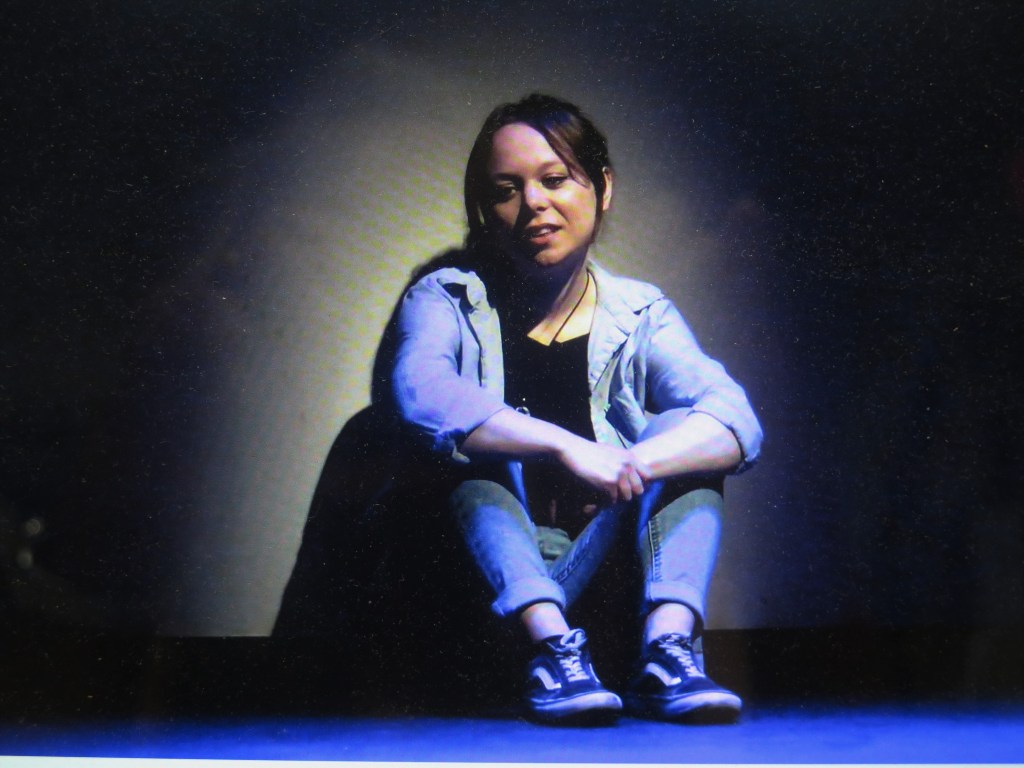
From her position at work, we note she is irascible and unapproachable. She doesn’t have any friends, nor does she have any hobbies or interests that she discusses. She essentially complains about her co-worker who clearly cares about her and with whom she might establish a relationship. She is uninterested and aloof. We consider is it him or her. As Sheila confides in us she slips information discussing that she can’t sleep at night. Perhaps, her irate attitude is because she hasn’t been home to Ireland in six years. Perhaps it is because she has not kept up with family after her mother died. Thus, we determine she grieves. Some people never end their grieving for a parent. No communication is easier than tears and longing for who will never retrun.
The turning point comes when she can’t sleep one night and someone shows up at the foot of her bed. Is this a dream? Is this reality? Is she hallucinating because she has gone insane? We follow along for the ride not wanting to believe that Sheila is psycho, though in some circles, she immediately would be given medication and confront her obviously deep-seated issues with group or individual psychotherapy. But this is different. Sheila is rational; her story, thus far, is logical and we accept that her former boyfriend at the foot of her bed is a ghost or has emerged out of her dream to stop ghosting her by ghosting her. The irony is humorous.
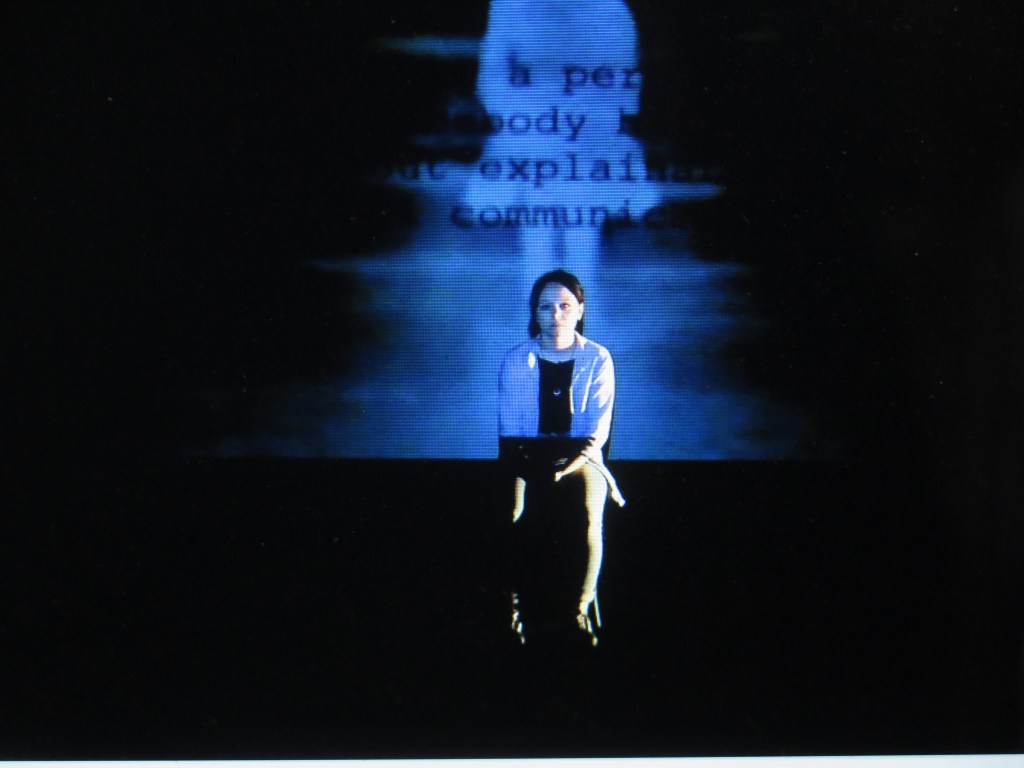
From there the twists and turns gyrate and we whirl along in Sheila’s adventure as she maneuvers a journey back to Ireland. What happens there becomes an examination of her admission that she has been the one ghosting. She’s ghosted her father, her family and friends there. Most importantly, she’s ghosted herself. She realizes she’s been living a non-living reality, not existing so that she deferred grappling with herself, her destiny and future. Does she make plans and enjoy the moments and breaths of her life? No. She has been a shadow person, beyond a state of hibernation. And the only way that she comes out of it is through someone else’s sacrifice and a supernatural visitation, an earthquake that shakes her unto herself to show her what she’s been doing.
When Sheila returns to Waterford, her hometown, she’s drawn home for an urgent reason (to her) via a text her sister sends her. She meets her sister in a bar but she vows not to see her father. Startling and embarrassing, emotional events occur. The miraculous visitations continue until she is brought to a reconciliation with herself and her family after she returns to her home in London.
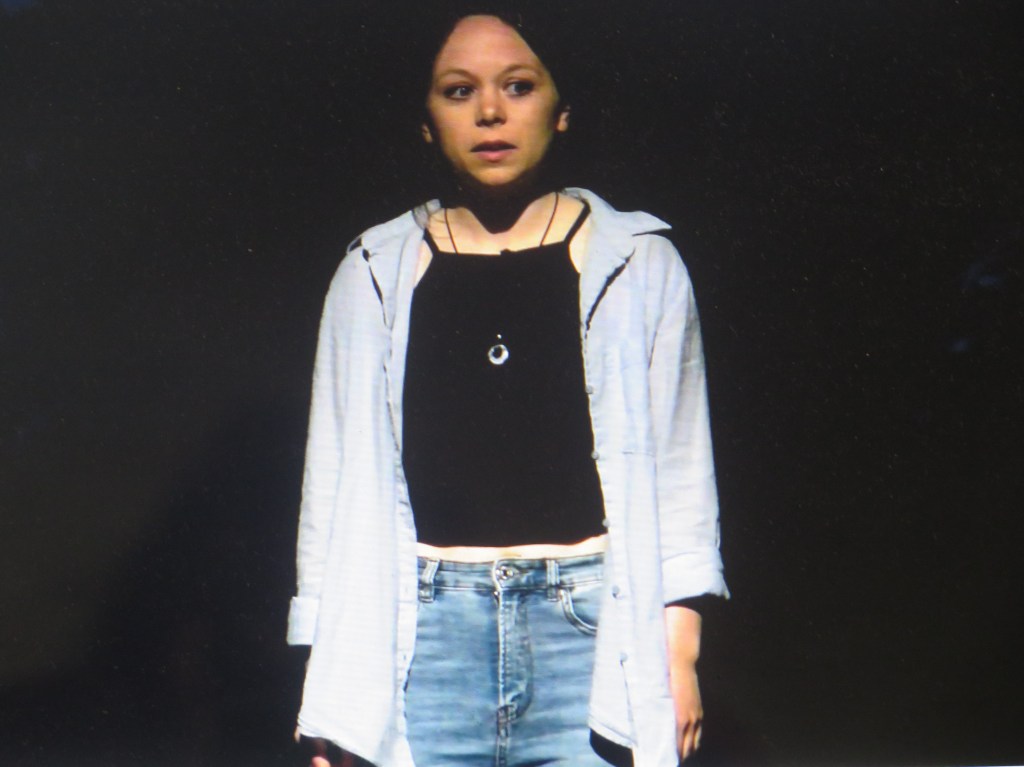
Beamish and O’Riordan’s writing has elements of the philosophical poetical. The direction of the visitation scenes is spot on. The scenes are powerful and remain atmospheric and suspenseful as we wonder, like the character of Sheila, where we are being taken. Importantly, the issues of why Sheila left Waterford, why Mark, her boyfriend ghosted her are eventually answered, though other mysteries are opquae.
The beauty of this work is the meld of the supernatural with reality; the sacred and the profane delivered through the lighting effects, projections and sound design (Beamish effected most of it with Dermot Quinn taking care of the lighting design). Vitally, it is O’Riordan’s authentic and finely hued performance which makes us believe and go along with her on this wild, exceptional journey. We remain curious and engaged with her as she touches the shadows of another consciousness which is hers, her boyfriend’s her father’s. Importantly, we are astounded at the human capacity for love despite misery and unredeemed emotional pain, and the ability to want to heal, even if it means stirring spirits from the other side to help us.,
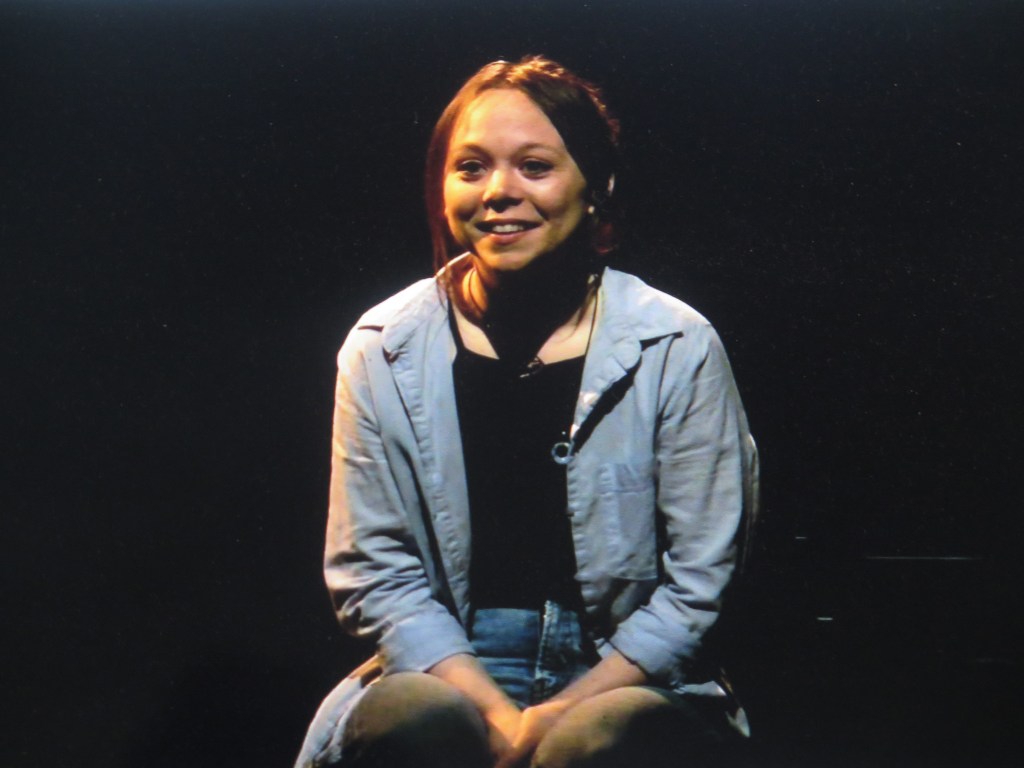
Ghosting reminds us with paramount intention that our actions have dualistic purposes that we may not understand, initially. But if we hang on long enough, the answers come and we can confront ourselves, evaluate and be gentle to our sensitive inner being which needs care. Sheila, by the conclusion of Ghosting resolves the emotional pain, though it will always be with her. However, the miraculous helps her look at it and stop ghosting herself, by making herself more present to accept actions which she once loathed about herself.
This is one you shouldn’t miss for O’Riordan’s performance which is memorable, for the production values and for the direction. Jamie Beamish directed the livestream. Aidan Kelly directed the original stage production. Ghosting streams until Sunday, 4 July unless they extend it. In order to make reservations go to Irish Repertory Theatre.
Check out the production and the 2021 seasonal offerings coming up. Theater in NYC is going live full blast in September. The Irish Repertory will be a part of that celebration. However, it’s appeal has now become global and most probably they will continue to stream performances during their season so if you are in Australia, New Zealand, Hong Kong and Ireland, you won’t miss out. Donations are always welcome . CLICK HERE for details in the pull down menu.
‘Mustard’ 2021 Origin 1st Irish Theatre Festival Solo Production

In the award winning solo production Mustard performed by Eva O’Conner and directed by Hildegard Ryan, the condiment of various shades of yellow and heat gains a new symbolism and significance. The award-winning comedy/drama, an offering of the 2021 Origin 1st Irish Theatre Festival online, is from Fishamble: The New Play Company based in Dublin. Mustard has been screening online in January because of the pandemic.
The Origin 1st Irish Theatre Festival is presented yearly. Because of the pandemic, this is the first year it has been streaming productions online, including a total of 20 events, with panels on various topics. One, for example, concerns producing during the pandemic.

Mustard originally premiered at the Edinburgh Fringe Festival in 2019, where it won the 2019 Lustrum Award, Edinburgh, and the 2019 Scotsman Fringe First Award. It was also nominated for the Scottish Mental Health Awards 2019. Eva O’Conner was last seen in the 2020 Origin 1st Irish Theatre Festival in Maz & Bricks. She is a superb performer whether in a two-hander or solo as in Mustard which she also wrote.
How O’Connor inhabits the the retelling of the story of the love possessed, lovelorn, hollowed-out character E is absolutely authentic and moment to moment mesmerizing. Her dynamic enactment of E’s relationship with a stunning, professional cyclist from London is both humorous and striking in its approach, as she develops the shades of difference between passion and obsession, between sexual addiction and love. All of this is accomplished in the name of the character’s yearning for a lasting relationship and a dollop of madness on the side.
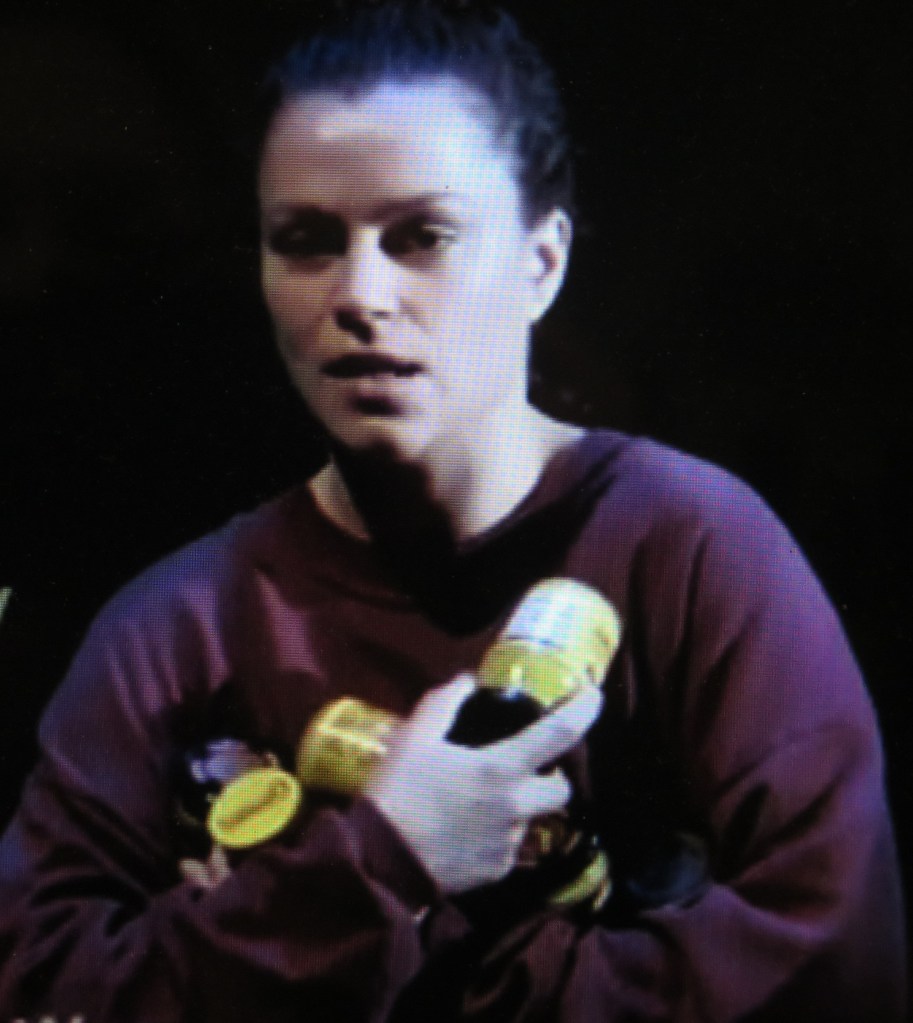
What E discovers about herself is her ability to maximize self-loathing. As she reflects back on the relationship, she encounters her stifling obsession for the cyclist who demeans her with a series of annihilating events. The humiliation and embarrassment of her dead-on emotional suffocation and idolatry of him as her “love” object consumes her. And, it renders her immobile in an acute depression which she endures by returning home to mom. Vying between want and repulsion because she allowed the cyclist (a Brit) to redefine her being, she realizes she crafted this eternal fire of “love” for him into a weapon of emotional self-destruction.
Her only release is “mustard.” How she employs the condiment to salve her soul, psyche and physical yearning becomes an active segment of E’s account. We watch fascinated as she sets the stage for the moment of maximum catharsis and pain, curious about how all of the various props she has brought with her, a bucket, a clothesline, etc. figure into the context of her explaining the “love” affair with this “guy” whom she’s lived with for almost a year.

O’Connor performs the characters of E, her evangelical mother and her English sometime lover with personality and spot-on revelation. Her relationship with her mother is humorously delivered with Irish accent and gesturing. Her adoration of the cyclist and her final answer to his effrontery, slaughtering her soul, is disclosed in heady wonder. Over all, O’Connor’s dialogue, descriptions, infusions of rhythmic language and unique interplay of the characters is beautiful, lush, unique and thrilling. For anyone who has experienced a similar stripping down to raw nerve by a “love interest,” this is a must see. O’Connor and her character’s emotionally mad ride are unforgettable.
After twenty minutes of viewing, it is obvious why O’Connor won awards for her play, incisively and excellently directed by Hildegard Ryan. Once again Fishamble: The New Play Company proves itself to be on the cutting edge of drama and comedy that is significant, as it expresses the depths of human emotion and feeling with dramatic ardor and vitality.
You can still see the last week of the 2021 Origin 1st Irish Theatre Festival by going to their website to view the calendar of events; these end on January 31st. For tickets to plays and the calendar of events CLICK HERE. For tickets to Mustard whose last performances are on Wednesday, 27th January at 8 pm and Sunday, 31st of January at 2 pm, click on this link. CLICK HERE for MUSTARD. You’ll be glad you did.
‘Meet Me in St. Louis’: Irish Repertory Theatre’s Spectacular Holiday Show

Irish Repertory Theatre continually proves that it can do the extraordinary with skill, talent and enthusiasm, as it mesmerizes and endears its members, donors and global audience with exceptional productions. This is particularly amazing during a time when New York City theater is staying safe and waiting until the blessings of the COVID-19 vaccines mitigate the dangers of the pandemic which to date has killed 330,000 Americans.
Thus, we welcome being cheered up for the holiday season. And what better way than to peer into past reflections of hope when The Louisiana Purchase Exposition, unofficially the 1904 St. Louis World’s Fair, commemorated the 100th year of the Louisiana Purchase. The Fair, the last great international exposition before World War I, was an extravaganza that included hundreds of thousands of people, animals, unique items and displays. It magnified the bright future of industry and innovation from 63 exhibiting countries and 43 of the 45 United States.

Excitement about the St. Louis Fair, which is the central image highlighted in the titular song of the musical Meet Me in St. Louis, drives the beginning and finale of the Irish Rep production. The book by Hugh Wheeler and songs by Hugh Martin and Ralph Blane are based on the Kensington Stories by Sally Benson and the 1944 MGM Motion Picture Meet Me in St Louis. Adapted and directed by Charlotte Moore with musical direction by John Bell, orchestrations by Josh Clayton and produced by Ciarán Reilly, this Holiday Special in Song and Screen can be appreciated again and again, whether with family or individually. You will never tire of the show because it is that wonderful.

The production values are sophisticated and spot-on. The orchestra’s superb technique performed seamlessly on zoom (thanks to the wizardry of musicians, Bell, M. Florian Staab and others) perfectly blends with the gorgeous voices of the cast, a tricky technical feat, especially with the ensemble numbers. The tuneful and lighthearted, upbeat songs (Trolley Song,” “Meet Me in St. Louis,” “Drunk Song,” “Touch of the Irish”) and in other instances poignant, familiar numbers (“The Boy Next Door”) are a pleasant remembrance, if you have seen the MGM film and the 1989 Broadway version which starred Charlotte Moore as Anne Smith.

Some of the songs in the Broadway version have been cut, a wise choice for a streaming production you watch via your tablet, phone or computer. But one song that had been cut from the 1989 Broadway show was added in the Irish Rep version (“You’ll Hear a Bell”). This song, reprised in the second act, is beautifully rendered by the golden-throated, imminently watchable Melissa Errico the mother. Anne Smith encourages her daughter Esther (Shereen Ahmed) about understanding and recognizing love based on her own experience with her husband, Alonzo Smith, Esther’s father.
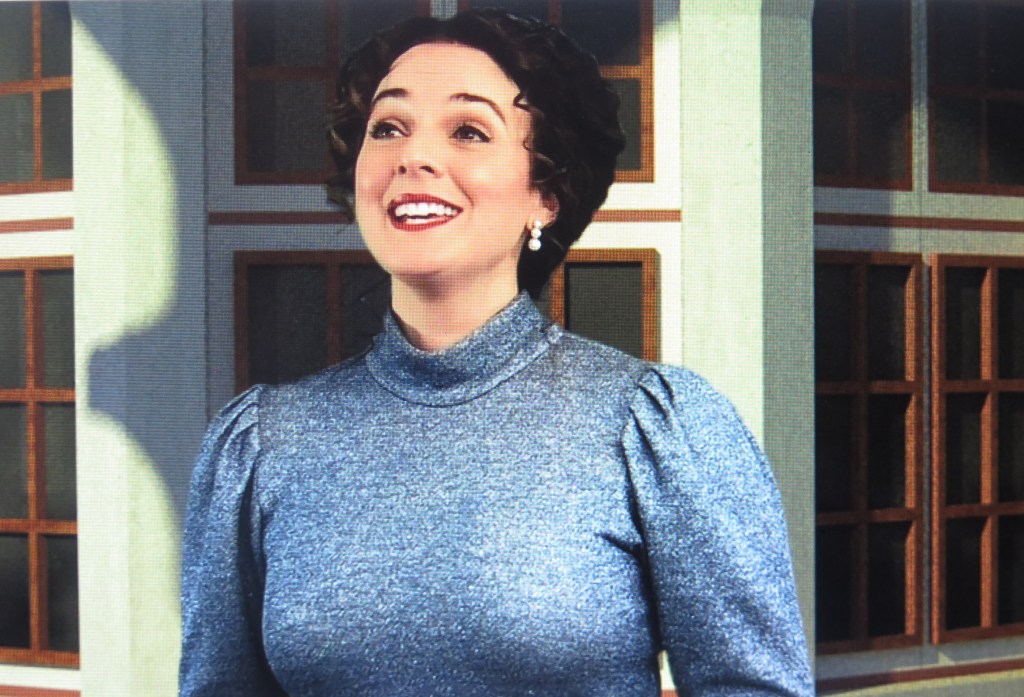
Charlotte Moore shepherds the cast with precision. She astutely teases out winning performances and humor from Kylie Kuioka (Tootie) who is a fireball of joy and mischievousness, the perfect foil for the sedate, companionable, near-in-age, wry, older sister Agnes (Austyn Johnson). The marriageable sisters, Rose (the vibrant Ali Ewoldt) and linchpin of the production, Esther (the soulful, exciting Shereen Ahmed) propel the plot development. Theirs is newfound love with their prospective partners the reserved Warren Sheffield (Ian Holcomb in a fine portrayal) and the “boy next door” John Truitt (the affable, illimitable Max Von Essen).
As Esther expresses good will toward the family which is sorrowful about moving, she poignantly sings the profound (“Have Yourself a Merry Little Christmas”) which is nostaligic under any circumstances and particularly heartbreaking under present circumstances of the pandemic. Shereen Ahmed’s Esther is particularly well wrought with her lyrical vocal instrument and authenticity of portrayal in the lead that Judy Garland played on film.

With the couples’ togetherness thrown down by Alonzo Smith’s moving the family to New York to make more money and raise their standard of living, we note this makes sense if seen through modern values that lift wealth and money above well being and happiness. However, Father Smith (Rufus Collins does a fine job in the concluding scene) in a throwback to old-fashioned values and economies of the past (only Dads worked) chooses to please his family by remaining in St. Louis. It is a gift that all adore beyond treasure and we yearn for in a culture that over the last two decades has been on the brink of losing its fundamental values of the preciousness of life, love and family.
William Bellamy, Kerry Conte, Kathy Fitzgerald, Jay Aubrey Jones and Ashley Robinson round out the cast of this marvelous production which was produced remotely with the dexterous application of green screens and lovely backdrops. In its technique, applied imagination and sheer audacity, the production, not streamed live from a stage, is a book musical with actors separate, home alone. filming, which has never having been done before. This was a realization which John Bell musical director affirmed to Melissa Errico who quipped in her New York Times article that Meet Me in St. Louis was a show where no one actually would meet in St. Louis or anywhere else. Read Melissa Errico’s account here.
Great praise goes to the cast, the creative team and director Charlotte Moore for this Christmas treasure. The Irish Repertory Theatre has exercised their vitality and prodigious cleverness to provide this most American of celebratory entertainments at a time when we crave affirmations of friendship, love, family, togetherness and joy present in the show’s themes. This is one you must not miss.
Irish Repertory Theatre’s Meet Me in St. Louis runs until Saturday, 2nd January. For tickets and times go to the Irish Repertory Theatre’s website. Click Here.
‘A Touch of the Poet’ The Irish Repertory Theatre’s Superb Revival of Eugene O’Neill’s Revelation of Class in America

The Irish Repertory Theatre’s activity during the COVID-19 pandemic is nothing short of award-winning. They have remained stalwart in presenting streaming live productions, filmed productions and filmed productions online by actors who have done their work solo from their own homes, which afterward are seamlessly brought together by creative technicians.
The latter phenomenon is perhaps the finest example of the tremendous effort the Irish Rep is ready to perform keeping in mind their unction to do no harm to actors, technicians and audience members during this incredibly dangerous time, where if you peruse statistics on Worldometer, the death toll in the U.S. marches toward the numbers of dead during four years of our involvement in WWII. Considering that the COVID atrocities have occurred over a 9 month period under the abdicated watch and depraved indifference of Donald J. Trump and the sleepwalking GOP, the death toll is staggering and egregious.
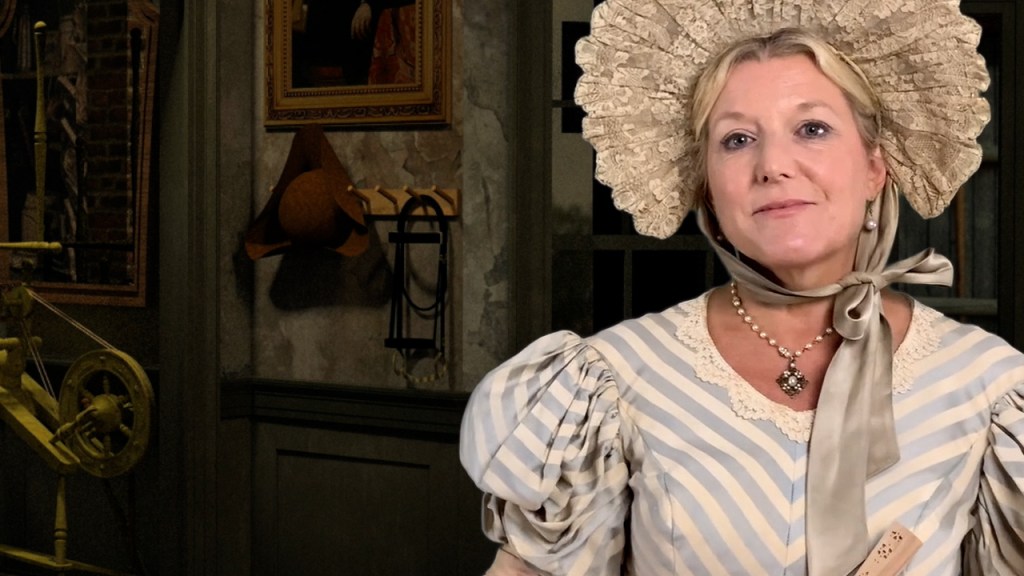
Thus, global watchers of Irish Repertory Theatre which hail from Australia to Ireland and all parts of the United States, are so grateful for the opportunities that engaged and talented actors and the Irish Rep’s creative team provide. As they unleash their talent and passion to create wonderful artistic performances, the productions help sustain us through this unprecedented crisis in our lives.
In their latest offering Eugene O’Neill’s A Touch of the Poet, the Irish Rep used the magnificent set they had created that was ready for production when the pandemic hit and New York was put on pause. With painstaking coordination, director Ciarán O’Reilly, the actors, technicians and artistic team configured a maverick presentation that launches the Irish Rep into new territory and reveals to other theater companies a way to deal with the vicissitudes of social distancing in performance. Each of the actors filmed their portrayals solo with attention to the staging of their actor/character counterparts.

The result is gobsmacking and actors’ performances are treasures. How they accomplished this feat of interaction keeping it dynamic and vital is beyond entertainment. The production of A Touch of the Poet is a profound recognition that with genius and collaboration, the breathtaking can result. And their collaboration elevates what many consider to be one of O’Neill’s more mediocre plays to one of illustrious depth.
This revival elucidates that in O’Neill’s work there is much that is parallel to our time as we follow the misfortunes and revelations of the humanity of the Melody family. In themes and characterizations we identify with the expose of Con Melody’s self-betrayal. Striking is his wanton self-abuse and the abuse of his wife and daughter as he pursues fantasies that no longer support the vitality of their lives and, in fact, hinder their appreciation of who they are and what they might be.
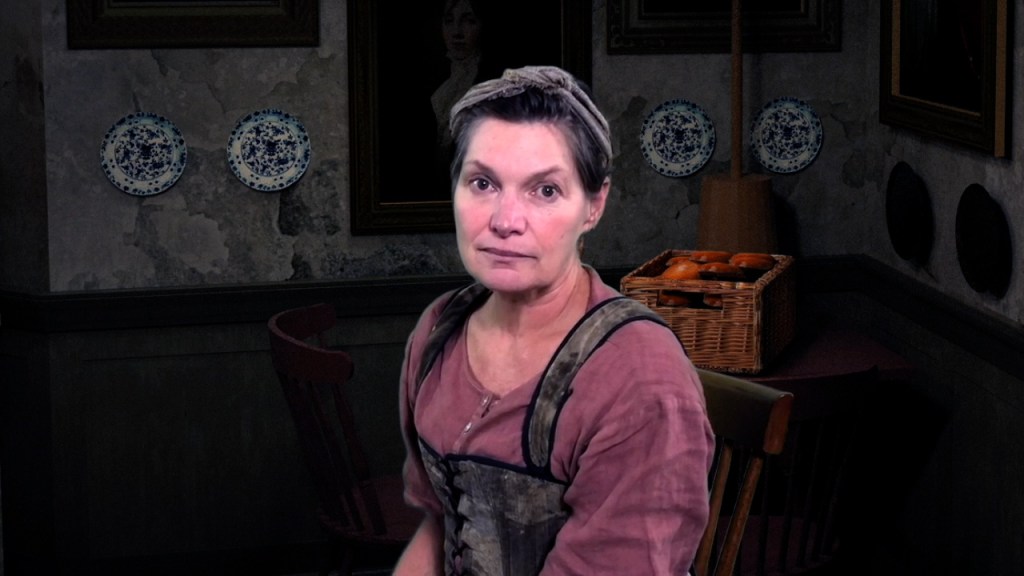
O’Neill sets his drama in Boston around 1828. The Melody family headed up by the alcoholic, self-destructive fantasist “Con” Melody (exquisitely portrayed by Robert Cuccioli) runs a ramshackle Inn with attached bar. Along with “Con,” are Sara (Belle Aykroyd) the stunning, truth-telling, rebellious foil to her father and Nora ( Kate Forbes) his pliant, subservient, fawning wife. The four live hand to mouth because Con abides in his glory days when he was a fiery and intrepid Major in the Dragoons, serving under the eventually exalted Duke of Wellington.
At the outset of the play, Jamie Cregan (Andy Murray gives a fine performance of Melody’s soldier underling and partner in brawling) provides the backstory of Con’s inner and outer conflict that Con has been unable to confront his entire life. Jamie explains how Con is an erstwhile gentleman with roots from the Irish peasant class that his father struggled to escape from. The father eventually advances himself and carves out an inheritance for Melody who is lifted into the airs of landed gentry and rises to a position of power in the British military.
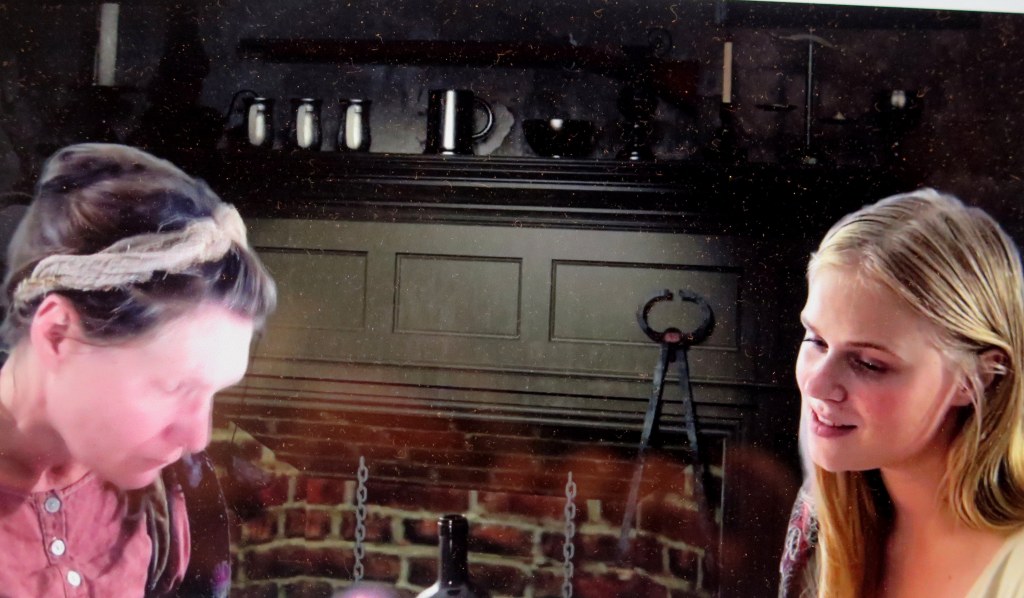
When Con’s philandering, drinking ways cause him to be sanctioned and ejected from his position as Major, Melody flees to the United States with Nora where they purchase the Inn and raise Sara. Swindled by a Yankee, who lies about the value and prosperity of the Inn, they barely scrape out an existence which is further impoverished by Con’s alcoholism and his inability to make his way in the United States.
Con’s relationship to Nora and Sara varies from drunken rages when he belittles and demeans both to guilty apologies and attempts to make amends with blandishments. Cuccioli balances the drunken bouts and insults with hasty apology that is both humorous and heartfelt. Through his spot-on portrayal we understand the impossibility of Con’s self-hatred and his attempt to escape both his alcoholism and his menial position in the new world as classism and discrimination drive him deeper into self-loathing. Cuccioli is particularly illuminating when he entertains the magical persona of “The Major.” As he affirms his exalted personage in a conveniently placed mirror, quoting Lord Byron, he imagines his long-lost greatness and gentility are still within.
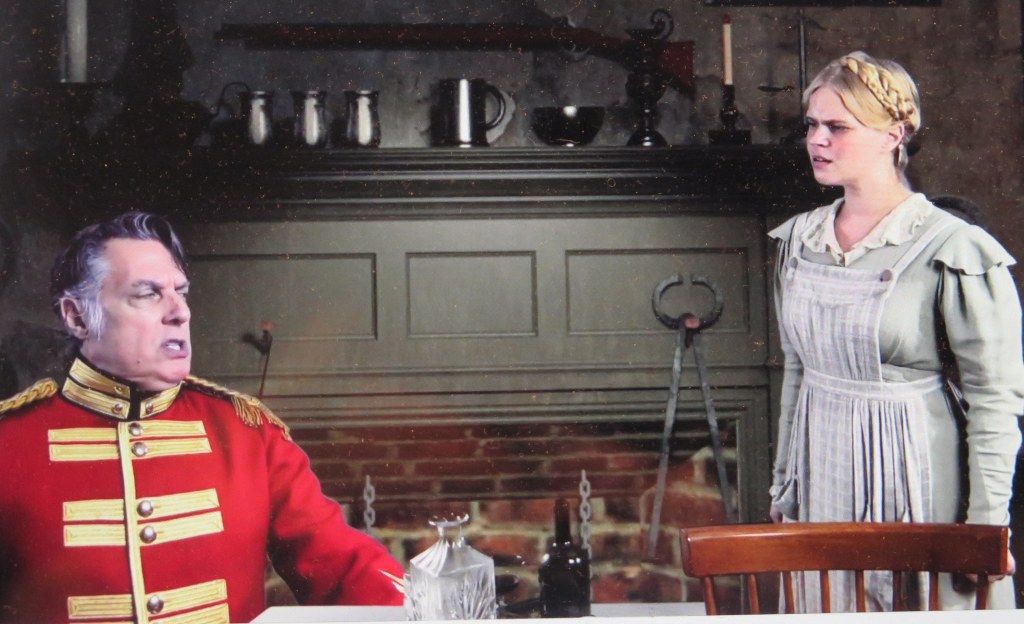
Indeed, Cuccioli’s stance, mien, presence convince us that he was once an individual of great deeds and valor and has fallen on hard times but will remain unbroken and unbowed. Nora adores him for she has “won” this dignitary’s love and that raises her own identity and self-esteem. Kate Forbes is just incredible as she mediates Nora’s self-recriminations, with her subservience to Con as she waits on his every whim. She never reproaches him for his abusiveness, indeed, she accepts his cruelties and disdain as worthy of her low station.
Cuccioli and Forbes relay powerful portrayals of these two individuals as they complete the dance of superior to menial externally which becomes the reverse when we see that Con needs to believe he is genteel and honorable, the stiff-upper-lipped gentleman of quality. However, ultimately, Nora dominates; Nora obliges and encourages him to fulfill her own assumptions about his love, as he lowers himself to rages and miscreant behavior.

Belle Aykroyd’s Sara who challenges Con’s treatment of Nora adds spark and fire to the dynamic of the family. She is the flint that ignites Con and inflames his drunken rages. She fills out the charged, family interplay with an amazing performance of irony and savagery. An instance of this occurs when Sara mocks Con’s puffery and “superiority” by putting on an Irish brogue and acting the menial. Apparently, Con has attempted to teach both Nora and Sara the finer ways, but Nora is unwittingly inflexible and Sara, who “knows better” enjoys defying her father at every turn.
Sara stirs the cauldron of infamy when she entices the guest of a wealthy land-owner to fall in love while she nurses him to health. Through her pursuit of him we learn of Nora’s own desires of greatness realized through her love of Con which becomes the similar road that Sara travels down. To raise her self-esteem in her own eyes and self-love, she becomes sexually involved with Simon Hartford (a blasphemy at the time) despite the threat of his mother Deborah Hartford’s (Mary McCann) disapproval. Deborah Hartford will make sure their relationship is doomed because of their class and economic differences.
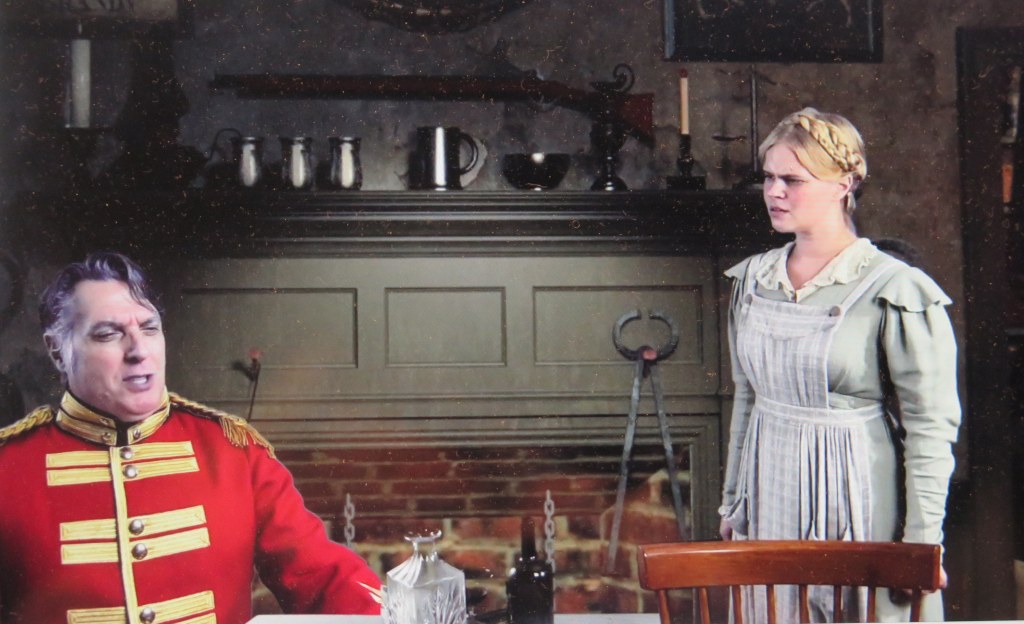
In the climax of the play which skirts the edges of physical confrontation, the actors seamlessly convey the action, considering each filmed his/her performance in their own homes. Thanks to the precise staging, it works when Con slaps Sara, when he caresses his wife at the conclusion with a new-found reverence of her patience and concern for him, and when he is physically bold in his attempts to kiss Deborah Hartford. Mary McCann’s staid and well-born Deborah Hartford is the perfect inducement for Con to entrap himself in one more perfidious and humiliating debasement.
From this juncture onward, we anticipate Con’s complete obliteration and the hope of a renewal. O’Neill satisfies; his ironic twists and Con’s ultimate affirmation of the foundations of his soul is as uplifting as it is cathartic. Now, his wife and daughter will have to adjust to this new day and redefine their expectations of their lives. Sara has already begun but the road she has chosen, like her mother’s is hard and treacherous with only her estimation of love to propel her onward.
Kudos to all the actors who negotiated the new medium of filmed staging on film and made it real. Likewise, kudos to the director who shepherded them through with extraordinary results. Last but not least are Alejo Vietti (costume design) Michael Gottlieb (lighting design) M. Florian Staab (sound design and mix) Ryan Rumery (original music) Sarah Nichols (video editor) April Anne Kline production coordinator.
This sensational collaboration magnifies the themes so you can greater appreciate O’Neill’s play of revelation and redemption through confronting one’s own shibboleths and destroying them. The revival shines a refreshing light on A Touch of the Poet and burnishes it with a new glory.
This is a production you must not miss. After this evening’s performance at 8 pm there are three more performances, two Saturday 31 October, and one performance on 1 November at 3 pm. For tickets to the online performances go to the listed site .https://web.ovationtix.com/trs/cal/32325?_ga=2.134261553.1367444511.160409768
‘Mirrors’ by Azure D. Osborne-Lee at NEXT DOOR @NYTW
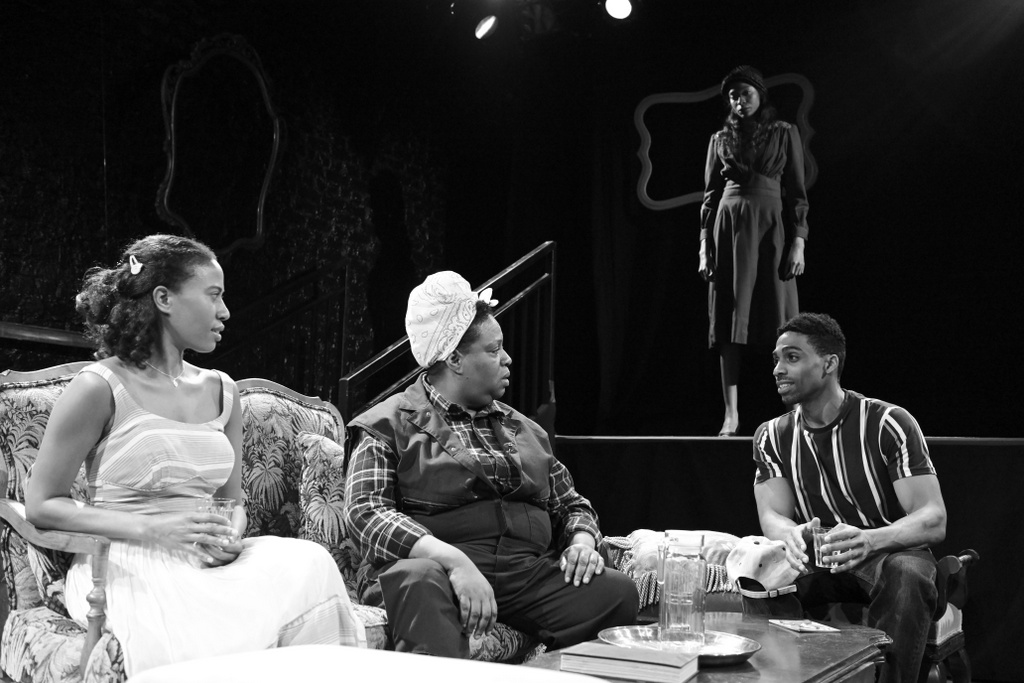
(L to R): Joyia D. Bradley, Suzanne Darrell, Kayland Jordan, Anthony Goss, in ‘Mirrors,’ by Azure D. Osborne-Lee, directed by Ludovica Villar-Hauser (John Quilty)
Mirrors, the superb play by Azure D. Osborne-Lee, seminally directed by Ludovica Villar-Hauser is currently at NEXT DOOR @NYTW. In the production Osborne-Lee examines how painful reflections that mirror hidden events from our past often pour out from our souls to impact our current lives. Though the events may be buried deep in our unconscious, they are ever-present to haunt us. However, if fate and truth have their way and we are open and flexible, these reflections of past events force themselves into a resolution. The truth that we may have feared, when confronted unfolds like a flower to encourage us to redeem our dark guilt and work toward achieving peace and contentment.
Azure D. Osborne-Lee weaves a profound tale of sorrow, memory and haunting in which the protagonist Bird Wilson (Suzanne Darrell in a wonderful performance) confronts what she views as a tragedy of her identity that she never really accepts until she reveals the truth to another. When she does this, ultimately she is able to free herself.
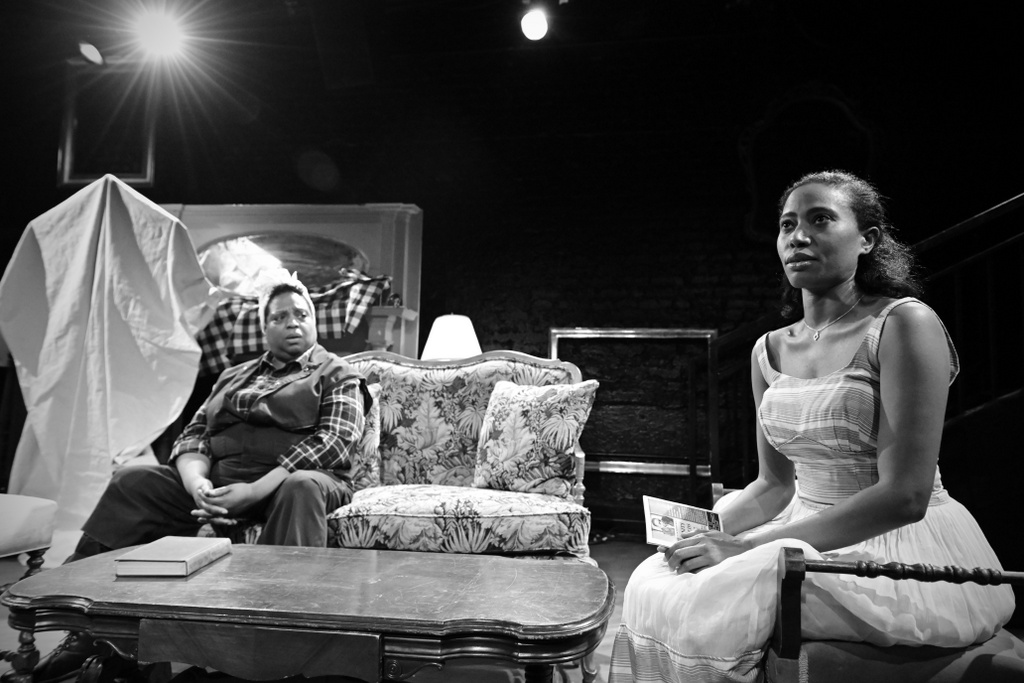
(L to R): SuzanneDarrell, Ashley Noel Jones in ‘Mirrors,’ by Azure D. Osborne-Lee, directed by Ludovica Villar-Hauser (John Quilty)
The play moves seamlessly from the present where we discover there has been a death, to the past that unravels the story of Bird’s love relationship with Belle. Throughout the arc of development, the play fuses both the past and the present and moves between the two worlds through flashbacks and flashforwards. And there is also the “other world” where resides the ghost that haunts Bird and eventually influences her to face a truth she has been suppressing. Only when Bird confronts the truth is the ghost allowed to return to a place of peace which Bird, too, achieves.
Because the play takes place in the sleepy town of Etheridge, Mississippi, in the summer of 1960, we note that this is the racist, Jim Crow South, where voting rights had not been established for individuals like the three African-American women. There, they are “separate but equal” in an “equality that is not only discriminatory, but is outright abusive. Despite this, in their strength and wisdom, they end up understanding each other in a fullness never achieved before by the conclusion of the play.
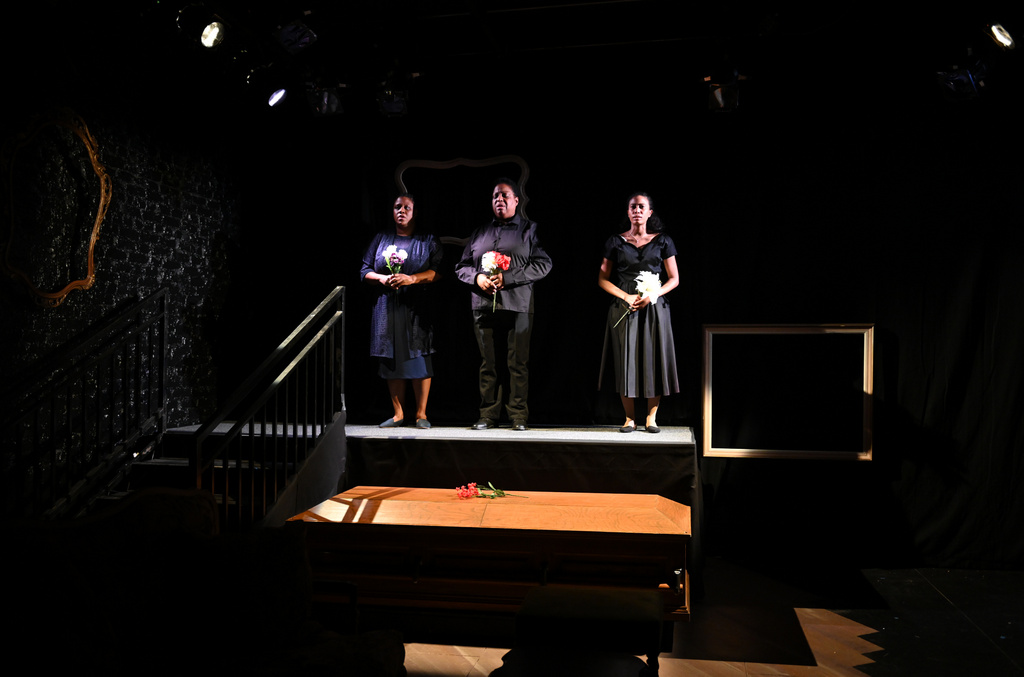
(L to R): Joyia D. Bradley, Suzanne Darrell, Ashley Noel Jones, in Mirrors, by Azure D. Osborne-Lee, directed by Ludovica Villar-Hauser, Next Door @NYTW (John Quilty)
Not only were black women second-class citizens, at that time, they were expected to fit in to the rigid gender roles, and the mores of the African American culture. For the individual who does not fit in, they are discriminated against and treated as an outcast. This is particularly unjust for a woman of color to be rejected not only by the white race, but by African Americans as well.
For Bird Wilson, a gay woman who lives in her own house and works to support herself, to be like other black women is an impossibility. Rather than to attempt to slide into a world which is contrary to her choice of sexuality, she carves out a place for herself and adapts friendships and relationships to cohere to her life’s decisions. For example we discover that she enjoyed a deep, loving relationship with Belle. However, events happened that caused a separation. When Belle dies, Bird must take in Belle’s daughter and give her a home as well as attend to the funeral arrangements and wake which takes place in Bird’s home.
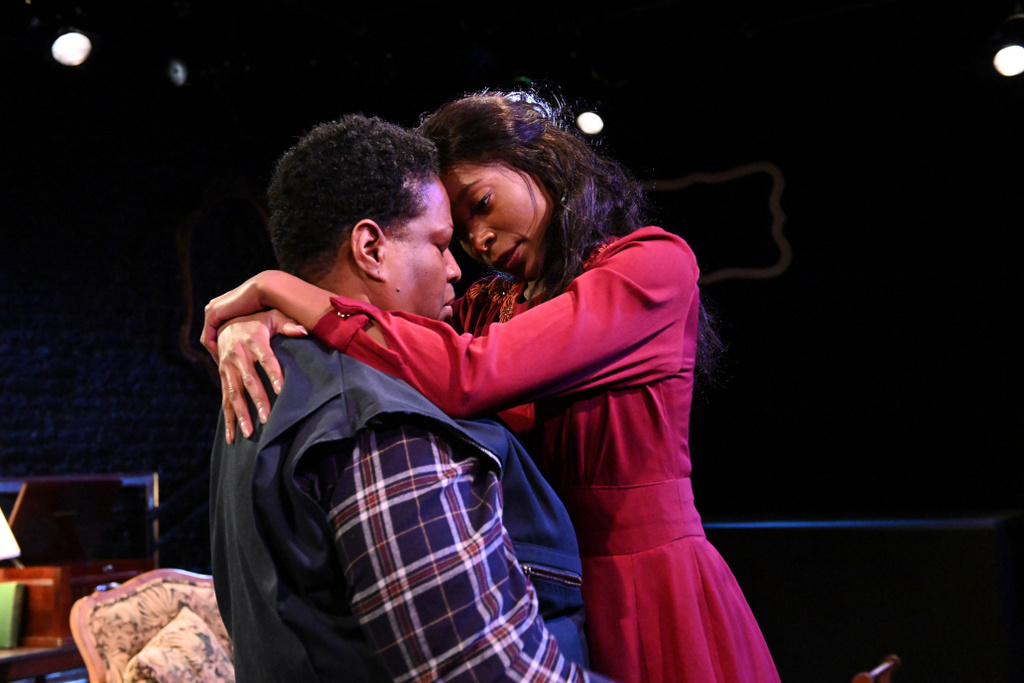
(L to R): Suzanne Darrell, Kayland Jordan, in ‘Mirrors,’ by Azure D. Osborne-Lee, directed by Ludovica Villar-Hauser, Next Door @NYTW (John Quilty)
Osborne-Lee delineates Bird as a strong, vital and energetic woman who is willing to take in Alma Jean, Belle’s daughter and give her a home through this difficult period of time that Alma Jean is mourning her mother. Initially, we surmise that though Bird and Belle had been estranged after Alma Jean was born, in the goodness of Bird’s heart, she buries the painful past so that she might give Alma Jean the security and comfort she needs to overcome this chaotic time without her mother. However, theirs is no easy relationship. And Bird is unsettled, uncomfortable and upset with Alma Jean’s presence in the house which also elicits the spirit of Belle, who haunts Bird and watches her daughter’s interactions with her.
Ashley Noel Jones and Suzanne Darrell create an appropriate tension and division between the two women. And gradually we understand that Bird sees Alma Jean as a mirrored reflection of her mother Belle in her wildness, wanting to be available to her boyfriend Ray (Anthony Goss).
The symbolism of the mirror has a number of interpretations. Bird tells Alma Jean that the large mirror in Bird’s living room is one that Belle loved to preen in front of. Bird has covered it up as a part of the folklore of death and burial to allow Belle to pass to the other world. Later, it is this same mirror that Alma Jean breaks which stresses out Bird because she fears that Belle will not be able to achieve peace in the afterlife and thus, neither will Bird. So the mirror represents the soul’s reflections of events on earth which must be covered over so the spirit can understand it must go to the afterlife.
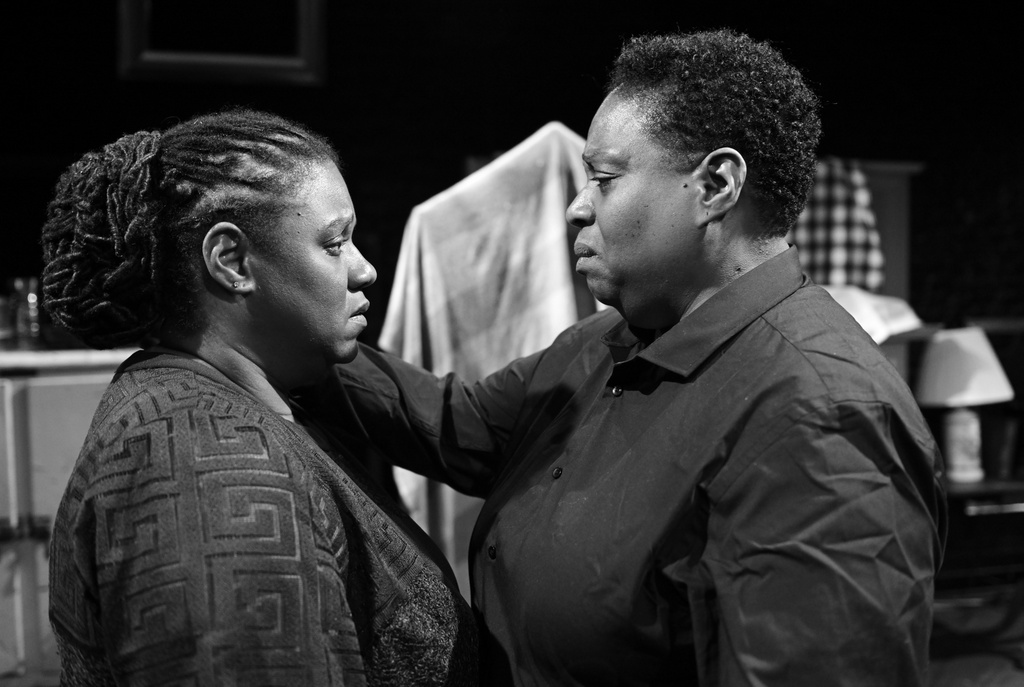
(L to R): Joyia D. Bradley, Suzanne Darrell, in ‘Mirrors, by Azure D. Osborne-Lee, directed by Ludovica Villar-Hauser, Next Door @NYTW (John Quilty)
The mirror also represents that which reflects the truth and identity of the characters. Bird appears to believe that Alma Jean is a reflection of Belle with regard to men. Just as Belle solicited the attentions of men which upset Bird, so does Alma solicit the attention of the undeserving Ray. After meeting Ray, Bird is convinced that he is “playing” Alma Jean for a fool and she attempts to chide her into understanding Ray isn’t someone trustworthy to see Alma Jean as valuable. However, by the conclusion of the play, we understand that the reflection Bird sees in Alma Jean is something else entirely.
The mirror is only a reflection. It is not the substance of the truth. Cleverly, the symbol becomes a metaphor for something deeper. And only through Bird’s loving relationship with Louise (the marvelous Joyia D. Bradley) is Bird able to reconcile the substance of her life with Belle and the truth of her relationship with the resistant Alma Jean.
This is a dynamic and powerful production made all the more incredible and poignant by the performances of Suzanne Darrell and Joyia D. Bradley. Both actors wonderfully convey the love in Bird’s and Louise’s relationship. They infuse the caring closeness and unity between these two women who must walk the line of respectability carefully. Their expressions of love at the conclusion of the play are spot-on touching and authentic.
Ashley Noel Jones’ Alma Jean is troubled, annoyed and then accepting at the moment of Bird’s revelation. Her performance, well shepherded by Villar-Hauser is heightened by Osborne-Lee’s precise and detailed dialogue which Ashley Noel Jones infuses with emotional grist that parallels Belle’s. Thus, we see the connections between Belle and Alma Jean and how/why their behavior sets off Bird.

(L to R): Natalie Jacobs, AnJu Hyppolite, Joyia D. Bradley, Kayland Jordan, in ‘Mirrors,; by Azure D. Osborne-Lee, directed by Ludovica Villar-Hauser, Next Door@NYTW (John Quilty)
In spanning the worlds of memory, the spirit realm and reality in the flashbacks to Bird’s and Belle’s relationship in the past, Kayland Jordan as Belle manages to be serenely charismatic, lovely and stately. She is believable in her haunting presence, always watching and ” in the moment.” Her performance effects the mood of the play and conveys elements of magical realism with surreality. When Bird and Belle dance together, the moment is loving and we understand their closeness and why Belle responds to Bird in her extreme time of need.
Natalie Jacobs as Constance Jenkins and AnJu Hyppolite as Mabel round out the townsfolk as the town gossips and church busy-bodies. In such a community, they reinforce the strength and power of Bird’s character to live in her own identity in a town that is petty, judgmental and self-righteous.
Villar-Hauser’s vision of the Osborne-Lee’s play is one which is delivered with power and poignancy by her collaboration with the excellent actors and fine creative team. Kudos to Jamie Nicole Larson for her spot-on, specific and functional set design and Sabrina Bianca Guillaume for her wonderful, detailed costume design. Rounding out the team are Miriam Nilofa Crowe for lighting design and Twi McCallum for sound design. The latter designers really worked beautifully with the choral music in setting the somber tone. The selection of music and the singing was atmospheric and exceptional thanks to Ashley Noel Jones as music director.
This is one you should not miss. It runs with one intermission at New Door @NYTW on 83 East 4th Street until 22nd March. For tickets and times CLICK HERE.
‘Incantata’ by Paul Muldoon, Starring The Masterful Stanley Townsend at The Irish Rep
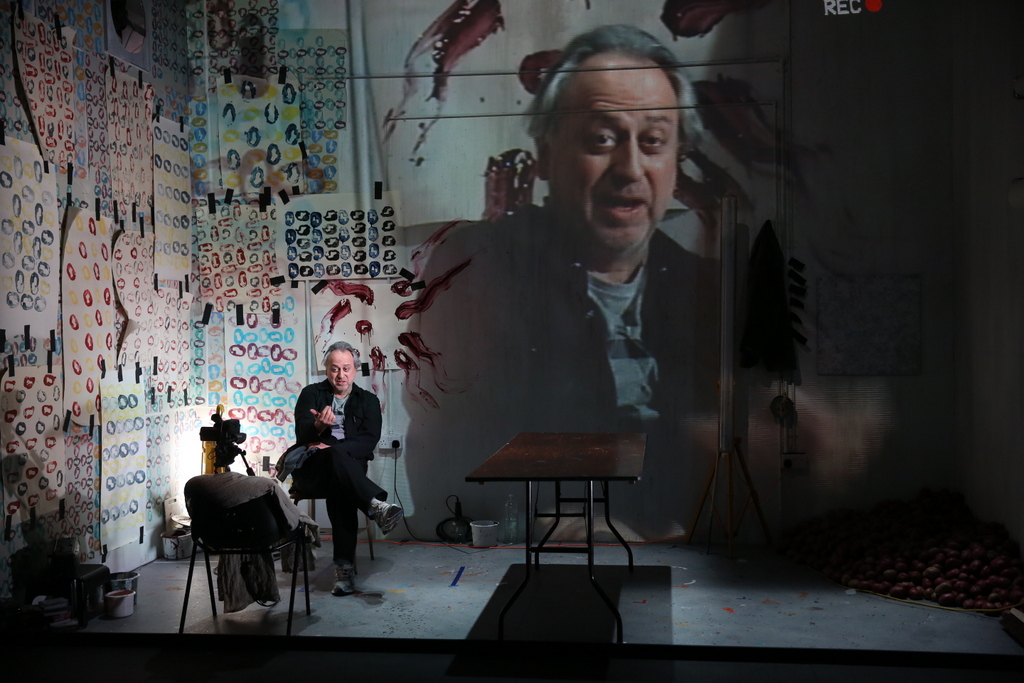
Stanley Townsend in ‘Incantata’ by Paul Muldoon, directed by Sam Yates in its U.S. premiere at the Irish Repertory Theatre (Carol Rosegg).
Incantata by Paul Muldoon is an encomium, a memorial to American artist Mary Farl Powers, Muldoon’s one-time partner and forever friend who resides somewhere in the memories of his imagination. Written in verse that is rhythmic, reminiscent of the stanzaic form popularized by W.B. Yeats, Incantata, currently at the Irish Repertory Theatre until 15 March, has been fashioned by director Sam Yates and actor Stanley Townsend into a staged production that dramatizes the speaker’s lament, remembrance and praise of his former lover.
Muldoon’s forty-five stanza poem is a “quiet” elegy turned on its head; the speaker known as “The Man,” rages and rants, pivots and emotes poignance and sorrow that Powers did nothing to stem her lifeblood draining away, gnawed by breast cancer which caused her untimely death. For indeed, in her perspective it was “pre-determined.” The Man doesn’t detail the specifics of why she thought this, only that she believed that the cancer might be treatable with alternative therapies. For her, these treatments did not work. Indeed, her death was determined by her own hand by not going for mainstream medical treatment which The Man believes could have saved her.

Stanley Townsend in ‘Incantata’ by Paul Muldoon, directed by Sam Yates, in its U.S. premiere at Irish Repertory Theatre (Carol Rosegg).
To bring Muldoon’s fervid poetry into a staged monologue, director Sam Yates shepherds Stanley Townsend with actions that appear to be organic and intrinsic to Powers. She was essentially a print artist who also worked in cast paper and paper sculpture. She mentored other artists (non printmakers) to bring their work into the mediums of etching and lithography. She helped to found the Graphic Studio.
Before The Man-Muldoon’s poetic speaker (Stanley Townsend) takes the stage, we note an artist’s studio where his/her works hang, prints cascading down in repeated patters of various colors. Until The Man picks up a potato and carves it out and employs it to create his colorful artistic patterns, we do not realize that the massive pile of red-skinned potatoes on the far corner of the studio opposite the artist’s wall of work has anything to do with creating the prints which hang there.
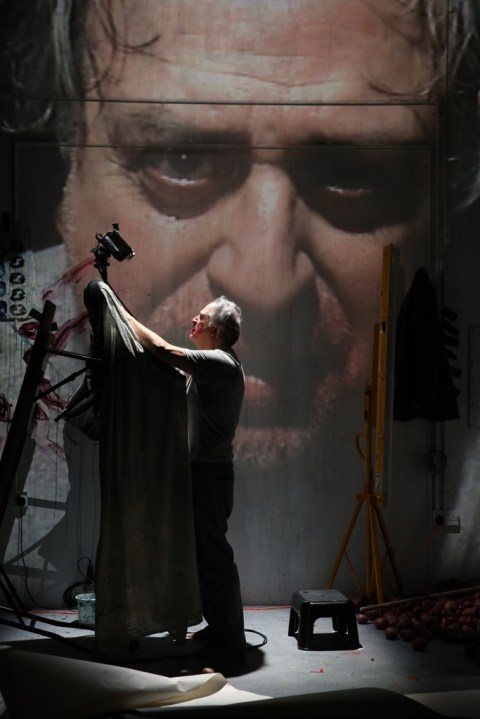
Stanley Townsend in ‘Incantata’ by Paul Muldoon, directed by Sam Yates, in its U.S. premiere a Irish Repertory Theatre (Carol Rosegg).
Through Townsend’s felt authenticity and live, on-stage printmaking, Yates staging, and the use of live camera projections which focus on “The Man,” or becomes a stand-in for an objective Powers who bestows her criticism, always there is a florid pouring out of raw emotion. In his soul grief, love, and too many emotions to categorize because they are not neatly rendered or subdued by logic, we gauge the impact of Powers on The Man’s life. Townsend’s and Yates’ collaboration yields an intriguing, enthralling and ever-present, moment-to-moment happening that is emotional art and equivalent to myth-making.
To symbolize Powers’ artistic endeavors and the nature of art’s power to heal and effect the transference of love, Townsend’s The Man actively creates prints using a potato cut, instead of a woodcut. He produces a multicolored series of duplications of form comprising prints from each show. First, the potato’s use is fascinating. It is also referenced in the poem: a “potato-mouth,” that “mouth as prim and proper as it’s full of self-opprobrium.” This reference moves in a refrain to references of the lazy, indolent character Belacqua in Dante’s Inferno and by extension to Samuel Beckett’s stories employing the character Belacqua. The Man, Muldoon’s speaker “crouches” with Belacqua, and then in an extrapolation to Beckett’s Pozzo and Lucky of Waiting for Godot attempts to discern what is, in fact, unknowable.

Stanley Townsend in ‘Incantata’ by Paul Muldoon, directed by Sam Yates, in its U.S. premiere at Irish Repertory Theatre (Carol Rosegg).
Such are the characteristics of Townsend’s “Man” who attempts to reason with himself about Powers’ fateful decision and blames her for it, yet wonders at the courage or fatalism of it. Perhaps it is a miserable turnaround because by rejecting treatment that may have saved her, Powers deprived the world of her additional art and her teaching presence at the Graphic Studio.
With this evocation of Powers (her vitality helped to establish the Graphic Studio Dublin and drive it from its basement inception to a huge warehouse) not even the memories and reminiscences can be pinned down. Much of their time together in Dublin and Belfast remain elusive fragments. Evanescent phrases are the moments in time that Muldoon/The Man had with Powers consigned to memories of “great big dishes of chicken lo mein and beef chow mein” and of “what’s mine is yours and yours is mine.” Of “all that is left” of their life together, he lists in a series of things they did, places they went, and flowers they saw, like oxlips and cowslips that had personal, intimate, visual meaning.
How does one even codify into a magical intoning, the essence of another human being and represent with words the relationship that resulted from the ephemeral bonds of love, remorse, argument, and the creative fountain of artistic impulse that the relationship engendered? One puts it on stage to dramatize it. Incantata has found its home in the drama.
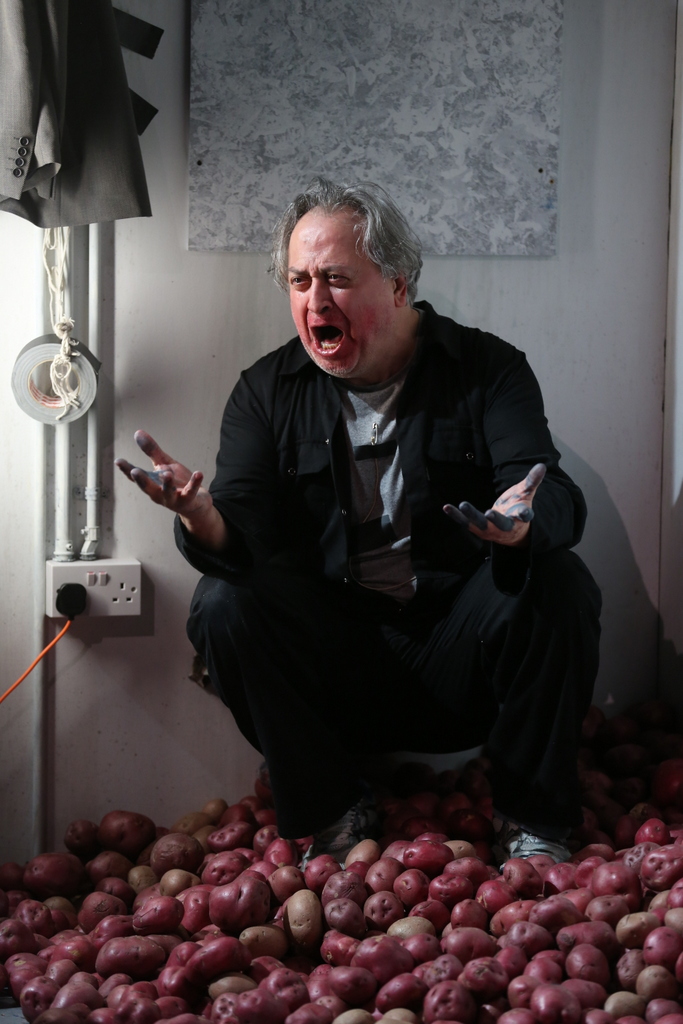
Stanley Townsend in ‘Incantata’ by Paul Muldoon, directed by Sam Yates, in its U.S. premiere at Irish Repertory Theatre (Carol Rosegg).
Muldoon’s speaker, The Man, infused with Stanley Townsend’s riveting performance remains an incantation to Power’s art, and to art, and the creative impulse that manifests in the arts. That manifestation is born and borne of suffering and is as simplistic, revelatory and symbolic as a bird picking up a “strand of bloody wool from a strand of barbed wire in the aftermath of Chicamauga or Culloden” most probably to use it to build a nest. By referencing two bloody battles, Chicamauga, the second bloodiest battle of the American Civil War and the battle of Culloden where the British quelled the Jacobite uprising, The Man reveals that in the extremis of pain and death, art can be birthed to bring healing and new life, or as Muldoon/The Man aptly states, “a monument to the human heart that shines like a golden dome among roofs rain-glazed and leaden.”
Townsend’s enlivening performance, succinctly directed by Yates brings Muldoon’s incantation of love, death, remorse, mourning, art and the creative impulse which seeks to heal to a striking dramatic iteration. This is a production which bears seeing a few times because of Townsend and because of the richness of the poem’s language, which I had the good fortune to examine.
Special kudos go to the following creative artists who helped stir the pot into its enchanting evocation: Rosanna Vize (set & costume design) Paul Keogan (lighting design) Sinéad Diskin (sound design) Jack Phelan (video design) Teho Teardo (composer).
Incantata is in its U.S. premiere on the Francis J. Greenburger Mainstage at the Irish Repertory Theatre (22nd St. between 6th and 7th). It runs with no intermission until 15th March. For tickets and times CLICK HERE.
‘Lady G: Plays and Whisperings of Lady Gregory’ at The Irish Repertory Theatre

(L to R): John Keating, James Russell, Úna Clancy in Irish Rep’s ‘Lady G: Plays and Whisperings of Lady Gregory’ by Lady Augusta Gregory with additional material by Ciarán O’Reilly, directed by Ciarán O’Reilly (Carol Rosegg)
What do William Butler Yeats, John Millington Synge, Sean O’Casey, AE, George Bernard Shaw, George Moore and Katharine Tynan have in common? Their initials are carved on a tree growing on the property of Coole Park, Gort, in County Galway, the estate Lady Gregory inherited after the death of her husband Sir William Henry Gregory.
That is just one of the tidbits told by the spirit of Lady Gregory (1852-1932) who inhabits the production Lady G: Plays and Whisperings of Lady Gregory currently at the Irish Repertory Theatre until the 22nd of March. Written by Lady Augusta Gregory with additional material by Ciarán O’Reilly and directed by Ciarán O’Reilly, the delightful production reveals the life and times of one of the venerable, wry-humored progenitors of the Irish Literary Revival and co- founder of The Irish Literary Theatre and the Abbey Theatre with William Butler Yeats and Edward Martyn.
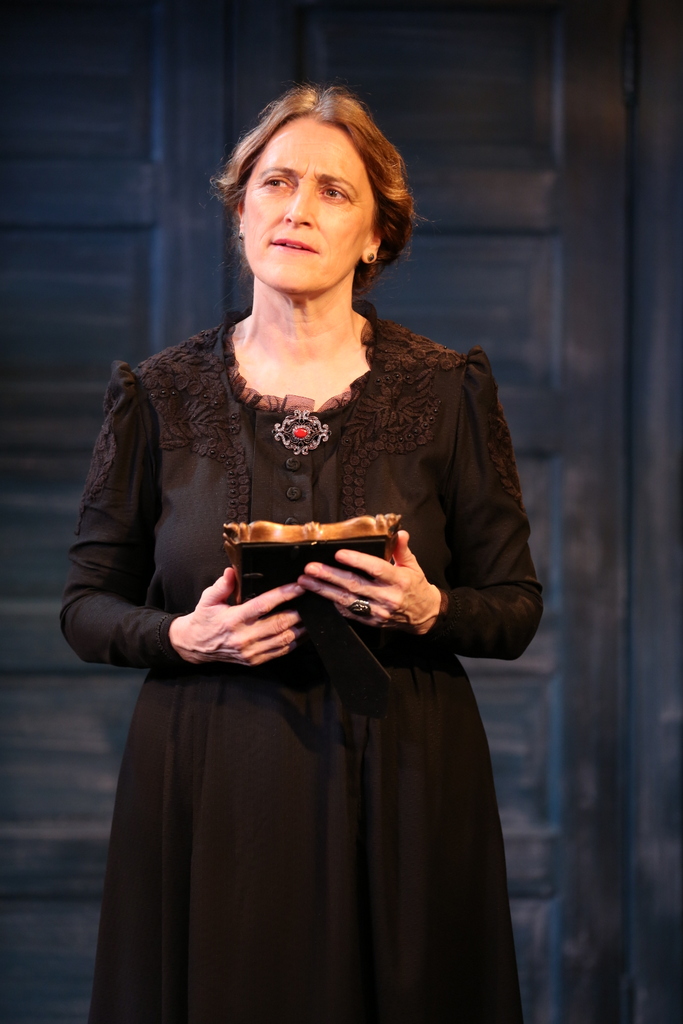
Úna Clancy, , Irish Rep’s ‘Lady G: Plays and Whisperings of Lady Gregory’ by Lady Augusta Gregory, with additional material by Ciarán O’Reilly, directed by Ciarán O’Reilly (Carol Rosegg)
The production stars Úna Clancy as the lively and candid Lady Gregory who fills out another role in Lady Gregory’s play “McDonough’s Wife at the end of Act II. James Russell portrays a variety of roles and is the humorous Mike McInerney in Lady Gregory’s, “Workhouse Ward” and the Sheep shearer in “McDonough’s Wife.” Russell is erudite and reserved in his portrayal of the philosophical literary genius, poet, playwright William Butler Yeats. And he is the kindly, avuncular Sir William Gregory who was Lady Gregory’s senior by thirty-five years.
We learn they had a son Robert, the pride of their lives whose death Robert mystically foreshadowed in a dream which his cousin also mysteriously had. He died during WWI in a play crash in a death which his mother like any devoted mother never could reconcile easily. Sir William Gregory attempted to practice noblesse oblige for the suffering Irish people under his care at a time when it was least appreciated. And his actions Lady Gregory implies were mischaracterized and reshaped to satisfy another agenda.

(L to R): Terry Donnelly, Úna Clancy, , Irish Rep’s ‘Lady G: Plays and Whisperings of Lady Gregory’ by Lady Augusta Gregory, with additional material by Ciarán O’Reilly, directed by Ciarán O’Reilly (Carol Rosegg)
Terry Donnelly of the lyrical voice, spot-on authenticity and versatility portrays Anne Horniman friend of the literary lights who helped fund the Irish National Theatre Society. Terry Donnelly also portrays Mary Sheridan, Lady Gregory’s influential, native-speaking Irish nanny who teaches her about the history and folklore of the area. Donnelly constantly surprises with her characterizations as Honor Donohoe in Gregory’s “Workhouse Ward,” and portrayals of Widow Quin, the Narrator, Marian and the character of the Hag 1 in “McDonough’s Wife.”

John Keating, Irish Rep’s Lady G: Plays and Whisperings of Lady Gregory’ by Lady Augusta Gregory with additional material by Ciarán O’Reilly, directed by Ciarán O’Reilly (Carol Rosegg)
John Keating rounds out this exceptional ensemble with versatility and humor portraying notaries Wilfred Blunt, Edward Martyn, John Quinn, George Bernard Shaw and Sean O’Casey. He is hysterical and nuanced as Michael Miskell the down-and-out companion of Mike McInerney who wheedles McInerney to remain in impoverishment when he might have stayed with his well-off sister Honor Donohoe (Terry Donnelly). And he is the poignant and raging McDonough who returns from his journeys to discover that the townspeople have eschewed his wife as an “outsider.” Their rejection is particularly loathsome because she dies in childbirth and no one in the xenophobic community wishes to join together to memorialize her passing or help bury her. Dark are Lady G’s themes of bigotry, alienation, shame and guilt in the revelatory “McDonough’s Wife.”
The personification of the Irish literary greats and the effect of their productions (the story of Synge’s Playboy of the Western World is particularly acute and ironic) is fascinating. Their discussions reveal the history of the period memorably with gusto. Gregory’s emblematic presence delivered with good will by Clancy makes the narrative of Lady Gregory’s life ring with truth.

(L to R): John Keating, James Russell,, Irish Rep’s Lady G: Plays and Whisperings of Lady Gregory’ by Lady Augusta Gregory with additional material by Ciarán O’Reilly, directed by Ciarán O’Reilly (Carol Rosegg)
This production is many things: a historical encomium, a mini-revival of Irish playwrights, an affirmation and revisiting of that vital Irish literary renaissance in the early twentieth century and beyond. Importantly, it is a celebration of a woman who accomplished much for Irish theater and cemented the connections between Ireland and the United States, something which Americans need to be reminded of.
The added material by O’Reilly with Lady Gregory’s own words from her autobiography and published journals and from insightful articles by professors and researchers into the amazing time, O’Reilly cobbles together thoughtfully and humorously. The actors enliven the true to life artists, but O’Reilly’s narrative spoken by Gregory with various quotes from real personages coheres dramatically so that the audience remains engaged.
Critically, O’Reilly adds the two productions written by Lady Gregory which reveal her breadth and scope from humorous dialogue and conflict in “The Workhouse,” (finely engendered by director and actors) to the reality of the isolation and xenophobia of the the community where “MDonough’s Wife” takes place. The drama of the latter reflective of the bigotry of isolated communities regarding anyone from another social spectrum i.e. their inability to embrace with Christian grace “the other” has currency for us today. Gregory hit upon a strain of the human condition that is pernicious and seems everpresent despite the hope of religion to expurgate it.

(L to R): Terry Donnelly, Úna Clancy, , Irish Rep’s ‘Lady G: Plays and Whisperings of Lady Gregory’ by Lady Augusta Gregory, with additional material by Ciarán O’Reilly, directed by Ciarán O’Reilly (Carol Rosegg)
I thought the set was functional and symbolic; the dark green walls with nooks and crannies was where actors sat in character waiting to add their portrayals to the grand stew that was being created. Seamlessly, the set afforded them the opportunity to don costumes secreted there so that they could quickly step into the 22 roles the four actors portrayed with authenticity. The inclusion of the tree with the famous initials of Yeats, et. al and the music, lighting and sound effects added to the production’s appeal.
Clancy’s natural rapport with the audience is expertly directed and developed. The idea to incorporate Lady Gregory’s ritual practice of distributing a Barm Brack to her cast and the audience was fun. The cast distributed the Barm Brack (the delicious fruitcake was moister and less adamantine than the one my Irish-American aunt made) to us. It was a perfect treat after the humorous, ironic conclusion of “Workshouse Ward,” at the end of Act I.

Úna Clancy, John Keatin in, Irish Rep’s ‘Lady G: Plays and Whisperings of Lady Gregory’ by Lady Augusta Gregory with additional material by Ciarán O’Reilly, directed by Ciarán O’Reilly (Carol Rosegg)
This production is a gem and I do think that educationally it needs to find an audience because of its revelations and historical grist regarding Irish literary history. Above all it is a memorialization and celebration of Lady Gregory, her works, her amazing friends. And, if you like, you may consider taking a trip to the West Country of Ireland to visit Coole Park. There, you will still see the walled garden and “The Autograph Tree” with the initials of Sean O’Casey, William Butler Yeats, George Bernard Shaw, John Millington Synge, AE and others, and be able to imagine a time when these writers enjoyed a unique camaraderie and received sustenance for their souls in a little piece of heaven on earth.
Noted are the creative team: Charlie Corcoran (set design) David Toser (costume Design) Michael O’Connor (lighting design) M. Florian Staab (sound design).
Lady G: Plays and Whisperings of Lady Gregory runs with 1 intermission at the Irish Repertory Theatre’s W. Scott McLucas Studio Theatre (22nd St. between 6th and 7th) until 22nd March. For tickets and times CLICK HERE.
‘Anatomy of a Suicide’ by Alice Birch at Atlantic Theater Company
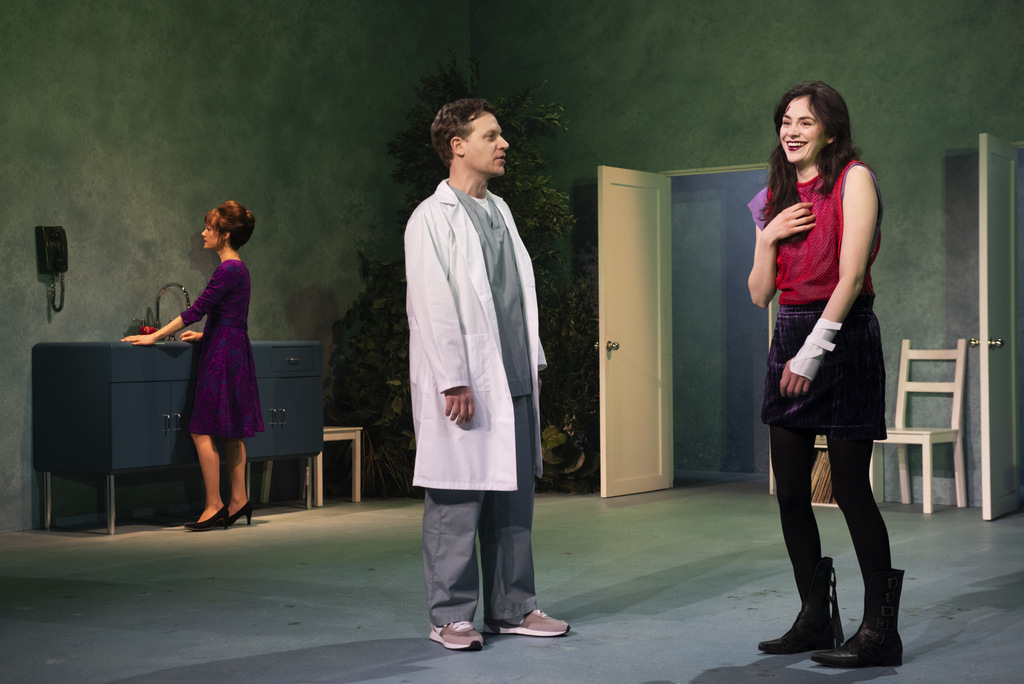
(L to R): Carla Gugino, Vince Nappo, Celeste Arias, ‘Anatomy of a Suicide, by Alice Birch, directed by Lileana Blain-Cruz (Ahron R. Foster)
In Anatomy of a Suicide written by Alice Birch directed by Lileana Blain-Cruz, the playwright examines suicide’s ancestral relativities between and among mothers and daughters. Underlying the developmental arc and structure of her complex play, Birch examines many questions. Two which appear to pertain the most directly are the following. What is the likelihood that a mother’s depressive, suicidal personality may be inherited as part of the familial DNA passed down through generations? If a mother commits suicide, what is the likelihood that her daughter will be unable to overcome the death impulse to follow her mother’s example, unconsciously nurtured by her mother to that end?
Currently running at Atlantic Theater Company’s Linda Gross Theater, Birch’s Anatomy of a Suicide won the Susan Smith Blackburn Prize in 2018. Indeed, her approach to the topic is structurally unique and worthy of the tremendous efforts of the cast and director to reveal the mysterious bond between mothers and daughters that moves them in the direction of soul immolation.
Birch displays three generations of mothers and daughters: Carol (Carla Gugino) her daughter Anna (Celeste Arias) and Anna’s daughter Bonnie (Gabby Beans) on stage concurrently in real time. She unwinds their characters until they reach their apotheosis. They exist in different decades in the 20th and 21st century but appear before us in the present. Each mother anticipates the depressive ethos of her daughter in some of her interactions with others: spouse, friend, family.
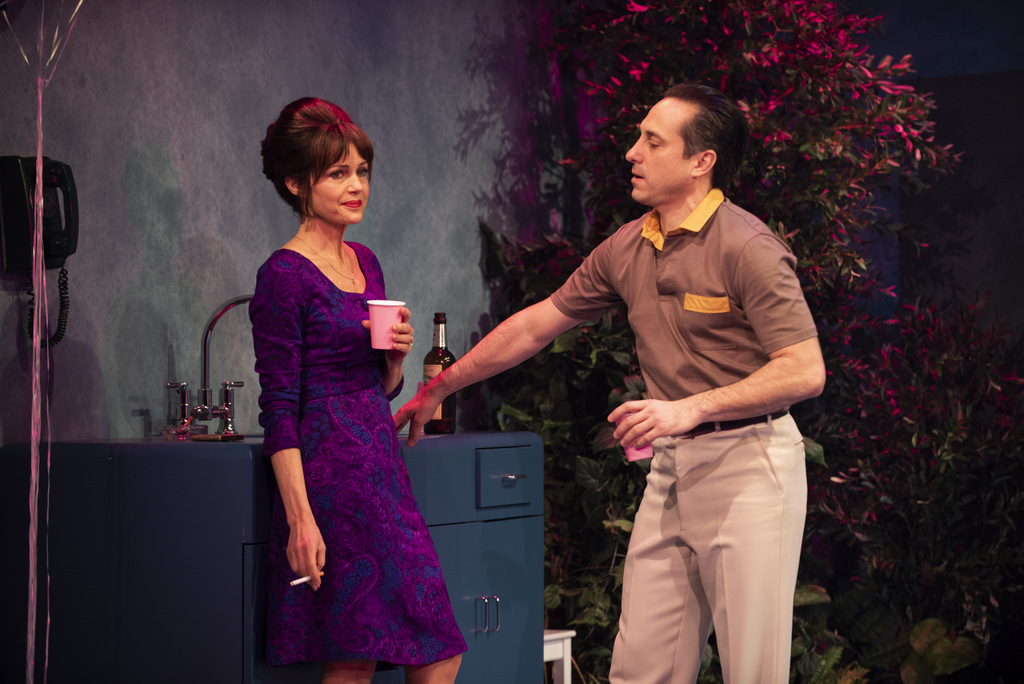
Carla Gugino, Jason Babinsky in ‘Anatomy of a Suicide,’ by Alice Birch, directed by Lileana Blain-Cruz (Ahron R. Foster)
Birch sets these three components of the depressive state in each character on stage simultaneously with their ancestral counterparts by defying the space/time continuum. As each character depicts her own manifestations of her condition, sometimes the dialogue overlaps repetitively as if a time warp occurs and you are allowed to see how the mother has impacted the daughter in the future (i.e. how Carol impacted Anna). Usually, Birch features a key vignette with one character while the other two draw inward. For example while Anna has a scene with a doctor, Carol is occupied in an action, i.e. cutting apples, smoking, etc. and Bonnie is involved in her own action. When their dialogue overlaps and there is a synchronicity of time and space, a still point of connection occurs.
Birch uses this structure of simultaneity, rhythmic dialogue, repetition and overlap to stimulate the audience’s dissection and analysis of the characters. Perhaps it is to understand how suicidal depression in the case of this family leaps genetically (?) telepathically (?) from mother to daughter without knowing the etiology of each woman and specifically how or if such a transmission occurs. Birch depicts Carol’s, Anna’s and Bonnie’s depressive, addictive and emotional isolation in events unique to each and not in chronological order, but always simultaneously. However, though we see the symptoms and reactions which are the tip of the iceberg, we never know the rationale why these women are suicidal because it is unknowable. It is unconscious. Thantos, the death impulse exists in each of us, as does eros, the life impulse. Why does one overcome the other in these women is not what concerns Birch. That it is there in this family group is enough to investigate and atomize.
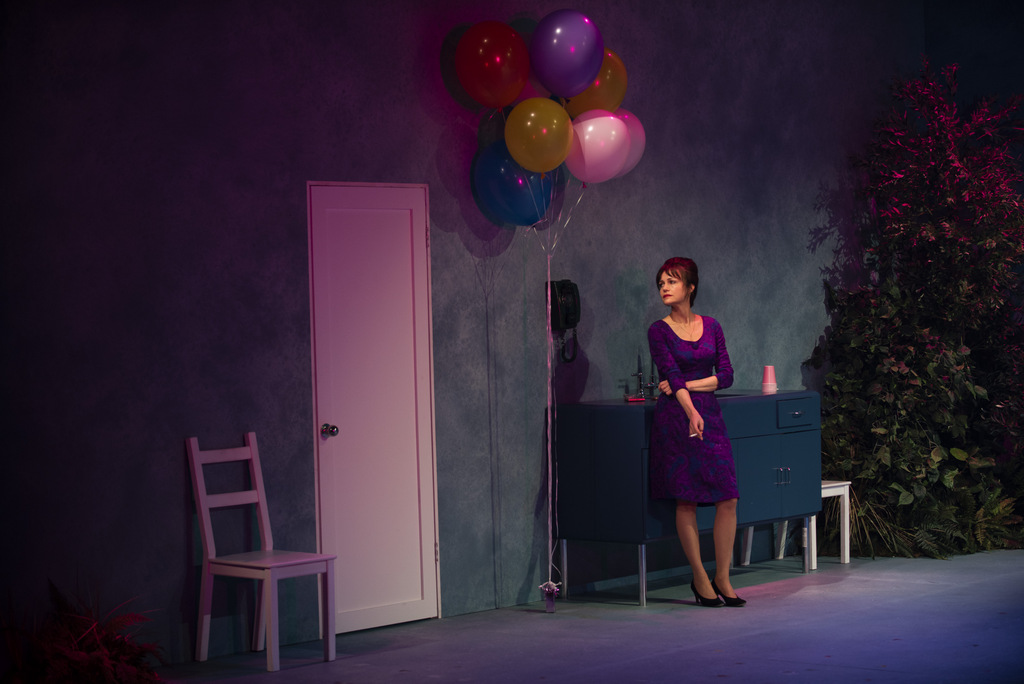
Carla Gugino in ‘Anatomy of a Suicide,’ by Alice Birch, directed by Lileana Blain-Cruz (Ahron R. Foster)
For Carol and Anna the suicidal impulse is acute at the outset of the play. Carol’s husband John (Richard Topol) confronts her about her bandaged/sliced wrists and her thoughtful accommodation for him to have enough dinners for a week or so, which she has cooked and frozen for him to thaw out after her death. Such premeditation is crystal clear; she has thought about what she will do and planned for it, yet she tells John everything is “fine.” Later in her segments the evidence mounts and we understand why “it is fine.”
For his part, John confronts her with great passivity, an element of her depressive state she perhaps wishes to conclude with finality. Divorce would not be final enough, we learn in a subsequent later vignette that is companionable to a simultaneous event with Anna and Bonnie. Nevertheless, John is frightened, yet incompetent to handle her. Through various scenes he cannot read her or cogently, effectively deal with her flattened affect that hides the dark abyss within. Carol’s various scenes unfold tied not to a time order but to a thematic familial order with her daughter Anna and Granddaughter Bonnie who demonstrate their own angst: Anna in her relationship with her spouse Jamie (Julian Elijah Martinez) and Bonnie in her interest and relationship with Jo (Jo Mei ).
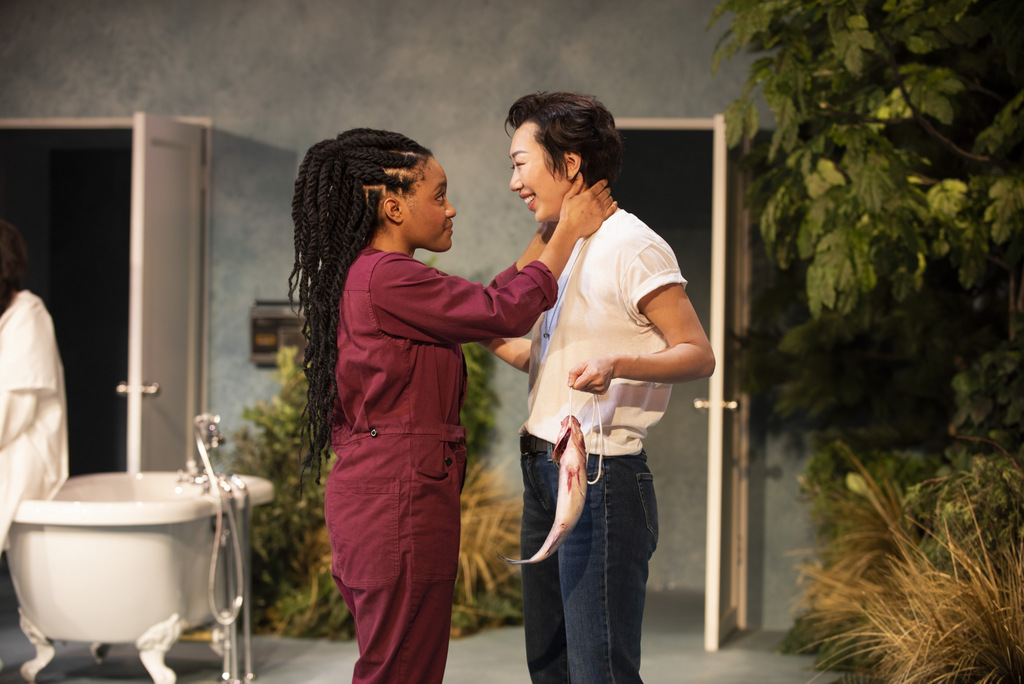
(L to R): Gabby Beans, Jo Mei in ‘Anatomy of a Suicide,’ by Alice Birch, directed by Lileana Blain-Cruz (Ahron R. Foster)
A telling event occurs during Carol’s pregnancy and after baby Anna is born. We and John understand that she will never have another child; sex is not pleasurable and she is only staying in the marriage to raise their daughter. Each vignette reinforces Carol’s intense emotional interior trauma that Carla Gugino’s brilliantly flickers to the surface through the character’s strained, straight-lipped smile, wooden responses and modulated, refined voice.
What happened to her, to Anna, to Bonnie? Why are they depressed? Does the historical cause matter if it is genetic, a brain disorder or some other causation that is beyond the kin of the medical profession? Interventions are tried to no avail: shock therapy, perhaps rehab for Anna for her drug addiction. Nothing works. No human interaction satisfies to stem the death impulse.
We realize Carol is fine when she succeeds in achieving her goal in life. By the end of her scenes (she is staged on the far left as the progenitor mother of depression in the 20th century) we come to understand why Carol responds as she does to John that she is “fine.” Her mind is made up. She has planned and most probably will continue to plan and justify her suicide to herself because her pain is relentless, without limit, infinite as long as she is in her body. Thus, when we finally learn that she has killed herself, it is anti-climactic. The same is not true for Anna who, in her vignettes, gyrates between anxiety and calm, hyperactivity and peace with husband Jamie.
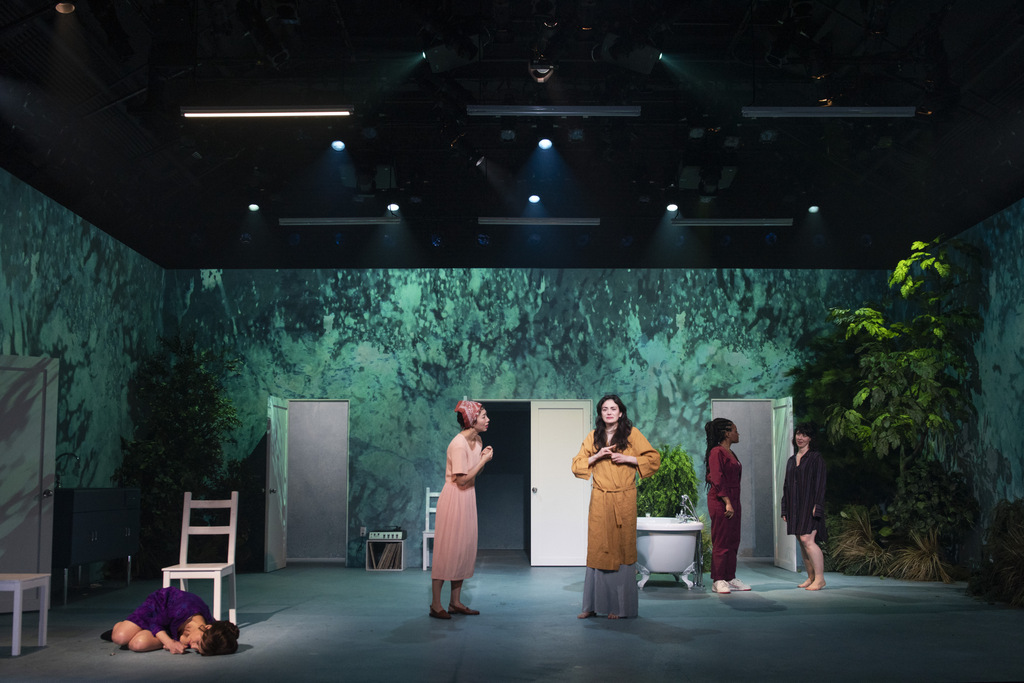
(L to R): Carla Gugino, Ava Briglia, Celeste Arias, Jo Mei, Gabby Beans in ‘Anatomy of a Suicide,’ by Alice Birch, directed by Lileana Blain-Cruz (Ahron R. Foster)
Regardless, Birch blindsides us and Carol’s and Anna’s spouses with their suicides to end the roiling hell within. For Carol we know it is coming, yet when we hear of it surprisingly tucked into a conversation, we remember her memorial to herself, “I’m fine.” Anna’s suicide is as Anna is, dramatic.
At the outset of the play when Carol and John have their discussion about Carol’s suicide attempt and she affirms she’s “fine,” Celeste discusses with a doctor friend (Vince Nappo) the necessity for an injection in a frenetic insistence to charm him. The doctor knows what she wants and ignores her despite her lightening responses and “hail good fellow well met” justification for it. Her heightened state, during which she discounts how she broke her arm, is like an episode of rapid recycling in a bi-polar disorder patient. In their synchronized scenes, obviously, both women display warning signs that they are ripe for suicide, but in their own personalities and iterations which are antithetical.
Perhaps, Birch posits one clue for Carol’s and Anna’s dark intentions and eliminates it for Bonnie. Carol’s and Anna’s intolerable misery is exacerbated when they become pregnant and have their daughters. Does this symbolize the end of their lives? Indeed, Celeste’s nihilism appears even greater than Carol’s and her commitment to killing herself happens in hyperbole part of the up/down of her life that Birch reveals is her nature. On the other hand Bonnie solves the problem of mother/ daughter suicidal ideation carried to her through an inherited gene pool. A doctor, Bonnie makes a canny choice about relationships and doesn’t put herself in the position of her grandmother and mother. But perhaps she is her father’s daughter, not her mother’s. Again the etiology is never clarified, not that it should be.
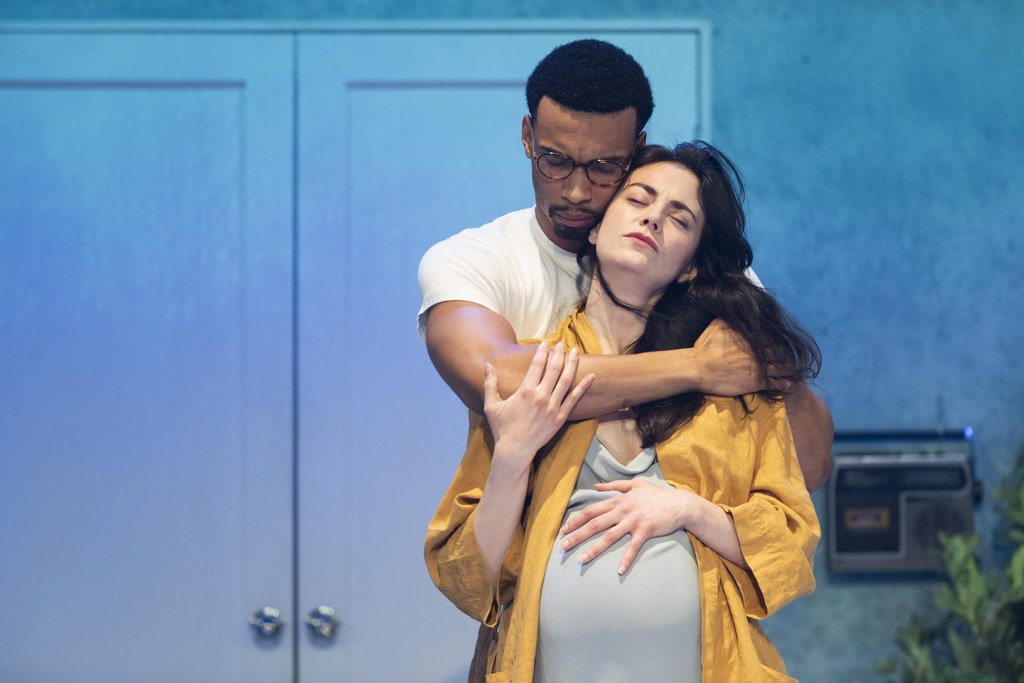
Julian Elijah Martinez, Celeste Arias, ‘Anatomy of a Suicide,’ by Alice Birch, directed by Lileana Blain-Cruz, Atlantic Theater Company (Ahron R. Foster)
The play intrigues with the everpresent present of three women in the same family reflecting how they respond to the unchanging underlying death impulse as it manifests with synchronicity in Carol, Anna and Bonnie over time, yet also with different and particular iterations based upon each individual woman. Staged simultaneously across three time periods, we think we can understand the suicidal threads in these characters and especially that Bonnie doesn’t physically move a hand against herself.
At times refocusing which vignette to watch to break through the overlapping dialogue was challenging. However, the uniform superb acting drew out the sequences appropriately and the pacing of the dialogue was letter perfect so that the key lines to be repeated resonated with rhythmic precision.
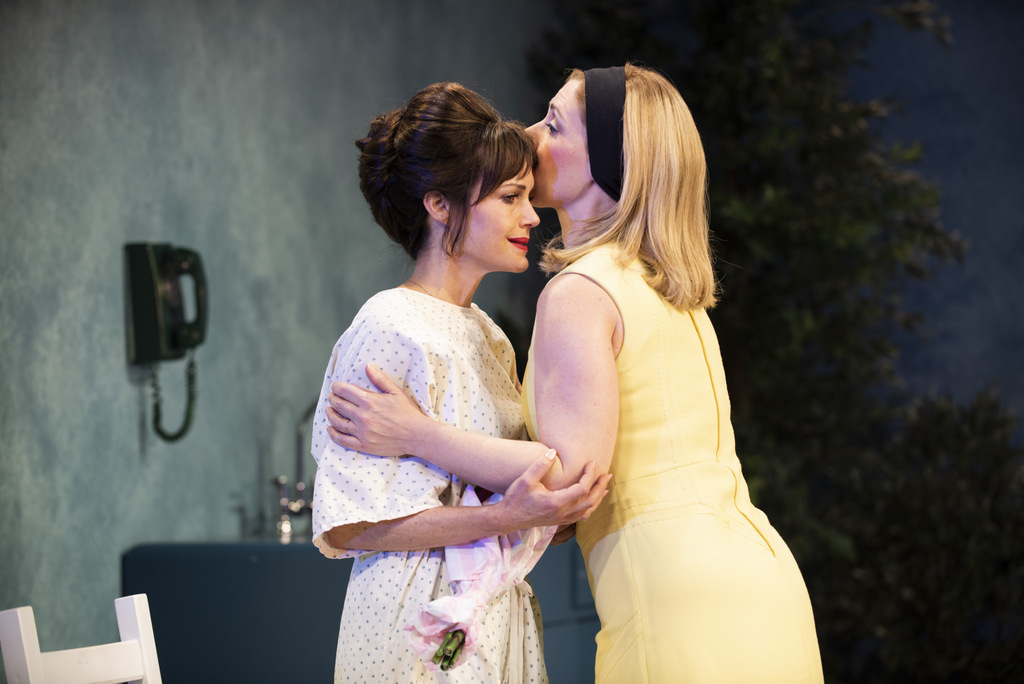
(L to R): Carla Gugino, Miriam Silverman in ‘Anatomy of a Suicide,’ by Alice Birch, directed by Lileana Blain-Cruz, (Ahron R. Foster)
The set whose three walls are painted a green-blue color and beset with complementary plants appears vibrant on first inspection. However, the wash basin in Carol’s space which looks like those in a doctor’s office with the high curving faucet, and a bathtub with similar faucet in Anna’s space convert the set toward the clinical and sterile. This is so despite the ensemble bringing in tables to suggest dinners with friends and other activities.
The set puts one on notice that this will not be a typical play about suicide with its recumbent, empathetic emotionalism. This will be as unique as the title implies and a detached, observational approach will be employed. Indeed, as we follow Birch’s presentation and the director’s shepherding of a truly superb cast, we become like scientists viewing, as if under glass familial fault-lines that break the family. It is an empty exercise and we are no closer to understanding another element of a mysterious anti-life position of human beings: the urge, necessity, the repeated will in some families, in this play mothers and daughters, to end their lives.
By the end of the play, we remain detached. Such detachment about the most violent act one can take against oneself is frightening. But the play encourages objectification for a reason. Objectification in our culture contributes to feelings of isolation. Being or feeling “the other,” not belonging, not communicating in a felt empathetic way to bridge one’s “aloneness” in pain are states of misery. Yet, for these mothers to put their daughters in that state indicates they were hopeless. It is the height of objectification, not having empathy for oneself to live to the next day. Birch’s work enlightens and devastates.
Noted are Mariana Sanchez (sets) Kaye Voyce (costumes) Jiyoun Chang (lights) Rucyl Frison (sound) Hannah Wasileski (projetions) Tommy Kurzman (wig, hair & makeup).
Anatomy of a Suicide runs at the Atlantic Theater Company (336 West 20th) with no intermission until 15th March. For tickets and times CLICK HERE.
‘Chekhov/Tolstoy Love Stories’ at The Mint Theatre, Two Masters’ Perspectives of Love, Adapted by Miles Malleson
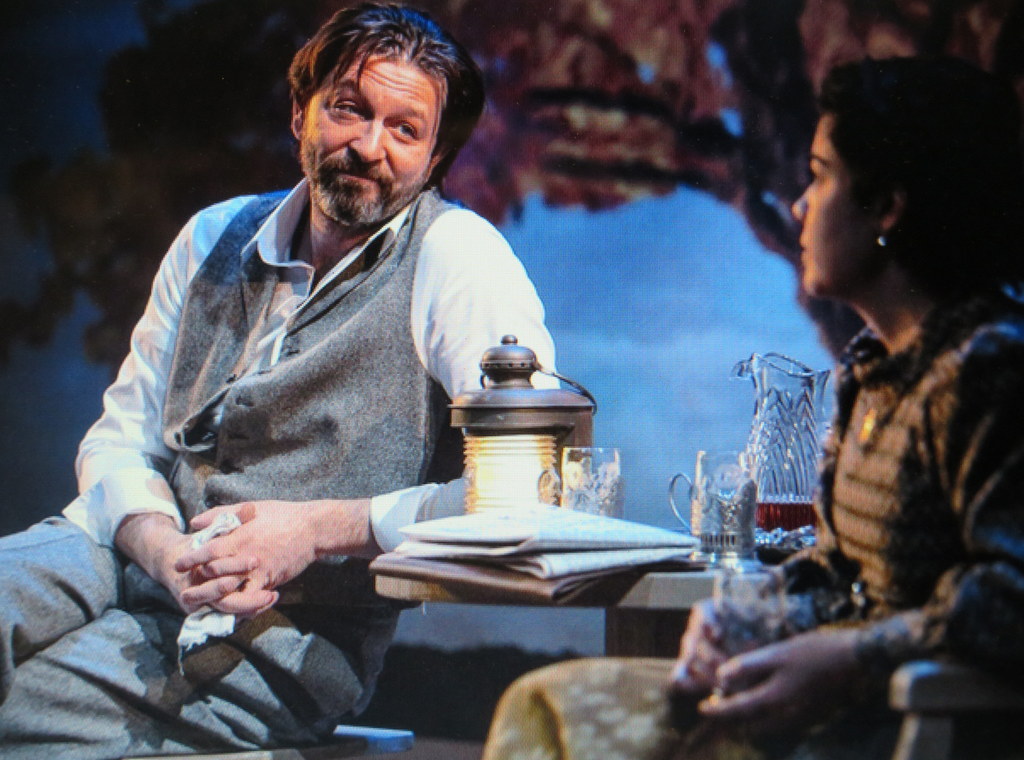
Alexander Sokovikov, Brittany Anikka Liu in ‘The Artist,’ adapted by Miles Malleson from “An Artist’s Story” by Anton Chekhov, Chekhov/Tolstoy Love Stories (Maria Baranova)
“One of the most diversified talents in the British theatre,” Miles Malleson (1888-1969) was enamored of Leo Tolstoy and Anton Chekhov, who had formed a bond in the latter years of their lives; Chekhov, the younger pre-deceased Tolstoy, the elder by six years–Tolstoy died in 1910. Admiration of these two great Russian writers inspired Malleson to create theatrical adaptations of short stories by Tolstoy and Chekhov. From Tolstoy’s parable “What Men Live By” Malleson adapted Michael. From Chekhov’s “An Artist’s Story,” Malleson configured The Artist.
The Mint Theatre Company has featured Malleson’s plays before (i.e. Unfaithfully Yours) considering Malleson to be a playwright worthy of recalling to our social theatrical remembrance. In the first offering of the season, The Mint has coupled the British playwright’s dramatic adaptations of Chekhov’s and Tolstoy’s one acts because their themes relate to love. In The Artist, directed by Jonathan Banks, Chekhov via Malleson ironically presents romantic love that never has the opportunity to blossom and rejuvenate, but is cut off before its time. In Michael directed by Jane Shaw, Tolstoy via Malleson uncovers truths related to the nature and power of agape love. The Mint Theatre Company’s production of Chekhov/Tolstoy Love Stories is currently at Theatre Row.
Presenting The Artist and Michael back-to-back offers the audience the opportunity to examine how each of the plays evokes themes about love, spirituality, redemption and revelation. Additionally, one identifies the contrasting social classes represented by the setting and characters of each one act. Each play identifies the perspective of the writers who were interested about what was accessible to the Russian social classes. Tolstoy, a nobleman often wrote about the worthiness of the lower classes who are represented by the characters in Michael. On the other hand Chekhov, whose grandfather was a serf, centered his greatest works on Russian gentry on the brink of an era of change (The Russian Revolution).
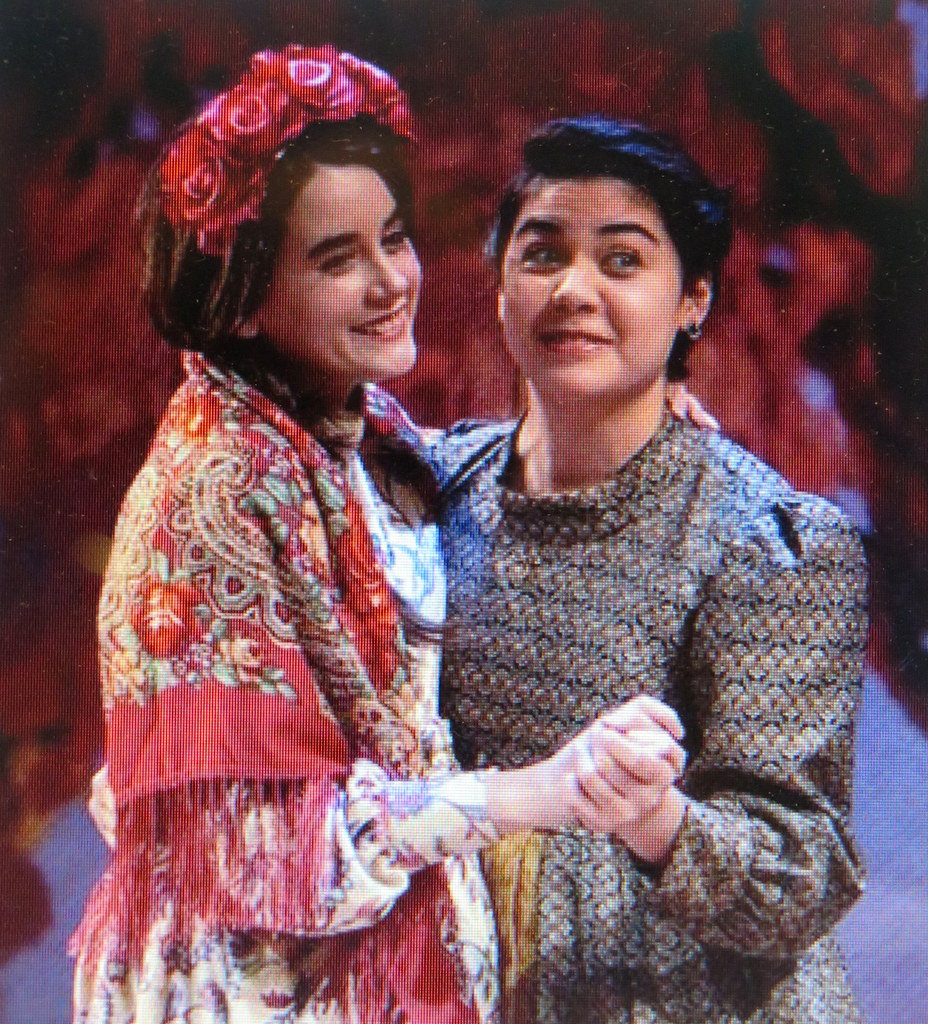
(L to R): Anna Lentz, Brittany Anikka Liu in ‘The Artist,’ adapted by Miles Malleson from “An Artist’s Story” by Anton Chekhov, Chekhov/Tolstoy Love Stories (Maria Baranova)
In keeping with Chekhov’s proclivities, The Artist takes place on a Russian estate run by a fine, elevated family of women who are intellectual and well regarded. These include the Mother (Katie Firth) and her two daughters. The elder daughter is the teacher Lidia (Brittany Anikka Liu) who is heavily involved with helping improve the status of the peasants. The youngest is the teenage dreamer Genya (Anna Lentz). An artist Nicov (portrayed by Alexander Sokovikov) visits often and the play opens as he paints his landscape while he interacts with Genya who listens to his philosophical justification of the importance of art over social reformation of the peasant class. Nicov and Lidia who represent antithetical views, argue continually. Thus, Nicov finds Genya’s unformed, youthful attentiveness an entrancement over Lidia’s disparagement of the useless function of Nicov’s art.
The characterizations of Nicov and Genya are reminiscent of Chekhov’s characters from his full-length plays, absent the conflict and tensions inherent in Chekhov’s full formed works. Malleson’s characterizations in The Artist are lukewarm and superficial. There is little heat and light as their should be when Nicov argues with Lidia to set up the drama and tension when he expresses his justifications to a sympathetic Genya with whom he falls in love and who returns his love.
The low-key tension and conflict of Malleson’s characterization is not helped by the lackluster performances. The spark of fire between Genya and Nicov that prompts the sardonic ending and Nicov’s felt and empathetic loss is missing. Nicov’s rant as delivered by Sokovikov is telling; Sokovikov does much of the heavy lifting with authentic responses from Katie Firth. Brittany Anikka Liu as the caring and forceful teacher/reformer in conflict with Nicov should be brighter, more ironic. Their interplay could even be darkly humorous. However, the love between Genya and Nicov is not believable. Thus, the impact of the Chekhovian sardonic ending is rendered impotent.

(L toR): Katie Firth, Vinie Burrows, Malik Reed, J. Paul Nicholas, in ‘Michael,’ adapted by Miles Malleson from “What Men Live By” by Leo Tolstoy, directed by Jane Shaw, ‘Chekhov/Tolstoy Love Stories’ (Maria Baranova)
Michael directed by Sound Designer Jane Shaw, making her directorial debut, employs more fluid light and music as the setting reverts to a peasant’s hut and the characters sing. The backdrop shifts. In The Artist, it is a painted tree filled with autumn leaves, signifying the season and symbolism of Nicov’s waning years. In Michael the design becomes the long, intricate white roots (interestingly lighting by Matthew Richards) of the tree. The symbolism of the lower classes is perhaps being suggested. It is the underclass (the tree’s roots) that supports and is the lifeblood of the middle and upper classes (the trunk, branches, leaves). Without the roots of the peasant class from which all humanity has derived, the upper classes can’t be sustained.
In Michael, the conflict arises when a homeless beggar (Malik Reed) is brought in by Simon (J. Paul Nicholas) and the wife (Katie Firth) must decide whether he should stay or be thrown out because they have barely enough for themselves and Aniuska (Vinie Burrows). The decision is made to let him stay. The scene shifts to a year later. We see the family is being sustained by Michael, the beggar who does not speak because he works as a cobbler for the peasant family. When a Russian Nobleman (Alexander Sokovikov) arrives and requires boots, the circumstances change. Michael makes a mistake with the boots, but it turns out to be a prescient action. That evening his learning is complete and finally Michael reveals who he is, why he is there and what he has learned about pity and empathy which is agape love. It is what we should live by.
The performances in Michael adhered more completely. Reed’s performance was soundly delivered undergirded by the ensemble. Malleson’s adaptation of the Tolstoy short story provided more dramatic tension and mystery. The staging and props added interest to engage the audience more completely, along with Oana Botez’s variable costuming, i.e. the nobleman’s coat and hat contrasted with the peasants’ outfits.
The pairing of the two one acts by the Russian writers who were contemporaries via Malleson is an enlightened decision if imperfectly rendered. It is the landed gentry in The Artist who remain unfulfilled by love, in effect harming the artist. They deprive him of rejuvenating love, and negatively impact his purpose to bring uplifting pleasure with his art. In Michael, the affirmation of the goodness of the peasant class (a Christian precept in the Beatitudes) is brought to them by Michael. He shares with them the wisdom that they have received through empathy/pity. It is the vitality of agape love that will sustain them.
In contrasting the two classes, the landed gentry is much worse off than the peasant class, a notion that Nicov suggests to Lidia to no avail. Lidia is convinced that (as in later years during the didactic polemic of the revolution) reform is imperative, art is useless. Meanwhile, the reforms and revolutions as they came did great harm which persists (one might argue) to this day. On the other hand making art is a necessity for the middle and upper classes to help them understand empathy and love, something the blessed poor, according to Tolstoy, are ready to receive and do take in as,the very potency which sustains them.
Chekhov/Tolstoy Love Stories runs until 14th March at Theatre Row (42nd Street). For tickets and times CLICK HERE.
Listed are the creative team: Roger Hanna (sets) Oana Botez (costumes) Matthew Richards (lights) Jane Shaw (original music and sound) Natalie carney (props).
‘The Sabbath Girl’ by Cary Gitter, Directed by Joe Brancato at 59E59 Theaters

(L to R): Angelina Fiordellisi, Lauren Annunziata in ‘The Sabbath Girl, by Cary Gitter, directed by Joe Brancato at 59E59 Theaters (Carol Rosegg)
What happens when Jewish orthodoxy and strict mores find intermarriage with someone of another faith verboten? Depending upon the orthodoxy of the Jewish community, this may be a serious issue. Cleverly, Cary Gitter, under the superb direction of Joe Brancato, keeps the difficult elements of love between a single Catholic woman and divorced, Orthodox Jewish man at bay in the lively, well-paced, delightful The Sabbath Girl currently at 59E59 Theaters. The production presented in its New York City premiere by Penguin Rep Theatre runs a slim 85 minutes with no intermission.
The romantic comedy’s tone and tenor skirts the dramatic in the opening scene when Nonna (portrayed exquisitely by Angelina Fiordellisi) visits with her beloved granddaughter Angie (the adorable Lauren Annunziata). Nonna checks on Angie to see how she is adjusting to her new apartment. In the process as is her custom, she chides Angie about not being in a love relationship. Angie assures Nonna she is a “modern woman,” perhaps a bit of a feminist. And she insists she doesn’t need a man to make her happy. She has her budding career, which encompasses her waking moments and keeps her busy. We note that Angie is ambitious, industrious and smart, especially since she intends to translate her success into even greater achievements.
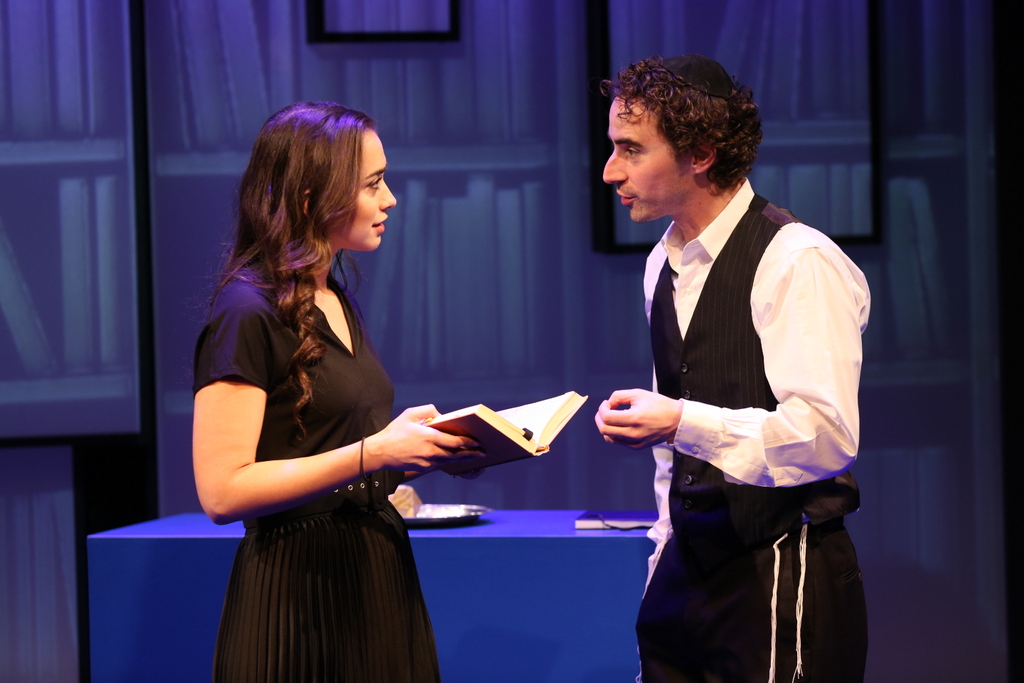
(L to R): Lauren Annunziata, Jeremy Rishe in ‘The Sabbath Girl, by Cary Gitter, directed by Joe Brancato at 59E59 Theaters (Carol Rosegg)
Thus begins the theme of traditionalism vs. modernism framed by familial relationships. Gitter expands the themes around this conflict during the course of the play. With humor and irony, she drives the arc of the plot neatly and swiftly to a satisfying resolution.
An additional conflict in Angie’s life centers around the men she encounters as potential love interests. Throughout the play, when her Nonna visits to examine how her “love life” is going, Angie sweetly dismisses Nonna’s “traditionalist” suggestions about falling in love with the “right person” and hearing the “music of love” in her soul. Angie’s feminist bent is to negotiate and affirm her own definitions of what affection, love and marriage might be for her life. Gitter’s characterization of Angie also includes that she is rebounding from a failed relationship where her former boyfriend lied and cheated on her. In other words if she will become involved with someone, he will have to convince her he is unlike the cad she was with.
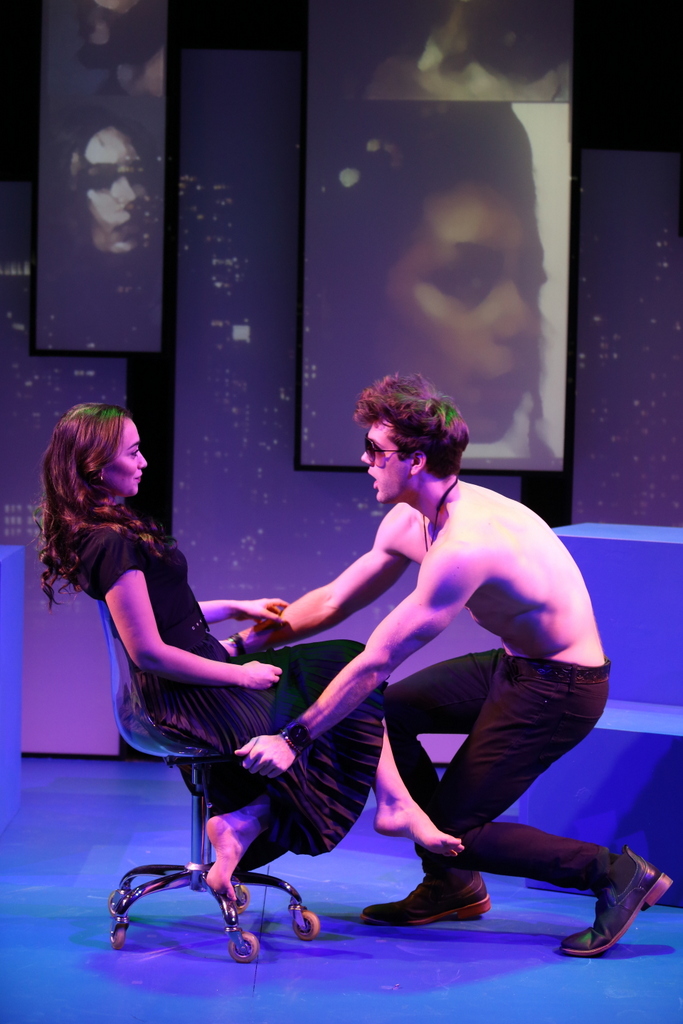
(L to R): Lauren Annunziata, Ty Molbak in ‘The Sabbath Girl’, by Cary Gitter, directed by Joe Brancato at 59E59 Theaters (Carol Rosegg)
The first man she encounters is Seth (Jeremy Rishe) an Orthodox Jewish gentleman who discovers his former Shabbos goy has moved and Angie is now his neighbor. A Shabbos goy is a Yiddish term for a non Jew who is asked by Jews to perform actions that are forbidden to them on Saturday, the Sabbath, i.e. turning on lights, electrical devices, etc.. Seth explains to Angie that his other neighbor was his regular Shabbos goy. Since Angie is his new neighbor, he asks her to turn on his air conditioning. They share a few insights and he leaves. However, Seth, who, too, is recovering from a bad relationship can’t get Angie out of his mind.
For her part Angie is uninterested in Seth because there is someone else on her horizon with whom she has art in common. This man is the awesome and cool Blake (Ty Molbak) an artist that Angie wishes to exhibit in her gallery, but who is holding out for the best offers from galleries in the city. Blake wears dark glasses to fuel his image. He manipulates Angie and claims that she will have to “woo” him before he exhibits in the gallery.
Nonna, like a fairy godmother who is gentle, funny and sweet, guides Angie and encourages her against Blake and toward Seth. Of course our own weaknesses sometimes lead us to be enamored of individuals who will hurt us, and reject others for whom we are well- suited. Angie is initially attracted to Blake and assesses that Seth is not her type and his religion is a barrier which she is not interested in climbing over.
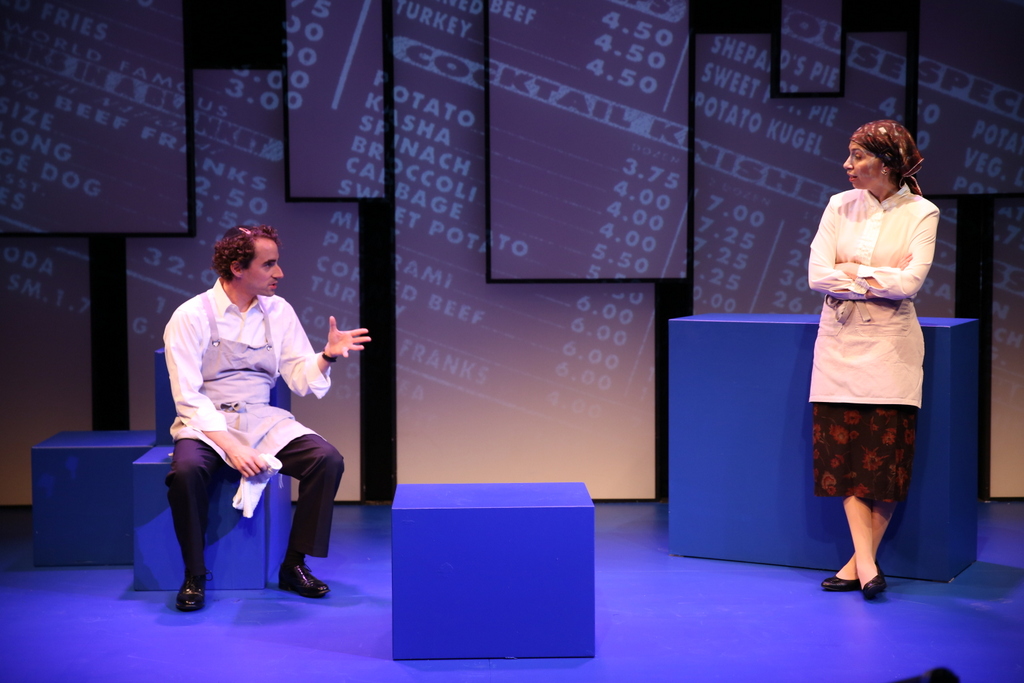
(L to R): Jeremy Rishe, Lauren Singerman in ‘The Sabbath Girl, by Cary Gitter, directed by Joe Brancato at 59E59 Theaters (Carol Rosegg)
How the playwright turns these developments on their head becomes the focal point in the action, with complications added by Rachel (Lauren Singerman) Seth’s sister after Angie begins to return Seth’s interest in her. Rachel is another aspect and voice of traditionalism. But unlike Nonna, hers is predicated not on love, but on fear. On the one hand, she wants her brother to move on with life after his divorce and dismiss the recriminations he feels against his parents who forced a marriage on him that he lacked the courage to prevent. Yet, traditionally, she believes Seth should be with a nice, safe, Orthodox Jewish girl, and she has the right woman for him. Furthermore, Rachel’s interference in her brother’s life is rather witchy. She discourages his interest in Angie and encourages him to return to his community in Riverdale that he moved away from prompted by the negativity and depression of his divorce.
Another complication is Blake’s facade of unreality. It masks his troubled nature and his doubts about where he is going with his art. Ultimately, when he is unmasked, his artistic ambivalence and his relationship with another woman deep six his moving forward with Angie as a love interest and as an exhibiting artist. It appears that despite Nonna’s good will, cheerfulness and her advice to Angie about hearing the music of love, her granddaughter is going to be alone. Indeed, both Seth and Blake turn away from her.

(L to R): Lauren Annunziata, Jeremy Rishe in ‘The Sabbath Girl, by Cary Gitter, directed by Joe Brancato at 59E59 Theaters (Carol Rosegg)
This is no spoiler alert. You will just have to see this endearing romantic comedy to discover how Gitter resolves the conflicts and discovers answers for those who are bound by traditions whether self-imposed or externally imposed by cultural mores that perhaps are less stringent than one might imagine. One has only to test the boundaries of love to understand whether such external mores enhance living as they are supposed to, or nullify it which runs counter to love. Also, one must reject the traditionalism of believing if love failed once, it will fail again because one is incapable of finding it. Sometimes, love arrives in the most surprising ways.
The ensemble brings home the laughter seamlessly and the jokes centered about being Jewish and Jewish men are particularly hysterical. For the staging (set design by Christopher and Justin Swader) boxes are employed to suggest Angie’s apartment, Seth and Rachel’s Knish shop, the gallery and more. The presentation is supplemented by apt video projections and music between various scene changes in an interesting, fanciful way. The props that serve to key in changes in the development of Angie’s relationship with Seth and Blake are well appointed and symbolic.
Gitter’s themes about love transcending internal and external traditions are important reminders in this social time of divides: progressive vs. reactionary. By the end of the play, Angie learns that Nonna was more progressive than Angie thought she was because of Angie’s inflexibility about relaxing her perceptions of men. Likewise, Rachel is taught a lesson by her brother and learns to relax her own inflexibility as Seth begins to hope his life will turn away from despair.
Kudos to the creative team who brought Brancato’s vision of Gitter’s humorous play to the stage: Christopher & Justin Swader (scenic designers) Gregory Gale (costume designer) Todd O. Wren (lighting designer) Matt Otto (original music/sound designer) Yana Birÿkova (projection designer) Buffy Cardoza (properties).
The Sabbath Girl is just what is needed to brighten our hearts and spirits during the doldrums of February. You may see The Sabbath Girl at 59E59 Theaters (59E59th St. between Madison and Park) before it closes on 8th March. For tickets and times CLICK HERE.

