Category Archives: Off Broadway
‘A Bright Room Called Day’ at The Public, Tony Kushner’s Haunting Spectres Thread Through Hitler’s Berlin, Reagan’s 1980s and Trumpism

Nikki M. James, Michael Esper in ‘A Bright Room Called Day,’ by Tony Kushner,directed by Oskar Eustis at The Public (Joan Marcus)
Tony Kushner’s A Bright Room Called Day directed by Oskar Eustis, currently at The Public until 15 December (unless it receives another extension which it should), reflects upon humanity confronting evil that on a number of levels appears unstoppable and irrevocable. Throughout the main action and play within a play, Kushner makes clear that those who recognize evil’s force and preeminence, often are too afraid to lay down their lives to fight, though fighting is the action needed to stop wickedness in political, social and economic institutions not constrained by the rule of law.

Nikki M. James in ‘A Bright Room Called Day,’ by Tony Kushner,directed by Oskar Eustis at The Public (Joan Marcus)
The play uses at is jumping off point political and social issues undermining the Weimar Republic in Berlin. The setting encompasses events one year prior to the “Eve of Destruction,” when Hindenburg acceded to Hitler’s government take-over after which Hitler evicted parliamentary, constitutional democracy from the minds, hearts and souls of the German people. Kushner examines the parallels of that time with our culture during Reaganism and Trumpism.
The questions he raises are pointed. Some might argue that from the 1980s to now, the decline in our democratic processes and the public’s response appear similar to the public’s response to precursor events in Germany 1933. A Bright Room Called Day relates Berlin, Germany 1933 to 1985 Reaganism, devolving to the time of Trump. These three settings represent a turning point when the crisis of the period might have shifted in another direction if good citizens acted differently, affirming the adage, “evil flourishes when good men and women do nothing.” In this play Kushner examines the “What if?” Couldn’t citizens have halted the terrifying dissolution of democracy? Couldn’t they have liquidated Hitler’s fascist dictatorship before he even attempted to manifest his warped vision of the Third Reich’s reign for 1000 years?

Michael Urie, Nikki M. James in ‘A Bright Room Called Day,’ by Tony Kushner,directed by Oskar Eustis at The Public (Joan Marcus)
The community of individuals we meet at the outset of the play who pop in and out of Agnes Eggling’s (Nikki M. James) lovely apartment are members of the political, liberal left, a combination of artists and activists who are/were at one point communists, socialists, progressives and union activists, one of whom is a homosexual (played by the exquisite, always present Michael Urie). All of these will be consigned to Hitler’s enemies’ list if they remain in Berlin. If captured, they will be deported as state enemies and undesirables and murdered when Hitler constructs and augments his network of slave labor and extermination camps to implement his “Final Solution.”
Kushner’s work which was excoriated when it first premiered in the 1980s has been given an uplift with an additional character, and dialogue tweaking to reference the current siege of Trumpism on our democracy. Kushner posits that our times manifest “inklings” similar to those employed by fascists and Reagan’s corrupt conservatives who sent the nation on a downhill slide which Trump appears to be pitching over the edge into oblivion, unless we do something. By drawing comparisons, we are forced to reflect upon the upheaval in our democratic institutions as the political, economic and social divisiveness spurred by Trumpism augments.
Kushner interjects his own commentary as a playwright and interrupts the action during which he actively engages his audience as a silent character whose consciousness he manipulates. Through identification with the people and events in Germany, we, like they, become like the frog that is placed in a pot of cold water. As the heat is turned up to the boiling point, if the frog is alert, he can escape before boiling to death. But he must realize immediately what is happening, so he will not be too lamed to escape. By degrees the audience realizes that they are in a crucible like Kushner’s characters, under which a fiery truth blazes. To that truth Kushner posits, one must recognize it, or its heat and pressure will pitch one into a death-state of paralysis like Agnes’.
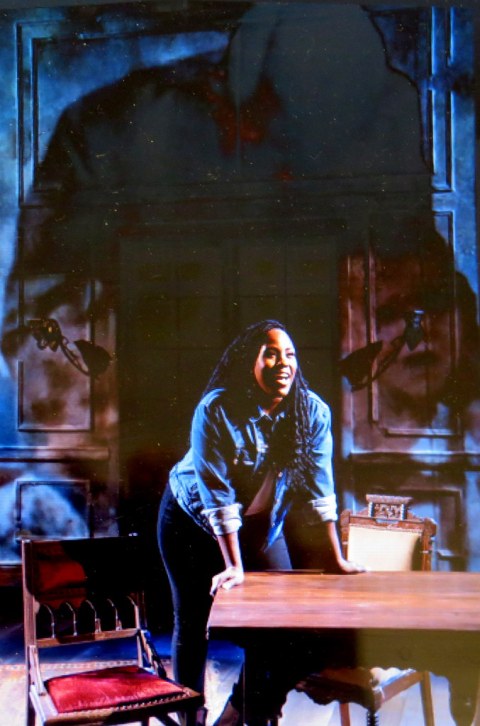
Crystal Lucas-Perry in ‘A Bright Room Called Day,’ by Tony Kushner,directed by Oskar Eustis at The Public (Joan Marcus)
The play’s new character is Xillah. Xillah represents Kushner’s perspectives as a citizen playwright who comments on his play and the policies of Reaganism and Trumpism. Playwright Xillah engages with Zillah his indefinable character whom he’s written into the 1980s. Zillah complains to Xillah about her function in the play. She importunes him for a viable role and purpose. She wishes to step beyond ranting about the emotional paralysis of character Agnes. Watching Agnes frustrates Zillah, for Agnes does little but quiver in fear at the ever-worsening events in Berlin. It is her fears which manifest nightmare presences (Die Älte-the Old One, in a wonderful portrayal by Estelle Parsons) who haunt her and drive her into soul paralysis which will lead to her death under Hitler’s regime.

Estelle Parsons in ‘A Bright Room Called Day,’ by Tony Kushner,directed by Oskar Eustis at The Public (Joan Marcus)
Xillah, a character in the play framing the Berlin events is portrayed with humorous vitality by Jonathan Hadary. His character criticizes the activities by the cults of Reagan and Trump. He sardonically characterizes Reagan’s presidency and Trump’s “monolithic” personage with abandon in a stream of hysterical epithets that are right-on. Both Xillah and Zillah (Crystal Lucas-Perry is Hadary’s counterpart in a feeling portrayal) comment on the dynamic of the Berlin characters which Xillah (as Kushner) has created. They watch as Agnes, Paulinka (the superb Grace Gummer) Baz ( Michael Urie) Husz (Michael Esper) Gotchling (Linda Emond) and comrades Rosa Malek (Nadine Malouf) and Emil Traum (Max Woertendyke) grow morose and desperate, experiencing the dissolution of the German Republic into fascism. They palpably encounter the manifested evil of the time in the form of Gottfried Swetts (Mark Margolis humorously intrigues in his portrayal). He is the Devil, whose darkness overtakes Germany as Hitler ushers himself into the government and eradicates any goodness that went before.
Kushner’s characters argue about communism, socialism, democratic socialism and the state of affairs. Their discussions fuel their waning activism and encourage impassivity with a few exceptions, for example, Gotchling (Linda Emond), who is continually putting up posters which are torn down continually. We empathize with the Berliners as they react to the brutalities and street fighting, Hindenberg’s ending the government and the Reichstag fire which Hitler blamed on the communists to ban the party, arrest the leaders (his enemies), and consolidate his power base.
The characters react emotionally with disgust and outrage but their impulses to act are largely stymied by fear. They will not move beyond marches and protests that the Brown Shirts help to render bloody and ineffective. And when back room deals are made to put Hitler in power, they become powerless. Like many they appear to believe the propaganda rallies that show support for Hitler, though initially these are largely staged until the rallies gain in momentum and many join Hitler’s party.
The historical events are chronicled with vitality. The characters reveal poignant moments expressing the mood and tenor of the like-minded populace. Baz relates a story of a man’s suicide and his imagined wish to take one of the oranges, he, Baz, has purchased and give it to the dead man as a comfort. Of course, Baz never gives him the orange, but he imagines having done it, ironically comforting himself as the man is beyond being comforted. For Baz it is a horror seeing the dead man’s body pooling blood around it. Baz identifies the cause of the man’s suicide as the despair and immobility to stop the terrible events in Berlin. The suicide rocks Baz to the core. We align the man’s suicide with Baz’s suicide attempt which he stops himself from committing when instead, he has a sexual encounter. Baz’s choice is ironic and the impact of the suicide he witnessed in the streets is nullified by sexual distraction. As Baz, Urie delivers another incredible story later on which sets one reeling. Again, when Baz could take a stand, he chooses not to. Throughout, Urie’s performance is spot on amazing.
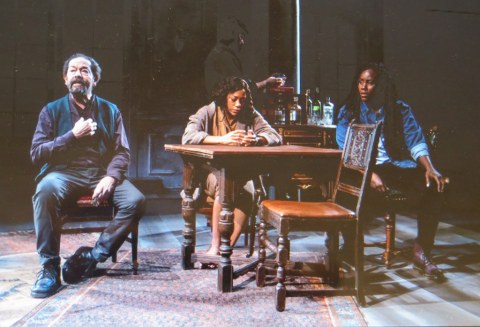
(L to R): Jonathan Hadary, Nikki M, James, Crystl Lucas-Perry in ‘A Bright Room Called Day,’ by Tony Kushner,directed by Oskar Eustis at The Public (Joan Marcus)
In the “intervening” frame play, Zillah attempts to persuade Xillah to write her with character powers that transcend time and space and go back to the past to warn Agnes of the danger of embracing fear and doing nothing. Zillah is upset that Agnes is so overcome, she is zombie-like. One of the humorous parallels is that Xillah, too, is at an impasse (like Agnes) only it is about the direction of this play and how to make it more vital so that it will have a resounding impact on the audience and get them to act. But he is filled with doubts about the function of plays. Also, he fears tampering with what he has already written. Indeed, he could make his play into a worse failure. His quandary is humorous.
Kushner, the frame (the present and 1980s) around which houses his Berlin character dynamic has Xillah remind Zillah of a number of important details, in addition to the chronological events of Hitler’s takeover. As Xillah parallels the then with the now, he affirms that friends living against the backdrop of Trumpism suggested he revisit The Bright Room Called Day because it is prescient and current. Xillah wrangles how best to show the similarities and complains that the characterization of Zillah doesn’t work. However, the character very much integrates the parallels. She criticizes inaction when a nation’s political/social structure disintegrates because the populace becomes overwhelmed and doesn’t act, becoming paralyzed as Agnes is paralyzed. The question remains: how does one move out of paralysis and take effective action which will change things for the better?

(L to R): Crystal Lucas-Perry, Jonathan Hadary in ‘A Bright Room Called Day,’ by Tony Kushner,directed by Oskar Eustis at The Public (Joan Marcus)
The threads of alignment that Kushner makes with Germany that mirror our present are thematically chilling. Xillah reminds Zillah that the Weimar Republic had a constitution like the U.S. but their constitution didn’t save them against Hitler who abolished it. With the constitution gone, Hitler and his underlings and judiciary created laws to further Hitler’s occult mythic vision (the Master Race). And with his own race laws, he legalized the genocide of millions. Of course, Kushner highlights the turning point when death and destruction could have been prevented during the events of 1932-33. But those who saw, like Agnes and her friends, chose to do nothing. Eventually, like the frog slow boiled in the pot, the only thing they can do is escape. If they, as Agnes did, stay, they will be killed or swallowed up like Paulinka to join Hitler’s Third Reich “support group” of murderous maniacal, psychotic, evil accomplices. A different type of death, certainly more horrific and self-recriminating.

Mark Margolis in ‘A Bright Room Called Day,’ by Tony Kushner,directed by Oskar Eustis at The Public (Joan Marcus)
Xillah muses about changing the play and warns Zillah that Agnes can’t hear her: she is dead as the past is dead. Zillah continues to beg Xillah. The dialogue that Kushner has written between them is humorous and reminiscent of the “Theater of the Absurd” genre and Luigi Pirandello’s Six Characters in Search of an Author, where the playwrights tweak dramatic conventions. This is done to expand audience consciousness. Such creative license demands being available to “thinking outside of the box.” It also leads to the audience having to follow a play’s absurdities which can be as confounding as the illogical, dire thrusts of fascism, Reaganism, Trumpism.

Linda Emond in ‘A Bright Room Called Day,’ by Tony Kushner,directed by Oskar Eustis at The Public (Joan Marcus)
The absurdist feeling becomes that one has been caught up watching oneself as a part of the larger picture which one deludes themselves into believing they can control. In fact the “author” of our lives is not one we’ve necessarily chosen or know. At least Zillah knows her progenitor and argues with him and finally convinces Xillah to lift space/time constraints so that Agnes hears and speaks to her.
This section gives rise to a number of themes in this work that is dense with brilliance. Before Zillah connects with Agnes, we note that Agnes’s spirit atrophies and dies because her fear incapacitates her. Even if Zillah could break through the time barrier and move from the 1980s to 1933, Agnes’s routine of embracing fear and inaction has warped and destroyed any life in her. Life is movement, action, vitality. Doing something, anything (even escaping) would be better than just withering away. The irony of the play is the melding of the frame play into the Berlin story by Kushner/Xillah. He finally allows Zillah to warn Agnes to leave because she is doomed. Though it is not mentioned, we understand that those who did leave Germany early on did manage to save themselves while millions were swept up in genocide and Hitler’s war machine.

(L to R): Michael Urie, Michael Esper in ‘A Bright Room Called Day,’ by Tony Kushner,directed by Oskar Eustis at The Public (Joan Marcus)
Agnes’ reply to Zillah is not what we expect. It is mind-numbing, a warning to Zillah and us about our own time. It has the effect of a final incredible bomb blast that whimpers and fades. The full-on irony is as Agnes exhorts her/us, we hear, but it doesn’t register, it doesn’t matter. Thematically, Kushner suggests that we are plagued by the same inabilities, insufficiencies and cowardice that Husz ranted about in an earlier magnificent scene. Time inevitably doesn’t matter as we are like Agnes. Paralyzed, immobilized by discussion doing little to save ourselves. We must act! But how? To do what? And so it goes.
Kushner’s play should be revisted and it is a credit to The Public and Oskar Eustis for bringing it back in this unsettling, frustrating iteration. The parallels with each time period, whether we deign to acknowledge them or not, are striking. The threads which indict us about our alienation and powerlessness are spectres which should prick us to the marrow of our bones.
Indeed, in our time as we watch the separation of powers (executive, legislative, judiciary) illegally devoured by the Trumpist Party with the DOJ stomping down its own institution (i.e. the Inspector General’s Report exonerating FBI officials whom the WH has slandered and insulted) and mischaracterizing the Mueller Report, such “above the law conduct” to loyally support the WH is frightening and dangerous. Additionally, in our time, we note how the Trumpist Party encourages law breaking of fired officials (lawyers and others) to defy congressional subpoenas tantamount to obstruction of justice. And currently, high ranking members of the Trumpist Party in the House of Representatives refuse to listen to non partisan congressional testimony which implicates the White House in potential bribery of a foreign leader, withholding appropriate congressional military aid in exchange for a political smear of the White House’s opponent. In other words, they refuse to uphold their constitutional oath of office and do their job, instead uplifting the “dear” leader’s loyalty pledge to support him in his criminality.
These are high crimes and misdemeanors to add to a long list of acts which we need whistleblowers to come out and speak about: Trumpist bribery of foreign leaders, quid pro quos, his acting above the law, his incurring human rights violations, overthrowing military law, and Trump’s blatant importuning of foreign nations and adversaries to help him overthrow our election processes with smear campaigns against his opponents, the indefensible practice he used to win the 2016 election.

Max Woertendyke, Nadine Malouf in ‘A Bright Room Called Day,’ by Tony Kushner,directed by Oskar Eustis at The Public (Joan Marcus)
Such lawless behavior in an executive that easily vitiates the separation of powers, and bullies, insults and retaliates against anyone who would attempt to point out his law violations recalls behaviors of fledgling dictatorships. Such dictatorships grow. They make laws into what are solely “good” for the dictator/autocrat as they obviate what is good for the rest of the body politic. And if one counters with opposition? That autocrat will bully, intimidate, censure, retaliate and eventually when no one stops them, kill or destroy any opponents using what it can get away with, first character assassination, then jail, then well placed convenient suicides (check the google article about Deustche Bank’s suicides) then murder.
One may argue that Kushner’s alignment of the present U.S. “leadership” with Germany’s situation in 1932-33 is extreme and overblown. Really? And indeed, if the play “doesn’t work,” are the themes and presentments just too horrible to contemplate? Are we, like Agnes, too overcome, too PTSDed by the WH’s horrific acts to consider that we have already lost our constitution and democracy to an overweening, unlawful executive branch whose party refuses to adhere to constitutional checks and balances?
Kushner’s A Bright Room Called Day raises so many parallels, similar threads and questions, that it should be seen. It should be seen not only for the superb performances, but for the humor, for the pith, the juicy pulp of the orange that is being offered as a comfort. And it should be seen as the bright bit of light in the sky before the darkness closes in and we can no longer see clearly fact from fiction. While there is that bit of light, we must discern conflicting alternative narratives from the propaganda that would occlude our minds, souls and hearts and propel us away from human decency and love for each other as citizens of a nation worthy of its ideals.
Kudos to David Rockwell (scenic design) Susan Hilferty and Sarita Fellows (co-costume design) John Torres (lighting design) BRay Poor (sound design) Lucy Mackinnon (projection design) Tom Watson (hair, wig, makeup design) Thomas Shall (fight director). A Bright Room Called Day runs with one intermission at The Public Theater until 15 of December. For tickets and times CLICK HERE.
‘Soft Power,’ The Uplifting Play/Musical by David Henry Hwang is Nothing Short of Brilliant
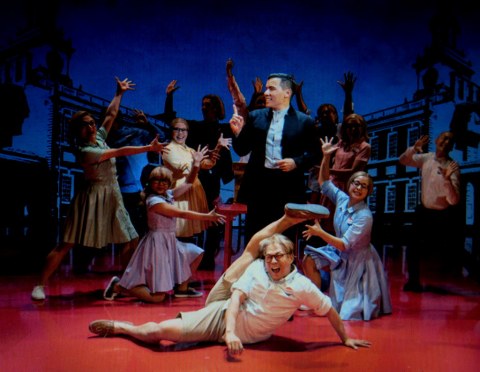
Conrad Ricamora and The Company of ‘Soft Power’ with play and lyrics ,by David Henry Hwang, music and additional lyrics by Jeanine Tesori, directed by Leigh Silverman, choreography by Sam Pinkleton (Joan Marcus)
David Henry Hwang’s awards and honors are too numerous to list here. Suffice to say he won the Tony Award, Drama Desk and Outer Circle Critics Award for M. Butterfly (1988). He is a prodigious author, playwright, librettist and screenwriter who was nominated for the Pulitzer Prize three times. With Soft Power, directed by Leigh Silverman, Hwang has crafted a mesmerizing production. Soft Power is a genre hybrid, a musical-fantasy-farce within a satire-comedy with autobiographical overtones. Primarily, the musical within a play concerns Chinese/American custom disparities, U.S./China relations and events around the U.S. 2016 election and afterward. To my mind it is Hwang’s finest theatrical production to date.
I saw a number of his works including the original production of M. Butterfly (1988) and the revival (2017), productions at the Pershing Square Signature Center (Dance and the Railroad-2013, Golden Child-2013, Kung Fu-2014) and an Off Off Broadway production of Yellow Face in 2009. I saw Chinglish (2011) on Broadway twice.
For Soft Power, Hwang wrote the lyrics, with Jeanine Tesori composing the music and additional lyrics. With choreography by Sam Pinkleton and a large Asian cast, Leigh Silverman, a long time collaborator with Hwang, shepherded the creatives and ensemble with sensitivity. Her adroit mastery pushing the envelope to achieve the right balance of comedy, irony, satire, humor, musical-fantasy-farce and stark reality to elucidate Hwang’s varied themes is a prime achievement of this production.
Hwang’s themes in this play/musical are on steroids to his credit. One should see this production a number of times; it is replete with concepts to think about including these: the U.S. is considered a dangerous country and visitors from abroad are warned of the mass shootings and white nationalist terrorist attacks. Among other concepts Hwang confronts with irony in the musical-fantasy sequence are the proliferation of guns. There is a sardonically funny song the Veep sings with the ensemble, “Good Guy With a Gun.” Hwang highlights the increasing, bigoted, racist, xenophobic attacks on those who are not “white and right.” And he ironically underscores China’s move toward westernization with the U.S. creep into autocracy under an unnamed (Hwang will not dignify his name, again to his credit), lawless president and the culture his lawlessness promotes.
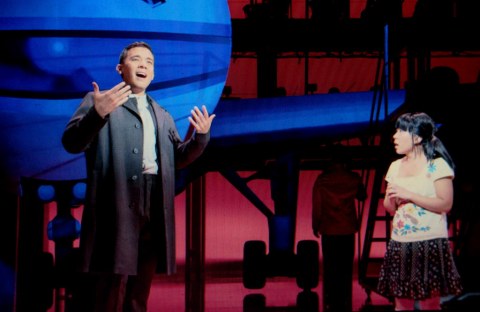
Conrad Ricamora, Kendyl Ito of ‘Soft Power’ with play and lyrics ,by David Henry Hwang, music and additional lyrics by Jeanine Tesori, directed by Leigh Silverman, choreography by Sam Pinkleton (Joan Marcus)
Another important theme the entire play and the musical presents is what it is to be an American who lives in a democracy whose constitution guarantees the freedoms it does and most especially the right of every citizen to vote. In the musical-fantasy sequence and even in the play that frames the musical, Hwang’s protagonists go head to head arguing the benefits of freedom and democracy vs. China’s autocracy and selection of leaders. Throughout, the playwright zeroes in on what it is like to be a Chinese-American in a nation that had deep xenophobic roots and anti-immigrant sentiment that since the last election have surfaced and would continue to grow into a poisonous tree overshadowing constitutional freedoms, unless the equivalent of weed killer in the form of love dissolves it at the root!
The opening scene of the play is autobiographical. DHH is on the street with groceries in front of his home, right before he was stabbed in his neck and nearly died. Played by Francis Jue who is nuanced, innocent, astutely honest, funny and sings with gorgeous resonance and power, DHH questions whether he will be “able to live in the country anymore.” Then the scene quickly shifts. Hwang cleverly dislocates us in time and we follow along to the next scene unaware of what will happen to him and the import of his comment.
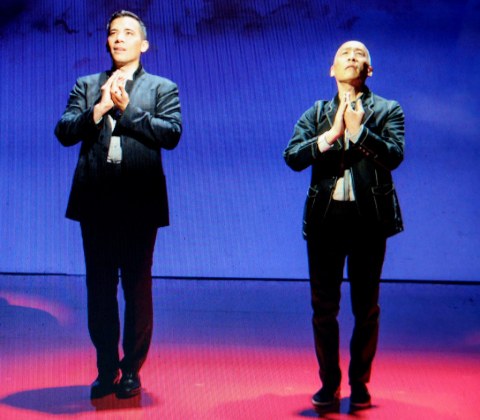
(L to R): Conrad Ricamora,Francis Jue of ‘Soft Power’ with play and lyrics ,by David Henry Hwang, music and additional lyrics by Jeanine Tesori, directed by Leigh Silverman, choreography by Sam Pinkleton (Joan Marcus)
In the next scene DHH meets with Xūe Xíng (Conrad Ricamora is near perfect as the debonair, well-meaning, sophisticated, musical lead-Chinese style), head of the North American Division of Dragon Entertainment based in Shanghai. Xūe Xíng presents the “soft power” idea to commission DHH to write a musical based on a film with a hysterical title roughly translated, “Stick With Your Mistake.” Xūe Xíng tells the dubious DHH that because he is a renowned and successful Chinese American playwright, he would be the perfect candidate to write a musical that will open the Dragon Palace in Shanghai when it is finished. But when Xūe Xíng tells him what the film is about, DHH disagrees with the ending based on cultural American values. The film is about a couple who love other people and desire to split up; following Chinese mores, they remain together. We discover later that this film is “close” to Xūe Xíng’s heart, though the Chinese populace is changing and may find the ending “old-fashioned” as DHH suggests.
DHH must leave because he is off to see The King and I, then meet Hillary Clinton at a presidential candidate reception. He invites Xūe Xíng to go with him and the married Xūe Xíng brings his lover Zoe Samuels (Alyse Alan Louis). Louis also plays Hillary Clinton in the musical-fantasy sequences and is hysterical when she sings as Hillary the “Song of The Campaign Trail” and then in full throated, uplifted glory, the smashing “Democracy.” She is sensational.
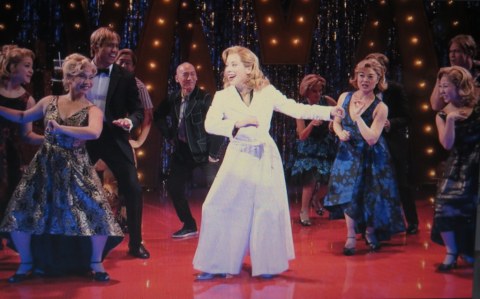
Alyse Alan Louis and The Company of Soft Power with play and lyrics by David Henry Hwang, music and additional lyrics by Jeanine Tesori, directed by Leigh Silverman, choreography by Sam Pinkleton (Joan Marcus)
In this scene between DHH and Xūe Xíng and then with Zoe, Hwang establishes many of the humorous tropes that will follow throughout the play. The playwright references differences between Chinese culture and American culture regarding politics and election of leaders. The dialogue reveals the differences in understanding and behavior. And there is the usual mangling of the Chinese language by Americans which is humorous, especially as DHH doesn’t know how to speak his Dad’s and mom’s birth language because he was born in the U.S.
For the Chinese, duty and obligation are paramount. For Americans following one’s heart is paramount. Chinese rarely show emotion; Americans as a group show emotions and allow their feelings to be expressed. Also, during this exchange we see the exemplification of China’s concept of “soft power“ in what Xūe Xíng hopes to accomplish with Chinese-American DHH. DHH will be perfect to write a smash hit for the Chinese in a cross cultural exchange. Humorously, Xūe Xíng references Lion King and Mama Mia, but since they will be seeing The King and I before meeting Hillary, Xūe Xíng hopes DHH will write that type of musical hit for China. Considering the elements of colonialism, DHH ironically points out the problems with the Rogers and Hammerstein II musical as something he would not want to write.
When Xūe Xíng suggests that China be in the position of the colonial power (the “I”), schooling the “King” (the U.S.), the implication is absolutely hysterical. Xūe Xíng’s sardonic riff about the U.S. barbaric Asian war policies abroad (with Japan, Korea, Viet Nam, China), and at home (the Chinese Exclusion Act, Japanese Internment during WWII), needing to be refined toward civility (as the teacher schools the King and the children in The King and I), is priceless. Also, the concept of China being the advanced and the U.S. being the inferior (it is happening as I write this thanks to the current U.S. president’s policies from Climate Change to tariffs) is not only funny it is incredibly ironic.
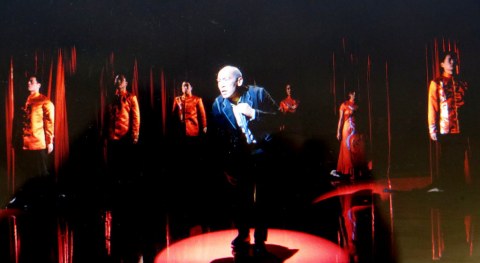
Francis Jue and The Company of Soft Power with play and lyrics by David Henry Hwang, music and additional lyrics by Jeanine Tesori, directed by Leigh Silverman, choreography by Sam Pinkleton (Joan Marcus),
Hwang riffs on himself with humor as character DHH responds ironically about his plays-they are not quite in the same vein as Lion King, nor is his idea of a smash musical being “Sticking With Your Mistake.” But it is at this juncture we understand the underlying premise of China’s initiative to curry favor with globalists by “leveraging their cultural assets and spending large sums of money” to create initiatives in the arts, etc. This is how to influence, how to find an acceptable way into other countries’ minds and hearts. When DHH suggests that such a film may not be what the younger Chinese want, interested in modernizing toward America, Xūe Xíng suggests that America may become more like China. Hwang’s portentous meaning cannot be understated.
The scene shifts again and DHH’s America is falling apart; Hillary lost. DHH argues with Xūe Xíng about the efficacy of everyone having the right to vote and electing the most qualified candidate in the popular vote and losing in the electoral college which Xūe Xíng finds appalling and illogical. It is a humorously frustrating exchange. The scene shifts; DHH is alone in front of his home in Brooklyn. Xūe Xíng has rubbed his point in about the election in the U.S. DHH questions how he can remain in a country that “voted for a guy that doesn’t believe we belong here,” and remain in a country to be nothing more than “supporting characters in someone else’s story.”
It is then Hwang brings us full circle out from the flashback into the opening scene of the play. As he ruminates about being a second class citizen as a Chinese American in the U.S., something happens that confirms his estimation, but it is beyond expectation. Reality slams into him and us. DHH as David Henry Hwang is stabbed by some white guy. Luckily, he yells in UNACCENTED ENGLISH, “WTF!” and the attacker runs away. As DHH applies pressure to the wound as per the Boy Scout instructions he learned as a kid, he walks toward the hospital and just before losing consciousness and fainting, he hears violins. And the musical-fantasy-satire emerges with chorus, dancing, orchestra and more as DHH hovers between life and death in what is a also a metaphoric rendering of his identity as a Chinese American.
Act One of the musical begins as DHH’s dream. The previous action repeats but with intensified be-spectacled musical numbers sung by Asian actors in white face. In another sardonic twist we are back in time at the beginning of Xūe Xíng’s story revealed from his perspective about his time in the U.S. After he says goodbye to his daughter (Kendyl Ito), who warns him about going to the dangerous country (“Dutiful”), he lands at Kennedy airport (“Welcome to America”), in what Hwang describes as a “deeply militarized, religious fundamentalist, violent society.” Hwang’s focus on Xūe Xíng’s perspective reveals what it is like for a foreign traveler nearly getting defrauded. However, Xūe Xíng, the hero, humorously turns the situation around by hiring a body guard Bobby Bob (the funny Austin Ku), who is always in the shadows to protect him. After all, this is a positive musical.
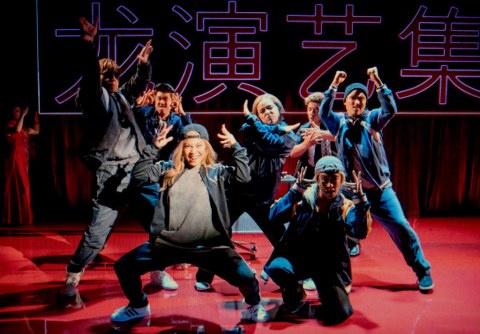
The Company of Soft Power with play and lyrics ,by David Henry Hwang, music and additional lyrics by Jeanine Tesori, directed by Leigh Silverman, choreography bySam Pinkleton (Joan Marcus)
In this segment, DHH again converses with Xūe Xíng about the play he might write, and they go to meet Hillary (“I’m With Her,” ). In Hwang’s roiling unconsciousness he dreams Xūe Xíng and Hillary bond together as Xūe attempts to teach her his name (“It Just Takes Time”). They satirize the reverse of the relationship in “The King and I” with Hillary in the barbaric country position and Xūe Xíng as the “I.” The scene is sardonic, considering the idealized players; Alyse Alan Louis is an exuberant Hillary (she looks like Chelsea), and Conrad Ricamora is the civil, gentlemanly, Asian leading man. The satire and irony here are profound as they dance a waltz referencing, The King and I.
As the election results are tabulated, the song “Election Night” is sung by the Chief Justice (the very funny Jon Hoche), and the ensemble. They sing a LOL description of the American election process and the dire Electoral College. But at the announcement that the “guy who hates China” won, white nationalists storm the building and in the process DHH is stabbed. In a dramatic duet (“I Am”), beautifully sung by DHH (Ju) and Xūe Xíng (Ricamora). DHH realizes he has been a fake, neither Chinese, nor American in a full blown identity crisis. With Xūe Xíng’s encouragement, he affirms he is one whole not separate and distinct cultures. That viewpoint is one of love. Holding the bleeding DHH, Xūe Xíng counsels himself to the Chinese way of not showing feeling or emotion. As he faints, DHH states “Democracy has broken my heart.” The angry white nationalist mob marches with tiki torches, guns and bats. Xūe Xíng poignantly questions, “What is this America? Why do I cry for America?” as Act I chillingly ends with an emotional and heart-wrenching flourish.
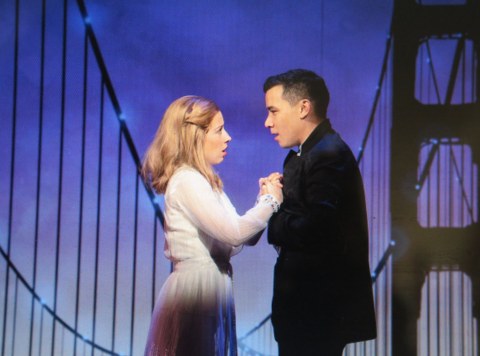
Alyse Alan Louis, Conrad Ricamora in Soft Power with play and lyrics ,by David Henry Hwang, music and additional lyrics by Jeanine Tesori, directed by Leigh Silverman, choreography by Sam Pinkleton (Joan Marcus)
Soft Power as a musical is maverick. It is revolutionary theater breaking genre molds. It diverges in the arc of development which swings like a pendulum including flashback, framing of the main story of DHH’s stabbing and his interactions and impact on Xūe Xíng and vice-versa. The action in the musical loops back revealing the story focusing more on Xūe Xíng’s perspective and the quasi love story between him and Hillary which could be read as symbolic of two countries brought together by love. Of course in DHH’s dream to recovery, there is the realistic component, but the musical is fantastic truth; in it DHH has supplanted Zoe with Hillary.
Additionally, in another amazing twist of the plot and in full on irony in a theater of the absurdist style, Act Two begins with a commentary interlude as a panel sits to discuss the impact of Soft Power fifty years later. Hwang’s panel comments on DHH’s stabbing as a “secondary character” and they argue about the form of the musical being developed in China by Xūe Xíng as “spoken and sung drama.” One expert states there are no American artists, only native craftspeople.
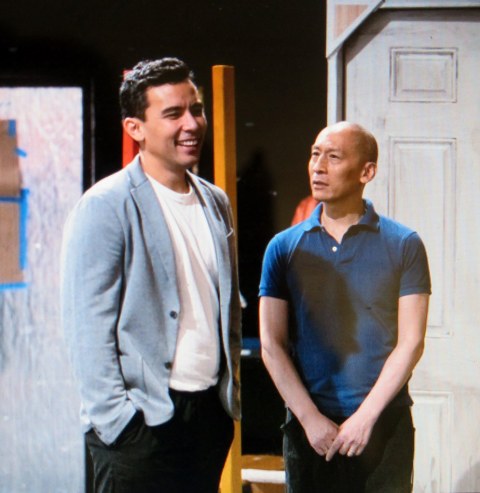
(L to R): REHEARSAL: Conrad Ricamora, Francis Ju, Soft Power with play and lyrics ,by David Henry Hwang, music and additional lyrics by Jeanine Tesori, directed by Leigh Silverman, choreography by Sam Pinkleton (Jenny Anderson)
In this brief scene, we as audience members have been shifted via sci-fi to the future. We get to view the play in a retrospective as Hwang comments on himself ironically. The experts (one who specializes in second-world nations-that is what America has become), argues with an American expert, Adjunct Professor of American Folklore at Columbia University about the genre. The Professor argues that some of the New York entertainments were sophisticated: “One of the most popular was entirely about cats.” Clearly, Hwang gets to dish on Broadway’s tourist fare which rankles New Yorkers, especially during the holidays. The Chinese refer to these American shows by “a second-world nation” as “regional folk art,” which the Chinese as a first world nation elevated. The ironies are telling.
Sadly, their discussion of why DHH was stabbed is Hwang’s factual indictment of white supremacy which his experts fifty years later also refer to as a “random act of violence.” Hwang’s theme of the U.S. as a dangerous country for a traveler is brought to bear for all Americans, especially the politician who would refuse to bring the gun legislation that has been passed in the House to the floor of the Senate.
In reality, David Henry Wang was stabbed before the 2016 election. The violent undercurrents in this nation have been there in each century. America as fantasy-land of the golden dream has many caveats, one of them gun violence, the other xenophobia. These two have been merged into companions by the current president, whose rhetoric has exacerbated the violence. Hwang uses the musical to unleash the satire about the election, guns, etc., because when all has been said, satire hits the target most memorably and is unforgettable.
The musical resumes and ends with Hillary overcoming her losing blues and upholding “Democracy,” perhaps the finest song in the show. DHH awakens and the ensemble joins him in singing the reprise of “Democracy,” which is beyond uplifting for not only Americans but for those remaining democracies in the world. Finally, DHH encapsulates what the citizens of this nation believe, “good fortune will follow, if we somehow survive in America.”
Kudos to all creatives involved :Clint Ramos (scenic design), Anita Yavich (costume design), Mark Barton (lighting design), Kai Harada (sound design), Bart Fasbender (sound effects design), Bryce Cutler (video design), Tom Watson (hair, wig and makeup design), Lillis Meeh (special effects), Danny Troob (orchestrations), with John Clancy (dance music arrangement/additional orchestrations), Larry Hochman (additional orchestrations), Antoine Silverman (music contractor), Chris Fenwick (music supervisor/music director).
Currently playing at the Public Theater until 17th November, Soft Power is sold out after a number of extensions. Someone may donate their tickets to the Public, so check the theater in the remaining days. Otherwise, you’ll have to wait until Soft Power goes to Broadway which it must. The show is astonishing. David Henry Hwang has exceeded even himself and it would be a shame if more people didn’t see it, especially this next year before the 2020 elections. In its hope, its simplicity and complexity, its truth, its charity, it is what we need right now and for as long as we are able to maintain our democratic republic.
‘Cyrano’ Starring The Inestimable Peter Dinklage in a Musical Turn

Scott Stangland, Peter Dinklage and Christopher Gurr in Cyrano, a production from The New Group, currently in a limited Off-Broadway engagement through December 22 at the Daryl Roth Theatre (Monique Carboni)
The New Group’s presentation of Cyrano in a musical adaptation by Erica Schmidt of the iconic Cyrano de Bergerac by Edmund Rostand soars with the entrance of Peter Dinklage as Cyrano. Stationed in the darkened audience, bellowing out witty insults to the actor, Montgomery played by Scott Stangland, he surprises. It is the first of a series of enlightenings by the astounding actor who keeps us enthralled to the conclusion. As Dinklage spirits himself into the light, he signifies he is the driving force of the play’s action. His casting as Cyrano is spot-on. For Cyrano is a genius with poetry and epithets. He is a charismatic, charming and ferocious swordsman, clever in besting all foes in every situation. Indeed, in his genius, he is similar to Tyrion Lannister, the brilliant, good-hearted warrior in the smashing series Game of Thrones for which Dinklage garnered four Emmy Awards and a Golden Globe.
Intuiting divine intelligence and rapier wit, Dinklage’s Cyrano shines. He is riveting and I say this not having watched Game of Thrones avidly, as many of the others in the audience most probably had done, mourning its conclusion this year. That said, the role of Cyrano de Bergerac, even in a version without music, Dinklage most certainly would have triumphed in, with or without the humongous nose attachment. In this version he looks attractively normal. However, when reference is made to his nose, he responds with a subtle gesture invoking his height. We understand he is twitting himself and in this instance, demeaning the disdainful and villainous De Guiche (the superb Ritchie Coster).

(L to R): Peter Dinklage and Josh A. Dawson in Cyrano, a production from The New Group, currently in a limited Off-Broadway engagement through December 22 at the Daryl Roth Theatre (Monique Carboni)
Dinklage is an actor’s actor so he brings thoughtfulness and grist to each and every character he undertakes. The gesture invoking his height is enough; the obviously fake prosthetic nose is unnecessary.
Jumping to an immediate conclusion it would appear to be a shame that a good deal of the poetic beauty, humor and grace of Rostand’s Cyrano speeches (which Dinklage would have delivered with thrilling verve, power and panache), have vanished. They have been supplanted by soulful melodies that sound similar with a few exceptions. The music changes the mood and tenor of Cyrano de Bergerac into Cyrano which Rostand fans may find difficult getting used to. No matter, there is enough to provide interest in this version which is filled with symbolism and irony, even to the point where Cyrano shades most everyone except his friend Le Bret. Schmidt alludes to this at the outset when Cyrano speaks in the darkened audience.
This version has a somberness not necessarily found in other versions of Cyrano de Bergerac. The character’s heartbreak is also more manifest as is Roxanne’s sorrow at the conclusion. Even the music picks up the darker tones, so a revision of understanding is necessary for this version. Cyrano, Christian and Roxanne are more tragic victims whose choices are made rashly and come to haunt them after they are made.

Blake Jenner and Peter Dinklage in Cyrano, a production from The New Group, currently in a limited Off-Broadway engagement through December 22 at the Daryl Roth Theatre (Monique Carboni)
Nevertheless, this Cyrano is inspired by the older play via its plot twists and masking of identities. The arc of development is also similar and the addition of musical numbers elucidate the characterizations and love themes. For example the opening number sung by Jasmine Cephas Jones’ Roxanne “Someone to Say” is particularly lovely and tuneful. The melody’s themes of love are reprised by Christian (Blake Jenner), who wants what Roxanne wants. After he meets Cyrano who befriends him as per Roxanne’s wishes, their union is guaranteed; Cyrano is a man of his word and a man of action who can get things done. Thus, they plot to woo Roxanne with his looks and Cyrano’s intellect and passionate heart for her…masked by his poetic words.
In their exchange, Cyrano will make Christian “eloquent, and Christian will make Cyrano “handsome.” For the love of Roxanne, two men will make up a whole, adorable and perfect man. Hence, we are reminded of another of the play’s themes: no one man has everything a woman wants or needs. And if he looks that perfect, percentages are he isn’t and something is up!

Blake Jenner, Peter Dinklage and Jasmine Cephas Jones in Cyrano, a production from The New Group, currently in a limited Off-Broadway engagement through December 22 at the Daryl Roth Theatre (Monique Carboni)
The music is by Aaron Dessner and Bryce Dessner and the lyrics are by Matt Berninger and Carin Besser. Aaron Dessner and Bryce Dessner are members of the Grammy Award-winning band The National and Matt Berninger is the group’s singer/songwriter. Their score is ambitious and for those who enjoy their music, Cyrano will resound and the machinations of love, intrigue, humor and irony, with Dinklage as Cyrano and Jones as Roxanne (in Hamilton she played the mistress who lures Hamilton into a blackmail scheme), will just be icing on the delicious cake.
This quasi “modernized,” Cyrano iteration shows the arc of the plot development, moving the story of Cyrano, Roxanne and Christian along the shores of romantic tragedy with love realized too late at the foot of death and sorrow. The themes of exceptionalism, the contrast of the beauty of the soul vs. the superficiality and vapidity of prizing outer appearance, ride high in Schmidt’s rendering. And irony underscores the relationships between Roxanne and Christian, and Cyrano and everyone else. As Dinklage’s Cyrano slips in and out of the shadows, he stirs the action while all along hiding his true feelings, like a lovable and poignant grand puppet master pulling everyone’s strings.
With scenic design by Christine Jones and Amy Rubin, we are transported to locations that enhance the eventful through-line: the theater, the pastry shop, Roxanne’s wisteria-laden balcony (beautifully rendered), the battlefield (with accompanying thunderous fire and flashes of distant cannonade), and finally the nunnery. Each are suggested with a simplicity of design. Also, they are enhanced with acutely appropriate and well-thought out props and effects (snow, leaves, etc.), accompanied by sound effects (Dan Moses Schreier).
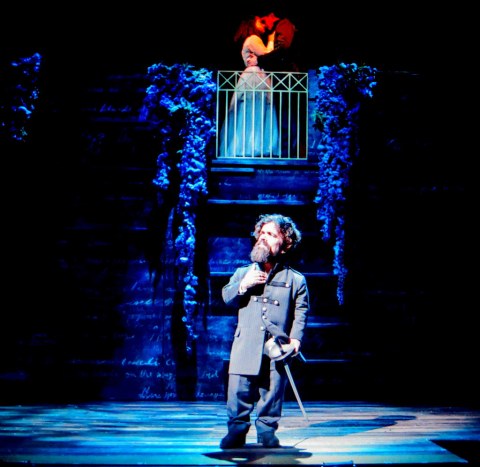
Peter Dinklage, Jasmine Cephas Jones and Blake Jenner in Cyrano, a production from The New Group, currently in a limited Off-Broadway engagement through December 22 at the Daryl Roth Theatre (Monique Carboni)
The back wall, with hundreds of words is a nice thematic touch as are other elements of spectacle, superbly coordinated to emphasize emotional feeling. For example, during the pastry shop scene, the actors perform balletic movements as they work with flour and dough, mixing, then shaping their rolls and pastries. This is fine choreography by Jeff and Rick Kuperman, as Cyrano sings the haunting “Need for Nothing.” The combined effect among the bakers, and Cyrano and his friend Le Bret (the fine Josh A. Dawson), ratchets up the mood and further draws us to empathize with Cyrano’s situation with Roxanne. Indeed, we consider and admire that his elevated, spiritual character does not need material things. Again, what this production beautifully manifests in its design elements reflects Cyrano’s ethos as anti-materialistic, filled with faith and hope in the power of words and the unseen spiritual realm.
For those unfamiliar with the dynamics of plot and characterization of Cyrano de Bergerac, they will appreciate the twists of fate and the evolution of Christian’s character. They will also enjoy the emotional strength and magnanimity of Cyrano, as he helps a rival succeed in love, and restrains his own feelings. It is an act of pure goodness and sacrifice that Roxanne only realizes at the conclusion when she understands that in grieving Christian, it was Cyrano’s soul she loves.
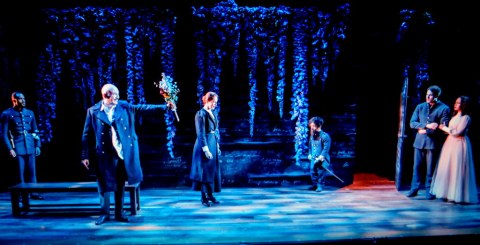
(L to R): Josh A. Dawson, Ritchie Coster, Grace McLean, Peter Dinklage, Blake Jenner and Jasmine Cephas Jones in Cyrano, a production from The New Group, currently in a limited Off-Broadway engagement through December 22 at the Daryl Roth Theatre (Monique Carboni)
The ending of this version of Cyrano is heavy-handed. As such it removes the life-blood of feeling that could be experienced when Cyrano dies. Roxanne’s crying out with too late tears becomes maudlin and melodramatic.
In the original version and a few later iterations I’ve seen, Cyrano de Bergerac is in bed and dying of a hidden head wound. Conquering the pain and his fading strength, he cheerfully tries to rally hope with Roxanne by his bedside. She has realized his love for her and expresses her love to him. Cyrano sees in the distance his old and most ancient of enemies that he’s fought all his life. He draws his sword once more to fight and flails at the reprobates all of us encounter and must overcome in life: “falsehood,” “prejudice” and “compromise.” When his sword drops from his grip as he dies, Roxanne covers his face with kisses.
This ending of Cyrano haplessly fighting these wicked spirits resonates for us especially today. Is it a missed opportunity NOT to conclude with the ancient evils Cyrano battled throughout his life and to his end, evils timeless and modern: “falsehood, prejudice, compromise”? To my mind, yes.
Despite the conclusion I enjoyed this intriguing and effort-filled musical of Cyrano for its performances, the choreography and movement (the battle scenes are unusual and excellent), and the risks taken by the writer/director and the Dessners, Matt Berninger and Carin Besser to form a new approach toward a timeless play.
Finally, kudos to the creatives who made Cyrano come thrillingly alive: Christine Jones and Amy Rubin (scenic design) Tom Broecker (costume design), Jeff Croiter (lighting design), Dan Moses Schreier (sound design), Tommy Kurzman (hair, wig and make-up design), Ted Arthur (music direction), Kristy Norter (music coordinator), Mary-Mitchell Campbell (music supervision and arrangements). Bravo to all!
A developmental production of Cyrano was presented by Goodspeed Musicals in August 2018. This version in its New York premiere runs with one intermission at the Daryl Roth Theatre (101 East 15th St.) until 22 December. For tickets and times CLICK HERE.
‘The Michaels’ by Richard Nelson at The Public Theater, The Extraordinary Ordinary

Rita Wolf, Maryann Plunkett, Haviland Morris, Jay O. Sanders, in ‘The Michaels,’ written/directed by Richard Nelson at The Public Theater, (Joan Marcus)
The Michaels written and directed by Richard Nelson Tony Award-winning playwright (Best Book of a musical for The Dead) is in its world premiere at The Public. The play is part of the Rhinebeck Panaroma cycle of eight plays which include The Apple Family Plays and The Gabriels.
The Michaels takes place in Rhinebeck, New York on the Michaels’ farm in the kitchen of Rose Michaels (Brenda Wehle) a celebrated choreographer who is facing the trial of her life with an acute illness. Present are David, Rose’s former husband, a producer and arts manager (the continually on point, always listening, fiercely authentic Jay O. Sanders) Sally, David’s wife and a former dancer with Rose’s company. Sally is finely portrayed by Rita Wolf. Joining them are Irenie Walker (Haviland Morris) a former dancer with Rose’s company and Kate Harris, a retired high school history teacher. As Kate Maryann Plunkett is superb and equally on point in her moment-to-moment performance. The next generation of the Michaels family includes Lucy Michaels (Charlotte Bydwell) dancer/choreographer who is Rose’s and David’s daughter and May Smith, (Matilda Sakamoto) Rose’s niece who also is a dancer.

(L to R): Haviland Morris, Brenda Wehle, Maryann Plunkett, Jay O. Sanders, in ‘The Michaels,’ written/directed by Richard Nelson at The Public Theater (Joan Marcus)
The Michaels is a “slice of life” drama where the development occurs within the characters as they gather for a reunion of sorts together in mindfulness of Rose’s upcoming exhibition and retrospective. They enjoy reminiscing about the past dancing. And they discuss experiences and highlight issues of currency and more. The interactions are laid back and flow like wisps on the wind that are there and gone. Their comments reveal Richard Nelson’s mastery of “everyday” dialogue. With this he manifests the importance of the little things, of appreciating what appears to be the insignificant detail that surrounds our lives, but which indeed, makes up the substance of the days and hours that we live. By emphasizing the apparently unimportant, these elements become the most crucial materials that saturate our beings in wonder.
The drama is layered with various textures. Although on one level, there isn’t much overt action, we note with the passage of time, the “how” of when friends and family are together. In the coherence there is a dynamism. During the process of gathering themselves, Rose physically reveals the nature of her condition: she is exhausted and must rest. In the first segment she goes upstairs to rest and we glide through this without much thought listening to the conversations generation about various subjects related to family, etc.

(L to R): Matilda Sakamoto, Charlotte Bydwell, Haviland Morris in ‘The Michaels’ written/directed by, Richard Nelson, The Public Theater (Joan Marcus)
Nelson builds this situation as the play unfolds, first with lighthearted easiness then with heavier tones. Rose’s illness becomes more and more central to this evening which in fact is a turning point in all of these characters’ lives. But it is the first night they are all together to celebrate Rose’s contributions and celebration of the dance in a coming exhibit. And gradually we realize that the gathering is a reckoning that time is fleeting and their lives are moving in wheel and woe toward a rise and close on the next part of the journey.
As the conversation touches upon the dance world (primarily in New York) where everyone knows everyone else, and subjects come up about the country, politics and more, eventually Lucy and May are inspired to show the dances they are working on. They have a quasi rehearsal in the kitchen which is more of a presentation and we wonder if there is room to dance in the tight space. There is and we are amazed at their grace, their movements, their physicality and comprehension of every inch of the area they make theirs to rehearse in.

(L to R): Maryann Plunkett, Brenda Wehle, Jay O. Sanders, Charlotte Bydwell, in ‘The Michaels,’ written/directed by Richard Nelson, The Public Theater (Joan Marcus)
Interestingly, their dance becomes symbolic as Rose watches their progress. Another generation is rising as the previous generation of dancers is passing. We appreciate Lucy’s and May’s energy and vibrance which is a counterbalance to the stasis of the conversation which isn’t a climactic series of revelations, but of small personal observations, opinions, shared memories and moments.
As Rose’s daughter and her niece dance, Rose, may be overcome by the realization of what once was that will never be again. She falters in her strength, exhausted from the illness. She must leave the gathering once again to rest and Kate goes with her a caretaker of sorts. This is a recognition for Lucy who goes for a walk with May to deal with this incident and perhaps consider the increasing changes that will continue to occur in her mother’s condition..
In this segment where Rose is in excruciating pain and must go up for her pills assisted by Kate, a chain reaction like a surge of current ripples through the group. Expressions of what will happen spill out. It’s an irony. Mortality has a way of sneaking into the conversation when friends with a history together sit with drinks and food. Rose’s pain attack delivers a hushed response from friends and family. The characters’ sub rosa emotional ebb and flow breaks the surface and we intimate how they may be thinking what life will be like without Rose. But as David characterizes it succinctly, Rose’s condition “is what it is.” Kate will continue to help Rose deal with all practical matters. And when Kate returns to continue the dinner preparation, she mentions that Rose and she did discuss Rose moving in with her into town, leaving the farm, at some point in the future.
These are telling moments toward which all of the other “unimportant” details actually move. And we understand that this is a network of individuals who have circled each other and had their being around Rose who has been an artistic leader and the fountain from which they have been drinking and receiving their nourishment. Indeed, it is a credit to Rose and her congeniality and generosity that her former husband and she have remained friends and that David and Sally are welcome there, integral to this dinner at her farm.
As Kate finishes preparations, they converse and the others help set up the table and begin to eat, there is a familiarity that is stunning and exceptional. All of us have been in this place; we bond with the actors’ characterizations and their acceptance of “what is is, and what’s next is next.”
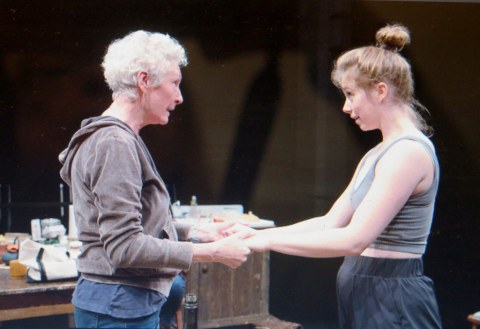
(L to R): Brenda Wehle, Charlotte Bydwell in ‘The Michaels,’ written/directed by Richard Nelson, The Public Theater (Joan Marcus)
In revealing what is mundane and ordinary, the precious actions and conversations of these unique individuals are lifted to a “once-in-a-lifetime” event. They are there, in this space around the table eating and communing. It is a holy event. And because the ensemble brilliantly appear to be so “matter-of-fact” about it, we understand that for them such an event will never return again.
Kudos to the scenic designer Jason Ardizzone-West whose functional, well-thought out spacial arrangements and utilitarian props and set pieces i.e. stove, etc., appeared authentic. Likewise, co-costume designers Susan Hilferty and Mark Koss conveyed the mood and tenor of this family unit of relatives and friends in their dress. Jennifer Tipton (lighting designer) Scott Lehrer (sound designer) rounded out the creative team. The dances based on Original Choreography by Dan Wagoner were superb and kudos to Sara Rudner for her dance coaching.
The Michaels runs with no intermission until 24 November at The Public Theater. For tickets and times CLICK HERE.
‘The Independents’ by Christopher Ward, Edgar Degas and Mary Cassatt in Collegial Conflict
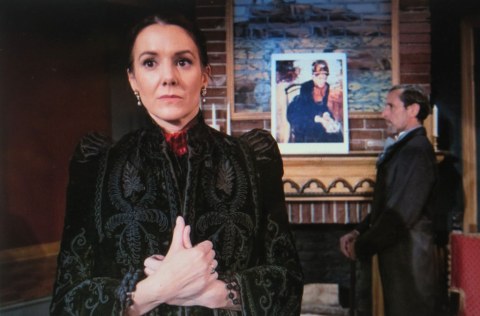
(foreground) Natasa Babic, (right) André Herzegovitch in ‘The Independents,’ written/directed by Christopher Ward at Theater Center (Russ Rowland)
Edgar Degas, French artist (1834-1917) who has been called an Impressionist but disavowed the term during his lifetime, is most known for his paintings of his ballerinas and dancers. His sculpture of “The Little Dancer of Fourteen Years” has become an iconic work whose miniature replicas parents purchase for daughters pursuing ballet. Mary Cassatt (1844-1926) was a maverick, forward-thinking and successful American painter who lived most of her life in Paris, France where she became friendly with Edgar Degas. The Independents currently at the Theater Center chronicles their extraordinary relationship and reveals fascinating information about the two artists who were geniuses in their own right.
Christopher Ward, director and writer conceives of these two individuals based on extensive research after being inspired by a 2014 Degas-Cassatt exhibit at the National Gallery in Washington, D.C. Ward was compelled to write about their relationship which seems counter-intuitive until one revisits their biographies and understands what bonded them together. Ward’s characterizations and delineation of their interactions are grounded in fact and imagined by the truth and mores of the time which limited women’s options and designated they be wives and mothers, spinsters or prostitutes. However, Mary Cassatt’s uniqueness, intelligence and artistic abilities are most probably what triggered Degas’ interest in becoming friendly with her after he saw her work. Ward’s understanding of these two individuals makes for a profound historical view of great artists, their influence on each other and the time in which they lived, Belle Epoch, Paris.
As the play opens Mary Cassatt, portrayed with reserved control, grace and subtle, ironic humor by Natasa Babic arranges to meet Edgar Degas in her studio. Degas’ reaction is unpredictable; he leaves. Mary sighs disappointed, but is nonplussed. Then Degas returns to further comment. Already, Ward has encapsulated the particularity of their natures which he unspools with surprises throughout the play.
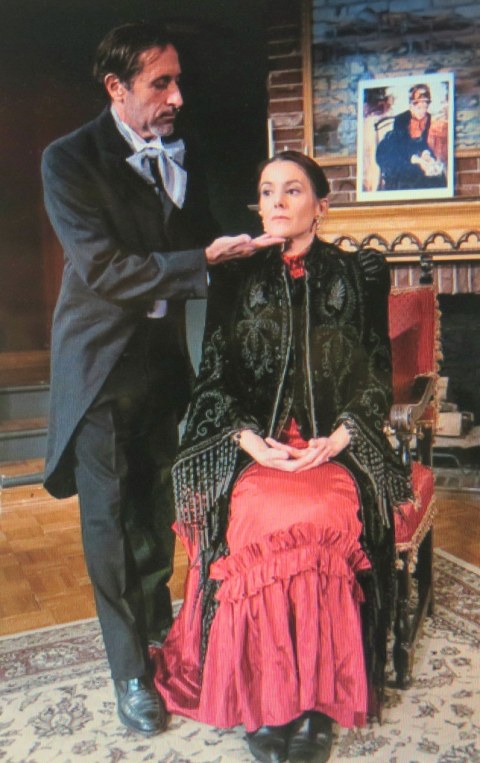
Natasa Babic, André Herzegovitch in ‘The Independents,’ written/directed by Christopher Ward at Theater Center (Russ Rowland)
Degas, portrayed with an arrogant disdain by André Herzegovitch, softens and becomes more good humored as their relationship progresses. Eventually, he reveals that he respects Cassatt’s achievements as a woman painter, a rare breed. He also recognizes the strength, autonomy and fearlessness required to pursue a career in painting that eschews a family and husband in order to become great. In short he admires her industry and work ethic which is like his. They both sacrificed marriage and a family for the sake of their work to constantly innovate and evolve. In this they are like “two peas in a pod,” and indeed, Degas tells her he respects her more than he does the painters in his group of “Independents.”
For her part Mary Cassatt, as the playwright depicts, holds her own with the venerated, successful Degas. She calls him down in response to his churlish comments some of which fall just short of demeaning insults, a criticism he denies. She admires his work and secretly yearns for even a crumb of support from him when he looks over her work. Interestingly, Cassatt doesn’t fawn over Degas though she might very well have done so. But Ward reveals her to be a powerful woman, a feminist in her time. Her personal well-spring of confidence serves her as she goes head-to-head with Degas whose presumptuous demeanor, though based on true brilliance, is often hard to take.
Indeed, both artists were headstrong and complex individuals. Christopher Ward superbly unveils the dynamic of their unique friendship and mentorship, and he indicates that Cassatt even gave Degas ideas. The director acutely shepherds the actors who portray Degas and Cassatt authentically, as they move forward with their work sometimes with excitement but always with irony, suspicion, aloofness and reserved warmth.
The play is largely a character study about two renowned artists who circle each other in competition and veneration like atoms that need each other to form something new, but never get too close for fear of colliding and destroying themselves. Ward’s characterizations are fascinating in showing who they are and how they inspired and competed with each other. With their dialogue he succinctly captures the undercurrents-conflicts, strains, admiration, humor and collegial acceptance. The interchanges between Degas and Cassatt, adroitly acted by Babic and Herzegovitch engage throughout.
Various events highlight their relationship and Ward builds the arc of development around these. The most vital one occurs when Degas upon finding the Salon has rejected Cassatt’s last two works is thrilled and invites her to exhibit with his “Independents” (a group of artists who have broken away from the salon) that some refer to as ‘Impressionists,” a title Degas despises. Cassatt is excited, but manages to restrain her overwhelming joy in receiving the great honor. She keeps her stance with measured, balanced grace. Degas is intrigued.
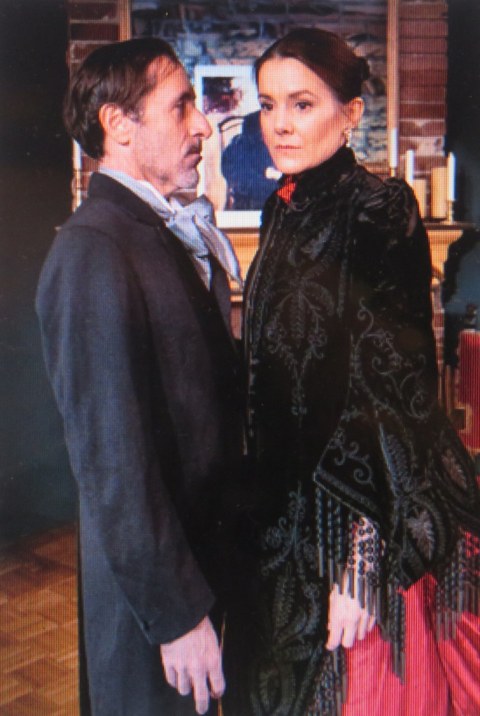
Natasa Babic, (right) Andre Herzegovitch in ‘The Independents,’ written/directed by Christopher Ward at Theater Center (Russ Rowland)
During an intimate conversation about herself, Babic’s Cassatt reveals that she has had suitors, but refused to become engaged because her work was paramount. She could not allow a man to interfere with what she wished to accomplish. However, she leaves a door open for Edgar Degas when she indirectly proposes that he might be the right man to marry because they have painting in common and he would understand her driving passion for her work. Degas’ response is ironic. Indeed, it sets the tone for their future relationship. Their shared sensibilities kept their friendship intact for almost forty years, despite arguments and strains. But they obviously enjoyed sharing artistic experimentation and freedoms and had secrets between them which have gone into the ethers. Neither were letter writers, or they destroyed all their correspondence. Ultimately, their bond retains mysteries for us today.
Another event Ward expands is based upon a discovery and revelation by art historians and experts at the National Gallery over 130 years later. Cassatt is painting a work which is not finished. When Degas looks at it, while Cassatt is otherwise engaged, Degas corrects the perspective adding a corner to the painting that wasn’t there before. At first Cassatt becomes infuriated at Degas’ effrontery adding something to her work and implying she is an “inferior.” Then she realizes that it is an improvement and she apologizes and the enhancement remains. In the process of exploring Degas’ addition to Cassatt’s work, the curators and experts at the National Gallery established the Degas-Cassatt exhibition in 2014. See Art news!
Ward’s inclusion of such a scene in the play reveals volumes. Both Cassatt and Degas obviously supervised each other’s work critically and benefited from each other’s influence. This is one more important moment of many in this play. Such dynamic events illuminate both artists and their dependence on each other. As far as history has revealed, Mary Cassatt appears to be Degas only female artistic friend.
The set design is simplistic and appropriate. Paintings that Cassatt finished appear on easels and the walls of her studio. Interludes for costume changes work with music filling in the gaps. I particularly like the Erik Satie additions which I found haunting and expressive of how these two individuals were friends but kept a portion of themselves secret so that they were ultimately not completely accessible to each other. The costumes are exquisite and appropriate for that time. Additionally, Cassatt’s dresses mirror dresses worn by herself as a subject of Degas’ work. Cassatt modeled for him on a number of occasions, sometimes not appreciating how Degas rendered her.
Rather than go on with more detail, I will not spoil it. You must see this production especially if you love Degas and Cassatt. Your eyes will be opened and you will be amazed as I was at the portrayals beautifully effected by Ward’s writing and directing and the actors’ intriguing and nuanced work. But the show is in a limited run and closes 10th November. So make arrangements immediately! You will be glad you did.
The Independents runs at the Theater Center (210 W 50th St. at Broadway) with a very brief intermission. For tickets and times CLICK HERE.
‘for colored girls who have considered suicide/when the rainbow is enuf,’ by Ntozake Shange in revival at the Public Theater

The company of ‘for colored girls who have considered suicide/when the rainbow is enuf,’ by Ntozake Shange, directed by Leah C. Gardiner, choreographed by Camille A. Brown (Joan Marcus)
You cannot watch for colored girls who have considered suicide/when the rainbow is enuf without your muscles vibrating in joy to the rhythms of the music of Ntozake Shange’s poetry. And when it is set to the dance with musicians pealing out the songs of multicultural generations with her choreopoem delivered enthusiastically in the personal languages of black women from various backgrounds using their unique words, gestures and dance movements, it is simply grand.
for colored girls... directed by Leah C. Gardner with choreography by Camille A. Brown is now in revival at the Public Theater. Originally, the work premiered on Broadway in 1976 and received a Tony nomination. Notably, it is the second play by a black woman to reach Broadway, preceded by Lorraine Hansberry’s A Raisin in the Sun in 1959. Shange updated the original choreopoem in 2010. She included additional material, the poem “positive,” and added references to The Iraq War and PTSD.
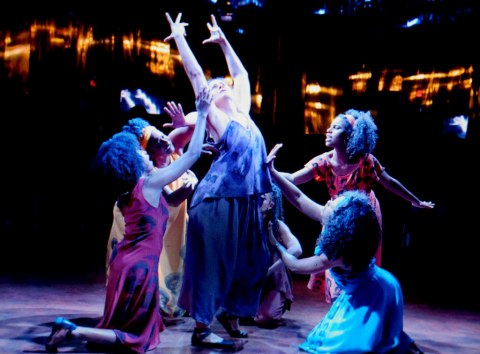
‘for colored girls who have considered suicide/when the rainbow is enuf,’ by Ntozake Shange, directed by Leah C. Gardiner, choreographed by Camille A. Brown (Joan Marcus)
This iteration in its maverick coolness is a celebration not only of black women. It is for women everywhere. The work recalls us to a time when women reveled in the identity and unity of being female. It was a time in the feminist wave when they rejoiced being in a community of sisters from around the nation and the world. It was a time to become visible, be heard, speak truth to power, overcome, conquer. Considering the crisis and chaos the current WH administration attempts to breed in our culture in concert with a senate majority leader supportive of the white patriarchy who revel in misogyny, embrace white nationalism and leverage religion as a political tool, it is time to revisit the themes and messages of for colored girls… and view them through the lens of womenhood, including those who are most in bondage, white women.
Shange’s choreopoem as in other productions includes music and dance with some poems sung. It is performed by seven women each sporting a dress of a different color which combine to make up colors of the rainbow. As an ironic note, remember that all colors combine to create the color white representing what is sanctified and holy, if you will. Indeed, this “is enuf.”

(L to R): Jayme Lawson and Adrienne C. Moore and the company of ‘for colored girls who have considered suicide/when the rainbow is enuf,’ written by Ntozake Shange and directed by Leah C. Gardiner, with choreography by Camille A. Brown, running at The Public Theater (Joan Marcus)
The woman/actors depicted in Shange’s majestic choreopoem are as follows: brown (Celia Chevalier), yellow Adrienne C. Moore) blue (Sasha Allen) red Jayme Lawson) purple (Alexandria Wailes) orange (Danaya Esperanza) and green (Okwui Okpok Wasili). Together and individually, they dance to express their identities throughout the work and also listen and partake in the community by sharing their wisdom and experience. At the outset of the production, each moves to center stage where via monologue, they contribute their personal message of womanhood.
As the various women play “tag, you’re it,” the first to begin, the woman in brown, steps into herself and with her own dialect, rhythms, gestures and carriage tells a story from her youth about her love fantasy Touissant. She first read about Touissant in the “forbidden” adult section of the library. Touissant was the black general who fought for France and ended up starting his own revolution reinforcing the Haitian slaves who ignited an insurrection against their bondage. Touissant continued their work and inspired a revolution against oppression which ended in a free Haiti.
The woman in brown’s love is metaphoric and symbolic. Touissant represents freedom from enforced bondage. In seeking him as her fantasy lover, the woman embraces the freedom to be herself in a culture that attempts to nullify her voice and identity. When she shares that she meets up with a boy named Touissant Jones, she realizes that one is similar to the other in not “taking any guff” from white people. She decides in her quest for escape from white supremacy’s mores (she had planned to to go Haiti) she will continue with the real Touissant Jones and become the freedom that Touissant metaphorically represents. She will make her own place regardless of whether “they” recognize her or not, for she has empowered herself to know who she is.

The company of ‘for colored girls who have considered suicide/when the rainbow is enuf,’ by Ntozake shange, directed by Leah C. Gardiner, choreographed by Camille A. Brown (Joan Marcus)
Each of the women relate their personal stories in choreopoems. Some are humorous. For example, the woman in yellow shares giving up her virginity in a buick on the night of her graduation. When queried about it by the woman in blue, she tells her, “It was wonderful!” Each of the women chime in about where they “lost it.” The effect is funny and the sharing brings the group together in community. Moving in a different direction, the woman in blue riffs on her experiences running off at sixteen to dance with Willie Colon in the Bronx where she feels sublime dancing the mambo, bomba and merengue all night. But when Colon doesn’t show, she goes to a bar where she learns the beauty and subtly of musicians playing the blues. Her time center stage ends with a song/poem to the power of music and life. Sasha Allen’s voice is incredible.

Shasha Allen (center) and the company of ‘for colored girls who have considered suicide/when the rainbow is enuf,’ written by Ntozake Shange and directed by Leah C. Gardiner, with choreography by Camille A. Brown, running at The Public Theater (Joan Marcus)
The woman in red gives a lament about throwing herself into the pursuit of a lover then ending the affair, a place all the women have been as they “dance to keep from” cryin’ and dyin.'” Then there is a transition; the light signals the emotional shift which deepens into the harder subjects beginning with rape. But is it rape when you know your rapist who is a friend or close family member? Each of the women relate their wisdom and finish each other’s thoughts for all have experienced the “latent rapist’s bravado.” These are “men who know us…that we will submit and relinquish all rights in the presence of a man…especially if he has been considered a friend…”
This section is particularly powerful in light of the #metoo movement. The women in the beauty of Shange’s verse and the rhythms of their movements share how the “nature of rape has changed.” You “meet your rapist in coffeehouses sitting with friends.” We can “even have them over for dinner and get raped in our own houses by invitation, a friend.”

The company of ‘for colored girls who have considered suicide/when the rainbow is enuf,’ by Ntozake shange, directed by Leah C. Gardiner, choreographed by Camille A. Brown (Joan Marcus)
Sadly, these lines are even more salient today as we hear the statistics: one in three women are raped in their lifetimes and more than a few are raped more times by different men. One thinks of the power dynamic of the Harvey Weinsteins, the Matt Lauers, the Bill O’Reillys, the Roger Aileses, and all those invisible bosses or friends who laud their “latent rapist bravado” towering over subservient females while boasting about their conquests in gyms and lockers rooms, while showering together. Women reduced, vilified, hated, objectified, say little for fear of more abuse or loss of a job and career. Or they are PTSD frozen by the audacity that someone took what wasn’t theirs to take. The #metoo movement is a first step. When the “latent rapists” are in jail and the men and women they would trample over with their violence are in positions of power, this justice will indicate the culture is climbing to the mountaintop.

Celia Chevalier (foreground) in for colored girls who have considered suicide/when the rainbow is enuf, written by Ntozake Shange and directed by Leah C. Gardiner, with choreography by Camille A. Brown, running at The Public Theater (Joan Marcus)
Whether latent or verbally harass raped or physically abused, rape is violence. There is nothing sexual about it. In the infantile man’s mind, his penis is a weapon to slay and conquer women. Nothing adult or masculine! A man’s sexuality and masculinity are expressed in tenderness, truth and soul giving as the various women point out in their comments about men and relationships. But who is mentoring these traits of grace? Certainly not the president, or Jeffrey Epstein or Bret Kavanaugh or the Republicans and others in positions of power in business, politics and elsewhere who have sexual abuse on their resumes, hidden by AMI’s “Catch and Kill” program. (Read Ronan Farrow’s titular book on this subject.)
From rape, the rainbow of women present choreopoems about abortion, domestic violence, abandonment, devastating relationships and seeking identity through sex and love. And in the sharing of their trials, hurts and losses, especially the loss of self-hood, there is a benefit. Healing comes with love and empowerment to resurrect a new self inspired by the community of women who understand and uplift.
One of the more powerful, humorous and profound presentations references how women give their self-hood and identity to men and or the culture/patriarchy. The audience responded with laughter at what the woman in green meant metaphorically and symbolically with the refrain, “somebody almost walked off wid alla my stuff…now why dont you put me back & let me hang out in my own self?” Okwui Okpokwasili as the woman in green is riotous in her portrayal and stance as a woman who has realized that she has been giving all of herself away to one or many who don’t really understand or want her being.
“i want my own things/ how i lived them/ & give me my memories/how I waz when I waz there/ you can’t have ’em or do nothin’ wit em/stealin’ my shit from me/dont make it yrs/makes it stolen”
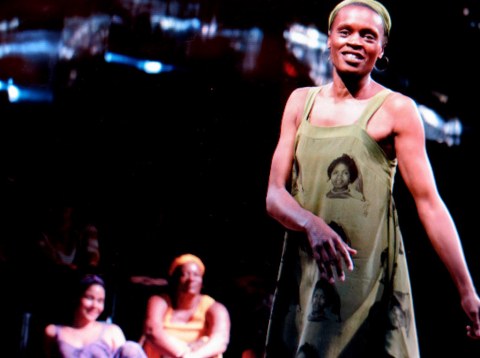
Okwui Okpokwasili (foreground) in for colored girls who have considered suicide/when the rainbow is enuf, written by Ntozake Shange and directed by Leah C. Gardiner, with choreography by Camille A. Brown, running at The Public Theater (Joan Marcus)
Okpokwasili’s presentation resonated deeply not only with women but with men. Stealing is an analogy with the robbery of self and what one deems most valuable. In this instance, it also includes physical, mental, emotional and spiritual well-being that has been robbed by the culture and those brainwashed into theft. Just Wow!
The most poignant choreopoem concerns soul sickness and fear in men that converts to abuse and torment. The woman in red shares the dramatic events that encompass her children’s deaths at the hands of a former partner. The pain and torment from these experiences are related to the community of women who give a laying on of hands to bring on healing. And by the end of this section and the conclusion of the production, each of the women separately then in unity chant as a chorus whose vibrations go out into the audience, “I found god in myself & I loved her/ I loved her fiercely.” At this point the women though they may have considered suicide because of what they have experienced, in the companionship of sistahs have brought themselves and each other to the end of their own rainbows, “fiercely.”
This production is momentous. Shange’s poetry shimmers on the page. The creative team makes the director’s vision equally shine with brilliance. Kudos to Myung Hee Cho (scenic design) Toni-Leslie James (costume design) Jiiyoun Chang (lighting design) Megumi Katayama (sound design) Martha Redbone (original music) Deah Love Harriott (music director) Kristy Norter (music coordinator) Onudeah Nicolarakis (director of American Sign Language).
A caveat, however, is that some of the lyricism and the poetic language is lost in the exuberance of the performers’ actions, some more so than others. Specifically, the words, the expressions in all their glory are not always clear. Sometimes, these were garbled or faded as if on the wind. That is a fabulous conception, however, it doesn’t serve the themes that can resonate and should resonate with the audience, especially the men as they learn about women, a subject they often profess to know little about. Men above all need to know the “what” of women’s experiences.
Hamilton, Lin Manuel Miranda’s work is rapped quickly, exuberantly. However, each word is treated with “kid gloves,” to add a simile, like a diamond, or precious ruby. Each word is articulated, pronounced clearly, enunciated. Why aren’t Shange’s words treated like such jewels? Every word is vital to our understanding.
I wasn’t the only one frustrated by the performers rushing over the poetry to make the production come in at a certain time. In my section of the audience, humorous segments were missed. Sitting in the round the audience opposite us laughed. The same occurred when we laughed, the audience on the opposite side were silent. Great, if that is a symbolic/thematic notion. I understand, but don’t agree if that is the intentional direction.
Shange’s poetic phrases and word choices are heady. The performers are there to tell a story, to act and be heard and understood. What Shange is saying we must understand. All of it! Okwui Okpokwasili’s “somebody almost walked off wid alla my stuff…” was hysterical and deep, and the audience around me laughed and enjoyed that choreopoem because she slowed down, enunciated, paused, articulated; the same occurred with Adrienne C. Moore. And Alexandria Wailes’ signing was excellent and powerful. But some of the other women at times didn’t completely come through to us. That disappointed me because I loved the production’s energy and profound themes. Despite that caveat, it is smashing!
for colored girls who have considered suicide/when the rainbow is enuf runs with no intermission at the Public Theater until 8th December. For tickets and times CLICK HERE.
,
‘Scotland, PA.’ a Smashing Musical Adaptation of the Titular Film-Spoof of ‘Macbeth’
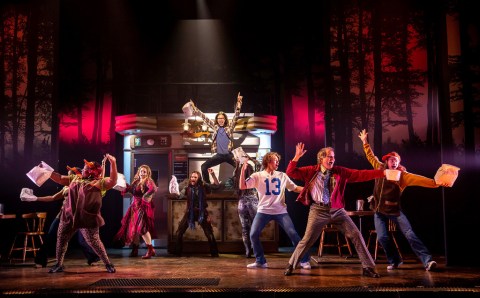
The Company of Scotland, PA, directed by Lonny Price, book by Michael Mitnick, music & lyrics by Adam Gwon, adapted from the titular film by Billy Morrissette, based on William Shakespeare’s ‘Macbeth’ (Nina Goodheart)
Scotland, Pa directed by Lonny Price, with book by Michael Mitnick and music and lyrics by Adam Gwon is a rollicking musical with clever twists, sardonic comedy and a morality tale tucked somewhere in between the all beef patties, special sauce, lettuce, cheese, pickles, onions on three sumptuous brioche buns. Well, perhaps I got carried away with the bun concept. Adapted from the film of the same title by Billy Morrissette which was produced by Richard Shepard, Jon Stern and Abandon Pictures, Scotland, Pa the musical, currently running at Laura Pels Theatre Harold and Miriam Steinberg Center for Theatre is a take-off of William Shakespeare’s Macbeth. There are even three stoner witches whose marijuana-toking hallucinations serve as the powder-keg to turn sweet protagonist Mac into a reprobate rapscallion.
Like the film the musical loosely reconfigures the “Scottish Play’s” key characterizations, plot and themes against the backdrop of a sleepy town Scotland, Pennsylvania hamburger joint. Nothing ever happens there, and no one anticipates that in a decade outsourcing and Reganomics will destroy unions, winnow high paying factory jobs and attenuate American workers’ pay checks making the situation in Scotland, PA even worse.
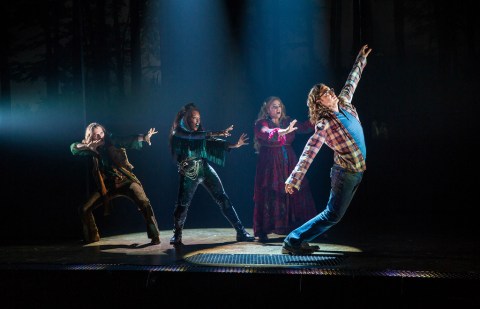
(L to R): Kaleb Wells, Wonu Ogunfowora, Alysha Umphress, Ryan McCartan, Scotland, PA, adapted from the titular film written by Billy Morrissette, based loosely on William Shakespeare’s Macbeth (Nina Goodheart)
For in this backwater of Pennsylvania, the economy is already rust belt before outsourcing vanishes the nation’s industries. There is little opportunity for high school graduates except working at fast food hamburger joint Duncan’s owned by Duncan (a humorously overweening Jeb Brown). Duncan (unlike King Duncan in Shakespeare’s Macbeth) is a horrible boss, penurious, abusive and greedy. He shortchanges and mistreats his workers, just like the corporate CEOs today. That is about the most forward thinking thinking that Duncan accomplishes for his business where he is slothfully satisfied to dump on Mac (Ryan MCartan) Pat (Taylor Iman Jones) and their friend Banko (Jay Armstrong Johnson) and keep any and all profits for himself. A poor businessman, he will not reinvest or motivate his workers to help his business expand.
Mac who is electrified by the business angle of fast food restaurants presents amazing ideas to Duncan who rejects them out of hand deeming Mac’s ideas dumb. Humorously, the ideas are famously brilliant having been implemented in Ray Kroc’s McDonald’s years later. Duncan’s arrogant stomping out Mac’s intellectual smarts, ambition and concern to accelerate Duncan’s bottom line reveals the “CEO’s” vapid bone lazy idiocy.

Taylor Iman Jones, Ryan McCartan in ‘Scotland, PA,’ directed by Lonny Price, adapted from the titular film by Billy Morrissette, based on William Shakespeare’s ‘Macbeth,’ book by Michael Mitnick, music & lyrics by Adam Gwon, choreographed by Josh Rhodes, music direction by Vadim Feichtner (Nina Goodheart)
Beyond frustrated, Mac spurred on by ambitious Pat comes up with an incredible idea and presents it to Duncan who once again demeans and tortures Mac with insults. As a final “hurrah of hope” Mac proves that the manager is stealing, believing that Duncan will reward him with a raise and the managerial position. Instead, Duncan gives his uninterested son Malcolm (Will Meyers brings down the house in his song “reveal”) the manager’s position. Malcolm who would rather play football rejects his father’s offer and leaves when Duncan tries to teach him the business.
Throughout, hippie stoners Jessie (Alysha Umphress) Stacey (Wonu Ogunfowora) and Hector (Kaleb Wells) sing about the town and Mac’s situation and effect the wicked transition in Mac and Pat’s destiny toward doom. In an argument with Mac, Duncan ends up falling head first into the hot oil of the fryer, an incident which just skirts manslaughter. What prompted this? Duncan catches Mac and Pat stealing and their guilt prompts them to struggle against Duncan though his death is largely accidental. But crime begets crime: in the commission of their theft, Duncan dies, they pin Duncan’s death on someone else and use Duncan’s money to buy out Duncan’s from his son. As Mac and Pat step deeper and deeper into the evil foretold and instigated by the witches, the musical progresses toward more twists, an investigation and scramble to hide the truth in an ironic, black comedy conclusion which is also poignant.
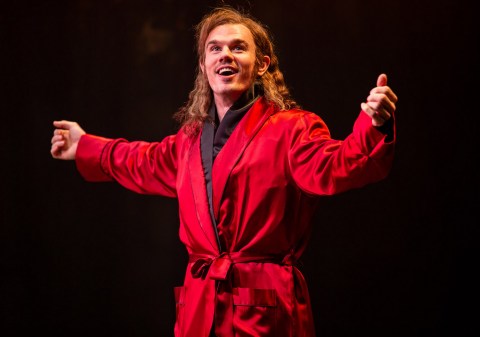
Jay Armstrong Johnson in ‘Scotland, PA,’ directed by Lonny Price, adapted from the titular film by Billy Morrissette, based on William Shakespeare’s ‘Macbeth,’ book by Michael Mitnick, music & lyrics by Adam Gwon, choreographed by Josh Rhodes, music direction by Vadim Feichtner (Nina Goodheart)
The surprises are many and the jokes are uproarious. The musical numbers are well staged and equally riotous and energetic. As Mac, Ryan McCartan is not only an adorable innocent turned miscreant, his vocals are smashing and his authenticity is spot-on in a role that one could make ineffectively campy which would have been a mistake. McCartan shines and we find ourselves empathizing with him as he stands up to detective Peg McDuff (the suspicious, inquisitive Megan Lawrence) and deflects her investigatory skills. Likewise, Taylor Iman Jones portrays wife Pat with sincerity and her voice is gorgeous. How can he not be loyal to her dreams and wishes though they include malfeasance?
Driven to seek a better life upward from their poverty, Pat motivates Mac toward with conniving subtly. The witches’ provocations spin and contort so that benign dreams morph into the nefarious and damaging, first with stealing the cash in Duncan’s safe then with manslaughter, then a cover-up murder. The crime dominoes fall and Pat is always there to “screw Mac’s courage to the sticking place,” as they enjoyably couple to commit even more dastardly deeds.
How Mitnik and Gwon transform a well-meaning, average, lower middle class husband and wife into thieves and murderers is humorous with all the stops removed. On the one hand, Jeb Brown’s Duncan is so loathsome, we are not surprised at the comeuppance he gets. His mistreatment of his workers, abuse of his son and arrogant insults and rotten demeanor drain all our sympathy upon his death. However, the black comedy deepens when investigator Peg McDuff comes upon the scene. Fear of discovery and the need to cover-up become the linchpins that send the “well-meaning” capitalists Mac and Pat right into hell with betrayal, murder and suicide.
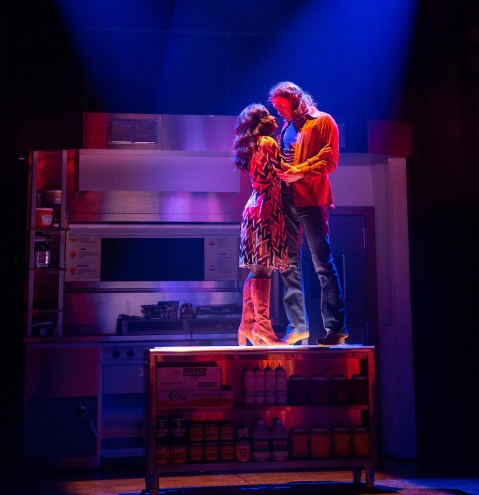
Taylor Iman Jones, Ryan McCartan in ‘Scotland, PA,’ directed by Lonny Price, adapted from the titular film by Billy Morrissette, based on William Shakespeare’s ‘Macbeth,’ book by Michael Mitnick, music & lyrics by Adam Gwon, choreographed by Josh Rhodes, music direction by Vadim Feichtner (Nina Goodheart)
As their friend and foil Banko, Jay Armstrong Johnson is flat out marvelous in the role of the lame-brained, stoned out hippie who can’t get out of his own way. And Armstrong can do more than carry a tune; he has a show stopper number to boot. As with the others in the ensemble, his vocal power is prime. The surprise in his characterization occurs when he reveals he is more sentient than we imagine and actually is a threat to his two friends in blowing apart their alibi.
The arc of development moves toward a swift conclusion and the “bedazzled by wickedness” Mac fulfills the prophecy of the witches, despite himself. We are left with the themes: “the love of money is the root of evil,” “crime begets cover-up and more crime,” “overweening, unrestrained ambition destroys.” Each are their own moral lessons. At least in this bucolic town, ethics still abide and “crime doesn’t pay,” after all. Of course that is because Peg McDuff believes in serving justice, not serving herself or any corrupt cronies, unlike our present times. In this the play’s small town folkways and ethics are charming reminders of the past. Oh how long ago and far away this America was!

The Company of ‘Scotland, PA,’ directed by Lonny Price, book by Michael Mitnick, music & lyrics by Adam Gwon, adapted from the titular film by Billy Morrissette, based on William Shakespeare’s ‘Macbeth’ (Nina Goodheart)
Scotland, PA remains a lovable, smash hit worthy of seeing a few times for its sardonic humor and the ensembles’ masterful delivery of clever humor and pacing to full effect. The songs are not earth-shattering in meaning, but they are tuneful and effervescent. Everyone in the cast from the three stoner witches to Peg McDuff are focused. Their portrayals have been well shepherded by Lonny Price’s incisive, thoughtful direction.
Set design elements thanks to Anna Louizos are funny in the transformation between the Duncan’s of Act I to the spoofing of the real Ray Kroc and McDonald’s in Act II. From the thunderous lightning cracks to additional lighting elements created by Jeanette Oi-Suk Yew and accompanying sound design elements by Jon Weston, Scotland, PA’s tenor, mood and irony shift and change providing a fabulous medium to stir the actors to hit their marks! Likewise, costume design by Tracy Christensen and hair, wig & make-up design by J. Jared Janas combine elements of the modern and throwbacks to the 1970s. I loved the look of the witches. And the restaurant outfits in Act 2 are a hoot!
Music Direction by Vadim Feichtner, orchestrations by Frank Galgano & Matt Castle and choreography by Josh Rhodes help to make this a great entertainment. Bravo once and bravo twice for good measure to the creative team, Lonny Price and the ensemble of Scotland, PA.
The production runs with one intermission until 8th December at Roundabout, Laura Pels Theatre Harold and Miriam Steinberg Center for Theatre (111 West 46th St). For tickets and times CLICK HERE.
‘Macbeth,’ by William Shakespeare, Starring Corey Stoll, Nadia Bowers at CSC

Nadia Bowers, Corey Stoll in Shakespeare’s ‘Macbeth’ directed by John Doyle at CSC (Joan Marcus)
Macbeth directed by John Doyle currently runs at Classic Stage Company. The production is minimalistic. It is stylized toward removing any extraneous feature that would slow down the race toward the conclusion of one of the most performed of Shakespeare’s plays. The production clocks in at a slim 90 minutes with no intermission, few props, the barest scenic design, no bulky Byzantine elements or interpretations. It eschews the spectacle, sturm und drang of previous maverick, heavy-handed iterations of Macbeth that have come to New York- Broadway, Lincoln Center or Off Broadway stages in recent years or have been presented at the Armory. Only the costumes whisper Scotland with each of the actors sporting a plaid tartan shawl and appropriate dress.
For those very familiar with the “Scottish Play,” this spare production will be fascinating. Its emphasis resides in the fine performances of Corey Stoll as Macbeth, his partner Nadia Bowers as Lady Macbeth, Eric Lochtefeld as Banquo and the adroit ensemble. For those unfamiliar with Macbeth who are looking to become more acquainted with the play, that has superstitious actors refusing to speak the title anywhere near a theater stage, this is not the production to see. Better to see a film version to get a handle on the plot, characterizations and themes before you stop in to see the CSC production. Then you will be able to understand and appreciate Doyle’s direction that concentrates on the grist of Shakespeare’s arc of development and characterizations, especially of Macbeth and Lady Macbeth.

Mary Beth Peil in ‘Macbeth’ by William Shakespeare directed by John Doyle, CSC (Joan Marcus)
There are many fine films of Macbeth; one directed by and starring Orsen Welles (1948); Roman Polanski’s Macbeth (1971), and most recently an incredibly visual and cinematic Macbeth starring Michael Fassbender directed by Justin Kurzel (2015). There is even a sardonic, comedic take-off on Macbeth (Scotland, PA, a film-2001), and the Off Broadway comedic musical adapted from the 2001 film currently running at the Laura Pels Theatre, Harold and Miriam Steinberg Center for Theatre.
Knowing the play as well as I do, I had little difficulty in appreciating the singularity of the performances and the rapid pacing of the events which fall in on themselves from scene to scene like dominoes. The pacing is important thematically and reveals much as an expression which manifests characterization. We, like Macbeth, are often hurled into a whirlwind of rapidly cascading events that occur around us, forged by those in power. Indeed, we barely have time to consider what is happening to take stock of circumstances. Instead, we must make quick deliberations and because of the speed, often make bad choices. This conceptualization pertains to this pared down production in the characters of Lady Macbeth and Macbeth.
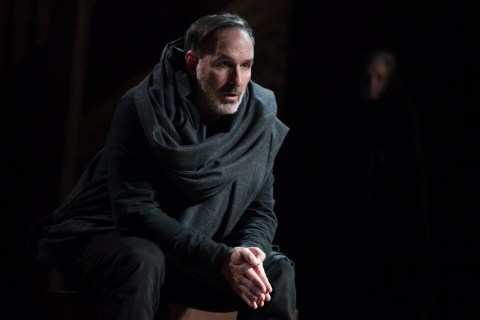
Erik Lochtefeld in ‘Macbeth’ by William Shakespeare, directed by John Doyle, CSC (Joan Marcus)
In Doyle’s version we note Macbeth, a Scottish general who is driven on a course of loyalty to king Duncan to be valorous in battle. Stirred up by the voices of the culture (represented by a chorus of players who recite the dialogue of the three witches), to extend his ambitions in competition with Banquo, both generals receive a prophecy. Each encourages the other to believe what the chorus of witches speaks in their incantations. The prophecy concerns Macbeth becoming king and Banquo’s heirs becoming kings and ruling the kingdom for generations. Banquo’s and Macbeth’s imaginations ripen without prayer or meditation to become obsessed with their futures. Macbeth, rather than to consider that the chorus of witches may be evil, shares the “news” with Lady Macbeth who leaps to the assassination plot of killing Duncan who will stay at their castle.
The events pick up speed, unhindered by Macbeth’s doubt or unsettled nervousness because Lady Macbeth moves without delay to influence him to kill Duncan and murder the guards in retribution, laying blame on Duncan’s sons who flee. Macbeth assumes the throne without question, then with growing fear and paranoia betrays his friend Banquo and has him killed. When Macbeth attempts to be a proper statesman and ruler holding a banquet for his Lords to ingratiate himself to them, Banquo’s ghost appears upending Macbeth’s peace of mind, rest and attempted diplomacy. Afterward, confusion and mania escalates into psychotic paranoia and guilt. Macbeth’s seemingly unstoppable reign of tyranny and civil war grows in ferocity and wickedness toward an inevitable and swift conclusion.
Indeed, Doyle reveals an aspect of Macbeth not typically focused upon. Events unfold like a storm for which no preparation can be made. Macbeth and Lady Macbeth are largely transactional. Their motivations overwhelm them without thoughtful consideration. These upend them so quickly they leave no time to check themselves and consider what the consequences of their dishonorable actions will foment. Rationality leaks into insanity. It is as if Macbeth has allowed himself to be submerged underwater and is drowning in his own bloody imagination and frenzied blood-letting. This happens so rapidly and so smothers him and Lady Macbeth in guilt, he cannot breathe or rest easily once they’ve murdered their king and usurped his power. After the regicide, they are incapable of ruling wisely or well. They are consumed with maintaining the power they don’t understand and cannot keep because they are illegitimate and unfit.
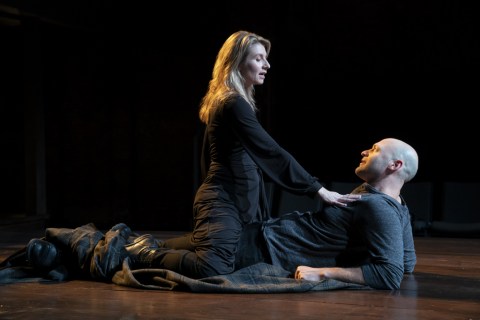
Nadia Bowers, Corey Stoll in ‘Macbeth’ by William Shakespeare, directed by John Doyle, CSC (Joan Marcus)
Regicide drives Macbeth and Lady Macbeth to devastating guilt. But they are incapable of seeking redemption from an ocean of blood that stains their minds and hearts and propels them toward masochistic betrayals of themselves and each other in infamous deaths. For Lady Macbeth it is suicide which Macbeth does not have the time to mourn. For Macbeth it is arrogance that leads to his downfall in not making the proper alignments to keep the throne or recognize that he is not immortal as the chorus of witches have duped him to believing. The vortex does not stop spinning until Macbeth comes up for air, as it were, and dies. He is killed by Macduff who was “untimely ripped from his mother’s womb” a fulfillment of the prophecy that Macbeth will be killed by one “not born of woman.”
The pared down version eliminates various characters and scenes, some comedic, some ironic and foreshadowing. The platform stage acting area allows for the audience to sit on three sides. Toward the back of the playing area is the focal point of the production, the throne and seat of power. The rustic, wooden throne’s placement at the end of the platform allows for a “theater in the round” effect.”

Corey Stoll in ‘Macbeth’ by William Shakespeare, CSC, directed by John Doyle (Joan Marcus)
The audience becomes immediately engaged with the heightened action of Macbeth’s obsession with the throne and what that means for himself and the country. The only way to gain the modest-looking, oversized wooden chair is by usurping power illegitimately through regicide. That is easy. But to maintain his illegitimacy, he must use the weapons of tyranny, brutality, murderous betrayal of Banquo and destruction of his country. His guilt knowing he is not a true king makes his paranoia and psychosis all the more explosive. Thus, against the country he wishes to govern, ironically, he instigates civil war to protect what he never deserved and was never truly his, the throne of Scotland. What Macbeth and many leaders who lust for power never understand is that powerful men serve others first. Power means acute responsibility to govern over all the people, not just the sycophants and toadies. To be powerful, one must be, like Duncan revealed beneficent and just. Macbeth proves what a king isn’t. His lust for the throne is a tragedy.
One of the themes of the minimalistic design and vibrant staging is that whomever sits in the throne chair takes the power of the position. Whether they realize it or not, it is assumed they understand power. Initially, we see Duncan (Mary Beth Peil) resting easily in this power as the King gives commands and bestows honors with legitimate authority and probity. It is a dangerous “game for the throne” which Macbeth initiates stirred by the cultural “witchy” voices of the time that emphasize ambition and position without achievement, without grace and without ethics and honor to perform the hard work to deservedly wait for the possibility of becoming king through divine means. Macbeth cannot wait. Lady Macbeth will not wait. They lift their will above Scotland and God and reap the requisite fate.

Raffi Barsoumian in ‘Macbeth’ by William Shakespeare, directed by John Doyle, CSC (Joan Marcus)
Duncan’s success in war indicates his wisdom. When the treasonous Thane of Cawdor, (the title position Duncan awards Macbeth for his valor) repents his treachery to Duncan and is forgiven, but must suffer the consequences, we understand Duncan’s worthiness and justice as a beneficent ruler. Macbeth’s hasty leap to steal what he can never fulfill is all the more wicked and horrifying for Scotland. Sadly, Macbeth, instead of learning from the Thane of Cawdor’s behavior and repentance, thinks nothing of it. Too much the transactional man of action, imbalanced and not given to thoughtful consideration, his end is manifest the moment he takes on the mantle of Thane of Cawdor. Unlike the Thane, Macbeth never humbly repents and admits what he has done.
This production is revelatory and acute. The performances by Stoll, Bowers, Lochtefeld and Peil are resonant. They and Doyle’s direction elucidate important themes for our times about power, leadership, justice, illegitimacy, unfitness, accountability. The ensemble work is seasoned. Macbeth runs at CSC (East 13th Street between 3rd and Madison) until 15th December. For tickets and times CLICK HERE.
‘The Rose Tattoo,’ Marisa Tomei Is Tennessee Williams’ Fiery, Sensual Serafina, in a Stellar Performance
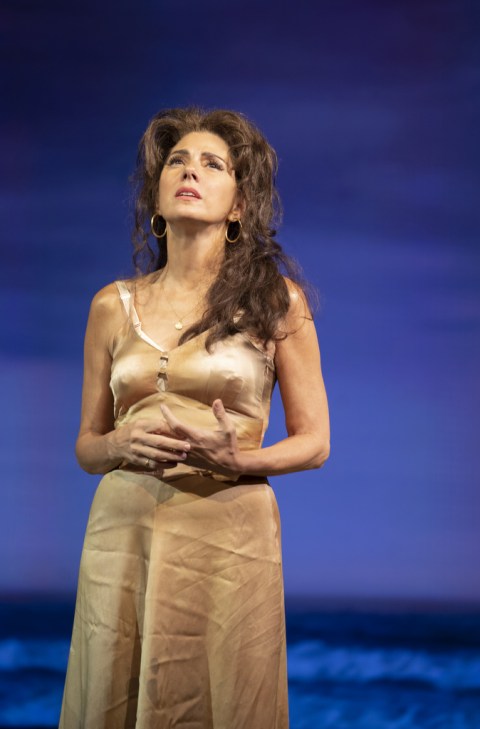
Marisa Tomei in ‘The Rose Tattoo,’ by Tennessee Williams, presented by Roundabout Theatre Company (Joan Marcus)
Atmosphere, heat, the heavy scent of roses, candles, mysticism, undulating waves, torpid rhythms, steamy melodies, fantastical rows of pink flamingos, a resonant altar of the Catholic Madonna. These elements combine to form the symbolic backdrop and evocative wistful earthiness that characterize Roundabout Theatre Company’s The Rose Tattoo at American Airlines Theatre.
Tennessee Williams playful, emotionally effusive tragic-comic love story written as a nod to Williams own Sicilian lover Frank Merlo, is in its third revival on Broadway in a limited engagement until 8th December (the Catholic date of the Feast of the Immaculate Conception). Reflecting upon Marisa Tomei’s portrayal of Serafina in The Rose Tattoo, this is an ironic, humorous conclusion in keeping with the evolution of her character which Tomei embraces as she exudes verve, sensuality, fury, heartbreak and breathtaking, joyful authenticity in the part.
If any role was made for Tomei, divinity and Tennessee Williams have placed it in her lap and she has run with it broadening the character Serafina Delle Rosa with astute sensitivity and intuition. Tomei pulls out all the stops growing her character’s nuanced insight. She slips into Serafina’s sensual skin and leaps into her expanding emotional range as she morphs in the first act from grandiose and joyful boastfulness to gut-wrenching impassioned sorrow and in the second act to ferocity, an explosion of suppressed sexual desire and its release. All of these hot points she elucidates with a fluidity of movement, hands, limbs, head tosses, eye rolls which express Serafina’s wanton luxury of indulgent feeling and effervescent life.
The contradictions of Serafina’s character move toward a hyperbolic excess of extremes. When speaking of her husband Rosario and their relationship, their bed is a sanctum of religion where they express their torpid love each night. She effuses to Assunta (the excellent Carolyn Mignini) how she mysteriously felt the conception of her second child the moment it happened. A rose tattoo like the one her husband Rosario wore on his chest appeared like religious stigmata without the dripping blood. And it burned over her heart, a heavenly sign, like others she receives as she talks to the statue of the Madonna, and remains a worshipful adherent to Mother Mary, praying and receiving the anointed wisdom whenever necessary.
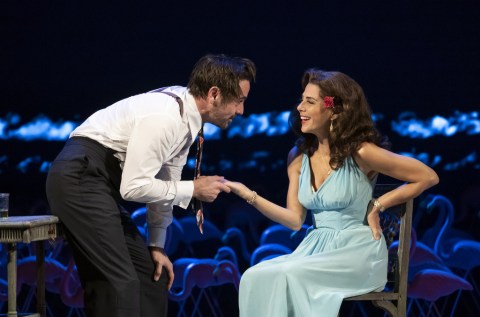
Marisa Tomei, Emun Elliott in ‘The Rose Tattoo,’ by Tennessee Williams, presented by Roundabout Theatre Company (Joan Marcus)
Rosario’s family is that of a “baron,” though Sicily is the “low” country of Italy and an area fogged over with undesirables, thieves and questionable heritages as the crossroads of Europe. We know this “baron-baroness” is an uppity exaggeration from the looks on the faces of her gossipy neighbors and particularly La Strega (translated as witch) who is scrawny, crone-like and insulting. Constance Shulman is convincing as the conveyor of Ill Malocchio-the evil eye. Her presence manifests the bad-luck wind that Assunta refers to at the top of the play and to which Serafina superstitiously attributes the wicked event that upends her life forever.
Williams’s characterization of Serafina is brilliant and complex. Director Trip Cullman and Tomei have effected her intriguing possibilities and deep yearnings beyond the stereotypical Italian barefoot and pregnant woman of virginal morals like Our Lady. It is obvious that Tomei has considered the contradictions, the restraints of Serafina’s culture and her neighbors as well as her potential to be a maverick who will break through the chains and bondages of her religion and old world folkways after her eyes are opened.
We are proud that Serafina disdains the gossiping neighbors with the exception of Assunta and perhaps her priest. Though Serafina’s world does not extend beyond her home, the environs of the beach, her daughter Rosa (Ella Rubin) and Rosario, a truck driver who transports illegal drugs under his produce, she is a fine seamstress. And in her business interactions with her neighbors and acquaintances, we note that she has money, is industrious, resourceful and a canny negotiator.
It makes sense that Rosario (whom we never see because he is a fantasy-Williams point out) treats her like a baroness filling their home with roses at various times to reassure her of her grandness. And the poetic symbol of the rose as a sign of their love and the romance of their relationship is an endearing touch, reminiscent of the rose tattoo on his chest signifying his commitment to her. At the outset of the play, a rose is in Serafina’s hair which she wears waiting for Rosario to come home. As she does, we believe she is fulfilled in their love and the happy status of their lives in a home on the shores of paradise, the Gulf Coast of Mississippi.
What is not manifest and what lurks beneath becomes the revelation that all is not well, that her Rosario is not real, but is an illusion. Typical of Williams’ work are the undercurrents, the sub rosa meanings. The rose is also a symbol of martyrdom, Christ’s martyrdom. And it is this martyrdom that Serafina must endure when word comes back that Rosario has been killed, burned in a fiery crash which warrants his body be cremated. Unfortunately, the miraculous son of the burning rose on her chest that appeared and disappeared, she aborted caused by the extreme trauma of Rosario’s death.

Marisa Tomei, Emun Elliott in ‘The Rose Tattoo,’ by Tennessee Williams, presented by Roundabout Theatre Company (Joan Marcus)
The rose as Williams’ choice symbol is superbly complex. For Rosario’s rose tattoo also represents his amorous lust for women, one of whom is Estelle Hohengarten (Tina Benko) who asks Serafina to make a gorgeous, rose-colored silk shirt for “her man.” When Estelle steals Rosario’s picture behind Serafina’s back, we know that Rosario led a double life and we are annoyed at Estelle’s arrogance and presumption to ask his wife to make such a gift shirt. But in William’s depth of characterization for Estelle, most probably Rosario is also philandering on Estelle who, to try to keep him close, gives him expensive gifts like hand-made silk shirts.
Williams clues us in that her faith and passion for Rosario has blinded her judgment and overcome her sharp intellect and wisdom. In fact it is an idolatry. Her religion stipulates that no human being should be worshiped or sacrificed for. Serafina’s excessive personality has doomed her to tragedy, betrayal and duplicity with Rosario. Ironically, his death is her freedom, but she must suffer his and her son’s loss ,a burden almost too great to bear, even for one as strong as Serafina who does become distracted, unkempt and uninterested in life.
Because Rosario, the wild rose with thorns is not worthy of Serafina’s love, after his death there is only pity for the cuckholded Serafina and a finality to her exuberant life until the truth of who Rosario really was lifts her into a healthy reality. Tomei’s breakdown is striking and Williams creates the tension that in weeping for the “love” of her life who indeed has betrayed her, she will be wasting herself. He also affirms the huge gulf between her ability to live again and her lugubrious state which continues for three years as she mourns an illusion.
The question remains. Will she come to the end of herself? The romantic fantasy held together with the glue of her faith and the enforced, manic chastity of her old world Italian mores must be vanquished. But how? It is in the form of the charismatic and humorous Alvaro Mangiacavallo. But until then Serafina withers. Isolating herself, she implodes with regret, doubt, sorrow and dolorous grief, as well as anger at her daughter Rosa who wants to live and find her own love like her mother’s.
The mother-daughter tensions are realistically expressed as are the scenes between Tomei and Jack (Burke Swanson) Rosa’s boyfriend, which are humorous. Altogether, the second act is brighter; it is companionable comedy to the tragedy of the first act.
When she meets Alvaro, in spite of herself, she responds with her whole being to his attractiveness. As they become acquainted, she accepts his interest in her for what she may represent; a new beginning in his life. It is a new beginning that he tries to thread into her life to resurrect her sexual passions and emotions of love. Thus, he pulls out all the stops for this opportunity to win her, even having a rose tattooed upon his chest in the hope of taking Rosario’s place in her heart.
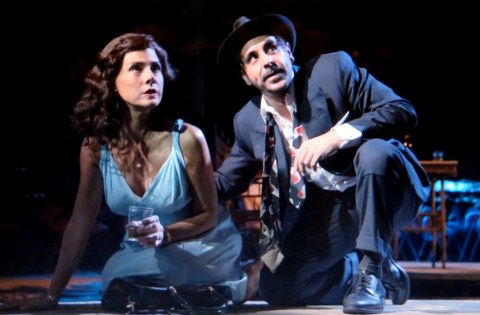
Marisa Tomei, Emun Elliott in ‘The Rose Tattoo,’ by Tennessee Williams, presented by Roundabout Theatre Company (Joan Marcus)
Emun Elliott is spectacular as the clownish, emotionally appealing, lovable suitor who sees Serafina’s worth and beauty and attempts to endear himself to her with the tattoo. Along with Serafina’s discovering Rosario’s betrayal, Elliott’s portrayal of Alvaro solidifies and justifies why Serafina jumps at the opportunity to be with him. He is cute. He is real. He is as emotional and simpatico as she is. He is Sicilian and above all, he is available and interested in her. It is not only his steamy body that reminds her of Rosario’s, but she is attracted to his humor, sensibility and sensitivity of feeling which mirrors hers.
After discovering Rosario’s duplicity, understanding Alvaro’s concern and care for three women dependents and his honesty in admitting he is a buffoon disarms Serafina. Alvaro’s strength and lack of ego in commenting that his father was considered the village idiot is an important revelation for her as well. Indeed, as she views who he is, she senses that his humility and humorous self-effacement is worth more than all of Rosario’s boastfulness that he was a baron which he wasn’t.
As the truth enlightens her, Tomei’s Serafina evolves and sheds the displacement and her sense of confusion and loss which was also a loss of her own imagined “secure” identity as Rosario’s “wife.” Wife, indeed! Rosario’s mendacity made her into a cuckhold and a brokenhearted fool over a man who was not real. At least Alvaro is real. The comparison between the men reinforced with Rosario’s unfaithfulness, which she can now admit to herself, prompts her to reject the religion that kept her blinded and the antiquated mores that made her a fool and kept her alone and in darkness.
Shepherded by Cullman, Elliott and Tomei create an uproarious, lively and fun interplay between these two characters who belong together, like “two peas in a pod” and have only to realize it, which, of course, Alvaro does before Serafina. Tomei’s and Elliott’s scenes together soar, strike sparks of passion and move with the speed of light. The comedy arises from spot-on authenticity. The symbolic poetry, the shattering of the urn, the ashes disappearing, the light rising on the ocean waves (I loved this background projection) shine a new day. All represent elements of hope and joy and a realistic sense of believing, grounded in truth for both protagonists.
Tomei, Elliott, Cullman and the ensemble have resurrected Williams’ The Rose Tattoo keeping the themes current and the timeless elements real. Duplicity, lies, unfaithfulness, love and the freedom to unshackle oneself from destructive folkways that lead one into darkness and away from light and love are paramount themes in this production. And they especially resonate for our time.
I can’t recommend this production enough for its memorable, indelible performances especially by Elliott and Tomei shepherded with sensitivity by Cullman. The evocativeness and beauty of the staging, design elements and music add to the thematic understanding of Williams’ work and characters. Kudos goes to the creative team: Mark Wendland (set design) Clint Ramos (costume design) Ben Stanton (lighting design) Lucy Mackinnon (projection design) Tom Watson (hair and wig design) Joe Dulude II (make-up design). Bravo to Fiz Patton for the lovely original music & sound design.
The Rose Tattoo runs with one intermission at American Airlines Theatre (42nd between 7th and 8th) until 8th December. Don’t miss it. For tickets and times CLICK HERE.
‘Games’ by Henry Naylor, Winner of the 2019 Adelaide’s Critic Circle Award

(L to R): Renita Lewis, Lindsay Ryan in ‘Games,’ written by Henry Naylor, directed by Darren Lee Cole (courtesy of the production)
Games the multi-award winning play by Henry Naylor directed by Darren Lee Cole codifies a time in history that resonates with us today. The play exposes the noxious practices of discrimination, racism, injustice and inequity during the backdrop of the 1936 Berlin Olympics held in Germany.
At that time Hitler was in power and was establishing his Aryan race laws against Jews who were being discriminated against in every aspect of society and government, from civil service positions to university jobs and private businesses. Hitler’s destructive social policies led to untold misery and horrific genocide. The ultimate tragedy was in the loss of human talent, brilliance and genius that most probably would have added to music, culture, the arts, sports and scientific advancements for the betterment of the world.
To explore how the initial race laws could impact a particular arena, Naylor highlights the world of sports and the Third Reich in the early stages of Hitler’s rise before the conceptualization of the Final Solution (the organized conspiracy to exterminate “undesirables,” specifically Jews, Gypsies, communists, etc.). Naylor indicates how the race laws destroyed the careers of two Jewish women who were incredible athletes and deserved the glory they should have gotten if not for Hitler’s wickedness.

Lindsay Ryan in ‘Games,’ written by Henry Naylor, directed by Darren Lee Cole (courtesy of the production)
The play, currently running at the Soho Playhouse, explores the true story about world class athletes, one in fencing, Helene Mayer, and the other in the high jump, Gretel Bergmann. The fascinating production, through interchanging direct address narratives, familiarizes the audience with another example of how Nazism not only harmed others but nearly annihilated the once venerable German culture and society.
The minimalistic production briefly chronicles the exceptionalism of Mayer and Bergmann and reveals how they worked with assiduous effort to achieve a greatness in their chosen sports. Mayer portrayed by Lindsay Ryan and Bergmann depicted by Renita Lewis take turns sharing their stories engaging the audience as their confidantes. Each woman discusses how she endeavored to become the best. Both share salient details about their struggles to excel at a level not achieved before by women in their respective fields.

Lindsay Ryan in ‘Games,’ Soho Playhouse, directed by Darren Lee Cole, written by Henry Naylor (photo courtesy of the production)
Helene Mayer, a German Jew was a phenomenon at 10-years-old. She sparred with male fencing partners after she sneaked into an all-male fencing class and convinced the teacher that she could best whomever she went up against. Encouraged by her father who was a doctor, Mayer achieved such a mastery in her skills that she won awards in competitions across Germany. Eventually, she won an Olympic gold medal at 17 at the 1928 Summer Olympics in Amsterdam, representing Germany. She won 18 bouts and lost only 2, bringing glory to Germany and receiving accolades from President Hindenburg.
Mayer’s story dovetails with Bergmann’s who was younger and who looked up to Mayer as her hero and inspiration. Indeed, she had a Mayer doll and was overwhelmed when she had the opportunity to meet with Mayer at her school where Mayer encouraged her to continue to excel as a track and field athlete.
During her segments of the play, Mayer discusses how she is ready to secure the Olympic gold medal a second time. However, when she receives disturbing news, her dedication and focus blows up and she doesn’t fulfill get the Gold. Sadly, by the time she worked to compete in the 1936 Olympics, she was banned from being on the German team because she was Jewish. The only team the Third Reich allowed her to be on was the equivalent Jewish team. She could not mingle with the “Christian” team, though she was well liked and spoke to everyone.
During the Bergmann exchange in the production, we discover that the same happened with Bergmann. Encouraged by her parents, as Bergmann, Lewis declaims enthusiastically that she eventually went to London and studied at London Polytechnic, where she became the British high jump champion. She also discusses how she was brought back to Germany to compete in the Olympics and save face with the Western World who received condemnation for discriminating against Jews. It is when she was preparing for the 1936 Olympics that the climax of the production occurs, Bergmann meets Ryan once more. They hadn’t seen each other since Bergmann’s high school years and Mayer’s visit.
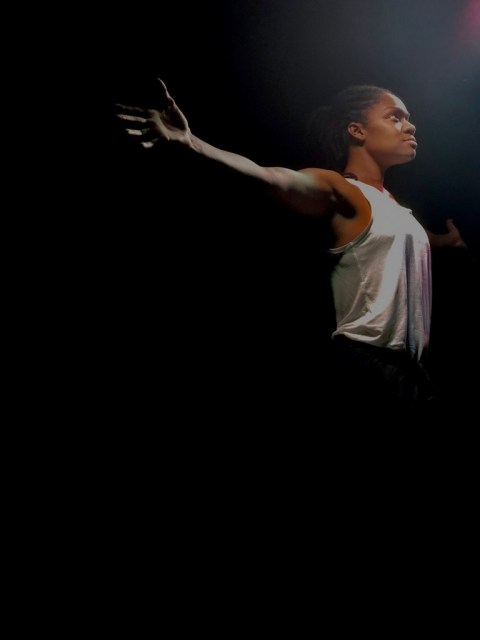
Renita Lewis in ‘Games,’ directed by Darren Lee Cole, written by Henry Naylor (courtesy of the production)
At the last minute, in fact two weeks before the Olympics, Bergmann was prevented from competing because of her religion, though it was given out that she had physical ailments that prevented her from competing. The irony is that the Third Reich was so rabid in its annihilating policies, the Nazi party gave up the advantage of a good chance to win a medal only in order not to have to accept a Jew onto their team. For the Third Reich, it would have been more of a disgrace to have a “Jew” be recognized as a great star athlete, a fact that would have disproved the Nazi FALSE FACT that Jews were an “inferior race.”
Things fared differently for Mayer. As a token gesture to mollify the United States, German authorities allowed the half-Jewish fencer to represent Germany in Berlin primarily because she was on record as having won an Olympic medal in 1928 and was venerated nationally. She had been studying at Mills College in California and returned for the games. No other athletes of Jewish ancestry competed for Germany, except Mayer who was forced to compromise and give the Nazi salute as did the other athletes. Interestingly, in the play, Naylor has Mayer affirm that she is apolitical and cannot be branded. Above all she swears that she is a fencer not supporting or working against Hitler. However, fact checking reveals that she was used by Hitler and that is why she saluted, a compromise for her to compete in her love of fencing.
Games is largely expositional with character actions of fencing moves and graceful running moves threaded in by the very fit actors. It may also be viewed as two largely solo performances for there is little interaction between Mayer and Bergmann which is why their meet up in Bergmann’s high school and at the Olympics preparation was dynamic. Ryan and Lewis do a fine job in relaying the angst that Mayer and Bergmann went through in their emotional trials to shore up their determination against the Third Reich and in their struggle to compete and be the best.

Lindsay Ryan, Renita Lewis in ‘Games,’ written by Henry Naylor, directed by Darren Lee Cole (courtesy of the production)
The themes are exceptional. And Naylor rings out a siren call for us today in regard to holding on to the following tenets so as not to fall into the abyss that Germany fell into under Hitler’s Third Reich. We must strongly affirm our democratic values by upholding a free press, and upholding what makes our government strong- checks and balances. This is especially so against a current failing White House executive that smells of fascist-type dictatorship and one-man rule of the nightmare that led to Germany’s downfall, and can lead to the dissolution of our nation if allowed to go unchecked. Finally, Naylor decries that ultimately the discrimination meant to hurt the group discriminated against, ultimately destroys the discriminators.
Kudos goes to the actors, director and writer for capturing history for us and translating it into a vital remembrance that resonates for us today. Kudos also goes to the creative team of Jared Kirby (fight choreographer) Carter Ford (lighting design) Hayley Procacci (sound design) that helped bring Mayer’s and Bergmann’s stories into the present.
Games is a must-see if you enjoy learning about incredible world class athletes largely unknown today, but who should be recognized for their pluck, drive and accomplishments. Games runs at the Soho Playhouse (15 Van Dam Street) with no intermission. For tickets and times CLICK HERE.

