Category Archives: Theater News, NYC
‘The Dark Outside’ by Bernard Kops, Starring Austin Pendleton and Katharine Cullison
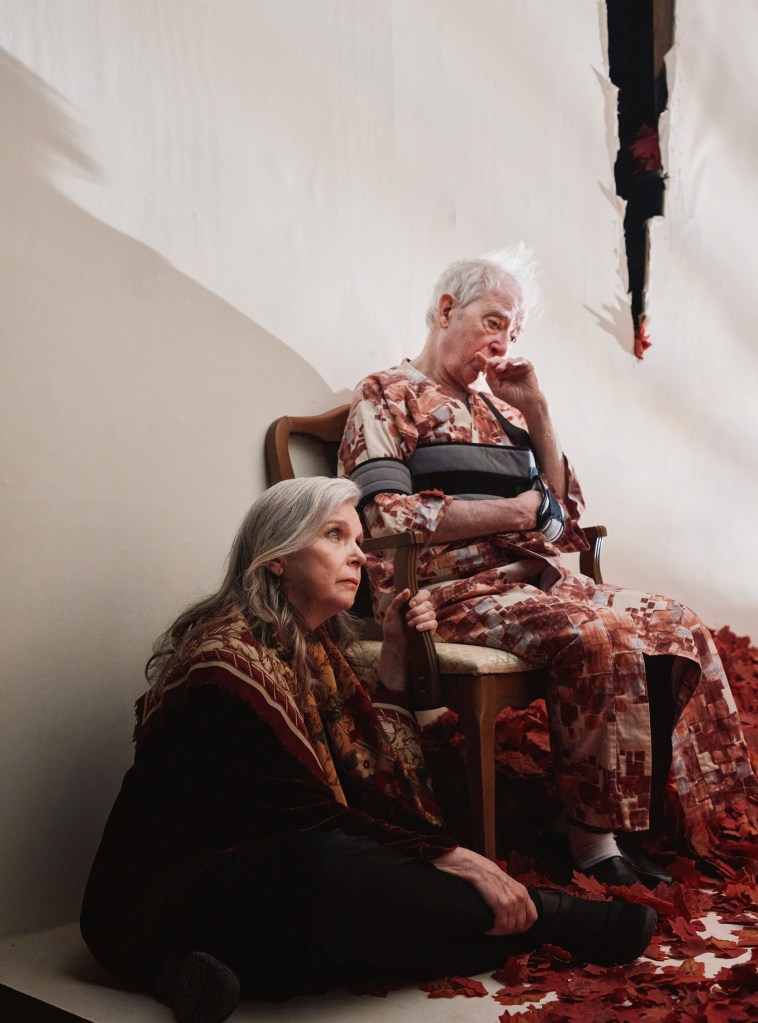
The Dark Outside by Bernard Kops currently at Theater for the New City is the renowned 94-year-old English playwright’s most recent work. The play uplifts the importance of family with themes of unity, love, encouragement, light and hope against the all-encroaching darkness that would turn family members against each other and destroy them. Kops’ lyrical play had a staged reading at London’s National Portrait Gallery in 2020. It is a great irony that The Dark Outside presciently foreshadowed the tenor of the times as the pandemic broke out and upended global society and culture right after the reading.
Through the COVID-19 chaos and upheaval, which bred uncertainty, want and fear, oftentimes, family provided the bulwark of steadfastness against psychic and physical infirmities and death. Disastrously, in the United States the divisiveness over how to handle COVID-19 became a political football which, to this day, divides families and ends friendships. Most importantly, Kops’ The Dark Outside reminds us of the moral, sociological and personal imperative of the family unit to sustain its members. Though the inevitable tribulations of life will come, they can be withstood through love’s immutable power.

In this premiere at Theater for the New City, director Jack Serio and the creative team deliver the beauty and sanctity of the play’s themes with a fascinating production that is incredibly timely. Serio highlights the British dramatist’s poetic sensibilities and notes Kops’ homage to archetypal character types through the production’s staging and overall design elements.
To achieve Kops’ ethereality, Serio selects minimalism. The production strips away material clutter and simplifies, using the bareness of space. In the atmosphere created, the superb acting ensemble conjures up the symbolic mulberry tree, the garden behind the house, the dinner, and more. All are in the service of Kops’ revelations about this family’s unity, inspired by the beautiful and loving mother and wife, Helen, portrayed with precision by Katharine Cullison and supported by the wounded, sensitive, poetic father and husband Paul, played by the impeccable Austin Pendleton.

At the outset, Kops introduces us to Paul (Pendleton) the father/husband, a former East London tailor who faces a life crisis after he loses the use of his arm in an accident. To inspire and encourage Paul, wife/mother Helen (Cullison) gathers their children, Penny (Kathleen Simmonds) Ben (Jesse McCormick) and Sophie (Brenna Donahue) to unify the family at the important occasion of celebrating Paul’s birthday.
As the play progresses, we discover that each of the children confronts conflicts and traumas in their own lives. Thus, the chaos that is outside on the streets and in the neighborhoods that Paul often refers to threatens to disturb and destroy each of the family members unless they are able to work through their problems, seeking the comfort of each other to tide them over to face another day.

Kops uses the majestic mulberry tree in the family’s garden to reveal the issues of the characters. For strength and peace, family members confess their angst and deep secrets to the tree whose life force listens and, in its silence, allows the characters to gain an inner solace and calm. Additionally, sisters Sophie and Penny share confidences. Sophie relates a horrific experience that caused her to leave college and spiral downward into emotional devastation and near destruction.
Sophie’s salvation is in coming home where she finds love, acceptance and redemption. Revitalized, Ben and Sophie receive great comfort in the arms and soul strength of Helen, who soothes and reassures both as she helps them overcome their inner hell. Paul’s great appreciation of his amazing wife is his continual blessing. Cullison and Pendleton are authentic and believable in the relationship they build of the loving couple. Thus, it follows that the children, despite their heart-rending troubles, have rightly come home to heal, as they receive encouragement and love from their parents.

Of the joys in this production are the poems and songs that are wide-ranging and eclectic. These, the family sings together or recites individually as expressions of emotion that are difficult to articulate. The songs resonate and recapture the play’s themes. They indicate how the family copes when a member needs help and uplifting. This is especially so in the poignant conclusion when Helen sweetly sings Paul to sleep with soothing grace. The moment is mythic in its power, and it is obvious that love’s sanctity is a balm which never falls short or fails. Thus, by the conclusion, joy returns to the household. The “darkness” has been thwarted with regard to Ben and Sophie who return to the family to complete the circle of love.

The only one who does not join them and leaves for New York City with her husband is Penny. In her move it is intimated that the wholeness of the family may remain incomplete for a season. But we have seen the strength of the archetypal mother who unites her children and husband. Regardless of whether the external darkness is in London or in New York City, Helen will continue to be the binding force that holds the family together with grace.
Jack Serio, the cast and the creative team have delivered the essence of Kops’ work and made it memorable. With the music and sound (Nick T. Moore) scenic design (Walt Spangler’s leaves are a lovely addition) the modulations of the darkness and light symbolism through Keith Parham’s lighting design, the production’s heightened moments are felt acutely. This is one that should be seen because of its cast and the symbolic iteration of one of Kops most heart-felt works.
The production runs at Theater for the New City until November 28th when Bernard Kops turns 95-years old. It is a feat for one of Europe’s best-known and most admired playwrights who the Queen awarded a Civil List pension for his services to literature. It is an award garnered by a very select few, namely Lord Byron, Wordsworth and Alfred, Lord Tennyson. For tickets and times go to the website https://theaterforthenewcity.net/shows/the-dark-outside/
Theater Review: ‘Trevor’ a New Musical at Stage 42, Based on the Titular Film

The musical Trevor with book and lyrics by Dan Collins and music by Julianne Wick Davis manages to run an emotional continuum from delightful, funny and whimsical to poignant, profound and heart-breakingly current. Based on the 1994 titular short film which inspired a suicide prevention organization, The Trevor Project, the musical comedy delivers without being a hokey, silly-serious “message” play. This is principally due to the vibrant direction by Marc Bruni, the fine cast lead by the impish Holden William Hagelberger, the energetic musical direction by Matt Deitchman and the ebullient choreography by Josh Prince.
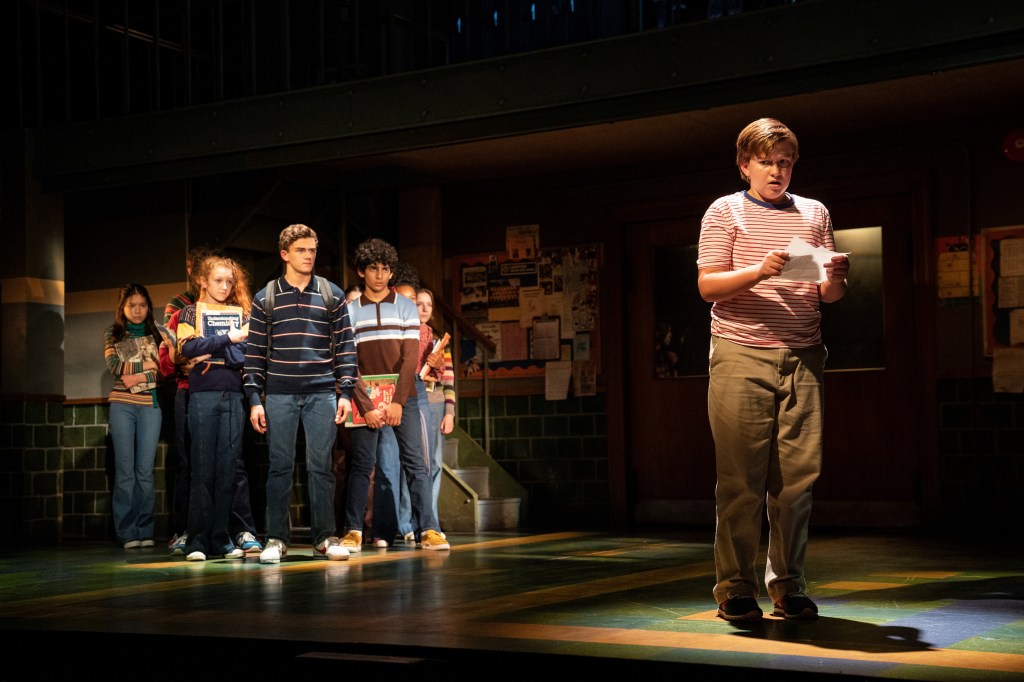
As a result, the musical comedy soars just high enough in the first act without burning itself up in the second, which takes a dark turn but remains ironic and soulfully empathetic. Its subject matter remains human and will touch even the most hard-hearted bigots who were never “cool” or “awesomely popular” in school. Above all Trevor touches upon the human need to be inspired by secret goals and dreams, which keep us enthusiasts of life and young at heart.
The original story by Celeste Lecesne generated the Academy Award-winning short film “Trevor” directed by Peggy Raiski and produced by Randy Stone. The film serves as an excellent foundation for the stage adaptation because it resonates with the familiar and never stands on sanctimony. Unfortunately, the all too probable “real life” situation provides the key conflict in the musical. What Trevor faces happens every day in a school in every school system in the nation to kids who are brave enough not to fit in despite the pain and bullying miscreants who will punish them for it out of cowardice and fear.

The musical in its New York premiere highlights the enthusiastic teen, Diana Ross fan and wanna be singer and performer Trevor, who is coming into his gay identity which he accepts and reconciles by the end of the production. Trevor lives in a suburb in 1981 before LGBTQ was “a thing” and at the outset of the AIDS crisis before it was “identified” as such. Neither of those factor into the arc of Trevor’s discovery and affirmation of himself which is a huge plus. Indeed, we are only caught up in the dramadey of this coming of age story without the angst or preachy assertions about gender identity. Trevor is and because he is, he is unequivocally acceptable and adorable in the human family.
Trevor’s uptight Catholic parents (Sally Wilfert, Jarrod Zimmerman) are clueless. Their fearful refusal to acknowledge that Trevor might be “gay” is humorous (thanks to Wilfert and Zimmerman). Their lack of understanding provides one of the conflicts in the production when they deliver Trevor to Father Joe, a Catholic priest for counseling. He is as helpful as a rock and Trevor’s reaction and the situation provides irony and humor. Importantly, Trevor must work out his own “redemption” for himself with the help of his friends, however difficult that is. Nevertheless, it is his talent and his dreams and interests that see him through the dark times.
Holden William Hagelberger is a likable and cheerful Trevor who is involved in his own world with his school friends, the funny geek Walter (Aryan Simhadri) and the awkward, humorous Cathy (Alyssa Emily Marvin) with glasses and rubber bands on her braces. Trevor is considered weird by the other kids in school, but fate throws him in with Pinky (the fine Sammy Dell) one of the most popular kids. Pinky is kind to Trevor who gives him help to hook up with Frannie (Isabel Medina).
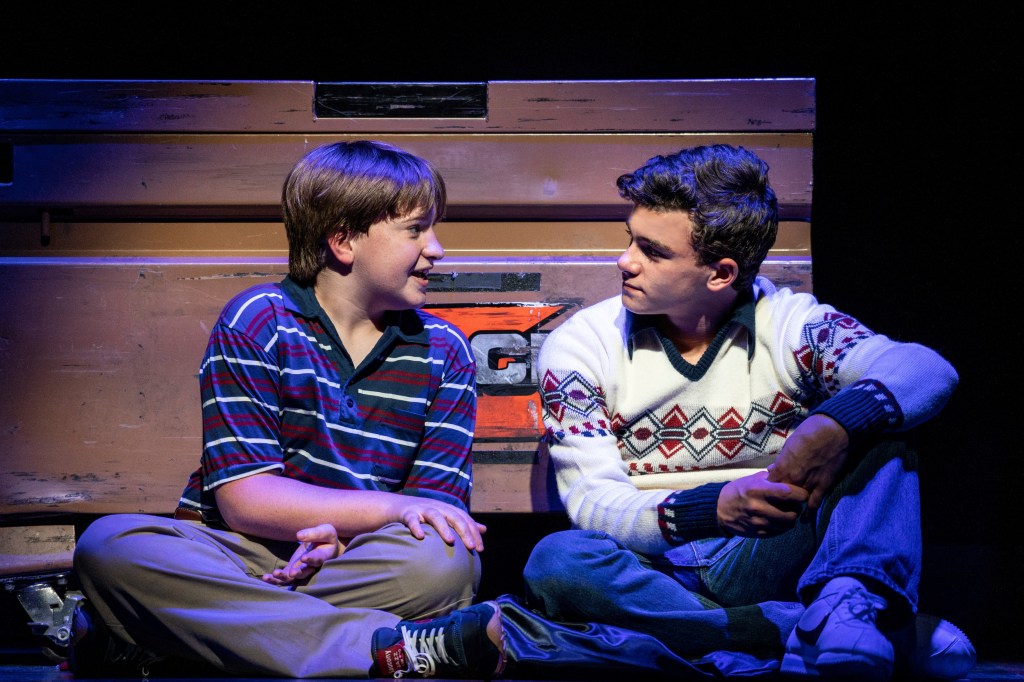
As Pinky and Trevor become friendly, Trevor finds himself “falling for” Pinky, having his first crush on a guy. Unfortunately, the friendship turns sour when someone steals Trevor’s notebook which has entries that indicate how much Pinky means to him. When Trevor’s classmates treat him as an “invisible” to punish him for his “crush” on Pinky, Trevor is devastated and takes it out on himself.
The turning point in the play with the number “Your Life is Over,” is campy and staged well (as are most of the musical numbers). The serious subject of suicide (Trevor tries to OD on Aspirin) is dealt with as a Diva’s comedic irony, skirting the edge of darkness successfully. Yet, the seriousness of what occurs is noted with concern and reverence.
How Trevor comes out of his morass of emotions with the help of his friends, and specifically his trust in the magically realistic Diana Ross (Yasmeen Sulieman) who appears and disappears when he needs her, encourages and enlightens. Indeed, Diana Ross is an extension of Trevor’s talent and wisdom. In his reliance on this inner ethos, we are released into an uplifting resolution in Act II.
Trevor does not wear political correctness on its sleeve. Nor does it beat its breast with finger-pointing. In remaining real and human, the creators hit this production out of the ballpark with its humor, music and the ensemble’s energy. Its appeal is wide-ranging. Who would not uplift being decent and kind? Who would disavow the Golden Rule to do unto others as we would have them do unto us? These values are cross-cultural, cross-national, cross-global. In its message, the production is not self-aggrandizing nor pushing any political stance. How refreshing! As such, that is Trevor’s strength and why it should be performed in schools across the nation.
Kudos to the creative team, to the director’s apt shepherding of the ensemble who does a bang up job led by Diana Ross (Yasmeen Sulieman) Trevor (Holden William Hagelberger) and Pinky (Sammy Dell). For tickets and times to see this must-see musical go to their website. https://www.trevorthemusical.com/?gclid=Cj0KCQiA-K2MBhC-ARIsAMtLKRsWL0YelVs_Hh9DC-KAOX76sPUOKMSwC-3EmKmF0YoUMHsHeY_bhQEaAtPGEALw_wcB
‘Lackawanna Blues,’ Starring Ruben Santiago-Hudson is Just Superb!

Once upon a time when Buffalo, Lackawanna, Detroit, Chicago, Cleveland, Pittsburg and other cities in the North were humming with industry, jobs, hope and prosperity, blacks migrated northward from the Jim Crow oppressions, danger and poverty of the South. Their industry, hard work and efforts contributed to a thriving black middle class which eventually petitioned and protested against the government for Civil Rights reform. In his one-man musical Lackawanna Blues, currently at the Samuel J. Friedman Theatre, Ruben Santiago-Hudson weaves together a beautiful elegy to the people of Lackawanna, New York, who grew him up and impacted the course of his life.
Santiago-Hudson writes, directs, performs-sings, blows a mean harmonica and dances his joy and revelations about Lackawanna, whose current population statistics indicate is growing out of its period of decline during previous decades. Accompanied by the superb Junior Mack on guitar, Santiago-Hudson transforms himself into more than twenty distinctive and unique characters that peopled his formative years, when his beloved Ms. Rachel Crosby raised him. He, and most of the people who knew her, lovingly called her Nanny.
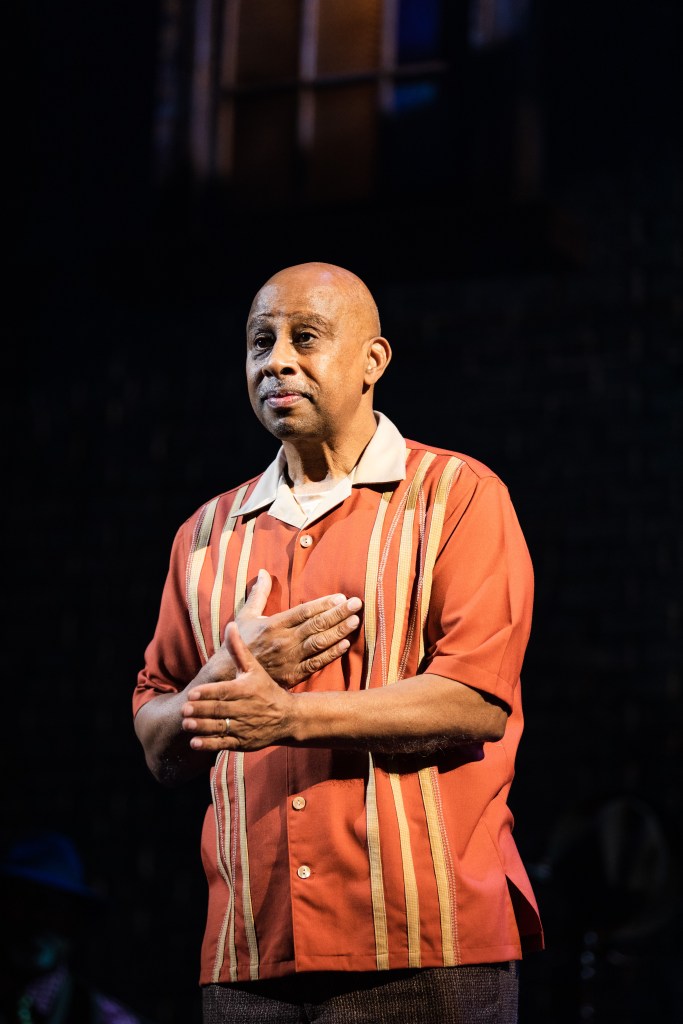
Nanny is at the center of his remembrance, the star of the production, the good and faithful servant on earth, who, laid to rest, brings on God’s greatest praise, “Well done.” Santiago-Hudson’s reflections on Nanny, through her interactions with others, indicate why God praises her so. The acute characterizations melded together and heightened by Mack’s guitar riffs and Santiago-Hudson’s jazz/blues harmonica and songs, reveal a woman we’d all love to be protected by. The picture is glorious. It is of individuals in need, beaten down by human cruelty being helped back up by a compassionate, loving, generous woman, more dignified than the government. Santiago-Hudson brings us into the cloud of witnesses to behold Nanny’s Christianity
Not to be understated is the underlying theme. We discover through humor and pathos, a migrating black culture settling in the middle of a white culture which wasn’t loving. As a result, Nanny “stood in the gap” with grace and a pure heart. Through the men and women that the prodigious Santiago-Hudson effects with his amazing performance skills, we come to know Ol’ Po’ Carl, Lottie, Ricky, Mr. Lemuel Taylor, Numb Finger Pete, Norma, Norma’s Mother, Bill, Dick Johnson, Sweet Tooth Sam and others who Nanny feeds, clothes, boards, chides, scolds and threatens in her way like a rod of Godly justice. Heck! You know they had it coming and invariably, they listen to her like chastened children in a kindergarten class.

What makes Lackawanna Blues so remarkable, apart from the music, is how Santiago-Hudson inhabits the characters with incredible details of speech, phrasing, word choice, stance, voice, behavior and walk, and in the twinkling of an eye switches from individual to individual without taking a noticeable breath. This is his understanding of these individuals’ souls and spirits, fictionalized with the sheen of memory. Interestingly, the result is in the revelation of this humanity, we become humanized with new knowledge of the time, place and culture. The effect is that we empathize and are fascinated to learn of each individual, to learn how Nanny attempts to bring them to wholeness. Though we may never have had a wonderful Nanny in our lives who demonstrated forgiveness and kindness, nor may we never have experienced some of the rough types that she took into her boarding houses and provided a meal, a bed and comforting words of hope to, we understand and experience her through Santiago-Hudson’s gifts of transference.
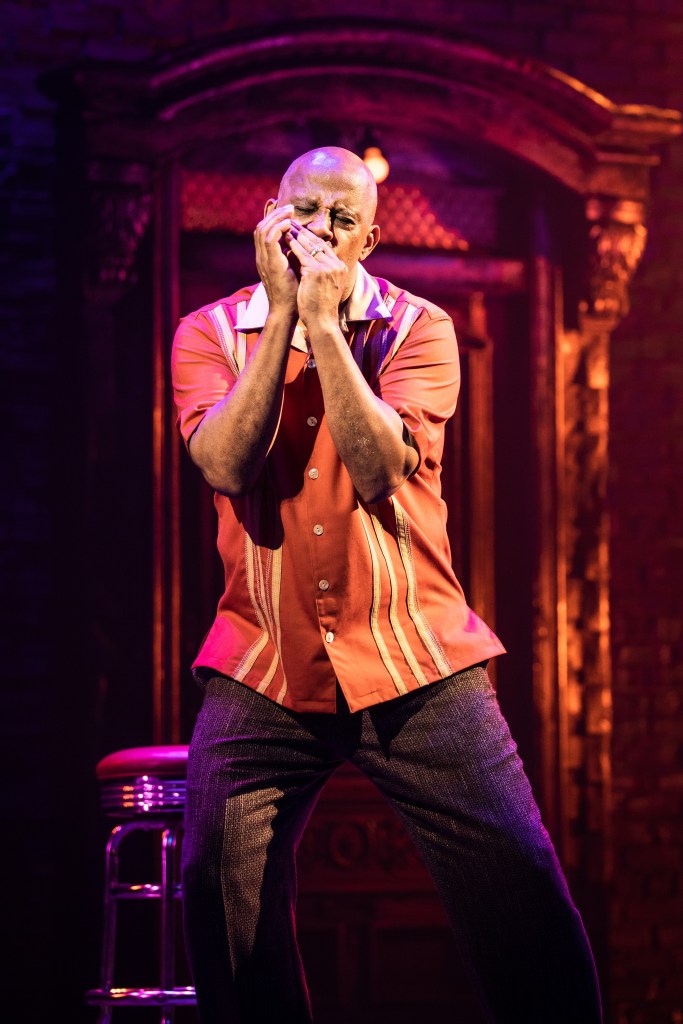
Each of Santiago-Hudson’s portraits of humanity are heart-felt. In some instances, they are so authentic you believe Pauline is standing before you, though Santiago-Hudson is wearing his shirt and pants throughout. Thematically, male or female, whether whole or in pieces as some of the characters are who have lost a limb or fingers, all have dignity and are respected regardless of their foolishness and hijinks. Through Nanny’s love, they are worthy of that respect and dignity. She elevates them from their low-down and fearful view of themselves.
,The writing and acting is breathtaking. Elegiac is the nearest word that comes to mind. However, that, too, is limited because there is great breadth of cultural humor and irony that allows the audience to laugh at themselves as much as they laugh at the situations the characters get into helped by Nanny’s wise responses which give them a way of escape.
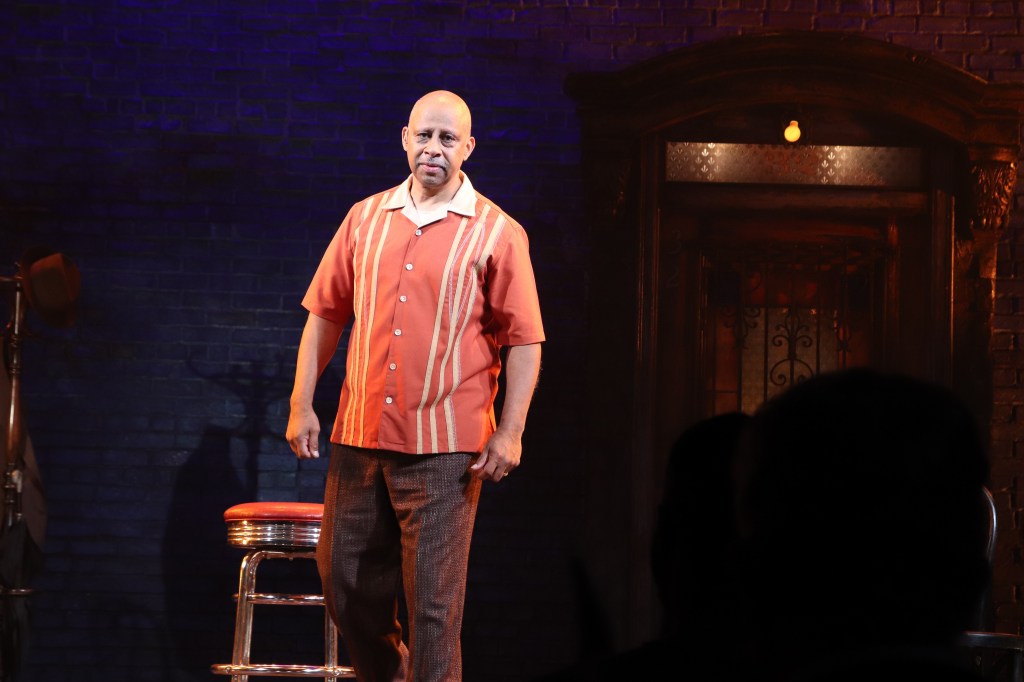
The suggestive blues club lighting (Jen Schriever) and minimalistic stage design (Michael Carnahan) convey the blues/sadness of each story. Karen Perry’s costume design reminds us that Santiago-Hudson doesn’t need costume tricks to become characters. He can effuse them with a smile, tilt of the head, protruding tongue or swagger. I loved the brick wall backdrop, majestic door, lighted window suggesting one of Nanny’s boarding houses, like whisps lifted from memory, that in turn lift us into timeless space and the ethers of imagination. The minimalism encourages a unified realm of audience consciousness thrilled to see and feel and experience live performance. Additional kudos for Darron L West’s sound design.
Santiago-Hudson states in the program that the musical is dedicated to the memory of Bill Sims Jr. who wrote the original music for Lackawanna Blues. In spirit Bill Sims Jr. and Nanny are the force that assists Santiago-Hudson in his dynamite portrayals, in his expressive joy and poignancy, and in his paean to a past that brought him to where he is today, on a Broadway stage.
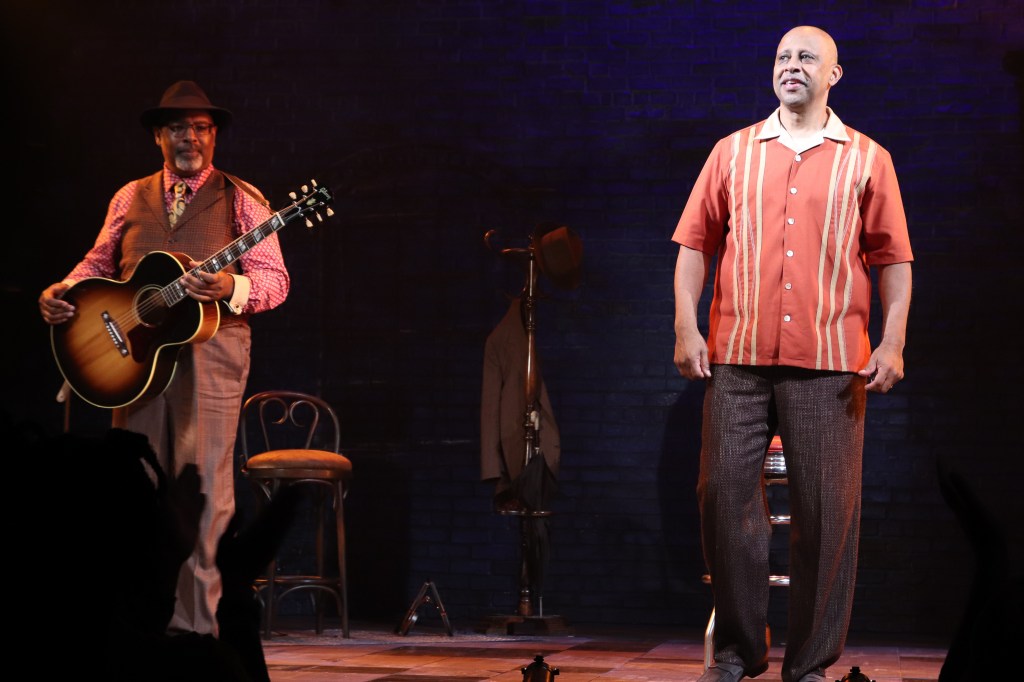
This is one that you don’t want to miss for the humor, writing, Junior Mack’s guitar and the easy way Bill Sims Jr.’s music tonally breezes the themes of goodness overpowering cruelty and hatred, love answering wrath and anger. Lackawanna Blues is uplifting and unifying in this time of division. It reminds us that we all crave love, forgiveness and care, all of us. That goodness lasts a lifetime and beyond. It stops the trajectory of destruction and converts sorrow and hurt to wholeness. And it brings spiritual life and love. Nanny is one for the ages. Hudson-Santiago’s portrayal is beyond triumphant. For tickets and times go to the website https://www.manhattantheatreclub.com/shows/2021-22-season/lackawanna-blues/
‘The Lehman Trilogy’ is a Triumph, Review
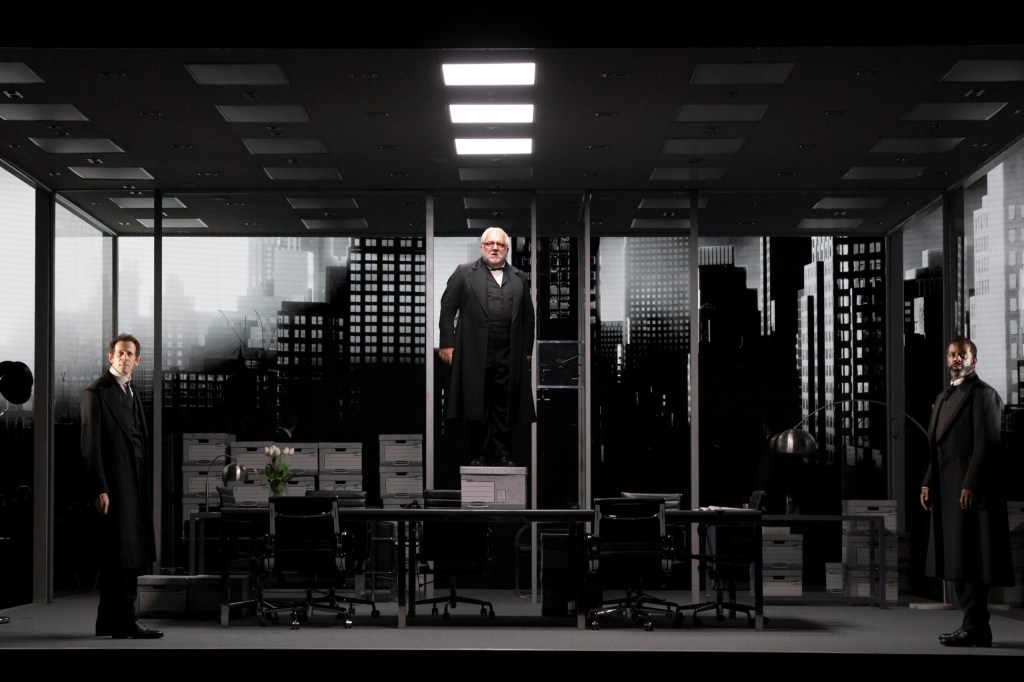
When you see Stefano Massini’s The Lehman Trilogy at the Nederlander Theatre, and you must because it is a majestic triumph which will win many awards and perhaps a Pulitzer, view it with an expansive perspective. Acutely directed by Sam Mendes, with a superb adaptation by Ben Power, the production’s themes highlight the best and worst of human attributes and American values. We see prescience and blindness, preternatural dreams and uncanny business acumen, along with unethical, unfettered capitalism and greed. If we are honest, we identify with this humanly drawn family, that hungers to be something in a new world that offers opportunity where the old world does not.

Humorously, poetically chronicling the Lehmans from their humble German immigrant beginnings, the brilliant Simon Russell Beale, (Henry Lehman), Adam Godley (Meyer Lehman), and Adrian Lester (Emanuel Lehman), channel the brothers, their wives, sons, grandsons, great grandsons, business partners and others with an incredible flare for irony and imagined similitude. Prodigiously, they unfold the Lehman brothers’ odyssey from “rags to riches” with a dynamism as fervent and ebullient as the brothers’ driving ambition which rose them to their Olympian glory in America.

The production is an amazing hybrid of dramatic intensity. It is an epic tone poem and heartbreaking American fairy-tale. It is a tragicomedy, a veritable operatic opus under Mendes’ guidance, Es Devlin’s fantastic, profound scenic design and Luke Halls’ directed, vital video design. Intriguingly, it remains engaging and edge-of-your-seat suspenseful through two intermissions and three hours. By the conclusion, you are exhausted with the joy, sorrow and profoundness of what you have witnessed. Just incredible! Three actors delivered the story of four generational lifetimes with resonance, care and extraordinary vibrancy. They are so anointed.

At certain moments the audience was silent, hushed, enthralled; no seals barked or coughed out of fear of disturbance. Perhaps this occurred because The Lehman Trilogy threads the history of antebellum America and the story of the most culturally complex, diverse and extreme (i.e. poverty and wealth), city on the globe, New York. Indeed, the audience watches transfixed by the magic of what “made in America” means, threading the poisoned soil of slavery to what “made in America” means today in an incredibly complicated and even more slavery poisoned institutionalization of economic corruption etherealized.
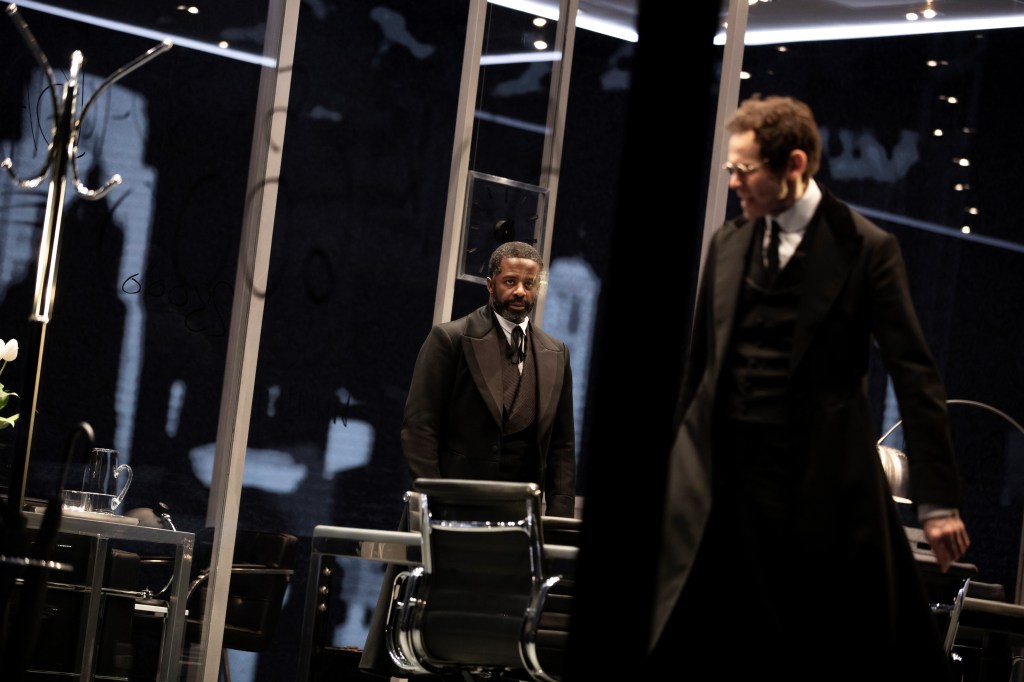
One of the subtle arcs of Massini’s and Powers’ Trilogy follows the growth of this corruption in one family as they expand their business. The brothers’ ambitious fervor morphs in each generation (the actors of the succeeding generation play the sons and grandchildren), until by the end, when Lehman Brothers is sold and divided up and sold again, when there are no more Lehmans involved in running an empire that still carries its name, we understand that outside forces and individuals have caused the interior dissolution via excess, greed and spiritual debauchery.

Especially powerful is the last segment of the Trilogy, “The Immortal.” After the second segment, “Fathers and Sons” concludes with the first and second suicide of the 1929 crash, the third segment continues with more suicides on that cataclysmic day as the debacle of selling goes on. And the segment ends in September 2008 a minute before the fateful phone call that no one is bailing out Lehman Brothers which becomes the sacrificial lamb that fails, while other firms are “too big to fail.” How American!

It is a keen irony that Lehman Brothers survives the 1929 crash. Indeed, they make it through the Civil War, WW I, the stock market crash and the great depression and WW II. Lehman Brothers is successful after the internet bubble burst and it moves steadily into the mortgage market mess in the 21st century until…it collapses. During the last Lehman generation, we watch how Bobby’s takeover and presidency shifts the perspective with regard to personal life and business; all is reform, even his religious observance. No longer do the Lehmans sit Shiva for the passing of a Lehman according to Talmudic Law; only three minutes of silence are allowed to recognize the passing of Bobby’s Dad, Phillip, before the business of Wall Street resumes in their offices.

Thus, by degrees, Lehman Brothers meets the future; the sun never sets on the huge investment bank with global centers everywhere which Bobby and his partners govern. The name becomes “immortalized,” even as Bobby symbolically dances into the future decades after his death. Adam Godley’s nimble movements are phenomenal in this dancing scene with the actors symbolically twisting Lehman Brothers into the success of the Water Street Trading Division and beyond. It’s hysterical and profound, a dance of ironic immortality which can’t last. No one thought Lehman Brothers could go bankrupt, but it is fated to. According to the brilliant themes and symbols (golden calf, golden goddess, tight rope walker), and ironies of Massini and Power, Lehman Brothers reaches its own apotheosis in the last moments of the production. Then the phone call comes and it’s over.
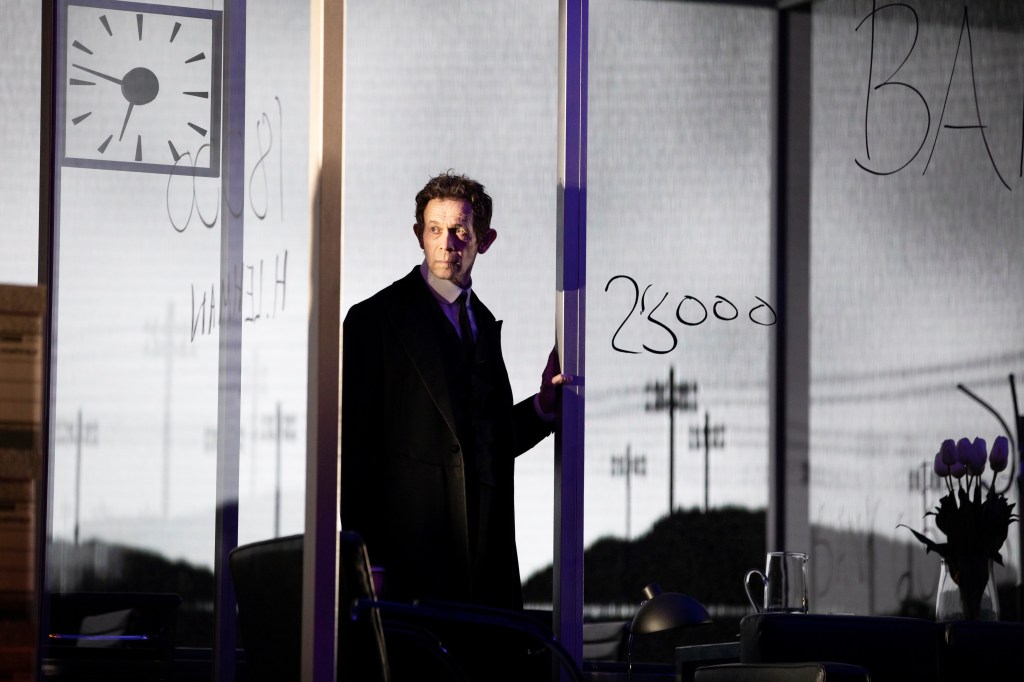
It is clear that after the last Lehman dies, others who take over (Peterson, Glucksman, Fuld), apply their own meretricious agenda on Lehman Brothers, defying good will and sound sense. Indeed, the entity that falls to its destruction is nothing like what Henry, Mayer and Emanuel and their progeny imagined or would have supported. Is this disingenuous? Massini, Powers, Mendes and the actors make an incredibly convincing case. Without the guiding influence of Judaic values and the mission that only the original family understood, Lehman Brothers is “Lehman” in name only. All of the meaning, value and venerable history have been sucked out of it.

Thus, is revealed the import of the conclusion. The once sound mission of Lehmans, under-girded by the values of the Talmud and Judaism is no more on the material plane. It exists in an infernal infamy, a cautionary tale of the ages. So it is fitting that in the last scene in the afterlife, one minute before that fateful phone call on September 15, 2008, Henry, Meyer and Emmanuel say Kaddish, a prayer for Lehman Brother’s demise. The dead bury the dead. Pure genius.

Massini’s/Power’s metaphors, Mendes and the actors understand and realize beautifully. They toss them off as so many luscious grains to feed off intellectually, if you like. Es Devlin’s revolving through history, glass house structure (just begging to have stones thrown at it), which the actors write on graffitizing the importance of Lehmans’ historical name-changing success is amazing. The turning platform and “see through” glass adds a profound conceptional component to the themes of money, power, finance and the energy of entrepreneurship. Luke Halls’ impactful video projections (the terrifying dream sequences, the burning Alabama cotton fields, the digital signals of the derivatives markets, etc.), enhance the actors’ storytelling with power. So do Jon Clark’s lighting design and Nick Powell’s sound design. Not to be overlooked Katrina Lindsay’s (costume design) and other creatives must be proud to have helped to effect this production’s greatness. They are Dominic Bilkey (co-sound design), Candida Caldicot (music director), Poly Bennett (movement).
There is more, but let peace be still and award The Lehman Trilogy sumptuously, all voting members of various organizations. It is just spectacular. For tickets and times go to their website: https://thelehmantrilogy.com/
Romy Nordlinger is Alla Nazimova in ‘Garden of Alla’
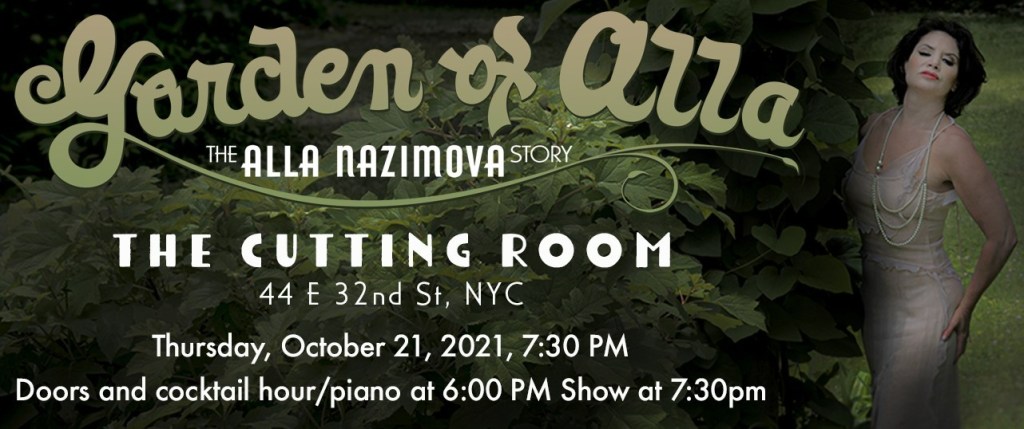
I had seen Romy Nordlinger in her solo show PLACES! at 59E59th’s East of Edinburgh Festival and thought she was marvelous. Evolving her presentation before and after the pandemic, once again she is stepping out to bring to life the amazing Nazimova who lived and made her mark during the early twentieth century. With additional performances under the direction of Lorca Peress, Romy’s achieved new heights exploring the maverick woman who was a force in her time. Ahead of her 7:30 pm show on Thursday, October 21st at The Cutting Room on 44 E 32nd St. (arrive at 6:00 pm for the live jazz cocktail hour) I had the opportunity to interview Romy about this production which she has also written.

Who is Alla Nazimova, the person you are bringing to life in your show?
Perhaps the greatest star you’ve never heard of, one of the brightest lights on America’s stage and cinema screen was actor, director, writer and producer Alla Nazimova. Few women, or men, rose to such great heights – but now she languishes largely forgotten. A student of Stanislavski, she fled from Tsarist Russia and an abusive father, to the Lower East Side, where she founded a Yiddish theatre – her play The Chosen People put her on the map.
From humble beginnings to a meteoric rise to stardom, she became Broadway’s biggest star, and in 1910-1911 made the Shuberts $4 million dollars in sold out runs (that’s 400 million dollars today). Described by Dorothy Parker as “the greatest Hedda Gabler” she helped to bring acclaim to playwrights such as Eugene O’ Neill, Chekhov, Ibsen, and Strindberg. She even inspired Tennessee Williams to become a playwright. The Shuberts then named the Broadway theatre after her, The Nazimova Theatre on 119 W. 39th St. Growing weary of the increasing pressure to perform in second rate commercial plays, she left the Shuberts and The Nazimova Theatre was renamed the 39th Street Theatre. It was finally torn down in 1926.
Nazimova went on to become the highest paid silent movie star in Tinseltown commanding a five year $13,000 a week salary in 1916. The first female director and producer in Hollywood and pioneer of the first art film, her stunningly avant-garde Salome was too “Wilde” for 1926. Unapologetic about her bisexual decadence, she defied the moral and artistic codes of her time that eventually forced her into obscurity.
Her legendary Garden of Allah mansion in Hollywood was a haven of intellectual and sexual freedom with regulars such as F. Scott Fitzgerald, Hemmingway, Garbo, Dietrich, Valentino, Chaplin, Rachmaninov – basically anybody who was anybody. There, she declared her all women’s “sewing circle” in open defiance, proclaiming her strength when women were relegated to silence. In financial and critical ruin after Salome, the press and the studios destroyed her. Finally, she rented a small bungalow in the grounds of the mansion she had built on Sunset Boulevard.
Her bold, trailblazing artistic legacy is unprecedented, unrepeated and under the radar. Her iconoclastic story of freedom and nonconformity was silenced under the smoldering rubble of forgotten history.
How did you “hear” about Nazimova?
The brilliant theatre historian, author and founder of The Society for The Preservation of Theatrical History, Mari Lyn Henry was putting on a production of ‘Stage Struck’ about famous actresses from history. She asked me to pick an actress to research and write about and she suggested some wonderful actresses, but none really struck my fancy. They all were very blonde and talented, but I felt no relation to them – and then Mari Lyn said, “I’ve got it! Alla Nazimova!” I thought, “Who in the heck is that?”
I started reading about Nazimova. She is also Jewish and Belarusian as I am, and I felt an immediate kinship. I read her biography by Gavin Lambert which quotes from writings from her own journals. I was mesmerized by her humor, her story, and most of all, her zest for life! She was a survivor. This was a woman who lost everything, overcame the most horrible circumstances, became a star more meteoric than even Madonna and ended up a guest inside the mansion she used to own. She was a maverick ahead of her time, investing her money for the love of art/film and experimenting with new forms. Despite her losses, she kept her joie de vivre, having no regrets or bitterness. She remained full of wonder with the beauty of life.
THIS, I thought, THIS is a person who inspires me to risk, to dare to dream out loud and bring to life my dream. Most importantly, she inspired me to be myself in a material culture that is constantly trying to commoditize and sell, a society that values only your worth in money. This was a woman who valued herself and loved life to the fullest.

Tell us about previous performances of the show.
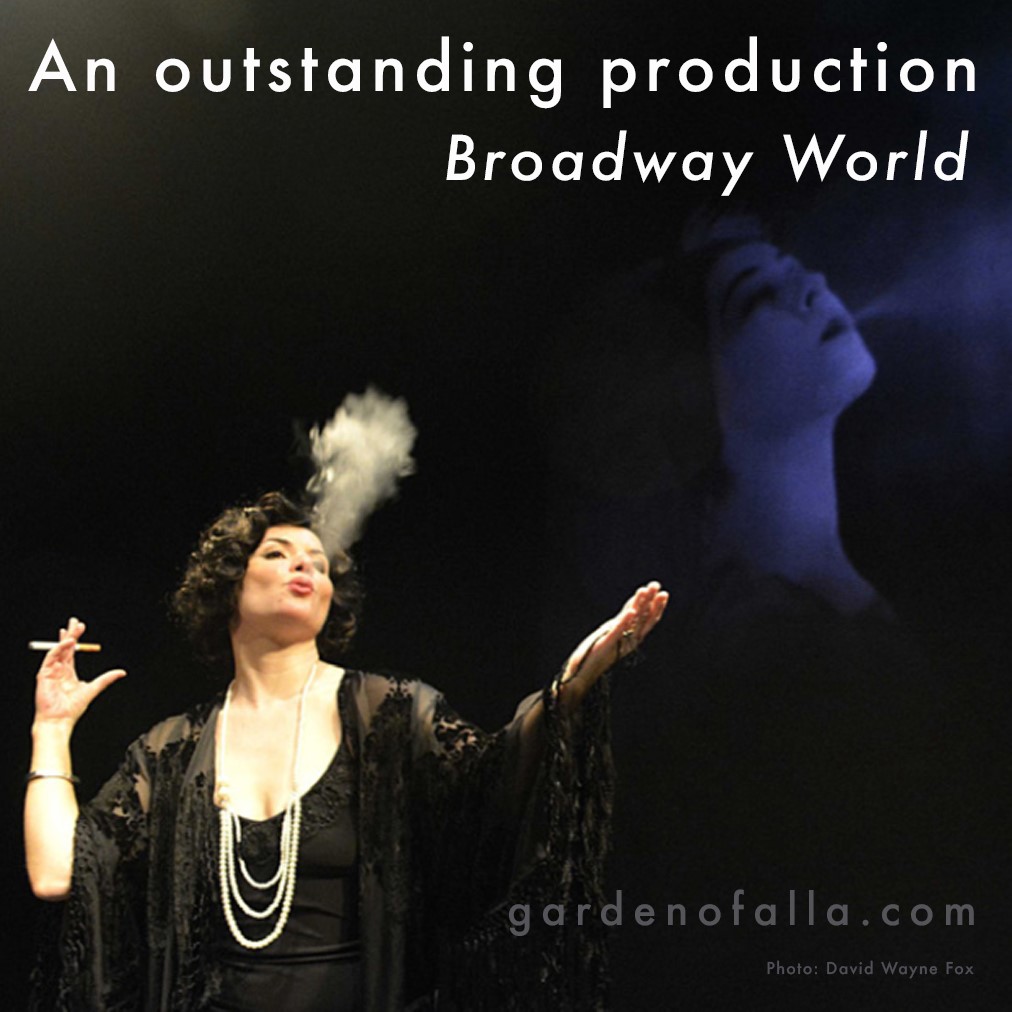
I have performed the show in another incarnation under the title PLACES! at Edinburgh Fringe, HERE Theater, Dixon Place, The Players Club and the studio center at The Kennedy Center. This is the production where, although we’ve always been received very well, we really tell her story to the best of all we have. It’s a multimedia show that is like a live silent movie with absolutely beautiful and evocative video design by Adam Burns, a brilliant musical score by Nick T. Moore and directed by the very talented Lorca Peress.

How has your performance and understanding of Nazimova evolved?
As life is wont to do, the more you experience the joys, the sorrows, all life’s disparities, the more you “understand” the heights and depths of the characters you play. After undergoing many upheavals in my own life, ups and downs in careers, triumphs and flops, deaths and loss, and then of course the pandemic, I feel an even stronger kinship to Nazimova’s survival instinct. I understand and am inspired by her amazing capacity for feeling – pain, joy, love, anything and everything but boredom. I channel her and she makes me feel able to cope. She helps make me a better person. This production is a great labor of love and a lot of work. It takes everything I have to get up on stage and perform a solo show – and to “bring” Nazimova there. It’s all worth it, every moment, for both the audience, and myself. It is a cathartic experience, and now more than ever, it’s a valentine to theatre.
What would you like the audience to understand about Nazimova that your performance enhances?
I’d like the audience to realize that we are standing on the shoulders of giants. That the LGBTQ movement started long ago with brave people like Nazimova who stood up and demanded she be herself, but alone and without a Twitter account, and that we can all dare to dream – and fail – and rise again – and fail again. It’s all the same. It’s the journey that’s important. To anyone whose felt like the underdog, I want them to feel less alone, and to feel that they, too, can use their voice (whether out loud or in writing or however they express themselves) to be an instrument, an extension of themselves. Their life matters. Their differences are beautiful.
Romy Nordlinger will be channeling Alla Nazimova in her exceptional show at The Cutting Room 7:30 pm, Thursday, Oct 21. Arrive at 6:00 pm for the live jazz cocktail hour. The Cutting Room address is 44 E 32nd St., NY, NY.
The interview has been gently edited.
‘Ghosting’ Streaming at The Irish Repertory Theatre

Theatermania has referred to the Irish Repertory Theatre as the “Leader of Streaming Theater,” during the pandemic. Its shows have been top notch during the unprecedented New York City theater shutdown. Ghosting written by Jamie Beamsh and Anne O’Riordan, performed by Anne O’Riordan is an intriguing and thoughtful provoking offering. Recorded live at Theatre Royal Waterford in Ireland, that theater, Thrown Shapes and the Irish Repertory Theatre collaborated to stream the presentation which concludes in a few days. (4th July)
Anne O’Riordan’s performance is nuanced, personal and superb. She personifies the voice and demeanor of various characters with the exception of one, for a symbolic reason. Sheila, nicknamed “She” for short, left Waterford for London and has been there for six years. We gradually discover the reason why, though she initially misleads us and we think it is because her former boyfriend who took her virginity then “ghosted” her. In the vernacular, ghosting means an individual cuts off all communication and ends a relationship without explaining why, without going through miserable late night begging sessions to “stay together.” In other words, he cut her off and never spoke to her again.
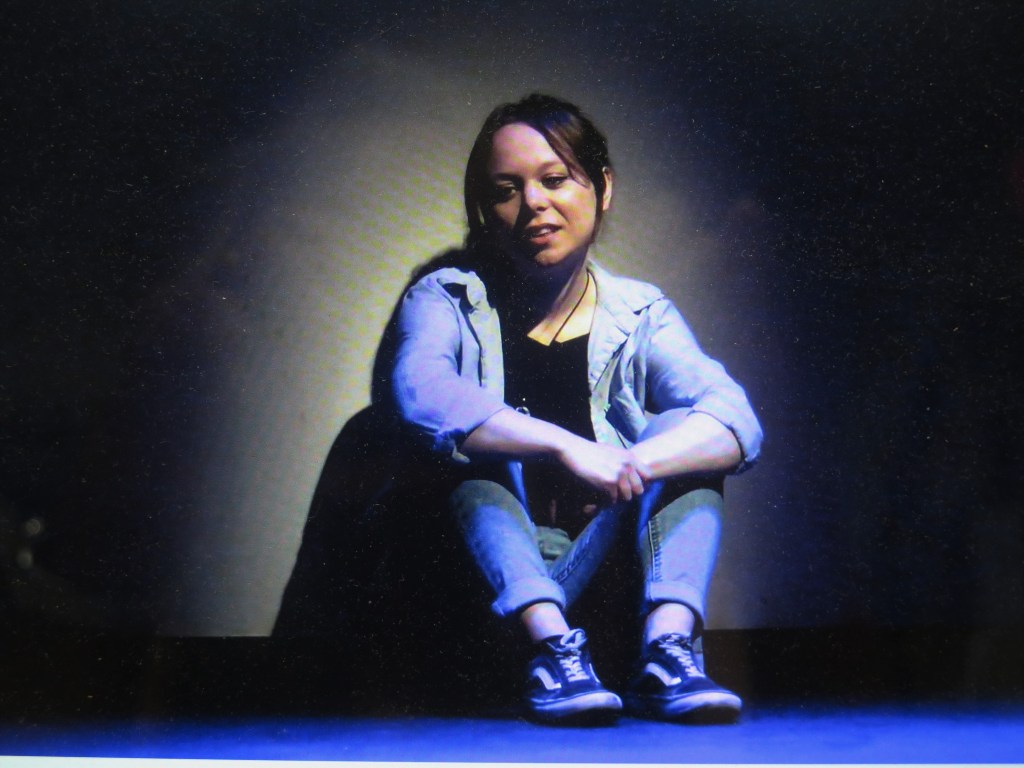
From her position at work, we note she is irascible and unapproachable. She doesn’t have any friends, nor does she have any hobbies or interests that she discusses. She essentially complains about her co-worker who clearly cares about her and with whom she might establish a relationship. She is uninterested and aloof. We consider is it him or her. As Sheila confides in us she slips information discussing that she can’t sleep at night. Perhaps, her irate attitude is because she hasn’t been home to Ireland in six years. Perhaps it is because she has not kept up with family after her mother died. Thus, we determine she grieves. Some people never end their grieving for a parent. No communication is easier than tears and longing for who will never retrun.
The turning point comes when she can’t sleep one night and someone shows up at the foot of her bed. Is this a dream? Is this reality? Is she hallucinating because she has gone insane? We follow along for the ride not wanting to believe that Sheila is psycho, though in some circles, she immediately would be given medication and confront her obviously deep-seated issues with group or individual psychotherapy. But this is different. Sheila is rational; her story, thus far, is logical and we accept that her former boyfriend at the foot of her bed is a ghost or has emerged out of her dream to stop ghosting her by ghosting her. The irony is humorous.
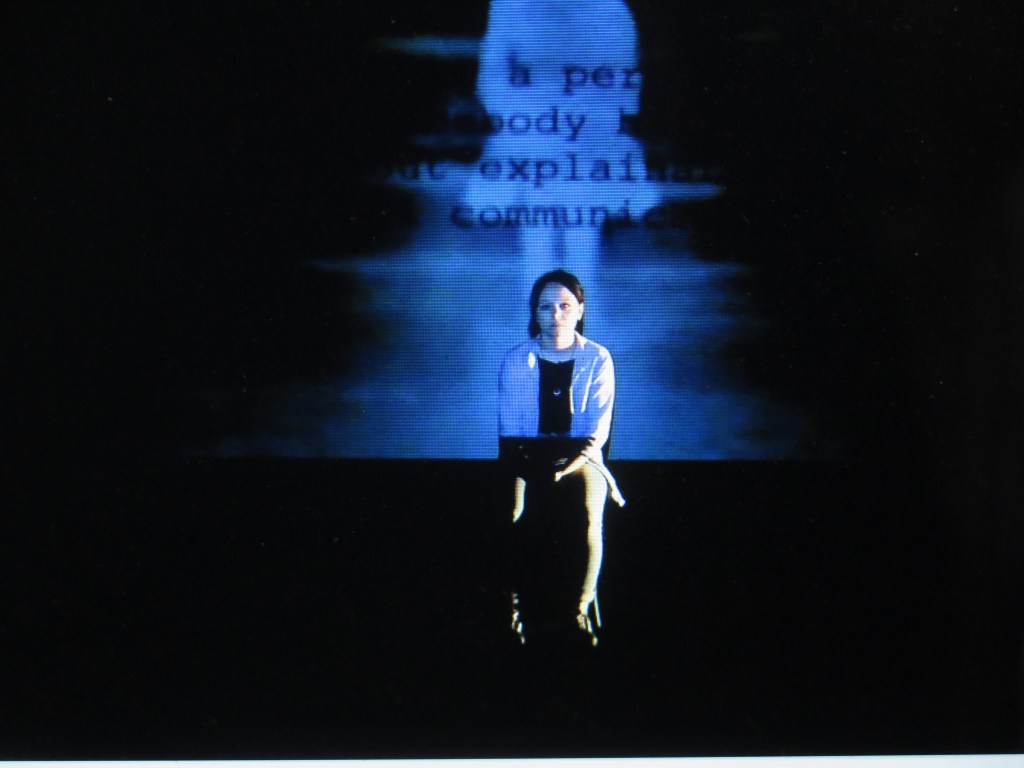
From there the twists and turns gyrate and we whirl along in Sheila’s adventure as she maneuvers a journey back to Ireland. What happens there becomes an examination of her admission that she has been the one ghosting. She’s ghosted her father, her family and friends there. Most importantly, she’s ghosted herself. She realizes she’s been living a non-living reality, not existing so that she deferred grappling with herself, her destiny and future. Does she make plans and enjoy the moments and breaths of her life? No. She has been a shadow person, beyond a state of hibernation. And the only way that she comes out of it is through someone else’s sacrifice and a supernatural visitation, an earthquake that shakes her unto herself to show her what she’s been doing.
When Sheila returns to Waterford, her hometown, she’s drawn home for an urgent reason (to her) via a text her sister sends her. She meets her sister in a bar but she vows not to see her father. Startling and embarrassing, emotional events occur. The miraculous visitations continue until she is brought to a reconciliation with herself and her family after she returns to her home in London.
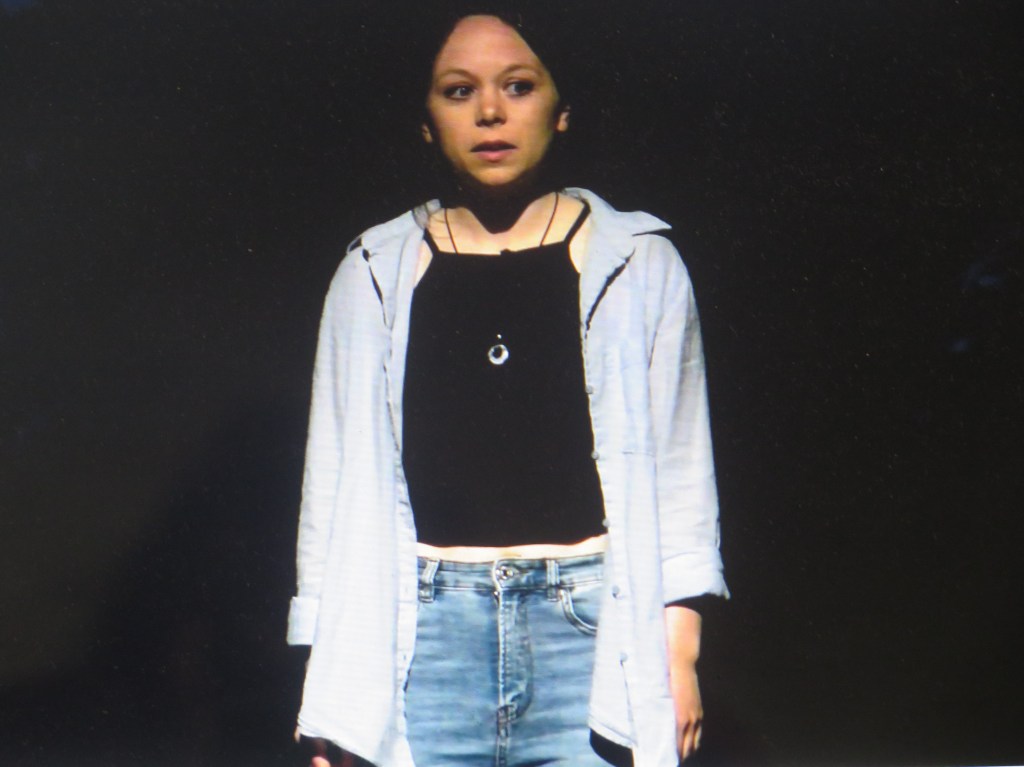
Beamish and O’Riordan’s writing has elements of the philosophical poetical. The direction of the visitation scenes is spot on. The scenes are powerful and remain atmospheric and suspenseful as we wonder, like the character of Sheila, where we are being taken. Importantly, the issues of why Sheila left Waterford, why Mark, her boyfriend ghosted her are eventually answered, though other mysteries are opquae.
The beauty of this work is the meld of the supernatural with reality; the sacred and the profane delivered through the lighting effects, projections and sound design (Beamish effected most of it with Dermot Quinn taking care of the lighting design). Vitally, it is O’Riordan’s authentic and finely hued performance which makes us believe and go along with her on this wild, exceptional journey. We remain curious and engaged with her as she touches the shadows of another consciousness which is hers, her boyfriend’s her father’s. Importantly, we are astounded at the human capacity for love despite misery and unredeemed emotional pain, and the ability to want to heal, even if it means stirring spirits from the other side to help us.,
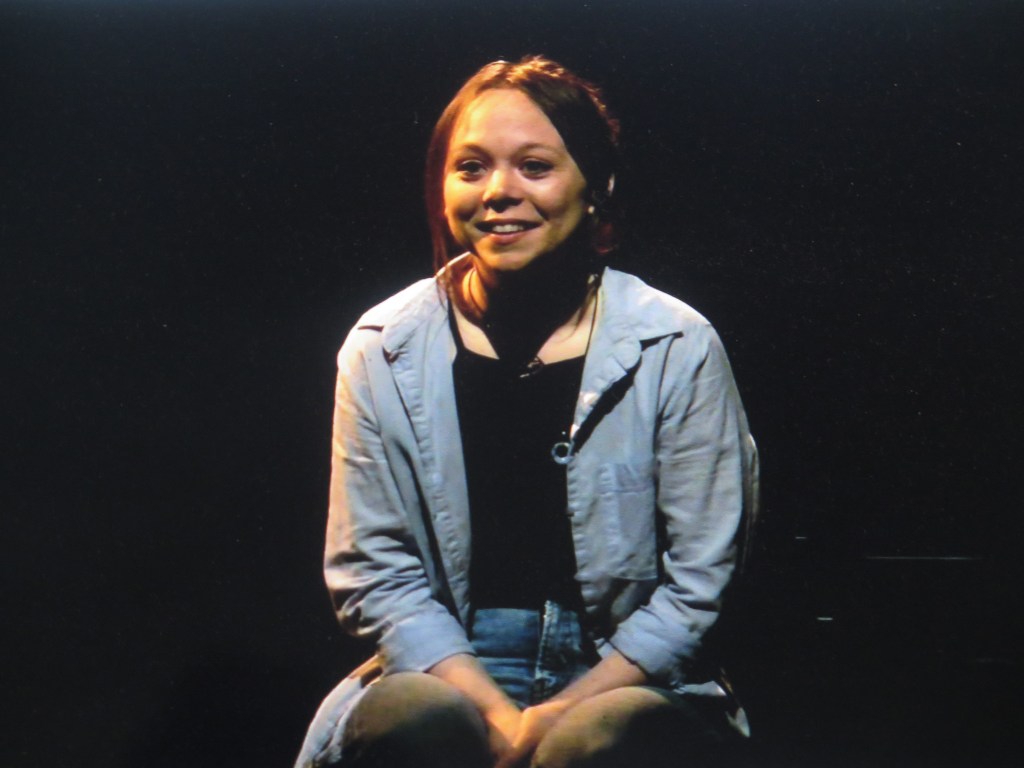
Ghosting reminds us with paramount intention that our actions have dualistic purposes that we may not understand, initially. But if we hang on long enough, the answers come and we can confront ourselves, evaluate and be gentle to our sensitive inner being which needs care. Sheila, by the conclusion of Ghosting resolves the emotional pain, though it will always be with her. However, the miraculous helps her look at it and stop ghosting herself, by making herself more present to accept actions which she once loathed about herself.
This is one you shouldn’t miss for O’Riordan’s performance which is memorable, for the production values and for the direction. Jamie Beamish directed the livestream. Aidan Kelly directed the original stage production. Ghosting streams until Sunday, 4 July unless they extend it. In order to make reservations go to Irish Repertory Theatre.
Check out the production and the 2021 seasonal offerings coming up. Theater in NYC is going live full blast in September. The Irish Repertory will be a part of that celebration. However, it’s appeal has now become global and most probably they will continue to stream performances during their season so if you are in Australia, New Zealand, Hong Kong and Ireland, you won’t miss out. Donations are always welcome . CLICK HERE for details in the pull down menu.
‘Mustard’ 2021 Origin 1st Irish Theatre Festival Solo Production

In the award winning solo production Mustard performed by Eva O’Conner and directed by Hildegard Ryan, the condiment of various shades of yellow and heat gains a new symbolism and significance. The award-winning comedy/drama, an offering of the 2021 Origin 1st Irish Theatre Festival online, is from Fishamble: The New Play Company based in Dublin. Mustard has been screening online in January because of the pandemic.
The Origin 1st Irish Theatre Festival is presented yearly. Because of the pandemic, this is the first year it has been streaming productions online, including a total of 20 events, with panels on various topics. One, for example, concerns producing during the pandemic.

Mustard originally premiered at the Edinburgh Fringe Festival in 2019, where it won the 2019 Lustrum Award, Edinburgh, and the 2019 Scotsman Fringe First Award. It was also nominated for the Scottish Mental Health Awards 2019. Eva O’Conner was last seen in the 2020 Origin 1st Irish Theatre Festival in Maz & Bricks. She is a superb performer whether in a two-hander or solo as in Mustard which she also wrote.
How O’Connor inhabits the the retelling of the story of the love possessed, lovelorn, hollowed-out character E is absolutely authentic and moment to moment mesmerizing. Her dynamic enactment of E’s relationship with a stunning, professional cyclist from London is both humorous and striking in its approach, as she develops the shades of difference between passion and obsession, between sexual addiction and love. All of this is accomplished in the name of the character’s yearning for a lasting relationship and a dollop of madness on the side.
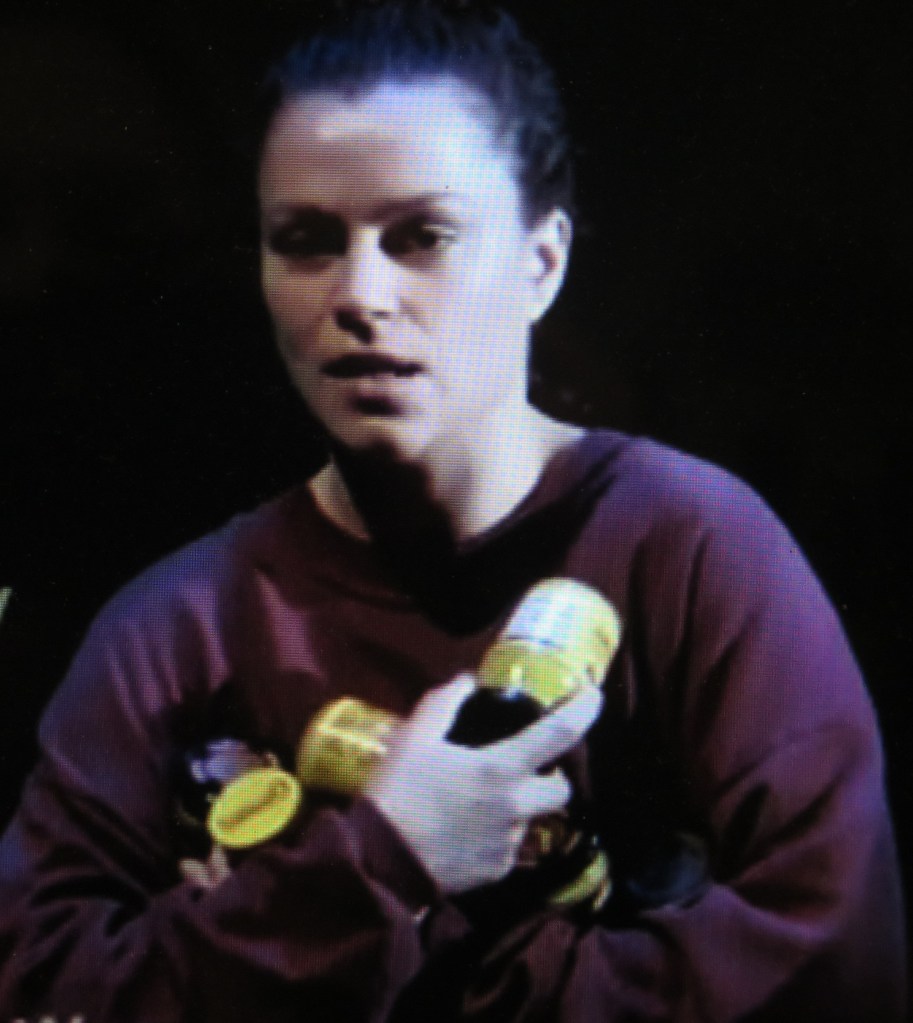
What E discovers about herself is her ability to maximize self-loathing. As she reflects back on the relationship, she encounters her stifling obsession for the cyclist who demeans her with a series of annihilating events. The humiliation and embarrassment of her dead-on emotional suffocation and idolatry of him as her “love” object consumes her. And, it renders her immobile in an acute depression which she endures by returning home to mom. Vying between want and repulsion because she allowed the cyclist (a Brit) to redefine her being, she realizes she crafted this eternal fire of “love” for him into a weapon of emotional self-destruction.
Her only release is “mustard.” How she employs the condiment to salve her soul, psyche and physical yearning becomes an active segment of E’s account. We watch fascinated as she sets the stage for the moment of maximum catharsis and pain, curious about how all of the various props she has brought with her, a bucket, a clothesline, etc. figure into the context of her explaining the “love” affair with this “guy” whom she’s lived with for almost a year.

O’Connor performs the characters of E, her evangelical mother and her English sometime lover with personality and spot-on revelation. Her relationship with her mother is humorously delivered with Irish accent and gesturing. Her adoration of the cyclist and her final answer to his effrontery, slaughtering her soul, is disclosed in heady wonder. Over all, O’Connor’s dialogue, descriptions, infusions of rhythmic language and unique interplay of the characters is beautiful, lush, unique and thrilling. For anyone who has experienced a similar stripping down to raw nerve by a “love interest,” this is a must see. O’Connor and her character’s emotionally mad ride are unforgettable.
After twenty minutes of viewing, it is obvious why O’Connor won awards for her play, incisively and excellently directed by Hildegard Ryan. Once again Fishamble: The New Play Company proves itself to be on the cutting edge of drama and comedy that is significant, as it expresses the depths of human emotion and feeling with dramatic ardor and vitality.
You can still see the last week of the 2021 Origin 1st Irish Theatre Festival by going to their website to view the calendar of events; these end on January 31st. For tickets to plays and the calendar of events CLICK HERE. For tickets to Mustard whose last performances are on Wednesday, 27th January at 8 pm and Sunday, 31st of January at 2 pm, click on this link. CLICK HERE for MUSTARD. You’ll be glad you did.
Seamus Scanlon Interview: Chatting With the Playwright of ‘The McGowan Trilogy’
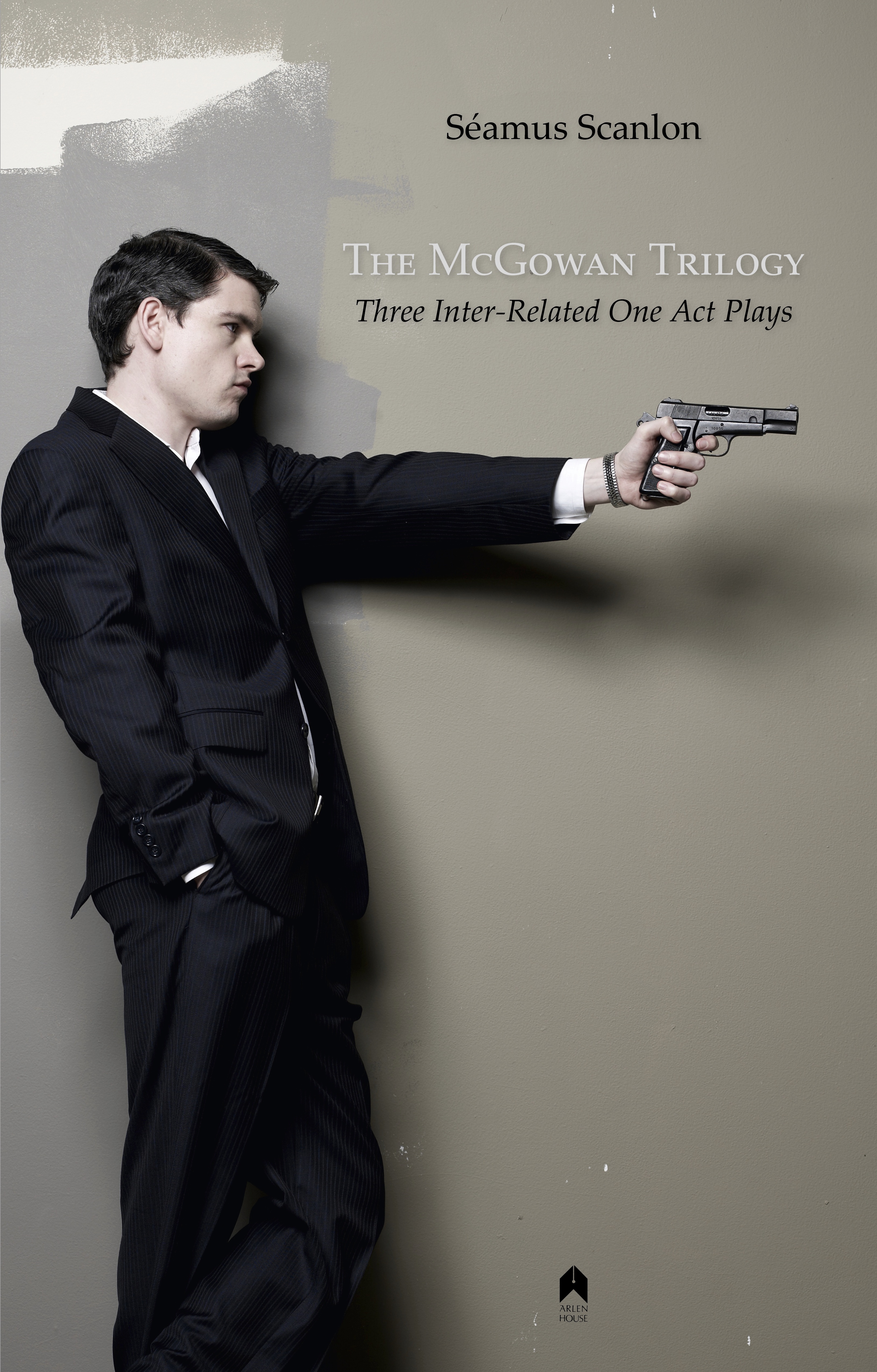
‘The McGowan Trilogy,’ written by Seamus Scanlon, directed by Kira Simring, part of 1st Origin Irish Theater Festival, Seamus Scanlon Interview (courtesy of Seamus Scanlon)
I had the opportunity to see Th McGowan Trilogy and review it on Blogcritics as an offering of The Origin Company’s 1st Irish Theater Festival 2014. Since then I have been in touch with Seamus Scanlon on social media and have kept up with his activities from time to time during posts. Finally, I caught up with him during the COVID-19 pandemic when we both had the time for me to interview him online via email.
Seamus, give the readers a bit of backstory about yourself.
My background is in science so I am a late convert to the arts. I am a first generation college goer in my family so gainful employment was the priority not frivolity (i.e. the creative arts). Science did appeal to me because it was definitive; equations and formulae were a great attraction for me. Also, my hand writing is appalling. I can’t even read it myself. I knew I would never be able to write papers or complete an analysis in college that a teacher could decipher.
Despite this, I recall playing a recording of Dylan Thomas reading Do Not Go Gentle Into That Night and I was immediately affected by it although I did not let on because our school was an artistic black hole. (In 2018, the Japanese production of The McGowan Trilogy played this recording during the performance which was an amazing surprise for me. I felt I had come full circle!) In English class we also read the poetry of Patrick Kavanagh – a self taught genius raised in poverty in rural County Monaghan. This poetry stirred me and remained with me despite my selection of science to pursue for a career
My hometown of Galway is an artistic epicenter with the Tony Award winning Druid Theater Company; the Galway International Arts Festival and The Cúirt International Festival of Literature. Nora Barnacle (James Joyce’s wife) was born there and Lady Gregory (Yeats’ mentor and co-founder of the Abbey Theater in Dublin) lived about 15 miles from Galway, Ireland. Galway county was the backdrop for Synge and Martin McDonagh. So there was no excuse for me not to be enamored of literature, but I just ignored it all. I was too timid to explore it.
How long did you work on the McGowan Trilogy?
Not very long. It was kick started by Nancy Manocherian’s Cell Theater Company Ltd (artistic director Kira Simring) who read a short play of mine Dancing at Lunacy and then staged it as part of the The Irish Cell event in March 2012. They then asked for a full play so I developed two other inter related one acts – The Long Wet Grass and Boys Swam Before Me. They were great to work with – two Jewish women interested in all things Irish. This was staged in Oct 2014 as part of the 1st Irish Theater Festival and was well received. The play was also published by Arlen House. Get a free digital copy here.

‘The McGowan Trilogy,’ written by Seamus Scanlon, directed by Kira Simmring, Seamus Scanlon Interview (courtesy of Seamus Scanlon)
What experiences helped you frame the story?
I lived in Belfast for five years so I was exposed to the daily life of Army patrols, constantly hovering Army helicopters, riots, shootings, July 12th marches where the deep seated tribal differences are in full flow. Before living in Belfast I had been affected greatly by the Hunger Strike in Belfast where 7 IRA and 3 INLA political prisoners died. Hunger strikes in Ireland have a long tradition. They are doubly significant and symbolic in Ireland because of the Great Famine (1847) which killed 1.5 million and caused forced emigration of 1.5 million to the US. A therapist in Belfast treating ex gunmen (late teens and early twenties) who had killed for the ‘cause’ and were suffering major trauma after killing someone.
Where has it been produced since it premiered in the US?
After The Cell production in 2014, they brought it to Hastings (UK) to the Kino-Teatr owned by a devoted Russian Hibernophile, Olga Manonova. The same Summer it was staged in two venues in Galway, and in Westport’s Townhall.
The major surprise for me came in 2018. The McGowan Trilogy (in Japanese) play was staged in Japan (in Japanese) to full houses (the lead was a rising movie star so that helped!). I traveled to Tokyo to see it and it was an amazing experience. They were selling merchandise in the foyer so I felt like a rock star! Japan has an amazing richness of theater and other art forms.
In Ireland three amateur drama groups have staged parts of the Trilogy and the feed back is usually positive. Amateur drama in Ireland is a long standing cultural phenomenon.
In April 2020 a theater student, Molly Flanagan at Southern Connecticut State University (SCSU) was to direct The Long Wet Grass. I was very excited to see this but it had to be cancelled because of the COVID-19 situation. Our mixed genre presentation Galway: The Good, the Bad, The Ugly at the New York Irish Center for April 23 had to be cancelled as well as an April performance at Lehman College.

Seamus Scanlon, ‘The McGowan Trilogy,’ Seamus Scanlon Interview (courtesy of Seamus Scanlon)
In addition to The McGowan Trilogy, what are some of your successes over the years of which you are most proud?
Since 2016 I have self produced The Long Wet Grass at a number of locations such as Lehman College, City College Downtown, Art House, An Beal Bocht, Hudson Valley Writers’ Center and The New York Irish Center.
In February 2020 I collaborated on the immersive theater event Echoes of Calling with the Japanese dancer and choreographer Akiko Kitamura. If the COVID-19 restrictions lift in time this may be staged again in the Fall.
I worked on two film projects The Long Wet Grass (Ireland/USA, 2017) and The Butterfly Love Song (Ireland/USA, 2019) which was a new medium for me and challenging. I learned a lot – mainly that I should stick to play writing!
My first art form was fiction so I managed to have seven pieces published in Akashic Books’ Mondays Are Murder slot.
In 2019 I was awarded a special achievement award by the United Federation of Teachers for my work as a librarian at City College Downtown and the international success of The McGowan Trilogy.
What projects do you have in the works?
My next full length play The Blood Flow Game is a sequel to The McGowan Trilogy and is due for publication shortly. The end game for all plays is to have them produced so that is my goal. I have had four table readings of it as part of that process. I thought after The McGowan Trilogy success in Japan I would be a hot prospect but that is not the case!!
The radio play script of The Butterfly Love Song was short listed in Ireland in 2020 and that was a great thrill for me. It was the first radio play I had written. The Cell Theater, where I started off with Dancing at Lunacy, is going to develop it in Fall 2020 as a radio play/podcast.
I have few short films in the works including Three-Nil, Move Baby, Recycle This and The Resurrection Love Song.
Have you been able to get around Covid 19 virtually as other playwrights and artists have done?
The Butterfly Love Song which premiered in NYC in October 2019 and was screened in Dublin in early March 2020 is now being screened offline by various film festivals so that is encouraging. Film lends itself to this more than any other artistic format. Watch the trailer and the full film free at Irish Film London.
What is the first thing you will do, once the medical profession and the government has a handle on Covid 19 and has decided that businesses can reopen along with bars and restaurants?
I am looking forward to getting back to job as a librarian at City College Downtown. It was set up by the Labor Unions in 1981. Many students are first time college goers (like myself), many are from blue collar backgrounds (like myself) so I have a natural affinity with these students. We offer BA, BS and MA programs. Classes run weekday evenings and Saturdays. We specialize in one-on-one advising from day one. Email aboutcwe@ccny.cuny.edu for more info.
I am pretty deaf so I can’t really hear anyone in a noisy café or bar. I write in cafés. My office in Galway – when I am home – is The Secret Garden where I accomplish a lot. I hope it is open by July or I will be in trouble.
I have no writing schedule or format or craft advice or a writing desk or writing techniques. I am probably the worst person to look at for guidance since I do not really know how I write etc. I did an MFA in City College in New York and that was very useful because I had writing deadlines so I had to produce.
You can update Seamus’ activities on his website at www.seamusscanlon.com
‘Support for Artists: The Bret Adams and Paul Reisch Foundation Grants’

Bret Adams and Paul Reisch Foundation (courtesy of their website)
Each day the COVID 19 pandemic takes another swipe at the New York theater community as notifications of deaths (playwright Terrance McNally, actor Mark Blum, former Drama Desk President William Wolf) darkly bloom. Theaters will remain closed for the end of the month and most probably into the summer, if state and federal projections are to be believed. Thus, we wait and create and pray supporting each other with phone calls, emails, social media posts virtual presentations, meetings and parties on Zoom.
Show business folks have always helped one another. Currently, Brad Paisley, John Bon Jovi, Dolly Parton and other celebrities have stepped up donations. And beautiful financial flowers are burgeoning from GoFundMe campaigns springing up to support artists. Along with smaller operations, tried and true foundations like the Actor’s Fund and Broadway Cares/ Equity Fights AIDS, Dramatists Guild, League of Professional Theatre Women and New York Women in Film and Television to name a few are available with support for their members and freelance artists.
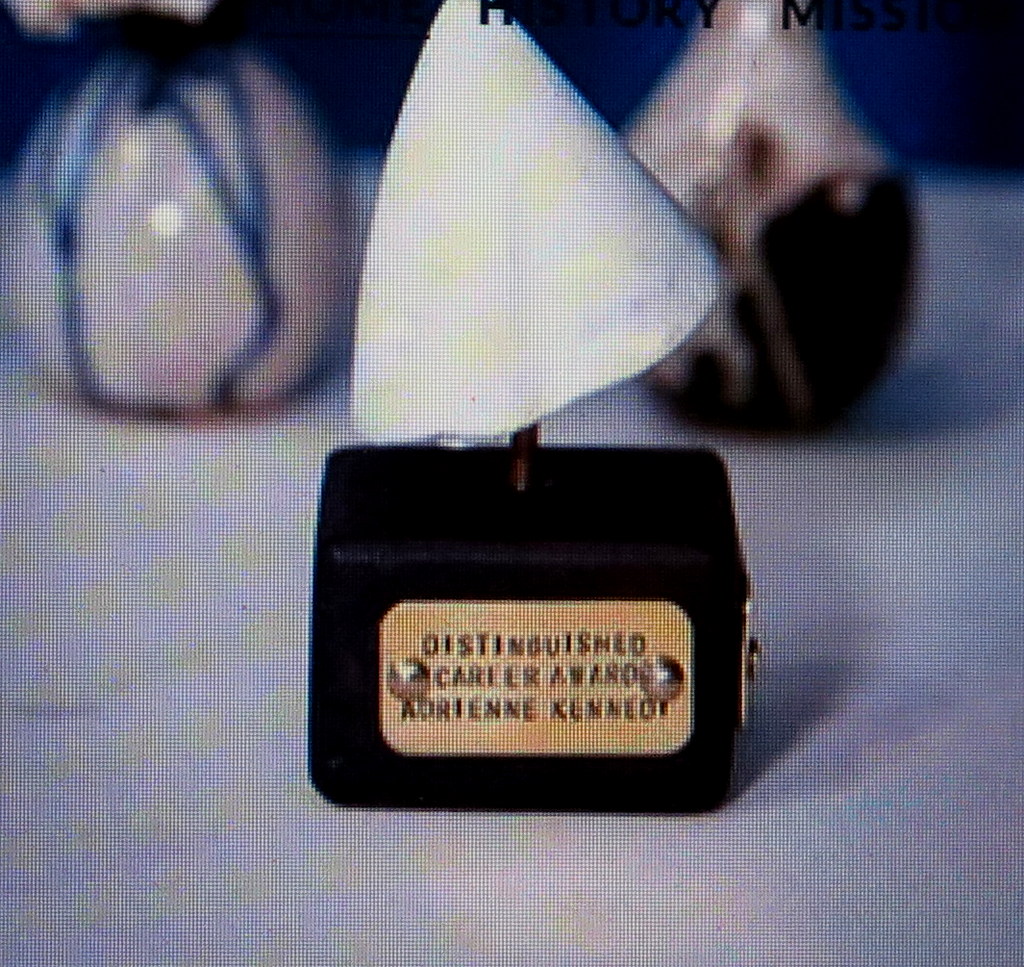
Tooth of Time Award: Honoring accomplished playwrights who have created significant, idea-driven works throughout their career, Bret Adams and Paul Reisch Foundation (courtesy of their website)
Freelancers are especially hard hit. They do not number amongst the 6.5 million who have filed for unemployment insurance (the number was posted on the news this morning). Not having a regular paycheck but living gig to gig, they are the invisible casualties of this war against a deadly molecule that strikes through those who are asymptomatic and “healthy,” but who are carriers of the spread. Clearly, more needs to be done by those of means who love theater and are devastated that COVID 19 has slammed into New York.
On that note The Bret Adams and Paul Reisch Foundation has decided to create an uplifting way to distribute the funds for their 2020 Idea Award for Theatre. This spring, the foundation will offer up to 40 emergency grants of $2,500 each to playwrights, composers, lyricists and librettists who have had a full professional production cancelled, closed, or indefinitely postponed due to the COVID-19 closures. A total of $100,000 will be distributed to theater writers.
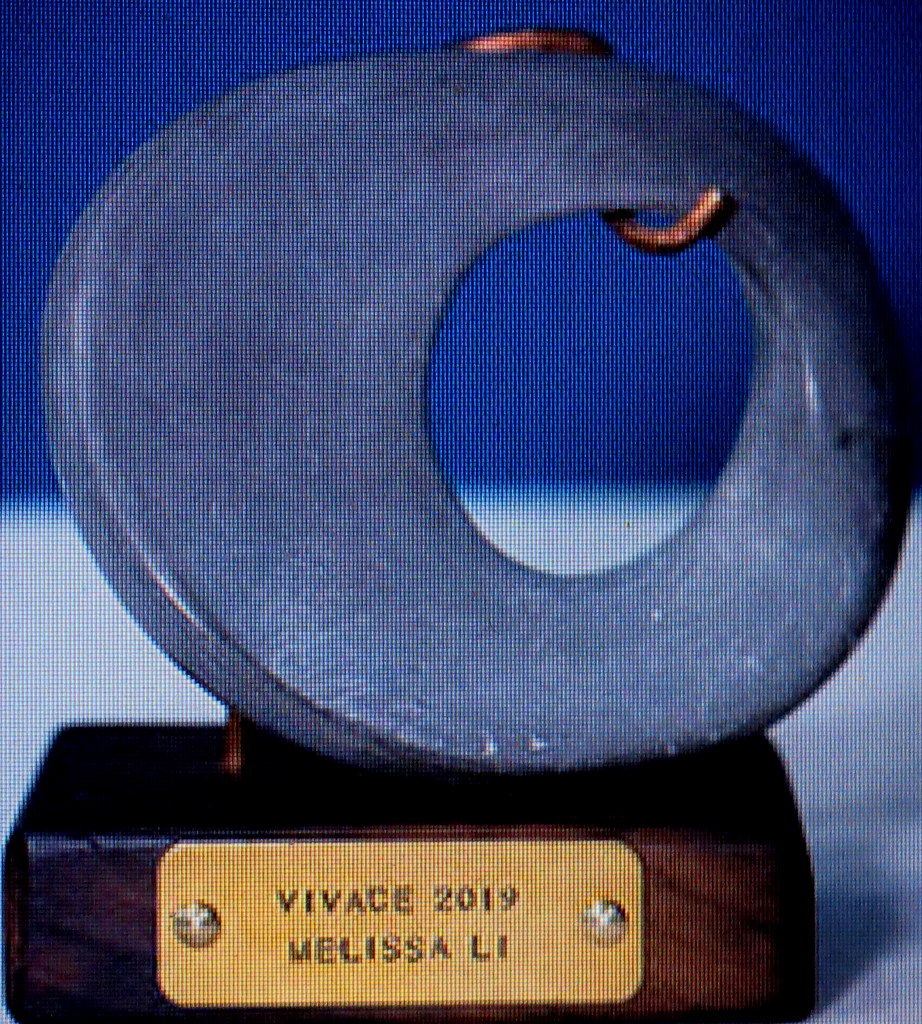
Bret Adams and Paul Reisch Foundation, The Vivace Award: Recognizing musical theatre artists with emerging talent and original work with ambitious ideas (courtesy of the Bret Adams and Paul Reisch Foundation)
Eligible playwrights, composers, lyricists, or librettists should apply at this link. Writers who have had a professional production canceled may submit their name and proof of a professional show’s closure. (“Professional,” in this case, is defined as LORT, Off Broadway, or Broadway). Each artist can submit only once. If there are more than 40 applicants, the Foundation will award grants by lottery, allowing them to give out the greatest amount of money directly into the pockets of the artists who have been most affected.
The submission deadline is April 14. The Foundation hopes to make funds available to artists as quickly as possible to forge a path to provide a bit of hope and relief and especially to guide others to do the same for artists in this unprecedented time.
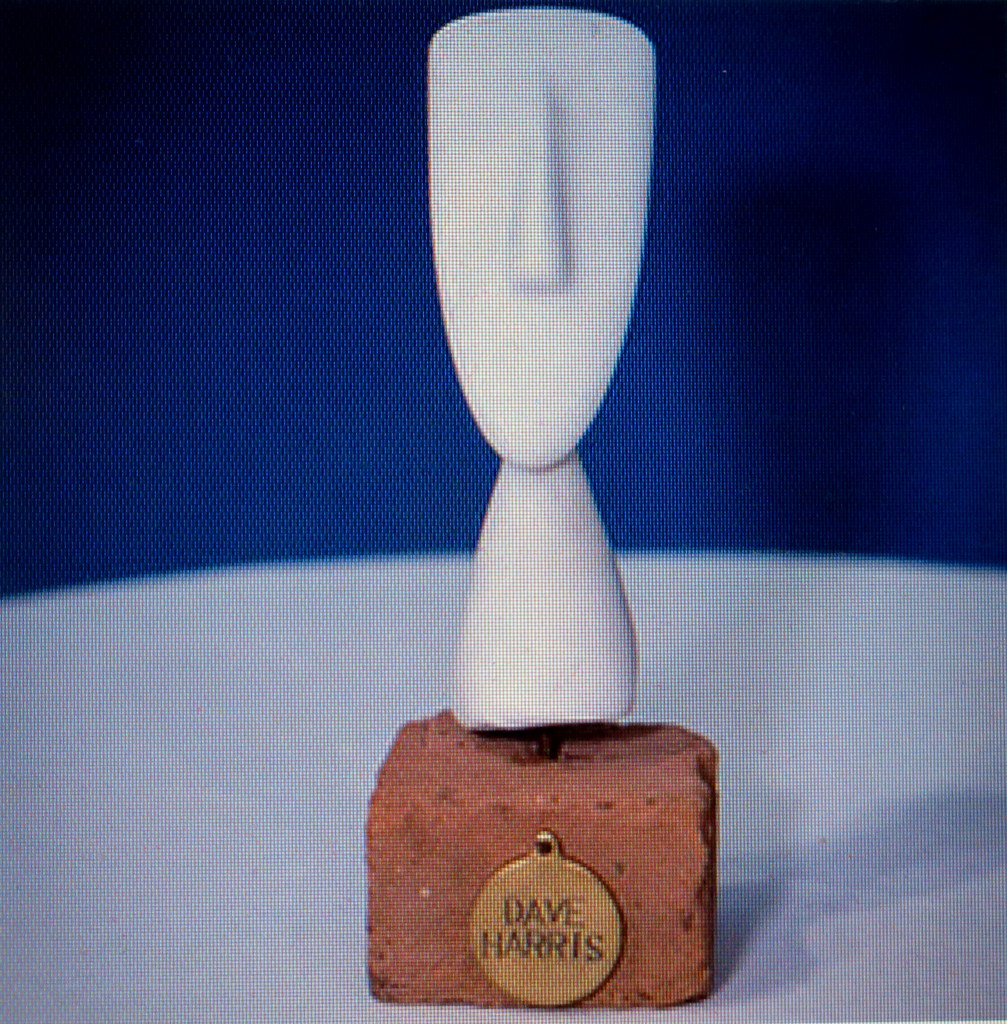
The Ollie Award: Recognizing playwrights with emerging talent and original work with ambitious theatrical ideas, The Bret Adams and Paul Reish Foundation (courtesy of the website)
The Bret Adams & Paul Reisch Foundation is a charitable foundation. Its mission is to give money to writers to write plays with ‘big ideas.’ This year, their ‘big idea’ is to help those “who have had productions cancelled,” said Bruce Ostler, V.P. and Board Member of The Bret Adams and Paul Reisch Foundation.
Ostler’s point is well taken and unfortunately, true when he affirms, “The economic model of theatre in the 21st century works much like it did in the 16th century, in that a playwright receives a percentage of the box office sales; without an audience, the box office receipts and royalty to playwrights dry up. In no uncertain terms, the business of theatre today has ground to a shocking halt due to the pandemic. Playwrights are not salaried workers and therefore are NOT eligible for unemployment for a cancelled production. That is the harsh reality of theatre today.”
Theatrical Agent Bret Adams and his partner Dr. Paul Reisch loved the theatre with great passion. As an agent, Bret shepherded the careers of many actors, writers and directors and designers, including Phylicia Rashad, Judy Kaye, Ruby Dee, Ossie Davis, Sherman Helmsley, Anna Maria Alberghetti, Eve Arden, Christine Ebersole, Kathleen Marshall, Jayne Wyman, Andre DeShields, Kathy Bates, and more.
After Bret and Paul’s passing, in 2006 and 2015, their foundation was created at their bequest. The Bret Adams and Paul Reisch Foundation champions visionary playwrights and embraces diversity in all its forms. It especially encourages fresh perspectives – particularly those from underrepresented backgrounds – to create idea-driven new plays and musicals. These may include a variety of themes, i.e. science, history, politics and sexual orientation. For more information, visit www.BretnPaulFoundation.org.
‘Grand Horizons,’ a Ferociously Funny Vision of Senior Redefinition, Starring Jane Alexander and James Cromwell
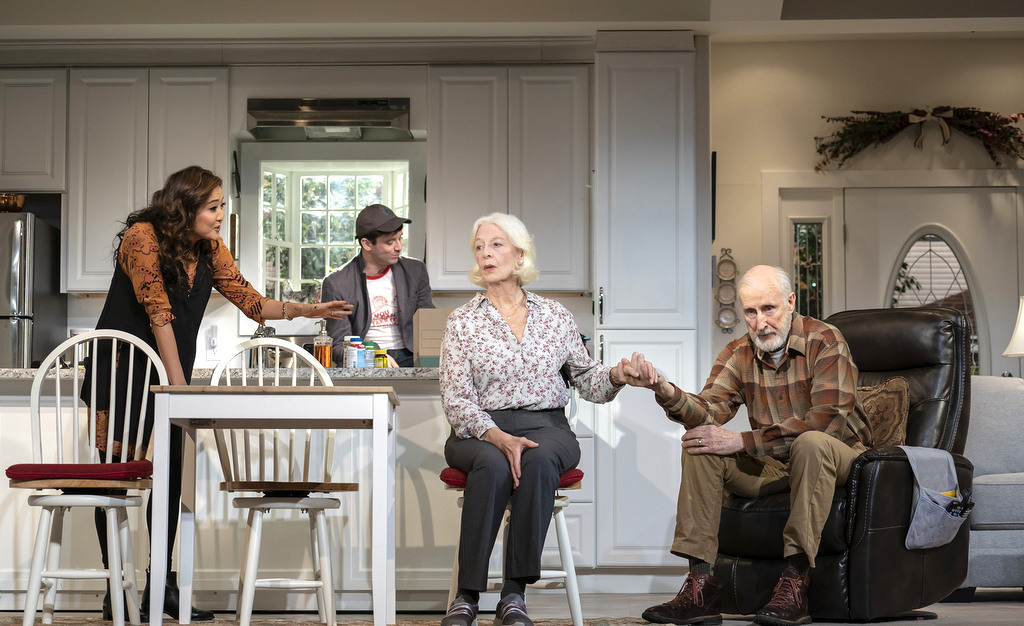
(L to R): Ashley Park, Michael Urie, Jane Alexander, James Cromwell in ‘Grand Horizons,’ by Bess Wohl, directed by Leigh Silverman (Joan Marcus)
At last! There’s a new and improved perspective of “seniorhood” that doesn’t include steps up the ladder of infirmity and dementia: from independent living to the “Rose Court,” from memory care to the palliative slip-away into Hospice. Indeed, as we appreciate and glory over the vibrant humor and comedic power of situation and characters in Bess Wohl’s Grand Horizons, we learn a thing or two about “old folks” and “the younger generation” in this rollicking yet profound play.
First, age is attitude. Second, the older one becomes, the more one must think outside of the box, especially out of the type found in replicated, independent living housing. Third, the closer one gets to the “end,” the more one should “rage against the dying of the light.” Fourth, one can experience in one’s later years a vision of life that is freeing, one that destroys the cages we created our entire lives: for they are a mere facsimile of living. Indeed, contrary to seniors who settle for the cardboard, cookie-cutter artificiality of existence in vegetative, pre-fabricated places like Grand Horizons, Wohl reveals that it is possible to make life-affirming changes even at the age of 80 years-old as does her protagonist, Nancy, the amazing Jane Alexander.
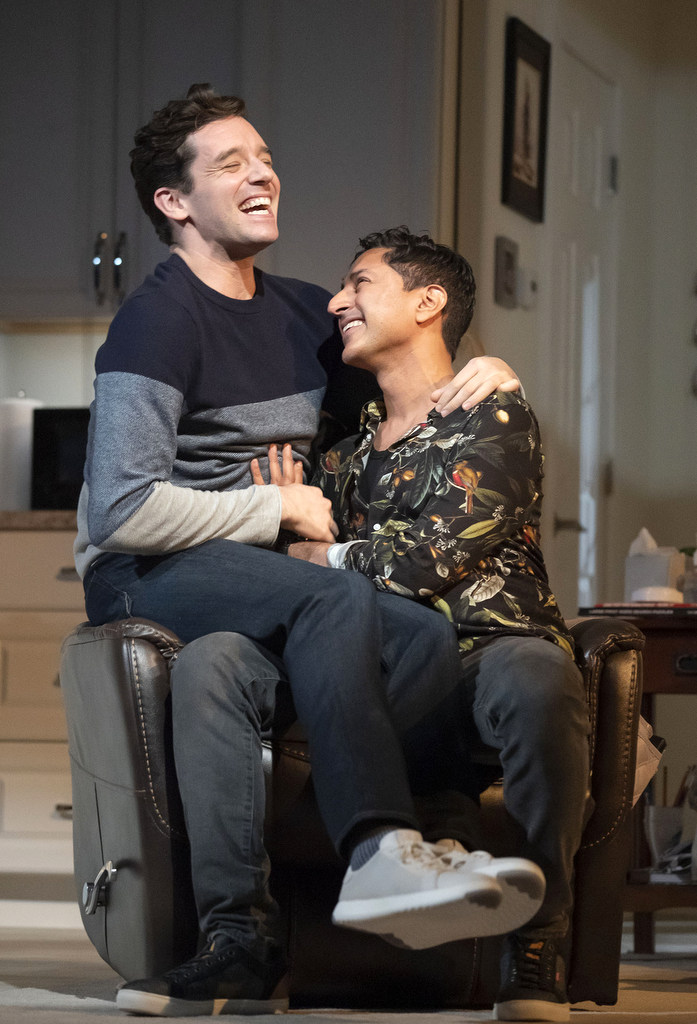
Michael Urie, Maulik Pancholy in ‘Grand Horizons,’ by Bess Wohl, directed by Leigh Silverman (Joan Marcus)
The playwright’s brilliant script is cleverly paced by Leigh Silverman’s precise direction of the superb ensemble. Masters of the comedy of real, of humor springing from grounded, soulful authenticity, the actors led by Jane Alexander and James Crowmwell pop the quips, jokes, one-liners, twists and turns of phrase and mood to keep the audience laughter rolling in waves of joy. Wohl’s well-crafted writing absolutely sings with comedic grace and profound themes, sharply channeled by Silverman. These include the importance of breaking through the stereotypical concepts of aging, family, parenting, marriage, love, intimacy, individuality and autonomy.
The play’s situation is common enough. Nancy and Bill, a “typical,” retired, fifty-year married couple have taken the next steps toward their journey’s end by moving into an independent senior living community. Is it the replication of row after row of modestly, flimsily built homes in a vast similitude (Bryce Cutler’s projection design) that sets off Nancy? Or perhaps what triggers her is the whitewashed, pleasant kitchen/dining nook/living room interior of “peaceful” uniformity (Clint Ramos’ set design) though it is festooned by artificial greenery.
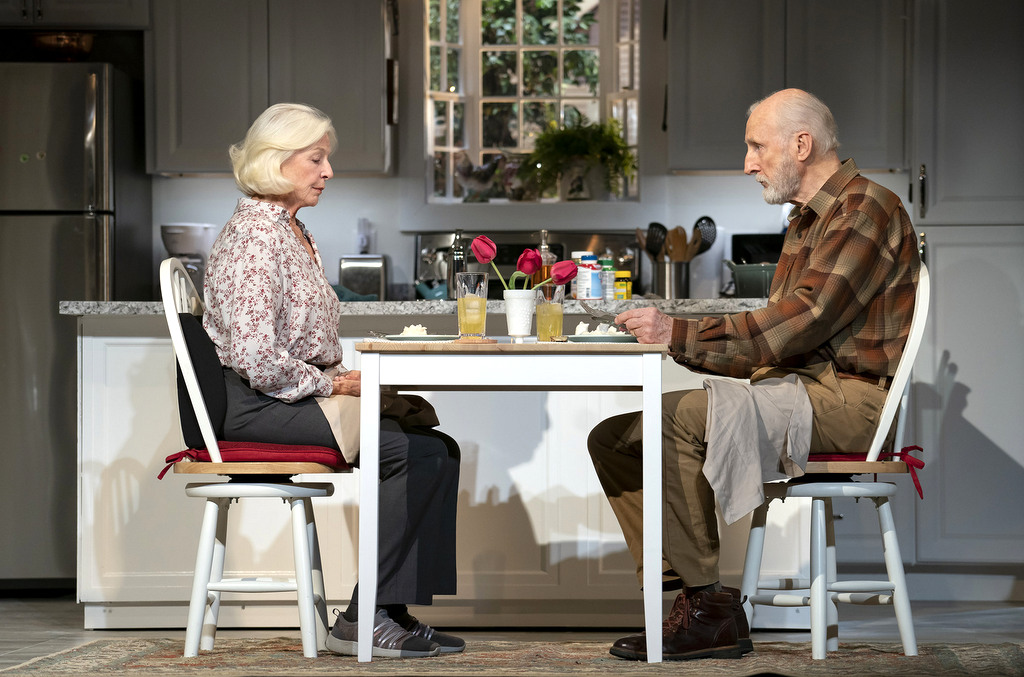
Jane Alexander, James Cromwell in ‘Grand Horizons,’ by Bess Wohl, directed by Leigh Silverman (Joan Marcus)
We learn later in a profound and symbolic irony, that the lovely plants don’t even have the opportunity to die bio-dynamically as a result of Nancy’s over or under watering. They just go on and on and on in lifeless “eternity.” Nancy’s eyes open to their fake permanence later in the play, after she has confronted herself, her children and Bill with the truth. Her ironic comment about their artificiality has to do with the realizations of her own growth.
The vast sterility of this community is only heightened by the play’s opening of Nancy’s and Bill’s dinner that is choreographed to reveal a mutually synchronized preparation that they execute silently with near robotic precision. Well, enough is enough in this perfect haven of deadness. I could hear Nancy’s thoughts as she looked at Bill as they, with synced movements in unison, took out their napkins, then began to drink and eat. What more could anyone their age wish want? They appear to have it all. But is this the exuberance of life we wish for?
At this point Alexander’s Nancy lets the desires of her heart explode from her lips and the train moves onto the express track and doesn’t stop until she achieves what she wants, sort of, by the play’s end. Jane Alexander’s delivery of the opening lines of conflict are spot-on humorous and ominous: “I think I want a divorce.”
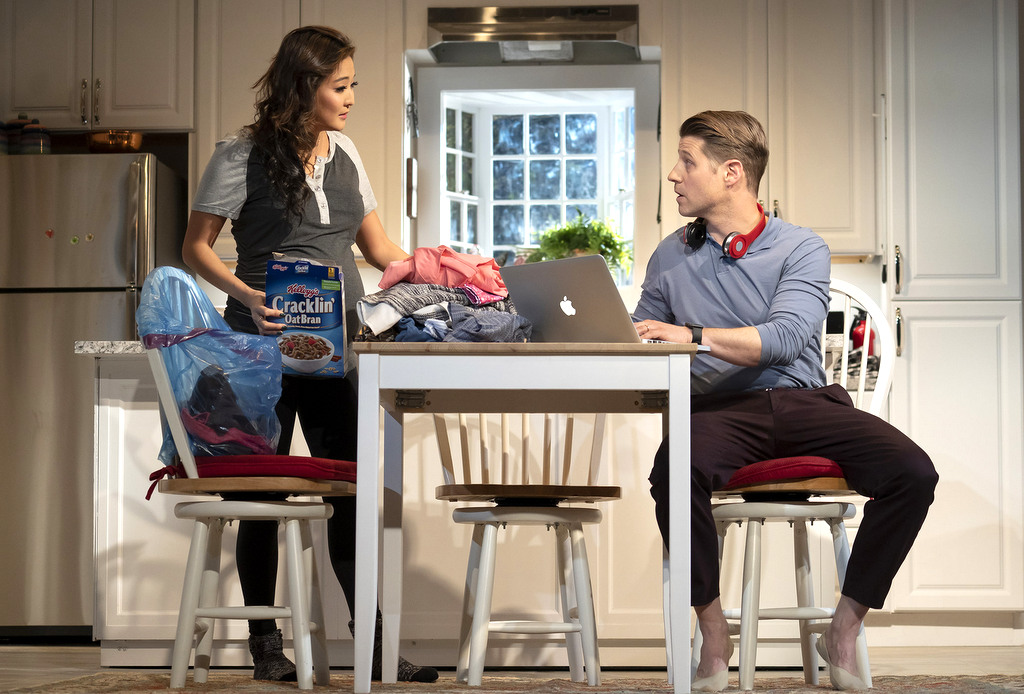
Ashley Park, Ben McKenzie in ‘Grand Horizons,’ by Bess Wohl, directed by Leigh Silverman (Joan Marcus)
The excitement of what Nancy envisions to be on her grand horizon for the future is in imagining its open-ended possibilities, even if it is merely sitting in a restaurant and enjoying a meal by herself. Clearly, she wants no more imprisonment by the chains of coupling. She wants to know her own power, strength and autonomy apart from defining herself as Bill’s wife. As the play progresses, we discover she has already established her autonomy away from her family, though she has kept it secret. Interestingly, perhaps as a long awaited response, Bill is striking out on his own in this senior community by taking stand up comedy classes and enjoying a relationship with Carla (Priscilla Lopez). We learn later that this may be his response to what he has known all along of Nancy’s secrets.
As these details are gradually revealed we enjoy watching the incredulous sons, Brian (the wonderfully funny Michael Urie) and Ben (Ben McKenzie is the harried lawyer control freak who can’t relax). Both are shattered by the announcement of the divorce. Ironically, they don’t want their parents to leave their comfortable “mom” and “dad” roles to be individuals, redefining who they want to be. They want stasis, not for their parents’ happiness but for their own comfort and assurance. Brian’s and Ben’s perceptions of their parents living apart from each other are at odds with their parents’ expectations. For Nancy and Bill divorce will be a positive experience. The sons cannot wrap their heads around this, especially that Nancy is planning to live in an Air Bnb. Their mom in an Air BnB: a horror!
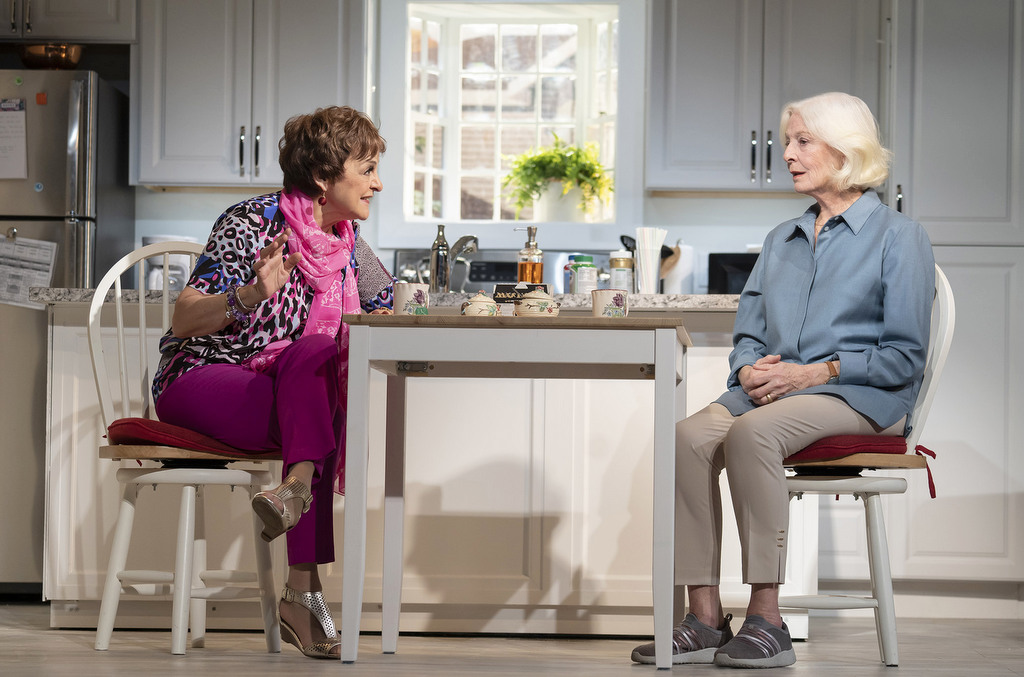
(L to R): Priscella Lopez, Jane Alexander in ‘Grand Horizons,’ by Bess Wohl, directed by Leigh Silverman (Joan Marcus)
Wohl takes advantage of this set-up in a refreshing way. In an ironic reversal, with the help of Jess (Ashley Park) Ben’s wife, Brian and Ben don the parental roles. They attempt to gauge what has recently happened, as they try to square away what mom and dad must do to resurrect the bloom on their long-dead marriage. Their failed attempts are humorous. Adroitly, the actors bounce off each of their characters’ stress-filled emotions with peppery dynamism and wit.
Brian’s neediness is easily identifiable throughout and is integral to his character as a theater teacher who creates 200 characters in The Crucible so “no kid will be left behind to feel left out.” It is Brian who is so dislocated by his parents’ future divorce, he worries about where he will spend Thanksgiving which is six months away. His sensitivity exceeds his parents’ emotionalism. The dichotomy is hysterical, yet heartfelt.
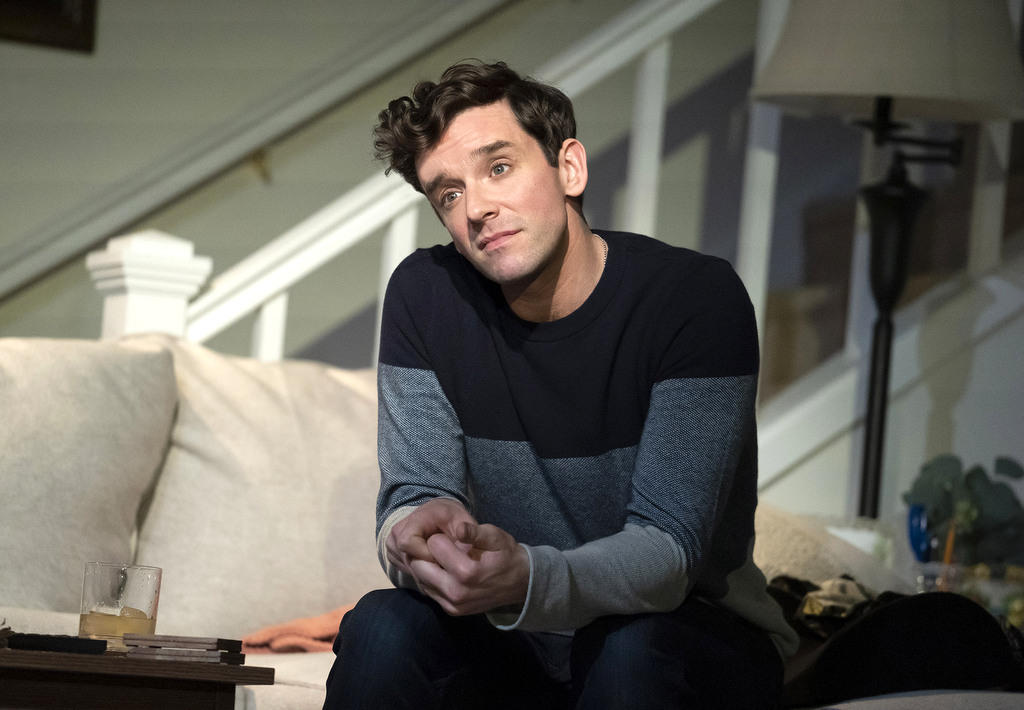
Michael Urie in ‘Grand Horizons,’ by Bess Wohl, directed by Leigh Silverman (Joan Marcus)
Ben’s eczema flares as he attempts to take control of where each of his parents will live. And then there is Jess providing the counseling so Nancy and Bill can return to their once affectionate times with each other. With Ben and Brian looking on with hope at Jess’ powers, the results that follow are riotous. As their visit with Bill and Nancy to persuade them not to divorce lengthens, Jess begins to look at her relationship with Ben differently as he reverts to Bill and Nancy’s son. Where has her husband gone or is this just hormones because she is pregnant?
The resistance of the younger generation to the divorce is a powerful obstacle which the parents find impossible to answer to their children’s’ satisfaction. It provides conflicts among the characters from which Wohl tweaks and teases thematic tropes. What are the phases and stages of our lives? How do we define them apart from cultural stereotypes and familiar roles that appear to offer comfort, but are actually binding and nullifying? What price do we pay to create our families and sacrifice for children with expectations that are unreasonable, or worse, false? From parenting to aging, no one can provide a guideline for what to do that will resonate completely with our individual lives. Every family, every person in that family is different. We fail, but perhaps it is worth it because we learn and if we are open to it, we heal.
Nancy’s desire for a divorce sets the entire family roiling except for Bill, who appears to remain calm. Of course Wohl is always pushing the envelope to get the maximum surprise and intrigue from her characters, who remain interesting and intensely human.
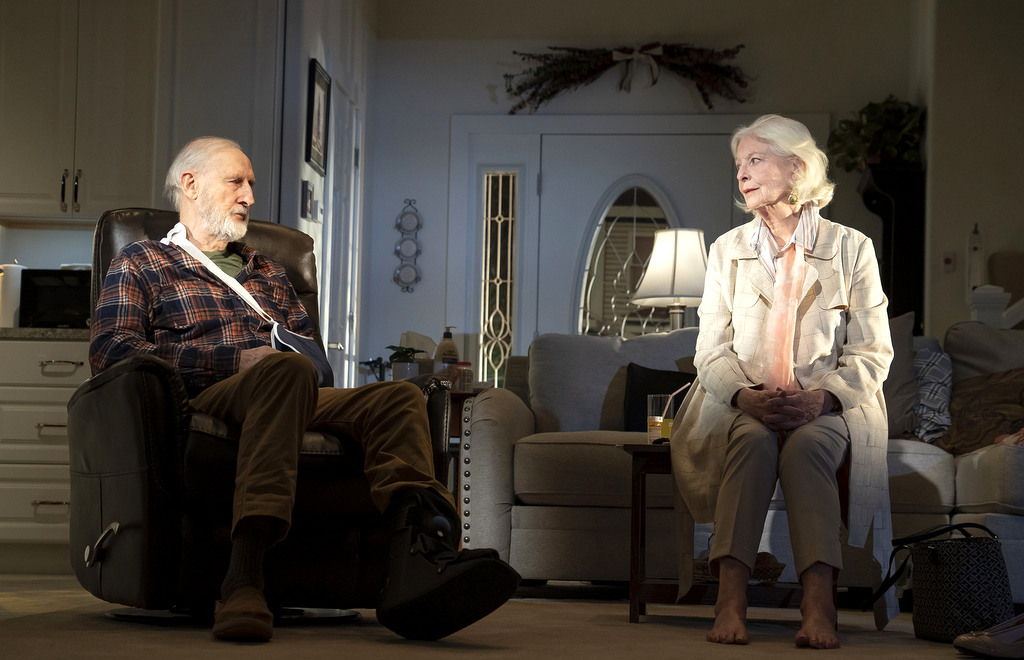
James Cromwell, Jane Alexander in ‘Grand Horizons,’ by Bess Wohl, directed by Leigh Silverman (Joan Marcus)
The audience’s gales of laughter organically spring from Nancy’s revelations that she has pursued her desires and dreams despite the intrusions of raising her two sons and making a home for her husband Bill. Indeed, the mother they believed she was, is not who she presented herself to be. She had another love. And when she expresses the importance of her closeness and intimacy with this lover to Brian (Urie brings down the house with his responses to her sexual descriptions) in the hope of explaining why she is leaving Bill, he cannot cope with understanding that his mother is perhaps a woman first.
This is something many children have difficulty with unless the parents, with good will and flexibility, help them to understand love, sexuality and intimacy. Bill and Nancy never considered going into these discussions with Brian and Ben because they never went there with each other. It is a telling irony that catches up with all of them at this juncture.
Clearly, Nancy runs deep as does Bill, who is a cypher that Wohl reveals by the conclusion, when we learn that both Bill and Nancy have kept intimacies and secrets to themselves. Yet, they do love one another. The humor and pathos come when we note how difficult it is for Ben and Brian to understand their parent’s particularities when they believed the packaged family meme that “togetherness is happiness.” That meme when they admit it, satisfied none of them, least of all their parents.
All of this eventually tumbles out after Brian, Ben and Jess visit, stay and don’t leave until Bill and Nancy politely tell them to go and reassure them that they are going to be all right. By the end of the play, Wohl opens the door to hope. Even if they live apart, maybe Bill and Nancy can begin to see each other outside of the roles that threatened to box them in “til death did them part.”
Grand Horizons is a mixture of uproarious fun and thoughtful poignance. Shepherded by Leigh Silverman’s vision the actors deliver, with sterling performances by Alexander and Cromwell and with high marks for McKenzie, Urie, Park and in secondary roles as Tommy (Maulik Pancholy) and Carla (Priscilla Lopez). Additional kudos to the creative team: Clint Ramos (scenic design) Linda Cho (costume design) Jen Schriever (lighting design) Palmer Hefferan (sound design) Bryce Cutler (production design).
Grand Horizons runs with one intermission at Second Stage Theater, The Helen Hayes Theater on 44th Street between 7th and 8th until March 1. For tickets and times to this LOL production CLICK HERE.
 CAROLE DI TOSTI