At Tribeca FF: Robert De Niro Honored, Documentary, ‘Kiss the Future’ Screens, Orange Skies Presage Climate Change’s Impact
It’s the opening of Tribeca Film Festival. Co-founders Robert De Niro and Jane Rosenthal are ready for anything, even the apocalyptic Canadian wildfires smoke billowing down from Nova Scotia and Quebec, that plumed and spread over the Northeast and New York City, raising the air quality alerts into the “hazardous” zone on June 7, 2023. This NYC condition is a throwback to the days of 1960s smog pollution. It is a terrible, noisome reminder of 9/11.

The man made terror of global warming is being answered by the earth’s revolt. It’s in the smell of the air and the toxic orange glow of the skies. It’s all along the Northeast coast and it’s wafting outward covering Pennsylvania, Ohio and the West, and is moving down to Virginia and the new la la land, Florida. These days are eerie and frightening because the atmosphere’s strangeness presages more to come.


Fossil fuels are very much in the pollution picture (the Biden administration just pulled a doozy with drilling joining craven Republicans in promoting global warming). The choice of dollars and toxic air over a clean environment and planet cooling isn’t a problem for corporate billionaires who have to make billions to pay politicians to keep the cycle going. Masochistically the money will be used to paper over theirs and their family’s coffins. The air they breathe will be unable to be purified, a condition they dismiss. This toxic air even of 400 wildfires burning to our North reminds one of the film Total Recall, of no oxygen and orange skies. That setting, which was Mars has become a reality on Earth.

Tribeca guests, who have frequently excoriated politicians for their derelict approach to global warming, COVID and other dire consequences for the species on the planet, now have one more outrage to use to make art. Without artists as activists, indeed, we would be in much worse shape. That is one of the themes of the documentary Kiss the Future, screening at its North American premiere at Tribeca. Artists as activists encapsulates one of the purposes of Tribeca Film Festival, which then and now uplifts New York City and artists who contribute their works submitting from all over the world.
The Festival kicked off with a pre-reception during which Mayor Eric Adams gave Robert De Niro a key to the city. He received praise for his work in lifting the spirits of New Yorkers during and after the dark days of 9/11 by establishing Tribeca Film Festival with his colleague Jane Rosenthal.
The great director and filmmaker Martin Scorsese honored his friend and fellow collaborator affirming Mayor Adams’ remarks about De Niro’s prodigious contributions. Guests included Mark Ruffalo, Debra Messing, Billy Porter, Patty Jenkins, Peter Coyote, Noah Centineo, Dianna Agron, Julian Schnabel, Piper Perabo, and New York Nico (many of them artists-activists).

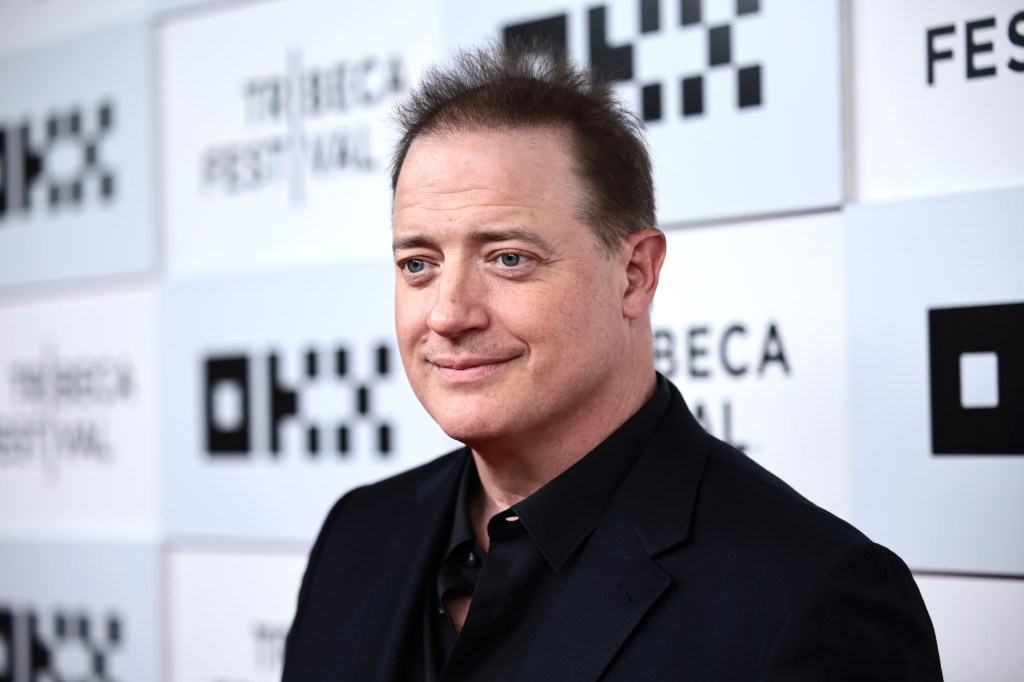
After the reception, the much anticipated documentary Kiss the Future was the opening night screening. The documentary chronicles U2’s journey to perform a long-promised concert to the people of Sarajevo after the war in the Balkans. Producer Matt Damon attended the event along with Brendan Fraser, Jennifer Esposito, Noah Centineo and Adam Goldberg. Before the screening Tribeca Film Festival co-founders Robert De Niro and Jane Rosenthal were on hand to answer questions from the media.
‘Grey House,’ a Subtle Send-up of Horror Films, That Delivers With Humor and Surprise, Starring the Fabulous Laurie Metcalf
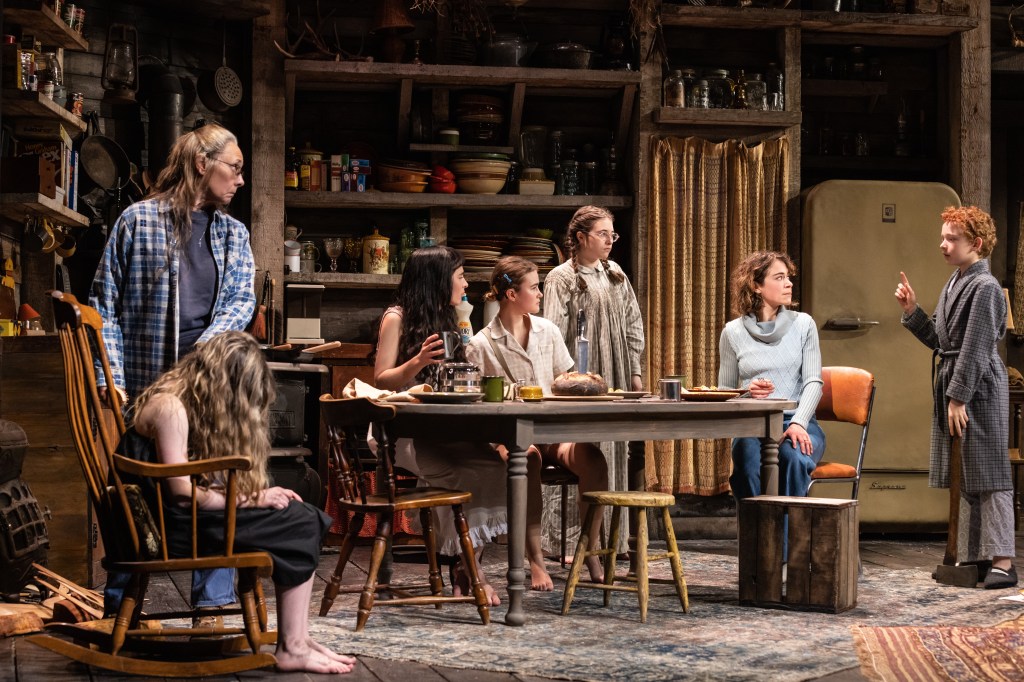
Top shelf performances and eerie effects in lighting, sound, and on-point set design carry Levi Holloway’s horror-thriller Grey House through to its unreasoned, macabre and opaque ending, leaving the audience disturbed and unsettled in an unusual, visceral entertainment. The production, currently running at the Lyceum Theatre until September 3rd, is insightfully directed by Joe Mantello for maximum preternatural weirdness and warped grotesqueness that is also a send-up of the genre.
With sardonic humor and glimpses of the supernatural which evanesce in the twinkling of an eye, the playwright Levi Holloway shrouds the action along a path of darkness, confusion and sometime shock, until the widening road dead ends in a climax and (spoiler-alert) Max’s partner Henry vanishes, replaced by a new guest as Raleigh (Laurie Metcalf), bags packed, leaves.
Spoiler alert! Stop reading if you want to be surprised by the play. Read the rest if you are looking for clues to guide you down the dark road of Grey House.
Where and how Henry de-materializes doesn’t matter. We have witnessed his sadistic torture by a child tormentor and watched astounded at his masochistic enjoyment of pain. When he contributes his substance to create a palliative “alcoholic” drink that anesthetizes, most probably for a future unrepentant male, our fog of understanding clears a bit. Henry receives well-deserved punishment for his unspeakable past acts, that, until he entered Grey House, have gone unanswered. Is the function of this house and these female inhabitants to deliver justice? If so, married couple Max (Tatiana Maslany) and Henry (Paul Sparks) who seek help at Grey House after a car accident are “innocents” walking into a trap.
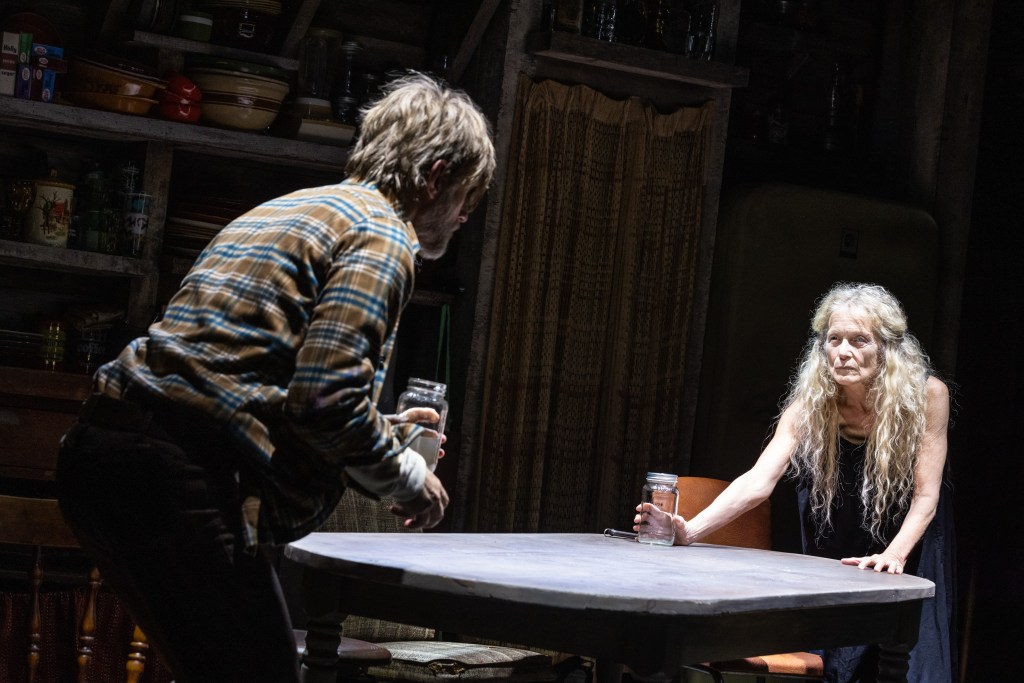
The creaking, groaning, hellish, two-story, ramshackle abode in the mountains, referred to as “Grey House,” initially appears to Max and Henry as a welcome, cozy shelter from the blizzard and their injuries. However, we know better and not just because of the advertising campaign for the show.
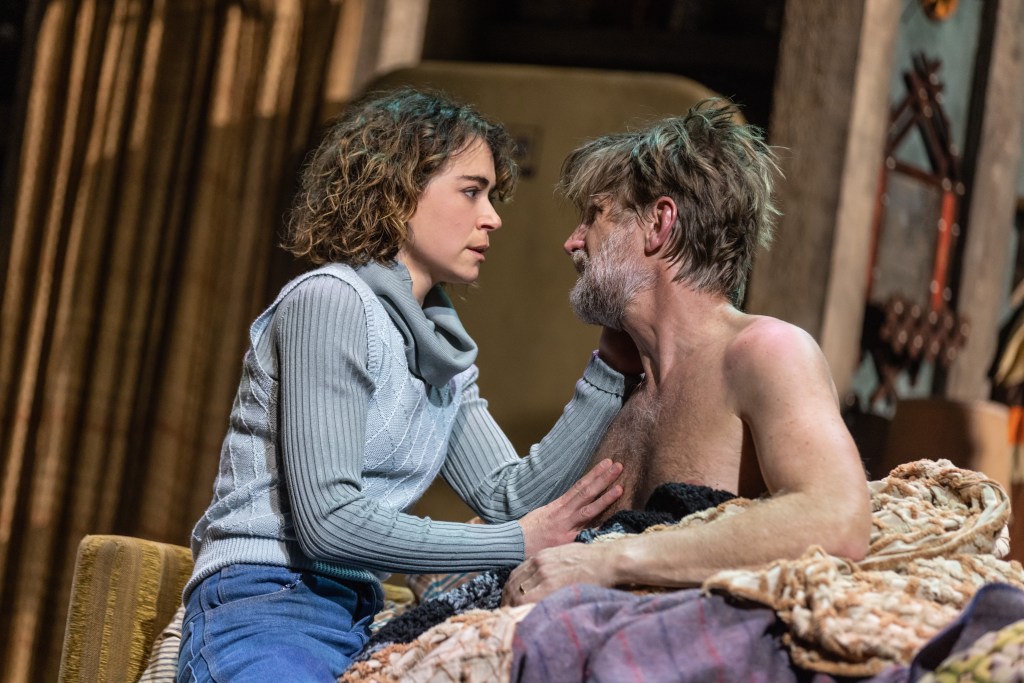
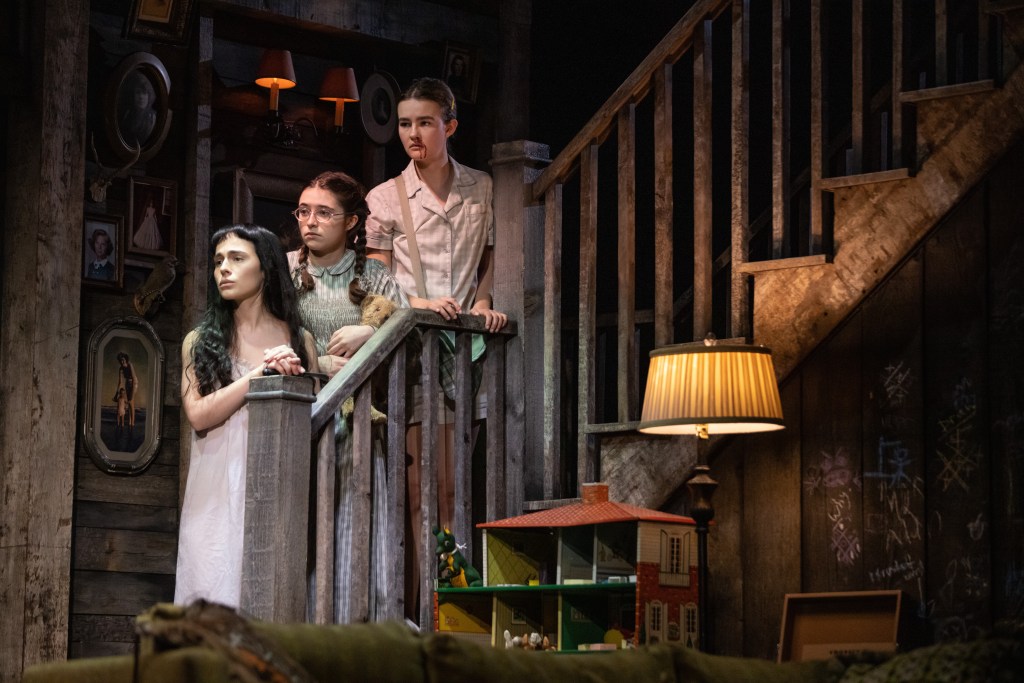
Previously, we have been introduced to the strange, uncanny children of the mountain cabin and their mother/caretaker Raleigh (the sensational Laurie Metcalf). Two of the “sisters” initially raise the spirits in a representative song of the region, singing a cappella. They produce an effect which is haunting and spooky. At turning points throughout the production, a total of four songs are sung: two authored by Mountain Man and the others by Bobby Gentry and Sylvan Esso. Each song is more compelling and meaningful in relation to the action, thanks to Or Matias (music supervisor and a cappella arranger).
Henry’s ironic comment that he’s seen this movie before and they “won’t make it,” lands with humor, horror and truth. We know something he doesn’t. He and Max must stay away from the two unnatural malevolents, a Wednesday Addams meme, Marlow, and her frightful companion in wickedness, the vicious, hell-bound Squirrel. In the initial moments of dialogue and action, they are daunting.
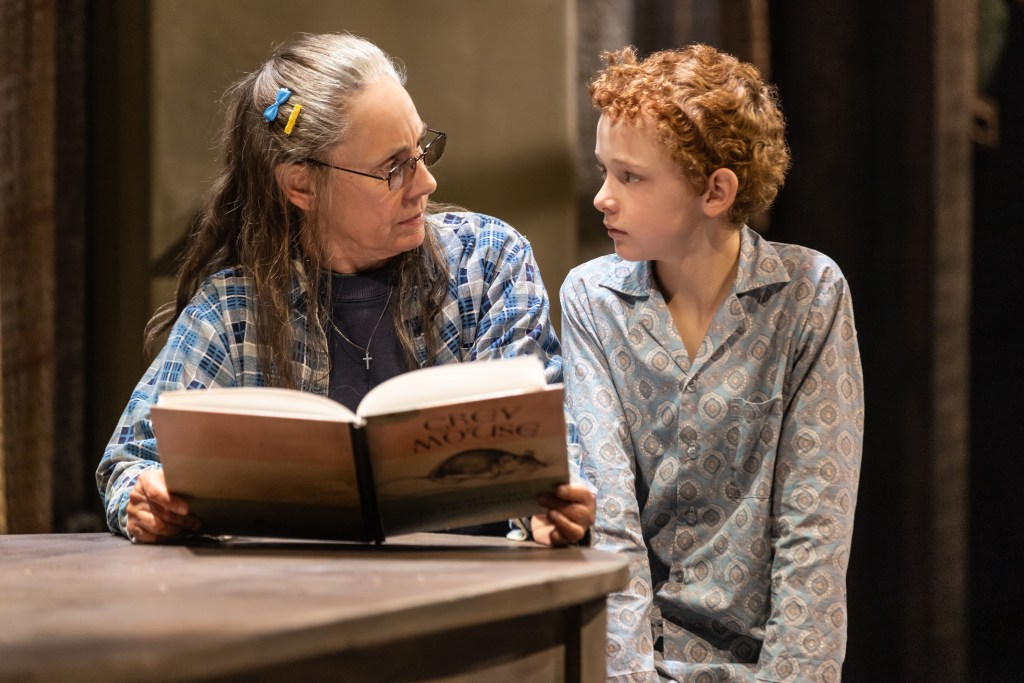
Throughout the action, both could double cast as witches in their sarcasm, sinister intentions and sub rosa text delivered in a straight-forward manner, as they allow the “words to convey the meanings.” The import of their statements are clues to what is really going on, however, the substance is easily missed because the audience is Holloway’s prey and is misdirected as she steers them down the road, and blinds them with her dark shadows of uncertainty.
Nothing is directly expressed. Of course, Henry and Max have the bulk of their interactions with these vixens, who rule the roost and who, Raleigh, their ersatz mom, calls “willful creatures,” an understatement.

As the Wednesday Adams meme who is a self-satisfied, self-admitted, proud “bitch” in the MAGA vein of “owning the libs,” Sophia Anne Caruso is terrific at suggesting the horror underneath the action. She enjoys making her guests, especially Max, feel creeped out.
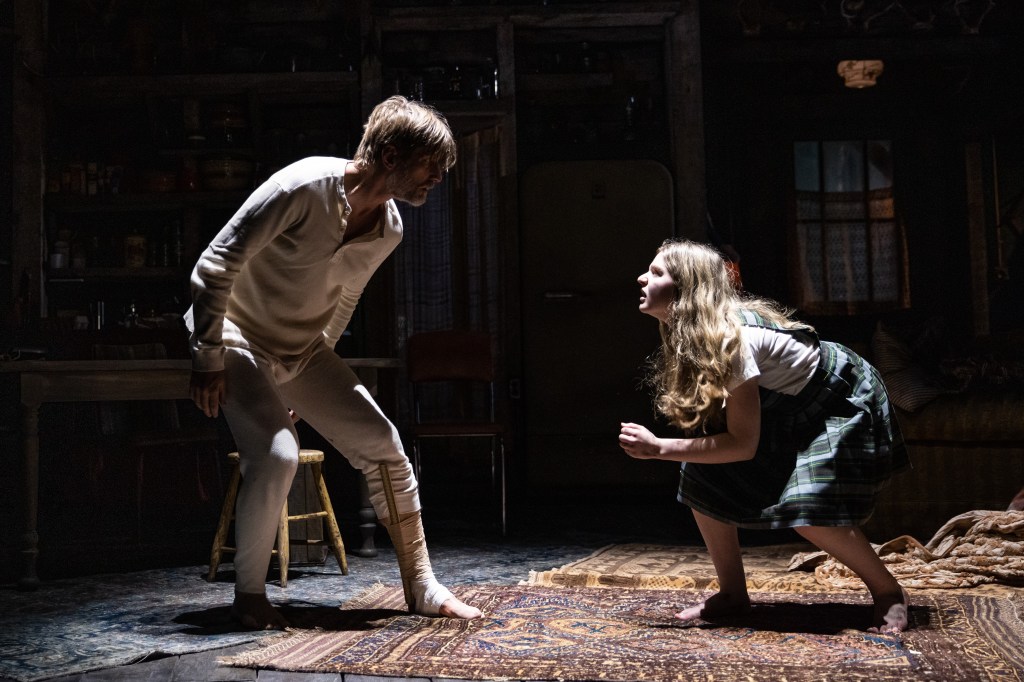
Squirrel, whose damaging persona is represented by her name and her having chewed the phone chord so no calls come in or go out, is the youngest. Portrayed with insinuation and sadism in a nuanced performance of softness and brutality, Colby Kipnes is superb. She is the youthful doppleganger of The Ancient (Cyndi Coyne) and is the instrument of revenge holding “everyman” predator Hank to account in a twisted time reversal. For unspeakable acts he committed decades before, the young Squirrel and the others collaborate in effecting physical retribution which the anesthetized Henry willingly accepts as his due.

“Grey House” exists beyond time and place, the repository of the wounded in life who exist when we meet them as otherworldly beings or some other undetermined construct of humanity, which the playwright ironically leaves in the realm of uncertainty. When we meet this particular brood, Raleigh suggests others will come and go, as she in fact leaves at the conclusion with a packed suitcase, letting Max who may be a younger version of herself replace her as the caretaker.
The bottles of “moonshine” the ersatz family of women, including A1656 (the fine Alyssa Emily Marvin), and hearing-impaired Bernie (Millicent Simmonds passionately completes the witches’ coven) extract from male predators is kept refrigerated for the next visitor destined to arrive at Grey House. Like Henry he will be punished to sustain its prosperity and existence as a “living thing.”

Laurie Metcalf’s Raleigh is continually surprising in a spot-on, gorgeous performance as the hapless “mom,” who she portrays with power, insight and presence. Of all of the actors, Metcalf is the most surreal yet authentic and empathetic, as we feel for what she goes through at Grey House, though we don’t succinctly understand what we see happening before our eyes. When she is on stage, she is imminently watchable. Her lead, as subtle as it is, guides Caruso’s Marlow and Kipnes’ Squirrel to their understated ferocity which spills out in their insightment to get Henry to masochistically “fall on his own sword,” as they act out their vengeance.
Sparks’ Henry is so likable and loving in his relationship with Maslany’s Max who is the perfect wife, that we are shocked that both are not who they appear to be, Henry less so than Max. Maslany shows a sense of humor with the girls, then turns, flexing her emotional range when she expresses the appropriate terror knowing their luck has changed and she confronts evil. Sparks’ demeanor during the ordeals he is put through is nuanced. His confession is forthright and shocking in its understated delivery.
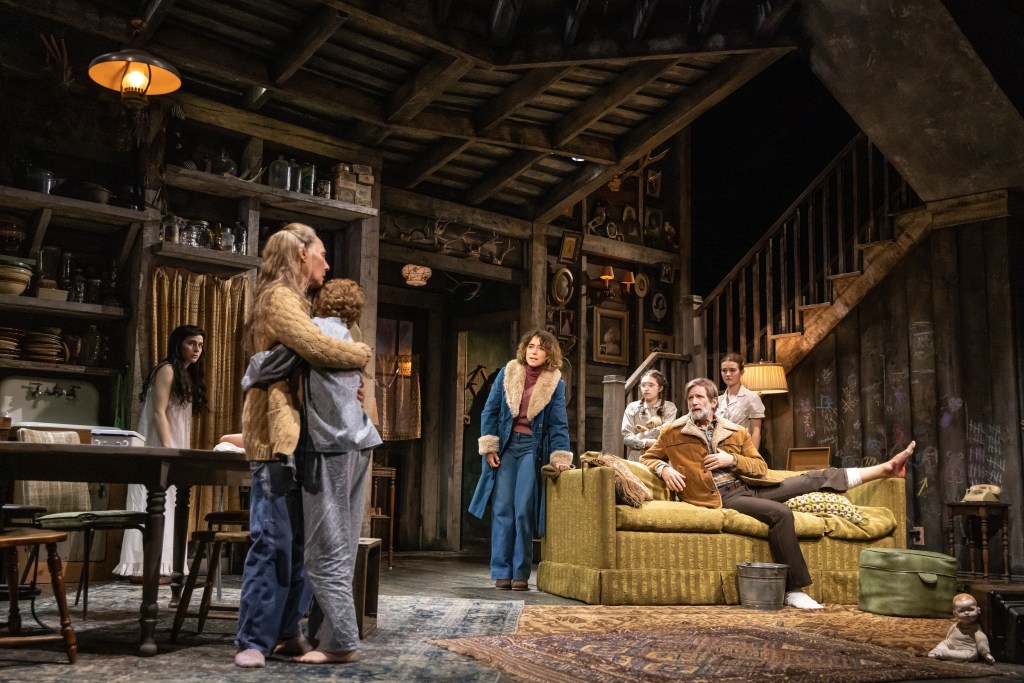
The silent characters, The Boy (Eamon Patrick O’Connell), and The Ancient (Cyndi Coyne), are vital in their gestures and presence. They add to the dynamic of “the family,” and Coyne’s Ancient is the wounded mirror image of Colby Kipnes’ Squirrel as a youth.
The production is amazing in its confabulation of mystery and opaque unreality delivered by the creative team. These include Scott Pask’s wonderful set design, Rudy Mance’s subtle costume design, Natasha Katz’s stark, atmospheric lighting design, Tom Gibbons’ house humanizing sound design, Katie Gell & Robert Pickens’ wig and hair design, Christina Grant’s makeup design. All of the actors are invested, as is Mantello in relating the otherworldly and arcane side by side with the profane, teasing out humanity in its wild derivations.
In life we see “through a glass darkly.” We receive glimpses beyond what we assume to be “reality” but know there is more that is present. What our senses apprehend, continually deceives us, though we like to believe “we know” and we are in control.
Holloway reminds us of the contradictions, the ironies, the shades of life that have no clear explanation. Indeed, the hints she drops about how the “family” of “willful creatures” operates in this spooky place are never solidified. All is intimation. The “moonshine” as Raleigh refers to it, “sold during the summer,” Marlow names “The Nectar of Dead Men,” which seems a more accurate handle by the conclusion. The duality of symbols existing on a spiritual, preternatural level are contrasted with the profane, material realm, for example when Max makes eggs (they are real-made offstage), for the “hungry, always hungry” sisters-daughters-creatures.
Thus, all is not what it seems. Holloway drives this theme home using the horror-thriller genre conveyance as a grand joke to prod us toward fear and laughter. She sends up that genre and twits us about our nightmares displayed in horror films, mirroring those found in our unconscious in dreams.

The development of the story and its characters, who are timeless archetypes reflected in literature (the good, the evil, the furies who gain vengeance), drive this work beyond genre. Thus, in an attempt to nail down Grey House and dismiss it, one may lose the deeper levels of Holloway’s symbols and complex, convoluted themes. One fascinating example is the red tapestry woven of the sinews of the historical predators, who have come to visit the cabin and whose “Nectar of Dead Men” is distilled for future use. The labels on the jars in the refrigerator tell the tale. The men’s remains we learn are in the walls, the grounds or in the basement which Squirrel frequents.
In Grey House Holloway’s vision expressed by Mantello and his creative team and enacted by the wonderful ensemble is a tonal hybrid of humor, a teasing send up of horror-thrillers, yet terrifying in its deeper representation of the patriarchy which doesn’t come off looking well in its tapestry of innards and crimes committed with impunity finally answered with rough justice, by “willful creatures.” The play is highly conceptual and may bear seeing twice because you will definitely miss connecting elements. Or just enjoy the ride and the fabulous acting and theatricality which will not disappoint.
For tickets and times go to their website https://greyhousebroadway.com/
‘Wet Brain’ by John J. Caswell, Jr., a Review

A family in crisis with no way out except love and forgiveness, is the focal point of the play Wet Brain by John J. Caswell, Jr. Directed by Dustin Wills (award-winning director of Wolf Play) the drama is presented by Playwrights Horizons and MCC Theater until June 25. The production reveals the knotty human condition in all its raw, ugly, ironic and humorous digressions, as siblings attempt to confront their father’s alcoholic illness and cope with the intense stress each experiences related to the situation as they interact with each other.
Wet Brain is the vernacular for Wernicke-Korsakoff syndrome (WKS). WKS occurs when alcoholism strips the body of necessary nutrients, vitamins and enzymes as the alcoholic depletes himself of food in exchange for his preferred “liquid diet.” The brain disorder is caused by chronic vitamin B1 (thiamine) deficiency found in those whose long-term, heavy drinking has ravaged their bodies and minds beyond repair, until death comes to “heal” them.

At the top of the play brother Ricky (the fine Arturo Luis Soria) returns home after a number of years to help sister Angelina (Ceci Fernandez) and brother Ron (Frankie J. Alvarez) find the proper way to care for their father Joe (Julio Monge). In this highly pressurized situation the siblings, who carp and criticize each other, must determine the best path for their father’s last months on the planet. This is a tall order. Joe is in and out of reality and takes heart from his “outer-space” fantasies.
He hallucinates? Because reality is so dire, Joe has found an escape route in his imagination. If he can only acculturate his children to his softer way of imagining, perhaps this will foster understanding. Maybe, but Joe is barely speaking and he belongs in an assisted living center with a memory care unit. However, Joe isn’t even on Social Security Disability and he allowed his medical insurance to lapse. Regardless, they can’t afford such a high end place. It is better if he stays at home and they have help come in.

Joe’s lack of balance makes him susceptible to falls. He walks with a severely disabled gait and ends up on the floor part of the time he is with them. He has a hard time keeping down food and vomits. His speech is garbled, though at times he is sentient and recognizes his children if he isn’t on a space fantasy. Among his other handicapping conditions, he soils himself at times and the cleanliness of his home and person is approaching nil. However, he manages to function in keeping himself close to his old friend vodka, which he stashes in Dasani bottles to “get over” on no one except himself.
Angie, who has been living with him can no longer cope with caring for him, keeping the house clean and studying for coursework to become a nurse. Thus, she calls Ricky who hasn’t seen her, his father and Ron for years. It is not a happy homecoming for Ricky or his siblings.
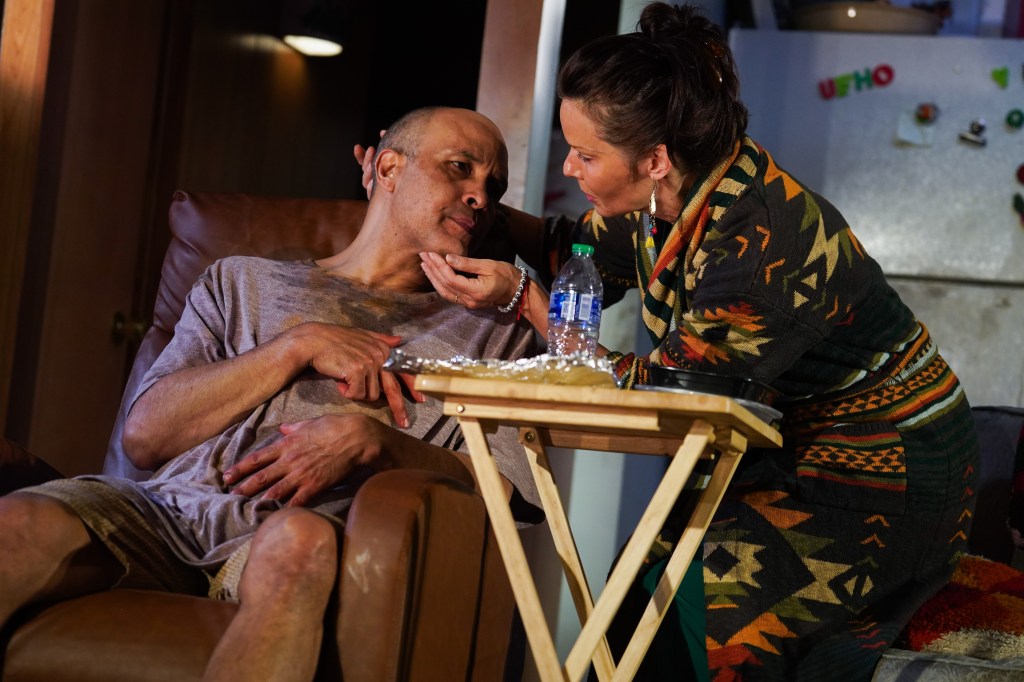
Of the three children, Ricky, who is gay, appears the most humane and empathetic, though Angie has been the stalwart, engaged member of the family, living with her father which she finally admits is beyond her. As the siblings resolve the situation, we understand the nuances of the dynamic that drove Ricky away from a home that was unaccepting and abusive because he is gay. Both Ron and Joe, who are close and worked together in their family business, found Ricky’s homosexuality loathsome. Nevertheless, Ricky has an MBA and has made something of himself. It is his presence that is the catalyst to finalize Joe’s care.
Casewell, Jr.’s drama with sardonic elements is approachable, if one enjoys insult comedy. The siblings shred each other, especially at the top of the play and reveal the horrific abuse they most probably experienced growing up, for they dish it out to each other. They communicate, not necessarily to be heard or understood, but talk at each other. Nor do they easily understand what each other has been going through. Instead, they are reactive and defensive and childish. Both Angie and Ron, themselves are psychologically, emotionally and physically damaged. Staying in the area where they grew up has not been a healthful choice.

How do the debilitated judgmental take care of each other and an acutely disabled father, living with the knowledge that their mother hanged herself because of her own mental illness? They lean on the one who had the perspicacity to leave the toxic environment and become moderately successful and accepting and loving of himself.
The most interesting section of the production occurs during Joe’s “outer-space sequence,” terrifically designed by Kate Noll (scenic design) with the help of Cha See’s lighting design, Nick Hussong’s projection design and Tei Blow and John Gasper’s sound design. The segment is highly symbolic and metaphoric.

During the scene, the siblings, Joe and their mother Mona interact and have a “heart-to-heart.” Mona, who returns as a ghost or another configuration of Joe’s space-time warp, initially hangs in the middle of her brood, and husband. All are able to communicate with each other clearly and soundly. In this sequence, the actors seemed most comfortable in the skins of their characters. They listened to each other with authenticity. The section is so striking in its coherence, the other sections of the play which relay the background exposition seem insignificant by comparison. The fantastic scenes of Joe’s imagination hold more theatricality and drama, thanks to the creative team and direction, then the scenes between the siblings. Importantly Joe’s fantastic reverie is the turning point, after which the characters become more human.
At the conclusion, when Ricky leaves, we note that the house is in order and a caretaker, Crystal (Florencia Lozano also plays Mona), stays with Joe to watch over him. In his imagination, Mona has returned to him for in the final scene, the caretaker moves close to Joe, almost as if they are about to kiss. Indeed, the development moves from the chaos at the top of the play, where we don’t very much like these siblings, to a peaceful resolution. During the play’s development, all have become more loving and accepting, stirred by the experiences with their father and each other. To bring about a resolution for him, they focused on one goal: to have their father cared for in his own home. The ending is uncertain, yet satisfying and filled with hope.

Dustin Wills’ shepherding of his creatives makes the theatrical and technical aspects of the production shine. The designs are coherent standouts that adhere with Will’s vision, from the complexity of the house and its props, to the sometimes sinister trees dwarfing the home, especially when Cha See eerily lights them. The revolving platform upon which the house is built shifts seamlessly and reflects the changes in the relationships among the siblings and their father.
The grinding sounds, the strange twists of darkness and sharp contrasts with light suggest the alternating states of consciousness in Joe’s mind and in the comprehension of the siblings. The irony is that with Joe, it is easy to understand that his condition has impacted his state of consciousness and his apprehension of reality. More subtle is how the siblings are also impacted by Joe’s perspective, most of all Ron, who is closest to him.
Wills’ direction brings Caswell, Jr.’s play to life as the actors nuance their characters. This is one to see if dysfunctional families and interesting characterizations are on your radar. What lifts the character dynamics from the boring repetition of victimization, blame and ranting and makes them interesting is how Wills and Caswell, Jr. integrate Joe’s hallucinations into a reality that is a soothing “what if” at the play’s high point. That it symbolizes a modicum of love and forgiveness is important. If the interrelationships declined, the play would have devolved into unsatisfying melodrama.
For tickets and times to Wet Brain which has no intermission, go to their website https://www.playwrightshorizons.org/shows/plays/wet-brain/
‘Love Letters,’ by A.R. Gurney, Starring Matthew Broderick & Laura Benanti, The Conclusion of Irish Rep’s Letters Series.

The intimacy of listening to the voices of individuals’ emotional grist, concern and vibrance through letters written to a secret confidante is delicious and stirring in this time of 140 characters where “brevity is often not the soul of wit.” Irish Repertory Theatre’s “Letters Series” portrays the profound, intimate relationship between two individuals not “visible” to the naked eye of friends and relatives, and sometimes not gleaned by the characters themselves until it is too late.
The first series, now ended, starred Melissa Errico and David Staller in Jerome Kilty’s play Dear Liar. Kilty reconfigured his play from the decades-long epistolary relationship between George Bernard Shaw and the actress, Mrs. Patrick Campbell. The second part of the series highlights Matthew Broderick and Laura Benanti in A.R. Gurney’s (Pulitzer Prize finalist for Drama) Love Letters, directed by Ciarán O’Reilly. The staged reading of the drama with prodigious comedic elements runs with one intermission on the Irish Repertory Theatre’s Francis J. Greenburger Mainstage and concludes on the 9th of June.
Gurney’s two-act play explores the arc of the decades long relationship between friends and eventual lovers, Andrew Makepeace Ladd III (played by the inimitable Matthew Broderick) and Melissa Gardner (Laura Benanti is fresh, witty, humorous). These individuals write letters to each other over a span of decades (1937-1985), beginning in the second grade when Mrs. Gardner sends Andy an invitation to Melissa’s birthday party, and Andy responds to Melissa accepting the invitation.

From then on the the individuals share a profound written correspondence, though Melissa tells Andy to stop writing to her initially and at various times during their lives. At first, it is because she prefers pictures to words. Afterwards, it is because the words are so heartfelt and searingly directed to her, they are breathtaking to process and conflict with her estimation of Andy when they meet in person.
Oftentimes, reverse psychology is at work in Gurney’s pla,y where subtext and undercurrent in the dialogue between the characters takes precedence. The characters are confessional, argumentative, challenging, and interested in each other as friends, though there is always the sense that their concern for each other, authenticity and the bond formed through words reveal theirs is not an ordinary friendship, but one of the most sincere, transcendent and special that love might bring, even though it is not formalized in marriage.
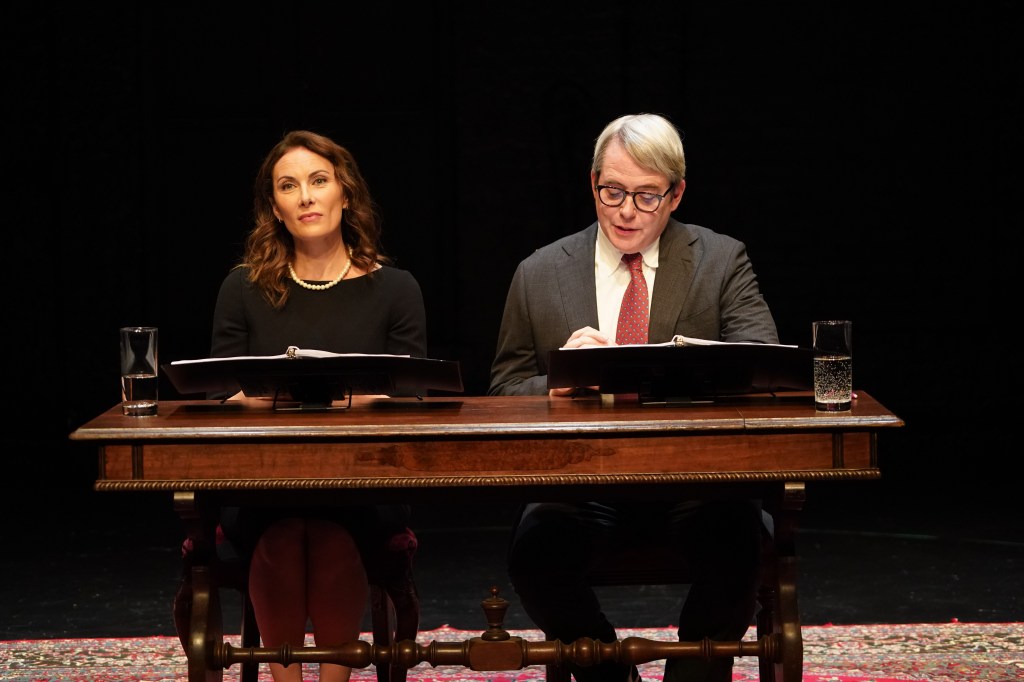
Gurney intimates the possibility that their feelings have the potential for intimacy with their child-like innocent abandon (in 2nd grade), when Andy asks if Melissa will be his valentine, and Melissa agrees that she will, if she doesn’t have to kiss Andy. The verbal affection continues when we learn that Andy repeatedly asks Melissa to marry him. She gets him to stop, by telling him she will go with him to get the milk and cookies for the class, if he stops proposing to her. When Melissa employs her skills drawing, which she enjoys doing, she draws pictures of them without their bathing suits on, asks if he knows which one he is, then importunes him not to tell anyone about her drawing. She concludes by telling him she loves him.
This thrust and parry structurally mirrors the pattern of their relationship. Andy initiates his desire to be close to her. Melissa avoids responding, then eventually comes around to agree with him. Then, something intervenes and prevents them from actually becoming boyfriend and girlfriend or partners. When they finally try to extend their relationship beyond the intimacy of their writings and meet “live” for a weekend at the Harvard/Yale game, their date, including sexual coupling explodes in their faces. There is more “aliveness” in their writing, than in their ability to regain the soulfulness of their correspondence face to face. It will take other circumstances to transpire in Act II before any meaningful physical coupling occurs.
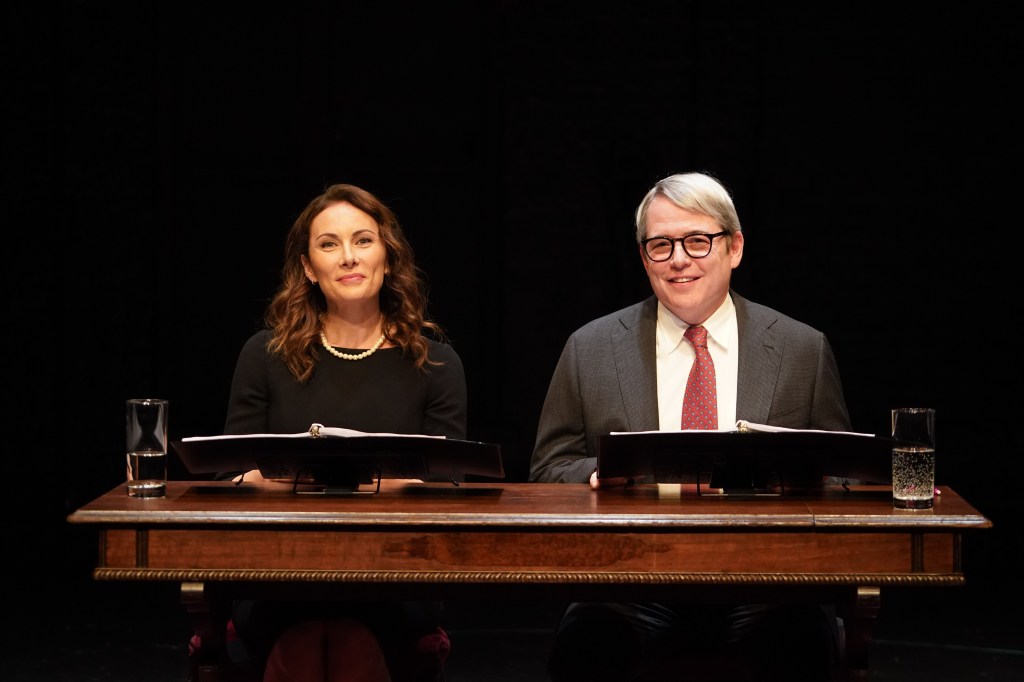
Ironically, despite their union and knowledge of each other that they’ve gleaned over the years and expressed in writing in the comfort of their surroundings, confronting each other in their “real” identities is problematic. Or perhaps the mental/spiritual connection through letters is their real identity.
Their written consciousness is a mystery. As Andy attempts to rationalize why their intimacy backfired when they met in person, Melissa blames the letter writing and suggests Andy phone her. However, this doesn’t work out and Melissa becomes infuriated with Andy when she hears he is writing letters to someone else, because he has fallen in love with the words coming out of his soul. Through their correspondence, he has discovered that he is compelled to write letters to “someone” to better know himself.
Andy’s love of writing and expressing himself to Melissa who listens and responds to him throughout elementary school, high school, college, the Navy and their travel to various places on the globe manifests in his career as a lawyer. Melissa’s drawing talents, that she initially felt comfortable to share with Andy, burgeon into a full-blown career as a professional artist who exhibits in New York City. Their epistolary relationship reveals a love, honesty and encouragement unlike that found in their other relationships. However, whether Melissa can bear continuing the writing when she dislikes it and believes it is keeping them apart physically gives both of them pause. Andy suggests that he hopes they can work it out and keep writing.

The suspense whether or not they will ever “get together” in a lasting marriage carries into Act II. However, by then, both end up with other individuals. Again, something intervenes to keep their love distant and unfulfilled. Every time Andy asks if Melissa is OK, she provides a “stiff up lip” response that she is “fine,” though we know she is not. Likewise, Andy never goes beyond his father’s folkways (family country, himself) which Melissa proclaimed was stifling him when they were teenagers. Following his father’s dictum, Andy fulfills his obligations to his family, country and himself sacrificially.
Though he and Melissa fulfill their love which blossoms, unlike that which they experience with others, Andy eventually falls back on his father’s belief, uplifting the traditional sacrifice of his own happiness. His choice to put his own desires last has disastrous consequences for both of them, only realized too late.
Broderick and Benanti bring their own unique talents and personalities portraying Andy and Melissa. Shepherded by O’Reilly, they strike the right tonal notes and pacing to engage us. We become involved in these two individuals to care about them and take the journey of life through elementary school, private high schools, college, careers and marriages to other individuals, all the while reading the sub rosa signs that they mean so much to each other and missed their destiny by never marrying and having children. Thus, the tragedy of the ending is all the more greater.

Throughout, Gurney’s clever dialogue, wit and fervor crafts individuals that Broderick and Benanti solidly inhabit to make them believable to us. From halting, shy children who are obligated by their parents to write birthday thank yous to hardened adults who have veered off their truth and empowerment, we accept all, even the abrupt conclusion which belies their soulful devastation leaving Andy to pick up the pieces.
The importance of this two-hander’s themes about human nature, love, cultural influences and the power of intimacy in correspondence lies in Gurney’s characters as they age. Andy and Melissa perceive each other’s identities and ethos first as innocent, frank children. As the corrupted environments harden them, they push each other away. The irony is that they are the only individuals that truly matter to each other in their lives as adults.
That Gurney has selected individuals who are upper middle class and are white, Protestant and privileged is telling. To a large extent it is their background folkways and traditions that Melissa rebels against and Andy adheres to that walls them off from each other. In their heart of hearts they are soul mates which Andy expresses and Melissa acknowledges, though they are incapable of taking the plunge to overthrow the strictures that bind them.
That Gurney in his notes wisely instructs the minimalism of sets (a table and two chairs facing out to the audience), simple lighting and reduced theatricality enhances the dialogue and focuses our attention on realizing the humanity of these two lovers traveling their destiny together in written words.
Broderick portrays Andy with unaffecting humor which allows Gurney’s ironies to be revealed all the more quickly. Benanti is sardonic and edgy with rebellion that is balanced just enough so as not to be curdling or understated. Both hit the mark to tease out their characters with a poignancy and grace that reminds us that love requited but not fulfilled is its own tragedy. In this staged reading we understand Gurney’s emphasis on the power of expression in a truthful exploration of relationships and love under the guidance and wisdom of director Ciarán O’Reilly.
For tickets to this fine staged reading with superb actors see below.
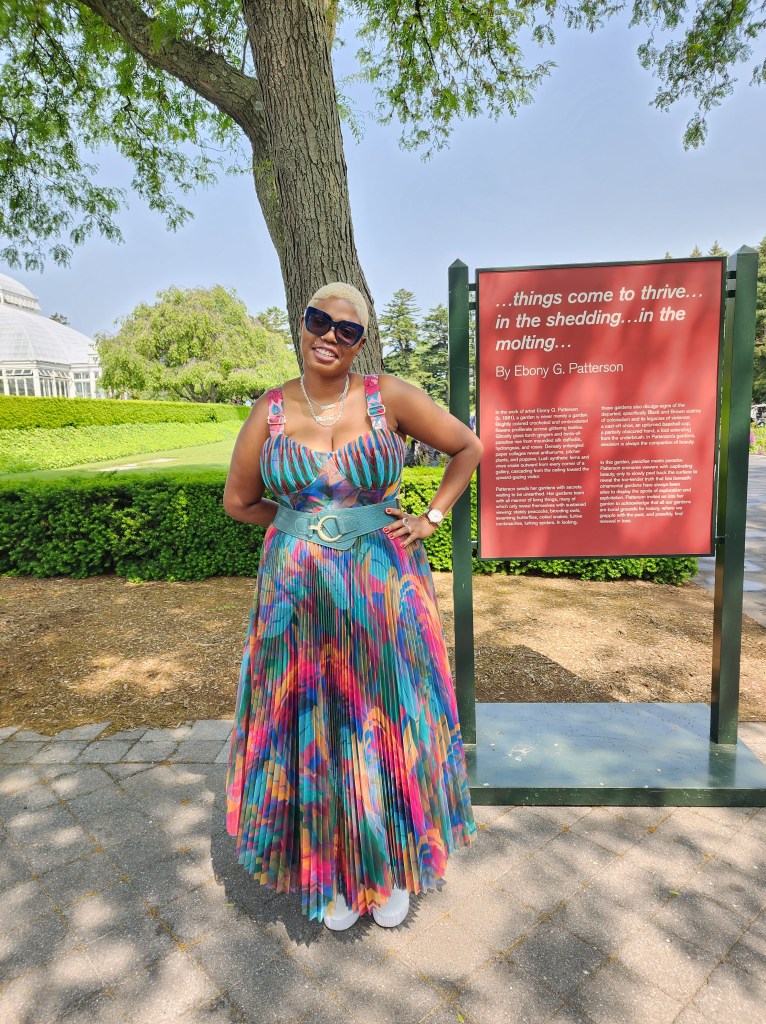
New York Botanical Garden Debut Exhibition ‘…things come to thrive…in the shedding…in the molting,’ Artist Ebony G. Patterson

New York Botanical Garden and visual artist Ebony G. Patterson have been collaborating for a year or more about Patterson’s new site-specific work which is a maverick first for the Garden. Entitled …things come to thrive…in the shedding…in the molting… Patterson focuses her unique vision in an exhibition of tensions, using living and preserved plant collections as its material and inspiration. In her examination of gardens as a metaphoric site of birth and the journey to the molting, shedding and death to be reborn again, her expression has found new meaning and is, as all artists hope, an important trigger to enhance revelation and the appreciation of our place in history on this planet in our expression and love of gardens.

Her approach specifically relates to how the visible/invisible (sub rosa), desirable/undesirable are manifested in how past and present inhabitants attempt to exert control over the natural world via the design and selection of plants for gardens.
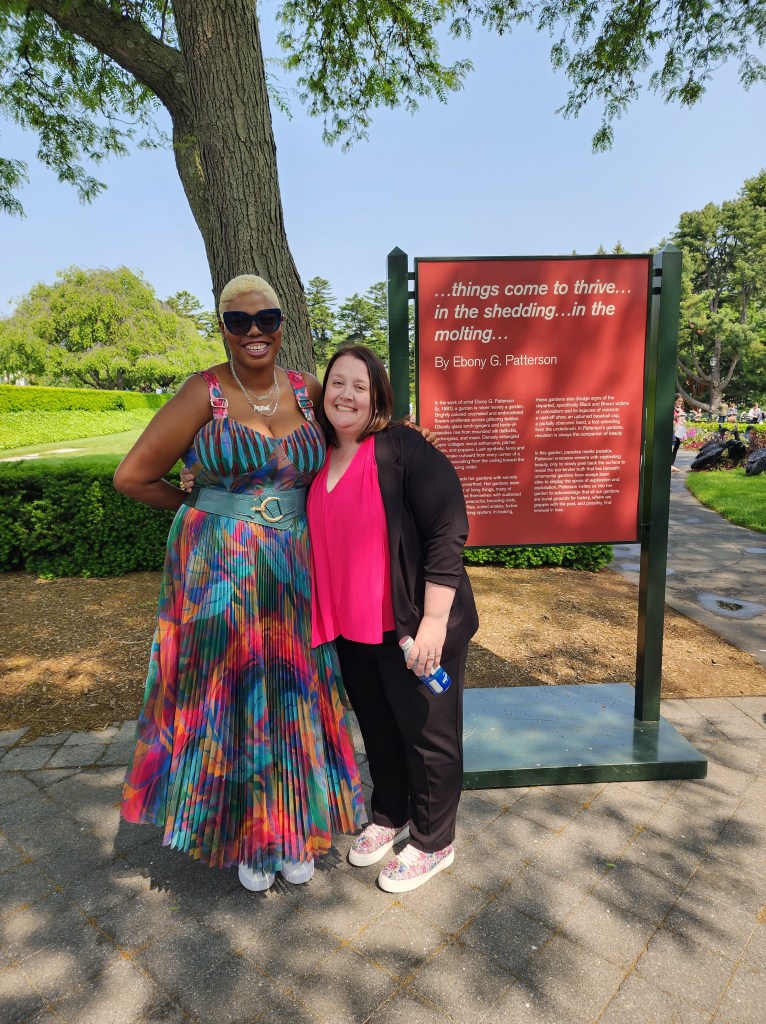
Patterson’s site-specific exhibition of sculptural and horticultural installations represents a few firsts. She is the first visual artist to embed with the New York Botanical Garden for an immersive residency. Working directly with the Garden’s grounds and collections she created an original conceptual arrangement that includes sculptures, installations and interventions with living plants to bring a message of impact that is highlighted in the Palms of the World Gallery, the staging rotunda and the walkway gallery between those two showcase galleries in the Enid A. Haupt Conservatory. Her visual artistry is also displayed outside the Conservatory in the lawn landscape as well in the Mertz Library Building on the 6th floor. The exhibition is on view Saturday, May 27 through Sunday, September 17, 2023.
The concept that life is cyclical and mirrors that “eternal” process is present throughout Patterson’s exceptional presentation. Living beauty doesn’t last. However, the regenerative process is what remains. Ultimately, it is that regenerative process that is beautiful and sacred. In order for the beauty of the butterfly to emerge, the ugly caterpillar must first go through its necessary transformative steps, some of them painful, after which it eventually emerges with its wings for its first flight. Likewise, wildlife, living plants and human beings go through processes of “molting,” “shedding” and “decay” in order to revive, regenerate, heal and eventually die, to then transition in another consciousness. Even what appears to be “the end,” is not a full finality, but can be cause for celebration of new life or supplying elements that create and sustain life.



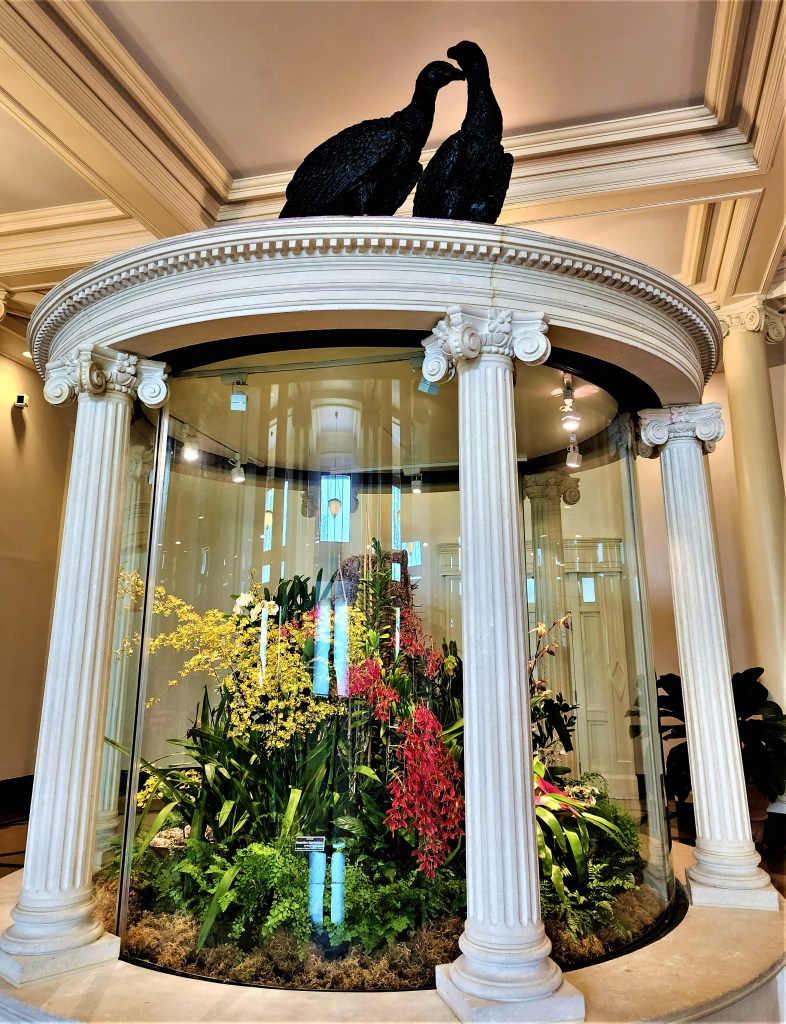
Patterson positions the loveliness of a selection of plants against sculptures which remind us that when they decay, there is the clean up crew that comes along to make way for the regeneration and rebirth. Thus, sculptures of black vultures (400 in all in four different positions) populate the landscape. A usual symbol of death and dying, certainly macabre, Patterson’s use of them, especially in the Palms of the World Gallery, the walkway and the showcase rotunda is a stark metaphor. If they are the ugliness and fearful example of nature and ultimately the planet’s world garden which is not “perfection,” they are a necessary element of purification because decay if left untended creates disease. The clean-up crew of vultures, insects, etc., takes care of the bodies that are decaying, picking their bones clean. Thus, they receive nourishment and the earth’s soil, etc., receives the nourishment from what the vulture’s don’t consume, i.e. bones leach out their phosphorous and other elements after weathering.


In Patterson’s attempt to realize new symbolism of the processes of life, death and regeneration with the backdrop of gardens, she also includes the impact this has had on her Jamaican roots which historically go back to slavery and colonialism with the Triangular Trade-sugar, molasses, rum, slaves. Historically, only the wealthy were able to create gardens. The poor and working class didn’t own swaths of land; rather they were the workers and the slaves on the land and in the gardens, until slavery was abolished and its remnants finally extirpated. Colonialism was white privilege from Europe, brought to the United States. The ending of colonialism and its representation in the ordered gardens of wealth took place during the twentieth century. Remnants of colonialism have been decaying ever since, as individuals acknowledge its horrific and miserable past (the invisible) while having created some of the most lasting and historic structures and dualistic civilization (the visible).



These notions are represented in the showcase rotunda where the white, glass, male feet are protruding upside down in pots of floral plantings. What lies underneath is the entire body that is being consumed by the insects and bacteria in the soil. On the surface are what the body pushes up, the flowering multiple-hued beauty of the plantings in circular pots. Thus, symbolized is the shedding of white colonialism and the power structures that once “lived” and “flourished,” but now are in a state of decay. On another level community gardens are taking over and the wealthy in the UK (which prospered from slavery and ruled in the 1700s) can no longer afford to maintain the gardens without a “free” worker force. Instead, many of the colonizers and wealthy estates have been donated to trusts and museums and paid workers are creating gardens. This is a form of regeneration.

According to Patterson, “The opportunity to work directly within the New York Botanical Garden, using its collections and landscape as inspiration, provided the opportunity to bring many elements of my practice together.” She continued, “I’ve long worked with the idea of gardens, but this direct intervention allowed us to begin to literally peel back the landscape to look, not only at the plans on the surface, but also explore what lies beneath, and the generative life cycles that sustain the entire ecosystem.”

She particularly focused on the “Plants and animals that clean, regenerate, and consume as an act of care. These are necessary for the survival of the entire ecosystem. This reality of the garden is often not highlighted and celebrated, an experience that is paralleled in many areas of society and a tension at the heart of my practice overall.”

Jennifer Bernstein, CEO and The William C. Steere Sr. President of The New York Botanical Garden, stated the following about the installations. “Ebony G. Patterson’s exhibition at the Garden marks an exciting moment for us as an institution, as we were able to provide a platform for one of the most compelling artists of our time to explore the complex symbolism of gardens and the fractured human relationship with nature. She added, “Patterson’s work will entice, disarm, and provoke visitors, and we look forward to the dialogue and conversations that will unfold.”
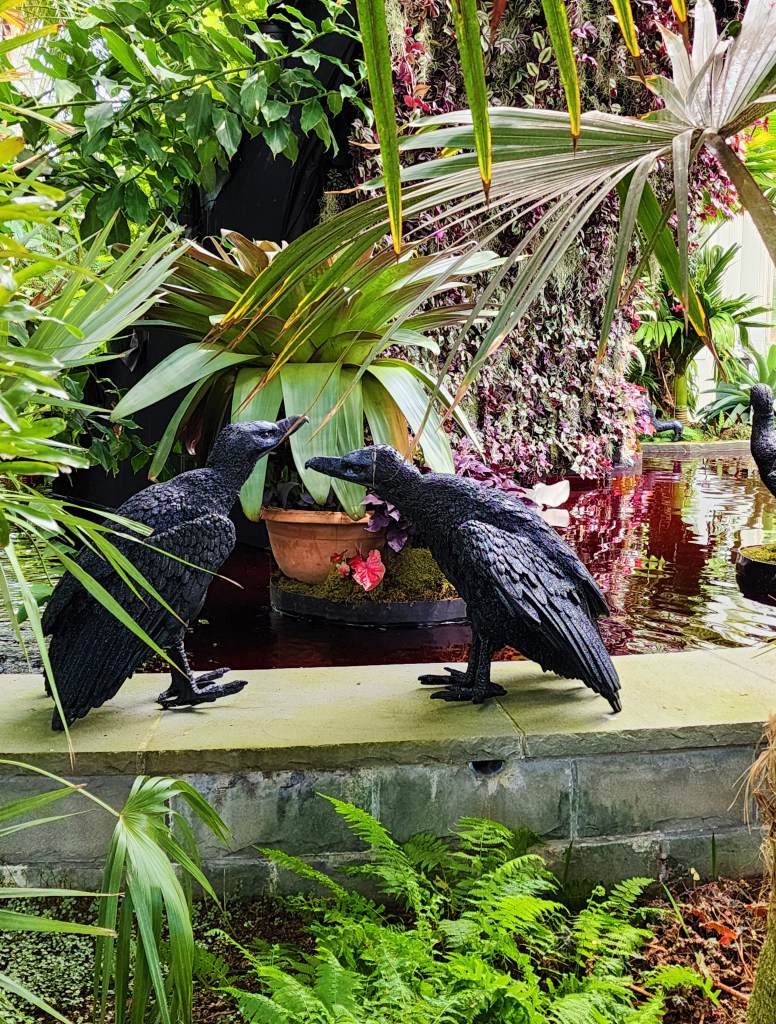
After perusing the hundreds of glittering vultures featured among blood-red, woumd-like ruptures (symbolic of the bloodshed of the enslaved) that interrupt an expanse of light purple foxgloves, lime-green zinnias, coleus and other blooms, you will enter the rotunda showcase gallery. Look up. You will see a cast-glass-and-hydrostone white peacock which focuses the installation from the rotunda to the Palms of the World Gallery. Symbolically, Patterson conceived of the peacock looking backward on its trailing tail, imaginatively unfolding an immersive garden of plants with variegated foliage. These include caladium, hypoestes, red begonias and impatiens.

Everpresent are the vultures cleansing and purifying the decay. In memorium to extinct species, there are ghostly cast-glass plants which Patterson researched in NYBG’s William and Lynda Steere Herbarium. These plants are plant placeholders, made one-of-a-kind. The species they symbolize are plants which were once alive, and now are unable to regenerate. All living things are sacred and if codified, will never truly be extinct, but will be photographed or illustrated as a reminder of the impermanence and sanctity of living structures.

Continuing the imaginary unfolding tail of the peacock, we enter the Palms of the World Gallery where there is a foliage wall reflecting in the pool. One sees various plantings including ipomeas, silver-inch plants and love-lies-bleeding. Again there is the symbolism of blood and lives sacrificed for wealth as a subtext and hidden meaning of gardens. Underneath the surface of the loveliness-there is brutality and ugliness. Indeed, nature in its feeding and living can be predatory, as well as gorgeous, a major theme of Patterson’s installation.
The secrets of decay are the subtext, always a contrast to the lush colorful and luxurious face of greenery and rainbow colors. But these plants, too, will wither and their bodies will be used as nutrients for bacteria to enrich the soil which can then burgeon with new growth when there time has arrived. Interestingly, Patterson has included the male glass figure, legs protruding out from the wall into the symbolic “blood pool.” This white glass sculpture halved by the plant wall is perhaps metaphoric of nature’s resilience against human control of gardens. It also may symbolize colonialism’s demise as the regrowth and power of nature always maintains control because of the process of birth, living, dying, decay and regeneration.



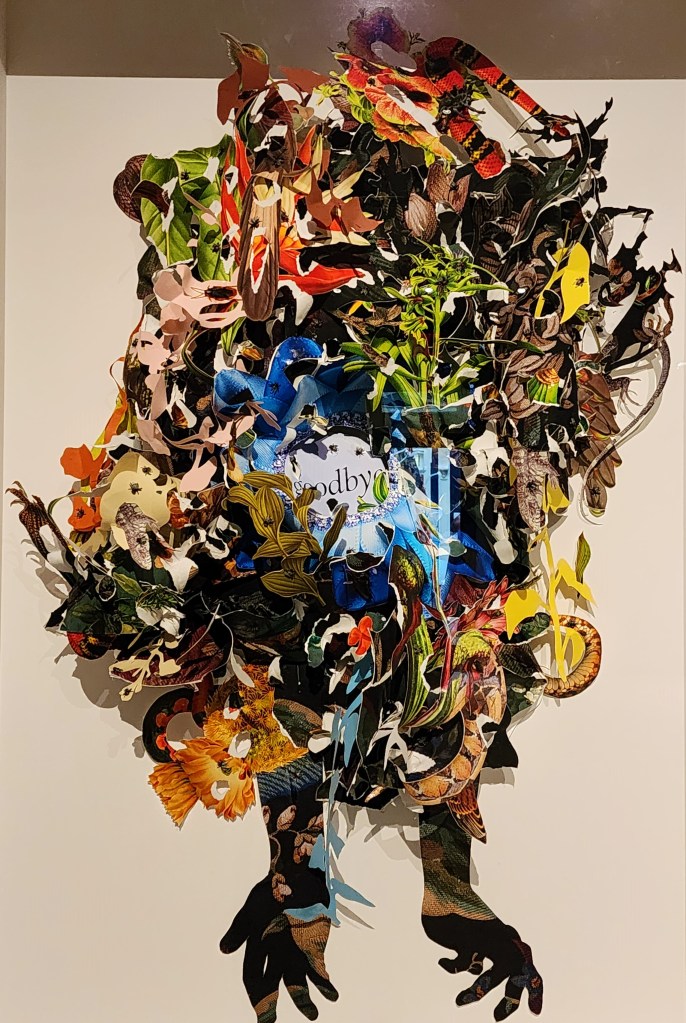
In the Mertz Library Building on the 6th floor one may see Patterson’s latest works on paper. Look closely, you will see those helpmates of plants, pollinators, and cleaners of decay, flies and spiders and cockroaches. The patterned entanglements are dense and complex. If you look closely snakes, plants, insects, human figures, butterflies can be teased out of the paper mesh which represents a vast and massive ecosystem curiously interdependent and synergistic. Her works trigger one’s thoughts and suggest subtext and hidden, symbolic meanings and associations. Patterson nudges one to look deeper at organization in nature which is more vastly unknown as discoveries currently happen. With humility researchers have discovered the vast communication system of trees, not only in their root systems, but in the ambient atmosphere. Patterson suggests the inter-connectedness of all things and the circular process which cycles.


The mixed media paper collages from the 2022 series studies for a vocabulary of loss combine highly-textured, torn, and reconstituted botanical illustrations and photographs of lilies, bird-of-paradise, carnivorous pitcher plants, mushrooms, stylized vines, scorpions and highly patterned human arms. These series of works are suggestive of funerary wreaths. There is renewal in loss and beauty in the process which is continuously revolving.

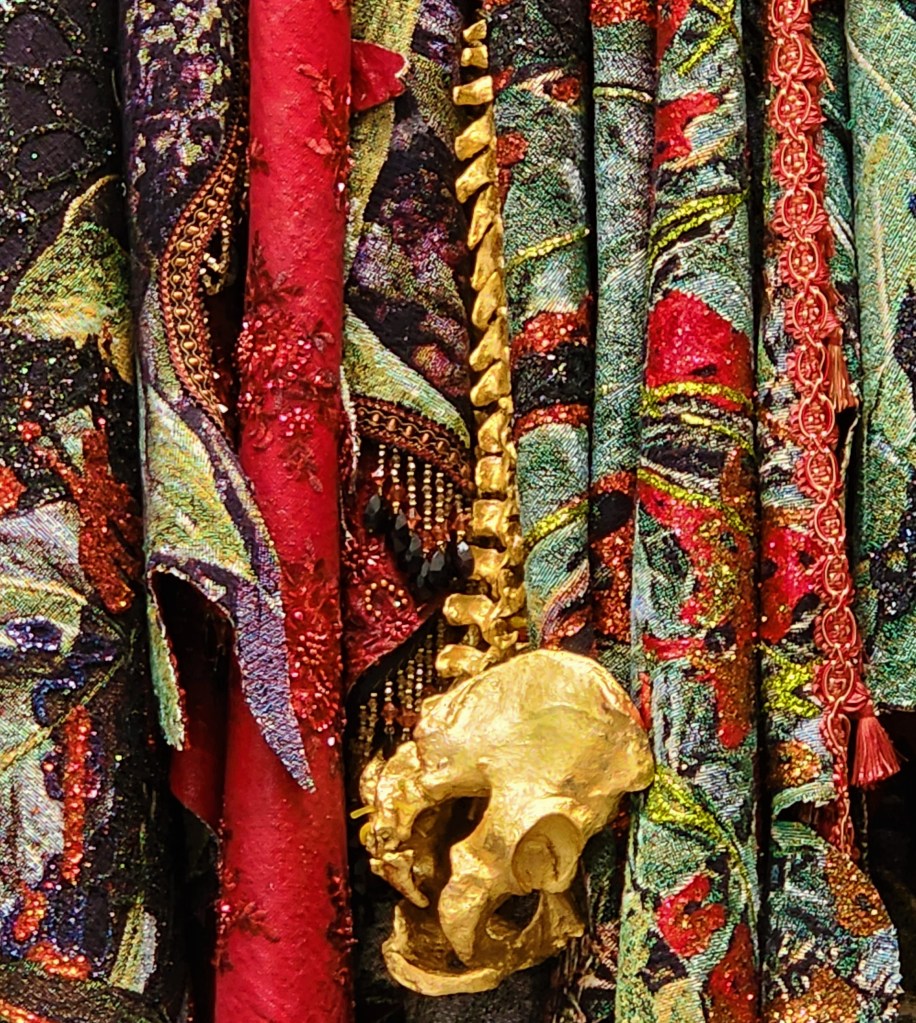
Additionally, there is Patterson’s fascinating installation “Fester.” The rotunda space has wallpaper of repeating patterns to suggest a nighttime garden and a central installation. On one side is a wall, the other side is surprising.Viewed in the round, the reverse side of the wall represents the freshly wounded earth with a cascade of over 1,000 red lace gloves, their root-like fingers revealing cast-glass thistles and cast-metal monstera leaves. Perhaps represented in the mass of blood red hands-a sacrifice of slavery and labor, there are black hands reaching out. And on the other side are the textiles, tapestries of rapturous hues hanging from the wall, partially concealing gold-leafed skeletal forms. The associations are rife. From picking cotton to making textiles, the labor is intensive. When it was free, colonizers and slave-holders made a ton of money, perhaps so much money, their spines turned to gold. Patterson’s work is so rich and imaginative, it stimulates a riot of symbolic concepts.
I also was intrigued to find Patterson’s work loaded with irony. I found myself laughing at the sharp contrasts and striking symbols. Her unique vision is refreshing and macabre and joyful and humorous and reflective of the cycles of living species.

Who is Ebony G. Patterson? The artist received her BFA in painting from Edna Manley College of Visual and Performing Arts in Kingston, Jamaica (2004), and an MFA in printmaking and drawing from the Sam Fox School of Design and Visual Arts at Washington University in St. Louis (2006). She has taught at the University of Virginia and Edna Manley College School of Visual and Performing Arts and has served as Associate Professor in Painting and Mixed Media at the University of Kentucky. Her work is in the collections of institutions including 21c Museum and Foundation, Louisville, Kentucky; Lost Angeles County Museum of Art, Los Angeles, California: Nasher Museum, Duke University, Durham, North Carolina to name a few. She is also exhibited in the Whitney Museum of American Art. Co-Artistic Director, along with curator Miranda Lash, Prospect.6 New Orleans,will open in Fall 2024.
For programming and tickets to this thought provoking exhibition, go to the NYBG website
‘The Sign in Sidney Brustein’s Window,’ Lorraine Hansberry’s Mastery of Ideas in a Superb Production

Oscar Isaac’s Sidney Brustein in Lorraine Hansberry’s most ambitious play, The Sign in Sidney Brustein’s Window (directed by Anne Kauffman) never catches a break. Hansberry’s everyman layman’s intellectual is in pursuit of expressing his creative genius and achieving exploits he can be proud of. When we meet him at the top of Hansberry’s masterpiece, which is full of sardonic wisdom, sage philosophy and political realism, Sidney is a flop looking for a reprieve. This revival, first produced on Broadway in 1964, was tightened for this Broadway revival (one noticeable end sequence with Gloria was shaved, not to the play’s betterment). Currently running at the James Earl Jones Theatre with one intermission, the production boasts the same stellar cast in its transfer from its sold out run at BAM’s Harvey Theatre in Brooklyn. The production is in a limited run, ending in July.
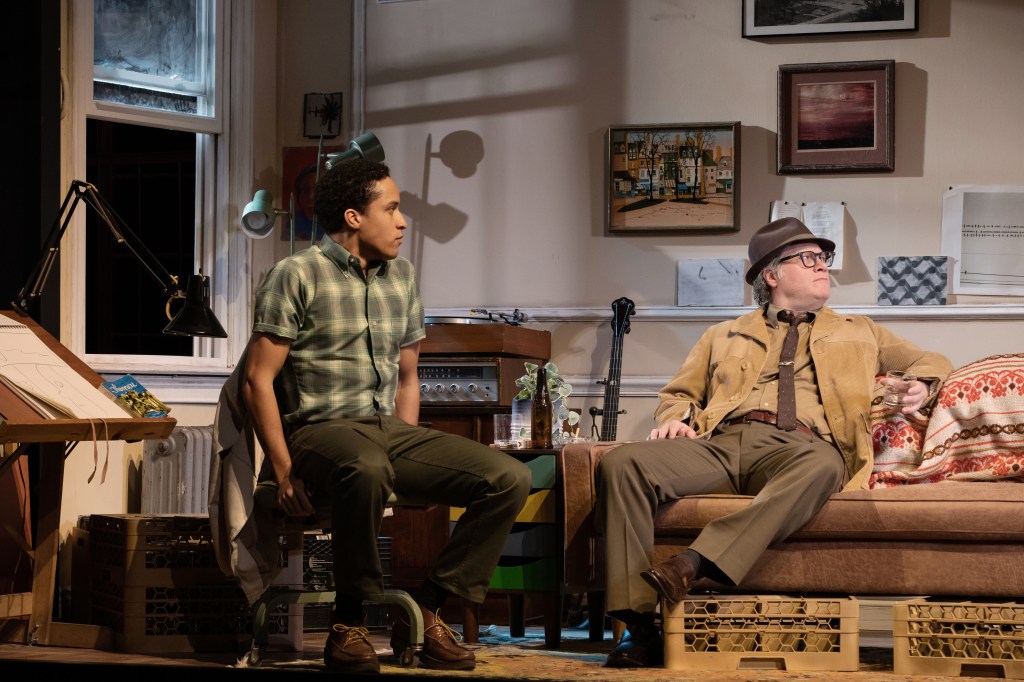
It is to the producers’ credit that they risked bringing the play to a Broadway audience, who may not be used to the complications, the numerous thematic threads, the actualized brilliance of unique characterizations and their interrelationships, and Hansberry’s overall indictment of the culture and society. Sign is a companion piece to her award-winning Raisin in the Sun. It explores the root causes why the Younger family is where it is socially and economically. Vitally, it examines the political underpinnings of institutional oppression and discrimination via reform movements, symbolized by the efforts of Brustein and friends who promote the reform candidacy of Wally O’Hara.

To focus her indictment of the perniciousness of political and social oppression, Hansberry examines the vanguard of reformists, Greenwich Village artists, activists and journalists who are emotionally/philosophically ready to make social/economic change of the type that the Younger family in Raisin in the Sun yearns for. However, these Greenwich Village mavericks are the least equipped tactically to sidestep co-optation and the political cynicism of the power-brokers. They realize too late that the money men will fight them to the death to maintain a status quo which inevitably destroys the vulnerable and keeps families like the Youngers and drug addict Willie Johnson struggling to survive.

The Sign in Sidney Brustein’s Window is timeless in its themes and its characterizations. When we measure it in light of current social trends, it is fitting that the play transcends the history of the 1960s in its prescience and reveals political tropes we experience today. Additionally, it suggests how far society has declined to the point where cultural and political co-optation (a principal theme) have been institutionalized via media that skews the truth unwittingly. The result is that large swaths of our nation remain oblivious to their exploitation and dehumanization, ignorant that they are the pawns of political parties, who promise reform then deliver regression. In short they, like Sidney Brustein and his friends, are seduced to hope in a better world that reform politicians say they will deliver. But when they win, through a plurality of votes from a diverse population, they renege on their promises and continue to do what their “owners” want, which is to “screw” the little people and deprive them of power and a “place at the table.”

Hansberry’s setting of Greenwich Village is specifically selected as one of the hottest, most forward-thinking, “happening” areas in the nation. Brustein’s apartment is the focal point where we meet representative types of those found in sociopolitical/cultural reform movements. His community of friends are activists who believe their friend and candidate Wally O’Hara (Andy Grotelueschen), is positioned to overturn the Village’s entrenched “political machine.” Sidney, reeling from his bankrupted club, which characterized his cultural/intellectual ethos (idealistically named Walden Pond after Henry David Thoreau’s book), purchases a flagging newspaper (The Village Crier) to once again indulge his passion for creative expression. He does this unbeknownst to his wife Iris (Rachel Brosnahan), a budding second-wave feminist who waitresses to support them financially. She chafes at her five-year marriage to Sidney, shaking off his definitions and the identities he places on her, one of which is his “Mountain Girl.”
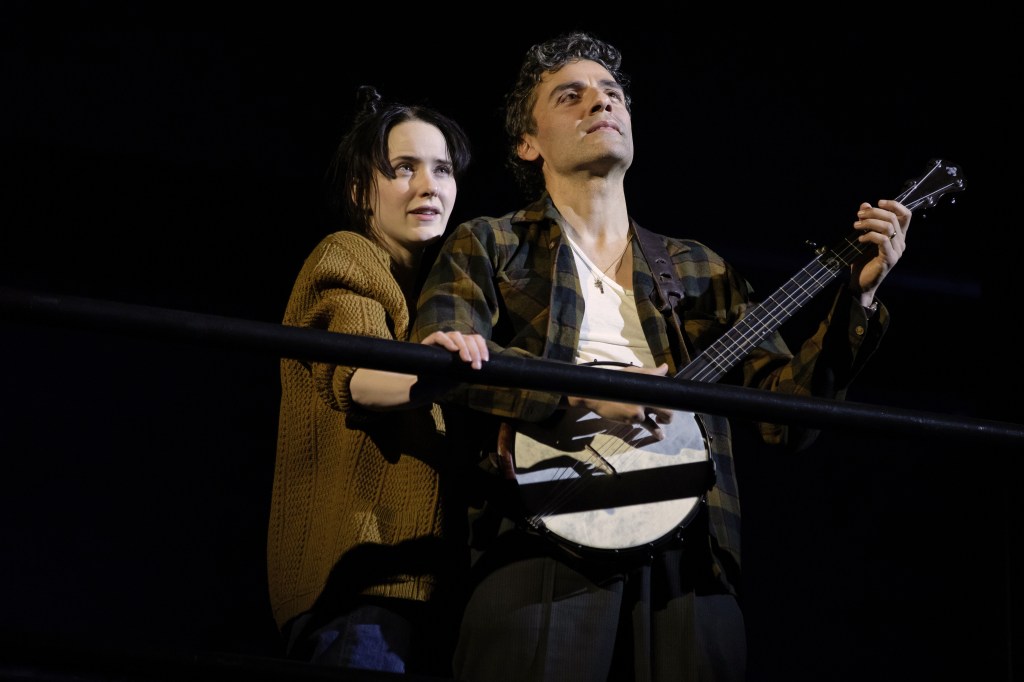
Activist and theoretical Communist (separated from the genocidal Stalinist despotism) Alton (Julian De Niro), drops in with O’Hara to encourage Sidney to join the crusade to elect O’Hara with the Crier’s endorsement. Sidney declaims their persuasive rhetoric and assures them that he will never get involved in political activism again. However, as events progress, his attitude changes. We note his friends, including artist illustrator Max (Raphael Nash Thompson), stir him to support O’Hara with his excellent articles. Sidney, mocked by Iris about his failures, is swept up in the campaign. When he hangs a large sign in his window that endorses O’Hara, his adherence to push a win for the “champion of the people” increases in fervency.

The sign symbolizes his hope and his seduction into the world of misguided activism, but its meaning changes over the course of the play. Hansberry doesn’t reveal the exact moment that Sidney decides to take up the “losing cause” after he disavowed it. However, his fickle nature and passion to be enmeshed in something “significant” with his friends helps to sway him.
In the first acts of the play, Hansberry introduces us to the players and reveals the depth of her characterizations as each of the characters widens their arc of development by the conclusion. We note the development of Mavis (Miriam Silverman), Iris’ uptown, bourgeois, housewife sister, who is married to a prosperous husband and is raising two sons. We also meet David Ragin (Glenn Fitzgerald), the Brustein’s gay, nihilistic, absurdist playwright friend, who lives in the apartment above theirs and is on the verge of success. Both Mavis and David, like Sidney’s other friends, twit him about Walden Pond’s failure. Mavis and Iris are antithetical in values and Mavis views her sister and brother-in-law as Bohemian specimens to be observed and secretly derided as entertainment. We discover Mavis’ bigotry when she opposes the union of their sister Gloria (Gus Birney), a high class call girl, to Alton, the young light-skinned Black friend.

The genius of this work is in Hansberry’s dialogue and the intricacies of the characterizations. It is as if Hansberry spins them like tops and enjoys the trajectory she creates for them, which ultimately is surprising and sensitively drawn. Organically driven by their own desires, we follow Sidney and Iris’ family machinations, pegged against the backdrop of a political campaign that could redefine each of their lives so that they could better fulfill their dreams and purpose. However, the campaign never rises to the sanctity of what a true democratic, civic, body politic should be. Indeed, the political system has been usurped in a surreptitious coup that the canny voter “pawns” are clueless about.

Tragically, instead of political power being used to combat the destructive forces Hansberry outlines, some of which are discrimination, drugs, law-enforcement corruption, economic inequity and other issues that impact the Brustein’s and their friends’ lives, O’Hara and his handlers have other plans. But first, they cleverly convince the voters a win is unlikely and they pump them up to believe in the possibility of an O’Hara success that would be earth-shattering and revolutionary. This, we discover later, is a canard. The “revolutionary coup” can never occur because the political hacks control everything, including Sidney’s paper which they exploit to foment support for O’Hara. How Hansberry gradually reveals this process and ties it in with the relationships-between Iris and Sidney, Alton and Gloria, Iris and Mavis and the other friends-is a fabric woven moment by moment through incredible dialogue that pops with quips, peasant philosophy, seasoned wisdom, and brilliant moments that evanesce all too quickly.
By the conclusion, the solidity of the characters’ hopes we’ve seen in the beginning have been dashed to fold in on themselves. Both Iris and Sidney learn to reevaluate their relationship with each other and their misapplication of self-actualization, which allowed a tragedy to happen. Likewise, Alton’s inflexibility about his own approach to his place in an exclusionary, oppressive culture ends up contributing to a tragedy that might have been prevented. In one way or another, these characters particularly, along with David’s self-absorbed nihilism, contribute to Gloria’s death.
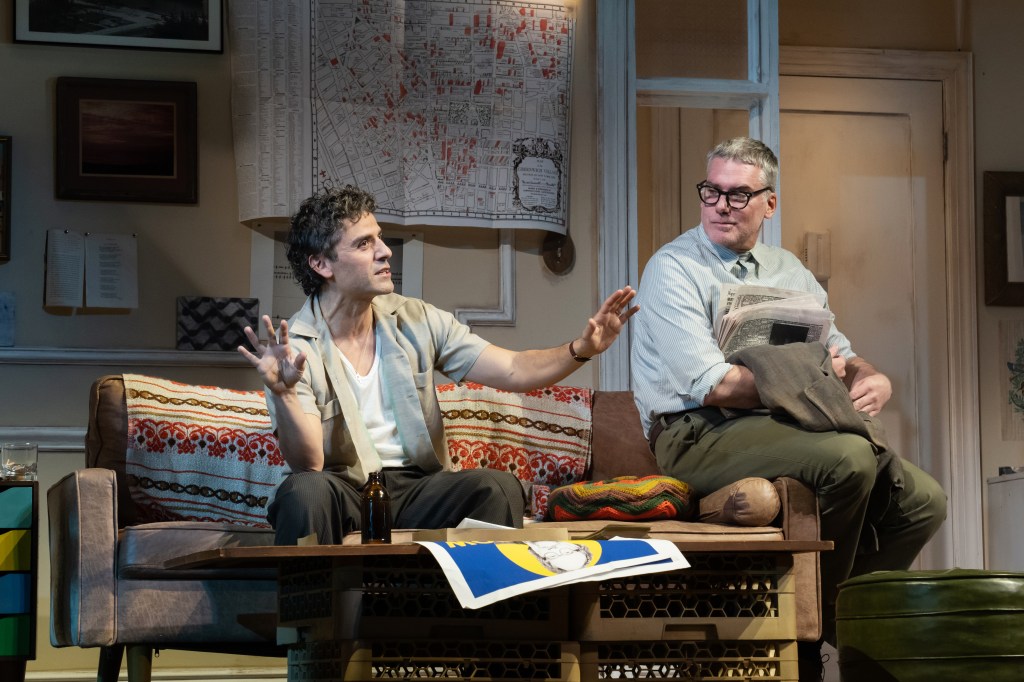
Symbolically, Hansberry points out that love and concern for other human beings is paramount. Too often, relatives, friends and cultural influences contribute to daily tragedies because human nature’s weaknesses in “missing the signs” contort such love and service to others. Ironically, politics, whose idealized mission should be to reform and make the culture more humane, decent and caring, is often hijacked by the powerful for their own agendas to produce money and more power and control. The resulting misery and every day tragedies accumulate until there is recognition, and the fight begins to overcome the malevolent, retrograde forces that O’Hara and his cronies represent.
This, Sidney vows to do with his paper and Iris’ help in a powerful speech to O’Hara proclaiming a key theme. To be alive and not spiritually, soulfully dead, one must be against the O’Haras of the world and the forces of corruption. To support them is to support death and dead things. To recognize how the power-brokers peddle death, one must discern their lies and avoid being lured into their desperate cycle of destruction, which they control to keep the populace oppressed, hopeless and suicidal.
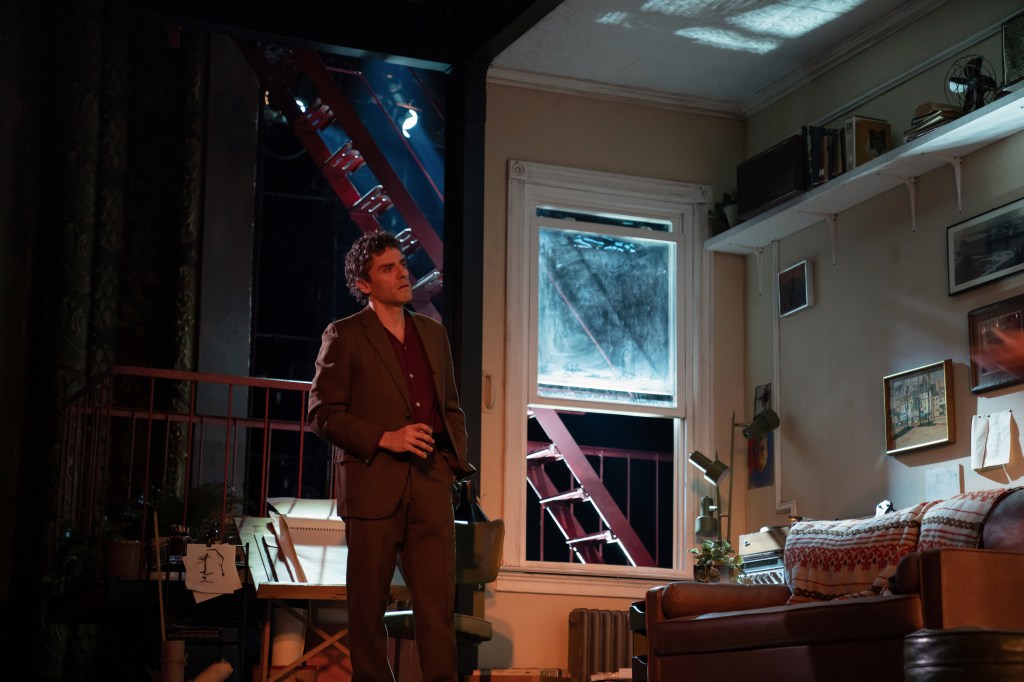
The actors’ ensemble work is superior. Both Isaac and Brosnahan set each other off with authenticity. Miriam Silverman as Mavis hits all the ironies of the self-deprecating housewife, who has suppressed her own tragedies to carry on. And Julian De Niro’s speech about why he cannot love or marry Gloria is a powerhouse of cold, calculating, but wounded rationality. Hansberry has crafted complex, nuanced human beings and the actors have filled their shoes to effect their emotional core in a moving, insightful production that startles and awakens.
The play must be seen for its actors, direction, and the coherent artistic team, which perfectly effects the director’s vision for this production. These artists include dots (scenic design), Brenda Abbandandolo (costume design), John Torres (lighting design), Bray Poor (sound design), and Leah Loukas (hair & wig design).
This must-see production runs under three hours. For tickets and times go to their website https://thesignonbroadway.com/
‘The Fears,’ Meditation vs. Inner Chaos, a Review

Where do you go when psychiatric therapy, group therapy, self-medication (alcohol, food, weed, etc.), prescribed medications, and other mainstream therapies don’t help you out of severe depression from psychic trauma and PTSD? You try the Buddhist center in New York City. In The Fears written by Emma Sheanshang, directed by Dan Algrant, currently running on the Irene Diamond Stage at The Pershing Square Signature Center, we are ironically entertained and drawn in to the emotional, traumatized, yet hysterical responses of seven individuals. Each attempts to reconcile their angst and anxiety together in five Buddhist meditative sessions over the course of five weeks.
The Buddhist practice led by Maia (Maddie Corman) follows the striking of the singing bowl, meditation in silence. Then individual members “touch in” and share their miseries, joys, or angers from the previous week. Part of the irony and humor of these sessions is in becoming acquainted with the individual stakeholders Rosa (Natalie Woolams-Torres), Katie (Jess Gabor), Fiz (Mehran Khaghani), Mark (Carl Hendrick Louis), and Suzanne (Robyn Peterson). Each unique individual is introduced to new member Thea (Kerry Bishé ), who has not received an email about the rules of the sessions and is flying blind. We, along with Thea, learn the quirky rules set up to guide the meditation and group dynamic as it unravels to a turning point during each session.
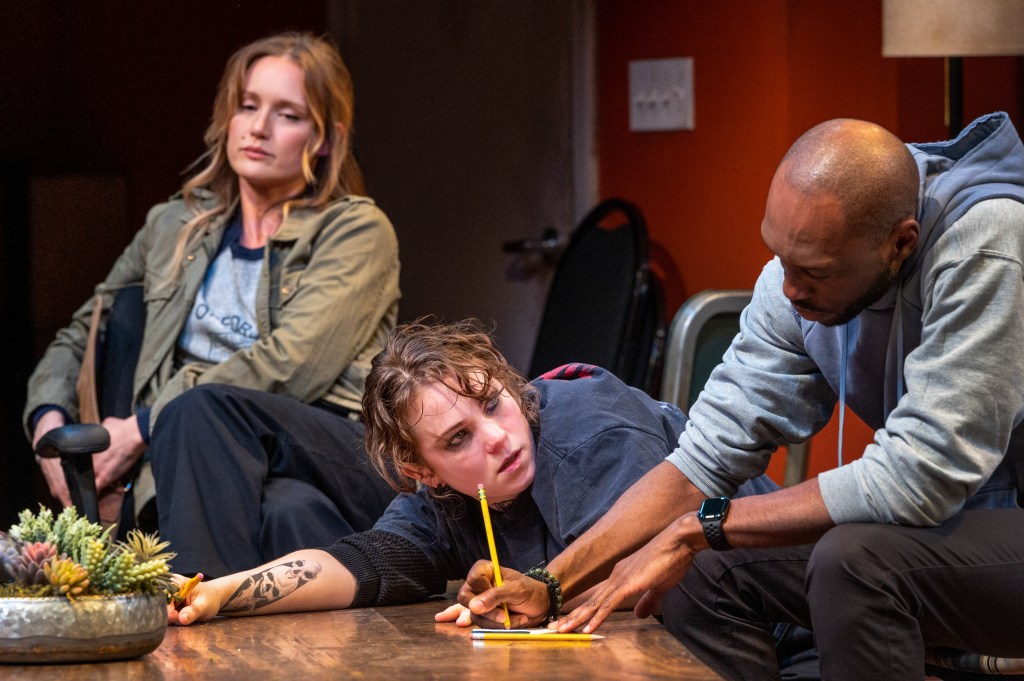
First, there are no apologies necessary for anything one does. Second, no discussion of the past is encouraged. Each of the members must stay “in the room” and in the moment to ground themselves with the here and now of their feelings. Third, no group member can ask questions of other members. Additionally, the group leader guides any member having problems with suggestions, for example to plant a tree (this never occurs), or in one instance, the inner child method–the adult version of the group member speaks to her inner child version– as the rest of the group’s inner children watch and learn.
For example, Rosa (Natalie Woolams-Torres) is subject to panic attacks and doesn’t do marital discord (conflicts between group members). Anything sets her off and raises her inner pressure. When she spirals upward in a fear, as she flails about her husband’s obliviousness to her panic attack at a christening, the controlled, calm Maia humorously brings her down by reminding her to “breathe,” and “stay in the room.” When these exhortations don’t work, she finally has Big Rosa address her inner child (Little Rosa), via a pillow who stands in for Little Rosa. Maia expertly guides her with questions, as the group members look on approvingly, while Big Rosa tells Little Rosa she’s safe, can go to another room, go for a walk, or go anywhere. Thea has gotten a eyeful as have we, except Thea doesn’t find it as humorous as the audience does.

The various members “touch in” after Rosa comes down from her attack. Katie “took a shower.” It’s apparently a big step for her because the others cheer her improvement. Fiz discusses that his sister dared to invite him to her wedding. Group members know he has issues with his parents. His father raped him as a tween, and when he told his mother, she refused to believe it and had him put in juvenile detention. His wounds are still raw, though he has been “healing.” Nevertheless, when Suzanne suggests that his sister’s invitation is a positive move, he blows up and asks if Suzanne is insane, a touchy question because all of them are off the charts from their traumas.
Also a sex abuse survivor, Suzanne attempts to defend herself. The interchange escalates humorously. Peterson’s Suzanne and Khaghani’s Fiz are invested in their emotions, and it’s crucial that the actors sustain the right balance of tone, sincerity and timing. or the scene could be deadly and fall flat. However, with apt direction and superb acting, the result is hilarity with no small thanks to Algrant, who knows how to make this hybrid dramedy pop. Additionally, the dialogue is choice with one-liners built in so that the actors (Khaghani is a comedian), cleverly measure the dead-on delivery.
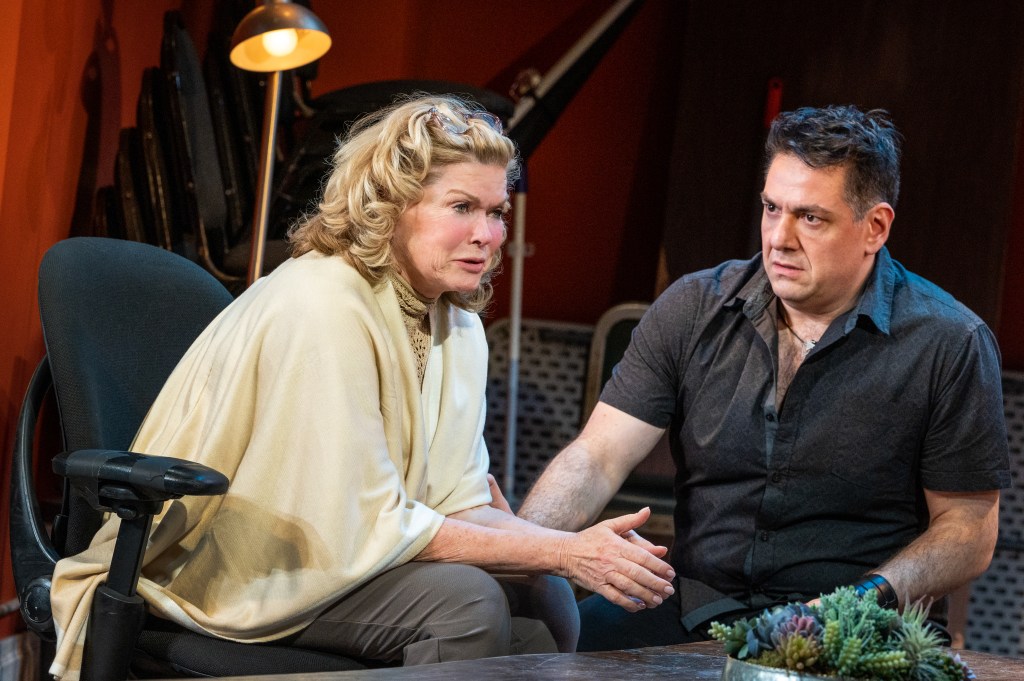
The heated exchange between Fiz and Suzanne prompts Maia to intervene and call “weather on the ones.” Gauging the “emotional atmosphere” each is feeling, the group members weigh in with “misunderstood,” “fear,” “anger,” etc., and the brewing storm subsides as they stay “in the room in real time,” and don’t nurture hurts from the past.
Sheanshang raises the emotional stakes higher when Thea tries to describe how Alexander the Great is responsible for a traumatic attack that happened to her. Initially, no one gets it and there’s confusion, until later in the play she describes the incident that terrorized her. The playwright’s clever script is both poignant and funny. She has pared down the lines yet has given enough backstory with the individuals to supply an inherent humor as they briefly describe the traumatic event which they are suppressed from discussing when the session gets underway, but not before.
The playwright thematically reminds us that humanity is boiling over with trauma and oftentimes, takes itself too seriously. However, the trauma cannot be suppressed because it is devastating; finding humor and having a gallows laugh about it is paramount. Interestingly, watching the group members surf the waves of their watery emotions, and explode despite Maia’s attempts to keep the ship on an even kee,l reveals the irony in attempting to control the chaos with “Buddhist” practice, which is a 20th century, Western appropriation of an Eastern religion, which requires an entirely different mind-set.
The religion has existed for thousands of years and its “practice,” through the Western lens and mind has been twerked. The practitioners ignore that it has been superimposed over Western, cultural psychoses and promulgated by various gurus (one of whom we later discover was a sex predator himself). Sheanshag twits the sessions and exposes the West’s arrogance and privilege in its appropriation. Her dialogue and Algrant’s direction land the play with the right tonal balance, which makes for a profound, yet comedic production. Incisively, it reveals the desperation of each of the characters, especially Maia, to find some modicum of peace, that the culture and society do not readily offer.

The actors are superb, and as they erupt with emotion, Dan Algrant has them work seamlessly in tandem with impeccable timing for maximum humor. Sheanshang has crafted the characters with such specificity, and uniqueness, we understand how they have become practiced to trust in Maia’s cues and guidance so that they follow it like herded cows. The only one who doesn’t get it is the outlier-newcomer Thea, who “didn’t get the email,” and thus, is introduced to the “rules” in real time as we are. This element keeps us engaged and provides vitality and surprise about what will happen next.
As group leader, Maia’s response to various members as she guides them, is a non-response of “Mmmmm,” which becomes loaded with meaning after we follow various characters’ issues. As the play progresses in humor and sobriety, we discover that each of the group members have experienced sexual abuse which has traumatized them, so that they rely on each other for comfort and the camaraderie of understanding. However, they aren’t allowed to discuss the specifics of the abuse because it happened in the past, and they must remain in the present. Because of the active dynamic going on in the sessions, we don’t miss learning about their past. It is enough to understand that their wounds spill into the presen,t regardless of how hard they try to “Mmmmm.”
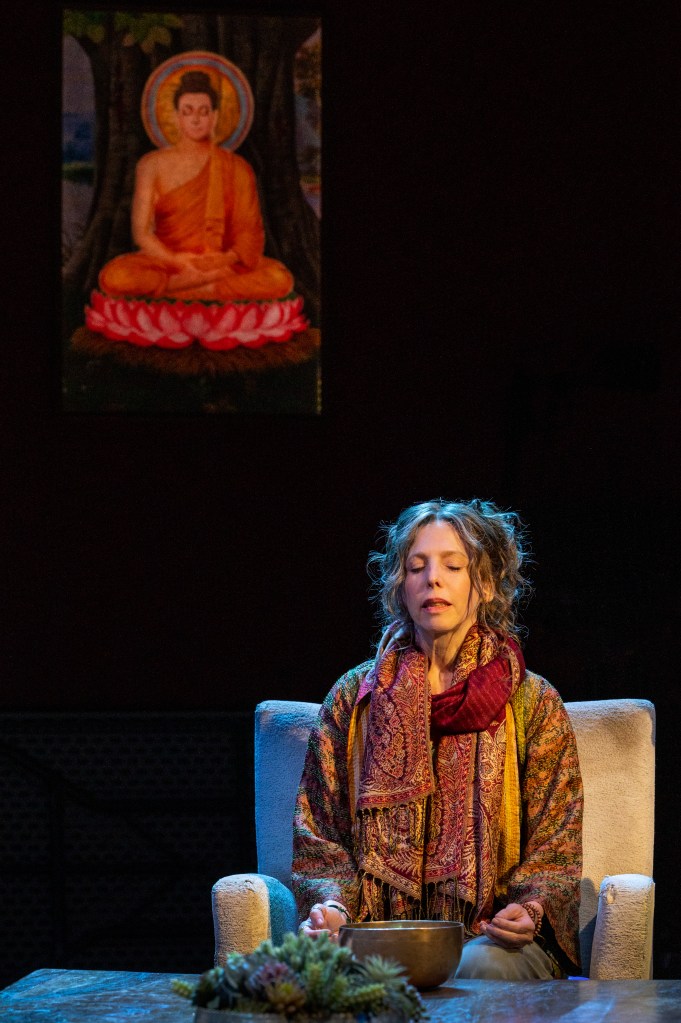
How each of the group members relates to the others remains funny and toward the end of the play becomes volatile. The techniques that Maia uses are successful only in so far that group members believe them to be. However, Thea reveals a few secrets and asks questions which throw a monkey wrench into their “smooth” sessions. And when Katie, who the others believe has joined a satanic cult, leaves after an emotional outburst, it sets the rest of the group members at each others throats. Even Maia who has the “air” of a female yogi, loses control of them and herself in a chaotic epiphany. After her outburst, she is forced to confront herself with the groups’ encouragement, as she reveal a truth she has suppressed to delude herself “nothing happened.”
The success of Sheanshang’s work is in its twists and moment-to-moment “presence” which the actors keep alive and bubbling. All of them have been beautifully shepherded into a believable ensemble of traumatics, which can be set off at any time. And, they are. The secrets revealed by Thea, Maia and Katie cause the group to go off the rails, until Maia is encouraged to hold a session which brings them and the audience back down to earth for a fitting conclusion. The necessity of restoring calm succeeds. As her depth of feeling reaches out and encourages healing, the audience members join in as well. The conclusion is poignant and the theme that every person faces their own PTSD events in their lives becomes clear. Ironically, as much as each of us would like to “get better,” and “be healed,” in an ironic comment, Thea says, “You’re on earth. There’s no cure for that.”

The quote from Samuel Beckett is the play’s principle theme. Knowing that human beings can’t escape having been shaped by horrors in their past, they are grateful for moments of shared peace which bring them outside of their emotional chaos. And in that peace they may find renewed purpose, as they acknowledge it is enough to bring power to reconcile such events with the help of others.
Kudos Jo Winiarski’s scenic design, David Robinson’s costume design (Maia’s and Goth Katie are particularly interesting), Jane Shaw’s sound design, Jeff Croiter’s lighting design, and Jimmy Goode’s wig, hair and make-up design (especially for Maia and Katie). The Fears presented by Steven Soderbergh (Academy Award winner for the film Traffic), is performed without an intermission. For tickets go to their website: https://thefearsplay.com/
‘Camelot’ Revival at Lincoln Center, Superbly Re-imagined for Our Time

The original 1958 musical Camelot. performed with Alan Jay Lerner’s book and lyrics, and Frederick Loewe’s music, adapts theArthurian legend from T.H. White’s collection of fantasy novels entitled Once and Future King (1958). White’s adaptation was loosely based on the 1485 work Le Morte d’Arthur by Sir Thomas Malory. Aaron Sorkin’s book updates the musical and puts an interesting spin on the events of legend, heightening the characters and shifting the emphasis to King Arthur, superbly portrayed by Andrew Burnap (Inheritance). As a result, Sorkin diminishes the love affair between Phillipa Soo’s Queen Guenevere (Hamilton) and Jordan Donica’s Lancelot du Lac (My Fair Lady), aligning it more with romantic tradition which fails. With outstanding set design and fine direction by Bartlett Sher, Camelot is a stunning revival of symbolic political moment, currently running at Lincoln Center’s Vivian Beaumont until September.
At the top of the play Sorkin introduces us to one of the most important aspects of Arthur’s kingdom, the feudalistic power structure and Arthur’s previous isolation from it. Before we even meet Arthur, we meet the lords who serve the king and make up his court, as well as Merlin (Dakin Matthews), Arthur’s counselor, whose wizardry is seen through his balanced demeanor, wisdom, erudition, time transcendence, foreknowledge and keen ability to redirect the perspectives of less enlightened individuals.
Tasked to meet Arthur’s bride-to-be at the top of the hill near the castle, the lords exclaim that her carriage is at the bottom of the hill. We note Merlin’s attributes in his initial discourse with these three knights, Dinadan (Anthony Michael Lopez), Lionel (Danny Wolohan), and Sagramore (Fergie Philippe), who rant that the Guenevere’s carriage has gone against tradition, as they watch her disembark from her carriage far away from them. This change in tradition upsets them, until Merlin uses gentle wisdom to calm their responses and show them they can merely change the law to update tradition. This exchange among the knights and Merlin indicates the conflict to come, tradition vs. progress. The knights’ acceptance of Arthur’s changes is paramount to Camelot’s success.

The ruling elites are conservative traditionalists. But Merlin handles them easily and emphasizes the power of laws to change useless, outmoded ways of being. These men have power and influence over an unequal class system, institutionalized by feudalism (the peasants who serve and the lords who protect and luxuriate over them). Arthur must step around them and gain their trust to overturn traditions which have harmed and caused wars and bloodshed.
Not a member of the royal class per se, Arthur must navigate the knights’ entrenched power with wisdom, if he is to rule his kingdom well and remain effective. This not only requires steadfast courage and acute psychological and personal skills, it demands a political philosophy and will to unite the lords and prevent division. Additionally, training and counsel from Merlin, whose extraordinary gifts of wisdom provide a broader, endowed perspective and understanding, are a boon.

In Sorkin’s different spin of Merlin, we understand that the time has been stepped up one hundred years, so that the medieval age is coming to a close, and Arthur is pushing his kingdom in the direction of the Enlightenment with the help of Merlin. Unfortunately, Merlin’s assistance remains all too brief. After his death, he is replaced by one of the oldest knights in the kingdom, Pellinore, also portrayed by Dakin Matthews, who Guenevere invites in to their circle.
Sorkin advances Arthur’s human graces, contrasting them with the backward knights of his time, who he must manipulate against their own stupidity, which manifests in Act II, encouraged by Mordred (Taylor Trensch) in “Fie on Goodness.” Arthur is not a royal in arrogance, presumption or privilege. He is a people person, decent, kind, likeable and extraordinarily generous. He is more like a Christ-like figure, who forgives Guenevere and Lancelot’s “treason,” and refuses to brutally punish them for their lack of faithfulness.

He invites his son Mordred into his circle, as a reconciliation for his past abandonment, which his mother caused by refusing Arthur’s pleas for her to come and live in the castle. He announces to the kingdom that Mordred is his out-of-wedlock son who is being treated equally like everyone else and has the opportunity to learn and become a knight, if he wishes. But Mordred refuses to listen to Arthur’s explanations why he is not with Morgan le Fey (Marilee Talkington), and he gives lip service to Arthur’s largesse. Instead, Mordred manufactures his own victimization and weaponizes it against his father. Indeed, as the villain, Mordred exploits Arthur’s kindness and love. In his wicked world, these traits are a weakness to set up Arthur’s downfall (“The Seven Deadly Virtues”).
Especially in the characterization of Arthur, Sorkin presents the idealization of a king whose humility, love, intelligence, forgiving nature, and equanimity is all that the Enlightenment promises. Unfortunately, Arthur is a man out of his time, more an influence for future generations in inspired legends and stories of his exploits, frailty and kindness, which can guide by example to bring hope and light to others. Though his reign and Camelot only lasted for for a brief time, the antithesis of the stability and “happy ever aftering” Arthur and Guenevere sing about in the beginning (“Camelot”), is mythic. All individuals, even the current day audience can aspire to Arthur’s ideals of a place of congeniality for persons great and small.
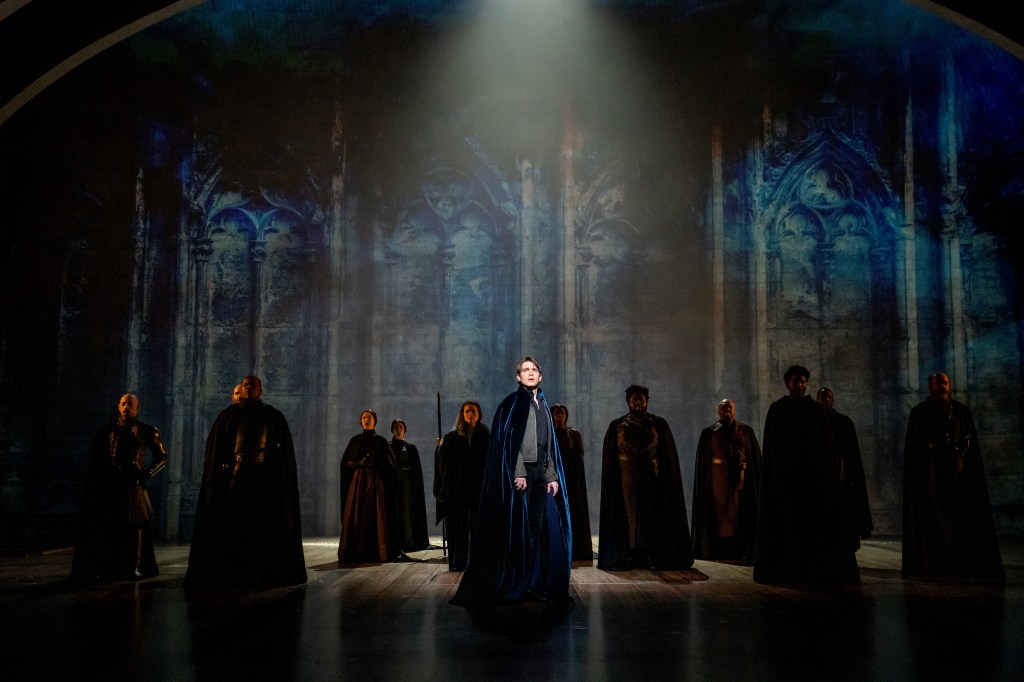
Each of the characters we see immersed in feudalism are lesser in nature, greedy for power, brutal, judgmental, calculating and self-absorbed. In the dialogue to some of the songs, we note Sorkin cleverly magnifies this. For example in the ironic “Simple Joys of Maidenhood” that Guenevere sings about wanting knights to die and sacrifice themselves for her love, Arthur brings up the notion that this isn’t much fun for the knights. Not only is Guenevere naive, she is brutal in her unrealistic romanticism, a clue to the source of her treachery with Lancelot, spawned from her privileged background. Indeed, the same knights that would kill for her, would just as soon end her “maidenhood,” in a rape, which Arthur seems to note in his ironic comment, but Guenevere conveniently ignores.
Guenevere is a traditionalist in all of her “modernity.” A spouse by arranged marriage to prevent war between England and France, she is born of royalty and has the presumption, lack of humility, and fieriness to prove it. Her expectations are royal, and she doesn’t understand Arthur’s personality and hoped for kingdom. Initially, she presumes Arthur will behave according to the traditions of kings, like her father. Kings are sexually promiscuous. They treat women as objects for their pleasure; they make demands on them, requiring they be passive creatures without individuality or autonomy.
That Arthur doesn’t have women at his sexual disposal at court, and expresses belief in the fidelity of marriage is a striking and revelatory contrast. Additionally, he fosters the novel idea they must prevent fighting, war, bloodshed, abuse of the lower classes and women. Remarkably, he gladly accepts her input of ideas. It is during their discussions that the “knights of the round table” come into being. In this acceptance of Guenevere as his ruling partner, he reveals that he is dynamically striding toward enlightened governance.

Appealing to her better nature constantly, Arthur trusts her with Lancelot. Ignoring her suggestion, he refuses to expel the narcissistic knight from the kingdom, before they have their momentary affair, which Mordred has “encouraged,” unbeknownst to Arthur, Guenevere and Lancelot. Above all, Arthur provides her with freedom and power to rule with him. This is unlike anything that is supposed to happen to a female royal anywhere. And in the musical’s memorable signature song, he imagines his vision of Camelot in order to engage her to want to be Queen, and woo her, before she knows his identity.
In retrospect, at the conclusion of the musical, we learn it is his intentions of good will toward her that prompts Guenevere to fall in love with him early on. However, since both of them are unpracticed at love, they never express it to each other. It is one of Arthur’s chief weaknesses of pride. Ironically, he fails at his own express thoughts in “How to Handle a Women,” and doesn’t love her, so that she understands his love, understands that his freedom and trust in her are love, decency and generosity in the Arthurian time of patriarchy on steroids. She is still stuck in the romantic notion of love, reinforced by her ladies in waiting, who push romantic tradition on her to her detriment.
Sorkin’s book is deeper and more complex than the original musical, so that before each song, one must catch the nuance. For example the humorous repartee before and after the song, “Camelot,” works beautifully and heightens the ironic, fantastical lyrics, symbolizing the fickleness of the place in its hyperbole, “The snow may never slush upon the hillside, by 9 P.M. the moonlight must appear.” In expressing his metaphor, Arthur encourages Guenevere to realize he is unlike royalty, and his kingdom and reign with her will be unique, maverick, loving. The tragedy is that the depth of their love is unrealized and misunderstood. Guevenere, entrapped by the tradition of her place and status, and Arthur overwhelmed by his sense of inferiority to express his feelings to her, contribute to the fall of the kingdom.
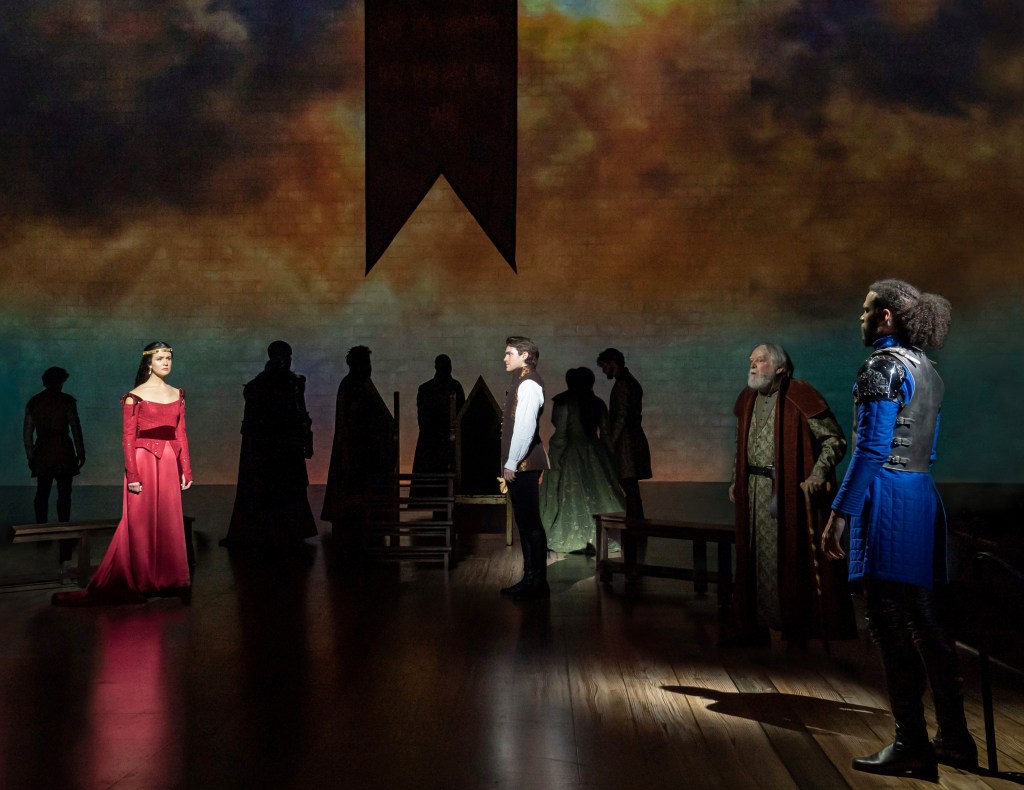
An express, underlying irony is that Arthur’s view and behavior toward women is even more forward thinking than many in the US South today, and especially some of the GOP political party antithetical to equanimity between women and men. Thus, Arthur is not only schooling Guenevere about equanimity and generosity as love, he is also reminding the audience of the beauty of such an approach between men and women for our own time.
Of course, this is legend, and it is hard to come by in reality, which makes the final exchange between Arthur and Guenevere, and their relationship, all the more poignant and tragic. In a failure of her character and bondage to her identity, Guenevere is too late to recognize and receive Arthur’s love and freedom to express it. Instead, she opts out for fleeting passion which is another form of bondage, and is the antithesis of freedom. It is why she regrets her affair with Lancelot, does not run off with him, but goes to a convent. The rest of her life she does penance for contributing to his death, Lancelot’s death, and the destruction of the kingdom.

Phillipa Soo and Andrew Burnap are perfectly cast in their respective roles and are simply smashing in voice, authenticity and aura, making us empathize with their characters who are victims of their own frailties. Burnap, especially at the conclusion, coalesces the poignant tragedy that Arthur’s dreams are broken, and that by a combination of rotten timing, privileged selfishness (by royals Lancelot and Guenevere), bitterness and resentment by an ungrateful Mordred, he is undone and must pay the forfeit with his death.
Jordan Danica’s Lancelot is both funny and dangerous, for we know what is coming when his resistance to Guenevere “protests too much” in selfishness. The right way to serve King Arthur would to leave and escape his lust, which he can’t because of his own self-betrayal. The bedroom scene is perfectly directed to suggest the thrill of passion, but not love. It is appropriate that their “aftermath” falls flat in disgrace, as they realize the import of what they’ve done. Sadly, as the pawns of Mordred, they’ve betrayed their king, and the golden idea which elevated their lives and the kingdom. Interestingly, Donica’s “If Ever I Would Leave You” indicates he can’t leave because of how she “looks” in the changing seasons. If he really loved her, not the image of her and him together, he would have left the moment he sensed the attraction to save her and himself. So much for his boasted purity. To insure his leaving, he would have been truthful with King Arthur. Donica’s voice and interpretation of that song in particular are non pareil, just fantastic.

Sorkin mitigates the “magical” in this Camelot update, palatably. For example it is suggested Arthur is able to pull the sword Excalibur out of the stone because previously, ten thousand men loosened it. Lancelot’s “resurrection” of Arthur occurs because he was just knocked unconscious and not killed. No miracle occurred. Arthur’s characterization is a forerunner of the rational man of the Enlightenment, when Europe will experience many transformations. Then, rigorous scientific, political and philosophical ideas burgeon in the society with the rise of the middle class. In his approach to ruling his kingdom, Arthur is bold to overthrow the most noxious elements of feudalism to bring ideals of equanimity, peace and honor that “might for right” and “justice for all” are the better way.
The thoughtful production has humor, vibrance and poignance. The treachery and resentment of unforgiving Mordred (the fine Taylor Trensch), who helps explode the Camelot ideals of equanimity, peace and honor are a potent reminder that such a “heaven on earth” is impossible because of human fallibility. Thematically, the musical warns us that only in the aspirations of future generations, represented by Camden McKinnon’s Tom of Warwick, may that possibility become reality in limited circumstances.
In the meantime, hope must be kept alive for a time when such dreams are possible. Realistically, all the characters fall from their own grace. It happens with the best of individuals, who cannot govern their own passions, and with the worst who rebel against a more perfect order for the sake of power. Sorkin reminds us in this complex re-imagining that most important is the striving for equity and equilibrium, not the achievement of it, which in itself is too fantastic to sustain. In the striving is the learning and revelation which is priceless. As such they provide the way for the hope of tomorrow, arriving at democratic polity hundreds of years in the future: i.e. a democratic Ukraine in the face of genocidal aggression by Russia, a democratic United States in practice not in lip service.
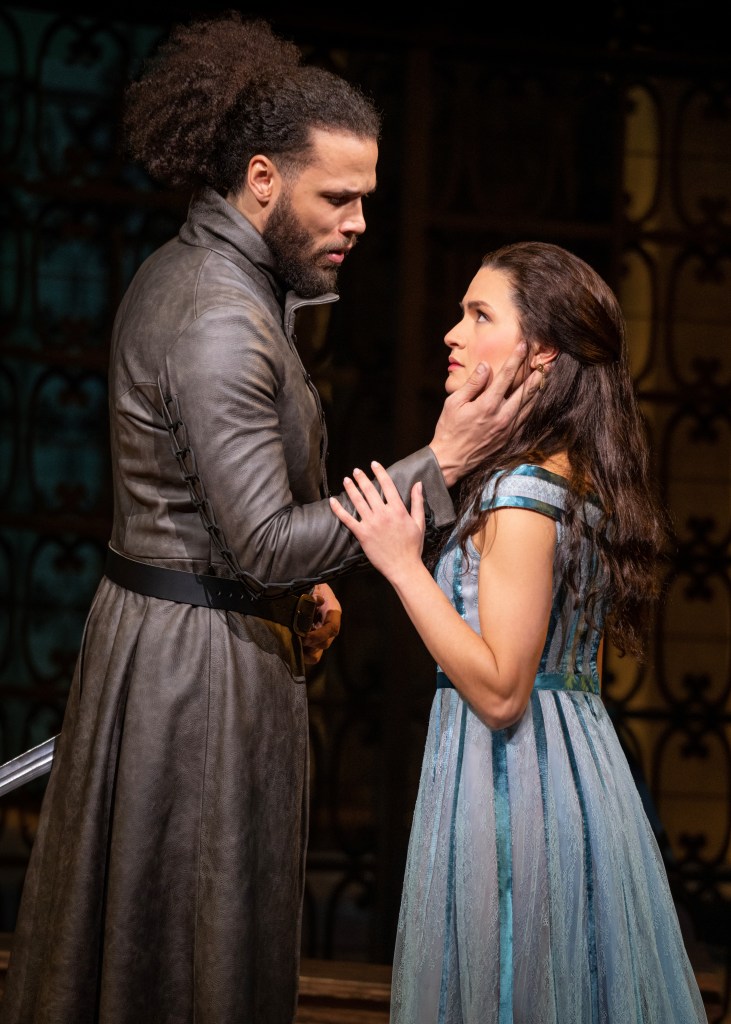
The sets by Michael Yeargan are suggestive, stylized, minimalist and symbolic, perfect for scene changes to the castle, Arthur’s study, a maypole dance, the tournament and more. Noted the black tree on stage never blossoms or has leaves, regardless of season. At one point the projection of the beautiful Camelot is seen in the distance. However, the tree does have leaves on the program cover as a figure peers out from its branches, and we, like him, wait for a “more perfect union,” and peace, justice and equity for all.
Jennifer Moeller’s costumes are richly appropriate and gorgeous. Lap Chi Chu’s lighting design, Marc Salzberg & Beth Lake’s sound design, Cookie Jordan’s hair & wig design cohere to manifest Bartlett Sher’s vision. Projections by 59 Productions are, as usual, marvelous.
I had forgotten how lyrical, memorable and powerfully touching are Lerner and Loewe’s songs and music. “Guenevere” is heartbreaking. Special recognition goes to Kimberly Grigsby’s music direction which does justice to the score. Noted are the original orchestrations by Robert Russell Bennett & Phillip J. Lang, and dance & choral arrangements by Trude Rittmann. These artists, no longer with us, had a prodigious history of creating the beauty of Broadway (Bennett over 300 productions, Lang and Rittmann over 50 productions). Byron Easley’s choreography is energetic in “The Lusty Month of May.” B.H. Barry’s fight direction and the staging/choreography of swordfights of Lancelot proving his mettle with the three knights and Arthur, appear as dangerous as the crashing blades sound.
Camelot runs with one intermission. Every minute is worth seeing. Don’r believe some of the critics. Judge for yourself. For tickets and times at the Vivian Beaumont go to their website https://www.lct.org/shows/camelot/
‘New York, New York’ is a Wow, Manhattanhenge is Here.

Inspired by the titular MGM motion picture written by Earl M. Rauch, the musical New York, New York at the St. James Theatre is an ambitious, updated adaptation from uneven source material. Its spectacular production values guided by the prodigious five-time Tony winner, Susan Stroman, who does double duty with direction and choreography, is set over the course of one year with the four seasons structuring the arc of development in the lives of the characters who want to “be a part of it in old New York,” from the Summer of 1946 through the Summer of 1947. Written by David Thompson, co-written by Sharon Washington with additional lyrics by Lin-Manuel Miranda and music and lyrics by John Kander and Fred Ebb, New York, New York’s music differs from that featured in the titular 1977 Martin Scorsese film.
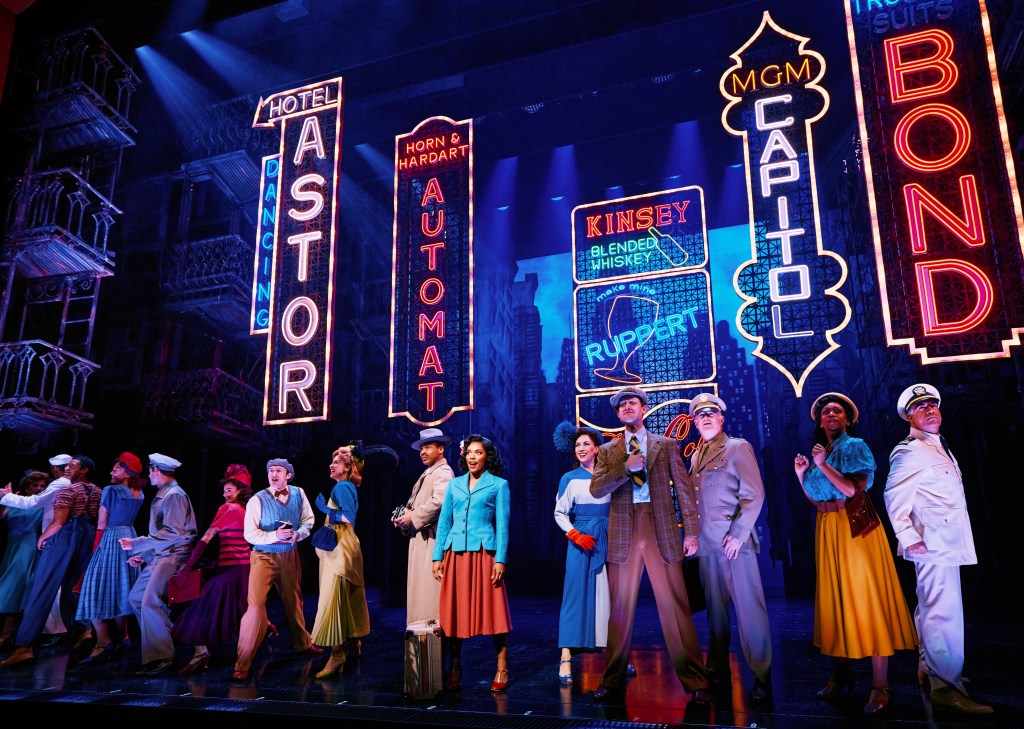
The noted exceptions are a few songs like “Happy Endings” and two schazam hits sung by Liza Minnelli in the film. Minnelli was initially associated with “New York, New York,” until Liza told Uncle Frank it was his to sing. Afterward, it became a part of every concert, TV show or gig Sinatra starred in. “But The World Goes ‘Round” is singularly Minnelli’s, though others have picked it up and run with it applying their own versions.
With such song classics, the production doesn’t capitalize on their tonal motifs threading intermittently from Act I to Act II more than just once. Instead, saving the best for last, they explode toward the conclusion. At the end Jimmy Doyle’s band (the real orchestra) rises up from the pit, playing “New York, New York” with bravado and glory. By far, the two songs are the richest, most seismic and memorable of the score. Despite who is singing them, they are a pleasure because of their symbolic associations.

The first is New York City’s anthem played as an encouragement around every dooms day disaster the city experienced in recent memory from the Terrorist Attack of 9/11 to the COVID-19 botch job by the twice-impeached former president, when nightly the city came out to applaud healthcare workers and some played Sinatra recordings of the signature song from their balconies. The other lush beauty about the irrevocability of life’s changing turns, highs and lows, is a classic best remembered for Minnelli’s fabulously impassioned rendition.
These songs, in their own right, are like the North Star. “But the World Goes ‘Round” appears to guide the writers to effect a richer, stirring musical about making it in a tough, unforgiving town which necessitates growing a thick skin because regardless, the world will spin, whether one plays the broken-hearted victim as Jimmy Doyle does initially in Act I, or become the heroes of their own myths as do all the characters who serendipitously meet in a Booking agent’s office, then join Doyle to play in a “tired club” in Act II in a reviving number “San Juan Supper Club.” However, reaching success takes a while.

Specifically, the book meanders as it strikes out into different story-lines of immigrants and ethnics, who come to Manhattan to establish their unique voices and become the stars of tomorrow. Problematically, the music, which should lead in a brassy, bold pop style of the latter forties reimagined, follows without the same consequence and heft of the two signature songs we long to hear that show up in full force by the end. The story lines take wayward side directions, straying away from “the heart of it,” making Act I (17 songs) much longer than necessary to spin the characters’ struggles in New York. The central focus becomes redirected. Eventually, it comes back and the lens crystallizes on salient themes, before flitting away to feature another plot-line.

The centrality, which is supposed to be how Jimmy Doyle’s Major Chord Club and musical group comes together, is delayed by scenes of the violinist from Poland and Mrs. Veltri waiting for her solider son to come home. What is represented is the loss and death from the war, a loss which explains why Doyle drinks, is angry and argumentative with those who could help him. He grieves his talented brother dying, while he, the inferior with “flat feet,” serving unheroically behind a desk, feels guilt as the ghostly shadow of his glorious sibling occludes him.
The impact of grieving New Yorkers out from under a cataclysm of the holocaust, which took violinist Alex Mann’s family and the heroic sons of America’s war dead is important, but diluted in the mix of all that is going on. Doyle, Mann (Oliver Prose) and Mrs. Veltri (Emily Skinner) are meant to carry that theme of loss and grieving as one more aspect of the “city that never sleeps,” but the power fades too fast for the audience to fully appreciate it, as the action springs to another scene and character. This is the nature of the city which acknowledges then moves on with forward momentum.
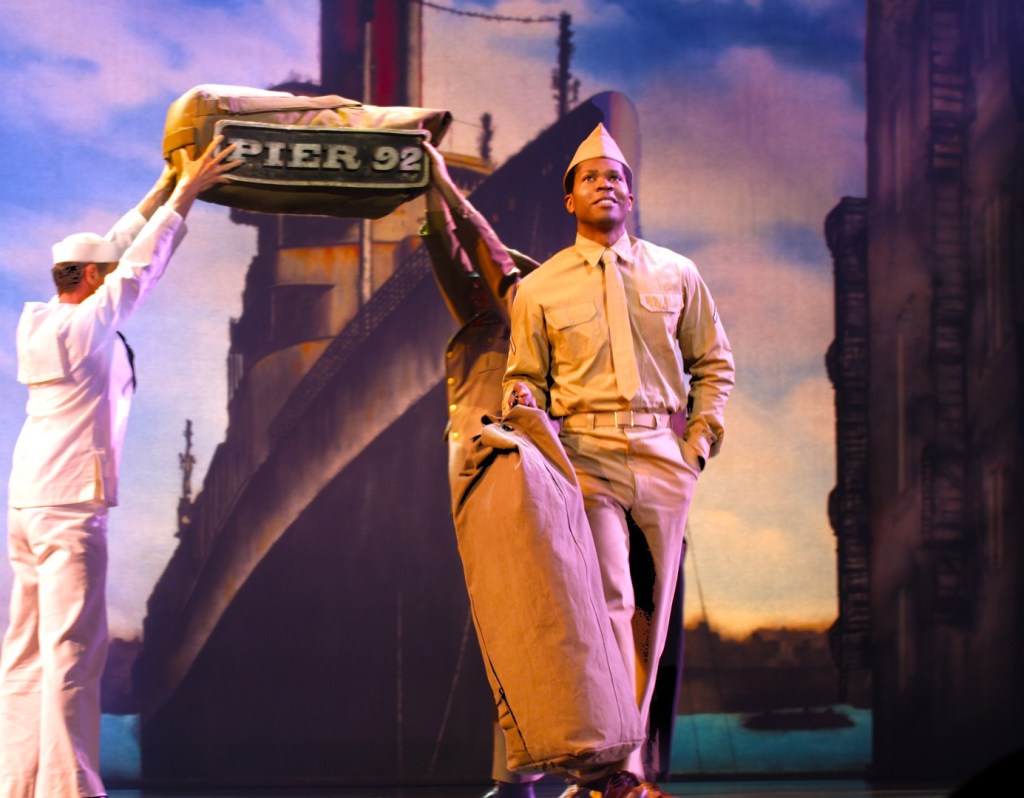
Not all the story-lines need specific scenes for explication. Some either should have been edited to a stark jabbing point with the songs either pumped up and primed, or eliminated. They seem extraneous, done for the sake of inclusiveness, rather than out of a visceral, organic need driving the characters in their forward momentum. Editing might have slimmed down the excess that sometimes dissolves the production’s vitality. Though the writers moved away from the film’s story, to be inclusive and representative in an update, they do feature the relationship between multi-talented musician Doyle (Colton Ryan really picks it up in Act II) and powerhouse singer Francine Evans (Anna Uzele has the creditable voice).

However, the idea of a New York City, where inclusiveness and freedom, born out of anonymity and size, that also has a down side, is not manifested with unique particularity beyond the concepts of struggle and making it. Only Jimmy Doyle’s character is nuanced and shaded with interest to reveal a convincing transformation that is believable, effected beautifully by Colton Ryan.

Despite these problems with the book, Stroman leaps over them creating terrific moments in representing the lifestyle of New York City street scenes. She materializes a pageantry of perfection in staging the dance numbers with delightful framing assists from Borwitt’s scenic design and Billington’s lighting design. These gloriously drive the production, along with the fabulous projection design by Christopher Ash and Beowulf Boritt, which majestically integrates historical photographic blow-ups with the sets (scaffolding erected to look like apartment buildings). New York City in their vision is a treasure to behold back in the day, as they remind us of how we got from then to now. Of course, the heartbreaking projections of the old Pennsylvania Station torn down in contrast with Grand Central Station which we are eternally grateful for Jacqueline Kennedy Onassis’s crusade to save it, are vital historical references in an ever changing Manhattan.
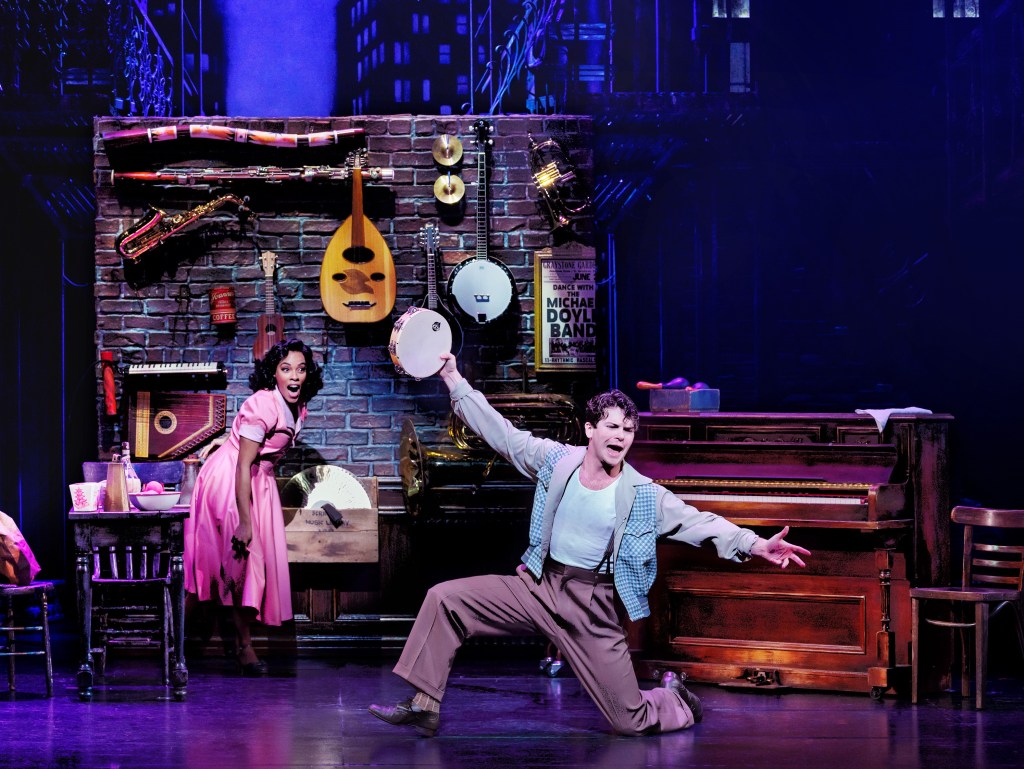
Stroman choreographs the ensemble with excitement, energy and vibrance. She shepherds the musical’s technical team to strike it hot. They create the atmosphere and stylized beauty of post war New York neighborhoods, synchronizing the scenic design, lighting design and projection design. Along with Donna Zakowska’s stunningly hued costumes pegged to the period, Michael Clifton’s period makeup design, Sabana Majeed’s hair and wig design and Kai Harada’s sound design (I heard every word) these talents manifest Stroman’s concepts of a bustling, charged city hyped up to establish the nation’s new-found prominence after winning WW II in Europe and the Pacific. The city of dreams is once more collecting its dreamers who will sink or swim according to luck and perseverance.

There are many moments in New York, New York I loved. The song “Wine and Peaches,” performed with the ensemble’s tap dance on a foundational iron beam, beautifully set “high in the sky” with the city projected from down below during the ironworkers lunchtime is gobsmacking. It’s a remembrance of the iconic black and white photo of the Empire State Building being erected and ironworkers sitting on the structural beams over 80 + stories up. The song is emblematic of New York City construction workers who are brave, balanced and accustomed to such heights, that they might dance “for the hell of it.” It is also a testament of the tremendous development in the city whose air rights allow buildings to rise taller and taller. Symbolically, visually and musically performed with grace and fun, the number is one of the most memorable and brilliant.

Another moment that is thematically important is the song “Major Chord,” as Jimmy Doyle and friend Tommy Caggiano (Clyde Alves, a fine song and dance man) discuss that “music, money and love” combined in a harmonious chord become what drives a purposeful life for them. In the lead up praise of the city, Tommy’s humorous truism rings clear for New Yorkers when he says, “It’s the greatest social experiment. Everybody lives here and everybody’s natural enemy lives here. And we manage not to kill each other. For the most part.”

To top his comments as New Yorkers are wont to do, Jimmy says, for him, New York City is a “major chord,” and Uzele’s Francine joins in to ask how to find her major chord (music, money, love). Tommy and Jimmy help her find an apartment near Jimmy to start her journey to become a star. Eventually, as fate throws Francine and Jimmy together (more through events he causes) they marry, have ups and downs and reconcile at the “Major Chord,” Jimmy’s successful club which concludes the musical with a resounding and stupendously staged “New York, New York,” sung by Uzele’s Francine.

In Act I, “New York in the Rain” is beautifully sung and staged with colorfully hued umbrellas skipping across the stage, under their own power, and others held by the ensemble who twirl them in uniformity with graceful energy. As Jimmy, Ryan’s “Can You Hear Me?” and “Marry Me,” are appropriately winsome and romantic as Act I concludes with Francine and Jimmy’s relationship sealed in love and marriage.

Act II picks up the forward momentum. Jimmy pushes for his “major chord” in his relationship with Francine, “Along Comes Love” and in the dynamic “San Juan Supper Club” (Ryan, Angel Sigala, John Clay III) which is a rousing, dance number where the musicians we’ve met in Act I come together to form Jimmy’s band which will headline his club Major Chord. In the superb “Quiet Thing,” Ryan’s Doyle shares the preciousness of arriving at his dream, not with great fanfare, but with the inner knowledge of its success, which is the confidence that the dream is the reality. The lyrics and music are Kander and Ebb at their finest, and Ryan delivers a superb, heartfelt slam dunk that any artist can identify with.
As Francine understands that the villain with a smile, Gordon Kendrick (Ben Davis), wants to unrealistically take her, a black woman, out on the road so he can sexually seduce her, Francine affirms what her husband Doyle has told her all along. Kendrick is a hypocritical wolf in a “promoter’s clothing.” She concludes her last song on the radio after Kendrick tells her “she’s finished.” “But the World Goes ‘Round” is Uzele’s home run and Francine’s realization that she must move away from him and join Jimmy at the Major Chord Club.

An incredible and breathtaking encomium to New York City is in one of the final musical numbers “Light” presented by Jesse (John Clay III) and the ensemble. Kudos go to the technical team and Stroman to effect Manhattanhenge through the projections, sets and lighting. It is absolutely magnificent and of course, symbolic that light, love and musical goodness can be in a city that is its own memorial to industry, dreams and aspirations.

Manhattanhenge occurs when the sunset perfectly lines up with the east-west streets on the main street grid in Manhattan. It’s Stonehenge in NYC! Happening twice over a two-day period, on one day you can see the sun in full and on the other day you get a partial view of the sun. Then to encapsulate the “light” in the city that is its own monument, Francine concludes accompanied by Jimmy Doyle’s band with “New York, New York.” And indeed, the show ends in a major chord at Doyle’s Major Chord Club in a beautiful flourish with Uzele singing her heart out as the audience stands with applause dunning the critics who panned the production.

New York, New York is exuberant, complex and bears seeing twice. There is so much happening you’re going to miss something and think the fault is in the production, as I did initially. Stroman is her representative genius. If one goes without expectation, your enjoyment will be immense. Look for the fine performances. Colton Ryan is sensitive and heartfelt especially in Act II and his gradual transformation is exceptional in “Quiet Thing,” and afterward. There’s nothing like knowing one is a success and at home in that confidence. The principals, especially Uzele, Janet Dacal, Ben Davis, Angel Sigala and the others mentioned above have golden voices. All are their own major chords, thanks to the music supervision and arrangements by Sam Davis.
For tickets and times go to the production’s website https://newyorknewyorkbroadway.com/
‘Good Night, Oscar’ Sean Hayes in a Marvelous Must-See

It is not that Sean Hayes looks like Oscar Levant (he is taller), or speaks like Levant (not really), or accurately displays Levant’s neurotic ticks and eye blinks (he ticks away), or imitates his posture (he slumps, cutting off 2 inches of his own height). What Hayes does nail is Levant’s pacing, deadpan delivery, comedic sentience and his self-effacing, desperate, sorrowful heart. And it is these latter Levantesque authenticities that Hayes so integrates into his being that when he shines them forth, we believe and follow Hayes wherever he takes us during the brilliant, imminently clever Good Night, Oscar, currently running at the Belasco Theatre with no intermission.

With a well-honed, drop-dead gorgeous book by Doug Wright (I Am My Own Wife), and superb production values (Rachel Hauck-scenic design), (Emilio Sosa-costume design), (Carolina Ortiz Herrera & Ben Stanton-lighting design), (Andre Pluess-sound design), and J. Jared Janas for hair & wig design, director Lisa Peterson’s vision brings us back to 1958 in NBC Studios’ inner sanctum, where the backstage drama is more incredible than what happens on live camera. Of course, by the time Hayes’ Levant appears live on The Tonight Show, we, Parr (Ben Rappaport), June Levant (Emily Bergl), Alvin Finney (Marchánt Davis) and head of NBC Bob Sarnoff (Peter Grosz), have lived two lifetimes fearing the worst. After all, this is live television with no splicing tape or editing. Whatever happens is. And that makes the tension and thrill of this production that duplicates the fear of “live,” (just like on Broadway, but with no extended rehearsals), just smashing.

Doug Wright acutely, craftily ups the ante of danger in the 80% probability that Levant will make a mess of things. Perhaps, he won’t make it to the studios, just like the time he left an audience of three thousand waiting in fancy dress to hear him play the piano, concert style, which was popular in those days. Then, he let them wait and never showed up.
Levant is noted for his version of the stellar George Gershwin’s “Rhapsody in Blue.” Parr and the TV audience expect Levant to play it, but of late, he is hesitant and may refuse and walk off the set. So Levant might be on time but blow-up his appearance, as he has done before, saying the extraordinary and surprising, if asked to comment on religion, politics or sex. Furthermore, he is plagued by the spirit of Gershwin and has reveries of the past where, at times, he makes no sense. So much can go wrong, like Murphy’s Law states: “If something can go wrong, it will.” With Levant this has become a truism with scheduled bookings and appearances.
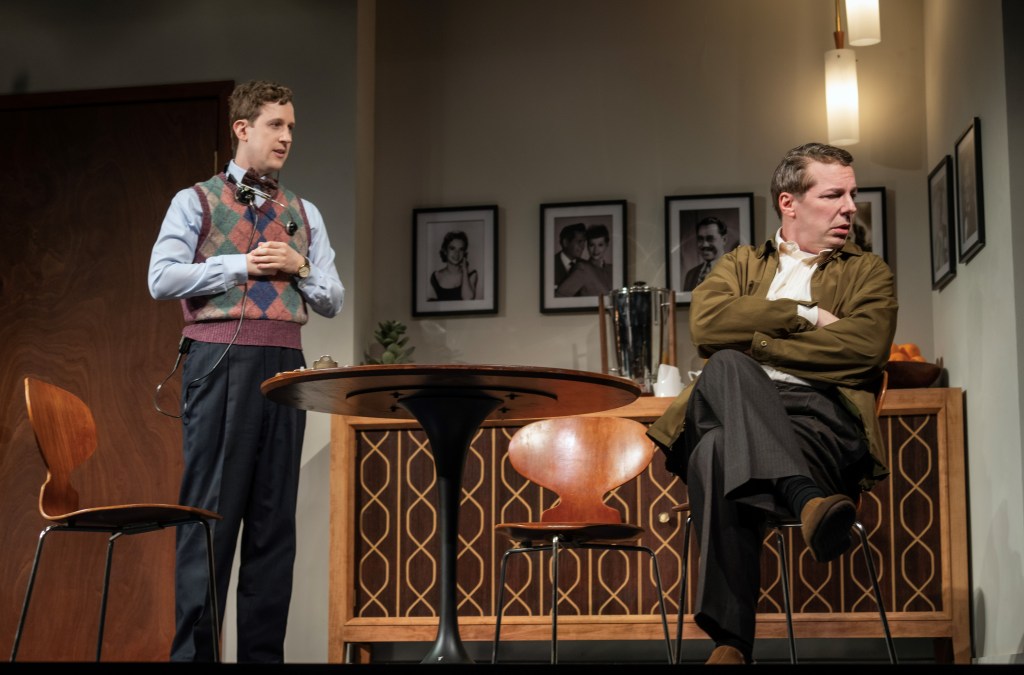
As Grosz’s apoplectic Sarnoff and Rappaport’s reasoned Parr go head to head about the high-risks they are taking because they cannot fail during “sweeps week,” we discover that recently, Levant is completely unreliable and “out there.” Sarnoff refers to him as a “freak.” On the other hand Parr has specifically chosen Levant because he needs his new Burbank show to be a success. Levant always delivers because Parr knows his close friend and can set him up for the best one-liners and witticisms in the business.
With Levant, Jack hopes to compete his way into prime time with a low budget and the talk show format he has perfected. It is a difficult task because he is on every evening, is rather high-brow, and the network underestimates him. However, Rappaport’s Parr believes Levant is a “true original,” who “treats chit chat with all the daring, all the danger of a high-wire act.” Parr knows that he will score with Levant because his unexpected brilliance lands his one liners all the time. Jack will start the engine, and Levant will speed off with the cues for a perfect show, nose diving into space and leveling off every time. He only needs to show up and get in make-up. Wright has created the set up for anticipation so that when Levant arrives, if he does, we are ready for his prime time antics, which happen behind the cameras.

That Parr doesn’t convince Sarnoff to calm down remains a problem. Sarnoff tells Parr he has booked “chica chica boom boom” Spanish musician and band leader Xavier Cugat as Levant’s replacement. He will save the day if Levant stiffs The Tonight Show, like he stiffed The Eddie Fisher Show the week before. In other words, as Levant keeps the studio waiting, the greater the likelihood that Levant’s career is down the toilet, along with the bad will that Parr has contributed making his goal to be in prime time a pipe-dream.
The issues appear to be settled when June Levant, Oscar’s wife, sweeps through the doors in her period piece, flowery outfit looking chic and composed. Parr is relieved until June tells him that she committed Oscar, and he’s in an asylum because she finally had enough. Parr becomes as apoplectic as Sarnoff and the rest of the play spins out of control, is brought back into control, then goes up into the high-wire act Parr wished for, after Levant shows up and fills everyone with expectation and sometime dread that he will blunder irreparably and destroy all they’ve planned.
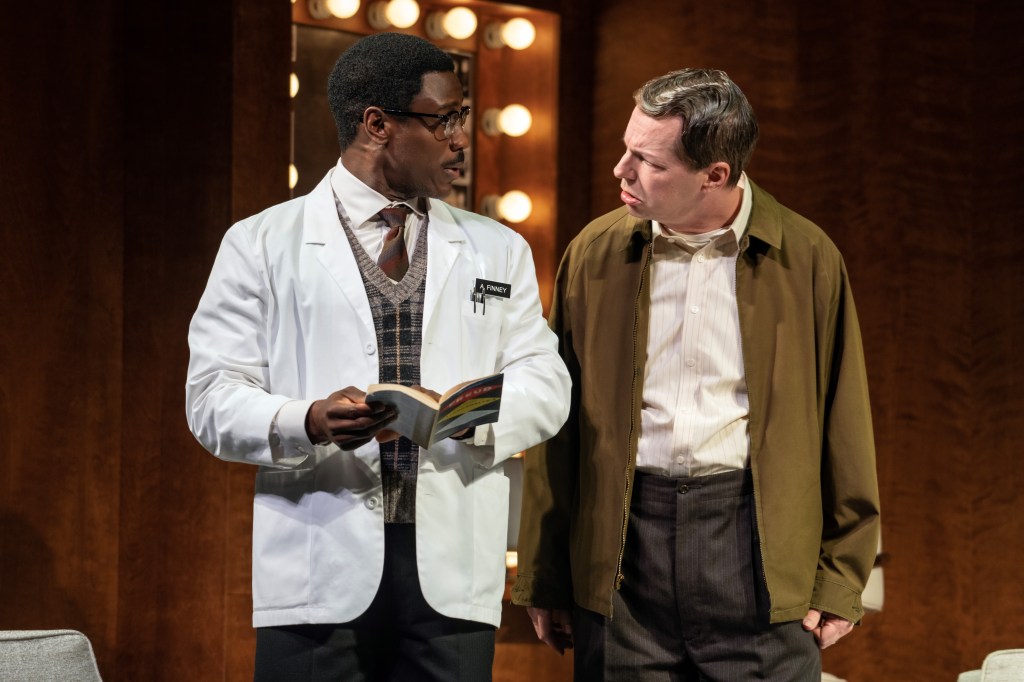
To add to the tension, right before Levant goes on the air, he downs a bottle of Demerol and seems comatose. The saving grace is that Levant is a drug addict and his body is accustomed to so many drugs of his choosing, he has to take a bottle of it to stop his hand from shaking. (I reminded you of that, if you question how taking that many pills and functioning is possible. Think functioning alcoholic.)
Who is this drug addict? Who is Jack Parr? In what century are we? One of the salient take-a ways of Good Night, Oscar is its reverential nod to the Golden Age of Television, when culture, wit, superior comedy shows and superb programs (I Love Lucy, Playhouse 90, Your Show of Shows, What’s My Line, etc.), and actual bona fide news graced the air waves. Jack Parr was one of the first hosts of The Tonight Show franchise, which has lasted to this day and has been duplicated many times over in other shows on other channels.

Then, Parr made individuals famous during his five-year stint. One of his frequent guests was comedic concert pianist and Hollywood celebrity Oscar Levant. Thanks to Doug Wright’s incredible, stylized portrayal of Levant, and Sean Hayes’ remarkable ability to don the ethos of the exceptional pianist and tortured artist, we understand his emotional underpinnings. And we empathize with the psychological whirlwinds captivating Hayes’ Levant. Figuratively haunted by George Gershwin’s shadow, Levant glorifies in and also regrets riding Gershwin’s coattails to celebrity. Wright fancifully manifests this haunting by materializing Gershwin, who cajoles, persuades and torments Hayes’ Levant with remembrances of his greatness and serene notes of “Rhapsody in Blue.” Davis’ Alvin tells Parr assistant Max (Alex Wyse) that these babblings are auditory and visual hallucinations.Max should just “go with it.”
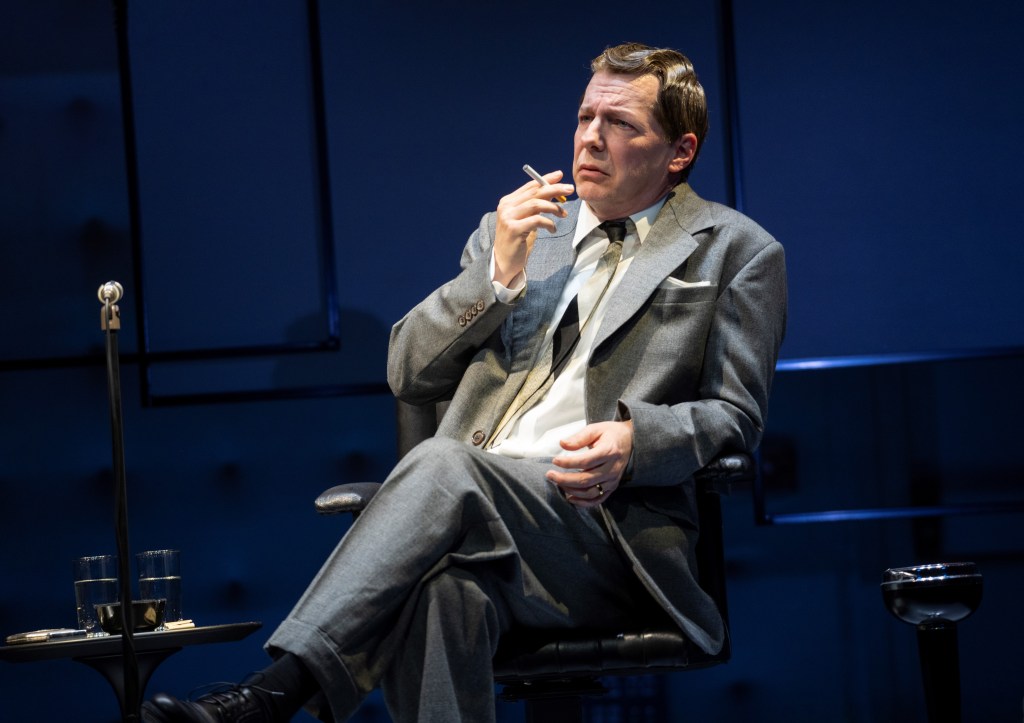
After June Levant and Parr tell Hayes’ Levant he must play, that the concert grand is waiting, Levant goes head to head with Gershwin’s ghost. Portrayed by John Zdrojeski, we note Gershwin’s arrogance and dapper, mordant, ghostly looks. However materially insubstantial he is, to Levant, the only one who sees him, he is beautiful and elegant. We understand that compared to Gershwin, Levant is a midget in looks and talent (in his own flawed estimation). Levant has undermined himself becoming Gershwin’s fawning adherent. Thus, eventually Levant obeys his hallucinations, as the Gershwin ghost compels him. Will Hayes’ Levant be able to play anything with arthritic hands and twenty-five concentrated doses of Demerol in pill form churning around in his stomach?
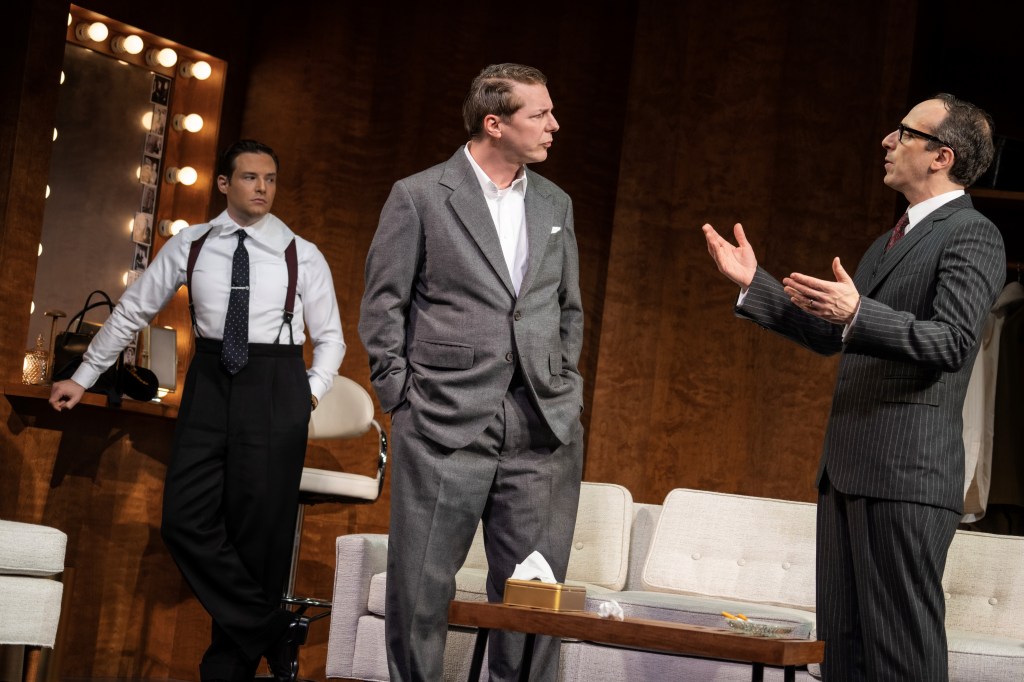
There is no spoiler alert. How Levant, his body hungering for drugs, manages to manipulate Parr assistant Max and his own nurse assistant Alvin to get what he wants is frightening, funny and ironic. Wright employs Max and Alvin as devices to reveal Levant’s backstory and acquaint the audience with his former grandiloquence, while we take in his deteriorating condition. Levant, Judy Garland and other celebrities shared the same fate with the pills and drugs that the studio doctors offered. Ironically, the tragedy of Oscar Levant and his glory and folly, which Hayes portrays with perfection, has great currency for our time.

Though Levant’s story is a throwback to that crueler, exploitive time of the studios, where the industry ground up artists in its maw and left them at the side of the road to deal with their own damage, we see the effects of big pharma today, expanding their client base beyond celebrities to the US public. Additionally, we note that corporations have become even more insidious than the Hollywood studio system as exploiters of writers and other artists. Good Night, Oscar is vital in showing how the then parallels the now.
Wright, Peterson and importantly, Hayes, elucidate how artists were encouraged to destroy themselves gradually for the sake of their “careers.” That Parr and June Levant are similar in their persuasions, pushing Oscar to “entertain,” is answered by the fact that Oscar adores being in front of an audience, even if it’s only for the four hours he has been “sprung” from the asylum. However, his self-harm becomes irrevocable as celebrity self-destruction through addictions to drugs and alcohol, unless redeemed is irrevocable in our time as well.
Wright’s play is an encomium to Levant’s genius, his humanity and his artistry, beautifully shepherded by Peterson and the creatives who convey her vision. And Sean Hayes’ performance is one for the ages.
There are gaps in this review for the sake of surprising the reader. Most assuredly, Good Night, Oscar is a must-see. You should go a few times to appreciate the wit, humor and spot-on performances, all of which are superb. Sean Hayes is especially poignant and authentic. For tickets and times go to their website https://goodnightoscar.com/
 CAROLE DI TOSTI