
‘Revisiting Frances McDormand’ Interview Transcription by Mari Lyn Henry
Frances McDormand is a terrific actress. Her body of work encompasses both comedy and drama, both stage and film. Recently, she has been garnering awards for her work in Martin McDonagh’s searing film Three Billboards Outside Ebbing, Missouri. Her “in-your-face” portrayal of a mother who stirs the fire under the police department of Ebbing, Missouri to get them to investigate her daughter’s brutal murder is both memorable and humorous. Indeed, in a matrix of powerful characters, who seek redemption and justice, the film is a tour de force between Mildred Hayes (McDormand), Sheriff Willoboughy (Woody Harrelson) and Jason Dixon (played by the brilliant Sam Rockwell. As Willogoughy and Dixon fight for the police department’s integrity and Mildred Hayes’ struggles to bring them to task for not effectively investigating her daughter’s rape and murder, the action deepens into a profound personal drama about redemption, love and solace of shared humanity and grace.
On Monday, April 23, 2012, The League of Professional Theatre Woman hosted an evening with Frances McDormand. Produced by Cheryl D. Raymond and funded by a grant from the Edith Meiser Foundation, the evening was presented in collaboration with the League of Professional Theatre Women as part of their Oral History Series with the Public Library for the Performing Arts. Kudos went to Betty Corwin for producing the program. Mari Lyn Henry, a member of the League who was present at the time transcribed the interview that appears below between Frances McDormand and interviewer Sarah Ruhl. The interview took place at the Bruno Walter Auditorium to an enthusiastic audience. Salient excerpts appear below and give one an understanding of how the amazing McDormand evolved along her journey. We see the tip of the iceberg into how she was able to mine her empathy and emotions to evoke the self-torment and desperate love that Mildred Hayes has for her daughter in her award-winning, intensely human portrayal in Three Billboards Outside Ebbing, Missouri.
Sarah Ruhl: Tell us about playing Lady Macbeth in high school.
I was 14, not a particularly good student. But I had a really good English teacher in Monessen, Pennsylvania. She said it was time for us to read Shakespeare and she had us read Macbeth out loud. And then we did a scene after school for family and friends. And so I found myself alone on stage doing the sleepwalking scene. And I think it was the power of the words, the power of being 14, alone on stage, and looking out and seeing a lot of adults quiet and attentive.
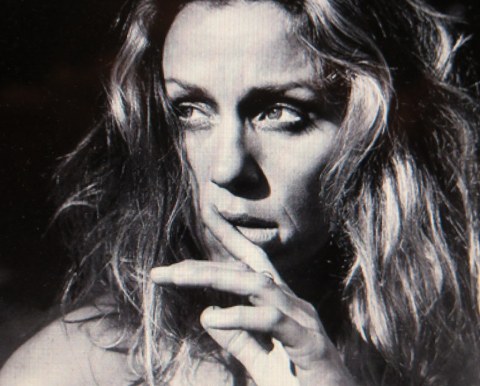
Frances McDormand (courtesy of the site)
Today would you ever want to play Lady Macbeth?
I have not done her. I don’t think it’s ever too late. Right now I am concerned about doing it because I don’t want to do a bad production of Macbeth. Maybe because it is a supporting role. I feel like I have been trained for that. I have been playing wives, girlfriends, mothers for years now. So I don’t want to be in a bad production of Macbeth. I (would) want a good director.
What is a good director?
How do you find one Sarah? It is really difficult. By going to see what is out there. I am looking for a director who can serve the work. It is different in the theater than it is in film. Actors are in a better position in film because eventually we get a lot of power. In the theater you are in charge of it once the production is open. That being said my last work was with Daniel Sullivan. I worked with him years ago in Sisters Rosensweig at Lincoln Center and we had a horrible time together and I didn’t want to work with him again and then we did a reading of a play by David Lindsay Abaire. David and Dan had worked together before. We got into the room and it was magic and I adored working with him and I think perhaps because it was a different play, a different time. I was concerned about working at MTC. I haven’t always worked on Broadway and am not really attracted to working on Broadway. Probably more interesting audiences I have worked for have been Off Broadway. My favorite place to work is at St. Ann’s Warehouse (Brooklyn). They have performance art and a lot of different disciplines have been held in that arena. The audiences don’t have expectations. They could be going to the theater or to the circus. I have been so impressed with them.
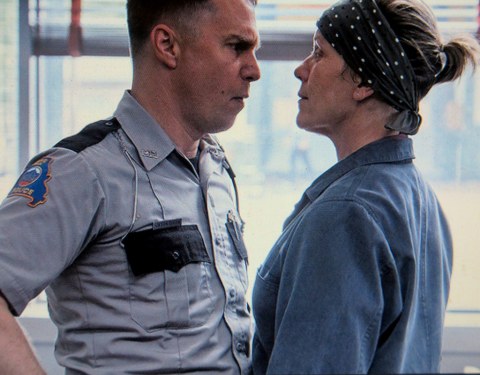
Frances McDormand, Sam Rockwell award winners in their portrayals in Three Billboards Outside Ebbing, Missouri (courtesy of the film)
Explain the value of the ensemble.
That was what I was led to believe I was going to do. That is what I was trained to do, a reason to go into the theater. I went to four years of college. I went to drama school for three years at Yale and I was trained as a classical theater actress.The only choice was to come to New York and start working in the theater. My goal and assumption was to become a member of a theater company. We were on the dying end of a program that had started in our country where drama schools were made to train actors to go into regional theater companies. When I got out of school you could still be a member of the Guthrie Theatre which I eventually worked at. But people went straight from drama school and that’s why drama schools were invented and were funded like in Minneapolis at the Guthrie Theatre. It became like Pillsbury out there. All those companies and sponsors were bringing executives from the west coast and they had to offer them something cultural. So these companies like Seattle Rep, Trinity Playhouse, the theaters in Chicago, all those great repertory theaters had to have cheap labor coming out as trained labor and that is what I chose to do.
I have to say my first job was in Trinidad in a play directed by Liviu Ciulei. Liviu was with the Wooster Group, a theater company which I have been involved in for the past thirty years. We have used the same actors over and over and they also write for us. The Wooster Group has taken me in like a stray little lamb and I now feel like I have a home with them. What is really great about that for me is that Kate Valk, who is the queen of the Wooster Group and premier actress of that company has been honing her craft and working with them for thirty years. We got to work together on To the Birdie, an adaptation of Racine’s Phedre (2002). That was ‘magic’ and what an ensemble should be about.

Sam Rockwell, HIFF 2017 Q and A for ‘Three Billboards Outside Ebbing, Missouri (Carole Di Tosti)
There is a tremendous humility when you talk about your work and working with other actors and I find that very rare. I have seen your work and it wasn’t the role that attracted me but your interpretation and what you brought to it. Tell us about your process and how you create a character.
When I came to New York, I was fortunate, coming out of a major drama school. I remember a casting agency experience. An older woman said to me, ‘Frances you would be a perfect pioneer woman. Unfortunately they are not making one. Okay, okay, okay,okay! Finding my type I realized at first, I was not very castable. But I had to pay my rent and didn’t want to do anything else. I had jobs like cashier or at restaurants, but I was really bad at all of them. I had to figure out how to make money. So there was a Pabst Blue Ribbon commercial, regional theater jobs and so on, all the things that young actors have to do, but then I started thinking about this.
I was always getting feedback like ‘You’re too this, you’re not enough that. You’re not enough his. You’re not pretty enough, tall enough, young enough, old enough. I started putting all of this together and decided I am going to be the one that is not pretty enough and I worked hard at that. In most storytelling, not as much in the theater, but in film, the theater is the only place for women of all ages and types. But to support myself outside the theater I took on some supporting roles in films and realized that all genres of films are male protagonist-based. Put a woman or women in these roles but (like Thelma and Louise) they die in the end. That film is ground breaking with two women. But all those male protagonist driven stories need women in supporting roles so I found I was good at that. I did girlfriends to some of the best leading male stars out there. Robert DeNiro, Michael Douglas, Gene Hackman. I’ve kissed them all but more importantly I made their characters more interesting. I was the off center, not very pretty, a little touchy—you know, mousy-brown-hair-uh-girlfriend. From a business angle, that is what I became.
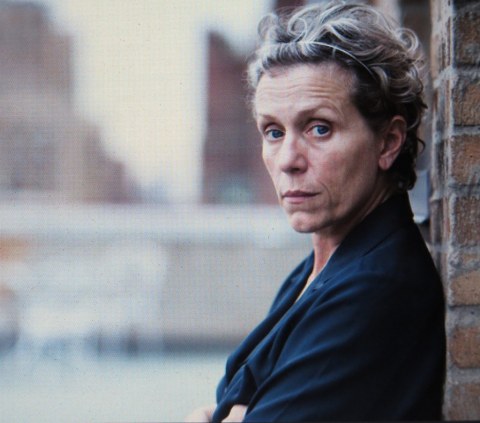
Frances McDormand (Alison Cohen Rosa, courtesy of the site)
In the theater I was very fortunate. My husband, Joel Coen, could afford to support me and believed in the theater. I could do theater whenever I could make that choice and not worry about the mortgage payment. It is not about the part, it is about the play.
What about achieving a balance between personal and professional lives? Can one lead a normal life?
One of my accomplishments was adopting a son and introducing my son to his father and my husband to his son. Your universe goes from being self-centered and self-absorbed. We wanted to rear a child our way. That meant living together and working together, avoiding publicity and keeping our private life private. No scandal.That is my life. I learned this from my mother.
Any roles you regret not playing?
Well if I didn’t do them, I didn’t do them. But there are a couple of roles. Orlando is one, Doubt is another. Well I have plenty of time to do Doubt but Cherry Jones was the actress for that role. So I didn’t give up anything.
You have played all the female characters in both Streetcar named Desire and Three Sisters. How did that come about?
With Three Sisters I wanted to be in a play by Chekhov. First time I played Olga when I was the youngest. My fourth job was playing Irina at the Guthrie directed by Liviu Ciulei. I was more suited to playing Irina at that time of my life and I was working with a wonderful cast. I played Masha at the McCarter for Emily Mann. It was an interesting treatment. I was Masha, Linda Hunt was Olga and Mary Stuart Masterson was Irina. And now I want to play Anfisa someday while I direct the play. Anfisa and the servants get what they want in that play. They know what they want, the sisters don’t.
I’m a transformative actor. I want to go inside a character and come out on the other side. Some actors are better at interpreting certain plays. I believe that I am a good interpreter (maybe not of Chekhov) but definitely of Tennessee Williams. I need a play that has a woman of my age and the parts that are my age are the parts that every actress is supposed to do. I never planned to do Blanche. I felt very successful as Stella, one of the best things I was able to work on as a young actor. I was given the opportunity by Michael Colgan who runs the Gate Theater to do Blanche in Dublin to an audience of extraordinary performers (you know every Irish man or woman can tell a great story) so when they come to the theater they are tough (Fran makes a face like them) and to feel the temperature of that audience every second is exciting. I had the opportunity to play Blanche which I am not suited for but the director wanted to do it against the traditional type. She was delicate but she was also a caretaker for the death of the plantation and the family who she had watched die in the family home. It was an interesting production. Everyone gets a role like this but you shouldn’t do more than one. That’s my opinion.
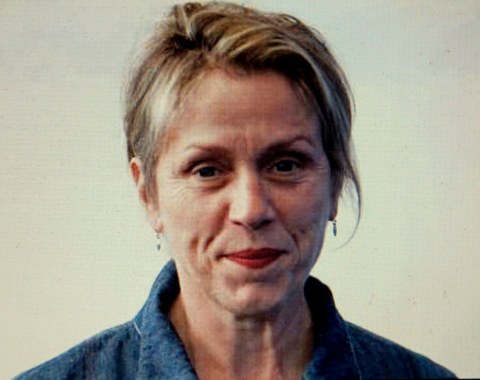
Frances McDormand (GUILLAUME COLLET photo courtesy of the site)
Sarah What do you think about plastic surgery?
What society has pressured men and women to do to capture eternal youth! I read an article about so many of these things that are being used—botox, ingesting into the system without any question. It hasn’t been long enough to know what effects it will have and what the emotional repercussions will be. When you are talking to someone who is stressed you feel their stress. If their brow furrows, your brow furrows because your empathetic nature is reaching out to what they need. If you can’t do that you can’t do that. Your neurological response sends a trigger to your brain to care about that other person, to care what they are going through to sit there long enough to read their expression and to find out what else is going on. If you can’t do that, you are not getting that signal. THAT IS PRETTY SCARY.
Literally I will walk down the street sometimes because we are walking around in a society that is absorbing without question people’s fear. One of the reasons that I haven’t done press or publicity for about ten years now in relationship to my work is the unspoken rule that we don’t talk about that. For me it is not the same thing as not talking about someone’s private life. If I have information about someone I have worked with who has a certain amount of celebrity, I would not share that with you. It is none of your business. I started feeling like I need to make a list and I need to start walking around with a sandwich board with a list of all the people I know who have somehow altered themselves for the service of something that they were perpetuating—I think we have to be careful.
Plastic surgery is the Greek mask of our generation.
I think that when someone ages beautifully, it is partly because of an internal condition and it can relate to what they have done from suffering or comes about as a result of suffering and I think that plastic surgery is an erasure of suffering.
What was your road trip like?
We took a road trip last summer and we hadn’t done that in a while. I love road trips and everything that goes along with them. One problem was that we didn’t get our AAA map guide. We could unfold it and figure out what road we wanted to take. Oh let’s go on that road instead. I had my iPAD with the little blue dot. I spent the entire time doing this (shows iPAD to face) watching the blue dot. ‘Oh my god where are we?’ We had to stop and get a map because we were not enjoying the trip. This is my map and I can pick where I want to go, what direction I want to take and it all started when I met my son 17 years ago.
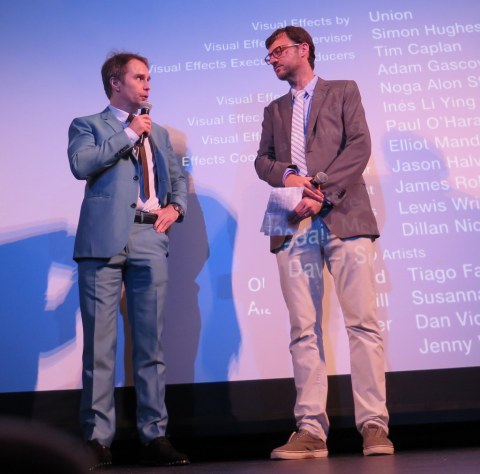
(L to R): Sam Rockwell, David Nugent, HIFF 2018 Q and A for ‘Three Billboards Outside Ebbing Missouri’ (Carole Di Tosti)
QUESTIONS FROM THE AUDIENCE
Could you speak about Miss Pettigrew Lives for A Day?
We made the movie in 2006 which is not as witty or naughty as the book. I wanted to see a project from beginning to end and I really loved the story. In the book, it is about a day in the life of Miss Pettigrew and the friendship she makes with a whore, a woman who is living with three men. But that doesn’t come out like that in the movie. She is simply being kept. The other character is the fashion designer. In the book these three characters form a friendship. We had a lovely director. It was his first feature. He was a lovely man but not a visionary. We connected but he didn’t feel as passionate as I did about this film. As the producer I knew it would be a challenge to sell the film with a middle-aged female. But we were fortunate to have this really wonderful actress (Amy Adams) and she looks great in lingerie. It turned out okay, but it wasn’t great.
Could you tell us about working with Lili Taylor in a play with students
We are both members of a company called the 52nd Street Project. It started 30 years ago near the PALeague across from the Ensemble Studio Theatre. Kids in the neighborhood go take boxing lessons at the PAL after school. Curt Dempster, the late artistic director of EST, sent Willie Reale, a young actor/playwright, to teach the kids playwriting. It helped give the kids an honest creative outlet. He founded this program which eventually became a non-profit organization. We have two boards in a newly developed building on the corner of 53rd and Tenth Ave. Kids have to take the playwrights course or write a play they can stage and perform in. They go away for a weekend and have a monitor help them write their plays. When they return, they cast from a group of adult professional actors with a dramaturg and a young director and they get to see their plays performed.
Do you ever get star treatment?
I am getting it right now. I don’t want to be a star or known as a star. That being said if I want to get a table at Cafe Luxembourg, Joel will have me call. I will use shamelessly whatever advantage my name gets for a restaurant reservation.
Could you talk about how we get more roles for women.
I think the most important thing is female writers. I spent years beating my head against the wall and I would say to my husband, “Joel why can’t you write better roles for women?” Lisa Cholodenko (The Kids Are All Right) and Nicole Holofcener write great films with behavior and character and have a lot of trouble getting their films made. Here is what is going to be good. When the actor who is also on the board of the 52nd St. Project has a company who is going to liaison with the money market world for the goal of making money and to get them to invest in their film and money into female-centric films whether written by women, directed by women with a good business plan—a terrific spreadsheet with what has been made, what needs to be done, how it can be done, take a chance on us. That will help. It is a business. Theater is not it. I can stand up to do a sleepwalking scene right now and that is theater or on a sidewalk, but unfortunately it won’t raise money. I am trying to raise four million dollars for a film which I think is a lot of money. but in terms of films, the last epic film cost producers 300 million dollars so 4 million is nothing. But they won’t give it to you for a nice family-oriented film.

New York Botanical Garden Holiday Train Show ‘Bar Car Nights’ One Last Time
If you have not been to Bar Car Night of the NYBG Holiday Train Show, this weekend will be your last chance. The entire week, the cold has softened into the sunshine and snow melt. It would be a wonderful time to go with friends, partner, spouse, lover, blind date, seeing date or just yourself. Have a few drinks, saunter through the gorgeous conservatory and various galleries appreciating Applied Imagination’s love letter to New York and NYC and go home refreshed and ready for a new week.

St Patrick’s, Manhattan, NYBG Bar Car Nights, Holiday Train Show (Carole Di Tosti)
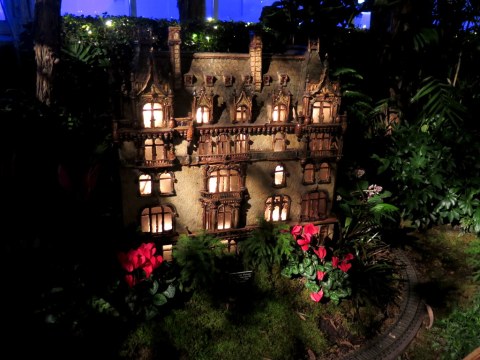
The Jewish Museum, NYBG Bar Car Nights, Holiday Train Show (Carole Di Tosti)
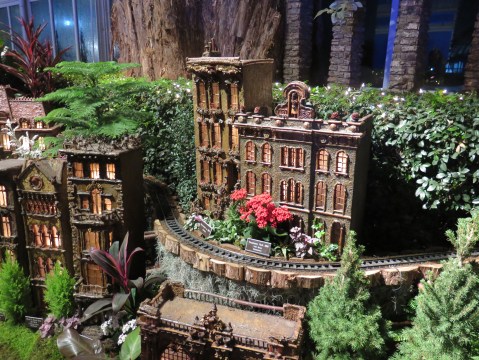
NYC Row Houses, Bar Car Nights, NYBG Holiday Train Show (Carole Di Tosti)
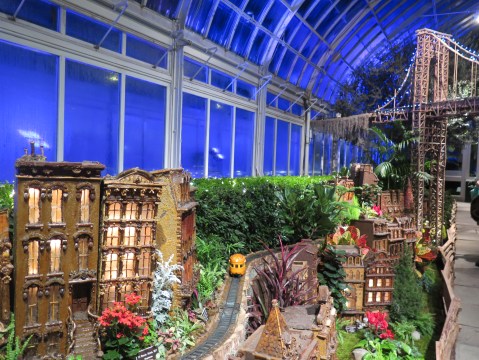
Row Houses against GW Bridge, Bar Car Nights, NYBG Holiday Train Show (Carole Di Tosti)

GW Bridge, NYBG Bar Car Nights, Holiday Train Show (Carole Di Tosti)
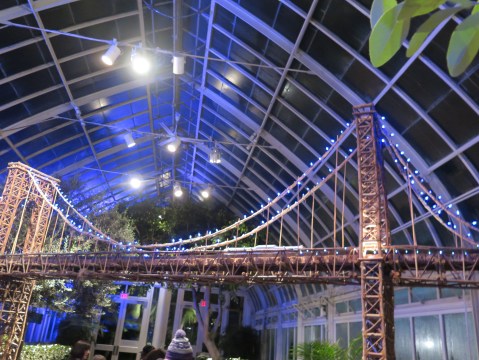
Another view from underneath the GW Bridge, Bar Car Nights, NYBG Holiday Train Show (Carole Di Tosti)
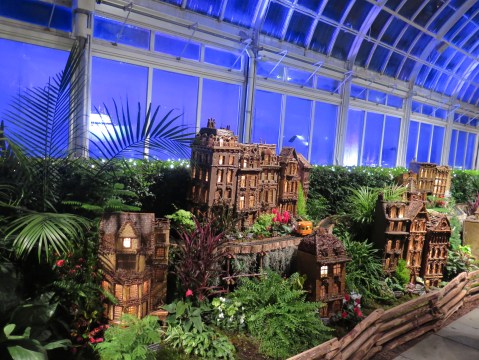
Row Houses, NYBG Bar Car Nights, Holiday Train Show (Carole Di Tosti)
The show’s main Palms of the World Gallery features the new exhibits of Mid Town Manhattan and the show is splendid with some of the seasonal decorations still hanging and lights twinkling. everywhere. One of the most popular of the NYBG shows, ‘Bar Car Nights’ is the time to leave the kids at home and enjoy the quiet, low surrounding conversations as you note the incredibly imagined replicas that pay homage to old world Victorian New York and the twentieth century.
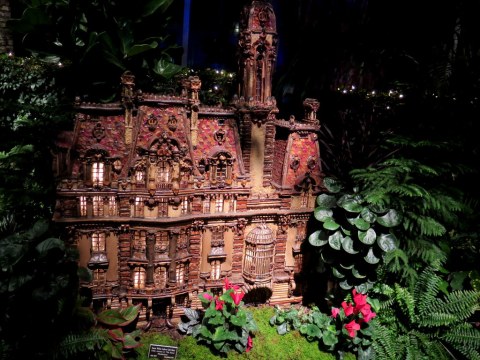
Senator Clark mansion that was demolished, Bar Car Nights, Holiday Train Show, NYBG (Carole Di Tosti)
The show advances our historical knowledge of many buildings and structures that have either been demolished or destroyed. Five bridges of New York (Brooklyn, Queensboro, Manhattan, Hells Gate and the George Washington sparkle their lights as trolleys and passenger cars slip quickly over the bridge trestles. One also notes various sections of Manhattan-Museum Row, NYPL,Central Park, Morris Jumel Mansion, Park Avenue Armory, Mid-town Manhattan-Empire State Building, East Side/West Side Row Houses; Brooklyn-Coney Island’ Queens-the TWA Flight Center, the Bronx-Poe Cottage, NYBG Haupt Conservatory, Yankee Stadium, Hudson River Valley mansions and more.

Coney Island, Brooklyn Bridge, Luna Park, Steeple Chase, Bar Car Nights, NYBG Holiday Train Show (Carole Di Tosti)

Brooklyn Bridge, Coney Island, Bar Car Nights, Holiday Train Show, NYBG (Carole Di Tosti)
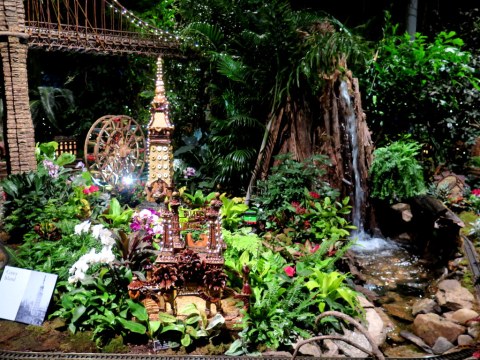
Coney Island, Brooklyn Bridge, Bar Car Nights, Holiday Train Show, NYBG (Carole Di Tosti)

Elephant Colossus, Coney Island, Bar Car Nights, Holiday Train Show, NYBG (Carole Di Tosti)

Wonder Wheel, Coney Island, Bar Car Nights, NYBG Holiday Train Show (Carole Di Tosti)
Whether you move slowly observing all of the sustainable, botanical wonder (stems, leaves, twigs, see pods, pine cones, acorn caps, cinnamon, etc.) that create finials, roof tops, gables, windows, decorative elements and stones, or just jet through taking in the overall sensual experience, you will feel wellness spark your soul. The creative energy, joy and love demonstrated by the details of the structures and placement among the NYBG’s finest living panoramas and water features will delight. It is worth it to take a trip for the evening magic and variety of visual and aural sights that will titillate, yet soothe your senses.
Queensboro Bridge close up, Bar Car Nights, NYBG, Holiday Train Show (Carole Di Tosti)
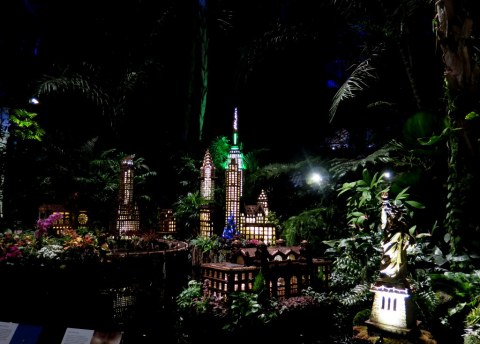
Mid-Manhattan scene, Empire State Building, Chrysler Building, Bar Car Nights, NYBG, Holiday Train Show (Carole Di Tosti)

Another view Mid-town Manhattan, Bar Car Nights, NYBG Holiday Train Show (Carole Di Tosti)

Another view, Ellis Island, Statue of Liberty, Mid-town Manhattan, Bar Car Nights, NYBG Holiday Train Show (Carole Di Tosti)
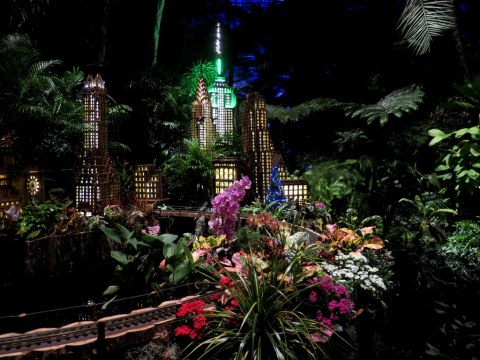
Mid Town Manhattan, Palms of the World Gallery, Bar Car Nights, NYBG Holiday Train Show (Carole Di Tosti)
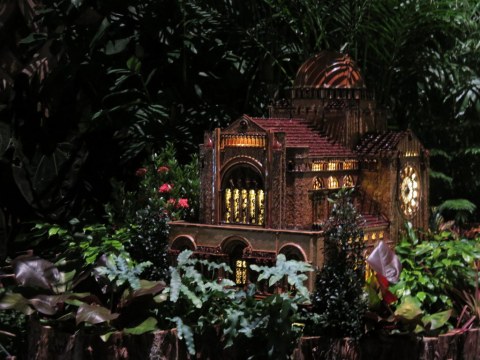
St. Bartholomews, Bar Car Nights, NYBG Holiday Train Show, Palms of the World Gallery (Carole Di Tosti)

Mid-town Manhattan display, daytime view, Palms of the World Gallery, NYBG ‘Holiday Train Show’ (Carole Di Tosti)

The Bronx, old Yankee Stadium, Bar Car Nights, NYBG, Holiday Train Show (Carole Di Tosti)

New York State mansions, Bar Car Nights, Holiday Train Show, NYBG (Carole Di Tosti)
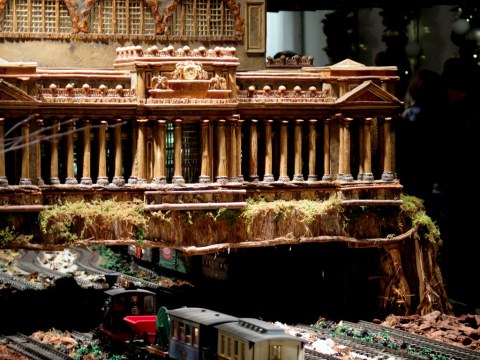
Old Penn Station, Bar Car Nights, NYBG Holiday Train Show (Carole Di Tosti)
The show enjoying 26 years at the New York Botanical Garden has been engineered, created and lovingly collaborated to delight and enthrall by the team at Applied Imagination. Applied Imagination’s baton has passed from creator and founder Paul Busse to his daughter Laura Busse Dolan. She discussed her Dad’s evolving the show over the years. Laura Busse Dolan has fulfilled and maintained her Dad’s intention to create a world of New York grandeur in miniature. And around the fantastic replicas wholly created with sustainable plant parts and biodegradable materials, 25 gauge trains leap, choo-choo, slip smoothly.

Bar Car Nights, NYBG Holiday Train Show (Carole Di Tosti)
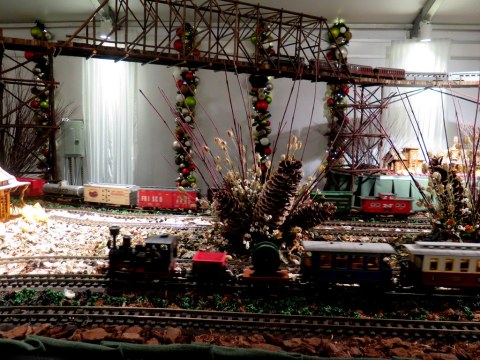
Bar Car Nights, NYBG Holiday Train Show (Carole Di Tosti)
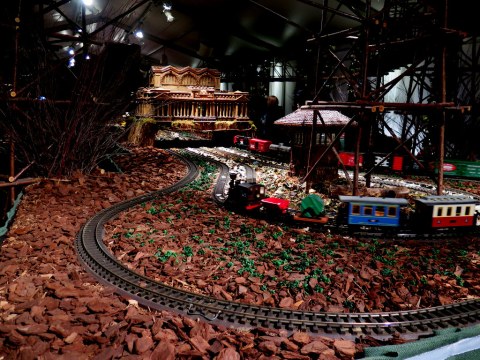
Bar Car Nights, Holiday Train Show, NYBG (Carole Di Tosti)
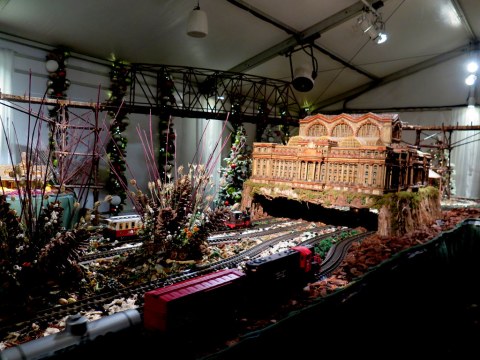
Another view of old Penn Station, Bar Car Nights, NYBG Holiday Train Show (Carole Di Tosti)

Upstate New York Station house inn, Bar Car Nights, NYBG Holiday Train Show (Carole Di Tosti)

Laura Busse Dolan, Owner Applied Imagination, NYBG Holiday Train Show (Carole Di Tosti)
The amazement of Bar Car Nights for me always becomes noting the differences of the daytime Holiday Train Show and the cold wintry evening in the shadowy NYGB. The Enid A. Haupt Conservatory, a fountain of sunlight streaming brilliantly through the latticework and glass cheers. The delicacy of the replicas, the intricacy of their botanical components from magnolia seed pods to cinnamon sticks, bamboo, eucalyptus, acorn caps and more fascinate. How does the team innovate the use of a twig or bark for various buildings to simulate Senator William Clark’s guilded-age mansion? Clearly, their intimacy and knowledge and experience with materials and collaborative efforts prompt them to top themselves each year as they place the buildings among gorgeous flowering shrubs, orchids, palms and water displays.
The NYBG Holiday Train Show ends on 15 January. This is the last week and weekend of the show. You may check for tickets HERE. Bar Car Nights end on 13 of January, this Saturday. Pick up tickets by CLICKING HERE.
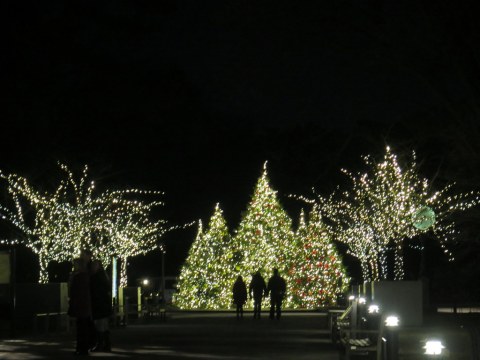
The magic of the NYBG during the winter season on Bar Car Nights for the Holiday Train Show. 13 of January is the last evening you will be able to experience Bar Car Nights. (Carole Di Tosti)
If you missed The Holiday Train Show select programming this year because you were out of town, the show will be presented annually and you should mark your calendar for special events that happen during the winter season inclusive of the Holiday Train Show. From music to dance, from movies to poetry readings, the New York Botanical Garden is a hive of activity for the entire family. If you are a New Yorker, you probably are apprised of this. If you are a global traveler, this is one of the places to be during the Christmas and Holiday season. If you can’t make it this year, check for the show around Thanksgiving in November of next year.

New York Botanical Garden ‘Holiday Train Show’ Lights up The Season

Enid A. Haupt Conservatory replica completed in 2014, NYBG ‘Holiday Train Show’ (Carole Di Tosti)
The Holiday Train Show is always a spectacular reaffirmation of what is beautiful, shining and creative in the human spirit. This year seems more so against a backdrop of tumultuous, grimy political scandals and redundant “breaking news” moments that jar the nerves and chill one’s core. I heartily appreciate an escape from the unsettling thesis of chaos to the antithesis of children’s screams of laughter and twinkling, colorful Holiday lights of assurance. The felt innocence is more lovely than the low details of worldly goings on. And I am uplifted to remember that throughout the labored struggles of men and women who strive to retain power, there is something more worthy and spiritual in the human soul that the season reminds us to seek and direct our attention to.

All trains (more than 25 varieties) are G-scale, NYBG ‘Holiday Train Show’ by Applied Imagination (Carole Di Tosti)

Passenger train speeding over Brooklyn Bridge, above the Coney Island exhibit, NYBG ‘Holiday Train Show’ (Carole Di Tosti)

Locomotive with engineer in at the helm, NYBG ‘Holiday Train Show’ (Carole Di Tosti)
Thus, for me especially this year, and for the friends I visit with, The Holiday Train Show in the New York Botanical Garden is a sanctuary of refinement, a haven of peace. Amidst the lovingly arranged pageantry, the plantings strike poses between the stunning miniature replicas of New York’s icons, historical landmarks and stupendous structures of the gilded age, made into museums or torn down because they were too expensive to maintain.

Senator William Clarke mansion (Clarke’s Folly) the end of the Gilded Age, finished 1911, demolished 1927, created by Paul Busse and his team at Applied Imagination, NYBG ‘Holiday Train Show’ (Carole Di Tosti)

Detail, Senator William Clarke’s mansion, NYBG ‘Holiday Train Show’ by Applied Imagination and Paul Busse (Carole Di Tosti)
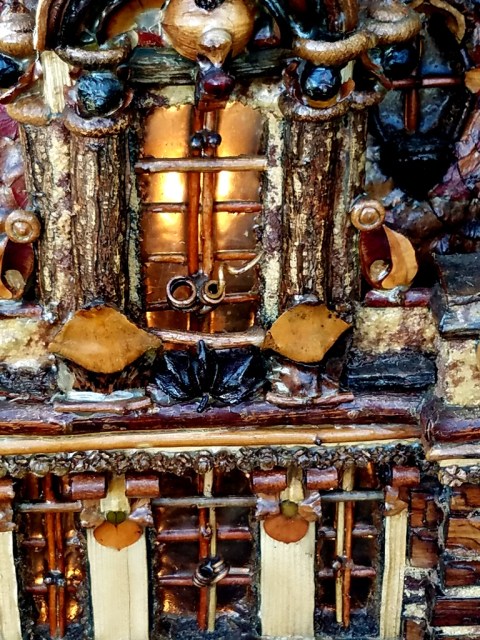
Window detail of leaves, twigs, berries, bark on the replica of Senator William Clarke mansion, NYBG ‘Holiday Train Show’ (Carole Di Tosti)
As I note the complexity of the constructions from plant parts as tiny as a barely seed and as large as a gourd, and wander slowly in amazement at the specificity of creation, solace is delivered in cupfuls and happiness in bushels. I take picture after picture, trying to stir my memories about the location of the recreations in previous years.

Replica of Poe Cottage, Fordham in the Bronx, NYBG ‘Holiday Train Show, Applied Imagination (Carole Di Tosti)
If I take my time without rushing to the show finale, my memory serves me. The Poe house is situated more prominently this year on the opposite side of the central theatrical showcase. I am glad because I am writing a play about Poe and I feel akin to this replica. For example, I know that Poe’s wife Virginia Clemm died of tuberculous in Poe Cottage which is in Fordham in the Bronx a few miles from the Garden. The replica is modest, a no frills structure which is a miniature facsimile of the real Poe Cottage. The Poes were impoverished for all of their marriage a terrific irony considering just one of Poe’s short handwritten letters brought in almost $100,000 at auction a few years ago.

Replica of the Stephen A. Schwarzman Building (NYPL), NYBG ‘Holiday Train Show’ by Applied Imagination team (Carole Di Tosti)

Coney Island Exhibit, Brooklyn Bridge, Wonder Wheel, Luna Park and more, NYBG ‘Holiday Train Show’ (Carole Di Tosti)
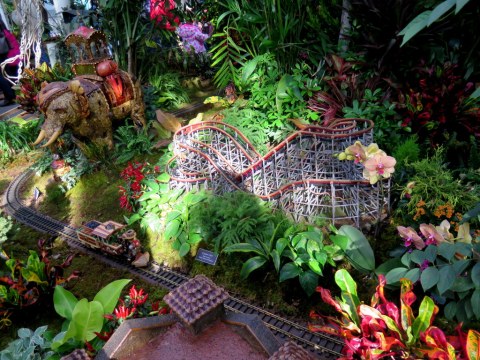
Coney Island display, Elephantine Colossus, Cyclone, train of plant parts, NYBG ‘Holiday Train Show’ (Carole Di Tosti)

Elephantine Colossus Hotel replica, Coney Island Display, NYBG ‘Holiday Train Show,’ by Applied Imagination team and its founder Paul Busse (Carole Di Tosti)
I see that the New York Public Library (Stephen A Schwartzman building) is up front and center as it should be. The Fifth Avenue Manhattan library with the stentorian lions is under renovation and receiving technological updates that will be completed by 2020. I note that the Coney Island display is prominent with the Elephantine Colossus, Wonder Wheel (now a film of the same name by Woody Allen about Coney Island and gangsters), The Steeple Chase, Luna Park, the Cyclone (with moving parts) and more. These structures backdropped with waterfall and reflecting pools are encircled by sauntering trains lazily enjoying their pace in the 360 degree central showcase of the Enid A. Haupt Conservatory. Last year they were in the Palms of the World Gallery.

Coney Island display, Wonder Wheel, Lighthouse, Brooklyn Bridge, NYBG ‘Holiday Train Show,’ by Applied Imagination team (Carole Di Tosti)
As I appreciate the Elephantine Colossus so carefully and brilliantly created out of variously shaped gourds and other plant pieces, I consider Leslie Salka’s (Director of Applied Imagination whose creations we love) comments about the construction of the replica of the Elephant shaped hotel. The unusual structure was an example of the period’s novelty architecture, designed by James V. Lafferty to bring in tourists. The seven-story building, which served as a hotel, concert hall and amusement bazaar, stood above Surf Avenue from 1885 to 1896 when it burned down. Leslie decided they should include the hotel in the Coney Island display in memoriam of Topsy the female elephant who was electrocuted in Coney Island’s Luna Park in 1903.

Elephantine Colossus Hotel replica at Coney Island display, NYBG ‘Holiday Train Show’ (Carole Di Tosti)

Mushrooms, gourds in detail of Elephantine Colossus Hotel replica, Coney Island display, NYBG ‘Holiday Train Show’ (Carole Di Tosti
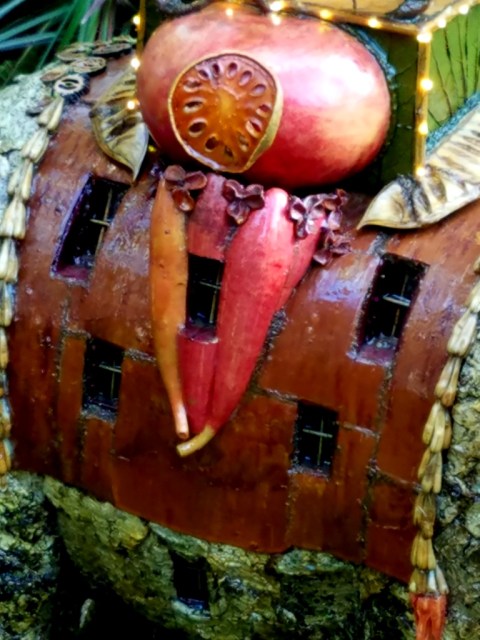
Detail of plant parts, Elephantine Colossus Hotel replica, Coney Island display, NYBG ‘Holiday Train Show,’ Applied Imagination (Carole Di Tosti)
Topsy’s demise had been all but forgotten until someone noted a film had been made of her electrocution and clips of it were included in a Ric Burns documentary about Coney Island. After Burns’ film the subject of Topsy’s death has been featured in popular culture and media and has been the subject of poetry, fiction, songs and journalist Michael Daly’s book about her. Contrary to belief there is no purported direct association of Topsy’s death at Luna Park with Thomas Edison. Though Edison did electrocute animals 15 years earlier during the War of Currents when he was attempting to demonstrate the dangers of alternating current, he was not responsible for Topsy’s death. The Elephantine Colossus replica is gorgeous and the backstory of Topsy’s life and death, the preservation of the film clip, and her rise to celebrity is a notable piece of history found in The Holiday Train Show if you enjoy digging deeper.

Macy’s sign is made up of white barley seeds and cayenne pepper flakes, NYBG ‘Holiday Train Show’ (Carole Di Tosti)

Novelty car, NYBG ‘Holiday Train Show’ (Carole Di Tosti)

Painted butterfly on novelty car, NYBG ‘Holiday Train Show,’ Applied Imagination (Carole Di Tosti)
What I particularly appreciate about The Holiday Train Show is that there is something for everyone young and ancient. Children see the trains and love to hear and watch them. Adults see the history, and depending upon their day and mood go deep or gloss over the displays. No one sees all of it during each visit. If you glean 20% of the entire production which pays homage to history, trains, New York, the five New York City boroughs and their landmarks interspersed fancifully throughout the Garden’s botanical kingdom, you will have walked away with a treasure.
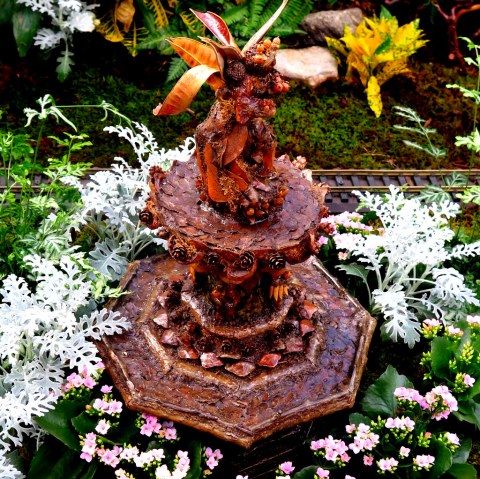
Angel of the Waters replica, Central Park display, NYBG ‘Holiday Train Show,’ Applied Imagination (Carole Di Tosti)
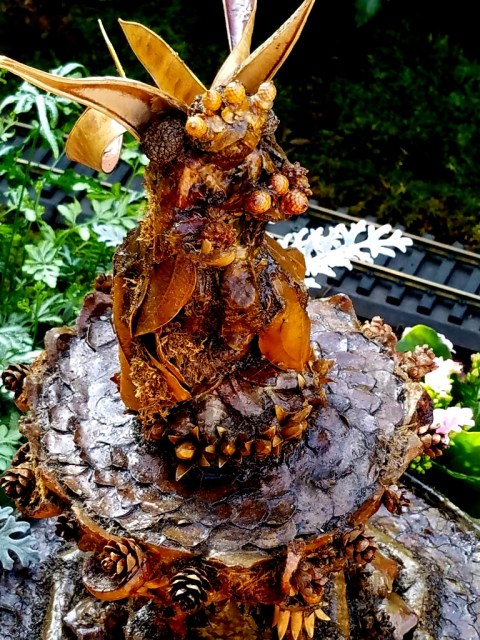
Detail berries, mini pine cones, seeds, leaves, twigs, bark, pods, Angel of the Waters, NYBG ‘Holiday Train Show’ (Carole Di Tosti)
The Show is overwhelming. So one may jaunt through it appreciating the overarching dazzling spectacle and briefly glance at the replicas, taking a few moments to identify the name of a particularly striking recreation. Or you may more closely observe, inspect and take a leisurely microscopic view of how each of the replicas was assembled ingeniously with twigs, varieties of flower and grain seeds, pine cones, stems, leaves, nut shells, acorn caps, pods, gourds, varieties of moss, mushrooms, flowers, herbs, spices and more.

streetcar over Brooklyn Bridge, NYBG ‘Holiday Train Show’ (Carole Di Tosti)
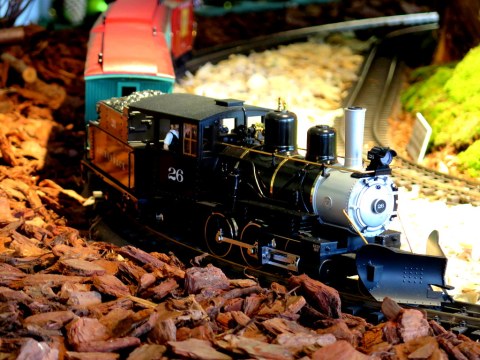
NYBG ‘Holiday Train Show’ (Carole Di Tosti)
And the trains? Use your phone video feature to capture the particularly cool passenger trains or trolleys flying over the Manhattan or Queensboro bridge high above your head. Most NYC bridges (five out of the nine) are featured. Or snap the cute novelty cars painted with butterflies or other insects trolling back and forth over the tracks. All of the trains are G-scale, whether ancient or modern, whether locomotives and freight cars or diesel engines, electrified passenger trains, trolleys and streetcars. There are over 25 full fledged train set ups clanging, whirling, zipping, steaming, chugging, purring and careening over 1/2 mile of track situated between rocks, over bridges and water features, through tree stump tunnels and under low hanging tree branches throughout the conservatory.

Trains coming out of historic Penn Station, NYBG ‘Holiday Train Show’ (Carole Di Tosti)

Hudson Valley train station, since demolished, NYBG ‘Holiday Train Show’ (Carole Di Tosti0

Historic Penn Station demolished in 1963, NYBG ‘Holiday Train Show’ (Carole Di Tosti)
In the 3000 foot 360 degree display whose extension was added a few years ago, you’ll see a grand memorial to traindome. You’ll note various New York historical station replicas that are throwbacks to a time when travelers stayed at inns before they journeyed to relatives. These have since been torn down to make way for flat-looking, rectangular, unappealing buildings signifying what has been lost to progress. You will note Grand Central Station saved by Jacqueline Onassis and the magnificent station that developers couldn’t wait to get their grimy hands on, the Beaux Arts beauty, built in 1910, Pennsylvania Station. The Applied Imagination replica is a memorial to history, grand architectural effort that remains timeless though Penn Station itself was torn down in 1963. But there the miniature building stands for us to admire at The Holiday Train Show. Just consider that for a second or two.

Palms of the World Gallery, mid-town Manhattan display, NYBG ‘Holiday Train Show’ (Carole Di Tosti)
The Palms of the World Gallery exhibit is the glorious conclusion that sends you out into the sterling night of stars if you go to Bar Car Nights (December 22, 23, 29, 30, January 6, 13) with a date, friends or are just slumming by yourself. Or if brushing by the palm fronds with goodbyes to Garden staff dressed as train engineers you slip from the tropical paradise into the bright, cold atmosphere and sunshine with a beaming smile on your face because the final exhibit is just…just. Well! You’ll have to go and see the show and come up with your own descriptors. Marvelous? Rising? Scintillating? Neat? Memorable? Illustrious?

Ellis Island display, NYBG ‘Holiday Train Show’ (Carole Di Tosti)
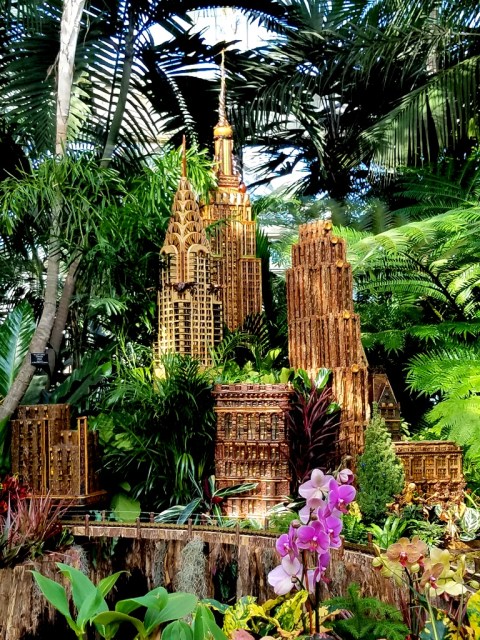
Chrysler Building, Empire State Building, GE Building replicas renovated as new. NYBG ‘Holiday Train Show’ (Carole Di Tosti)

Palms of the World Gallery, NYBG ‘Holiday Train Show’ (Carole Di Tosti)

Palms of the World Gallery, NYBG ‘Holiday Train Show’ (Carole Di Tosti)
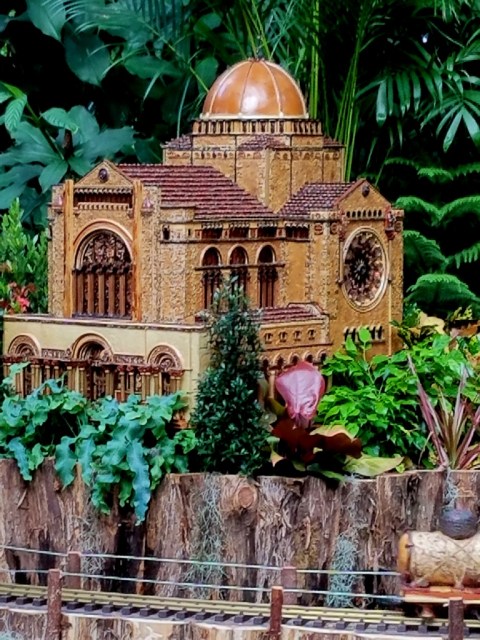
St. Bartholomew replica, Palms of the World Gallery, NYBG ‘Holiday Train Show’ (Carole Di Tosti)

Statue of Liberty drape is made of bamboo, NYBG ‘Holiday Train Show’ (Carole Di Tosti)
It’s all of that and more as the display in the large reflecting pool glimmers and splits into double images which lengthen the buildings and set them skimming across the water. This segment in particular memorializes why Manhattan is its own tribute to itself: skyscraper-particular, iconic, architecturally astonishing, mesmerizing, glowing. Whether its Rockefeller Plaza, Ellis Island, the Statue of Liberty, the GE Building, the Empire State Building, the Chrysler Building, St. Bartholomew’s Church, this is what tourists, natives and even botanical adventurers love about New York City. Take some time to especially view the last four replicas listed here, all of which are new.
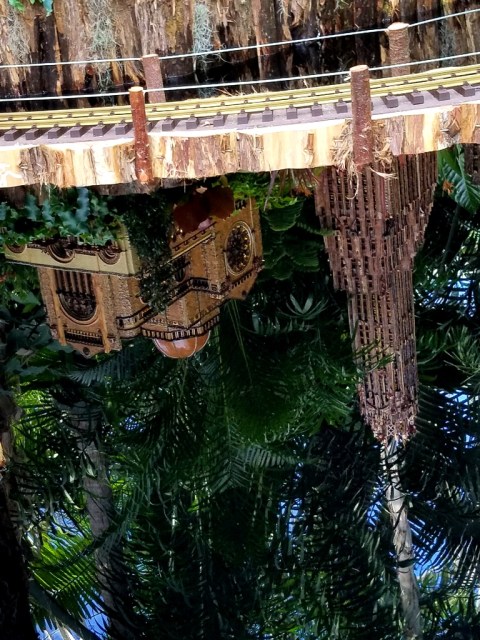
Reflections in water, Empire State Building replica, St. Bartholomew replica upside down, Palms of the World Gallery, NYBG ‘Holiday Train Show’ (Carole Di Tosti)

Upside down reflections, Queensboro Bridge in mid-Manhattan display, Palms of the World Gallery, NYBG ‘Holiday Train Show’ (Carole Di Tosti)
I was struck by the extravagant details and was rather gobsmacked at the illusion which is created in this gallery. These buildings effect their namesakes, but are built with completely organic, sustainable materials, unlike their reality of concrete, glass and steel. The effect will draw you in as you remember the essence of the Applied Imagination’s vision to set a monument to nature’s ineffable and infinite botanical variety and the wonder of at plants’ creative usefulness as building blocks for humans. Read that sentence again, to ken the full meaning. Heart!
Mid-town Manhattan display, another view, Palms of the World Gallery, NYBG ‘Holiday Train Show’ (Carole Di Tosti)

Laura Busse Dolan, owner of Applied Imagination, daughter of Paul Busse. NYBG ‘Holiday Train Show,’ Palms of the World Gallery (Carole Di Tosti)
There is no leaving the Palms of the World Gallery after the first minute of arrival. You leave when you receive the full effect of the display upon your senses and decide that The Holiday Train Show is a celebration of the best of who we can be as creators and lovers of nature’s bounty of which we are an integral part.
For all the intriguing programming during the Train Show, from the Evergreen Express and family events, Billy Collins poetry reading and more, go to the Garden website HERE. For BAR CAR NIGHTS, HERE. To learn about Paul Busse artistic visionary, founder and 25 year creator of Applied Imagination replicas and themes with his team click HERE.

Los Angeles Online Film Critics Society Nominations


(L to R): Darryl Poniscan, Laurence Fishburne, Bryan Cranston at NYFF Q and A, ‘Last Flag Flying’ (Carole Di Tosti)
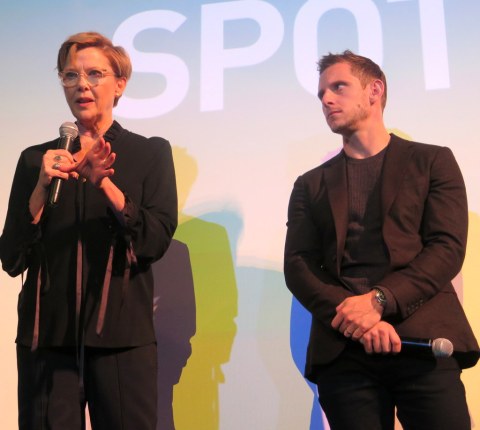
Annette Bening, Jamie Bell, Q & A ‘Film Stars Don’t Die in Liverpool,’ HIFF 2017 (Carole Di Tosti)

(L to R): Michael Stuhlbarg, Timothée Chalamet, Armie Hammer, Director Luca Guadagnino in ‘Call Me By Your Name’ Q & A at NYFF 2017, hosted by Nigel M. Smith (courtesy NYFF Talks)
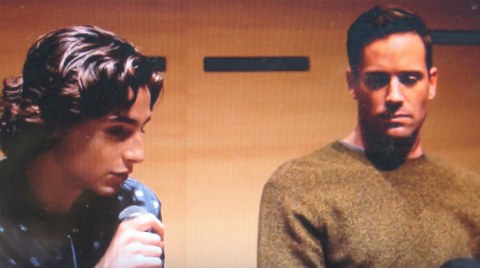
Timothée Chalamet, Armie Hammer, NYFF 2017 ‘Call Me By Your Name’ Q & A hosted by Nigel M. Smith (courtesy NYFF Talks)
Guillermo del Toro’s The Shape of Water leads with 11 nominations while Greta Gerwig’s Lady Bird lands in second place with nine and Christopher Nolan’s Dunkirk in third with eight.
(Los Angeles, CA – December 4th, 2017) – The Los Angeles Online Film Critics Society (LAOFCS) is pleased to announce that their Awards Ceremony will be held on January 3rd, 2018, at which time the winners will be announced.
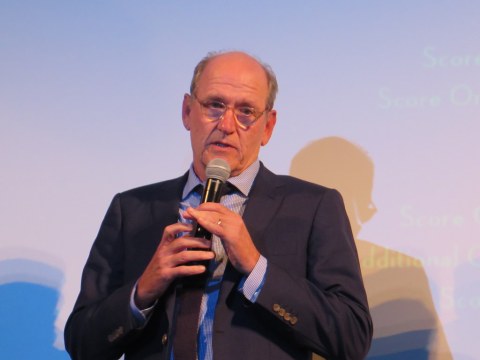
Richard Jenkins ‘The Shape of Water,’ HIFF 2017 Q & A (Carole Di Tosti)
Fox Searchlight’s The Shape of Water tops the nominations list with eleven nominations including Best Picture and Best Original Screenplay while Lady Bird earns nine nominations and Dunkirk earns eight. Jordan Peele’s massive hit, Get Out scores nominations for Best Male Director and Best First Feature.

Ruben Ostend, director ‘The Square,’ NYFF 2017 Q & A (Carole Di Tosti)
Studio films such as Wonder Woman, War for the Planet of the Apes, and Blade Runner 2049 are also among the nominations scoring five nominations each.
A few smaller released films have found their place on the nominations list including Neon’s Colossal, Trademark Films & Break Thru Films’ Loving Vincent, and the Sundance Institute’s Columbus.

Diane Kruger, ‘In the Fade,’ HIFF 2017 Q & A (Carole Di Tosti)
Saoirse Ronan and Timothée Chalamet are each nominated for Best Actress and Actor as well as Best Performance by an Actor or Actress Under the Age of 23.
The Los Angeles Online Film Critics Society is pleased to announce that it is the first ever critics group to feature two Best Director categories; one for female and one for male. “There has been so much conversation about the power of female filmmakers and we wanted to embrace it,” said Mantz. “There is a Best Actor and Best Actress category as well as Best Supporting Actor and Actress, so why not have a Best Male Director and Best Female Director category?” asked Menzel. Good idea considering more attention must be given to the exceptional work of female directors who are often closed out in favor of their male counterparts.
In total, the Los Angeles Online Film Critics Society members have nominated over forty different films ranging from smaller art-house releases to major blockbusters.
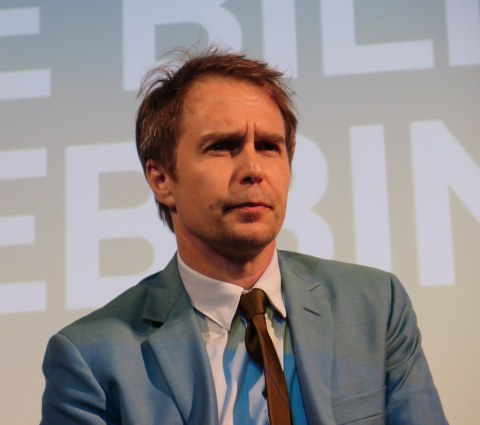
Sam Rockwell, HIFF 2017 ‘Three Billboards Outside Ebbing, Missouri’ (Carole Di Tosti)
Nominations for the first Annual Los Angeles Online Film Critics Society Awards:
BEST PICTURE
The Big Sick
Colossal
Call Me By Your Name
Get Out
I, Tonya
Lady Bird
Molly’s Game
The Post
The Shape of Water
Three Billboards Outside Ebbing, Missouri

Bryan Cranston, ‘Last Flag Flying,’ NYFF 2017 Q & A (Carole Di Tosti)
BEST FEMALE DIRECTOR
Dee Rees, Mudbound
Greta Gerwig, Lady Bird
Kathryn Bigelow, Detroit
Patty Jenkins, Wonder Woman
Sofia Coppola, The Beguiled
BEST MALE DIRECTOR
Christopher Nolan, Dunkirk
Guillermo del Toro, The Shape of Water
Jordan Peele, Get Out
Luca Guadagnino, Call Me By Your Name
Steven Spielberg, The Post

Jamie Bell, ‘Film Stars Don’t Die in Liverpool,’ HIFF 2017 Q and A (Carole Di Tosti)
BEST ANIMATED / VISUAL EFFECT PERFORMANCE
Andy Serkis, War for the Planet of the Apes
Doug Jones, The Shape of Water
Dan Stevens, Beauty and the Beast
BEST EDITING
Baby Driver
Dunkirk
I, Tonya
The Post
The Shape of Water
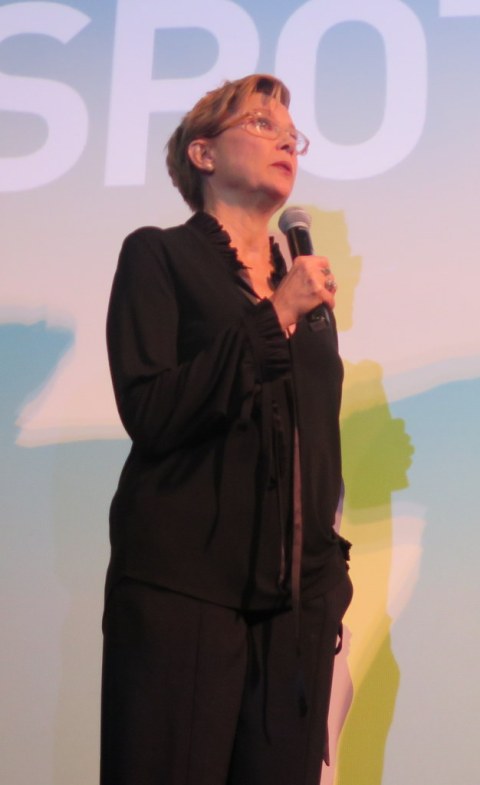
Annette Bening, HIFF 2017 Q & A ‘Film Stars Don’t Die in Liverpool,’ (Carole Di Tosti)
BEST SCORE
Blade Runner 2049
Dunkirk
Phantom Thread
The Shape of Water
War for the Planet of the Apes
BEST STUNT WORK
Atomic Blonde
Baby Driver
Dunkirk
John Wick: Chapter 2
Wonder Woman
BEST PERFORMANCE BY AN ACTOR OR ACTRESS UNDER 23 YEARS OLD
Brooklynn Prince, The Florida Project
Dafne Keen, Logan
Jacob Tremblay, Wonder
Saoirse Ronan, Lady Bird
Timothée Chalamet, Call Me By Your Name
BEST SCI-FI/ HORROR
Blade Runner 2049
Get Out
It
It Comes at Night
The Shape of Water
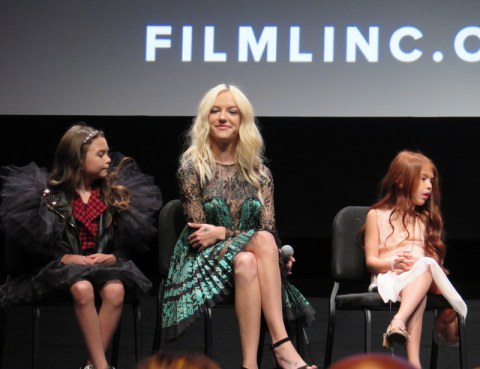
(L to R): Brooklyn Prince, Bria Vinaite, Valeria Cotto, NYFF 2017 Q & A ‘The Florida Project’ (Carole Di Tosti)
BEST ACTION/WAR
Baby Driver
Dunkirk
Logan
War for the Planet of the Apes
Wonder Woman
BEST COMEDY/MUSICAL
The Big Sick
The Disaster Artist
Girls Trip
I, Tonya
Lady Bird
BEST FIRST FEATURE
Aaron Sorkin, Molly’s Game
Greta Gerwig, Lady Bird
Kogonada, Columbus
Jeremy Gasper, Patti Cake$
Jordan Peele, Get Out

Armie Hammer, HIFF 2017 Red Carpet, ‘Call Me By Your Name,’ (Carole Di Tosti)
BEST INDEPENDENT FILM
The Big Sick
Colossal
A Ghost Story
I, Tonya
Lady Bird
BEST BLOCKBUSTER
Beauty and the Beast
Dunkirk
Logan
War for the Planet of the Apes
Wonder Woman
BEST CINEMATOGRAPHY
Bruno Delbonnel, Darkest Hour
Dan Laustsen, The Shape of Water
Hoyte van Hoytema, Dunkirk
Rachel Morrison, Mudbound
Roger Deakins, Blade Runner 2049
BEST VISUAL EFFECTS
Blade Runner 2049
Dunkirk
The Shape of Water
War for the Planet of the Apes
Wonder Woman
BEST DOCUMENTARY
An Inconvenient Sequel
Jane
Jim & Andy: The Great Beyond
Step
Whose Streets?

(L to R): Bryan Cranston, Steve Carell, Laurence Fishburne in ‘Last Flag Flying,’ (courtesy of the film)
BEST FOREIGN LANGUAGE FILM
BPM, France
First They Killed My Father, Cambodia
In the Fade, Germany
The Square, Sweden
Thelma, Norway
BEST ANIMATED FILM
The Breadwinner
Coco
Captain Underpants: The First Epic Movie
The LEGO Batman Movie
Loving Vincent
BEST ORIGINAL SCREENPLAY
Emily V. Gordon & Kumail Nanjiani, The Big Sick
Greta Gerwig, Lady Bird
Guillermo del Toro & Vanessa Taylor, The Shape of Water
Jordan Peele, Get Out
Martin McDonagh, Three Billboards Outside Ebbing, Missouri

(L to R): Sam Rockwell, David Nugent, HIFF 2017 Q & A ‘Three Billboards Outside Ebbing, Missouri (Carole Di Tosti)
BEST ADAPTED SCREENPLAY
Aaron Sorkin, Molly’s Game
Luca Guadagnino, James Ivory, & Walter Fasano, Call Me by Your Name
Michael H. Weber & Scott Neustadter, The Disaster Artist
Scott Frank, James Mangold, & Michael Green, Logan
Virgil Williams & Dee Rees, Mudbound
BEST SUPPORTING ACTRESS
Allison Janney, I, Tonya
Holly Hunter, The Big Sick
Laurie Metcalf, Lady Bird
Octavia Spencer, The Shape of Water
Tiffany Haddish, Girls Trip
BEST SUPPORTING ACTOR
Idris Elba, Molly’s Game
Michael Stuhlbarg, Call Me By Your Name
Patrick Stewart, Logan
Sam Rockwell, Three Billboards Outside Ebbing, Missouri
Williem Dafoe, The Florida Project
BEST ACTRESS
Frances McDormand, Three Billboards Outside Ebbing, Missouri
Margot Robbie, I, Tonya
Jessica Chastain, Molly’s Game
Sally Hawkins, The Shape of Water
Saoirse Ronan, Lady Bird
BEST ACTOR
Daniel Kaluuya, Get Out
Gary Oldman, Darkest Hour
James Franco, The Disaster Artist
Timothée Chalamet, Call Me By Your Name
Tom Hanks, The Post

‘Desperate Measures’ An Exceptional, Hilarious Musical Tweak of ‘Measure for Measure’
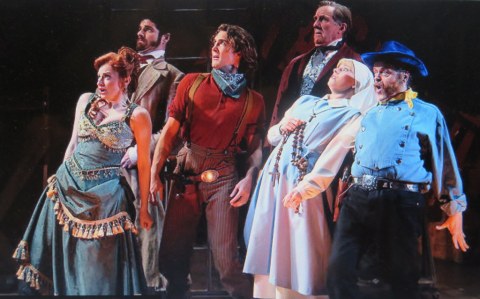
(L to R): Lauren Molina, Peter Saide, Conor Ryan, Nick Wyman, Emma Degerstedt, Gary Marachek in ‘Desperate Measures,’ York Theatre Company (Carol Rosegg)
Shakespeare’s comical plot of Measure for Measure radiates with riotous and melodic, exceptionalism in the glorious musical Desperate Measures. The musical currently at the York Theatre shines like no other rendition of Shakespeare’s work because of the adroit skill of the playwright Peter Kellogg who wrote the book and lyrics. Coupled with the musicality and memorable compositions by David Friedman, Desperate Measures is an incredible hit that is biding its time to make its mark on Broadway.
The comedy is non stop. The brilliant, clever story twists run rampant throughout. Indeed, the Western update of Shakespeare’s work is lifted to satiric high farce. Set to an illustrative musical songscape which is both appealing and profound, Desperate Measures delivers moment to moment fun and enthralls with good will and joy.
Thus far, I have taken my measure of this production twice. Each time I’ve appreciated the specific, brilliant direction by Bill Castellino. His acting ensemble’s choreographed movements during the musical numbers are reminiscent of the amazing work of the great Graciela Daniele. Additionally, the six-member cast portray the spin-off Shakespearean characters with invested realism and inventiveness that reves up the humor and makes it a stand-out. The cast’s unparalleled singing and cavorting through the setting of the 1890s Old West transforms many of the fantastical elements into searing present-day themes.

(L to R): Peter Saide, Emma Degerstedt, Conor Ryan in ‘Desperate Measures,’ York Theatre Company (Carol Rosegg)
For that reason alone. this production must be seen. Uplift and encouragement suggest hope throughout each Act. Above all Desperate Measures brings us the wonderful reminder that laughter provides goodness like a wholesome medicine. And bitterness dries up the bones. So! You need a dose of healthful chortles? This show sheds them in abundance.
In ‘The Ballad of Johnny Blood” the ensemble and Johnny (an adorable, multi-talented, effusive and expertly winning Conor Ryan), introduce the conflict. Prisoner Johnny will hang for the love of a woman who unwittingly caused his downfall when he shot his rival in self-defense. However, Johnny has an advocate in the Sheriff (the equally adorable, smooth, brilliant, reserved, heroic Peter Saide), who guards him. The Sheriff creates an effective plan to soften the law and order governor of the territory (the hilarious, preening, fascist, sexual predator Nick Wyman). The softener, Sister Mary Jo (the exquisitely voiced and excellent Emma Degerstedt), will plead for her brother’s release.
To convince the Sister to visit the governor, the Sheriff sings “That’s Just How It Is.” The superb lyrics of this tuneful, beautifully rendered song by Saide carry one of the vital themes of the production. The unfair culture creates economic injustice. The rich prosper. The children of the poor suffer. Rarely can one upturn this dynamic. However, every now and then a time comes when goodness can prevail. If people take a stand and “speak up,” they can make a difference. The demure and innocent Sister Mary Jo, persuaded by the Sheriff’s challenge decides to ask for her brother’s pardon.

Lauren Molina, Conor Ryan in ‘Desperate Measures,’ York Theatre (Carol Rosegg)
Of course the novitiate, has no idea of the nefariousness of the governor. We recognize his qualities immediately with Wyman’s Governor’s “Some Day They Will Thank Me.” In the song, the arrogant, presumptive, martinet reveals he is a blaggard. As the Sheriff prompts her to be more convincing with the Governor, Susanna sings “Look in Your Heart.” Unfortunately, Wyman’s Governor confirms our worst fears about those in power. Because Susanna persuades him with her lyrical loveliness, the Governor ties her up in a Gordian knot. He will release Johnny for one night of Susanna’s love.
In the beautifully wrought “Good To Be Alive,” (a high-point among many in the show), Johnny begs his sister. Trade her chastity for his life. The humorous debate that ensues leaves Johnny facing death. And Susanna’s refusal to give her chastity to the Governor over her brother’s pleas appears cold-hearted. Nevertheless, once again, the brilliant Sheriff comes up with an ingenious (and hysterical), plan to obtain the pardon.
However, will this ridiculous and incredible plan work? To encourage themselves, Johnny the Sheriff and Susanna (Sister Mary Jo’s real name) are joined by the alcoholic, atheistic priest (the hysterical Gary Marachek), to sing the uplifting “It Doesn’t Hurt to Try.” Indeed, since the risk of life and death is great, any plan that can stave off the hangman’s noose for Johnny is a boon. Thus, off Susanna and the Sheriff go to set the plan in motion eliciting the help of Johnny’s love Bella (the wonderful Lauren Molina), whose occupation as a saloon singer gives her special talents to work a miracle for Johnny’s life.
Following the basic plot of Measure for Measure, yet giving it a modern Old Western twist, Desperate Measures follows with the parallels yet adds its own flavor through the lyrics and tuneful songs. For example, in order to train Bella for her upcoming role where she switches places with Sister Mary Jo, the Sheriff assists Sister Mary Jo in teaching Bella how to present herself in “The Way You Feel on the Inside.” Additionally, as the situation to save her brother’s life has thrown the Sheriff and Sister Mary Jo together, we recognize a budding romance between them which neither wants to acknowledge. The Sheriff especially, a proud man, doesn’t even want to contemplate that he is attracted to Sister Mary Jo, who will be taking her vows to be a nun in the next few days. The memorable “Stop There” recalls the fear of unrequited love and identifies the reality of the pain of falling in love and allowing one’s imagination to run away before the love interest accepts being loved.
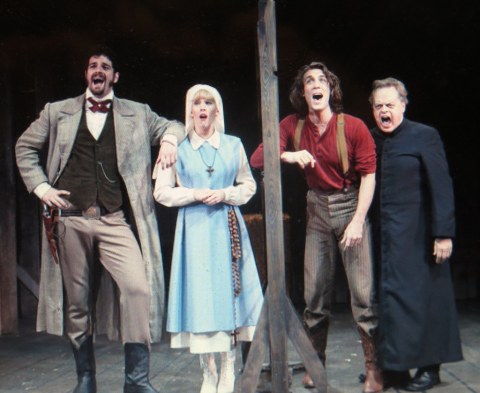
(L to R): Peter Saide, Emma Degerstedt, Conor Ryan, Gary Marachek in ‘Desperate Measures,’ York Theatre Company (Carol Rosegg)
To conclude Act I the ensemble joins in the thrumming song “In the Dark.” As each individual identifies that the darkness is the place where anything can happen, they encourage themselves to hope for their desires. For Johnny it is his release. For the Governor it is a fulfillment of his passion for Sister Mary Jo. For Bella who is duping the Governor, she hopes for the ability to pull off the deception that she is Sister Mary Jo. For the Sheriff and Sister Mary Jo (Susanna) they secretly yearn for the hope that they might be able to love one another. The musical number beautifully caps the conflicts and themes of Act I and establishes the set up for the resolution of the conflicts in the second act.
The Governor’s fabulous seduction scene, the ensuing hi-jinks and the heroic actions of Johnny’s love, Bella, transport us to comedic heights. How the conflicts thread their way to the conclusion, bring the characters together and apart again. And they resolve in a hysterical climactic scene which brings down the house. The music of the second act is as heady as is the first. And once more, the various songs resonate as does the clever rhyming dialogue.
Memorable and engaging, this is a production where the smarmy villain receives his comeuppance. And where an alcoholic, atheist priest manages to redeem himself. There is love, unique heroism, surprising justice, and redemption for even the wicked. Perhaps! As for the specifics, this review holds no spoiler alerts. You will just have to see this most superb musical production to discover the incredibly clever rhymes and production’s tremendous vibrance for yourself.

(L to R): Peter Saide, Lauren Molina, Emma Degerstedt in ‘Desperate Measures,’ York Theatre Company (Carol Rosegg)
Can there be a better rollicking, musical update of Shakespeare’s Measure for Measure? I think not!
I cannot say enough about the music (folks have asked when the CDs will go on sale), and the lyrics and book by this prodigiously adroit team of Kellogg and Friedman. The functional and minimalistic Western sets trope the humor, time and place, as do the costumes. Their simplicity carries the farce and comedy, yet makes room for the dark, ironic undertones in the themes. Thankfully, the characters in this production suit the measure with which they have bestowed grace and beauty. However, such does not occur in life, as Kellogg reminds us and Shakespeare reminds us in Measure for Measure.
Nevertheless, the show’s currency resonates timelessness. Heroes may thwart villains. Innocence may triumph over corruption. Love may save. Justice might win out despite overwhelming odds. Does absolute power corrupt in Desperate Measures? Indeed, as it corrupts in Measure for Measure. Both works reflect the vicissitudes that confront individuals whether in the Old West 1890 or in our current world. However, when good men rise up to stand against lust, avarice and overweening privilege, the light of truth can disperse the darkness. That it does so tunefully, memorably, riotously in Desperate Measures is very welcome for us at this time.
Kudos to the musicians David Hancock Turner, Justin Rothberg, Joseph Wallace, Douglas Waterbury-Tieman. And accolades to the design team James Morgan, Nicole Wee, Paul Miller Julian Evans for their creative exploits on Desperate Measures. A word to the wise. The production most probably will be moving to a more expensive venue. This New York premiere has already enjoyed two extensions. See it now, so you will be able to see it again. You will be thrilled you did.
Desperate Measures runs with one intermission. It will be at The York Theatre (619 Lexington Avenue) until 26th November.

Off Broadway Theater Review: ‘Wood Calls Out to Wood’ at The Tank
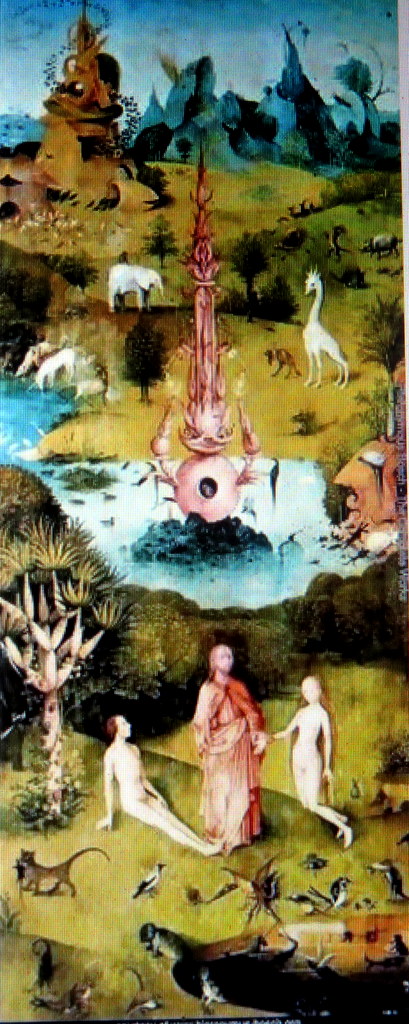
Hieronymous Bosch’s ‘Garden of Earthly Delights,’ panel #1, courtesy of this site.
Hieronymus Bosch’s 15th century triptych “The Garden of Earthly Delights,” never fails to amaze and intrigue. In Fisher Stevens’ exceptional Before The Flood which examines global warming/climate change and shadows Leonardo DiCaprio’s quest as United Nations Messenger of Peace on climate change, Stevens references Bosch’s work.
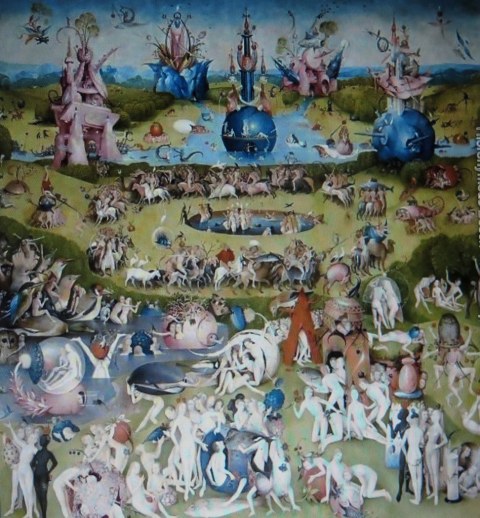
Hieronymous Bosch’s ‘Garden of Earthly Delights,’ panel #2, courtesy of the site.
The Garden of Earthly Delights which hung over DiCaprio’s bed when he was a kid becomes a the monumentally symbolic metaphor at the central point of Before the Flood.. The director elucidates the triptych and reveals Bosch’s progression from panel to panel. Mankind was given the power of the beautiful Garden (our planet Earth) and in seeking forbidden knowledge of good and evil, created a nightmare world that his very nihilism and self-hate (sin) currently is effecting the destruction of his own species, every other species and the eco-systems of the planet, which results in a hellish state (panel three).
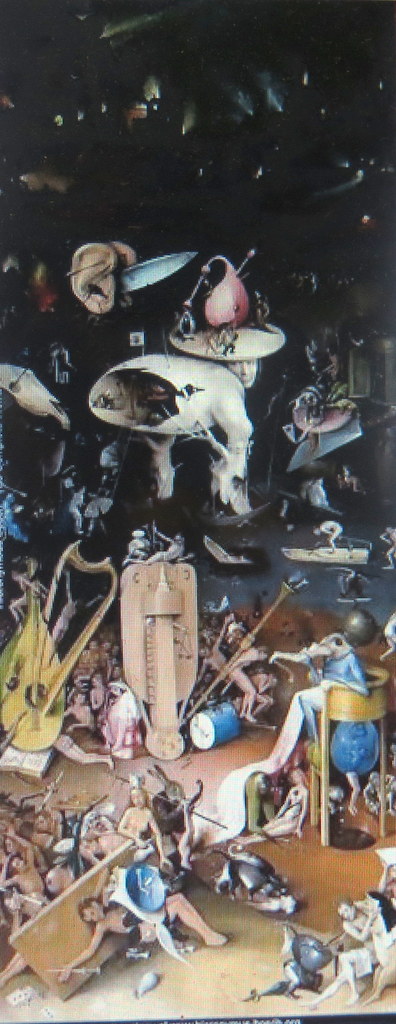
Hieronymous Bosch’s ‘Garden of Earthly Delights,’ panel #3, courtesy of the site.
Corinne Donly’s Wood Calls Out to Wood, directed by Sarah Hughes currently at The Tank until 12 November presents a different interpretation of Bosch’s work. However, before one travels to The Tank to see the production which translates Bosch’s work from wood and paint into a live play creation, shimmering, colorful, fanciful and more, acutely review the Bosch triptych.
The assumption the playwright makes is that the audience carries around the detailed visual memory of the three panels and with that prodigious knowledge can correlate the dialogue, actors, sets, costumes and objects used with the various panels. I admit my own failing. Without nary a projection of Bosch’s triptych, I became hard pressed to recognize various associations. However, I gather, that was one theme of this work, as abstruse, opaque and self-possessed as it was.
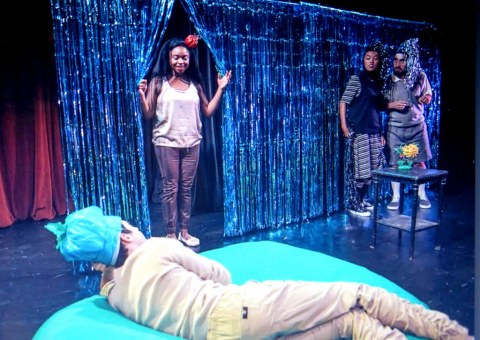
Foreground: Connor James Sheridan, L to R background: Tanyamaria, Lanxing Fu, Will Dagger in ‘Wood Calls Out to Wood,’ by Corinne Donly, directed by Sarah Hughes (Sasha Arulyunova)
The often poetic dialogue and nonsensical ramblings of the characters inspired by a few figures in Bosch’s work kept one interested by its sheer dense ridiculousness. Experimental theater reaching out for someone to make sense of it, to hang a truth on? OK. I can move with surrealism and absurdism. But even surreal, “out-there” work hangs on a point of revelation throughout and most importantly at its conclusion. Indeed, if the production was meant to end in a whimper, or a fabulous new insight, I confess, I missed it.
I do appreciate the exertions of the actors who seemed to have their sense memories and in-the-moment behaviors lined up appropriately. And the couple who love and comfort one another were adorable.
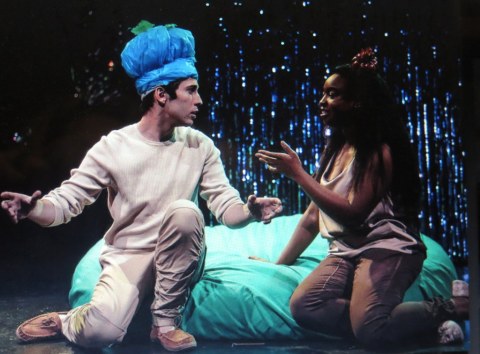
Connor James Sheridan, Tanyamaria in ‘Wood Calls Out to Wood,’ by Corinne Donly, directed by Sarah Hughes (Sasha Arulyunova)
Of course the irony in all of this remains that Bosch’s triptych replete with spiritual symbolic significance of man’s own inhumanity to himself was no where to be viscerally found. Wood Calling Out to Wood exists as an exercise. It is an exercise in the fun, lively, innovative, experimental, weird, often incompletely executed extrapolation of the three panels because that is what it is attempting. In the attempt it becomes the esoteric for esoteric’s sake. A Foucault for those who would attempt to make meaning of it and get tripped up on their own inadequate philosophies. It perches on the edge of Fuzzy Thinking as a mind blowout for those who will go there. If one will, make sure to have enough rest. It may be a flip to follow along. But you may also flip into the unconscious and post haste, fall asleep. Have coffee beforehand, and preferably not decaf.
My reading of the script helped me to understand what the playwright had intended. If the production could be given a proper mounting, with visual projections of Bosch’s work for those like this obtuse writer, I do think that Corinne Donly’s Wood Calls Out to Wood might find itself marvelous.
As it is, if you enjoy supporting The Tank (312 West 36th St), and favor the sheer nonsensical fun of attempting to make heavy-duty meaning out of the curious, you will enjoy the silly, frenetic quality of Wood Calls Out to Wood which runs for 50 minutes without an intermission. As for Bosch? Well, don’t expect any of his magnificent visuals, so review his works, exercise your memory and go prepared.

Chihuly and Pumpkins at New York Botanical Garden’s Fall Weekend
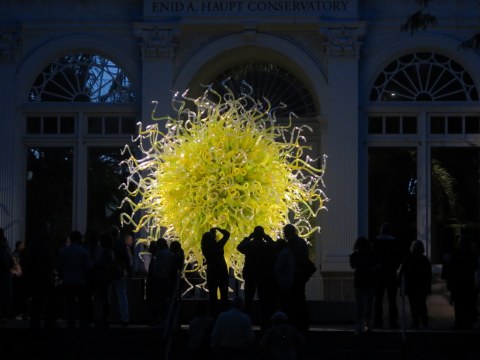
Chihuly Exhibit, ‘Sol de Citron,’ NYBG 2017, Dale Chihuly, Chihuly Nights (Carole Di Tosti)
Last weekend at the New York Botanical Garden was my last time to say goodbye to the Chihuly Exhibit. I have visited the exhibit a number of times, but each time is fresh and different. One reason is because Dale Chihuly’s outdoor sculptures refract and reflect the changes in sunlight during the changing seasons, from spring to fall.

Stunning Chihuly chandeliers at the NYBG Chihuly Exhibit, Dale Chihuly, New York Botanical Garden, Chihuly Nights (Carole Di Tosti)

Dale Chihuly’s art glass for sale in the NYBG Garden Shop, Chihuly Exhibit, NYBG (Carole Di Tosti)

Dale Chihuly’s ‘Macchia Forrest’ (2017), ‘Jazz & Chihuly, Songs of Protest & Reconciliation’ NYBG summer concert series (Carole Di Tosti)

Dale Chihuly’s ‘Macchia Forrest’ (2017), another view, Chihuly Nights, NYBG (Carole Di Tosti)
Another reason is because no matter how closely you look at a piece, you will notice something unique every time. Perhaps it is the way the colors merge into each other on some pieces or the way the glass curves or projects starkly upward. With the sculptures that are housed indoors at the Enid A. Haupt conservatory, for example Macchia Forest, 2017, Chihuly’s vibrant colors startle in multi-colored tulip-shaped cups arising from iron-like stems in the conservatory’s indoor pond and fountain gorgeously arranged with hanging flowering plantings. One could remain there all day or in the evening with a drink during Chihuly Nights. The rich ambience delights and the sounds of water splaying in the fountain soothe. As with all of Chihuly’s sculptures thoughtfully arranged in or around water, the reflections dazzle and enthrall with their multi-dimensional views.
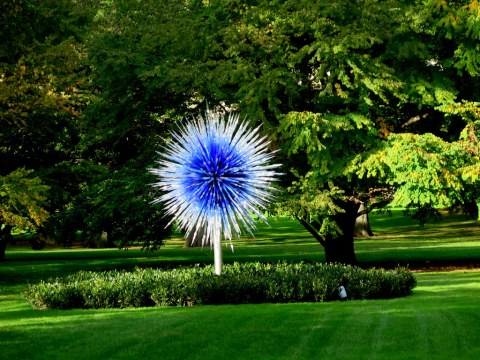
Chihuly Exhibit, ‘Sapphire Star,’ 2010, NYBG 2017, Dale Chihuly (Carole Di Tosti)

‘Dale Chihuly’s ‘Sapphire Star’ 2010, NYBG 2017, Chihuly Nights (Carole Di Tosti)
I will sorely miss this exhibit which stirs the imagination toward infinite and graceful fantasies that one conjures up in brilliant dreams. I have become used to catching the falling sunlight at dusk as it stirs the effervescence and evolving, sparkling, deep blue, shimmering hues on Sapphire Star 2010, NYBG 2017 amidst the darkening shadowy green of the landscape and deepening black shapes of the trees. Sapphire Star 2010, installed at NYBG 2017 is my favorite. I enjoyed seeing it in high noon brilliance or in the surrounding darkness enhanced with a few ground lights along the Garden path that is out of the Chronicles of Narnia. My imagination runs wild. And if I were indeed alone without anyone near me, I would expect a unicorn or centaur to jump out from behind a tree and admiringly gaze at this groundling star whose other-worldy beauty beckons.

Chihuly Exhibit, ‘Float Boat and Koda Studies #1 & 2,’ Chihuly Nights, NYBG 2017 (Carole Di Tosti)
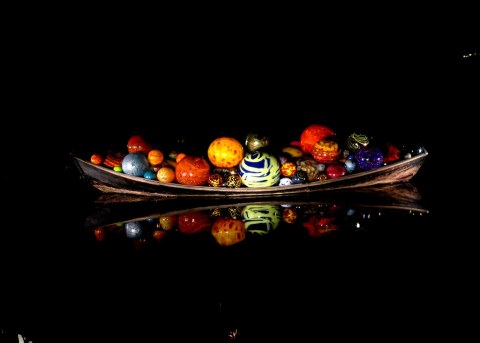
A closer view! Chihuly Exhibit, ‘Float Boat and Koda Studies #1 & 2,’ Chihuly Nights, NYBG 2017 (Carole Di Tosti)

A closer view!! Chihuly Exhibit, ‘Float Boat and Koda Studies #1 & 2,’ Chihuly Nights, NYBG 2017 (Carole Di Tosti)
This past weekend I also strayed beyond the Everett Children’s Adventure Garden to visit the Native Plant Garden where Chihuly’s Float Boat and Koda Studies #1 and #2 herald all that might be accomplished when the creative spirit is allowed to run wild amidst a natural platform. Again, Dale Chihuly combines contrasting shapes, sizes and forms. There are the comforting huge glass balls of every shining hue imaginable displayed in a an oblong vessel held up by a flowing water pond.. In the nighttime, the view widens its depth. Which is is solid? Which is fluid? And indeed physics will explain that both are double images of each other for all contain infinitesimal atoms which spin at incredible speeds and play havoc with what appears to be real but which is something else entirely. A true mind-blast and pageantry of excellence.
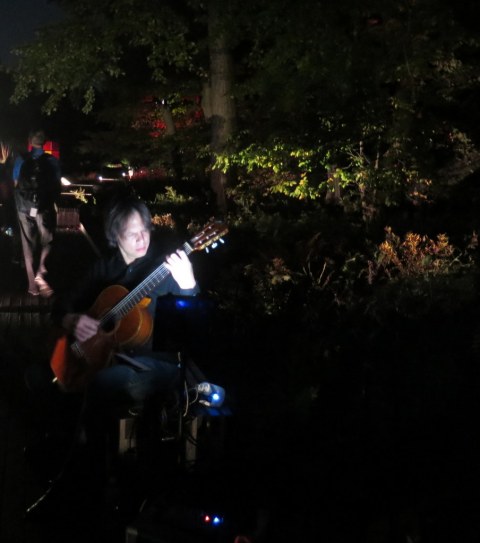
Guitar player accompanying our views in the Native Plant Garden, NYBG, Chihuly Nights (Carole Di Tosti)
That evening a guitar player shared his repertoire as we hailed the Chihuly’s Koda Studies # 1 and 2. Chihuly designed these specifically for the exhibit, honoring his original Artpark installation designed with friend Seaver Leslie in Lewiston, New York in 1975. That significant installation launched Dale Chihuly as a glass artisan and he has been flying into glory ever since.
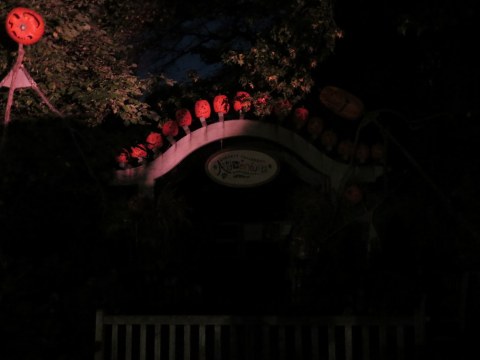
Walking to the Native Plant Garden we encounter spooky pumpkins on the way. NYBG, Chihuly Exhibit, Giant Pumpkin Weekend (Carole Di Tosti)

Spooky pumpkins, NYBG Giant Pumpkin Weekend (Carole Di Tosti)
As we sauntered along the path viewing Chihuly’s muted dark fuschia, red and yellow glass panes pinging off the lengthy water display in the Native Plant Garden, our senses were regaled. The native grasses, wild herbs, shrubs and dying foliage exuded gorgeous aromas released in the humid night air. There was a sense of freedom and exploration I felt. Tell me where else in New York City can one travel safely along landscaped, tree-lined paths in the nighttime breathing clean air with heavenly scents except at a NYBG evening exhibit.
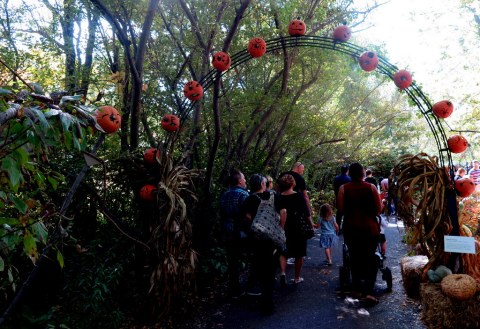
Everett Children’s Adventure Garden, Giant Pumpkin Weekend, NYBG (Carole DI Tosti
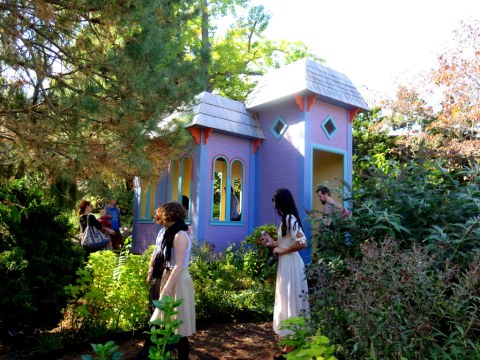
Everett Children’s Adventure Garden, Giant Pumpkin Weekend, NYBG (Carole Di Tosti)

Everett Children’s Adventure Garden, Giant Pumpkin Weekend, NYBG (Carole Di Tosti)

Everett Children’s Adventure Garden, Giant Pumpkin Weekend, NYBG (Carole Di Tosti)

Everett Children’s Adventure Garden, Giant Pumpkin Weekend, NYBG (Carole Di Tosti)
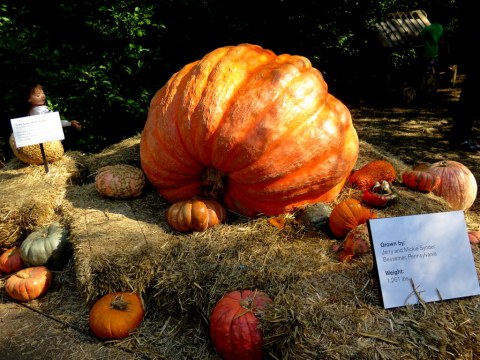
Pumpkin grown by the Synders, from Bessemer, Pennsylvania weighs 1,261 pounds, NYBG Giant Pumpkin Weekend (Carole Di Tosti)
During the daytime I walked amongst the still-green trees which are here and there beginning to prepare for fall and winter. I stepped into the fun-filled Everett Children’s Adventure Garden and watched the kids enjoy themselves everywhere they went. The Children’s Garden was packed. The humongous pumpkins patiently sat as children scrambled on top of them and families posed for pictures. Each of the gigantic specimens were record-breakers. (see below for stats) Families sought and found enormous pumpkins, gourds, and squashes – it was also Giant Pumpkin Weekend, and families came to see these incredible natural wonders.

Conquering a record-breaking pumpkin, (2,269 lbs) from England at NYBG Giant Pumpkin Weekend (Carole Di Tosti)

Conquered! Record-breaking pumpkin, (2,269 lbs) from England at NYBG Giant Pumpkin Weekend (Carole Di Tosti)
Kids and parents took pictures standing on them, climbing them, sitting on them, and standing next to them. Giant Pumpkin Weekend, arranged in collaboration with the Great Pumpkin Commonwealth, showed off the growers’ skills at nurturing the hugest (I know that’s not a word), most fantabulous (or that either) pumpkins. Each of these record-breakers from around the world weighed in at more than a ton.
How these pumpkins’ DNA allows them to expand boggles the mind. Importantly, growers come to share how this happens in the growing process during Q&As.
Recapping the record-breakers and their growers for 2017.
This year’s largest pumpkin traveled from Sumner, Washington, bringing with it the North American all-time record. Nurtured by Joel Holland, the “Great Pumpkin” weighed in at 2,363 pounds.
The second-largest pumpkin ever grown came from the United Kingdom, with that country’s all-time record of 2,269 pounds. Ian Paton and Stuart Paton grew this lovely.
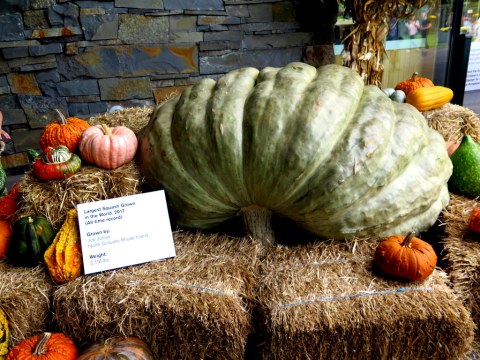
Largest squash grown, 2,118 lbs, NYGB Giant Pumpkin Weekend (Carole Di Tosti)
Finally, at the entrance of the Leon Levy Visitors Center you will find the largest squash grown in the world this year. This all-time record-breaker grown by Joe Jutras hails from North Scituate, Rhode Island. It weighs in at 2,118 pounds.

Pumpkins everywhere in the Everett Children’s Adventure Garden, NYBG, Giant Pumpkin Weekend (Carole Di Tosti)

Pumpkins everywhere in the Everett Children’s Adventure Garden, NYBG, Giant Pumpkin Weekend (Carole Di Tosti)

Pumpkins everywhere in the Everett Children’s Adventure Garden, NYBG, Giant Pumpkin Weekend (Carole Di Tosti)
If you missed this annual fun event the weekend of 21-22 October, don’t worry. The display continues through 31 October. And if you can’t make it this year, next year the Garden will be hosting amazing record-breaking specimens again. You know they will be even larger.
Another fun event at the Everett Children’s Adventure Garden involved costumes and goodies. Children dressed in costumes visited the Whole Foods Market® Trick-or-Treat Trail. Since Whole Foods offered the treats, you know they had to be nutritious and delicious. No candy corn could be found anywhere on those Whole Foods Market tables. Additionally, children could decorate a bag to collect their goodies, which included a “children’s sized” baby spider plant anxious to receive a new home.

Reptile wrangler with Sheldon a beautiful turtle, NYBG, Creepy Creatures of Halloween, Everett Children’s Adventure Garden (Carole Di Tosti)

Petting Skittles the milk snake, Everett Children’s Adventure Garden, NYBG (Carole Di Tosti)

Petting Wilma a very sweet and popular lizard, Everett Children’s Adventure Garden, NYBG (Carole Di Tosti)
One event I particularly enjoyed took place at the Clay Family Picnic Pavilions. Kids and parents came curious to see what creepy, spooky creatures of Halloween might crawl around, fly, or calm down to be petted. The live animal presentation revealed interesting reptiles from everywhere, perhaps even some backyards upstate or in the South.
In the photos are the popular Wilma, a lizard who sustained the children petting her with peace and calm, and Skittles the milk snake who also was petted by the children and remained peaceful throughout. One can see the various creatures Saturdays and Sundays, 1 & 3 p.m. until 29 October.

A Chihuly piece for sale in the NYBG Garden Shop, Chihuly Exhibit, NYBG (Carole Di Tosti)
The New York Botanical Garden contains a fabulous and beautiful world of treasures for everyone. If you can catch the Chihuly Exhibit during the day, you will be thrilled. Unfortunately, tickets to Chihuly Nights have been sold out for the last week. However, if you go during the day over the weekend, make sure to get there early. The parking is limited. And even if it is a bit colder, New Yorkers and out-of-towners want to take a last breathtaking look at the NYBG Chihuly exhibit before it leaves. Thankfully, I took many pictures in remembrance. When winter approaches in earnest in New York City, I will look back at this article and my pictures in fond remembrance.
For events at the NYGB, CLICK HERE.

Shouldn’t Women Have a Greater Place at the Table They Have Set For Decades?

Tuesday, October 24th (doors open at 7 pm)
The Playroom Theater, 151 W 46th Street, 8th floor
Tuesday, October 24th (doors open at 7 pm)
The Playroom Theater, 151 W. 46th St. 8th floor
Tuesday, October 24th (doors open at 7 pm)
The Playroom Theater, 151 W. 46th St. 8th floor
Tuesday, October 24th (doors open at 7 pm)
The Playroom Theater, 151, W. 46th St., 8th floor
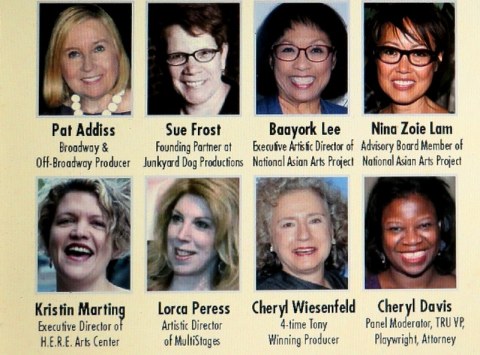
Tuesday, October 24th (doors open at 7 pm)
The Playroom Theater, 151, W. 46th St., 8th floor
1. Do women producers offer a different esthetic from their male counterparts?
2. Might more women producers mean more works by women and more women-centric stories?
3. Is commercial theater or not-for-profit theater more welcoming for women?
The evening is free for TRU members. For non members: $12.50. For members of Women in the Arts & Media Coalition $5.00.

‘Jazz and Chihuly, Songs of Protest & Reconciliation,’ New York Botanical Garden Summer Concert Series
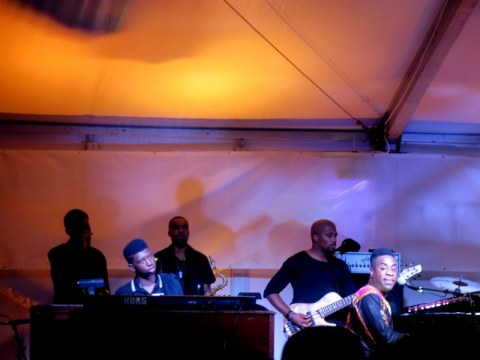
Damien Sneed and musicians in ‘Jazz & Chihuly, Songs of Protest & Reconciliation’ at the New York Botanical Garden (Carole Di Tosti)
Considering the Charlottesville, Virginia August 11th incidents and the tragic loss of one woman’s life, up through the president’s press conference of Tuesday, August 15th, these days of August have been tumultuous and divisive. Indeed, taking a stand to uphold human rights and decry hate groups that seek mainstream political power appears to be more vital than ever as protest marches this past weekend indicate. Symbolic action, whether it is through protest demonstrations or concerts is a reminder to all that Love trumps Hate. A great majority of Americans are committed to upholding the sanctity of every life, regardless of race or religion.

Chihuly sculptures (“Koda Study No. 3”) in the New York Botanical Garden water lily and lotus pond backdropped by the Enid A. Haupt Conservatory, after the summer concert series, ‘Jazz & Chihuly, Songs of Protest & Reconciliation’ with Damien Sneed, and his ensemble and guest Keyon Harrold (Carole Di Tosti)
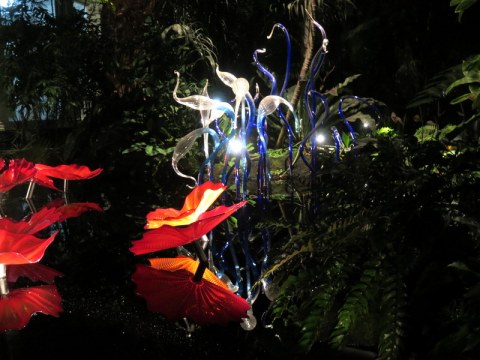
NYBG Palms of the World Gallery, Chihuly’s ‘Persian Pond and Fiori’ (2017), ‘Jazz & Chihuly, Songs of Protest & Reconciliation’ New York Botanical Garden summer concert series (Carole Di Tosti)
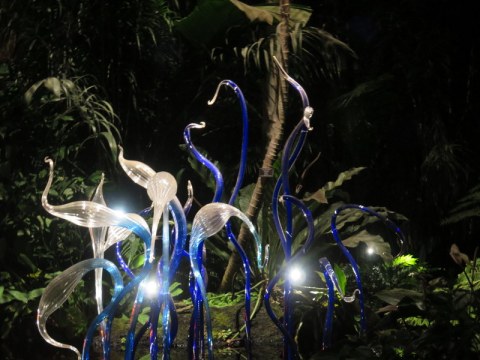
Detail, Chihuly’s ‘Persian Pond and Fiori’ (2017), ‘Jazz & Chihuly, Songs of Protest & Reconciliation,’ New York Botanical Garden summer concert series (Carole Di Tosti)
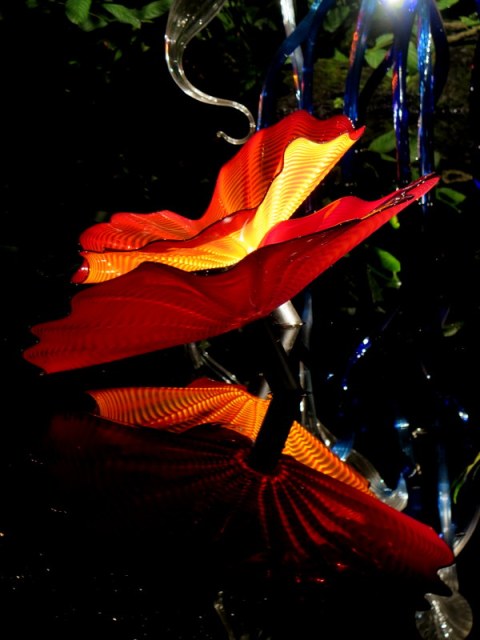
Detail, NYBG Palms of the World Gallery, Chihuly’s ‘Persian Pond and Fiori’ (2017), ‘Jazz & Chihuly, Songs of Protest & Reconciliation,’ New York Botanical Garden summer concert series (Carole Di Tosti)
Serendipitiously, the final summer concert series at the New York Botanical Garden on Friday, 18 August was a majestic reminder of this citizen commitment. Despite the threatening thunderstorm and intermittent periods of rain throughout the day, the turnout to embrace Jazz and Chihuly, “Songs of Protest & Reconciliation” was overwhelming.
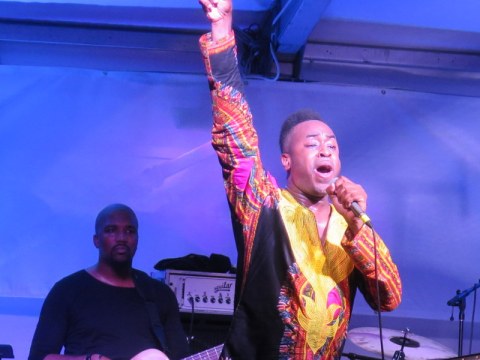
Damien Sneed, ‘Jazz & Chihuly, Songs of Protest & Reconciliation,’ New York Botanical Garden summer concert series (Carole Di Tosti)
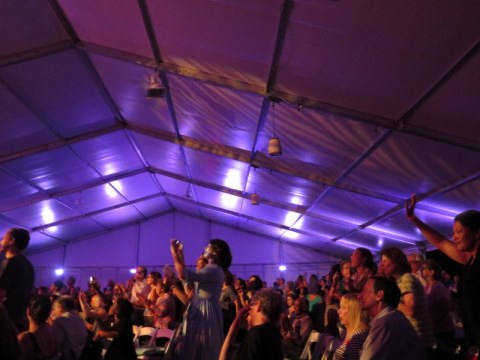
The audience for ‘Jazz & Chihuly, Songs of Protest & Reconciliation’ the concert series at the New York Botanical Garden (Carole Di Tosti)
The tent was packed with a diverse crowd who were there to enjoy the all-star musical group led by award-winning pianist and vocalist, Damien Sneed, guest trumpeter Keyon Harrold and the other prodigiously talented musicians and vocal artists. Together, these individuals presented an evening of entertainment that was poignant and joyful. And after joining with them in celebrating some of the best songs created by greats of jazz, soul, gospel and contemporary music (including two composed by Damien Sneed), the audience was sent out into the night sans rain to appreciate the luminous Chihuly sculptures presented throughout the grounds and in the Enid A. Haupt Conservatory.
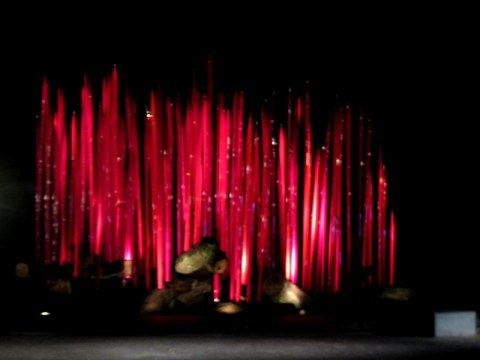
Dale Chihuly’s “Red Reeds on Logs” (2017) part of the special concert series ‘Jazz and Chihuly, Songs of Protest & Reconciliation’ at the New York Botanical Garden (Carole Di Tosti)
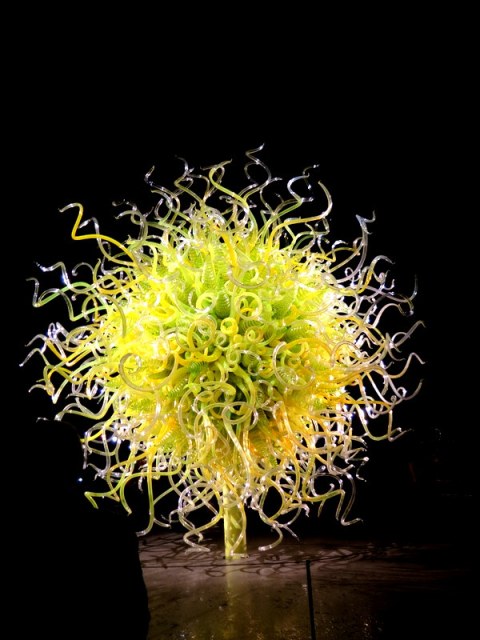
“Sol del Citron” at ‘Jazz & Chihuly, Songs of Protest & Reconciliation’ New York Botanical Garden summer concert series (Carole Di Tosti)
‘Dale Chihuly’s ‘Sapphire Star’ ‘Jazz & Chihuly, Songs of Protest & Reconciliation’ New York Botanical Garden summer concert series (Carole Di Tosti)
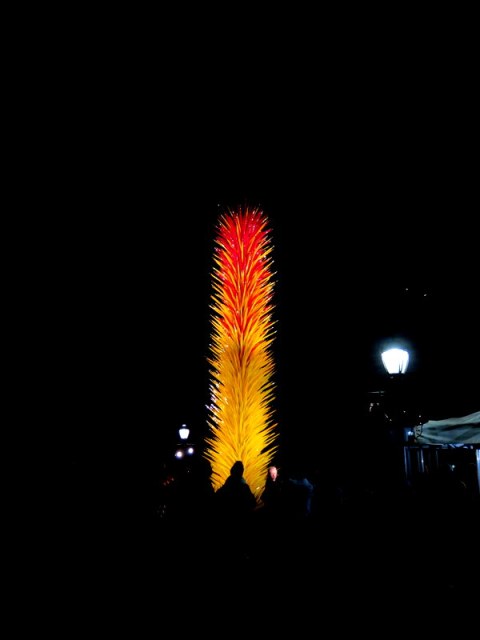
Chihuly’s ‘Scarlet and Yellow Icicle Tower’ (2017), ‘Jazz & Chihuly, Songs of Protest & Reconciliation’ New York Botanical Garden summer concert series (Carole Di Tosti)
This final concert in the summer series was co-produced by the Catskill Jazz Factory and Absolutely Live Entertainment. The Catskill Jazz Factory encompasses a dynamic jazz program whose mission is to aid some of the finest young jazz artists with year-round workshops, concerts, residencies and world-class performances in the Hudson Valley. Absolutely Live Entertainment is a festival, tour and concert production company spearheaded by Danny Melnick. Malnick is the Producer of the Newport Jazz Festival and the Artistic Director of Carnegie Halls’ The Shape of Jazz series.
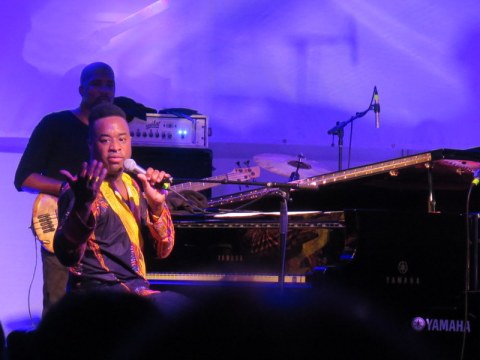
Damien Sneed rouses the crowd at ‘Jazz & Chihuly, Songs of Protest & Reconciliation’ New York Botanical Garden summer concert series (Carole Di Tosti)
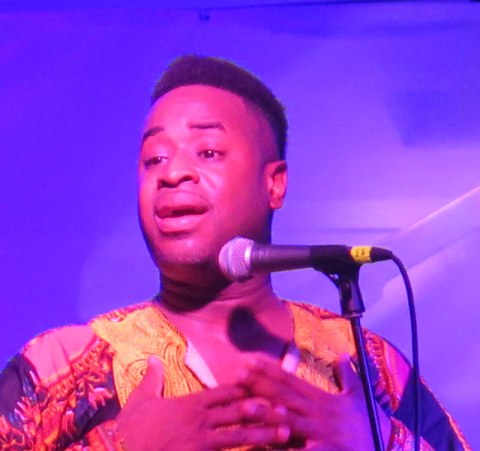
Damien Sneed on piano and vocals at ‘Jazz & Chihuly, Songs of Protest & Reconciliation,’ New York Botanical Garden summer concert series (Carole Di Tosti)
Damien Sneed is a master of practically every musical genre and a 2014 recipient of the Sphinx Medal of Excellence honor which is presented annually to emerging Black and Latino leaders in classical music. His facility with jazz, gospel, pop, R & B, opera and musical theater and his work with Aretha Franklin, Wynton Marsalis, Stevie Wonder and Diana Ross have served him in excellent stead.
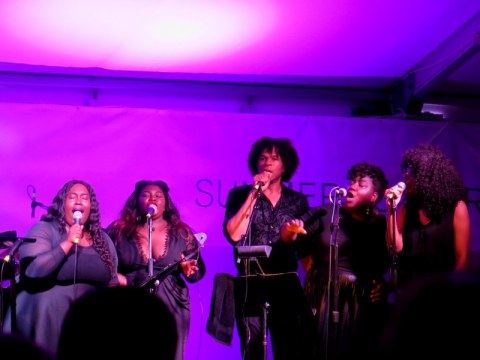
Ensemble vocalists, ‘Jazz & Chihuly, Songs of Protest & Reconciliation’ New York Botanical Garden summer concert series (Carole Di Tosti)
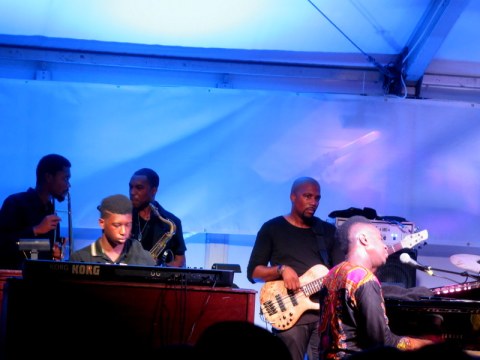
Damien Sneed and ensemble musicians at ‘Jazz & Chihuly, Songs of Protest & Reconciliation’ New York Botanical Garden summer concert series (Carole Di Tosti)
Sneed facilely shepherded the ensemble of vocalists Chenee Campbell, Anitra McKinney, Djore Nance, Tiffany Stevenson, Matia Washington and musicians Stacy Dillard (saxophone) Corey Wilcox (trombone) Julius Rodriguez (Hammond B3 organ) John Matthew Clark (bass guitar), Mark Clark, Jr. (drums). The songs of protest “I Wish I knew How it Would Feel to Be Free” (Nina Simone), “Oh Freedom,” (African-American spiritual), “Follow the Drinking Gourd (Underground Railroad) and “Freedom (excerpt)” (Duke Ellington) for example, emphasized every individual’s yearning for freedom and what freedom means collectively and personally.
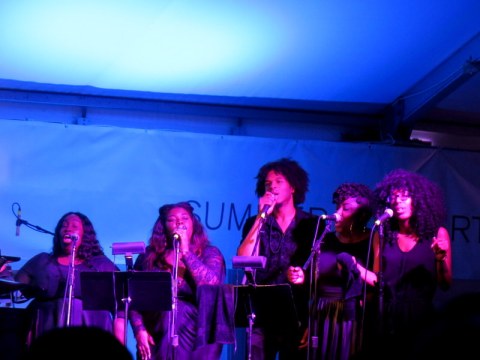
Vocal ensemble, ‘Jazz & Chihuly, Songs of Protest & Reconciliation’ New York Botanical Garden summer concert series (Carole Di Tosti)
During the first half of the evening, an audience member brought up a T-Shirt and draped it on a music stand. The T-Shirt had the logo, “Black Lives Matter.” Her action was spontaneous and unstaged.
Interspersed with these songs of protest were the songs of reconciliation: “Bridge Over Troubled Water” (Simon and Garfunkel), “God Bless the Child, (Billie Holiday & Arthur Herzog, Jr., “Proud Mary,” (John Fogarty), “Is My Living in Vain,” (Twinkie Clark & The Clark Sisters) and more. Each number featured a powerful solo by one of the vocalists. The audience showed their appreciation with standing ovations.
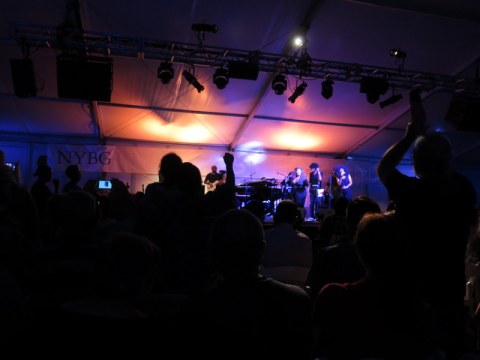
Powerful solo performances by the ensemble garnered standing ovations at ‘Jazz & Chihuly, Songs of Protest & Reconciliation’ New York Botanical Garden summer concert series (Carole Di Tosti)
During the second portion of the evening, Keyon Harrold performed a song he had composed. Harrold presented “When Will The Killing Stop?” as a dedication to Michael Brown and all the young, black men who have been killed for “no good reason.” His playing was at once soulful and poignant, his talent incredible. It is no wonder he has been featured on nearly 100 albums with a wide music range from jazz to R & B, from pop and gospel, to blues and hip-hop.
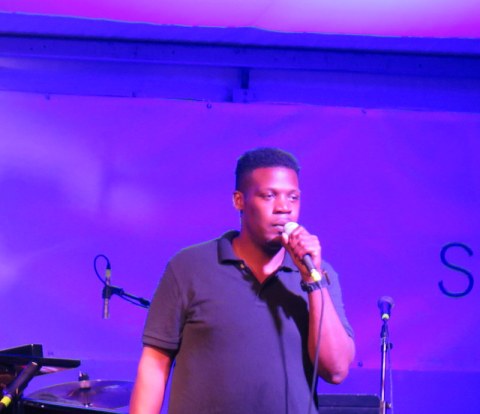
Keyon Harrold trumpeter at “Jazz & Chihuly, Songs of Protest & Reconciliation’ New York Botanical Garden summer concert series (Carole Di Tosti)
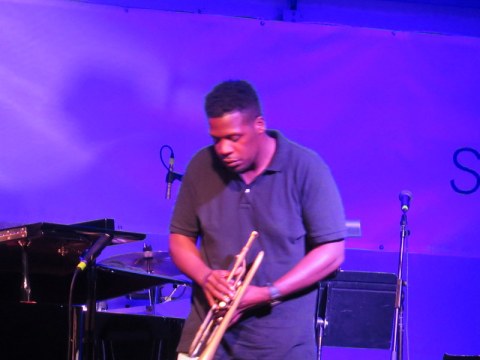
Keyon Harrold, ‘Jazz & Chihuly, Songs of Protest & Reconciliation’ New York Botanical Garden summer concert series (Carole Di Tosti)
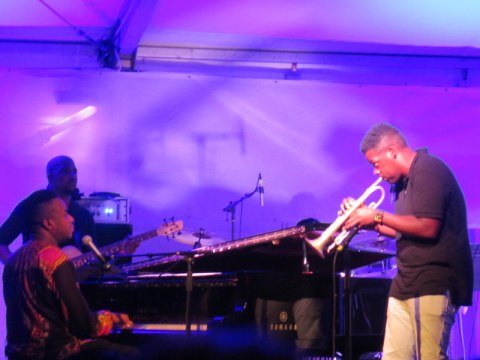
(L to R): Damien Sneed, Keyon Harrold, ‘Jazz & Chihuly, Songs of Protest & Reconciliation,’ New York Botanical Garden summer concert series (Carole Di Tosti)
By the conclusion of the evening, the storm and rain had stopped and the audience had been refreshed and uplifted by the development of the program from seeking soul freedom to the process by which that freedom evolves: forgiveness, reconciliation and love.
Dale Chihuly’s ‘Macchia Forrest’ (2017), ‘Jazz & Chihuly, Songs of Protest & Reconciliation’ NYBG summer concert series (Carole Di Tosti)
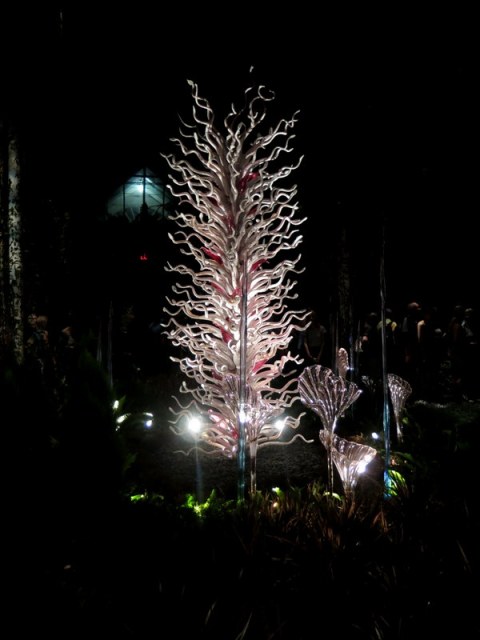
Chihuly’s ‘White Tower with Fiori.’ central showcase, Enid A. Haupt Conservatory, New York Botanical Garden, ‘Jazz & Chihuly, Songs of Protest & Reconciliation’ summer concert series (Carole Di Tosti)
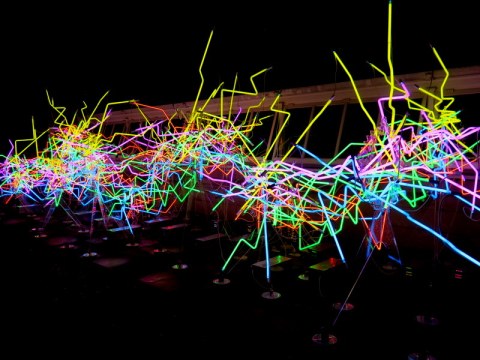
Dale Chihuly’s ‘Neon 206’ ‘Jazz & Chihuly, Songs of Protest & Reconciliation,’ NYBG summer concert series (Carole Di Tosti)
Lillian Goldman Fountain of Life with Chihuly’s Blue Polyvitro Crystals, ‘Jazz & Chihuly, Songs of Protest & Reconciliation’ New York Botanical Garden summer concert series (Carole Di Tosti)
On this night the evolution was inspired through music and exceptional artistry which united and uplifted a community of jazz, botanical and Chihuly enthusiasts. For audience members it was a clarification of the last few weeks and exemplification of all that is best in human hearts, further embodied by our wonderment at the fantastic, illuminated Chihuly sculptures.

‘A Wall Apart,’ A New York Musical Festival Theater Review
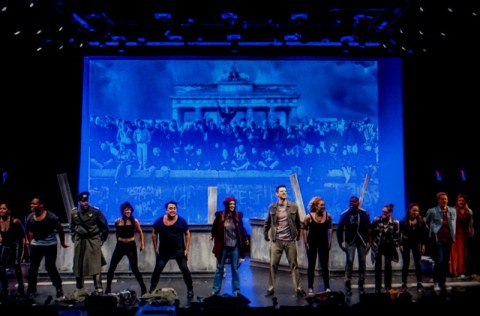
‘A Wall Apart’ at the NYMF, Music & Lyrics by Lord Graham Russell, Book by Sam Goldstein & Craig Clyde, directed/choreographed by Keith Andrews (Michael Schoenfeld)
It was a frightening time, the height of the Cold War! It was the division of Berlin into two sectors divided by a mammoth wall of concrete and barbed wire. West Berlin embraced everything economically viable through a market economy representative of Western culture. East Berlin was controlled by the East German police (the hated Stasi) who were the engines of the government of the German Democratic Republic, a repressive communist country beholden to U.S.S.R. ideologies. How does one resist oppression and the repression of personal freedoms? How does one deny adherence t and subservience to the state? A Wall Apart reveals that the resistance was established prominently in two ways: rock music and love.
In A Wall Apart, a thrilling production which premiered at the New York Musical Festival (Music and Lyrics by Lord Graham Russell of Air Supply; Book by Sam Goldstein and Craig Clyde), we recognize that in the twenty-eight years which spanned the time of the Berlin Wall and the oppression it represented, that rock music promoted the resistance against Communist tyranny. It did this subtly through its brash sounds and clashing, free-wheeling lyrics. Rock music expressed the yearned for liberty already inherent in the minds and souls of the younger generation. Its expression was life itself and in its clanging, smashing vibrations there could be heard the clarion call to revolt.
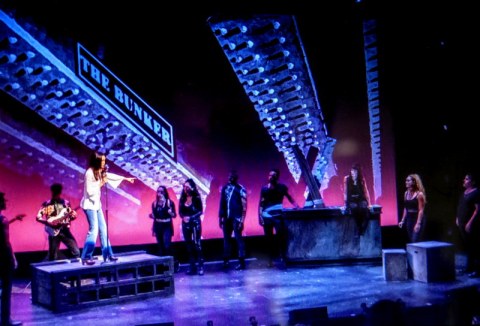
Maddie Shea Baldwin and the company of ‘A Wall Apart,’ NYMF (Michael Schoenfeld)
Perhaps more importantly, this production also reveals the power in resisting with love. In A Wall Apart we see that love and family unity ultimately triumph over allegiance to an oppressive government and the acceptance of its lies that subvert one’s humanity. From the opening song “Our City” we are reminded of the dreams of liberty that are inherent in every soul and which are the driving force that cannot be overthrown ,despite the attempt of governments to control that force through external structures and the threat of destruction.

(L to R): Emily Behny, Josh Tolle, Jordan Bondurant, Maddie Shea Baldwin in ‘A Wall Apart,’ NYMF (Michael Schoenfeld)
This force is manifested in each of the characters, perhaps most symbolically through Mickey (Josh Tolle gives a powerful sustained performance throughout) whose rock band plays at The Bunker in West Berlin. The Bunker is the place of symbolic birth, life and hope in the liberty of the rock music of the West. Mickey’s band, The Angels, represents all the goodness of Mickey’s own character. It has led him to a loving relationship with Suzanne (Emily Behny’s portrayal is soulfully rendered) and collaboration with his brother Kurt (the excellent Jordan Bondurant). It is at The Bunker where the bond between Kurt and Esther (the superb Maddie Shea Baldwin) is initiated, and all seems to be going swimmingly except for the rumors that Berlin is being divided, revealed to Kurt by their brother Hans (Darren Ritchie gives a bravura performance as the Stasi who must negotiate the conflict between love and obligation to the state in his own heart).

Jordan Bondurant and company in ‘A Wall Apart,’ NYMF (Michael Schoenfeld)
The most stalwart and loving of the characters is Tante (Leslie Backer is nothing short of astonishing). She is the glue that holds the family together; she mediates the troubles among the brothers and provides wisdom when Kurt and Mickey are caught in the East after the Berlin Wall is built and there is no getting out. Kurt and Mickey cannot abandon Tante who raised them when their parents were killed. Kurt especially is pressured by circumstances for he has left Esther in the West and will not join her but instead, joins the Stasi with Hans so that together they can put food on the table and obtain greater stockpiles of coal for heating. It is a devil’s bargain.
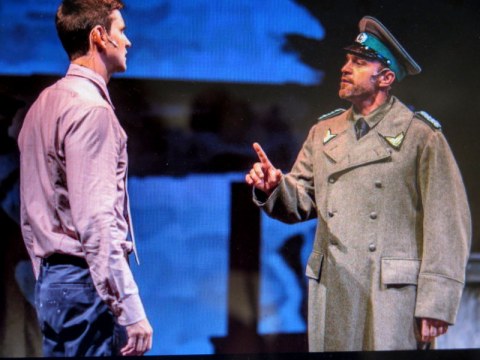
(L to R): Jordan Bondurant, Darren Ritchie in ‘A Wall Apart,’ NYMF (Michael Schoenfeld)
Material safety and support are not enough for Mickey who has to be free to express his being though his artistry and music. With Kurt’s information about which routes to take to get over the Wall, Mickey and a pregnant Suzanne make an escape attempt. What happens is irrevocable. And once again, we are reminded that individuals are willing to take grave risks when freedoms and personal identity are at stake. Ultimately, the risk is worth it for a difference is made in the lives touched by sacrifice.
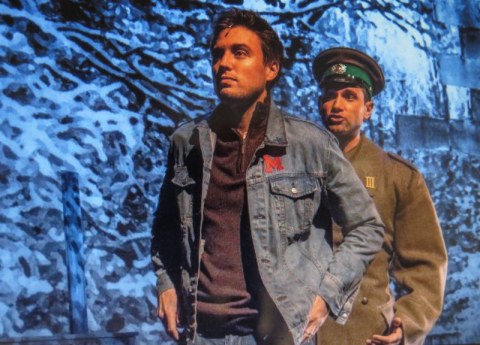
(L to R) Josh Tolle, Jordan Bondurant in ‘A Wall Apart,’ NYMF (Michael Schoenfeld)
A Wall Apart follows the resistance of the family and Hans’ conflict at having to perform the obligations of being a Stasi when his heart is elsewhere. It journeys with Kurt’s resignation from the Stasi and his affirmation to join the revolt from within East Germany to bring down the totalitarian structures external and internal which would oppress individuals’ rights to follow their own path. And somehow, the love between Kurt and Esther finds a way to grow though the wall divides them physically. It is intriguing how this occurs and as there is no spoiler alert here, you will just have to see the production when it moves to another venue (which it should) at some point in the future.
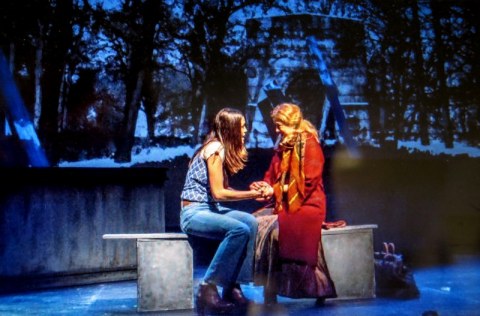
(L to R) Maddie Shea Baldwin, Leslie Becker in ‘A Wall Apart,’ NYMF (Michael Schoenfeld)
This is a finely wrought production whose music (Lord Graham Russell of Air Supply created the music and lyrics) is gobsmackingly good in its variety, its power and its touching poignancy. The book by Sam Goldstein and Craig Clyde highlights the period. It is aptly enhanced through the staging, sets, props and visual projections of archived black and white photographs, and video newsreel clips of the time. The fictionalized chronicle of one family’s struggles through tremendous economic and social upheaval is not only a vital remembrance of the past, it is a reminder of the tyranny of walls and what might happen in the future if fascism (in the guise of communism or any ism) is allowed to rear its ugly head.

The company of ‘A Wall Apart,’ NYMF (Michael Schoenfeld)
The production is incredibly current. As we understand the uselessness of the Berlin Wall to serve its mission, we acknowledge that the inhuman, fascist separation of humanity is fear for fear’s sake. Fear is counterproductive, restriction retards innovation and stops the move toward progress. Regardless, freedom will triumph, love will triumph whether the resistance be through music or any means possible. Walls are symbolic of powerlessness in the face of humankind’s indelible desire for freedom and betterment. Barricades don’t work. Indeed, they inspire others to seek freedom despite the risk to themselves.
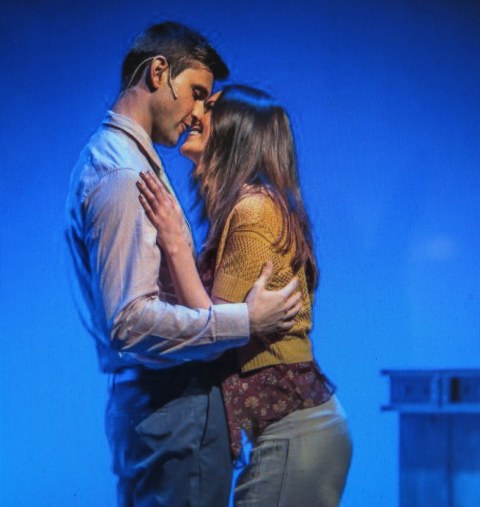
Jordan Bondurant, Maddie Shea Baldwin in ‘A Wall Apart,’ NYMF (Michael Schoenfeld)
I would hope that this production sees a continuation elsewhere. It is that good especially in that its themes presented through the music and book are profoundly transcendent. Kudos to the skillful, adroit and versatile musicians (Jonathan Ivie, Matt Brown, Lavondo Thomas, Daniel Ryan, T-Bone Motta), exceptional ensemble and the uber talented Keith Andrews, whose direction and choreography was insightful and spot-on great. I loved this production, for what it says and how the design team, ensemble, musicians all shepherded by the director collaborated to say it! A resounding yes, you get my vote! A must-see which I am counting on seeing again.
 CAROLE DI TOSTI