How I Saved Hundreds of Dollars On Editing
Great article.

 Everyone loves saving money, but sometimes I don’t want to go the extra effort to do so. This time, however, I did take the extra steps and I saved hundreds of dollars. I was thrilled!
If you’re following my posts on Facebook (facebook https://www.facebook.com/JAOwenby/) you know my upcoming novel was sent to my editor January 15th. I sent her 75 pages of my manuscript in order for her to present a scope of work and price. This is what she wrote back:
“I’ve spent some time with chapters of Tears in the Sun, and overall your development and plot are strong. You’re a good writer, and the story is intriguing. You only need light developmental editing.”

I was so excited I didn’t sleep that night! The next day I finally got over myself and looked back at what I did that saved me money, and I laughed. The one thing…
View original post 348 more words
Mark Twain in Damascus
Interesting post by Barb Drummond.

Some more from Charles Glass, in his ‘Tribes with Flags’. I knew Train travelled to Britain, but I had no idea he had done the Grand Tour to the Middle East as well:
This is Twain on Damascus in 1867:
“She measures time not by days and months and years, but by the empires she has seen rise and prosper and crumble into ruin. she is a type of immortality. She saw the foundations of Baalbek and Thebes and Ephesus laid; she saw these villages grow into mighty cities and amaze the world with their grandeur – and she has lived to see them desolate, deserted, and given over to the owls and the bats. She saw the Israelitish empire exalted, and she saw it annihilated. She saw Greece rise and flourish two thousand years and die. In her old age she saw Rome built; she saw it overshadow the…
View original post 435 more words
Interview With Christian Primeau Designer of NYBG Orchidelirium, Part II
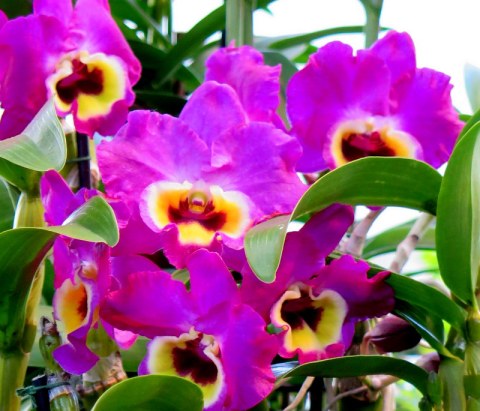
Dendrobrium Red Emperor Prince (cane orchid) NYBG Orchidelirium. Photo: Carole Di Tosti
In continuing my discussion with Christian Primeau, designer of NYBG Orchid Show, Orchidelirium, Christian discussed details about orchids and specific information about the show’s design and his background.

Christian Primeau designed Orchidelirium and overseas the tropical/subtropical plant collections at the NYBG.
How did you know which orchids you were going to select for the show? There are a lot of different orchids that I’ve never seen before.
That was our main focus with this show as opposed to many others. It’s always a spectacle. We wanted to really represent the scope of the orchid family as a show theme. The Victorians were passionate about finding super rare orchids. We wanted to show what that orchid geek’s greenhouse would look like and what a really passionate orchid collector’s greenhouse would look like. So we have the bulk orchids. The beauty in bulk is there to show people that range of how different the orchids can be. Their diversity is fantastic. A lot of people are familiar with the Paphiopedilum (lady slipper orchids). You can buy them at the grocery store. But we’re hoping to show people orchids and plants that they may not have seen before. It was easy too because we’re nerds and we might pick things that we might want in our greenhouse as well.

Cattlianthe Trick or Treat Fuchs Orange Nugget Orchids Photo by Carole Di Tosti
Did you find a lot of orchids that you had never seen before?
I was not familiar with a lot of the orchids. Marc is the orchid fanatic. He’s the curator. So he would come to me and say look at this and I would say that’s, fantastic, we have to have that in the show. So I did lean on Marc a lot for his expertise. And that was fun for me, too, because I learned a lot as we went along, too. It was great.

Nepenthes-tropical pitcher plants at NYBG Orchidelirium Photo by Carole Di Tosti NYBG
Which one of the smaller touches in the show did you appreciate?
Well, the vignettes. When I drew the actual design sketches, I knew the things that I wanted the most were the Nepenthes, which is not an orchid it’s a tropical pitcher plant. In my mind when I drew the sketches I had these tropical pitcher plants incorporated in with the orchids.. It’s ironic. People from year to year will target plants that are not orchids and say, “Look at those, that’s beautiful.” And we explain, “Yeah it’s not an orchid but it is beautiful.”So I wanted those Nepenthes. They grow on little pieces of tree fern that we have and that I’ve incorporated to grow over rocks. I think they go beautifully with the orchids. They give a little added touch and a little change in texture. So I do like those.

A vignette with Bromiliads and Paphiopedilum, NYBG Orchidelirium Photo: Carole Di Tosti
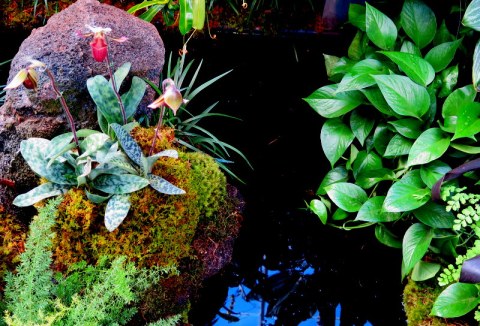
Another vignette with a Paphiopedilum, water, mosses, rocks, maidenhair fern and other Victorian plants (pothos). NYBG Orchidelirium Carole Di Tosti
In my head I wanted small. We never really showcased paths, the Paphiopedilum. I mean we have small pots, and we have little groups, but I wanted to show how they might grow. I incorporated flat rocks and put paths (lady slippers) on them and a bit of moss, something very simple but might make people stop and look and see that it is beautiful in its simplicity and appreciate those on their own. That way they wouldn’t get lost. But if you notice in front in the pool the little rocks that were put there to show people that vignette. That concept was mine, too. Given the scope of the project they are fairly inconsequential but I just wanted to incorporate them.

The greenhouse potting bench suggesting that of a Victorian “geek” collector with different orchids and prayer plant. NYBG Orchidelirium Photo by Carole Di Tosti
Are you amazed?
I am amazed at what my staff was able to do and I feel uncomfortable taking any credit. They are my guys. I can draw a picture, but without them there is no way this is getting done. There are 8 staff members and without them, no way. To their credit they stayed happy and positive. It was actually a pleasure. We were all exhausted but when they stepped back and looked and saw the little things that they had done and how they contributed to the entire show, I think they were really proud and I was proud of them. It was nice for me to see, even more so, I think, viewing the vignettes than the totality of it. It was great that all of my staff was represented. They’re passionate. They’re plant people. That’s what it’s all about and it was fun for me to see them work.

Bromeliad Aechmea Patricia’s Secret NYBG Orchidelirium Photo by Carole Di Tosti
How many orchids do you have in your collection?
The NYBG? The official line is thousands.
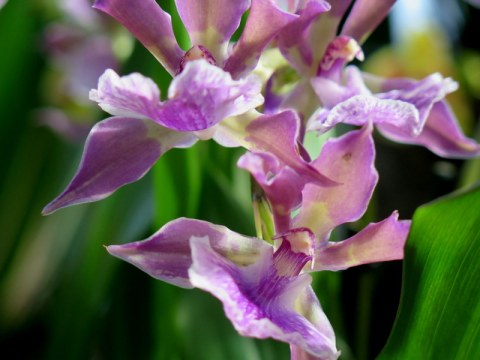
Zygonisia Cynosure ‘Blue Bird’ NYBG Orchidelirium Photo by Carole Di Tosti
What about in your personal collection? A few?
I have a select few but I’m more of a succulent person. It’s funny because they asked me to design the Orchid Show. I like cacti and succulents and my area of expertise is actually Madagascan aloes. But I do have some paphs (Paphiopedilum). I have a soft spot in my heart for the paphs, lady slipper orchids. In my personal collection there are six or seven of those but I do have a lot of the other plants that we show with them, the Epiphytic Cacti, Nepenthes (pitcher plants), the weird things. The weirder it is, the more I like it.

Tacca Chantrieri “Bat Flower” NYBG Orchidelirium Photo by Carole Di Tosti
You must know the medicinal properties of those plants.
One of my favorites points of information when I give a tour of the conservatory is I love to stop and ask people if they have any chemistry backgrounds. I’m fascinated by alkaloids. You know what alkaloids are. Basically, a naturally synthesized pesticide. So if it affects an insect, it affects a human system as well.
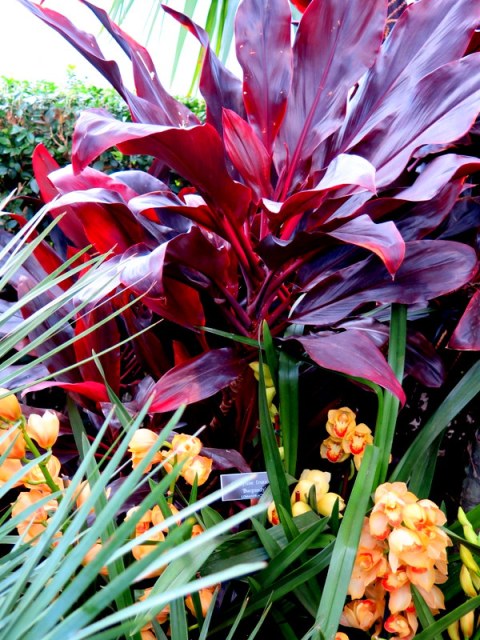
Cymbidium orchids and Lomandrace Burgandy Frutica Codyline NYBG Orchidelirium Photo by Carole Di Tosti
Caffeine is one of my favorite alkaloids, and quinine. I tell the story of how gin and tonic (quinine) was invented. Being in the tropics, the British learned to take quinine to stave off the malaria that was rampant from the mosquitoes. When they colonized India, British would mix their quinine dose with a little bit of sugar and a little bit of water and a little bit of lime. All they needed was to add the gin and that’s how they created a gin and tonic. Fantastic. (Apparently, Christian is a kind of alkaloid guy) All I need is gin and tonic at night and coffee in the morning and I’m ready to go.
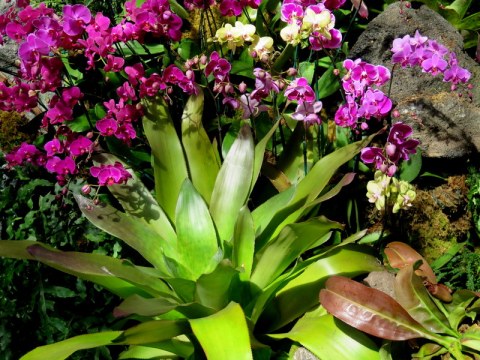
Phalaenopsis with Bromeliads NYBG Orchidelirium Photo by Carole Di Tosti
Yeah, I’m fascinated by the chemistry of plants. Of course rain forest plants are in such a competitive environment, that these plants, all these beautiful orchid plants that you see and delicious fruit that you see at the grocery store are a product of that competition. Competition for pollinators, competition for seed disseminators. Every day you learn something new and that’s what I like about all of this. You can never know it all. It’s like a road that doesn’t end. And I have people ahead of me on that road that teach me things. Then, I can teach those coming up behind me. I enjoy it. I’m not the biggest orchid fanatic but I certainly can appreciate what Marc knows and what Marc does. He’s an encyclopedia. I joke with these guys about Marc. You flick a switch and he just goes and you try to keep up. I learn something from him every time.

Bromeliad Aechmea ‘Tropic Torch’ NYBG Orchidelirium Photo by Carole Di Tosti
Where did you work before the NYBG?
I was the Conservatory Manager in Bolyston Mass, Tower Hill Botanical Garden. It is smaller than this. The shows we did were far smaller in scale. But don’t you know, that’s where I cut my teeth. I learned a lot from Marco Polo Stefano. He’s had an incredible career. He was at Wave Hill Botanical Garden. Fantastic man. Still lives right around here. He gave me so much encouragement and I learned so much there and he actually encouraged me to come here. And I did and I never looked back. And I love it.
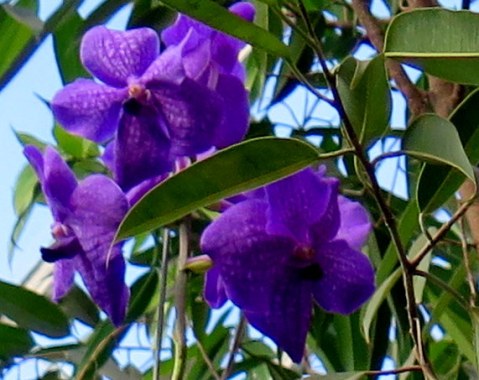
Vandas NYBG Orchidelirium Photo by Carole Di Tosti
You have to be a special person to love plants. Creative, unique a different sensibility.
Don’t you think, though, that many people can love plants?
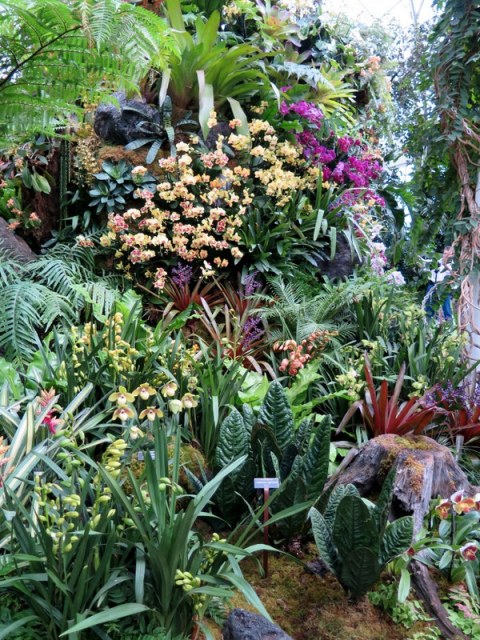
Christian’s orchid mountain (see Part I) Don’t miss the yellow Paphiopedilum and Cymbidium orchids. NYBG Orchidelirium Photo by Carole Di Tosti
Yes. But what I mean is to have the sensibility and creativity to work here is great.
There is no where else I would rather be.

Another view of the orchid mountain designed by Christian Primeau Photo by Carole Di Tosti (see part I for his inspiration)
I can understand.
And I think part of this, too, when I was doing the show. You know the Dieffenbachia?

Pansy orchids, Moth orchids, Onicidium, Bromeliads, Staghorn Ferns and more in another view of the orchid mountain. NYBG Orchidelirium Photo by Carole Di Tosti
Yes.
The Dieffenbachia is a Victorian plant that has been around for hundreds of years. It’s the kind of thing my grandmother grew or people who don’t grow plants, if they get something for their windowsill, usually a Dieffenbachia or something along those lines that is fairly standard. I wanted to incorporate those, but I wanted to give it a little bit of a twist to show people how far we’ve come. So I used those traditional Victorian plants but I used modern cultivars. So these Bromileads are just wild, crazy, the Aglaonemas, the Aechmeas, the crazy variegation and crazy colors. So there’s the thing that somebody can recognize and say, “Yes, I grow that.” But they also can see the potential. My hope is that I hook people. Whether you’re an expert like Marc or just a casual grower, I wanted to get somebody interested. What’s the saying, “You can’t please everyone all the time?” Well, I wanted to try.
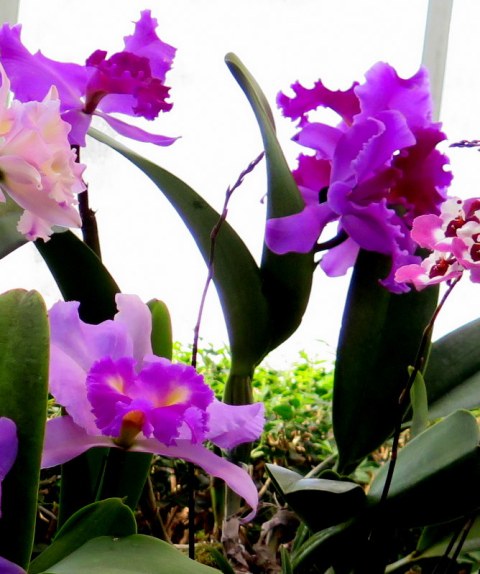
I don’t know what orchids these are but I love them. NYBG Orchidelirium Photo: Carole Di Tosti
Well, I think you definitely did. It’s a magnificent show.
We shall see. (Christian Primeau smiles)

One side of the entrance to the mountain: Moth orchids and Cymbidium. The bright green plants in decoration with the brown plants are mosses. Photo by Carole Di Tosti
The NYBG Orchid Show 2016 “Orchidelirium” concludes April 17th. Check the website for details.
Orchid Evenings Come for a nighttime cocktail experience on Saturdays (March 12, 19, 26, April 2, 9, 16), as well as Friday (April 15), and Thursday (March 24, LGBT night). On select evenings visitors can also upgrade to V.I.P. status and enjoy an Orchid Lounge.
World Beat: Music and Dance Around the World of Orchids Live performances from cultures around the world we be held on Saturdays and Sundays throughout the exhibition.
NYBG Orchidelirium Designer Christian Primeau Talks Orchids, Part I
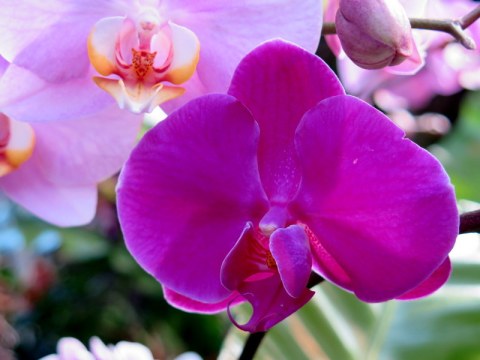
Beloved Phalaenopsis are one of the most popular of the thousands of man-made orchid hybrids. Orchidelirium at the NYBG. Photo Carole Di Tosti
Orchidelirium, the theme of the NYBG Orchid Show for 2016, refers to the Victorian period in England when there was a renaissance in the collection, research, propagation and cultivation of rare and exotic plants which eventually morphed into an obsessive craze for orchids. The selection of the theme dovetails with the 125th Anniversary of the Garden because the Victorians’ orchid obsession spawned many innovations in propagation and cultivation and hybridization of orchids that has continued to this day. The Victorian passion for illimitable orchid gems even improved trends in greenhouse design and helped inspire the Victorian design for the Enid A. Haupt Conservatory.

Phalaenopsis Shu Long Beauty, NYBG Orchidelirium. Photo by Carole Di Tosti
Indirectly, it is because of Victorian orchid mania that the NYBG has one of the largest institutional orchid collections in the world with over 7,000 individual specimens as a part of its entire collection, a fact which Marc Hachadourian orchid curator reinforces. The family Orchidaceae is the largest and one of the most varied of blooming plant families in the plant kingdom and as a result it has been used to conduct research and encourage efforts toward conservation and habitat preservation. Additions from the historic, permanent orchid collection are included in the Orchidelirium exhibition.

Angulocaste Red Jewel, NYBG Orchidelirium. Photo by Carole Di Tosti
Christian Primeau, the show designer and manager of the Enid A. Haupt Conservatory oversees the extensive tropical/subtropical plant collections housed in 11 unique environments in the Conservatory. Primeau reinforced the tremendous influence the Victorians had and continue to have today. It is because of them that orchids are the most charismatic and popular of plants. As NYBG orchid curator Marc Hachadourian says, “They are the pandas of the plant world.” It is their popularity that has encouraged growers and cultivators to create over 150,000 man-made hybrids for us to enjoy.
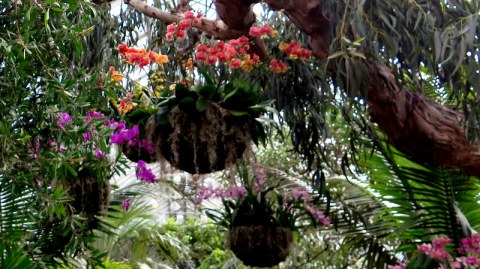
The many varieties of orchids at NYBG Orchidelirium galleries. Photo by Carole Di Tosti
Christian Primeau talked to a group of us about his design inspiration for the show and clarified that the two week installation period was a high pressured and frenetic but absolutely enjoyable time.

Christian Primeau, Orchidelirium’s designer
Orchidelirium has a whole different meaning for my staff and me because we’ve been working 13 hour days including weekends. We were pretty ambitious with the design and we hope you like it. But we’re all hallucinating at this point. I think I’m one of those rare people and I think Marc probably shares the same feeling of love for our jobs. It’s my hobby and my career. And it’s just what I’m passionate about. I hope that’s not the case, but loving one’s job seems like a rarity these days. I owe everything around me, this entire beautiful collection, this palate of plants that we get to work with, we owe all that to the people who came before us who were passionate. As Marc explained their motive may not always have been so pure, a lot of time it was a passion for personal glory or for profit, but in any case we owe what we have now, where we are today in this industry, everything around you that you see to that passion.

Introductory display in the Palms of the World Dome. NYBG Orchidelirium. Photo Carole Di Tosti
This is a celebration. We’ve been here 125 years. Orchid collecting has been going on for longer than that. So we owe this to the passion of those people. It’s an homage to those guys and ladies and people who sometimes gave up their lives so that we can enjoy these plants. And we also give them a nod because in terms of breeding and conservation, we’ve come a long way. We’re much more responsible, hopefully, nowadays in regard to collecting. Not always, but we’re trying. Of course, the mission of the garden is to move that along and to show the public these plants that they wouldn’t have access to see 125 years ago. Orchid collections was only accomplished with those who had the wealth to fund orchid expeditions for themselves or orchid collectors.
Orchid Mountain and waterfall at NYBG Orchidelirium. Photo by Carole Di Tosti
This is the centerpiece of the collection. (Christian points to the magic mountain of orchids towering above us.) When the Victorians obtained these beautiful plants, they would bring them into their greenhouses and try to stage them basically to reproduce nature. We found this incredible drawing. I think you all have access to it. It’s an 1837 sketch of the Epiphyte house at Knypersley Hall. (The illustration appears in a two volume tome commissioned by James Bateman, The Orchidaceae of Mexico and Guatemala, 1843). It’s about a 5-6 foot mountain they built at the center of the greenhouse, beautifully covered with ferns and orchids.

The orchid mountain rises above 8 feet at NYBG Orchidelirium. Photo by Carole Di Tosti
I thought, wouldn’t it be great to take this and put it on steroids? So I asked, “Hey, can you build me a fake mountain? And they came back and said, ‘No, that would cost as much as a vacation home in the Hamptons. But what you can have is a bunch of four foot by four foot cubes.’ So the bones of this mountain are four by four steel cubes stacked on top of each other. It looked great on paper. But when I saw them stacked I wondered, how are we ever going to make that look like a mountain? Hours later and many rolls of chicken wire later, we were able to mount it and plant it to look much like the mountain in the picture but just on a grander scale. It’s hollow and we have a little access door. I won’t tell you where it is. So it’s on the mountain and we can go inside and water it from the inside. All the orchids are wrapped by hand in moss so we can actually water them from the inside through the chicken wire. It looks like a beast to water but it’s fairly simple to do.
It’s an homage to those guys who really were so passionate and built these structures. It is naturalistic but that’s what they were going for and it is the inspiration for our centerpiece mountain. I really let my staff loose in terms of creativity. I cannot thank them enough because I really worked them to the bone. So as you walk around, you are going to see lots of little moments and vignettes so the character of each one of my staff members is actually reflected in certain moments in the display. I hope that people will find the moments that appeal to them whether it be the really intense colors or delicate colors or the moss areas or the small areas of the Paphiopedilum, the Lady Slipper orchids, to find something they can grab onto. My hope is that the orchid enthusiasts will be as psyched about the show as the people who are general plant growers. They’ll find something they can recognize or something that will spark that passion that we all have here. I mean that’s what it’s all about. We want to share what we love and ignite this love in them as well.

Paphiopedilum (lady slipper orchids) Photo by Carole Di Tosti
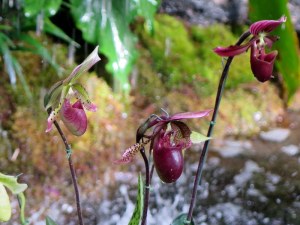
Vignettes of Paphiopedilum by the waterfall. Photo by Carole Di Tosti
I planned for a large waterfall in the front, and in the back something a little more peaceful. So we just wanted to have a mossy grotto of water, taller in the back and a bit crazier in the front. In the sketch there’s actually a bird’s nest fern at the top of the mountain. I thought it would be great to take a little license. So we took bromeliads up there and again on paper it looked great. But when we actually had to climb up the mountain carrying a 70 pound bromeliad, it became less fun but we got them up there and we got everything planted. And are fairly happy with the way things turned out. So that’s it. So this was based on that illustration that we talked about. And then we head into what I imagine Marc Hachadourian’s greenhouse looks like. For the crazy plant nerd, orchid geek, this would be the greenhouse that you see. And again we took license and as I said we’ve come a long way in terms of breeding and cultivars. What you see here crazy color, lots of contrast, lots of strange plants and again a huge, huge variety of orchids that we have in this section.

Orchids are epiphytic and grow on trees and rocks. Others are terrestrial orchids, depending on where they grow. Lots of plants will be epiphytic. Note the walls. They are reproductions of the walls that are actually in that scene from Knypersly, so we had those reproduced. A working greenhouse would be dingier and a little less densely planted. We have the potting benches where people can learn a little about propagating orchids and what a working greenhouse would be like but this section of the display it’s predominately ornamental. We tried to load it up with a diverse selection of orchids. The Phalaenopsis (moth orchid) on the mountain everyone is familiar with but you come in here and even if you’re a serious orchid aficionado, you will see a lot of interesting orchids you may not have seen otherwise. The more expensive orchids come from our permanent collection.

The Wardian Case with a variety of orchids of different sizes and shapes. Photo by Carole Di Tosti
Explorers and others used the Wardian Cases to transport orchids back in the Victorian era. They created and maintained that micro-climate to keep them alive. The show also highlights the history of Ward and the invention of the Wardian case wonderfully. The Wardian Case is a symbol of the Victorians.
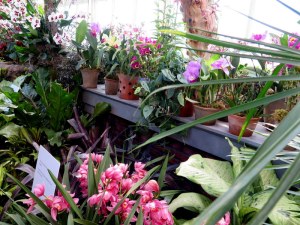
An example of an orchid geek’s potting bench with orchids in a greenhouse. Photo by Carole Di Tosti

Another example of a potting bench displaying a variety of orchids. Photo by Carole Di Tosti
The majority of the orchids that people buy are from Florida, Hawaii, California. The bulk orchids come in from nurseries around the country. And the rarer ones come from our collection. (What happens to the orchids after the show?) We all have plenty of orchids in our houses after the show. But we donate the rest to schools and societies and give them to people who use them to teach so they don’t go to waste. If they are degraded then we compost them. They have their own value and come back into the greenhouse or into the vegetable garden as they are recycled. So that’s what we tried to do with the show. It turned out to be more ambitious than we thought in terms of numbers of orchids, but I’m happy it doesn’t look like Q*bert the game. That’s what it looked like before we planted. I think we succeeded. We took Q*bert out of it, making it look natural.
Orchidelirium, The NYBG Orchid Show 2016, concludes April 17th. Check the Garden website for details about Orchid Evenings on Saturdays (March 12, 19, 26, April 2, 9, 16), as well as Friday (April 15), and Thursday (March 24, LGBT night). On select evenings visitors can also upgrade to V.I.P. status and enjoy the Orchid Lounge.

‘Buried Child’ The New Group Production Starring Ed Harris and Amy Madigan

(L to R): Ed Harris and Paul Sparks in Sam Shepard’s “Buried Child,” directed by Scott Elliott, Off-Broadway at The New Group. Photo credit: Monique Carboni.
Secrets are the bricks that layer the foundations of family histories. Such secrets may serve as supportive bonds to keep a family together through trials and catastrophes. They may spur families to create protective walls against a foreboding and nullifying social order. They also may imprison family members in a bottomless well of pain. What is hidden often then develops a dark, spiritual life of its own to create havoc until family members finally confront its reality.
Sam Shepard’s profound, Pultizer Prize-winning tour de force Buried Child is The New Group’s new production directed by Scott Elliott, currently at The Pershing Square Signature Center. It explores the devastation when what lurks underneath becomes an implement family members use to hack at each others’ souls. As they provoke one another and stir up whirlpools of misery, what has been concealed is eventually unearthed and they must confront the fear of its loathsomeness. Only then can they employ their strength to either reconcile with the past and heal, or die.

(L to R): Paul Sparks, Ed Harris, Amy Madigan in Sam Shepard’s “Buried Child,” directed by Scott Elliott, Off-Broadway at The New Group. Photo credit: Monique Carboni
At the outset, we are introduced to the paterfamilias, Dodge (ironic name choice), sitting on the sofa as if he occupied this space without purpose and there is nowhere else for him to go. Dodge (Ed Harris) is nearly invisible.
Certainly he melds into the shabby interior of the house and the worn furniture. Except for the occasional cough and accompanying sip of whiskey from a bottle he hides under his blanket, we wouldn’t notice anything significant about his presence until he converses with his wife Halie (Amy Madigan), who is upstairs getting ready for an outing. Their exchange becomes funny when Dodge mocks her pretensions and her suggestions, i.e. for their son Bradley to cut Dodge’s hair, which Bradley always butchers. Dodge’s wit and clever personality indicate that though he may now appear to be down-and-out, he once may have been a man to be reckoned with. He well plays the role of nagged husband, tolerant of Halie’s persistent, shrill commentary about everything from the weather to son Tilden, who makes his entrance soon after Halie tells Dodge to take his pill.
The brilliance of this play is in its suggestive, interpretative aspects; it is opaque and ambiguous, yet clearly sounds a bell of alarm. Characters present bits and pieces of information like a reversed puzzle. Truths slip in and out like whispers. Unveilings abide in the off-beat comments and actions of Tilden (a terrific Paul Sparks) and Bradley (the fine Rich Sommer), and in the contradictions posed by Dodge about the past and present. Glimmers of light reveal key themes about the flawed nature of human beings and their unsatisfying relationships, of the oppressiveness of fearful secrets that are not allowed to be uttered or expurgated, of the resulting soul sickness that chokes off vitality.
As Shepard brings this family to us through their conversations and clashes, we divine the background story, of a brokenness that overwhelms all of the sons and Dodge, and of a protective, hard lacquer that glistens from Halie’s persona as she steps quickly through time without looking to the right or left and especially not into the past.
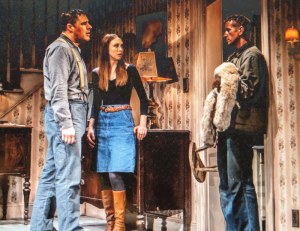
(L to R): Rich Sommer, Taissa Farmiga, Paul Sparks in Sam Shepard’s “Buried Child,” directed by Scott Elliott, Off-Broadway at The New Group. Photo credit: Monique Carboni.
Tilden, once an All-American halfback, is child-like, dense, withdrawn: these may be weaknesses caused by that “trouble in Mexico” a while ago. The obstreperous Bradley was careless with a chainsaw and chopped off his leg.
Bradley’s movement “to go far” has ended; he must wear a prosthetic device to go anywhere. The most promising son, Ansel, died in the military, and Halie, who meets with inoffensive, smarmy Father Dewis (Larry Pine) to discuss the placement of his statue in the community, brings the priest in for tea and stirs havoc. Clearly, Halie has sought religion to stave off the darkness.
Shepard’s writing is precisely rendered. He wanders his characters through a filtered catastrophe that they have long suppressed. Their meanderings with each other are filled with humor, thematic layers, poetry, and symbolism. The dramatic action is interior; when Tilden, Bradley, or Halie appear, disappear, and interact, the molecules have been stirred, the atmosphere changes, and tensions strain. There is the sometimes gentle, sometimes antagonistic sparring among the four. And Dodge is central; he grounds all who enter and leave with brusque ease. He is the family linchpin, and only he will be able to exhume what sickens in all of them when the time is ready.

(L to R): Taissa Farmiga, Ed Harris, Rich Sommer, Amy Madigan, Larry Pine in Sam Shepard’s “Buried Child,” directed by Scott Elliott, Off-Broadway at The New Group. Photo credit: Monique Carboni.
Shepard’s grand metaphor of the harvest, sown in the past and now ready to be picked and enjoyed, is spiritual, interpretive, and surreal. It is a harvest seen and recognized by some in the family and not others, much as truth and circumstances are perceived and interpreted individualistically. Shepard combines this metaphor with an even greater one, a human embodiment of the harvest in the characterization of Vince (Tilden’s son whom no one initially acknowledges or seems to remember), and his girlfriend Shelly (Taissa Farmiga is appropriately sharp and intrusive), whose curiosity eventually prompts Dodge to reveal that which has been rotting the foundations of their family relationships and particularly Dodge’s soul.

(L to R): Taissa Farmiga, Nat Wolff, Ed Harris in Sam Shepard’s “Buried Child,” directed by Scott Elliott, Off-Broadway at The New Group. Photo credit: Monique Carboni
That Vince (a portentous and dangerous Nat Wolff) and Shelly appear at precisely the right moment when the crops are ready to be harvested is a singular mystery answered by the play’s conclusion. Dodge finally discloses the secret of the fields and acknowledges that he is no longer afraid; it is then that the reckoning comes. Shepard emphasizes in Buried Child that there indeed is a season for everything. And regardless of whether we want to acknowledge it, the ripeness of fulfilled truth eventually is visited on a family, though it may skip a generation or two.
This is a magnificent production, prodigiously acted by the ensemble cast and brilliantly conceived, staged, and designed by Scott Elliott and his team. The production throbs with tension. The undercurrents vibrate throughout. Above all the character portrayals balance evenly to create a living portrait of the poignancy of human families.
Ed Harris resides in Dodge with sustained concentration and moment-to-moment precision, even as the audience shuffles in and fumbles around for their seats (before the play begins). Harris embodies the character’s rough-edged, blunt and ironic persona and it is difficult to take one’s eyes off of him. His seamless sliding underneath Dodge’s skin is without equal. Amy Madigan as Halie is his perfect counterpart, striking and glorious one moment and in the next shrew-like and high-pitched as if stretched to the point of breaking.
Indeed, Elliott has guided this cast into taut perfection; Ed Harris, Amy Madigan, Paul Sparks, Taissa Farmiga, Rich Sommer, Nat Wolff and Larry Pine would not be as alive in their characters as they are if the balance and the pressure were not tuned to a proper pitch by each actor’s work.
Buried Child is beyond memorable. It is is one for the ages. The New Group production runs until April 3 at Pershing Square Signature Center.
VINO 2016: Highlighting an Award Winning Wine of Cantina Sampietrana

VINO 2016 at the Hilton Midtown Hotel (2/7-2/9) This is the grand ballroom with over 125 exhibitors of Italian wines from the 20 regions of Italy.
Italy, like no other place on earth for its food, is also like no other place on earth for its wines. In the US we are just beginning to understand how the wine making history, terroirs and microclimates of the various wine regions of Italy, have contributed to an abundance of so many wonderful wines. It is almost impossible to wrap one’s head around all the amazing wine possibilities that Italians have lived with all of their lives and for centuries.

At VINO 2016 I tasted Cantina Sampietrana’s wonderful Puglian wines. One featured here is an award winning wine.
Indeed, the entire country of Italy from one corner to the other is layered in the ancient history of winemaking and the appreciation of the beauties of living and enjoying good food paired with wonderful wine. To give you an idea of how much Italians know and understand the ancient wine making business, there are 500 grape varietals in Italy that can be made into a multitude of wines as varied as Proseccos, to dessert wines, to rich full bodied reds and creamy, soothing, light whites. In France, there are only 15 grape varietals that compose French wines. So for every Italian wine tasting I go to like VINO 2016’s tasting that featured over 125 wine exhibitors in the Hilton Midtown grand ballroom on February 8th-9th, I enjoy sampling wines from Italy’s different regions. Slowly, but surely I am learning about the multitude of grapes, their terroirs and microclimates which have produced some of the most incredible Italians wines that pair wonderfully with lip-smacking, delicious, quality Italian food.
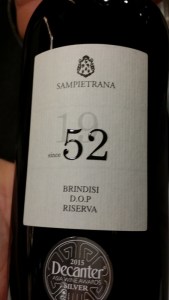
This Cantina Sampietrana 52 Brindisi D.O.P Riserva won a Silver Award from Decanter (2015)
VINO 2016 is preparing me for visiting Italy again to visit relatives and to visit some of my most favored wineries whose wines I’ve tasted recently. Some are featured on this blog; others are featured in my Blogcritics posts: the exemplary Slow Wines like Cantina Della Volta and Badia A Coltibuono and Slow Wines from the Piedmont like those from The Fiorenzo Nada winery, Carussin winery and the Cà ed Balos winery, and the storied, amazing Tuscan wines of Pietro Beconcini, These represented regions in the North. I also sampled wines from Abruzzo (see the post on this blog of the story of Montepulciano d’Abruzzo and winery Valpeligna Vini) and Puglia in my first post about the Negroamaro and Primitivo wines from Cantina Sampietrana produced from their wonderful organic Alberello bush vines.
After attending workshops on wines from other regions at VINO 2016, I went to the grand tasting in the ballroom and spent some time learning about Puglian wines from Stefano Civino who represents Cantina Sampietrana. One wine I didn’t discuss in my previous post about Cantina Sampietrana is their amazing 52 Brindisi D.O.P. Riserva 2012 (see photo). It is an award winner, a beautiful red statuesque wine, with moderate fruit and earthy palate, barely noticeable tannins and sumptuous, lasting finish. Paired with spicy meats and full flavored cheeses and salumi it is a knockout. I figured it would be best to let Stefano Civino discuss for himself Cantina Sampietrana and an exemplary vintage of this marvelous blend of Montepulciano (20%) and Negroamaro (80%) via Wine TV with host Jessica Alteri.
VINO 2016: Cantina Sampietrana, the Wonderful Wines of Puglia
 VINO 2016, Italian Wine Week, is an unforgettable event that occurs once a year around the first part of February. This year VINO 2016 took place at the Hilton Midtown, NYC (February 7-9). It is a festival of Italian wines where producers, importers, retailers, journalists and wine educators gather to learn about Italian wines and sample some of the marvelous vintages that are being produced throughout the 20 regions of Italy. This year there were approximately 125 producers represented and since I cannot get to all of them though I would have liked to, I had “a little help from my friends” who made recommendations.
My friend, wine connoisseur Chris Black, who hails from Hungary, suggested I stop at a exhibitor he enjoyed, Cantina Sampietrana, a cooperative which produces wines from Puglia. The region of Puglia is Italy’s heel and Southwestern most province. Its coastline fronts the Adriatic and Ionian Seas. I have never been to Puglia, but I have tasted delicious Puglian wines and knew I would not be disappointed by the wines from Cantina Sampietrana. Chris was right to send me there as the wines I tasted were superb.

Stefano Civino, the face and heart of Cantina Sampietrana.
Co-op representative, Stefano Civino who joked that he is “the face of Cantina Sampietrana,” told me that his father is a wine producer and member of the cooperative which was established in 1952. Stefano himself has extensive experience in the wine making business, not only from an international sales and marketing standpoint, but he actually goes into the vineyards. He told me he joins his father in various aspects of vine development; for example, he recently helped to prune the vines. Not only does this exemplify the expert’s desire to remain in touch with the land and vines, it manifests the passion to understand and experience all aspects of expert cultivation which helps to produce top quality wines.
Catina Sampietrana (whose location is the historic centre of San Pietro Vernotico, a little village in between Brindisi and Lecce in Puglia), produces both reds and whites from mostly indigenous varietals. What makes these wines wonderful? The type of cultivation that requires working with the vines by hand as they grow in bushes, and the bio-dynamic growing techniques; the vines are certified organic using NO Monsanto pesticides, fertilizers or herbicides. I talked to Stefano at length; he knows a great deal about wellness and eating organic, clean food to promote a strong immune system. Of course drinking clean, delicious wines paired with clean food is an important part of good health.

Tacco Barocco Primitivo 2014

Tacco Barocco Negroamaro 2013
I tried the Tacco Barocco Negroamaro 2013, which is 100% Negroamaro grapes made from 50-year-old Alberello bush vines. It is deep red with the fragrance of wild berries. Its oak aging from 9-12 months adds a note of spices to the velvet smooth elegance on the palate. The 2013 Salento IGT has a lasting finish; the tannins are mildly present but flavorful. As a red I would drink it with appetizers of Prosciutto di Parma and mild to sharp cheeses. It would go well with pasta and meat sauces, steaks, and grilled meats and vegetables.
Next was the Tacco Barocco Primitivo (meaning early) 2014 which is 100% Primitivo grapes. The 2014 Salento IGT is ruby red. Refined in oak for 9-12 months, it has a deep, rich, spicy nose and is layered and mellow with a hint of deeper texture on the palate. The tannins are not overpowering and give this wine an expressive finish. It would go great with slow cooked roasts, braised, savory meats, quail, wild boar and moderately sharp cheeses.
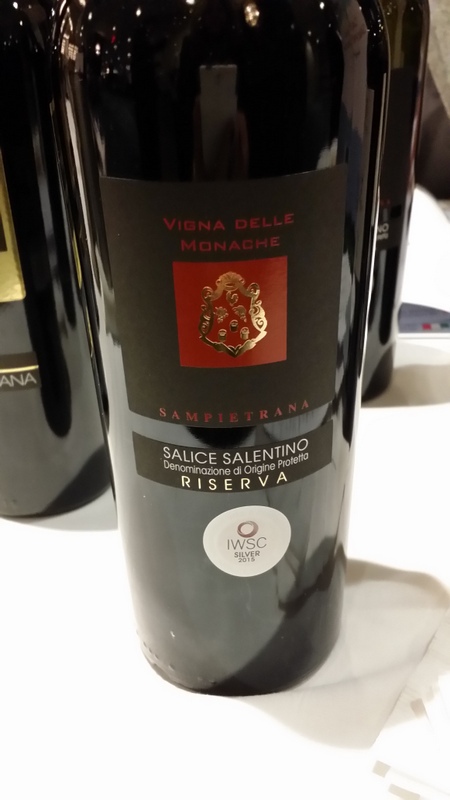
The Vigna Delle Monache Salice Salentino DOC Riserva 2011, a fuller bodied wine and quite delicious is made from 100% selected Negroamaro grapes. It has a darker ruby red color. Aging in French oak barrels for 12 months and in bottles for two years adds to the stature of the wine. Its bouquet is of black cherry with a scent of pleasant vanilla. The palate is velvety and profound with a lasting finish.This would go great with well-seasoned earthy dishes, roasts, savory game, poultry, pork and spicy salumi or Grana Padano cheese.
When I go to Puglia, I do plan to stop at Cantina Sampietrana and sample the next sequence of these wines vintages and try some of their other wines. They have tastings and if you call before hand (see the website information or contact your tour guide and arrange a visit), you will have a fun time and be assured that all the vineyards you are looking at are cultivated with passion, assiduous care and astute attention to sustainability and zero negative environmental impact.
VINO 2016: The Story of Montepulciano D’Abruzzo
Producer at VINO 2016. Photo, Carole Di Tosti
The last day of VINO 2016, Italian Wine Week at the Hilton Midtown, NYC (February 7-9) I ran into Chris, a friend and wine connoiseur. This was in the grand ballroom where over 125 Italian wineries and their representatives were exhibiting their wonderful wines. During such amazing tastings, I try to feature one or two regions of Italy and concentrate on their wines. But I always know I am giving the other wineries short shrift. So many wines, so little time! It helps when a friend covers one area and I another and we swap notes.
Chris recommended I stop at Valpeligna Vini and try the 2010 Montepulciano which he really favored along with meeting the two brothers Marco and Giuseppe Iacobucci who were representing the wine cooperative that produced the wines. When I stopped by to see if I agreed with Chris, I spoke to Roberto Polidoro who told me an interesting story and cleared up a few facts about the wines we associate with Montepulciano that for me, Frances Mayes made famous in her book Under the Tuscan Sun.

Montepulciano d’Abruzzo, Don Peppe 2010, Photo Carole Di Tosti
Did you know that Montepulciano D’Abruzzo is a particular grape that evolved in Abruzzo (the province running from the Appinnines, East of Rome to the Adriatic coast), and it is not to be confused with the wine referred to as Montepulciano, actually Vino Nobile di Montepulciano, a Tuscan wine which is a meld of Sangiovese and other grapes? I did not. Italy has over 500 indigenous varietals that are found in the twenty regions of Italy. To give you some perspective, France has only 15 varietal grapes. So when one begins to learn about the great wines of Italy, you will learn amazing stories about the evolution of their many, many grapes and you will want to continue learning about them once you begin to get your “feet wet,” and try another grape varietal or blend which is at the heart of another superb Italian wine.
This is the interesting story about the Montepulciano grape varietal, which did NOT originate in Tuscany, even though it takes the name of the town of Montepulciano in the province of Siena. The grape that grew in Tuscany in the area of Montepulciano was the Prugnolo grape varietal. Prugnolo was cultivated around Montepulciano, Siena since the Renaissance. All the European Renaissance courts from Venice to Paris adored Prugnolo. However, it was around the XVIII century before the French Revolution in 1789 that the Mazzara Nobility had the Prugnolo grape transplanted in the Peligna Valley because of the appropriate climate, soil and other features. The farmers and vintners in the Peligna Valley liked the wines produced by the Prugnolo, but didn’t use that appellation; they used a short-cut to name it, like saying “that Montepulciano grape.”

Don Peppe 2010, Valpeligna Vini Carole Di Tosti
It has been documented by travelers at the time (Michele Torcia) of 1792 that the grape referred to as “Montepulciano” was being grown everywhere in the Peligna Valley. The irony is that the nature of the micro-climate, the soil, the suns and winds and the cultivation techniques impacted the Prugnolo and actually changed the life blood of the grape’s morphology and thus evolved a completely different grape varietal which those of the then Abruzzo-Moliese (now Abruzzo because the two provinces split in 1963) region were growing. They referred to it as “Montepulciano.”
Thus, who would think that from the Prugnolo, a different grapevine evolved and it was the familiar named grape varietal, Montepulciano. After the split of the provinces in 1963, it became Montepulciano D’Abruzzo because the Peligna Valley and other areas in Abruzzo are where the Montepulciano grapes are grown.

Giuseppe and Marco of Valpeligna Vini with the Don Peppe 2010. Photo Carole Di Tosti
The full-bodied, bold character of the “that Montepulciano grape” is best realized in the Peligna Valley where Marco and Giuseppe Iacobbuci and other vintners combine their efforts in their cooperative, Valpeligna Vini. And I must say the wine of the Montepulciano D’Abruzzo D.O.C. is sensational and very different from the Tuscan Vino Nobile di Montepulciano, a blend.
I tried the Don Peppe 2010. Its color is dark, deep ruby red. There were lovely notes of black cherry melded with vanilla. It was complex and layered and had a long, strong finish. The tannins were not overwhelming but balanced. Such a wine is great with Grana Padano and other sharp cheeses, salumi, and of course, red meats, roasts and pasta.
Italian wines like the Italian people themselves have within them an amazing story to tell. If we remember that all of Italy’s peninsula is a phenomenal food and wine region (I like to say you can’t get a bad meal in Italy), with the evolution of grape growing morphed by nobles and peasants alike, by monks and clergy who were diligent vintners. The wine tradition goes even further back to the ancestors of today’s Italians, for example, Etruscans, Samnites, Greeks, Romans because often the wine which was fermented, was SAFER and more delicious to drink than water. Indeed, there are similarities to today and upon doing a bit of research, it is amazing what one discovers: the more recent Montepulciano D’Abruzzo grape varietal is a welcome, wonderful addition to Italy’s indigenous varietals.
For me the story of this grape represents the ingenuity of vintners and how they are constantly developing and enhancing their vineyards with improved techniques to tease out the finest most luscious quality wines. As an added note, this does not involve use chemicals (pesticides, herbicides) over a thousand of which are banned in the European Union. The Montepulciano D’Abruzzo is strictly the morphology of the terroir, the microclimate of the Peligna Valley, the sun, wind and rains of the region as it develops from year to year and enjoys its enriched life. These wines of Valpeligna Vini are all bio-dynamic. They are grown with the passion and tender care of the vintners whose vineyards are on the Maiella hillside in Abruzzo. For further information check: Valpeligna Vini.
The Top 50 Sites for Indie and Self-Published Authors
I stumbled across this fantastic resource and wanted to share with you. I’d love to hear any feedback.
View original post 93 more words
#Slow Wine 2016, A Festival of Great Wines

Slow Wine 2016 at the Highline Ballroom. Photo by Carole Di Tosti
Slow Wine 2016 is in its 5th year touring the globe with stops in Asia, the USA and Europe. Traveling in the US, Slow Wine Guide’s editorial team and select winemakers went from west to east moving from San Francisco, Los Angeles, Austin and New York before they will be heading over to Europe.
Many New Yorkers are proponents of the Slow Wine Guide. They have come to expect excellent wines based on the Slow Wine mantra of good, clean, virtuous wines whose winemakers employ sustainable agriculture, use little or no pesticides or herbicides and engage in traditional time worn techniques using centuries-old indigenous grapes from the various regions of Italy.
Judging from the turnout at the Highline Ballroom, February 3rd, distributors, wine educators, retailers, sommeliers and others in the industry were anxious to become acquainted with exceptional slow wines produced from every region of Italy. A number of the producers were present in NYC rounding out the last of the US tour. Most of the winemakers I spoke with appear in the Slow Wine Guide which was available for purchase during the incredible tasting of reds, whites, dessert wines, and sparkling astis. The Slow Wine Guide features the best Italian wines as determined by Slow Food editors. The guide is also an App and is available for download on the App Store for iPhone. The App, like the guide hard copy, tells the story behind the producers, their vineyards, and Italy’s wine-producing regions.

Slow Wine 2016 at the Highline Ballroom, 2/3. Photo by Carole Di Tosti
This walk around tasting featured many small-scale winemakers who are using traditional techniques. Following through on their ancestral history and the bio-dynamic changes that have been occurring over the decades since the concept of “Slow Food, Slow Wine” emerged and was implemented, the producers work with respect for the environment and terroir. They make sure to safeguard the incredible biodiversity of grape varieties that are part of Italy’s heritage.
Winemakers who embrace the Slow Wine Guide symbols and standards are truly coming into their own. I talked to a few sommeliers and educators associated with culinary institutes. They agreed with me that when the producers began to convert from the chemicalized agriculture to bio-dynamic and sustainable tenets, the wines they initially constructed were not very good. However, as winemakers shared information and worked to perfect their techniques over the last thirty years, today the wines they produce taste out of this world. For me of vital importance is the added assurance that the agriculture used to produce the taste is sustainable. Most of the wineries have US distribution.
The Piedmont region of Italy. Turin is the capital. It has been designated a UNESCO World Heritage site.
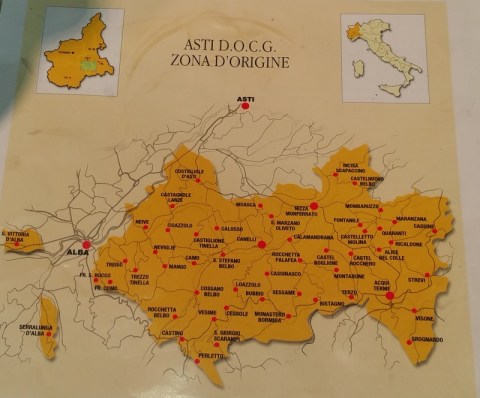
Some of the producers whose tables I visited were from the Piedmont region of Italy, with Turin as its capital, a place where some of my ancestors are from. In north western Italy, the Piedmont is a region whose wines I was not familiar with. What I found particularly interesting is that the Langhe wine making zone in the Piedmont has been recognized as a UNESCO World Heritage Site. That added protection will hopefully maintain the flora and fauna of the area for decades and will protect the vineyards and producers from land raids by developers.

Exceptional wines from Cà ed Balos winery in Piedmont. Photo by Carole Di Tosti
Some of the winemakers whose exceptional wines I tasted included wines from producer Renata Bonacina of the winery Cà ed Balos. The dessert wine Moscato d’Asti was particularly drinkable. Another winery from the Piedmont is Bruno Nada’s Fiorenzo Nada, whose son Danilo is following in his father and grandfather’s footsteps. Danilo introduced me to two delicious red wines. From Bruna Ferro’s winery Carussin, Luca introduced me to two lovely red wines. Representatives of the consortium of wines from PiedmOnTop introduced me to wines from four different vintners.
There were two other wine regions I sampled wines from: Emilia-Romagna and Tuscany, both whose regional wines I tasted before this event, though I had not tasted wines from these producers which were just great. From Modena in Emilia-Romagna is the winery Cantina Della Volta whose “prestigious cellar is old in origin but modern in conception” according to the Slow Wine Guide 2016. And from Tuscany was a type of wine that I drank years ago at family gatherings but I thought was boring: Chianti. Chianti has been revolutionized. It overshadows many of our West coast reds for drinkability and agricultural integrity. When I tasted the offerings of Badia a Coltibuono, I was impressed. Slow Wine states that the winery is “a paragon of good Italian viticulture and has been certified organic since 2000.” All of their efforts to work sustainably have produced some incredible Chiantis. After having turned up my nose at this type for years, Badia a Coltibuono as made me a convert to be on the lookout for more amazing Chiantis like those of this winery.
This year’s Slow Wine 2016 was an exceptional event. Because of the tenor of what it means to produce the fruit of the earth without harming the vines, the terroir and environment, I am persuaded that these wines are finally achieving a level of quality that conventional wines produced with chemicals will never attain. I am sorry that I couldn’t get to each vintner, but I do have the Slow Wine Guide to keep me apprised of the offerings of great Italian vintages that have been produced in a growing style that most wine lovers will come to expect over time because the wines are incomparable.
Continually, Europe has been way ahead of the United States with regard to sustainability, local food sourcing, the rejection of radiated foods and the labeling of GMOs. Unlike the US, Europe has banned over 1000 chemicals which appear on a blacklist as toxic for people and the environment. To have such chemicals (herbicides, pesticides, chemical fertilizers) used in the production of agriculture and husbandry (antibiotics, growth hormones, processed feed), is anathema to most countries in the European Union. Because Italians are assiduous keepers of clean food and wine, the quality of the food Italians experience daily has superb taste, nutrition and cleanness. To have wines which exemplify the same value and worth as their food makes complete sense and complements a daily lifestyle that shows an appreciation for life and beauty. Would that we were to follow the European and Italian Slow Food and Slow Wine example.
This article first appeared on Blogcritics.
 CAROLE DI TOSTI