Tom Hanks, Lucky Guy. Not So Lucky Play by the Late, Marvelous Nora Ephron.

Tom Hanks is a phenomenal human being and actor. Many would be proud to have him as a friend. Helping Nora Ephron mount her play, Lucky Guy, is a tribute to her and to him. They are to be credited and although it has not been made crystal clear, most likely they discussed and worked on the play at length before she was struck down by her illness. For the most part, I write reviews that are supportive of the arts. I understand that every attempt made at producing and promoting a production whether on or off Broadway is a labor of love that engenders a very long process over hurdles, obstacles, nay-sayers and grouchy money lenders and enthusiastic investors. I acknowledge and appreciate. the courage, brilliance and perseverance it takes to present an artistic endeavor which could fall or succeed depending upon so many variables that sometimes it is impossible to calculate the why, the if and the how.
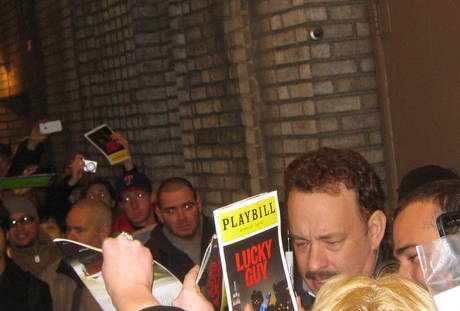

The spectacular Sir Ian McKellan. He was so gracious to speak to me after the performance. See future posts about this.
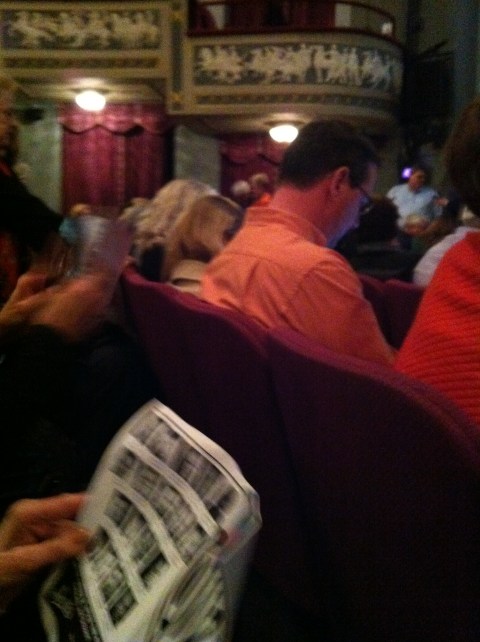
Blurry picture of Glenn Close, the blonde to the far right. I briefly spoke to her after the play telling her how much I loved her incredible body of work. She, too, was very gracious and smiled. But as Emily Blunt responded to me once a few years ago when I saw her at a performance of Bloody, Bloody Andrew Jackson, and apologized for complimenting her. She responded that actors don’t find praise droll and tiresome. “It’s better than saying, ‘I hated you!” she said with smiling humor. I doubt that Close found the praise droll and tiresome either. So much of the world of acting is filled with cattiness, criticism, negativity and soul angst. A bit of well-deserved praise from viewers is welcome.
Lucky Guy will not fall on its face because Tom Hanks’ presence in New York City in a live performance will draw tony crowds willing to pay $400 for premium seats and Hanks’ buddy celebrities who will come to support him through rain, sleet, snow and desert temperatures, and who may have been comped to be seen in the audience. Others living in New York will purchase the “hot” ticket, though they may never have worked or buddied up with Hanks, just to see this renown and beloved movie actor on Broadway. Certainly, the little people and fans will pay big money for the rafter seats to catch a glimpse of Forest Gump, the Oscar winning actor and the producer who has a fine eye for humorous talent exemplified when he backed little known comedian Nia Vardalos by producing a little film with a big heart, My Big Fat Greek Wedding.

Hanks quips and smiles to an adoring well wisher. Many pictures were taken with smart phones and iPhones. There was a crowd crush line up at the end of this performance.
The promoters know of Hanks’ draw capability by his track record box office. So if the play is less than sterling, if the plot is convoluted, chopped, contrived, unfocused and completely un-Ephronesque, if the sign offs from McAlary’s family were hushed and pressed, will the audience care? No. They are there to see an exhibition, a show, the glitz and the fun. They are not expecting great writing at this point, and since they are coming for all the other reasons and not to see a marvelous story, they will not be disappointed. They might be rather surprised that the play doesn’t cohere and that it shifts after the intermission toward a completely different focus, but that will not cool them from enjoying the evening. Why? Hanks is true to form. He rises to the occasion. He makes the thin, stereotyped, fictionalized characterization of the brilliant and courageous newspaper reporter Mike McAlary believable, likable and intensely human with yeomen’s help from an exceptional supporting cast, beautifully acted by Courtney B. Vance, Richard Masur, Christopher McDonald, Maura Tierney, Peter Gerety and Deirdre Lovejoy and aptly directed by George C. Wolfe.
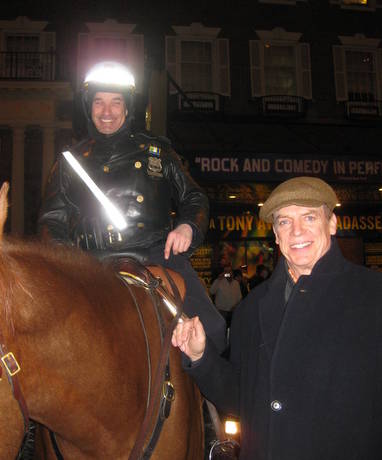
Mounted police were thrilled to take pictures with Christopher McDonald who has been in over 85 film rolls over the years and still looks like a kid.

Even the horse was tickled to be in a photo op with McDonald. A bit later he head butted McDonald and pushed him forward as if to tease him. McDonald posed a fighting boxer stance in humor. It was a great and spontaneous moment. McDonald upstaged the horse, proving you have to be ready for anything in the moment as an excellent actor which McDonald is.
Lucky Guy is about the arc of success for Mike McAlary: his influences, his exuberance, his integrity, his passion and the conflicting loves of his life, his wife and his reportage and status as a columnist when he worked for New York City Newsday, The Daily News and The New York Post. Yet Lucky Guy also purports to be about the the men, McAlary’s editors, specifically Mike Daly and Hap Hairston with whom he worked closely and who supposedly knew him best. As an iteration of these newspapermen it also shows snippets of New York City and the three New York tabloids during the 1980s and 1990s.

New York City in the misty retrospective of the 1980s and 1990s, the play’s setting.
Ephron took on an ambitious challenge compressing McAlary’s story as a newspaperman, using the narrators-editors and newspaper people and his wife to bridge the enactments of seminal events in McAlary’s life. Whether the abortive conception of McAlary as a man whose star skyrocketed too quickly in bombastic, self-possessed glory that could only result in a plummet, Icarus-like to the earth, or whether the sheer weight of the attempt at compression of the hundreds of moments of a true life story caved in on itself (without using symbolic, representational short cuts of revelation to assist in the telling) the ride became chopped and grinding. At best it was ill conceived and at worst it was a flatliner that catapulted into nowhere land. The dialogue witty and clever at times, reveals Ephron’s turn of phrase and humor. As for the excitement, thrill and edginess of the newspaper business? It was lost in the retelling through the selection of events and perceptions of the editors which decreased the vitality of what were fascinating and complex decades in New York City’s history.
The irony is that the urgency to chronicle the story truncated the spirit of the truth of these individuals, especially McAlary and the editors. This wobbly “truth” webs an obscurity that minimizes their very real conflicts with themselves and each other. This in turn skews the focus and redirects the play in the second act toward hyper-resolution as McAlary wins the Pulitzer Prize for reporting on the Abner Louima case. At this high and low point of his life, Ephron shows his humility in accepting the prize (which strangely appears like a mea culpa speech to his colleagues) and his resignation as his cancer battle overwhelms him. This battle in the play’s unfolding almost appears as a judgment on his life which it shouldn’t. The play lamely concludes with the recognition of the birth and death years of the two editors and McAlary projected on the screen as the men stand before us in a tableau. For a second, I was left feeling like this was a theater of the absurd Pinteresque let down, “That’s all there is folks?” What? Wasn’t this play about McAlary as the focus? Or was it about the editors? Was it about the last choking song of New York’s tabloid newspapers? Clouds swirled around my understanding making me feel that both the playwright and director were unsure about an effective ending and ran out of steam. Incongruency. The play was unable to hold together the line of events that were so urgently chronicled.

As I stared at the dates, I felt a dull thud of “ho hum,” when I should have felt a lightening jolt of recognition that the era of newspaper tabloid reporting had ended with these individuals and would never return again; that greats like McAlary were precious, rare talents, their flaws having enriched their work. The preciousness did not come through in Ephron’s least satisfying endeavor. What did come through was Hanks’ presence and being despite the muddled plot and characterization. Hanks’ acting skills injected every ounce of spiritual strength and humanity into Ephron’s words. Hanks breathed life into a wooden, thinly written Mike McAlary. The cast were true to their best efforts and allowed us to envision what these living individuals might have been like at this time and place. Was the memory of McAlary served by Hanks? Absolutely. But the play was not a vehicle to introduce or remind us of McAlary’s genius. Unfortunately, it muted and veiled the artistry and the power of his legacy, and most likely it did the same for the other individuals who lived and breathed newsprint onstage.

Call it a problem with plot, selection of events and perceptions. Say it was too ambitious a task to try to cover his journalistic career and life during that time. Call it a problem of how the truth of McAlary the man was cobbled together through interviews, newspaper articles and editorials, etc.,and spun. Call it what you will, the play was uneven, misshapen. Hanks has been quoted as saying that the play is a fictionalized account of McAlary. Well, fictionalized would have been vastly more entertaining with great opportunities for extrapolation and flexibility of story telling. The identities and names could have been masked and the story better wrought; it could have been simplified to parable level or made more mythic. Or it could have been made more real, refocused on the relationship between McAlary and his wife which would have been an enhancement. Somehow, their love never resonated as it should have. And this wasn’t the fault of the actors, but rather in the thinly drawn interaction between them.
To accommodate Hanks, McAlary’s age was tweaked. The man died at 41. To say his life was cut short is an understatement. To say that his wife and children were bereft without him is another understatement. To say that he accomplished a tremendous amount in the years he had is another understatement for he wrote novels and screenplays and consulted on films. McAlary was a dynamo, beloved to his wife, relatives and friends, an amazing personality a newspaper man of the old school who adored his work. Indeed he adored life and wanted to live it to the fullest. He did, but his season for living was brief. And this is the tragedy with which all can identify. This is the story, and what a story.
But how do you put this in words and get it all in? You render it as legend; he’s an Odysseus, a hero, a champ, a newspaperman we can love. You create an independent narrator, one not involved as a character, one who has an overarching view who selects the crucial events that brought the man higher on his soul journey. Then you reveal what he has learned and what he has carved for himself out of the roughness of youth into a wisdom borne out of love, loyalty to his passion, trial and suffering. You show the nobility of the time through this narrator’s eyes, revealing the horror that has increased in the decades as a precursor to the new prowling terrorism of war on American soil. Then the focus is clear. Then the years of McAlary’s birth and death make sense in context. Then we understand their value and can say, here was a great newspaperman who captured the era with the dynamism of his reporting and we shall mourn an era that we’ll never see the likes of again.
Lucky Guy is at the Broadhurst Theater.
B.B. King’s Signature Wines Launched. A Bottle of Red, A Bottle of White, the Legend Continues.

B.B. King toasts to fans and wine lovers with a glass of the B.B. King Signature Red.
The legendary blues musician and 15 time Grammy winner B.B. King is a dynamo at 87. If you are a B.B. King fan and have caught his blues act in concert or play his music at home, you know why this beloved Rock and Roll and Blues Hall of Famer has achieved global renown. His blues is easy listening. His musicianship is kinetic. His youthful verve is catching. His bubbling vitality has stirred B.B. King to keep a busy schedule. He tours globally averaging 250 concerts a year and promotes or plays at his B.B. King’s Blues Clubs occasionally in Orlando, Memphis, Nashville, West Palm Beach and Las Vegas (currently closed). All of his moves and his clubs encourage the iconic blues to flow. Visiting artists and musicians play music at B.B. King’s, whether funky and fast or soulful and smooth, LIVE, every night of the week.
In another contribution to stimulating our enjoyment of life, B.B. King’s energy has spilled over into creating his own signature wines. Whether you are a wine lover or B.B. King fan you can savor his wines at his clubs and in select retail stores, wine bars and music clubs nationwide as well as online. You and friends can share a bottle of red paired with the Bourbon Glazed Ribeye at B.B. King’s Orlando or share a bottle of white with the Southern Fried Catfish if you’re visiting family in Memphis and decide to drop in to B.B. King’s for a great evening of music, food and wine. When you enjoy his wines you are embracing this amazing talent who has brought so much to global fans and has given back with joy to artists and musicians.

B.B. King’s Signature white and red wines at Vinport.com/bbking
How did the B.B. King Signature Collection come about? Since B.B. King has performed in 88 countries throughout the world with hundreds of performances given in Europe, he has become acquainted with the relaxing, leisurely and healthful style of meal enjoyment there. One of the most memorable visits was to Spain in 1991 when Seville hosted the original all-star “Guitar Legends” concert series. This series celebrated 27 of the world’s finest guitarists, including B.B. King, over a five day period of completely sold out shows. It is not a coincidence that his signature wine is sourced in the up-and-coming D.O. wine region of Almansa, Spain from the award winning Bodega Santa Cruz winery which has been producing wine for over 60 years.With the efforts of Bodega Santa Cruz winery and the assistance of Votto Vines Importing headquartered in Connecticut, B.B. King’s Signature Collection was established and is being launched nationwide.

This Crianza will pair well with stews, red meats, and some richer pasta dishes. It will also compliment sausage, but nothing too spicy
The B.B. King Signature Collection is the misty elegance of the blues; it manifests the sine qua non of B.B. King, the legend, the personality, the sustained career excellence. The B.B. King Signature Collection Red 2010 is a Crianza blend made from Garnacha, Syrah, and Cabernet Sauvignon. The B.B. King Signature Collection White 2011 is made only from 100% Verdefo grapes. The wines pair well with various dishes and can be drunk with appetizers to one’s taste as they are food friendly. They are moderately priced and won’t destroy your wine budget for the month and as in European style can be enjoyed as every day drinking wines. The suggested retail price is $13.99 which is perfect for casual enjoyment with friends, larger parties, as well as other dining occasions. You can purchase B.B. King’s Signature Red and Signature White at Vinport.com/bbking.

This Verdejo pairs beautifully with seafood, light sauces, and marinated olives. It This Verdejo is light and refreshing on its own as an aperitif, and matches well with a wide variety of dishes including Mediterranean pizzas, sushi, and especially mussels or clams in broth.
Just a few details about B.B. King that you should know.When you think of blues, the iconic King of Blues, the man with the golden fingers easily comes to mind. B.B. King has defined blues globally for the last 50 years. His tireless efforts have set the standards for blues. His work ethic and force of will are marvelous to experience given his age and effervescent spirit.

B.B. King in concert.

The riff.
B.B. King began recording in the 1940s and since then has released over 50 albums. His guitar style is memorable, identifiable and amongst the finest in the world. It earned him a #3 spot on the list of Rolling Stone’s “Top Guitarists of All Time.” B.B. King was inducted into the Blues Foundation Hall of Fame in 1980 and into the Rock and Roll Hall of Fame in 1987. In addition to receiving the Grammys, he was awarded with NARAS’ Lifetime Achievement Grammy Award in 1987. Was he ready to throw in the hat and retire? Saay what? He was just beginning. He opened his clubs and continued to tour increasing his fan base to a new generation of fans who enjoy his music and dig his club scene. He has established his iconic presence with clubs in key cities and now has expanded our enjoyment with the B.B. King Signature Wine Collection. Now, is this man the blues or what?

King of Blues
Sagrantino Wine Tasting at Eataly’s La Scuola: It’s Sagrantino Month!
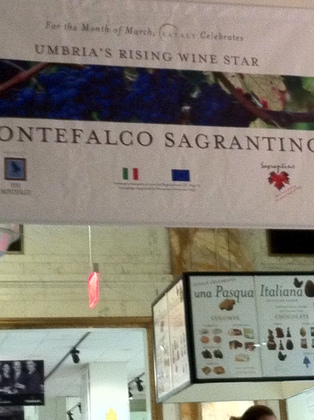
This is Sagrantino month at Eataly. You can enjoy a glass of Sagrantino from various Umbrian wineries at Eataly’s restaurants. You can also taste the pleasures of Sagrantino wines every Friday when Eataly’s wine store will feature a select Montefalco winery’s Sagrantino vintage.

I am enjoying a glass of Sagrantino Collepiano from the Arnaldo-Caprai winery. Eatay’s signature brand is on its stemware, of course. Eataly’s La Scuola is host to events like tastings and cooking classes. I have yet to get to a pasta class, though I could probably teach it as I learned how to make fresh (spinach, tomato, gnocchi, ravioli, etc.) pasta from my mom and nonna.
I don’t think I can easily tire of Sagrantino wines. I am rather unschooled in superlatives and cannot tell you the finest wine ever produced in the last 60-100 years. I’ll leave the sommeliers to that and surely there will be disagreement, pretension (no offense guys and gals) and enough rant to bore the rest of us oenophiles. However, I do know what I like and after being introduced to a little known grape varietal and its wines from the region of Montefalco, Umbria, I’ve tasted enough wines made from the Sagrantino to know that they are a lovely accompaniment to hot appetizers, cheeses, salumi and meat dishes.
So I really enjoyed the Sagrantino wine tasting at Eataly’s La Scuola. I was introduced to different Montefalco wineries producing a variety of the region’s Sagrantino wines and blends, from Rosso to the straight Montefalco Sagrantino D.O.C.G.
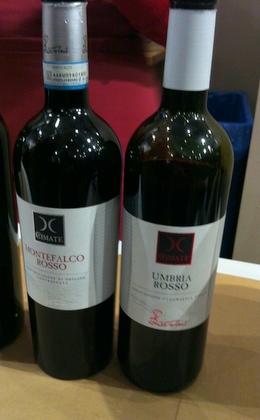
I tried these wines which are an older vintage and found them to bloom into the satisfying Sagrantino mouth feel. The winery is Cantina Le Cimate and I had the opportunity to speak to producer Paolo Bartoloni who is happy that his wines are being introduced to the American markets where we will be able to enjoy them. My oenophile friend FK spoke to Paolo at length and hopes to visit him in Montefalco after FK returns to his home in Hungary.

Paolo Bartoloni with Marco Caprai (back to the camera) both paisano from Montefalco, Umbria. Take a day trip there if you are visiting Spoleto or Perugia.
Eataly has been featuring Sagrantino wineries since its Umbrian promotion of products in the fall. That was my first introduction to the rare Sagrantino grape and the Arnaldo-Caprai winery. I enjoyed the wines then and at a delicious tasting hosted by Roberto Paris at New York Times 3 starred Il Buco Alimentari & Vineria. As I attended other tastings and dined at other venues, I moved on falling back on my past loves, the better known Tuscan wines, primarily because I couldn’t get a glass of the Sagrantino blend or wine made only with the Sagrantino grape varietal. The restaurants simply didn’t have it on their wine lists, nor could I find it at my neighborhood liquor shop.

Another delicious wine from the Antonelli winery. This is a Rosso, a blend of Sagrantino and other reds.
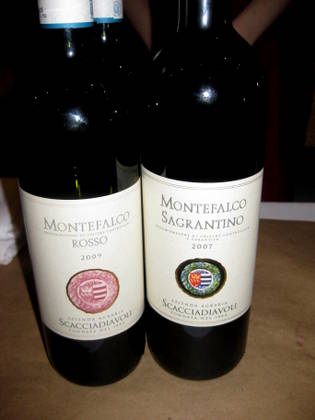
Montefalco Sagrantino from the Scacciadiavoli Winery. The winery takes its name from an exorcist who lived nearby. I would have loved to have gone to a wine dinner the Scacciadiavoli Winery was hosting at Eolo, a restaurant in Chelsea, NYC. The food and wine pairings looked sensational. The way to fully experience the luscious power of Sagrantino is with a great food. The menu looked super. Rats. I hope to give you some feedback on the dinner and restaurant it in an upcoming post.
This recent wine event at Eataly’s La Scuola was not an official tasting which made it relaxing and enjoyable. As I tasted the rich, blood-red, full bodied Sagrantinos, I was able to mingle, share and talk at length with some of the producers and winery owners. I tasted Sagrantino blends in their roughness of youth and only wines made of Sagrantino in the mellowness of a 5 year aging. Either way, whether I was curious about drinking a red blend of Sagrantino and merlot with every day meals or saving the best, the aged pure Sagrantino wine, for a more special occasion with friends, the wines I tasted were unique and interesting. And there were some surprises.
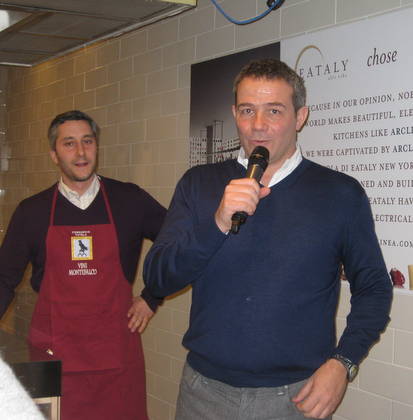
Dan Amatuzzi, Eataly’s wine expert (left) and Marco Caprai of the Arnaldo-Capri Winery which won Wine Enthusiast’s European Winery of the Year 2012. Marco is discussing the region of Umbria, its beauty and nearby cities to visit. He discussed Perugia and Spoleto which has the annual Spoleto festival.
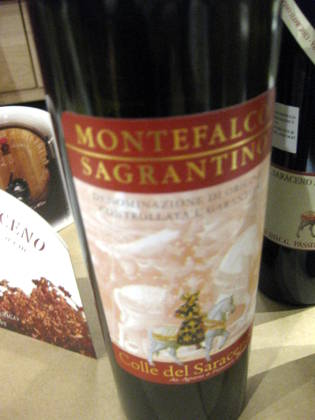
This ruby red Sagrantino with its lingering smell of vanilla and spices is produced by Colle Del Saraceno and Francesco Botti…on the BOTTI farm (it has been around since the last century) in Montefalco.
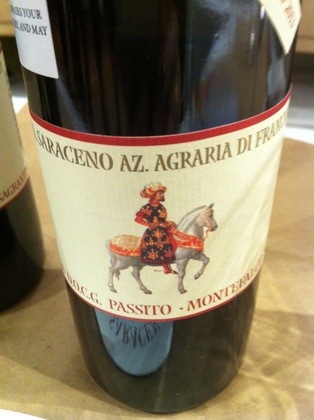
I happen to enjoy great after dinner wines. Who knew Sagrantino could be used to make a delicious dessert wine? This Montefalco Sagrantino D.O.C.G. Passito has been produced on the BOTTI family farm since the 19th century. And it is out of this world, great, almost liqueur-like because of the long period of natural air-drying. The bouquet of blackberries, cloves and cinnamon lingers on the mouth and persists on the nose. Wonderful with desserts and cheeses.
What is wonderful is that Eataly is offering Sagrantino wines by the glass for $10.00 in all of its restaurants Fridays and Saturdays. That means that if you are near Eataly on Fridays, check out the Sagrantino tastings. If you are dining there ask for a glass of Sagrantino from one of these producers. Though I dined at Manzo on Sunday, I was able to get a glass of the Arnaldo-Caprai Sagrantino Collepiano and when I checked, there are still some bottles for sale.


If you walk into Eataly from its entrance on 23rd Street, you will see this sign reminding you it’s Sagrantino month. Enjoy a glass of this interesting wine from a grape varietal that was nearly made extinct.
If you are in New York City and haven’t yet been to Eataly, you are missing a great treat. If you are in town before the end of the month and you stop by, you will be able to enjoy these wines that are gaining global favorable renown. And if you visit Umbria, Perugia and Spoleto for the festival and Montefalco, the town where the Sagrantino grape varietal has made its home for centuries, you will be able to drink the vino locale with relish. Now that you are familiar with wineries in the area, you will be able to visit for tours and tastings of this amazing varietal that nearly went into extinction if not for a dedicated group of growers and producers and families whose generational lifestyle included making really great wines for every occasion.
WINERIES CELEBRATING SANGRANTINO MONTH AT EATALY AND AT THE LA SCUOLA TASTING
Colle Del Saraceno, Francesco Botti
A DISCLAIMER: I was not able to feature a few wineries here because I ran out of time. When I travel again to Umbria to visit family, I will make sure to map an itinerary to tour the ones I missed. And I will try to taste their wines this week at Eataly.
Plane Love by Rosary O’Neill Performed at the Players Club
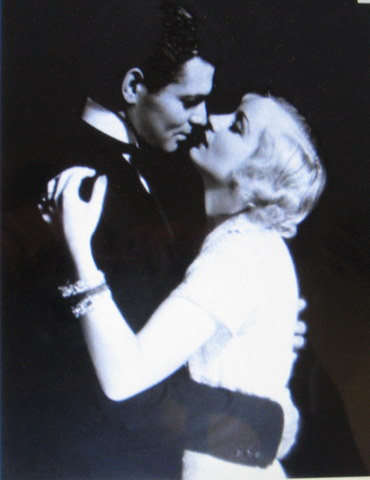
Clark Gable and Carol Lombard who had a passionate romance that developed into an enduring love and successful marriage until Lombard’s life was cut short. Plane Love by Rosary Hartel O’Neill references the relationship of these two celebrities.
You know how you can see one version of a play with one set of actors and another version with different actors and a whole new meaning is presented with different themes and an enhanced understanding? Last month Rosary Hartel O’Neill’s play Plane Love directed by Melissa Attebery and starring David Copeland and Shana Farr presented at the Player’s Club in New York City had that effect on me. The play had a previous showing a year ago at the National Arts Club with a different group of actors and production values. I enjoyed it then and thought the play’s promise, if picked up by other Off Off Broadway producers had the potential to create momentum and drift up the line so that it could create a followership as happens with many Off Off Broadway productions.

Rosary O’Neill and Diane Bernhardt (then President) at the National Arts Club reading of Plane Love.
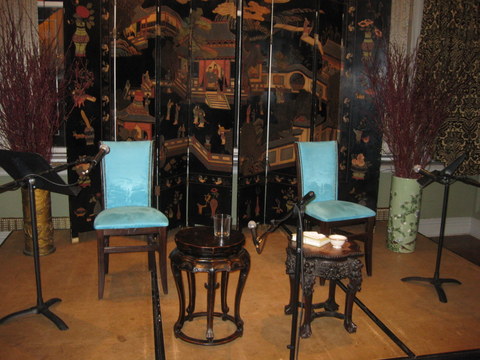
The reading of Plane Love was held in one of the many anterooms of the National Arts Club’s beautiful Victorian building which is a historic landmark.
A bit about Rosary Hartel O’Neill, the playwright before I discuss the play will elucidate some interesting details. I’ve known Rosary’s work now for over a year and have been privileged to have seen a number of her plays presented in scene studies at the Actor’s Studio. I have seen a few presentations of Plane Love, one at the National Arts Club and the other at The Actor’s Studio. I have read a number of her dynamic plays and absolutely love her The Awakening of Kate Chopin, based on the real life Kate Chopin. (If you have not read Chopin’s groundbreaking The Awakening, regardless of whether you are male or female, it is a compelling story and you will walk away from it shocked, your intellect, your soul lazered.)
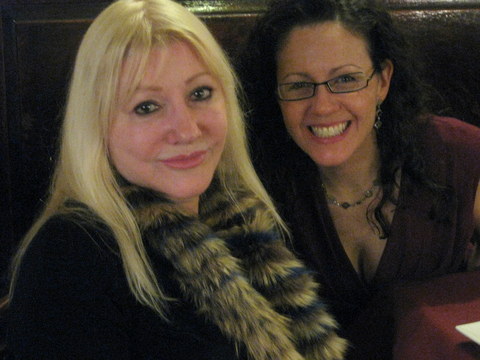
Rosary O’Neill and Melissa Attebery (Director) at the Player’s Club cafe.
O’Neill’s play The Awakening of Kate Chopin reveals how the real Kate Chopin came to write The Awakening. O’Neill strips open the events which are iconic in shaping Chopin’s phenomenal work. After The Awakening was published and universally vilified with criticism nearly likening her to the maw of Satan (Male critics at that time were terrorized by the true tenants of her themes.) Chopin never wrote or published another word again. O’Neill’s play is historical yet modern, it is vibrant and transfixing and it should be added to the repertory of seminal works showing casing men’s and women’s struggles with self-definition as they attempt to step beyond issues of sexual stereotype and fail miserably. Sound familiar? Welcome to the 21st century. Chopin’s character is a modern day Medea with a twist. O’Neill’s play examines the Kate who could write such an incredible story.
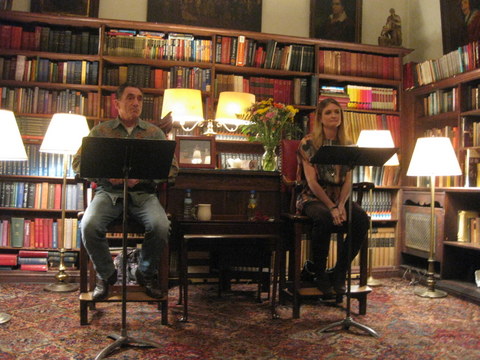
David Copeland (Actor’s Studio actor) and Shana Farr in the library of the Player’s Club where the reading was held.
Plane Love echoes some of the struggles of love, autonomy in relationships and trust revealed in the play The Awakening of Kate Chopin. But Plane Love has lighter notes, is clever and witty with the deep undercurrents playfully brought to the surface in a successful expiation. Interestingly, it too, has a basis in real life relationships. The characters and situation are styled after a celebrated Hollywood couple, Clark Gable and Carole Lombard who were passionate for each other and fit together in a Plato’s soul love that is rarely duplicated. It was a love that Gable never overcome after Lombard’s death in a plane crash. The couple in Plane Love is also mirrored to some extent to reflect O’Neill’s relationship with her current husband, Bob. Rosary and Bob met on a plane and grew their romance through letters. (In the play they chat via e-mails and IMs. Tweets and Facebook posts are too potentially public. Yes, folks their love chats were private and personal, not to be shared with others in this Anthony Weiner social media culture of “fat finger” clicking mistakes.) Their absences, because of Bob’s extensive travel and Rosary’s living in another part of the country made their joyful hearts bond with the heat of their words and imaginations. Distance love can be a really great spur for passion.
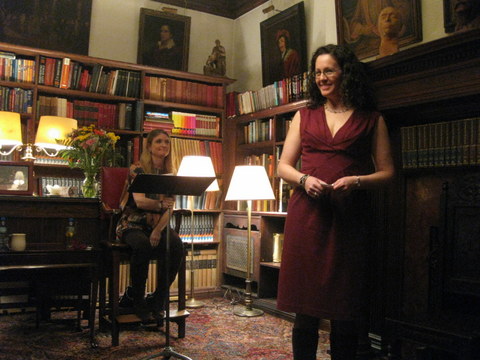
Shana Farr plays the role styled after Carole Lombard in her relationship and marriage to Clark Gable. Melissa Attebery is introducing the play.
Energetic and vital David Copeland and Shana Farr melded with the ethers of director Melissa Attebery and the result was dynamic and alive. Some script changes were made for the better and the ending was supernally charged and had morphed from the time I had seen it at the National Arts Club and the Actor’s Studio. I will not give a spoiler alert except to say that the changes made the poignancy and connections to today really pop. I was moved and emotionally affected where in the previous versions I was not. The actors subtly and seamlessly developed the relationship between the characters through their power and ability to be eternally present. Exceptional acting talent whispered and nuanced the delicacy of how couples bond, the wheels and woes of emotional stripping and unmasking toward trust, the inevitable hurts and glories and the risks of unifying one soul to another.
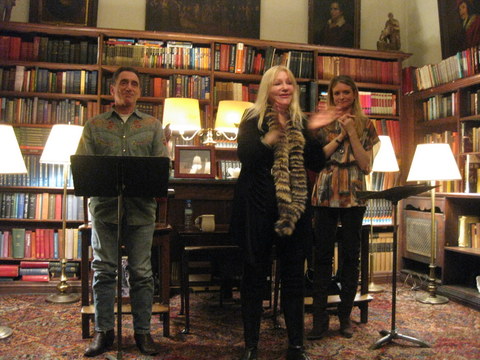
After the performance, the audience applauds . David Copeland, Rosary O’Neill and Shana Farr
This production for me proves that casting excellent talents like Copeland and Farr is essential, good direction is paramount. A fine play will stand despite mediocre direction and a lack of will on the part of all concerned. Nevertheless, the audience will walk away from such live theater feeling something was not quite right, there was a drop of energy, the actors had a bad night or the play had dead spots. And as such, a good play will be forgotten until it is unearthed two decades later and electrically the cast gets it, the director is on fire, there is a unity of spectacle and everything is right. That is when the audience walks away with a sigh of relief, energized in a catharsis of human feeling and the play has a long run or a full run.
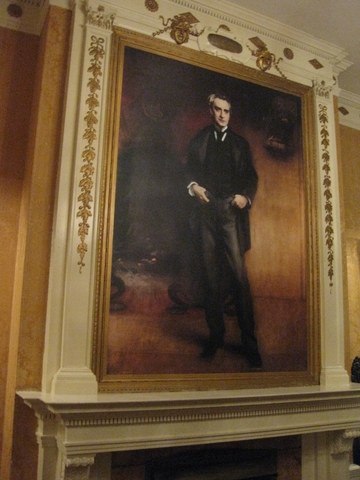
Great actor Edwin Booth purchased the Victorian building off Gramercy Park to have a place where he and his actor friends could congregate and enjoy themselves. He hired Stanford White to renovate the place adding various features which were conducive to enjoying parties and seeing plays. There is a cafe downstairs and auditorium with a stage on the second floor. There is an amazing library with old volumes and the place is festooned with paintings and pictures and drawings of actors. Booth also had White renovate an upstairs portion where he had apartments for himself. When all this was finished, Booth lived at the Player’s Club for five years and then died…presumably a happier man for giving his actor friends a comfortable and convivial place to hang out in NYC,
This production of Plane Love was in the second category. Look for the playwright, the actors and the director. They are not fading away, and look for Plane Love to gradually get its wings and fly uptown eventually toward wider avenues and brighter lights.
Croatian Wines. Vina Croatia Wine Tasting Review: Part I

Dalmatian Coast, Croatia. This is on Adriatic across from Italy. These vineyards are protected by UNESCO as a World Heritage Site. Some of these vines have been producing continuously for more than two thousand years.
Croatia is a beautiful land. Not many Americans are familiar with the country unless they have Croatian friends and colleagues who introduce them to the wines and foods of Croatia or unless they have heard Lidia Bastianich discuss her Istrian heritage. Istria is in the North-Western section of Croatia. You can be sure when Croatia becomes part of the European Union in July, promotional marketing for the country will abound and you will wish that you had visited before it became incorporated into one of Europe’s most hectic and busy tourist destinations.
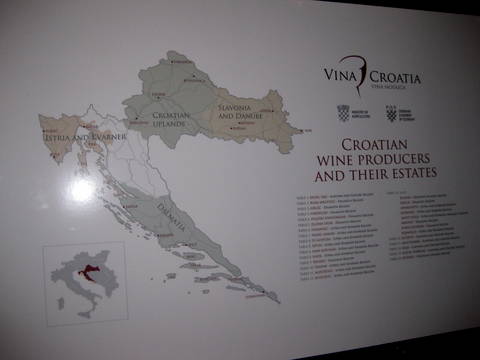
Map of Croatia minus the surrounding Balkans and border countries.
Croatia once a territory in the former Yugoslavia, above all is a crossroads. It is where East meets West. It is where the foodie cultures have merged and various fare from surrounding countries have melded to create lovely, distinctive cuisine. It is also where the hot Mediterranean climate meets the cold Alpine climate. And these variations in climate and terroir have produced unique environmental zones that are great for growing a number of grape varietals that for centuries have become acclimated to the unusual growing conditions. As the vines adapted, they grew strong and thrived so that the wines produced from them have a distinct, delicious and discrete flavor that is wholly and unmistakably Croatian. Amazingly, some of the hardy vines are centuries old yet still produce grapes. Indeed Croatian wine production is ancient, dating to a time well before the Roman empire.

The Northernmost part of Croatia where the Zagreb, the capital is located.
Croatia’s beauty from upland mountains to the Dalmatian coast and numerous islands in the Adriatic and Mediterranean is apparent even from stills. The country, now coming into its own, is moving rapidly to innovate and blossom into one of Europe’s most unique treasures. It has positioned itself for a continued prosperity after having gone through the upheavals and cataclysms during and after the fall of Communism, and the troubles leading up to Croatia’s War of Independence. Since 1998 Croatia has been peacefully enjoying its sovereign status as an independent republic, continuing to reconstruct, rebuild and develop its infrastructure, industry and tourism after the devastation of the 1990s.
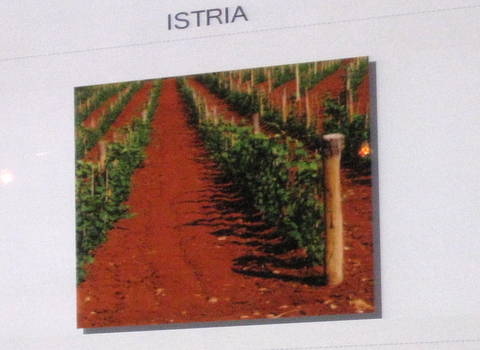
Istrian vines’ red clay soil. Istria is where Lidia Bastianich was born. Her family left and went to Italy when Yugoslavia went over to communism.
Threaded all through Croatia’s turbulent history, has been the fabulous wine making culture and the pleasures of experiencing a rich heritage and lifestyle of great food and wine. The Communists could never dampen Croatian wineries’ good wines, but the prevalent socialist concept was quantity over quality, the mass production for mass consumption all over Yugoslavia. Now that the Republic of Croatia has its full lead, the emphasis has changed and the paradigm has shifted to focus on quality fine wines, boutique wineries and fine dining. As the younger generation takes over innovates and implements newer wine making techniques, the wines the country is currently producing will continue to manifest some of the highest quality wines Europe can offer. OMG. Who knew?

This wine region is surrounded by three rivers: the Danube, the Drava and the Sava. It is the Easternmost region of Croatia.
Having never been introduced to imported Croatian wine and never having visited Croatia, I consider myself fortunate to have been available to attend the Vina Croatia wine tasting event at the Astor Center. Not only was it fun, but I became educated to some of the best wines coming out of the country, wines which I will look to purchase in the U.S. in the near future. However, it would be even more fun to visit some of the friendly Croatian vintners back in their country where I could go on a wine tour and take the proper amount of time to do wine tastings, coupled with food pairings, as many wineries have restaurants attached to b Dalmatiast demonstrate their delicious wines. Food and wine cannot be appreciated without each other as any gourmand or food and wine lover knows.
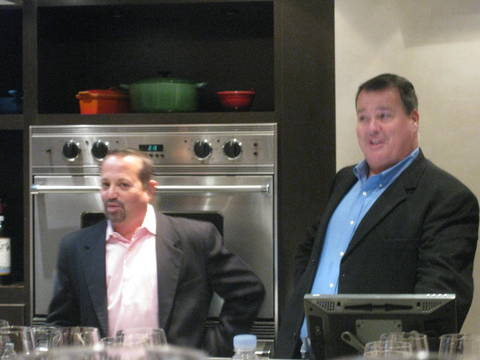
The Wine Guys, Mike DeSimone and Jeff Jenssen, wine writers who have appeared in the Huffington Post and elsewhere are widely traveled and knowledgeable about fine wines and good food. This is the first Master Class at Vina Croatia, the Astor Center.

Cliff Rames is a sommelier and wine expert who gave an interesting and informative tasting class on the varieties of Croatian grapes and wines. I walked away knowing the wine regions and many of the varietals used to make the delicious wines I was tasting.
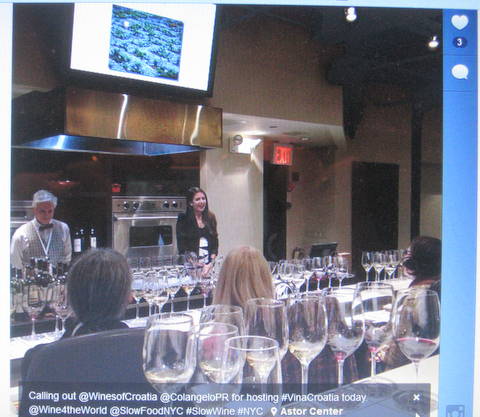
The pic/tweet is from Yangbo Du on Twitter. The picture is of Cliff Rames and Ashley Colburn who is a travel expert with her own production company. She visited Croatia and has been back many times since, loving everything about the country’s beauty, food and wine.
During the tasting, I took a few classes to become better educated in the Croatian wine making regions. The first class, “Vina Croatia: Taste the Place” was taught by The Wine Guys, Mike DeSimone an Jeff Jenssen wide travelers and jocund wine writers. The second class, “Beyond Plavic Mali: Croatia’s Other Indigenous Varietal Wines’ was by Cliff Rames, a sommelier who was an expert in Croatian wines. The speakers proved knowledgeable and informative as they lead the tasting through the four wine regions: Dalmatia, Istria and Kvarner, Slavonia and the Croatian Danube and the Croatian Uplands.These regions are further divided into sixteen sub-regions and 66 appellations. Because each sub-region has grape varietals that are only unique and distinct to that region, the wines produced there cannot be gotten anywhere else in the world. These are tastes that are more then special and unique; they are gold. And the Croatians have been enjoying some of these wines for centuries; it is the vino locale they drink with every day meals and the vina for festivals and celebrations. Of course, the clergy have been having a ball for as long as there has been a church, making their own wines and using them for sacramental purposes.

Grgic Plavac Mali 2008: region Dalmatia. The grape varietal is Plavac Mali.
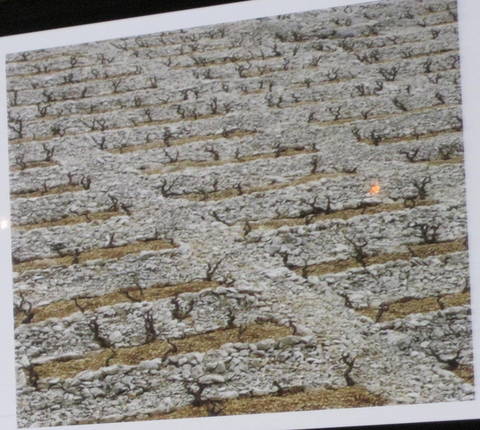
These are Dalmatian vines. The area is very dry and the vines are accustomed to little irrigation and dry heat. This is a World Heritage vineyard on the island of Hvar.

Another vineyard during the growing season. The vines and roots are protected by the surrounding rocks and dry, rocky soil. The yield is not plentiful, but it is extraordinary for its taste, making Plavac Mali, Babic, Lasin,a Plavina grape varietal wines, and white wines, with Gegic, Posip varietals and even ice wine with a combination of wines.
Because you need to go there or go to the next year’s Vina Croatia wine tasting event in New York City or another area of the country, I will just whet your drinking lusts with some of the wines I adored during the classes. From Dalmatia, there are the world heritage wines some of which have been produced on the island of Hvar, get this now, the world’ oldest continuously cultivated vineyard. We are talking about 2,500 y ears of production, folks. No wonder this area is protected by UNESCO. Wonderful red wines I tasted from DALMATIA were the BIBIch R6 2009 (red grape varieties: Babic, Lasina, Plavina) the Babic Vrhunski 2009 (Babic) the Grgic Plavac Mali 2008 (Plavac Mali) Korta Katarina Reuben’s Private Reserve 2007 (Plavac Mali) and three white wines Boškinac Gegic 2011 (Gegic) Korta Katarina Pošip 2010 (Pošip) and Bodren Triptih 2010 (ice wine grape varietals-Müller Thurgau, Sauvignon Blanc, Pinot Blanc). The pictures below show the grape varietals, both white and red from Dalmatia.
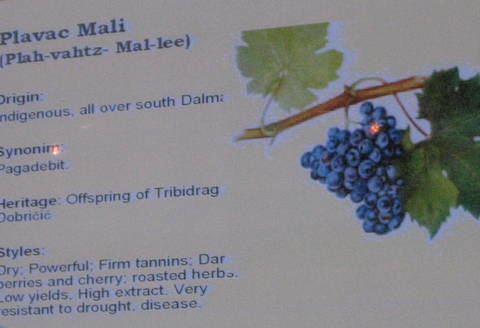
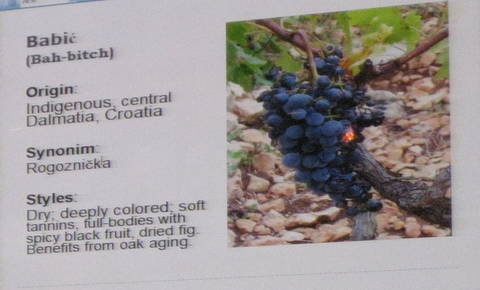


From Lidia’s birthplace, ISTRIA AND KVARNER, the milder climate produces more lush environs than the rocky Dalmatian coast. The grapes that have adapted to this climate are the Malvasia Istriana (white) and Teran varietals (red). White wines I enjoyed were Trapan Malvazija Ponente 2011, Damjanic Malvazija 2001, Nada Zlahtina 2011 (Zlahtina grape varietal) and Matoševic Antiqua 2008 (Malvasia Istriana). Red wines I tasted and enjoyed were the Franc Arman Teran 2009 and Kozlovic Teran 2011. Interesting note. British wine critic, Oz Clarck reported that Istria was Europe’s no. 2 terroir for Merlot. Not jammy it has a freshness and when young is fruity; when aged it has an elegant, intense bouquet. Like other Bordeaux varieties it is blended with a local varietal, in this case, Teran (great potential for aging with notes of fruit and pepper) offering a very interesting combination.
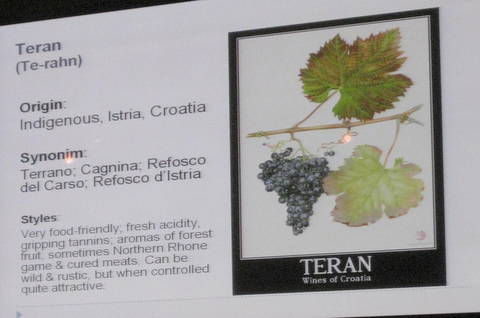

From SLOVANIA AND THE CROATIAN DANUBE, a region characterized by plains covered in golden fields of wheat and the three rivers that surround it (the Danube, Drava and Sava) Croatia’s principal grape variety is found, Graševina. Slavonia is home to the species of oak used to make the barrels that age Italian wines (Barolo and Barbaresco). Croatian winemakers also use this oak especially for larger barrels. White wines I enjoyed from this region were Krauthaker Graševina 2011, Kutjevo Graševina Vrhunska 2011, and Ilocki Podrumi Traminac Kvalitetni 2011 (Gewürtzreminer).

The CROATIAN UPLANDS include the hilly, picturesque ranges dotted with family-owned vineyards that surround Croatia’s capital, Zagreb. It is the coldest wine region in Croatia. Though there are not many native varieties here, the international varieties like Pinot, Riesling or Sauvignon are doing well because the chilly climate and very cold winters allow the wines to preserve intense aromas and high levels of acidity (which bring longer aging periods). The higher elevations offer an abundant amount of sun and wind to cure and rest the vines. The Reisling I tasted from this region was delicious: Bolfan Rajnski Rizling 2011. The Pinot noir I tasted, the Bolfan Primus Pino Crni 2009 was very good, distinctive.
In my second article, Part II of the Vina Croatia wine tasting event, I review my walk around tasting where I had the opportunity to speak to some of the vintners themselves and hear stories of their techniques and struggle with the land to tease out the finest selection of grapes, usually hand picked for their harvest to make the best wines. As one of my oenophile friends tells me (CBlack an oenophile, contributor to this article and photographer of many of the photos in David Copp’s, Tokaj: A Companion For The Bibulous Traveller) speaking with the boutique vintners, especially on their home turf, is an unforgettable experience. (I was just glad to meet a few at this tasting. I will eventually travel to their home turf for the full experience.) However, even in brief discussions I had with wine lovers, producers, agents and the Wine Guys at the classes, the love of sterling wines is always manifest. Sharing that love and gaining new information about the next trend in fine wines is what brings folks out despite crowds and inconveniences. It is all in the name of the fast growing global wine community achieving greater wine drinking pleasure. Count me in!
For more information about Croatian wines, check out the next article in this series. And check out the website of Blue Danube Wine Company for online orders. In the U.S. they are based in Los Altos, California. If you are on Facebook you can locate them by using the search feature and just typing in their name (or click the Facebook link here.). They are also on Twitter: click here for Twitter page if you are on Twitter.)
Writers! Regardless of Where You Stand in the Publishing Game, Enhance Your Social Media Presence.

A Spiegelman fan,I purchased this copy at a used bookstore.
Brilliant best selling graphic artist and Pulitzer prizewinner Art Spiegelman of Maus I and Maus II fame struggled to get his work out there in the early 1970s. It was a process and there was even rejection of his incredible, iconic work. (Words cannot describe the graphic artistry and meaning of what he has done with Maus I and Maus II. You just have to check it out for yourself or not.) When he was attempting to get his book Breakdowns published (before he created Maus I) it didn’t go swimmingly. Decades later, after his many awards, global recognition and other publications, his editor at Pantheon was all for re-issuing Breakdowns and this time, Spiegelman was surprised and hesitant. But things had changed by 2007. You mean publishing and the cultu1re had galactically shifted from the days that Art Spiegelman was first establishing his career? Duh!
In those days, for Spiegelman, getting published was not unimportant. To many today, it is golden. It is the dream of established writers who may have faced writer’s block after years of success. It is the dream of those who have fallen off the charts and out of the hearts of former readers. It is the dream of the published whose first, second and third books have middling sales that tapered to .001% so that literary agents and editors won’t go near them. (Low percentages? Nil profit margins? Are you insane? How can the media CEOs sustain tremendous salaries and bonuses with such schlocky sales numbers?) It is the dream of the working writer who has written and published one book and is working on another in the hope of changing publishers/ agents and getting a better deal, though the first book sales were abysmal. The variables of situation are endless, unless of course, one is a hot name with an extensive platform, i.e. Bill O’Reilly (in which case the greatness of the work is immaterial, as long as there is name recognition and a ready mega platform).
The irony has been that for the last century, concepts and particular literati who have been favored by elites, the wealthy or politicos have been highly publicized. This creates an inherent censorship. The gatekeepers, the literary agents, the large presses have kept it that way to fuel ideas that elitists wanted the public to believe and be bound in by. So traditional media has worked in concert with the very wealthy. (Perhaps it is why Spiegelman was rejected for publication until he found an intelligent, prescient SMALL publisher who took a chance on him.) In many instances the middle class and general public’s reading tastes have been tailored to what elites have deemed, “great,” though their standards are merely opinions and predominately skewed to their agendas. Their concepts of great craft, writing and artistry often beggar the imagination.
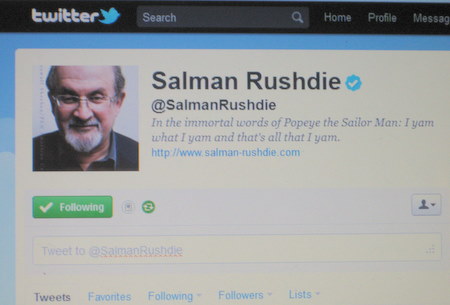
Salman Rushdie tweets with his fans on Twitter and actually did battle last year with Facebook, winning with his great humor, irony and wit. Social media is one of the best ways to connect and keep in touch with your readers.
Needless to say, European publishers, more intellectual, knowledgeable in breadth and scope, courageous and less censoring, have allowed titles in that NEVER WOULD HAVE BEEN ACCEPTED IN THE US. And yet, we think we are a free and open democracy? (We are told that by traditional media hirelings though many medical books and controversial political content find publishing friends overseas or in Canada.) Well…traditional publishing has relied on TV to gather its stable of often un-meritorious but profitable properties. Writers, unfortunately, have been at the mercy of these “experts” in the field who often consider the art and craft of a work last, and consider the saleability first.

Apple was one of the companies sued by the DOJ for price collusion.
This former “state of the art” for the industrial media complex has been upended by Google. It has been overturned by Amazon, undercut by Facebook and thwarted by Twitter and other social media platforms and growing spheres like Storylane. How? Subtly and not so surreptitiously. When traditional media realized it had lost its edge and destroyed the bee hives producing their honey, their fear and greed and inability to ADAPT or wrap their brains around what was happening spurred them into old paradigm interventions that worked before: lobbying and price collusion.
Mistake. They’ve been held accountable and have been sued by the DOJ and a few have had to settle while others collude with the government for the best deal which may not be forthcoming since their profitability is much lower than Google’s and Amazon’s. You see traditional media became so comfy with their century long oligolopoly that they were caught up short without a chamber pot when Amazon undersold them. That’s all they could come up with to compete? While they were riding out the waves of the past, their navigation misdirected by the old paradigm, the innovators, like a huge roller, a mammoth tidal wave, a mega tsunami, capsized their hopes and dreams of profits. Now, they are paddling slowly while growing social media networks and companies like Google continue their innovations, investing money in R & D to create better product and to entice readers, writers and developers to improve.
Bottom line? Google is swamping the media that was! I will not refer to the traditional publishers by name. Unless they begin to accept mid-list and beginning writers, offering them credible crumbs, the writing community will eschew them completely in favor of working with e-publishers, small publishers, Createspace, et. al, and those in the online publishing paradigm. I give these censoring publishers who will have to spend more and more on costly promotions and PR campaigns less than 20 years. Unless they begin to innovate to create the “next best thing,” or unless they merge with Amazon or Google (Why would those companies want to merge with inefficient, ineffective, archaic and intractable platforms?) they will have disappeared, become a ghost memory, a ridiculous faux nightmares of elitism from which we have awakened. What was the name of that book seller that went bankrupt because its innovations were too little too late? Innovate or perish. Big name publishers are slowly writhing in the mud as their hand maidens, the agents, the PR personnel, the editors struggle, sucked downward with them, sinking further into the shifting, miry clay soon to be swallowed up in a sinkhole of their own making.
The diminishing present trend is that,unless you are President Obama or a politico or a faux or worthy celebrity, a salable commodity, a publishing company will not market you. You have to market yourself. Even if you are President Obama, you have to market yourself, appearing on old media, TV, etc. Wasn’t it Michelle Obama I saw ripping open the envelope for the Best Picture Oscar last night, via a feed from the White House? Folks, the President is savvy enough to have his social media hordes and teams busy marketing him online. It’s why the Republicans have been doing unmentionables in the dark. They can’t get into the light of Twitter/ Facebook, et. al. and sound rational.
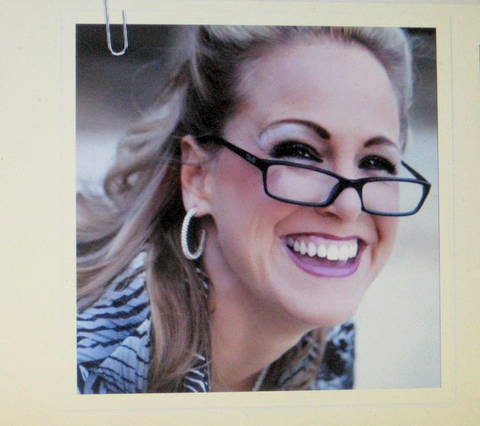
Kristen Lamb, author, blogger and a member of the online writing community who inspires and nudges writers to get on with the craft and be persistent in achieving their goals.
So, writers, if it’s good enough for the Prez, it should be good enough for you. Kristen Lamb, social media maven and author, in a recent blog post discussed the hard work it takes to position yourself on social media platforms to establish a working, interactive community from which you can promote and sell your books. If you think it will take too much time, then hire a team to help you. Using hashtags, and signings and promotions and launches, you will be able to promote yourself on social media and continue to do so, long after a traditional publishing company has left you to ROT.

Nina Amir is a motivational coach who helps writers and non writers achieve their goals and live inspired lives.
How do you do this if you have been out of the loop for some time and find Facebook, Twitter, Tumblr, Youtube and Reddit loathsome? GET OVER YOURSELF! SNAP OUT OF IT! Swallow, take a deep breath and sign on for social media classes online. If you are a woman writer, then check into WOW Women on Writing. If you prefer live and hands on, there are many Continuing Ed. courses at various universities or colleges near you. Hopefully, you are not in this dire condition.
To help yourself and your writing career regardless of where you are…pick up the bullet at your current situation:
- Read about social media and take classes to learn how to post and interact on the most powerful sites (Twitter, Facebook, Reddit, Tumblr, Instagram, Pinterest, etc.)
- Start a few blogs and blog about subjects related to your writing, making sure to increase your readership and followership daily. Read other blogs faithfully and post comments on them, inviting them to guest on your blog.
- Be willing to spend at least 3-4 hours a day on social media and the same on your writing. Alternate this according to a schedule you make for yourself if you can’t spend the time.
- Once you’ve created a viable interacting platform and joined writers’ groups including those on Linked In and elsewhere, create your book pages and invite your followers.
- Somewhere in between all of this, you are writing your book, editing it or sending it out to be edited or working with an editor or an agent you get along with; one who is a friend and one you can trust.
- If you have done all of the above years ago and are in a slump, change it up and do something different. Shut down all online interaction for a day or a number of hours. Then review what seems to be working and what isn’t and jettison both for another day or period of hours. Go back and reassess and research. The change up will spur you on and revitalize you. If it doesn’t, seek a coach or someone to help you get out of the funk or open this up to your online writing community. Share, ask for comments and advice. Eventually the watershed moment will come. (Skip below as needed and move to the last paragraph.)
This is the beginning of a beautiful relationship with your online writing community and your team of writing friends who are intelligent, creative wordsmiths. You will keep many; you will lose many, but the journey is amazing, and eventually what was the hard work, when you look back after a year of doing this, will not appear to be so arduous after all.

The following 2 sources might be helpful for those who are beginning, or those who have taken a hiatus and need to get back into it especially if you feel overwhelmed. I apologize for not including many more, but these should whet your appetite and they are easy.
Online writing source with classes: WOW Women on Writing. (Men can take these classes as well. They are not maternalistic.) I took classes with WOW and found them to be what I needed. I also had to put in the time to learn by trial and error. I have writing friends who refuse to do this and their many publications languish, but they are trying to use other venues to get going. (traditional media venues)
Helpful Books: How to Blog a Book by Nina Amir
We are Not Alone: The Writer’s Guide to Social Media by Kristen Lamb
Your successful publishing career can take years, but so can publishing via the traditional way, which may never come to pass as the industry is reeling in a downward spiral toward doom. I have a friend who self-published because he said he was getting old and he wanted to see his books in print. That was his dream. What is yours? Are you using your social media presence to achieve it?
EATALY CELEBRATES SAGRANTINO MONTH IN NYC 2nd Annual Event
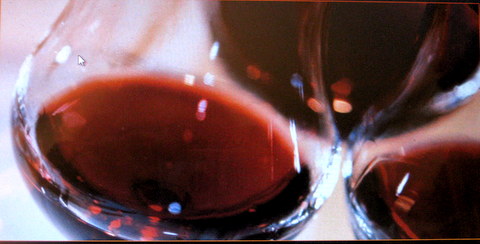
My cousin who is a doctor in Perugia, Umbria is so fortunate. She has the opportunity to enjoy the vino locale whenever she wants. It has been a few years since I have been to visit and I miss everything I enjoyed about the region, the sounds, sights, tastes, smells, all of which combined to take my breath away and create an indelible experience of freshness and beauty.
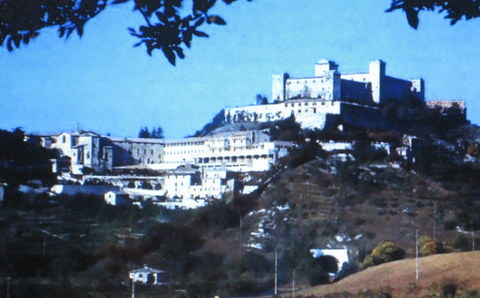
Spoleto, home of the arts and music festival in east central Umbria.
In the region you will find Montefalco and its indigenous wine, the Sagrantino. Umbria, belovedly referred to as “The Green Heart of Italy,” was celebrated in NYC in the fall. It was then I happily took advantage of imbibing Umbrian wines and feasting on the delicious cuisine native to the region. I even purchased some Umbrian products at venues (i.e. Eataly, De Paolo’s Fine Foods) around the city as New York highlighted the month long events that Mayor Bloomberg proclaimed for the celebration of “I Love Umbria Month.”
Growing Popularity of Montefalco’s Signature Wine in the U.S.
By now familiar with the region and its cuisine, I was glad to learn that The Montefalco Consortium announced a 2nd annual ‘Sagrantino Month’ to be held at New York City’s Eataly in March. I have come to love Sagrantino wines, becoming acquainted with various Montefalco wineries which grow the finicky and spare grape vines. Producing these wines is a feat which requires concentrated effort, knowledge and determination to tease out a wonderful harvest that through experience and honed skill rewards us with the sumptuous, full bodied and rich tasting Montefalco Sagrantino.
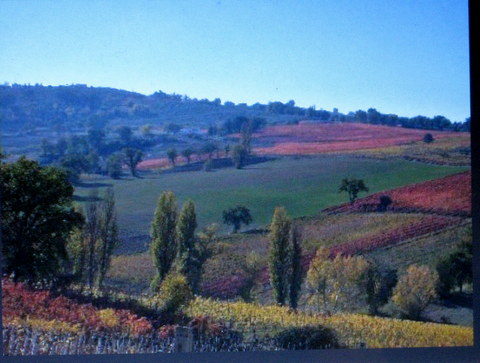
Montefalco Wine Region
This year’s Sagrantino Month celebration is part of a year-long, national Sagrantino campaign that includes events and promotions capitalizing on the momentum created by an increased American interest for the signature wine of Montefalco. Amilcare Pambuffetti, president of the Montefalco Consortium explains this thrust into the U.S. market. “Last year we introduced many Americans, both trade and consumer, to Sagrantino and the response was enthusiastic. This year we plan to build on the foundation we’ve established.”
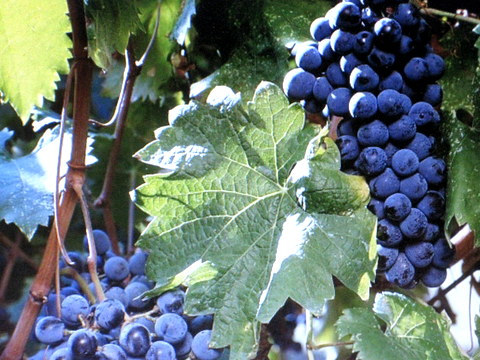
Sagrantino grapes
Sagrantino Month Celebration at Eataly
The Sagrantino Month promotion at Eataly will include a trade seminar, consumer classes, tastings in the Eataly Wine Store, wine by the glass at all of Eataly’s restaurants and tastings in Eataly’s ‘La Piazza.’ The year-long promotion will continue with virtual tastings with US press, trade tastings, dedicated meetings for unrepresented producers, a consumer awareness and education program. From its quiet beginnings as a regional Umbrian wine, Sagrantino has become a favorite in Italy and producers are assured that as the American consumer becomes knowledgeable about Sagrantino it will become equally popular in the U.S.
There consumer classes at Eataly will be held on March 12 and March 28. Starting from March 1 to March 30, there will be free wine tastings at Eataly Vino every Friday, from 6 to 8pm, each time with a different producer.
Every Saturday a wine by the glass will be poured at the Le Eccellenze Corner inside the store, for just $10. Select wines of Montefalco will be available by the glass at each Eataly restaurant throughout the month and on sale at the wine store.
There are five participating wineries in the Sagrantino Month promotion: Antonelli San Marco, Arnaldo Caprai, Perticaia, Scacciadiavoli and Tenuta Castelbuono. Five more wineries will be involved in the other activities throughout the year, these are Colle Ciocco, Colle del Saraceno, Le Cimate, Romanelli and Tenuta Bellafonte.
If you are planning to indulge your love of Sagrantino or would like to have an introductory taste at Eataly and would like more information on the month long activities, visit www.consorziomontefalco.it.
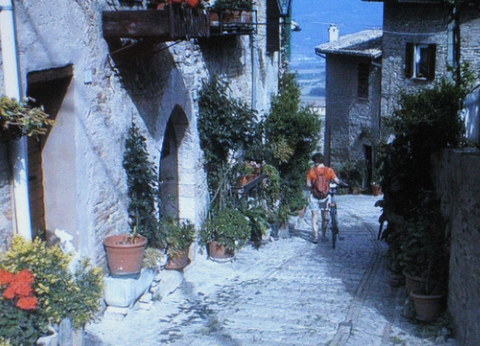
Looking into the valley of wine producers below. (Spello)
About the Wines of Montefalco
Sagrantino grapes are indigenous to the region of Montefalco, Umbria and have a long history there. dating back to the 1700s, where the growing of grapes and wine making was suited to Umbria, the “green heart of Italy” and Montefalco, where documents of the time noted that “fine and delicate wines were produced there in ‘beautiful and good’ vineyards.” So much was this the case that municipal sanctions were strengthened to maintain and sustain the culture of thriving, glorious vineyards and sumptuous wines. If you hampered a winery in its noble and sacred endeavors, you were in big trouble. In 1622 Cardinal Boncompagni, the Pontifical delegate in Perugia, threatened “capital punishment for anyone found cutting down grape vines.” Cutting down a plant was worthy of death? Such was the symbolism, of grape vines and the vitality of wine to the culture and the church.
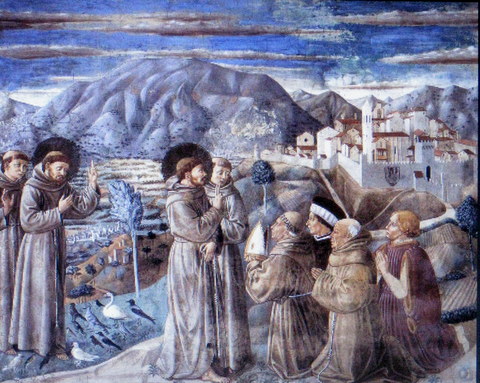
Franciscan monks nurtured the Sagrantino grapes in vineyards like St. Leonard’s in Montefalco to produce their sacramental wines. (Painting: Blessing the birds and the beasts.)
Sagrantino vines were cultivated in monasteries like St. Leonard and St. Claire where monks that made the wine used it for sacramental purposes and local farmers enjoyed the wine during festivals and religious holidays, including Christmas and Easter. The wine had a hearty following during the 20th century until after WWII when the vines and wine fell off and nearly disappeared in the 1960s. Thanks to the dedication of local producers with a romantic imagination and assiduous determination to bring back the Sagrantino grape and its luscious, full bodied wines, the Sagrantino DOC was granted in 1979 and the DOCG in 1992. Producers like Marco Caprai also elicited the help of the University of Milano to ensure that the Sagrantino vines burgeoned to yielding productive harvests. (The grapes are not prodigious and abundant in output and must be carefully nurtured.) As a result Sagrantino wines have become a favorite of Italy and are becoming globally known.
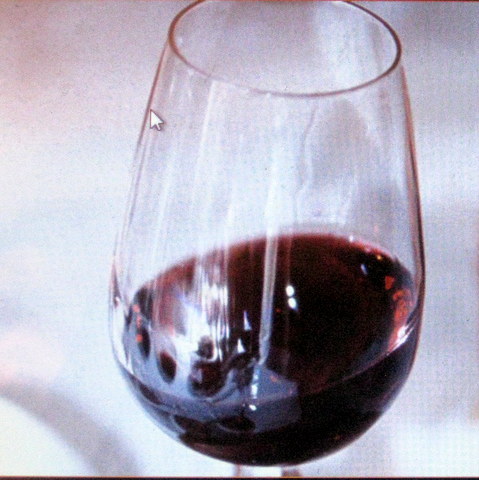
Sagrantino Montefalco DOCG
Wonderful points about Sagrantino is that it is suitable for long aging. It pairs well with many cuisines and is delicious with roasted meats like beef short ribs, pork loins, game and other meats that are juicy with bit of tasty fat. Other friends have told me that Sagrantino is delicious with spicy foods and of course, with cheeses like Granna Padano, Petite Basque, Robiola, or other sharp raw sheep’s or cow’s milk cheeses. I have found that Montefalco wines offer excellent quality without destroying one’s weekly wine budget. Two examples of high quality but affordable wines are the versatile Montefalco Rosso, a blend of principally Sangiovese, and Sagrantino, and the refreshing white blend known as Montefalco Bianco, made of the indigenous Grechetto, combined with Trebbiano and other grapes. The Montefalco Bianco pairs beautifully with fish dishes or light pasta dishes which sparingly use milk or cream.
Participating Wineries of Montefalco Celebrating at Eataly
IL Buco Alimentari & Vineria. A Great Place to Host the “European Winery of the Year 2012.”

I had been to other restaurants on Great Jones Street in that well trafficked section of NoHo, namely Five Points, a restaurant my friend invested in. IL Buco Alimentari & Vineria was just up the block. I had read Pete Wells’ New York Times three star review of Il Buco. Pretty impressive as reviews go, one star away from the four stars which only six other NYC restaurants achieved over the years.
Wells had raved about the bread, “Remarkable stuff, with the gradually unfolding nuances of taste that are achieved only through a slow and patient fermentation of dough with wild yeast.” (Yes, wild yeast! I liked the place already.) He was pumped about the salumi board, “…satiny pink and white folds of lonza and capocollo…melting into a lasting impression…” These were “cured and aged in the basement of IL Buco Alimentari e Vineria,” and “among the finest salumi in the country.” I do enjoy a great salumi board. My taste buds have been cured over the years by exceptional sopressatas, lonzas and capocollo, “home mades” served by Nonna Gabriele (maternal grandmother) and cuigini on both sides of my family. I tucked Wells’ February 2012 review in the back of my mind for later use.
It came when I received an invitation. Roberto Paris and Il Buco were toasting Marco Caprai winemaker and proprietor of Arnaldo-Capri Winery on his “Best European Winery” Wine Star Award from Wine Enthusiast Magazine. My schedule was swamped. Could I squeeze in some time to stop by? I was intrigued about going to a cocktail hour in the “simple and convivial spot” that the food critic claimed, “tastes just like Italy.”

What edged me to RSVP “accept” was my experience of NYC’s “I Love Umbria Month.” During the month’s activities celebrating Umbria in various venues around Manhattan, I attended a kick-off press event at Eataly. I was introduced to Caprai wines and a few native Umbrian dishes prepared by Eataly’s Alex Pilas. The Arnaldo-Caprai Winery is from Umbria, the region known as “the green heart of Italy.” In Umbria classic regional fare includes pork, mushrooms and lentils or legumes. From my Eataly experience, I knew the Sagrantino wines from Arnaldo-Caprai, paired beautifully with these items; I had sampled dishes made with pork, lentils and mushrooms at the press luncheon. The Sagrantino di Montefalco, I remembered Caprai’s signature wine had a rich and powerful mouth feel which heightened the earthiness of mushrooms and lentils. It complimented and lightly cut through the moist and fattiness of the pork. Though the luncheon was before Wine Enthusiast awarded Arnaldo-Caprai with its Wine Star award, I really liked the wines I had tasted.
Truly, the award is well deserved. Arnaldo-Caprai Winery is an “acknowledged leader in the production of top quality Sagrantino di Montefalco,” a wine produced exclusively from Montefalco’s indigenous Sagrantino grape. Arnaldo-Caprai wines have been globally recognized for their quality and production excellence. Caprai’s diligence in helping to restore the Sagrantino grape to a glorious plateau is applauded in the wine trade, and the winery has won many awards. The Wine Enthusiast Magazine’s award was no anomaly. Caprai’s exceptional wines were really taking off and wine lovers were appreciating just how good these wines were. A neophyte wine connoisseur, I was rapidly becoming a fan of Caprai’s wines.

Another venue might hold a slap dash ho hum affair I could easily avoid. This was all too enticing. The range of Caprai wines, its white and reds, would be accompanied by SAVEUR Top 100 Chef Salvatore Denaro’s “Umbrian light bites”and IL Buco chef, Justin Smillie’s delicious appetizers. These chefs? Caprai’s wines? Even the little time I would be able to spend there promised to be an absolutely exceptional rendering. I couldn’t afford to miss it.
I climbed the stairs to IL Buco’s private room with happy anticipation.The crowd kept coming. I mingled in to where Roberto Paris was pouring. He suggested I start with the white, the 2011 Colli Martani Grechetto DOC Grecante. The wine is made from 100% Grechetto grapes. At my first sip there was the pop of crispness and vibrancy on my tongue, refreshing to the palette. A lovely aperitif (one may also have it with fish, veal and poultry) I enjoyed it with Chef Salvatore Denaro’s incredible Grilled Spring Onions Wrapped in Fresh Pancetta, then I moved on to the Umbrian lentil soup the chef was proudly stirring. It was perfectly seasoned to show off the earthy taste of the legumes with just enough cooking time for a savory, luscious texture. Servers were coming around with trays conceived/prepared by Justin Smillie, Crocchette di Baccala, crispy house salted cod, aioli, and there were skewers of Mushroom & Artichoke.Wine and these bites were in the fold.

Back to Roberto Paris for the first of the reds, the 2010 Montefalco Rosso DOC a combination of Sangiovese, Sagrantino and Merlot grapes, followed by the more powerful and full bodied Montefalco Sagrantino Collepiano DOCG with 100 % Sagrantino grapes. I enjoyed the Rosso with a taste of the Salumi della Casa, definitely home made and yum yum lovely. Though I was becoming full and didn’t sample them, it was apparent the Rosso was great with the imported cheeses, spreads, compotes, Taralli, olives and fabulous house made whole grain breads (to die for) from Chef Justin Smillie’s Alimentary Table. The plates came in chock full of salumi and treats, and left swept clean by guests; again and again the servers came and went. Our appetites expanded, the conversation grew louder and I would soon have to leave, but not before tasting the best of the best and assessing what I had experienced thus far.

I thought the Rosso good, but I prefered the 100% Sagrantino grape wines. The Collepiano DOCG was perfect with the Panini sandwiches made on that fabulous and earth shattering Il Buco bread. (I love rustic, chewy bread.) One panini was with tender and juicy Slow-Roasted Short Ribs, gorgonzola, onion and agrodolce. The other was Roast Porchetta, arugula, salsa verde. The Collepiano DOCG is recommended for a roasted meat with juice and fat and after tasting the short rib panini, I knew why: explosive ruby red piquant flavor that cut through any heaviness of the meat and melded with the gorgonzola, onion and agrodolce. I tried the porchetta with the Sagrantino Di Montefalco 25 Anni. Striking, strong but smooth and soft velvet with a nice finish. Was that a hint of blackberries for the nose? I understand better how the tannins in the Sagrantino compliment and slice their flavors through succulent roasted meats. But I could even see myself enjoying a glass with a really great imported cheese as well.
I looked around. Time to leave. Was it possible the invited devoured the pork faster than the short ribs paninis? These chefs knew the Caprai wines and had done their homework with the menu which was exceptional. As I waited for my coat, I glanced around. Rats! Guests were eating pasta and I was missing it. I asked a woman and her partner who were chatting and smiling as they plopped what looked to be rigatoni shaped wedges with a light cream colored coating in their mouths. “Delicious, pasta…with pumpkin,” the woman said pinging some lovely light orange-yellow veggie on her fork for me to view. An obvious innovation. I would call Il Buco tomorrow and ask for the specifics, since I was already running late. (I found out it was Chef Denaro’s own take on Amatriciana* the traditional Roman dish usually served with Bucatinni.)
I finished the last of my Sagrantino Di Montefalco and savored its multiplicity of flavors on my tongue, the last a distilled earthiness. I envisioned the Franciscan monks that had kept those sacred vines growing in their monastery of St. Leonard in Montefalco in 1700. I guess I was a bit addled, and could have used some pasta to help with the wine’s power.

I said my goodbyes and slipped away from the fading din of conversation and exclamations about the full body of the Sagrantino De Montefalco. I left as I came in, happy with anticipation. I looked forward to returning to IL Buco with friends and ordering their roasted pork with a glass of Sagrantino De Montefalco 25 Anni. But before I came back, I’d have to lose the 2 pounds I gained eating this fabulous food and enjoying the equally wonderful wines.
*The traditional preparation has tomatoes, guanciale and garlic BUT rather than tomatoes Chef Denaro used Hokaido pumpkin (a very delicate, perfumed pumpkin.)
Wine Enthusiast Magazine Awards Arnaldo-Caprai Winery, “2012 European Winery of the Year.”
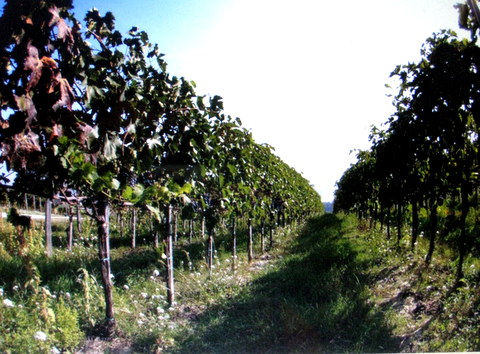
The Arnaldo-Caprai vineyards.
What does it take to be an award winning winery? Centuries. What contributes? Various factors, the terroir, changes in the wine making process, the winery’s sustainability and innovations, possible climate changes based on land changes and the regulations, protection and veneration of the social culture, government and owners/keepers of the harvest, their industry and efforts. Italy is an ancient land of wine making, dating from before the Romans. The social culture supported the grape harvests and enjoyed drinking wine daily; it was certainly better than water.
In current times, the 1700s, the growing of grapes and wine making was suited to Umbria, the “green heart of Italy” and Montefalco, where documents of the time noted that “fine and delicate wines were produced there in ‘beautiful and good’ vineyards.” So much was this the case that municipal sanctions were strengthened to maintain and sustain the culture of thriving, glorious vineyards and sumptuous wines. If you hampered a winery in its noble and sacred endeavors, you were in big trouble. In 1622 Cardinal Boncompagni, the Pontifical delegate in Perugia, threatened “capital punishment for anyone found cutting down grape vines.” Cutting down a plant was worthy of death? Such was the symbolism, of grape vines and the vitality of wine to the culture and the church.

The Arnaldo-Caprai vineyards in Montefalco
With this dictum in place, Montefalco was assured of continued abundant grape harvests and in good seasons and bad, productive, determined wineries. In the next two centuries, the place was considered “at the summit of the State for its wine production.” though even then, the cultivation of Sagrantino grapes, a varietal indigenous to the region, was destined to produce sparely. However, difficult their productivity, the Sagrantino vines were nevertheless preserved in ancient monasteries by wine-making monks.
Sagrantino grape vines and characteristic leaves. Arnaldo-Caprai Winery
Interest in the Sagrantino grape waned after World War II and trends had changed by the 1960s. Perhaps because of its scarce productivity, the Sagrantino grape nearly disappeared from Umbrian vineyards. It was the dedication of a few courageous wine producers and perhaps their romantic imaginations and interest in the Sagrantino as an indigenous varietal that the D.O.C. label in 1979 and D.O.C.G label in 1992 officially sealed that the important tradition of these vines would continue. After this, the few Sagrantino vines still flourishing within the city walls of Montefalco were labeled and classified. The history of the grape had been preserved, and with research, it was assessed that some vines growing in the monasteries of St. Claire and St. Leonard dated between 1700 and 1800. Certainly, when the wine producers encouraged the sustainability of the Sagrantino vines, they were also preserving the sacred nature and lineage of the wine’s association.

The Sagrantino grape varietal of spare productivity.
It was in 1988 that Marco Caprai, son of Arnaldo Caprai began managing the Arnoldo-Caprai winery that had been producing unique, top quality, Umbrian wines. Because of the father’s and son’s passion and rich understanding of the local varietals, and Marco Caprai’s desire to expand the work and develop the winery and the indigenous grape, the Sagrantino, Marco Caprai partnered with the University of Milan. His goal was to research the neglected native Umbrian Sagrantino varietal.

With the collaboration and support of top local winemakers and sustained effort, Caprai and colleagues succeeded in transforming a relatively unknown indigenous grape to one that is world renown. Because of the connection to his ancestry, with his characteristic enthusiastic fervor, Capai expanded the winery to over 375 acres of vineyards. One of the keys to his great success was and is his selection of a first-rate team. The team worked and continue to work alongside him in both wine production and company management. Together, their efforts contributed to making The Arnaldo-Caprai winery the “acknowledged leader in the production of top quality Sagrantino di Montefalco, the wine produced exclusively from the Sagrantino grape.”
For his determination in working to pioneer and produce excellent wines of unique character and depth, Marco Caprai and the Arnaldo-Caprai Winery have garnered multiple awards and global recognition. A few examples include Winery of the Year – Gambero Rosso Slow Food 2006, and Best Winery of 2011 from the Italian Sommelier Association (AIS). Their Sagrantino di Montefalco has won awards up to the present.
Not satisfied resting on these laurels developing the Sagrantino, to global renown, currently Marco continues to assist in the development and reclassification of the Montefalco territory suitable for vineyards. He works in collaboration with the La Strada del Sagrantino Project, the prime force in engineering the marketing of the territory.
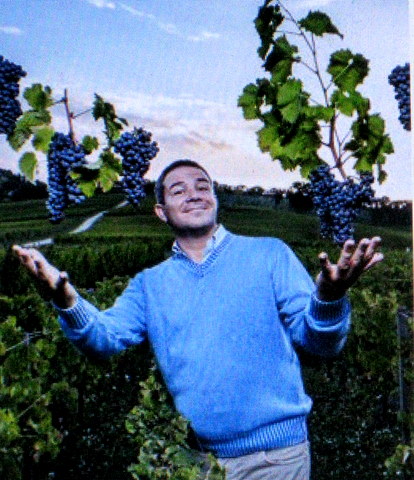
The irrepressible Marco Caprai. What grapes are those?
Photo courtesy of Wine Enthusiast Magazine, from the article by Monica Larner at the announcement of the Arnaldo-Caprai “European Winery of the Year Award.”
Marco is president of the Vinegrowers of the Provincial Agricultural Union of Perugia, as well as the president of the Association of Foodstuffs Industry of Perugia. He was formerly the director of the Consortium which protects and promotes authentic Montefalco wines and president of the Agri-Foodstuffs Center of Umbria Marco Caprai was presented with the Best Producer award by the Italian Sommelier Association.

Arnaldo-Caprai vineyards in the fall.
This year, the Arnaldo-Caprai Winery has been recognized by Wine Enthusiast Magazine, which is an industry leading publication founded in 1988 to bring consumers information about the world of wine through its reviews. The periodical, which has grown to become the world’s largest and most respected magazine devoted to wine and spirits, gives out annual “Wine Star Awards.” The magazine’s editors honor the year’s finest wineries and highlight the influential personalities who have contributed greatly to the world of wine, celebrating outstanding achievement both within that given year and over time.
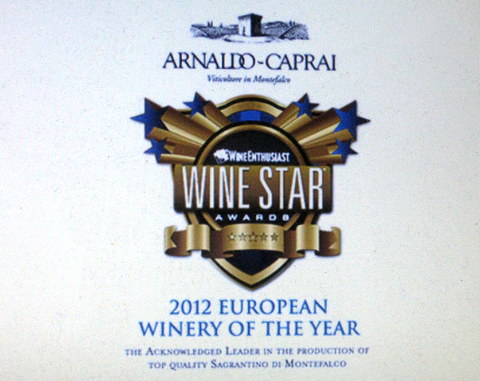
Wine Enthusiast Founder, Chairman, Publisher and Editor Adam Strum explained the winery’s selection, “The innovative Arnaldo-Caprai Winery has helped revive Umbria’s indigenous grapes, bringing the wine region into the international spotlight for its production of Sagrantino di Montefalco.”
 Upon receiving notification of the award, Caprai said, “The Sagrantino grape has been my lifelong passion. I have dedicated my life to making Sagrantino a grape known worldwide and this award is a terrific testament to that effort. We’re honored to be chosen for such an important international award and to be in the company of some of the best wineries and wine personalities in the world.”
Marco and the Arnaldo-Capri Winery are now the toast of the town in recognition of being awarded the Wine Enthusiast‘s European Winery of 2012. On January 22, 2013, there was a Marco Caprai Producer Dinner at L’Artusi. Attendees enjoyed a delectable five course dinner with wine pairings. Marco is also being celebrated for his achievements by Roberto Paris and Il Buco Alimentari & Vineria in a private event the following week.
Can things get better than this? From the bit I have researched about this diligent, resourceful, innovative entrepreneur and fine wine artist, Marco Caprai, there are even better things on the horizon.
What is Slow Wine? Come to the Slow Wine Tasting in NYC on January 28th to Find Out!
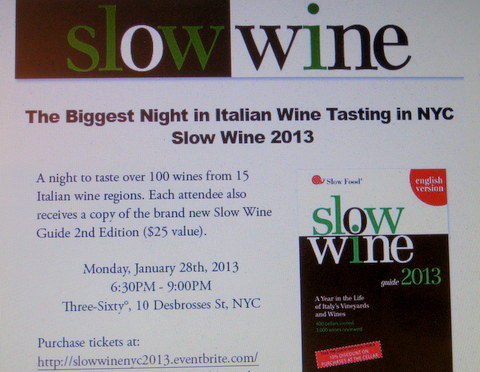
Slow Food NYC website
SLOW FOOD, SLOW WINE, WELLNESS
If you are living in the 21st century, you know the importance of wellness and healthy lifestyle as it integrates with the wellness of our planet. You also know that ecology is tied with food production, that increased carbon dioxide in our atmosphere is threatening all of our ecosystems, that ultimately every country is interrelated regardless of whether it is a failed state with a tiny carbon footprint or a prospering one responsible for chemical mega poisoning. Whether you are connected to enhancing the current paradigm shift, changing the negative impact of corporations, fighting against GMO salmon and wheat and corn and adulterated processed foods like pink slime, or whether you are a part of the problem, turning a blind eye to all of it, the quality of what you eat and drink over the next ten years will determine whether you stay well, or build up toxins that will eventually wreck your immune system shortening your life span.
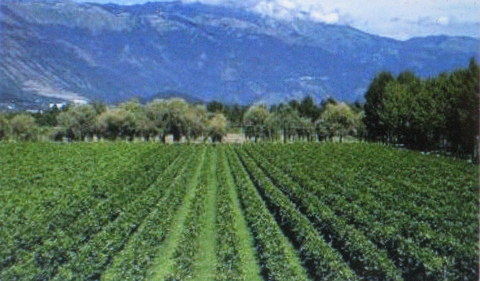
Conte Brandolini Winery is located in Vistorta, a small “borgo” within an agricultural estate in the heart of Western Fruili. The winery embraces Slow Wine concepts.
Nino Negri Winery’s “5 stelle’ Sfursat di Valtellina DOCG.” The winery embraces Slow Wine concepts.
BIRTH OF SLOW FOOD AND SLOW WINE
Did you know that this idea of countering toxic food intake and supporting healthy eco-agronomy actually began to boil over in the 1980s in Italy? As the economy of Italy improved in the 1970s-1980s and tourism burgeoned, Italian chic gave way to the lure of American globalism. Italy’s once fabulous cuisine was being thwarted by pandering to fast food franchises. Its ancient culinary traditions centering around home made and locally farmed deliciousness were being overrun by processed, chemicalized, adulterated convenience foods. If this continued, the land of sumptuous eating and wine-making would be no more. A vital aspect of Italy’s historical culture was at stake.

The Slow Food and Slow Wine website
Many understood the country was under a cultural siege and one of these was a culinary writer and journalist. Fast food was anathema to Carlo Petrini, who first came to prominence when he campaigned against the fast food chain McDonald’s opening near the Spanish Steps in Rome. Petrini’s successful activism prompted him to found a “slow food” and eventually “slow wine” movement initiating and establishing the importance of “eco-gastronomy.” In 1989 Petrini’s Slow Food nonprofit determined to influence producers and consumers in a paradigm shift away from processed, bland, unhealthful, chemical-ridden foods that Petrini recognized were destroying the gastronomy of the world. He spearheaded global advocacy starting in Italy to redirect food production back to Italy’s glorious agricultural past.
In two decades, his dream of protecting the biodiversity of the land and the cultural food traditions of Italy caught the imagination of many who saw the common sense of his platform. The movement has spread to more than 130 countries. The U.S. has the second largest chapter behind Italy which is the leader in the Slow Food and Slow Wine Movement. Just how does the movement make its impact guiding consumers’ food selections? Represented by the symbol of a snail (see the example given in the New York City Slow Food blog) restaurants or products approved by the Slow Food movement display the organization’s snail logo in their window or on their packages. Slow Food has also burgeoned into Slow Wines and wineries in Italy and elsewhere have employed the principles initiated by Carlo Petrini over two decades ago..

Assiduous grape selection after the harvest at the Nino Negri Winery…embracing the Slow Wine concepts.
The Slow Food precepts have encompassed the area of wines and wineries. Wineries in Italy and elsewhere have employed the vital factors initiated by Carlo Petrini over two decades ago. You will be able to taste Slow Wines from the wineries pictured here and many others at a grand tasting event in NYC. This year the Slow Wine Guide 2013 is presenting its latest edition on January 28th in New York City, January 30th in Miami and February 4th in San Francisco. To celebrate, Slow Wine and Vinitaly International are hosting this grand wine tasting.
SLOW WINE AND VINITALY INTERNATIONAL WINE TASTING EVENT (NYC)
For this wine tasting evening, Slow Wine’s collaboration with Vinitaly International offers an exceptional opportunity. Vinitaly holds the largest annual wine event in the world in Verona, Italy. Vinitaly’s expertise and presence assures that January 28th will be an unforgettable night in Italian wine tasting and education for New York City oenophiles and Slow Food and Slow Wine NYC members.

Slow Wine Guide, 2013 Attendees of the grand wine tasting event in NYC will receive a free copy of the Slow Wine Guide 2013 ($25 value)
Sagrantino grapes from the multiple award winning Arnaldo-Caprai Winery, which embraces Slow Wine concepts.
The Slow Wine Guide highlights the extent to which wineries follow the slow food, slow wine concepts. What’s a slow wine? Thirst Wine Merchants in Fort Greene Brooklyn describe it perfectly. It’s wine made from vineyards without pesticides or herbicides, and without chemical additives or flavors. Slow wines are made sustainably, organically, biodynamically. They are made on a small scale, from grapes grown in low-yielding, dry-farmed vineyards. Slow winemakers make their careful selection of grapes and harvest them by hand. No laboratory yeasts are used. Ambient yeasts allow the fermented grapes to naturally unfold revealing their distinct terroir (place of origin). New oak barrels (if necessary) are used with circumspection. The winemakers who follow these methods do it as has been done for centuries. There is no necessary certification, because winemakers believe this is in the best interest of preserving a tradition and making a great wine. In fact, this is the way my family members make wine, cherry liquor and lemoncello in my ancestors’ home town, Bagnoli del Trigno, Italy.
The vineyards of the Arnaldo-Caprai Winery, Wine Enthusiast Magazine’s 2012 European Winery of the year.
If you attend this Slow Wine tasting event, you will receive the added benefit of trying approved Slow Wines using the complimentary Slow Wine Guide 2013 to make your selections for future purchase. You will be tasting graciousness and supporting a movement which has taken hold and which will continue to grow exponentially as it gains critical mass against mechanized, adulterated, industrialized food and wine.
ABOUT THE SLOW WINE GUIDE
Like the 2012 guide, this year’s Slow Wine guide does not use a point system to evaluate wines. Instead, according to the Slow Wine US Tour article, wineries are judged “in their entirety, taking into consideration the wine quality, typicity and adherence to terroir, value, environmental sensitivity and ecologically sustainable viticultural practices.” wine connoisseurs, US industry producers, Italian wine aficionados and just your average oenophiles. Last year, The Slow Wine Guide 2012 debuted its first ever English-language edition in what was a compilation of expert reviews of Italian wineries, examining their production as it related to region and a myriad of other factors. This year’s Slow Wine Guide 2013 presenting its latest edition on January 28th in New York City, promises to offer interesting revelations and additions to last year’s guide.
SLOW WINE GUIDE SYMBOLS
Because Slow Wine was conceived to indicate the reality of the present Italian wine “landscape,” the guide presents reviews of 400 different wineries. Each of these wineries in Italy has been visited by Slow Food experts and their evaluations employ these symbols:
- The Snail (Slow Food symbol) indicates a cellar that has distinguished itself through its interpretation of sensorial, territorial, environmental and personal values in harmony with the Slow Food philosophy.
- The Bottle is attributed to cellars which reveal a consistently high quality throughout their range of wines.
- The Coin indicates great value.
A wine from the Nino Negri Winery, embracing Slow Wine precepts.

The Conte Brandolini Winery has been in the Brandolini family since 1780. The Brandolini estate is beautiful and boasts a lovely villa and gardens.
The Slow Wine guide is published by Slow Food Editore (the publishing arm of Slow Food Italy) and distributed in the U.S. by Chelsea Green. Following the events, the book will be available for purchase nationally on Amazon.com and select retail stores throughout US.
 CAROLE DI TOSTI