The Nance: Nathan Lane in the Performance of a Lifetime.
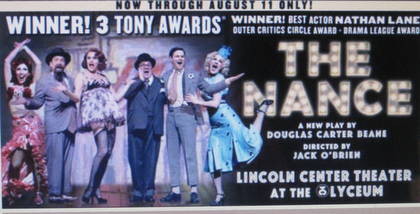
The Nance is a heavenly vehicle for comedic singer/ dramatic actor Nathan Lane, who plays 1930s vaudeville performer Chauncey Miles in the Lincoln Center production now at the Lyceum Theatre on 45th Street. Supported by an exceptional ensemble – Jonny Orsini (Ned), Lewis J. Stadlen (Efram), Cady Huffman (Sylvie), Jenni Barber (Joan), and Andrea Burns (Carmen) – Lane’s performance is a powerhouse, expressing a variegated population of emotions that stretch the audience along a rubber band from zany belly-laughs to poignant tears as we identify with this gay burlesque performer who forces himself to walk a tightrope of contradictory impulses toward love and hate, cynicism and hope, self-acceptance and self-loathing, empowerment and weakness.
Douglas Carter Beane, it has been reported, wrote the play with Nathan Lane in mind. Who better to portray a caricatured “Nance,” the stereotypical, effeminate “pansy” (usually in vaudeville played by a straight man) of burlesque, who spurs on laughs with double entendres and quippy one-liners between female strip acts, cooling down the steam stoked by bare women who must change for their next peeling reveal. Who better than a “Nance” to encourage the audience males about their virility as they ogle the strippers’ nudity, enjoy the sexual thrill of it and laugh at the “bloke” who is more interested in watching them than the tasseled nipples of the lightly clad ladies. Who better than Nathan Lane to play a “Nance”? Didn’t this amazing chameleon-like showman catapult us into a laugh track with his broad histrionics and heart-opening portrayal of lovable Albert Goldman in the Mike Nichols film The Birdcage (1996)? Beane has spun circles around this irony and delivered an amazing play and the director, Jack O’Brien, with Glen Kelly (Original Music), Joey Pizzi (Choreography), John Lee Beatty (Sets), and Ann Roth (Costumes) to name a few, have brought together a magnificent conceptualization with a tragi-comical punch line as the dominoes of irony tumble on each other at the play’s symbolic conclusion.

Chauncey Miles (Nathan Lane) at the automat (photo Jean Marcus)
The theme and tensions of duality between what is real and what is masked pretense thread throughout the entire production performed with aptly giltless sets including a revolving platform upon which Chauncey unfolds the roiling aspects of his existence traveling between his fun, madcap, self-deprecatory “fag” antics onstage (that are poignant and real) and offstage as the straight, intellectual poseur, a frame to enclose his surreptitious gay affairs, moments enacted in an automat, staging ground for covert gay trysts where one can secretly troll for sex partners who are then brought back to the privacy of Chauncey’s apartment.
His duality manifests when we watch Chauncey’s “poseur” persona lure young, beautiful, down-on-his-luck Ned, who Chauncey, with carefully nuanced signals and occult gay innuendo and subterfuge (part of the act) brings to his apartment. Despite Chauncey’s reluctance (his poseur self) and desire to maintain the orderly division between what is real and what is acting, he violates his best intentions allowing Ned to stay. He is falling in love. The tearing of the curtain between reality and illusion between life and art has begun in their morning after scene when Lane brilliantly begins the morph from the initially strained, cynically laced, intellectually conservative Republican straight Chauncey into the increasingly truthful, loving, caring Chauncey, a harmless, humorous, gifted “Nance” (as seen by the culture, but who the audience sees as the eternally, mystical, tragic-comic clown/fool).

Jonny Orsini (Ned) and Nathan Lane (Chauncey)
Beane’s dual threads are fraught with complexity and can easily be underestimated because of the subtle interplay between Chauncey’s burlesque pansy act and Chauncey’s real life straight poseur which he acts out as a conservative Republican who glorifies NYC Mayor La Guardia. The shifts between onstage reality and offstage acting are reminiscent of Cabaret, but here function as an amazing reversal of the Candor and Ebb musical; the Nance act is the real thing, the real life is the act, until a certain character, Ned, shows up. The truth which Ned forces Chauncey to confront is his faux existence and after Chauncey falls hard for Ned, he no longer wants to be two different people.
Beane reveals the evolution of Chauncey and Lane is spot on as he unhappily struggles to be the poseur, a closeted gay man, who has fallen in love with married Ned, a discovering gay, as both are forced to live the lies of straights while masking their feelings, identities, beings. Lane’s Chauncey helplessly entangles himself in his true love for Ned. He becomes enraged and dislocated. Not only has he shredded the curtain between his real self and the act which ensured his former easy existence and world view, he no longer wants to repair the curtain sustaining the two person duality and its emotionally disastrous attendant issues. He enjoys the singularity of love and its feeling truths and his new, free statehood.

Nathan Lane (Chauncey) and Lewis J. Stadlen (Efram) (Photo credit Jean Marcus)
With this freedom has come empowerment. He becomes upfront about despising hypocrites like prudish Paul Moss (a failed theatrical, lifelong bachelor and “dandy.”) Mayor La Guardia’s watchdog mandated to curtail stage indecency, closing down perverse “Nance” acts. Moss and the La Guardia administration have labeled as perverted the love that healed the schism in Chauncey’s soul, a schism that had made him emotionally unfeeling and alien. Though Ned’s uncomplicated, authentic, self nurtured Chauncey’s individuality into a healthier state, Chauncey’s new identity/truth explodes with rage and vision. Like an artist out of his time, he is doomed for it. Of course, the irony of the play’s action is that the more Ned and Chauncey love, come alive and receive authenticity from each other, the more their straight “act” falls away. The new fusion jeopardizes their lives and both must be sacrificed on an alter of oppression.
All semblance of the curtain separating his duality is completely destroyed by Chauncey when, during his act onstage, Moss shows up and Chauncey lathered in fury shouts out at the audience and Moss With a singular will and determination he provokes his own arrest and in-jail brutality. We later discover the rumors of his love relationship with Ned have suggested he is a real pansy, an illegality the La Guardia administration in NYC will not tolerate if it is exposed.
The second act opens with Chauncey alone in front of the Lyceum theatre stage curtain. He is in court and we hear the loud gavel as if banging down on his head; the judge is silent and Chauncey responds as if the judge’s questions were audible to us, though they are not. In seething, bile-filled humor he puts on his (No one is there…in a way the scene represents Chauncey’s battle struggling between his duality: the judge/Republican poseur and the Nance) poseur straight act. He justifies the harmlessness of double entendres in the pansy act which make folks laugh. Though he makes it out of court, Chauncey has lost hold of his ordered former existence where he could easily move himself in and out of offstage illusion and onstage reality. During the court scene and after, we see he is at the end of his rope, but not the end of his very raw emotional state which has blossomed because of his relationship with Ned. Chauncey must survive: he has “to get his act together” and leave show business or put the curtain down between his two personas and live his former life of duality. Will he be able to after having been healed to oneness in the freedom of love?

After jail, Chauncey returns to his friends, muddled. Theatrical protests are forming to “save the Nance acts.” Chauncey has refused to protest, pooh-poohing any hope of success with his conservative poseur sardonic self and we are duped into believing him as the others crowd around the radio to hear the results, never once considering he is back in his straight “act” for a good reason. He has been bullied there. He can’t protest; he has been on the front lines in jail and has seen the face of discriminatory brutality. Repression and abuse have stymied him. When the protest fails, his “I told you sos” ring clear. Banned, his stage act is over; his offstage act must go on. But how can it if Ned is around?
Through oppressive cultural circumstances, Chauncey converts his reality of love to a lie; call it his material survival and soul death. Onstage, his act which had once been more real than his offstage life has taken a turn into hyperbole when he is forced to play a role that ridicules both sexes. Not only has the Nance gone undercover, he has engaged the double-edged ridicule of men and women (a further perversion wrought by an oppressive government). This ridicule of both sexes is heightened in his portrayal of drag queen Hortense. A Nance in drag, he is neither convincing, good-looking or adorable as he once was, though his humor is in tact. Nevertheless, the irony is impeccable. In drag as Hortense, Chauncey has become freakish, unfeminine, weak and unlovable. He is barely capable of carrying through with his act because it is so far removed from himself. In ridiculing the ridiculed and oppressed (women) he receives no empowerment, only the inherent humorous degradation of taking on the xx chromosome. As the Nance, he was free to be himself onstage and in a role that both empowered and uplifted him to get to the next day, the next tryst, the next stage performance.
We understand how the Hortense act stifles Chauncey’s real impulses and provides no outlet for his true self (as the Nance) when, during his Hortense “act” reality intrudes. Chauncey breaks down and sobs. He has lost himself, Ned, freedom and love. But the oppressive show must go on. He recoups after a long pause and with a one-liner gets a belly laugh. The audience gets what they came for, an hour to forget their troubles. And this tragic fool on the stage? He gets to see the curtain going down on a most wondrous part of his life and his ability to be real anywhere.
The playwright has so aptly woven the notes of Chauncey’s character with perfect writing and Lane hits every single one of them with a sledgehammer, nailing down Chauncey’s spiritual/soulish coffin. By the end, as Chauncey packs up his parapherenalia to return home, there is a huge bang-crash. A fixture drops nearly on his head, barely missing him. He looks off staring into the future. When I first saw the production, I missed an important detail that I caught the second time I saw it when I was sitting in the front row: the black shadow of a rope tied in a noose, swinging high from the backstage rafters.
The symbolism is furtive with multiple meanings foreshadowed. Certainly, the noose shadow suggests the La Guardia administration’s unforgiving and brutal noose tightening toward homosexuals, a cultural attitude which only loosened after the 1990s and hard won battles to break down injustices against gays. In parts of the country, the noose is still hanging; certainly the online bullying of gay youngsters has caused one too many to take their own lives. Related to Chauncey (Chancey) it is moot whether he will be able to maintain the curtain separating his dual selves. Will he be able to forgive himself, knowing all he has been forced to give up and has allowed himself to give up, the stereotype of a weak willed woman? Will his bitterness and self-hatred get the best of him one dark night when he decides it is better not to live at all than to live a life of lies onstage and off with no outlet for his soul’s fulfillment?
It’s all there and more in Lane’s and cast’s performances, in the direction and spectacle, in Beane’s writing, and it’s marvelous to behold. If you love Lane don’t miss this. Treat yourself to this work of art which won three Tony Awards and the performance of a lifetime by Nathan Lane who won the Outer Circle Critics Award and the Drama League Award.
The Nance runs through August 11, 2013 in an extended performance.
Production photo credits by Jean Marcus.
Classic Stage Company’s Caucasian Chalk Circle by Bertolt Brecht
Once again the Classic Stage Company produced a play by Bertolt Brecht. Last season the company presented Galileo starring F. Murray Abraham in an unusual translation by Brecht and the fine British actor Charles Laughton, now deceased. Abraham portrayed Galileo to sold out-crowds. He and the production were superlative. The current version of The Caucasian Chalk Circle stars, as The Singer and Azdak, Christopher Lloyd, the prolific theater actor who is still most noted for his role as “Doc” Brown in the Back to the Future trilogy and Uncle Fester in the Addams Family films.

Jason Babinsky and Christopher Lloyd, courtesy of Joan Marcus, CSC website
The director Brian Kulick (who also helmed Galileo last season) has chosen to set Brecht’s play in the Soviet Union, right about the time of the fall of Communism and the partitioning of its satellite regions into their present independent states. The production’s ironic description of the time and place suggests the metaphors which choppily thread through the play and could have been developed with much greater import to make the conception more powerful: “Ancient Grusinia but also perhaps the fall of the Soviet Union, when the Hammer and Sickle were replaced by the Coca-Cola bottle.”
Because the setting is specific to this time period, the play’s universality, its satire of politics, government corruption and injustice, is unfortunately mitigated. The themes are convoluted and confused. The play’s significance related to our time, when global corporations and shadow global elites deliver a fascist repression of their own, is rendered faint indeed. With a bit more innovation, and connected theatricality of spectacle and costume, the tie-ins symbolized by the Coke bottle (meretricious mercantilism) supplanting the noble beginning of philosophical Marxism (devolving into corrupt, repressive Communism) would have been stupendous. But the conception is to a great extent washed out. Gimmicks (an interruptive blackout, ad hoc audience participation at a makeshift wedding, and the gloss of comedic Russian and Russian-accented English spoken to frame the fable) distract from the interesting conception. The lackluster effects sink the production’s impact and Brecht’s powerful theme that love and human kindness will and should overthrow political class systems whatever their stripe.
The play begins with a Stalinesque/Leninesque statue being toppled by citizens as the current governor and his wife (Mary Testa) flee the violent tumult and retaliation for his repressive rule. It is regime change. The question Brecht poses: Which devils will now come to rule? Testa, true to her comedic talent, lessens the sting of the wife’s cruelty and arrogance as she picks the dresses she will take – but in the chaos leaves her infant son behind.

Christopher Lloyd as The Singer and Elizabeth A. Davis as Grusha. Photo by Joan Marcus.
The child (for expediency and symbolism, perhaps) is represented by a life-like puppet. The fate of the child is debated by a young servant girl who finds him. Grusha (Elizabeth A. Davis in a poignant though uneven performance) deliberates whether to save him. But in a typical Brechtian character tension, her humanity and the lower/middle class tenets of the Golden Rule prompt her to sacrifice her own wellbeing for the child whom she preserves. The main action of the play is the preservation of this puppet-child as she confronts danger and trials to get to her brother’s house for asylum, all the while keeping the child’s identity hidden.
The circumstances achieve a quieter resolution with strange moments of accidental kindness, and power reversal. Azdak (a hapless, loutish peasant portrayed forcefully and playfully by Christopher Lloyd) saves the disguised governor who has become his loutish, peasant equal. Through a series of inane ironies that only political revolutions can foment, Azdak turns himself in for saving the governor, but because the current political crazies have hanged all the former judges, he is in the right place at the right time to be selected as a new judge to decide matters of the law. Why not?

Christopher Lloyd and Tom Riis Farrell, CSC website, Joan Marcus photo

Tom Riis Farrell and Christopher Lloyd. Courtesy of CSC website, Joan Marcus photo.
The justice Azdak metes out is even nuttier (Lloyd shines at these moments), probably, then the decisions the former bribed, corrupt judges handed out, with one random exception. In appears that the true Just Judge (fortune, fate, God) exerts its will through this wild, roguish Azdak. The governor’s wife has returned to reclaim her child from Grusha. Azdak must make the final decision: Who is the appropriate mother? Is it the overweening, materialist, elite, selfish biological mother or the deeply human, loving peasant who exhibits the nobility, kindness and self-sacrificial traits that exemplify the finest qualities of the human spirit that we (the little people) aspire to? In a fit of Solomonic wisdom uncharacteristic of Azdak, this lout has a chalk circle drawn. Whoever is able to take the child out of the circle is the mother. This sets the competition as two women pull each arm of the child as if to tear him in half to prove “ownership.” And you know what happens.
In this translation by James and Tania Tern, with original music by Duncan Sheik and lyrics by the poet W. H. Auden, the production has rare, clarified moments and muddied, miry ones. Coherence throughout is chopped. However, Lloyd should not be missed, and Elizabeth A. Davis manages to hew out a Grusha with whom we want to identify and who vindicates our belief in ethical intention and fine human instinct. And yes, she is rewarded for this when her love interest (Alex Hurt) reaches out to her, despite the complications. (She married a dyingman under false pretenses – his being that he was escaping the draft – then is stuck with him – but not for long.)
Article first published as Theater Review (NYC): ‘The Caucasian Chalk Circle’ by Bertolt Brecht on Blogcritics.
Brian Schorn Exhibit at Omega Institute

Visitor Center
Omega Institute in Rhinebeck, New York
Omega Institute in Rhinebeck, New York is an amazing center for wellness, holistic studies and sustainable living programs and practices. Omega’s beautiful environs and campus must be experienced to be believed. The institute offers workshops, conferences, online learning, retreats and getaways and hosts programs in New York City and Costa Rica. Omega encompasses the world; it is a global community that “awakens the best in the human spirit and cultivates the extraordinary potential” that is in all of us.
My first visit to Omega was with a friend, Rosary O’Neill, who is teaching a scriptwriting workshop July 7-12, 2013. With her I had the opportunity to tour the campus and discover more about Omega’s mission and its programs. After my brief time there, I realized that Omega represents everything I embrace and have endorsed for a good part of my life, starting with health and wellness. I especially appreciate their forward momentum in implementing ways to support and integrate a sustainable lifestyle that replenishes, renews and regenerates a culture that is in harmony with the environment.
One of the opportunities open to me as I walked through the gardens and followed pathways over the stream (after a delicious organic cappuccino in the cafe) was to see Brian Schorn’s exhibit at the Ram Dass Library. Brian was one of the individuals Rosary and I met in the cafe and after sharing with us his journey of how he arrived at Omega, I was convinced that this accomplished Renaissance man who has engaged his senses in all realms of the fine arts and media is perfecting his life’s work, and that indeed, his life path is an artistic work unfolding.
To be able to let ourselves release into freedom is one of the greatest achievements we can attain as human beings. Often intense personal restrictions (after psychological cleansing) prevent us from “going over the cliff.” and finding ourselves. Over the cliff is not the great fall to fear. It is the free space allowing us to fly. Sharing time with Brian, I could easily see that he was soaring and I was gobsmacked at his courage to break out from the entangling personal labyrinths, to move to the edge and then leap.
And after the leap? New directions for his art some of which is currently being exhibited at Omega’s Ram Dass Library. Spurred by opportunities to live in the mountains of Colorado and Vermont, Schorn focused on his connection to the natural world. In the seclusion and beauty of various terrains, he could explore and delve into environmental art, deep ecology, natural history and outdoor adventure. Previous artist residencies included Ox-Bow in Saugatuck, MI and I-Park Artists Enclave in East Haddam, CT. In a ‘fusion complement’ his experiences with natural environments directly informed a new body of work: audio field recordings, electronic music composition, outdoor performance, calligraphy, sculpture with natural materials, photography and computer-generated imaging.
Brian’s exhibit at the Ram Dass Library is entitled “Lost and Found.” His work includes sculpture, assemblages and calligraphy. To whet your appetite, a few examples are below.

Brian Schorn
Heaven, Earth & Man Navigating Fear, I, II, III
sumi ink on paper
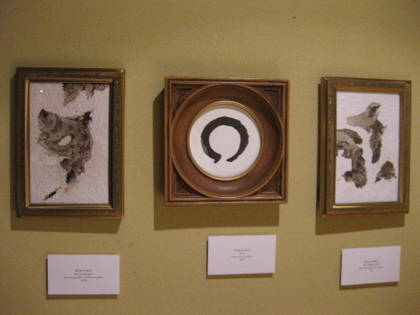
Brian Schorn
Dirt Calligraphy I (left)
pine island dirt, smoke on paper
Enso (center)
sumi ink on paper
Dirt Calligraphy II
pine island dirt, smoke on paper

Brian Schorn
Acorn Yin Yang
wood, acorns, acrylic, enamel
Brian Schorn’s exhibition opened Memorial Day to an enthusiastic reception. The selection of works and their presentation offer Brian’s unique vision and integrated approach employing a dichotomy of natural elements in a juxtaposition of artistic mediums. His works will be exhibited throughout the summer and into September. If you are in the area, drop by the library after availing yourself of a look see at Omega Institute’s Visitor’s Center to check out this phenomenal venue tucked away in the Hudson River Valley. You will thank yourself that you did.
Tony Awards. No Surprises as Tony’s Mirror Drama Desk Award Wins.
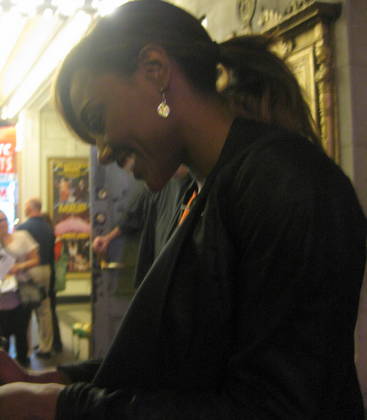
Patina Miller won the Tony for Best Performance of a Leading Actress in a Musical Revival. When she signed my program, I told her I believed she would win the Tony. Turns out I was right. She is probably still shocked and sooo happy over her win.
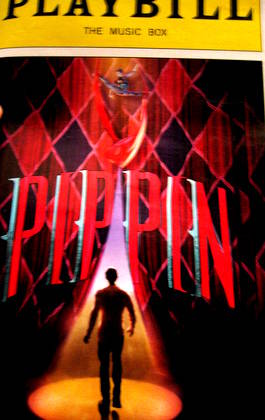
Pippin won the Tony for Best Musical Revival
The Tony Awards at Radio City Music Hall hosted by Neil Patrick Harris held no surprises if you saw the Drama Desk Awards. The award wins echoed each other this year, as the winners of the Drama Desks and Tonys mirrored each other last year. It’s as if the separate award committees sat down with each other and agreed on the wins.
Just the highligts are repeated here, of the Best Musical, Best Musical Revival, Best Play, Best Play Revival and the Actor awards. I’m thrilled for the Kinky Boots win for Best Original Musical and Cindi Lauper’s score win for Kinky Boots. I’m glad it won over Mathilda which I didn’t think was as great as it was touted to be when I saw it. I have yet to see the production of Kinky Boots, but will get tickets as soon as possible. Billy Porter now has a Tony to add to his Drama Desk Award for Best Performance by a Leading Actor in a Musical. The trailer posted online with him dressed in drag is a show stopping number and looks like a deserved win. He, as many of the performers did, thanked his family and God for sustaining him throughout to bring him to the stage and the wins.
Pippin won for Best Musical Revival. I’m thrilled. See my review of Pippin here! I predicted wins for Andrea Martin (Best Performance by a Featured Actress in a Musical Revival) Diane Paulus (Best Director for Musical Revival) and Patina Miller (Best Performance by an Actress in a Musical Revival). I am so thrilled because I had the opportunity to tell Andrea Martin and Patina Miller that I hope they won because they were fabulous. Their wins bring viability and credibility to their careers and will most probably sky-rocket them to other roles in film or Broadway. I’m absolutely joyous for them. They and Diane Paulus so deserve it for their efforts.
Cicely Tyson (Best Performance by an Actress in a Leading Role in a Play ) received the Tony to go with her Drama Desk for her incredible, moving performance in A Trip to Bountiful. She was absolutely stunning and heart-wrenching. Judith Light received a Tony to go with her Drama Desk for her humorous character portrayal in The Assembled Parties. Likewise, Tracey Letts (Best Performance by an Actor in a Leading Role in a Play) won the Tony, adding to his award shelf that already holds a Drama Desk and other awards for his performance of George in Who’s Afraid of Virginia Woolf? The play’s director, Pam MacKinnon, also won the Tony as she did the Drama Desk.
Courtney B. Vance from Lucky Guy by Nora Ephron brought home the Tony for Best Performance by an Actor in a Featured Role in a Play. He was excellent, though I did want Tony Shalhoub to win in that category for Golden Boy. Shalhoub’s portrayal of the father (too bad it was so early in the season) was exceptional; he was dynamic and powerful in his soft-spoken, loving, nuanced portrayal. His was a pivotal character, the conscience and the theme of Odets’ play. He brought together the elements brilliantly in a living, vital performance. It was a shame he didn’t win; he was breathtaking. Vance, though fine, didn’t do it for me, where Hanks, actually, was touching and wonderful…enhancing Ephron’s somewhat lackluster characterization of McAlary. (See my review.) If not for Hanks, the play would have been a yawn. But Letts was the favorite and I unfortunately missed this supposedly iconic Virginia Woolf. After all the nominations, Matilda did receive a win for Best Performance by an Actor in a Featured Role in a Musical (Gabriel Ebert). For me, it was a toss up between Terrance Mann (Pippin) and Ebert, but I didn’t see the other performances, so I can’t say. I did think that Ebert was pushing for laughs as was Mann…both comedic roles. Comedy is very, very hard to do well.
The finest remarks in the evening were delivered by Tracey Letts as he thanked the ATW. He said something to the effect that the others in the category were not his competitors, they were his peers. He was absolutely correct: Tom Hanks (Lucky Guy) David Hyde Pierce (Vanya and Sonia and Masha and Spike) Nathan Lane (The Nance) and Tom Sturridge (Orphans)? I saw each production and there is absolutely no way I would have been able to select from these. Of course, I did not see Letts. And the Best Play? Christopher Durang’s Vanya and Sonia and Masha and Spike. What can I say? I loved it and of the four nominees, it was my favorite.
As a show, The Tony Awards was better than the Oscars which lasts forever in its own self-indulgent mode. But then I only watched two hours of The Tonys while I was online doing other things. It is how I watch TV, if I watch it at all, which is extremely seldom. I prefer streaming or the interactivity of social or mobile. The more alive, the better. That is why I love theater, but am annoyed that they have not entered the Social Media age of living, breathing interactivity during performances. They (the theater police) don’t trust the rabble to not throw things, I guess.
Don’t they understand about Macros flash settings and texting and silent mode on mobile? Don’t they get it that interactivity from fans IS THE BEST PROMOTION AND ADVERTISING OUT THERE FOR A BROADWAY SHOW? Maybe not. NASA gets it. They have Tweet teams. A play is a potential TWEET TEAM LAUNCH ON SOCIAL Yawn. I’m waiting for them to “get it.” It may take years.
Westchester Collaborative Theatre: New Season, New Innovations

WCT announcement for Summerfest 2013
The Westchester Collaborative Theatre has been on a whirlwind beginning January when Alan Lutwin and Marshall Fine received a 2013 Arts Alive Grant from ArtsWestchester! The WCT is officially a non-profit 501C3 corporation and will be able to intensify its fund raising efforts and continued integration with the New York City theatre community in Westchester. This inspiring and vital group theatre continues to evolve productions and projects, some of which with further development may move to New York City venues. The artistic symmetry and free flowing energy between and among artists in Westchester and New York City move their currents back and forth. This company is open and flexible and inspired by its artists’ innovations. It is apparent they will not limit themselves.
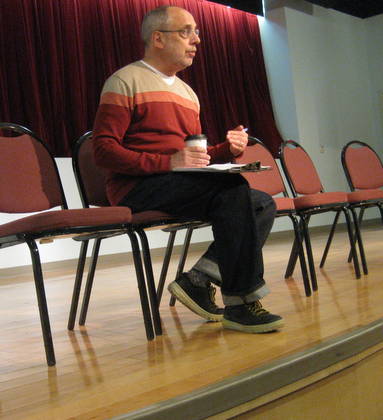
Alan Lutwin, discussing upcoming events at WCT.
LABS, where great work continues to be read and presented and where guest artists conduct workshops, now follow a new tri-monthly schedule. On March 21st Sheila Speller conducted an acting seminar workshop and on April 11th, John Pielmeier, author of Agnes of God was the Guest Artist. Buddy Crutchfield, director of the Off-Broadway hit Freckleface Strawberry, was the Guest Artist at the May 23 Lab.
During May, two events enabled WCT to contribute its energy and engage its directing and acting talent. One was in celebration of the Village of Ossining’s two hundred year birthday. Actors (including the current mayor) directed by Alan Lutwin dramatically recreated the first Ossinging Willage Board Meeting that was held in 1813. The event, “The Village of Sing-Sing, How It All Began,” was produced in the Town of Ossining Justice Court. WCT actor members who were in the production were Sherman Alpert, Jon Barb, Marilyn Colazzo, Janice Kirkel, Joe Lima, Ward Riley, Jeff Virgo and Howard Weintraub. These individuals linked their gifts to Ossinging’s history and had a ball. Lutwin who researched the project discovered, among many other interesting facts that some of Ossinging’s early residents had slaves. All slavery was banned in New York State on July 4, 1827.

Playwright Rosary O’Neill
The second event was a full length reading premier of White Suits on Sunday, a play by New Orleans/New York City playwright Rosary O’Neill directed by WCT member (actress and director) Elaine Hartel.

Elaine Hartel, Director
With the help of WCT, O’Neill has been developing the play and was thrilled that actors were able to portray the characters, allowing her to understand what sections of the play resonated and what dialogue, if any, needed tweaking. After the reading, discussion followed. Initially, O’Neill thought to entitle the play, Exposition Boulevard, referring to the play’s setting in the elite section of New Orleans. Then she reconsidered (She was raised in New Orleans in a wealthy family.) because those living on the real “Exposition Boulevard” might be offended. O’Neill’s play, like F. Scott Fitzgerald’s work, The Great Gatsby, peels the onion on the culture of wealth, but in New Orleans. (The play has themes similar to a TV series O’Neill also wrote, Heirs. The series is currently being option shopped by Executive Producers Wendy Kram and David Black.) O’Neill’s writings (plays, the TV series) about New Orleans reveal the rages, complexities, machinations of families in this elite class with often humorous results. It is a familiar subject dear to O’Neill’s heart.

O’Neill and Lutwin after the reading listening to audience feedback.
The discussion after the reading which held praise for the playwright, the play, the director and actors also pinpointed that the title “Exposition Boulevard,” resonated with the action and themes. Considering the current productions about New Orleans on cable TV (Treme) the widest latitude about the cultural life of that amazing city should be explored and O’Neill’s work does that with humor, grace and depth. Hers is a rare look at New Orleans’ economic strata and a reminder that the gaps among rich and poor can only be melded if they are first examined.
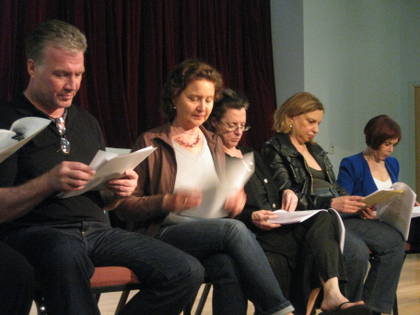
Deacon Hoy, Sharon Rowe, Janice Kirkel, Evelyn Mertens, Enid Breis
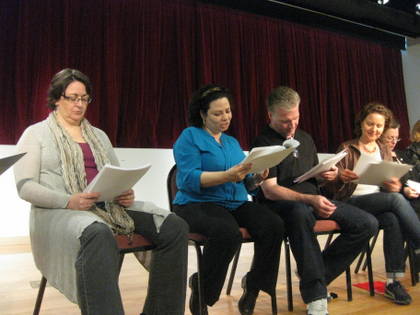
Margie Ferris, Marilyn Collazo, Deacon Hoy, Sharon Rowe, Janice Kirkel

Cathy Jewell-Fischer, Margie Ferris, Marilyn Collazo
The WCT continued June 1st, with its dynamic Spring Fundraiser at the Steamer Firehouse with their theme “Trash n’ Vaudeville.” Members dressed for the fun event in offbeat attire and enjoyed the food and drink during and after entertainment. The fundraiser signals that the summer season is in full swing. The SUMMERFEST 2013 plays which were announced in May are currently being worked on by the directors and actors and will be presented on Friday, June 28th at 7:30 pm and Saturday, June 29th at 2:00 PM. Five selected plays that participated in the Lab process will be performed: You Were Awesome by Bob Zaslow, Hedge Fund by Csaba Teglas, Excess Baggage by Carol Mark, Facebook Friends by Marshall Fine and Wander Inn by Ginny Reynolds.
While other theater groups languish for lack of vision, the Westchester Collaborative Theatre continues to move forward innovating, growing, pulsating life. WCT is fed by the creativity, ingenuity and vitality of its members. All are sustained by an immense passion for theater and the enjoyment and community of creative endeavor. This is a group to watch, nurture and hold dear. You “ain’t seen nothing, yet!”
A Family for All Occasions. A Labyrinth Theater Company Production

A LABYrinth Theatre Company production at the Bank Street Theatre
I thought that A Family for All Occasions, at the Bank Street Theatre (It’s run is completed.) was well acted and directed, but missed the mark with regard to a number of areas in the play that were obviously drop dead contrived.
The actors, with the help of the director, Philip Seymour Hoffman, managed to overcome this as best they could, but the dissonance still crept through. Jeffrey DeMunn held the piece, the family and the ensemble together beautifully. He tempered his portrayal of Howard well: always striving for goodness yet receding from it at various junctures, especially at the climax when he takes out the baseball bat and begin a smash riot. DeMunn’s performance was sustained, real and alive. (His character was also the one most fleshed out by the playwright.)
Deirdre O’Connell’s attempt at portraying her character’s neurosis and anxiety was one note. In the second act, when she is finally retiring from her job (The action of massaging her feet works beautifully.) she is somewhat humanized. At that point she was more believable and relaxed, helped by that simple massaging action. Her acting choices were not spot on; she pushed as a termagant, hollowing out the character’s substance instead of making choices that revealed layers to May’s underlying angst (not just about the job) and unhappiness. The actress cannot be expected to perform miracles; this portrayal fell down in the writing and the direction also.
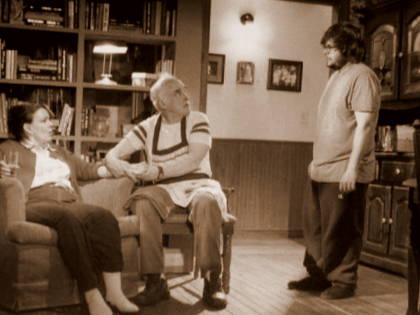
Deirdre O’Connell (May) Jeffrey DeMunn (Howard) Charlie Saxton (Sam)
Due to whatever, there was a problem with her characterization as there was in the relationships between and among the characters. I thought the relationship between Oz and Sue was too convenient; black man willing to do everything for this family. Oz is portrayed as Mr. Wonderful and Sue the convenient foil, a vapid, lost, presumptuous, willful blonde, demonstrating no redeemable inner characteristics (beyond attempting to find herself). The actress, Justine Lupe was remarkable and dealt with the stereotype as best she could; too bad the playwright didn’t give the character depth and substance. The character is so thinly drawn: how convenient she was orphaned by her mother who she might rather believe killed herself. How convenient she connects with no one, not even Oz and demonstrates utter selfishness. Where is her humanity, making us believe she is worthwhile? Sue is miserable before she meets Oz, but the misery is only relayed by her restlessness as a fluttering creature who never lands. Again How convenient is the playwright’s characterization as the contrived: I’m young and I can be rebellious and this baby is tying me down. (Humans have souls, spirits and complexity. This was not even etch-a-sketched in the play.)
This surface portrayal makes her a characterization device to set up the plot as was the characterization of Oz, as the hero. Both are needed to bring in the baby, create some conflict and move the play along. There is no rational explanation given as to why, selfish as Sue is, she does not get an abortion on her own. We do not see the development of Oz’s relationship with her beyond the sex scene which Sue uses to lure him. If she is perpetrating revenge on her own daughter as a sort of Orestia “sins of the fathers,” this is not apparent or reinforced with symbols. Sue is not fleshed out toward this or any end.
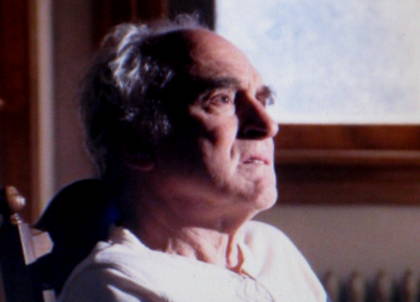
Jeffrey DeMunn
In fact with the exception of the father, the other characters are “types.” Just to exclaim, “Well, humans don’t have reasons why they behave as they do as an answer to the questions the play raises doesn’t cut it, especially when we see how full and deeply Howard is drawn. We know the same depth might have been added to the other characters; this is not beyond the playwright’s talents; the play doesn’t have to be lengthened to do this, either. The problem left the actors doing the best they could to fill in the gaps.
If the work is being revised and funded to go elsewhere, filling out the women characters (from their paper-thin renderings) is an imperative. We don’t need to see another caricature of a “dumb blonde slut” who abandons her baby and runs away; if she has characterized herself as this…how interesting…then this needs to be clarified through symbol, poignant dialogue, hopeless yearning. It wasn’t. What a shame. This is doubly unjust when the demonstrated home life shows no commensurate explanation for her actions except for a few convenient phrases about her past and at best we are told “she is finding herself.” Also, for the characterization of May, we don’t need to see another termagant upset with her job: is she schizophrenic? Well, then, OK. Child of alcoholics? OK. Repudiated by past loves? All right? Challenged in some way besides having no college education? OK. Something? Nothing.
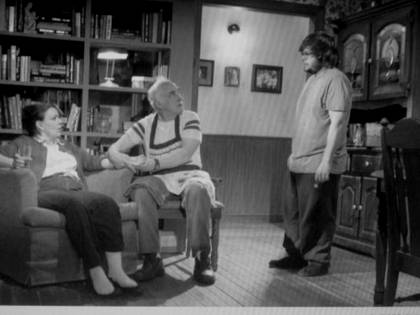
A quiet moment before all hell breaks loose.
Is there a character who makes sense? The character of Sam is the perfect Geek as counterpoint and his begrudging relationship with his father comes through due to Howard’s mea culpa admission he was wrong as he hugs his son before Sam leaves for college. There is something beyond his disgruntled existence and curt, abrupt anger. But what? The Geek stereotype is current and trending (if his phobia of being touched is pushed for effect) so the playwright can get away with it. With Howard’s well drawn characterization and Sam’s stereotype Geek carrying that portrayal, these two fare OK in the play; there is some attempt at connection, only due to Howard reaching out. As for Sam, again a one note stereotype tottering on the edge of human feeling.
My normally perceptive sensibilities ran into confusion upon confusion the play never answered and bring the questions to the playwright’s door. Oz, as intelligent as he is selects Sue when there are so many phenomenal black/white/hispanic sexy women who are alluring and predatory as well. It is suggested Oz is naive with women (All the more reason for the question, why isn’t he snapped up by anyone else as he is engaging and adorable. Here come the cougars!) and is lured by her sexual gifts. Is this not the typical “black man attracted to the white, blonde woman?” obnoxious stereotype? If so it is subliminally racist. Either hone in on this with symbolism, revealing this is Oz’s problem, OR reveal that he is not a free black man who isn’t tied down by his own racial bondages and is there for another reason. The fact that Oz hangs around also because he never had the warm feelings of family? If that is the case, his actions at the end could have been made so poignant…she runs away, he stays because he has found love from Howard and May who accept him. (This is ironic and dubious, by the way.) We see no discussion or hint of any undercurrents he will stay. The end is disjointed at best, but again, that is supposed to be the charm of this free flowing mish mash. Unfortunately, life is much more dirty, specific, real, uncontrived and deep, soulful and complex, unless you tell me that all these people are on meds.
Overall, I think I would have swallowed the incongruities, if this play’s setting was a small, blue collar city in North Carolina, Ohio, Missouri, South Carolina or the Midwest in the 1990s. A Midsize Northeastern City, the present? I don’t think so. This setting was incongruous with the characters’ beings and sensibilities and behaviors. Additionally, the fact that technology was so absent from the play was another failing (Sue has no Android? or Oz? I know folks on the poverty level who sport Smart Phones. I TAUGHT THEM.) And the only one who we see using a cheap mobile is Howard…he also gets an iPod from Oz, not at the suggestion of HIS GEEK SON? I don’t care how much of an isolated recluse he is…it’s technology, computers, smart phones. OMG.)
The setting as “the present” an eastern city is abjectly myopic and discordant with reality. I know 19th century practice in the theater TODAY prevents the use of Social and Mobile to its UTTER STUPID DETRIMENT. (Did you see Roman Tragedies at BAM? They integrated the use of Mobile devices for the audience..brilliantly. We took pictures {OMG, YES…THE TAKING OF PICTURES DURING A PERFORMANCE WAS ALLOWED! We promoted that production with the immediacy of Tweets and FB and Instagram. The audience was employed as the marketing arm of the producers. FOLKS IT WAS FREE PUBLICITY!!!! DUH!} I am glad European theater, once again, is MORE BRILLIANT than restrictive, enslaving, feudalistic old media which must in greed and cupidity HAVE ITS PROFITS. How utterly stupid. Go check out the Oreo brand and see what they’re doing if you want to be profitable.} NYC theater is downright Byzantine and Philistine and the death knell is coming as a result.) But to eliminate mobile devices from the play and say this is the present? Well, it beggars all rationality.
IS ANYONE OUT THERE IN THE LIVE THEATRE LIVING IN THIS CENTURY? Or is there a rife schizophrenia in the theater community and no overlap between onstage works whose settings are supposed to be current and theater people’s own lives where they use Mobile and Social daily? Either change the setting or, change the setting or change the setting, Bob Glaudini. Then flesh out the characters and answer the incongruities you’ve raised beyond contrivance and convenience with specificity. For Oz… What is the unconscious glitch in his being? He knows “malefic”; has he not read the culture’s twistedness in Autobiography of Malcom X to understand his attraction to a clueless, blonde, white woman to forestall it? May? One note- tra, la, la? Sue- this is a very deep woman-where? Sam just isolated by his mother’s loss into geekiness and angry reticence? Again, too many questions and the playwright’s intent doesn’t even adequately hint at the deeper whys. We are left with demonizing Sue, happy Sam escaped…not sure what he escaped, as he’s taking everything with him, feeling sorry for Oz and hopeful for Howard and May’s coming years, especially since May’s chief cause for anxiety is over and she’ retiring. That is not even the beginning of irony for this “family for all occasions.”
I so wanted to really like this play because I appreciate the work of its Director, Philip Seymour Hoffman, the actors, the playwright Bob Glaudini and the usual daring of The LAByrinth Theater Company. I was let down. I hope the play will evolve. It has possibilities if the kinks are ironed out. If no one notices these issues, all the better for them, especially if they receive backing to go farther. Visionary playwrights know this to be so and they seek ways to develop and evolve their work. Will that happen for this play?
Pippin: Glad I Saw It Ahead of the Tony Awards 2013

Program for Pippin
I saw Pippin last night at the Music Box Theatre on 45th Street. The show is beyond spectacular, and I don’t enjoy musicals for the most part. (I am not a great fan of Matilda currently up for a 2013 Tony for Original Musical). I was familiar with Pippin‘s score and book, though I didn’t see the 1970s stage version which made Ben Vereen a household name and which had the medieval template stamped all over it.
Well, this revival is one for the ages. Director Diane Paulus (Artistic Director of the American Rep. Theatre at Harvard, 2012 winner of Tony-revival the Gershwins’ Porgy and Bess) along with Chet Walker (Choreographer) Gypsy Snider (Circus Creation) and others have evolved a breathtaking production. Phenomenal. The circus metaphor is pure genius (Is not the journey of life/career/war/hedonism/finding self a circus of distractions until one arrives at the end of oneself as Pippin eventually does?).
The performers are stunning, beautiful, iconic and truly magical which we have been told they would be by the Leading Player flawlessly performed by Patina Miller. I told her last night (Friday, May 18) she IS beautiful and magnificent, and if she doesn’t win the Tony (Best Performance by a Leading Actress in a Musical) I will have to kill someone. Her performance is eternally memorable. She is almost maniacally God-like in her construction of events, with a tinge of malevolence and sinister allure. She reminded me of the Master of Ceremonies in Cabaret…caught up in the action, but strangely aloof, a player and a puppet master, all the while smiling and drawing us in closer, closer closer to and away from ourselves. While waiting for Playbill autographs, an enthusiastic audience member characterized her as “mesmerizing.” Yep! Was it Peter O’Toole who said, when a performer is onstage, “You should not be able to take your eyes off him/her?Well, that about sums up Patina Miller in the role of Leading Player. You have to see her. You just have to while she is still in the role. Please!!!!!
Patina Miller is the Leading Player. She was so gracious and appreciative signing autographs and receiving much audience praise.
The show is two acts. The time flies. The dialogue, possibly through ad libbing morphs by the cast and tweaks by Paulus had moments of genius modernization and cultural reference. For example the Leading Player to justify the “Intermission,” quips a break is needed because the attention span of the audience is “shorter these days,” a reference to social media, computers, etc. and 80 minute plays with no intermissions. Andrea Martin in her superb, jaw dropping (She looks fabulous.) show stopping “No Time At All,” nudges Baby Boomers about looking great while reminding us how important it is to stay young as the time is passing. Martin received applause that did not stop until after a full five minutes. She is sixty-six (My fellow audience member quickly Googled this. It was just as Martin ad libbed in the show.) But folks, she looks like she’s in her 30s with a shape to match. She strips to her Gina Lollobrigida Trapeze outfit right before she is transported high in the air to a trapeze by her acrobatic, lithe partner who is sexy, strong, supple, marvelous. OMG. The two of them together did their act which reaffirmed the vitality of her agelessness, supported by the spinning, whirling, balancing, leaping, somersaulting, catapulting, gyrating Manson Trio (look them up, folks) and singers and dancers. It was a piece of heaven and an inspiration to all of us that we need to get back to the gym and into the Yoga and Pilates immediately and my God, jettison that last 10 pounds. Woo ooooo! And if Andrea Martin doesn’t win the Tony (Best Performance by an Featured Actress in a Musical) I’ll have to kill someone. (That makes two deaths.)

Theo, played by Ashton Woerz and Andrew Cekala. Not sure which one was on Friday night.
Along with the innovation of the circus metaphor, was the change in the conclusion/finale. The Leading Player keeps the actors steady and in focus in the play within a play structure conducting and orchestrating the flow of events and retelling of the story. An innovation comes after Pippin elects to not “Be Extraordinary,” (jumping into fire) but to be human in his desires and loves. The players leave the actors alone on stage and the lights are dimmed. There is no dialogue, only action. The son Theo (played by Andrew Cekala or Ashton Woerz) picks up Pippin’s cane or armor or whatever and you know that the cycle will repeat itself. Theo will take up where his step-father has left off. Every generation must seek and find its own place, must strike out its own path, must become extraordinary. If not the father, then the son. The circle and cycle begins again and the center circus ring opens and an audience will be waiting to watch another time, another place, another magical historical hero or villain like Pippin. The show must go on. As the Brits say, “Brilliant!”
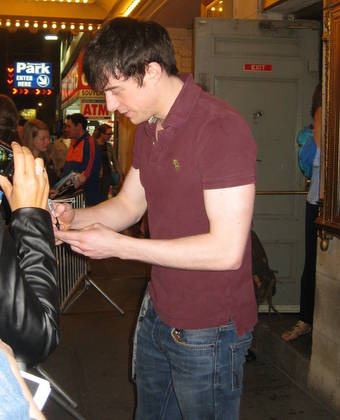
Matthew James Thomas as Pippin. Told him it should win the Tony and he said in a beautiful British accent, “I hope so.”
Pippin is played beautifully by UK actor Matthew James Thomas who looks like he has been mentored by Hugh Jackman, for certainly, he is a young version (gorgeous, adorable, fit, with a voice and appropriate athletic presence). Thomas is so supple in his integration with the sheer physicality of being a part of the acrobatics at times, yet is believable as the rather naive and bumbling, disingenuous Pippin on the journey toward inner light and revelation of love and self awareness. This Pippin is matchless, ready for anything, living in the moment. During the shop stopping number by Martin, Thomas went with the flow, graceful, relaxed, in the moment (a reference by the Leading Player and granny-Martin) smiling at the five minute audience applause, appreciative for Martin. And somehow, Thomas never broke character. Now, in himself he was the character Pippin, played by an actor-performer of the circus troupe, as the actor Thomas. A bit of Pirandello thrown in for free in complete spontaneity and LIVE THEATRE MOMENT that can NEVER BE DUPLICATED. I absolutely loved it and so did the audience. I mean we were DOWN WITH HIM and MARTIN and the cast. A Wow moment. Later, signing programs, Thomas told us that he could tell the audience loved it. He said, “It was a good audience, tonight!” smiling at me. You mean there are BAD AUDIENCES? Ha! You bet…dull, asleep, who’ve eaten too much, overweight and from the burbs. And they come for the matinees and snore as their listening devices go off. HELP!!!

Rachel Bay Jones who is adorable and younger than the woman she played, Catherine. She was wonderful.
Matthew James Thomas listening to more praise and well wishes.
(Side Note about Thomas’ comment) There is an electrical charge and rhythm that flows between a ready audience and the actors. Both feed off each other and both look for that telepathic connection and vibrant, spiritual merging. Audience and actors bask in those connective moments. Both adore it. It’s what makes live theatre so great and so matchlessly eternal. And when it doesn’t happen? Live theatre becomes deadly and vacuous, rather like a computer screen that’s gone black and won’t light up IRRESPECTIVE of how much you press than “ON” butten. FRIGHTENING!!!! Last night, the connections were popping. We saw and heard and felt and transmitted to the actors and they were pumped. I don’t think I’ll ever go on a Wednesday night to a live show again. I cannot be dragged to a Wednesday matinee, ever.
Erik Altemus as Lewis and next to him Charlotte d’Amboise as Fastrada
When I asked this incredible performer how long it took for him to train (balancing act extraordinaire) in a beautiful British accent (he’s from the UK) he said he started at 4 years-old. The act was chosen for him. Marvelous. Really buff, muscled as you would expect one has to be to perform such feats.
 Terence Mann looks like he is enjoying the play. The audience didn’t want it to end, and it’s apparent he’s having fun and felt us loving him. He was wonderful as Pippin’s father, Charlemagne. I don’t know if he will win the Tony for Best Performance for a Featured Actor in a Musical. He should. However, I didn’t see Keith Carradine in Hands on a Hardbody. I did see Gabriel Ebert in Matilda the Musical. Unfortunately, I saw him in the second show on a Wednesday night, not a particularly good time to see a show. He was pushing; his performance was not Mann’s. Probably Keith Carradine will win the Tony for this category. I may have to hurt someone if Mann doesn’t win the Tony. Two deaths and an injury. Hmmm.

Another circus performer. Wow. Dynamite, amazing flips, leaps acrobatics.
If you’re coming to town, get tickets. Don’t wait. This cast will be around for a while, but after the Tony wins, the production is nominated for 10 Tonys, they won’t stay much longer. The validation will bring new opportunities. So please! Do yourself a favor. See a fabulous musical. Then come back and tell me you did yourself good. Pippin. Who knew musical theatre could be that good?

Signed program. Don’t ask me to identify the initials. 😉
Drama Desks Sunday, May 19th. Will Winners Overlap With Lucille Lortel Winners?
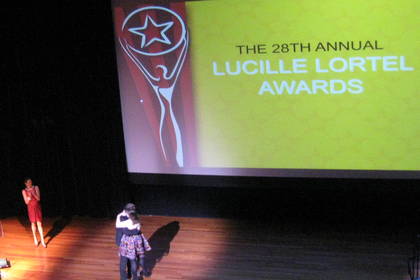
Jake Gyllenhaal hugs Annie Funke for her win as Outstanding Featured Actress in the production where Gyllenhaal also starred: If There is I Haven’t Found it Yet.
The Drama Desk Awards like the Lucille Lortel awards are given annually. Unlike the Lortels which honor Off Broadway productions (over 100 this year, musicals, dramas, solo performances) The Drama Desks are the only major New York theater honors for which productions on Broadway, Off-Broadway and Off-Off Broadway compete against each other in the same category. Because of the fierce competition, the Drama Desks are to be coveted because they are voted on by media people only and without any vested interests in the results. Though the Tonys are seen globally, they represent highly commercial theatre, which in effect is controlled by the entertainment industrial complex, fueled by corporates. That is why the commercial spots during the Tonys are pricey and the event is all showmanship, glitz and bling for a home audience as they trail in the shadow of the Oscars. For recognition of innovative, experimental, original theatre, the Lucille Lortels and the Obie’s represent Off and Off Off Broadway, but the Drama Desks represent the best of all of NYC theatre.
A few of my predictions for the Lucille Lortels came about. Below are photos from the event.
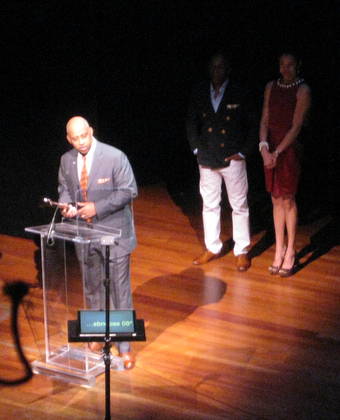
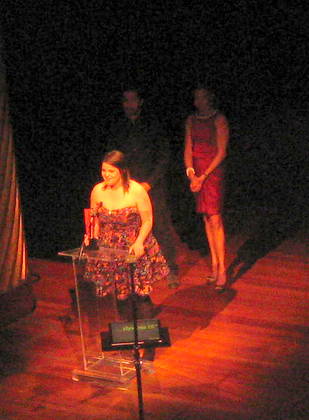
Ruben Santiago-Hudson (photo left thanking the cast) deservedly won for his phenomenal direction of The Piano Lesson. Annie Funke (pictured right with Gyllenhaal in the background) was marvelous in If There Is I Haven’t Found It Yet and I was thrilled she was honored for her outstanding work. I had predicted both of these. I was surprised that the voting committee didn’t select Jake Gyllenhaal. I thought his performance was excellent and Off Broadway would give him a win in encouragement for the risk he took and because his presence and stature creates a vitality and interest for the smaller venue. Interestingly, the committee went with the fabulous performance of Chuck Cooper in The Piano Lesson, a well deserved win. I thought he didn’t have a chance, but in this instance, the committee members were just. His performance was moving and indeed incredible, and yes, I can agree that of the two performances, his was absolutely memorable.
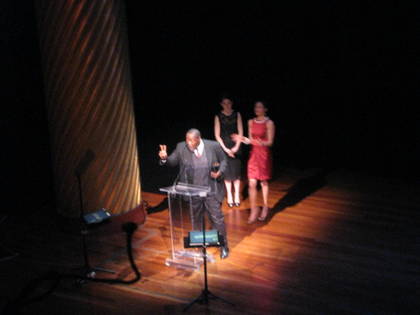
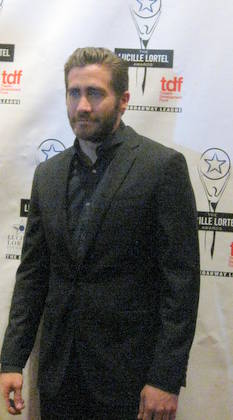
Chuck Cooper (photo left above acceptance speech. Gyllenhaal photo right, at the pre-show photo session) was so ecstatic that he won for Outstanding Featured Actor for The Piano Lesson he basked in the applause and chuckled that, “He might be there a while, because there was no clock.” The show was not televised at NYU’s Skirball Center nor was it streamed, so advertisements and time factor didn’t really intrude. He thanked director “Ruben, a force of nature,” and August Wilson, the Bard of Pittsburgh and the 10 plays that he left (The Piano Lesson won the 1990 Pulitzer for Drama). Aasif Mandi, Master of Ceremonies along with Maura Tierney, (Aasif was nominated for his performance as Outstanding Lead Actor in Disgraced) joked after Chuck Cooper left that Cooper was still thanking people and carrying on backstage about how grateful he was.
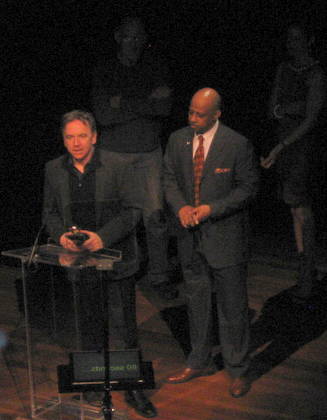
Signature Theatre’s Founding Artistic Director, James Houghton and Director, Ruben Santiago-Hudson receiving the award for Outstanding Revival The Piano Lesson by August Wilson.
I had predicted that The Piano Lesson would win the Lortel for Outstanding Revival and I was gratified to see the committee and I agreed about its being the best of the revivals. Though Vanessa Redgrave didn’t win for Outstanding Lead Actress for The Revisionist (I thought she was wonderful.) I wasn’t disappointed because the brilliant Roslyn Ruff won for The Piano Lesson.
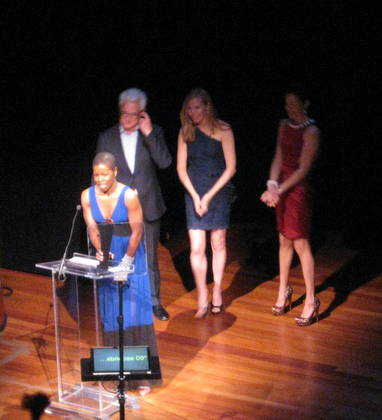
Roslyn Ruff accepting for Outstanding Lead Actress in The Piano Lesson.
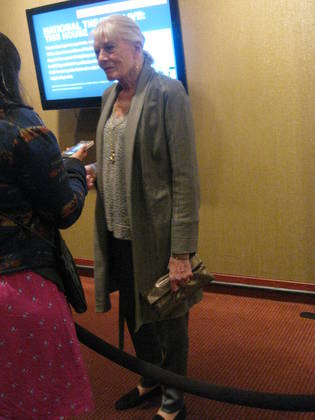
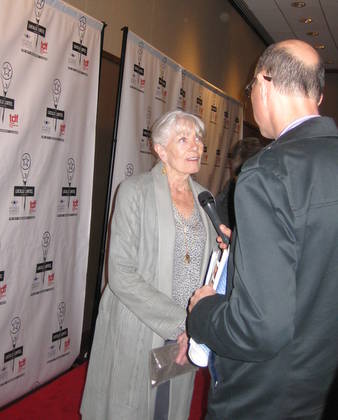
Vanessa Redgrave graciously answered questions right before taking her seat for the award ceremony. She arrived right on time, quickly moving through the pre-show photo shoot. She did stop to chat with nominees’ family and friends.
 The only actor from The Piano Lesson who was nominated but who didn’t win for Outstanding Lead Actor was Brandon J. Dirden. I thought he would, but the committee gave the award to Shuler Hensley for playing the morbidly obese, gay, geeky (online tutor) recluse in The Whale. How could that role not be empathetic and soulfully written? Having not seen his performance, I cannot weigh in (sorry for the pun) but I thought Dirden was unparalleled and I imagine he had a greater challenge because he created an empathy for his character that was NOT built in and padded as it was with Hensley’s character which seems to have every underdog trait piled into it to elicit the sympathy one would have for a run over pet. If that part were a female, lesbian, morbidly obese, geeky (online tutor) recluse, I doubt that the character would have been as empathetic to audiences. A morbidly obese, lesbian, geeky (online tutor) female recluse not hidden from the view of the male/female audience? Hardly. Self-righteous, judgmental females would have found her disgusting. A male can get away with so much (gay, morbid obesity) that a female in our culture simply cannot. Do I sound biased? I am. See why HERE. Dirden carried the play with magnificence; his role was the most complex, the richest and most nuanced. Hensley’s role was in the stereotype, a cake walk for an excellent actor. I am not taking anything away from Hensley by suggesting this…just highlighting the impossibility of equating two highly varied roles for the same award; an absurdity.
Off Broadway musicals were a varied range. My friends enjoyed Murder Ballad, but Dogfight beat it out in the competition. 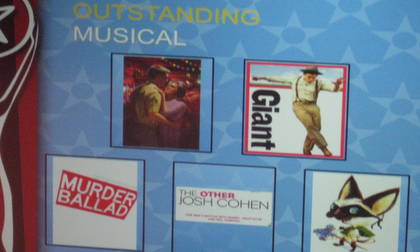 Audience supporters were thrilled and the clips for the show did look awesome. I am sorry I missed both, and neither are nominated for Drama Desk Awards which include Lucille Lortel nominees The Other Josh Cohn and Giant one of which may take the Drama Desk. Though the field for the Drama Desk includes Broadway and totals two more musicals, a win for the Public Theatre’s Giant or Here Lies Love, touted by critics and friends alike is good. Those productions are up against Matilda which is a commercial audience favorite, but whose music might not be as lyrical, innovative or clever. Hands on a Hardbody which was unable to produce enough ticket sales to sustain the show which will probably be a total loss to investors never got up the steam to chug it through initial box office doldrums. A Drama Desk win would vindicate the production, though it isn’t likely.
Drama Desks Mirroring Lucille Lortels?
The offerings and categories are different among the Drama Desks and Lucille Lortels. My favorite for Outstanding Revival is still The Piano Lesson, though I loved the Broadway revivals of Golden Boy and Trip to Bountiful. I did not see Albee’s Whose Afraid of Virginia Woolf; actor friends loved it. Shuler Hensley for The Whale is up against Tom Hanks for Lucky Guy, Nathan Lane for The Nance and other Outstanding Actor nominees (highly praised Tracey Letts for Albee’s Whose Afraid of Virginia Wolf). CLICK HERE FOR COMPLETE LIST OF DRAMA DESK NOMINEES. I did see Tom Hanks and Nathan Lane’s performances. I didn’t like Lucky Guy, CLICK HERE FOR REVIEW, but Hanks was amazing in a role that goes counter to his usual roles; I liked The Nance, but Nathan Lane is a natural and the role is typical for him, yet he is nuanced and marvelous. It’s a crap shoot, folks. I loved them both. Hanks and Lane. Someone put them in a play together!
I would love to see either an Outstanding Actress win for Cicely Tyson, A Trip to Bountiful (She is a tour de force.) or Vanessa Redgrave for The Revisionist. And for Outstanding Featured Actor my favorite is Tony Shalhoub (Golden Boy) who was so beautiful, loving, sweet and poignant as the father (He reminded me of my own). Chuck Cooper (Piano Lesson) was wonderful and a favorite over two other actors I did see, The Big Knife’s Richard Kind and Brian F. O’Byrne for If There is I Haven’t Found it Yet. The fact that they’ve been nominated is a win, surely, though the Drama Desk is lovely on a mantle piece and an affirmation to continue or retire.
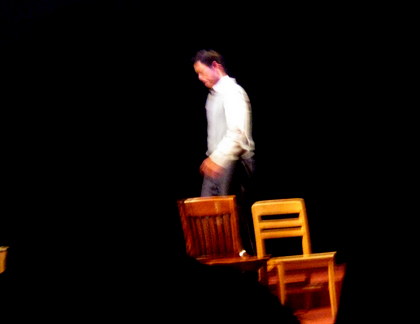
Joel de la Fuente nominated for Best Solo Performance for Hold These Truths
A few words about the Drama Desk’s Outstanding Solo Performance. I reviewed Hold These Truths in the fall. I have been honored to see the evolution of this brilliant play written by Jeanne Sakata and the incredible performance by Joel de la Fuente (CLICK HERE FOR REVIEW) who portrays the journey of Gordon Hirabayashi, civil rights hero. Hirabayashi was one of three American citizens who defied the order for Japanese internment to the desolate camps in the American west during World War II. It was an infamous time when first generation American-Japanese citizens were swept up with naturalized Japanese – American citizens, and forced into the American version of racist concentration camps after they hurriedly gave up or sold their possessions and lost their homes. Joel de la Fuente’s performance does not only portray the young and old Gordon, it includes the portrayal of individuals along the pathways of Gordon’s life: his parents, his girlfriend/wife, friends, officers, judges, et. al. It is a veritable one man show of many characters and in the retelling you are uplifted to understanding the greatness of perseverance and the beauty and the loneliness of the struggle for human freedom and dignity.
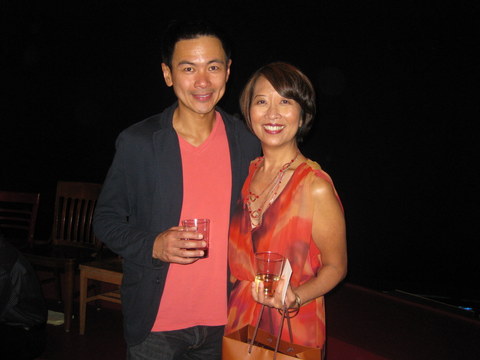
Joel de la Fuente and playwright of Hold These Truths, Jeanne Sakata.
Joel de la Fuente’s is an intensely American performance. Hold These Truths is an intensely American play about a time of infamy in our recent history. He deserves the Drama Desk. I hope he wins it because, though Bette Midler was exciting and LOL funny as Sue Mengers in I’ll Eat You Last, and Taylor Holland was marvelous in Ann, a role she wrote and originated, Joel’s work is genius in recreating not one individual, but many. The necessity of capturing the unique individuals to tell Gordon’s story would be a tremendous challenge for any actor. de la Fuente honors Gordon Hirabayashi’s courage (He passed in January of 2012. Obama granted him The Presidential Medal of Freedom posthumously on May 29, 2012.) and makes the period and the people live in our hearts and minds. The performance is unforgettable. As much as I appreciated Taylor Holland’s seminal work about the former Texas governor, Ann Richards, so much more was the vitality of Joel de la Fuente’s delineation of people, history and events from the 1930s to the 1980s in Jeanne Sakata’s amazing play, Hold These Truths.
Lucille Lortel Awards: My Predictions for Some of Off Broadway’s Best
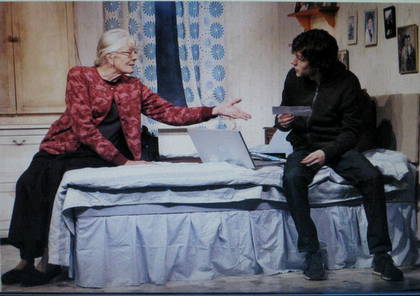
Vanessa Redgrave and Jesse Eisenberg. Redgrave is up for a Lortel Award.
Tonight Off Broadway receives its day in the sun. Some of the finest theater resides Off Broadway in smaller houses whose productions are less costly to mount. If a big name is attached to an Off Broadway production, all the better. This year, Vanessa Redgrave, Jesse Eisenberg, Jack Gyllenhaal and America Ferrera, renown for nominations and/or wins for sterling performances in other entertainment mediums acted in productions in the Village or in theaters away from Broadway central. We are blessed that they have given their support to these smaller venues, their name recognition helping to draw investors to risk their money on productions we might never have seen performed anywhere.
Though I was not able to see many of the productions, amongst the ones I did see, I do have my favorites. Will they win a Lortel Award? Well, they do have my vote. For Outstanding Play, amongst the picks three women playwrights offered their brilliance to the five nominated plays which you can find online: HERE. My vote was between Bethany, produced by the Women’s Project Theater and written by Laura Marks and Detroit produced by Playwrights Horizons and written by Lisa D’Amour. If either play receives the Lortel Award, I’ll be thrilled.
I did not see any of the musical productions, though I was tempted to and may still see Murder Ballad, which I heard friends rave about. I just couldn’t fit the production in my schedule. As for Outstanding Revival, I have two favorites, Signature Theatre productions: My Children My Africa written by Athol Fugard and The Piano Lesson written by August Wilson. Both were directed by Ruben Santiago-Hudson and I had the opportunity to go to the talk backs for both shows with Santiago-Hudson and the cast which were fascinating. However, I particularly thought The Piano Lesson was one of the finest, most alive, thrilling productions of August Wilson’s plays that I have seen in the last few years, even more phenomenal than Fences with Denzel Washington which I loved. So for me, The Piano Lesson blows away the rest of the competition and should win the Lortel for Outstanding Revival and Direction. Ruben Santiago-Hudson worked wonders in marshaling and inspiring his actors, Brandon J. Dirden (up for Outstanding Lead Actor) and Chuck Cooper (Outstanding Featured Actor) and Roslyn Ruff (Outstanding Lead Actress) to come alive onstage. I was drained and uplifted by their performances and the unforgettable production. Marvelous.
For Outstanding Lead Actress, I did see four of the performanes. Nominated are Quincy Tyler Bernstine for Neva, America Ferrera for Bethany, Vanessa Redgrave for The Revisionist, Roslyn Ruff for The Piano Lesson and Sharon Washington for Wild With Happy. I must say that it is very difficult to make any basis of comparison and all the actresses were exceptional. I thought Quincy Tyler Bernstine’s portrayal as Chekov’s wife was ironic, tempestuous, feeling and humorous. Roslyn Ruff was anointed in her portrayal; her exorcism of the demons which plague the family electrifying, acute, spiritual. Hers was the pivotal role around which all the other characters weave and she commanded turning with grace and subtly.
However, my favorite performance was Vanessa Redgrave’s for the old Polish woman harboring a secret which she attempts to keep even from herself, in The Revisionist. Given my proclivity for annoyance with Rattlestick Theater Company who mounted the production, I was not easily persuaded into enjoying the play’s brilliance, depth, and austere themes. Redgrave and Eisenberg were wonderful together, a great union there. I was particularly touched by Redgrave at the end as she so completely conveyed the gravitational pull of her character away from human love and connection: her necessity to remain alive and paradoxically remain numb and emotionally dead danced in a somber interplay, something only a truly accomplished and talented actress could execute without undermining the truth of her being onstage. Redgrave’s sensitivity was amazing and she conveyed this great pain-filled void of her character with great beauty. The result was Greek Drama: catharsis and empathy. An “Ahhhh.” moment.
A few words about If There is I Haven’t Found it Yet. I was happy that Jake Gyllenhaal performed in live theatre taking a tremendous risk to stretch his acting gifts. His presence and the lower cost of the venue brought many younger audience members to see the production and though it is a debatable concept, in this instance, many of these twenty-somethings probably would not have come to see the production otherwise. It is unfortunate and fortunate that he is competing with Chuck Cooper in The Piano Lesson. Both were so creative and so unique and alive and felt. They are both favorites of mine. I do think that Gyllenhaal will receive the award because his stature coming from film might be considered a vital and necessary promotional spur to bring publicity and celebrity to Off Broadway.
It is a time when the artists, actors, directors in the NYC theatre community long for repertory companies, long for sure venues to mount experimental, innovative productions, long for alternatives to the grind of finding investors and being told, “No it can’t be done!” Over the last decades the Philistines have forced belt tightening in the extreme. Only love and obsession for live theater drives this artistic community to commit to creating the unique theatrical experiences. Their hunger for money does not, not that the lure of riches ever drove brilliant artists and art. Yet, it is an exciting time. It is a time when shifting paradigms and mega social media and the internet threaten the way things have been done for decades. Thus, the Philistines are being attacked on all sides, and I do think if the young are able to capitalize on this, theatre WILL OUT because those from the old paradigm are confused and disconcerted at the loss of market share. They will be forced to listen to innovators and youthful-minded integrators to compromise and use the new medium to massage theatre into a new era.
Will the arbiters of old entertainment media learn how to embrace new trends in the new paradigm? (For example, using social media during performances to promote and create interest about the productions. No folks. It isn’t distracting if you are not in the first three rows. That is a myth perpetuated supposedly to keep control of revenue, when it actually prevents revenue. And where are productions’ Twitter/Tweet and FB teams?) I don’t know. I do know that this concept rules investors: celebrity names give credibility to live theatre and bring revenue (the costs also drive the younger crowd away and hamper revenue) by drawing a larger audience. (This is debatable. The greatness of a production is what draws. Well placed and thought out social media strategy can help, but it hasn’t been used to any well meaning extent.) We will probably see more of this (currently Tom Hanks is in Lucky Guy) until traditional, old paradigm threads into new paradigm and the shift is made.
The Signature Theatre has received the funding to take a modicum of risk in its selection of performers by highlighting established and upcoming playwrights. They select playwrights (some living) in residence (Hwang, Albee, Katori Hall, Fugard) and directors like Ruben Santiago-Hudson have followed through with their verve and creative energy to put on interesting and brilliant productions. That is what we need more of. We also need to see more renown film actors taking risks Off Broadway, like Gyllenhaal, though of course, for them, the work is tantamount to doing pro bono. For that reason, I think Gyllenhaal will win, though I do think that Cooper was astounding. However, this is Off Broadway. You never know.
Finally, I do know that Annie Funke will win for Outstanding Featured Actress in If There is I haven’t Found it Yet. She played the obese teenage family member set adrift in familial landscape of oblivion and negligence, where all except her uncle (Gyllenhaal) are drowning. (see my review) Her performance was without parallel. If she doesn’t get the Lortel, I’ll be pissed. Will keep you posted as to whether my favorites and those of the voting members of the Off Broadway League jive.
The Testament of Mary. Why Protest This Tony Nominated Production?

I saw The Testament of Mary starring Fiona Shaw a few weeks ago. It was the opening night of the previews and as I walked up to the theater, there was a huge commotion on the opposite side of the street. Members of a branch/sect of the Catholic Church were protesting the production. It reminded me of the protests for Martin Scorsese’s film, The Last Temptation of Christ which was in theaters for a brief period and then scuttled away in shame, quickly forgotten.
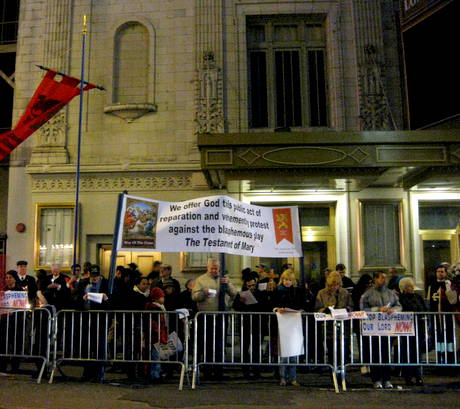
That was a travesty. The Last Temptation of Christ is a brilliant film, stirring and iconic in its imagery, thought provoking and incredibly spiritual. What other film about Christ so aptly deals with the realm of carnality in Jesus Christ’s human side? The fleshly, carnal nature is something the Catholic Church seems to have a huge problem with and as a result, certainly should have encouraged their membership to see the film and learn HOW TO THWART FLESHLY TEMPTATION. They were too afraid what the film might reveal to them, apparently, and like ostrich’s, put their heads in the sands of protest and the studio and distributors backed down, so the church prevailed and didn’t see the film. Ironically, in the years that followed, more of their membership and clergy committed acts of carnality and submitted to fleshly desires. If they had seen the film, it may have been an expurgating and healing experience.

With these thoughts in mind, I took pictures of the protesters and wondered if the same fate would befall The Testament of Mary, as it did Last Temptation, a brief run, sparse audience, excoriation, hell and condemnation.

After seeing the production, I thought the run might be longer. This is 2013. The Catholic Church’s credibility is plummeting into the abyss, self-damned with the exposure of its abusive clergy, nuns, et.al. and the wide swath of deceitful cover-ups of the abuse.

The play doesn’t have a wide release like a film and can’t be widely protested; this is New York City, and the play could draw an amazingly tolerant, urbane, thinking audience, albeit it is not a fluffy, touristd musical. Turns out for whatever reason, most likely money, the production which has been nominated for a number of awards, including a Tony for best play and a few other lesser categories, the play is shuttering on May 5th, in four days. I urge you to see it, especially if you are a person of faith, Catholic, an atheist and/or an agnostic.

A bit of comparison between the Scorsese film and this production, because thematically, they are similar. Both uplift faith and in no way deny the deity of Christ and the spiritual purpose of Mary. What they do reveal is the tremendous humanity and fleshly temptations of Christ and Mary, Jesus’ mother. Both represent the scriptures to a fault. How the Catholic Church could protest such revelation of the humanity of Mary and Jesus is beyond my comprehension. It is with the humanity that we inevitably identify. God? He is far from us. Only through Christ, Mary, Paul and the other very human disciples do we comprehend how to grow into a more loving, compassionate and empathetic nature. If they did it through faith, belief and prayer and forgiveness of self and others, then perhaps we can begin to relate and improve our lives and the lives of those we touch. As they were subject to failure and temptation, even to doubt, then we can relate our very humble existence to theirs. Both the play and the film highlight their humility, above all, very much in keeping with scripture.
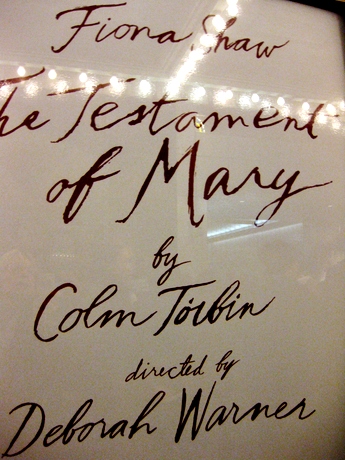
Colim Toibin’s The Testament of Mary at Broadway’s Walter Kerr Theatre stars Fiona Shaw and is directed by Deborah Warner. Based on Toibin’s novella of the same name, The Testament of Mary tells the unheard story of Mary, the mother of Jesus, who is being guarded and protected in the city of Ephesus after her son’s Crucifixion. The one-woman performance will have played 27 previews and 16 performances when it closes May 5th.

Before the play begins, Mary dressed in an iconic blue drape is behind a glass case, the very picture of the mother of God depicted in paintings. Under glass, she is the somber woman deified for all time. Mary under glass recalls tacky lawn ornaments. As the figure of Mary with plastic flowers Shaw poses and prays reverently, an emblem of the religion removed from humanity. While Shaw is behind the glass case, the audience, if they like, can go up on stage and view her and walk around. Also, present on stage is a chained up (so he won’t fly away) turkey buzzard, a predatory bird referred to later in Mary’s testament about the events leading up to the crucifixion. She refers to seeing a bird of prey gouge out the eyes of a rabbit and then eviscerate the animal, killing it in blood and gore. In context, it is what is done to Jesus, her son, which she laments and wishes had not happened.
The play begins after Shaw comes out from under the glass and becomes the human Mary. She takes away the bird of prey and begins her story of what happened to her, to her son and her ultimate lament that she wished it had not, a very contrary view, not to the Bible, necessarily, but certainly to the Catholic portrayal of Mary as the iconic wonder woman who birthed God.
Throughout the testimony, we do not see or hear the exultant Mary happy her son is the savior, an all-knowing Mary who understands flawlessly and effortlessly without a smidgeon of doubt her son’s purpose. This is a human Mary, filled with doubt. As she recounts the story in flashback, she laments as she tells us she had seen the “writing on the wall” when Lazarus was raised from the dead. She knew the envy and jealousy of the religious leaders. She knew they would go after Him because of the miracles He performed. This human Mary is fearful for her son because He is too loving, too kind, to wise, too beautiful, too knowledgeable and too just. And she intuits that He will be killed for it all especially because of His fan club and followers’ love.
The rabbit eviscerated in gore is her son eviscerated and left bloody. She doesn’t hail the blood of Christ as that of the lamb slain for the world that the religions (Christian) rejoice about. She rues his blood shed. He is first and last her beloved human son. All the more poignant is the scripture of Jesus when he looks down upon Mary from the cross, saying, “Mother, behold your son.” For Mary, it is a great sorrow that her innocent son went to His death, for what? Not even Pilot wanted Him dead, and in fact was warned by his wife not to “kill that innocent man.” How much more a mother suffers when her son is destroyed for what she knows is jealousy and envy. She knows the price that her son will have to pay to heal, cleanse, comfort, make water into wine, and especially to raise from the dead. She knows that the religious leaders will punish him and exact a blood penalty. She shares what motivates her son and what motivates the religious leaders who put burdens on the people that they themselves cannot relieve. She knows her son is the “real thing,” and that they, motivated by greed, money and power will destroy him. Her son’s death is not salvation; for her it is torture.
Can Mary the “mother of God” be allowed to speak as a human mother when she is portrayed by some religious leaders (Catholicism) as even greater than Jesus? Is it fair that she be human, that she show fear and run away like Peter who denied Christ? Is this not blasphemous? And yet in the scripture, she mourns and grieves her son as the women and disciples did. The production is not contrary to the scripture, even with regard to the resurrection of Christ.

So what’s the fuss? Fiona Shaw is absolutely brilliant, touching, painful, monumental in her portrayal. The play taken from the scripture is electrifying. Mary was indeed human and she is divine. We are human and have the potential to achieve great goodness, perhaps even divinity counting a few miraculous prayers answered. What the play intentions through the beauty of Shaw’s cry of humanity is that the divine be brought into our reach and that we identify and become ennobled by this understanding. That we too, given the concept of world salvation by a son, would rather have the son with us…forget the world. Let it rot. All the more the sacrifice, was Christ’s to have been paid at such a great cost: the suffering of a mother who, knowing who her son is and understanding what He can accomplish must lose him to brutality, jealously, all the sins of the world? No wonder Mary’s lament; no wonder she disputes God’s purpose. No wonder she questions and wishes a reversal of events. Wouldn’t we? And isn’t that the point?
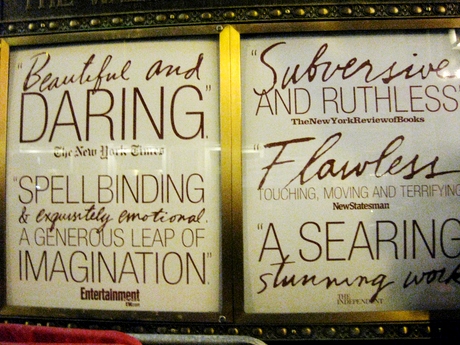
But as in The Last Temptation of Christ, there is no going back. Christ defeated temptation. His work was finished on the cross and He fulfilled God’s purpose. And likewise, Mary may rant, she is human, but her rant too is finished. And though she is an icon, Mary lives and prays in Spirit. Nothing can be taken from her nor is it in this production. The beauty is in the addition of her wonderful humanity in the paradox of divinity. There is hope for us yet.
 CAROLE DI TOSTI
