Blog Archives
‘The Dinosaurs’ at Playwrights Horizons
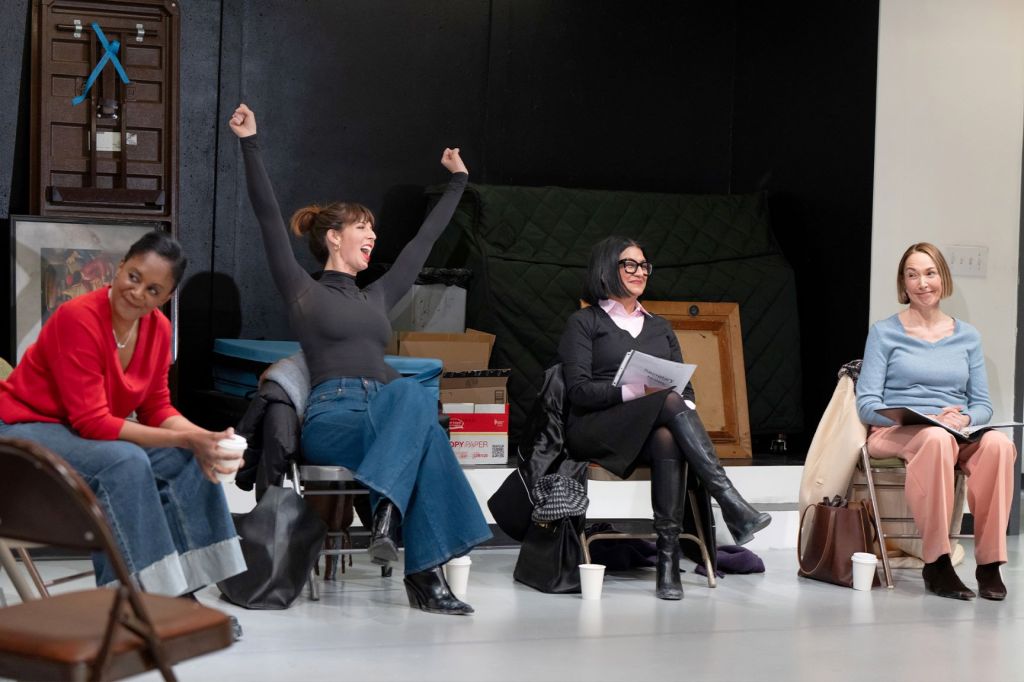
In The Dinosaurs written by Jacob Perkins and directed by Les Waters, time stands still yet moves in leaps that are hard to figure out. It takes place in a room where women who are alcoholics meet, form community and establish friendships helping each other through the years. With strong performances that require solo monologues, the characters share experiences and perspectives and enumerate their days of continuing sobriety. The Dinosaurs currently runs at Playwrights Horizons until March 8, 2026.
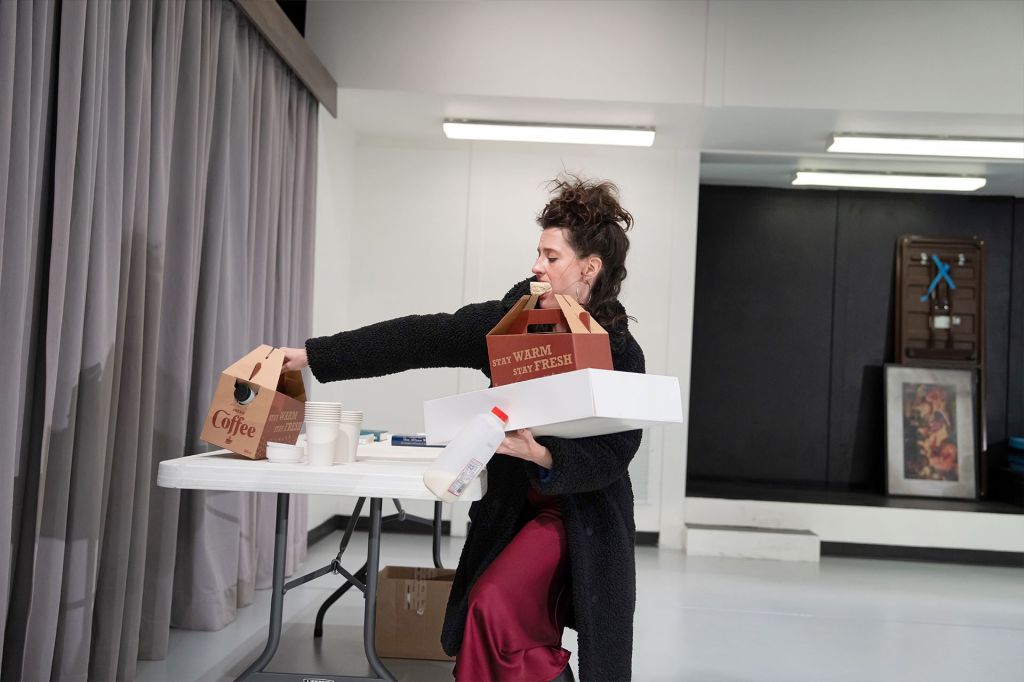
As the characters set up the neutral unadorned room (scenic design by dots), where they meet, wait for participants to show up and reaffirm the rules of their sessions, we understand this is a female inclusive community. April Matthis as Jane is first to arrive to begin setting up chairs, followed by nervous Buddy (Keilly McQuail), who after a humorous exchange with nonjudgmental Jane, decides she can’t stay. She does show up during the meditation and the end only making a connection with Jane in a layering that makes the time structure hard to divine.
Next, Elizabeth Marvel as Joan enters with the coffee and helps Jane set up. She is followed by Kathleen Chalfant’s Jolly as the longest, oldest member of the group, who brings positivity and warmth with the donuts and scones. Newer member Joane (Maria Elena Ramirez), arrives with gossip about a female teacher. Finally, Janet (Mallory Portnoy)–the appointed time keeper–arrives late and is the first one to share on the topic “coming back,” after their group meditation.
The playwright avoids heavy emotional content related to grief, sorrow, regrets, abuse or violence. Indeed, he avoids in the moment conflict in the plot and character development, with the exception of Joan, Jane and Joane who disagree about feeling empathy for a “lonely” female teacher who has sex with a teen who is “of age.” Jolly provides the down-to-earth humorous perspective as the argument persists then ends once Janet arrives. Interestingly, one would think these are average women of various ages who live regular lives, but for their momentous pronouncement later, during their time to share, that they are alcoholics.
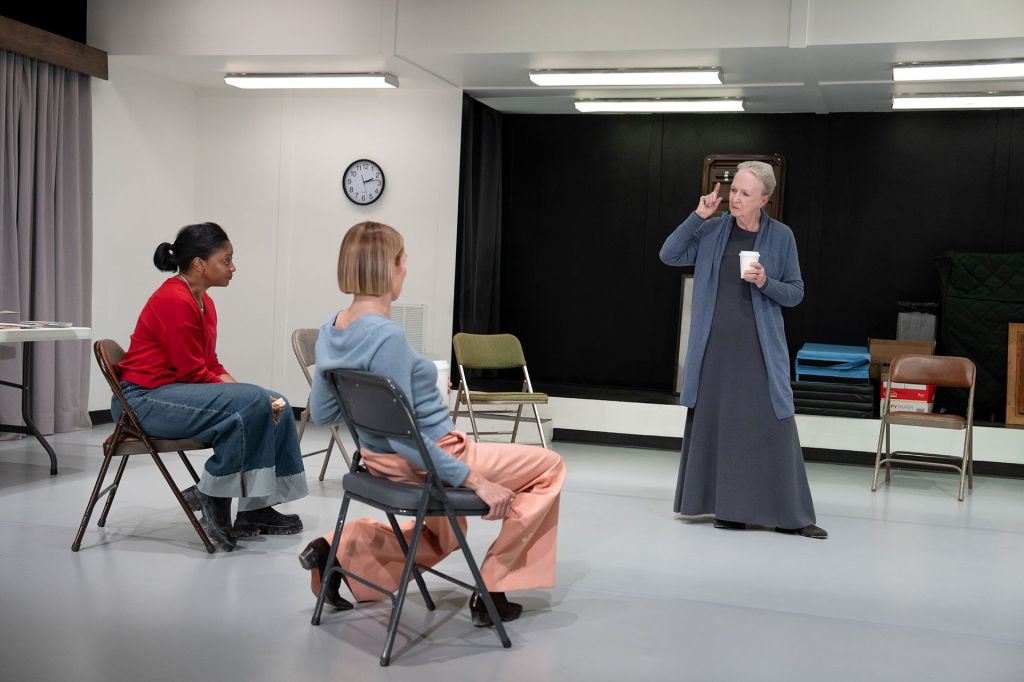
The production spends a good deal of time having Joan, Jane and Jolly set up the room making small talk. Chalfant’s portrayal as Jolly mesmerizes with substance, authenticity and humor, which she clearly infuses with backstory and meaning. In comparison with the other women, Jolly’s character is the most delineated because of Chalfant’s superb, specific performance, as is Marvel’s Joan who reveals why she is an alcoholic toward the end of the play. Otherwise, the characters divulge little else about themselves. This forces the audience to imagine who these women are and why they chose alcohol as their drug and not opiates, barbiturates, food or other addictive elements to anesthetize themselves and escape from life’s “slings and arrows of outrageous fortune;” if indeed, that is why they are alcoholics.
Janet’s metaphoric experience about being driven by a chauffeur she hates and who tells her to throw out the body of a man instead of carrying it around, seems to express her situation of carrying baggage which she eventually throws away in her awake dream state. However, we don’t understand to what she refers and she doesn’t connect the dots. Likewise, the others say little hard evidence about their situations. This adds to a general tiresome opaqueness.
All important personal details are absent, perhaps playwright censored to indicate his characters’ self-censorship. No explanation is given by the playwright, which leaves a huge gap in the ethos of the play. Nevertheless, a picture forms of these characters and the process of their recovery from a disease. However, its horrific effects in their personal lives as they share with their community is never identified. Indeed, the recovery process seems deadening as the women avoid discussing even the difficulty of fighting the urge to taste a drop of their favorite alcoholic beverage.
The characters also avoid discussing the severity of their alcoholism. If the blood never boils with emotion, then not feeling alive removes any impulse to drink. Perhaps keeping a steady deadened state is their key to recovery. How fortunate that they have found other individuals who allow this type of emotional void to be shared. Their tell-tale meditation at the beginning of their meeting indicates what substitutes for feeling and the connection with their feelings.
Notable examples of a separation perhaps disassociation from feelings happen with a few of the characters. Joane’s discussion of finding her son pleasuring an older man in their house seems devoid of an emotional reaction on her part in relation to her drinking. The assumption is that her discovery caused the rift between herself and her son that she describes and perhaps this led to her alcoholism. She and her son never discussed or dealt with her seeing her son with the older man. Did this lead to the dire circumstances that happened later in their lives? Ramirez’ Joane recalls it with dispassion though she takes a moment to breathe revealing the confession is difficult. Her admission that she is revealing it for the first time is groundbreaking.
That her son at fifteen was under the apparent influence of an older man reflective of the current pedophilia reports in the Epstein files is passed over without judgment by Joan or any of the other women. Is this what it takes to recover from alcoholism, this passive, non-reactive state of mind while others are there to just listen?
Joan’s time lapse discussion of the days of her recovery to sixteen years emerges with vitality. A matter-of-fact statement of her number of years without a drink that has seen her in this room with various community members of alcoholics hearing her make comments becomes her milestone. And apparently, during that sixteen year period she had to say goodbye to Jolly who dies and whom she misses. Thus, Jolly’s influence on her own recovery is reduced to less than a minute of time, though counting the years of struggle to maintain sobriety must have seemed an eternity. Unfortunately, there is a grand absence of information. Perkins revels in being opaque. More is needed.
Thankfully, the actors do a yeowoman’s job of leaping over the play’s lack of detail by providing as much of their interior substance as possible. Nevertheless, the lifeblood of theatricality and living onstage is hindered by the playwright’s lack of clarity. Nor is the play’s incoherence at times clarified by Waters’ direction.
Perhaps Rainer Maria Rilke’s quote from Book of Hours which Perkins uses to head up his script might have been spoken aloud by one of the characters in a prelude to The Dinosaurs. The lines of poetry present a lens though which to view each of the characters’ journeys, lifting them to a spiritual plane and revealing the irrelevance of time.
I live my life in widening circles that reach out across the world. I may not complete this last one but I give myself to it. I circle around God, around the primordial tower. I’ve been circling for thousands of years and I still don’t know: am I a falcon, a storm, or a great song. –Rainer Maria Rilke from Book of Hours
The Dinosaurs runs 1 hour 15 minutes at Playwrights Horizons until March 8, 2026. playwrightshorizons.org.
‘Primary Trust,’ the Hope of Friendship Through The Trauma of Being Alone

Small town life can be incredibly boring and static. However, for those who experienced unaccountable pain and trauma, the peace and quiet may be precisely what is needed to achieve a balanced state. In Eboni Booth’s sensitive, profound drama Primary Trust, currently at Roundabout Theatre Company until July 2nd, the playwright investigates humans in their ability to heal from trauma.
For some, getting beyond the pain of emotional loss requires a particular kind of remedy. Kenneth (William Jackson Harper), a resident of Rochester suburb, Cranberry, New York, has found the ability to withstand loss through his mind and will’s resilience to nurture itself with hope and friendship.
Kenneth addresses the audience directly relating a sweetness and shy vulnerability that is immensely likable. He introduces the town and his friend Bert to the audience with ease and authenticity. When there is a segue in thought and feeling, a bell rings as an accompaniment by musician Luke Wygodny who also plays the cello and other instruments before the play begins and during salient turning points.

Harper’s Kenneth takes his time to gather his thoughts as he confesses to us. His need to share his story resonates. Clearly, his story is momentous and universal. Praise goes to William Jackson Harper who engages us with his humanity. Additionally, Eboni Booth’s simple word craft in structuring likable, recognizable, human characters in this small town is amazing. With fine direction by Knud Adams, who shepherds Harper’s Kenneth and the supporting actors, we become captivated and empathize with Kenneth though we may have little in common with him.
Kenneth shares his experiences about “what happened” to him at a turning point in his life when he is thirty-eight years old. He gives us background and reviews his daily routine in Cranberry, New York focusing on the high point of his day after work, when he spends the evening at Wally’s, a typical tiki bar/restaurant. There, he joins his BFF Bert (Eric Berryman) and they drink Mai Tais and share jokes and stories. Their affection and warmth is genuine as they reminisce about past experiences in the joyful atmosphere of booze and camaraderie.

However, apart from their bonding daily at Wally’s and their race, the men are very different. Kenneth works at a bookstore and has been invaluable to his boss, Sam (the on-point Jay O. Sanders) doing bookkeeping, clerking and various chores. Bert on the other hand has an office job, a wife and children, whom he leaves to be with Kenneth in the evenings. It is around about this time that reality fuses with the ethereal, and logic is throw out the window. How the playwright, director and Harper’s portrayal of Kenneth massage us to accept this maverick dramatic element is a testament to their talent and genius.
Kenneth explains that his friend Bert is invisible, imaginary. In other words his BFF can only be seen by him (and of course us). Thus, we become intimates. In confiding to us, Kenneth trusts us to share his secret, in the hope we will not judge him and “turn off” because he’s “wacky.”

Sam is aware that Bert is Kenneth’s imaginary friend. When he tells Kenneth he is selling the store and relocating for health reasons, he makes it a point to reference Bert. He suggests when Kenneth looks for another job, he shouldn’t allow Bert to intrude on the interview. Nor should he share with prospective employers that Bert is his imaginary friend. The implication is that they will think Kenneth is deranged. That we accept Bert as imaginary and go along for the ride is creditable to the playwright, director and actors.
Sam’s news about closing his store is an earthquake. Kenneth discusses the impact on his life with Bert and a new Wally’s waitress Corrina (April Matthis). Though Sam’s move shakes Kenneth, it is an opportunity. He is forced to end the nullifying status quo must. Change occurs in Kenneth’s discussions with Bert and Corrina, who suggests the bank Primary Trust is looking to hire tellers. When Kenneth applies for a job and speaks with Clay who is the branch manager (Jay O. Sanders), all goes well. Humorously, Bert accompanies him to the interview and prompts Kenneth’s winning responses which seal the deal. Clay hires him and he becomes one of the best employees of the bank.

However, Kenneth must confront a transition moving in his soul. The stirrings begin when he and Corrina as friends move beyond Wally’s to a lovely French restaurant. In a humorous turn Jay O. Sanders is the French waiter who serves them. It is in this new expansive world with Corrina that possibilities open up for Kenneth. For the first time, Kenneth doesn’t meet Bert at Wally’s It is another earthquake that rocks him off the status quo of his insular life. There is no spoiler alert. You’ll just have to see this heartfelt production to discover what happens next.
William Jackson Harper is absolutely terrific in a role which is elegantly written for the quiet corners of our minds. The supporting cast are authentic and vital in filling out the life that Kenneth has made for himself to help him emerge out of his cocoon and begin to fly. The playwright’s courage to present an extraordinary friendship which serves Kenneth to bring him to a point of sustenance until he launches into success is beautifully, subtly conveyed. Thanks to the ensemble, who make the unbelievable real, Kenneth’s “small life” in its human drama is important to us.

Thus, when Kenneth explains his upbringing to Corrina toward the end of the play, his revelation stuns. The clues coalesce and we “get” who he is, understanding his brilliance, his tenacity and perseverance. It brings to mind the character of Jane Eyre (in the titular novel), whose dying friend tells her, “You are never alone. You have yourself. ” The playwright takes this notion further to suggest, when you feel you can’t trust yourself, primarily, you can always elicit an imaginary friend who is closer than a brother or sister, until it is time for them to leave. It is through this “primary trust” one survives through heartbreak, trauma, isolation and death.
Primary Trust‘s fantastic qualities enliven the themes and remind us of the importance of doing no harm as we negotiate aloneness in our own soul consciousness. Kenneth chose his friend wisely. He relates how this occurs to Corrina who listens, the active ingredient of his budding friendship with her.
Kudos to the set designer Marsha Ginsberg,Isabella Byrd’s lighting design, Mikaal Sulaiman’s sound design, Qween Jean’s costume design, Niklya Mathis’ hair & wig design and Like Wygodny’s original music which to tonally balance the production. The mock up of the town square offered a metaphoric quaint suburb at a time before the technological explosion and cell phones when people listened to each other live and as Kenneth does created conversations with ethereal friends. The set design and music created the atmosphere so that we readily accept Kenneth’s and Bert’s friendship and its significance with wonder and surprise.
For tickets and times to see Primary Trust, go to their website https://www.roundabouttheatre.org/get-tickets/2022-2023-season/primary-trust/performances
‘Toni Stone,’ A Baseball Great Takes Center Stage at the Roundabout

April Matthis in Roundabout Theatre Company’s ‘Toni Stone,’ directed by Pam MacKinnon, written by Lydia R. Diamond (Joan Marcus)
Imagine being so excellent at baseball you have to join a boys’ team because no one on the girls’ team can hold a candle to you! Toni Stone was the first African American female to distinguish herself and play pro ball ball in the Negro Leagues. No other woman of any race topped her skill, pluck or stamina in 1953, not that any women even conceived that they should try. Based on the biography Curveball, The Remarkable Story of Toni Stone by Martha Ackmann, Roundabout’s humorous, intriguing and illuminating production about baseball, race, gender, inspiration and ambition, Toni Stone, written by Lydia R. Diamond, is currently at the Laura Pels Theatre until the 11th of August.
Starring Obie Award Winner April Matthis, who transforms herself into the feisty, wise-cracking, straight-talking, female baseball maverick in the two act production that runs with one intermission, we learn Toni’s inside perspective about what it was like to break into the prestigious negro leagues. She was the only woman to do exploits with her male teammates playing the game she adored and gave the best years of her life to in the late 1940s to 1954. Hired to play second base with The Clowns in 1953, Toni Stone took over the position that Hank Aaron had played the previous year and rocked it in 50 outings, slamming a hit off the legendary pitcher Satchel Paige. Matthis as Stone is incredible, moment-to-moment, real.
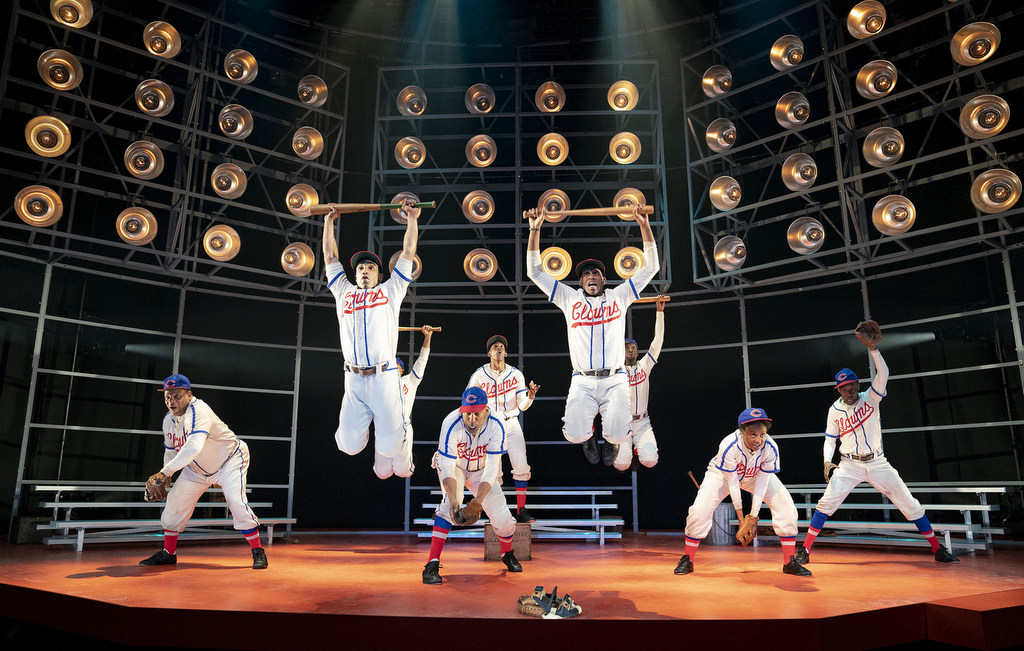
(L to R): Harvy Blanks, Jonathan Burke, Daniel J. Bryant, Ezra Knight, Toney Goins, Eric Berryman, Phillip James Brannon, April Matthis, Kenn E. Head in ‘Toni Stone,’ Roundabout Theatre Company, written by Lydia R. Diamond, based on the book ‘Curveball, The Remarkable Story of Toni Stone,’ by Martha Ackmann directed by, Pam MacKinnon (Joan Marcus)
The structure of Toni Stone is picaresque and dramatic. It spans the years from the 1920s to the 1950s in various locations around the country. With superb, athleticism by the actors, the movements are precision, characteristically baseball as the actors represent the players on Toni’s exhibition team The Clowns (like the Harlem Globetrotters in the basketball world today). The Choreography by Camille A. Brown in Act I is taut as we watch the players practice their fielding, throwing, catching, swinging as professional ball players with the fierce pride and confidence to match any professional today. They and Brown’s choreography are impressive. Director Pam MacKinnon’s staging segues from bit to bit with fast paced spin in the first act, and less precision in the second act which becomes more ponderous.
The Lighting (Allen Lee Hughes) and Set Design (Riccardo Hernandez) echoe where Tony strived to spend the best years of her life, on the ball field, with lights blaring down (at the right moment) and with bleachers for the full effect and accoutrements, i.e. uniforms (Dede Ayite) caps, gloves, bats minus the ball which is held in mime invisibly as the players “throw” and “catch.” The minimalism is effective in lifting the subject of what has been described as the only true American sport. The lack of extraneous spectacle draws our attention to the dialogue between and among the players and other characters. Without the razzle dazzle, we focus on Toni Stone’s narration during which she confides to us about salient details of her life and events which reveal the themes of the production: steadfastly overcoming the odds, ambition as everything, female success in a man’s world, and effort and hard work pays off if one keeps focused.

(L to R): Eric Berryman, Jonathan Burke, April Matthis, Daniel J. Bryant, Ezra Knight, ‘Toni Stone,’ written by Lydia R. Diamond, directed by Pam MacKinnon, based on the book ‘Curveball, The Remarkable Story of Toni Stone,’ by Martha Ackmann (Joan Marcus)
April Matthis has the accent, the drawl, the humor to evoke Toni’s persona and let us in on the secrets of her baseball obsession and efforts to be the best. She’s not as good as Jackie Robinson whom the players reference moving from the Negro Leagues in a leap over the line of segregation to Major League baseball as the first African American to integrate the Majors. Nevertheless, Toni was a one-of-a-kind celebrity and superb ball player. It is that particularity that playwright Diamond characterizes and Pat MacKinnon highlights through her direction so that it explodes on stage and holds our interest.
The top of the play begins with her teammates on the Indianapolis Clowns who introduce her and then she introduces them with humorous quips and prods. As the men move like poetry as they practice behind her, Toni gives an overview of the game with a rhythm all her own in description and enumeration of details. Her full on discussion of the ball, likening it to that which is a part of her hand and which she balances by its weight, shape and feel is typically mind-bending. It indicates how one can be engrossed by that which one loves to go very deep! Indeed, she remarks that as the girls in high school were obsessed about boys, she could only see, hear and think about baseball. A fiend she spends her waking moments on the baseball fields of St. Paul where her tom boyishness and fervor were accepted by the guys who “let” her play with them.

(L to R): Jonathan Burke, Harvy Blanks, Toney Goins, Kenn E. Head, April Matthis, Eric Berryman, Daniel J. Bryant, Phillip James Brannon, Ezra Knight, ‘Toni Stone,’ written by Lydia R. Diamond, directed by Pam MacKinnon, Roundabout Theatre Company (Joan Marcus)
However, when she did break into pro baseball, the players gave her “what for.” Some of the intriguing elements of the production occur when Toni hones in on confronting difficulties. She prides herself on “taking it” i.e. the male-on-female abuse. She kept a stoic outlook and sustained the bruising and battering she got when the players treated her like a guy, but more so. In one segment, her friend, prostitute Millie (an exceptional Kenn E. Head) is with her as she applies cream on a bruise she receives from a player out to “get her.” In that brief moment is the tip of the iceberg of what she went through as the singular woman among the burly, smelly, macho men. Yet, she felt that she was one of them but through the years many of them treated her as “the other.” Indeed, she wasn’t allowed in the locker room and had to change in spaces they had to find for her as they traveled on the road.
Playing on the Negro Leagues, the players encountered the usual “hospitality” of the Jim Crow South; they were banned from white hotels, motels and bathrooms and subjected to racist, discriminatory abuse. In one town the only hotel they were accepted in was one that catered to sex workers. This is the place where she meets Millie, replete with flowery robes courtesy of Dede Ayite’s Costume Design, albeit Head wears them over his Clowns’ uniform. The interactions between Kenn E. Head’s Millie (his feminine gestures are humorous, but real) and Matthis’ Toni are poignant and revelatory. Head particularly has superb timing with his looks, his one-liners.
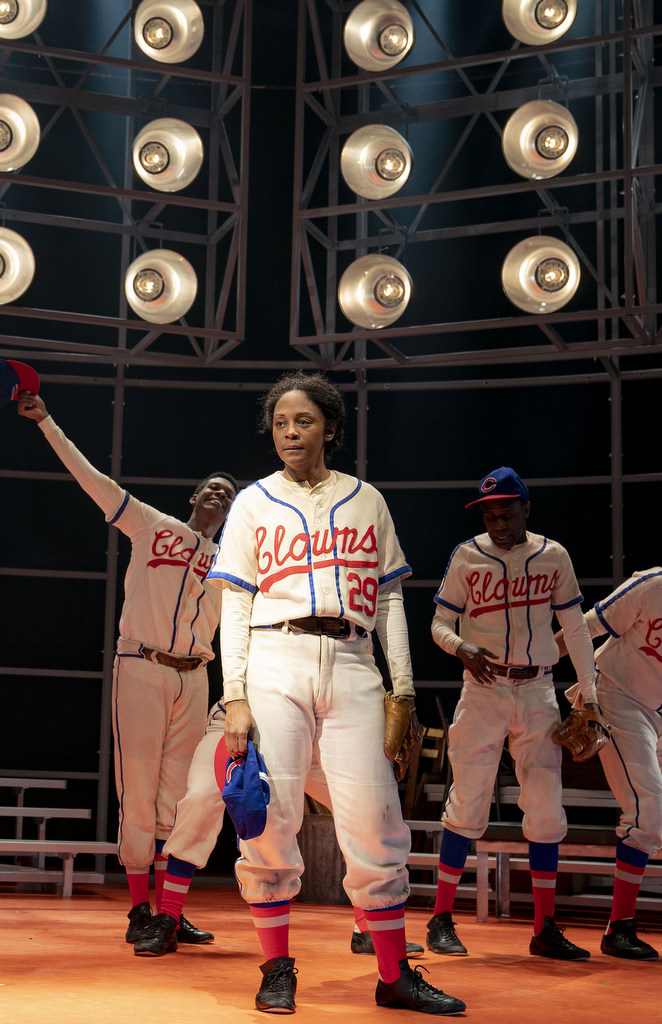
(L to R): ,Toney Goins, April Matthis, Kenn E. Head, in ‘Toni Stone,’written by Lydia R. Diamond, directed by Pam MacKinnon, based on the book ‘Curveball, The Remarkable Story of Toni Stone’ by Martha Ackmann, Roundabout Theatre Company (Joan Marcus)
There are sensitive illustrious moments drawn between the two, for example when Millie gives her tips on how to do her hair. And as Toni questions Millie for her wisdom regarding men, we note that her attitude is unrelenting and strong. We never see her break down even with Millie; she can’t afford that luxury. And very simply, it is not the “Toni Stone” style.
In another segment the playwright examines Toni’s relationships, in particular Alberga (portrayed by the superb, likable Harvy Blanks) who she allows to buy her drinks in a bar. How these scenes are simplistically staged using two players to hold a board is part of the fun. It is obvious that Alberga intends to sweet-talk her and ply her with alcohol which doesn’t understand until Millie explains it to her. Eventually, Toni abruptly calls him down on it and distracts him by talking “baseball.” Taken aback by her honesty and unpretentious, unfeminine, unflirty demeanor, they continue to “hang out” whenever she is in town.
Toni decides to marry him; it is the right time. When he and she are tired of smelling the man-sweat wreak of her own exertions on her clothes, coupled with sweaty, noxious odors of her male baseball counterparts, it is one more element that helps her decide to leave baseball. The last straw occurs after she is traded to the Kansas City Monarchs and benched most of the time sitting next to teammates whose dislike for her is obvious. Toni Stone leaves for a civilian life with her husband and never returns to baseball again.
Perhaps the most searing effect of this production is in how the playwright weaves in the details of the history of our nation’s racism during the accounts of her life on the field and in pro baseball. These thread everpresently throughout. In one instance Toni editorializes about the discrimination and it is here where the director and choreographer work their magic, starkly in a memorable finality to Act I. Toni stares out at the audience and comments about the “spectacle” of exhibition games where they were to make the audience laugh. The players “dance” behind her as grinning “clowns,” though one imagines that each and every one of the players is “crying inside.”
The depth and beauty of the sport she loves is compromised by the stereotypical, racial attitudes. The indictment is clear as Matthis’Toni stares out at the audience. We are a throwback to the historical audience who wanted the “negroes” to entertain them. It is then, the playwright infers little has changed regarding discriminatory racial stereotypes and bigoted acts. The tragedy of this is the stereotype obviates the profound depth of what African Americans/blacks were/are but are locked out from “becoming.” It is a vital moment in the play and the perfect end of the first act. The second act does not end as strongly.
Kudos to the creative team not already mentioned: Broken Chord (Original Music & Sound Design) Cookie Jordan (Hair & Wig Designer) Thomas Schall (Fight Director).
Toni Stone runs with one intermission at the Laura Pels Theatre, the Harold and Miriam STeinberg Center for Theatre on 46th Street between 6th and 7 Avenue until the 11th of August. For tickets and times go to the Roundabout Website by CLICKING HERE.
 CAROLE DI TOSTI