Blog Archives
The Fine June Squibb Heads up the Stellar Cast of ‘Marjorie Prime’

When Marjorie Prime by Jordan Harrison opened Off Broadway in 2015, starring Lois Smith, it appealed as science fiction. Since then the use of various forms of artificial intelligence to support human behavior have become ubiquitous.
Reinforcing this new reality the playwright and director Anne Kauffman dusted off the prescient family drama and shined it up for its Broadway premiere with few changes to the script. Maintaining the prior production values, director Anne Kauffman works with set designer Lee Jellinek, sound designer Daniel Kluger and Ben Stanton’s lighting design to create the almost surreal and static atmosphere where AI takes over the lives of a family and exists for itself in the last scene.
The production runs at the Helen Hayes Theater with the superb cast of June Squibb, Cynthia Nixon, Danny Burstein and Christopher Lowell through February 15. They are the reason to see the revival.
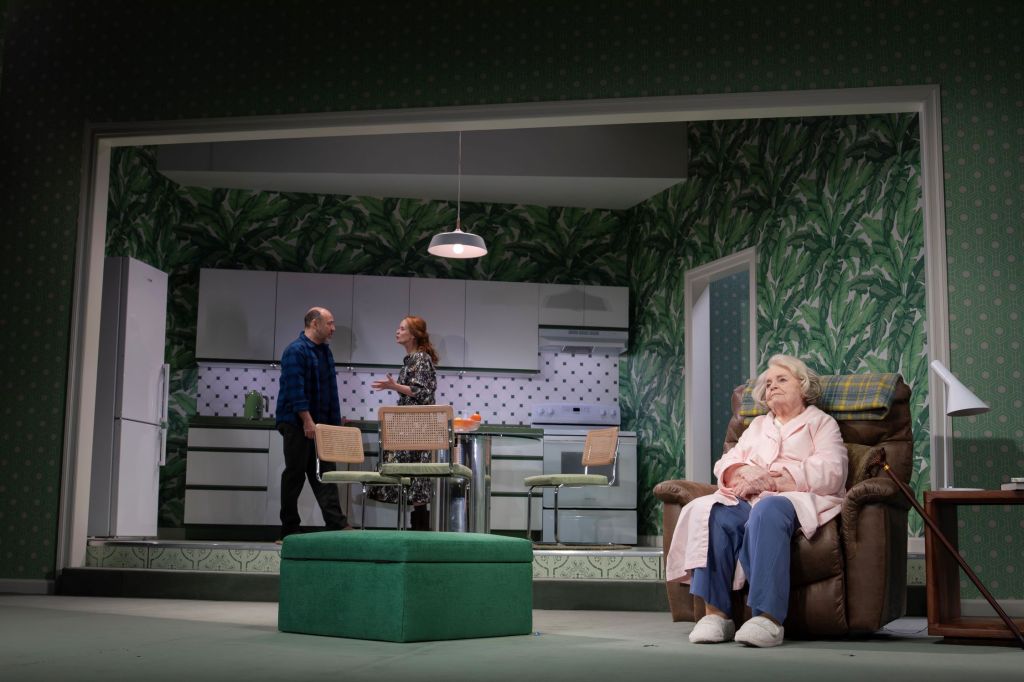
On one level the excellent performances outshine the themes of Marjorie Prime which deal with death, identity, the grieving process, artificial intelligence and more. The science fiction aspect of the play, so striking before, has diminished.
Yet, Harrison’s conceit that AI holograms might be used to reconcile the death and loss of a loved one still fascinates a decade later. Our culture fights death and aging with its emphasis on ageless appearance, looking 25-years-old at the chronological age of 90-years-old. Some other cultures have a healthier approach, viewing the acceptance of death and aging as a normal part of life cycles. However, with technological advancements, regardless of the culture or country, AI will have its uses in the battle against disease, dying, death and mourning.
The “Primes,” in Marjorie Prime are the spitting image of loved ones at a particular time in their lives. Created by the company Senior Serenity to help the bereaved get through inconsolable grief, Marjorie’s family believes a holographic duplicate of husband Walter will help her adjust to his death. The replica keeps her engaged, sentient and interactive, unlike passively watching TV.
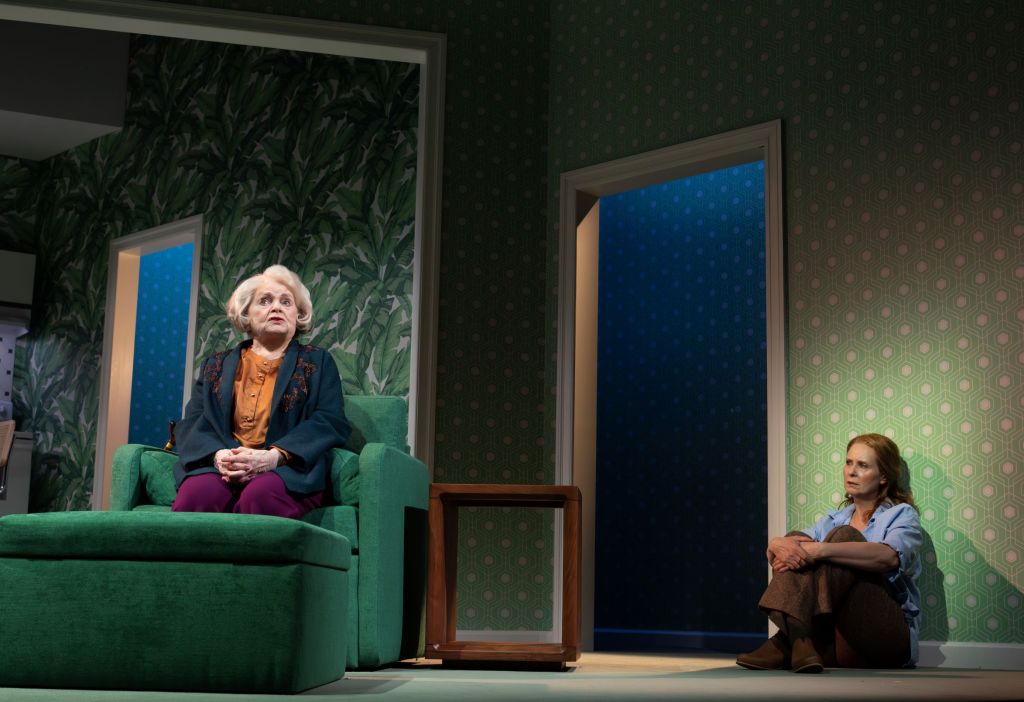
Walter Prime (Christopher Lowell) duplicates the younger, good-looking Walter in his thirties. Happily, he reminds her of the distant past, not the more recent, sick and dying Walter. The hologram’s programming and presence also help stir Marjorie’s memory, complicated with dementia. A work in progress, Walter Prime evolves based on the information that 85-year-old Marjorie (June Squibb), her daughter Tess (Cynthia Nixon), and son-in-law Jon (Danny Burstein), give him about Walter and Marjorie’s life together.
Thus, at the top of the play Walter Prime and Marjorie discuss movies they went to, for example, My Best Friend’s Wedding, which Marjorie has forgotten until Walter tells her the synopsis. The spry 96-year old Squibb, who made her Broadway debut playing one of the strippers in Gypsy (1959), portrays the spicy, funny, confused, chronologically younger woman with a failing memory, an irony that amused me to no end. Squibb is just terrific.
As Marjorie’s identity and memory dim, Walter Prime builds up the identity of Walter with her help. However, Harrison’s play raises questions about this process and never answers them. For example, how much information has Walter Prime been fed prior to his engagement with Marjorie, Jon and Tess? How can Marjorie be expected to keep track of information from before their marriage into their elderly years with her failing memory? Won’t she feed him incorrect details?
Indeed, facts and details shift and Marjorie confuses the truth. An imagined past becomes easier to accept with one’s husband “Prime” fed information by others. This problem never resolves. Neither does Tess’s incomplete acceptance of Walter’s function to stimulate Marjorie, the supposed benefit that Senior Serenity, the company that made him, affirms. The impatient, edgy Tess doubts Walter’s usefulness, but the upbeat Jon thinks that he helps improve Marjorie’s engagement and memory.
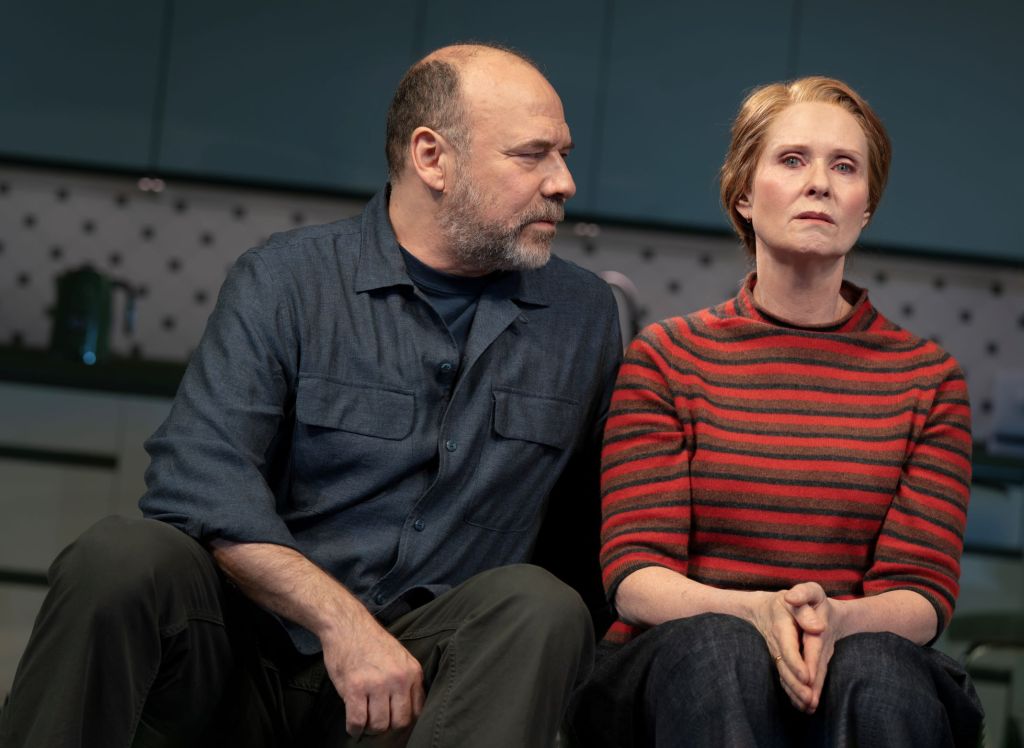
When Walter Prime’s presence annoys Tess, Jon accuses her of jealousy. Does Marjorie prefer Walter over Tess, who must nag her mother to eat and “obey” her in the reversal of mother/daughter, parent/child roles? Losing her autonomy Marjorie must rely on Tess and Jon in her living arrangements and personal care needs.
As Jon, Marjorie and Tess converse in Jellick’s minimalist, living room-kitchen combination that lacks futuristic style, Walter Prime sits on a sofa in the living room. He waits in a “listening mode” ready to interact when needed.
For his part Jon is positive about Walter’s impact on Marjorie. As the scene progresses, Tess mentions after an interval that her mother surprisingly recalls a situation long buried in pain. We learn the specifics of this later in the play. Some of the action referred to happens off stage. (i.e. Tess and Jon take Marjorie to the hospital after a fall).
Guided by the “Primes,” who Harrison sequences to move the action forward, time jumps. Marjorie has died and Jon and Tess engage Marjorie Prime to help console Tess and move her through her bleak depression and grief at her mom’s passing. After that we learn through Jon’s conversation with Tess Prime what transpired with Tess. In the various scenes Nixon’s Tess gives a heartbreaking speech about her mother, memory and imagination which sets up the rest of the play. Burstein’s Jon listens and responds with an uncanny authenticity. Both are superb.
Since the “Primes” “live” forever in holographic form until someone decommissions them, they occupy the home in the last scene. Jon is elsewhere, so Walter, Tess and Marjorie converse among themselves having been given life from their human counterparts as an ideal, evolved “being.” Eerie perfection.
Marjorie Prime runs 1 hour 15 minutes with no intermission at the Helen Hayes Theater on 44th Street until the 15 of February. 2st.com.
Laurie Metcalf is Amazing in ‘Little Bear Ridge Road’
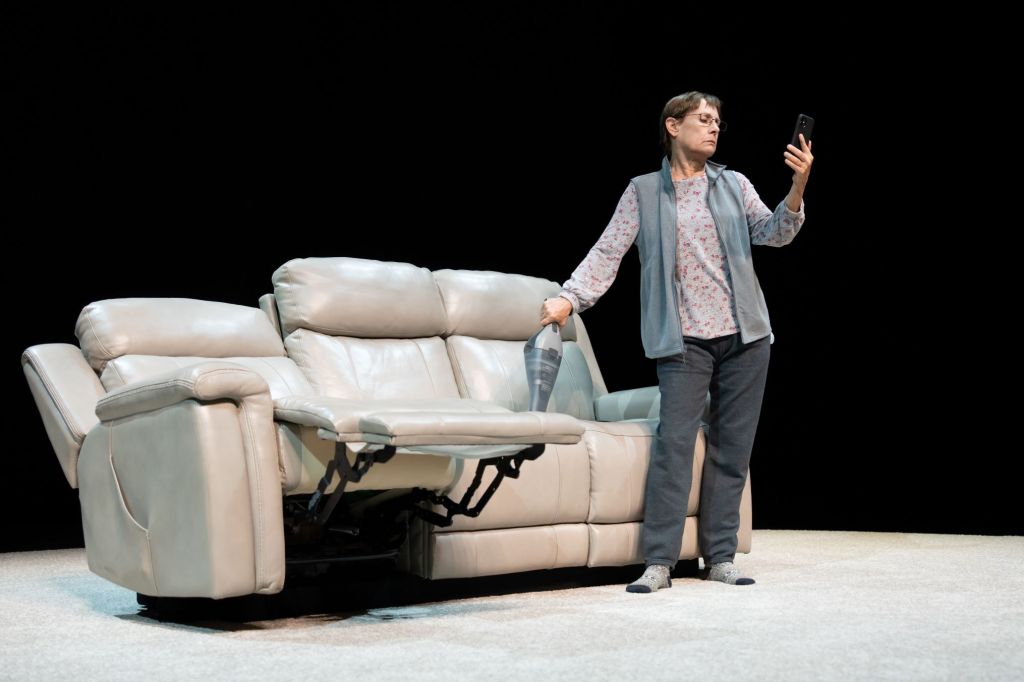
On 12 acres of property in Idaho on the top of the ridge, the sky is so intense it makes Ethan (Micah Stock) panicky because he feels that his life is insignificant against the vastness of the galaxy glittering before him. Sarah (Laurie Metcalf), Ethan’s aunt who owns the property and appreciates the nighttime view tells him she “thought once about buying a telescope, but you know. Then I’d own a telescope.” The audience laughter responding to Metcalf’s pointed, identifying statement that reveals her edgy, funny character peppers Samuel D. Hunter’s powerful, sardonic Little Bear Ridge Road currently at the Booth Theatre.
Metcalf is terrific as Sarah who delivers comments like darts hitting the bullseye and evoking laughter because her words are heavy with authenticity. Her statements convey meaning and pointedly eschew the gentility of polite conversation. Micah, Sarah’s nephew, is withdrawn, remote and masked, not only because the play begins during the COVID-19 pandemic, but because he wears his soul damage on the exterior with a covering of silence that withholds speech. Interestingly, these two estranged family members, one a nurse who doesn’t even nurture her own wounds, and the other, a self-damaged young man of thirty, who can’t really get out of his own way, eventually get along,
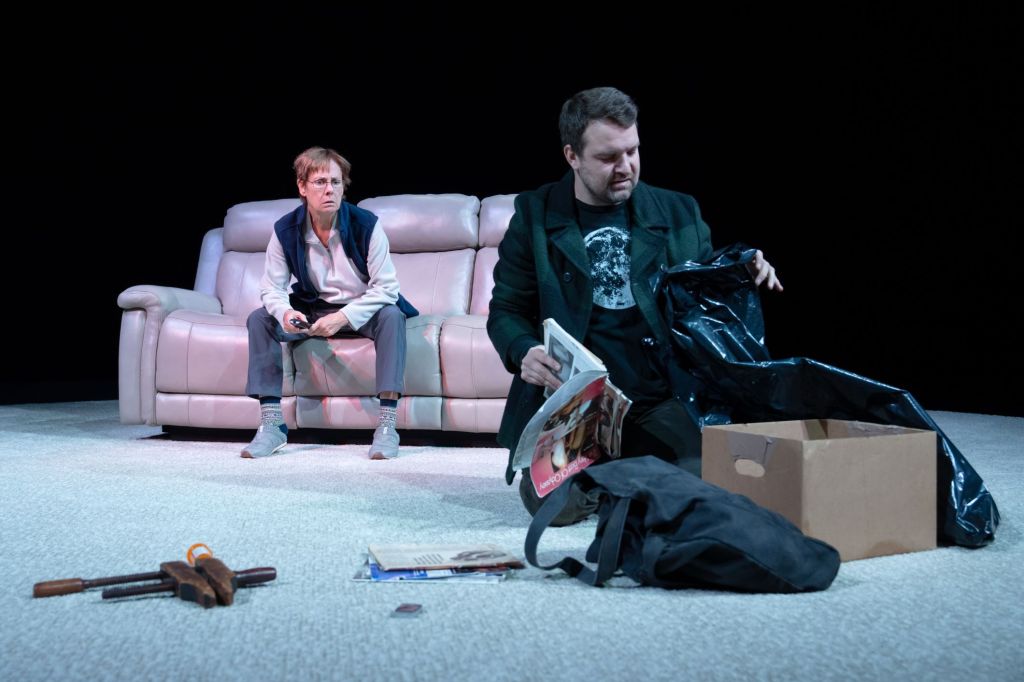
With this Broadway debut Hunter (The Whale, A Bright New Boise) weaves a poignant, humorous, fascinating dynamic. Metcalf and Stock inhabit these individuals with humanity and a fullness of life that is breathtaking.
Directed crisply with excellent pace and verve by Joe Mantello, Hunter’s comedic drama that premiered at Steppenwolf Theater Company, confronts human isolation and failed familial relationships. Hunter presents individuals who confuse self-supporting independence with misguided self-reliance. With spare, concise dialogue the playwright explores how Metcalf’s Sarah and Stock’s Ethan rekindle their sensitivity and open up while nursing their fractured, self-victimized souls, to help each other without acknowledging it as help.
Finally, Hunter’s dialogue has flourishes of well-placed poetic grace and rhythm. Within its meta-themes about human beings struggles with themselves, it’s also about knowing when to let go to encourage another’s growth.

Aunt Sarah and nephew Ethan have an ersatz reunion, when Ethan’s father, Sarah’s brother, dies and leaves the nearby house and estate to Ethan to dispose of. Estranged from his father and from her for a number of years, Ethan, who is gay, lived in Seattle with a partner, who emotionally abused him and self-medicated with a cocaine habit. Eventually, they split. Graduating from university with an M.F.A. in writing, Ethan has drifted, stunned by his devastating childhood where he was raised by an addict father, since Ethan’s mother abandoned the family when he was little. How does Ethan learn not to duplicate his problematic relationship with his father, with love relationships with other older men?
For her part Sarah remained in Idaho near where she was born and worked as a nurse during and after her husband left her. Fortunately or unfortunately, they had no children. This means that she and Ethan are the only Fernsbys left on the planet, dooming their family line to extinction, which according to Ethan seems pathetic. Selling her home in Moscow, Sarah tells Ethan she moved to a more remote area because “It suits me better. Not being around—people.”
With her prickly, self-reliance and proud stance refusing help, Sarah has taken care of her house and property, worked, organized documents and paperwork for Leon (Ethan’s dad, her brother). She generously gave Leon money to help him with his bills. When Ethan affirms that was a bad idea because his addict father used it for his meth habit, Sarah states she doesn’t know what he used it for. After all, Leon told her that he never did meth in front of Ethan. The truth lies elsewhere.

As the pandemic passes and circumstances improve, the relationship between aunt and nephew also improves. They communicate more intimately. They watch a TV series and comment about the characters. The dialogue is funny and Sarah and Ethan become family. Assumptions and mistaken views are dismissed and overturned. Realistic expectations fill in the gaps. A surprise occurs when Ethan meets and forms an attachment with James (the excellent John Drea).
Hunter uses James as a catalyst, who provokes a turning point to continue the forward momentum of the play. James comes from a more privileged, loving background and is studying at a nearby university to be a star-gazer for real, an astrophysicist. With eloquence James explains the magnificence of Orion’s Belt to Ethan, as it relates to our sun. Sarah welcomes him and encourages his relationship with Ethan, until once more circumstances gyrate in another direction, all perfectly unfolding with the emotion of the characters.
Mantello arranges the interlocking dynamic among Sarah, Ethan and then James, center stage on a “couch in a void.” From there the characters converse, sit, enter and leave stage right (to an invisible kitchen), stage left (to bedrooms). The recliner couch on a turntable platform in different positions establishes the passage of time between 2020 and 2022. Scott Pask’s set and the lighting by Heather Gilbert are symbolic and interpretive. Our focus becomes the characters and the actors’ exceptional portrayals as they struggle to find a home with each other and themselves, until the threads of grace in their alignment come to a necessary end.
After all, the Fernsbys have to have a legacy, if not in offspring, then in words. And the respite and connections they find together talking and watching TV on a “couch in void” becomes the place where Ethan’s legacy in writing is born, and the Fernbys legacy prevails.
Little Bear Ridge Road runs 1 hour 35 minutes with no intermission at the Booth Theater through February 15th littlebearridgeroad.com.
Bobby Cannavale, James Corden, Neil Patrick Harris Are LOL in ‘Art’

Superb acting and humorous, dynamic interplay bring the first revival of Yasmina Reza’s Tony-award winning play Art into renewed focus. The play, translated from the French by Christopher Hampton, is about male friendship, male dominance and affirming self-worth. Directed by Scott Ellis, the comedy with profound philosophical questions about how we ascribe value and importance to items considered “art” as a way of bestowing meaning on our own lives resonates more than ever. Art runs until December 21st at the Music Box Theatre with no intermission.
When Marc (Bobby Cannavale) visits his friend Serge (Neil Patrick Harris) and discovers Serge recently spent $300,000 dollars on a white, modernist painting without discussing it with him, Marc can’t believe it. Though the painting by a known artist in the art world can be resold for more money, Marc labels the work “shit,” not holding back to placate his friend’s ego. The opening salvo has begun and the painting becomes the catalyst for three friends of twenty-five years to reevaluate their identity, meaning and bond with each other.
As a means to reveal each character’s inner thoughts, Reza has them address the audience. Initially Marc introduces the situation about Serge’s painting. After Marc insults Serge’s taste and probity, Serge quietly listens, makes the audience, his confidante and expresses to them what he can’t tell Marc. In fact Serge categorizes Marc’s opinion saying, “He’s one of those new-style intellectuals, who are not only enemies of modernism, but seem to take some sort of incomprehensible pride in running it down.” As Serge attempts to pin down Marc reinforcing Marc’s lack of expertise or knowledge about modern art, he questions what standards Marc uses to ascribe his valuable painting as “this shit.”
At that juncture Reza emphasizes her theme about the arbitrary conditions around assigning value to objects, people, anything. Without consensus related to standards, only experts can judge the worth of art and artifacts. Obviously, Marc doesn’t accept modernist experts or this painter’s work. He asserts his opinion through the force of his personality and friendship with Serge. However, his insult throws their friendship into unknown territory and capsizes the equilibrium they once enjoyed. The power between them clearly shifts. The white canvass has gotten in the way.
During the first thrust and parry between Marc and Serge in their humorous battle of egos, the men resolve little. In fact we learn through their discussions with their mutual friend Yvan (James Corden), they think that each has lost their sense of humor. The purchase of the painting clearly means something monumental in their relationship. But what? And how does Yvan fit into this testing of their friendship?

Marc’s annoyance that Serge purch,ased the painting without his input, becomes obsessive and he seeks out Yvan for validation. First he warns the audience about Yvan’s tolerant, milquetoast nature, a sign to Marc that Yvan doesn’t care about much of anything if he won’t take a position on it. During his visit with Yvan, Marc vents about Serge’s pretensions to be a collector. Though he knows he can’t really manipulate Yvan about Serge because Yvan remains in the middle of every argument, he still tries to influence Yvan against the painting.
Marc believes if Yvan tolerates Serge’s purchase of “shit” for $300,000, then he doesn’t care about Serge. Tying himself in knots, Marc considers what kind of friend wouldn’t concern himself with his friend getting scammed $300,000 for a shit panting? If Yvan isn’t a good friend to Serge, at least Marc shows he cares by telling Serge the painting is “shit.” Without stating it, Marc implies that Serge has been duped to buy a white canvass with invisible color in it he doesn’t see based on BS, modernist clap trap.
In the next humorous scene between Yvan and Serge, knowing what to expect, Yvan sets up Serge, who excitedly shows him the painting. True to Marc’s description of him, Yvan stays on the fence about Serge’s purchase not to offend him. However, when Yvan reports back to Marc about the visit, he disputes Marc’s impression that Serge lost his sense of humor. In that we note that Yvan has no problem upsetting Marc when he says that he and Serge laughed about the painting. However, when Marc tries to get Yvan to criticize Serge’s purchase, Yvan tells him he didn’t “love the painting, but he didn’t hate it either.”
In presenting this absurd situation Reza explores the weaknesses in each of the men, and their ridiculous behavior which centers around whose perception is superior or valid. Additionally, she reveals the balance inherent in friendships which depend upon routine expectations and regularity. In this instance Serge has done the unexpected, which surprises and destabilizes Marc, who then becomes upset that Yvan doesn’t see the import behind Serge’s extreme behavior.

Teasing the audience by incremental degrees prompting LOL audience reactions, Reza brings each of the men to a boiling point and catharsis. Will their friendship survive their extreme reactions (even Yvan’s noncommittal reaction is extreme) and differences of opinion? Will Serge allow Marc to deface what he believes to be “shit” for the sake of their friendship? In what way are these middle-aged men asserting their “place” in the universe with each other, knowing that that place will soon evanesce when Death knocks on their doors?
The humorous dialogue shines with wit and irony. Even more exceptional are the actors who energetically stomp around in the skins of these flawed characters that do remind us of ourselves during times when passion overtakes rationality. Each of the actors holds their own and superbly counteracts the others, or the play would seem lopsided and not land. It mostly does with Ellis’ finely paced direction, ironic tone, and grey walled set design (David Rockwell), that uniformly portrays the similarity among each of the characters’ apartments (with the exception of a different painting in each one).
Reza’s characters become foils for each other when Marc, Serge and Yvan attempt to assert their dominance. Ironically, Yvan establishes his power in victimhood.
Arriving late for their dinner plans, Corden’s Yvan bursts upon the scene expressing his character in full, harried bloom. His frenzied monologue explodes like a pressure cooker and when he finishes, he stops the show. The evening I saw the production, the audience applauded and cheered for almost a minute after watching Corden, his Yvan in histrionics about his two fighting step-mothers, fiance, and father who hold him hostage about parental names on his and his fiance’s wedding invitations. Corden delivers Yvan’s lament at a fever pitch with lightening pacing. Just mind-blowing.
The versatile Neil Patrick Harris portrays Serge’s dermatologist as a reserved, erudite, true friend who “knows when to hold ’em and knows when to fold ’em.” Cannavale portrays Marc’s assertive personality and insidiously sardonic barrel laugh with authenticity. Underneath the macho mask slinks inferiority and neediness. Together this threesome reveals men at the worst of their game, their personal power waning, as they dodge verbal blows and make preemptive strikes that hide a multitude of issues the playwright implies. They are especially unwinning at successful relationships with women.
Reza’s play appears more current than one might imagine. As culture mavens and influencers revel in promoting and buying brands as a sign of cache, the pretensions of superiority owning, for example, a Birkin bag, bring questions about what an item’s true worth is and what that “worth” means in the eye of the beholder. Commercialism is about creating envy and lust and the illusion of value. To what extent do we all fall for being duped? Does Marc truly care that his friend may have fallen for more hype than value? Conclusively, Yvan has his own problems to contend with. How can he move beyond, “I don’t like it, I don’t hate it.”
As for its own value, Art is worthwhile theater to see the performances of these celebrated actors who have fine tuned their portrayals to a perfect pitch. Art runs 1 hour 35 minutes with no intermission through Dec. 21 at the Music Box Theater. artonbroadway.com.
‘Two Strangers (Carry a Cake Across New York),’ Smashing Performances, Delightful, Lyrical, Poignant

A simple rom-com it is not. When New York (a town that’s all about money) figures as a character in the dynamic of a budding relationship, complexity arises. It seems especially so with the musical comedy Two Strangers (Carry a Cake Across New York) by Jim Barne & Kit Buchan, currently at the Longacre Theater until Jul,y, unless it receives an extension. Judging from the audience who knew the songs, and reveled in the fun and celebration when I saw it, it may extend its run.
Originally, titled The Season in two regional English theaters (2019), a new title and opening in London at the Kiln Theatre (2023-2024) and the West End at the Criterion Theater (2024) helped the musical make its mark. At the Criterion Theater it received an extension due to popular demand. Gaining momentum it kept the new title and began its North American premiere at the American Repertory Theater. There, it received another extension. Again, Sam Tutty reprised his role of Dougal Todd at A.R.T. (2025) when Christiani Pitts joined him as Robin.

Ironically, the longer, detailed title kills for its uniqueness which characterizes this musical comedy that resonates also because the writers make New York a character viewed through the eyes of two broke, twenty-somethings. The world-weary New Yorker, Robin (Christiani Pitts, Ann Darrow in King Kong) contrasts with the kooky, exuberant Brit, Dougal (Sam Tutty shepherded the role since the Kiln Theatre).
Delectably opposites, the characters are thrown together by Dougal’s invite to his dad’s wedding in Manhattan where he will meet Mark Todd for the first time in a town he’s only seen on film. No wonder why he’s excited.
Deliciously, the actors inhabit the characters’ dialogue as if they wrote it themselves. Tutty’s quick, off-handed, throw-away one liners, perfectly timed, always land. Pitts’ Robin, the perfect foil, picks up steam after she drops her bored, ironic pose and jumps into the pools of Dougal’s freeing enthusiasm.

Indeed, on a deeper level, much recommends this musical comedy directed by Tim Jackson, effortlessly performed with charisma and chemistry by its leads. The minimalist production (i.e. Soutra Gilmour’s set of variously sized, silver-grey suitcases that hold surprises) aligns old-fashioned and hyper modern tropes. The equally unostentacious lighting design (Jack Knowles) appropriately adds atmosphere when most needed.
When Robin bumps into Dougal and tramples his passport, Robin knows about Dougal,. But neitherhe nor the audience know about her. So the idea of strangers meeting and caring about each other after twenty-four hours or so twerks off the rails of typical “boy-meets-girl” ho-hum.
Importantly, little about the characterizations and storyline are predictable. In the twists and bends we note the refreshing unusual. For example, she is one of the few NYC waitresses who isn’t trying to be an actress or performer. In fact she circles the edges of struggling, lonely, confused, an invisible nobody to the well-heeled crowd (“Be Happy”). He awkwardly circles the edges of dorkdom, living with mom as best mates and drinking buddies. However, their far from admirable backgrounds heighten audience empathy in this on-point two-hander, incisively and acutely directed by Jackson.

Arranged by sister Melissa (the bride-to-be), to ease Dougal into the NYC scene, Robin accompanies Dougal to his hotel from JFK. Initially, we don’t understand Robin’s cool attitude. Is it because she’s a sophisticate annoyed that he acts like a wide-eyed, bushy-tailed ten-year old at Christmas about being in Manhattan (“New York”)? Or is her attitude a cover for deeper knowledge about the marriage of her 30-year-old sister to Dougal’s 57-year-old millionaire dad Mark, who abandoned Dougal before he was born?
Nevertheless, the combination of her dour attitude and his outsized ebullience and film buff references make their choppy interplay continually humorous. It becomes LOL in Act II when Robin removes her mask “the morning after” their wild night during their song, “The Hangover Duet.” Barne’s and Buchan’s clever script and at times profound lyrics and beautiful music enhance the perplexing situation of these two strange “family members” growing toward love, despite the weird circumstances.
Along the journey of discovery which begins with Dougal’s conflict (“Dad”), his disappointment that his father didn’t meet him at JFK, the truth eventually unravels. Perhaps spurred by passive aggression, Robin fails at her mission to deliver a whole wedding cake to her sister, as well as other tasks Melissa demands of her. With his cheerio attitude and stock of film plots at the ready to reference during the major catastrophe that will drive Melissa to a terrorist act when she finds out, they flee despite their poverty into the dreamland New York can be. Happily, they end up spending a fabulous evening together dancing, eating and blindly drinking their way into the classy Plaza Hotel for a stay-over.

How is this possible? Mark gave Melissa his card which she improbably gave to Robin to pay for the $2000 wedding cake. With the card (during the fast-paced, frenetic, “American Express”), they charge for the hotel room and various sundries, like a tux rental and exquisite dress and shoes, food, drink and breakfast. Their joyful abandon is courtesy of Mark. Come on! He’s Dougal’s dad and Dougal’s making up for lost time. And we discover in a note Mark sends to their Plaza hotel room, he gladly bestows his largess on “little Robin,” because of their former “friendship.” He even invites her to the wedding, which we later understand is a slap in her face.
By the conclusion we “get” Robin’s initial cynical attitude toward Dougal, whose boyish, angelic hope eventually rubs off on Robin. How can it not as they journey up and down devastating emotional mountains (“New York/What’ll It Be,” “About to Go In,” “This Year”) and work through their explosive blow-out (“He Doesn’t Exist,” “What Did You Say?”). They reconcile in uncertainty as Dougal suggests, “If you ever need anything, I’ll be 4000 miles away,” and sing one refrain of “New York,” then return to their lives.
Two Strangers (Carry a Cake Across New York) runs 2 hours 15 minutes with one intermission at the Longacre Theater. twostrangersmusical.com.
Keanu Reeves, Alex Winter carry Ted and Bill into the adventure of ‘Waiting for Godot’

Referencing the past with Bill and Ted’s Excellent Adventure movie series, something has happened. Bill (Alex Winter) and Ted (Keanu Reeves), who long dropped their younger selves and reached maturity in Bill and Ted Face the Music (2020), have accomplished the extraordinary. They’ve fast forwarded to a place they’ve never been before in any of their adventures. An existential oblivion of uncertainty, Samuel Beckett’s Waiting for Godot.
There, they cavort and wallow in a hollowed out, megaphone-shaped, wind-tunnel (Soutra Gilmore’s clever set design). The gaping maw is starkly, thematically lighted by Jon Clark. Ben & Max Ringham’s sound design resonates the emptiness of the hollow which Winter’s Valdimir and Reeves Estragon fill up to the brim with their presence. And, among other things, Estragon loudly snacks on invisible turnips and carrots, and some chicken bones.

Oh, and a few others careen into their empty hellscape. One is a pompous, bullish, land-owning oligarch with a sometime southern accent, whose name, Pozzo, means oil well in Italian (a superb Brandon J. Dirden in a sardonic casting choice). And then there is his slave, for all oligarchs must have slaves to lord over, mustn’t they? Pozzo’s DEI slave in a wheelchair, seems misnamed Lucky (the fine Michael Patrick Thornton).
However, before these former likenesses of their former selves show up and startle the down-on-their luck Vladimir and Estragon, the two stars of oblivion wait for something, anything to happen. Maybe the dude Godot, who they have an arrangement with, will show up on stage at the Hudson Theatre. Maybe not. At the end of Act I he sends an angelic looking Boy to tell them he will be there tomorrow. A silent echo perhaps rings in the stillness of the oblivion where the hapless tramps abide.

Despite the strangeness of it all, one thing is certain. Bill and Ted are together again for another adventure that promises to be like no other. First, they’ve landed on Broadway, dressed as hobos in bowler hats playing clowns for us, who happily watch and wait for Godot with them. And it doesn’t matter whether they tear it up or tear it down. The excellent novelty of these two appearing live as Didi (Vladimir) and Gogo (Estragon), another dimension of Bill and Ted, illuminates Beckett.
Keanu Reeves’ idea to have another version of their beloved characters confront Samuel Beckett’s tragicomical questions in Waiting for Godot seems an anointed choice. It is the next step for these bros to “party on,” albeit with unsure results. However, they do well fumfering around in this hollowed out world, a setting with no material objects. The director has removed the tree, the whip, or any props. Thus, we concentrate on their words. Between their riffs of despair, melancholy, hopelessness and trauma, they have playful fun, considering the existential value of life. Like all of us, if they knew what circumstances meant in the overall arc of their lives, they wouldn’t be so lost.
Director Jamie Lloyd, unlike previous outings (A Doll’s House, Sunset Boulevard), keeps Beckett’s script without alteration. Why not? Rhythmic, poetic, terse, seemingly repetitive and excessively opaque, in their own right, the spoken words ring out, regardless of who speaks them. That the characters of Bill and Ted are subsumed by Beckett’s Didi and Gogo makes complete sense.
What would they or anyone do if there was no intervention or salvation as occurs fancifully in the Bill and Ted adventure series? They’d be waiting for salvation, foiled and hopeless about the emptiness and uselessness of existence without definition. Indeed, politically isn’t that what some in a nation of unwitting, passively oppressed do? Hope for salvation by a greater “someone,” when the only possibility is self-defined, self-salvation? How long does it take to realize no one is coming to help? Maybe if they help themselves, Godot will join in the work of helping them find their own way out of oblivion. But just like the politically passive who do nothing, the same situation occurs here. Godot is delayed. Didi and Gogo do nothing but play a waiting game.

From another perspective eventually unlike political passives they compel themselves to act. And these acts they accomplish with excellent abandon. They have fun.
And so do we watching, listening, wondering and waiting with them. Their feelings within a humorous dynamic unfold in no particular direction with a wide breadth of expression. Sometimes they want to hang themselves to end the frustration. Sometimes, bored, they engage in swordplay with words. Sometimes they rage. Through it all they have each other. And despite wanting to separate and go their own ways, they do find each other comforting. After all, that’s what friends are for in Jamie Lloyd’s anything is probable Waiting for Godot.
In Act I they are tentative, searching their memories for where they are and if they are. Continually, they circle the truth, considering where the one is who said they were coming. However, the situation differs in Act II because the Boy gave them the message about Godot.
In Act II they cut loose: chest bump, run up and down their circular environs like gyrating skateboarders seamlessly navigating curvilinear walls. By then, the oblivion becomes familiar ground. They relax because they can relax, accustomed to the territory. And we spirits out there in the dark, who watch them, become their familiar counterparts, too. Maybe it’s good that Godot isn’t coming, yet. They may as well while away the time. Air guitar anyone? Yes, please. Reality is what we make it. Above all, we shouldn’t take ourselves too seriously. In the second act they don’t. After all, they could turn out like Pozzo and Lucky. So they do have fun while the sun shines, until they don’t and return right back to square one: they wait.

As for Pozzo and Lucky a further decline happens. In Act I Lucky gave a long, unintelligible speech that sounded full of meaning. In Act II Lucky is mute. Pozzo, becomes blind and halt, dependent upon Lucky to move. He reveals his spiritual and physical misery and haplessness by crying out for help. On the one hand, the oppressor caves in on himself via the oppression of his own flesh. On the other hand, he still exploits Lucky whom he leads, however awkwardly. The last shreds of his bellicosity and enslavement of Lucky hang by a thread.
Pozzo has become only a bit less debilitated than Lucky, whereas before, his identity commanded. Fortunately for Pozzo Lucky doesn’t revolt and leave him or stop obeying him. Instead, he takes the role of the passive one, while Pozzo still acts the aggressor, as enfeebled as he is. The condition happened in the twinkling of an eye with no explanation. Ironically, his circumstances have blown most of the bully out of him and reduced him to a pitiable wretch.
Nevertheless, Didi and Gogo acknowledge Pozzo and Lucky’s changes with little more than offhanded comments. What them worry? Their life-giving miracle happened. They have each other. It’s a congenial, permanent arrangement. After that, when the Boy shows up to tell them the “bad” news, that Godot has been delayed, yet again, and maybe will be there tomorrow, it’s OK. There’s no “sound and fury” as there is in Macbeth’s speech about “tomorrows.” We and they know that they will persist and deliver themselves and each other into their next clown show, tomorrow and tomorrow and tomorrow.
If one rejects the comparison of this version of Waiting for Godot with others they may have seen, that wisdom will yield results. To my thinking comparing versions takes the delight out of the work. The genius of Beckett is that his words/dialogue and characters stand on their own, made alive by the personalities of the actors and their choices. I’ve enjoyed actors take up this great work and turn themselves upside down into clown princes. Reeves and Winter have an affinity and humility for this uptake. And Lloyd lets them play, as he damn well should.
In the enjoyment and appreciation of their antics, the themes arrive. I’ve seen greater and lesser lights in these roles. Unfortunately, I allowed their personalities and their gravitas to distract me and take up too much space, crowding out my delight. In allowing Waiting for Godot to settle into fantastic farce, Lloyd and the exceptional cast tease out greater truths. These include the indomitably of friendship; the importance of fun; the tediousness of not being able to get out of one’s own way; the uselessness of self-victimizing complaint; the vitality and empowerment of self-deliverance, and the frustration of certain uncertainty.
Waiting for Godot runs approximately two hours five minutes with one intermission, through Jan. 4 at the Hudson Theatre. godotbroadway.com.
‘Call Me Izzy’ Jean Smart Triumphs in her Broadway Return

It was a wise casting choice to engage Jean Smart for Call Me Izzy, written by Jamie Wax. Call Me Izzy currently runs at Studio 54 until August 17th. The beloved “Hacks” star, a Six-time Emmy Award winner and Tony nominee is drawing fans who are delighted to see her after a two-decade absence from Broadway.
The 90-minute play is aptly shepherded with fine pacing and staging by Sarna Lapine. This is especially so once Izzy moves from the bathroom where she is forced to write in secrecy. The director’s collaboration with Smart and the technical team reveal a woman’s life under siege in a horrific marriage.
With supporting lighting effects by Donald Holder, compressed interior scenic design and haunting, exterior forest projection by Mikiko Suzuki MacADAMS, the production is nuanced and profound. Though the play does feel contrived in its development, overall, the production is memorable for Smart’s performance and the technical elements that highlight the play’s themes. Even Smart’s costumes (long flannel shirts and jeans by Tom Broecker) and the original music composition by T Bone Burnett and David Mansfield cohere with the characterization and suggest the South.
Smart portrays Izzy in a moment-to-moment solo performance. She takes on the voices of various characters as she relates Izzy’s story. Throughout, Smart shimmers as a powerhouse of feeling, evoking empathy and emotion. Though at times the accent she uses wasn’t clear, (Beth Lake’s sound design), enough of the humor broke through. Smart’s illuminating portrayal of the Louisiana poet who lives in a trailer park with a mean, abusive husband, did override any artificiality that distracted me.
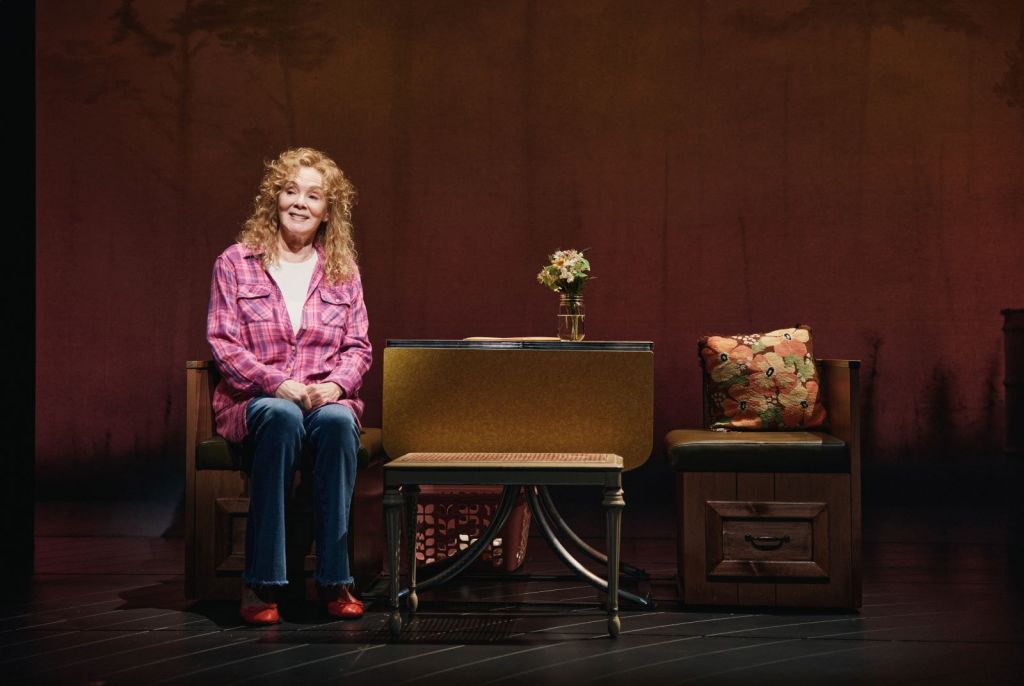
Nevertheless, because of the setting and background details, one can easily figure out the direction of events after the first fifteen minutes. Additionally, the play’s predictability and Izzy’s self-victimization, provoked when she stays with the violent Ferd for years, strain one’s patience. Thank goodness for the talented Jean Smart whose affability and humility lead one to hope for Izzy, despite knowing what the inevitable, dire conclusion will be.
As a housewife in rural Louisiana in 1989, Izzy adores writing, even though it must be in secret away from Ferd’s prying eyes. With exuberance she explains her first inspiration to write, her high school teacher who encouraged her, and a neighbor who takes her to a nearby library where Izzy reads Shakespeare and writes a sonnet. Over the years she fills her journals which she hides away in a back closet because Ferd despises such “uppity ways.” Clearly, as his possession she must remain on his intellectual level. Thus, he prevents her attending college though it might improve their lives. And a monetary award she wins to pursue a writing residency is her curse to be punished, not their blessing.
Izzy writes to express her feelings. Married to Ferd since her 17th birthday, initially they enjoyed each other, prospered and moved to a more upscale trailer park abutting a forest. As Izzy discusses their relationship we note that he gradually meets her attempt to establish her identity through poetry with violence. Tip-toeing around Ferd, Izzy learns to live an inner life apart from him. Whenever she or others inadvertently reveal her talents, Ferd takes offense. He interprets her work as treason and beats her. At a particularly crucial turning point, he takes all of her journals and burns them. He forces her to watch her words, which symbolize her lifeblood, “go up in smoke.” Izzy says with his act he has killed her.
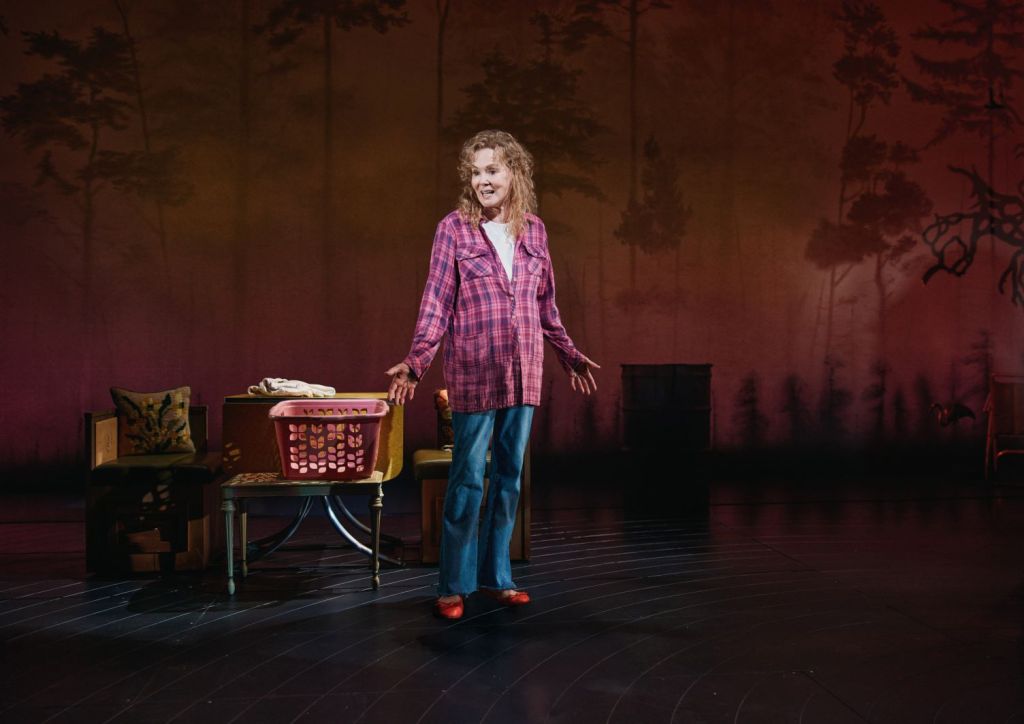
Ferd controls. Izzy lets him believe he is the lord and master, and she bows to his every whim. What sustains her? The inner resilience she receives by writing poetry.
Izzy persists after he burns her journals. Covertly, she evolves herself, her reading and writing. It is why she is in the bathroom discussing the blue tablets she puts in the toilet tank at the top of the play. She shows us how she writes in the bathroom of the cramped trailer. In fact a good deal of the play takes place in the bathroom where she can be alone in quiet to write, think and speak to us.
Mikiko Suzuki MacAdams’ scenic design aptly walls off a bathroom and squeezes in an oversized toilet with a lid that serves as a “table” where Izzy writes on toilet paper. The sonnet and other poems are wadded up and hidden in a Tampax box in a cabinet. The toxically masculine Ferd would never look there. The irony of the bathroom setting is a wonderful touch. In its small space Izzy finds the solace of her wide imagination.
Unfortunately, her writing is not enough. Izzy is a product of the folkways of her culture and her upbringing. Unable to escape them they influence her final actions at the play’s conclusion.
The subject matter of Call Me Izzy is important now more than ever. However, Izzy’s passivity is difficult to experience. It is why, when Smart’s Izzy expresses an interest in leaving Ferd, the audience cheers her on. Too little, too late; we must be tortured by Izzy’s last choice which leaves an uncertain ending.
Call Me Izzy runs 1 hour 30 minutes through August 17th at Studio 54. callmeizzyplay.com.
I
‘Pirates!’ Is a Riot With David Hyde Pierce, ARGH!

Pirates! The Penzance Musical Set in The Big Easy
The revival of Pirates of Penzance, the comedic operetta with music by Arthur Sullivan and libretto by W. S. Gilbert, has been transformed into Pirates! The Penzance Musical. Indeed, it has been hauled overseas from Penzance, England to New Orleans, Louisiana for a riotous update by Rupert Holmes with new orchestrations by Joseph Joubert and Daryl Waters. It is currently revving up exuberance and laughter at Roundabout’s Todd Haimes Theater.
Holmes attempts to spin the setting changes by having a “real” Gilbert (David Hyde Pierce, who also plays Major General Stanley), and Sullivan (Preston Truman Boyd, who also plays the sergeant of Police), take the audience into their confidence in the show’s prelude. They discuss why they brought the musical to premiere and tour US cities. Importantly, they relate their enchantment with post-Reconstruction New Orleans which inspired them to “pirate” the colorful flavor of the music in the French Quarter and adapt it to various songs in the musical. Indeed, all of the scenes take place in and around the atmospheric New Orleans (even a graveyard) that represents the varied ethnic and cultural ethos of the city.

This is where fantasy takes over and “reality” is dumped by the wayside. New Orleans (1880s) notoriously expanded white supremacy (the White League was the racist organization that benefited from the eventual Jim Crow legislation, Plessy v Ferguson) despite its multicultural population, after Reconstruction ended in 1877.
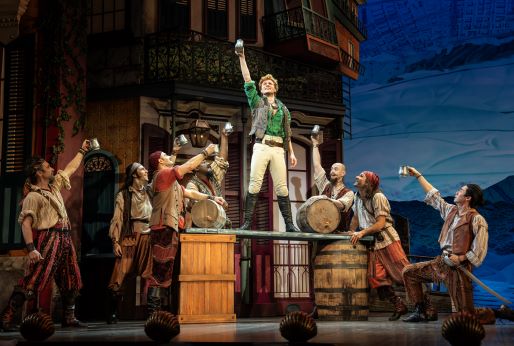
Nevertheless, as facts are stretched to fantasy, the casting of Major General Stanley’s daughters along a racial divide in contrast to the pirates must suspend one’s imagination into the realm of farce and pure entertainment. Actually, Holmes’ version would do well in a current MAGA South adverse to being aligned with “woke” or “critical race theory,” as it throws history out the window. However, the production makes New Orleans “historical” in its wonderful costuming (Linda Cho) and David Rockwell’s scenic design of the pirate ship that Karimloo makes his rope-swinging, spectacular entrance from.
As farce Holmes’ reworking is top notch for humor. His desire to update the musical and appeal to current audiences is understandable because Gilbert and Sullivan’s work (first brought to the US in 1878) is extraordinary, British ironic and extremely clever. It is especially appreciated if one is able to launch into the nooks and crannies of its brilliant and humorous lyrics. Though I was able to look at the script, for those who must rely on the ensemble to enunciate the lyrics, especially in the choral numbers, one loses much in the translation. However, the driving music and director Scott Ellis’ staging and frenetically paced action mitigates that loss.

In keeping with reimagining a New Orleans’ vibe that is more Southern down home than British witty, the production sports a different tenor than a superb but traditional revival produced at The Public Theater in 1981, starring Kevin Kline, Linda Ronstadt and Estelle Parsons. That Pirates of Penzance was gloriously captured on film in 1983. For a contrast, it would be delightful to revisit the film then see the Roundabout’s lighthearted production.
Maintaining the general plot of Gilbert and Sullivan’s 1878 operetta, “Pirates!” unfolds the story of the hapless and innocent Frederic (the excellent Nicholas Barasch). In the antiquated fashion of indentured servitude, Frederic is duty-bound by his deceased father to be the apprentice to the Pirate King (the gymnastically vigorous, organically funny and gorgeously voiced and appearanced Ramin Karimloo). Ironically, the Pirate King is derelict in his piracy (we discover why at the conclusion), as he incompetently leads his band of “spurious” pirates NOT to plunder, kill or steal.
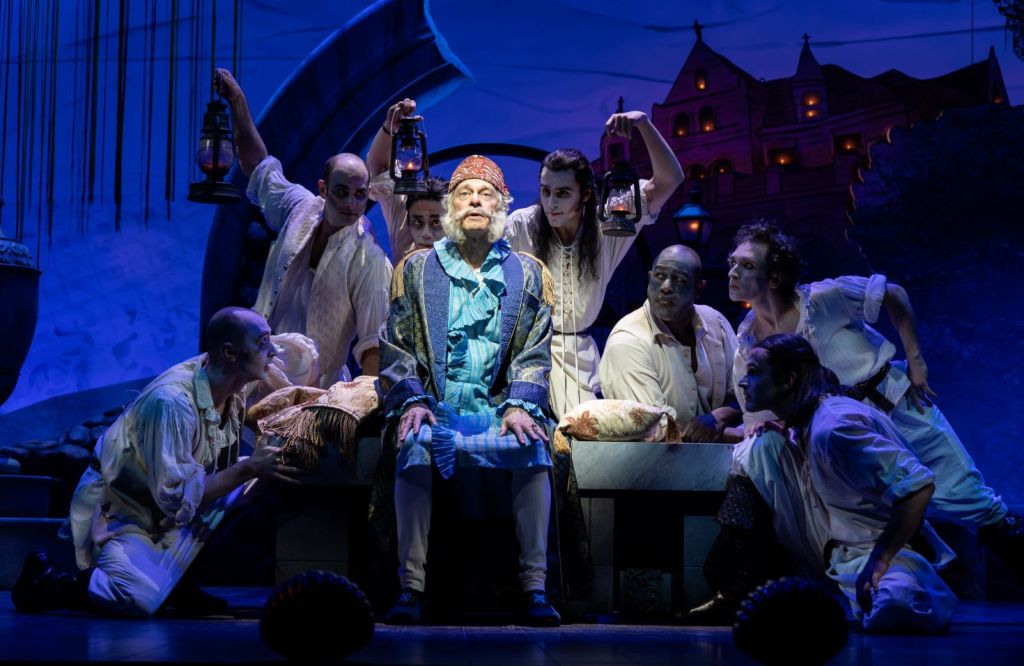
Thus, residing with the pirates and following the dereliction of duty promoted by the Pirate King, Frederic eventually completes his service on his twenty-first birthday. It is then the Pirate King frees him so he can go ashore, join law abiding society and kill every pirate he was colleagues with during his long servitude. Of course, his freedom doesn’t go as planned because of a mathematical miscalculation, and the conflict turns in another direction teetering on debacle until it is righted.
Additionally, in between meting out justice, Frederic plans to find a bride, though marrying a younger woman will break Ruth’s heart because he promised to be with her for the rest of his life. But information enlightens him and makes Frederic change his promise to Ruth, especially after he meets the lovely Mabel (Samanta Williams) and they pledge their love for each other. However, as with a common Shakespearean theme, for Frederic and Mabel, “The course of true love never runs smoothly.” And it is in the kinks and gyrating turns that the comedy reaches its heights.
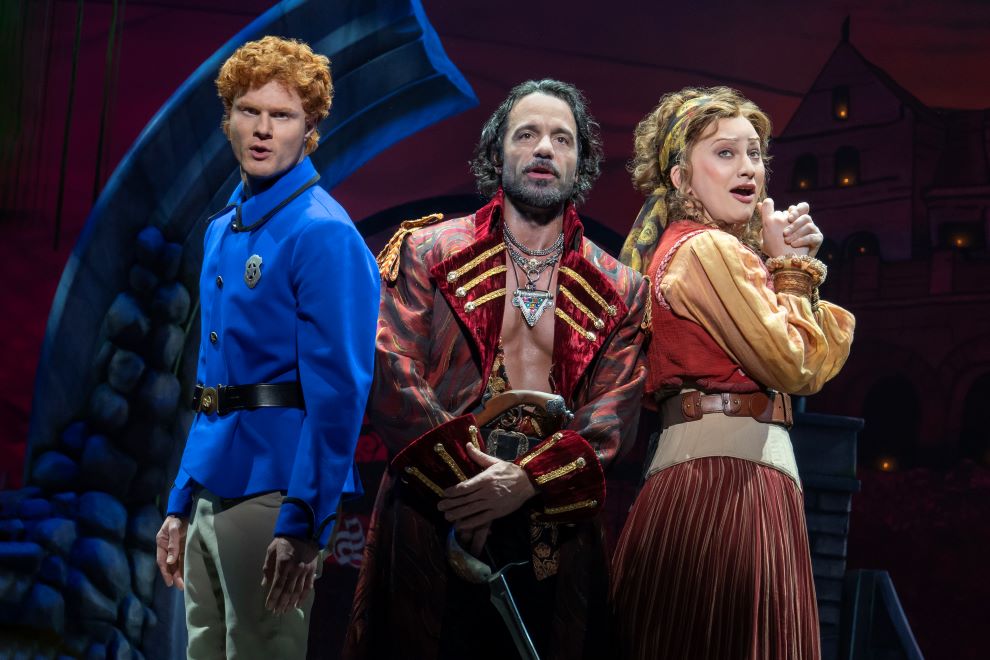
The comedy also is delivered with David Hyde Pierce’s exceptional performance of Major-General Stanley, which he acts with complete aplomb and authenticity. Pierce enunciates every word clearly and thus unrolls the stuffy, effete, sincere Major-General with dedicated determination. Considering Pierce is doing double time as Gilbert performing the Major-General, his ironic demeanor is the vehicle which is a natural for the British Gilbert’s stiff upper lip delivery. And it is hysterical. His is a really well-thought out performance as is Monsoon’s and Karimloo’s, which is memorable for his leaps over barrels, leaps onto tables and veritable sailing in the air during various numbers. Humorous as well, he is outrageously good as he pings the Pirate King’s vulnerability falling for the plight of the orphaned who into his sphere of influence.
To his credit, Holmes has put his imprint on Gilbert and Sullivan with this reinvention and has even tucked in numbers from other Gilbert and Sullivan operettas (HMS Pinafore, The Mikado and Iolanthe) to fill in and round out the characterizations and establish bridges seguing action from one sequence to the next. For characterization, in Act II, we learn more about the emotions of lovelorn and Frederic-spurned pirate wench Ruth (featuring the versatile talents of Jinkx Monsoon-two-time winner of “RuPaul’s Drag Race”). Bemoaning her fate away from her unrequited love interest Frederic, she sings “Alone and Yet Alive” with lyrics adapted from the song in The Mikado.
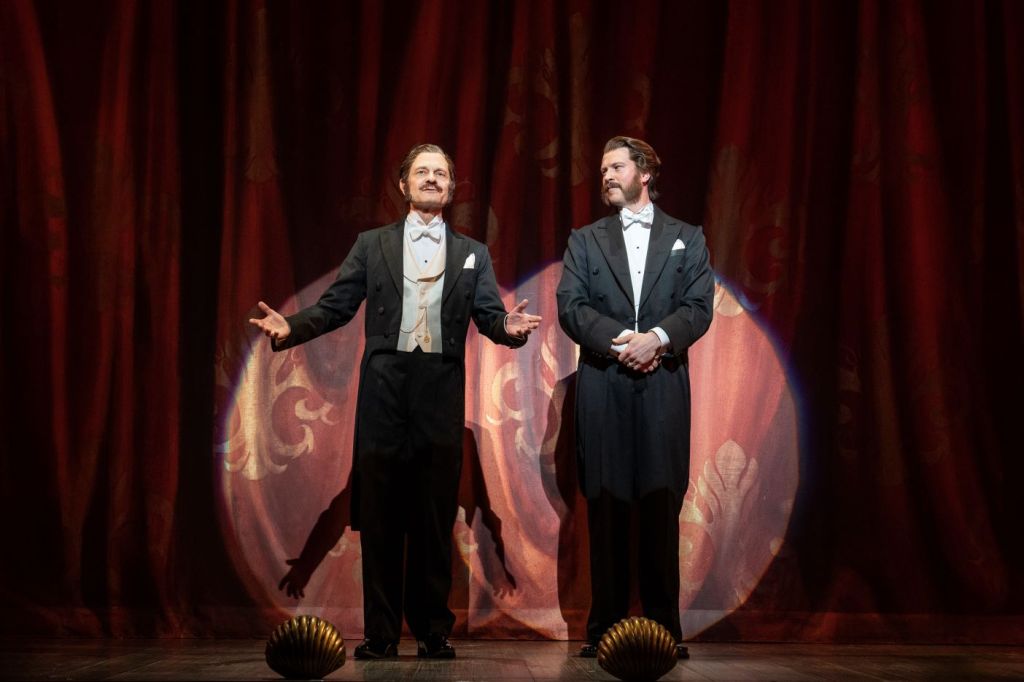
It is Holmes’ bold move to create empathy for Ruth, add coherence and deepen the emotion in the fun frolic. Jinkx Monsoon does a fine job in keeping balance with humor and pathos so we understand Ruth’s heart-felt loss, yet appreciate how she encourages herself to make the best without a particular “someone.”
Waters’ orchestrations and Joubert’s music direction strike various phrasings which are current New Orleans (not the setting of the post-Reconstruction town). These include blues, jazz, Creole notes and rhythms, Dixieland and much more. There is even an ersatz funeral New Orleans style music which is thrown in for good measure. And Mardi Gras season comes upon the pirates as they “let the good times roll.”
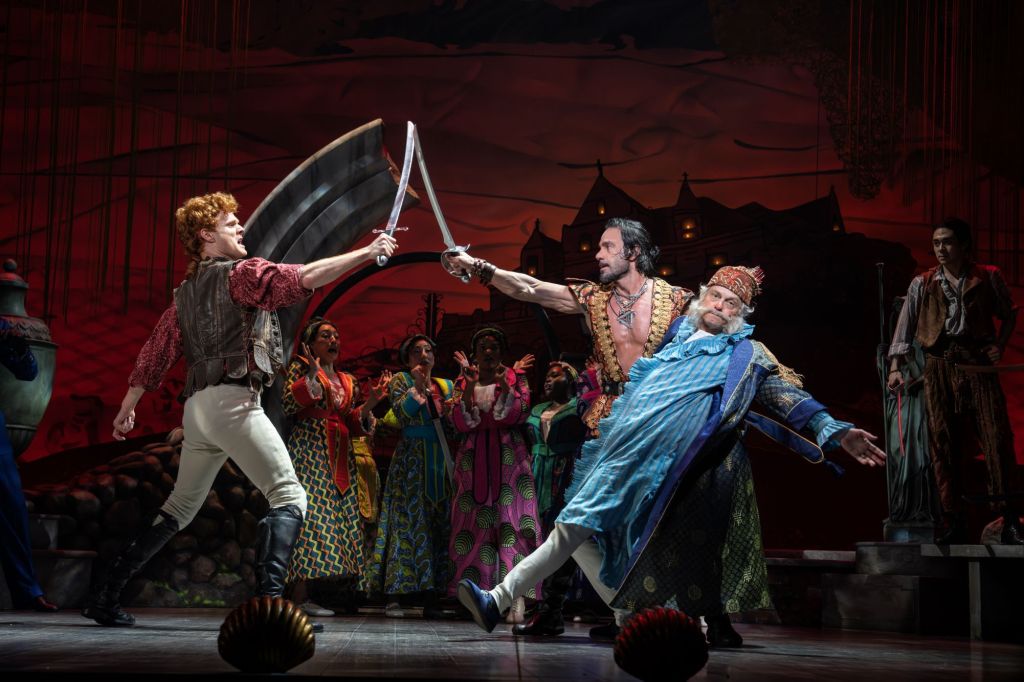
Finally, I enjoyed the washboard number at the end of Act I (“We Sail the Ocean Blue” from HMS Pinafore) for its cleverness and rhythmically united efforts by the entire cast. And the conclusion is a fantasy finale which uplifts the Trump, Musk, MAGA hated DEI lyrics “integrated” into “He Is an Englishman” from HMS Pinafore, which is a sardonic joke in itself, which I completely adored. This is in your face Broadway. If the Bill of Rights doesn’t apply, then nowhere on the globe and in the former British Empire or American is humanity safe. I completely appreciate Holmes’ sardonic and charming approach with a wit that Gilbert and Sullivan would have approved of.
I just loved this reimagining as a farce with fantastic elements, all with a point. See it.
Pirates! The Penzance Musical runs 2 hours, 15 minutes with one intermission until July 27 at the Todd Haimes Theater. roundabouttheatre.org.
‘Boop! The Musical’ is a Dazzling Spectacle. I’m a Fan!
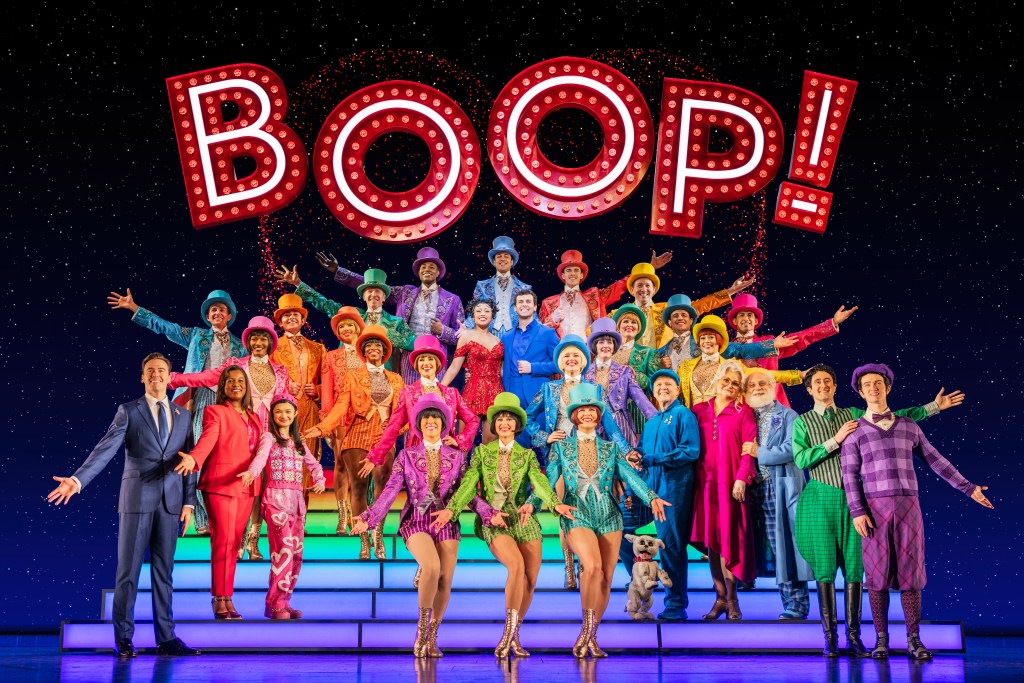
Boop! The Musical
If you need an uplift and who doesn’t listening to the news these days, Boop! The Musical is your vehicle of delight. Currently running at the Broadhurst Theatre, Boop! is pure joyous spectacle, a Broadway extravaganza with clever twists, and a wink to the best of the past, and a thematic nod to the present.
The cast sings and dances to a variety of song genres (from jazz, to pop, to blues), and Jerry Mitchell shows his razzle dazzle choreography and staging with abandon. There is just too much to praise. The glittering kick line is bar none. The nine principals are spot on with their humorous portrayals and exquisite vocals. Boop! is a welcome send up of the fanciful, historical cartooning of yesteryear, in a mesmerizing update that shines talented brilliance at every artistic level of this blazing production
What’s not to love if you enjoy an adorable story and salient themes reinforcing “girl power,” with the additional intention to pay homage to old Hollywood, and the Jazz-age, and depression era cartoons of Fleischer Studios? Importantly, the production is a throwback to old-fashioned Broadway musicals, where most songs are memorable with a beginning, middle and end. In its song variety and hot, superlatively executed dance numbers Boop! delivers.
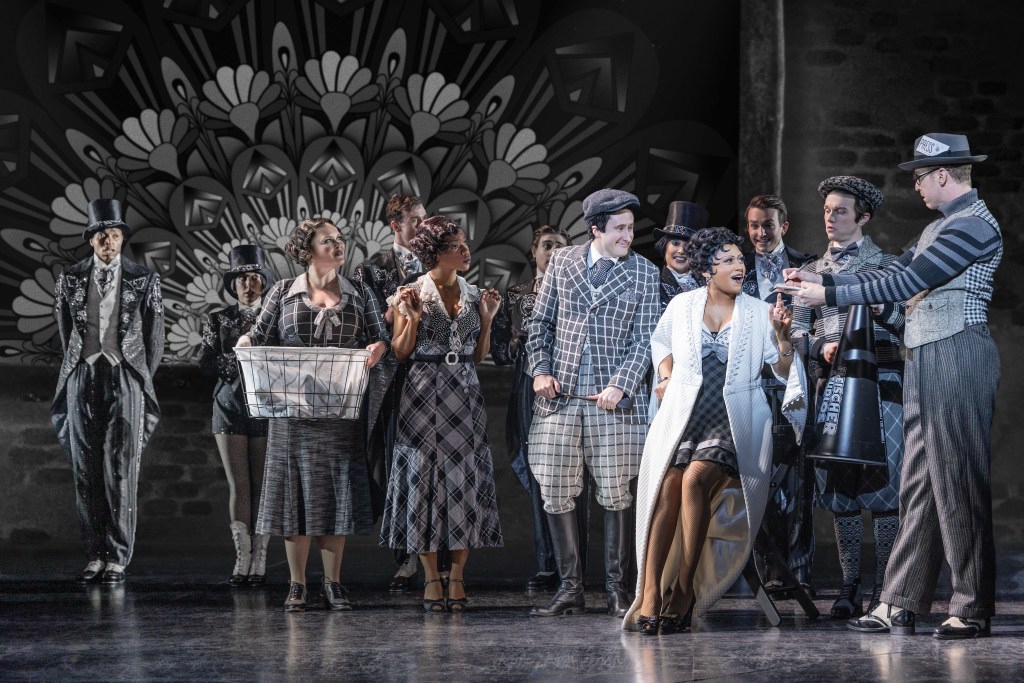
Directed and choreographed by Tony Award®–winner Jerry Mitchell (Kinky Boots), Boop! features music by 16-time Grammy®-winning composer David Foster and lyrics by Tony-nominated Susan Birkenhead.
The cartoony, “tongue-in-cheek” book by Bob Martin (The Prom), brings to life the iconic, historic cartoon character and current meme Betty Boop (the sensational Jasmine Amy Rogers in her Broadway debut). Betty has been a symbol of charm and empowerment for almost a century, and Rogers channels her believably to the minutest gesture, giggle and batting of her eye lashes. Importantly, Betty has an identifiable problem to solve in her personal life. As the reluctant super-star, she eventually must choose between two worlds, fiction and reality. Mustn’t we all? The show is incredibly, ironically, thematically current.
Martin presents the thrust of Boop! as fun, family fare. Going deeper as one should, the irony in Boop! as a farce, emphasizes that this is a cartoon within a cartoon, with the simplicity of a fairy-tale.
Thus, the plot develops as follows. Betty works so very hard for Fleischer Studios, portraying women’s greatness in every job imaginable (“A Little Versatility”), which actually is maverick considering her original 1930s context. And there are vicissitudes and annoyances: the publicity grind and the slimy men who harass her for her “favors and charms.” Exhausted by overwork and untoward publicity, Betty has a moment of self-reflection, something more of us need to practice. She realizes she needs a vacation from her life as a cute, celebrity cartoon with no “real” identity to discover for herself. Above all, she wishes her life was less celebrated (“Ordinary Day), so a respite from cartoonland in a venue where she won’t be recognized and judged would be just fine.
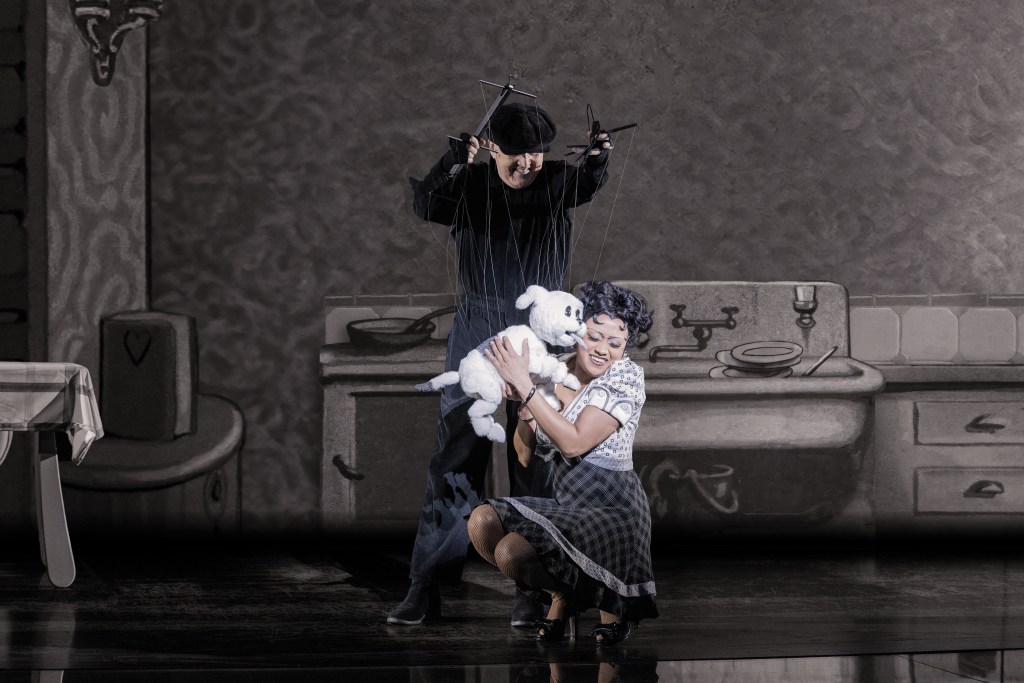
Grampy, (the lovable, powerfully voice Stephen DeRosa), her guardian and roommate, reminds her the current “world” she lives in can’t qualify because she’s a globally recognized star. However, he does suggest a tenable place to go since he went there years before, fell in love, then left. Grampy tells her reality is the place for a grand vacation. It’s much more adventurous, unscripted and serendipitous than cartoonland. (I love the irony.) Of course, this is a family show with no untoward or frightening elements like ICE (Triple Canopy) agents kidnapping folks. So when the winning, charismatic Betty lands in the present at the Javitz Center’s funscape Comic Con, having been jettisoned there by Grampy’s DIY time machine, all works out swimmingly.
In this magical atmosphere and vibrant New York City fantasia, Betty fits right in with a host of rainbow-hued fans dressed as their favorite characters from comic books. Though she is recognizable, she tries to hide her cartoon identity. Nevertheless, she is gobsmacked by reality’s wild beauty (“Color”). At Comic Con, she meets her destiny which becomes tied up with two individuals. First, is her future love interest, dreamy, blue-eyed, politically correct to a fault Dwayne (the boyish Ainsley Melham who sports an amazing voice). Along with Dwayne, she befriends the cute, clever Trisha, a forever Boop fan, who she can’t fool when she tells Tricia her name is Betsy. As Tricia, Angelica Hale is the perfect sidekick teen with an exceptional voice.

Meanwhile, Grampy discovers Betty is gone when her bosses drop by looking for her. He divines she left for reality. The key conflict, of course, is to get her to return (“Get Her Back”). But to do that Grampy must take Betty’s cutie, white dog Pudgy, a marionette operated by the wonderful puppeteer Phillip Huber. The imperative is to jump in his time machine, set it for reality and find her. With energetic multi-tasking Grampy will locate her without GPS, while reuniting with his former love Valentina (the stalwart Faith Prince), for comfort and companionship during his quest. The quaint Grampy hero, love story, sub-plot with astrophysicist Valentina gives an extra pop of reality to the fantastic.
As Betty goes home with Tricia to stay, she meets Tricia’s family, her brother, the blue-eyed Dwayne, and her Aunt Carol (the terrific Anastacia McCleskey). She discovers that Dwayne’s love of jazz (“I Speak Jazz”), dovetails with her strengths singing and dancing. Finally feeling comfortable, Betty confides her real identity to Tricia, who breaks through the cartoon character’s confusion about herself with the upbeat “Portrait of Betty.”

Betty’s adventures in reality continue when Tricia and Dwayne take her on a tour of the city and to Times Square, where the dancers join them for the continuous party that goes on there in a great number, “My New York.” Whether in cartoonland or New York City’s reality, Betty is light, laughter and healing. In an interesting counterpoint, Dwayne sings about her in realityland in contrast with Betty’s studio bosses who sing about missing her (“Sunlight”). Thus, the conflict about which world she will select to live in intensifies, for both realms will certainly draw her with those who give her love and appreciation.
If Boop! is too ridiculously fantastic and purposeless for some, they are missing the point of depression-era entertainment and entertainment today. Even in the most despairing of places and times, the imagination takes flight and the fictional fantastic gets one though the horrors that life can bring.
Though the underbelly of darkness is rarely seen in the production, it does shows up. And the enemy is a modern one. The dark villain comes in the form of a grinning, perfectly coiffed, narcissistic politician, Raymond Demarest, who is running for the office of New York City mayor. Erich Bergen is terrific in a hysterical, nuanced, full-of-himself portrayal. The corrupt, money-hungry, and exploitive Demarest is offset by his hard-working, clever, organized campaign manager, Tricia’s Aunt Carol. Carol efficiently, competently runs his campaign and life. And eventually, her efforts pay off where Demarest’s dereliction and corruption receive its due reward.

As Act One sets forth the problem. Act Two answers it for Betty, her friends and family. Boop! even justly disposes of the villain in the process of ironing out all difficulties. Would the same occur in “real” real life USA with a certain criminal felon, as happens to Demarest. The riotous Bergen makes the most of the villain’s just comeuppance, intuiting the audience’s real wishes as they watch him tripping away, all smiles in his orange jump suit. Just great!
The shimmery white and grey-toned two-dimensional Boop world is cleverly created by David Rockwell to represent Boop’s artificial universe in a snazzy scenic design that contrasts perfectly with the real world of living color. Rockwell’s suggested black, and white, multi-patterned lines and squiggly designs reflect the Boop cartoon. Other cartoon characters peek out from the curtain following the same design. Betty’s materialization in the beautifully eye-popping, gloriously colorful, real world of New York City with the accompanying song and dance numbers seal the deal.
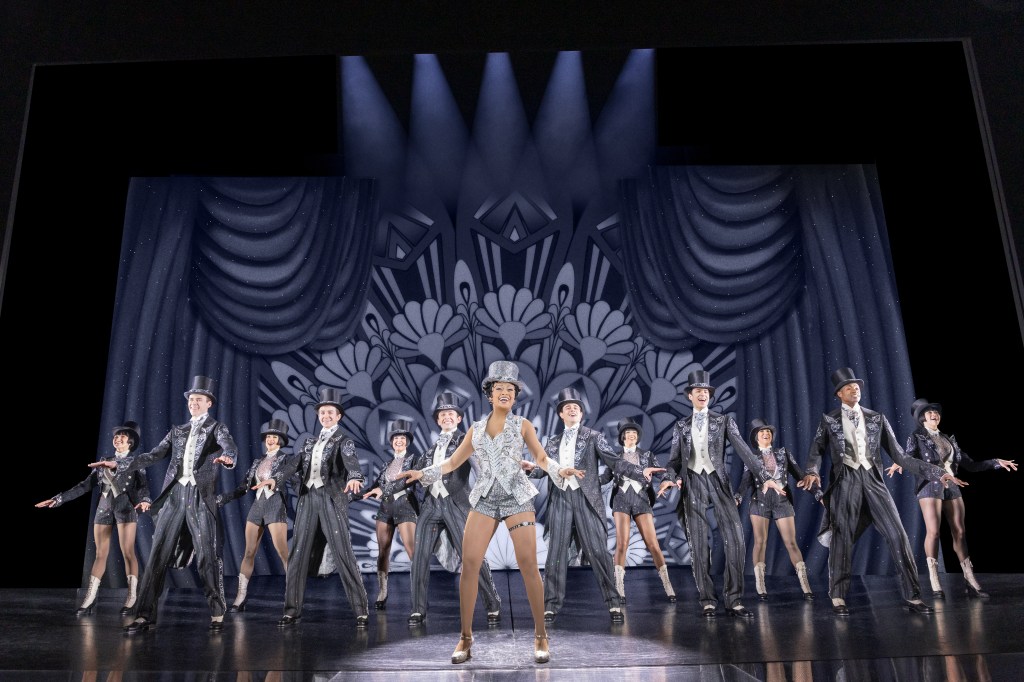
Whether in cartoonland or reality, the costumes by Gregg Barnes are ingenious and gorgeously appropriate. The costume design in a set of two-sided costumes which reveal the contrast of the alternating grey vs. color worlds, shows maximum creative brilliance. The same must be said for the other designers whose collaborative efforts contribute to the show’s gobsmacking effect. These include Philip S. Rosenberg (lighting design), Gareth Owen (sound design), Finn Ross (projection design), Sabana Majeed (hair & wig design), Michael Clifton (make-up design), Skylar Fox (illusions design).
Mitchell and the creatives have outdone themselves. “Professional” is a partially accurate descriptor. Amazing, phenomenal, superlative, genius seems more INCLUSIVE and PRECISE. In every aspect the designs cohere with the director’s vision. Above all Daryl Waters’ music supervision (with additional arrangements), is integral to making this extraordinary production what it is. And the cast? Beyond!
See Boop! two or three times to escape for the purpose of rejuvenation. Then go right back out there and work, march, resist, protest the current villainy, taking the wisdom manifest in this production, having learned persistence from a silly, ridiculous, cartoon character with a century of staying power.
Boop! the Musical runs 2 hours 30 minutes with one intermission at the Broadhurst Theatre (235 West 44th Street). https://boopthemusical.com/?gad_source=1
‘Tammy Faye,’ Starring Olivier-winner Katie Brayben in a Thematically Charged Musical

Tammy Faye
Tammy Faye, with music by Elton John, lyrics by Jake Shears and book by James Graham stars theater heavyweights Katie Brayben, Christian Borle and Michael Cerveris. All of them are letter perfect in the roles of Tammy Faye Bakker, Jim Bakker and Jerry Falwell. Considering that the show is about the rise and fall of the hugely successful PTL Christian network headed up by televangelists Tammy Faye Bakker and Jim Bakker, the production’s chronicle of a complex period in America’s sociopolitical and religious history is ambitious. Currently at the newly renovated Palace Theatre, Tammy Faye runs until December 8th.
For some, the production is hard to swallow. This is unfortunate because its themes are vitally connected to our country. Also, it is a satiric, entertaining new musical whose theatricality coheres in director Rupert Goold’s vision shepherding a fine ensemble and creative technical team. Because I have a familiarity with the Christian evangelical church and, in fact, went to the same church that Jessica Hahn went to during the PTL scandal, and knew and spoke to her, I have a different perspective. Arguably, I may be biased in favor of the musical. That must be considered when reading this review.
With choreography by Lynne Page and Tom Deering’s music supervision, arrangements and additional music, Tammy Faye presents a fascinating picture of individuals who currently are not held in high esteem. Only one comes out on top as James Graham’s book characterizes her and as the phenomenal voice and acting chops of Katie Brayben performs her. Singing from a core of emotion and heart, illustrating Tammy Faye’s trials of faith, Brayben belts out numbers that overshadow the real Tammy Faye’s voice. These high-points in Tammy Faye’s emotional journey include “Empty Hands,” “In My Prime Time,” and “If You Came to See Me Cry.”

Katie Brayben gives a bravura performance
During these dynamic and compelling songs, Brayben’s Tammy Faye reveals the depth and impact of her betrayal by husband Jim Bakker, as she attempts to find a way forward for and by herself. Not to be underestimated, Tammy Faye is a maverick among the Christian women of the church, a portrayal that we see time and again as she speaks out, despite Christian pastors trying to shut her up. Sharing her opinion at a conference with Billy Graham (Mark Evans), in a beginning flashback of “how it all began,” we note her courage at a time when women took a back seat to any form of leadership. Billy Graham encourages her as the new generation of spiritual warriors in front of a patriarchal, oppressive, conservative group of pastors.
From then on we see her emerge despite being dismissed by the pastors who become the hypocritical villains of Tammy Faye and who sadly lead the way for the massive hypocrisy present in the white supremacist leaning evangelical church today. The Falwell types and white supremacist pastors turn a blind eye to the bullying hatreds and criminality of the MAGA movement they undergird in supporting Donald Trump. Trump’s controversial presidency is in his violating the tenets of Christianity and patriotism. Indeed, he is an alleged pedophile consorting with friend Jeffrey Epstein. He is Putin’s asset who has undermined our election processes twice, and most probably cheated and defrauded the American voter to elicit a “win,” in 2024 (see the Mark Thompson Show on YouTube). He adheres to Putin’s guidance regarding NATO, and on a personal note to emphasize his “godliness,” he’s a lying adulterer and admitted sexual predator (the Hollywood access tape), many times over, in cover ups much worse than Jim Bakker ever committed.
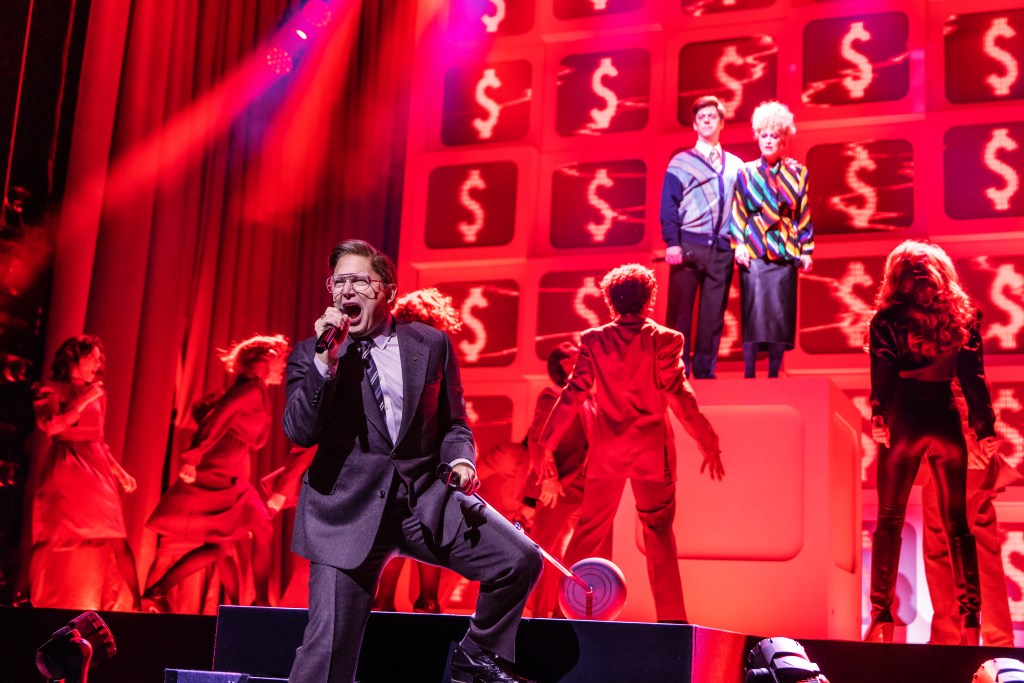
Tammy Faye reveals how we got to the current politics of evangelism
Importantly, for those who would understand how the US “got here” with the rise of evangelism and a brand of political Christianity that belies the true tenets of Jesus Christ’s sermon on the mount, and “Love thy neighbor as thyself,” Tammy Faye gives a crash course in hypocritical Christianity that is right out of St. Paul’s letters to the hypocritical church in Corinthians I and II. It’s interesting to note that over two thousand years later, nothing changes much. Judgment, criticism and condemnation are alive in the human heart and in venues that are supposed to be uplifting the opposite and preaching Christ’s message of love.
Goold stages the production with scenic designer Bunny Christie’s “Hollywood Square” back screen and other projections (video design by Finn Ross), to emphasize the importance of TV to the rise of global evangelism in the 1970s to the present. When the PTL live program is not being taped with dancers and singers, other scenes reflect the importance of satellite TV in the square/screen motif in which appear the various players. Always present as a backdrop are the TV screens reflected in the grid of boxes strikingly lit by Neil Austin that represent what obsesses the actions of the preachers, the Bakkers and their employees (“Satellite of God”). The electric church was televised globally via satellite and its reach was and is expansive, though the screens became smaller on phones after streaming WiFi.
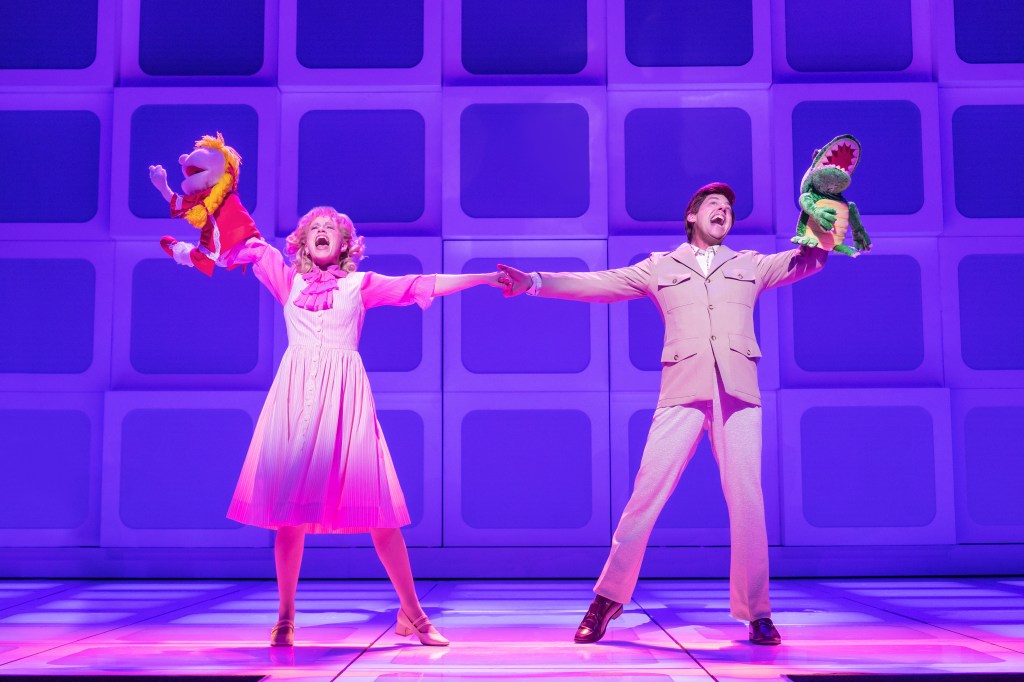
In its symbolism and its wayward themes of church leaders and politicians making damaging and unconstitutional bedfellows, Tammy Faye does its job perfectly, thanks to its creatives. And for that it has received its due misplaced disgust at a time in our nation when Americans have no more patience for hypocrites, scammers and thieves, especially those who profess “Christianity” and lie, cheat, steal, condemn, oppress, restrict, torment and insult as their brand of fun and sanctimony. Hello, Speaker Mike Johnson, Jim Jordan and JD Vance. Nevertheless, Tammy Faye is a vital musical of the time and should be seen for Elton John’s striking music, its irony in how the hypocrites dance around their own lies, and its themes which are more current than ever.
Graham’s book elucidates a version of PTL worthy of note
Book writer James Graham elucidates a version of what happened with PTL that is worthy of note. Laying the blame on the inability of the Christian Church to be united under the first two commandments that Christ preached (love God, love your neighbor as yourself), Graham reveals how Tammy Faye tried to bring disparate groups together with love, but failed. Additionally, to that point, if Tammy Faye had been part of the back room financial arrangements, the fraudulent situation with Heritage Village might not have gotten completely out of hand (“God’s House/Heritage USA”). Indeed, Heritage Village was Jim Bakker’s idea, and clearly, its idea development was mishandled and mismanaged.
Finally, we note that Jim Bakker, whose feckless leadership causes their collapse when he relinquishes PTL and the TV network to Jerry Falwell. With smiling duplicity and treachery, Falwell promises to help the Bakkers get on their feet again and pay their expenses. Tammy Faye warns Jim not to listen to Falwell whom she has always distrusted and deemed a self-serving, condemnatory, hypocritical preacher of hate. Tammy Faye’s unheeded warning proves correct. With his lies, misinformation and mischaracterizations, Falwell upends any goodness the Bakkers accomplish, defames them publicly, and kicks them out of the Christian fellowship for the “good” of the conservative church and himself.
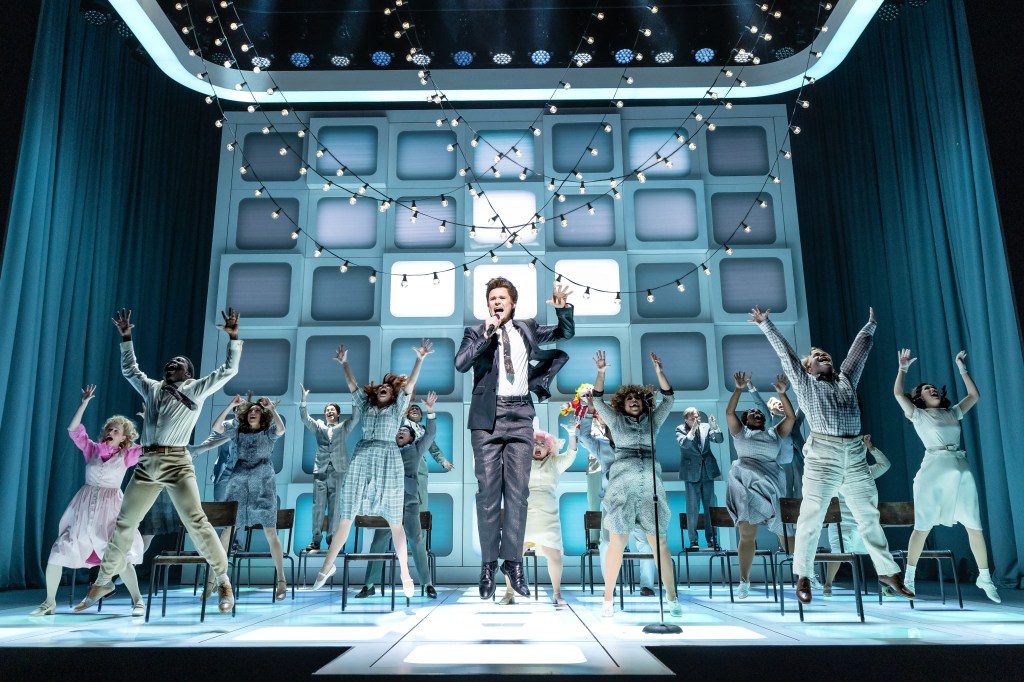
The difference between preachers and preachers
The book underscores the difference between Tammy Faye and Jim, and the other preachers from conservative churches. Falwell (a dynamic Cerveris), Jimmy Swaggart (Ian Lassiter), Pat Robertson (Andy Taylor) and Marvin Gorman (Max Gordon Moore), demean Tammy Faye and Jim Bakker’s way of bringing people to the Gospel. They tolerate them, believing they will fail and are surprised and shocked at their success. Falwell’s massive ego can’t bear to see another preacher in his sphere of influence doing better than he. Not only does Falwell compete for viewership, he goes on their program and insults them attempting to send a message to church goers that they are not of God.
The turning point comes at the prodding of Ted Turner (Andy Taylor), who is concerned about PTL’s finances plummeting because of overspending. Part of the reason Turner suggests the program needs an uplift is because the love and charisma in Tammy and Jim’s relationship has cooled and viewers sense something is wrong. Even friends Paul Crouch (Nick Bailey) and Jan Crouch (Allison Guinn) warn them. At this point in time Tammy has learned of Jim’s infidelity with Jessica Hahn (Alana Pollard), and though he repeatedly asks for forgiveness, Tammy finds it difficult. Increasingly, she relies on prescription pain medicine to anesthetize herself which staff preacher, John Fletcher (Raymond J. Lee), sometimes gives her.
When Tammy strikes out on her own without Jim to carry a show, she draws greater audience viewership which Ted Turner praises. In a heartfelt satellite interview, she speaks with gay pastor Steve Pieters (Charl Brown), about having AIDS. Her public action is courageous. She hugs Steve and accepts him with love into Christ’s fellowship, an anathema to conservative Christianity which condemns gays and believes AIDS is God’s punishment for their sinful homosexuality.

A meeting sealing the fate of PTL
Falwell and the other ministers have a confidential meeting and Falwell even phones President Ronald Reagan (Ian Lassiter), who never acknowledged or worked to stem the AIDS crisis, despite having a gay son and working with gays when he was an actor. Of course, Reagan’s hypocrisy and need for the evangelical church to endorse him is why he speaks to Falwell. In another inflection point, we see the division between church and state morph into an unholy matrimony of religious politicos washing each other’s hands despite the historically traditional separation between church and state.
Thus, Reagan’s public uplifting of the evangelical community via Falwell and others provokes a sea change in the sociopolitical and cultural direction of the nation. The growing intrusion of religion into politics becomes the foundation of constitutional human rights’ reversals seen today, which are particularly uplifted in MAGA states.
Reagan and conservative evangelism, for the voting block-merging church and state
With Reagan in their corner, conservative religious leadership agrees that PTL is moving in an unGodly direction. Falwell and the other preachers see the Bakkers are headed for disaster and they give them a push when the opportunity arises. For example, they get prominent PTL member John Fletcher to turn on Bakker. He sets up Bakker with Hahn, then leaks information when Falwell threatens to expose him of his “infidelities” with gay men if he doesn’t play ball. Falwell also tips off the Charlotte Observer whose reporter Charles Shepard (Mark Evans), investigates the financial arrangements of PTL and finds them to be indebted and insolvent. The situation boils over in “Don’t Let There Be Light.” Tammy, Jim and Jerry recognize their shameful actions and pray that they will not be exposed.
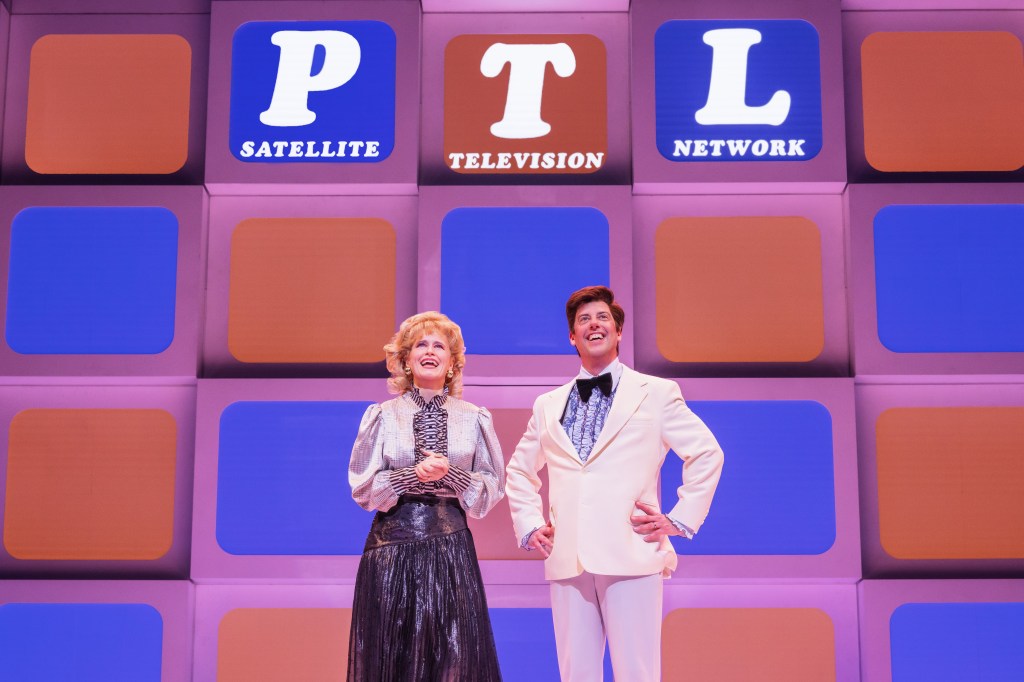
Of course, they are all exposed and vilified by the press and other church leaders. One humorous scene involves Pope John Paul II (Andy Taylor), Mormon leader (Thomas S. Monson), and Archbishop of Canterbury (Ian Lassiter), staged in window squares raised to a higher level above the stage ironically. From their lofty positions, they comment on the troubles of the “electric church” and the Bakkers. Meanwhile, elements of the same unloving hypocrisy are present in their congregations. The pederasty, pedophilia and horrific abuse of the Catholic church is yet to be revealed by the Boston Globe and is still being revealed in the Irish Madeline Laundries and Mother and Baby Homes. Certainly, the church memberships fall off in the Mormon Church and the Church of England. Congregants loathe the leaderships’ hypocrisy.
Acting hate not love
Falwell, Robertson, et. al., end up backbiting each other with hate and jealously. A desperate Bakker, beyond Tammy’s counsel, gives the PTL reigns to Falwell after Tammy learns Jim paid hush money to Jessica Hahn. The scandal widens the more the Bakkers give interviews to defend their positions. In Falwell’s hands, PTL goes bankrupt and is closed down. Tammy divorces Jim and other pastors’ infidelities are exposed as Bakker ends up in jail (“Look How Far We’ve Fallen”). The biased judge ridiculously throws the book at Bakker when murderers are even given lighter sentences.
Eventually, the conservative hypocritical Falwell and Pat Robertson follow in Reagan’s footsteps and run for the presidency. Indeed, their great piety is a sham as they attempt to vault their notoriety to the White House and reap untold rewards, but fail. Unlike Donald Trump who has defrauded his way there again with the treasonous help of various conservative think tanks, True the Vote’s voter challenges in Georgia, voter suppression in swing states, Elon Musk and Putin, Falwell and Robertson’s reputations preceded them and they were rejected as candidates.
Nevertheless, the evangelical Christian movement had an established foothold in politics. The country then wasn’t ready for a conservative, religious president. Now, the MAGAS, building on white supremacists and overturning Reagan’s legacy, have evolved to the point that with Putin’s foreign interference paying influencers to promote misinformation, Trump has become their acceptable, religious MAGA god/autocrat. Despite what Trump/MAGAS/Putin and a complicit press would have voters and the world believe that Trump received “great” voting support, over half the voting public of both parties doesn’t agree with MAGA/Trump’s religious, conservative, oppressive and autocratically unconstitutional mandates. Most probably, if there had been a recount, the results would have revealed otherwise. Better to let sleeping MAGAS, Trump, Putin and others lie.

Favorable reviews in London, bad timing in Manhattan
The show, which originated two years ago at the Almeida Theater in London, received favorable reviews. Opening here at the time it did proved unfortunate because of its subject, a conservative evangelical church, now associated with Donald Trump: a twice impeached, three times indicted, one time convicted criminal, who attempted to overthrow the 2020 election with some of their help via militias and the support of Clarence Thomas’ wife Ginni Thomas.
From Reagan and Falwell and PTL televangelism to the racist, xenophobic, misogynist, MAGA Christianity of today, the conservative brand of evangelicalism has blossomed into “acceptable” white supremacy, oppression, hellfire condemnation and tyranny toward other religions and people of color. Is there any wonder that Tammy Faye, opening around the 2024 election, is a brutal and noisome reminder of what lies, misinformation and money do for those in power, who stir up hate, work unconstitutionally and divide even their own believers from patriotism and the love of God?
Important takeaways
Positive takeaways are the show’s performances which are sterling, especially the leads. The technical team under Goold’s guidance manifests his vision for the production. The book glosses over a complicated series of events (one of which never shows the other side of Jessica Hahn’s professed “virginal innocence,” nor the role her Long Island pastor played in strong-arming the PTL board to pay her hush money).
However, the production does manage to portray one individual, regardless of her psychic flaws, who preached love instead of messages of hate and condemnation (“See you in Heaven”). Tammy Faye did this at a time when standing up for individuals with AIDS was anathema to the general public, let alone Christians. Hers was a courageous, heartfelt stance as an independent Christian church woman. who, alone, went out on a limb to mirror God’s love and show how Christians were supposed to support and help one another.
I heartily recommend this production, especially for those who are interested to understand how evangelism became involved with our politics, despite the supposed separation of church and state. Tammy Faye runs at the Palace Theatre with one intermission until December 8th. https://tammyfayebway.com/?gad_source=1 It’s a shame it is closing so soon.
‘Support for Artists: The Bret Adams and Paul Reisch Foundation Grants’

Bret Adams and Paul Reisch Foundation (courtesy of their website)
Each day the COVID 19 pandemic takes another swipe at the New York theater community as notifications of deaths (playwright Terrance McNally, actor Mark Blum, former Drama Desk President William Wolf) darkly bloom. Theaters will remain closed for the end of the month and most probably into the summer, if state and federal projections are to be believed. Thus, we wait and create and pray supporting each other with phone calls, emails, social media posts virtual presentations, meetings and parties on Zoom.
Show business folks have always helped one another. Currently, Brad Paisley, John Bon Jovi, Dolly Parton and other celebrities have stepped up donations. And beautiful financial flowers are burgeoning from GoFundMe campaigns springing up to support artists. Along with smaller operations, tried and true foundations like the Actor’s Fund and Broadway Cares/ Equity Fights AIDS, Dramatists Guild, League of Professional Theatre Women and New York Women in Film and Television to name a few are available with support for their members and freelance artists.
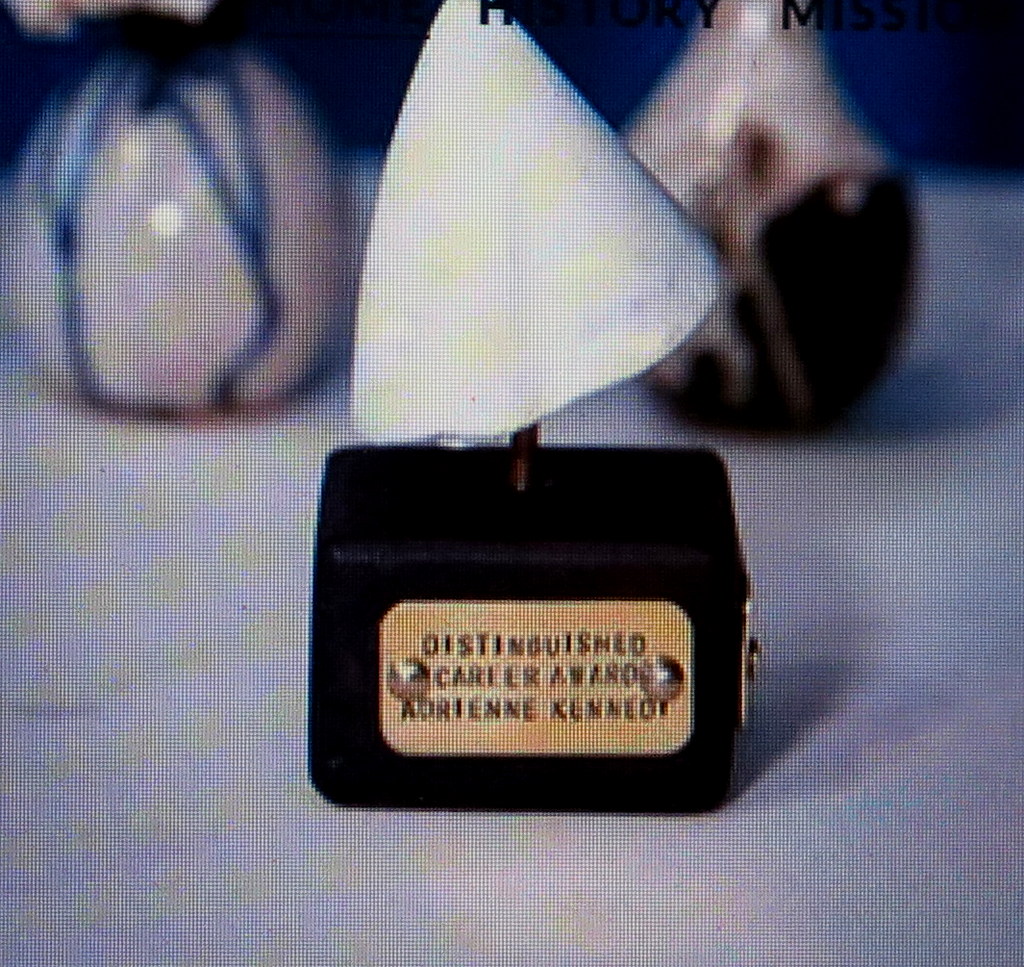
Tooth of Time Award: Honoring accomplished playwrights who have created significant, idea-driven works throughout their career, Bret Adams and Paul Reisch Foundation (courtesy of their website)
Freelancers are especially hard hit. They do not number amongst the 6.5 million who have filed for unemployment insurance (the number was posted on the news this morning). Not having a regular paycheck but living gig to gig, they are the invisible casualties of this war against a deadly molecule that strikes through those who are asymptomatic and “healthy,” but who are carriers of the spread. Clearly, more needs to be done by those of means who love theater and are devastated that COVID 19 has slammed into New York.
On that note The Bret Adams and Paul Reisch Foundation has decided to create an uplifting way to distribute the funds for their 2020 Idea Award for Theatre. This spring, the foundation will offer up to 40 emergency grants of $2,500 each to playwrights, composers, lyricists and librettists who have had a full professional production cancelled, closed, or indefinitely postponed due to the COVID-19 closures. A total of $100,000 will be distributed to theater writers.

Bret Adams and Paul Reisch Foundation, The Vivace Award: Recognizing musical theatre artists with emerging talent and original work with ambitious ideas (courtesy of the Bret Adams and Paul Reisch Foundation)
Eligible playwrights, composers, lyricists, or librettists should apply at this link. Writers who have had a professional production canceled may submit their name and proof of a professional show’s closure. (“Professional,” in this case, is defined as LORT, Off Broadway, or Broadway). Each artist can submit only once. If there are more than 40 applicants, the Foundation will award grants by lottery, allowing them to give out the greatest amount of money directly into the pockets of the artists who have been most affected.
The submission deadline is April 14. The Foundation hopes to make funds available to artists as quickly as possible to forge a path to provide a bit of hope and relief and especially to guide others to do the same for artists in this unprecedented time.

The Ollie Award: Recognizing playwrights with emerging talent and original work with ambitious theatrical ideas, The Bret Adams and Paul Reish Foundation (courtesy of the website)
The Bret Adams & Paul Reisch Foundation is a charitable foundation. Its mission is to give money to writers to write plays with ‘big ideas.’ This year, their ‘big idea’ is to help those “who have had productions cancelled,” said Bruce Ostler, V.P. and Board Member of The Bret Adams and Paul Reisch Foundation.
Ostler’s point is well taken and unfortunately, true when he affirms, “The economic model of theatre in the 21st century works much like it did in the 16th century, in that a playwright receives a percentage of the box office sales; without an audience, the box office receipts and royalty to playwrights dry up. In no uncertain terms, the business of theatre today has ground to a shocking halt due to the pandemic. Playwrights are not salaried workers and therefore are NOT eligible for unemployment for a cancelled production. That is the harsh reality of theatre today.”
Theatrical Agent Bret Adams and his partner Dr. Paul Reisch loved the theatre with great passion. As an agent, Bret shepherded the careers of many actors, writers and directors and designers, including Phylicia Rashad, Judy Kaye, Ruby Dee, Ossie Davis, Sherman Helmsley, Anna Maria Alberghetti, Eve Arden, Christine Ebersole, Kathleen Marshall, Jayne Wyman, Andre DeShields, Kathy Bates, and more.
After Bret and Paul’s passing, in 2006 and 2015, their foundation was created at their bequest. The Bret Adams and Paul Reisch Foundation champions visionary playwrights and embraces diversity in all its forms. It especially encourages fresh perspectives – particularly those from underrepresented backgrounds – to create idea-driven new plays and musicals. These may include a variety of themes, i.e. science, history, politics and sexual orientation. For more information, visit www.BretnPaulFoundation.org.
 CAROLE DI TOSTI