Blog Archives
‘Downstate’ Opens on Broadway With Heartfelt, Redemptive Performances in a Play More Relevant Than Ever
If wrongdoers who harm us admit fault and are held to account, should we forgive them or damn them forever? In Downstate, Bruce Norris questions the power of empathy, justice, forgiveness and redemption for victims and perpetrators. With incredible performances by Francis Guinan and K.Todd Freeman, and a fine supporting ensemble shepherded by Joe Mantello, Downstate‘s Broadway opening, similar to its Primary Stages premiere in 2022, especially resonates for our country today. The play gives us tremendous pause. In light of the partially released Epstein files that reference wealthy men’s alleged sexual predation of young children, and no attempts made to investigate or seek justice via the Trump DOJ, Downstate sends a strong message. Downstate, currently runs at the Booth Theater through January 10, 2027.
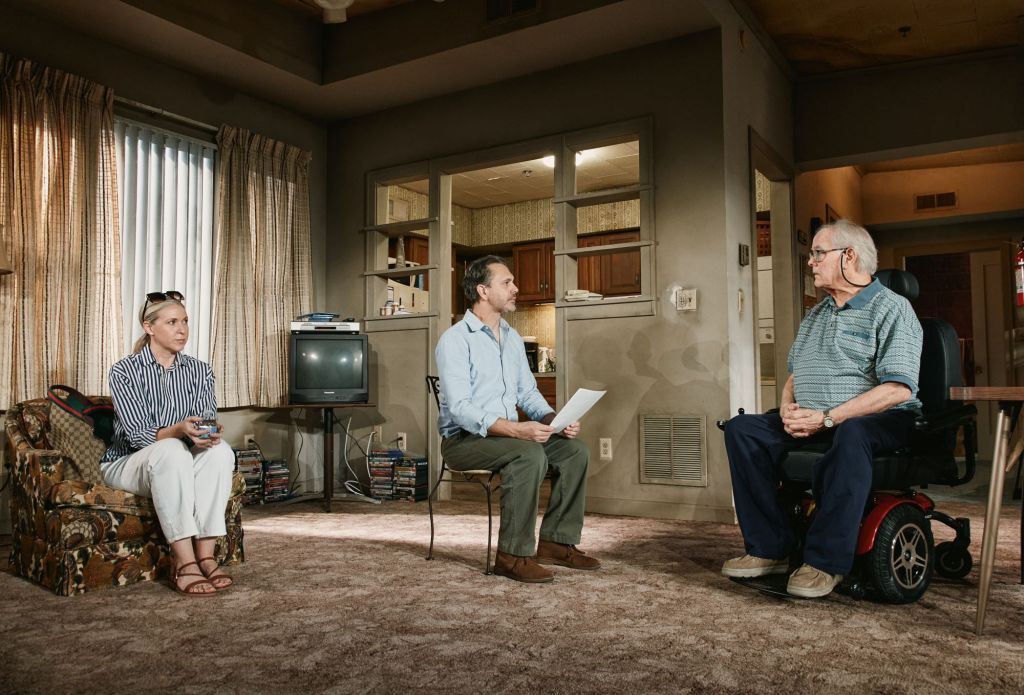
At the top of the play the skittish Andy (Thomas Sadowski) and his controlling wife Em (Cassie Beck) confront Fred, disabled in a motorized wheelchair, about Fred’s sexual predation thirty years prior when Andy was twelve. As the other housemates try to quietly go about their activities, they distract Andy and Em. For example the house master and moral sentinel, Dee (K. Todd Freeman), and the hyper-masculine, scripture-spouting Gio (Al’Jaleel McGhee) quibble about grocery money. When Felix (Adrian Martinez) emerges from his bedroom for the bathroom, then breakfast, he further disturbs the “flow” of Andy and Em’s recriminations of Fred. The interruptions displace the gravity of the situation and actually become humorous as Francis Guinan’s Fred listens with quiet humility, to their description of him as evil.
Ironically, Andy can’t muster enough soul power around Fred’s convicted sex offender housemates, monitored with ankle bracelets, to do “what he came to do.” Annoyed, upset that the “confrontation” doesn’t go as expected, he and Em leave.
Norris’ devastating, sardonic humor seamlessly, organically explodes throughout his two act drama. Obviously, the couple disrupts Dee, Felix and Gio, who gets ready for work. In a weird twist Em and Andy take umbrage at the convicted criminals’ interference with their inexorable mission to put “things right for Andy.” Their determination obviates the humanity of the other men, though they are shown hospitality. Andy and Em’s self-righteous ferocity reveals an underlying remoteness and cruelty that Norris nuances in the superb dialogue, acted exceptionally in the opening scene that sets up the portentous conflicts to come.
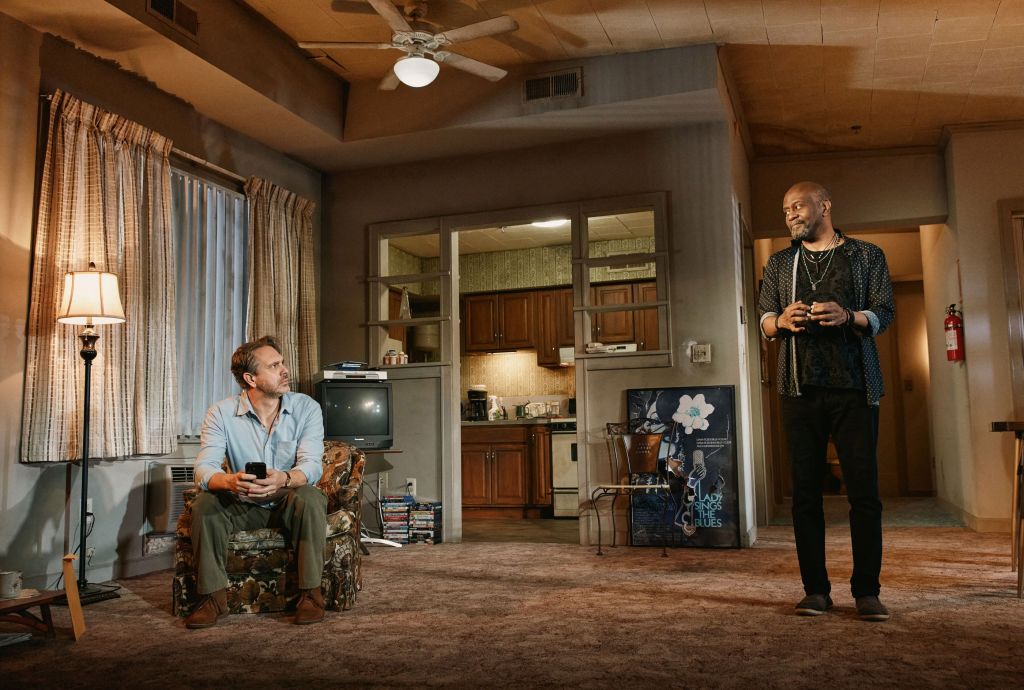
Important to note, Andy travels from Chicago to Downstate with Em to deal with Fred after the pedophile’s incarceration, release and gradual transition into society.Though Fred didn’t have to see Andy who should be nowhere near Fred, he agrees, and Andy’s inner compulsion brings him to the shabby, dilapidated, depressing halfway house (Scott Pask’s scenic design). But during the course of the play we understand the implications of Andy’s monstrous, unresolved, psychological wounds, exposed in Andy’s astounding and tearful confession to Fred in Act II.
Thus, Andy’s seeking out Fred turns into a greater complication than Andy just having Fred sign a reconciliation paper. Clinging to victimization to solve Andy and Em’s intimacy issues, Andy’s dissatisfaction with the “justice” Fred received, and insistence he deserves no human empathy, even for the broken back Fred sustained when a convict hatefully kicked in his spine, reveals Andy’s infantilism. Thus, Norris suggests there is more to predation that happens between victims and their predators, than what the stereotypes presume. Indeed, the sensitive, quick witted Dee provokes Andy’s and others’ underlying prejudices with drop dead humor to provide a clear-eyed perspective. Perhaps, the “evil” and “perversion” taken on a case by case basis falls not only on the predator. Mantello, following in the directorial footsteps of Primary Stages’ director Pam McKinnon, navigates these disturbing elements with understanding, forthrightness and intelligence, heightened by the ensemble’s gobsmacking performances.
After Andy and Em leave, the overworked PO Ivy (Liza Colón-Zayas) visits. As she discusses the increased limitations on their personal freedoms in transportation routes they must take that don’t go near schools or places where children congregate, a picture forms. Thus, we begin to understand how the surrounding community reviles these men despite their accountability. Additionally, Norris reveals their low social status, 24/7 surveillance and poverty create stress. From the neighborhood harassment, gunshots through windows and death threats, to needed house repairs (broken window, leaking septic tank) which Ivy tells them to repair themselves, their punishment continues, long after their release from prison. Especially disturbing is their maltreatment from each other and attacks on their dignity and respect which they struggle to maintain.
Norris also outlines the interactions between the four men. Gio and Felix, who are religious, act superior or reserved, and reject Dee’s lifestyle as a homosexual. Gio accuses Dee of taking advantage of Fred, who needs help bathing and toileting and pays Dee. Meanwhile, Ivy confronts Gio about his behaviors and he is defensive and asserts his rights even threatening to file a complaint. Regardless, if Gio steps over the line, he will be sent back, as will Felix who Dee guides through Ivy’s relentless interrogation, reminding him he still has rights. Ivy’s interrogation comes off particularly heavy-handed, a weakness of this production. Thus, how Felix responds to it, makes it appear that she indirectly provokes the action he takes. Unfortunately, that diminishes the complexity of what he does.
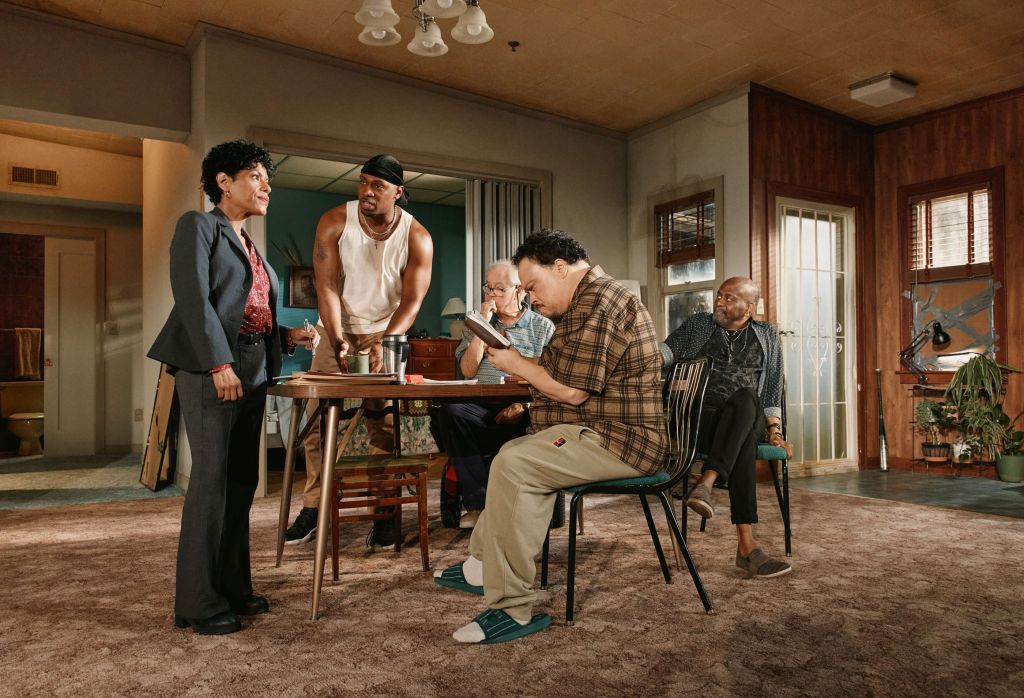
As a secondary character of importance, Gio’s co-worker, Effie, has a friend who is a sex offender, so she should know the balancing act that must be taken with offenders. Representative of many in the culture, she doesn’t care. Using her character as a catalyst, Norris shows how she plays fast and loose with Gio’s status as a first time offender found guilty of statutory rape with a minor. Ivy Wolk’s Effie provokes as a high wired, “wise-ass” loud-mouth, knowledgeable enough about the law to use it with Guzman’s Ivy. Through Ivy and Dee’s response to her, we note her ADHD carelessness and irresponsibility, a train wreck waiting to happen.
Finally, K. Todd Freeman’s Dee, follows everyone’s business, and watches out for each of the roommates, regarding their rights and responsibilities to each other. Clearly the redemptive, most likeable character, Dee’s witty, socially critical dialogue as a former show business person and lover of the arts provides humor. Freeman knocks it out of the ballpark as the black, senior homosexual, who makes the perfect ironic retort when coming up against hypocrisy and cruelty, displayed especially by Gio and Andy. Freeman and Guinan show their prodigious acting talents in establishing the caring, kind relationship between Dee and Fred. In their interactions with Gio and Felix, their performance is nuanced. Freeman’s ironic delivery lands as Dee slices apart Gio’s arrogance and Andy’s psychological fears and self-hatred. Just breathtaking.
Norris has set up the action threads in Act I, that he unravels to explode sensationally in Act II. The result is cataclysmic and heartbreaking. When one considers the difference between these impoverished, powerless sexual offenders who admit guilt and received justice and the wealthy sexual offenders who use money and power with to escape justice, one cannot help but appreciate Norris’ themes. Interestingly, in the characterizations of Guinan’s Fred and Freeman’s Dee, with accountability comes redemption and the opportunity to receive grace and healing. For those whose wealth and power place them above accountability, redemption and grace are beyond them.
Downstate runs 2 hours 20 minutes with one intermission at the Booth Theater through January 10, 2027. downstateonbroadway.com.
‘Downstate’ a Powerhouse of a Play, With Sterling Performances

Do we ever receive justice for wrongs done to us if the wrongdoer goes to jail and apologizes? Or are we so damaged no justice or forgiveness is possible? In Downstate, Bruce Norris raises such questions and many more in his compelling play superbly directed by Pam MacKinnon currently at Playwrights Horizons.
At the top of the play the reserved Andy (Tim Hopper) and his concerned wife Em (Sally Murphy) sit opposite Fred (Francis Guinan) who is a senior gentleman, disabled in a motorized wheelchair. As they attempt to discuss why Andy has come to visit, Dee (K. Todd Freeman) comes in with a shopping cart with groceries and Gio (Matthew J. Harris) quibbles with him about the money he owes Dee for bananas. Surveying the house and the roommates, only Fred is white, we surmise this living arrangement has been forced. As it turns out, all four roommates including Felix (Eddie Torres) who eventually comes out of his bedroom to make himself breakfast are convicted sex offenders, who wear leg braces so their activities may be monitored.
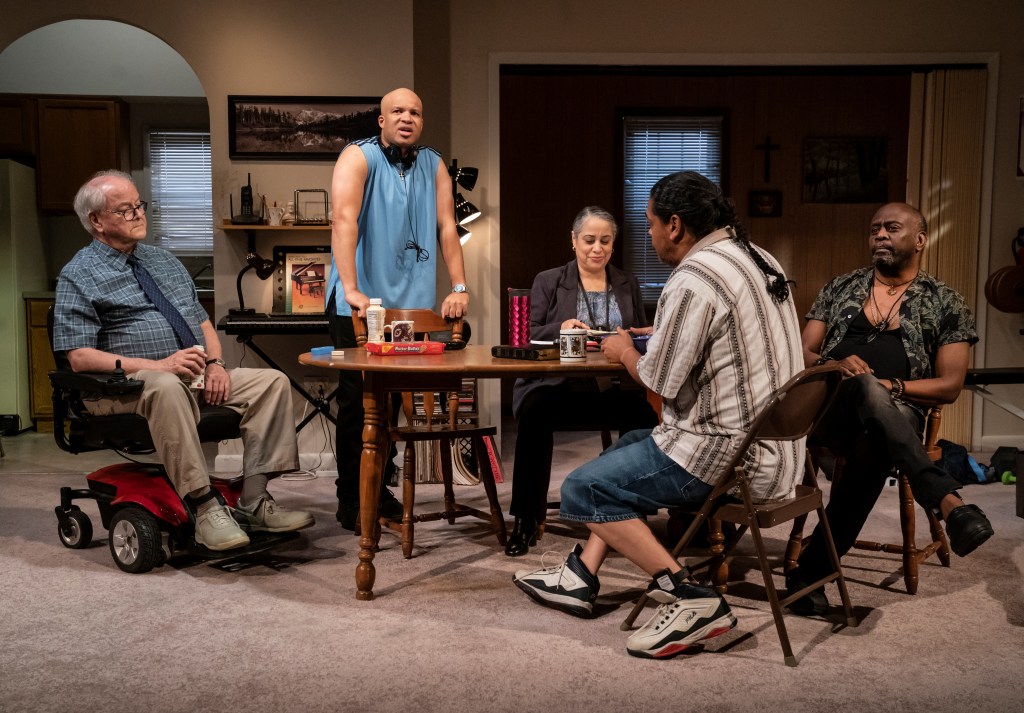
Andy visits Fred with Em to discuss Fred’s predation which happened over thirty years ago, when Andy was twelve and Fred was his piano teacher. Andy tells Fred he ruined his life and he can’t function the way he felt he could have if Fred had left him alone. Norris intimates subterranean clues why Andy has taken the liberty to visit Fred. Though Fred didn’t have to, he agrees to see Andy. In his 40s Andy is not supposed to be anywhere near Fred because Fred has served time and has been convicted and is currently transitioning and living in the half-way house. That Andy seeks Fred out and travels from Chicago to Downstate with his wife to deal with Fred is problematic and portentous.
After Andy and Em finish reading letters of judgment and recrimination they’ve written to Fred which Fred listens to calmly, they both reiterate that Fred is evil. When Em senses Andy is hesitating, she tells him to stop backpedaling and continue with why he’s come to see Fred. It is to get a full admission of what Fred has done to Andy. Fred insists he admitted to all of his actions in court, apologized and was sentenced. As they attempt to continue this discussion, the roommates are attempting to live their lives, get ready for work, make breakfast and use the bathroom. Clearly, the couple are a disruption to Dee, Gio and Felix. Yet, Em and Andy take umbrage at the activities around them interfering with the seriousness of their meeting. It is apparent that the mission they are on obviates the humanity of the other men whom they look down on. In their self-righteous ferocity there is an underlying remoteness and cruelty that Norris reveals in superb dialogue acted exceptionally.
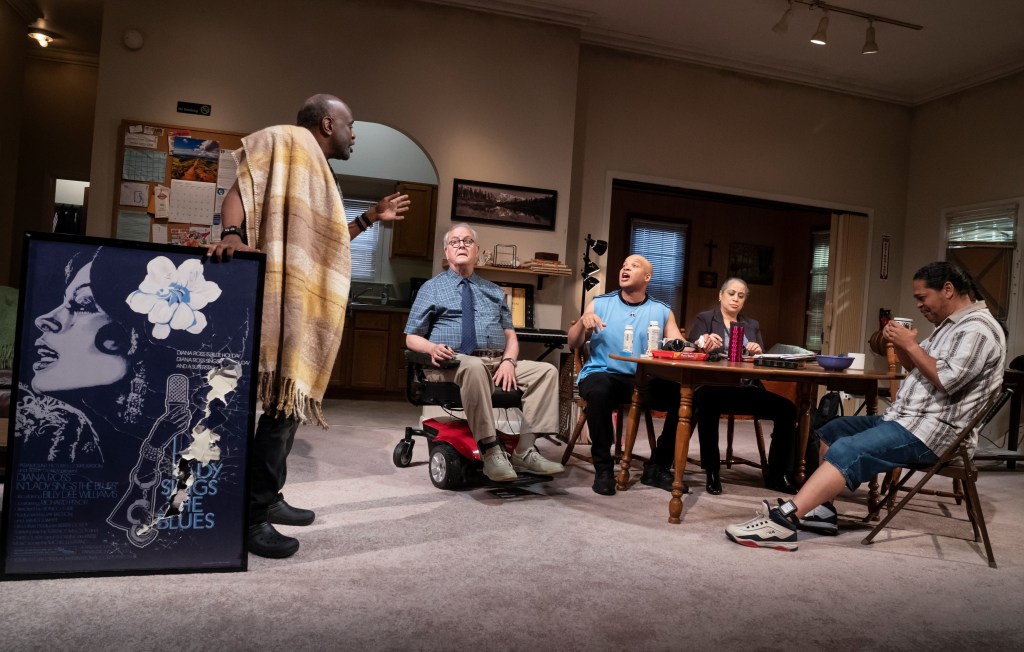
Indeed, Andy and Em are so absorbed in Andy’s victimization and his wish to fully confront Fred with it, they become annoyed by the interruptions in an environment which Andy admits does not fit his expectations. It is as if in Andy’s imagination, he expects Fred to be a silent robot upon which he can unleash vilification without Fred responding as he sits in an isolated room just to listen to Andy’s rant about him. And ironically, part of that logical diatribe includes Andy telling Fred he has fantasized killing him. Interestingly, Fred responds with humanity and humility. He is apologetic and kindly to Andy which Andy ignores and dismisses. Andy reiterates that he has a right and is not supposed to feel empathy for and forgive Fred. Fred can extend him grace, but he doesn’t have to or want to receive it nor will he bestow it.
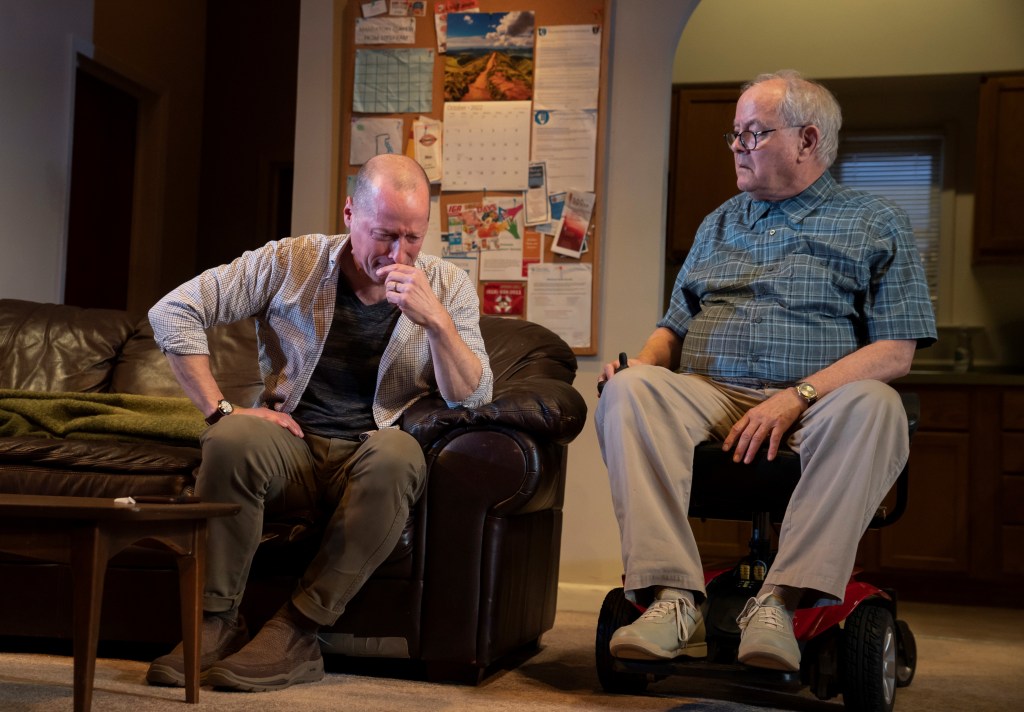
Norris does an impeccable job of revealing the humanity of both sides of the equation, especially in indicating that Andy, who is in therapy, has no idea how Fred’s life has been altered by what Fred refers to as his own sickness and deserved punishment. He believes Fred to be a fake. Tim Hopper’s Andy, Francis Guinan’s Fred and Sally Murphy’s Em are sensational in their performances listening acutely to each other and reacting with spot-on authenticity. Indeed, though we feel for Hopper’s Andy, Guinan’s Fred who is unassuming, childlike and kindly pulls us in and encourages our sympathy. When he reveals in a later discussion with Andy in Act II that an outraged fellow prisoner slyly brought in steel toed boots and kicked Fred so that his back was broken and he has to have a colostomy bag and can’t walk, we consider Andy’s “breast-beating” and Fred’s indulging him to be beyond ironic.
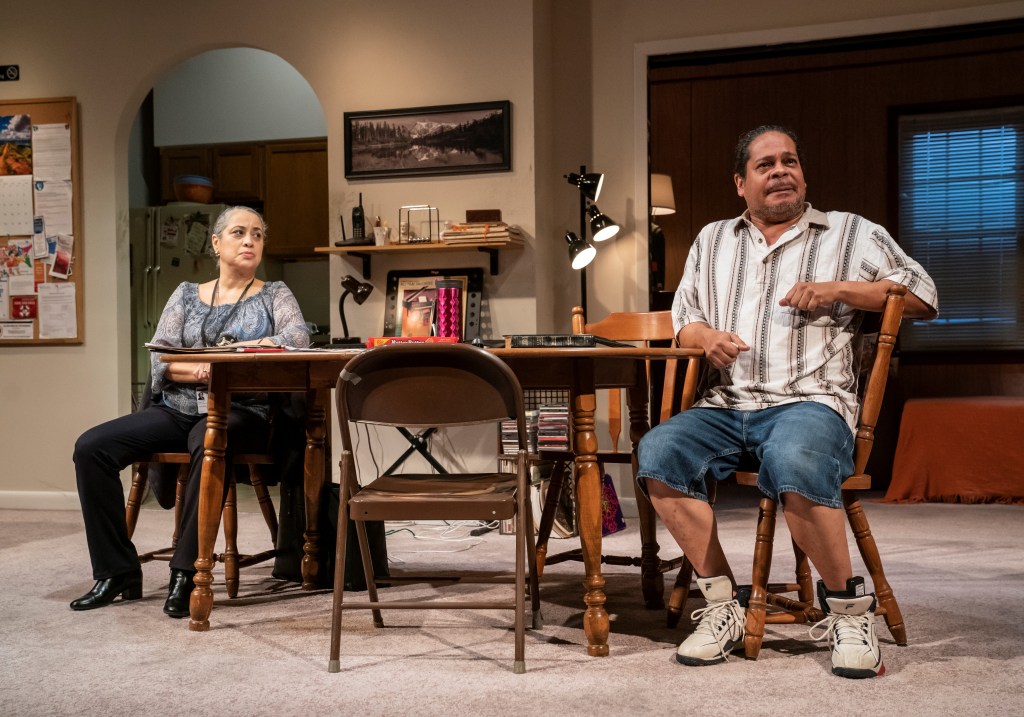
The relationship between Em and Andy as Norris infers, and the actors ingeniously perform with nuance, reveals there are intimacy issues and problems. Thus, Andy’s psychology seeking out Fred is much more complicated than having him sign a reconciliation paper. In Act II the complication is further exposed and we note Andy’s emotional issues which he can’t confront in himself. These allow him to cling to victimization perhaps for another reason. Clearly, Andy and Em are not satisfied with the “justice” Fred has received and by the end of the play we understand that there is more to predation that happens between victims and their predators, than what there is assumed to be. Perhaps, it is not all on the evil and perverted side of the predator. This is tricky ground and Norris navigates it with understanding, forthrightness and intelligence.
After Andy and Em leave in annoyance, PO Ivy (Susanna Guzman in a fine performance) visits. It is here where we begin to understand how the individuals are monitored and hated by the outside community. Also, the problems that they face living in the house are not being addressed by the state, another example that they are a bottom priority. For example, the house needs a broken window and a leaky septic tank repaired. Ivy tells them that they should pay for the repairs themselves. She is too overworked to deal with it. There are more important reasons for her visit. Ivy brings information which indicates the culture’s judgment of sex offenders has mandated increased restrictions on their transportation and mobility. When Dee asks for the particulars, they discover that the routes they must now take are illogical. The point is that the neighborhood opposes their being in the area and petitions constantly for them to leave; the mandate is a sop thrown to the neighborhood.
Norris also outlines the interactions between the four men. Gio and Felix, who are religious, act superior and reject Dee’s lifestyle as a homosexual. Gio accuses Dee of taking advantage of Fred, who needs help bathing and toileting and pays Dee. Meanwhile, Ivy confronts Gio about his behaviors and he is defensive, insulting and bullying. She has to warn him that she can send him back to prison if he doesn’t shape up. In Ivy’s interactions with Eddie Torres’ Felix, we note her attempt to be even-handed. However, in Guzman’s questioning of Torres’ Felix, again, we feel for both characters. She must do her job and Felix is trying to live his life and at least reach out to his daughter on her birthday. Torres is spot-on in his emotionalism and his broken-hardheartedness. His portrayal is beautifully human and tugs at our hearts.
As a secondary character of great importance, Gio’s co-worker, Effie, has a friend who is a sex offender, so she should know the balancing act that must be taken with offenders. She doesn’t care. Norris uses her character as a catalyst. She has become close to Gio and plays fast and loose with his status as a first time offender found guilty of statutory rape with a minor. Gabi Samels’ Effie is provocative, high wired, a “wise-ass” and loud-mouth, knowledgeable enough about the law to use it with Guzman’s Ivy. Through Ivy and Dee’s response to her, we note her ADHD carelessness and irresponsibility is a train wreck waiting to happen.

K. Todd Freeman’s Dee serves as the house master, who on the one hand is aware of everyone’s business, but also watches out for each of the roommates, regarding their rights and responsibilities not to screw it up for each other. Sometimes it is efficacious and other times it backfires. Norris has given Dee the most humorous, witty, intelligent and lovable lines as a former show business person and lover of the arts. Freeman is incredible as the black, senior homosexual, who makes the perfect ironic retort when coming up against bigotry, hypocrisy and cruelty, displayed especially by Gio and Andy. Freeman and Guinan show their prodigious acting talents in establishing the caring, kind relationship between Dee and Fred. In their interactions with Gio and Felix, their performance is nuanced, and Freeman’s ironic delivery as Dee, who uses his humor to lay bare Gio’s arrogance and Andy’s internal psychological fears, is breathtaking.
Norris’s characterizations are beautifully drawn. The playwright enables us to better understand the impact of the hatred and fear leveled by a culture that has little mercy for individuals such as the offenders in Downstate. The humanity that the actors portray in Gio, Fred, Dee and Felix is heartfelt, poignant and tragic. As those on the outside, Andy, Em, Guzman and Gabi Samels are edgy and powerful. All of the characters’ interactions are organic, complex and nuanced. Not enough praise can be given to Pam MacKinnon for shepherding the fine performances of this stark, amazing, forceful ensemble piece.

Norris has set up the action threads in Act I, that he unravels to explode sensationally in Act II. There is no spoiler alert in this review. You will just have to see Downstate to find out the conflict developments between Andy and Fred, Ivy and Felix, and Gio and the catalysts Dee and Effie. The result is cataclysmic and heartbreaking
Kudos to Todd Rosenthal’s scenic design, Clint Ramos’ costume design, Adam Silverman’s lighting design, Carolyn Downing’s sound design, which are perfect for the reality and drama that MacKinnon’s vision requires. This gobsmacking production is one to see for its themes of love, humanity and grace, its wonderful performances and ensemble acting, and its overall production design. For tickets and times go to their website: https://www.playwrightshorizons.org/shows/plays/downstate2223/

