‘Here There Are Blueberries’ Evil’s Ordinary Face at Auschwitz Death Camp
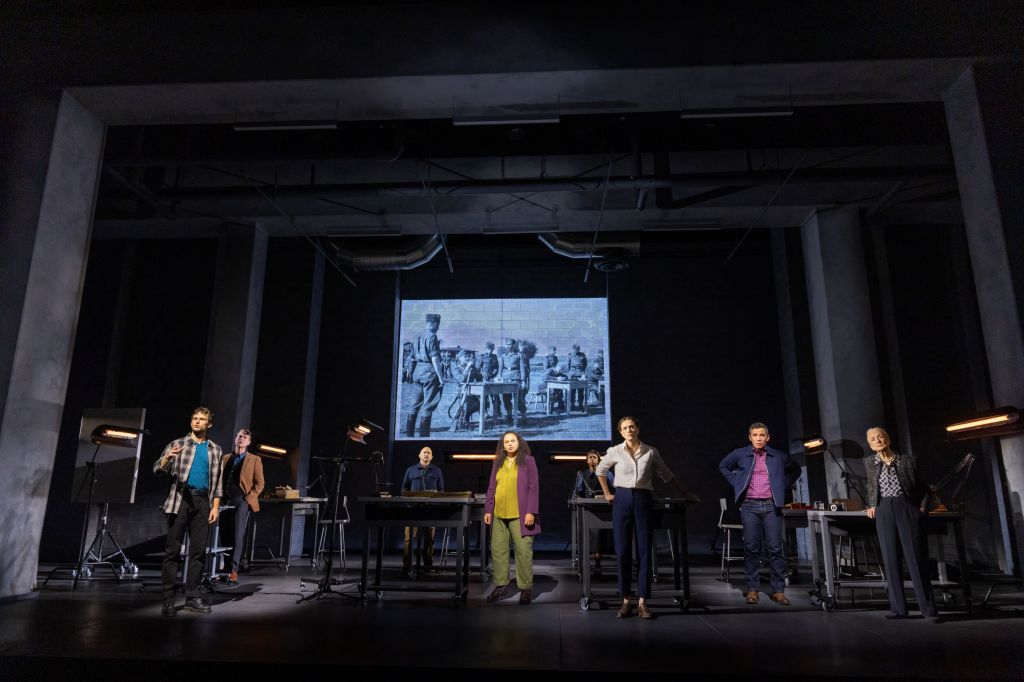
The many-layered, magnificent production of Here There Are Blueberries, first presented at NYTW, landed on Broadway in early November. Currently, it runs at the Barrymore Theater until January 20, 2027.
Stylized as a quasi-documentary that travels back and forth in time the play investigates the mysteries centered around an album of 116 photographs taken at Auschwitz. A retired U.S. Lieutenant Colonel, who found and kept the album for sixty years, contacts the US Holocaust Memorial Museum to see if it can contribute to their research. Problematically, the album has no pictures of the victims to be memorialized. However, after a tense build-up to a crucial meeting, experienced director Sara Bloomfield (Montego Glover) determines archivists can work on the album to study its significance.
Based on interviews, extensive research and photographs rarely seen of the infamous concentration camp from another perspective, the play follows archivists on their journey of discovery. Written by Moisés Kaufman and Amanda Gronich, and directed by Moisés Kaufman, Here There Are Blueberries resonates. Thematically, the play reaffirms Hannah Arendt’s explanation for the complicity of people who allow genocide to happen as, “the banality of evil.”
The playwrights introduce us to the archivists in the second scene. It is then Rebecca Erbelding (Delia Cunningham in an emotionally invested portrayal), reads the letter from the Lieutenant Colonel notifying the museum about the album. From that juncture on, we become engrossed. Gradually, the researchers and others close the monumental gaps in information about the album’s purpose, provenance and significance.
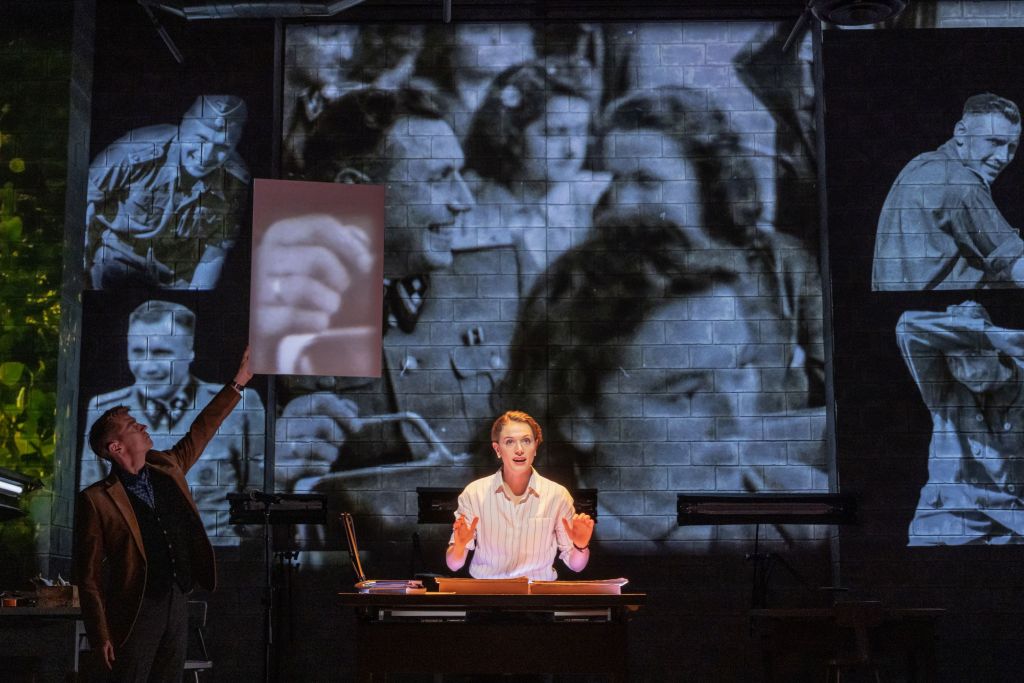
In the production’s transfer to the Barrymore, scenic designer Derek McLane makes use of the expanded space to meticulously define the large room where archivists pour over photographs and make conclusions. As a result of David Bengali’s expert projection design of the black and white photographs displayed on the back of the stage in all their stark clarity, the audience engages with lead archivist Rebecca Erbelding’s questions. One example that puzzles concerns a Nazi officer smiling and laughing as he enjoys blueberries with various secretaries (Helferinnen, who were in communications, etc., and held jobs at the camp).
Kaufman’s staging moves the search for the purpose and ownership of the album forward. Through Erbelding’s queries, directed to the audience, he creates suspense because the archivists become detectives. Personifying the various characters/historical individuals, actors like Kathleen Chalfant, Michael Cerveris and Brandon Flynn take on a variety of roles. As they step forward from their research tables, like a Greek chorus, they bear witness and speak from the ethereal realms of history. All of the creatives-Dede Ayite (costume design), David Lander (lighting design), Bobby McElver (sound design)-further the play’s themes. These, like most themes probing historical truth, sit on the edge of darkness. Here, we attempt to understand why nondescript bureaucrats of civil society become the monstrous accomplices to an efficient, mass murdering operation.
After pinpointing the owner of the album as Karl Höcker (Scott Barrow), who moved his way up to become the administrative assistant to the head of Auschwitz, the archivists explore the lifestyle of those in the photographs. These include the SS guards, top brass, doctors, various secretaries, staff and others. Like average people, they have meals, relax at a nearby resort, participate in athletics, and carry on with wholesome, human activities. Meanwhile, monumental horrors happen nearby on the death camp’s grounds.The disconnect staggers the audience.
The global attention the album receives (revealed by projections of headlines), brings new interest and adds to information when individuals from around the world contact the museum. Indeed, some revelations are from grandchildren of the SS, like Tilman Taube (Conrad Ricamora). Of course ,seeing hidden aspects of their relatives shocks them. Secrets kept hidden eliminated family shame. Additionally, perpetrators avoided accountability.
None of the photos show the functions of Auschwitz, the prisoners, victims or crematoria. All is pleasant and reflective of the wonderful world that Hitler spoke about bringing to mankind, after the “vermin” were removed. That the Helferinnen were photographed, surprised a number of researchers who wondered if the young women knew about the gas chambers. How could these young women be aware of the extemination and stay?
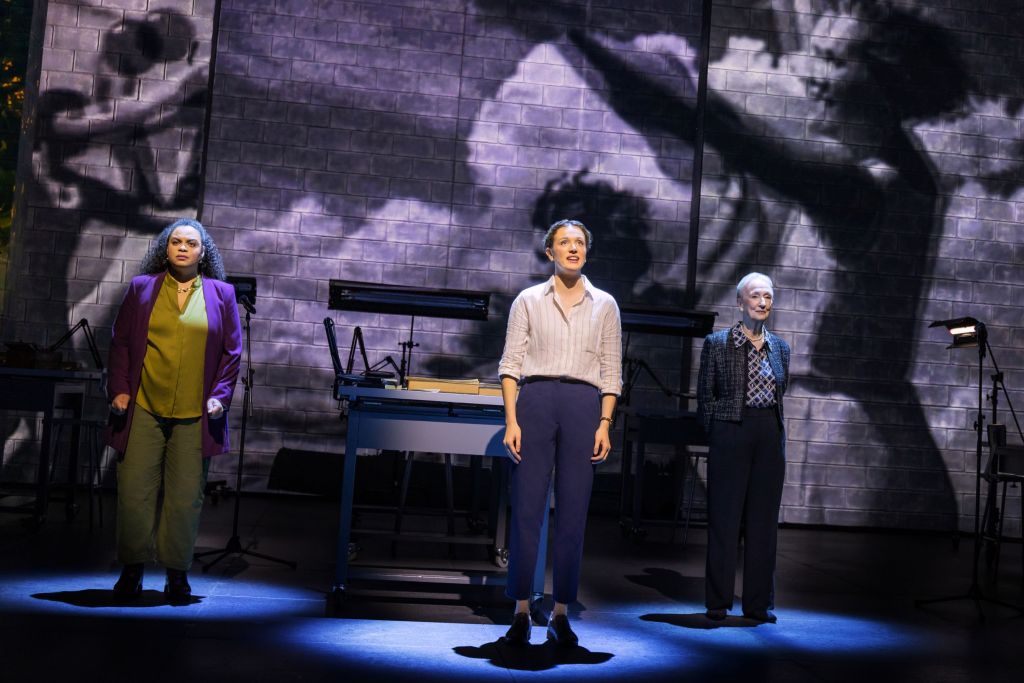
After denials, one of the secretaries who worked at Auschwitz discusses this. Matter-of-factly, Charlotte Schunzel (Michelle Beck) states that she and the other women recorded how many victims were sent to hard labor and how many were sent to “SB.” The initials stood for “special treatment,” a euphemism for the gas chambers. In other words, the sweet, smiling secretaries enjoying blueberries with Karl Höcker in the titular photograph, knew they participated in a genocide.
The archivists pin down the identity of the SS officers and high command in the photographs. One is the notorious “Angel of Death,” Dr. Menegele. Another is the commandant who set up Auschwitz-Birkenau, Rudolph Höss. Eventually, they realize he returned to oversee the extermination of Jewish Hungarians. The researchers determine that the photos are like selfies. In fact they reveal the happy, Auschwitz, camp life of Karl Höcker (Scott Barrow), who would have been a “nobody” if he had not joined the Nazi party in 1937. With Höss, Menegele, Tilman Taube’s grandfather and others they took a group photograph in what archivists describe as a “Chorus of Criminals.” However, researchers don’t understand the date or significance of the photo.
The most enlightening revelation comes from Holocaust survivor Lili Jacobs, who contacts archivists, as a result of the press reports. She possesses an album she uncannily found of 193 photographs of Hungarians standing in groups waiting. After she donates her album, the researchers solve the dates of the mystery of the albums. Also, they figure out the purpose of the photo which shows all the SS, high command and workers celebrating at Solahütte, a resort on the camp grounds. At this resort Karl Höcker occasionally rewarded the SS guards, workers, Helferinnen etc., when they did something special.
With the evidence of the two albums together, archivists complete the full story of murderers and victims. The victims in Jacobs’ album were those who arrived in train transports from Hungary toward the end of the war. The album included photographs of Lili, her family and her rabbi, right before they were separated into the lines for labor camp and gas chambers which the Helferinnen recorded. Höcker assembled and photographed what archivists called the “Chorus of Criminals'” photograph for a vital reason because the murderers at Solahütte celebrated. Relieved, they successfully finished a job well done. In a united victory they proudly uplift the massive operation that divided, selected, processed Hungarians, so that 350,000 could be exterminated, among them Lili’s parents and two younger brothers.
Through their research, archivists discovered that Lili arrived one day after Höcker arrived at Auschwitz. He most probably received a career bump up to administer the massive “Hungarian Project.” In light of Lili’s discovery and sharing it with the archivists at the museum, she and they “get the full picture.” She sees the identity of the men who murdered her family. Finding the album of herself in the tie in with the album of the SS and commandant seems an extraordinary sequence of events beyond coincidence. For Lili, the discovery is mystical and divinely spiritual.
For us, the play charts how evil becomes normalized, even banal, once the wall of human empathy is breached.
Here There Are Blueberries runs 1 hour 30 minutes with no intermission through January10, 2027 at the Barrymore Theater.

Posted on November 18, 2026, in Broadway and tagged Brandon Flynn, Conrad Ricamora, Delia Cunningham, Here There Are Blueberries, Kathleen Chalfant, Michael Cerveris, Michelle Beck, Montego Glover, Scott Barrow. Bookmark the permalink. Leave a comment.


Leave a comment
Comments 0