Blog Archives
‘The Honey Trap,’ Irish Rep’s Acclaimed Production Returns

Subscribe to continue reading
Subscribe to get access to the rest of this post and other subscriber-only content.
‘Kyoto,’ Climate Science vs. Oil Billionaires’ Profits as the Planet Crisps, Theater Review

Based on events beginning in 1989 leading up to the 1997 United Nations Climate Change Conference in Kyoto, Japan, Joe Murphy and Joe Robrtson’s Kyoto explores the momentous occasion when nations agree to confront climate change. The two-act political thriller is in its US Premiere at the Lincoln Center Theater at the Mitzi E. Newhouse until November 30th. Compressing extensive detail, the playwrights reveal how representatives from 160 nations negotiated the Kyoto Protocol. The Protocol committed first world and emerging nations to limit/reduce greenhouse gasses after setting targets and timetables.
Stephen Daldry and Justin Martin co-direct Kyoto, which enjoyed its world premiere at the Swan Theatre, Stratford-upon-Avon. Due to its continued success, it transferred to London’s West End before debuting to American audiences, who don’t always relate to the ironies and humor in the play (directed at the US). Indeed, the US representative (Kate Burton), and American oil lobbyist Don Pearlman (Stephen Kunken) and the representative of Saudi Arabia (Dariush Kashani) become the objects of humor and frustration. They continually oppose any movement to pin down emissions’ timetables or support decreasing oil production.
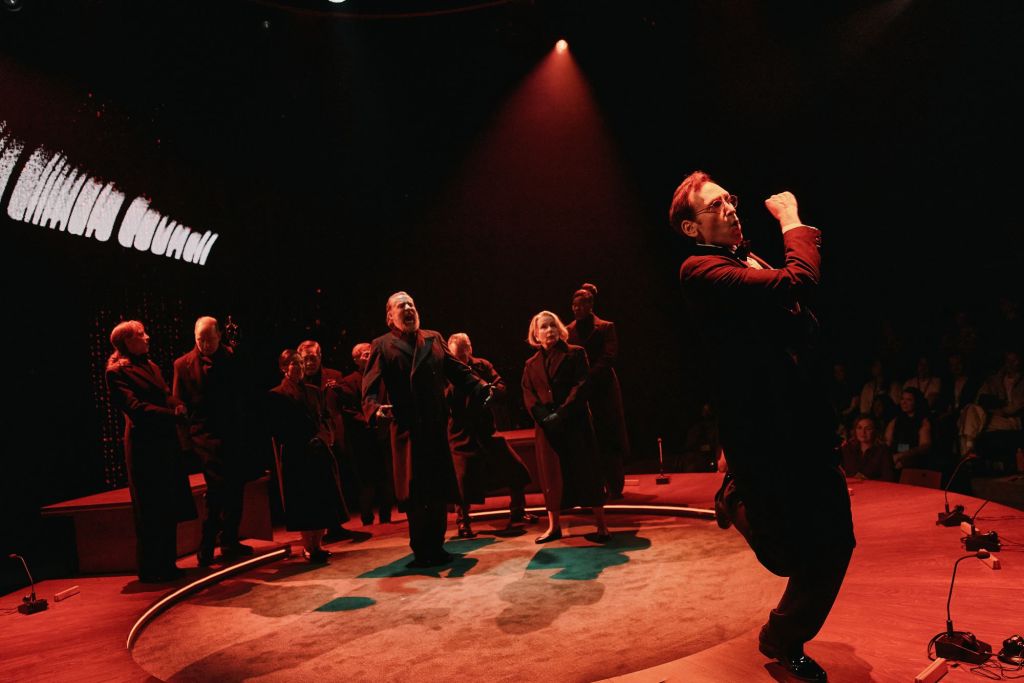
The set is a circular conference table where members sit and sometimes interact with the audience. The table serves also as a raised platform for Don Pearlman, placing him above the fray. In its design by Miriam Buether, Pearlman stands at its center and addresses the audience. Variably it becomes a private meeting area where Pearlman speaks with those opposed to any “progress” on emissions. It becomes a setting in his home, and several hotel rooms where he converses with his wife Shirley (Natalie Gold) and others. The co-directors keep the play in the realm of ideas, not material places. In one instance Shirley and Don join Raul Estrada (Jorge Bosch), the Argentinian representative for China, in a rain forest. The fluid, minimal set design forces the audience to keep up with the dialogue cues which indicate setting changes.
The playwrights have chosen the “well-meaning,” slippery lawyer Don Pearlman, as their spokesperson to reveal what happened from 1989 through1997, when nations finally achieved consensus in Kyoto. At the outset Kunken’s disarming oil lobbyist begins by discussing how the Seven Sisters (big oil, i.e, Exxon, Shell, BP) appoint him as their agent provocateur to stall and delay any UN agreement about greenhouse gas emissions.
Like Iago in Othello, Pearlman instructs the audience in his nefarious plans. Though the events happen at lightning speed, Kunken’s Pearlman slow walks us with his wise words and commentary about how to derail progress among the nations.
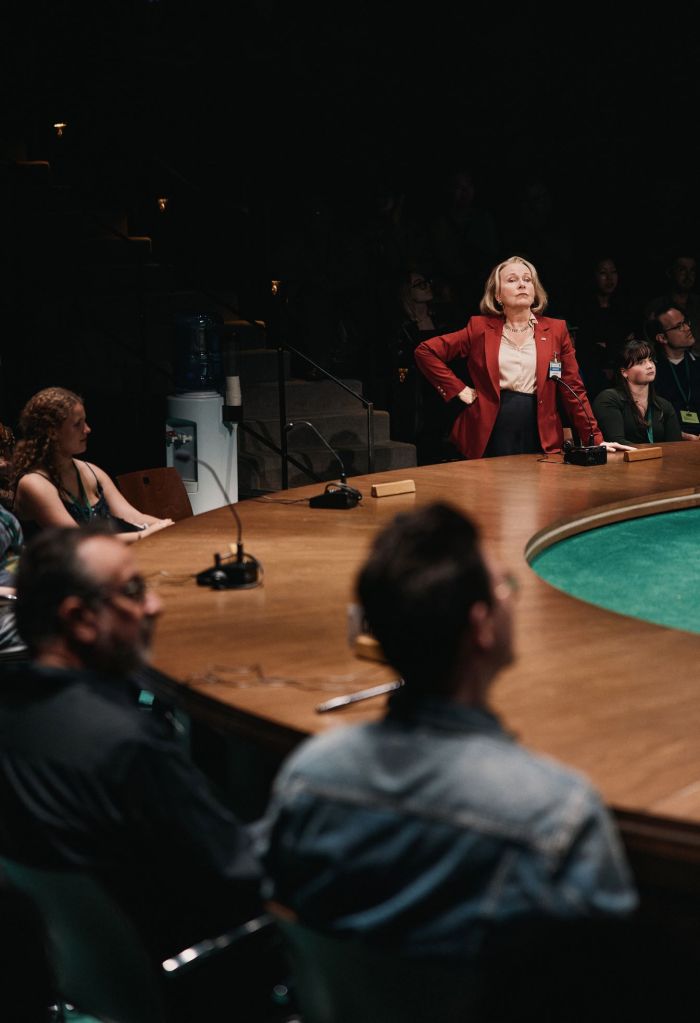
We become mesmerized as we note how he thwarts the representative countries who have different agendas than big oil conglomerates. Also, by extension we understand why little has been done to effectively curtail global warming. Without particular malice or a sinister tone, Kunken’s Pearlman humanely portrays a man who justifies his mission to support American’s “freedoms” to have a first world economy delivered by fossil fuels. Any change disrupting the oil supply, decreasing fossil fuels and harming profits must be stopped. Truly, Pearlman believes in his job and he believes in doing it well. This makes him and the Big Sisters utterly terrifying and wicked when one stops to consider the consequences.
As we follow along with the various conferences and summits beginning with the 1990 World Climate Conference in Geneva, through the Rio Earth summit, the many rounds of talks with scientists among countries, to 1995 Berlin, the First Conference of the Parties, COP-1, we see Kunken’s Pearlman enact the strategies and philosophies he first discussed with us and his wife Shirley. Without glee, with more than a soupcon of irony, Pearlman, ever the oil lobbyist, proves his genius standing up to various representatives with his knowledge about the process of negotiation, as well as his breadth of knowledge about the subject matter.

He, Burton’s US representative, Kashani’s Saudi Arabian representative for OPEC, and others dismiss the gravitas of what climate scientists have presented about global warming. However, Pearlman’s and others’ delinquence in acknowledging the looming disaster for representatives of low-lying coastal nation states comes to a screeching halt. The representative from Kiribati (Taiana Tully) joins forces with 39 other coastal nations to create a powerful negotiating bloc, The Alliance of Small Island States. They make it clear they will not allow the first world nations to marginalize and destroy them. For it is the first world nations’ oversized pollution that predominately contributes to the polar ice caps melting, and that puts the coastal nations at grave risk.
Thus, the conflict begins in earnest as the first world nations strain against the emerging nations, China having joined the coastal states. Few if any concessions are made for any collective unity as they delay for years, sea levels rise, and time runs out. However, a turning point occurs with the new appointment of Raul Estrada. Bosch’s Estrada eventually bans Pearlman from conferences, despite his being the CEO of the NGO, Climate Council (a blind to get him on the inside). Estrada knows Pearlman’s intent, and Pearlman shows no inclination to change his mission. Their war proceeds as representatives criss-cross the world in jets and add to the increasing emissions they seek to control.

Importantly, the play’s dynamism, pacing and urgency are conveyed by Kunken and Bosch’s performances and the co-directors’ staging and directed momentum. The lead actors who reprise their roles from the London production, have settled into their portrayals. As in real life, the oil lobbyist vs. the Argentinian representative to China smile and joke while warring against each other in a deadly “game” to stop big oil from holding the planet hostage.
Interestingly, the playwrights use the character of Shirley as a foil to soften and humanize Pearlman. However, when she finds out that the Seven Sisters knew about the consequences of global warming since 1959 and have kept this research under wraps, she realizes the wickedness of what her husband attempts. If she gives this information to him will it change his approach to his handlers? How can he live with himself and continue to support big oil knowing what the conglomerates have intentionally done for decades to keep profits flowing while endangering life on the planet?
At its strongest and most profound Kyoto dramatizes the tense political and scientific life and death battles that eventually result in the world’s first legally binding agreement to limit greenhouse gas emissions. That such Sturm und Drang resulted in so little is disappointing. However, in light of today’s international global divisions, to arrive at such a consensus seems miraculous and gives us pause.
Kyoto runs 2 hours 40 minutes with one intermission until Nov. 30 at the Mitzi E. Newhouse Theater, lct.org.
‘The Other Americans,’ John Leguizamo’s Brilliant Play Targeting the American Dream Extends Multiple Times
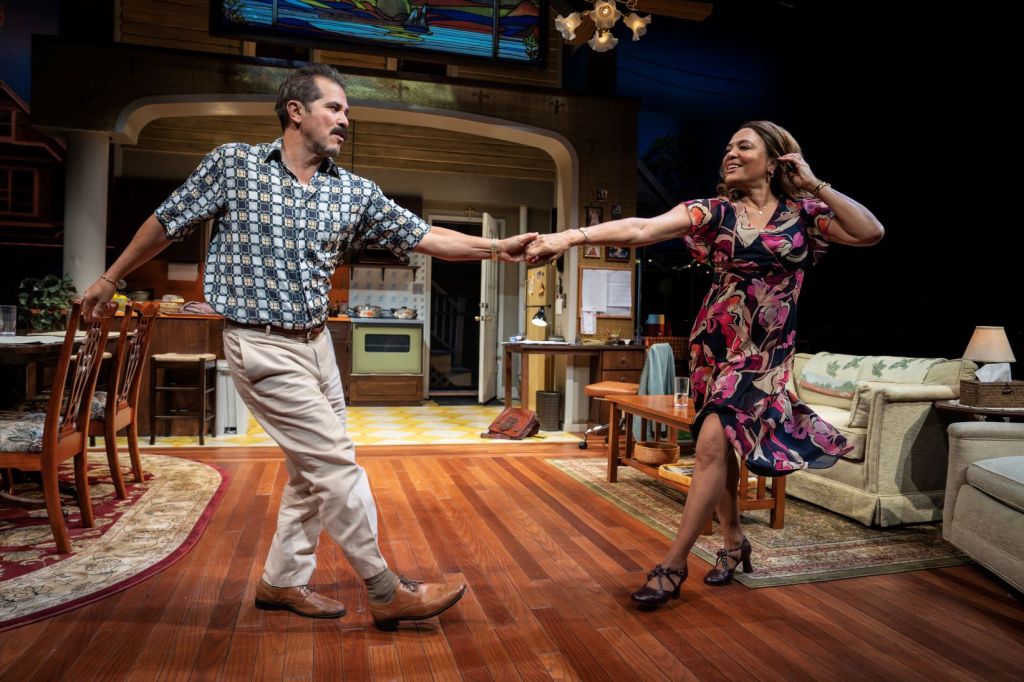
After a long career in every entertainment venue from films, to TV, to theater, Broadway, Off Broadway, etc., the prodigious work by the exceptional John Leguizamo speaks for itself. Now, Leguizamo tackles the longer theatrical form in writing The Other Americans, extended again until October 24th at the Public Theater.
Superbly directed by Ruben Santiago-Hudson, the theatrical elements of set design, lighting, costumes speak to the 1990s setting and cultural nuances. The following creatives developed a smart, stylish representation of the Castro household (Arnulfo Maldonado-set design, Kara Harmon-costumes, Justin Ellington-sound, Lorna Ventura-choreography).
Perhaps Leguizamo’s play could be tweaked to tighten the dialogue. All the more to have it shine with blinding, unforgettable truths sounding the alarm for immigrants in this nation. If tightened a bit, the complex, profound play would land perfectly as the unmistakable tragedy it inherently is. However, in its current iteration, Leguizamo gets the job done. The powerful play with comedic elements resonates to our inner core as a nation of immigrants and especially for Latinos.
Clearly, Leguizamo’s characterizations and themes add to the canon of classics that excoriate and expose the corrupted myth of the American Dream as a lie fitted to destroy anyone who believes it. That immigrants make the sacrifices they do to embrace it, is the ultimate tragedy.
Nelson Castro (played exquisitely by John Leguizamo), born in Jackson Heights from Columbian ancestry, embraces the American Dream. His wife Patti (the amazing Luna Laren Velez), from her Puerto Rican heritage, not so much. Patti’s values lead to loving her family and friends with devotion. Daughter, Toni (Rebecca Jimenez), who will marry the solid but nerdy Eddie (Bradley James Tejeda), looks to fit in as a white woman. The younger Nick (Trey Santiago-Hudson) was like his dad and took advantage of others, fiercely competitive. However, an incident changed him forever.
As the play unfolds, Leguizamo deals with the central question. To what extent have the warped values of the predominant culture negatively impacted this Latino family? From his first speech on we note that these twisted values have lured Nelson. The ethos-scam to get ahead-guides Nelson like a veritable North Star. He uses “getting over” as the key reason to provide for his family. This excuse rots everything under his power.
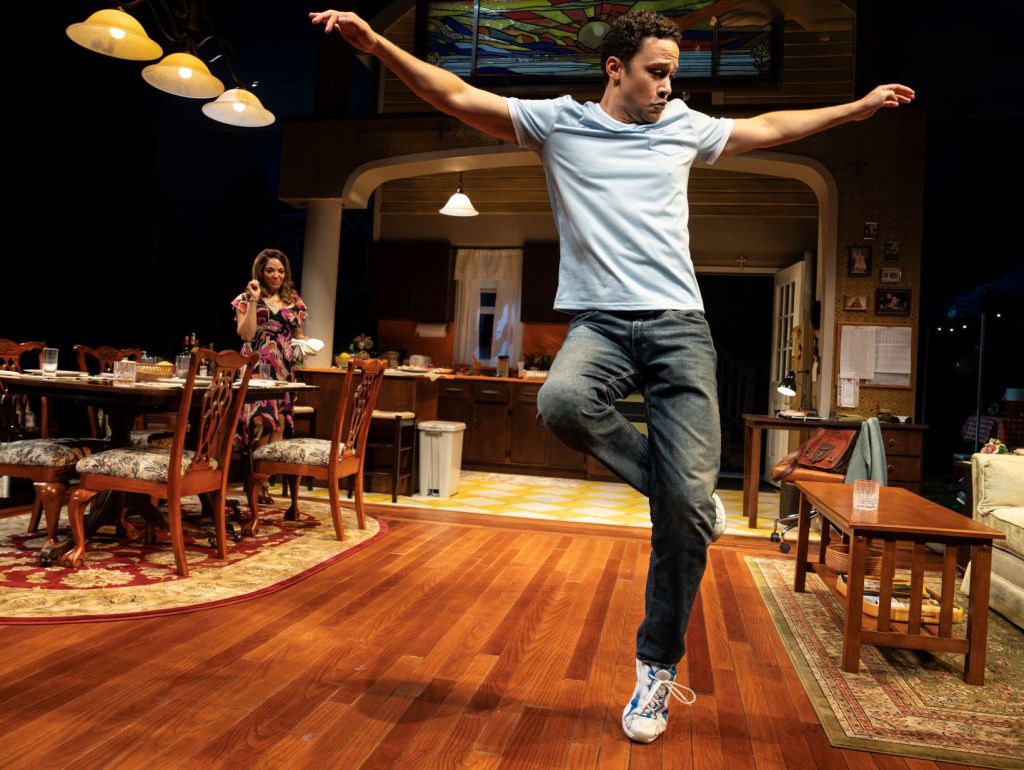
For example, Nelson acts the part of the upwardly mobile success story who always has a deal on the table ready to go. The irony is not lost on us when Nelson hypes a deal with a real estate big wig. Meanwhile, the mogul lives off his reputation for ripping off minorities. Sadly, Nelson admires the mogul’s pluck and con abilities. He ignores how this can potentially harms Latinos.
Mirroring the sick culture and society that values money and material prosperity over people, Leguizamo’s tragic hero tries to wheel and deal to get ahead. Making bad decisions, he overextends himself. Meanwhile, he encourages Nick and Toni to follow his lead. His overweening pride as the patriarch drives him to assume the mantle of a power player. Indeed, the opposite is true. During the process that causes him to fail and lie about it, he compromises his integrity and family’s probity and sanctity. That he willfully blinds himself to the consequences of his beliefs and suppresses his intelligence and good will to fit in, is the final heart breaker.
As in the classic tragic hero, Nelson’s pride also dupes him into a psychotic circularity to believe he has no recourse. Of course he believes the wheels have been set in motion against him by the society’s bigotry and discriminatory values. He should recognize and reject the society that uplifts such values because they support doing whatever necessitates getting ahead. The entire rapacious structure promotes financial terrorism and, whenever possible, it must be rejected. However, Nelson can’t reject it because he can’t help himself from being seduced. Instead, he persists in a prison of his own making, digging his family grave, on a collusion course of self-destruction.
Sadly, he internalizes the society’s inhumanity and makes it his own, a self-hating Latino. Because he adopts this construct because he loathes his immigrant self, he tries to create a new identity apart from his inferior ancestry. Thus, he moves to Forest Hills away from Jackson Heights where he lived “like an immigrant” in a place where cockroaches multiplied.

Finally, as we watch Nelson struggle to assert this new identity in a flawed, indecent, racially institutionalized culture (represented by Forest Hills and what a group of kids did to his son in high school), Leguizamo’s play asserts an important truth for immigrants. Internalizing and adopting the culture’s corrupt, sick, anti-human values is not worthy of immigrants’ sacrifices. This theme is at the heart of Leguizamo’s play. In his plot development and characterizations Leguizamo reveals his tragic hero chases after prosperity and upward mobility. The incalculable loss of what results-losing what it means to be human-isn’t worth it. If one does not weep for Leguizamo’s Nelson at the play’s conclusion, you weren’t paying attention.
To exemplify his themes, Leguizamo uses the scenario of the Castros, an American Latino family. They move from the homey, culturally diverse Jackson Heights to the white, Jewish upscale, racist enclave of Forest Hills. At the outset of the play Nelson, a laundromat owner, awaits his son’s return from a psychiatric facility. Patti has cooked up her son’s favorite dishes. Not only does this reveal her care and concern for her son, her comments to Nelson show her nostalgia for the Latin foods and people of their original Jackson Heights neighborhood in Queens.
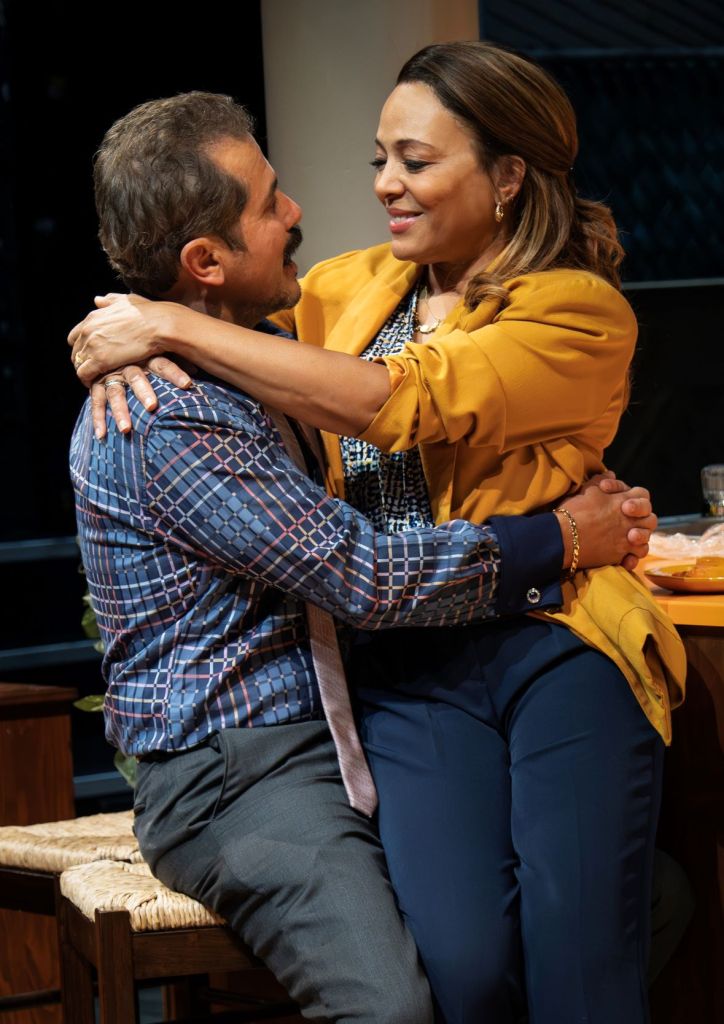
By degrees Leguizamo reveals the mystery why Nick was in a facility. Additionally, the playwright brilliantly explores the conflicts at the heart of this family whose parents put their stake in their children, chiefly son Nick to get ahead financially in the Castro business. To recuperate, the doctors partially helped Nick with medication and therapies.
However, on his return home months later, he still suffers and has episodes. Patti sees the change in his dislike of his old favorite foods (symbolic). Not only does he reject meat, he rejects Catholicism and turns to Buddhism. Because a girl he met at the facility influences him, he moves away from his Latin roots. Later, we learn he loves and admires her and they plan to live together. However, he doesn’t look at the difficulties of this dream: no money, no family support.
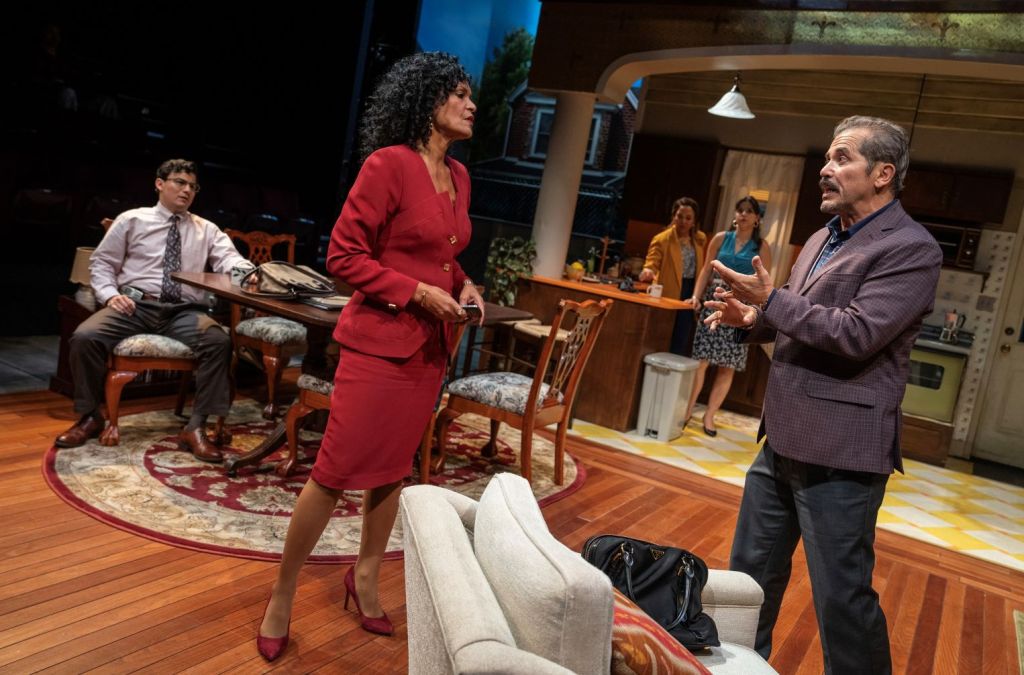
The family conflicts explode when Nick attempts to be truthful with his parents. In his conversation with his mother we learn the horrific details of the beating he received in high school, why it happened, and how it led to episodes in college. Wanting to move beyond this through understanding, Nick learns in therapy that he must talk to his father. Nelson refuses to acknowledge what happened, and becomes a stalemate to Nick’s progress.
Additionally, his doctor supports Nick’s getting out from under the family’s living arrangements. Inspired, Nick yearns to create a life for himself away from their control to be his own person. Ironically, he follows in his father’s footsteps wanting to create a new identify for himself. Yet, he can’t create this identity unless he confronts the truth of what happened to him in high school and talks to his father. Unless he understands the extremely complex issues at the heart of his father’s tragedy, they won’t move forward together. Nelson must understand that he hates his own immigrant being and has embraced sick, twisted corrupt values which he never should have pushed on his family.
Meanwhile, in a fight with Nelson, Nick demonstrates what may really be happening to him. Though he survived the high school beating with a baseball bat, he most probably suffers from what doctors have come to understand as TBI (traumatic brain injury). With TBI the individual suffers debilities both physically and emotionally. When Nelson questions the efficacy of the treatment Nick received from doctors who didn’t really know what was happening to Nick, Nelson is on the right track. But the science had to catch up to Nelson’s observations.
Meanwhile, the problems relating to Nick needing the right help from his parents and his doctors, Nelson’s financial doom and the future of this Latino family under duress are answered in a devastating, powerful conclusion.
There is no spoiler. Leguizamo elegantly and shockingly reveals this family as a microcosm of the ills of our culture and society. Additionally, he sounds the warning for immigrants. If they don’t recognize and refuse the twisted folkways of the “American Dream,” they may lose their self-worth and humanity for a for a lie.
The Other Americans runs 2 hours 15 minutes including an intermission at The Publica Theater until November 23, 2025. https://publictheater.org/theotheramericans
‘Duke & Roya’ Review, in Love and War
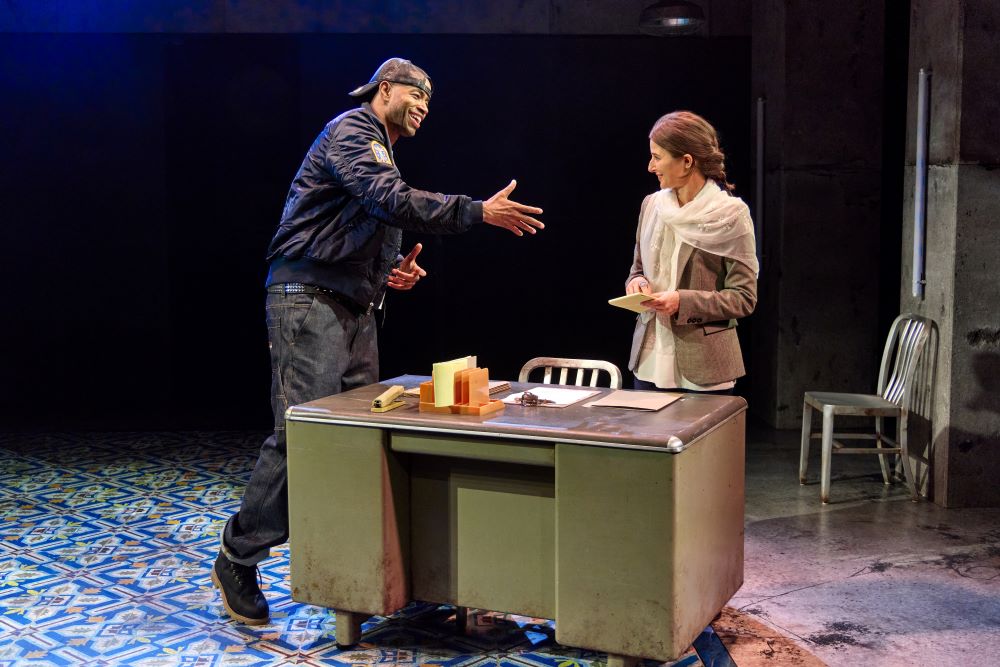
What does Hip Hop music have to do with a Muslim country whose strict religious practices frown on it? Nothing, unless an American base commander brings in a rapper to raise morale and entertain the troops stationed at Bagram Air Force base in Kabul, Afghanistan circa 2017. As unlikely as Hip Hop is to Afghanistan, so is the unlikelihood of the developing relationship between famous rapper Duke (Jay Ellis) and Afghan translator Roya (Stephanie Nur). The evolution of their love and respect for each other develops with humor and insight in Charles Randolph-Wright’s entertaining and meaningful play Duke & Roya. Currently, the hybrid comedy/drama runs at the Lucille Lortel Theatre until August 23rd.
Randolph-Wright unfolds his intriguing play through a series of flashbacks stirred by interviews and interrogations. The purpose of the interviews for the media, obviously is to entertain and titillate. On the other hand the interrogations yield information for investigators. Though we never see the questioners, the four principals, who answer the interrogators,’ questions do the heavy lifting. Through the nimble and talented actors, we form a perspective of the danger and the intrusion into their characters’ personal lives and identities. Randolph-Wright uses the “questioner” device so he can move immediately into the action and adventures between the titular characters in scenes between 2017 and 2025.
Initially, the media questions Duke about his music in the present. Then action transfers from the TV studio to his time in Kabul, Afghanistan. When Duke helicopters onto the base he meets Roya (Stephanie Nur) and her father Sayeed (Dariush Kashani), translators for the American military during the War in Afghanistan. Amiable Sayeed and cool Roya extend their hospitality as employees of the American government. Immediately, Duke shows interest and flirts with Roya, using his confident, “full-of-himself” attitude. Unsurprisingly, his approach, which most likely works on American women, falls flat with Roya.
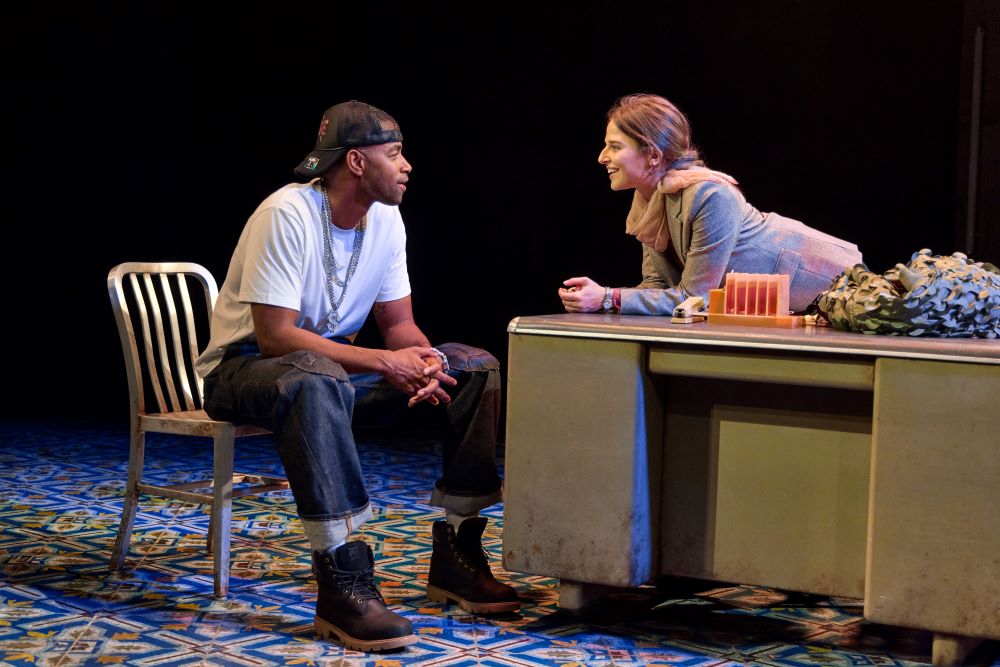
A product of her culture’s strict mores which Duke knows little about, Roya remains aloof. Because he interprets her reaction as “playing hard to get,” their acquaintance happens slowly. Influentially, Roya redirects him toward a new approach with women to encourage his respect. We recognize her brilliant balancing act. Cleverly, she resists his charms, yet lets him know he does appeal to her. So she teases and surprises him with ironic jokes. However, he eventually understands she must be her own woman.
Throughout their experiences together, this push-pull by Ellis’ Duke and Nur’s Roya plays believably. Acutely shepherded by director Warren Adams, the actors and Adams’ staging of them grounds the play in Wilson Chins’ minimal, stylistic set.
Vitally, the contrast between folkways of the west and east reflected in the lightheartedness, emotional drama and revelation of their personalities does capture our interest. For example we learn about the Afghan practice of bacha posh. Because Sayeed has many daughters, he chose the oldest Roya to live as a boy until puberty. Thus, as a boy she had the opportunity of an education. However, sometimes for purposes of safety she dons male clothing and practices bacha posh, which jeopardizes the situation for her later in the play.
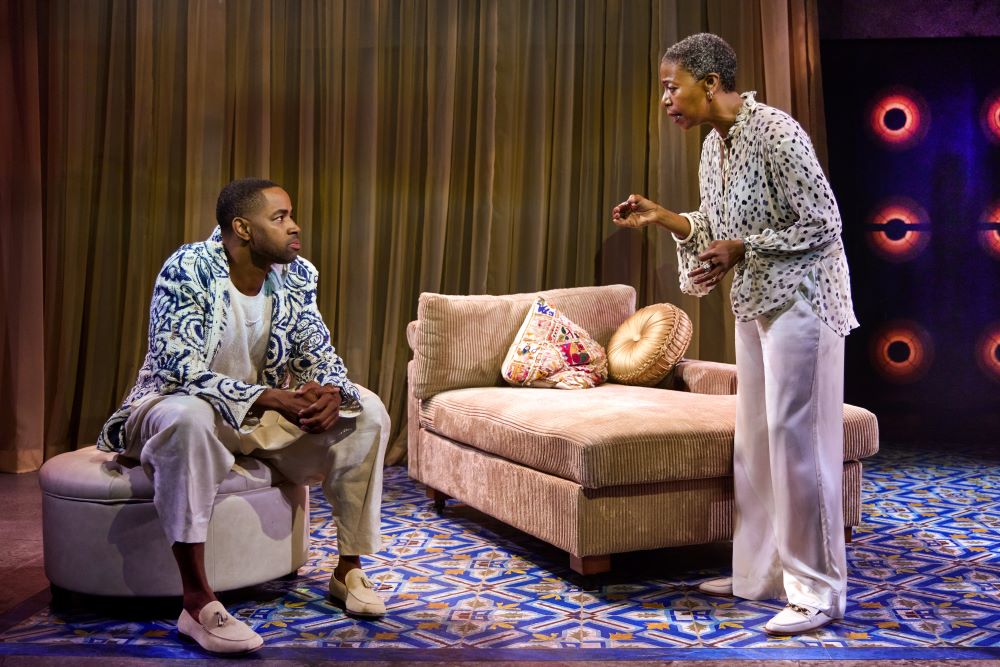
In addition to the standout performances by Ellis and Nur, Noma Dumezweni and Dariush Kashani keep us guessing as Duke’s mom and Roya’s dad. As Desiree, Dumezweni’s strong and forthright sister/mother figure, who chastises Duke when he needs it most, gains our admiration. She’s spot-on mesmerizing. The affable and charming Dariush Kashani authentically conveys the plight of Afghanis caught in an impossible situation. Not aligned with the Taliban that threatens to take over, nor with Americans who will leave the forever war, he, Roya and the family face ever-present danger. Though American visas have been promised for almost a decade, none are on the horizon, a horrific betrayal.
The complex themes sometimes get in the way of each other as the production moves toward the conclusion. Subtly, Randolph-Wright throws into the mix the perspective that Duke exploits the Black experience as a rapper, though his mother is middle upper class. However, Duke’s relationship with Roya changes his perspective and deepens his creativity. Of course the issues of religion, gender and politics come into play. Randolph-Wright intimates the strange parallel of Taliban repression to current oppression of women in the US.
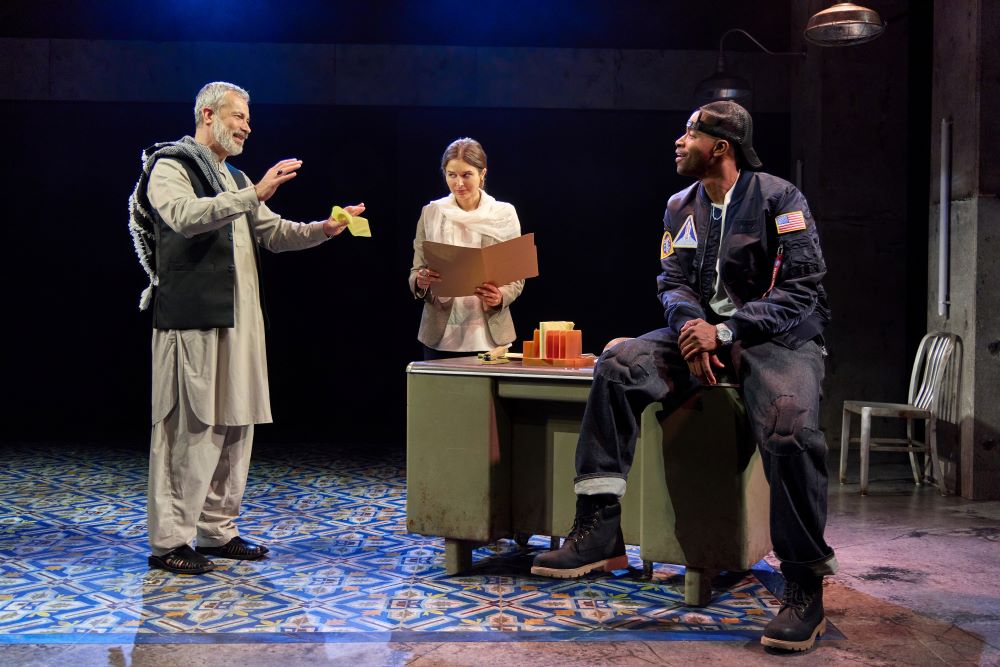
Also, in pointing out facts about the culture clashes and the Afghan war, Randolph-Wright shows the poisonous fallout when the Taliban made a peace deal with the Trump administration without the commitment of Afghan President Ghani. This led to a disastrous withdrawal of American troops and chaos, torture, imprisonment and death for Afghani/US government employees left behind. (Though it is true President Biden extended the evacuation dates, he could not delay the withdrawal indefinitely. Forced to cave to the previous administration’s pressure, he evacuated American personnel and as many of their Afghan counterparts as possible.)
As Duke and Roya mature over the 9 year period, Ellis particularly reveals his maturity during the completion of his interview at the play’s conclusion. Finally, when Duke and Roya meet up again after things become settled, we enjoy watching how their relationship continues to evolve into something profound. Whether or not they end up together is uncertain. However, they have earned their joyful moments together, especially when Ellis’ Duke sings his rhymes for Nur’s Roya with energy and pace. (Ronve O’Daniel’s original music and lyrics are easy and approachable in Ellis’ presentation.)
Amina Alexander’s lighting design, Sanowber Sabrina Spanta’s costume design, Taylor J. Williams sound design and additional music, and Caite Hevner’s projection design provide the background to enhance Chin’s minimal props and set design. These suggest an office at Bagram Air Force Base, an exterior scene in Kabul at night, a swanky hotel room in Dubai, an interrogation room and more.
As one of the more unique, nuanced offerings during this summer Off-Broadway, Duke & Roya shouldn’t be missed.
Duke & Roya runs 2 hours 20 minutes with one 15-minute intermission at the Lucille Lortel Theatre (121 Christopher Street) until August 2nd. https://dukeandroya.com/
‘Babe,’ Theater Review: Marisa Tomei, Rocking Through to the Next Phase

Babe
Can people change? Or do they just flip their perspectives and deceive themselves to believe they’re “evolving?” In the New Group presentation of Babe, written by Jessica Goldberg, directed by Scott Elliott, Abigail (Marisa Tomei), is Gus’ (Arliss Howard), invaluable collaborator in the music industry. The comedy/drama focuses on a number of current issues using Abby and Gus’ relationship as a focal point to explore the landscape of shifting political correctness, power dynamics, generational conflicts, delayed self-actualization, and more. With original music by the trio BETTY, Babe runs approximately 85 minutes with no intermission at the Signature Center until December 22nd.
Treading lightly on Gus’ rocky ground, Abby has been instrumental in maintaining their successful, collegial relationship for thirty-two years, though at a steep, personal price. She hasn’t acknowledged the sacrifice to herself or been inspired to make a change until the confident, twenty-nine year old, Katherine, interviews with Gus, while Abby monitors their conversation and tries to give him clues when to end his political incorrectness. Katherine’s poise and forward attitude develops during the play as the catalyst which ignites a fire that turns into a conflagration between Gus, Abby and Katherine by the conclusion.

Tomei’s astute Abby is sensitive and insightful
Tomei’s astute Abby provides the sensitivity and insight into the zeitgeist that electrifies fans and brings in the gold records, a number of which hang on the walls of Gus’s chic office (sleek, versatile set design by Derek McLane). The producing legend now in his 60s, but fronting his hip, “with-it” ethos in his tight, black pants, chains, stylized beret, and black leather jacket (Jeff Mahshie, costume design), is at “the top of his game,”and on a down-hill slide, indicated by the sensitivity-training Abby references he has had to withstand. We learn it has been ordered by patriarchal, music company head Bob, who also needs to correct himself, but is powerful enough not to. The hope is with Abby’s continual guidance, and the training, Gus’ boorish, self-absorbed, toxic maleness and unrestrained egotism, encouraged at the company by the other men in the past, will refine. Not a chance, as old dogs refuse to learn new tricks.
As groundbreaking, protective and vital as Abby has been to Gus, the two A & R reps, who have discovered and fashioned some of the most successful solo artists in the business, are not equal in stature, success or monetary rewards. Abby’s discovery of Kat Wonder epitomizes these disparities between her boss Gus, and her, as his second. The only woman in the company for years, Abby suffered through the vulgar and abusive patriarchy, a fact she admits late in the play. To her credit, she managed to gain Gus and the others’ respect and esteem. They keep her around because, as Gus suggests, they think she is like them. We learn by degrees that this is because she is silent and as apparently sedate as her bland, grey pants, white top and black jacket. She is unobtrusive and remains professional, the perfect “Girl Friday,” who allows them to “let it all hang out,” without judging their behavior or making them feel like pigs.
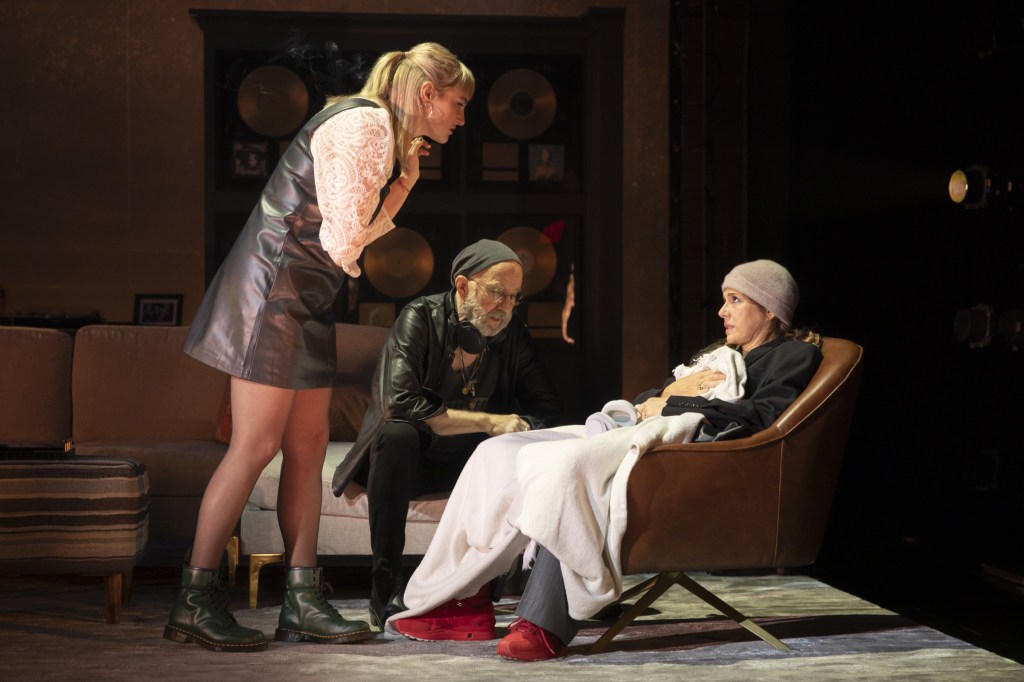
Abby is shut out of receiving credit for her sterling efforts
For her pains to participate, Abby didn’t receive credit on any of the Kat Wonder albums, an “invisible” co-producer. Nor did she share in the spoils as Gus did with global residences and a townhouse he forces the staff to meet in at his convenience, instead of the conference room.
However, ignoring Gus as “all that,” Katherine conflicts with his philosophy, his pronouncements, his ideas. If opposites attract, these two are an exception. Gus sees Katherine’s cultural approaches as pretentious and immaterial (vegan he is not). Katherine is gently oppositional as she pitches herself, her education and background. Interestingly, Katherine sees Abby as a hero to admire. In the initial meet-up, Katherine recognizes Abby from a photo Abby appears in with phenom of the time, “Kat Wonder” at CBGB.Admiring Abby and fawning over her after the interview, Katherine tells Abby that she has been her inspiration to get into the business and wanted to be her.
As obnoxious as Katherine’s forward presumptuousness is, her confidence and appearance remind Abby of Kat Wonder, whose wild grace and energy haunts her throughout the play. Kat appears in her imagination in flashbacks at varying, crucial turning points, with Gracie McGraw doubling for Kat Wonder. These memories of their time together direct Abby toward self-realization and an eventual confrontation with Gus about his unjust treatment of her. This is obviously a painful realization which Abby eventually allows, despite acknowledging Gus’ platonic love, and respect. His concern for her is apparent when he sits with her during a very uncomfortable chemo treatment for her breast cancer.

Katherine visits Abby in an unusual get-together
After Katherine again attempts to rise in the company in another interaction with Gus, she visits Abby at her apartment (McLane’s set design again shines in the transition from Gus’ office to Abby’s apartment and back). They listen to music and Katherine asks Abby probing questions. Then they rock out to music and she dances with Abby, at which point Katherine pushes herself on Abby. Abby is forced to rebuff her because any relationship between them is inappropriate. Nevertheless, this trigger, Goldberg implies, impacts Abby. Abby’s remembrance of her relationship with Kat brings her into a deepening realization of herself because of her experiences, including feeling responsible for Kat Wonder’s death, and being shut out of the glory of notoriety as producer who discovered grunge-rocker Kat.
Abby’s realizations about what she has allowed emotionally, which may have contributed to her physical illness and stress, coupled with a twist that Katherine generates, bring about a surprising conclusion. However, Abby’s response to the final events is the most crucial and important. Maybe it is possible in one’s middle age to forge a new path and become one’s own self-proclaimed star.

The ensemble melds with authenticity and flair
The actors convey their characters with spot-on authenticity, aptly shepherded by Elliot’s direction. Arliss Howard manages to break through Gus’ character with a winning charm and matter-of-factness, which throws dust in the audience’s eyes, even after Katherine corrects his back-handed compliment of her as a “smart girl.” Marisa Tomei as Abby is imminently watchable and versatile as she moves from quiet restraint, to the throes of physical and emotional suffering. The development and culmination of her rage and satisfying expression of it in rocking-out with Kat Wonder is powerful especially at the conclusion. As always Tomei gives it the fullness of her talent, rounding out the Abby’s humanity despite Goldberg’s thin characterization.
Gracie McGraw’s portrayal of Kat Wonder, the 1990s grunge rocker who embodied “centuries of female rage,” before she self-destructed is too brief, perhaps. Much is suggested in Kat’s and Abby’s relationship, but remains opaque. However, we do get to see McGraw’s Kat cut loose. And the memory is so alive and vibrant, it encourages Tomei’s Abby to be her own rock-star, wailing out her repressed rage by the conclusion of Babe. And the women in the audience wail with her, especially now, after the election.

Babe covers many interesting points. To what extent has music been egregiously shaped by the current technologies? What damage has been done as the music and entertainment industry, hypocritically shaped by cultural politics, only creates artificial boundaries on the surface that don’t penetrate the noxious back room parties and behaviors which have given rise to worse abuses? Another issue defines the difficulties of compromise and corruption which spans every institution, every industry. To be a part, one has to be complicit, and then be satisfied with less of a reward because others hold the power and money and make up the rules. Babe scratches the surface and leaves food for thought. The performances are noteworthy and should be seen.
Kudos to the creatives not mentioned before which include Cha See (lighting design), Jessica Paz (sound design), Matthew Armentrout (hair and wig design), and not enough of BETTY’S original music.
Babe runs 85 minutes with no intermission at the Signature Center.
‘Shit. Meet. Fan.’ Neil Patrick Harris, Debra Messing, Jane Krakowski in a Scatalogical Romp Through Coupledom

Shit. Meet. Fan.
It’s an intriguing title. Stepping into the audience seating area of the MCC Theater, what’s not to like? Clint Ramos’ scenic design sparkles as the audience gazes upon Eve (Jane Krakowski), and Rodger’s (Neil Patrick Harris), upscale condo in Dumbo, NYC, a shimmering spectacle of Manhattan lights twinkling in the distance, visible through windows on the second floor which includes a “must-have” telescope on an “elegant” terrace.
From the title Shit. Meet. Fan. to the conclusion, the production screams with sardonic hilarity. Thematically, playwright Robert O’Hara presents characters who exude the allure of security, prosperity, white privilege and “happiness,” conditions to be envied. Perhaps. However, as the evening unspools on this party night when three couples and odd-Black-man-out, Logan, (Tramell Tillman), gather and have their vicious fun, we note that prosperity without contentment, truth or happiness is anything but “all that.”

The shoe drops at the outset
The shoe drops immediately, as promised in the title, and we are startled into recognition that in the opening scene, “it” is hitting the fan, as mother Eve (Jane Krakowski), confronts daughter, Sam (Genevieve Hannelius), about a box of condoms she found that Sam glibly professes isn’t hers. Though the scene concludes with Mom’s peaceful concession and return of the box to her daughter, the screaming match which paves the daughter’s way to success, is revelatory. In their heated interaction, O’Hara, who also directs, discloses a “hip,” ribald mother and daughter, whose frank rants about having sex are “no big deal,” though mom appears to protest too much for 17 year-old-Sam’s liking.
From then on as the guests arrive, “it” grows more plentiful. The characters fan the room, drink, do cocaine and spray their increasingly toxic, chaotic, mind games and patter to the back row of the audience. By the conclusion the audience is “covered.” It is funny, but not necessarily what we’ve wished for during the 105 minute romp through a tragic waste of humanity. However, O’Hara wishes us to laugh at ourselves as much as at the characters. Their hypocrisy, toxic masculinity, feminine one-up-woman-ship, and misery may be ironically recognizable to those able to afford a ticket to this Off Broadway production.

O’Hara based Shit. Meet. Fan. on the popular 2016 Italian film Perfect Strangers
Based on the 2016 Italian film Perfect Strangers, by Paolo Genovese, in the similar development, Rodger and Eve have invited their couple friends to celebrate the eclipse. The bonds of friendship were formed in college when the four men were in the same fraternity and consider themselves “bros.” They are a hotbed of toxic masculinity, fitting all the stereotypes one loves to despise when they are “under the influence” of drugs and alcohol. The men are TV celebrity heavyweights. Besides Neil Patrick Harris, who is always spot-on in whatever role he acts, the superb actors include Brett (Garret Dillahunt), Frank (Michael Oberholtzer), and the aforementioned Tramell Tillman as Logan.
On the other hand the women are close, but ancillary to the key relationships in this comedy that has a number of thematic twists, especially in O’Hara’s version. Joining Jane Krakowski’s Eve and Genevieve Hannelius as Sam, there are Brett’s wife, Claire (Debra Messing) and Frank’s wife, Hannah (Constance Wu). All reveal comedic perfection. The women circle the wagons when attacked, questioned or prodded by their spouses whose vulgar, women-demeaning, objectifying tales and shared secrets, divide the party among gender lines.

As the eclipse presumably occurs the characters get wild and wooly
As the party progresses and the eclipse occurs, which is more symbolic than visualized since no one really watches, the teeth and nails sharpened for this occasion extend for the vicious “fun,” prompted by Eve. She suggests that they play a “game of phones,” and willfully violate each other’s privacy for each other’s amusement, by publicly reading or putting on speaker every phone text, email or call received for an hour during the evening. For one hour there are no secrets; all the dirty laundry is aired. As each unwillingly gives up their phones because no one protests, they put the “black boxes” that record their lives on a centrally located table ready for exposure and humiliation. After that, the drama and comedy intensifies.
The first to suffer the slings and arrows of shame in front of his “bros” is Frank when Rodger calls him from their unknown landline and breathes heavily into the phone. Hannah, newly married to Frank in the heat of their first year together, is ready to knife out his eye. But Rodger comes down the steps heavily breathing into the phone in a classically delivered, brilliantly funny, Neil Patrick Harris, dead pan moment. It is priceless and one of the biggest laughs in the first half of the production.

The “free-for-all” occurs after Logan receives a call
After that it becomes a free-for-all. Logan receives a phone call from his sister who insists humorously that he take her off speaker so those “white b%$ches” don’t hear “her business.” Censorship and political correctness cloaks are off; it’s expose time. Since there is no spoiler, you’ll just have to see the production to witness how each “bro” is delivered a blow and each spouse is found out to be doing numerous things other than being the sweet, loyal “wifey.”
Here are some clues. There are folks on the down low, alternate sexual preferences, affairs referenced by jewelry purchases, a proposal to throw mama in a nursing home behind sonny-boy’s back and more. O’Hara has pegged the jabbing one liners and jokes trippingly to the rapid-fire comedic rhythms which begin casually at an even pace, then pick up and race into the territory of high farce. Then, when the eclipse ends, all settles into normalcy as if nothing untoward, raw and menacing happened. Such is upscale life among the white privileged and two token persons of color. Oblivion after emergences of poisonous, festering wounds.
Meanwhile, we have the opportunity to peek into the illusions, lies and self-gaslighting of these peculiar and infantile minds that may not evolve beyond what we note as entertained watchers.
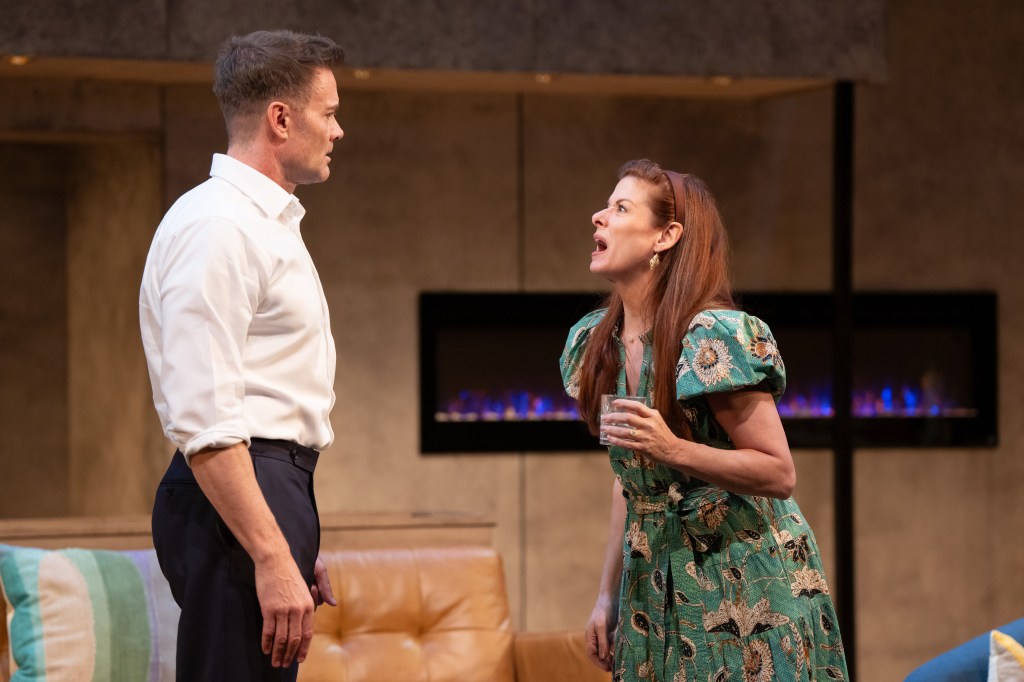
O’Hara portrays boorish, unlikable characters
Clearly, O’Hara finds these individuals boorish and craven, especially the white, toxic stereotypical males who make everywhere their preferred locker room, especially out of their wives earshot. The women are the fairer but not gentler sex. Together, we allow that this night of frolicking fun doesn’t happen often. If it did, there would be three divorces on the horizon except for one, perhaps, though Rodger loves his wife Eve, even if he dislikes who she is as they both contemplate divorce. Thematically, O’Hara proves that individuals choose the friends they deserve as they periodically are tortured and tormented by them under the guise of “fun and games” which are anything but.
O’Hara’s creative team in addition to Clint Ramos’ scenic design, includes Sarafina Bush’s costume design, Alex Jainchill’s lighting design, Palmer Hefferan’s sound design, and Cookie Jordan’s hair design. Each of these creatives assists O’Hara’s sardonic vision of these upper brow professionals in their one night of infantilism and terrorism of each other which is perhaps more well deserved than we know.
Shit. Meet. Fan. runs 1 hour forty-five minutes with no intermission at MCC Theater (511 West 52nd Street between 11th and 10th Avenue), until December 15th. See it for the celebrities who are glorious, as O’Hara intentionally tries the audience’s patience with their characters’ crass and vapid immaturity.
‘Pericles’ by Fiasco Theater a Joyful, Redemptive Must-See at CSC

Fiasco Theater’s Pericles presented by CSC is one of William Shakespeare’s works written in the twilight of his career that reveals a “hero” who the fates torment and play with until it is enough, and he receives his wish of a fulfilled life with family. The production directed by Ben Steinfeld is stylized and cleverly wrought, advancing storms, shipwrecks, kidnappings and more with the ingenuity and charm joyfully delivered with as little forced spectacle as possible, yet with an intriguing, bold and seamless minimal set and prop design. Currently at CSC until March 24, this is a must see which Fiasco has brought for us to appreciate.
Steinfeld is Gower, the troubadour whose tale this is. Through his music, lyrics and poetry he sets up the play and requires the audience to use their imagination to become involved with Pericles of Tyre’s harrowing and amazing adventures of a lifetime. Steinfeld’s Gower introduces every section and gives a summation of events essentially cluing in and reminding the audience to stay focused and attentive. He leads the cast in song initially and establishes the mood for each of the acts, making sure to recap the events in rhyme after the audience returns from the 10 minute intermission before Act 2.
There are four actors who portray Pericles and give their timber to each scene and adventure that Pericles experiences as he goes on a hero’s journey learning wisdom, perseverance, patience and fortitude, struggling to overcome whatever Fortune brings.
The first Pericles is Paco Tolson who journeys to the kingdom of Antioch where he must solve a riddle to marry King Antiochus’ (Noah Brody) beautiful daughter (Emily Young). If he doesn’t solve the riddle, he forfeits his life and hangs like the other suitors in the public square which the creative team and actors simplistically yet fearfully stage with staffs and boxes/crates. Hearing the riddle, Pericles shows his brilliance apart from all the suitors who have courted the king’s daughter and died. He understands King Antiochus’ treachery. The riddle infers the king’s incestuous relations with his daughter, who he will never give to a suitor.
Upon realizing this horrid circumstance, Pericles also realizes his own fate. Either way, if he reveals the riddle and exposes the king’s sin to public humiliation or doesn’t, he’s a dead man.
Making his excuses, Pericles ends up escaping Antiochus’ kingdom. He intuits the king will figure out why he left and come after him, so Pericles goes on a journey to Tarsus where King Cleon (Devin E. Haqq) and Dionyza (Titiana Wechsler) make their home and suffer through the dire misery of famine that has struck their lands. Knowing their plight, Pericles brings corn to Tarsus’ starving people and saves them from death. Forever grateful, King Cleon makes Pericles revered and celebrated in the land with friendship and goodness. However, we learn that kings are political and variable and circumstances change to sever the friendship.

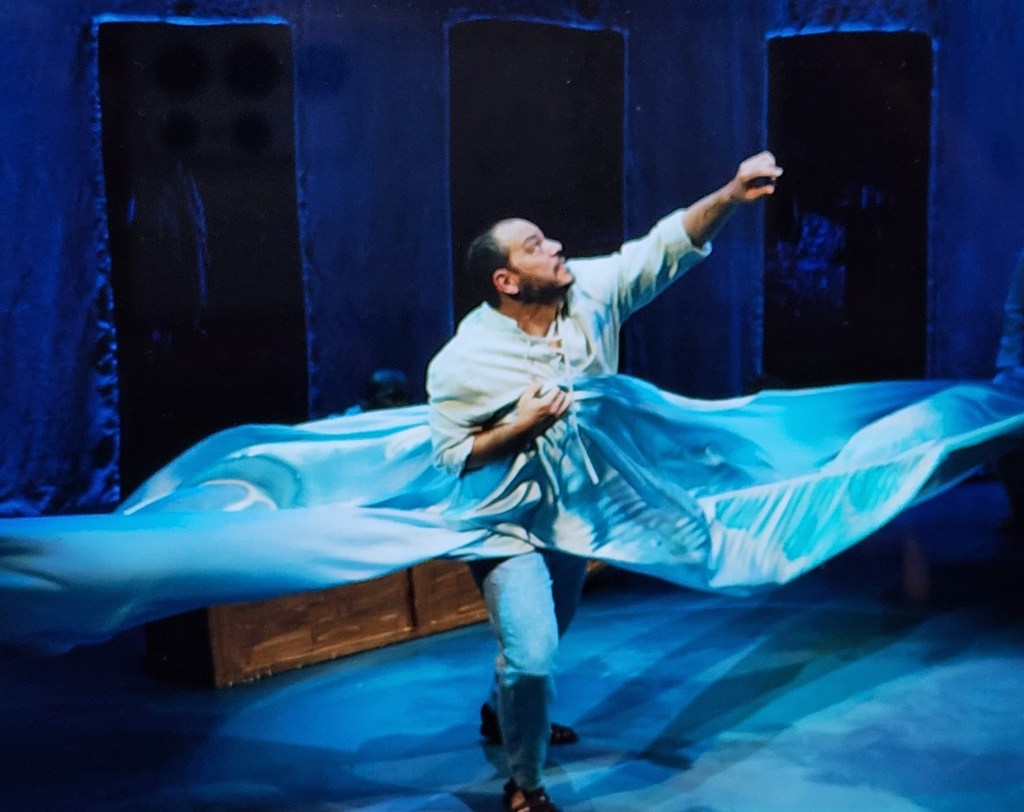
For the moment in his life’s travels Pericles is unaware of the possibility of deceit and betrayal. Called back to his home in Tyre by the administrator he left in charge, Helicanus (Paul L Coffey), Pericles once more bares himself to Neptune’s wrath on the fickle Mediterranean where the god upends and destroys his ship. Fiasco Theater’s inventiveness of Pericles braving the storm’s fury (Mextly Couzin’s lighting design and the Fiasco’s production design), using a bolt of cloth to suggest the tempestuous waves, maintains the stylized, roughly-hewn playfulness of the production. The soft, shimmery cloth symbolizing the waves belies the irony of Pericles’ situation on the roiling sea.
Pericles loses everything but his life and is washed up on the shores of Pentapolis. There, he is at the mercy of the fishermen who find him and change his fortune with happy information. Pentapolis is ruled by the goodly King Simonedes, (the humorous Andy Grotelueschen), a pleasant reversal of the kings who have gone before.
Shakespeare contrasts the kingdoms and their kings: the first is a lecherous murderer, the second variable in deceit and this third king. The fun loving Simonedes is popular even to the lowly fishermen who tell Pericles that the king holds a tournament and feast for his daughter’s birthday. The celebration is so that Thaisa (Jessie Austrian) may find suitors among the knights who joust for her. When Pericles’ armor washes ashore, the fishermen encourage him to compete for the king’s daughter. Shakespeare makes it a key point that though he is a stranger (an migrant) in their midst, he receives their country’s hospitality and mirth.
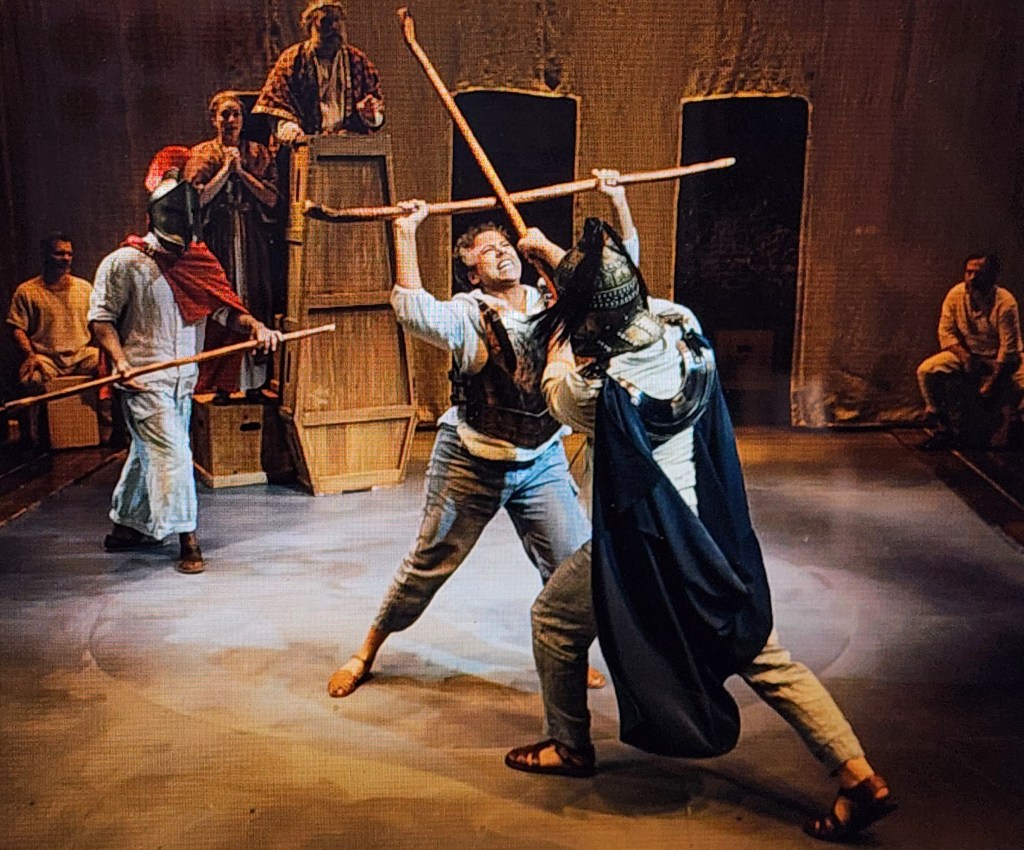
Pericles wins the jousting matches, performed with the sames staves Fiasco used to suggest the suitors’s hanging in Antioch. It is an example of how the theater company employs the props efficiently and meaningfully to emphasize themes of power, leadership and control. Through their variable exchange we note the contrast between the kingdoms and their rulers’ leadership, either deceitfully tyrannical or happily beneficent.
After the tournament, King Simonedes invites all the knights for a feast. The wooden crates which have been used as a throne, to circumscribe walls, etc., are now used to effect a long feast table. And there, Pericles (Titiana Wechsler portrays Pericles in this segment) gains the king’s favor and the love of Thaisa.

For his pains and pleasure, the Simonedes playfully uses reverse psychology to have the couple declare their love to each other by pretending to forbid their union. Jokingly, he reveals his pleasure at their marriage which produces an heir. In the next scene we see that a pregnant Thaisa, and husband Pericles (Noah Brody in this version) go on an ocean voyage back to Tyre to check on his kingdom.
Again, there is a storm at sea and dire circumstances. Thaisa who dies in childbirth must be thrown overboard to steady the ballast or the ship will sink. Pericles prepares her coffin with spices and jewels with a note to whomever finds the coffin to bury his wife whom he greatly loves. The child who was born as Thaisa died Pericles names Marina. To redeem the time, Pericles leaves Marina with those who revere him in the land of Tarsus. King Cleon and Dionyza promise to care for Marina like she is their own, while he returns to rule Tyre.

The staging of the scene where Marina is given to King Cleon is simultaneously juxtaposed with the fate of Thaisa whose coffin washes ashore at Ephesus. The director makes excellent use of the space at CSC to clarify what happens. As Pericles hands over baby Marina to his friends, a woman with powers of healing (Tatiana Wechsler with hair down in flowing priestly robes) restores Thaisa back to life. So thankful is Thaisa that she becomes a devotee of Diana and officiates at her temple. Meanwhile, Pericles is heartbroken and grieves his dead wife but joys that his child is being raised well. As fate would have it, during the fifteen years Marina has been brought up with the daughter of Dionyza, things grow problematic.
Dionyza envies Marina’s beauty and talents and decides she must be murdered for the sake of her own daughter, so their child will shine if the glory of Marina is removed. Though Cleon opposes Dionyza’s evil act, he is powerless to stop her. But just as Marina is about to be killed, pirates kidnap her and thwart the murder. In the following sequences, Gower shifts the mood once more and the riotous humor of how Marina’s chastity is used to great effect proves comical in a brothel run by Bolt (Andy Grotelueschen) and Bawd (Jessie Austrian). There, Emily Young’s Marina turns away the lusty, hot clients who are horrified that she pushes her virginity onto them and attempts to make them Diana (the feminist of the time) devotees. Of course the irony is that Thasia, her mother, is back in Ephesus praying as a Diana devotee.
In the second act, Fiasco’s farcical skills shine and the atmosphere shifts from Fate’s woes to merriment at those lecherous males who should be ridiculed for their unseemliness. However, when it is least expected, Pericles, who returns to Tarsus to bring his daughter back to Tyre to rule with him, discovers through Cleon that Marina drowned. Indeed, King Cleon and his wife have betrayed Pericles’ goodness and there is no punishment for them as there was for King Antiochus who the gods burned up. It would seem that incest is the worst crime when it begets murder. Dionyza’s intention of murder the wicked pirates interrupted; it is an irony is that the pirates evil act is turned around for goodness. Dionyza’s envy and murderous intention the gods leave to her and Cleon’s consciences to seek redemption.
Inconsolable that she is gone, Pericles (an excellent David E. Haqq in the last, most emotional segment) will not speak and is dead in spirit. How events change magically to effect Pericles’ reunion with his wife and daughter is poignant and heart-rending, if not fanciful in hope. Interestingly, Shakespeare makes abundant use of the Deus ex Machina (the gods interrupt evil fate to save the hero) in Pericles. As Gower and the cast conclude the tale of Pericles, King of Tyre, we are uplifted by the grace of a happy ending, and the redemption offered to Marina, Pericles and Thaisa because of their goodness, devotion to the values of truth, generosity, decency and steadfastness.

The strengths of this production include the fine ensemble’s seamless acting which provides the coherence throughout, even though the character of Pericles has four actors which was initially confusing. The whimsical and at times farcical, lighthearted approach toward myth-making and storytelling through music, rhyme, dance and song are superbly balanced throughout. The stylization is the correct choice for a play that gyrates throughout voyage, disaster, and roller coaster storms that metaphorically parallel human joys and sorrows.
That the play has been spurned as silly and not worthy of being produced has been a misread of the depth of one of Shakespeare’s most trenchant latter plays. The life theme is an important one. For those who patiently endure, they gain wisdom in temperance and the power to face and overcome trials of their faith. The obstacles help one all the more appreciate and be grateful for a life that acknowledges human beings live on the brink of peril every moment of their lives. To be numb to that knowledge is to live a zombie death in life.
This is a must-see, for the music, songs, fantasy, laughter and fanciful, profound truth-telling.
Pericles. CSC, 136 E 13th St between Third and Fourth Avenues. Closes March 24th. https://www.classicstage.org/pericles/
‘The Ally,’ Terrific Performances of a Trenchant Play at the Public
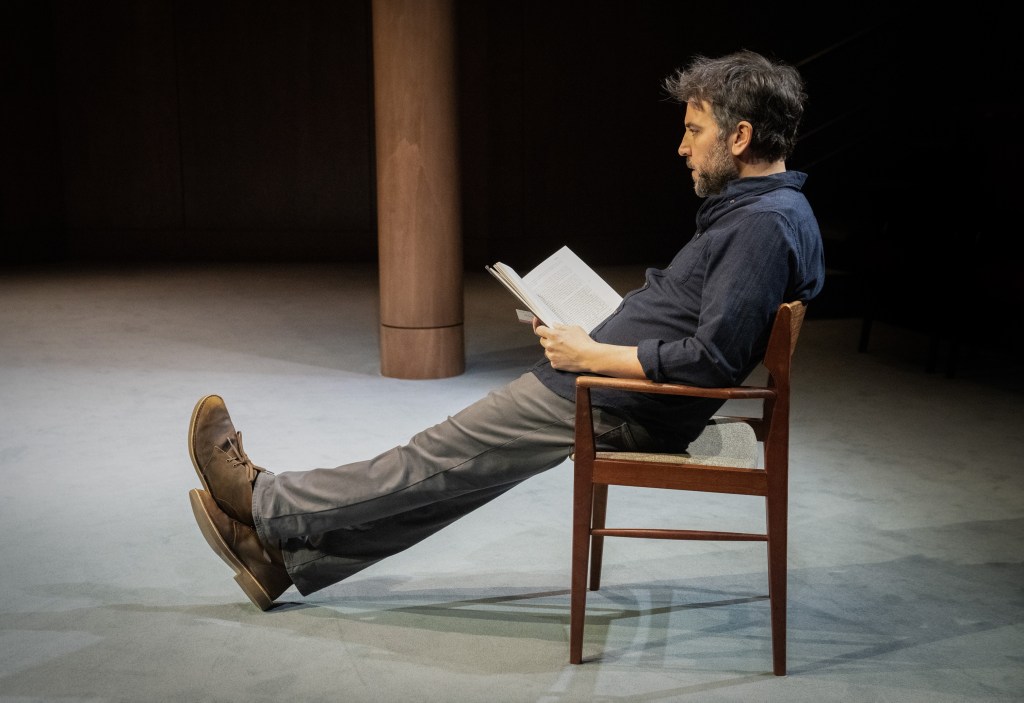
The Ally, written by Itamar Moses (The Band’s Visit), and directed by Lila Neugebauer (The Waverly Gallery), currently runs in a World Premiere at the Public Theater until March 24th. Moses’ two act play that is largely polemical raises important and controversial questions in its two hours and thirty-five minutes. It is thought-provoking, historically informative and profound, and has great currency in light of the Netanyahu government’s war against Hamas. Though the play was written before the October 7th attack, the issues couldn’t be more on-point.
The Ally is short on dramatic tension, and long on terrific performances. The exceptional actors passionately argue about Black and Brown people struggling to achieve human rights in countries (Israel, the United States, etc.), which have their foundations in oppressive, white, patriarchal colonialism. Though the prejudices and discrimination have been called out and strides have been made, often the countries obfuscate justice, and in defensive mode, redirect their institutions, practices and social constructs away from equanimity, foregoing humanity, compassion and empathy to abuse those they subjugate.
To present the arguments and make a case with little resolution, Neugebauer’s vision offers a spare stage and few props to evoke the setting in a professor’s home and office on a University campus which represents a bastion of learning, where allegedly every viewpoint may be expressed without censure, to promote enlightened civil discourse and benefit the social good of the community. Moses’ protagonist on the field of intellectual battle is liberal Jewish professor Asaf (the excellent Josh Radnor).
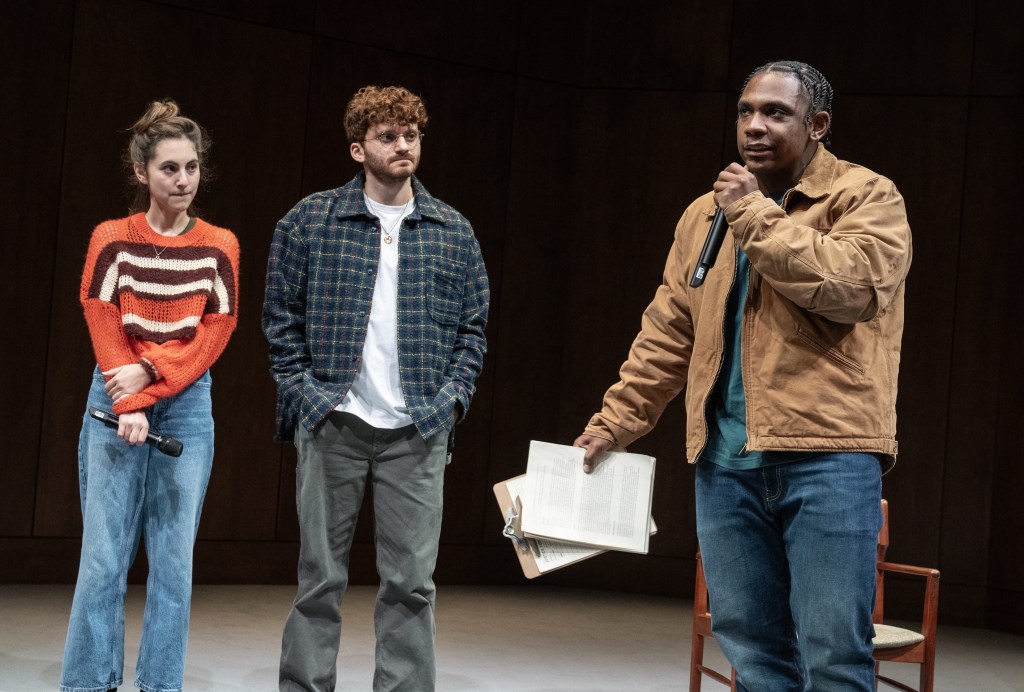
Asaf’s Korean-American wife Gwen (Joy Osmanski), has been hired to give a positive spin on land the University is developing that was formerly used for housing in a lower middle class, Black area. The land has been appropriated, though the University has assured that it will provide housing units to compensate for the dwellings that have been demolished. How the situation evolved, we discover later, is fraught with rumors about underhanded tactics the University used to create circumstances beneficial to University expansion, while dismissing the interests of the Black community.

The main conflict begins when Asaf’s former student Baron (Elijah Jones), who is Black, feels encouraged asking Asaf to sign a social justice manifesto that involves his cousin Deronte, who was killed by police unjustly for a theft Deronte didn’t commit. After agreeing to sign once he looks over the twenty-page manifesto, Asaf realizes that the documented is personally sensitive to him in what it demands.
First, it aligns the history of violence against Black Americans to the violence against oppressed Black and Brown people who have been colonized globally and suffer under inhuman conditions. Additionally, the manifesto targets a controversial subject for Asaf, an American, who doesn’t identify culturally with Israel, though he was born there. The manifesto demands that sanctions be placed on Israel for its nihilistic treatment of Palestinians, resulting in an apartheid state. In clear terms it pronounces that a “failure to do so will leave the United States complicit in the ongoing genocide of the Palestinian people.”
Though he is Jewish, essentially, Asaf is an atheist. But he thoughtfully considers what he is signing, and questions the words “apartheid” and “genocide” as extreme, unrelated positions, though he feels that Baron’s cause is just. Helping support Baron holds no contentions for him, initially. The apparent police brutality in killing Deronte is one more example of murderous racism and the blue wall of silence that fronts against such horrific injustice in a country with a long history of slavery and oppression of Black and Brown peoples.

Gwen tells Asaf’ that his signing the manifesto will undergird her position as a university administrator pushing for expansive development of university housing into the Black community. If he refuses to support Baron it will appear that he cannot align with fighting injustice and it most probably will add to the negative spin already brewing about the expansion project which the Black community is resisting.
It is after Asaf signs the manifesto that problems arise which disastrously make him the “man in the middle” among activist organizations with conflicting agendas which demand that he support and be an “ally” with their specific causes and positions. The situation embroils him deeper in conflict with his conscience and beliefs and forces him to deeply question allegiances he would forge with others on campus, impacting his reputation.
Two organizations confront him after he signs Baron’s manifesto. Jewish representative (Madeline Weinstein), and Palestinian representative (Michael Khalid Karadsheh), ask Asaf to support their bringing a controversial speaker to campus. They tell him that the speaker argues for a revisionist history of Israel’s foundational and follow-up wars. Contrary to the standard view that Israel was defending itself, the speaker posits that the wars were fought ferociously for one reason: “the likely outcome was more territory.”
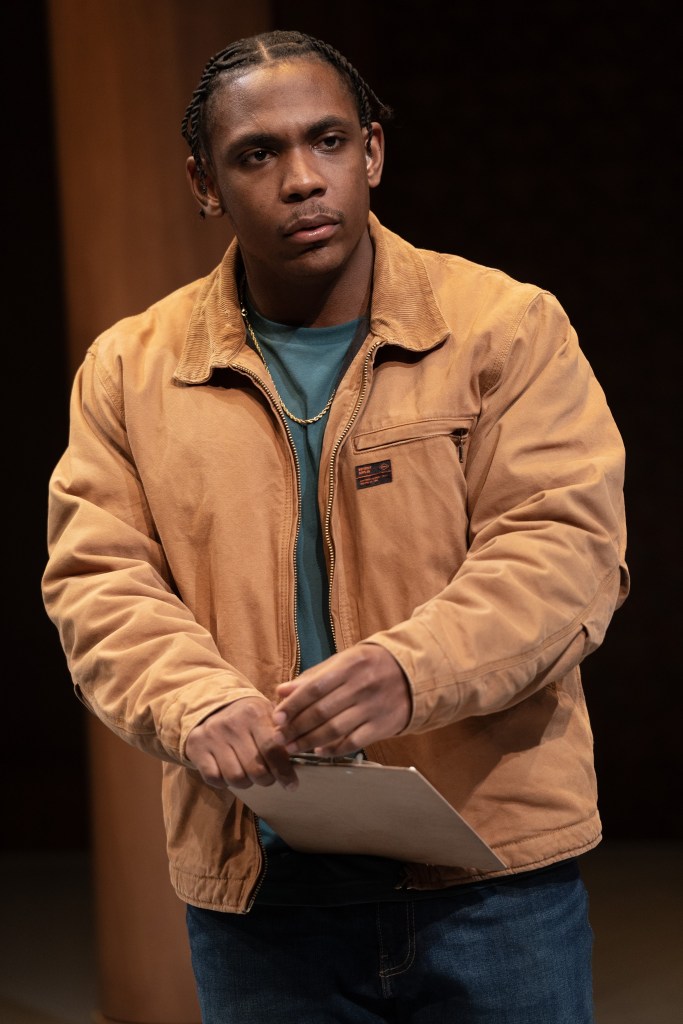
To his credit to give all opinions a place in civil discourse, Asaf discusses the nature of the support they want, but questions why they want this particular speaker. Additionally, with a follow-up which indicates that activist organizations are noting who is importuning Asaf, another oppositional individual shows up to challenge Asaf. Reuven Fisher (Ben Rosenfield), a religious Jewish graduate student attacks Asaf’s arguments and the others that we’ve previously heard. Fisher defends Israel ‘s position with the Palestinians.
Interspersed among those who have backed Asaf into a corner, Nakia Clark (Cherise Boothe), confronts him about his questioning the fact that Israel is the one expected to ameliorate its position and is always used as a “whipping boy,” when it is the only place historically where Jews can find safe on their home turf.
As we listen to their wrangling, we take into account that Nakia and Asaf have history together. Once a couple who dated, Nakia shepherded Asaf in community social justice, inspiring him to go with her on marches, and schooling him in protest as she strengthened her role as a Black community organizer. Now, years later, she challenges him once more to step up and not renege on his support of the manifesto which Nakia, herself, wrote.

Where is Asaf’s place in these arguments when the university community knows the stand he wished to take that he now equivocates about taking? Moses uses the character of Asaf as a canvas upon which to project all the viewpoints in the arguments about Israel, Palestine, Black discrimination and colonial oppression. The playwright proves knowledgeable and informative, especially in recounting the conflicts in the history of Israel starting from its inception in 1948 and its wars against the PLO and the complicated rise of Hamas which didn’t happen in a vacuum but was allowed by an extremist government to its own benefit, not necessarily to create equity and harmony with the Christians, Jews and Muslims who make Israel their home.
However, as has occurred since divisions created an untenable situation between Zionists, Palestinians, Muslims, Christians and Jews when Israel was formed in 1948 and worsened up to the present war in Gaza, there is only the horrific struggle. Moses indicates the lessons in why with his exploration of the reasons in The Ally. Thus, how can there be a positive resolution in this work? All is uncertain, with even more passionate feelings on all sides we’ve heard presented.
And of course, Asaf now has issues with each of the groups because of his lack of certainty; thus, his reputation has received a hit. Even Gwen is annoyed that his equivocation has bounced back to impact her project. Only more questions remain.

However, Moses and Neugebauer have pulled a rabbit out of a hat with this production which focuses the audience on the arguments which make them understandable and relatable, especially because the ensemble is just brilliant. Importantly, we have been shown the intricacies of intense debate which, if continued will eventually lead to the possibility of a positive resolution. Thus, we are left with the feeling that there must be an open dialogue during which responsible individuals listen to each other and again and again hash out some consensus, as impossible as that seems..
This is one to see because of its overall coherence, incredible performances and fine direction. Neugebauer stages the debate amongst the stakeholders, so we thrillingly follow every word. Could there have been edits? Perhaps. However, Moses has built solidly and any removal of the bricks in his structure will lessen the impact overall.
Kudos to the creative team who effect the director and playwright’s vision. These include Lael Jellinek (scenic design), Sarita Fellows (costume design) Reza Behjat (lighting design) Bray Poor (sound design).
The Ally runs 2 hours 35 minutes at the Public until March 24th. https://publictheater.org/productions/season/2324/the-ally/
‘Buena Vista Social Club™’ is Phenomenal, Theater Review

If you are a world music lover, you don’t need any introduction to the “Buena Vista Social Club,” a group of Cuban musicians that Cuban producer and musician Juan De Marcos González, brought together in a recording studio in Cuba to eventually release an album in 1997. González is to be credited for his passion to capture the striking beauty and spirit of traditional Afro-Cuban music of the Buena Vista Social Club, while some of the members were still alive and able to perform and record in 1996.
Surprising everyone, the Buena Vista Social Club musicians, who had been a hit in the 1950s and disappeared after the Cuban Revolution, created a smoking hot album in 1997 that won a Grammy in 1998. Subsequently, they were the subject of the documentary initiated by musician/songwriter Ry Cooder and filmed by Wim Wenders, that rocked the BVSC into the stratosphere of global fame by 2000, when the documentary was nominated for an Academy Award.
The Atlantic Theater Company’s musical, Buena Vista Social Club™ is based on the titular documentary with references to Buena Vista Social Club: Adios, a second documentary filmed in 2016. The superb musical, directed by Saheem Ali (Fat Ham), has as its creative consultant David Yazbek (The Band’s Visit). With book by Marco Ramirez and music by the Grammy Award winners known as the Buena Vista Social Club, the production currently runs with the ebullient magnificence of songs, brilliant tonal hues, dances and movements at the Linda Gross Theater with one intermission until 21st of January. The Buena Vista Social Club™ is a touch of paradise with Afro-Cuban rhythms and sonority that are unforgettable.

When you see it, and you must, you will not be able to sit still. The music fills you with its joyous power and heartfelt beauty. The production which extends beyond the crass label of “jukebox musicals” gives a reverential bow to the album, the documentaries and importantly, the magnificent musicians and singers who were vaulted to a success they had never known when they started out.
The production, loosely narrated by Juan De Marcos (Luis Vega), boasts a song list that is steeped in the incredible social club’s rhythms and cadences that spiritually manifest the history and diversity of the Cuban people. At the opening, De Marcos, who stands in Egrem Studios-the Old Havana music studio where musicians in the 1990s still record states, “A sound like this, it tends to travel.” His prophetic remarks reference how Buena Vista Social Club’s songs resonated and still resonate throughout the world today, even though most of the original members of the BVSC have passed. Only Omara Portuondo, the National treasure of Cuba, still sings and tours.
The key to opening the lock on the social club that dissolved with all the social clubs that Castro disbanded to end discrimination in Cuban society is Omara Portuondo. As the musical indicates, her notoriety and fame in Cuba allows her to serve as the bridge between the traditional musicians no longer heard and herself who is very much in the Cuban music scene in the 1990s and today.
Thus, the musical focuses on Omara and flashes back and forth from the past to the present in recounting her history with the BVSC, as well as introducing the members, and revealing how they were a part of the popular social club in a Cuba whose segregated clubs prevented various groups from singing and dancing together. The musical’s arc of development unspools as De Marcos attempts to interest Omara in making a recording of the musicians from long ago, who are still alive to keep the torch of Cuban folk music vibrating and lighting the way for musicians and fans of a younger generation.

Initially, when Vega’s, De Marcos approaches her, Omara (Natalie Venetia Belcon), is not interested because she doesn’t sing with a live band anymore. Her attitude is cold, aloof and proud, but later, we discover this hard shell fronts for deep pain underneath, concerning her alienation from her sister and niece because of the Revolution and the US embargo barring any exchange of visitors between the two countries. Recording the album would bring up tenuous memories. However, her dismissal of De Marcos on the surface appears to be because she is famous and he is an unknown, who intends to exploit her beloved renown for his own purposes.
Cleverly, De Marcos plays one of her old recordings with the BVSC. Only then, reflecting back to the past, does she relent and give her stipulations for the recording. First, she must be the voice that’s front and center, as De Marcos writes the arrangements. Second, she must be in control to select the singers and musicians. Thus begins the process, conveyed with humor and pathos, that Omara and De Marcos use to bring back the members of the BVSC, so that they are able to record together and reestablish the vitality, importance and universality of Afro-Cuban music, making them a global phenomenon.
The musical is an important tribute to revitalizing how the BVSC Afro-Cuban stars were incredible singers and musicians. It also intimates in the flashbacks and lovely balletic dances featuring the Young Omara (Kenya Browne), and her sister Haydee (Danaya Esperanza), the historical, social schemata of a diversely segregated Cuba, referencing its importance in the Slave Trade, the divisions between the rich and the poor, as well as Castro’s plan to bring equality to the country that backfired and instead created a hell and misery for the Cuban people. This was especially so after the revolution and the flight of wealthy Cubans and middle class off the island.

As is pointed out as a major theme, which indicates the segregation still is manifest concerning Cuba, the division became forever known as “the ones who stayed” and braved out the situation in their mother country, and the “ones who left” and went to various parts of the United States and elsewhere.
Crucially, Omara is an important symbol of transition and the voice and the bridge between the rich and the poor, the socially upscale strata of Cuban society, and the segregated, representing the traditional Cuba with which all Cubans can identify, if they put their prejudices away. Indeed, in this musical, the character of Omara magnifies the best of Cuban culture. She recalls the past and weds it to the present, in the tears and pain of the loss of family and her sister Haydee, who died before she was ever able to see her again. Because Omara was already famous, she was able to negotiate travel as she employed her talents on tour. This mobility was not possible for the other BVSC musicians who were not as famous, and lived under the oppression of segregation and poverty before and ironically, after, in Castro’s Cuba.
Obviously, the ones like Omara who had mobility or the thousands of others who left, had some money to establish themselves elsewhere, even though they lost their lands and businesses to Castro’s “communistic” usurpation. It is a wealth Castro didn’t share with the Cubans who stayed, reminiscent of Vladimir Putin’s behavior toward the Russian people in today’s Russia. Like a predominance of the Russian society, the Cubans who stayed were impoverished and the musical references that during the “Special Period” when the dissolved U.S.S.R. split up, there was no longer any “communistic” aid to Cuba. Thus, the people starved.
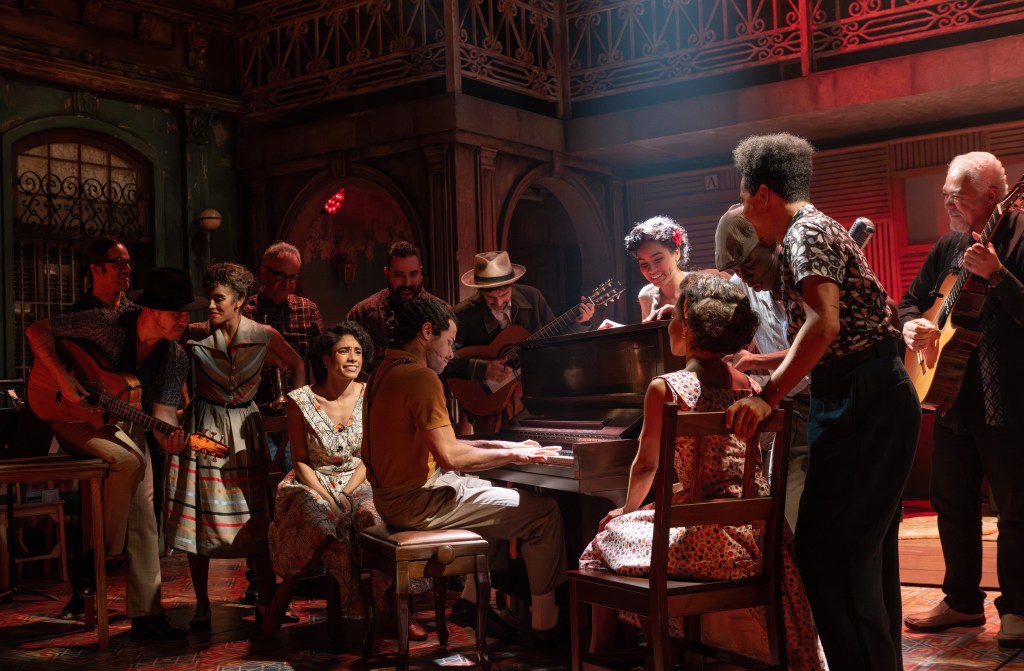
The hope of recording an album with BVSC members was to earn a bit of money, as many of the musicians and singers we meet and learn about in their relationships to Omara and the club were barely scraping by from day to day. During the production we meet the incredible individuals who Omara was close to and sang with in the 1950s when they were young and in 1996 during the recording. These include the charming, funny Compay (Julio Monge), the sweet, loving Ibrahim (Mel Seme), the wonderful pianist Ruben (Jaindardo Batista Sterling) and Eliades (Renesito Avich).
The seminal moments of the production however, meld the present to the past, revealing how Omara connected with each of the BVSC members in the flashbacks with the Young Omara and the Young Haydee. The musicians/singers include the Young Compay (Jared Machado), the Young Ibrahim (Olly Sholotan), and the Young Ruben (Leonardo Reyna).
The balletic sequences with dancers portraying the Young Omara and Young Haydee, choreographed by Patricia Delgado and Justin Peck, developed and directed by Saheem Ali. These sequences seamlessly and stylistically reveal the differences in opinions between the sisters, regarding the BVSC which Haydee feels is beneath her. Also revealed in these flashback dance sequences, is Omara’s sadness in losing her sister and family forever because of the Revolution and US Embargo. As Belcon’s Omara sings of her feelings, the poignance of her expressiveness resonates with all Cubans and punctuates the cruel punishment visited upon the people by both governments, revealing the malevolence of political machinations. However, it is in the power of the songs that the Cuban people thrive and with dignity transcend the brutality.
The BVSC playlist is sung in the native tongue of the BVSC, and on one level doesn’t need translation because the music “speaks” for itself. However, the musical’s closed captions in Spanish, should also have had an English counterpart. In English, the lyrics can relate the historical culture of the Cuban people which is referenced throughout in the English dialogue and storyline. English closed caption lyrics, as well as Spanish, would convey the complete picture of the BVSC and its tremendous importance socially, politically (their democratic diversity should not be diminished), and spiritually.
The BVSC’s immutable human values conveyed in their incredibly poignant rhythms and music is what resonates and draws in fans globally in an egalitarian message that makes sense and that most human beings yearn for. Politics and the power hungry divide to conquer. The music of the people soars, uplifts, transcends hardship and unifies. This production’s value is priceless and the ensemble of musicians and singers are fabulous in memorializing the Buena Vista Social Club for all time.
The creative team brings the director’s vision together in a beautifully stylized way that breathes life into the real musicians and singers who made up the BVSC (1950s, 1996). These creatives include Arnulfo Maldonado (sets), Dede Ayite (costumes), Tyler Micoleau (lighting), Jonathan Deans (sound), J. Jared Janas (hair, wigs & makeup), Dean Sharenow (music supervisor), Marco Paguia (music director, orchestrations & arrangements), Javier Diaz, David Oquendo (additional arrangements), the swings and band.
The company of Buena Vista Social Club™, Atlantic Theater Company, 20th Street between 8th and 9th. https://atlantictheater.org/production/buena-vista-social-club/
‘Support for Artists: The Bret Adams and Paul Reisch Foundation Grants’

Bret Adams and Paul Reisch Foundation (courtesy of their website)
Each day the COVID 19 pandemic takes another swipe at the New York theater community as notifications of deaths (playwright Terrance McNally, actor Mark Blum, former Drama Desk President William Wolf) darkly bloom. Theaters will remain closed for the end of the month and most probably into the summer, if state and federal projections are to be believed. Thus, we wait and create and pray supporting each other with phone calls, emails, social media posts virtual presentations, meetings and parties on Zoom.
Show business folks have always helped one another. Currently, Brad Paisley, John Bon Jovi, Dolly Parton and other celebrities have stepped up donations. And beautiful financial flowers are burgeoning from GoFundMe campaigns springing up to support artists. Along with smaller operations, tried and true foundations like the Actor’s Fund and Broadway Cares/ Equity Fights AIDS, Dramatists Guild, League of Professional Theatre Women and New York Women in Film and Television to name a few are available with support for their members and freelance artists.
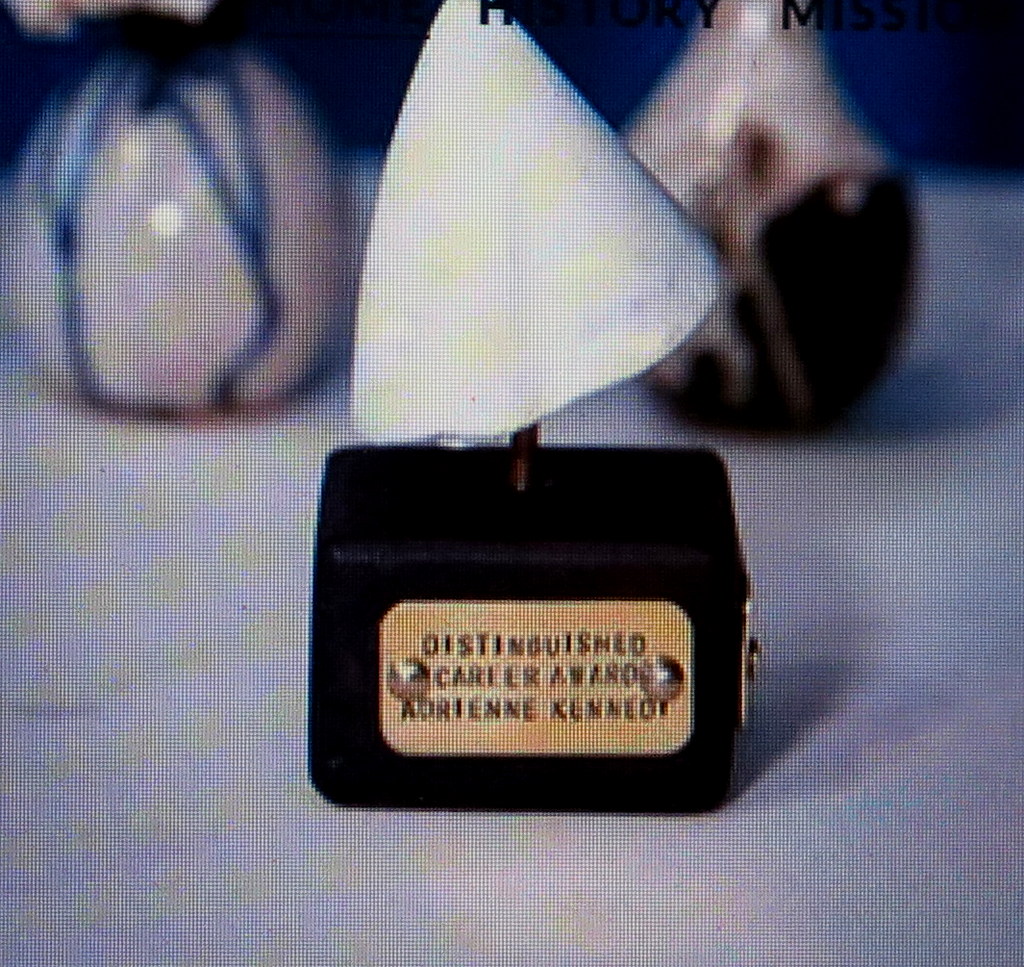
Tooth of Time Award: Honoring accomplished playwrights who have created significant, idea-driven works throughout their career, Bret Adams and Paul Reisch Foundation (courtesy of their website)
Freelancers are especially hard hit. They do not number amongst the 6.5 million who have filed for unemployment insurance (the number was posted on the news this morning). Not having a regular paycheck but living gig to gig, they are the invisible casualties of this war against a deadly molecule that strikes through those who are asymptomatic and “healthy,” but who are carriers of the spread. Clearly, more needs to be done by those of means who love theater and are devastated that COVID 19 has slammed into New York.
On that note The Bret Adams and Paul Reisch Foundation has decided to create an uplifting way to distribute the funds for their 2020 Idea Award for Theatre. This spring, the foundation will offer up to 40 emergency grants of $2,500 each to playwrights, composers, lyricists and librettists who have had a full professional production cancelled, closed, or indefinitely postponed due to the COVID-19 closures. A total of $100,000 will be distributed to theater writers.

Bret Adams and Paul Reisch Foundation, The Vivace Award: Recognizing musical theatre artists with emerging talent and original work with ambitious ideas (courtesy of the Bret Adams and Paul Reisch Foundation)
Eligible playwrights, composers, lyricists, or librettists should apply at this link. Writers who have had a professional production canceled may submit their name and proof of a professional show’s closure. (“Professional,” in this case, is defined as LORT, Off Broadway, or Broadway). Each artist can submit only once. If there are more than 40 applicants, the Foundation will award grants by lottery, allowing them to give out the greatest amount of money directly into the pockets of the artists who have been most affected.
The submission deadline is April 14. The Foundation hopes to make funds available to artists as quickly as possible to forge a path to provide a bit of hope and relief and especially to guide others to do the same for artists in this unprecedented time.
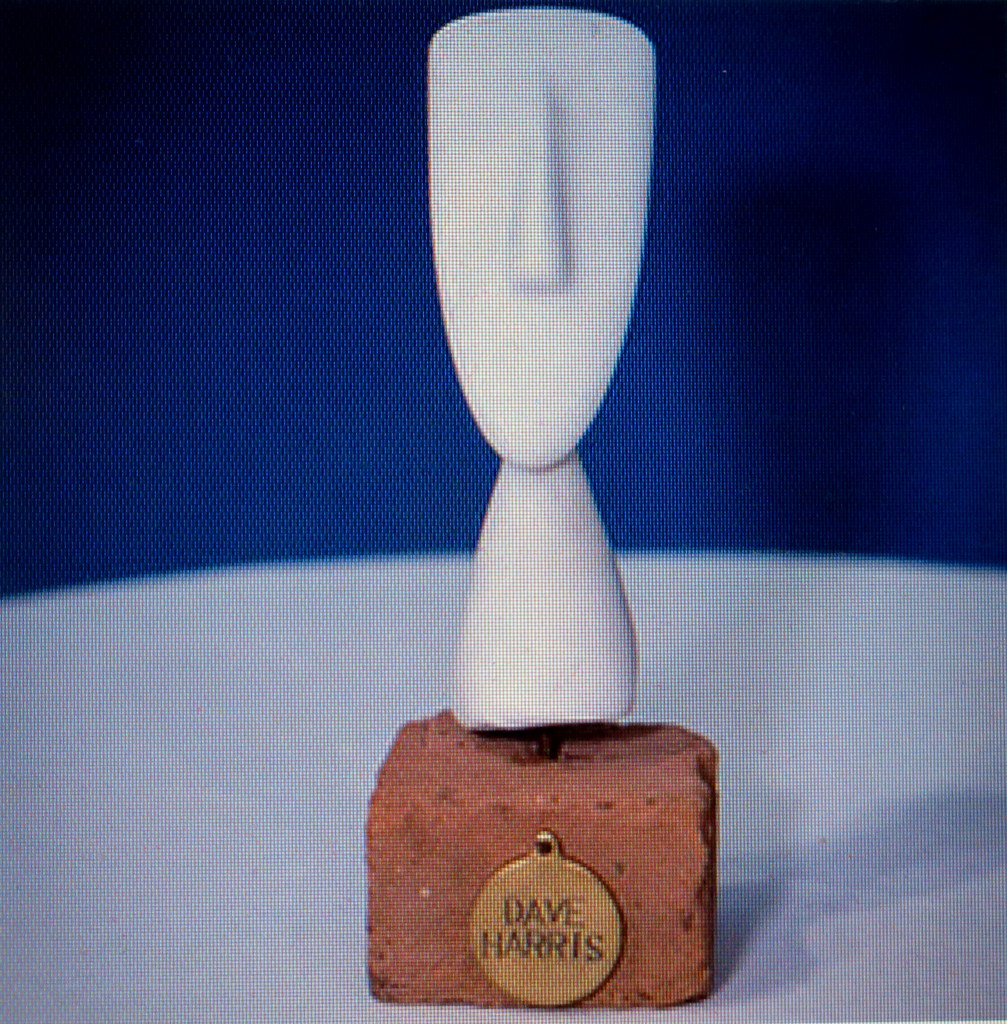
The Ollie Award: Recognizing playwrights with emerging talent and original work with ambitious theatrical ideas, The Bret Adams and Paul Reish Foundation (courtesy of the website)
The Bret Adams & Paul Reisch Foundation is a charitable foundation. Its mission is to give money to writers to write plays with ‘big ideas.’ This year, their ‘big idea’ is to help those “who have had productions cancelled,” said Bruce Ostler, V.P. and Board Member of The Bret Adams and Paul Reisch Foundation.
Ostler’s point is well taken and unfortunately, true when he affirms, “The economic model of theatre in the 21st century works much like it did in the 16th century, in that a playwright receives a percentage of the box office sales; without an audience, the box office receipts and royalty to playwrights dry up. In no uncertain terms, the business of theatre today has ground to a shocking halt due to the pandemic. Playwrights are not salaried workers and therefore are NOT eligible for unemployment for a cancelled production. That is the harsh reality of theatre today.”
Theatrical Agent Bret Adams and his partner Dr. Paul Reisch loved the theatre with great passion. As an agent, Bret shepherded the careers of many actors, writers and directors and designers, including Phylicia Rashad, Judy Kaye, Ruby Dee, Ossie Davis, Sherman Helmsley, Anna Maria Alberghetti, Eve Arden, Christine Ebersole, Kathleen Marshall, Jayne Wyman, Andre DeShields, Kathy Bates, and more.
After Bret and Paul’s passing, in 2006 and 2015, their foundation was created at their bequest. The Bret Adams and Paul Reisch Foundation champions visionary playwrights and embraces diversity in all its forms. It especially encourages fresh perspectives – particularly those from underrepresented backgrounds – to create idea-driven new plays and musicals. These may include a variety of themes, i.e. science, history, politics and sexual orientation. For more information, visit www.BretnPaulFoundation.org.
 CAROLE DI TOSTI