Blog Archives
Jean-Michel Basquiat Celebrated, ‘In Honor of Jean-Michel Basquiat’
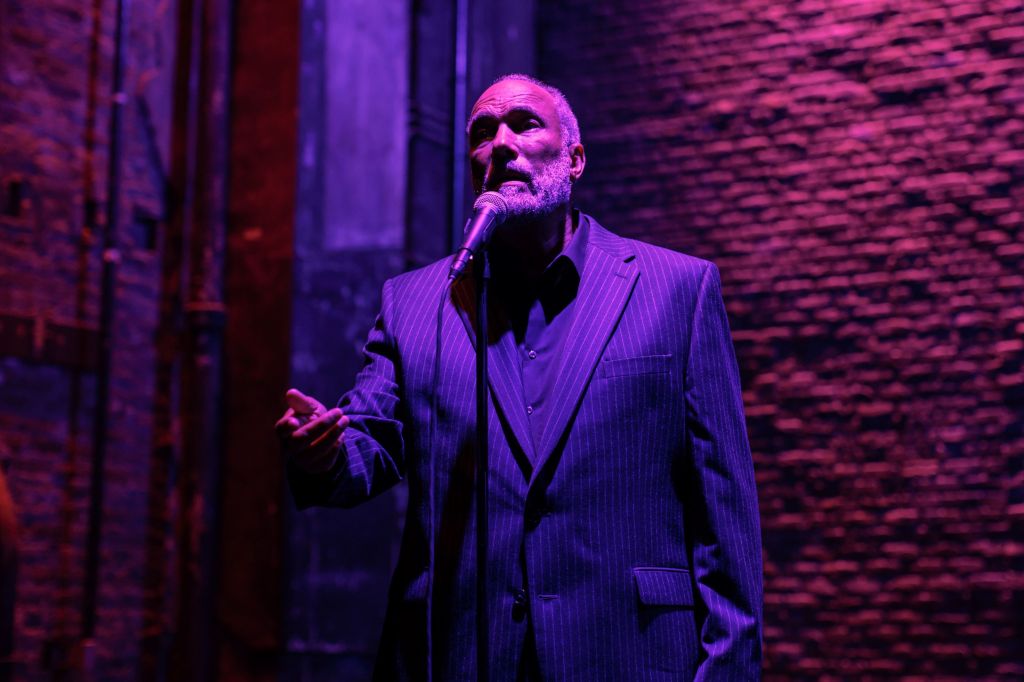
Who better to memorialize the artistic genius Jean-Michel Basquiat than a friend and a fellow creative Black performer who hung around with him in Venice, California? In his mesmerizing one man show at New York Theatre Workshop, Roger Guenveur-Smith cobbles together a thematically, ordered, series of stylized vignettes and images of his encounters, impressions and insights against the quixotic philosophical street wisdom of Basquiat. Importantly, Guenveur-Smith quietly illuminates Basquiat as a maverick and icon in the pantheon of Black artists/musicians running up against the annihilating, pathological, racist dynamic of white American culture. This is a necessary reckoning if we consider the current sociopolitical climate and thus, a must-see show.
The Obie Award-winning actor, playwright and director’s solo presentation follows his acclaimed sold-out run during Under the Radar Festival earlier in the year. As a testament to Guenveur-Smith’s profound, personal work about Basquiat and his legacy, the production has once more connected with audiences whose enthusiasm prompted its extension until October 10, 2026.
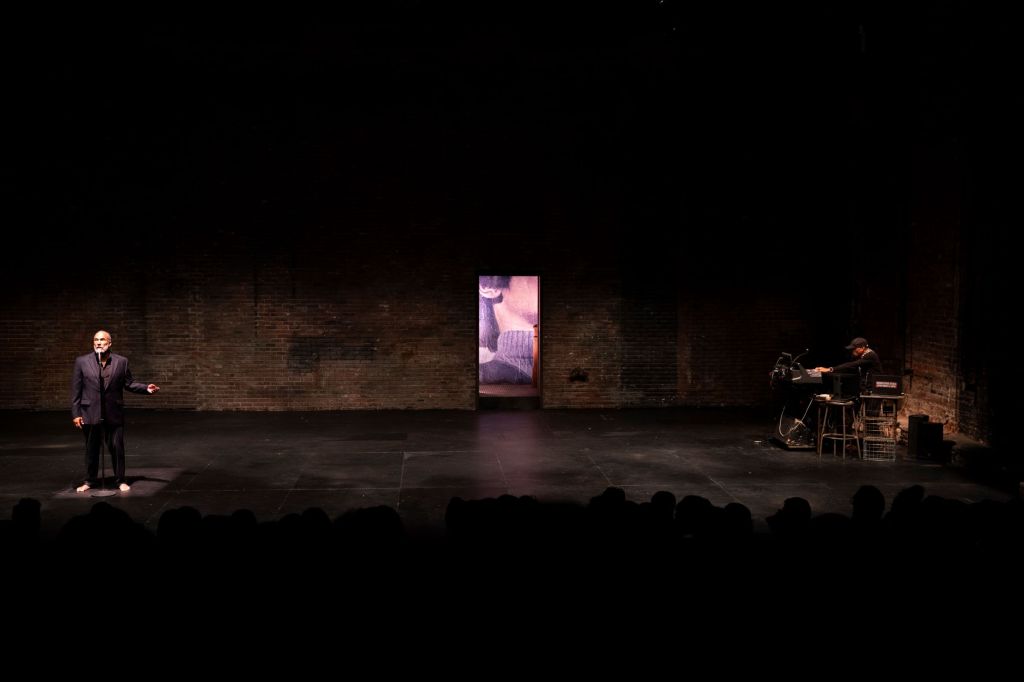
Accompanied with superb live sound design by Marc Anthony Thompson, and Ario Sanders’ atmospheric, symbolic lighting design, the 1 hour show zips by leaving one wishing for more. Standing barefoot in a natty suit, on a bare stage against the backstage wall a doorway reveals an intriguingly beautiful, mysterious space behind the performer.
At the mic Guenveur-Smith infuses his poetic delivery with an accompanying choreography of subtle movements. At times his subject possesses him and Basquiat’s presence feels palpable. The audience becomes fully immersed in the colors of sound and words melding in nuanced rhymes and rhythms. The immersion is a subtle plunge.
Gradually, the solo performer draws in the audience after he expresses the wisdom and encouragement his father gave him when he launched his own career as an actor. The father humorously reminds his son of the “challenges” (understatement) of Black identity. “You think you’re so goddamn clever/ You know if Van Gogh was Negro/He would have cut off more than his ear.” Also, his dad infers the commercial world’s exploitation. “Hell that boy didn’t live long enough/To see his shit really sell.” In an auction vignette Guenveur-Smith ironically conducts the auction for Basquiat’s “Untitled” which sold for $110.5 million dollars.
And, the father chides son Roger, “You go ahead, be an actor/But you’ll never act yourself out of this coffin called the US of A.” Finally, with love he uplifts him. “Be the best actor you can possibly be/And before it’s all over son, why don’t you act something out for your friend Jean-Michel and for me.”
Unlike Van Gogh, Basquiat did see his success translate into wads of money which he preferred as cash. Unfortunately, it sped him more quickly to his death which Guenveur-Smith narrowly pinpoints then moves on to more lyricism. The money afforded Basquiat greater access to heroin and an overdose at an age Basquiat uncannily predicted on canvas when he was twenty-one-years old.
Guenveur Smith’s lyrical account is a vibrant vision of the man whose candle lit up the skies then was extinguished by his own hands in 1988 when Basquiat was twenty-seven. Initially, the two met at an L.A. dance hall in 1982. Guenveur Smith, rapping under the name “Hollywatts” (Hollywood and Watts), hooked up with Basquiat at his career’s first blossoming.
Rather than examine the artist’s place in Neo-expressionism or define him as an appendage of Andy Warhol, Guenveur-Smith uniquely personalizes his friend with compelling metaphoric images that stick in one’s mind. For example when he and Baquiat met, he thought he was just “a cool kid with an electronic hairdo.” He didn’t know Basquiat was “incognegro numero uno writing acrylic poems and philosophy on concrete walls and canvas and refrigerator doors.” Together they see Martin Scorsese’s King of Comedy walking in late to the balcony moving in front of the projectionist. “His dreads are projected in silhouette onto the screen, obscuring Robert DeNiro and Jerry Lewis/The crowd is very confused then very amused/The King of Comedy crowned.”
Additionally, Guenveur-Smith punches up events and people in ironic synchronicity with Basquiat’s life. In 1960, the only survivor of a plane crash, a young “white boy burned black,” having fallen from the plane remarks that the city “looked like a magic fairyland.” Then he dies in the same Brooklyn hospital where three days after Basquiat is born. Hit by a car, Basquiat, a child, loses his spleen the same year Andy Warhol, shot by radical feminist Valarie Solanas, loses his. Basquiat’s father comes to Brooklyn in 1955, the same year Emmett Till was savagely murdered, the same year the Brooklyn Dodgers won the World Series on the backs of Jackie Robinson, Don Newcombe and Roy Campanella.
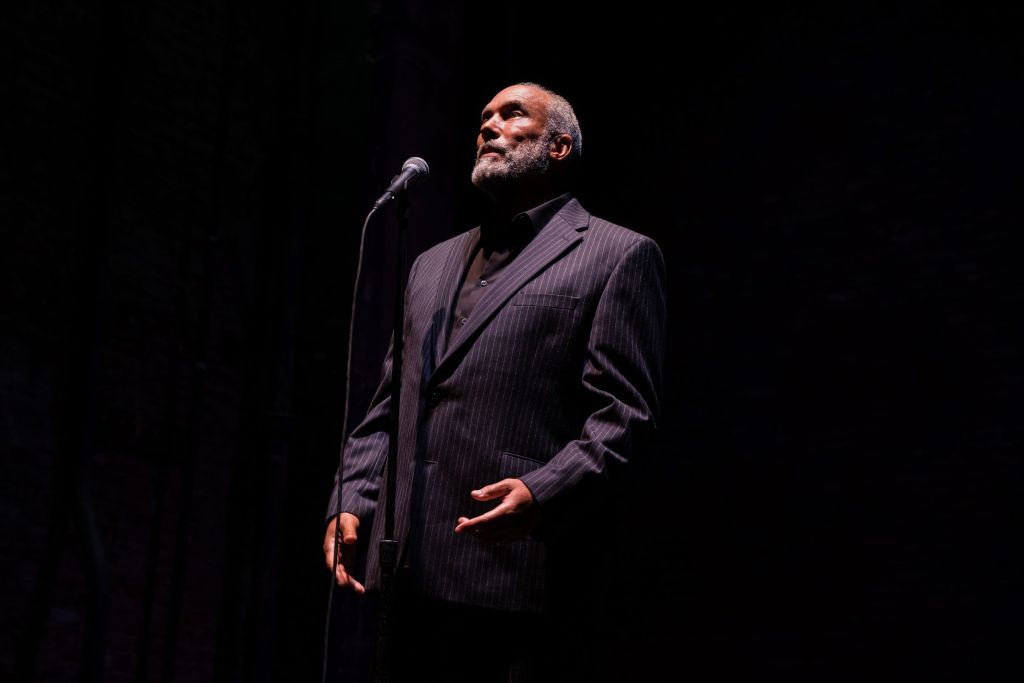
The synced parallels continue throughout as touchstones centering Basquiat in time and out of time in this memorial. A history of Black musicians, singers, some of whom they listened to as Hollywatts rapped and Basquiat threw down on whatever medium he liked are referenced. These honorable mentions include everyone from Charlie Parker, Charles Mingus, Lady Day, Louis Armstrong, Nat King Cole, John Coltrane and many more. Guenveur-Smith makes sure to indicate that the best of them took a stint in mental institutions or rehab centers. It’s part of the landscape of white American culture’s deadliness Guenveu-Smith’s father referred to earlier.
As Guenveur-Smith threads together stories of Black artists and activists, he intersects them with Basquiat. Basquiat’s father said he “Never needed a mic to politicize or a machete, but still he was a soldier.” This is especially so in Basquiat’s work Defacement (The Death of Michael Stewart). Guenveur-Smith starkly describes the murder of Michael Stewart by MTA police with searing detail. It’s a lynching that brought no accountability to the officers. Recognizing that Stewart, the graffiti artist and model, could “have been him,” Basquiat gives homage to Michael Stewart in his acrylic marker on wood painting. After Guenveur-Smith’s jarring description, he revisits memories that inspired his own character “Smiley” in Spike Lee’s film Do the Right Thing.
Guenveur-Smith concludes his en memoriam as it should in a celebration of Basquiat’s legacy forever tied with a nation that looks to his astonishing work sometimes with apprehension but mostly with pure joy.
In Honor of Jean-Michel Basquiat runs one hour with no intermission at New York Theatre Workshop. https://www.nytw.org/show/basquiat/?gad_source=1&gad_campaignid=24057584595

