‘Degenerates’ Incels in Raging Feedback Loops, Funny, Devastating
In order to exist in space and time online, incels (involuntary celibates) of emotional necessity, create their own philosophical concepts of society’s matrix which they believe rejects them. Thus, they construct an online subculture with its own language and rules for belonging, as a manosphere haven in which they live and have their being.
In Degenerates, playwright Else Went (Initiative) investigates the question whether love can blossom among individuals who practice hate, chronic fury and isolation as a cocoon against pain. Because they trap themselves in their own nihilistic, monstrous incel-speak-world, can they ever break out of their masochistic dependence on self-flagellation? Degenerates, which investigates these questions, enjoys its final extension running at Playwrights Horizons through November 8, 2026.
Directed by partner Emma Rose Went (Initiative), the play reveals four dynamic characters who meet in a communication collective on Discord. Went lets them loose to find their way out of loneliness and the dark abyss of rage and self-loathing. With laughter and heartbreak we watch her sociological profile of incels, made authentic by the incredible actors Zachary Desmond (Miller), Christopher Dylan White (Target) and Tyler Nowell Felix (Kemp).
Additionally, Went makes us feel at home with these “strongmen” by cleverly incorporating incel “red pill/black pill” terminology. As a result, we note how their language substantiates its own power dynamic and makes incels visible to themselves. Thus, we can understand and empathize, even if we recoil from their one-note repetitions and stereotypical, bigoted perspectives that project their self-loathing onto people of all genders and races. Because these projected images rebound and loop back on the self-defined, misogynistic fabricators like Kemp, Miller and Target, an end result of the isolation, loneliness and desolation invariably settles on acts of self-harm or violence.

Appropriately, the Wents begin Degenerates on a darkened stage between life and death, with two disembodied voices conversing. Indeed, the symbolic opening seems emblematic of this tragic subculture of men who accept that as bottom feeding losers, no creature on the planet wants them or finds them lovable.
In the oblique void we listen (they speak in voice-over) as Felix’s Kemp talks to a hotline counselor (Olivia Rose Barresi also plays “the Stacy”) whom he questions might be an AI robot. We follow the tension as the counselor attempts to knock down Kemp’s belief that no one cares about him. The circumstance is dire; he told her he intends to blow his brains out with the gun on the desk in front of him. Clearly, beyond miserable with his self-created identity, Kemp believes he won’t ever have a sexual or romantic relationship. Sadly, he’s conflated ending this fabrication with ending himself.
In a sharp development and segue, the playwright reveals that Kemp, not living in a vacuum, has been brought to this stage in his life through the help of “friendly,” fellow incels on Discord, who insult him and encourage him to take his own life. Thus, as the lights rise, we meet the key players Miller and Target, and we continue to hear Kemp in voice-over with Serge (Juan Arturo) trying to confront his feelings of uselessness.
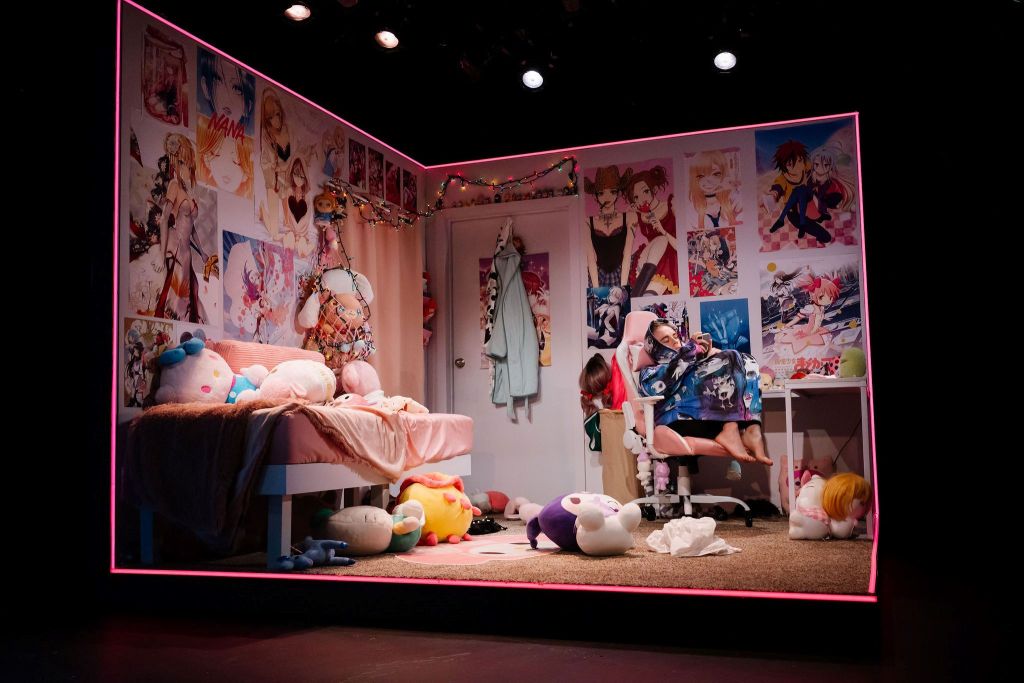
Went and set designer Mikiko Suzuki MacAdams divide the stage showing the particular habitats Miller and Target create to express themselves. Desmond’s Miller lives in the cramped, basement, studio apartment of his mother’s house. Leading the chat, the self-appointed guru presents his brand of the solipsistic, superior, manosphere of hate and condemnation (of others). Older than the others, Miller spouts statistics of questionable research to substantiate his particularly shallow, angry assertions, i.e. about Chads and Stacys (the gorgeous ones who easily find sexual partners). With his own political agenda that gradually forms by the play’s conclusion, Miller grows his Discord chat to help other isolates and fulfill his mission of forming a solid community of potential influencers. His didactic tone and readiness to categorize/insult others suggests he finds pleasure belittling both Kemp and Target at various points during their interactions. Additionally, he seems to enjoy compelling them to accept their own uselessness and unpleasantness.

As an interesting counter to Miller, White’s Target is quieter, softer. Estranged from his family, the teenager has chosen isolation, unlike the reluctant, defeated Kemp. Working as a cam boy, he rarely leaves the house, and indulges his passion for anime. Set designer Mikiko Suzuki MacAdams reveals Target’s potentially loving, caring personality in the design of Target’s room. Filled with anime, stuffed plushies and anime posters on the walls, lit by a string of colored lights and pink neon lighting (Jiyoun Chang), Target bathes his room in a magical atmospheric comfort.
We never meet the fourth member, Serge (Juan Arturo) in his physical presence as we do the others. Arturo’s Serge in voice over reveals his superiority having an ex and a child. Even if one chooses voluntary celibacy, as Serge has, that doesn’t qualify him as a bone fide incel for Miller’s group. Thus, Miller disappears Serge. His hypocritical power dynamic reeks of the irony, “do unto them as they do unto us.” Because people of the despised matrix disappear incels as invisibles, Miller does this to Serge.
Indeed, Miller, Kemp or Target most probably have never been with women or men and feel uncomfortable around the sexually experienced. Went never explores the how and why of this absence of sexuality and romance. Though she includes a few stories of high school rejection that they weaponize against themselves, she keeps their backstories vague. In the meat of the play which concerns face to face encounters between Target and Miller, then Target and Kemp, Went provides more of the how and why.
In the most dynamic scenes of the long play, the incels meet up with each other live. Target lures Miller to come out of his hole and join him in his magical anime room. Likewise, almost as an accident, Kemp decides to take fate in his own hands and goes to a cafe where he bumps into Target (a contrived scene which the actors spin beautifully as coincidental). Having his hopes on transitioning, Target dresses stylishly as a woman. For Kemp just making contact satisfies. Happy and hopeful, he doesn’t care about Target’s sexual identity.
On the other hand, Miller’s inherent bigotry and manosphere ego does care as they become intimate. Though Miller enjoys himself with the sexually generous Target, he becomes violent against him because of the pleasure. Reminiscent of a certain political party, with an agenda, Miller repudiates his encounter with the loving Target. In an ensuing argument among the truthful Target, the happy Kemp and the furious, raging Miller we realize the extent to which the manosphere’s toxic, brutal masculinity covers over fears of gay sexual identity. Went nails down these characters so we recognize them down to their politics. .
Not surprisingly, in the last scene of the play, Miller presents himself in a suit in formal, incel glory as he addresses a community of incels. Miller reminds us of some of the podcasters who have influenced men to embrace insults and cruelty for cruelty’s sake. Degenerates reveals the core of our propagandized society, its divisions and the sub rosa undercurrents formed to keep the hate flowing between and among genders. The superb ensemble brings this home to today’s headlines and gives us pause.
Degenerates runs in its final extension through November 8, 2026 2 hours 50 minutes with one intermission at Playwrights Horizons playwrightshorizons.org.

Posted on October 30, 2026, in Off Broadway and tagged Christopher Dylan White, Degenerates, Else Went, Emma Rose Went, Juan Arturo, Tyler Nowell Felix, Zachary Desmond. Bookmark the permalink. Leave a comment.


Leave a comment
Comments 0