Author Archives: caroleditosti
‘All My Sons,’ Exceptional Performances Infuse Miller’s Play With Grist and Power

Tracy Letts, Annette Bening in Arthur Miller’s ‘All My Sons,’ directed by Jack O’Brien (Joan Marcus)
Roundabout Theatre Company’s revival of Arthur Miller’s All My Sons speaks with resounding energy about our current time in its themes and characterizations despite its setting 72-years-ago in an America that no longer exists. Directed with acute insight and sensitivity, Jack O’Brien opens the play with the shock of a lightening crash as sounds of thunder dissolve into the droning thrum of a plane. Projected on the curtain we see the visual of a doomed plane speeding toward its demise.
Later, we discover the symbolism. During the fierce storm which destroys a memorial tree in the backyard, Kate Keller (the fabulous Annette Bening) wakes with a nightmare about her son, Larry, a WWII pilot who is MIA. O’Brien adroitly realizes Kate’s nightmare and the storm which destroys Larry’s memorial to foreshadow the coming turmoil in the next day and a half that changes the lives of the Keller family forever.
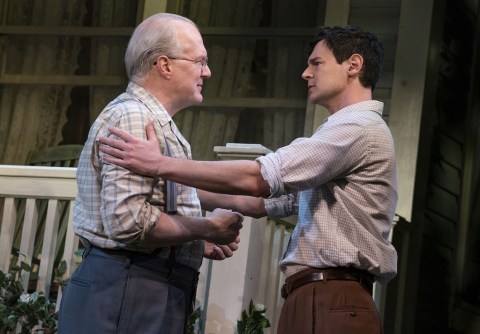
Tracy Letts, Benjamin Walker in Arthur Miller’s ‘All My Sons,’ directed by Jack O’Brien (Joan Marcus)
This auspicious beginning, however, is quelled by the sunny atmosphere of August in the gorgeous, bucolic, serenity of an upper middle class neighborhood where Joe Keller (the superb Tracy Letts), Kate and son Chris (an emotional, authentic portrayal by Benjamin Walker) reside in peace and plenty. The exquisite set by Douglas W. Schmidt invites with its blooming, well-trimmed wisteria vines regaling a square gazebo and homely, comfortable patio with companionable chairs. There, we imagine that pleasant and lively conversations have taken place over the years. Miller never takes us inside to reveal the intimacies of family interactions, a vital clue to this family. They cannot be intimate with each other for fear of cracking the image they present to each other and themselves.
All the play’s action is “out in the open,” “in plain sight,” an irony filled with contradictions. This living “in the public eye” belies the truth that threads throughout the play in one of Miller’s searing themes. In one form of another, the human condition is to live in lies and rationalizations that mask painful truths. The best of us attempt to confront and work through these to get to the core and evolve to “be better” as Chris suggests. Nevertheless, it is easier for us to keep our miserable truths hidden in the shadows while we live in hypocrisy.
It is this hypocrisy that eats away at the soul and mind in a terrible corruption that eventually destroys. An extension of this theme of the individuals is the theme of a society which lives in hypocrisy in a culture founded on lies. The end result is the rot blooms, the lies abide and the culture no longer distinguishes the difference between facts and obfuscations. The cultural dissolution that occur is not even recognizable to the national body politic.

Tracy Letts, Annette Bening in Arthur Miller’s ‘All My Sons,’ directed by Jack O’Brien (Joan Marcus)
Clearly, Miller reveals this is so for his protagonist Joe Keller and the neighborhood and society which enables Joe to maintain his untenable soul condition. In the backstory, Keller was found guilty of negligence in manufacturing defective aircraft parts that ended up bringing 21 pilots to their deaths. Joe and partner/neighbor Steve Deever, end up serving prison time. Joe appeals and is exonerated, foisting off the blame on Steve who is held accountable for the defective engines being sent out. Steve loses everything including his house and the love of his children who move away as he serves out his prison sentence.
When Joe returns home to neighborhood whispers of “murderer,” he holds his head high, fronts with his new business manufacturing household appliances, makes a ton of money and re-engages the friendship of his neighbors. In a few years he re-establishes the honor and integrity he once held through hard work and a well-meaning, generous, jovial public image. He does all of this for the benefit of his family, and especially for his son Chris who made it out of WWII alive and who will inherit the business.
As the details of the past are revealed, in subsequent acts we gradually understand the family dynamic. Stalwart and unshakable are Kate’s and Chris’ support of Joe during the trial and after feeding into the presumptions that he is a vindicated man with a restored public image. We also note the full blown love relationship Chris has with Steve’s daughter, Larry’s girlfriend, Ann Deever (Francesca Carpanini). Ann moved away after the trial, but writes to Chris and they pledge their love.. She comes to visit Chris, Kate and Joe to solidify their marriage plans with Joe and Kate from whom they’ve kept their love secret. Chris and Ann fear Kate will strongly oppose their marriage because “Larry is alive” and Ann must lovingly wait for him.
As the sunlight shines on Joe and his neighbor Dr. Jim Bayliss (Michael Hayden) and they chat about Ann’s visit, we have no sense of any underlying difficulties. O’Brien’s and the actors’ skill abides in the gradual unraveling of the characters’ consciousness, as each attempts to maintain the intricate bulwark of falsehoods that have carried them through three years of Larry’s absence and Joe’s exoneration, both chimaeras.

Hampton Fluker (foreground) Benjamin Walker, Francesca Carpanini in Arthur Miller’s ‘All My Sons,’ directed by Jack O’Brien (Joan Marcus
Lies are central to this family’s “wholeness” and “health,” as lies are central to America’s dominant “greatness” after the war. In secret, unbeknownst to us until the conclusion, each suppresses their guilt and fear rather than to confront the painful truth head on and bring it out “in the open” to heal. Kate and Joe are stuck in time, mired in the past. Joe recognizes Kate’s insistence that Larry’s “being alive” is a “fantasy.” But he goes along with it to comfort her and himself and avoid any discussion about the possible alternatives.
Likewise, Chris attempts to forge ahead but is locked in his own fears about his brother. It is no small irony that he chooses his brother’s girlfriend to wive and force the issue of Larry’s MIA by bringing her home to mom. Indeed, it is as if he is keeping Larry’s ghost hovering. Ann is the last person his mother will accept as his bride as long as “Larry is alive.” Chris, like his parents, is conflicted and lives with the guilt of his brother’s ghostly presence.
Each of the family members has created justifications; the more the truth threatens, the more elaborate the excuses. Ultimately, these reside in “I did it for you”-Joe, Kate or blaming others, “you made me”-Ann, Chris. Unable to work through the traumas to heal, they tiptoe around each other, wearing masks of goodness, righteousness and faith. The only one who believes these images is themselves.
The neighborhood encourages the family in their fantasies, as the larger society encourages ideologies about America’s goodness. However, as the play progresses, the Bayliss’s (Michael Hayden, Jenni Barber) candidly reveal everyone in the town believes Joe is guilty and Larry was killed by a defective engine. (the truth that Ann brings in a letter is worse).
Eventually, the truth is revealed when George Deever comes to confront them about Joe’s guilt, and Ann reads a letter revealing where Larry is. As George, Hampton Fluker’s, sorrow and yearning to be in the past with the family’s illusions before the hellish incident of negligence happened is beautifully graded and nuanced with poignance. Fluker’s emotional range from judgmental anger, love for the family to, indictment of their duplicity is beautifully developed.
Francesca Carpanini’s Ann approaches this visit with the Kellers as a developing revelation of her “love” for Chris which is founded in loneliness. Carpanini’s emotional range also solidifies her portrayal of Ann’s self-interest and wish to rid Kate of her illusions forever to extricate Chris from Kate’s hold over him. Her performance as the foil and enemy to the family is well rendered.
When Carpanini’s Ann reads the letter, it is a fascinating mixture of emotions. On the one hand she attempts to “help” by revealing the truth, a devastation that will most probably destroy Kate’s well being, but she does it anyway. When it backfires and Chris, Kate and Joe react counter to what she anticipates, she backpedals in an apologetic excuse blaming the family for “forcing her.” She is desperate to recapture Chris, but it’s too late. It is then she understands the length to which the family has unified against the truth which she selfishly used to move things her way.

(L to R): Benjamin Walker, Tracy Letts, Annette Bening, Hampton Fluker, in ‘All My Sons,’ directed by Jack O’Brien (Joan Marcus)
Up to the point of domino revelations at the conclusion, Annette Bening’s portrayal as Kate Keller is a masterpiece of shifting emotions. She is like a tiger who must keep the family together at all costs and will use her cunning against anyone (like Ann or George) who threatens their circle. Thus, as Kate, Bening makes the reality that Larry is alive amazingly palpable. She is the mortar that holds the bricks Chris and Joe fashion into a wall to close themselves off against the truth. The structure is a protection to keep them from looking within to their self-hatreds, guilt and dishonor. If the bulwark of illusions cracks, they would attack and destroy each other; thus, to keep them safe, she sacrifices herself as “the crazy one” by basing her every thought and action around the spin about Larry and Joe.
The truth that George and Ann (ironic it takes Steve’s kids to do this) brings, she attempts to forestall with distractions luring George with love. But it is she who provides the damning piece of evidence to George who hands the sledgehammer to Ann. It is Ann who crashes down the structure that the family has unconsciously built to safe themselves and their self-righteous image to the public.
Annette Bening converts Kate’s belief into the driving force of will which lives and breathes and resurrects Larry’s presence. Bening is stunning in how she effects this, every moment she lives onstage. Her authenticity as she strikes the notes of Kate’s insistence and determination is so starkly alive, it gives Lett’s Joe and Walker’s Chris the charge and fluidity to carry that reality into their own portrayals making them vibrate with authenticity. Her good will toward George turns him off his intentions to indict Joe and the family with his Joe’s terrible abuse of his father Steve.

Tracy Letts, Benjamin Walker in Arthur Miller’s ‘All My Sons,’ directed by Jack O’Brien (Joan Marcus)
How Walker, Letts and Bening adeptly shepherded by O’Brien establish the nexus of Larry’s being both alive and a ghost who haunts all of them is just brilliant. It is the linchpin of the play and all of the action depends upon their getting this right which they do with spot-on intensity.
The more desperately Joe and Chris attempt to move away from Larry’s ghost, the greater Kate digs in (with her telepathy, her reading signs, her dream, her understanding of the Larry’s astrological chart). Chris’ selection of Ann, Larry’s girlfriend, as his future wife and his asking her to visit to end Kate’s faith about Larry. only exacerbates it. Bening and the others are mesmerizing during this dynamic of thrust and parry of unconscious desires to expurgate their guilt and exorcise Larry from their midst. Kate resists Ann’s presence and the marriage from the outset of her suspicions. Letts’ Joe never argues with Kate to counter her about the marriage. Miller makes it clear, Kate is unstoppable in her resistance to the marriage. The irony is that ultimately, Larry stops it. His voice comes in a letter from beyond the grave. And the revelation, one that Kate has feared all destroys the family unity.

Annette Bening in ‘All My Sons,’ written by Arthur Miller, directed by Jack O’Brien (Joan Marcus)
Until the letter Letts, like Bening, is so invested, we are convinced that Joe is exonerated. Even Walker’s Chris cannot hold him accountable as they confront one another after George’s visit in a terrific scene that uncovers their souls. But it is only after Joe reads the letter himself, that he understands what he must do.
This sterling production especially reveals the verities and timelessness of Miller’s play. Joe Keller redeems himself at the end and leaves a legacy Kate knew in her heart was coming, but the pain was so great she couldn’t confront it until Joe does. It is Chris who is left to assemble the pieces of his shattering into a new ethos.
Miller’s tragic elements are the final apotheosis that uplift us to want to be “better than that,” but leave us knowing that if we were in this family’s shoes, we would probably do the same. In the currency of our time, self-righteousness and blaming the “others” has become a profitable boon. Such hypocrisy Miller suggests in Joe’s pointed aria at the end, which he eventually realizes is the last lie that must fall with himself.
The conclusion mounts to a climax of power and poignance and delivers the blow that Miller desires and O’Brien perfectly crashes down on the audience. This tour de force of sensational ensemble work is perhaps the best iteration I’ve seen of this play to date. At its core, the production has delivered Miller’s thematic wisdom from start to finish. The ensemble’s prodigious talent at hitting the bulls-eye with each and every portrayal makes this production the incredible rendering it is.
Kudos to the creative team: Jane Greenwood (Costume Design) Natasha Katz (Lighting Design) John Gromada (Sound Design) Jeff Sugg (Video and Projection Design) Bob James (Original Music) Douglas W. Schmidt (Set Design)
All My Sons runs with one intermission at The American Airlines Theatre on 42nd Street. It is in a limited run until 23rd June. For tickets and times go to their website by CLICKING HERE.
‘Hadestown,’ Broadway’s Tone Poem is an Epic, Illuminating Triumph
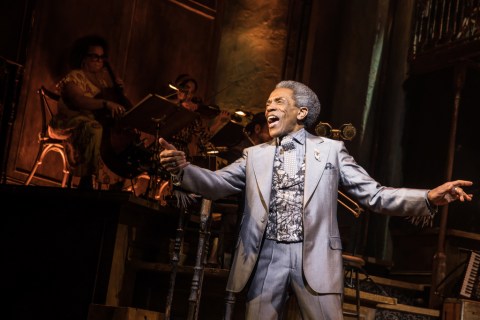
André De Shields in ‘Hadestown,’ Music, Lyrics, Book by Anaïs Mitchell, Developed with & Directed by Rachel Chavkin (Matthew Murphy)
The ending spirals into the beginning, spirals into the ending. And so it goes in Hadestown, the magnificent production by Anaïs Mitchell (Music, Lyrics, Book), and Rachel Chavkin (Direction and Co-development with Mitchell) currently at the Walter Kerr Theater after transferring from other production iterations at the National Theatre, U.K. and NYTW in New York.
Hadestown is a breathtaking journey, into a phantasmagorical world whose musical pageantry and flickering contrasts between revelatory light and atmospheric darkness vibrate to one’s core. The spiritual themes of the play are rife; the irony of life in death (living to die) and death in life (dying to live) resonate for all time. Mitchell and Chavkin adroitly reshape the well-known love myth of Orpheus and Eurydice to parallel it with the equally compelling love myth of Persephone and Hades: Ancient Greece’s metaphoric visions of the immutable power of death, and the mutability of earthly life reflected in the seasons.
Hermes, the lightening-speed god who operates as our guide, negotiates the realms of the earth and spirit for us. We hop on his quicksilver wings of imagination and go along for the death-defying ride to return to earth wiser, perhaps. As Hermes, the inimitable André De Shields transforms into the phenomenal, captivating messenger.

Eva Noblezada and the Broadway cast of ‘Hadestown,’ Music, Lyrics & Book by Anaïs Mitchell, Developed with & Directed by Rachel Chavkin (Matthew Murphy)
With measured grace he combines forceful power with smooth cool. He counsels, philosophizes, warns us in verse and song of an ancient story. It is the story of how the power of love and faith overcome death. And how the fates (the fabulous Jewelle Blackman, Yvette Gonzalez-Nacer, Kay Trinidad in patterned black/white outfits) influence the outcome using fear, doubt and the inherent tragedy of the human condition. Look for their signature song which they beautifully croon to Eurydice who echoes their response (“Any Way the Wind Blows”).
De Shields’ lovable chronicler looks dapper in a silver sharkskin suit with slivery slips on his sleeves which suggest wings courtesy of Michael Krass’ symbolic, well-thought out costume design. (Krass’s costumes enhance the characterization and themes throughout.) De Shields’ moves and manner are so easy, we risk the mysterious train ride with him through light and darkness on the journey to Hadestown and are introduced to all those who play a part in his chronicle of gods and men, life and death, material and supernatural forces (the “Road to Hell”).
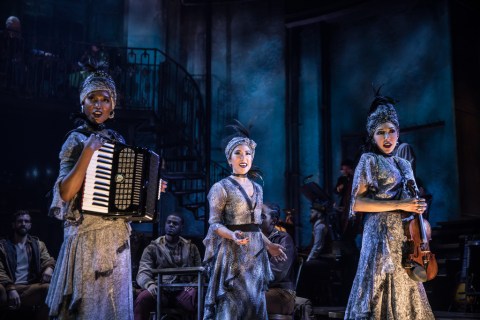
(L to R): Jewelle Blackman, Kay Trinidad Yvette Gonzalez-Nacer, Music, Lyrics & Book by Anais Mitchell, Developed with & Directed by Chavkin (Matthew Murphy)
Mitchell’s and Chavkin’s amazing reconfiguration of these myths is powered by vibrant, musically diverse and multilayered songs and spoken verse. These combine to reveal how climate change has gravely misaligned the world that the characters live in. Chavkin and Mitchell evoke fitting metaphoric parallels with the myths of mutability and immutability. Orpheus and Eurydice become central characters interwoven in the fabric of the play: its action, conflicts, arc of development, symbols, themes.
On the material plane, the situation is dire. Upended by fires, floods and extreme cycles of heat and cold with storms that are off the categorical charts, the earth provides no succor for its inhabitants, many of whom are destitute and dying. Forced into a gypsy lifestyle, outrunning starvation and weather extremes as resources become scarce, migrants like Eurydice (the golden voiced Eva Noblezada) face an arduous, spooky ride to Hadestown unless they manage to get to the next day. Theirs is an existence of slow starvation, chronic sickness, sexual abuse and torment.
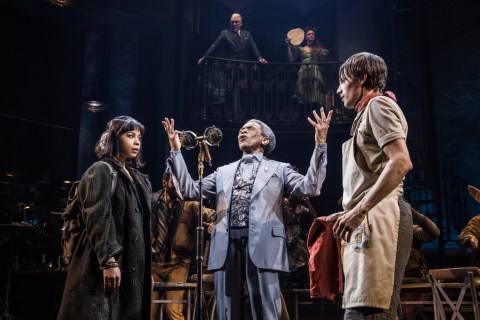
Eva Noblezada, Reeve Carney, André De Shields, Music, Lyrics, Book by Anaïs Mitchell, Developed with & Directed by Rachel Chavkin (Matthew Murphy)
For the haves like Orpheus (Reeve Carney’s naiveté, “touched” grace and beautiful tenor shine throughout) whose ancestor is a Muse and whose life is anointed by the protection of Hermes, the situation is less bleak. Orpheus has a roof over his head and a menial job in a haunting, ambience-rich, New Orleans-like jazz club, a way-station where the customers are soothed by the music of Dixieland before they continue on with the struggles of their miserable lives or elect to ride the train on the “Road to Hell” and get off at the last stop, Hadestown..
It is in this charged, atmospheric, (the lighting is superb thanks to Bradley King) jazz/R & B/folk/pop joint, Orpheus encounters the stunning, waif-like Eurydice, who is blown in by the Fates (“Any way the Wind Blows”). He falls for her and attempts to entrance her with a song of love that will right the world and return spring and abundance to the planet. But Eurydice’s knowledge of the dire, doomed existence of humanity runs deep. She confronts him with the facts of starvation and reality of life’s sorrows. She asserts his song has no power. But as he sings, the generating force of the anointed melody stirs her. She realizes its greatness and tells him to finish the song. He reassures her of his love and vows the song will establish a shared brotherhood and prosperous peace (“Come Home With Me,” “Wedding Song”).
Mitchell and Chavkin use the evocation that Orpheus’ love song is an ancient melody Hermes gave him when he was young. They dovetail this concept into the second love myth of Persephone and Hades. “Epic I” sung by Orpheus and Hermes, reveals how the gods’ love “made the earth go round” and established the beauteous seasonal balance that few remember now that their world is dying. The implication is that Orpheus’ supernatural song will return the earth to its former glory, and Persephone will be present the full six months of the year to celebrate her powers above ground (“Livin’ It Up On Top”).

Amber Gray in ‘Hadestown,’ with the company, Music, Lyrics & Book Anaïs Mitchell, Developed & Directed by Rachel Chavkin (Matthew Murphy)
With hope and determination that he can succeed because, as Hermes says, “he’s touched,” Orpheus and Eurydice pledge their forever love in the lyrical “All I’ve Ever Known.” Eurydice forgets the reality of starvation in the warmth of Orpheus’ embrace as she basks in the beauteous spring that Amber Gray’s feisty, ebullient Persephone brings, however, briefly.
The seasons shorten incrementally, reflecting the indelible impact of global warming and Hermes’ injunction of “times being hard.” Persephone’s wine celebration is cut even shorter. Hades’ ride to bring Persephone back to the underworld is foreshadowed in the gyrating rhythms, enthralling melodies, sharp lyrics of “Hadestown,” In this memorable titular song, Hermes, Persephone and the entire company indicate what’s causing the earth’s doom as they illustrate in movement and song what Hadestown is like in its symbolic reflection of its impact above ground.
The themes and plot development merge seamlessly as the love stories meld. Hades, the brooding mover and shaker and oppressed Persephone are brought into focus with intriguing twists. Overwhelmed with anxiety and the stress about growing his powerful underworld empire (precious metals, oil, and attendant industries), Hades has forgotten his youth and the joy of his love for Persephone. He’s dour, commanding; she’s his bored, unhappy, trophy wife. The underlying humor is ironic. He is supposed to be the terrifying, sexy god of the underworld and his wife is, in effect, kicking him out of her bed. Fearing he has lost her, Hades brings Persephone back to Hadestown earlier and earlier triggering weather extremes as the earth cannot adjust (“Gathering Storm”).

Eva Noblezada and the Broadway cast of ‘Hadestown’ Music, Lyrics & Book Anaïs Mitchell, Developed & Directed by Rachel Chavkin (Matthew Murphy)
When Persephone leaves, weather devastation returns. Eurydice suffers her former hellish grind and panic. She searches for food and firewood, losing patience, dismissing Orpheus’s vows. While Orpheus feverishly works on the song (“Epic II”) she wanders in weariness and hunger. The conflicts intensify. The lure of Hadestown, the world apparently more stable than the cataclysmic earth in the song (“Chant”) trenchantly reveals the strident tensions between Orpheus and Eurydice.
Eventually losing her will to survive, doubting Orpheus’ ability to care for her, Eurydice becomes susceptible to Hades. He finds her fascinating because Persephone has cast him aside (“Hey Little Songbird”). When he offers Eurydice safety, security and freedom, she considers a visit to Hadestown for a bite to eat would be better than waiting for Orpheus in pain. What should she choose? Security and reliability below or starvation, slow torture and uncertainty above. Whether now or in the future, either decision will result in the final stop of her existence in Hadestown. What she does not consider is her will. It is one thing to struggle to survive, dying in the process. It is another to choose to die because it is too tough to go on.
Though this differentiation is inferred in the play, Greek Mythology carries it further. Souls who made good/beneficial choices on earth (they did not commit suicide) went to the Elysian Fields where they played all day: an equivalent of Paradise. Other souls who made harmful decisions were given their just due in the underworld. The souls in Hadestown fall into the latter category, laboring in the toil of the mines forever, in Mitchell’s and Chavkin’s version.

Reeve Carney and the Broadway cast of ‘Hadestown,’ Music, Lyrics & Book Anaïs Mitchell, Developed & Directed by Rachel Chavkin (Matthew Murphy)
As Eurydice considers her options, the Fates influence her with the fabulous, rhythmic “When the Chips Are Down.” (“Aim for your heart, shoot to kill, if you don’t do it, then the other one will”). Eurydice chooses her destiny, allowing material necessity and her flesh to overwhelm her. As she embraces Hadestown’s certainty, she cries out for Orpheus as the Fates admonish the audience that they would do the same as she, if they were in her shoes, in the superb song (“Gone, I’m Gone”).
Eurydice affirms she’ll return (“Wait For Me”) then travels to the underworld lowered into the darkness as ominous clouds of smoke billow up with intimations of flames and intense heat. Orpheus finishes his song, but it’s too late; Eurydice has gone into hell. Hermes guides him along a secret alternate route to Hadestown as Hermes, Orpheus, Fates and the ensemble sing that Orpheus comes for her in the lyrical, powerful ending of “Wait For Me.”
These scenes are uniquely staged, with dynamism and excitement; the lighting enhances throughout. The tension builds to the final revelatory scene in Act I which uncovers Hades’ terrifying realm. The revolving platforms move clockwise and counterclockwise as the ensemble and Orpheus move in the opposite direction. Time reverses and changes course as Orpheus walks with fierce determination to the underworld.
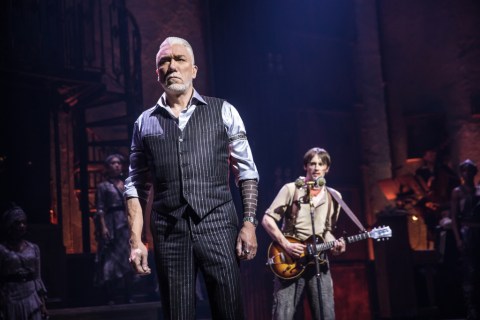
Patrick Page (foreground) Reeve Carney (background) in ‘Hadestown,’ Music, Lyrics & Book Anaïs Mitchell, Developed & Directed by Rachel Chavkin (Matthew Murphy)
The circularity of movement is rich with profound meaning. For example, we make repeat wrong decisions, doing the same thing over and over again with dire consequences This theme suggests the oblivion of Hadestown, (its boring factory sameness) and the waning vitality of Hades. His repeated bad decisions result in the imprisonment of himself, his workers and Persephone, the goddess of change, who abhors the drudgery of the same old same old. Hades has so brainwashed himself, he’s convinced they are free while they are in oblivion as they work like slaves (today’s corporate erosion of worker’s rights…see the film American Factory)
The pounding, thematically “earth-shattering” brilliant song, “Why We Build the Wall” sung by Hades, Persephone and the company is a sardonic paean to wall builders everywhere. The song is Hades’ stubborn justification for his misery, self-torment and the loss of his youth while amassing an empire. By building the wall he and workers he refers to as his “children” keep out the fear of uncertainty and want. They are secure in their never-ending work as they war against deprivation. What he seeks to avoid, he brings upon the entire planet in a self-fulfilling prophecy swaddled by fear. There is only one way to break down the wall: restore Hades’ and Persephone’s love. His fear of losing her will end and he’ll allow her to restore the earth in the natural balance of the seasons. Orpheus must sing his anointed, ancient love song to restore Hades to himself and Persephone, and restore Eurydice to his arms and life.
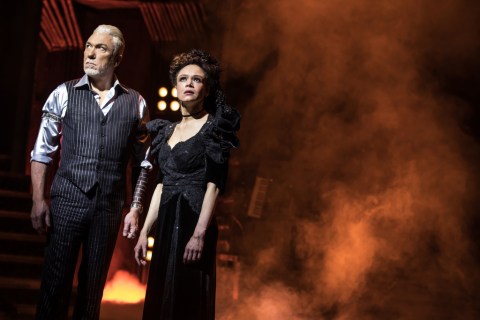
Patrick Page, Amber Gray in ‘Hadestown,’ Music, Lyrics & Book Anaïs Mitchell, Developed & Directed by Rachel Chavkin (Matthew Murphy)
As Hades, Patrick Page’s eminence is superbly realized in his demeanor, walk, voice and appearance. Page’s Hades is a charismatic warlord who sports his sleek brand of “mellow cool” in a gangster-ish pin stripped suit and styled comb-up. His organic, spot-on portrayal makes him human and empathetic. Though he is a god, he fears his adoration of Persephone (“Chant”) is jealous of her absences, and looks for comfort in someone new (“Hey, Little Songbird”). Page’s portrayal is spot-on, mesmerizing.
Amber Gray’s Persephone is an energetic, sun-filled presence. She blooms with razz-ma-tazz vitality above ground but turns it around as an upside down gal in the bleak underworld appropriately dressed for a perpetual funeral. Like the rest of the principals in the ensemble, she is just smashing. Carney’s Orpheus and Noblezada’s Eurydice sing with the lyricism inherent in their gorgeous vocal instruments. They permeate their songs in the second act with soulful, aching beauty, breathing life into the score and lyrics. But then so do Hermes/De Shields (Wow!) Hades/Page (Good gracious!) Persephone/Grey (Yes, ma’am!)

Reeve Carney, Eva Noblezada in ‘Hadestown,’ Music, Lyrics & Book Anaïs Mitchell, Developed & Directed by Rachel Chavkin (Matthew Murphy)
Act II brings the fullness of the plot development, themes and characterizations/gods/lovers that Hermes has so familiarized us with, we’ve come to adore them as family. The song lyrics and music are standouts and build upon what’s been threaded before. You will walk away humming the tunes, drumming the beats. Orpheus’ journey to Hadestown is paced frenetically, with foreboding danger as he moves with stylized grace through his mind of doubt and fear. The use of lighting is sensational and thrilling especially during this sequence (thanks, Bradley King). And at the end, well it’s De Shield’s moment. He stands rooting us in mankind’s tragic history, as the ensemble joins him in soaring song that will be sung over and over again. Ineffable.
This is the type of production that is so jeweled, one will appreciate it in the second seeing or third. You will catch nuances here, symbols there, effects, songs, movements, so much of what your sleight of mind may have missed the first or second time around. All of it is soul careening. This rare production thrums with poetic grace and ancient rhythmic currents that resonate profoundly, irrevocably with life. And occasionally what peers out at us in this play from the other side reminds us of…
Kudos to the creatives who measured the symbols of characterization and themes to synergistically meld them with stylistic, adroit artistry into the play’s fantastic spectacle: Rachel Hauck (Scenic Design) Michael Krass (Costume Design) Bradley King (Lighting Design) Nevin Steinberg, Jessica Paz (Sound Design) Hudson Theatrical Associates (Technical Supervision) Michael Chorney, Todd Sickafoose (Arrangements and Orchestrations).
The music and lyrics are unparalleled, thrilling, coherent. Mitchell and Chavkin, the ensemble and creatives have wrought a divine work for the ages. Surely it is a multiple award winner. Hadestown runs with one intermission at the Walter Kerr Theater (219 West 48th St.) For tickets go to their website by CLICKING HERE.
‘The Pain of My Bellgierence,’ Starring Halley Feiffer, Hamish Linklater

Halley Feiffer, Hamish Linklater in ‘The Pain of My Belligerence,’ directed by Trip Cullman at Playwrights Horizons (Joan Marcus)
The Pain of My Belligerence written by Halley Feiffer, directed by Trip Cullman, at the outset subtly lures the audience with humor and a playful tone, largely through the adroit writing and the prodigious work by Feiffer (Cat) and Hamish Linklater (Guy). Once engaged, the playwright slams viewers with profound truths about skewed perceptions caused by having internalized noxious cultural mores. Though it has been assumed these have floated away into the past borne by political correctness and decency, indeed, they remain trenchantly ubiquitous in our workplaces and love relationships.
Feiffer’s play in its World Premiere at Playwrights Horizons, is a standout in its complexity and the development of the characters and themes which reflect the chaotic currency of our times. Folkways learned from our upbringing and reinforced by the culture are nearly impossible to expurgate. In the process we often damage our psyches and souls in wrestling to oust or embrace them. Indeed, Feiffer’s characters Guy, Cat and Yuki are caught knowing what not to do to damage themselves and others. Yet they persist harming themselves and each other. The hope is to end the cycle in their ever-present struggle that seems to go nowhere until deliverance arrives in one form or another. By the conclusion of the play comfort comes and from the most unexpected of sources.
Guy and Cat meet in one of Guy’s restaurants and both engage with light banter and snacks to match. Feiffer makes it clear that Guy needs no alcohol to fuel his engine. Cat is not plied with drinks to fall under his influence. By the end of the play after taking in all of the themes, character development and action, we realize that the culture’s inherent conceptual liquidity, which has bathed them their entire lives, has already prepped them for their fatal encounter.

Halley Feiffer, Hamish Linklater in ‘The Pain of My Belligerence, directed by Trip Cullman (Joan Marcus)
We watch amazed as Guy soars into the clouds of triumph spiked by his own adrenaline in pursuit of the frenzy of conquest. With an ineffable “something” he slides invisible, velvet chains onto Cat’s heart and soul using stunning sexiness, charm, self-admitted diabolic flare, and sleek, macho dominance. Linklater’s Guy has adopted the ethos of the hyper-lothario, unparalleled in allurement, alternating compliments and abuse, sweet sensuality and brutality.
Linklater is fabulous. He IS Guy! The women in the audience swoon at his seductiveness; the men laugh and remember a time when they may have achieved a modicum of his brutish grace. And if Incels were prone to seeing live plays, they would surely write down his every tactic, nuance, quip and cutting swipe to get a date.
As mesmerizing and preeminent as Guy is, Cat is the demure, shy, passive, feminine, giggly, clueless counterpart. She is the perfect flower for this buzzing, aggressive bee. As the conversation progresses, we learn that Cat is a writer for the New Yorker who has recently interviewed the successful Yuki, Guy’s wife and partner in the restaurant business. Cat is savvy, smart, assertive in her own right. But she’s putty in Guy’s sphere of influence and so are we putty in Feiffer’s hands, as we watch their brilliantly scripted and acted interplay. We are mesmerized because we cannot “believe” what we see which ultimately is verbal, harmful abuse in the the guise of “love” and “attraction.”
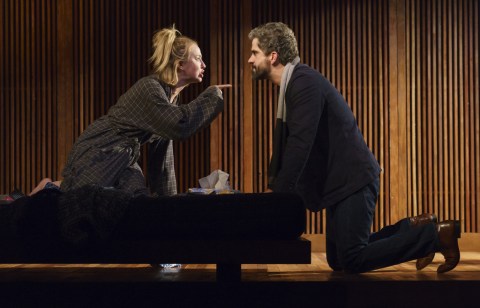
Halley Feiffer, Hamish Linklater, ‘The Pain of My Belligerence, directed by Trip Cullman (Joan Marcus)
Immediately, this situation throws up screaming alarms. I was upset and wanted to slap Cat (my younger self) in the face. Wake up! Why is this successful, high-powered, married man seducing you, the vulnerable? Cat is pretty and has lovely skin but is not a Miss America. No matter. It’s all about him. This is a (Trumpian) narcissist, drunk with his own image as a “Don Juan.” Must he notch his belt, prove his sexual prowess, his “beauteous” drawing power with any susceptible women he comes into contact with? Feiffer delivers the truth in spades by the conclusion.
Cat is brilliant and ambitious in her own right. Doesn’t she see through him, or is she that needy? Also, having met/interviewed Yuki how can she be so craven, selfish and harmful as to be amenable to his advances? He is not “just” married; he is in an intricate and incredibly successful partnership with his wife, an impossible situation to extricate himself from. What is Cat thinking? Where is her emotional intelligence?
The writing is superb. Feiffer reveals the tenuous, inner “belligerence” of these two individuals who “play with their own consuming fires.” In the play’s first minutes we have fun watching Feiffer as Cat being cajoled and won over by Guy until we learn the details. Then we are transfixed, horrified. But by the time we note the harmful manifestations of the abusive relationship blooming “in plain sight,” Cat has been bitten by the adrenaline-charged Guy who oozes bewitchment and sadism in equal measure as he infects her. And we note with painful and unsettling recognition the theme of how gender mores (passive female, aggressive male) destabilize perspective even in the most intelligent.

Halley Feiffer, Hamish Linklater in ‘The Pain of My Belligerence, directed by Trip Cullman (Joan Marcus)
In an important theme, Feiffer reveals how ancient folkways (female competitor, male conqueror, etc.) nullify the power of love and truth to establish a positive life-affirming relationship. Cat and Guy, are psychically and emotionally injured individuals. Life-affirming love is not possible. Indeed, their relationship is doomed and can never fly with freedom.
The irony is that as we watch the first segment, we hope that Guy is not who he really appears to be, an insensitive, self-aggrandizing, narcissist. And we think with her career, Cat just can’t be the whimpy, passive female whose behaviors scream “use me, abuse me, prey on me, I am your willing host.” As the play continues, by the second scene, four years later, the threaded themes of male privilege, “having one’s wife and mistress too,” have blown up into a full-fledged unhealthy relationship.
Cat is ill, alone and unable to work. Guy does not leave his wife as he suggested he was doing four years before. Being with Cat and having a wife and children tears him up. Though they are still intimate, their relationship has morphed and their unhealthiness has graduated. Guy now is adrenaline fueled by Cat’s helplessness and her needing him. For her part she has become dependent on Guy and emotionally weakened. And in a symbolic action at the conclusion of the scene, he plays “airplane” with her like his little daughter whom he loves. Her passivity has psychically debilitated and disempowered her even more.

Vanessa Kai in ‘The Pain of My Belligerence,’ directed by Trip Cullman (Joan Marcus)
All negative relationships seek their own level like water, and some fall to their own death. How Feiffer constructs the devolution is superb, as is how she, from the ashes of its demise, has Cat receive a new beginning. Ironically, by this point it is 2020 and the hope of a different cultural ethos after Trump is on the horizon. Perhaps a woman will be a part of this after all as Feiffer tangentially infers? Please!
Feiffer’s play is vital for us today in a time when gender mores (passive female, dominant male) have received a recent resurrection in the current politically divisive climate that has empowered right-wing extremism and encouraged extreme political correctness on the left. Feiffer’s play infers this brilliantly as the setting spans an eight- year-time period with the election cycles as the backdrop beginning in 2012 and ending on election night in 2020. Social, cultural paradigms among the genders are conflicted. How do men and women define themselves apart from the noxious behaviors being exemplified by those whose braggadocio about being cruel and insulting is considered by some as entertaining and funny?
On the other hand there are also dangers in being snarky, smug and self-possessed. Though we may think we’ve learned all there is to know about feminism, chauvinism, privilege, discrimination and gender roles, we are “babes in the woods.” Indeed, unless we dress our minds with uncanny perception and filter our souls to carefully gauge our own growth, we will allow ourselves to fall prey to every kind of influence, unaware we’ve been “bitten” and “infected.” Sadly, such values/notions that take over our mind/vision, we’ve so internalized, we cannot perceive the difference between clever dissembling disguised as truth when it identifies itself as a lie.
Every aspect of this production strikes to the heart. This is only possible with expert direction and excellent performances by Feiffer, Linklater and Vanessa Kai as Yuki. The writing is gloriously truthful. The metaphor of the tick bite is so pointed. Guy bites her, biting out the tick, he thinks. However, unless a tick’s head is removed, it stays and injects its poison to further corrupt its host, until the disease seeks its course. That symbol/metaphor is perfectly threaded by Feiffer throughout her amazing play.
Kudos to Mark Wendland (Scenic Desgin) Paloma Young (Costume Design) Ben Stanton (Lighting Design) and Elisheba Ittoop (Original Music and Sound Design).
The Pain of My Belligerence runs at Playwrights Horizons (416 West 42nd Street). For tickets and times to this superb production go to their website by CLICKING HERE.
‘Ain’t No Mo,’ A Searing, Edgy, Sardonic, Magnificent Production at The Public

(L to R)” Fedna Jacquet, Ebony Marshall-Oliver, Marchant Davis, Simone Reccasner, Crystal Lucas-Perry in ‘Ain’t No Mo,’ written by Jordan E. Cooper, directed by Stevie Walker-Webb (Joan Marcus)
Aint’ No Mo by Jordan E. Cooper directed by Stevie Walker-Webb is the most cutting edge, maverick and sterling production I’ve seen this year at The Public Theater. It is a must-see for its hysterical humor, black satire, superb “over-the-top” performances and jaw-dropping, brilliant writing by the playwright whom I cannot praise enough for his startling wake-up call to citizens in this nation that faces, a constitutional crisis.
Cooper with the assistance of the sharp direction and lightening, comedic pacing of Stevie Walker-Webb who shepherds the electric, moment-to moment actors, lays bare themes about black Americans attempting to survive in the medium of white oppression, a condition which began when the first slave ship in 1619 offloaded its precious cargo to the lands we now refer to as the United States. Through vignettes exemplifying black characters who REPRESENT a variety of socio-economic and cultural identities that make up black American society today, Cooper, Walker-Webb and the versatile actors portray the alienation, dislocation and terrorization black individuals confront daily based on the color of their skin because of institutionalized racism, whether they acknowledge it or not.
Though the playwright satirizes black culture and the sardonic humor is exceptional, underlying all of the vignettes is the ubiquity of a fascist system that destroys or chips away through incipient attenuation black citizens’ rights, freedoms, talents, hopes, legacies and praise for black contributions to the goodness of our society. The cultural blessings of black identity reside in every area one can think of; they are an indelible part of our society and culture’s music, scientific research, dance, inventive creations and much more. But why are blacks still facing record incarceration, economic injustice, legal injustice, housing discrimination, job discrimination, educational discrimination, killings by racist law enforcement who are not held accountable and more?

Jordan E. Cooper in ‘Ain’t No Mo,’ directed by Stevie Walker-Webb, written by Jordan E. Cooper, Public Theater (Joan Marcus)
These inequalities born of white, male, privilege fascism, citizens must take to heart and understand regardless of skin color, especially if one is not black. Indeed, black American treatment in the culture serves to note the health of the society. It is like the canary in the coal mine. For a time around the decades up to the turn of the 20th century, it looked like maybe the canary was breathing. When Obama became president, the canary seemed stronger. But things didn’t turn out as expected. And now, the canary is croaking out its death song.
Cooper’s play exemplifies this with incredible power. It is a warning for all in the culture that we are very sick and it is especially egregious for black Americans. Those ethnicities who have their eyes open (not the KKK, the white supremacists, racist law enforcement, neo Nazis, the Trumpist administration and supporters, the Federalist Society and ultra-right wing think tanks who use race to divide and scoop up political power) are subject in a different way to the fascism that rides roughshod over black Americans.
Where fascist controllers are concerned, they will divide and conquer through racial hatreds so that ultimately all suffer under a horrible cultural-economic ethos where suffering becomes a matter of degree. And blacks are sacrificed in a blood letting that makes all guilty, unless they work fervently to stop it.

(L to R): Fedna Jacquet, Ebony Marshall-Oliver in ‘Ain’t No Mo,’ directed by Stevie Walker-Webb, written by Jordan E. Cooper (Joan Marcus)
The greatness of this production which has not one “white” (an irony in itself since many “whites” don’t know their own racial history which includes African-American blood) person in it, concerns black perspectives about having to “get along” and survive in a “white privilege” culture. In effect, black Americans don’t “get along” very well (an understatement). And after the Obama administration ended in a hellishness for black Americans, the Trump election and current white supremacist administration has given rise to another holocaust.
With the empowerment of the KKK and white supremacy under Trump, where do blacks stand? Should they leave a country which has in some states reverted to voting violations reminiscent of the Jim Crow South? The question pervades this amazing and thought-provoking production from its powerful beginning to its riveting ending.
The production begins in a black church on the eve of the election of President Obama in 2008 during the funeral for Brother Righttocomplain. The Pastor leads the hopeful to believe that under Obama, a black president, finally things will begin to improve, and there will be “No Mo” of the oppression, killing and racial-based institutional abuse blacks have experienced.
However, at the end of the church service, we hear gunshots and see flashing red lights symbolizing more cops stopping blacks and killing them unjustly. And we hear in a voice over some of the black abuses that happened during Obama’s presidency, i.e. the Flint Water Crisis, the deaths of Travon Martin, Sandra Bland and scores of others. The unjust murders of many blacks at the hands of law enforcement continue. Obama did what he could but the death and destruction of black people and black identity in various forms is “alive and well.”

(L to R): Simone Recasner, Crystal Lucas-Perry, ‘Ain’t No Mo,’ directed by Stevie Walker-Webb, written by Jordan E. Cooper (Joan Marcus)
Cooper then steps into the future. The horror of Trump’s election has resulted in an evacuation of all blacks in the US. Peaches (a wonderful job by Cooper) is a flight attendant on African American airlines and she is responsible for checking in passengers on the flights to African countries for free; it is a form of reparations. Blacks must leave and give up all they have known here, or they will be transmogriphied into whites. All traces of their blackness, culture, identity will be obliterated and they will have to start anew in Africa. Cooper establishes the play’s development with three Peaches’ segments during which thousands of blacks are checked onto their flights so that there will be no blacks left in America.
In between the flights taking off, Cooper relays vignettes of various black individuals being confronted with the decision of staying and losing their black ethos or leaving. In the “Circle of Life” vignette, hundreds of black women line up for abortions; they would rather kill their children then see them in prison or “die while black” at the hands of law enforcement in the US. How Cooper dramatizes this (NO SPOILER ALERT HERE) is superb. However, the news of the eviction letter is just being received for these women They will have to make their decision quickly because the planes are leaving.
In the next vignette, a reality show entitled “Real Baby Mamas of the South-Side,” Cooper confronts the memes of what black identity means. It is a humorous and drop-dead serious send-up of black reality shows which exploit the idea of “being black” from a profit-motive angle.

Marchant Davis, Fedna Jacquet in ‘Ain’t No Mo,’ directed by Stevie Walker-Webb, written by Jordan E. Cooper, Public Theater (Joan Marcus)
During this segment as he does with others, the playwright touches upon many examples of oppressive destruction of black identity and the internalization of the destruction as blacks attack themselves and each other’s confidence in their “blackness.”
For example nullification of black identity exists through excoriation of the darkness of one’s skin color and the naturalness of one’s hair. “The lighter the skin, the better” is a reality blacks have had to deal with because of white fascist physical mores. The trend has morphed over the decades into a perverse reverse. Other ethnic groups including whites have embraced the “black ethos” in a perverse acceptance of only the superficiality of “being black” without realizing any of the horrific sacrifices blacks have made over their 400-year history in this nation.
Cooper takes this notion and puts it on steroids during the hysterical, satiric “Real Baby Mamas of the South-Side.” One of the characters (Rachonda-her real name is Rachel) is going through transracial treatments to become black. When she is called out on it by Tracy, Kendra and Karen, she reveals that she has no clue about black American sacrifices and and just wants to ride the current wave of black female “cool” generated by Michelle Obama.
This becomes so obnoxious and Rachonda so overweening in exrpessing the “right” to be who she wants, the hypocrisy for the real black women is overwhelming. All fight, a boon for reality TV’s exploitation. The attack on each other is symbolic. It is a tragic outcome of internalizing the “whiter is better” cultural mores turned on its head. We are ironically reminded how divide and conquer is a tactic of the dominant, white, privilege culture.

(L to R): Ebony Marshall-Oliver, Crystal Lucas-Perry in ‘Ain’t No Mo,’ written by Jordan E. Cooper, directed by Stevie Walker-Webb, Public Theater (Joan Marcus)
Interestingly, the real black women leave to join the thousands who are evacuating to Africa. Of course Rachel (who is white) never gets the notification to evacuate. The irony is that in attempting to become transracial she will never be black “cool.”
In the remaining vignettes, Cooper reveals a wealthy bourgeois black family who is covering over their black identity symbolized by the character “Black” (dressed like a slave) who their father kept in the basement out of fear. Because he dared to have his own business, the KKK nearly lynched their father. As a result, he suppressed his “blackness” and assimilated/internalized white cultural mores while suppressing his “blackness” by chaining up Black in the basement (psychological suppression).
It is an incredible vignette, both sardonic and sober in its revelation that to survive, blacks have internalized white cultural values to their own destruction. By adopting the”white” ethos by being the proud bourgeois class (nullifying their real selves/souls) they have trampled all those who have shed blood to advance the hope of achieving civil rights, equal opportunity and justice overcoming institutional racism.
As the family attempts to have an elegant dinner and discuss whether to go to Africa, Black comes up from the basement bursting on the scene. Black, representing everything about the family’s identity that they wish to eradicate (having internalized the white supremacy values) is a horror to them. They end up killing Black themselves for they do not want to be associated with being black. They have wealth and status and live in a white neighborhood; they are deluded they have made it in the oppressive culture that has destroyed their being.
Indeed, the theme is clear. An oppressive fascist culture has as its most horrific tactic: get blacks to destroy the finest traits about them, their blackness. Without that blackness, they embody the worst of the fascist “master race.” They genocide their own and themselves..
Cooper also identifies the black, female prison population in a very powerful scene. When freedom is posited, one of the prisoners, Blue, in great fear and rage from all the abuse of her past nearly creates a situation where she messes up her chances for freedom and is killed (or never makes the plane and is transmogrified). How Cooper ends this vignette and the last one when Peaches also goes to join those evacuating the US, are memorable scenes. They leave the audience in complete shock.

Jordan E. Cooper, ‘Ain’t No Mo,’ directed by Stevie Walker-Webb, written by Jordan E. Cooper (Joan Marcus)
This superb production is a crucifying indictment of the nullification/annihilation of black Americans through identity confusion and racist oppression via various institutions in the United States. It is even more prevalent today under Trumpism in its blatant constitutional violations, gerrymandering, lies, destroying ballots and Trump’s sanctioning of the Russians helping elect him. (He denies this still, though the Mueller Report evidence proves the Russians meddled and then that Trump covered it up and obstructed justice). All of these segments hit the bulls-eye with mind-blowing truthfulness that makes one laugh and cry at the same time.
The themes are unmistakable. The sub rosa genocide of black Americans will continue unless we work together to stop it. Regardless, black Americans have made magnificent contributions and are the backbone of our progress. No one culture and class should dominate; that is the greatest myth and whether or not whites acknowledge that this is a lie, nevertheless, is a lie. The truth is apparent.
Sadly, if black women question having children because they fear giving them up to shootings and jail terms, then where is the hope? Are the strides taken up to this point in time hope-filled enough to continue in the face of the new fascism and white supremacy that is just plain in your face and denies that it is in your face? The play raises these questions for us to consider and answer with advocacy and action.
This marvelous production is an experience. Above all it is a reminder that we are together in this culture, striving to prosper. If we don’t work for all of us, then we can’t work for any of us. This is especially so against an administration that only bows to its own agenda and money men.
Praise go to these actors: Fedna Jacquet, Marchant Davis, Simone Recasner, Ebony Marshall-Oliver, Crystal Lucas-Perry and Jordan E. Cooper as Peaches. Kudos go to Kimie Nishikawa (Scenic Design), Montana Levi Blanco (Costume Design) Adam Honore (Lighting Design) (Emily Auciello (Sound Design) Cookie Jordan (Hair, Wig, Makeup Design).
Ain’t No Mo runs with no intermission until 5 May. Don’t miss this incredible, “in-your-face” production. You will be glad you saw something as novel and profound and wonderfully performed as you will see. There is NOTHING like it around! For tickets go to the website by CLICKING HERE.
‘Instructions for American Servicemen in Britain,’ Brits Off Broadway at 59E59 Theaters

(L to R): James Millard, Dan March (co-writers with Matt Sheahan) in ‘Instructions for American Servicemen in Britain,’ directed by John Walton (Lidia Crisafulli)
In Instructions for American Servicemen in Britain, the setting of the play is Britain 1942. Based on a pamphlet of the same time (valuable historical/cultural ephemera) created by the American War Office, the comedic play is a fascinating bit of history. It reveals the cultural divide between America and Britain and pointed differences in words, coinage, foods, phrases, social graces, sports, class system and much more.
At the time military and civilian officials anticipated that the socio-cultural differences between the U.S. and the U.K. could create havoc in cooperation during the war effort, unless Americans were provided with a guide book to smooth over relations between the two countries. Germany had already initiated a propaganda campaign against Britain and hoped to keep America out of the war. Military officials didn’t want servicemen to so influenced by the propaganda that Americans and British would be attacking each other instead of the Germans. Hence the “Instructions.”
The comedy, part of an offering in the Brits Off Broadway season is refreshingly quaint in light of advances after WWII in technology through the digital age, Google, Wikipedia, and social media which have made knowledge and interactions with the UK’s culture and society ubiquitous. However, in those days, paper in the form of pamphlets was the vehicle used to educate servicemen about British lifestyles.
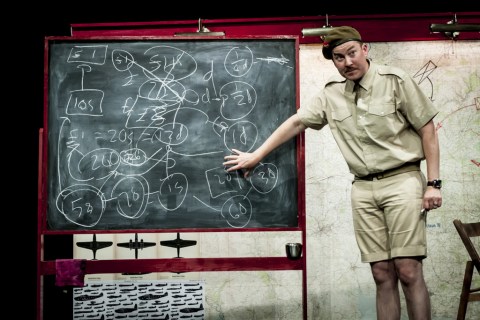
At the top of the play friendly, intelligent, socially attuned Lieutenant Schultz (James Millard) who already lives in Britain and is a stalwart mentor of proper comportment welcomes the servicemen (audience) and informally shakes hands with them to make them feel comfortable in a potentially awkward situation.. As Schultz, James Millard portrays an immediately likable and well meaning American soldier that we can be proud of. Schultz introduces himself to the Eight Air Force squadron (the audience) and gives his resounding interactive opening remarks. He then answers a few logistical questions, i.e. “Private Welch-yes if you can find somewhere to put it.” Millard’s superb interplay essentially sets the tone and exuberance of the production which carries through to the second act.
After this humorous interchange which actually preps the audience for the smartly paced jokes to follow, Schultz attempts to oil the way for the bulk of the program handed off to the imperial, crass and vapidly dense (single digit IQ dense) Colonel Atwood (the excellent Dan March). Atwood unwittingly manages to insult the British in every conceivable way imaginable after Major Randolph Gibbons arrives. Matt Sheahan portrays the endearing senior-ranked British officer who is the perfect foil for Atwood to lay his cultural “Brutish” stupid on.
What follows is Atwood’s disconnect and Randolph’s attempt to correct him with great frustration. Their resistant attempts at establishing a relationship is a bumpy ride throughout the production. Randolph is the standard polite Brit whose social norms and phrases completely confuse the rough and ready American cowboy style of Atwood, who must defer to Schultz to clear up his muddle. (i.e. “It’s very urgent, I’m afraid.” Atwood: “He’s afraid?”)
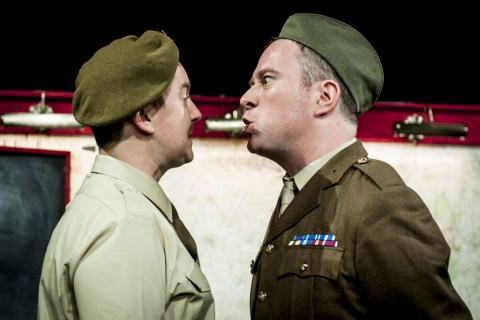
(L to R): Matt Sheahan, Dan March (co-writers with James Millard) in ‘Instructions for American Servicemen in Britain,’ directed by John Walton (Lidia Crisafulli)
Eventually, as Randolph attempts to assume his authorized position to instruct the men, Atwood refuses to give place to “a smart ass in short pants.” Indeed, we think if these instructive sessions are populated by other Atwoods and Randolphs in American bases dotted throughout the English countryside like this one, the Germans don’t need to lift one more finger to sow discord. Americans and British are doing an excellent job of disrespecting one another on their own and dissolving the good will to cooperate and unify against the Germans.
Throughout Act I Colonel Atwood embarrasses himself as a rude, dim-witted ugly American, albeit one in a position of power who thinks he is the “smartest guy on the base.” Considering that we understand the outcome of the war and the importance of the US to winning it, of course the vignettes about learning British coinage, going out in a social setting, having tea, etc. are hysterically funny and we enjoy laughing at Colonel Atwood.
However, the underlying irony is that the British do not know the outcome of the war in 1942 and were very frightened of the Nazi aggressions, i.e. bombing London and threatening invasion. If Atwood illustrates the typical American higher up military man with “know-how and bravery”, the Germans will easily win. This gap in logic should have been strengthened in the play’s writing for even more laughs. But indeed, with aplomb, the writers (also the actors) Dan March, James Millard, Matt Sheahan emphasize the theme that the Peter Principle is alive and well and running the US and British military, in an all too familiar dynamic that the greater the incompetence, the higher the rank.
That the Peter Principle applies to the British military resides in Atwood’s humorous observations that because of mismanagement and incompetence, the British blew it against the Germans, nearly lost it at Dunkirk and had to beg the Americans to come there and “save the day.” This most calumnous of truth-based insults sets Randoph and Atwood in a competitive war of one-up-manship. Schultz, ever the peacemaker attentive to the servicemen (us) watching this mini-attack of the Americans against the British points out their divisiveness is just what the German’s intend with their propaganda. Schultz (his name is an irony) effects a truce and diverts the men so they proceed calmly.
Some of the high points in this act occur when Randolph takes over the command which he has been authorized to do to educate the servicemen despite Atwood’s bombastic protestations which reveal he has lost the point of the entire military exercise. Randolph’s explanation of British coinage is fascinating (we see how large the 5 pound notes were). Atwood’s muddle-headed confusion about the specific values and differences between shillings, guineas, tuppence, etc. (which he never learns) is hysterical as is our confusion.
Also in Act I to school the servicemen in the social graces and polite conversation (you always talk about the weather) while going to a pub, Schultz impersonates Randolph’s wife as “she” and Atwood have drinks. The scene is Monty Pythonesque in its absurd ridiculousness. James Millard’s demure, shy wife is thick with hilarity as is Randolph’s outrage at Atwood overstepping his boundaries and going against propriety. If one thing is obvious, Atwood has learned little, and Randolph underscores this by tossing his own weaponry in the form of ironic asides at the dull-witted Colonel Atwood which, like duds, never register or square away on their target.

(L to R): James Millard, Dan March (co-writers with Matt Sheahan) ‘Instructions for American Servicemen in Britain,’ directed by John Walton (Lidia Crisafulli)
Act II continues the humor with an intensive conducted by the enemy at Nazi Spy School. March, Millard and Sheahan use puppets to reveal how the Germans are prepping for the invasion of the British countryside and sowing discord in their propaganda between the Americans and the British. Then in additional vignettes, we meet Lord Tolly, learn the differences between cricket and baseball, discover British puddings and end with learning the steps to Morris Dancing. The vignettes are redirected and the last, depending upon the audience flies or falls. However it is fun and instructive.
The production has many fine points in revealing the history and customs, attitudes and variabilities between the two countries during wartime. And importantly, not only is the writing, especially in Act I crisp and well paced, it illustrates that although both countries evolved, some of the particularly noxious elements of behavior associated with both countries has not. The pompousness and sense of superiority that manifests culturally in Americans and the British needs work certainly.
The enlightened spoof of a typical Nazi spy school which instructs German soldier-spies and officers how to sow division and discord and how to pass for a countryman in England or America is an excellent reminder of how countries attempt to gain superiority in power domination. The carry-over is that this is done even in peacetime.
Matt Sheahan (co-writer with James Millard, Dan March) in ‘Instructions for American Servicemen in Britain,’ directed by John Walton (Lidia Crisifulli)
I couldn’t help but think of Russian efforts in their cyber-warfare campaigns against the UK with regard to Brexit and the US with regard to the 2016 election. Currently, Americans like Steven Bannon and other conservative groups in Germany and France are pushing forth an ultra right-wing propaganda agenda in concert with Russian efforts to push out liberal, democratic views, policies and perspectives. The spy techniques used in the theater of war in the Pacific and Europe during WWII, evidenced in this play, then and now are now effective psychological weapons to gain advantage. Indeed, many of these techniques and principles are largely used today in social media and alternative news sights to influence unwitting global citizens and strengthen lies, memes, mythologies to promote the policies of political groups, and also to divide. The divisions continue and of course, the country that remains unified and in a solid state will dominate.
In that I found this to be a vital production, not only in its humorous approach and clever writing and acting but also in the important themes of which we need to be reminded. Knowledge about the underlying customs, mores and graces that have held a culture together for centuries is valuable not only in war but also in peace. Divisions can only be created when religious sects, cultural groups with different values and mores are kept divided in separate communities without speaking to one another or sharing a cup of coffee or cup of sugar. Cultural divisions create discord, the perfect medium for an attacking enemy, especially on the internet.
Instructions for American Servicemen in Britain is instructive, funny and prescient. For a delightful and thematically trenchant evening give it a look-see at 59E59 Theaters. It runs with one intermission until 12 May. For tickets, go to their website by CLICKING HERE.
INSTRUCTIONS FOR AMERICAN SERVICEMEN IN BRITAIN
Adapted with kind permission from the Bodleian Library’s publication “Instructions for American Servicemen, 1942” by Dan March, Matt Sheahan, James Millard, and John Walton; directed by John Walton
Produced by Fol Espoir in association with Jermyn Street Theatre and The Real MacGuffins, for Brits Off Broadway at 59E59 Theaters.
‘Burn This,’ Sparking Flames Between a Smoldering Adam Driver and Cool Keri Russell

Keri Russell, Adam Driver in ‘Burn This,’ by Lanford Wilson, directed by Michael Mayer (Danielle Levitt)
Part of the fun of watching Lanford Wilson’s characters in Burn This includes noting their particularity, their measured “normalcy,” their zany, hyped-up incredulity. Concisely directed by Michael Mayer for authenticity and humorous grist, Burn This in its New York City revival drifts, flares up, subsides, then rages. The characters circle each other, collide, implode, retreat with tenuous watchfulness, then boil over, coursing the play to an uplifting conclusion.
What makes this an intricate production is the dynamic of the relationships centered around Anna (Keri Russell) the smooth, sylph-like dancer who evidences a shine for artistic endeavor and the artfulness of restrained love. However, Anna is undone by the haphazard. It comes in the prodigious shape of earthy, sensual Pale (Adam Driver) who like a force-of-nature inflames subterranean passions and blasts her out of her staid romance with Burton (David Furr) and easy routine with gay roommate Larry (Brandon Uranowitz).
After Anna’s one-time sizzling encounter with Pale, unbeknownst to Anna, her elaborately constructed inner psychic protections are shaken to their foundation. Her external “cool” and artistic resolve are broken wide open with the affirmation of life’s most chaotic of emotions which irrevocably will spin her into a relationship with the amazing and sensitive Pale.
At the opening of the play, Larry and Burton reveal their need for the friendship and the attention of the grace-filled and gorgeous dancer, whose nurturing kindnesses and moderate emotional tenor roll up and around marketing whiz Larry, and successful, screenwriter Burton. Anna receives comfort from both men in this expositional scene as they console each other about the loss of Larry’s and Anna’s other roommate, Robbie to an unfortunate accident.

(L to R): David Furr, Keri Russell, Brandon Uranowitz in Lanford Wilson’s ‘Burn This,’ directed by Michael Mayer (Matthew Murphy)
As we listen to Anna and Larry, we understand that Robbie, who was gay, meant a great deal to them. Anna’s anger with Robbie’s family, who refuses to acknowledge that he was gay or that he was a superb dancer (they never saw him dance) spills out in her ironic descriptions of the “relatives,” a Lanford Wilson set up for the next scene and a character revelation of Anna. We understand the easy dynamic among the three. We also note that Anna’s wry comments are her way of coping with Robbie’s loss and indemnifying the narrowness of the family who finds Robbie’s homosexuality unacceptable. The themes of familial rejection and estrangement over gender identity, and emotional disconnectedness with one’s inner feelings are themes that Wilson examines with rigor and truthfulness in Burn This, as he does in his other works.
Keri Russell gives a nuanced and calculated performance in Anna’s scenes with Burton and Larry. In this opening scene, Russell’s Anna modulates her emotions of anger and sorrow as she seeks affectionate relief from lover Burton, and an uplift from the humorous Larry, who comforts with irony and wit.

Larry’s lovably in-your-face gay ironist shares a closeness with Anna garnered during the years he and Robbie roomed with her. The quips and jokes adroitly delivered by Brandon Uranowitz’s Larry snap out and hit the bulls-eye. From his portrayal we understand that Larry speaks from deep within an authentic specificity born out of negotiating his gayness. His timing is excellent. Uranowitz provides the thrum of energy in scenes which, without him, might too readily have slipped away.
The hot-looking screenwriter Burton, a familiar presence in Anna’s and Larry’s NYC loft apartment (the back projection of the rooftops is stunning thanks to Derek McLane’s scenic design) rounds out the easy interplay among the three in the first scene. And as a straight man, Burton provides Larry with joke fodder.
David Furr’s portrayal succinctly conveys an upper level reserve and privilege that sits on the edge of narcissism. But he does retain a a bit of self-effacing humility and for this reason, Furr’s Burton manages to elicit our approval. He knows (perhaps Anna nudges him about this) that he must evolve and become a better “listener.” And for Anna’s sake, Burton reminds her that he is trying.
As two who appear to be the halves of one lovely, perfect whole in the best of all possible worlds, Anna and Burton are the beautiful, artistic, classy, cool couple. Boooorrrring! No wonder Anna is entranced by the strikingly opposite, frenetic, dazzlingly, off-beat Pale, even if he is as high as a cloud on cocaine and whatever else the restaurant manager has plied himself with. Though Anna has encountered Pale who “saves her” from pinned butterflies at his relative’s house after the funeral (you’ll have to see the play to understand the symbolism of this) “he” doesn’t register on her psyche. When he shows up to collect his brother Robbie’s “stuff” at the loft, Anna cannot help but “take him all in!”

Adam Driver in Lanford Wilson’s ‘Burn This,’ directed by Michael Mayer (Matthew Murphy)
Adam Driver’s Pale explodes onto the stage in the second scene. Russell’s Anna never recovers. Neither do we. And that is one of the major thrusts of Mayer’s Burn This. Anna is so swept off her feet (as are most of the men and women in the audience) into the exuberance and thrall of his electric and fiery presence (he has a toaster oven in his belly), she doesn’t know what’s happening. Russell’s portrayal shifts; the nuance mediates then gyrates in the direction of surprise, disbelief and unrestrained engagement. Her gradual evolution as an individual morphs from this point. Wilson’s first scene with Anna, Larry and Burton provides the markers from which we measure her change from then on.
As Pale, Driver’s completely unaffected randomness and moment-to-moment outrageousness are jaw-dropping, in a funny, fabulous way. His unpredictability is life itself. Driver’s emotional portrayal lives onstage with sustained exuberance. Indeed, he resonates like a tuning fork. The magnificence of the vibrating sound thrums deep in our souls and hearts. His presence clarifies a message we need to follow. Be real if you find someone who moves you! (even on cocaine)
Is there such a thing as “love at first sight?” With regard to Anna and Pale, “sight” is the wrong word; perhaps “second sight,” is appropriate. Driver’s Pale is awesome; and Driver as Pale is starkly lovable. The irony is that externally, he cannot hold a candle to Burton. And that is the poetic Lanford Wilson’s second thrust which Michael Mayer’s direction relates with profound realism. Love is ineffable, perhaps irrevocable. It is as blind as the faith required to experience it, especially when you stumble in the darkness unprepared, then crash into it head-on!
After their intimacy Anna and Pale hunger for each other though they remain apart. But no matter. Pale is Anna’s spiritual counterpart, and she is his. Such a bond is not only chemical, it is profoundly healing and revolutionary.
How does Wilson engineer the redemption of these characters who remain separated, even estranged? Larry provides the gateway, manifesting another of Wilson’s themes. Friends (regardless of their gender and sometimes because of it) love and encourage without jealousy or fear of loss. Though this theme seems as obvious as climate change, sadly in the currency of our time, there are the “disbelieving” who find it anathema.

Kerri Russell in ‘Burn This,’ by Lanford Wilson, directed by Michael Mayer (Matthew Murphy)
Pale’s and Anna’s love and passion lift them beyond stasis, represented by Burton and Pale’s wife. Their tie seems other worldly, layered with truth and forgiveness. As a result, Pale acknowledges the lost years of his life as he confesses his frailties to Anna and the regrets he has amassed during his failed marriage and fatherhood.
For Russell’s Anna this love has encouraged her artistry onto a different pathway. She has entered into a new becoming. Unrecognizable to herself, unable to contain her emotional kindling fired up by Pale, she acknowledges the inner conflagration, a condition which she has never experienced with Burton. Pale acknowledges he, too, is completely overwhelmed. We understand this is a hard realization for both of them, a glorious disconnect/connect that will continue its wending way however it will. In the play’s last moments, Anna slips into Pale’s arms and life. He reassures her with love endearments, that only someone like Pale can express, and “cries all over her hair.”
Lanford Wilson’s characterization of New York City roommates’ gender diversity, and his themes about the ineffable qualities of love and generosity of friendship was revelatory in 1987, the setting of the play. Mayer’s production with the illimitable Driver, measured, blossoming Russell, with assists from Uranowitz and Furr is equally revelatory for us today. The themes of love, acceptance, the possibility of redemption and growth in this era of Trumpism are vital. They encourage us to retain the social advancements we’ve achieved and to embrace our humanity and decency through the power of non judgmental love and self-forgiveness.
Mayer and the actors and artistic creatives take this startling, understated, emotionally sonorous and uplifting play and make it a resounding success that you do not want to miss, especially for the laughter, the hope and the performances.
Special Kudos go to Derek McLane for scenic design, Clint Ramos, costumes, Natasha Katz for lighting design and David Van Tieghem’s sound design.
Burn This runs with one intermission at the Hudson Theatre (141 W 44th between 6th and 7th) in a limited engagement until Sunday, 14 July. For tickets go to their website by CLICKING HERE.
‘Life Sucks’ by Aaron Posner, a Punchy, Waggish ‘Uncle Vanya’ Update That Keeps You Laughing, Starring Austin Pendleton

(L to R): Kimberly Chatterjee, Michael Schantz, Stacey Linnartz, Austin Pendleton, Nadia Bowers, Barbara Kingsley, Jeff Biehl in ‘Life Sucks,’ directed by Jeff Wise (Russ Rowland)
Life Sucks by Aaron Posner, presented by Wheelhouse Theater Company in its New York Premiere is a knee-slapping, aisle-rolling riot. The adroitly rendered production directed by Jeff Wise boasts superb ensemble acting, edgy, rapid-fire pacing, scintillating vibrance and abject fun as the audience is raked over the coals of rejection and dragged through emotional torments, trials and tribulations of love, lust and allurement. And for dessert at the end of every scene and act, you’ll enjoy over-sized irony wrapped in a continual joke fest.
Who are the actors and characters that satisfy the audience’s need for mirth in our hour of great need when the blackened pages of the redacted Mueller Report loom over our plebeian, miserable heads? They may be found as a variation of characters from Anton Chekhov’s Uncle Vanya but with an update for all seasons within the USA or the U.K. in the twenty-first century.
What happens when you set a number of miserable, bored, ungrateful and psychically damaged characters in a room with each other? Anton Chekhov investigated this over 100 years ago and directors and actors have been doing the same ever since. Within a modernized version that simulates the structure and most of the characterizations, Aaron Posner presents his examination of such individuals all the while twitting them with a droll and LOL sardonic perspective.
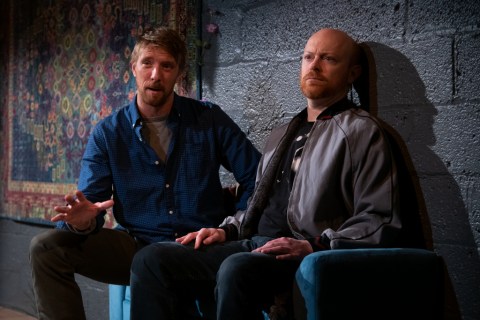
(L to R): Michael Schantz, Jeff Biehl in ‘Life Sucks,’ directed by Jeff Wise, The Wild Project, Wheelhouse Theater Company (Russ Rowland)
Uncle Vanya’s humorously morose, whiny, masochistic victim is portrayed by the completely heartfelt (especially at the conclusion) and totally believable Jeff Biehl who steers the production blaring out Uncle Vanya’s shredded inner life so we completely identify that yes, “Life Sucks!” The original quote attributed to Stephen King’s Pet Sematary reads with the horrific refrain, “Life sucks, then you die.” (SPOILER ALERT-do not read the last sentence) However, in the play Posner saves us from the inevitable exclamation point for Uncle Vanya.
The unobtrusive, slighted, self-critical Sonia (Chekhov’s Sonya) is portrayed by the adorable Kimberly Chatterjee who manages to tone down her adorableness just enough for us to not consider why the attractive Dr. Aster (Chekhov’s Astrov-played by Michael Shantz with mirey depressiveness) elects to frantically, humorously lust after Ella who spurns him, rather than to seek the comforting arms of the sweet, cute, funny Sonia.
Ella (in Chekhov, Yelena) portrayed with exceptional wit by Nadia Bowers, during narcissistic moments of externality, considers herself to be the “IT” girl with the overwhelming problem of attracting men and women she doesn’t want. All the males are entranced with her, especially because she is married to the elderly professor, Sonia’s Dad, played by the inimitable Austin Pendleton who is her counterpart in self-loathing, but for different reasons.

Austin Pendleton, Nadia Bowers in ‘Life Sucks,’ directed by Jeff Wise, Wheelhouse Theater Company, The Wild Project (Russ Rowland)
Pendleton is expertly hysterical, yet completely believable as he expresses that Ella’s image of her outward appearance and confidence mirrors the professor’s inner intellect and image of himself. Nevertheless, both are devastated; she by her own self-loathing and lack of psychic confidence and emotional wholeness, and he by his irreversible condition of O.L.D. How Posner’s elucidates their relationship is humorous and reminds us how and why opposites attract and then whip each other for it with great similarity.
Interestingly, it is the marriage of “ocelot” Ella with the professor that Uncle Vanya and Dr. Aster find a “come on” because “they” believe themselves to better for her than the professor. This obvious disconnect of the marriage between Ella and the professor frustrates both men. It also sends the crabby, murderous Vanya into rages and mordant behavior which of course is authentically funny. The self-confident but despondent doctor acts out his lust on Ella without asking permission, is rewarded, then verbally rejected. Interestingly, he takes this in stride. Can he do anything else when she refuses to run away with him?
The object of Vanya’s and the doctor’s desires portrayed with affability and outer confidence by Nadia Bowers, too, is filled with annoyance and frenzy that is driven by her compromised psychic state. She has everything any woman could want and can’t get out from under her own misery. Neither love nor lust satisfies and not even Pickles’ (Stacey Linnartz is the perfect foil for Bowers) alluring kiss can offer Ella any hope of lifting her out of herself.

(L to R): Nadia Bowers, Michael Schantz, Barbara Kingsley, Stacey Linnartz, Austin Pendleton in ‘Life Sucks,’ directed by Jeff Wise, The Wild Project (Russ Rowland)
Only Babs-Chekhov’s character Maria (the sane and moderate Barbara Kingsley) seems to be at a steady, “Goldilocks,” emotional state. Within she appears to have achieved self-contentment. She is the Zen Mother and well-meaning philosopher/artist and mother to Vanya. She appears grounded and whole. As foils go, Barbara Kingsley is measured and with near perfection, she rounds out this well shepherded, sterling ensemble as she manages to corral her son (the prickly Biehl) with intelligence.
What I particularly enjoyed was how each character engages the audience in their solo moments with a genuineness so acute that one believes the real actor behind the mask stands emotionally/psychically naked before us. This direct address channeling is difficult to achieve sans actors’ expertise, relaxed confidence, witty, ironic tenor, and, of course, damned superb writing. For example, I saw another production recently with uneven performances especially in the solo sections which didn’t ping with authenticity. The contrast between the two productions was striking with regard to the actors’ solos.
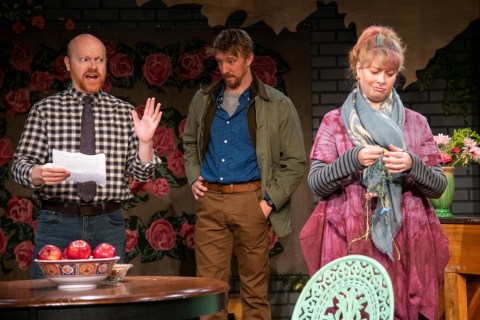
(L to R): Jeff Biehl, Michael Schantz, Stacey Linnartz in ‘Life Sucks,’ directed by Jeff Wise (Russ Rowland)
Life Sucks is a treasure which should be extended, if possible. This New York Premiere by Wheelhouse Theater Company just brings down the house! It will engage you like no other production this spring. It achieves a trinity of excellence in the writing, ensemble work and direction. All cohere seamlessly and the high points resonate and recede with the undulations of life’s joys and self-indulgent sorrows. Surely, the themes are clear; there are some things that cannot be changed. And the petulance of not wanting to make the best of our own personal situations is sheer foolishness.
Special recognition to the designer creatives who include Brittany Vasta (Scenic Design) Christopher Metzger (Costume Design) Drew Florida (Lighting Design) Mark Van Hare (Sound Design).
Life Sucks runs with one intermission at The Wild Project (195 E. 3rd St) until 20 April. For tickets go to their website by CLICKING HERE.
‘White Noise,’ Starring Daveed Diggs at the Public
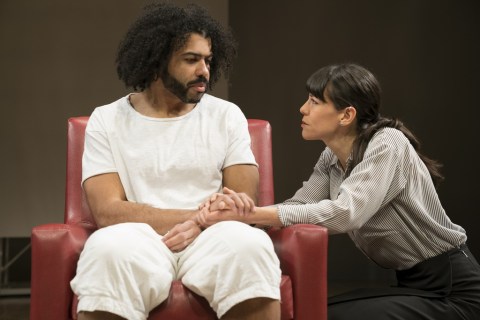
Daveed Diggs, Zoe Winters in ‘White Noise,’ Zoë Winters, Suzan-Lori Parks, the Public (Joan Marcus)
White Noise, written by Suzan-Lori Parks, directed by Oskar Eustis is a long thrill-ride into the psyches of thirty-somethings reeling from the abuses of previous generations’ willful negligence, regarding racial and gender mythologies. These stereotypes and demeaning memes abide with a vengeance below the surface of friendship power dynamics and mixed-race love relationships. Indeed, Parks suggests these are embedded in the American cultural DNA. And not even elaborate experiments such as the one long-time friends Leo (Daveed Diggs-always the consummate actor/performer and a joy to watch) and Ralph (Thomas Sadowski acts with moment-to-moment precision) embark on to expurgate Leo’s fears of being shot while black, ameliorate issues of racial identity politics int heir psyches..
The ultimate message in Parks’ White Noise remains: if these race and gender myths abide among friends, then what hope is there to modify, redeem and heal the nullifying cultural divides that exist among races, genders and economic classes that are at odds with one another? This is especially so in the retrograde Trump era when noxious white supremacist groups have been empowered to embrace hate and fear by a president who finds upholding the constitution and civil rights laws loathsome and inconvenient.

Daveed Diggs, Sheria Irving in ‘White Noise,’ directed by Oskar Eustis, written by Suzan-Lori Parks, the Public (Joan Marcus)
The inherent sado-masochistic, master/slave ethos deep within the mindset of all who have white/black relationships and their gender derivatives are mostly covered by social veneers of liberalism. Parks lays bare this phenomenon in a gradual reveal that she stages within an artificial construct prompted by Leo after he has been traumatized by the police. However, it is an idea that Leo long thought about to deal with his inability to sleep which he attributes to an ambient fear begun at childhood. It is a fear that has morphed like a monster into unsettled apprehensions about being black and living in a repressive culture of white privilege.

(Foreground, L-R): Thomas Sadoski, Daveed Diggs in ‘White Noise,’ directed by Oskar Eustis, written by Suzan-Lori Parks, the Public (Joan Marcus)
To free himself of the apprehension and feel that he is empowered in his own identity apart from racial, socio-political constructs, Leo devises the Master/Slave freedom project. He finally convinces his professor/writer friend Ralph to contract his services as a slave. Leo believes that if he is owned by Ralph who will be his Master for 40 (a magically symbolic number) days, he will be psychologically secure in the knowledge that he is protected by his “Master” in a culture that promulgates institutional racism and brutality against blacks via the justice system, economic inequality and unequal opportunity. As a result of this experiment at the end of the 40 days, Leo believes he will move to the core of his own reality and become free of the stereotypes, memes, lies, matrixes, objectifications and internalizations of abuse inherent in the culture and society of America.
During their extended friendship over the years, Ralph and Leo believed they had risen above racial gender politics and achieved a state of being “cool” and close with each other. Their friends/girlfriends Misha (the humorous Sheria Irving) and Dawn (the crisp, on point Zoë Winters) whom they’ve also known for years and have swapped as partners provide the security and sanctity of love and help to be the glue that has kept the group together and flourishing.
But during Leo’s and Ralph’s Master/Slave experiment, the women learn that they have been lying to themselves and each other. Indeed, for Leo, Ralph, Misha and Dawn their outward congeniality, love and closeness is a ruse, a construct they have created for and with each other to keep the “outer hellishness” of the culture away from them.
But the ruse hasn’t worked. In one way or another all are lost and feel incomplete, despite their relative successes, a fact revealed by the conclusion of the master/slave project.
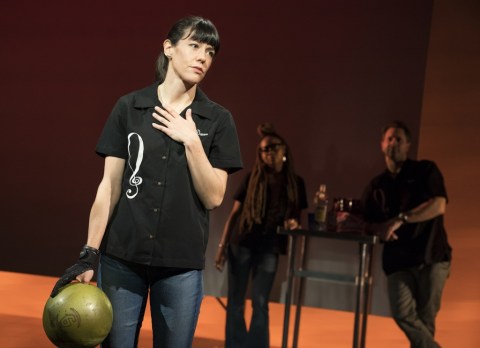
Zoë Winters in ‘White Noise,’ directed by Oskar Eustis, written by Suzan-Lori Parks, the Public (Joan Marcus)
Indeed, the experiment overturns the foursome’s relationships, their perceptions of each other and ultimately how they view themselves. In the past they have fed off the group’s collective identity and while it has made them feel loved, it also has hindered them. Misha, Dawn and Ralph have cheated on each other and are incapable of fidelity, peace or joy. Though they were able to get around being “cheaters” with secrecy and forgiveness, they remain unfulfilled in love.
That each is searching is obvious, though they are not sure what they want or who they want it with, for they are identity challenged. Only Leo has been faithful to Dawn. Only Leo, Parks’ heroic protagonist has enough self-awareness to understand he is chained by the past in the present. He realizes that he will only be at peace by finding a way to free his being to live in harmony with himself.
Over the course of the master/slave project, Parks reveals how the dynamics of this foursome fragments. Their group identity together and with their partners cannot withstand their own hypocrisies which the project reveals. Ultimately, as Leo learns, they also learn how they’ve allowed the cultural constructs to imprison them. And their attempt to avoid these underlying hate-filled concepts that surreptitiously guide their behaviors in their friendships and love relationships with each other has thwarted their quest for peace and autonomy. Their ability to forge their own healthful identities and act on their self-knowledge with a confidence that will free them has been constrained.

(L to R): Thomas Sadoski, Daveed Diggs, Zoë Winters, Sheria Irving in ‘White Noise,’ directed by Oskar Eustis, written by Suzan-Lori Parks (Joan Marcus)
After Leo and Ralph “progress” into their simulated journey back into history to effect the egregious acts of domination and subservience, the worm turns: the relationships between them and among their girlfriends morph. “Freed” to imprison himself within the soul crushing white privilege dynamics, Ralph throws himself into the “master” tropes and changes his attitude to become more bossy and edgy with Leo. Influenced by members of a White Club he joins as a secret society, he leases a punishment slave collar for Leo and pushes the master/slave behavior to levels of cruelty and exploitation he would not have thought possible of himself prior to their experiment.
Interestingly, Leo for a time is able to sleep and rest in this masochistic abuse of slavery because it is “out in the open,” and “in your face.” Above all, he is the “author and finisher” of his slave role having come up with the contract and agreeing to the amendments that Ralph suggests. By controlling the construct himself and choosing to be subservient, he empowers himself with what he learns. As he becomes freer, Ralph’s dignity and honor are compromised, though superficially he thinks he is empowered. However, by engaging as Leo’s “Master,” Ralph becomes more loathsome to himself. It is, a state which he fought his entire life, but was incapable of overcoming. Ironically, in the “Master” roll, he further enslaves himself as a hateful loser who “gets off” on being exploitive.
The lies and pretended altruisms end. Leo’s “cool” relationship with Dawn (Winters) is over and Misha’s (Irving) hidden sexual relationship with Dawn dissolves in a fight. However, Misha admits she will most probably still keep Ralph around because by having a white boyfriend, she feels protected as part of the privileged culture. That they will continue to be unfaithful to each other doesn’t matter.

Thomas Sadoski, Zoë Winters in ‘White Noise,’ directed by Oskar Eustis, written by Suzan-Lori Parks (Joan Marcus)
By the conclusion of Parks’ dramatic polemic, Leo understands his personal self-imposed oppression he internalized from the culture’s oppressive mores. He also realizes that like his ancestors, in spite of it, he will thrive and prosper. On the other hand Ralph’s weakness so manifests to himself that he is broken. Indeed, white privilege which is meant to prosper white males in their dominance of all “under them in the culture,” actually weakens and enslaves them worse than those they attempt to victimize. The women who go along with the white privilege program are swept up in the abuse and are forced to live in a sub rosa muddle of lies and obfuscations which propel them into an abyss of misery and torment. Only if they work to extricate themselves from the fears that destroy their wholeness, will they become free to establish their own autonomy and identity.
Parks’ play is a powerhouse in its satiric elements and in its themes. She brilliantly presents her concepts through the interplay and active relationships between and among Dawn, Leo, Ralph and Misha. Eustis’ direction is insightful and illuminating. The performances, are solid; Daveed and Sadoswki are electric and the effect they produce is frightening. Irving and Winters continually surprise, and Irving’s program “Ask a Black” is absolutely hysterical. The satire throughout is astounding with just enough subtle rendering to punch you in the gut with a bit of truth to leave you breathless.
As a caveat, I nodded out during some of the solos which were expositional and might have been slimmed down to keep the pacing taught. I did find I was completely focused during Diggs’ opening monologue which was electric. His easy, relaxed bonding with the audience completely engaged me. The other solos were less so, not a fault of the actors or direction. It may have been the order in the overall arc of the play’s development. Or the solos might have been a tad redundant with explanation not dramatization.
Kudos to the design team that helps to bring the production to life. These include Clint Ramos (Senic Design) Toni-Leslie James (Costume Design) Xavier Pierce (Lighting Design) Dan Moses Schreier (Sound Design) Lucy Mackinnon (Projection Design) U. Jonathan Toppo (Fight Director) Michael Rossmy and Kelsey Rainwater (Intimacy Directors).
White Noise brings one-of-a-kind performances to a thought-provoking, memorable play about the subtle, historic mores and influences that control us if we are not introspective or self-examining. It is a must-see which runs with one intermission at the Public Theater until 5 May. For tickets go to the website by CLICKING HERE.
‘Oklahoma!’ Cool Convolution, a Review

The cast of Rodgers & Hammerstein’s ‘Oklahoma!’ directed by Daniel Fish, Circle in the Square (Little Fang)
Rodgers and Hammerstein II’s Oklahoma has come to New York City again. This slimmed down (cast) production directed by Daniel Fish initially opened at St Anne’s Warehouse with accompanying servings of chili and cornbread during the intermission. It gained steam to open at Circle in the Square with a multi-talented, vibrant cast, some of whom shine with resplendence. These include the principals: the transcendent, mesmerizing Damon Daunno as Curly, Rebecca Naomi Jones as Laurey, with salient assists by Mary Testa (Aunt Eller) the adorable Ali Stroker (Ado Annie) the sensitive, menacing Patrick Vaill (Jud Fry) the humorously clueless James Davis (Will Parker) and the funny, always on-point Will Brill (Ali Hakim).
Green Grow the Lilacs, (1930) by Lynn Riggs is the play source for the original 1943 version of Rodgers & Hammerstein II’s Oklahoma! Riggs’ (a mixed-race white and Native American-Cherokee) text provides the lyrical, wistful opening that Rogers and Hammerstein II used as inspiration for the lyrics to the iconic song, “Oh, What a Beautiful Morning.” Cowboy Curly McClain opens the “innovative-for-its-time” musical with this serenade which is an advertisement to win over Aunt Eller and Laurey Williams who he wants to ask to the evening box social.
The corn, cattle, sky, “give off a golden emanation that is partly true and partly a trick of the imagination, focusing to keep alive, a loveliness that may pass away,” Rogers and Hammerstein II’s original script states in the stage directions lifted from Riggs. Inherent in Curly’s hopefulness that “everything will go his way,” regarding Laurey Williams, is the possibility that it won’t.

Damon Daunno, Mary Testa in Rodgers & Hammerstein II’s ‘Oklahoma!’ directed by Daniel Fish at Circle in the Square (Little Fang)
In fact the moment he ends the song, his interchange with Laurey sparks reality. Things are upended where she is concerned and indeed, the loveliness that he enjoyed for a moment has passed. Already, the themes have been presented: uncertainty, impermanence and imperfections caused by tricks of the imagination. Foreshadowed? Continual struggle ahead for Curly’s and Laurey’s relationship and for Oklahoma which is about to become the 46th state.
These themes of impermanence and imperfection coupled with the struggle for survival and the mitigating force of love which may or may not last or help, are important ones. This is especially so for the main characters Curly and Laurey who strive, argue and sacrifice for each other. Though by the play’s conclusion they fulfill their love in marriage which they celebrate with Oklahoma’s statehood, harbingers of change forebode on the horizon. Curly will become a farmer which he knows little about and in twenty-three years his community will be facing drought, deprivation, dust bowl storms and bankruptcy as the “land that is grand” fails them because of their own inability to properly husband it.
Some of this nightmare future in a place that will not fulfill its beautiful mornings is incipient in the plot development of Green Grow the Lilacs and Rodgers and Hammerstein II’s musical. The dark days ahead are certainly revealed by the end of Fish’s Oklahoma! which is thought-provoking, intriguing but also convoluted.
Fish does not change the script, except for the physical fight scene between Jud and Curly. Curly doesn’t fall on his knife; there is a pistol. But the use of design elements lighting/darkness (Scott Zielinski) staging (Fish) scenic design (Laura Jellinek) costume design (Terese Wadden) special effects (Jeremy Chernick) projection design (Joshua Thorson) and sound design (Drew Levy) morph the basic immutable tenets of Oklahoma! to reflect Fish’s circulatory vision. I found this at times confusing and at cross-purposes with characterizations and themes.

Damon Daunno, Rebecca Naomi Jones in Rodgers & Hammerstein II’s ‘Oklahoma!’ directed by Daniel Fish (Little Fang)
In this re-imagined Oklahoma! these are largely re-directed, sifted and filtered revealing the underpinnings of a tenuous social culture which we are encouraged to become a part of. Indeed, the lights are on with the exception of a lovely, sensual and intimate scene between Laurey and Curly and a few other scenes where the design hues change or there is total darkness.
However, despite the lighting touch of inclusiveness, Fish’s social dynamic isn’t completely realized. For example there is no clear referent to Native Americans (30 tribes inhabited the territories by the time of the play) in the community that the designers create of family-style tables sporting chili-filled crock pots that surround the playing area. There is not one eagle feather, moccasin or soft, beaded belt, headband or any obvious identifying cultural accoutrements. In this alternating stylized/realistic version of Oklahoma! this appears to be an oversight along with the reality that also appears to be diminished: laws did not protect women who were men’s chattel once married. (And the EPA amendment has still not been passed!)
In his emphasis of the conflict that grows to a great malevolence between Curly (Damon Daunno) and Jud Fry (Patrick Vaill) Fish uses design elements (darkness, sound effects, projections) and particular staging. The result impacts and twists the characterizations in the service of presenting a culture and community rather than individuals. This diminishes the inner conflicts of the characters and hinders the elucidation of themes that could lift the audience’s understanding of immutable principles of good and evil. In this version goodness is sometimes hard to come by.
Specifically, in the smokehouse scene, Fish douses the lights and then uses close up projections of the faces of Duanno and Vaill to create tension and menace. Damon Daunno as Curly and Patrick Vaill’s Jud speak in miked whispers; the effect reveals surreptitious treachery on the part of both characters. The song “Poor Jud is Dead” has a completely different tenor. It appears that Curly is as wicked intentioned, as Jud, perhaps even more so as he encourages Jud to think suicide might yield the love and companionship he seeks, an abject lie for an outsider and miscreant like Jud. Any potential humor in this scene is removed. Curly who should be the bigger person becomes the weaker in his jealousy of a man he criticizes after Jud threatens him.
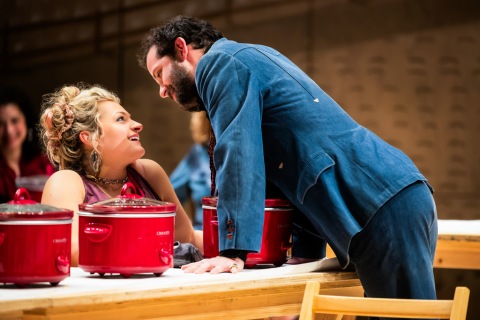
Ali Stroker, Will Brill in Rodgers & Hammerstein II’s ‘Oklahoma!’ directed by Daniel Fish, Circle in the Square (Little Fang)
In this version the scene is a disconnect. It throws down the brokenness of Jud and Curly which ends in their ominous shooting in the dark which Aunt Eller investigates and breaks up as the lights come on. The way Fish renders it, the scene makes us reflect that perhaps Curly is just better at hiding his rapaciousness toward Laurie with more enhanced social graces. His jealously unsettles him that Laurie selects Jud to be with; rather than to confront this, his childish pride takes over.
Because of the overall tone of the scene, the congenial, affable musician and expert singer and guitar player Curly who formerly delighted us, seems an incongruity in his behavior toward Jud. Granted, the scene is a difficult one for tone and tenor to strike a balance with humor. However, when the scene reveals characterizations tweaked without humor, the effect is disturbing. Curly is made unlikable and Jud becomes pitiful and wormy, in addition to being unlikable. All these machinations are over a woman? Do they even see Laurie’s identity? Or is Laurie an objectified symbol of conquest their male egos compete over? Considering Jud’s position in the community (which he himself has effected) there is no competition; why is Curly so upended?
Laurie’s characterization in this version is made shallow. Eliminated is the dream dance sequence where Laurie chooses to sacrifice herself to be with Jud in order to save Curly’s life. The love element is missing and is replaced with an incongruous solo dance (albeit Gabrielle Hamilton is an incredible, lovely talent). The thrust of why Laurie should “lay low” in her feelings for Curly are suggested in “People Will Say We’re in Love.” She must be careful around Jud; she must prevent gossip that would get back to Jud, yet suggest her true feelings for Curly to him. We find this out as she confesses how Jud is stalking her and she hears sounds of him under her window. It is not only because she is undecided about Curly, but it is also because she fears Jud and senses he will not tolerate a relationship between her and Curly. This is muddled in Fish’s version of Oklahoma!
Without the dream dance sequence with Curly, Jud, Laurie and their dream counterparts to illuminate Laurie’s inner struggle and sacrifice, all of the subsequent plot development, foreshadowing of danger and tensions between Laurie, Jud and Curly fall short of the bulls-eye. The coherence and through line become disjointed. I found the solo dance confusing and unrelated to Laurie’s conflict with Jud who haunts her dreams.

Cast of Rodgers & Hammerstein II’s ‘Oklahoma!’ directed by Daniel Fish (Little Fant)
The tensions in the character of Laurie, the strain and indecision about Curly made little sense to me without the interpretation of her dream to clarify. It seemed she was being a petulant tease to frustrate and torment Curly who is adorable and cares for her. Why shouldn’t she go with him? That she is sacrificing herself to protect him from Jud is a powerful justification why she doesn’t. It should not be undercut. Meanwhile, the laws don’t protect Laurie as a woman or discourage Jud’s potential stalking behavior. She thinks she can negotiate the situation and keep Jud “at bay” by going with him. She must be her own strong woman and handle things her way, keep Jud around as useful to Aunt Eller, and somehow discourage Jud. Her tenuous position and personal strength are de-emphasized in this version.
When her decision to manipulate Jud and save Curly backfires, Jud seeks her out though she attempts to avoid him. Being near her encourages Jud to enact what he has most probably imagined all along, sexual intimacy. However, Fish’s version complicates. To add to the incongruity, the director chooses to place Laurie and Jud in darkness. Jud’s attempts at intimacy are not visible. We hear sounds between Jud and Laurie but they do not sound like a struggle and Laurie never screams “No,” or “Stop.” Is she returning his kisses out of her own “hot” desires for intimacy? We can’t tell.
Meanwhile, the maladjustment and menace in Jud is apparent from the outset and underscored throughout. The pictures of nude women he has up in the smokehouse reveal a warped sensibility toward women and unfilled expectations. That he doesn’t know the difference between love or sex is manifest in his obsession for Laurie. That he might force himself on her is clearly foreshadowed in her fear and his threats against Curly being with Laurie. Why it is called into question with a “lights-out” scene between Laurie and Jud? This is not conducive to clarifying their characterizations.

James Davis, Ali Stroker Patrick Vaill (far right looking on) in Rodgers & Hammerstein II’s ‘Oklahoma!’ Daniel Fish, Circle in the Square (Little Fang)
Not being able to “see” what happens raises questions. Is Laurie enticed by Jud or is he misreading her? Is this a #metoo moment (an anachronism) in a time when men did what they pleased with women and rarely answered for it unless they were a different race? In the original script and other versions, it is a definite #metoo moment, that perhaps even Justice Brett Kavanaugh might acknowledge. (Well, maybe not.) The power and profound meaning of this is lost in this version. The justification for Laurie having the courage to throw Jud off the property is obviated as is her evolution as a character who has seen the light. Sadly, her insults of Jud seem harsh, if he has not grossly pushed himself on her.
Overall, the scene between them should be to the purpose that “he has gone too far,” and has misinterpreted her kindnesses to him as interest. Other Oklahoma! versions portray Laure’s characterization with coherence and logic. The attempted molestation empowers Laurie to kick him off the property. She draws the line; she will sacrifice herself no longer to protect Curly from Jud’s wickedness. She is no longer afraid which is a big step for her. In 1907 the law will not protect her, she will ask Curly to. It is a risk she takes. Does she have another choice?
It is an important moment and it has been re-characterized, supplanting it with the concept that Jud can’t catch a break and everyone in the community isolates and rejects him unfairly. That Jud creates the situation for himself is buried in this version. That he is the cause of his own problems, a truth he refuses to acknowledge or attempt to correct, is obscured. Jud is his own victim, the point of the humor in the song Curly initiates about him. His whines and resentments are weaknesses as is his impulse for revenge. (Unfortunately, upon closer inspection in modern day parlance he might be a Trump supporting sexual pervert, Incel or a Uni-bomber type in the making. UH OH. Have I gone too far?)

Damon Daunno in Rodgers & Hammerstein II’s ‘Oklahoma!’ (Little Fang)
Jud cannot get up and over his jealousy of Curly and obsession with Laurie. Curly doesn’t let his jealousy overtake him nor is he obsessed with Laurie; he loves her. There is a difference. Fish’s version muddies the contrasts between the two men. Curly understands himself and Jud. Jud lacks the will to understand that he is on the road to suicide or murder and doesn’t appear to want to select another path.
But rather than to reach out for help and crawl out of his hole to stop festering (Curly’s description of his behavior) he feeds his resentments and his victimization and remains apart, except when he can purchase “The Little Wonder” to harm Curly and when he goes to the social event to be with Laurie. He ignores his own faults and blames an unloving, heartless community which apparently has been a routine of his in his past. The fact that Fish’s casting of Jud does not reflect a member of another ethnic or racial group apart from this generally friendly community makes this all the more puzzling. We can only conclude he brings about his own demise, a tragedy of the human condition.
Fish slices away at the substance of the two protagonist’s inner conflicts that make them endearing and readily identifiable to us. He modifies Jud’s characterization which confuses, and de limits his character, draining him from being the self-harming tragic figure he is. Thankfully, the humor and relationships between Ado Annie (Ali Stroker) and her lovers Ali (Will Brill) and Will Parker (James Davis) brighten and thrill, all because of the excellent actors’ exuberance. They provide the fun, frolic and wise counterparts to Laurie’s and Curly’s sturm und drang. Directors impose their visions on productions and that is fine. But it should be effected with coherence, logic, clarity and balance. To my feeble mind, this version didn’t satisfactorily land.
This is especially so at the conclusion of Fish’s Oklahoma!. SPOILER ALERT! (Do not read this section; go to the last paragraph) The climax occurs not in Jud falling on his knife, but in Curly shooting him with a gun Jud gives him. (I couldn’t see this with Jud’s back to me…problematic staging.) Jud’s blood splatters Curly’s and Laurie’s white wedding outfits. This is the gruesome wedding present Jud bestows on them effected by Curly. The audience shock is palpable. That is the point, albeit gratuitous since Curly has Laurie and he should not be jealous or feel malevolently toward Jud. Thus, this intentional shooting of Jud appears strange; but because of the staging, I couldn’t see the death scene action, just the blood splattering.
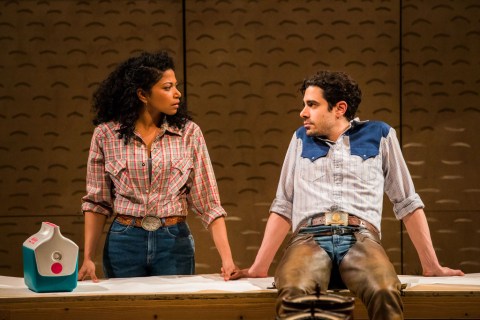
Rebecca Naomi Jones, Damon Daunno in ‘Oklahoma!’ directed by Daniel Fish, Circle in the Square (Little Fang)
The trial afterward becomes unjust justice of folks not wanting federal law (though they are now a state). Indeed, the entire community of cowpokes, farmers and their gals that many of the audience have broken cornbread with are complicit in vindicating Curly of Jud’s questionable death. Of course Jud is free of Curly and Laurie, but for the rest of their lives, remembrances of their wedding day are tainted by his blood.
The point is well taken. Regardless, the vital fact is that now Curly and especially Laurie are free of Jud who threatened their lives and personal sanctity. That the town forgives him and gives Curly a second chance is their justice. Indeed, only the audience was around to “see” the dark clouds in the scene between Curly and Jud. However, at the conclusion when Curly sings “everything’s going my way,” for Oklahomans, and audience members who know the state’s history in the 20th century, this is a supreme irony.
Fish, the cast and the creatives are to be lauded for taking the risks they did to reformulate Oklahoma! Kudos especially goes to the Orchestra: Nathan Koci, Joe Brent, Brett Parnell, Hilary Hawke, Sarah Goldfeather, Leah Coloff, Eleonore Oppenheim, John Miller.
All involved did a superb job in effecting Fish’s vision. That the incongruities and convolutions in this version were startling to me is of little consequence.
The original version and subsequent versions retain the depth and continuity of characterization, though the musical may be flawed if the directors do not accommodate for how the roles of Native Americans were seminal in the evolution of Oklahoma to statehood. But people will continue to see Oklahoma! because of its place in the historical musical canon. This version should be seen because of Fish’s conceptualizations and the creative designers’ and ensemble’s live performance spectacle which audience members will, at the last, appreciate.
Oklahoma! runs for two hours and forty-five minutes with one intermission at Circle in the Square (1633 Broadway…50th Street). For tickets go to the website by CLICKING HERE.
‘Oklahoma!’ Cool Convolution, a Review
The cast of Rodgers & Hammerstein’s ‘Oklahoma!’ directed by Daniel Fish, Circle in the Square (Little Fang)
Damon Daunno, Mary Testa in Rodgers & Hammerstein II’s ‘Oklahoma!’ directed by Daniel Fish at Circle in the Square (Little Fang)
Damon Daunno, Rebecca Naomi Jones in Rodgers & Hammerstein II’s ‘Oklahoma!’ directed by Daniel Fish (Little Fang)
Ali Stroker, Will Brill in Rodgers & Hammerstein II’s ‘Oklahoma!’ directed by Daniel Fish, Circle in the Square (Little Fang)
Cast of Rodgers & Hammerstein II’s ‘Oklahoma!’ directed by Daniel Fish (Little Fant)
Rebecca Naomi Jones, Damon Daunno in Rodgers & Hammerstein II’s ‘Oklahoma!’ directed by Daniel Fish, Circle in the Square (Little Fang)
James Davis, Ali Stroker Patrick Vaill (far right looking on) in Rodgers & Hammerstein II’s ‘Oklahoma!’ Daniel Fish, Circle in the Square (Little Fang)
Damon Daunno in Rodgers & Hammerstein II’s ‘Oklahoma!’ (Little Fang)

