Author Archives: caroleditosti
‘Ernest and Celestine’ at The New York International Children’s Film Festival

Ernest & Celestine with Forest Whitaker, Mckenzie Foy, William H. Macy, Lauren Bacall, Jeffrey Wright, and Paul Giamatti
The New York International Children’s Film Festival is offering screenings of top films for kids and adults. Many are popular and the tickets to official screenings and after party events have been sold out. However, tickets are being offered at venues throughout the city, so it is not too late to see beautiful, groundbreaking, thought-provoking films from around the world for ages 3-18. In the case of Ernest and Celestine directed by Stephane Aubier, Benjamin Renner and Vincent Patar which still has tickets available, even adults will enjoy the deeper issues and technical expertise which made this an award winning animated feature from France.
Daniel Pennac based his screenplay for this ethereally artistic and dreamy animation on the characters of Ernest and Celestine by Belgian author and illustrator Gabrielle Vincent. Vincent (1928 -2000) added to her initial concept of Ernest and Celestine by creating an entire Ernest & Celestine collection. She wrote and illustrated a total of thirty-eight books which encompass the pairs’ various adventures. Each has subtle lessons for children to assimilate as they enjoy the mouse-bear struggles and find solutions in the bonds of friendship. Adapting to themes of their unlikely companionship, Pennac has written a tale of how these two delicious and beautifully rendered characters met, bonded, and began their very first adventure together. In effect the feature serves as a prerequisite to the classic series of Ernest and Celestine books that readers around the world delight in.
The Ernest & Celestine animated feature has all of the elements of an adorable yet meaningful romp through a fantasy land of two disparate animal social cultures. The mice live below ground and control their terrain and society using a hierarchical pecking order fueled by mythologies and mores which promulgate an intense fear of alternate animal societies. Every child is indoctrinated with a horror of the ursine society which lives above ground. Profit motives and survival motives exploit this fear which trends throughout the mice generations. One reason for the antipathy between the two cultures is suggested. The mice/rats depend upon bear teeth when theirs fall out or they will become unproductive and perish. The bears don’t willingly give up old teeth; the mice must surreptitiously steal them. Thus, the mice employ corrupt means to exploit the “alien” culture.

Ernest & Celestine at the New York International Children’s Film Festival
For their part the bears abhor the creatures below ground. Theirs is a community of quaint, charming storybook houses out of Bruges, Belgium, minus the canals. The seemingly sweet dwellings are paintbrush animated in light, watercolors, simplistically drawn. The pastels tend toward pinkish, cream, fade-washed shades. However, all is not fairy tale “nice” in the ursine society. The profit motive also drives the bear population, and we see one example with the candy store entrepreneur. He sells delicious sweets of all stripes and colors to lure the bear children and adults into overindulgence. To gain his profits on the back end, his wife sells bear teeth for the children and adults who will lose theirs eating his sweets. He is without compunction or morals supported by an oblivious social structure equally as corrupt as the mice society.
Both cultures above and below ground are Philistine in nature and represent some of the worst human social characteristics; they are greedy, selfish, exploitative, without empathy, fear-mongering and manipulative. Our two friend heroes do not fit in; they are artists: Ernest is a musician and Celestine loves to draw. Both are not appreciated for their talents and Ernest lives alone in his ramshackle house while Celestine, an orphan, must steal bear teeth to survive. Through a “random” series of events in which Ernest nearly eats Celestine, the two strike a spark of empathy, love, and understanding. This lifts both beyond the fear and death-embracing, indoctrinating cultures that attempted to brainwash them in the name of sustaining an unfortunate paradigm of existence. With their artistic sensibilities they appreciate each other’s gifts and find a peaceful and pleasant “way of being.” These experiences allow them to tap into a reservoir of hope, love, and loyalty so that they might overcome the horrors of what threatens to destroy them when each is caught and imprisoned by the “enemy” side.

Ernest & Celestine, directed by Stephane Aubier, Vincent Patar and Benjamin Renner.
Forest Whitaker (Ernest), Mackenzie Foy (Celestine), Lauren Bacall (The Grey One-mouse), Paul Giamatti (Rat Judge), William H. Macy (Mouse Dentist), Jeffrey Wright (Grizzly Judge) do a fine job with their characterizations. Whitaker is grumpy, yawny, sleepy, kind with humorous grunts and groans. Foy is delicate, sweet, and serenely heroic as one would hope Celestine would be. The animations pair beautifully with the selected actors’ portrayals. Lauren Bacall is practically unrecognizable and scary as are Wright and Giamatti. I did love Macy’s removed and “matter-of-fact” explanation of why the bear teeth are of paramount importance to mice survival, and his transformation into bully as he threatens Celestine not to come back until she achieves her bear teeth quota.
If you have not seen the film yet, take your kids or grandchildren who will appreciate it. Do not pass up the opportunity to see it. You will appreciate the underlying themes and animation, music, and screenplay artistry that blend to form a perfect and satisfying whole.
This review first appeared on Blogcritics.
Gidion’s Knot by Johnna Adams. A Play About a Teacher, a Single Mom and Her Son.
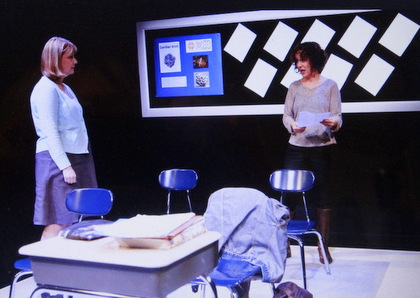
L to R: Dara O’Brien and Karen Leiner in Gidion’s Knot by Johnna Adams, directed by Austin Pendleton. Photo by Carol Rosegg.
Humans are self-deceivers; they often avoid confronting painful truths. When/if their frauds lead to catastrophe, then they are forced to look at how their self-duplicity created the consequences. With self-deception, there is the inevitable manipulation of others and the abusive “passing the blame” of one’s hated flaws onto these victims who may or may not suspect the manipulator’s ulterior motives. If the victims are enablers, they accept the blame and help push the abuser into their catastrophe. Ideally, the sooner one confronts the horrific inner Gorgon of truth, the better. Confrontation leads to enlightenment and growth. Delay, brings stony emotions, obfuscations, and more lies, until there is collapse, self-destruction, or madness.
In her play Gidion’s Knot, Johnna Adams explores how a mother and a fifth grade teacher dance around the “truth” of an incident which involves Gidion who was in Heather Clark’s fifth grade public school class. The dance provokes mother Corryn (Karen Leiner), and teacher Heather (Dara O’Brien), to inadvertently lay bare their souls in an interesting power manipulation. Rather than confront their inner Gorgon, and help one another, they pity, judge, condemn, project, and appear cold-hearted: all acts of self-deception and obfuscation. As the play records their convolutions, we, the audience, try to unravel the mystery of what happened to Gidion and what is happening in the present between the two women. But our attempt to unravel the knots of lies and truths remains feeble. In a fog we wonder about the significance of what we are seeing and question if these characters will ever acknowledge their inner Gorgon, thus destroying its power over them.
Playwright Johnna Adams has contrived a complex, hyper-charged conundrum of a play. Directed with precision, insight and sensitivity by Austin Pendleton, Gidion’s Knot leaves one spinning about the characters’ manipulations and duplicities as it examines the issue of social and parental responsibility. I cannot envision many other directors who so aptly could have created an atmosphere to elicit the marvelous performances. Because of the team’s united efforts this amazing production thrills and provokes.

Dara O’Brien in Gidion’s Knot by Johnna Adams, directed by Austin Pendleton at 59E59 Theaters. Photo by Carol Rosegg.
Pendleton’s talents adhere with the vivid, alive portrayals by actors Karen Leiner and Dara O’Brien. Their creation is a continuous thrumming of palpable tension that keeps us engaged. Can the mysteries be solved given the complexities and needs of the characters? Pendleton’s, Leiner’s and O’Brien’s masterful work illuminates the charades, blinding rationales, and subtle justifications the characters use to avoid their miserable inner truths. We recognize how Corryn’s and Heather’s self-deceptions have lead to catastrophe. Will these women see the light and help one another or resort to recriminations and judgements enabling and fomenting the inevitability of another disaster?
As the actors and director elucidate these points, the entanglements intensify. The more we attempt to extricate the truths, the more we are caught up in the characters’ rationalizations and self-fraud. We empathize because we are looking at ourselves. We realize that for them, there may be no way out except to live with an inner morass that will worsen. Unlike a Gordian Knot, an allusion aptly used by the playwright, the knot Gidion has created cannot be cut.
For the setting and backdrop Adams uses a conventional educational system and an atypical parent-teacher conference. Along the way she touches upon the issues of our present public educational system’s cultural assumptions about curriculum, appropriate behavior, and the responsibility of the parent, child, teacher, and system to produce learning. She also infers how these assumptions may run counter to the true nature of learning as art and how such learning prompts the finest art. Though parts of the play might appear to be contrived, (i.e. Gidion’s act, Corryn’s choice to put Gidion in a public school, the absence of communication between the school and parent), the playwright tries to smooth over the glitches with the characters’ logical explanations. Just at the point where one might find the contrivance an obstacle, Pendleton and the actors patch up the holes with brilliant performance art that is completely “in the moment.” We are swept up by the life we see and don’t give the contrivance much thought.

L to R: Karen Leiner and Dara O’Brien in Gidion’s Knot. Photo by Carol Rosegg.
The playwright focuses Gidion’s Knot around Corryn’s interaction with Heather during the conference. When Corryn first enters the classroom, we believe she is misplaced because Ms. Heather Clark is shocked that she’s come. Corryn tells her she is there to discover the reasons why Gidion, a brilliant student, has been given a suspension by Ms. Clark. She wants to understand what happened to her son and figure out the motivations for his behaviors. We suspect there is more to her initially benign response because of Heather’s amazement at her presence. As Corryn probes Heather for answers, she becomes hostile and aggressive, and the underlying tensions between the parent and the teacher grow. Corryn’s acidic comments push Heather Clark into retreat mode with long periods of silent acquiescence as she takes in Corryn’s opprobrium. Throughout the exchanges we wonder who is being truthful, who is avoiding reality and why is the “bullying” necessary?

Karen Leiner in Gidion’s Knot by Johnna Adams, directed by Austin Pendleton at 59E59 Theaters. Photo by Carol Rosegg.
Little by little, the playwright unfolds the mysteries. We find out why Heather Clark is shocked to see Corryn in her classroom. However, this initial revelation is only the beginning. Gidion has left a knot to unravel about his behavior; we search for answers about the extent to which Corryn and Heather might have been culpable in effecting Gidion’s nullifying actions. The playwright adeptly guides the audience through the teacher’s and parent’s perspectives. From Corryn’s perspective we want to know more from Heather Clark. Surely, the teacher understands what happened to Gidion. We understand Corryn’s need to manipulate, browbeat, and abuse the truth from Heather. However, we know from Heather’s reticence that she is protecting someone and is keeping certain situations in her classroom confidential. Aligning with Heather’s professional perspective, then, she appears to be in the right. We assume that Corryn is too emotionally invested to see clearly and rationally. But who is Heather protecting? Heather? The principal? The children? Gidion? Corryn? And from what?
Because of the superb performances which ooze strain and inner turmoil, we yearn to understand and this suspense keeps our attention. As more of the complications are revealed, the less truth we know. The more vitriol Corryn expresses, the farther she moves from inner understanding of herself and her impact on her son. The more Heather Clark enables Corryn’s bitter “truth” seeking with her spare explanations, the less we understand about Gidion’s motivation and Heather’s part in it. Was Gidion’s suspension truly justified? Or was it an example of the public education system curtailing sensitivity, artistry, and creativity as suggested by Corryn? Does the letter that Corryn finds in Gidion’s desk reveal he has been damaged by classmates? Or is there a deeper, hidden truth which will have ramifications upon Corryn’s understanding of herself and her son?
Throughout the play we are riveted because we are off balance. We do not know who is “fronting” whom. By the conclusion we are uncertain and that is the best we can hope for because the characters are inscrutable. We should not be projecting our own failed, misplaced assumptions on them. The issues of where parental responsibility and social responsibility begin and end are not resolved. We do understand that the educational system presented by the playwright (somewhat contrived) is not ready to deal with who or what Gidion is, but then neither is Corryn. Lastly, there is Gidion. In fifth grade, he is past the age of accountability. To what extent does the final culpability rest with him?
Gidion’s Knot was performed at 59E59 Theaters in a limited engagement.
This review first appeared on Blogcritics.
‘Take Me Back’ by Emily Schwindt, A Play About the Heartland of America.

James Kautz in Take Me Back by Emily Schwend, directed by Jay Stull at Walkerspace. Photo by Russ Rowland.
Thomas Wolf said in Look Homeward Angel, that one can never really go home again. This is particularly true for those who have established themselves in careers and have become successful. Not only have they picked themselves up and replanted roots in an environment where they can flourish, they are often loath to associate with their origins especially if the memories are unhappy ones. But what happens to those who have no where else to go? Home isn’t always the place where they have to take you in.
Emily Schwend in Take Me Back, directed by Jay Stull, explores the scenario of a young man who has returned home in desperation. As the play opens, we note that Bill (James Kautz) has served time in jail for theft. Unable to start elsewhere with no education, few prospects, no money or other place to live, he has moved in with his diabetic mom (a fine performance by Charlotte Booker). He attempts to take care of her. He tries to control her eating habits and get her to take her blood sugar in the morning and during the day. Above all he monitors her like a security guard to make sure she stays off the sweets. The exchanges between mother and son are humorous, and Sue’s furtive stashing of candies and goodies brings knowing chuckles from the audience. Kautz and Charlotte Booker have established a rapport that feels right as this mother and son attempt to adjust to circumstances where each are dependent on the other, though it is not necessarily a dependence that is desired or appreciated.

L to R: James Kautz and Charlotte Booker in Take Me Back by Emily Schwend, directed by Jay Stull at Walkerspace. Photo by Russ Rowland.
Frustrated that he has mucked up his life and upset that his mom is not listening to his adjurations about her diabetes, Bill resorts back to his old thieving ways. What opportunities are open to him in Oklahoma except to work in a Walmart and make the minimum wage? He can only see a series of unrewarding empty decades ahead. For him that is not better than nothing. The exciting allure of his old life beckons with the promise of a quick buck and an easy inside job. It is only when former girlfriend Julie shows up that he begins to believe that he might be able to get along in this desolate environment. When she reciprocates in an affectionate way and says she will come back and see him, he realizes that perhaps there is the hope that they can be together. He has correctly surmised she does not love her husband and is unhappy in her marriage.

L to R: Boo Killebrew and James Kautz in Take Me Back by Emily Schwend, directed by Jay Stull at Walkerspace. Photo by Russ Rowland.
Schwend has established themes that will resonate with all who have lived in this country during the last twenty years. There is the issue that the children will have to care for their aging parents who are starting on the road to dementia and who have multiple physical problems, including type two diabetes. There is also the issue of few employment opportunities away from larger coastal cities if one doesn’t have an advanced college degree, technical skills, or show entrepreneurial promise in creating one’s own opportunities. Another issue is the sad fact that children after divorce or other major life changes have moved back in with parents to share economic burdens. Worse, some have found it nearly impossible to leave home because they can’t afford living alone or sharing rent.

L to R: Jay Eisenberg and James Kautz in Take Me Back by Emily Schwend, directed by Jay Stull at Walkerspace. Photo by Russ Rowland.
Sub rosa issues weaving throughout the play point to a shrinking middle class, increasing economic hardship, and no employment opportunities. These have created a declining social community. Meanwhile, the prison population of which Bill had been a part has continued to soar. Underlying all these themes is that the humdrum, boring every day existence of work at a “dead end” job is no existence. Anything that can prompt one to escape (excessive entertainment, drugs, alcohol, addictions, the seduction of petty crime) is what a young people will seek out to release themselves from the boredom of “life” that is not living. Only family can get folks through. But what hope is there if the family is a parent in decline? There is the possibility of love and a relationship with someone to share one’s existence with, perhaps.
Schwend’s play is filled with pathos. There are a few surprising twists. The ensemble brings it all together under the competent direction of Jay Stull. The underlying questions Schwend asks will be confronting the U.S. in the next decades. How can we create more employment in decent, interesting jobs that pay well? How can we shore up the heartland with opportunities to stabilize the social community and strengthen it? Will resolving these problems be enough to keep men and women out of jail? The questions are important ones. Schwend has brought them to the fore without indicating political answers. With her homely characterizations, dynamic relationships, and important themes, she has given us much to contemplate.
The New York City premiere of Take Me Back will be performed at Walkerspace through March 22nd.
This review first appeared on Blogcritics.
London Wall by John Van Druten, Prescient and Trending.
The renowned playwright John Van Druten (Bell, Book and Candle, I Am a Camera which inspired Cabaret) stated in a 1951 interview that “I have never been a man for messages.” After viewing London Wall directed by Davis McCallum and currently at the Mint Theater, I would disagree.

L to R: Elise Kibler, Alex Trow, Katie Gibson, Matthew Gumley in London Wall by John Van Druten. Photo by Richard Termine.
In writing about the nature of relationships between men and women in the work environment, Van Druten has loaded his play with vital themes against the trending political backdrop where many women feel that “the war on women” is real. Though he is not didactic and always remains entertaining, humorous and prescient, Van Druten’s play steers us to “the handwriting on the London Wall.” And on that wall, if we follow what he has written, we must not ignore or diminish the timeless reminder that encourages us to define our own happiness and not allow the social culture to delineate it for us.

L to R: Elise Kibler and Christopher Sears in London Wall by John Van Druten at the Mint Theater. Photo by Richard Termine
In London Wall, Van Druten reveals that as women enter the workforce and establish themselves in an environment where they compete with men, the fireworks will fly. He suggests that there will be repercussions that must be dealt with in temperance, or the setting will become larded with sexual harassment and political grandstanding. Unless the potential for abuse is recognized and standards of behavior are clarified, the working environment will be predatory and nullifying. In such a negative, despairing workplace, employees will be like automatons, and their efficiency and effectiveness will be greatly impaired.
The play dissects the human interactions in a solicitor’s office. There are the usual suspects: the secretaries, clerks and counsel. Though the technology has changed from press-copiers to faxes and computers, the pecking order back then was similar to today’s. The men are in the very top positions and the women are feeding them their materials and smoothing their operations. The ages of the women vary. Miss Janus (a fine Julia Coffey), who has been there the longest and holds sway over the younger women, is in a long-term relationship and intends to get married. Younger women Miss Hooper (Alex Trow), Miss Bufton (Katie Gibson), and the youngest, Pat Milligan (Elise Kibler), have boyfriends. All the women look to the security of a husband and marriage, and office gossip revolves around this. Marriage is the culturally accepted route to happiness, so one does not end up frightfully and horribly alone like Miss Willesden (Laurie Kennedy).

L to R: Julia Coffey, Stephen Plunkett in London Wall, directed by Davis McCallum at the Mint Theater. Photo by Richard Termine
The villain comes in the form of a handsome solicitor, though not yet a partner in the firm, a Mr. Brewer (a smarmy, slick Stephen Plunkett). Mr. Brewer knows he is “a catch” and every woman in her right mind wants him. The culture has prompted him to believe this and because of his looks, position and standing women have not discouraged him. In real life the Van Druten scenario has played out too many times to imagine, and though women should be more sensible, and most are nowadays, there are those who encourage such men out of desperation. The play is loaded with such male-female situations and Van Druten points up the hazards related to such socially designated “male” and “female” roles/interactions in bringing great unhappiness.
Van Druten’s characters have defined themselves according to cultural stereotypes. Each is at a different point on the learning curve of discovering his or her identity separate and apart from what the culture assumes it should be. All are looking for a happiness that society implies should be theirs. But they are following traditional patterns. For men it is to have many women. For women it is to be married.
Whether these characters will find happiness in such roles is unclear, and Van Druten suggests that they may be blowing smoke rings around themselves. Nevertheless, they enact their parts with hope. Brewer, the single man, the “cock of the rock,” is in the midst of “hens.” It is the capstone of the culture that he pursue the youngest, naivest, pretty “chick” who is slower to catch on than the other experienced “fowl” who recognize a predator rooster when they see him. Van Druten has created his perfect cultural barnyard and set the character of Brewer loose in it to muck around with the “birds.” What occurs is an evolving imbroglio which would be unavoidable under the best work conditions where behavior standards between men and women have been established and spelled out. They have not in the office of Walker, Windermere & Co. The result is humorous, telling and explosive, and how the playwright spools the action is insightful and clever.

L to R: Jonathan Hogan and Elise Kibler in London Wall by John Van Druten at the Mint Theater until April 13th. Photo by Richard Termine
Van Druten understands the timelessness of human nature and society. The play reveals that stereotypical cultural roles are dangerous. In playing their “designated” parts out of fear, individuals deny themselves the right to establish their own definitions of happiness and contentment. If they define themselves and decide what they want and it turns out they are different or seek another way, they are forced to wear cultural shame. The more institutional and hierarchical the setting, oftentimes, the worse it is. In selecting this solicitor’s office, the playwright has revealed the societal norms and mores in microcosm and revealed the larger scale of damaging impact these mores have on individuals.
However, the play ends on very hopeful notes because of the empathy of Miss Willesden (an excellent Laurie Kennedy) and the forcefulness of Mr. Walker, senior partner at the law firm (a superb and moment-to-moment acting turn by the marvelous Jonathan Hogan). As appropriate, Van Druten shows there is enlightenment and growth for some characters. For others, the blindness continues.
The director and ensemble have delivered the meaningful currency of this wonderful playwright who is undergoing a resurgence, as well he should. London Wall is being performed at the Mint Theater through April 13.
Cast: Matthew Gumley, Stephen Plunkett, Alex Trow, Julia Coffey, Elise Kibler, Laurie Kennedy, Christopher Sears, Katie Gibson, Jonathan Hogan
This post first appeared on Blogcritics.
‘Daylight Precision’ by Douglas Lackey. A Play About US Bombing Tactics During WWII

L to R: Pat Dwyer, Maxwell Zener and TJ Clark in Daylight Precision by Douglas Lackey. Photo by Jonathan Slaff.
Daylight Precision by Douglas Lackey and directed by Alexander Harrington presents an elucidating historical perspective of the events surrounding the creation of the U.S. Air Force prompted by our involvement in WWII. Based on real accounts and the true-to-life inspired characterizations of influential people from that time, Lackey explores the controversies about warfare that trend for us today. One of the issues he deals with is the extent we dupe ourselves into believing that war is just and ethical, despite the massive number of innocents mowed down as casualties of conflict. Though it is not directly confronted, a sub theme Lackey posits is that perhaps no war is justifiable. And it certainly is not if the pro war “Rah, rah, get ‘em boys” protection propaganda we often cling to masks barbarism and wanton bloodletting in the name of power, domination, and wealth.
To present this philosophical construct beautifully, Lackey uses as his unappreciated and very human hero, General Heywood Hansell (an expert performance by Pat Dwyer). An initial advocate of strategic bombing, General Hansell helped establish the plans for daylight precision bombing and helped create the command formation for an independent Air Force separate from the other military branches. Daylight Precision focuses on General Heywood Hansell’s career as it cross sections General Curtis LeMay’s (a hard-nosed Joel Stigliano). Both men were engaged in air command and specifically strategic bombing. Le May advocated area bombing of cities and “Bombing the enemy back to the stone age.” Hansell advocated bombing military targets. With growing fervor he presaged the logical rationale for avoiding the bombing of cities which were largely populated by civilians: women, children, the disabled, and elderly. Lackey brings these two positions front and center and shows how LeMay and Hansell struggled with the problems surrounding both.

Pat Dwyer as General Haywood Hansell in Daylight Precision by Douglas Lackey at Theater for the New City. Photo by Jonathan Slaff.
The playwright creates scenarios which bring to light how Hansell arrives at his decision that destroying military targets will weaken the enemy and bombing cities only strengthens the citizens’ resolve to fight with resilience to the death. Lackey soundly shows Hansell coming to this conclusion in an evolving process through discussions with others, rumination, and dream sequences. Lackey solidifies Hansell’s resolve not to bomb any more cities after Hamburg is destroyed (45,000 perished in a night raid firestorm). He illustrates the decision through an effecting scene between Hansell and a well known pacifist at the time, Vera Brittain ( Danielle Delgado). Though Hansell and Brittain never met, her views were well known and supported by many of the most erudite in the U.S. who opposed civilian aerial bombing. Hansell’s views mirrored theirs. The scene evokes how Hansell might have been driven to that perspective by those whose views he respected.
Hansell’s career accelerated as one of the most influential generals to have effectively organized the allies’ air strategy against Hitler. LeMay reports to him. However, Hansell must continually justify his philosophy and position because military targets are dangerous whereas civilian targets, the bombing of women and children appear to result in fewer airmen deaths. The effects of killing civilians is brutal, immediate, and quantifiable. These are visible results: numerous enemy deaths. The effect of bombing military targets does not show immediate results. Buildings, terminals, and factories are destroyed to what effect? A moral one? Of what need is morality in war? The Germans quickly move for reconstruction. Then what? Eventually, Hansell is overshadowed; the politics change: area bombing of cities is embraced. Dresden and Leipzig are cut down in great brutality to the justified tune of “War is hell!”

L to R: Danielle Delgado and Pat Dwyer in Daylight Precision by Douglas Lackey, directed by Alexander Harrington. Photo by Jonathan Slaff.
Lackey brilliantly evolves the action of the play to show how the shift occurred from setting military bombing targets (materials factories, ball bearings factories, railroads, steel mills) to civilian bombing targets of entire cities. As Hansell’s views are shuttered and shouted down, LeMay’s views about bombing cities, the more populous the better, are lifted up. The war hawk, whose simplistic barbarism is easily rationalized by those in power, takes over.
LeMay’s career rises; Hansell’s falls. Hansell is shuffled to the Pacific front in the war effort. Eventually, disputing tactical maneuverings in air command and insisting that precision bombing of targets is the most effective and moral of strategies, he is relieved of his duties. Somewhere in the crosscurrents, Hiroshima and Nagasaki are bombed back to the stone age.

Joel Stigliano in Daylight Precision by Douglas Lackey, directed by Alexander Harrington at Theater for the New City. Photo by Jonathan Slaff.
Hanesell’s personality and character are greatly humanized by Lackey (and Pat Dwyer’s talents) in brief scenes where he reveals Hansell’s appreciation of the arts, Shakespeare, and poetry. Because Lackey reveals this philosophical sensitivity and sensibility, we are not surprised at Hansell’s moral views. Nor are we surprised that he uses his brilliance to initiate tactical maneuvers which in the long run were highly effective in shortening the war in Europe. Years later Albert Speer, Hitler’s architect, claimed that by bombing ball bearings factories (Hansell’s plan) the course of the war was irrevocably changed and would have been different if these factories had been left in tact. After Hansell was dismissed, the Air Force moved toward a strategy of bombing civilian populations. This encouraged a dependence on the more potentially devastating and inflexible doctrine of nuclear warfare and nuclear weapons escalation and stockpiling that lasted for decades.
How has history viewed these two generals? Lackey’s Daylight Precision sheds new light on the careers of both men. Hansell’s overlooked brilliance and acumen trumped Le May in every aspect including morality and ethics. He is an understated hero whose philosophies ring true for every age, especially ours in light of our current strategies in the Middle East. Lackey’s play and the direction by Alexander Harrington and fine work by the ensemble cast allow Hansell to soar back in command as we appreciate his efforts and are reminded that bombing women and children serves no rational military purpose.
Cast: Pat Dwyer, Joel Stigliano, Kyle Masteller, Joseph J. Menino, Eric Purcell, Maxwell Zener, TJ Clark, Danielle Delgado
Daylight Precision will be performed at Theater for the New City through March 16th.
This review first appeared on Blogcritics.
Montefalco Sagrantino Wine Tasting at Eataly NYC

Montefalco Sagrantino wines I recently sampled at Eataly NYC.
If you are a red wine drinker and like to try fine wines that have a robust flavor, then Sagrantino wines will list among your favorites. The Sagrantino grapes are small, finicky powerhouses, but despite their needing much care to properly cultivate in their indigenous Italian region, California, Australia and other areas of the world are jumping on the Sagrantino bandwagon. As they try their hand at producing the bold red wine which originated in Montefalco in the province of Umbria, Italy centuries ago, they will tease out its richness and unique characteristics.
Montefalco Sagrantino is a wine that is appropriate in every season. It is distinctive, flavorful, and vibrant and has an interesting finish on the palate. It pairs well with wintry fare of stews, roasts, short ribs, as well as summery grilled meats and chops. It is lovely with rustic and hearty vegetable and pasta-dish combinations. It also goes well with appetizers like cheeses and salumi and is a highly drinkable accompaniment to foods that are sweet or salted.

Inalata di Farro, Cavoletti di Bruxelles & Pecorino (Farro, Brussels Sprouts, & Pecorino Salad) Chef Alicia Walter prepared the dish. The Perticaia went well with the salad. It has a freshness and lighter quality.

Perticaia, Sagrantino di Montefalco DOCG 2009, now featured at Eataly NYC and Chicago. It’s Montefalco Sagrantino month.
This is Sagrantino month at Eataly NYC and Eataly Chicago. Eataly is the extravaganza presenting the best of Italy in its restaurants, market and wine shop on 5th Avenue housed under one roof in an amazing and fun way. All month Eataly is offering Montefalco Sagrantino classes in its teaching school, La Scuola. It’s wine shop is hosting Montefalco Sagrantino tastings for free. Additionally, in its hugely popular La Piazza restaurant, one can pair up a glass of Montefalco Sagrantino with the cheese plates or salumi for a delicious treat or lunch.
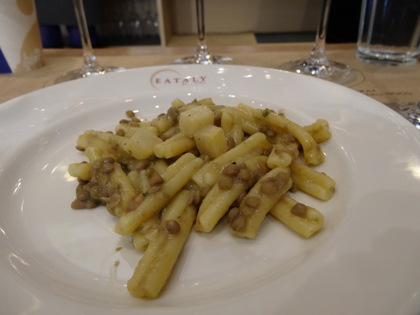
Casarecce con Lenticchie & Pere (Casarecce with Lentils & Pears.) Chef Alicia Walter.

L to R: Scacciadiavoli, Sagrantino di Montefalco DOCG 2008 and Antonelli, Sagrantino di Montefalco DOCG 2007
Five Monetfalco Sagrantino producers are being offered at the Friday tastings. I had the opportunity to try each at an event at Eataly’s La Scuola during which various producers were present. Rebecca Mills discussed the wines, the food pairings and the producers Marco Caprai of Arnaldo Caprai Vineyards and Filippo Antonelli from Antonelli San Marco filled in with salient facts about their wines.

Agnello allo Scottadito con Zucca al Forno (Lamp Sottadito with Roasted Squash). Loosely translated, scottadito means “burnt Fingers.” The inference is that these little chops are so irresistible that you go for it before cooling. Even well done these are fabulous and they are perfect with Sagrantino.

L to R: Arnaldo Caprai, Montefalco Sagrantino Collepiano DOCG 2007 and Tenuta di Castelbuono, Sagrantino di Montefalco DOCG 2007. Both go well with roasted meats, short ribs and stews as well as grilled steaks and chops.
Alicia Walter chef from Eataly in New York City, created the dishes which paired beautifully with the wines. They were the Sagrantino di Montefalco DOCG wines, 2007-2009 vintages from the five different producers in the Montefalco region of Umbria now being featured at Eataly in March.
- Perticaia, Sagrantino Di Montefalco DOCG 2009
- Scacciadiavoli, Sagrantino Di montefalco DOCG 2008
- Antonelli, San Marco Sagrantino Di Montefalco DOCG 2007
- Arnaldo Caprai, Collepiano Sagrantino Di Montefalco DOCG 2007
- Tenuta Castelbuono, Sagrantino Di Montefalco DOCG 2007
The DOCG designation for each means that the wines must adhere to the highest production standards. The wines are produced from 100% Sagrantino grapes grown in Montefalco. The regulations include the specific months in the barrel, an October harvest, and the agriculture of the vines (number of vines per hectare).
You will be able to purchase these producers wines at Eataly NYC and at other fine wine shops in NYC, Chicago, San Francesco and Los Angelos. Their websites are above and you can place orders there. Better yet, travel to Umbria, visit these producers’ wineries. They will be happy to offer tastings and tours of their vineyards. However, if you aren’t planning a trip in the near future, drop in to sample the Montefalco Sagrantino at Eataly NYC or Chicago this month. As you open up your palate to these unique wines, you will note their different personalities, and you will probably walk away with a bottle of pure Montefalco Umbria. You will be glad you did.
A Play About the JFK Assassination: ‘Witnessed by the World’ by Ronnie Cohen and Jane Beale

Photo is a still taken from the renown Zapruder film of the movie of the assassination of JFK.
The assassination of President John F. Kennedy is perhaps the most written-about event of the 20th century, with over 800 books alone devoted to parsing the details of the how and why of the assassination and the alleged subsequent cover-up. Some books justify the evidence produced in the Warren Commission Report, which found Lee Harvey Oswald to be Kennedy’s sole murderer. Many reputable writers and investigators, including the 1960s District Attorney of New Orleans, James Garrison, meticulously and logically disputed the Warren Report’s conclusions.
The mainstream media ridicules “conspiracy theorists,” who put forth the idea that a cabal of conspirators were responsible for Kennedy’s murder and wanted him “out of the way” for various political reasons. Witnessed by the World written by Ronnie Cohen and Jane Beale and directed by Karen Carpenter provides an interesting spin on the assassination and the “conspiracy theory” decriers. It is informative, taking into consideration that there are those in subsequent generations who know little about the assassination and the major players connected to it.
The playwrights have cleverly avoid didacticism and preachiness. They posit information about the assassination through dialogue between an older journalist, Joan Ross (an excellent Charlotte Maier), enthralled with the research she has done about the assassination, and the younger, uninterested, uninformed screenwriter, Ira Basil (Max Gordon Moore in a good counterpoint), who is working with her on a writing project. Information is also revealed through the play’s developing action. We follow Joan and learn about the assassination as she channels information from her leads into discussions with the screenwriter, a friend, and her sources.

L – R: Charlotte Maier and Bob Ari (Aaron Spencer), in Witnessed by the World, written by Ronnie Cohen & Jane Beale, directed by Karen Carpenter. Photo by Douglas Denoff.
At the outset, the play shows the black and white TV clip of the Jack Ruby shooting of Lee Harvey Oswald, which was the first live mass media murder viewed by millions. (There were no warning ratings preventing young children from watching the live coverage and later the incessant replaying of Oswald’s painful collapse after the bullet did its work.) We are in shock as the viewers at the time were in shock seeing Ruby conveniently smash the possibility that any trial of Kennedy’s alleged killer would take place.
If Ruby was a hero, performing the role of Oswald’s executioner, he was not released for his “good deed.” The mysterious incongruity is that Ruby received the death penalty after his first trial. This was overturned in a Texas appellate court. He was waiting for a second trial when he died of cancer in a Dallas hospital. Had he been threatened not to disclose the mystery of his relationships and background connections to mobsters, the CIA, Oswald and others? Though he was interviewed by Dorothy Kilgallen toward the end, Kilgallen never lived to “blow the lid off the JFK assassination” as she said she would.
Cohen and Beale explore these mysteries and others as Joan investigates Ruby’s early background and teen years to help Ira Basil finish a screenplay about Jack Ruby and the mystery surrounding his ties to organized crime and visits to Cuba. Though Ira warns Joan that she must not write about or investigate Ruby’s connection to the JFK assassination, Joan on her own recognizance pieces together information she learns from Jack Ruby’s sister, Eileen Kaminsky (an exceptional and believable Lois Markle). After Joan and Eileen become close, Eileen gives Joan a box of items which no one knows about. Ruby had given them to Eileen for safekeeping. Each item is a potential clue, a possible missing puzzle piece that Joan can use to create a logical picture of Ruby, his ties to organized crime figures and answers to the questions about why he killed Oswald.

L – R: Bob Ari and Joe Tapper (Joe Capano), in Witnessed by the World, written by Ronnie Cohen & Jane Beale, directed by Karen Carpenter. Photo by Douglas Denoff.
As Joan’s investigation proceeds, she is spurred on with potential answers about the assassination. We are interested and happy to go along for the ride which she keeps hidden from Ira. However, when Ira discovers information which throws Joan’s character into muddy waters, we can see the headlines above her name “conspiracy theory nut,” a twist which is panicking Ira. He manages to continue working with her because he has grown closer to her and for personal self-interest: he will continue to receive the information she has given him about Ruby. They work well together on the screenplay which appears to portend lucrative possibilities.
In the midst of the Ira-Joan scenario, there is a detour down a dark road. Joan confides in friend Aaron Spencer (an appropriate and capable Bob Ari) about the screenplay and her secret investigation of Ruby’s mob connections, and in turn, the JFK assassination. Aaron, who is confronting financial difficulties and is forced to make some debt arrangements with shady mob characters, is told by Joe Capano (a smiling, insidious Joe Tapper) that he knows an old “uncle” in the criminal network who knew Ruby. Aaron shares the information with Joan, who tries to arrange a meet up with this “uncle,” to confirm the final threads of logic she is sewing together about how Ruby was connected to the JFK assassination. These threads tie in Ruby’s connections to mob figures, Sam Giancana, Carlos Marcello, Santo Trafficante and others.
Aaron discourages Joan about the meet up, but it has been arranged by Joe Capano who tells Aaron that Uncle Tony is anxious to talk to Joan. Joan is thrilled after years of research and hard work in overcoming the resistance of recalcitrant sources. She is exuberant because she knows she is going to be able to blow the lid off the Kennedy assassination with the final confirmation of testimony from Uncle Tony.

L – R: Charlotte Maier and Lois Markle (Eileen Kaminsky), in Witnessed by the World, written by Ronnie Cohen & Jane Beale, directed by Karen Carpenter. Photo by Douglas Denoff.
The play is a vital go-see-it for a number of reasons. It will be informative for those who are unfamiliar with the Kennedy assassination and the time period. The play provides a quick and dirty clip sheet of one element of the possible assassination conspirator network that will not be found through mainstream media, except the History Channel offerings. Highlighted is information which includes a growing body of research about the history of our government’s political machinations during the cold war and the extent that the intelligence community was willing to go to insure the US retained the upper hand against Communist leaders. The play is well constructed and keeps the audience engrossed about a period of our history which is crucial to understanding the present.
However, the play does manifest issues; some of the contrivances are problematic. The contrivance of character and dialogue to get out the information (an older journalist and a younger screenwriter unfamiliar and uninterested about the assassination) works because it is subtle and well crafted into the conflict and action of Joan’s investigation of Ruby. We can overlook it because it melds seamlessly with relaying the background information to the audience. But the character complication, that Aaron happens to be in financial trouble and just happens to be involved with mobsters who knew Ruby and who are still alive, is less seamlessly written into the play’s action.
Tthe contrivance of the naivete of Joan’s character cannot be overlooked. We understand that she is a brilliant investigative reporter who is putting the pieces together and who knows the score about the individuals connected with the assassination. We believe she is a hard hitting and uncompromising journalist and a thorough researcher. Her ingenuousness with her sources, for example overlooking the shady character of who she is dealing with seems incongruous and is not credible.

L – R: Charlotte Maier, Bob Ari, Max Gordon Moore, in Witnessed by the World, written by Ronnie Cohen & Jane Beale, directed by Karen Carpenter. Photo by Douglas Denoff.
Would the playwrights have created even more tension…would the play have been more striking if Joan implies she knows the risks involved, but takes them anyway? Would this be a more heroic Joan, one more in keeping with who she is? If, yes, then, the conclusion would be more tragic, more appropriate, and of course, more ironic. Though the acting is excellent and the ensemble work holds together beautifully, it is a lot to ask of Charlotte Maier to reconcile the contradictions of Joan as a naive yet hard-hitting journalist. It is not as if her naivete has been intimated throughout the play as a tragic flaw. It is artificial, contrived. If Joan was portrayed as one who knows she is taking a risk but she does it anyway because there is a moral imperative…the truth must be revealed? This portrayal is logical, noble and in keeping with Joan’s character. It elevates the play to a greater reality. How many have risked their lives to tell the truth?
The great tragedy in the assassination of JFK is that the only justice the assassins, and there were more than one as the Senate Select Committee designated (which later puppets attempted to decry) is that justice was never served. The country, though never above corruption and villainy which our past is filled with, suffered many blows afterward. The most crucial misery was that the indomitable spirit of the American people was dampened. HOWEVER, IT WAS NOT EXTINGUISHED. If this is what was intended, and if the MO was to increase profits and gain lucre, then so be it. The perpetrators did that. They have reaped their reward. And the full weight of their actions will fall on their heads.
The play, which enjoyed its New York Premiere at 59E59 Theaters is a reminder that the JFK case, despite what one apologist wrote, IS NOT CLOSED. IT WILL NEVER, EVER BE CLOSED. SO THERE IS NO “CASE CLOSED” ABOUT THE JFK ASSASSINATION, no matter how much one may assert that we should all just not think about it. The magic bullet theory which fatuously has been used as proof that only Oswald was the killer and that there was NO conspiracy is, in fact, THEORY. Theory is not fact; it is hypothesis. Once the argument is raised to “belief” then theories are allowed in and by their nature, are uncertain. The best we can say is it is a 50% / 50% chance there was a conspiracy. The true perpetrators have gotten away with murder, probably not for the first time. Hopefully, for the last.
The review first appeared on Blogcritics.
Puglia and its Wines. Lovely tastings at GD Cucine and Vinitaly USA-New York

#Vinitaly International Academy’s Master Class on Puglian wines: Consorzio Movimento Turismo del Vino Puglia
Puglia Italy is a treasure. My cousins visited and added to their travel adventures in this glorious Southern province of Italy that borders the Adriatic Sea and Mediterranean. I was jealous as I have yet to tour the province. However, I have taken a step in the right direction by sampling their delicious wines at a mega tasting event in New York City last week. The event was sponsored by Vinitaly International USA-New York whose spot on International Academy led by Scientific Director, Ian D’Agata, held master classes. One of these was in Puglian Wines; the presentation was by Daniele Cirsone. To further promote their wines and indulge in appetizers and dishes with which they paired well, there was also an event at GD Cucine Showroom held afterward. Both the Master Class held by Consorzio Movimento Turismo del Vino Puglia: “Puglia Land of Opportunity” and the event at GD Cucine Showroom were exceptional.

At the GD Cucine Puglian Wine tasting event.
The wines featured at the Master Class on Puglian wines included the following offerings.
Mottura Vini Del Salento / Le Pitre Negroamaro – Salento IGP (2011)
Vigne & Vini Varvaglione / Papale Oro – Primitivo di Manduria DOP (2011)
Tenute Emera / Anima di Primitivo Primitivo di Manduria DOP (2011)
Azienda Agr. Duca Carlo Guarini / Boemondo -Salento IGP (2010)
Castel Di Salve / Cento su Cento Negroamaro -Salento IGP (2010)
Carvinea / Sierma – Salento IGP (2009)
Rivera S.P.A. / Il Falcone – Castel del Monte DOP Riserva (2007)

The last of the bottle at the GD Cucine wine event. The wine is Tormaresca from the estate Bocca di Lupo at Minervino Murge.
The wines at the tasting at GD Cucine included wines from the wineries listed above and the following offerings below.
Albea Winery Il Serlva Locorotondo doc 2012 SRP / Petrarosa Puglia Rosato igp 2012 / Petranera Puglia igp 2009 SRP
Apollonio Salice Salentino Rosso DOC -SRP / Terragnolo Primitivo Salento igt – SRP
Leone de Castris 50 Vendemmia Salice Salentino Rosso Riserva DOC SRP
Masseria Altemura Fiano Salento igt 2012 / Rosato Salento igt 2012 / Sasseo Salento Igt 2011
Palama Metiusco Salento Rosso igp 2012 / Albarossa Salento Rosso Primitivo igp 2011
Taurino Salice Salentino Riserva Rosso DOC 2009 / Notarpanaro Salento Rosso igp 2006
Tormaresca Trentangeli Castel del Monte DOC 2009 – SRP / Roycello Salento Bianco igt 2011
Puglia’s Land and Wines Part II
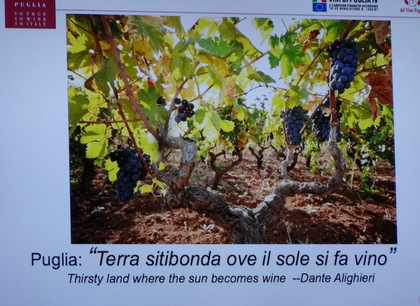
Puglia, land of great wines and the “green gold.” (olive oil)
I am grateful to have received the information supplied by friends who live in Puglia as well as those who love and represent Puglian wines. The more I learn about Puglia, the more my appetite is whetted for a visit. When I do go, I will be prepared to enjoy the province’s delights and spend more than a few weeks there.
The Unique Wine Region
Over 800 kilometers of coastline define the geographic boundaries of the Puglia Region. It is long and narrow. Puglia is composed of Daunia and the High Murgia, Murge, Lower Murgia and Itria Valley, Messapia and Salento. These five territories are well-defined wine districts, strongly anchored to typical grapes that characterize the productions.
A wide ampelography collection makes the difference between Puglia and other Italian or Southern regions. Characterized by a marked mutability of its territory, Puglia can count on a wide variety of terroir that is expressed in a rich bouquet of aromas and flavors unique and unparalleled. It changes from Daunia mountain peaks to the sandy coast of Salento going through large and sunny hill areas.
There are the native grapes and also grown are the many varieties of national and international grapes now permanently inhabiting the region. The wines made here have a very distinctive and impressive structure. Thanks to the passion and experience of wine makers, Puglia’s wines are mostly red, with a strong character and identity.
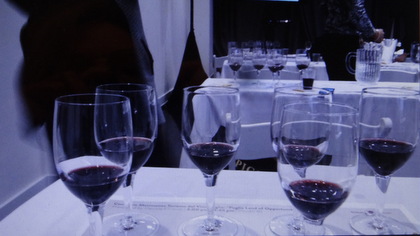
Wines from Puglia are mostly red. Vinitaly International Academy Master Class on Puglian Wines.
Daunia and the High Murgia
Bordered by Molise, Campania and Basilicata Regions, this northernmost area of Puglia has a vast array of colors and flavors, and extends from the Sub-Appennine hills and the Gargano promontory right down into the heart of Frederick II’s territories. Wine-growing here is an ancient tradition, and the legend surrounding the origins of wine-growing here is that the king of Daunia invited the mythical Greek hero Diomedes to settle down; he had wandered around the Mediterranean after discovering that his wife was unfaithful and was seeking a new homeland. Diomedes planted the first vines, so that to this day, the vineyards are known as the “fields of Diomedes” and the typical Tremiti Island seagulls are also called “diomedee”, almost as if their sing-song calls tell the story of the hero’s wanderings.
Some vines which have found their ideal habitat in this corner of Puglia are Montepulciano, Bombino (bianco and nero) and the increasingly well-known and appreciated Nero di Troia – the powerful and unmistakable variety common to both Daunia and the Murgia.
Besides wine, olive oil is another symbol of this area of Puglia: the precious “green gold” is mostly identified with the cities of Andria and Corato, and some of the region’s most important olive oil-producing companies are in the surrounding countryside. Finally there is the delightful city of Trani, with its magnificent Cathedral, its Frederician Castle and its delightful sea-front. A glass of Trani’s delicious sweet wine – Moscato di Trani – is the perfect end to a wonderful tour.

At the GD Cucine wine tasting event. Trentangeli Castel del Monte DOC 2009 – SRP
Lower Murgia and Itria Valley
A tour of Bari Province’s authentic flavors takes you via Gravina in Puglia – near the border with neighboring Basilicata Region – down towards the Gulf of Taranto, passing through places well-known for their wines, their bread and pastries, and their excellent meats. Altamura is famous for its Dop bread. Santeramo in Colle produces wine and oil, and meat-lovers will be thrilled with its traditional grill-houses. Gioia del Colle has an imposing castle and is home to the Primitivo DOC wine.
The Itria Valley is renowned for its white wines, and no one should miss Alberobello with its world-famous trulli, and its two districts – Monti and Aia Piccola. The town was designated a national monument in 1910 and is a Unesco World Heritage site. The other jewel of the Itria Valley and the area’s wine-making center is Locorotondo. Historically, generations of small farmers have worked the soil. In modern times thousands of wine-growers combine traditional techniques with the new trends of the international wine scene.
Messapia and Salento
The people of the Salento are proud of their past, and at the same time they are very much orientated towards the future. This is the land of three important vines – Negroamaro, Malvasia Nera and Primitivo – which dominate the so-called Great Salento, from Taranto Province to Lecce Province, passing through Brindisi Province. This is the land of the great fortified farmsteads – the masserie – now top-class hotels and resorts which have made Puglia world-famous. This is also the land of wineries.
The roads to the outlying villages are very scenic, like the green road linking Grottaglie to Manduria, the city of Primitivo wine; on every side of the road there are alberello vineyards and monumental olive groves.
On the road to Lecce, it is definitely worth stopping in Guagnano, Novoli, Carmiano and Arnesano, small towns in the Negroamaro Park. This is where some of the region’s important wine-growers are based, and they offer an excellent combination of hospitality and quality products.
The Tribute Artist by Charles Busch

L to R: Cynthia Harris and Charles Busch in The Tribute Artist by Charles, presented by Primary Stages at 59E59 Theaters. Photo by James Leynse.
Buying and selling Manhattan real estate! It’s all about being in the right place at the right time with the right clients. If the opportunity to sign a deal on a most fabulous place in Greenwich Village just dropped in your lap, you’d probably leap at it. What if it involved a smidgeon of shadiness and a soupcon of fraud?
The Tribute Artist by Charles Busch presents a hilarious scenario of three rather desperate, down on their luck characters, one attractive and potentially nefarious thief, and a $12 million dollar townhouse whose occupant has recently died. From soup to nuts, this two act play is a cleverly written comedy that is beautifully acted by the ensemble cast and tightly directed by Carl Andress. Charles Busch, a Drama Desk Award winner for “Career Achievement as Playwright and Performer,” once again delights with his impeccable timing and comic genius in a play that skirts the edges of farce. The Tribute Artist’s trending humor, themes and ironies are incisive and just shy of brilliant.
The play opens to the sumptuous living room of a Greenwich Village townhouse where we meet grand dame Adriana (the lively and funny Cynthia Harris), the alleged homeowner. We appreciate Adriana’s sulfuric wit which she states, “is not nastiness, but my European sense of irony.” This upper crust lady is a former clothing designer and she is entertaining her down-to-earth and frenetic real estate broker, Rita (the excellent Julie Halston), who may or may not broker the townhouse sale. Jimmy (Charles Busch) a recently fired Las Vegas drag queen, who prefers to be called a “celebrity tribute artist,” is staying with Adriana for a while. When we are introduced to Rita and Jimmy, both are modeling Adriana’s designer clothing and Jimmy is modeling one of her wigs. Rita and Jimmy have been long time friends and they enjoy Adriana’s hospitality as she fills in details from her past which, unbeknownst to them, are portentous to their future. When they all fall asleep from rather too much drink, the scene shifts to morning and the comedy and plot complications jolt into the most interesting of wonderful possibilities.

Charles Busch as Jimmy impersonating Adriana in The Tribute Artist by Charles Busch presented by Primary Stages at 59E59 Theaters. Photo by James Leynse
During the night, Adriana has passed; she did say she was dying, but Jimmy and Rita didn’t believe her. No one will inherit this lovely house and it will end up in the hands of the government since there are no inheritors and no will. The path appears to be clear that Adriana wants the house sold and is exerting her will that this should be exacted by those who are present. They are a perfect combination: a real estate broker and a female impersonator who just happens to have in his repertoire all the greats from Marilyn Monroe to Betty Davis. Impersonating “Adriana” will be easy. Jimmy and Rita talk themselves into the devilish plan (a hilarious segue), plotting that Jimmy will become Adriana for the time it takes Rita to sell the house. In the clear, they will split their “winnings” fifty/fifty. They even have the perfect resolution for how to deal with Adriana’s remains. Through their euphoria, they both agree that they may have forgotten something, only they aren’t sure what.
What they’ve forgotten shows up in the next scenes, creates havoc and additional conundrums. The plot complications humorously involve the real heirs who will take the townhouse away from Rita and Jimmy. The inheritors are Adriana’s late husband’s loathsome relatives, niece Christina (a perfectly overwrought Mary Bacon) and grandniece Rachel Oliver (a fine Keira Keeley). An additional complication involves one of Adriana’s former lovers, the sexy and very masculine Rodney (Jonathan Walker in a hysterical performance). Somehow Rita and Jimmy deal with these “interlopers” and Jimmy’s impersonation of Adriana goes swimmingly for a time until Rodney throws the switch that could overturn their peaceful coexistence. Once again the elements of farce are stepped up with the added suspense that Rodney may be up to something worse than the “silly little fraud” that Rita and Jimmy had hoped to commit.

L to R: Keira Keeley, Charles Busch, Julie Halston, Mary Bacon, Jonathan Walker in The Tribute Artist by Charles Busch, presented by Primary Stages at 59E59 Theaters. Photo by James Leynse.
While spinning these humorous events, the playwright carefully weaves in issues of class, gender, identity and social injustice. He does this with wit and subtle undercurrents of poignancy in keeping with the comedic pacing. Added to the glee, Jimmy unleashes his repertoire of old-time celebrity actresses with snippets of dialogue from their most famous scenes. Rosalyn Russel, Katherine Hepburn, Betty Davis and others show up and aptly spout “wisdom” to heighten the madness. In his impersonations Busch is at the apex of his powers. His “Running Wild” is superb. If you don’t know which actress performed the song from which iconic film, then you’ll have to get yourself to 59E59 Theaters where the production is being performed. Rita will clue you in to the impersonations just in case you were born after 1980.
The playwright ties up all the complications and reveals the inner workings of each character reinforcing one of the main themes: one never knows how things will out in the end. In Busch’s iteration the phrasing is more poetic. The production will be running until March 16th. It is being presented by Primary Stages at 59E59 Theaters.
The review first appeared on Blogcritics. Click Here.
 CAROLE DI TOSTI