Author Archives: caroleditosti
Barolo’s Cannubi Master Class at #Vinitaly International Tour in NYC

Barolo Cannubis at the tasting.
Vinitaly International Tour has launched the Vinitaly International Academy which is an innovative educational initiative about Italian wines. Master Classes on various Italian wines are being presented so that members of the wine trade can deepen their knowledge of Italian wines for sale, promotion and enjoyment purposes. This initiative was successfully launched at Vinitaly International Tour’s largest wine event in the U.S. in NYC on February 3rd at the Metropolitan Pavilion. And the initiative will continue as Vinitaly International Tour goes around the world to mainland China, Hong Kong, Russia and back to Italy’s largest wine event in Verona, Italy on April 5th.
The first of the Master Classes was on Barolo’s Cannubi. These wines are Italy’s oldest and most famous Grand Cru. This designation taken from the French means great vintages from specific areas, terrains and vineyards. Ian D’Agata, Vinitaly’s Scientific Director of the VIA (Vinitaly International Academy) presented at the tasting of these Barolo Cannubi wines and highlighted which ones were upcoming and which were more established producers. The tastings and information were a great way to find new Italian wines to love and to ask for.

Ian D’Agata, Scientific Director of Vinitaly International Academy at the Barolo Cannubi presentation and tasting.
Thsee wines are Nebbiolo grapes grown in the Piedmont and specifically the Barolo region. Some producers add other grapes like Muscatel or San Lorenzo. As for Barolo Cannubi? Cannubi is a long hill with a gradual slope lying in the heart of the Barolo area. The soils are rich in magnesium and maganese carbonate that are enhanced and weathered to richness by the air and unique microclimate. Surrounded by higher hills, Cannubi hill is protected from storms and extreme wind. Soil and exceptional microclimate give Cannubi a completeness and balance melding perfectly the structure and aromas and very elegant tannins making it an imminently drinkable wine.
Many of the wines we tasted were absolutely lovely, full bodied and elegant. deep- some with hints of red cherry others with raspberry notes, others spice. Aged in wood barrels, the spice and wood notes blend beautifully. Garnet-red in color, they cast ruby reflections. D’Agata asserted that the colors vary from a bright red that deepens with aging. The color is never inky black as some would want to claim. They offered a fine nose of penetrating clean scents: roses, vanilla, licorice, spices, toasted oak. Certainly a perfume of graceful power.
The Barolo Cannubi achieves maturity after 6 years from the harvest. As it ages well, it can be enjoyed throughout its life between 6 and 25 years. The prestige of the wines are site specific depending on the vintage and history of the vineyard. The bottles of Barolo Cannubbi can run $100 more at auction than a Barolo, again site specific with the reputation of the vineyard and vintage determining price.

This is a list of the wines presented:
Brezza Giacomo E Figli (Cannubbi)
Cascina Bruciata (Cannubi Muscatel)
Ceretto (Cannubi San Lorenzo)
Chiara Boschis (Cannubi)
Damilano (Cannubi)
Michele Chiarlo (Cannubi)
Scavino Paolo (Cannubi)
Virna (Cannubi Boschis)
If you, like me, are in a gastronomic paradise like New York City, San Francisco or Chicago and are always looking for lovely wines to go with fabulous cuisine, try one of these Cannubis. You can have them with cheeses and with fine (preferably free ranged, humanely slaughtered and anti-biotic free) red meats,like braised short ribs, steak, veal, roasts, game dishes. If you are in the wine trade, then get the word out about Italy’s oldest and finest “Grand Cru.”
Amarone Wines, The Velvet Underground! #Vinitaly International

#Winitaly Tour NYC Master Class: “Amarone, the velvet underground: treasures to be shared” Amarone flight,
Friends had introduced me to Amarone, but frankly it was a few years ago and I was not really informed about the wonderful Amarone wines. My friends were unfamiliar with it beyond being introduced to it at cursory tastings, one of the way wines are introduced but not really known.
Vinitaly International Tour has innovated a better way for wine aficionados to become familiar with lovely Italian wines. This innovation will not only increase familiarity with Italian wines which are gradually becoming known in America. The best benefit will be to further encourage our visits to wineries in Italy where we’ll be able to experience the wines on “their own turf” and spend more time savoring their flavors and understanding the terroir, production and their best years. With that knowledge, we can come back home and demand an increase in the wines’ availability.
The Vinitaly International Academy established this year provided an invaluable exposure to Amarone for those like myself who were familiar but not particularly knowledgeable about Amarone wines. Presented were the Amarone family of wines. Their quality and standards are exceptional because the association of producers has set the highest standards for their Amarone. Because of the popularity of Amarone, vintners have hopped on the train to cash in on the trend. The problem has been a diminution of the offerings and a lowering of quality. To ensure that this beloved and increasingly popular wine is not diminished or diluted in its power of enjoyment the association has adopted strict standards so the Amarone’s beautiful, riches are maintained. The association intends that Amarone’s history of greatness continue and that the wine NOT be treated like a commodity, but more as an appreciation of the art of fine wine making. Assembly line wines and lowered quality? These producers have an important point that few would argue with. What can I say? After the tasting, I was thrilled to add this wine to my list of favorites.

The Amarone wines we tasted during the Master Class on Amarone at the Vinitaly International Academy, #Vinitaly Tour.
A bit about Amarone. Some is produced in the Valpolicella region which is near Verona. The finest grape growing region is in the hills which can be up to 700 metres high. The better vineyards are in the hilly region; the impoverished wines are in the alluvial plane which is not particularly advantageous to growing the grapes found in the traditional Amarone.
Amarone is composed principally of the Corvina grapes and Corvinone (bigger grape…and unrelated to Corvina). The Corvina grape is an ancient grape used by the Romans. To produce the wines, there is a meld of various percentages of Corvina or Corvinone, Rondinella, Molinara and Oseleta grapes. Oseleta has fallen out of favor with vintners because it has a thick skin and little juice, though it is indigenous to the area. There is a much smaller percentage of Oseleta and Molinara, especially Oseleta simply because there is little juice yield. Usually an Amarone will have about 5% of either the Molinara or Oseleta.

#Vinitaly International NYC
Amarone is rich, smooth and depending upon percentages of grapes. there are spicy notes or black cherry savor on the tongue. Most of the wines we tasted had an interesting, memorable or lasting finish. A fine feature of Amarone is that it ages really well and actually benefits from aging.
The below list covers a few of the wines we sampled and my notes and Ian D’Agata’s informative Master Class, “Amarone, the Velvet Underground” are the first step to understanding this wonderful wine if you are not already familiar with it.
Begali / Amarone Classico 2008 The grapes are air dried. There was a subtle 17% alcohol content that was not readily noticeable. Notably rich tasting with 30% Rondinella and the rest of the main Corvina or Corvinone grapes and a small percentage of another grape (not Oseleta).
Brigaldara / Amarone Case Vecie 2008 This hadd a beautiful velvet mouth feel and lovely tannins. Again the grapes are air dried. The vineyard is in the high hills and they are harvested late and dried into February.
Musella / Amarone della Valpolicella Riserva 2008 This wine held the usual blend with less rondinella. Interestingly the wine was balanced with a fresh taste. What I liked was that the grapes were organically certified.
Speri / Amarone Classico Vigneto Monte Sant’Urbano 2009 This wine from a famous vineyard was delicious. It was composed of 75-80% Corvina and Covinone, 15% Rondinella and the rest from Molinara. It had a spiciness from the Molinara and nice finish. It ages well.
Tommasi Viticoltori / Amarone della Valpolicella Classico DOC 2010 This wine is a typical blend with 5% Oseleta. It is a deep, rich red color typical of Amarone. It is imminently drinkable, not opulent, a big red wine. It has an alcoholic strength that is subtle.
At a later date, I will feature the rest of the Amarone we tasted. Look for the article.
#Vinitaly International USA-NYC! Best of Italian Wines
#Winitaly Tour NYC
Once again the international Vinitaly Tour graced NYC and the turn out despite the snow was huge. Vintners, producers, retailers, distributors, exhibitors wouldn’t miss the largest Italian wine event of the year. Present were key figures for Vinitaly, Stevie Kim, Managing Director at Vinitaly International and Ian D’Agata, Scientific Director of Vinitaly International Academy. Both Stevie Kim and Ian D’Agata were present for a number of the Master Classes and Ian D’Agata’s expertise proved invaluable in relating the notable details about specific wines from the highlighted production regions.
The Master Classes provided by the Vinitaly International Academy are designed to familiarize patrons, American distributors and sommeliers with specific Italian wines. Particularly informative classes were on Barolo’s Cannubi flight presented by Ian D’Agata and his discussion at the tasting of the Amarone family of wines. “Amarone, the velvet underground: treasure to be shared” was a memorable session that garnered applause at the conclusion. Other exceptional Master Classes where on Franciacorta and wines from Puglia.
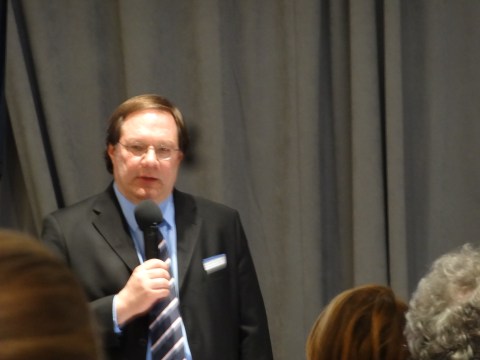
Ian D’Agata, Scientific Director of Vinitaly International Academy, #Vinitaly International Tour in NYC
Friends kept friends who were unable to make it connected via Social. Yangbo Du captured many great pix and snippets on Storify. More stories to follow on this blog.
CIAO and remember to check out the great Italian wines coming your way.
‘Loot’ by Joe Orton, Stowing Mummy in the Closet for the Payoff
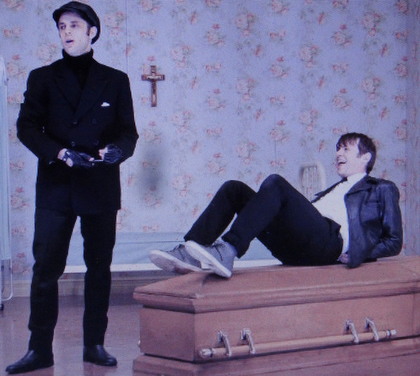
L to R: Ryan Garbayo as Dennis and Nick Westrate as Hal in Joe Orton’s Loot, at the Lucille Lortel Theatre (Red Bull Theater). Photo by Sarah Moore.
Joe Orton, the British playwright whose London hit Entertaining Mr. Sloan proved his brilliance, had his life cut short in 1967 at the age of 34. He was killed by his partner, who committed suicide in recompense for killing Orton. It is the theater world’s great loss, for Orton had experienced the steam of greatness as an exceptional playwright/writer, but not the substance. Whenever a production of his zany, dark comedies is revived, see it to appreciate the frenzy of hyperbolic farce that Orton was marvelous at creating. Impeccable timing and jeweled turn of phrase characterize Orton’s work. He is sardonic, like Wilde; over the top, like Monty Python; an iconic British wit.
Loot, in revival at the Lucille Lortel’s Red Bull Theater until February 9, is one of Orton’s gems. This production, directed by Jesse Berger, conveys Orton’s scorn of entrenched social institutions (religious, judicial, legal, medical). Clearly, the playwright had a rollicking time opening them to ridicule. This is appropriate for us currently; the hypocrisies Orton lays bare, are snatched from the 1960s. Yet, they are immutable now as they were then. In the delivery of the madcap and over-the-top plot extremities, we are able to bear the painful truths expressed underneath. If fraud, official corruption, murder and theft are the stuff of life, at least they can be used as meat to gnaw on for our entertainment sustenance in the hands of a savvy, sharp playwright, able director and acute acting ensemble.
The setting, the McLeavy living room is comfortably furnished with chairs and tables circling the walls, a locked chifferobe and what looks to be a folding screen more befitting a hospital room than a living room. The room is a style cacophony of weird items, the most strange being the coffin with decorative grave flowers at center stage. Thus begins the wackiness which develops into full-blown mayhem.

L to R: Nick Westrate, Rebecca Brooksher and Ryan Garbayo in Loot by Joe Orton, directed by Jesse Berger at the Lucille Lortel Theatre until February 9. Photo by Rahav Segev.
We discover from Fay, Mrs. McLeavy’s live-in nurse (Rebecca Brooksher), in a discussion with barely sentient, grieving Mr. McLeavy (a hysterical Jarlath Conroy), that the funeral service is today. The lovely nurse is a sweet, unassuming golddigger who has been married and widowed seven times.She is looking to be widowed again, after she marries Mr. McLeavy who is overwhelmed with grieving his wife and straightening out his affairs, especially his confused mind and emotions. While Fay encourages him that a month or so is an appropriate time to remarry, son Hal McLeavy (Nick Westrate) bursts onto the scene. His entrance with his beloved (he is gay) buddy Dennis (he is a polyamorous bisexual), fosters a scene switch into a plot convolution that stirs up the cauldron of madness.
Hal is like a young George Washington; he can not tell a lie once confronted with the truth. Dennis (Ryan Garbayo), the undertaker will transport Hal’s mum to the cemetery.The other reason Dennis is with Hal is that both have committed a bank robbery and Dennis has become the chief suspect after his questioning earlier in the day. Better his questioning than Hal’s which would be disastrous for them both, for Hal, a parboiled Catholic with issues, can’t lie. If the moral contradiction of not being able to lie but having no problem with stealing seems patently absurd, you’re right. It is and so is the hypocrisy it represents; this is one of Orton’s tucked away jewels. The play abounds with them.
Dennis fears he will be pinched if he can’t stash the hot “loot” away from the piercing eyes of one particular copper, Truscott, (Rocco Sisto, who is hilarious in his continually indignant state). Truscott, who later appears in a poor disguise as an official from the Water Board, has been snarling and eying Dennis like a canny German shepherd. It is only a matter of time before Truscott finds him, discovers the evidence and throws him in prison, especially if he asks Hal any questions about the theft.
The loot which has been stashed but the locked armoire i is the first place anyone would look; and Fay, who can sniff out money like a dog sniffs out a bone, has intimated to Hal that she knows the loot is there and will expose them in a blackmail scheme. When she leaves, simultaneously, both spy the coffin with Mrs. McLeavy’s body inside. Hide the loot in the body? Gruesome, bloody horror! Hal is a “good” Catholic and that would be untoward. Besides, this is a farce, no matter how black hearted. Hide the body in the armoire and the loot in the coffin and lock both.? Perfect! That way Hal will not be lying if he has to deny the thousands are inside the wardrobe. And if someone gets a crowbar and breaks open the chiffarobe? They’ll be a bloody hell of a surprise. Mrs. McLeavy has been stuffed like a sausage and pickled with embalming fluid. She’s a real stiff.

L to R: Rocco Sisto, Nick Westrate and Ryan Garbayo in Loot, by Joe Orton, directed by Jesse Berger at the Lucille Lortel Theatre (Red Bull Theater) until February 9th. Photo by Rahav Segev.
The official from The Water Board (investigator Truscott inept disguise) interrupts their plans to check the water system. Hal and Dennis quickly send him off to the pipes, then speedily trundle the coffin to the armoire and lob in the corpse. In their frenetic haste they flip poor ole mummy like they’re hefting a log onto a wood pile. Their antics are hysterical especially in light of Hal’s professed Catholicism that has forbade him to see his mum naked but allows him to manhandle her remains. The woman hasn’t been able to RIP since she passed.
After this inglorious treatment, the miscreants lock the chiffarobe and dump their cash booty in the coffin sealing it just in time to escape detection. Truscott figures his inept disguise and circular questioning will eventually trip up the thieves so he can pin them like dead insects with the evidence, pulling out all the stops in his “intelligence” to do so. Orton’s characterization of detective Truscott, is an absurdity of confusion, all in the service of quick humor; Truscott is brilliant-inane, hypocritical-legalistic, corrupt but honest about it, opportunistic and self-serving. He is this and more in the interest of feathering his own nest, but money is his object.
The body-cash swap heightens our belly laughs. We see how these ingrates have dumped Mrs. McLeavy in a “most shameful position.” Added to the romp is Truscott’s indignation and frustration at the suspects “innocence” made all the more hysterical by his ridiculous questions which are as twisted as their answers. The scene is surprising and wonderful.

L to R: Nick Westrate and Rocco Sisto in Loot by Joe Orton, directed by Jesse Berger at the Lucille Lortel Theatre. Photo courtesy Broadway.com.
When Fay and Mr. McLeavy enter the fray, they contribute with flippant repartee. The pace steps up, high jinks fueled by understatement, irony. Orton weaves the scenes so the hilarity builds to climax in an even more preposterous and lunatic second act. Plot complications abound and mysteries are uncovered. The innocent are proven guilty and the guilty are shown to be innocent. Such are the pleasant spoils of ambition in a corrupt universe. For irony, Hal’s good, Catholic conscience has remained spotless. He has not seen his mum naked, and he never lied. He’s good to go. We just don’t know where.
The production does not disappoint. It is a pleasure to see the mostly American actors honor this astounding playwright and make him known to another generation of playgoers who can appreciate brilliant farce and black comedy. That said, it must be acknowledged that Orton is uniquely English. Though there is an opaque line between our countries and cultures differentiating America from England, there is a nuanced sensitivity that comes with presenting English cultural and social humor. It is more felt than studied, intuited than practiced. All humor is generic to place, culture, time, range and social consciousness. Very simply, there are some phrases which can fall flat to some ears if not comprehended in the way that the culture normatively means them to be. In this aspect the production’s humor was flattened by our cultural limitations. However, Orton’s words remain true if one has ears to hear them.
Loot is being performed at the Red Bull Theater by special arrangement with the Lucille Lortel Theatre Foundation. George Forbes is the Executive Director; Jesse Berger is the Founding Artistic Director and Evan O’Brient is the Managing Director.
This review first appeared on Blogcritics, at this link: Click Here.
Breakfast With Mugabe by Fraser Grace Extended by Popular Demand
 When I heard that Breakfast With Mugabe had received an extension Off Broadway and would appear at the Lion Theatre at Theatre Row until March 2nd, I was pleased. It is a terrific show and enjoyed a near sold out run at the Signature Center when I reviewed it in August of last year. Now it is back by popular demand and I understand why. The tension, the undercurrents, the terrifying wild ride brought to you by the soft spoken and imminently dangerous Robert Mugabe (expertly played by Michael Rogers) is a play told in foreshadowing and suggestive of aggression and power unchecked. It should be seen because it is a reminder that all leaders if left to their own devices for too long will be corrupted and will destroy the good that they have set out to do. It is also a warning for the unsuspecting, those who attempt to play by the rules but have the rules turned against them because of expediency. These are a few of the themes. For more this review initially appeared on Blogcritics at this link.
From the moment we meet Grace Mugabe (Rosalyn Coleman) and hear the complaints she shares with psychiatrist Dr. Andrew Peric (Ezera Barnes) about her husband’s obsessive fears, there is an undercurrent of danger and ominous import in Breakfast With Mugabe, directed by David Shookhoff. According to Grace, Robert Mugabe is hallucinating enemy ghosts and malevolent spirits. Each day he sets a place at the table for one haunting devil in particular and conducts his life and his wife and children’s lives around this paranoia.
We hear in Grace Mugabe’s dark notes of alarm her misery as she tells the story of her husband’s increasingly disturbed mental state. In particular, she refers to the traumatic event in the airport when her husband made a loud scene commanding his bodyguards to stop her and the children from escape, when there was no apparent need to do so. Since then the Zimbabwean President’s wife has been kept prisoner in her own home and cannot go shopping or enjoy the fruits of their position with autonomy, a reality she wishes to end. She begs Dr. Peric to convince her husband to let her leave with the children. She also hopes he will be able to help Robert as best he can since the malady is obviously a dire one that may destroy Mugabe’s political leadership and power regime.
From this too-long exposition scene, the playwright develops the issues which progress to their final resolution. We learn that Dr. Peric, who has been entrusted to help Mugabe, is a member of the once elite class of white farmers who still maintain their farms while many of his social peers are losing theirs to Mugabe’s resettlement plans. Unlike the other former white colonials, Peric has embraced Mugabe’s leadership, has an interracial marriage, and has been a tremendous help to patients at the hospital in Harare. There, the doctor has a sterling reputation because he is loving and culturally flexible. He uniquely understands the spiritualism of the people of Zimbabwe. If anyone can help Mugabe, it is Dr. Peric, but as he makes clear to Grace Mugabe, the President will have to forgo all of his airs and his will to power. He will have to submit to Dr. Peric’s will during the treatment. Thus the playwright introduces the conflict between Dr. Peric and Robert Mugabe as psychiatric patient.

Dr. Peric (Ezra Barnes) received by Mugabe aide Gabriel (Che Ayende)
The second problem we assess from Grace Mugabe’s discussion is this: Obviously, Mugabe has lost his hold on reality, though his hallucinations and paranoia are probably grounded in reality. Apparently, Mugabe’s power structure and leadership are beset on all sides by those who want to overthrow his government and replace it with their own factions. In this underlying atmosphere he most likely fears everyone and knows his enemies are seeking revenge for the blood of those he is responsible for having killed. His country has known war in its struggle for independence. His separate power struggle to maintain his despotic rule under the guise of equality and fair elections has also resulted in bloodshed. He can trust only his select group and must suppress any recriminations and guilty feelings about having acted stupidly and without diligence. He must play the role of the brilliant and powerful leader. Mugabe is wrestling with Mugabe for power over his own demons generated by his past actions. Unless he thwarts them, they will overtake his future and the country he intends to rule.

Rosalyn Coleman as Grace Mugabe
Another complication is in the character of Grace Mugabe. She is pompous, manipulative and extremely clever. Either she is Mugabe’s prize or his bête noire. Her pleas to Dr. Peric and her explanation of her husband’s deteriorating mental state give us the impression that she completely trusts that Dr. Peric has the upper hand and will eventually be the catalyst to help her escape. Her situation is tenuous. Mugabe’s mental decline is impacting his ability to lead and maintain his political power over threatening rivals.
Grace Mugabe is looking out for her husband, but especially, she is looking out for number one. Even if she intends to remain on top as the President’s wife and adviser, her husband will drag her into the abyss, as long as he the dinner plate sits on the table for his chief spirit enemy so Robert can have conversations with him. This is not a leader. Grace doesn’t want to be around for the overthrow. She will escape preferably with Dr. Peric’s help and plenty of money to live abroad. Despite her husband’s attempts to hold on to her and reality, the wolves are circling and closing in.
The playwright has thus established the conflicts in the first scene. When he finally introduces Robert Mugabe (Michael Rogers) after the immense build-up, we are surprised to discover that this may not be the man Grace Mugabe has described so acutely. He is humorous and insightful, and has a penetrating mind and confident spirit. Either Mugabe is “fronting” or Grace has misrepresented her husband’s condition for her own ends. We remain intrigued as the ominous undercurrents swirling around the question of truth and the integrity of each of the characters gradually come to light.
Playwright Fraser Grace uses Dr. Peric’s questioning of Mugabe’s past traumas to create dramatic momentum. As we gradually wend our way through the dense thicket of defense mechanisms Mugabe displays to cover up death and loss, we understand how Mugabe’s self-torture over the past blocks him in the present. Theirs is an interesting “tug of war.” The sense of foreboding we felt in the first scene never leaves us, so we feel relieved that Dr. Peric uses tact and truth to scrape away this uncanny, hyper-manipulative and brilliant leader’s tough outer skins until the softer layers are exposed. Lulled by the doctor-patient interplay, we may be misled and not readily recognize how the playwright cleverly diminishes the doctor’s personal presence while brightening Mugabe’s as he becomes unburdened.

Dr. Peric (Ezra Barnes) delivers the question to Robert Mugabe (Michael Rogers) who must face the haunting spirits.
Finally, the doctor arrives at the healing revelation Mugabe seeks. The outcome is counter to what Dr. Peric expects and what Grace Mugabe desires. Ultimately, the doctor has enabled Mugabe to find his own solution to exorcizing the spirits, freeing himself, strengthening his leadership and deepening his power regime. Dr. Peric has been invaluable, but Mugabe feels no compunction to accommodate him while he guides the country’s toward a new horizon. Grace Mugabe, always the survivor, rides her husband’s wave to the shores of success, no longer desiring to flee. And we, like Dr. Peric, are rattled at their ungenerous callousness as the ominous foreboding we’ve felt all along hits us with its harsh realities.
The play is cerebral, intricate, surprising, foreboding, powerful. I loved it. I thought that of all the actors, Rosalyn Coleman’s performance as Grace Mugabe was the most layered and complex. Ezra Barnes’ and Michael Rogers’ interchange of waxing and waning personas and presence was subtle and enlightening. Together with an excellent Che Ayende as the imperious aide Gabriel, the cast brings us carefully to the stark finish. David Shookhoff has aptly directed his ensemble to present an amazing portrait of this determined and cagey leader who, despite all odds, including avenging spirits, has kept himself in power using any means necessary.
This review first appeared on Blogcritics at this link.
The show is currently at the Lion Theatre at Theatre Row until March 2nd.
Restaurant Review (NYC): Il Buco Alimentari & Vineria
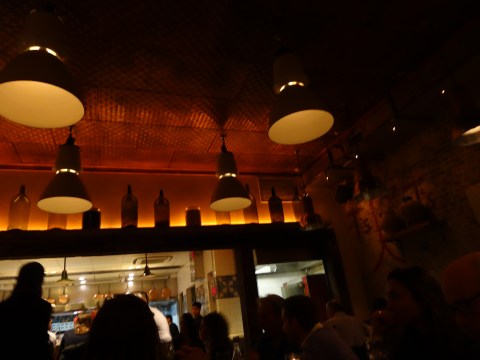
Il Buco Alimentari et Vineria view of the kitchen from where we were seated.
Ever since I went to a wine tasting of Marco Capri wines last year at Il Buco Alimentari et Vineria, (Facebook page),
I wanted to return and sample more of Chef Justin Smillie’s fare. A friend and I share the same birthday, so we decided to go for dinner and were happy we did. We received the royal treatment.
Following recommendations from New York Times, Foursquare, Immaculate Infatuation, and my own experience the prior year, I was completely thrilled with the dishes I ordered as were my friends. So were our neighbors at the table sitting next to us. Repeat diners they were ecstatic with their “to die for” Porchetta Alla Romana. The previous couples had scarfed down the “Spit-roasted Short Ribs” and left an large empty plate of the remains of the dish which was the main rib bone. Hmm. I was encouraged.
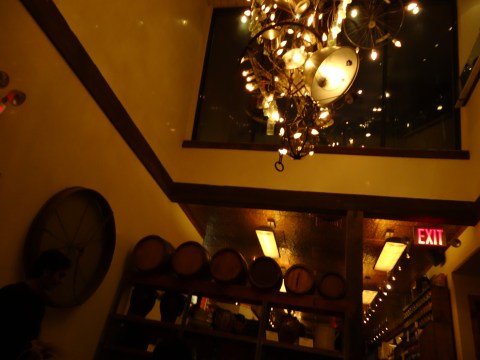
Il Buco Alimentaria et Vineria with the camera viewing the opposite direction from the kitchen.
The decor is rustic and the atmosphere is relaxed. We sat in a section that was family style, conducive to speaking to your neighbor which is fun because I am nosy. I like viewing what others have ordered and if the group is friendly I will ask about their enjoyment of their various dishes. This homely, family style approach is what I think is the beauty of this restaurant which guys really love because it is not self-aggrandizing, nor pretentious. Indeed, it is an informal wine bar and restaurant that serves breakfast, lunch and dinner.
In answer to those “foodies” (?) outraged that the New York Times gave it three stars because they thought it was like a sandwich shop (see the reference in Immaculate Infatuation), I would say that perhaps they are less flexible and more into their own pretension and conceptualization of “branding” than gorgeous tasting food. The idea of a market section up front where one can buy some of “the best salumi della casa in NYC, gelato, and other home made products beggars their idea of “three stars.” Well, I’ve gone to Michelin starred restaurants and the food was neither deliciously prepared nor were the elements combined well. So, it’s all in the perception and it brings to mind that with regard to restaurants, sometimes, the emperor is naked (The Emperor’s New Clothes) but no one wants to say it.

Bread basket, we’ve devoured most of the bread.
Back to our meal. First, came the basket of bread. If you adore crusty, substantial and sumptuous bread, Kamel Saci creates his bread’s magic from his own recipe and bakes it on the premises. Add Il Buco Extra Virgin Olive Oil, which is green, fresh and exceptional and you are home. My birthday buddy adores bread, so she was in heaven. If your taste doesn’t run to olive oil, and you’re a dairy fanatic, they will bring you delicious, fresh butter to spread on the fabulous bread.
We had appetizers and sides and then for some of us the Primi was the main meal and others, the Secondi.

Lattuga
Lattuga was just what I wanted: little gem lettuce, pickled onions, anchovies, tarragon, red radish. The combination of ingredients melded beautifully and seasoned with the unique taste of the tarragon. The lemon dressing was light and accentuated the freshness of the greens.
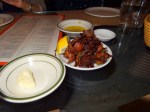
Crispy Artichokes
The Crispy Artichokes with lemon were wonderfully delicious. They were thin and curled by the char and dark browned to a perfect crunchiness. My friend who thought the gem lettuce was “romaine” which she hates, selected these as a veggie. There wasn’t a crumb left on her plate after we each had a little taste.
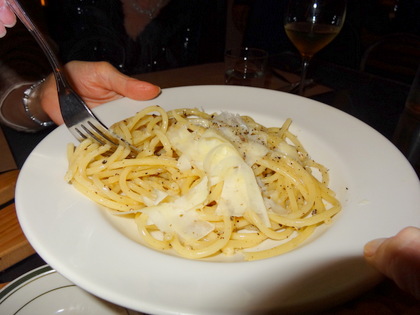
Bucatini Cacio E Pepe
The Bucatini Cacio e Pepe is pasta setaro with fresh pecorino romano and black pepper. The pasta is all home made on the premises and was of course, perfectly al dente. My birthday buddy Andrea said it was really good, a compliment that one does not hear often dropped from her lips as she frequently orders pasta dishes and they are mostly, (silence), “OK,” or “good.” She is a pasta fan and gave Emily and Margaret a taste, but did not share the plate with Emily who was a bit disappointed as she loves pasta. But the pasta was Andrea’s main course. Do you blame her for not wanting to share it?

Polletto al Forno
Polletto al Forno is poussin, roasted meyer lemon, capers and bread crumbs. Margaret thought this dish very good. Again, these are words I don’t normally hear, especially when they are said with the enthusiastic and emphatic pronouncement that Margaret made. Chef Smillie created the perfect combinations of ingredients and flavor textures and tastes with this dish. The beauty with all these dishes is that they are spot on, having achieved a regularity that is duplicated, without variation or unevenness.
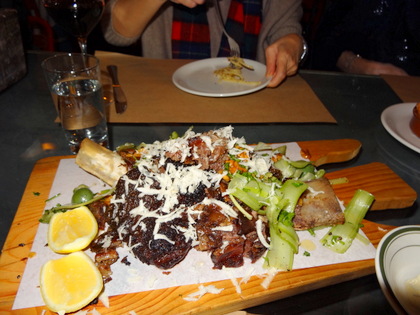
The OMG, Spit-Roasted Short Ribs.
The Slow-roasted or Spit-roasted Short Ribs are like that as well. These are the rave of city reviewers everywhere, whether for lunch in a sandwich or for dinner. OMG! I say amen to that. I do think they are amongst the best short ribs in the city and in a portion large enough to share with four. They were cooked to tender, flavorful moistness, complemented by the castelvetrano olives, celery, walnuts, horseradish and lemon which, squeezed on the meat, was a wonderful, unique addition. This is Chef Smillie’s creation of perfection. I had been waiting for a year and it was worth it. Absolutely marvelous.
To round out our luscious main courses we added Contorni.
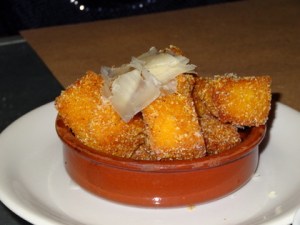
Polenta
The Crispy Polenta was amazing, crunchy with the salty, pungent taste of the parmesian on the outside and moist softness with milder notes of the corn/polenta on the inside. This was a delicious and wonderfully different way to morph polenta which I have found tiresome when it is served the usual way under the short ribs or meat. Same, same, enough already.

Carrots salsa verde
Carrots salsa verde. These had an incredible and luscious char which combined with their sweetness and hinted of other seasonings. They too offered a taste that was exceptional and interesting. The carrot plate was empty by the end of the meal and the pieces of polenta that were left, Margaret took home for her husband. They were devoured that evening.
Fingerling Potatoes valdeon we didn’t try. I wish we noted them because if they were anything like their brother contorni, they were probably wonderful and unique also.

The remains of the Spit-Roasted Short Ribs.

Seasonal Fruit Crostata and Vanilla Gelato and Flourless Chocolate Cake and Gelato
Our shared dessert was home made seasonal Fruit Crostata and Vanilla Gelato, and Flourless Chocolate Cake and Gelato. Yum. The espresso and cappuccinos rounded off the dinner.
Il Buco Alimentari et Vineria is a NYC treasure. (See menu which is seasonal and changes.) And the beauty is you can go for breakfast, lunch or dinner. In fact the breakfast sandwich with 2 organic eggs, salame rosa, rupert cheese and focaccia fino is an incredible value. You will probably want to order a few Brioches for take away, since they go beyond originality in the flavor palette with the following varieties: “White Chocolate,” Chocolate Cherry, and Pistachio and Apricot Brioches. And then there are the Bombolone plain or filled with jam or dulce de leche. I don’t think it gets much better than this.
Veneto Wines, NYC! December is the Month to Celebrate Veneto Wines.

MONTELVINI Tullia Prosecco di Treviso Brut DOC, NV. I tasted this light sparkling wine at an Eataly luncheon. December celebrates Veneto wines at Eataly.

The Veneto, Italy.
December is a great month to celebrate wines from the Veneto region of Italy. December we celebrate the holidays, Christmas and New Year’s Eve and New Year’s Day. It is a time when we enjoy great food with family and friends and are looking for exceptional wines to pair with fish or are looking for sparkling wines to ring in the New Year without the gross hangoveR the next day.
I tasted some exceptional wines during a luncheon at Eataly’s La Scuola Grande. There the chef using Lidia’s, Mario Batali’s and Eataly’s recipes made delicious cuisine that paired seamlessly with the drinkable wines from the Veneto that were featured:
MONTELVINI Tullia Prosecco di Treviso Brut DOC, NV
ASTORIA Millesimato Prosecco DOCG, NV (DOCG PROSECCO)
CANTINA DI SOAVE Re Midas Soave DOC, 2012
CESARI Mara Valpolicella Superiore Ripasso DOC, 2011 (a red wine)
The Veneto is the primary region for wine production in Italy. The variety of wines produced there is surprising. The Veneto produces whites and reds, sparkling wines to meditation wines. There are also niche-labels from small producers that are in demand and luxurious. Veneto wines are in demand globally. The region expots 75% of its DOC wines. The wines featured were so drinkable that I would enjoy them with appetizers, with cheese and with the full range and complement of meats including chicken and other fowl and certainly fish. They go down smoothly and are a great value. For NEW YEAR’S EVE, a Prosecco is such a tremendous value over champagne. My cousin recommended it for years and knowing little about great wines, I was a snob and drank champagne. Have you seen the prices of good champagne lately? Too rich for my blood. An expensive Prosecco is the greater value. A great and delicious wine, a great value. Why not?

U.Vi.Ve. is the Association or Consortium of DOC Veneto wines established in January 1980 to ensure the wine quality was the highest.
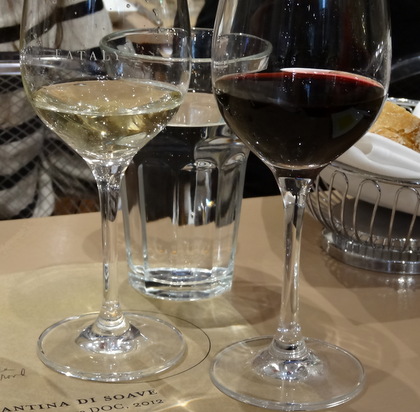
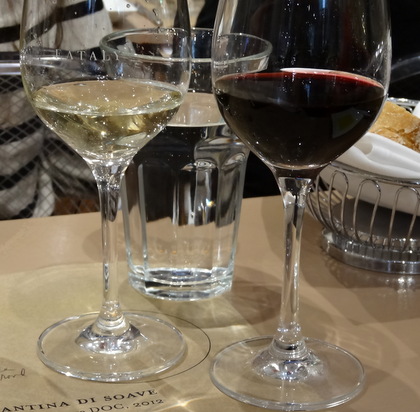
CANTINA DI SOAVE Re Midas Soave DOC, 2012 and CESARI Mara Valpolicella Superiore Ripasso DOC, 2011 (the red wine)

Lidia Bastianich’s Fritto Misto (Mixed Fried Seafood & Vegetables)
As Lidia suggests, “The point of a fritto misto is to enjoy the flavors and textures of a variety of fish. You can vary the roster of fish according to what is fresh in the market and increase of decrease the amount according to the number of guests you’re cooking for.” Also, the vegetables are now in season and can be swapped out for other vegetables that are fresh and in season. The Fritto Misto was delicious with the featured Proseccos.

Striped bass, medium shrimp, winter squash and fennel.
Mario Batali’s Risotto al Radicchio
(Risotto with Radicchio & Red Wine)
You can find this in Simple Italian Food by Mario Batali, 1998.

Mario’s risotto which goes well with Soave.

Eataly’s Veneto Wine Events.
Veneto Wines: Appreciating Prosecco and Soave During Move the Passion Tasting
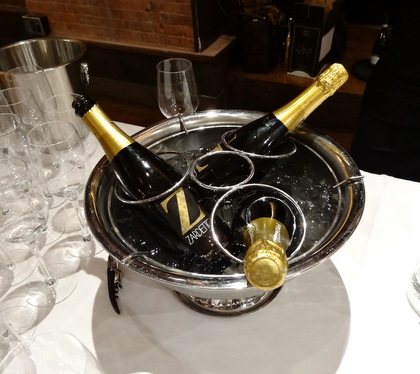
Italian Proseccos from the Veneto at Move the Passion Wine Tour NYC (Astor Center)
Move the Passion! Sounds hot, yes? Well, I took in two venues during the Move the Passion Walking Tour of NYC on December 3rd. The tasting encompassed seven venues around Manhattan where one could sample the various wines offered and enjoy various appetizers which paired well with the wines.
If you enjoy the Veneto region of Italy, you know the province that takes in Venice, Verona, Padua, Treviso, etc., in the northwest corner of Italy on the Adriatic, you probably have tasted Soave and Prosecco that are produced in the Veneto. Because the climate and terroir are conducive to wine making and grape cultivation in that area going back to Roman times and before, the vintners know what they are doing and have perfected their skills to create some incredible wines which give great value.
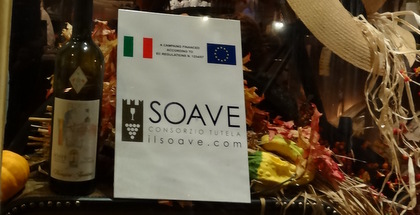
Soave the lovely white wine from the Veneto region of Italy. Tasting at Risotteria Melotti on the Wine Walking Tour, NYC, Move the Passion
I haven’t been to Italy in a few years and feel fortunate to be able to experience Italy around the city at wine tastings (#Vinataly and Slow Wine are presenting their mammoth tasting on on February 3rd at the Metropolitan Pavilion) at Eataly events which have featured wines from Umbria and the Veneto, and at special presentations like the “Pausa de Luce,” in upscale Italian retailers. Move the Passion was such a lovely event which I hope returns again next year because the city’s wine lovers are unstoppable once they are on notice there is an event.

Prosecco from the Veneto. Walking Wine Tour NYC, Move the Passion (Astor Center venue)
Though I had other events to attend, I made sure to drop in to The Astor Center which featured some delicious Proseccos. I then dropped in to Risotteria Melotti for some interesting Soave. In both instances I had never tried these wines before and I have put down my markers to make sure to ask for them when I am looking for a pairing for fish or to have a Prosecco as a pre-appetizer wine and appetizer wine.
For years I have disagreed with my cousin who prefers Prosecco to champagne. Learning about Prosecco, becoming educated to its smooth, refreshing taste, understanding its quality and value, I have changed my mind. I now prefer it to champagne which has been over- hyped up for centuries because of the relationship of France to this country. In my estimation, the “fantasy” and the reality are very different. Champagne’s value, quality and taste doesn’t comparewith Prosecco. Prosecco is the best kept secret for sparkling wine lovers. Good! More for us and great value!
Of course, if you are a wine snob and are a CEO of a hedge fund or corporate, then you can drink Cristal 2005 ($274.00 a bottle on one website) like water and won’t know the difference. Go for it. I’ll throw in my lot with the 99% of the global wine lovers and leave the .001% to its palate. I do hope my estimation is wrong and the .001% also drinks Prosecco. If they don’t, they are missing a fabulous experience.
Here are some other delicious Proseccos I tried at the Astor Center. They are double processed, steel barrel aged, DOC and DOCG ensuring the highest quality and standards. The only Prosecco is an Italian Prosecco from Northern Italy. Don’t be fooled into drinking an Australian sparkling white which is NOT Prosecco. Check out my posts about this from last year’s article on #Vinatly…CLICK HERE.
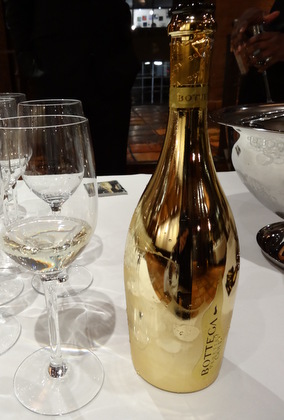
Prosecco from the Veneto, Italy sampled at Move the Passion Wine Walking Tour NYC (Astor Center venue)

Delicious Prosecco tasted at the Astor Center (see above)

Prosecco from the Veneto in Italy. Move the Passion Walking Wine Tour, NYC (Astor Center venue)

Prosecco from the Veneto, Move the Passion Walking Wine Tour, NYC (Astor Center venue)
The Soave white wines from the Veneto were equally delicious and surprising as I had not tried these vintners before and found them to be drinkable with a wide range of foods and cuisines, for dinner or as an aperitif. A number I tried (I wish I had more time…it was at closing) were lighter and refined for easy enjoyment. The Soave tasting was held at Risotteria Melotti in the Village.
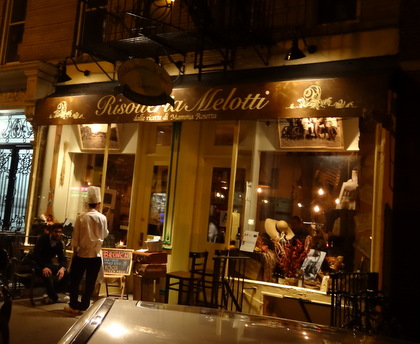
Risotteria Melotti in the East Village on 5th St. between 1st and 2nd. Venue for the Soave tasting during Move the Passion Walking Wine Tour NYC
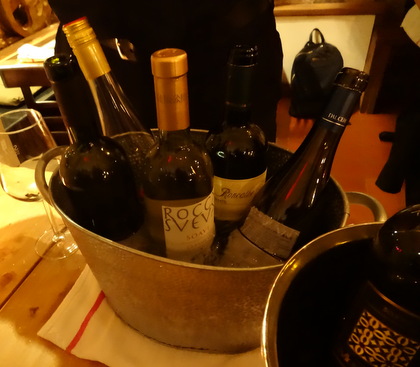
Soave wines from the Veneto. Tasting at Risotteria Melotti, Move the Passion Walking Wine Tour, NYC

Soave Wine from the Veneto at the tasting during Move the Passion Walking Wine Tour, NYC (venue Risotteria Melotti)

A delicious Soave at the tasting during Move the Passion NYC Walking Wine Tour (venue Risotteria Melotti)
This Soave (pictured above) was featured in the window next to the Soave Consortium sign in the above picture at the beginning of the article. There are 4 types of Soave: 1) Soave DOC 2)Soave Classico DOC, 3) Soave Superiore DOCG and 4)Reciotodi Soave DOCG. Soave is mainly composed of two grapesGarganega (70-100%) and Trebbiano de Soave. The wines are fermented in stainless steel, which brings out the lively acidity and fresh fruit notes.
The Soave producers featured at the tasting at Risotteria Melotti were

Risotteria Melotti the venue for the Soave tasting during Move the Passion NYC Wine Tour serves delicious risotto dishes and has been positively review on Yelp, the Go-To New Yorkers restaurant site.
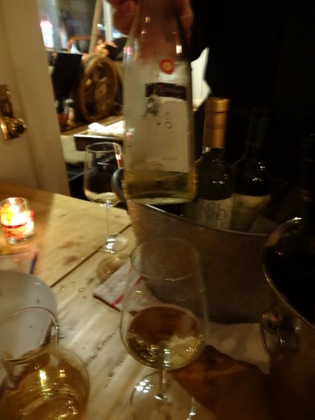
This is a delicious Soave offered for tasting at Move the Passion Wine Tour NYC (venue Risotteria Melotti)
The pictures of the Soave white wines were taken at Risotteria Melotti, a wonderful restaurant in the Village whose menu you should check out because it is gluten-free and serves delicious risotto that IS ORGANIC AND IMPORTED. HELLO FOLKS! (Check out the duck risotto and great salads on the menu and gluten-free desserts)
DECEMBER IS THE MONTH FOR VENETO WINES. THERE WILL BE TASTINGS AND EVENTS AROUND THE CITY. EATALY WILL BE OFFERING TASTINGS ON FRIDAYS AFTER 6:00 PM DURING THE MONTH OF DECEMBER. THERE ARE 32 PRODUCERS THAT ARE REPRESENTED AT EATALY IN THE WINE SHOP AND AT THEIR RESTAURANTS. SO TRY A GLASS AT ONE OF THE RESTAURANTS OR STOP OFF AT THE WINE STORE FOR A TASTING. CLICK HERE FOR EATALY’S WINE SHOP AND LOOK FOR THE VENETO TASTINGS ON FRIDAYS BETWEEN 6-8 PM.
Move the Passion! December 3rd! A Fun Veneto Wine Tasting Tour in NYC.
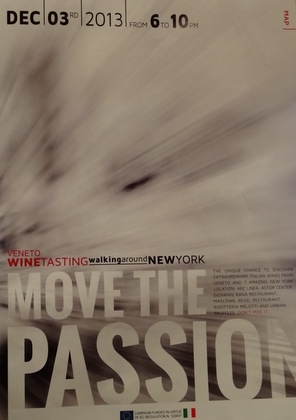
Move the Passion, Veneto Wines walking/driving tour in NYC on December 3rd, 6-10 pm.
If you love the best of Italian Prosecco DOC and DOCG, Soave and even delicious lesser known red and white wines from the Veneto, you will appreciate Move The Passion, which begins this evening in New York City.
Move the Passion is a wine tasting event where you will be able to walk or be driven around to various areas of New York City to sample and discover the best wines from the Veneto which is Italy’s top wine producing region. The U.Vi.Ve. is the consortium of the Veneto wine producers to ensure the highest standards of Veneto wines, including their quality and uniformity. They have organized for the entire month of December a celebration of their finest wines highlighted throughout the city with various events.
Move the Passion is such an event. It offers wine lovers the unique opportunity to discover amazing Italian wines at 7 wonderful wine locations in New York City. The walking Veneto Wine tour will take place on December 3rd from 6 to 10 pm and will take in the following venues:
Arclinea: 21 East 26th Street
Astor Center: 399 Lafayette St.
Giovanni Rana Restaurant: 75 9th Ave.
Maslow 6: 211 West Broadway
Revel Restaurant: 10 Little West 12th St.
Urbani Truffles: 10, West end Avenue (between 59th and 60th)
Risotteria Melotti: 309 E 5th St.
Reds and whites from the Veneto.
You will be tasting sumptuous wines and fabulous food to go with them including truffles, rice (risotto), home made pasta, panettone, cheese and more.
REGISTRATION IS MANDATORY TO ATTEND THE EVENT.
TO REGISTER: CLICK AND SCROLL TO REGISTRATION.
Was it Jack Kerouac who said, “There is wisdom in wine?” Go for it!
Pausa di Luce! A Celebration of Elegance by Poltrona Frau and Luce della Vite for “Casa di Luce”

The presentation was held at Poltrona Frau on Wooster Street in NYC.
Last week I was invited to participate in a celebration of the presentation of “Pausa di Luce.” I must admit, though I speak some Italian, I was perplexed. Curious, I went to be educated. This would be a wine tasting of a delicious upscale wine from Montalcino, Tuscany with which I was not familiar. I adore Tuscan wines. They remind me of the fabulous experiences I’ve had touring that wonderful region of Italy. I wondered if I would like this wine, a combination of Sangiovese and Merlot a recent addition to the wine-making scene in Tuscany. What I discovered was novel. Luce was the first wine in Montalcino produced with Sangiovese and Merlot grapes.

Luce the vintage I tasted was delicious. It inspired the creation, Pausa di Luce representing the elegance of both the wine and the special edition of the “1919,” an authentic Poltrona Frau icon designed by Renzo Frau in 1919 created ad hoc by Poltrona Frau for Luce.
In 1995 in collaboration with the Robert Mondavi company, the Marchesi de’ Frescobaldi company which oversees its estate Luce della Vite created and produced wines from Montalcino, Tuscany. After the collaboration with Mondavi ended, Lamberto Frescobaldi continued his passion creating Luce wine, and in 2009 reached a turning point. He considered: what better way to express the elegant style of his wonderful wine Luce, than to represent it with Italian-produced, hand-crafted creations? From then on Frescobaldi partnered with different companies to create limited edition pieces which reflected and symbolized aspects of the wine, Luce, that he so enjoyed producing.
This year the wine estate Luce della Vite which produces Luce partnered with renown Poltrona Frau, a leader in the finest Italian-made hand-crafted furniture. Together in their joint project, they conceptualized, “Pausa di Luce.” What is “Pausa di Luce?” It is Poltrona Frau’s creation, an armchair to celebrate the exclusive and elegant style of this grand wine of the “Casa di Luce.”
The theme is laid back excellence, something rather far flung in this modern time of digital hyperspeed and modulated rat-race living. Italians are known for their ability to take the time to relax, to appreciate, to rest, to contemplate. Rest is vital for renewal and rejuvenation. Luce is a wine that needs time to peak in its brightness, full bodied flavor and supple mouth taste. There is a required period of resting and readying the wine, making it imminently flavorful. With its supple, comfortable armchair, Poltrona Frau conceptualized relaxation and comfort, hand-crafted, Italian-style to embody the finest elements of Luce since it is a wine to enjoy, savor, relax with.

“Pausa di Luce” presented for the first time in NY at the Poltrona Frau Showroom, 145 Wooster Street
It is fitting that The “Pausa di Luce” is a special edition armchair which heralds back to the armchair handcrafted for the company by artisan Renzo Frau in 1919. Naturally, master craftsmen-artisans have designed a resting area where you may put your wine glass, sip, relax, settle back and enjoy. And ladies, relaxation isn’t just for men any more. You, especially, should be able to “pausa,” sip this luscious wine and indulge yourself to contemplate your next endeavor. I understand why the winemaker is proud to brand his product with beautifully designed and hand-crafted Italian made products, this year collaborating with Poltrona Frau. There is nothing that beats relaxed style and elegance. No uncomfortable stiffness here.

Luce a Tuscan wine produced from Sangiovese and Merlot grapes by Luce della Vite
However, when I discussed the concepts further with Luce della Vite’s North American Director, Alessandro Lundardi, I understood something deeper: the need for conservation, for preserving the ancient, healthful ways, for not allowing the beneficial elements to be overtaken and destroyed by the new blighted ones. For example, the region of the vineyards of the estate is southwest of Montalcino. However, that entire region is in many ways still a relatively wild landscape; the Italians have established a respectful relationship with nature preserving it from excess building and land speculation. Its landscape is so exceptional that in 2004 UNESCO declared it a World Heritage Site. Montalcino is an ancient village on a hilltop, and the earth is rich, the climate yields outstanding wines created over the centuries, carrying through the tradition back hundreds of years for Tuscan wine-making, one of the key cornerstones being sustainability, no intrusion with chemicals, organic principles and intervention only if a vineyard needs to be made whole again.
Now, what about the wine, Luce? The 2009 vintage is beginning to peak and is delicious. It was served with various savory canapes. However, I can imagine it with sharper cheeses and with stronger red meats with which it will hold up well and bring out the piquant flavors. You can buy Luce and the Tuscan wines from Luce della Vite HERE.
The “Pausa di Luce” armchair is available only on request in a select number of Poltrona Frau showrooms in Italy (Milan and Rome), Asia (Tokyo, Taipei, Hong Kong and Shanghai), and the US (New York, Miami and San Francisco).

What other armchair is ready for you to relax with a delicious glass of Luce?
 CAROLE DI TOSTI

