Laurie Metcalf is Amazing in ‘Little Bear Ridge Road’
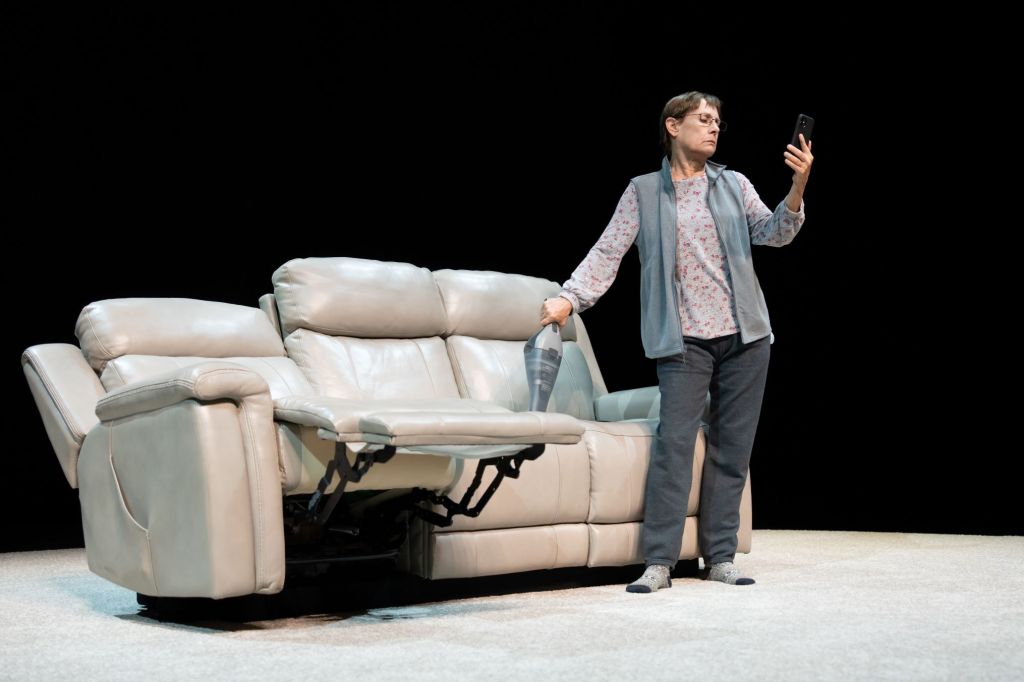
On 12 acres of property in Idaho on the top of the ridge, the sky is so intense it makes Ethan (Micah Stock) panicky because he feels that his life is insignificant against the vastness of the galaxy glittering before him. Sarah (Laurie Metcalf), Ethan’s aunt who owns the property and appreciates the nighttime view tells him she “thought once about buying a telescope, but you know. Then I’d own a telescope.” The audience laughter responding to Metcalf’s pointed, identifying statement that reveals her edgy, funny character peppers Samuel D. Hunter’s powerful, sardonic Little Bear Ridge Road currently at the Booth Theatre.
Metcalf is terrific as Sarah who delivers comments like darts hitting the bullseye and evoking laughter because her words are heavy with authenticity. Her statements convey meaning and pointedly eschew the gentility of polite conversation. Micah, Sarah’s nephew, is withdrawn, remote and masked, not only because the play begins during the COVID-19 pandemic, but because he wears his soul damage on the exterior with a covering of silence that withholds speech. Interestingly, these two estranged family members, one a nurse who doesn’t even nurture her own wounds, and the other, a self-damaged young man of thirty, who can’t really get out of his own way, eventually get along,
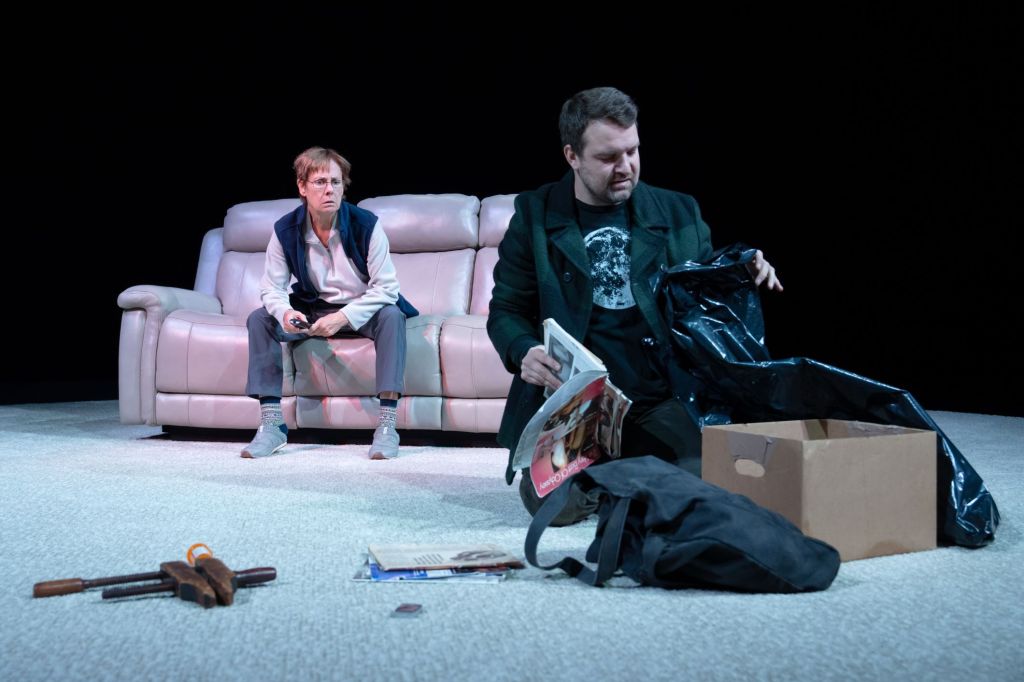
With this Broadway debut Hunter (The Whale, A Bright New Boise) weaves a poignant, humorous, fascinating dynamic. Metcalf and Stock inhabit these individuals with humanity and a fullness of life that is breathtaking.
Directed crisply with excellent pace and verve by Joe Mantello, Hunter’s comedic drama that premiered at Steppenwolf Theater Company, confronts human isolation and failed familial relationships. Hunter presents individuals who confuse self-supporting independence with misguided self-reliance. With spare, concise dialogue the playwright explores how Metcalf’s Sarah and Stock’s Ethan rekindle their sensitivity and open up while nursing their fractured, self-victimized souls, to help each other without acknowledging it as help.
Finally, Hunter’s dialogue has flourishes of well-placed poetic grace and rhythm. Within its meta-themes about human beings struggles with themselves, it’s also about knowing when to let go to encourage another’s growth.
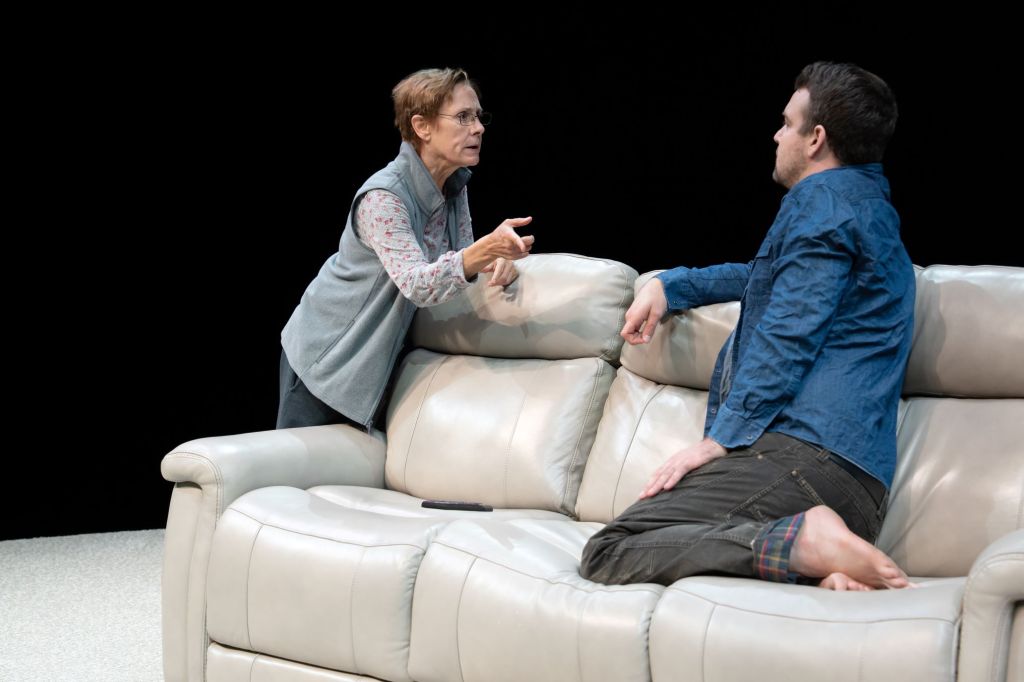
Aunt Sarah and nephew Ethan have an ersatz reunion, when Ethan’s father, Sarah’s brother, dies and leaves the nearby house and estate to Ethan to dispose of. Estranged from his father and from her for a number of years, Ethan, who is gay, lived in Seattle with a partner, who emotionally abused him and self-medicated with a cocaine habit. Eventually, they split. Graduating from university with an M.F.A. in writing, Ethan has drifted, stunned by his devastating childhood where he was raised by an addict father, since Ethan’s mother abandoned the family when he was little. How does Ethan learn not to duplicate his problematic relationship with his father, with love relationships with other older men?
For her part Sarah remained in Idaho near where she was born and worked as a nurse during and after her husband left her. Fortunately or unfortunately, they had no children. This means that she and Ethan are the only Fernsbys left on the planet, dooming their family line to extinction, which according to Ethan seems pathetic. Selling her home in Moscow, Sarah tells Ethan she moved to a more remote area because “It suits me better. Not being around—people.”
With her prickly, self-reliance and proud stance refusing help, Sarah has taken care of her house and property, worked, organized documents and paperwork for Leon (Ethan’s dad, her brother). She generously gave Leon money to help him with his bills. When Ethan affirms that was a bad idea because his addict father used it for his meth habit, Sarah states she doesn’t know what he used it for. After all, Leon told her that he never did meth in front of Ethan. The truth lies elsewhere.
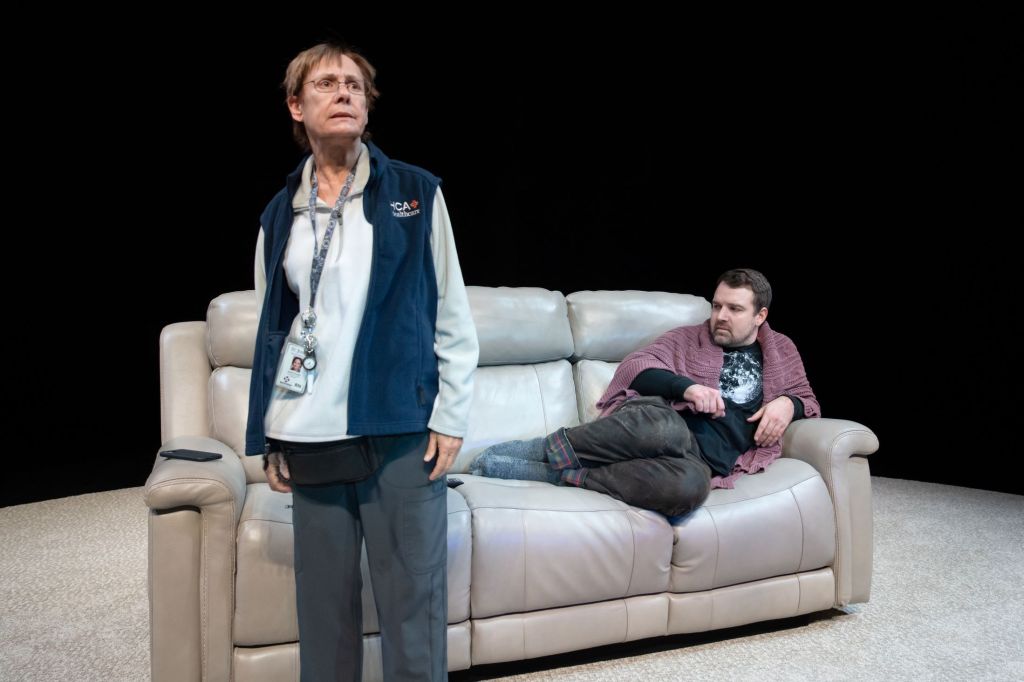
As the pandemic passes and circumstances improve, the relationship between aunt and nephew also improves. They communicate more intimately. They watch a TV series and comment about the characters. The dialogue is funny and Sarah and Ethan become family. Assumptions and mistaken views are dismissed and overturned. Realistic expectations fill in the gaps. A surprise occurs when Ethan meets and forms an attachment with James (the excellent John Drea).
Hunter uses James as a catalyst, who provokes a turning point to continue the forward momentum of the play. James comes from a more privileged, loving background and is studying at a nearby university to be a star-gazer for real, an astrophysicist. With eloquence James explains the magnificence of Orion’s Belt to Ethan, as it relates to our sun. Sarah welcomes him and encourages his relationship with Ethan, until once more circumstances gyrate in another direction, all perfectly unfolding with the emotion of the characters.
Mantello arranges the interlocking dynamic among Sarah, Ethan and then James, center stage on a “couch in a void.” From there the characters converse, sit, enter and leave stage right (to an invisible kitchen), stage left (to bedrooms). The recliner couch on a turntable platform in different positions establishes the passage of time between 2020 and 2022. Scott Pask’s set and the lighting by Heather Gilbert are symbolic and interpretive. Our focus becomes the characters and the actors’ exceptional portrayals as they struggle to find a home with each other and themselves, until the threads of grace in their alignment come to a necessary end.
After all, the Fernsbys have to have a legacy, if not in offspring, then in words. And the respite and connections they find together talking and watching TV on a “couch in void” becomes the place where Ethan’s legacy in writing is born, and the Fernbys legacy prevails.
Little Bear Ridge Road runs 1 hour 35 minutes with no intermission at the Booth Theater through February 15th littlebearridgeroad.com.
‘Ragtime’ is Magnificent and of Incredible Moment
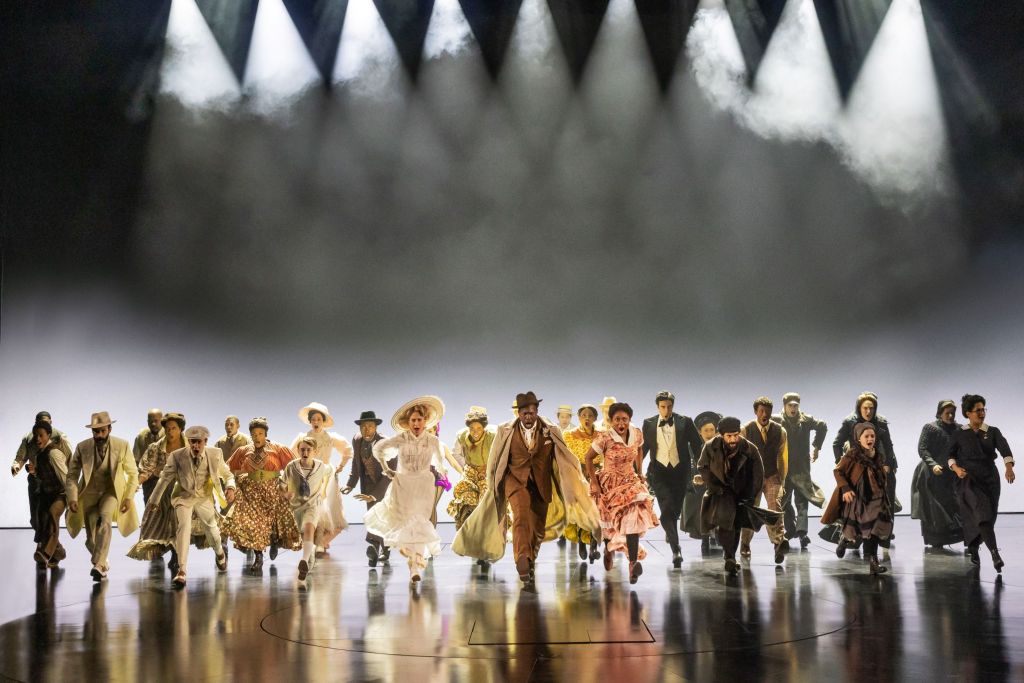
Between the time Lear DeBessonet’s Ragtime graced New York City Center with its Gala Production in 2024, until now with the opening of DeBessonet’s revival at Lincoln Center, our country has gone through a sea change. The very core of its values which uphold equal justice, civil rights and due process are under siege. Because our democratic processes are being shaken by the current political administration, there isn’t a better time to revisit this musical about American dreamers. Ragtime currently runs at the Vivian Beaumont Theater until January 4.
DeBessonet has kept most of the same cast as in the City Center Production. The performers represent three families from different socioeconomic classes. In each instance, they face the dawning of the 20th century with hope to maintain or secure “life, liberty and the pursuit of happiness,” in a country whose declaration asserted independence from its king. In affirming “We hold these truths to be self-evident; that all ‘men’ are created equal,” America’s promises to itself are fulfilled by its citizens. Ragtime reveals who these citizens may be as they strive toward such promised freedoms.
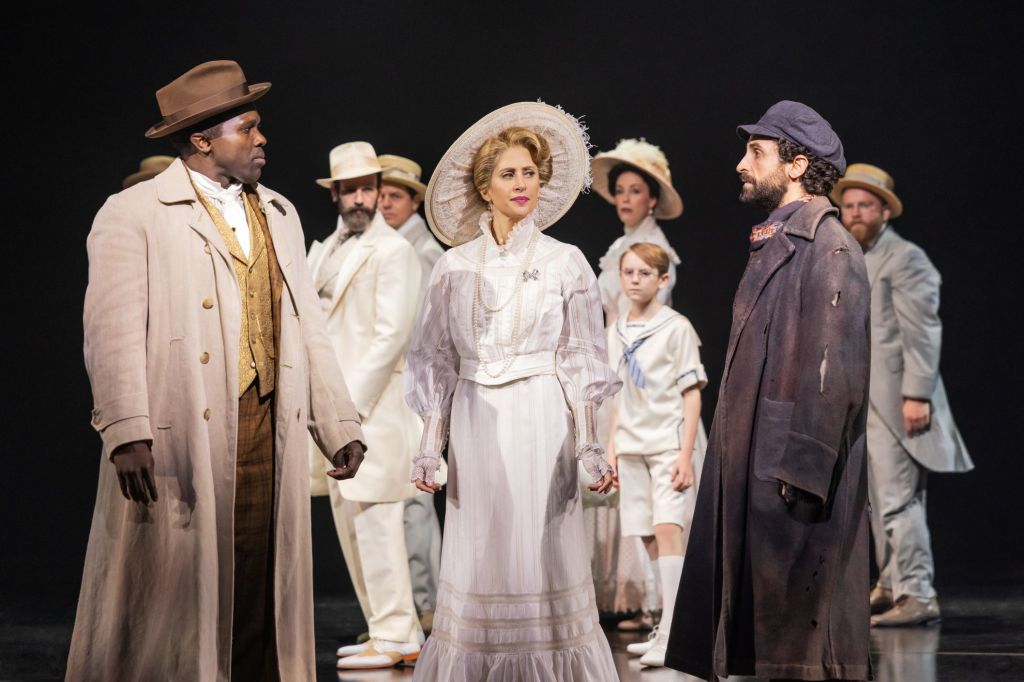
Above all Ragtime is about America, the saga of a glorious and terrible America, striving to manifest its ideals and live up to them, despite overarching forces that would slow down and halt the process.
Based on E. L. Doctorow’s classic 1975 historical novel, and adapted for the stage by Terrence McNally (book), Stephen Flaherty (music), and Lynn Ahrens, (lyrics), Ragtime‘s immutable verities are heartfelt and real. As such, it’s a consummate American musical. DeBessonet’s production celebrates this, and superbly presents the beauty, tragedy and hope of what America means to us. In its concluding songs (Coalhouse’s “Make Them Hear You,” and the company’s “Ragtime/Wheels of a Dream”), the performers express a poignant yearning. Sadly, their choral pleading is a stunning and painful reminder of how far we have yet to go to thoroughly uphold our constitution.
The opening number “Ragtime,” introduces the setting, characters and suggested themes. Here, DeBessonet’s vision is in full bloom, from the lovely period costumes by Linda Cho, David Korins’ minimally stylized scenic design, DeBessonet’s staging, and Ellenore Scott’s choreography. As the company sings with thrilling power and grace, they gradually move forward to take center stage. They are one unit of glorious interwoven diversity and destiny. The audience’s applause in reaction to the soaring music and stunning visual and aural presentation, heightened by a bare stage, emotionally charged the performers. Thematically, the cast had an important mandate to share, a cathartic revelation of the sanctity of American values, now on the brink of destruction.
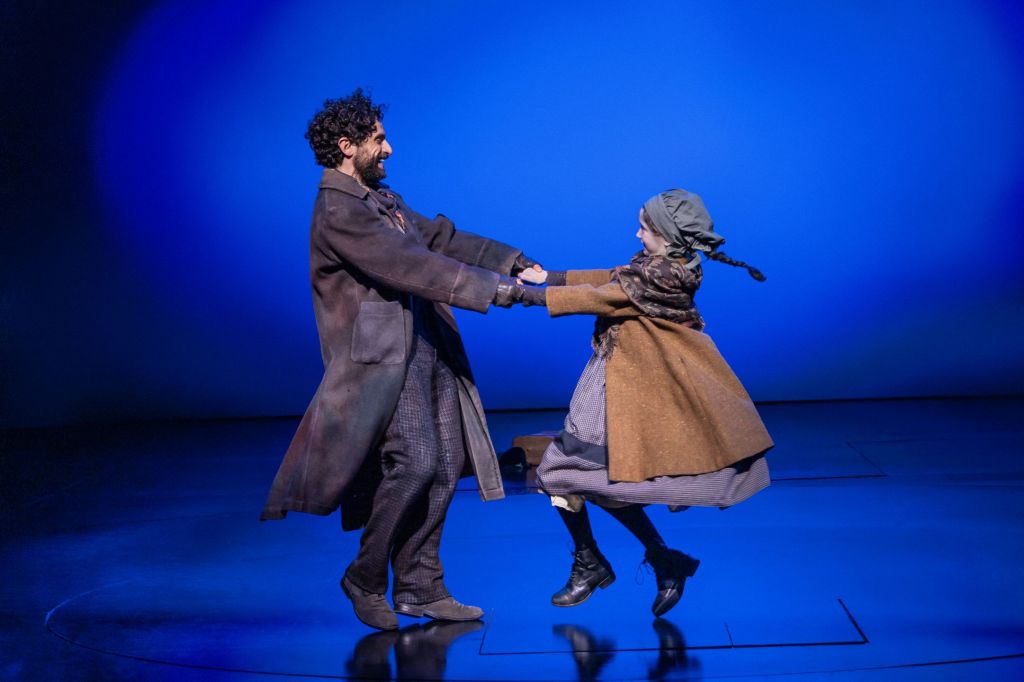
Watching the unfolding of events we cheer for characters like the talented Harlem pianist and composer of ragtime music, Coalhouse Walker, Jr. (the phenomenal Joshua Henry). And we identify with the ingenious, Jewish immigrant Tateh (the endearing Brandon Uranowitz). Tateh must succeed for the sake of his little daughter (Tabitha Lawing), despite their impoverished Latvian background. Likewise, we champion Mother (the superb Caissie Levy), who reveals her decency, kindness and skill, running the house, family and business. She must fill in the gap while her husband (Colin Donnell), goes on a lengthy expedition to the North Pole as a man of the privileged, upper class patriarchy.
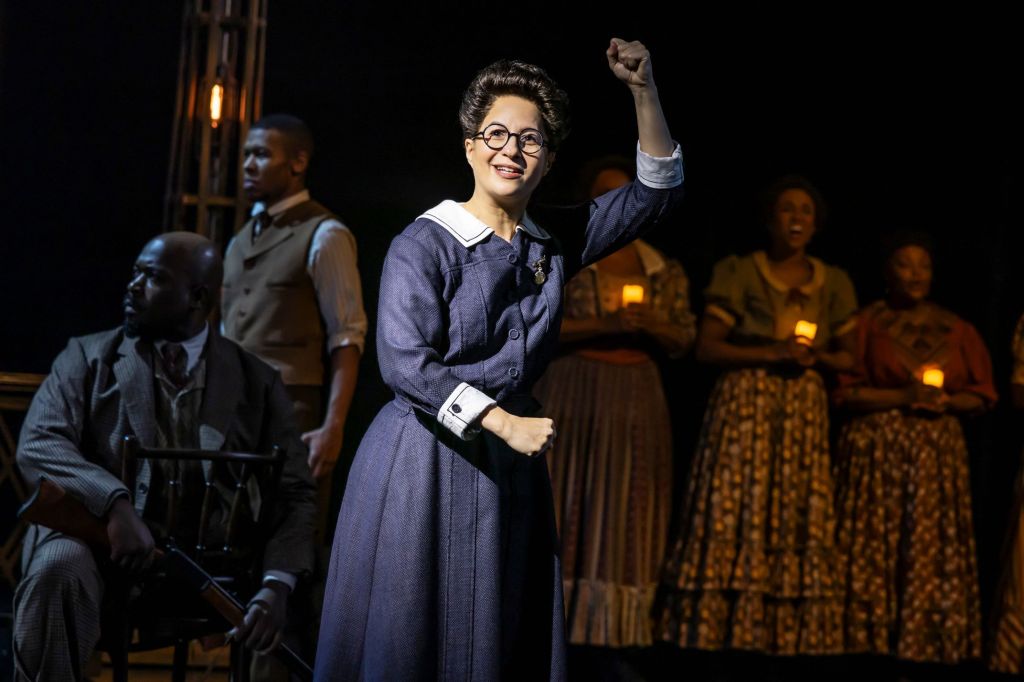
The musical also reflects the other side of America’s blood-soaked history, best represented by characters along a continuum. Their misogyny, discrimination and greed often overwhelm, victimize and institutionalize innocents in the name of a just progress. These include tycoons like J.P. Morgan, Henry Ford, and the garden variety racists that brutalize Coalhouse Jr. and his partner Sarah (the fine Nichelle Lewis), in the name of order and security. Finally, to inspire all, the musical includes wily entrepreneurs like Harry Houdini (Rodd Cyrus), social justice advocates like Emma Goldman (the wonderful Shaina Taub), and accepted reformers like Booker T. Washington (John Clay III). All these individuals make up the living fabric of America.
At its most revelatory, Ragtime exposes elements of our present as the continuation of entrenched issues never resolved from our past. Despite our great strides in nuclear fission and quantum computing, retrograde darkness still lurks in the nation’s beating heart, in its violence, in its human rights inequities. Clear-eyed, incisive, DeBessonet’s spare choices about spectacle and design, and her focus on great acting and singing by the leads and ensemble, ground this masterwork.
Ragtime begins with an interesting unexplained entrance: a winsome and beautiful Black male child in period dress frolics across a bare stage. At the conclusion the circle comes to a close and he appears again. We discover who he is and what he symbolizes in a stark, crystallizing moment of elucidation. After the opening number (“Ragtime”), Mother’s adventure as head of her household begins when Father leaves (“Goodbye My Love”). Her helpers include her outspoken, prescient, son Edgar (Nick Barrington), her younger brother (Ben Levi Ross), and her opinionated, crotchety father (Tom Nelis).
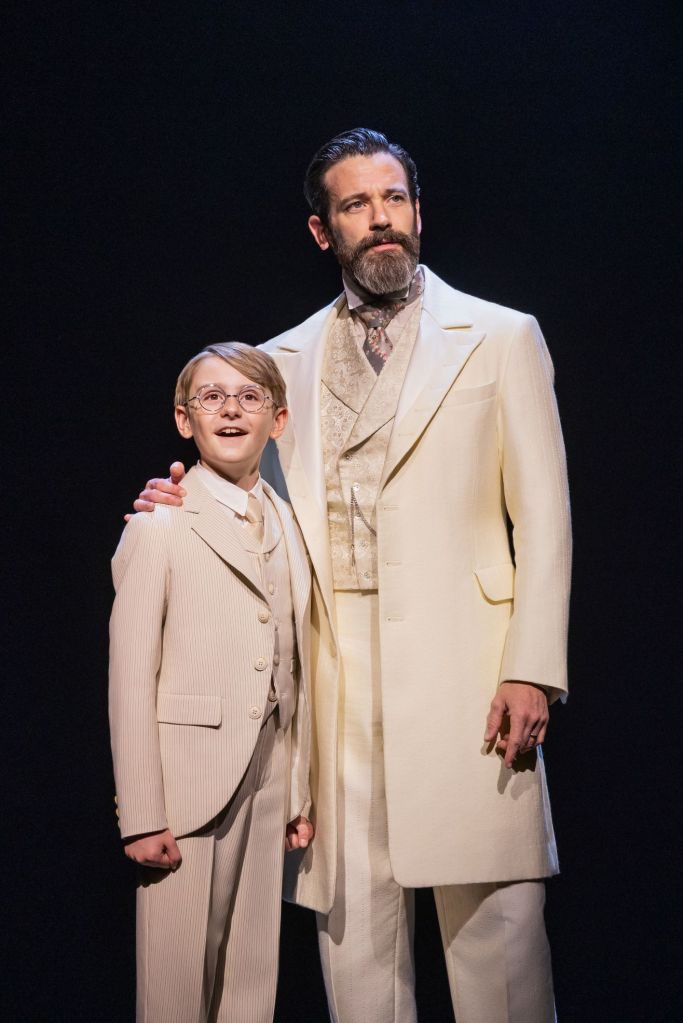
However, the peace and serenity of their lives become interrupted when Mother discovers an abandoned baby in her garden. After much deliberation, Mother takes in the infant and traumatized mother, Sarah. Clearly, this startling act of redemption never would have occurred if Father was present. As an assertion of Mother’s right to make her own decisions, her grace becomes a turning point in the lives of the baby’s father, Coalhouse, and his love, Sarah. Apparently, Coalhhouse left Sarah to travel for his career, not knowing she was pregnant. He was pursing his dream of being a singer/composer of the new ragtime music.
By he time Coalhouse searches for Sarah to eventually find and woo her back to him, we note the tribulations of Tateh, who tries to survive using his artistic skills (like Harry Houdini). And we note the moguls of a corrupted capitalism, i.e. Ford, Morgan (“Success”), who Emma Goldman accuses of exploitation. They keep the workers and society oppressed and poor.
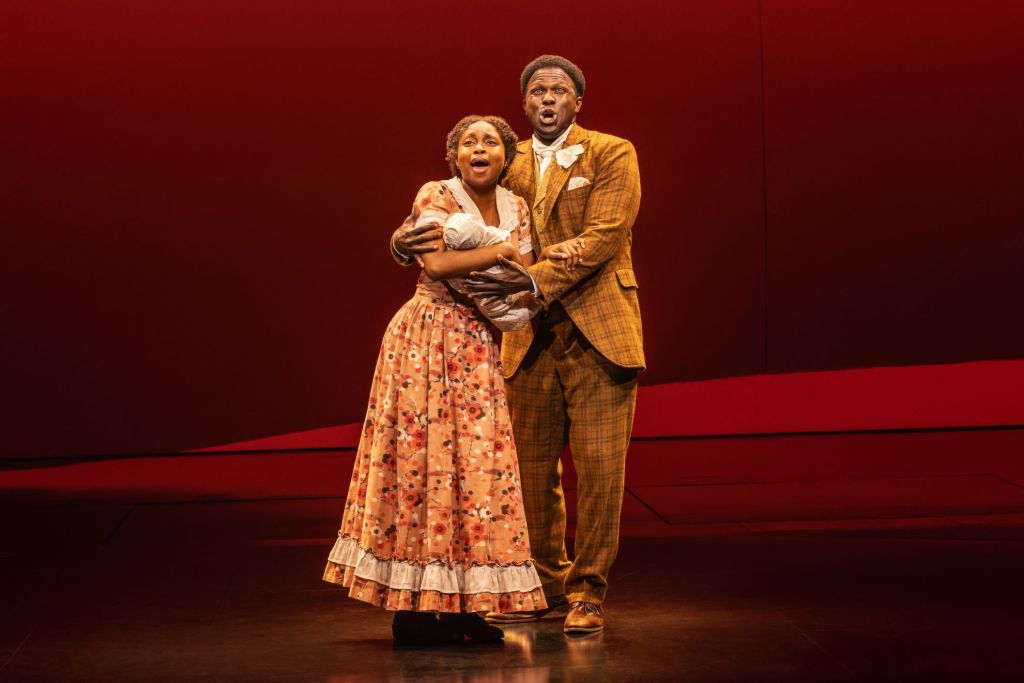
Using his charm and daily persistence (“he Courtship,” “New Music,”), Coalhouse wins Sarah back. In a dramatic, dynamic moment, Henry’s Coalhouse sings with emotion, “Sarah, come down to me.” When Lewis’ Sarah descends, their fulfillment together is paradise. The stunning scene like the ones that follow, i.e. “New Music,” and especially Henry and Lewis’ “Wheels of a Dream,” where Coalhouse and Sarah sing to their son about America, are hopeful and heartbreaking. Again, the audience stopped the show with applause and cheers as they periodically did throughout the production.
On the wave of Coalhouse and Sarah’s togetherness and love reunited, we forget the underbelly of a dark America that looms around the corner. It does appears during Father’s reunion with Mother after his lengthy voyage.
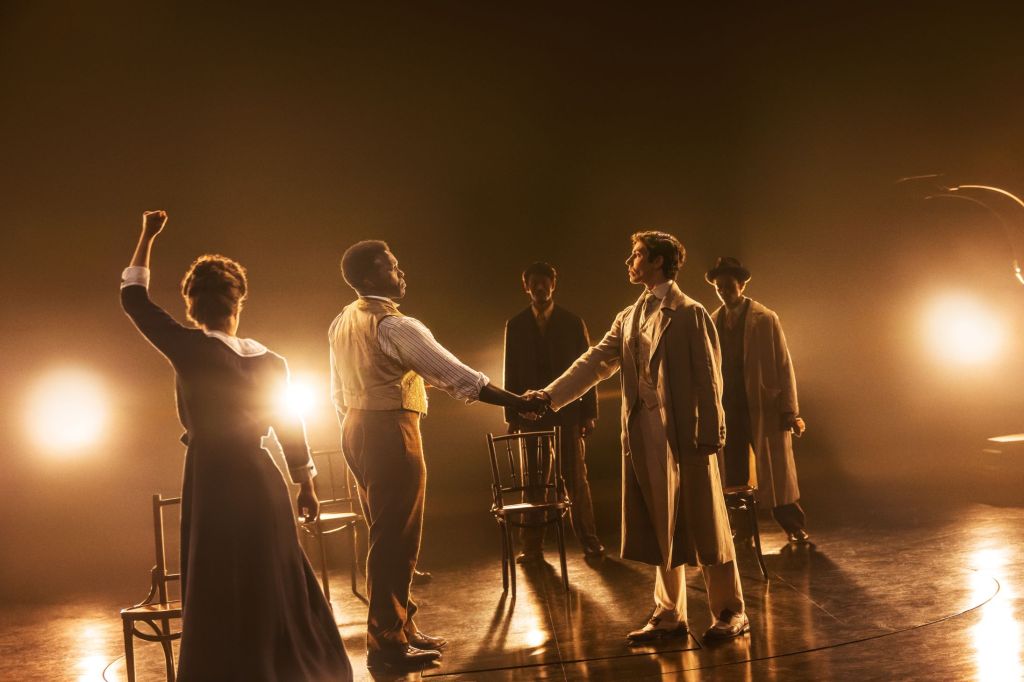
Unhappily, Father returns to a household in chaos with Sarah, Coalhouse and the baby under his roof. He can’t imagine what “got into” his wife and makes demeaning remarks about the baby. His conservative, un-Christian-like attitude upsets Mother. She defends her position and replies with demure, feminine instruction. Interestingly, her comment indicates she will not heel to him like the good lap dog she was before he left. As with the other leads, Levy’s performance is unforgettable in its specificity, nuance and authenticity.
Clearly, the characters have made inroads with each other bringing socioeconomic classes together during events when activists like Emma Goldman and Booker T. Washington make their mark and reaffirm equality. As a representative of the wave of immigrants coming to America from other teeming shores, Uranowitz’s Tateh steals our hearts and pings our consciences, thanks to his human, loving portrayal. Despite his bitterness in having to brace against the poverty he came to escape, he tries to overcome his circumstances and with ingenuity and pluck continually perseveres. Uranowitz’s Tateh particularly makes us consider the current government’s cruel, unconstitutional response toward migrants and immigrants today.
Act II answers the conflicts presented in Act I, leaving us with a troubling expose of our country’s heart of darkness. Yet, the musical uplifts bright halos of hope with the return of the adorable Black male child. We discover who he is and understand his mythic symbolism. Also, we learn the fate of the characters, some justly deserved. And the audience leaves remembering the cries of “Bravo” that resounded in their ears for this mind-blowing production.
Ragtime
With music direction by James Moore Ragtime runs 2 hours 45 minutes with one intermission through Jan. 4 at the Vivian Beaumont Theater lct.org.
‘Chess,’ a Terrific Aaron Tveit, Lea Michele, Nicholas Christopher Electrify a Less Troubled Book
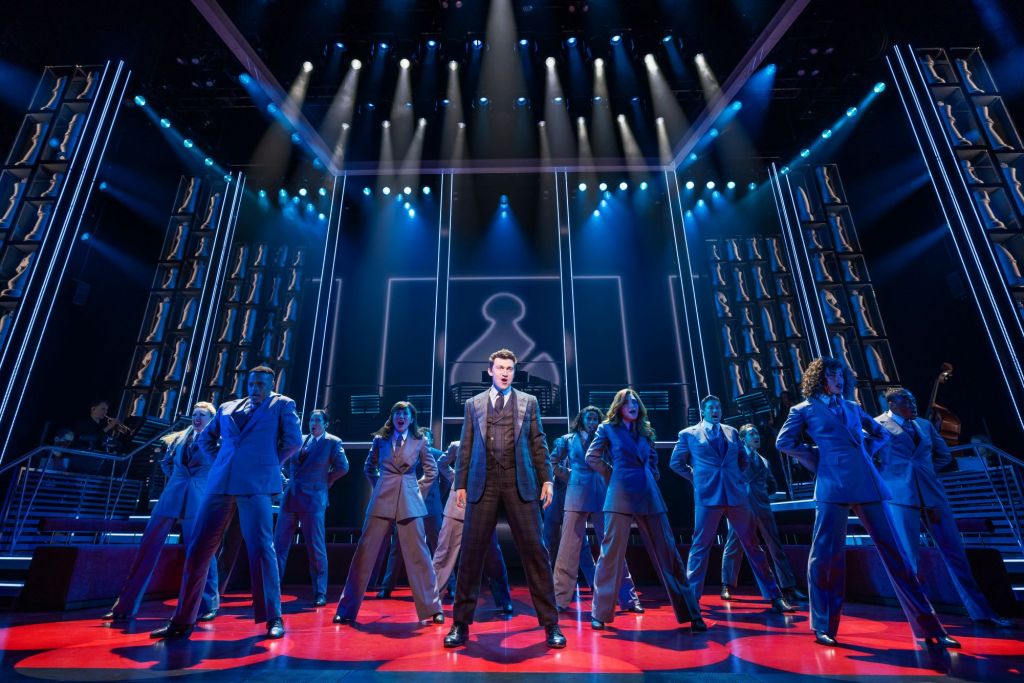
In all of the adventures of the musical Chess, from concept album to initial production in the West End (1986), to its Broadway premiere (1988), concerts, revivals, recordings and tours up to the present, there might be an object lesson in how to develop a winning book. The memorable score by Abba’s genius collaborators, Benny Andersson and Björn Ulvaeus will always resonate. But the musical with lyrics by Ulvaeus and Rice, and new book by Danny Strong may have alighted on the merry-go-round of success never to return to a troubled past. The musical currently runs at the Imperial Theatre until May 3rd.
In its current iteration, the Broadway revival, starring three powerhouses in the lead roles, makes Tim Rice’s idea about a Cold War musical more coherent and interesting. This seems especially so if one lived through the hell of President Reagan’s escalating nuclear arms race with the Soviet Union, and saw the 1983 TV movie The Day After (about nuclear annihilation). Watched by 100 million viewers in one sitting, the TV movie, also watched by Reagan, allegedly influenced him against continuing proliferation.
Strong’s book ties in to the arms race, SALT talks, CIA and KGB compromises, and a controversial, frightening event (Able Archer ’83). All become aligned with two chess matches and chess gambits played by the Soviets and Americans to enable communications during a dangerous time in the 1980s, when nuclear war seemed imminent and chess was used as a form of negotiation to save face and make deals (“Difficult and Dangerous Times”).
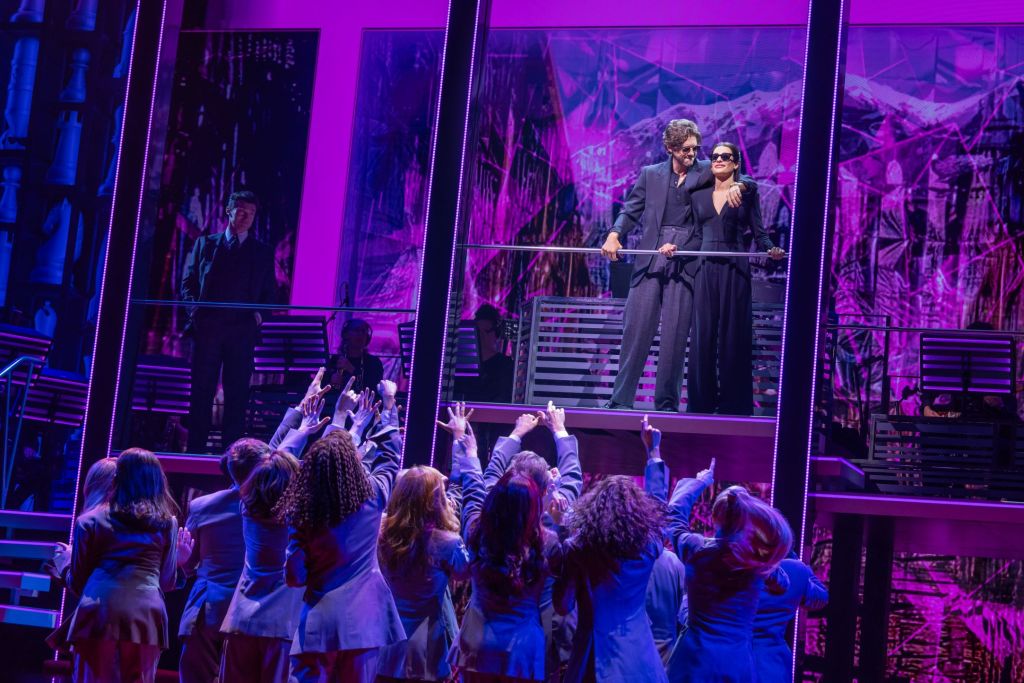
To frame the story, clarify the events with a through-line, and provide a critique, Strong presents this version of Chess through the perspective of an omnipotent narrator, The Arbiter, superbly played by Bryce Pinkham. Snapping his fingers to move the action, he introduces the players, as he selects and explains the events which the company enacts. Invariably, he shares his opinions. Accordingly, the characters subtly move around like chess pieces (the metaphor) in the Cold War game.
This is an important conceit that can be overlooked as one becomes caught up in the powerful music, well choreographed dances, and love triangle between Freddie (Aaron Tveit), Florence (Lea Michele) and Anatoly (Nicholas Christopher). We thrill to their sterling voices and the ensemble’s striking dances. Amidst the glory, the emotion and the angst, Bryce Pinkham’s Arbiter holds the Cold War musical together and gives it a new coherence. He dishes up humor and irony as he tosses off snarky one-liners that sometimes relate the events of the past to events in the present. In one aside he infers the US and NATO countries are in a second Cold War.
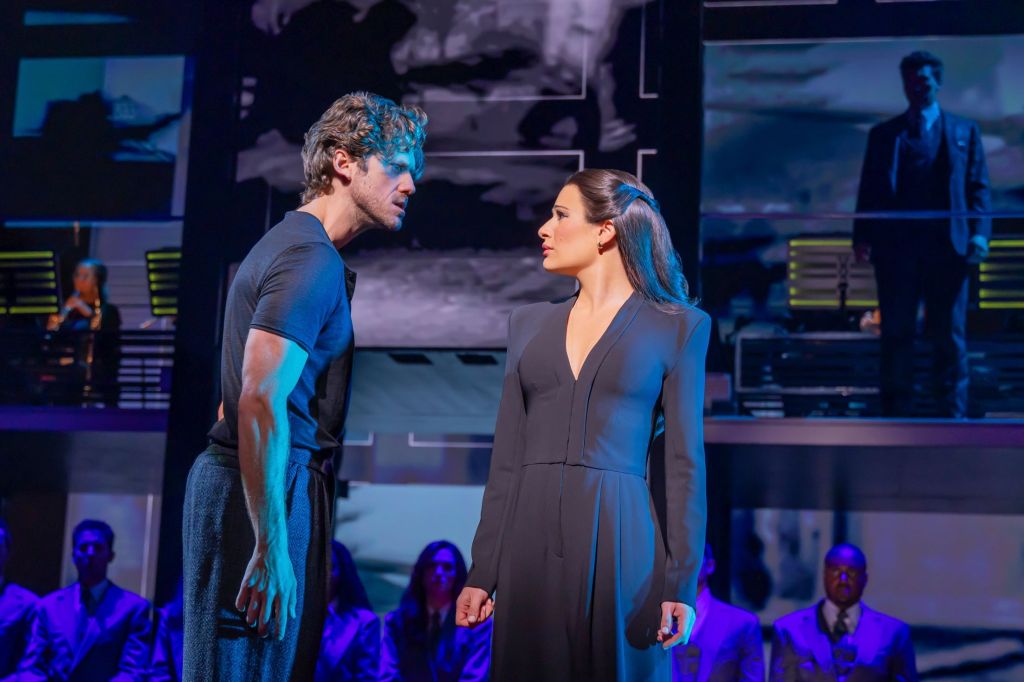
Accompanied by the ensemble, Pinkam’s Arbiter presents a wild and woolly number in which he introduces himself as a new character, and critiques his song (“The Arbiter”) with a confident, “I’m going to crush it.” Pinkham does “crush it,” then his character arbitrates the first chess match between Freddie and Anatoly. After the match Freddie’s Second, Florence, eventually falls out of love with wired Freddie (“Pity the Child #1), and into love with the depressive Anatoly (“Where I Want to Be”). The struggle for all to remain on an even keel against the backdrop of the spy games creates the musical’s tension and generates the fabulous songs.
In Strong’s book whether one agrees with the character’s attitude or not, Pinkham’s Arbiter presents clarity and the symbolism that the Soviets vs. the Americans “Cold War” was an overarching chess match containing a series of smaller chess matches between the players, even between Anatoly’s two love interests, his wife, Svetlana (Hannah Cruz) and Florence. Their powerful duet (“I Know Him so Well”), strikes gold in Act II. After Anatoly defects to England and lives with Florence, he plays against the Soviet champion Viigand in Bangkok (Act II), which underscores the frightening Able Archer 83 event.

In Strong’s version, the CIA agent Walter de Courcey (Sean Allan Krill), and KGB agent and Anatoly’s chess mentor Alexander Molokov (Bradley Dean), negotiate compromises and deals behind the scenes of the first match and the second. Of course, this is for the purpose of winning the larger game of chess which is a deescalation of nuclear weapons to insure the safety of the planet. Indeed, there were real chess matches between the countries, and Pinkham’s Arbiter infers this with his suggestion that some of these events are true. The video projections go a long way toward filling in the gaps in information and de-mystifying what happened during the time befor the Berlin Wall fell.
Chess is acutely, incisively directed by Tony-award winner Michael Meyer (Swept Away, Hedwig). Meyer stages many of the numbers with the concert style approach. Kevin Adams’ lighting design of blues, reds, purples, yellows, effectively dramatizes the dynamic between and among the specific characters, the Soviets and Americans, and the shift of settings, i.e. Bangkok in Act II.
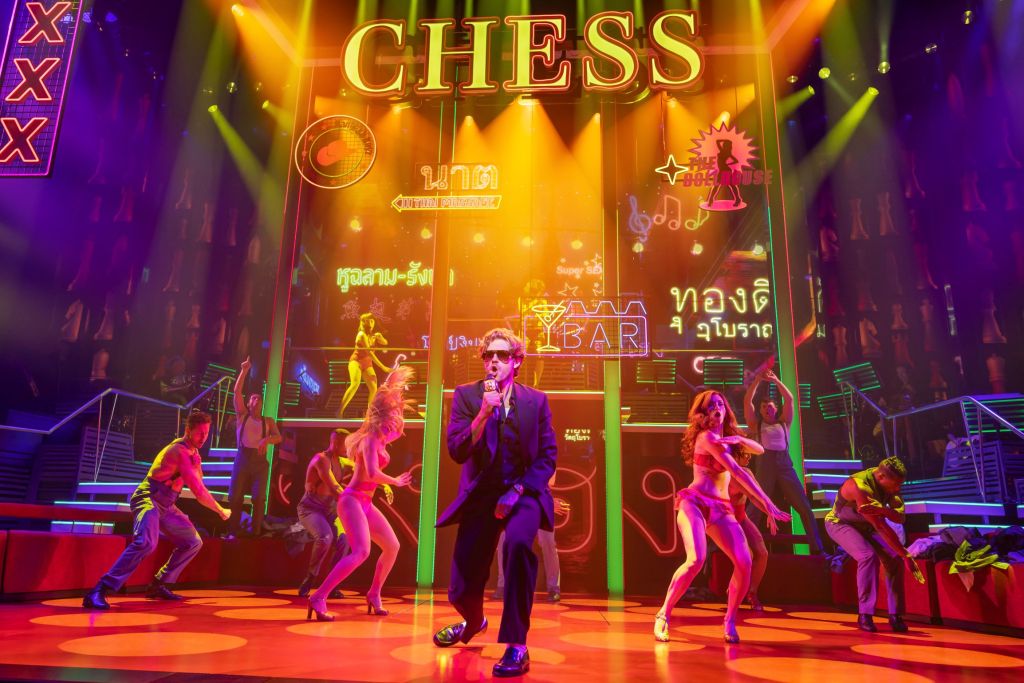
David Rockwell’s multi-tiered scaffolding enhanced by neon and chrome gives the production a stark, period look which is softened for an intimate bedroom scene between Florence and Anatoly with minimal props. Video by Peter Nigrini enhances the historical background needed to provide context, i.e. the Hungarian Revolution, or add interest. Lorin Latarro’s energetic, at times mannered (“Difficult and Dangerous Times” ), at times wild, erotic (“One Night in Bangkok”), energetic movement and dance enhance the ensemble’s pivotal numbers. These reflect the stereotypical thinking of that time, the cold war policy and the feverish, hot, atmosphere in Bangkok where the second chess match is held.
Appropriately, the ensemble’s tailored, grey suits (Tom Broecker), reflect the somberness of countries at war with the threat of their antagonisms heating up. The leads in dark colors contrast with the ensemble, and Anatoly’s wife dressed in maroon “leather.”
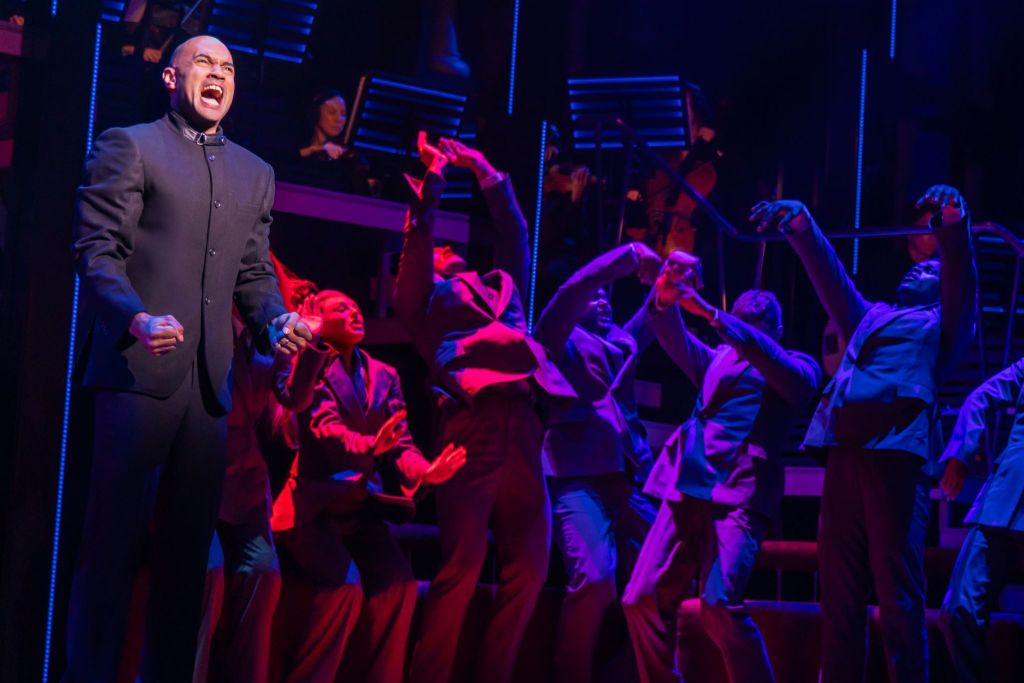
The phenomenal score played by an 18-20 piece orchestra with Ian Weinberger’s musical direction, and Anders Eljas and Brian Usifer’s orchestrations power up the ballads, pop rhythms and near operatic ensemble numbers gloriously. Finally, the orchestra, carefully positioned onstage by the back wall, is always witnessed by the audience who engages with it.
The sexy “One Night in Bangkok” received applause of recognition by the audience with the first notes of the charted global hit song (1984-85), as the exotic dancers and Tveit rocked Latarro’s movements with mastery. The superbly performed numbers by Tveit (“Pity the Child #2”), Michele (“Someone Else’s Story,” “Nobody’s Side”) and Christopher’s “Where I Want to Be” and “Anthem,” sung with the ensemble, are show-stoppers.
Finally, as the games conclude and presumably the first Cold War is over, Pinkham’s Arbiter sings “One Less Variation.” Then, Tveit, Michele, Christopher, Pinkham and the company end with the warning lyrics from “Nobody’s on Nobody’s Side”: “Never stay (a minute too long), don’t forget the best will go wrong, nobody’s on nobody’s side.”
Chess runs 2 hours 45 minutes with one intermission through May 3 at the Imperial Theater. chessbroadway.com.
Bobby Cannavale, James Corden, Neil Patrick Harris Are LOL in ‘Art’

Superb acting and humorous, dynamic interplay bring the first revival of Yasmina Reza’s Tony-award winning play Art into renewed focus. The play, translated from the French by Christopher Hampton, is about male friendship, male dominance and affirming self-worth. Directed by Scott Ellis, the comedy with profound philosophical questions about how we ascribe value and importance to items considered “art” as a way of bestowing meaning on our own lives resonates more than ever. Art runs until December 21st at the Music Box Theatre with no intermission.
When Marc (Bobby Cannavale) visits his friend Serge (Neil Patrick Harris) and discovers Serge recently spent $300,000 dollars on a white, modernist painting without discussing it with him, Marc can’t believe it. Though the painting by a known artist in the art world can be resold for more money, Marc labels the work “shit,” not holding back to placate his friend’s ego. The opening salvo has begun and the painting becomes the catalyst for three friends of twenty-five years to reevaluate their identity, meaning and bond with each other.
As a means to reveal each character’s inner thoughts, Reza has them address the audience. Initially Marc introduces the situation about Serge’s painting. After Marc insults Serge’s taste and probity, Serge quietly listens, makes the audience, his confidante and expresses to them what he can’t tell Marc. In fact Serge categorizes Marc’s opinion saying, “He’s one of those new-style intellectuals, who are not only enemies of modernism, but seem to take some sort of incomprehensible pride in running it down.” As Serge attempts to pin down Marc reinforcing Marc’s lack of expertise or knowledge about modern art, he questions what standards Marc uses to ascribe his valuable painting as “this shit.”
At that juncture Reza emphasizes her theme about the arbitrary conditions around assigning value to objects, people, anything. Without consensus related to standards, only experts can judge the worth of art and artifacts. Obviously, Marc doesn’t accept modernist experts or this painter’s work. He asserts his opinion through the force of his personality and friendship with Serge. However, his insult throws their friendship into unknown territory and capsizes the equilibrium they once enjoyed. The power between them clearly shifts. The white canvass has gotten in the way.
During the first thrust and parry between Marc and Serge in their humorous battle of egos, the men resolve little. In fact we learn through their discussions with their mutual friend Yvan (James Corden), they think that each has lost their sense of humor. The purchase of the painting clearly means something monumental in their relationship. But what? And how does Yvan fit into this testing of their friendship?

Marc’s annoyance that Serge purch,ased the painting without his input, becomes obsessive and he seeks out Yvan for validation. First he warns the audience about Yvan’s tolerant, milquetoast nature, a sign to Marc that Yvan doesn’t care about much of anything if he won’t take a position on it. During his visit with Yvan, Marc vents about Serge’s pretensions to be a collector. Though he knows he can’t really manipulate Yvan about Serge because Yvan remains in the middle of every argument, he still tries to influence Yvan against the painting.
Marc believes if Yvan tolerates Serge’s purchase of “shit” for $300,000, then he doesn’t care about Serge. Tying himself in knots, Marc considers what kind of friend wouldn’t concern himself with his friend getting scammed $300,000 for a shit panting? If Yvan isn’t a good friend to Serge, at least Marc shows he cares by telling Serge the painting is “shit.” Without stating it, Marc implies that Serge has been duped to buy a white canvass with invisible color in it he doesn’t see based on BS, modernist clap trap.
In the next humorous scene between Yvan and Serge, knowing what to expect, Yvan sets up Serge, who excitedly shows him the painting. True to Marc’s description of him, Yvan stays on the fence about Serge’s purchase not to offend him. However, when Yvan reports back to Marc about the visit, he disputes Marc’s impression that Serge lost his sense of humor. In that we note that Yvan has no problem upsetting Marc when he says that he and Serge laughed about the painting. However, when Marc tries to get Yvan to criticize Serge’s purchase, Yvan tells him he didn’t “love the painting, but he didn’t hate it either.”
In presenting this absurd situation Reza explores the weaknesses in each of the men, and their ridiculous behavior which centers around whose perception is superior or valid. Additionally, she reveals the balance inherent in friendships which depend upon routine expectations and regularity. In this instance Serge has done the unexpected, which surprises and destabilizes Marc, who then becomes upset that Yvan doesn’t see the import behind Serge’s extreme behavior.
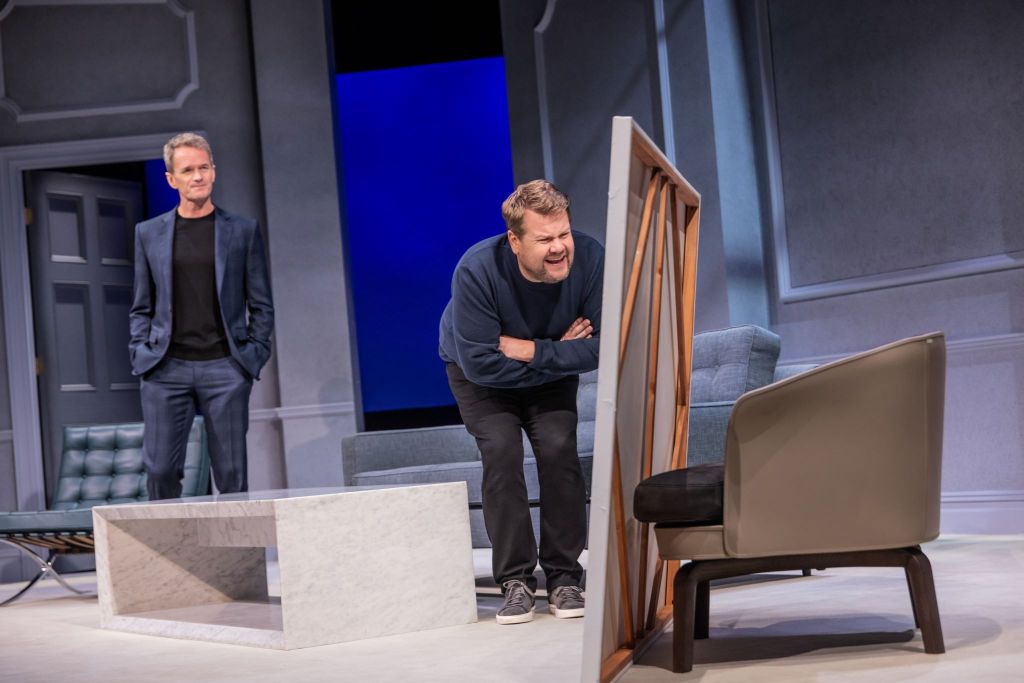
Teasing the audience by incremental degrees prompting LOL audience reactions, Reza brings each of the men to a boiling point and catharsis. Will their friendship survive their extreme reactions (even Yvan’s noncommittal reaction is extreme) and differences of opinion? Will Serge allow Marc to deface what he believes to be “shit” for the sake of their friendship? In what way are these middle-aged men asserting their “place” in the universe with each other, knowing that that place will soon evanesce when Death knocks on their doors?
The humorous dialogue shines with wit and irony. Even more exceptional are the actors who energetically stomp around in the skins of these flawed characters that do remind us of ourselves during times when passion overtakes rationality. Each of the actors holds their own and superbly counteracts the others, or the play would seem lopsided and not land. It mostly does with Ellis’ finely paced direction, ironic tone, and grey walled set design (David Rockwell), that uniformly portrays the similarity among each of the characters’ apartments (with the exception of a different painting in each one).
Reza’s characters become foils for each other when Marc, Serge and Yvan attempt to assert their dominance. Ironically, Yvan establishes his power in victimhood.
Arriving late for their dinner plans, Corden’s Yvan bursts upon the scene expressing his character in full, harried bloom. His frenzied monologue explodes like a pressure cooker and when he finishes, he stops the show. The evening I saw the production, the audience applauded and cheered for almost a minute after watching Corden, his Yvan in histrionics about his two fighting step-mothers, fiance, and father who hold him hostage about parental names on his and his fiance’s wedding invitations. Corden delivers Yvan’s lament at a fever pitch with lightening pacing. Just mind-blowing.
The versatile Neil Patrick Harris portrays Serge’s dermatologist as a reserved, erudite, true friend who “knows when to hold ’em and knows when to fold ’em.” Cannavale portrays Marc’s assertive personality and insidiously sardonic barrel laugh with authenticity. Underneath the macho mask slinks inferiority and neediness. Together this threesome reveals men at the worst of their game, their personal power waning, as they dodge verbal blows and make preemptive strikes that hide a multitude of issues the playwright implies. They are especially unwinning at successful relationships with women.
Reza’s play appears more current than one might imagine. As culture mavens and influencers revel in promoting and buying brands as a sign of cache, the pretensions of superiority owning, for example, a Birkin bag, bring questions about what an item’s true worth is and what that “worth” means in the eye of the beholder. Commercialism is about creating envy and lust and the illusion of value. To what extent do we all fall for being duped? Does Marc truly care that his friend may have fallen for more hype than value? Conclusively, Yvan has his own problems to contend with. How can he move beyond, “I don’t like it, I don’t hate it.”
As for its own value, Art is worthwhile theater to see the performances of these celebrated actors who have fine tuned their portrayals to a perfect pitch. Art runs 1 hour 35 minutes with no intermission through Dec. 21 at the Music Box Theater. artonbroadway.com.
‘Two Strangers (Carry a Cake Across New York),’ Smashing Performances, Delightful, Lyrical, Poignant

A simple rom-com it is not. When New York (a town that’s all about money) figures as a character in the dynamic of a budding relationship, complexity arises. It seems especially so with the musical comedy Two Strangers (Carry a Cake Across New York) by Jim Barne & Kit Buchan, currently at the Longacre Theater until Jul,y, unless it receives an extension. Judging from the audience who knew the songs, and reveled in the fun and celebration when I saw it, it may extend its run.
Originally, titled The Season in two regional English theaters (2019), a new title and opening in London at the Kiln Theatre (2023-2024) and the West End at the Criterion Theater (2024) helped the musical make its mark. At the Criterion Theater it received an extension due to popular demand. Gaining momentum it kept the new title and began its North American premiere at the American Repertory Theater. There, it received another extension. Again, Sam Tutty reprised his role of Dougal Todd at A.R.T. (2025) when Christiani Pitts joined him as Robin.

Ironically, the longer, detailed title kills for its uniqueness which characterizes this musical comedy that resonates also because the writers make New York a character viewed through the eyes of two broke, twenty-somethings. The world-weary New Yorker, Robin (Christiani Pitts, Ann Darrow in King Kong) contrasts with the kooky, exuberant Brit, Dougal (Sam Tutty shepherded the role since the Kiln Theatre).
Delectably opposites, the characters are thrown together by Dougal’s invite to his dad’s wedding in Manhattan where he will meet Mark Todd for the first time in a town he’s only seen on film. No wonder why he’s excited.
Deliciously, the actors inhabit the characters’ dialogue as if they wrote it themselves. Tutty’s quick, off-handed, throw-away one liners, perfectly timed, always land. Pitts’ Robin, the perfect foil, picks up steam after she drops her bored, ironic pose and jumps into the pools of Dougal’s freeing enthusiasm.

Indeed, on a deeper level, much recommends this musical comedy directed by Tim Jackson, effortlessly performed with charisma and chemistry by its leads. The minimalist production (i.e. Soutra Gilmour’s set of variously sized, silver-grey suitcases that hold surprises) aligns old-fashioned and hyper modern tropes. The equally unostentacious lighting design (Jack Knowles) appropriately adds atmosphere when most needed.
When Robin bumps into Dougal and tramples his passport, Robin knows about Dougal,. But neitherhe nor the audience know about her. So the idea of strangers meeting and caring about each other after twenty-four hours or so twerks off the rails of typical “boy-meets-girl” ho-hum.
Importantly, little about the characterizations and storyline are predictable. In the twists and bends we note the refreshing unusual. For example, she is one of the few NYC waitresses who isn’t trying to be an actress or performer. In fact she circles the edges of struggling, lonely, confused, an invisible nobody to the well-heeled crowd (“Be Happy”). He awkwardly circles the edges of dorkdom, living with mom as best mates and drinking buddies. However, their far from admirable backgrounds heighten audience empathy in this on-point two-hander, incisively and acutely directed by Jackson.

Arranged by sister Melissa (the bride-to-be), to ease Dougal into the NYC scene, Robin accompanies Dougal to his hotel from JFK. Initially, we don’t understand Robin’s cool attitude. Is it because she’s a sophisticate annoyed that he acts like a wide-eyed, bushy-tailed ten-year old at Christmas about being in Manhattan (“New York”)? Or is her attitude a cover for deeper knowledge about the marriage of her 30-year-old sister to Dougal’s 57-year-old millionaire dad Mark, who abandoned Dougal before he was born?
Nevertheless, the combination of her dour attitude and his outsized ebullience and film buff references make their choppy interplay continually humorous. It becomes LOL in Act II when Robin removes her mask “the morning after” their wild night during their song, “The Hangover Duet.” Barne’s and Buchan’s clever script and at times profound lyrics and beautiful music enhance the perplexing situation of these two strange “family members” growing toward love, despite the weird circumstances.
Along the journey of discovery which begins with Dougal’s conflict (“Dad”), his disappointment that his father didn’t meet him at JFK, the truth eventually unravels. Perhaps spurred by passive aggression, Robin fails at her mission to deliver a whole wedding cake to her sister, as well as other tasks Melissa demands of her. With his cheerio attitude and stock of film plots at the ready to reference during the major catastrophe that will drive Melissa to a terrorist act when she finds out, they flee despite their poverty into the dreamland New York can be. Happily, they end up spending a fabulous evening together dancing, eating and blindly drinking their way into the classy Plaza Hotel for a stay-over.

How is this possible? Mark gave Melissa his card which she improbably gave to Robin to pay for the $2000 wedding cake. With the card (during the fast-paced, frenetic, “American Express”), they charge for the hotel room and various sundries, like a tux rental and exquisite dress and shoes, food, drink and breakfast. Their joyful abandon is courtesy of Mark. Come on! He’s Dougal’s dad and Dougal’s making up for lost time. And we discover in a note Mark sends to their Plaza hotel room, he gladly bestows his largess on “little Robin,” because of their former “friendship.” He even invites her to the wedding, which we later understand is a slap in her face.
By the conclusion we “get” Robin’s initial cynical attitude toward Dougal, whose boyish, angelic hope eventually rubs off on Robin. How can it not as they journey up and down devastating emotional mountains (“New York/What’ll It Be,” “About to Go In,” “This Year”) and work through their explosive blow-out (“He Doesn’t Exist,” “What Did You Say?”). They reconcile in uncertainty as Dougal suggests, “If you ever need anything, I’ll be 4000 miles away,” and sing one refrain of “New York,” then return to their lives.
Two Strangers (Carry a Cake Across New York) runs 2 hours 15 minutes with one intermission at the Longacre Theater. twostrangersmusical.com.
NYBG Holiday Train Show® Joyfully Presents a Magical Winter Wonderland
The 34th NYBG Holiday Train Show® runs until Jan 11, 2026
The 34th NYBG Holiday Train Show® opened November 15, 2025 to fanfare, excitement and large crowds with families and delighted children eagerly moving through the galleries of the Enid A. Haupt Conservatory. The exquisite botanical train theater shines its way into the New Year and closes on Sunday, January 11, 2026.



The enchanting train displays reflect beloved seasonal traditions. The show offers something for everyone—with two ways to experience it: day or night. In the daytime, families are welcome. More than 30 G-scale model locomotives and trolleys whizz and hurtle through a showcase of nearly 200 twinkling replicas of renowned New York architecture. During select evenings Holiday Train Nights invites visitors to see lighted, celebratory show one through a different lens. Sparkling nighttime at the Enid A. Haupt Conservatory is extraordinary.
So The Holiday Train Show® ties the past with the present and history with modernity in the exhibits which center around thematic locations. Look for exhibits featuring landmarks in the Bronx, Brooklyn’s Coney Island, Queens and Staten Island. Look for the New York City bridges that connect the boroughs with Manhattan. Look for replicas featuring famous landmarks in the lower Hudson River Valley, as well as downtown Manhattan.
In the Central Park displays there is the new addition, the Delacorte Theatre. The Delacorte was recently refurbished to expand its offerings of the Public Theater’s Free Shakespeare in the Park. Applied Imagination celebrated the completion of the Theater with this replica.






In the Palms of the World Gallery, check carefully and you will see the Oculus, One World Trade Center, the Statue of Liberty, St. Bartholomew’s Church, the Woolworth Building and another new addition, the Whitney Museum in the display featuring historic structures old and new.



To see the real magic which defies your imagination, get up close to view the construction of the artistically crafted masterpieces. Each one has been configured to scale painstakingly and ingeniously assembled from plant parts. The roof of a building might be shelf fungi.



There are leaves, palm fronds, pinecones, cinnamon sticks, seed pods, acorns, twigs used for fine details as larger pieces are shaped into cornices, columns and stone blocks. It’s mind-blowing when you discover that a pistachio shell was used to meticulously detail an angelic statue.


All of the incredible building designs of the miniatures created by Applied Imagination, highlight the immense importance of plants in our world. Indeed, nature’s flora inspires some of the finest, most uplifting of architectural designs that comfort and support humanity. Plants are vital not only to our physical well being (the rain forests are the lungs of the planet), they are vital to our psychic and emotional well being.
In this outside exhibit, trains chug along with their heavy loads (i.e. acorns, seed pods) around mountains and fanciful, gigantic toadstools and fungi adding an outdoor wonderland to the indoor wonderland of magic. Notice the whimsical train car, and the mushroms out of Alice in Wonderland. And look for the woodland creatures tucked away in a mountain or peering down at you from a train trestle.


Whether young or old the NYBG Holiday Train Show® continues to spark wonder in generations of visitors. It’s one of the City’s best way to celebrate the season with all your loved ones.
For the evenings you can enjoy seasonal beverages as you stroll through the twinkling lights of the exhibition,. And don’t forget to stop in at the NYBG Shop to pick up that gift for that hard to buy friend or family member. Not only does the NYBG Shop have lovely and unique gifts, if you are a member, show your card for the discount.
As you enjoy the Garden at night dance to the holiday classics and sing along with performers as they croon the Christmas pop favorites. You can also enjoy sweet and savory bites for purchase, or stop at the “Bar Car” which features a 21+ bar at the Hudson Garden Grill Patio.

Holiday Train Nights offer their unique experiences from 7 to 10 p.m. on November 22, 28, and 29, 2025; December 6, 12, 13, 19, 20, 21, 26, 27, 28, and 29, 2025; and January 2, 3, and 10, 2026; 7 to 10 p.m. Holiday Train Nights are ticketed through NYBG’s presenting partner Fever. Tickets start at $39 for Non-Members purchasing for groups of four or more, with 20% off for NYBG Members, and free entry for children under the age of 2. For more information, visit https://www.nybg.org/holiday-train-nights/.
.
‘The Queen of Versailles,’ Fabulous Kristin Chenoweth Makes Dreams Realities

If the road to excess leads to the palace of wisdom (quote by English poet William Blake), do people know when they’ve reached their limit? When is enough enough? According to the themes of the new musical The Queen of Versailles, currently at the St. James Theatre, knowing this depends upon the seeker.
In the clever, sardonic musical, based on Lauren Greenfield’s titular documentary film and the life stories of Jackie and David Siegel, the question of excess and how to measure it shines into the darkness of American culture, conspicuous consumption, surgically enhanced, plastic looks, and meretricious values. With an ironic, humorous, no holds barred book by Lindsey Ferrentino, and music and lyrics by Stephen Schhwartz, the Siegel’s riches to more riches story, including the 2008 mortgage debacle, takes center stage. By the conclusion, the audience leaves shaken and maybe stirred, either with a bad taste in their mouths or with the prick of guilt in their consciences.
At its finest, The Queen of Versailles inspires the audience to peer into their own values and behavior and evaluate their souls to correct. Ultimately, it asks, do the Siegels have a worthwhile life or have they allowed their childhood poverty to overwhelm their good sense and inner emotional well being? Despite its ripe fun Ferrentino’s book and Schwartz’s music encourage a hard look at crass, materialistic greed that blinds the rich from using their largess for the social good. Lastly, it questions do the representative Siegels count the cost to live the oversized billionaire’s lifestyle which causes harm? To what extent has their craven indulgence choked off their lifeblood to their own destruction?
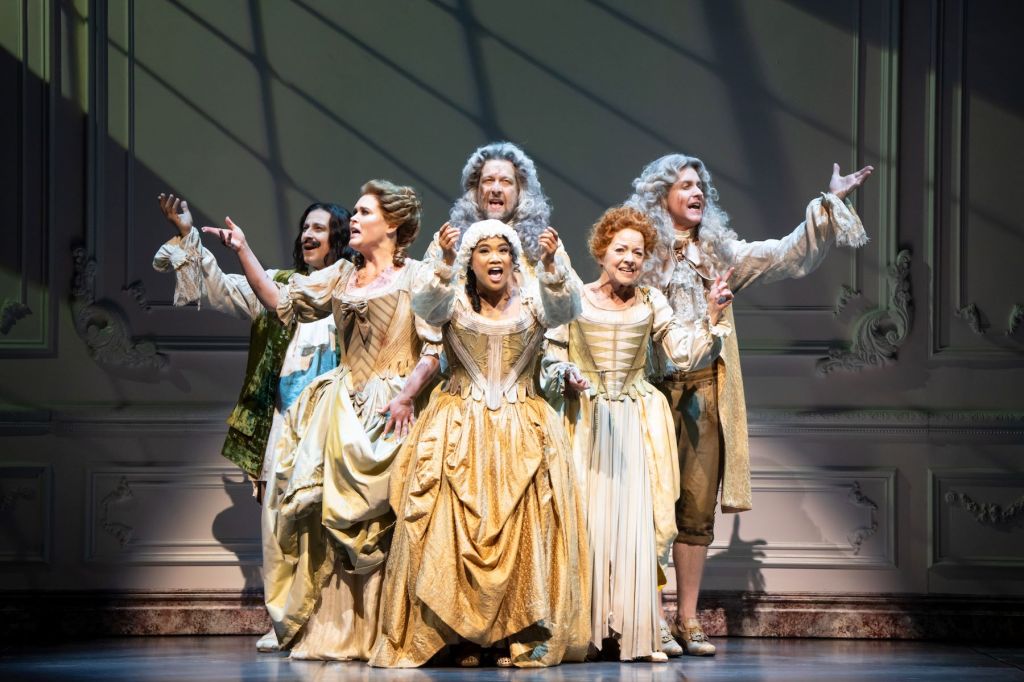
Starring an endearing, heartfelt and bubbly Kristin Chenoweth as the materially insatiable Jackie Siegel, and F. Murray Abraham as billionaire workaholic David Siegel, the New York premiere which has an end date of March 29, 2026, rings with disturbing truths. It’s farcical, dark elements present many themes. Chief among them is the theme that the Siegel’s shiny ostentation hides a sad emptiness that can never be fulfilled.
Framing the Siegel’s story with the key meme of Versailles, the mansion in France that 17th century Louis XIV, built as a memorial to his majesty, the opening scene and song (Pablo David Laucerica is King Louis XIV) replete with period chandeliers, furniture, costumed butlers and maids reveals how and why the Sun King built his palace on swampland (“Because I Can”). Without giving thought to the inequities in French society that necessitated the economic gap between royalty and its impoverished, destitute subjects, Jackie and David want one.
In a quick switch to the present (2006) we see the Siegel’s Versailles in progress. With construction scaffolding in the background and a documentary film crew in the foreground, Chenoweth’s Jackie glows as she sings “we want to have the very best for the biggest home in America because we can.” The fluid set design with appropriate props and pieces by Dane Laffrey, who also does the video design, brings perfect coherence to the Siegel’s intentions. It connects the idea of royal wealth manifest in Louis XIV’s lavish excess to their rich/famous lifestyle which reeks of tawdriness. Thanks to Michael Arden’s staging and direction and Cristian Cowan’s costumes, and Cookie Jordan’s hair and wig design, the shifts from the present to the court of Louis XIV and back solidly establish the trenchant themes of this profoundly current musical.
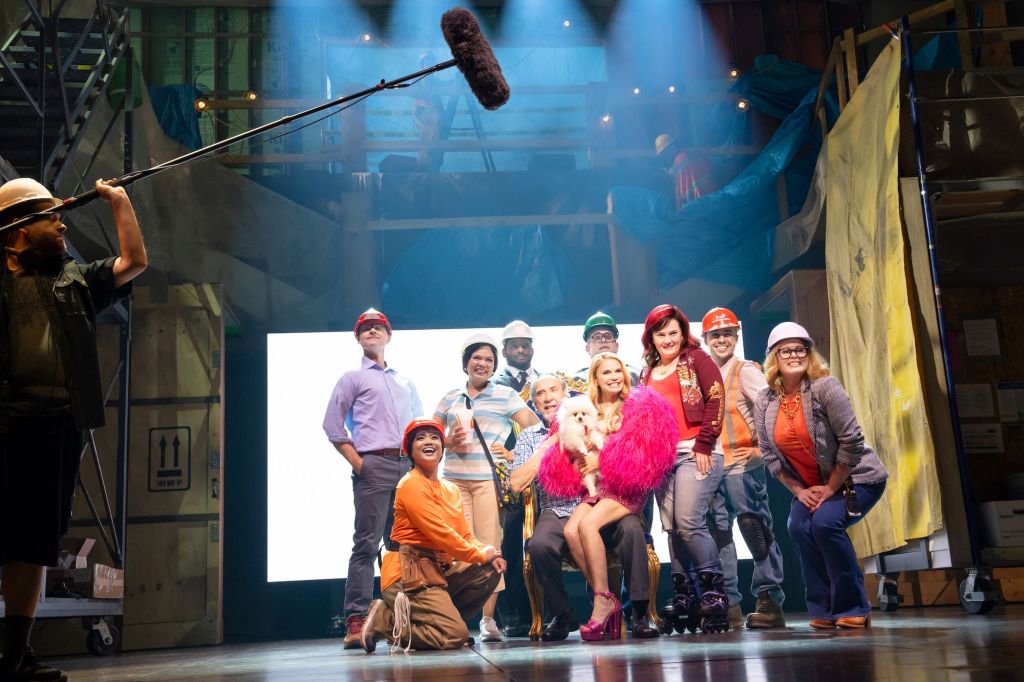
Presuming themselves American royalty, the Siegels hope to replicate a modern-day Versailles, like their mentor king. Indeed, they will best him. Their Versailles has whatever the family wants. This includes a jewelry-grade gem stone floor, an in-house Benihana (with all those tossed shrimp because David doesn’t like to stand on line), a spa, a pool with a stained glass roof, and a family wing with numerous bedrooms and bathrooms so Jackie doesn’t lose track of her seven kids.
After this opening salvo that mesmerizes like any show about the “lifestyles of the rich and presumptuous,” we discover that Jackie didn’t always come from wealth. In fact her story mirrors the old Horatio Alger “rags-to-riches” fable that Alger shaped into the American Dream, which abides today and which also influenced F. Scott Fitzgerald’s take on it in The Great Gatsby. Jackie, albeit a female dreamer, buys into the concept that if she pulls herself up with determination, works hard and does good works, she can lift herself into the upper classes.

We see how this manifests in the next segment of Chenoweth’s 17-year-old version of Jackie with her parents Debbie (Isabel Keating) and John (Stephen DeRosa) in their humble Endwell, New York home. Debbie and John count on Jackie to continue to work as many jobs as possible to become rich and famous like the titular show they watch together. Singing the song “Caviar Dreams,” a ballad that expresses beautifully a female Alger hero, we “get” Jackie’s drive and pluck to work day and night to achieve an engineering degree at IBM, then kick the job to the curb because it won’t give her wealth fast enough.
As she “keeps on thrustin” she makes a bold turn into marriage with alleged banker Ron (Michael McCorry Rose), who disappoints when he drags her to the Everglades, and opposes her Mrs. Florida win. When he physically abuses her, despite her pregnancy, Jackie leaves. Singing “Each and Every Day” beginning when Victoria is a baby, the scene switches to the present at the construction site and the teenage Victoria (the excellent Nina White) enters. Chenoweth’s Jackie soulfully finishes the song to Victoria in an important transitional moment. We understand Jackie as a survivor who loves her firstborn, who she claims saved her life.

Not only does Jackie not look back, we learn she and baby Victoria lived in an apartment which “barely fit the baby’s crib and Jackie’s sleeping bag.” However, always “thrustin’ forward,” she recognizes opportunity when she goes to a party where she meets David Siegel, the CEO of Westgate Resorts. As it turns out, his impoverished childhood was similar to hers and left him with dreams of extreme wealth. F. Murray Abraham does justice to David throughout, first as a “cowboy” in the wild west of timeshares as son Gary (the fine Greg Hildreth) sings with the ensemble “The Ballad of the Timeshare King.” Occasionally, for emphasis, Abraham’s David chimes in with irony.
For example, David’s sales force make “one hundred percent of their sales on the first day.” Gary sings, “George W.’s president now, thanks to David Siegel.” When folks can’t afford the timeshare, Siegel helps them with financing from his bank, so the ensemble sings joyfully, “Yippee-I-owe-you-owe-we-owe.” We recognize the sardonic humor for David’s dishing out sub-prime mortgages to “anyone who breathes.” Of course this adds to the mortgage crises of 2008 which taxpayers foot the bill for. Eventually, the sub-prime loans bring his empire to the brink of bankruptcy as the crash swallows whole billionaires like David.

At that point, Jackie and David have been married with children and are two years into the Versailles construction having cycled through songs of their outsized wedding (“Trust Me”), a honeymoon trip to Versailles bringing back a scene of King Louis XIV and his courtiers. Smartly, Ferrentino and Schwartz reinforce their themes by joining past and present in the reprise “Because I Can and the “Golden Hour.”
However, conflict looms on the horizon. Though David and Jackie live their wildest dreams and birth child after child, daughter Victoria feels miserable, insular and ugly. “I know mom wishes I was prettier,” she sings in the poignant “Pretty Wins.” And in Act II in the superb “Book of Random” Victoria sings from her journal, the thoughts that she keeps hidden. Unlike her mother Victoria grounds herself in her current feelings of sadness brought on by reality, escapism fueled by drug addiction and scorn for their damaging and excessive lifestyle. However, when Jackie’s niece Jonquil (Tatum Grace Hopkins) arrives and Jackie takes her in, we think that Victoria has someone to confide in.

But Jonquil doesn’t understand Victoria’s dislike of Jackie’s appetite for more. And it doesn’t help Victoria that Jonquil becomes a clone of Jackie (“I Could Get Used to This.”). Ironically, when the crash happens and Victoria hears of the talk that they will sell Versailles to keep David from going belly up, she feels relief. In a farce-filled scene in the 17th century Versailles, with some of the most ironic lyrics, the Sun King chides the Siegels and Americans in the song “Crash.” “You thought you’d be egalitarian, let peasants own their own homes in some altruistic plan. Well, what were you expecting from a choice so rash? Crash…”
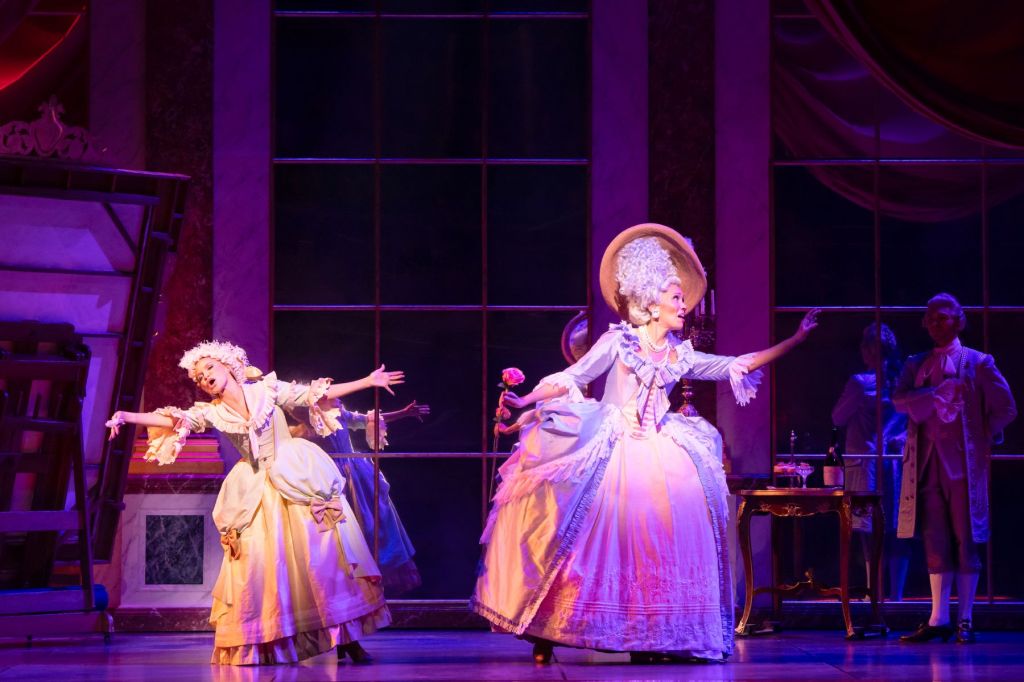
At the end of Act I, we have only Jackie’s spunk and perseverance (“This is Not the Way”), and David’s connections to rely on to bail them out of bankruptcy and foreclosure. Act II reveals that deus ex machina saves them when the government (taxpayers) bail out billionaires and banks. Naturally, the little people with no safety net lose their shirts. Where the peasants of France revolted against their royals (there is a humorous scene with the luckless Marie Antoinette on her way to the guillotine), in America, no one goes to jail because the banks and firms are “too big to fail.”
At the end of Act II, in a scene with King Louis XIV, in a reprise of “Crash,” King Louis and his courtiers sing as Marie Antoinette says “goodbye.” Here, Schwartz’s lyrics and tune underscore a crucial theme. America’s Aristocracy has cleverly worked it out that “democracy” will prevent revolutions. How? The rich have peasants “thinking they’re tomorrow’s millionaires; that you’re special privileges will someday soon be theirs.” And the ensemble adds, “No blade across the throat for you. Instead it seems your peasant class will all turn out to vote for you!” Thus, with no accountability for wrecking the economy and countless lives, the rich get richer, and Jackie and David, out of bankruptcy, continue building Versailles.
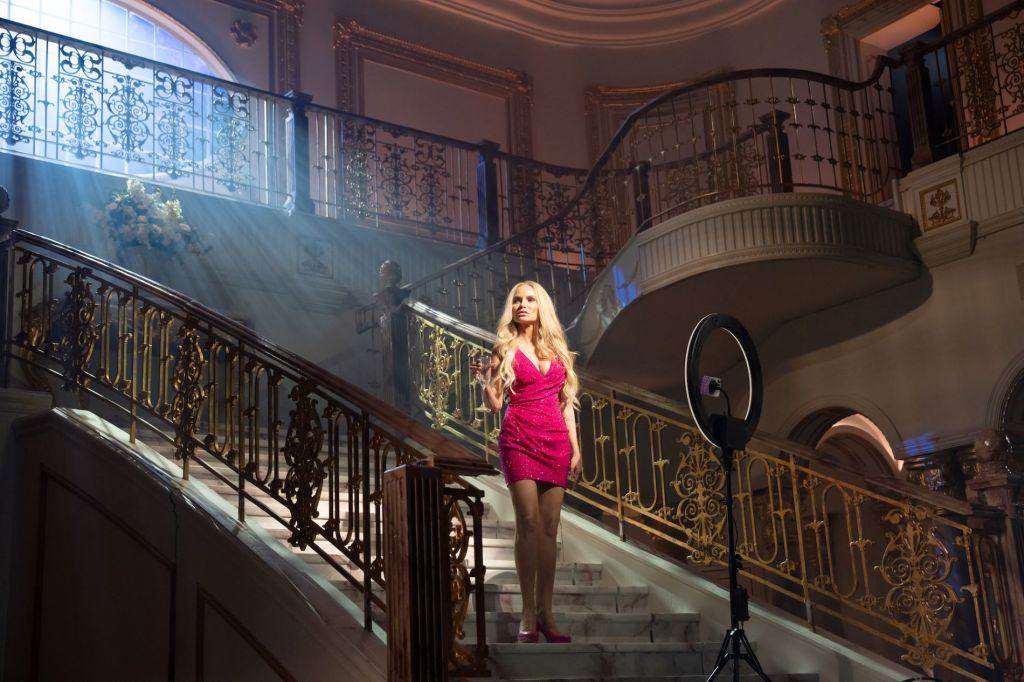
However, in all of the mayhem of trying to regain solvency, the Siegels sacrifice a family member. If material empires go on for centuries, flesh and blood does not. The unreality of excess belies mortality. But some folks never learn. Schwartz and Ferrentino ironically underscore this as Chenoweth’s Jackie holds a glass of champagne standing in front of a ring light. She speaks to a social media audience and hopes that, like her, they get their “champagne wishes and caviar dreams.”
The Queen of Versailles runs 2 hours 40 minutes with one intermission at the St. James Theatre. https://queenofversaillesmusical.com/
‘Kyoto,’ Climate Science vs. Oil Billionaires’ Profits as the Planet Crisps, Theater Review
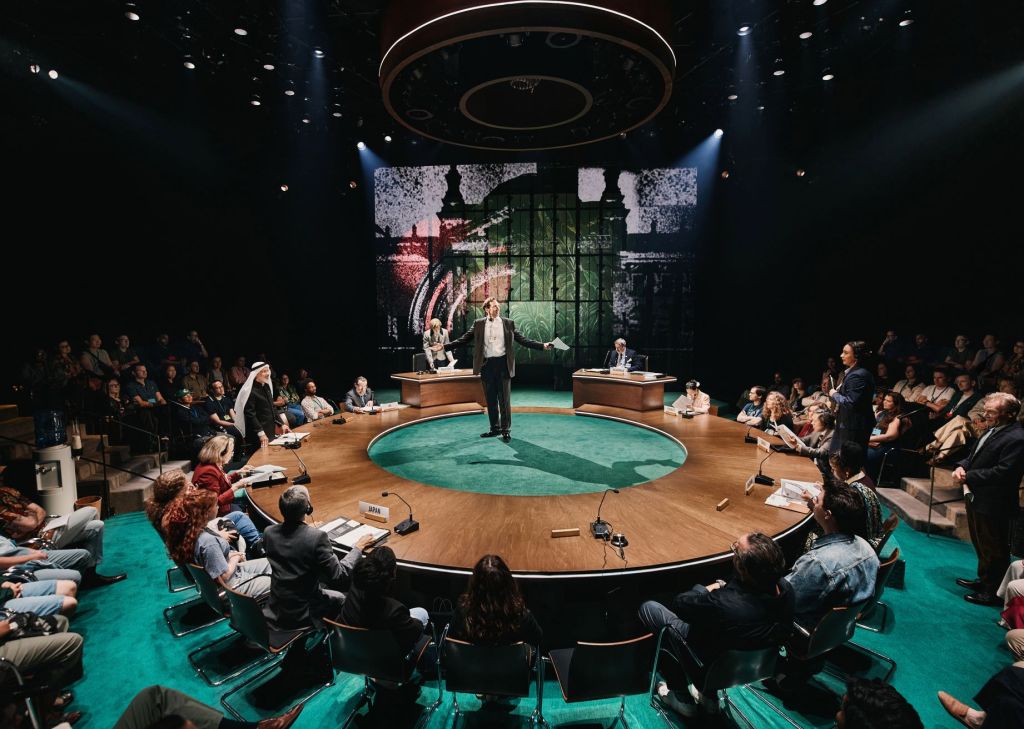
Based on events beginning in 1989 leading up to the 1997 United Nations Climate Change Conference in Kyoto, Japan, Joe Murphy and Joe Robrtson’s Kyoto explores the momentous occasion when nations agree to confront climate change. The two-act political thriller is in its US Premiere at the Lincoln Center Theater at the Mitzi E. Newhouse until November 30th. Compressing extensive detail, the playwrights reveal how representatives from 160 nations negotiated the Kyoto Protocol. The Protocol committed first world and emerging nations to limit/reduce greenhouse gasses after setting targets and timetables.
Stephen Daldry and Justin Martin co-direct Kyoto, which enjoyed its world premiere at the Swan Theatre, Stratford-upon-Avon. Due to its continued success, it transferred to London’s West End before debuting to American audiences, who don’t always relate to the ironies and humor in the play (directed at the US). Indeed, the US representative (Kate Burton), and American oil lobbyist Don Pearlman (Stephen Kunken) and the representative of Saudi Arabia (Dariush Kashani) become the objects of humor and frustration. They continually oppose any movement to pin down emissions’ timetables or support decreasing oil production.
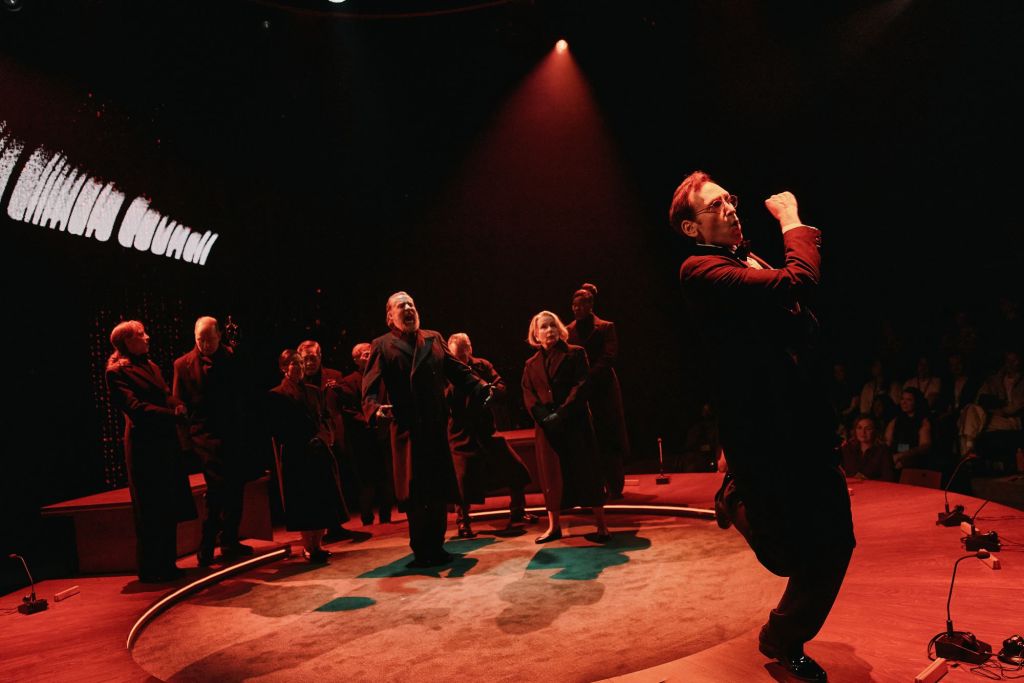
The set is a circular conference table where members sit and sometimes interact with the audience. The table serves also as a raised platform for Don Pearlman, placing him above the fray. In its design by Miriam Buether, Pearlman stands at its center and addresses the audience. Variably it becomes a private meeting area where Pearlman speaks with those opposed to any “progress” on emissions. It becomes a setting in his home, and several hotel rooms where he converses with his wife Shirley (Natalie Gold) and others. The co-directors keep the play in the realm of ideas, not material places. In one instance Shirley and Don join Raul Estrada (Jorge Bosch), the Argentinian representative for China, in a rain forest. The fluid, minimal set design forces the audience to keep up with the dialogue cues which indicate setting changes.
The playwrights have chosen the “well-meaning,” slippery lawyer Don Pearlman, as their spokesperson to reveal what happened from 1989 through1997, when nations finally achieved consensus in Kyoto. At the outset Kunken’s disarming oil lobbyist begins by discussing how the Seven Sisters (big oil, i.e, Exxon, Shell, BP) appoint him as their agent provocateur to stall and delay any UN agreement about greenhouse gas emissions.
Like Iago in Othello, Pearlman instructs the audience in his nefarious plans. Though the events happen at lightning speed, Kunken’s Pearlman slow walks us with his wise words and commentary about how to derail progress among the nations.
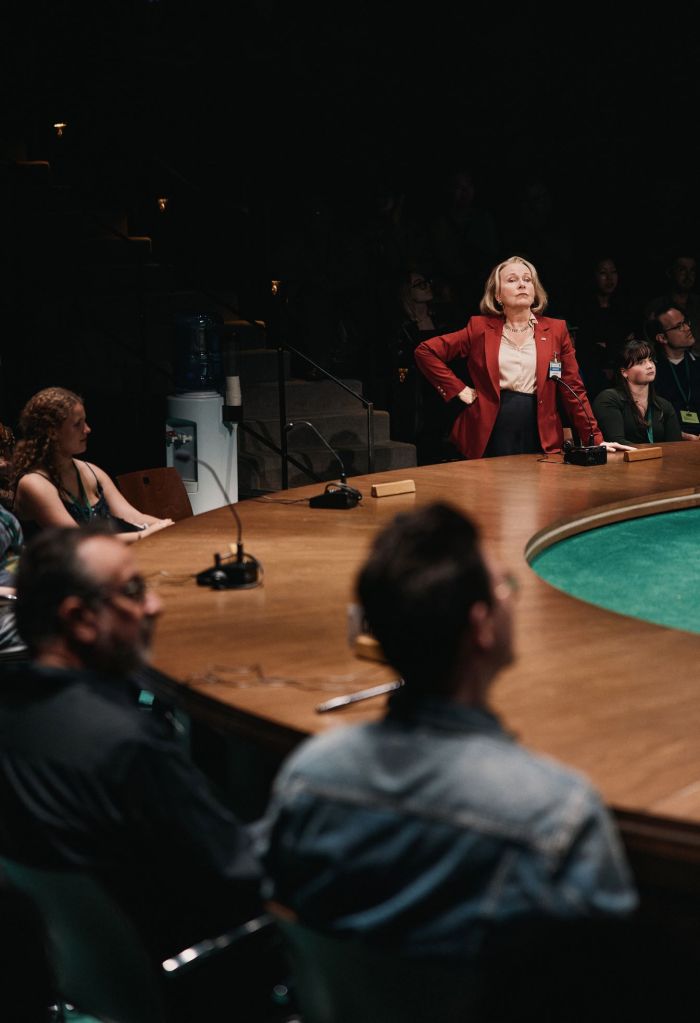
We become mesmerized as we note how he thwarts the representative countries who have different agendas than big oil conglomerates. Also, by extension we understand why little has been done to effectively curtail global warming. Without particular malice or a sinister tone, Kunken’s Pearlman humanely portrays a man who justifies his mission to support American’s “freedoms” to have a first world economy delivered by fossil fuels. Any change disrupting the oil supply, decreasing fossil fuels and harming profits must be stopped. Truly, Pearlman believes in his job and he believes in doing it well. This makes him and the Big Sisters utterly terrifying and wicked when one stops to consider the consequences.
As we follow along with the various conferences and summits beginning with the 1990 World Climate Conference in Geneva, through the Rio Earth summit, the many rounds of talks with scientists among countries, to 1995 Berlin, the First Conference of the Parties, COP-1, we see Kunken’s Pearlman enact the strategies and philosophies he first discussed with us and his wife Shirley. Without glee, with more than a soupcon of irony, Pearlman, ever the oil lobbyist, proves his genius standing up to various representatives with his knowledge about the process of negotiation, as well as his breadth of knowledge about the subject matter.

He, Burton’s US representative, Kashani’s Saudi Arabian representative for OPEC, and others dismiss the gravitas of what climate scientists have presented about global warming. However, Pearlman’s and others’ delinquence in acknowledging the looming disaster for representatives of low-lying coastal nation states comes to a screeching halt. The representative from Kiribati (Taiana Tully) joins forces with 39 other coastal nations to create a powerful negotiating bloc, The Alliance of Small Island States. They make it clear they will not allow the first world nations to marginalize and destroy them. For it is the first world nations’ oversized pollution that predominately contributes to the polar ice caps melting, and that puts the coastal nations at grave risk.
Thus, the conflict begins in earnest as the first world nations strain against the emerging nations, China having joined the coastal states. Few if any concessions are made for any collective unity as they delay for years, sea levels rise, and time runs out. However, a turning point occurs with the new appointment of Raul Estrada. Bosch’s Estrada eventually bans Pearlman from conferences, despite his being the CEO of the NGO, Climate Council (a blind to get him on the inside). Estrada knows Pearlman’s intent, and Pearlman shows no inclination to change his mission. Their war proceeds as representatives criss-cross the world in jets and add to the increasing emissions they seek to control.

Importantly, the play’s dynamism, pacing and urgency are conveyed by Kunken and Bosch’s performances and the co-directors’ staging and directed momentum. The lead actors who reprise their roles from the London production, have settled into their portrayals. As in real life, the oil lobbyist vs. the Argentinian representative to China smile and joke while warring against each other in a deadly “game” to stop big oil from holding the planet hostage.
Interestingly, the playwrights use the character of Shirley as a foil to soften and humanize Pearlman. However, when she finds out that the Seven Sisters knew about the consequences of global warming since 1959 and have kept this research under wraps, she realizes the wickedness of what her husband attempts. If she gives this information to him will it change his approach to his handlers? How can he live with himself and continue to support big oil knowing what the conglomerates have intentionally done for decades to keep profits flowing while endangering life on the planet?
At its strongest and most profound Kyoto dramatizes the tense political and scientific life and death battles that eventually result in the world’s first legally binding agreement to limit greenhouse gas emissions. That such Sturm und Drang resulted in so little is disappointing. However, in light of today’s international global divisions, to arrive at such a consensus seems miraculous and gives us pause.
Kyoto runs 2 hours 40 minutes with one intermission until Nov. 30 at the Mitzi E. Newhouse Theater, lct.org.
‘The Burning Cauldron of Fiery Fire,’ Anne Washburn’s Challenging, Original Play

Known for its maverick, innovative productions, the Vineyard Theatre seems the perfect venue for Anne Washburn’s world premiere, The Burning Cauldron of Firey Fire. Poetic, mysterious and engaging, Washburn places characters together who represent individuals in a Northern California commune. When we meet these individuals, they have carved out their own living space in their own definition of “off the grid.” Comprised of adults and children, their intention is to escape the indecent cultural brutality of a corrupt American society, where solid values have been drained of meaning.
Coming in at 2 hours, 5 minutes with one 15 minute intermission, the actors are spot-on and the puppetry engages. However, the play sometimes confuses with director Steve Cosson’s opaque dramatization of Washburn’s use of metaphor, poetry and song. More clearly presented in the script’s stage directions, the production doesn’t always theatricalize Washburn’s intent. Certainly, the themes would resonate, if the director had made more nuanced, specific choices.
The plot about characters who confront death in their commune in Northern California unfolds with the stylized, minimal set design by Andrew Boyce, heavily dependent on props to convey a barn, a kitchen and more. The intriguing lighting design by Amith Chandrashaker suggests the beauty of the surrounding hills and mountains of the north country where the commune makes its home.
The ensemble of eight adult actors takes on the roles of 10 adults and 8 children. Because the structure is free-flowing with no specific clarification of setting (time), it takes a while to distinguish between the adults and children, who interchange roles as some children play the parts of adults. The scenes which focus on the children (for example at the pigpen) more easily indicate the age difference.
The conflict begins after the members of the commune burn a fellow member’s body on a funeral pyre to honor him. Through their discussion, we divine that Peter, who joined their commune nine months before, has committed suicide, but hasn’t left a note. Rather than to contact the police and involve the “state,” they justify to themselves that Peter wouldn’t have wanted outside involvement. Certainly, they don’t want the police investigating their commune, relationships and living arrangements which Washburn reveals as part of the mysterious circumstances of this unbounded, “bondage-free,” spiritual community.
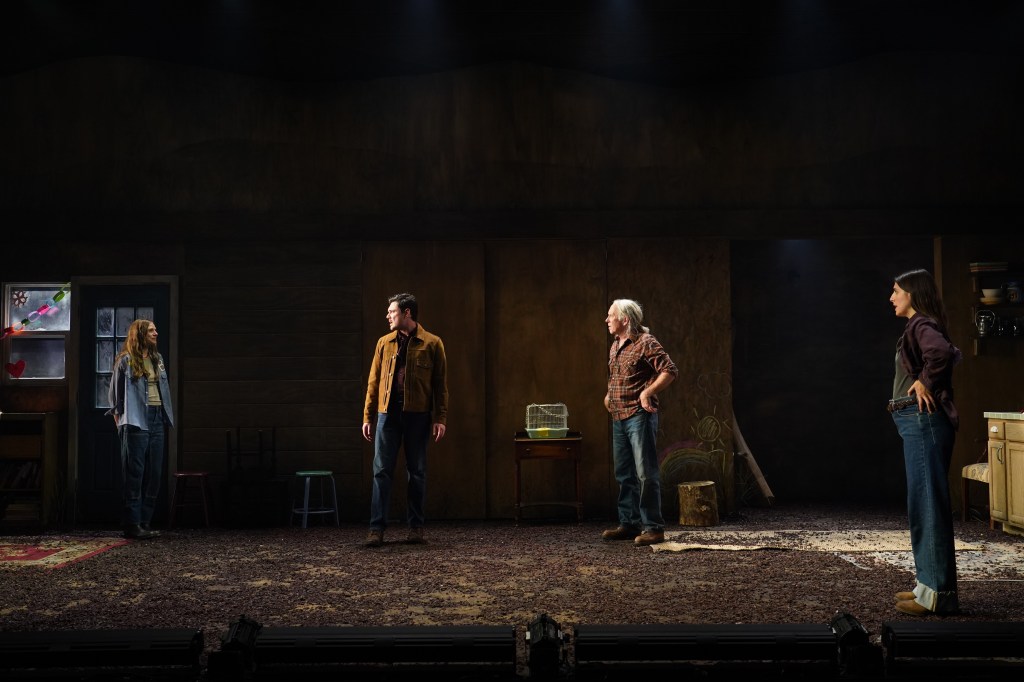
Nevertheless, Peter’s death has created questions which they must confront as tensions about his death mount. Should they reburn his body which requires the heat of a crematorium to reduce it to ashes? After the memorial fire, they decide to bury him in an unmarked grave, which must be at a depth so that animals cannot dig up his carcass. Additionally, if they keep any of Peter’s belongings, which ones and why? If someone contacts them, for example Peter’s mother, what story do they tell her in a unity of agreement? Finally, how do they deal with the children who are upset at Peter’s disappearance?
We question why they feel compelled to lie about Peter’s disappearance, rather than tell the truth to the authorities or Peter’s mom, even if they can receive her calls on an old rotary phone. Thomas, infuriated after he speaks to Peter’s mom who does call, tells her Peter left with no forwarding address. After he hangs up, Thomas (Bruce McKenzie) self-righteously goes on a rant that he will tear down the phone lines.
When Mari (Marianne Rendon) suggests they need the phone for emergency services, he counters. “Can anyone give me a compelling argument for a situation in which this object is likely to protect us from death because let me remind you that if that is its responsibility we have a recent example of it failing at just that.”
Indeed, the tension between commune members Thomas, Mari, Simon (Jeff Biehl), Gracie (Cricket Brown) and Diana (Donnetta Lavinia Grays) becomes acute with the threat of outside interference destabilizing their peaceful, bucolic arrangements. Washburn, through various discussions, brings a slow burn of anxiety that displaces the unity of the members as they work to hide the truth. What begins at the top of the play as they burn the body in a memorial ceremony that allows Thomas and the group to take philosophical flights of fancy, augments their stress as they avoid looking at hard circumstances.
Fantasy and reality clash also In the well-wrought scene where the actors portray the children moving the piglet they believe is Peter when it reacts to Peter’s belongings, specifically, a poem it chews on. Convinced Peter has been reincarnated and is with them, they take the piglet staunching their upset at Peter’s death by reclaiming and renaming the piglet as the rescued Peter. Rather than to have explained what happened, the commune members allow the children to believe another convenient lie.
This particularly well-wrought, centrally staged scene of the children in the pigsty works to explicate the behavior of the commune members. They don’t confront Peter’s death and don’t allow the children to either. The actors captivate as they become the children who relate to the invisible mom Lula and her piglets with excitement, concern and hope. It is one of the highpoints of the production because in its dramatization, we understand the faults of the commune. Also, we understand by extension a key theme of the play. Rather than confronting the worst parts of their own inhumanity, people close themselves off, escape and make up their own fictional worlds.
Washburn reveals the contradictions of this commune who parse out their ideals and justify their actions “living away from society.” Yet they cannot commit to this approach completely because of the extremism required to disconnect from civilization. As it is, they have a car, they do mail runs and sometimes shop at grocery stores. At best their living arrangement is as they agree to define it and as Washburn implies, half-formed and by degrees runs along a continuum of pretension and posturing.
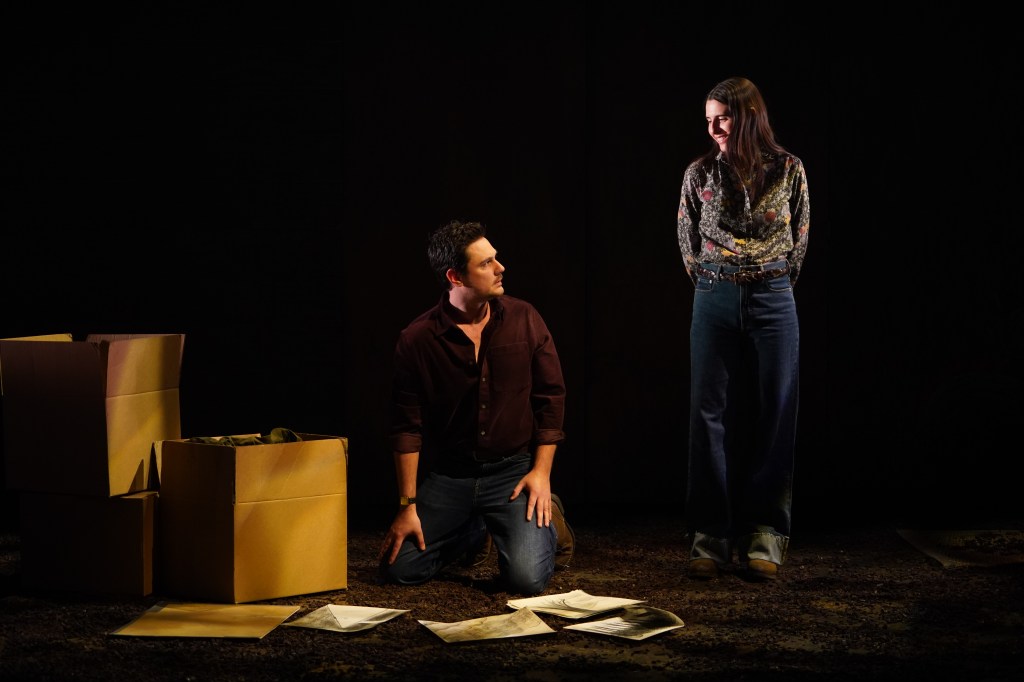
The issues about Peter’s death come to a climax when Will (Tom Pecinka), Peter’s brother, shows up to investigate what happened to Peter. Washburn ratchets up the suspense, fantastical elements and ironies. Through Will we discover that Peter was an estranged, trust-fund baby who will inherit a lot of money from his grandmother who is now dying. Ironically, we note that Mari who claims she had an affair with Peter and dumped him (the reason why he “left”), is willing to have sex with Will. They close out a scene with a passionate kiss. Certainly, Will has been derailed from suspecting this group of anything sinister.
Also, Will is thrown off their lies when he watches a fairy-tale-like playlet, supposedly created by Peter and the children that is designed to lull the watcher with fanciful entertainment.
In the fairy tale a cruel king (the comical and spot-on Donnetta Lavinia Grays), prevents his princess daughter (Cricket Brown) from marrying her true love (Bartley Booz), also named Peter. The bad king thwarts Peter from winning challenges to gain the princess’ love. Included in the scenarios are puppets by Monkey Boys Productions, special effects (Steve Cuiffo consulting), the burning cauldron of fiery flames with playful fire fishes proving the flames can’t be all that bad, and a beautiful, malevolent, dangerous-looking dragon who threatens.
Once again creatives (Boyce, Chandrashaker and Emily Rebholz’s costumes) and the actors make the scene work. The clever, make-shift, DIY cauldron, puppets and dragon allow us to suspend our judgment and willingly believe because of the comical aspect and inherent messages underneath the fairy-tale plot. Especially in the last scene when Peter (the poignant Tom Pecinka), cries out in pain then makes his final decision, we feel the impact of the terrible, the beautiful, the mighty. Thomas used these words to characterize Peter’s death and their memorial funeral pyre to him at the play’s outset. At the conclusion the play comes full circle.
Washburn leaves the audience feeling the uncertainties of what they witnessed with a group of individuals eager to make their own meaning, regardless of whether it reflects reality or the truth. The questions abound, and confusion never quite settles into clarity. We must divine the meaning of what we’ve witnessed.
The Burning Cauldron of Fiery Fire runs 2 hours 5 minutes with one 15-minute intermission at Vineyard Theatre until December 7 in its first extension. https://vineyardtheatre.org/showsevents/
Paris Daze (day 5) With Co-author of ‘The Haunted Guide to New Orleans’

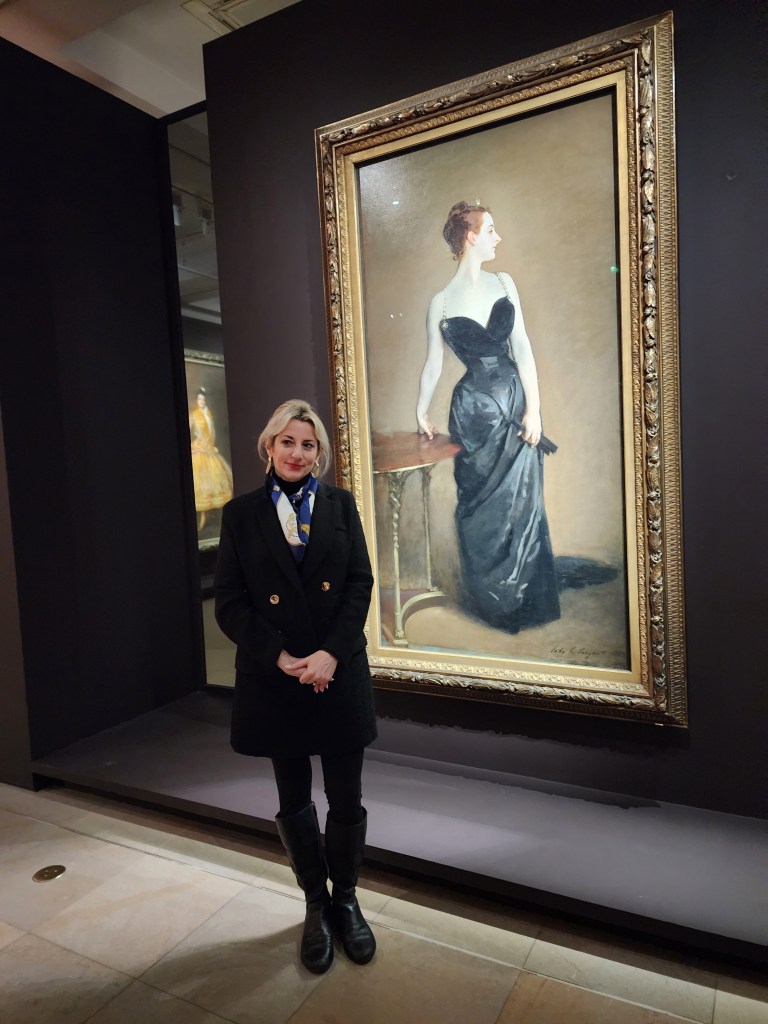
Thursday was an eventful day. First, we were off to the Musée d’Orsay to see the John Singer Sargent exhibit which was presented in partnership with the New York Metropolitan Museum of Art. According to the d’Orsay, the exhibit John Singer Sargent Éblouir Paris was “organized in partnership with the Metropolitan Museum of Art in New York for the centennial of the artist’s death.” Both exhibits take a look at Sargent’s early career. The MET ran its Sargent and Paris exhibit April 27th through August 3rd, after which arrangements were made to send over the paintings to the Musée d’Orsay. In its exhibition material, the d’Orsay states that some of the Sargent paintings are being seen for the first time in France.
Since Rory and Rosary are working on their book about John Singer Sargent and Madame X, Rory was keen to continue her research into the painter and his subject, Parisian socialite, Madame Pierre Gautreau (the Louisiana-born Virginie Amélie Avegno; 1859–1915) who was married to a wealthy Parisian banker. Unable to get to the MET exhibit, Rory who had seen the painting of Madame X before, was happy to do more extensive research in the City of Light, which was held the culture and society that produced the scandalous reaction when Sargent’s painting was presented.
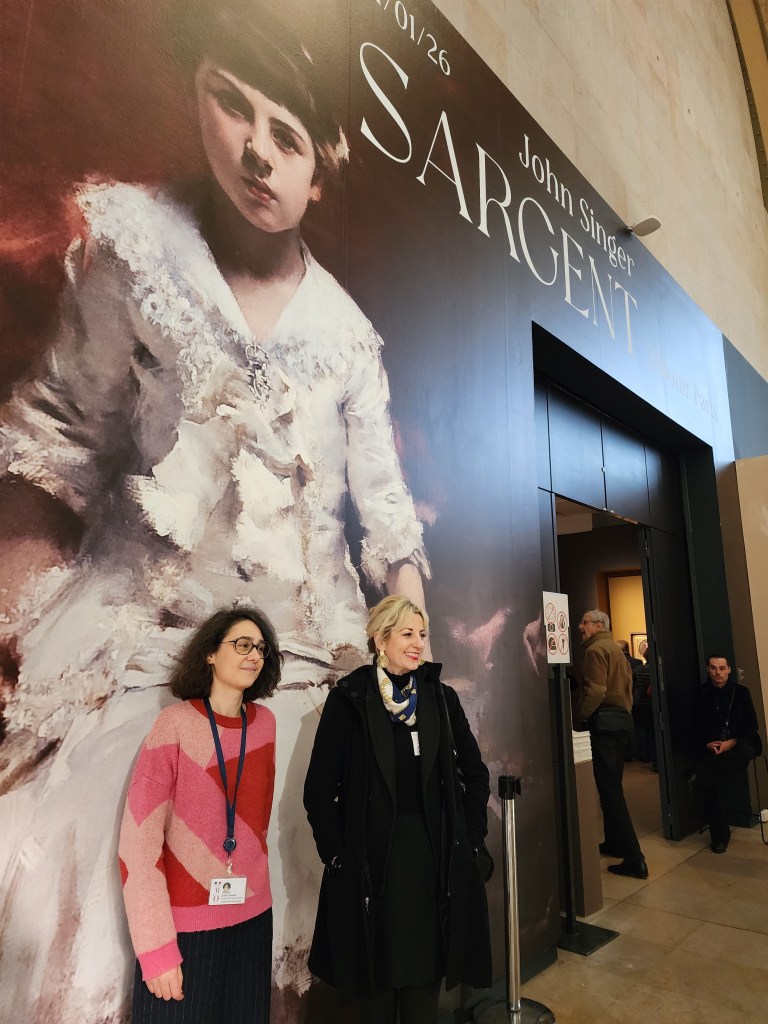
Rory contacted Lucie Lachenal-Taballet, who is a research engineer at the biblioteque interuniversitaire de la Sorbonne. Her expertise is in art criticism and the press in the 19th century. Ms. Lachhenal-Taballet graciously arranged for all of us to enter one hour early and see the Sargent exhibit before the crowds arrived.
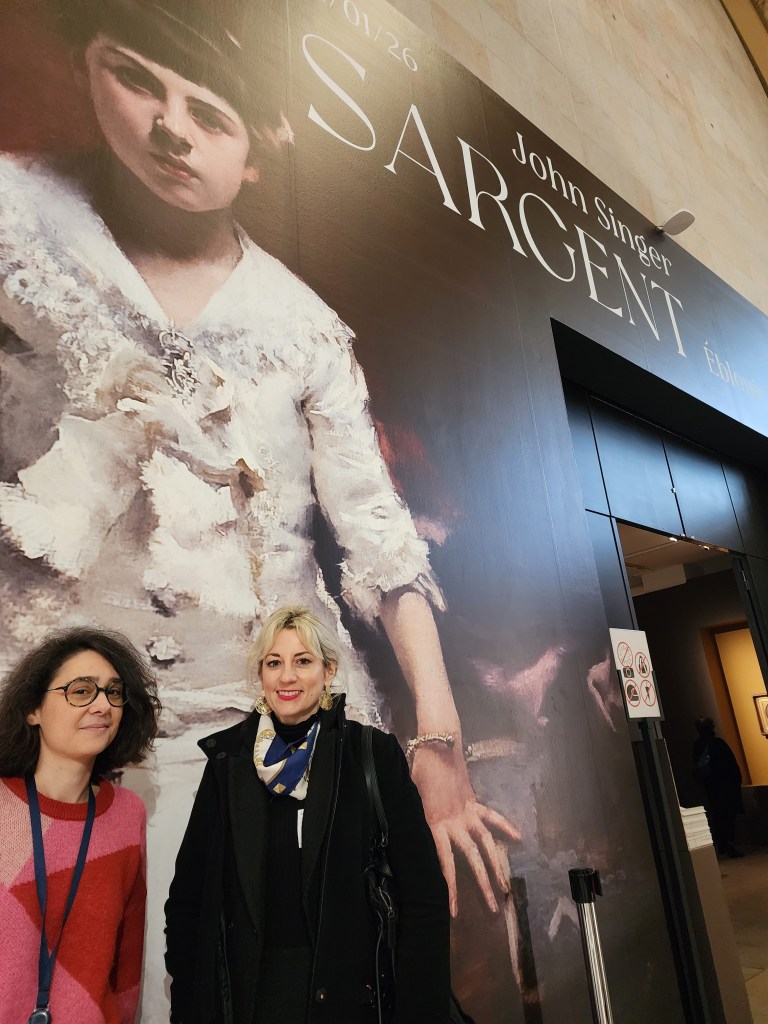
We each took our time viewing the paintings. I had seen the Sargent exhibit at the MET and noted the differences.
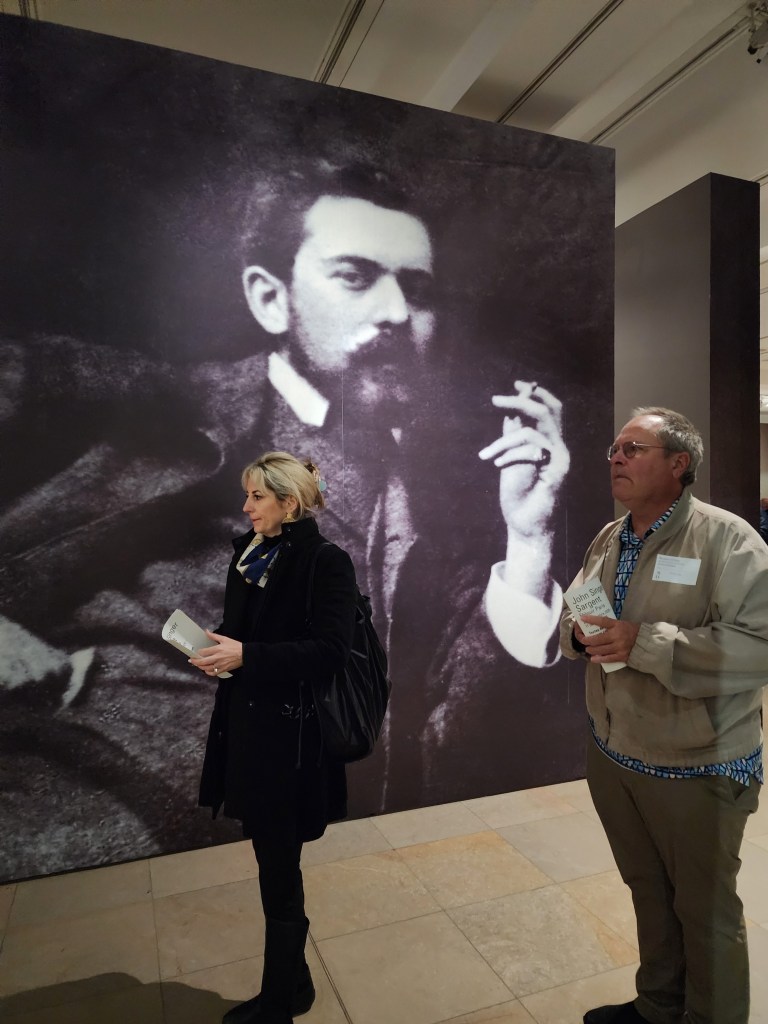
The d’Orsay perspective decidedly enhanced Sargent’s French influences with a selection of paintings under the tutelage of Carolus-Duran, one of his teachers in Paris. Some of these were absent from the MET exhibit. However, the MET included five paintings by other painters, Sargent contemporaries, teachers and influencers. An example is of Comtesse Potocka (Princesse Emmanuela Pignatelli di Cerchiara) painted by Léon Bonnat (1880). According to the MET description in the Sargent and Paris exhibition materials, “Bonnat was a significant and sought-after portraitist in the 1870s and 1880s, and one of Sargent’s teachers at the Ecole des Beaux-Arts.”
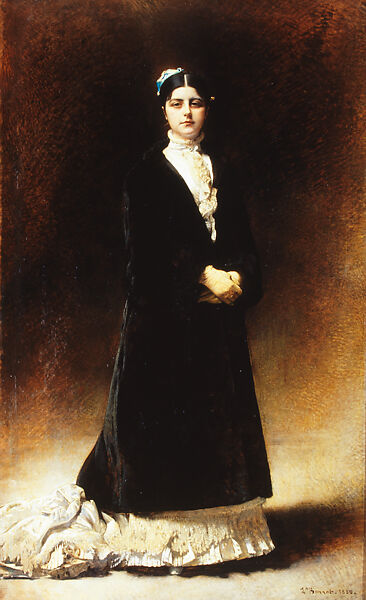
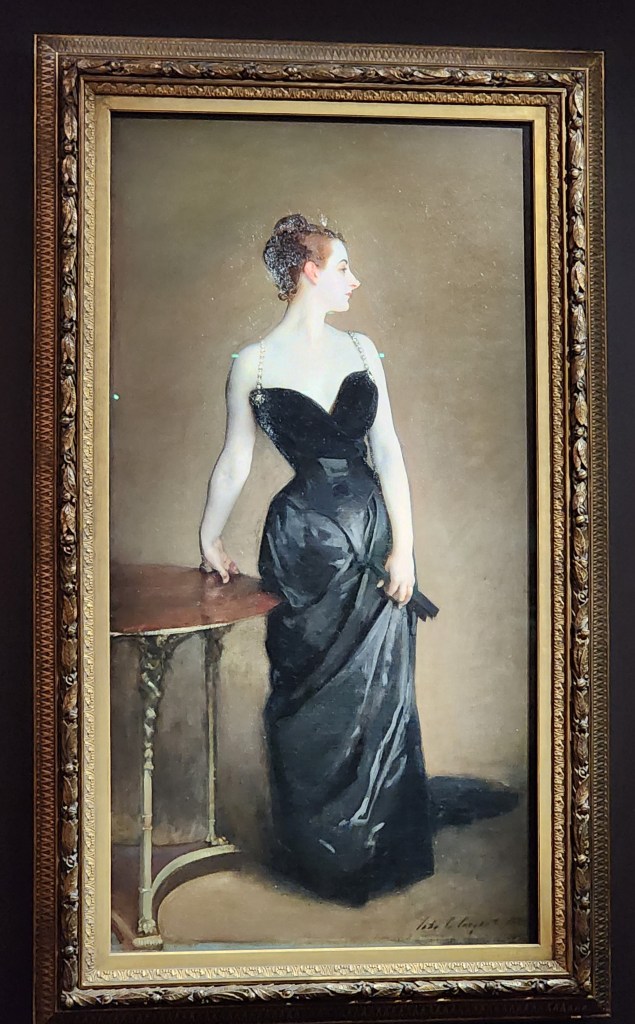
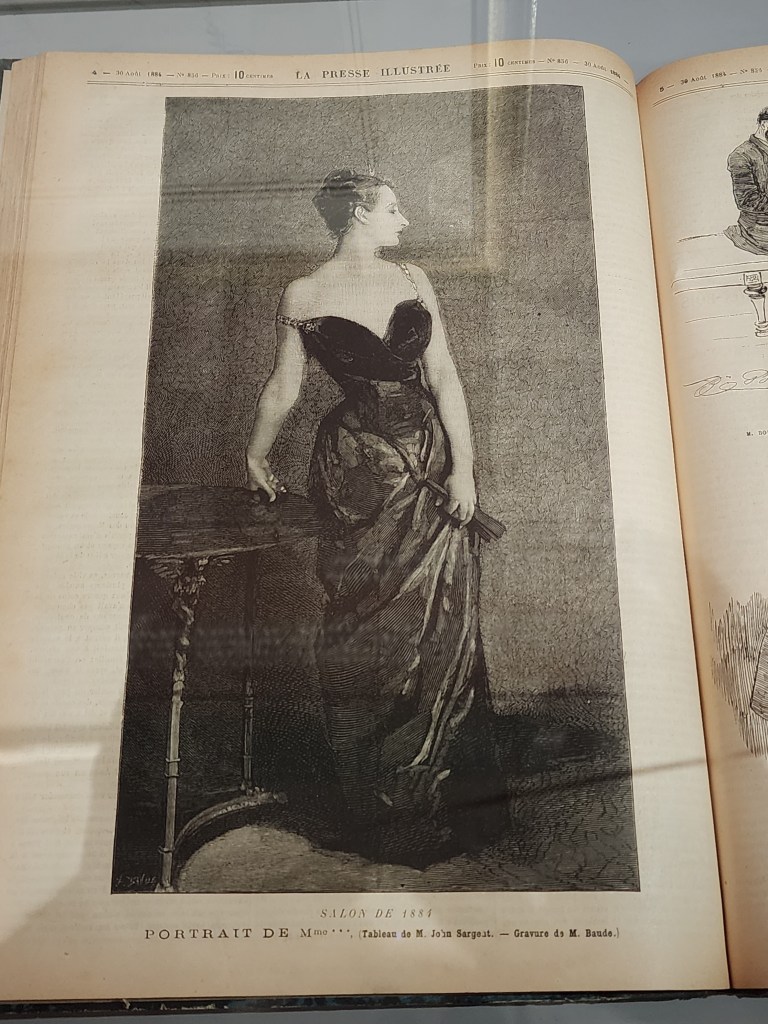
The MET used these paintings, like the one of Comtesse Potocka (Princesse Emmanuela Pignatelli di Cerchiara) to compare them with Sargent’s Madame X. In three of the paintings at the MET exhibit, the women subjects are examples of renown Parisienne socialites of the time. Similarly, two additional paintings are entitled “The Parisienne.” The painters are Leon Bonnat, Carolus-Duran, Edouard Manet, James McNeill Whistler and Charles-Alexandre Giron. All stunningly capture the historical, cultural period in Paris, revealing fashionable wealthy women of Parisian high society.
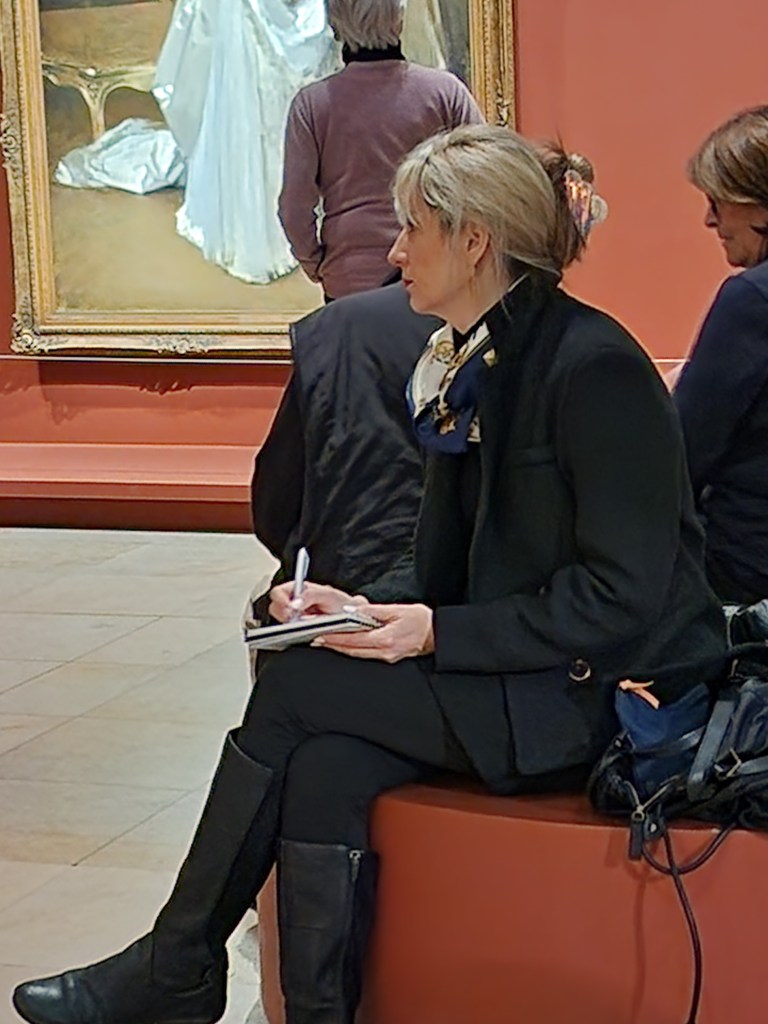
Interestingly, the d’Orsay’s exhibit didn’t include works from other painters to use as a comparison. So Rory spent time reflecting and taking notes on Sargent’s painting and various sketch studies he used in preparation for Madame X. She asked Bill and me about our impressions. When we finished with the exhibit, we headed off to other sections of the d’Orsay while Rory remained behind to study.
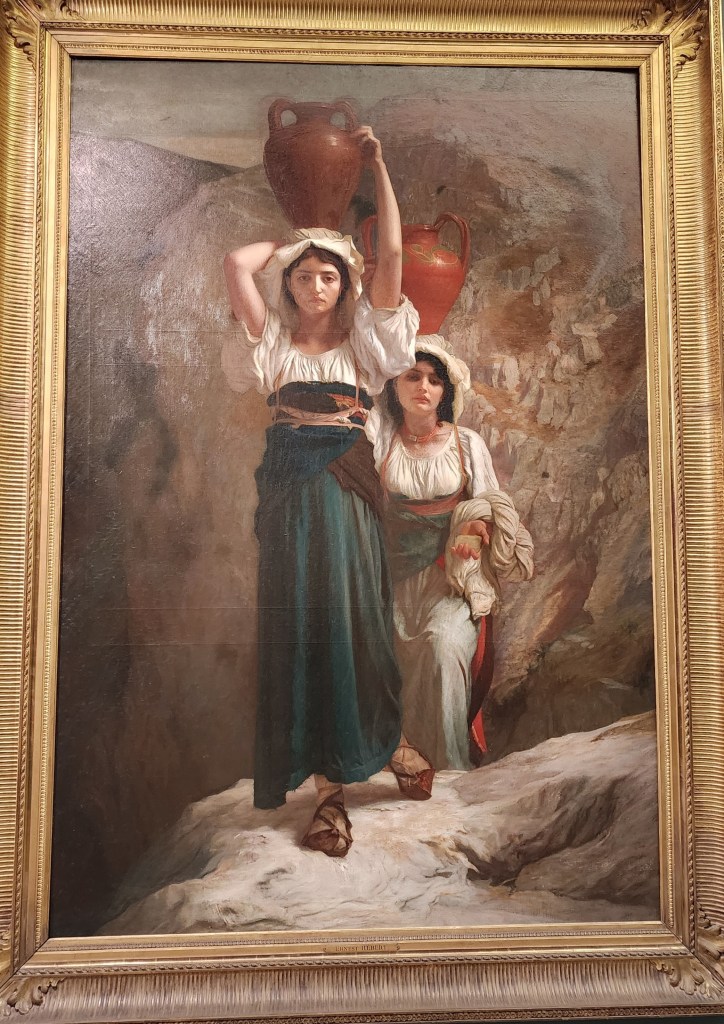
I looked at the Ernest Hébert paintings. (He is known for La Mal’aria in the d’Orsay collection). The exhibit included a few of his paintings of the peasants of Latium, strikingly beautiful works painted during his thirty year period in Italy.
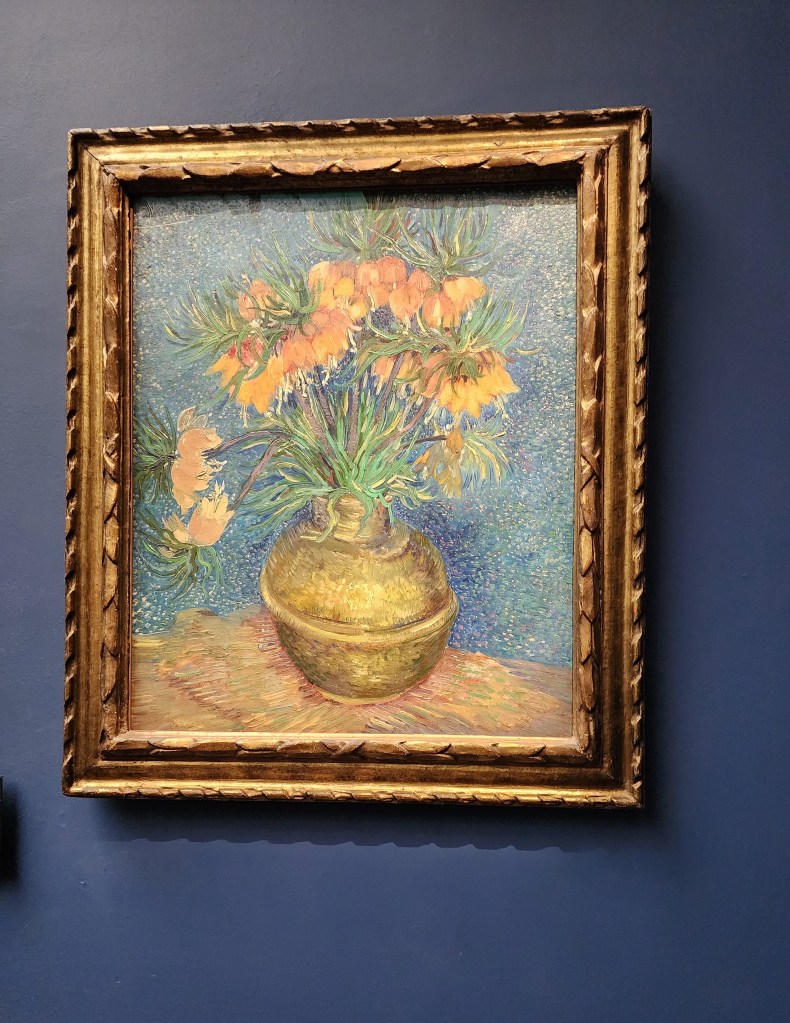
Also, I visited the Impressionists and looked at the van Goghs on display. I’ve written a play which references a lost van Gogh. My play, yet to be produced/published, was well received by workshop mentors, classmates, a partner I collaborated with and various friends I trust to read my work and be honest without feeling they need to flatter me.
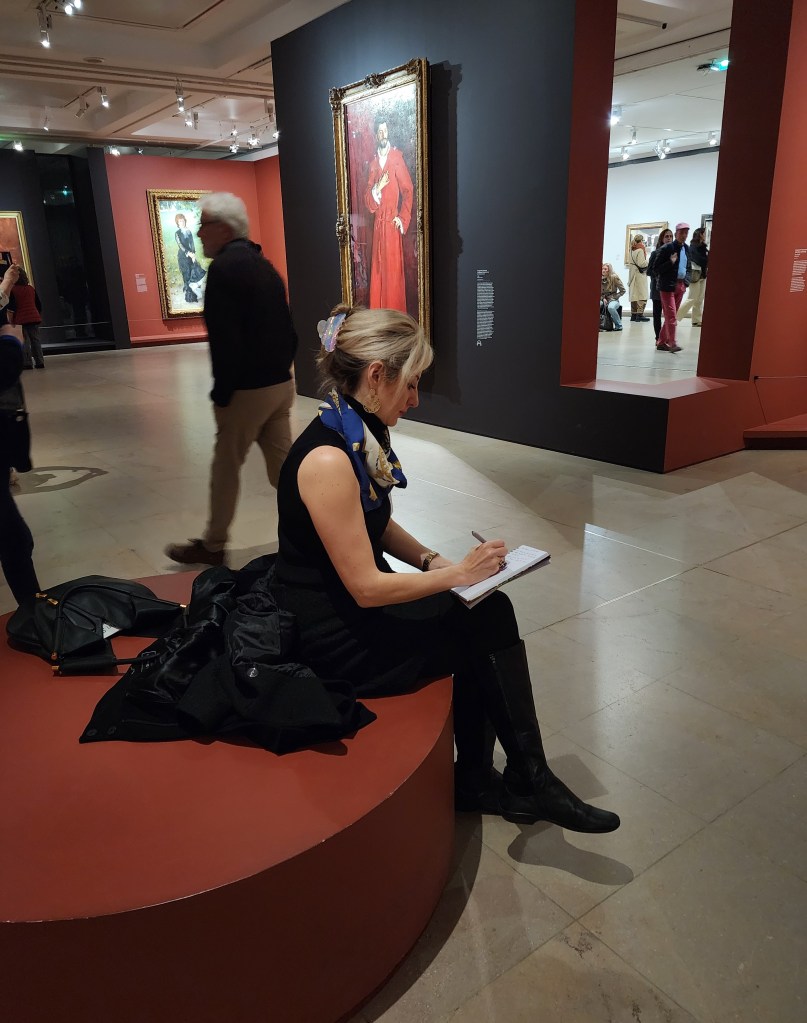
Rory continued with her research and notes, then readied herself for her appointment to interview Lucie about the exhibit, Sargent and other salient details that would be included in the book about the relationship between Sargent and Madam X. Apparently, after the painting’s presentation and the eruption of scandal, the close relationship between Madam X and Sargent fell apart. After her interview, Rory continued the rest of the day perusing the archives for any information she might find that would solidify and refine her impressions and hard information about Sargent and Madame Pierre Gautreau.
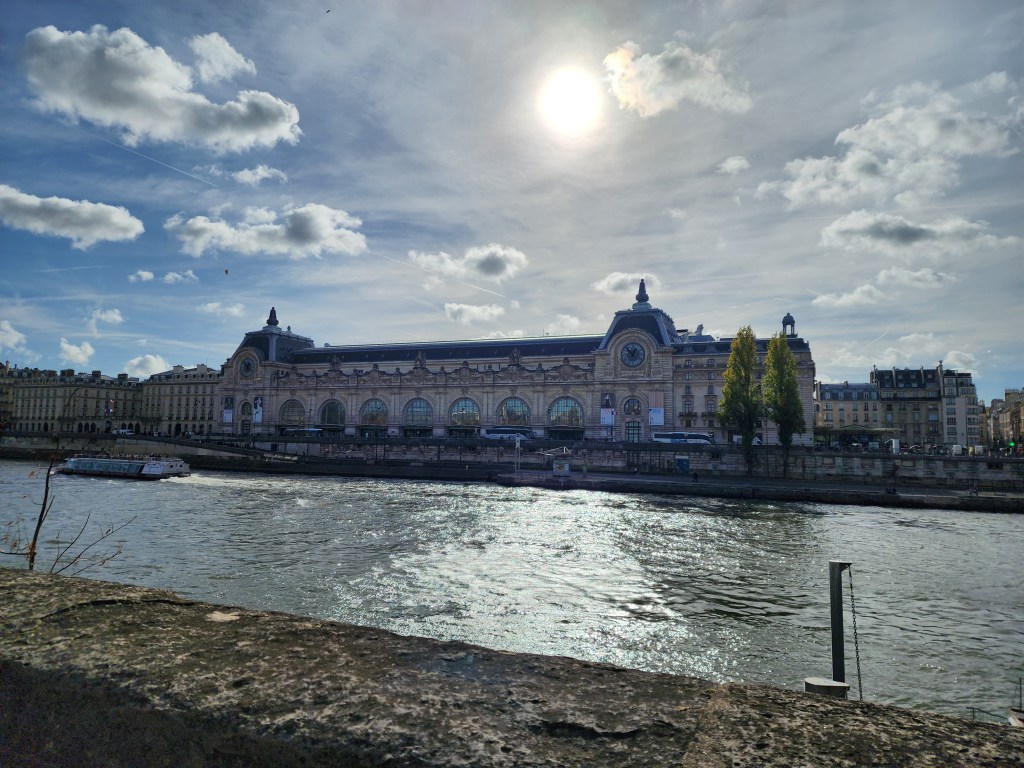
After viewing the Impressionists collection (I’ve seen the exhibit at the d’Orsay a number of times), I walked back along the Seine River to a favorite avenue in the fifth arrondissement, Boulevard Saint-Michel.


Walking up past the Sorbonne, and past the Pantheon, I arrived at the little park and environs where the TV series Emily in Paris had set-ups for various external shots.

It’s around the corner of the Irish Cultural Centre and now, has become a tourist attraction. Years ago, when I walked through theis park with its lovely water fountain, it used to be empty.

After the team reconvened back at the Irish Cultural Centre, we took a cab to Foyer International d’Accueil de Paris (FIAP), where Rory was presenting the photography exhibit ‘Piercing the Veil.’

These were the photographs Rory, Amelie and the team had put up earlier in the week. Rory and sister Rachelle took the photographs of the various haunted buildings and New Orleans environs for The Haunted Guide to New Orleans. FIAP residents got to look at the photos since Monday. Now it was time for the formal opening of the exhibit.
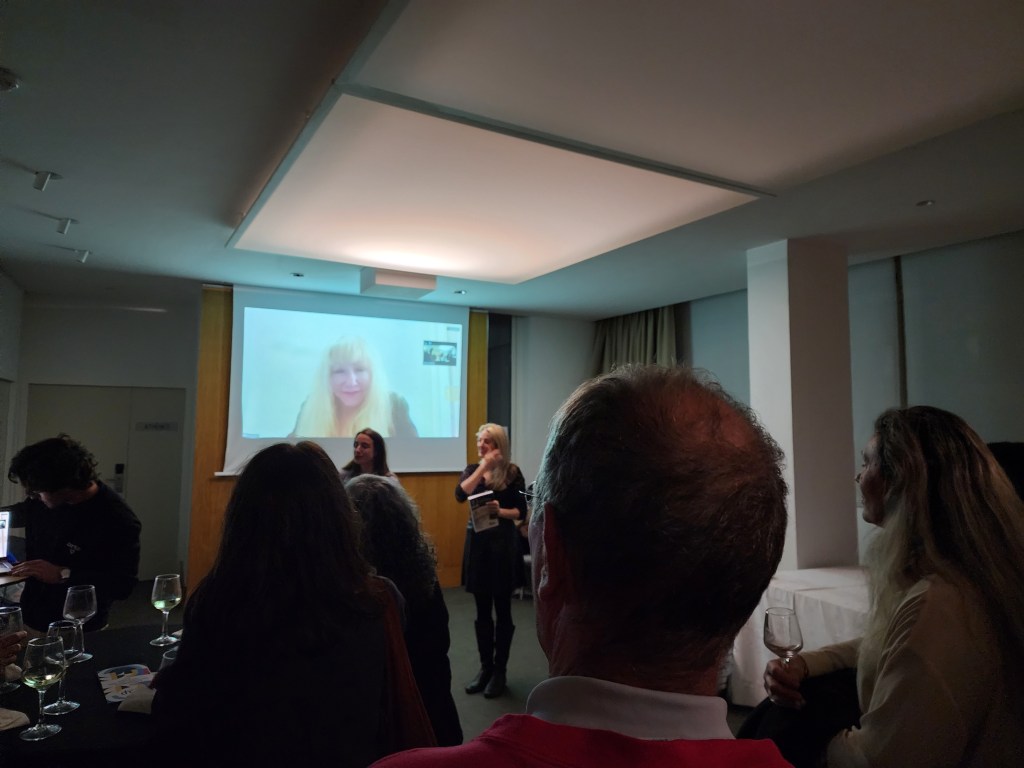
Amelie introduced Rory and the exhibit and then Rory continued in French, discussing the book and the photographs of New Orleans of buildings where ghosts have been sighted.
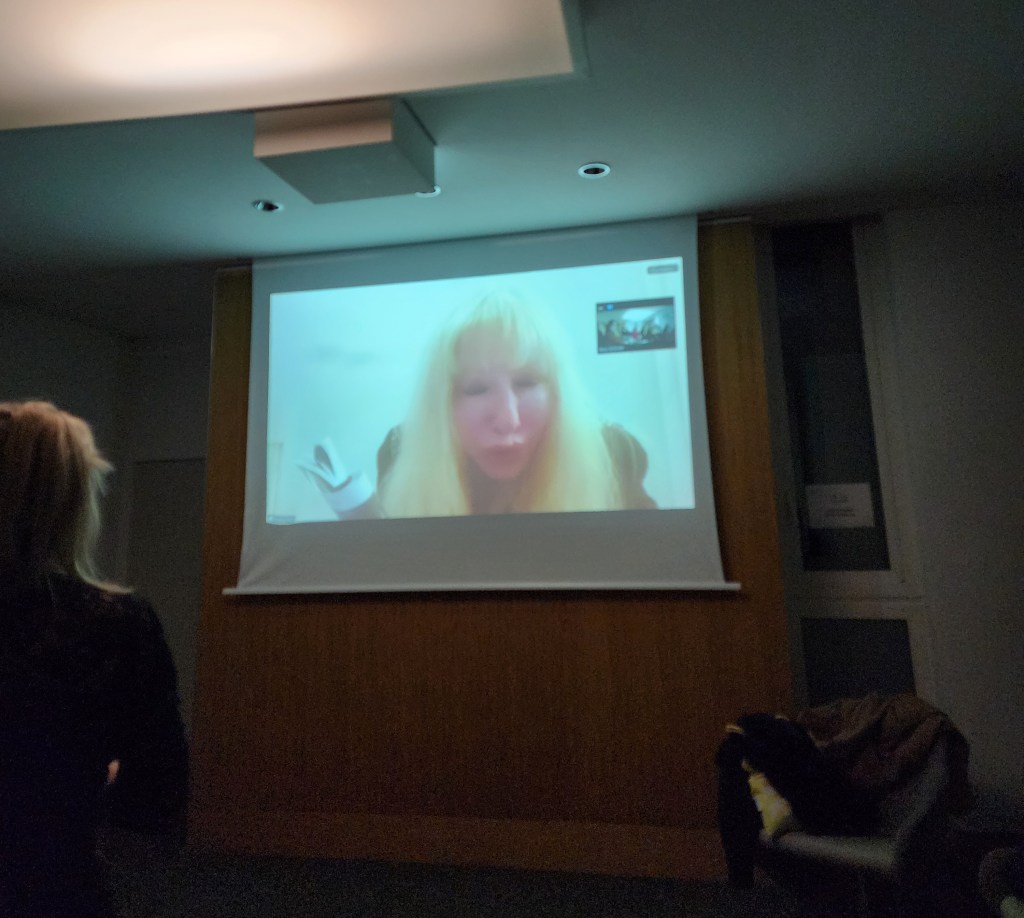

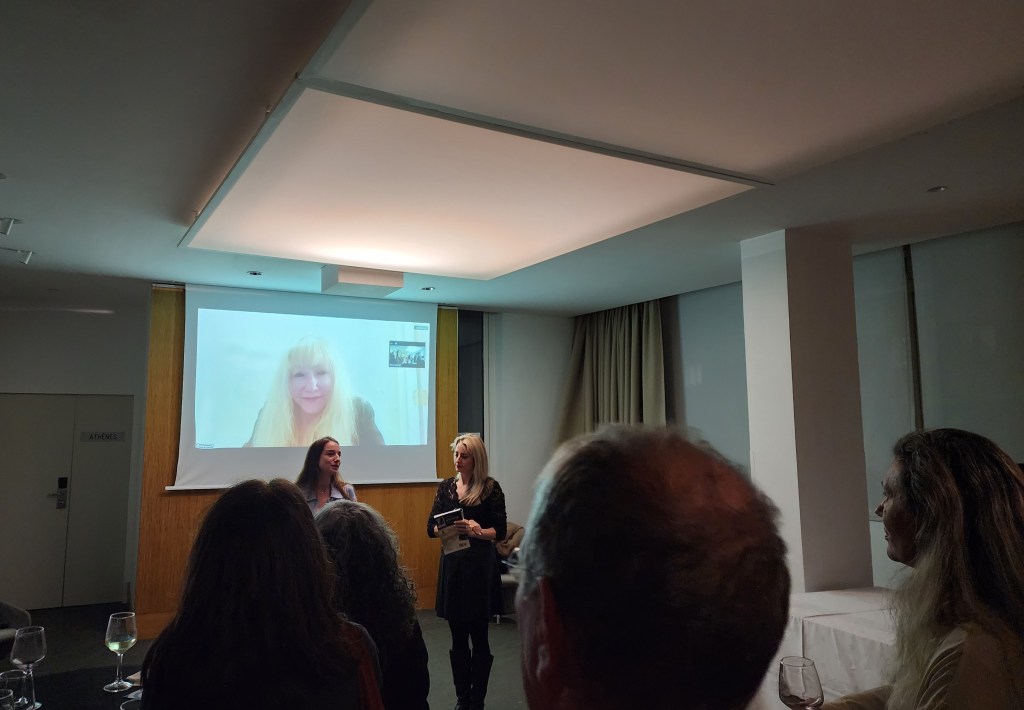
Before Rosary read from the introduction of The Haunted Guide to New Orleans, she shared some words of wisdom and humor in French gathering laughter from the crowd. Rosary, a former actress a long while ago, and a playwright in addition to her histories she’s worked on alone and with Rory is dramatic and theatrical. She can read the most boring, dull technical paper on how to set up barometric instruments for home use and make it interesting. Her reading of the book’s intro was superb.

Before, during and after the presentation, there were light bites and wine to accompany the nibbles, which added to the atmosphere of conviviality. Some of Rosary’s former friends stopped by and she spoke with them via Zoom.


A long time friend who was a liaison between France and New Orleans’ cultural affairs spoke to Rory about getting their books translated into French. Other friends were present and showed up to support Rory and Rosary’s new book release.
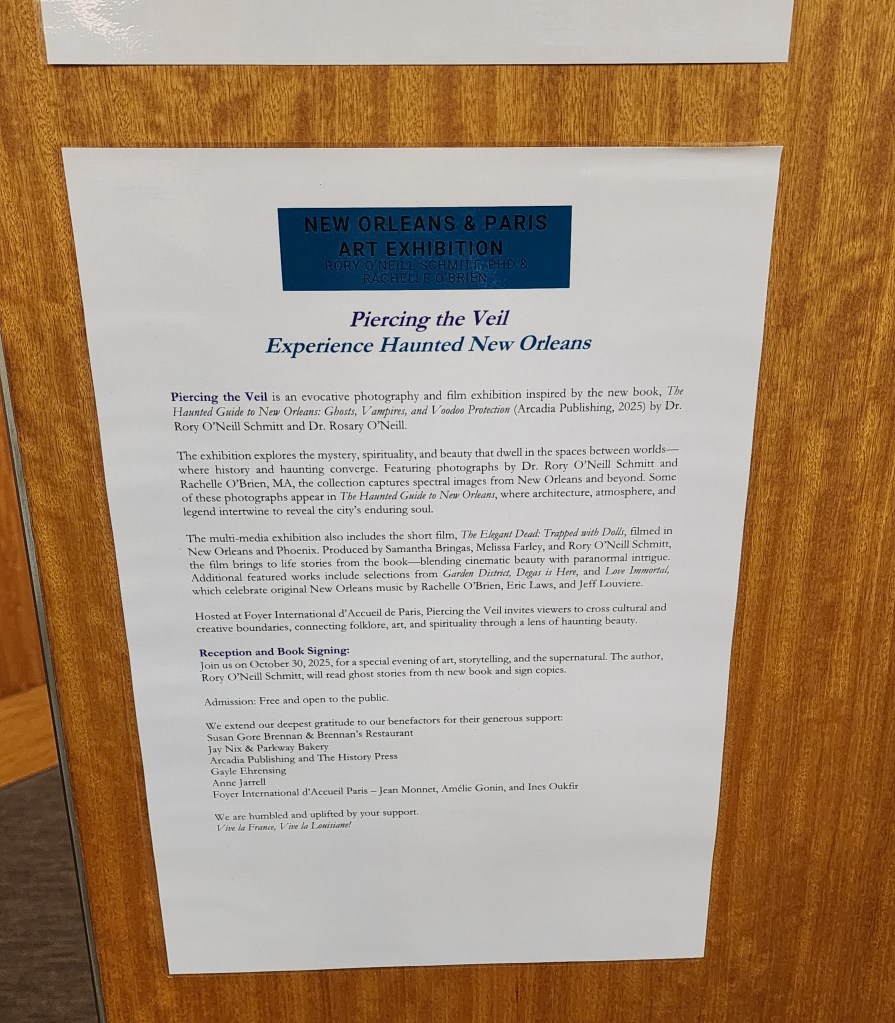
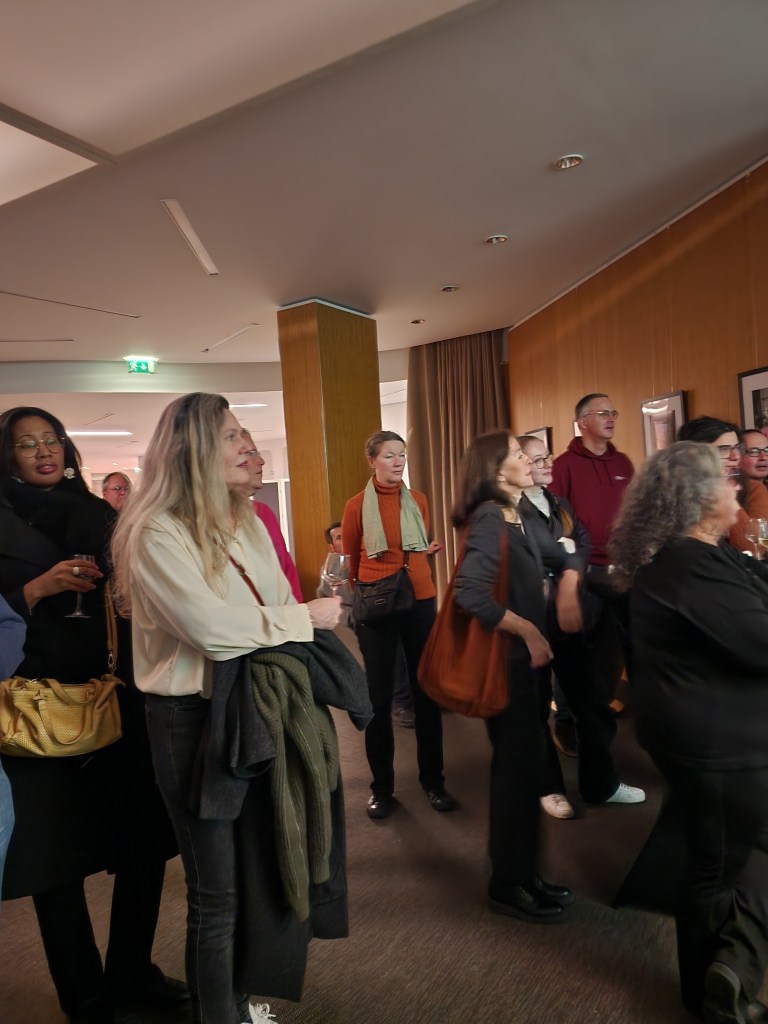
After Rosary’s dramatic reading there was a multi-media presentation of a short, spooky film, The Elegant Dead: Trapped With Dolls. Filmed in New Orleans and Phoenix, the film materializes the stories in the book and makes them palpable. Produced by Samantha Bringas, Melissa Farley and Rory O’Neill Schmitt, the film’s atmospheric haunting sends chills up and down one’s spine. The audience was rapt. until the end, then stayed for more conversation.
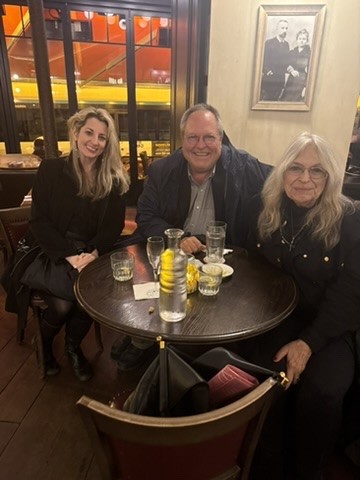
Ours was a long, fulfilling day that ended with a late dinner at a nearby restaurant that seems to always be open for everything lovely, including French onion soup, Le Comptoir du Panthéon.
 CAROLE DI TOSTI