Blog Archives
‘The Hairy Ape’ Eugene O’Neill’s Classic of Oligarchs and Apes at Irish Rep
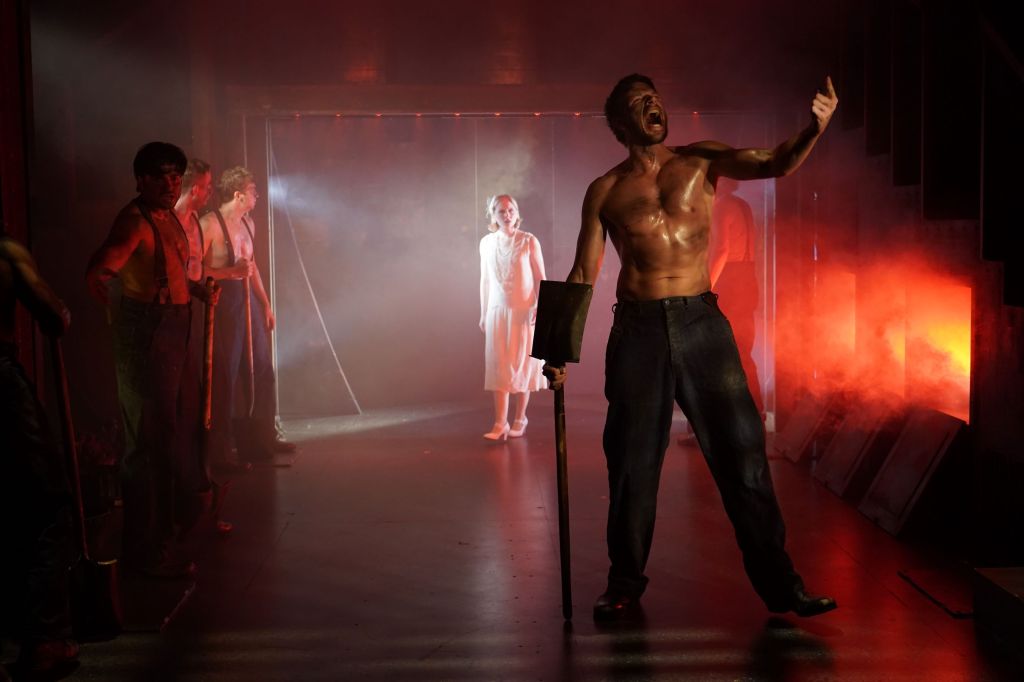
Eugene O’Neill labeled his 8-scene play The Hairy Ape “a comedy of Ancient and Modern life.” Surely, the playwright sardonically jested because the themes relayed through the journey of the anti-hero Yank (superbly portrayed by John Beavers) a fireman (coal stoker) on a luxury cruise ship, mirror those found in Greek tragedy. However, comedic elements at times peak through the fine revival directed by Ciarán O’Reilly which runs through Novmber15, 2026 at Irish Repertory Theatre.
The shattering of Yank’s proud ego (his fatal flaw), and his inability to recover immerses the audience in his fateful journey, and shakes us to the core. With empathy we follow Yank’s growing realization that he must redefine his purpose and identity which can never align or fit in with the corrupt society of uncaring, soul dead wealthy and oppressed working stiffs alike. Eventually, the truth of his discovery destroys him before he redeems himself and creates a place where he fits in.
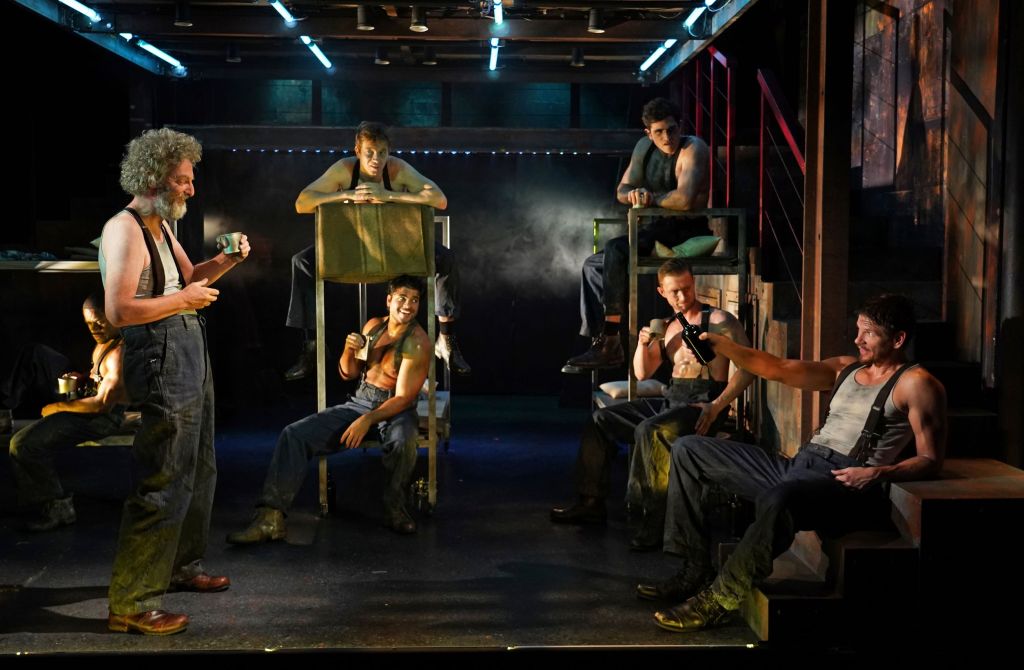
Initially, when O’Neill introduces Yank, we note his bellowing assertions of his sense of purpose. Amongst his fellow firemen shoveling coal, drinking and carousing on breaks to sustain themselves as they feed the fiery furnaces in the ungodly heat of the engine room, Yank projects confidence. In defining himself as integral to the movement of modern progress, he uplifts himself and his fellows’ importance to society. Without their work, their physical prowess and the steel-like resolve of what they face each back-breaking day, the weak, lazy, unregenerate upper classes could not sustain themselves.
Yank’s comments seem true enough. Certainly, the upper classes have always eschewed drudgery work and foisted it off on the lower, uneducated classes, who they also get to fight their wars to maintain their power and profits. This seems the case from feudalism to 1922, O’Neill’s setting. However, until Yank’s eyes are opened, he doesn’t understand class bigotry, nor how workers are exploited, disempowered and soul drained by a system rigged against them. Indeed, in the modern age, the wealthy deliver a double whammy.
Aligning the political class with themselves, the upper classes and captains of industry make the laws which oppress the slavish workers and mislead them to believe in the myths of getting ahead. As the underclasses dutifully pay taxes on their labor “never getting ahead,” the wealthy avoid paying their fair share because the politicians rig the system in their favor, having the courts and cops enforce the rigging. In O’Neill’s introductory jest, the play is so modern it is as current as today’s headlines.
Yank commands the conversation and men in Charlie Corcoran’s suggestive and stylized bunk room, and later in the smoking, red hot furnace room deep in the ship’s belly. Unfortunately, his brash, inflexible stance leaves no room for other viewpoints. Paddy’s lyrical comments about the clipper ships of the past with their healthful, unpolluted air and beauty, allowing the sailors to see the sunsets and appreciate the natural elements, are past their prime according to Yank. His uplifted mantra glamorizes the might and force of the ship’s engines representing industrialization. Despite its filthy, toxic, coal dust, and smoke-filled polluting byproducts, Yank embraces it pridefully, without thinking. He revels in “his place” there and proclaims the heat, filth and stink of the coal dust are the perfect climate for him, a man. “I’m what makes iron into steel! Steel, dat stands for de whole ting! And I’m steel—steel—steel! I’m de muscles in steel, de punch behind it.”
Through these oversized speeches which Beavers (Yank) and John Keating (Paddy) have made their own, we recognize O’Neill’s expressionism. This is the set up of ideas and symbols which O’Neill then mines throughout the rest of the play. Additionally, these symbols that Yank and the others express, become the platform from which Yank takes his great fall into the abyss which breaks him apart.
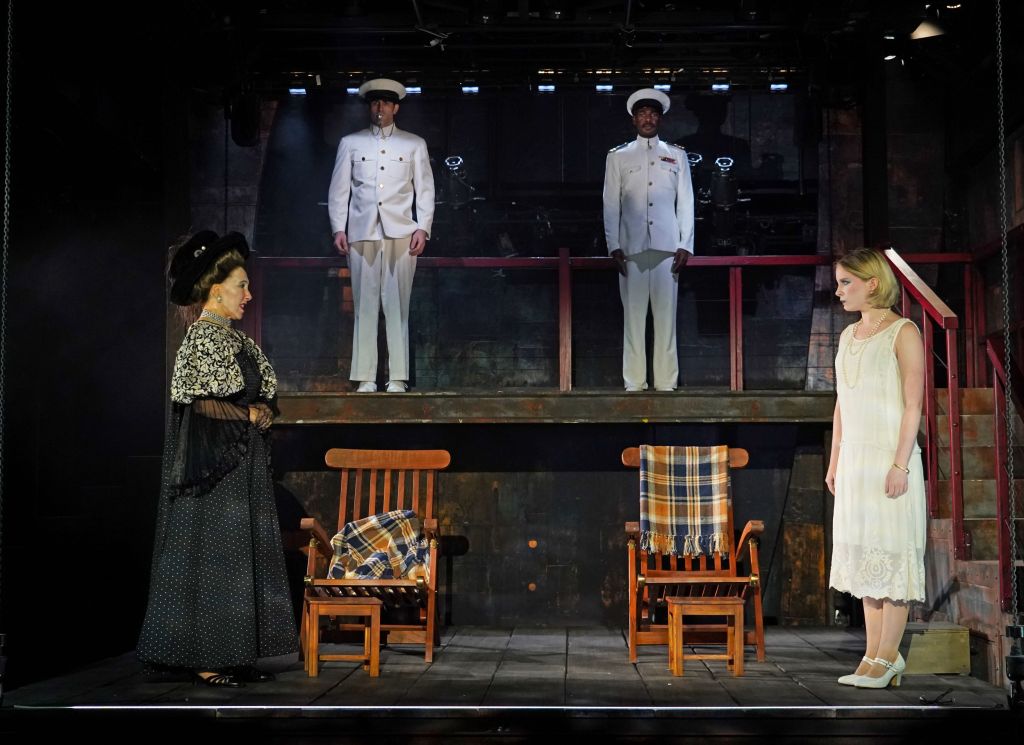
From the realistic set design of the “the lower depths” the scene moves to a view of the level above with two representatives from the upper class at leisure; their state which Yank suggested earlier is unproductive. The young Mildred (Elizabeth Teeter) and her aunt (Joanna Glushak) snipe at each other as they sun themselves on the upper deck of the cruise ship. Mildred, who wants to feel a sense of purpose, has taken classes in sociology. She intends to see “how the other half lives,” using the ship as her laboratory. By lying and leveraging her father’s position of ownership, she arranges a visit to the ship’s bowels, the engine room. Her aunt objects to the visit calling her a “poseur,” a hypocrite, questioning her sincerity. Afraid, to upset her father, the officers oblige Mildred and take her to the engine room.
At the worst time for her visit when Yank is raving at the Captain’s whistle, Mildred arrives emerging like a ghost into their midst. When she sees and hears Yank, he turns around aware of his fellow stokers’ silence at her entrance. As they look at each other in alarm, she defines him forever, calling him “a filthy beast,” and faints in disgust as the officers remove her. Yank attempts to recoup from her offensive observation of him, the antithesis of how he characterizes himself. Paddy suggests it’s “love at first sight,” humorously. The men tease Yank and discuss her classist slur. Gradually, they turn over the purpose of her visit to “look” at them. Paddy translates her look at Yank as if he was a “hairy ape.” Beside himself with rage at her humiliation, that he is lower than a man, Yank vows to find her, avenge himself and restore his smashed ego.
Unless one understands the depths of Yank’s despair and fury at her conversion of what he loved most about himself, “a manly man,” into an ape, his journey for vengeance and complete deterioration and loss of self makes no sense. By degrees Beavers expertly reveals Yank’s terrible desolation. Unable to release himself from “her truth,” he allows Long to take him to Fifth Avenue where the rich Mildred may be found in church (an ironic hypocrisy) or the exclusive shops that ironically feature a monkey fur jacket in an upscale store window that distracts the shoppers.
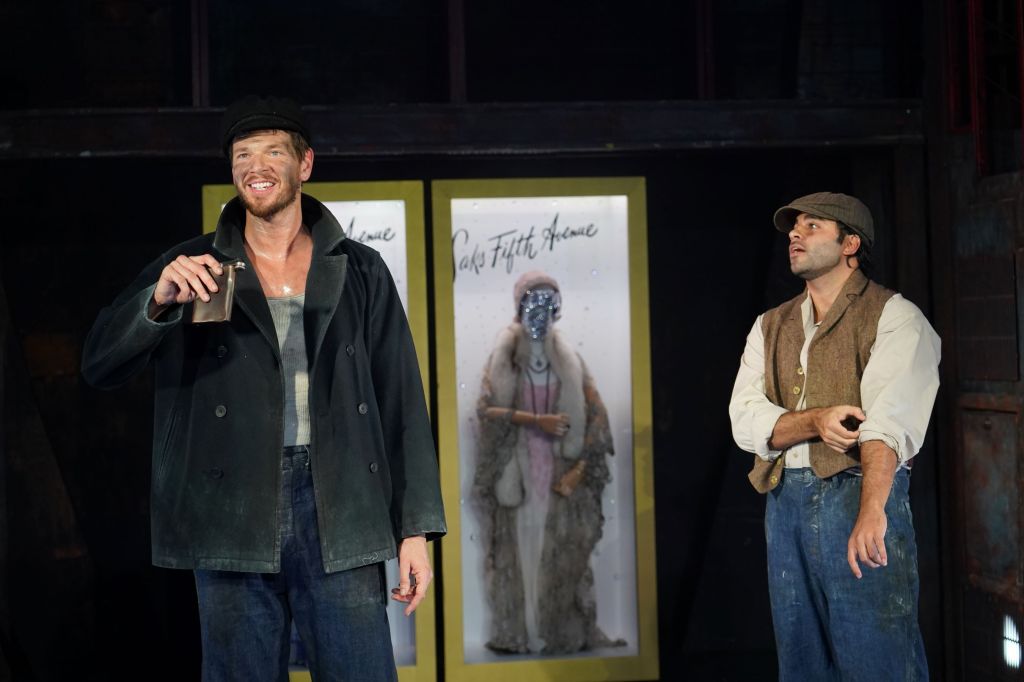
O’Reilly expressionistically stages the Fifth Avenue scene threading O’Neill’s symbolism of the fake, artificial society to highlight the contrast with the coal stoker. The wealthy wear stylized outfits and gesture like stiff, unreal figures. Their mannerisms references Yank’s earlier characterization of them not being alive. Yank, confused by the Fifth Avenue crowds, dressed symbolically in masks and glitter like jacked up, automatons, searches for Mildred. Not seeing her, angry, he attempts to confront and engage any of them in the medium he feels most comfortable, a physical fight. Ignored, rebuffed Yank’s behavior gets him thrown in jail. Only the police and Yank appear real. Normally dressed, Yank in his fireman’s jacket, and the cops in their uniforms provide a contrasting authenticity with “high society,” that ends in his being brutalized and caged (like a beast in the zoo).
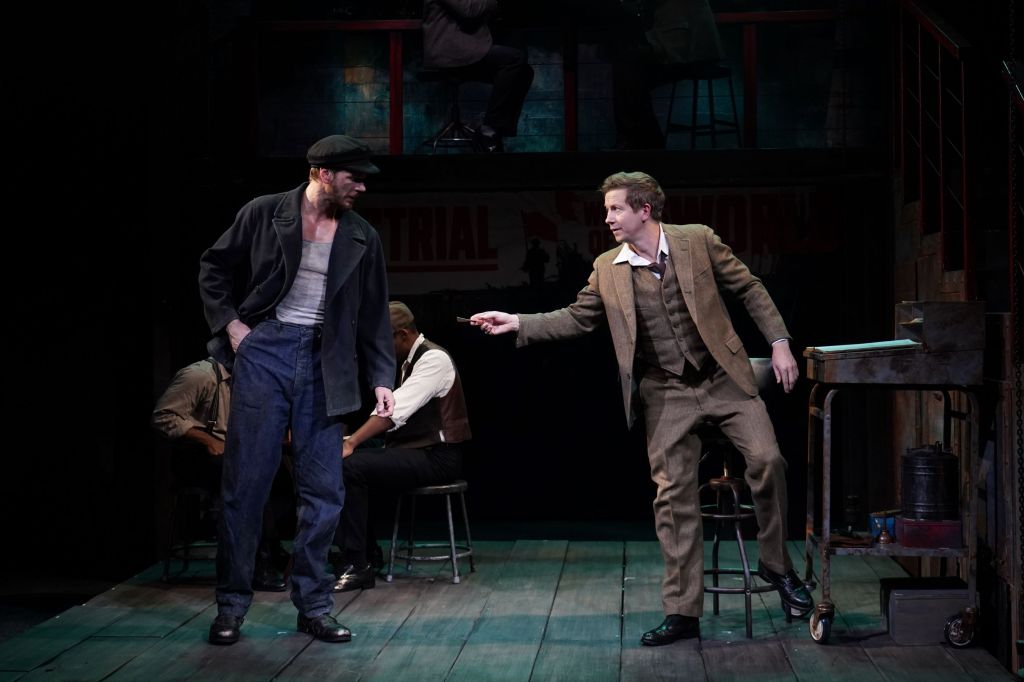
Getting tips about how to fight Mildred and her class from fellow prisoners, Yank ends up at the offices of the International Workers of the World. After five minutes of conversation with the Secretary (Adam Petherbridge) they reject his membership, suspect his weird, “stupid” comments and toss him onto the streets. The parallels between the wealthy and the IWW in their response to Yank are suggestive and telling. By this point Yank has completely lost his former confidence and perspective. By allowing others to judge him and cast him out, he feels alienation and isolation which overwhelm him. He realizes he can’t fit in.
Of course, the irony tantalizes philosophically. Not fitting in can be something wonderful. Individuals go to spiritual retreats, psychiatrists, writing classes or therapy sessions when the ego shatters and self-knowledge opens one’s mind and soul in awareness. Not fitting in with the toxic and corrupt is an advantage. Unfortunately, Yank has neither the money, the status, the intellectual or psychological means to lift himself up, make sense of his feelings and make his own place away from the nullifying society. O’Neill’s expressionism, well conveyed by the actors, creatives and O’Reilly’s direction, indicts the industrial, technological machinery of progress Yank thought emblazoned him but instead destroys him.
At O’Neill’s fascinating conclusion we note that Yank goes to a place seeking comfort, in order to look at himself in a different mirror. There, he sinks to a depth from which he never returns and never saw coming. And neither did the audience.
The Hairy Ape has no intermission and runs 1 hour 30 minutes on the Francis J. Greenburger Mainstage. https://irishrep.org/whats-on/the-hairy-ape
‘The Secret Life of Bees,’ a Heartfelt Musical Adaptation of Sue Monk Kidd’s Titular Novel
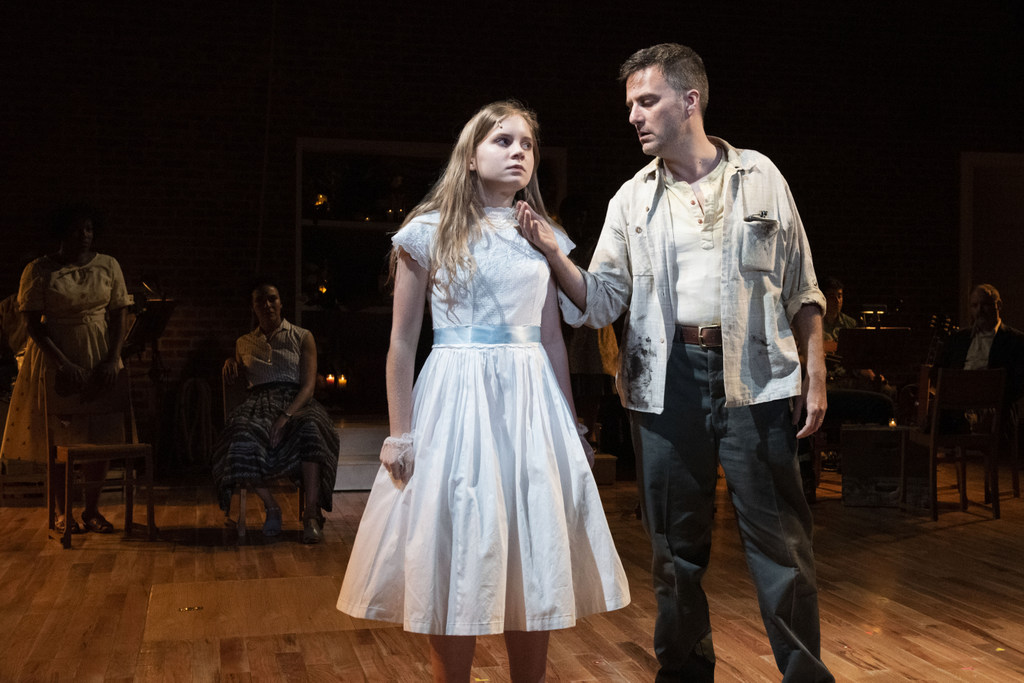
(L to R): )Elizabeth Teeter and Manoel Felciano in ‘The Secret Life of Bees,’ bOok by Lynn Nottage, Music by Duncan Sheik, Lyrics by Susan Birkenhead, based on Sue Monk Kidd’s novel, directed by Sam Gold (Ahron R. Foster)
The World Premiere of The Secret Life of Bees (Book by Lynn Nottage, Music by Duncan Sheik, Lyrics by Susan Birkenhead) spins Sue Monk Kidd’s best-selling novel into “A River of Melting Sun,” a metaphor for love, sweetness and redemption that is established in the opening lyrical musical number. Sung by the ensemble who elicit the audience to join them on a mythic and personal a journey they might wish to take, the song reinforces primary themes. These ripple throughout the story of Rosaleen (a sensational Saycon Sengbloh) and the troubled heart-broken Lily (Elizabeth Teeter’s lyrical voice is perfect for the role) both of whom must reconcile the wounds from their motherless childhood that threaten to destroy them.
The production directed by Sam Gold (Fun Home) is uniquely metaphysical. The director has chosen to keep the staging and set design (Mimi Lien) illustratively spiritual, functionally minimalistic and suggestive. The characters. pull out the props from the back wall use them to reflect and evoke events as they conduct the action organically. The book melds together the music and lyrics with characterizations. Sheik’s music with Birkenhead’s lyrics are sensitively drawn and vibrantly anointed in a mix of styles (gospel, blues, ballads, rock and pop pieces). This musical inspires and thrills.

The company of ‘The Secret Life of Bees,’ Book by Lynn Nottage, Music by Duncan Sheik, Lyrics by Susan Birkenhead, based on Sue Monk Kidd’s novel, directed by Sam Gold (Ahron R. Foster)
Ultimately, the healing power of many of the melodies, infused by the gorgeously, heady voices of the inimitable LaChanze (August Boatwright) Saycon Sengbloh (Rosaleen) Elizabeth Teeter (Lily) Eisa Davis (June) and Anastacia McCleskey (June) become the golden threads that provoke us to understanding that we too can share in “The Secret Life of Bees” and be purveyors of the honey of joy, moving down our own byways of life impacting others positively within our own sphere of influence.
The symbolism in the “A River of Melting Sun” has a myriad of layers as evocative as the messages in this adaptation enhanced with the emotionalism of Sheik’s score and veteran Birkenhead’s stirring lyrics. On one level the melting sun represents the golden honey that expert beekeeper August Boatwright (LaChanze) draws from hundreds of bee hives which is processed into the pure, amber sweetness from which she and her sisters, the broken-hearted May, and the hypercritical, austere June make their living in the county around Tiburon, South Carolina.

(L to R): LaChanze, Elizabeth Teeter in ‘The Secret Life of Bees,’ Book by Lynn Nottage, Music by Duncan Sheik, Lyrics by Susan Birkenhead, based on Sue Monk Kidd’s novel, directed by Sam Gold (Ahron R. Foster)
The melting sun also alludes to the mysterious power of sunlight that impacts the bees before and after they gather the pollen from the flowers whose plants, require the radiant rays’ energy to blossom and lure their pollinators to complete the vital rhythmic cycle of propagation that has persisted for thousands of years.
As the bees follow the rhythms of nature, so do the characters. The bee puppets shimmering in the expert lighting against the dark backdrop are effective, especially accompanied with the lyrical, flowing “bee theme.” In this musical as in the novel, both bees and humans are symbolic counterparts. Both focus on and require support from (their bee queen, the Black Madonna, Mother Mary). The honey, the bees produce for themselves and their queen; the honey represents the strength and love as well as the product central to August’s business. Importantly, the honey is the “sunlight” theme of the underlying love, unity, equanimity and community that sustains life. Without these elements, human beings will wither and die from displacement, isolation, disunity and emotional malnutrition. The same applies for the bee colonies.
Rosaleen and Lily are amazed and learn from the community of healing love from which the praying, spiritual Daughters of Mary find sustenance in, despite an oppressive, bigoted, hateful culture. Without their unity and faith there would be a return to misery, torment and depression, the likes of which May experiences and must continually be lifted away from. The metaphor of melting sun also alludes to the heat/warmth/enlightenment/encouragement/hope/faith extended by August and the Daughters of Mary to the broader community. This symbolic “melting sun” is received by Rosaleen and Lily after the runaways allow faith to transform their souls and heal their brokenness through love and peace.
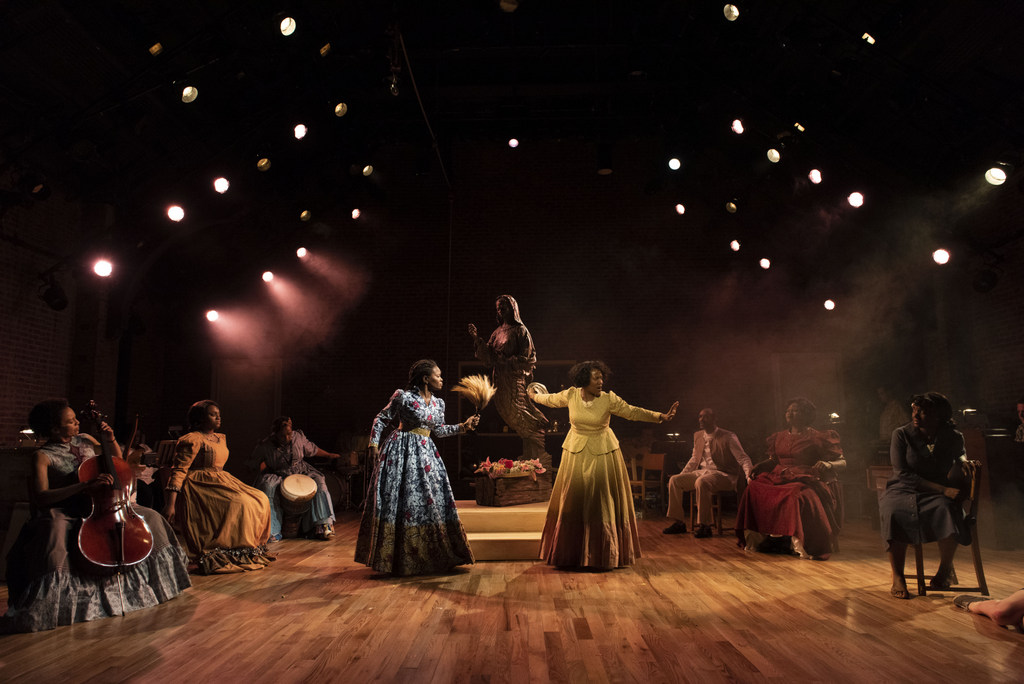
(L to R): LaChanze, Anastacia McCleskey and the company of ‘Secret Life of Bees,’ Book by Lynn Nottage, Music by Duncan Sheik, Lyrics by Susan Birkenhead, based on Sue Monk Kidd’s novel, directed by Sam Gold (Ahron R. Foster)
Nottage’s book serves to frame the arc of development, elucidate the characterizations and manifest the themes. Cleverly, she employs a delicate, slim, suggestive rendering. She quickly establishes the setting as 1964, South Carolina. For those unfamiliar with the history, we learn through radio announcements salient news details; these news events are tied to the action. Those familiar with the Civil Rights Movement, will recall the year was a time of roiling fury for Southern white supremacists who opposed the passage of President Johnson’s Voting Rights Act and retaliated with bombings and killings to spread fear and stop blacks from registering to vote.
This social and cultural backdrop magnifies the conflicts for Lily, the confused white teenager who sings “The Girl Who Killed Her Mother” and Rosaleen who works for Lily’s father T-Ray and who intends to vote (“Sign My Name.”) challenging racist bullies who have maintained their oppressive, genocidal power structure since Plessy v. Ferguson in a Jim Crow South. During the musical, we learn that Rosaleen and Lily have been abandoned by their mothers and suffer from emotional and spiritual traumas that destroy their confidence and wholeness so they cannot progress.
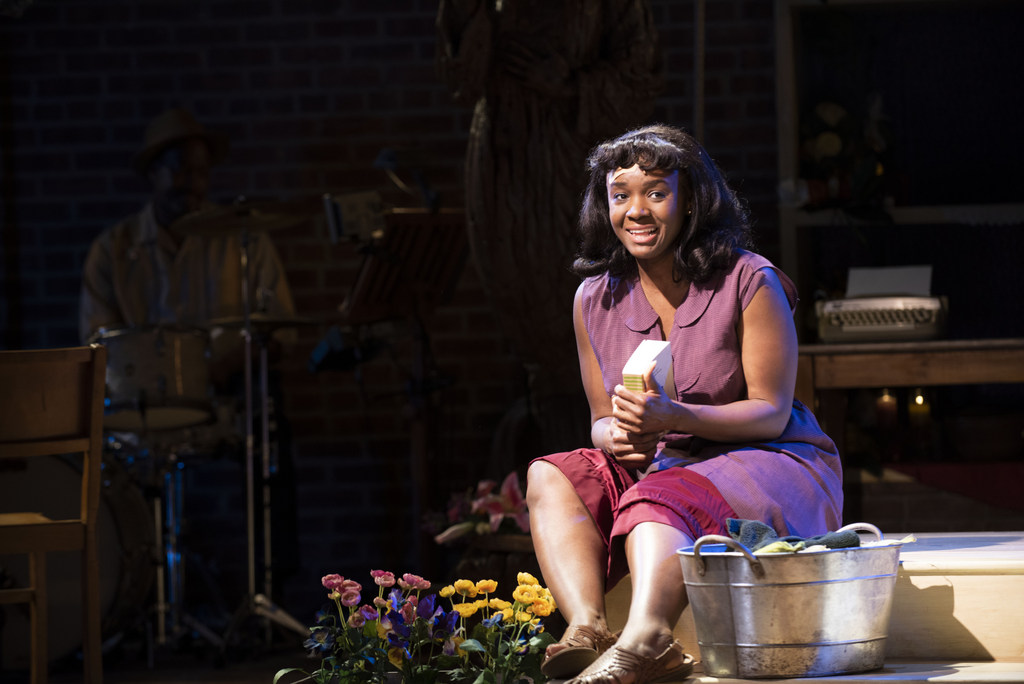
Saycon Sengbloh in ‘The Secret Life of Bees,’ Book by Lynn Nottage, Music by Duncan Sheik, Lyrics by Susan Birkenhead, based on Sue Monk Kidd’s novel, directed by Sam Gold (Ahron R. Foster)
Escalating conflicts force Lily and Rosaleen to take the risk of running away together. Tired of her father’s physical and emotional abuse, and in her quest for the truth about her mother who has died, Lily solicits Rosaleen’s companionship and they leave Sylvan without T-Ray’s permission. Manoel Felciano as T-Ray aptly delivers the brutish, hurtful father convincingly.
They follow the only clue Lily has about her mother’s past, a paper honey label stamped with a Black Madonna with the printed location of Tiburon, South Carolina. Though tired and worn, they believe and hope in their future (“Better Than This”). For feisty Rosaleen who spit on a red-neck’s shoe when he prevented her from registering to vote after she brings down the house with “Sign My Name,” escape may lead to power. For Lily escape means the freedom to seek her mother’s identity away from the gnawing terrors of a childhood event that is too traumatic to remember. Her lack of memory is why T-Ray opaquely tortures her about it without being entirely truthful.

(L to R): LaChanze, Elizabeth Teeter in ‘The Secret Life of Bees,’ Book by Lynn Nottage, Music by Duncan Sheik, Lyrics by Susan Birkenhead, based on Sue Monk Kidd’s novel, directed by Sam Gold (Ahron R. Foster)
Rosaleen’s and Lily’s travels lead them to the mysterious, striking, holy scene, a ritualized church service of dance and song that is a powerful prayer to Mother Mary (a Black Madonna carved in driftwood). The Black Madonna is a contact point of faith, enlightenment and love. The anointed song “Tek A Hol A My Soul” is rhythmic and profound. It thrums with the pulsation of sweeping currents that uplift and energize the Daughters of Mary (ensemble and the sisters) and Neil (a heartfelt, humorous, sensitive portrayal by Nathaniel Stampley). Neil is a like-minded “brother”who prays and sings with them; he is also the principal of the school where June teaches. The song is a soul shaker, just fabulous in providing the dramatic focus from which the action centralizes.
When the singers (August, June, May, Neil, Queenie, Sugar Girl, Violet, Neil) see Rosaleen and Lily are enthralled, August (she represents the Queen Mother, the educated entrepreneur whose encouragement and wisdom undergirds the community of educated black women) invites them to work for room and board. The ensemble sings “The Secret Life of Bees,” the thematic mantra which represents the unity of all things through love, hope and decency, and all that is life affirming and purposeful, if one has the eyes to see and the ears to hear the secrets/mysteries to obtain the honey goodness.
Rosaleen and Lily gratefully accept the invitation and in exchange for lodging, they assist with the housework and beekeeping. As they gradually become a part of the family, they confront their troubles and embrace peace and self-love through August’s nurturing. This becomes problematic for Lily because of June’s skepticism about taking in a white girl who obviously will bring trouble into their sanctuary. Lily must overcome June’s negative attitude with the help/love of August and her own soul searching and prayers to Mother Mary. She grows in empathy toward the broken-hearted May (the golden voiced Anastacia Mcleskey) who also has gone through a terrorizing, event. In the lovely “Frogs and Fireflies” and they encourage one another

(L to R): Anastacia McCleskey, Elizabeth Teeter in ‘The Secret Life of Bees,’ Book by Lynn Nottage, Music by Duncan Sheik, Lyrics by Susan Birkenhead, based on Sue Monk Kidd’s novel, directed by Sam Gold (Ahron R. Foster)
Rosaleen’s and Lily’s arrival at the farm is a major turning point in which the interactions between and among May, June and August entertain and teach us about the women’s industry, resourcefulness and determination to strive in a culture that would otherwise annihilate their souls and identities. LaChance’s August (accent on the second syllable means sage) is spot-on brilliant. She delivers a nuanced performance that drips with wisdom, steadfastness, inner mystical knowledge and power through inner peace. Her portrayal is transcendent. She sets the tone for the metaphysical underpinnings, revelations and healings which might not be gleaned if one is “scientifically,” empirically-minded. Her singing is absolutely grand.
Saycon Sengbloh is a whirlwind, likable, effusive and joyful as Rosaleen, a true overcomer. Her chiding Lily’s selfishness into true friendship in “All about You,” is superbly, forcefully delivered. Her other solo “Who Knew?” as she receives grace and heals her sorrows is another highpoint of the production in its development of her character that makes crystalline sense.
Her white counterpart in “becoming,” Lily, is her equal in redemption after Zachary (the adorable Brett Gray and Lily’s potential love interest) has been found alive. When he and Lily are pulled over and officers brutalize Zachary and arrest him for nothing, he nearly loses his life, but for the help of a white client of August, who wields power in the county. The currency of this scene is painful to watch considering how many times such unjust violence spilled from the past into today and it is ongoing. Many times the outcome is not as it is in the play; the victim is tortured, abused and murdered with impunity. The Daughters of Mary understand what is at stake and do all they can to free the innocent Zachary.
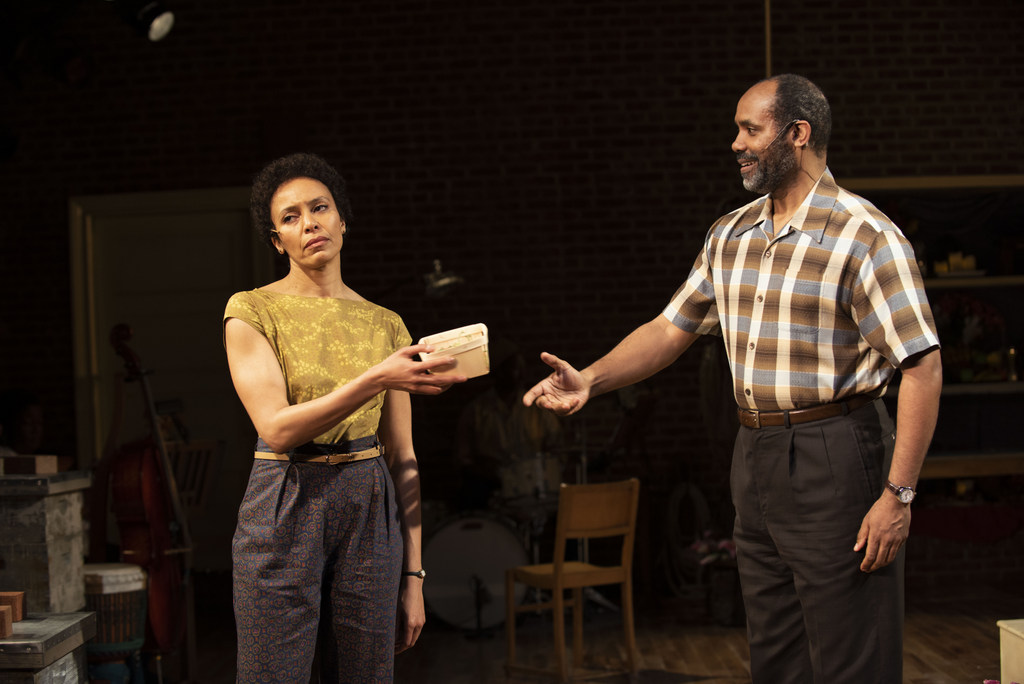
Eisa Davis, Nathaniel Stampley ‘The Secret Life of Bees,’ Book by Lynn Nottage, Music by Duncan Sheik, Lyrics by Susan Birkenhead, based on Sue Monk Kidd’s novel, directed by Sam Gold (Ahron R. Foster)
That Lily importunes Mother Mary and has a conversion experience praying for Zachary is an indication of her growth away from selfishness toward healing and self-love. In this powerful scene, she activates the substance of her own faith as it joins with the Daughters of Mary who also pray for Zachary’s return. However, any hope she may have to be with Zachary will never be realized as long as the atmosphere of hatred and injustice is an entrenched, “legal” social more.
Brett Gray’s Zachary “rocks it” with Lily in two musical numbers which show their bonds: “Fifty-Five Fairlane,” and “What Do You Love?” Their exuberance in the first and their sweetness in the second provide a side story of budding love which avoids the syrupy and remains authentic. The second love story, between Neil (Nathaniel Stampley) and June (Eisa Davis) is LOL hysterical as Neil persists in wooing June and she rejects him a whopping number of times out of fear of being hurt again as she was before. “Marry Me” is just fabulous. The men in the play empathize with Neil and chortled around me at the humor and were tense at June’s answers. This is no spoiler alert; you will have to see the musical to find out if June and Neil join forces. And you will have to see it to discover what happens when T-Ray shows up to confront Lily about her mother’s death to take her back home.
The Secret Life of Bees is an ethereal, spiritual adaptation with little spectacle of the type that “dazzles” and then is easily forgotten. It is an evocative and suggestive view of a time that is near timeless as it reflects the same horrific events that are happening today (voter suppression, police brutality, racial abuse, women’s oppression). But the adaptation carefully elicits the substance of faith and its power evidenced in a mystical group of educated, “sisters” and a “brother” who have found a way to negotiate the hellish genocidal racists and best them beyond “religiosity” and a form of godliness that has no power. Nottage’s selection of events in the style she’s chosen is right on as is Sheik’s music and Birkenhead’s lyrics, aptly shepherded by Sam Gold.
Kudos to the company, and to the creative artists Chris Walker (choreography) Dede Ayite (costumes) Jane Cox (lights) Dan Moses Schreier (sound) AchesonWalsh Studios (puppets) Jason Hart (music director) Antoine Silverman (music contractor) Duncan Sheik & John Clancy (orchestrations) Jason Hart (vocal arrangements) Cookie Jordan (hair, makeup & special effects) UnkleDave’s Fight House (fight director).
This must see musical production runs with one intermission at Atlantic Theater Company’s Linda Gross Theater (West 20th Street) until 21 July. It should be extended or another venue found. For tickets and times CLICK HERE.

