Blog Archives
‘Titus Andronicus’ Patrick Page is Mesmerizing, Heartbreaking, Over-the-top
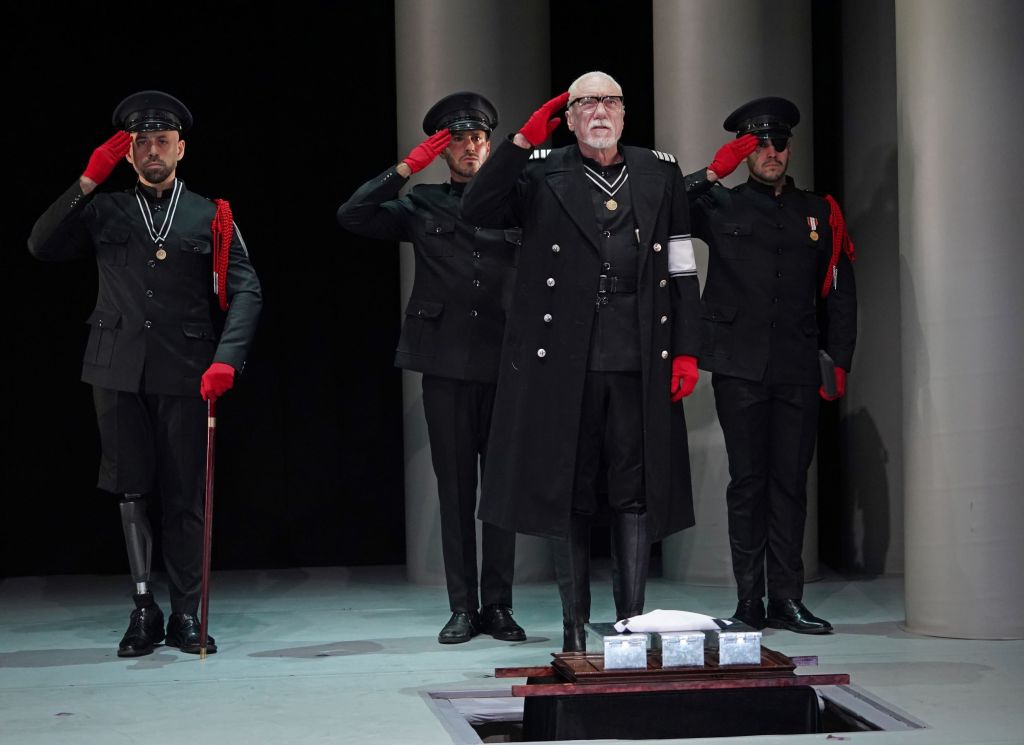
William Shakespeare’s Titus Andronicus comes with a warning label about the bloodshed and violence in this profound, incredibly acted Off-Broadway production at Pershing Square Signature Center. As I was watching the visceral, gut-wrenching performances of Patrick Page’s Titus Andronicus and Olivia Reis’ portrayal as Lavinia, Andronicus’ treacherously abused daughter, I thought of the brutal, unjustifiable bombing of women and children in Gaza, Israel. However, the difference of watching reports via screens from the safety of one’s sofa versus watching fictional live-action bloodshed onstage seems moot. One requires imagination to understand what is happening that media doesn’t show: the eviscerated bodies, the scattered arms and legs of blown up children. That horror compared to immersing oneself in stage acting with the well timed bursting of fake blood capsules during a fight or murder scene? Violence and murder are inhumane. Blood and gore in fictional drama loudly points to the heinous, triggering realities of war going on today.
Thus, the themes of William Shakespeare’s goriest tragedy are impactful. But one must understand that the result of Titus Andronicus‘ gore is tragic. Murder, treason, blood-lust, vengeance all turn the warriors’ swords against their own entrails. This is especially so when the ones maimed and brutalized are offspring the enemies leverage to emotionally annihilate their parents. There’s nothing like watching one’s future inheritance and legacy wiped out and being unable to find peace afterward. That is the ultimate tragedy in the magnificent Titus Andronicus produced by Red Bull Theater at the Alice Griffin Jewel Box Theatre. Titus Andronicus has been extended through May 3, 2026.
At the top of the play victorious, intrepid Roman general Titus Andronicus returns from the wars in triumph, but having paid a stiff price. During the battles he sacrificed three of his sons for Rome. However, he did succeed in bringing Rome the spoils of his win. Titus presents these captives to Rome: Tamora (Francesca Faridany) the Queen of Goths, her ambitious warrior/lover Aaron the Moor (McKinley Beelcher III), and her three sons played by Jesse Aaronson, Blair Baker, Adam Langdon. Their captivity in chains gives more light to shine Rome’s mighty, justified conquests.
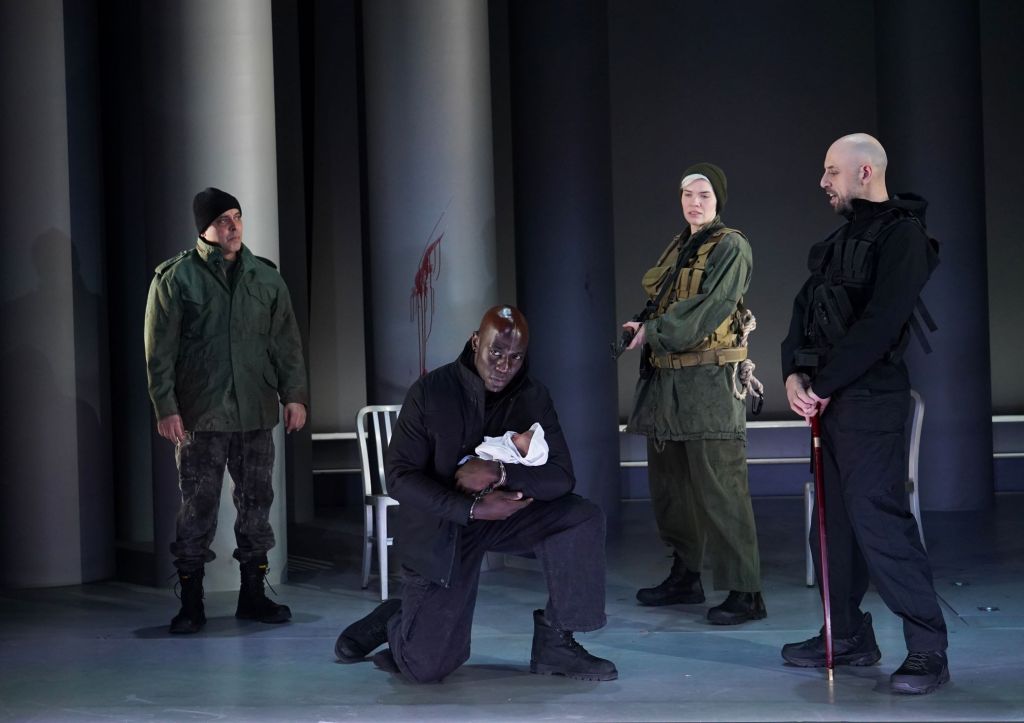
During the Andronici family reunion which includes Titus, Titus’ Tribune sister Marcia (Enid Graham), his daughter Lavinia and his three living sons, played by Anthony Michal Martinez, Zack Lopez Roa and Anthony Michael Lopez, they perform burial rites. Additionally, a ritual of recompense is made of Goth blood for Andronici blood. Lucius (Anthony Michal Lopez) states, “Give us the proudest prisoner of the foe, that we may hew his limbs and sacrifice his flesh to these our fallen brothers.” It is an act to appease the deceased son’s spirits who were killed in the war with the Queen of the Goths, and to stop any “prodigies” from being visited upon the Andronici.
If bloodletting is ever fair, the balance is that three were lost and the blood of one is the equivalent of three. This is a ritual always performed on the battlefield and to Tamora’s pleadings, Titus asks her to pardon him. His sons perform the ritual killing of Alarbus without rage, but as a tradition. One could argue this duty is more than fair, a viewpoint Titus holds, but Tamora does not.
In truth, Titus should have killed all those he captured, instead of just Tamora’s oldest, her firstborn son. Dismissive of Roman tradition, the Goth Queen sees this act as a gruesome provocation-killing her son in front of her. She is a Goth; she doesn’t “get” Roman traditions or values. She dispenses with the mercy Titus bestows on her, the Moor, and her sons by letting them live and roam free to do damage to Titus and his family. Titus’ mercy is a brutality from Tamora’s perspective. And Titus doesn’t remind her of the fact that she and the others live by his grace. In tragic blindness she refuses to acknowledge or see his act as just and a Roman tradition (I read the script’s stage directions about killing her son as ritual.). And Titus is completely blind to her ferocity and the possibility that she will get vengeance on him and his entire family when the opportunity arises. She has chosen not the way of life bestowed by Titus’s grace, but of vengeance, bloodshed and death. Tragically, blindly Titus lets down his guard and opens the door to Tamora’s hell with fate’s help.
In their blindness lies their downfall.
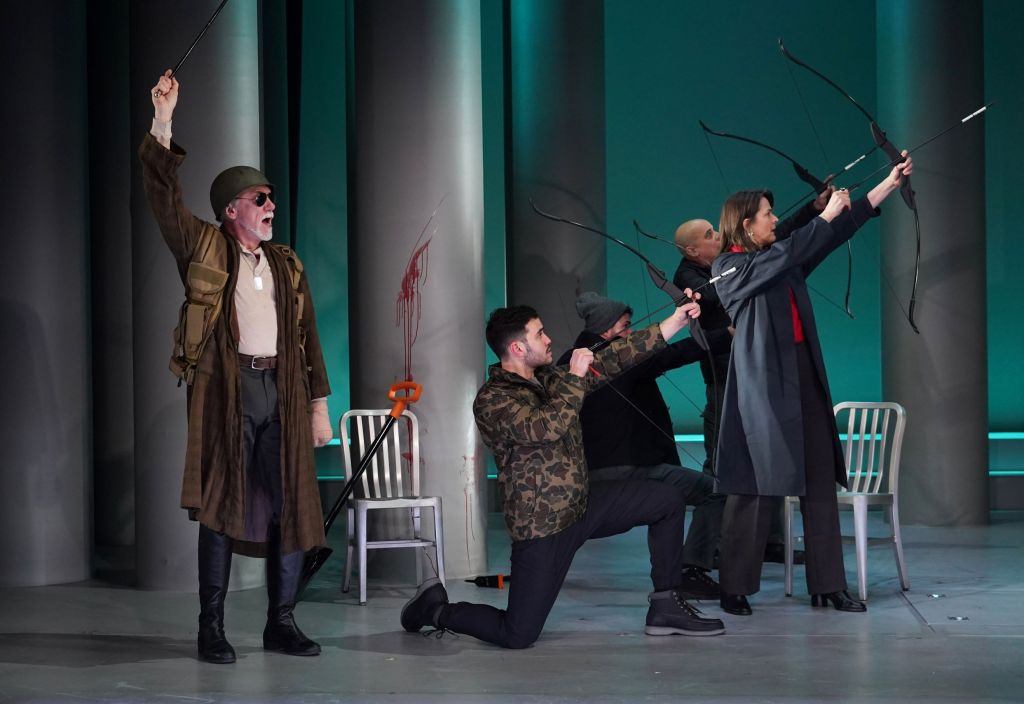
Most probably if Tamora had won, Titus and his sons would have been killed. We note in her future actions and those of Aaron, her lover, what she would have done. Humiliated, a captive in chains, a loser, she chooses to feel provoked by her eldest son’s sacrifice, not acknowledging the lives his blood saves. As they take her and the captives off, she rants, beats her breast and waits for a time of revenge saying, “I’ll find a day to massacre them all.”
Unfortunately, that day comes sooner than later. It is hastened by Titus’ choice not to be the Emperor of Rome, though the people want him, and though Lavinia’s betrothed Bassianus (Howard W. Overshown), Saturninus younger brother, supports him with his troops and followers. Why? Romans are not idiots. Saturninus, the late emperor’s eldest son is unlikable, silly, pompous and incompetent. They want Titus, but Saurninus, the child, protests, not caring about Rome, but caring about himself. In fact Titus would make the better leader proven by his track record of service, leadership competence and popularity. (The parallels with the US are staggering)
Titus makes his ultimate mistake not taking the emperor-ship, stating he is too old and that he wants to enjoy peace after forty years of wars. Titus persuades the people to accept Saturninus as the head of Rome. Under his rule, all hell breaks loose and chaos and violence are unleashed by this terrible decision. Mathew Amendt portrays Saturninus as an infantile, asinine, petulant fool easily duped by one who ends up with a ruling partner as unfit as he, but worse-the bloodthirsty Tamora. Not able to have Lavinia, though Titus suggests it to her, then relents when she says she is betrothed to Bassianus, Saturninus elevates the bloodthirsty Tamora to the throne as his queen. There, she is all about peace and unity. Titus doesn’t see her coming. Nor does he see coming her instrument of vengeance, the gleeful, sneaky Aaron who suggests rape, mutilation and torture for Lavinia to Tamora’s slothful sons. He also suggests a means of impunity so she will never confess the crimes nor bring about her own healing.
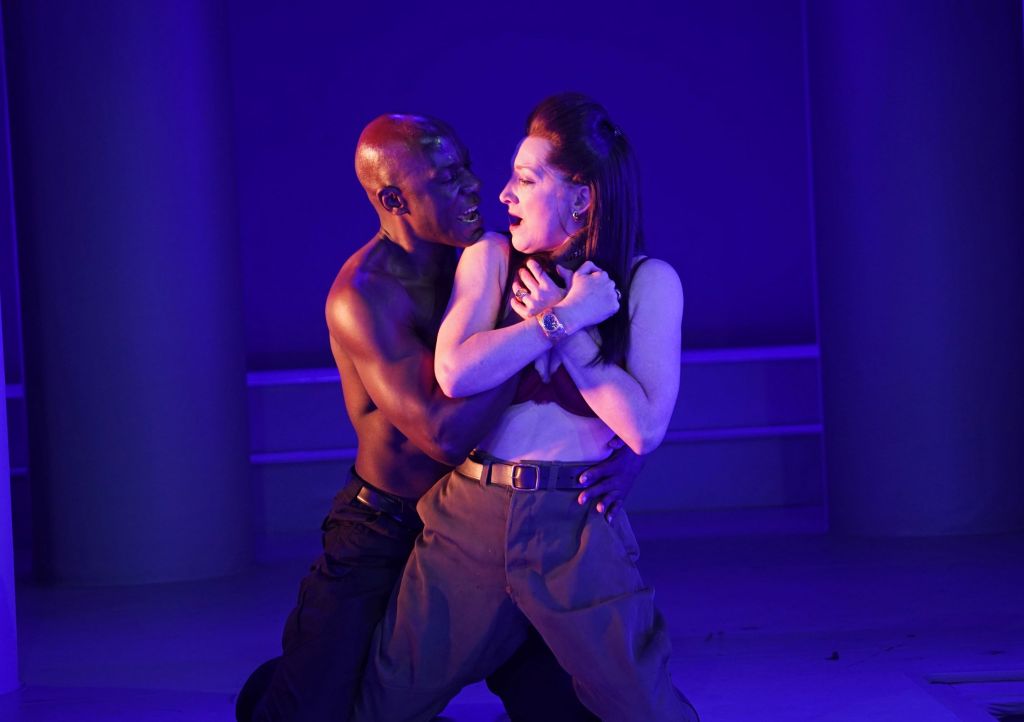
Jesse Berger’s staging works, though the tone of the tragedy shifts off its axis in Act II from sorrowful horror to an outrageous, sometimes weirdly comedic tone. In the last scene of Act I Page’s Titus experiences the full effects of Tamora’s trickery and the loss of two of his sons. When Page’s Andronicus beholds what the spirit of vengeance and hate have done to Lavinia, he is broken. With breathtaking, magnificent, touching grief, he cannot absorb what an anonymous “they” have done to his daughter. Reis’ pitiable cries at the heinous treatment during her violent struggle with the heartless Aaronson’s Chiron and Langdon’s Demetrius (both excellent) are symbolically representative. She is the archetype of women’s soul murder and it is clear why men use rape and mutilation as the defining weapon of war. In the scene Reis conveys what every woman in that position feels. Beyond words.
Page and Reis are incredible together. Page’s Titus slides into madness with laughter and screaming, the extreme emotions of a father unable to protect his daughter or help her. As the destroyed Lavinia, Reis’ cries in echoing response to stage father Page are shattering. One cannot help but weep for empathy at their loss of identity, beauty and valor.
Of course Act II is almost anticlimactic as we wait for the coming revenge on one who chooses vengeance and death rather than life and peace when she vows to “massacre them all.” In that, too, Tamora fails for Lucius lives to become emperor welcomed by both Romans and Goths alike with Tribune Marcia serving his mission of peace, ending the cycle of revenge. Belcher III is superb. As Aaron he speaks passionately to save the son birthed by Tamora who in humiliation gives up the Black child to be killed to hide her shame. The speech softens Aaron’s Iago-like wickedness as the engineer of Tamora’s revenge. His humanity extends to his innocent son, whom he forgives, as he wallows in despair and condemnation.
When Page’s Titus sits his guests down to dinner dressed in a chef’s hat and outfit grinning from ear to ear, he holds Tamora’s sons flesh pie. The laughter from the audience is a confusion of emotions: gladness that he is holding Tamora accountable with a just revenge; empathy that anyone would be driven to this. In fact laughter at serving up Tamora’s sons in a meat pie is all that is left of his sanity.
By this juncture Titus has released all his grief and sorrow. Life has become absurd. What’s left when nothing’s left? Page who worked on the script and did a masterful job sluicing it to crystal clarity reveals the descent of a noble individual who was better at fighting wars, than living in peace. His act of killing Lavinia is an act of mercy. If she could do it herself, she would. But the sons have chopped off her hands so she can’t reveal her abusers. Titus knows her yearning for death like he knows his own soul. He lovingly kills her ending her torment, which she will never get over in life, stripped of her identity and empowerment of words and actions, which end any opportunity for her to heal.
Titus Andronicus runs a swift 2 hours through May 3, 2026 at the Pershing Square Signature Center.
redbulltheater.com.

‘The Government Inspector,’ starring Michael Urie at New World Stages

Michael McGrath (forefront) Luis Moreno (L) Mary Lou Rosato (R) in ‘The Government Inspector (Carol Rosegg)
Corruption, bribery, pay offs siphoning off citizens’ taxes and lifeblood in a small town? What could be more symbolically representative of politics, whether such machinations take place in Russia or the United States today? In good times, officials steal roundly and with less accountability because citizens are economically well placed to go about their lives. In harsh economic times the sub rosa avarice of bureaucrats who serve themselves first and serve the public never, always raises a hue and cry. When the little people are squeezed, they pressure their overlords to uphold the “sanctity of their positions.” Usually, the miscreants don’t and must be brought to heel. And sometimes there is even justice.
For playwright Nikolai Gogol, such a scenario, laden with hypocrisy and condemnation was a golden treasure trove of comedy. He has proven this with Revizor adapted by Jeffrey Hatcher into The Government Inspector, currently enjoying an extended run at New World Stages.

(L to R): Michael Urie, Arnie Burton in ‘The Government Inspector’ (Carol Rosegg)
What a marvelous production this is. It is relevant to our political times which encapsulate the play’s themes. This satire of small town government officials and their general incompetence and corrupt misapplication of their mission and public service is a relief and respite from disheartening nightly news. For that alone, it is a must-see. Apart from that, this production is a must-see because it is just terrific.
For Jeffrey Hatcher who was commissioned to adapt Gogol’s Revizor into a version which would be performed for the 2008 Guthrie season, it was a “kick.” He clarifies that it was an election year. The barnyard of democrats and republicans was in full cacophonic frenzy. Hatcher’s enjoyment is evident in this adroit adaptation. Indeed, he steps up Gogol’s humorous scenario of malevolent politicians who have the tables turned on them, as they conspire to cover-up their cronyism, graft and malfeasance.
Hatcher delivers the best of Gogol and allows the Russian playwright’s genius to shine. With finely tuned direction (Jesse Berger) and exceptional ensemble work, The Government Inspector is madcap, zany and high comedic exhilaration.. Hatcher nimbly tweaks the playwright’s work just enough to enhance the hysteria in the comedy, acute jokes and incredible witticisms. His writing makes this production so completely sumptuous, you will want to feed on it again and catch a second time the artful ironies and slick phrases that ring with truth and reality at every laugh riot of a turn.

(L to R) Arnie Burton, Mary Lou Rosato, Mary Testa in ‘The Government Inspector’ (Carole Rosegg)
How satisfying it is to see the petty, self-dealing bureaucrats hoisted on their own greedy petard when they are duped by one of their own, who is even more mercenary than they. This is a normally improbable justice that we are privy to see, as it is unwittingly launched by error. When the government officials receive their own comeuppance, we are assured that the lofty are most greatly impugned and punished by their own shame, humiliation and self-deception. At this time in our social and political history, we are thrilled to laugh riotously at the characters’ machinations and their unhappy conclusions which remind us that “what goes around comes around.” What a pleasure!
The performances are the jewels that provide the glitter and the piquant vibrancy of the production. Without this ensemble, the jokes would scintillate but not with the power to strike as hard and send us as furiously as they do into the comic heavenlies.

(L to R) Michael McGrath, Mary Testa, Talene Monahon in ‘The Government Inspector’ at New World Stages (Carol Rosegg)
In the first scene, we are introduced to the conflict and meet the dastardly mayor (Michael McGrath is wonderfully on point with every hysterical line, every turn of phrase) and his legion of nefarious officials, the illuminating and funny Tom Alan Robbins, William Youmans, Stephen Derosa, James Rana, Luis Moreno. Hatcher/Gogol pull back the veil as the politicians chatter and conspire and we are allowed to see where they have buried all the financial duplicities and discover who is taking what and how the mandate and mission of the judge, the principal, the hospital and law enforcement have been mismanaged to a preposterous degree. (It’s kind of like appointing an EPA director who will dismantle all of the environmental regulations to fund anti-green corporations.)
As for privacy concerns? All the town gossip, all of the secrecies and personal intimacies and weaknesses are explored and savored for broadcast by The Postmaster (the unforgettable Arnie Burton) who enthusiastically reads every line in each letter, sharing the juiciest and most damning information with his cronies for entertainment. Burton’s portrayal of the Postmaster is moment to moment LMAO; the comedy comes out of the personality of the character which makes his performance absolutely sublime. In this town there is no detail which is not known or kept quiet that Arnie’s Postmaster doesn’t blabber with gusto. He certainly is a tool of the corrupt political machine; he helps it keep abreast of its enemies to forestall any dangers to its power structure.
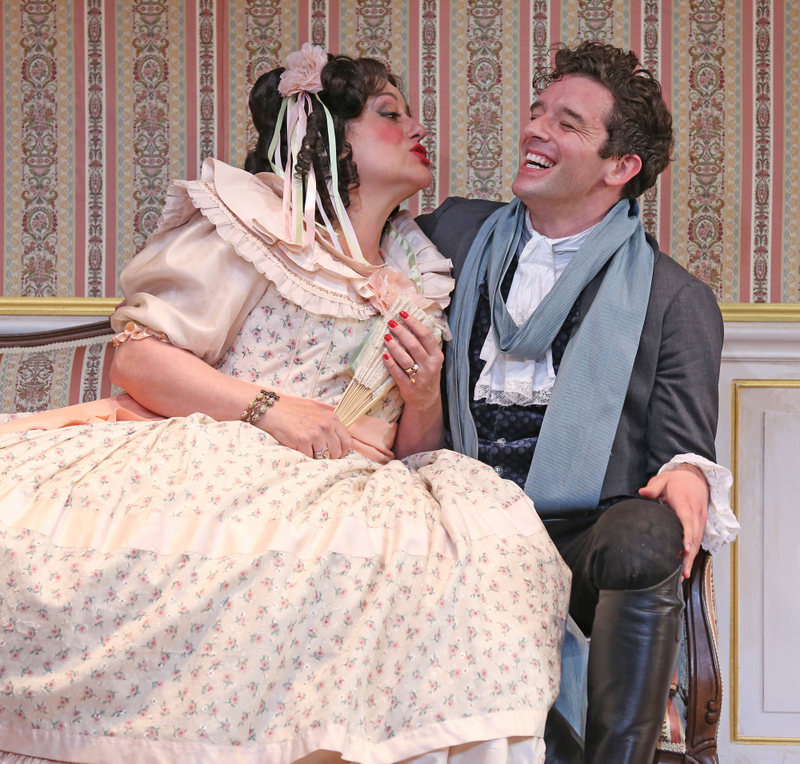
Mary Testa, Michael Urie in ‘The Government Inspector’ at New World Stages (Carol Rosegg)
At the meeting of these wicked corrupt, they discuss their grave problem which is a threat to their livelihood and career positions. An investigator has come to the town in disguise to explore the level of malfeasance. They fear that he will hold them to account. All the officials and even two local landowners (the funny Ben Mehl and Ryan Garbayo) must work together, discover the hidden identity of this “spy” and turn him over to their side with bribes and payoffs. It is an intrigue that holds danger for the officials and promise for the little people who we don’t really see as we are in thick with the conspirators, a completely enjoyable and refreshing sardonic view.
What has been a boisterous and satiric introduction is jettisoned into a hyperbole of hilarity in the next scene where we meet a lowly civil servant, the ineffectual would-be suicide Hlestakov (the unforgettable and prodigiously talented Michael Urie) and his clever servant Osip (the versatile Arnie Burton). Hlestakov can’t quite “do the job” with a pistol to free himself of this unrequitable earthly plane, his gambling debts and the ignominy of a meager, zero-of-a-life, which he has badly used.

(L to R) Ryan Garbayo, Michael Urie, Ben Mehl in ‘The Government Inspector’ at New World Stages (Carol Rosegg)
Because Hlestakov is incompetent at suicide, we have an hour and one-half of side-splitting laughter. Urie fashions comical uproariousness by using all the acting tools of his instrument. He flawlessly surfs the cresting waves of farcical action which he has helped to inflate. He is rather like a fine composer assisted by the incredible accompaniment of the ensemble, who spin their superbly tuned acting instruments into a wild symphony of raucous delight.
In this production Urie has stretched his talents to new heights. He is reminiscent of some of the comic greats; select any one of them in film, television or theater. He distills the substance of his lines then infuses them with the character of Hlestakov filtered through and around himself so that the civil servant who dupes the corrupted officials, and he, Michael Urie, are indivisible. Not only does Urie have seamless timing, he anticipates the power of pauses which he capitalizes on with grace, fluidity and an uncanny communication with the watchful, listening audience. Very simply, he captures Hlestakov’s being and rounds it out with Chaplinesque force and will.

Talene Monahon, Michael Urie in ‘The Government Inspector’ at New World Stages (Carol Rosegg)
As grand accompaniments, Mary Lou Rosato (various roles), Kelly Hutchinson (various roles), Mary Testa (the mayor’s wife) and Talene Monahon (the mayor’s daughter) are divine comedians. Without them the production would fly at a lower pitch. They are integral to the revelation of pretense behind the mayor, who is a wanna-be aspiring to nobility but must wallow in the mud of his position as a small-town functionary. And they (Testa, Monahon) provide the grist upon which Urie’s Hlestakov bakes the fabulous bread we devour to nurture our souls with exuberance and glee.

(L to R): Michael McGrath, Mary Testa, Michael Urie, Talene Monahon in ‘The Government Inspector’ at New World Stages (Carol Rosegg)
Indeed, all of the servant portrayals, each one more clever and shrewd than their masters/mistresses, are exceptionally delineated as characters and specifically portrayed by the actors. If one considers that in less than one hundred years what they are to “inherit” after the Revolution, there are no insignificant characters here, but they are the most prescient in biding their time waiting, in due season to dispatch here and there the fools they serve.
The dynamic arc of the play’s development is expertly unfolded so that by the conclusion, we have feasted and are sated. We recognize how thrilling it is to take our part in this rollicking spectacle which is perfectly congenial in its staging, set design, lighting, costuming and the thematic symbolism of its physical, emotional and intellectual levels. This seemingly effortless and easy production took loving care, sagacity and genius to effect the terror of its satire, the bounty of its humor, the innovation of its celebrated cast. Kudos to Jesse Berger who magnificently brought this together and who had the quick-witted spirit and grace to understand how to let it “all hang out,” using the structure of these artists’ inner freedom to live within the boundaries of Gogol’s classic.
If you don’t see this production you will have missed something truly wonderful and riotous. If you do see it, expect the audience to break into laughter and applause frequently because the infection of joy is abundant and bounces liberally between audience and cast. The two hours with one intermission race by.
The Government Inspector is in its extended run at New World Stages until 20 August. You may purchase tickets on their website (CLICK HERE). Or you may phone 212-239-6200.
‘Loot’ by Joe Orton, Stowing Mummy in the Closet for the Payoff
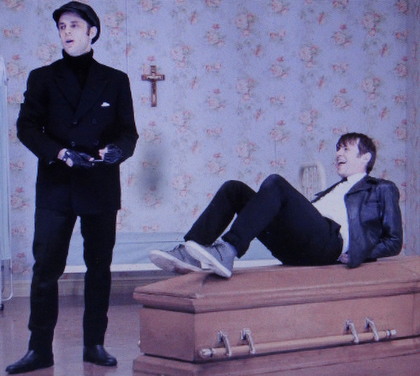
L to R: Ryan Garbayo as Dennis and Nick Westrate as Hal in Joe Orton’s Loot, at the Lucille Lortel Theatre (Red Bull Theater). Photo by Sarah Moore.
Joe Orton, the British playwright whose London hit Entertaining Mr. Sloan proved his brilliance, had his life cut short in 1967 at the age of 34. He was killed by his partner, who committed suicide in recompense for killing Orton. It is the theater world’s great loss, for Orton had experienced the steam of greatness as an exceptional playwright/writer, but not the substance. Whenever a production of his zany, dark comedies is revived, see it to appreciate the frenzy of hyperbolic farce that Orton was marvelous at creating. Impeccable timing and jeweled turn of phrase characterize Orton’s work. He is sardonic, like Wilde; over the top, like Monty Python; an iconic British wit.
Loot, in revival at the Lucille Lortel’s Red Bull Theater until February 9, is one of Orton’s gems. This production, directed by Jesse Berger, conveys Orton’s scorn of entrenched social institutions (religious, judicial, legal, medical). Clearly, the playwright had a rollicking time opening them to ridicule. This is appropriate for us currently; the hypocrisies Orton lays bare, are snatched from the 1960s. Yet, they are immutable now as they were then. In the delivery of the madcap and over-the-top plot extremities, we are able to bear the painful truths expressed underneath. If fraud, official corruption, murder and theft are the stuff of life, at least they can be used as meat to gnaw on for our entertainment sustenance in the hands of a savvy, sharp playwright, able director and acute acting ensemble.
The setting, the McLeavy living room is comfortably furnished with chairs and tables circling the walls, a locked chifferobe and what looks to be a folding screen more befitting a hospital room than a living room. The room is a style cacophony of weird items, the most strange being the coffin with decorative grave flowers at center stage. Thus begins the wackiness which develops into full-blown mayhem.

L to R: Nick Westrate, Rebecca Brooksher and Ryan Garbayo in Loot by Joe Orton, directed by Jesse Berger at the Lucille Lortel Theatre until February 9. Photo by Rahav Segev.
We discover from Fay, Mrs. McLeavy’s live-in nurse (Rebecca Brooksher), in a discussion with barely sentient, grieving Mr. McLeavy (a hysterical Jarlath Conroy), that the funeral service is today. The lovely nurse is a sweet, unassuming golddigger who has been married and widowed seven times.She is looking to be widowed again, after she marries Mr. McLeavy who is overwhelmed with grieving his wife and straightening out his affairs, especially his confused mind and emotions. While Fay encourages him that a month or so is an appropriate time to remarry, son Hal McLeavy (Nick Westrate) bursts onto the scene. His entrance with his beloved (he is gay) buddy Dennis (he is a polyamorous bisexual), fosters a scene switch into a plot convolution that stirs up the cauldron of madness.
Hal is like a young George Washington; he can not tell a lie once confronted with the truth. Dennis (Ryan Garbayo), the undertaker will transport Hal’s mum to the cemetery.The other reason Dennis is with Hal is that both have committed a bank robbery and Dennis has become the chief suspect after his questioning earlier in the day. Better his questioning than Hal’s which would be disastrous for them both, for Hal, a parboiled Catholic with issues, can’t lie. If the moral contradiction of not being able to lie but having no problem with stealing seems patently absurd, you’re right. It is and so is the hypocrisy it represents; this is one of Orton’s tucked away jewels. The play abounds with them.
Dennis fears he will be pinched if he can’t stash the hot “loot” away from the piercing eyes of one particular copper, Truscott, (Rocco Sisto, who is hilarious in his continually indignant state). Truscott, who later appears in a poor disguise as an official from the Water Board, has been snarling and eying Dennis like a canny German shepherd. It is only a matter of time before Truscott finds him, discovers the evidence and throws him in prison, especially if he asks Hal any questions about the theft.
The loot which has been stashed but the locked armoire i is the first place anyone would look; and Fay, who can sniff out money like a dog sniffs out a bone, has intimated to Hal that she knows the loot is there and will expose them in a blackmail scheme. When she leaves, simultaneously, both spy the coffin with Mrs. McLeavy’s body inside. Hide the loot in the body? Gruesome, bloody horror! Hal is a “good” Catholic and that would be untoward. Besides, this is a farce, no matter how black hearted. Hide the body in the armoire and the loot in the coffin and lock both.? Perfect! That way Hal will not be lying if he has to deny the thousands are inside the wardrobe. And if someone gets a crowbar and breaks open the chiffarobe? They’ll be a bloody hell of a surprise. Mrs. McLeavy has been stuffed like a sausage and pickled with embalming fluid. She’s a real stiff.

L to R: Rocco Sisto, Nick Westrate and Ryan Garbayo in Loot, by Joe Orton, directed by Jesse Berger at the Lucille Lortel Theatre (Red Bull Theater) until February 9th. Photo by Rahav Segev.
The official from The Water Board (investigator Truscott inept disguise) interrupts their plans to check the water system. Hal and Dennis quickly send him off to the pipes, then speedily trundle the coffin to the armoire and lob in the corpse. In their frenetic haste they flip poor ole mummy like they’re hefting a log onto a wood pile. Their antics are hysterical especially in light of Hal’s professed Catholicism that has forbade him to see his mum naked but allows him to manhandle her remains. The woman hasn’t been able to RIP since she passed.
After this inglorious treatment, the miscreants lock the chiffarobe and dump their cash booty in the coffin sealing it just in time to escape detection. Truscott figures his inept disguise and circular questioning will eventually trip up the thieves so he can pin them like dead insects with the evidence, pulling out all the stops in his “intelligence” to do so. Orton’s characterization of detective Truscott, is an absurdity of confusion, all in the service of quick humor; Truscott is brilliant-inane, hypocritical-legalistic, corrupt but honest about it, opportunistic and self-serving. He is this and more in the interest of feathering his own nest, but money is his object.
The body-cash swap heightens our belly laughs. We see how these ingrates have dumped Mrs. McLeavy in a “most shameful position.” Added to the romp is Truscott’s indignation and frustration at the suspects “innocence” made all the more hysterical by his ridiculous questions which are as twisted as their answers. The scene is surprising and wonderful.

L to R: Nick Westrate and Rocco Sisto in Loot by Joe Orton, directed by Jesse Berger at the Lucille Lortel Theatre. Photo courtesy Broadway.com.
When Fay and Mr. McLeavy enter the fray, they contribute with flippant repartee. The pace steps up, high jinks fueled by understatement, irony. Orton weaves the scenes so the hilarity builds to climax in an even more preposterous and lunatic second act. Plot complications abound and mysteries are uncovered. The innocent are proven guilty and the guilty are shown to be innocent. Such are the pleasant spoils of ambition in a corrupt universe. For irony, Hal’s good, Catholic conscience has remained spotless. He has not seen his mum naked, and he never lied. He’s good to go. We just don’t know where.
The production does not disappoint. It is a pleasure to see the mostly American actors honor this astounding playwright and make him known to another generation of playgoers who can appreciate brilliant farce and black comedy. That said, it must be acknowledged that Orton is uniquely English. Though there is an opaque line between our countries and cultures differentiating America from England, there is a nuanced sensitivity that comes with presenting English cultural and social humor. It is more felt than studied, intuited than practiced. All humor is generic to place, culture, time, range and social consciousness. Very simply, there are some phrases which can fall flat to some ears if not comprehended in the way that the culture normatively means them to be. In this aspect the production’s humor was flattened by our cultural limitations. However, Orton’s words remain true if one has ears to hear them.
Loot is being performed at the Red Bull Theater by special arrangement with the Lucille Lortel Theatre Foundation. George Forbes is the Executive Director; Jesse Berger is the Founding Artistic Director and Evan O’Brient is the Managing Director.
This review first appeared on Blogcritics, at this link: Click Here.

