Blog Archives
‘Titus Andronicus’ Patrick Page is Mesmerizing, Heartbreaking, Over-the-top
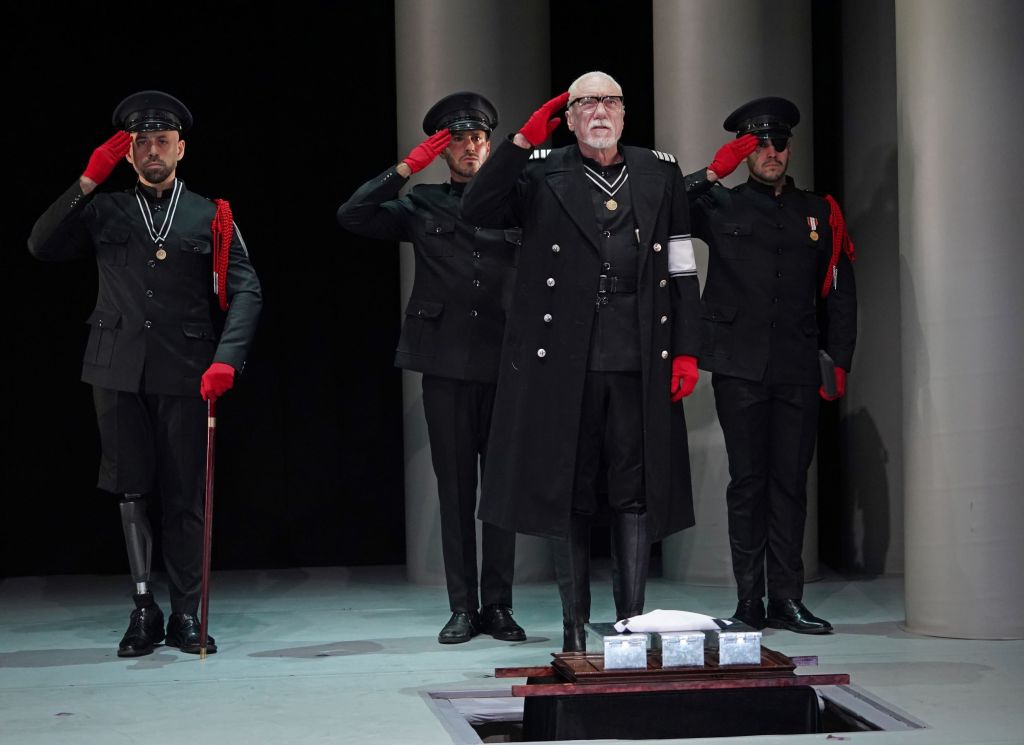
William Shakespeare’s Titus Andronicus comes with a warning label about the bloodshed and violence in this profound, incredibly acted Off-Broadway production at Pershing Square Signature Center. As I was watching the visceral, gut-wrenching performances of Patrick Page’s Titus Andronicus and Olivia Reis’ portrayal as Lavinia, Andronicus’ treacherously abused daughter, I thought of the brutal, unjustifiable bombing of women and children in Gaza, Israel. However, the difference of watching reports via screens from the safety of one’s sofa versus watching fictional live-action bloodshed onstage seems moot. One requires imagination to understand what is happening that media doesn’t show: the eviscerated bodies, the scattered arms and legs of blown up children. That horror compared to immersing oneself in stage acting with the well timed bursting of fake blood capsules during a fight or murder scene? Violence and murder are inhumane. Blood and gore in fictional drama loudly points to the heinous, triggering realities of war going on today.
Thus, the themes of William Shakespeare’s goriest tragedy are impactful. But one must understand that the result of Titus Andronicus‘ gore is tragic. Murder, treason, blood-lust, vengeance all turn the warriors’ swords against their own entrails. This is especially so when the ones maimed and brutalized are offspring the enemies leverage to emotionally annihilate their parents. There’s nothing like watching one’s future inheritance and legacy wiped out and being unable to find peace afterward. That is the ultimate tragedy in the magnificent Titus Andronicus produced by Red Bull Theater at the Alice Griffin Jewel Box Theatre. Titus Andronicus has been extended through May 3, 2026.
At the top of the play victorious, intrepid Roman general Titus Andronicus returns from the wars in triumph, but having paid a stiff price. During the battles he sacrificed three of his sons for Rome. However, he did succeed in bringing Rome the spoils of his win. Titus presents these captives to Rome: Tamora (Francesca Faridany) the Queen of Goths, her ambitious warrior/lover Aaron the Moor (McKinley Beelcher III), and her three sons played by Jesse Aaronson, Blair Baker, Adam Langdon. Their captivity in chains gives more light to shine Rome’s mighty, justified conquests.
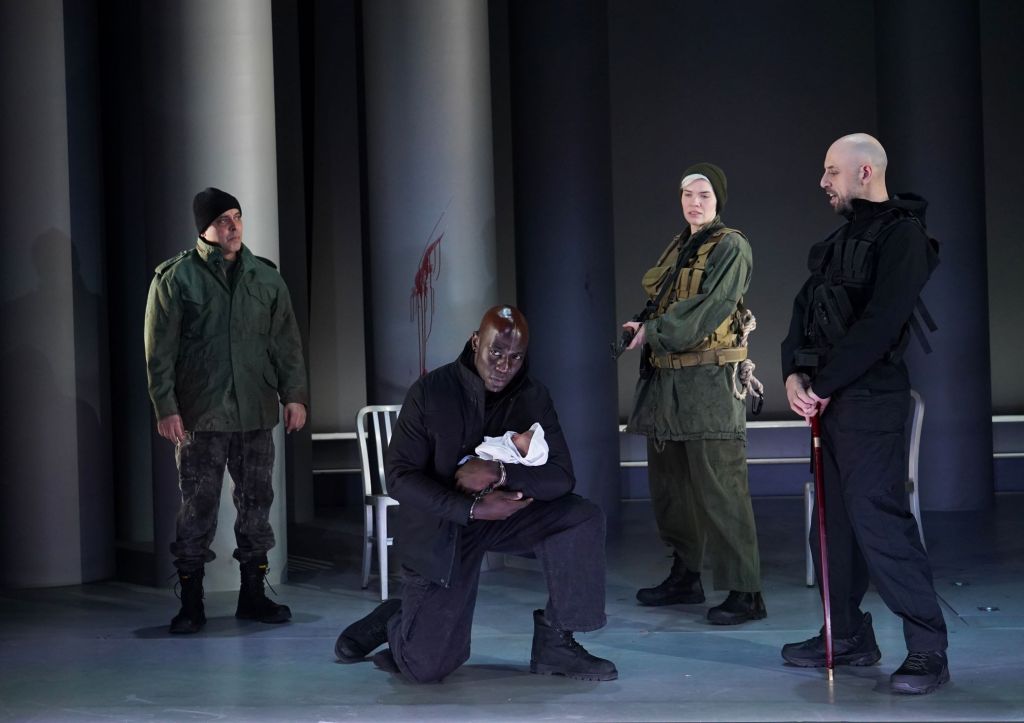
During the Andronici family reunion which includes Titus, Titus’ Tribune sister Marcia (Enid Graham), his daughter Lavinia and his three living sons, played by Anthony Michal Martinez, Zack Lopez Roa and Anthony Michael Lopez, they perform burial rites. Additionally, a ritual of recompense is made of Goth blood for Andronici blood. Lucius (Anthony Michal Lopez) states, “Give us the proudest prisoner of the foe, that we may hew his limbs and sacrifice his flesh to these our fallen brothers.” It is an act to appease the deceased son’s spirits who were killed in the war with the Queen of the Goths, and to stop any “prodigies” from being visited upon the Andronici.
If bloodletting is ever fair, the balance is that three were lost and the blood of one is the equivalent of three. This is a ritual always performed on the battlefield and to Tamora’s pleadings, Titus asks her to pardon him. His sons perform the ritual killing of Alarbus without rage, but as a tradition. One could argue this duty is more than fair, a viewpoint Titus holds, but Tamora does not.
In truth, Titus should have killed all those he captured, instead of just Tamora’s oldest, her firstborn son. Dismissive of Roman tradition, the Goth Queen sees this act as a gruesome provocation-killing her son in front of her. She is a Goth; she doesn’t “get” Roman traditions or values. She dispenses with the mercy Titus bestows on her, the Moor, and her sons by letting them live and roam free to do damage to Titus and his family. Titus’ mercy is a brutality from Tamora’s perspective. And Titus doesn’t remind her of the fact that she and the others live by his grace. In tragic blindness she refuses to acknowledge or see his act as just and a Roman tradition (I read the script’s stage directions about killing her son as ritual.). And Titus is completely blind to her ferocity and the possibility that she will get vengeance on him and his entire family when the opportunity arises. She has chosen not the way of life bestowed by Titus’s grace, but of vengeance, bloodshed and death. Tragically, blindly Titus lets down his guard and opens the door to Tamora’s hell with fate’s help.
In their blindness lies their downfall.
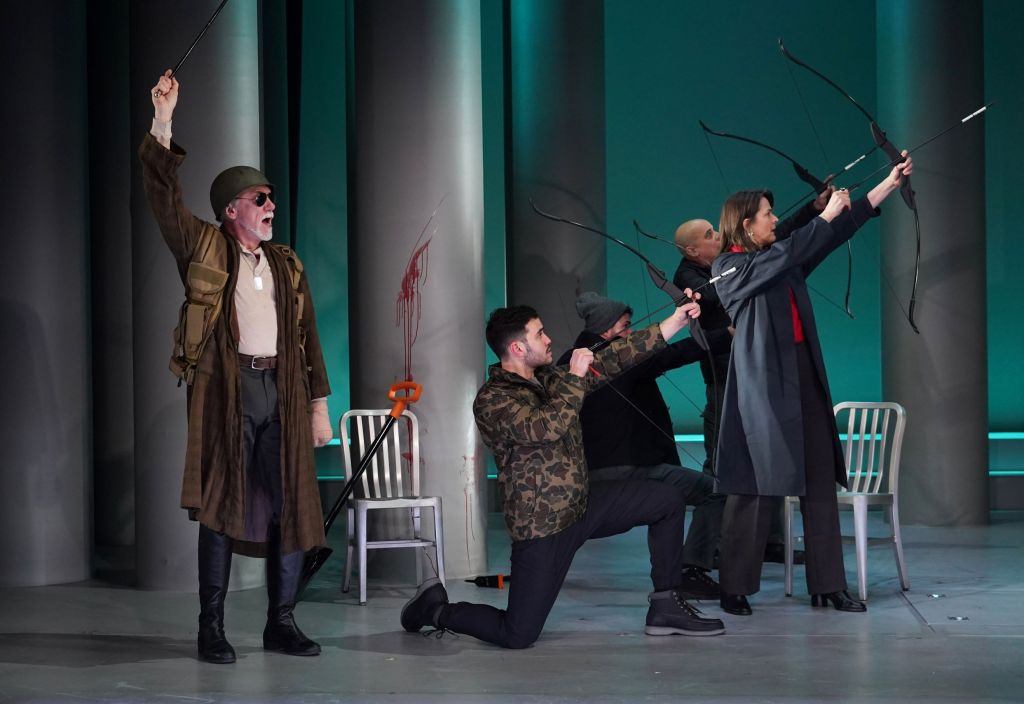
Most probably if Tamora had won, Titus and his sons would have been killed. We note in her future actions and those of Aaron, her lover, what she would have done. Humiliated, a captive in chains, a loser, she chooses to feel provoked by her eldest son’s sacrifice, not acknowledging the lives his blood saves. As they take her and the captives off, she rants, beats her breast and waits for a time of revenge saying, “I’ll find a day to massacre them all.”
Unfortunately, that day comes sooner than later. It is hastened by Titus’ choice not to be the Emperor of Rome, though the people want him, and though Lavinia’s betrothed Bassianus (Howard W. Overshown), Saturninus younger brother, supports him with his troops and followers. Why? Romans are not idiots. Saturninus, the late emperor’s eldest son is unlikable, silly, pompous and incompetent. They want Titus, but Saurninus, the child, protests, not caring about Rome, but caring about himself. In fact Titus would make the better leader proven by his track record of service, leadership competence and popularity. (The parallels with the US are staggering)
Titus makes his ultimate mistake not taking the emperor-ship, stating he is too old and that he wants to enjoy peace after forty years of wars. Titus persuades the people to accept Saturninus as the head of Rome. Under his rule, all hell breaks loose and chaos and violence are unleashed by this terrible decision. Mathew Amendt portrays Saturninus as an infantile, asinine, petulant fool easily duped by one who ends up with a ruling partner as unfit as he, but worse-the bloodthirsty Tamora. Not able to have Lavinia, though Titus suggests it to her, then relents when she says she is betrothed to Bassianus, Saturninus elevates the bloodthirsty Tamora to the throne as his queen. There, she is all about peace and unity. Titus doesn’t see her coming. Nor does he see coming her instrument of vengeance, the gleeful, sneaky Aaron who suggests rape, mutilation and torture for Lavinia to Tamora’s slothful sons. He also suggests a means of impunity so she will never confess the crimes nor bring about her own healing.

Jesse Berger’s staging works, though the tone of the tragedy shifts off its axis in Act II from sorrowful horror to an outrageous, sometimes weirdly comedic tone. In the last scene of Act I Page’s Titus experiences the full effects of Tamora’s trickery and the loss of two of his sons. When Page’s Andronicus beholds what the spirit of vengeance and hate have done to Lavinia, he is broken. With breathtaking, magnificent, touching grief, he cannot absorb what an anonymous “they” have done to his daughter. Reis’ pitiable cries at the heinous treatment during her violent struggle with the heartless Aaronson’s Chiron and Langdon’s Demetrius (both excellent) are symbolically representative. She is the archetype of women’s soul murder and it is clear why men use rape and mutilation as the defining weapon of war. In the scene Reis conveys what every woman in that position feels. Beyond words.
Page and Reis are incredible together. Page’s Titus slides into madness with laughter and screaming, the extreme emotions of a father unable to protect his daughter or help her. As the destroyed Lavinia, Reis’ cries in echoing response to stage father Page are shattering. One cannot help but weep for empathy at their loss of identity, beauty and valor.
Of course Act II is almost anticlimactic as we wait for the coming revenge on one who chooses vengeance and death rather than life and peace when she vows to “massacre them all.” In that, too, Tamora fails for Lucius lives to become emperor welcomed by both Romans and Goths alike with Tribune Marcia serving his mission of peace, ending the cycle of revenge. Belcher III is superb. As Aaron he speaks passionately to save the son birthed by Tamora who in humiliation gives up the Black child to be killed to hide her shame. The speech softens Aaron’s Iago-like wickedness as the engineer of Tamora’s revenge. His humanity extends to his innocent son, whom he forgives, as he wallows in despair and condemnation.
When Page’s Titus sits his guests down to dinner dressed in a chef’s hat and outfit grinning from ear to ear, he holds Tamora’s sons flesh pie. The laughter from the audience is a confusion of emotions: gladness that he is holding Tamora accountable with a just revenge; empathy that anyone would be driven to this. In fact laughter at serving up Tamora’s sons in a meat pie is all that is left of his sanity.
By this juncture Titus has released all his grief and sorrow. Life has become absurd. What’s left when nothing’s left? Page who worked on the script and did a masterful job sluicing it to crystal clarity reveals the descent of a noble individual who was better at fighting wars, than living in peace. His act of killing Lavinia is an act of mercy. If she could do it herself, she would. But the sons have chopped off her hands so she can’t reveal her abusers. Titus knows her yearning for death like he knows his own soul. He lovingly kills her ending her torment, which she will never get over in life, stripped of her identity and empowerment of words and actions, which end any opportunity for her to heal.
Titus Andronicus runs a swift 2 hours through May 3, 2026 at the Pershing Square Signature Center.
redbulltheater.com.

