Monthly Archives: July 2019
‘Little Gem’ Starring Marsha Mason at the Irish Repertory Theatre
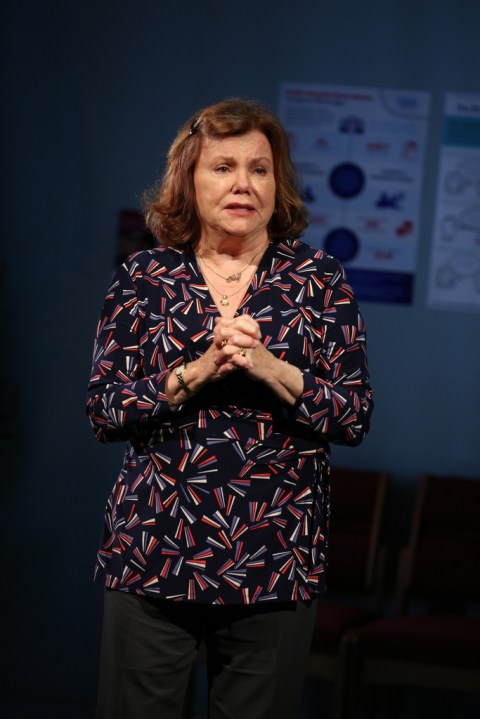
Marsha Mason in ‘Little Gem,’ directed by Marc Atkinson Borrull, written y Elaine Murphy at the Irish Repertory (Carol Rosegg)
Little Gem starring the wonderful Marsha Mason at the Irish Repertory Theatre is a poignant and comedic look at three generations of women from North Inner City Dublin. We follow along as the grandmother, daughter and granddaughter share their experiences, responses and perspectives at major turning points in their lives. Each tells their tale in six separate segments precipitated by a visit to the doctor’s office. In the final segment, the women, having gone through their own personal cataclysms, rally around the comfort of each other and sleep in the same bed, reunited in love and understanding.
The play written by Elaine Murphy premiered at the Dublin Fringe Festival in 2008, where it won the Fishamble New Writing Award before transferring to the Edinburgh Fringe Festival. This production directed by Marc Atkinson Borrull is essentially a solo tour de force for each character/actor. The only interaction among the characters occurs in the last segment. Only then do we see grandmother Kay (Marsha Mason is powerful, heartfelt and funny) daughter Lorraine (Brenda Meaney is ironic and nuanced) and Lauren O’Leary as the wise-cracking, sharp-tonged Amber relate to each other directly.
During the production, we listen to the narration of each woman separately. We revisit how each is at a different stage in her life (symbolic of women in general at different ages in their lives). We understand how she experiences the physical and emotional desires of needing and wanting to be in a relationship with someone who will care for her. And we note how each negotiates the wheel and woe of their personal relationships.

Lauren O’Leary, ‘Little Gem,’ by Elaine Murphy, directed by Marc Atkinson Borrull (Carol Rosegg)
The women relate their stories in flashback in direct addresses to the audience. Initially, we discover the superficial reasons why they are in a doctor’s office. Amber has indigestion and throws up frequently in the mornings. Lorraine is emotionally mottled with stress and needs medications to calm her and resettle her life. Kay has a “personal itch down there.”
As the production unfolds the women by degrees go into their reveals during their story-telling turns with the youngest generation first, simulating the arc of life’s beginning. The forty-something Lorraine represents the middle stage of life and the sixty-something Kay represents the senior years. As they each address the audience, we understand the depth of their angst as they relate how their situations become the touchstones of their growth and realizations. The progression is an interesting one and thematically reminds us of the innocence and naiveté of youth (the fecund period) the transformation into recognizing deeper values in life and the winding down into menopause, and the increased sexual libido that often occurs for older women long after they’ve thrown off the aftereffects of child rearing.

Brenda Meaney, ‘Little Gem,’ by Elaine Murphy, directed by Marc Atkinson Borrull (Carol Rosegg)
In six segments Amber discusses the events with Paul which brought her to the doctor to help her during her pregnancy and afterward as she takes care of baby Jamie and he is accepted into the family. We discover how Lorraine’s stress precipitated by her lack of communication with Amber and worry centered around Amber’s sometimes wild behavior (like mother, like daughter) is somewhat mitigated when she follows her therapist’s suggestions to “get out of herself” and her miseries and goes dancing. After she meets someone, with Amber’s encouragement she goes on a date with him in what becomes a developing relationship.
At the doctor’s office Kay receives “the ok” to have sex without Little Gem who is too debilitated and ill to continue their fabulous sex life. She will do this via the help of a vibrator. Indeed, the scene when Mason effects this is one of the funniest in the play. And as Little Gem fades from this life and moves into the next, at the grave she grieves her husband and in the last scene of the play seeks the comfort of her daughter and granddaughter.
Elaine Murphy’s work is strongest in the concept of revelation and self-recognition and growth that occurs in each of the women’s lives. However, the playwright decides to keep the play largely expositional. This dissipates the drama that occurs in the family dynamic. We note the underlying levels of action, however they are reported; an example of this occurs when Lorraine discusses that she doesn’t communicate with her daughter. However, we never see the characters Lorraine and Amber demonstrate how or when this occurs actively. Likewise, the characters may talk about a family member who stands next to them, but there is no active dialogue or exchange between and among each of the characters until the end. The strongest exchange occurs only then when they get into bed after Little Gem dies and they comfort Kay to reveal they unite as a family.

(L to R): Marsha Mason, Lauren Oleary, Brenda Meaney, ‘Little Gem,’ by Elaine Murphy, directed by Marc Atkinson Borrull (Carol Rosegg)
For me any related emotional power and inherent possibility of empathy falls short with the playwright’s selection of this expositional structure predominately. Would the play have worked more dramatically and humorously with different staging and lighting as each woman takes a darkened stage stepping into the spotlight and sharing the import of her story? Somehow, the office setting was a banal distraction. Or was this the point since the women are vibrant and we are transfixed at various times during their revelations?
The actors stand out because through them, their characters’ stories are exposed. They remind all of us that we have a story to tell and it is representational and unique for our time and place. Meaney, O’Leary and Mason engage and keep us launched into remembering what has occurred previously. We must figure out how related events have bled into the current segments of their narration as they detail the specifics: Lorraine’s difficulties with her daughter, Amber’s difficulties with Paul after he discovers she’s pregnant, Little Gem’s sickness and dying. We become the catch-basin for all of their humorous/poignant story events. These are peaked with the tragicomedy of Amber’s, Lorraine’s and Kay’s feminine perspectives of their middle class lives which include the prickly narrative of their relationships: Amber’s reports of sometime boyfriend Paul, Lorraine’s report of a poignant conversation with junkie ex-husband Ray, and Kay’s explanation of her role as caretaker during Little Gem’s frustrating illness and heartbreaking death.
Little Gem is a portrait of women during crisis and the ways they look for the humor and uplift during the rough patches of life. The audience partners with them as we listen to their troubles like a good friend or neighbor. And in the telling of their stories there is the release, growth and hope that in the family all will be well as the next generation adds to the flavor of their future. And so it goes for us as well.
Little Gem is in a revival in New York from a run in 2010 and is in a limited engagement through 1 September. For tickets and times at the Irish Rep website CLICK HERE.
Annie Golden Kills in ‘Broadway Bounty Hunter,’ A Rollicking, Musical Hybrid

The Company of ‘Broadway Bounty Hunter,’ Music and Lyrics by Joe Iconis, Book by Joe Iconis, Lance Rubin and Jason Sweettooth Williams, directed by Jennifer Werner (Matthew Murphy)
Broadway Bounty Hunter starring the inimitable Annie Golden (Orange is the New Black for six seasons) is a musical comedy that gyrates into the stratosphere with hijinks galore. and a plot that careens to an apotheosis of self-fulfillment for the atypical, underdog, heroic bounty hunter characters. The just comeuppance for the white, privileged, male villain with a greedy, malevolent and double dealing heart (the excellent Brad Oscar) feels right by the conclusion of the production, though he has Broadway connections and was once a sensitive, artistic type until he turned to the “dark side.”

The Company of ‘Broadway Bounty Hunter,’ Music and Lyrics by Joe Iconis, Book by Joe Iconis, Lance Rubin and Jason Sweettooth Williams, directed by Jennifer Werner (Matthew Murphy)
With Music and Lyrics by Joe Iconis (Be More Chill) and Book by Joe Iconis and long time collaborators Lance Rubin (Bloodsong of Love) and Jason Sweettooth Williams (Be More Chill) the production is a hard one to “categorize!” That is its hybrid grace, for it defies description and is a meld of farce, satire, comedy and musical that keeps one riveted by divergences into adventurous, road-trip sequences and action that hypes up the humor and suspense, all the while having a blast and twitting itself. If that “description” appears over-the-top,” the show is just that, and its entertainment and production values are larger-than-life with the excitement and exuberance of a musical that is off-beat wild.
Yet, it begins on a dark, depressing note. Annie, an out of work actress and apparent “has-been,” as “A Woman of a Certain Age,” goes to an audition and is insulted and demeaned by the audition monitor, director and another actress she meets there. The opening number is choreographed and staged by the exceptional Jennifer Werner to encompass the entire theater. The ensemble takes on the roles of various New York City street folks. It is they who take up the cry that Annie later refrains, “they’re not giving no free rides,” to “kick you off the stage,” when you’re a “woman of a certain age.”

Omar Garibay, Jared Joseph, Badia Farha, Christina Sajous, Jasmine Forsberg, ‘Broadway Bounty Hunter,’ Music and Lyrics by Joe Iconis, Book by Joe Iconis, Lance Rubin and Jason Sweettooth Williams, directed by Jennifer Werner (Matthew Murphy).
This unhealthy dose of reality is a slap in the face to every women in the audience over forty and that is the point of revealing where Annie is in her life: in the pits, at rock bottom, in the valley of the shadow of death. Can it get any worse? It does, happy female campers!
After swallowing this bitter dose of time and place in her life, Annie goes back to her seedy apartment and her answering machine of dire messages and the coming blackout of her lights being shut off for non payment of bills. It is then she realizes it’s over for her in the song “Spin Those Records.” Her only solace is talking and singing to the resplendent Charlie, the picture of her Broadway producer husband, who died over ten years ago. As she attempts to persevere to get to the next refrain of the song “I won’t spin those records anymore,” the ensemble echoes her lament that her success has long faded and the songs she once sang in glory have now “forgotten her.”
That the real Annie Golden who has turned the trope of “woman of a certain age” on its head with her success in Orange is the New Black, is not lost on her fans in the audience who cheer her on. And that is the point of the first two songs; the successful Annie Golden can sing these (and she can belt with roaring power) with a hint of mournful acknowledgement that “it is done,” because it isn’t! This is the salvation and humor and hope, which is a major theme of this production. It is never done! It is never over! And surprises do come right around the corner and improve one’s circumstances. But you must persevere for their “coming.”

Jasmine Forsberg, and the company of ‘Broadway Bounty Hunter,’ Music & Lyrics by Joe Iconis, Book by Joe Iconis, Lance Rubin and Jason Sweettooth Williams, directed by Jennifer Werner (Matthew Murphy)
Annie’s “apparent” nemesis is that “the matrix” of privilege in the institutions of the patriarchical system (whether it be in the entertainment industry, politics or global corporate control) would dictate and select who and what can be successful, mostly white men; in the entertainment industry, young, white and thin. Nevertheless, the labels and definitions the institutions place can be overcome and twerked by redefinition and a revolution that embraces multiculturalism and defies ageism, which this production does! Though the setting is the past, the production speaks with its whole heart to the present! BRAVO!
With fervor, inspiration and a little “help” from your friends and colleagues who face the same conditions, you can prosper and thrive with effort, drive and enthusiasm. Considering that only the few “fit” the “success” labels, the great majority who don’t are allies. It is only a matter of perceiving this to be true and working to bring it into reality. Iconis, Rubin’s and Sweettooth Williams’ message is especially uplifting and forward thinking in this wannabe retrograde time of Trumpism.

(L to R): Jared Joseph, Jasmine Forsberg, Annie Golden, Christina Sajous, ‘Broadway Bounty Hunter,’ Music and Lyrics by Joe Iconis, Book by Joe Iconis, Lance Rubin, Jason Sweettooth Williams, directed by Jennifer Werner (Matthew Murphy)
The creators and director are masters of reversals. They turn inside out “the matrix” that would keep us inside “the box,” and keep audiences lulled into the traditional expectations of musical plot, spectacle and character so they don’t necessarily have to look for the profound. Iconis, Rubin and Sweettooth Williams are grand at going upside down and striking deep notes about our culture and society. This production from its funky, stylized music of the 70s and 80s found in Blaxploitation films like Shaft, Super Fly, Foxy Brown, Coffy, etc., to its kung fu, martial arts choreography (by Jennifer Werner) replete with nunchucks (chuka sticks) staffs and surround-action movement and staging with the ensemble abundantly using the audience aisles, soars with energy and excitement. And if you look for vital themes, they are everywhere from #metoo, to image fascism and silent oppression that doesn’t “exist,” until it slams you in the face.
Because we follow Annie to the outer depths of the Mariana Trench of emotional devastation, we are ready to soar with her to the heights of a new career as a “bad ass” bounty hunter hired by Shiro Jin (the classic, cool, deadly Emily Borromeo). We empathize readily with Annie as she accepts “Shiro’s Proposition” without completely understanding the how and the why of it. We cheer her on as Annie becomes accomplished in martial arts skills with the other bounty hunters. And when she gains confidence and bravery learning her “killer moves” and employing acting techniques to sharpen her inner “rage,” we thrill for her.
Ironically, by this point we realize this Bounty Hunter business is no joke. Annie automatically accepts her “mission impossible” to locate, confront and “take out” the despicable, drug pusher, pimp daddy killer with the hot name Mac Roundtree (the funny Brad Oscar). But what is a sweet “woman of a certain age” doing? Well, she does have the help of a strong, uber powerful, yet soft-hearted, sensitive partner Lazarus (the winning, gorgeous-voiced Alan H. Green).

Annie Golden, Alan H. Green, ‘Broadway Bounty Hunter,’ Music and Lyrics by Joe Iconis, Book by Joe Iconis, Lance Rubin and Jason Sweettooth Williams, directed by Jennifer Werner (Matthew Murphy)
In the song “Mac Roundtree Theme Song,” Brad Oscar is the dirty, rotten scoundrel who will front them and “not go easily” against Annie and Lazarus, especially on his home turf in Ecuador. With this shades of the film Scarface, in the foreground, we understand the stakes have been raised and Roundtree is worse than Shiro Jin has let on to Annie and Lazarus. Indeed, their boss may be sacrificing Annie for her own agenda to kill Roundtree. Furthermore, Lazarus and Annie are counter intuitive partners; Lazarus finds her hard to accept and she is dismissive of him. Just before they end up at Roundtree’s mansion in the jungle, Lazarus does confront his demons with the ensemble’s help in”Feelings.” Alan H. Green is just plain out hysterical as he sings Lazarus’ inner angst.
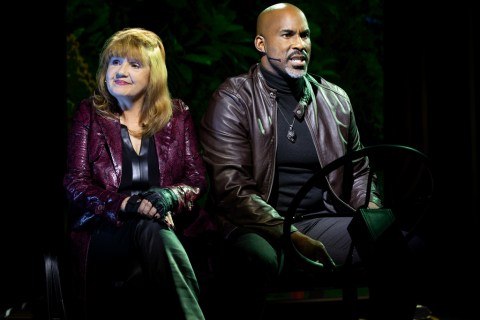
Annie Golden, Alan H. Green, ‘Broadway Bounty Hunter,’ Music and Lyrics by Joe Iconis, Book by Joe Iconis, Lance Rubin and Jason Sweettooth Williams, directed by Jennifer Werner (Matthew Murphy)
As they confront Roundtree’s allurements/prostitutes who gain information about the man and woman are who have come to Roundtree’s empire, the ensemble pulls out all the stops and performs the smashing “The Song of Janessa.” And it is then that the creators, once more, interject two twists in characterization and plot as the arc of development spins into an unexpected direction. Lazarus and Annie discover with a brief touch of the hand, they are attracted to one another (“Aint No Thing”). The second dynamic twist I will not reveal because it is a delicious reversal of a reversal and this is no spoiler alert. Suffice to say that Annie and Lazarus make a fascinating discovery which brings the production to an insightful and intensifying end of Act I. When Act II lifts into the heavens you are ready to hold beats and join Annie and Lazarus for the more surprises.

(L to R): Alan H. Green Brad Oscar, Annie Golden, ‘Broadway Bounty Hunter,’ Music and Lyrics by Joe Iconis, Book by Joe Iconis, Lance Rubin, Jason Sweettooth Williams, directed by Jennifer Werner (Matthew Murphy)
The production flies high with the performances that are campy, yet heartfelt. Standouts are the principals, Green, Golden and Oscar. The ensemble in movement, dance with powerful voices is exceptional. Thanks to Werner’s direction and choreography the show leaps from scene to energetic scene to the jazzy, funky, pop score beautifully rendered by Geoffrey KO, with Charlie Rosen’s Music Supervision & Orchestrations. Just great!
I also enjoyed the fine use of projection and video by Brad Peterson whose designs were the best I’ve seen Off Broadway. They melded with the Lighting Design by Jules Fisher and Peggy Eisenhauer and both sparked up and enhanced the tone and style of this musical, especially in the fight scenes, and Lazarus’ driving his sweet truck sequence. Kudos to Michael Schwelkardt for functional, clever scenic design, Sarafina Bush’s costume design (especially for the ensemble during “The Song of Janessa”) and Cody Spencer’s excellent sound design.
Broadway Bounty Hunter is at the Greenwich House Theater on 27 Barrow Street until 15 September. Reimagined, it moved from Barrington Stage Company where it had a critically acclaimed, sold-out run, to land in the city where the story of Annie Golden begins and ends triumphantly after she goes to South America to deal with a hardened drug pusher criminal. The production will probably have legs and continue to move. Regardless, if it goes uptown, it is a must see that is a unique, enjoyable ride into the past future. Female Bounty Hunters need to do more bad ass kicking the patriarchy before the election cycle is done. For tickets and times CLICK HERE.
‘Mojada’ by Luis Alfaro at The Public, A Superb Update of ‘Medea’ via the Migrant Crisis
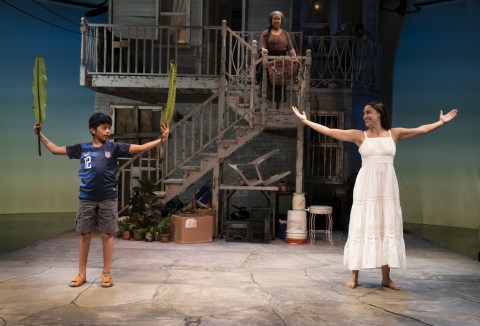
(L to R): Benjamin Luis McCracken, Socorro Santiago, Sabina Zúñiga Varela in ‘Mojada,’written by Luis Alfaro, directed by Chay Yew (Joan Marcus)
Luis Alfaro’s riveting update of the Greek Tragedy Medea spun out against our current immigrant crisis is authentic, primal and timely with exceptional direction and evocation by Chay Yew. I saw it this weekend, one day prior to the Trump announced ICE raids designed to terrorize and apprehend illegal immigrants, “wetbacks” (mojados) with the intention of incarcerating them until eventual deportation. The “raids” failed miserably in their execution, but not their intent to terrorize.
Alfaro adroitly reinterprets the migrant crisis and parallels it with the story of Medea, the sorceress who dispatches her children after her husband Jason dumps her and marries the king’s daughter. However, he makes significant changes in the characterizations, softening and humanizing Medea and Jason and removing the notions of vengeance and anger by changing it to despair, isolation, loneliness and desperation for the character of Medea. Additionally, unlike the classic Medea, Alfaro never leaves off Jason’s love and tender concern for Medea, shifting her enemy conflict away from Jason to her rival Pilar.
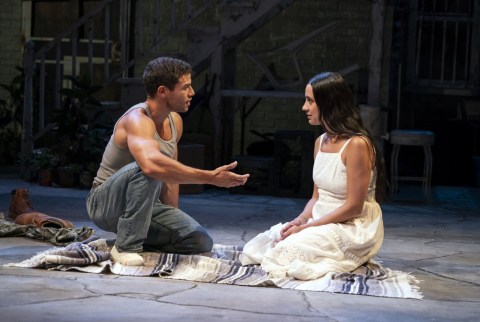
Alex Hernandez, Sabina Zúñiga Varela in ‘Mojada,’ by Luis Alfaro, directed by Chay Yew (Joan Marcus)
Alfaro’s Medea is the the indigenous Mexican “mojada” portrayed by the always present and heartfelt Sabina Zúñiga Varela. Varela gives an exceptional, thrilling portrayal of the emotionally driven and abused spiritualist who has been raped on their journey to the United States and still psychologically suffers from the trauma. Her servant/family member tells us early on in the play that despite the herbs she gives her, she cannot heal. Later, as Medea revisits her horrific journey to “freedom” in America in a flashback sequence, we discover why she cannot “heal;” the trauma has frozen her soul and filled her with fear and death.
Medea’s partner Jason (the excellent, charming Alex Hernandez) is one she adores. Despite the sacrifice of her wholeness and happiness, she stays with him and they finish their journey North with their son Acan (the lively, adorable Benjamin Luis McCracken) and their servant Tita (the humorous, wonderful Socorro Santiago) so Jason may fulfill his ambitions. In a later reveal, we discover why Medea had to leave. When Jason suggests they start over in America, she has little choice but to join him and remain under his protection. However, Medea is confused and unable to self analyze and straighten out her severe emotional problems after their arrival.

(L to R): Alex Hernandez, Sabina Zúñiga Varela, Socorro Santiago in ‘Mojada,’ written by Luis Alfaro, directed by Chay Yew (Joan Marcus)
Early on in the production we discover that Jason wants “the American Dream.” Clinging to Jason and her family as her only hope, Medea believes in Jason’s love and good will. She indulges his promises of a better life for her and their son in the alien American culture. As the play begins, all appears calm for they have settled in Jackson Heights, New York and both have jobs and earn money while Tita cares for Acan. Jason works construction and Medea works at home, all of which is a divergence from the classic play Medea which begins after Jason and Medea end their marriage.
Alfaro seeks to represent his Mexican Medea with a strong faith in herbal medicine that Tita concocts as well as a ritual morning obeisance to the four winds which she practices with Acan as an incantation, a recitation to recall their past life and infuse it with them in the present so they never forget what they have given up. As an indigenous Mexican, Medea is close to the spiritual plane. Her incantation’s powerful symbolism to her mind strengthens the connection with their homeland to which Medea daily seeks a return, despite Jason’s successful forward direction in becoming prosperous and in encouraging a better life so they may become American citizens. Though Alfaro’s Medea lacks the status of a princess, his portrayal of her beauty, innocence and purity (she is in white throughout the play) represents an everywoman. His depiction symbolizes the core ethos of what makes women noble and sanctified. Varela embodies these traits and heightens the honor of Alfaro’s vision for this character which makes her desperate, hopeless fall from grace all the more tragic and poignant.
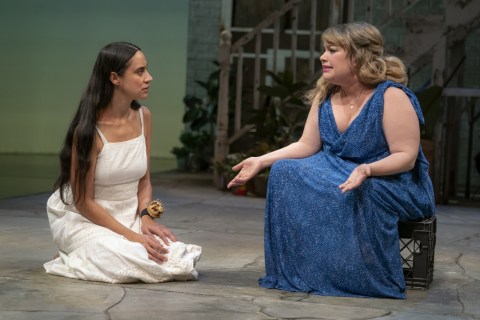
(L to R): Sabina Zúñiga Varela, Vanessa Aspillaga in ‘Mojada,’ by Lluis Alfaro, directed by Chay Yew (Joan Marcus)
Medea, a professional level seamstress, works diligently at supplementing their family income by creating a veritable sweatshop in their home where she makes gorgeous clothing at a pittance while her “bosses” reap a substantial profit for each item and exploit her labor because of her non-status as an illegal immigrant without a green card or work visa. The theme of workers being exploited for their cheap labor while greedy individuals who prey upon their circumstances reminds us of the timeless status quo of the workers vs. their corporate overseers and highlights the plight of undocumented workers. It also is reminiscent of the greed of corporate America which refuses to pay the proper value for their workforce that makes them profitable while paying their CEOs who largely schmooze and network lazily 300 times the amount.
In Medea’s life as an undocumented worker is the everpresent fear that she, her son and Tita may be turned in and deported. This haunts Medea and contributes to her agoraphobia so that she prefers to stay at home in Queens away from the chaos of New York City life that is unfamiliar to her. Her status oppresses her for she has no way to bargain with her employers who “call the shots” and pay her the minimum locking her into an indentured servitude. She has no recourse if she doesn’t like her wage to ask for more. They will go to another undocumented worker or have her deported. Her circumstances make her their slave.
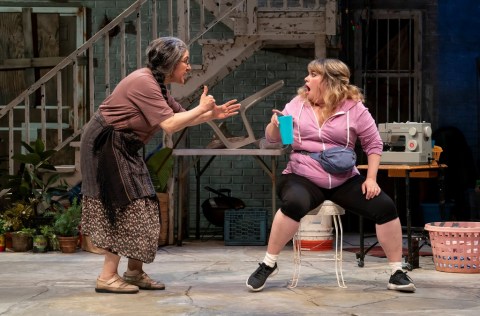
(L to R): Soorro Santiago, Vanessa Aspillaga, ‘Mojada,’ written by Luis Alfaro, directed by Chay Yew (Joan Marcus)
All the general details of Medea, Jason and Acan, Tita relates to the audience chorus-like in a humorous narrative in which she pines for the old country and identifies the difference between the old ways and the inferior American lifestyle. Having been sold to take care of Medea since her mother died as a baby, Tita acknowledges her servile position, but reinforces her authority as a healer who has taught Medea everything she knows. Tita loves Medea who is her obligation. But she fears for her as an innocent and questions Medea’s blind loyalty to Jason whom she believes is not worthy of Medea’s trust. Tita is not only a healer, she is telepathic and she sees what Medea refuses to recognize because if she does, all that Medea has experienced to get to America is in vain, above all the pain and torment she endured on the trip and the misery she feels as an outsider who fits in nowhere in except in Jason’s arms and Acan’s reliance on her.
The arc of development jolts forward after we meet Jason and note how Medea and Jason greet each other, with the calls of the guaco, a bird that lives in the southwest. Their cries to each other are haunting and beautiful. We recognize the bond between them that is ethereal and powerful. Alex remains affectionate and loving to her as Alfaro diverges from Euripides’ classic tragedy in that their family which has been in the U.S. for about a year appears to be united and prospering. Jason is fearless in his desire to be someone and take Medea, Acan and Tita with him on this uplifted path to citizenship. He appears honorable and we assume theirs is the happy whole, until we discover the cracks in the foundation that earthquake and drive the family apart by the end of the play.
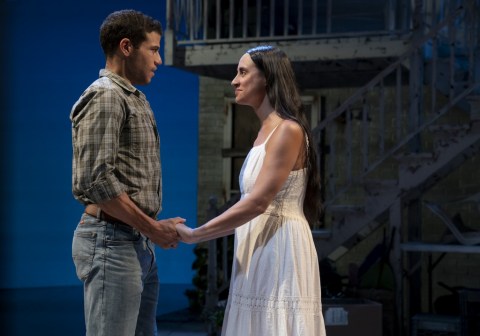
Alex Hernandez, Sabina Zúñiga Varela in ‘Mojada,’ by Luis Alfaro, directed by Chay Yew (Joan Marcus)
The cracks of the foundation are revealed in flashbacks. At one point Medea asks Jason to make love to her under the stars out in the open but she stops herself, and the tender Jason understands and is patient with her. In the extended flashback which Medea narrates, we discover how they struggled to make it to the border, but not before Medea is violated by Mexican soldiers. But that is not the worst that could have happened. Another young woman along the journey is not only gang raped, she is killed and dumped in an unmarked grave. The ordeals migrants go through seeking a better life for themselves is clarified dramatically during this vital segment without polemic or dogma. The ensemble’s acting during these scenes brings the audience to the edge of horror and beyond.
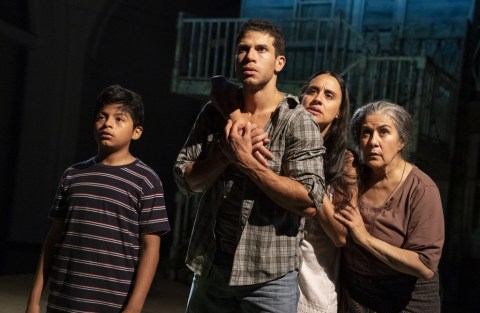
(L to R): Benjamin Luis Mcracken, Alex Hernandez, Sabina Zúñiga Varela, Socorro Santiago, in ‘Mojada,’ by Luis Alfaro, directed by Chay Yew (Joan Marcus)
It is Medea’s relationship with Jason that receives the most dynamic upturn in the development of the conflict which Alfaro gradually unravels as we glean the events from Medea’s perspective. Alfaro cleverly occludes the truth as Jason has obfuscated the reality of his personal circumstances to Medea. On the surface we only see that Jason chides her for not going out, and seeks her love and support for his working late nights for the family’s benefit. Even though gossipy comedic Luisa, a neighborhood vendor from Puerto Rico (vibrantly acted by Vanessa Aspillaga) intimates that she is glad her own husband is ugly because Jason’s good looks would be catnip to women, Medea laughs but doesn’t get the message. And the playwright gives no hint of deception until deep in the play so that when its revelation comes, we are shocked and devastated for her.
In a splendid and relevant turn for the culture he writes about, Alfaro shifts the conflict away from the aspect of revenge and justification for vengeance that the classic Euripides’ Medea emphasizes. In Mojado, Alfaro focuses on the bond between Jason and Medea, always as a loving one so that Jason’s betrayal lands like a bomb, and even then, Jason’s charm and sweet, urgent pleas almost convince Medea that he means well in his actions.

Benjamin Luis McCracken, Alex Hernandez,Sabina Zúñiga Varela, Socorro Santiago in ‘Mojada,’ by Luis Alfaro, directed by Chay Yew (Joan Marcus)
Medea’s true enemy is “the other woman” who is Jason’s wealthy boss Pilar (the forceful, slyly arrogant Ada Maris) who has turned her life into the success that Jason intends for himself. Pilar represents all that is noxious about immigrants who embrace the “American Dream,” assimilate and lose their souls to the pursuit of power and money. They become even more treacherous and corrupt than the dolorous white citizens who have been in the country for generations, some of whom have failed and refuse to pick themselves up but instead, blame the migrants for stealing jobs that their own lack of effort would never “lower” them to take, for they are too “superior” to do such labor. This notion abides sub rosa as we watch Pilar and Jason discuss business and note the tremendous industry that Pilar, Jason and Medea embody in their diligence and effort to make money and prosper. Undocumented migrants are synonymous with an incredible almost Puritan work ethic in this play. It is a truism that partisan politics to tickle the ears of the dolorous white supremacists turn on its head.
Pilar comes to diner and reminds Medea that she is staying in one of Pilar’s many houses. Pilar implies she is to be appreciated for not charging Medea fees for making the home into a sweat shop. She infers that it is only her reliance on Jason whom she intends to promote who deflects Pilar from taking a percentage of the money Medea makes. Again, the theme of the exploitation and predation of immigrant bosses who have “made it” taking advantage of undocumented migrant brothers’ and sisters’ industry and resourcefulness is brought to the fore.
When Pilar greets Acan with affection that reveals they have been together a number of times, Medea still remains blind. It is only when Jason reveals that he has married Pilar does Medea begin to understand the forces ranging against her. Medea and Jason never married. Medea believes their union is a spiritual force that would keep them together forever. A marriage paper for their life in Mexico was not necessary; they are bonded by their love and the fruit of their union, Acan. However, in America, legality is paramount so that their spiritual union is nullified by the absence of a piece of paper. The crass American values of money, power, materialism over spirituality, loyalty and love overcome Medea’s hope of survival. Her only way out of the misery and desperation Pilar and the corrupted Jason have bestowed on her as her fate is to take the only power she has left and use it.
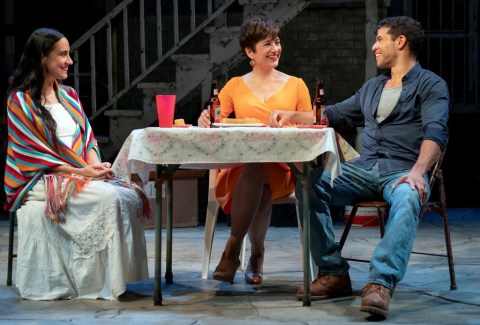
(L to R): Sabina Zúñiga Varela, Ada Maris, Alex Hernandez in ‘Mojada,’ by Luis Alfaro, directed by Chay Yew (Joan Marcus)
In the incredible scene between Pilar and Medea, all of the undercurrents of a woman used to demanding her own way crashes into the innocent Medea’s consciousness. Pilar’s rivalry with this woman who is still loved by her man is acute. It is either Medea or her and unless Medea “gets lost” she will have her deported. The choice for her is no choice. An even more dire fate awaits Medea in Mexico in her home town.
Alfaro has written an amazing play referencing the classical tragedy. He has adopted his work to the Mexican/Latino culture and in so doing expertly gives us an appreciation for what immigrants endure for a better life. Additionally, we empathize because his work covers timeless themes about the powerless vulnerability of migrants like Medea/la mojada. He spins out the familiar tale but enhances it with great depth of feeling so that his protagonist (spoiler alert) restores her own honor and delivers herself to freedom by her acts which proceed more from desperation and sorrow than vengeance. She empowers herself through suicide, something that the sorceress Medea would never contemplate. But in la mojada’s choice there is dignity and sanctity, but at great cost. And at the last moments which are breathtaking she calls out with the cry of the guaco from the realm of spirit. And the response is her tragedy and fall from grace.
From the performances to the authentic, realistic sets and Chay Yew’s fine directorial choices, Mojada is Alfaro’s monumental vision for our times through the lens of Euripides powerful tragedy Medea. In effecting his version Alfaro reveals the great nobility and honor in those who seek to evolve to a different life in another culture, often not completely understanding that the life they seek is filled with corruption, devastation and dishonor. However, to not try is worse. To remain and never know or never learn is naive and a submission to fear and death. The greatness of Alfaro’s character Medea is in her attempt to hold on to the little health/innocence she has and endure. When evil threatens to overwhelm her and her family completely, she defends herself in the only way she knows how. And we are uplifted and sorrowed for her choice.
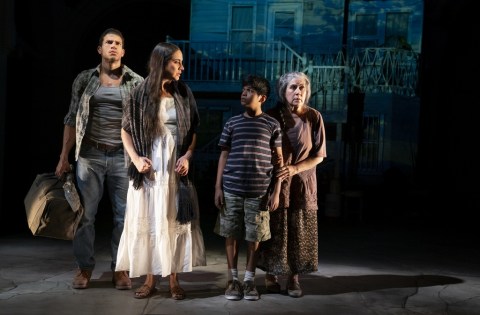
(L to R): Alex Hernandez, Sabina Zúñiga Varela, Benjamin Luis McCracken, Socorro Santiago (Joan Marcus)
Kudos goes to the creative team for their fine evocation of the family’s lifestyle through minimalism: Arnulfo Maldonado (Scenic Designer) Haydee Zelideth (Costume Designer) David Weiner (Lighting Designer) Mikhail Fiksel (Sound Designer) Stephan Mazurek (Projetion Designer) Earon Chew Nealey (Hair Style Consultant & Wig Designer) Unkledaves Fight0House (Fight & Intimacy Director).
Mojada runs 1 hour 45 minutes without an intermission at the Public Theater on Lafayette Street until 11 August. Run, do not walk to see this memorable production. For tickets and times CLICK HERE.
New York Music Festival 2019 Review: ‘Buried’

Lindsay Manion, Sebastian Belli, ‘Buried, NYMF 2019 (courtesy of the production)
The New York Music Festival 2019, now in its 16th year (July 8-August 4) remains the premiere musical theatre festival in the world. During the past sixteen years, thousands of artists and administrators have participated in over 400 new musicals some of which have moved to a renewed life Off Broadway. Others have toured the country and found venues elsewhere, perhaps landing back in NYC to achieve a finer calling after being tested on the road. Indeed, a very few like Next To Normal make it to Broadway audiences.
The possibilities for Buried, this year’s only musical which hails from the UK are trenchant and wide-ranging, depending upon the continued energy and fervor of its creators. The music and lyrics are by Cordelia O’Driscoll, book and lyrics by Tom Williams (he also directs) with fine orchestrations and musical direction by Olivia Doust. Buried, a black comedy/musical/drama was twice presented at the Edinburgh Fringe Festival and it has won awards. I have missed this production these past three years I’ve attended the Edinburgh International Festival and Fringe Festival. I’m glad it found a home at NYMF 2019 so I could see its promise and hear the lyrical music.
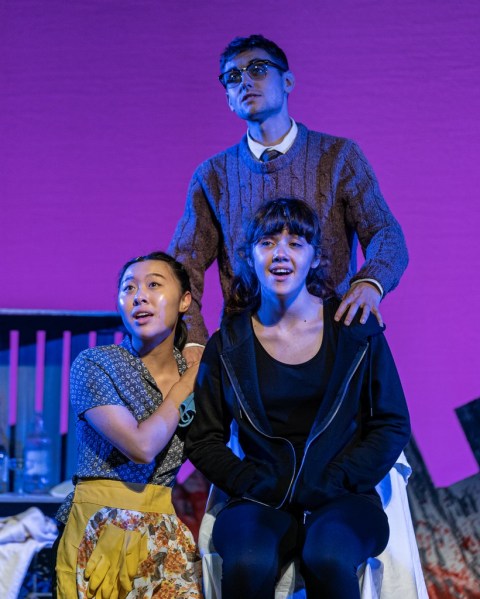
(L to R): Rebecca Yau, Wilf Walsworth, Lindsay Manion, ‘Buried, NYMF 2019 (courtesy of the production)
I am intrigued by the initial concept of serial killers falling in love. However, how Rose (Lindsay Manion) and Harry (Sebastian Belli) eventually, slowly fall in love is problematic. Perhaps the stakes are not high enough, the protagonists not alluring and scintillating enough because they are too self-engrossed in their issues and pasts. Considering there is no rational justification for being a serial killer, the psychological angle could have been turned on its head regarding the protagonists in the scenes they have with each other. The digression into the comedic examination of the psychology of killing with the doctor/professor and his questioner (ensemble-Laurence Hunt and Wilf Walsworth) is witty. Indeed, the one song they sing provides the interposition of a much needed variety with the rest of the score.
However, the self-examined life of Rose and Harry as they discuss who they are and why they are with one another becomes repetitive after the initial songs. There is a matter-of-fact irony lyrically carried by the music that reveals the thrust of their togetherness to be that they kill and are outsiders. More is needed. They are able to front to get their prey and can fit in enough to get dates. But allure and charm is wanting; the sociopath, the psychopath are hungry; they are compelled; they manipulate.
These protagonists are drawn in a halfhearted measure. If theirs could be a love at all costs which it is not, we might have been completely enthralled. And in that identification, the theme, which faltered in this production would be enhanced. Where is the revulsion that we may be attracted to the allure of another soul, no matter how damaged or self-destructive and the fact that that soul may have as its intent to lure us to kill us?
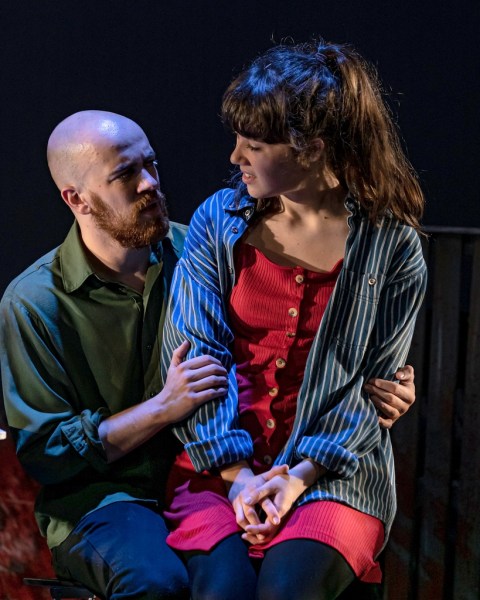
Lindsay Manion, Sebastian Belli, ‘Buried, NYMF 2019 (courtesy of the production)
The concept of the show is original. On a level beyond its purely fantastic entertainment value (and it is entertaining without a doubt) I considered that the production should either pull back or go to its most extreme sardonic limit. Because the tension and conflict doesn’t rise to a pinnacle, it gets lost in the limbo of relationship doldrums between the two protagonists, which I drifted out of in the middle of the show. However, I came back to them at the powerful conclusion which was dynamic with the external conflict adding tension. The beginning was strong as was the ending with shining moments as Rose and Harry select their final destination.
The book could use a reworking of the arc of development to make it more powerful and in the moment. Additionally, it needs to pump up the possibilities for incredible, “kill-em” black humor to give it the grist to engage throughout. If the creators could add in new songs, perhaps with a different music style and swap out those that sometimes become lyrically redundant, the score would be various and lifted. The music is gorgeous. However, it becomes repetitive. The full appreciation of its beauty, as a result, diminishes.
All the above is couched from the perspective that the show is good enough to deserve reworking so that its inherent possibilities can be manifested and taken to additional venues and go far. The cast is excellent. Manion and Belli engaged us especially in the beginning and the ending. However fine their skills are, they could not overcome the show’s middle section which speaks more to the conflict and development of the book’s structure, not their fine performances or lustrous voices. The same may be said for the fine efforts of Hunt and Wallsworth, Niamh Finan and Rebecca Yau who performed seamlessly to Tom Williams able direction.
Buried, part of the 2019 New York Musical Festival, should be seen because it is an entertainment that is fun and delights with humor. It is a show with tremendous potential. Kudos to all involved!
Buried runs with no intermission from July 9-14 at The Alice Griffin Jewel Box Theatre at The Pershing Square Signature Center, 480 West 42nd Street. For tickets and times CLICK HERE.
 CAROLE DI TOSTI