Author Archives: caroleditosti
John Lithgow in ‘Giant,’ a Towering Triumph in a Giant of a Play
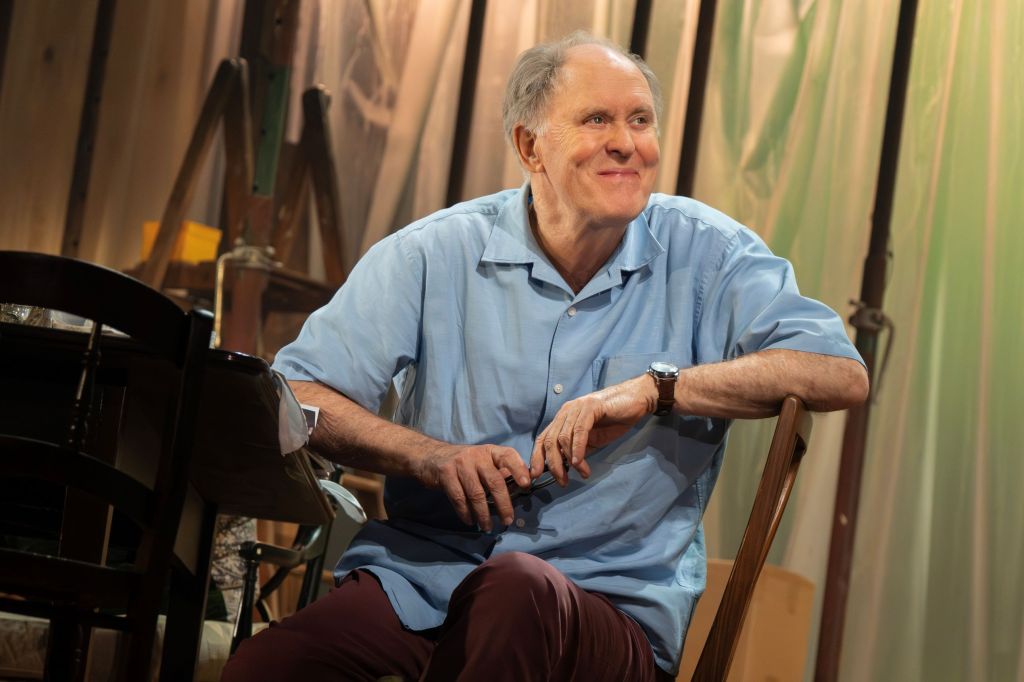
Roald Dahl, beloved British children’s author and poet, has sold more than 300 million copies world wide. He has been called “one of the greatest storytellers for children of the 20th century.” Dahl was also a self-proclaimed anti-Semite. How could a tender-hearted children’s author who answered children’s letters and nursed his wife back from death, be a bigot? The answer to this question turns the drama Giant by Mark Rosenblatt into thrilling, dynamic and controversial theater. Acutely directed by Nichols Hytner and designed by Bob Crowley, Giant runs in a limited engagement at the Music Box Theatre until June 28, 2026.
Mark Rosenblatt’s thought-provoking and slippery play about Dahl takes place in 1983 in the deconstructed living room of Dahl’s family home in Buckinghamshire, England during a summer afternoon. At the odd moment workers who renovate upstairs, pepper the quiet with loud bangs thanks to Darron L West’s sound design, which supports the set design, an undressed living room awash in plastic curtains, boxes and a table and chairs. The cacophony drives John Lithgow’s Dahl up the wall as he discusses the final draft of his latest children’s book, Witches, with Tom Maschler (Elliot Levey). Tom, the managing director of his British publisher, counters Dahl’s complaints with cheerfulness and irony.
With this foray into book corrections we get a glimpse of the terrific John Lithgow’s best selling children’s author responsible for Mathilde and James and the Giant Peach to name a few. Rosenblatt painstakingly constructs the direct, intrusive style of the author with specificity. We note that Dahl listens to every word and humorously spits out whiplash retorts. Apparently, he finds fun in provocative wordplay and enjoys stirring argument.
Lithhgow, who has gotten inside the skin of Dahl and walks in his shoes comfortably, reveals Dahl’s steel-trap mind, and his prickly personality, a mine field to carefully navigate with eyes open. His adversary Mrs. Jessie Stone (Aya Cash), discovers by the play’s end that his cheeky, dark, playfulness should not be underestimated as silly or childish. Indeed, his actions reveal intention. His demeanor may be dismissed as egotistical and inflexible, but it can also be described as adamantine regarding his convictions, however wrong-headed one may think them. On closer investigation Dahl is the giant that should not be self-righteously challenged. He must be responded to in like kind to bring out his generous, sensitive heart to receive the best results for all involved.
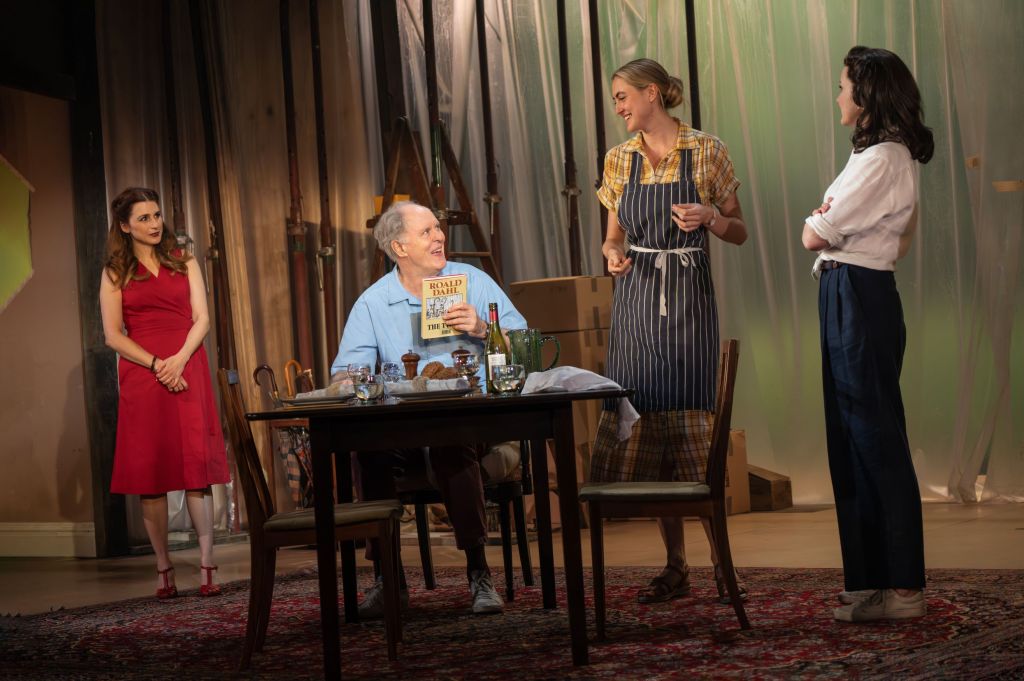
Tom and Liccy, Dahl’s long-time lover and fiancée (Rachael Stirling), have learned to smartly counsel him. And this particular day of aches and pains and banging and agitation requires that he be subtly “managed.” Grumbling about royalties, Dahl waits for Jessie Stone, the sales representative from his American publisher. Prompted by the publishing house, she visits to discuss a scandalous review he wrote that exploded with negative press into a death threat by a “crank-caller.” The book Dahl reviewed was God Cried by Catherine Leroy and Tony Clifton. It concerns the 1982 siege of Beirut, Lebanon where Israeli soldiers killed 22,000, mostly Lebanese women and children.
An RAF fighter pilot who shot down German Junker 88s during WWII, Dahl knows the death threat was from a coward because “genuinely violent people don’t call beforehand.” He remains nonplussed, despite Liccy and Tom’s concern, but he keeps the hired policeman stationed outside to protect his family. Furthermore, he dismisses the impact of his review. Later in the play Liccy implies he knew what he was doing and avoided discussing it with her because she would have moved him to take out his inflammatory statements.
Gradually, we learn of the trouble Dahl caused for himself as Liccy and Tom discuss how to “make the stink go away.” Liccy quotes the “Spectator’s” Paul Johnson, who said Dahl’s book review was, ‘The most disgraceful thing to be written in the English language for a very long time.” Though Tom dismisses Johnson as “a hysteric,” Liccy says the criticism about Dahl is “everywhere. All the rags. Left and right.” The point seems to be how badly this will tank his career, reputation and book sales without an apology.
However, we don’ t know what Dahl wrote in his book review until after Jessie arrives. Her mission is to run interference, reveal the fallout in the United States and get Dahl to make a statement, at best, disavowing his objectionable comments so the company’s profitability and launch of Dahl’s Witches goes swimmingly.
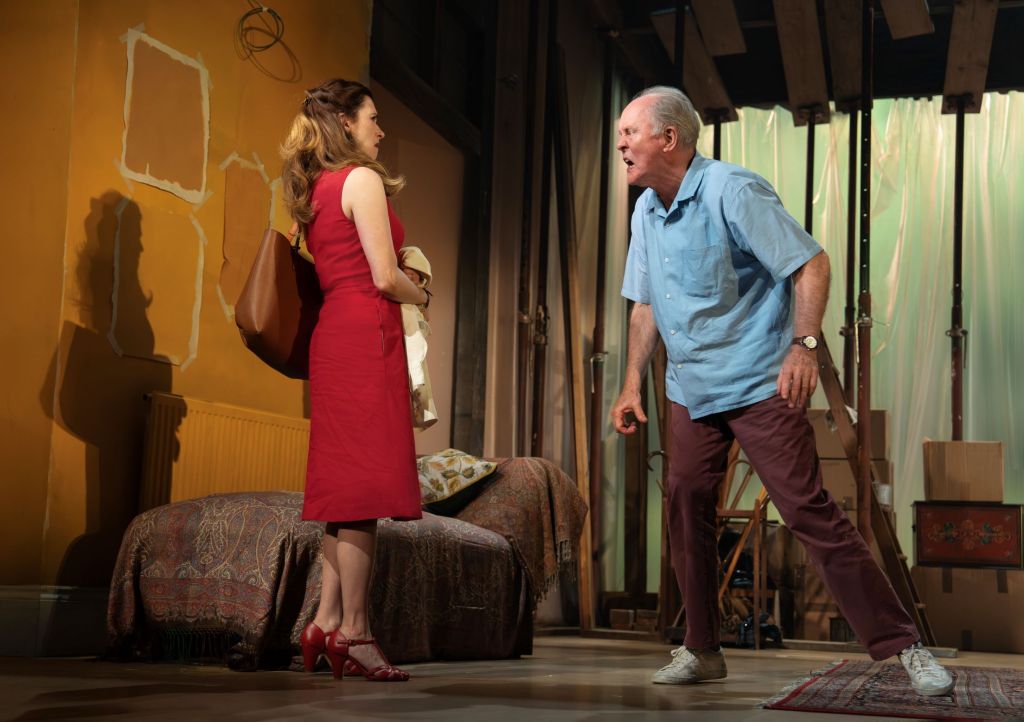
The controversy begins when Dahl asks if she’s Jewish, a question Liccy gently chides him about because of its rudeness. However, Jessie’s answer about her name change from Stein to Stone helps Dahl consider how he should proceed. Does she feel attacked by Dahl’s remarks which she deems antisemitic because they are anti-Israel? Dahl’s provocative question rankles her. A cut-out of his review with her accusatory notes scribbled on it that falls out of her son’s book she wished him to sign provokes him.
Rosenblatt sets up the mounting drama conveniently. Tensions increase as Jessie backs Dahl into a corner and the celebrated author reacts defensively. In a private moment Tom criticizes Jessie for not keeping quiet and for not “managing” Dahl away from his incendiary impulses. If only she had returned Tom’s call so he might have debriefed her about how to best conduct the meeting which now, crashes and burns.
As adversaries, Cash’s Jessie and Lithgow’s Dahl electrify the audience to side with their opinions as the characters take their stands. Obviously, Dahl feels justified about condemning Israel for its heartless massacre in the siege of Beirut. He will not amend his comments, one of which stated, “Never before in the history of man has a race of people switched so rapidly from being much pitied victims to barbarous murderers.” But by the end of Act I Cash’s Jessie counters his view with forceful righteousness. She points out Israel’s response to Lebanon’s attack as self-defense. And, she takes umbrage with Dahl’s blaming all Jews for the actions of Israeli soldiers. Additionally she reminds Dahl that 400,000 Israeli citizens condemned and protested the attacks, “protested Sharon, and the Supreme Court forced him out of the army.” The audience responded to Cash’s Jessie with applause and cheers the night I saw the play. She wins a vital, personal victory in her confrontation with Dahl.
Her remarks, however forceful, propel the second act into darker rumblings, her conciliation, Dahl’s growing uncertainty about his remarks, and further attempts by her, Tom and Liccey to get Dahl’s apology on the record. When Liccy reveals his antisemitic comments may inhibit his investiture, Dahl hesitates for her sake, though he dislikes the thought of doing a “begging” interview before a committee to qualify for a knighthood. Further insights into Dahl’s character in a conversation with his gardener Wally, reveal a kind, loving individual who Wally counsels to be himself. But in his last conversation with Jessie, she cannot resist provoking him with one final salvo about how she responds to this experience with Dahl.
Unwittingly, she escalates Dahl’s anger with the revelation of a “white lie” that pushes Dahl over the edge. He sees what he now must do in a final response to the press in remarks which he will not take back. He proclaims his antisemitism with a caveat and qualification, easily overlooked because he mentions Hitler. Only long after his death does the family apologize. How and why he responds to a white lie that Jessie reveals clues us in to his identity. Depending upon how one perceives the portrayal of events, Rosenblatt’s alignment of Dahl with a giant found in his stories, may be interpreted a number of ways in this memorable, wonderfully acted, tragically current play.
Giant runs 2 hours 20 minutes through June 28 at the Music Box Theater, gianttheplay.com.
‘Antigone (This Play I Read in High School)’ Review
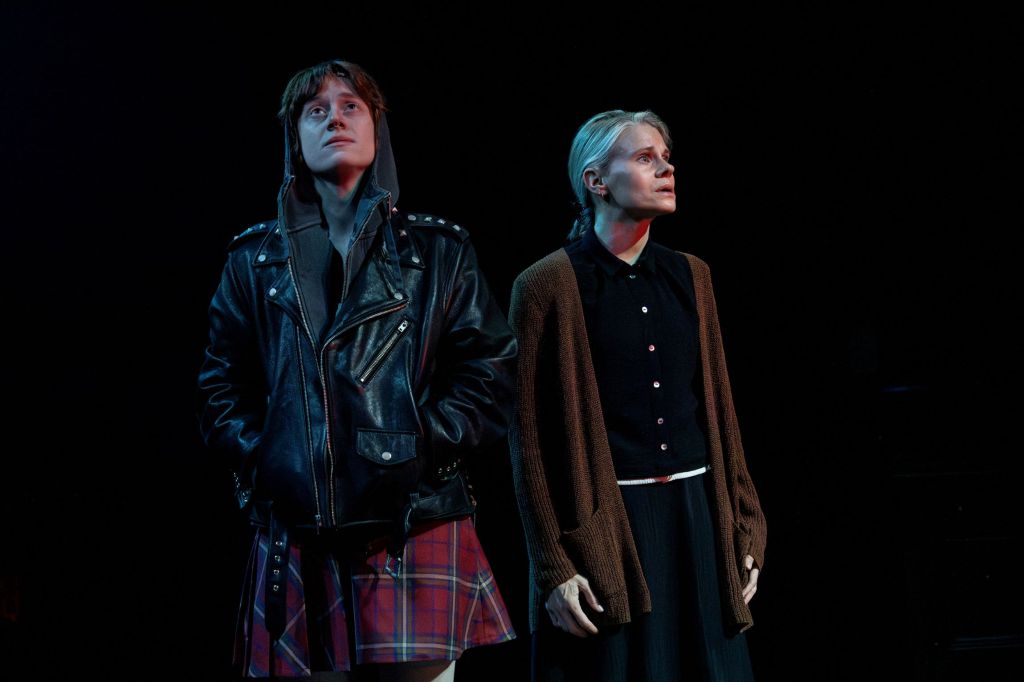
Strong performances from the leads Celia Keenan-Bolger, Susannah Perkins and Tony Shalhoub lift up Anna Ziegler’s unbalanced, convoluted feminist revision of Sophocles’ masterpiece Antigone. An irony not to be overlooked is that Antigone is a tragedy about a profoundly heroic and powerful woman who overturns the rule of the patriarchy-her Uncle Creon’s leadership-and destroys it and its future by adhering to spiritual and moral laws rather than the state’s. Ziegler gives a nod to the inherent “feminism” in Antigone in her adaptation which must be lauded for her attempt. However, its execution and rearrangements fall far short of the original. Directed by Tyne Rafaeli, Antigone (This Play I Read in High School) runs at the Public Theater until April 5, 2026.
Zigler reconfigures Antigone through the lens of Keenan-Bolger’s unnamed “Chorus/Narrator.” The playwright uses modern, feminist issues to frame and review Antigone’s heroism by having the Chorus/Narrator create her own scenario of the play she knew from high school. In effect, she imagines the Antigone/Creon conflict in a winding plot that relates to the Chorus/Narrator’s womanhood and identity.
Finding she is pregnant at an older age, the Chorus/Narrator must decide if she should keep the child or get an abortion, given who she thinks she is. However, this straightforward question comes after we witness her shadow her version of Antigone (exiled Oedipus and deceased Jocasta’s rebellious daughter) calling her up during events in the Chorus/Narrator’s life. In effect she uses Antigone to surge power into her own life over the years and help her resolve her problematic relationship with her mother, who she believes didn’t love her. The process of revisiting her own reclamation of the Antigone/Creon conflict enables her to validate her identity and her choices, and establish the power of her voice which she does by the play’s conclusion.
Through the Chorus/Narrator’s lens Antigone is a hip teenager with cropped hair (designers Robert Pickens, Katie Gell), wearing a black leather jacket, loosely fitting top and red plaid skirt courtesy of Ever Chakartash’s costume design. All of the characters are in modern dress, save Ismene, Antigone’s sister, who the narrator “sees” in a smock dress which she wears during her own self-imposed isolation, while Antigone makes defiant decisions. The set design (David Zinn) is minimalist mostly defined by props, for example, a lectern when Creon speaks to the crowd, a security screener at the palace entrance, a settee for Ismene’s room and more.
In the narrator’s first scenario the wild and recalcitrant, Antigone carouses in a bar and ends up with a pickup instead of going to her Uncle Creon’s coronation. She hears he’s become a hard-line politician and to keep control has established many strict laws to create order out of a chaotic Thebes. One of his laws is the banning of abortions which gives rise to illegal abortionists in the back of bodegas. Antigone eventually visits one of these after discovering her pregnancy from her love relationship with Haemon, Creon’s son, her fiance whom she has cheated on.
Key to the Chorus/Narrator’s conflict with herself is establishing her own life and identity, so scenarios especially between Creon and Antigone that she envisions help her. In the second act Antigone confronts Creon about having the illegal abortion. She tells him her body is her own and her choices are her own. They are acts of freedom. She will not be ruled by state laws or Creon’s laws, but by herself. The fact that she asserts this because she believes she can and should is a revolutionary act. The Chorus/Narrator’s view of Antigone is an independent, autonomous being beyond any laws, speaking truth to power, brave and unafraid. Her ultimate power is in ending a pregnancy, another life, if she chooses.
Creon has no power over Antigone in this context, over her reproductive rights. Thus the Chorus/Narrator imagines a dynamic scene where Antigone illustrates her act of freedom and of owning her own body to Creon. Perkins’ Antigone disrobes and points to various injuries and scars only she knows about. Naked, in full possession of herself in front of Shalhoub’s Creon, we believe in the power and determination of Perkins’ Antigone. Only she can objectify her own body, if she so chooses. Perkins makes a meal of this scene and we can identify with her argument keeping in mind how long it took for women to get to this point which was overturned federally in Dobbs after women experienced the freedom to choose via Roe v Wade for 49 years.
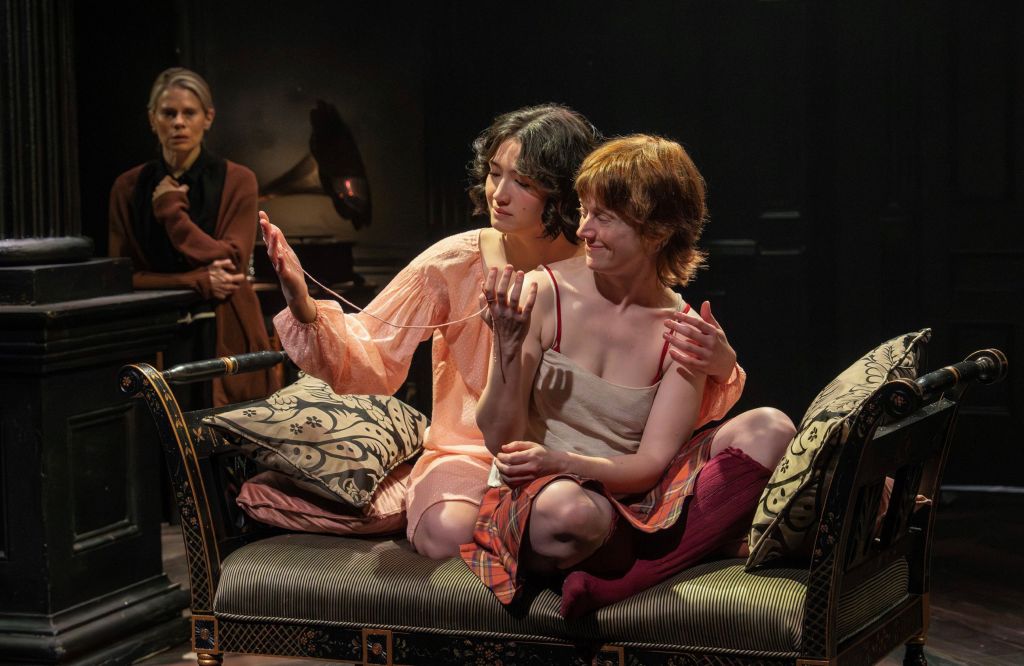
Apart from this high-point and Shalhoub’s Creon’s impassioned speech justifying why she must apologize publicly for getting the abortion, the characters don’t resonate. In Sophocles’ Antigone/Creon conflict we feel the enormity of the stakes and the depths of Antigone’s despair which prompts her decision to disobey Creon and not let her brother’s spirit wander for eternity. Unfortunately, Ziegler’s Chorus/Narrator’s inner conflict is not fully explored with grist or emotion. This prevents us from engaging with her as we look through the Chorus/Narrator lens darkly and have difficulty completely identifying with her version of Antigone.
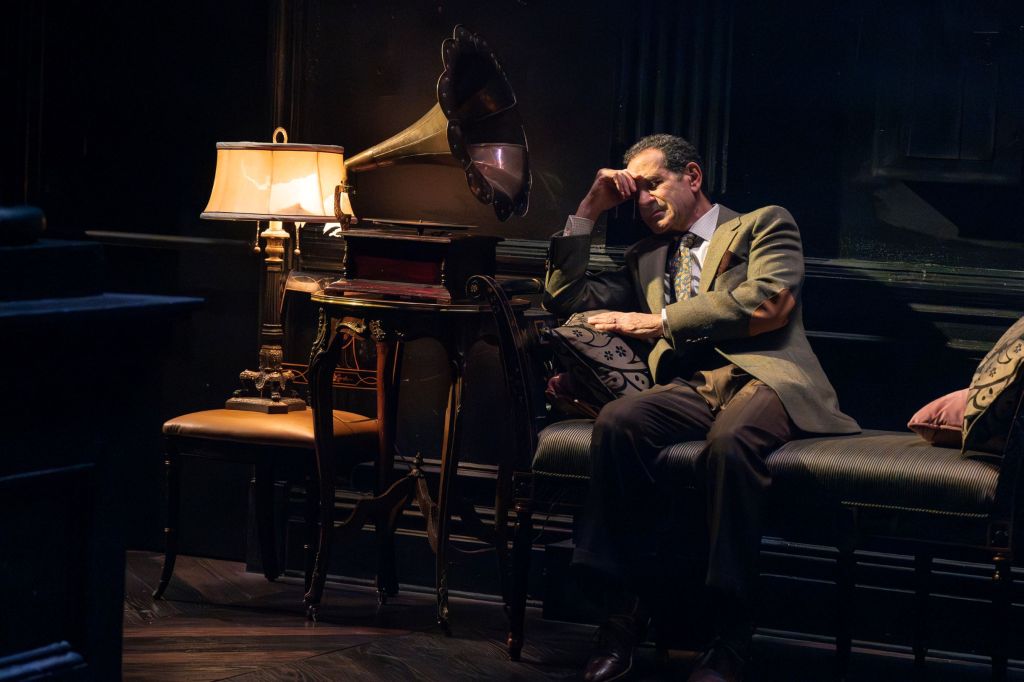
It is an irony that Tony Shalhoub’s Creon, so expertly acted, elevates Creon. We note his character loves his son, niece and family. Unlike the more brutal tyrannical Creon of Sophocles’ original, Shalhoub’s Creon delivers the most reasoned and believable argument for his actions. Shalhoub actually humanizes Creon. Antigone’s choice to end her pregnancy, apart from her action of naked self-possession, becomes reduced from the heroic, noble Antigone in the original play to that of a willful revolutionary who does what she wants not because of any other reason, but to assert her will against the state, because she can. She refuses to apologize but her revolutionary act of facing death is not realized in Creon’s death penalty. She bleeds out from the bad abortion, the meaning of her act diminished.
Unfortunately, Ziegler’s framing structure reduces the characters’ stakes and prevents the audience from being drawn into the plight of Keean-Bolger’s Chorus/Narrator or Perkins’ Antigone to care about what happens to them. This occurs despite the acting chops both women acutely display. The structure is at fault, not their performances.
Antigone (This Play I Read in High School) runs 2 hours15 minutes through April 5 at the Public Theater https://publictheater.org/productions/season/2526/antigone-this-play-i-read-in-high-school/
‘My Joy is Heavy’ the Bengsons Sing Their Joy Through Sorrow
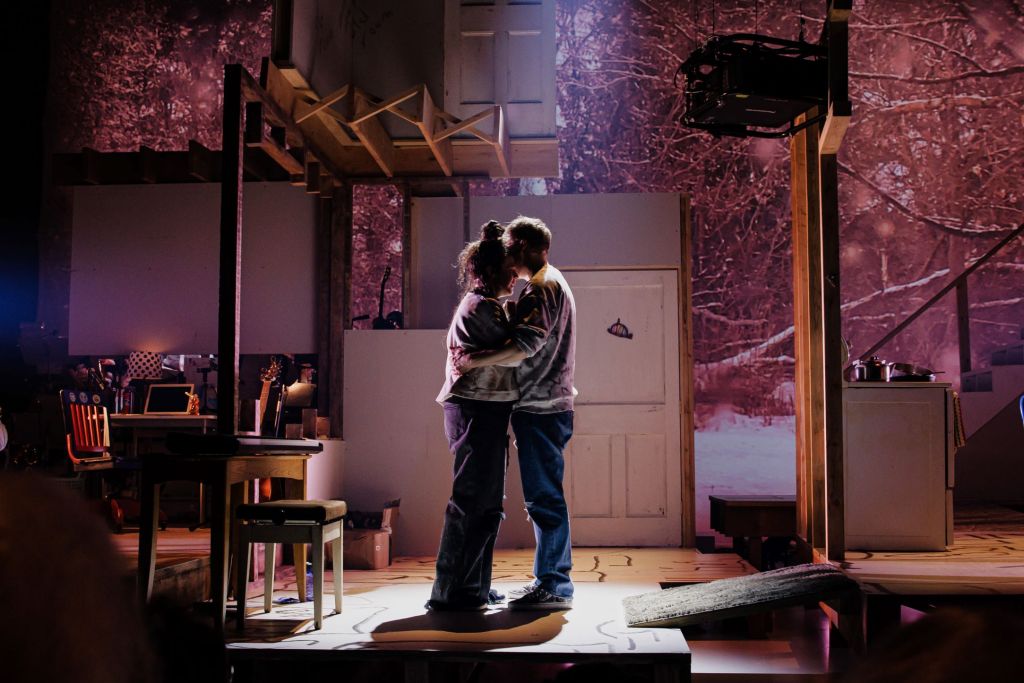
Like “A Tear and a Smile,” Kahlil Gibran’s well-known poem, the Bengson’s musical memoir My Joy is Heavy displays the couple’s affirmation of life in contrasts. Great joy can arise while experiencing great loss.The Obie-winning husband and wife team responsible for notable offerings like NYTW’s Hundred Days, presents an intimate, visceral series of experiences expressed organically in hauntingly beautiful music. Grounded in the audience’s remembrance of COVID lock-down, its isolation and traumas, we learn of the fiery trials the Bengsons went through separately and together during that time.
This powerful, soulful, cycle of songs and narration superbly directed by Tony Award winner Rachel Chavkin (Hadestown), transports the audience every moment the couple takes the stage. Abigail and Shaun invite audience members into their world, a gritty chronicle of emotions, spooling out from an extraordinary mix of folk-rock, punk and gospel that rearranges one’s psyche from start to finish. Because of audience enthusiasm, My Joy is Heavy has been extended through April 12, 2026 at New York Theatre Workshop.
What makes this production intimate and heartfelt includes the couple’s attention to the audience. To make sure they hear and see every lyric, turns of phrase, imagery and poetry, the production employs closed captions that appear above the stage. I found these to be less distracting than captions in other productions that oftentimes appear stage left or stage right. Additionally, the musical duo cuts to the chase identifying their wish to share a compelling revelation at the center of their musical memoir. “We’re here to tell you about this one moment, this one moment that happened right there on that bed.”

When Abigail says this, she motions to the bed in Lee Jellinek’s set design of Abigail’s mom’s house in Vermont. The couple and their toddler son stayed there during the alienating months of COVID, the time period of the production. It was then they had an epiphany, like a shamanic vision, which drives them artistically. Hoping that the expressiveness and power of their story helps restore harmony and wholeness, they try to connect with the audience so they might experience a cathartic, emotional release.
When Abigail and Shaun begin to discuss their COVID isolation, they call upon the audience to remember with them and reflect upon those lost to the pandemic. Abigail memorializes these individuals with a symbolic gesture involving two audience members. Then the duo plunges into their musical narrative with choreography by Steph Paul and music supervision by Obie Award winner Or Matias (Grey House). Shaun’s great versatility playing piano, guitar, accordion, etc., and the expert six member band directed by Matt Deitchman, accompany Abigail and Shaun throughout.
With them the couple rides waves of humor, uplift and sadness as they course through songs, not slowing down until they sing the last refrain of “My Joy is Heavy” to the audience’s rhythmic hand clapping.
As a part of the narrative we see snippets of Gramma Kathy, Abigail’s mother, and their toddler Louie in home video footage taken with their phones. Chauvkin uses these and other videos projected on the back wall of the set to convey and enhance mood and tone, and transition to other scenes with different emotional content. Also, Chavkin integrates these projections into the narrative to relay quieter moments of homely family life in “the calm before the storm.”

As a complement to the home videos, David Bengali’s video design, which accompanies the metaphoric song “Underground,” and serves as background for other musical pieces, effectively captures the Bengson’s interior emotions. For “Underground” the wild and evocative projections aptly serve the lyrics. For example, to reflect how Abigail and Shaun went into feelings of isolation and fear they sing, “I’ve been underground in a deep, dark cave, doing my best to stay live.” Alan C. Edwards’ lighting makes the projections pop. For her part Abigail experiences excruciating headaches that she labels PTSD. Clearly, the pandemic causes intense stress when, despite everyone’s assumptions, it goes on for months because of skyrocketing numbers of the dead and dying as COVID spreads.
With the drama of the pandemic in the background, Abigail and Shaun try for another baby. However, the risk reward ratio of a prior miscarriage plummets them into cascading fear. They elicit help from doctors and when the medication and fertility testing don’t seem to help, they watch holistic programs and go through Zoom sessions. Many of the profound songs as well as the humor deal with the Bengsons struggle with their having another baby. Standouts include “River” and “Don’t Hope.”
The first song is a striking, poignant remembrance of their baby who never makes it into life, a song of love and mourning. This devastating experience five years prior informs their roller-coaster emotions in the present when Abigail discovers the blue line of her new pregnancy. Though “over the moon,” Shaun and Abigail can’t allow themselves the luxury of celebrating, because “what if?”

“Don’t Hope” hits home with its simple humanity and perfect melody aligning with the repeated refrain, “DON’T DO IT, DON’T
HOPE, DON’T DO IT, DON’T GET HAPPY. Who cannot empathize with the sentiment that feeling too exuberant will jinx what one wants desperately? After this amazing song Shaun describes his riotous experience with little Louie on the Santa Sleigh and the humor breaks through the fear and makes way for the song, “Veil.” Both agree, they’re doing everything they can do. And this leads to their understanding that they can’t live avoiding their natural feelings. Together they decide, in the next song, “I’d Like to be Happy.” They choose to let go of repression.
By degrees we follow their emotional journey from the cave and pain to an expiation of the sorrow of the miscarriage and recognition that happiness shouldn’t be suppressed. And in between a few other remembrances and songs, the couple arrives at the epiphany Abigail refers to at the top of the musical. Thus, engaged audience members travel with them through flashbacks to experience palpably how joy and sorrow can occupy the same place in one’s heart, at the same time. The Bengsons bring the audience to this breathtaking and ebullient conclusion in the rousing gospel “My Joy Is Heavy,” as all stand in appreciation.
My Joy Is Heavy runs 1 hour 10 minutes through April 12, 2026 at New York Theatre Workshop. https://www.nytw.org/show/my-joy-is-heavy/
.
u
.
Daniel Radcliffe Smashes it in ‘Every Brilliant Thing’

Every Brilliant Thing starring the inimitable Daniel Radcliffe in a solo, interactive performance as The Narrator succeeds on many levels. The show has become a global phenomenon and has been performed for over a decade. Presented Off Broadway at the Barrow Street Theatre in 2014, it finally landed in its Broadway Premiere at the Hudson Theatre. The joyous, hybrid comedy/drama runs through May 24, 2026.
Written by British playwright Duncan Macmillan as an initial 15-minute monologue the play evolved into a longer work with Jonny Donahoe. Over the years culturally diverse cities and theater companies around the world performed the piece with male and female “Narrators,” tailoring the particularities of the list to various cultures, which playwrights included in the notes. These provide a fascinating and humorous read.
The usually triggering subjects of suicide and depression swallow easily because Radcliffe’s Narrator introduces the topic from the innocent perspective of a seven-year old. The production becomes an extended flashback of The Narrator’s life with delightful, often humorous audience participation seamlessly woven into his storytelling. Not understanding his mom’s profound desolation, The Narrator relates how he tries to joggle her out of depression during her initial hospitalization. He attempts this by giving her his “list of life’s brilliant things,” the first being “ice cream.”

The Narrator flashes back to key turning points related to his mom’s first act to take her own life. These parallel the expansion of “the list” which develops a life of its own. While eventually enumerating hundreds of thousands of great things, ironically, the narrator is no closer to understanding his mom’s mental state. Additionally, he is in denial about his own depressed, isolating behaviors and ignores his beloved partner when they try to alert him to go for help. However, recognition is the dawn of his enlightenment. With both sorrow and joy he confronts the devastating and untenable impact of his mom’s condition upon his and his father’s lives as the play ends.
What makes this production so special is its humanity, love and the encouragement conveyed by Radcliffe as he elicits enthusiasm from participating audience members. Because they’re thrilled to be a part of this experience on Broadway, the show manifests a unique, communal vibe. It begins when the first audience member shouts out in response to Radcliffe’s “#1,” their response, “ice cream.” They do this from the balcony, or the back row, or audience left, or wherever the person is who has the paper with #1 written on it.
Amazingly, Radcliffe sentience is tuned like a seismograph to audience members’ locations and responses and discomforts, if any. Prepared for the unpredictable with “in the moment” spontaneity, Radcliffe’s performance can’t be quantified. It’s breathtaking, ineffable, divine genius.
In addition to Radcliffe’s numbered shout-outs, he guides the participation of lucky folks who help him tell the segments of The Narrator’s life. These include a vet, a librarian, an old couple, his dad, his partner, his college professor that Radcliffe selects. Interestingly, The Narrator’s mother never appears. The enigmatic mom cannot be known, nor does anyone ever portray her.

The key players in his life circle around Radcliffe’s Narrator on stage. To their surprise Radcliffe sits next to a few of them or asks them to perform at crucial moments. In one example the vet gives his suffering dog a shot (a pen was used the night I saw it), to ease him out of the world. These electrifying moments happen magically as audience members anticipate being ready for anything as they stand before Radcliffe, who demonstrates great good will. They pay attention and listen acutely, taking their lead from him. What results brings humor, uplift and surprise. What happens comes at the whim of the audience members who Radcliffe entrusts to trust him in whatever they do together.
Directors Jeremy Herrin and Duncan Macmillan shepherd Radcliffe to prepare by selecting audience members as they arrive. Some might be visiting actors though there are no plants. The audience members’ parts scripted by the playwrights leave the freedom for ad libs, jokes and funny or somber retorts. Some of the unique responses even tickle Radcliffe. As he moves through The Narrator’s stages of development from teenager to adult, the list becomes an afterthought that he unearths unwittingly or others (his partner) give him. In reflection about his “childish” perspective, Radcliffe’s Narrator questions the list ‘s efficacy. Did it help to mitigate his mother’s extreme ups and downs? Did it startle his unemotional, undemonstrative father into a more responsive relationship with his family?
Clearly, the list’s intended result fails. But what does succeed are the positive unintended results of the list as a light that shines for however long because others he meets and befriends keep it going as an uplifting fulfillment of hope. For example the list even has a Facebook page that you might add to if invited.

One of the high-points of Every Brilliant Thing occurs when the Narrator meets his partner. In rehearsals, Radcliffe and the directors considered every contingency for the segment which moves The Narrator’s relationship from the first date, to a wedding, to a marriage to a split. The night I saw it, the lovely audience member he selected as his partner glowed. And Radcliffe’s energy played back the enthusiasm and transmitted it to the audience. The Narrator achieves a high not experienced before as his parents show their love and acceptance happily dancing at his wedding.
Another fun moment occurs when Radcliffe’s Narrator runs around the audience, attempting to “high five” everyone. However, his “manic” peak immediately craters into the downward spiral of a depressive state. Even the Narrator’s list in the hundreds of thousands of brilliant things can’t stop his “peaks and valleys” from happening like they happened to his mom.
The play must not be underestimated because of its elements of easy enjoyment. Powerful and understated themes of silence, and the inability of the sufferer and those impacted to connect, help or effectively confront the crisis, gently thread throughout. The fun comes with the audience’s effervescence. Yet, the playwrights take pauses identifying convenient truths and salient information tucked in by The Narrator when the audience takes a breath between laughs. What is known of the mind that takes its own life? The Narrator leaves many unanswered questions. Evident underneath is the pain which clarifies when no specific information about his mom, his parent’s relationship and The Narrator’s emotions ever comes.
Every Brilliant Thing runs 1 hour 10 minutes with no intermission, through May 24, 2026 at the Hudson Theater. everybrilliantthing.com. Running time: 1 hour 10 minutes.
‘Ulster American’ Matthew Broderick Leads the Bang on Ensemble at Irish Repertory Theatre

With sardonic wit and dark farcical elements David Ireland’s Ulster American sends up the differences among Irish-American, left-wing British, and Northern Ireland’s Unionists’ views about identity politics. David Ireland also ridicules the hypocrisy of those who adhere to political correctness and equanimity when it serves their purpose, but when push comes to shove and the stakes are raised, they easily throw overboard their posturing to reveal ugly, ingrained prejudices not yet reconciled.
The play’s humor lands sometimes with subtly, other times with uproarious riot and full throttled mayhem in this wonderful production acutely, specifically directed by Ciaran O’Reilly. Ulster American runs at Irish Repertory Theatre through May 10, 2026.
Using theater as the medium to express his themes, Ireland begins with a simple “meeting of the minds,” among an actor, director and playwright. They join up to discuss the play which has been scheduled for its first rehearsal the following day. The individuals include Jim Conway, the lead actor (Matthew Broderick) of Irish ancestry from America. Conway has been cast for his talents and star power. The play’s British director (Max Baker), runs his own theater company that produces the play. Most importantly, the director has chosen a Northern Ireland female playwright (Geraldine Hughes) because her play is exceptional. He will present the play in London which is also where the director’s home conveniently is. Scenic designer Charlie Corcoran provides the comfortable environs where the characters discuss the play and where their true emotions explode.
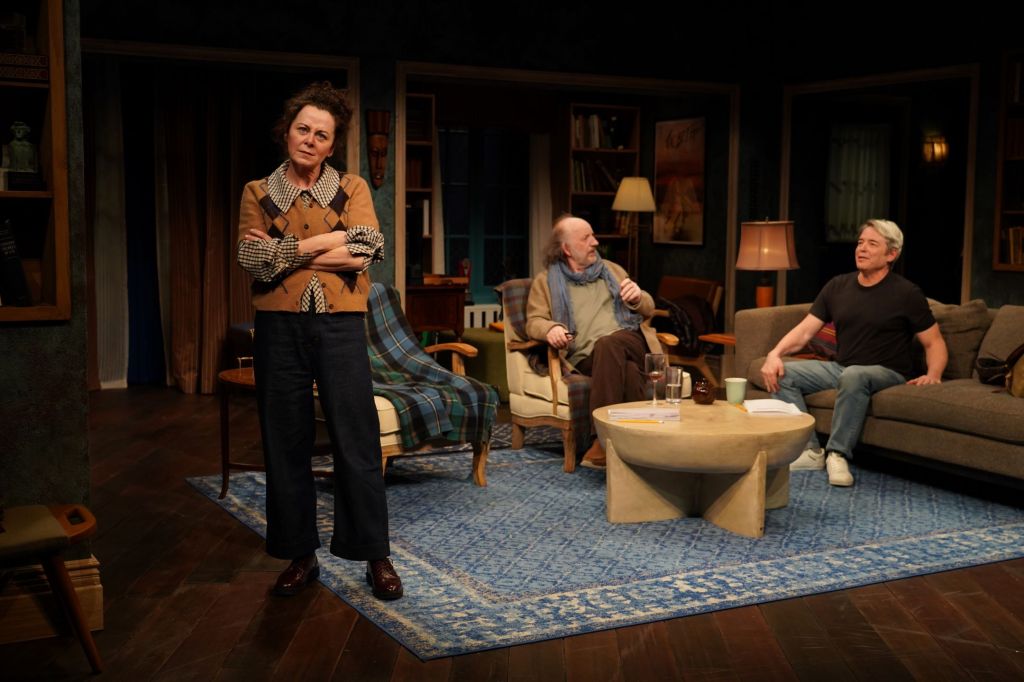
But what can go wrong among these artists who pride themselves on their craft and their humanity as creatives? Indeed! The diverse ethnic combination in itself indicates a potential powder keg for those in the know about the history of the Republic of Ireland, England, Northern Ireland, and America’s roots in all three. However, the beauty of David Ireland’s play and the talents of the dynamic cast manifest in the gradual reveal. Discovering who these people are and what each assumes about the others is the order of the day. If they achieve a consensus and understanding of the play, then they hope it will be a smash that takes them to Broadway and eventually to a friend of the actor’s doorstep, filmmaker Quentin Tarentino.
The fun is in watching the characters’ assumptions about each other and “their” play go up in flames, and seeing their shock when they realiz who everyone is as the smoke clears. How Ireland turns everything on its head after the opening scene is terrific theater. The actors deliver, hitting every bullseye Ireland sets up.
Matthew Broderick’s Irish American Jay Conway reveals the underlying pomposity of an Oscar-winning film star who attempts to evolve into a better person as he conquers his alcoholism with the help of his priest sponsor. Deft with the character’s initial humility, decency and humanity Broderick pings these notes with earnestness. Conway and amenable theater director Leigh Carver (Max Baker) become better acquainted discussing topics ranging from the use of the “N” word, to the importance of “women’s voices crying out,” to Irish history, and being of the patriarchy only as a necessary evil, though it demeans them.
Ironically, both disavow the patriarchy and uplift themselves as feminists. Though they dismiss the inherent power and status they’ve received from being males at the top of their game, in due season, the worm turns. We watch delighting in their hypocrisy as they riotously try to exert power over playwright Ruth Davenport by changing her play among other actions. Under the right conditions everyone’s truth emerges and deeper unconscious impulses explode to the surface.
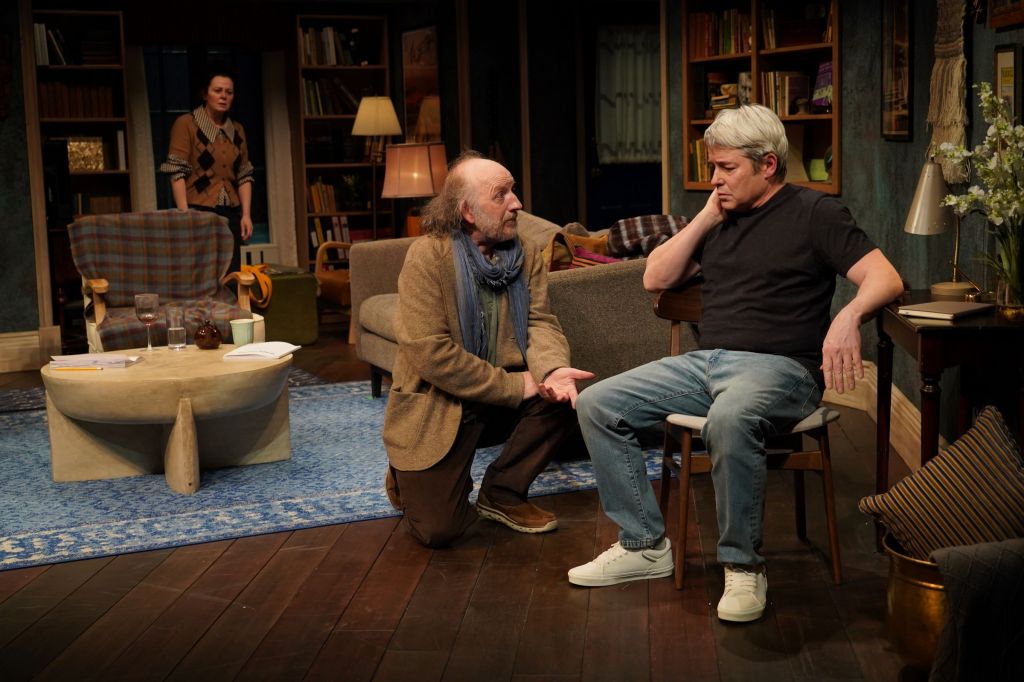
The men’s discussion topics conclude with a scene in a film early in Conway’s career which involved Jay’s character raping a woman at the direction of a terrorist who would bomb Minneapolis with a nuclear bomb if he didn’t do the deed. The studio cut the scene from the script because the women at the studio felt it was objectionable. However, Conway considered the scene thought provoking and thought about who he would rape to save the city, as hideous as it was.
Why Conway brings each of the topics up, especially the latter one, he ascribes to nervousness and being overly talkative. Perhaps, it is an attempt to deepen the feelings and get on solid footing with his director in a relationship which he believes should be close, intimate, like family. Nevertheless the question Conway innocently poses to the reticent, Brit Leigh alienates the director. Not only does he lie and pretends it’s OK when Conway confronts him, but he is so upset he spills to Hughes’ Ruth, though Conway told him in confidence. Eventually, this causes havoc for the actor, director and playwright, who swore that being true to oneself and being honest were paramount.
David Ireland has peppered the scene between the two men with platitudes and their agreed upon myths about themselves and each other which he gradually topples on the proving ground of working with Ruth after she arrives. She is late because of a car crash which lands her mother in hospital. After pleasantries and compliments the artists get to the “nitty gritty,” what the play is about.
We learn interesting bits of information along with Conway who asks what and why Ulster. The questions about Irish vs. British identity arise and unsettle Conway who expected something else. Ruth calls him on his misunderstanding. Did he really read and “get” what her characters were about? Does Conway really mean it is the best play he read in a decade and that it’s like Chekhov? And does Leigh mean the play is better than Harold Pinter? If one knows Pinter’s attitude about his own work, Leigh’s compliment that even Pinter would say her play is better than his is particularly ironic.
Of all of them Ruth holds her own and finds ways to fight back, using their own admissions against them. Remembering how they patted themselves on the back for their feminism, we note that white knights become black knights as they attempt to change the play and save their egos. For her part Ruth cleverly makes her demands and uses impeccable leverage to get what her play needs.
The specific details about how these webs are woven to catch the self-duplicitous are entertaining and surprising. The actors move from moment to moment and give nothing away, least of all the last five minutes until lights out. Great stuff.
Ulster American runs 1 hour 30 minutes with no intermission at Irish Repertory Theatre until May 10, 2026. https://irishrep.org/whats-on/ulster-american
‘Bughouse’ John Kelly Becomes the Fascinating Ousider Artist Henry Darger
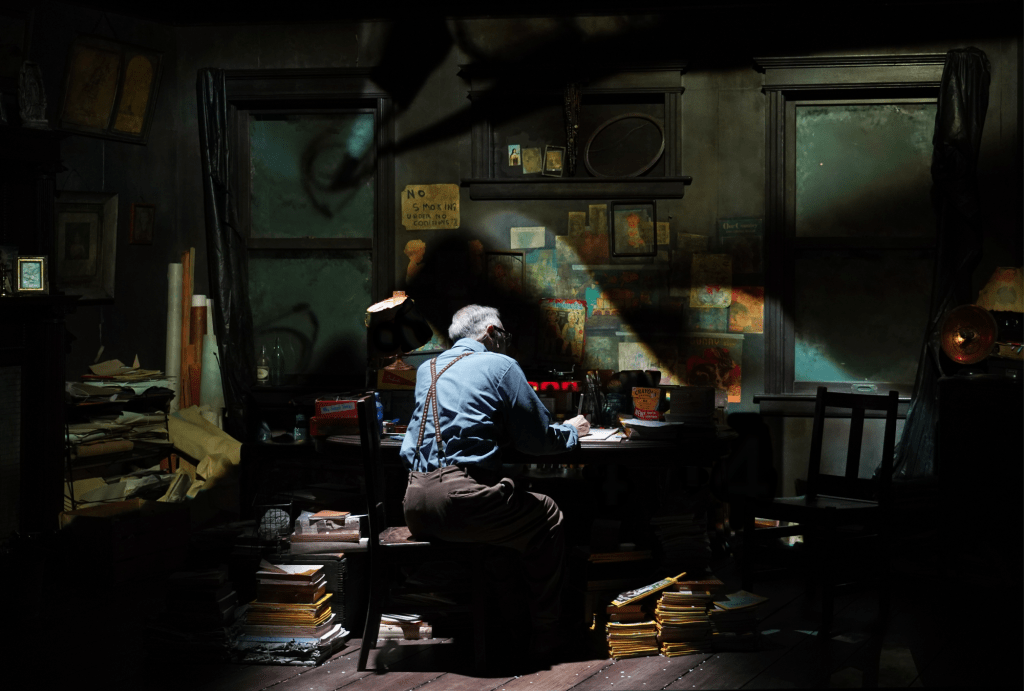
An unknown until his work was discovered just before his death, the incredible outsider artist and epic novelist Henry Darger (1892-1973) is celebrated at the Vineyard Theatre in the multi-media work Bughouse. Adapted from the writings of Henry Darger by Pulitzer Prize-winning playwright Beth Henley, the 70-minute play is conceived and directed by Drama Desk and Obie Award winner Martha Clarke.
The dance-theater director’s prodigious talents are on full display in Bughouse. Incisively, Clarke shepherds Obie Award-winning performance artist John Kelly to emotionally spin Henry Darger’s creative angst into the fantastical in this beautiful and poignant production. Heartily embraced by its audiences, Bughouse has been extended an additional week until April 5, 2026.
Martha Clarke uses Ruth Lingford’s animation, John Narun’s projection design and Fred Murphy’s cinematography to create the layered realities of Darger’s exterior and interior worlds. She uses animations created from Darger’s illustrations to explore and enhance Darger’s life and work. When projected on windows and mirrors, the “unreal realms” live to the delight of the audience. Kelly’s Darger moves seamlessly through the artist’s interior states of consciousness with enthusiasm and feeling. We can’t help but identify with Darger’s uniquely metaphoric creations. These include archetypal battles between good and evil. When hearing of Darger’s childhood experiences, one concludes the battles express emotional conflicts from his past that he could only reconcile through his artistic creations.

Inspired by photographs of Darger’s apartment, Neil Patel’s production design shows Darger living and creating in a claustrophobic, curio and antique stuffed apartment. In Patel’s recreation, Darger hordes National Geographics and period magazines in piles on the floor. Various items crowd every inch of space in the room. Papers and illustrations cover the table where Darger types up his magnum opus, a few lines of which Kelly’s Darger reads as he types. Beth Henley aptly uses passages from Darger’s epic fantasy in Bughouse (i.e. “The Vivian Girls, fought bravely against the Christian hating, child slave holding Glandelinian demons.”)
The audience becomes Darger’s confidente as we watch his creative process unfold. When he explains his life story, his imagination sparks. Immediately, he moves to type up the continuing adventures of the Vivian Girls, his chief protagonists. “The Vivian Girls…were prettier than fairies and as good as saints and though delicate in form as they looked, they were perfectly strong.”
In their perfection, his characters fight battles in righteousness, overcoming oppression and brutality. Darger explains what makes them heroic when he says, “Beautiful as they were in features however, they were more beautiful in soul doing all that all good children should do, and were so righteous and attended church so frequently every day that their father began to look upon them as saints!”
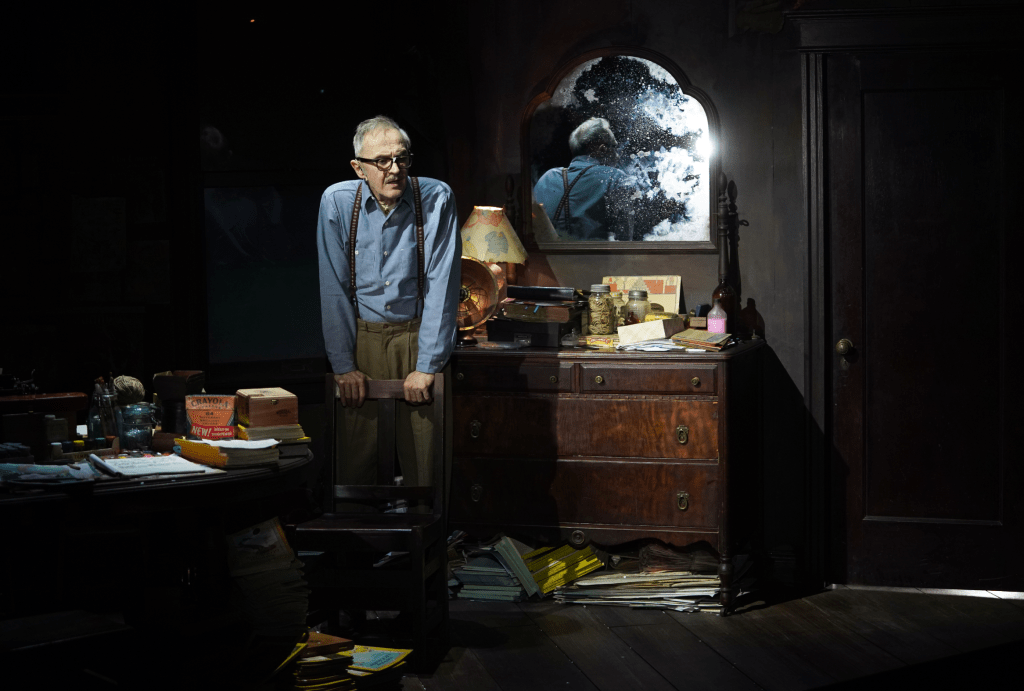
In between sharing his woeful childhood after his mother died and his father could no long care for him, Darger expresses his hatred of the abuse he experienced as a child. From the nuns in the school he attended, “Mission of Our Lady of Mercy,” and the caretaker at an asylum for feeble-minded children, where he lived until he finally escaped after two failed attempts, Darger was bullied and persecuted for “being different.” Based on various reports and his examination, a doctor misdiagnosed him as feeble-minded when, in fact, the opposite was true. Henry’s father taught him to read at a very young age so he could read the newspaper to him.
We question why these incompetent individuals didn’t recognize or encourage Darger’s talents. But then perhaps snatches of the creative soul of the reclusive, hospital janitor and dishwasher Henry Darger wouldn’t be the essence marvelously portrayed by John Kelly in this fine production. If one believes the adage that pain and suffering produce the artistic drive to express and relieve an artist and writer’s soul’s agonies, then Darger surely is representative.
Thankfully, Darger’s incredible imagination and genius lives on in 350 exquisite watercolors which appear in museums, galleries and collections worldwide. His fantasy novel of 15,000 pages, his 5000 page autobiography and more are available to read.
Caveat: noted is the warning that the content in Darger’s illustrations sometimes depict harm against children as the heroines battle to free enslaved children against evil forces. Also, some of the illustrations depict children without clothes. A few of these images are “included in brief moments in Bughouse.”
Bughouse runs 70 minutes with no intermission at the Vineyard Theatre until April 5, 2026. https://vineyardtheatre.org/shows/bughouse/
‘Marcel on the Train’ a Celebration of Life Using the Silent Power of Mime
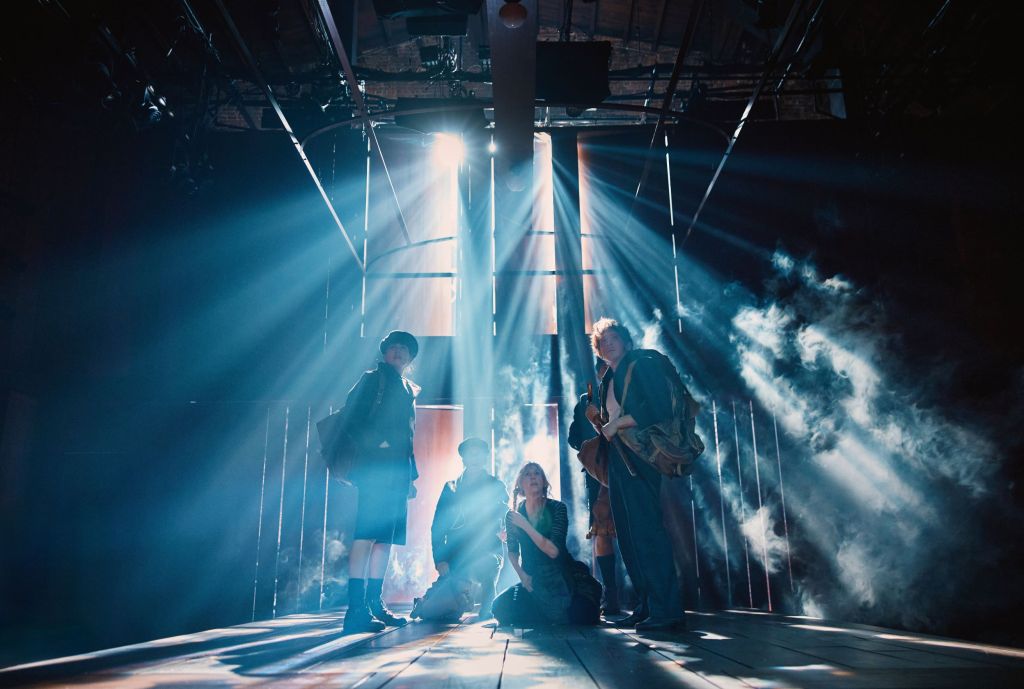
Live theater has the power to enthrall while inspiring a deep emotional impact, not only with well-honed dialogue and organic staging, but with movement and well-placed silences. With an emphasis on the latter, Marcel on the Train is mesmerizing and emotionally powerful. The drama is a tribute to celebrated icon of mime, Marcel Marceau. With a fascinating twist it captures a little known fact about Marceau’s life. As a young Frenchman he helped his brother save Jewish children with the French Resistance during the WWII Nazi occupation. This poetic, profound and suspenseful production finely directed by Marshall Pailet is inspired by Marceau’s courage and work in the Resistance. It currently runs at CSC until March 22, 2026.
Written by Marshall Pailet and Ethan Slater, who portrays Marceau, the events begin with an introduction to Marceau’s power to fluidly convey the invisible with simple movements. With these he manifests concrete objects that the audience sees with their imaginations in a silent, collective consciousness.
The opening scene happens in an abandoned train car overgrown with weeds, all invisible. Once Slater’s Marceau mimes sliding the doorway open, he views his surroundings. He sees a flower, picks it, and behold, his hand becomes the flower which opens, then dies. Another cast member enters and joins Marceau in the three sided space that is the train car. His right hand is a fluttering butterfly whose movements are accompanied by a riff of piano music, via Jill BC Du Boff’s sound design. Other performers whose hands are butterflies fill the train car with delicate beauty. Then, they vanish.
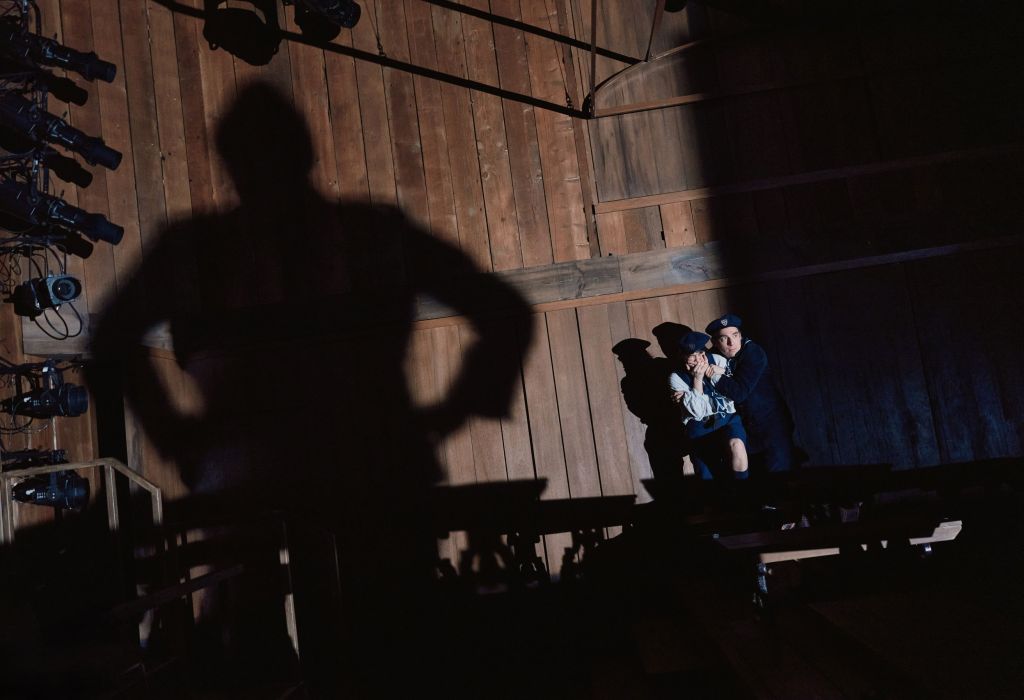
The scene transforms with the whistle and chugging sounds of the train. The performers turn into sleeping children and the difficult Berthe (Tedra Millan) screams as she awakens from a nightmare. Marceau attempts to understand her explanation and comfort her with humor in his role as chaperone of the 12-year-old boys (two girls are in disguise) under his charge. The train takes the 20-year-old Marceau and the four “boys” to a Boy Scout Camp in Switzerland to escape Nazi deportation to the concentration camps.
Pailet and Slater disclose the backstory in flashback vignettes where Marceau at various points remembers scenes from the past with his brother or father. These fill in gaps to clarify present events. In one such scene his brother Georges (Aaron Serotsky) discusses the foolproof plan (Jews never become Boy Scouts) to save children. Georges volunteers a reluctant Marceau to take them on a train through Nazi occupied France to the Swiss border. The flashbacks seamlessly return to the present stressful circumstances on the train created effectively with minimal design by Scott Davis and atmospheric lighting by Studio Luna.
As Marceau attempts to comfort the nihilistic, quarrelsome Berthe with humor, she criticizes his bad jokes and throws their dire situation in his face. Her character, though unlikable, provides the forward momentum challenging Marceau to rise above the dangerous circumstances. He persists and succeeds in rocking her off her negativity and fear with the silence of mime.
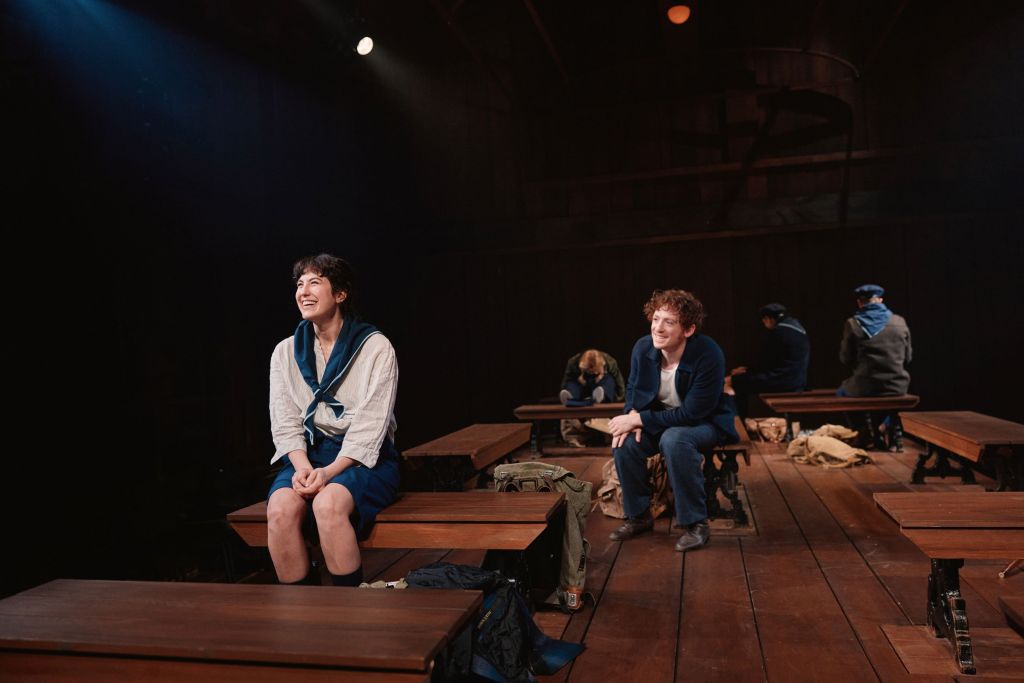
This becomes the template Marceau uses as he and the children travel toward the Alps, encountering obstacles along the way. Particularly tense scenes concern the unexpected. For example Georges doesn’t meet them at a stop where he was supposed to board the train to accompany them. Other frightening moments occur when they encounter the Nazis, especially as they come closer to their destination and the Swiss border crossing. At these moments of possibly being discovered, the stakes go through the roof. In each case, Marceau proves his mettle by using his art to distract the children and provide the hope and courage to confront extreme danger by believing in a positive outcome. Slater’s Marceau proves his talent using the power of silence and kinetic physicality. His creative imagination entrances the children. Thus, they follow his lead to keep quiet and not fight with each other and expose their true identity.
As a break in this template of Marceau’s softening the hellish situation with his artistry, Pailet and Slater interpose a scene in the future for each of the children. It is Marceau’s affirmation that they will not be captured and die in the camps. For example, Adolphe’s (Max Gordon Moore), future takes place in a POW camp in Vietnam. Marceau told him to remember something from his time on the train, Adolphe uses this remembrance to give himself hope. As a result he lightens the outlook for himself and another soldier despite the hellishness of the POW camp.
Marceau gives each of the children hope by telling them he sees their futures. Of course this inspiration deters them from believing in the present which is peopled by Nazis who intend to send any and all Jewish kinder off to the extermination camps.
The ensemble is superb. The staging and direction surprising and engaging. Slater, whose effervescent performance was perfection in the title role of “SpongeBob SquarePants: The Broadway Musical.” is of necessity the standout in a startling, endearing portrayal he helped write for himself. The scene where he picks up the snow that becomes the white make-up of Bip the Clown is searing and poignant. Slater’s few, profound gestures carry a lifetime of meaning in Marceau’s sixty-year career as a mime and actor in films who most always played himself with ironic silence.
Marcel on the Train runs 100 minutes with no intermission through March 22 at Classic Stage Company. classicstage.org.
‘The Dinosaurs’ at Playwrights Horizons
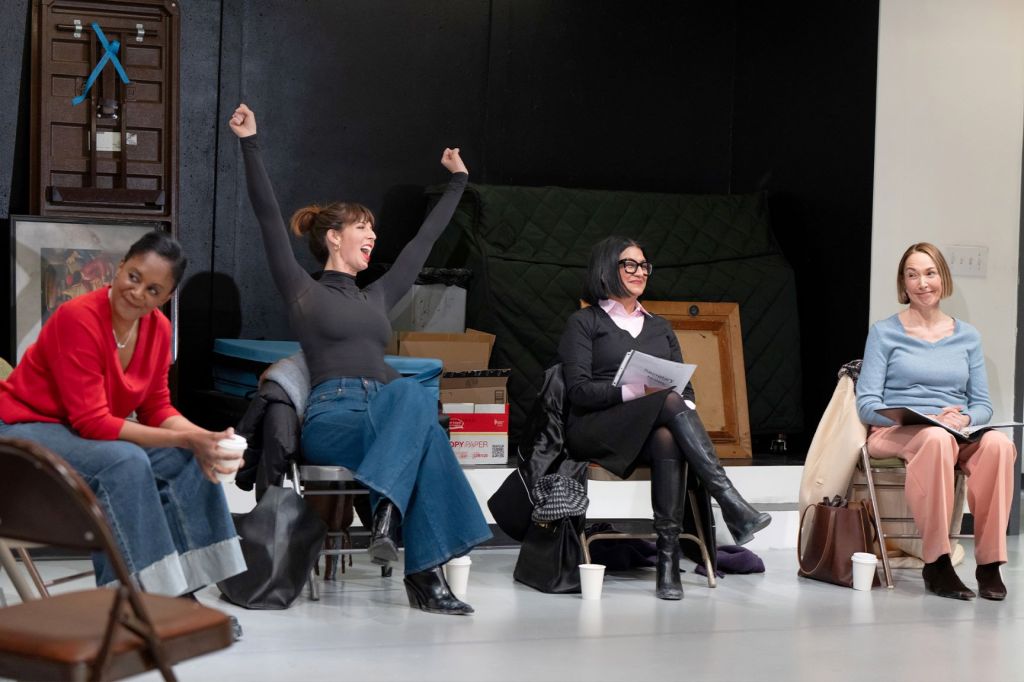
In The Dinosaurs written by Jacob Perkins and directed by Les Waters, time stands still yet moves in leaps that are hard to figure out. It takes place in a room where women who are alcoholics meet, form community and establish friendships helping each other through the years. With strong performances that require solo monologues, the characters share experiences and perspectives and enumerate their days of continuing sobriety. The Dinosaurs currently runs at Playwrights Horizons until March 8, 2026.
As the characters set up the neutral unadorned room (scenic design by dots), where they meet, wait for participants to show up and reaffirm the rules of their sessions, we understand this is a female inclusive community. April Matthis as Jane is first to arrive to begin setting up chairs, followed by nervous Buddy (Keilly McQuail), who after a humorous exchange with nonjudgmental Jane, decides she can’t stay. She does show up during the meditation and the end only making a connection with Jane in a layering that makes the time structure hard to divine.
Next, Elizabeth Marvel as Joan enters with the coffee and helps Jane set up. She is followed by Kathleen Chalfant’s Jolly as the longest, oldest member of the group, who brings positivity and warmth with the donuts and scones. Newer member Joane (Maria Elena Ramirez), arrives with gossip about a female teacher. Finally, Janet (Mallory Portnoy)–the appointed time keeper–arrives late and is the first one to share on the topic “coming back,” after their group meditation.
The playwright avoids heavy emotional content related to grief, sorrow, regrets, abuse or violence. Indeed, he avoids in the moment conflict in the plot and character development, with the exception of Joan, Jane and Joane who disagree about feeling empathy for a “lonely” female teacher who has sex with a teen who is “of age.” Jolly provides the down-to-earth humorous perspective as the argument persists then ends once Janet arrives. Interestingly, one would think these are average women of various ages who live regular lives, but for their momentous pronouncement later, during their time to share, that they are alcoholics.
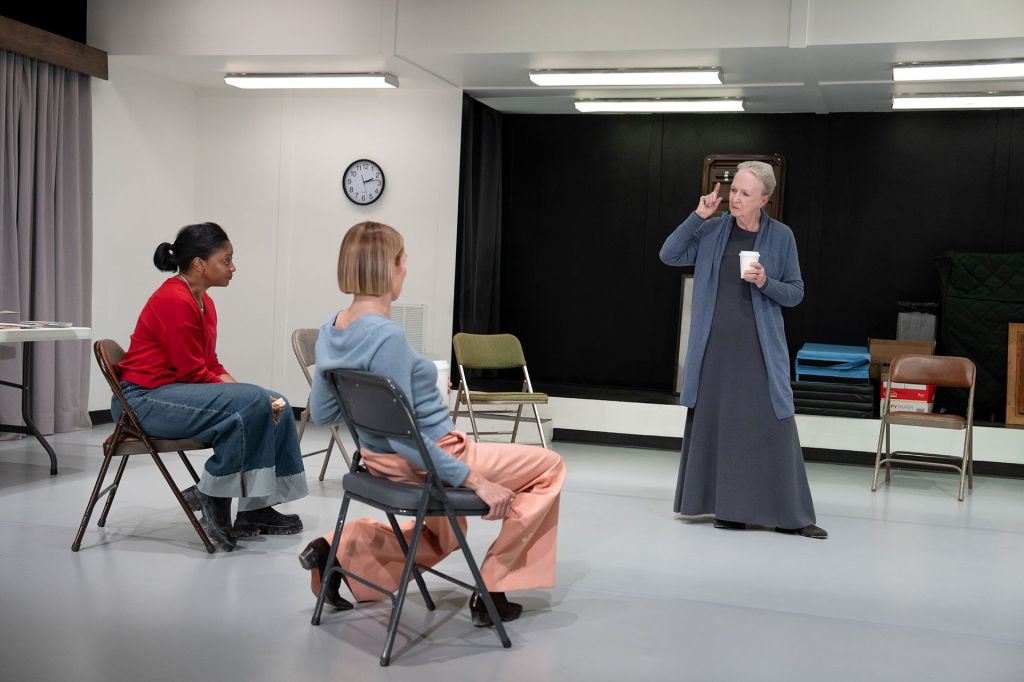
The production spends a good deal of time having Joan, Jane and Jolly set up the room making small talk. Chalfant’s portrayal as Jolly mesmerizes with substance, authenticity and humor, which she clearly infuses with backstory and meaning. In comparison with the other women, Jolly’s character is the most delineated because of Chalfant’s superb, specific performance, as is Marvel’s Joan who reveals why she is an alcoholic toward the end of the play. Otherwise, the characters divulge little else about themselves. This forces the audience to imagine who these women are and why they chose alcohol as their drug and not opiates, barbiturates, food or other addictive elements to anesthetize themselves and escape from life’s “slings and arrows of outrageous fortune;” if indeed, that is why they are alcoholics.
Janet’s metaphoric experience about being driven by a chauffeur she hates and who tells her to throw out the body of a man instead of carrying it around, seems to express her situation of carrying baggage which she eventually throws away in her awake dream state. However, we don’t understand to what she refers and she doesn’t connect the dots. Likewise, the others say little hard evidence about their situations. This adds to a general tiresome opaqueness.
All important personal details are absent, perhaps playwright censored to indicate his characters’ self-censorship. No explanation is given by the playwright, which leaves a huge gap in the ethos of the play. Nevertheless, a picture forms of these characters and the process of their recovery from a disease. However, its horrific effects in their personal lives as they share with their community is never identified. Indeed, the recovery process seems deadening as the women avoid discussing even the difficulty of fighting the urge to taste a drop of their favorite alcoholic beverage.
The characters also avoid discussing the severity of their alcoholism. If the blood never boils with emotion, then not feeling alive removes any impulse to drink. Perhaps keeping a steady deadened state is their key to recovery. How fortunate that they have found other individuals who allow this type of emotional void to be shared. Their tell-tale meditation at the beginning of their meeting indicates what substitutes for feeling and the connection with their feelings.
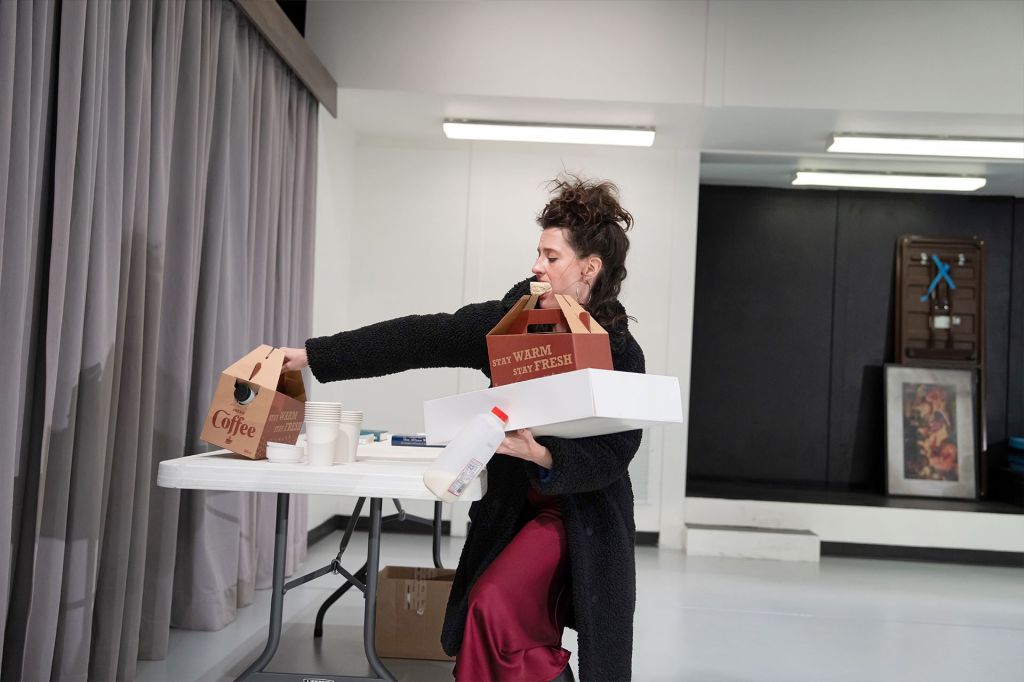
Notable examples of a separation perhaps disassociation from feelings happen with a few of the characters. Joane’s discussion of finding her son pleasuring an older man in their house seems devoid of an emotional reaction on her part in relation to her drinking. The assumption is that her discovery caused the rift between herself and her son that she describes and perhaps this led to her alcoholism. She and her son never discussed or dealt with her seeing her son with the older man. Did this lead to the dire circumstances that happened later in their lives? Ramirez’ Joane recalls it with dispassion though she takes a moment to breathe revealing the confession is difficult. Her admission that she is revealing it for the first time is groundbreaking.
That her son at fifteen was under the apparent influence of an older man reflective of the current pedophilia reports in the Epstein files is passed over without judgment by Joan or any of the other women. Is this what it takes to recover from alcoholism, this passive, non-reactive state of mind while others are there to just listen?
Joan’s time lapse discussion of the days of her recovery to sixteen years emerges with vitality. A matter-of-fact statement of her number of years without a drink that has seen her in this room with various community members of alcoholics hearing her make comments becomes her milestone. And apparently, during that sixteen year period she had to say goodbye to Jolly who dies and whom she misses. Thus, Jolly’s influence on her own recovery is reduced to less than a minute of time, though counting the years of struggle to maintain sobriety must have seemed an eternity. Unfortunately, there is a grand absence of information. Perkins revels in being opaque. More is needed.
Thankfully, the actors do a yeowoman’s job of leaping over the play’s lack of detail by providing as much of their interior substance as possible. Nevertheless, the lifeblood of theatricality and living onstage is hindered by the playwright’s lack of clarity. Nor is the play’s incoherence at times clarified by Waters’ direction.
Perhaps Rainer Maria Rilke’s quote from Book of Hours which Perkins uses to head up his script might have been spoken aloud by one of the characters in a prelude to The Dinosaurs. The lines of poetry present a lens though which to view each of the characters’ journeys, lifting them to a spiritual plane and revealing the irrelevance of time.
I live my life in widening circles that reach out across the world. I may not complete this last one but I give myself to it. I circle around God, around the primordial tower. I’ve been circling for thousands of years and I still don’t know: am I a falcon, a storm, or a great song. –Rainer Maria Rilke from Book of Hours
The Dinosaurs runs 1 hour 15 minutes at Playwrights Horizons until March 8, 2026. playwrightshorizons.org.
‘Chinese Republicans’ a Sardonic Look at Chinese Women and the Glass Ceiling
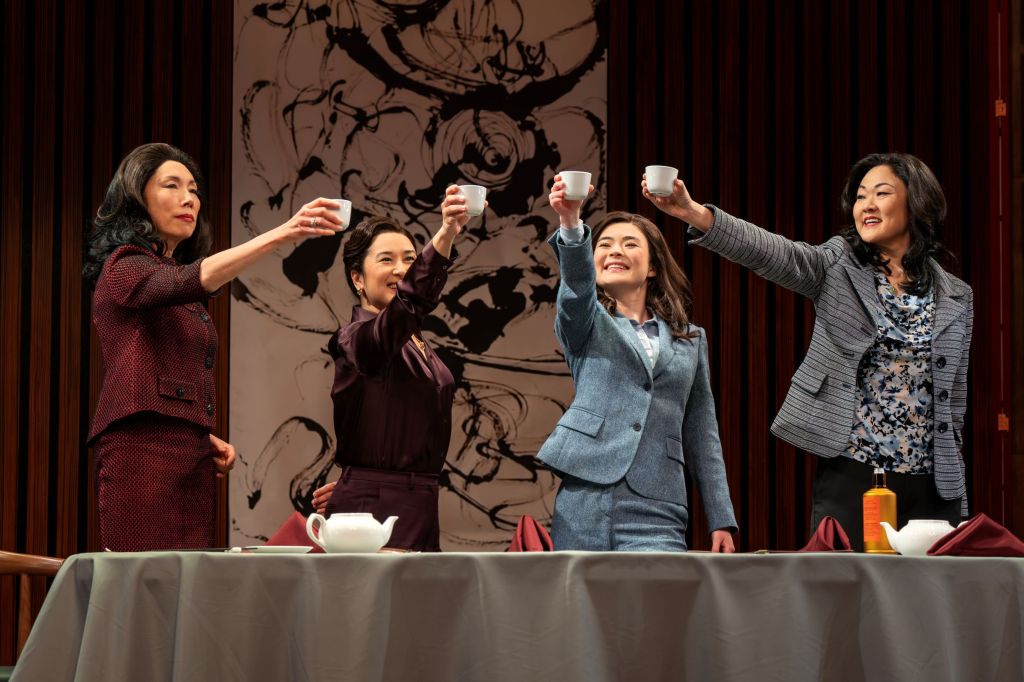
A cross section of how Chinese American women have fared in the corporate world is the engaging subject of Alex Lin’s ironic, humorous and ultimately devastating play Chinese Republicans. Directed by Chay Yew, the well-honed production examines personal sacrifice, identity conflicts, and nuanced discrimination (gender, age, cultural). Currently, Chinese Republicans runs at the Roundabout, Laura Pels Theare, Harold and Miriam Steinberg Center for Theatre until April 5, 2026.
The playwright spins a complex dynamic about Chinese American corporate working women. Yew expertly unfolds the complications among four women of different generations, including one immigrant, working to get her citizenship. During meetings designed to encourage affinity but which actually stir resentments and competitiveness, each of the characters reveals the struggle they face to break the glass ceiling, competing against their less qualified male counterparts. Though the story is unfortunately all too familiar, Lin spikes the interactions with an original, darkly funny approach that resonates with currency.
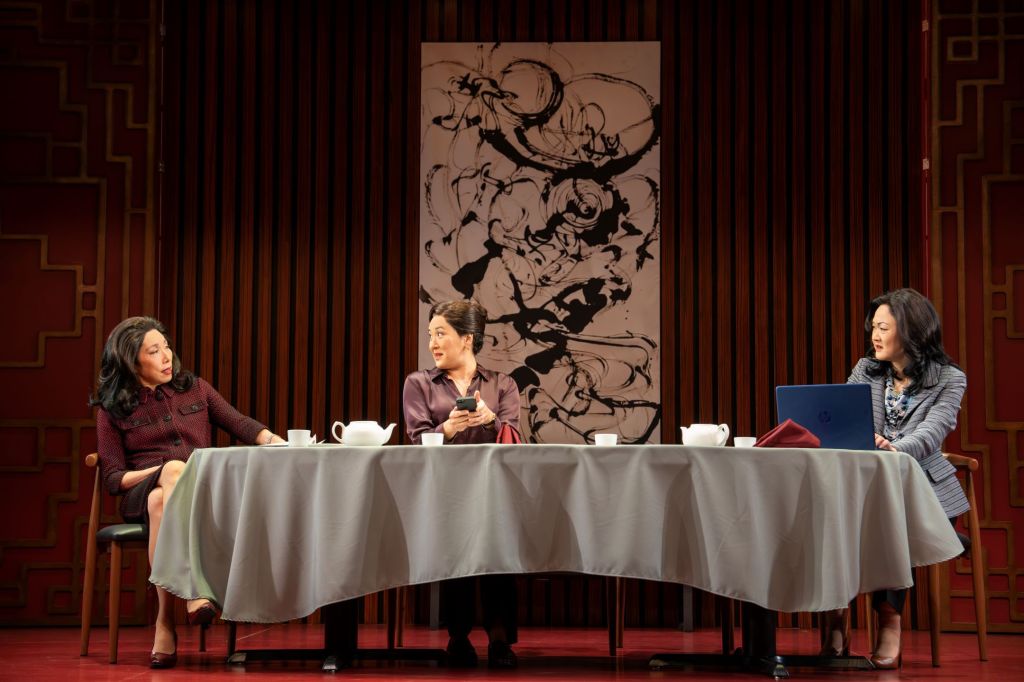
The production takes off by introducing us to four female suits who work at various upper level positions at Friedman Wallace, as they gather for their “affinity luncheon,” where they meet once a month at a Chinese restaurant. We note ambition, assertiveness and edginess which might as readily be exhibited by any male power-player succeeding in a tough environment. However, these women must obviously work much harder for their success because of internal biases against them culturally as women, and especially as Chinese women. Lin and Yew dance artfully around this gender debility by focusing on cultural elements and details. This strengthens the irony and themes while instructing the audience on elements about the Chinese culture they may not know.
First and most preeminent with experience and knowledge to instruct the younger suits is Phyllis (Jodi Long). She holds little back and uses her irony as a weapon. Ellen, (Jennifer Ikeda), Phyllis’ mentee, has sacrificed having children for her position and plans on becoming partner. Iris (Jully Lee), an immigrant who speaks four dialects, chides the others, especially Ellen on their bad Mandarin and losing touch with their Chinese identity. Lastly, Katie (Anna Zavelson) is the youngest and newest member of the group. Confident and positive about her recent promotion, Katie enthusiastically intones she is excited about their “making a difference.” Then she proclaims, “Come on Asian queens.”
From this luncheon onward, Lin and Yew prove the difficulty for each of the characters to be “Asian queens” in their workplace or their personal lives. Mostly the scenes take place at the restaurant as neutral ground with the exception of the game show farce when Iris ironically shreds Ellen, Phyllis and Katie’s ambitions with irony as part of a fever dream turned nightmare. The side scene after Katie does a turn around and evolves into an advocate for unionizing Friedman Wallace is funny, as she stands in front of the building pumping up a labor rat while the others watch her from the conference room at Friedman Wallace in shock and horror.
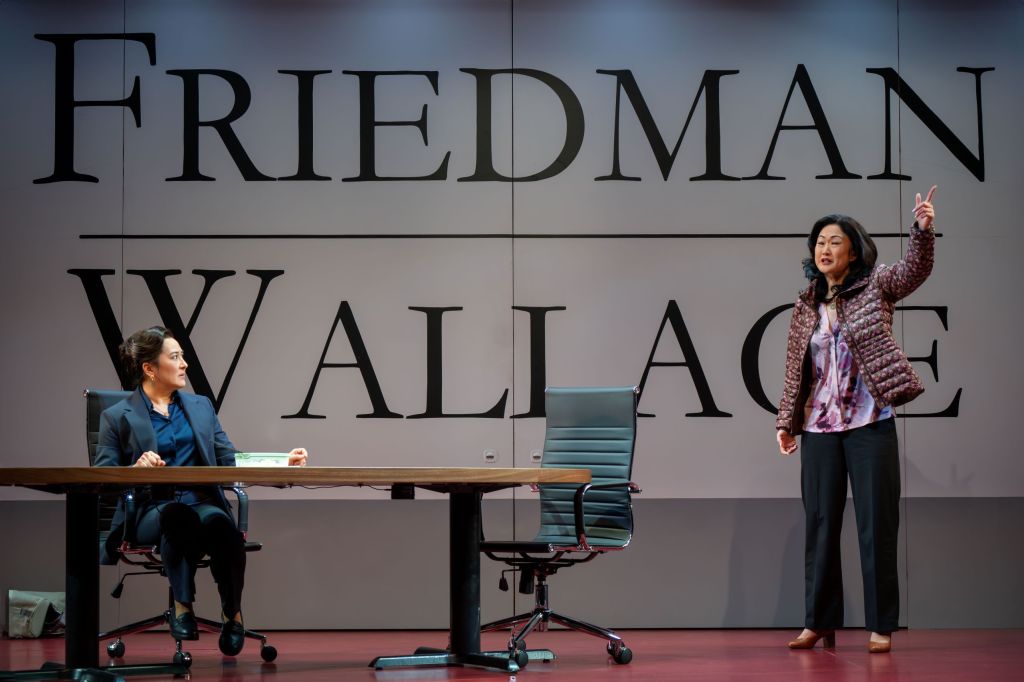
How and why Katie reverts to an anti-Republican unionizer from “gun-ho” Asian queen Republican in all its glory involves the corrupt male culture of Friedman Wallace, to discriminatory street violence against Phyllis, to Iris’ immigration hell, to sexual harassment and much more. However, we learn a few twists and turns about each of the characters that add to our admiration of these highly competent women who have endured and suffered nobly, knowing in their bones that not only are the odds stacked against them to ever be at the top, they have strived and sacrificed to what end? A sea of regrets?
The ensemble is uniformly superior. Each portrays their characters with authenticity and a no holds barred approach. As a result the concluding revelations land with poignancy and a powerful kick. The double irony of the evolving meaning of being a Republican is tragic, considering the current face and brand of the MAGA party. Lin neatly slips this information about being Republican into Katie’s development from corporate martinet to human being with a conscience. It’s a reminder to history buffs and salient information for others that political labels are meaningless.
Chinese Republicans fires on all levels of theatricality and spectacle, adhering to Yew’s minimalist, unadorned vision for Lin’s play which focuses on character and themes. Wilson Chin (set design), Ania Yavich (costume design) and other creatives present an attractive backdrop which lends itself to disappearing so the actors are able to live onstage and emotionally, profoundly impact the audience.
https://www.roundabouttheatre.org/get-tickets/2025-2026-season/chinese-republicans
Elevator Repair Service’s ‘Ulysses’ by James Joyce, a Review
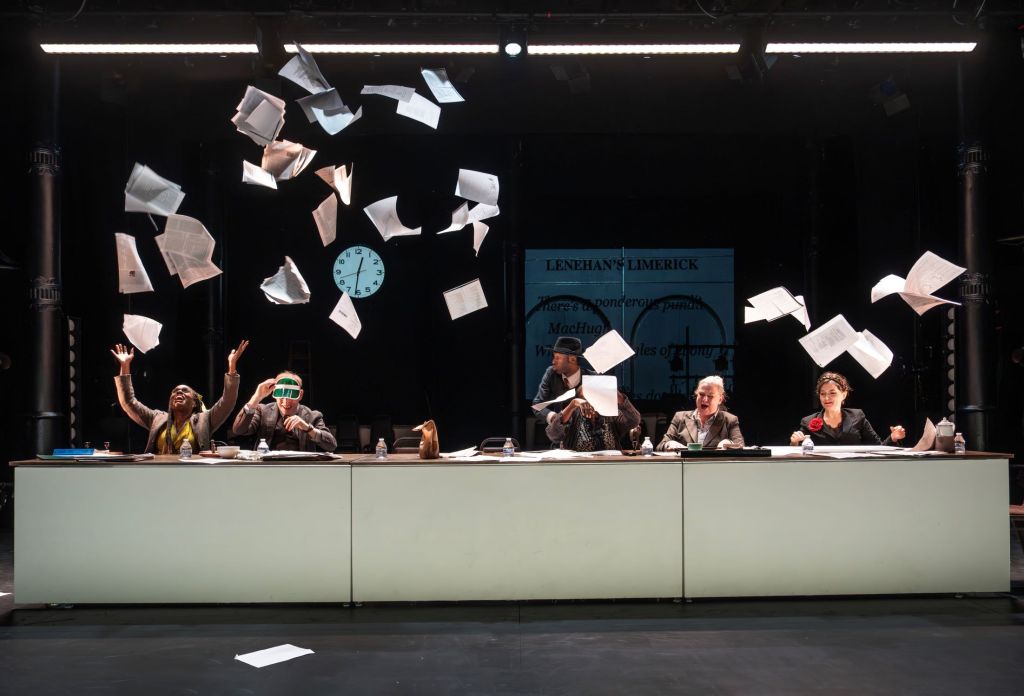
Elevator Repair Service became renowned when they presented Gatz, a verbatim six hour production of F. Scott Fitzgerald’s The Great Gatsby at the Public, as part of the Under the Radar Festival in 2006. Since their remarkable Gatz outing, they have followed up with other memorable presentations. It would appear they have outdone themselves with their prodigious effort in their New York City premiere of James Joyce’s opaque, complicated novel Ulysses. The near three-hour production directed by John Collins with co-direction and dramaturgy by Scott Shepherd, currently runs at The Public Theater until March 1, 2026.
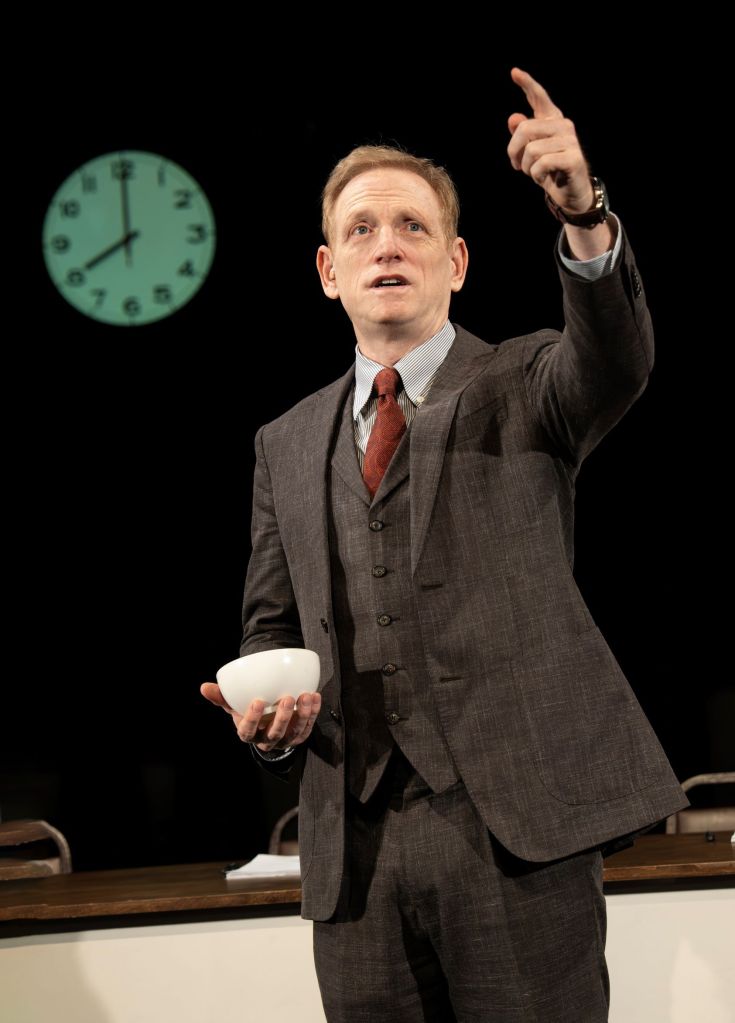
At the top of the play Scott Shepherd introduces the play with smiling affability and grace. He directly addresses the audience, reminding them that “not much happens in Ulysses, apart from everything you can possibly imagine,” and that it happens in the span of a day beginning precisely at 8 a.m,, Thursday June 16, 1904 in Dublin, Ireland. Before Shepherd dons the character Buck Mulligan who appears at the beginning of the novel, he discusses that in the “spirit of confusion and controversy” (labels by critics), Joyce’s day in the life of three characters will be read with cuts in the text. Elevator Repair Service elected to remove Joyce’s text to redeem the time. The cuts are indicated by the cast “fast forwarding” over the narrative.
Collins and the creative team cleverly effect this “fast forwarding” with gyrating, shaking movement and action. Ben Williams’ design replicates the sound of a tape spinning forward. To anyone who may be following along with their own copy of the novel, the “fast forward” segments are humorous and telling. However, the cuts pare away some of the details and depths of character Joyce thought vital to include in his parallel of Dublin figures with the most important characters of the Odyssey: home returning hero Odysseus, long-suffering wife, Penelope, and warrior son, Telemachus.
After Shepherd’s introduction, Ulysses moves from a sedentary reading with multiple actors into a fully staged and costumed production as it progresses through the day’s events principally following Stephen Dedalus (Chisopher-Rashee Sevenson), who represents Telemachus, Leopold Bloom (Vin Knight), as Odysseus, and Molly Bloom (Maggie Hoffman) as Penelope.
The events illuminate these characters, and the cast superbly theatricalizes the novel’s humor, whimsy and farce. Some scenes more successfully realize Joyce’s playfulness and wit better than others. For example when Bloom decides to go to another pub after seeing the sloppy, gluttonous patrons of the first bar, the cast revels in portraying the slovenly, grotesque Dubliners. slobbering over their food. Additionally, the scene where Bloom faces his deepest anxieties shows Knight’s Bloom giving birth to “eight male yellow and white children.” Director Collins hysterically stages Bloom’s “labor” with Knight in the birthing position, legs apart, as Shepherd “catches” eight baby dolls he then throws to the attending cast members.
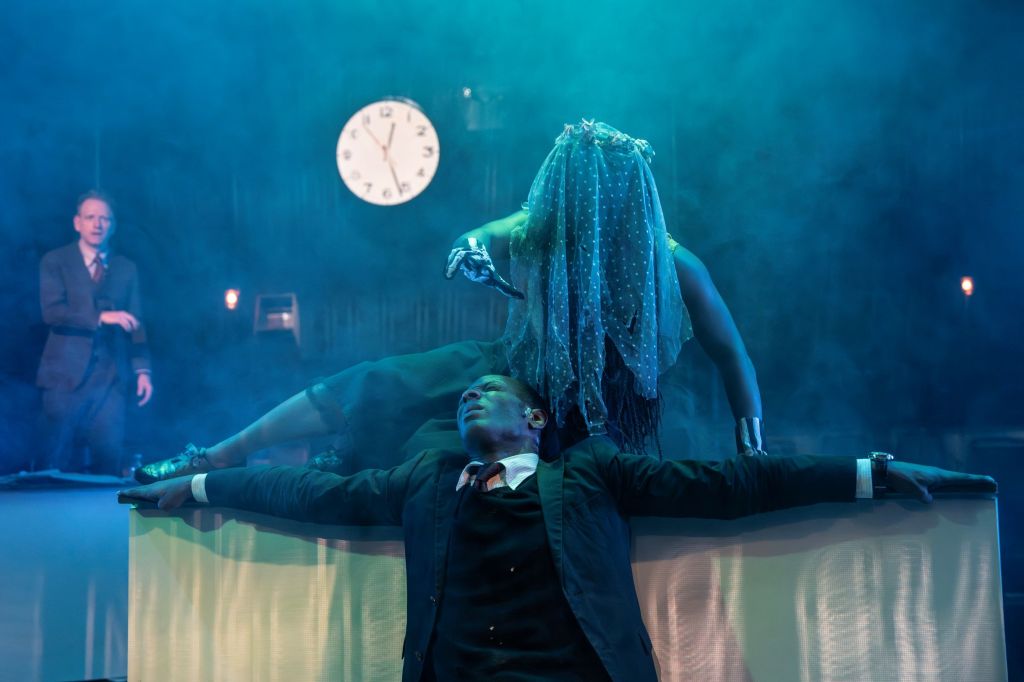
As costumes and props are added to the staging, we understand Leopold Bloom’s persecution as an outsider and a Jew. Also, wee note Stephen Dedalus as the writer/poet outsider who eventually joins Bloom, a father figure, who Bloom takes home for a time until Dedalus leaves to wander the night alone. Chistopher-Rashee Stevenson portrays the young Dedalus, a teacher whose unworthy friends lead him to drink and misdirection. Dedalus grieves his recently deceased mother and toward the end of the play has a nightmare visitation by her frightening, judgmental ghost.
For those familiar with the novel, the cast becomes outsized in rendering the various Dubliners that Knight’s Bloom and Stevenson’s Dedalus encounter. The dramatization is ultimately entertaining. We identify with Bloom as an Everyman, an anti-hero, who tries to get through the day in peace, while dismissing the knowledge that his wife Molly cuckolds him. Though he hasn’t been intimate with her since their baby Rudy died, he is unsettled that she conducts an affair with Blazes Boylan in their marriage bed at home. Somehow, Bloom has discovered that Molly who is a singer will be meeting with Boylan at 4 p.m. that afternoon. On his journey through the day he avoids confronting Boylan as they carry on with their activities around Dublin.
The ironic anti-parallel to the Odyssey, on the one hand, is that Molly Bloom is far from a Penelope who physically remained loyal to Odysseus, where Molly has an affair. On the other hand, late at night as Bloom sleeps with his feet awkwardly next to her face, we understand that Molly still loves Bloom and is emotionally and intellectually loyal. In her stream of consciousness monologue, seductively delivered by Maggie Hoffman, Molly arouses herself with memories of her relationship with Bloom when they were first together. It was then that she transferred a seed-cake from her mouth to his, sensually expressing her love.
Collins’s staging of the scene is humorous and profound. It defines why Molly has been present in Bloom’s consciousness throughout his strange journey traversing the streets of Dublin until he eventually finds his way home to her bed later that evening.
For those unfamiliar with Joyce’s novel, they will find the events and people a muddled hodgepodge that clarifies then becomes opaque, like a light switch turning on and off. Characters swap places with each other as seven actors take on numerous parts in a sometimes confusing array. Only Bloom, Dedalus and Molly stand out, true to Joyce’s vision for Ulysses for they embody Joyce’s themes about life. Thus, Bloom and Dedalus move through the day with flashes of brilliance, revelation, connection, irony and dread. Their reactions interest us. And Molly Bloom in her ending monologue puts a capstone on the vitality and beauty of a women’s perspective, as she experiences the sensuality and power of love for Bloom through reminiscence.
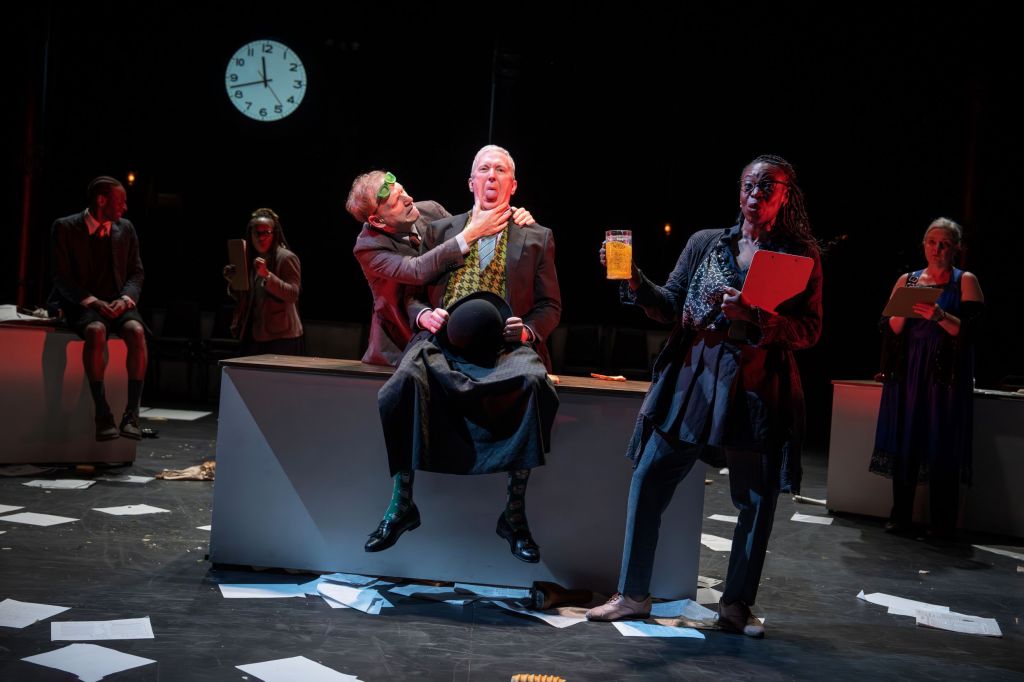
The costume design by Enver Chakartash reflects the time period with a fanciful modernist flourish that gives humor and depth to the personalities of the characters. For example Blazes Boylan (Scott Shepard) who has the affair with Molly wears a straw hat, outrageous wig and light suit that aligns with his jaunty gait. The scenic design by DOTS is minimalist and functional as is Marika Kent’s lighting design and Mathew Deinhart’s projection design. Most outstanding is Ben Williams’ acute, specific sound design which brings the scenes to life and follows the text adding fun and delight.
By the conclusion the audience is spent following the challenge of recognizing Joyce’s Dublin and the three unusual intellectuals and artists who he chooses to explore. Elevator Repair Service has elucidated the novel beyond what one might endeavor to understand reading it on one’s own. Importantly, they’ve made Ulysses an experience to marvel at and question.
Ulysses runs 2 hours 45 minutes with one intermission at the Public Theater through March 1, 2026. https://publictheater.org/productions/season/2526/ulysses
 CAROLE DI TOSTI