Author Archives: caroleditosti
‘Back to the Future’ Roars Onto Broadway, Review

The charm and humor of the musical Back to the Future with book by Bob Gale and music and lyrics by Alan Silvestri and Glen Ballard is that the story flashes into the past minding 1955’s tropes and trends i.e. cigarette smoking is healthy, leaded gas provides a clean environment, DDT gets rid of the mosquitos and bugs with no deleterious effects, asbestos for home insulation keeps you warm. As in the titular film (written by Bob Zemeckis and Bob Gale), the Broadway musical, directed by John Rando, presents a similar plot with the same characters and allows us to reflect upon two decades in history thirty years apart.
Currently at the Winter Garden, kicking up a storm with fantastical asides, fourth wall-breaking irony and other slapstick, the show is a high powered delight.
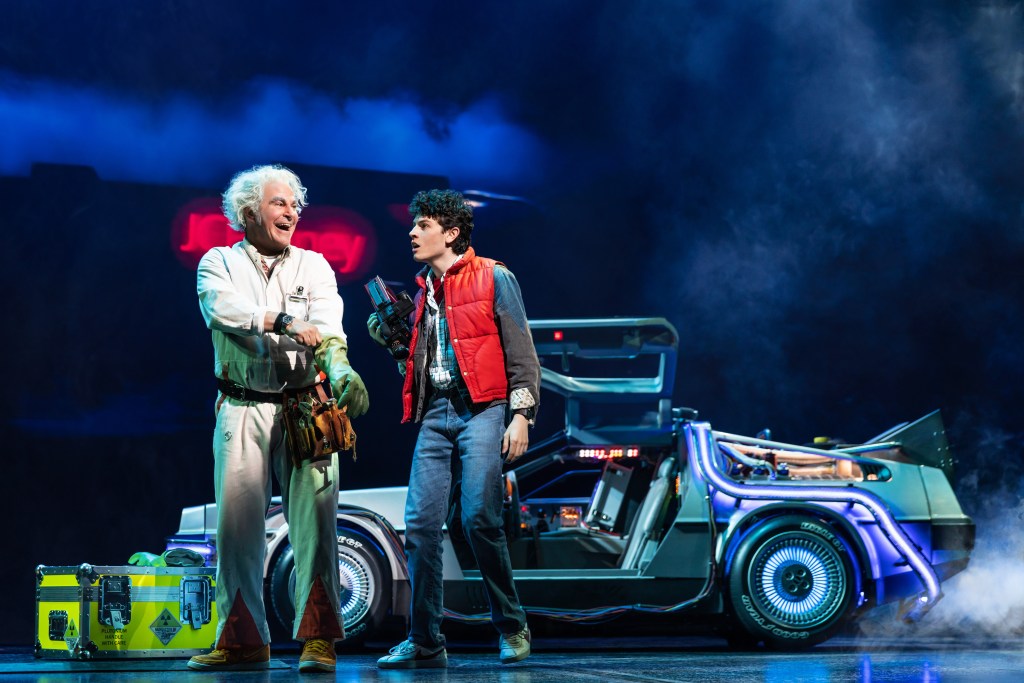
Rando’s production of the book by the film’s co-creator Bob Gale speeds by with thirteen songs in Act I and thirteen songs in Act II, all of them popping with zest and excitement. The velocity never lets up, though one might wish it, but that’s the beauty of such a production whose protagonist races against time so he doesn’t obliterate himself with the physics of time travel that doesn’t quite make sense but certainly adds to the tension, excitement and horror when he nearly doesn’t make it “back to the future.”
The audience remains engrossed with the dynamic, lovable Marty McFly (the superb Casey Likes of Almost Famous), who visits friend Doc Brown’s lab, where he creates mayhem with an over-amped ukulele. Revved up, the scene shifts to right before his audition for a talent contest in the town square (“It’s Only a Matter of Time”). McFly and Goldie Wilson (the vibrant Jelani Remy), who is running for mayor, affirm they are winners, not losers. However, Principal Strickland shuts McFly down quicker than a Broadway audition. In a very public, obnoxious dressing down, Strickland (Merritt David Janes) shreds McFly’s dignity and proclaims him and his family slackers and losers.
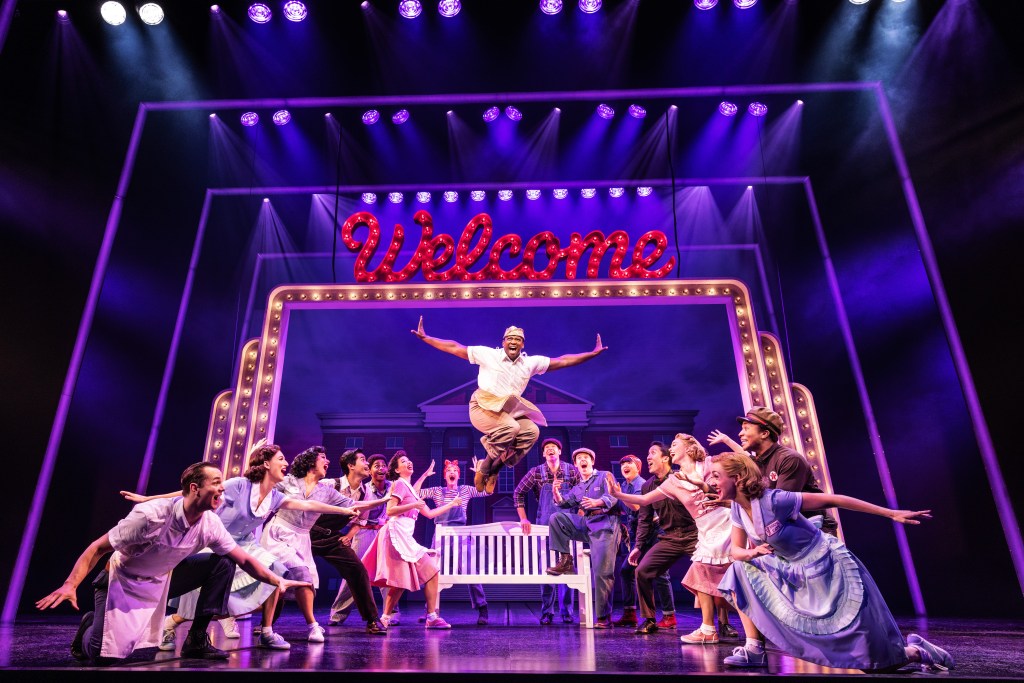
Marty crashes emotionally for a moment, allowing Strickland to define him. He realizes that he will be like his slacker parents and sings the pop-rock “Got No Future,” thus establishing the conflict McFly must overcome. How will he be able to reshape his loser self and prove he is someone to reckon with?
It’s quite elementary and accidental. In a physics sleight of hand, he jumps into Doc’s DeLorian’s time machine and goes back to 1955 to save Doc (Roger Bart originated the role), from radiation poisoning. There, he becomes the rocker success he knows himself to be. However, before his time travel, Marty receives the courage to forge on despite Strickland’s pronouncements by hanging with his girlfriend, Jennifer (Mikaela Secada in her Broadway debut). They sing “Wherever We’re Going,” and once more he is uplifted to his dreams with her love and support.

But McFly is brought low again when we follow him home to see his loser family: George (Hugh Coles originated the role), Lorraine (Llana Hunt-Newsies), Linda (Amber Ardolino), Dave (Daryl Tofa). If they are an example of his genetic inclination to loserdom, he definitely has no future. Indeed, if he goes to 1955, most probably since he is always late, he won’t make it back in time and he will be in a space time continuum paradox. He he will be wiped from the map of existence. This is the key set up, spurring the momentum forward at two times faster than the speed of light.
Introducing each of his family members, the song (“Hello-Is Anybody Home?”) features snippets of how his father, mother and siblings can’t get arrested on Broadway. Rando’s direction allows each actor to go “over the top,” especially Dad George McFly, whose antics are enforced for laughs and sometimes don’t appear to rise organically.

However, Back to the Future The Musical is Sci-Fi fantasy. If George’s movements are angular and extreme schtick and he’s pushing for laughs, he’ll get them. The men especially will identify with his personality weaknesses that make him quake in his boots when he tries to avoid confronting the wicked bully of the show, Biff Tannen (Nathaniel Hackmann). Of course, Marty’s attempts to counsel his Dad in 1955 (before Marty was born), are ironic and the theme resonates that “a little child shall lead them.” Oftentimes, kids are sharper than their parents and adults, who should listen to their kids’ wisdom but who often, like Strickland, shut them down.
The only adult who doesn’t shut down Marty is Bart’s Doc Brown. When Marty meets Doc in a field where the DeLorean lands with an explosive, gyrating flourish, it is obvious the two have a powerful bond. Through a series of mishaps Marty ends up traveling to 1955 where Doc has set the machine and we watch as some incredible projections show Marty’s time/space travel imaginatively, going twice the speed of light.

Back in 1955 complications arise. Marty becomes tangled in a love triangle with his mother that includes some of the biggest laughs of the show. With the exception of some minor changes the musical keeps the humorous conceit of time travel with all of its paradoxes which are never explained. Neil DeGrasse Tyson, the astrophysicist, would enjoy the show because it is sheer entertainment. However, it defies explanation and logic. That is the point.
One must not think too much about how in the twinkling of an eye George moves from bumbling idiot to savvy book author, his body ticks straightened out. And how do his mother and sister lose weight and become gorgeous in a week’s time? Inquiring celebrities want to know if it’s Ozempic®. Oh, wait, that’s an anachronism. It’s clear that Marty does something in the past to shift the present from his former perception. However, the songs crash into each other, with such verve, that one cannot breathe for the intricacies of the story. It’s typical Sci-Fi prestidigitation. Whatever happens happens, and we are enjoying the ride.

The scenes shift to different sets. The songs have flashy backing dancers with color coordinated costumes. The assumption is that audience members are familiar with the film which is both a plus and minus. On the one hand, the jokes relate from the film and the audience notes them with pleasure. On the other hand the pace is frenetic. A quiet moment is necessary for the audience to take a breath. Perhaps, the DeLorean scenes would pop even more. They are such fun.
The DeLorean is the highpoint of the show, thanks to Chris Fisher’s illusions which are absolutely gobsmacking. Of course, he has an assist from Gareth Owen’s sound design, Tim Lutkin & Hugh Vanstone’s lighting design and Finn Ross’ video design. The DeLorean moving from present to past and back is a memorable feat.
Also, the clock tower scene set in the lighting storm is equally thrilling. Will Marty make it back in time, moving forward? The jokes and memes on time are exhausted by the conclusion of the show.

Importantly, audiences are going because they want to see how the production effects the time traveling DeLorean and they enjoy hearing tunes from the past whose hits always strike a congenial nerve (“Earth Angel,” “The Power of Love,” “Johnny B. Goode”). One new song which Doc sings resonates well with the themes and is reprised a few times in Act II, “For the Dreamers.” Doc is thrilled that for the first time, something that he has created “works.” The theme suggests that one must persist, keep on dreaming, and never give up. This is sage advice in any era, any decade, any age.

Act II deepens the relationships we’ve seen laid out in Act I. “Put Your Mind to It” which Marty and George sing together unites them with a similar purpose. Marty is encouraging his father to stand up for himself, be confident and “go for” Lorraine. The actors work the song but more organically.
Casey Likes is always spot on authentic as is Roger Bart. In their loser iterations George, Lorraine, David and Linda play for the stereotype. In this type of production it works. The laughs might have been greater if they were no so intentionally “loserish. However, they shine after their son returns with the “goods.”
Kudos to Tim Hatley (designer), Chris Bailey (choreographer), Campbell Young Associates (wigs, hair and make-up), Nick Finlow (musical supervisor, vocal and music arrangements), Ted Arthur (music director), Ethan Popp and Bryan Crook (orchestrations) David Chase (dance arrangements).
This is one to see especially if you are a fan of the films and enjoy seeing live theater with amazing stagecraft and technical designs that are phenomenal.
For tickets and times go to their website https://www.backtothefuturemusical.com/new-york/
‘Here Lies Love,’ The Stunning Bio-Pop-Musical Sounds Alarms About the Price of Democracy

The Millennium Club is the phenomenal, multi-level, theatrical setting of the bio-pop musical Here Lies Love. The resulting panorama is a monolith of disco and pop music, many-hued neon lights, black and white historical film clips, multiple dazzling screen projections, and spot-on performers’ heightened song and dance moves “here, there, everywhere” in living color. With 12 musicians (guitar, percussion, bass, etc.) some of the musical backing is prerecorded like karaoke, a cultural staple in Filipino lives. All this is the backdrop to David Byrne and Fatboy Slim’s spectacular immersive, sensorial, orgiac experience currently at the Broadway Theatre.
At the unfolding of the alluring dance party, the political and social history of 20th century democracy in the Philippines coalesce under a gleaming, disco ball. On the dance floor the pink, jump suited ushers shepherd and move the audience around a platform in the shape of a cross (a coincidental reference to the predominately Catholic country) that in a different configuration later becomes the bier upon which the coffin of the assassinated Ninoy Aquino moves leading the audience in the funeral procession.

On the second level, the jazzy, sun glass-wearing, cool, black-leather outfitted DJ (Moses Villarama) amps up the crowd, encouraging their investment in the show’s diversions. Throughout, the audience members in the balconies on three sides and on the first level dance floor, cheer, mourn, laugh and applaud. Their interactive roles as the captivated conspirator/citizens allow them to witness and participate in the iconic rise and fall of Ferdinand (Jose LLana) and Imelda (Arielle Jacobs) Marcos, celebrity leaders turned dictators.
With American encouragement and influence steeped in an autocratic colonial past, the Marcoses’ initially inspired governance devolved into a brutal, self-serving regime. Peacefully overthrown by the People’s Revolution (1986), after years of repressive, murderous authoritarianism, the Marcoses’ story masterfully stenciled by Byrne, Slim, Clint Ramos’ research and Alex Timber’s enlightened direction, is an important work for us in our time of QAnon, Donald Trump, the Federalist Society’s purchase of Supreme Court Justices, the Dobbs’ Decision and foreign donor’s dark money purchasing politicians, who, to feather their own agendas and dilute and destroy global democracies and the right of the people to self-governance.

The narrative of Here Lies Love is an encomium in song and dance. In its Broadway premiere ten years after its off-Broadway premiere at the Public (2013), the musical features Filipino producers and is brilliantly performed by an all-Filipino cast. With passion they portray the narcissistic Marcoses and their acolytes, who conspired to gradually hoodwink citizens to dance to the Marcoses’ siren songs.
Importantly, the production highlights the heroes. It is their vision for the Filipino people, and their hopes for a democratic country, that inspired them to risk their lives for the Filipinos’ right to “a place in the sun.” These courageous exposed and railed against the Marcoses’ excessive squandering of millions of dollars in a luxurious lifestyle, while a majority of deprived citizens had insufficient access to life-sustaining food, shelter, clean water and the freedom from military terror. This is the story of their love, and the sacrifice of their lives in the revelation of how easily leaders may fall prey to their own crass weaknesses and destroy a nation they disingenuously proclaim to love.

Key among the heroes is the liberal leader of the opposition party, Ninoy Aquino (Conrad Ricamora in an inspired and dynamic portrayal), and those aligned with Aquino like his mother Aurora Aquino (the wonderful Lea Salonga). Aquino’s persistent example, assassination by the Marcoses who were never held accountable, and subsequent martyrdom paved the way for the People’s Revolution.
Though the Marcoses are key players in the musical, Byrne and Slim make sure through quotes and commentary from interviews and news reports that praise does not go to the despots, one of whom is still attempting to exert power today through her son and president of the country. Here Lies Love is an object lesson in vanity, dereliction of duty, self-deception and treachery which Fatboy Slim and Byrne spin with irony in their lyrics in the title song, “Here Lies Love,” and in Imelda’s concluding song, “Why Don’t You Love Me?” written by Byrne and Tom Gandey.

Though the title of this production belies Imelda Marcos’ “love” for her country (she affirms her epitaph should read “here lies love”) Byrne, Fatboy Slim and director Alex Timbers underscore the hypocrisy of her love revealed in the musical’s arc of development. Her hypocrisy and velvet insidiousness are especially demonstrated in the 3,200 Filipinos killed, 30,000 tortured and disappeared and 70,000 imprisoned (the numbers are higher most probably).
These statistics are listed in the surrounding projections in black and white. The musical uplifts the Filipino people’s resilience, courage and love of their countrymen and women. The citizens are a shining example for democracies around the world and for whom the musical’s title really applies. Indeed, the Filipinos’ love is demonstrated in the People’s Revolution at the conclusion, and culminates memorably in the final poignant song.

The production is majestic and profound. Its themes counsel that citizens of democracies must be sentinels against those like the Marcoses, who would exploit democratic elections, usurp power, declare martial law, and order the military to protect the powers of the executive, while disbanding all the other branches of government. By silencing their critics and killing opponents, dictators like the Marcoses rebrand terrorism as law enforcement in order to steal from the treasury and maintain their hold on power. This follows after smearing the opposition, jailing perceived enemies without due process, nullifying democratic laws and wiping out a free and fair press, who cannot call out their crimes.
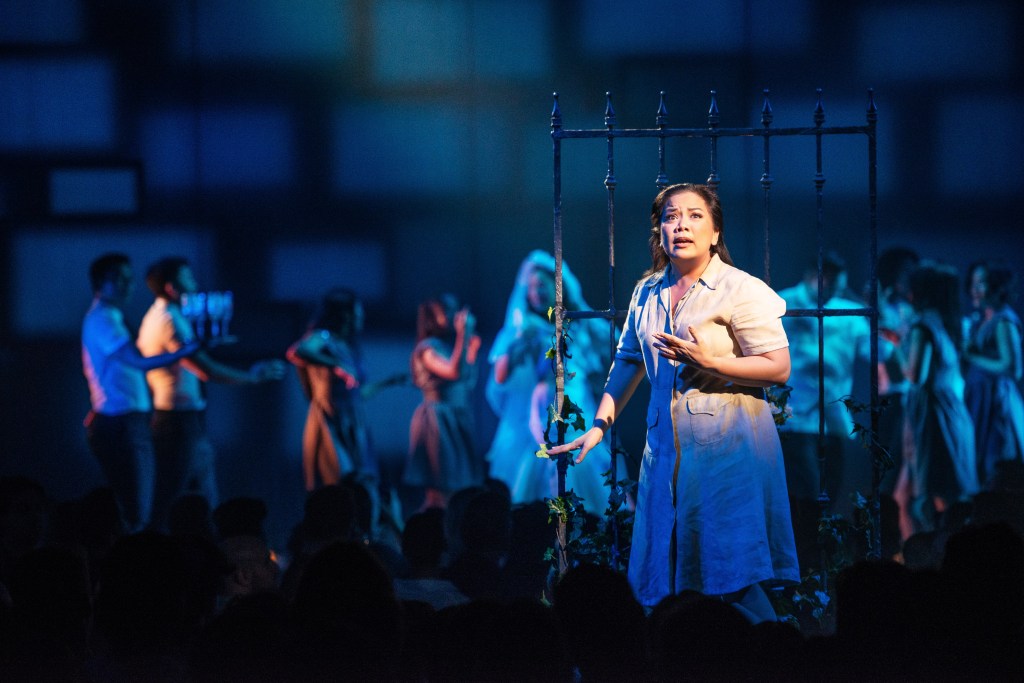
All of these egregious actions Ferdinand and Imelda Marcos did while the United States turned its head and looked away.

Thus, as the audience dances and follows the guidance of the ushers and DJ, they are initially blinded and mesmerized by the fantastic surreality of beauty, fun and energy. And as Imelda the beauty queen ends her relationship to Nimoy Aquino and takes up with Ferdinand on a publicized 11 day whirlwind romance that ends in a white wedding, we watch as she morphs from the naive country girl to the savvy doyen of American fashion and celebrity. The “steel butterfly” (a nickname given to her by the press), has become a clever political animal, who is a help meet to ruthless Ferdinand right before our eyes.

The 90 minute dance party summarizes the Filipino seduction and decades of growing repression in key events. After their marriage, Imelda is overwhelmed by being in the limelight and has a nervous breakdown, requiring therapy and becoming addicted to drugs. Jacobs portrays the changes in Imelda convincingly. When she sings “Walk Like a Woman,” we realize that the once innocent girl has become a seductively calculating political creature as she tirelessly campaigns with her husband and helps him win the presidency. She becomes knowledgeable about culture and obsessed with the construction of buildings (The Philippine Cultural Center), which draw attention to herself as a celebrity but do nothing for Filipino citizens.

The projections and black and white film clips from archives are salient in revealing the glittering Marcoses rise. Byrne’s lyrics are from interview quotes and reports covering the Marcoses and Aquino. Photographs show Imelda with everyone from Andy Warhol to various leaders like Ford and later Reagan,, who propped up the Marcoses and gave them sanctuary in Hawaii after they fled during the People’s Revolution. Ricamora’s Aquino gives rousing speeches about Imelda’s egregious use of funds for a cultural center (“The Fabulous One/I’m a Rise Up”) which sets the audience/citizens on edge and alerts them to financial corruption in the Marcos’ regime every time Aquino calls them out. Byrne creates lyrics that borrow heavily from his speeches.

The turning point comes after Marcos’ scandal with American actress Dovie Beams, whose impact on Imelda is ironically highlighted in a dance number with multiple “Dovie Beams” in black bikinis and blonde wigs. The original tape recording between Beams and Marcos is played during this point in the production accompanied by music and lights reinforcing the spectacle. Imelda considers that “Men Will Do Anything” (Jasmine Forsberg is Imelda’s powerful inner voice).
Losing trust in Ferdinand, she conveniently latches onto self-deception and sings of her dream that she is the people’s star and slave (“Your Star & Slave”). As she disingenuously commits herself to her country, Ferdinand, licking his wounds in embarrassment, retires to the hospital with Lupus and attempts to win Imelda back. Jacobs and Llana’s duet “Poor Me,” is a beautiful example of a couple lying to each other, complicit in keeping their hold on power.

The beating of students protesting the Marcoses’ corruptions, Estrella’s (the heartfelt Melody Butiu) revelations of Imelda’s lies about her heritage (“Solano Avenue”) and Estrella’s subsequent arrest and punishment for going to the press, puts the Marcoses’ maladministration on everyone’s radar. Aquino speaks for the masses in his criticism of Imelda, which she and Ferdinand not only ignore, but feel victimized by. The easy way dictators shift blame and beat their breasts about being persecuted is highlighted by Byrne’s song and incredibly acted by Llana and Jacobs. One almost believes they are victims and the unjust criticism is weaponized by Aquino, protesting students and opponents.
After bombs go off in Miranda Plaza wiping out almost all the liberal party, Marcos blames it on the liberals (1984 fascist logic-why would they intentionally kill themselves) and declares martial law in Order 1081. Byrne and Fatboy Slim have outdone themselves in the lyrics and forceful, pounding music that codifies the new dictatorship and power grab by the Marcoses. During the performance of “Order 1081,” the statistics enumerate the casualties of the Marcoses’ punishments for for protests. Ninoy Aquino is jailed for 7 years. There are no trials, just guilt and oppression. The staging and performances are shocking and disturbing.

We ask, what? Are the glorious Marcoses murderers? Indeed. And they act privileged and justified in brooking all “nefarious” opposition.

After seven years when the jailed Aquino needs a heart operation, the Marcoses send him and his family to America on the stipulation that he never return. Aquino doesn’t keep his promise to the criminal dictators. Instead, he sacrifices his life, an assassinated martyr, which is another shocking blow in the musical slammed into the audience’s psyche with all the force of lights, sound effects and music that explode when the audience least expects it. And in the aftermath with Salonga’s song as Aquino’s mother, the crowds at his funeral effected by the ushers and the coffin on the platform are staged with impeccable emotional poignance.
Timbers reveals how the Peaceful Revolution happens in the staging and the surrounding projections. We understand that the crowds demand Marcos’ resignation after a rigged election in which he proclaimed himself the winner. The people’s massive protests demand the Marcoses resign. Ronald Reagan gives his friends sanctuary in Hawaii, announced via projections of New York Times’ headlines. It’s an appalling closure to the Reagan administration’s supporting dictators and murderers who deny culpability.

Ironically, in the musical it’s a blip that passes speedily which Byrne intentions because he is sardonically indicting the Americans for supporting dictators as a horror of colonialism’s aftereffects. Also, it is incredibly current and an expose of the Republican MO to protect their own. They conveniently pardoned Nixon’s criminality during Watergate and refuse to censure or disqualify Donald Trump as a presidential candidate indicted for his crimes against the country.
The last song “God Draw’s Straight” (But With Crooked Lines) is a testament that democracy depends upon the power of the citizens worthy to govern themselves. The song is magnificent, encouraging and a reminder that citizens must actively resist the lies, excesses and dereliction of corrupt, dangerous leaders, by continually calling them down in peaceful protests.
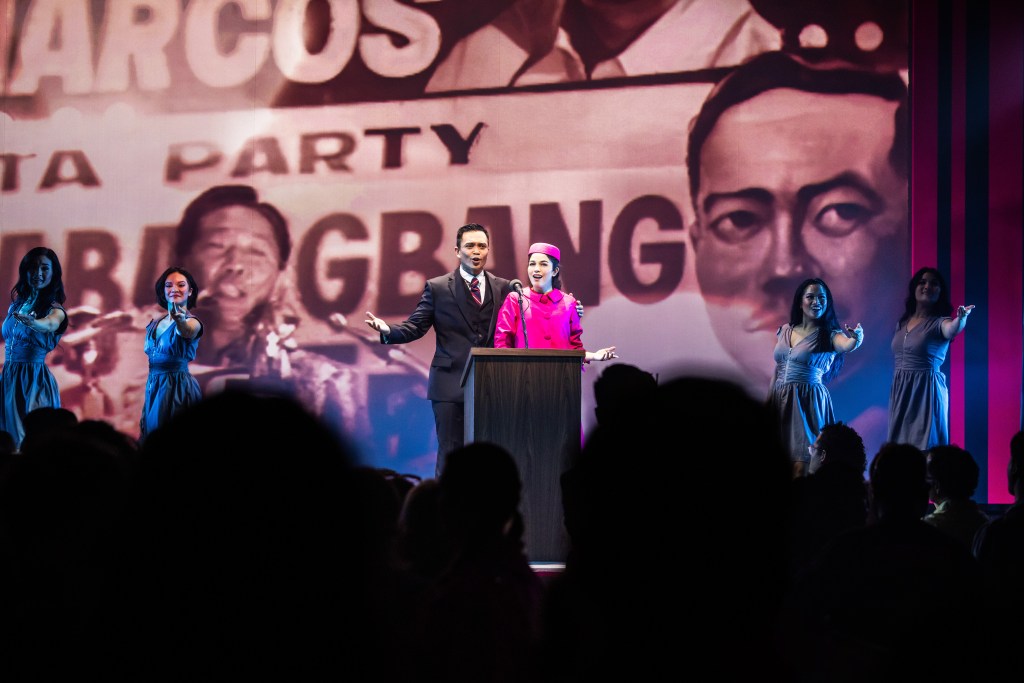
From the top of the dance party whose song “American Troglodyte” incriminates the Marcoses’ chief influencer, the crass, monopolistic, corporate consumerism of America, to “God Draw’s Straight” (But With Crooked Lines), this gobsmacking production chronicles how the Marcoses, emblematic of how dictator-murderers, subvert democracies and rise themselves up through lies, misinformation, disinformation, propaganda, self-victimization and the vitiation of constitutional government in exchange for military oppression and terrorism. Of course, the dictators justify their crimes with the “poor me” ploy, the refusal to admit responsibility and martial law directed to empower and protect them.
Every American citizen should see this incredible work of art whose creative team worked overtime to meld all the technologies and elements to effect Timbers,’ Byrne, and Slim’s (with additional music by Tom Gandey & Jose Luis Pardo) vision. The performers are incredible, invested, determined to express this vital story that must be told.
Special recognition goes to Annie-B Parson’s choreography, Clint Ramos versatile and quick change costume design (referencing the times according to news articles and video clips), Justin Townsend’s lighting design, M.L. Dogg & Cody Spencer’s well-balanced sound design (not any easy feat with such a venue), Peter Nigrini’s wonderful projection design, Craig Franklin Miller’s spot-on hair design and Suki Tsujimoto’s make-up design. Additional kudos goes to J. Oconer Navarro (music director), Kimberly Grigsby and Justin Levine (vocal arrangement), Matt Stine and Justin Levine (music production & additional arrangements).
I’ve said enough. For tickets and times go to their website https://www.telecharge.com/Broadway/Here-Lies-Love/Ticket
Photos by Billy Bustamante, Matthew Murphy and Evan Zimmerman (2023)
‘Orpheus Descending,’ One of Tennessee Williams Most Incisive Works-a Searing Triumph
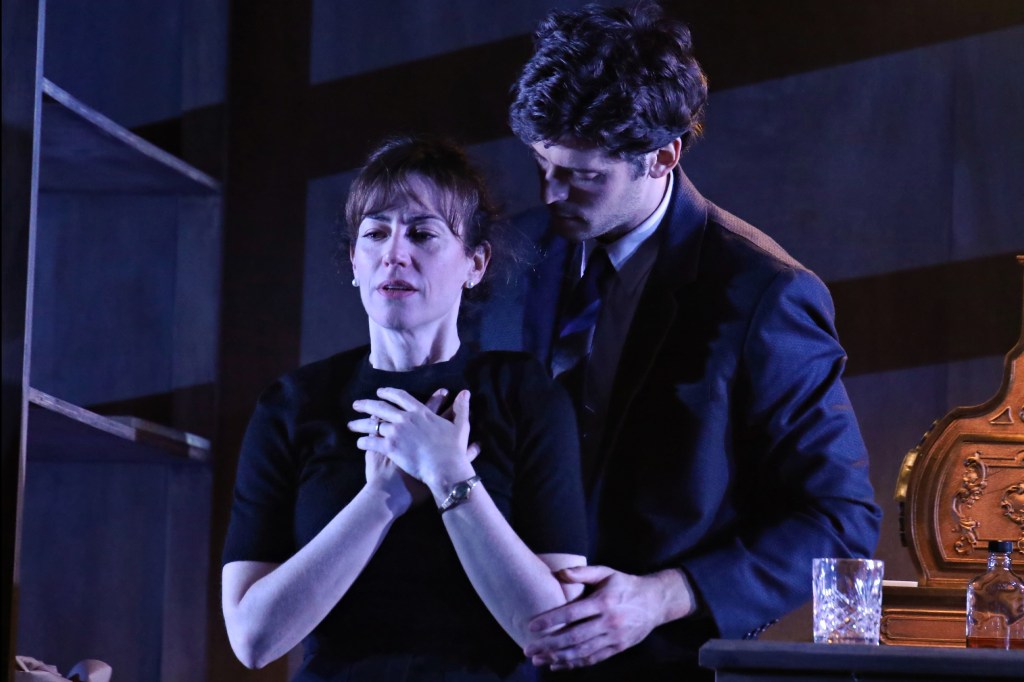
The hell of the South abides in Erica Schmidt’s revival of Orpheus Descending, currently running at Theatre for a New Audience in Brooklyn until August 6th. Tennessee Williams’ poetically brazen work about the underbelly of America that reeks of discrimination, violence, bigotry and cruelty seems particularly regressive in the townspeople of the rural, small, southern, backwater of Two River County, the setting Williams draws for his play.
This production is raw in its ferocity, terrifying in its prescience. It reminds us of the extent to which racists and bigots go feeling self-righteous about their loathsome behaviors when the culture empowers them. The director shepherds the actors to give authentic portrayals that remind us that death lurks in the sadistic wicked who seek to devour those whom they may, especially when their targets have peace and happiness, and step over the line (what the bigots hypocritically think is the line).
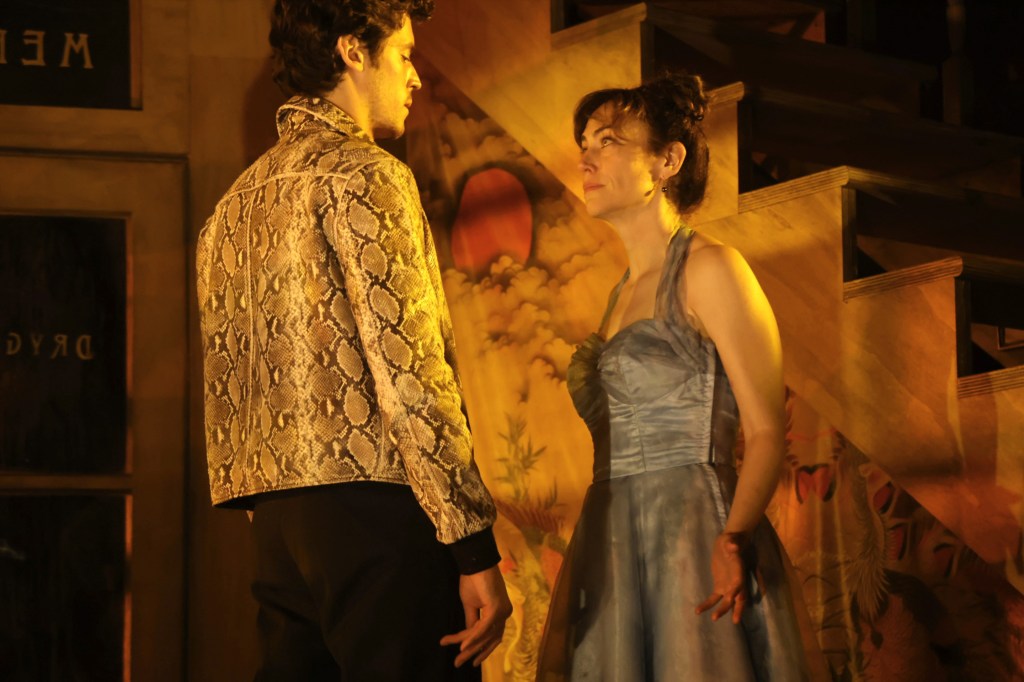
At the top of the play, we immediately note that stupidity and hypocrisy exude from the pours of most of the homely white characters. Sheriff Talbot and the wealthy Cutrere family are the chief representatives and purveyors of white supremacist, conservative law and order, which is as natural and welcome as white on rice.
Williams’ brilliant but lesser known work is based on the Orpheus and Eurydice myth. However, Williams updates the allusion and spins it into metaphoric gold transposing the heroic characters into artists, visionaries and fugitives, who rise wildly above the droll deadness of their environs or are delivered from them, as is Lady (Maggie Siff) who is brought to life during her relationship with Val (Pico Alexander). During the course of Val’s and Lady’s dynamic relationship with each other, they seek to cleanse and overcome their past heartbreaks and regrets and move upward toward redemption, reclamation and new beginnings with each other’s help.

The banal atmosphere conveyed by Amy Rubin’s spare, angular, cage-like design of the Torrence dry goods store is an appropriate setting where most of the conflict and interplay among the characters takes place. Its ugly, hackneyed blandness, lack of vibrancy and straight-edged corners symbolize Lady Torrence’s desolate life with the hypocritical, vapid townspeople and her infirm, brutal, racist, hoary-looking husband Jabe Torrance (the irascible, excellent Michael Cullen).
The other two sections of the set, the confectionery (stage left) and the storage area behind the curtain (stage right), Rubin suggests with minimalism. The confectionery and the storage area symbolize the other aspects of Lady’s character that are not governed by Jabe and the destructive, deadening, Southern folkways. The confectionery eventually outfitted with lanterns symbolizes her hope for renewal and reclamation. The intimate, barely lit, storage area where Val sleeps symbolizes the fulfillment of her desire for love.
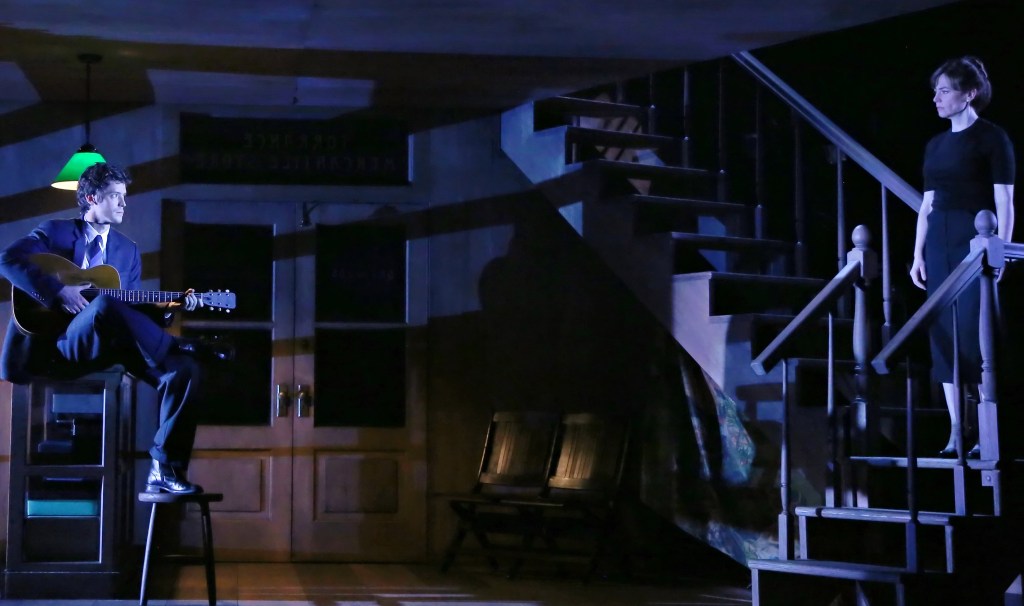
Center stage is the store and above it the Torrence bedroom, both subscribed by walls which pen Lady in. Along with Jabe, the store’s visitors suck her life-blood dry with the exception of Val and Vee (Anna Reeder), a Cassandra-like character. Above the store, Jabe lies in bed dying. Empty of kind words, Jabe communicates his bile and bitterness by pounding his cane on the floor from his sick bed. It is an ominous foreboding alarm that one imagines the master sends to his slave when he commands something from them immediately.
Into Two River county’s washed-out “neon,” “low-life” mediocrity comes the contrasting light and beauty of the guitar artist/entertainer, the stunning and untouchable Val Xavier. Pico Alexander makes the role his own, portraying Val with grace and alluring, angelic innocence befitting “Boy,” the nickname the assertive, feisty Lady gives him. Siff is sterling and likable as she grows vivacious as their bond develops. Siff’s scene where she reveals she is committed to loving Val, despite not wanting to admit needing him is just smashing.
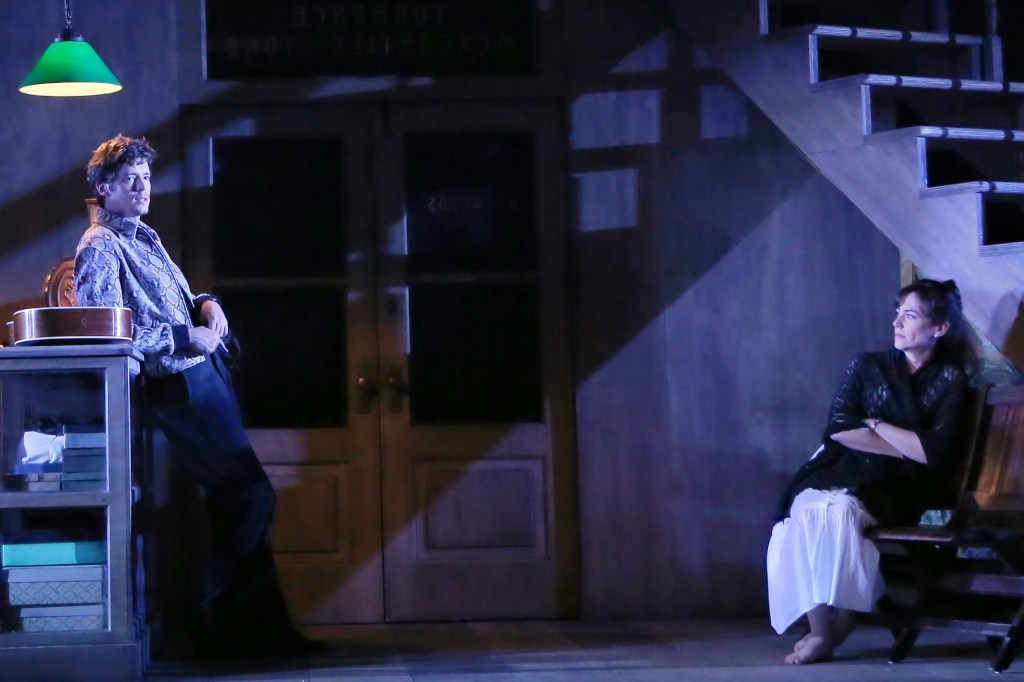
Val illuminates the spaces he enters and shatters the peace of Dolly Hamma (Molly Kate Babos) and Beulah Binnings (Laura Heisler) when he drops by the Torrence store on Vee Talbott’s suggestion that Lady Torrence might give him a job. As he waits patiently for Jabe and Lady to arrive from the hospital after Jabe’s unsuccessful operation, Jabe’s cousins Dolly and Beulah “eye him” while they prepare a celebration for Jabe’s return.
Vee (the fine Ana Reeder), a spiritual visionary born with second sight, accompanies Val and introduces him to the other women hanging around, one of whom is Carol Cutrere (the superb Julia McDermott), a rebellious hellion whose outsized antics and screaming of the Chocktaw cry with Uncle Pleasant, the conjure man (Dathan B. Williams), make the other women apoplectic. Clearly, Carol is an outsider like Val and Lady, only saved by her last name.
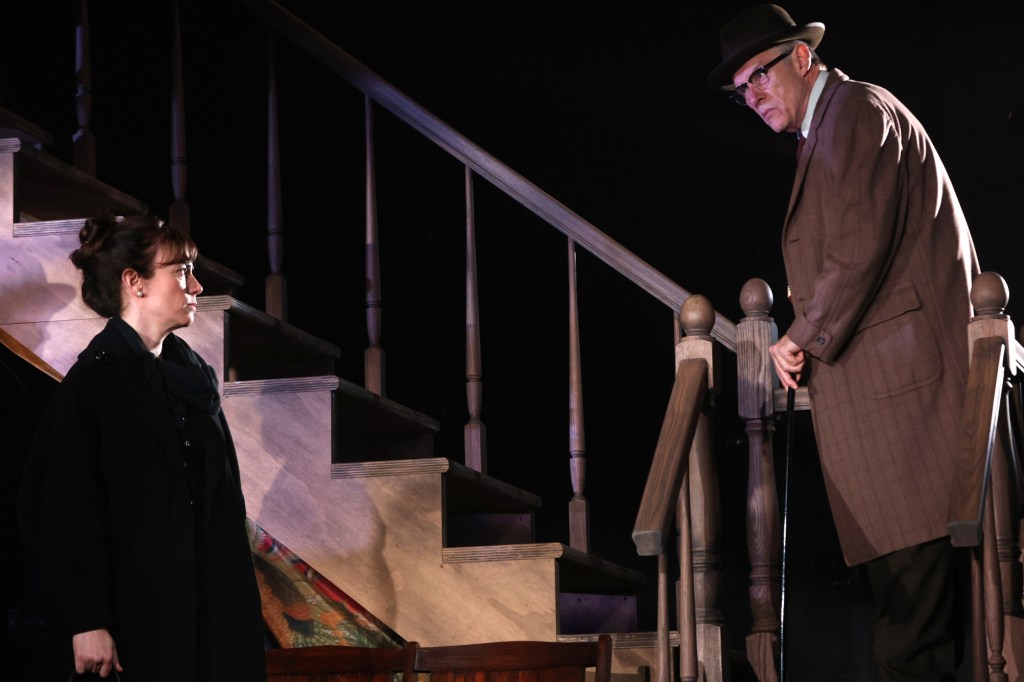
As Vee relates the visions that form the basis of the painting she brings for Jabe to encourage his healing, we note she doesn’t fit in either. If she weren’t married to Sheriff Talbott (Brian Keane) her eccentric ways would banish her from the “polite society” gathered in the store, rounded off by gossip mongers, Sister Temple (Prudence Wright Holmes) and Eva Temple (Kate Skinner), who sneak up the wooden steps to check out Jabe’s bedroom before he and Lady return.
Schmidt stages these opening scenes of William’s claustrophobic setting and characters to maximum effect, clustering the women at the counter and bringing Carol and Uncle Pleasant downstage for their chant and evocation. Downstage is where Carol cavorts, delivers a few soliloquies, and wails her outrage and sorrow as an encomium at the play’s conclusion.
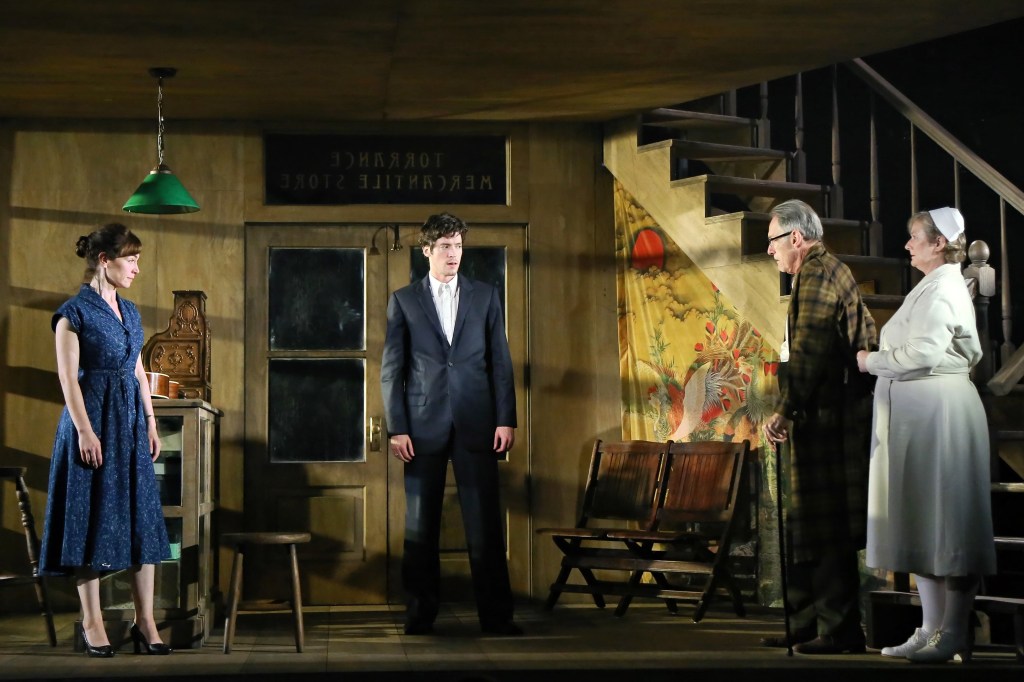
By the time Jabe and Lady arrive and Jabe retires upstairs, we have an understanding of the desolate elements and competing life forces that will drive the conflict forward. Additionally, Williams has the gossips share Lady’s terrible backstory that involves the KKK torching her father’s wine garden, and his gruesome death burning alive in the conflagration because not one firetruck or patron came to his aide.
All this was because he violated the towns’ mores and unwritten law serving wine to “ni$$ers. Implied by Jabe later in the play, the “Wop” had too much life in him and had to be cut down to size and made destitute. Interestingly, Lady’s determined father decided he’d rather burn alive trying to salvage his life’s work than accept poverty and brutality in a death-filled culture. For Lady, the acorn doesn’t fall far from the oak. She decides to take a stand against Jabe and his sadistic brutality than run away with Val.
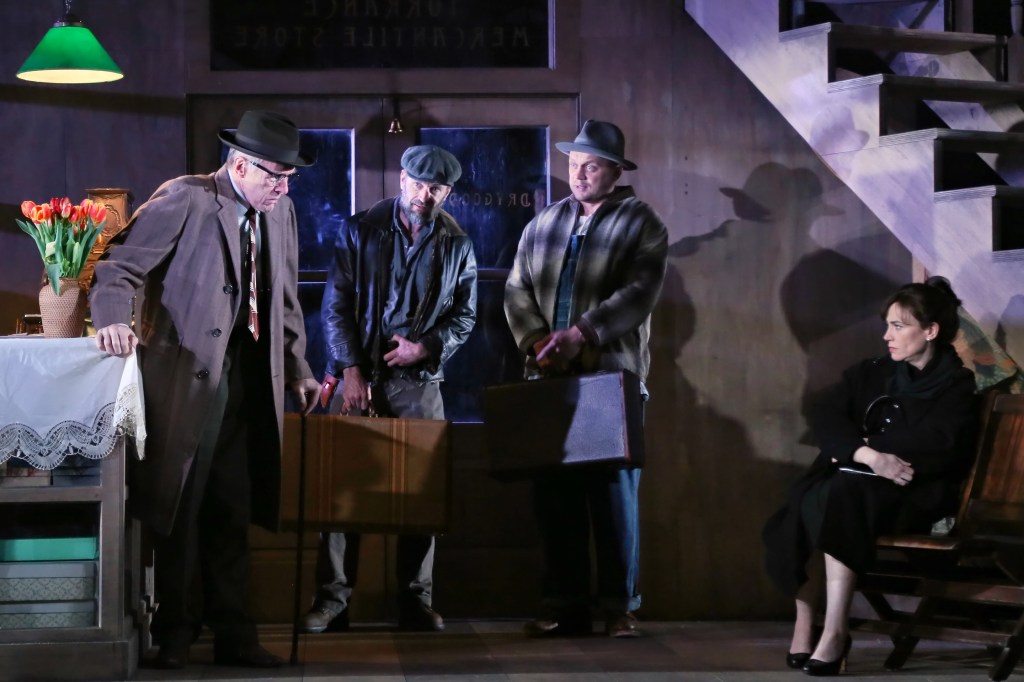
Alexander’s Val and Siff’s Lady establish their relationship gradually with Siff aggressively taunting Val’s appeal to women, one of whom is McDermott’s live-wire Carol. As their comfort level with each other grows, the two bond over Val’s description of a bird that is so free it never corrupts itself by touching the ground and only does so when it dies. Lady expresses her desire for such freedom, and after their discussion is abruptly interrupted by Jabe’s pounding, we note a greater lightheartedness within Lady. Val’s presence is the freedom and wildness that she craves.
Indeed, we note her mood is uplifted every time Lady has a quiet conversation with Val. The actors have the privilege of organically inhabiting these memorable characters with ease to deliver some of the most figuratively elegant and coherently rich dialogue found in all of Williams’ works. One of their most powerful scenes concerns Val’s description of the corrupt world and his own corruption. He counters it by sharing how his “life’s companion,” his guitar and his music, cleanses his impurity and makes him whole again.
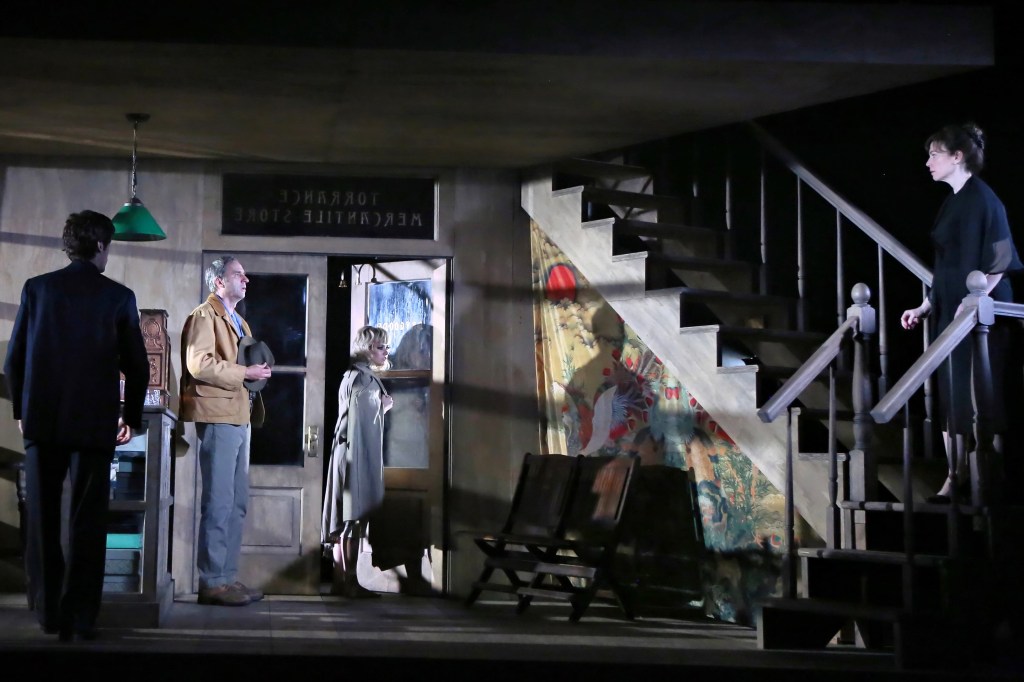
As Val settles in and she begins to rely on him, we realize that her inspiration and actions to reopen the confectionery (Schmidt use of the lanterns descending in the stylized space, stage left) run parallel to Val’s regenerative influence over her. He has ignited her hope and desire to be resurrected from the ashes of the burning, the town’s hatred and racism, and Jabe’s enslavement and ownership of her mental and emotional well being.
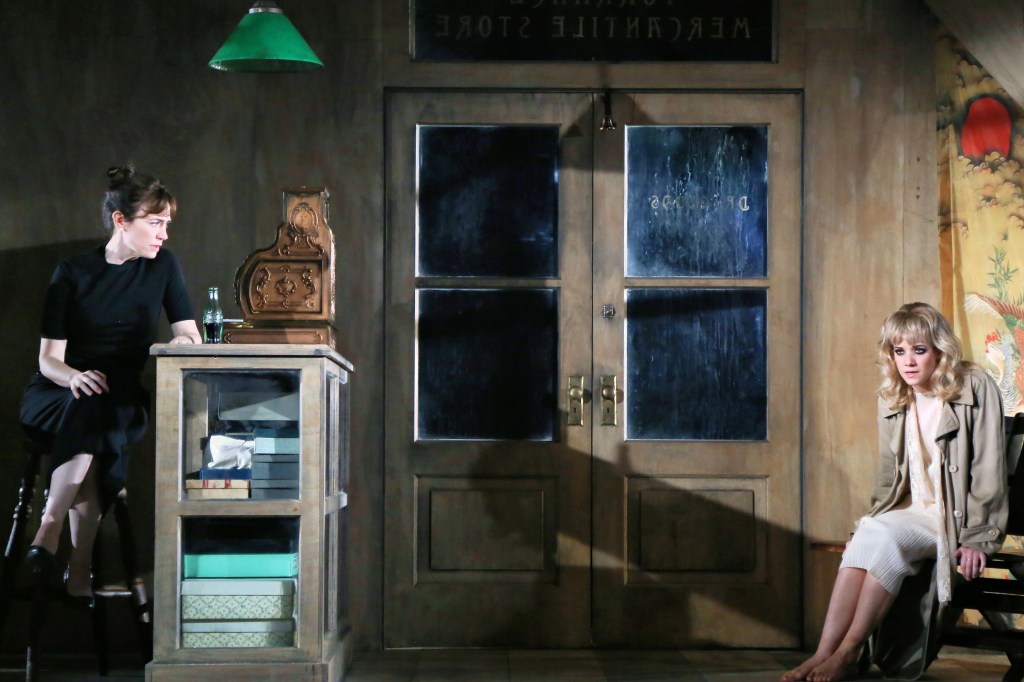
In his characterization of Jabe, Williams reveals the psychosis of the Southern Red Neck confederates turned white supremacists that lost the Civil War but persist in acting as if they won it, especially with regard to their racism and hatred of Blacks and “the other,” (immigrants). In Schmidt’s version, we see that Jabe’s attitudes and the attitudes of the other men presciently foreshadow the current MAGA Republicans’ penchant to be brutal and criminally sadistic because their “power” gives them the right, regardless of the truth of the circumstance or the legality. Certainly, Jabe has the power and white supremacist friends (Sheriff Talbot) to back up his actions with impunity.
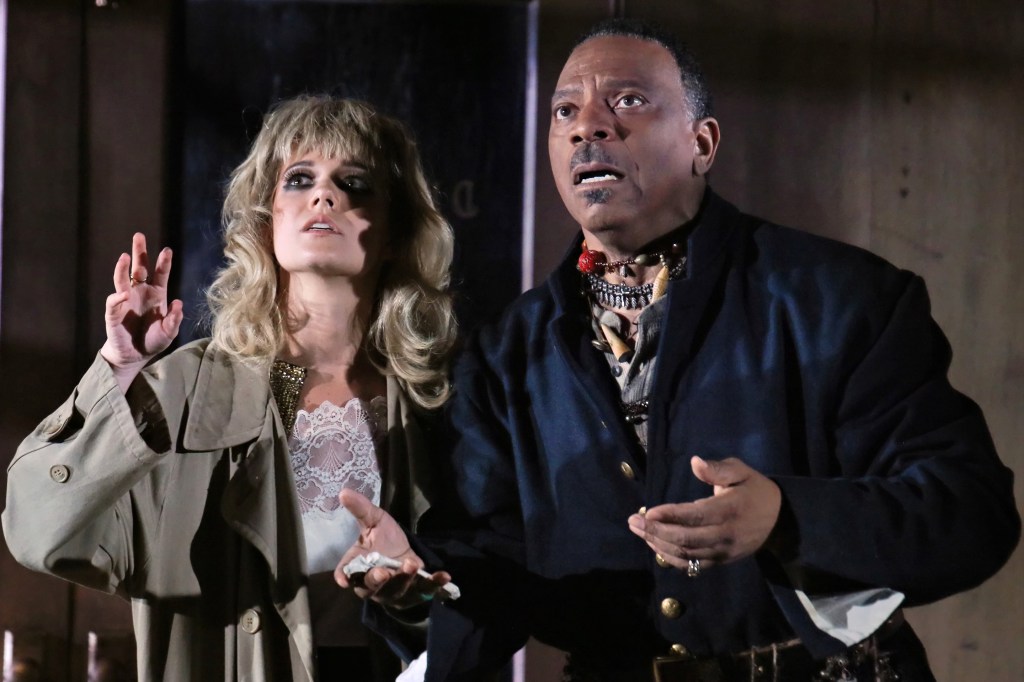
Thus, as Lady has told Val, she “lives” with Jabe, a figure of death who makes sure to stomp down her happiness or agency every chance he gets. In fact each time Val and Lady seek each other’s company for verbal comfort, Jabe almost intuits that she is uplifted away from his presence and claws and pounds (with his cane) his way back into her mind and emotions with his demands. She always goes running to him, for in her soul, she feels she has no other options.
The turning point arrives when Jabe comes downstairs to exert himself over the cancer that is killing him and perpetrate some new malignity against her, which appears to be the only pleasure he has. His emotions are pinged to remembrance when he views the loveliness of the confectionery and the new life that has inspired it (Val). It is then he strikes at Lady provoking her past reason, a white supremacist sadist to the last.
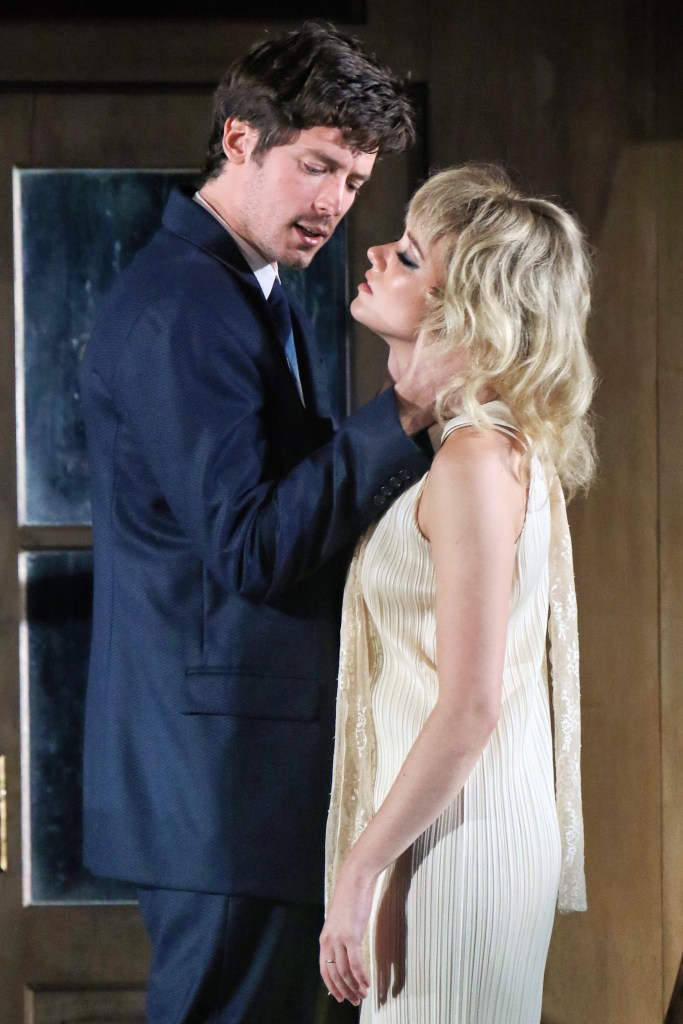
There are no spoilers. What transpires is Williams’ reaffirmation of the modern day tragedy that resulted daily in the Jim Crow South when white supremacists asserted they won the Civil War with every Black person they lynched using law enforcement to cover for them. In the play Williams also infers how this happens in the inhuman, abusive prison system which prompts men to escape and uses the escape as the justification for their killing.
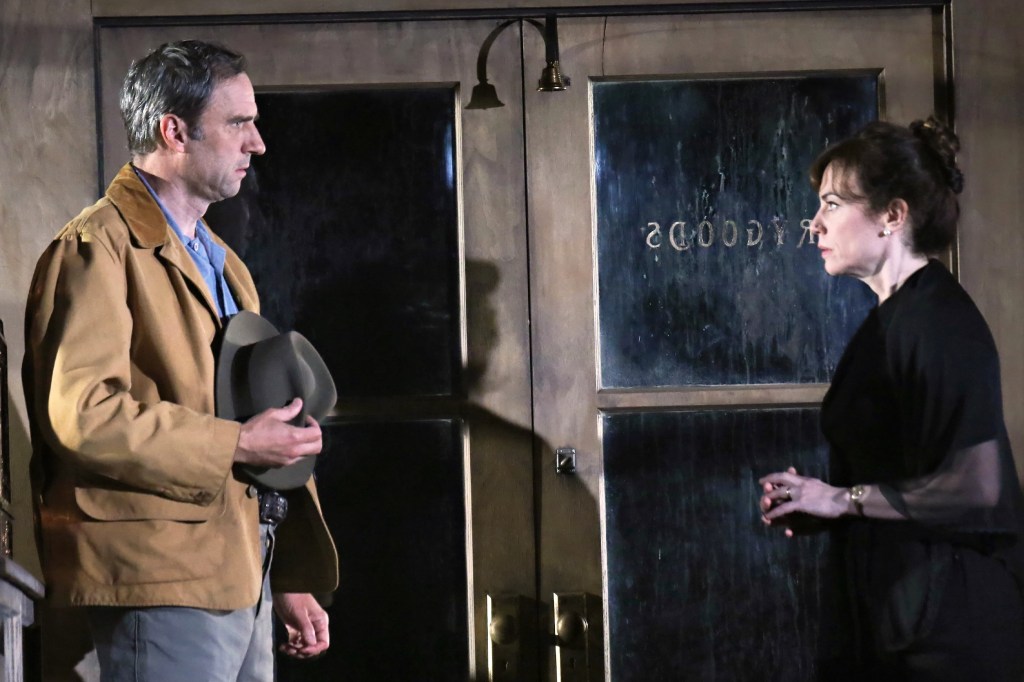
Schmidt and her team have created a production that is bold in revealing Williams’ trenchant themes about death, life, hatred, bigotry, racism and the utter wicked sadism and evil that would keep such a culture going even if the culprits, like Jabe, suffer and are eaten alive by their own hatred. In revealing Williams’ prescient themes that apply for us today, we note that a racist culture cannot be confronted when the power is held by the racists and bigots. Indeed, one must escape the purveyors of death and leave their sphere of influence, if there is no federal oversight or punishment for law breaking. If there isn’t accountability, the individuals, will do as they please, and like despots bend their underlings to their will as death dealers.
Kudos to the creative team which includes Jennifer Moeller’s costume design, David Weiner’s lighting design, Cookie Jordan’s hair and wig design and Justin Ellington’s original music and sound design.
The production concludes August 6th. Don’t miss it for its profound characterizations beautifully acted, acute ideas Schmidt suggests with her fine direction and the technical production values that bring Williams’ stark truths to bear on us today. For tickets and times go to their website https://www.tfana.org/visit/ticket-venue-policies
‘Hamlet,’ Kenny Leon’s Dynamite Version, Free Shakespeare in the Park

There are more iterations of Hamlet presented globally in the last fifty years than are “dreamt of in your philosophy.” To that point director Kenny Leon’s version of Hamlet, currently at the Delacorte Theater in Central Park until August 6th, provides an intriguing update of the son for whom time is so “out of joint,” he is unable to seamlessly and speedily avenge his father’s murder. Leon’s version shapes a familial revenge tragedy. Once set on its course, dire events cannot be averted, for at the core is the initial corruption, “the primal eldest curse, a brother’s murder” that “smells to heaven.” From that there is no turning, until justice is served, the sooner the better.
In this 61st offering of Free Shakespeare in the Park, we immediately note the conceit of corruption and its ill effects to skew the right order of things, making them “out of joint,” off-kilter. This is an important theme of the play (expressed by Hamlet) and represented by Beowulf Boritt’s set, some of which is a wrecked-out remnant of his design from Leon’s pre-Covid production of Shakespeare’s comedy, Much Ado About Nothing.
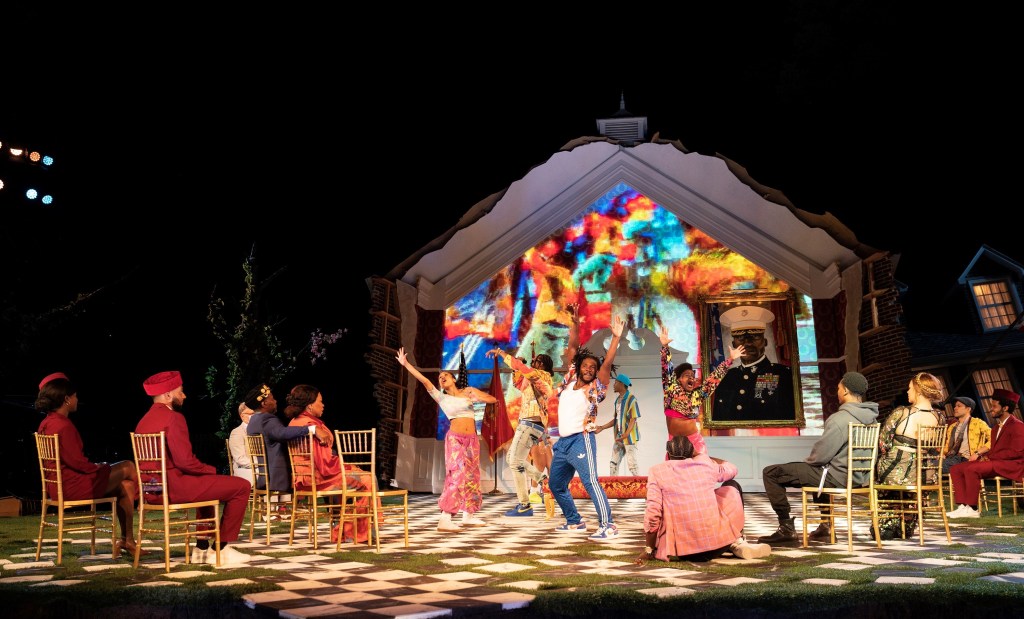
That 2019 design sported a resplendent, brick, Georgian mansion that stylistically conveyed the wealth and rectitude of its Black, lordly owners rising up in a progressive South. Hope was represented by a “Stacy Abrams for President” campaign sign proudly displayed on the side of the building. A towering flagpole and American flag patriotically stood like a sentinel at the ready. Peace and order reigned.
It is not necessary to have seen Much Ado About Nothing to understand the ruination and disorder foreshadowed by Boritt’s Hamlet set which coherently synthesizes Leon’s themes for his modernized version. In one section a tilted smaller version of the former Georgian house appears to be sinking off its foundation. On stage left, an SUV is tilted off center, undrivable, in a ditch. The Stacy Abrams’ sign is torn and displaced on the ground like discarded trash. And the American flag with its long flagpole angled toward the ground signals distress and a “cry for help.”

The only ordered structure is the cutaway of a building center stage (used for projections), whose door the characters enter and exit from.
Boritt’s set design suggests “something is rotten” unstable and “out of joint” in this kingdom. Themes of devolution are foreshadowed. From unrectified corruption comes disorder which breeds chaos and dark energy, out of which destruction and death follow. And all of this springs from the unjust murder of the deceased in the coffin that is draped in an American flag and placed center stage. It is his life which is celebrated by the beautiful singing of praise hymns at his well-attended funeral in the prologue of Leon’s Hamlet. It is his life that is memorialized by the huge portrait of the kingly father in military dress which hangs watchful, presiding over events from its position on the back wall of the only part of the set that is not wrecked and disarrayed.

Cutting Act I scene i (soldiers stand on guard watchful of an attack from Norway), Leon opens with the elder Hamlet’s funeral. A Praise Team joined by a Wedding Singer, who we later recognize to be Ophelia (the golden-voiced Solea Pfeiffer), sing with beautiful harmony. Jason Michael Webb created the music and additional lyrics which set out the Godly tenets that all are importuned to follow or live by. To their downfall they don’t and this is manifested in tragedy.
Importantly, the first three songs are taken from the Bible. The first is from Ecclesiastes (“To everything there is a season). Then follow Matthew 5 (“To show the world your love, I’m goona let it shine”) and I John 5 (“When you go on that journey you go alone”). The last song that Ophelia sings is composed of lines from a love poem that Hamlet wrote for her.
The songs intimate the former moral rectitude and divine unctions found in the former Hamlet’s kingdom. Ironically, the memorial service represents the last peace that this kingdom will appreciate. As the set indicates, wrack and ruin have already begun. The scenes after the funeral represent declension and growing darkness. And after old Hamlet is buried, nothing good follows.
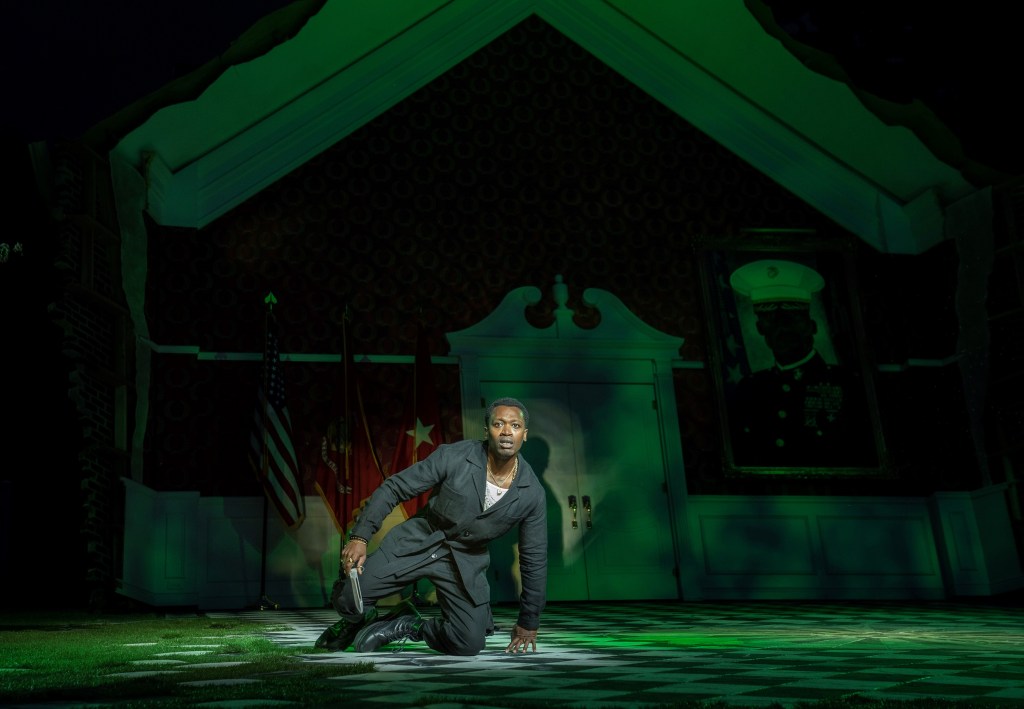
Numerous cuts (scenes, lines, characters) abound in Leon’s version. His iteration presents questions about the disastrous consequences of familial revenge which is different from Godly justice suggested by the songs. Importantly, Leon’s update (sans scene i) gets to the crux of the conflict with scene ii, the marriage celebration of Claudius (the terrific John Douglas Thompson and Gertrude (Lorraine Toussaint is every inch Thompson’s equal). We note their public affection for one another, which Hamlet later intimates is a lust-filled marriage in an “unseemly bed.” The partying has followed fast upon the old Hamlet’s burial, to the dismay and depression of his loyal son.
It is during the festivities when the sinister intent of the new king and duped mother Gertrude chide Hamlet (the fabulous Ato Blankson-Wood). They suggest he put off his mourning clothes, “unmanly grief” and depression for it is “unnatural.” Already, the cover-up has begun and Hamlet is the one individual Claudius must be circumspect about as the rightful heir to a throne which he usurped.
Gertrude importunes Hamlet to remain in the kingdom instead of returning to his studies in Wittenberg, and dutifully, he obeys, stuck with the daily reminder of his father’s death and mother’s “o’er hasty marriage.” This version emphasizes Claudius’ sincerity covering over his suspicion and fear of Hamlet. He is happy to keep him under his watchful eye. Throughout his magnificent portrayal, Thompson’s Claudius gradually reveals his underlying guilt and fear for his crimes of regicide and fratricide. We see his behavior grow more and more paranoid about Hamlet as the conflict between them grows and Hamlet unloads snide remarks on Claudius, Polonius and all those who are obedient to the usurper king as a provocation.

Leon’s version is a familial revenge tragedy which eliminates any reference to Norway or Prince Fortinbras seeking justice for his father’s death in battle with Denmark. Leon is unconcerned with Norway and Fortinbras. The conflict in his Hamlet is internal to Denmark, a divided kingdom like “an unweeded garden, rank and gross in nature.” Divided against itself, with brother vs. brother and son vs. uncle, and Gertrude the exploited, seduced pawn, Claudius’ guilt is a canker worm which gnaws at him. Likewise, gnawing at Hamlet after his father’s ghost’s visit, is the knowledge of what has to be done. But he maintains, “cursed spite, that ever I was born to set it right.”
All is covert and the truth is covered up. Polonius and Claudius spy on Hamlet to divine why he is “mad,” and Hamlet acts mad and rejects Ophelia’s love during the process of divining whether the ghost is telling the truth. Intrigue, chaos and darkness augment and have their way with the innocent and guilty. For Hamlet, the “time is out of joint.” An intellect, he is “blunted” (the ghost later says) from making the correct decisions or acting upon them in a timely fashion. The darkness that Claudius has set loose taints Hamlet and every principal character that must show obeisance to King Claudius’ illegal reign.

Key to the argument of choosing vengeance vs. justice is the enthralling scene when Hamlet meets his father’s ghost. Initially, the creative team (Jeff Sugg’s projections, Allen Lee Hughes’ lighting design, Justin Ellington’s sound design) present the father’s ghost on the back wall with projections on the portrait and the wall, accompanied by the ghost’s booming, shattering voice, which commands Hamlet’s obedience.
But at the description of the murder, the ghost possesses Hamlet. Blankson-Wood’s performance of the ghost consuming his soul is phenomenal and physical. He arches his back with the jolt of spirit possession and then rights his gyrating body as his father’s voice spews wildly from him, eyes rolled back, arms waving, the very picture of the demonic that Horatio (the fine Warner Miller) warned Hamlet might “tempt him to the flood.” At once frightening and mesmerizing, the possession enthralls us and changes Hamlet. It is a dynamic, successful scene showing the decline in the goodness from the initial praise songs to the devolution of the spirit’s will demanding vengeance. We are thunderstruck. Blankson-Wood’s authenticity frightfully convinces us of the spirit’s potential for evil misdirection into a vengeance which is not just and will bring devastation.
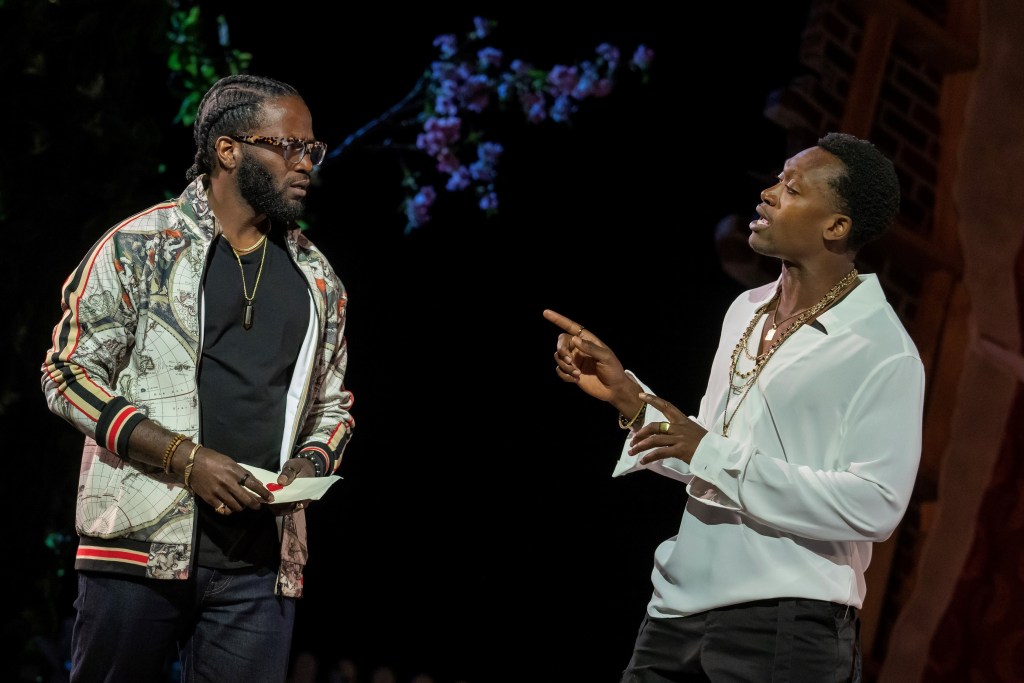
After the ghost leaves the vessel it inhabited and Hamlet swears Horatio and Marcellus (Lance Alexander Smith) to secrecy, Hamlet’s fate is sealed. He moves toward faith in the ghost, farther away from the light-filled unctions in the songs at his father’s funeral. Now, there is no “showing love” and “shining one’s light.” Intrigue and acting “mad” and conspiracy and cover-up overtake the mission of the kingdom. Hamlet toys with and ridicules Polonius (Daniel Pearce gives a humorous, organically funny portrayal) and does the same with Ophelia in a powerful scene, eschewing his love for her. Pfeiffer’s Ophelia shows her devastation and shock. His behavior is a complicating truth for everyone and it intensifies Hamlet’s conflict with Claudius.
Knowing Hamlet’s madness is not for Ophelia’s love, Claudius grows more paranoid and guilt laden. Clearly, when the actors make their presentation of the dumb show (Jason Michael Webb’s song “Cold World” is superb), and Hamlet presents ‘The Murder of Gonzago,’ he and Horatio see that Claudius’ guilty conscience is made manifest in ire and defensiveness. Though this scene is truncated, as is Hamlet’s description of how the actors should proclaim their speeches, no coherence is lost. Claudius runs away, his soul uncovered. Hamlet is convinced vengeance is the right course of action. But he has allowed himself to be misguided. Nothing good will come of following the ghost’s lead.

Leon truncates the minor speeches, retaining those that convey Hamlet’s angst at being stuck in the kingdom which is a prison. He can’t commit suicide (“To Be or Not to Be”) because his morality and fear of death forbids it. Stuck in Denmark, everyone is a potential enemy except Horatio. He uses coded speech with everyone especially Rosencrantz and Guildenstern, who Claudius/Gertrude have engaged to spy on him. Ato Blankson-Wood delivers the key soliloquies powerfully with insight as he makes the audience his empathetic confidante who understands his intellect has chained him to inaction. We are drawn into his plight, but become frustrated when his determination falters.
The paramount event where his intellect intrudes happens when Claudius is praying in the church (fine stylized staging). Coming upon Claudius, Hamlet rejects the opportunity to kill him because he thinks Claudius is confessing his sins and getting right with God. However, it is a missed opportunity which Hamlet squanders because Claudius’ prayers fail (“my words fly up, my thoughts remain below; words without thoughts never to heaven go.”). Claudius realizes to receive forgiveness he would have to give up the throne, Queen and his cover-up which he will never do.
Hamlet lacks proper discernment and moves from his bad decision to impulse. Not killing Claudius in the church, he rashly and mistakenly kills Polonius, assuming incorrectly that Claudius quickly ran up to Gertrude’s room. The stakes are raised for Claudius and Hamlet. Polonius’s death missing body incense Claudius who is overwrought with fear knowing his enemy Hamlet has put a target on his back.
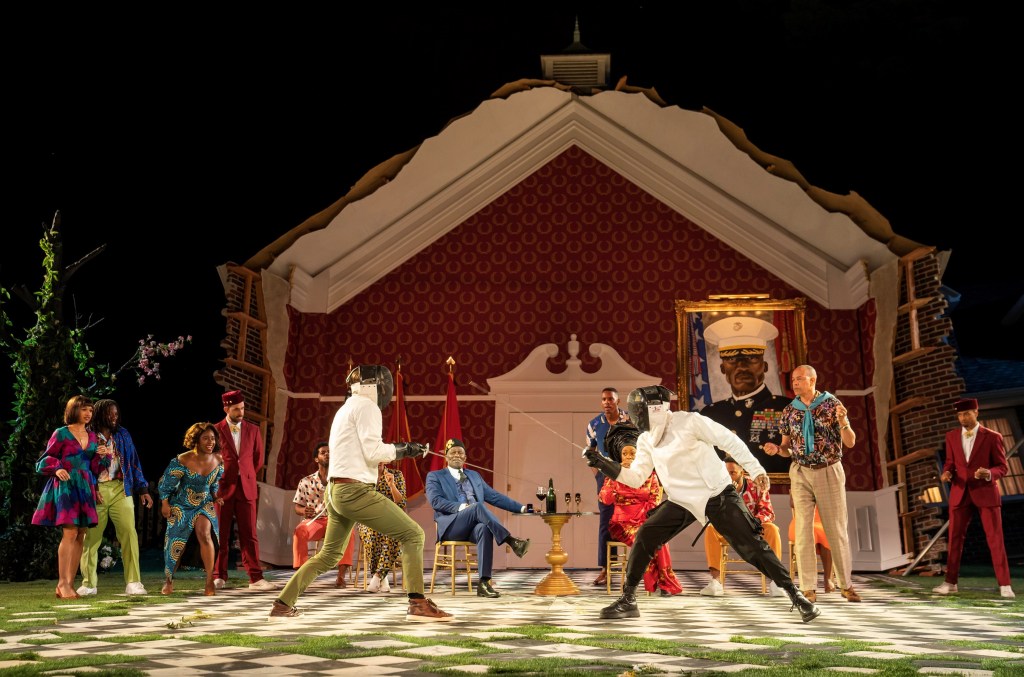
Once more, the “time is out of joint,” and Hamlet defers vengeance and subjects himself to Claudius, finally revealing where Polonius’ body is. For Gertrude’s sake, Claudius sends Hamlet away with the orders for others to kill him in a plan that fatefully backfires.
Leon’s version has clarified the stakes for Claudius to escape accountability, manipulating Laertes (Nick Rehberger) from killing him by blaming Hamlet. Thompson conveys each of these cover-ups with precision. Also, clarified is Blankson-Wood’s angst and struggle confronting his father’s murderer. His use of irony as a weapon to prick Claudius’ conscience is superbly rendered as are his soliloquies whose philosophical constructs tie him in emotional knots. Hamlet, knowing that he is stuck in a morass with no way out, recognizes that like the other characters, he is on a collision course with destiny and ruination which is foreshadowed at the beginning with Boritt’s set.
Also, clarified in this version is Toussaint’s Gertrude who is in a state of ambivalence and guilt stirred by Hamlet’s antic behavior, which she suspects is his response to her marrying Claudius. When their confrontation occurs after Hamlet kills Polonius, she knows her relationship with Claudius must be thrown over, yet she hesitates and discusses Hamlet with Claudius ignoring Hamlet’s wise counsel. The doom she recognizes in Ophelia’s madness will only bring more sorrows, a trend which both Claudius and Gertrude comment upon. Toussaint’s description of Ophelia’s drowning is heartfelt and mournful.
The flow of events coheres because the through-line of Claudius and Gertrude in conflict with Hamlet is maintained with intensity. Stripping Norway from the action and leaving Fortinbras out of the conclusion is to the purpose of Leon’s emphasis of the familial tragedy. The contrast of the good son and man of action who achieves justice (Fortinbras) with Hamlet’s flawed son of inaction who is Fortune’s fool, exacerbating destruction via revenge gone wrong would have pleased Queen Elizabeth I. Contrasting the two Prince’s and showing the heroic one in Fortinbras is an encouragement of how royalty should rule. However, it doesn’t fit with the themes that Leon emphasizes, especially that a “house divided against itself cannot stand.”
Hamlet concludes with the slaughter of two families tainted by their association with a corrupted king, out from which there is no release except death. A final theme current for our time suggests that unless individuals stand against usurpers of power, the usurper and all who are his accomplices by not bringing him to justice will pay the forfeit of their lives and fortunes.
However, only Miller’s Horatio understands the full story of Hamlet and the striving between vengeance and justice. That vengeance brings disaster is why the ensemble finishes with the actors’ song that they sang when Hamlet first meets them. It is poignant and true and heartfelt when the spirit of Ophelia joins them and together they sing, “I could tell you a tale, God’s cry. It could make the God’s cry.”
Kudos to the ensemble and the creative team who carry Leon’s vision of Hamlet into triumph. These include those not already mentioned: Jessica Jahn’s colorful costume design, Earon Chew Nealey’s hair, wig and makeup design, Camille A. Brown’s choreography and Gabriel Bennett for Charcoalblue and Arielle Edwards for Delacorte’s sound system design.
For tickets to this unique Hamlet which has one intermission, go to their website https://publictheater.org/productions/season/2223/fsitp/hamlet/
‘The Saviour,’ a Tour de Force at the Irish Repertory Theatre
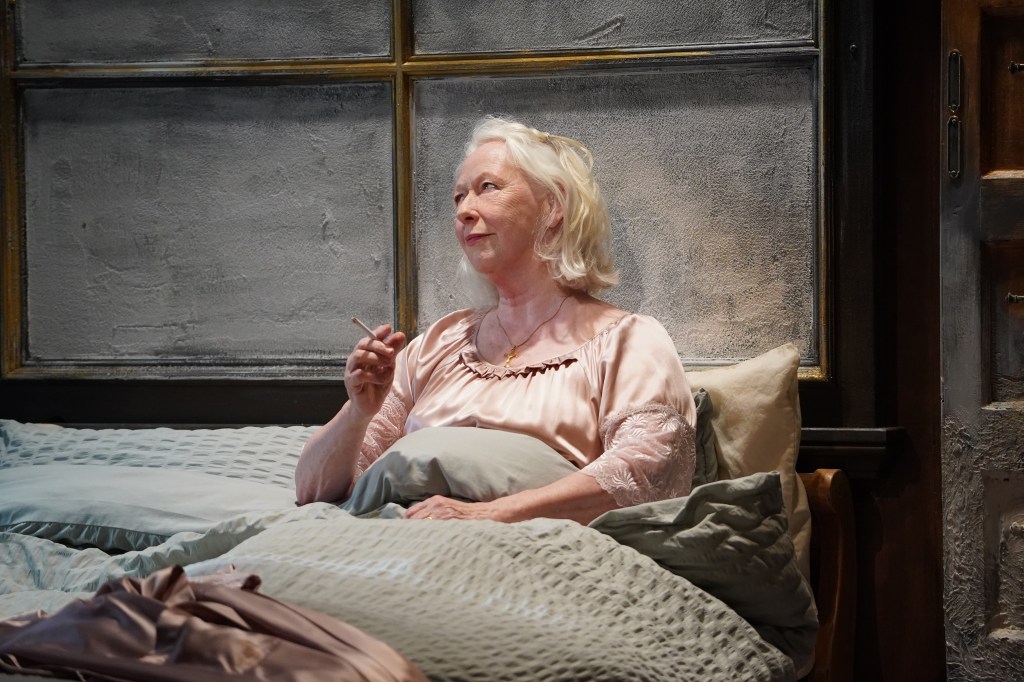
The Saviour, a powerful, ironic character expose, written by Deirdre Kinahan and directed by Louise Lowe, presents the wonderful Marie Mullen in a performance which strikes at the heart of Catholicism, paternalistic culture and hypocrisy. The World Premiere by Landmark Production is being performed on the Francis J. Greenburger Mainstage at the Irish Repertory Theatre until August 13.
Kinahan begins her 70 minute play as Marie Mullen’s Máire resides in bed enjoying a “fag” (cigarette) and laughing to herself at what has just transpired with Martin. She expresses her enthusiasm and joy to her great confidante Jesus, whom she addresses for half of the play.
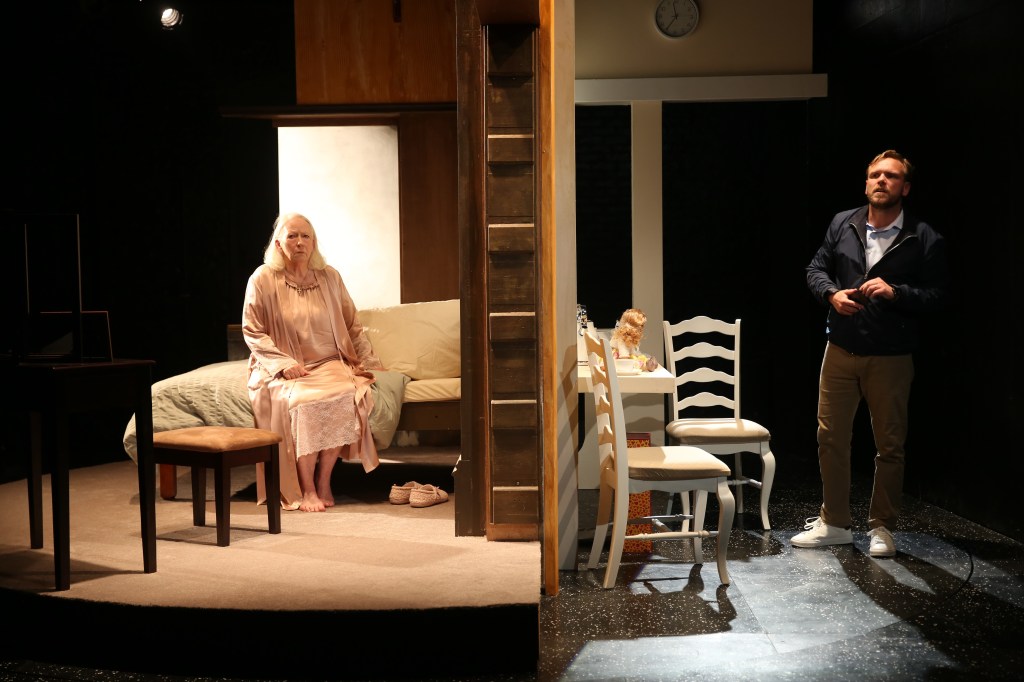
The audience is shocked into laughter at the unexpected subject matter of her descriptions. Máire (thanks to Joan O’Clery’ costume design), is the opposite of a woman that others might describe as a “dolled-up floozy,” generous with her affections and body. The protagonist is a senior citizen. Her environs and bedroom are neither opulent nor well-appointed thanks to Ciarán Bagnall’s scenic and lighting design. The sets on a revolving platform of bedroom and kitchen are a clue to her financial situation.
In other words, Máire is not the type to be taken advantage of for her money or what she has which looks to be the stylized bare minimum of possessions. Thus, she must be taken at her word, or she is completely fantasizing the circumstance with Martin, who, like Jesus, remains invisible. She is an unreliable narrator, so we are left guessing about the truth of the present circumstance she describes.
Louise Lowe’s acute direction shepherds’ Mullen’s fabulous performance as Máire to lead the audience in wonder, enthralled in the grip of hearing about Máire’s relationship with Martin as she discusses it with Jesus.
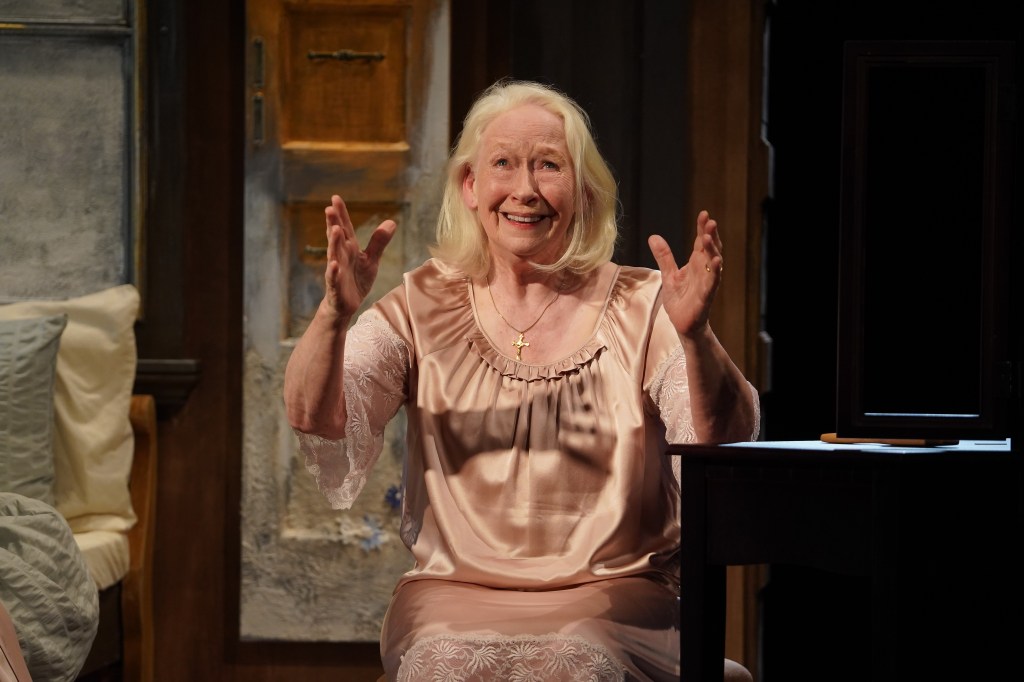
As Máire waits for Martin to come upstairs with her coffee, she glories that it is her birthday and she celebrated a wonderful evening with Martin who shopped and cooked for her and appreciates her more than her husband who died years before. Indeed, Martin even appreciates her more than her children, who are now grown and have children of their own. She reviews the circumstances of her life with Jesus in light of her relationship with Martin. She believes that her relationship with “the saviour” is somehow in concert with her Godly interactions with Martin, because he prays, believes in God, goes to church and wouldn’t be with her if Jesus didn’t accept him.
Kinahan’s characterization of Máire, effected through Mullen’s interpretation, is completely believable, especially when she speaks to Jesus as if He is her “all in all.”
As the monologue continues, we question the reality of what Máire shares with Jesus with regard to Martin who is shadowy and mysterious. Is it true or isn’t it? However, we do accept her discussion with Jesus about her devastating upbringing. This includes the death of her mother, and her father’s abandonment. He left her with the nuns where she is abused and made to work in the oppressive, hot “laundry.”
The reference is perhaps to the Magdalene Laundries in Ireland, run by the nuns and Roman Catholic orders to give shelter to “fallen women” from poor backgrounds. To punish them with proper penance and hide their shame, parents sent them to these asylums which were secretive and oppressive. Exploiting the girls’ labor, they offered little emotional respite from condemnation. Sadly, the babies born out of wedlock were taken away from their birth mothers and adopted out by the nuns for donations.
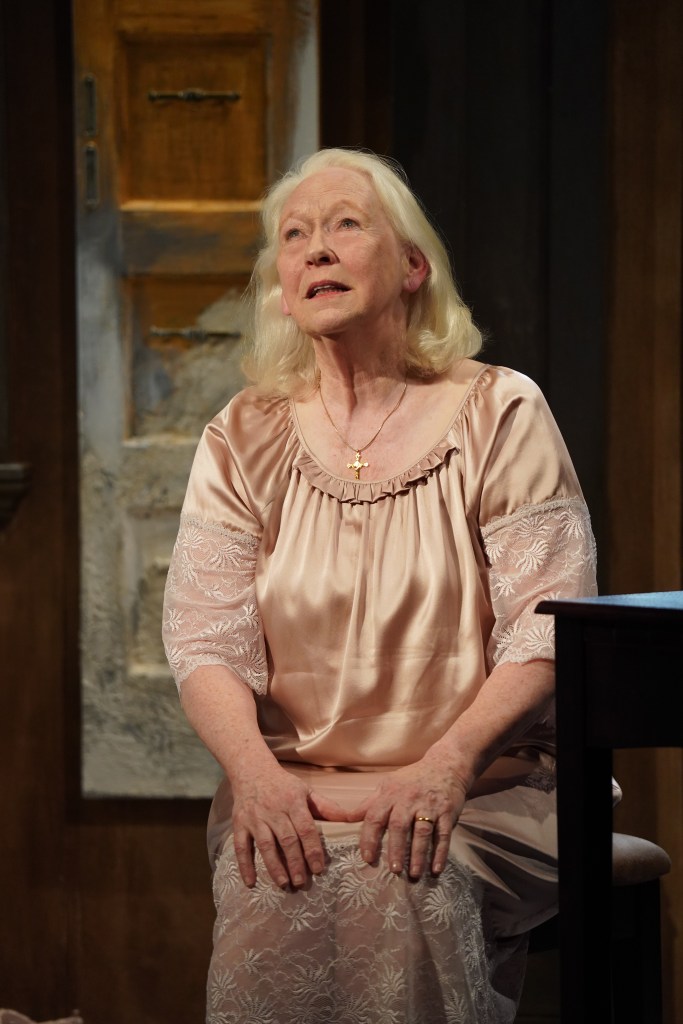
As in the case of Máire, orphaned girls were placed there so they could be properly raised by the goodly nuns. However, as Máire indicates, her situation was equally terrible, not because she “sinned,” but because poverty relegated her to a life of misery of hellish toil and fear with the nuns at a young age.
It is during this discussion of the laundry, whose atmosphere and terror is effected by Aoife Kavanagh’s crushing sound design (as Máire recalls her past), that she reveals her only salvation was her faith in Jesus. She refers to “her loving Jesus” as not the “nuns’, Jesus.” Her Jesus helps her survive the nuns’ cruelty, condemnation and judgment until she manages to free herself with a job. And it is then she meets her husband with whom she has a loving relationship and family.
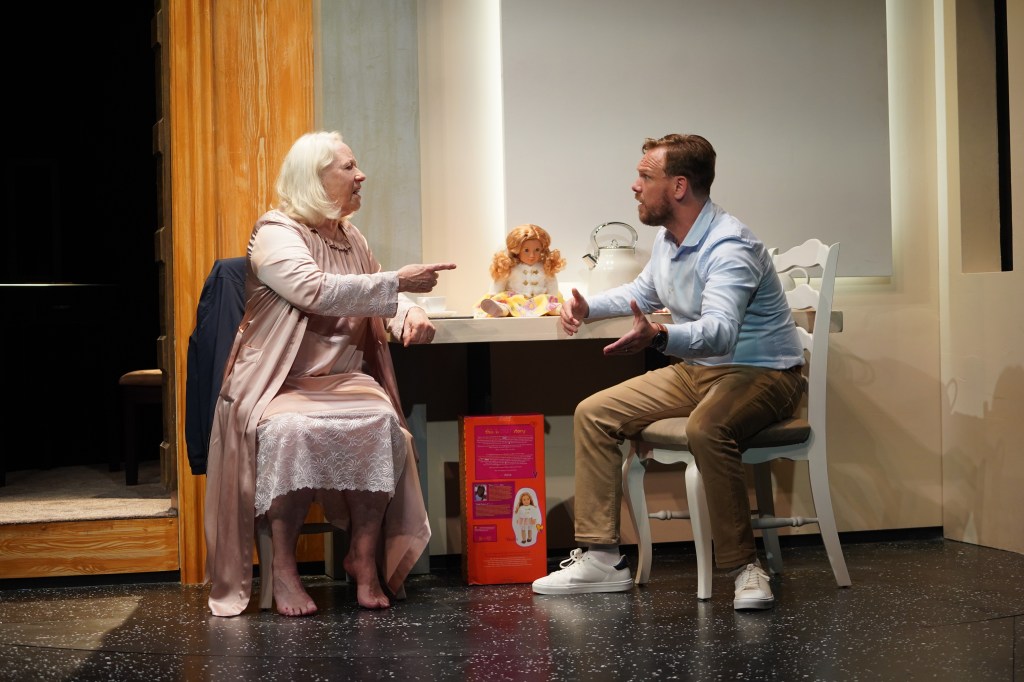
Marie Mullen’s is absolutely terrific in animating Máire and establishing Jesus as a “living” being with whom she shares the most intimate of secrets. Mullen’s authenticity is spot-on. We accept how Jesus affirms Máire’s life to receive this new beginning in her relationship with Martin. Though there doesn’t appear to be a conflict, the dramatic dynamic unfolds in earnest when son Mel (the superb Jamie O’Neill) appears. He brings her a present (a doll which has symbolic significance), to celebrate her birthday.
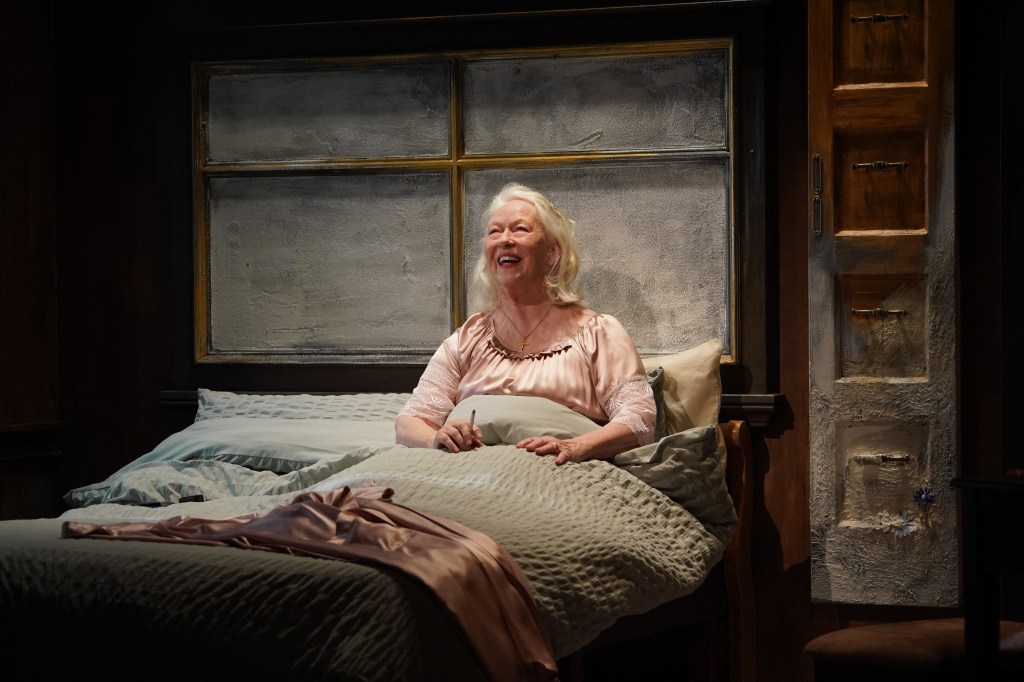
Her relationship with Mel seems loving enough, until Máire’s behavior references Martin’s visit. It is then that they make statements which explode with revelation and meaning in a myriad of emotions including anger, torment and hate. Both mother and son hurt one another. Their comments are severe. No apologies can be made to salve the wounds. We question where is forgiveness? Where is Jesus? Where is love? All appears to be confusion, fear and obfuscation.
Kinahan’s dialogue cleverly builds as Mel and Máire turn to the undercurrents of the past. Clearly, we understand the impact the church has had upon them. After Mel leaves, Máire must grapple with what the truths may be and either confront and accept them, or reject them finding justifications. Ironically, this leaves the audience in uncertainty with more questions which are never answered.
Kinahan’s suspenseful events beautifully build toward the high point at the conclusion. The mesmerizing play is directed and acted to perfection. Thematically, the characters’ acceptance of lies as truth and their ability to be duped by “isms,” philosophies and trends is incredibly current. Mel uses the truth to bludgeon his mother which appears vengeful. On the other hand, Máire selects which truths to believe and which to reject, hypocritically.
Both son and mother are flawed. Both need redemption and love from each other. Both have been caught in a web of religion, either rejecting/rebelling against it, or embracing it but not in the fullness of its meaning. As a result, caught up in their own agendas, they cannot communicate to use the very tenets of faith that are supposed to heal, bring peace and redeem. This is a terrible, magnificent irony where Jesus is called upon, but never arrives to heal and mend the differences. Additional work must be done for that to occur.
Unfortunately, this is a story visited again and again in religious households. It is thematically universal. Kinahan, Lowe, the actors and creatives have expressively highlighted the conundrums of faith, hypocrisy, forgiveness, spiritual truth and condemnation in this amazing and unforgettable production. It is a must-see.
For tickets and times go to their website https://irishrep.org/show/2022-2023-season/the-saviour/
‘Days of Wine and Roses,’ Truthful, Poignant, a Stunning Triumph

Alcohol is different from other addictive drugs. It’s a part of our culture and integral to events around professional and social situations. It’s legal and easy to purchase. But for those who can’t “live” without it, alcohol is both a blessing and a curse. Days of Wine and Roses currently at Atlantic Theater Company until July 16th encapsulates the joy and emotional horror of the drinking disease. The production is a complicated, profound, assailable to the senses, cathartic must-see.
Adam Guettel’s music and lyrics spin out the anatomy of alcoholism in the dynamic of a couple’s relationship. The couple, portrayed by the exceptional Kelli O’Hara and Brian d’Arcy James, are forced to confront their psychological weaknesses manifested by their alcoholism. Guided by Craig Lucas’ book, Guettel relays the extremes of euphoric addiction and its impact on the emotions of the characters with his expressionistic score and lyrics that appear to be lighthearted and lyrical but mirror undercurrents of desperation and loneliness.

Lucas nails down Joe and Kirsten’s alcohol dependent relationship dynamic with precision and poignancy. He carries it through to the point when d’Arcy James’ Joe Clay comes to the end of himself. Out of love he waits and hopes for O’Hara’s Kirsten to want to recover from alcoholism. This uncertain state promises to usher in a long, hard wait for Kirsten to admit she is ill and needs help.
Directed by Michael Greif, Days of Wine and Roses is a journey of devolution and evolution that displays the characters’ emotions of exuberance, sorrow, unforgiveness, self-discovery, redemption, self-annihilation, humiliation and love. Above all, it reflects the tragedy and joy of human experience, either confronting one’s individual consciousness or running from it, until one finally acknowledges that they must change or kill themselves.

Based on the titular 1958 teleplay by JP Miller and the 1962 Warner Bros. film, the musical is produced by special arrangement with Warner Bros. Theatre Ventures. Importantly, once again it brings together the successful Lucas and Guettel team who created The Light in the Piazza. Kelli O’Hara, who sang the lead in that Broadway production, encouraged this project.
Key to understanding this musical that is set in 1950 and lightly references the cultural mores of the time (sexism and paternalism) is that Alcoholics Anonymous’ 12 step program (never named) identifies alcoholism as a disease and not just a “drinking problem.”

The production frames how Joe and Kristen’s love blossoms with their drinking. It acutely underscores that the disease elevates their mood and pleasure centers (“There I Go,” “Evanesce” “As the Water Loves the Stone”) with pernicious allurement. Indeed, it is the linchpin to how they initially become involved with each other and why Kristen refuses to stay with Joe and her daughter after he combats his illness by meeting with other alcoholics to stop his self-destructive patterns.
The characters’ dynamic is emphasized when they meet at a business party on a yacht in the East River. A nondrinker, Kristen eschews alcohol. On the other hand Joe persists in getting her to be his drinking buddy. She resists him and his advances because she doesn’t like the taste of alcohol nor his smarmy, belittling, fake PR patter and persona.

It is only when she upbraids him and he apologizes for “starting off on the wrong foot” that she relents and suggests they leave. Her honesty and authenticity charm Joe and allow his better self to emerge. Together at a quiet restaurant, they discover qualities in each other that they can appreciate and adore.
As they establish a friendship, Joe introduces her to a Brandy Alexander (she loves chocolate) and she discovers her subsequent enjoyment of the buzz it gives her. This drink and others draw her to Joe as they gradually become boozy partners, who “in their continual high,” eventually marry and have a daughter, despite her father’s (the excellent Byron Jennings) disapproval and distrust of Joe. She and Joe have made a commitment to each other. Determined, O’Hara’s Kirsten will not allow her father Arensen to sway her from establishing a family with her lover and partner in drinking.

As Kirsten, Kelli O’Hara creates a complex portrayal of a woman whose drinking subterfuge eventually splits open her soul weakness after seven years of marriage and taking care of their daughter Lila (Ella Dane Morgan). Covertly, she sneaks drinks as she completes household chores and plays with Lila. O’Hara’s “Are You Blue,” “Underdeath and “First Breath” (the latter sung with Morgan’s Lila) reveal the roiling undercurrents of unhappiness and her attempts to deal with depression as the absent Joe, who works in Houston, barely keeps himself functioning at a job that requires he drink to entertain clients.
Brian d’Arcy James’ vibrant, alcohol-alluring, loving Joe allows her to take the lead, while he cleverly introduces her to a new world of drinking, fun and happiness. He draws her to him and maintains their closeness and joy, but such adventures are always fueled by alcohol. Initially, like any disease that manifests slowly, they convince themselves they are in control and live together as a successful family.

However, all is upended the seventh year of their marriage. A spectacularly destructive circumstance set off by Kirsten’s alcohol blackout destroys what they have built together (conveyed fearfully thanks to Lizzie Clachan’s sets, Ben Stanton’s lighting and Kai Harada’s sound). As their family spirals downward, their only hope of rehabilitation lies under her father’s condemning watchfulness, when they plead for his help and he gives them food, shelter and work in his greenhouse business.
The arc of their destruction is born out of their compulsions, one of which is their susceptibility to the pleasure of alcohol, the other, the belief they can ignore their desire to harm themselves and each other as addicts.

After months of sobriety, Joe breaks down, buys alcohol and offers it to Kirsten (“Evanesce” reprise), then goes completely “off the rails” (“435”) looking for a bottle he has hidden in the greenhouse. In anger at himself for his weakness and fury in not finding the bottle, he becomes rebellious. Turning against his judgmental father-in-law who has given them a chance, Joe destroys the greenhouse that Arnesen has made into a profitable business. When he finds the bottle, he drinks himself unconscious and lands on his back in the hospital on the brink of death.
Kirsten and Arnesen refuse to believe this is a disease that has no cure except through a way provided by a volunteer who is also an alcoholic, Jim Hungerford (David Jennings). Jim belongs to an association of alcoholics who understand that the only path away from the disease is through meetings, readings and the community of others who need each other’s help and camaraderie. Arensen dismisses Joe’s attempt at reconciliation and recovery. He bans Joe from his presence as an evil influence. The family are on their own in a dingy apartment as Joe allows himself to be helped by Jim while Kirsten refuses to admit she needs help and rejects Jim’s offers.

The apex of their relationship involved the ecstasy of alcohol. Kirsten appeals to Joe’s love and the remembrance of the fun they had (“Morton’s Salt Girl”) with a soft shoe in salt poured on the floor, created by Sergio Trujillo and Karla Puno Garcia. The song attempts to rekindle the magic when they enjoyed being drunk together. However, Joe’s eyes have been opened and Jim’s voice resides in his heart with the growing strength that he can conquer his illness. Sadly, Kirsten interprets this as rejection and a killing off of their love. She criticizes Joe for making her feel ashamed of herself and victimizing her with guilt and pain.
As Joe affirms his confidence that he can change to Jim in the powerful “Forgiveness” Joe and Lila cling to each other and KIrsten eventually stays with her father whose judgment, though problematic, is better than the humiliation and weakness she feels around Joe, who is passionate about healing and recovering. Now Joe’s love in sanctimony drives her away.

Days of Wine and Roses is poignant and current for our time, taking us beyond the beautiful period costumes by Dede Ayite and hair design by David Brian Brown. Kelli O’Hara is affecting and brilliant. Her operatic, rich and plaintiff voice in the concluding songs elicits our empathy. Her aloneness and sorrow at losing her partner to sobriety is intensely human and real. Her rejection of Joe’s help and love beyond the haze of alcohol is frightening.
Brian d’Arcy James is superb in reveling the nuances of determining his own confidence to overcome his addiction. Yet, he mines Joe’s attempt to balance the authenticity of being happy with his sober self with his love for Kirsten without their alcohol infusions. Together these amazing actors bring home the production leaving the audience with a confluence of feelings that will not be easily forgotten.
Kudos to the ensemble and the technical creatives and Greif’s direction and vision. With additional kudos to music director Kimberly Grigsby, Adam Guettel’s orchestrations and Jamie Lawrence’s additional orchestrations.
Days of Wine and Roses runs one hour and forty-five minutes with no intermission. For tickets and times go to the Atlantic Theater Company website https://atlantictheater.org/production/days-of-wine-and-roses/
‘The Comeuppance,’ a Pre-Reunion Reunion of Five Friends and Death, Theater Review
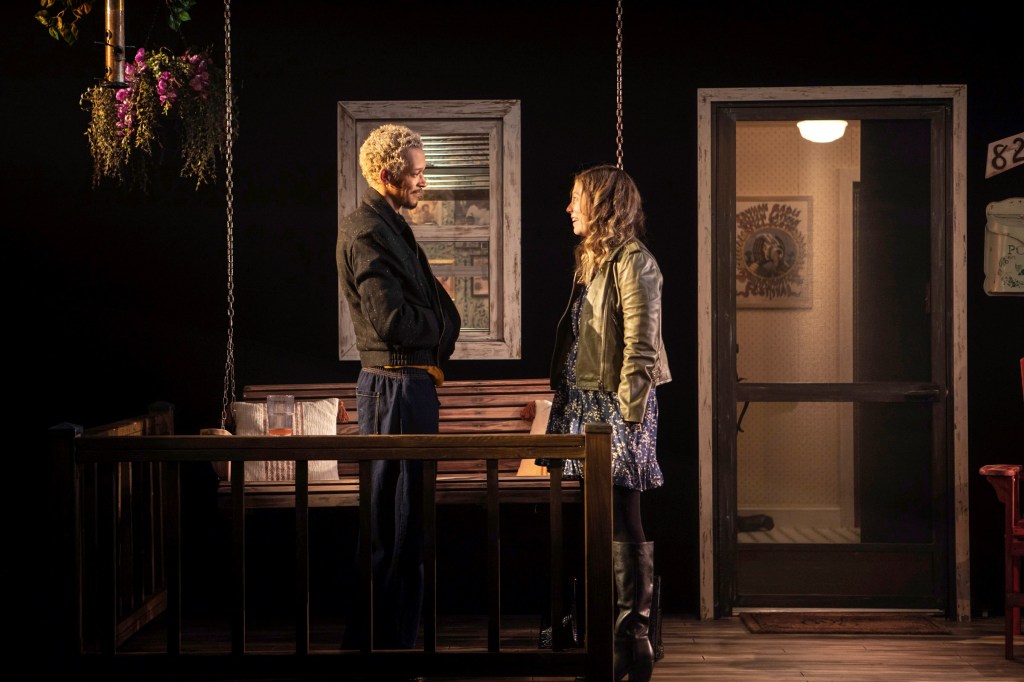
In The Comeuppance by Branden Jacobs-Jenkins, directed by Eric Ting, old friends meet for a pre-reunion reunion at the home of Ursula (the superb Britney Bradford), who has organized a party to celebrate before she sends off friends to their twentieth reunion. In an extension of its World Premiere at the Signature Theatre, the comedy with somber, stark elements was extended until July 9th by popular demand.
Jacobs-Jenkins’ (Appropriate, An Octoroon) themes are timely. The ensemble was spot-on authentic and natural. In his two hour play with no intermission millennials admit the consequences of living with unsound decisions made in the less scrupulous years of their youth. Sooner or later, there is a “comeuppance.” One cannot escape the inevitability of oneself and one’s mortality, as Death, who like a sylph inhabits each of the characters, periodically reminds us.

To effect this principle theme of death in life and the transience of all things, Jacobs-Jenkins places thirty-somethings in a backyard with drinks, weed and a loaded, shared past. They once were part of a high school friend group called M.E.R.G.E.: Multi Ethnic Reject Group. Jacobs-Jenkins allows them to go at each other (Emilio’s bitterness is apparent), as they bond over a perceived closeness, which may not have existed after all.
But first, Death introduces himself after slipping into the soul of the protagonist Emilio (Caleb Eberhardt), who has the most difficult time struggling to let the past remain in the past so he can create a better life for himself. As he does with all the characters, Death speaks through Emilio. He warns the audience he is always lurking in omnipotence, with a complete understanding of who human beings are, including the audience members, which he crudely, fearfully reminds us of, once more at the conclusion.

Since last they met, Emilio, Caitlin (Susannah Flood), Paco (Bobby Moreno) and Kristina (Shannon Tyo) have established careers, been to war, gotten married and had kids. Each in their own way has confronted loss, confusion, cultural chaos and most recently COVID-19. We learn that all have been under an emotional siege. Some are sustaining the sociopolitical chaos that Emilio points out better than others, as they either ignore it, reflect upon it, or allow their own lives and difficulties to blot it out of their consideration.
Interestingly, the generous Ursula, whose home, inherited after her grandmother’s death, has been offered up for the celebration, becomes the first to manifest the ravages of millennial time and aging. She has lost her sight in one eye, having contracted diabetes. She tells the others that she is not up to going to the reunion and they may stay as long as they like at her party.

As Emilio, Caitlin and Ursula wait for the others, Emilio’s irritability spills out in humor against Caitlin, whom he once dated in high school. She has married an older man who is a Trumper, which upsets Emilio. Their two children her husband has from a first marriage appear to be doing well: one is finishing college, the other is beginning a career. Thanks to the actors who present their characters with moment, as the characters cath up their lives, the segment never completely falls into tedium. The characters reacquaint as they step into familiarity with Ursula reminding them of M.E.R.G.E codes they used in high school.
During this segment Death manifests a presence in the monologues from Ursula and Caitlin. They heighten their soul revelations and reflect another aspect of their ethos that is not apparent on the surface.

When Kristina, a doctor with “so many kids” arrives bringing her cousin Paco, who once dated Caitlin and treated her badly, the hilarity increases. It is driven to its peak with the characters’ fronting as a means of getting their “land legs” with each other. By this point the drinks and weed have kicked in and Emilio confronts Paco. whom he clearly distrusts and despises. More revelations erupt and we note Paco’s and Kristina’s individual unhappiness. Once again, Death inhabits Kristina and Paco and expresses their soul’s interior.
Throughout the play Jacob-Jenkins contrasts the material realm and the illusory fitted by human delusion that these individuals have “all the time in creation” to live their lives against the immutable truth of life’s impermanence. Speaking with quietude and without passion, Death assures us he “has their number.” He matter-of-factly reminds us that entropy is king. Things fall apart; human bodies, human relationships, all we hold dear is smothered in half-truths and lies, for we die.

Then the limo arrives and with it well-worked confusion. Ursula goes off to the reunion that Emilio never attends. With the door locked against him and all his buddies gone, he sleeps on the porch, a hapless, solitary and alone soul who needs to “get himself together” emotionally, expiate the past and forgive himself for his failings.
When Ursula returns, we learn the extent of the lies of omission as Eberhardt’s Emilio allows the truth to flow and Ursula shares with him what she couldn’t reveal before. Then Death through Emilio takes his final “comeuppance.” While she “sleeps in her mind” he expresses that his target is Ursula in the immediate future. He discusses that how she will end up is exactly as her friend Caitlin fears. Despite Emilio’s offering to marry and take care of her, Ursula puts him off because she has someone. It turns out, it’s another poor decision for both of them.
Branden Jacobs-Jenkins has woven an interesting conceptual piece that is uneven especially in segments where there is too much ancillary discussion by characters. There is an overabundance of unnecessary detail that impede the forward momentum of the dynamic that occurs on the porch of their lives. In these sections, I dropped out. Perhaps wise editing would make the segments more vital and immediate.
Nevertheless, the actors are terrific. They make the most of the unevenness that drives the play toward the characters’ acknowledgement of duality: of experiencing life and watching and reflecting oneself living it in the knowledge that they are mortal.
The difficulty of this duality is dealing with the reality of Death. In the play it is animated through the characters for our benefit. However, in their lives, it is ever-present in the form of gun massacres, the war in Iraq and Afghanistan, political subterfuge and sabotage in January 6th which attempted to signal in the “death” of our democracy. All of these, Death’s cultural possessions, have brought the characters’ millennial generation to the brink, Emilio acknowledges. That and their body’s frailty is their comeuppance, Ursula suggests.
Though each generation has had its cataclysms, it is the millennials “no way out” that Emilio especially confronts while the others seem to ignore it, save Ursula. Unfortunately, our culture doesn’t do death well and entertainment capitalizes on its particularly gruesome features in the proliferation of horror stories and films. Jacobs-Jenkins counters this aspect, making it a homely creation of back porches. And as he reminds us no one “gets out alive,” at least there is humor. We can laugh on our way out of life’s conundrums, miseries toward Death’s grasp.
Look for this play to be produced elsewhere. And check out their website for more information at https://signaturetheatre.org/
‘Primary Trust,’ the Hope of Friendship Through The Trauma of Being Alone

Small town life can be incredibly boring and static. However, for those who experienced unaccountable pain and trauma, the peace and quiet may be precisely what is needed to achieve a balanced state. In Eboni Booth’s sensitive, profound drama Primary Trust, currently at Roundabout Theatre Company until July 2nd, the playwright investigates humans in their ability to heal from trauma.
For some, getting beyond the pain of emotional loss requires a particular kind of remedy. Kenneth (William Jackson Harper), a resident of Rochester suburb, Cranberry, New York, has found the ability to withstand loss through his mind and will’s resilience to nurture itself with hope and friendship.
Kenneth addresses the audience directly relating a sweetness and shy vulnerability that is immensely likable. He introduces the town and his friend Bert to the audience with ease and authenticity. When there is a segue in thought and feeling, a bell rings as an accompaniment by musician Luke Wygodny who also plays the cello and other instruments before the play begins and during salient turning points.

Harper’s Kenneth takes his time to gather his thoughts as he confesses to us. His need to share his story resonates. Clearly, his story is momentous and universal. Praise goes to William Jackson Harper who engages us with his humanity. Additionally, Eboni Booth’s simple word craft in structuring likable, recognizable, human characters in this small town is amazing. With fine direction by Knud Adams, who shepherds Harper’s Kenneth and the supporting actors, we become captivated and empathize with Kenneth though we may have little in common with him.
Kenneth shares his experiences about “what happened” to him at a turning point in his life when he is thirty-eight years old. He gives us background and reviews his daily routine in Cranberry, New York focusing on the high point of his day after work, when he spends the evening at Wally’s, a typical tiki bar/restaurant. There, he joins his BFF Bert (Eric Berryman) and they drink Mai Tais and share jokes and stories. Their affection and warmth is genuine as they reminisce about past experiences in the joyful atmosphere of booze and camaraderie.

However, apart from their bonding daily at Wally’s and their race, the men are very different. Kenneth works at a bookstore and has been invaluable to his boss, Sam (the on-point Jay O. Sanders) doing bookkeeping, clerking and various chores. Bert on the other hand has an office job, a wife and children, whom he leaves to be with Kenneth in the evenings. It is around about this time that reality fuses with the ethereal, and logic is throw out the window. How the playwright, director and Harper’s portrayal of Kenneth massage us to accept this maverick dramatic element is a testament to their talent and genius.
Kenneth explains that his friend Bert is invisible, imaginary. In other words his BFF can only be seen by him (and of course us). Thus, we become intimates. In confiding to us, Kenneth trusts us to share his secret, in the hope we will not judge him and “turn off” because he’s “wacky.”

Sam is aware that Bert is Kenneth’s imaginary friend. When he tells Kenneth he is selling the store and relocating for health reasons, he makes it a point to reference Bert. He suggests when Kenneth looks for another job, he shouldn’t allow Bert to intrude on the interview. Nor should he share with prospective employers that Bert is his imaginary friend. The implication is that they will think Kenneth is deranged. That we accept Bert as imaginary and go along for the ride is creditable to the playwright, director and actors.
Sam’s news about closing his store is an earthquake. Kenneth discusses the impact on his life with Bert and a new Wally’s waitress Corrina (April Matthis). Though Sam’s move shakes Kenneth, it is an opportunity. He is forced to end the nullifying status quo must. Change occurs in Kenneth’s discussions with Bert and Corrina, who suggests the bank Primary Trust is looking to hire tellers. When Kenneth applies for a job and speaks with Clay who is the branch manager (Jay O. Sanders), all goes well. Humorously, Bert accompanies him to the interview and prompts Kenneth’s winning responses which seal the deal. Clay hires him and he becomes one of the best employees of the bank.

However, Kenneth must confront a transition moving in his soul. The stirrings begin when he and Corrina as friends move beyond Wally’s to a lovely French restaurant. In a humorous turn Jay O. Sanders is the French waiter who serves them. It is in this new expansive world with Corrina that possibilities open up for Kenneth. For the first time, Kenneth doesn’t meet Bert at Wally’s It is another earthquake that rocks him off the status quo of his insular life. There is no spoiler alert. You’ll just have to see this heartfelt production to discover what happens next.
William Jackson Harper is absolutely terrific in a role which is elegantly written for the quiet corners of our minds. The supporting cast are authentic and vital in filling out the life that Kenneth has made for himself to help him emerge out of his cocoon and begin to fly. The playwright’s courage to present an extraordinary friendship which serves Kenneth to bring him to a point of sustenance until he launches into success is beautifully, subtly conveyed. Thanks to the ensemble, who make the unbelievable real, Kenneth’s “small life” in its human drama is important to us.

Thus, when Kenneth explains his upbringing to Corrina toward the end of the play, his revelation stuns. The clues coalesce and we “get” who he is, understanding his brilliance, his tenacity and perseverance. It brings to mind the character of Jane Eyre (in the titular novel), whose dying friend tells her, “You are never alone. You have yourself. ” The playwright takes this notion further to suggest, when you feel you can’t trust yourself, primarily, you can always elicit an imaginary friend who is closer than a brother or sister, until it is time for them to leave. It is through this “primary trust” one survives through heartbreak, trauma, isolation and death.
Primary Trust‘s fantastic qualities enliven the themes and remind us of the importance of doing no harm as we negotiate aloneness in our own soul consciousness. Kenneth chose his friend wisely. He relates how this occurs to Corrina who listens, the active ingredient of his budding friendship with her.
Kudos to the set designer Marsha Ginsberg,Isabella Byrd’s lighting design, Mikaal Sulaiman’s sound design, Qween Jean’s costume design, Niklya Mathis’ hair & wig design and Like Wygodny’s original music which to tonally balance the production. The mock up of the town square offered a metaphoric quaint suburb at a time before the technological explosion and cell phones when people listened to each other live and as Kenneth does created conversations with ethereal friends. The set design and music created the atmosphere so that we readily accept Kenneth’s and Bert’s friendship and its significance with wonder and surprise.
For tickets and times to see Primary Trust, go to their website https://www.roundabouttheatre.org/get-tickets/2022-2023-season/primary-trust/performances
At Tribeca FF: Robert De Niro Honored, Documentary, ‘Kiss the Future’ Screens, Orange Skies Presage Climate Change’s Impact
It’s the opening of Tribeca Film Festival. Co-founders Robert De Niro and Jane Rosenthal are ready for anything, even the apocalyptic Canadian wildfires smoke billowing down from Nova Scotia and Quebec, that plumed and spread over the Northeast and New York City, raising the air quality alerts into the “hazardous” zone on June 7, 2023. This NYC condition is a throwback to the days of 1960s smog pollution. It is a terrible, noisome reminder of 9/11.

The man made terror of global warming is being answered by the earth’s revolt. It’s in the smell of the air and the toxic orange glow of the skies. It’s all along the Northeast coast and it’s wafting outward covering Pennsylvania, Ohio and the West, and is moving down to Virginia and the new la la land, Florida. These days are eerie and frightening because the atmosphere’s strangeness presages more to come.


Fossil fuels are very much in the pollution picture (the Biden administration just pulled a doozy with drilling joining craven Republicans in promoting global warming). The choice of dollars and toxic air over a clean environment and planet cooling isn’t a problem for corporate billionaires who have to make billions to pay politicians to keep the cycle going. Masochistically the money will be used to paper over theirs and their family’s coffins. The air they breathe will be unable to be purified, a condition they dismiss. This toxic air even of 400 wildfires burning to our North reminds one of the film Total Recall, of no oxygen and orange skies. That setting, which was Mars has become a reality on Earth.

Tribeca guests, who have frequently excoriated politicians for their derelict approach to global warming, COVID and other dire consequences for the species on the planet, now have one more outrage to use to make art. Without artists as activists, indeed, we would be in much worse shape. That is one of the themes of the documentary Kiss the Future, screening at its North American premiere at Tribeca. Artists as activists encapsulates one of the purposes of Tribeca Film Festival, which then and now uplifts New York City and artists who contribute their works submitting from all over the world.

The Festival kicked off with a pre-reception during which Mayor Eric Adams gave Robert De Niro a key to the city. He received praise for his work in lifting the spirits of New Yorkers during and after the dark days of 9/11 by establishing Tribeca Film Festival with his colleague Jane Rosenthal.
The great director and filmmaker Martin Scorsese honored his friend and fellow collaborator affirming Mayor Adams’ remarks about De Niro’s prodigious contributions. Guests included Mark Ruffalo, Debra Messing, Billy Porter, Patty Jenkins, Peter Coyote, Noah Centineo, Dianna Agron, Julian Schnabel, Piper Perabo, and New York Nico (many of them artists-activists).

After the reception, the much anticipated documentary Kiss the Future was the opening night screening. The documentary chronicles U2’s journey to perform a long-promised concert to the people of Sarajevo after the war in the Balkans. Producer Matt Damon attended the event along with Brendan Fraser, Jennifer Esposito, Noah Centineo and Adam Goldberg. Before the screening Tribeca Film Festival co-founders Robert De Niro and Jane Rosenthal were on hand to answer questions from the media.
‘Grey House,’ a Subtle Send-up of Horror Films, That Delivers With Humor and Surprise, Starring the Fabulous Laurie Metcalf
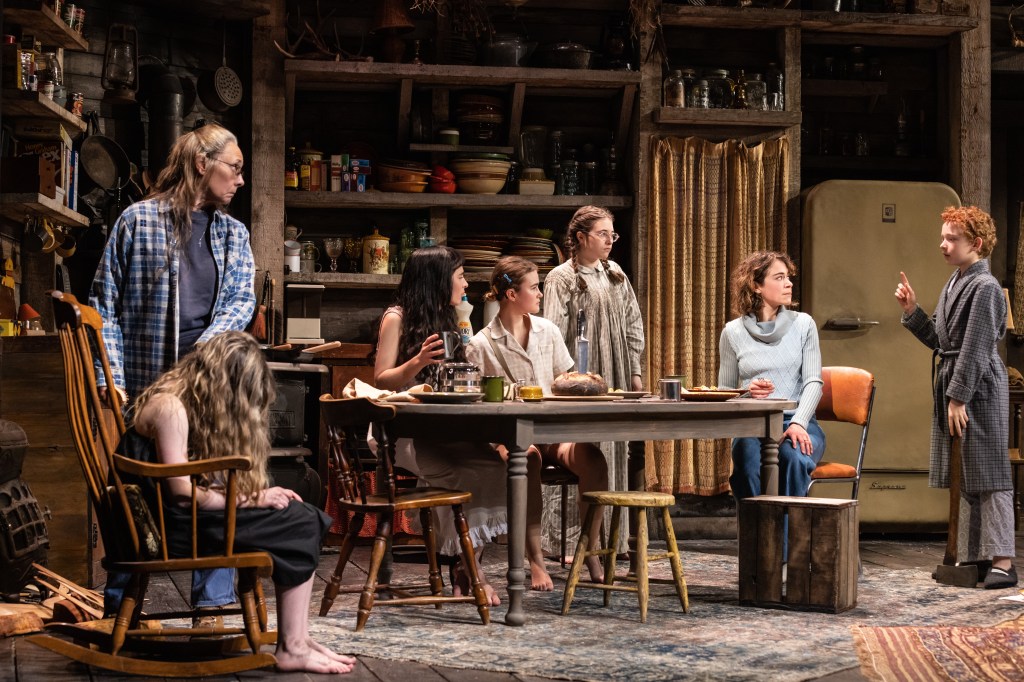
Top shelf performances and eerie effects in lighting, sound, and on-point set design carry Levi Holloway’s horror-thriller Grey House through to its unreasoned, macabre and opaque ending, leaving the audience disturbed and unsettled in an unusual, visceral entertainment. The production, currently running at the Lyceum Theatre until September 3rd, is insightfully directed by Joe Mantello for maximum preternatural weirdness and warped grotesqueness that is also a send-up of the genre.
With sardonic humor and glimpses of the supernatural which evanesce in the twinkling of an eye, the playwright Levi Holloway shrouds the action along a path of darkness, confusion and sometime shock, until the widening road dead ends in a climax and (spoiler-alert) Max’s partner Henry vanishes, replaced by a new guest as Raleigh (Laurie Metcalf), bags packed, leaves.
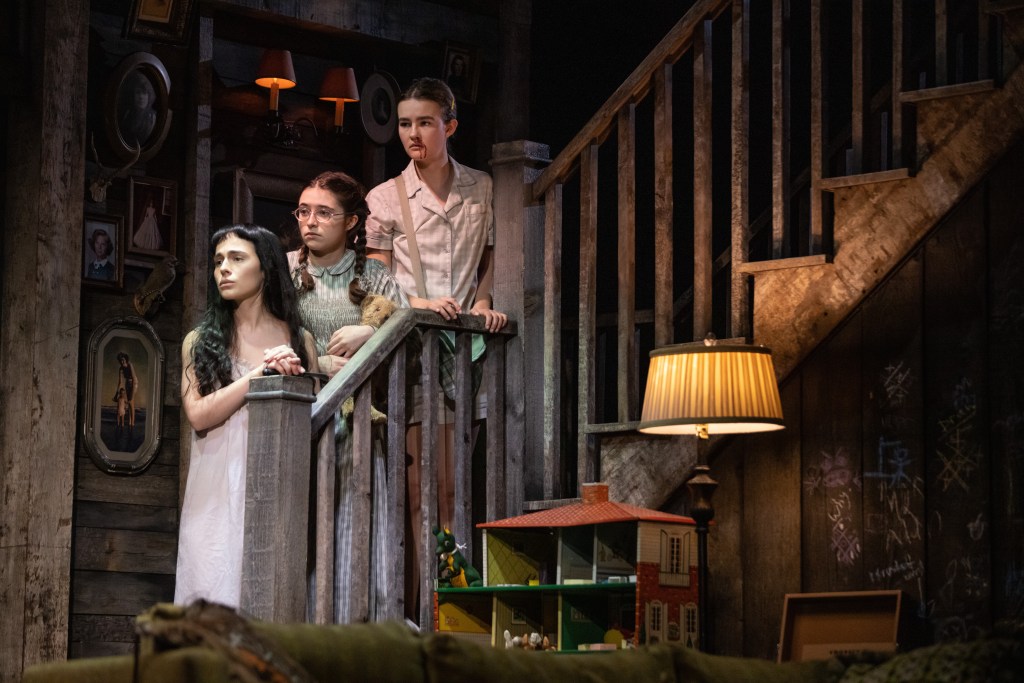
Spoiler alert! Stop reading if you want to be surprised by the play. Read the rest if you are looking for clues to guide you down the dark road of Grey House.
Where and how Henry de-materializes doesn’t matter. We have witnessed his sadistic torture by a child tormentor and watched astounded at his masochistic enjoyment of pain. When he contributes his substance to create a palliative “alcoholic” drink that anesthetizes, most probably for a future unrepentant male, our fog of understanding clears a bit. Henry receives well-deserved punishment for his unspeakable past acts, that, until he entered Grey House, have gone unanswered. Is the function of this house and these female inhabitants to deliver justice? If so, married couple Max (Tatiana Maslany) and Henry (Paul Sparks) who seek help at Grey House after a car accident are “innocents” walking into a trap.
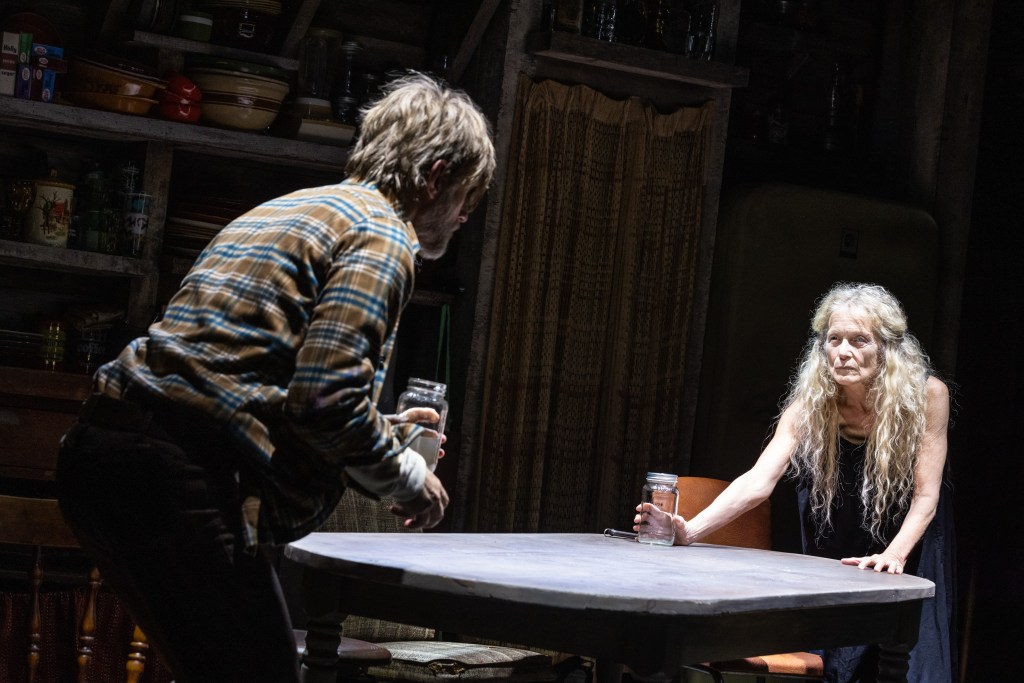
The creaking, groaning, hellish, two-story, ramshackle abode in the mountains, referred to as “Grey House,” initially appears to Max and Henry as a welcome, cozy shelter from the blizzard and their injuries. However, we know better and not just because of the advertising campaign for the show.
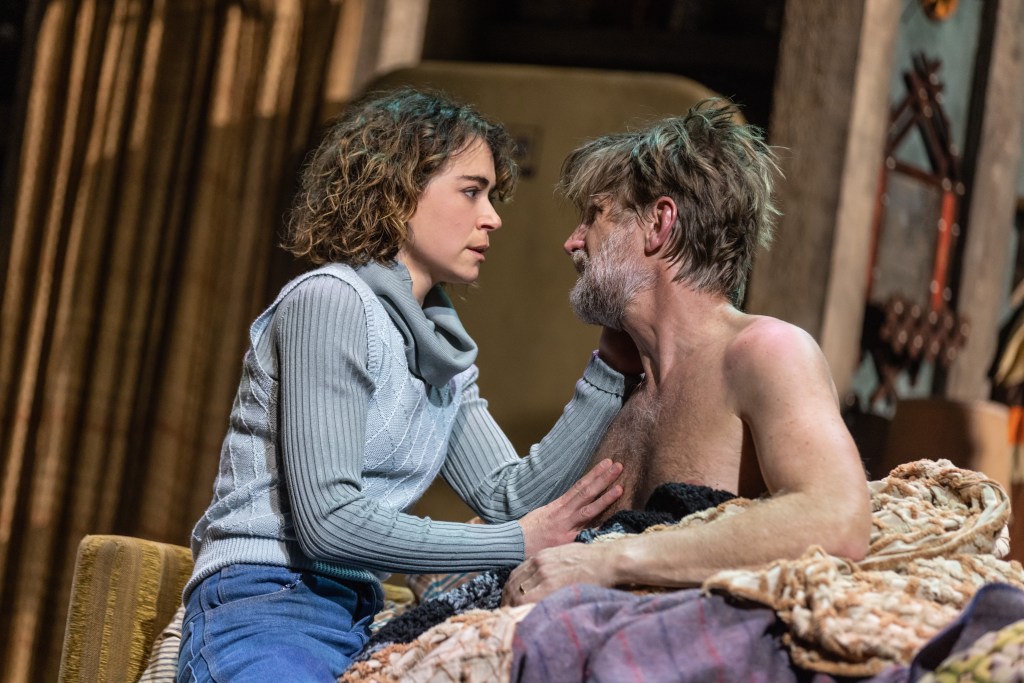
Previously, we have been introduced to the strange, uncanny children of the mountain cabin and their mother/caretaker Raleigh (the sensational Laurie Metcalf). Two of the “sisters” initially raise the spirits in a representative song of the region, singing a cappella. They produce an effect which is haunting and spooky. At turning points throughout the production, a total of four songs are sung: two authored by Mountain Man and the others by Bobby Gentry and Sylvan Esso. Each song is more compelling and meaningful in relation to the action, thanks to Or Matias (music supervisor and a cappella arranger).
Henry’s ironic comment that he’s seen this movie before and they “won’t make it,” lands with humor, horror and truth. We know something he doesn’t. He and Max must stay away from the two unnatural malevolents, a Wednesday Addams meme, Marlow, and her frightful companion in wickedness, the vicious, hell-bound Squirrel. In the initial moments of dialogue and action, they are daunting.
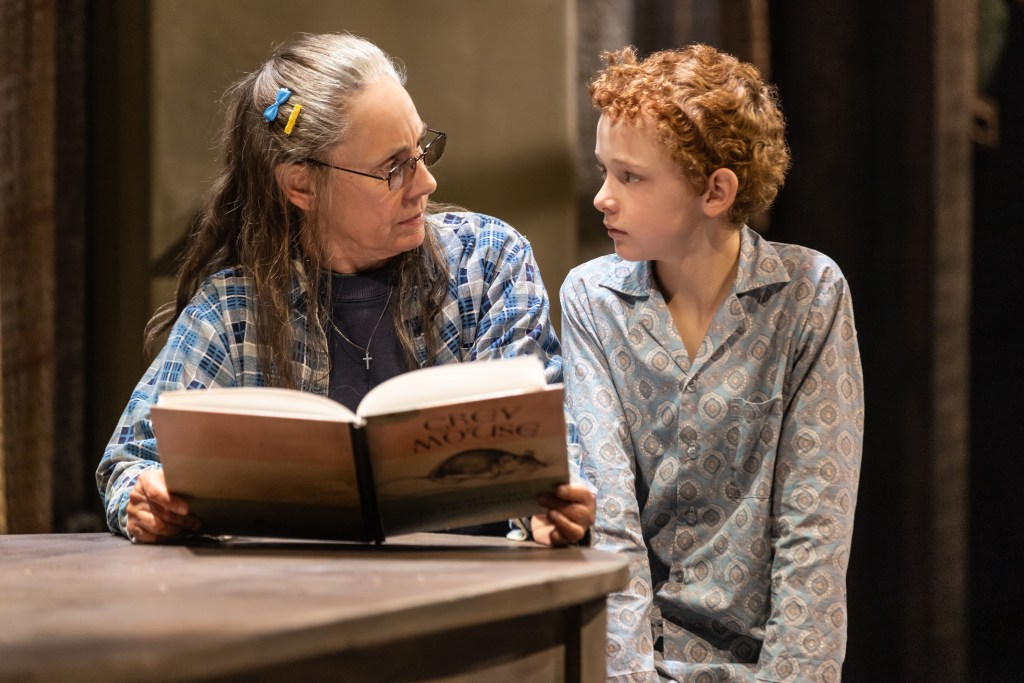
Throughout the action, both could double cast as witches in their sarcasm, sinister intentions and sub rosa text delivered in a straight-forward manner, as they allow the “words to convey the meanings.” The import of their statements are clues to what is really going on, however, the substance is easily missed because the audience is Holloway’s prey and is misdirected as she steers them down the road, and blinds them with her dark shadows of uncertainty.
Nothing is directly expressed. Of course, Henry and Max have the bulk of their interactions with these vixens, who rule the roost and who, Raleigh, their ersatz mom, calls “willful creatures,” an understatement.

As the Wednesday Adams meme who is a self-satisfied, self-admitted, proud “bitch” in the MAGA vein of “owning the libs,” Sophia Anne Caruso is terrific at suggesting the horror underneath the action. She enjoys making her guests, especially Max, feel creeped out.
Squirrel, whose damaging persona is represented by her name and her having chewed the phone chord so no calls come in or go out, is the youngest. Portrayed with insinuation and sadism in a nuanced performance of softness and brutality, Colby Kipnes is superb. She is the youthful doppleganger of The Ancient (Cyndi Coyne) and is the instrument of revenge holding “everyman” predator Hank to account in a twisted time reversal. For unspeakable acts he committed decades before, the young Squirrel and the others collaborate in effecting physical retribution which the anesthetized Henry willingly accepts as his due.

“Grey House” exists beyond time and place, the repository of the wounded in life who exist when we meet them as otherworldly beings or some other undetermined construct of humanity, which the playwright ironically leaves in the realm of uncertainty. When we meet this particular brood, Raleigh suggests others will come and go, as she in fact leaves at the conclusion with a packed suitcase, letting Max who may be a younger version of herself replace her as the caretaker.
The bottles of “moonshine” the ersatz family of women, including A1656 (the fine Alyssa Emily Marvin), and hearing-impaired Bernie (Millicent Simmonds passionately completes the witches’ coven) extract from male predators is kept refrigerated for the next visitor destined to arrive at Grey House. Like Henry he will be punished to sustain its prosperity and existence as a “living thing.”

Laurie Metcalf’s Raleigh is continually surprising in a spot-on, gorgeous performance as the hapless “mom,” who she portrays with power, insight and presence. Of all of the actors, Metcalf is the most surreal yet authentic and empathetic, as we feel for what she goes through at Grey House, though we don’t succinctly understand what we see happening before our eyes. When she is on stage, she is imminently watchable. Her lead, as subtle as it is, guides Caruso’s Marlow and Kipnes’ Squirrel to their understated ferocity which spills out in their insightment to get Henry to masochistically “fall on his own sword,” as they act out their vengeance.
Sparks’ Henry is so likable and loving in his relationship with Maslany’s Max who is the perfect wife, that we are shocked that both are not who they appear to be, Henry less so than Max. Maslany shows a sense of humor with the girls, then turns, flexing her emotional range when she expresses the appropriate terror knowing their luck has changed and she confronts evil. Sparks’ demeanor during the ordeals he is put through is nuanced. His confession is forthright and shocking in its understated delivery.
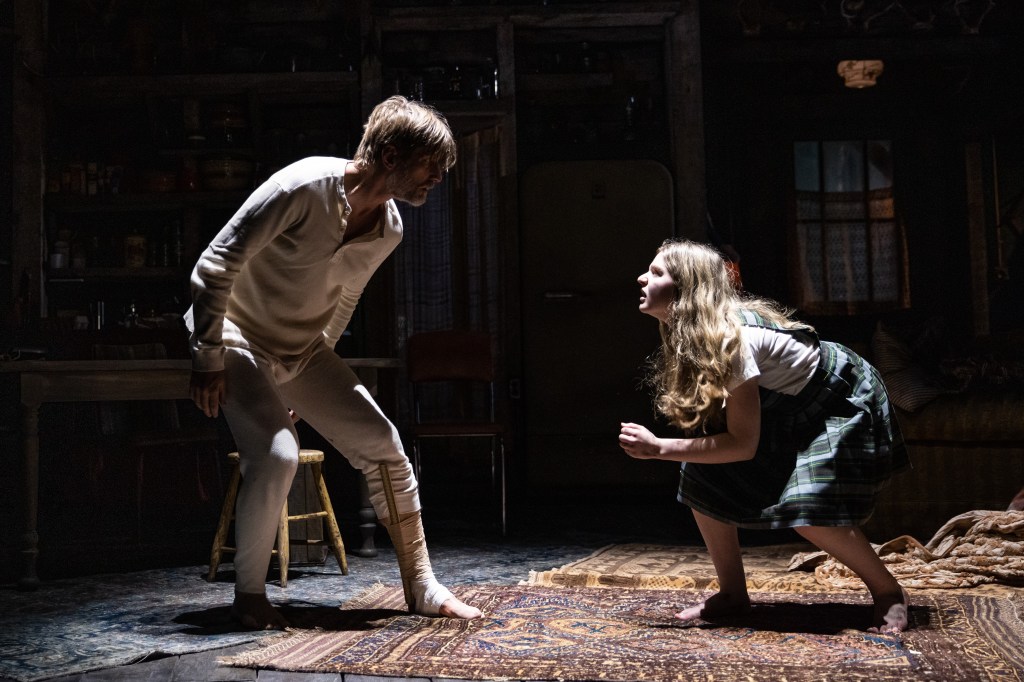
The silent characters, The Boy (Eamon Patrick O’Connell), and The Ancient (Cyndi Coyne), are vital in their gestures and presence. They add to the dynamic of “the family,” and Coyne’s Ancient is the wounded mirror image of Colby Kipnes’ Squirrel as a youth.
The production is amazing in its confabulation of mystery and opaque unreality delivered by the creative team. These include Scott Pask’s wonderful set design, Rudy Mance’s subtle costume design, Natasha Katz’s stark, atmospheric lighting design, Tom Gibbons’ house humanizing sound design, Katie Gell & Robert Pickens’ wig and hair design, Christina Grant’s makeup design. All of the actors are invested, as is Mantello in relating the otherworldly and arcane side by side with the profane, teasing out humanity in its wild derivations.
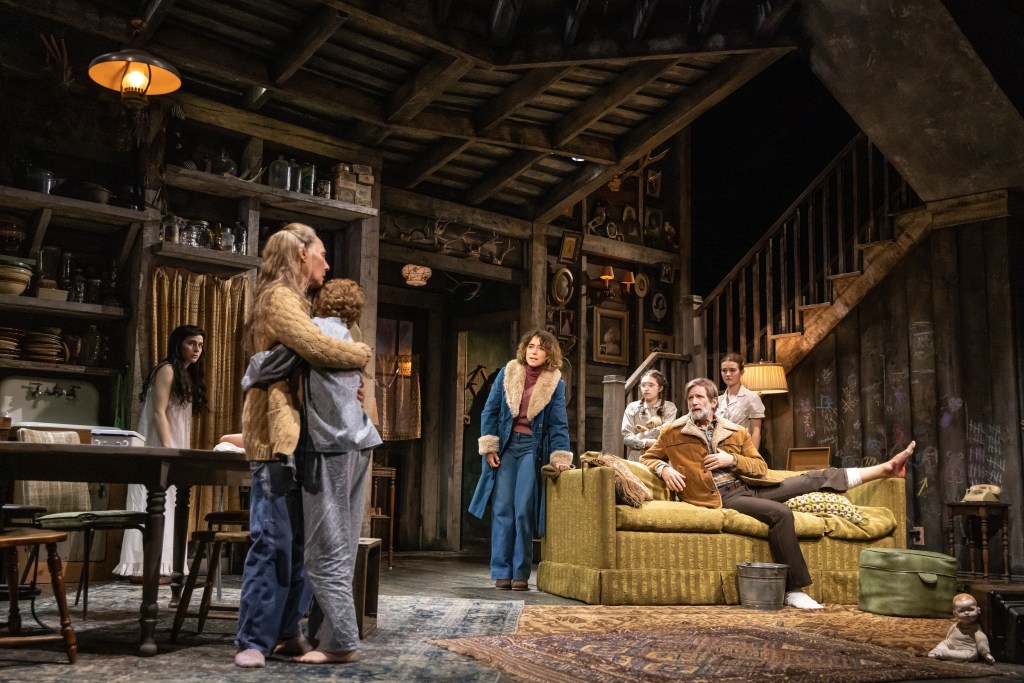
In life we see “through a glass darkly.” We receive glimpses beyond what we assume to be “reality” but know there is more that is present. What our senses apprehend, continually deceives us, though we like to believe “we know” and we are in control.
Holloway reminds us of the contradictions, the ironies, the shades of life that have no clear explanation. Indeed, the hints she drops about how the “family” of “willful creatures” operates in this spooky place are never solidified. All is intimation. The “moonshine” as Raleigh refers to it, “sold during the summer,” Marlow names “The Nectar of Dead Men,” which seems a more accurate handle by the conclusion. The duality of symbols existing on a spiritual, preternatural level are contrasted with the profane, material realm, for example when Max makes eggs (they are real-made offstage), for the “hungry, always hungry” sisters-daughters-creatures.
Thus, all is not what it seems. Holloway drives this theme home using the horror-thriller genre conveyance as a grand joke to prod us toward fear and laughter. She sends up that genre and twits us about our nightmares displayed in horror films, mirroring those found in our unconscious in dreams.

The development of the story and its characters, who are timeless archetypes reflected in literature (the good, the evil, the furies who gain vengeance), drive this work beyond genre. Thus, in an attempt to nail down Grey House and dismiss it, one may lose the deeper levels of Holloway’s symbols and complex, convoluted themes. One fascinating example is the red tapestry woven of the sinews of the historical predators, who have come to visit the cabin and whose “Nectar of Dead Men” is distilled for future use. The labels on the jars in the refrigerator tell the tale. The men’s remains we learn are in the walls, the grounds or in the basement which Squirrel frequents.
In Grey House Holloway’s vision expressed by Mantello and his creative team and enacted by the wonderful ensemble is a tonal hybrid of humor, a teasing send up of horror-thrillers, yet terrifying in its deeper representation of the patriarchy which doesn’t come off looking well in its tapestry of innards and crimes committed with impunity finally answered with rough justice, by “willful creatures.” The play is highly conceptual and may bear seeing twice because you will definitely miss connecting elements. Or just enjoy the ride and the fabulous acting and theatricality which will not disappoint.
For tickets and times go to their website https://greyhousebroadway.com/

