Category Archives: Broadway
‘Doubt: a Parable’ The Revival With Liev Schreiber and Amy Ryan is Exceptional
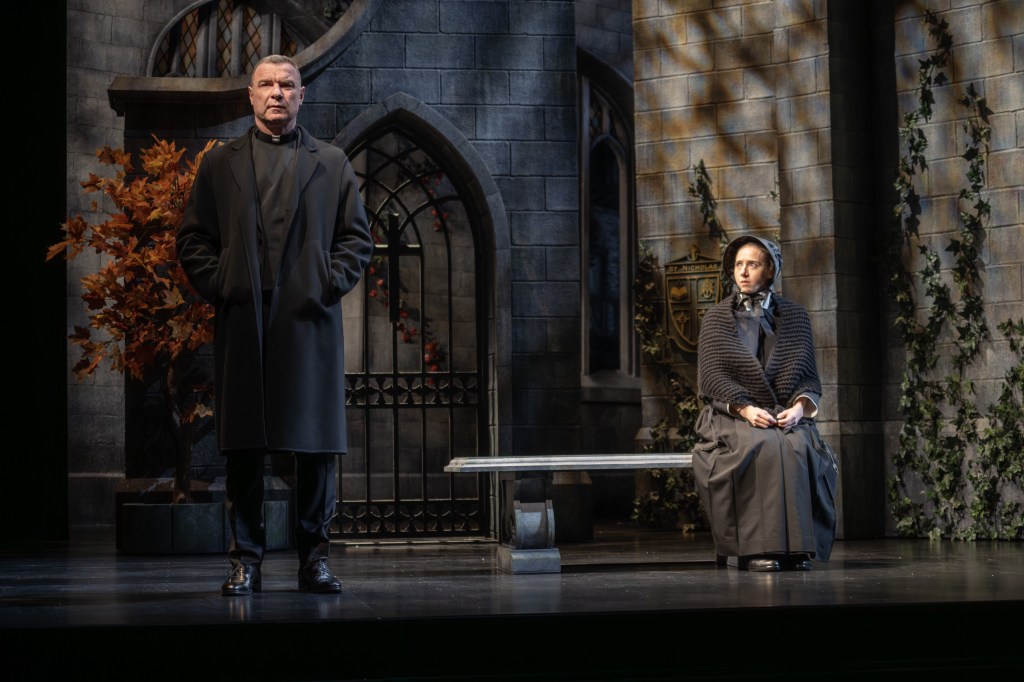
If nothing is certain but uncertainty, then “doubt” is a natural state, as genius quantum physicist Werner Heisenberg in his uncertainty principle postulated. However, in the realm of faith, “doubt” may be a blasphemy as scripture encourages Christian adherents to “walk by faith, not by sight,” believing fervently, blindly in God and His truths. Such is the position that Sister Aloysius Beauvier (Amy Ryan) initially presents in John Patrick Shanley’s Doubt: a Parable ably directed with specificity and edginess by Scott Ellis.
Doubt, currently in its first revival on Broadway since it premiered in 2005 continues to be a controversial powerhouse exposing embarrassing infelicities about the Catholic Church and the patriarchy.
In this beautifully acted revival running with no intermission at Todd Haimes Theatre, we note how the play emphasizes many of the divisive cultural issues at stake today though the setting is 1964, the Bronx, New York. However, Shanley nails the timeless sticky problems operating then and now with institutions that are incapable of policing themselves when they are run by men. Specifically, the play delves into church sponsored schools. Their male dominated hierarchy and paternalism shuffled off the harder tasks of teaching, learning and administration to the women. In this instance, the Sisters of Charity do the scut work in “collaboration” with the diocese in the fictional St. Nicholas Church.
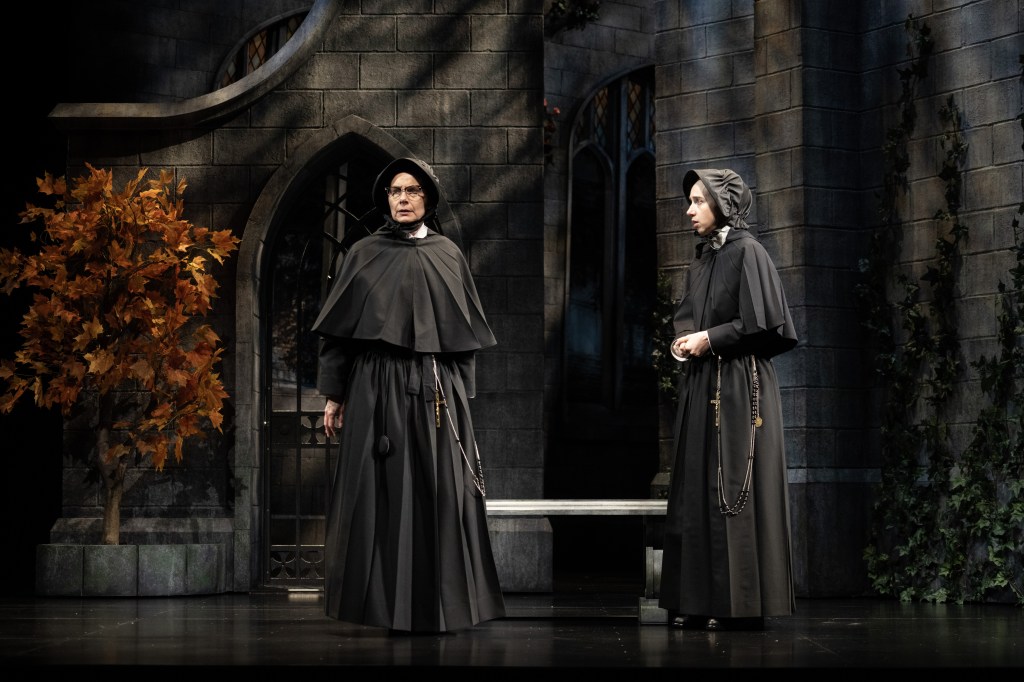
To highlight his themes Shanley contrives a situation among three religious adherents who influence children toward or away from Catholic tenets. These include the charismatic Father Flynn (Liev Schreiber), pastor of St. Nicholas, the school principal, Sister Aloysius, and neophyte teacher and nunm Sister James (Zoe Kazan). Their dynamic interplay reveals age-old issues about the best and worst of human nature, goodness, egotism, arrogance, the need to control through guilt and fear, inability to discern lies from truth, gender inequality and hypocrisy.
Doubt opens with Schreiber’s Father Flynn addressing the audience as his congregation, preaching a sermon on the opportunities of having doubt as a part of the bonds of faith. Father Flynn’s sermon frames the play’s arc of development and the subject becomes the driving force as each character confronts their uncertainties about what is right, decent, truthful as they project their own inner weaknesses onto the behavior of each other. Importantly, their uncertainties reveal a crises of their faith in God to move them through the darkness. Instead of allowing God’s love to unify them, darkness, suspicion and doubt overcome them.
The second scene opens on the office finely outfitted by David Rockwell’s wood paneled set design on a turntable which later revolves to show a pleasant Garden and backdrop of the city beyond. Sister Aloysius unleashes her intentions and suspicions on Sister James in the confines of her principal’s office. Ryan’s Sister Aloysius is a martinet who runs a tight ship with a stern, icebox demeanor. In her spot-on, nuanced portrayal of the nun, Ryan never shines forth Christ’s light and love and remains largely an emotionless cipher until the conclusion. To her credit, Ryan never pushes Sister Aloysius’s austere attitude over the edge, but breathes feeling and life into her persuasiveness and her determination with fervency.
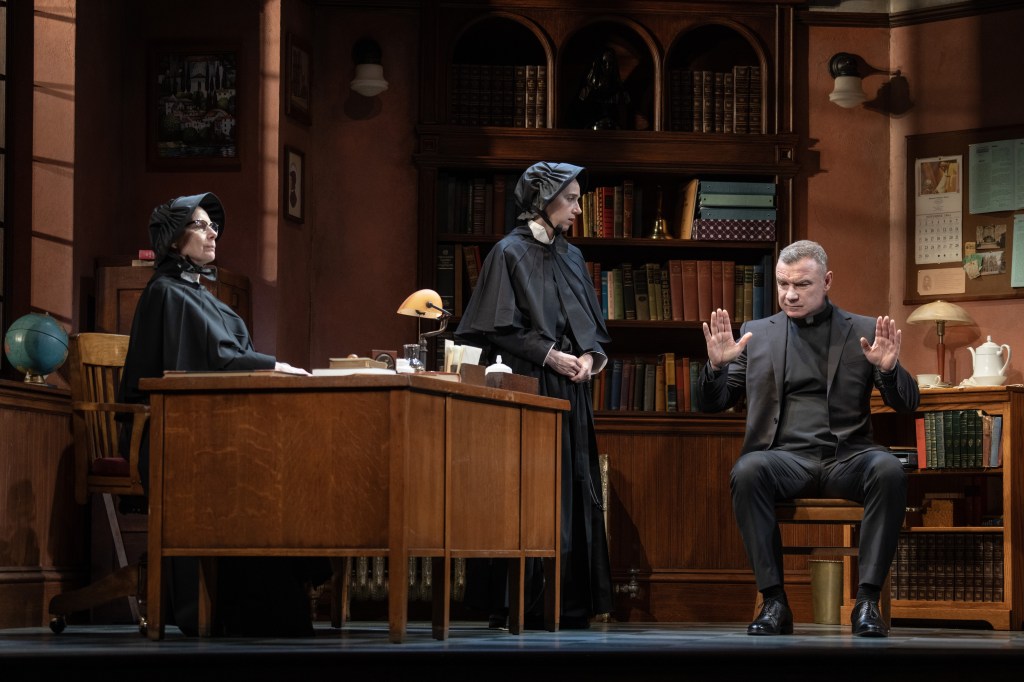
On the other hand, Father Flynn (Liev Schreiber) the priest, who is the pastor of St. Nicholas, manifests an openness, intelligence, flexibility, forward thinking personality and sense of irony. He and Sister Aloysius appear to be opposites in character, though both fabricate and lie; Father Flynn to drive home themes in his sermons, Sister Aloysius to “get at” the truth. The lighthearted, yet controlling Father conducts the physical education program and religion at the school. Both Sister Aloysius and Father Flynn follow the hierarchy and answer to the Monseigneur. This remains an obstacle for Sister Aloysius because she deems the elder cleric “other worldly” to a fault. She tells the young neophyte Sister James (Zoe Kazan), that he “doesn’t know who the president of the United States is.” Yet, here men rule.
A problem for the manipulative, coercive Sister Aloysius, the Monseigneur will dismiss any issue she brings to him, unlike another cleric she confided in at St. Boniface who believed her word and got rid of a priest Sister Aloysius implies was a pederast. Suspicious about Father Flynn, and questioning the personal purpose of his sermon about “doubt,” Sister Aloysius picks at Sister James like a feather pecking chicken who dominates hens by pecking them to draw blood because she enjoys its taste.
Preparing her victim for maximum influence, Aloysius criticizes Kazan’s Sister James. She derides her showboating as a teacher, her enthusiasm about her subject, her kindness to the students. She discourages Sister James’ relaxed atmosphere in her classes. After reducing the young nun to tears, she directs the neophyte to be emotionless and watchful about anything untoward. We learn later, as Sister James confides in Father Flynn, that the older nun has stolen her joy about teaching and has contributed to her bad dreams and loss of peace. This irony is not lost on us today, when religion is used as a hammer and sickle to browbeat and slice up the condemned populace to contort their lifestyles to politicized religious tenets popular over 120 years ago.
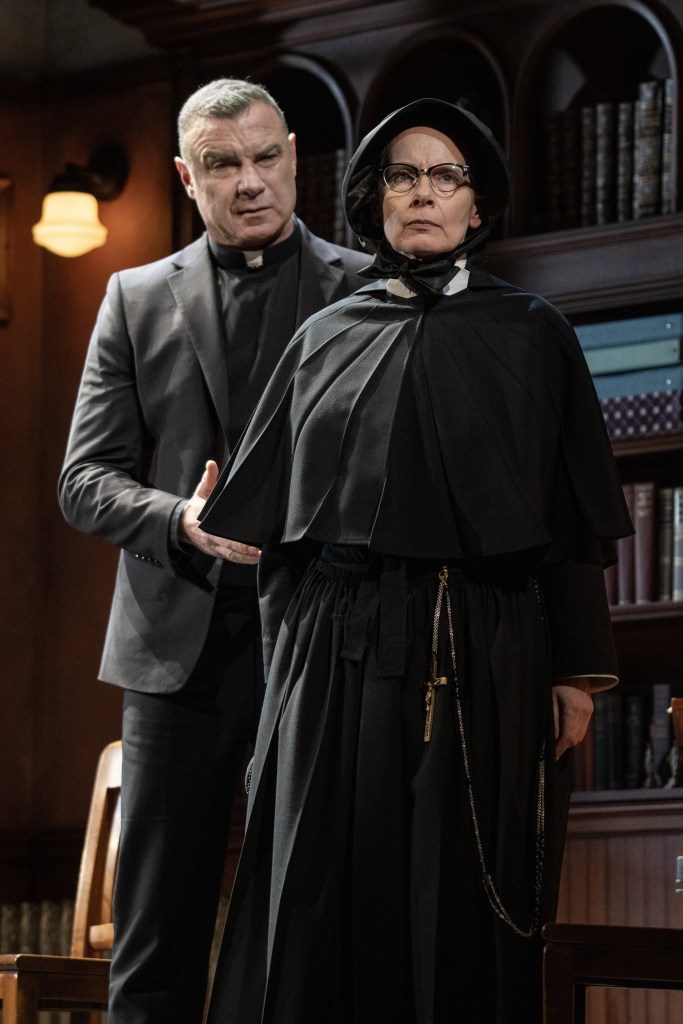
Sister James becomes the perfect foil for the imperious, commanding Sister Aloysius to manipulate and play upon in the tug of war between Sister Aloysius and Father Flynn. Initially, the “war” appears grounded in a difference in philosophies and life approaches between progressivism vs. conservatism. However, the divisiveness between them takes a sinister turn and explodes as Sister Aloysius gives rise to her suspicions that Father Flynn is grooming Black student Donald Muller for pederasty by giving him alcohol in the sacristy. It is an accusation that is proven only in her imagination.
Sister James is like a deflated ball tossed about in the storm that rages between Sister Aloysius’s determination to expose and evict Father Flynn from the church and Father Flynn’s insistence he is telling the truth and has done nothing wrong. In a climactic scene between them, Flynn’s denials and pleadings with her to count the cost to Donald, him and herself and to amend her convictions and threats because of a lack of proof, go on deaf ears. She has converted herself into the “anointed.” She would make those of the Inquisition proud, except they never would listen to a female.
To complicate the matter Sister Aloysius meets with the Black child’s mother, Mrs. Muller (the superb Quincy Tyler Bernstine). Mrs. Muller expresses that she is thankful Father Flynn has become her child’s protector. If Donald stayed in his previous school, he “would have been killed” by the bullies. Sister Aloysius dismisses Mrs. Muller’s backstory about her son’s beatings by his father for “being that way.” Instead, the principal is self-righteous and gratified that her determination has led to Donald Muller’s being dismissed from the Altar Boys, which Mrs. Muller explains devastated Donald.
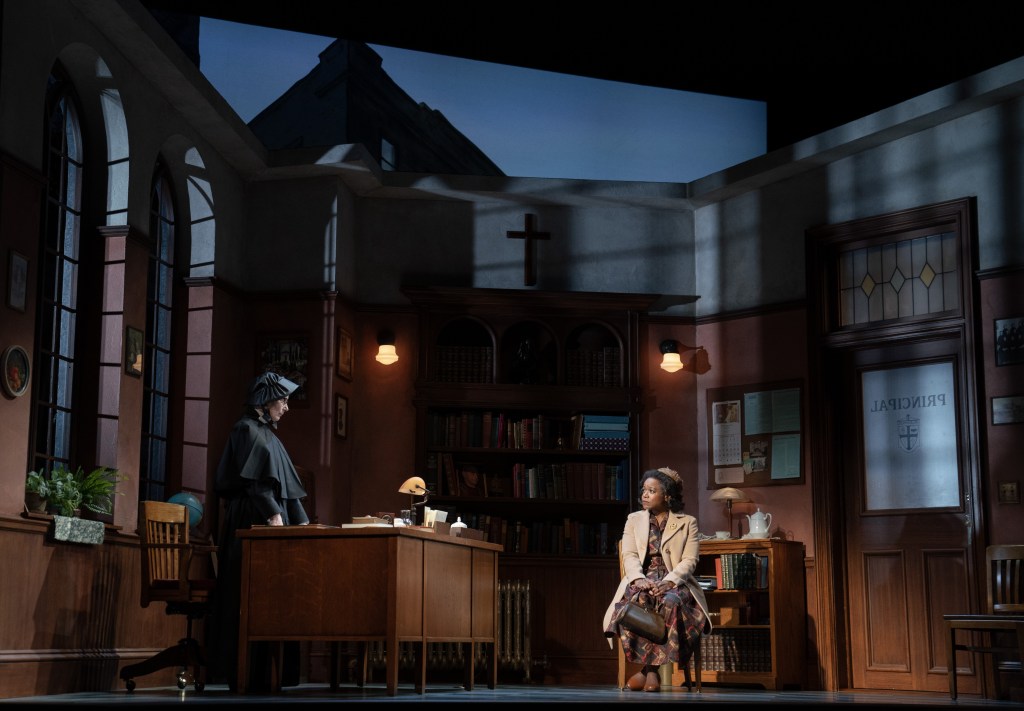
Mrs. Muller leaves with the assurance that Donald will be able to finish out the few months left, but Sister Aloysius is not satisfied and won’t be satisfied until Father Flynn has been exposed and kicked out of the priesthood. Because she is the assiduous hunter of her prey, Father Flynn, we become sympathetic to his cause and Sister James’ acceptance that he is innocent of Sister Aloysius’ allegations. However, the Catholic Church since 2000 has been expelling priests for pederasty and has paid great sums of money in damages to men who testified years later to being abused by priests’ sexual predation.
So, Father Flynn may be a pederast and Sister Aloysius may be correct in her “gut instinct” that he is a predator. Enter Werner Heisenberg. Uncertainty reigns without proof and admission of guilt and an act of contrition and repentance which Schreiber’s stalwart, assertive Father Flynn will never yield up.
The performances and direction are uniformly terrific as is Ellis’ pacing and vision which leaves the audience in a breathtaking conclusion and Sister Aloysius upended and overturned in her philosophy and life approach. Thanks to Linda Cho’s appropriate costume design, Kenneth Posner’s lighting design and Mikaal Sulaiman’s sound design, and Charles G. LaPointe’s hair & wig design, Doubt resonates with currency. As mentioned before, David Rockwell’s scenic design, first with a gorgeous cathedral interior setting for St. Nicholas, then with its turntable sets is appropriate for a place of peace which, by contrast, echoes with torment, division and fear.
The complexity of suspicion, accusation and innocence remind us of our time, and of the insistence of liars to demand they are right on little proof when the stakes are high. In the play’s instance careers may be upended, reputations are at stake, and individuals are harmed for the sake of one’s suspicions of imagination. Today, it is no less shattering that lies are the pylons which shore up candidacies to achieve power by any means necessary, even if it means the destruction of nations, citizens, the government. In its timeless themes about assessing truth when the professing upright religious protect liars, fantasists and themselves from accountability, Doubt is a profound must-see.
Doubt. Todd Haimes Theater, 42nd St between 7th and 8th with no intermission until April 21st. roundabouttheatre.org.
‘Appropriate,’ Exceptionally Acted, Scorching, Complex, Revelatory

Appropriate’s theme
The truth is the truth, no matter how hard one betrays oneself into believing otherwise. Currently, segments of the American population have difficulty with the nation’s history of bigotry and murder and would mitigate it, not through reparations and reconciliation, but through dismissal and nihilism. As long as such masking occurs, the violence will continue in a legacy that can only be expiated and ended by confronting the deplorable aftereffects of racism head on. Such is the basic theme of Appropriate, Branden Jacobs-Jenkins harrowing, humorous, profound family drama about loss, self-betrayal, torment, fear and generational psychic damage, that is currently unraveling great performances at 2nd Stage’s Helen Hayes Theater. The drama with sardonic humor is in its Broadway premiere and has now been extended.
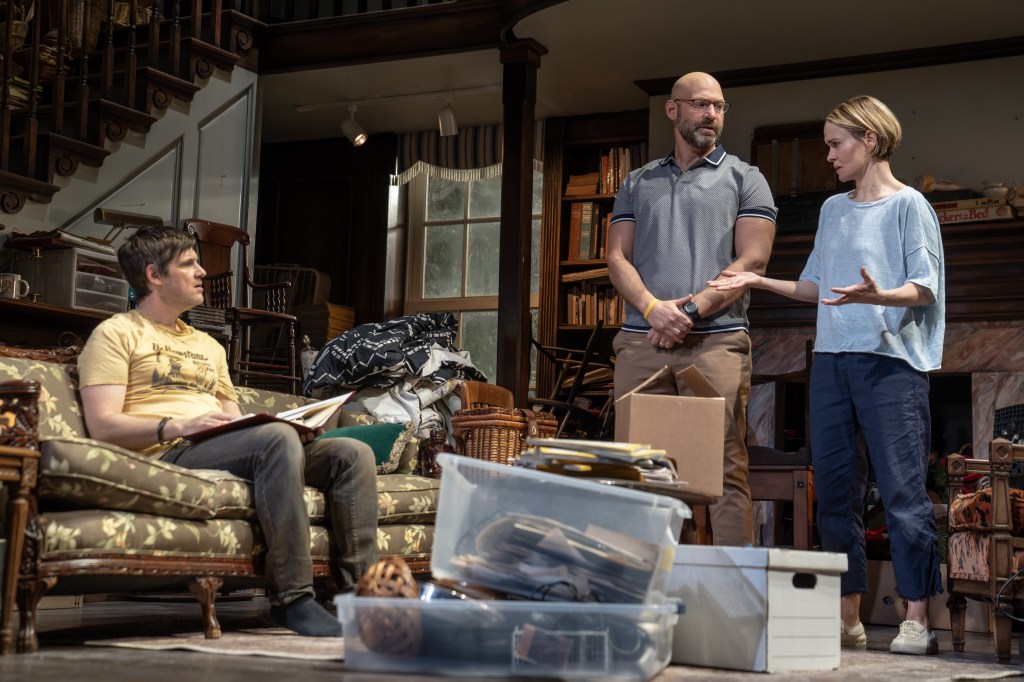
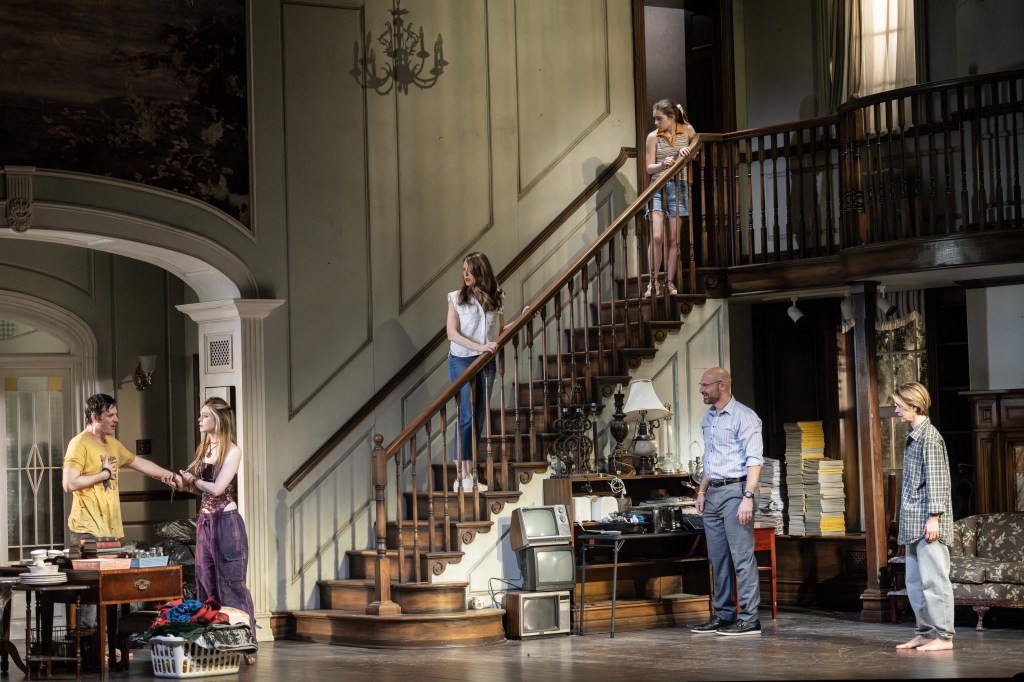
Before the curtain lifts onto the 7th generation Arkansas plantation home of the Lafayette family, the theater is plunged into the darkness of nighttime. Then, Bray Poor and Will Pickens let loose the prolonged, screeching sound of Cicadas, a sound repeated between acts and scenes. When Jacobs-Jenkins determines we’ve “had enough,” the lights dimly come up on a once stately mansion interior- living room, foyer, and stairs-leading up to the balcony landing and off to unseen bedrooms, where Toni (Sarah Paulson,Talley’s Folly), Bo (Corey Stoll, Macbeth), and Frans (Michael Esper, The Last Ship), slept during their childhood.
The mansion, in complete disarray, filled with hoarder’s junk-furniture, ceramics, glassware, clothing and more-still has remnants of beauty amidst its dilapidation and tawdry dressings of curtains and outdated furniture, thanks to dots’ prodigious scenic design. Symbolic of the once “glorious” South, with its penchant for ritual and gentility delivered by Black enslavement, servitude, Jim Crow peonage, bigotry and prejudice, the mansion, we come to discover, hides remnants of brutality, sadism and murder, a legacy of the Layafettes, which has not been recognized or confronted by the present generation, especially Toni.
The Backstory
In the backstory, we learn that Toni, Bo and their families are at the plantation for the auction of the estate interior, house and extensive property which includes two cemeteries, one for seven generations of Lafayette ancestors, and the other a slave cemetery isolated near the algae-ridden pond. Bo and Toni have kept in touch and were together for their father’s funeral six months prior, when they discussed raising money to pay off the loans of the estate’s indebtedness. Though they try to contact Franz, who has been AWOL for 10 years, they have been unable to tell him of their father’s death and the disposal of the estate.
It is no small irony that Franz, at the top of the play, comes in through the window with his girlfriend like a thief in the night, in the early morning hours, the day the liquidators are supposed to catalogue and price the estate’s valuables. When Paulson’s Toni makes a dramatic entrance from the 2nd floor balustrade, shining a flashlight on Franz, ranting at his presence and interrupting his reunion with her son, his nephew, Rhys (Graham Campbell), we question what is going on. From this incident of conflict, Jacobs-Jenkins unspools the mystery about the family, its members, their dead father and their ancestors. Throughout the play by agonizing and strategic degrees, the playwright reveals the Lafayette’s tragic family portrait, and explores many themes, key among them ancestral accountability for the past sins, which if not addressed or confronted, will be a curse on future generations.

As the play progresses and the siblings deal with the estate, we note that Toni, as executrix, makes unilateral decisions and controls everything to the point of “spur-of-the-moment” irrationality (though her explanations to herself are rational). This foments more chaos than is necessary in a situation fraught with turmoil, divisiveness and alienation among the siblings.
Pressures and conflicts in the Lafayette family
Pressures of the father’s illness and death, the disparate circumstances in each sibling’s family, Toni’s divorce and difficulties with her son Rhys (Graham Campbell), exacerbate the tensions of the stressful time, as the siblings attempt to create order out of chaos and obtain the most money to pay off the debts. Handling the estate and settling the inheritance would upend the most sanguine, peace-loving and close siblings. However, for the tormented Lafayettes, settling the estate is apocalyptic. The brokenness of each family member and their significant others raises the temperature of the non air-conditioned mansion to an explosive boiling point by the end of the play.
The first roiling incident begins with Franz, renamed from Frank by his California-dreaming, tendentious, sweetie, River (Elle Fanning is brilliant as the peace-keeping, pompous, shaman-loving spiritualist). The moment Paulson’s acerbic, sniping Toni sees Franz, she launches into strident questions, as he soft peddles his replies and defends himself against her accusations that he only showed up to greedily collect “his share.” When she threatens to “call the cops” on him, he ignores her and goes upstairs with River to sleep off their long trip from Oregon, where he had been hiding out for a decade.

Why she responds toward her youngest brother this way is revealed in the last act cataclysm. However, her bile-frothing attitude, while humorous and sardonic, frightens. Though she seeks hugs from her son Rhys and tells him she loves him, we question her volcanic response to Franz and fiery tirade answering Bo’s comments about shelling out money to maintain the estate through the last years of their father’s illness. Apparently, Bo paid for the aide who ministered to their father almost 24/7, and paid for all the house expenses. According to Bo, he took that “hit,” and hopes to recoup some of that loss from the proceeds of the auction and estate sale.
Questions about the kids’ discoveries
Toni dismisses him saying that it was “their father” who was ill. The implication is that he is heartless and should have opened his bank account willingly with no thought of recompense. We are curious about this “selflessness” she demands of others, while equating her time with her father and drives to Arkansas from Atlanta as more than the equivalent of the money Bo paid. Meanwhile, why wasn’t the father’s grand estate enough to pay for its upkeep? As a DC district justice (in line for becoming a Supreme Court Justice), didn’t the father have the acumen to financially manage it? Why didn’t Toni contribute monetarily, and why are there heavy loans against the property? And why did the father keep quiet about his precarious financial circumstances? Eventually, we learn the answers about this family which is so dysfunctional, it is caving in on itself by the weight of its violent legacy which they refuse to confront.
Little of what her siblings say Toni takes in giving any weight to their position or logic. She is quick to retort and uplift her own situation and attack theirs with seething anger. Whether this is a function of her age (the oldest), and her position as executrix, one concludes that it is mostly due to Jacob-Jenkins’ stylized characterizations in the service of elucidating his themes. A key theme is that karma is a bitch. Unless you break the cycle of abuse of others (slavery, murder) and acknowledge and reverse it, it comes to haunt you with its own particular brand of sickness and blight in the human heart. By the end of the play, we note how each sibling is crippled with agony, divided and isolated from each other without any possibility of reconciliation or redemption.
That this may be the result of what their ancestors had wrought upon the land they “appropriated,” and the slaves they abused, and the Black people they may have seen or had lynched, generational accountability is the last thing these present day Layafettes consider. However, adding other clues (i.e. River feeling the presence of spirits), it is a sub rosa theme of the play. Bo, Toni and even Franz hurt, lash out and move to disinherit themselves from each other, the estate valuables and the plantation which they leave to the elements, abandoning it.
Who would question their behavior? Who would want their legacy which involves lynchings (they find photographs of Blacks lynched), glass jars filled with noses, fingers, ears and penises of Black people carved out of the lynched bodies, and a Klan hood that was their father’s. Clearly, the race hatred permeated their childhood, but they didn’t realize it, having spent most of their lives in Washington, DC and some summers at the Arkansas plantation. Besides, around them, their father never mentioned the “N” word, though Bo remembers in college the judge refused to look at “in the eye,” or “shake the hand” of a Black dorm-mate.
The mystery revealed: spoiler alert.
The siblings and apparently, the father and mother, didn’t deal with their ancestry, but like so many others in the south, received the benefits of “free labor” and reaped the rewards of servitude and Black social oppression through the generations without considering the possibility of karmic reparations exacted on their being, emotionally, spiritually and psychically. Jacobs-Jenkins gives clues of the cruelty of their ancestors toward the Black population throughout, via the collector’s items and junk their father and his relatives hoarded.
That this sale of the estate represents the family’s apotheosis of failure and self-destruction, Jacobs-Jenkins uncovers by the conclusion. Bo has lost his cushy job. Toni has been fired from her teaching position when her son distributed her meds to classmates, for which he was kicked out of high school. She is finalizing her divorce and Rhys doesn’t want to stay with her but is going with his father because she is not a good mother.
We discover that Franz is only interested in collecting “his share,” after befriending Bo’s daughter Cassidy (Alyssa Emily Marvin), who broadcast family events to him via her Facebook pictures. Franz had been receiving checks from his father to pay for his upkeep after his jail sentence as a pederast (he got a teenager pregnant). During Toni’s harangues, we discover, though Franz is presently “clean,” Toni suffered with “worry” through his hospitalizations, rehabilitations and addictions to drugs and alcohol. Meanwhile, Franz blames his “bi-polar,” psychically-broken father who fell apart after his wife’s loss to cancer, as he attempted to raise Franz by indulging him. Franz also blames his siblings’ abandonment of him to his father’s questionably abusive care. Of course Toni counters Franz “defense” as lies.

The Lafayettes are an emotionally debilitated family on steroids
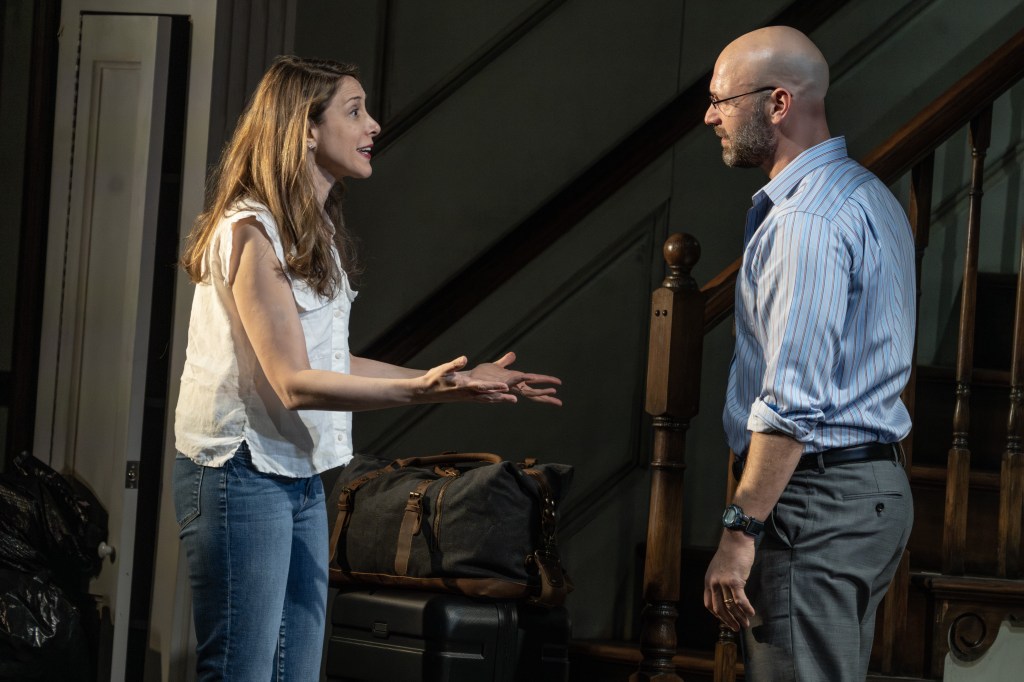
Jacobs-Jenkins clarifies that this is a emotionally debilitated family on steroids. Maybe the only member with any rationality is Bo, but only because of his wife. When discussing their father’s racism and prejudices, which Toni denies, Rachel mentions she overheard their father slur her when he referred to her on the phone with a crony, as Bo’s “Jew wife.” Toni dismisses her and the race hatred artifacts. She is “put-out” by Rachel’s alarm that the children have seen the photo album of Black lynchings and incensed that Rachel implies her father is anti-semitic and racist, she ends up provoking Rachel to provoke Toni to slur her. Toni does with ironic abandon, then claims she was joking.
Interestingly, Bo, who lives in the North has put a great distance between himself and his heritage, which is another form of dismissiveness. However, he has taken his racist attitudes with him. He attempts to recoup money from the estate by arranging to sell the photographs of the lynchings of Blacks, which apparently are valuable on a covert white nationalist market of sadistic memorabilia of the “good ole” Southern “glory days”
Bo is so numbed to his legacy, he doesn’t see the egregious amorality of making money off others’ victimization and death. This is a corrupt continuation of the “benefits” the South receives from its Jim Crow policies of racism and murder, heightened by the fact that there is a market for these “valuable collector’s items.” Though each revelation of the father’s racist hoardings is achieved through the kids’ innocent, sardonic, humorous discovery, as the adults try to cover up the shocking “in-your-face” racism, the audience’s real shock is at the macabre, psychotic nature of keeping such items. We ask, why would the father, a judge, “get off” on photos of Black lynchings and jars of Black body parts from the lynchings?
Who does the photo album belong to or the glass jars of body parts?
Toni, Bo and Franz don’t find this loathsome about their father, and try to pretend it belongs to someone else.

Jacobs-Jenkins clarifies the craven, broken psyche of Bo, Toni and Franz, who don’t see anything wrong with selling these items to recoup the estate’s losses. On the other hand, Rachel is outraged her children have been the ones to discover the photo album and jars of body parts. And at some point, she intends to discuss what they mean with her kids to work through the psychological shock of seeing such horrors. Indeed, she is the only one who seems to understand the brutality and violence such artifacts signify. It is her morality that stirs the morality of the others to try to protect the kids from further exposure. But Cassidy is interested because it is verboten, so she continues to look, seduced to the grotesque, cruel voyeurism that this American past was normal for the South..
The playwright speaks volumes through what is absent in the siblings’ conversation. They don’t deal with why the father hoarded such items and didn’t find a better place for them in the Smithsonian African-American History Museum, Arkansas African-American History Museum, or other educational institutions or museums. Why has he kept the photos in a shelf in the foyer, and the Klan hood and the body parts in his bedroom? They weren’t secreted away in a hiding place in the attic or elsewhere, but were out in the open. Obviously, there are two sides to the retired judge’s character. One part of him justifies lawless lynching via white domestic terrorist racism, while the other lives peaceably as a justice. Perhaps Franz has a better handle on his father’s “bi-polar” nature than Toni, who disbelieves all of the “incongruities” Bo, Rachel and Franz have pointed out about him.
The final coup de grâce

Jacob-Jenkins cannot resist the final coup de grâce on this tragic, racist, family legacy that is blowing up in their faces with regard to recouping money. Bo states the land cannot even be sold without dealing with the two cemeteries, so the property isn’t worth much. Secondly, Franz,, to “cleanse himself and get in good with his family,” throws himself and the photos into the pond by the slave cemetery before he knows they might be valuable. The photos are destroyed; the money up in smoke. This family can’t win for losing. Have the spirits of the dead effectively prevented any benefit to a family with its violent legacy of slavery and lynchings, as karma takes its recompense and the estate goes into receivership?
River, who has from the start been wary of the spirits on the place and has sensed “a presence” in the mansion, is used by Jacobs-Jenkins to validate this possibility that the spirits of lynched, enslaved African-Americans exact their karmic retribution. Additionally, the playwright and director’s vision reveal that such spirits may seek vengeance until the family expiates the bloodshed and torment their forebears have wreaked on the Black population on their lands. Thus far the current generation hasn’t and the siblings are a wreck.
The tragedy of blindness is on everyone in this family, who ignores the significance of those murdered, lynched, abused and oppressed. The lives of those in the slave cemetery and those in the photo album are like the lives of Blacks across the South, who were and are still being appropriated for money on the covert market of “lynching” items that white, terrorist racists find “quaint,” “cool” and “prize-worthy” for trading. It is an unacceptable criminal abomination that must not be normalized. It still is at what cost?
The siblings abandon the mansion and its contents which nature takes over and destroys through the decades as it collapses and a final haunting symbol emerges in the mansion center stage. It is a huge tree open to interpretation. It is representative of the lynchings in the photograph album which must be accounted for.
An amazing conclusion
The conclusion after the blighted family members have left, never to see each other again, is an amazing scenic feat. A tree rises from the mansion floor effected by the amazing scenic designers, dots. Neugebauer’s vision with dots’ execution of the house symbolically shattering as the tree rises up from the foundation of racial hatred, brings together Jacobs-Jenkins’ themes. They warn that despite assuming all is well, recompense will continue to be exacted for historic racial bloodshed and murder. As this family has a legacy of it and refuses to confront it, a bill for the bloodshed will be delivered on them and future generations, via psychosis, financial ruin, addiction etc. Karma is a bitch.
The play is exceptional in its themes and important in its significance about recognizing and not normalizing racial murder and lawlessness as the family tends to do when their father’s hidden life uplifts it. The characterizations serve the themes; the themes don’t arise from the characters. At times the dialogue is contrived to be humorous, especially as the playwright has stylized these individuals as types. Toni’s character is drawn as sardonic, insulting, shrewish and one-note.

The reason why the production gets away with the contrivances is because the director’s staging is perfection, the technical creative team is superbly coherent in conveying her vision. Most importantly, the actors are incredible, individually and as an ensemble. They flesh out and inhabit these unlikable individuals and make them watchable and horridly humorous. Paulson brings her own star quality and beauty to the role so we dismiss Toni’s obnoxiousness, until as with all of them, their faults gradually clarify and deaden them. Then, we reach the point of no return.
By the end we could care less that Toni declares herself dead to the others as they are dead to her. We watch as Bo weeps and questions why he cries. We assume that Franz will continue in his lost state with River directing him until she gets fed up. And Toni sums up what each of the siblings is thinking. She affirms this is who she is with them, implying they “make her” this way and she doesn’t like herself as a result. It is the same for Bo and Franz, who aren’t particularly happy with themselves. Neither do we empathize with any of them because they don’t acknowledge their legacy, they dismiss it or run from it. As their ancestors “threw away” Black generations, so these individuals in self-torment, “throw away” themselves…a tragedy.
This family is the problem and not the solution which is hard won. And as the themes imply, there must be recognition of the horrors of murder and reparations must be attempted. Karma is taking its toll. The sooner the crimes and injustice are recognized, the better for all who have a legacy of violence as this family does. Regardless of how disconnected they think they are from it, they are suffering and will suffer until the injustice is made right.
Kudos to the creative team not identified above. These include Dede Ayite (costume design) and Jane Cox (lighting design). This is not one to miss in its profound themes about the South, about normalizing crimes, and dismissing their historical significance and impact on us today.
Appropriate, two hours thirty minutes with one intermission at the Helen Hayes Theater, 240 W 44th St. between 7th and 8th. https://cart.2st.com/events/?view=calendar&startDate=2024-1
‘Gutenberg! The Musical!’ Featherbrained, Loopy, Josh Gad and Andrew Rannells Shine!
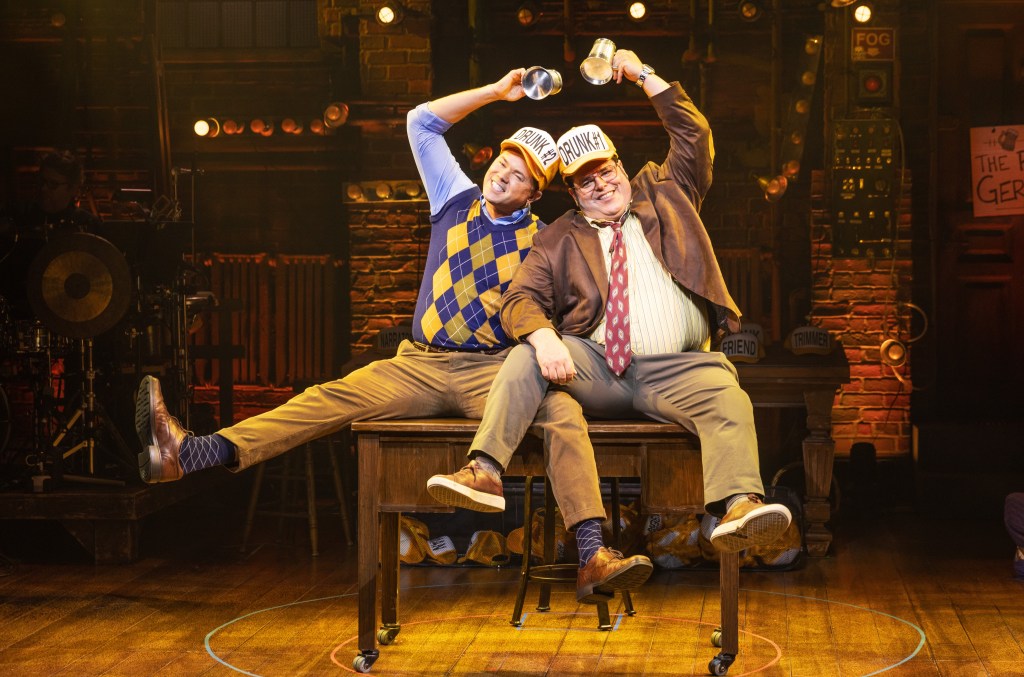
If you are looking for laughs and ridiculous fun, Gutenberg! The Musical! is the show for you. Thanks to the superbly wacky performances in this farce where Josh Gad and Andrew Rannells make a twosome of bat-sh*t silliness, Gutenberg! is a standout. Currently running at the James Earl Jones Theatre with one intermission in a two hour time slot, the zaniness is a treat to take you out of yourself. And who doesn’t need to “forget your troubles and get happy” in these times that try all of our souls?
The premise is well known: amateurs strike out for Broadway, draw in by the allurement of the “great white way.” In this iteration, two guys from New Jersey decide to toss the dice and bankroll a musical they’ve written to pitch it at a backer’s audition they set up at the James Earl Jones Theatre for a one night rental. Because they have to scrounge up the money by using the last dime of their inheritances, they can only afford a bare bones cast. Both play a total of twenty parts. They never change costumes except for hats in bold, black print which state their roles. For accompaniment they’ve hired a three-piece, local band that plays weddings, bar mitzvahs, retirement parties, etc.
Their thought is if they are good enough (ah, there’s the rub), they will get funding from producers to mount their musical on Broadway. Thus, Gutenberg! is theater “vérité,” happening with immediacy. Sitting in the audience, we are told, are various producers who’ve received invites. Thus, the audience bears witness to whether or not these Jersey guys have what it takes to sizzle and shine or fizzle and die on the vine of their dreams.

Scott Brown and Anthony King (book, music and lyrics), launch the show into the stratosphere of inanity. Not only are Bud (Josh Gad) and Doug (Andrew Rannells) below average talents, they have little expertise about what makes a musical or any show for that matter. Furthermore, their lyrics, rhymes and meaning rival the simplicity of Dr. Seuss.
But all is not lost. Interestingly, Dr. Seuss is extremely popular because it capitalizes on being silly. Additionally, the wild duo are winning and lovable. What Bud and Doug lack in talent and expertise, they make up for with enthusiasm, joie de vivre and hilarious, charming schtick.
As a side note, Gad and Rannells, who haven’t been together since Book of Morman, are terrific in curtailing their exceptional talent just enough to be a tad off, making their portrayals as Bud and Doug even funnier. Of course, this adds to the inside joke about who they really are and what they are capable of. Indeed, the audience was tuned to the inside jokes.

Gad and Rannells have fun playing it to the hilt with tongue in cheek direct addresses to the audience and a shattering of the fourth wall, as they move along the plot about a dry subject, the life and times of Johannes Gutenberg, inventor of the printing press. As it turns out Gutenberg is a topic about which little is written and much can be embellished and fictionalized. That is why Bud and Doug have found it to be a glorious subject for a “fantastic” musical.
Ironically, referring to their content as historical fiction, they share little factual information about the man and the time. In falling back on fabrication, which currently is trending in political news and the radical conservative, nihilistic, QAnon wing of the “Republican” Party, Bud and Doug’s fantastic tale is hugely satiric. It indirectly points the finger at the last seven years of Trumpism, when the playing field of misinformation became normalized through the efforts of conservative media. Lies of omission, conspiracy theories and sheer made-up junk swanned as legitimate and newsworthy.

Take for example reports on Italian space lasers causing the 2020 election to be stolen from former president Donald Trump. (Look up recently convicted Trump lawyer Sidney Powell, if my reference to Italian space lasers eludes you.) Such theories are inane fabrications such as those found in this musical.
On the other hand for all its guffaws, belly laughs and puerility, Gutenberg! is as serious as a heart attack. If you peek underneath the abundant blanket of hysteria, it actually makes grave points.
That Scott Brown and Anthony King convert the momentous occasion of the birth of Gutenberg’s printing press, a turning point in history, into a farce that nuances themes about the perils of illiteracy, is profound as well as riotous. In truth illiteracy and “not reading books” is disastrous, when considering the culture wars of the South and their twisted turn into banning books. Making indirect inferences to the QAnon pride of ignorance against the elitism of the educated, Gutenberg! twits us with its ridicule about our present time.

This is especially so with the musical’s humorous, historical reminder of how ignorance leaves an open door for the power hungry. In its Act II arc of development, after the printing press has been invented, the villainous, devilish monk completes his scheme to target Gutenberg and destroy his press. Representing the power of the church which historically exploited the ignorant and illiterate, we understand the benefits of keeping the uneducated, non-reading masses brainwashed, oppressed and afraid.
In portraying the monk with a nefarious purpose, Gad is riotously funny. He pings all the notes of the stereotypical wicked, leaving the audience LOL. Of course, his crafty portrayal stings, if one moves beyond the laughter to the quiet message underneath. Despotism only works well with the uneducated, non-reading, non-thinking masses who are often too distracted to distinguish the truth from fiction and lies.
Throughout the winding action which involves anti-semites, Gutenberg’s fictional German town of Schlimmer, a wine press becoming a printing press, a pretty, violent white cat named Satan, a maid named Helvetica, pencils that kill, Brechtian breaks and commentary about the musical, and so much more, Gad and Rannells create their comedic, whirlwind sketches at Alex Timber’s breakneck pace. Seamlessly stirring the narrative segues, then plunging back into the action as they don the various hats of the characters they portray to trigger spot-on caricatures with their voices and gestures, they send up the “politically warped” stereotypes and spin this delightful musical farce with lightening speed.
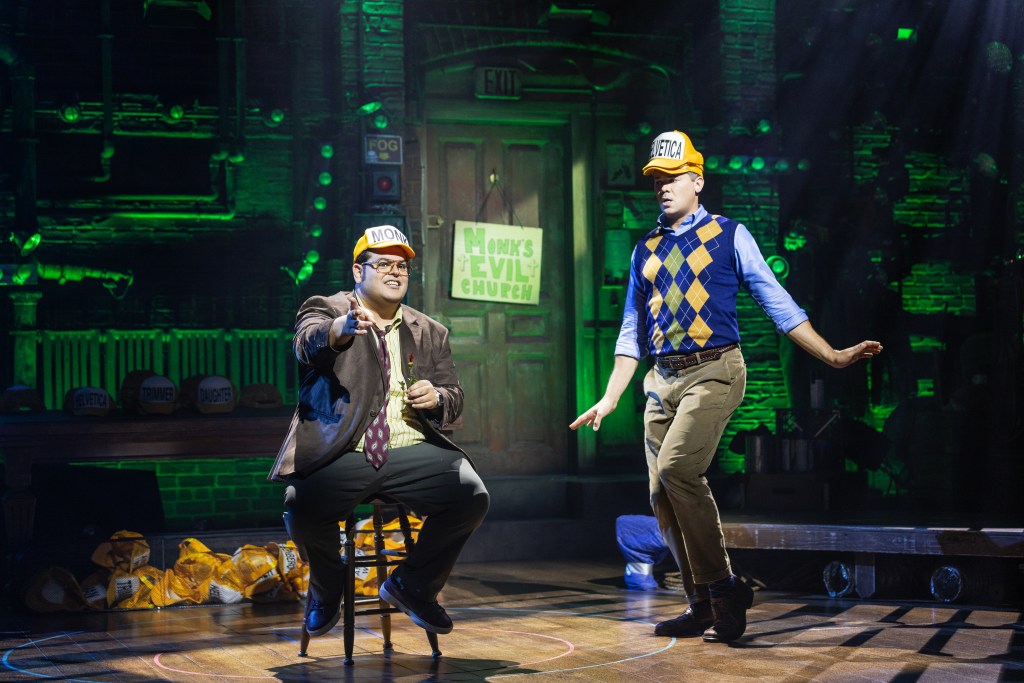
We have been led into the “secret world” of a backer’s audition for a production that is a loser and a winner. Maybe with a little revision, a tweak here and there, a consolidated cast, a reworking of the more incredible elements, a producer will envision its commercial vitality? Maybe not. You have to see it to find out if the producers line up to sign on or hold their noses and back out quietly.
Importantly, during the process, Gad’s Bud and Rannells’ Doug steer the audience from joke to quip to zany song with an aplomb that is exhaustive and exhausting. Assisted by Scott Pask’s scenic design of the stripped down stage, Emily Rebholz’s costume design which is appropriate for Doug and Bud’s dorkish affability, Jeff Croiter’s lighting design and Tommy Kurzman’s hair design, the actors fulfill Timber’s tone and vision for this seemingly facile, but humorously febrile, profound musical. M.L. Dogg and Cody Spencer’s sound design is spot on; I could hear every word.
Kudos goes to the orchestra which includes Marco Paguia (conductor/keyboard 1), Amanda Morton (associate conductor/keyboard 2) and Mike Dobson (percussion). Additional arrangements are made by Scott Brown and Anthony King. T.O. Sterrett is responsible for music supervision, arrangements and orchestrations.
This is one to see for the fun of it. It is also a sardonic criticism of our time, which, thankfully, doesn’t slam one over the head with pretentious probity. For tickets go to the Box Office at 138 West 48th Street or visit their website online https://gutenbergbway.com/ It closes January 28th.
‘Purlie Victorious,’ a Riotous Look in the Backward Mirror of 1960s Southern Racism

White power structures die hard. However, they do fall apart when the younger generation helps to topple them.
This is particularly true in Purlie Victorious, a Non-Confederate Romp Through the Cotton Patch, currently in revival on Broadway at The Music Box. It is the next generation that overwhelms the cement-like apparatus of noxious, white paternalism in Ossie Davis’ trenchantly funny play. Thus, we cheer on the pluck, humor, audacity and cleverness of the young reverend Purlie Victorious Judson, exquisitely inhabited by the unparalleled Leslie Odom, Jr. of Hamilton fame. Odom, Jr. leads the cast with his kinetic and superb performance.
The premise for the play that initiates the action is steeped in hope and youthfulness-the righting of a an ancestral wrong symbolically-the despotic terrorism of slavery’s oppressive violence. With mythic actions and intentions Purlie returns home to the Georgia plantation where he was raised, to claim his inheritance and take back the honor which racist owner Ol’ Cap’n Cotchipee siphoned off from his family through peonage (servitude indebtedness).
How Purlie does this involves a fantastic and hysterical scheme, eliciting the help of the adorable Lutiebelle Gussie Mae Jenkins (the riotous Kara Young). Purlie, who met Lutiebelle in his travels, intends to pass her off as his Cousin Bee, who will charm Ol’ Cap’n (the perfect foil, Jay O. Sanders), into giving her the $500 cash that was bequeathed to their aunt by her wealthy lady boss. After succeeding in the scheme to dupe Ol’ Cap’n, Lutiebelle will give Purlie the cash. With cash in hand, Purlie will purchase and restore the Old Bethel Church, so he can preach uplifting freedom to the sharecroppers, who are enslaved by peonage to Ol’ Cap’n.

As Purlie relates his scheme to family, Missy Judson (the fine Heather Alicia Simms), and Gitlow Judson (the riotous Billy Eugene Jones), they avow it won’t work. At first, Gitlow refuses to take any part because he is one of Ol’ Cap’n’s favorite “darkies.” Gitlow has risen to success through his amazing cotton picking labors. Ol’ Cap’n bestows upon him the anointed status of chief oppressor of the “colored folk” working for Ol’Cap’n. He keeps them nose to the grindstone at their backbreaking work.
However, when Purlie introduces his relatives to Lutiebelle, and unleashes his persuasive and inspiring preaching talents on his kin, they give the scheme a whirl. What unfolds is a joyous, sardonic expose of all the techniques that Black people used when dealing with the egregious, horrific, white supremacists of the South, represented by Ol’ Cap’n, The Sheriff (Bill Timoney), and The Deputy (Noah Pyzik).
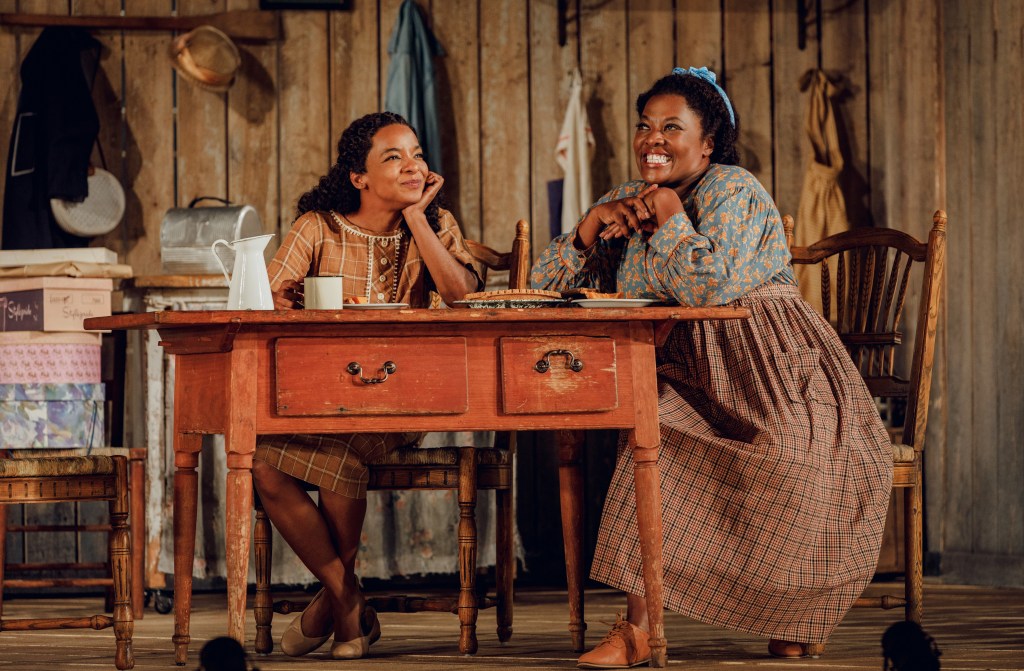
The irony, double entendres and reverse psychology Purlie and family use when confronting Ol’ Cap’n are sharp, comedic, and of moment. Though Ol’ Cap’n owns the place and exploits the sharecroppers using indebtedness, on the other hand, we note that Gitlow is able to manipulate Ol’ Cap’n with his “bowing and scrapping” which, as we are in on the joke, is brilliantly humorous.
It is in these moments of dramatic irony when Ossie Davis’ arc of development reveals how the characters work on a sub rosa level, that the play is most striking and fabulous. The enjoyment comes in being a part of knowing that Purlie and the others are able to “get over,” while Ol’ Cap’n is unable to see he is “being had.” Additionally, with the assistance of Ol’ Cap’n’s clever, forward-thinking son, Charlie (the wonderful Noah Robbins), Ol’Cap’n is completely flummoxed, having missed all the undercurrents which indicate he is being duped.

The actors, beautifully shepherded by director Kenny Leon, effect this incredible comedy, which also has at its heart a deadly, serious message.
Black activist, writer, actor, director Ossie Davis wrote Purlie Victorious, which premiered on Broadway in 1961 at a time when Martin Luther King, Jr. had strengthened the Civil Rights Movement and celebrities were taking a stand with Black activists. In fact, Martin Lurther King, Jr. saw the production and was pictured with the cast, Ossie Davis and Ruby Dee, his wife, who portrayed Lutiebelle.

Particularly in the final speech that Purlie delivers, we can identify with the important themes of a unified human family being together on an equal plane. It is a message that is particularly poignant today, considering the political divisiveness of the white nationalists, a throwback to the Southern racists of the 1960s, like Ol’ Cap’n, who Jay O. Sanders makes as human as possible to allow his racial terrorism to leak through with humor. Because of Sanders’ balanced portrayal, Ol’ Cap’n is an individual who has become his own hysterically funny caricature and stereotype, precisely because he is so obtuse in his self-satisfied mien as their “great white father.”
In the play Davis’ themes about the cruelties of peonage resonate today in the corporate structures which have kept wages low while giving CEOs 500 times what their average workers make. Indeed, the play resonates with the idea of servitude and keeping the labor force however indebted (with student loans, loans, mortgages, credit card debts), so that individuals must work long hours to keep one step ahead of financial ruin. We note the parallels between then and now. The inequities then are in many ways reflective of current economic disparities between the classes, allowing for very little upward mobility from one generation to the next.

It is this that Purlie attacks and preaches against throughout the play. It is this inequity and enslavement indebtedness that Purlie intends to educate Black people about, so that they become free and whole. It is for this reason Purlie wants to purchase and renovate Bethel Church, where he will preach his message of freedom. As we listen, we also realize that the message resonates with everyone, regardless of race, except, of course, the white oppressors, who stand to lose their power, lifestyle and privilege.
This material loss, which would be their spiritual gain, is unthinkable to them. Davis’ indirect message is that this is the oppressors’ greatest sin. They don’t see that by internalizing the defrauding and inhumane values of white supremacy, they are the truly hellish, loathsome monsters, the “other,” they seek to destroy. The destruction only happens to them, while the strengthening happens to those they oppress.
Kenny Leon’s direction expertly guides his actors, moving them with perfectly timed pacing and comedic rhythm. The play develops from broad farce and hi jinks and moves to an ever-expanding roller coaster ride of frenetic humor and excitement. We note Purlie’s desperation and frustration with Ol’ Cap’n’s arrogance and presumptions about Black inferiority, which Purlie will not scrape to. Of course, Idella Landy (the wonderful Vanessa Bell Calloway), who has been a mother to Charlie, with love, influences him to override his father’s brutal attitude toward their family. Indeed, Charlie adopts the Judsons as the family he chooses to be with, rather than his arrogant, ignorant, abusive father.

Leon manages to seamlessly work the staging and find the right balance so the irony and true comedy never becomes bogged down in the seriousness of the message. Because of the lightheartedness and good will, we are better able to see what is at stake, and why Charlie comes to the rescue of his Black family, against his own father, who is an inhumane obstructionist past his prime.
The set design by Derek McLane allows the action to remain fluid and shape shifts so that we move from the Judson family home, to Idella Landy’s kitchen, to the Bethel Church at the conclusion. With Emilio Sosa’s costume design, Adam Honore’s lighting design, Peter Fitzgerald’s sound design and J. Jared Janas hair, wig and makeup design, the creatives have manifested Leon’s vision for the play. Additional praise goes to Guy Davis’ original music, and Thomas Schall’s fight direction.

This revival of Purlie Victorious is a wonderful comedic entertainment that also has great MAGA meaning for us today. For tickets to this must-see production that runs without an intermission, go to their Box Office on 239 West 45th Street or their website https://purlievictorious.com/tickets/
‘The Shark is Broken’ Three Men Missing a Shark, Broadway Review

Much of the real terror related to the film Jaws (1975), was experienced behind the scenes. The film was over budget $2 million and its flawed premise needed correction because the star of the picture, Bruce (the monster great white shark), was unworkable. To add insult to injury, director Steven Spielberg and the main cast were unproven at the box office and had issues to overcome. Finally, there was no finished script. For all intents and purposes, the film looked to go belly up, just like the three versions of mechanical Bruce, who foundered, sputtered and sank forcing the director and writer John Milieus into extensive rewrites.
However, Hollywood is the land of miracles. Jaws (adapted from Peter Benchley’s titular novel), broke all box office records for the time, despite the frankenfish never really “getting off the ground” the way Spielberg intended.

The Broadway show The Shark is Broken, currently sailing at the Golden Theatre until the 19th of November is the story of the three consummate actors behind the flop that might have been Jaws if Spielberg and his team didn’t rethink their broken monster, proving less screen time is more powerful when the shark finally shows up. The amusing play co-written by Ian Shaw (Robert Shaw’s son) and Joseph Nixon, and directed by Guy Masterson comes in at a slim 90 minutes. It features Alex Brightman (Beetlejuice the Musical) as Richard Dreyfuss, Colin Donnell (Almost Famous at The Old Globe) as Roy Scheider, and Ian Shaw (War Horse), who plays his father Robert Shaw.
The play focuses on these three actors who attempt to deal with the circumstances and each other as they try to make it through the tedious days waiting for Bruce, the real star, to “get his act together.” However, Bruce never does. Indeed, if one revisits the film, one must give praise to the superb performances of Dreyfuss, Scheider and Shaw who make the audience believe the shark is horrifically real and not a broken-down, mechanical “has been.”
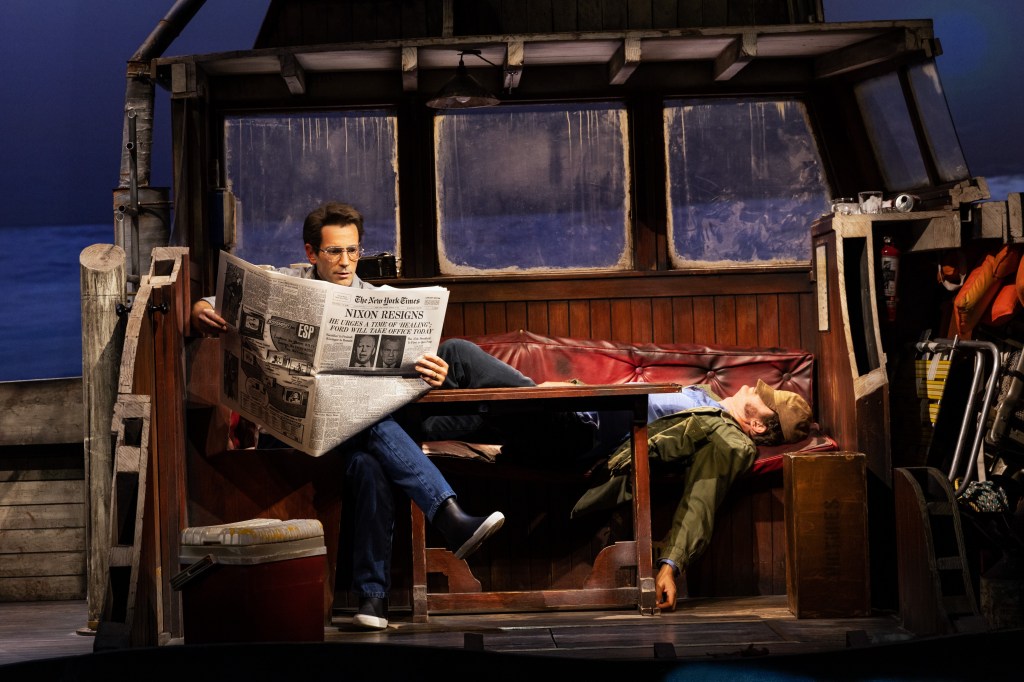
Crucial to the film’s success are the dynamics among the actors which The Shark is Broken highlights with sardonic humor and a legendary sheen. Once the film skyrocketed to blockbuster status, the high-stress problems surrounding the film’s creation could be acknowledged with gallows humor. Such is the stuff that Ian Shaw and Joseph Nixon configure as they reveal intimate portraits of the actors’ personalities, foibles, desperations and bonding, while waiting for their “close-ups” with Bruce. Though the play appears “talky,” the tensions and undercurrents form the substance of what drives the actors. Like a shark that glides with fin above water, what lies inside each of the actors threatens to explode when least expected.
Even seemingly mild-mannered, emotionally tailored Scheider flips out. When his luxurious sun bathing is curtailed and his presence demanded on set, Donnell takes a bat and smashes it on the deck in fury. Donnell has no dialogue but his actions and body speak louder than words and we see how underneath that calm demeanor, Scheider is capable of potential violence which he keeps on a leash and, like a dog, gets it to heel when he wishes.
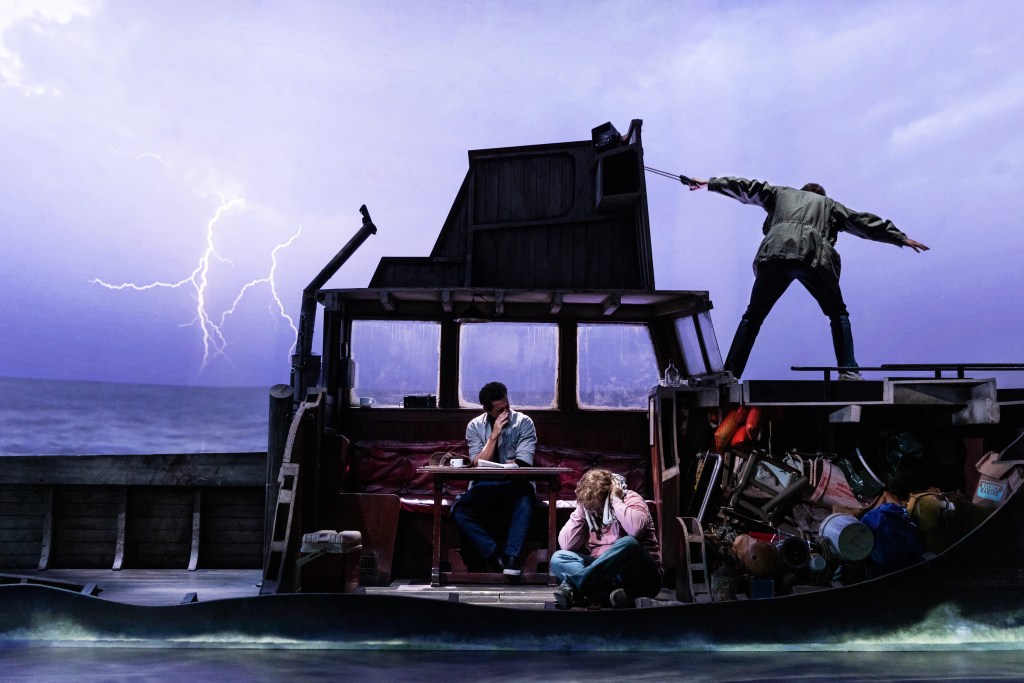
Based on Robert Shaw’s drinking diary, family archives, interviews and other Jaws‘ sources, Shaw and Nixon pen an encomium to the actors’ efforts and relationships forged during their claustrophobic time spent on the Orca, which floated on the open ocean east of Martha’s Vineyard between East Chop and Oak Bluffs. As the actor-characters arrive, we note the resemblances to their counterparts, further emphasized by their outfits, (costumes by Duncan Henderson), speech (dialect coach-Kate Wilson), and mannerisms.
Donnell is the fit, tanned, attractive, temperate Scheider, well cast to portray police chief Brody, head of the shark expedition. Brightman is the pudgy, scruffy, angst-filled Dreyfuss, who sounds and looks like the actor, and is filled with brio and insecurity as Ian’s Shaw batters his ego. As a dead-ringer, Ian portrays his father Robert Shaw, who merges the steely-eyed, gravely voiced, hard-drinking Quint with himself so the boundary between actor and character is seamless. Ian’s Shaw is comfortable in his cap and jacket ready to conquer his prey which includes the poorly written Indianapolis speech, and Richard Dreyfuss.

Thanks to the creative team, Duncan Henderson’s set and costume design, Campbell Young Associates wig design and construction, Jon Clark’s lighting design, Adam Cork’s sound design and original music, and Nina Dunn for Pixellux’s video design, the scenes when the three are on the Orca waiting for the great white to arrive include the manifested cross section of the boat interior, undulating ocean with seagulls flying overhead, wave washing sound effects, sunsets, and a lightening storm during which Ian’s Shaw stands rocking near the boat railing as he challenges the storm. The designated force of Robert Shaw comes through particularly, as he stands arms outstretched, back to the audience, accepting whatever the chaotic, dangerous elements unleash on him.
What do these men do to redeem the time as they wait for one of the three versions of Bruce to be commissioned to work? They do what sailors have done time immemorial: play innumerable card games, read the newspaper, play pub games and verbally and physically attack each other parlaying wit, wisdom, insults and choking. The latter occurs when Brightman’s Dreyfuss calls Shaw’s bluff about giving up drinking. With a quick maneuver, Dreyfuss takes Shaw’s bottle and tosses it over the side, a severe cruelty for a drinking man. Ian’s Shaw leaps into ferocity. It is only Scheider’s peacemaking and his threat that Shaw will be sued for delaying the film further, that remove Shaw’s ham hands from Dreyfuss’ quivering throat.
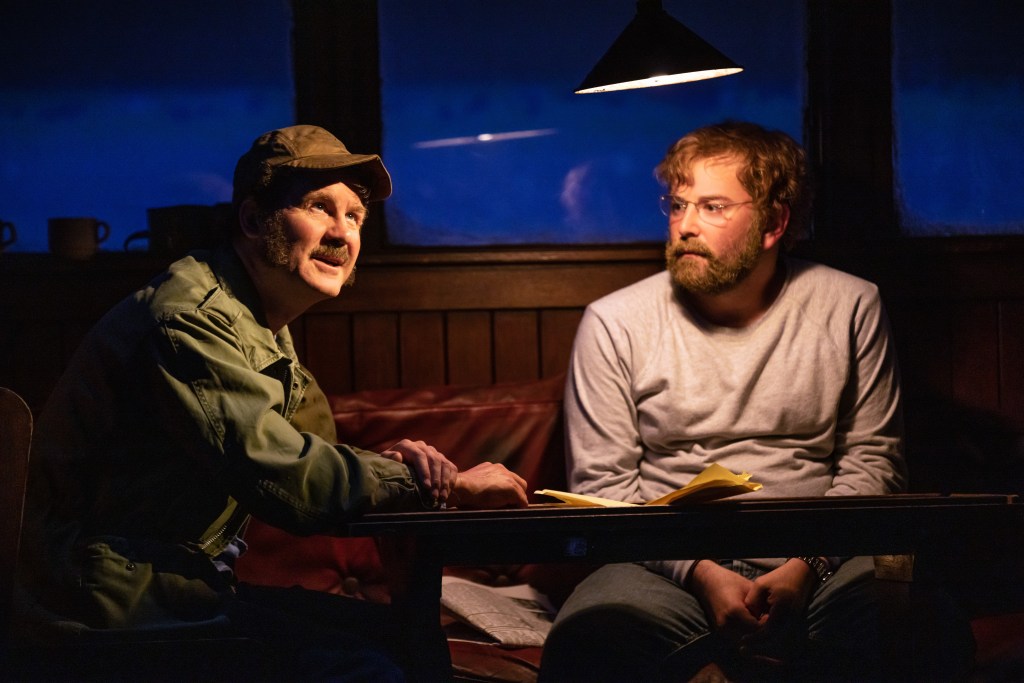
The feud between Dreyfuss and Shaw is exacerbated by inaction and the actors’ boredom between scene takes. This gives rise to the competitive hate/love emotions between the two men, which escalate during the play and are a fount of scathing, sardonic humor. When confronted about it, Shaw insists he is helping to improve Dreyfuss’ performance, and indeed, the tension between the actors behind the scenes travels well to their portrayals on film. The thrust and parrying of epithets and wit, which Scheider attempts to mitigate to no avail, forms the backbone of the dialogue which comes at the expense of Dreyfuss’ savaged ego.
Shaw, a noted writer and giant on the stage, sharpens his wordplay on Dreyfuss’ attempts at rebuttal. It is only after a quiet moment between Scheider and Shaw when Scheider tells Shaw how much Dreyfuss admires him, that Shaw lets up, but only a bit.

Son Ian is not shy about his father’s alcoholism and he plays the role as if he was familiar with how crusty and gritty his father could get when he was “three sheets to the wind.” Though he lost him at a young age and most probably doesn’t remember him all that well, the point is made that alcoholism and loss is generational. Robert Shaw shares that he lost his father to suicide when he was a youngster and always rued that he could never assure his dad that things would be all right. By that point his father had killed himself. Robert Shaw also died young and left his nine children wanting him. Thus, homage is paid by Ian to his grandfather and father who both battled alcoholism and died before their sons could really know them.

At its most revelatory, The Shark is Broken is about fathers and sons and how their father’s abandonment and/or rejection traumatized the actors who struggle to get out from under the sense of loss, rejection and insecurity. Dreyfuss shares that his father left the family and wanted him to be a doctor or lawyer. Scheider reveals his father disdained his acting career, until he eventually accepted it and became proud of his son. It is the few shared moments like these where the men bond and find common ground that are strongest and wonderfully acted. The play might have used more of these moments and fewer attempts at ironic jokes about how Jaws won’t be memorable in film history.

Shaw’s reductio ad absurdum of the future of films as a measure of sequels: sequels will beget sequels of sequels that have sequels rings true, of course. But the statement for humorous purposes is far from prescient.
The Shark is Broken premiered in Brighton, England, went to a 2019 Edinburgh Festival Fringe run then opened on the West End before it arrived on Broadway. The play is humorous and entertaining with some missed opportunities for quiet, soulful moments. Certainly, those who have seen Jaws and its sequels will have fun and enjoy the near replica of the Orca and its inhabitants for a captured moment in film history made alive. The acting is crackerjack and Ian’s interpretation of the Indianapolis speech, which Shaw wrote himself, is at the heart of the film. As Ian delivers it, it is at the heart of the play and symbolically profound.
The Shark is Broken runs without an intermission at the Golden Theatre (252 West 45th Street). For tickets and times, go to their website https://thesharkisbroken.com/
‘Back to the Future’ Roars Onto Broadway, Review
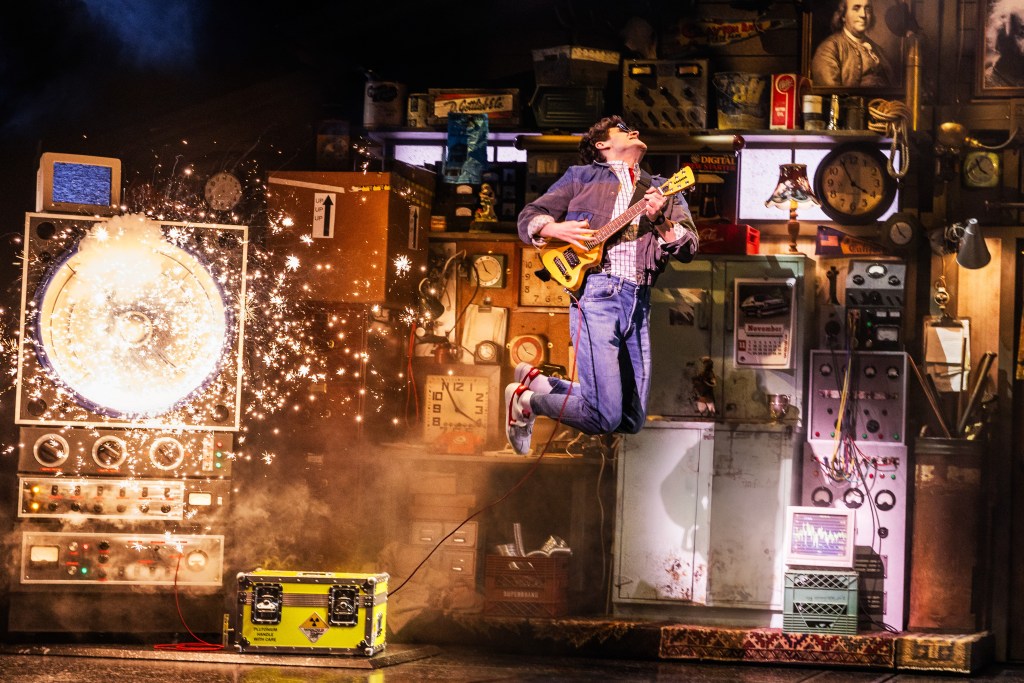
The charm and humor of the musical Back to the Future with book by Bob Gale and music and lyrics by Alan Silvestri and Glen Ballard is that the story flashes into the past minding 1955’s tropes and trends i.e. cigarette smoking is healthy, leaded gas provides a clean environment, DDT gets rid of the mosquitos and bugs with no deleterious effects, asbestos for home insulation keeps you warm. As in the titular film (written by Bob Zemeckis and Bob Gale), the Broadway musical, directed by John Rando, presents a similar plot with the same characters and allows us to reflect upon two decades in history thirty years apart.
Currently at the Winter Garden, kicking up a storm with fantastical asides, fourth wall-breaking irony and other slapstick, the show is a high powered delight.
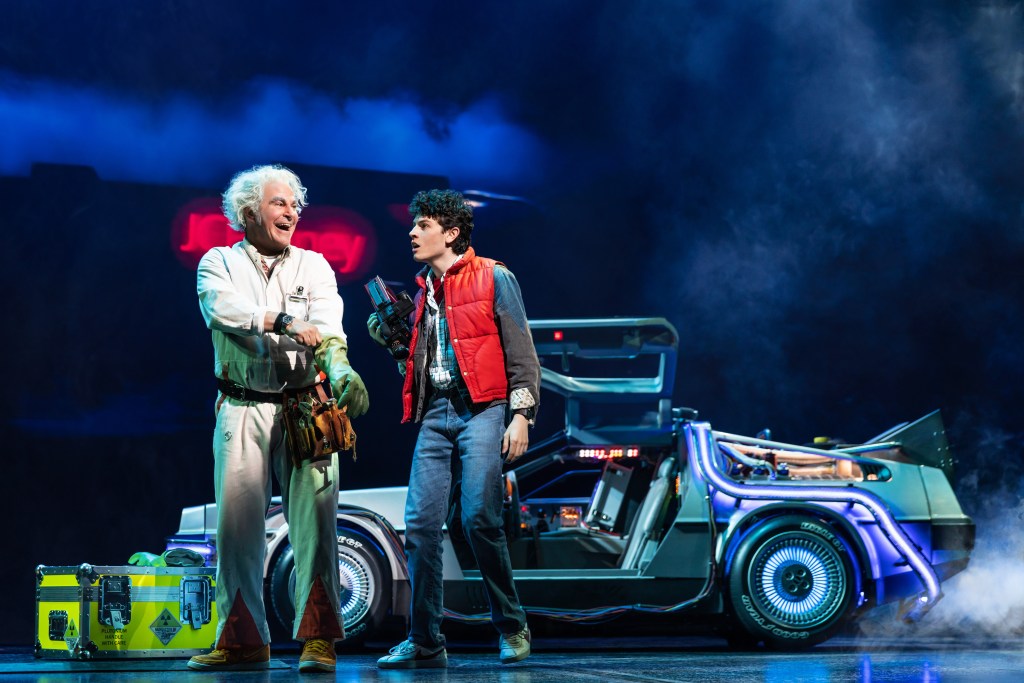
Rando’s production of the book by the film’s co-creator Bob Gale speeds by with thirteen songs in Act I and thirteen songs in Act II, all of them popping with zest and excitement. The velocity never lets up, though one might wish it, but that’s the beauty of such a production whose protagonist races against time so he doesn’t obliterate himself with the physics of time travel that doesn’t quite make sense but certainly adds to the tension, excitement and horror when he nearly doesn’t make it “back to the future.”
The audience remains engrossed with the dynamic, lovable Marty McFly (the superb Casey Likes of Almost Famous), who visits friend Doc Brown’s lab, where he creates mayhem with an over-amped ukulele. Revved up, the scene shifts to right before his audition for a talent contest in the town square (“It’s Only a Matter of Time”). McFly and Goldie Wilson (the vibrant Jelani Remy), who is running for mayor, affirm they are winners, not losers. However, Principal Strickland shuts McFly down quicker than a Broadway audition. In a very public, obnoxious dressing down, Strickland (Merritt David Janes) shreds McFly’s dignity and proclaims him and his family slackers and losers.
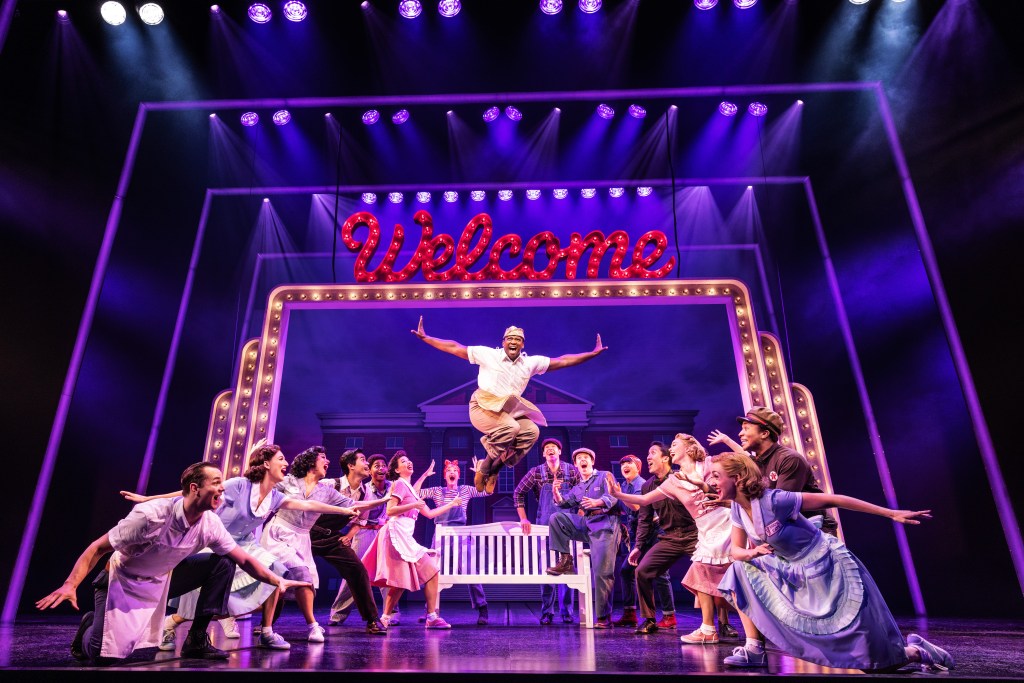
Marty crashes emotionally for a moment, allowing Strickland to define him. He realizes that he will be like his slacker parents and sings the pop-rock “Got No Future,” thus establishing the conflict McFly must overcome. How will he be able to reshape his loser self and prove he is someone to reckon with?
It’s quite elementary and accidental. In a physics sleight of hand, he jumps into Doc’s DeLorian’s time machine and goes back to 1955 to save Doc (Roger Bart originated the role), from radiation poisoning. There, he becomes the rocker success he knows himself to be. However, before his time travel, Marty receives the courage to forge on despite Strickland’s pronouncements by hanging with his girlfriend, Jennifer (Mikaela Secada in her Broadway debut). They sing “Wherever We’re Going,” and once more he is uplifted to his dreams with her love and support.

But McFly is brought low again when we follow him home to see his loser family: George (Hugh Coles originated the role), Lorraine (Llana Hunt-Newsies), Linda (Amber Ardolino), Dave (Daryl Tofa). If they are an example of his genetic inclination to loserdom, he definitely has no future. Indeed, if he goes to 1955, most probably since he is always late, he won’t make it back in time and he will be in a space time continuum paradox. He he will be wiped from the map of existence. This is the key set up, spurring the momentum forward at two times faster than the speed of light.
Introducing each of his family members, the song (“Hello-Is Anybody Home?”) features snippets of how his father, mother and siblings can’t get arrested on Broadway. Rando’s direction allows each actor to go “over the top,” especially Dad George McFly, whose antics are enforced for laughs and sometimes don’t appear to rise organically.

However, Back to the Future The Musical is Sci-Fi fantasy. If George’s movements are angular and extreme schtick and he’s pushing for laughs, he’ll get them. The men especially will identify with his personality weaknesses that make him quake in his boots when he tries to avoid confronting the wicked bully of the show, Biff Tannen (Nathaniel Hackmann). Of course, Marty’s attempts to counsel his Dad in 1955 (before Marty was born), are ironic and the theme resonates that “a little child shall lead them.” Oftentimes, kids are sharper than their parents and adults, who should listen to their kids’ wisdom but who often, like Strickland, shut them down.
The only adult who doesn’t shut down Marty is Bart’s Doc Brown. When Marty meets Doc in a field where the DeLorean lands with an explosive, gyrating flourish, it is obvious the two have a powerful bond. Through a series of mishaps Marty ends up traveling to 1955 where Doc has set the machine and we watch as some incredible projections show Marty’s time/space travel imaginatively, going twice the speed of light.

Back in 1955 complications arise. Marty becomes tangled in a love triangle with his mother that includes some of the biggest laughs of the show. With the exception of some minor changes the musical keeps the humorous conceit of time travel with all of its paradoxes which are never explained. Neil DeGrasse Tyson, the astrophysicist, would enjoy the show because it is sheer entertainment. However, it defies explanation and logic. That is the point.
One must not think too much about how in the twinkling of an eye George moves from bumbling idiot to savvy book author, his body ticks straightened out. And how do his mother and sister lose weight and become gorgeous in a week’s time? Inquiring celebrities want to know if it’s Ozempic®. Oh, wait, that’s an anachronism. It’s clear that Marty does something in the past to shift the present from his former perception. However, the songs crash into each other, with such verve, that one cannot breathe for the intricacies of the story. It’s typical Sci-Fi prestidigitation. Whatever happens happens, and we are enjoying the ride.

The scenes shift to different sets. The songs have flashy backing dancers with color coordinated costumes. The assumption is that audience members are familiar with the film which is both a plus and minus. On the one hand, the jokes relate from the film and the audience notes them with pleasure. On the other hand the pace is frenetic. A quiet moment is necessary for the audience to take a breath. Perhaps, the DeLorean scenes would pop even more. They are such fun.
The DeLorean is the highpoint of the show, thanks to Chris Fisher’s illusions which are absolutely gobsmacking. Of course, he has an assist from Gareth Owen’s sound design, Tim Lutkin & Hugh Vanstone’s lighting design and Finn Ross’ video design. The DeLorean moving from present to past and back is a memorable feat.
Also, the clock tower scene set in the lighting storm is equally thrilling. Will Marty make it back in time, moving forward? The jokes and memes on time are exhausted by the conclusion of the show.

Importantly, audiences are going because they want to see how the production effects the time traveling DeLorean and they enjoy hearing tunes from the past whose hits always strike a congenial nerve (“Earth Angel,” “The Power of Love,” “Johnny B. Goode”). One new song which Doc sings resonates well with the themes and is reprised a few times in Act II, “For the Dreamers.” Doc is thrilled that for the first time, something that he has created “works.” The theme suggests that one must persist, keep on dreaming, and never give up. This is sage advice in any era, any decade, any age.

Act II deepens the relationships we’ve seen laid out in Act I. “Put Your Mind to It” which Marty and George sing together unites them with a similar purpose. Marty is encouraging his father to stand up for himself, be confident and “go for” Lorraine. The actors work the song but more organically.
Casey Likes is always spot on authentic as is Roger Bart. In their loser iterations George, Lorraine, David and Linda play for the stereotype. In this type of production it works. The laughs might have been greater if they were no so intentionally “loserish. However, they shine after their son returns with the “goods.”
Kudos to Tim Hatley (designer), Chris Bailey (choreographer), Campbell Young Associates (wigs, hair and make-up), Nick Finlow (musical supervisor, vocal and music arrangements), Ted Arthur (music director), Ethan Popp and Bryan Crook (orchestrations) David Chase (dance arrangements).
This is one to see especially if you are a fan of the films and enjoy seeing live theater with amazing stagecraft and technical designs that are phenomenal.
For tickets and times go to their website https://www.backtothefuturemusical.com/new-york/
‘Here Lies Love,’ The Stunning Bio-Pop-Musical Sounds Alarms About the Price of Democracy

The Millennium Club is the phenomenal, multi-level, theatrical setting of the bio-pop musical Here Lies Love. The resulting panorama is a monolith of disco and pop music, many-hued neon lights, black and white historical film clips, multiple dazzling screen projections, and spot-on performers’ heightened song and dance moves “here, there, everywhere” in living color. With 12 musicians (guitar, percussion, bass, etc.) some of the musical backing is prerecorded like karaoke, a cultural staple in Filipino lives. All this is the backdrop to David Byrne and Fatboy Slim’s spectacular immersive, sensorial, orgiac experience currently at the Broadway Theatre.
At the unfolding of the alluring dance party, the political and social history of 20th century democracy in the Philippines coalesce under a gleaming, disco ball. On the dance floor the pink, jump suited ushers shepherd and move the audience around a platform in the shape of a cross (a coincidental reference to the predominately Catholic country) that in a different configuration later becomes the bier upon which the coffin of the assassinated Ninoy Aquino moves leading the audience in the funeral procession.

On the second level, the jazzy, sun glass-wearing, cool, black-leather outfitted DJ (Moses Villarama) amps up the crowd, encouraging their investment in the show’s diversions. Throughout, the audience members in the balconies on three sides and on the first level dance floor, cheer, mourn, laugh and applaud. Their interactive roles as the captivated conspirator/citizens allow them to witness and participate in the iconic rise and fall of Ferdinand (Jose LLana) and Imelda (Arielle Jacobs) Marcos, celebrity leaders turned dictators.
With American encouragement and influence steeped in an autocratic colonial past, the Marcoses’ initially inspired governance devolved into a brutal, self-serving regime. Peacefully overthrown by the People’s Revolution (1986), after years of repressive, murderous authoritarianism, the Marcoses’ story masterfully stenciled by Byrne, Slim, Clint Ramos’ research and Alex Timber’s enlightened direction, is an important work for us in our time of QAnon, Donald Trump, the Federalist Society’s purchase of Supreme Court Justices, the Dobbs’ Decision and foreign donor’s dark money purchasing politicians, who, to feather their own agendas and dilute and destroy global democracies and the right of the people to self-governance.

The narrative of Here Lies Love is an encomium in song and dance. In its Broadway premiere ten years after its off-Broadway premiere at the Public (2013), the musical features Filipino producers and is brilliantly performed by an all-Filipino cast. With passion they portray the narcissistic Marcoses and their acolytes, who conspired to gradually hoodwink citizens to dance to the Marcoses’ siren songs.
Importantly, the production highlights the heroes. It is their vision for the Filipino people, and their hopes for a democratic country, that inspired them to risk their lives for the Filipinos’ right to “a place in the sun.” These courageous exposed and railed against the Marcoses’ excessive squandering of millions of dollars in a luxurious lifestyle, while a majority of deprived citizens had insufficient access to life-sustaining food, shelter, clean water and the freedom from military terror. This is the story of their love, and the sacrifice of their lives in the revelation of how easily leaders may fall prey to their own crass weaknesses and destroy a nation they disingenuously proclaim to love.

Key among the heroes is the liberal leader of the opposition party, Ninoy Aquino (Conrad Ricamora in an inspired and dynamic portrayal), and those aligned with Aquino like his mother Aurora Aquino (the wonderful Lea Salonga). Aquino’s persistent example, assassination by the Marcoses who were never held accountable, and subsequent martyrdom paved the way for the People’s Revolution.
Though the Marcoses are key players in the musical, Byrne and Slim make sure through quotes and commentary from interviews and news reports that praise does not go to the despots, one of whom is still attempting to exert power today through her son and president of the country. Here Lies Love is an object lesson in vanity, dereliction of duty, self-deception and treachery which Fatboy Slim and Byrne spin with irony in their lyrics in the title song, “Here Lies Love,” and in Imelda’s concluding song, “Why Don’t You Love Me?” written by Byrne and Tom Gandey.

Though the title of this production belies Imelda Marcos’ “love” for her country (she affirms her epitaph should read “here lies love”) Byrne, Fatboy Slim and director Alex Timbers underscore the hypocrisy of her love revealed in the musical’s arc of development. Her hypocrisy and velvet insidiousness are especially demonstrated in the 3,200 Filipinos killed, 30,000 tortured and disappeared and 70,000 imprisoned (the numbers are higher most probably).
These statistics are listed in the surrounding projections in black and white. The musical uplifts the Filipino people’s resilience, courage and love of their countrymen and women. The citizens are a shining example for democracies around the world and for whom the musical’s title really applies. Indeed, the Filipinos’ love is demonstrated in the People’s Revolution at the conclusion, and culminates memorably in the final poignant song.

The production is majestic and profound. Its themes counsel that citizens of democracies must be sentinels against those like the Marcoses, who would exploit democratic elections, usurp power, declare martial law, and order the military to protect the powers of the executive, while disbanding all the other branches of government. By silencing their critics and killing opponents, dictators like the Marcoses rebrand terrorism as law enforcement in order to steal from the treasury and maintain their hold on power. This follows after smearing the opposition, jailing perceived enemies without due process, nullifying democratic laws and wiping out a free and fair press, who cannot call out their crimes.
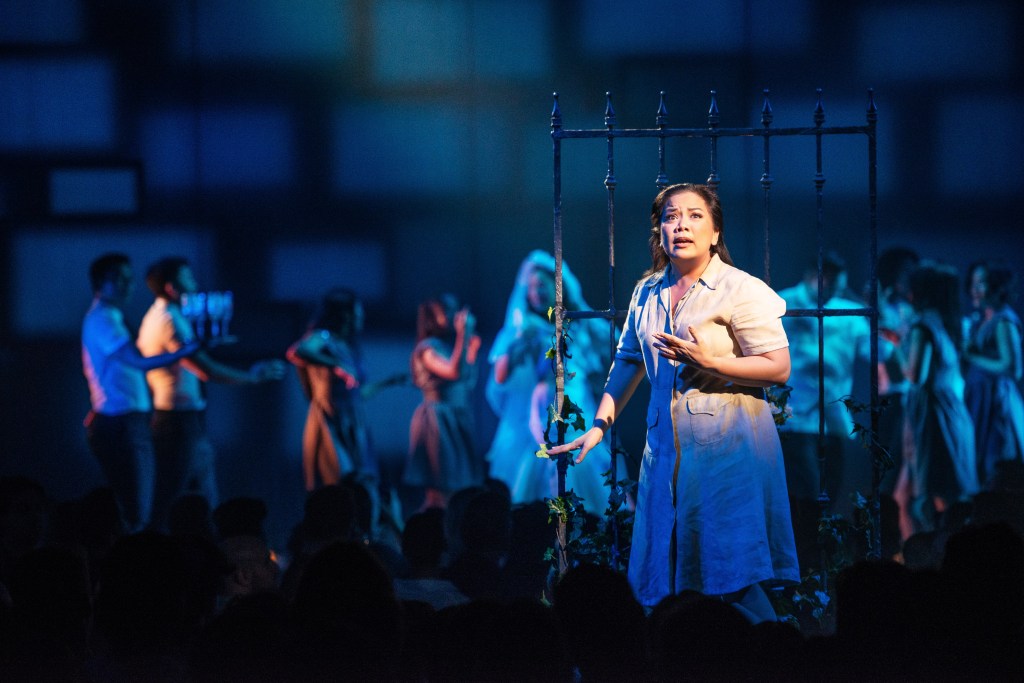
All of these egregious actions Ferdinand and Imelda Marcos did while the United States turned its head and looked away.

Thus, as the audience dances and follows the guidance of the ushers and DJ, they are initially blinded and mesmerized by the fantastic surreality of beauty, fun and energy. And as Imelda the beauty queen ends her relationship to Nimoy Aquino and takes up with Ferdinand on a publicized 11 day whirlwind romance that ends in a white wedding, we watch as she morphs from the naive country girl to the savvy doyen of American fashion and celebrity. The “steel butterfly” (a nickname given to her by the press), has become a clever political animal, who is a help meet to ruthless Ferdinand right before our eyes.

The 90 minute dance party summarizes the Filipino seduction and decades of growing repression in key events. After their marriage, Imelda is overwhelmed by being in the limelight and has a nervous breakdown, requiring therapy and becoming addicted to drugs. Jacobs portrays the changes in Imelda convincingly. When she sings “Walk Like a Woman,” we realize that the once innocent girl has become a seductively calculating political creature as she tirelessly campaigns with her husband and helps him win the presidency. She becomes knowledgeable about culture and obsessed with the construction of buildings (The Philippine Cultural Center), which draw attention to herself as a celebrity but do nothing for Filipino citizens.

The projections and black and white film clips from archives are salient in revealing the glittering Marcoses rise. Byrne’s lyrics are from interview quotes and reports covering the Marcoses and Aquino. Photographs show Imelda with everyone from Andy Warhol to various leaders like Ford and later Reagan,, who propped up the Marcoses and gave them sanctuary in Hawaii after they fled during the People’s Revolution. Ricamora’s Aquino gives rousing speeches about Imelda’s egregious use of funds for a cultural center (“The Fabulous One/I’m a Rise Up”) which sets the audience/citizens on edge and alerts them to financial corruption in the Marcos’ regime every time Aquino calls them out. Byrne creates lyrics that borrow heavily from his speeches.

The turning point comes after Marcos’ scandal with American actress Dovie Beams, whose impact on Imelda is ironically highlighted in a dance number with multiple “Dovie Beams” in black bikinis and blonde wigs. The original tape recording between Beams and Marcos is played during this point in the production accompanied by music and lights reinforcing the spectacle. Imelda considers that “Men Will Do Anything” (Jasmine Forsberg is Imelda’s powerful inner voice).
Losing trust in Ferdinand, she conveniently latches onto self-deception and sings of her dream that she is the people’s star and slave (“Your Star & Slave”). As she disingenuously commits herself to her country, Ferdinand, licking his wounds in embarrassment, retires to the hospital with Lupus and attempts to win Imelda back. Jacobs and Llana’s duet “Poor Me,” is a beautiful example of a couple lying to each other, complicit in keeping their hold on power.

The beating of students protesting the Marcoses’ corruptions, Estrella’s (the heartfelt Melody Butiu) revelations of Imelda’s lies about her heritage (“Solano Avenue”) and Estrella’s subsequent arrest and punishment for going to the press, puts the Marcoses’ maladministration on everyone’s radar. Aquino speaks for the masses in his criticism of Imelda, which she and Ferdinand not only ignore, but feel victimized by. The easy way dictators shift blame and beat their breasts about being persecuted is highlighted by Byrne’s song and incredibly acted by Llana and Jacobs. One almost believes they are victims and the unjust criticism is weaponized by Aquino, protesting students and opponents.
After bombs go off in Miranda Plaza wiping out almost all the liberal party, Marcos blames it on the liberals (1984 fascist logic-why would they intentionally kill themselves) and declares martial law in Order 1081. Byrne and Fatboy Slim have outdone themselves in the lyrics and forceful, pounding music that codifies the new dictatorship and power grab by the Marcoses. During the performance of “Order 1081,” the statistics enumerate the casualties of the Marcoses’ punishments for for protests. Ninoy Aquino is jailed for 7 years. There are no trials, just guilt and oppression. The staging and performances are shocking and disturbing.

We ask, what? Are the glorious Marcoses murderers? Indeed. And they act privileged and justified in brooking all “nefarious” opposition.

After seven years when the jailed Aquino needs a heart operation, the Marcoses send him and his family to America on the stipulation that he never return. Aquino doesn’t keep his promise to the criminal dictators. Instead, he sacrifices his life, an assassinated martyr, which is another shocking blow in the musical slammed into the audience’s psyche with all the force of lights, sound effects and music that explode when the audience least expects it. And in the aftermath with Salonga’s song as Aquino’s mother, the crowds at his funeral effected by the ushers and the coffin on the platform are staged with impeccable emotional poignance.
Timbers reveals how the Peaceful Revolution happens in the staging and the surrounding projections. We understand that the crowds demand Marcos’ resignation after a rigged election in which he proclaimed himself the winner. The people’s massive protests demand the Marcoses resign. Ronald Reagan gives his friends sanctuary in Hawaii, announced via projections of New York Times’ headlines. It’s an appalling closure to the Reagan administration’s supporting dictators and murderers who deny culpability.
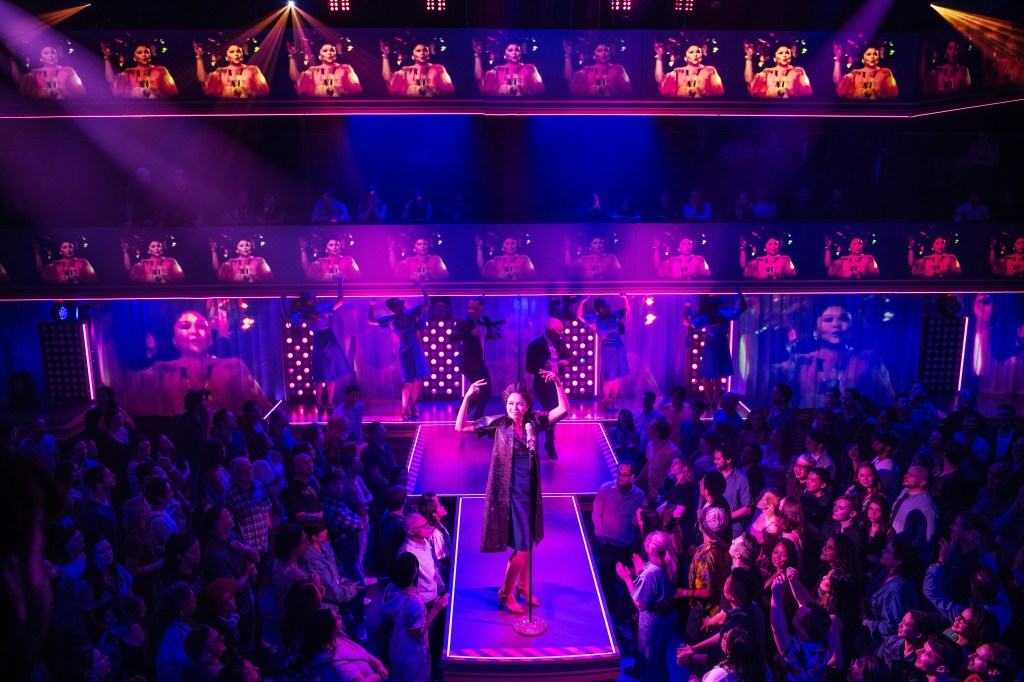
Ironically, in the musical it’s a blip that passes speedily which Byrne intentions because he is sardonically indicting the Americans for supporting dictators as a horror of colonialism’s aftereffects. Also, it is incredibly current and an expose of the Republican MO to protect their own. They conveniently pardoned Nixon’s criminality during Watergate and refuse to censure or disqualify Donald Trump as a presidential candidate indicted for his crimes against the country.
The last song “God Draw’s Straight” (But With Crooked Lines) is a testament that democracy depends upon the power of the citizens worthy to govern themselves. The song is magnificent, encouraging and a reminder that citizens must actively resist the lies, excesses and dereliction of corrupt, dangerous leaders, by continually calling them down in peaceful protests.
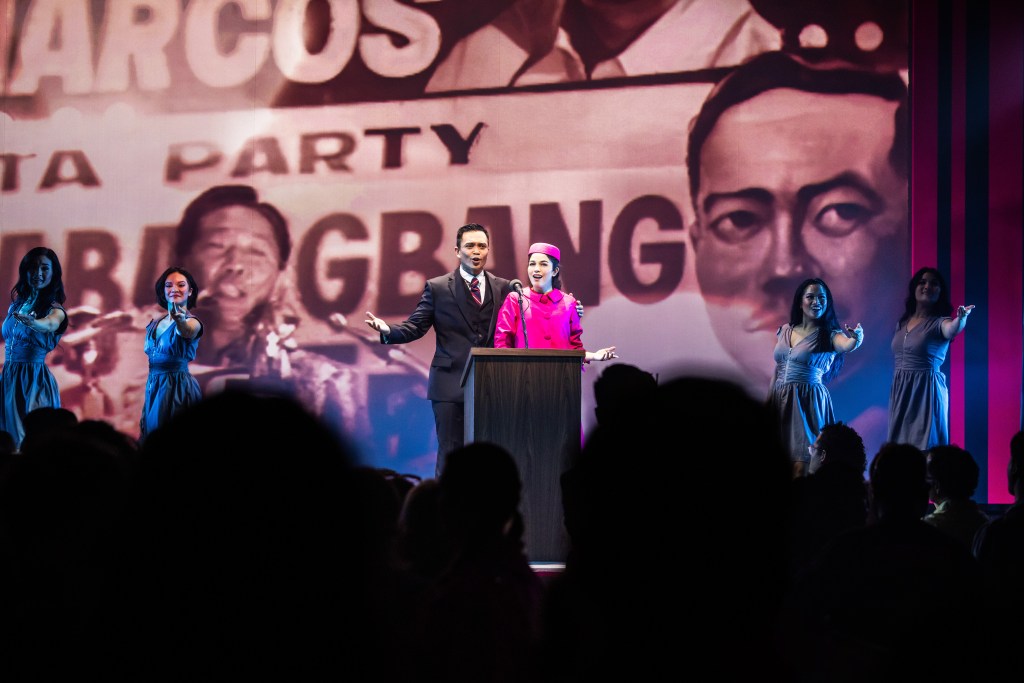
From the top of the dance party whose song “American Troglodyte” incriminates the Marcoses’ chief influencer, the crass, monopolistic, corporate consumerism of America, to “God Draw’s Straight” (But With Crooked Lines), this gobsmacking production chronicles how the Marcoses, emblematic of how dictator-murderers, subvert democracies and rise themselves up through lies, misinformation, disinformation, propaganda, self-victimization and the vitiation of constitutional government in exchange for military oppression and terrorism. Of course, the dictators justify their crimes with the “poor me” ploy, the refusal to admit responsibility and martial law directed to empower and protect them.
Every American citizen should see this incredible work of art whose creative team worked overtime to meld all the technologies and elements to effect Timbers,’ Byrne, and Slim’s (with additional music by Tom Gandey & Jose Luis Pardo) vision. The performers are incredible, invested, determined to express this vital story that must be told.
Special recognition goes to Annie-B Parson’s choreography, Clint Ramos versatile and quick change costume design (referencing the times according to news articles and video clips), Justin Townsend’s lighting design, M.L. Dogg & Cody Spencer’s well-balanced sound design (not any easy feat with such a venue), Peter Nigrini’s wonderful projection design, Craig Franklin Miller’s spot-on hair design and Suki Tsujimoto’s make-up design. Additional kudos goes to J. Oconer Navarro (music director), Kimberly Grigsby and Justin Levine (vocal arrangement), Matt Stine and Justin Levine (music production & additional arrangements).
I’ve said enough. For tickets and times go to their website https://www.telecharge.com/Broadway/Here-Lies-Love/Ticket
Photos by Billy Bustamante, Matthew Murphy and Evan Zimmerman (2023)
‘Grey House,’ a Subtle Send-up of Horror Films, That Delivers With Humor and Surprise, Starring the Fabulous Laurie Metcalf
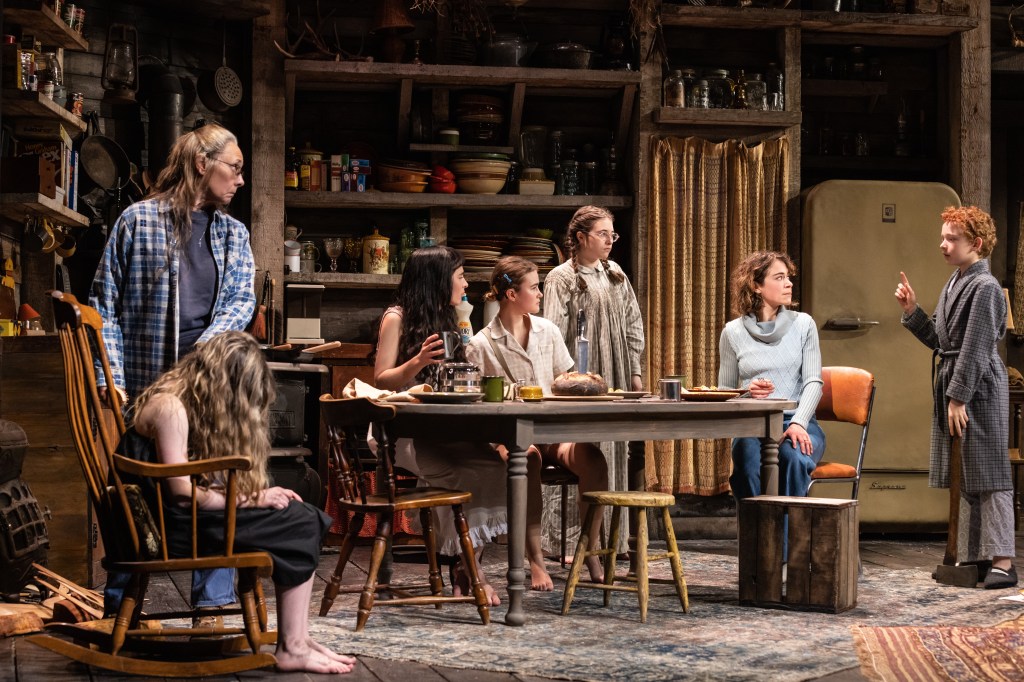
Top shelf performances and eerie effects in lighting, sound, and on-point set design carry Levi Holloway’s horror-thriller Grey House through to its unreasoned, macabre and opaque ending, leaving the audience disturbed and unsettled in an unusual, visceral entertainment. The production, currently running at the Lyceum Theatre until September 3rd, is insightfully directed by Joe Mantello for maximum preternatural weirdness and warped grotesqueness that is also a send-up of the genre.
With sardonic humor and glimpses of the supernatural which evanesce in the twinkling of an eye, the playwright Levi Holloway shrouds the action along a path of darkness, confusion and sometime shock, until the widening road dead ends in a climax and (spoiler-alert) Max’s partner Henry vanishes, replaced by a new guest as Raleigh (Laurie Metcalf), bags packed, leaves.
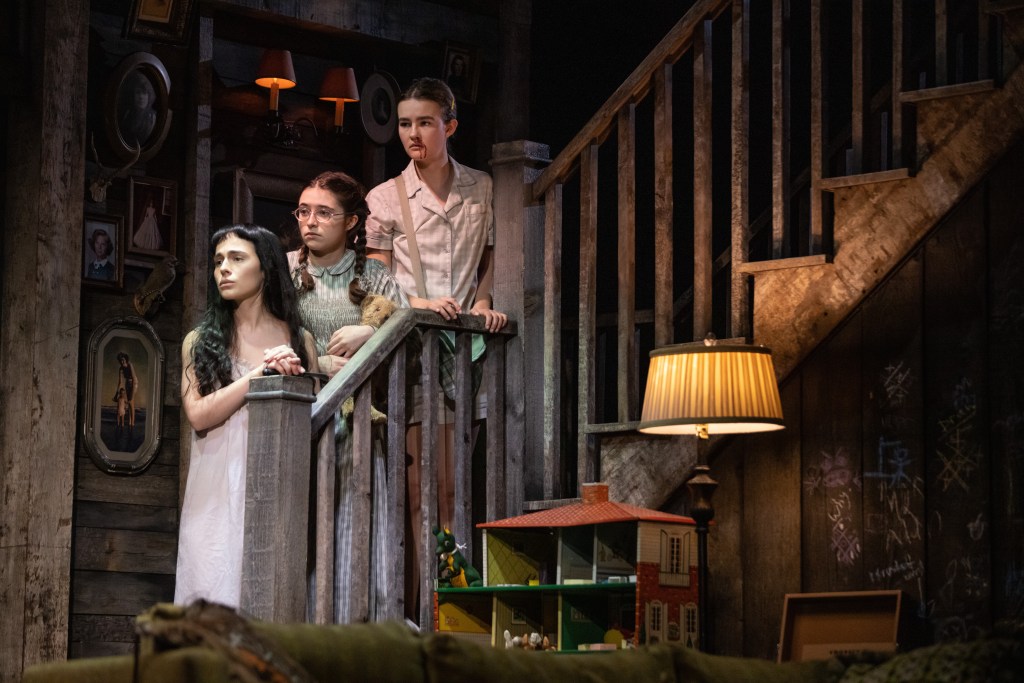
Spoiler alert! Stop reading if you want to be surprised by the play. Read the rest if you are looking for clues to guide you down the dark road of Grey House.
Where and how Henry de-materializes doesn’t matter. We have witnessed his sadistic torture by a child tormentor and watched astounded at his masochistic enjoyment of pain. When he contributes his substance to create a palliative “alcoholic” drink that anesthetizes, most probably for a future unrepentant male, our fog of understanding clears a bit. Henry receives well-deserved punishment for his unspeakable past acts, that, until he entered Grey House, have gone unanswered. Is the function of this house and these female inhabitants to deliver justice? If so, married couple Max (Tatiana Maslany) and Henry (Paul Sparks) who seek help at Grey House after a car accident are “innocents” walking into a trap.
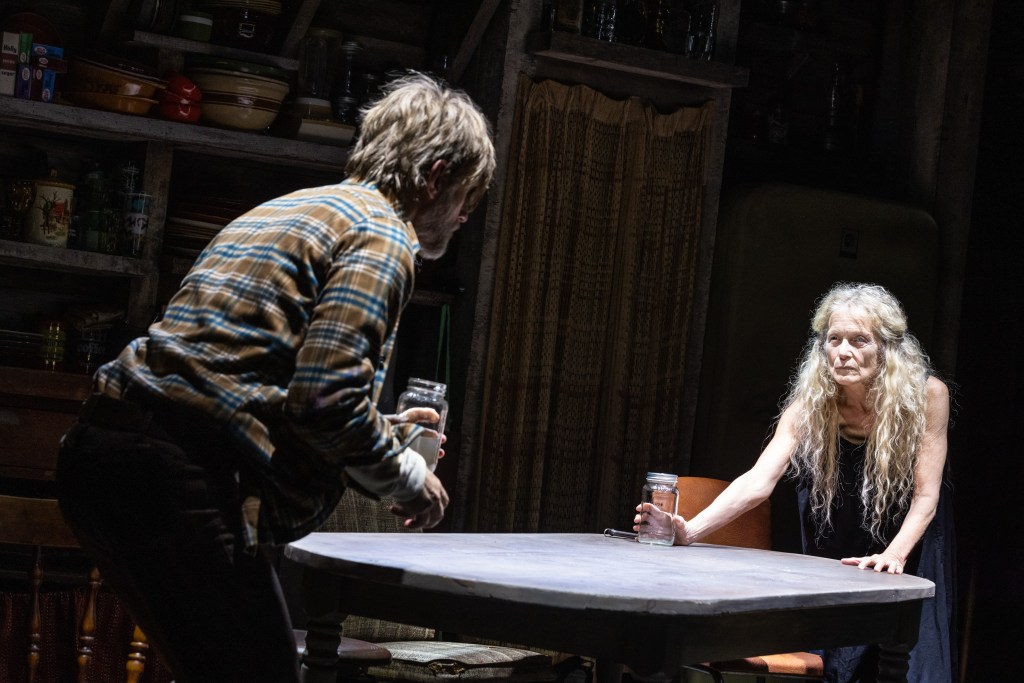
The creaking, groaning, hellish, two-story, ramshackle abode in the mountains, referred to as “Grey House,” initially appears to Max and Henry as a welcome, cozy shelter from the blizzard and their injuries. However, we know better and not just because of the advertising campaign for the show.
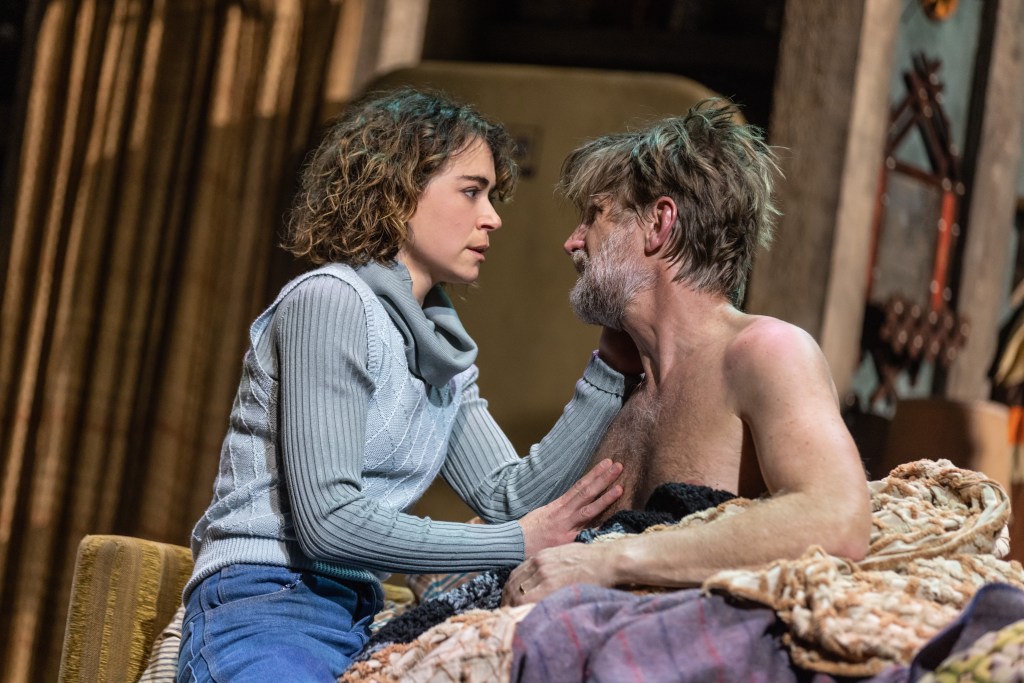
Previously, we have been introduced to the strange, uncanny children of the mountain cabin and their mother/caretaker Raleigh (the sensational Laurie Metcalf). Two of the “sisters” initially raise the spirits in a representative song of the region, singing a cappella. They produce an effect which is haunting and spooky. At turning points throughout the production, a total of four songs are sung: two authored by Mountain Man and the others by Bobby Gentry and Sylvan Esso. Each song is more compelling and meaningful in relation to the action, thanks to Or Matias (music supervisor and a cappella arranger).
Henry’s ironic comment that he’s seen this movie before and they “won’t make it,” lands with humor, horror and truth. We know something he doesn’t. He and Max must stay away from the two unnatural malevolents, a Wednesday Addams meme, Marlow, and her frightful companion in wickedness, the vicious, hell-bound Squirrel. In the initial moments of dialogue and action, they are daunting.
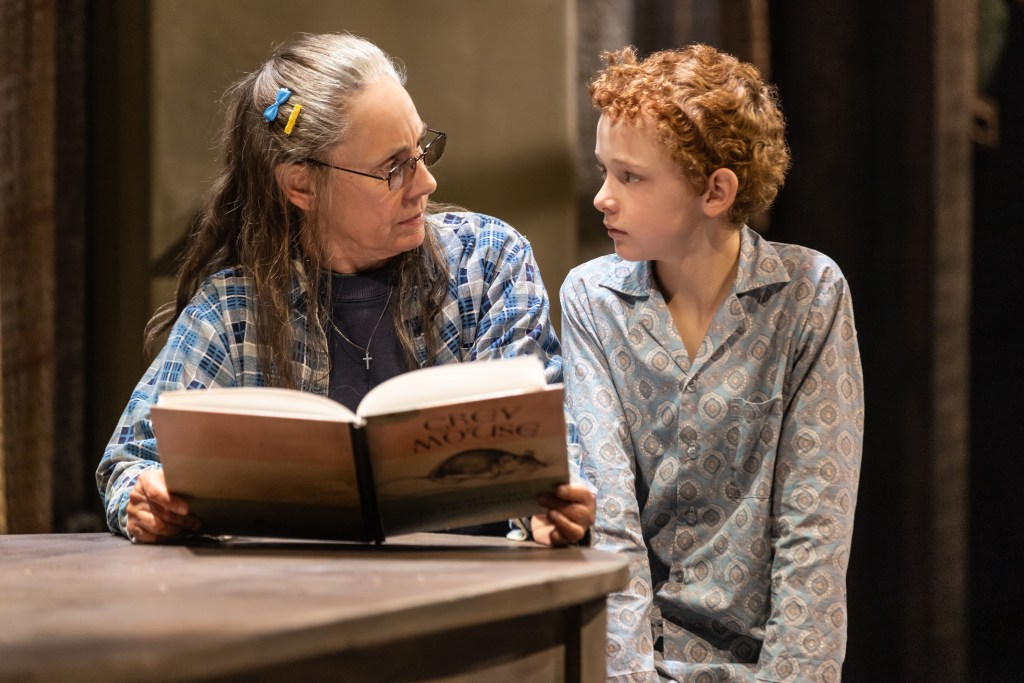
Throughout the action, both could double cast as witches in their sarcasm, sinister intentions and sub rosa text delivered in a straight-forward manner, as they allow the “words to convey the meanings.” The import of their statements are clues to what is really going on, however, the substance is easily missed because the audience is Holloway’s prey and is misdirected as she steers them down the road, and blinds them with her dark shadows of uncertainty.
Nothing is directly expressed. Of course, Henry and Max have the bulk of their interactions with these vixens, who rule the roost and who, Raleigh, their ersatz mom, calls “willful creatures,” an understatement.

As the Wednesday Adams meme who is a self-satisfied, self-admitted, proud “bitch” in the MAGA vein of “owning the libs,” Sophia Anne Caruso is terrific at suggesting the horror underneath the action. She enjoys making her guests, especially Max, feel creeped out.
Squirrel, whose damaging persona is represented by her name and her having chewed the phone chord so no calls come in or go out, is the youngest. Portrayed with insinuation and sadism in a nuanced performance of softness and brutality, Colby Kipnes is superb. She is the youthful doppleganger of The Ancient (Cyndi Coyne) and is the instrument of revenge holding “everyman” predator Hank to account in a twisted time reversal. For unspeakable acts he committed decades before, the young Squirrel and the others collaborate in effecting physical retribution which the anesthetized Henry willingly accepts as his due.

“Grey House” exists beyond time and place, the repository of the wounded in life who exist when we meet them as otherworldly beings or some other undetermined construct of humanity, which the playwright ironically leaves in the realm of uncertainty. When we meet this particular brood, Raleigh suggests others will come and go, as she in fact leaves at the conclusion with a packed suitcase, letting Max who may be a younger version of herself replace her as the caretaker.
The bottles of “moonshine” the ersatz family of women, including A1656 (the fine Alyssa Emily Marvin), and hearing-impaired Bernie (Millicent Simmonds passionately completes the witches’ coven) extract from male predators is kept refrigerated for the next visitor destined to arrive at Grey House. Like Henry he will be punished to sustain its prosperity and existence as a “living thing.”

Laurie Metcalf’s Raleigh is continually surprising in a spot-on, gorgeous performance as the hapless “mom,” who she portrays with power, insight and presence. Of all of the actors, Metcalf is the most surreal yet authentic and empathetic, as we feel for what she goes through at Grey House, though we don’t succinctly understand what we see happening before our eyes. When she is on stage, she is imminently watchable. Her lead, as subtle as it is, guides Caruso’s Marlow and Kipnes’ Squirrel to their understated ferocity which spills out in their insightment to get Henry to masochistically “fall on his own sword,” as they act out their vengeance.
Sparks’ Henry is so likable and loving in his relationship with Maslany’s Max who is the perfect wife, that we are shocked that both are not who they appear to be, Henry less so than Max. Maslany shows a sense of humor with the girls, then turns, flexing her emotional range when she expresses the appropriate terror knowing their luck has changed and she confronts evil. Sparks’ demeanor during the ordeals he is put through is nuanced. His confession is forthright and shocking in its understated delivery.
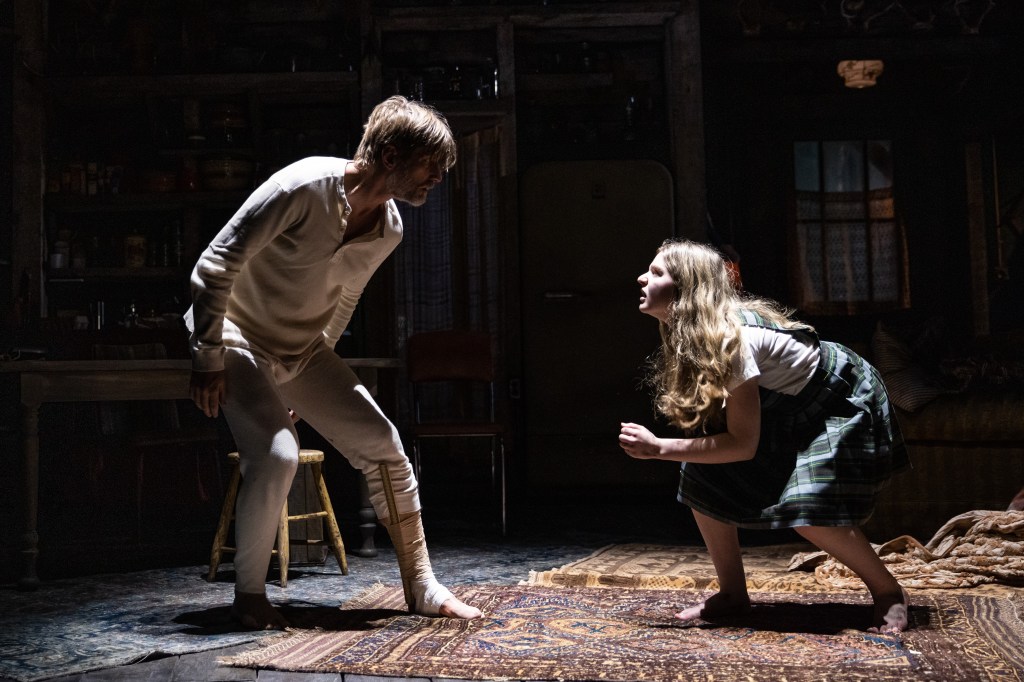
The silent characters, The Boy (Eamon Patrick O’Connell), and The Ancient (Cyndi Coyne), are vital in their gestures and presence. They add to the dynamic of “the family,” and Coyne’s Ancient is the wounded mirror image of Colby Kipnes’ Squirrel as a youth.
The production is amazing in its confabulation of mystery and opaque unreality delivered by the creative team. These include Scott Pask’s wonderful set design, Rudy Mance’s subtle costume design, Natasha Katz’s stark, atmospheric lighting design, Tom Gibbons’ house humanizing sound design, Katie Gell & Robert Pickens’ wig and hair design, Christina Grant’s makeup design. All of the actors are invested, as is Mantello in relating the otherworldly and arcane side by side with the profane, teasing out humanity in its wild derivations.
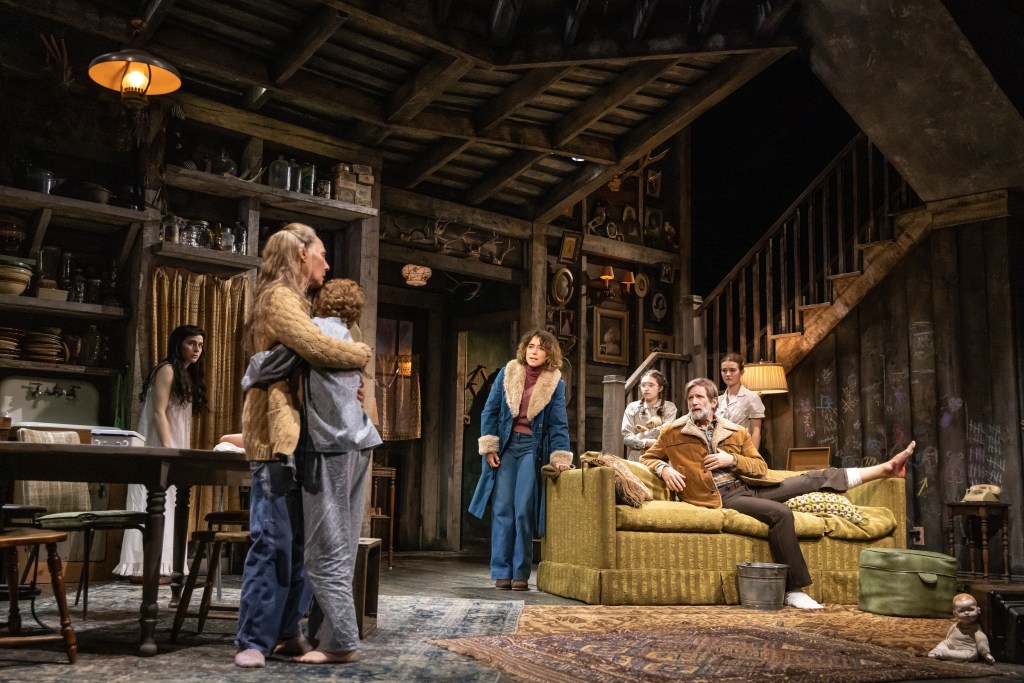
In life we see “through a glass darkly.” We receive glimpses beyond what we assume to be “reality” but know there is more that is present. What our senses apprehend, continually deceives us, though we like to believe “we know” and we are in control.
Holloway reminds us of the contradictions, the ironies, the shades of life that have no clear explanation. Indeed, the hints she drops about how the “family” of “willful creatures” operates in this spooky place are never solidified. All is intimation. The “moonshine” as Raleigh refers to it, “sold during the summer,” Marlow names “The Nectar of Dead Men,” which seems a more accurate handle by the conclusion. The duality of symbols existing on a spiritual, preternatural level are contrasted with the profane, material realm, for example when Max makes eggs (they are real-made offstage), for the “hungry, always hungry” sisters-daughters-creatures.
Thus, all is not what it seems. Holloway drives this theme home using the horror-thriller genre conveyance as a grand joke to prod us toward fear and laughter. She sends up that genre and twits us about our nightmares displayed in horror films, mirroring those found in our unconscious in dreams.

The development of the story and its characters, who are timeless archetypes reflected in literature (the good, the evil, the furies who gain vengeance), drive this work beyond genre. Thus, in an attempt to nail down Grey House and dismiss it, one may lose the deeper levels of Holloway’s symbols and complex, convoluted themes. One fascinating example is the red tapestry woven of the sinews of the historical predators, who have come to visit the cabin and whose “Nectar of Dead Men” is distilled for future use. The labels on the jars in the refrigerator tell the tale. The men’s remains we learn are in the walls, the grounds or in the basement which Squirrel frequents.
In Grey House Holloway’s vision expressed by Mantello and his creative team and enacted by the wonderful ensemble is a tonal hybrid of humor, a teasing send up of horror-thrillers, yet terrifying in its deeper representation of the patriarchy which doesn’t come off looking well in its tapestry of innards and crimes committed with impunity finally answered with rough justice, by “willful creatures.” The play is highly conceptual and may bear seeing twice because you will definitely miss connecting elements. Or just enjoy the ride and the fabulous acting and theatricality which will not disappoint.
For tickets and times go to their website https://greyhousebroadway.com/
‘The Sign in Sidney Brustein’s Window,’ Lorraine Hansberry’s Mastery of Ideas in a Superb Production

Oscar Isaac’s Sidney Brustein in Lorraine Hansberry’s most ambitious play, The Sign in Sidney Brustein’s Window (directed by Anne Kauffman) never catches a break. Hansberry’s everyman layman’s intellectual is in pursuit of expressing his creative genius and achieving exploits he can be proud of. When we meet him at the top of Hansberry’s masterpiece, which is full of sardonic wisdom, sage philosophy and political realism, Sidney is a flop looking for a reprieve. This revival, first produced on Broadway in 1964, was tightened for this Broadway revival (one noticeable end sequence with Gloria was shaved, not to the play’s betterment). Currently running at the James Earl Jones Theatre with one intermission, the production boasts the same stellar cast in its transfer from its sold out run at BAM’s Harvey Theatre in Brooklyn. The production is in a limited run, ending in July.
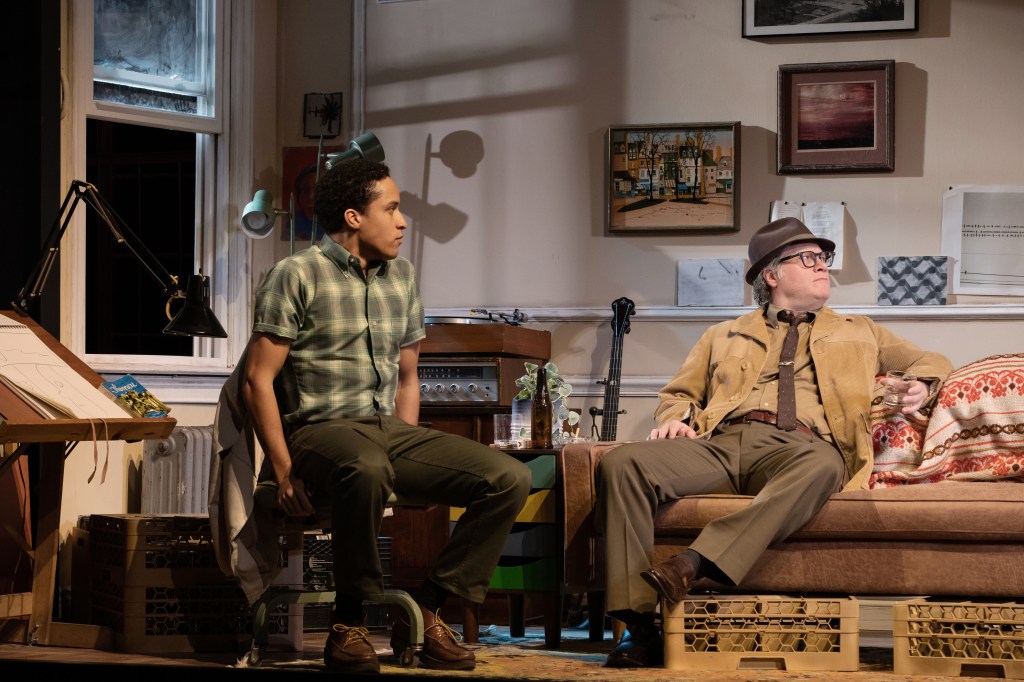
It is to the producers’ credit that they risked bringing the play to a Broadway audience, who may not be used to the complications, the numerous thematic threads, the actualized brilliance of unique characterizations and their interrelationships, and Hansberry’s overall indictment of the culture and society. Sign is a companion piece to her award-winning Raisin in the Sun. It explores the root causes why the Younger family is where it is socially and economically. Vitally, it examines the political underpinnings of institutional oppression and discrimination via reform movements, symbolized by the efforts of Brustein and friends who promote the reform candidacy of Wally O’Hara.

To focus her indictment of the perniciousness of political and social oppression, Hansberry examines the vanguard of reformists, Greenwich Village artists, activists and journalists who are emotionally/philosophically ready to make social/economic change of the type that the Younger family in Raisin in the Sun yearns for. However, these Greenwich Village mavericks are the least equipped tactically to sidestep co-optation and the political cynicism of the power-brokers. They realize too late that the money men will fight them to the death to maintain a status quo which inevitably destroys the vulnerable and keeps families like the Youngers and drug addict Willie Johnson struggling to survive.

The Sign in Sidney Brustein’s Window is timeless in its themes and its characterizations. When we measure it in light of current social trends, it is fitting that the play transcends the history of the 1960s in its prescience and reveals political tropes we experience today. Additionally, it suggests how far society has declined to the point where cultural and political co-optation (a principal theme) have been institutionalized via media that skews the truth unwittingly. The result is that large swaths of our nation remain oblivious to their exploitation and dehumanization, ignorant that they are the pawns of political parties, who promise reform then deliver regression. In short they, like Sidney Brustein and his friends, are seduced to hope in a better world that reform politicians say they will deliver. But when they win, through a plurality of votes from a diverse population, they renege on their promises and continue to do what their “owners” want, which is to “screw” the little people and deprive them of power and a “place at the table.”

Hansberry’s setting of Greenwich Village is specifically selected as one of the hottest, most forward-thinking, “happening” areas in the nation. Brustein’s apartment is the focal point where we meet representative types of those found in sociopolitical/cultural reform movements. His community of friends are activists who believe their friend and candidate Wally O’Hara (Andy Grotelueschen), is positioned to overturn the Village’s entrenched “political machine.” Sidney, reeling from his bankrupted club, which characterized his cultural/intellectual ethos (idealistically named Walden Pond after Henry David Thoreau’s book), purchases a flagging newspaper (The Village Crier) to once again indulge his passion for creative expression. He does this unbeknownst to his wife Iris (Rachel Brosnahan), a budding second-wave feminist who waitresses to support them financially. She chafes at her five-year marriage to Sidney, shaking off his definitions and the identities he places on her, one of which is his “Mountain Girl.”
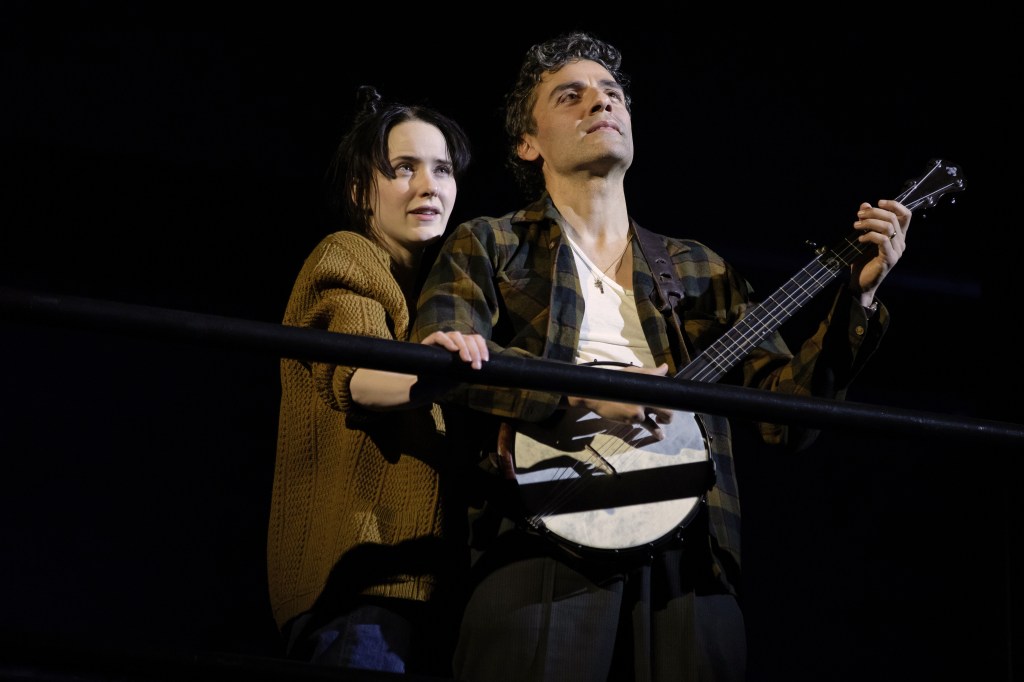
Activist and theoretical Communist (separated from the genocidal Stalinist despotism) Alton (Julian De Niro), drops in with O’Hara to encourage Sidney to join the crusade to elect O’Hara with the Crier’s endorsement. Sidney declaims their persuasive rhetoric and assures them that he will never get involved in political activism again. However, as events progress, his attitude changes. We note his friends, including artist illustrator Max (Raphael Nash Thompson), stir him to support O’Hara with his excellent articles. Sidney, mocked by Iris about his failures, is swept up in the campaign. When he hangs a large sign in his window that endorses O’Hara, his adherence to push a win for the “champion of the people” increases in fervency.

The sign symbolizes his hope and his seduction into the world of misguided activism, but its meaning changes over the course of the play. Hansberry doesn’t reveal the exact moment that Sidney decides to take up the “losing cause” after he disavowed it. However, his fickle nature and passion to be enmeshed in something “significant” with his friends helps to sway him.
In the first acts of the play, Hansberry introduces us to the players and reveals the depth of her characterizations as each of the characters widens their arc of development by the conclusion. We note the development of Mavis (Miriam Silverman), Iris’ uptown, bourgeois, housewife sister, who is married to a prosperous husband and is raising two sons. We also meet David Ragin (Glenn Fitzgerald), the Brustein’s gay, nihilistic, absurdist playwright friend, who lives in the apartment above theirs and is on the verge of success. Both Mavis and David, like Sidney’s other friends, twit him about Walden Pond’s failure. Mavis and Iris are antithetical in values and Mavis views her sister and brother-in-law as Bohemian specimens to be observed and secretly derided as entertainment. We discover Mavis’ bigotry when she opposes the union of their sister Gloria (Gus Birney), a high class call girl, to Alton, the young light-skinned Black friend.

The genius of this work is in Hansberry’s dialogue and the intricacies of the characterizations. It is as if Hansberry spins them like tops and enjoys the trajectory she creates for them, which ultimately is surprising and sensitively drawn. Organically driven by their own desires, we follow Sidney and Iris’ family machinations, pegged against the backdrop of a political campaign that could redefine each of their lives so that they could better fulfill their dreams and purpose. However, the campaign never rises to the sanctity of what a true democratic, civic, body politic should be. Indeed, the political system has been usurped in a surreptitious coup that the canny voter “pawns” are clueless about.

Tragically, instead of political power being used to combat the destructive forces Hansberry outlines, some of which are discrimination, drugs, law-enforcement corruption, economic inequity and other issues that impact the Brustein’s and their friends’ lives, O’Hara and his handlers have other plans. But first, they cleverly convince the voters a win is unlikely and they pump them up to believe in the possibility of an O’Hara success that would be earth-shattering and revolutionary. This, we discover later, is a canard. The “revolutionary coup” can never occur because the political hacks control everything, including Sidney’s paper which they exploit to foment support for O’Hara. How Hansberry gradually reveals this process and ties it in with the relationships-between Iris and Sidney, Alton and Gloria, Iris and Mavis and the other friends-is a fabric woven moment by moment through incredible dialogue that pops with quips, peasant philosophy, seasoned wisdom, and brilliant moments that evanesce all too quickly.
By the conclusion, the solidity of the characters’ hopes we’ve seen in the beginning have been dashed to fold in on themselves. Both Iris and Sidney learn to reevaluate their relationship with each other and their misapplication of self-actualization, which allowed a tragedy to happen. Likewise, Alton’s inflexibility about his own approach to his place in an exclusionary, oppressive culture ends up contributing to a tragedy that might have been prevented. In one way or another, these characters particularly, along with David’s self-absorbed nihilism, contribute to Gloria’s death.
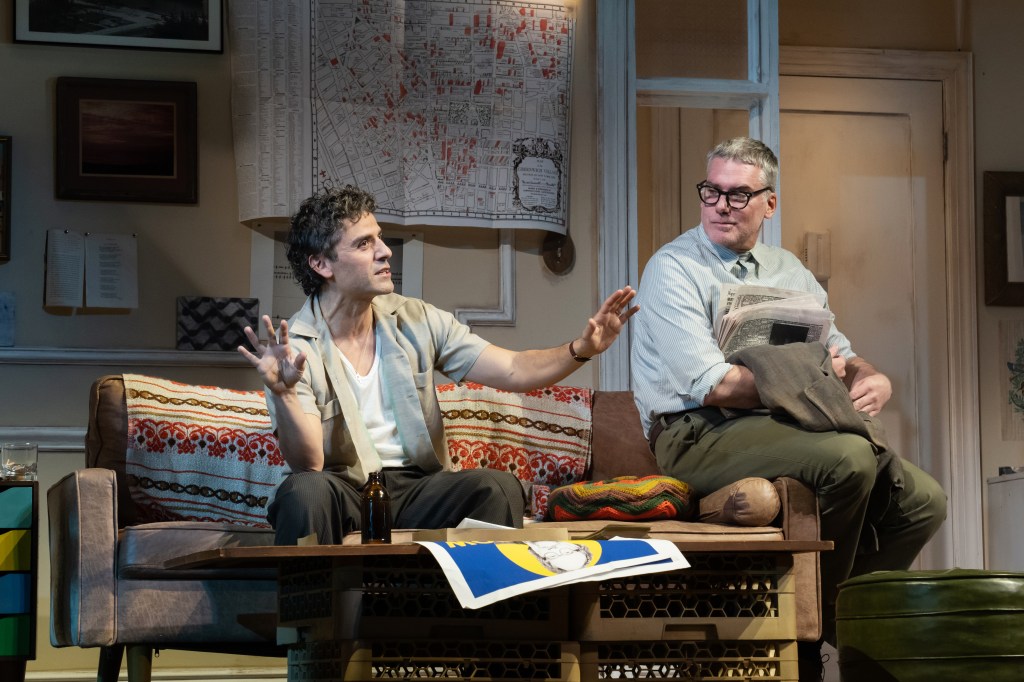
Symbolically, Hansberry points out that love and concern for other human beings is paramount. Too often, relatives, friends and cultural influences contribute to daily tragedies because human nature’s weaknesses in “missing the signs” contort such love and service to others. Ironically, politics, whose idealized mission should be to reform and make the culture more humane, decent and caring, is often hijacked by the powerful for their own agendas to produce money and more power and control. The resulting misery and every day tragedies accumulate until there is recognition, and the fight begins to overcome the malevolent, retrograde forces that O’Hara and his cronies represent.
This, Sidney vows to do with his paper and Iris’ help in a powerful speech to O’Hara proclaiming a key theme. To be alive and not spiritually, soulfully dead, one must be against the O’Haras of the world and the forces of corruption. To support them is to support death and dead things. To recognize how the power-brokers peddle death, one must discern their lies and avoid being lured into their desperate cycle of destruction, which they control to keep the populace oppressed, hopeless and suicidal.
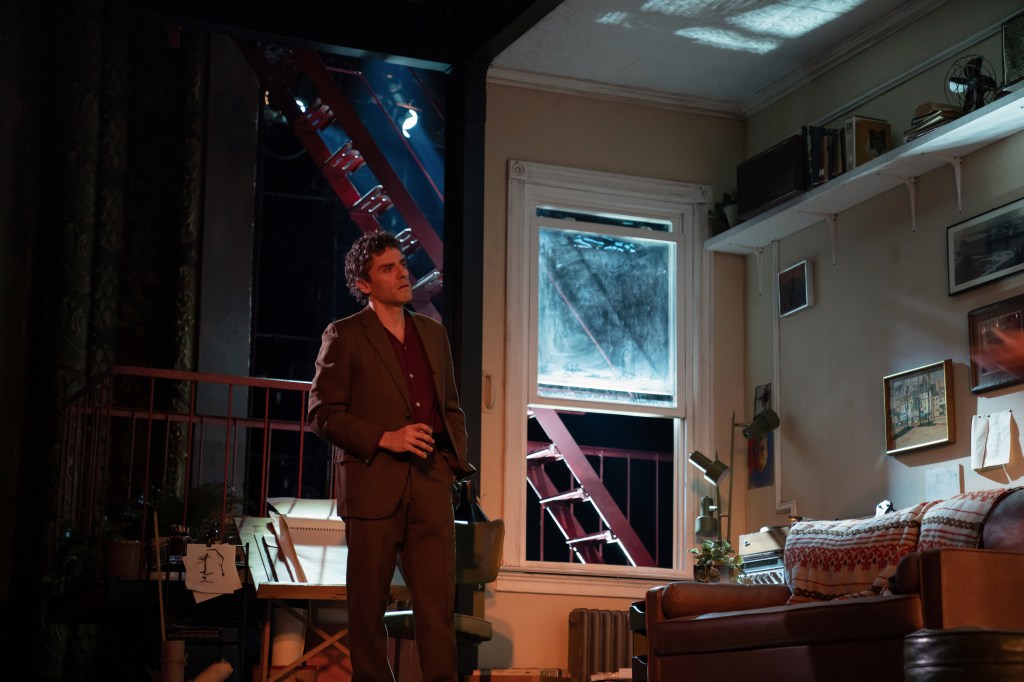
The actors’ ensemble work is superior. Both Isaac and Brosnahan set each other off with authenticity. Miriam Silverman as Mavis hits all the ironies of the self-deprecating housewife, who has suppressed her own tragedies to carry on. And Julian De Niro’s speech about why he cannot love or marry Gloria is a powerhouse of cold, calculating, but wounded rationality. Hansberry has crafted complex, nuanced human beings and the actors have filled their shoes to effect their emotional core in a moving, insightful production that startles and awakens.
The play must be seen for its actors, direction, and the coherent artistic team, which perfectly effects the director’s vision for this production. These artists include dots (scenic design), Brenda Abbandandolo (costume design), John Torres (lighting design), Bray Poor (sound design), and Leah Loukas (hair & wig design).
This must-see production runs under three hours. For tickets and times go to their website https://thesignonbroadway.com/
‘Camelot’ Revival at Lincoln Center, Superbly Re-imagined for Our Time

The original 1958 musical Camelot. performed with Alan Jay Lerner’s book and lyrics, and Frederick Loewe’s music, adapts theArthurian legend from T.H. White’s collection of fantasy novels entitled Once and Future King (1958). White’s adaptation was loosely based on the 1485 work Le Morte d’Arthur by Sir Thomas Malory. Aaron Sorkin’s book updates the musical and puts an interesting spin on the events of legend, heightening the characters and shifting the emphasis to King Arthur, superbly portrayed by Andrew Burnap (Inheritance). As a result, Sorkin diminishes the love affair between Phillipa Soo’s Queen Guenevere (Hamilton) and Jordan Donica’s Lancelot du Lac (My Fair Lady), aligning it more with romantic tradition which fails. With outstanding set design and fine direction by Bartlett Sher, Camelot is a stunning revival of symbolic political moment, currently running at Lincoln Center’s Vivian Beaumont until September.
At the top of the play Sorkin introduces us to one of the most important aspects of Arthur’s kingdom, the feudalistic power structure and Arthur’s previous isolation from it. Before we even meet Arthur, we meet the lords who serve the king and make up his court, as well as Merlin (Dakin Matthews), Arthur’s counselor, whose wizardry is seen through his balanced demeanor, wisdom, erudition, time transcendence, foreknowledge and keen ability to redirect the perspectives of less enlightened individuals.
Tasked to meet Arthur’s bride-to-be at the top of the hill near the castle, the lords exclaim that her carriage is at the bottom of the hill. We note Merlin’s attributes in his initial discourse with these three knights, Dinadan (Anthony Michael Lopez), Lionel (Danny Wolohan), and Sagramore (Fergie Philippe), who rant that the Guenevere’s carriage has gone against tradition, as they watch her disembark from her carriage far away from them. This change in tradition upsets them, until Merlin uses gentle wisdom to calm their responses and show them they can merely change the law to update tradition. This exchange among the knights and Merlin indicates the conflict to come, tradition vs. progress. The knights’ acceptance of Arthur’s changes is paramount to Camelot’s success.

The ruling elites are conservative traditionalists. But Merlin handles them easily and emphasizes the power of laws to change useless, outmoded ways of being. These men have power and influence over an unequal class system, institutionalized by feudalism (the peasants who serve and the lords who protect and luxuriate over them). Arthur must step around them and gain their trust to overturn traditions which have harmed and caused wars and bloodshed.
Not a member of the royal class per se, Arthur must navigate the knights’ entrenched power with wisdom, if he is to rule his kingdom well and remain effective. This not only requires steadfast courage and acute psychological and personal skills, it demands a political philosophy and will to unite the lords and prevent division. Additionally, training and counsel from Merlin, whose extraordinary gifts of wisdom provide a broader, endowed perspective and understanding, are a boon.

In Sorkin’s different spin of Merlin, we understand that the time has been stepped up one hundred years, so that the medieval age is coming to a close, and Arthur is pushing his kingdom in the direction of the Enlightenment with the help of Merlin. Unfortunately, Merlin’s assistance remains all too brief. After his death, he is replaced by one of the oldest knights in the kingdom, Pellinore, also portrayed by Dakin Matthews, who Guenevere invites in to their circle.
Sorkin advances Arthur’s human graces, contrasting them with the backward knights of his time, who he must manipulate against their own stupidity, which manifests in Act II, encouraged by Mordred (Taylor Trensch) in “Fie on Goodness.” Arthur is not a royal in arrogance, presumption or privilege. He is a people person, decent, kind, likeable and extraordinarily generous. He is more like a Christ-like figure, who forgives Guenevere and Lancelot’s “treason,” and refuses to brutally punish them for their lack of faithfulness.

He invites his son Mordred into his circle, as a reconciliation for his past abandonment, which his mother caused by refusing Arthur’s pleas for her to come and live in the castle. He announces to the kingdom that Mordred is his out-of-wedlock son who is being treated equally like everyone else and has the opportunity to learn and become a knight, if he wishes. But Mordred refuses to listen to Arthur’s explanations why he is not with Morgan le Fey (Marilee Talkington), and he gives lip service to Arthur’s largesse. Instead, Mordred manufactures his own victimization and weaponizes it against his father. Indeed, as the villain, Mordred exploits Arthur’s kindness and love. In his wicked world, these traits are a weakness to set up Arthur’s downfall (“The Seven Deadly Virtues”).
Especially in the characterization of Arthur, Sorkin presents the idealization of a king whose humility, love, intelligence, forgiving nature, and equanimity is all that the Enlightenment promises. Unfortunately, Arthur is a man out of his time, more an influence for future generations in inspired legends and stories of his exploits, frailty and kindness, which can guide by example to bring hope and light to others. Though his reign and Camelot only lasted for for a brief time, the antithesis of the stability and “happy ever aftering” Arthur and Guenevere sing about in the beginning (“Camelot”), is mythic. All individuals, even the current day audience can aspire to Arthur’s ideals of a place of congeniality for persons great and small.
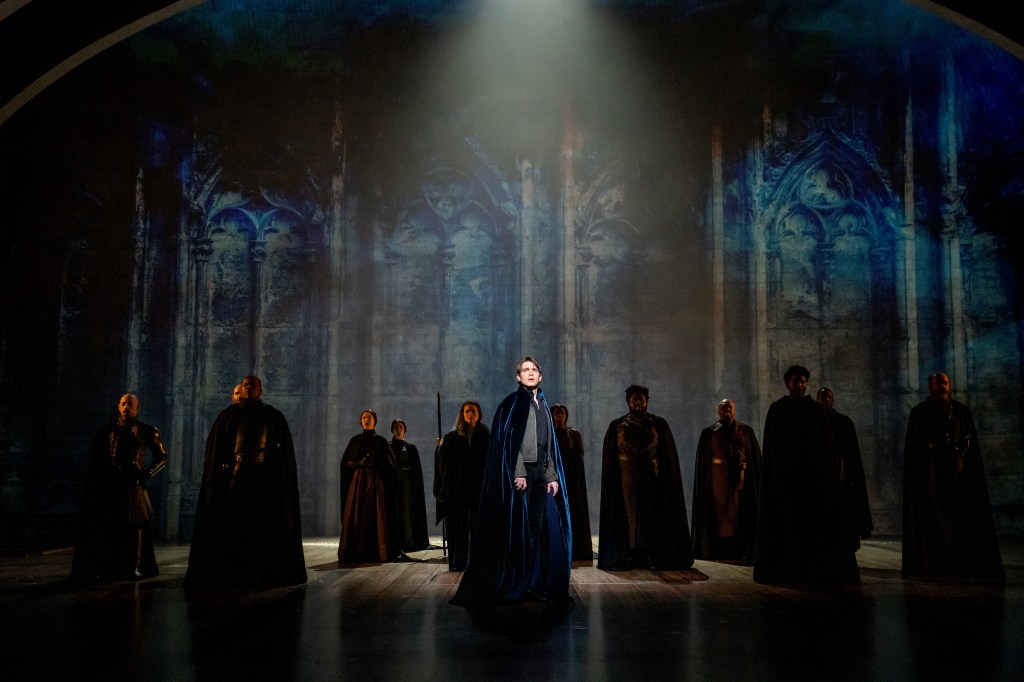
Each of the characters we see immersed in feudalism are lesser in nature, greedy for power, brutal, judgmental, calculating and self-absorbed. In the dialogue to some of the songs, we note Sorkin cleverly magnifies this. For example in the ironic “Simple Joys of Maidenhood” that Guenevere sings about wanting knights to die and sacrifice themselves for her love, Arthur brings up the notion that this isn’t much fun for the knights. Not only is Guenevere naive, she is brutal in her unrealistic romanticism, a clue to the source of her treachery with Lancelot, spawned from her privileged background. Indeed, the same knights that would kill for her, would just as soon end her “maidenhood,” in a rape, which Arthur seems to note in his ironic comment, but Guenevere conveniently ignores.
Guenevere is a traditionalist in all of her “modernity.” A spouse by arranged marriage to prevent war between England and France, she is born of royalty and has the presumption, lack of humility, and fieriness to prove it. Her expectations are royal, and she doesn’t understand Arthur’s personality and hoped for kingdom. Initially, she presumes Arthur will behave according to the traditions of kings, like her father. Kings are sexually promiscuous. They treat women as objects for their pleasure; they make demands on them, requiring they be passive creatures without individuality or autonomy.
That Arthur doesn’t have women at his sexual disposal at court, and expresses belief in the fidelity of marriage is a striking and revelatory contrast. Additionally, he fosters the novel idea they must prevent fighting, war, bloodshed, abuse of the lower classes and women. Remarkably, he gladly accepts her input of ideas. It is during their discussions that the “knights of the round table” come into being. In this acceptance of Guenevere as his ruling partner, he reveals that he is dynamically striding toward enlightened governance.

Appealing to her better nature constantly, Arthur trusts her with Lancelot. Ignoring her suggestion, he refuses to expel the narcissistic knight from the kingdom, before they have their momentary affair, which Mordred has “encouraged,” unbeknownst to Arthur, Guenevere and Lancelot. Above all, Arthur provides her with freedom and power to rule with him. This is unlike anything that is supposed to happen to a female royal anywhere. And in the musical’s memorable signature song, he imagines his vision of Camelot in order to engage her to want to be Queen, and woo her, before she knows his identity.
In retrospect, at the conclusion of the musical, we learn it is his intentions of good will toward her that prompts Guenevere to fall in love with him early on. However, since both of them are unpracticed at love, they never express it to each other. It is one of Arthur’s chief weaknesses of pride. Ironically, he fails at his own express thoughts in “How to Handle a Women,” and doesn’t love her, so that she understands his love, understands that his freedom and trust in her are love, decency and generosity in the Arthurian time of patriarchy on steroids. She is still stuck in the romantic notion of love, reinforced by her ladies in waiting, who push romantic tradition on her to her detriment.
Sorkin’s book is deeper and more complex than the original musical, so that before each song, one must catch the nuance. For example the humorous repartee before and after the song, “Camelot,” works beautifully and heightens the ironic, fantastical lyrics, symbolizing the fickleness of the place in its hyperbole, “The snow may never slush upon the hillside, by 9 P.M. the moonlight must appear.” In expressing his metaphor, Arthur encourages Guenevere to realize he is unlike royalty, and his kingdom and reign with her will be unique, maverick, loving. The tragedy is that the depth of their love is unrealized and misunderstood. Guevenere, entrapped by the tradition of her place and status, and Arthur overwhelmed by his sense of inferiority to express his feelings to her, contribute to the fall of the kingdom.
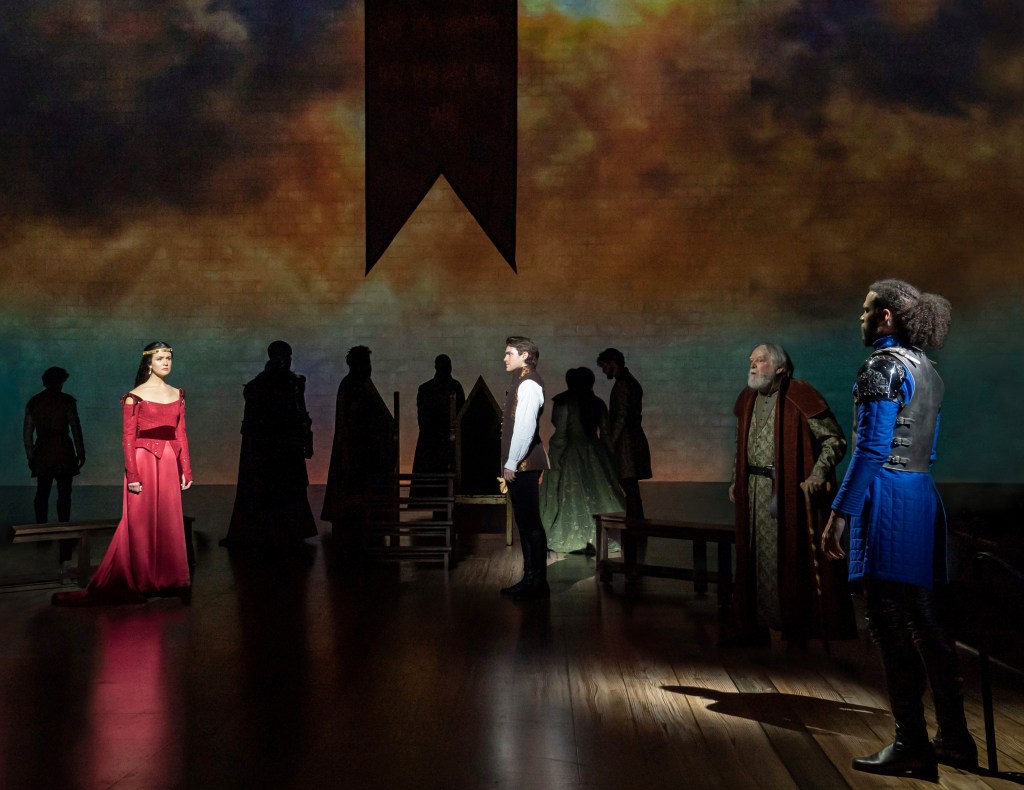
An express, underlying irony is that Arthur’s view and behavior toward women is even more forward thinking than many in the US South today, and especially some of the GOP political party antithetical to equanimity between women and men. Thus, Arthur is not only schooling Guenevere about equanimity and generosity as love, he is also reminding the audience of the beauty of such an approach between men and women for our own time.
Of course, this is legend, and it is hard to come by in reality, which makes the final exchange between Arthur and Guenevere, and their relationship, all the more poignant and tragic. In a failure of her character and bondage to her identity, Guenevere is too late to recognize and receive Arthur’s love and freedom to express it. Instead, she opts out for fleeting passion which is another form of bondage, and is the antithesis of freedom. It is why she regrets her affair with Lancelot, does not run off with him, but goes to a convent. The rest of her life she does penance for contributing to his death, Lancelot’s death, and the destruction of the kingdom.

Phillipa Soo and Andrew Burnap are perfectly cast in their respective roles and are simply smashing in voice, authenticity and aura, making us empathize with their characters who are victims of their own frailties. Burnap, especially at the conclusion, coalesces the poignant tragedy that Arthur’s dreams are broken, and that by a combination of rotten timing, privileged selfishness (by royals Lancelot and Guenevere), bitterness and resentment by an ungrateful Mordred, he is undone and must pay the forfeit with his death.
Jordan Danica’s Lancelot is both funny and dangerous, for we know what is coming when his resistance to Guenevere “protests too much” in selfishness. The right way to serve King Arthur would to leave and escape his lust, which he can’t because of his own self-betrayal. The bedroom scene is perfectly directed to suggest the thrill of passion, but not love. It is appropriate that their “aftermath” falls flat in disgrace, as they realize the import of what they’ve done. Sadly, as the pawns of Mordred, they’ve betrayed their king, and the golden idea which elevated their lives and the kingdom. Interestingly, Donica’s “If Ever I Would Leave You” indicates he can’t leave because of how she “looks” in the changing seasons. If he really loved her, not the image of her and him together, he would have left the moment he sensed the attraction to save her and himself. So much for his boasted purity. To insure his leaving, he would have been truthful with King Arthur. Donica’s voice and interpretation of that song in particular are non pareil, just fantastic.

Sorkin mitigates the “magical” in this Camelot update, palatably. For example it is suggested Arthur is able to pull the sword Excalibur out of the stone because previously, ten thousand men loosened it. Lancelot’s “resurrection” of Arthur occurs because he was just knocked unconscious and not killed. No miracle occurred. Arthur’s characterization is a forerunner of the rational man of the Enlightenment, when Europe will experience many transformations. Then, rigorous scientific, political and philosophical ideas burgeon in the society with the rise of the middle class. In his approach to ruling his kingdom, Arthur is bold to overthrow the most noxious elements of feudalism to bring ideals of equanimity, peace and honor that “might for right” and “justice for all” are the better way.
The thoughtful production has humor, vibrance and poignance. The treachery and resentment of unforgiving Mordred (the fine Taylor Trensch), who helps explode the Camelot ideals of equanimity, peace and honor are a potent reminder that such a “heaven on earth” is impossible because of human fallibility. Thematically, the musical warns us that only in the aspirations of future generations, represented by Camden McKinnon’s Tom of Warwick, may that possibility become reality in limited circumstances.
In the meantime, hope must be kept alive for a time when such dreams are possible. Realistically, all the characters fall from their own grace. It happens with the best of individuals, who cannot govern their own passions, and with the worst who rebel against a more perfect order for the sake of power. Sorkin reminds us in this complex re-imagining that most important is the striving for equity and equilibrium, not the achievement of it, which in itself is too fantastic to sustain. In the striving is the learning and revelation which is priceless. As such they provide the way for the hope of tomorrow, arriving at democratic polity hundreds of years in the future: i.e. a democratic Ukraine in the face of genocidal aggression by Russia, a democratic United States in practice not in lip service.
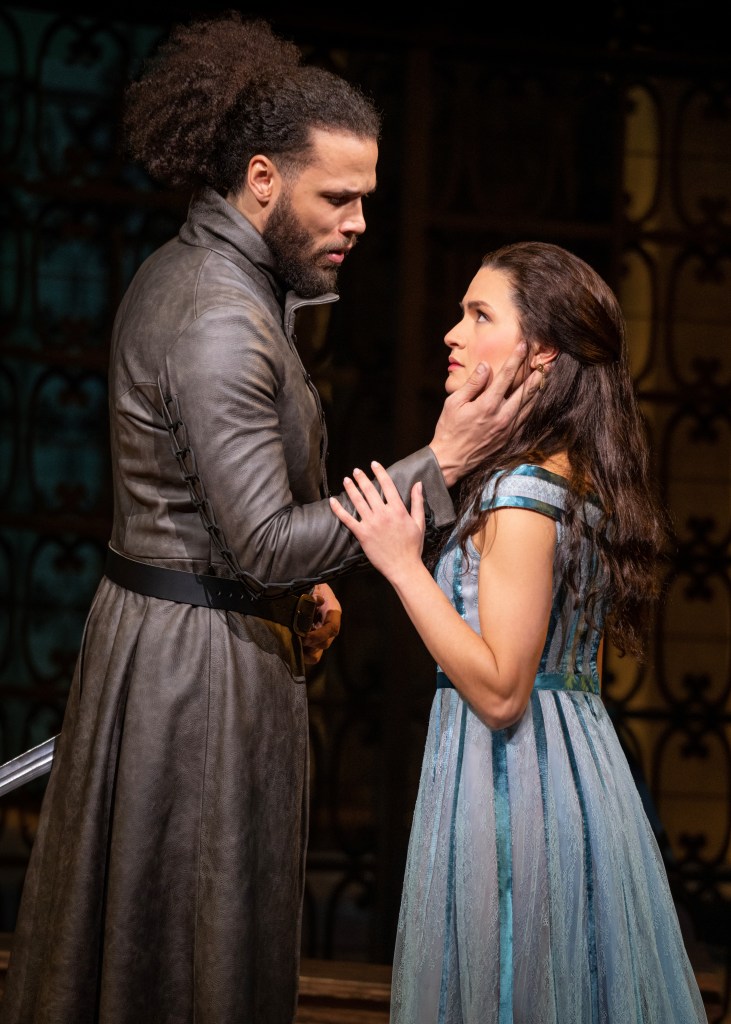
The sets by Michael Yeargan are suggestive, stylized, minimalist and symbolic, perfect for scene changes to the castle, Arthur’s study, a maypole dance, the tournament and more. Noted the black tree on stage never blossoms or has leaves, regardless of season. At one point the projection of the beautiful Camelot is seen in the distance. However, the tree does have leaves on the program cover as a figure peers out from its branches, and we, like him, wait for a “more perfect union,” and peace, justice and equity for all.
Jennifer Moeller’s costumes are richly appropriate and gorgeous. Lap Chi Chu’s lighting design, Marc Salzberg & Beth Lake’s sound design, Cookie Jordan’s hair & wig design cohere to manifest Bartlett Sher’s vision. Projections by 59 Productions are, as usual, marvelous.
I had forgotten how lyrical, memorable and powerfully touching are Lerner and Loewe’s songs and music. “Guenevere” is heartbreaking. Special recognition goes to Kimberly Grigsby’s music direction which does justice to the score. Noted are the original orchestrations by Robert Russell Bennett & Phillip J. Lang, and dance & choral arrangements by Trude Rittmann. These artists, no longer with us, had a prodigious history of creating the beauty of Broadway (Bennett over 300 productions, Lang and Rittmann over 50 productions). Byron Easley’s choreography is energetic in “The Lusty Month of May.” B.H. Barry’s fight direction and the staging/choreography of swordfights of Lancelot proving his mettle with the three knights and Arthur, appear as dangerous as the crashing blades sound.
Camelot runs with one intermission. Every minute is worth seeing. Don’r believe some of the critics. Judge for yourself. For tickets and times at the Vivian Beaumont go to their website https://www.lct.org/shows/camelot/

