Category Archives: NYBG EXHIBITS
KIKU Exhibit at the New York Botanical Garden

An example of Ogiku at the New York Botanical Garden’s Kiku: The Art of the Japanese Garden until 30 October. Photo by Carole Di Tosti
For those of you who have visited Japan in the fall, you are familiar with kiku and will most probably have fond memories of kiku that you saw in amazing displays wherever you may have walked around Tokyo or other cities in the country. Kiku is the Japanese word for “chrysanthemum.” It is the most venerated of all Japanese fall flowering plants, not only for its beauty, but also for its medicinal qualities and ancient cultural tradition.
What is most amazing is how the Japanese for centuries have maintained what is now becoming the dying art of training and shaping liku into the most incredible designs. It is becoming a dying art because the process of training the growing, fragile Kiku into such lovely shapes requires great skill and is tremendously labor intensive. One false move, one mistake and the entire display may be ruined. Kiku are “no joke.” And it is for that reason they are celebrated in Japan as part of the traditional Japanese custom of enjoying the ephemeral beauty of flowers, known as hanami.

Kiku, the chrysanthemum, is the foundation for all kiku displays. Kiku: The Art of the Japanese Garden at NYBG. Photo by Carole Di Tosti
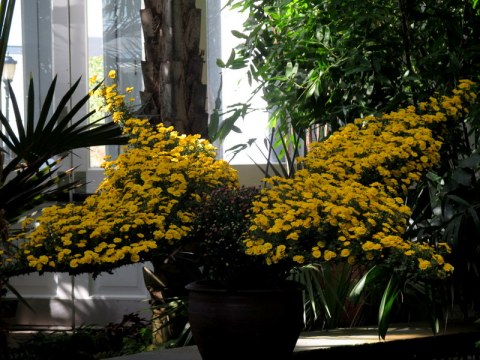
Butterfly kiku, an innovative design at the NYBG exhibit, Kiku: The Art of the Japanese Garden. Photo by Carole Di Tosti
Kiku presentations in conceptualization and philosophy are perhaps one of the most fleeting flower arrangements of all. The displays cannot be preserved beyond a few weeks. They are original. They are easily damaged and during the process of the pruning and training, they are incredibly fragile. Considering that it takes 11 months to grow, train and shape kiku into a cascade design, for example, for 11 months of labor, one receives, if one is careful, two to three weeks of beauty that vanishes as if it never lived at all. It is that impermanence of life that is so captivating a reminder for us to appreciate all that is beautiful for a season, until it withers. The irony is that kiku cannot even regrow their shapes. So, the artistry required to get them to their state of loveliness is truly exceptional
Indeed, one wonders why, in our fast paced digital age, anyone cares about pinching the buds off some flowers to effect beauty. Precisely. When one understands the process and the effort, one appreciates their pageantry. Besides, like all craft and artistry, if it can be preserved, we stay connected with our historical past and the past of other countries and their cultures. In our blink-and-it’s gone current cultural oppression of time, kiku are at once given to us from the ancients and are made modern by having those who care bring the art into the 21st century.
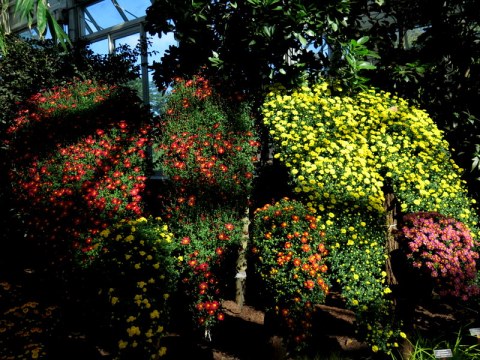
Kengai, cascade kiku at the NYBG exhibit, Kiku: The Art of the Japanese Garden. Photo by Carole Di Tosti
The NYBG has taken on the laborious craft in order to insure that the art will continue to be enjoyed by visitors from Japan as well as those who are familiar with the fall chrysanthemums, but are unfamiliar with the ability of the plants to be trained and designed into magnificent trees, cascades, bridges and more. Each year the NYBG has its kiku exhibit in the fall, pioneered by the chrysanthemum masters at the Shinjuku Gyoen National Garden in Tokyo who educated Yukie Kurashina. Yukie has trained others like James Harkins in the fine art of floral theater. And under the supervision of Marc Hachadourian, Director of the Nolan Greenhouses for Living Collections, James (foreman of gardeners) and kiku expert Yukie with scores of volunteers have made the kiku exhibit at the Enid A. Haupt Conservatory into a place of refuge mirroring the past and merging it with the present.

Ozukuri, thousand bloom display at the NYBG exhibit, Kiku: The Art of the Japanese Garden. Photo by Carole Di Tosti
During the exhibit Kiku: The Art of the Japanese Garden, you will see three traditional kiku styles:
- Ozukuri which means thousand bloom. A single stem of a chrysanthemum plant is trained to produce hundreds of simultaneous blossoms in a massive umbrella-shaped display.
- Kengai which means cascade. Small-flowered chrysanthemums are pruned and pinched to frameworks that flow downward like waterfalls for lengths up to six and one-half feet.
- Ogiku which means double and triple stem. These are enormous individual flowers presented at the end of stems that can reach up to six feet tall.
Kiku: The Art of the Japanese Garden is running from October 8 through October 30. For the full programming schedule that follows this exhibit, click HERE for the NYBG website.
‘Impressionism: American Gardens on Canvas’ at the NYBG
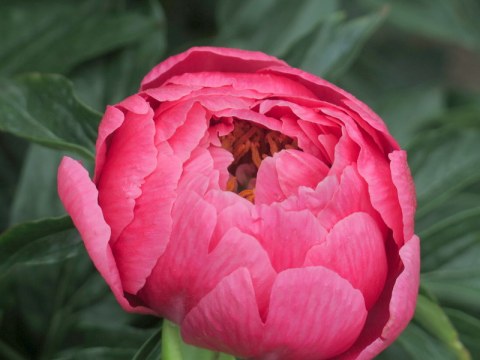
Peony at the NYBG’s ‘Impressionism: American Gardens on Canvas.’ Photo by Carole Di Tosti
If gardens represent a fount of life, revealing some of humankind’s and nature’s finest living creative achievements, artists throughout the centuries have been inspired to recreate on canvas the fanciful delight of blooming plants selected and arranged to display the best of life’s natural pageantry.
As part of the 125th year celebration of the NYBG, the dynamic NYBG team (scores collaborated to mount this exhibition), are paying tribute to the gardens that inspired American Impressionist painters (a brand of impressionism that revolves around subject, not painterly style).
The showpieces of “Impressionism: American Gardens on Canvas” receive an exquisite rendering in a unique floral exhibit at the Enid. A. Haupt Conservatory, and complementary display of more than 20 paintings and sculptures in the LuEsther T. Mertz Library’s Art Gallery.

Roses at the Enid A. Haupt Conservatory, NYBG exhibit, ‘Impressionism: American Gardens on Canvas.’ Photo by Carole Di Tosti
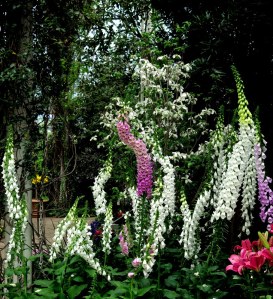
Foxgloves at the Enid A. Haupt Conservatory, NYBG’s ‘Impressionism: American Gardens on Canvas.’ Photo by Carole Di Tosti
Both the art work at the gallery and the show gardens in the conservatory capture American historical trends in painting (in plein air, influenced by French impressionism), around the turn of the 20th century and reflect the renewed interest in Colonial Revival gardens found in private residences and art colonies in the Hamptons and Old Lyme Connecticut.
The vibrant impressionist paintings and the radiant, ebullient floral showcase in the conservatory are mirror images of one another. The paintings reflect the subject American Impressionists were most enthralled by, American gardens.

Counterclockwise from top: Matilda Browne, “In Voorhees’s Garden,’ William Chadwick, ‘Irises,’ Daniel Putnam Brinley, ‘The Peony Garden,’ NYBG exhibit, ‘Impressionism: American Gardens on Canvas.’ Photo, Carole Di Tosti
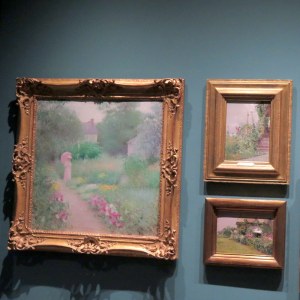
Counterclockwise from top: Edmund William Greacen, ‘In Miss Florence’s Garden,’ John H. Twachtman, ‘Wildflowers,’ Theodore Wores, ‘Thomas Moran’s House (East Hampton, Long Island)’ NYBG’s ‘Impressionism: American Gardens on Canvas.’ Photo by Carole Di Tosti
Artists appreciated that the gardens of the time uniquely characterized the domestic experience on the East Coast. They highlighted how middle and upper middle class Americans turned to their gardens for respite, relaxation, emotional uplift and sanctuary from the confusion of the cities, the unhealthful effects of pollution with heavy industrialization and unsettling urbanization.
The entire exhibition encompassing both venues reveals the marriage between the artists’ impressionism and their veneration of floral homespun, of gardens whose symbolism acknowledged a unique, national character distinct from the formal European gardens of France and the heavy-handed Victorian gardens of the gilded age. Americans seemed to have a desire for such subjects, though every now and then artists honed in on the more formal garden aspect sometimes for utilitarian reasons.

John Singer Sargent, ‘The Fountain of Oceanus,’ (1917), NYBG exhibit, ‘Impressionism: American Gardens on Canvas.’ Photo Carole Di Tosti
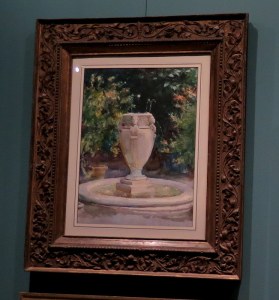
John Singer Sargent, ‘Vase Fountain Pocantico,’ NYBG’s ‘Impressionism: American Gardens on Canvas.’ Photo, Carole Di Tosti
John Singer Sargent painted The Fountain of Oceanus (1917) and Terrace, Vizcaya (1917), when he was visiting two wealthy families to complete portrait commissions. (both paintings are at the LuEsther T. Mertz Library Art Gallery) William de Leftwich Dodge built a studio house on Long Island in an airy classical style and created a series of Impressionist paintings to magnify his design of the terraced formal gardens and intricate pergolas. (His painting The Artist’s Garden [1916] may also be viewed at the Library Art Gallery)
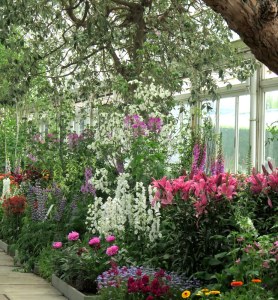
NYBG’s ‘Impressionism: American Gardens on Canvas.’ Photo, Carole Di Tosti
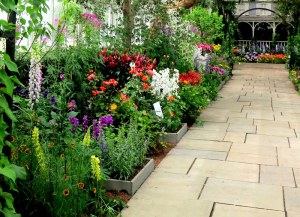
NYBG’s ‘Impressionism: American Gardens on Canvas.’ Photo, Carole Di Tosti
At the time (1890s-up to WW I), there was a burgeoning interest in gardening and horticulture. Avid gardeners from spring to fall embraced planting multiple flowering species, so that when segments of flowers finished their growing seasons, others timed with sowings and plantings would be exploding into an exuberant cornucopia of petals as the earlier plantings waned. Thus, the gardens would always or nearly always be in a rainbow of blooms.
Concurrently, artists influenced by European impressionism were returning to America where they evolved their own cultural impressionism centered around intimate American lifestyle subjects.

NYBG’s ‘Impressionism: American Gardens on Canvas.’ Photo by Carole Di Tosti

NYBG’s ‘Impressionism: American Gardens on Canvas.’ Photo by Carole Di Tosti
They eschewed the panoramic landscapes of the frontier style paintings of the golden west and expansive, mountain stained vistas. They supplanted images of vastness with the discrete, intimate, homely patchwork of every day life in the East. Our impressionists (like the French impressionists), painted urban scenes, old farms, villages with colonial styled homes, picturesque public parks and unpretentious homestyle gardens where the gardeners themselves were nature artists. But these were uniquely American.
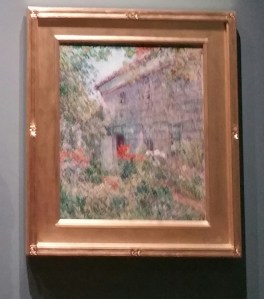
Child Hassam, ‘Old House and Garden, East Hampton, Long Island,’ (1898) at NYBG’s ‘Impressionism: American Gardens on Canvas.’ Photo by Carole Di Tosti

Persian buttercup at the Enid A. Haupt Conservatory, NYBG exhibit, ‘Impressionism: American Gardens on Canvas.’ Photo, Carole Di Tosti
There was a synergy that occurred by happenstance. Following French Impressionist Claude Monet’s example at Giverney, some artists (Hugh Henry Breckenridge, John H. Twachtman, Maria Oakey Dewing, William de Leftwich Dodge), planted their own gardens to evoke inspiration, then applied paint to canvas distilling the picturesque living arrangement they had effected in an intriguing unity of aesthetics. The conceptualization was that the gardens were echoes of their canvas counterparts; they were living paintings. What the artist did was to telescope the natural beauty not with a realistic style of painting, but one that was restive, evocative, with heavier brushstrokes. The thickness of paint teased out amorphous shapes and these hinted at the innate virtuosity of animate flowers. Artists could glorify an expansive color palette which reflected life’s infinite variety and emphasized an explosive riot of colors bursts.
Gardens like Ceilia Thaxter’s (Appledore Island, Maine), provided a wealthy subject for artists like Childe Hassum, who was a regular visitor to Thaxter’s seaside garden.
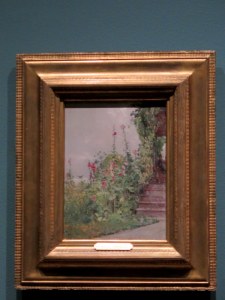
Childe Hassam, ‘Celia Thaxter’s Garden, Appledore, Isles of Shoals’ (1890), NYBG’s ‘Impressionism: American Gardens on Canvas.’ Photo, Carole Di Tosti

Floral show at the NYBG’s ‘Impressionism: American Gardens on Canvas.’ Photo, Carole Di Tosti
He painted in plein air and enjoyed the luminosity of the sunlight bouncing off the alternate churning ocean waves and smooth glassine waters. Thaxter was a poet, writer, gardener and quasi-horticulturalist whose informal summer artist colony was frequented by renowned romantic/abolitionist/regional writers (i.e. Henry Wadsworth Longfellow, Nathaniel Hawthorne, John Greenleaf Whittier, Sarah Orne Jewett), and painters (William Morris Hunt and Childe Hassum), both of whom painted her and her colorful botanical evolutions.
Thaxter’s grounds, like other artist/gardeners of the period made sure her beds were replete with quaint and strikingly picturesque old-fashioned floral favorites of grandma’s “thrown-together” garden.
Through various seasons, these might include spiking blooms of phlox, hollyhock, lupines, piquant snap dragons and pointed delphiniums, the popular, tasty sweet peas, puff-ball hydrangeas, carpeting forget-me-nots, bachelor buttons and sweet-faced violas, that ran like pixies up to the edge of porches and backdoors and nooks and crannies.

Iris at the NYBG’s ‘Impressionism: American Gardens on Canvas.’ Photo by Carole Di Tosti
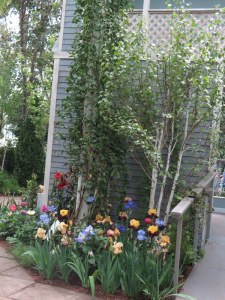
Iris planted by the cottage at the NYBG exhibit, ‘Impressionism: American Gardens on Canvas.’ Photo by Carole Di Tosti
And in corners blue and yellow iris might appear to their finest advantage. From spring to fall, an exquisite luxuriance of flowers blossomed. Examples of these species may currently be seen blooming in the Enid A. Haupt Conservatory floral showcase.
These widely planted varieties along with roses, peonies, cleomes (spider flowers), baby’s breath, cosmos, strawflowers, poppies, and golden tickweed at various times of spring and summer months flourished in wide swaths of varicolored beds planted to imbue a non-formal seemingly random outgrowth. Conscious gardeners intentioned the appearance of helter skelter, profuse arrangements, as if the plants themselves decided which spots suited them best and plopped there unceremoniously to stretch out and take the sun and rain with ease.
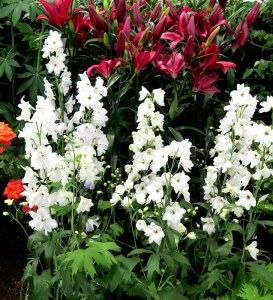
American gardens at the Enid A. Haupt Conservatory, NYBG exhibit, ‘Impressionism: American Gardens on Canvas.’ Photo, Carole Di Tosti

Country cottage at the Enid A. Haupt Conservatory, NYBG’s ‘Impressionism: American Gardens on Canvas.’ Photo, Carole Di Tosti
Attention was given to colonial revivalist styles where gardens were utilitarian, intimate and incorporated the lifestyle arrangements of the family so that the matron of the house, for example, could fling open the backdoor and pick the heavenly scented lavender to create sachets or go to the side of the house to pick peonies for a table arrangement.
Beginning with inspiration from the artists whose adoration of vintage gardens as a throwback to a more gentile and nostalgic time, Guest Curator Linda S. Ferber applied her expertise to investigate seminal works, some known, some from less renowned American impressionists.
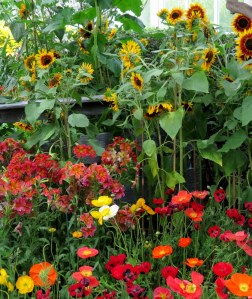
Poppies and sunflowers at the NYBG’s ‘Impressionism: American Gardens on Canvas.’ Photo Carole Di Tosti

Strawflower ‘hot bikini’ at the NYBG’s ‘Impressionism: American Gardens on Canvas.’ Photo, Carole Di Tosti
From the guest curator’s selections which included one formal garden, the predominance of works encompassed the artistic loveliness of dooryard gardens of homes in various locales in the East, some in Pennsylvania and Maine and some in the Hamptons, New York which picture grey shingled houses festooned by splashes of variegated hued plants.
The various works then provided the creative heart for Francisca Coelho and the horticultural staff to gain their inspiration and provide the doorway into recreating a three season garden encapsulating the style, elegant simplicity and peace-filled homey comfort these American gardens exuded.
Their splendid result abides in the Enid A. Haupt Conservatory even to the recreation of the grey clapboard, white shuttered country cottage that one would adore living in to escape the frenetic pace of the city. The cottage has a porch with rocking chairs and if you sit in one and look out on the hollyhocks, foxgloves, delphiniums, sweet peas, beauteous painted tongue and all the flowers previously mentioned here (you need to take an up close and personal view to catch them all), you will exhale a deep breath and allow the fragrances and mystical plenitude of nature to incite your senses and move you to a peaceful sense of well being.
This splendid exhibit at the New York Botanical Gardens runs from May 14th through September 11, 2016. To purchase tickets and check programming for the event and throughout the summer click the website HERE.
A facsimile of this article appears on Blogcritics at this site.
A Million Daffodils, Celebrating NYBG’s 125 Anniversary

Project 1 million daffodils at the NYBG. Photo by Carole Di Tosti
The past week and one-half has been deary, cloudy and rainy as the cold front lingered. However, the week before, Earth Day weekend festivities at the NYBG sported good weather. The sun peeked out and it was warmer from noon on, just in time to appreciate the daffodil blooms at their height as well as the wine tastings and interesting wine and distilled spirit selections from upstate and around the city (The City Winery).

NYBG planters with the colors of spring, daffodils and violets. Photo, Carole Di Tosti
To celebrate the 126th anniversary, the NYBG is planting 1,000,000 daffodils and I had the opportunity of seeing their initial efforts which began with the expansion of the historic Narcissus collection at Daffodil Hill where staff planted 150,000 bulbs in October 2015.
On that Earth Day Daffodil Sunday, walking the by-ways past the Everett Children’s Adventure Garden into the farther reaches where I had never gone before, the daffodils were in heady bloom along with the flowering cherries and other blooming trees.
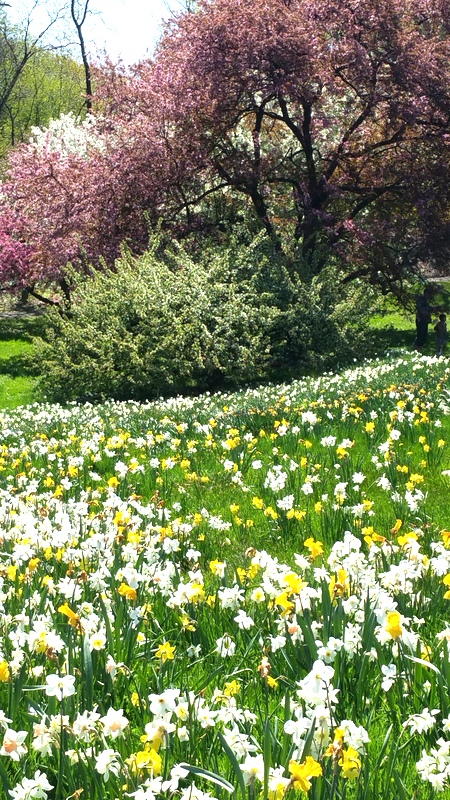
NYBG one million daffodil initiative. Photo by Carole Di Tosti
It was spectacular. I was glad that I arrived earlier in the day because I knew the crowds would be thick as they meandered with drinks and cameras in hand stopping for photos or sitting on the grassy areas in the sun to enjoy the wine and light snacks that were available for purchase.

Daffodils and flowering cherry trees at the NYBG.
The initial planting is now on the increase and over the next six years, staff, volunteers and members will be adding more plantings (in the tens of thousands), each year in October until that magical number is reached. British romantic poet William Wordsworth wrote about the spiritual renewal we feel through nature’s beauty.
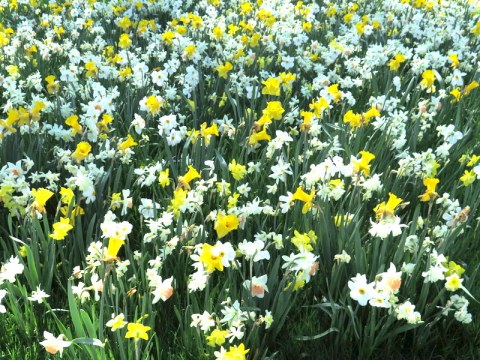
NYBG daffodils part of the ongoing 1 million daffodils project over the next 5 years. Photo Carole Di Tosti
In a famous poem of his, “I Wandered Lonely As A Cloud,” the narrator/Wordsworth discusses his feeling disconsolate and alone as he took long walks seeking to be uplifting in his soul. But it was only when he came across a dazzling array of golden of daffodils that stretched as far as his eyes could see, that his heart and spirits regenerated. And whenever those downcast feelings would arise, he had only to see “in his mind’s eye” that vision of the joyful daffodils “dancing in the breeze” to become restored to a state of balance and contentment.
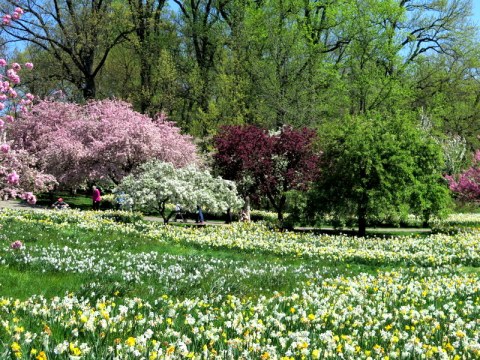
NYBG near Daffodil Hill. Photo by Carole Di Tosti
When this daffodil initiative is completed in the next years our experience will recall Wordsworth’s. It will be breathtaking to see daffodils that span the lawns and Daffodil Hill in a great swath of yellow, gold, tricolor and cream yellow in a multitude of varieties. After the project is completed in a few years, for those who visit Daffodil Hill at the NYBG, as they look in the distance and turn around in every direction, they will see daffodils, thick and lush in the landscape, smiling and dancing in the breeze. Like Wordsworth it will be a picture that one can recall to remembrance in the heft of winter as a heavenly uplift that spring is on its way.
The pictures that follow represent the initial stages of the one million daffodil project. Daffodils which symbolize rebirth and are known elsewhere as the “Lent Lilly” because they grow and burgeon during Lent are a lovely choice to recognize and appreciate the NYBG’s 125th year in the Bronx.

Flowering cherry tree at the NYBG near Daffodil Hill. Photo by Carole Di Tosti
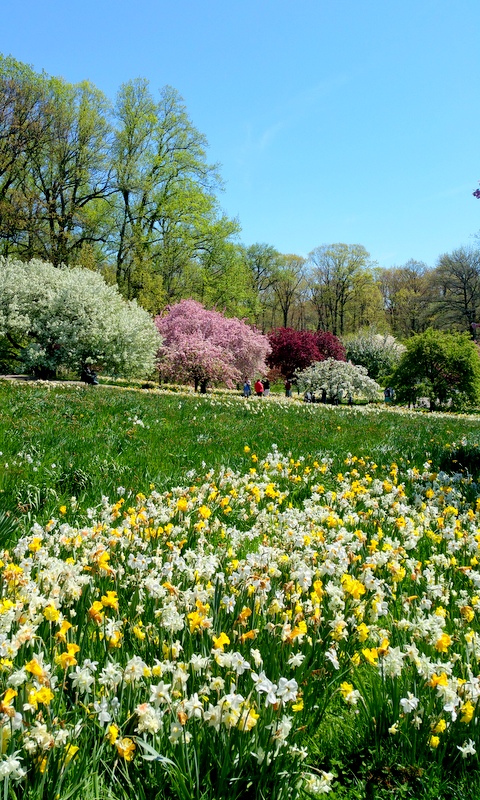
NYBG near Daffodil Hill. Photo by Carole Di Tosti
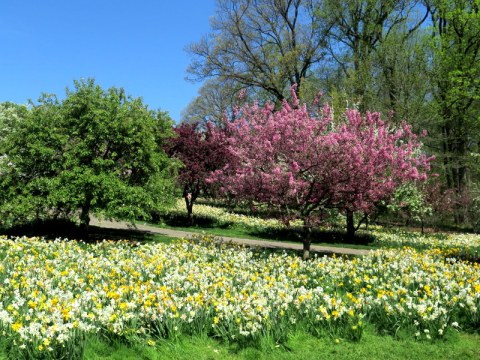
NYBG, Daffodil Hill, one million daffodil initiative. Photo, Carole Di Tosti
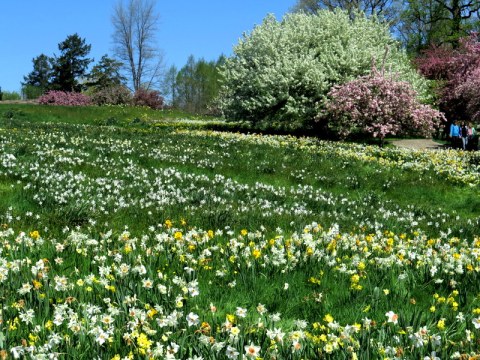
NYBG Daffodil Hill, one million daffodil initiative. Photo by Carole Di Tosti

NYBG, Daffodil Hill, one million daffodil initiative. Photo by Carole Di Tosti
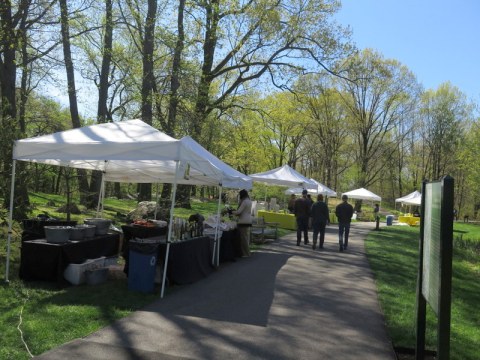
Along the wine tasting trail at the NYBG, 125th Anniversary Celebration and Daffodil weekend. Photo, Carole Di Tosti
The wineries who displayed their selections at the NYBG were from upstate New York. Some are featured below and their websites are listed if you click on the name: PALAIA WINERY.
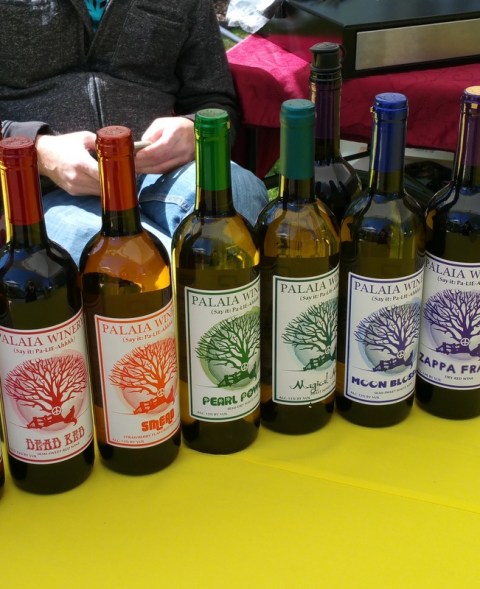
NYBG Wine Tasting at the 125th Anniversary Celebration during Daffodil weekend. Featured are Palaia Winery wines. Photo by Carole Di Tosti
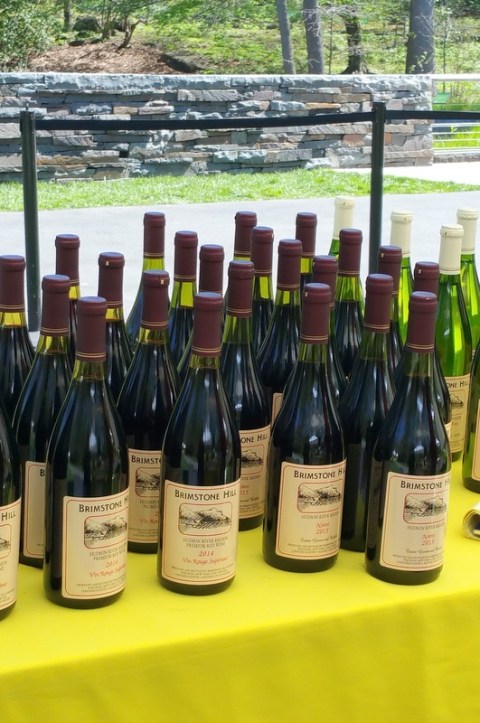
NYBG Wine Tasting at the 125th Anniversary Celebration of the one million daffodil initiative. Featured are wines from Brimstone Hill Winery. Photo by Carole Di Tosti
WARWICK VALLEY WINERY & DISTILLERY
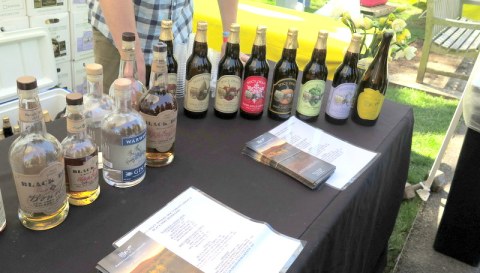
NYBG Wine Tasting and 125th Anniversary Celebration with the one million daffodil initiative. Featured wines by Warwick Valley Winery & Distillery. Photo by Carole Di Tosti.

NYBG Wine Tasting, Warwick Valley Winery & Distillery (Black Dirt Distillery). Photo, Carole Di Tosti

More daffodils at the NYBG one million daffodil initiative. Photo by Carole Di Tosti
The NYBG is offering an opportunity to become a part of the legacy. A contribution of $25.00 will support the planting of five daffodil bulbs that will be contribute to the one million daffodil display in the next few years. Gifts can be made in honor or memory of a loved one and the family member or honoree may be notified of your thoughtful gift with a card. To make a gift, be a part of the one million daffodil initiative or learn about other dedication opportunities call Lisa Sifre at 718-817-8545 or e-mail daffodils@nybg.org. Or visit million-daffodils.nybg.org
Earth Day & Weekend Celebrations at the New York Botanical Garden, April 22-24
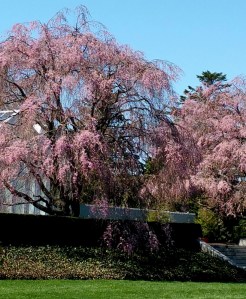
NYBG flowering trees beginning to blossom. Photo Carole Di Tosti
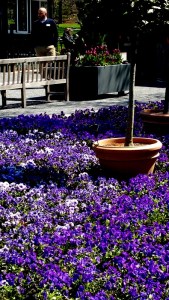
Violets are blooming at the NYBG. Photo by Carole Di Tosti
It is dismal, cold, damp weather and Punxsutawney Phil has committed suicide because of his incorrect prognostications of an early Spring! So went a humorous Facebook post I saw yesterday with a picture of a dead groundhog with a gun lying across his chest. Well, Spring has come despite the rainy, chilly bleakness. But at the New York Botanical Garden nature is thrilled. The Garden is manifesting its beauty, despite the less than sunny conditions.
All through the Spring and summer months, the various sections of the Garden will be radiant in their finest of blooms: the rose garden, the lily ponds and more. Interspersed here and there to match the outdoor beauty, the conservatory exhibits will sport more magnificent floral theater centered around various themes. Throughout the year the Garden is always vibrant with the flavors, sights and sounds of natural horticultural beauty. Some feel the fall retains the most vibrant pageantry of all the seasons.

Tulips at the NYBG. Photo by Carole Di Tosti

Vibrant tulips at NYBG. Photo Carole Di Tosti
A celebration that represents something we all should lift up is recognition of the planet that nurtures us. Earth Day is upon us and the NYBG is commemorating with three days of activities. Perhaps the the finest, most reckoning event is on Earth Day (Friday, April 22nd). Earth Day, a national event with parades and festivals, is the underappreciated and understated day that is relevant to our lives and those of our posterity.
To recognize its importance, on Friday, the Garden will be screening Seeds of Time. Directed by Sandy McLeod, the film is a compelling documentary about global agriculture, the increasing difficulties facing the world’s food supply and the seeds that must be stored for future generations.

Daffodils are blooming at the NYBG. Photo by Carole Di Tosti
Hopefully, these seeds will not be hybrids or Monsanto tweaked seeds, but will be heirloom seeds that can be planted for lifetimes.
If you stay after the screening, you will be able to enjoy a discussion and Q and A by CaryFowler, Senior Advisor of the Global Crop Diversity Trust, and the Academy Award-nominated director of Seeds of Time, Sandy McLeod. Both will be discussing how agriculture, unless it is rethought and redirected will not be able to supply the world with food unless there are sustainable practices. Both will discuss the vital issues the filmmaker raises in the film.

Container plantings at the NYBG. April 22-24, 2016. Photo by Carole Di Tosti
Barring inclement weather, Saturday and Sunday, April 23 & 24, the Botanical Garden is showing off her splendor in a panoply of spectacular spring blooms Along the paths and the beds throughout the Garden, the 150,000 daffodil bulbs planted in November 2015 will be bursting with joyful glory and unmistakable fragrance.
If you are familiar with William Wordsworth’s poem, “I Wandered Lonely As A Cloud” you will remember how Wordsworth, a romantic poet, uplifted nature to stave off the growing industrialization and mechanization of the factories which dehumanized, and brutalized city life. The romantics believed that through the spiritual aspects of nature man could be restored. The opening lines of Wordsworth’s “I Wandered Lonely As A Cloud” begin:

Daffodils, some of the 150,000 bulbs planted last fall at the NYBG. Photo Carole Di Tosti
I wandered lonely as a cloud
That floats on high o’er vales and hills,
When all at once I saw a crowd,
A host, of golden daffodils;
Beside the lake, beneath the trees,
Fluttering and dancing in the breeze.
Continuous as the stars that shine
And twinkle on the milky way,
They stretched in never-ending line
Along the margin of a bay:
Ten thousand saw I at a glance,
Tossing their heads in sprightly dance
Daffodils are a joyful harbinger of warmer weather and Wordsworth commented that their wealth of beauty lasted with him long after he left that location. All he had to do was remember in his mind’s eye their lovely happiness and he was spiritually refreshed.
Well, this weekend will offer not only spiritual rest and peace the Garden brings to rejuvenate one’s soul to face Monday, but there will be liquid refreshment, a wine tasting against the amazing backdrop of the Garden’s blooming trees and sprightly flowers. New York State vintners will offer palate-pleasing local wines while experts on winemaking and viticulture will host demonstrations and presentations all weekend long.
For the full media alerts, go to:
Seeds of Time screening (Friday, April 22):
http://www.nybg.org/files/EarthDay2016MEDIAALERT.pdf
Daffodil Celebration & Wine Weekend (Saturday and Sunday, April 23 & 24):
http://www.nybg.org/files/pr/Daffodil_Wine_Weekend_2016_Media_Alert.pdf
The Earth Day weekend promises to be a memorable one. What better way to celebrate Spring, the 125 Anniversary of the NYBG and the sustenance and sustainability of our planet?
NYBG Orchidelirium: The Victorians’ Obessession for Orchids and Profits

Phalaenopsis at NYBG Orchidelirium Photo by Carole Di Tosti
Phalaenopsis orchids, the most ubiquitous of flowers, hardly garner a second glance when we stroll by the myriad colored hybrids that adorn restaurants, homes, offices, and flower sections of grocery stores.

Opsistylis Mem. Mary Nattrass NYBG Orchidelirium Photo by Carole Di Tosti
However, in 19th century Victorian England, if you had orchids in your parlour, you were most probably a member of the upper class. Orchids were a costly rarity, and for much of the 19th century, these plant gems remained in the domain of aristocrats, whose adoration of spectacular orchid originals epitomized the genteel display of power, status, and luxury.

Phalaenopsis I-Hsin Sun Beauty at NYBG Orchidelirium Photo by Carole Di Tosti
In celebration of those passionate Victorians whose obsessions spawned perilous journeys and whose collectors’ cultivations helped to transform the field of plant research, propagation, and conservation, this year’s theme of the NYBG Orchid Show, is “Orchidelirium.” Representative of all that is exceptional and dynamic about this monumental flowering plant family Orchidaceae (over 30,000 naturally occurring species from tiny to large, with over 150,000 man-made hybrids), NYBG “Orchidelirium” in its intense visual design and intriguing tour layout circumscribes the trending mania that burst onto the scene in Victorian England. The exhibition highlights the finest and most innovative creative impulses of the time and recalls some of the most nefarious of human activity before profiteering, exploitation, and habitat destruction became the anathema they are today.
Marc Hachadourian (NYBG orchid curator) holding the beloved Psychopsis papilio that whetted the Duke of Devonshire’s obsession for more rare beauties. Photo: Carole Di Tosti
The euphoria began when the Duke of Devonshire fixated upon a dazzling, most singular orchid, Psychopsis papilio. Enchanted, he lusted for more “living jewels” and commissioned explorers to travel the continents and bring back obscure treasures. They did. His addiction grew. Word spread. London’s upper class’ fanaticism was set ablaze, and the orchid craze catapulted into hyper-drive.
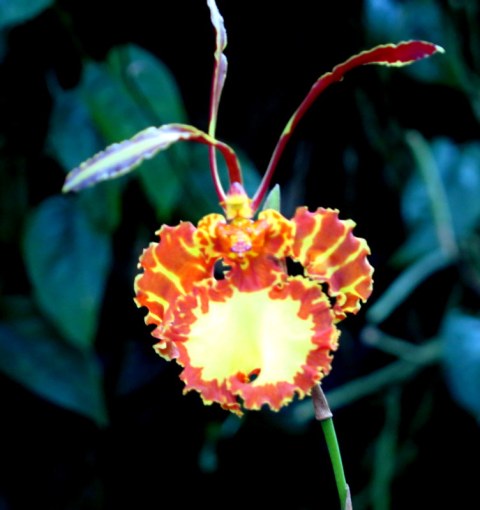
Close up of the Psychopsis papilio that started orchid mania and determined the British Duke of Devonshire to amass the largest private orchid collection in the world at his Chatsworth House estate in Derbyshire which you can visit today. Photo Carole Di Tosti
The Duke’s head gardener Joseph Paxton revolutionized greenhouse design and orchid cultivation for the Duke whose expanding collection (eventually his greenhouses were over an acre under glass), inspired his wealthy friends to also display their unrivaled orchid prizes. Soon hundreds of adventurers were commissioned to travel on the high seas and bring back all the obscure, unparalleled beauties they could find. In 10 years the Duke possessed the largest private orchid collection in the world centered at his Chatsworth House estate. The grandiloquent gardens, greenhouses, and impressive buildings in Derbyshire, which recall the wealth and splendiferous grounds of Mr. Darcy’s estate in Pride and Prejudice, are worth the visit if you are traveling to the UK.
 Fragrant Dancing Ladies Orchid, Oncidium, Rosy Sunset ‘F’ NYBG Orchidelirium. The oncidium orchids carry a lovely fragrance of roses or chocolate. Photo: Carole Di Tosti
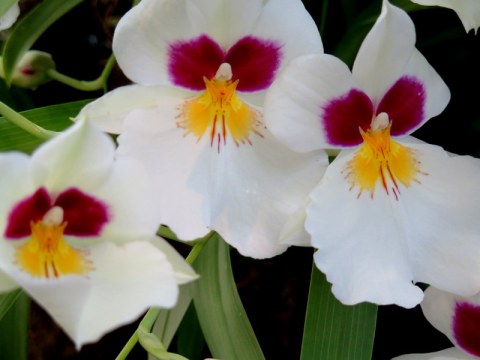
Miltoniopsis Herralexandre (pansy orchid) NYBG Orchidelirium Photo:Carole Di Tosti
Our love of orchids has been tempered with an ethical imperative about conservation and preservation of habitats that was absent back in the time of the exploitative, predatory Victorians. Throughout, this prodigious show highlights the extent of the Victorians’ often piratical obsession, not only through its exquisite, floral pageantry but by showcasing the historical artifacts, books, pictures, narratives that adorn the pathways where the lusciously fragrant Oncidium Rosy Sunset ‘F’ orchids dance (they smell like chocolate), and the Miltoniopsis Herralexandre (pansy orchids) charm with their smiling faces that bloom with scintillating color. The narrative discloses “movers and shakers like Benedikt Roezl, the “Prince of Orchid Hunters,” who was the most famous and successful orchid collector of the era.
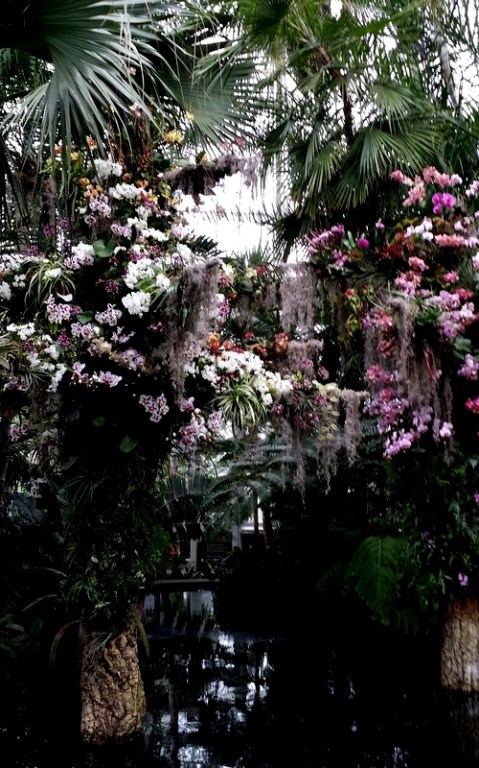
Featured display introducing Orchidelirium in the Palms of the World Gallery and Reflecting Pool. Photo by Carole Di Tosti
The exhibition is breathtaking in its conceptualization, scope, design, and presentation. It is partly conceived as an expeditionary journey that snakes through the greenhouse galleries and suggests the diversified habitats that recall the various continents spanning rain forests, mountains, and deserts (orchids live in all continents with the exception of Antarctica), where orchids luxuriate. One first enters the conservatory’s Palms of the World Gallery Reflecting Pool and is struck by the explosion of whites, fuscias, variegated roses, pinks, and maroons of reigning Phalaenopsis which cascade dripping Spanish moss from elevated dispositions in the trees. The featured display symbolizes how far orchid cultivation has come from hunters poaching species in the wild to the massive hybridization and cultivation of Orchidaceae it is today.
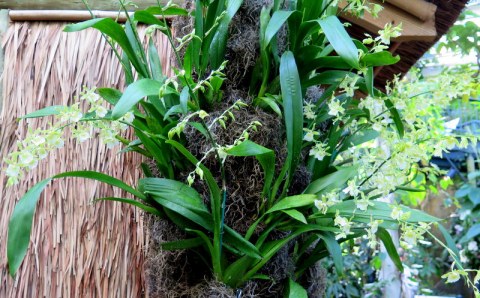
Oncidium Irish Mist ‘Big Hot Sun’ Photo by Carole Di Tosti
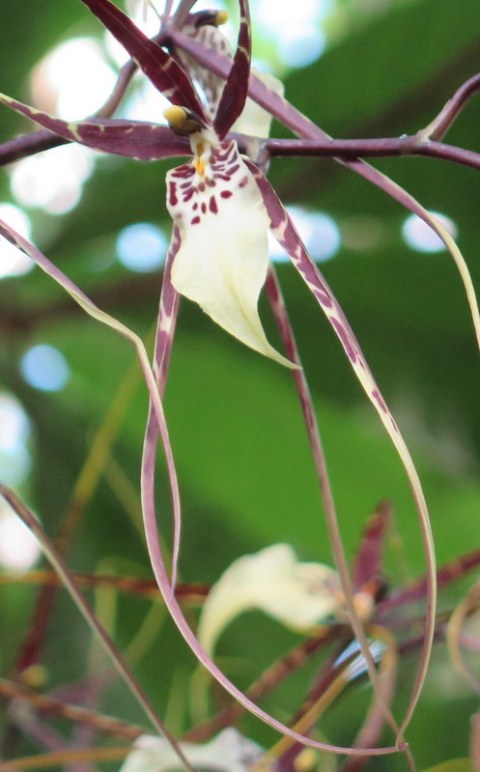
Bratonia Kaui’s Choice-note the long petals. NYBG Orchidelirium Photo by Carole Di Tosti
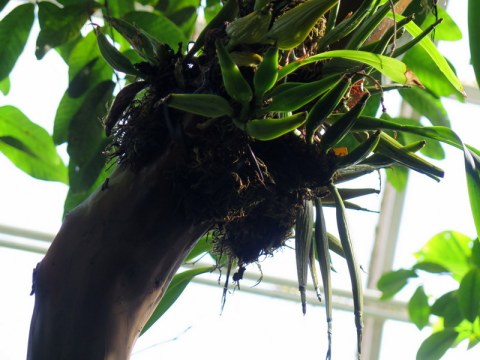
Vanilla orchid not in bloom, pods visible. Photo by Carole Di Tosti
Around each turn is the unusual, like the vanilla orchid whose pods are not beans and which is the only orchid of natural economic value from which we derive all our vanilla flavoring. According to Marc Hachadourian who walked with us along the orchid trail, the vanilla seed pod of the orchid is what is taken, dried and cured and as a result of that curing process or fermentation, that’s where natural vanilla comes from. So the Madagascar and Tahitian vanilla which is the real vanilla extract, comes from the seed pod of an orchid. Marc referred to the black flecs in Vanilla Haagen dazs ice cream which are from the vanilla orchid seed pod. “You see, you’ve been eating orchids your entire life and didn’t know it.”
As we move along the trail, Marc informs us of the tremendous diversity of orchids which are highly adaptable to all terrains and climates and are the reason why researchers use them in their plant studies. Along the pathway through the galleries that mimic the various terrains where orchids grow, you will encounter the desert orchid Eulophia Petersii.
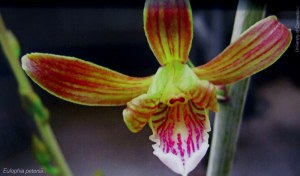
Photo of desert orchid in bloom in the NYBG desert gallery. Photo of photo by Carole Di Tosti
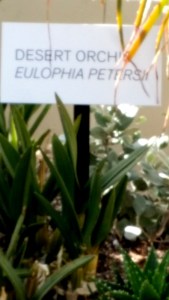 The Desert Orchid Eulophia Pettrsii has adapted to the terrain in that has stems like the swollen stems of a cactus and it has a defense; the edges of the leaves which are like a saw, may cut you. Orchids adapt to every location in the world but Antarctica.
There is also a display case filled with orchid miniatures and valuable, rare orchids from the NYBG’s permanent collection. Within the case is a yellow orchid from Southeast Asia that has the fragrance of horse manure, a scent irresistible to its fly pollinators. As he walked with us Marc Hachadourian discussed that he even had equestrians test it and verify the scent. According to Marc, “It’s one of the things that orchids are known for, the really bizarre pollination biology sort of verging on science and science fiction.
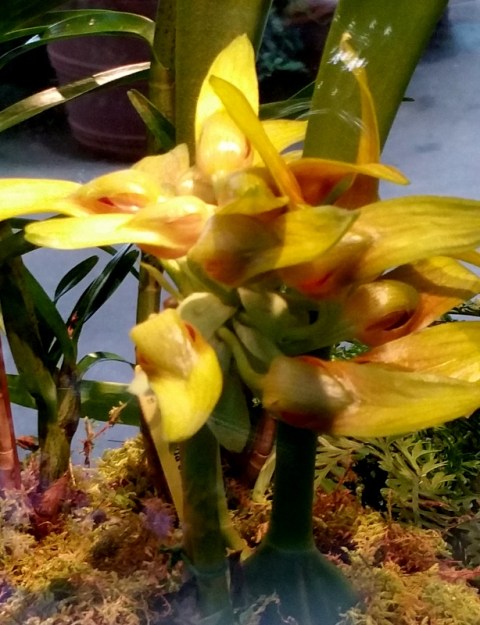
The Bulbophyllum orchid smells like horse manure fragrant to its fly pollinators. This may be found in the permanent orchid collection ,NYBG Orchidelirium. Photo by Carole Di Tosti
The winding trails of the rainforest gallery recall the thick jungles of an earlier time when thousands of undiscovered orchid species proliferated with abandon. Their abundance was staggering. It exists no longer, having fallen prey to wasteful plunderers. Stop to read the story synopses of collectors and nurserymen and see how the orchid hunters lived while under threat of tropical diseases (malaria, yellow fever, blackwater fever), big jungle cats, and other predatory animals. Historically recorded are some of the most dastardly examples of plant exploitation, cupidity, and habitat destruction, encouraged by the likes of self-proclaimed “Orchid King” Henry Frederick Conrad Sander.

On the orchid trail with Marc Hachadourian who points out the typical shelter of an orchid hunter at NYBG Orchidelirium. Photo by Carole Di Tosti
Sander sent out twenty explorers at a time to South and Central America, India, Burma, etc., all in the name of possessing, monopolizing, propagating, and monetizing the most inimitable specimens. The collector amassed a fortune, grew between 1 and 2 million orchid plants in his nurseries, and was named Royal Orchid Grower to Queen Victoria. The NYBG bought orchids from Sander. One of them, a Vandopsis gigantea purchased in 1904 and on display, is almost as old as the NYBG which is celebrating its 125th Anniversary this year. The Vandopsis gigantea is in its 112th year.
Behind the scenes of the splendid faerie blooms imperiously showcased in sedate upper class English parlours and Joseph Paxton designed conservatories (his greenhouse innovations influenced the Enid A. Haupt Conservatory design), lurked venality, bellicosity and coldblooded aggression. The orchid wilds were foreboding territories of mayhem and murder. Avaricious collectors like Sander and his competitors (Dr. John Lowe, Beechers, Veitch & Sons), hired ruthless, cutthroats to seek and discover peerless finds that would yield a veritable king’s ransom ($100,000 and more in today’s currency for a single orchid). If they could destroy their rivals’ orchid specimens, urinate on them, burn down forest habitats, cut down trees (4000 were cut during an expedition), throw competitors “off the scent” of a particularly stupendous find by slyly redirecting them, and generally assure their orchid bosses’ exclusivity in nature’s masterpieces, they succeeded. That was the “game of orchids.”
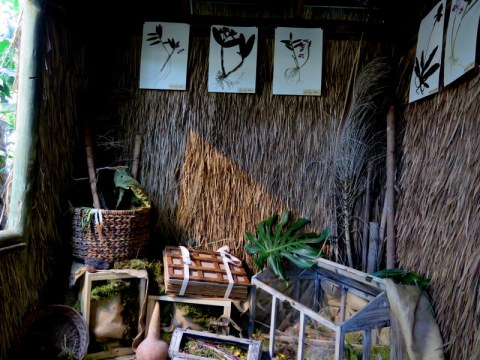
The interior of the hut with the implements the orchid hunter used including the Wardian Case found on the orchid trail NYBG Orchidelirium. Photo by Carole Di Tosti
Along the garden tour is placed an orchid hunter’s grass hut. Inside, along with examples of his tools and implements, is his Wardian Case (an early terrarium), where he would create a kind of micro-climate for his orchids’ preservation on the long journey home. Wardian Cases were also used to display orchids. A few in this exhibition display delicate orchid miniatures.

Photo of a sketch/photo of Benedikt Roezl, “Prince of Orchid Hunters,” an intrepid gardener, horticulturalist and orchid collector who discovered 800 different species of orchids. NYBG Orchidelirium Photo by Carole Di Tosti
The life of the orchid explorer was arduous and death-defying at every turn. One can review chronicles of those who drowned in the Orinoco (William Arnold), were attacked or mauled by jaguars and tigers, were felled by dysentery (Gustav Wallis), or yellow fever (Frantisek Klaboch), or robbed 17 times at gun or knifepoint (Benedikt Roezl). There were many who simply didn’t return. (David Burke, a Veitch hunter was murdered as many probably were). Indeed, though these brazen, plunderers might fiercely fight with spear, gun or knife, they were duty bound to come back alive with their “booty.” If they killed a rival or indigenous peoples to preserve their stash? Well…
Susan Orlean’s John Larouche of The Orchid Thief and the posse of Seminoles who were arrested in 1994 for poaching the ghost orchid from Fakahatchee Strand State Preserve are pussy cats in comparison to the wanton, fortune hunting Victorians. They were not constrained by any laws except the laws of the jungle, where only the fittest survived to plunder the precious rarities that had never been discovered before.
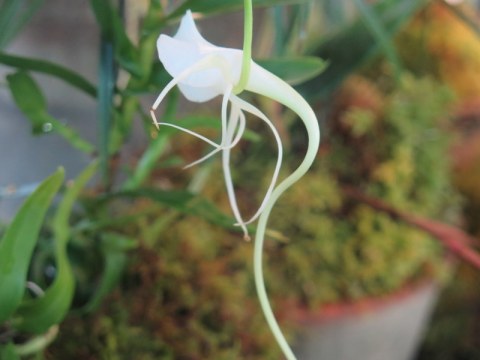
Rare orchid in the glass display case as part of the permanent collection. NYBG Orchidelirium Photo by Carole Di Tosti
Is it any wonder that Charles Darwin, Victorian contemporary and “fantastic observational botanist” (quote from Marc Hachadourian NYBG orchid curator), who was all too familiar with the rapacious frenzy of orchid collectors and the lurid stories of explorers’ dire misfortunes in jungles, high plains, mountains, and plateaus, that the notion of predatory survival in nature spoke to his heart and perhaps added weight to his evolutionary theories?There is a nod to Darwin as an aficionado of orchids with a marvelous explanation and illustrations of an ingenious discovery Darwin intuited about the Darwin Star Orchid and its pollinator that you can see on your way through the galleries.

Paphiopedilum (lady slippers) and Nepenthes (pitcher plants) in a gallery before the final exhibition centerpiece. NYBG Orchidelirium Photo: Carole Di Tosti
In the gallery just before reaching the finale you will find an interesting display of the unusual that Christian Primeau (see previous articles on this site) designer of Orchidelirium really enjoy: Paphiopedilum and Nepenthes which also can be found in the centerpiece where they are quietly tucked in and create uniqueness and an innovative touch to the usual gorgeous and brilliant displays.
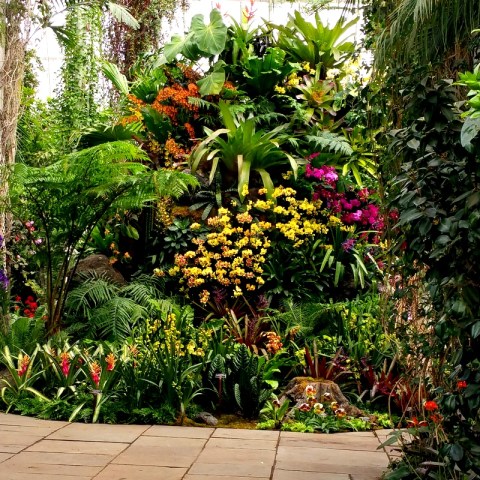
A view of the orchid mountain from the previous gallery. NYBG Orchidelirium Photo by Carole Di Tosti
On the final expeditionary leg one reaches the centerpiece of the exhibition, and the apotheosis of Victorian orchid frenzy, a 360 degree supernal, floral prominence rising over 8 feet tall in glittering, vivid technicolor. This otherwordly mountain is awash with orchids of varying species, Phalaenopsis, Oncidopsis, Oncostele, Oncidium, Vandas, Paphiopedilum (lady slippers). The hundreds of orchids vibrate a multitude of colors-fuscias, yellows, variegated pinks, roses, tricolors, whites, pale yellows, maroons, and more.

Another view of the orchid mountain with waterfall at the far side NYBG Orchidelirium Photo: Carole Di Tosti
They are a massive profusion, with smaller, quiet vignettes of orchids here and there on rocks clinging as orchids do. This splendid proliferation evokes what orchid hunters may have seen at the dawn of their exploration before the craze was underway and many had been ripped from their centuries old habitats. Jewels, they drape the mountain and create its texture rising up to the summit, sported by staghorn ferns and weird hanging Nepenthes (pitcher plants). Paphiopedilum, sit on rocks at the bottom of the two waterfalls planted with striking orange blooming bromeliads and Tacca chantrieri (black bat flowers) luxuriating in the water shallows.
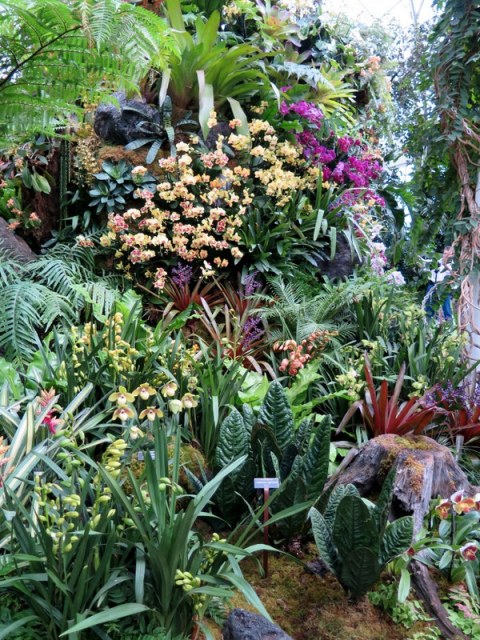
Another view of the mountain NYBG Orchidelirium Photo: Carole Di Tosti
Christian Primeau, the designer of the exhibition, was inspired into the mountain creation by an engraving of James Bateman’s (Victorian horticulturist and collector), naturalistic display in a conservatory at his country mansion, Knypersley Hall. The illustration appears in a two volume tome commissioned by James Bateman, The Orchidaceae of Mexico and Guatemala, (1843).
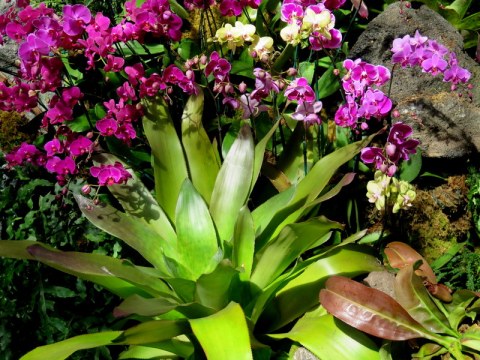
A studied vignette of the mountain with Bromeliads and Phalaenopsis NYBG Orchidelirium. Photo by Carole Di Tosti
This mountain created with volcanic rock, steel cubes, and chicken wire with a secret door to water the plants from the inside is “an homage” (Primeau’s words), to those who have gone before…to the avid collectors who endured the wrath of indigenous peoples, poisonous serpents, insects the size of birds, predatory animals, and murderous rivals in their exploits to scour unknown terrain, even lava-spewing volcanoes (Roezl did this), for the most exquisite and valuable of Orchidaceae. Despite the negatives, we have the Victorians to thank for their remarkable finds and innovations in cultivation and propagation.

Illustration of a potting bench with a variety of orchids one might find in an orchid collector’s greenhouse. NYBG Orchidelirium Photo: Carole Di Tosti
Victorian Orchidelirium gave birth to the billion dollar orchid industry that abides today. It even gave rise to the New York Botanical Garden’s ornate Victorian Enid A. Haupt Conservatory and its missions of research, preservation and protection of orchid species and hundreds of other plants that are becoming extinct because of illegal poaching, habitat destruction and climate change. With every delicate bloom, every fern, every pitcher plant, “Orchidelirium” is a bedazzling, live horticultural spectacular, a sterling exhibition to celebrate the NYBG’s 125 Anniversary.
The NYBG Orchid Show 2016 concludes April 17th. Check the Garden website for details about Orchid Evenings on Saturdays (March 12, 19, 26, April 2, 9, 16), as well as Friday (April 15), and Thursday (March 24, LGBT night). On select evenings visitors can also upgrade to V.I.P. status and enjoy an Orchid Lounge.
A shorter version of this article appeared on Blogcritics.
Interview With Christian Primeau Designer of NYBG Orchidelirium, Part II
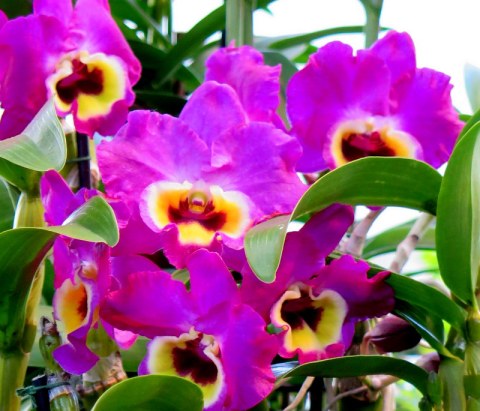
Dendrobrium Red Emperor Prince (cane orchid) NYBG Orchidelirium. Photo: Carole Di Tosti
In continuing my discussion with Christian Primeau, designer of NYBG Orchid Show, Orchidelirium, Christian discussed details about orchids and specific information about the show’s design and his background.

Christian Primeau designed Orchidelirium and overseas the tropical/subtropical plant collections at the NYBG.
How did you know which orchids you were going to select for the show? There are a lot of different orchids that I’ve never seen before.
That was our main focus with this show as opposed to many others. It’s always a spectacle. We wanted to really represent the scope of the orchid family as a show theme. The Victorians were passionate about finding super rare orchids. We wanted to show what that orchid geek’s greenhouse would look like and what a really passionate orchid collector’s greenhouse would look like. So we have the bulk orchids. The beauty in bulk is there to show people that range of how different the orchids can be. Their diversity is fantastic. A lot of people are familiar with the Paphiopedilum (lady slipper orchids). You can buy them at the grocery store. But we’re hoping to show people orchids and plants that they may not have seen before. It was easy too because we’re nerds and we might pick things that we might want in our greenhouse as well.

Cattlianthe Trick or Treat Fuchs Orange Nugget Orchids Photo by Carole Di Tosti
Did you find a lot of orchids that you had never seen before?
I was not familiar with a lot of the orchids. Marc is the orchid fanatic. He’s the curator. So he would come to me and say look at this and I would say that’s, fantastic, we have to have that in the show. So I did lean on Marc a lot for his expertise. And that was fun for me, too, because I learned a lot as we went along, too. It was great.

Nepenthes-tropical pitcher plants at NYBG Orchidelirium Photo by Carole Di Tosti NYBG
Which one of the smaller touches in the show did you appreciate?
Well, the vignettes. When I drew the actual design sketches, I knew the things that I wanted the most were the Nepenthes, which is not an orchid it’s a tropical pitcher plant. In my mind when I drew the sketches I had these tropical pitcher plants incorporated in with the orchids.. It’s ironic. People from year to year will target plants that are not orchids and say, “Look at those, that’s beautiful.” And we explain, “Yeah it’s not an orchid but it is beautiful.”So I wanted those Nepenthes. They grow on little pieces of tree fern that we have and that I’ve incorporated to grow over rocks. I think they go beautifully with the orchids. They give a little added touch and a little change in texture. So I do like those.

A vignette with Bromiliads and Paphiopedilum, NYBG Orchidelirium Photo: Carole Di Tosti
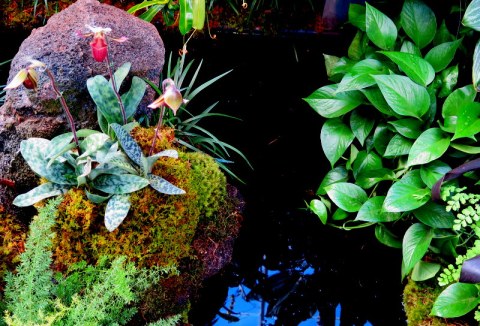
Another vignette with a Paphiopedilum, water, mosses, rocks, maidenhair fern and other Victorian plants (pothos). NYBG Orchidelirium Carole Di Tosti
In my head I wanted small. We never really showcased paths, the Paphiopedilum. I mean we have small pots, and we have little groups, but I wanted to show how they might grow. I incorporated flat rocks and put paths (lady slippers) on them and a bit of moss, something very simple but might make people stop and look and see that it is beautiful in its simplicity and appreciate those on their own. That way they wouldn’t get lost. But if you notice in front in the pool the little rocks that were put there to show people that vignette. That concept was mine, too. Given the scope of the project they are fairly inconsequential but I just wanted to incorporate them.

The greenhouse potting bench suggesting that of a Victorian “geek” collector with different orchids and prayer plant. NYBG Orchidelirium Photo by Carole Di Tosti
Are you amazed?
I am amazed at what my staff was able to do and I feel uncomfortable taking any credit. They are my guys. I can draw a picture, but without them there is no way this is getting done. There are 8 staff members and without them, no way. To their credit they stayed happy and positive. It was actually a pleasure. We were all exhausted but when they stepped back and looked and saw the little things that they had done and how they contributed to the entire show, I think they were really proud and I was proud of them. It was nice for me to see, even more so, I think, viewing the vignettes than the totality of it. It was great that all of my staff was represented. They’re passionate. They’re plant people. That’s what it’s all about and it was fun for me to see them work.

Bromeliad Aechmea Patricia’s Secret NYBG Orchidelirium Photo by Carole Di Tosti
How many orchids do you have in your collection?
The NYBG? The official line is thousands.
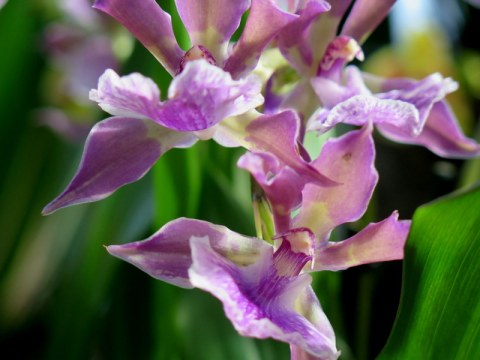
Zygonisia Cynosure ‘Blue Bird’ NYBG Orchidelirium Photo by Carole Di Tosti
What about in your personal collection? A few?
I have a select few but I’m more of a succulent person. It’s funny because they asked me to design the Orchid Show. I like cacti and succulents and my area of expertise is actually Madagascan aloes. But I do have some paphs (Paphiopedilum). I have a soft spot in my heart for the paphs, lady slipper orchids. In my personal collection there are six or seven of those but I do have a lot of the other plants that we show with them, the Epiphytic Cacti, Nepenthes (pitcher plants), the weird things. The weirder it is, the more I like it.

Tacca Chantrieri “Bat Flower” NYBG Orchidelirium Photo by Carole Di Tosti
You must know the medicinal properties of those plants.
One of my favorites points of information when I give a tour of the conservatory is I love to stop and ask people if they have any chemistry backgrounds. I’m fascinated by alkaloids. You know what alkaloids are. Basically, a naturally synthesized pesticide. So if it affects an insect, it affects a human system as well.
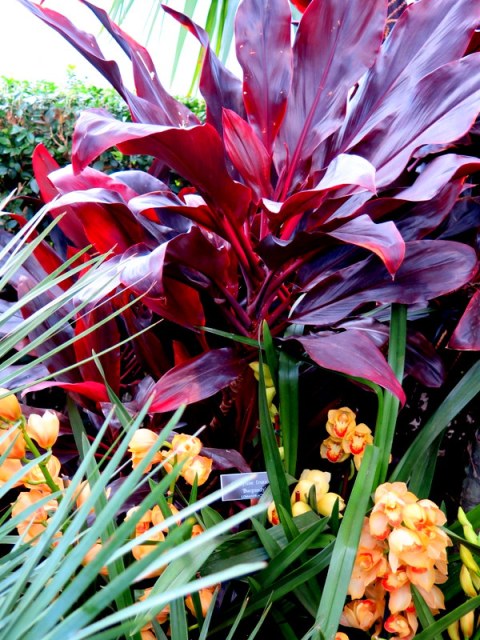
Cymbidium orchids and Lomandrace Burgandy Frutica Codyline NYBG Orchidelirium Photo by Carole Di Tosti
Caffeine is one of my favorite alkaloids, and quinine. I tell the story of how gin and tonic (quinine) was invented. Being in the tropics, the British learned to take quinine to stave off the malaria that was rampant from the mosquitoes. When they colonized India, British would mix their quinine dose with a little bit of sugar and a little bit of water and a little bit of lime. All they needed was to add the gin and that’s how they created a gin and tonic. Fantastic. (Apparently, Christian is a kind of alkaloid guy) All I need is gin and tonic at night and coffee in the morning and I’m ready to go.
Phalaenopsis with Bromeliads NYBG Orchidelirium Photo by Carole Di Tosti
Yeah, I’m fascinated by the chemistry of plants. Of course rain forest plants are in such a competitive environment, that these plants, all these beautiful orchid plants that you see and delicious fruit that you see at the grocery store are a product of that competition. Competition for pollinators, competition for seed disseminators. Every day you learn something new and that’s what I like about all of this. You can never know it all. It’s like a road that doesn’t end. And I have people ahead of me on that road that teach me things. Then, I can teach those coming up behind me. I enjoy it. I’m not the biggest orchid fanatic but I certainly can appreciate what Marc knows and what Marc does. He’s an encyclopedia. I joke with these guys about Marc. You flick a switch and he just goes and you try to keep up. I learn something from him every time.

Bromeliad Aechmea ‘Tropic Torch’ NYBG Orchidelirium Photo by Carole Di Tosti
Where did you work before the NYBG?
I was the Conservatory Manager in Bolyston Mass, Tower Hill Botanical Garden. It is smaller than this. The shows we did were far smaller in scale. But don’t you know, that’s where I cut my teeth. I learned a lot from Marco Polo Stefano. He’s had an incredible career. He was at Wave Hill Botanical Garden. Fantastic man. Still lives right around here. He gave me so much encouragement and I learned so much there and he actually encouraged me to come here. And I did and I never looked back. And I love it.
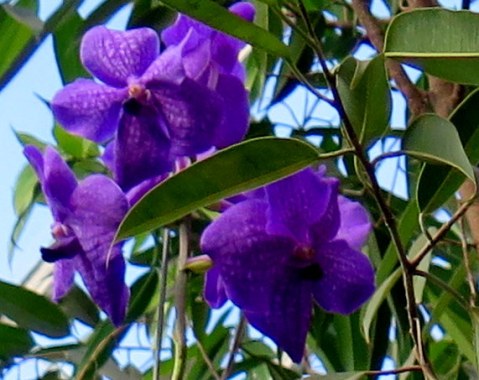
Vandas NYBG Orchidelirium Photo by Carole Di Tosti
You have to be a special person to love plants. Creative, unique a different sensibility.
Don’t you think, though, that many people can love plants?
Christian’s orchid mountain (see Part I) Don’t miss the yellow Paphiopedilum and Cymbidium orchids. NYBG Orchidelirium Photo by Carole Di Tosti
Yes. But what I mean is to have the sensibility and creativity to work here is great.
There is no where else I would rather be.

Another view of the orchid mountain designed by Christian Primeau Photo by Carole Di Tosti (see part I for his inspiration)
I can understand.
And I think part of this, too, when I was doing the show. You know the Dieffenbachia?

Pansy orchids, Moth orchids, Onicidium, Bromeliads, Staghorn Ferns and more in another view of the orchid mountain. NYBG Orchidelirium Photo by Carole Di Tosti
Yes.
The Dieffenbachia is a Victorian plant that has been around for hundreds of years. It’s the kind of thing my grandmother grew or people who don’t grow plants, if they get something for their windowsill, usually a Dieffenbachia or something along those lines that is fairly standard. I wanted to incorporate those, but I wanted to give it a little bit of a twist to show people how far we’ve come. So I used those traditional Victorian plants but I used modern cultivars. So these Bromileads are just wild, crazy, the Aglaonemas, the Aechmeas, the crazy variegation and crazy colors. So there’s the thing that somebody can recognize and say, “Yes, I grow that.” But they also can see the potential. My hope is that I hook people. Whether you’re an expert like Marc or just a casual grower, I wanted to get somebody interested. What’s the saying, “You can’t please everyone all the time?” Well, I wanted to try.
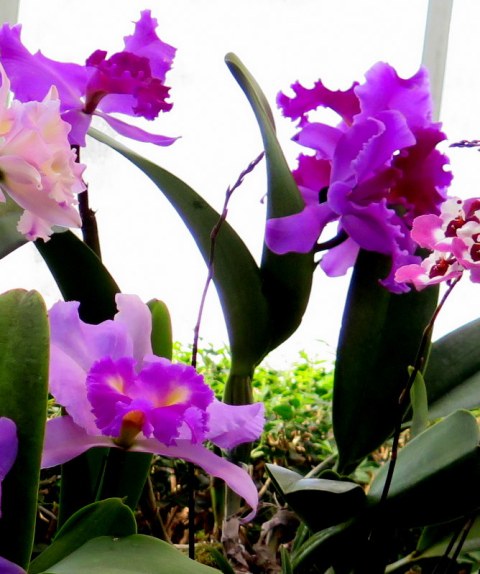
I don’t know what orchids these are but I love them. NYBG Orchidelirium Photo: Carole Di Tosti
Well, I think you definitely did. It’s a magnificent show.
We shall see. (Christian Primeau smiles)

One side of the entrance to the mountain: Moth orchids and Cymbidium. The bright green plants in decoration with the brown plants are mosses. Photo by Carole Di Tosti
The NYBG Orchid Show 2016 “Orchidelirium” concludes April 17th. Check the website for details.
Orchid Evenings Come for a nighttime cocktail experience on Saturdays (March 12, 19, 26, April 2, 9, 16), as well as Friday (April 15), and Thursday (March 24, LGBT night). On select evenings visitors can also upgrade to V.I.P. status and enjoy an Orchid Lounge.
World Beat: Music and Dance Around the World of Orchids Live performances from cultures around the world we be held on Saturdays and Sundays throughout the exhibition.
NYBG Orchidelirium Designer Christian Primeau Talks Orchids, Part I
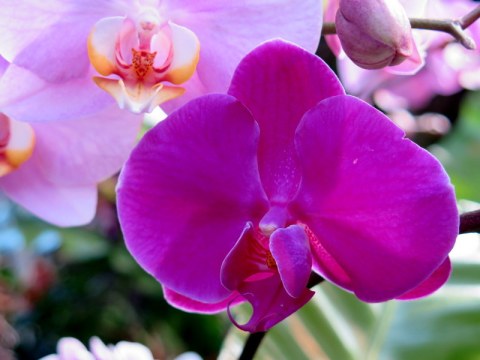
Beloved Phalaenopsis are one of the most popular of the thousands of man-made orchid hybrids. Orchidelirium at the NYBG. Photo Carole Di Tosti
Orchidelirium, the theme of the NYBG Orchid Show for 2016, refers to the Victorian period in England when there was a renaissance in the collection, research, propagation and cultivation of rare and exotic plants which eventually morphed into an obsessive craze for orchids. The selection of the theme dovetails with the 125th Anniversary of the Garden because the Victorians’ orchid obsession spawned many innovations in propagation and cultivation and hybridization of orchids that has continued to this day. The Victorian passion for illimitable orchid gems even improved trends in greenhouse design and helped inspire the Victorian design for the Enid A. Haupt Conservatory.

Phalaenopsis Shu Long Beauty, NYBG Orchidelirium. Photo by Carole Di Tosti
Indirectly, it is because of Victorian orchid mania that the NYBG has one of the largest institutional orchid collections in the world with over 7,000 individual specimens as a part of its entire collection, a fact which Marc Hachadourian orchid curator reinforces. The family Orchidaceae is the largest and one of the most varied of blooming plant families in the plant kingdom and as a result it has been used to conduct research and encourage efforts toward conservation and habitat preservation. Additions from the historic, permanent orchid collection are included in the Orchidelirium exhibition.

Angulocaste Red Jewel, NYBG Orchidelirium. Photo by Carole Di Tosti
Christian Primeau, the show designer and manager of the Enid A. Haupt Conservatory oversees the extensive tropical/subtropical plant collections housed in 11 unique environments in the Conservatory. Primeau reinforced the tremendous influence the Victorians had and continue to have today. It is because of them that orchids are the most charismatic and popular of plants. As NYBG orchid curator Marc Hachadourian says, “They are the pandas of the plant world.” It is their popularity that has encouraged growers and cultivators to create over 150,000 man-made hybrids for us to enjoy.
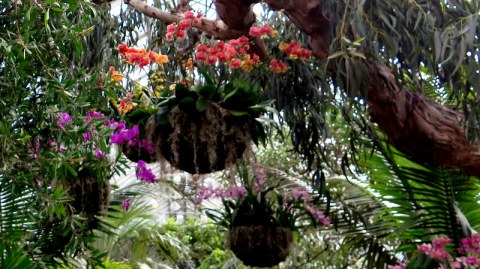
The many varieties of orchids at NYBG Orchidelirium galleries. Photo by Carole Di Tosti
Christian Primeau talked to a group of us about his design inspiration for the show and clarified that the two week installation period was a high pressured and frenetic but absolutely enjoyable time.

Christian Primeau, Orchidelirium’s designer
Orchidelirium has a whole different meaning for my staff and me because we’ve been working 13 hour days including weekends. We were pretty ambitious with the design and we hope you like it. But we’re all hallucinating at this point. I think I’m one of those rare people and I think Marc probably shares the same feeling of love for our jobs. It’s my hobby and my career. And it’s just what I’m passionate about. I hope that’s not the case, but loving one’s job seems like a rarity these days. I owe everything around me, this entire beautiful collection, this palate of plants that we get to work with, we owe all that to the people who came before us who were passionate. As Marc explained their motive may not always have been so pure, a lot of time it was a passion for personal glory or for profit, but in any case we owe what we have now, where we are today in this industry, everything around you that you see to that passion.

Introductory display in the Palms of the World Dome. NYBG Orchidelirium. Photo Carole Di Tosti
This is a celebration. We’ve been here 125 years. Orchid collecting has been going on for longer than that. So we owe this to the passion of those people. It’s an homage to those guys and ladies and people who sometimes gave up their lives so that we can enjoy these plants. And we also give them a nod because in terms of breeding and conservation, we’ve come a long way. We’re much more responsible, hopefully, nowadays in regard to collecting. Not always, but we’re trying. Of course, the mission of the garden is to move that along and to show the public these plants that they wouldn’t have access to see 125 years ago. Orchid collections was only accomplished with those who had the wealth to fund orchid expeditions for themselves or orchid collectors.
Orchid Mountain and waterfall at NYBG Orchidelirium. Photo by Carole Di Tosti
This is the centerpiece of the collection. (Christian points to the magic mountain of orchids towering above us.) When the Victorians obtained these beautiful plants, they would bring them into their greenhouses and try to stage them basically to reproduce nature. We found this incredible drawing. I think you all have access to it. It’s an 1837 sketch of the Epiphyte house at Knypersley Hall. (The illustration appears in a two volume tome commissioned by James Bateman, The Orchidaceae of Mexico and Guatemala, 1843). It’s about a 5-6 foot mountain they built at the center of the greenhouse, beautifully covered with ferns and orchids.
The orchid mountain rises above 8 feet at NYBG Orchidelirium. Photo by Carole Di Tosti
I thought, wouldn’t it be great to take this and put it on steroids? So I asked, “Hey, can you build me a fake mountain? And they came back and said, ‘No, that would cost as much as a vacation home in the Hamptons. But what you can have is a bunch of four foot by four foot cubes.’ So the bones of this mountain are four by four steel cubes stacked on top of each other. It looked great on paper. But when I saw them stacked I wondered, how are we ever going to make that look like a mountain? Hours later and many rolls of chicken wire later, we were able to mount it and plant it to look much like the mountain in the picture but just on a grander scale. It’s hollow and we have a little access door. I won’t tell you where it is. So it’s on the mountain and we can go inside and water it from the inside. All the orchids are wrapped by hand in moss so we can actually water them from the inside through the chicken wire. It looks like a beast to water but it’s fairly simple to do.
It’s an homage to those guys who really were so passionate and built these structures. It is naturalistic but that’s what they were going for and it is the inspiration for our centerpiece mountain. I really let my staff loose in terms of creativity. I cannot thank them enough because I really worked them to the bone. So as you walk around, you are going to see lots of little moments and vignettes so the character of each one of my staff members is actually reflected in certain moments in the display. I hope that people will find the moments that appeal to them whether it be the really intense colors or delicate colors or the moss areas or the small areas of the Paphiopedilum, the Lady Slipper orchids, to find something they can grab onto. My hope is that the orchid enthusiasts will be as psyched about the show as the people who are general plant growers. They’ll find something they can recognize or something that will spark that passion that we all have here. I mean that’s what it’s all about. We want to share what we love and ignite this love in them as well.

Paphiopedilum (lady slipper orchids) Photo by Carole Di Tosti
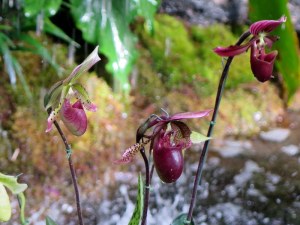
Vignettes of Paphiopedilum by the waterfall. Photo by Carole Di Tosti
I planned for a large waterfall in the front, and in the back something a little more peaceful. So we just wanted to have a mossy grotto of water, taller in the back and a bit crazier in the front. In the sketch there’s actually a bird’s nest fern at the top of the mountain. I thought it would be great to take a little license. So we took bromeliads up there and again on paper it looked great. But when we actually had to climb up the mountain carrying a 70 pound bromeliad, it became less fun but we got them up there and we got everything planted. And are fairly happy with the way things turned out. So that’s it. So this was based on that illustration that we talked about. And then we head into what I imagine Marc Hachadourian’s greenhouse looks like. For the crazy plant nerd, orchid geek, this would be the greenhouse that you see. And again we took license and as I said we’ve come a long way in terms of breeding and cultivars. What you see here crazy color, lots of contrast, lots of strange plants and again a huge, huge variety of orchids that we have in this section.

Orchids are epiphytic and grow on trees and rocks. Others are terrestrial orchids, depending on where they grow. Lots of plants will be epiphytic. Note the walls. They are reproductions of the walls that are actually in that scene from Knypersly, so we had those reproduced. A working greenhouse would be dingier and a little less densely planted. We have the potting benches where people can learn a little about propagating orchids and what a working greenhouse would be like but this section of the display it’s predominately ornamental. We tried to load it up with a diverse selection of orchids. The Phalaenopsis (moth orchid) on the mountain everyone is familiar with but you come in here and even if you’re a serious orchid aficionado, you will see a lot of interesting orchids you may not have seen otherwise. The more expensive orchids come from our permanent collection.

The Wardian Case with a variety of orchids of different sizes and shapes. Photo by Carole Di Tosti
Explorers and others used the Wardian Cases to transport orchids back in the Victorian era. They created and maintained that micro-climate to keep them alive. The show also highlights the history of Ward and the invention of the Wardian case wonderfully. The Wardian Case is a symbol of the Victorians.
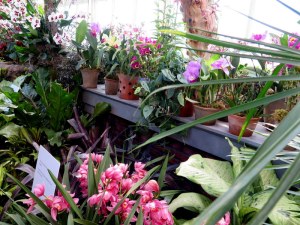
An example of an orchid geek’s potting bench with orchids in a greenhouse. Photo by Carole Di Tosti

Another example of a potting bench displaying a variety of orchids. Photo by Carole Di Tosti
The majority of the orchids that people buy are from Florida, Hawaii, California. The bulk orchids come in from nurseries around the country. And the rarer ones come from our collection. (What happens to the orchids after the show?) We all have plenty of orchids in our houses after the show. But we donate the rest to schools and societies and give them to people who use them to teach so they don’t go to waste. If they are degraded then we compost them. They have their own value and come back into the greenhouse or into the vegetable garden as they are recycled. So that’s what we tried to do with the show. It turned out to be more ambitious than we thought in terms of numbers of orchids, but I’m happy it doesn’t look like Q*bert the game. That’s what it looked like before we planted. I think we succeeded. We took Q*bert out of it, making it look natural.
Orchidelirium, The NYBG Orchid Show 2016, concludes April 17th. Check the Garden website for details about Orchid Evenings on Saturdays (March 12, 19, 26, April 2, 9, 16), as well as Friday (April 15), and Thursday (March 24, LGBT night). On select evenings visitors can also upgrade to V.I.P. status and enjoy the Orchid Lounge.
Orchidelirium: The NYBG Orchid Show 2016

Orchiddelirium, the theme of the NYBG Orchid Show 2016
Are you a fan of orchids? Do you properly care for them? Or do you end up having to throw them away? When orchids were first discovered, people were devastated when they killed them because other orchid plants were not easily accessible. in the 1900s orchids were a rare flower commodity until things began to change and they grew in popularity as they became known.
Orchidelirium was the title given to the Victorian era of orchid flower madness when collecting and discovering these exotic and beautiful plants was the intention of wealthy merchants and fanatical collectors. Motivated by the flower frenzy, they hired explorers to uncover different, unknown species from far flung reaches of the world oftentimes at great danger to themselves. The obsession with orchids never really died down if one reads Susan Orlean’s The Orchid Thief, a humorous tome about orchid collecting and the lengths to which those in the business go to indulge their passion for orchids, even theft.

NYBG Orchid Show 2016
For orchid passionistas, the NYBG has an extensive collection of exotic and rare orchids, some that don’t even look like orchids, yet, they do belong to the same plant family. Because of the ever popular annual orchid show in February of each year, it was no large leap to understand how NYBG orchid curators and exhibit programmers might have gained inspiration from the frenetic orchid craze of the Victorian era to revisit that time and spur on fans’ curiosity and love of the exotic blooms, by referencing the Victorians’ fervent obsession.
Orchidelirium the NYBG 14th annual orchid show which opens on February 27th and ends on April 17th, promises to inform, dazzle and celebrate the century-old appreciation of what Mark Hachadourian, NYBG Director of the Nolen Greenhouses and Rock Garden for Living Collections-and an orchid fancier, has characterized as the largest and most environmentally adaptive plant family in the world.
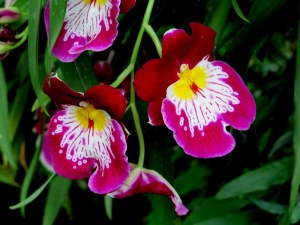
Pansy orchids from previous NYBG orchid shows.
Visitors to the landmark Enid A. Haupt Conservatory will step back into the time when orchids were a rarity to confound and mesmerize. Wealthy Victorians were surprised that some of the lavish blooms had no fragrance while others did. Nevertheless, they were enchanted with the orchid’s symmetry and pixie tongued faerie face that elevated the flower to a symbol of power, opulence and luxury in England.
The indulgent fascination with the vast varieties of blooms of a continuum of shapes, sizes and textures will thread the exhibit and highlight how these amazing flowering plants were transitioned from the wilds of jungles and deserts to indoor cultivation in conservatories and glasshouses, and eventual commercialization when the price could be stabilized and lowered for the middle classes.
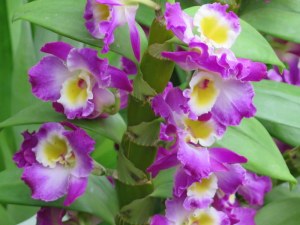
NYBG orchids from previous years at the Orchid Show.
The NYBG’s substantial and elegant permanent collection represents all the floristic regions of the world. These include Australia, Africa, South America, and Madagascar. The exhibition will showcase some unusual and rarely seen jewels in the NYBG orchid crown. One such specimen is the spectacular Psychopsis papilio which inspired the Duke of Devonshire’s obsession that instigated Orchidelirium in London. Another inspiration which will be displayed is Paphiopedilum sanderianum which was named for the nurseryman Frederick Sander, the self proclaimed “Orchid King,” a plant which is renowned for its petals’ remarkable length.
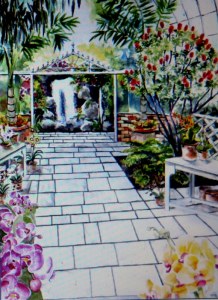
Orchidelirium at the NYBG Orchid Show 2016, evoking the Victorian era scenes with orchid blooms.
Moving on through the Conservatory galleries, visitors will learn about the transition of orchid growing. The trendsetting Duke of Devonshire began collecting orchids in 1833 at his Chatsworth House estate (still there today). His head gardener, Joseph Paxton, revolutionized the way orchids were cultivated in England by innovating larger and more effective glasshouses, beginning with the Great Conservatory in London and culminating in his masterpiece, the Crystal Palace of Prince Albert’s Great Exhibition in London in 1851.
A series of orchid vignettes will recapture the brilliant glasshouse displays that the Duke and other collectors tirelessly effected with their newly acquired delicate specimens brought back by explorers, hunters and adventurers with whom they fiercely competed for various plants and endured all manner of thrills facing animals, reptiles, humans who would readily pounce on them for disturbing their territory.

Orchid varieties number into the thousands. Some of these will be represented at the NYBG Orchid Show 2016.
From antique to modern, the orchids are in stand alones amongst the glasshouse greenery, as well as in hanging baskets, hanging pots, Victorian wall displays and elsewhere, in fact, wherever you turn. Each area of the conservatory will contain a diverse selection of orchids from around the world. Formal arrangements will be intermingled with casual plantings however, in typical NYBG fashion. And you can expect that all will be made exuberantly gorgeous and lush with a riot of blooms assaulting the intellect and immersing one in a sensory playland. A small stone patio will accommodate a stunning Wardian Case (an early type of protective terrarium for plants), housing a selection of miniatures.

pansey orchids from prior NYBG Orchid Show
Diverse programming will follow the exhibit during which a variety of events will take place: Orchid Evenings, World Beat: Music and Dance around the World of the Orchid. There will be weekend orchid care demonstrations with topics like “Easy Orchid Care,” “Fantastically Fragrant Orchids, and “Orchid Tips for Amateurs.” These important tips will encourage orchid purchasers and collectors to properly maintain their orchids so that they may bloom more than once and so that they may even harvest the orchid seeds. Once you become more familiar with orchids and their care, the temptation to throw away an orchid because “it won’t bloom,” will be counteracted with, “I am going to get this orchid to bloom a few times, and will NEVER consider throwing it away.”
Kudos go to designer Christian Primeau who oversees the extensive tropical/subtropical plant collections housed in 11 unique environments in the Conservatory. Marc Hachadourian curates the exhibit’s orchid selection and the NYBG’s extensive groupings of living plants from around the world housed in the Nolen Greenhouses, the behind-the-scenesglasshouses where plants for the Garden’s indoor and outdoor and science program are grown and maintained.
The 14th annual orchid show ORCHIDELIRIUM promises to be an enlightening and enjoyable way to usher in springtime at the NYBG. The show begins on February 27th and ends April 17th. You can learn more at the NYBG website by clicking HERE.
Photos and copy details courtesy of the NYBG.
 CAROLE DI TOSTI