Category Archives: NYC Theater Reviews
Broadway,
‘Downstairs,’ a Sanguine Thriller Starring Tyne Daly and Tim Daly

Tim Daly, Tyne Daly in Primary Stages’ production of Theresa Rebeck’s ‘Downstairs,’ directed by Adrienne Campbell-Holt (James Leynse)
Theresa Rebeck’s Downstairs is a hybrid drama-mystery, a thriller with sly, humorous overtones. As usual the playwright’s particular and complex characterizations startle with their humanity and angst. And the myriad themes that Rebeck tackles in Downstairs reverberate with currency.
Directed with acute precision and depth by Adrienne Campbell-Holt, and starring siblings Tyne Daly and Tim Daly as well as John Procaccino, Downstairs is a tour-de-force about relationships, wickedness masking as truth, second chances, hope, and the interior and unseen ebb and flow that happens in all evolving souls.
Written especially for the Daly siblings, the play exudes cleverness and wry import. She opens the intriguing story on the trash-heap of an unfinished basement, a workshop cellar with a couch and a few tables. Teddy (Tim Daly’s strikingly alive portrayal uplifts with power) emerges from the bathroom. As he carries on with the morning ritual of waking up, making coffee, and brushing his teeth, we understand that he has slept in the basement and is perhaps living there. Then Irene (the exquisitely versatile Tyne Daly, who is just extraordinary in this portrayal of the mousey, oppressed wife) comes down the basement steps and confronts him. She attempts to understand why he needs to be staying in their cellar.
From their conversation Rebeck reveals their prior estrangement and background circumstances since their mother died some years before. Notably, the forthright Teddy reveals his upset that their mother left Irene with the inheritance, which he deems unfair. They fill their discussion with questions that neither quite answers. Irene refuses to discuss how Teddy became disinherited. This exchange unsettles us. Their tense interplay appears shows us siblings who at this juncture cannot be described as showing good will toward each other.

Tyne Daly, Tim Daly in ‘Downstairs’ presented by Primary Stages at the Cherry Lane Theater in New York. The play, by Theresa Rebeck is directed by Adrienne Campbell-Holt and also features John Procaccino (not pictured) (photo by James Leynse)
Nevertheless, as they continue Teddy discloses that he has been poisoned by malevolent people at work. His truthful admission, though bizarre, opens Irene’s heart. She shifts from being defensive to accepting her brother’s plight and wanting to help him.
Throughout these initial exchanges, we make assumptions about Teddy’s mental and emotional condition and life’s circumstances. Evasive and scattered, he appears to have suffered a breakdown. Surely, he faces a crossroads in his life, especially if his sanity remains in question. But the brilliance of Downstairs is that nothing is what it appears to be. Neither the situation, the characters, nor the development of the conflicts play out the way we anticipate. Rebeck takes us for a dangerous ride fraught with suspense which remains far from the mundane family story we thought we had signed up for.
For example, the reconciliation between Irene and Teddy after their mother died is anything but mundane. Irene’s marriage and financial situation, which initially appear comfortable, normal, and steady, are a deception for numerous reasons that Rebeck reveals with adroit, painstaking details of characterization. We become enlightened about Teddy’s erratic “craziness” and quirky genius. And the estranged relationship between the siblings has little to do with each of them. Indeed, as the present veneers slip away and they connect with their deeper emotions, we discover the real culprit of their alienation.
Their inner emotions drive the energy and action. The actors craft their portrayals so carefully and sensitively, we identify and hope for Irene and Teddy. As they confess their truths to each other, Teddy listens and supports Irene’s confrontation of the lies within herself so she may heal. In her evolution, enlightenment, self-deception, and growth, Tyne Daly’s Irene soars. Her gradual empowerment with Teddy’s help thrills and engages us. Tim Daly’s Teddy displays individuality, bravery, and truth that can call down deception, corruption, and evil, uplifting us. Together, they beautifully manifest their eventual understanding that the ties that once bound them can be reconstituted. And this is so even though the world and the wicked have worked overtime to break their spirits and wreck their souls.

Siblings Tim Daly, Tyne Daly in ‘Downstairs,’ written by Theresa Rebeck, directed by Adrienne Campbell-Holt, presented by Primary Stages, Cherry Lane Theatre (James Leynse)
John Procaccino’s amazing portrayal of Gerry, Irene’s husband, creates the perfect foil for Irene and Teddy. He inhabits Gerry with sensitivity, finding the character’s motivation without going for result. Procaccino’s mastery of Gerry’s sinister presence is authentic and believable. This is not a spoiler. You will just have to see Downstairs to marvel at how these superlative actors work together to breathe life into Irene, Teddy, and Gerry.
In this wonderful production, the unexpected peeks around the corner of every scene. By degrees the story goes through many turns and twists. The more the truth of Irene’s marriage is revealed to her by Teddy, the more open she becomes with her brother and he with her. Rebeck gradually unfolds the mysteries. In the last scenes we finally understand what has separated them from the love they once held for each other.
Throughout this tautly suspenseful work, the playwright captures seminal themes. These include women’s empowerment, familial love, the vitality of childhood bonds, and the saving grace of compassion and goodness. There are numerous messages that echo for us today in the cultural morass between reality and fabrication, truth and lies, visibility and invisibility. I especially enjoyed the moment-to-moment, slow reveal of the struggle between good and evil, enlightenment and cover-up, and the extent to which we betray ourselves with self-deception. The title symbolizes and brings together many of these rich them
Downstairs is a must-see for the sterling performances and for Adrienne Campbell-Holt’s directorial craft. Each of these sends you to the edge of your seat and equally touches your heart. Look for the profundities that will wash over you long after you have left the Cherry Lane Theatre. Kudos also go to Narelle Sissons (Set Design), Sarah Laux (Costume Design), Michael Giannitti (Lighting Design), M.L. Dogg (Sound Design), and Leah Loukas (Wig Design).
Downstairs, a Primary Stages presentation, runs through 22 December at the Cherry Lane Theatre. Tickets are available online
‘Gloria: A Life,’ Starring Christine Lahti, directed by Diane Paulus, Off Broadway
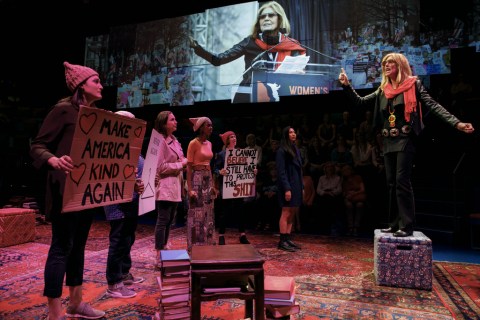
(L to R): Joanna Glushak, Christine Lahti, Fedna Jacquet and Francesca Fernandez McKenzie in ‘Gloria: A Life,’ by Emily Mann, directed by Diane Paulus at the Daryl Roth Theatre (Joan Marcus)
An older Irish white woman cabbie driving Gloria Steinem and Flo Kennedy to an event in Boston after overhearing their discussion about abortion said, “Honey, if men could get pregnant, abortion would be a sacrament!” Since then you may have seen that quote on cups, t-shirts, and other memorabilia. That priceless comment/story and countless others, plus witticisms, jokes, truths, and historical facts spill out in Gloria: A Life, written by Emily Mann and directed by Diane Paulus, currently at the Daryl Roth Theatre.
This exceptional production about the life and times of Gloria Steinem moved me to laughter and tears. Writing with extraordinarily seamless beauty, Mann trenchantly underscores how and why Gloria Steinem moved from bondage to freedom in her own life. And this account of how her transformation helped/helps countless women and men move toward freedom from destructive gender folkways resounds with power and reveals why Steinem has become a living legend
Steinem’s development and experiences, and her own influences from so many other women, serve as the backbone of this superb production. With archived photos, videos, voiceovers, and more, the director and writer form a mosaic of the unique perspectives of men and women who have taken part in and still embrace the women’s movement. We discover a key point: that Gloria’s continuing evolution has strode in tandem with the movement’s multiple stages.
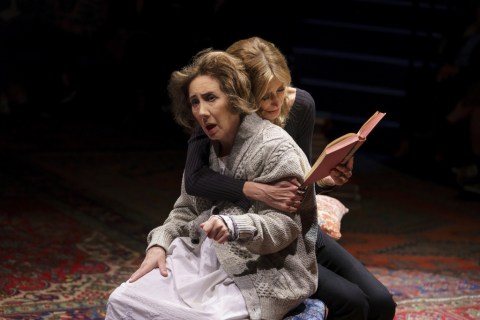
(L to R): Joanna Glushak as Gloria’s mom, Christine Lahti as Gloria in ‘Gloria: A Life,’ by Emily Mann, directed by Diane Paulus (Joan Marcus)
Adroitly, director Diane Paulus employs an ingenious, comfortable, interactive approach. She intersperses details, facts, stories, and themes about how women transformed the culture, through Christine Lahti’s portrayal of Gloria. Steinem’s development spins out from the stereotyping oppression and laws against women of her youth, to the legal revolution in support of women, in her 30s, to the current legal assault on women’s rights, in her later years. (As a reminder, our country has yet to pass an Equal Rights Amendment.) The actors take on multiple roles to reveal examples of the nullifying attitudes Gloria encountered early on. Lahti’s humorous portrayal sprinkled with good will reveals how Gloria eventually dealt with such attitudes as her eyes opened and she evolved.
As Lahti’s Steinem sanguinely points out, anti-feminist groups (represented by Phyllis Schlafly in the past) ultimately have the bottom line as their motive. Profits, not people’s concerns, fuel the hate rhetoric against feminists. Attempting to understand the logical truths behind what women are saying puts a downer on money making. Better for companies to stir people’s emotions with propaganda that makes them avid consumers. As such they buy products they don’t need to momentarily salve their soul sickness, stimulated by advertisements that browbeat them for not being perfect. The convenient, vacuous, catchy, divisive memes and gender-perfect advertisements perennially harm.
As she references such truths, Christine Lahti inhabits Gloria Steinem with joie de vivre and humility. Joanna Glushak, Fedna Jacquet, Francesa Fernandez McKenzie, Patrena Murray DeLanna Studi, and Liz Wisan portray the towering women who impacted Gloria. These include major influencers like her mom (a journalist who left her work to join her husband), Dorothy Pitman Hughes (who created the first non–sexist, multi-racial childcare centers), the feisty, no-nonsense Flo Kennedy, and lawyer, activist, and U.S. Representative Bella Abzug.

Christine Lahti as Gloria Steinem in ‘Gloria: A Life,’ by Emily Mann, directed by Diane Paulus (Joan Marcus)
Mann took from Gloria’s 2015 autobiography My Life on the Road the feminist icon’s early experiences and her trials as a journalist. Ironically, when she wrote the book, Steinem most probably didn’t imagine she would be speaking at the greatest global Women’s March ever in 2016. The production includes photographs and video clips of Steinem speaking in Washington, D.C. Though the women’s movement, like Gloria, has evolved, so much more work must be done in the Trump era. The inspiration to get us to move and participate in this work activates the
Particularly startling, Paulus includes video clips of the demeaning, acid attitudes of interviewers like Harry Reasoner, who later apologized when Ms Magazine sold out in eight days. For those too young to realize how far women have come, we see archived photos of memes showing with women whose only functions are as housewives and sex objects. Photos of such advertisements in the 1950s and 1960s prompts Lahti’s Gloria to quip, “Is this what some Americans are nostalgic for?”
I particularly appreciated the historical facts about the movement revealed in archived material. The production cleverly projects video and photographs over two back walls on opposite sides. The entire production seats with benches and colorful pillows for the audience in the round. On the stage in the squarish round, red Persian rugs and pillows suggest discussion circles.
Indeed the discussion circle is an important part of the production. In Act II a special guest each night opens the circle. Audience members may remain or leave. This theme also abides throughout: The discussion and integration of ideas happen in a circle where everyone sits equally. For the hierarchy (the pyramid) to diminish, we must hear, see, listen to, and interact with each other as comfortably as our Native American forebears chose to do. Steinem points out that Native American democracy included such discussion circles and caucuses. Women were integral parts of these, a fact that stunned (and inspired) Benjamin Franklin when he learned about culture of the Iroquois Confederation
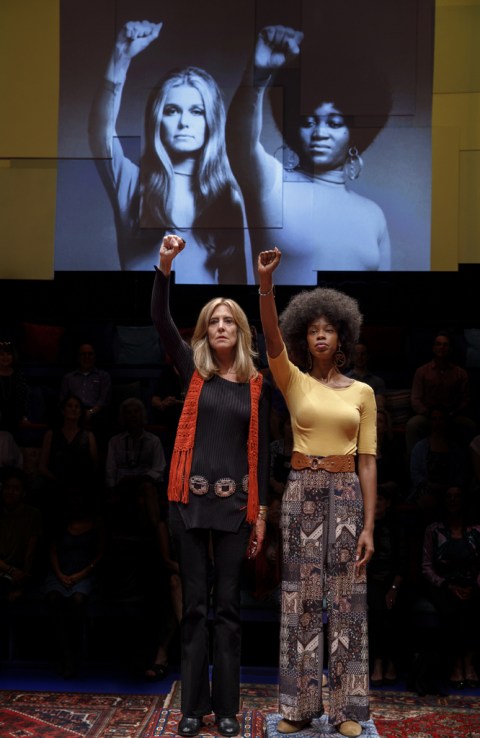
(L to R): Christine Lahti as Gloria Steinem, Fedna Jaquet as Dorothy Pitman Hughes in ‘Gloria: A Life’ (Joan Marcus)
Gloria credits her ideas and actions to the mighty courage and determination of black women, Hispanic women, and Native American women. In underscoring who remained instrumental in spearheading second-wave feminism, she presents a list with photographs of black women who were crucial to the movement. Paulus projects their pictures with inspirational quotes on two screens. The list includes Dorothy Pitman Hughes, Flo Kennedy, Pauli Murray, Aileen Hernandez, Fannie Lou Hamer, Shirley Chisholm, Margaret Sloan, and Alice Walker. Wikipedia doesn’t recognize some of these women, but Gloria credits them for their prodigious efforts.
Finally, wonderful milestones are noted. For example we see acutely how our culture changed. Yet more change is needed with regard to the artificial gender images fostered by corporate agendas. As Lahti inhabits Steinem, Mann’s brilliant encapsulation of Gloria’s words through Paulus’ sterling direction opens our eyes. What we may have thought we knew bears hearing and seeing again and again. Indeed, this all-female production stirs us as an amazing, uplifting experience. Most importantly, it has the earthiness, historical universality, and erudition to appeal to all genders, races, and religions.
Would even evangelicals appreciate this production? Of course. Don’t women make up more than half of their numbers? Indeed, sharing stories about men’s personal habits always resonates. For example the actors include humorous stories about non-partnership minded men who leave their underwear on the floor, expecting their wives to pick it up. Such stories of personal lives are integrated beautifully to illustrate the importance of discussion among women. The more women talk to each other, the more healing comes, the more solutions to problems may be found.
At the heart of what is called the women’s movement, Gloria’s life’s work promotes freedom for men. Indeed, women and men both need freedom from the nullifying, dis-empowering macho and female roles of domination and passivity. These roles deny personality, growth, evolution, partnership, friendship, companionship, and the integration of the family unit beyond commands and orders.

(L to R): Christine Lahti as Gloria Steinem, Joanna Glushak as Bella Abzug in ‘Gloria: A Life,’ directed by Diane Paulus, written by Emily Mann (Joan Marcus)
Gloria: A Life suggests that women and men should have equal opportunities for medical care, financial wellbeing, family care, and prosperity. That the privileged wealthy minority will use gender division to cloud our eyes and misdirect our pursuit for human rights for all is a given. Noted, and stopped, say Gloria and millions of others. We must work to bridge the divide and jettison such roles, which crucify all genders and destroy the social good.
By looking at the past, though we may not have been alive at the time, we understand the value of what women globally endured then and now. Also, by understanding the past, we appreciate and value the hard-won freedoms (Roe v Wade, LBGTQ marriage equality, a woman’s right to use her own name, etc.) that women in democracies enjoy. Still, throughout these moments of progress highlighted by the actors and visuals in the production, concerns about the present political climate whisper.

Christine Lahti (center) as Gloria Steinem with cast of ‘Gloria: A Life,’ by Emily Mann, directed by Diane Paulus at the Daryl Roth Theatre (Joan Marcus)
Understanding becomes crucial to our growth. The production fosters understanding. And from this understanding we realize that the current political partisanship has pushed us to a precipice. All the more noxious are the agendas right-wing organizations like the Federalist Society and conservative think tanks use to consolidate power on the right. For these uber-conservative organizations, women’s rights must be overthrown and diminished as a political initiative. The prize to be gained includes corporate hegemony. The power and money behind these groups are used to maintain supremacy over puppet leaders. And they intend to employ “unbeatable” partisan, conservative voting blocks of nativists, anti-feminist groups (Neo-Nazis, white supremacists), and evangelicals (anti-abortionists, etc.) to maintain or usurp power by any means necessary.
For what it encourages – to understand ourselves today through viewing the past – Gloria: A Life is a must-see. Additionally, you will enjoy its humanity, good will, and uplifting remembrance of history, as well as Christine Lahti as Gloria, the sterling ensemble performances, the active staging, and Mann’s integrated writing of Gloria’s perspectives. All of this enthralls and contributes to making the production soar.
Gloria: A Life runs until 31 March 2019 at the Daryl Roth Theatre in NYC. Stay for the discussion circle in Act II and raise questions with the cast, audience, and special guest. Or just listen. Tickets are available online
‘The Lifespan of a Fact,’ Starring Daniel Radcliffe, Cherry Jones, Bobby Cannavale

(L to R): Daniel Radcliffe, Cherry Jones, Bobby Cannavale in ‘The Lifespan of a Fact,’ directed by Leigh Silverman (Peter Cunningham)
What are facts? What is truth? Can you state truth without a factual basis? These questions debated for centuries have been redefined in every age. Playwrights Jeremy Kareken, David Murrell and Gordon Farrell refine the debate in an intriguing and humorous go-around between a fact-checker and his essayist in The Lifespan of a Fact. The play incisively directed by Leigh Silverman is comically paced for its light side. And its darker side leads to questions about how information, “facts” may be misused in the wrong hands. The production suits in our time of “alternative facts,” and truths skewed to make a larger point about the human condition.
Based on the titular book/essay written by John D’Agata and Jim Fingal, the “true” story tells what happened when Jim Fingal fact-checked John D’Agata’s poignant essay about a teen’s suicide at a Las Vegas resort. The play explores their individual perspectives about the importance of writing for impact despite the inaccuracy of ancillary background details. But more importantly, it explores personality types and the very funny heightened alerts that sound when an obsessive compulsive, detail-driven nerdy researcher clashes with a loosey-goosey, poetic, symbolic, “going meta” writer with panache.
The conflict generates when Emily Penrose accomplished, saavy editor of a magazine chooses John D’Agata’s piece because of its social import. In hoping to get the article turned around for publication in less than five days, Emily appoints Jim Fingal. As the fact-checker he will ground the details of D’Agata’s piece for consonance and coherence to reality.

Bobby Cannavale, Cherry Jones, ‘The Lifespan of a Fact,’ directed by Leigh Silverman (Peter Cunningham)
Cherry Jones portrays editor Emily Penrose with humor, good will, yet stern determination. Strong-willed and no nonsense, yet measured, she selects her new hire, Jim, quickly assessing him and asking all the right questions. Happy with his reasonable answers, she sets him spinning off on his journey. Indeed, her expectation rides on Jim’s assurances that he will make the deadline. Ironically, the opposite occurs. Not because the fact-checker is incompetent. But because his magnificent competence strains the credulity of time and patience.
As Jim, Daniel Radliffe reveals his gifts for timing. He employs the right amount of deadpan edginess. And his ironic delivery isn’t quite over the top, but appears organic with his researcher ethos. Though he exasperates Emily, he does so out of ego pride of meticulousness. Indeed, she does not fault him for doing a fine job. And despite Radcliffe’s history with owls and wands, we appreciate his portrayal of Jim’s excellence, however a tad outrageous. When you see this too good to miss production, consider the traffic map which Jim uses to prove John’s inaccuracy on the day of the teen’s suicide.
Bobby Cannavale stands on the opposite continuum of Radcliffe’s Jim and pushes back with parries, jibes and wordy counter punches. Cannavale’s portrayal has John D’Agata’s indignation finely tuned. And we respond with riotous laughter. His initial attitude toward the fact-checking assaulter of his exquisite prose reveals a huge ego. Despite all the word talk, these male egos can barely be in the room together. What a pleasure to watch Radcliffe and Cannavale go head to head.
Indeed, after the two meet, we note their reactions pair beautifully with their physical types. Jim, fits the researcher twerp type, diminutive in stature and voice but a giant in intellect and research skills. By comparison John D’Agata’s muscular presence and bruising confident carriage signals macho. The irony that he is a romantic and goes for the meta sources the humor between them. However, the fact-checker holds sway. And D’Agata becomes affronted by the miscalculations Jim tells Emily that John has made. How dare this guy attempt to restrain and retrain his ineffable, high-minded prose?
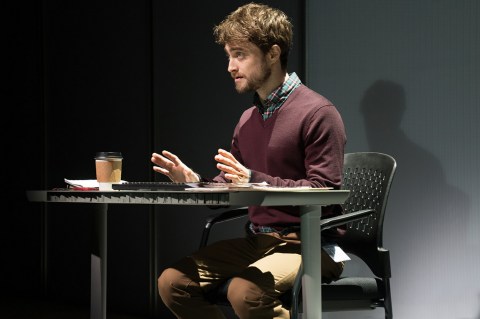
Daniel Radcliffe in ‘The Lifespan of a Fact,’ directed by Leigh Silverman (Peter Cunningham)
Of course the humor explodes every time Jim attempts to toggle John. And the exceptional Bobby Cannavale’s bite challenges worse than his roar. Indeed, only Emily can straighten out the warfare between the two. How this evolves and resolves remains as the meat of the play. Indeed, she exquisitely maneuvers the two male egos, forces them to recede and calls upon “their better angels” to emerge.
This ensemble piece moves quickly. It arrives at its non resolution resolution with delectable, sometimes rolling in the aisles comedy. The philosophical arguments hold worthwhile import. Emily as the arbiter explains why responsibility for accuracy must be taken with extreme seriousness for publications. And yet, the vitality of striking the readers’ emotions with well-written prose that sings also must be taken seriously. Thus, the two perspectives must combine with equanimity. One must not submerge the other. Indeed, John’s intimation at truth is not enough. Facts secure it and make our feelings about an essay indelible and irrevocable.
Silverman’s direction and staging works well. The emails written among Emily, John and Jim provide the opening salvos of humor. Through screen projections we get to read and appreciate the writing styles of both the researcher and the essayist. Of course, the humor and explosions escalate during their live interactions as the notorious Jim investigates the scene of the suicide and visits the uber frustrated John. How Emily arrives at the scene to stem these two embattled paces with LMAO humor.
You will enjoy the superb cast who Silverman has brimming with fast-paced quips that slide down easily. Their finest scenes take place in John’s Las Vegas home when each faces off against the other. How they negotiate their own ire, frustration, and need to harangue mentors us with the silence of their inner thoughts and the power of their words. With intellect, logic and rationality they persuade. How refreshing!
Kudos go to Mimi Lien for Scenic Design, Linda Cho for Costume Design and Jen Schriever for Lighting Design. For Original Music and Sound Design we have Palmer Hefferan and for Projection Design, Lucy MacKinnon. For Hair and Wig Design, kudos to Charles G. Lapointe.
The Lifespan of a Fact currently runs at Studio 54 (254 W 54th) with no intermission until 13 January. You can purchase tickets at their website.
‘FABULATION, OR THE RE-EDUCATION OF UNDINE,’ by Lynn Nottage, Review
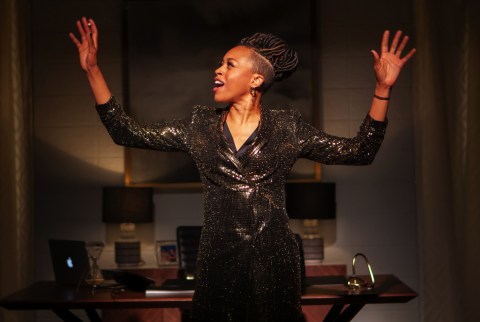
Cherise Boothe in FABULATION, OR THE RE-EDUCATION OF UNDINE by Lynn Nottage, directed by Lileana Blain-Cruz (Monique Carboni)
First, Lynn Nottage is a master story teller. Secondly, she is a master playwright, an avid spinner of profound characterizations and themes. With an antic zeal for weaving humor throughout organic dialogue that establishes her unique characters, Nottage continually lays bare the most exasperating and trenchant aspects of the human condition. If one is color blind, which Nottage mightily encourages, you see yourself in the arc of her characters’ inevitable development. For growth is the sum total of where we all are going, is it not?
FABULATION, OR THE RE-EDUCATION OF UNDINE, wonderfully directed by Lileana Blain-Cruz, is typical Nottage in its maverick brilliance and marvelous exploration of the complexities of black culture and identity. Essentially, with sardonic humor and LOL comedic fun, Nottage spirals out the larger-than life evolution, devolution and reaffirmation of the fabulous Undine. This hybrid genre two-act play (satire, “narrative of the life,” comedy-with threads of the macabre fantastic) strikes with irony and hyperbolic authenticity, turning every stereotype on its head to arrive at a satisfying resolution.
Currently at The Pershing Square Signature Center, the production is a must-see for its LMAO wit and profound revelations about class and culture. And tucked carefully away between the guffaws and belly laughs is this universal wisdom. When pursuing wealth and status, sidestep the alluring predations and pitfalls by remaining real. One way or another during your life’s journey, you’re going to get to the end of yourself. So you might as well avoid all the heartache and space shuttle gyrations and keep it soul local! Hyper money and status don’t bring truth unless you pivot, plummet and fall. When you reach bottom, if you’re still alive, you “get it,” and will then appreciate what you’ve learned.

MaYaa Boateng, Marcus Callender, Cherise Boothe, Dashielle Eaves in ‘FABULATION, OR THE RE-EDUCATION OF UNDINE by Lynn Nottage, directed by Lileana Blain-Cruz (Monique Carboni)
Importantly, in FABULATION, OR THE-RE-EDUCATION OF UNDINE, Nottage’s protagonist bounces off the most reprehensible and meretricious elements of the nouveau riche who “seduce” the black bourgeoisie into internalizing their corrupted values. Chief among these include the canard that money and celebrity bring personal power and satisfaction. Undine comes across this truth through a divergent, fantastic, incredulous sequence of events that can only be likened to divine comedy. As we follow her on the ride, if our eyes are open, our mouths eventually breathe out a sigh of relief for it will be well for her. But at various twists and egregious turns downward, we believe Undine to be heading to hell with no one to pull her back except Nottage’s deft story telling.
At the outset of the play, we identify an apparently successful Undine. Portrayed with a piquant and vibrant drama queen personality, Cherise Boothe continually astonishes with engaging humor and likability. Her Undine hits all the emotional high notes of comedy with a range of authenticity that keeps the audience laughing. Yet intriguingly we are aware of the seriousness of her wise commentary beneath all of the humorous riot.

Cherise Boothe, Nikiya Mathis, Heather Alicia Simms in FABULATION, OR THE RE-EDUCATION OF UNDINE, by Lynn Nottage, directed by Lileana Blain-Cruz (Monique Carboni)
From her demeanor and treatment of underlings, we note that Undine’s rabid and rapacious ambition and power has steered her to the top of her game. We discover she owns and manages a PR firm catering to the needs of the black bourgeoisie. Humorously, we learn this after her accountant and an FBI agent inform her she’s “got some issues to deal with.” Ironically, her success and the lifestyle it precipitates ends up placing her in a situation that she is ill equipped to handle. This noxious situation moves in the form of Hervé (the smooth Ian Lassiter), a slick Argentinian whose fabulous tango moves, hot kisses and an ingenious sleight of hand where her bank account is concerned sweep her up into a two-year marriage. When Hervé absconds with her money and life’s work, this ending initiates Undine’s journey and the dynamic momentum of the play.
Shepherded by the adept directing skills of Blain-Cruz, we watch Undine who Nottage moves from the interaction of this opening scene to an Undine “confidential. Upon the arrival of Agent Duva, Undine breaks the fourth wall and elicits our confidence to explain how she became “Undine.” Eschewing her Brooklyn ways, Undine confabulated herself. Undine is her new identity which she created when she bravely struck out on her own, as many of her race did before she moved “up from slavery.”
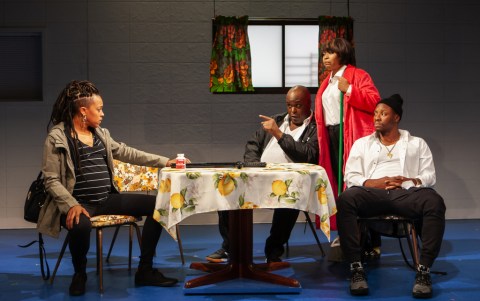
(L to R): Cherise Boothe, J. Bernard Calloway, Nikiya Mathis, Marcus Callender in FABULATION, OR THE RE-EDUCATION OF UNDINE,’ by Lynn Nottage, directed by Lileana Blain-Cruz (Monique Carboni)
Of course since the play takes place in the present, this metaphor of identity and race improvement stretches to a wonderful and sardonic breadth and length that only Nottage can evoke with clever dialogue and allusions. It seems Undine at thirteen left home on scholarship and morphed herself by attending an Ivy League school. Transformed into a player, Undine internalized upper crust values and negotiated/networked with the upper classes to become an entrepreneur. She achieved success externally.
However, Undine has not done the work internally. And it is this which snares her in the Hervé trap and sets her on a downward momentum externally and inner enlightenment. As life/fate/consciousness would have it, this all begins when Undine comes to a pivot with a mild physical breakdown at the critical moment. The FBI agent tells her Undine shows up on no records; they cannot find out who Undine is. (The irony is wonderful.)
With us as her confidantes, Undine shepherds us through her story that evolves with flashback scenes. From hospital to moving out of her office, the scenes quickly pace as Undine steps from the realm of the fantastic Undine “fabulation” closer to the authenticity of self. Ironically, the fantastic follows her and apparently is an integral part of who she is. She seeks a Yoruba priest who tells her she must placate the spirits who are angry with her. To ameliorate their ire it will take a bottle of rum and the last of Undine’s money. The priest informs her there is something she must do to straighten out her life. Of course it is the last thing Undine wants to hear. As if that weren’t extraordinary enough, Undine’s journey takes her to additional and amazing adventures in the “real.”

Nikiya Mathis, Cherise Boothe, Mayaa Boateng in FABULATION, OR THE RE-EDUCATION OF UNDINE, by Lynn Nottage, directed by Lileana Blain-Cruz (Monique Carboni)
Nottage shifts the dynamism alternating the action between Undine’s ironic story telling breaks to flashbacks of illustrative scenes relating her journey back to the fantastic real of Brooklyn. The director beautifully shepherds this ebb and flow and maintains the pace of comedy. We connect with Undine’s ironic comments and eagerly follow the rhythms of development in Undine’s “re-education” to discover who she is. For extreme fun, as fate and the spirits would have it, Undine is forced to confront every situation of Brooklyn street life she attempted to avoid when she ran away to her Ivy League education and “Undine” identity and lifestyle. Nottage’s sardonic situational humor is precious.

Ian Lassiter, Cherise Boothe in FABULATION, OR THE RE-EDUCATION OF UNDINE, by Lynn Nottage, directed by Lileana Blain-Cruz (Monique Carboni)
FABULATION, OR THE RE-EDUCATION OF UNDINE is just great for its comedy, complexity, questions about identity and culture, examination of issues about growth, and themes which all of us can take to heart. The superb ensemble who portray various roles in conveying Undine’s journey include Mayaa Boateng, Dashiell Eaves, Heather Alicia Simms, Ian Lassiter, Nikiya Mathis, J. Bernard Calloway, Marcus Callender.
The director deserves much credit with the actors for breathing life into this enjoyable and shimmering comedy. The staging is excellent, the pacing never drops the humor. Look for the little stereotypic bits which I dare not reveal for fear of spoiling the surprises.
Final kudos go to Adam Rigg (Scenic Design), Montana Levi Blanco (Costume Design), Yi Zhao (Lighting Design), Palmer Hefferan (Sound Design), Cookie Jordan (Hair and Wig Design).
FABULATION, OR THE RE-EDUCATION OF UNDINE runs with one intermission at The Pershing Square Signature Center until 13 January. You may purchase tickets at their website.
‘The Hard Problem’ by Tom Stoppard at Lincoln Center Theater, Reviewing a Profound Work
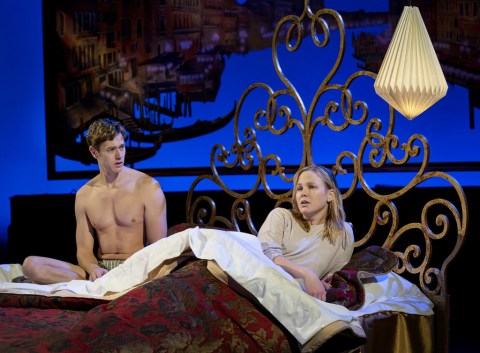
Chris O’Shea, Adelaide Clemens in ‘The Hard Problem,’ by Tom Stoppard, directed by Jack O’Brien, Lincoln Center Theater (Paul Kolnik)
The Hard Problem by Tom Stoppard initially premiered at London’s National Theatre in 2015. Since then, Stoppard tweaked the play. Director Jack O’Brien has given it another rendering for its New York presentation at the Lincoln Center Theater’s Mitzi E. Newhouse. The production intrigues, heavy with scientific and philosophical intent. When the epiphany arrives at the conclusion, heartfelt emotions stir us. Then we marvel at how Stoppard threaded the interplay of scenes and characterizations into a lovely fabric of hope and the culmination of faith’s efficacy.
As with all Stoppard’s plays, The Hard Problem deals with questions. These include questions about existence, faith, fate vs. coincidence, goodness vs. evil and divinity. He shores up these questions against the backdrop of current scientific debates about the brain vs. consciousness which encompasses what characters refer to as “The Hard Problem.” Indeed, neuroscientists suggest the brain creates consciousness. On the other hand some believe that existence may be characterized by the reverse, that consciousness creates humanity. This latter theory borders on intelligent design, that a greater consciousness formulated the universe and all that it encompasses in its beautifully coherent, complex and infinite display..
Of course much of science opposes the notion of Intelligent Design. And Stoppard presents the thesis antitheses continuum not only in the central questions of the play, but in his extrapolation of themes which playfully present various characters’ “take” on “the hard problem.”
As a result we are led to consider the possibilities of our existence through Stoppard’s sly, humorous perspective. For example one concept posited is that a human being is just a mechanism, a machine whose every cell function can be recorded via empirical data. Thus, after millennia, the evolution of the carbon life forms that currently exist, results from self-dealing and self-interest. Evolution and the idea of machine body survival relies on evolutionary instinct and egocentric action to preserve oneself and one’s species.

Adelaide Clemens (foreground) with Eshan Bajpay (left) and Robert Petkoff, in’The Hard Problem,’ by Tom Stoppard, directed by Jack O’Brien, Linclon Center Theater (Paul Kolnik)
The response to the computer model of existence can easily be breached by the aspect of consciousness. For example where does feeling and emotion come from, our thoughts brewing in the “mind”? Those do not show up on any brain scan or measurement. Science has no answer for what “the mind” and “consciousness” are. It cannot be measured on brain scans when folks in a coma or death states show no brain activity. Yet, if they have come back from that state (and many have) with incredible stories to tell about what happened “over there,” neuroscientists cannot adequately answer with proof. (For a further discussion of this check out the author Eben Alexander.) Looped into these arguments are discussions of ethics and morality, the desire to be good versus the impulse to trod on others to advance In consciousness, where do the impulses toward “ethics” and “morality” generate from when they do appear in human behavior? Do any of us act with altruism? Or is self-benefit the sum total of our “machine” behaviors?
The questions are heady. But Stoppard humorously frames them with events which illustrate the arguments as the characters’ behaviors and actions set them in motion.
As the play opens graduate student Hilary (Adelaide Clemens), and her maths tutor, Spike (Chris O’Shea), debate the impulses of egoism versus altruism, as a preamble to her receiving math help. Hilary has applied for a research slot with The Krohl Institute for Brain Science. Spike reviews the maths on the model she plans to submit in her application. After they have sex, Spike notes that Hilary prays. As a scientist and atheist, he remains shocked that she believes in God. Quips fly back and forth with a brief debate of His existence.
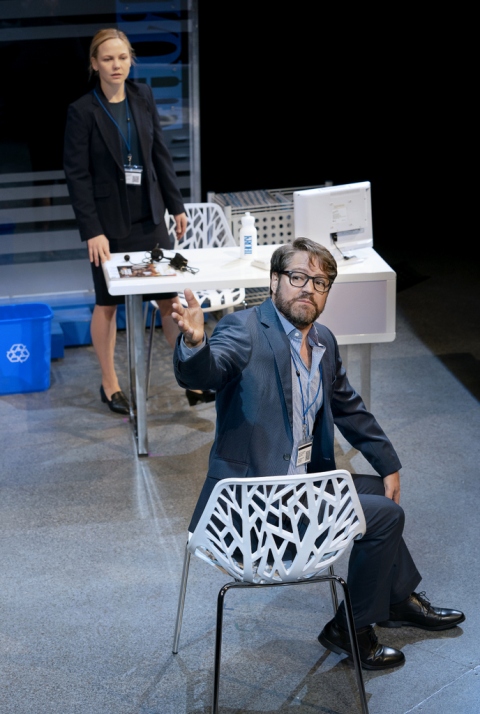
Robert Petkoff (foreground) and Adelaide Clemens in ‘The Hard Problem,’ written by Tom Stoppard, directed by Jack O’Brien, Lincoln Center Theater (Paul Kolnik)
Then Hilary raises “the hard problem” of consciousness. Unable to counter argue adequately, Spike diverts the conversation to helping her with her math. However, they continue to quip about morality, goodness, parenting, mother-love as Spike responds to her presentments with scientific Darwinian explanations for each. She leaves Spike with two comments which slide over him, but we remember for future reference. One thing she prays to God for is forgiveness and her prayers help her. Also, she affirms that to get this plum research position at The Krohl Institute, she needs a miracle.
In these initial scenes reside the conflicts and themes of The Hard Problem. As the intriguing events develop, we note how the characters highlight aspects of Spike and Hilary’s arguments. And as situations spool throughout the play, Stoppard demonstrates the callow, self-serving ethics of the scientific set, loosed from morality, ethics and concerns about divinity or consciousness. Indeed, as they unleash themselves upon the culture, we understand the value of their scientific perspective not “looking for” proof or adequate explication of consciousness. For the utility of humans as machine-like forgoes any measure of dealing with them in a way which is “consciously” kind, decent, moral, ethical, etc.
On the other hand, Hilary and those who believe in being good and evolving toward altruistic behavior, act with noble intentions and equanimity toward others. Of course some of the characters appear to manifest both altruistic and egoistic behaviors in a strange schizoid pattern. An acute example of this is in Stoppard’s characterization of Jerry Krohl, the owner of Krohl Capital and the chief founder of non-profit Krohl Institute for Brain Science.

(L to R) Jon Tenney and Katie Beth Hall in ‘The Hard Problem,’ by Tom Stoppard, directed by Jack O’Brien at Lincoln Center Theater, Mitzi E. Newhouse (Paul Kolnik)
Those in agreement with the machine aspect of existence are Amal (Eshan Bajpay), a mathematician, who adheres to Spike’s scientific perspective as does Urusla (Tara Summers). Each shows more than a share of egoism and a lack of fulfillment within. Leo (Robert Petkoff), who selects Hilary for the research position, Bo (Karoline XL), Julia (Nina Grollman) and Cathy (Katie Beth Hall), manifest finer behaviors. Jerry Krohl (Jon Tenney), compartmentalizes both perspectives related to the situation. He remains the perfect example of a moral relativist. When it “is required” for him to be cruel and self-serving to make money, he is. When the occasion requires he be loving, he is. Of course Stoppard reveals by the end of the play why Jerry Krohl has spent oodles of money on his non-profit in addition to the tax deductions his tax accountants most probably set up for him.
Throughout the play, Stoppard develops how Hilary’s perspective and her beliefs eventually lead her to develop as a person who evolves productively toward the moral, social good. We discover why she prays for forgiveness each night. And her ending up for a season to do research at The Krohl Institute for Brain Science leads to a revelation that exceeds coincidence. In a beautiful and satisfying culmination, Stoppard validates Hilary’s assertions about consciousness. Indeed, these manifest in a realm of divine goodness that Hilary seeks. In summation the miraculous finds sway in her life to bring comfort and peace.
That she receives what she prays for appears indeed miraculous against the backdrop of the machine perspectives of science that dismiss a deep understanding of the mind and consciousness. This is no spoiler alert. You will just have to see the production to engage with Stoppards’s humor amidst the profound, the philosophical, the divine.

(L to R): Karoline Xu and Adelaide Clemens in ‘The Hard Problem,’ written by Tom Stoppard, directed by Jack O’Brien, Lincoln Center Theater (Paul Kolnik)
In portraying Hilary, Adelaide Clemens reveals an iron vulnerability and truthful innocence. She smacks down Spike’s manipulations with assurance. She portrays Stoppard’s characterization of Hilary’s strength of will, her openness to the universe, her belief without religious dogma spilling out obtrusively. Clemens’ Hilary is becoming what she intends to be, an empathetic, good individual. We root for Clemens’ Hilary throughout the production. When the blessings come to Hilary, we celebrate with her and are deeply moved.
The ensemble adroitly shepherded by director Jack O’Brien work admirably as Hilary’s foils. O’Shea’s Spike and Bajpay’s Amal remain as the ballast for the arguments and actions presented.
Tenney’s Krohl intrigues with his perfect admixture of kindness with his daughter and cruelty with his underlings. He epitomizes the dark money forces as the ultimate operator of Krohl Capital whose billions come at the expense of others. As a symbol he represents most of the uber wealthy in our culture and reveals how they function. They compartmentalize morality, ethics, love, family. Finely tuning their rapacious greed and harmful, sweeping policies that impair and destroy the lives of many, they turn a blind eye to the results of their behaviors. Like fascism everywhere, they negotiate their own vacuous logic and get others to “buy in.”
Ironically, the scientific culture absent morality, ethics, goodness, absent the nod of assent toward the greater search for a comprehension of “mind,” and “consciousness” can be used as the very “irrational rationale” which justifies harmful sweeping policies set in motion by the uber wealthy and in the processes they employ to accumulate wealth. The perspective of the “machine” view of humanity nullifies the search for the divine in our lives and the acknowledgement that we can be self-less and evolving toward altruism. Instead, that perspective gives a green light for abuse and every attenuating impulse that foments human rights violations.
Stoppard, once again posits this conundrum of consciousness vs. the machine-body model in a pleasing way. The questions his characters raise manifest “the hard problem,” and exemplify, though some have suggested this is too “talky.” However, Stoppard offsets this by revealing the moral implications of the debate while we watch the characters follow their own journeys. Ultimately, we “get” where the dominoes fall for all for the principals, and we rally for those whose humanity and reliance on the “ethereal” compels us. As Stoppard uplifts us away from mechanical, how can we not empathize with Hilary and embrace her noble impulses. Hers is an affirmation of the soul’s flight toward the divine.
The play is one of Stoppard’s most lucid (I know many may disagree with me on this) and most uplifting. Especially in its final culmination, the power of Hilary’s revelation allows us to soar with her on the wings of joy. Our feelings release into the substance of what we seek with her. And it suits for the season.
Kudos to David Rockwell (Sets), Catherine Zuber (Costumes), Japhy Weideman (Lighting), Marc Salzberg (Sound), Bob James (Original Music).
The Hard Problem runs with no intermission at Lincoln Center Theater Mitzi E. Newhouse Theater, until 6 January. Especially if you appreciate Stoppard, do not miss this revelatory new work. You can purchase tickets at their website.
‘Network’ on Broadway, Starring Bryan Cranston

Bryan Cranston and cast in ‘Network,’ adapted by Lee Hall based on the Paddy Chayefsky film, directed by Ivo Van Hove (Jan Versweyveld)
Paddy Chayefsky’s gobsmacking 1976 film satire Network (directed by Sidney Lumet), provides a searing example of the noxious morphing of Broadcast News toward lurid entertainment. Also, its timeless themes about the ubiquity of corruption even in the banal news delivery business cauterize with laser-like precision. In transferring this amazing work to Broadway, only a devilishly adroit director could improve upon an already ingenious rendering of the nullification of the free press by corporate greed. It takes genius to tackle the already fantastic. Unsurprisingly, Ivo Van Hove has applied his brilliance to bring Network to Broadway after its London run last year.
The innovative Van Hove and the inestimably formidable Bryan Cranston as Howard Beale, the uncanny, knight-errant, news anchor of fictional UBS make Network a mind-blaster. Cranston’s performance leaves one speechless. With humanity and ferocity, Cranston believably renders Beale’s epiphany about his own life. As a result he elicits our compassion and captivates us into astonishment. We watch open-mouthed as he steps into Beale’s cavernous soul-depth. And we feel the emotional pull of Cranston’s Everyman and journey with him to the Beale abyss. Cranston achieves an immediacy and truth that coheres with our own empathetic understanding. We’ve been there! Truly, even if we remain complacent with every privilege in the world, we feel “mad as hell and refuse to take it anymore!”
Exhilarated with wonder after seeing the production, I recall the profound themes Van Hove’s exalted direction and Lee Hall’s succinctly adapted script present. Indeed, these resound for us today in the fake news Trumposphere. Increasingly, the news spills out “shock and awe” entertainment. For the sake of profits, facts, information and sourced material shift to the back burner. Judgment and reason become sacrificed to the audience lust for titillation. The difficulties of divining the differences between truth, reality, lies, obfuscations increase. Content appears subject to media company editors who must carefully negotiate around the mission of profit and not upset advertisers. The confounded viewer eventually stops seeking to be informed as a civil obligation. Notably, viewers have been overwhelmed by the cacophony of lies from the media nexus which depends on advertising dollars.
Sadly, as Network illustrates, if truth and a truth deliverer do somehow break through the confusion of white noise and find a following as Howard Beale seemingly does, he and his opinions, “the truth” are commoditized. Finally, when the truth is hijacked for its profitability, the service of one whose opinions authoritatively voice society’s zeitgeist will be undermined. Truth can never be commoditized, regardless of how much its seekers long to hear it. The once noble concepts of a free press and information sharing to keep the public informed and knowledgeable disintegrate in CEOs bank accounts.
Van Hove and Hall have reconfigured the already brilliant Paddy Chayefsky script to another level of currency with a few modifications. Though the time period and characters appear similar, in the case of Max Schumacher (the fine Tony Goldwyn), and Diana Christensen (Tatiana Maslany distills all we dislike about the rapacious female executive), their self-destruction appears to be more trenchant.
The ironies of Network’s plot development are still precious. The fired Howard Beale whose ratings slump cannot be overcome states on the air that he intends to kill himself on next week’s program. His unauthorized announcement creates a furor and a ratings spike. Indeed, competitor news media make Howard Beale front page headlines. From this point on Beale’s inner unraveling moves to center stage. Beale becomes the stuff of media legend. As the journey of his personal enlightenment grows with power and truth, he and it are commoditized. Enabled by his friend Max Schumacher (Tony Goldwyn), and ambitious up-and-comer Diana Christensen (Tatiana Maslany), who usurps Max Schumacher’s job with seductive abandon, Beale ends up becoming the superlative ratings darling of UBS.

Tony Goldwyn, Tatiana Maslany in ‘Network,’ directed by Ivo Van Hove, adaptation by Lee Hall based on the Paddy Chayefsky film (Jan Versweyveld)
Essentially the dynamic twists of Hall’s adaptation follow Chayefsky’s sardonic overload brought to an absurdist conclusion. Beale’s breakdown drives him to the edge of sanity and a fool’s genius. Notably, as Cranston negotiates Beale’s travels from the hackneyed to sublime revelation, he leaves us spellbound. His “mad as hell” rant arises from Cranston’s core of understanding the human condition. As he explodes with humanity and inner beauty, we align ourselves with his emotion. We marvel at what he has made us feel.
Despite Max’s plea for decency to take Howard off the air and stop exploiting his breakdown, Diana Christensen promotes Beale as the angry “prophet” of the airwaves. As spokesperson for millions of individuals, Beale enamors his fans with unscripted “truths.” On “The Howard Beale Show,” converted into something akin to a game show with us as the live audience, Beale’s ravings resound with passion.
Meanwhile, confounded by his own immorality and dissipation, Max leaves his wife Louise. I love what Alyssa Bresnahan does with Louise’s aria. Going against his own best interests, Max has an affair with the obscenely ambitious Christensen. As their relationship begins to crumble, the climax of the cacophony of chaos peaks. Cannily, Beale crosses a line that must never be crossed. He mucks with the corporate restructuring of debt. And Arthur Jensen, the CEO of CCA, the parent company, gets mightily pissed. Nick Wyman’s subtle, grinning malevolence as Jensen is just great.
Largely due to Bryan Cranston’s fantastic performance as Howard Beale, Network echos in our remembrance. As Howard Beale communicates truth to his television audience, Cranston brings our consciousness into the greater understanding of who we are as human beings. In Beale’s realization of who he can be, he reminds us of our value and our spirit and soul worth. When Cranston’s Beale expresses the anger which is more than anger and rage that is more than rage, it is as if he grasps our being, and we tie in with him forming a collective consciousness.
Indeed, Beale takes us to a level of human sanctity that was unimaginable at the top of the production. When at one point Cranston’s Beale joins the audience and sits next to two individuals for a confidential moment (he’s incredible in delivering the irrevocable ineffability of live theater), Van Hove turns the cameras on us. We see ourselves projected on television. It is impossible to ignore the truths of what we experience in the shadow of Beale’s soul light. Irrevocably, we awake and feel intensely because Cranston trusts Beale’s heart and conjoins himself and us with it.

(L to R): Bryan Cranston, Tony Goldwyn and the cast of ‘Network,’ directed by Ivo Van Hove, adaptation by Lee Hall based on the Paddy Chayefsky film (Jan Versweyveld)
For his part Van Hove has rendered the dynamism, artificiality and hyperbolic humming chaos of the TV production newsroom with seamless facility. We watch the recreated TV Studio live! Thus, we see the news projected on the big screen as camera operators live-capture Cranston’s Beale. And we note his various pilot fish (make-up, hair and clothing assistants, etc.), fussing over him. The immediacy of their actions powers up to build suspense about watching the “TV show.” Of course it is a show within a show. And we all become players!
Interestingly, the authenticity and the boardroom scenes reinforce the theme that “profit-motives propel television content” (we think of social media), to addict and brainwash. Media folks need us to appreciate sensationalism over rationality. And their obsession with the bottom line strips and devours the decency of all who work for the CCA company. Most importantly, we note the downward trend away from kindness, generosity and concern for others in Christensen, Frank Hackett (Joshua Boone), Harry Hunter (Julian Elijah Martinez) and others. In fact all who create such entertainment news reflect a craven amorality.
Additionally, Van Hove’s striking re-imagining of a TV studio and news room as a live play by play brings the action into our laps. We serve a dual function. With sardonic humor, Van Hove makes us a live and interactive, participatory audience as we applaud to “Applause” signs. Yet simultaneously, we watch the action on smaller screens featuring various channels which morph to the large screen for Beale’s news program. We participate, yet we distance ourselves as the voyeurs of TV’s “non-participatory experience.”
Interestingly, this meld of the two roles we play as audience members during “The Howard Beale Show” creates dissonance. For ultimately, we “get” that as the media audience (especially social media), we choose/control the content which is as good as our viewing tastes.
This production and all who create its fever, furor and fabulousness from actors to scene and technical designers impart a momentum that runs like an electric wave which ignites all it touches. The encounter provokes. It is as if by watching the downfall of Howard Beale, UBS, CCA and everything that was once moral and decent in the news business, we watch our own participation/contribution to it.
Chayefsky’s and Hall’s Network is the harbinger of the current social media devolution. “The news” has been atomized to fit every opinion or position based on skewed information and ear tickling “facts.” And it is these statements “of fact” that force us to a site like Snopes for fact-checking. Ironically, the site speaks more credibly of its being relied upon by non-readers and non-researchers than for its accuracy.

Bryan Cranston and the cast of ‘Network,’ directed by Ivo Van Hove, adaptation by Lee Hall based on the Paddy Chayefsky film (Jan Versweyveld)
The greatness of this production is in its expression as an immersive consciousness-raising satire/comedy/drama. For it compels us to interact with cognition and emotion in a weird connect/disconnect. On one level, Network, especially in its addendum video clips (no spoiler alert-you’ll just have to see it), becomes an intriguing call to action. We can be better if we demand better and do not settle for less. On the other hand, Van Hove shepherds Cranston, the excellent ensemble and the artistic designers to provide an incredible one-of-a-kind entertainment that makes us think long after we’ve left the Belasco Theatre.
Special kudos to Jan Versweyveld (Scenic & Lighting Design), Tal Yarden (Video Design), An D’Huys (Costume Design), Eric Sleichim (Sound & Music).
Don’t miss this one. You will regret not seeing Bryan Cranston and this fiery re-imagining of Network at the Belasco Theatre. The production runs with no intermission at the Belasco Theatre (111 44th Street), through 17 March. You can pick up tickets at their website.
‘Wild Goose Dreams,’ at The Public Theater
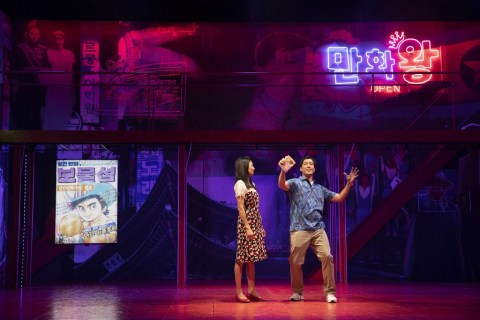
Peter Kim, Michelle Krusiec in ‘Wild Goose Dreams,’ by Hansol Jung, directed by Leigh Silverman, Public Theatre (Joan Marcus)
Wild Goose Dreams by Hansol Jung, the captivating and uniquely relevant production currently at the Public Theatre, promises no hackneyed storytelling. Its settings of South Korea, North Korea, social media platforms, and individual consciousness meld irreverently and ingeniously. Directed by Leigh Silverman, Jung’s characterizations and plot receive the clever staging and conceptualizations they deserve. Coupled with sensitive performances by lead actors Peter Kim, Francis Jue, and Michelle Krusiec, this innovative work is vibrant and exciting.
Intriguingly, the production accomplishes this while striking into hot themes about virtual dependency. Traveling through disparate settings, we avidly follow the characters, empathizing with their loves, aspirations, and dashed dreams and hopes.
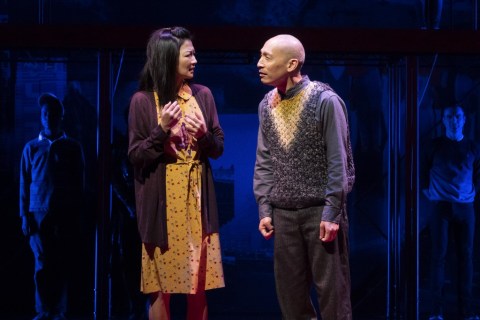
Michelle Krusiec, Francis Jue in ‘Wild Goose Dreams’ by Hansol Jung, directed by Leigh Silverman at the Public Theatre (Joan Marcus)
The production’s dramatization of the ever-presence of virtual reality in our lives becomes one of the annoying yet graceful saving impulses that ping the characters throughout. For Guk Minsung, virtual reality becomes a way, however ineffective, to try to acquaint himself with his daughter, separated from him by time and distance. For Yoo Nanhee it remains the way through which she attempts to deal with her guilt after leaving family, boyfriend, and friends to escape from North Korea to South Korea. And for Minsung and Nanhee it is the medium through which they, like countless others, attempt to ameliorate gnawing loneliness and the pain of grappling with their own inner struggles, regrets, and self-flagellating failures.
The rhythmic propulsion of the internet intrudes on our consciousness like an addiction. Jung and Silverman convey this with the ensemble’s kraks, “beeps,” and 111001s, evoking in rhythmic poetry the allure of connecting with others across social media. The effect achieved is astounding and grindingly inescapable. As a thematic metaphor the humor and “randomness” conveyed simultaneously made me laugh and threatened like a monster.

Michelle Krusiec and Peter Kim in ‘Wild Goose Dreams’ by Hansol Jung, directed by Leigh Silverman (Joan Marcus)
But before this sensory assault, the Father (a wonderful, emotionally varied portrayal by Francis Jue) recalls an ancient process of communication: oral bedtime storytelling. The fable he relates to Nanhee tells of an angel who flies to earth with fellow angels. Her flight robe stolen by a woodcutter, she is forced to remain earthbound. Despite the woodcutter’s love, his care for her, their marriage, children, and growing old together, when the angel finds her buried robe, she flies away. The Father reinforces the theme: If one has a choice between family and flying away, fly!
The myth becomes Nanhee’s haunting reality. And the theme of selecting flight over family threads throughout the entire play. Not only is it acute for Nanhee, whose physical flight from North Korea floods her soul with guilt, fear, nightmares, and regrets. This flight from family also abides as a central theme in the life of Minsung, who remains in South Korea. Separated from his wife and daughter, he financially supports them, living “small” while they create a better life in America against a time he can join them.
Yoo Nanhee, whose Father told her the story as a child, becomes plagued by it. The nightmare myth worsens in her imagination even after her “successful” integration into South Korean culture. Should she return to family? Has her flight put family in danger? To stem the tide of anxiety when a conversation with her Father provokes her sense of failure in her new life, she goes online. A “love” platform invites her to seek a man, so the next time she speaks to her Father she won’t lie to him anymore about being married with sons.

Peter Kim and ensemble of ‘Wild Goose Dreams’ by Hansol Jung, directed by Leigh Silverman (Joan Marcus)
Likewise, Minsung goes online because he is lonely for his wife and daughter. He cannot fly to them or “fly from them” to a new life until he finds someone to fly with.
Continually intruding on this couple is the allure of virtuality, where one can connect with family and friends, especially if one is estranged from them. Also, the chance at meeting someone on a dating platform enthralls and addicts. Both take the plunge. The effusion of noises signifying the devices humming to retrieve information we need and our comments and responses to what we read or search for online puts us on overload.
Nevertheless, Minsung and Nanhee meet online. From that they move even more quickly to have sex, converse, know a bit of each other, then separate. This attempt at bonding becomes as ephemeral as digital 10110s. But the impact they have on one another remains unmistakable. The reality of their live, physical meet-up, coupling, and conversation becomes irrevocable. Jung’s argument for supporting the virtual as a meld with live exchange titillates.
Ironically, their head-on, live, intimate interaction also exacerbates their personal struggles and issues. With their power of dynamic confrontation, living interactions have a way of forcing growth. Eventually, both enter a crossroads. Though they meet only one more time, the exchange motivates each to act almost in a parallel reversal. One indeed returns to family. The other flies away. These decisions lead to fascinating, unexpected results.

Peter Kim, Michelle Krusiec in ‘Wild Goose Dreams’ by Hansol Jung, directed by Leigh Silverman, Public Theatre (Joan Marcus)
This brief description cannot intimate the profound themes of Jung’s drama, which is both humorous and tragic. Nor will I define the fantastic dreamscape of Nanhee’s imagination, wonderfully evoked by Silverman’s interpretation of Jung’s story using surreal characters. I will state that Jung effectively employs clever, striking symbols and metaphors that the production chillingly brings to life. The match symbol is particularly revelatory and poetic. You will just have to get to the Public Theatre to witness for yourself the surprise, the production’s danger, beauty, pathos, and uplifting poignancy.
Peter Kim’s performance as Guk Minsung builds, turns surprisingly, and blossoms with his versatility. He remains touching and heartfelt at the conclusion. Michelle Krusiec’s Yoo Nanhee reveals a subtle range of emotion. She moves from shock to anger, numbness, and cool indifference. Indeed, her aloofness masks the turmoil underneath. And the dominant, sinister, mythic Father portrayed with precision by Francis Jue charges and gives grist to the other portrayals.
I particularly enjoyed the adroit costumes, lighting, and scenic and sound design, which cohered with the themes, characterizations, and story development. Special kudos are due Clint Ramos (Scenic Design), Linda Cho (Costume Design), Keith Parham (Lighting Design), Palmer Hefferan (Sound Design), Paul Castles (Composer), Jongbin Jung (Korean Music Composer), Charity Wicks (Music Supervisor), Lillis Meeh (Special Effects Designer), and Yasmine Lee (Movement Director). Finally, I liked the water effects and the recreations of club settings. The projections used to convey these coupled with the lighting provided colorful interest.
And to the ensemble, who effectively evoke the technological platforms and digital thrumming that have sorrowfully yet vitally become our lifeblood, more kudos. The ensemble includes Dan Domingues, Lulu Fall, Kendyl Ito, Jaygee Macpugay, Joel Perez, Jamar Williams, and Katrina Yaukey.
Wild Goose Dreams is at The Public Theatre, until 16 December. Tickets are available online.
‘Thom Pain (Based on Nothing),’ Starring Michael C. Hall, an Existential Crisis With Humor

Michael C. Hall in ‘Thom Pain (Based on Nothing),’ by Will Eno, directed by Oliver Butler (Joan Marcus)
Playwright Will Eno’s one-man show Thom Pain (based on nothing) flies any way you like it. Surely, this depends upon that day’s audience’s intellect and responses. Indeed, one focus of the production entails the shared consciousness between Thom Pain and his listeners. Layered, multi-dimensional, this ethereal communication blossoms in the world created between the audience and Michael C. Hall as Thom. Reflecting upon this daunting effort comes a startling idea. This consciousness creation captivates beyond knowing every performance is different because it is live.
The portrayal of Thom Pain in the hands of Hall shepherded by Oliver Butler makes this production live theater on steroids. Hall’s very present performance magnifies each moment. The impact is powerful. Indeed, Hall’s Pain with subtle humor plows into the sardonic and tragic-comic furrows of our own humanity. He does this through contradictory impulses. On the one hand, as Thom he attempts to suppress his feelings and “manage them.” On the other hand he feels compelled to express/expurgate what makes him and all of us human: feelings of hurt. We understand the tense conflict between the compulsion to reveal and the desire to suppress. Daily, we accomplish this with friends, acquaintances, and ourselves, whether we admit it or not.

Michael C. Hall in ‘Thom Pain (Based on Nothing),’ by Will Eno, directed by Oliver Butler (Joan Marcus)
By extension these apparent contradictions in Thom create the tautness we feel when he pauses or pointedly addresses us by the royal “you.” Hence, we identify with his inner conflict to express and repress. Also, the tension helps to create immediacy. For Thom tells us whatever he wishes with urgent authenticity. And his suppressed pain guides his childhood revelations. Is he conscious of his suppressed pain? Certainly, it evidences in his demeanor, hesitations, attempts at humor, and need to talk to us.
Directed with a stark relevance and clever re-imagining, Oliver Butler spins out Eno’s irreverent, perplexing, Beckett-like piece. Thom’s ramblings move into places that settle on topics with uncertain happenstance, like the flight and landing of a wary sparrow. And then Eno, Hall, and Butler spiral the piece in a completely different direction. This is a superlative plot twist, as if a sparrow startled itself unexpectedly, then rapidly skedaddled.
Notably, Thom often redirects back to us. He puts us “on the line” for examination and a silent or vocal refrain as he confesses his observations about his life. At one point during this audience-participatory moment, an individual did respond orally when Hall’s Thom asked for a volunteer. The individual commented about a time he volunteered to go on stage during a Spalding Gray production. Hall responded as one would imagine Thom Pain as Hall would respond (not the other way around). The audience chortled and guffawed.
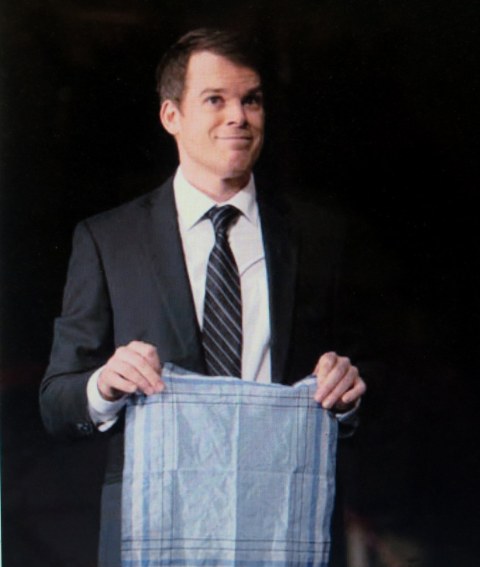
Michael C. Hall in ‘Thom Pain (Based on Nothing),’ by Will Eno, directed by Oliver Butler (Joan Marcus)
That exact moment with that particular audience and that gentleman remains the quintessential element of theater. It was classic, alive, and immediate. And it will never be duplicated, not even if all the same individuals returned to try to repeat it. Great theater should be about the unrecapturable, spontaneous life evoked by actors. That life spiritually refreshes. It’s priceless and breathtaking.
Likewise, Hall’s performance enlivens, refreshes, rejuvenates throughout. Ironically, the content, the playwright states, is based on “nothing.” So process rather than content activates the audience. But, sans the content conveyed by the consciousness between Hall and his audience, no “life” would be possible. Hall’s Thom and Eno’s words and Butler’s direction find their perfect union in receptive ready minds.
Such production artistry occurs when the key players open themselves to the universe. Whatever Hall’s Thom appears to seek from us at each moment carries us all to the next string of moments in the show. This immediacy, made possible through Hall’s many superlative talents, strikes humor and wariness into the audience’s hearts.
For his part when Hall ventures into the audience and/or asks for a volunteer, we turn on high alert. Hall’s relaxed graceful performance as Thom, never moves to result. He breathes with the rhythms of Eno’s Everyman clown stuck in a consciousness of others. Subsequently, his attempt at movement continually displaces him back to his key hurtful childhood incident. And it sends him to other highpoints in his life from which he attempts to make particular sense. Ironically, these efforts turn into a weird null. But he, Thom, Michael C. Hall so captivates, we stay with him curious about where he goes.
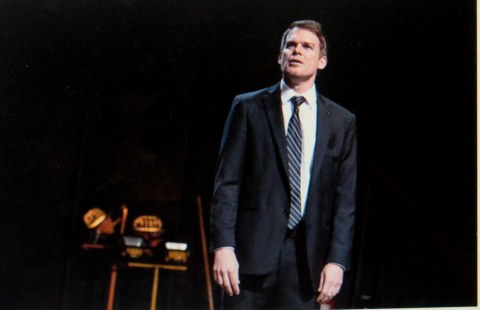
Michael C. Hall in ‘Thom Pain (Based on Nothing),’ by Will Eno, directed by Oliver Butler (Joan Marcus)
The ironic parenthetical in the title “based on nothing,” implies that Thom Pain’s musings before the audience lead no where and come from “not much,” in his perspective. Not so! The very profound themes of existence, consciousness, life purpose, memory caught up among the ordinary, off-handed remarks lead us to questioning joy. With the incredible acting instrument that Hall employs, we become enthralled from beginning when darkness engulfs the entire theater, to ending, when Hall asks the audience the ultimate question. And I of course in my mind as other audience members did made a choice. We answered or ruminated without answering or sat shocked or took on a myriad of audience mental responses to his question.
By the outburst of applause afterward, Eno, Hall and Butler hit their target. Strangely, I felt not only uplifted but cleansed of the last year and one half of angst-ridden and confounding “breaking news” stresses. What a pleasure to communicate mentally, silently with Hall as Thom Pain.
Any day, give me the existential crisis of attempting to make sense of the uncertainty of consciousness, of shifting memory, felt emotional loss, pain and the clown struggle of existence. At least my mind wasn’t being assaulted with the president’s narcissistic pronouncements in a time, place and space which daily confounds him and menaces a majority of the citizenry. After seeing Thom Pain, I am reminded to laugh. If our body politic is at a critical mass of mess, so? My answer to the last question of the play suffices with my laughter!
Hall’s performance will be up for nominations as will Butler’s direction, most probably. The actor’s sincerity and the moment to moment life he breathes through Eno’s words washes over one like a beautiful, clear river. Just wow!
Thom Pain (Based on Nothing) slides through your viewing appreciation without an intermission at The Pershing Square Signature Center in NYC. The production has been extended through 9 December.
‘American Son,’ on Broadway, Starring Kelly Washington, Steven Pasquale

Steven Pasquale, Kerry Washington, ‘American Son,’ directed by Kenny Leon, written by Christopher Demos-Brown (Peter Cunningham)
American Son written by Christopher Demos-Brown is a much needed polemic about what happens to young black males in our nation. If you can help it, don’t be a young, black male. Or if you are, try to stay off the streets between the ages of 13-35. Then, your chances of being shot or incarcerated should be greatly reduced.
To what extent does law enforcement abuse figure in to the above? The percentages speak for themselves. Indeed, this is especially so if one considers that law enforcement regulations and gun laws vary from state to state. However, do not take my word or this production’s thematic pronouncements at face value. Read the crime blotters in cities and suburbs. Sadly, the facts/statistics mount up. And this “in-your-face,” “no-holds-barred” drama powerfully directed by Kenny Leon, presents a typical case so we cannot blink or turn away. Nor can we pretend American Son lays out a mostly fictional reality. If only that were true.
The title generalizes to all our American sons. It does this in the hope that we empathize and understand especially if we are white. Eventually, our nation may become color blind, and there will be no need for the paranoia of white supremacy, Neo-Nazis, and the KKK. Then we will have achieved a miracle of decency and humanity. Surely, then law enforcement will not be partisan to favor white males over women and darker hued men and women of all races in the apprehension of suspects. Perhaps then we will be able to uplift the United States as a country which stands for equal opportunity and justice for everyone. Until then, our presentments express nobility, but our actions express venality and injustice.
Having taught in a multi-cultural district for decades, I’ve known of tensions between law enforcement and various cultures. I can think of one incident when a male student as talented and erudite as Jamal (Kendra’s son in American Son), discussed his experience of police brutality. I saw the remnants of the beating on his handsome face and was sick for the trauma he went through. Thankfully, since then he has prospered in his life and has his own family.
That was over twenty years ago. Overall, the situation has worsened. The rhetoric has escalated, and groups which work to ameliorate the tensions between law enforcement and various cultures have faltered. Often conservative, right-wing, partisan think tanks hold up memes of such groups as fodder for their smear campaigns. They promote antipathy to accelerate their political agendas against gun control and in support of oligarchic nationalism. Also, they seek to divide the populace and incite incidents throwing law enforcement in the middle of the fray.
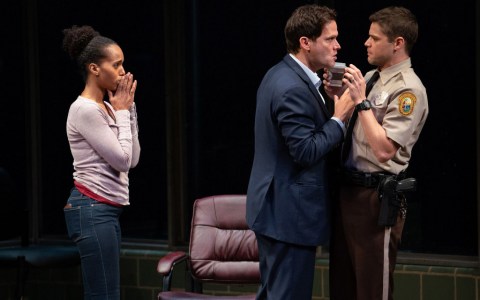
(L to R): Kerry Washington, Steven Pasquale, Jeremy Jordan, ‘American Son,’ written by Christopher Demos-Brown, directed by Kenny Leon (Peter Cunningham)
And what of law enforcement representatives of multi-cultural groups? Indeed, circumstances squeeze them to an “either-or” choice between a rock and a hard place. Few issues have a thesis-antithesis result or solution but remain extremely complex. Thus, the lack of will and incomplete measures to solve problems remain beyond the grasp of well meaning individuals.
All of these issues and many more Demos-Brown presents in this soul-crushing drama that reminds us we live in a nation whose values allegedly proclaim equality for all. But whose recent government practices establish equality for the rich, privileged and predominately white conservatives. Living in the South, even if the city is Miami, the setting of American Son, if a son is not a white, young male, but a black male, then black mothers’ anxiety living in that culture increases. Sadly, their fears for their son when encountering police often is warranted.
African American parents understand that their son’s age and skin-color provide a tragic liability for harm. Darkly hued skin colors arrest faster than white skin colors. Driving while black used to be a twisted joke. You know, when a black male drives through a white neighborhood, he is there to commit a crime. The situation has been exacerbated and the joke has morphed. Now, if one is riding while black, walking while black, smiling while black, hanging out while black, existing while black, one becomes a police suspect.
The question remains. To what extent have members of law enforcement across the nation lost their moral compass about civil rights? And how has the “use of force” taken on sinister tones toward people of color in the aftermath of protests concerning Michael Brown, Travyon Martin, Sandra Bland, and many others?
As Kendra (Kerry Washington is magnificent throughout), Jamal’s mom suggests, if you’re not black you will not understand the fear of a mother for a child who is missing. And she vehemently asserts this truth to Jeremy Jordan’s Officer Paul Larkin who tries to ameliorate her vocal volume and push back as to his whereabouts. Larkin, the white police officer manning the midnight shift in the law enforcement building where Kendra waits for news of Jamal, appears to be a fine person.
Ironically, we and he think she’s abrasive and “over-the-top.” Of course we do not understand as black parents might understand. However, by the end of the play, our perception changes. Only then do we reflect upon Kendra’s intuition. And we realize that indeed, her frantic, frenzied, fearful ranting and insistent “aggression” against the officers and husband, Scott (Steven Pasquale), speak to a deeper purpose.

Kerry Washington, Steven Pasquale, ‘American Son,’ (Peter Cunningham)
Kendra, as mother tiger stands up to Larkin’s very fine person presentation. Unrelenting, she finally pushes him to give her snippets of information until Scott (also in law enforcement but not a cop), her estranged husband arrives. Interestingly, with Kendra out of the room for a moment, the characters reveal additional information about themselves and the situation. When the two white men speak together, the dynamic shifts.
Demos-Brown to his credit includes this scene to advance the plot development and relay themes. Easily we note how between the interactions between Larkin, white Scott and black Kendra reveal stereotyping, presumptions and damaging social folkways that perpetuate social ills. Such folkways promote male-female stereotypes and black-white stereotypes. And the fears and close-mindedness generated by them become obstacles to authentic, heart-felt dialogue among all of the stakeholders.
As Scott, Kendra’s soon to be X husband, Steven Pasquale’s powerful performance remains level with Washington’s. Tragically, he partially “gets” how his son’s not coming home implies danger. However, as a white male, we note he wears the cloak of privilege. Sadly, as hard as he has tried to place the cloak upon Jamal’s shoulders, his son’s skin color isn’t light enough.
Nevertheless, when Scott repeatedly asserts Jamal will be fine, we and Kendra believe him. Indeed, how comforted we are as he makes assurances. But Kendra’s son and Scott’s son though the same, hail from different backgrounds. On the streets, Jamal’s DNA is Kendra’s. On the sports field, in school, and at the prestigious college he will be attending, Jamal’s privileged DNA belongs to Scott’s background. Kendra calls Scott on such issues. Scott remains in a cloud about it not quite accepting the import of her message. How can he? His background and very DNA establish his cultural supremacy regardless of his heart. Blessed and damned by his identity, he loves Jamal and this love becomes its own liability. The play’s conclusion clarifies the complex truth of being a child of this bi-racial couple.
With precision Demos-Brown reveals the mammoth difficulties in color-blind marriages. This becomes a very vital theme of this amazing and thoughtful play. For however “color-blind,” loving and empathetic he remains, Scott thinks and carries the white male perspective which he has projected on his son’s lifestyle and accomplishments. Of course, Kendra speaks from a black female perspective with great wisdom. However this fact remains. They must work overtime to conjoin their views, attitudes and the chasms of identity or the contentions and blind spots will continue as they raise Jamal.
This paramount theme strikes with fury throughout the production especially after Scott appears and he and Kendra argue about their perspectives and relationship to their son. Scott blames her not Jamal as the reason he walks out on the family. Bravely, Kendra shines her authentic and “no-nonsense,” self. Thus, when she indicts him and the others for their various individual callousness, her retorts sting. And when she indicts Lieutenant John Stokes (the excellent Eugene Lee), as an “Uncle Tom” who should know better, but only soft-pedals a cover-up, we cringe. Yet we do recognize that circumstances have forced the Lieutenant to wear that mantle, regardless of his inner feelings.
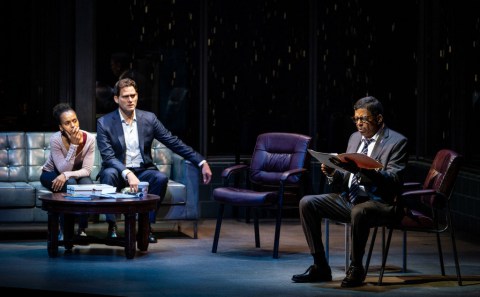
(L to R): Kerry Washington, Steven Pasquale, Eugene Lee, ‘American Son,’ written by Christopher Demos-Brown, directed by Kenny Leon (Peter Cunningham)
Though she does apologize to obtain the Lieutenant’s help with Jamal, her words have struck home. To what extent do blacks rise to the level of gatekeepers, merely put there to keep “their own folks in line?” Meanwhile, do they ever achieve the top positions and call the shots? Or must they remain lackeys to cover up the mess their colleagues may create? To what extent do they compromise themselves and add to the racial stereotyping? This is another theme that Demos-Brown includes in this multi-messaged, profoundly insightful play about race, gender, mores surrounding each, social stereotypes, the inadequacy of law enforcement training and much more.
All the while, Jamal never shows up or answers his phone heightening the tension for the parents. When Scott has a physical altercation with Lieutenant Stokes, we wonder the extent to which prejudice has pushed him over the edge. And likewise for Lieutenant Stokes to arrest Scott, how far does his own prejudice take him? The white-black conflict between Stokes and Scott fascinates. So does the conflict between Kendra and Scott as they argue about how they raised Jamal. Then comes the information that pushes everyone toward a new development and possible resolution.
Kerry Washington, Steven Pasquale, Eugene Lee, and Jeremy Jordan hit the bulls-eye with their portrayals. Each creates intensity. This combines to transfer the tension up the line to explode at the conclusion. Leon’s taut and clear-eyed direction channels their energy in a tumultuous build. All play for the stakes which crescendo up and into a mountain of emotions with which we simultaneously engage in, recoil, sorrow over.
Inevitably, I intuited what happened to Jamal before the conclusion because of my own background and extensive reading. Demos-Brown and the cast work assiduously to get us to do the impossible: identify with Kendra’s plight as a black mother in an environment of predators and passive-aggressives. Empathizing with her, one knows what can and might happen. Thus, for me, the ending came less as a shock. However, emotion doesn’t figure in so much as rationality at the play’s conclusion. When is enough enough? The nightmare of racism, genderism, oppression, injustice, inequity of power must decrease adhering to constitutional law not increase. The play is an incredible cry from the heart of love, and it reverberates with a terrible, engrossing, and tragic echo of our time.
American Son must been seen for the stellar, relentless, crackling performances, the tension, the adroit direction, the symbolism of the set (including the rain storm), and the lucid and well constructed play by Demos Brown.
American Son features scenic design by Derek McLane, costume design by Dede Ayite, lighting design by Peter Kaczorowski, and sound design by Peter Fitzgerald.
It runs with no intermission at the Booth Theatre (222 West 45th street) until 27th of January. For tickets go to the website.
Mike Birbiglia’s ‘The New One’ at The Cort Theatre
Mike Birbiglia in ‘The New One,’ directed by Seth Barrish (Joan Marcus)
Looking around the audience waiting for Mike Birbiglia’s The New One to begin, I recognize his huge following. We need laughter more than ever and Birbiglia suits up with his homely, hysterical riffs with grace and aplomb.
The prolific monologist appears to be everywhere at once. The award-winner (Kurt Vonnegut Humor Award 2017, Stand-up Comedian awards 2016, 2009, 2003) revels in standup and theatrical solo shows. His winning productions have included My Girlfriend’s Boyfriend (Lucille Lortel, 2011) and Mike Birbiglia: Thank God for Jokes (2016). Not only does he tour his solo shows nationally and internationally, he finds the time to write, direct, and act. For example, his film Don’t Think Twice (2016) debuted at festivals and received award nominations.
He’s also released eight comedy albums and four comedy specials. And did I mention he acts in television (Orange is the New Black) and film?

Mike Birbiglia in ‘The New One,’ directed by Seth Barrish (Joan Marcus)
The New One began Off Broadway at the Cherry Lane and extended before landing at the Cort Theatre on Broadway. With zany but well-modulated humor, Birbiglia’s jokes crash into us nonstop. Directed by Seth Barrish, his marvelous genius delivers a well-written, beautifully acted, perfectly paced performance.
Birbiglia endears us to him the moment he walks his relaxed self onstage. This every-guy American just wants to have fun and enjoy himself. And he makes us believe that he gets off entertaining us and explaining the most startling, shocking, and frightening developments in his life. The connection he establishes with the audience is well honed, measured, soft-spoken, admirable. When we sigh about the doctor discovering his cancer or his description of painful procedures, he comments, “I know.” The give-and-take stimulated by his responses to our guffaws, chortles, groans, and awwwws bonds us in a weird, crazy identification that we all (males, females, transgenders, old, young) participate in. God! I hope Birbiglia takes decades to fade away. We need his humor to grow old to. He gets us, and we get him. It’s love, and love should be forever, or ’til death do us part!

Mike Birbiglia in ‘The New One,’ directed by Seth Barrish at the Cort Theatre (Joan Marcus)
This consummate comedian gives us his intimate and singular takes on singledom, husband-dom, fatherdom. With the last comes the title of his show. He establishes eventually and finally that he is the father of “The New One.” Of course, this also refers to his changing identity.
Beginning with a symbol that expands to cover elements of his life in his 20s, 30s, and the current year, he zeroes in on his first couch. What Birbiglia does with a simple piece of furniture sent us into gales of laughter. The amazing thing about his aphorisms is that they not only make sense, but we note them and forget they make sense in our own lives. But this is where Birbiglia takes things that one considers insignificant and reveals their mammoth importance for us. Thus, when he codifies his numerous reasons why he loves his couch and generalizes why its better than his bed, we admit: Christ! He’s right!
I just adored how Birbiglia makes the couch one of the centerpieces of his story. From there he lifts off into other subjects, like the wooing of his wife. We enjoy his lovely, humorous observations about their relationship. Happily they can live and love forever after. We believe this for them more than for any other couple on the planet. The two of them have reached a soul union. Birbiglia’s buildup sings with humor.
What follows is the inevitable. Shouldn’t couples who adore one another have a child together? Who better than they to bring their love to their “own” boy or girl. What? In their decision-making about not having a child vs. having a child, Birbiglia shows his nimble-mindedness. The hysterical back-and-forth reflects the beauty and angst and abject uncertainty of a new human being coming onto the planet. This crescendos into one of the high points of the evening. What an ending for a beginning. We identify; half the audience has been there, done that. The guy sitting next to me was awwing throughout these riffs.

Mike Birbiglia in ‘The True One,’ directed by Seth Barrish (Joan Marcus)
Birbiglia tells us how his wife believed a baby would be great for him. Only a Birbiglia could set up this story of how he never, ever, ever wanted kids. Just by looking at his brother’s misery, he knows kids are not for him. Ironically, as he covers the hysterical threads insuring he cannot have children for a myriad of reasons, we know with one mind as an audience Birbiglia nails it. We laugh passionately in agreement! Yes!
Anyone in their right mind, whatever gender or sexual orientation, would never have children and duplicate themselves. Having kids is nuts, wacko, especially now given the state of the planet. And I will add, because Birbiglia does not specify, especially with the current political crisis.
And when the event happens, in true Birbiglia form, what he has foreshadowed comes to pass. Then reversals and twists occur. As with any set of parents raising a newborn, comes the roller-coaster ride that runs off the rails. You’ll just have to see the show to discover whether he and his wife land on their feet or spiral out into the darkness without a prayer.
Birbiglia masters relating his feelings with candor and authenticity. We become his intimates and he can tell us whatever he devises. We so want to listen! And best of all he makes a circularity of the randomness of his life, which actually appears fairly ordered, after all. In any case, I laughed and teared up and the gentleman next to me awwwed up until the standing ovation. What a fabulous, LOL, fun evening. No one wanted to leave. We could have stayed for another hour. But the poor guy had to go home to his baby daughter and wife. We’d kept him long enough.
Do not miss The New One, Mike Birbiglia’s shimmering laugh riot. Cheer yourself for the holidays and especially after Thanksgiving when you need the most laughs. The New One runs at Broadway’s Cort Theatre until 20 January. Visit the website for tickets.
 CAROLE DI TOSTI