Category Archives: NYC Theater Reviews
Broadway,
‘The Prom,’ A Musical Comedy That Soars With Positivity and Truth
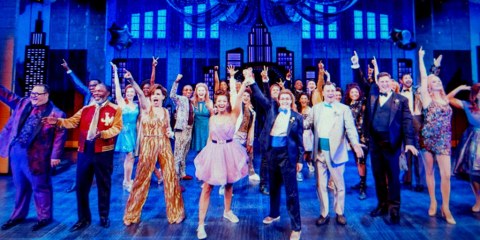
The cast of ‘The Prom,’ Book by Bob Martin & Chad Beguelin, Music by Matthew Sklar, Lyricsy by Chad Beguelin, Directed and Choreographed by Casey Nicholaw (Deen van Meer)
Even if you never went to your own high school prom and can’t imagine wanting to, The Prom directed and choreographed by Casey Nicholaw, currently at Broadway’s Longacre Theatre is a celebration of joy and life that you would be comfortable with. In fact just for its sheer hilarity, exuberance, and wisdom, you would eagerly sign up for the high school prom decorations committee. From its timing-perfect acting, to the evolution of characterization, and ingenious “true-to-life” story-line delivered in dialogue with dollops of zazzzzz, this musical comedy is thematically trenchant and expansive. Thanks to its talented creatives who know how to please and bring in the jokes at two hours and change with one intermission. The Prom is saavy, poignant and politically current with immutable themes that resonate for all time.
The notion of a “prom” unifying a senior class for the last time before they take off to “parts unknonwn” beyond the cliff of their community, is antiquated. But it is a tradition that the “in” crowd and “cool” kids in various schools in the US of course exploit to champion their supremacy over the rest of the school’s social groups. Naturally, for girls it is the height of achievement to be able to go with a date and buy a gorgeous dress with all the trimmings including matching color co-ordinated cumberbund for the guy’s tux and baseball cap. For those outcasts and isolates who have had to endure the humiliation and often sub rosa bullying and excoriation of their classmates precisely because they are “EWWWWW,” and would never be able to either ask someone or be asked, “the prom” is synonymous with pain, torment, Nazi-style fascist sadism which ultimately reverts to self-flagellation for the isolate’s not measuring up and having one’s place on the sunny side of high school superiority and popularity.

‘The Prom,’ Book by Bob Martin & Chad Beguelin, Music by Matthew Sklar, Lyricsy by Chad Beguelin, Directed and Choreographed by Casey Nicholaw (Deen van Meer)
The high school structure of placing students in same-age-related grades causes such emotional debacles and crucibles of misery, not only with regard to “the prom,” but with regard to stratification of achievement levels and every aspect of the daily life of the high school student. But what happens if you are not only a social outcast, but one with a gender proclivity that is UBER “EWWWW” in a setting where religious folks in a Red state culture believe your very nature, identity and being is a sin? Such is the conundrum and very real stakes for Emma (sensitively and realistically portrayed by the golden-voiced Caitlin Kinnunen) As a high school senior of a small high school in Indiana, Emma must suppress her year and one-half relationship with Alyssa (Isabelle McCalla is superb as Emma’s waffling sub rosa girlfriend) which they both intend to make manifest when they go to their prom together. But when the PTA led by Alyssa’s mom (the heartfelt and many-sided Courtenay Collins) discovers that Emma intends to bring a same sex girlfriend (she does not know it is her daughter-surprise, surprise), she protests and creates a ban. And Emma protests creating a stir.
This real-life situation of gay teens being barred from attending their proms with same sex partners has occurred all over the US and as recently as in 2017, Buffalo, New York. Most specifically when it happened to Constance McMillen of Itawamba Agricultural High School, in Mississippi, McMillen sued because her rights were violated. And when the ban was lifted and she attended her scheduled prom, the district had a surprise waiting for her right out of Mitch McConnell’s and the Republican Party’s playbook. (Check this article on McMillen.)
With Trumpism, gender discrimination, misogyny, racism and nativism have gained a legitimacy as certain social groups glance back fondly to the days of Jim Crow and attempt to enforce their fascist agenda on the rest of US citizenry who are patriots and believe in upholding the constitution. That Bob Martin, Chad Beguelin and Matthew Sklar have allowed the prom banning of LGBTQ groups to inspire them to write a musical comedy which explores the heights and depths of Trumpist-type discriminatory acts with grace, style, laugh-riot humor and profound wisdom (without making reference to Trump, or the new Trump party) is prestidigitation on a grand scale. For they inspire unity, hope and love with the same tools that adversarial groups use to promote hate and division.

(L to R): Isabelle McCalla and Caitlin Kinnunen in ‘The Prom,’ Directed and Choreographed by Casey Nicholaw,(Deen van Meer)
And what is the vehicle they use to initiate a way into the LGBTQ hair-raising problems of a small Indiana high school and Emma’s fight? Theatricals! Thespians who represent some of the finest, award-winning celebrity narcissists on Broadway. And these even bring their Tonys and Drama Desks to impress the motel manager to give them a better room. Of course, not only are they not recognized, the crushing humiliation they experience in a town that could care less about them is enough to make even a narcissist more lovable and heart-warming.
Martin, Beguelin and Sklar begin in New York City with the Broadway stars backstage after a performance which closes immediately when they receive a horrific New York Times review. The critic was particularly humiliating when they referred to the headliners as “unlovable narcissists.” The joke is priceless for it recalls another celebrity narcissist who also cannot be insulted and refuses to change.
The narcissists are the fabulous Beth Leavel as Didi Allen the Diva Queen extraordinaire with a gorgeous belt (We hear it in the song “The Lady’s Improving), and her co-star in infamy the “bring-down-the-house” high flier, Brooks Ashmanskas as Barry Glickman whose vibrant and hysterical “Barry is Going to the Prom,” hints at the 30-years-ago miseries of high school and the affirmation of love wiping tears away years later.
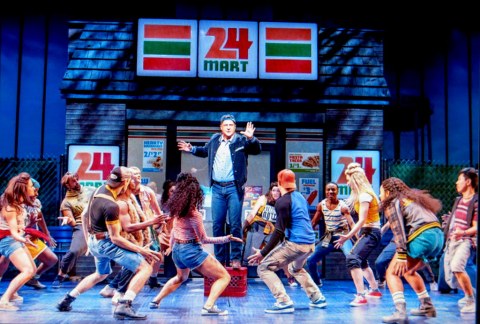
The Prom,’ Cast and Christopher Sieber, Book by Bob Martin & Chad Beguelin, Music by Matthew Sklar, Lyricsy by Chad Beguelin, Directed and Choreographed by Casey Nicholaw (Deen van Meer)
The attention starved thespians are accompanied by Angie (the excellent Angie Schworer whose dance/voice number “Zazz” is just wonderful) and Trent Oliver (Christopher Sieber’s fantastic “Love Thy Neighbor” with the ensemble is the gobsmacking point of the show). Along with producer Sheldon Saperstein (Josh Lamon’s timing is spot-on) this motley crew goes on the road to resurrect their brand, recover from the criticisms in the Times article by battering down the unjust doors of the discriminatory high school to join Emma’s cause. They determine that this “self-less act” of “making a difference,” “doing good for the world” will lift their reputations and give them some positive publicity.
Of course they exacerbate the horror of the initial situation for Emma and create a chaotic shambles riling up the parents of the PTA who demand the interlopers be removed and leave. When Emma succeeds in her lawsuit proving her civil rights cannot be violated, the PTA and student body contrive a solution, represented by the song “Tonight Belongs to You/Us” sung by the ensemble at the end of Act One. The number is mesmerizing, wildly frenetic (the dance moves are spectacular) and enthralling. And then the chill comes to us in a terrifying realization of the song’s true message sung by a predatory, vampirish-sounding refrain “the night belongs to us.” Clue, the cool crowd, the money, the power players who attempt to devour and suck the blood of the little people who suffer their callous and unconstitutional injustices. Emma’s Broadway “helpers” prove anything but and Emma is worse off than before the show crowd showed up!
This is a superior high point to end Act One, for there must be change; such injustice cannot continue. Enter the answer which turns the religious institutional crowd on its ear and enter artistic empathy. The result is a beautiful cathartic Greek style elevated comedy of triumph in Act Two which provides a more than satisfying and very adult addendum to proms everywhere in the US.
Yes, some of the problems are not resolved, just like in life. And the townspeople still must grapple with their prejudices. These have taken years to simmer and boil and do not retreat overnight. Alyssa’s mom Mrs. Green must confront the pain of a truth she doesn’t want to see with her daughter. The hatreds and bullying will continue, but this hiatus of joy has begun to ameliorate it. Ironically, the ones who have benefited greatly (the celebrity narcissists) have stepped up and contributed their grist to making the prom one that everyone will remember. Interestingly, they have evolved and developed into less self-absorbed individuals who perhaps have begun to understand another level of success beyond the wins they’ve received in their careers.
I loved this show for its incredibly energetic performances by all of the cast and the ensemble. There is not one who isn’t superb or who isn’t “on point” and “moment-to-moment.” I loved the book and the accompanying musical numbers which remain insightful and carry the themes and story-line forward to the powerful message of the show. Indeed, some of the songs are stand alones with lovely melodies and rising lyrics: “Dance With You,” and “Unruly Heart,” are especially meaningful.

Beth Leavel, Brooks Ashmanskas and the Cast in ‘The Prom,’ Book by Bob Martin & Chad Beguelin, Musi by Matthew Sklar, Lyrics by Chad Beguelin, Directed and Choreographed by Casey Nicholaw (Deen van Meer)
The Prom presents the realms of hope and faith in people’s goodness. It encourages us to take a stand for what is right regarding human dignity, respect and decency. Without politicizing or rankling, it cleverly portrays elements of our nation’s weaknesses from the self-absorbed celebrity elite, to the equally self-absorbed and self-righteous conservatives. Both must modify and one way this will occur is for each social group of the nation to come together, get out of their comfortable locations and visit the hinterlands or “sin city.” The production makes a case for laughing at oneself and not taking one’s beliefs too seriously to forget the dignity of others, regardless of their beliefs. And perhaps especially because of their beliefs, they must be given a hearing. How many times must we say this to begin to do it? We need to stop cannibalizing ourselves.
The final song “It’s Time to Dance,” argues for each and every one of us to be our own creations, to define ourselves to be as truthful as possible on journeys of grace and openness, and without arrogance that masks fear or belligerence to “prove” a point.
The production is superb in its thematic encouragement/reinforcement for young and old: 1)to be the best of who one can be; 2)to take charge of one’s own life and not wait for others to act for us; 3) to bravely do one’s part to establish a world of tolerance and inclusion through communication and empathy.
The creators are not presenting ideas that are puerile and simplistic. If one just stops for two minutes and considers the rise of white terrorist incidents in the last two years that go against the fabric of our nation’s tenets, then one realizes how much our culture needs to witness these themes again and again. On the surface The Prom is a fun ride and you leave the theater humming the songs. But underneath the laughter and fun is the poignant message expressed with ebullience by the ensemble and Christopher Sieber’s Trent Oliver with rousing spirits in the song, “Love Thy Neighbor.” If only…but for the shining last quarter of the show, the cast convinces us of the truth and possibility of putting aside behaviors that divide. What a crazy great message that all of us imperfect, flawed individuals need to remember to dance at our own “prom” (our own way of walking) every day and invite a host of other smiling individuals to promenade with us!
Kudos go to the artistic team which makes this production a resounding you want to come back to see a few times: Jack Viertel (Original Concept) Scott Pask (Scenic Design) Ann Roth (Costume Design) Matthew Pachtman (Costume Design) Natasha Katz (Lighting Design) Brian Ronan (Sound Design) Josh Marquette (Hair Design) Milagros Medina-Cerdeira Mary-Mitchell Campbell (Music Supervisor, Vocal Arrangements) Larry Hochman (Orchestrations) Meg Zervoulis (Music Director) and John Clancy, Glenn Kelly and Howard Joines for their musical coordination, additional orchestrations and arrangements.
The Prom (Longacre Theatre on West 48th between 7th and 8th) has one 15 minute intermission. You can purchase tickets by CLICKING HERE.
‘To Kill a Mockingbird’ a Profound Update of Harper Lee’s Work in a New Play by Aaron Sorkin

Jeff Daniels,Celia Keenan-Bolger,Harper Lee’s ‘To Kill a Mockingbird,’ a new play by Aaron Sorkin, directed by Bartlett Sher (Julieta Cervantes)
Harper Lee won the Pulitzer Prize for To Kill a Mockingbird. If there had been a Pulitzer during the time of the Civil War, Harriet Beecher Stowe would have been awarded it by the North for her incredibly heartfelt and powerful Uncle Tom’s Cabin. President Abraham Lincoln upon meeting Harriet Beecher Stowe greeted her with this famous quote, “So this is the little lady that started this great war.” At the time To Kill a Mockingbird slammed onto US bookshelves in 1960, its effect has been no less dynamic 100 years after the Civil War. As a full frontal expose of egregious Southern racism, the novel justified white support of the Civil Rights Movement.
Both Lee and Stowe impacted the culture of their time indelibly and irrevocably. And there is no going back regardless of how much certain groups long for the “nobility” of being at the top of a social structure ratified by “that peculiar institution” whose remnants live on today in the Trumpist era of right-wing white supremacy, the KKK and Neo Nazism hiding billionaire fascism.
It is to these modernized remnants that Aaron Sorkin gives obeisance to, in his “new” To Kill a Mockingbird which tweaks elements of Lee’s novel more than a little. However, the purpose of the production is grand and our political and social currents scream out for such a tweaking. The script’s divergence does so in the spirit and dynamism of the novel to serve theatrical spectacle, enthrall the audience and align the themes to emphasize our society and its once hidden hypocrisies now brought into the fore by the White House. Whether or not this is a positive or a negative for understanding the novel’s role as a vital imprimatur against racism for its place and time is moot.
The changes are Sorkin’s decision and codified within the heading of “A New Play.” And though as a former teacher and Adjunct professor who is a Mockingbird purist, I “get it” and understand the primal necessity of the how and why Sorkin made certain adjustments. I will save the discussion of Sorkin’s changes and how they slide away from Lee’s intentions in another article.

Jeff Daniels (in the background L to R): Will Pullen, Celia Kennan-Bolger, Gideon Glick in Harper Lee’s ‘To Kill a Mockingbird,’ a new play by Aaron Sorkin, directed by Bartlett Sher (Julieta Cervantes)
This review focuses on Sorkin’s new To Kill a Mockingbird at the Sam S. Shubert Theatre which serves us beautifully in its revelation of the story of Tom Robinson and Boo Radley, the quintessential mockingbirds of the play. Sorkin’s script is bar none in its delineation of the wisdom of seeing through a child’s lens, in its superb rendering of representative characters (Link Dees, Judge Taylor, the Ewells and others) and above all in how it configures and integrates many of the important events in the novel in a crystal clear weave that is magnificent, earth-shattering and poignant drama.
Sorkin’s wrangling with the plot of To Kill a Mockingbird to integrate it into a riveting and spellbinding play becomes exceptional in the adroit and genius apparatus of Bartlett Sher’s renowned expertise and direction. The staging which resettles from courtroom, to the porch and interiors of the Finch House, and to the outside of the county jail works seamlessly in transitions: the fly-away sets all smoothly functioning at maximum speed and pace without distractions. His dialogue brilliantly enacted by the cast (special kudos go to the children played by Celia Keenan-Bolger, Will Pullen, Gideon Glick) maintains the novel’s humor, the balanced irony, the essential linchpin themes, the dynamic action, the flavor of the Maycomb, Alabama townspeople. No part of the production should be underestimated from acting to lighting, for all cohere around the script and Sher’s interpretation of it: in short absolutely spectacular.
Having taught the novel for years, I am familiar with much of it the beloved story’s high and low points. The production manifests the crucial thematic threads and dramatizes Lee’s ironic, subtle description by having the children speak to the audience as confidantes. Though the play comes in at around two and one-half hours with one intermission, the pacing is measured and at no part did the action drag or wither with dry spots. The dramatic unities of spectacle fuse with high-powered vigor and flow from the characters’ organic feelings. Credit this to Sorkin’s ability to carve away the meat from a scene and spice it with sometimes hysterical moments and emotional tenor (fear, joy, suspense, foreboding) to create a delectable feast that inspires and engages. Also credit this movement with the gobsmacking performances by Celia Keenan-Bolger as Scout, Will Pullen as Jem and Gideon Glick as Dill.

LaTanya Richardson Jackson, Jeff Daniels in Harper Lee’s ‘To Kill a Mockingbird,’ a new play by Aaron Sorkin, directed by Bartlett Sher (Julieta Cervantes)
Celia Keenan-Bolger credibly inhabits the spirit of Scout in her ebullience, her enthusiasm, her curiosity, her innocence. I loved the novel Scout, though not the film Scout. I do love Keenan-Bolger’s Scout with the subtle passion and care and am amazed at how Keenan-Bolger allows Scout’s quiet, moment-to-moment, emotional entrenchment to overtake her. In every scene she is present consciousness. She so convincingly wears Scout’s mantle that I couldn’t even guess her chronological age. We have all seen teenagers or adults portray caricatures of kids which are funny or laughable but not always credible. She is no caricature of Scout. She IS Scout. It is through Keenan-Bolger’s sheer energy, liveliness and truthful genius that the production has found its success which balances on her elucidation of innocence and child-like grace.
Likewise, Will Pullen’s Jem as her foil, older sibling and loving brother is equally spectacular. All the modulations and evolutions of Jem, Pullen has embraced authentically, especially in his growing enlightenment about Boo Radley, and in his excoriation and disbelief in Atticus’ naivete about the swirling dark undercurrents of Maycomb’s residents. His relationship with Dill (the very lovable Gideon Glick) is forged with humor and energy and as the “oldest” and protector of Scout he is the real deal.

Erin Wilhelmi in Harper Lee’s ‘To Kill a Mockingbird,’ a new play by Aaron Sorkin, directed by Bartlett Sher (Julieta Cervantes)
Glick who has some of the best lines and gets the biggest laughs in the production is the sensitive, funny and tragic child that Lee has captured in her novel. Glick, Pullen and Keenan-Bolger are shining examples of characters living onstage; you want to adopt them and take them home convinced their advice and love may serve you in rough times. They and others in the ensemble are why we go to live theater, to empathize, to be thrilled, to cry.
As the modernized house manager/mother/sister Calpurnia (the wonderful LaTanya Richardson Jackson) and the brave and dutiful, loving father Atticus Finch (Jeff Daniels in a fine turn) we understand a relationship we have not seen in the novel, but one which cannot be any other way in our current socio-political milieu. Daniels’ Atticus at times appears to be able to put himself in the place of other individuals, but has an incredibly difficult time of settling in his own shoes. An interesting rendering and amazing uncomfortable irony. Daniels is strongest in the final courtroom scene and with his visits with Judge Taylor, and scolding and being scolded by Jem. Richardson Jackson’s Calpurnia is a favorite; we do enjoy hearing her call down Atticus, though in the time and place the Cal of the novel would not have done so.
A word about some terrific performances. Dakin Matthews is just great. It is a comfort to see a Southern Judge who appears to be decent, kind and human, though it is Southern justice’s purview that Robinson will get the electric chair if found guilty. Robinson is being sacrificed on the altar of justice and if he doesn’t bring in the goods, Atticus will emotionally “die” with him, like a number of characters in the novel caught between Scylla and Charybdis, though Atticus forestalls this thought clinging on to the notion of an appeal.
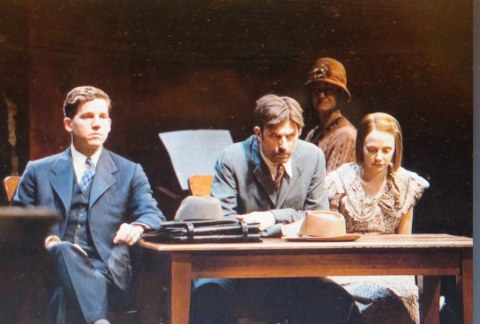
(L to R): Stark Sands, Frederick Weller, Erin Wilhelmi in Harper Lee’s ‘To Kill a Mockingbird,’ a new play by Aaron Sorkin, directed by Bartlett Sher (Julieta Cervantes)
Neal Huff’s Link Deas, likewise, is poignant and revelatory. Both Matthews’ Judge Taylor and Huff’s Deas reveal so much about Maycomb residents and the Southern culture’s subtle, slippery folks who cleverly negotiate the noxious climate of hate. Erin Wilhelmi is beyond superb as Mayella Ewell in her self-righteousness, her fear fueled arrogance and pride. Frederick Weller’s Bob Ewell as the underappreciated villain of Maycomb is sinister and arrogant and bullying. Both manage to reveal the characters as sonorously evil individuals with such humanity, we understand or at least think we understand why they are apparently hateful. However, as Cal suggests, it is horrifying to simulate “walking around in their shoes.”
And then there’s Tom Robinson. All I have to say about Gbenga Akinnagbe’s performance is bravo with tears in my eyes. At the curtain call I was happy to see he has full movement of both arms. As for Boo Radley portrayed by Danny Wolohan who also portrays Mr. Cunningham, he is the appropriate quiet, peaceful, and sensitive mockingbird as Boo, and the misled, “down-and-out” farmer Mr. Cunningham we feel sad for. Through the actors fine portrayals we understand how cultural mores and economics impact the society for ill and keep everyone behind, especially soulfully.
Not enough can be said about Sher’s direction and craft in assembling the skillful and award-wining creative designers to manifest his and Sorkin’s vision for the new play To Kill a Mockingbird. These are Miriam Buether (Scenic Design) Ann Roth (Costume Design) Jennifer Tipton (Lighting Design) Scott Lehrer (Sound Design) Adam Guettel (Original Score) Luc Vershueren for Campbell Young Associates (Hair/Wig Design) Kimberly Grigsby (Music Director) and Kate Wilson (Dialect Coach). All are perfect in my book. I thought the costumes of the children were well thought out; the music is both thrilling and poignant.
Can you get tickets to this award garnering (in a few months) production? Of course and you should. It is a monumental and historical event which happens every night and it comes at a heart-breaking time in US History. Be watchful, be aware, the themes are prescient and prevalent in our everyday lives. The production runs over two hours which fly by and it has one intermission. You can get tickets by CLICKING HERE.
”Merrily We Roll Along,’ Strong Performances, an Ebullient, Sleek, Shining Revival at Roundabout

The Company of ‘Merrily We Roll Along,’ presented by Roundabout Theatre Company and Fiasco Theater. Book by George Furth, Music/
lyrics by Stephen Sondheim, directed by Noah Brody (Joan Marcus)
Dramaturgs are most probably familiar with the tribulations of the 1981 version of Merrily We Roll Along, book by George Furth, music and lyrics by Stephen Sondheim, produced by Harold Prince. The musical, based on the titular play by George S. Kaufman and Moss Hart essentially extols youthful ambitions and artistic dreams which may become subverted by practical considerations once success and financial security are achieved. The original Furth/Sondheim musical lacked measured focus but was noted by some for its wonderful score. Though the show closed after more previews than performances, it was nominated for awards and won two.
The concepts highlighted by Sondheim’s music and lyrics are timeless and made especially so in their reworked version of Merrily We Roll Along (1994) which grounds the adapted iteration presented by Roundabout and engendered by the sterling efforts of Fiasco Theater. From the superlative, exciting performances by a “gang of six” headed up by the three principals, Jessie Austrian, Manu Narayan and Ben Steinfeld and directed with precision and adroit sensitivity by Noah Brody, this thematically poignant production resoundingly works (rare praise coming from a lukewarm Sondheim fan). I found the energetic pace, incredible plot structure and imaginative set design that paid tribute to theaters of the past (and Sondheim’s work) delightful and funny. Altogether, the artistic design, staging, costumes, sound design, and the ensemble’s superlative acting and singing unfold seamlessly in the service of uniquely structured storytelling that many should appreciate.
Certainly, the sheer number of theatrical props on library bookself-style floor to ceiling walls covering three sides of the stage intrigue. The props, haphazardly arranged appear akin to a “behind-the-scenes” look into symbolic take-aways of the characters’ lives. The theatrical design and tropes provide a fascinating backdrop to the action, the arc of which spins linchpin events in a reverse chronology from 1980 to 1957. It is a period of time which encompasses seven transitions to the precipitating incident when the three protagonists (Mary-Jessie Austrian, Charley-Manu Narayan, Frank-Ben Steinfeld) first meet on a rooftop that turns out to hold a lasting symbolism for them. The flashbacks to crucial years, highlight the melds and fractures of these immensely talented individuals whose dreams, personalities and synergies help to solidify an artistic fount of creativity. It is from this fountain of creativity and their interlocking aspirations that their successes spring forth.

(L to R): Ben Steinfeld, Manu Narayan, Jessie Austrian in ‘Merrily We Roll Along,’ Book by George Furth, Music/lyrics by Stephen Sondheim, directed by Noah Brody, Fiasco Theater’s production at Roundabout Theatre Company (Joan Marcus)
However, without their symbiotic energies weaving and flowing together, the fountain dries up. As we follow the events backward in time, we note the progression and conclude that the waters that once revived them dissipated as did the joy, hope and vibrance of creative, encouraging friendship. It is this that Frank remembers at the outset of the play and which is the initiating incident of all the scenes that flow back into the past. We shadow Frank as he relives and remembers key times and places that led to his separation from his friends. The three when we meet them in 1980 are successful and rest on their laurels. However, their greatness which is embedded in their friendship with each other is behind them. It is this tri-parte greatness that Frank (the excellent Ben Steinfeld) seeks in the beginning of Merrily We Roll Along.
And it is this greatness that Frank understands he has lost in an epiphany at the conclusion of the extended flashback which switches back into the present. He knows when his friendship ended with Mary (Austrian is absolutely wonderful) and Charley (Narayan brings down the house with “Franklin Shepard, Inc.”), that he lost the best part of himself. Whether he makes a determined effort to rekindle his relationship with Mary and Charley to recapture what they had is uncertain and sadly, not even alluded to as the lights dim.
The play’s structure as we chronicle the journey back to their first sparks of friendship is revelatory. When we witness the older individuals and their various partners at the outset of the play, these successful people are “played out,” grossly unspectacular and unoriginal. We do not relate to them, and feel disengaged from Frank’s “matter-of-fact” attitude as he sings “Rich and Happy.” But the song belies the truth and he and others question how they arrived at their aggressive and truly unhappy, unfulfilled state. There is a “movie-like” rewind (a transition which segues into the past), and the characters get to experience what most of us don’t get to see: the pivotal events that cause them to be where they are, when they don’t wish to be there at all.
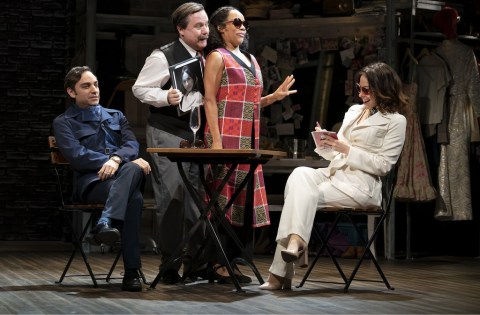
(L to R): Ben Steinfeld, Paul L. Coffey, Brittany Bradford, Emily Young in ‘Merrily We Roll Along,’ Book by George Furth, Music/lyrics Stephen Sondheim, directed by Noah Brody, Fiasco Theater’s production at the Roundabout Theatre Company (Joan Marcus)
In the brilliance of the play’s structure we chronicle Frank’s and the other’s flashback to the greatness they lost with various songs (“Like It Was,” “Franklin Shephard, Inc.”, “Old Friends,” “Growing Up,” through to “Our Time”). With the songs and transitional refrain (“Merrily We Roll Along”) taking us to their former times, the characters fill out and become personable individuals with whom we readily identify. Because of the ensemble’s acting skills and the director’s attention to detail, we joy to their humanity and feel ebullient with them, witnessing how they “made it.” However, we realize there is a caveat: success is another type of failure if one allows it to overthrow priorities and values that are based in goodness.
When we finally witness Mary’s, Frank’s and Charley’s serendipitous meet up on the rooftop when they solidify an uncanny unity, we make the connection to their twenty years later selves. Yes, years later they have “grown up.” But they have sacrificed, not their youthfulness, but their hope. They’ve lost the eternal innocence that initially ignited their artistic ambitions and happiness when they “found” each other.
It was this eternal innocence that synergistically drove them, encouraged them, sustained them through the “hard” years before they achieved success. However, after each becomes successful in their own right, they allowed their friendship to be sacrificed on the altar of celebrity. Their triumph is hollow, their latter-day efforts are uninspired. It is an incredible irony that in “the seeking” is the fun and adventure. With success comes another myriad of torments. And without your friends to hear you out and go through the miseries with you, it is especially painful. So it is for Mary, Charley and Frank.
To round out the acting “gang of six” are Brittany Bradford who portrays Beth, Meg and K.T. Her “Not a Day Goes By,” is just great in its emotional power and resonance. Paul L. Coffey and Emily Young are excellent as foils to each other portraying the producer, husband, actress, divorced and devolved. Carefully they authenticate the specifics of these individuals that confound Mary’s, Charley’s and Frank’s friendships with each other.

(L to R): Jessie Austrian, Ben Steinfeld, Manu Narayan in ‘Merrily We Roll Along,’ Book by George Furth, Music/lyrics by Stephen Sondheim, directed by Noah Brody, Fiasco Theater’s production at Roundabout Theatre Company (Joan Marcus)
Coffey’s upward development of Joe from failed producer to top of the world success is great (rewinding from the present to the past). Young’s upward development of neophyte actress and wife, who throws over Joe for Frank is excellent. The ebb and flow of success and failure in the marriages and relationships between Frank, Beth, Gussie, Joe characterizes the show business life. Meanwhile, Charley and Mary manage to hang on to their steady state (though Mary never marries). The contrast between the two groups is fascinating. It is clear how the demands of the producing/acting/songwriting lifestyles overthrow stability as these characters swim and tread water in an ever-changing sea of transitions.
Fiasco Theater’s re-imagining of Merrily We Roll Along is sharp, engaging, humorous, heartbreaking. The themes of friendship, regret and loss examined using flashbacks are clearly drawn through the music which is dynamic and exceptional. Sondheim touched upon the ineffability of friendship’s innocence and beauty and used that to drive the show forward into the remembrances of the past. The transitions beginning with the “Big Rewind” are excellent as the “gang of six” “rolls merrily along further into the convoluted turning points that got them to where they are decades later.
Some numbers are riotous, for example Austrian’s transformation into her thinner, unalcoholic self. Her vomiting up the booze “in the rewind” is super smart and hilarious. “Bobby and Jackie and Jack,” a song Charley, Beth, Frank and Mary perform at the Downtown Club is fun, and nostalgic for those who remember the Kennedys. The excitement of “It’s a Hit!” sung by Joe, Charley, Frank, Mary and Beth when their show is a success is exuberant and effervescent. And “Old Friends” is just spectacular. emotional and stirring. It is the kindling of the show’s fiery brightness.

(L to R): Jessie Austrian, Manu Narayan, Brittany Bradford, Ben Steinfeld in ‘Merrily We Roll Along,’ Book by George Furth, Music/lyrics by Stephen Sondheim, Fiasco Theater’s production at the Roundabout Theatre Company (Joan Marcus)
Most importantly, the cast authentically, magnetically fulfills in their various portrayals what Sondheim and Furth wanted to express: themes about friendship gained and lost, the synergies of creativity, the wonder of manifesting the creative process, and the corruptions that undermine the best of one’s self, for example prizing financial gain above all else.
The production is complex and rich. It should be seen, especially if you saw another version of Merrily We Roll Along. Fiasco Theater’s smashing adaptation is not to be missed. And if you didn’t see an earlier version, be happily enthralled while enjoying the depth of this production which is a clever, profoundly poignant “every-person” memoir of gaining and losing oneself. Finally, the work is a paean to friendship which in this show starts in the forever and ends up with protagonist Frank and the others staring into the abyss of regret. Is there a warning here in the “Age of Trumpism?”
Special Kudos to all creatives and The Band: Conductor/Piano-Emily Whitaker and these musicians: Giuseppe Fusco, Ansy Francois, Jeremy Miloszewicz, Jami Dauber, Hidayat Honari, Matt Aronoff, Janna Graham. Music Coordinator: Meg Zervoulis; Music Preparation: Conor Keelan.
Merrily We Roll Along runs without an intermission at the Laura Pels Theatre, Harold and Miriam Steinberg Center for Theatre (111 West 46th Street) until 7 April. You can purchase tickets at (212) 392-6308 or at their website by clicking HERE.
‘The Neurology of the Soul,’ Written/Directed by Edward Einhorn, at A.R.T.

Ashley Griffin in Untitled Theater Company No. 61’s ‘The Neurology of the Soul,’written and directed by Edward Einhorn at A.R.T. (Richard Termine)
Without bringing it square and center in his latest work The Neurology of the Soul, a must-see currently at A.R.T., playwright Edward Einhorn thematically relays what Tom Stoppard focused on in his work about neuroscience’s inability to deal with consciousness in The Hard Problem. Indeed, in The Neurology of the Soul Einhorn’s presents a neuroscientist’s search to empirically measure consciousness (love) with brain scans. Einhorn also directs this exceptional play which delivers humor, boundless verve and exciting ideas that on closer inspection are concerning.
Why are neuroscientists, marketers and art gallery owners (representatives of whom Einhorn acquaints us with in the play) assiduously and feverishly working to find the next great “discovery?” The profit motive in all of its sinister, opaque, nullifying effects which bind us to cultural norms that are often destructive to our souls. With an intriguing backdrop linking neuroscience, art, marketing/branding and human relationships, Einhorn raises questions about ethics and justice in his beautifully constructed, dynamic and mind-blowing work.

Ashley Griffin, Matthew Trumbull in Untitled Theater Company No. 61’s, ‘The Neurology of the Soul,’
written and directed by Edward Einhorn at A.R.T. (Richard Termine)
This is Einhorn’s newest play and it is as trenchant as much of his earlier work, perhaps even more so. For by identifying a loving couple’s relationship in the petri dish of our time, then agitating it with other individuals and circumstances, he explores the hideaway crevasses of the human spirit and soul. And he reveals how ultimately, consciousness and feelings of love are beyond the kin of empiricism (quantifiable, material data production) which science clings to with ferocity and an almost paranoid, discriminatory blindness. His exploration is at once humorous and frightening, if one considers the implications of what the art world, marketing and neuroscientists may intend. Each have their own siren songs which Einhorn gently presents to allow us to form our own conclusions. And even if the results are unsettling and uncertain, indeed the considerations are limitless and fascinating. Above all, his play alerts us to be on guard.
Stephen (a superbly developed performance by Matthew Trumbull) a cognitive neuroscientist, works for a university as a researcher. He is obsessed with attempting to chart consciousness, specifically the emotions of love. He is using brain scans (fMRI) to do so. That he employs his wife Amy (Ashley Griffin is equally brilliant in the give and take with Trumbull) as his research subject to gauge her reactions and brain responses to his expressions of love, appears sweet. On deeper inspection, Matthew’s Stephen remains removed and aloof as a researcher in the lab. And hearing his “matter-of-fact” atonal love expressions is humorous. It is antithetical to any expression of emotional love and desire which might arise during the normal course of two people interacting in a more intimate setting. (How Einhorn evolves this character and shepherds Trumbull’s adroit, incisive acting skills to bring him to surprising emotionalism is fabulous! Bravo to both!)

Mick O’Brien, Untitled Theater Company No. 61’s ‘The Neurology of the Soul’ written and directed by Edward Einhorn, at A.R.T. (Richard Termine)
Amy, a “failed” artist who signs on for the experiment, for she, too, wants to see how “love” lights up her brain, at the outset appears to be the more sensitive of the two. As Stephen gauges her responses, Amy speaks her feelings and thoughts to the audience and engages us as her confidante. She remains the impassive subject on a research table. We and Stephen can view her on a television screen and Stephen charts her brain responses. Nevertheless, she is two people: the interior and the exterior. For during the scene, when Stephen speaks love phrases to her, Amy’s interior feelings (which she relates to us) and thoughts are very active. Indeed, they are not about him or her love for him, but about the process of being “a subject.”
Einhorn’s having Amy speak to the audience is intriguing. Is this foreshadowing how from the outset, the scientific mapping is not only primitive, but is most probably heading in the direction of a complete disconnect? Einhorn surreptitiously sneaks in through Amy’s address/aside to the the audience (a dramatic technique with more than a typically Shakespearean purpose) that the human being is not a machine easily measurable. Nor is a human being easily controllable, manipulated, or understood. Her thoughts are unseen to Stephen, but revealed to us as she flashes back to a time when she modeled nude for art classes. This “disconnect,” is at the crux of the play and provides the action that propels it to the climax (when Amy and Stephen “scream” in recognition of their hurt and what they fear they have lost).
Increasingly, during Stephen’s experimentation of charting love, his love relationship with Amy is impacted. The observation of their love strangely changes it, recalling to mind the “observer effect” in Physics; the observation of a situation or phenomenon impacts and changes it.

(L to R): Mick O’Brien, Matthew Trumbull, Ashley Griffin (background) in Untitled Theater Company No. 61’s ‘The Neurology of the Soul,’ written and directed by Edward Einhorn at A.R.T. (Richard Termine)
Immediately, in the next segment Einhorn introduces Mark, the head of a neuromarketing firm who speaks before a “Digital Leadership Convention.” As Mark, Mick O’Brien is frighteningly believable as the narcissist with an overweening ego convinced of his own perfection and the justice of brainwashing people whom he uses for his own agenda. With clips of older TV advertisements, Mark convinces us how facile it is to manipulate consumers to buy product. Mark brilliantly persuades his audience (us) in the direction of using the expertise of his neuromarketing firm for whatever purpose, for example, selling product or something else. As Mark’s selling segments alternate with the research sessions between Amy and Stephen, the inevitable happens. Mark eventually hires Stephen for a lot of money to conduct research for his firm with the quid pro quo that Stephen can continue his research with Amy.
The delicious irony that Einhorn reveals with Mark’s characterization is that Mark “believes” that by employing visual and aural propaganda and brainwashing techniques, consumers are completely pliable and suggestive. That this is a “belief” or “theory” and not a 100% proven fact is lost on him. There is no uncertainty with him. He is convinced of the reality he creates to lure his listeners (Amy, Stephen, us) and himself.

Ashley Griffin, Yvonne Roen, Mick O’Brien in Untitled Theater Company’s ‘The Neurology of the Soul,’ written and directed by Edward Einhorn, A.R.T. (Richard Termine)
Though Amy does not trust him initially, Stephen and she relocate to an apartment in New York City. Mark persuades Amy to use her brain scans to create art which will be shown in a gallery he co-owns with his former wife Claire (a fine performance by Yvonne Roen as the congenial art dealer who ameliorates Amy’s misgivings and suspicions about Mark). Altruism doesn’t play into Mark’s “concern” for Amy’s talent or artistry. He convinces her she is lucky meeting him and that his is an opportunity she shouldn’t refuse. When she doesn’t, of course, he profits from the exhibition of her work and insinuates himself into her relationship with Stephen. Additionally, her art and herself become a commodity to be branded and marketed. Amy and her art are objectified, but the price for this process of bringing her brain scans (soul?) into art is worth it she believes. The irony is duly noted and we are reminded that promoters and marketers control how art and people rise and fall as trending commodities.
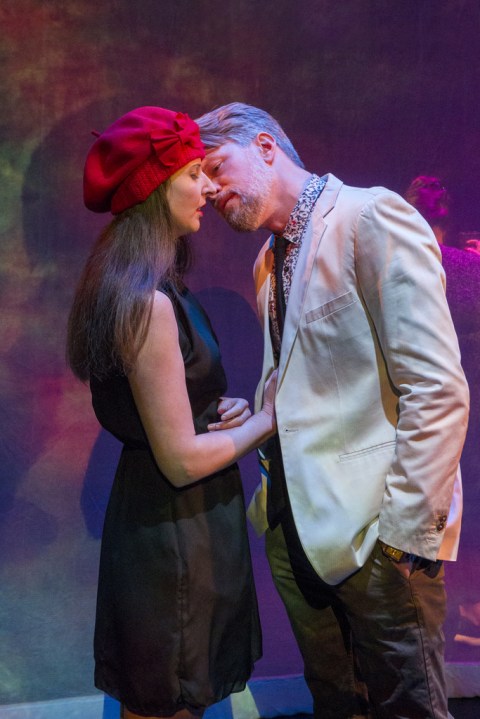
Ashley Griffin, Mick O’Brien, Untitled Theater Company No. 61’s ‘The Neurology of the Soul’ written and directed by Edward Einhorn, A.R.T. (Richard Termine)
The inevitable affair does not occur between Mark and Amy; though how this doesn’t occur is as complicated and uncertain as the wind. Stephen in the process of measuring Amy’s scans convinces himself that he sees in her scans a diminishing love response. And this he interprets to mean that she is falling out of love with him. Ultimately, there is a separation of living arrangements. With all this scientific measuring, belief, assumption, and second guesses encroach. It is a great irony of this play that the characters reveal how unobjective and unscientific they are in typical human fashion.
Despite the persuasive talents of Mark who is convinced of his own invincibility, Amy’s love is for one man only. Once more our faith is restored in what is unknowable, unscientific and spiritual (love). Amy’s art does receive an uplift; about that, as Claire suggested, Mark’s invincibility appears to be correct.

Matthew Trumbull, Ashley Griffin in Untitled Theater Company No. 61’s ‘The Neurology of the Soul’
written and directed by Edward Einhorn, A.R.T. (Richard Termine)
The Neurology of the Soul startles, thrills and absolutely shimmers with light. The themes Einhorn suggests are heady and profound. To what extent must we question the ethics about neuroscientific information in the employ of unscrupulous “neuromarketers” like representative Mark? If science captivates human beings’ unconscious proclivities with the intention of handing over the data to corporate entities who will then use it to brainwash social groups to consume their products, shouldn’t this be regulated? What if such data is turned over to digital companies to manipulate individuals to vote a certain way or support a certain political group over others? Isn’t this injudicious? Undemocratic? Should scientific ethics be left to scientists to self-regulate or independent panels of retired scientists? How do scientists regulate themselves to prevent abuses?
Science removed from philosophy and ethics and morality because those are quaint historic notions is a dangerous “science”. Such science is akin to its own philosophy and belief system which then could be used to justify anything. Without moral and ethical considerations, primitive neuroscience is still in its infancy. But what happens if certain emotions and consciousnesses can be mapped? As for now, the mind is unknown. Consciousness is a “hard problem.” And emotions like love, as Einhorn shows by the conclusion of his play, are beyond measure.
Einhorn’s The Neurology of the Soul is incredibly prescient and current. Think of social media’s use of memes, tropes, visuals and hot button rhetoric pegged to unconscious impulses to manipulate with disastrous results, especially when social groups are being targeted. Regulation is an imperative. But what happens when corporates and other leading social actors resist regulation for their own ends?
All of these themes and many more Einhorn sweepingly covers in this incredible and memorable work, made more exceptional with the production team’s artistry. All these listed are well shepherded by Einhorn’s direction. Kudos to Jim Boutin (Set Designer); Magnus Pind Bjerre (Video Designer); Ramona Ponce (Costume Designer); Jeff Nash (Lighting Designer); Sadah Espii Proctor (Sound Designer); Tiffany Lee (Asst. Video); Eric Mueller (Neurosales Logo) and all who contributed their efforts.
The Neurology of the Soul runs with no intermission until 2nd of March at A.R.T. (53rd between 10th and 11th). For tickets to this amazing production go to the website: Click Here.
‘The Price of Thomas Scott’ by Elizabeth Baker, Presented by The Mint Theater Company
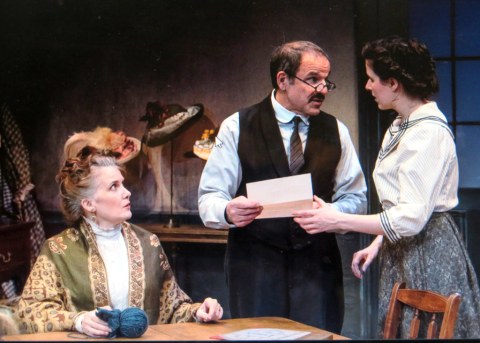
(L to R):Tracy Sallows, Donald Corren, Emma Geer in ‘The Price of Thomas Scott,’ presented by The Mint Theater (Todd Cerveris)
The Price of Thomas Scott, currently at Theatre Row is an interesting period piece which has at its core central issues about conscience, upholding the values one professes to believe in and sacrificing material well being for spiritual health and soul wholeness. Written by Elizabeth Baker (1876-1962) the playwright who hailed from a religious family wrote in the early last century about London’s working classes, shop girls, clerks and the ambitiously upwardly mobile.
In focusing a spotlight on their dreams, foibles and mores, Baker entertains with an eye to unraveling key theses about the human condition. Despite fashion and social folkways, if you transplant her characters in a modern prototypical setting, the results would initially appear vastly different, but the similarities in the characters’ issues would be stark and familiar. The reason why is because the moral, ethical and personal questions her characters confront, are issues we also confront at one time or another, if we have a conscience. There’s the rub!
The setting is the back parlor of Thomas Scott’s Draper’s shop (cloth wholesaler, haberdasher) where daughter Annie Scott (the delightful and winning Emma Geer) and son Leonard (the vibrant Nick LaMedica) discuss their ambitions and dreams, all of which require a large amount of money that their father does not have. The Scotts are part of the declining middle class and the children are strivers. However, Thomas Scott’s business is not doing well because his competitors drive down the prices, and the costs, as always, seem to eat into any profits. In short, Scott wishes to sell his business, retire and go to a beautiful place in Wales, something his wife has been longing for as she is tired of city living.
One factor that we note immediately is that this is a religious family and Mr. Scott (Donald Corren’s portrayal is modulated and has none of the self-righteous tone of the “religious”) upholds his beliefs and encourages his family to attend church and eschew all the latest fads and fashions, even attending theater performances. Though he doesn’t view theater as sinful, actually, he characterizes it as immoral (this gets a laugh from the audience). He suggests he can read the about it and that time and money could be spent better with other pursuits.
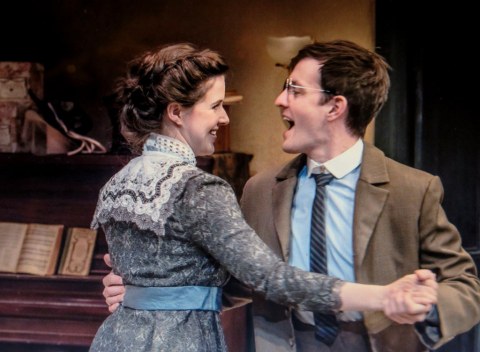
Nick LaMedica, Emma Geer in ‘The Price of Thomas Scott’ by Elizabeth Baker, directed by Jonathan Bank (Todd Cerveris)
After a scene where lodger Johnny Tite (Andrew Fallaize) and his friend Hartley Peters (Josh Goulding) waltz with Annie and her friend May (Ayana Workman), as brother Leonard plays for them, we understand that the young people wish to break away from the repressed culture in which they live. A waltz seems harmless enough. But we realize from the paranoid and hurried way that they rearrange the furniture which they moved to dance, that Mr. Scott would not be pleased to see them carrying on. Apparently, he doesn’t approve of dancing either. The focal point of his life seems to be church, praying, Bible study and singing religious hymns and he encourages his family to follow his upright example which they do to his face with a few lapses behind his back.
The conflict slowly develops. Mr. Scott fears running down his business to bankruptcy. And the only way out for his and his children’s dreams to come true would be to sell. However, no one is interested. And because of the other sales of neighbors’ business it appears he will not get a particularly good price for his shop. The quandray stresses him and his family who understand the stakes and the potential doom if there is no buyer.
When a buyer appears as a recommendation from elsewhere, Mr. Scott is thrilled as is the family. Following the adjurations of his friend to ask for an excellent price, he holds out for a price which would answer all of the desires of the family. Indeed, money answers all things, a Biblical scripture the play does not allude to. The 500 pound settlement would allow him to retire to Wales with his wife, set his son on a fine career path and pay for his daughter’s dream to go to Paris to learn the latest styles and return to London to employ her craft.
However, there is a fly in the ointment which may prevent their dreams from ever being realized. And the huge fly is Mr. Scott’s values and conscience. He is not enamored of the buyer or his trade.
His wife Ellen (the fine Tracy Sallows) respects him as do his children. However, if he allows his conscience to rule over their happiness, then their dreams and his own will turn to ashes. Unless a buyer shows up that he approves of, he may go bankrupt and have to close the shop without any money to forestall their downward economic decline. He is a religious man. He will have to turn to His God and his conscience for his final decision and after that the outcome which will be “good” or “ill.” When in trouble, rely on miracles!
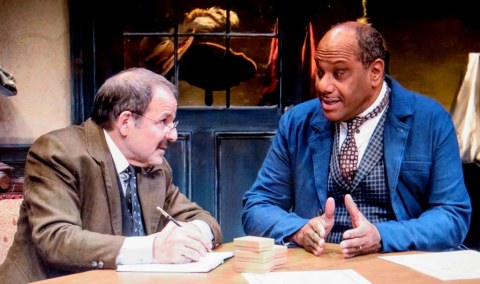
(L to R): Donald Corren, Mark Kenneth Smaltz in ‘The Price of Thomas Scott,’ by Elizabeth Baker, directed by Jonathan Bank (Todd Cerveris)
Mr. Scott’s choices and decisions mirror those conundrums faced by every world leader, every businessman, every head of the household who has control of others’ economic well being. If one is ethical and moral, the choices are actually harder. If one is amoral and believes that it is all right to wipe all competitors and settle for an “I win you lose” result, then there is no problem making the decision, but a huge problem with the result especially if the rule of law is in force. On the other hand morality, ethics and conscience create immense problems and crises. Living by one’s own standards stolidly without hypocrisy is the problem especially if there are temptations. And it is especially the problem if one expects others to live by one’s own standards though theirs may be different. Of course if the standards are high moral ones then it should be clear and the individual should be respected for living up to them. But relativity creeps in depending upon the situation and definition of “high moral standards.”
For example racists believe their discrimination is for the common good and a “high moral standard.” Conservative religious individuals believe the LBGTQ crowd are twisted and sick and should be rejected until they are turned to normal heterosexuality. A head of the household believes he must live by his values though it will impoverish his family and take food out of their mouths. These individuals, if they stick to their beliefs unequivocally, are not hypocrites selling their souls to be accepted by others. They have defined their actions as belief and conviction, though their actions would be described in the culture at large as discriminatory and loathsome. In the case of the head of the household, money and family are less important than his/her conscience. Some might argue that this man should not even have a family if he does not properly take care of them. Questions of ethics, morality and following one’s conscience are invariably complex, as playwright Baker intriguingly points out.
Above all the play is fascinating in the questions it asks. The Mr. Scotts of the world who follow conscience to the exclusion of other reasonable considerations are as extreme as the amoralists whose greed and self-dealing may cause death, misery and devastation. Applying Baker’s questions to a current problem today, might be as follows. To fight against corporate hegemony and abuse of other cultures must one eschew all technology because of its inherent slave footprint to not be a hypocrite or amoralist as well? Can one completely eliminate one’s slave footprint and abide in First World country status knowing that other cultures do without allowing us to “do with?” Thus, living in social modernity carried to this absurd conclusion means living as a hypocrite unlike Mr. Thomas or living as a self-dealing amoralist who ignores the ramifications of his behavior.

(L to R) Emma Geer, Ayana Workman in ‘The Price of Thomas Scott,’ by Elizabeth Baker, directed by Jonathan Bank, The Mint Theater Company (Todd Cerveris)
The Price of Thomas Scott brings to life the ethics and morality of “modern” living in exposing the human condition which is as ancient as “Adam and Eve in the “Garden.” And though the play concludes on an upward note with the next generation “resolving” the issues in a lighthearted way, what they do is “in your face” ironic and rebellious by the standards of Mr. Scott. In that rebellion lays the foundation of a greater crisis of the culture which in a decade or so moves into the excesses of “The Roaring Twenties,” eventual crash and great Depression which was effected as a partial response to the reactionary time of prohibition, religious revivalism and strict morality that Mr. Scott embraces. For every action there is a reaction, especially when ethics, morality, hypocrisy and soul selling are at issue.
The production by The Mint Theater Company gives precise attention to the spectacle of theatrical performance and time period which is as always a pleasure to see from the props to the staging. Kudos to Vicki R. Davis (Sets) Hunter Kaczorowski (Costumes) Christian Deangelis (Lights) Jane Shaw Sound & Musical Arrangements) and others which helped to make this a beautifully rendered production. The hats are magnificent and made me wish for a time beyond weddings and funerals when such hats were in vogue. (not really…just the hats)
Special kudos to the director Jonathan Banks and the cast who deliver a measured and authentic view into the past of how individuals like Mr. Scott and his family made hard decisions and stuck by them without taint of hypocrisy or corruption of their own consciences. Would that current day politicos were more like Mr. Scott who quails at selling his soul for Mammon. (The question in the play is, is that what he really is doing or that he believes he is doing?) In light of our president and the actors who surround him in the administration and influencers in foreign lands, Mr. Scott’s problem with (X) appears quaint. So much more the irony of this play being produced now when the problems of selling one’s soul for betraying a nation and its democratic processes are paramount. Bravo, Mint Theater Company!
You can see The Price of Thomas Scott which runs without an intermission at Theater Row (42nd Street between 8th and 9th Avenue). The production closes on 23rd March. Click for tickets HERE.
‘Switzerland,’ by Joanna Murray-Smith, Dishing Patricia Highsmith With Murder and a Smile

Peggy J. Scott and Daniel Petzold in Hudson Stage Company’s NYC Premiere of ‘Switzerland,’ by Joanna Murray-Smith, directed by Dan Foster at 59E59 Theaters (Rana Faure)
Renowned award winning novelist, essayist and short story writer, Patricia Highsmith isolates herself in Switzerland with views of the gorgeous snow-capped Alps glinting beams of light cheerily toward her house. As her desk and old-fashioned typewriter face opposite the window, we understand the writer is not in Switzerland for a pleasant reprieve from the United States which she often excoriated in newspaper articles and editorials.
No! She is there for another purpose. As we hop on the erratic train ride of her mind over the peaks and valleys of Highsmith’s jagged mental state fueled by alcohol, we discover what that purpose is in the Hudson Stage Company production of Switzerland. Highsmith’s goal emerges from the thrust and parry of her cruel, epithetical witticisms directed at guest Edward Ridgeway’s ineffective, mewling arguments.
From the opening of Switzerland (written by Joanna Murray-Smith) as Highsmith fronts off against Edward Ridgeway and continues until the conclusion, their menacing pas de deux fascinates and thrills. Theirs is a standoff that requires no compromise, just “a winner take all” attitude to finish off the opponent. In her inimical and irrevocable way, Highsmith finally triumphs.

Peggy J. Scott in Hudson Stage Company’s ‘Switzerland,’ by Joanna Murray-Smith, directed by Dan Foster at 59E59 Theaters (Rana Faure)
Ridgeway (Daniel Petzold’s performance surprises and titillates) has been sent by her publisher who intends for Highsmith (the irascible and cantankerous Peggy J. Scott) to write one more crime novel in the globally successful series about mesmerizing murderer Tom Ripley. Ridgeway employs the typical mundanely unsophisticated patter of an underling sent on an impossible mission to get Highsmith to sign a last contract. Highsmith flays his emotional skin and carves up his pride like a parboiled turkey and dumps the carcass in the toilet as dung. The process is humorous to watch as he sinks further into himself and she blossoms with the sardonic verve of a yellow-jacket wasp tearing at a stink weed flower.
Nevertheless, Ridgeway sustains her sneering barbs about his age, US society and more. He persists and gradually threads together the spot-on phrases and allurements to seduce Highsmith. What initially intrigues Highsmith is that Ridgeway may be psychologically traumatized by the loss of his parents in a car accident. She points out that he must be an orphan for he plays the part of an orphan willing to please. Intrigued and puffed up at her accurate assumptions about him, Highsmith cruelly revels with glee as she penetrates his emotions forcing him to rehash the accident’s how, when and where like a criminal investigator. Her enthusiastic reactions to his morbid retelling are humorous and we become as interested as she about this first appearances milk-toast who seemed to fit in with the furniture until she drew him out.

Daniel Petzold, Peggy J. Scott in ‘Switzerland,’at 59E59 Theaters (Rana Faure)
During the course of Ridgeway’s sojourn into this indelicate persuasion to seduce Highsmith to do what for a decade she has chosen not to, we learn of her noxious views and stances which are racist, anti-semitic, and somewhat homophobic, though she herself is admittedly gay. Joanna Murray-Smith paints this dark portrait of the beloved writer’s underbelly which reflects the truth if one reads her fans’ and detractors’ commentary about her personal life. As Ridgeway continues his persuasion, Highsmith gradually is pulled in and accedes after he suggests plot points for the new work. She takes the bait and they contrive together. He stays the night and the scene converts and heads in a completely different direction in the morning. It is then we realize that up is down, black is white and appearances like books cannot be judged by their covers.
What emerges Murray-Smith cleverly twists into high intrigue. The logic of this turning point is exacting and perfect. And the shock of it is succinctly and boldly enacted by Petzold’s adroit, flexible and admirable acting chops. Scott deftly works in concert holding her own with commensurate power and delight. Confronting this plot switch on a switch with hints of magical realism, Highsmith enters into her glory. Her enthusiasm is boundless once more, as if she has been given a new lease on a life that she had grown weary of in its sameness, inane vanities and boredoms.
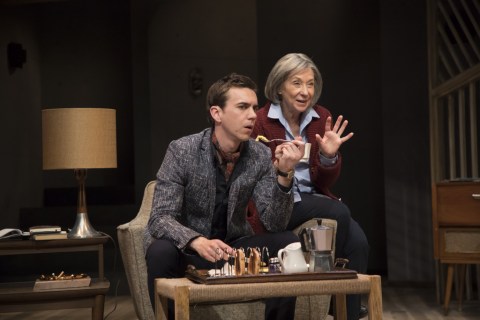
Daniel Petzold, Peggy J. Scott, Hudson Stage Company’s ‘Switzerland,’ at 59E59 Theaters (Rana Faure)
Directed by Dan Foster, the staging, the choices of the actors and director in a pacing of revelations shine especially at the beginning and the conclusion of the production. After the “switch” the scenes evolve rapidly. And we are riveted when the music shifts and Petzold’s Ridgeway and Scott’s Highsmith move in a delicious tango with a hints of love and attraction.
There are no spoiler alerts here. You will have to appreciate for yourself the excellent acting and the superb ensemble work of Scott and Petzold who listen, react, nuance and rightly divide their tone to enjoy the fun and humor of the relationship that they create between these characters.
Kudos to the creative team. I thought the music was a particularly fine choice (Garrett Hood is responsible for the Sound Design and Composing). Kudos go to James J. Fenton for his thoughtful set design, to Charlotte Palmer-Lane who creates the Highsmith “look” and Ridgeway’s clothing finesses; and to Andrew Gmoser for apt, suggestive lighting design.
The production in its New York City premiere is a must-see for Highsmith fans and mystery fans. And for those who may have seen a few of Highsmith’s works made into films like the Ripley series, Strangers on a Train (Alfred Hitchcock version, 1951) and wacky comedic take-offs like Throw Momma From the Train (Danny DeVito version, 1987), you will appreciate how Murray-Smith generates this fascinating piece which is well-shepherded by Dan Foster and finely rendered by Peggy J. Scott and Daniel Petzold.
Switzerland runs with no intermission (1 hour 30 minutes) at 59E59 Theaters (Fifty-nine East 59th Street) until 3 March. For tickets you may call 59E59 Theaters at 212-753 5959 or go online by CLICKING HERE
‘The Shadow of a Gunman,’ The Sean O’Casey Season at the Irish Repertory Theatre
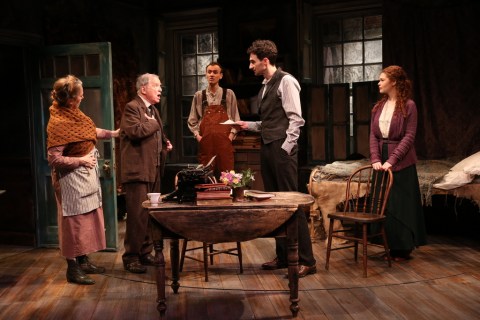
(L to R): Una Clancy, Robert Langdon Lloyd, Ed Malone, James Russell, Meg Hennessy in the Irish Rep production of Sean O’Casey’s ‘The Shadow of a Gunman’ directed by Ciarán O’Reilly (Carole Rosegg)
Sean O’Casey’s compelling The Shadow of a Gunman (1923), the first play of his Dublin Trilogy, has been selected by the Irish Repertory Theatre as the “send off” to introduce their Sean O’Casey Season which has been running from January 30 and will continue through May 25,2019. The first play of the O’Casey Cycle is presented in repertory along with O’Casey’s Juno and the Paycock and The Plough and the Stars on the Irish Rep’s main stage (132 West 22nd Street).
The plays of the trilogy take place during three pivotal and violent confrontations between Ireland and the United Kingdom: The Irish War of Independence (January 21, 1919-July 11, 1921); The Irish Civil War (June 1922-May 1923) and The Easter Rising (April 24-29, 1916). These wars led to the Republic of Ireland achieving independence from the United Kingdom. However the tribal wounds and ferocious heartbreak and resentments incurred centuries ago that exploded into these wars and ended in an uncertain peace, still abide to this day.

(L to R): James Russell, Michael Mellamphy in Irish Repertory Theatre’s production of Sean O’Casey’s ‘The Shadow of a Gunman,’directed by Ciarán O’Reilly (Carol Rosegg)
The Irish Rep has chosen to celebrate its 30th anniversary by featuring O’Casey’s trilogy which chronicles the impact of dire events on the impoverished tenement dwellers of Dublin who were often the casualties of war. Revisiting the plays remains important for our time because as O’Casey highlights the effects of division and internecine hatreds, he raises questions about the nature of freedom, sacrifice, art, nationalism, Republicanism and more. Always in the background is the price average individuals are “willing” to pay to achieve self-governance and negotiate the political power plays of forces, organizations and governments not readily understandable nor controllable.
The Shadow of a Gunman ably and concisely directed by Ciarán O’Reilly to achieve O’Casey’s maximum intended effect has as its setting Dublin during the Irish War of Independence (see dates above). The largely guerilla warfare campaigns encompassed brutal clashes between the IRA (referred to as the Old IRA today) appointed as the enforcers of Irish Independence, and many former British WWI veterans known as the “Black and Tans.” These British military units were “volunteered” by England to safeguard Ireland as part of the United Kingdom. However, their undisciplined and harsh tactics exacerbated the conflicts so that repeated incidents of bloodshed and devastation were wrecked upon Dublin society by the IRA and the British military.

Meg Hennessy and James Russell in the Irish Rep’s production of Sean O’Casey’s ‘The Shadow of a Gunman,’ directed by Ciarán O’Reilly
How the innocent tenement dwellers of Dublin suffer for the price of a freedom and economic independence that largely remains beyond them is brilliantly chronicled by O’Casey. And indeed, through the excellent work of the ensemble and shepherding of the fine performances by Ciarán O’Reilly, we experience the ironic tragicomedy of happenstance and the true terror of being caught between two ranging enemies who do not care who is swept up in the brutality or destroyed.
The comedy resides largely in the human interactions of the residents of a rooming house and how they present themselves as they negotiate their own political positions and participation or lack of interest in effecting a free Ireland. One central irony is that they underestimate the danger of the warfare that surrounds them until it is too late. In their naivete they assume that struggling writer and poet Donal Davoren (James Russell in a sensitive, angst-ridden and nuanced portrayal) is a member of the IRA and the titular “gunman” of the play.
Davoren, who has newly arrived to the boarding house and is the roommate of Seumus Shields (the humorous, hapless and unwitting Michael Mellamphy whose cowardice is recognizable and empathetic) is treated with dignity and great respect by the other residents. Minnie Powell (Meg Hennessy renders a feisty, sweet and charming portrait of innocence and bravery) especially finds Donal irresistible for she is enamored of the romantic notions of heroism and courage that gunman fighting for a free Ireland display. Of course, the irony O’Casey delivers in blow after blow by the end of the play dispels everyone’s romantic notions of freedom fighters. And we are reminded that dying for freedom and liberty are propaganda, especially when there is a shortage of brave and courageous souls who are willing to take risks facing off against a loaded gun.

Terry Donnelly in the Irish Rep production of Sean O’Casey’s ‘The Shadow of a Gunman,’ directed by Ciarán O’Reilly (Carol Rosegg)
O’Casey presents the issues and themes immediately. He introduces the Everyman’s perspective which many of the renters embrace, particularly Mellamphy’s Shields. And the playwright fronts that view against the poet/philosopher’s pacifist view of Donal Davoren whom the renters believe to be with the IRA. The irony, if followed to its absurd conclusion in O’Casey’s plot, rings with horrific truth, considering the results and follow-through of their beliefs about him.
Meanwhile, discounting their attitudes about, yet slyly thinking to capture Minnie’s heart by saying little, to Shields Donal beats his breast and cries of the miseries and pains of being a poet. He rails against the commoners for whom he creates his art to little effect. Through him O’Casey reveals an ironic addendum. For all the angst and pain artists go through to create the beauties of art and literature, the works may or may not assert a place of importance in the hearts of citizens in a time of war. (Is O’Casey perhaps being sardonic about the importance of his own work through this character’s mewlings?)
Director O’Reilly gives attention to each of these characters. In his rendition of Casey’s work, we understand that they represent symbolic types in the human panoply of characters that manifest the cowardice and hypocrisy of those who inhabit every society in the throes of violent revolutionary change.
All of them reveal in one way or another the flaws that contribute to the tragedy that occurs by the play’s end. For example the kowtowing, gossiping Tommy Owens (Ed Malone in a humorous turn) exemplifies the toady and hypocrite who brings on the trouble. The alcoholic and abusive husband Mr. Grigson screams out his position as an “Orangeman” sympathetic to the opposite side. John Keating manages to be sincere in his drunkenness and hysterical to boot. However, we note another side of him when Mr. Grigson and Shields swap stories of their bravery in the face of the British, who in actuality frighten them out of their wits. Only Donal remains silent and renders himself invisible in the face of terror. Though the lying bravado is typically understandable, it is also cringe-worthy. For men should be stronger, should they not? O’Casey smashes this notion by the play’s end with a resounding exclamation point which this production succeeds in spearing through our hearts and minds.
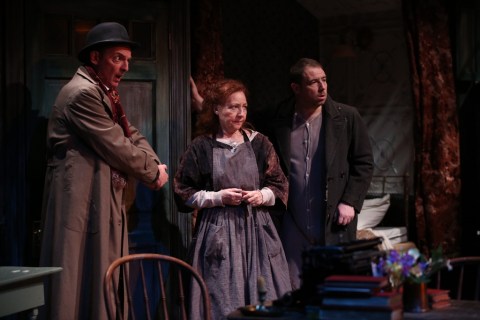
(L to R): John Keating, Terry Donnelly, Michael Mellamphy in the Irish Reps production of Sean O’Casey’s ‘The Shadow of a Gunman,’ directed by Ciarán O’Reilly Carol Rosegg)
Terry Donnelly as the long-suffering Mrs. Grigson delivers a superbly heartfelt, broken and poignant portrayal that takes us into a tragedy that we will remember long after the lights come up. Most importantly, the second act thrums with rapid pacing, suspense and “edge-of-your-seat” fear. We empathize with the Dubliners throughout the experience O’Reilly and the company put us through as they moment-to-moment envelop us with the emotion and horror of unfolding events in real time.
This immediacy is a vital element of O’Casey’s work and the ensemble and the production team render it superbly. For it is the terrifying experience that delivers our epiphany of what the historic Dubliners went through and what occupying troops in Syria and Yemen put innocents through today. The civilians are gun fodder for wars they have not willingly signed on for. Surely, they do not anticipate their lives threatened and lifestyles destroyed by both sides of the warring factions on streets and in homes where children once played and all was safe and secure. Surely, they do not choose between the Scylla and Charybdis of becoming an escaping refugee or staying to be numbered among the dead or disappeared. It was so in Ireland, then, it is so in wars that dot our planet and fuel defense manufacturers’ profits today.
As O’Casey reveals most acutely in the action conveyed by the actors, designers and director of this production, this is THE TERROR. And as the characters experience the horror, uncertainty and helplessness in the face of the oppression and tyranny from both sides, we experience it as well. The tragedy becomes that all who are present as witnesses become the accountable participants and they must live with the regrets imprinted on their souls until they are washed away, if ever.
Kudos to all in the acting ensemble who contribute to making this a soul-sonorous production. Kudos to the design team: Charlie Corcoran (scenic), Linda Fisher & David Toser (costume) Michael Gottlieb (lighting) Ryan Rumery & M. Florian Staab (sound) Ryan Rumery (original music).
This is a must-see, especially if you are unfamiliar with Shadow of a Gunman which runs with one intermission. The production is a wonderful introduction to Sean O’Casey and if you have been a forever fan, you will be very pleased. Additionally, the Irish Rep in celebration of the playwright is conducting free readings, symposiums, lectures, film screenings and music exhibitions. For more information on the Sean O’Casey Cycle and for tickets to the Dublin Trilogy, check the website.
‘Mies Julie’ an Adaptation of August Strindberg’s ‘Miss Julie’ by Yaël Farber at CSC

(L to R): Elise Kibler, Patrice- Johnson Chevannes, James Udon in CSC, ‘Mies Julie,’ by Yaël Farber, adapted from the play ‘Miss Julie’ by August Strindberg, directed by Shariffa Ali (Joan Marcus).
The Classic Shakespeare Company is presenting two 19th century plays by August Strindberg in Repertory. The Dance of Death (see my review by “clicking here” in a new version by the award winning Conor McPherson) and Mies Julie in an adaptation by the award winning South African director and playwright Yaël Farber.
Farber has given Strindberg’s Miss Julie a renovation in texture, location, structure and dynamic by intensifying the conflict and shortening the arc of the play’s development. Inherent in this production directed by Shariffa Ali is the force and power to further elucidate the themes about classism, chauvinism, oppression, economic injustice, racism, white supremacy and cyclical revenge with the backdrop of a new setting, South Africa, 2012. Additionally. she has changed the characterization of Christine from Jean’s fiancee to John’s mother, and worldly servant Jean to Xhosa farm worker John, intriguingly characterizing him as one who grew up with Mies Julie on the farm that Julie’s father owns.

(L to R): (L to R): Elise Kibler, Patrice- Johnson Chevannes, James Udon in CSC, ‘Mies Julie,’ by Yaël Farber, adapted from the play ‘Miss Julie’ by August Strindberg, directed by Shariffa Ali (Joan Marcus).
Christine has raised Mies Julie alongside her own son when Julie’s mother abandoned her daughter suffering from severe depression. The mother, alienated and isolated from the strangeness of the colonial women with whom she never could feel comfortable, the difficulty of the farming life and her own inner regrets caved in her soul. Without any sense of purpose or the obligation of duty to take care of her own child, she shoots herself and little Julie finds the disastrous ruin of the woman. Mies Julie thinks she is responsible for her mother’s death, but is nurtured by Christine’s love to eventually recover.
Nevertheless, Mies Julie bears the scars of the trauma. And during the course of the play we intuit that her rebellious behavior and impulsiveness suppresses an inner pain as she careens through her life. If not for Christiane’s love and an emotional attachment to Christine’s son John, who protects her and secretly, hopelessly loves her, Mies Julie might follow in her mother’s footsteps. The character of Mies Julie is most similar to Strindberg’s Miss Julie in ethos, however, the fascinating twists of transformation of setting reshape all of her actions and give them additional resonance and thematic richness.
Farber’s adaptation opens in a farmhouse kitchen in Eastern Cape, Karoo, South Africa on Freedom Day, 27 of April 2012, almost 20 years after all South Africans were give the right to vote in 1994. The day is a vital symbol integral to the complex themes of this adaptation. For the blacks of South Africa, the price of freedom was purchased by blood and suffering. The black culture’s redemption and return to the land of their ancestors will also be paid for by blood and suffering in a twisted karmic resolution in Farber’s Mies Julie.
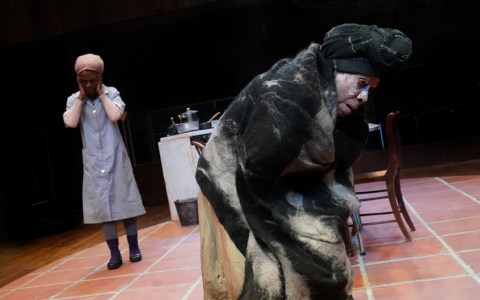
(L toR): Patrice- Johnson Chevannes, Vinie Burrows, CSC, ‘Mies Julie,’ by Yaël Farber, adapted from the play ‘Miss Julie’ by August Strindberg, directed by Shariffa Ali (Joan Marcus).
Indeed, ancestors in the form of a ghostly grandmother seek revenge as she haunts the house which was built upon ancestral graves. Although this is not effected in the set design, Christine refers to the great tree which was cut down to make way for the house, but whose roots retained life and now break through the tiles of the floor of the kitchen and continue to grow in defiance of the white, man-made structure. The symbolism of the tree as representational of the Xhosa family which belongs on the land and whose culture can never be erased is a focal point. Unfortunately, without evidence of the tree breaking through the floor (due to the repertory’s need for minimalism) an important theme of Farber’s work is diminished, opaquely realized through Christine’s dialogue which becomes too easily lost in the hum of action.
Farber presents the underlying conflict when the workers on the farm and some squatters who have returned to the land that their ancestors lived on before the colonials came, have been celebrating and dancing on Freedom Day. Mies Julie dances with the workers a bold and inappropriate act. Because her father is away, she rebelliously revels in these liberties which lower her stature and respect in the workers’ eyes. When John attempts to admonish her, we see the emotional tensions between them and realize that the relationship they have developed in many ways runs past master/servant and portends elements of love or sado-masochism or both.
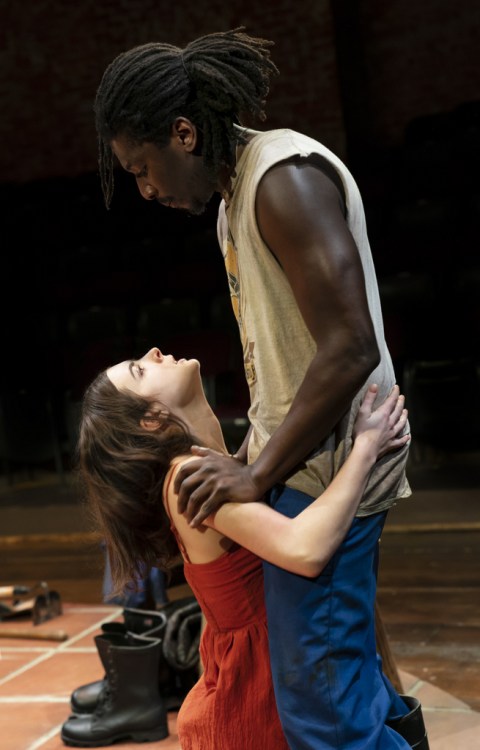
(L to R): Elise Kibler, James Udon in CSC, ‘Mies Julie,’ by Yaël Farber. adapted from the play ‘Miss Julie’ by August Strindberg, directed by Shariffa Ali (Joan Marcus).
During the course of the production we discover that the South African’s hope is to one day take back the land from the colonials like Julie’s father. They consider this an act of restitution for the terrible bloodshed and misery caused in the years of usurpation which brought about cultural devastation. The economic struggles continue in the present day for the workers like John and Christine must still submit to servitude to survive. Decades of economic injustice and inequality have delayed their accumulation of enough capital to purchase the land that their ancestors lived on centuries ago.
Though John has educated himself and wants the freedom to be able to prosper beyond his “class and race,” he is not the urbane, world traveler of the Jean of Strindberg’s work. And though he has had women, he has loved Mies Julie from childhood. It is this night that erupts in a culmination of many subterranean wants and desires for both Mies Julie and for John. And of course it is this night of freedom that lifts up Mies Julie’s “Afrikaaner race” out from under the degradation and debasement of oppressing the Xhosa.
John and Julie are representative of their race and class. On one level Mies Julie becomes the sacrifice to expiate the “sins” of her forefathers when she chooses to become equal and unite in a physical consummation of love with John. Likewise for John, it is a night where he asserts his privilege to repossess the land (symbolized by Mies Julie’s body) and achieve a lifelong dream to be restored to his true sense of self-worth, identity and power.
The beauty and tragedy of portraying their relationship as Farber does in layer upon layer of intricate psychological and social texture is that we understand before the characters do that perhaps decades need to pass before the destructive social MATRIX in which both live and have their being disintegrates. John comes to this realization sooner than Mies Julie, who is impaled on the immediacy and unreality of wanting an idyllic life with John away from the farm. She intends to run away with him and use her father’s money that she’s stolen from the safe. John cannot trust Mies Julie enough to leave his mother and the stultifying but familiar identity that has oppressed him his entire life. The two are trapped and their end appears to be an inevitability. The time is surely “out of joint.” And only a few options remain for them to take before Julie’s father returns the next day and stasis consumes their lives once more.
In this adaption, Farber presents some of Strindberg’s themes front and center and then embellishes and expands them. Farber suggests the following. In order for the injustices between and among economic classes to ever be resolved, the classes themselves must be dissolved. For all human beings, the trials overcoming the miseries of childhood and the nullifying stricture of social mores, are uneasily won. For outsiders who are economically challenged, the trials are even greater. Only gradually through the passing of the generations will there ever be economic and social parity between and among disparate races and ethnic groups.
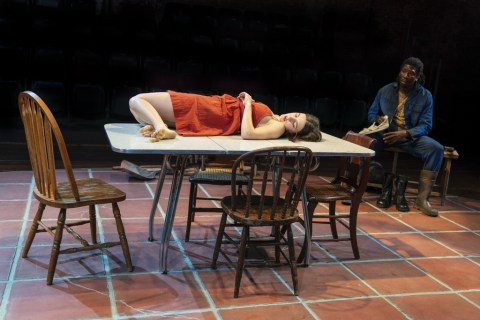
(L to R): Elise Kibler, Patrice- Johnson Chevannes, James Udon in CSC, ‘Mies Julie,’ by Yaël Farber. adapted from the play ‘Miss Julie’ by August Strindberg, directed by Shariffa Ali (Joan Marcus).
Christine knows this. She treasures her job and is willing to abide in her faith believing that for her son’s generation it will be better, but for her generation, it is finished. John wants change immediately and by fathering Mies Julie’s child he will overthrow the status quo, though he risks her father’s wrath. They must leave, for if a baby comes, her father will kill them both.
The harder he and Julie attempt to extricate themselves from the binding circumstances, the more they become mired in fear. It is a truism that they must leave or die. They cannot forge new identities in the same place where old hatreds and resentments float like ghosts above the blood-soaked land. Mies Julie wisely commands that they run away from her father and the farm’s oppression and migrate to a new identity and new existence in the city. But John is stuck. Christine adjures that she will never leave the farm. John must choose. Either he abandons his mother and goes with Mies Julie to freedom, or he remains with Christine in servitude. If there is a baby, all three will die.
Farber’s adaptation presented by the CSC and directed by Shariffa Ali enthralls with strong, emotional performances by James Udon as John, Elise Kibler as Mies Julie and Patrice Johnson-Chavannes as Christine. And when the ghost of the grandmother walks the kitchen, Vinnie Burrows is uncanny and foreboding. Because of her presence, we understand that a fearful retribution is coming, but it remains unclear until the play’s conclusion.

(L to R): James Udon, Elise Kibler, Patrice- Johnson Chevannes, in CSC, ‘Mies Julie,’ by Yaël Farber, adapted from the play ‘Miss Julie’ by August Strindberg, directed by Shariffa Ali (Joan Marcus).
The production runs like a bullet train on a collusion course toward destruction especially in the scenes where Kibler and Udon spar, seek to dominate and control, then relent, succumbing to their tenuous love for each other. Kibler is effective in her smoldering, wild longing. Udon is sensitive and caring as the “fool” for love, then angry and rebellious in believing he is Mies Julie’s plaything. These emotions provide a field for incredible contrasts. On the one hand Julie and John collide with their fear of abandonment and betrayal. Then they fly to each other then fly to reinforce a love perches on the edge of desperation. These tensions and the heightened interplay between Kibler’s Mies Julie and Udon’s John is wrought with ferocious zeal.
A note of warning. Some of the dialect and the accents are muffled and strained. I found that swaths of dialogue were garbled because of an overemphasis to “get the accents right.” I am not referring to the words of Afrikaans or Indigenous words in Xhosa, but the heavily accented English. The accents are vital for they introduce the setting. However, the use remained problematic. When the emotion was presented organically, the dialogue followed and the actors were easily understood.
Finally, the set design was spare and adequate as it should be in this repertory Strindberg cycle. However, the incredible symbolism of the tree should be included as an important thematic thread of the play. The music, the effects, make-up and costumes are apt. When the ghostly presence enters and leaves, all these design elements effect the supernatural wonderfully.
Mies Julie and The Dance of Death alternate in repertory at CSC (13th Street between 3rd and 4th) until 10 March. Mies Julie is a spare 75 minutes with no intermission. You can pick up tickets at their website.
The Mindblasting Ethan Hawke and Paul Dano Cave to Primal Hatreds and Private Desolations in Sam Shepard’s ‘True West’

(L to R): Ethan Hawke, Paul Dano in Roundabout Theatre Company’s ‘True West,’ by Sam Shepard, directed by James Macdonald (Joan Marcus)
True West by Sam Shepard is a tour de force which easily reveals actors’ talents or their infelicities. Indeed, it may be a devastating on-stage nightmare if the actors’ skills do not resonate with a fluid “moment-to-moment” dynamic that sits precariously on the knife-edge of emotional chaos and crisis. This is especially so in Act II of Shepard’s True West which is currently in revival at the American Airlines Theatre on 42nd Street, starring the consummate Ethan Hawke and Paul Dano. Both actors rise to the pinnacle of their skills surfing their own moment-to-moment impulses in this sense-memory tearing, emotional slug-fest of a play about siblings. This is a glorious, shattering production thanks to Hawke and Dano who once more prove to be among the great actors of their generation. If Shepard is apprised of this production in another realm of consciousness, surely he is thrilled.
The arc of True West‘s development reveals Shepard’s acute examination of brothers Lee and Austin who wrangle and rage against each other to finally emerge from the emotional and familial folkways they’ve spun into their own self-fabricated prisons. The second act especially (the first act is more expositional and slower paced) screams with the taut, granular impact of subtly shifting, increasingly augmenting collisions of the mind, will and emotions of the older, social outcast and thief Lee (portrayed with dark tension, authenticity, humanity by Ethan Hawke) and the younger, ambitious, middle class Austin (the “mild-mannered” Dano seethes with fury and sub rosa angst that simmers to a boil). As these two attempt to reconnect after an estrangement, they thinly reconcile, negotiating confrontation and abrasion, while they attempt to deal with personal dissatisfaction. During their reunion, they discover that too far is never far enough to unleash the emotional convolutions, chaos and conundrums of their relationship.

(L to R): Ethan Hawke, Paul Dano in Roundabout Theatre Company’s ‘True West,’ by Sam Shepard, directed by James Macdonald (Joan Marcus)
Of course, Shepard’s searing, dark humor and sardonic irony resides in Lee’s and Austin’s attempt to achieve an inner and outer expurgation. Interestingly, they use each other’s “being” as a battering ram against themselves and their complex, twisted “brotherhood.” And as they pummel and propel themselves “forward” through the charged, electrified atmosphere between them, they disintegrate their inner soul rot and misery. By the conclusion of the play, they have reached their own TRUE WEST. This is brilliantly symbolized and effected by Jane Cox’s Lighting Design, Mimi Lien’s Set Design and Bray Poor’s Original Music and Sound Design.
In the last moments between life, death and resurrection, Lee and Austin stand on the edge of a precipice eyeballing each other with uncertain respect and caution as they assess who they are and what they have wrought together. We realize that they have sought this desert of their creation. That they, by primal impulses, destroyed and trashed everything around them including some of their mother’s prized possessions to get there, is unfathomable to us. It is incomprehensible unless we examine our own self-destructive behaviors. However, their behavior is an achievement necessary to get to who they are. At the least they’ve shed pretense. They are raw creature/creations like the the yapping coyotes that lure pets, grab them and chow down for supper. However, where these characters go from this still point remains uncertain. But the hope is that it will result in a new identity for each, away from the annihilation and alienation of the parents who raised them.
Though Shepard’s play is set in the distant past, the themes and relationship that Hawke and Dano establish is vital, energetic, heart-breaking, mind-blowing, current. Each actor has brought so much of his own grist to Lee and Austin and responds with such familiarity and raw honesty to the other, it is absolutely breathtaking. It remains impossible not to watch both and be in awe of their craft. One is utterly engaged in the suspense of where the brothers’ impulses will take them as they scrape and claw at each other’s nerve endings to create bleeding wounds.

Ethan Hawke (standing) Paul Dano in Roundabout Theatre Company’s ‘True West,’ by Sam Shepard, directed by James Macdonald (Joan Marcus)
Thanks go to James Macdonald’s direction and staging to facilitate Dano’s and Hawke’s memorable portrayals. With extraordinary performances like theirs, we are compelled to consider the characters, and determine how and why they are smashing each other’s personal boundaries to reveal inner resentments, hurts, and the chaotic forces that have swamped each of them in the most particular ways. The ties that bind them run so deep these two are oxymorons. They have identical twin souls, though they are externally antithetical. Why they clash is because they are like minded: raging, though controlled. Their emotions, like subterranean lava flows wait for the precise moment to explode and change the landscape around them. Lee is the more mature volcano; but his earthquakes create the chain reaction that stirs Austin’s. No smoke and mirrors here; just raw power.
As a perfect foil to spur the play’s development Gary Wilmes portrays Saul Kimmer, the producer hack who smarmes his way into Austin’s heart, then dumps him because he will not exact a devil’s bargain which Austin refuses to accept. Austin’s rejection of the “bargain,” enragese Lee. Wilmes is appropriately diffuse and opaque. Where does he really stand? What happened to make him turn on a dime regarding hiring Austin who has invested sweat equity and emotional integrity in a project Kimmer professed interest in? Wilmes is both authentic and the Hollywood “type,” to drive Lee and Austin against each other.
Likewise, as a foil, Marylouise Burke is LOL hysterical but frightening as their quirky mother. Her responses to their behavior are hyperbolic in the reverse and they speak volumes about how this family “functioned” in the past. She, too, helps to engine the suspense as Austin takes his power over Lee and she remains sanguine. All of the audience who are parents and especially those who have avoided the role are screaming silently in horror as the two “have at one another.” The situation and their confrontation is insane and humorous. Burke is perfect in the role as non-mediator. And Macdonald has done a magnificent job of balancing the tone and tenor of the last scene. As a result, Burke, Hawke, Dano deliver the lightening blow that helps us to realize the brothers’ intentions and the result of where they find themselves at the finale.

Ethan Hawke (standing) Paul Dano in Roundabout Theatre Company’s ‘True West,’ by Sam Shepard, directed by James Macdonald (Joan Marcus)
So much of the production resides in these incredible portrayals, of Lee and Austin’s devolution into the abyss to come to an epiphany. Caught up with that, one may overlook the artistic design. But it is so integral for it reveals the family and reflects the dynamic interactions. Superb, for example are the sound effects which augment in intensity, the frame of lights contrasting the stage into darkness for set changes, the homely, well-ordered kitchen and alcove writing area, the lovely plants and their “growth” (a field-day for symbolists), and the props. The toasting scene is just fabulous. Kudos go to Mimi Lien (Set Design) Kaye Voyce (Costume Design) Jane Cox (Lighting Design) Bray Poor (Original Music & Sound Design) Tom Watson (Hair & Wig Design) Thomas Shall (Fight Choreographer).
Sam Shepard’s play is a powerful revelation of brotherly love and hate, its design and usefulness. At the heart of our global issues resides familial relationships. To what impact on the whole is the sum of its parts? To what extent do families foment their own hatred upon themselves and the culture to exacerbate the issues? Likewise, what of families who love each other? The interplay between families and society is present but understanding it remains elusive and opaque. Shepard attempts clarity. Certainly, Lee points out that family relationships are high stakes and sometimes the warring relatives kill each other. Certainly, Austin points out that he and Lee will not kill each other over a film script. But he underestimates how far he or Lee are willing to go. How far are any of us willing to go if pushed by a relative?
Life’s uncertainty, as in the best of plays is all about surprise and not knowing what will happen in the next moments. This production of True West lives onstage because the actors are immersed in the genius of acting uncertainty that is always present. Most probably, their performance is different daily because the actors have dared to breathe out the characters whose souls they have elicited. Just W.O.W! (wild, obstreperous, wonderful)
See True West before it closes on 17 March. It runs with one intermission at the American Airlines Theatre on 42nd Street between 7th and 8th. You can get tickets at their website HERE.
‘A Man For All Seasons’ by Robert Bolt, A Sterling Production at The Acorn Theatre, NYC

(L to R): Carolyn McCormick, Michael Countryman, Kim Wong, Fellowship for Performing Arts Production of ‘A Man for All Seasons’ (Jeremy Daniel)
A Man for All Seasons by Robert Bolt currently at The Acorn Theatre until 3 March is an exceptional play about the value of one’s life and the hope of death when that value is removed. In the final decision to live a life of worth or die if one cannot, lies the honor of realizing one’s life has true purpose. The production by the Fellowship for Performing Arts promotes a superb iteration of Bolt’s work which posits interesting themes about self-worth, the rule of law, political cravenness and acts of conscience.
These heady themes are uplifted in this revival of Bolt’s work which examines Sir Thomas More’s conflict with King Henry VIII over the King’s divorce of Catherine of Aragon and marriage to Anne Boleyn. More chose to follow his conscience and not the King’s feverish obsession to gain a male heir by putting away the barren Queen Catherine. When he took a stand that King Henry VIII interpreted as being against him, More knew the grave risks. Yet he held firm in his beliefs, maintaining his purpose and meaning for himself, an action which was used against him to advantage his enemies. Rather than to change his stance and support all the other powerful men who sided with the King, More followed his own conscience, martyring himself. He preferred to be in the afterlife with God, than in a physical existence among men abiding in lies and treason to his soul, a death far greater than any delivered by the executioner’s blow to his neck.
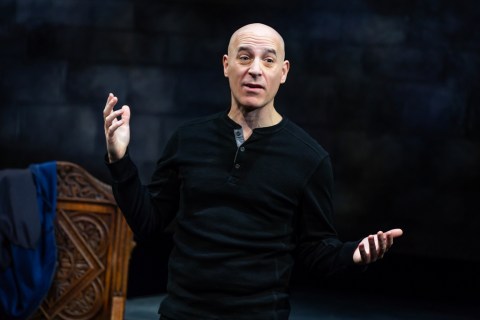
Harry Bouvy, Fellowship for Performing Arts Production of ‘A Man for All Seasons,’ Acorn Theatre (Jeremy Daniel)
Bolt examines the strength required to abide in the grace of righteous beliefs even if it means dying for it, rather than follow the crowd to stay alive. The playwrite’s brilliant work written in the sixties seems especially trenchant in our times when lying to protect one’s physical life is no longer an art, but a gross and craven reality show in politics. This fine production of A Man for All Seasons seems more resonant than ever.
Bolt most probably took title which originated from an Oxford scholar Robert Whittington who in 1520 wrote, “More is a man of an angel’s wit and singular learning. I know not his fellow. For where is the man of that gentleness, lowliness and affability? And, as time requireth, a man of marvelous mirth and pastimes, and sometime of as sad gravity. A man for all seasons.” Perhaps Whittington may have been inspired by the Biblical scripture, 2 Timothy 4:2 (NKJV) “Preach the word! Be ready in season and out of season. Convince, rebuke, exhort, with all longsuffering and teaching.”

Photograph of the playbill, of Fellowship for Performing Arts, ‘A Man for All Seasons’, directed by Christa Scott-Reed, starring Michael Countryman, David McElwee, John Ahlin, Todd Cerveris, Harry Bouvy, Carolyn McCormick, Kim Wong, Kevyn Morrow, Trent Dawson, Sean Dugan.
Bolt’s characterization of Sir Thomas More (Michael Countryman maintains a sensitive and thoughtful portrayal throughout) reflects the scripture and Whittington’s commentary. In Countryman’s rendering of More’s traits and interactions with his family, the King and Richard Rich, his foil and enemy, we understand the greatness of More’s mind and character.
Countryman also relays a profound appreciation of More’s humor and social affability. As Countryman presents More’s humility with the King (the effervescent and proud Trent Dawson), even though he disagrees with him we understand More’s sorrow at displeasing a man he loves. We also see the King’s sorrow that More is on a collusion course with the King’s soul. One of them will lose, the other will gain, and at that momentous juncture when the King visits More’s household, the actors and able direction reveal that there is no turning back for either man. It is an excellently rendered moment in the production, one of many that Director Christa Scott-Reed interprets and guides the actors to elicit.
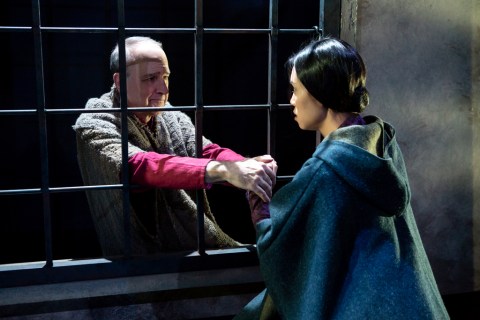
Mihael Countryman, Kim Wong, ‘A Man for All Seasons,’ Acorn Theatre (Jeremy Daniel)
Countryman, David McElswee as Richard Rich, Carolyn McCormick as Lady Alice More, Todd Cerveris as Thomas Cromwell Kim Wong as Meg are the principals who help establish the solid foundation upon which Bolt’s More rests. In various crucial scenes, the actors’ interplay heightens the stakes and pronounces the conundrum that More faces if he chooses conscience over king and loses everything he holds dear in the earthly realm to achieve a finer estate in the heavenly one.
In one particular example, the tension the cast creates when Meg, Lady Alice and Roper (Sean Dugan) tell More to have the pernicious Richard Rich arrested for being evil, we watch amazed as Countryman’s More defends McElwee’s Rich and upholds the law as paramount. Because of their acute sensitivity and the apt direction we understand how More is refining his position on the law to protect his own soul and, as Bolt perhaps wishes, we empathize and put ourselves in More’s shoes. Would we have the strength of character to follow the right and true dictates of our souls? Or would we as his family suggests he do use the law against others injudiciously and damn ourselves? Is such an action to uphold what is most precious important to us? Should it be? Bolt asks these intriguing questions and answers them by highlighting More’s difficult choices.
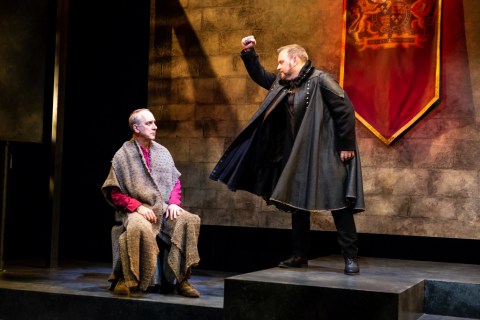
(L to R): Michael Countryman, Todd Cerveris, Fellowship for Performing Arts Production, ‘A Man for All Seasons,’ (Jeremy Daniel)
By the end of the play, McElwee’s Rich has become totally corrupted, rewarded for his betrayal of More by selling his soul for Wales. McElwee’s development from young man teetering on the brink of wickedness to world-hardened, wicked maturity having easily sold out a man he once greatly admired is well delivered. Both actors elicit the contrast between More and Rich beautifully. Rich achieves worldly power climbing from a lowly state upward and More moves in the opposite direction. But only More makes it to glory. Though Richard Rich dies peacefully in his bed unperturbed, unmolested by sending More to his beheading, More down through the centuries is venerated for his courage. He was canonized by the Church in 1935 and in 2000 Pope John Paul II named him “heavenly patron of statesmen and politicians.”
Countryman’s steadfast More, assisted by the ensemble’s excellence becomes especially powerful in the trial scene when More confronts his accusers, McElwee’s Rich, Cerveris’ Cromwell, Archbishop Cranmer (Sean Dugan), his former dear friend The Duke of Norfolk (Kevyn Morrow) and the executioner who also plays The Common Man (Harry Bouvy). Presented with the lies that Rich has told about him, More answers vehemently for his innocence and affirms that his silence about the oath taking is acquiescence under the law which they have misinterpreted because they do not know the law. The scene especially enthralls for we know that as More counters Rich’ lies, the blade will fall. He is as he says, “a dead man.”

(L to R): Todd Cerveris, David McElwee, Fellowship for Performing Arts Production of ‘A Man fro All Seasons,’ Acorn Theatre (Jeremy Daniel)
Countryman’s More is poignant as he maintains his domination and will when someone questions his surety that he will go to heaven. More’s reply is without fear or doubt, “God will not reject one so cheerful to go to Him.” We believe then that what More has suffered has a higher purpose. Indeed, Countryman’s portrayal of More uplifts with hope and inspires as Bolt most probably intended.
Bolt’s play is given a very fine rendering by The Fellowship for Performing Arts. The ensemble, shepherded by director Christa Scott-Reed depict Bolt’s characters with authenticity and engage us throughout. Countryman’s More comes off as a human saint. How Bolt shapes More’s development rising to glory as the king’s Lord High Chancellor and devolving to infamy as a traitor to kingdom and crown is the genius of the drama. The characterizations of More, his long suffering wife Lady Alice (Carolyn McCormick) and daughter Meg (Kim Wong) are superb and perhaps strongest in the prison scene when they see each other for the last time. As contrasts to the enlightened and saintly More, Richard Rich (McElwee) The Duke of Norfolk (Kevyn Morrow) and Thomas Cromwell (Todd Cerveris) reveal an edgy hardness as the play reaches its conclusion and More is condemned for treason. John Ahlin is exceptional as Cardinal Wolsey and Signor Chapuys. The latter attempts to wrangle with More about supporting Catherine of Aragon’s Queenly fate in Henry’s Kindgom.
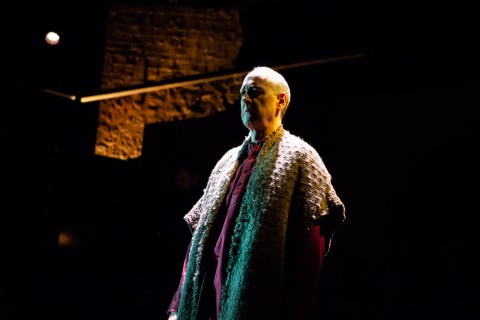
Michael Countryman, Fellowship for Performing Arts Production, ‘A Man for All Seasons,’ Acorn Theatre (Jeremy Daniel)
The character of The Common Man (excellently played by Harry Bouvy) is absent in some productions of A Man for All Seasons. Bouvy’s portrayal of the lowly roles (Matthew-More’s servant, the executioner, etc.) is one we identify with readily. His pronouncement of the earthly ends of More’s enemies Cranmer, Cromwell, The Duke of Norfolk is ironic. His sardonic humor at relating where Richard Rich ends up for sending a good man to his death is the exclamation point of Bolt’s work. But upon further research (More’s standing in the UK and with the Church as a saint), we note that Sir Thomas More comes off as a hero. On the other hand Richard Rich (hyperbolic name, indeed) comes off as the craven, mendacious coward. One of the strengths of the play and of this production is in the comparison between Rich and Moore. Indeed, Bolt uses Rich as a foil to burnish More’s greatness.
In this social climate of up is down black is white, there are many in power who behave as Richard Rich using clever manipulation, lying and amorality to achieve their desires. Bolt, a professed agnostic, leaves the final judgment about such individuals up to God. In the last analysis without a Richard Rich, would More have been so glorified?
Of late Hillary Mantel’s Wolf Hall downplays Bolt’s perspectives about More. She establishes the more vilifying and intriguing points about his religious beliefs. In uplifting Catholicism against Lutheran Protestantism which was spreading at the time of the play set in England between 1526-1535, Mantel emphasizes that More employed torture. Additionally, to force heretics to recant their beliefs in Protestantism, he believed in burning heretics who refused to recant. Others have been critical of More. For example, James Wood in his book The Broken Estate, refers to him as “cruel in punishment, evasive in argument, lusty for power, and repressive in politics.”
With controversial individuals like More, the jury is still out. However, with this production, the verdict is a resounding bravo. I especially enjoyed the John Gromada’s selection of music as Composer/Sound Design, and the staging and artistic of the production in its integration of the Scenic Design (Steven C. Kemp), Costume Design (Theresa Squire) and Lighting Design (Aaron Porter).
Man for All Seasons runs with one intermission at the Acorn Theatre (42nd Street between 8th and 9th) and is extended until 3 March. You can purchase tickets to see this fine production of Bolt’s great play at their website by CLICKING HERE.

