Category Archives: NYC Theater Reviews
Broadway,
‘Hamlet,’ Kenny Leon’s Dynamite Version, Free Shakespeare in the Park

There are more iterations of Hamlet presented globally in the last fifty years than are “dreamt of in your philosophy.” To that point director Kenny Leon’s version of Hamlet, currently at the Delacorte Theater in Central Park until August 6th, provides an intriguing update of the son for whom time is so “out of joint,” he is unable to seamlessly and speedily avenge his father’s murder. Leon’s version shapes a familial revenge tragedy. Once set on its course, dire events cannot be averted, for at the core is the initial corruption, “the primal eldest curse, a brother’s murder” that “smells to heaven.” From that there is no turning, until justice is served, the sooner the better.
In this 61st offering of Free Shakespeare in the Park, we immediately note the conceit of corruption and its ill effects to skew the right order of things, making them “out of joint,” off-kilter. This is an important theme of the play (expressed by Hamlet) and represented by Beowulf Boritt’s set, some of which is a wrecked-out remnant of his design from Leon’s pre-Covid production of Shakespeare’s comedy, Much Ado About Nothing.
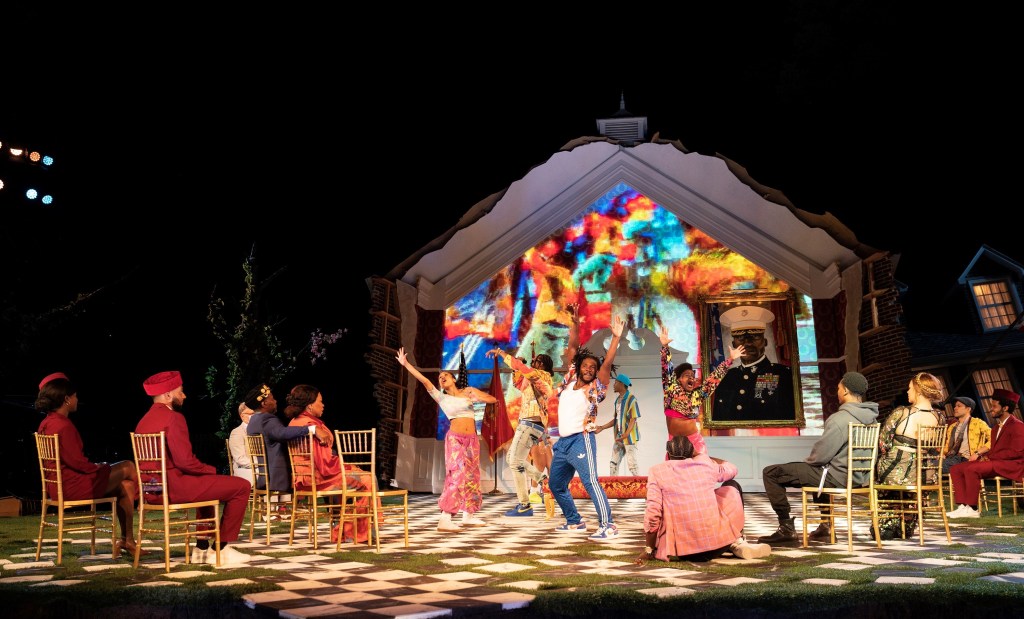
That 2019 design sported a resplendent, brick, Georgian mansion that stylistically conveyed the wealth and rectitude of its Black, lordly owners rising up in a progressive South. Hope was represented by a “Stacy Abrams for President” campaign sign proudly displayed on the side of the building. A towering flagpole and American flag patriotically stood like a sentinel at the ready. Peace and order reigned.
It is not necessary to have seen Much Ado About Nothing to understand the ruination and disorder foreshadowed by Boritt’s Hamlet set which coherently synthesizes Leon’s themes for his modernized version. In one section a tilted smaller version of the former Georgian house appears to be sinking off its foundation. On stage left, an SUV is tilted off center, undrivable, in a ditch. The Stacy Abrams’ sign is torn and displaced on the ground like discarded trash. And the American flag with its long flagpole angled toward the ground signals distress and a “cry for help.”

The only ordered structure is the cutaway of a building center stage (used for projections), whose door the characters enter and exit from.
Boritt’s set design suggests “something is rotten” unstable and “out of joint” in this kingdom. Themes of devolution are foreshadowed. From unrectified corruption comes disorder which breeds chaos and dark energy, out of which destruction and death follow. And all of this springs from the unjust murder of the deceased in the coffin that is draped in an American flag and placed center stage. It is his life which is celebrated by the beautiful singing of praise hymns at his well-attended funeral in the prologue of Leon’s Hamlet. It is his life that is memorialized by the huge portrait of the kingly father in military dress which hangs watchful, presiding over events from its position on the back wall of the only part of the set that is not wrecked and disarrayed.

Cutting Act I scene i (soldiers stand on guard watchful of an attack from Norway), Leon opens with the elder Hamlet’s funeral. A Praise Team joined by a Wedding Singer, who we later recognize to be Ophelia (the golden-voiced Solea Pfeiffer), sing with beautiful harmony. Jason Michael Webb created the music and additional lyrics which set out the Godly tenets that all are importuned to follow or live by. To their downfall they don’t and this is manifested in tragedy.
Importantly, the first three songs are taken from the Bible. The first is from Ecclesiastes (“To everything there is a season). Then follow Matthew 5 (“To show the world your love, I’m goona let it shine”) and I John 5 (“When you go on that journey you go alone”). The last song that Ophelia sings is composed of lines from a love poem that Hamlet wrote for her.
The songs intimate the former moral rectitude and divine unctions found in the former Hamlet’s kingdom. Ironically, the memorial service represents the last peace that this kingdom will appreciate. As the set indicates, wrack and ruin have already begun. The scenes after the funeral represent declension and growing darkness. And after old Hamlet is buried, nothing good follows.
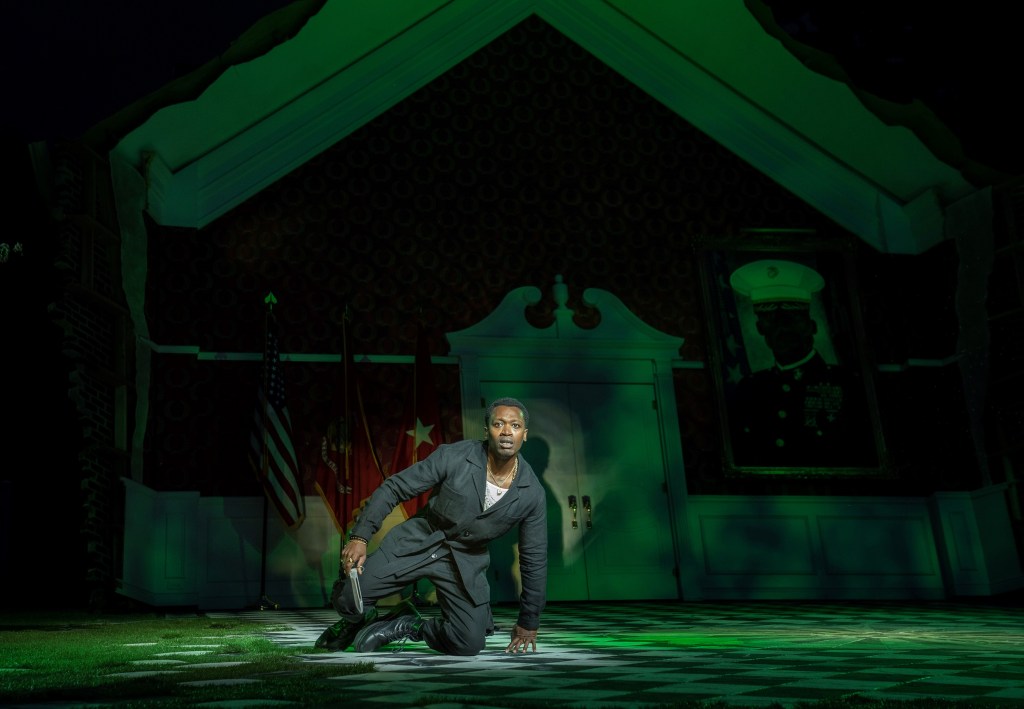
Numerous cuts (scenes, lines, characters) abound in Leon’s version. His iteration presents questions about the disastrous consequences of familial revenge which is different from Godly justice suggested by the songs. Importantly, Leon’s update (sans scene i) gets to the crux of the conflict with scene ii, the marriage celebration of Claudius (the terrific John Douglas Thompson and Gertrude (Lorraine Toussaint is every inch Thompson’s equal). We note their public affection for one another, which Hamlet later intimates is a lust-filled marriage in an “unseemly bed.” The partying has followed fast upon the old Hamlet’s burial, to the dismay and depression of his loyal son.
It is during the festivities when the sinister intent of the new king and duped mother Gertrude chide Hamlet (the fabulous Ato Blankson-Wood). They suggest he put off his mourning clothes, “unmanly grief” and depression for it is “unnatural.” Already, the cover-up has begun and Hamlet is the one individual Claudius must be circumspect about as the rightful heir to a throne which he usurped.
Gertrude importunes Hamlet to remain in the kingdom instead of returning to his studies in Wittenberg, and dutifully, he obeys, stuck with the daily reminder of his father’s death and mother’s “o’er hasty marriage.” This version emphasizes Claudius’ sincerity covering over his suspicion and fear of Hamlet. He is happy to keep him under his watchful eye. Throughout his magnificent portrayal, Thompson’s Claudius gradually reveals his underlying guilt and fear for his crimes of regicide and fratricide. We see his behavior grow more and more paranoid about Hamlet as the conflict between them grows and Hamlet unloads snide remarks on Claudius, Polonius and all those who are obedient to the usurper king as a provocation.

Leon’s version is a familial revenge tragedy which eliminates any reference to Norway or Prince Fortinbras seeking justice for his father’s death in battle with Denmark. Leon is unconcerned with Norway and Fortinbras. The conflict in his Hamlet is internal to Denmark, a divided kingdom like “an unweeded garden, rank and gross in nature.” Divided against itself, with brother vs. brother and son vs. uncle, and Gertrude the exploited, seduced pawn, Claudius’ guilt is a canker worm which gnaws at him. Likewise, gnawing at Hamlet after his father’s ghost’s visit, is the knowledge of what has to be done. But he maintains, “cursed spite, that ever I was born to set it right.”
All is covert and the truth is covered up. Polonius and Claudius spy on Hamlet to divine why he is “mad,” and Hamlet acts mad and rejects Ophelia’s love during the process of divining whether the ghost is telling the truth. Intrigue, chaos and darkness augment and have their way with the innocent and guilty. For Hamlet, the “time is out of joint.” An intellect, he is “blunted” (the ghost later says) from making the correct decisions or acting upon them in a timely fashion. The darkness that Claudius has set loose taints Hamlet and every principal character that must show obeisance to King Claudius’ illegal reign.

Key to the argument of choosing vengeance vs. justice is the enthralling scene when Hamlet meets his father’s ghost. Initially, the creative team (Jeff Sugg’s projections, Allen Lee Hughes’ lighting design, Justin Ellington’s sound design) present the father’s ghost on the back wall with projections on the portrait and the wall, accompanied by the ghost’s booming, shattering voice, which commands Hamlet’s obedience.
But at the description of the murder, the ghost possesses Hamlet. Blankson-Wood’s performance of the ghost consuming his soul is phenomenal and physical. He arches his back with the jolt of spirit possession and then rights his gyrating body as his father’s voice spews wildly from him, eyes rolled back, arms waving, the very picture of the demonic that Horatio (the fine Warner Miller) warned Hamlet might “tempt him to the flood.” At once frightening and mesmerizing, the possession enthralls us and changes Hamlet. It is a dynamic, successful scene showing the decline in the goodness from the initial praise songs to the devolution of the spirit’s will demanding vengeance. We are thunderstruck. Blankson-Wood’s authenticity frightfully convinces us of the spirit’s potential for evil misdirection into a vengeance which is not just and will bring devastation.
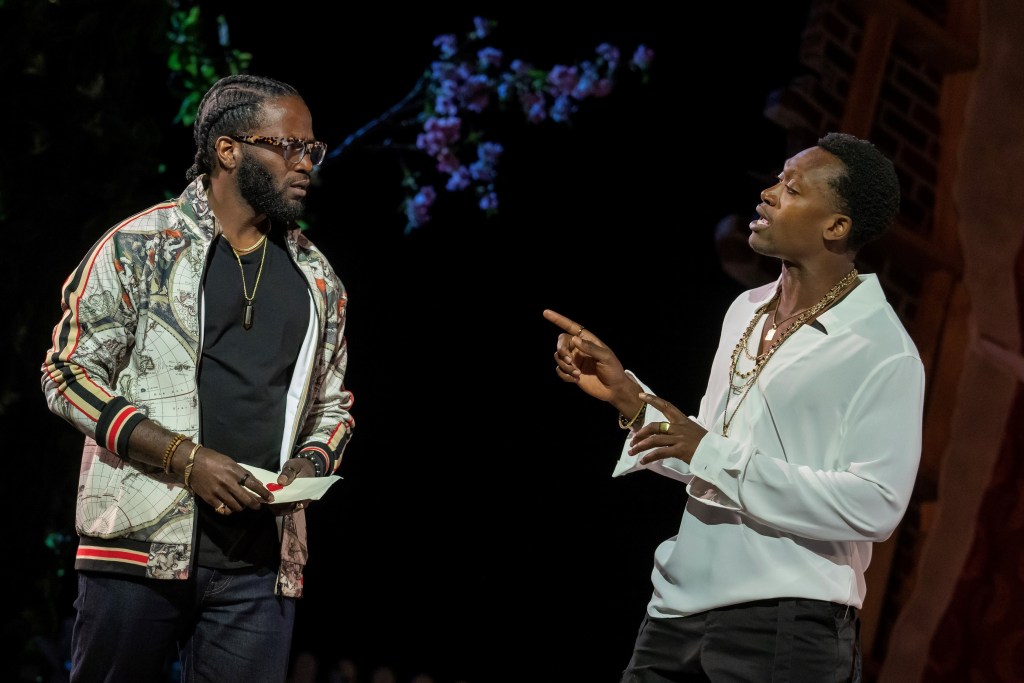
After the ghost leaves the vessel it inhabited and Hamlet swears Horatio and Marcellus (Lance Alexander Smith) to secrecy, Hamlet’s fate is sealed. He moves toward faith in the ghost, farther away from the light-filled unctions in the songs at his father’s funeral. Now, there is no “showing love” and “shining one’s light.” Intrigue and acting “mad” and conspiracy and cover-up overtake the mission of the kingdom. Hamlet toys with and ridicules Polonius (Daniel Pearce gives a humorous, organically funny portrayal) and does the same with Ophelia in a powerful scene, eschewing his love for her. Pfeiffer’s Ophelia shows her devastation and shock. His behavior is a complicating truth for everyone and it intensifies Hamlet’s conflict with Claudius.
Knowing Hamlet’s madness is not for Ophelia’s love, Claudius grows more paranoid and guilt laden. Clearly, when the actors make their presentation of the dumb show (Jason Michael Webb’s song “Cold World” is superb), and Hamlet presents ‘The Murder of Gonzago,’ he and Horatio see that Claudius’ guilty conscience is made manifest in ire and defensiveness. Though this scene is truncated, as is Hamlet’s description of how the actors should proclaim their speeches, no coherence is lost. Claudius runs away, his soul uncovered. Hamlet is convinced vengeance is the right course of action. But he has allowed himself to be misguided. Nothing good will come of following the ghost’s lead.

Leon truncates the minor speeches, retaining those that convey Hamlet’s angst at being stuck in the kingdom which is a prison. He can’t commit suicide (“To Be or Not to Be”) because his morality and fear of death forbids it. Stuck in Denmark, everyone is a potential enemy except Horatio. He uses coded speech with everyone especially Rosencrantz and Guildenstern, who Claudius/Gertrude have engaged to spy on him. Ato Blankson-Wood delivers the key soliloquies powerfully with insight as he makes the audience his empathetic confidante who understands his intellect has chained him to inaction. We are drawn into his plight, but become frustrated when his determination falters.
The paramount event where his intellect intrudes happens when Claudius is praying in the church (fine stylized staging). Coming upon Claudius, Hamlet rejects the opportunity to kill him because he thinks Claudius is confessing his sins and getting right with God. However, it is a missed opportunity which Hamlet squanders because Claudius’ prayers fail (“my words fly up, my thoughts remain below; words without thoughts never to heaven go.”). Claudius realizes to receive forgiveness he would have to give up the throne, Queen and his cover-up which he will never do.
Hamlet lacks proper discernment and moves from his bad decision to impulse. Not killing Claudius in the church, he rashly and mistakenly kills Polonius, assuming incorrectly that Claudius quickly ran up to Gertrude’s room. The stakes are raised for Claudius and Hamlet. Polonius’s death missing body incense Claudius who is overwrought with fear knowing his enemy Hamlet has put a target on his back.
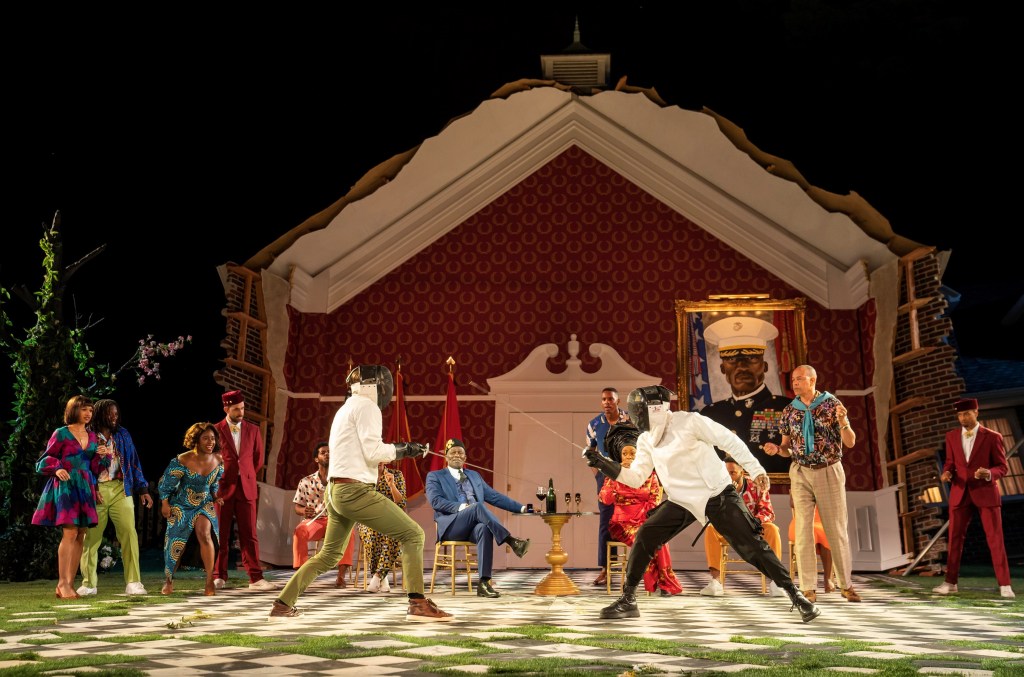
Once more, the “time is out of joint,” and Hamlet defers vengeance and subjects himself to Claudius, finally revealing where Polonius’ body is. For Gertrude’s sake, Claudius sends Hamlet away with the orders for others to kill him in a plan that fatefully backfires.
Leon’s version has clarified the stakes for Claudius to escape accountability, manipulating Laertes (Nick Rehberger) from killing him by blaming Hamlet. Thompson conveys each of these cover-ups with precision. Also, clarified is Blankson-Wood’s angst and struggle confronting his father’s murderer. His use of irony as a weapon to prick Claudius’ conscience is superbly rendered as are his soliloquies whose philosophical constructs tie him in emotional knots. Hamlet, knowing that he is stuck in a morass with no way out, recognizes that like the other characters, he is on a collision course with destiny and ruination which is foreshadowed at the beginning with Boritt’s set.
Also, clarified in this version is Toussaint’s Gertrude who is in a state of ambivalence and guilt stirred by Hamlet’s antic behavior, which she suspects is his response to her marrying Claudius. When their confrontation occurs after Hamlet kills Polonius, she knows her relationship with Claudius must be thrown over, yet she hesitates and discusses Hamlet with Claudius ignoring Hamlet’s wise counsel. The doom she recognizes in Ophelia’s madness will only bring more sorrows, a trend which both Claudius and Gertrude comment upon. Toussaint’s description of Ophelia’s drowning is heartfelt and mournful.
The flow of events coheres because the through-line of Claudius and Gertrude in conflict with Hamlet is maintained with intensity. Stripping Norway from the action and leaving Fortinbras out of the conclusion is to the purpose of Leon’s emphasis of the familial tragedy. The contrast of the good son and man of action who achieves justice (Fortinbras) with Hamlet’s flawed son of inaction who is Fortune’s fool, exacerbating destruction via revenge gone wrong would have pleased Queen Elizabeth I. Contrasting the two Prince’s and showing the heroic one in Fortinbras is an encouragement of how royalty should rule. However, it doesn’t fit with the themes that Leon emphasizes, especially that a “house divided against itself cannot stand.”
Hamlet concludes with the slaughter of two families tainted by their association with a corrupted king, out from which there is no release except death. A final theme current for our time suggests that unless individuals stand against usurpers of power, the usurper and all who are his accomplices by not bringing him to justice will pay the forfeit of their lives and fortunes.
However, only Miller’s Horatio understands the full story of Hamlet and the striving between vengeance and justice. That vengeance brings disaster is why the ensemble finishes with the actors’ song that they sang when Hamlet first meets them. It is poignant and true and heartfelt when the spirit of Ophelia joins them and together they sing, “I could tell you a tale, God’s cry. It could make the God’s cry.”
Kudos to the ensemble and the creative team who carry Leon’s vision of Hamlet into triumph. These include those not already mentioned: Jessica Jahn’s colorful costume design, Earon Chew Nealey’s hair, wig and makeup design, Camille A. Brown’s choreography and Gabriel Bennett for Charcoalblue and Arielle Edwards for Delacorte’s sound system design.
For tickets to this unique Hamlet which has one intermission, go to their website https://publictheater.org/productions/season/2223/fsitp/hamlet/
‘Days of Wine and Roses,’ Truthful, Poignant, a Stunning Triumph

Alcohol is different from other addictive drugs. It’s a part of our culture and integral to events around professional and social situations. It’s legal and easy to purchase. But for those who can’t “live” without it, alcohol is both a blessing and a curse. Days of Wine and Roses currently at Atlantic Theater Company until July 16th encapsulates the joy and emotional horror of the drinking disease. The production is a complicated, profound, assailable to the senses, cathartic must-see.
Adam Guettel’s music and lyrics spin out the anatomy of alcoholism in the dynamic of a couple’s relationship. The couple, portrayed by the exceptional Kelli O’Hara and Brian d’Arcy James, are forced to confront their psychological weaknesses manifested by their alcoholism. Guided by Craig Lucas’ book, Guettel relays the extremes of euphoric addiction and its impact on the emotions of the characters with his expressionistic score and lyrics that appear to be lighthearted and lyrical but mirror undercurrents of desperation and loneliness.

Lucas nails down Joe and Kirsten’s alcohol dependent relationship dynamic with precision and poignancy. He carries it through to the point when d’Arcy James’ Joe Clay comes to the end of himself. Out of love he waits and hopes for O’Hara’s Kirsten to want to recover from alcoholism. This uncertain state promises to usher in a long, hard wait for Kirsten to admit she is ill and needs help.
Directed by Michael Greif, Days of Wine and Roses is a journey of devolution and evolution that displays the characters’ emotions of exuberance, sorrow, unforgiveness, self-discovery, redemption, self-annihilation, humiliation and love. Above all, it reflects the tragedy and joy of human experience, either confronting one’s individual consciousness or running from it, until one finally acknowledges that they must change or kill themselves.

Based on the titular 1958 teleplay by JP Miller and the 1962 Warner Bros. film, the musical is produced by special arrangement with Warner Bros. Theatre Ventures. Importantly, once again it brings together the successful Lucas and Guettel team who created The Light in the Piazza. Kelli O’Hara, who sang the lead in that Broadway production, encouraged this project.
Key to understanding this musical that is set in 1950 and lightly references the cultural mores of the time (sexism and paternalism) is that Alcoholics Anonymous’ 12 step program (never named) identifies alcoholism as a disease and not just a “drinking problem.”

The production frames how Joe and Kristen’s love blossoms with their drinking. It acutely underscores that the disease elevates their mood and pleasure centers (“There I Go,” “Evanesce” “As the Water Loves the Stone”) with pernicious allurement. Indeed, it is the linchpin to how they initially become involved with each other and why Kristen refuses to stay with Joe and her daughter after he combats his illness by meeting with other alcoholics to stop his self-destructive patterns.
The characters’ dynamic is emphasized when they meet at a business party on a yacht in the East River. A nondrinker, Kristen eschews alcohol. On the other hand Joe persists in getting her to be his drinking buddy. She resists him and his advances because she doesn’t like the taste of alcohol nor his smarmy, belittling, fake PR patter and persona.

It is only when she upbraids him and he apologizes for “starting off on the wrong foot” that she relents and suggests they leave. Her honesty and authenticity charm Joe and allow his better self to emerge. Together at a quiet restaurant, they discover qualities in each other that they can appreciate and adore.
As they establish a friendship, Joe introduces her to a Brandy Alexander (she loves chocolate) and she discovers her subsequent enjoyment of the buzz it gives her. This drink and others draw her to Joe as they gradually become boozy partners, who “in their continual high,” eventually marry and have a daughter, despite her father’s (the excellent Byron Jennings) disapproval and distrust of Joe. She and Joe have made a commitment to each other. Determined, O’Hara’s Kirsten will not allow her father Arensen to sway her from establishing a family with her lover and partner in drinking.

As Kirsten, Kelli O’Hara creates a complex portrayal of a woman whose drinking subterfuge eventually splits open her soul weakness after seven years of marriage and taking care of their daughter Lila (Ella Dane Morgan). Covertly, she sneaks drinks as she completes household chores and plays with Lila. O’Hara’s “Are You Blue,” “Underdeath and “First Breath” (the latter sung with Morgan’s Lila) reveal the roiling undercurrents of unhappiness and her attempts to deal with depression as the absent Joe, who works in Houston, barely keeps himself functioning at a job that requires he drink to entertain clients.
Brian d’Arcy James’ vibrant, alcohol-alluring, loving Joe allows her to take the lead, while he cleverly introduces her to a new world of drinking, fun and happiness. He draws her to him and maintains their closeness and joy, but such adventures are always fueled by alcohol. Initially, like any disease that manifests slowly, they convince themselves they are in control and live together as a successful family.

However, all is upended the seventh year of their marriage. A spectacularly destructive circumstance set off by Kirsten’s alcohol blackout destroys what they have built together (conveyed fearfully thanks to Lizzie Clachan’s sets, Ben Stanton’s lighting and Kai Harada’s sound). As their family spirals downward, their only hope of rehabilitation lies under her father’s condemning watchfulness, when they plead for his help and he gives them food, shelter and work in his greenhouse business.
The arc of their destruction is born out of their compulsions, one of which is their susceptibility to the pleasure of alcohol, the other, the belief they can ignore their desire to harm themselves and each other as addicts.

After months of sobriety, Joe breaks down, buys alcohol and offers it to Kirsten (“Evanesce” reprise), then goes completely “off the rails” (“435”) looking for a bottle he has hidden in the greenhouse. In anger at himself for his weakness and fury in not finding the bottle, he becomes rebellious. Turning against his judgmental father-in-law who has given them a chance, Joe destroys the greenhouse that Arnesen has made into a profitable business. When he finds the bottle, he drinks himself unconscious and lands on his back in the hospital on the brink of death.
Kirsten and Arnesen refuse to believe this is a disease that has no cure except through a way provided by a volunteer who is also an alcoholic, Jim Hungerford (David Jennings). Jim belongs to an association of alcoholics who understand that the only path away from the disease is through meetings, readings and the community of others who need each other’s help and camaraderie. Arensen dismisses Joe’s attempt at reconciliation and recovery. He bans Joe from his presence as an evil influence. The family are on their own in a dingy apartment as Joe allows himself to be helped by Jim while Kirsten refuses to admit she needs help and rejects Jim’s offers.

The apex of their relationship involved the ecstasy of alcohol. Kirsten appeals to Joe’s love and the remembrance of the fun they had (“Morton’s Salt Girl”) with a soft shoe in salt poured on the floor, created by Sergio Trujillo and Karla Puno Garcia. The song attempts to rekindle the magic when they enjoyed being drunk together. However, Joe’s eyes have been opened and Jim’s voice resides in his heart with the growing strength that he can conquer his illness. Sadly, Kirsten interprets this as rejection and a killing off of their love. She criticizes Joe for making her feel ashamed of herself and victimizing her with guilt and pain.
As Joe affirms his confidence that he can change to Jim in the powerful “Forgiveness” Joe and Lila cling to each other and KIrsten eventually stays with her father whose judgment, though problematic, is better than the humiliation and weakness she feels around Joe, who is passionate about healing and recovering. Now Joe’s love in sanctimony drives her away.

Days of Wine and Roses is poignant and current for our time, taking us beyond the beautiful period costumes by Dede Ayite and hair design by David Brian Brown. Kelli O’Hara is affecting and brilliant. Her operatic, rich and plaintiff voice in the concluding songs elicits our empathy. Her aloneness and sorrow at losing her partner to sobriety is intensely human and real. Her rejection of Joe’s help and love beyond the haze of alcohol is frightening.
Brian d’Arcy James is superb in reveling the nuances of determining his own confidence to overcome his addiction. Yet, he mines Joe’s attempt to balance the authenticity of being happy with his sober self with his love for Kirsten without their alcohol infusions. Together these amazing actors bring home the production leaving the audience with a confluence of feelings that will not be easily forgotten.
Kudos to the ensemble and the technical creatives and Greif’s direction and vision. With additional kudos to music director Kimberly Grigsby, Adam Guettel’s orchestrations and Jamie Lawrence’s additional orchestrations.
Days of Wine and Roses runs one hour and forty-five minutes with no intermission. For tickets and times go to the Atlantic Theater Company website https://atlantictheater.org/production/days-of-wine-and-roses/
‘The Comeuppance,’ a Pre-Reunion Reunion of Five Friends and Death, Theater Review
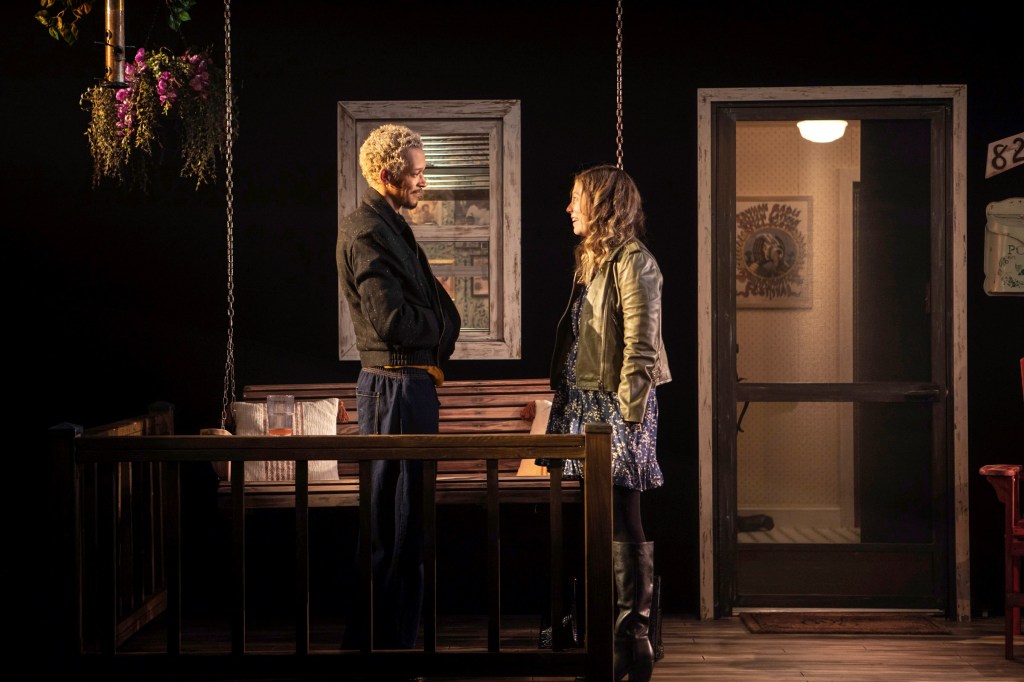
In The Comeuppance by Branden Jacobs-Jenkins, directed by Eric Ting, old friends meet for a pre-reunion reunion at the home of Ursula (the superb Britney Bradford), who has organized a party to celebrate before she sends off friends to their twentieth reunion. In an extension of its World Premiere at the Signature Theatre, the comedy with somber, stark elements was extended until July 9th by popular demand.
Jacobs-Jenkins’ (Appropriate, An Octoroon) themes are timely. The ensemble was spot-on authentic and natural. In his two hour play with no intermission millennials admit the consequences of living with unsound decisions made in the less scrupulous years of their youth. Sooner or later, there is a “comeuppance.” One cannot escape the inevitability of oneself and one’s mortality, as Death, who like a sylph inhabits each of the characters, periodically reminds us.

To effect this principle theme of death in life and the transience of all things, Jacobs-Jenkins places thirty-somethings in a backyard with drinks, weed and a loaded, shared past. They once were part of a high school friend group called M.E.R.G.E.: Multi Ethnic Reject Group. Jacobs-Jenkins allows them to go at each other (Emilio’s bitterness is apparent), as they bond over a perceived closeness, which may not have existed after all.
But first, Death introduces himself after slipping into the soul of the protagonist Emilio (Caleb Eberhardt), who has the most difficult time struggling to let the past remain in the past so he can create a better life for himself. As he does with all the characters, Death speaks through Emilio. He warns the audience he is always lurking in omnipotence, with a complete understanding of who human beings are, including the audience members, which he crudely, fearfully reminds us of, once more at the conclusion.

Since last they met, Emilio, Caitlin (Susannah Flood), Paco (Bobby Moreno) and Kristina (Shannon Tyo) have established careers, been to war, gotten married and had kids. Each in their own way has confronted loss, confusion, cultural chaos and most recently COVID-19. We learn that all have been under an emotional siege. Some are sustaining the sociopolitical chaos that Emilio points out better than others, as they either ignore it, reflect upon it, or allow their own lives and difficulties to blot it out of their consideration.
Interestingly, the generous Ursula, whose home, inherited after her grandmother’s death, has been offered up for the celebration, becomes the first to manifest the ravages of millennial time and aging. She has lost her sight in one eye, having contracted diabetes. She tells the others that she is not up to going to the reunion and they may stay as long as they like at her party.

As Emilio, Caitlin and Ursula wait for the others, Emilio’s irritability spills out in humor against Caitlin, whom he once dated in high school. She has married an older man who is a Trumper, which upsets Emilio. Their two children her husband has from a first marriage appear to be doing well: one is finishing college, the other is beginning a career. Thanks to the actors who present their characters with moment, as the characters cath up their lives, the segment never completely falls into tedium. The characters reacquaint as they step into familiarity with Ursula reminding them of M.E.R.G.E codes they used in high school.
During this segment Death manifests a presence in the monologues from Ursula and Caitlin. They heighten their soul revelations and reflect another aspect of their ethos that is not apparent on the surface.

When Kristina, a doctor with “so many kids” arrives bringing her cousin Paco, who once dated Caitlin and treated her badly, the hilarity increases. It is driven to its peak with the characters’ fronting as a means of getting their “land legs” with each other. By this point the drinks and weed have kicked in and Emilio confronts Paco. whom he clearly distrusts and despises. More revelations erupt and we note Paco’s and Kristina’s individual unhappiness. Once again, Death inhabits Kristina and Paco and expresses their soul’s interior.
Throughout the play Jacob-Jenkins contrasts the material realm and the illusory fitted by human delusion that these individuals have “all the time in creation” to live their lives against the immutable truth of life’s impermanence. Speaking with quietude and without passion, Death assures us he “has their number.” He matter-of-factly reminds us that entropy is king. Things fall apart; human bodies, human relationships, all we hold dear is smothered in half-truths and lies, for we die.

Then the limo arrives and with it well-worked confusion. Ursula goes off to the reunion that Emilio never attends. With the door locked against him and all his buddies gone, he sleeps on the porch, a hapless, solitary and alone soul who needs to “get himself together” emotionally, expiate the past and forgive himself for his failings.
When Ursula returns, we learn the extent of the lies of omission as Eberhardt’s Emilio allows the truth to flow and Ursula shares with him what she couldn’t reveal before. Then Death through Emilio takes his final “comeuppance.” While she “sleeps in her mind” he expresses that his target is Ursula in the immediate future. He discusses that how she will end up is exactly as her friend Caitlin fears. Despite Emilio’s offering to marry and take care of her, Ursula puts him off because she has someone. It turns out, it’s another poor decision for both of them.
Branden Jacobs-Jenkins has woven an interesting conceptual piece that is uneven especially in segments where there is too much ancillary discussion by characters. There is an overabundance of unnecessary detail that impede the forward momentum of the dynamic that occurs on the porch of their lives. In these sections, I dropped out. Perhaps wise editing would make the segments more vital and immediate.
Nevertheless, the actors are terrific. They make the most of the unevenness that drives the play toward the characters’ acknowledgement of duality: of experiencing life and watching and reflecting oneself living it in the knowledge that they are mortal.
The difficulty of this duality is dealing with the reality of Death. In the play it is animated through the characters for our benefit. However, in their lives, it is ever-present in the form of gun massacres, the war in Iraq and Afghanistan, political subterfuge and sabotage in January 6th which attempted to signal in the “death” of our democracy. All of these, Death’s cultural possessions, have brought the characters’ millennial generation to the brink, Emilio acknowledges. That and their body’s frailty is their comeuppance, Ursula suggests.
Though each generation has had its cataclysms, it is the millennials “no way out” that Emilio especially confronts while the others seem to ignore it, save Ursula. Unfortunately, our culture doesn’t do death well and entertainment capitalizes on its particularly gruesome features in the proliferation of horror stories and films. Jacobs-Jenkins counters this aspect, making it a homely creation of back porches. And as he reminds us no one “gets out alive,” at least there is humor. We can laugh on our way out of life’s conundrums, miseries toward Death’s grasp.
Look for this play to be produced elsewhere. And check out their website for more information at https://signaturetheatre.org/
‘Primary Trust,’ the Hope of Friendship Through The Trauma of Being Alone

Small town life can be incredibly boring and static. However, for those who experienced unaccountable pain and trauma, the peace and quiet may be precisely what is needed to achieve a balanced state. In Eboni Booth’s sensitive, profound drama Primary Trust, currently at Roundabout Theatre Company until July 2nd, the playwright investigates humans in their ability to heal from trauma.
For some, getting beyond the pain of emotional loss requires a particular kind of remedy. Kenneth (William Jackson Harper), a resident of Rochester suburb, Cranberry, New York, has found the ability to withstand loss through his mind and will’s resilience to nurture itself with hope and friendship.
Kenneth addresses the audience directly relating a sweetness and shy vulnerability that is immensely likable. He introduces the town and his friend Bert to the audience with ease and authenticity. When there is a segue in thought and feeling, a bell rings as an accompaniment by musician Luke Wygodny who also plays the cello and other instruments before the play begins and during salient turning points.

Harper’s Kenneth takes his time to gather his thoughts as he confesses to us. His need to share his story resonates. Clearly, his story is momentous and universal. Praise goes to William Jackson Harper who engages us with his humanity. Additionally, Eboni Booth’s simple word craft in structuring likable, recognizable, human characters in this small town is amazing. With fine direction by Knud Adams, who shepherds Harper’s Kenneth and the supporting actors, we become captivated and empathize with Kenneth though we may have little in common with him.
Kenneth shares his experiences about “what happened” to him at a turning point in his life when he is thirty-eight years old. He gives us background and reviews his daily routine in Cranberry, New York focusing on the high point of his day after work, when he spends the evening at Wally’s, a typical tiki bar/restaurant. There, he joins his BFF Bert (Eric Berryman) and they drink Mai Tais and share jokes and stories. Their affection and warmth is genuine as they reminisce about past experiences in the joyful atmosphere of booze and camaraderie.

However, apart from their bonding daily at Wally’s and their race, the men are very different. Kenneth works at a bookstore and has been invaluable to his boss, Sam (the on-point Jay O. Sanders) doing bookkeeping, clerking and various chores. Bert on the other hand has an office job, a wife and children, whom he leaves to be with Kenneth in the evenings. It is around about this time that reality fuses with the ethereal, and logic is throw out the window. How the playwright, director and Harper’s portrayal of Kenneth massage us to accept this maverick dramatic element is a testament to their talent and genius.
Kenneth explains that his friend Bert is invisible, imaginary. In other words his BFF can only be seen by him (and of course us). Thus, we become intimates. In confiding to us, Kenneth trusts us to share his secret, in the hope we will not judge him and “turn off” because he’s “wacky.”

Sam is aware that Bert is Kenneth’s imaginary friend. When he tells Kenneth he is selling the store and relocating for health reasons, he makes it a point to reference Bert. He suggests when Kenneth looks for another job, he shouldn’t allow Bert to intrude on the interview. Nor should he share with prospective employers that Bert is his imaginary friend. The implication is that they will think Kenneth is deranged. That we accept Bert as imaginary and go along for the ride is creditable to the playwright, director and actors.
Sam’s news about closing his store is an earthquake. Kenneth discusses the impact on his life with Bert and a new Wally’s waitress Corrina (April Matthis). Though Sam’s move shakes Kenneth, it is an opportunity. He is forced to end the nullifying status quo must. Change occurs in Kenneth’s discussions with Bert and Corrina, who suggests the bank Primary Trust is looking to hire tellers. When Kenneth applies for a job and speaks with Clay who is the branch manager (Jay O. Sanders), all goes well. Humorously, Bert accompanies him to the interview and prompts Kenneth’s winning responses which seal the deal. Clay hires him and he becomes one of the best employees of the bank.

However, Kenneth must confront a transition moving in his soul. The stirrings begin when he and Corrina as friends move beyond Wally’s to a lovely French restaurant. In a humorous turn Jay O. Sanders is the French waiter who serves them. It is in this new expansive world with Corrina that possibilities open up for Kenneth. For the first time, Kenneth doesn’t meet Bert at Wally’s It is another earthquake that rocks him off the status quo of his insular life. There is no spoiler alert. You’ll just have to see this heartfelt production to discover what happens next.
William Jackson Harper is absolutely terrific in a role which is elegantly written for the quiet corners of our minds. The supporting cast are authentic and vital in filling out the life that Kenneth has made for himself to help him emerge out of his cocoon and begin to fly. The playwright’s courage to present an extraordinary friendship which serves Kenneth to bring him to a point of sustenance until he launches into success is beautifully, subtly conveyed. Thanks to the ensemble, who make the unbelievable real, Kenneth’s “small life” in its human drama is important to us.

Thus, when Kenneth explains his upbringing to Corrina toward the end of the play, his revelation stuns. The clues coalesce and we “get” who he is, understanding his brilliance, his tenacity and perseverance. It brings to mind the character of Jane Eyre (in the titular novel), whose dying friend tells her, “You are never alone. You have yourself. ” The playwright takes this notion further to suggest, when you feel you can’t trust yourself, primarily, you can always elicit an imaginary friend who is closer than a brother or sister, until it is time for them to leave. It is through this “primary trust” one survives through heartbreak, trauma, isolation and death.
Primary Trust‘s fantastic qualities enliven the themes and remind us of the importance of doing no harm as we negotiate aloneness in our own soul consciousness. Kenneth chose his friend wisely. He relates how this occurs to Corrina who listens, the active ingredient of his budding friendship with her.
Kudos to the set designer Marsha Ginsberg,Isabella Byrd’s lighting design, Mikaal Sulaiman’s sound design, Qween Jean’s costume design, Niklya Mathis’ hair & wig design and Like Wygodny’s original music which to tonally balance the production. The mock up of the town square offered a metaphoric quaint suburb at a time before the technological explosion and cell phones when people listened to each other live and as Kenneth does created conversations with ethereal friends. The set design and music created the atmosphere so that we readily accept Kenneth’s and Bert’s friendship and its significance with wonder and surprise.
For tickets and times to see Primary Trust, go to their website https://www.roundabouttheatre.org/get-tickets/2022-2023-season/primary-trust/performances
‘The Sign in Sidney Brustein’s Window,’ Lorraine Hansberry’s Mastery of Ideas in a Superb Production

Oscar Isaac’s Sidney Brustein in Lorraine Hansberry’s most ambitious play, The Sign in Sidney Brustein’s Window (directed by Anne Kauffman) never catches a break. Hansberry’s everyman layman’s intellectual is in pursuit of expressing his creative genius and achieving exploits he can be proud of. When we meet him at the top of Hansberry’s masterpiece, which is full of sardonic wisdom, sage philosophy and political realism, Sidney is a flop looking for a reprieve. This revival, first produced on Broadway in 1964, was tightened for this Broadway revival (one noticeable end sequence with Gloria was shaved, not to the play’s betterment). Currently running at the James Earl Jones Theatre with one intermission, the production boasts the same stellar cast in its transfer from its sold out run at BAM’s Harvey Theatre in Brooklyn. The production is in a limited run, ending in July.
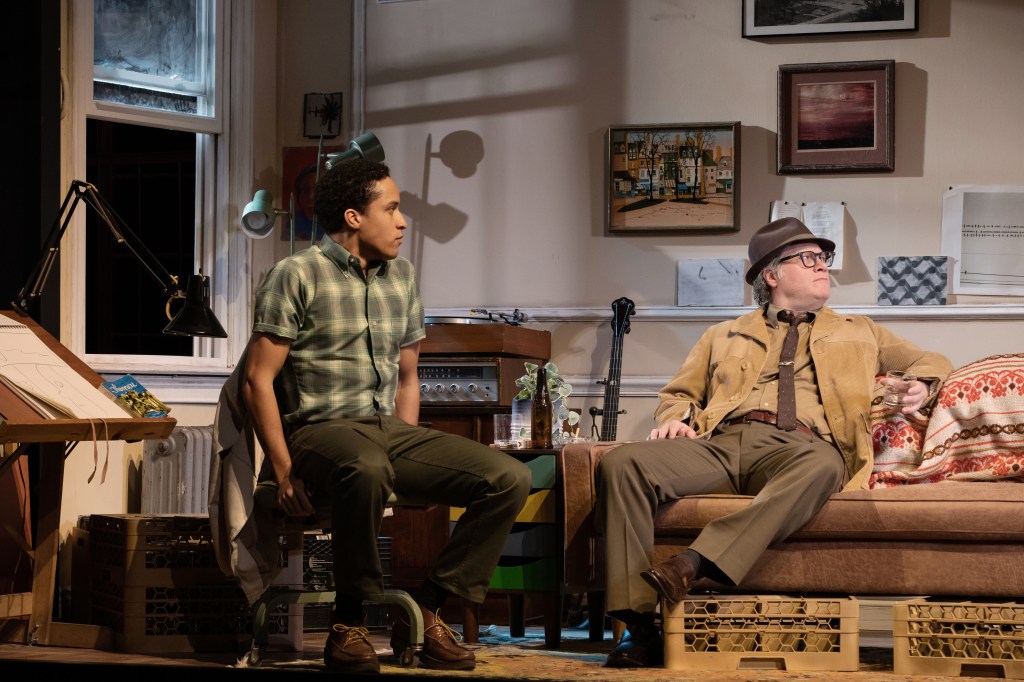
It is to the producers’ credit that they risked bringing the play to a Broadway audience, who may not be used to the complications, the numerous thematic threads, the actualized brilliance of unique characterizations and their interrelationships, and Hansberry’s overall indictment of the culture and society. Sign is a companion piece to her award-winning Raisin in the Sun. It explores the root causes why the Younger family is where it is socially and economically. Vitally, it examines the political underpinnings of institutional oppression and discrimination via reform movements, symbolized by the efforts of Brustein and friends who promote the reform candidacy of Wally O’Hara.

To focus her indictment of the perniciousness of political and social oppression, Hansberry examines the vanguard of reformists, Greenwich Village artists, activists and journalists who are emotionally/philosophically ready to make social/economic change of the type that the Younger family in Raisin in the Sun yearns for. However, these Greenwich Village mavericks are the least equipped tactically to sidestep co-optation and the political cynicism of the power-brokers. They realize too late that the money men will fight them to the death to maintain a status quo which inevitably destroys the vulnerable and keeps families like the Youngers and drug addict Willie Johnson struggling to survive.

The Sign in Sidney Brustein’s Window is timeless in its themes and its characterizations. When we measure it in light of current social trends, it is fitting that the play transcends the history of the 1960s in its prescience and reveals political tropes we experience today. Additionally, it suggests how far society has declined to the point where cultural and political co-optation (a principal theme) have been institutionalized via media that skews the truth unwittingly. The result is that large swaths of our nation remain oblivious to their exploitation and dehumanization, ignorant that they are the pawns of political parties, who promise reform then deliver regression. In short they, like Sidney Brustein and his friends, are seduced to hope in a better world that reform politicians say they will deliver. But when they win, through a plurality of votes from a diverse population, they renege on their promises and continue to do what their “owners” want, which is to “screw” the little people and deprive them of power and a “place at the table.”

Hansberry’s setting of Greenwich Village is specifically selected as one of the hottest, most forward-thinking, “happening” areas in the nation. Brustein’s apartment is the focal point where we meet representative types of those found in sociopolitical/cultural reform movements. His community of friends are activists who believe their friend and candidate Wally O’Hara (Andy Grotelueschen), is positioned to overturn the Village’s entrenched “political machine.” Sidney, reeling from his bankrupted club, which characterized his cultural/intellectual ethos (idealistically named Walden Pond after Henry David Thoreau’s book), purchases a flagging newspaper (The Village Crier) to once again indulge his passion for creative expression. He does this unbeknownst to his wife Iris (Rachel Brosnahan), a budding second-wave feminist who waitresses to support them financially. She chafes at her five-year marriage to Sidney, shaking off his definitions and the identities he places on her, one of which is his “Mountain Girl.”
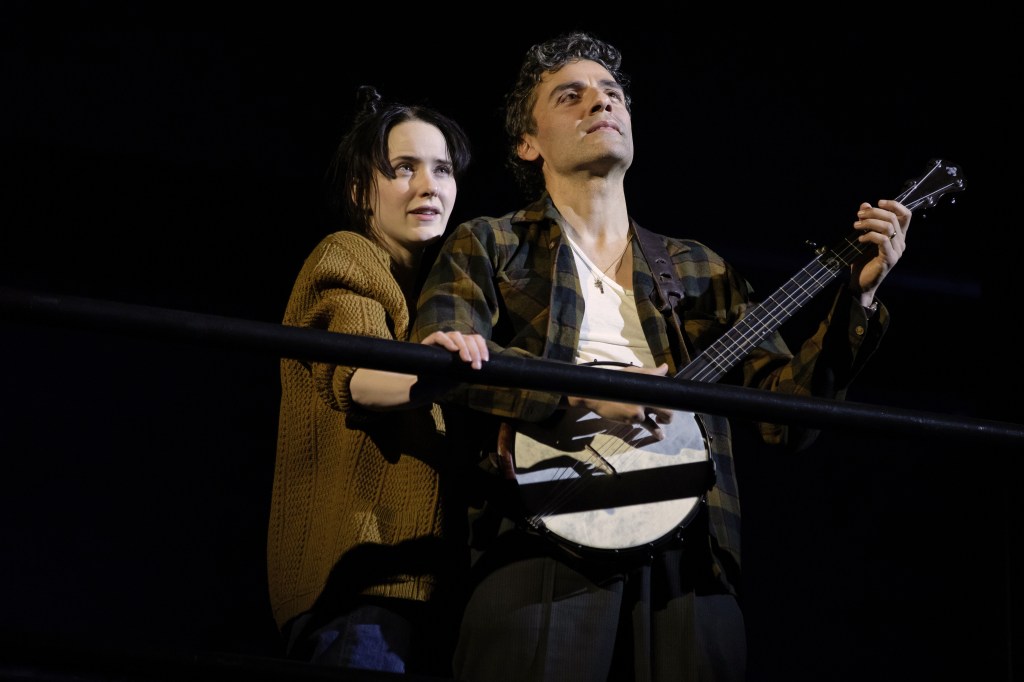
Activist and theoretical Communist (separated from the genocidal Stalinist despotism) Alton (Julian De Niro), drops in with O’Hara to encourage Sidney to join the crusade to elect O’Hara with the Crier’s endorsement. Sidney declaims their persuasive rhetoric and assures them that he will never get involved in political activism again. However, as events progress, his attitude changes. We note his friends, including artist illustrator Max (Raphael Nash Thompson), stir him to support O’Hara with his excellent articles. Sidney, mocked by Iris about his failures, is swept up in the campaign. When he hangs a large sign in his window that endorses O’Hara, his adherence to push a win for the “champion of the people” increases in fervency.

The sign symbolizes his hope and his seduction into the world of misguided activism, but its meaning changes over the course of the play. Hansberry doesn’t reveal the exact moment that Sidney decides to take up the “losing cause” after he disavowed it. However, his fickle nature and passion to be enmeshed in something “significant” with his friends helps to sway him.
In the first acts of the play, Hansberry introduces us to the players and reveals the depth of her characterizations as each of the characters widens their arc of development by the conclusion. We note the development of Mavis (Miriam Silverman), Iris’ uptown, bourgeois, housewife sister, who is married to a prosperous husband and is raising two sons. We also meet David Ragin (Glenn Fitzgerald), the Brustein’s gay, nihilistic, absurdist playwright friend, who lives in the apartment above theirs and is on the verge of success. Both Mavis and David, like Sidney’s other friends, twit him about Walden Pond’s failure. Mavis and Iris are antithetical in values and Mavis views her sister and brother-in-law as Bohemian specimens to be observed and secretly derided as entertainment. We discover Mavis’ bigotry when she opposes the union of their sister Gloria (Gus Birney), a high class call girl, to Alton, the young light-skinned Black friend.

The genius of this work is in Hansberry’s dialogue and the intricacies of the characterizations. It is as if Hansberry spins them like tops and enjoys the trajectory she creates for them, which ultimately is surprising and sensitively drawn. Organically driven by their own desires, we follow Sidney and Iris’ family machinations, pegged against the backdrop of a political campaign that could redefine each of their lives so that they could better fulfill their dreams and purpose. However, the campaign never rises to the sanctity of what a true democratic, civic, body politic should be. Indeed, the political system has been usurped in a surreptitious coup that the canny voter “pawns” are clueless about.

Tragically, instead of political power being used to combat the destructive forces Hansberry outlines, some of which are discrimination, drugs, law-enforcement corruption, economic inequity and other issues that impact the Brustein’s and their friends’ lives, O’Hara and his handlers have other plans. But first, they cleverly convince the voters a win is unlikely and they pump them up to believe in the possibility of an O’Hara success that would be earth-shattering and revolutionary. This, we discover later, is a canard. The “revolutionary coup” can never occur because the political hacks control everything, including Sidney’s paper which they exploit to foment support for O’Hara. How Hansberry gradually reveals this process and ties it in with the relationships-between Iris and Sidney, Alton and Gloria, Iris and Mavis and the other friends-is a fabric woven moment by moment through incredible dialogue that pops with quips, peasant philosophy, seasoned wisdom, and brilliant moments that evanesce all too quickly.
By the conclusion, the solidity of the characters’ hopes we’ve seen in the beginning have been dashed to fold in on themselves. Both Iris and Sidney learn to reevaluate their relationship with each other and their misapplication of self-actualization, which allowed a tragedy to happen. Likewise, Alton’s inflexibility about his own approach to his place in an exclusionary, oppressive culture ends up contributing to a tragedy that might have been prevented. In one way or another, these characters particularly, along with David’s self-absorbed nihilism, contribute to Gloria’s death.

Symbolically, Hansberry points out that love and concern for other human beings is paramount. Too often, relatives, friends and cultural influences contribute to daily tragedies because human nature’s weaknesses in “missing the signs” contort such love and service to others. Ironically, politics, whose idealized mission should be to reform and make the culture more humane, decent and caring, is often hijacked by the powerful for their own agendas to produce money and more power and control. The resulting misery and every day tragedies accumulate until there is recognition, and the fight begins to overcome the malevolent, retrograde forces that O’Hara and his cronies represent.
This, Sidney vows to do with his paper and Iris’ help in a powerful speech to O’Hara proclaiming a key theme. To be alive and not spiritually, soulfully dead, one must be against the O’Haras of the world and the forces of corruption. To support them is to support death and dead things. To recognize how the power-brokers peddle death, one must discern their lies and avoid being lured into their desperate cycle of destruction, which they control to keep the populace oppressed, hopeless and suicidal.
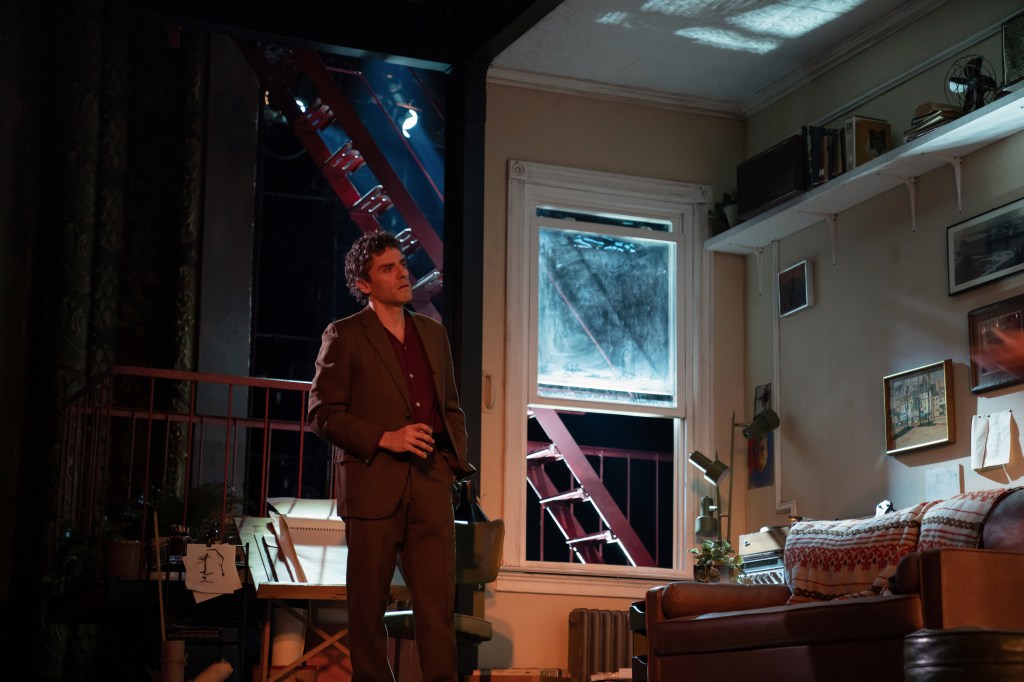
The actors’ ensemble work is superior. Both Isaac and Brosnahan set each other off with authenticity. Miriam Silverman as Mavis hits all the ironies of the self-deprecating housewife, who has suppressed her own tragedies to carry on. And Julian De Niro’s speech about why he cannot love or marry Gloria is a powerhouse of cold, calculating, but wounded rationality. Hansberry has crafted complex, nuanced human beings and the actors have filled their shoes to effect their emotional core in a moving, insightful production that startles and awakens.
The play must be seen for its actors, direction, and the coherent artistic team, which perfectly effects the director’s vision for this production. These artists include dots (scenic design), Brenda Abbandandolo (costume design), John Torres (lighting design), Bray Poor (sound design), and Leah Loukas (hair & wig design).
This must-see production runs under three hours. For tickets and times go to their website https://thesignonbroadway.com/
‘The Fears,’ Meditation vs. Inner Chaos, a Review

Where do you go when psychiatric therapy, group therapy, self-medication (alcohol, food, weed, etc.), prescribed medications, and other mainstream therapies don’t help you out of severe depression from psychic trauma and PTSD? You try the Buddhist center in New York City. In The Fears written by Emma Sheanshang, directed by Dan Algrant, currently running on the Irene Diamond Stage at The Pershing Square Signature Center, we are ironically entertained and drawn in to the emotional, traumatized, yet hysterical responses of seven individuals. Each attempts to reconcile their angst and anxiety together in five Buddhist meditative sessions over the course of five weeks.
The Buddhist practice led by Maia (Maddie Corman) follows the striking of the singing bowl, meditation in silence. Then individual members “touch in” and share their miseries, joys, or angers from the previous week. Part of the irony and humor of these sessions is in becoming acquainted with the individual stakeholders Rosa (Natalie Woolams-Torres), Katie (Jess Gabor), Fiz (Mehran Khaghani), Mark (Carl Hendrick Louis), and Suzanne (Robyn Peterson). Each unique individual is introduced to new member Thea (Kerry Bishé ), who has not received an email about the rules of the sessions and is flying blind. We, along with Thea, learn the quirky rules set up to guide the meditation and group dynamic as it unravels to a turning point during each session.

First, there are no apologies necessary for anything one does. Second, no discussion of the past is encouraged. Each of the members must stay “in the room” and in the moment to ground themselves with the here and now of their feelings. Third, no group member can ask questions of other members. Additionally, the group leader guides any member having problems with suggestions, for example to plant a tree (this never occurs), or in one instance, the inner child method–the adult version of the group member speaks to her inner child version– as the rest of the group’s inner children watch and learn.
For example, Rosa (Natalie Woolams-Torres) is subject to panic attacks and doesn’t do marital discord (conflicts between group members). Anything sets her off and raises her inner pressure. When she spirals upward in a fear, as she flails about her husband’s obliviousness to her panic attack at a christening, the controlled, calm Maia humorously brings her down by reminding her to “breathe,” and “stay in the room.” When these exhortations don’t work, she finally has Big Rosa address her inner child (Little Rosa), via a pillow who stands in for Little Rosa. Maia expertly guides her with questions, as the group members look on approvingly, while Big Rosa tells Little Rosa she’s safe, can go to another room, go for a walk, or go anywhere. Thea has gotten a eyeful as have we, except Thea doesn’t find it as humorous as the audience does.

The various members “touch in” after Rosa comes down from her attack. Katie “took a shower.” It’s apparently a big step for her because the others cheer her improvement. Fiz discusses that his sister dared to invite him to her wedding. Group members know he has issues with his parents. His father raped him as a tween, and when he told his mother, she refused to believe it and had him put in juvenile detention. His wounds are still raw, though he has been “healing.” Nevertheless, when Suzanne suggests that his sister’s invitation is a positive move, he blows up and asks if Suzanne is insane, a touchy question because all of them are off the charts from their traumas.
Also a sex abuse survivor, Suzanne attempts to defend herself. The interchange escalates humorously. Peterson’s Suzanne and Khaghani’s Fiz are invested in their emotions, and it’s crucial that the actors sustain the right balance of tone, sincerity and timing. or the scene could be deadly and fall flat. However, with apt direction and superb acting, the result is hilarity with no small thanks to Algrant, who knows how to make this hybrid dramedy pop. Additionally, the dialogue is choice with one-liners built in so that the actors (Khaghani is a comedian), cleverly measure the dead-on delivery.
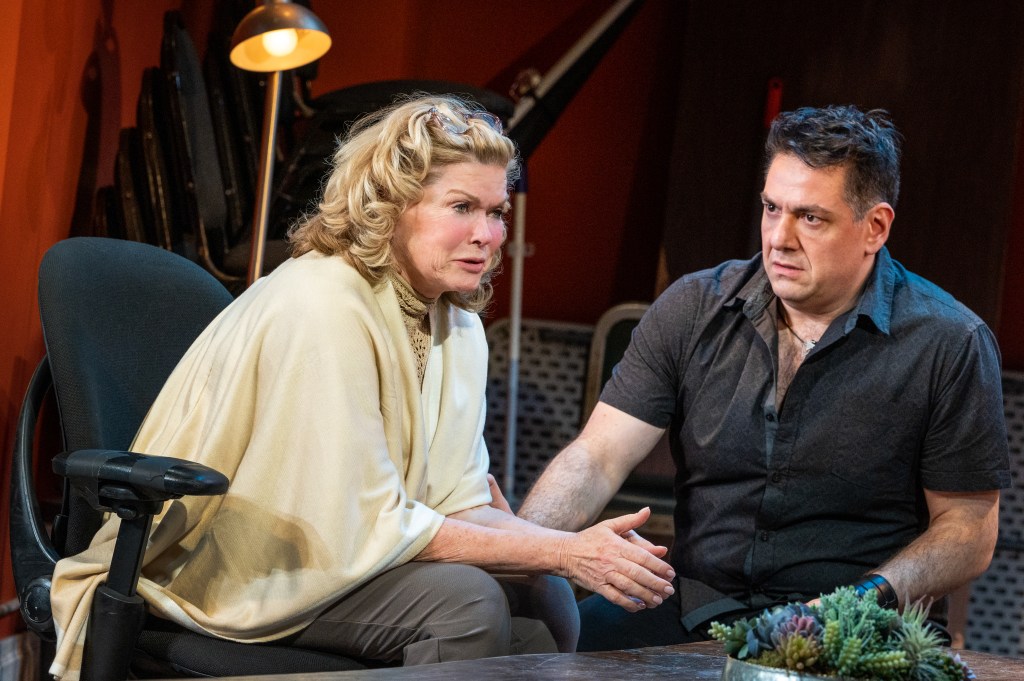
The heated exchange between Fiz and Suzanne prompts Maia to intervene and call “weather on the ones.” Gauging the “emotional atmosphere” each is feeling, the group members weigh in with “misunderstood,” “fear,” “anger,” etc., and the brewing storm subsides as they stay “in the room in real time,” and don’t nurture hurts from the past.
Sheanshang raises the emotional stakes higher when Thea tries to describe how Alexander the Great is responsible for a traumatic attack that happened to her. Initially, no one gets it and there’s confusion, until later in the play she describes the incident that terrorized her. The playwright’s clever script is both poignant and funny. She has pared down the lines yet has given enough backstory with the individuals to supply an inherent humor as they briefly describe the traumatic event which they are suppressed from discussing when the session gets underway, but not before.
The playwright thematically reminds us that humanity is boiling over with trauma and oftentimes, takes itself too seriously. However, the trauma cannot be suppressed because it is devastating; finding humor and having a gallows laugh about it is paramount. Interestingly, watching the group members surf the waves of their watery emotions, and explode despite Maia’s attempts to keep the ship on an even kee,l reveals the irony in attempting to control the chaos with “Buddhist” practice, which is a 20th century, Western appropriation of an Eastern religion, which requires an entirely different mind-set.
The religion has existed for thousands of years and its “practice,” through the Western lens and mind has been twerked. The practitioners ignore that it has been superimposed over Western, cultural psychoses and promulgated by various gurus (one of whom we later discover was a sex predator himself). Sheanshag twits the sessions and exposes the West’s arrogance and privilege in its appropriation. Her dialogue and Algrant’s direction land the play with the right tonal balance, which makes for a profound, yet comedic production. Incisively, it reveals the desperation of each of the characters, especially Maia, to find some modicum of peace, that the culture and society do not readily offer.

The actors are superb, and as they erupt with emotion, Dan Algrant has them work seamlessly in tandem with impeccable timing for maximum humor. Sheanshang has crafted the characters with such specificity, and uniqueness, we understand how they have become practiced to trust in Maia’s cues and guidance so that they follow it like herded cows. The only one who doesn’t get it is the outlier-newcomer Thea, who “didn’t get the email,” and thus, is introduced to the “rules” in real time as we are. This element keeps us engaged and provides vitality and surprise about what will happen next.
As group leader, Maia’s response to various members as she guides them, is a non-response of “Mmmmm,” which becomes loaded with meaning after we follow various characters’ issues. As the play progresses in humor and sobriety, we discover that each of the group members have experienced sexual abuse which has traumatized them, so that they rely on each other for comfort and the camaraderie of understanding. However, they aren’t allowed to discuss the specifics of the abuse because it happened in the past, and they must remain in the present. Because of the active dynamic going on in the sessions, we don’t miss learning about their past. It is enough to understand that their wounds spill into the presen,t regardless of how hard they try to “Mmmmm.”

How each of the group members relates to the others remains funny and toward the end of the play becomes volatile. The techniques that Maia uses are successful only in so far that group members believe them to be. However, Thea reveals a few secrets and asks questions which throw a monkey wrench into their “smooth” sessions. And when Katie, who the others believe has joined a satanic cult, leaves after an emotional outburst, it sets the rest of the group members at each others throats. Even Maia who has the “air” of a female yogi, loses control of them and herself in a chaotic epiphany. After her outburst, she is forced to confront herself with the groups’ encouragement, as she reveal a truth she has suppressed to delude herself “nothing happened.”
The success of Sheanshang’s work is in its twists and moment-to-moment “presence” which the actors keep alive and bubbling. All of them have been beautifully shepherded into a believable ensemble of traumatics, which can be set off at any time. And, they are. The secrets revealed by Thea, Maia and Katie cause the group to go off the rails, until Maia is encouraged to hold a session which brings them and the audience back down to earth for a fitting conclusion. The necessity of restoring calm succeeds. As her depth of feeling reaches out and encourages healing, the audience members join in as well. The conclusion is poignant and the theme that every person faces their own PTSD events in their lives becomes clear. Ironically, as much as each of us would like to “get better,” and “be healed,” in an ironic comment, Thea says, “You’re on earth. There’s no cure for that.”

The quote from Samuel Beckett is the play’s principle theme. Knowing that human beings can’t escape having been shaped by horrors in their past, they are grateful for moments of shared peace which bring them outside of their emotional chaos. And in that peace they may find renewed purpose, as they acknowledge it is enough to bring power to reconcile such events with the help of others.
Kudos Jo Winiarski’s scenic design, David Robinson’s costume design (Maia’s and Goth Katie are particularly interesting), Jane Shaw’s sound design, Jeff Croiter’s lighting design, and Jimmy Goode’s wig, hair and make-up design (especially for Maia and Katie). The Fears presented by Steven Soderbergh (Academy Award winner for the film Traffic), is performed without an intermission. For tickets go to their website: https://thefearsplay.com/
‘Camelot’ Revival at Lincoln Center, Superbly Re-imagined for Our Time

The original 1958 musical Camelot. performed with Alan Jay Lerner’s book and lyrics, and Frederick Loewe’s music, adapts theArthurian legend from T.H. White’s collection of fantasy novels entitled Once and Future King (1958). White’s adaptation was loosely based on the 1485 work Le Morte d’Arthur by Sir Thomas Malory. Aaron Sorkin’s book updates the musical and puts an interesting spin on the events of legend, heightening the characters and shifting the emphasis to King Arthur, superbly portrayed by Andrew Burnap (Inheritance). As a result, Sorkin diminishes the love affair between Phillipa Soo’s Queen Guenevere (Hamilton) and Jordan Donica’s Lancelot du Lac (My Fair Lady), aligning it more with romantic tradition which fails. With outstanding set design and fine direction by Bartlett Sher, Camelot is a stunning revival of symbolic political moment, currently running at Lincoln Center’s Vivian Beaumont until September.
At the top of the play Sorkin introduces us to one of the most important aspects of Arthur’s kingdom, the feudalistic power structure and Arthur’s previous isolation from it. Before we even meet Arthur, we meet the lords who serve the king and make up his court, as well as Merlin (Dakin Matthews), Arthur’s counselor, whose wizardry is seen through his balanced demeanor, wisdom, erudition, time transcendence, foreknowledge and keen ability to redirect the perspectives of less enlightened individuals.
Tasked to meet Arthur’s bride-to-be at the top of the hill near the castle, the lords exclaim that her carriage is at the bottom of the hill. We note Merlin’s attributes in his initial discourse with these three knights, Dinadan (Anthony Michael Lopez), Lionel (Danny Wolohan), and Sagramore (Fergie Philippe), who rant that the Guenevere’s carriage has gone against tradition, as they watch her disembark from her carriage far away from them. This change in tradition upsets them, until Merlin uses gentle wisdom to calm their responses and show them they can merely change the law to update tradition. This exchange among the knights and Merlin indicates the conflict to come, tradition vs. progress. The knights’ acceptance of Arthur’s changes is paramount to Camelot’s success.

The ruling elites are conservative traditionalists. But Merlin handles them easily and emphasizes the power of laws to change useless, outmoded ways of being. These men have power and influence over an unequal class system, institutionalized by feudalism (the peasants who serve and the lords who protect and luxuriate over them). Arthur must step around them and gain their trust to overturn traditions which have harmed and caused wars and bloodshed.
Not a member of the royal class per se, Arthur must navigate the knights’ entrenched power with wisdom, if he is to rule his kingdom well and remain effective. This not only requires steadfast courage and acute psychological and personal skills, it demands a political philosophy and will to unite the lords and prevent division. Additionally, training and counsel from Merlin, whose extraordinary gifts of wisdom provide a broader, endowed perspective and understanding, are a boon.

In Sorkin’s different spin of Merlin, we understand that the time has been stepped up one hundred years, so that the medieval age is coming to a close, and Arthur is pushing his kingdom in the direction of the Enlightenment with the help of Merlin. Unfortunately, Merlin’s assistance remains all too brief. After his death, he is replaced by one of the oldest knights in the kingdom, Pellinore, also portrayed by Dakin Matthews, who Guenevere invites in to their circle.
Sorkin advances Arthur’s human graces, contrasting them with the backward knights of his time, who he must manipulate against their own stupidity, which manifests in Act II, encouraged by Mordred (Taylor Trensch) in “Fie on Goodness.” Arthur is not a royal in arrogance, presumption or privilege. He is a people person, decent, kind, likeable and extraordinarily generous. He is more like a Christ-like figure, who forgives Guenevere and Lancelot’s “treason,” and refuses to brutally punish them for their lack of faithfulness.

He invites his son Mordred into his circle, as a reconciliation for his past abandonment, which his mother caused by refusing Arthur’s pleas for her to come and live in the castle. He announces to the kingdom that Mordred is his out-of-wedlock son who is being treated equally like everyone else and has the opportunity to learn and become a knight, if he wishes. But Mordred refuses to listen to Arthur’s explanations why he is not with Morgan le Fey (Marilee Talkington), and he gives lip service to Arthur’s largesse. Instead, Mordred manufactures his own victimization and weaponizes it against his father. Indeed, as the villain, Mordred exploits Arthur’s kindness and love. In his wicked world, these traits are a weakness to set up Arthur’s downfall (“The Seven Deadly Virtues”).
Especially in the characterization of Arthur, Sorkin presents the idealization of a king whose humility, love, intelligence, forgiving nature, and equanimity is all that the Enlightenment promises. Unfortunately, Arthur is a man out of his time, more an influence for future generations in inspired legends and stories of his exploits, frailty and kindness, which can guide by example to bring hope and light to others. Though his reign and Camelot only lasted for for a brief time, the antithesis of the stability and “happy ever aftering” Arthur and Guenevere sing about in the beginning (“Camelot”), is mythic. All individuals, even the current day audience can aspire to Arthur’s ideals of a place of congeniality for persons great and small.
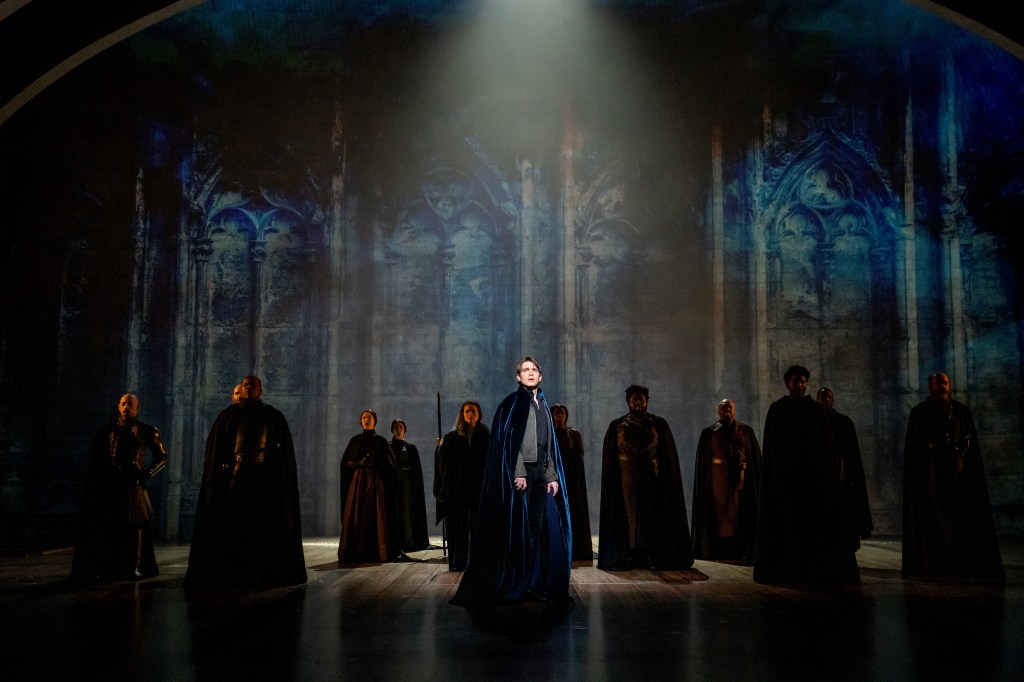
Each of the characters we see immersed in feudalism are lesser in nature, greedy for power, brutal, judgmental, calculating and self-absorbed. In the dialogue to some of the songs, we note Sorkin cleverly magnifies this. For example in the ironic “Simple Joys of Maidenhood” that Guenevere sings about wanting knights to die and sacrifice themselves for her love, Arthur brings up the notion that this isn’t much fun for the knights. Not only is Guenevere naive, she is brutal in her unrealistic romanticism, a clue to the source of her treachery with Lancelot, spawned from her privileged background. Indeed, the same knights that would kill for her, would just as soon end her “maidenhood,” in a rape, which Arthur seems to note in his ironic comment, but Guenevere conveniently ignores.
Guenevere is a traditionalist in all of her “modernity.” A spouse by arranged marriage to prevent war between England and France, she is born of royalty and has the presumption, lack of humility, and fieriness to prove it. Her expectations are royal, and she doesn’t understand Arthur’s personality and hoped for kingdom. Initially, she presumes Arthur will behave according to the traditions of kings, like her father. Kings are sexually promiscuous. They treat women as objects for their pleasure; they make demands on them, requiring they be passive creatures without individuality or autonomy.
That Arthur doesn’t have women at his sexual disposal at court, and expresses belief in the fidelity of marriage is a striking and revelatory contrast. Additionally, he fosters the novel idea they must prevent fighting, war, bloodshed, abuse of the lower classes and women. Remarkably, he gladly accepts her input of ideas. It is during their discussions that the “knights of the round table” come into being. In this acceptance of Guenevere as his ruling partner, he reveals that he is dynamically striding toward enlightened governance.

Appealing to her better nature constantly, Arthur trusts her with Lancelot. Ignoring her suggestion, he refuses to expel the narcissistic knight from the kingdom, before they have their momentary affair, which Mordred has “encouraged,” unbeknownst to Arthur, Guenevere and Lancelot. Above all, Arthur provides her with freedom and power to rule with him. This is unlike anything that is supposed to happen to a female royal anywhere. And in the musical’s memorable signature song, he imagines his vision of Camelot in order to engage her to want to be Queen, and woo her, before she knows his identity.
In retrospect, at the conclusion of the musical, we learn it is his intentions of good will toward her that prompts Guenevere to fall in love with him early on. However, since both of them are unpracticed at love, they never express it to each other. It is one of Arthur’s chief weaknesses of pride. Ironically, he fails at his own express thoughts in “How to Handle a Women,” and doesn’t love her, so that she understands his love, understands that his freedom and trust in her are love, decency and generosity in the Arthurian time of patriarchy on steroids. She is still stuck in the romantic notion of love, reinforced by her ladies in waiting, who push romantic tradition on her to her detriment.
Sorkin’s book is deeper and more complex than the original musical, so that before each song, one must catch the nuance. For example the humorous repartee before and after the song, “Camelot,” works beautifully and heightens the ironic, fantastical lyrics, symbolizing the fickleness of the place in its hyperbole, “The snow may never slush upon the hillside, by 9 P.M. the moonlight must appear.” In expressing his metaphor, Arthur encourages Guenevere to realize he is unlike royalty, and his kingdom and reign with her will be unique, maverick, loving. The tragedy is that the depth of their love is unrealized and misunderstood. Guevenere, entrapped by the tradition of her place and status, and Arthur overwhelmed by his sense of inferiority to express his feelings to her, contribute to the fall of the kingdom.
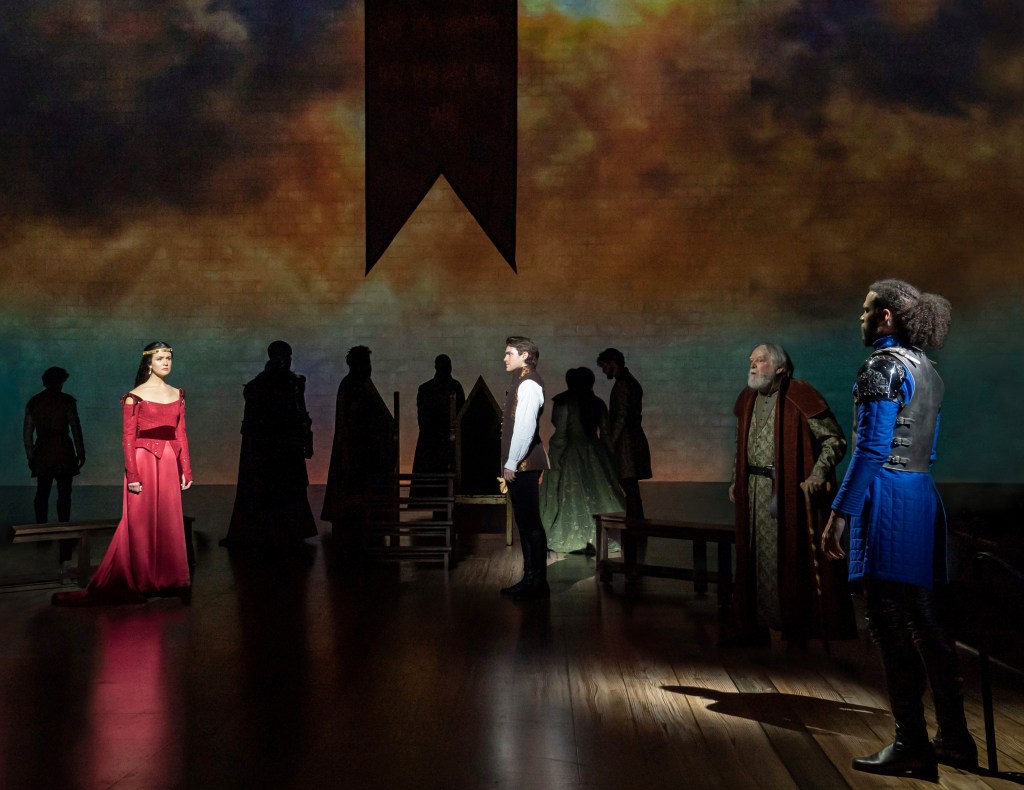
An express, underlying irony is that Arthur’s view and behavior toward women is even more forward thinking than many in the US South today, and especially some of the GOP political party antithetical to equanimity between women and men. Thus, Arthur is not only schooling Guenevere about equanimity and generosity as love, he is also reminding the audience of the beauty of such an approach between men and women for our own time.
Of course, this is legend, and it is hard to come by in reality, which makes the final exchange between Arthur and Guenevere, and their relationship, all the more poignant and tragic. In a failure of her character and bondage to her identity, Guenevere is too late to recognize and receive Arthur’s love and freedom to express it. Instead, she opts out for fleeting passion which is another form of bondage, and is the antithesis of freedom. It is why she regrets her affair with Lancelot, does not run off with him, but goes to a convent. The rest of her life she does penance for contributing to his death, Lancelot’s death, and the destruction of the kingdom.

Phillipa Soo and Andrew Burnap are perfectly cast in their respective roles and are simply smashing in voice, authenticity and aura, making us empathize with their characters who are victims of their own frailties. Burnap, especially at the conclusion, coalesces the poignant tragedy that Arthur’s dreams are broken, and that by a combination of rotten timing, privileged selfishness (by royals Lancelot and Guenevere), bitterness and resentment by an ungrateful Mordred, he is undone and must pay the forfeit with his death.
Jordan Danica’s Lancelot is both funny and dangerous, for we know what is coming when his resistance to Guenevere “protests too much” in selfishness. The right way to serve King Arthur would to leave and escape his lust, which he can’t because of his own self-betrayal. The bedroom scene is perfectly directed to suggest the thrill of passion, but not love. It is appropriate that their “aftermath” falls flat in disgrace, as they realize the import of what they’ve done. Sadly, as the pawns of Mordred, they’ve betrayed their king, and the golden idea which elevated their lives and the kingdom. Interestingly, Donica’s “If Ever I Would Leave You” indicates he can’t leave because of how she “looks” in the changing seasons. If he really loved her, not the image of her and him together, he would have left the moment he sensed the attraction to save her and himself. So much for his boasted purity. To insure his leaving, he would have been truthful with King Arthur. Donica’s voice and interpretation of that song in particular are non pareil, just fantastic.

Sorkin mitigates the “magical” in this Camelot update, palatably. For example it is suggested Arthur is able to pull the sword Excalibur out of the stone because previously, ten thousand men loosened it. Lancelot’s “resurrection” of Arthur occurs because he was just knocked unconscious and not killed. No miracle occurred. Arthur’s characterization is a forerunner of the rational man of the Enlightenment, when Europe will experience many transformations. Then, rigorous scientific, political and philosophical ideas burgeon in the society with the rise of the middle class. In his approach to ruling his kingdom, Arthur is bold to overthrow the most noxious elements of feudalism to bring ideals of equanimity, peace and honor that “might for right” and “justice for all” are the better way.
The thoughtful production has humor, vibrance and poignance. The treachery and resentment of unforgiving Mordred (the fine Taylor Trensch), who helps explode the Camelot ideals of equanimity, peace and honor are a potent reminder that such a “heaven on earth” is impossible because of human fallibility. Thematically, the musical warns us that only in the aspirations of future generations, represented by Camden McKinnon’s Tom of Warwick, may that possibility become reality in limited circumstances.
In the meantime, hope must be kept alive for a time when such dreams are possible. Realistically, all the characters fall from their own grace. It happens with the best of individuals, who cannot govern their own passions, and with the worst who rebel against a more perfect order for the sake of power. Sorkin reminds us in this complex re-imagining that most important is the striving for equity and equilibrium, not the achievement of it, which in itself is too fantastic to sustain. In the striving is the learning and revelation which is priceless. As such they provide the way for the hope of tomorrow, arriving at democratic polity hundreds of years in the future: i.e. a democratic Ukraine in the face of genocidal aggression by Russia, a democratic United States in practice not in lip service.
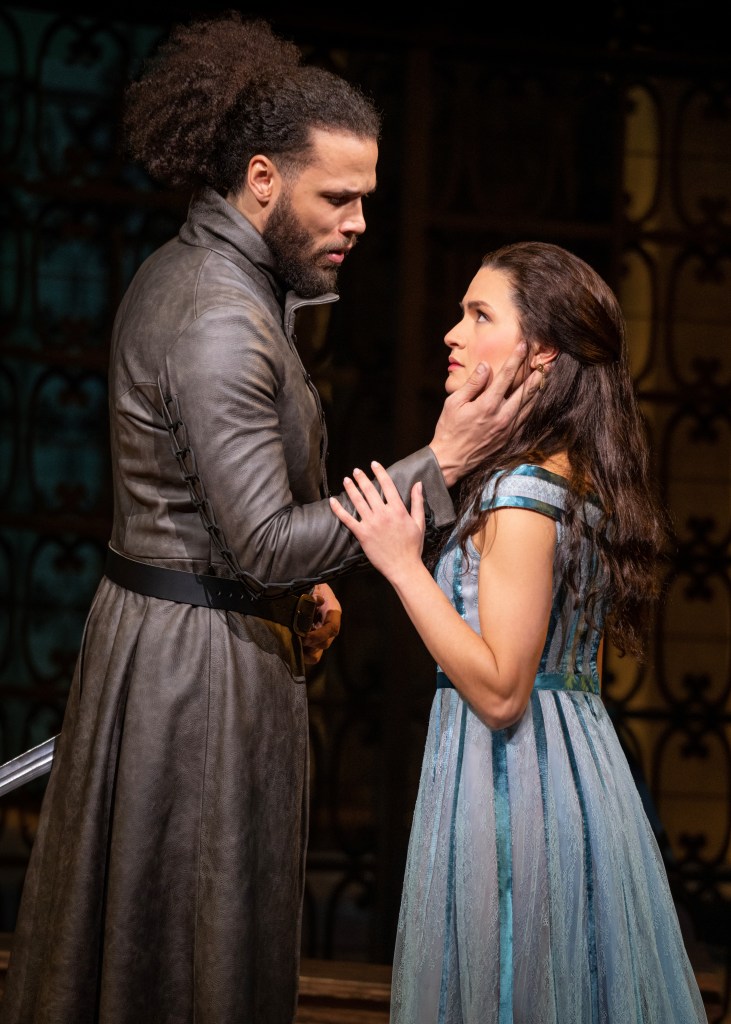
The sets by Michael Yeargan are suggestive, stylized, minimalist and symbolic, perfect for scene changes to the castle, Arthur’s study, a maypole dance, the tournament and more. Noted the black tree on stage never blossoms or has leaves, regardless of season. At one point the projection of the beautiful Camelot is seen in the distance. However, the tree does have leaves on the program cover as a figure peers out from its branches, and we, like him, wait for a “more perfect union,” and peace, justice and equity for all.
Jennifer Moeller’s costumes are richly appropriate and gorgeous. Lap Chi Chu’s lighting design, Marc Salzberg & Beth Lake’s sound design, Cookie Jordan’s hair & wig design cohere to manifest Bartlett Sher’s vision. Projections by 59 Productions are, as usual, marvelous.
I had forgotten how lyrical, memorable and powerfully touching are Lerner and Loewe’s songs and music. “Guenevere” is heartbreaking. Special recognition goes to Kimberly Grigsby’s music direction which does justice to the score. Noted are the original orchestrations by Robert Russell Bennett & Phillip J. Lang, and dance & choral arrangements by Trude Rittmann. These artists, no longer with us, had a prodigious history of creating the beauty of Broadway (Bennett over 300 productions, Lang and Rittmann over 50 productions). Byron Easley’s choreography is energetic in “The Lusty Month of May.” B.H. Barry’s fight direction and the staging/choreography of swordfights of Lancelot proving his mettle with the three knights and Arthur, appear as dangerous as the crashing blades sound.
Camelot runs with one intermission. Every minute is worth seeing. Don’r believe some of the critics. Judge for yourself. For tickets and times at the Vivian Beaumont go to their website https://www.lct.org/shows/camelot/
‘New York, New York’ is a Wow, Manhattanhenge is Here.

Inspired by the titular MGM motion picture written by Earl M. Rauch, the musical New York, New York at the St. James Theatre is an ambitious, updated adaptation from uneven source material. Its spectacular production values guided by the prodigious five-time Tony winner, Susan Stroman, who does double duty with direction and choreography, is set over the course of one year with the four seasons structuring the arc of development in the lives of the characters who want to “be a part of it in old New York,” from the Summer of 1946 through the Summer of 1947. Written by David Thompson, co-written by Sharon Washington with additional lyrics by Lin-Manuel Miranda and music and lyrics by John Kander and Fred Ebb, New York, New York’s music differs from that featured in the titular 1977 Martin Scorsese film.
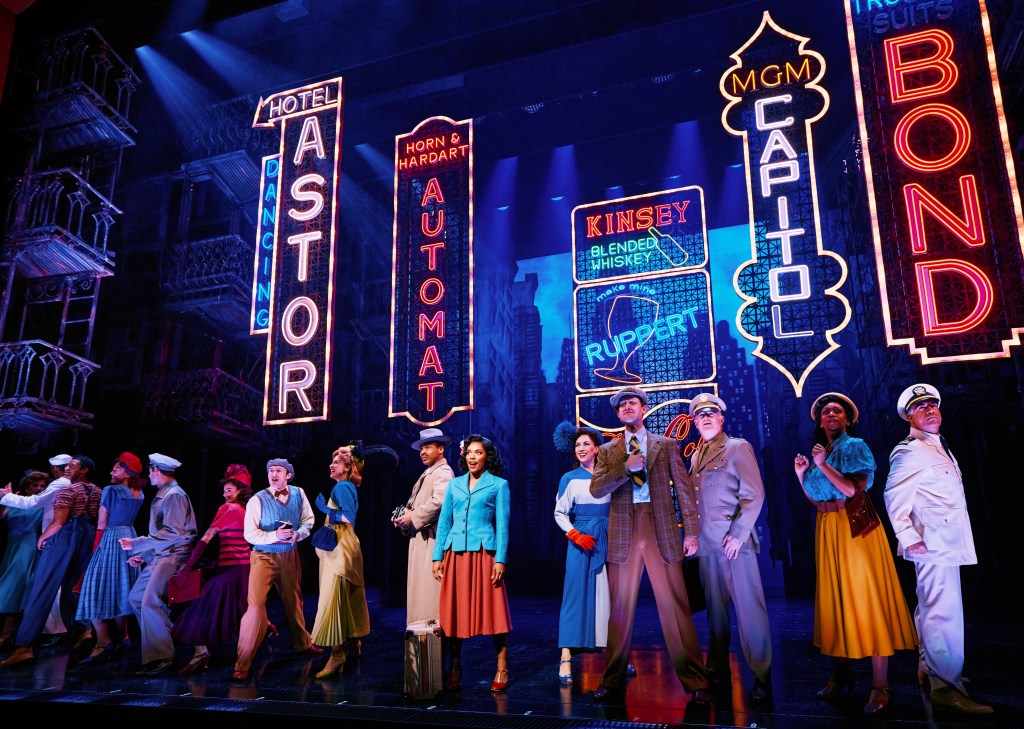
The noted exceptions are a few songs like “Happy Endings” and two schazam hits sung by Liza Minnelli in the film. Minnelli was initially associated with “New York, New York,” until Liza told Uncle Frank it was his to sing. Afterward, it became a part of every concert, TV show or gig Sinatra starred in. “But The World Goes ‘Round” is singularly Minnelli’s, though others have picked it up and run with it applying their own versions.
With such song classics, the production doesn’t capitalize on their tonal motifs threading intermittently from Act I to Act II more than just once. Instead, saving the best for last, they explode toward the conclusion. At the end Jimmy Doyle’s band (the real orchestra) rises up from the pit, playing “New York, New York” with bravado and glory. By far, the two songs are the richest, most seismic and memorable of the score. Despite who is singing them, they are a pleasure because of their symbolic associations.

The first is New York City’s anthem played as an encouragement around every dooms day disaster the city experienced in recent memory from the Terrorist Attack of 9/11 to the COVID-19 botch job by the twice-impeached former president, when nightly the city came out to applaud healthcare workers and some played Sinatra recordings of the signature song from their balconies. The other lush beauty about the irrevocability of life’s changing turns, highs and lows, is a classic best remembered for Minnelli’s fabulously impassioned rendition.
These songs, in their own right, are like the North Star. “But the World Goes ‘Round” appears to guide the writers to effect a richer, stirring musical about making it in a tough, unforgiving town which necessitates growing a thick skin because regardless, the world will spin, whether one plays the broken-hearted victim as Jimmy Doyle does initially in Act I, or become the heroes of their own myths as do all the characters who serendipitously meet in a Booking agent’s office, then join Doyle to play in a “tired club” in Act II in a reviving number “San Juan Supper Club.” However, reaching success takes a while.

Specifically, the book meanders as it strikes out into different story-lines of immigrants and ethnics, who come to Manhattan to establish their unique voices and become the stars of tomorrow. Problematically, the music, which should lead in a brassy, bold pop style of the latter forties reimagined, follows without the same consequence and heft of the two signature songs we long to hear that show up in full force by the end. The story lines take wayward side directions, straying away from “the heart of it,” making Act I (17 songs) much longer than necessary to spin the characters’ struggles in New York. The central focus becomes redirected. Eventually, it comes back and the lens crystallizes on salient themes, before flitting away to feature another plot-line.

The centrality, which is supposed to be how Jimmy Doyle’s Major Chord Club and musical group comes together, is delayed by scenes of the violinist from Poland and Mrs. Veltri waiting for her solider son to come home. What is represented is the loss and death from the war, a loss which explains why Doyle drinks, is angry and argumentative with those who could help him. He grieves his talented brother dying, while he, the inferior with “flat feet,” serving unheroically behind a desk, feels guilt as the ghostly shadow of his glorious sibling occludes him.
The impact of grieving New Yorkers out from under a cataclysm of the holocaust, which took violinist Alex Mann’s family and the heroic sons of America’s war dead is important, but diluted in the mix of all that is going on. Doyle, Mann (Oliver Prose) and Mrs. Veltri (Emily Skinner) are meant to carry that theme of loss and grieving as one more aspect of the “city that never sleeps,” but the power fades too fast for the audience to fully appreciate it, as the action springs to another scene and character. This is the nature of the city which acknowledges then moves on with forward momentum.
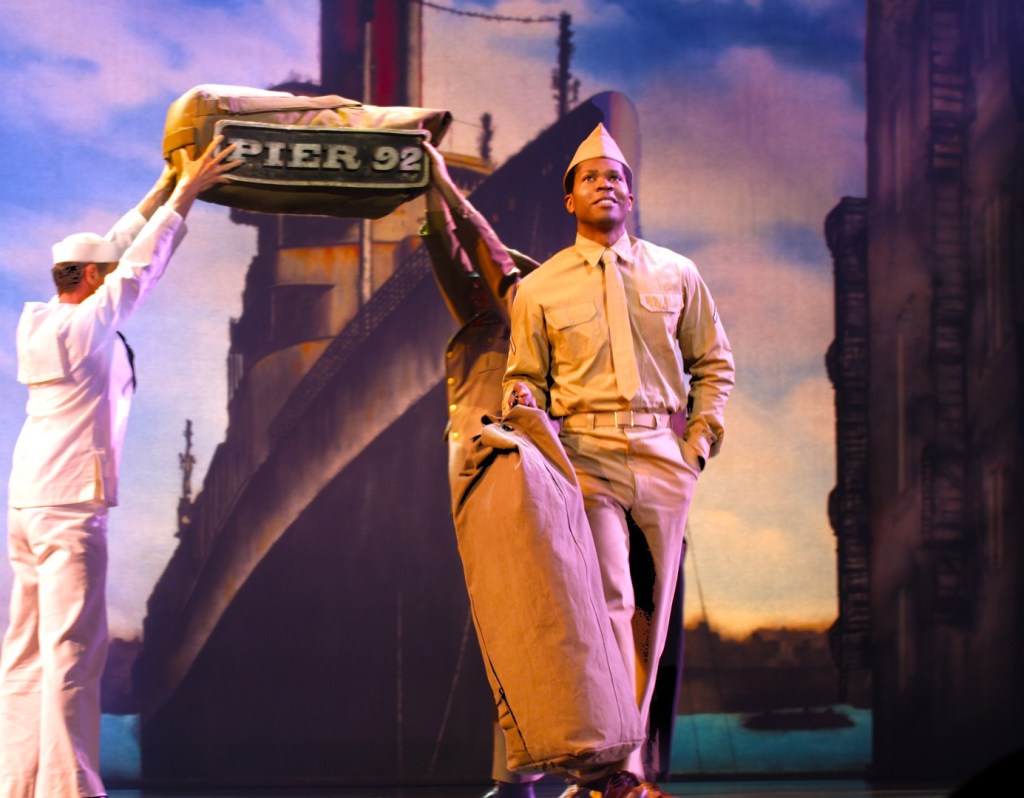
Not all the story-lines need specific scenes for explication. Some either should have been edited to a stark jabbing point with the songs either pumped up and primed, or eliminated. They seem extraneous, done for the sake of inclusiveness, rather than out of a visceral, organic need driving the characters in their forward momentum. Editing might have slimmed down the excess that sometimes dissolves the production’s vitality. Though the writers moved away from the film’s story, to be inclusive and representative in an update, they do feature the relationship between multi-talented musician Doyle (Colton Ryan really picks it up in Act II) and powerhouse singer Francine Evans (Anna Uzele has the creditable voice).

However, the idea of a New York City, where inclusiveness and freedom, born out of anonymity and size, that also has a down side, is not manifested with unique particularity beyond the concepts of struggle and making it. Only Jimmy Doyle’s character is nuanced and shaded with interest to reveal a convincing transformation that is believable, effected beautifully by Colton Ryan.

Despite these problems with the book, Stroman leaps over them creating terrific moments in representing the lifestyle of New York City street scenes. She materializes a pageantry of perfection in staging the dance numbers with delightful framing assists from Borwitt’s scenic design and Billington’s lighting design. These gloriously drive the production, along with the fabulous projection design by Christopher Ash and Beowulf Boritt, which majestically integrates historical photographic blow-ups with the sets (scaffolding erected to look like apartment buildings). New York City in their vision is a treasure to behold back in the day, as they remind us of how we got from then to now. Of course, the heartbreaking projections of the old Pennsylvania Station torn down in contrast with Grand Central Station which we are eternally grateful for Jacqueline Kennedy Onassis’s crusade to save it, are vital historical references in an ever changing Manhattan.
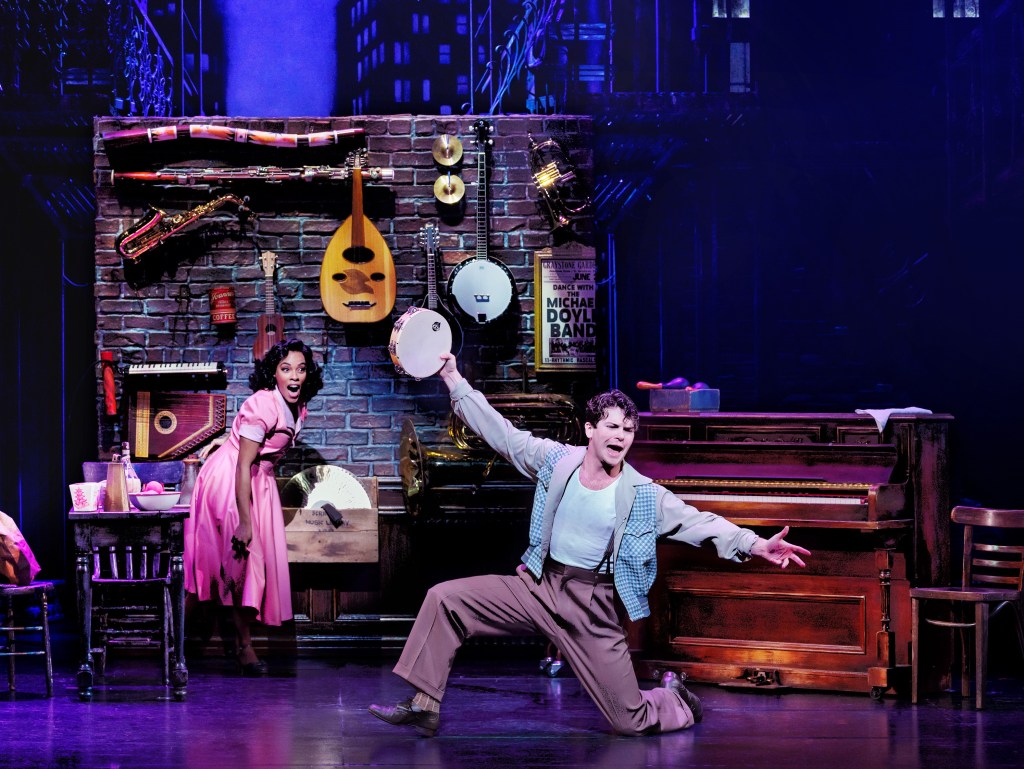
Stroman choreographs the ensemble with excitement, energy and vibrance. She shepherds the musical’s technical team to strike it hot. They create the atmosphere and stylized beauty of post war New York neighborhoods, synchronizing the scenic design, lighting design and projection design. Along with Donna Zakowska’s stunningly hued costumes pegged to the period, Michael Clifton’s period makeup design, Sabana Majeed’s hair and wig design and Kai Harada’s sound design (I heard every word) these talents manifest Stroman’s concepts of a bustling, charged city hyped up to establish the nation’s new-found prominence after winning WW II in Europe and the Pacific. The city of dreams is once more collecting its dreamers who will sink or swim according to luck and perseverance.

There are many moments in New York, New York I loved. The song “Wine and Peaches,” performed with the ensemble’s tap dance on a foundational iron beam, beautifully set “high in the sky” with the city projected from down below during the ironworkers lunchtime is gobsmacking. It’s a remembrance of the iconic black and white photo of the Empire State Building being erected and ironworkers sitting on the structural beams over 80 + stories up. The song is emblematic of New York City construction workers who are brave, balanced and accustomed to such heights, that they might dance “for the hell of it.” It is also a testament of the tremendous development in the city whose air rights allow buildings to rise taller and taller. Symbolically, visually and musically performed with grace and fun, the number is one of the most memorable and brilliant.

Another moment that is thematically important is the song “Major Chord,” as Jimmy Doyle and friend Tommy Caggiano (Clyde Alves, a fine song and dance man) discuss that “music, money and love” combined in a harmonious chord become what drives a purposeful life for them. In the lead up praise of the city, Tommy’s humorous truism rings clear for New Yorkers when he says, “It’s the greatest social experiment. Everybody lives here and everybody’s natural enemy lives here. And we manage not to kill each other. For the most part.”

To top his comments as New Yorkers are wont to do, Jimmy says, for him, New York City is a “major chord,” and Uzele’s Francine joins in to ask how to find her major chord (music, money, love). Tommy and Jimmy help her find an apartment near Jimmy to start her journey to become a star. Eventually, as fate throws Francine and Jimmy together (more through events he causes) they marry, have ups and downs and reconcile at the “Major Chord,” Jimmy’s successful club which concludes the musical with a resounding and stupendously staged “New York, New York,” sung by Uzele’s Francine.

In Act I, “New York in the Rain” is beautifully sung and staged with colorfully hued umbrellas skipping across the stage, under their own power, and others held by the ensemble who twirl them in uniformity with graceful energy. As Jimmy, Ryan’s “Can You Hear Me?” and “Marry Me,” are appropriately winsome and romantic as Act I concludes with Francine and Jimmy’s relationship sealed in love and marriage.

Act II picks up the forward momentum. Jimmy pushes for his “major chord” in his relationship with Francine, “Along Comes Love” and in the dynamic “San Juan Supper Club” (Ryan, Angel Sigala, John Clay III) which is a rousing, dance number where the musicians we’ve met in Act I come together to form Jimmy’s band which will headline his club Major Chord. In the superb “Quiet Thing,” Ryan’s Doyle shares the preciousness of arriving at his dream, not with great fanfare, but with the inner knowledge of its success, which is the confidence that the dream is the reality. The lyrics and music are Kander and Ebb at their finest, and Ryan delivers a superb, heartfelt slam dunk that any artist can identify with.
As Francine understands that the villain with a smile, Gordon Kendrick (Ben Davis), wants to unrealistically take her, a black woman, out on the road so he can sexually seduce her, Francine affirms what her husband Doyle has told her all along. Kendrick is a hypocritical wolf in a “promoter’s clothing.” She concludes her last song on the radio after Kendrick tells her “she’s finished.” “But the World Goes ‘Round” is Uzele’s home run and Francine’s realization that she must move away from him and join Jimmy at the Major Chord Club.

An incredible and breathtaking encomium to New York City is in one of the final musical numbers “Light” presented by Jesse (John Clay III) and the ensemble. Kudos go to the technical team and Stroman to effect Manhattanhenge through the projections, sets and lighting. It is absolutely magnificent and of course, symbolic that light, love and musical goodness can be in a city that is its own memorial to industry, dreams and aspirations.

Manhattanhenge occurs when the sunset perfectly lines up with the east-west streets on the main street grid in Manhattan. It’s Stonehenge in NYC! Happening twice over a two-day period, on one day you can see the sun in full and on the other day you get a partial view of the sun. Then to encapsulate the “light” in the city that is its own monument, Francine concludes accompanied by Jimmy Doyle’s band with “New York, New York.” And indeed, the show ends in a major chord at Doyle’s Major Chord Club in a beautiful flourish with Uzele singing her heart out as the audience stands with applause dunning the critics who panned the production.

New York, New York is exuberant, complex and bears seeing twice. There is so much happening you’re going to miss something and think the fault is in the production, as I did initially. Stroman is her representative genius. If one goes without expectation, your enjoyment will be immense. Look for the fine performances. Colton Ryan is sensitive and heartfelt especially in Act II and his gradual transformation is exceptional in “Quiet Thing,” and afterward. There’s nothing like knowing one is a success and at home in that confidence. The principals, especially Uzele, Janet Dacal, Ben Davis, Angel Sigala and the others mentioned above have golden voices. All are their own major chords, thanks to the music supervision and arrangements by Sam Davis.
For tickets and times go to the production’s website https://newyorknewyorkbroadway.com/
‘Good Night, Oscar’ Sean Hayes in a Marvelous Must-See

It is not that Sean Hayes looks like Oscar Levant (he is taller), or speaks like Levant (not really), or accurately displays Levant’s neurotic ticks and eye blinks (he ticks away), or imitates his posture (he slumps, cutting off 2 inches of his own height). What Hayes does nail is Levant’s pacing, deadpan delivery, comedic sentience and his self-effacing, desperate, sorrowful heart. And it is these latter Levantesque authenticities that Hayes so integrates into his being that when he shines them forth, we believe and follow Hayes wherever he takes us during the brilliant, imminently clever Good Night, Oscar, currently running at the Belasco Theatre with no intermission.

With a well-honed, drop-dead gorgeous book by Doug Wright (I Am My Own Wife), and superb production values (Rachel Hauck-scenic design), (Emilio Sosa-costume design), (Carolina Ortiz Herrera & Ben Stanton-lighting design), (Andre Pluess-sound design), and J. Jared Janas for hair & wig design, director Lisa Peterson’s vision brings us back to 1958 in NBC Studios’ inner sanctum, where the backstage drama is more incredible than what happens on live camera. Of course, by the time Hayes’ Levant appears live on The Tonight Show, we, Parr (Ben Rappaport), June Levant (Emily Bergl), Alvin Finney (Marchánt Davis) and head of NBC Bob Sarnoff (Peter Grosz), have lived two lifetimes fearing the worst. After all, this is live television with no splicing tape or editing. Whatever happens is. And that makes the tension and thrill of this production that duplicates the fear of “live,” (just like on Broadway, but with no extended rehearsals), just smashing.

Doug Wright acutely, craftily ups the ante of danger in the 80% probability that Levant will make a mess of things. Perhaps, he won’t make it to the studios, just like the time he left an audience of three thousand waiting in fancy dress to hear him play the piano, concert style, which was popular in those days. Then, he let them wait and never showed up.
Levant is noted for his version of the stellar George Gershwin’s “Rhapsody in Blue.” Parr and the TV audience expect Levant to play it, but of late, he is hesitant and may refuse and walk off the set. So Levant might be on time but blow-up his appearance, as he has done before, saying the extraordinary and surprising, if asked to comment on religion, politics or sex. Furthermore, he is plagued by the spirit of Gershwin and has reveries of the past where, at times, he makes no sense. So much can go wrong, like Murphy’s Law states: “If something can go wrong, it will.” With Levant this has become a truism with scheduled bookings and appearances.
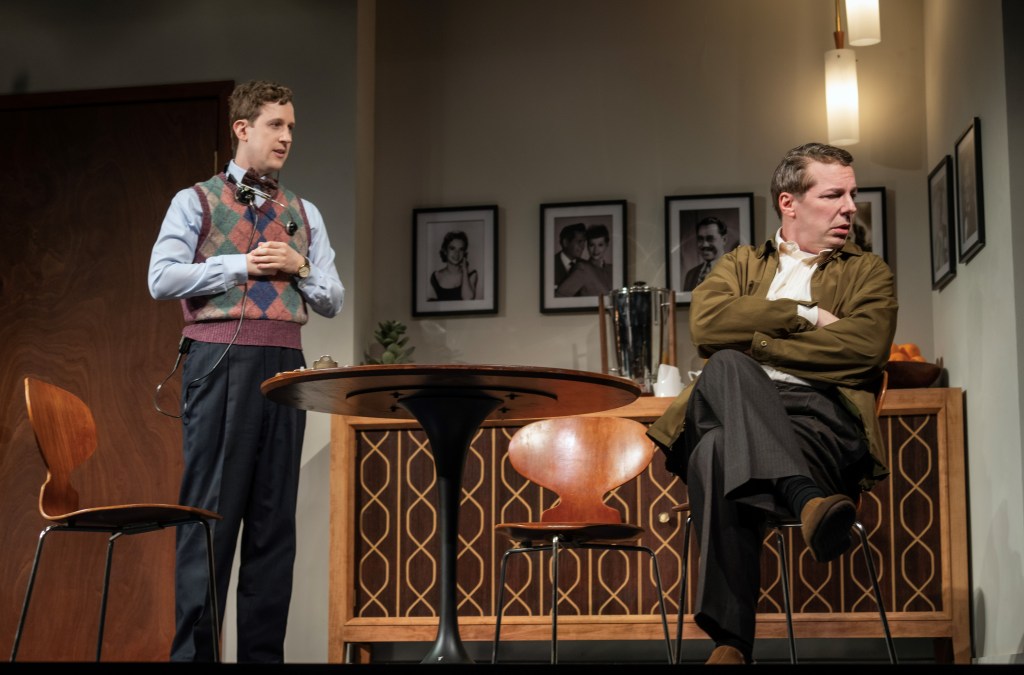
As Grosz’s apoplectic Sarnoff and Rappaport’s reasoned Parr go head to head about the high-risks they are taking because they cannot fail during “sweeps week,” we discover that recently, Levant is completely unreliable and “out there.” Sarnoff refers to him as a “freak.” On the other hand Parr has specifically chosen Levant because he needs his new Burbank show to be a success. Levant always delivers because Parr knows his close friend and can set him up for the best one-liners and witticisms in the business.
With Levant, Jack hopes to compete his way into prime time with a low budget and the talk show format he has perfected. It is a difficult task because he is on every evening, is rather high-brow, and the network underestimates him. However, Rappaport’s Parr believes Levant is a “true original,” who “treats chit chat with all the daring, all the danger of a high-wire act.” Parr knows that he will score with Levant because his unexpected brilliance lands his one liners all the time. Jack will start the engine, and Levant will speed off with the cues for a perfect show, nose diving into space and leveling off every time. He only needs to show up and get in make-up. Wright has created the set up for anticipation so that when Levant arrives, if he does, we are ready for his prime time antics, which happen behind the cameras.

That Parr doesn’t convince Sarnoff to calm down remains a problem. Sarnoff tells Parr he has booked “chica chica boom boom” Spanish musician and band leader Xavier Cugat as Levant’s replacement. He will save the day if Levant stiffs The Tonight Show, like he stiffed The Eddie Fisher Show the week before. In other words, as Levant keeps the studio waiting, the greater the likelihood that Levant’s career is down the toilet, along with the bad will that Parr has contributed making his goal to be in prime time a pipe-dream.
The issues appear to be settled when June Levant, Oscar’s wife, sweeps through the doors in her period piece, flowery outfit looking chic and composed. Parr is relieved until June tells him that she committed Oscar, and he’s in an asylum because she finally had enough. Parr becomes as apoplectic as Sarnoff and the rest of the play spins out of control, is brought back into control, then goes up into the high-wire act Parr wished for, after Levant shows up and fills everyone with expectation and sometime dread that he will blunder irreparably and destroy all they’ve planned.
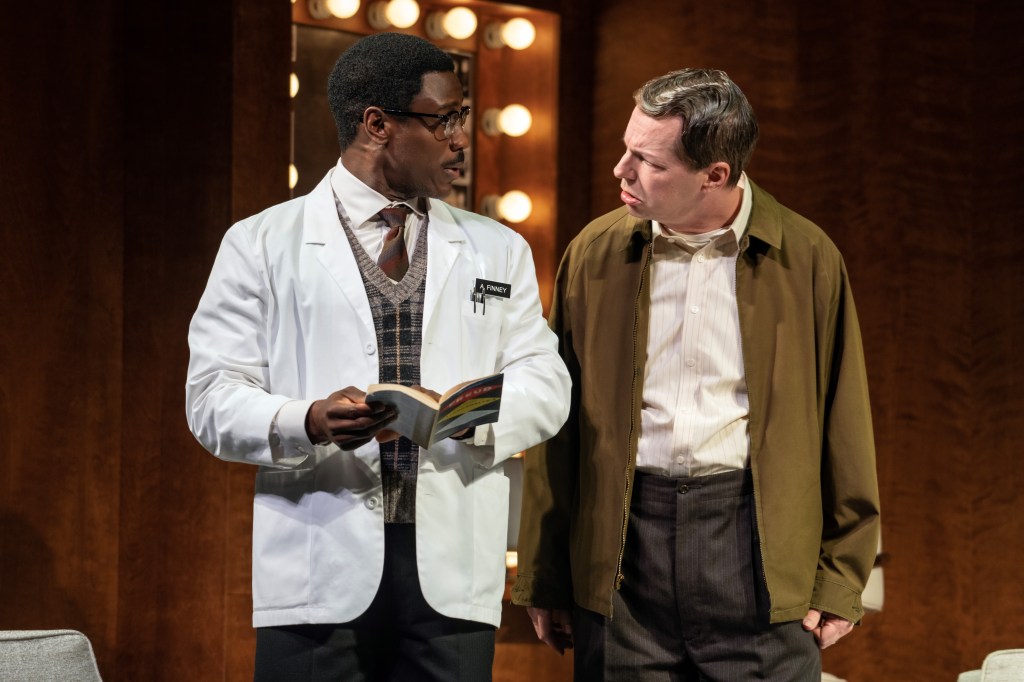
To add to the tension, right before Levant goes on the air, he downs a bottle of Demerol and seems comatose. The saving grace is that Levant is a drug addict and his body is accustomed to so many drugs of his choosing, he has to take a bottle of it to stop his hand from shaking. (I reminded you of that, if you question how taking that many pills and functioning is possible. Think functioning alcoholic.)
Who is this drug addict? Who is Jack Parr? In what century are we? One of the salient take-a ways of Good Night, Oscar is its reverential nod to the Golden Age of Television, when culture, wit, superior comedy shows and superb programs (I Love Lucy, Playhouse 90, Your Show of Shows, What’s My Line, etc.), and actual bona fide news graced the air waves. Jack Parr was one of the first hosts of The Tonight Show franchise, which has lasted to this day and has been duplicated many times over in other shows on other channels.

Then, Parr made individuals famous during his five-year stint. One of his frequent guests was comedic concert pianist and Hollywood celebrity Oscar Levant. Thanks to Doug Wright’s incredible, stylized portrayal of Levant, and Sean Hayes’ remarkable ability to don the ethos of the exceptional pianist and tortured artist, we understand his emotional underpinnings. And we empathize with the psychological whirlwinds captivating Hayes’ Levant. Figuratively haunted by George Gershwin’s shadow, Levant glorifies in and also regrets riding Gershwin’s coattails to celebrity. Wright fancifully manifests this haunting by materializing Gershwin, who cajoles, persuades and torments Hayes’ Levant with remembrances of his greatness and serene notes of “Rhapsody in Blue.” Davis’ Alvin tells Parr assistant Max (Alex Wyse) that these babblings are auditory and visual hallucinations.Max should just “go with it.”
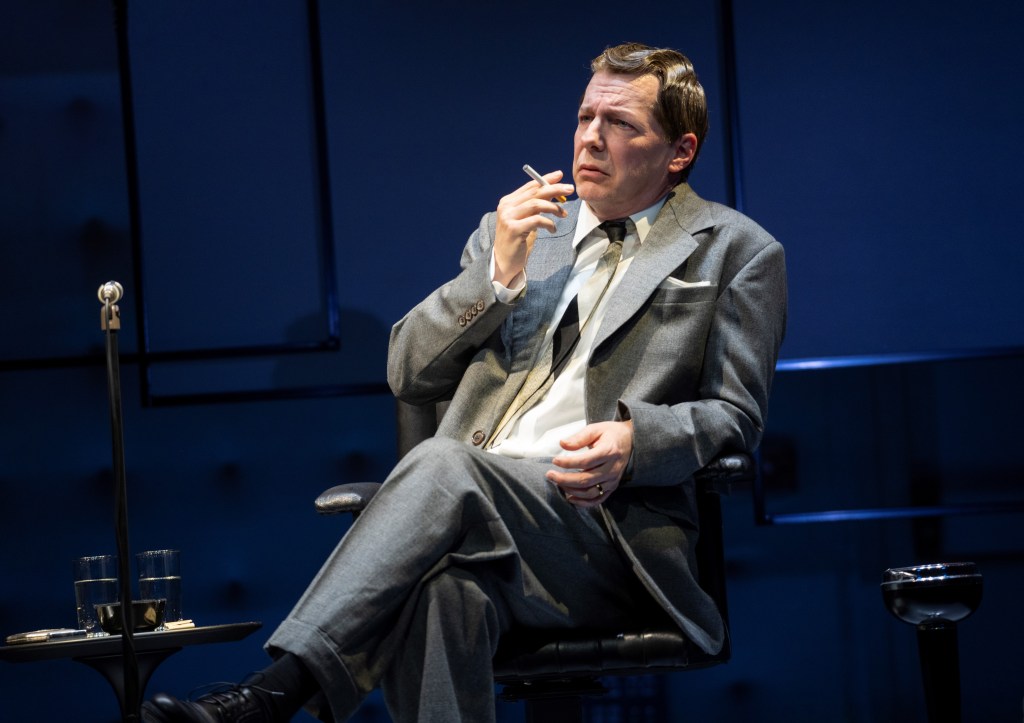
After June Levant and Parr tell Hayes’ Levant he must play, that the concert grand is waiting, Levant goes head to head with Gershwin’s ghost. Portrayed by John Zdrojeski, we note Gershwin’s arrogance and dapper, mordant, ghostly looks. However materially insubstantial he is, to Levant, the only one who sees him, he is beautiful and elegant. We understand that compared to Gershwin, Levant is a midget in looks and talent (in his own flawed estimation). Levant has undermined himself becoming Gershwin’s fawning adherent. Thus, eventually Levant obeys his hallucinations, as the Gershwin ghost compels him. Will Hayes’ Levant be able to play anything with arthritic hands and twenty-five concentrated doses of Demerol in pill form churning around in his stomach?
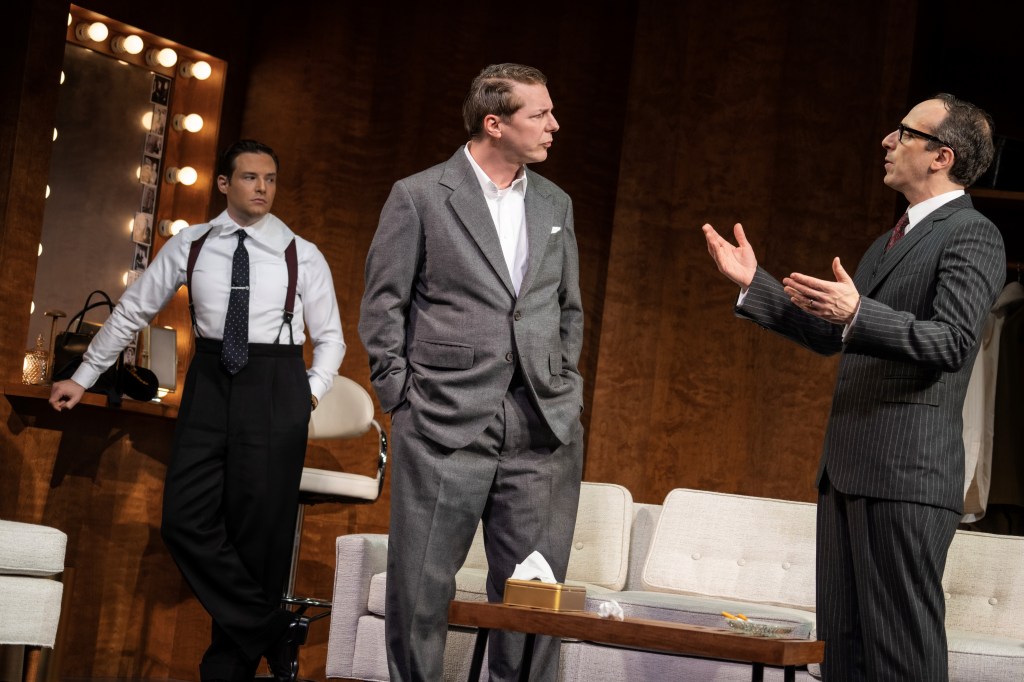
There is no spoiler alert. How Levant, his body hungering for drugs, manages to manipulate Parr assistant Max and his own nurse assistant Alvin to get what he wants is frightening, funny and ironic. Wright employs Max and Alvin as devices to reveal Levant’s backstory and acquaint the audience with his former grandiloquence, while we take in his deteriorating condition. Levant, Judy Garland and other celebrities shared the same fate with the pills and drugs that the studio doctors offered. Ironically, the tragedy of Oscar Levant and his glory and folly, which Hayes portrays with perfection, has great currency for our time.

Though Levant’s story is a throwback to that crueler, exploitive time of the studios, where the industry ground up artists in its maw and left them at the side of the road to deal with their own damage, we see the effects of big pharma today, expanding their client base beyond celebrities to the US public. Additionally, we note that corporations have become even more insidious than the Hollywood studio system as exploiters of writers and other artists. Good Night, Oscar is vital in showing how the then parallels the now.
Wright, Peterson and importantly, Hayes, elucidate how artists were encouraged to destroy themselves gradually for the sake of their “careers.” That Parr and June Levant are similar in their persuasions, pushing Oscar to “entertain,” is answered by the fact that Oscar adores being in front of an audience, even if it’s only for the four hours he has been “sprung” from the asylum. However, his self-harm becomes irrevocable as celebrity self-destruction through addictions to drugs and alcohol, unless redeemed is irrevocable in our time as well.
Wright’s play is an encomium to Levant’s genius, his humanity and his artistry, beautifully shepherded by Peterson and the creatives who convey her vision. And Sean Hayes’ performance is one for the ages.
There are gaps in this review for the sake of surprising the reader. Most assuredly, Good Night, Oscar is a must-see. You should go a few times to appreciate the wit, humor and spot-on performances, all of which are superb. Sean Hayes is especially poignant and authentic. For tickets and times go to their website https://goodnightoscar.com/
‘Summer, 1976’ Laura Linney and Jessica Hecht are Terrific

Summer, 1976 at the Manhattan Theatre Club’s Samuel J. Friedman Theatre is predominately two solo performances with a few dynamic interchanges, the principal one occurring at the conclusion. The static, expository “play,” directed by Daniel Sullivan, occurs in the minds and reflections of Diane (Laura Linney) and Alice (Jessica Hecht). Through their discourse, we learn how they established a close friendship over a summer which gradually fades into memories when Diane moves away a few years later. If not for the brilliant, authentic performances by Linney and Hecht, and the enlightened direction by Sullivan, one might think that “the dramatic event” that supposedly initiates the conflict never occurs. Nor does the conflict occur manifestly. However, the performances and direction overcome the lack of theatricality, and make Summer, 1976 interesting enough thematically to put this on one’s radar to see.
One of the key themes that playwright David Auburn (Proof) explores in Summer, 1976, is how the right connections, though brief in the span of a lifetime, may vitally change one’s development and help individuals evolve in a direction they might never have taken without such influence. Diane and Alice become friends who, for no particular reason, share their memories revealing this thematic point in this stylized storytelling that alternates back and forth from Diane and Alice as each reflects and remembers. Through their perspectives as reliable/unreliable narrators, they discuss themselves and each other, sometimes offering conflicting details, leaving us to decide for ourselves who is the more accurate storyteller, if it even matters. During the course of their reveries, we note there are more similarities than differences between them, if we carefully tease out the deeper levels in their personalities.
Superficially, Diane has an immaculate house and is a foodie, with some quirky lapses in her perfection. Interestingly, she is unconventional in one regard. She carelessly becomes pregnant having a fling with a man who wasn’t “all that,” and who she dismisses from her life so she can raise her daughter alone. She doesn’t give much thought that Gretchen might need a father, but is confident within herself not to be desperate for a man at her side. which would cause more stress and complication. Besides, Diane has enough inherited money to raise her without worries and continue with a quasi-serious art career which Alice encourages.

Alice points out that Diane’s work reminds her of Paul Klee’s. Diane confesses that she used to be influenced by Klee, but has moved on. Diane never finishes her art pieces, a revelation which Diane eventually confides to us and discusses with Alice. For her part Alice doesn’t think Diane’s art is very good, precisely because they are unfinished. We learn this through Alice’s commentary after Diane makes various disclosures.
Alice contrasts with Diane. Her housekeeping is messy. None of the furniture matches and she isn’t a foodie or an excellent chef as Diane is. Also, Alice is a laid back housewife who helps husband Doug, He doesn’t make much money as a college professor and their lifestyle reveals it. In those days women could still live (not comfortably) on one salary. Doug and Alice manage, though Diane notes that they don’t have style, class or much dynamism. Ironically, staying at home doesn’t encourage Alice to be a superior housewife or foodie. What she does all day is take care of her daughter and Doug, read and clean up the house as best as possible, when it moves her .
These superficial differences would stand in the way of their becoming best friends, if their daughters were not thrown together at the beginning of the summer. Because their daughters adore one another and beg Diane and Alice for play dates, the mothers reluctantly get together to please Gretchen and Holly. It is during these hot days of summer, Diane and Alice move beyond the surface to reveal deeper elements about themselves and their circumstances to forge a beneficial relationship.
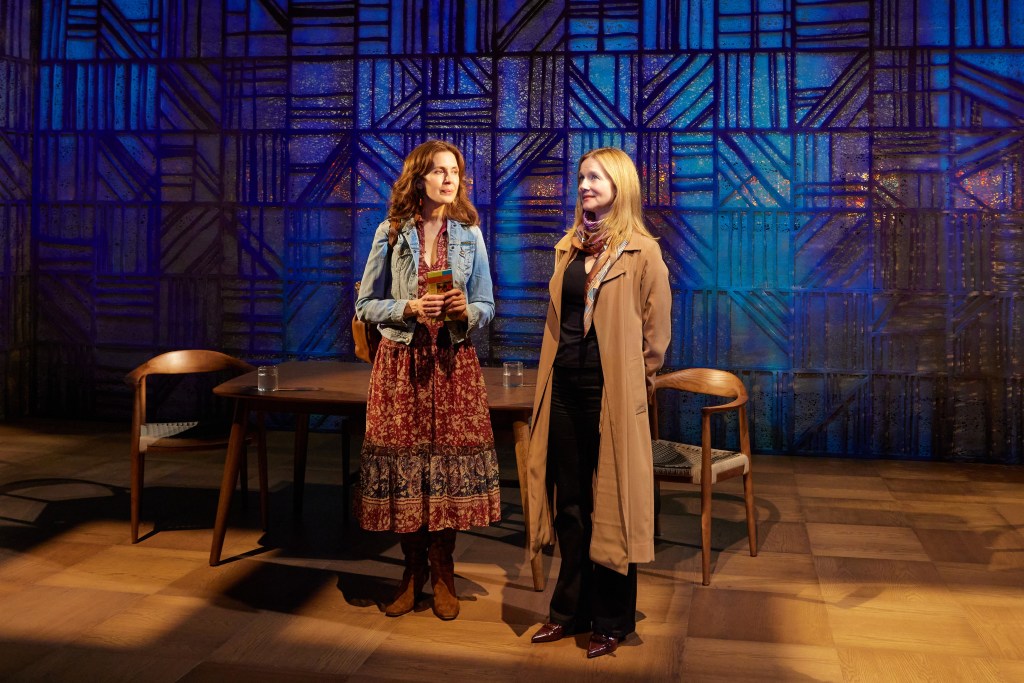
Auburn uses narration and the women’s solo reveries to reveal their lives. However, it is the nuanced performances and portrayals by Linney and Hecht that elevate this play and make us interested in these two women, who live unadventurous outer lives. The actors land on the humor of their confessions and judgmental criticism (only given to the audience) about each other. It is only when the women take day trips, the first to an antique store where Diane buys Alice a Bauhaus desk, that their relationship takes off. Afterward, we note that there is a soulful simpatico that they seem to have with each other that transcends their differences.
That soulfulness is brought to the fore during two crucial events that Linney’s Diane and Hecht’s Alice reflect upon. During one summer day Diane has a wicked migraine. Alice lovingly nurtures her and gives her time generously, as Diane attempts to overcome the waves of pain. In supervising the situation while Diane writhes in pain, Alice even allows Gretchen to watch the TV channels Diane doesn’t permit normally. However, this situation warrants it because, as Diane suggests, she can’t deal with her daughter and a migraine at the same time. In Diane’s perspective, Alice’s comfort and care saves her life and the migraine goes away the next day. However, a thread has been woven between the two women that never dissolves, despite their not keeping up the relationship in later years.
Diane helps Alice when she has an argument with Doug that blows up into a full on discussion about divorce. Alice takes Holly and seeks solace from Diane, who readily gives it and comforts her. Diane always thought Doug boring and she encourages Alice to consider other possibilities. Even when Alice resolves to herself emotionally that she and Doug can work out their marriage, Diane offers her place to stay to regroup. This is an offer that later could have become a living arrangement, however, Alice is faithful to Doug and never takes her up on it.

Another theme that comes up when Alice stays the night with Diane is happiness. Diane asks Alice if she is happy, but Alice is more concerned with “keeping up appearances” and trying to make the marriage work after Doug tells Alice he “can’t do this any more.” The idea that people can’t make people happy and rarely does anyone find sustained happiness is something Alice considers as a result of her conversation with Diane that evening. Certainly, it influences Alice in her relationship with Doug, and they eventually divorce in 1978, after Diane moves away.
During the summer and their weekly dinners in the fall, they gradually see each other less and less during 1977 because Alice is engrossed with saving her marriage. However, Diane’s wisdom helps Alice.
At one point Diane lightly suggests they should just travel together and have adventures. Alice’s traditionalism and conventionalism won’t permit it. It is as if Diane intuits Alice and Doug’s marriage will end, but Alice is not ready to admit it. For Holly’s sake she must go through the arduous process of salvage that is fruitless anyway. The possibilities of their close friendship remaining and becoming something more becomes swallowed up in Alice’s conservatism and her fear about leaving Doug. Her inner conflict prevents her from considering other possibilities and freeing herself. Ironically, by the time Alice and Doug divorce and she is free, Diane has left.
Almost a decade later, both women are in New York City. When Alice sees the banner featuring Diane’s works on exhibit, she goes inside the gallery and they meet and discuss how their circumstances have changed. Alice is a middle school English teacher. Diane has become a professional artist who finally finishes her work. When they say their farewells and Alice expresses that she misses Diane and gives her a hug, Diane’s response is “matter-of-fact,” and distant. She reveals to the audience that Gretchen has moved back in with her, has a drug dependency and perhaps made a suicide attempt. She reveals none of this to Alice which is unclear why. When considering if she misses Alice, she reminisces that they were close only for that summer and that is why they drifted apart completely when Diana left and Alice divorced in 1978. Diana even suggests that perhaps it is the memories that she misses.
The final meeting and hand off are fascinating because we note that Diane dismisses Alice, yet gives herself away when she says that Alice is the only one she sends her “art cards” to annually for a decade then stops. Alice loves them and assumes she sends them to everyone, but never replies back. That Diane only sent them to her is momentous. The relationship was important to her for her artistic development. Furthermore, considering Diane and Alice have no partnerships, though Alice admits there were men, but nothing spectacular, we are left wondering that perhaps in a time when the culture wasn’t as oppressive for female-female relationships, they might have had a deep and abiding love. By the play’s end, we understand that their candle of friendship may have nearly blown out, nevertheless they have contributed to each other’s lives and careers beyond measure. Perhaps, it may be rekindled again if one of them takes the step forward.
Summer, 1976 occurs in the undercurrents, the aside comments to the audience, and the subtext. There are the nuanced perspectives and the unspoken spoken. Nothing is manifest. Sullivan’s superb direction and the stellar Linney and Hecht fascinate, in this character study of two women who subtly influence each other to evolve and grow. One day when they are ready, they may possibly reaffirm their connection in the future after their New York meeting. The rest is uncertain as is true to life.
The scenic design (John Lee Beatty) is a minimalist latticed backdrop through which Japhy Weideman’s lighting design flips on the turn of events in their storytelling with beautiful hues. Linda Cho’s costume design is aptly pegged to the characters and Auburn’s characterization. Kudos to Jill BC Du Boff’s sound design, Hana S. Kim’s projection design and Greg Pliska’s original music which elucidates Sullivan’s stylized vision.
Summer, 1976 runs with no intermission, but Linney and Hecht with prodigious authenticity keep the audience rapt and the time becomes transcendent. For tickets and times go to their website https://www.manhattantheatreclub.com/shows/2022-23-season/summer-1976/

