‘Night Hunter,’ a Psychological Thriller Starring Henry Cavill, Alexandra Daddario, Ben Kingsley, Stanley Tucci
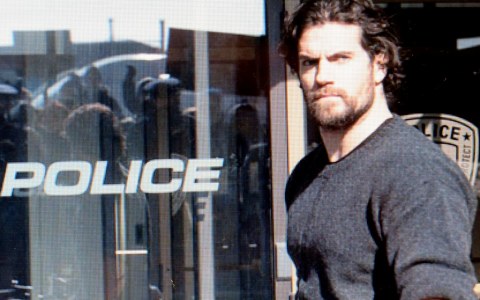
‘Night Hunter,’ starring Henry Cavill, Ben Kingsley, Stanley Tucci, Alexandra Daddario, directed by David Raymond (photo courtesy of Saban films)
Strong performances by Sir Ben Kingsley and Brendan Fletcher as a psychotic sexual predator killer make Night Hunter an intriguing film for those who are able to pay attention. If you watch it on a small screen and take frequent breaks from focus, you may get lost with the opacity of the plot which largely rests as a mystery whose reveal builds brick upon brick and slams into crystal clarity at the end.
Written and directed by nascent filmmaker David Raymond, the film is not without flaws in its sound and audio delivery. Indeed, the fine music score at times drowns out the dialogue instead of whispering the insidiousness and suspense that is inherent in the storyline, a storyline which pays homage to psychotic schizophrenics in other films that have a better handle on terrorizing the audience, perhaps. But make no mistake. This film is not of that genre. Night Hunter has its moments and if you are a fan of Tucci, Cavill and especially Kingsley, who as usual is spot-on terrific in a small, meaty part, you will receive what you came for.

‘Night Hunter,’ starring Henry Cavill, Ben Kingsley, Brendan Fletcher, Stanley Tucci (photo courtesy of the Saban films)
Henry Cavill portrays police detective Marshall, a “night hunter” of sexual predator/killers who has become so overwhelmed by his career that he has allowed it to occlude his family relationships. He’s lost custody of his daughter and is divorced and has been drawn inward by guilt and the darkness he hunts. His characterization is largely intuited; Cavill is dour, depressed and cold, a warning to those who believe that “hunting” killers is all fun and video games. It’s not and Raymond indicates that Marshall has been largely undone emotionally. He’s siphoned off feelings and warmth to remain sharp for his incredible journey into the minds of the psychotics. Fun it is not!
Along this particular journey looking for a murderous sexual predator, he is aided by former girlfriend Rachel, the lovely Alexandra Daddario who is a sweet-faced, kittenish damsel in distress (especially at the end). Continually against type she alternately proves she can and can’t profile killers, but nevertheless she somewhat successfully draws out the monstrously weird, mentally challenged, deaf Simon who Brendan Fletcher portrays with lightening empathy and terrifying reality.
Stanley Tucci as Commissioner Harper keeps his force together and weathers the embarrassment (it’s a humorous scene) of facing down the press and public infuriated by the police force’s incompetence at locating enough proof to put away the predator stalking their city. Unlike American Law Enforcement who readily finds their killers and then years later are upended by DNA testing which proves they got the wrong guy, Canadian law enforcement intends to get it right. Of course, amidst botch jobs and misdirection down wrong paths (the mentally challenged Simon is being abetted by someone who is keen to kill and has the brilliance to outsmart and dispatch the police) the community’s patience wears thin as the serial killer remains on the loose to strike again and again.

Brendan Fletcher in ‘Night Hunter,’ directed by David Raymond (courtesy of Saban films)
It is no surprise that Kingsley, who portrays retired judge Cooper converted into a vigilante who protects the community against sexual predators without killing them appears a hero. His rationale beautifully delivered to Cavill’s Marshall in the benign brightness of a diner, seems right-on and clear-eyed considering he succeeds where law enforcement continually stumbles. Well, their emotional motivations are as different as night and day. For the police, looking for predators is just a job. For Cooper it is a mission in which he is emotionally invested. Actually, women have suggested that predators be dealt with as Cooper deals with them. Stopping the assaults and ending ruining the emotional ethos and psyches of women, however, is not important enough for the male-driven law enforcement officials to even lobby for.
Law enforcement, full of brio and testosterone (Marshall, Harper) find his methods beyond the pale, except at the end when Cooper joins the team. How Cooper goes about stopping predators from their chronic obsession to sexually abuse, prey upon and even kill young women is ironic and profound. Perhaps such a method should have been used on Jeffrey Epstein, Harvey Weinstein and other misogynistic (rape is a crime of violence and against young and old has been characterized as a weapon of war) sexual criminals whose privilege (if they are rich) places them above the law to predatorize women with impunity.

Alexandra Daddario, Henry Cavill in ‘Night Hunter,’ starring Ben Kingsley, Brendan Fletcher, Stanley Tucci, directed by David Raymond (photo courtesy of the Saban films)
Indeed, Cooper outshines all of law enforcement and makes the self-righteous Marshall, who can’t even get his own role as father in sync with his daughter and is in a state of panic with the predator on the loose, look like a wimp. In all fairness, Cavill is not Superman in this film which is a refreshing switch. And up against Kingsley who is just terrific, he is bested/awed in the two-minute scene where Cooper makes his case for going after predators “his” way with his side-kick the wry and sometime funny Lara (the fine Eliana Jones) as the lure for the men attracted to underage, “unwitting” GIRLS.

Henry Cavill in ‘Night Hunter’ (courtesy of Saban films)
Not enough credit has been given to Raymond for exposing the two different approaches to sexual predation: one as a medical condition, the other as a crime whose predators, once they fulfill their sentence, move back into the culture to prey upon victims again. Law enforcement’s and the male culture’s myopia perceive sexual predation as a sexual phenomenon. It is not; it is a mental/physical condition as Cooper suggests, or worse, a hate crime especially regarding serial rapists (who eventually turn out to be killers). To end the deaths and destruction of women’s lives, Cooper’s methods seem less than harsh. However, as long as the patriarchy runs things, women will have to suffer and sexual predators, always men (identified with by male law enforcement) be given lenience. Kingsley’s performance brings all the nuance, depth and controversy to these issues. As Cooper he is heartfelt. The arc of that character’s development by Raymond is drawn well and acted superbly by Kingsley who gives the judge great substance and moment.

Alexandra Daddario, Henry Cavill in ‘Night Hunter,’ directed by David Raymond (courtesy of Saban films)
The themes about how “night hunters” who are hunted (the psycho killer avenges himself on the police) survive and the emotional toll it takes on them are interesting, as is Daddario’s Rachel in her empathetic sweetness to lure Simon to speak the truth. The psychological aspects of law enforcement are notes in the film, which is not just about apprehending a psychotic sexual predator/killer. See if you can figure out the mystery; clues are present.
Considering that many murders/disappearances (sex trafficking ends in murder, the womens’ bodies often disappeared) end up cold case, the elements Raymond pinpoints are vital; but as in most films about rape, sexual predators, psychotic killers, i.e. the Silence of the Lambs series, SeVen, etc., the plots are fantastic fiction regarding the success of law enforcement. Holding serial rapists and killers and sexual predators to account is hard won and more often than not, they are allowed to go free, abetted by law enforcement’s malaise about rape (see the film I Am Evidence). Thus, Night Hunter effects an interesting response to the issue of sexual predation through the characterization of Cooper, unlike any seen before. That males will easily dismiss and overlook these elements seems moot.
Currently on DIRECTTV, Night Hunter will be screening in theaters and ON DEMAND in NYC, LA and other cities beginning 6th September. Look for it.
‘Super Size Me 2: Holy Chicken!’ Morgan Spurlock’s Ironic Exposé of Corporate Chicken and Fast Food

Morgan Spurlock, ‘Super Size Me 2: Holy Chicken!’ (courtesy of the film)
Morgan Spurlock rose to international fame in Super Size Me (2004) when he used himself as a research subject to chow down for breakfast, lunch and dinner on “supersize portions” at McDonalds in a marathon of calorically indulgent eating. During the process Spurlock fashioned his body into a toxic biohazard. After one month of greasy Mc-oversizing, he proved the medical hazards of such an intake of poisonous fare. His systemic overloading on fats, salt and sugar compromised the health of his kidneys, liver and heart and his weight gain laced with nights of acid reflux and intense heartburn solidified how fast food chains outsourced bad nutrition and obesity while emphasizing low cost.
The film successfully grossed millions with a huge profit margin and vaulted Spurlock into the hero heaven of vegans and health food mavens. Meanwhile, a shamed McDonalds pulled its “supersize program” and brought in “healthier” menus with salad sides and meals, and thoughtful “trimmings” on burgers. And as a documentarian, actor, producer, writer and filmmaker, Spurlock’s entertaining and revelatory approach reshaped the tenor of documentaries by spinning a novel, investigative method, moving from outside critic to inside ethnographer whose chronicle as a consumer couldn’t be easily dismissed.
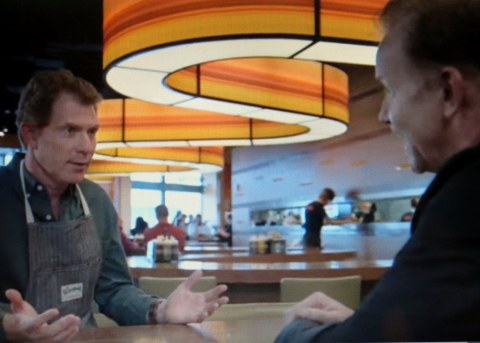
(L to R): Bobby Flay, Morgan Spurlock, ‘Super Size Me 2: Holy Chicken!’ (courtesy of the film)
Though the fast food chains had been put on notice immediately after the film’s release and mega publicity, to what extent did they maintain their “good behavior” providing healthier fare years later? Indeed, after the shock of Spurlock’s doctor’s dire warnings about his ill health faded from the public’s memory, could they be lured back to fried, greasy, salty, burgers, chicken sandwiches and fries?

Morgan Spurlock in ‘Super Size Me 2: Holy Chicken!’ (courtesy of the film)
Spurlock discovered they could in his sequel Super Size Me 2: Holy Chicken! in which he chronicles his own launch into fast food and agribusiness poultry farming. As a result of a proposition by Hardees to make an advertisement using his credibility and authenticity showcasing the supposed “healthiness” of its menu, he decided it was time to revisit the new “trends” morphing the fast food industry. Once again, taking an ethnographer participant’s approach after research, expert consultations and the input of the public, Spurlock created his farm to fast food table chicken pop-up restaurant in Columbus, Ohio where his Holy Chicken! joint rose like a phoenix from an old Wendy’s.

‘Super Size Me 2: Holy Chicken!’ (courtesy of the film)
Super Size Me 2: Holy Chicken! is Spurlock’s amazing journey through poultry farming right up to the psychological approach of designing a chicken sandwich and “healthy,” relaxing setting in which to eat it. When it comes to the insidiousness and cruelty (toward farmers and chickens) of what Spurlock refers to as the “Big Chicken Mafia,” and the obsessive intensity of the fast food industry to brainwash and lure its customers, Spurlock reveals how the public is gamed, bamboozled, duped and mollified into believing agribusiness and the fast food industries have their best interests at heart. By assuming the role of the insider, Spurlock becomes privy to most everything we need to know to “open our eyes” when we make food selections from their raw forms in grocery stores (branding, i.e. organic, free range, etc., is an extreme exaggeration) to their crispy chicken (never say fried-it’s anathema) and painted on grill marks in fast food restaurants.

Morgan Spurlock in ‘Super Size Me 2: Holy Chicken!’ (courtesy of the film)
Some of what Spurlock entertainingly and wryly unloads on the viewer they are probably familiar with. Fast food menus have been made to appear sleek, chic, “organic,” healthy, fresh, but are actually filled with the same old malign items despite the kale most probably grown with pesticides and herbicides. With his innocent, frank and humorous delivery that he has honed to precision, he lightly excoriates how “branding” and “labeling” provide a “halo of health” effect which of course is a sham.
For example what is fresh, organic, natural regarding veggies? Were these items bagged from California days ago or fresh picked from the farm that morning and raised without pesticides and herbicides? Are pictures of salads, veggies and fruits come-ons to convince us we are eating healthy food as we by-pass them for the greasy, fat-filled burgers and fried chicken? Are wooden laminate floors and green decor appointments suggestive of fresh, natural settings decrying the artificial? Yes! The industry has staged every element of delivery down to their brown napkins and bags and paper straws.

Morgan Spurlock in ‘Super Size Me 2: Holy Chicken!’ (courtesy of the film)
When Spurlock in the interest of sampling the competition’s chicken sandwiches (chicken sandwiches-best sellers, have overtaken burgers as healthier offerings in the public mind) he visits McDonalds, Burger King, et. al, to try out their chickeny fare. His epithet descriptors are humorous and of course, the taste is no different than what he remembers from thirteen years ago. As for sampling and examining the best-selling chicken sandwich in the US market today offered at Chick-fil-a? He discovers their advertised “seasoned to perfection” deliciousness is not because of the chicken, but because of the extensive “flavor enhancer” otherwise known as the devastatingly poisonous MSG. So he and the experts he has taken along on their sampling travels to see how they can beat the competition vow that to succeed, he should be as authentic farm to table as possible, minus the MSG.
The most upsetting segment in the documentary underscored ironically by melodic classical music involves Morganic Fresh Farms in Alabama. Spurlock takes us on his adventures finding, purchasing and raising his chickens which begin as adorable hatchlings under the auspices of independent farmer and mentor Johnathan Buttram. It is then that he rips the veil to expose the noxious, controlling practices of “Big Chicken” integrators (Tyson Foods, Perdue, Koch Foods, Pilgrim’s Pride, Sanderson Farms) who turn their farmers into sharecroppers as they “tow the poverty line” eventually bankrupting them or driving them out of business if they become rebellious. The integrators use a genocidally counterproductive “tournament system” that pits farmer against farmer for the “love of “big brother chicken” to enhance their profits while squeezing their farmers by forcing them to make unnecessary upgrades.

Farmers and Morgan Spurlock in ‘Super Size Me 2: Holy Chicken!’ (courtesy of the film)
Spurlock’s interviews with some of the farmers who are at their wits end and emotionally devastated at the stress of having to increase their purchases and indebtedness to “big brother chicken” integrators, tell a tale akin to “slavery,” in a job that requires farmers never take rests or vacations but are on call almost 24/7. On strict orders not to talk to reporters to tell them of their plight or they will be blackballed, the farmers take a great risk to get the information to the public in Spurlock’s film. Indeed, Spurlock who makes Jonathan Buttram his hero farmer, indicates by the close of the film (2016) “big brother chicken” integrators refused to give Buttram more chickens to grow because of his revelations about the industry. To “big brother chicken” integrators the truth is punishable by elimination. Vladimir Putin and other autocrats do no less. Reprehensible!
Indeed, if “big brother chicken” truly cared about the public as their friendly advertisements and chicken lobbyist Tom Super suggest, they would open their doors to their growing houses. But they can’t because if the public knew how the chickens were overcrowded and abused, they would be appalled and boycott “big brother chicken,” who refuses to change its profitable practices. For example Spurlock chronicles how the broiler chickens used in fast food and for sale in grocery stores have been genetically modified to grow in hyperdrive over a six week period so they weigh six pounds by the end of their lives. If a baby grew as fast proportionately, it would weigh 650 pounds.

Morgan Spurlock in ‘Super Size Me 2: Holy Chicken!’ showing the space designated for USDA free ranged chickens (courtesy of the film)
Talk about genetic overload, the chickens are so obscenely big breasted top heavy, they can have hip joint breakage and necrosis and a myriad of other disgusting diseases if their immune systems are not functioning properly. However, even the healthier ones die of heart attacks before the six weeks are up because they are too heavy to stand for longer than 5 seconds let alone run around and get exercise. Their heart muscle gives out because genetically they are conditioned to grow too quickly for their heart to accommodate them. When Spurlock takes some of his heart attacked chickens to the vet who autopsies them, the vet pronounces that this is what happens to these chickens whose meat is otherwise healthy.
Humanely, Spurlock allows his chickens more space to run around where to make money to survive, his friend and mentor from whom he purchased his chicks, Buttram, like other farmers are forced to pack in their chickens for profitability. If they can’t move? Well, a hazard the integrators promote. Spurlock saves the one God-growing chicken not genetically modified to hyperdrive growth that he kept with the other big breasted chickens to show as a comparison. The God-growing chicken runs so fast, they can barely catch him. Of course, he is smaller, healthy and not in a chronically somnambulant feed overdose!

Morgan Spurlock in ‘Super Size Me 2: Holy Chicken!’ painting grill marks on a crispy chicken sandwich (courtesy of the film)
Spurlock’s film is fascinating and sardonic not only for what he reveals, but for the authentic and honest approach he takes insuring the credibility and reliability of his chicken sandwich product. On the walls of his pop-up Holy Chicken!, he exposes every shoddy practice that the fast food industry and he himself used down to the painting of grill marks on his crispy “grilled” chicken sandwich. And he identifies, to the dismay of his patrons, the big breasted hyperdrive grown chickens he grew on his farm. He also includes a drawing of Johnathan Buttram with the admonition “know your farmer” and a description of the sharecropper system that farmers are forced to use if they would be poultry growers.
The opening day patrons of Holy Chicken! paid for a delicious chicken sandwich which by the time they finished reading all of the information on the walls and the menu, they were appalled to have eaten. One patron commented about the clever ironies of the restaurant ,and Spurlock affirmed speaking into the camera to both industries that he hopes to put himself and them out of business with increased public awareness that they are being “taken for a ride.”

Morgan Spurlock, ‘Super Size Me 2: Holy Chicken!’ (courtesy of the film)
Supersize Me 2: Holy Chicken! is a must-see for a laugh and a tear. It was featured a few years ago at the Toronto Film Festival and then was pulled for #MeToo reasons against Spurlock who made an Al Franken move and apologized for his behavior then was bashed again and again for it. The inability of women to discern when they should forgive those who admit fault and apologize instead of beating them forever, bodes badly for the movement. Kirsten Gillibrand’s insistence that Franken fall on his own sword and resign from the senate while the occupant of the White House and his friend Jeffrey Epstein and Justice Kavanaugh had done far worse than Franken, reveals the movement needs to step back and examine itself for inequitable judgment and cowardice for not going after those who need to be called down in the face of overwhelming evidence. #MeToo needs to embrace the men who apologize, make amends and change, not flagellate them in a misguided fashion while NOT ADMONISHING RELENTLESSLY the true rapists, misogynists and sexual predators in high places who smile in the shadows of their lying denials.
Thankfully, Spurlock’s film finally will do the good that it was intended to do, receiving a release date the week of 6 September 2019. Don’t miss it! If you can’t wait, it is also online.
‘Bat Out of Hell the Musical’ by Jim Steinman, Thunders Off Broadway

Andrew Polec in ‘Bat out of Hell the Musical,’ book, music & lyrics by Jim Steinman directed by Jay Scheib (Little Fang photo)
Jim Steinman’s Bat out of Hell the Musical is first and foremost a clangorous, booming Hard Rock/Pop Concert on a small stage with operatic, bespectacled overtones. In other words, the production is an amazing hybrid not easily categorized. Replete with strobes, underground caves and fiery doomsday projections, intimate video hand-held captures which codify emotional moments and the blaring fantasmagoria of myriad-colored flashing lights with haze and fog, the musical numbers are loud and shattering and the unusual choreography evokes the strangeness of the futuristic setting. These are characters not of our time, but with emotional resonances we can feel and glory with.

(L to R): William Branner, Andrew Polec and Tyrick Wiletz Jones ‘Bat out of Hell the Musical’ with music, book, lyrics by Jim Steinman (Little Fang Photo)
Based on bestselling Meat Loaf albums, Steinman wrote the book, music and lyrics. He has been working on this magnum opus for years and has managed to garner awards during his production tours which began in 2017 up to and after the London West End Tour which beamed its startrails to Off Broadway at the New York City Center where it ends on 8 September. Five days ago, Meatloaf showed up on stage to celebrate this vibrant, blasting out of the park musical production directed by Jay Scheib. With the cast he celebrated songs he made famous from the 1970s through his Grammy Award win in 1994 and beyond.

Andrew Polec, Christina Bennington in ‘Bat out of Hell the Musical,’ book, music & lyrics by Jim Steinman, directed by Jay Scheib (Little Fang Photo)
Bat out of Hell’s sketchy story coheres to its slim plot points. These gyrate the action into a “world’s end” scenario that casts as enemies the haves like the Falcos, well placed elites with a pedigree living high above in the neo-gothish “Falco Towers” (slamming Trump Towers) and the have nots (The Lost Boys/Girls). The latter clan are Oliver Twist urchin-orphans, who live a hard scrabble existence in abandoned subway tunnels underground, making wild music, partying and ferreting out their existence with above ground raids. Their keyword is freedom and the innocence and wildness of reveling in being what the mainstream culture refers them to as “lost.” Indeed, it is the other way around. With their power and money, Sloane and Falco have become lost to what they once were and what they once enjoyed. The theme, sometimes you need to launch off and take a break from your own imprisoning fears and corrupted values (which Falco and Sloane eventually do) you can restore the passion and vitality of youth which is spiritual and never “lost.”
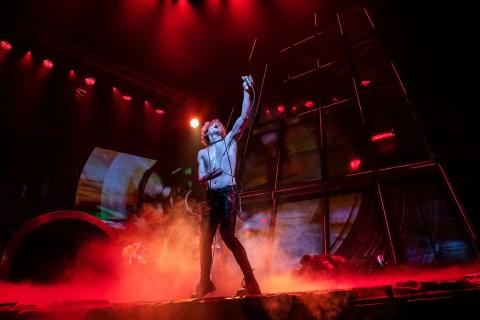
Andrew Polec in ‘Bat out of Hell the Musical (Little Fang Photo)
As perpetual teens (it’s a Peter Panish spin as their metabolic physical processes never age past 18-years-old), Strat and his band also attempt to stay one step ahead of cudgelings by autocratic Falco’s security forces who intend to eradicate them like the “vermin” they are. However, this street gang is poetic; their “vermin-state” is romantic as Strat proves to Raven (the sylph-like, melodically voiced Christina Bennington). Ignoring her parents’ dictum to stay away from the miscreants, she is lured by the sonorous, powerful Strat (Andrew Polec is mesmerizingly fabulous; you cannot take your eyes off him), attracted to his energy, resourcefulness and ever abundant enthusiasm. Like a super-hyped engine, he charges Raven’s curiosity, daring and love. Eventually, her boredom with privilege and oppression by her father lead her Juliet-like (there is even a balcony scene) to Strat’s emotional, heart-throbbing Romeo.

Christina Bennington in ‘Bat out of Hell the Musical’ (Little Fang Photo)
The character developments are primarily revealed through the dynamism of Steinman’s songs and the superb acting, dance-movements and singing talents of Andrew Polec (Strat) Bradley Dean (Falco) and Lena Hall (Sloane). Interestingly, unlike the others whose movements and actions remain purposeful, especially when delivering an intense, revved up song, Raven’s movements during the time she is influenced by her parents are like those of a jelly-fish with no backbone. Only after she leaves home for one night with Strat, does she gain strength and resolve and her movements become more directed.
During the course of the two act musical, we witness how wife Sloane (Lena Hall’s voice is unparalleled) resists Falco’s love and motivates him to change with her anger and remembrances of their love from the past (the fabulous “Paradise by the Dashboard Light”). Bradley Dean, like Andrew Polec, delivers his songs with incredible verve and realism (“What Part of My Body Hurts the Most,” “Who Needs the Young,” etc.) He is mesmerizing. The Dean and Hall duets are highpoints; balance, strength, power encapsulate their emotional potency in a unified whole. Wow!

Lena Hall, Bradley Dean in ‘Bat out of Hell the Musical,’ directed by Jay Scheib, book music & lyrics by Jim Steinman (Little Fang Photo)
Thankfully, all turns on love restored between Falco and Sloane. However, the poignance that Strat will never move past 18-years-old while Raven reaches her late forties is a reality not easily traversed. The ideal that love is the answer, if not the reality is one of the finest moments for the entire ensemble with solos by the protagonists in “I’d Do anything for Love (But I won’t Do That).” And somehow we let pass the hard distinctions of youthfulness and old age that Raven hits Strat with; this trope is easily forgotten and passed over by the rousing, gobsmacking finale.
Outstanding cast members who belt out their souls are the couple Jagwire (Tyrick Wiltez Jones) and Zahara (Danielle Steers). Like Sloane and Falco, this would-be couple remains apart until the end. And their performance together is nothing short of stunning as it melds with the other couples’ renditions into the iconic “I’d Do Anything for Love (But I won’t Do That).” Additionally, Avionce Hoyles’ (Tink, a Tinkerbell allusion to Peter Pan) and Andrew Polec’s number which both sing while Tink is dying is heartfelt and gut-wrenching. Polec and Hoyles are one’s to watch for their inherent star power.
Kudos go to the following creatives: Ryan Cantwell (musical director) Howard Joines (music coordinator) Edward Pierce Studio (design supervision) Steve Sidwell (orchestrator) Jon Bausor (set and costume designer) Meentje Nielsen (original costume designer) Finn Ross (video designer) Patrick Woodroffe (lighting designer) Gareth Owen (sound designer) Xena Gusthart (choreography adaptor) Michael Reed (musial supervisor and additional arrangements).
Presented at New York City Center, Bat out of Hell the Musical is at the end of its run, closing on 8 September unless it is extended which it should be. It is that phenomenal. It runs in two acts. You can purchase tickets online if you CLICK HERE.
‘Rinse Repeat,’ an Intense, Riveting Exposé of Illness Perpetuated by a Family in Crisis
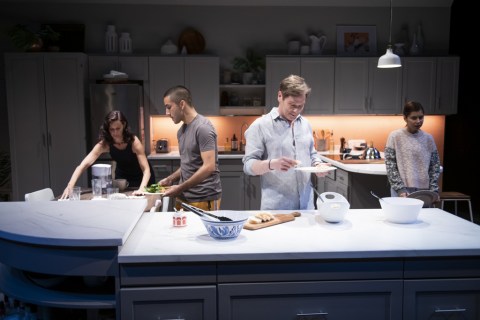
(L to R) Florencia Lozano, Jake Ryan Lozano, Michael Hayden, Domenia Feraud, in ‘Rinse, Repeat,’ written by Domenica Feraud, directed by Kate Hopkins, The Linney at The Pershing Square Signature Center (Jenny Andersen)
Domenia Feraud’s brilliantly constructed, intimate and fascinating Rinse Repeat, is about one woman’s attempt to grapple with a disease pervasive in our culture, but which few discuss and many keep hidden. Feraud’s play at Pershing Square’s Signature Center (The Linney) receives a cogent, eye-opening, much needed rendering in this astounding production expertly directed by by Kate Hopkins and exceptionally acted by an “in the moment,” acute, dynamic ensemble..
From the outset when Rachel (Domenica Feraud’s portrayal is specific, highly tuned and real) enters the home she has left for a season to return to her family, we are gripped by her tentative steps, her unsettled, hesitant manner. Surely, her unease comes out of something which has happened there; her expectation hovers in the air like a darkened cloud, and we pick up her imbalance which leaves us in a hushed suspense.

(L to R):, Domenica Feraud, Florencia Lozano, ‘Rinse, Repeat,’ directed by Kate Hopkins, written by Domineca Feraud (Jenny Andersen)
All this is put to rest, however, when beautiful mother Joan (the superb Florencia Lozano) and warm, loving father Peter (the heartfelt and engaging Michael Hayden) greet her enthusiastically and smother her in smiles and encouraging, welcoming comments about “how wonderful she looks” and how happy they are to see her and have her back. Yet, clues are dropped. Her mom asks if she may hug her: importuning if her daughter is ready to receive her affection? Curious! And her laconic, 18-year-old brother, the haphazardly funny Brody, whose response to his sister is frank and unapologetic, gives her a less than gracious hug that is cold and brief. This unsettles the atmosphere once more. We question: is that just Brody’s character or does it reflect “what happened” before Rachel left?
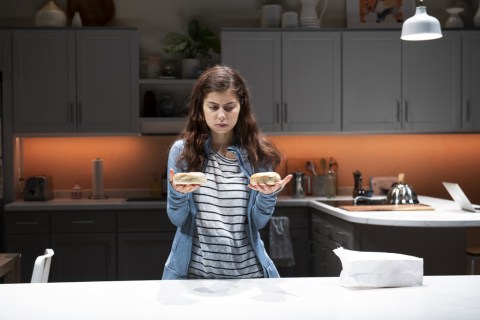
Domenica Feraud in ‘Rinse, Repeat,’ written by Domenica Feraud, directed by Kate Hopkins (Jenny Andersen)
Jake Ryan Lozano’s portrayal as Brody garners laughs with his callow, humorous, teen-male demeanor, obsessed with his girlfriend and sports. (The portrayal blossoms in their quiet sister/brother time together later in the play when Lozano’s Brody allows his love and sensitivity to unfold with poignance.) Initially, Brody seems uninterested in her presence, but tips us off that her return is something he may fear when he implies he doesn’t want to introduce her to his girlfriend to scare her off and that her physical appearance the last time he saw her “was scary.”
As we watch these interactions, we synthesize the clues and the picture sharpens. Rachel has been in intense therapy that involved she be away from family. Before she left, she was in a wheelchair, too weak to walk. But now she appears physically fit. Therapy has saved her life. Back in the environment that bred her illness, can she maintain the health she has achieved or will she suffer a set back into her addiction?
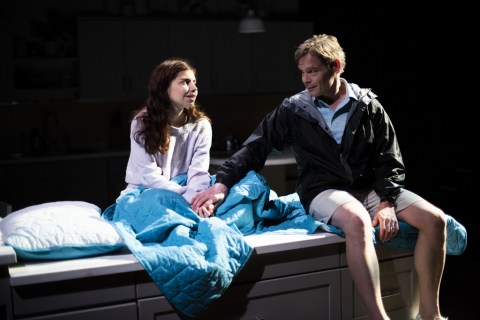
Domenica Feraud, Michael Hayden in ‘Rinse, Repeat,’ written by Domenica Feraud, directed by Kate Hopkins (Jenny Andersen)
The playwright gradually unfolds the mystery of what happened before that on the surface upended the loving, “normal” family. The family was never “normal;” nor was it unconditionally loving. Peter and Joan are rife with issues and problems in their relationship and in themselves; blindness, fear and anger have prevented them from confronting themselves honestly and this has spilled onto their relationships with their children.
Feraud has drawn the matrix of illness interrelating it with Rachel, Joan and Peter primarily. Ironically, the complications of Rachel’s addiction are the manifestation of profound issues with each of the family members. Like a festering boil which comes to a head then is burst so the infection is released, Rachel’s addiction has been burst to impact the family on a manifest level. However, for the infection to be eliminated, it must be excised at the root and that means Joan and Peter and even Brody must be excised in therapy with Rachel if she is to live with them in health. They are her addiction as well as being psychically ill themselves. However, only Rachel understands this.

(L to R): Florencia Lozano, Domenica Feraud in ‘Rinse, Repeat,’ written by Domenica Feraud, directed by Kate Hopkins (Jenny Andersen)
For those who have suffered in similitude with Rachel’s illness, they will identify with her behaviors and immediately “get it.” And indeed, the “tell-tale” signs of how her sickness morphs her back toward unhealthy patterns explodes again and again during the weekend with Peter, Joan and Brody. During her discussion with Brody in a quiet time of night, we appreciate the serenity and honesty between the siblings, an honesty that is lacking in her relationship with her mother and father. Placed back into the family structure that is in effect a sham, Rachel and Brody huddle in their own corner of their lives. Peter’s and Joan’s marriage is crumbling with dishonesty. Brody and Rachel sense it and suffer, and will be happy to leave the festering wounds that work deep underground in the soils of their family’s lives and interrelationships.

Jake Ryan Lozano in ‘Rinse, Repeat,’ written by Domenica Feraud, directed by Kate Hopkins (Jenny Andersen)
The details of Rachel’s eating disorder are superbly portrayed. We note her family’s concern about Rachel’s eating as they sit down to a meal together all on their best behavior, playing the dutiful family members the first night. The turning point comes when Rachel speaks to her mother that evening and looks for a snack. Her mother pressures her about her career and the snack. The dutiful daughter, Rachel agrees with her mother and foregoes the snack, which she is not supposed to do according to the protocol of health set up for her by her therapists. The tiny detail and the seemingly benign interaction between mother and daughter spills controlling maternal poison that psychically infuses Rachel’s emotions and careens her back into her old self-damaging behaviors.
The next day, all unravels and the underpinnings of the problems that contributed to Rachel’s illness emerge. Back in an environment where she is the sacrifice and the target around which everyone places the blame, no one else appears to accept responsibility for their contributions in the matrix of self-destruction twining into Rachel’s addiction. Indeed, unless the others, especially Joan, who herself is eating disordered, reflect on their own psychic maladies and seek help to correct, Rachel is doomed to fail once more if she stays at home.
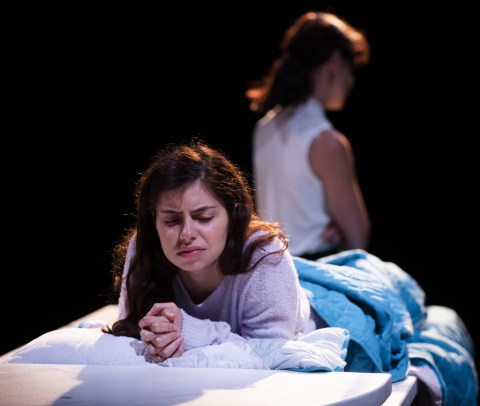
(foreground): Domineca Feraud, (background) Florencia Lozano in ‘Rinse, Repeat,’ directed by Kate Hopkins, written by Domenica Feraud (Jenny Andersen)
This is the anatomy of an illness that Feraud incisively chronicles with emotional power and intense, accurate specificity. As each event builds on the ones that have gone before we understand the magnitude and the complexity of why people die from Rachel’s anorexia, and chronic eating disorders. Feraud unravels the tapestry with an incredible precision of detailed acts that show how Rachel slides back into a routine of bulimia, binging/purging, excessive weighing and body dysmorphia, which Joan, unconsciously, neglectfully perpetrates with the controlling pressure on Rachel to do as she suggests regarding a legal career and eating less than she should.
On the other hand, though Peter, having gone to therapy at Renley with Rachel, appears to be sympathetic and concerned, he too drops the ball regarding monitoring her care. Both parents leave her alone to fend for herself, a violation of the protocol which therapists established to make sure she will not relapse. For those “unfamiliar” with eating disorders, Feraud ‘s characterization of the struggling Rachel is one for the ages. And as Rachel weighs the bagels and takes the smallest one, stuffs down the delicious French toast then spits it out, the looming psychology of why one must watch one’s weight and not “get fat,” reveals the self-fulfilling monster that is devouring the anorexic like Rachel from inside out.

Portia in ‘Rinse, Repeat,’ written by Domenica Feraud, directed by Kate Hopkins (Jenny Andersen)
Sadly, as Feraud points out in her “Note from the playwright,” Rachel is not alone. Thirty million people suffer from an eating disorder; truth be told, the numbers are most probably much larger considering the cultural obsession of the fashion, advertising, plastic surgery and billion dollar weight loss industries which ply their guilt on women to be thin and look sleek, young and beautiful at every age.
The play is filled with the signs of nefarious eating oddities that plague not only women of all ages but men as well. Perhaps the scene that most resonates, is one enacted incredibly by Florencia Lozano’s Joan. Having been too busy to eat, Joan, who deprives herself of food to maintain her lovely body comes home ravaged with uncontrollable hunger. We watch stunned as standing by the counter, too impatient to set a place for herself at the table while she cooks a meal (Peter does the cooking; she avoids it) she crams her face with anything low calorie to stave off her “insane” cravings. The hunger she expresses is a theme and metaphor, not only of her inability to be the beautiful person she intends to be, but of her starvation of self-love borne out by her obsessive need to “be the best, prettiest, slimmest, smartest, sharpest,” all the while believing inside that she is a miserable, loathsome worm.
This and the other scenes related to eating are so authentic their reality shocks us. Indeed, the truths in this production create vital theater exacted with brilliance by the director and actors. This is a production that must be seen for its themes of how parents “lovingly” encourage their children into self-loathing translating their own self-loathing onto them, to the cultural starvation through appearance fascism that commands that all conform to one physical appearance type and self-righteously condemn anyone who does not measure up. These themes and others and the characterizations and interrelationships Feraud has painstakingly drawn to perfection.

Florencia Lozano, Michael Hayden in ‘Rinse, Repeat,’ written by Domenica Feraud (Jenny Andersen)
Another of the beauties of her well-crafted writing is that the themes evolve with revelation upon revelation. stacked upon each other. Then, at the end Rachel reaches a crescendo of rage that she releases in truths about her mother and father with such wisdom, it is breathtaking. All makes perfect sense; the family masks are off and Rachel returns to therapy leaving her parents standing naked in their own psychic self-loathing.
Kudos to Brittany Vasta whose functional, evocative scenic design conveys the household of perfection where imperfect individuals strive, lose, hurt and avoid each other with lies. Likewise, Nicole Slaven’s costume design, Oona Curley’s Lighting design and Ien Denio’s sound design/original compositions help to create such a memorable, indelible portrait of a family in crisis and one who is on the road to health, in spite of it.
Rinse, Repeat (precisely symbolic title for the chronic circularity of illness) has been extended until 24 of August and should be extended again, it is that superb. The play runs with no intermission at Pershing Square Signature Center. For tickets and times go to their website by CLICKING HERE.
‘the way she spoke,’ Audible’s Searing Production About Misogyny and Genocide in Juárez, Mexico
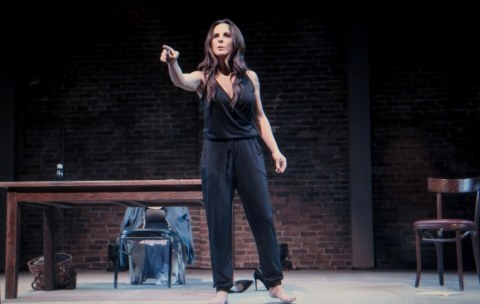
Kate del Castillo in ‘the way she spoke’ presented by Audible, written by Isaac Gomez, directed by Jo Bonney at Minetta Lane Theatre (Joan Marcus)
The first few minutes of the way she spoke by Isaac Gomez directed by Jo Bonney are easy and humorous with light but discriminatory undertones. An actor comes in for a reading. She references that directors give her demeaning parts to read, for example, whores or prostitutes typified by characters named Cha Cha.
The turning point in this lightheartedness erupts with a stark description. Sporadic laughter morphs to horror as the actor moves into the pages of a script where there is the first mention of the graphic mutilation of women’s bodies identifying the brutal murder of eight Mexican women in Juárez, Mexico.

Kate del Castillo in ‘the way she spoke’ presented by Audible, written by Isaac Gomez, directed by Jo Bonney (Joan Marcus)
In one fell blow, Telemundo star Kate del Castillo in her electric solo performance strikes at the heart of the patriarchy and bloodletting against thousands of women in the way she spoke. These acts are the side effects of gang violence, power dominance and poverty. In this horrific unofficial civil war, women’s carcasses send messages. They cry out threats and triumphs. They are the most often poignant and innocent casualties, many unrecovered as their persons, after whatever torment and abuse they experienced while alive, are buried in loam in vacant fields that are vast burial grounds.
Gomez’s dramatic rendering, is staged by Bonney with appropriate projections against the stage’s brick wall, while del Castillo in measured crescendos and fades of emotion and woodenness, responds to the shock of what she’s reading so she eventually experiences the high sorrow of this hell. At emotional midpoints she stands and redirects to another part of the stage to enact a role, sometimes of a dastardly, cold killer. The music and the projections follow her and slip into silence with the resonance of her storytelling. The drama increases its intensity; she configures the eye-witness accounts so that they jump off the page, spin with her energy into our imaginations.

Kate del Castillo in ‘the way she spoke’ presented by Audible, written by Isaac Gomez, directed by Jo Bonney (Joan Marcus)
As del Castillo relates events, describes images, philosophizes and makes us feel a paralysis of horror about the terrible femicide in ,Juárez at a time when the drug cartels were most fierce, we understand. Regardless that the violence has been mitigated since then and murders have decreased a bit, the same happens elsewhere in the world. This is a theme that del Castillo/Gomez reiterate. This reality floats like a dagger before us; what can we do? Is awareness enough? The playwright has unloaded his revelations in this work. He is finished, for in the effort to gain and reveal evidence of our blood lusting nature, he has accepted a measure of responsibility. But where do we go from here? And how do we become involved in a fight of advocacy to ensure that such targeted bellicosity against women doesn’t happen again?
There is always the response to “do nothing and move on with our lives.” It is a survival response, to ignore, duck and cover, return to our pleasant lives and try to forget we ever heard such descriptions of a female holocaust impacting all ages. But we cannot. Gomez, del Castillo and Bonney grip us with the power of these women’s voices from beyond the grave. They make us care for the “invisible” women whom they transcribe into reality during the strongest segments of this production. The concrete images of hate, fear and gore unsettle our minds: they are the final evidence that the mutilation and murder of women, the givers of life, have at their core a blasphemy against all of humankind like no other. After our numbness, the outrage comes against the patriarchy that would not sanction this, against the misogyny that is ancient, inbred and unique to our species!
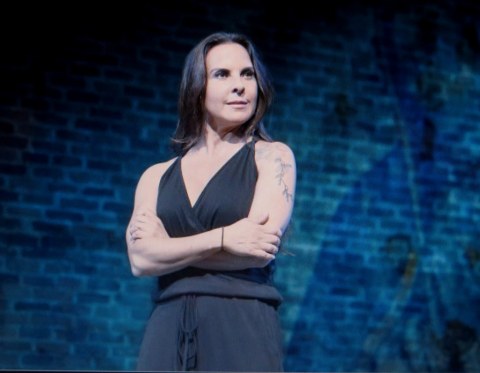
Kate del Castillo in ‘the way she spoke’ presented by Audible, written by Isaac Gomez, directed by Jo Bonney (Joan Marcus)
The material gleaned by the playwright from a series of interviews with various members of the Mexican community speaks for itself in the voices of the witnesses. And Gomez has cobbled it together thematically allowing the interviewees words conveyed with heartfelt grist by del Castillo to float like blood in water whose increasing droplets will not co-mingle or mix but retain their shape. And then suddenly, all is a dark red that stains our remembrance.
Kudos to the creative artists who assisted to make this a haunting presentation. They are Riccardo Hernandez (scenic design), Emilio Sosa (costume design), Lap Chi Chu (lighting design), Elisheba Ittoop (sound design), and Aaron Rhyne (projection design).
This production which Audible has recorded will be released as an audio play after its closing. Without visuals the words of the witnesses will explode in the hearer’s ears. They are both an encomium and a chronicle reconciling the dead to the light of a greater truth we are being forced to acknowledge in the hope of changing if even one life in the future.
In its final week the way she spoke is presented by Audible Theater at Minetta Lane Theatre (18 Minetta Lane between 6th Ave and McDougal St. in the West Village) until 18 August. For tickets and times go to their website by CLICKING HERE.
‘Coriolanus’ by William Shakespeare, Pride Without Humility Breeds Self-Destruction
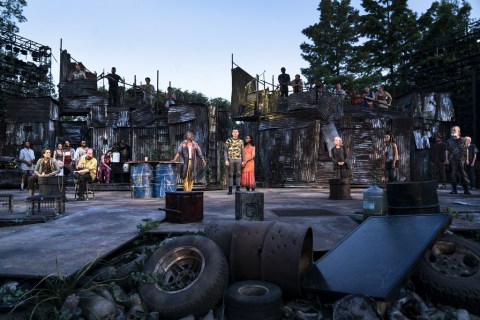
‘Coriolanus,’ by William Shakespeare, directed by Daniel Sullivan with Justin P. Armstrong (Ensemble), Teagle F. Bougere (Menenius Agrippa), Kate Burton (Volumnia), Jonathan Cake (Caius Martius Coriolanus), Louis Cancelmi (Tullus Aufidius), Katharine Chin (Ensemble), Gregory Connors (Ensemble), Darryl Gene Daughtry, Jr. (Ensemble), Biko Eisen-Martin (Ensemble), Bree Elrod (Ensemble), Nayib Felix (Ensemble), Josiah Gaffney (Ensemble), Chris Ghaffari (Titus Lartius), Enid Graham (Junius Brutus), Christopher Ryan Grant (Ensemble), Emeka Guindo (Young Martius), Jonathan Hadary (Sicinius Velutus), Suzannah Herschkowitz (Ensemble), Gemma Josephine (Ensemble), Thomas Kopache (First Senator), Tyler La Marr (Ensemble), L’Oreál Lampley (Ensemble), Jack LeGoff (Ensemble), Alejandra Mangini (Ensemble), Louis Reyes McWilliams (Ensemble), Max Gordon Moore (First Citizen), Tom Nelis (Cominius), Nneka Okafor (Virgilia), Donovan Price (Ensemble), Sebastian Roy (Ensemble), Ali Skamangas (Ensemble), Jason Paul Tate (Ensemble), and Amelia Workman (Valeria), (Joan Marcus
Coriolanus, Shakespeare’s apotheosis about a war monger who fires up for battle and yawns with boredom when he must live peaceably in the community brings to mind a ravaged soldier whose PTSD has so overcome him that he prefers living on the edge of death to energize himself to life. If he must choose between bloodshed, battle and calm, give Coriolanus carnage that he delivers, the gorier the better.
What does one do with such a Roman in a time of scarce resources on a planet ravaged by the doomsday scenario of global warming? Make him a politician to organize and straighten out issues in a time of great unrest in the most dire of conditions? Indeed, then watch him self destruct. For politicians must schmooze, flatter, promise, swallow crow, apologize and act with humanity and forbearance. Coriolanus is fit for battle, not for compromise, leader of his own personal autocracy which cannot be countermanded. Politics requires equanimity or the appearance of it. Of this he is incapable.
Shakespeare’s protagonist has a bit of the hero of The Hurt Locker (Kathryn Bigelow’s 2008 award winning film) without Jeremy Renner’s heartfelt agony and recognition of the mammoth loss of his former self before he signed up for war. Indeed, Coriolanus as portrayed by Jonathan Cake has much of the robotic machine killer with whom one has a devil of a time empathizing, especially as he rants and raves against those not born to a privileged background, from no fault of their own. Cake’s Coriolanus lacks interest, love or concern for others, except his wife (Nneka Okafor) son (Emeka Guindo) and mother (the wonderful Kate Burton). For his patrician friends he shows equal measure and latitude, for example Menenius Agrippa (Teagle F. Bougere) Cominius (Tom Nelis) and Titus Lartius (Chris Ghaffari) who advise him and fight with him. For his marvelously bellicose foes like Tullus Aufidius (Louis Canelmi) he bestows his complete veneration and worship.

(L to R): Christopher Ryan Grant, Louis Cancelmi in ‘Coriolanus,’ directed by Daniel Sullivan, Delacorte Theater (Joan Marcus)
As for the hurting, starving crowds clamoring for grain while the patricians’ storehouses flow with plenty? Let them eat each other in a zombie apocalypse. Coriolanus will none of it. Indeed, at the outset of the production, director Daniel Sullivan has placed a locked up barrel holding water downstage which the plebeians attempt to break into. But only Coriolanus holds the key to the lock and only he has access as he gives water to his son and denies his thirsty underlings. Charity stops first and last with self and family in a time of crisis such as that which confronts this deteriorating Rome, evocatively represented with a Mad Max scenic design by Beowulf Boritt of scattershot, burned out piles of garbage, remnants of the past, rather like Bob Ewell’s (To Kill a Mockingbird) scrummy playland hovel next to a massive town dump.
Because the rabble are deprived, there is civil unrest against the elites which if not quelled will threaten the security of the state, making it vulnerable to Rome’s enemies. However, Coriolanus answers the plebeians’ complaints with epithet and insult (they are curs and scabs) and argues that if he had the opportunity, he would slaughter them and create a mountain with their carcasses.

(L to R): Jonathan Cake, Biko Eisen-Martin, and Teagle F. Bougere in the Free Shakespeare in the Park production of Coriolanus, directed by Daniel Sullivan (Joan Marcus)
Some explanation is given for his wrath against the fickle, unreliable lower classes. His is an elitist patrician nature roiled by his aggressive, assertive mother. When he was a child she encouraged him to abusive dominance exemplified when he attacked the most beautiful and delicate of nature’s creatures by chomping off the wings of butterflies. Being so schooled against softness and generosity, he has no tolerance for the lazy, cowardly plebeians whose unmeritorious behaviors deserve no handouts. He states this to their faces in the opening scenes and we divine that his rancor is most grievous when he rails that he has provided the security of Rome while these poor and unfit do nothing to help him, but quailing in fear, flee even the thought of battle.
The situation is certainly egregious with the Volsces who come to attack. To get the corn they need to stem Rome’s hunger and murmurings, Coriolanus like a Titan hero single-handedly in “Incredible Hulk” fashion goes against these foes and delivers the goods without the help of the commons who slow him down. He emerges victorious from Beowulf Boritt’s ramshackle tin gates set, bloody and triumphant, but arrogant to the point of caricature!
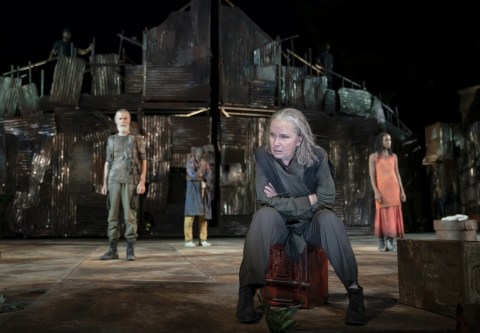
(L to R): Kate Burton (downstage) Tom Nelis, Teagle F. Bougere, and Nneka Okafor in the Free Shakespeare in the Park production of ‘Coriolanus,’ directed by Daniel Sullivan (Joan Marcus)
Was ever there such a raging hero hewn from the trials of confronting daily doom as the populace struggles against diminishing resources in Sullivan’s fascinating, ominously foreboding vision? Never. And Shakespeare forges from his hyperbolic character the tragic flaw that caves in Coriolanus’ life, legacy and career: his overweening pride, and his fearsomeness in not being shy to express his superiority to those lowlife “deplorables” who hate him.
Coriolanus certainly is reminiscent of other leaders we know whose arrogance and inability to apologize runs before them. However, Coriolanus is intrepid, mighty and uber skilled in battle. In this he is admirable. The current arrogant and boastful who lead are 100% image and 0% substance, bullying, cowardly and shallow like those whom they represent. That both Coriolanus and the resident of the White House are unfit for politics is their only similarity. Coriolanus’ pride is based in fact and follows an important logic that is downright Puritan in a time of destitution. If one doesn’t contribute to the good of the society, then one is not worthy of the grain that others have supplied. Freeloaders are not welcome!
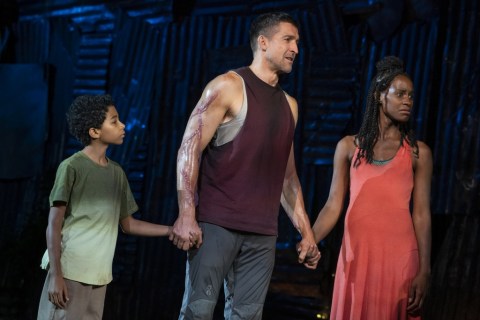
(L to R): Emeka Guindo, Jonathan Cake, Nneka Okafor in Free Shakespeare in the Park,’Coriolanus,’ directed by Daniel Sullivan (Joan Marcus)
Shakespeare’s tragedy revolves around his protagonist being lured into the political sphere which he hates for he is not social. He is too “in your face” real to grovel in flowery phrases, alluring promises and imaginative disingenuousness to please the masses. He is direct, frank and authentic and cannot apologize or “fake it” to front those he despises.
However, he suppresses his best judgment and accepts a position which is offered to him. The conspiracy against him blows up when the Tribunes who despise him Sicinius (the excellent Jonathan Hadary) and Junius Brutus (the equal of the pair Enid Graham) incite the plebeians to revoke the offer of the position. This is upon condition that Coriolanus does not “bow” to the voice of the people. This untenable situation requires Coriolanus to be humble and compromising; this is an impossibility which results in his banishment by the Tribunes. Coriolanus counters with the statement that he banishes Rome from his presence and stature. With solemnity, he suggests that there is a place for him, away from Rome.
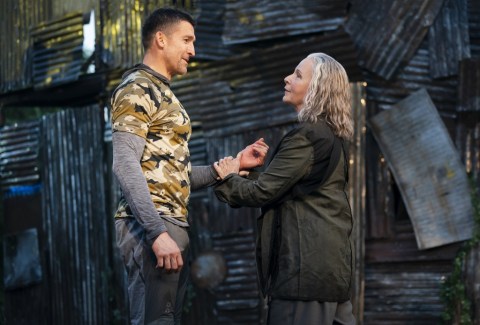
(L to R): Jonathan Cake, Kate Burton in ‘Coriolanus,’ directed by Daniel Sullivan (Joan Marcus)
But there is not. Though he joins Rome’s former enemy Tullus Aufidius of the Volsces intending to avenge his disgrace and dishonor of banishment by destroying Rome, it is a rush to judgment. The momentous decision means that he will destroy his mother, wife, son and friends who have not joined the Volsces. In the most insightful and powerful scene in the production (thanks to Kate Burton and Jonathan Cake’s whining “but mother” which reveals his enslavement to her dominance) Voluminia persuades him to betray Aufidius and fight for Rome not Volsces. It is Coriolanus’ act of sacrificial, stoic death. Aufidius will certainly kill him for his betrayal. That Voluminia has raised her son to war so that he can ultimately die to save her is unnatural and wicked for a mother. Doesn’t Voluminia and his family have other options? But their relationship as Cake and Burton portray it is fraught with issues of power dominance and abuse as the brute Coriolanus is reduced to a mewling weakling by his mother. He accedes to her wishes.
The production’s emphasis works at times and at other times is spotty. The rag-tag Costume Design by Kaye Voyce, Scenic Design by Beowulf Boritt, the Lighting Design by Japhy Weideman (strongest at the conclusion) the Soudd Design by Jessica Paz, the Composer Dan Moses Schreier’s music all convey Sullivan’s vision and themes soundly to resonate for us today. What happens to the haves and have nots when the law of diminishing returns lets loose annihilation because of the willful negligence and stupifying greed of previous generations’ corporate elites? Sullivan’s answering backdrop for the play is acute and frightening.
On the other hand, the empathy that we could feel for the plight of Coriolanus struggling against his own character wobbles perhaps because his character portrayal is one-note, at times cartoonish and lacking in depth. In the scenes with Burton’s Voluminia the depth of Cake’s Coriolanus shines, however. Shakespeare’s characterization reveals a character caught by his own ego between a rock and a hard place. He is betrayed by the Tribunes (his mother’s rant in their faces is largely ineffective) who capitalize on his arrogant weak character, lure him then back him into a humble pie corner from which he implodes.
And when he decides to punish Rome by depriving the society of the one way he has greatly benefited it by delivering death to its door? Once again he is thwarted, this time by his mother. And yet, there is no solace, nor sorrow nor identification at the conclusion that one might feel with Cake’s portrayal of a man who has undone himself. This is a weakness of the production which in all else especially Sullivan’s vision of the future is pointed.
Coriolanus is enjoying its last presentation today, 11 August. Performances have been sold out. However, there may be seats released if you are lucky and able to get to the Delacorte Theater well before curtain time at 8:00 pm.
‘Little Gem’ Starring Marsha Mason at the Irish Repertory Theatre
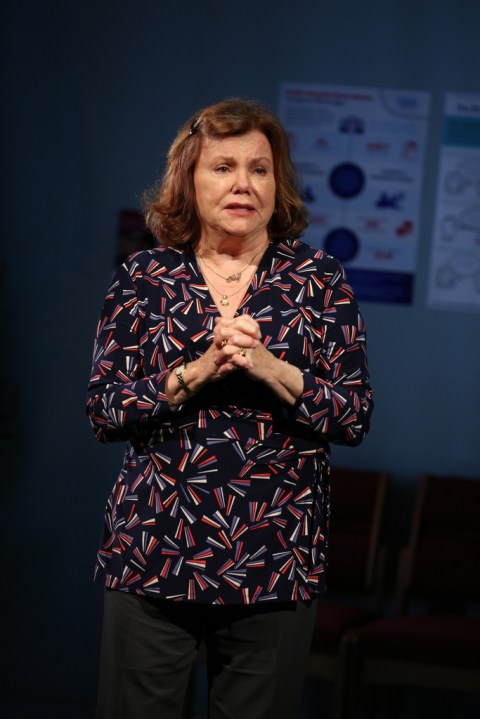
Marsha Mason in ‘Little Gem,’ directed by Marc Atkinson Borrull, written y Elaine Murphy at the Irish Repertory (Carol Rosegg)
Little Gem starring the wonderful Marsha Mason at the Irish Repertory Theatre is a poignant and comedic look at three generations of women from North Inner City Dublin. We follow along as the grandmother, daughter and granddaughter share their experiences, responses and perspectives at major turning points in their lives. Each tells their tale in six separate segments precipitated by a visit to the doctor’s office. In the final segment, the women, having gone through their own personal cataclysms, rally around the comfort of each other and sleep in the same bed, reunited in love and understanding.
The play written by Elaine Murphy premiered at the Dublin Fringe Festival in 2008, where it won the Fishamble New Writing Award before transferring to the Edinburgh Fringe Festival. This production directed by Marc Atkinson Borrull is essentially a solo tour de force for each character/actor. The only interaction among the characters occurs in the last segment. Only then do we see grandmother Kay (Marsha Mason is powerful, heartfelt and funny) daughter Lorraine (Brenda Meaney is ironic and nuanced) and Lauren O’Leary as the wise-cracking, sharp-tonged Amber relate to each other directly.
During the production, we listen to the narration of each woman separately. We revisit how each is at a different stage in her life (symbolic of women in general at different ages in their lives). We understand how she experiences the physical and emotional desires of needing and wanting to be in a relationship with someone who will care for her. And we note how each negotiates the wheel and woe of their personal relationships.

Lauren O’Leary, ‘Little Gem,’ by Elaine Murphy, directed by Marc Atkinson Borrull (Carol Rosegg)
The women relate their stories in flashback in direct addresses to the audience. Initially, we discover the superficial reasons why they are in a doctor’s office. Amber has indigestion and throws up frequently in the mornings. Lorraine is emotionally mottled with stress and needs medications to calm her and resettle her life. Kay has a “personal itch down there.”
As the production unfolds the women by degrees go into their reveals during their story-telling turns with the youngest generation first, simulating the arc of life’s beginning. The forty-something Lorraine represents the middle stage of life and the sixty-something Kay represents the senior years. As they each address the audience, we understand the depth of their angst as they relate how their situations become the touchstones of their growth and realizations. The progression is an interesting one and thematically reminds us of the innocence and naiveté of youth (the fecund period) the transformation into recognizing deeper values in life and the winding down into menopause, and the increased sexual libido that often occurs for older women long after they’ve thrown off the aftereffects of child rearing.

Brenda Meaney, ‘Little Gem,’ by Elaine Murphy, directed by Marc Atkinson Borrull (Carol Rosegg)
In six segments Amber discusses the events with Paul which brought her to the doctor to help her during her pregnancy and afterward as she takes care of baby Jamie and he is accepted into the family. We discover how Lorraine’s stress precipitated by her lack of communication with Amber and worry centered around Amber’s sometimes wild behavior (like mother, like daughter) is somewhat mitigated when she follows her therapist’s suggestions to “get out of herself” and her miseries and goes dancing. After she meets someone, with Amber’s encouragement she goes on a date with him in what becomes a developing relationship.
At the doctor’s office Kay receives “the ok” to have sex without Little Gem who is too debilitated and ill to continue their fabulous sex life. She will do this via the help of a vibrator. Indeed, the scene when Mason effects this is one of the funniest in the play. And as Little Gem fades from this life and moves into the next, at the grave she grieves her husband and in the last scene of the play seeks the comfort of her daughter and granddaughter.
Elaine Murphy’s work is strongest in the concept of revelation and self-recognition and growth that occurs in each of the women’s lives. However, the playwright decides to keep the play largely expositional. This dissipates the drama that occurs in the family dynamic. We note the underlying levels of action, however they are reported; an example of this occurs when Lorraine discusses that she doesn’t communicate with her daughter. However, we never see the characters Lorraine and Amber demonstrate how or when this occurs actively. Likewise, the characters may talk about a family member who stands next to them, but there is no active dialogue or exchange between and among each of the characters until the end. The strongest exchange occurs only then when they get into bed after Little Gem dies and they comfort Kay to reveal they unite as a family.

(L to R): Marsha Mason, Lauren Oleary, Brenda Meaney, ‘Little Gem,’ by Elaine Murphy, directed by Marc Atkinson Borrull (Carol Rosegg)
For me any related emotional power and inherent possibility of empathy falls short with the playwright’s selection of this expositional structure predominately. Would the play have worked more dramatically and humorously with different staging and lighting as each woman takes a darkened stage stepping into the spotlight and sharing the import of her story? Somehow, the office setting was a banal distraction. Or was this the point since the women are vibrant and we are transfixed at various times during their revelations?
The actors stand out because through them, their characters’ stories are exposed. They remind all of us that we have a story to tell and it is representational and unique for our time and place. Meaney, O’Leary and Mason engage and keep us launched into remembering what has occurred previously. We must figure out how related events have bled into the current segments of their narration as they detail the specifics: Lorraine’s difficulties with her daughter, Amber’s difficulties with Paul after he discovers she’s pregnant, Little Gem’s sickness and dying. We become the catch-basin for all of their humorous/poignant story events. These are peaked with the tragicomedy of Amber’s, Lorraine’s and Kay’s feminine perspectives of their middle class lives which include the prickly narrative of their relationships: Amber’s reports of sometime boyfriend Paul, Lorraine’s report of a poignant conversation with junkie ex-husband Ray, and Kay’s explanation of her role as caretaker during Little Gem’s frustrating illness and heartbreaking death.
Little Gem is a portrait of women during crisis and the ways they look for the humor and uplift during the rough patches of life. The audience partners with them as we listen to their troubles like a good friend or neighbor. And in the telling of their stories there is the release, growth and hope that in the family all will be well as the next generation adds to the flavor of their future. And so it goes for us as well.
Little Gem is in a revival in New York from a run in 2010 and is in a limited engagement through 1 September. For tickets and times at the Irish Rep website CLICK HERE.
Annie Golden Kills in ‘Broadway Bounty Hunter,’ A Rollicking, Musical Hybrid

The Company of ‘Broadway Bounty Hunter,’ Music and Lyrics by Joe Iconis, Book by Joe Iconis, Lance Rubin and Jason Sweettooth Williams, directed by Jennifer Werner (Matthew Murphy)
Broadway Bounty Hunter starring the inimitable Annie Golden (Orange is the New Black for six seasons) is a musical comedy that gyrates into the stratosphere with hijinks galore. and a plot that careens to an apotheosis of self-fulfillment for the atypical, underdog, heroic bounty hunter characters. The just comeuppance for the white, privileged, male villain with a greedy, malevolent and double dealing heart (the excellent Brad Oscar) feels right by the conclusion of the production, though he has Broadway connections and was once a sensitive, artistic type until he turned to the “dark side.”

The Company of ‘Broadway Bounty Hunter,’ Music and Lyrics by Joe Iconis, Book by Joe Iconis, Lance Rubin and Jason Sweettooth Williams, directed by Jennifer Werner (Matthew Murphy)
With Music and Lyrics by Joe Iconis (Be More Chill) and Book by Joe Iconis and long time collaborators Lance Rubin (Bloodsong of Love) and Jason Sweettooth Williams (Be More Chill) the production is a hard one to “categorize!” That is its hybrid grace, for it defies description and is a meld of farce, satire, comedy and musical that keeps one riveted by divergences into adventurous, road-trip sequences and action that hypes up the humor and suspense, all the while having a blast and twitting itself. If that “description” appears over-the-top,” the show is just that, and its entertainment and production values are larger-than-life with the excitement and exuberance of a musical that is off-beat wild.
Yet, it begins on a dark, depressing note. Annie, an out of work actress and apparent “has-been,” as “A Woman of a Certain Age,” goes to an audition and is insulted and demeaned by the audition monitor, director and another actress she meets there. The opening number is choreographed and staged by the exceptional Jennifer Werner to encompass the entire theater. The ensemble takes on the roles of various New York City street folks. It is they who take up the cry that Annie later refrains, “they’re not giving no free rides,” to “kick you off the stage,” when you’re a “woman of a certain age.”

Omar Garibay, Jared Joseph, Badia Farha, Christina Sajous, Jasmine Forsberg, ‘Broadway Bounty Hunter,’ Music and Lyrics by Joe Iconis, Book by Joe Iconis, Lance Rubin and Jason Sweettooth Williams, directed by Jennifer Werner (Matthew Murphy).
This unhealthy dose of reality is a slap in the face to every women in the audience over forty and that is the point of revealing where Annie is in her life: in the pits, at rock bottom, in the valley of the shadow of death. Can it get any worse? It does, happy female campers!
After swallowing this bitter dose of time and place in her life, Annie goes back to her seedy apartment and her answering machine of dire messages and the coming blackout of her lights being shut off for non payment of bills. It is then she realizes it’s over for her in the song “Spin Those Records.” Her only solace is talking and singing to the resplendent Charlie, the picture of her Broadway producer husband, who died over ten years ago. As she attempts to persevere to get to the next refrain of the song “I won’t spin those records anymore,” the ensemble echoes her lament that her success has long faded and the songs she once sang in glory have now “forgotten her.”
That the real Annie Golden who has turned the trope of “woman of a certain age” on its head with her success in Orange is the New Black, is not lost on her fans in the audience who cheer her on. And that is the point of the first two songs; the successful Annie Golden can sing these (and she can belt with roaring power) with a hint of mournful acknowledgement that “it is done,” because it isn’t! This is the salvation and humor and hope, which is a major theme of this production. It is never done! It is never over! And surprises do come right around the corner and improve one’s circumstances. But you must persevere for their “coming.”

Jasmine Forsberg, and the company of ‘Broadway Bounty Hunter,’ Music & Lyrics by Joe Iconis, Book by Joe Iconis, Lance Rubin and Jason Sweettooth Williams, directed by Jennifer Werner (Matthew Murphy)
Annie’s “apparent” nemesis is that “the matrix” of privilege in the institutions of the patriarchical system (whether it be in the entertainment industry, politics or global corporate control) would dictate and select who and what can be successful, mostly white men; in the entertainment industry, young, white and thin. Nevertheless, the labels and definitions the institutions place can be overcome and twerked by redefinition and a revolution that embraces multiculturalism and defies ageism, which this production does! Though the setting is the past, the production speaks with its whole heart to the present! BRAVO!
With fervor, inspiration and a little “help” from your friends and colleagues who face the same conditions, you can prosper and thrive with effort, drive and enthusiasm. Considering that only the few “fit” the “success” labels, the great majority who don’t are allies. It is only a matter of perceiving this to be true and working to bring it into reality. Iconis, Rubin’s and Sweettooth Williams’ message is especially uplifting and forward thinking in this wannabe retrograde time of Trumpism.

(L to R): Jared Joseph, Jasmine Forsberg, Annie Golden, Christina Sajous, ‘Broadway Bounty Hunter,’ Music and Lyrics by Joe Iconis, Book by Joe Iconis, Lance Rubin, Jason Sweettooth Williams, directed by Jennifer Werner (Matthew Murphy)
The creators and director are masters of reversals. They turn inside out “the matrix” that would keep us inside “the box,” and keep audiences lulled into the traditional expectations of musical plot, spectacle and character so they don’t necessarily have to look for the profound. Iconis, Rubin and Sweettooth Williams are grand at going upside down and striking deep notes about our culture and society. This production from its funky, stylized music of the 70s and 80s found in Blaxploitation films like Shaft, Super Fly, Foxy Brown, Coffy, etc., to its kung fu, martial arts choreography (by Jennifer Werner) replete with nunchucks (chuka sticks) staffs and surround-action movement and staging with the ensemble abundantly using the audience aisles, soars with energy and excitement. And if you look for vital themes, they are everywhere from #metoo, to image fascism and silent oppression that doesn’t “exist,” until it slams you in the face.
Because we follow Annie to the outer depths of the Mariana Trench of emotional devastation, we are ready to soar with her to the heights of a new career as a “bad ass” bounty hunter hired by Shiro Jin (the classic, cool, deadly Emily Borromeo). We empathize readily with Annie as she accepts “Shiro’s Proposition” without completely understanding the how and the why of it. We cheer her on as Annie becomes accomplished in martial arts skills with the other bounty hunters. And when she gains confidence and bravery learning her “killer moves” and employing acting techniques to sharpen her inner “rage,” we thrill for her.
Ironically, by this point we realize this Bounty Hunter business is no joke. Annie automatically accepts her “mission impossible” to locate, confront and “take out” the despicable, drug pusher, pimp daddy killer with the hot name Mac Roundtree (the funny Brad Oscar). But what is a sweet “woman of a certain age” doing? Well, she does have the help of a strong, uber powerful, yet soft-hearted, sensitive partner Lazarus (the winning, gorgeous-voiced Alan H. Green).

Annie Golden, Alan H. Green, ‘Broadway Bounty Hunter,’ Music and Lyrics by Joe Iconis, Book by Joe Iconis, Lance Rubin and Jason Sweettooth Williams, directed by Jennifer Werner (Matthew Murphy)
In the song “Mac Roundtree Theme Song,” Brad Oscar is the dirty, rotten scoundrel who will front them and “not go easily” against Annie and Lazarus, especially on his home turf in Ecuador. With this shades of the film Scarface, in the foreground, we understand the stakes have been raised and Roundtree is worse than Shiro Jin has let on to Annie and Lazarus. Indeed, their boss may be sacrificing Annie for her own agenda to kill Roundtree. Furthermore, Lazarus and Annie are counter intuitive partners; Lazarus finds her hard to accept and she is dismissive of him. Just before they end up at Roundtree’s mansion in the jungle, Lazarus does confront his demons with the ensemble’s help in”Feelings.” Alan H. Green is just plain out hysterical as he sings Lazarus’ inner angst.
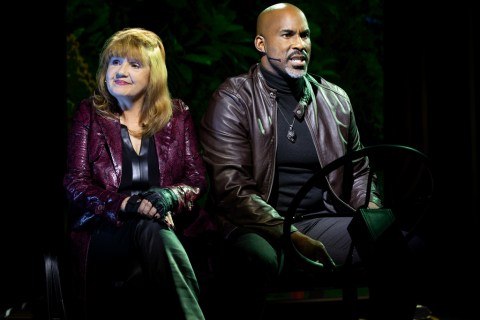
Annie Golden, Alan H. Green, ‘Broadway Bounty Hunter,’ Music and Lyrics by Joe Iconis, Book by Joe Iconis, Lance Rubin and Jason Sweettooth Williams, directed by Jennifer Werner (Matthew Murphy)
As they confront Roundtree’s allurements/prostitutes who gain information about the man and woman are who have come to Roundtree’s empire, the ensemble pulls out all the stops and performs the smashing “The Song of Janessa.” And it is then that the creators, once more, interject two twists in characterization and plot as the arc of development spins into an unexpected direction. Lazarus and Annie discover with a brief touch of the hand, they are attracted to one another (“Aint No Thing”). The second dynamic twist I will not reveal because it is a delicious reversal of a reversal and this is no spoiler alert. Suffice to say that Annie and Lazarus make a fascinating discovery which brings the production to an insightful and intensifying end of Act I. When Act II lifts into the heavens you are ready to hold beats and join Annie and Lazarus for the more surprises.

(L to R): Alan H. Green Brad Oscar, Annie Golden, ‘Broadway Bounty Hunter,’ Music and Lyrics by Joe Iconis, Book by Joe Iconis, Lance Rubin, Jason Sweettooth Williams, directed by Jennifer Werner (Matthew Murphy)
The production flies high with the performances that are campy, yet heartfelt. Standouts are the principals, Green, Golden and Oscar. The ensemble in movement, dance with powerful voices is exceptional. Thanks to Werner’s direction and choreography the show leaps from scene to energetic scene to the jazzy, funky, pop score beautifully rendered by Geoffrey KO, with Charlie Rosen’s Music Supervision & Orchestrations. Just great!
I also enjoyed the fine use of projection and video by Brad Peterson whose designs were the best I’ve seen Off Broadway. They melded with the Lighting Design by Jules Fisher and Peggy Eisenhauer and both sparked up and enhanced the tone and style of this musical, especially in the fight scenes, and Lazarus’ driving his sweet truck sequence. Kudos to Michael Schwelkardt for functional, clever scenic design, Sarafina Bush’s costume design (especially for the ensemble during “The Song of Janessa”) and Cody Spencer’s excellent sound design.
Broadway Bounty Hunter is at the Greenwich House Theater on 27 Barrow Street until 15 September. Reimagined, it moved from Barrington Stage Company where it had a critically acclaimed, sold-out run, to land in the city where the story of Annie Golden begins and ends triumphantly after she goes to South America to deal with a hardened drug pusher criminal. The production will probably have legs and continue to move. Regardless, if it goes uptown, it is a must see that is a unique, enjoyable ride into the past future. Female Bounty Hunters need to do more bad ass kicking the patriarchy before the election cycle is done. For tickets and times CLICK HERE.
‘Mojada’ by Luis Alfaro at The Public, A Superb Update of ‘Medea’ via the Migrant Crisis
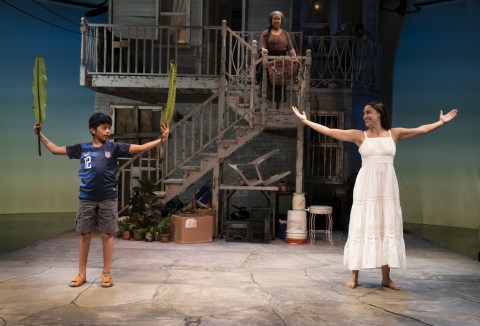
(L to R): Benjamin Luis McCracken, Socorro Santiago, Sabina Zúñiga Varela in ‘Mojada,’written by Luis Alfaro, directed by Chay Yew (Joan Marcus)
Luis Alfaro’s riveting update of the Greek Tragedy Medea spun out against our current immigrant crisis is authentic, primal and timely with exceptional direction and evocation by Chay Yew. I saw it this weekend, one day prior to the Trump announced ICE raids designed to terrorize and apprehend illegal immigrants, “wetbacks” (mojados) with the intention of incarcerating them until eventual deportation. The “raids” failed miserably in their execution, but not their intent to terrorize.
Alfaro adroitly reinterprets the migrant crisis and parallels it with the story of Medea, the sorceress who dispatches her children after her husband Jason dumps her and marries the king’s daughter. However, he makes significant changes in the characterizations, softening and humanizing Medea and Jason and removing the notions of vengeance and anger by changing it to despair, isolation, loneliness and desperation for the character of Medea. Additionally, unlike the classic Medea, Alfaro never leaves off Jason’s love and tender concern for Medea, shifting her enemy conflict away from Jason to her rival Pilar.
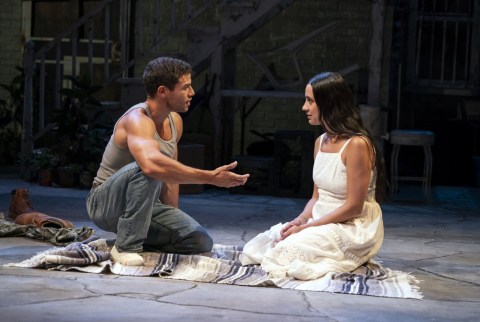
Alex Hernandez, Sabina Zúñiga Varela in ‘Mojada,’ by Luis Alfaro, directed by Chay Yew (Joan Marcus)
Alfaro’s Medea is the the indigenous Mexican “mojada” portrayed by the always present and heartfelt Sabina Zúñiga Varela. Varela gives an exceptional, thrilling portrayal of the emotionally driven and abused spiritualist who has been raped on their journey to the United States and still psychologically suffers from the trauma. Her servant/family member tells us early on in the play that despite the herbs she gives her, she cannot heal. Later, as Medea revisits her horrific journey to “freedom” in America in a flashback sequence, we discover why she cannot “heal;” the trauma has frozen her soul and filled her with fear and death.
Medea’s partner Jason (the excellent, charming Alex Hernandez) is one she adores. Despite the sacrifice of her wholeness and happiness, she stays with him and they finish their journey North with their son Acan (the lively, adorable Benjamin Luis McCracken) and their servant Tita (the humorous, wonderful Socorro Santiago) so Jason may fulfill his ambitions. In a later reveal, we discover why Medea had to leave. When Jason suggests they start over in America, she has little choice but to join him and remain under his protection. However, Medea is confused and unable to self analyze and straighten out her severe emotional problems after their arrival.

(L to R): Alex Hernandez, Sabina Zúñiga Varela, Socorro Santiago in ‘Mojada,’ written by Luis Alfaro, directed by Chay Yew (Joan Marcus)
Early on in the production we discover that Jason wants “the American Dream.” Clinging to Jason and her family as her only hope, Medea believes in Jason’s love and good will. She indulges his promises of a better life for her and their son in the alien American culture. As the play begins, all appears calm for they have settled in Jackson Heights, New York and both have jobs and earn money while Tita cares for Acan. Jason works construction and Medea works at home, all of which is a divergence from the classic play Medea which begins after Jason and Medea end their marriage.
Alfaro seeks to represent his Mexican Medea with a strong faith in herbal medicine that Tita concocts as well as a ritual morning obeisance to the four winds which she practices with Acan as an incantation, a recitation to recall their past life and infuse it with them in the present so they never forget what they have given up. As an indigenous Mexican, Medea is close to the spiritual plane. Her incantation’s powerful symbolism to her mind strengthens the connection with their homeland to which Medea daily seeks a return, despite Jason’s successful forward direction in becoming prosperous and in encouraging a better life so they may become American citizens. Though Alfaro’s Medea lacks the status of a princess, his portrayal of her beauty, innocence and purity (she is in white throughout the play) represents an everywoman. His depiction symbolizes the core ethos of what makes women noble and sanctified. Varela embodies these traits and heightens the honor of Alfaro’s vision for this character which makes her desperate, hopeless fall from grace all the more tragic and poignant.
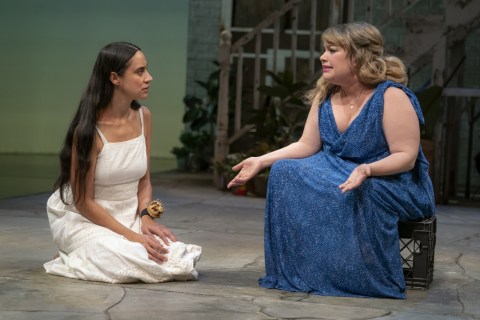
(L to R): Sabina Zúñiga Varela, Vanessa Aspillaga in ‘Mojada,’ by Lluis Alfaro, directed by Chay Yew (Joan Marcus)
Medea, a professional level seamstress, works diligently at supplementing their family income by creating a veritable sweatshop in their home where she makes gorgeous clothing at a pittance while her “bosses” reap a substantial profit for each item and exploit her labor because of her non-status as an illegal immigrant without a green card or work visa. The theme of workers being exploited for their cheap labor while greedy individuals who prey upon their circumstances reminds us of the timeless status quo of the workers vs. their corporate overseers and highlights the plight of undocumented workers. It also is reminiscent of the greed of corporate America which refuses to pay the proper value for their workforce that makes them profitable while paying their CEOs who largely schmooze and network lazily 300 times the amount.
In Medea’s life as an undocumented worker is the everpresent fear that she, her son and Tita may be turned in and deported. This haunts Medea and contributes to her agoraphobia so that she prefers to stay at home in Queens away from the chaos of New York City life that is unfamiliar to her. Her status oppresses her for she has no way to bargain with her employers who “call the shots” and pay her the minimum locking her into an indentured servitude. She has no recourse if she doesn’t like her wage to ask for more. They will go to another undocumented worker or have her deported. Her circumstances make her their slave.
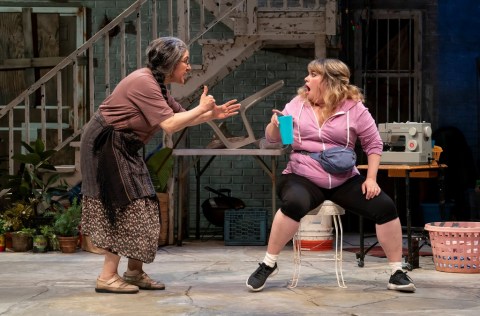
(L to R): Soorro Santiago, Vanessa Aspillaga, ‘Mojada,’ written by Luis Alfaro, directed by Chay Yew (Joan Marcus)
All the general details of Medea, Jason and Acan, Tita relates to the audience chorus-like in a humorous narrative in which she pines for the old country and identifies the difference between the old ways and the inferior American lifestyle. Having been sold to take care of Medea since her mother died as a baby, Tita acknowledges her servile position, but reinforces her authority as a healer who has taught Medea everything she knows. Tita loves Medea who is her obligation. But she fears for her as an innocent and questions Medea’s blind loyalty to Jason whom she believes is not worthy of Medea’s trust. Tita is not only a healer, she is telepathic and she sees what Medea refuses to recognize because if she does, all that Medea has experienced to get to America is in vain, above all the pain and torment she endured on the trip and the misery she feels as an outsider who fits in nowhere in except in Jason’s arms and Acan’s reliance on her.
The arc of development jolts forward after we meet Jason and note how Medea and Jason greet each other, with the calls of the guaco, a bird that lives in the southwest. Their cries to each other are haunting and beautiful. We recognize the bond between them that is ethereal and powerful. Alex remains affectionate and loving to her as Alfaro diverges from Euripides’ classic tragedy in that their family which has been in the U.S. for about a year appears to be united and prospering. Jason is fearless in his desire to be someone and take Medea, Acan and Tita with him on this uplifted path to citizenship. He appears honorable and we assume theirs is the happy whole, until we discover the cracks in the foundation that earthquake and drive the family apart by the end of the play.
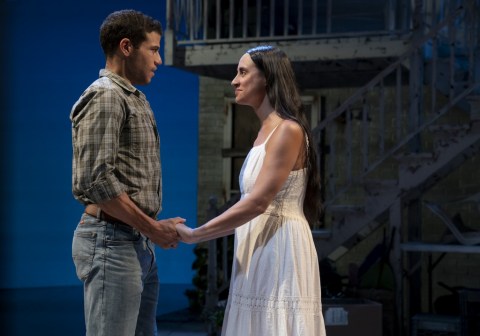
Alex Hernandez, Sabina Zúñiga Varela in ‘Mojada,’ by Luis Alfaro, directed by Chay Yew (Joan Marcus)
The cracks of the foundation are revealed in flashbacks. At one point Medea asks Jason to make love to her under the stars out in the open but she stops herself, and the tender Jason understands and is patient with her. In the extended flashback which Medea narrates, we discover how they struggled to make it to the border, but not before Medea is violated by Mexican soldiers. But that is not the worst that could have happened. Another young woman along the journey is not only gang raped, she is killed and dumped in an unmarked grave. The ordeals migrants go through seeking a better life for themselves is clarified dramatically during this vital segment without polemic or dogma. The ensemble’s acting during these scenes brings the audience to the edge of horror and beyond.
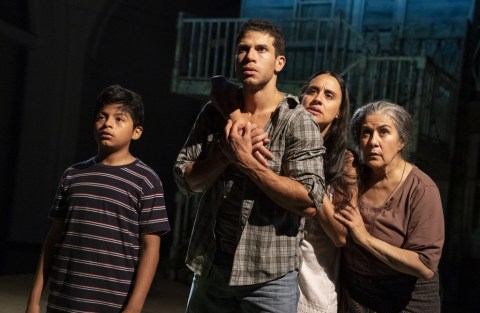
(L to R): Benjamin Luis Mcracken, Alex Hernandez, Sabina Zúñiga Varela, Socorro Santiago, in ‘Mojada,’ by Luis Alfaro, directed by Chay Yew (Joan Marcus)
It is Medea’s relationship with Jason that receives the most dynamic upturn in the development of the conflict which Alfaro gradually unravels as we glean the events from Medea’s perspective. Alfaro cleverly occludes the truth as Jason has obfuscated the reality of his personal circumstances to Medea. On the surface we only see that Jason chides her for not going out, and seeks her love and support for his working late nights for the family’s benefit. Even though gossipy comedic Luisa, a neighborhood vendor from Puerto Rico (vibrantly acted by Vanessa Aspillaga) intimates that she is glad her own husband is ugly because Jason’s good looks would be catnip to women, Medea laughs but doesn’t get the message. And the playwright gives no hint of deception until deep in the play so that when its revelation comes, we are shocked and devastated for her.
In a splendid and relevant turn for the culture he writes about, Alfaro shifts the conflict away from the aspect of revenge and justification for vengeance that the classic Euripides’ Medea emphasizes. In Mojado, Alfaro focuses on the bond between Jason and Medea, always as a loving one so that Jason’s betrayal lands like a bomb, and even then, Jason’s charm and sweet, urgent pleas almost convince Medea that he means well in his actions.

Benjamin Luis McCracken, Alex Hernandez,Sabina Zúñiga Varela, Socorro Santiago in ‘Mojada,’ by Luis Alfaro, directed by Chay Yew (Joan Marcus)
Medea’s true enemy is “the other woman” who is Jason’s wealthy boss Pilar (the forceful, slyly arrogant Ada Maris) who has turned her life into the success that Jason intends for himself. Pilar represents all that is noxious about immigrants who embrace the “American Dream,” assimilate and lose their souls to the pursuit of power and money. They become even more treacherous and corrupt than the dolorous white citizens who have been in the country for generations, some of whom have failed and refuse to pick themselves up but instead, blame the migrants for stealing jobs that their own lack of effort would never “lower” them to take, for they are too “superior” to do such labor. This notion abides sub rosa as we watch Pilar and Jason discuss business and note the tremendous industry that Pilar, Jason and Medea embody in their diligence and effort to make money and prosper. Undocumented migrants are synonymous with an incredible almost Puritan work ethic in this play. It is a truism that partisan politics to tickle the ears of the dolorous white supremacists turn on its head.
Pilar comes to diner and reminds Medea that she is staying in one of Pilar’s many houses. Pilar implies she is to be appreciated for not charging Medea fees for making the home into a sweat shop. She infers that it is only her reliance on Jason whom she intends to promote who deflects Pilar from taking a percentage of the money Medea makes. Again, the theme of the exploitation and predation of immigrant bosses who have “made it” taking advantage of undocumented migrant brothers’ and sisters’ industry and resourcefulness is brought to the fore.
When Pilar greets Acan with affection that reveals they have been together a number of times, Medea still remains blind. It is only when Jason reveals that he has married Pilar does Medea begin to understand the forces ranging against her. Medea and Jason never married. Medea believes their union is a spiritual force that would keep them together forever. A marriage paper for their life in Mexico was not necessary; they are bonded by their love and the fruit of their union, Acan. However, in America, legality is paramount so that their spiritual union is nullified by the absence of a piece of paper. The crass American values of money, power, materialism over spirituality, loyalty and love overcome Medea’s hope of survival. Her only way out of the misery and desperation Pilar and the corrupted Jason have bestowed on her as her fate is to take the only power she has left and use it.
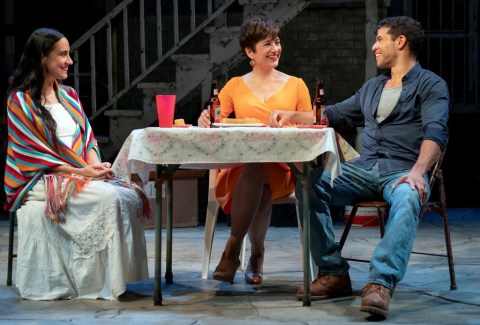
(L to R): Sabina Zúñiga Varela, Ada Maris, Alex Hernandez in ‘Mojada,’ by Luis Alfaro, directed by Chay Yew (Joan Marcus)
In the incredible scene between Pilar and Medea, all of the undercurrents of a woman used to demanding her own way crashes into the innocent Medea’s consciousness. Pilar’s rivalry with this woman who is still loved by her man is acute. It is either Medea or her and unless Medea “gets lost” she will have her deported. The choice for her is no choice. An even more dire fate awaits Medea in Mexico in her home town.
Alfaro has written an amazing play referencing the classical tragedy. He has adopted his work to the Mexican/Latino culture and in so doing expertly gives us an appreciation for what immigrants endure for a better life. Additionally, we empathize because his work covers timeless themes about the powerless vulnerability of migrants like Medea/la mojada. He spins out the familiar tale but enhances it with great depth of feeling so that his protagonist (spoiler alert) restores her own honor and delivers herself to freedom by her acts which proceed more from desperation and sorrow than vengeance. She empowers herself through suicide, something that the sorceress Medea would never contemplate. But in la mojada’s choice there is dignity and sanctity, but at great cost. And at the last moments which are breathtaking she calls out with the cry of the guaco from the realm of spirit. And the response is her tragedy and fall from grace.
From the performances to the authentic, realistic sets and Chay Yew’s fine directorial choices, Mojada is Alfaro’s monumental vision for our times through the lens of Euripides powerful tragedy Medea. In effecting his version Alfaro reveals the great nobility and honor in those who seek to evolve to a different life in another culture, often not completely understanding that the life they seek is filled with corruption, devastation and dishonor. However, to not try is worse. To remain and never know or never learn is naive and a submission to fear and death. The greatness of Alfaro’s character Medea is in her attempt to hold on to the little health/innocence she has and endure. When evil threatens to overwhelm her and her family completely, she defends herself in the only way she knows how. And we are uplifted and sorrowed for her choice.
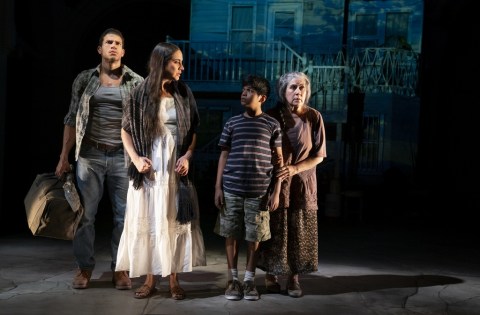
(L to R): Alex Hernandez, Sabina Zúñiga Varela, Benjamin Luis McCracken, Socorro Santiago (Joan Marcus)
Kudos goes to the creative team for their fine evocation of the family’s lifestyle through minimalism: Arnulfo Maldonado (Scenic Designer) Haydee Zelideth (Costume Designer) David Weiner (Lighting Designer) Mikhail Fiksel (Sound Designer) Stephan Mazurek (Projetion Designer) Earon Chew Nealey (Hair Style Consultant & Wig Designer) Unkledaves Fight0House (Fight & Intimacy Director).
Mojada runs 1 hour 45 minutes without an intermission at the Public Theater on Lafayette Street until 11 August. Run, do not walk to see this memorable production. For tickets and times CLICK HERE.
New York Music Festival 2019 Review: ‘Buried’

Lindsay Manion, Sebastian Belli, ‘Buried, NYMF 2019 (courtesy of the production)
The New York Music Festival 2019, now in its 16th year (July 8-August 4) remains the premiere musical theatre festival in the world. During the past sixteen years, thousands of artists and administrators have participated in over 400 new musicals some of which have moved to a renewed life Off Broadway. Others have toured the country and found venues elsewhere, perhaps landing back in NYC to achieve a finer calling after being tested on the road. Indeed, a very few like Next To Normal make it to Broadway audiences.
The possibilities for Buried, this year’s only musical which hails from the UK are trenchant and wide-ranging, depending upon the continued energy and fervor of its creators. The music and lyrics are by Cordelia O’Driscoll, book and lyrics by Tom Williams (he also directs) with fine orchestrations and musical direction by Olivia Doust. Buried, a black comedy/musical/drama was twice presented at the Edinburgh Fringe Festival and it has won awards. I have missed this production these past three years I’ve attended the Edinburgh International Festival and Fringe Festival. I’m glad it found a home at NYMF 2019 so I could see its promise and hear the lyrical music.
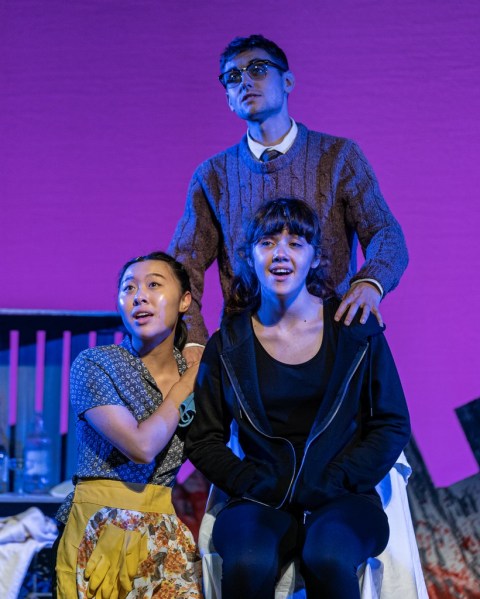
(L to R): Rebecca Yau, Wilf Walsworth, Lindsay Manion, ‘Buried, NYMF 2019 (courtesy of the production)
I am intrigued by the initial concept of serial killers falling in love. However, how Rose (Lindsay Manion) and Harry (Sebastian Belli) eventually, slowly fall in love is problematic. Perhaps the stakes are not high enough, the protagonists not alluring and scintillating enough because they are too self-engrossed in their issues and pasts. Considering there is no rational justification for being a serial killer, the psychological angle could have been turned on its head regarding the protagonists in the scenes they have with each other. The digression into the comedic examination of the psychology of killing with the doctor/professor and his questioner (ensemble-Laurence Hunt and Wilf Walsworth) is witty. Indeed, the one song they sing provides the interposition of a much needed variety with the rest of the score.
However, the self-examined life of Rose and Harry as they discuss who they are and why they are with one another becomes repetitive after the initial songs. There is a matter-of-fact irony lyrically carried by the music that reveals the thrust of their togetherness to be that they kill and are outsiders. More is needed. They are able to front to get their prey and can fit in enough to get dates. But allure and charm is wanting; the sociopath, the psychopath are hungry; they are compelled; they manipulate.
These protagonists are drawn in a halfhearted measure. If theirs could be a love at all costs which it is not, we might have been completely enthralled. And in that identification, the theme, which faltered in this production would be enhanced. Where is the revulsion that we may be attracted to the allure of another soul, no matter how damaged or self-destructive and the fact that that soul may have as its intent to lure us to kill us?
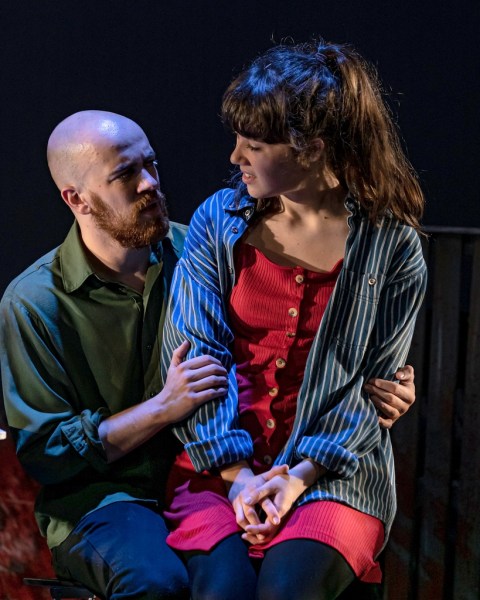
Lindsay Manion, Sebastian Belli, ‘Buried, NYMF 2019 (courtesy of the production)
The concept of the show is original. On a level beyond its purely fantastic entertainment value (and it is entertaining without a doubt) I considered that the production should either pull back or go to its most extreme sardonic limit. Because the tension and conflict doesn’t rise to a pinnacle, it gets lost in the limbo of relationship doldrums between the two protagonists, which I drifted out of in the middle of the show. However, I came back to them at the powerful conclusion which was dynamic with the external conflict adding tension. The beginning was strong as was the ending with shining moments as Rose and Harry select their final destination.
The book could use a reworking of the arc of development to make it more powerful and in the moment. Additionally, it needs to pump up the possibilities for incredible, “kill-em” black humor to give it the grist to engage throughout. If the creators could add in new songs, perhaps with a different music style and swap out those that sometimes become lyrically redundant, the score would be various and lifted. The music is gorgeous. However, it becomes repetitive. The full appreciation of its beauty, as a result, diminishes.
All the above is couched from the perspective that the show is good enough to deserve reworking so that its inherent possibilities can be manifested and taken to additional venues and go far. The cast is excellent. Manion and Belli engaged us especially in the beginning and the ending. However fine their skills are, they could not overcome the show’s middle section which speaks more to the conflict and development of the book’s structure, not their fine performances or lustrous voices. The same may be said for the fine efforts of Hunt and Wallsworth, Niamh Finan and Rebecca Yau who performed seamlessly to Tom Williams able direction.
Buried, part of the 2019 New York Musical Festival, should be seen because it is an entertainment that is fun and delights with humor. It is a show with tremendous potential. Kudos to all involved!
Buried runs with no intermission from July 9-14 at The Alice Griffin Jewel Box Theatre at The Pershing Square Signature Center, 480 West 42nd Street. For tickets and times CLICK HERE.
 CAROLE DI TOSTI