

VINO 2016: The Story of Montepulciano D’Abruzzo

20160209_170422

Producer at VINO 2016. Photo, Carole Di Tosti

The last day of VINO 2016, Italian Wine Week at the Hilton Midtown, NYC (February 7-9) I ran into Chris, a friend and wine connoiseur. This was in the grand ballroom where over 125 Italian wineries and their representatives were exhibiting their wonderful wines. During such amazing tastings, I try to feature one or two regions of Italy and concentrate on their wines. But I always know I am giving the other wineries short shrift. So many wines, so little time! It helps when a friend covers one area and I another and we swap notes.

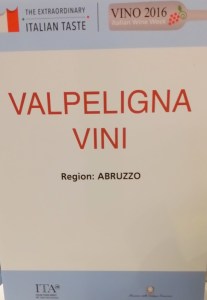
Chris recommended I stop at Valpeligna Vini and try the 2010 Montepulciano which he really favored along with meeting the two brothers Marco and Giuseppe Iacobucci who were representing the wine cooperative that produced the wines. When I stopped by to see if I agreed with Chris, I spoke to Roberto Polidoro who told me an interesting story and cleared up a few facts about the wines we associate with Montepulciano that for me, Frances Mayes made famous in her book Under the Tuscan Sun.

20160209_171424

Montepulciano d’Abruzzo, Don Peppe 2010, Photo Carole Di Tosti

Did you know that Montepulciano D’Abruzzo is a particular grape that evolved in Abruzzo (the province running from the Appinnines, East of Rome to the Adriatic coast), and it is not to be confused with the wine referred to as Montepulciano, actually Vino Nobile di Montepulciano, a Tuscan wine which is a meld of Sangiovese and other grapes? I did not. Italy has over 500 indigenous varietals that are found in the twenty regions of Italy. To give you some perspective, France has only 15 varietal grapes. So when one begins to learn about the great wines of Italy, you will learn amazing stories about the evolution of their many, many grapes and you will want to continue learning about them once you begin to get your “feet wet,” and try another grape varietal or blend which is at the heart of another superb Italian wine.

This is the interesting story about the Montepulciano grape varietal, which did NOT originate in Tuscany, even though it takes the name of the town of Montepulciano in the province of Siena. The grape that grew in Tuscany in the area of Montepulciano was the Prugnolo grape varietal. Prugnolo was cultivated around Montepulciano, Siena since the Renaissance. All the European Renaissance courts from Venice to Paris adored Prugnolo. However, it was around the XVIII century before the French Revolution in 1789 that the Mazzara Nobility had the Prugnolo grape transplanted in the Peligna Valley because of the appropriate climate, soil and other features. The farmers and vintners in the Peligna Valley liked the wines produced by the Prugnolo, but didn’t use that appellation; they used a short-cut to name it, like saying “that Montepulciano grape.”

20160209_170436

Don Peppe 2010, Valpeligna Vini Carole Di Tosti

It has been documented by travelers at the time (Michele Torcia) of 1792 that the grape referred to as “Montepulciano” was being grown everywhere in the Peligna Valley. The irony is that the nature of the micro-climate, the soil, the suns and winds and the cultivation techniques impacted the Prugnolo and actually changed the life blood of the grape’s morphology and thus evolved a completely different grape varietal which those of the then Abruzzo-Moliese (now Abruzzo because the two provinces split in 1963) region were growing. They referred to it as “Montepulciano.”

Thus, who would think that from the Prugnolo, a different grapevine evolved and it was the familiar named grape varietal, Montepulciano. After the split of the provinces in 1963, it became Montepulciano D’Abruzzo because the Peligna Valley and other areas in Abruzzo are where the Montepulciano grapes are grown.

20160209_171417

Giuseppe and Marco of Valpeligna Vini with the Don Peppe 2010. Photo Carole Di Tosti

The full-bodied, bold character of the “that Montepulciano grape” is best realized in the Peligna Valley where Marco and Giuseppe Iacobbuci and other vintners combine their efforts in their cooperative, Valpeligna Vini. And I must say the wine of the Montepulciano D’Abruzzo D.O.C. is sensational and very different from the Tuscan Vino Nobile di Montepulciano, a blend.

I tried the Don Peppe 2010. Its color is dark, deep ruby red. There were lovely notes of black cherry melded with vanilla. It was complex and layered and had a long, strong finish. The tannins were not overwhelming but balanced. Such a wine is great with Grana Padano and other sharp cheeses, salumi, and of course, red meats, roasts and pasta.

Italian wines like the Italian people themselves have within them an amazing story to tell. If we remember that all of Italy’s peninsula is a phenomenal food and wine region (I like to say you can’t get a bad meal in Italy), with the evolution of grape growing morphed by nobles and peasants alike, by monks and clergy who were diligent vintners. The wine tradition goes even further back to the ancestors of today’s Italians, for example, Etruscans, Samnites, Greeks, Romans because often the wine which was fermented, was SAFER and more delicious to drink than water. Indeed, there are similarities to today and upon doing a bit of research, it is amazing what one discovers: the more recent Montepulciano D’Abruzzo grape varietal is a welcome, wonderful addition to Italy’s indigenous varietals.

For me the story of this grape represents the ingenuity of vintners and how they are constantly developing and enhancing their vineyards with improved techniques to tease out the finest most luscious quality wines. As an added note, this does not involve use chemicals (pesticides, herbicides) over a thousand of which are banned in the European Union. The Montepulciano D’Abruzzo is strictly the morphology of the terroir, the microclimate of the Peligna Valley, the sun, wind and rains of the region as it develops from year to year and enjoys its enriched life. These wines of Valpeligna Vini are all bio-dynamic. They are grown with the passion and tender care of the vintners whose vineyards are on the Maiella hillside in Abruzzo. For further information check: Valpeligna Vini.

The Top 50 Sites for Indie and Self-Published Authors

jenowenby's avatarJens Thoughts

I stumbled across this fantastic resource and wanted to share with you. I’d love to hear any feedback.

View original post 93 more words

#Slow Wine 2016, A Festival of Great Wines

Slow Wine 2016, Italian Wines, sustainability, bio-dynamic Italian wines

Slow Wine 2016 at the Highline Ballroom. Photo by Carole Di Tosti

Slow Wine 2016 is in its 5th year touring the globe with stops in Asia, the USA and Europe. Traveling in the US, Slow Wine Guide’s editorial team and select winemakers went from west to east moving from San Francisco, Los Angeles, Austin and New York before they will be heading over to Europe.

Many New Yorkers are proponents of the Slow Wine Guide. They have come to expect excellent wines based on the Slow Wine mantra of good, clean, virtuous wines whose winemakers employ sustainable agriculture, use little or no pesticides or herbicides and engage in traditional time worn techniques using centuries-old indigenous grapes from the various regions of Italy.

Judging from the turnout at the Highline Ballroom, February 3rd, distributors, wine educators, retailers, sommeliers and others in the industry were anxious to become acquainted with exceptional slow wines produced from every region of Italy. A number of the producers were present in NYC rounding out the last of the US tour. Most of the winemakers I spoke with appear in the Slow Wine Guide which was available for purchase during the incredible tasting of reds, whites, dessert wines, and sparkling astis. The Slow Wine Guide features the best Italian wines as determined by Slow Food editors. The guide is also an App and is available for download on the App Store for iPhone.  The App, like the guide hard copy, tells the story behind the producers, their vineyards, and Italy’s wine-producing regions.

Slow Wine 2016, Italian wines, sustainable wines, bio-cynamic wines

Slow Wine 2016 at the Highline Ballroom, 2/3. Photo by Carole Di Tosti

This walk around tasting featured many small-scale winemakers who are using traditional techniques. Following through on their ancestral history and the bio-dynamic changes that have been occurring over the decades since the concept of “Slow Food, Slow Wine” emerged and was implemented, the producers work with respect for the environment and terroir. They make sure to safeguard the incredible biodiversity of grape varieties that are part of Italy’s heritage.

Winemakers who embrace the Slow Wine Guide symbols and standards are truly coming into their own. I talked to a few sommeliers and educators associated with culinary institutes. They agreed with me that when the producers began to convert from the chemicalized agriculture to bio-dynamic and sustainable tenets, the wines they initially constructed were not very good. However, as winemakers shared information and worked to perfect their techniques over the last thirty years, today the wines they produce taste out of this world. For me of vital importance is the added assurance that the agriculture used to produce the taste is sustainable. Most of the wineries have US distribution.

Piedmont, italy, Italian winemaking region

The Piedmont region of Italy. Turin is the capital. It has been designated a UNESCO World Heritage site.

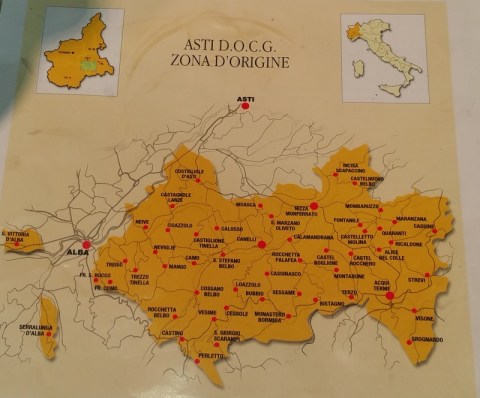
Some of the producers whose tables I visited were from the Piedmont region of Italy, with Turin as its capital, a place where some of my ancestors are from. In north western  Italy, the Piedmont is a region whose wines I was not familiar with. What I found particularly interesting is that the Langhe wine making zone in the Piedmont has been recognized as a UNESCO World Heritage Site. That added protection will hopefully maintain the flora and fauna of the area for decades and will protect the vineyards and producers from land raids by developers.

Cà ed Balos, Slow Wine 2016, bio-dynamic Italian wines, Italian wines sustainable wines

Exceptional wines from Cà ed Balos winery in Piedmont. Photo by Carole Di Tosti

Some of the winemakers whose exceptional wines I tasted included wines from producer Renata Bonacina of the winery Cà ed Balos.  The dessert wine Moscato d’Asti  was particularly drinkable. Another winery from the Piedmont is Bruno Nada’s Fiorenzo Nada, whose son Danilo is following in his father and grandfather’s footsteps. Danilo introduced me to two delicious red wines. From Bruna Ferro’s winery Carussin, Luca introduced me to two lovely red wines. Representatives of the consortium of wines from PiedmOnTop introduced me to wines from four different vintners.

There were two other wine regions I sampled wines from: Emilia-Romagna and Tuscany, both whose regional wines I tasted before this event, though I had not tasted wines from these producers which were just great. From  Modena in Emilia-Romagna is the winery Cantina Della Volta whose “prestigious cellar is old in origin but modern in conception” according to the Slow Wine Guide 2016. And from Tuscany was a type of wine that I drank years ago at family gatherings but I thought was boring: Chianti. Chianti has been revolutionized. It overshadows many of our West coast reds for drinkability and agricultural integrity. When I tasted the offerings of Badia a Coltibuono, I was impressed. Slow Wine states that the winery is “a paragon of good Italian viticulture and has been certified organic since 2000.” All of their efforts to work sustainably have produced some incredible Chiantis. After having turned up my nose at this type for years, Badia a Coltibuono as made me a convert to be on the lookout for more amazing Chiantis like those of this winery.

This year’s Slow Wine 2016 was an exceptional event. Because of the tenor of what it means to produce the fruit of the earth without harming the vines, the terroir and environment, I am persuaded that these wines are finally achieving a level of quality that conventional wines produced with chemicals will never attain. I am sorry that I couldn’t get to each vintner, but I do have the Slow Wine Guide to keep me apprised of the offerings of great Italian vintages that have been produced in a growing style that most wine lovers will come to expect over time because the wines are incomparable.

Continually, Europe has been way ahead of the United States with regard to sustainability, local food sourcing, the rejection of radiated foods and the labeling of GMOs. Unlike the US, Europe has banned over 1000 chemicals which appear on a blacklist as toxic for people and the environment. To have such chemicals (herbicides, pesticides, chemical fertilizers) used in the production of agriculture and husbandry (antibiotics, growth hormones, processed feed), is anathema to most countries in the European Union. Because Italians are assiduous keepers of clean food and wine, the quality of the food Italians experience daily has superb taste, nutrition and cleanness. To have wines which exemplify the same value and worth as their food makes complete sense and complements a daily lifestyle that shows an appreciation for life and beauty. Would that we were to follow the European and Italian Slow Food and Slow Wine example.

This article first appeared on Blogcritics.

Commedia dell ‘Artichoke: A Pizza/Theater Combo You’ll Love

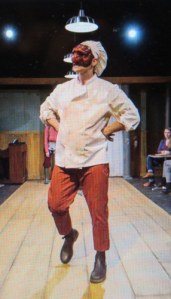
Carter Gill, Pulcinella, Commedia dell 'Artichoke, Gene Frankel Theatre,

Carter Gill  in Commedia dell ‘Artichoke at the Gene Frankel Theatre. Photo courtesy Jacob J. Goldberg.

One of the best kept secrets in Manhattan for enjoying a night of rollicking, hysterical fun, lip-smacking sumptuous pizza and a bit of wine to restore one’s nerves during a hectic work week is Commedia dell’Artichoke at the Gene Frankel Theatre. Presented by Frances Black Projects in association with CAP21, the production is a hyper blast party of stupendous fun which runs until February 6.

Commedia dell’Artichoke is a ripping comedy like no other you will see in the city for its inventiveness, extemporaneous joyride, audience participation and prescient, trending humor.  It’s conceived by the ingenious team of Frances Black, Carter Gill and Tommy Russell, who have honed their artistic statement into a whimsical whirlwind, a compendium of ancient and modern social satire about how the wealthy stick it to the classes beneath them and how the working classes push back with resilience, humor and verve. The show boasts Devin Brain at the director’s helm who skillfully guides the unique performance art of Carter Gill, Alexandra Henrikson, Tommy Russell and Shannon Marie Sullivan. All of these actors are scintillating.

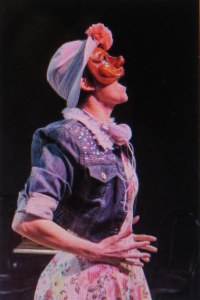
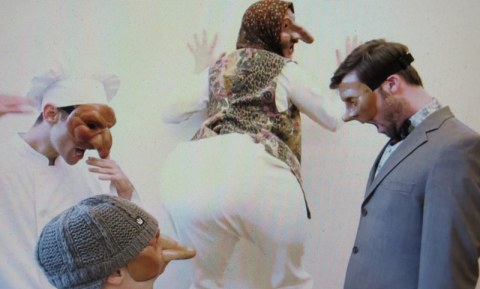
Over the course of the evening, Gill, Henrikson, Russell and Sullivan broadly portray 10 characters in the Commedia dell’arte style, with grotesque masks, antic characterizations and hyper-mannered behaviors. Not only are the actors superb comedians with expert timing, they sing and dance with sheer abandon. The show has an extemporaneous feel, added to by the audience participation: anything can happen. Surprising moments are completely appropriate to the winding, picaresque storyline.

Shannon Marie Sullivan, Commedia dell 'Artichoke, Gene Frankel Theatre

Shannon Marie Sullivan in Commedia dell ‘Artichoke. Photo by Jacob J. Goldberg.

The beauty of the production is that the silly absurdity of some scenes allows the actors’ musical breakouts, which prompt our unexpected laughter. And that ebbs into somber thoughtfulness about the wisdom of what we have experienced; this is expert, clever, comic pacing. We appreciate the pithy jokes about “The American Dream-nightmare,” trending political slogans, social media topics, gender loops and much more. The humor is sardonic, darkly funny, socially meaningful. All makes complete sense, and you have the time of your life romping in the intellectual brilliance and ridiculousness of these characters who “know the score.”

The original musical numbers are beautifully integrated, with appropriate accompaniment by band leader and multi-instrumentalist Robert Cowie. The music helps shape the plot dynamics and organically evokes the scenes. The actors/characters bring Cowie into their ensemble as their dutiful “conductor” of fun. He good-naturedly accompanies/instigates the songs, fanciful tunes and dances.

This “gypsy” music echoes the ideas of love and empathy. In a deus ex machina rescue, the villain, Adam Smith’s “Vile Maxim” incarnate, La Capitana (portrayed with audacious, Trump-like ferocity by the operatic Alexandra Henrikson), is deflected from enacting dire financial doom upon our hero, Carter Gill’s brash, endearing everyman and pizza “entrepreneur” Pulcinella. As the production concludes, hope and a stay of financial execution are achieved for another day. All ends well in the perfect unity of comedy.

If I had to explain to you specifically how we arrived at this superb finale, I couldn’t. The journey is labyrinthine, fraught with diversions and robust antic scenes from Pulcinella’s conflicted life, leading back to the beginnings when Pulcinella, whose pizza we have enjoyed, explains his New York City dreams to become a “self-made man.” With gyrating plot arcs which double back on themselves, vignettes which make sense in their nonsense, and brilliant jokes that kill as they are tossed off like salad leaves for you to either graze on or disallow, this is as close to Commedia dell’arte style as you will see in our savvy, super-cool city.

IMG_2939

Carter Gill, Alexandra Henrikson, Tommy Russell and Shannon Marie Sullivan in Commedia dell ‘Artichoke at the Gene Frankel Theatre. Photo by Jacob J. Goldberg.

Scenes spiral out from protagonist Pulcinella and his retinue. The conflict pounces on our poor hero in the form of villain Capitana and her sycophant lackey Tartaglia. Capitana, a crazy caricature of the stereotypical mannish woman boss, signifies the American nightmare of the business class that will stop at nothing to make American business “great,” “big” and “hard” again in order to blow away China (the sexual allusions are funny).

In keeping with these undemocratic notions, Capitana must wipe out Pulcinella and develop the area (her projected store possibilities are riotous) into “greatness.” It is a displacing event all too familiar to real-estate-pressured New Yorkers. Along the way, we meet other Commedia-style “stock” characters in Pulcinella’s life, modernized but with their Commedia flavor (thanks to Commedia consultant Christopher Bayes) present. The comic scenario has been ramped up to satirize urban life, mega-developers vs. the little guy, crazy cultural tropes, corporate business models, etc.

The hijinks are nonstop. And as you enjoy the entertainment, you also swallow the characters’ irony about our city’s social infirmities: its hyper-development, its classism, its intransigence against democratic wellbeing for all. We laugh as Pulcinella comments about having to work and work and work some more and work your butt off and do more work, ostensibly to make it to the first rung up the ladder of success.

And as for climbing up into the clouds where the Bloombergs and Trumps abide, there’s always a Capitana to toll the financial death knell or pour acid into one’s bleeding bank wounds. These types manifest the cryptic financial screed of being “bigger and better” (as Capitana does to Pulcinella) by raising the rent to “one dollar more than you can afford.” Though it isn’t stated, the message is clear and we have come to know it as brutal irony: “It’s nothing personal, just business.”

The actors’ high energy spins out other rapid-fire scenes about the ridiculousness of who we choose to love, the zany relationships we become involved in, and a guy’s proper etiquette toward a gal. Such pointed jokes ground us in ourselves. The sharp humor brings us to the remembrance that in the theater as in life, we are in this together. As we laugh, we encourage each other to enjoy the journey. We can control some things, but other events just unfold. We dare not stand in the shadows nor miss the passing parade or the fun will dissolve. Just dive in and don’t consider how it will turn out because what you prepare for won’t necessarily happen in the ways you expect.

Pulcinella’s artichoke pizza is one of the better pizzas in the city. You certainly do not want to miss his hard work and the effort it took to concoct his super recipe of deliciousness and fun. The production is comic genius. The show should be extended or brought back again in another venue. See it while you still can.  Commedia dell’Artichoke will be at the Gene Frankel Theatre until February 6.

Orchidelirium: The NYBG Orchid Show 2016

orchid, NYBG

Orchiddelirium, the theme of the NYBG Orchid Show 2016

Are you a fan of orchids? Do you properly care for them? Or do you end up having to throw them away? When orchids were first discovered, people were devastated when they killed them because other orchid plants were not easily accessible. in the 1900s orchids were a rare flower commodity until things began to change and they grew in popularity as they became known.

Orchidelirium was the title given to the Victorian era of orchid flower madness when collecting and discovering these exotic and beautiful plants was the intention of wealthy merchants and fanatical collectors. Motivated by the flower frenzy, they hired explorers to uncover different, unknown species from far flung reaches of the world oftentimes at great danger to themselves. The obsession with orchids never really died down if one reads Susan Orlean’s The Orchid Thief,  a humorous tome about orchid collecting and the lengths to which those in the business go to indulge their passion for orchids, even theft.
Orchidelirium, NYBG Orchid Show 2016, orchids

NYBG Orchid Show 2016

For orchid passionistas, the NYBG has an extensive collection of exotic and rare orchids, some that don’t even look like orchids, yet, they do belong to the same plant family. Because of the ever popular annual orchid show in February of each year, it was no large leap to understand how NYBG orchid curators and exhibit programmers might have gained inspiration from the frenetic orchid craze of the Victorian era to revisit that time and spur on fans’ curiosity and love of the exotic blooms, by referencing the Victorians’ fervent obsession.

Orchidelirium the NYBG 14th annual orchid show which opens on February 27th and ends on April 17th, promises to inform, dazzle and celebrate the century-old appreciation of what Mark Hachadourian, NYBG Director of the Nolen Greenhouses and Rock Garden for Living Collections-and an orchid fancier, has characterized as the largest and most environmentally adaptive plant family in the world.
pansy orchids, NYBG, 14th Annual Orchid Show

Pansy orchids from previous NYBG orchid shows.

Visitors to the landmark Enid A. Haupt Conservatory will step back into the time when orchids were a rarity to confound and mesmerize. Wealthy Victorians were surprised that some of the lavish blooms had no fragrance while others did. Nevertheless, they were enchanted with the orchid’s symmetry and pixie tongued faerie face that elevated the flower to a symbol of power, opulence and luxury in England.
The indulgent fascination with the vast varieties of blooms of a continuum of shapes, sizes and textures will thread the exhibit and highlight how these amazing flowering plants were transitioned from the wilds of jungles and deserts to indoor cultivation in conservatories and glasshouses, and eventual commercialization when the price could be stabilized and lowered for the middle classes.
orchids, NYBG,

NYBG orchids from previous years at the Orchid Show.

The NYBG’s substantial and elegant permanent collection represents all the floristic regions of the world. These include Australia, Africa, South America, and Madagascar. The exhibition will showcase some unusual and rarely seen jewels in the NYBG orchid crown. One such specimen is the spectacular Psychopsis papilio which inspired the Duke of Devonshire’s obsession that instigated Orchidelirium in London. Another inspiration which will be displayed is Paphiopedilum sanderianum which was named for the nurseryman Frederick Sander, the self proclaimed “Orchid King,” a plant which is renowned for its petals’ remarkable length.
IMG_2894-001

Orchidelirium at the NYBG Orchid Show 2016, evoking the Victorian era scenes with orchid blooms.

Moving on through the Conservatory galleries, visitors will learn about the transition of orchid growing. The trendsetting Duke of Devonshire began collecting orchids in 1833 at his Chatsworth House estate (still there today). His head gardener, Joseph Paxton, revolutionized the way orchids were cultivated in England by innovating larger and more effective glasshouses, beginning with the Great Conservatory in London and culminating in his masterpiece, the Crystal Palace of Prince Albert’s Great Exhibition in London in 1851.
A series of orchid vignettes will recapture the brilliant glasshouse displays that the Duke and other collectors tirelessly effected with their newly acquired delicate specimens brought back by explorers, hunters and adventurers with whom they fiercely competed for various plants and endured all manner of thrills facing animals, reptiles, humans who would readily pounce on them for disturbing their territory.
NYBG ORCHID SHOW 2016, orchids, NYBG

Orchid varieties number into the thousands. Some of these will be represented at the NYBG Orchid Show 2016.

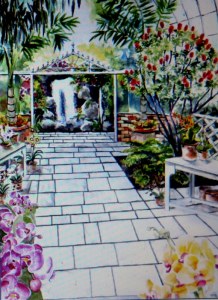
 From antique to modern, the orchids are in stand alones amongst the glasshouse greenery, as well as in hanging baskets, hanging pots, Victorian wall displays and elsewhere, in fact, wherever you turn. Each area of the conservatory will contain a diverse selection of orchids from around the world. Formal arrangements will be intermingled with casual plantings however, in typical NYBG fashion. And you can expect that all will be made exuberantly gorgeous and lush with a riot of blooms assaulting the intellect and immersing one in a sensory playland. A small stone patio will accommodate a stunning Wardian Case (an early type of protective terrarium for plants), housing a selection of miniatures.
NYBG ORCHID SHOW, orchids

pansey orchids from prior NYBG Orchid Show

Diverse programming will follow the exhibit during which a variety of events will take place: Orchid Evenings, World Beat: Music and Dance around the World of the Orchid. There will be weekend orchid care demonstrations with topics like “Easy Orchid Care,” “Fantastically Fragrant Orchids, and “Orchid Tips for Amateurs.” These important tips will encourage orchid purchasers and collectors to properly maintain their orchids so that they may bloom more than once and so that they may even harvest the orchid seeds. Once you become more familiar with orchids and their care, the temptation to throw away an orchid because “it won’t bloom,” will be counteracted with, “I am going to get this orchid to bloom a few times, and will NEVER consider throwing it away.”

Kudos go to designer Christian Primeau who oversees the extensive tropical/subtropical plant collections housed in 11 unique environments in the Conservatory. Marc Hachadourian curates the exhibit’s orchid selection and the NYBG’s extensive groupings of living plants from around the world housed in the Nolen Greenhouses, the behind-the-scenesglasshouses where plants for the Garden’s indoor and outdoor and science program are grown and maintained.

The 14th annual orchid show ORCHIDELIRIUM promises to be an enlightening and enjoyable way to usher in springtime at the NYBG. The show begins on February 27th and ends April 17th. You can learn more at the NYBG website by clicking HERE.
Photos and copy details courtesy of the NYBG.

Screenwriters Lab Open Submissions

IMG_2215-005

The Maidstone, Headquarters of the HIFF. Photo by Carole Di Tosti, Ph.D.

The Hamptons International Film Festival Screenwriters Lab is open for submissions.

ABOUT THE LAB

The Hamptons International Film Festival’s Screenwriters Lab is going into its 16th year. The HIFF Lab is an intimate gathering that takes place each Spring in East Hampton, New York  from April 8- 10, 2016.

The Lab develops emerging screenwriting talent. It pairs established writers and creative producers with up-and-coming screenwriters. The screenwriters are selected by HIFF in collaboration with key industry contacts. In a one-on-one creative laboratory setting mentors advise the initiates. Additional events bring the participants together with board members, sponsors, the local artistic community, and other friends of the festival. Scripts from past year’s screenwriters have gone on to production year after year. The vital feature of The Lab is that it has and will continue to be an inspirational, safe venue where artists can perfect their craft and creative vision.


Recent Lab projects have evolved into productions that have screened at festivals world wide. These include Sundance, South by Southwest, Katlovy Vary, Locarno and the Los Angeles Film Festival.  Selected highlights include Short Term 12 with Brie Larson (she is currently in the amazing ROOM) and John Gallagher, which won the Grand Jury and Audience Award at SXSW. The Discoverers starring Griffin Dunne, Little Accidents featuring Elizabeth Banks and Chloe Sevigny, Fort Bliss starring Michelle Monaghan and Ron Livingston and Twelve, starring Ellen Barkin and Emma Robers, the 2010 Sundance Film Festival Closing Night film are just a few of the projects that have taken off to success.

IMG_2275

Dennis Quaid, Q & A for HIFF Opening Night screening of TRUTH, film by Screenwriters Lab Mentor James Vanderbuilt. Photo Carole Di Tosti

NOTED LAB MENTORS

Recent HIFF Screenwriters Lab mentors are Alex Dinelaris (Birdman),  Nicole Perlman (Guardians of the Galaxy), Oren Moverman (The Messenger),  Michael Cunningham (The Hours, Evening); James Vanderbilt (Zodiac, Truth), Mark Heyman (Black Swan),  Rob Siegel (The Wrestler),  Anna Boden and Ryan Fleck (Half Nelson, Sugar, Mississippi Grind), Hawk Ostby (Children of Men),  Whit Stillman (Metropolitan, The Last Days of Disco),  Ira Sachs (40 Shades of Blue, This Married Life),  Andy Bienen (Boys Don’t Cry),  Lawrence Konner (The Sopranos, Boardwalk Empire),  Maria Maggenti (The Incredibly True Adventures of Two Girls in Love),  and Laurie Collyer (Sherrybaby)


DEADLINES

Earlybird Deadline | December 1, 2015

Regular Deadline | December 15, 2015

Late Deadline | December 29, 2015

WAB Extended Deadline | January 12, 2016

For more information contact: hamptonsfilmfest.org

PRESS CONTACTS

FRANK PR | 646.861.0843

Lina Plath | lina@frankpublicity.com

Nicole Kerr | nicolek@frankpublicity.com

New York Film Festival Review: ‘Ingrid Bergman in Her Own Words’

Ingrid Bergman, New York Film Festival, Ingrid Bergman in Her Own Words

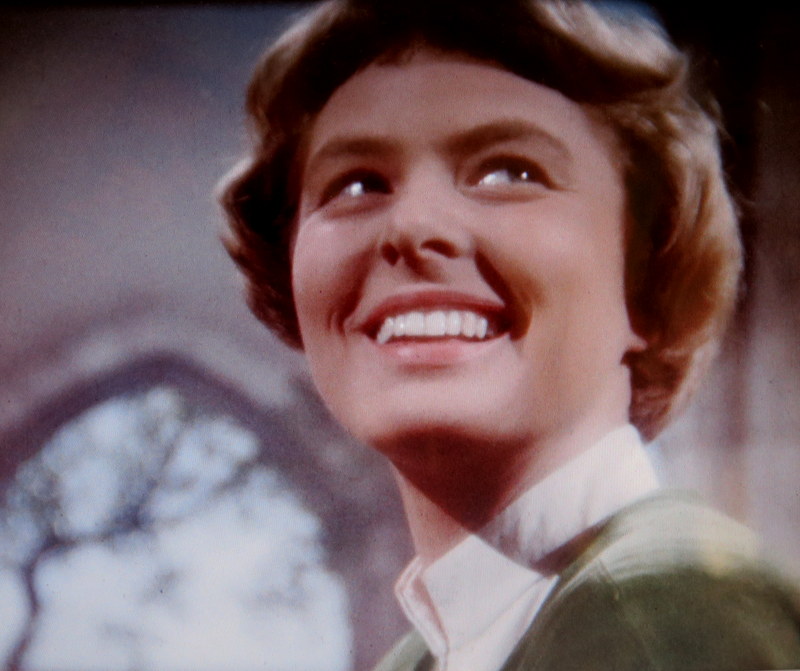
Ingrid Bergman in ‘Ingrid Bergman in Her Own Words.’ Photo courtesy of the film.

Celebrations of Ingrid Bergman’s 100th birthday (August 29, 1915) have been taking place all year, as fans and film professionals honor the iconic Swedish actress, winner of 3 Academy Awards, 4 Golden Globes, 1 Tony and 2 Emmys. But perhaps the greatest celebration of Bergman’s amazing career and life is the documentary Ingrid Bergman in Her Own Words, directed and written by Stig Björkman and Dominika Daubenbüchel. Björkman offers a fresh and intriguing perspective of Bergman: the person and the actress.

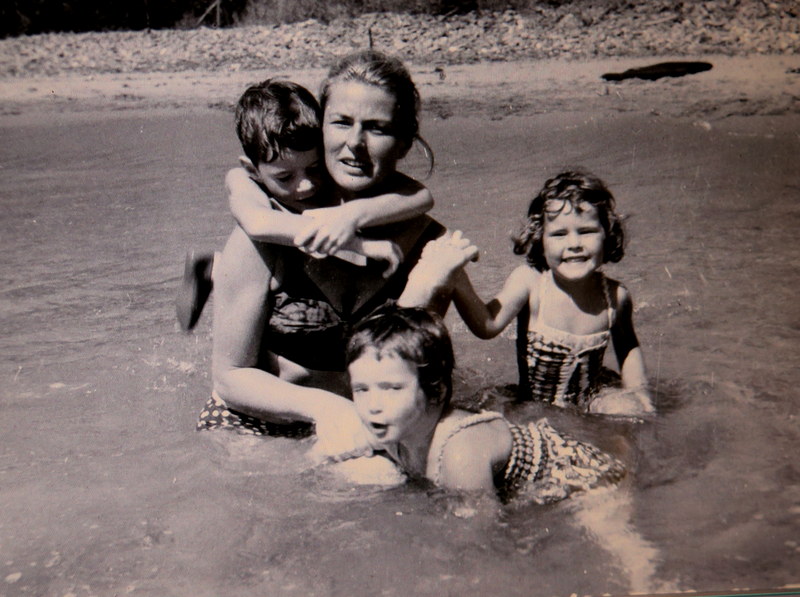
The documentary is a fascinating account of Bergman’s life, cobbled together using Bergman’s own 8 and 16 mm family film clips, Bergman interviews, pointed snippets from Bergman’s childhood diary entries, letters to best friends (the voice-over narration read by Alicia Vikander), and vibrant commentary by her four children Pia Lindstrom, Isabella, Ingrid and Roberto Rossellini. Bergman was a pack rat who saved, letters, photographs, and other personal memorabilia.

Her diary and letters are a treasure trove of her evolving thoughts, impressions and personal growth over the years. Her letters, and the interviews about her relationships with her husbands, her agent, her close friend Ruth Selznick (wife of David O. Selznick), and her own self-described identity as a bird of passage, who flew to new ground where she forged another milestone in her life marked “change” as the only permanence she would cling to.

The amazing and juicy tidbits Bergman wrote in letters and diaries, and the film clips that she, herself, took, chronicle her life and the times in which she lived. The material makes for a thrilling historical glimpses into the aura of film studios (Hollywoodland’s golden times), the hypocritical social folkways of the times (the culture’s response to her affair and marriage to director Roberto Rossellini), her film directors (Hitchcock), her travels through European cities a few years before WWII, and much more. The director includes Bergman’s pre-WWII footage of marching Nazi Youthregiments, and Storm Troopers doing maneuvers. Prewar anti-semitic slices of life in Berlin–prescient warnings–Bergman captured in footage and photograph: a glimpse of the horrors to yet to come.
Ingrid Bergman, Ingrid Bergman in Her Own Words, New York Film Festival

Ingrid Bergman and her children. ‘Ingrid Bergman in Her Own Words.’ Photo courtesy of the film.

In every country she lived (Sweden, the U.S., Italy, France and England),  Bergman carried her most prized possessions with her. These mementos represented her very being. To leave them behind or destroy them would have meant obliterating a part of herself and her past. Considering that she had to pack them up each time she moved on, whether to a new city or new partner, this was no small feat. It is clear that the artifacts symbolized her heart’s love and held profound meaning for her. The public is fortunate that they are archived at Weslyan University, and many are revealed in this documentary.

Putting the pieces together from these slivers of history, the director traces her life voyage as Bergman attempts to put down roots for herself and her family. Her personal films reveal the human woman and her interconnected, loving, down-to-earth persona as friend, wife, mother, and general ambassador of good will. The clips also exhibit that when the roots deepened, she changed her garden landscape and pulled them up to transplant herself. The director includes her perspective that whenever she became stifled or felt she was not progressing within, she had to release herself to the universe and embrace another adventure, another world that she would create at will.
Ingrid Bergman, Ingrid Bergman in Her Own Words, New York Film Festival, 100 Year Celebration of Ingrid Bergman's Life

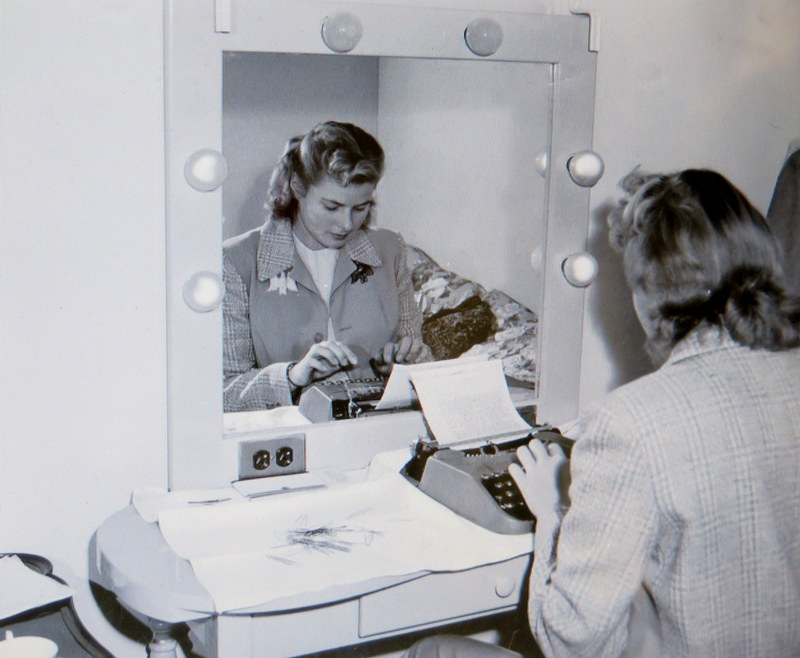
Ingrid Bergman in ‘Ingrid Bergman in Her Own Words.’ Photo courtesy of the film.

Using Bergman’s own metaphor, “bird of passage,” she became inspired to move on, not wanting to remain settled or stationary. The documentary material reveals how much Bergman enjoyed her freedom. Thus, although her children often rued her departure because she was so much fun to be around, she never took them with her. She understood the instability, insecurity and upheaval caused by her need for continual movement, and likewise comprehended that her children required a solid foundation. They needed to finish their schooling and be embraced by the comfort of familiar surroundings. During her travels and transformations, the children were raised by her former husbands and their wives or family members. In leaving her families and moving on, there was sorrow, and whenever she could she would see them and bring them to visit in the next city where she remained for a time.

This candid and very open view offered by her adoring adult children, and her archived material reveal what was paramount in Bergman’s life. As a young girl, she wanted to be a great actress; she made this dream real and in the pursuit of this goal she remade herself in her personal and professional life. She was a maverick, an autonomous and independent woman ahead of her time.

Stig Björkman discloses that the colorful, charming and beautiful creative spirit was as flexible and strong as a reed in the storm. Hence, she took on the creative challenge to be brilliant at her craft: that was the force that flooded her veins and propelled her to flight and transformation. It propelled her into Swedish films and then to Hollywood. It propelled her away from her first husband into the arms of director Roberto Rossellini and into a hiatus of filmmaking, scandal and media vilification. It propelled her away from Rossellini back to a declining and morphing studio system that embraced her and forgave. It propelled her onto the stage and to TV. It propelled her into the arms of her third husband, a stage producer.

Ingrid Bergman shooting family films in 'Ingrid Bergman in Her Own Words.' Photo courtesy of Mantaray AB.

Ingrid Bergman shooting family films in ‘Ingrid Bergman in Her Own Words.’ Photo courtesy of Mantaray Film AB.

Throughout her life existed the compulsion to be a great actress. Next to Katherine Hepburn, Bergman is the most awarded actress in the film industry, and one of the most celebrated. Acting, she realized, stirred her to the finest joys in her life. In establishing her career, she lay her own self-evolved identity apart from anyone else. In the craft, there could be boundless creativity. In the process, there were no tethers to rein her in. Because of acting, Ingrid Bergman was her own woman. Because of her prodigious talents she possessed her own soul.

The director wisely reveals the maverick Bergman through her own 8 and 16 mm films, with only passing reference to her movie persona. By the end of the documentary, we understand that Bergman was an iconic woman for all time, in her ambition, her recreations of her own identity and especially for her courage in breaking through the restrictions of cultural hypocrisy and double standards.

The documentary is an homage to the film industry and the personal life of one of its enduring actresses. The editing is a bit uneven and a few sections could have been tightened, even though a fine musical selection adds to the film’s poignancy when relating her early years. Nevertheless, the director avidly selects and shapes Bergman’s mementos in a presentation that clarifies a salient theme. It is a reminder to us that, like Bergman, we must do exploits. It is a call to be one’s own person, regardless of social hypocrisy or the social pressures to conform to an image that is not our own.

If Ingrid Bergman had lived longer, surely she would have supported women’s power constructs in the entertainment and media industry. Included in one of her last TV interviews, she comments on ageism and the illogic of it. Sadly, the industry has not budged from her time to ours; roles for “older” women (in their 30s, as Maggie Gylenhall implied recently) are in short supply. Bergman spoke out and though her comments may have been only noted by a few men, she encourages that women must raise their voices continually. By using Bergman’s “own words,” the director cleverly emphasizes the power of voice. It is her power of voice and her example that challenge us from beyond the grave. In this Stig Björkman has done a masterful job.

This review first appeared on Blogcritics @ http://blogcritics.org/new-york-film-festival-review-ingrid-bergman-in-her-own-words/

Kurt Cobain Suicide Controversy. ‘Soaked In Bleach,’ A Film by Benjamin Statler

Kurt Cobain, 'Soaked in Bleach, suicide controversy, Nirvana

Kurt Cobain, ‘Soaked in Bleach.’ Photo courtesy of the film.

 Soaked in Bleach (a lyric in “Come as You Are” from the album Nevermind), is the metaphoric, suggestive title of Benjamin Statler’s film which infers what really happened in the Kurt Cobain death investigation. The documentary begins with the acknowledgement that for Generation X, Kurt Cobain was the equivalent of what John Lennon was for the baby boomers. Both ended up dead before their time with Cobain at 27, the same age as Jim Morrison at his death. Cobain was the “go-to” Alternative-Rock icon, establishing grunge music with a permanent place in the stars and Cobain’s Nirvana the #1 spot on the Billboard 200 in 1992 with the album Nevermind. His tragic death two years later on April 8th, 1994 was pronounced a suicide by the Seattle Police Department.

The question of whether it was or wasn’t a suicide is the subject of Soaked in Bleach. The filmmakers with pinpoint logic, methodical and meticulous details and facts underscore that the gunshot wound to Cobain’s head, the position of the rifle and Courtney Love’s (his wife), insistence that Cobain was suicidal, prematurely closed down any further death investigation of the quiet, press-shy man whose music reached out to the down trodden of society and whose language spoke to the “average Joe in the streets.”

Courtney Love, 'Soaked in Bleach, Kurt Cobain, Nirvana, suicide controversy

Courtney Love, Kurt Cobain’s wife. ‘Soaked in Bleach.’ Photo from the film.

Statler uses film clips of testimony by retired law enforcement experts in forensics, investigation and homicide, who point out that a death ruled a suicide conveniently precludes the need for any further investigation of the evidence. After such a ruling, investigation becomes nearly impossible. This is doubly so for Cobain whose body has been cremated; interestingly, the building where his body was found, soon afterward was ordered torn down. The notion  of suicide was first presented by Courtney Love when she hired private investigator Tom Grant to locate Kurt Cobain. This was five days before the corpse was located. That notion of suicide was fueled by the media along with other misinformation which the filmmakers expose as lies. Indeed, the rapacious media reveled in the story of another celebrity rocker nihilist who “burned bright and burned out.” Thus, filmmakers disclose that the idea of Cobain’s death as a suicide was entrenched. It helped to obliterate the need for any credible death investigation into what really might have happened. According to experts the Seattle Police Department prompted by Love in a highly unusual and uncharacteristic move for law enforcement death investigations ruled his death a suicide in one day, the day the body was found. Then they closed the file on Cobain.

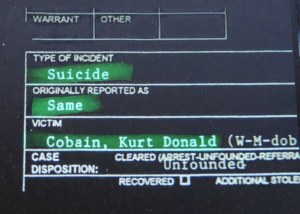
Kurt Cobain, 'Soaked in Bleach, suicide controversy

From the official file on Kurt Cobain. ‘Soaked in Bleach.’ Photo courtesy of the film.

If suicide is convenient for the police and the possible murderer or murderers, then inconvenient is the aftermath of Cobain’s suicide as it has influenced others. Fans of the rocker have celebrated him in death by more greatly embracing his music and memory in life. Then there are the others. These are the copy cat suicides.  Reports of teens have sprung up over the years. It is a global phenomenon. As parents have had to bury their children who killed themselves leaving notes that referenced Cobain’s death or Nirvana’s song lyrics, they’ve had to go through the tragedy of asking themselves how they could have prevented their deaths. To date there have been 68 related copy cat suicides, each one of them a profound, individual family tragedy. To consider that Cobain might have been the victim not of his own hands but of someone else’s would make their deaths a completely macabre and twisted irony too horrible to contemplate.

Soaked in Bleach reveals this and more as filmmakers travel the stark, mind bending road uncovering truths that conclude Cobain’s death was improperly investigated and incorrectly determined. The implications that his was a probable homicide run far and wide to decrying the investigative skills of the Seattle Police Department and implicating those in charge at the time. If the investigation of Cobain’s death is reopened as suggested by journalist Max Wallace and officials like retired Seattle Chief of Police, Norm Stamper, Vernon J. Geberth, former Homicide Commander of NYPD, the Bronx, and Dr. Cyril H. Wecht (Forensic Pathologist and Former President of the American Academy of Forensic Science), and if Cobain’s death is ruled a homicide, the problem will be locating enough evidence to identify a killer or killers. Motive will play a huge factor in that determination. Filmmakers, through the testimony of experts, suggest possibilities.

Kurt Cobain, 'Soaked in Bleach,' Nirvana, greenhouse

The greenhouse where Cobain’s body was found. It has since been destroyed. ‘Soaked in Bleach.’ Photo from the film.

This documentary first and last is tantamount to a crime thriller. Though Cobain’s suicide ruling by police was a quick and dirty convenience, Statler and co-writers Donnie Eichar and Richard Middleton make the compelling case that it wasn’t. They present this argument  throughout with clips of Cobain’s friends who give testimony about his positive mental state, tape recordings, experts’ commentary, and recreations of the players who peopled the last days of Cobain’s life before the body was discovered.

These evidentiary revelations and facts are contrasted with media misrepresentations and video clip commentary by Seattle Police investigators who journalist Max Wallace, Norm Stamper, Vernon J. Geberth and others infer made a “rush to judgment.” The lynchpin in the filmmakers’ presentation is private investigator Tom Grant whose law enforcement background and reputation are sterling. Grant, who was hired by Courtney Love to locate Kurt Cobain 5 days before his body was found, discusses his experiences dealing with Love during this time. It is his revelations that are the most startling, it is his commentary that is the most logical and convincing.

As Statler focuses on Grant, he includes audio clips of Grant’s tape recordings of conversations with Courtney Love and others during the time he worked for her. Suspicious of Courtney Love’s contradictory stories, Grant taped her and taped all of those he spoke to including her attorney and Cobain’s friends. With these tapes and Grant’s narrative, filmmakers narrow to a still point his logical conclusions and the rationale which teases out the threads of truth from media falsehoods. It is these which they sew into a manifest tapestry that Cobain’s death was anything but a suicide.

Tom Grant, Kurt Cobain, 'Soaked in Bleach.

Tom Grant’s tape recordings. ‘Soaked in Bleach.’ Photo from the film.

The documentary is beautifully organized and layered into clear, easy to understand segments. Statler’s adept direction makes excellent use of his recreations to reveal the chronology of the days Grant worked with Love. Continually interspersed throughout are clips of the experts who pull apart the Seattle Police Department’s uber brief death investigation to reveal their mismanagement of the case, their blunders as well as how and why this probably occurred. Pieces of evidence and reports are reviewed. There is one that is particularly astounding. It was identified that the amount of heroin in Cobain’s body would have put him in a coma or near coma state; he would not have been sentient enough to use a shotgun to kill himself.

Soaked in Bleach is a film to see if you enjoy investigative crime documentaries. Even if one is not a fan of Kurt Cobain and Nirvana, the film is powerful in what it suggests and well made in its presentations and argument. It is clear that the filmmakers have taken the time to carefully reconstruct the possibilities of what didn’t happen in the death of Kurt Cobain. They do this in the interest of discovering what actually did happen to a man whose life had miles to go.

This review first appeared on Blogcritics.


A Conversation With Dan Lauria About The Inspiration For His Play ‘Dinner With The Boys’

Dan Lauria, Ray Abruzzo, Richard Zavaglia, 'Dinner With The Boys,' Acorn Theatre

(L to R) Dan Lauria, Ray Abruzzo, Richard Zavaglia in ‘Dinner With The Boys,’ at the Acorn Theatre until July. Photo courtesy of the website.

Before Dinner With The Boys opened Off Broadway at the Acorn Theatre, I went to a press event for the production where the producer and director introduced the show, its cast and playwright Dan Lauria (Lombardi, Christmas Story, The Musical), who also stars as Charlie. The play is about two wise guys with issues that only Big Anthony Jr. (Ray Abruzzo-“The Sopranos”), can solve after he shows up for a delicious home cooked, mouth watering dinner by Dom (Richard Zavaglia-Donnie Brasco) who is Charlie’s chef roommate. The press event and following conversation with Dan Lauria took place before I saw and reviewed the production. Turns out what I had intuited about the performances was spot on. The show is smashing and I enjoyed the rollicking night of joy and farce that has a number of sardonic twists. You can read my review here on Blogcritics.

Introductory Remarks by the Producer, Director and Playwright

Pat Addiss, 'Dinner With The Boys,' Acorn Theatre

Pat Addiss, producer of ‘Dinner With The Boys,’ at the Acorn Theatre. Photo by Carole Di Tosti

Pat Addiss (Producer): I knew Dan Lauria when he played the lead, Jean Shepherd, in A Christmas Story, The Musical for us. And he told me about this wonderful show that he’d written for Dom DeLuise and Charles Durning and Jack Klugman and he told me how they were all dead. And I asked him if he isn’t getting a message. And he got the message. And he loved Gabe Barabas and SuzAnne Barabas at The New Jersey Repertory. He knew them before I was on the board. And he wanted them to produce this even though we were just a little black box theater. It all happened thanks to Dan and Suzanne and Gabe. Here I am; I’m so lucky that last night I had my own dinner with the boys. We are also going to have a dinner at Tony DiNapoli’s every Tuesday where people can buy tickets and can also buy dinner at Tony DiNapoli’s and have dinner with the boys. I’m very excited about the production, but before I go any further, I’d like to introduce our wonderful director Frank Megna and he can tell us a bit about the play.

Frank Megna, 'Dinner With The Boys,' Acorn Theatre

Frank Megna, director of ‘Dinner With The Boys,’ at the Acorn Theatre. Photo by Carole Di Tosti

Frank Megna (Director): Hello everybody. I was lucky enough to direct the play in Jersey. Dan and I go back to when we first played mafiosos together thirty plus years ago. You played Al Capone and I played a character named Joey Adonis and I walked around without my shirt a lot which back in those days meant something. (laughter) The play is unusual. It’s a surprise. It’s not a typical Sopranos kind of a deal. It’s interesting in exposing some of the links that need to surface and that go on in this world that we’re investigating. I think you’ll have a lot of fun. Now, I’ll introduce Mr. Lauria who wrote it.

Dan Lauria, 'Dinner With The Boys,' Acorn Theatre

Dan Lauria in ‘Dinner With The Boys,’ at the Acorn Theatre. Photo by Carole Di Tosti

Dan Lauria (Playwright): Thanks to all here for their work on the production in New Jersey. This is a very twisted play. (crowd laughs) Like Pat said, it was originally written for my mentor Charlie Durning and for Jack Klugman, Peter Falk and Dom DeLuise. It was actually Dom DeLuise’s idea. To this day the funniest lines are Dom DeLuise’s ad libs, which I take full credit for. (we laugh) I still remember the night we read it and the reaction of Peter Falk who never cracks up. He was saying the lines I wrote. Dom just got up and did this ad lib. Peter just lost it. He looked at the audience and said, (Dan does a perfect Peter Falk imitation), “It doesn’t say that!” I said, “It does now.” So we’re keeping their names alive. It’s really a play about all the violence that we’re consuming. We had a lot of fun and loads of laughs, but the purpose of the play is there’s too much of this gratuitous violence. They’re not even in the genre of horror movies any more. They’re mutilation films. So this spoofs all that. I’m very lucky to have Richard Zavaglia who’s been with us from the beginning. He actually read the narration the first time Charlie and Dom read it. Ray Abruzzo, Little Carmine from “The Sopranos”…he is a chameleon. For him to do what Jack Klugman and Peter Falk did? What a testament for an actor. So that alone is worth the price of the ticket. (we laugh)

After the introductory remarks, I spoke to Dan Lauria about the show.

I’m very happy to see you again. I enjoyed your performances in A Christmas Story, The Musical which was a lot of fun and Lombardi was wonderful.

Dan Lauria, 'Dinner With The Boys,' Acorn Theatre

Dan Lauria in ‘Dinner With The Boys,’ at the Acorn Theatre until July. Photo by Carole Di Tosti.

Dan Lauria: This is totally different than either of those two.

Tell us how it’s different.

Well, for Italians who come to see the show, they either get very offended, or they realize, oh, you’re spoofing the stereotype of kill, eat, curse. Yet, there’s no cursing in the play. People always tell me, “Oh, the language.” And I ask, “What curse?” And they say, “Well…???” There isn’t any. We spoof shows like “The Sopranos,” etc., and usually by the end, all the Italians are like, “Yeah, there should be more plays like this.” So it takes a little while for them to catch on. But like I said initially, it’s really about all the violence we’re consuming. I wanted to write a serious play about that subject. But Dom DeLuise said, “Ah, it will sound preachy. Now, if you make that funny…” So that’s what we did.

You mentioned before, all of these horror flicks that have violence…

Well, not even the horror flicks so much as the mutilation films.

Well, people devouring other people…

Ah, zombies and vampires? Well, this spoofs them. I have an 8-year-old godson and I can’t stand the violence in the video games, like blowing up heads and exploding body parts. So we talk about that in a funny way, but you don’t see any of that. As a matter of fact, the only blood you see in our show is that Ray takes a ketchup bottle and sprays it on the window. And we don’t care if the audience sees it’s ketchup. It’s a joke and it’s a spoof of the blood.

'Dinner With The Boys,' Frank Megna, Dan Lauria, Ray Abruzzo, Richard Zavaglia

(L to R) Frank Megna (director), Dan Lauria, Ray Abruzzo, Richard Zavaglia in ‘Dinner With The Boys,’ at the Acorn Theatre. Photo by Carole Di Tosti

OK, now, what’s the food?

Well, I don’t want to give it away. (we laugh) But there are excellent recipes

It’s homemade.

Oh, it’s all homemade. Dom, who is played by Richie Zavaglia cooks delicious dinners. The role was supposed to be played by Dom DeLuise. Dom DeLuise was a great chef and he actually gave us some of the ideas for the recipes. As a matter of fact there’s a line about a cacciatore that’s spoken and it’s strictly Dom DeLuise. That was one of his ad libs.

You were close to Dom and Peter Falk?

I was closest to Charles Durning. He was like my Dad and I was close to Jack Klugman. I gave the eulogies at both their funerals. But Peter and Dom I knew very well. It’s a shame when I meet young people who don’t know them.

Richard Zavaglia, 'Dinner With The Boys,' Acorn Theatre

Richard Zavaglia (Dom) was with Dan Lauria from the beginning of the play’s development narrating at readings. ‘Dinner With The Boys,’ at the Acorn Theatre. Photo by Carole Di Tosti

They may see the TV reruns. But Dom DeLuise was absolutely hysterical. I forget what I saw him in but I was belly laughing. (I remembered later: Mel Brooks’ Robin Hood Men in Tights, 1993)

The first night we read the play…Peter couldn’t read because he was working. So I read the part. But I’m sitting in the wings with Jack Klugman and Jack said, (Dan Lauria does a gravely voiced Jack Klugman imitation here), “Dom DeLuise will say something tonight that will bring down the house that no other actor can say.” And during the reading, Dom literally while he’s hearing this grotesque story, said, “Woof.” And the audience went on the floor. And Jack Klugman said, “No actor you know could say ‘Woof,’ and get a reaction like that.” (Lauria laughs) He was right. And when I wrote it into the script and I sent it to somebody to read, they sent it back to me with notes saying, “What does ‘Woof’ mean?’” (Lauria laughs) I said, “Forget it. We’ll never get it.” (we laugh) That’s how creative he was.

Absolutely adored him. Peter Falk as well.

One of the hardest working actors.

I saw him as a kid in Pocket Full of Miracles. He stole the scenes he was in from the other actors.

That was the Frank Capra movie. Falk was the only one to get nominated for an Academy Award as a supporting actor in that film. Peter told us a story about him and Edward Everett Horton who played the butler. They were shooting the scene where Peter was being helped to put on his coat by the very proper butler played by Horton. It was funny and there were no cuts, so they finished it with the crew laughing. As a matter of fact the first take was ruined because Frank Capra laughed out loud so hard, sound picked it up. Capra said, “I’m sorry boys, let’s do it again.” So they did it again, and it was even funnier. Frank Capra said, “Great, great, but let’s do it again.” And then the third or fourth take, Frank Capra actually put a knot in the sleeve. That’s the one that’s in the movie. And it was hysterical and his own people were rolling in the aisles. Frank Capra said, “Great, great, let’s do it again!” And Peter went up to him and said, (Lauria in a great imitation of Peter Falk), “Frank is there something wrong? I mean why are we doing it again?” And Capra said, “Oh, Peter, I’m going to use the one with the knot in the sleeve, but the crew is enjoying it so much.” Peter said to me, “Frank Capra was the best audience I ever played to.”

Richard Zavaglia, Ray Abruzzo, Dan Lauria, 'Dinner With The Boys,' Acorn Theatre

(L to R) Richard Zavaglia, Ray Abruzzo, Dan Lauria in ‘Dinner With The Boys,’ at the Acorn Theatre. Photo courtesy of the site.

Ah, inspired by Capra, he gave a great performance in Pocketful of Miracles. Now, when you were writing Dinner With the Boys, what was the specific conceptualization? You thought, I’m writing something serious…then changed it?

Yes. I was driving Dom DeLuise down to Palm Springs for the Frank Sinatra Golf Tournament. I always play in it every year. And on Friday night Dom was going to do his “stand-up” but we called it the “sit-down,” because he never stood up. He was very funny and he was a good friend of Frank’s. As we’re driving down…previously, I had written something else that he liked. So he asked, What are you working on now?” And I told him I wanted to write about the violence with the kids. This was years ago because you could see it getting worse and worse with the video games. And he said, “Well, it’s going to be too preachy. Now, if you can make fun of consuming violence.” I said, “How would you do that?” He said, “Well, they’ve got to eat violence.” So that triggered the idea, and then as I wrote it with him and Charlie in mind, it just developed.

I’d like to think they’re watching.

We put it in the program that every performance is dedicated to them.

Ray Abruzzo, 'Dinner With The Boys,' Acorn Theatre

Ray Abruzzo (Big Anthony Jr.) in ‘Dinner With The Boys’ written by Dan Lauria, at the Acorn Theatre. Photo by Carole Di Tosti

Now, from what part of Italy is your heritage?

Well, I don’t think Lauria is my real last name. I think it’s Signorelli. But my father’s family was from the heel, the town of Lauria. So it’s the Corleone thing. (Dan is referring to how immigrants were given the names of the towns where they came from since the officials couldn’t pronounce or spell Italian names that looked too complicated, like in the film The Godfather II) But my mother was from Naples. She would say, “We’re the cooks.”

I assumed you might be Neapolitan.

When my mother met Joe Mantegna, she said, “Where are your people from?” Joe said, “Well, my mother’s from Calabria.” And my mother knocked on her head. (the Calabrians are reputed to be hard headed). And he said, “Well, my father’s from Sicily.” And my mother said, “Oh, you’re half Italian.” (we laugh) Joe and I still get a laugh out of remembering that when he comes to my apartment.

Do you keep the traditions going or not? Well, with the food, I imagine. Have you gone to Italy?

No, I’ve never taken a vacation like that. I’ve never been to Europe. I haven’t taken a day off.

Do you want to go?

Yeah, I will if I get the chance or get a job over there. I don’t really vacation, I just work. Charlie Durning did that. This is my approximately 60th-something play.

(PR is signaling me to wrap up the interview) A feat in itself. Hopefully you’ll be able to travel to Europe at some point.

Of course. Well, maybe we can get an English speaking company over there because this play would do very, very well.

They would adore it.

They would catch it right away that we’re spoofing that stereotype.

Do you speak Italian?

Very little. My mom did. I can understand it more than I can speak it.

Well, good luck with the play I’m sure the New Jerseyites are following you over here and continuing the fun from New Jersey Rep.

Yeah, we had some really fun nights there.

Dinner With The Boys is at Theatre Row, the Acorn Theater, 410 42nd Street. The production is continuing there for another month including VIP Tuesdays and Nonna Wednesdays. The show is in a limited run and will end on Sunday, July 5th. It’s a feast of fun. Enjoy it before the run concludes.

‘The Belle of Belfast’ at The DR2 Theatre in NYC

'The Belle of Belfast,' Belfast, Ireland, The Irish Repertory Theatre, DR2 Theatre.

‘The Belle of Belfast,’ at the DR2 Theatre, a production of The Irish Repertory Theatre. Exterior, Belfast, Ireland in 1985. Photo take from the Irish Rep Facebook page.

A few years ago, my friend Bob who was wearing an orange shirt and was going through passport control in Dublin, Ireland, was startled when a staffer stopped him and said, “I wouldn’t wear that shirt outside of Dublin though you’re a Yank. People will take offense.” Bob heeded his advice and after doing a bit of online research at his Dublin hotel, understood what the official meant. Even though the Good Friday peace agreement ended The Troubles in Northern Ireland in 1998, the wounds were still raw. At the time Bob visited, there was an unrest that bubbled just under the surface. If the protestant pro-British Orange Order held a parade, the Irish Catholics often were unduly provoked and took umbrage. Surely, peace had come. But the conflicts were all encompassing, then and now, and it may be a few more decades before the waters have completely smoothed over and horrible incidents that occurred during The Troubles remain buried forever in lost memories.

The Belle of Belfast presented by The Irish Repertory Theatre which is currently playing at the DR2 Theater, has as its setting Belfast, Ireland. The time is 1985 the year of the Anglo-Irish Agreement and 13 years before the 1998 Good Friday peace agreement. In Belfast 1985 The Troubles between Irish Catholic paramilitary groups who intend to break away and join the Republic of Ireland to the south and the protestant paramilitary groups who are determined to keep British rule of Northern Ireland are steadfast, and there doesn’t appear to be an adequate resolution in sight.

The intense and harrowing conflict of the 40 years war is not the subject of The Belle of Belfast. Nevertheless, it contributes an elusive and ever-present darkness that overshadows the events and individuals’ inner conflicts. The darkness continually rises from the depths of the abyss of hatred and despair that impacts the main characters who try to make their lives in Belfast but who are often jolted by the sporadic violence which they have come to internalize. The characters live with the tiresome, oppressive atmosphere of guerilla warfare which can strike anyone at any time. And they must become inured to it and find their way through the morass of bloodshed as individuals are “disappeared,” become martyrs, or are hapless victims of the collateral damage sprayed by bombs meant for “the enemy.” We come to understand the depths of the dark shadow of war as the play evolves and the characters react to each other and seek unsuccessful personal solutions most probably influenced by the undercurrents of danger they must live with and force themselves to reconcile as a fact of life in Belfast during The Troubles.

Patricia Conolly, Hamish Allan-Headley, 'The Belle of Belfast,' Irish Rep Theatre, DR2 Theatre, The Troubles

Patricia Conolly and Hamish Allan-Headley in ‘The Belle of Belfast,’ directed by Claudia Weill at the DR2 Theatre. Photo by Carol Rosegg.

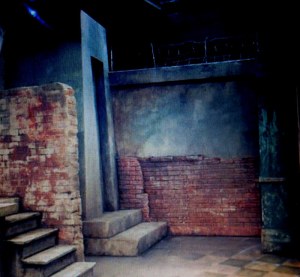
Director Claudia Weill has expertly fashioned Nate Rufus Edelman’s The Belle of Belfast. With the help of set designer John Mcdermott, the director has made sure the production employs a clever and symbolic economy of design. The three sections of the stage suggest different areas: outside in the city of Belfast and inside in the private interior of the Catholic church confessional and the rectory. For the outside, the bleak walls of division and sterility of a  life lived amidst randomized terror is evoked with graffitied brick walls and barbed wire, stage left. The exterior is contrasted with an interior, the ironic security offered by a church confessional in the stage middle. To stage right is positioned the personal inner sanctity of the priests’ rectory where truthful actions and comments are laid bare by three of the main characters. Lest audience members are unfamiliar with the history of the setting, at the play’s outset a black and white film clip of a variety of shots of beleaguered Belfast unspools to project the tattered lives of the residents (children and adults), and the sorrow and violence that is their portion during The Troubles.

As these projections fade, the light focuses on the confessional interior. At confession is a typical, elderly, staunch Irish Catholic woman, Emma Malloy (Patricia Conolly does a beautiful job as the humorous, slightly ridiculous and eccentric aunt of feisty Anne Malloy). Emma Malloy is sharing her darkest secrets with the handsome, youthful priest, the father confessor in a parish that offers help in this trying time of soul need to offset the chaos and confusion everyone is experiencing. Of course the help is for Catholics and though the tenets of Christianity encompass both protestants and Catholics, the irony is not lost on us that Catholicism is a tremendous thorn in the flesh of the Protestants on the other side of the high walls which divide Irish from Irish.

During the ironic and funny exchange between the priest and Emma Malloy, the playwright has unfolded the character of Father Ben Reilly (an excellent Hamish Allan-Headley), as a sympathetic and well meaning Irish Catholic cleric who attempts to remain above the fray following the tenets of Christianity as best he can. Nate Rufus Edelman has expertly established the gnawing rodents of duplicity within the Father that will continue to eat at him until they devour his potential for goodness. With Emma Malloy, we understand that the Father is playing the part of the good priest as he perceives his role to be. However, we also understand that the depth of goodness is not yet present in him to actually be that good priest, for we also see the extent to which Emma Malloy tries his patience and the extent to which he allows her to frustrate him. Instead of “stopping her in her tracks” for her silly ideas of what constitutes sinning (one thing Catholicism teaches well is sinning and condemnation), he allows her to continue in folly, “showing” how kind he can be until she makes untoward remarks that are sinful. Here is a flawed priest, who in his attempts to be empathetic and gracious goes overboard toward permissiveness because of his notions about how a priest should be kind and understanding. In attempting both, he ends up doing neither, though he is charming, self-deceitful and apparently “harmless.”

'The Belle of Belfast,' Kate Lydic, Hamish Allan-Headley, Irish Repertory Theatre, Belfast, Ireland

Kate Lydic and Hamish Allan-Headley in ‘The Belle of Belfast,’ at the DR2 Theatre. Photo from this site.

Of course, the irony is that with the true tenets of Christianity, it is not about image, it is about substance, about what happens behind closed doors, about what happens in the rectory when the public isn’t watching. That is what counts and the playwright never reveals the characters’ relationships with God and that absence is crucial to the understanding of the play and the understanding of the characters who are in desperate need of help and who are incapable of receiving it through the source they have supposedly chosen to pray to. Clearly, this priest and his colleague Father Behan (Billy Meleady), are having their own “troubles” with the substance of love and truth. Edelman brilliantly reveals how they are having issues with self-deceit as they attempt to “appear good” but find it much harder to “be” good. Their trials are revealed during their personal moments away from their roles as priests and after they return to the rectory, relax and take off their collars. This is one of the main conflicts of the play, the image of goodness versus the reality of goodness and gives rise to the theme: if one does not live in truth, one is miserable living in hypocrisy. The theme has broader implications for indeed, the whole of Northern Ireland is reeling from this problem, especially in their disparate warring religious factions which lack “the substance” to be Christians in word, deed and love: they cannot forgive each other; they cannot ultimately forgive themselves.

The playwright has cleverly characterized Father Reilly revealing the seeds of his potential downfall which like weeds in a garden plague him. These weeds grow quickly and are the cause of his weaknesses which allow him to succumb to the manipulative wiles of the fiery teenager Anne Malloy (the angst-filled “belle”). As a result of their flawed actions both Anne and the Father are forced to view the truth of themselves and the pictures are ugly. The characterizations are aptly drawn; we note Father Reilly’s rationalizations to Father Behan when he protests that he is trying to help Anne. But when he ends up seducing her, he is easily able to convince himself that it is the other way around, that he has allowed her to seduce him. Regardless, both Anne and he are culpable; both make each other miserable with the truth of their self-deceit and lies, though his is the greater blame because he violates his position as a “pure man of God,” and she is a minor, not really responsible for her own decision making, though of course, she believes she is.

Hamish Allan-Headley, Billy Meleady, 'The Belle of Belfast,' Belfast, Ireland, Irish Repertory Theatre, DR2 Theatre

Hamish Allan-Headley and Billy Meleady in ‘The Belle of Belfast,’ Photo by Carol Rosegg

Likewise, the playwright’s characterization of Father Ben Reilly’s fellow colleague in the parish, Father Behan (a fine, nuanced and edgy performance by Billy Meleady), shows another cleric in the throes of a personal crisis. Behan despises the protestants and supports the Irish Republicans, though he knows he should remain objective. He is an alcoholic with the excuse that it is a way to get over and through the miseries of the times. Yet, rather than to rely on his faith to help him end the addiction, we see that his faith fails him and even inspires him to drink more. He has chosen a profession about which he is largely indifferent and is now stuck in. It is a cryptic irony that he hopes he doesn’t have to continue to be a priest when he is dead and in heaven, for that would be hellish. As a priest there are no choices left for him and he wishes he were anywhere but Belfast, the worst place to get murdered for being a priest. As we see for Father Reilly and Father Behan, both succumb to the dark time of chaos. Both cannot see their way clear to confront their character imperfections. Both lack the faith to work through and achieve peace.

Edelman has presented the underlying issues of the characters from which the incipient themes evolve, hammering these through to the conclusion. We recognize that all of the characters have opaque vision; they are limited from seeing the hypocrisy of their own actions as they walk in a bizarre, dual state of determination and haphazardness. They mistake their false assumptions about themselves as truthful and accurate, only to find out later they are playing at being what they are not. Of course, they are miserable and their actions lead to devastation. However, because of the backdrop of war which rears its ugly head from time to time in a bomb blast that kills or in the terrible beating and victimization of someone, we know that the characters are reeling from the confusion which foments the mist through which the ever-present threat of violence erupts. We forgive them for they are easy to recognize in ourselves; such is the state of affairs in the human soul: until unity and peace come, it’s division and war.

Hamish Allan-Headley, Kate Lydic, 'The Belle of Belfast,' Irish Repertory Theatre

Hamish Allan-Headley and Kate Lydic in ‘The Belle of Belfast,’ at the DR2 Theatre. Photo by Carol Rosegg.

Thus, when wise-cracking, foul-mouthed and brash Anne Malloy (played with abrasive and wild-hearted abandon by Kate Lydic), tells conflicted and insecure friend Ciara Murphy (the vulnerable and resigned Arielle Hoffman), that she is in love with Father Reilly and she will be with him, we are not surprised. We have anticipated this, as we anticipate the tragedy of their coupling and the impossibility of their being together because they have no solid relationship borne of love. We know his permissiveness and his playing at being the good priest has been the snare that renders him a hypocrite to the faith and a predator. With kind duplicity he does harm to her and himself. Father Reilly is incapable of seeing clearly that Anne Malloy is playing at being in love with him in a desperate quest for happiness. He cannot discern the truth to know that she is searching for a love of self that will fill her soul more than what she could ever have with him. Blindly, Father Reilly takes advantage of her inner emptiness. Deceitfully, he becomes a predator exploiting her sorrow. He adds to her soul damage; orphaned by her parent’s death in a bomb blast as a child, she is forced to live with her difficult aunt from whom she feels little love.

The importance of The Troubles as a backdrop to what happens in the inner sanctum of the rectory is a clever touch brought to the fore by the canny director. Father Reilly’s abuse of Anne’s fragile emotions and the abuse of his position is performed behind closed doors away from the prying eyes of the parish. In the rectory he turns this emotional violence against himself as he upends his own integrity. In hypocrisy he trashes everything good that he may have attempted in the past. In an invisible line from the external brick wall and barbed wire right through to the rectory, the director and playwright show that the war’s shocks have led him to become an emotional casualty of the war’s harm. The tragic irony is that as a casualty, he cannot rightly understand how to best help Anne. Thus, he contributes to making her into a twice-fold victim of The Troubles. His failures as a priest thwart her from achieving soul health: the “love” she sought to replace that was lost at her parent’s death can never come from Father Reilly; she is twice traumatized. The emotional violence Father Reilly and Anne enact upon themselves and each other mirrors the violence of Belfast. Though they are alive and breathing, emotionally they shatter one another. They can only inure themselves to the pain and move on. If they make themselves numb, there may be a kind of deliverance after all. However, there is no grace that they can give each other; they lack that power. It will have to come from another source, if it comes at all.

Through the fine, on point acting, the director’s steadfast vision and the help of the artistic team, Edelman’s work shines with humor, cleverness and grace, revealing how in a time of chaos, individuals attempt to make the best of the hand they are dealt but often make a shambles of it, instead. This would appear to be doubly true when those appointed to help “make the peace” are often the ones doing the harm. To what extent does the war impact individuals’ choices? On a continuum from 1-100, it cannot be discounted and like an earthquakes’ aftershocks, the calm may settle but things have been irrevocably changed. So Edelman points out. After a few years have passed, Anne Malloy, achieves a term of happiness which she discusses with Father Reilly when she finds him after he moves from Belfast. Meeting with him, she explains what happened in her life after she left the war zone. It is obvious that she has made a tentative peace. For Father Reilly the playwright is silent about the divisions in the cleric’s soul. Nevertheless, for these two characters, it is a fitting conclusion reflective of the citizens in Belfast whose high walls still divide and whose wounds have yet to heal completely.

You can see the terrific The Belle of Belfast at the DR2 Theatre until June 14th.

This review first appeared on Blogcritics: CLICK HERE WHERE IT WAS AN “EDITOR’S PICK.”