Blog Archives
‘The Imaginary Invalid’ With Bill Irwin, Marvelous Fun
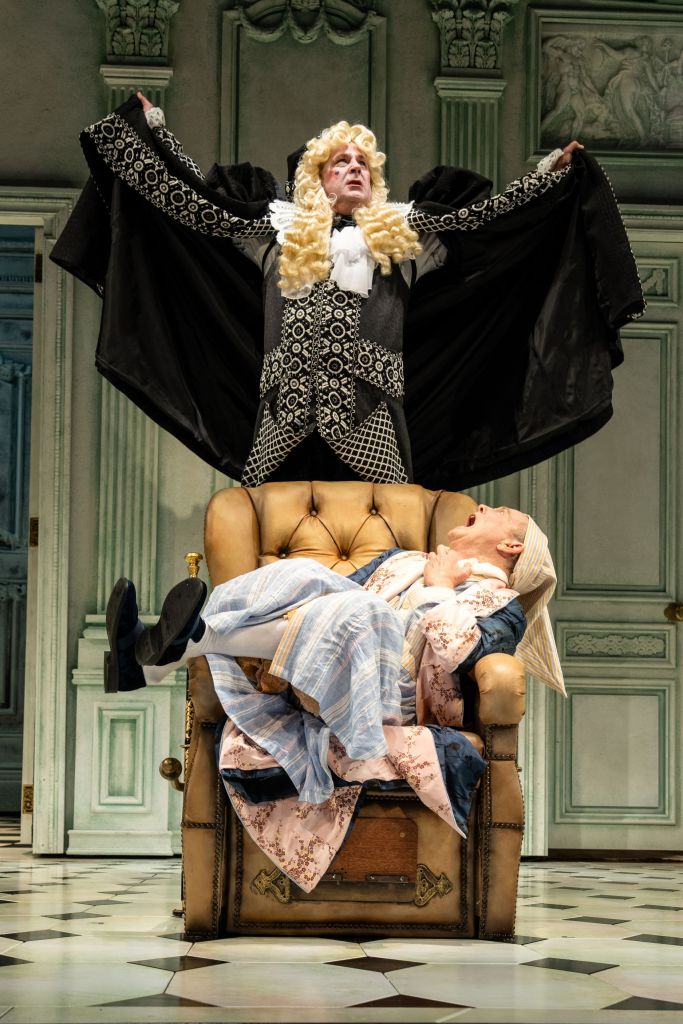
If laughter does good like a medicine, The Imaginary Invalid by Molière adapted by Bill Irwin from a translation by Doug Skinner will set your body humming with health and joy. The French farce with its roots in commedia dell’arte premiered in 1673 when a sick Molière played the hypochondriac lead Argan, finished the fourth performance giving it everything he had, then collapsed and died at home hours later. With that ironic send-off, the play has lasted for over 350 years, securing the playwright’s legacy with his other globally produced works.
This cleverly wrought production directed by Brandon J. Dirden currently runs at the Todd Haimes Theater until November 22, 2026. It is a treat to see this classic lovingly handled with precision by cast and creatives who obviously appreciate its satiric whimsy and trenchant current themes.
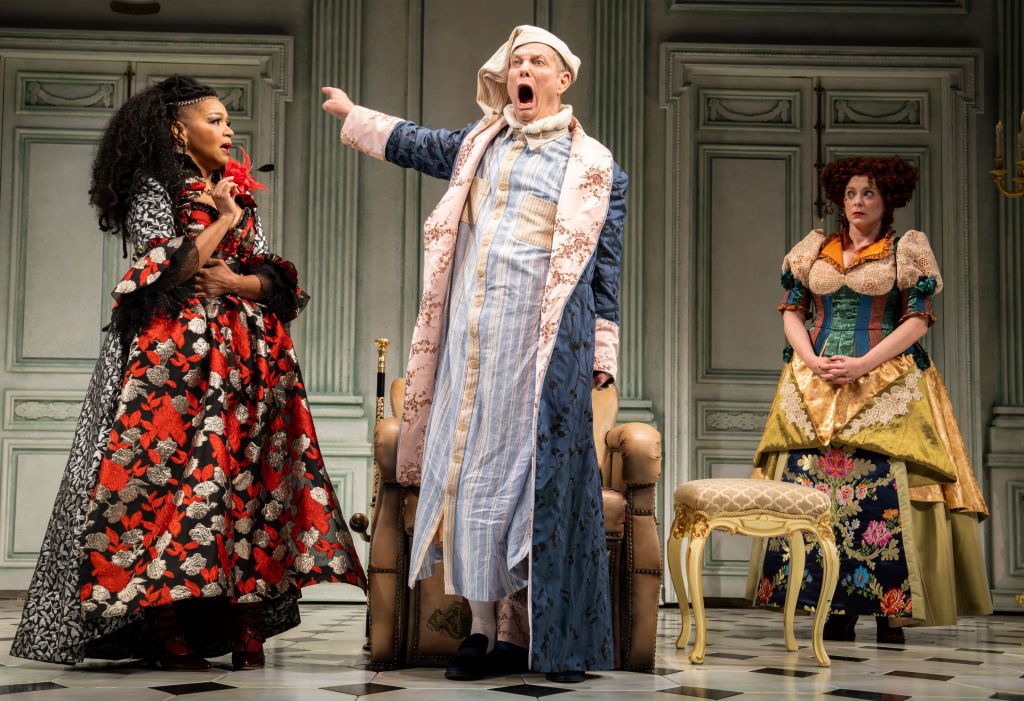
Bill Irwin, the clown prince of theater who brings his background at Ringling Brothers to his performances (pacing, mime and rhythm), leads a fine ensemble. These include Rachel Bloom, Brooks Ashmanskas, Dylan Baker, Hiram Delgado, Crystal A. Dickinson, Ava Lalezarzadeh and Daniel Croix Henderson. Portraying the wealthy Argan who spends a fortune on his persuasive doctor’s regimens and medicines, Irwin superbly delivers his humorous portrayal of Argan, balancing authenticity with innate comic timing. His high stakes investment in the character’s belief that without the doctors’ treatments and prescriptions he would be dead in three days, Irwin presents the field upon which the ensemble zanily frolics.
With a nod to commedia dell’arte and the Commedia Francise, a prologue which is a dumb show (pantomime), lays out the events of the play and dresses the stage with Beowulf Boritt’s ingenious, period, scenic design. The masked, robed Pantolone character gets the audience’s attention, striking a long staff on the stage floor. Then, with the staff he strikes the traditional Trois Coups which summons the actors to begin the play. The actors’ seamless movements, directed by Lorenzo Pisoni, whisk the mesmerized audience from the digital age to the 17th century’s comedy of manners.
Subsequently, masked, robed doctors pull long, red ribbons from Pantalone’s robe, symbolizing the bleeding treatment practiced at the time. During that process, they pull into place the walls and the ceiling, and add the simple pieces of furniture to create the home of Argan and playing space for the actors. Through the hustle and bustle, Irwin invisibly takes his position center stage in a modernish recliner. The robed, masked actors crowd around and dress him, back to the audience, then swivel him around. Lo and behold Irwin has transformed into the iconic hypochondriac!
Spinning its magic the play builds and explodes with satire and farce into a morality tale about obsessions with quack doctors, true and false love, and a brilliant, underestimated servant who saves the day, all in the 90 minute twinkling of an eye.
Economy and efficiency for maximum laughs are the watchwords for this production. The current, edgy dialogue serves as a counterpoint to the situation and subject matter, which Irwin’s adaptation smartly leaves in the 17th century. However, to streamline the play, Irwin removes the customary “interludes,” balletic dances, that lengthen Molière’s work into three acts. Also, Irwin removes the ancillary scene with the younger daughter Louison, who Argan interrogates for information about his daughter, her sister, Angelique. Removing the scene doesn’t impact the plot development or themes.
Essentially, Irwin keeps the structure and the problems driving the forward momentum of the play. For example, customary at the time wealthy families set up arranged marriages which Argan does with a satiric twist. The marriage he proposes is not an economic arrangement because no one needs financial assistance. Instead, it erupts from Argan’s desire to indulge his hypochondria and always have a doctor, or two or three at the ready. Dr. Diafoirus (Brooks Ashmanskas) and son Thomas (Hiram Delgado) are the brother and nephew of Dr. Purgon (Brooks Ashmanskas), Argan’s primary physician. If his daughter Angelique (the lovely Ava Lalezarzadeh) marries Thomas, Argan presumably will have 24/7 access to all three doctors.
In the funny scene when Thomas first meets Angelique, we learn in coded language that he can hardly wait to have children and is practicing by himself, alone. The reference to masturbation lands, LOL. Additionally, Thomas argues a thesis against the circulation of the blood and against the obsession with “cleaning of wounds” prior to surgery. Thus, we know how ineffective, even dangerous he is, especially because he stubbornly believes in his own righteousness. Thomas appears as the 17th century equivalent of a 21st century dweeb.
Though Argan’s word is law, the lovely Angelique loves Cleante (Daniel Croix Henderson). With Toinette’s help and understanding, the couple hope to pledge themselves to each other.
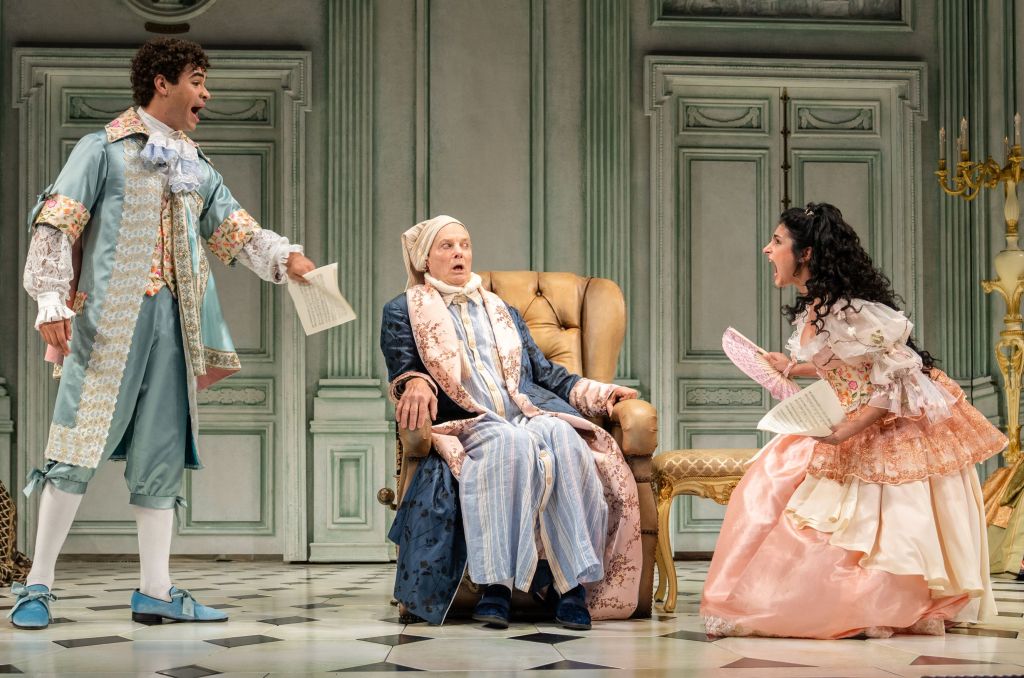
Wisely, Irwin includes the singing scene between Angelique and her love Cleante (Daniel Croix Henderson). Humorously, they sing an opera in codes to each other in front of Argan and the others. The audience, clued into their love “gets” it. Of course the fun turns into laughs as Argan gets annoyed and ends up foolishly ridiculing himself. Thus, he continues to push the marriage between Angelique and Thomas. As the complications heighten when Argan’s wife Beline (Crystal A.Dickinson) insists Angelique go to a nunnery, the suspense builds. Who will help Angelique marry the man of her dreams and not the slow-witted, unappealing Thomas?
Brooks Ashmanskas portrays both brother doctors, refining the ‘”likeness” of each. However, despite differences in long, curly period wigs (Nikiya Mathis), variations in stance, speech, demeanor, costuming (the excellent Karen Perry), we note they are one in the same. With ironic intention, we recognize their same pompousness, foppishness and presumptuousness of erudition. Casting the fine, comic actor in both roles gives the audience more time to appreciate his send up of greedy doctors, and enhances the themes.
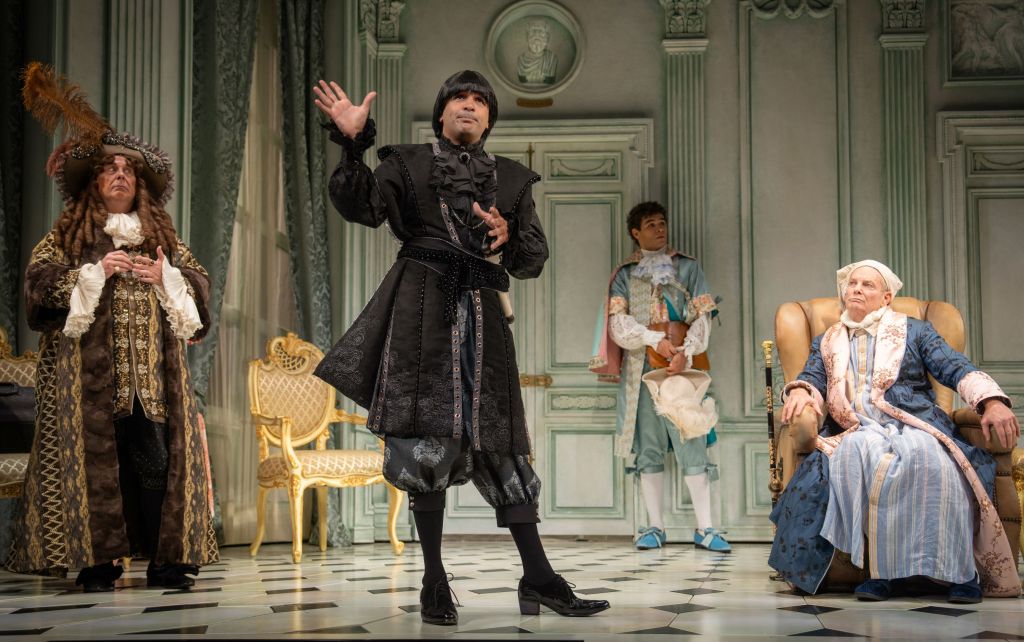
For example, the irony of casting Ashmanskas to play the younger brother Dr. Diafoirus and the older Dr. Purgon who appear in different scenes reveals how their exploitive, unscrupulous natures run in the family. As we expect, Thomas copies his charlatan father and uncle. Indeed, Delgado stokes laughter when Thomas explains his approach in never moving from the “Ancients” fixed methods into the discovery method. The family prefers to “practice” not at court where they would be held accountable for their bad, dangerous remedies since the king and courtiers expect cures. The Purgon clan only concerns themselves with proper form, not cures. Thus, they treat their own private patients whom they’ve cultivated. These patients, like Argan are gullible “cash cows,” Toinette (Rachel Bloom) counsels Argan who ignores her.
The brothers overcharge for the simple treatments like enemas, bleeding and purgatives which cause vomiting. As Beralde (the excellent Dylan Baker), Argan’s brother chides, the fact that Argan lives after all their harmful regimens proves his healthy constitution. But Argan is enamored of being ill and enjoys the attention and sympathy it brings from his second wife, the gold-digger Beline (Crystal A. Dickinson). Obviously, she plots with Bonnefoy (Hiram Delgado) to disinherit Angelique and extract as much cash as possible while Argan lives. Then, she inherits all of it after he dies. Argan’s foolishness must be countered before Angelique ends up evicted and in a convent. Will the conniving Beline win?
In fact Beline and the doctors work double time to part Argan from his money. Thus, three themes stand out in the play’s unraveling. First, golddiggers marry sick men to easily inherit. Second, doctors over charge for treatments that don’t work. Third, the course of true love never runs smoothly. These and others unspool with histrionics and hilarity. Additionally, Moliere’s theme that education can be meaningless unless put to effective use, threads throughout. Clearly, the anecdote appears to be in addition to Beralde’s dictum to “rest, ” would be to observe and watch. Observation like that accomplished by Bloom’s Toinette and Baker’s Beralde provides the wisdom to expose the difference between the liars, the frauds and the caring truth tellers. Thus, to see fact from fiction, we must watch what “they” do, not what they say. In that The Imaginary Invalid rings most true for us today.
The Imaginary Invalid runs 1 hour 30 minutes at the Todd Haimes Theater through November 22, 2026
roundabouttheatre.org.

