Author Archives: caroleditosti
Tribeca Film Festival NOTIFICATIONS
FILMS AT TRIBECA FF

Sabrina Carpenter,’Short History of the Long Road,’ Tribeca Film Festival (photo courtesy of the film and TFF)
THE SHORT HISTORY OF THE LONG ROAD
*World Premiere Screening at the 2019 Tribeca Film Festival in the U.S. Narrative Competition*
Written & Directed by: Ani Simon-Kennedy
Starring: Sabrina Carpenter, Steven Ogg, Maggie Siff, Danny Trejo
For teenage Nola, home is the open road with her self-reliant father and their trusty van, two nomads against the world. When Nola’s rootless existence is turned upside-down, she realizes that life as an outsider might not be her only choice.
Public Screenings:
Saturday, April 27th at 2:30 PM at Village East Cinema 07 (World Premiere)
Sunday, April 28th at 5:00 PM at Regal Battery Park 06
Wednesday, May 1st at 5:45 PM at Village East Cinema 03
Saturday, May 4th at 9:00 PM at Regal Battery Park
Purchase tickets by going to Tribeca Film Festival website. See the film guide at the top of the website page. TRIBECA WEBSITE: CLICK HERE
FRAMING JOHN DELOREAN
|
|

|
|
|
|
‘The Cake’ Directed by Lynne Meadow, at Manhattan Theatre Club

Debra Jo Rupp in ‘The Cake,’ directed by Lynne Meadow, written by Bekah Brunstetter at MTC (Joan Marcus)
The Cake written by Bekah Brunstetter is a deliciously humorous look at love and prejudice with twists that harken back to the Supreme Court ruling which sided in favor of Masterpiece Cakeshop which refused to to bake a cake for a gay couple. The setting is not Colorado, however, it is North Carolina, and there is a similar response about baking for a gay couple.
Indeed, one of the themes of The Cake touches upon the current backlash by religious groups against the LGBTQ community and gay marriage. However, by the conclusion the playwright reinforces that love and decency can drive out divisiveness and bigotry, leading to mutual respect among groups with divergent orientations and beliefs.
Della (Debra Jo Rupp) owns her own bakeshop and is a fabulous baker of confections, specialty cakes, cupcakes, cookies and other desserts, all of which she bakes from scratch in her shop in Winston-Salem, North Carolina. As she introduces herself with her sunny, sociable and sweet personality, we recognize why she selected this particular business to showcase herself.
Dessert baking is fun. Cakes and confections are feel good, comfort foods in a state that is less concerned about waist-lines and more concerned about family gatherings and get togethers. A cake will satisfy as the crowning glory of any party and Della’s recipes are unique and fabulous.
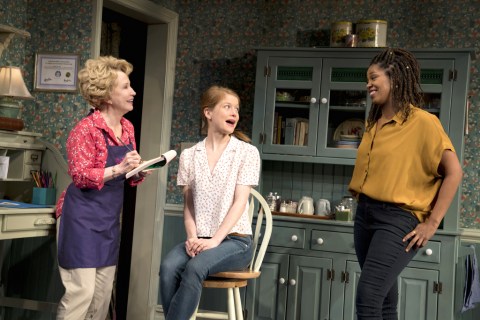
(L to R): Debra Jo Rupp, Genevieve Angelson, Marinda Anderson in ‘The Cake,’written by Bekah Brunstetter, directed by Lynne Meadow for MTC (Joan Marcus)
Furthermore, Della is not timorous about sharing her recipes because most people who ask for them don’t follow them to the exact drop of liquid or sift of dry ingredients. Della affirms that’s why her cakes are so delectable. When she bakes the cakes that she has crafted for greatness, she follows the recipe directions and comes out with beauty every time. She further endears us in this opening sequence when she tells a customer that she is going to be a contestant and compete with others on The Great American Baking Show, the most watched baking show on CBS.
Debra Jo Rupp is a joy to watch, as she takes every line in this opening sequence and makes it her own with spontaneity, authenticity and sincerity, so that we long to taste a piece of her wonderful cake and feel the love vibrating from her. If mom baked and cooked with love, surely Della does the same. She is so affable and winning, we are completely taken in by her hospitality. We forget that she lives in the south, has lived there her whole life and most probably and at the least harbors residual racism and bigotry or at best is in a state of confusion like a good part of the southern United States regarding the LGBTQ community which cannot be reconciled with their religious beliefs.
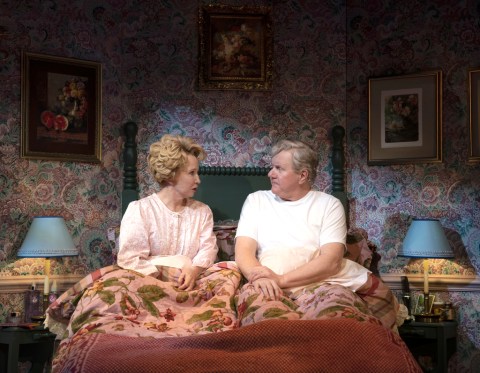
Debra Jo Rupp, Dan Daily in ‘The Cake,’ directed by Lynne Meadow, written by Bekah Brunstetter for MTC (Joan Marcus)
However, the worm turns soon enough when Northerner Macy, a lovely black journalist enters the shop. During the course of the conversation, Macy turns down a taste of Della’s cake and goes into a rant about the food industry putting sugar in everything to addict consumers who are getting so fat that childhood obesity and diabetes are at the highest rates ever in the history of the nation. Immediately, we understand that beneath the lovely bakery confections there is an underlying toxicity and harm to one’s health. Macy has shaken us awake and alerted us that perhaps Della is a bit too sugary for our Northern sensibilities.
When the conversation continues and Della claims she is not concerned about politics but just concerned with her cakes, Macy comments: “Isn’t ambivalence as evil as violence?” Bam! We get the alarming picture. As a typical Southern woman who votes as her husband tells her and doesn’t think about the hypocritical values of Christianity rejecting a woman’s right to choose while obviating all responsibility toward children beyond the fetus stage, Della’s love charms appear to ring hollow. We wonder, where does she stand with her love if not in support of children and her baking?
Macy’s loaded, thematic-laden remark ratchets their communication into an embarrassing stalemate: Della leaves to check on her pineapple upside down cake and Macy oogles the piece of cake Della cut for her to try, but doesn’t touch it. Clearly, Della and Macy are at opposite ends of the political and religious spectrum and never the twain shall meet. Then Jen enters with a wedding binder to visit her mother’s old friend Della and the play launches off into a number of fascinating, complicated directions that stretch Della’s patience and religion, and hurt Jen’s feelings almost to a breaking point.

(L to R): Debra Jo Rupp, Genevieve Angelson in ‘The Cake,’ written by Bekah Brunstetter, directed by Lynne Meadow (Joan Marcus)
However, clarity, understanding and growth come when Jen discusses why she is who she is and how she has come to make the decision to marry Macy and live with her, despite Macy’s father’s censure and opprobrium. When Jen and Macy ask Della to bake their wedding cake for them and attend their party, Della’s husband, in typical “good ole boy” fashion, puts his foot down as the man of the house.
Though Della attempts to get around him, he remains steadfast. Taking her cues from her deep conversation with Jen about being a woman, Della attempts to ignite the fires that once burned in Tim’s heart. Indeed, it is obvious that Jen’s and Macy’s conversations with Della have touched a growth nerve and this in uncovers the flaws in her marriage with Tim.
Della is forced to sift herself and reconfigure a new recipe of care and concern with her husband and her daughter’s friend Jen. It is in her desire to be a good, decent person that we discover where Della’s love and heart is as she works things out with her husband and reconsiders her religious beliefs. Her love which is rooted deep grows toward becoming more open-minded.
The Cake is a compact, well-written, beautifully acted, sensitive play that resonates with vitality for our time. Marinda Anderson as Macy portrays the lucid, flexible and mature womanly partner of the equally sensitive and hopeful, upbeat Jen. As Jen Genevieve Angelson, measures beat for beat Anderson’s well-thought-out depiction.
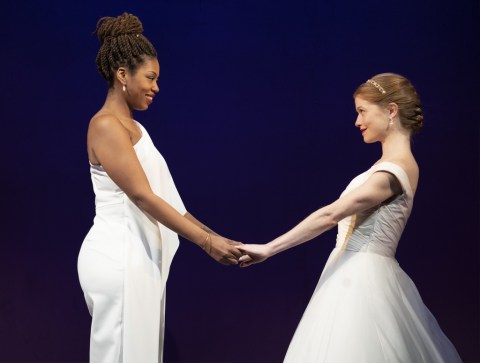
Marinda Anderson, Genevieve Angelson in ‘The Cake,’ written by Bekah Brunstetter, directed by Lynne Meadow (Joan Marcus
Dan Daily as Tim, Della’s husband, is both jarring in his domineering attitude, then later loving and humorous in his sensitivity toward his wife. The section where he reveals the issue that has been undermining his confidence in their relationship is excellent. Debra Jo Rupp’s Della is particularly poignant when she tries to engage with Tim and he is incapable of responding and tells her so. This is a wonderful lay up to the surprisingly humorous event which occurs between them later in the play.
Lynne Meadow’s sterling direction keeps the pacing and the humor alternating in time with the quiet, thoughtful powerful moments. These moments underscore the themes about how to bridge the gaps in our viewpoints when friendships are at stake. The artistic elements and revolving set design serve the importantly intimate scenes between Tim and Della and Jen and Macy. Allowing us to view their relationships, we note there isn’t much difference regarding the couples as they attempt to further their understanding and love of each other. I was particularly heartened by the portrayal of Tim and his love for Della. Whether in straight or gay hearts, love abides with need. And this results in the uplifting and satisfying conclusion of The Cake.
Special kudos to John Lee Beatty for his superb scenic design (too bad there were no real cakes there, but at the bar the night I saw the production, there was a vanilla cake). And kudos to Tom Broecker for Costume Design (the wedding outfits are perfect), Philip S. Rosenberg for Lighting Design, John Gromada for Original Music and Sound Design and Tommy Kurzman for Hair, Wig & Makeup Design.
This is a winning production that you will enjoy. It runs with no intermission for 90 minutes at the Manhattan Theatre Club’s New York City Center Stage 1 (131 West 55th Street between 6th and 7th). For tickets CLICK HERE.
SXSW 2019 Documentary World Premiere: ‘I Love You, Now Die: The Commonwealth Vs. Michelle Carter’
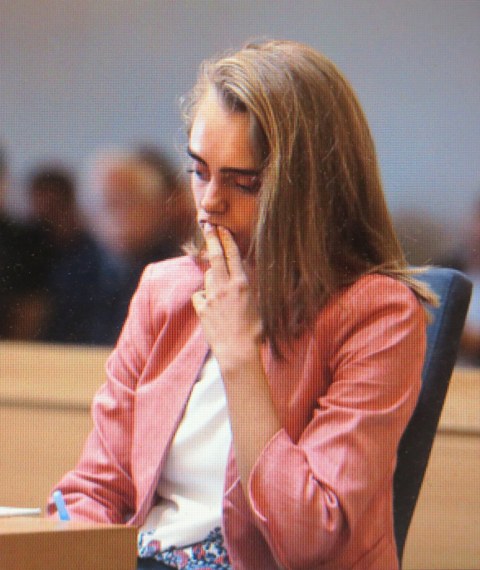
Michelle Carter, ‘I Love You, Now Die: The Commonwealth Vs. Michelle Carter,’ directed by Erin Lee Carr, SXSW 2019 Documentary World Premiere (courtesy of HBO and the film)
The documentary I Love You, Now Die: The Commonwealth Vs. Michelle Carter in its World Premiere at SXSW 2019 is a provocative and compelling look at a case which stunned New England. Directed by Erin Lee Carr, presented in the Spotlight Section, the filmmaker examines two different perspectives of the case against Michelle Carter who the court found culpable in the death of her friend/boyfriend Conrad Roy III. Carr features the prosecutions arguments, replete with video clips taken from the courtroom. Also, the filmmaker features the arguments presented by the defense in the courtroom. She does some follow-up interviews of the witnesses on both sides.
The eighteen-year-old, Conrad Roy III, was found in his pick up truck asphyxiated by carbon monoxide at his own hand. He had purchased a generator which trapped the carbon monoxide from his car’s cabin as he sat parked behind a local K-Mart. He didn’t leave a suicide note. Instead, he and Michelle Carter left 60,000 text messages of their relationship, feelings for one another, their mental states, fantasies about being like Romeo and Juliet and more.
However, as the texts made clear, Roy III was in pain and wanted to commit suicide. He was being treated for depression and he was on the medication Prozac which has been tied to suicide deaths. Whether as a friend, help-meet, or as a self-serving, dastardly and willful individual looking for attention as the prosecution painted her, some of Michelle Carter’s final text messages encouraged him to finish his goal to end his life. What was never recorded was the final phone conversation they had together. Whether this was up until the moments of his death is unclear. Only the text messages remain as evidence.
In the first segment, Carr presents an outline of the backstory of the texting relationship between Carter and Conrad Roy III who only saw each other face to face around 5-6 times, but in teenspeak were “talking” which meant they were close. Indeed, Michelle Carter referred to him as her boyfriend. In the first segment Carr includes many of their texts, out of order in following the prosecution’s case to hone in on various arguments. They often texted that they loved each other. Carr culled through the approximately 60,000 texts between the two individuals. She uses their texts and sound effects on a black screen for full effect in both segments of the HBO presentation.
Carr uses video clips from the public hearings during the case. She interviews Conrad Roy III’s family members. There was difficulty between his parents who were divorced and were with other individuals. Clearly, Conrad Roy III didn’t have an idyllic home life, however, the extent to which this contributed to his pain and wanting to commit suicide was only alluded to by Carr briefly in the film. Michelle Carter’s family life was not covered, but her parents are together and supporting her throughout the ordeal and civil lawsuit by Conrad Roy III’s family.
Interestingly, there was no jury trial, but three judges decided the case. Since the media had garnered such an outcry spiking controversy against her, the Defense decided no jury trial was in her best interests. In Part II of the series which is an HBO Showcase and scheduled to air some time in the summer, the documentarian presents the Defense’s perspective why Michelle Carter should not be held accountable for Conrad Roy III’s suicide..

Conrad Roy III, ‘I Love You, Now Die: The Commonwealth Vs. Michelle Carter, directed by Erin Lee Carr, SXSW 2019 Documentary World Premiere (courtesy of the film, HBO)
Michelle Carter never gave voice to her own feelings testifying before the judges in court. Nor was she interviewed for the film. Her testimony, the missing piece of the puzzle, may never be revealed now that she is serving her prison sentence after she lost her appeal.
Carr chronicles the events mirroring each perspective. The film is structured precisely to allow the audience to decide where they land, in support of Michelle Carter or in favor of the prosecution. I found both arguments riveting, but the situation is extremely complex and the film does not evidence the complexity. One must “see” between the lines.
The femme fatale image of Carter whipped up by a media hungry for clicks and viewers tragically skewed the case beyond a proper examination of the mental background related to both Conrade Roy III and Carter. Carr includes the Defense testimony of the doctor who discusses Conrad Roy III’s mental state. Also this witness ties in the effects of Prozac which in some individuals create suicidal tendencies. However, in this area, the film and perhaps the defense’s medical strategy doesn’t go far enough.

Michelle Carter and her Criminal Defense Attorney Jeff Kroll, ‘I Love You, Now Die: The Commonwealth Vs. Michelle Carter, directed by Erin Lee Carr (courtesy of the film, HBO)
I know of at least three individuals who were on Prozac who either attempted or succeeded in committing suicide; these were adults. Conrad Roy III was 18-years-old and it is unclear the extent to which this drug exacerbated his pain on his young mind.
Nevertheless, the focal point of the prosecution’s argument became Michelle Carter’s encouragement of Conrad Roy III in the last hour and one–half of his life to choose death, not life. The Defense strategy used a freedom of speech argument saying Michelle Carter’s speech was protected, and couldn’t be used against her, even though it was morally reprehensible to encourage someone else to commit suicide.
The judges ruled against Carter using as evidence her texts of encouragement. She urged Conrad Roy III to get back into the truck and finish what he set out to do as the carbon monoxide was filling up the cabin. Because she did not encourage him against killing himself, she was given the sentence she received. The Defense could disprove the prosecution’s faulty logic, however, there was no answer for what the judges deemed in their opinions indefensible, which was her encouragement to suicide.
Obviously, Conrad Roy III had doubts the last hour of his life whether to kill himself or not. Interestingly, he sought out Michelle Carter precisely for what she gave him: support in his endeavor. He did not call his parents, his sister, or go on youtube where he would have been discouraged. His parents notified? He would have been put in the Psych Ward. His will to choose one who would support him kill himself is clear: indeed, in that he holds the ultimate responsibility, the ultimate choice of texting her, of phoning her and not someone who would stand in the way and prevent his wishes.
However, in that the judges obviated and ignored his obvious, willful selection and damned her. Her texts were used as the weapon to kill him, not his own will, determination, previous texts, treatment for depression, known wishes to commit suicide and the youtube video he posted about “social anxiety.” The evident misogyny in not looking at Conrad’s ultimate selection of Michelle Carter to get what he needed in the last moments of his life is apparent. It was his choice; the responsibility was his, and he took her down with him.

Michelle Carter, “I Love You, Now Die: The Commonwealth Vs. Michelle Carter, Erin Lee Carr, SXSW 2019 World Documentary Premiere (courtesy of HBO, the film)
Indeed, the judges and prosecution believed that Michelle Carter should have “gone on record” inspiring Conrad Roy III toward life, though clearly the fact that Conrad Roy III purchased the generator and sat in the pick-up and eventually stayed in the cabin to inhale enough of the poison to kill himself, ultimately revealed that his will was toward death, as heinous as that may seem. The tragic irony is that the text messages “appear” to reveal what happened. However, not even Michelle Carter knew what was going on in the final moments with Conrad Roy III. She only responded to what he told her. Only he knew what he did, for only he was present. Thus, though her Defense didn’t enforce this argument, Carter was swept up in what is largely circumstantial evidence.
Following the judges’ logic, examine the instance of a jumper at the top of a building who is cursed at and screamed at with encouraging phrases to jump by the crowd below. If he jumps, all in the crowd should be held responsible for his death. They are not. Ultimately, the choice whether to jump or not is in the mind/will of the jumper.
The filmmaker by the very nature of her selection process cannot be objective, though she tries. She includes some trial clips over others and interviews of Conrad Roy III’s parents and Michelle Carter’s friends over others. She also interviews the reporters who covered the case.
However, in presenting the clips, to my mind questions are raised about the adequacy of the defense and the adequacy of the testimony of the mental health professionals in the cross examination of the prosecution’s medical professional. There should have been more health professionals testifying about Conrad Roy III’s mental health, the side effects of Prozac, and Michelle Carter’s mental health, etc.
In attempting to organize the series into two parts and “leaving it up to the viewer to decide” the approach is a quick and dirty way to further sensationalize this tragedy and “involve” folks in the “harmless” game of having an “opinion” about Michelle Carter. To actually dig deeper and approach the subjects from another angle would have been more profound and elucidating. The question remains. Where is Michelle Carter’s viewpoint, opinion and testimony in all of this?

Michelle Carter, ‘I Love You, Now Die: The Commonwealth Vs. Michelle Carter,’ SXSW 2019 Documentary World Premiere, directed by Erin Lee Carr (courtesy of the film, HBO)
Though this isn’t a focal point, the film does raise additional questions philosophically as to whether it is “right” to assist someone else in their wish to commit suicide to escape extreme mental anguish. If the person appears to aver, should one encourage them in support, or take the opportunity to help them stop their plans, knowing they will try again, perhaps until they succeed? Indeed, teen rates of suicide are increasing as suicide rates overall are increasing in our nation, and especially for those veterans who have PTSD. What is the law’s stance regarding suicide? Did Michelle Carter know? Or is this a matter of human rights and one’s autonomous decision?
Suicide is a slippery slope. Taking into consideration the ages of these individuals (Conrad Roy III was of age), Michelle Carter at the time was younger, the teen mind set, the teen subculture, the lack of communication with parents and siblings of both families, the effects of Prozac, many variables need to be examined to understand better what may have happened. However, Conrad Roy III enacted all of the steps he needed to kill himself, even elected to use carbon monoxide and not a gun or pills. Michelle Carter a supportive friend/girlfriend reacted to what he told her with her texts. But no one was present except Conrad Roy III.
Carr’s work is intriguing in relaying teen social constructs that are current. She focuses on raising the specter of suicide that haunts our culture. The clips of Roy speaking on social media are particularly gut-wrenching. Did his parents see these? Now, more than ever, parents need take note and make sure lines of communication are always open with their children. If this had been the case, would Conrad Roy III have taken the ultimate path he choose for himself?.
The organization of the documentary is sufficient for what the filmmaker’s intended purpose may be, to “have the audience decide.” Another approach might have yielded much more information. The documentary will air in the summer on HBO.
‘Juno and the Paycock’ by Sean O’Casey at the Irish Repertory Theatre, the O’Casey Season Continues

Ed Malone, Sarah Street, James Russell, Maryann Plunkett, and Ciarán O’Reilly in Irish Repertory Theatre’s 2019 production of ‘Juno and the Paycock,’ directed by Neil Pepe (Carol Rosegg)
Juno and the Paycock, directed by Neil Pepe. is a powerful and trenchant look at the lives and lifestyles of tenement dwellers in Dublin, impacted by the Irish Civil War (June 28, 1922-May 24, 1923). The production is part of The Dublin Trilogy by Sean O’Casey currently featured by the Irish Repertory Theater. O’Casey’s work is populated by singular characters whose flawed humanity rings with truth and tragedy during the birth pangs of a nascent Irish Republic.
Juno Boyle (in a fine, measured performance by Maryann Plunkett) is the long suffering wife of ‘Captain’ Jack Boyle. Ciaran O’Reilly’s spot-on, brilliant “paycock” is humorous, puffed-up and delightfully roguish as well as “haplessly” self-destructive. Both Juno and Captain Jack have managed to carve out an existence for themselves with the help of their daughter Mary (Sarah Street) and their son Johnny (Ed Malone). However, as the play opens we find that they cannot get out from under the dire circumstances fomented by the various stakeholders who fight for and against the evolving movement for independent Irish statehood.

Harry Smith, Sarah Street, Irish Repertory Theatre’s 2019 production of ‘Juno and the Paycock,’ directed by Neil Pepe (Carol Rosegg)
Johnny (Ed Malone does an excellent job as the peevish, complaining, guilt-ridden son) has been badly injured during the Easter Rebellion. He attempts to disengage himself from his former comrades with the Old IRA which has been reconstituted and has become more purposefully violent in its thrust to move toward an Ireland completely free from the British. Mary (Street is excellent as the demure, naive, gentle daughter) is out on strike with the trade unionists who protest pay cuts and the general approach of the “Free State government” which is aligned with Britain.
From this motley group of family, the only one who works and keeps the household “running” is the assertive Juno. She waits on the “paycock,” Captain Jack, and puts up with his squandering money on drink. But she warns Captain Jack about his friendship with tenement drinking buddy the ne-er-do-well Joxer (John Keating’s reprobate, hypocrite is absolutely dastardly and the perfect foil for Captain Jack). Joxer’s exploitative and free-loading ways Juno dislikes and runs down to Captain Jack because of his evil influence.
Helping her family and short-changing herself, the saintly Juno soothes Johnny by answering to his every need. For example she gets Johnny a glass of water when he asks for it, though he is capable of doing it himself.
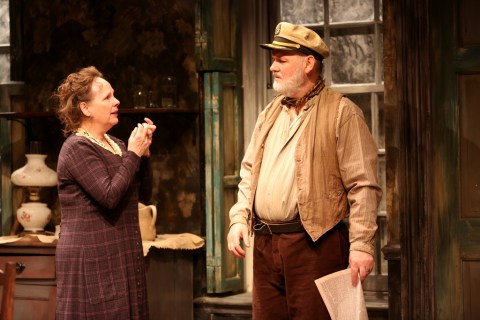
Maryann Plunkett, Ciarán O’Reilly in Irish Repertory Theatre’s 2019 production of ‘Juno and the Paycock’ (Carol Rosegg)
O’Casey’s characterizations reveal a group of impoverished individuals (mentally and materially). Their hand-to-mouth existence is continually impacted by the turmoil and chaos of a society fractured by civil war and upheaval. When news of the death of one of his former friends reaches the family, Johnny is on edge and “sensitive” rushing into his room, refusing to hear about the details which his sister reads from the paper. We think that he is going through “PTSD,” however, O’Casey develops the seeds of this unrest during the play. Eventually, they blossom into a dark revelation. By the conclusion O’Casey enlightens us so we understand why Johnny carps and whines about Tancred’s death and the chaos of the Civil War happening around them.
For their part, Juno and her “paycock” have achieved a steady routine. Juno harangues Captain Jack and tries to prevent the family from going into the abyss as she encourages her husband to show up for a job and chides him to stop his drinking bouts with Joxer. All is stasis until Mary brings home a gentleman, Charles Bentham (James Russell in an appropriately “high-minded” and slippery portrayal), a teacher. He brings the information that Captain Jack has come into an inheritance that will lift them from poverty. This grand news transforms their spirits. The job that Captain Jack was going to take is now unnecessary and he settles into his role as the preening “paycock,” full time with no recriminating Juno to excoriate him.
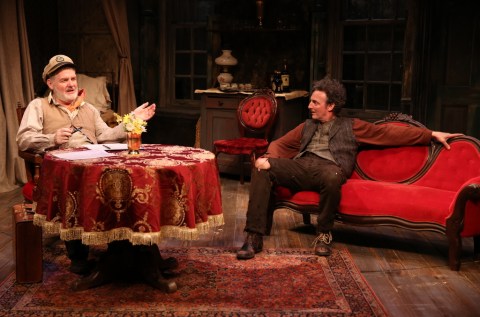
(L to R): Ciarán O’Reilly and John Keating in the 2019 Irish Repertory production of ‘Juno and the Paycock,’ directed by Neil Pepe for the Sean O’Casey Season, The Dublin Trilogy by Sean O’Casey (Carol Rosegg)
Even Johnny seems to be more cheerful as he hopes that they can move away from the area once they receive the money. With this redemption, Mary who has thrown over Jerry Devine (Harry Smith in a softly sweet and heartfelt portrayal) as a boyfriend, becomes enamored of Charles. They become a serious couple with marriage plans. All appears to be rosy with this “dream come true” scenario, and we, who empathized with their rough and tumble former condition are happy that they have in effect “won the lottery” and will not suffer the indignity and wretchedness of poverty any more.
O’Casey has lured us into their hope for a better life, a hope that all of us experience. This very identification with this family makes the conclusion of O’Casey’s work all the more tragic and heart-wrenching.
At the discovery of their inheritance, the family conflicts subside and these personalities expand despite the chaos in the culture. Captain Jack borrows money against his inheritance as does Juno. For a time, they are floating on clouds of joy as they dance and the couples are at peace, with all distemper ending between and among family members.

(L to R): Terry Donnelly, Ed Malone, John Keating,Ciarán O’Reilly, Maryann Plunkett, James Russell, and Sarah Street in Irish Rep’s 2019 production of ‘Juno and the Paycock,’ by Sean O’Casey, directed by Neil Pepe (Carol Rosegg)
Yet, a suggestion of darkness floats in when Charles Bentham describes his belief in Theosophy. His comments give rise to the world of spirits who remain unsettled and without peace. Indeed, he suggests those who are sensitive enough to see into the supernatural may recognize a spirit’s misery and displacement from a peaceful state.
During the discussion Johnny’s emotions unravel. He leaves their company and goes into the bedroom. There, he has an encounter with the supernatural and rushes out of the bedroom. Whether this is his overactive imagination or a spirit coming to plague his soul, a warning, or something else, Ed Malone’s Johnny makes this a harrowing experience. Indeed, in this segment O’Casey suggests there is something that Johnny is deathly afraid of, something no one in his family suspects or knows about.

(L to R): Sarah Street, Ed Malone, Maryann Plunkett in the Irish Repertory Theatre’s 2019 production of ‘Juno and the Paycock,’ directed by Neil Pepe (Carol Rosegg)
But like any uncanny, foreshadowing moment, it is easily forgotten and Johnny’s apprehensions are dispelled when it is proven there is nothing alarming or unusual in the room. All is well. Nevertheless, O’Casey quietly grows the seeds he planted at the outset of the play and the tension increases related to the mystery of Johnny’s past involvement with the “Diehards,” the Old IRA and why he has left them.
This tension is carefully, subtly wrought by Pepe’s staging and his precise shepherding of the actors. Our misgivings are confirmed and the pall of death brought in by Mrs. Tancred’s mourning of her son and his funeral convey the shrouds of darkness and doom that overcome the light-heartedness that the family once felt and manifested in song and dance. Each member of the family is enveloped by disaster and tragedy that was foreshadowed at the beginning of the play when Mary read of the Tancred son’s death. Finally, the abyss which Juno had kept from devouring the family, finally comes to call for each of them.
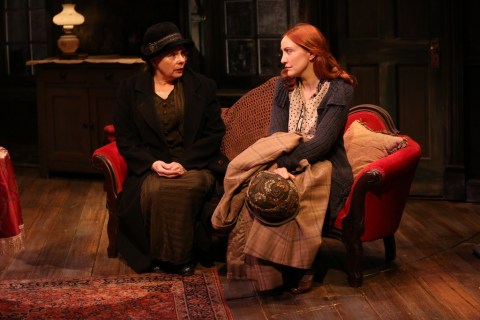
Maryann Plunkett, Sarah Street in Irish Repertory Theatre’s 2019 production of ‘Juno and the Paycock,’ (Carol Rosegg)
Juno and the Paycock’s stark and tragic human realities of lost lives are realized in this memorable production. It is no wonder that O’Casey was able to write full time after this play was produced at the Abbey Theatre; it is a marvelous work. Our identification with the characters’ downfall is acute and heartfelt. And every foible that threads its way from the beginning in each of the character portraits augments to the point where the civil war in the streets has been manifested internally as a civil war in the lives of each of the family members. For each struggles against their own addictive impulse to destroy themselves in not facing hard realities that can and should be dealt with until it is too late.
O’Casey’s themes about the struggle for survival, lost innocence, the inability to get free of one’s own addictive nature is relayed against the backdrop of war when countrymen fight against countrymen, and those who cannot fight hide and enter into the oblivion of drink. Sadly, the women are left to bury their dead and to mourn, seeking the surcease of sorrow through religion and prayer, which to the men is an inadequate response.
The production shines in the cast’s rendering of O’Casey’s searing portraits of the Dublin tenement-dwellers and their relationships with each other. Included in these not mentioned before are the fine Terry Donnelly as Maisie Madigan, Robert Langdon Lloyd as Needle Nugent, Una Clancy as Mrs. Tancred and members of the Ensemble (Rory Duffy, Meg Hennessy, Michael Mellamphy).
Special kudos go to the creative artists who effected the themes and intentions of the director through their talents and efforts. These include Charlie Corcoran (Scenic Design), Linda Fisher (Costume Design), David Toser (Costume Design), Michael Gottlieb (Lighting Design), Ryan Rumery (Original Music), M. Florian Staab (Sound Design).
Juno and the Paycock runs with one intermission. You can purchase tickets at the Irish Repertory Theatre website by CLICKING HERE.
‘After’ by Michael McKeever, Directed by Joe Brancato at 59E59 Theaters

(L to R): Mia Matthews, Jolie Curtsinger, Bill Phillips, Denise Cormier, Michael Frederic in ‘After,’ written by Michael McKeever, directed by Joe Brancato at 59E59 Theaters (John Quilty)
The play After by Michael McKeever superbly, incisively directed by Joe Brancato at 59E59 Theaters chronicles what happens between two families whose teenage sons, once friends, are involved in a bullying incident. In examining the events before, during and after the incident, the playwright dissects the anatomy of denial, psychological debility and delusion in the lives of each of the parents and their sons. Whether the occurrence may have been avoided is uncertain. However, the play argues that openness and communication should be the linchpins of a family unit. When they are not, the possibilities for self-destruction are endless.
The Campbells and the Beckmans, once friends, meet to discuss a bullying text that Kyle Campbell sent to Matthew Beckman. Julia Campbell’s sister Val (Jolie Curtsinger) is present during the discussion to help strengthen Julia and serve as a mediator, though both Connie and Alan Beckman question the soundness of this.
Julia Campbell (Mia Matthews) is a beautiful woman and everything about her speaks of her desire for perfection, peace and happiness. And if there is a wrinkle in her fine world, she will either straighten it out or justify with logic why the wrinkle doesn’t exist.

(L to R): Michael Frederic, Mia Matthews, Bill Philips, Denise Cormier, Jolie Curtsinger in ‘After,’ written by Michael McKeever, directed by Joe Brancato at 59E59 Theaters (John Quilty Photography)
On the other hand Connie Beckman (Denise Cormier) appears to have donned the role of motherhood with a vengeance. Front and center she is a mama bear defending her baby cub and will do whatever she deems necessary to make sure he is safe, regardless of her cub’s wishes. In the opening dialogue between the Beckmans, the playwright establishes that Connie is assertive and confrontational with everyone. Her husband Alan (Bill Phillips) suggests that she must tone down her combativeness if they are to make inroads toward the resolution they desire during this meet up with the Campbells about Kyle’s text to Matthew.
The text “You’re next faggot,” is opaque. Apparently, neither teenager is discussing with their parents what “next” means, who provoked whom, why Matthew is a “faggot,” in Kyle’s eyes, even what Kyle means by “faggot.” Somehow, the vital import of the text is lost in all of the wrangling about Kyle’s punishment and whether this is just a matter of “boys will be boys” shenanigans.
Connie Beckman has not informed Matthew of the visit, not wanting to antagonize her son whom she infers would be furious if he knew. Overshadowing the discussion is the Beckman’s intention to convince the Campbells that the two sons should not be allowed to confront each other again, because the text, from their perspective, is a dangerous threat.
To deflect what happened, Kyle has offered to apologize, though we learn later this does not “come from the heart.” Additionally, Kyle has received a suspension from the principal and it is hoped that the parties involved have made up and all is well. On his part Matthew apparently feels to deal with the event on his own. Like Kyle, Matthew is deflecting and hiding what occurred from his parents, keeping it as a secret between himself and Kyle.

(L to R): Mia Matthews, Michael Frederic, Bill Phillips in ‘After,’ written by Michael McKeever, directed by Joe Brancato at 59E59 Theaters (John Quilty Photography)
The Campbells and Beckmans do not have open communication with their sons so that the teenagers feel they can discuss ANYTHING with them or even ask for the help that they need. In fact the only reason why the parents became involved is because Connie broke the privacy rules with her son and checked his phone text messages, then went to the principal. Her actions from a teenagers’ perspective identify her as an over-protective mother who is exacerbating the problem when it should be left between Kyle and Matthew to resolve. Certainly, the Campbells both feel that if Connie had not forced the issue, nothing further would have happened and their sons would be “OK.”
We learn later, the situation is more complicated than both families imagine. The teenagers are duping the parents and principal. Lip service has been given, but the truth has been obfuscated and no one wants to look for it, not even the teenage boys who are unable to deal with their own personal feelings on a rational level to make themselves understood to themselves, let alone others.
Initially, McKeever doesn’t focus on the lack of communication between parents and sons. It only manifests as a reveal by the conclusion of the play. The irony is that the parents don’t see this elephant in the room either. Both couples are on the defensive and willing to blame “the other side,” as opposed to coming to terms with the fact that they do not communicate with their children on the deepest level possible to understand what the text means. Allowed to continue, both sons’ isolation and reluctance to speak to their parents may result in an escalation of events between Kyle and Matthew.

(L to R): Denise Cormier, Bill Phillips, Michael Frederic in ‘After,’ written by Michael McKeever, directed by Joe Brancato (John Quilty Photography)
That their blindness about their children belies a flaw within the parents’ psyches gradually becomes apparent. Indeed, the incident between Kyle and Matthew explodes the arrogance each mother has about her ability to parent her child. It also explodes the stereotypic masculine tropes the fathers may embrace since their sons did not feel comfortable enough to discuss the underlying situation with them either. The walls that divide the sons from their parents, and the spouses from each other only expand as the couples attempt to come to a satisfying conclusion, an impossibility as long as the blindness and alienation remains.
The Beckmans argue that the text is a threat, that it is serious and should be dealt with not only by a suspension but by Kyle’s expulsion from the private school which abstains from taking such extreme action for monetary reasons. To illustrate the point that the texting threat is severe and perception means everything, Alan frightens all in the room with a rifle he takes from the living room wall mounting. Though he proves his point about the nature of a perceived threats’ power, it falls on the Campbell’s deaf ears. Tate Campbell believes that the text is just BS. He minimizes his son’s behavior as does Julia Campbell and both agree if Connie had not taken the text to the principal, Kyle and Matthew would have forgotten about the situation.
As the arc of the play’s development expands and intensifies, revelations about the couples become manifest. In the “During” segment of the play, the circumstances between Julia and Connie appear to improve after Julia shares her difficulties becoming pregnant with Kyle. Both women apologize to each other. Nevertheless, Kyle’s resentment at being suspended and Matthew’s fear about facing Kyle in school have not been dealt with adequately. Neither son expresses his emotions to his parents. The situation explodes with disastrous consequences and at the end of the segment of “During,” a catastrophe occurs which is elucidated in the last segment of the play with irony.
This is a riveting, powerful and timely production. The greatness of the play in its themes, conflicts and revelation of the importance of communication among family members is evident from the outset. The adroit actors carry the tension throughout. Indeed, each actor hits the ball out of the park so that no one character “dominates” the other which would ruin the dynamic and theme that all have a responsibility in the events. This is ensemble work at its best, its most alive.
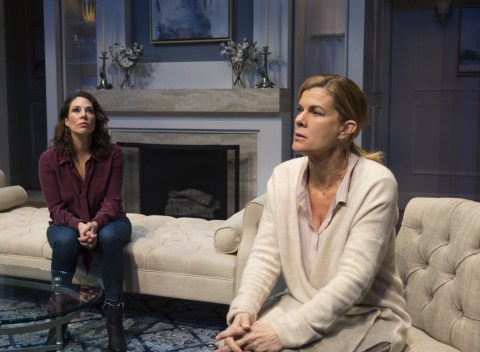
(L to R): Jolie Curtsinger, Mia Matthews in ‘After,’ written by Michael McKeever, directed by Joe Brancato (John Quilty Photography)
Brancato’s direction paces the suspense toward the tragic and uplifting conclusion. And the production values sustain this presentation making for vibrant, “in-the- moment” theater that resonates for us, as thrilling theater should.
With McKeever’s examination of such a situation, we hope to learn from the mistakes of these two families. As the playwright implies, channels of communication must be open. Judgmental, value-laden condemnation should not be the focal point of a parent-child relationship. Ironically, over-protection can damage as can permissiveness and laissez faire parenting styles. However, with teenagers, it is impossible to second guess them. They may damn well do as they please. What then? The parents must deal with what comes “after.”
Kudos to the artistic creatives for their efforts which enhance the production’s themes and provide a supportive milieu for the actors to exercise their craft to perfection. These include Gregory Gale (Costume Designer), William Neal (Original Music/Sound Designer), Brian Prather (Scenic Designer), Martin E. Vreeland (Lighting Designer), Buffy Cardoza (Properties Designer), Max Silverman (Associate Sound Designer).
After is being presented by Penguin Rep Theatre and Inproximity Theatre Company in their New York City Premiere. The production runs 90 minutes with no intermission at 59E59 Theaters (59E59th Street between Madison and Lexington Ave.) until 14 April. To purchase tickets you may go to the website by CLICKING HERE.
SXSW 2019 World Premiere Narrative Spotlight Film, ‘The Day Shall Come’

Marchánt Davis in ‘The Day Shall Come,’ SXSW 2019 World Premiere Narrative Spotlight film (photo courtesy of the film)
The Day Shall Come directed by Chris Morris, co-written by Chris Morris and Jesse Armstrong takes real-live accounts of how the FBI attempts to trap terrorists and hate groups and spins a fantastical yarn that is in whole is frighteningly realistic. Indeed, Morris culled research from stories which run to the overarching plot of this film, NOT the specifics. The events recall dastardly Keystone Cops episodes of law enforcement who entrap faux criminals, while real killers, i.e Parkland, 911, Columbine, Tree of Life Synagogue, Las Vegas, etc. have their way with US citizens.
Chris Morris creates a complicated, humorous and sardonic plot to send a powerful message to us about real terrorists and the convenient conversion of folks into harmless, safe, FBI-styled terrorists in the wake of the Bush era “war on terror” and Trump era terrorists on the border mantras used to herd the brains of American Citizens. At the bottom of Morris’ contentions? If we are not circumspect watchmen, law enforcement can become overweaning and abuse its powers. This is especially so when the risk reward ratios are tied to terrorist quotas which allow agents to convert folks to terrorism rather than locate actual terrorists and skillfully infiltrate their groups which takes years/decades.

(L to R): Danielle Brooks, Marchánt Davis, Anna Kendrick in ‘The Day Shall Come,’ SXSW 2019 World Premiere Narrative Spotlight film (photo courtesy of SXSW and the site)
In The Day Shall Come, Morris’ compact film resounds with currency, insanity and selects as its hero a black man. Considering historically blacks have proportionately not engaged in terrorist activities and have continually been victimized by law enforcement, this is an extremely satiric choice.
Moses, a self-proclaimed Floridian preacher, his wife Venus and four saintly “soldiers” attempt to raise up a religious following and by peaceful means, overcome the corrupt white culture that is displacing hundreds with gentrification and soulless development that decries affordable housing. On a wing and a prayer, some meds for bi-polar disorder, his converts and his raggedy church/farm that sells eggs and chickens to make ends meet, Moses (a hysterical and well-paced performance by Marchánt Davis) attempts to stop the continual threats of eviction and sell-out to developers with a shuck and jive routine that grows tired even for his once empathetic landlord.
Money is king. Money is the soul and song of existence in a culture which has extruded Moses and his church from its society and left them on the precipice of humanity. Without money, one cannot live even a meager existence with dignity. And Moses rag tag group Star of Six, cannot even begin to think about activism with any viability.

Chris Morris, SXSW 2019 World Premiere Narrative Spotlight film ‘The Day Shall Come’ (photo courtesy of the site)
Desperate to forestall the end of his ministry and the abject misery of extreme poverty for himself, his children and his church family becoming like the thousands of Floridian homeless, Moses is driven to use “any means necessary” to fulfill his destiny and keep his church in the promised land where God has placed him. But where will he come up with the rent?
Enter a slimy pedophile miscreant with a taste for teenage girls and the FBI’s immunity to abuse them in a continual quid pro quo. Reza (Kayvan Novak) is the enslaved puppet informant of the FBI whom they send out with gobs of taxpayer cash to lure, entrap and capture those groveling for their last dimes (like Moses) to turn them into “enemies of the state” and terrorists. Terrorists are needed to prove this branch of the FBI “are worthy” of their budget and the jobs they hold.
In the case of Moses who goes off his meds to speak to God and Satan and refuses to carry rifles, AK-47s, glock pistols or anything that shoots bullets, the impoverished preacher, his wife and four congregants are hard cases to prove as terrorists, even though they are an uber tiny “radical” group. The nature of who the FBI is willing to convert to terrorism is beyond the pale. But Reza is the perfect foil for his handlers to squeeze. He is stressed to come up with a ready plot to snag Moses, though a three-year-old can see Moses has mega mental issues and terrorism is not one of them.
But desperate to continue his sexual abuse of teen girls, Reza’s urges compel him to work quickly or his equally amoral, slimy handlers Kendra Glack (Anna Kendrick), Andy (Dennis O’Hare) and other FBI officials will cut off his chick supply and throw him in a greasy Florida jail with worse perverts. That they are more into “fighting” terrorism with the most unlikely of candidates than get a red, hot, live sex offender, is ironic and damning. But, hey, this is credible considering the backlash against the #metoo movement and rampant world sex trafficking that could be ameliorated if… but it is not considered that important, nor is rape, for that matter.

Danielle Brooks, Marchánt Davis, Chris Morris, Anna Kendrick in SXSW 2019 Narrative Spotlight film ‘The Day Shall Come,’ (photo courtesy of SXSW and the site)
With Reza’s lust working overtime, a plan is conceived to snare Moses who by this time, enveloped with stress about money, has gone off his meds and is convinced the lightening strike on a large crane in a development zone is God’s sign that he is with Moses whatever he does. How Moses goes from a poor, non-violent preacher who means well to an FBI terrorist supplying arms to the KKK is the stuff of satiric greatness that only a Brit like Chris Morris could evolve with horrific authenticity, supple comedy and riotous laughter. The coda at the end which identifies what happens to Moses, his wife, his four congregants and the FBI agents is both sickening and too realistic.
The Peter Principle is alive and well according to Chris Morris in The Day Shall Come, which also proves that in a septic tank, the really big turd chunks rise to the top. By comparison, Moses and his church are crystal clear water preyed upon by evil creatures twisted by their own hellishness.
The actors who portray the agents are depicted with skill. We dislike them immediately once we understand their self-dealing intentions. And indeed, Davis’ comedic “performance with a purpose” as the bi-polar preacher who hears from God and Satan is truly exceptional. The supporting cast and wife Venus (Danielle Brooks) do their wacko leader proud.
The themes Morris touches upon are numerous, varied and styled with clever twists. Many vital concepts about human nature and the human condition, good vs. evil reversals, abide with humor in this clever work. Most importantly, we understand how corruption self breeds like a toxic bacteria once it begins. When there is no moral force to oversee the rabidly power-hungry and abusive who are supposed to be caretakers of the law, every wicked trope, every sick meme congregates on the warped and diseased host, then spreads. This is not a pretty portrait of the FBI, but it is a darkly wicked one which will resonate. Physician? Heal thyself or your own disease will rot you from within.
The Day Shall Come will be released later in the year. Don’t miss this sardonic, zany and “too-true-to-look-away” film. And do not in any way confuse it with satire against black activist organizations. This is aimed front and center at the FBI. Moses and his group are cast in the most extreme and crazy light possible to reveal “how” terrorists are made and how economic inequality and overweaning power structures mold harmless, faux “terrorists” into bogey men then use them in their institutional PR campaigns.
‘If Pretty Hurts, Ugly Must be a Muhfucka’ at Playwrights Horizons, Review

(L to R): Mirirai Sithole, Antoinette Crowe-Legacy, Phumzile Sitole, Rotimi Agbabiaka, Nike Uhe Kadri in ‘If Pretty Hurts Ugly Must be a Muhfucka,’ at Playwrights Horizons, directed by Leah C. Gardiner, written by Tori Sampson (Joan Marcus)
If Pretty Hurts Ugly Must be a Muhfuka is a genre hybrid (comedy, musical, fantasy) that boasts sterling music, fine choreography and movement, and elements of the fantastic and supernatural all in the service of monolithic themes and blockbuster issues that woman have been grappling with for centuries, regardless of race or culture. In this world premiere written by Tori Sampson and directed by Leah C. Gardiner, the playwright focuses on cultural folkways of beauty as a blessing and a curse for the one who is beautiful and also for those who are the “un-beautiful” or average looking. Caveat, there are no “ugly” women or men in the play. However, when one is “the most beautiful of all,” everyone else is ugly.
Every culture has it beauty standards. However, ideals promoted in advertising, the diet industry, the fashion industry, etc., create the values of appearance fascism that render mirrors and scales the vehicles of anathema and self-excoriation for young and old women of every culture. The beauty myth is not a myth but a very real stigma that women must conquer during their lives. Unless the strength of a woman’s soul is built up, self recriminations about appearance fostered by the cultural beauty police (in fashion, advertising, etc.) greatly influence all aspects of womanhood, education, career, and can impact the friends a woman has, who she marries, the society she is accepted in and her ability to float on the currents of lifestyle both virtual and live.
The playwright makes the subject of beauty and the issues it raises front and center the first five minutes of this fanciful/magical-realism styled production with her protagonist Akim (Nike Uche Kadri) who is beautiful and thin and who the girls in her social strata resent because they do not look “as good as she.” The casting for the production is genius because all of the girls are adorable and in fact, the rival of the protagonist could be said to be more attractive, depending upon one’s subjective opinion.

(L to R): Maechi Aharanwa, Jason Bowen, Leland Fowler in ‘If Pretty Hurts Ugly Must be a Muhfucka,’ written by Tori Sampson at Playwrights Horizons (Joan Marcus)
The arc of the plot development revolves around the interactions of Akim with her ultra protective father (Jason Bowen), her beauty encouraging mother (Maechi Aharanwa) and her school mates who front off on being her friends to entrap and destroy her. These include Massassi (Antoinette Crowe-Legacy), Adama (Mirirai Sithole) and Kaya (Phumzile Sitole). Thrown in to escalate the conflict is the romantic interest Kasim (Leland Fowler) who Massassi and Akim fight over. Rotimi Agbabiaka portrays the Chorus as he narrates and guides the action.
Sampson’s protagonist who has been sheltered by her parents and especially her Dad because he fears her beauty will bring trouble upon her, has few social guideposts to help her recognize those who are truly friendly and those who are plotting against her. Thus, as a series of events unfolds, she is blind to the wickedness of Massassi who instigates her friends to drown Akim in the river. Massassi is motivated by jealousy, insecurity and fear that Akim’s beauty will steal Kasim from her. She reasons if Akim is dead, she will free the world and herself of the daily torment and misery she experiences because Akim exists. Like the witch in Snow White and the Seven Dwarfs, who attempts to kill Snow White, Massassi must eliminate her competition to end her suffering.

(L to R): Phumzile Sitole, Antoinette Crowe-Legacy, Miriarai Sithole in ‘If Pretty Hurst Ugly Must be a Muhfucka, written by Tori Sampson, directed by Leah C. Gardiner at Playwrights Horizons (Joan Marcus),
The notion that beauty standards provoke evil and harm when women focus on their outer appearance to the exclusion of everything else is an unshakable cultural phenomenon. Eating disorders like anorexia nervosa and bulimia exemplify this harm; the obsession with plastic surgery and appearing youthful, undergoing physical mutilation to leave a good looking corpse at the end of life has become a fantastical reality that all women confront and succumb to or rebel against. One of Simpson’s themes in the play suggests that when individuals so concerned with appearance ignore the very reality of the soul and value of human beings, life itself and the appreciation of life’s wonders dissolve. The person becomes a vapid and empty non-person blown about by the next cultural trend or “beauty” style.
Paramount in the production is the theme that life is more than external appearances. The wholeness of life encompasses the soul, spiritual rebirth and regeneration away and apart from cultural mores that command women adhere to rigid appearance fascism. In a symbolic musical dance number, Simpson suggests the importance of spirituality to every individual when Akim undergoes a spiritual resurrection that lifts her soul beyond the attention of the physical, empirical world. The true realm of life is not the empirical, material world which one sees with the eyes but what one apprehends in one’s spirit, the invisible world of the supernatural.

(L to R): Mirirai Sithole, Phumzile Sithole, Nike Uche Kadri, Antoinette Crowe-Legacy in ‘If Pretty Hurts Ugly Must be a Muhfucka,’ directed by Leah C. Gardiner, written by Tori Sampson (Joan Marcus)
With Akim’s transformation, Simpson clarifies that only spiritual regeneration can fill the emptiness and underlying void that attention to external beauty cannot fulfill. And indeed, by the end of the play, we see that encouragement to develop inner self-love and confidence obviates Massassi’s hellish, obsessive torment for not measuring up to the culture’s appearance fascism. Instead, she defines her own standards of beauty and internalizes them, focusing on her true self.
The production raises intriguing questions about how each of us negotiates cultural folkways that can be destructive if we internalize them and punish ourselves for “falling short.” The themes are powerful and varied. The arc of the play’s development moves from realism to mysticism which may be confusing to some. The conclusion ends with a construct that “all is a dream.” Yes, this is contrived, but Massassi’s dialogue brings the themes and the story together. Indeed, this play is about ideas and human archetypes. I appreciate the playwright’s intent and know the themes to be vital ones.
One caveat about performances. The finest portrayals were by the actors who slowed down, projected and didn’t allow “accents” to get in the way of the playwright’s wonderful meaning. The words are key, the dialogue is king. The audience must understand every word the actors project. This was sadly not the case in this production where the tongues sometimes tripped over the accents garbling the dialogue.
Kudos to the creative artists responsible for scenic design (Louisa Thompson), lighting design (Matt Frey), costume design (Dede Ayite) and original music and sound design (Ian Sot). Without their shining efforts, the production would have been a drab mess. Musicians Rona Siddiqui on percussion and keyboard, and Erikka Walsh on percussion and base were fantastic. Special kudos to choreographer Raja Feather Kelly whose symbolic dance numbers superbly conveyed the playwright’s themes and solidified them. Leah C. Gardiner’s excellent staging brought together the various elements to ingeniously effect this production and make it memorable.
If Pretty Hurts Ugly Must be a Muhfucka runs with no intermission at Playwrights Horizons (42nd Street between 9th and 10th) in an extension until 5 April. For tickets on their website CLICK HERE.
Rosary O’Neill, Playwright of ‘Degas in New Orleans’ Discusses Edgar Degas
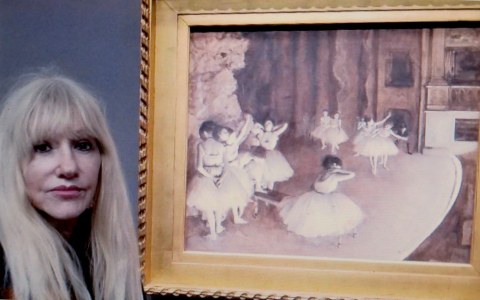
Rosary O’Neill at the Muse D’Orsay, fifth floor appreciating Impressionist Edgar Degas’ famous painting (Carole Di Tosti).

Rosary O’Neill at the Muse D’Orsay appreciating the famous Impressionist Edgar Degas who she has written about in ‘Degas in New Orleans’ (Carole Di Tosti)
‘By the way, Meet Vera Stark’ by Lynn Nottage at The Signature Theatre

(L to R): Jessica Frances Dukes, Jenni Barber, Heather Alicia Simms in ‘By the way Meet Vera Stark’, written by Lynn Nottage, directed by Kamilah Forbes (Joan Marcus)
Lynn Nottage’s By the Way, Meet Vera Stark at the Pershing Square Signature Center is a comical/tragic study in black Hollywood’s greats that few recognize because the racism and oppression in the nation was also reflected in Hollywood institutions. Nottage follows the career of black actress Vera Stark across seven decades and examines how she fared while the roles for black women remained static as maids, servants, slaves and menials. The setting is Hollywood, but the time shifts from 1933 (film studio and apartment) to 1973 on Brad Donovan’s Hollywood TV show and 2003 during a Hollywood film colloquium.
We are first introduced to the incomparable Vera Stark (Jessica Frances Dukes) in the 1930s when she is young, beautiful, vibrant and naive about launching her career in the movies. Working as a maid for “America’s little sweetie pie” Gloria Mitchell (Jenni Barber), Vera creates her own opportunities and lands the prized role as a maid in a picture starring two of her friends and Gloria Mitchell called The Belle of New Orleans.
Nottage’s characterization of Vera Stark reveals the actor’s assiduous work ethic, her dogged ambition and supreme cleverness at jiving the system and environment she is in. She negotiates helping Gloria Mitchell with everything from her image and wearing the right clothes, to reading lines with her for the audition that Gloria needs to get a plum part which will strengthen her career. It is this audition that Vera hopes to also parlay into a role for herself to eventually rise up the ladder of stardom.
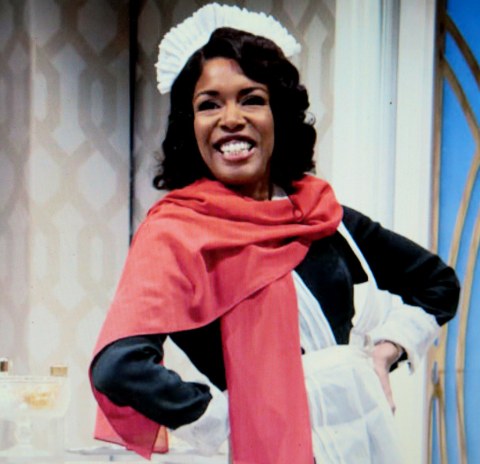
Jessica Frances Dukes in ‘By the way Meet Vera Stark,’ by Lynn Nottage, directed by Kamilah Forbes (Joan Marcus)
Act I is filled with humor that indicates the sub rosa black culture’s fronting and milking the stereotypes whites have of them behind their backs. Joined by her friend Lottie McBride (the fine Heather Alicia Simms) who also has come to Hollywood and has eaten herself out of house and home to play a mammy slave part to no avail, their playfulness and criticism of their circumstances indicates they are survivors and will hang on until they achieve what they want, though the roles available to them are as slaves, maids and servants.
We meet another “high yellow” black actress Anna Mae Simpkins (the funny Carra Patterson) a quasi friend who is looking to advance herself by dating various directors and other filmmakers and passing herself off as a Brazilian. The interactions between the women and a foreign director are beyond hysterical, and Nottage has fun with turning assumptions about blacks on their head. When the director assumes that all blacks come from a slave background, Vera and Lottie act the parts of the oppressed for him with hysterical precision mugging the stereotypes, convincing the director to give them parts in his film.
Act I presents the backstory of these four women before they achieve artistic greatness in the film The Belle of New Orleans which all of them are cast in. The beauty of this production is how Nottage chronicles the development of Vera Stark. So we actually get to see the film in black and white. And all of the actresses are superb, placed into the film’s reality. On stage and in real life, these women, Lottie, Gloria, Anna Mae and Vera are “larger than life.” However, on film the actresses give the roles they play a resonance and authenticity. We understand why and how (based on the last moments of the film), the film is a great and iconic one in the annals of film history and often the subject of film colloquiums.
After the screening of The Belle of New Orleans, Herb Forrester (Warner Miller) steps out from the curtain and we realize that he has just shown the film at a colloquium in Hollywood. As Forrester proceeds, we hear a disposition about Vera Stark’s identity as a black actress and how she was able to make a life and career for herself despite the demeaning roles black men and women played as slaves, helpers, servants, chauffeurs, etc., reflecting the culture at large. Joined by Carmen Levy-Green (Heather Alicia Simms) and Afua Assata Ejobo (Carra Patterson) we are struck by the cultural ironies as these heady intellectuals play the elites while they dissect Vera Stark and cast her “blackness” in philosophical racial identities that Nottage turns into hysterical objectifications.
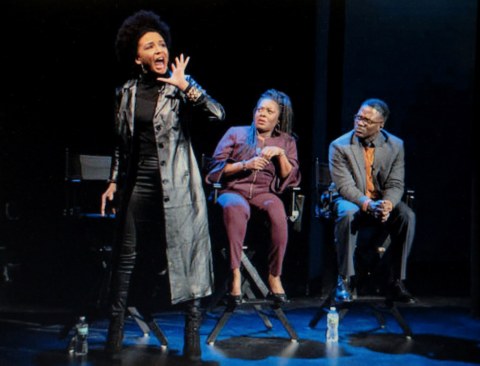
(L to R): Carra Patterson, Heather Alicia Simms, Warner Miller in ‘By the way Meet Vera Stark, directed by Kamilah Forbes, written by Lynn Nottage (Joan Marcus)
The humor as the two women argue about Vera Stark’s identity, gender and racial politics with Forrester, who appears to deal with them in all his glorious paternalism, is just great. Act II brings all the tropes together and the liveliness of the conflict between the black male and the two female guests is superbly done.
Even more superb is the flashback to a tape of the afternoon talk show (a la Merv Griffin style) that stars host Brad Donovan with guest, the great black actress Vera Stark. Forrester plays the taped interview with Vera Stark to reveal what happened to her after she had her Hollywood career that never advanced beyond the cultural stereotypes and roles that the white paternalistic studio heads created for her.
In this taped session which we see live, Jessica Frances Dukes appears more like a version of every starlet who faded irretrievably into old age and alcoholism and speaks with a wobbly voice rather like Katherine Hepburn’s. Every moment of the taping, the diva, Vera Stark is “on.” She sings a bit and entertains with humor another guest, Peter Rhys-Davies (Manoel Felciano). All goes swimmingly as Vera gets drunker and drunker until surprise! Donovan trots out Gloria Mitchell so the women have a reunion to discuss The Belle of New Orleans. The difference between how Vera Stark has aged and how Gloria Mitchell has aged is striking and revelatory. Gloria Mitchell who had a career, and the substantial money to take care of her body looks the same. Vera Stark, who has allowed the excesses of alcohol and demeaning parts to overtake her soul, has aged and appears to be a tragic figure.
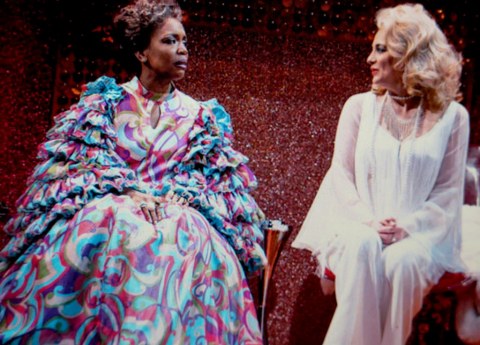
(L to R): Jessica Frances Dukes, Jenni Barber in ‘By the way Meet Vera Stark,’ (Joan Marcus)
This is a subtle devastation which the host doesn’t appear to “get,” but which Vera Stark finally does. And in an epiphany she relates that she is still enslaved to a role she played decades ago. Now, once again, she must confront Gloria Mitchell and the role of Tilly, though she has gone on to do other parts during her career she perceived she made for herself. Only with this final confrontation, Vera realizes she has allowed the culture to dupe her. And she vows, it is for the last time. Dukes’ Vera is fabulous in this section and the ensemble fields her beautifully.
How Nottage concludes the third segment with Forrester, Levy Green and Ejobo continuing to disagree with each other’s dialectic about Vera Stark is both humorous and sardonic. For they have completely missed the point which we clearly have seen in the segments. Vera Stark was morphed by the circumstances of Hollywood. The rumors of how she ended her life are even more ironic as we listen to the elites discuss a woman they knew very little about. Then Nottage in the last few minutes configures another fabulous revelation that is poignant and beautiful. You will just have to see this wonderful production to appreciate it for yourself.
By the way, Meet Vera Stark runs with one intermission until 10th of March at the Pershing Square Signature Center. You can pick up tickets by CLICKING HERE.
Artistic Creatives: Clint Ramos (Scenic Design) Dede M. Ayite (Costume Design) Matt Frey (Lighting Design) Mikaal Sulaiman (Sound Design) KAtherine Freer (Projetion Design) Daniel Kluger (Composer) Mia Neal (Hair and Wig Design)
‘The Prom,’ A Musical Comedy That Soars With Positivity and Truth
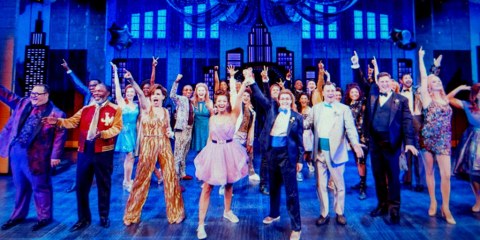
The cast of ‘The Prom,’ Book by Bob Martin & Chad Beguelin, Music by Matthew Sklar, Lyricsy by Chad Beguelin, Directed and Choreographed by Casey Nicholaw (Deen van Meer)
Even if you never went to your own high school prom and can’t imagine wanting to, The Prom directed and choreographed by Casey Nicholaw, currently at Broadway’s Longacre Theatre is a celebration of joy and life that you would be comfortable with. In fact just for its sheer hilarity, exuberance, and wisdom, you would eagerly sign up for the high school prom decorations committee. From its timing-perfect acting, to the evolution of characterization, and ingenious “true-to-life” story-line delivered in dialogue with dollops of zazzzzz, this musical comedy is thematically trenchant and expansive. Thanks to its talented creatives who know how to please and bring in the jokes at two hours and change with one intermission. The Prom is saavy, poignant and politically current with immutable themes that resonate for all time.
The notion of a “prom” unifying a senior class for the last time before they take off to “parts unknonwn” beyond the cliff of their community, is antiquated. But it is a tradition that the “in” crowd and “cool” kids in various schools in the US of course exploit to champion their supremacy over the rest of the school’s social groups. Naturally, for girls it is the height of achievement to be able to go with a date and buy a gorgeous dress with all the trimmings including matching color co-ordinated cumberbund for the guy’s tux and baseball cap. For those outcasts and isolates who have had to endure the humiliation and often sub rosa bullying and excoriation of their classmates precisely because they are “EWWWWW,” and would never be able to either ask someone or be asked, “the prom” is synonymous with pain, torment, Nazi-style fascist sadism which ultimately reverts to self-flagellation for the isolate’s not measuring up and having one’s place on the sunny side of high school superiority and popularity.

‘The Prom,’ Book by Bob Martin & Chad Beguelin, Music by Matthew Sklar, Lyricsy by Chad Beguelin, Directed and Choreographed by Casey Nicholaw (Deen van Meer)
The high school structure of placing students in same-age-related grades causes such emotional debacles and crucibles of misery, not only with regard to “the prom,” but with regard to stratification of achievement levels and every aspect of the daily life of the high school student. But what happens if you are not only a social outcast, but one with a gender proclivity that is UBER “EWWWW” in a setting where religious folks in a Red state culture believe your very nature, identity and being is a sin? Such is the conundrum and very real stakes for Emma (sensitively and realistically portrayed by the golden-voiced Caitlin Kinnunen) As a high school senior of a small high school in Indiana, Emma must suppress her year and one-half relationship with Alyssa (Isabelle McCalla is superb as Emma’s waffling sub rosa girlfriend) which they both intend to make manifest when they go to their prom together. But when the PTA led by Alyssa’s mom (the heartfelt and many-sided Courtenay Collins) discovers that Emma intends to bring a same sex girlfriend (she does not know it is her daughter-surprise, surprise), she protests and creates a ban. And Emma protests creating a stir.
This real-life situation of gay teens being barred from attending their proms with same sex partners has occurred all over the US and as recently as in 2017, Buffalo, New York. Most specifically when it happened to Constance McMillen of Itawamba Agricultural High School, in Mississippi, McMillen sued because her rights were violated. And when the ban was lifted and she attended her scheduled prom, the district had a surprise waiting for her right out of Mitch McConnell’s and the Republican Party’s playbook. (Check this article on McMillen.)
With Trumpism, gender discrimination, misogyny, racism and nativism have gained a legitimacy as certain social groups glance back fondly to the days of Jim Crow and attempt to enforce their fascist agenda on the rest of US citizenry who are patriots and believe in upholding the constitution. That Bob Martin, Chad Beguelin and Matthew Sklar have allowed the prom banning of LGBTQ groups to inspire them to write a musical comedy which explores the heights and depths of Trumpist-type discriminatory acts with grace, style, laugh-riot humor and profound wisdom (without making reference to Trump, or the new Trump party) is prestidigitation on a grand scale. For they inspire unity, hope and love with the same tools that adversarial groups use to promote hate and division.

(L to R): Isabelle McCalla and Caitlin Kinnunen in ‘The Prom,’ Directed and Choreographed by Casey Nicholaw,(Deen van Meer)
And what is the vehicle they use to initiate a way into the LGBTQ hair-raising problems of a small Indiana high school and Emma’s fight? Theatricals! Thespians who represent some of the finest, award-winning celebrity narcissists on Broadway. And these even bring their Tonys and Drama Desks to impress the motel manager to give them a better room. Of course, not only are they not recognized, the crushing humiliation they experience in a town that could care less about them is enough to make even a narcissist more lovable and heart-warming.
Martin, Beguelin and Sklar begin in New York City with the Broadway stars backstage after a performance which closes immediately when they receive a horrific New York Times review. The critic was particularly humiliating when they referred to the headliners as “unlovable narcissists.” The joke is priceless for it recalls another celebrity narcissist who also cannot be insulted and refuses to change.
The narcissists are the fabulous Beth Leavel as Didi Allen the Diva Queen extraordinaire with a gorgeous belt (We hear it in the song “The Lady’s Improving), and her co-star in infamy the “bring-down-the-house” high flier, Brooks Ashmanskas as Barry Glickman whose vibrant and hysterical “Barry is Going to the Prom,” hints at the 30-years-ago miseries of high school and the affirmation of love wiping tears away years later.
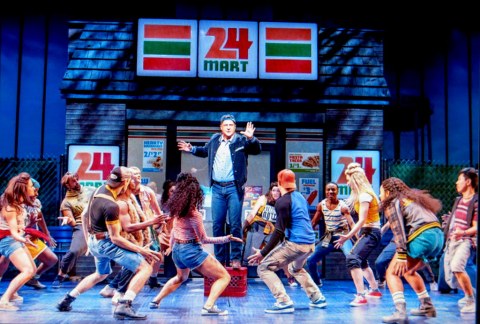
The Prom,’ Cast and Christopher Sieber, Book by Bob Martin & Chad Beguelin, Music by Matthew Sklar, Lyricsy by Chad Beguelin, Directed and Choreographed by Casey Nicholaw (Deen van Meer)
The attention starved thespians are accompanied by Angie (the excellent Angie Schworer whose dance/voice number “Zazz” is just wonderful) and Trent Oliver (Christopher Sieber’s fantastic “Love Thy Neighbor” with the ensemble is the gobsmacking point of the show). Along with producer Sheldon Saperstein (Josh Lamon’s timing is spot-on) this motley crew goes on the road to resurrect their brand, recover from the criticisms in the Times article by battering down the unjust doors of the discriminatory high school to join Emma’s cause. They determine that this “self-less act” of “making a difference,” “doing good for the world” will lift their reputations and give them some positive publicity.
Of course they exacerbate the horror of the initial situation for Emma and create a chaotic shambles riling up the parents of the PTA who demand the interlopers be removed and leave. When Emma succeeds in her lawsuit proving her civil rights cannot be violated, the PTA and student body contrive a solution, represented by the song “Tonight Belongs to You/Us” sung by the ensemble at the end of Act One. The number is mesmerizing, wildly frenetic (the dance moves are spectacular) and enthralling. And then the chill comes to us in a terrifying realization of the song’s true message sung by a predatory, vampirish-sounding refrain “the night belongs to us.” Clue, the cool crowd, the money, the power players who attempt to devour and suck the blood of the little people who suffer their callous and unconstitutional injustices. Emma’s Broadway “helpers” prove anything but and Emma is worse off than before the show crowd showed up!
This is a superior high point to end Act One, for there must be change; such injustice cannot continue. Enter the answer which turns the religious institutional crowd on its ear and enter artistic empathy. The result is a beautiful cathartic Greek style elevated comedy of triumph in Act Two which provides a more than satisfying and very adult addendum to proms everywhere in the US.
Yes, some of the problems are not resolved, just like in life. And the townspeople still must grapple with their prejudices. These have taken years to simmer and boil and do not retreat overnight. Alyssa’s mom Mrs. Green must confront the pain of a truth she doesn’t want to see with her daughter. The hatreds and bullying will continue, but this hiatus of joy has begun to ameliorate it. Ironically, the ones who have benefited greatly (the celebrity narcissists) have stepped up and contributed their grist to making the prom one that everyone will remember. Interestingly, they have evolved and developed into less self-absorbed individuals who perhaps have begun to understand another level of success beyond the wins they’ve received in their careers.
I loved this show for its incredibly energetic performances by all of the cast and the ensemble. There is not one who isn’t superb or who isn’t “on point” and “moment-to-moment.” I loved the book and the accompanying musical numbers which remain insightful and carry the themes and story-line forward to the powerful message of the show. Indeed, some of the songs are stand alones with lovely melodies and rising lyrics: “Dance With You,” and “Unruly Heart,” are especially meaningful.

Beth Leavel, Brooks Ashmanskas and the Cast in ‘The Prom,’ Book by Bob Martin & Chad Beguelin, Musi by Matthew Sklar, Lyrics by Chad Beguelin, Directed and Choreographed by Casey Nicholaw (Deen van Meer)
The Prom presents the realms of hope and faith in people’s goodness. It encourages us to take a stand for what is right regarding human dignity, respect and decency. Without politicizing or rankling, it cleverly portrays elements of our nation’s weaknesses from the self-absorbed celebrity elite, to the equally self-absorbed and self-righteous conservatives. Both must modify and one way this will occur is for each social group of the nation to come together, get out of their comfortable locations and visit the hinterlands or “sin city.” The production makes a case for laughing at oneself and not taking one’s beliefs too seriously to forget the dignity of others, regardless of their beliefs. And perhaps especially because of their beliefs, they must be given a hearing. How many times must we say this to begin to do it? We need to stop cannibalizing ourselves.
The final song “It’s Time to Dance,” argues for each and every one of us to be our own creations, to define ourselves to be as truthful as possible on journeys of grace and openness, and without arrogance that masks fear or belligerence to “prove” a point.
The production is superb in its thematic encouragement/reinforcement for young and old: 1)to be the best of who one can be; 2)to take charge of one’s own life and not wait for others to act for us; 3) to bravely do one’s part to establish a world of tolerance and inclusion through communication and empathy.
The creators are not presenting ideas that are puerile and simplistic. If one just stops for two minutes and considers the rise of white terrorist incidents in the last two years that go against the fabric of our nation’s tenets, then one realizes how much our culture needs to witness these themes again and again. On the surface The Prom is a fun ride and you leave the theater humming the songs. But underneath the laughter and fun is the poignant message expressed with ebullience by the ensemble and Christopher Sieber’s Trent Oliver with rousing spirits in the song, “Love Thy Neighbor.” If only…but for the shining last quarter of the show, the cast convinces us of the truth and possibility of putting aside behaviors that divide. What a crazy great message that all of us imperfect, flawed individuals need to remember to dance at our own “prom” (our own way of walking) every day and invite a host of other smiling individuals to promenade with us!
Kudos go to the artistic team which makes this production a resounding you want to come back to see a few times: Jack Viertel (Original Concept) Scott Pask (Scenic Design) Ann Roth (Costume Design) Matthew Pachtman (Costume Design) Natasha Katz (Lighting Design) Brian Ronan (Sound Design) Josh Marquette (Hair Design) Milagros Medina-Cerdeira Mary-Mitchell Campbell (Music Supervisor, Vocal Arrangements) Larry Hochman (Orchestrations) Meg Zervoulis (Music Director) and John Clancy, Glenn Kelly and Howard Joines for their musical coordination, additional orchestrations and arrangements.
The Prom (Longacre Theatre on West 48th between 7th and 8th) has one 15 minute intermission. You can purchase tickets by CLICKING HERE.

