Category Archives: NYC Theater Reviews
Plays
‘Derren Brown Secret,’ is a Stunner, a “Mind” Field, Raising Illusions to Unforgettable Art!
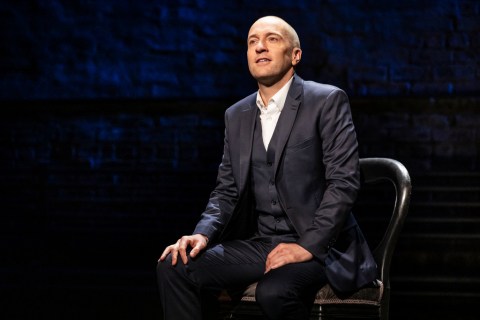
Derren Brown SECRET, written by Andy Nyman, Derren Brown & Andrew O’Connor, directed by Andrew O’Connor, Andy Nyman at the Cort Theatre (Matthew Murphy)
Derren Brown SECRET in its first time on Broadway at The Cort Theatre is nothing short of brilliant. Every illusion that Brown performs to perfection with scintillating charm and lightening smoothness, I have figured out! No! I haven’t. But I am still trying my damnedest two days after I saw Wednesday night’s show. And I am completely frustrated because the only way I will ever know is to ask Derren Brown or another magician to affirm whether my explanations might be correct. So, I’m at an impasse. However, I may know “the secrets” if I research/practice mesmerization, hypnosis and psychological manipulation or read about Brown’s iconic mind control exploits in the UK, which are each one of them harrowing “mind fucks” of entertainment that end up being great, harmless fun. Hmmm!
From convincing middle managers to commit armed robbery, to sticking viewers at home to their sofas, Brown may be one of the foremost masters of mind control in the world. Indeed, he makes President Donald Trump look like a crass sharpie. Thankfully, Brown is a mild-mannered English gentleman with a posh accent who paints and obviously enjoys what he does and will not run for the U.S. Presidency. If he ever does, the country would be in… Well, actually, perhaps he should run. Too bad there is a citizenship requirement. His honesty alone would be absolutely refreshing.

Derren Brown SECRET, written by Andy Nyman, Derren Brown & Andrew O’Connor, directed by Andrew O’Connor, Andy Nyman at the Cort Theatre (Matthew Murphy)
Seriously, Derren Brown is no joke. He is awe-inspiring. And this production will win awards because it is a lesson in human experience, crowd psychology, mind control, the power of suggestion and one’s inability to resist what is already in the unconscious, especially if one attempts to resist it. That is to say, the show is a lesson not only in illusion and mind manipulation and the mysterious, it is above all a lesson in audience participation and a revelation of you as an audience member in a dual role of watching yourself in all your unsubtle susceptibility and experiencing your psychological weaknesses.
It must also be a learning experience for Derren Brown. Indeed, he is always perfecting his artistry, honing his senses and his psychological talents. Whatever it takes to uplift his craft and ability to gauge the audience and manipulate them to a heightened interactive performance so that they stay in dynamic one accord, Brown appears to be pursuing this to the highest degree.
Derren Brown SECRET, written by Andy Nyman, Derren Brown & Andrew O’Connor, directed by Andrew O’Connor, Andy Nyman at the Cort Theatre (Matthew Murphy)
The audience’s “one accord” changes which makes each and every performance fabulous. Diverse audience members are a historical treasure of synchronicity and singularity. To bring audience members “there” who come with unusual lives and schedules and backstories is an impossibility made possible by their will and desire to be “there.” So to say that each night of Derren Brown SECRET is unique, is an understatement. An understatement of understatement. The audience’s and Brown’s particularity is what places this show at the pinnacle of live solo performance. Because of this exceptionalism Brown has deservedly won the Drama Desk in 2017 for his debut show, Secret. And he has won two Olivier Awards and five nominations. a record for one-person shows since the inception of the Olivier Awards.
Derren Brown SECRET showcases the illusory as high artistic execution. Brown begins the first act by reminding us that in our minds the world we live in is our own definition/explanation/fiction. Our perception is our choice, what suits us, probably learned or rejected or somewhat retained from our parents and/or the culture is ours and ours alone.

Derren Brown SECRET, written by Andy Nyman, Derren Brown & Andrew O’Connor, directed by Andrew O’Connor, Andy Nyman at the Cort Theatre (Matthew Murphy)
These moments of wisdom Brown employs throughout to gain our confidence and convince us that he is on our side. Of course his honesty and wisdom relaxes and blinds us to our own susceptibility to ourselves. It is a glorious misdirection, a mesmerization. Indeed, throughout the show, we will forget what we have just witnessed in plain sight and remember only unconsciously that which is inaccessible. The joke is on us and we laugh, yet are unsettled. Is this what is going on all day, every day, at work and at play? Oh, my God!
I watched carefully, so “out of the corner of my eye” in my peripheral vision I saw, what Brown told us would happen, then forgot I saw it. Yes, it did happen, but I missed it. Twice! Brown upends, distracts, and with verbal legerdemain disappears the visible, all the while warning us what to expect. His honesty is treacherous and exciting.
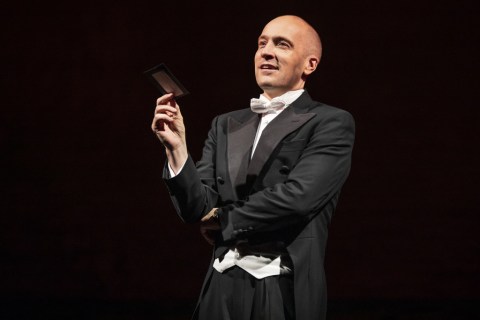
Derren Brown SECRET, written by Andy Nyman, Derren Brown & Andrew O’Connor, directed by Andrew O’Connor, Andy Nyman at the Cort Theatre (Matthew Murphy)
This is also a production in encouraging an audience member’s humility. Whenever I think that “I’ve arrived,” all I have to remember is a gorilla and a banana and Derren Brown to deflate my self-important arrogance. To understand what I mean, you must see the production. There is no spoiler alert.
Completely necessary for this show’s success is audience trust. Thus, to elicit audience participation to a maximum of effect, a good deal of this unparalleled production includes mentally massaging the audience which Brown does surreptitiously; he is a cypher with fragrant oils, gentle, quick hands. Meanwhile, this congeniality brings out audience interactions and responses which are authentic, humorous, genuine, unaffecting, human, all guided by Brown with adroit good will.
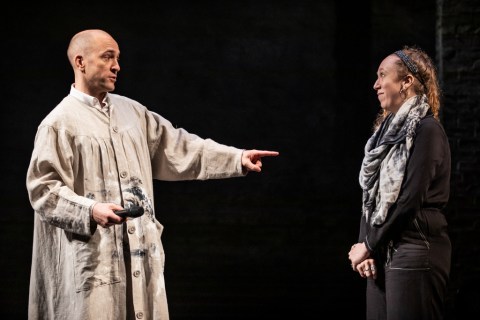
Derren Brown SECRET, written by Andy Nyman, Derren Brown & Andrew O’Connor, directed by Andrew O’Connor, Andy Nyman at the Cort Theatre (Matthew Murphy)
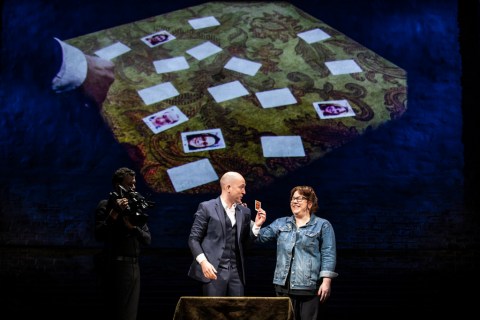
Audience interactivity and seeming spontaneity are rather “a character” along with Brown, whose persona is confident, wise, gently suggestive, witty, comfortable and youthfully avuncular. The audience responds by going onstage, as well as by thinking and sitting in their seats as they watch close-up projections of what is going on via the back wall. If you are in the audience, whether Brown chooses you to join a few others onstage for various illusions, or asks you to think of a celebrity, or asks you to think of a question for him, or write a question, or catch a “frisbee-thingy,” you are involved mentally, though you might passively think you are simply observing. And if you go unconscious and sleep? You are really interacting; you may stand up and walk down the aisle toward the stage!
I can only suggest the aftereffects of his mysterious illusory psychological craft and a bit of my amazement at the audience’s hushed, unified, “mind field” response in an example that is glorious and indescribable, though I will try. During the show Brown offers autobiographical information as patter to endear us to him. The story he shares about his deceased grandfather who enjoyed mysteries and magic is charming, humorous and a bit heartbreaking as Brown relates, it lovingly. Then Brown incorporates this story in an illusion. The night I was present, this involved bringing a woman participant on stage. Brown asked her a few questions about her relationship with a grandparent.
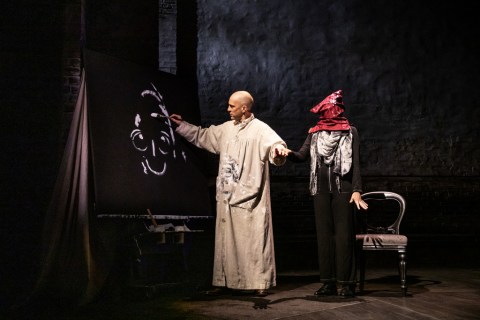
Derren Brown SECRET, written by Andy Nyman, Derren Brown & Andrew O’Connor, directed by Andrew O’Connor, Andy Nyman at the Cort Theatre (Matthew Murphy)
Brown crafted an extemporaneous event with the woman participant involving the audience in its creation. During these sterling moments the attentive audience, the woman participant and storyteller Brown become spectators in a joyous fabrication that was unimaginable beforehand and unfathomable after Brown concludes with a philosophical, metaphorical and mysterious flourish. From start to finish the entire audience was breathless, engaged, inspired and the woman participant was gobsmacked.
For those lovely moments, Brown returned us to the innocence of childhood in our first heartbeats of wonder. That is one of the beauties of this production, Brown’s continually igniting our imagination to fly to the realms of the supernal. But Brown does set us gently down into reality, afterward. We know we’ve been “had.” But it’s ok. Maybe we’ll become more learned about ourselves and more forgiving of our susceptibilities to return to a true place of wonderment after-all.
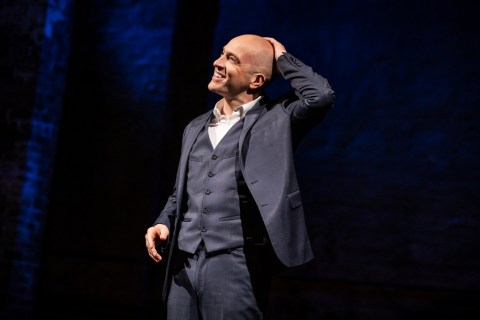
Derren Brown SECRET, written by Andy Nyman, Derren Brown & Andrew O’Connor, directed by Andrew O’Connor, Andy Nyman at the Cort Theatre (Matthew Murphy)
Explaining such illusions spoils the fun of the unknown. That’s why Derren Brown SECRET is celestial. The show is a mystery, wrapped in a box (like one of the illusions) of riddles filled with the fantastic and there are no explanations. Even the ushers are sworn to secrecy. I’m still trying to shake the thought that I’ve been screwed with mentally as I love to figure things out, and I’m annoyed that I’m not quite there yet. But that’s a part of what the power of suggestion does. Someone suggests. The more you fight it, the more you are hooked. Better to go with the flow and then the extraction from the spider’s web will come in due time.
Brown is an ADEPT. He mesmerizes in the direction you think you are going then find out that you are somewhere else completely. He is dastardly, wicked fun and the evening disappears like a shot. Maybe I need to return to “get” what I missed. But what if I miss it again? More frustration!
Of course that’s one of the many points that Derren Brown, performer and co-writer (with Andy Nyman and Andrew O’Connor who also directed) makes in this starry-minded, ephemeral, psychically untouchable production. Intriguingly, if you think that the audience has been planted with Brown’s co-conspirators to effect his “stupid pet tricks,” that is a simple yet profound error prompted by frustration. Unless you are an exceptional mesmerizer yourself and are a genius at misdirection and ledgerdemain like he is, you will not arrive at an explanation. But why even bother? It is a fabulous joy being returned to child-like innocence where all manner of spiritual mysteries are real, having been beaten out of us by ourselves after whatever ill wind blows.
Kudos to the creative team who enhance the enjoyment all the more: Takeshi Kata (scenic design) Ben Stanton (lighting design) Jill Bc Du Boff (sound design) Caite Hevner (projection design). Derren Brown SECRET runs with one intermission at the Cort Theatre (West 48th Street between 7th and 6th) until 4 January. I dare you to go!!! For tickets and times CLICK HERE.
‘Fern Hill’ Starring John Glover, Jill Eikenberry and Mark Linn-Baker at 59E59 Theaters, a Sharp, Non-formulaic Comedic Drama About Friendship

(L to R): Mark Linn-Baker, John Glover, Mark Blum, Jill Eikenberry, Jodi Long, Ellen Parker in Michael Tucker’s ‘Fern Hill’ directed by Nadia Tass at 59E59 Theaters (Carol Rosegg)
Fern Hill by Michael Tucker is about three couples in their golden years who hope to confront the next phase of their lives with joie de vivre and vibrance. The idea of spending one’s last years in the bucolic farmhouse haven, whose name is an allusion to the Dylan Thomas poem “Fern Hill,” where Thomas spent his childhood, is a pleasurable one for the characters. Directed by Nadia Tass, Tucker’s play offers the opportunity for superb actors to shine in a comedy-drama that is relentless, “in your face,” human and clever.

(L-R): Mark Blum, Mark Linn-Baker in Michael Tucker’s ‘Fern Hill’ directed by Nadia Tass 59E59 Theaters (Carol Rosegg)
The award-winning cast (Mark Blum, Jill Eikenberry, John Glover, Mark-Linn-Baker, Jodi Long, Ellen Parker) whose combined credits in theater, film and television number over one hundred are simply divine. Throughout, they remain inspired to hit the emotional notes and spark the humor with resonating heat at every turn. The plot twists gyrate the play into increasingly subtle directions until the inevitable result concludes with realism and poignance. Tucker’s thematic points about love, aging, sex, friendship, alienation in marriage, intimacy and more settle well because of fine ensemble work and authentic, moment-to-moment performances.
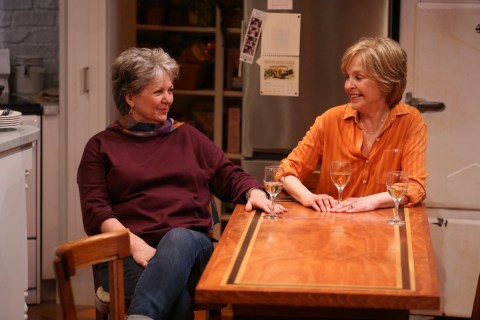
(L to R): Ellen Parker, Jill Eikenberry in Michael Tucker’s ‘Fern Hill directed by Nadia Tass at 59E59 Theaters (Carol Rosegg)
Initially, the gathering of couples feels like a hippie reunion from the early 1970s. But we discover these individuals have advanced together in friendship and collegiality teaching at a university. Additionally, they have launched themselves in careers as professional artists (painters, writers, photographers and even a musician rocker in a band) who attempt to make a difference as they offer their talents to the world and each other for stimulation, fun and growth. These are the perfect friends to have. They share the same values and intelligence with high social IQs. Indeed, their interactions at “Sunny and Jer’s” farmhouse located upstate in Fern Hill are similar to those represented in Lawrence Kasdan’s film The Big Chill (1983). However, unlike the companions in the film who have not seen each other in five years, these couples frequently meet up and have long-lived friendships that have weathered storms.

(L-R): Jodi Long, Mark Linn-Baker, Ellen Parker, John Glover in Michael Tucker’s ‘Fern Hill’ directed by Nadia Tass at 59E59 Theaters (Carol Rosegg)
Playwright Tucker through Tass’ amiable direction has weaved a happy tableau which we cannot conceive will ever end. And for precious moments the ensemble has made us feel so comfortable that we are happy to witness and be a part of their clan while they enjoy themselves riffing, joking, eating and drinking together. But as we are lulled into their “play,” reality hits with Vincent’s (John Glover) announcement about his hip-replacement. Though Vincent is older, the deterioration that comes with mortality has begun in earnest it seems.
And especially for the men, the creep of fear is plaguing each of them. In this pleasant farmhouse of joy, all does not really bode well. Despite the satisfaction of achieving successful careers, artistic purpose and comfortable lifestyles, the question looms: what remains next for Sunny (Jill Eikenberry) and Jer (Mark Blum), Billy (Mark Linn-Baker, who is a younger, lighter version of David Crosby of the band Crosby, Stills and Nash) and Michiko (Jodi Long), Darla (Ellen Parker) and Vincent (John Glover)? The answer is daunting. After all, “aging is not for sissies” (Bette Davis’ oft quoted comment).

Jill Eikenberry, Mark Blum in Michael Tucker’s ‘Fern Hill’ directed by Nadia Tass at 59E59 Theaters (Carol Rosegg)
Thinking outside the box during the last four months, these buddies have discussed the finest way to stave off the horror of aging, isolated, alone and desolate among strangers. Rather than be blind-sided by disease, loneliness and depression in the narrow construct of Assisted Living Centers and Nursing Homes, on this birthday celebration for Jer and Billy, they cement their agreement to live together as a commune at Fern Hill so that they can help each other as they transition into the next great adventure after retirement and moving toward their irrevocable sunset.
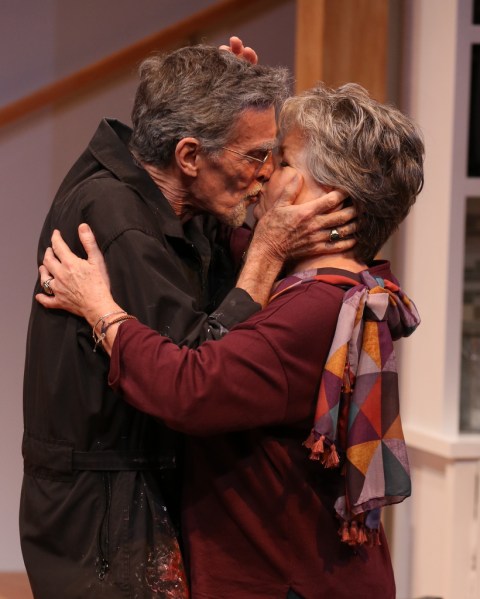
John Glover, Ellen Parker in Michael Tucker’s ‘Fern Hill’ directed by Nadia Tass at 59$59 Theaters (Carol Rosegg)
The playwright takes a while to set up this idyllic place with divine companions that we can visualize living together as an exceptional solution to the nation’s dire aging institutionalization foisted upon older citizens. So we don’t get why Jer attempts to end their discussion and close down a fabulous idea as a fantasy. Even his reasons appear lame: he doesn’t think they can live together; they will sabotage their closeness and loving relationships and end up without each other. When he becomes irate about it, we sense there are deeper reasons.

(L to R): Mark Linn-Baker, Mark Blum, Jill Eikenberry, Jodi Long, Ellen Parker, John Glover in Michael Tucker’s ‘Fern Hill,’ at 59E59 Theaters. (Carol Rosegg)
Tucker spins the plot twist abruptly in a few revelatory lines. Sunny shatters the peace, love and community of friends on this lovely evening with an explosion of truth. This truth threatens to nullify all their efforts at a togetherness that has encouraged power, integrity and strength. Deceitfulness like the worm of age leers at each of the characters so that they must check themselves and deal with this problem between Sunny and Jer which is also their problem.
It is fascinating to watch character responses. The wisdom and humor that emerges engages with honesty and love. And regardless of whether their camaraderie appears a bit fantastic or completely possible, Tucker has written a fine work that is grounded in logic and constructed brick by brick with solid characterizations. Finally, the actors’ portrayals are spot-on so that every segment of the journey that Sunny and Jer take to where they must go to resolve their relationship issues makes sense and seems right. Encouraged, we have followed them recognizing ourselves in their foibles and earthy humanity.
This is a terrific production made all the more exceptional by the performances and direction. Kudos to the creative team without which this ensemble piece would not have been neatly realized: Jessica Parks (scenic designer) Patricia E. Doherty (costume design) Kate MGee (lighting designer) Kenneth Goodwin (sound designer).
Fern Hill is currently running at 59E59 Theaters (59E59th Street between Madison and Lexington) with one intermission until 20 October. For tickets and times CLICK HERE.
‘Moulin Rouge! The Musical’ Celebrates the Seductive Delights of the Iconic Venue in a Sumptuous Feast for the Senses

(L-R): Jacqueline B. Arnold, Robyn Hurder, Holly James, Jeigh Madjus in Moulin Rouge! The Musical, book by John Logan, Music Supervision, Orchestrations, Arrangements & Additional Lyrics by Justin Levine directed by Alex Timbers (Matthew Murphy)
The moment you enter the Al Hirshfeld Theatre, a paradise of sensuality embraces your soul and immerses you in the suggestion of hedonistic pleasure. Immediately, you are “eyes wide open,” moving along a course where anything is possible, even an after hours engagement with one of the male, female or transgender perfections of beauty, scantily but tastefully adorned, who saunter on the catwalks and peer out at you from the stage. Undulating rhythms and sensual music in this Bohemian, Paris, Left Bank cabaret/theater/dance hall soothe and allure. The luxurious red and gold appointments, the deep cherry and red velvet variegated stage curtains, the banquets, chandeliers, gleaming brass, the golden cherubim all whisper romance, sex, excitement and a whirlwind of indulgence. Whoever you are, you will be encouraged to understand that you can achieve your vision of an exalted life, a life where freedom, truth, beauty and love raise you above a bruising and squalid reality out there on the dark streets.

Danny Burstein in Moulin Rouge! The Musical, directed by Alex Timbers (Matthew Murphy)
This is the Moulin Rouge Club at Moulin Rouge! The Musical. Expect the finest in fantasy and escapism. If your intellect and imagination are ripe to receive, you will never be the same again! As you sense this revelation La Chocolat (Jacqueline B. Arnold), Nini (Robyn Hurder), Arabia (Holly James), Baby Doll (Jeigh Madjus), parade their “stuff” and throatily grind to the beats as they torch out “Lady Marmalade,” in an unforgettable opening number joined by the ensemble. This full throttle ignition is brilliantly conceived with grand style and prodigious effort by the creative team. My God, what a triumph!

(L to R): Sahr Ngaujah, Aaron Tveit, Ricky Rojas in Moulin Rouge! The Musical, directed by Alex Timbers (Matthew Murphy)
The production directed by the illimitable Alex Timbers, with a clever book by John Logan (based on the 2001 Twentieth Century Fox Motion Picture written by Baz Luhrmann and Craig Pearce, directed by Baz Luhrmann), with “to-die-for” music supervision, orchestrations and arrangements by Justin Levine is a towering majestical remembrance of what never was but might have been during La Belle Époque in Paris and specifically at the fin de siè·cle. From the on-point luxurious, sexy, ravishing costumes by Catherine Zuber to the energetic, aggressive, dance numbers choreographed by Sonya Tayeh, this musical is a non stop festival. “Bad Romance” is especially gravitating as a thrilling, energetic, “lemme consume your lips,” head to head, face-off with couples gyrating to the hot Lady Gaga song which thematically epitomizes the romance among the principal couples: The Duke of Monroth (Tam Mutu), Satine (Karen Olivo), Christian (Aaron Tveit), and the lesser lights: Santiago (Ricky Rojas), and Nini (Robyn Hurder), all of whom are sensational in voice, and character portrayals.

Karen Olivo Aaron Tveit in Moulin Rouge! The Musical, directed by Alex Timbers (Matthew Murphy)
Baz Luhrmann and Catherine Martin provided their creative services to the production which is an update of their ground-breaking, award-winning film Moulin Rouge (2001). And indeed, the basic arc of development inspired by a meld of characters and plots from Giuseppe Verdi’s opera La Traviata and Giacomo Puccini’s La Boheme remains with added tweaks of humor, phantasm and fun, delivered by incredible performances, perhaps the most preeminent charismatic, chameleon of of them all being the gobsmacking Danny Burstein.

The Company, Moulin Rouge! The Musical, directed by Alex Timbers (Matthew Murphy)
Burstein is a mesmerizing scene stealer. Amidst the splendiferous sets (Derek McLane), and shimmering, vibrantly lit (Justin Townsend), festivities, Burstein, as the club’s artistic owner/showman Harold Zidler, is the “God-like” host of confabulation. And he is damn good at it, in fact so adorable that we understand how and why Harold has kept his “chickens” together through thick and the current financially thin stage of the Moulin Rouge Club’s history. As Burstein’s Harold winningly controls our imaginations and guides the glory and spectacle, we willingly follow him believing he has our best interests at heart because to him there is no sin, no judgment. Within this space and for this night, we are free to be our fantasies.

Tam Mutu in Moulin Rouge! The Musical, directed by Alex Timbers (Matthew Murphy)
What this production does exceedingly well is reveal that the Moulin Rouge Club into which Zidler has put his heart, soul and every red hot cent he owes is an artistic production down to the lavish sets and well-heeled orchestra. And he and the ensemble live for this art. Thus, Burstein’s performance is a revelatory genius of Zidler’s dedication and desperation. Motivated by his craft and concern for his artistic family, his character’s steely sweetness is genuine, his charm and love is pure without oily ingratitude or predatory insidiousness. Above all he makes clear in the behind the scenes discussions with Olivo’s Satine, that his desire is to supply his patrons’ complete enjoyment so his company will survive and remain off the streets and away from the impoverished hellishness they all came from.
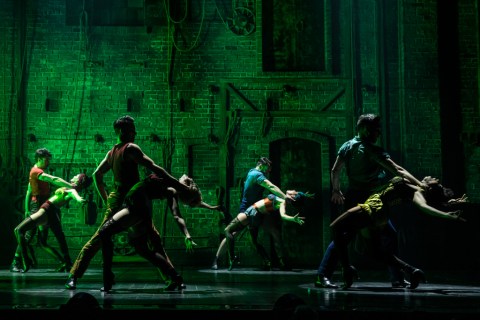
Moulin Rouge! The Musical, The Company, directed by Alex Timbers (Matthew Murphy)
Likewise, Satine’s love for Zidler and her company of friends and compatriots, one of whom is the great painter Toulouse-Lautrec (the very fine, grounded Sahr Ngaujah), reveals they understand the club’s liquidity is their life and happiness. Thus, Satine’s characterization is profound. She is the “read deal:” she is their salvation, their mother, their friend, their life-blood, their sacrifice. The sense of love and community among the ensemble is palpable so we believe Burstein’s Harold when he insists that Satine should “go to hospital,” as her friends insist as well. Without her, they are lost.
Karen Olivo’s Satine is a sensual, hot, earth-mother and high-class courtesan, experienced, wise, unmoved. She is not an ethereal beauty, but dominant, solid in will, though failing in flesh. She is a perfect symbol to represent what Harold’s artistic creation stands for, a lotus risen from the mud into full flower which will fade quickly. Olivo’s fullness of voice soars during her duets with Tveit’s Christian who is her equal in range, power and sensitivity. “The Elephant Medley” (the love song riff mash-up they sing in her boudoir as a “come-on” and “let-down”), that has been enhanced with additional numbers is just smashing.
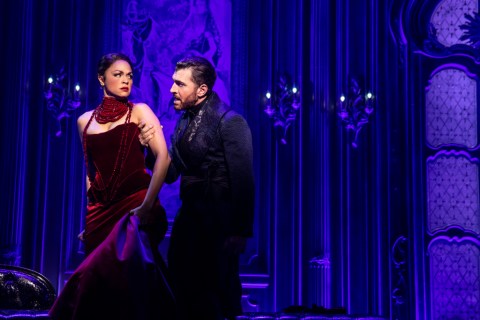
Karen Olivo, Tam Mutu, Moulin Rouge! The Musical, directed by Alex Timbers (Matthew Murphy)
Her introduction by Zidler as the “jewel” of the Moulin Rouge Club as she descends on a trapeze singing the “Diamond Medley” symbolizes her ethos and the club’s centrality as a necessity in the hearts of a society at that time and perhaps for all time. Escapism is in; it always was and always will be. The more authentic the fantasy, the better. And Satine, like Zidler, are exceptional conveyors. Their importance is an equivalent to their patrons’ happiness. Thus, she is fitting as a timeless symbol of the club; their interwoven stories will always resonate and instruct with wisdom, which like a diamond shines but cuts.
Obviously, Logan’s book adapted from Luhrmann’s and Craig Pearce’s film, reflects depth in its simple story of artists attempting to survive in a carnivorous world, as they use their charms and love inducements to glean wealthy backers. And all goes well, until the artists are hoisted on their own petard of humanity, and they fall fatally in love, and others fall fatally in lust with them. As cultural icons, artists cannot be owned or even possessed. (a not so subtle message to philistines everywhere). Satine and Zidler belong to their art, themselves and the world, as Ngaujah’s Toulouse-Lautrec affirms despite The Duke of Monroth’s insistence that Monroth owns the club and all its performers. This is another intriguing theme. When art is put in the hands of philistine owners, it crumbles for they lack the talent, will and spirit to create. Instead, they should uplift the brilliance of creators like Zidler. He knows how to draw the crowds but lacks the finances to sustain the Moulin Rouge Club.
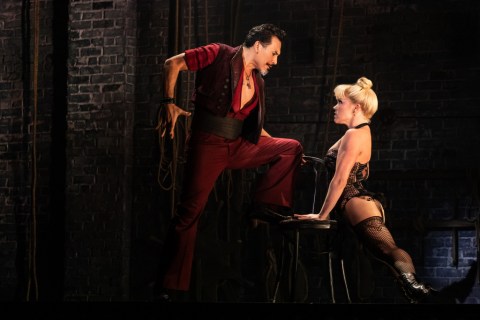
Ricky Rojas, Robyn Hurder, Moulin Rouge! The Musical, directed Alex Timbers (Matthew Murphy)
The scenes when Lautrec and the company rehearse and Mutu’s Duke attempts to assist are particularly to the point and humorous. Monroth’s ego gets in the way after he senses he has lost Satine to Christian. Yet, he is willing to keep her despite her lack of affection for him. And his jealousy rises to spoil the show, as Christian’s jealousy rises to provoke the Duke. Yet, the show must go on, but how? Satine, once more must “save the day,” but she is not immortal.

Aaron Tveit, Karen Olivo, Moulin Rouge! The Musical, directed by Alex Timbers (Matthew Murphy)
As rivals for her love and lust Tveit’s Christian and Mutu’s Duke are worthy. The intricacies of plot which involve Satine’s eventual love for the innocent and consumed Christian, and sexual enticement of the Duke are woven adroitly. Particularly delightful are Mutu’s mash-up of Mick Jagger’s songs (his “Sympathy for the Devil” could have gone on longer). And the conversion of lyrics to a male orientation for Rihanna’s “Only Girl” are hilarious. Mutu manages to be wicked but sexy and seductive. His intentions are insidious but he retains the exceptionalism of aristocracy that assumes privilege from generational wealth that goes back centuries. Importantly, it is the humor in Mutu’s depiction that keeps him interesting and edgy and not loathsome, which is in keeping with the comedic tone of the production.
As a keen and successful rival, Tveit expertly tweaks the humor related to Christian’s, creating his compositions in the funny scene when he first befriends Lautrec and Santiago. He does this with expert timing and together the three render their exchange into pure farce. His “Ohio” demeanor evolves by the conclusion from a “lad” to a man who “comes into his own.” He is every inch the authentic lover. His duets with Satine in which they both feed song refrains to each other are happily playful, suggestive and grounded. And in the delivery of his last songs, Tveit is amazing, heartfelt, sonorous. As a couple in a loving affair that grows into something more, Tveit and Olivo strike powerful resonances.
Nothing more can be lauded about Mouline Rouge! The Musical except that the sound design by Peter Hylenski was on point, balanced, targeted. I heard words from well known songs that I never “got” before, for example Katy Perry’s “Firework,” which Olivo sends into the heavens as a PURE WOW! Thus, I could greater appreciate the character development, the themes, symbols, the ironies, the true riches of this mythic production because the song mash-ups and medleys were crystal clear.
This is a Broadway show in the true spirit of New York City’s greatness. To see these performers, you should get tickets immediately and order another set to revisit a month or two out. I guarantee that seeing it again, you will note many other elements that you missed the first time around as you peel back layers. If you can’t see it again, some of the music is on YouTube. Check for updates.
The show runs with one intermission at the Al Hirschfeld Theatre on West 45th street. For tickets and times CLICK HERE.
The cast album is currently available for streaming at https://smarturl.it/MRtheMusical
‘L.O.V.E.R.’ a Personal Take on Sex and Love, Written and Performed by Lois Robbins

Lois Robbins in ‘L.O.V.E.R.’ written and performed by Lois Robbins, directed by Karen Carpenter (poster courtesy of the production)
So what’s life like for a lovely Jewish girl as she evolves into a lovely Jewish woman who marries a few times and has a fulfilling family life with husband and children after a long inquiring journey toward finding her voice? Lois Robbins (TV Land’s “Younger”; Cactus Flower) directed by Karen Carpenter (Love, Loss, and What I Wore) in her solo, one-woman show L.O.V.E.R. explains it all to you with tongue-in-cheek humor and great good will. As she entertainingly confesses her journey of many loves, she explains how she reconciles her loves and and losses to settle into her own measure of womanhood, confident and serene at the last.
With scenic design by Jo Winiarski, lighting design by Jeanette Oi-Suk Yew, sound design by Jane Shaw and styling by Fayola Ricotta, Lois Robbins’ woman shares her early stories of budding sexuality before she even realized what she was doing (masturbating) but it “really felt good.” There wasn’t an edge of a table or a vibrating washing machine she didn’t pass up. It was only much later in her burgeoning sexual love life did she realize what she had accomplished as a youngster.
The retelling of these events during her childhood are humorous and playful. Certainly, she had found a source of comfort and enjoyment without the stigma of “religious” guilt dumped on her. This is the first of Robbins’ bravo moments. Her happy-go-lucky attitude and finesse steer the show through many such fun, lively, authentic moments.
From this young age Robbins chronicles her youth and beyond. The stories she spins of boyfriends and relationships eventually bring her to the doors of marriage which she relates as a unique adventure with her first husband. Throughout, her quips and commentary resound with humanity and wit. She always seems to land on her feet as wisdom trails her journey into divorce and a second marriage which satisfies.
Both men and women will enjoy Robbins’ energy and vitality as she relates a variety of tales that are humorous, unusual and memorable. Throughout, we are reminded of ourselves in young love, impulsivity, marriage, relationship woes, mishaps and sheer zaniness. And then as Robbins so eloquently relates, she matures to understand the impact of her actions on herself and others. As this canny woman pulls herself together, she walks on the lighter side of life. By doing so she gains our empathy and we enjoy sitting back and listening to the final events in her evolution as a woman, who at the end, is able to define for herself what the letters L.O.V.E.R. mean for her.
This vibrant comedy is for you if you are looking for a break from darker aspects of love, life and relationships that end abruptly or sour into bitterness. There is little of the cryptic or cynical here. That is refreshing! Robbins’s gift is her ability to engage the audience as a confidante. Gradually, willingly the audience travels with her on her adventures as a listening friend. Robbins has mastered a relaxed delivery shepherded by the apt direction of Karen Carpenter. And with the use of the minimalistic set (stairs wrapped in a flowing sheet as an everpresent reminder where love often happens, between the sheets) the solo performance slips by with ease to achieve its satisfying conclusion.
L.O.V.E.R. is enjoying its Off Broadway premiere. It runs without an intermission at The Alice Griffin Jewel Box Theatre (480 West 42nd Street) at The Pershing square Signature Center. The last performance is Saturday, 2 November. For tickets and times CLICK HERE.
‘Betrayal’ Starring Tom Hiddleston, Zawe Ashton, Charlie Cox in Quintessential Harold Pinter

(L to R): Charlie Cox, Zawe Ashton, Charlie Cox in Harold Pinter’s ‘Betrayal,’ directed by Jamie Lloyd (Marc Brenner)
For those who have seen one of the many revivals of Harold Pinter’s brilliant, award winning play Betrayal or its film equivalent (1983), you cannot help but be engaged following the intrigue and duplicity of the triangulated relationship between married couple Emma and Robert, and close friend Jerry. In Betrayal, Pinter raises deceitfulness to a fine art as he memorializes how a convolution of lies evolve into the death of a marriage. The current revival directed with exceptional insight and precision by Jamie Lloyd and acted to perfection by Tom Hiddleston (Robert) Zawe Ashton (Emma) and Charlie Cox (Jerry) at the Bernard B. Jacobs Theatre, vaults Pinter’s work into the heavens.
Though I have not seen every revival, this one most probably exceeds productions that came before it with few exceptions, perhaps the only one being the production in 2013 directed by Mike Nichols starring real-life-couple Daniel Craig and Rachel Weisz. However, I cannot adequately compare for this spectacular production is mind-blowing. It took my breath away.

Tom Hiddleston in Harold Pinter’s ‘Betrayal,’ directed by Jamie Lloyd (Marc Brenner)
Director Jamie Lloyd removes any extraneous spectacle of sets, props, costumes. He supplants them with unobtrusive design elements to enhance Pinter’s themes so we focus on the interactions of the three principals and their responses to each other both sub rosa and manifest. Lloyd retains a spare physicality during scene changes employing the use of a revolving platform to spin the characters back into time and flashback where they finally land on the “beginning” event in Emma’s/Robert’s bedroom. It is then in 1968 when Jerry poetically, fervently seduces Emma mentally and plants the seeds of the irrevocable ending of it all in her consciousness. In a reverse chronological order we witness the ending dissolution of the marriage at the top of the play. Pinter reveals in reverse the salient conversations which slide back to the initial thrusts of “love and betrayal” between Jerry and Emma which are integral to their relationship with Robert. who manages to retain control despite their duplicity with a mendacity all his own.

Charlie Cox in Harold Pinter’s ‘Betrayal,’ directed by Jamie Lloyd (Marc Brenner)
To clarify the structure of the seven year affair, Lloyd adds projections of the backward turning years on the wall and the front of the proscenium. Thus, we note in backward evolution events which lead to the primal moment when the canker worm of adultery first nestles on the flower of Robert’s and Emma’s marriage, a worm which we witness from the initial scene and which completely has eaten away Emma’s, Robert’s and Jerry’s well being and peace. However, at the top, like most interactions we ourselves have, we are not sure what we witness until the final revelation of deceit at the play’s conclusion.
For the entire production, Lloyd has constructed as the main set piece, the backdrop of a blandly colored wall at the rear of the stage against which the actor not engaged in a scene stands facing the audience or leaning in profile. Lloyd’s enlightened staging reinforces the nature of the relationship among Robert, Emma and Jerry as if they are one being and entity. It also heightens the notion that the one absent is everpresent in the others’ minds, and that he or she will be the subject of the conversation between the other two.

(L to R): Tom Hiddleston, Charlie Cox, Zawe Ashton in Harold Pinter’s ‘Betrayal,’ directed by Jamie Lloyd (Marc Brenner)
Maintaining the presence of all the principals on stage whether they are actively engaged or silently hovering, also elucidates the nature and condition of each. It is as if they enjoy the necessity of being a “threesome” of duplicity, though they are not a “threesome” physically or sexually. Nevertheless, each is seared and entrapped in the consciousness of the other two and never really is far away from “them” when the other two are together cheating “behind his/her back.” The fascinating staging furthers Lloyd’s theme: if there is to be an affair, the three are perhaps most satisfied in being clandestine with each other in a strange egotistical and mental sadomasochism which allows them to continue betraying and misleading each other for years. Thus, the themes of betrayal for each of the characters is nuanced and layered and because Robert, Jerry and Emma cannot confront the truth of their own illness of self-deception, the destruction of their relationships between and among each other grows, despite their willful obliviousness.

(L to R): Zawe Ashton, Charlie Cox, Tom Hiddleston in Harold Pinter’s ‘Betrayal,’ directed by Jamie Lloyd (Marc Brenner)
Lloyd’s focus on psyche and consciousness rises to great thematic purpose and illustrates why Pinter never includes the presence of Judith, Jerry’s spouse or the others with whom Robert and Emma are having affairs. These others are ancillary to the vitality of the psychic “threesome.” As a result we understand how Emma, Robert and Jerry function together swimming in the medium of lies pulling toward and against each other to an inevitable dissolution of what they once were before the affair between Emma and Jerry began.
For what Lloyd’s staging and incredible direction with the equally scintillating acting by Hiddleston, Ashton and Cox evokes and symbolizes, we experience a production which is thrilling, alive, masterful. For in the hands, minds and instruments of these brilliant talents, Pinter’s Betrayal is a play about consciousness and the emotional and mental agility of ego, impulse, deflection and undercurrent so that we understand each character’s intentions and feelings though these may never be expressed and may hover as the unspoken and insidious. Hiddleston, Ashton and Cox circle smugly around the truth, even to the point of lying about “how they are doing.” All are doing poorly, considering they’ve blown apart love and friendship and have reveled in allowing a cover-up to persist with a sub rosa disdain and rebuke of each other. We witness a tragedy which the characters are loathe to admit. Only the waiter wonderfully portrayed by Eddie Arnold remains cheerful, positive and authentic.
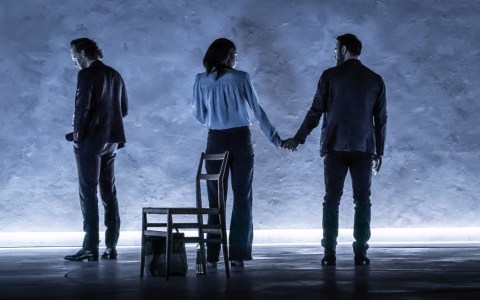
(L to R): Tom Hiddleston, Zawe Ashton, Charlie Cox in Harold Pinter’s ‘Betrayal,’ directed by Jamie Lloyd (Marc Brenner)
Interestingly, when prodded, the characters deflect. Typical of Pinteresque dialogue, a simple “How are you?” and response of “Fine,” becomes weighted with subterranean meaning and import. The individual whether Robert or Emma or Jerry is not fine. Indeed, their souls are in tatters. Though the relationship between and among each was profound (Emma and Robert have two children together, one after she sleeps with Jerry; Robert actually likes Jerry better than Emma) it is not intimate. Each is an isolate, separate and alone, inauthentic, insincere, manipulative. Pinter displays the very core of friendship and love for these three. They lovingly, charmingly, metaphorically stab each other again and again in the back while smiling in each other’s faces. They accomplish their treacheries to preserve ego. Meanwhile, how can their center hold? Eventually, it doesn’t.
Of course this is the human condition: fronting, saving face. God forbid these would admit hurt, pain and torment. God forbid Robert would smash Jerry’s head in for seducing his wife or confront Jerry with the truth. God forbid Emma and Robert would go to therapy. Instead, we discover that Robert becomes “all right” with their affair and doesn’t share his knowledge with Jerry punitively, until Jerry furiously confronts him after the affair is over for two years. Likewise, Emma’s ego is shattered when she discovers Robert punishingly, ironically, has been unfaithful to her for years. Thus, we note how Robert has controlled Jerry and Emma and manipulated them while letting them believe he was the “weakling” and cuckold. That he encourages it and that they are outraged at his behavior and unfaithfulness is the height of irony, humor and cynicism.

Tom Hiddleston, Zawe Ashton in Harold Pinter’s ‘Betrayal,’ directed by Jamie Lloyd (Marc Brenner)
What particularly enthralled me was the emotional grist of Hiddleston, Zawe and Cox revealed at various times when the truth smashes into them. The actors allow us to see glimpses of the pain the characters are hiding. This occurs, for example: when Hiddleston initially discovers Emma’s letter to Jerry; when Emma discovers her marriage which has been over for years, is finally over; when Jerry discovers with outrage how Robert hid his knowledge of the affair from him for four years without a stir or breath of upset or anger. Each of them plodded on living with their own perfidy and self- deception without feeling the necessity of coming to an end of themselves in truth. Cox, Hiddleston and Zawe are absolutely stunning in their moment-to-moment responses to each other. Theirs is breathtaking ensemble work.
Betrayal is a magnificent production. I didn’t want it to end and the standing ovation wasn’t enough appreciation, surely, for such marvelous work. Kudos to Soutra Gilmour (scenic & costume design) Jon Clark (lighting design) Ben and Max Ringham (sound design and composition) for executing Jamie Lloyd’s vision and in creating a medium in which the actors’ portrayals are encouraged to vibrate with life.
Betrayal runs with no intermission at the Bernard B. Jacobs Theatre (242 West 45th Street) until 8 December. Don’t miss this theatrical event which will surely bring in nominations for the cast and director. For tickets and times CLICK HERE.
‘Bat Out of Hell the Musical’ by Jim Steinman, Thunders Off Broadway

Andrew Polec in ‘Bat out of Hell the Musical,’ book, music & lyrics by Jim Steinman directed by Jay Scheib (Little Fang photo)
Jim Steinman’s Bat out of Hell the Musical is first and foremost a clangorous, booming Hard Rock/Pop Concert on a small stage with operatic, bespectacled overtones. In other words, the production is an amazing hybrid not easily categorized. Replete with strobes, underground caves and fiery doomsday projections, intimate video hand-held captures which codify emotional moments and the blaring fantasmagoria of myriad-colored flashing lights with haze and fog, the musical numbers are loud and shattering and the unusual choreography evokes the strangeness of the futuristic setting. These are characters not of our time, but with emotional resonances we can feel and glory with.

(L to R): William Branner, Andrew Polec and Tyrick Wiletz Jones ‘Bat out of Hell the Musical’ with music, book, lyrics by Jim Steinman (Little Fang Photo)
Based on bestselling Meat Loaf albums, Steinman wrote the book, music and lyrics. He has been working on this magnum opus for years and has managed to garner awards during his production tours which began in 2017 up to and after the London West End Tour which beamed its startrails to Off Broadway at the New York City Center where it ends on 8 September. Five days ago, Meatloaf showed up on stage to celebrate this vibrant, blasting out of the park musical production directed by Jay Scheib. With the cast he celebrated songs he made famous from the 1970s through his Grammy Award win in 1994 and beyond.

Andrew Polec, Christina Bennington in ‘Bat out of Hell the Musical,’ book, music & lyrics by Jim Steinman, directed by Jay Scheib (Little Fang Photo)
Bat out of Hell’s sketchy story coheres to its slim plot points. These gyrate the action into a “world’s end” scenario that casts as enemies the haves like the Falcos, well placed elites with a pedigree living high above in the neo-gothish “Falco Towers” (slamming Trump Towers) and the have nots (The Lost Boys/Girls). The latter clan are Oliver Twist urchin-orphans, who live a hard scrabble existence in abandoned subway tunnels underground, making wild music, partying and ferreting out their existence with above ground raids. Their keyword is freedom and the innocence and wildness of reveling in being what the mainstream culture refers them to as “lost.” Indeed, it is the other way around. With their power and money, Sloane and Falco have become lost to what they once were and what they once enjoyed. The theme, sometimes you need to launch off and take a break from your own imprisoning fears and corrupted values (which Falco and Sloane eventually do) you can restore the passion and vitality of youth which is spiritual and never “lost.”
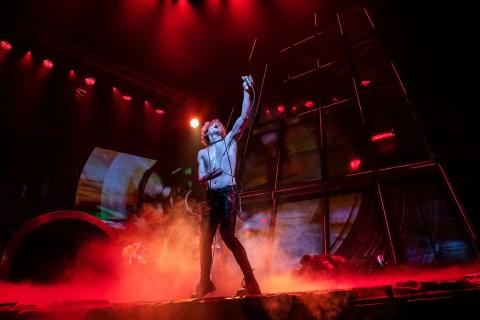
Andrew Polec in ‘Bat out of Hell the Musical (Little Fang Photo)
As perpetual teens (it’s a Peter Panish spin as their metabolic physical processes never age past 18-years-old), Strat and his band also attempt to stay one step ahead of cudgelings by autocratic Falco’s security forces who intend to eradicate them like the “vermin” they are. However, this street gang is poetic; their “vermin-state” is romantic as Strat proves to Raven (the sylph-like, melodically voiced Christina Bennington). Ignoring her parents’ dictum to stay away from the miscreants, she is lured by the sonorous, powerful Strat (Andrew Polec is mesmerizingly fabulous; you cannot take your eyes off him), attracted to his energy, resourcefulness and ever abundant enthusiasm. Like a super-hyped engine, he charges Raven’s curiosity, daring and love. Eventually, her boredom with privilege and oppression by her father lead her Juliet-like (there is even a balcony scene) to Strat’s emotional, heart-throbbing Romeo.

Christina Bennington in ‘Bat out of Hell the Musical’ (Little Fang Photo)
The character developments are primarily revealed through the dynamism of Steinman’s songs and the superb acting, dance-movements and singing talents of Andrew Polec (Strat) Bradley Dean (Falco) and Lena Hall (Sloane). Interestingly, unlike the others whose movements and actions remain purposeful, especially when delivering an intense, revved up song, Raven’s movements during the time she is influenced by her parents are like those of a jelly-fish with no backbone. Only after she leaves home for one night with Strat, does she gain strength and resolve and her movements become more directed.
During the course of the two act musical, we witness how wife Sloane (Lena Hall’s voice is unparalleled) resists Falco’s love and motivates him to change with her anger and remembrances of their love from the past (the fabulous “Paradise by the Dashboard Light”). Bradley Dean, like Andrew Polec, delivers his songs with incredible verve and realism (“What Part of My Body Hurts the Most,” “Who Needs the Young,” etc.) He is mesmerizing. The Dean and Hall duets are highpoints; balance, strength, power encapsulate their emotional potency in a unified whole. Wow!

Lena Hall, Bradley Dean in ‘Bat out of Hell the Musical,’ directed by Jay Scheib, book music & lyrics by Jim Steinman (Little Fang Photo)
Thankfully, all turns on love restored between Falco and Sloane. However, the poignance that Strat will never move past 18-years-old while Raven reaches her late forties is a reality not easily traversed. The ideal that love is the answer, if not the reality is one of the finest moments for the entire ensemble with solos by the protagonists in “I’d Do anything for Love (But I won’t Do That).” And somehow we let pass the hard distinctions of youthfulness and old age that Raven hits Strat with; this trope is easily forgotten and passed over by the rousing, gobsmacking finale.
Outstanding cast members who belt out their souls are the couple Jagwire (Tyrick Wiltez Jones) and Zahara (Danielle Steers). Like Sloane and Falco, this would-be couple remains apart until the end. And their performance together is nothing short of stunning as it melds with the other couples’ renditions into the iconic “I’d Do Anything for Love (But I won’t Do That).” Additionally, Avionce Hoyles’ (Tink, a Tinkerbell allusion to Peter Pan) and Andrew Polec’s number which both sing while Tink is dying is heartfelt and gut-wrenching. Polec and Hoyles are one’s to watch for their inherent star power.
Kudos go to the following creatives: Ryan Cantwell (musical director) Howard Joines (music coordinator) Edward Pierce Studio (design supervision) Steve Sidwell (orchestrator) Jon Bausor (set and costume designer) Meentje Nielsen (original costume designer) Finn Ross (video designer) Patrick Woodroffe (lighting designer) Gareth Owen (sound designer) Xena Gusthart (choreography adaptor) Michael Reed (musial supervisor and additional arrangements).
Presented at New York City Center, Bat out of Hell the Musical is at the end of its run, closing on 8 September unless it is extended which it should be. It is that phenomenal. It runs in two acts. You can purchase tickets online if you CLICK HERE.
‘Rinse Repeat,’ an Intense, Riveting Exposé of Illness Perpetuated by a Family in Crisis
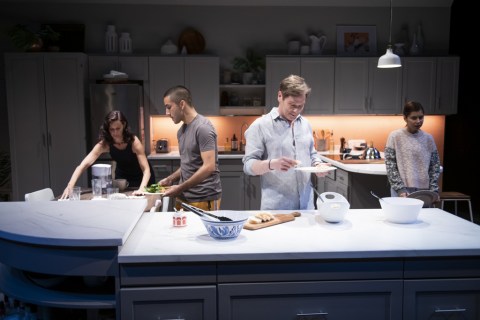
(L to R) Florencia Lozano, Jake Ryan Lozano, Michael Hayden, Domenia Feraud, in ‘Rinse, Repeat,’ written by Domenica Feraud, directed by Kate Hopkins, The Linney at The Pershing Square Signature Center (Jenny Andersen)
Domenia Feraud’s brilliantly constructed, intimate and fascinating Rinse Repeat, is about one woman’s attempt to grapple with a disease pervasive in our culture, but which few discuss and many keep hidden. Feraud’s play at Pershing Square’s Signature Center (The Linney) receives a cogent, eye-opening, much needed rendering in this astounding production expertly directed by by Kate Hopkins and exceptionally acted by an “in the moment,” acute, dynamic ensemble..
From the outset when Rachel (Domenica Feraud’s portrayal is specific, highly tuned and real) enters the home she has left for a season to return to her family, we are gripped by her tentative steps, her unsettled, hesitant manner. Surely, her unease comes out of something which has happened there; her expectation hovers in the air like a darkened cloud, and we pick up her imbalance which leaves us in a hushed suspense.

(L to R):, Domenica Feraud, Florencia Lozano, ‘Rinse, Repeat,’ directed by Kate Hopkins, written by Domineca Feraud (Jenny Andersen)
All this is put to rest, however, when beautiful mother Joan (the superb Florencia Lozano) and warm, loving father Peter (the heartfelt and engaging Michael Hayden) greet her enthusiastically and smother her in smiles and encouraging, welcoming comments about “how wonderful she looks” and how happy they are to see her and have her back. Yet, clues are dropped. Her mom asks if she may hug her: importuning if her daughter is ready to receive her affection? Curious! And her laconic, 18-year-old brother, the haphazardly funny Brody, whose response to his sister is frank and unapologetic, gives her a less than gracious hug that is cold and brief. This unsettles the atmosphere once more. We question: is that just Brody’s character or does it reflect “what happened” before Rachel left?
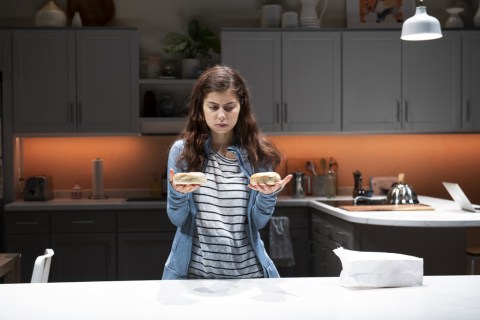
Domenica Feraud in ‘Rinse, Repeat,’ written by Domenica Feraud, directed by Kate Hopkins (Jenny Andersen)
Jake Ryan Lozano’s portrayal as Brody garners laughs with his callow, humorous, teen-male demeanor, obsessed with his girlfriend and sports. (The portrayal blossoms in their quiet sister/brother time together later in the play when Lozano’s Brody allows his love and sensitivity to unfold with poignance.) Initially, Brody seems uninterested in her presence, but tips us off that her return is something he may fear when he implies he doesn’t want to introduce her to his girlfriend to scare her off and that her physical appearance the last time he saw her “was scary.”
As we watch these interactions, we synthesize the clues and the picture sharpens. Rachel has been in intense therapy that involved she be away from family. Before she left, she was in a wheelchair, too weak to walk. But now she appears physically fit. Therapy has saved her life. Back in the environment that bred her illness, can she maintain the health she has achieved or will she suffer a set back into her addiction?
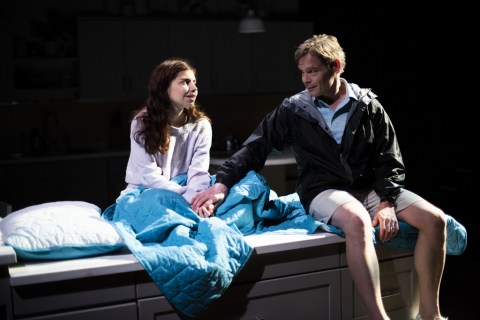
Domenica Feraud, Michael Hayden in ‘Rinse, Repeat,’ written by Domenica Feraud, directed by Kate Hopkins (Jenny Andersen)
The playwright gradually unfolds the mystery of what happened before that on the surface upended the loving, “normal” family. The family was never “normal;” nor was it unconditionally loving. Peter and Joan are rife with issues and problems in their relationship and in themselves; blindness, fear and anger have prevented them from confronting themselves honestly and this has spilled onto their relationships with their children.
Feraud has drawn the matrix of illness interrelating it with Rachel, Joan and Peter primarily. Ironically, the complications of Rachel’s addiction are the manifestation of profound issues with each of the family members. Like a festering boil which comes to a head then is burst so the infection is released, Rachel’s addiction has been burst to impact the family on a manifest level. However, for the infection to be eliminated, it must be excised at the root and that means Joan and Peter and even Brody must be excised in therapy with Rachel if she is to live with them in health. They are her addiction as well as being psychically ill themselves. However, only Rachel understands this.

(L to R): Florencia Lozano, Domenica Feraud in ‘Rinse, Repeat,’ written by Domenica Feraud, directed by Kate Hopkins (Jenny Andersen)
For those who have suffered in similitude with Rachel’s illness, they will identify with her behaviors and immediately “get it.” And indeed, the “tell-tale” signs of how her sickness morphs her back toward unhealthy patterns explodes again and again during the weekend with Peter, Joan and Brody. During her discussion with Brody in a quiet time of night, we appreciate the serenity and honesty between the siblings, an honesty that is lacking in her relationship with her mother and father. Placed back into the family structure that is in effect a sham, Rachel and Brody huddle in their own corner of their lives. Peter’s and Joan’s marriage is crumbling with dishonesty. Brody and Rachel sense it and suffer, and will be happy to leave the festering wounds that work deep underground in the soils of their family’s lives and interrelationships.

Jake Ryan Lozano in ‘Rinse, Repeat,’ written by Domenica Feraud, directed by Kate Hopkins (Jenny Andersen)
The details of Rachel’s eating disorder are superbly portrayed. We note her family’s concern about Rachel’s eating as they sit down to a meal together all on their best behavior, playing the dutiful family members the first night. The turning point comes when Rachel speaks to her mother that evening and looks for a snack. Her mother pressures her about her career and the snack. The dutiful daughter, Rachel agrees with her mother and foregoes the snack, which she is not supposed to do according to the protocol of health set up for her by her therapists. The tiny detail and the seemingly benign interaction between mother and daughter spills controlling maternal poison that psychically infuses Rachel’s emotions and careens her back into her old self-damaging behaviors.
The next day, all unravels and the underpinnings of the problems that contributed to Rachel’s illness emerge. Back in an environment where she is the sacrifice and the target around which everyone places the blame, no one else appears to accept responsibility for their contributions in the matrix of self-destruction twining into Rachel’s addiction. Indeed, unless the others, especially Joan, who herself is eating disordered, reflect on their own psychic maladies and seek help to correct, Rachel is doomed to fail once more if she stays at home.
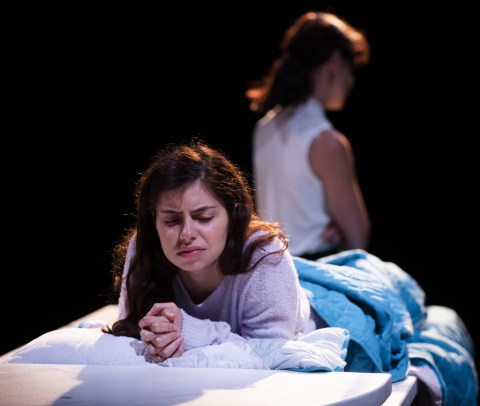
(foreground): Domineca Feraud, (background) Florencia Lozano in ‘Rinse, Repeat,’ directed by Kate Hopkins, written by Domenica Feraud (Jenny Andersen)
This is the anatomy of an illness that Feraud incisively chronicles with emotional power and intense, accurate specificity. As each event builds on the ones that have gone before we understand the magnitude and the complexity of why people die from Rachel’s anorexia, and chronic eating disorders. Feraud unravels the tapestry with an incredible precision of detailed acts that show how Rachel slides back into a routine of bulimia, binging/purging, excessive weighing and body dysmorphia, which Joan, unconsciously, neglectfully perpetrates with the controlling pressure on Rachel to do as she suggests regarding a legal career and eating less than she should.
On the other hand, though Peter, having gone to therapy at Renley with Rachel, appears to be sympathetic and concerned, he too drops the ball regarding monitoring her care. Both parents leave her alone to fend for herself, a violation of the protocol which therapists established to make sure she will not relapse. For those “unfamiliar” with eating disorders, Feraud ‘s characterization of the struggling Rachel is one for the ages. And as Rachel weighs the bagels and takes the smallest one, stuffs down the delicious French toast then spits it out, the looming psychology of why one must watch one’s weight and not “get fat,” reveals the self-fulfilling monster that is devouring the anorexic like Rachel from inside out.

Portia in ‘Rinse, Repeat,’ written by Domenica Feraud, directed by Kate Hopkins (Jenny Andersen)
Sadly, as Feraud points out in her “Note from the playwright,” Rachel is not alone. Thirty million people suffer from an eating disorder; truth be told, the numbers are most probably much larger considering the cultural obsession of the fashion, advertising, plastic surgery and billion dollar weight loss industries which ply their guilt on women to be thin and look sleek, young and beautiful at every age.
The play is filled with the signs of nefarious eating oddities that plague not only women of all ages but men as well. Perhaps the scene that most resonates, is one enacted incredibly by Florencia Lozano’s Joan. Having been too busy to eat, Joan, who deprives herself of food to maintain her lovely body comes home ravaged with uncontrollable hunger. We watch stunned as standing by the counter, too impatient to set a place for herself at the table while she cooks a meal (Peter does the cooking; she avoids it) she crams her face with anything low calorie to stave off her “insane” cravings. The hunger she expresses is a theme and metaphor, not only of her inability to be the beautiful person she intends to be, but of her starvation of self-love borne out by her obsessive need to “be the best, prettiest, slimmest, smartest, sharpest,” all the while believing inside that she is a miserable, loathsome worm.
This and the other scenes related to eating are so authentic their reality shocks us. Indeed, the truths in this production create vital theater exacted with brilliance by the director and actors. This is a production that must be seen for its themes of how parents “lovingly” encourage their children into self-loathing translating their own self-loathing onto them, to the cultural starvation through appearance fascism that commands that all conform to one physical appearance type and self-righteously condemn anyone who does not measure up. These themes and others and the characterizations and interrelationships Feraud has painstakingly drawn to perfection.

Florencia Lozano, Michael Hayden in ‘Rinse, Repeat,’ written by Domenica Feraud (Jenny Andersen)
Another of the beauties of her well-crafted writing is that the themes evolve with revelation upon revelation. stacked upon each other. Then, at the end Rachel reaches a crescendo of rage that she releases in truths about her mother and father with such wisdom, it is breathtaking. All makes perfect sense; the family masks are off and Rachel returns to therapy leaving her parents standing naked in their own psychic self-loathing.
Kudos to Brittany Vasta whose functional, evocative scenic design conveys the household of perfection where imperfect individuals strive, lose, hurt and avoid each other with lies. Likewise, Nicole Slaven’s costume design, Oona Curley’s Lighting design and Ien Denio’s sound design/original compositions help to create such a memorable, indelible portrait of a family in crisis and one who is on the road to health, in spite of it.
Rinse, Repeat (precisely symbolic title for the chronic circularity of illness) has been extended until 24 of August and should be extended again, it is that superb. The play runs with no intermission at Pershing Square Signature Center. For tickets and times go to their website by CLICKING HERE.
‘the way she spoke,’ Audible’s Searing Production About Misogyny and Genocide in Juárez, Mexico
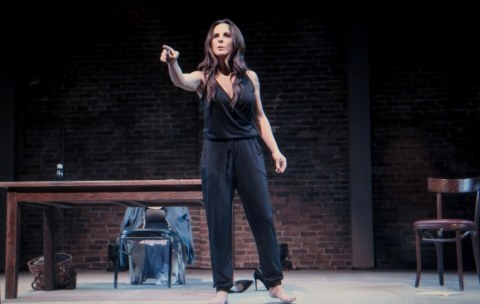
Kate del Castillo in ‘the way she spoke’ presented by Audible, written by Isaac Gomez, directed by Jo Bonney at Minetta Lane Theatre (Joan Marcus)
The first few minutes of the way she spoke by Isaac Gomez directed by Jo Bonney are easy and humorous with light but discriminatory undertones. An actor comes in for a reading. She references that directors give her demeaning parts to read, for example, whores or prostitutes typified by characters named Cha Cha.
The turning point in this lightheartedness erupts with a stark description. Sporadic laughter morphs to horror as the actor moves into the pages of a script where there is the first mention of the graphic mutilation of women’s bodies identifying the brutal murder of eight Mexican women in Juárez, Mexico.

Kate del Castillo in ‘the way she spoke’ presented by Audible, written by Isaac Gomez, directed by Jo Bonney (Joan Marcus)
In one fell blow, Telemundo star Kate del Castillo in her electric solo performance strikes at the heart of the patriarchy and bloodletting against thousands of women in the way she spoke. These acts are the side effects of gang violence, power dominance and poverty. In this horrific unofficial civil war, women’s carcasses send messages. They cry out threats and triumphs. They are the most often poignant and innocent casualties, many unrecovered as their persons, after whatever torment and abuse they experienced while alive, are buried in loam in vacant fields that are vast burial grounds.
Gomez’s dramatic rendering, is staged by Bonney with appropriate projections against the stage’s brick wall, while del Castillo in measured crescendos and fades of emotion and woodenness, responds to the shock of what she’s reading so she eventually experiences the high sorrow of this hell. At emotional midpoints she stands and redirects to another part of the stage to enact a role, sometimes of a dastardly, cold killer. The music and the projections follow her and slip into silence with the resonance of her storytelling. The drama increases its intensity; she configures the eye-witness accounts so that they jump off the page, spin with her energy into our imaginations.

Kate del Castillo in ‘the way she spoke’ presented by Audible, written by Isaac Gomez, directed by Jo Bonney (Joan Marcus)
As del Castillo relates events, describes images, philosophizes and makes us feel a paralysis of horror about the terrible femicide in ,Juárez at a time when the drug cartels were most fierce, we understand. Regardless that the violence has been mitigated since then and murders have decreased a bit, the same happens elsewhere in the world. This is a theme that del Castillo/Gomez reiterate. This reality floats like a dagger before us; what can we do? Is awareness enough? The playwright has unloaded his revelations in this work. He is finished, for in the effort to gain and reveal evidence of our blood lusting nature, he has accepted a measure of responsibility. But where do we go from here? And how do we become involved in a fight of advocacy to ensure that such targeted bellicosity against women doesn’t happen again?
There is always the response to “do nothing and move on with our lives.” It is a survival response, to ignore, duck and cover, return to our pleasant lives and try to forget we ever heard such descriptions of a female holocaust impacting all ages. But we cannot. Gomez, del Castillo and Bonney grip us with the power of these women’s voices from beyond the grave. They make us care for the “invisible” women whom they transcribe into reality during the strongest segments of this production. The concrete images of hate, fear and gore unsettle our minds: they are the final evidence that the mutilation and murder of women, the givers of life, have at their core a blasphemy against all of humankind like no other. After our numbness, the outrage comes against the patriarchy that would not sanction this, against the misogyny that is ancient, inbred and unique to our species!

Kate del Castillo in ‘the way she spoke’ presented by Audible, written by Isaac Gomez, directed by Jo Bonney (Joan Marcus)
The material gleaned by the playwright from a series of interviews with various members of the Mexican community speaks for itself in the voices of the witnesses. And Gomez has cobbled it together thematically allowing the interviewees words conveyed with heartfelt grist by del Castillo to float like blood in water whose increasing droplets will not co-mingle or mix but retain their shape. And then suddenly, all is a dark red that stains our remembrance.
Kudos to the creative artists who assisted to make this a haunting presentation. They are Riccardo Hernandez (scenic design), Emilio Sosa (costume design), Lap Chi Chu (lighting design), Elisheba Ittoop (sound design), and Aaron Rhyne (projection design).
This production which Audible has recorded will be released as an audio play after its closing. Without visuals the words of the witnesses will explode in the hearer’s ears. They are both an encomium and a chronicle reconciling the dead to the light of a greater truth we are being forced to acknowledge in the hope of changing if even one life in the future.
In its final week the way she spoke is presented by Audible Theater at Minetta Lane Theatre (18 Minetta Lane between 6th Ave and McDougal St. in the West Village) until 18 August. For tickets and times go to their website by CLICKING HERE.
‘Coriolanus’ by William Shakespeare, Pride Without Humility Breeds Self-Destruction

‘Coriolanus,’ by William Shakespeare, directed by Daniel Sullivan with Justin P. Armstrong (Ensemble), Teagle F. Bougere (Menenius Agrippa), Kate Burton (Volumnia), Jonathan Cake (Caius Martius Coriolanus), Louis Cancelmi (Tullus Aufidius), Katharine Chin (Ensemble), Gregory Connors (Ensemble), Darryl Gene Daughtry, Jr. (Ensemble), Biko Eisen-Martin (Ensemble), Bree Elrod (Ensemble), Nayib Felix (Ensemble), Josiah Gaffney (Ensemble), Chris Ghaffari (Titus Lartius), Enid Graham (Junius Brutus), Christopher Ryan Grant (Ensemble), Emeka Guindo (Young Martius), Jonathan Hadary (Sicinius Velutus), Suzannah Herschkowitz (Ensemble), Gemma Josephine (Ensemble), Thomas Kopache (First Senator), Tyler La Marr (Ensemble), L’Oreál Lampley (Ensemble), Jack LeGoff (Ensemble), Alejandra Mangini (Ensemble), Louis Reyes McWilliams (Ensemble), Max Gordon Moore (First Citizen), Tom Nelis (Cominius), Nneka Okafor (Virgilia), Donovan Price (Ensemble), Sebastian Roy (Ensemble), Ali Skamangas (Ensemble), Jason Paul Tate (Ensemble), and Amelia Workman (Valeria), (Joan Marcus
Coriolanus, Shakespeare’s apotheosis about a war monger who fires up for battle and yawns with boredom when he must live peaceably in the community brings to mind a ravaged soldier whose PTSD has so overcome him that he prefers living on the edge of death to energize himself to life. If he must choose between bloodshed, battle and calm, give Coriolanus carnage that he delivers, the gorier the better.
What does one do with such a Roman in a time of scarce resources on a planet ravaged by the doomsday scenario of global warming? Make him a politician to organize and straighten out issues in a time of great unrest in the most dire of conditions? Indeed, then watch him self destruct. For politicians must schmooze, flatter, promise, swallow crow, apologize and act with humanity and forbearance. Coriolanus is fit for battle, not for compromise, leader of his own personal autocracy which cannot be countermanded. Politics requires equanimity or the appearance of it. Of this he is incapable.
Shakespeare’s protagonist has a bit of the hero of The Hurt Locker (Kathryn Bigelow’s 2008 award winning film) without Jeremy Renner’s heartfelt agony and recognition of the mammoth loss of his former self before he signed up for war. Indeed, Coriolanus as portrayed by Jonathan Cake has much of the robotic machine killer with whom one has a devil of a time empathizing, especially as he rants and raves against those not born to a privileged background, from no fault of their own. Cake’s Coriolanus lacks interest, love or concern for others, except his wife (Nneka Okafor) son (Emeka Guindo) and mother (the wonderful Kate Burton). For his patrician friends he shows equal measure and latitude, for example Menenius Agrippa (Teagle F. Bougere) Cominius (Tom Nelis) and Titus Lartius (Chris Ghaffari) who advise him and fight with him. For his marvelously bellicose foes like Tullus Aufidius (Louis Canelmi) he bestows his complete veneration and worship.

(L to R): Christopher Ryan Grant, Louis Cancelmi in ‘Coriolanus,’ directed by Daniel Sullivan, Delacorte Theater (Joan Marcus)
As for the hurting, starving crowds clamoring for grain while the patricians’ storehouses flow with plenty? Let them eat each other in a zombie apocalypse. Coriolanus will none of it. Indeed, at the outset of the production, director Daniel Sullivan has placed a locked up barrel holding water downstage which the plebeians attempt to break into. But only Coriolanus holds the key to the lock and only he has access as he gives water to his son and denies his thirsty underlings. Charity stops first and last with self and family in a time of crisis such as that which confronts this deteriorating Rome, evocatively represented with a Mad Max scenic design by Beowulf Boritt of scattershot, burned out piles of garbage, remnants of the past, rather like Bob Ewell’s (To Kill a Mockingbird) scrummy playland hovel next to a massive town dump.
Because the rabble are deprived, there is civil unrest against the elites which if not quelled will threaten the security of the state, making it vulnerable to Rome’s enemies. However, Coriolanus answers the plebeians’ complaints with epithet and insult (they are curs and scabs) and argues that if he had the opportunity, he would slaughter them and create a mountain with their carcasses.

(L to R): Jonathan Cake, Biko Eisen-Martin, and Teagle F. Bougere in the Free Shakespeare in the Park production of Coriolanus, directed by Daniel Sullivan (Joan Marcus)
Some explanation is given for his wrath against the fickle, unreliable lower classes. His is an elitist patrician nature roiled by his aggressive, assertive mother. When he was a child she encouraged him to abusive dominance exemplified when he attacked the most beautiful and delicate of nature’s creatures by chomping off the wings of butterflies. Being so schooled against softness and generosity, he has no tolerance for the lazy, cowardly plebeians whose unmeritorious behaviors deserve no handouts. He states this to their faces in the opening scenes and we divine that his rancor is most grievous when he rails that he has provided the security of Rome while these poor and unfit do nothing to help him, but quailing in fear, flee even the thought of battle.
The situation is certainly egregious with the Volsces who come to attack. To get the corn they need to stem Rome’s hunger and murmurings, Coriolanus like a Titan hero single-handedly in “Incredible Hulk” fashion goes against these foes and delivers the goods without the help of the commons who slow him down. He emerges victorious from Beowulf Boritt’s ramshackle tin gates set, bloody and triumphant, but arrogant to the point of caricature!
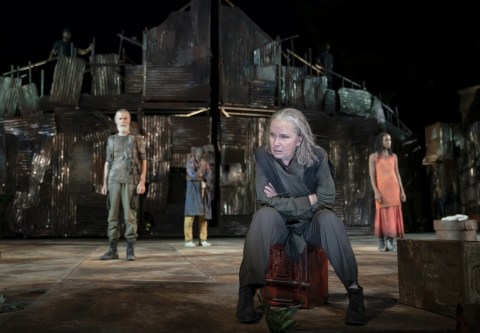
(L to R): Kate Burton (downstage) Tom Nelis, Teagle F. Bougere, and Nneka Okafor in the Free Shakespeare in the Park production of ‘Coriolanus,’ directed by Daniel Sullivan (Joan Marcus)
Was ever there such a raging hero hewn from the trials of confronting daily doom as the populace struggles against diminishing resources in Sullivan’s fascinating, ominously foreboding vision? Never. And Shakespeare forges from his hyperbolic character the tragic flaw that caves in Coriolanus’ life, legacy and career: his overweening pride, and his fearsomeness in not being shy to express his superiority to those lowlife “deplorables” who hate him.
Coriolanus certainly is reminiscent of other leaders we know whose arrogance and inability to apologize runs before them. However, Coriolanus is intrepid, mighty and uber skilled in battle. In this he is admirable. The current arrogant and boastful who lead are 100% image and 0% substance, bullying, cowardly and shallow like those whom they represent. That both Coriolanus and the resident of the White House are unfit for politics is their only similarity. Coriolanus’ pride is based in fact and follows an important logic that is downright Puritan in a time of destitution. If one doesn’t contribute to the good of the society, then one is not worthy of the grain that others have supplied. Freeloaders are not welcome!

(L to R): Emeka Guindo, Jonathan Cake, Nneka Okafor in Free Shakespeare in the Park,’Coriolanus,’ directed by Daniel Sullivan (Joan Marcus)
Shakespeare’s tragedy revolves around his protagonist being lured into the political sphere which he hates for he is not social. He is too “in your face” real to grovel in flowery phrases, alluring promises and imaginative disingenuousness to please the masses. He is direct, frank and authentic and cannot apologize or “fake it” to front those he despises.
However, he suppresses his best judgment and accepts a position which is offered to him. The conspiracy against him blows up when the Tribunes who despise him Sicinius (the excellent Jonathan Hadary) and Junius Brutus (the equal of the pair Enid Graham) incite the plebeians to revoke the offer of the position. This is upon condition that Coriolanus does not “bow” to the voice of the people. This untenable situation requires Coriolanus to be humble and compromising; this is an impossibility which results in his banishment by the Tribunes. Coriolanus counters with the statement that he banishes Rome from his presence and stature. With solemnity, he suggests that there is a place for him, away from Rome.

(L to R): Jonathan Cake, Kate Burton in ‘Coriolanus,’ directed by Daniel Sullivan (Joan Marcus)
But there is not. Though he joins Rome’s former enemy Tullus Aufidius of the Volsces intending to avenge his disgrace and dishonor of banishment by destroying Rome, it is a rush to judgment. The momentous decision means that he will destroy his mother, wife, son and friends who have not joined the Volsces. In the most insightful and powerful scene in the production (thanks to Kate Burton and Jonathan Cake’s whining “but mother” which reveals his enslavement to her dominance) Voluminia persuades him to betray Aufidius and fight for Rome not Volsces. It is Coriolanus’ act of sacrificial, stoic death. Aufidius will certainly kill him for his betrayal. That Voluminia has raised her son to war so that he can ultimately die to save her is unnatural and wicked for a mother. Doesn’t Voluminia and his family have other options? But their relationship as Cake and Burton portray it is fraught with issues of power dominance and abuse as the brute Coriolanus is reduced to a mewling weakling by his mother. He accedes to her wishes.
The production’s emphasis works at times and at other times is spotty. The rag-tag Costume Design by Kaye Voyce, Scenic Design by Beowulf Boritt, the Lighting Design by Japhy Weideman (strongest at the conclusion) the Soudd Design by Jessica Paz, the Composer Dan Moses Schreier’s music all convey Sullivan’s vision and themes soundly to resonate for us today. What happens to the haves and have nots when the law of diminishing returns lets loose annihilation because of the willful negligence and stupifying greed of previous generations’ corporate elites? Sullivan’s answering backdrop for the play is acute and frightening.
On the other hand, the empathy that we could feel for the plight of Coriolanus struggling against his own character wobbles perhaps because his character portrayal is one-note, at times cartoonish and lacking in depth. In the scenes with Burton’s Voluminia the depth of Cake’s Coriolanus shines, however. Shakespeare’s characterization reveals a character caught by his own ego between a rock and a hard place. He is betrayed by the Tribunes (his mother’s rant in their faces is largely ineffective) who capitalize on his arrogant weak character, lure him then back him into a humble pie corner from which he implodes.
And when he decides to punish Rome by depriving the society of the one way he has greatly benefited it by delivering death to its door? Once again he is thwarted, this time by his mother. And yet, there is no solace, nor sorrow nor identification at the conclusion that one might feel with Cake’s portrayal of a man who has undone himself. This is a weakness of the production which in all else especially Sullivan’s vision of the future is pointed.
Coriolanus is enjoying its last presentation today, 11 August. Performances have been sold out. However, there may be seats released if you are lucky and able to get to the Delacorte Theater well before curtain time at 8:00 pm.
‘Little Gem’ Starring Marsha Mason at the Irish Repertory Theatre

Marsha Mason in ‘Little Gem,’ directed by Marc Atkinson Borrull, written y Elaine Murphy at the Irish Repertory (Carol Rosegg)
Little Gem starring the wonderful Marsha Mason at the Irish Repertory Theatre is a poignant and comedic look at three generations of women from North Inner City Dublin. We follow along as the grandmother, daughter and granddaughter share their experiences, responses and perspectives at major turning points in their lives. Each tells their tale in six separate segments precipitated by a visit to the doctor’s office. In the final segment, the women, having gone through their own personal cataclysms, rally around the comfort of each other and sleep in the same bed, reunited in love and understanding.
The play written by Elaine Murphy premiered at the Dublin Fringe Festival in 2008, where it won the Fishamble New Writing Award before transferring to the Edinburgh Fringe Festival. This production directed by Marc Atkinson Borrull is essentially a solo tour de force for each character/actor. The only interaction among the characters occurs in the last segment. Only then do we see grandmother Kay (Marsha Mason is powerful, heartfelt and funny) daughter Lorraine (Brenda Meaney is ironic and nuanced) and Lauren O’Leary as the wise-cracking, sharp-tonged Amber relate to each other directly.
During the production, we listen to the narration of each woman separately. We revisit how each is at a different stage in her life (symbolic of women in general at different ages in their lives). We understand how she experiences the physical and emotional desires of needing and wanting to be in a relationship with someone who will care for her. And we note how each negotiates the wheel and woe of their personal relationships.

Lauren O’Leary, ‘Little Gem,’ by Elaine Murphy, directed by Marc Atkinson Borrull (Carol Rosegg)
The women relate their stories in flashback in direct addresses to the audience. Initially, we discover the superficial reasons why they are in a doctor’s office. Amber has indigestion and throws up frequently in the mornings. Lorraine is emotionally mottled with stress and needs medications to calm her and resettle her life. Kay has a “personal itch down there.”
As the production unfolds the women by degrees go into their reveals during their story-telling turns with the youngest generation first, simulating the arc of life’s beginning. The forty-something Lorraine represents the middle stage of life and the sixty-something Kay represents the senior years. As they each address the audience, we understand the depth of their angst as they relate how their situations become the touchstones of their growth and realizations. The progression is an interesting one and thematically reminds us of the innocence and naiveté of youth (the fecund period) the transformation into recognizing deeper values in life and the winding down into menopause, and the increased sexual libido that often occurs for older women long after they’ve thrown off the aftereffects of child rearing.

Brenda Meaney, ‘Little Gem,’ by Elaine Murphy, directed by Marc Atkinson Borrull (Carol Rosegg)
In six segments Amber discusses the events with Paul which brought her to the doctor to help her during her pregnancy and afterward as she takes care of baby Jamie and he is accepted into the family. We discover how Lorraine’s stress precipitated by her lack of communication with Amber and worry centered around Amber’s sometimes wild behavior (like mother, like daughter) is somewhat mitigated when she follows her therapist’s suggestions to “get out of herself” and her miseries and goes dancing. After she meets someone, with Amber’s encouragement she goes on a date with him in what becomes a developing relationship.
At the doctor’s office Kay receives “the ok” to have sex without Little Gem who is too debilitated and ill to continue their fabulous sex life. She will do this via the help of a vibrator. Indeed, the scene when Mason effects this is one of the funniest in the play. And as Little Gem fades from this life and moves into the next, at the grave she grieves her husband and in the last scene of the play seeks the comfort of her daughter and granddaughter.
Elaine Murphy’s work is strongest in the concept of revelation and self-recognition and growth that occurs in each of the women’s lives. However, the playwright decides to keep the play largely expositional. This dissipates the drama that occurs in the family dynamic. We note the underlying levels of action, however they are reported; an example of this occurs when Lorraine discusses that she doesn’t communicate with her daughter. However, we never see the characters Lorraine and Amber demonstrate how or when this occurs actively. Likewise, the characters may talk about a family member who stands next to them, but there is no active dialogue or exchange between and among each of the characters until the end. The strongest exchange occurs only then when they get into bed after Little Gem dies and they comfort Kay to reveal they unite as a family.

(L to R): Marsha Mason, Lauren Oleary, Brenda Meaney, ‘Little Gem,’ by Elaine Murphy, directed by Marc Atkinson Borrull (Carol Rosegg)
For me any related emotional power and inherent possibility of empathy falls short with the playwright’s selection of this expositional structure predominately. Would the play have worked more dramatically and humorously with different staging and lighting as each woman takes a darkened stage stepping into the spotlight and sharing the import of her story? Somehow, the office setting was a banal distraction. Or was this the point since the women are vibrant and we are transfixed at various times during their revelations?
The actors stand out because through them, their characters’ stories are exposed. They remind all of us that we have a story to tell and it is representational and unique for our time and place. Meaney, O’Leary and Mason engage and keep us launched into remembering what has occurred previously. We must figure out how related events have bled into the current segments of their narration as they detail the specifics: Lorraine’s difficulties with her daughter, Amber’s difficulties with Paul after he discovers she’s pregnant, Little Gem’s sickness and dying. We become the catch-basin for all of their humorous/poignant story events. These are peaked with the tragicomedy of Amber’s, Lorraine’s and Kay’s feminine perspectives of their middle class lives which include the prickly narrative of their relationships: Amber’s reports of sometime boyfriend Paul, Lorraine’s report of a poignant conversation with junkie ex-husband Ray, and Kay’s explanation of her role as caretaker during Little Gem’s frustrating illness and heartbreaking death.
Little Gem is a portrait of women during crisis and the ways they look for the humor and uplift during the rough patches of life. The audience partners with them as we listen to their troubles like a good friend or neighbor. And in the telling of their stories there is the release, growth and hope that in the family all will be well as the next generation adds to the flavor of their future. And so it goes for us as well.
Little Gem is in a revival in New York from a run in 2010 and is in a limited engagement through 1 September. For tickets and times at the Irish Rep website CLICK HERE.
 CAROLE DI TOSTI