Category Archives: NYC Theater Reviews
Broadway,
FringeNYC Theater Review: ‘Onaje’ by Robert Bowie, Jr
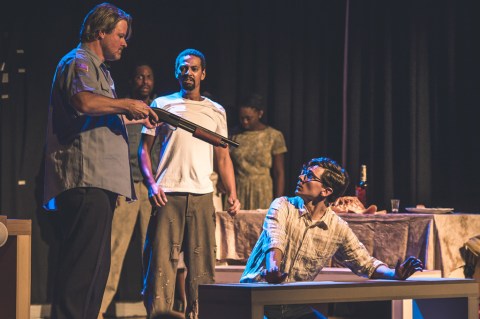
L to R): Tim Rush, Jay Ward, Curtis M. Jackson, Tinuke Adetunji, John Dewey in ‘Onaje,’ written by Robert Bowie, Jr., directed by Pat Golden, FringeNYC (ZeCastle Photography)
FringeNYC has been up and running again after a year’s hiatus. It has come roaring back with experimental theater offerings and thought-provoking presentations. One intriguing production out of the 85 or so offered ended its predominately sold-out run on Sunday, 21 October. Among the other productions, it’s a standout and bears revisiting. Onaje, written by Robert Bowie, Jr. and searingly directed by Pat Golden sported a large cast with sterling performances. Overall, the play’s themes resound with currency in this time of social and political divisiveness and hyper rhetoric not witnessed since the early 20th century.
The play takes place in the 1980s. However, the flashbacks that infuse and haunt the mind of the protagonist William/Onaje take place earlier. Onaje/William (portrayed with mesmerizing power and spot-on immediacy by Curtis M. Jackson), suffers a miserable fate. Indeed, a traumatic event that happened during the 1967 Maryland riots affects him emotionally and chains him to a bondage of self-recrimination. Sadly, racism and bigotry force him to leave his loving family (the fine Jay Ward, Mary E. Hodges, Tinuke Adetunji).
Dislocated from his former life as a result of this event, fear drives William to seek refuge and healing on the open road. Subsequently, he attempts to evolve beyond the tragic events of the past by creating another persona, Onaje. It is Onaje that Bowie, Jr. introduces us to at the play’s opening. And as the play unfolds, we learn about the devastating events that might have driven a less enlightened person than William/Onaje to suicide or murder.
Through his interactions with fellow travelers, the couple Richard and Belle, the revelation of Onaje’s humanity unfolds. Richard (Adam Couperthwaite in a dynamic and edgy performance), and Belle (the feisty, humorous, down-to-earth Sheila Joon Ostadazim), are happy Onaje accompanies them on their road trip.
Apparently, Onaje has traveled the highways of the United States since he left his family on the Eastern shore of Maryland fifteen years ago. Unbeknownst to Onaje, fate has thrown him in with this couple, and he will accompany them to return him full circle to the place of the traumatic experience. Ironically, Richard and he come from the same area. Because Richard intends to settle his accounts with his father and seek affirmation, he must return home. But Richard’s father, Middleman Sr. (Bristol Pomeroy), witnessed what happened to Onaje fifteen years before. Though he doesn’t know it yet, nor do we, a reckoning comes for Richard, his father, and Onaje. But unlike most reckonings, this one distills hope, peace, and unity.
From his conversations with Belle, we learn the extent to which Onaje has evolved. Thus, the wisdom and strength he developed on his travels transformed him into the admirable Onaje. As Onaje he has purified himself on his life journey. However, the old William and the events that devastated him still lurk within. Eventually, he must confront what occurred to expiate his guilt and self-torment and completely heal.

Sheila Joon Ostadazim, Curtis M. Jackson in ‘Onaje,’ FringeNYC, written by Robert Bowie, Jr, directed by Pat Golden (ZeCastle Photography)
Though Belle intuits Onaje, she remains clueless about his, at times, gorgeous poetic language and philosophical ramblings. Nevertheless, she understands his goodness and truth. Indeed, he presents himself as a spiritual man of the universe. He perceives himself to be a caretaker of the earth and its people. And his life on the open road allows him to be free of the culture’s machine existence. Not only does Onaje manifest goodness to this couple. But his profound and poetic insights inspire Belle to seek truth in her relationship with Richard.
Eventually, Richard reveals his criminal, “uncool” past to Belle, and she reveals her “lowly” beginnings. Indeed, Onaje’s openness and authenticity encourage them. As Richard confronts his father and seeks forgiveness, we realize the positive impact Onaje has had. Certainly, a theme the character represents remains; only by living in truth can one be free. As a veritable tour de force, Onaje changes the lives of all those he encounters. Except one.
In the play Bowie Jr. revisits the tragic history of Cambridge, Maryland and William’s participation in it. Should this scene have appeared later in this work? Indeed, the structure of the play needs shoring up for this scene is the most striking. And all scenes in the play lead to and revolve around this one.
In 1967, the Civil Rights Movement gained in strength and solidarity throughout the country including Maryland. There, marchers and protestors supported H.Rap Brown’s dynamic speech in Cambridge, Maryland. When Brown identified injustices and demanded equal treatment for African-Americans on the Eastern Shore, klansmen whipped up whites’ fearful animosity and hate-filled sentiments. As a result infuriated white mobs, some, law enforcement in hoods, torched black neighborhoods. Tragically, homes burned to the ground. Indeed, most feared that snipers would shoot anyone who attempted to put out the raging infernos.
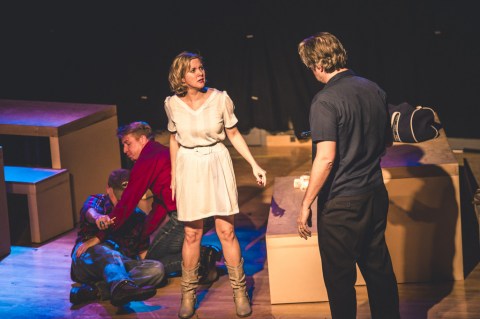
(L to R): Bristol Pomeroy, Adam Couperthwaite, Sheila Joon Ostadazim, Tim Rush in ‘Onaje,’ FringeNYC (Ze Castle Photography)
During the chaos, William/Onaje becomes swept up as a casualty of these catastrophic events. And Andrew, a young civil rights worker invited home by William’s Dad becomes another casualty along with the entire black family. Andrew (portrayed with good-natured aplomb and humanity by John Dewey), is at the wrong place at the wrong time with William’s family.
When racist cop Henderson seeks out William at his home, he questions Andrew’s presence there. The “do-gooding” arrogance of a white man in the home of a black family! Thus, Andrew’s magnanimity and color blindness provoke Henderson’s already stoked hatred. Tim Rush convinces as the malevolent, corrupt Henderson. Punishing both William (he had an earlier incident with Henderson), and Andrew, we witness the terror of sadism and brutality William must visit on Andrew. Thanks to Golden’s acute, precise direction, the scene is gobsmacking dynamite.
The incident remains the pivotal point of the production. And the lighting, staging and shepherding of the actors’ performances creates terror. Thus, the revelation of who, how and why Onaje is, clarifies. What remains must be healing between him and the man who might have stopped it but didn’t: Middleman, Sr. For he was present at the event. Henderson, the foil for wickedness, is past hope, overtaken by his own inhumanity.
The second half of the play appears anticlimactic. The playwright brings us to the closing epiphany through a meandering route. Nevertheless, when Richard brings Belle and Onaje to the Middleman home, and Henderson confronts Richard, the tension recalls us to the incident fifteen years earlier. Our fears coalesce around this character. Perhaps once again Henderson will explode with violence and hatred.

(L to R): Bristol Pomeroy, Curtis M. Jackson in ‘Onaje,’ written by Robert Bowie, Jr., directed by Pat Golden (ZeCastle Photography)
Most of these individuals seek to change and evolve. Why does this impulse elude Henderson? However, Middleman, Sr. has remorse for his former actions. He apologizes to Onaje and the hope of peace and understanding abides between them. This message, that we must be decent and human with each other in these times brings us a much needed uplift. Nevertheless, the reality of the Hendersons of the world enlists this concept. Out of horrific evil, good can come and people can change. But for some, this is an impossibility…perhaps until they stare at their own death.
I enjoyed the production, especially its excellent cast and the terrific performances by all, especially Curtis M. Jackson. Though the play needs fine tuning, the conceptualizations and themes are exquisite. The director well handled the challenges and the restrictions of the festival concerning sets, etc. In another venue with fine tuning of the dialogue, etc, this smashing production deserves another go around.
Kudos to actors: Jay Ward, Mary E. Hodges, Tinuke Adetunji, and kudos to Joye Liao (lighting design), Bevin McNally (costume design and wardrobe), Dedalus Wainwright (scenic design). Onaje was produced by Sue Conover Marinello.
‘The Ferryman’ on Broadway, Jez Butterworth’s Striking Tragedy About The Silent Unspoken

‘The Ferryman,’ ensemble, by Jez Butterworth, directed by Sam Mendes (Joan Marcus)
How does one disentangle oneself from a clandestine tribe that has no legitimacy? A tribe who bonds over shared bloodshed, brutality, and murder to achieve a political purpose? Jez Butterworth’s masterpiece The Ferryman, superbly directed by Sam Mendes, has transferred to the Bernard B. Jacobs Theatre in New York from its run in London. This smashing production confronts important themes about politics and violence for our times, for all times.
The Ferryman opens up a series of conundrums. First, is it possible to turn away from violence without completely working through one’s past bloody deeds? Or is an inherently violent nature prone to murderous acts when an occasion for vengeance presents itself? Second, when a loved one has gone missing, can family members truly reconcile the absence? When there is no closure to grieve because of the “ambiguous loss,” what is the impact on family relationships? Finally, is the missing one physically absent but still present? Or is their absence a haunting force, a myth that overwhelms, even if some family members never knew them?
Butterworth confronts these issues in his epic family tragedy akin to the works of classical Greek playwrights Sophocles and Euripides. Those ancients selected war as the backdrop to develop their dramas. And so does Butterworth. He sets this three-act play in Northern Ireland during what is referred to as the Troubles.

‘The Ferryman’ by Jez Butterworth, directed by Sam Mendes (Joan Marcus)
Through his characterizations and the references of irascible elderly Aunt Pat and sweet oldster Aunt Maggie Far Away, we learn of the Irish-British conflict. (Dearbhla Molloy as Aunt Pat and Fionnula Flanagan as Aunt Maggie Far Away are “bring-down-the-house” phenomenal as their family’s and culture’s historian and prophet respectively.) The bloody shadow of civil strife darkened the relationship between British Protestants and Irish Catholics for centuries. But by the 20th century, the Irish Catholics were taking a stand. From the Easter Rising (1916) and the partition of Northern Ireland to the Battle of Bogside (1969), the Irish fought back. With the inception of the IRA (1970), and Bloody Sunday when hundreds of young men and women joined it, British and Irish blood continued to soak the land.
As the intensity of the strife grew and bombs exploded in Belfast, killing nine in 1972, the IRA went on record. Suspected informers began to disappear. The British continued to round up and intern members of the IRA. As the prisoners held actions, the Thatcher government refused to change their status to that of political prisoners. When in 1981 the imprisoned Bobby Sands and others went on a hunger strike and died, global censure helped to turn the tide. From August to October of that year, during the action of The Ferryman, the hunger strikes ended. Not only was Bobby Sands elected to Westminster, a platform opened for the rise of Sinn Fein, the IRA’s political wing.
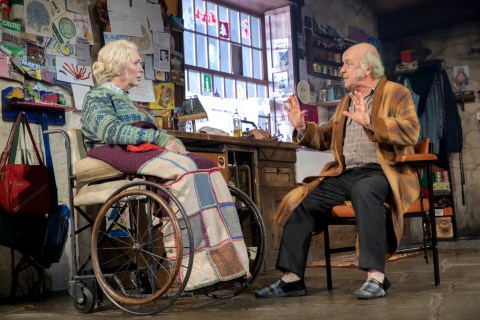
Fionnula Flanagan, Mark Lambert in ‘The Ferryman’ by Jez Butterworth, directed by Sam Mendes (Joan Marcus)
From the outset Butterworth reveals the Troubles broiling beneath the land, which ironically revolts at the strife and bloodshed by spewing up one of its “disappeared.” In the prologue a priest and sinister IRA men discuss a body popping up from its clandestine burial ground in a bog. Butterworth gradually reveals the import of this pivotal moment. After the body’s public discovery, Father Horrigan (Charles Dale), the IRA’s Muldoon (Stuart Graham), and the entire 14-member Carney family will never be the same.
Though the body, blackened from the peat, looks appalling, its preservation secures the man’s identity as Seamus Carney. The husband of Caitlin Carney (Laura Donnelly) and brother of Quinn Carney (Paddy Considine), had gone missing 10 years before. Mysterious reported sightings in Liverpool and elsewhere suggested Seamus had abandoned wife and family.
For the Irish Catholic Carneys living on a farm in County Armagh, Northern Ireland, all has remained in a suspended state. This is especially so for Caitlin, Quinn, Mary (Quinn’s wife), and Oisin (Seamus’ son). On closer inspection, the meaning of Seamus’ loss has afflicted all of the family interactions. Not only has their dynamic been upended, but Quinn’s, Mary’s, Caitlin’s guilt, regrets, and self-recriminations simmer in the ground of their souls. Closure eludes them. It’s as if the spirit of absence inhabits family members, who come and go like wraiths. In fact a malaise of absence abides between Mary and Quinn, Oisin and Caitlin, and Aunt Maggie Far Away and the family. Indeed, this raucous family talks, but their conversation rarely achieves intimacy or depth.

(L to R): Laura Donnelly, Genevieve O’Reilly, Paddy Considine in ‘The Ferryman’ by Jez Butterworth, directed by Sam Mendes (Joan Marcus)
After the prologue, an immense bustle of activity explodes in the 14-member household. As the children rouse and come down for breakfast, happy chaos filters in with the sunlight. Tom Kettle (Justin Edwards), a Brit saved by the family as an orphan, brings his good will. Along with apples, a live bunny, and strength for the harvest, Kettle’s slow-witted presence provides assurance of a good harvest. Still, Aunt Pat carps about his being a Brit. And she warns that the family has forgotten what is important. Eventually Mary comes downstairs in her nightgown, like a ghost, then goes back upstairs. And somewhere in this foolishness, the sterling portrayals by the ensemble win our hearts. So does the live goose that Tom Kettle rescues for the dinner.
Beautifully staged with the clutter of fun and bounty of children’s drawings, the production convincing shows us a convivial, lively family. Mendes’ staging of the entrances of the numerous Carney children (including a gorgeous baby), three elders, three parents, and cousins strikes with wonder. The enthusiasm of life and togetherness bubbles with cheer.
Their joy manifests the day’s specialness. For today, the Carneys and their Corcoran cousins will harvest the fruits of their labors. Surely, they will move out to the combines with thoughts of celebration: with the killing of the goose, feasting, drinking and dancing. But before they leave, as they have breakfast, in the midst of the ebullient confusion come the prophet and historian. The truth resounds with the moral imperative that comes with the women’s presence.
Certainly, Uncle Patrick’s (Mark Lampert) jokes about Aunt Pat’s having turned from a sweet girl to a bitter witch entertain us. But the playwright has effected a greater purpose for her character. From Pat we learn of the ongoing socio-political conflict in Northern Ireland. And yes, Aunt Maggie’s dementia breaks our hearts. But her character carries a message. All of a sudden, as she is wont to do, she comes out of her fog and sings. She “arrives!” Next, she interacts with Uncle Pat about the harvest. Then she “disappears” in a twinkling. Her absence devastates. Her arrivals vibrate with contagious electricity. She is a will-o-the-wisp sprinkling laughter until she closes up in deadly silence.

Paddy Considine, Genevieve O’Reilly in ‘The Ferryman’ by Jez Butterworth, directed by Sam Mendes (Joan Marcus)
As Maggie disappears, the children’s lively banter once more takes over. But we understand that both women serve as omens, as does Uncle Pat. Toward the end of the play, Uncle Pat delivers the final truth about the ferryman of Greek mythology, to capstone the meaning of Seamus’ loss. And Aunt Maggie sees into the spirit realm and cries out our future for all of us.
Indeed, the three elders reveal the family’s irrevocable foundations in sorrow and struggle. Through them, Butterworth most poignantly and powerfully unfolds the symbolism, beauty, and tragedy of what has been culturally and socially “disappeared.” The spiritual ethos of the Irish culture’s identity, voice, beneficence would be buried under British rule of Northern Ireland. And that rule ensures vengeful violence and murder.
Ironically, the youngest children seem dislocated from their background until Aunt Maggie reveals Aunt Pat’s miseries about the Easter Rising. The teenagers know more about the Troubles. Brooding Oisin (Rob Malone) acknowledges the struggle at the worst possible moment. When he confuses his loyalties, he reaps a horrific fate.
The climactic reckoning comes to Quinn Carney when his brother’s body emerges in a public disgrace of the IRA. Will Quinn choose to be silent to protect the IRA as he has done since his brother disappeared? Or will he take press interviews and blow the whistle on his brother’s murder? Muldoon fears the latter.
Once a member of the IRA, now a farmer, Quinn has submerged for a decade his awareness of how British rule impacts his daily life. Not until Seamus’ body with a bullet hole in the back of his head arises from the earth to confront him and Caitlin, do they move from their stasis. Ironically, Quinn regenerates the cycle of bloodshed and revenge he attempted to leave before Seamus went missing. Indeed, in a malevolent twist Muldoon provokes him to it.

Paddy Considine in ‘The Ferryman,’ directed by Sam Mendes, written by Jez Butterworth (Joan Marcus)
Quinn (an incisive and fierce portrayal by Considine) had left off this cycle to embrace his family and his farm. As patriarch he carried on the family tradition and created a large brood with Mary, which would wall him off from the political necessities of gaining freedom. They lived with Seamus’ loss, somehow waiting in peace to learn his fate. But in Butterworth’s stark, heavily messaged tragedy, the harvest brings more than the barley. And it brings more than his brother’s body, which evidences the IRA’s handiwork on alleged traitors. For the harvest returns the bloody nature and being that Quinn Carney manifested years before. If blood will let blood, surely the deeds of the fathers come knocking on the doors of the sons and the nephews. This is a bitter harvest indeed, sown in blood with little fruit to enjoy.
The play evokes a timelessness with profoundly spiraling themes and symbolism. Mendes has shepherded the actors to terrific performances and created a potent, masterful production that must not be missed. Paddy Considine, Laura Donnelly, Justin Edwards, Fionnula Flanagan, and Dearbhla Molloy are standouts. Michael Quinton McArthur delivers some of the funniest lines of the play with perfect timing. The ensemble also includes Dean Ashton, Fra Fee, Tom Glynn-Carney, Stuart Graham, Carla Langley, Matilda Lawler, Conor MacNeill, Willow McCarthy, Brooklyn Shuck, Glenn Speers, and Niall Wright.
Kudos go to Rob Howell (Scenic & Costume Designer), Peter Mumford (Lighting Designer), Nick Powell (Sound Designer & Original Music), and the rest of the creative team.
The Ferryman runs 3 hours and 15 minutes. (There is a 15-minute intermission following Act I and a three-minute pause following Act II.) The production closes on 17 February 2019. You will not forgive yourself if you miss it.
Theater Review (NYC Off-Broadway): ‘Apologia’ by Alexi Kaye Campbell, Starring Stockard Channing, Hugh Dancy

(L to r): Hugh Dancy, Talene Monahon, Stockard Channing, ‘Apologia,’ Alexi Kaye Campbell (Joan Marcus)
Apologia by Alexi Kaye Campbell poses the question: At what point must women decide between their families and their careers? Why do they have to? Should family members judge them for making their own individual choices? Must they always sacrifice their own identities to the happiness of husbands, sons? Would men in the same position subvert their own happiness allowing their wives to self-actualize without them?
Apologia, starring Stockard Channing as American art historian and human rights activist Kristin Miller in a riveting performance that spellbinds with truth and power, answers some of these questions. Playing both of Kristin’s sons, Peter and Simon, Hugh Dancy provides a tremendously potent assist as the initial backboard for Kristin’s edgy, ironic sarcasm. And then he doesn’t, in a turn which startles and leaves one breathless. Along with Talene Monahon’s deeply nuanced and empathetic Trudi, the twists of the evening and Trudi’s last comment lead Kristin on a long-awaited journey toward an acknowledged and necessary expiation.
Directed ably by Daniel Aukin, the Roundabout production is presented in special arrangement with Trafalgar Entertainment group, DB Productions, and The Dodgers. The themes scale up to the mountains women continually climb. However, each woman’s specific experience, though easily generalized, brings out unique circumstances. Such is true for Kristin Miller and her family.
Forty years ago, when Kristin Miller had her sons, feminists’ efforts to shatter the glass ceilings were faltering. Over the decades women found that “having it all” exhausted them, because they didn’t actually “have it all.” The differences loomed, as they still do, between men’s and women’s efforts to create success. And what of those women who forge ahead only to confront the ire and snide glances of men, family, and other women? Like Kristin, realizing they have to go it alone, these mavericks harden their souls because they must.
Thus, only the sound of their own ironic understanding resonates within. And gradually their rough edges blossom forming steely, stolid personalities. Such tough, determined women become renowned for their achievements. This life path sustains Kristin over the decades, supported by friends, through socio-political events and sometimes family gatherings. And then –
On the evening the action begins, her family and a friend visit for dinner and her birthday, bearing gifts. It’s the spring of 2009 in the UK, and the world wide economy is attempting to recover from the mortgage debacle which her son Peter, a congenial banker, may have helped preside over.
During the birthday celebration, we discover an intriguing antithesis. When Kristin’s marriage failed, her husband left. But he didn’t leave her for another woman. Instead, he left her bereft, took the children without a discussion, and divorced her. She could see her songs only on holidays. Irony of ironies, he left despite their shared values and mutual respect. With all of that, he still couldn’t tolerate her gaining her own voice.

Stockard Channing in ‘Apologia’ directed by Daniel Aukin, written by Alexi Kaye Campbell (Joan Marcus)
In speaking truth to power, sparking her own personal revolution through discovering the maverick Renaissance painter Giotto’s revolution, Kristin soared. And while she moved progressively upward, her husband felt abandoned. In turn, he abandoned her without notice. She stood strong against the winds, but we learn that this abandonment and betrayal changed all of their lives forever.
In an illuminating performance, Channing portrays Kristin Miller as one of the culture’s more steadfast moral compasses. We appreciate her acute sensitivity and wit when she calls her party guests on the carpet with reasonable arguments. For example, she elevates Simon’s girlfriend Claire (the wonderful Megalyn Echikunwoke) for her acting talents, shown as she plays an innovative Nora in Ibsen’s A Doll’s House. On the other hand she calls her down when Claire refers to her soap opera acting job as “artistic.” And she ironically roots out from Claire that she paid over 2,000 pounds for a designer dress because she “deserved it.” Friend Hugh (the humorous, well paced John Tillinger) finds such an amount for a dress nearly obscene. So does Kristin, a communist and activist who attends protests with great hope and fervor.

(L to R): Megalyn Echikunwoke, John Tillinger, Talene Monahon, Hugh Dancy, Stockard Channing, ‘Apologia, by Alexi Kaye Campbell, directed by Daniel Aukin (Joan Marcus)
As the play progresses we acknowledge Kristin’s outer invulnerability and searing, humorous acerbity. The guests circle around her with care. Only her longtime friend Hugh understands. And he praises her and defends her as they discuss their fun past filled with war protests and marches. However, once in a while, Talene Monahon’s Trudi pings a chip in Kristin’s protective shell. As simplistic and washed out as Kristin would make Trudi out to be, we realize this is a blind. Indeed, the information Trudi has gleaned from Peter’s discussion of his mother has stirred Trudi with insight. And the wisdom she gained Trudi drives like an arrow through Kristin’s hardness into the depths of her softening heart.
In this ominous time when Kristin first meets Trudi, a transformation occurs. Trudi brings an intriguing present which has great symbolic significance, initially unknown to all. Kristin looks up its description and identifies its purpose and meaning. Assuredly, Trudi has chosen this gift with intuition, as it fits who Kristin represents. However, the revelation occurs after Simon’s momentous visit and departure. Dancy’s portrayal of Peter’s brother Simon rings with a poetic, stark emptiness that breaks Kristin’s heart though she doesn’t readily show it. Channing’s subtle portrayal implies her inner brokenness with Simon. The actors mesmerize us in this scene.
As the lighting design indicates, Simon’s being remains in the shadows. Though his mother tenderly attempts to bind his wounds from a fall, she succeeds only with the physical flesh. Instantly, we realize this ministration of wrapping Simon’s wounds symbolizes a greater action on her part.
Kristin cannot bind the emotional lacerations he experienced when the family split up. Not completely understanding what happened between his parents, Simon doesn’t know why she never came for his brother and him. But he takes a small step in realizing that his current feelings reflect reactions from the past about her. This realization comes because Kristin doesn’t refer to her two sons as part of her “life and times” in her memoir that has just been published. Indeed, both Peter and Simon must acknowledge Kristin’s identity as separate from theirs, yet a part of them. Finally, they must stop blaming her and take responsibility for their own baleful choices.
Will Simon ever understand that Kristin, in pursuing her own identity and self-validation, benefited him? Crickets for now; maybe not in the future. Though Simon leaves with a stain on his heart, perhaps the door has opened a crack to let in more light. He decides to finalize his relationship with Claire. Indeed, this evening of understanding may portend a new beginning in Kristin’s and Simon’s relationship.

Hugh Dancy in ‘Apologia’ (Joan Marcus)
Though Kristin’s evening celebration went through its own thunder and lightning storm, the light of day shines on each of the guests. Peter apologizes. And Kristin apologizes to him. Her hard, humorous, sardonic protections appear to soften. Suppressed emotions pour out and the air clears. However, whether this result will move the sons in a finer direction of empathy toward their mother, Campbell leaves open.
Thankfully, hope appears on the horizon in the profound shape of Peter’s Christian fiancée, Trudi, who may really be what Christians are supposed to be, loving and understanding. Incredibly, Campbell cleverly sneaks this in without fanfare.
Campbell’s work shepherded by the director and actors subtly draws us into this family evening that flows with deep undercurrents. The actors are splendid together and the lighting and music segues us into the soulful levels of the characters’ hearts. I particularly love the play’s concept of “apologia,” the noun meaning vindication, justification, explanation. For both of the sons and Kristin, there is an apologia. Of course none needs it more than Kristin. But it is Trudi who triggers Kristin’s finally laying down her defense, justification, explanation to others. For she must set her own forgiveness in motion for herself. At the end Channing’s cry is one of beauty, sorrow, grace, and at bottom, the courage to let go. Wonderful.
Kudos to Dane Laffrey (set design), Anita Yavich (costume design), Bradley King (lighting design), Ryan Rumery (original music and sound design). The premiere of APOLOGIA is at the Laura Pels Theatre in the Harold and Miriam Steinberg Center for Theatre (111 West 46 Street). It runs through 16 December. Visit the website for tickets.
Theater Review (NYC): ‘Girl from the North Country’ by Conor McPherson, Music and Lyrics by Bob Dylan

‘Girl From The North Country,’ Written and Directed by Conor McPherson, Music and Lyrics by Bob Dylan, Featuring Todd Almond, Jeannette Bayardelle, Stephen Bogardus, Sydney James Harcourt, Matthew Frederick Harris, Caitlin Houlahan, Robert Joy, Marc Kudisch, Luba Mason, Tom Nelis, David Pittu, Colton Ryan, John Schiappa, Kimber Sprawl, Rachel Stern, Chelsea Lee Williams, and Mare Winningham (Joan Marcus)
I cannot imagine any writer but Conor McPherson effectively providing such a dramatic flight path to Bob Dylan’s repertoire. The playwright’s eerie, atmospheric writing effectively implies connections between the material at hand and otherworldly realms. Dylan’s titular song is part of the hybrid McPherson musical Girl from the North Country, which is part song cycle, part winsome and effusive-with-longing memory play. Extended, the production currently runs at The Public Theater until 23 December.
Indeed, in this musical, which the playwright also directed, McPherson’s writing and Dylan’s songs have reached an apotheosis of sorts. Their collaboration is a fascinating meld. And their works morph like sand under the tremendous heat and pressure of sadness, fear, and desperation to depict a desperate time in 1934. The result when cooled becomes a glass through which we see clearly the emotional and spiritual impact of longing, desiccated dreams, the desolation of impoverishment, unfulfilled love and loss.
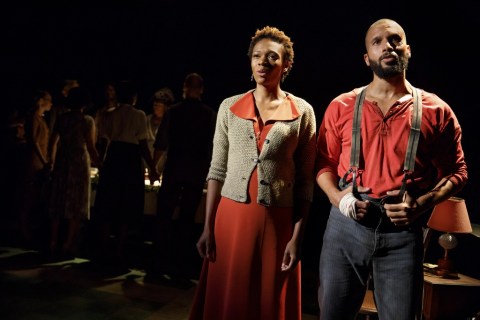
‘Girl From The North Country,’ written and directed by Conor McPherson, music and lyrics by Bob Dylan. Featuring Todd Almond, Jeannette Bayardelle, Stephen Bogardus, Sydney James Harcourt, Matthew Frederick Harris, Caitlin Houlahan, Robert Joy, Marc Kudisch, Luba Mason, Tom Nelis, David Pittu, Colton Ryan, John Schiappa, Kimber Sprawl, Rachel Stern, Chelsea Lee Williams, and Mare Winningham (Joan Marcus)
We recognize that that era is like our current one. Thus, these elements in the characters’ songs and word-arias become empathetic fragments. And in them we find threads familiar from our own lives meshing with the raw, explicit rendering of soul-weakened characters who “can’t catch a break.”
McPherson, the seminal Irish playwright of the haunting Shining City, The Weir, and The Seafarer, always exposes the spiritual elements present in our midst, whether we want to acknowledge them or not. For his part, Dylan for over 50 years has entertained and moved us with poetic evocations of life’s gritty and hope-inspired underbelly. Indeed, his brilliance manifests in his reverse chameleon-like morphology. Incrementally, he started trends, then left them to form others after musician admirers saturated the field with imitations. Always fresh, insightful, wise, Dylan has become a treasured cultural prophet and minstrel wandering through the times of our lives.
Over the decades he has proven himself more than a masterful tunesmith, though the Nobel Prize Committee bestowed its award for his songwriting. His word-craft and storytelling ballads remain unique and particular to Dylan. He has shepherded us through repeated social crises and cultural transformations. But Dylan stayed true to himself. He adhered only to the shifting currents within, despite the outward tug of his fans’ pressure to keep doing the same stuff.

Jeannette Bayardelle in ‘Girl From The North Country,’ written and directed by Conor McPherson, songs by Bob Dylan (Joan Marcus)
Together McPherson and Dylan achieve a new boldness and resonance. Surely, that remains one reason why this stellar production at the Public inspires and rises to an extraordinary level. This abides especially because of the striking voices of the cast. It also comes from the stunning portrayals that echo characters from John Steinbeck’s Depression-era short stories and novels. Mare Winningham’s depiction of Elizabeth Laine is just gobsmacking.
Thus, the memorable fusion of two greats illuminates like starlight. Indeed, the production may guide the way for future collaborations by others of like kin. McPherson’s and Dylan’s first time out of the gate wins with grace, humor, delight, and poignancy. Its rich fullness bears seeing more than once. For you may miss the book’s subtle themes intermingled with the parallel thematic thrust of Dylan’s songs. Gleaning how the show subtly weaves the songs into the characterizations and story development pleasantly startles. Dylan’s “Sign on the Window” and “You Aint Goin’ Nowhere” exemplify the characters’ ironic, spiritual situations, for example.
In all of McPherson’s works, spirits materialize. Sometimes, devils manifest, including a few “Christian” human devils. Some leave once they have moved humanity to act. Other spirits continue to haunt his characters with surreal guilt. In Girl From the North Country, a sister’s horrific end floats in the consciousness of Nick Laine, a fact Dr. Walker (Robert Joy) and Elizabeth Laine his wife (Mare Winningham) affirm.
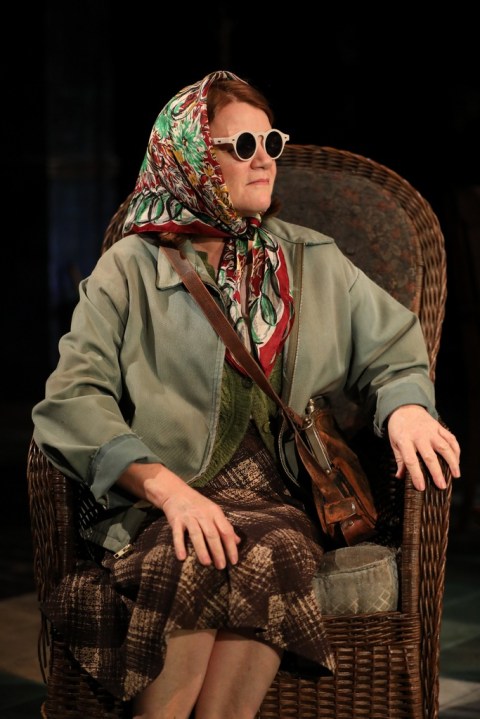
Mare Winningham, ‘Girl From The North Country,’ written and directed by Conor McPherson, songs by Bob Dylan (Joan Marcus)
Nick doesn’t admit to this “haunting.” But Elizabeth, at times strikingly sentient, other times searingly dementia-addled, suggests its impact. She refers to “hearing the girl down the hole” when she resists Nick’s struggles to attend her. In another instance, when Nick attempts to finalize the deal to marry off their adopted daughter, the pregnant Marianne (a moving Kimber Sprawl), to the 70-year-old Mr. Perry (a fine Tom Nelis), Elizabeth speaks of “the girl.” Thus, “the girl” becomes the signifier of women as casualties of abandonment, accidental negligence, and death at the unwitting hands of men.
This metaphor, further strengthened by the male/female interactions throughout, provides the backdrop for various songs. Love, its strength, its loss, is a theme found in Dylan’s songs: “Tight Connection to My Heart,” “I Want You,” “Make You feel My Love.” The husband/wife relationships weakened by want and economic stresses languish (“True Love Tends to Forget,” “What Can I Do For You,” “Is Your Love in Vain.”) And the young girls Kate (Caitlin Houlahan) and Marianne have few options but to settle for those they do not love, in order to gain security and shelter.
Escape from this desolation of want and hopelessness lurks in every character’s mind, especially in Elizabeth’s. Her “escape hatch” under her chair, where she’s collected coins and dollars, suggests women’s behavior from time immemorial. Sadly, the paltry sum wouldn’t take her far. And her dementia, if she did “escape,” would result in her being placed in a mental institution. Thus, Nick, the best husband he can be under the circumstances, humors and takes care of her with Marianne’s and his mistress Mrs. Neilsen’s (Jeannette Bayardelle) help.
After Dr. Walker apprises us of what happened and “the girl”‘s relationship to Nick, we understand why, throughout the production, Nick never sings his own individual/solo song. Unable to forgive himself for her death, he increasingly allows his inner life to wither. Laine’s emotional and psychic state remains doubly clear when he says to Mrs. Neilsen that he “has no soul” and can’t tell her he loves her. Desolation would overcome him with alcoholism, but he must take care of Elizabeth. It is she whom he lives for, as her caretaker. Their occasional interaction during Elizabeth’s sentient periods forces edgy and humorous exchanges.
Except for Dr. Walker and the elderly Mr. Perry, each character sings either his soul’s theme that typifies his/her existence or a song of regret and loss that asks questions about life and love. Most striking for me is Sydney James Harcourt’s portrayal as the boxer Joe Scott. His rendition of “The Hurricane,” portends the (racial) storm coming, both physically and metaphorically. Obviously, McPherson has drawn parallels between his Joe Scott and the boxer Rubin “Hurricane” Carter, whose quest for freedom Dylan supported against wrongful imprisonment in the 1960s.

Mare Winningham, Stephen Bogardus in ‘Girl From The North Country,’ written and directed by Conor McPherson, songs by Bob Dylan (Joan Marcus)
Winningham brilliantly delivers “Like a Rolling Stone” with nuanced depth and power. With it Elizabeth indicts all who have entered their boarding house, her family, herself, indeed all humanity. For all, whether they admit it or not, are “on their own,” facing their own abyss. The rhetorical question “How does it feel?” and the silent answer we all fear and know in our “aloneness” become the signature theme of the musical. Fabulous!
Dr. Walker narrates the story of the Laines and their guesthouse. And Mr. Perry delivers a powerful word-aria when he attempts to persuade 19-year-old Marianne that he will take care of her, die soon, and leave her his inheritance – so why not couple? However, like Nick Laine, both Perry and Walker remain songless. It is as if they haven’t the heart/soul to pour out their feelings in melodic phrases.
Stephen Bogardus’ (recently Dr. Mark Bruchner in Irish Rep’s On a Clear Day) dynamic voice has been closed off to portray Nick Laine. His Laine draws us in as he exhibits tireless efforts as proprietor of the boarding house he manages in Duluth, Minnesota in 1934. This semi-stolid figure, in his chaotic guesthouse, offering cheap room and board to a bankrupt businessman, his wife and son, a widow, a Bible salesman, and a boxer, cannot keep his family prospering. Like his impoverished guests, he struggles to make it to the next day and attempts to be sanguine about it. Of course he dreams and works at escape with Mrs. Neilsen; they wish to leave with her inheritance and start a hotel. It’s a Eugene O’Neill pipe dream!
As the musical develops, every hopeful door slams in Nick’s face. Son Gene (Colton Ryan) never gets that railroad job Nick moved heaven and earth to get for him. And Marianne doesn’t settle down with Mr. Perry, who offered to provide Laine with a check to pay a bit of his mortgage debt. Living with Perry would safeguard his daughter and her baby, Nick believes, though Marianne prefers seeking the baby’s father. When lawyers defraud Mrs. Neilsen, she decides to leave. For Nick this last door slams in his face.

Caitlin Houlahan, Colton Ryan in ‘Girl From The North Country,’ written and directed by Conor McPherson, songs by Bob Dylan (Joan Marcus)
And when there appears to be no way out, Nick considers suicide. Dr. Walker mentions the high suicide rates after the Wall Street crash. Surely, suicides continued in high numbers during those Depression years. Homelessness, want, sickness, starvation – Nick has seen sufferers in tent embankments like those so trenchantly described in Steinbeck’s The Grapes of Wrath. Nick fears for himself and Elizabeth, for in a few months the bank will foreclose on their mortgage. Assuredly, they will end up like the other ragtags living in tents unless he finds a way for them.
Considering that Dylan’s songs range over decades, written before this project ever could have been conceived, McPherson selected an appropriate setting and characters for his musical’s book. Every character’s desperation spills out into urgent need for money and shelter. Like the Joads of Grapes of Wrath, right before they lose their home and travel, these characters strive and seek the comfort of one another. Thankfully, Nick’s boarding house provides “a welcome for lost souls.” There, Nick feeds them, they celebrate Thanksgiving, they dance. However, Mrs. Burke (Luba Mason), Mr. Burke (Marc Kudisch), and Elias Burke (Todd Almond) hide secrets. So do Reverend Marlowe (David Pittu) and Joe Scott (Sydney James Harcourt). On the run, they bring their fears and hidden sorrows to this guesthouse and eventually their darkness is brought into the light.
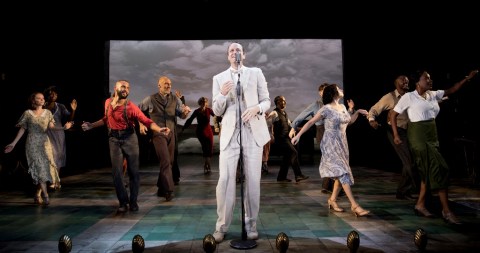
Todd Almond as Elias Burke in ‘Girl From The North Country,’ written and directed by Conor McPherson, songs by Bob Dylan (Joan Marcus)
Perhaps the most poignant of fears concerns the Burkes, whose strong, powerfully built son Elias manifests the mind of a three-year-old. Like the character Lennie in Steinbeck’s Of Mice and Men, he understands little of his world around him and stumbles into fearful trouble.
The poignance of his demise is uplifted when Todd Almond as Elias magnificently sings “Duquesne Whistle.” As a spirit he has gone to the afterlife. No more materialistic pain and suffering shackles his mind and heart in darkness. Dressed in a white suit, free of his mental challenges, he and the chorus celebrate that other dimension McPherson beautifully presents. It is a full-on, gospel “coming home” ceremony. Elias (like his name-variant prophet Elijah), “makes it to the other side” of Light in a wonderful capstone to Almond’s complex and nuanced portrayal that stuns.
Thanksgiving, the last memorable party, follows with grim realities that unload truths on all of them. Only Elizabeth, after her marvelous speech about love and her marriage to Nick, afterward singing “Forever Young,” remains stalwart in her sentience and distraction. Indeed, with Nick’s help she has mastered the art of balance even in her dementia.
With finality, we look in the background at their last Thanksgiving together in tableau, as Dr. Walker narrates what he knows of the characters’ futures, reminiscent of the narrator in Thornton Wilder’s Our Town. And as McPherson is wont to do and does believably, Dr. Walker shares his passing to “the other side” in Christmas of 1934. We realize then that he has been speaking to us as a spirit of his memories of the Laines, the guests, and that time.
What more can be said about this marvelous must-see-a-few-times production? The chorus/ensemble (Matthew Frederick Harris, John Schiappa, Rachel Stern, Chelsea Lee Williams), are exceptional in voice and movement. Kudos to Rae Smith (scenic & costume design), Mark Henderson (lighting design), and Simon Baker (sound design). Simon Hale’s orchestrations and arrangements of Dylan’s music are exceptional. Additionally, without Lucy Hind, Unkledave’s Fight-House, Dean Sharenow, Marco Paguia, the actors who played in the band (Todd Almond, Marc Kudisch, Luba Mason), and musicians Martha McDonnell, Mary Ann McSweeney, and others, the full impact of the production would be lessened.
The Girl From the North Country at the Public Theater runs until 23 December. Just wow! Visit the Public Theater website for tickets.
Bill Irwin in ‘On Beckett’ at the Irish Repertory Theatre, Off Broadway Review

Bill Irwin, ‘On Beckett: Exploring The Works of Samuel Beckett,’ Irish Repertory Theatre (Carol Rosegg)
Has there ever been a more elegant, erudite and riotously funny clown prince of theater than Bill Irwin? Not only has the Tony Award winner mastered the innards of pacing, rhythm, mime, body visualizations and timing of the comedic. Irwin writes, directs, acts. What does he not do well theatrically and dramatically? In what he attempts, Irwin delights. In his On Beckett at the Irish Repertory Theatre, Irwin examines the opaque and timeless works of Nobel Laureate Samuel Beckett. What an exquisite evening Irwin conceives, directs and performs.
On Beckett: Exploring The Works of Samuel Beckett introduces us to lesser-known works, and he revisits the often performed Waiting For Godot with the assistance of Finn O’Sullivan as the boy. Irwin appeared in the 2009 production of Godot and received a Drama Desk Award nomination.
As he presents Beckett’s less familiar writings, he acknowledges the importance of the playwright’s Irish voice, identity, and heritage. Notably, Irwin showcases passages from Beckett’s elusive Texts For Nothing (13 short prose pieces), pointing out that Beckett wrote the arcane prose pieces in French, then translated them into English, his native tongue that Irwin identifies as the “familiar familial voice.” As an Irishman writing in French, Beckett maintained his uniquely Irish ethos but received widespread acceptance in France initially. The irony astounds as it is “the product of a complex translation exercise.”
The prose pieces Irwin performs, #1, #9, and #11, are masterworks about being, absence, presence, and vacancy, all interior dialogues and questions. They reveal the common man/woman’s struggle with self in a massive inner argument that represents individual consciousness. And they reveal the human condition of impoverishment, failure, exile, loss. In the passages Irwin selects, Beckett wrangles the concept of consciousness. Indeed, these excerpts reveal the act of viewing oneself in despair, in parallel with the self experiencing despair.
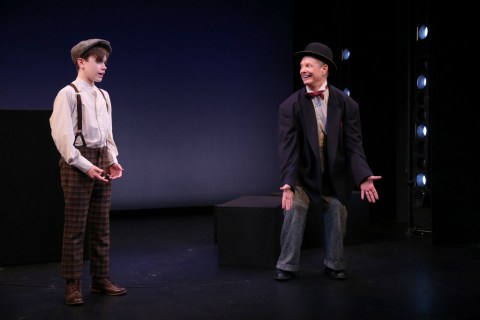
(L to R): Finn O’Sullivan, Bill Irwin in ‘On Beckett: Exploring The Works of Samuel Beckett,’ Irish Repertory Theatre (Carol Rosegg).
Thus, from both perspectives Beckett suggests questions about existence, survival, struggle, and purpose. The will “not to go on” while “going on” remains paramount in Beckett’s darkest, bleakest comedy. These elements Irwin melds with the cliché of the Comic Irishman “who has waiting to do” and “struggles with the notion of ease, and his placement in the larger scheme of things.”
In his comments before and after excerpts from Beckett’s novels The Unnamable and Watt, Irwin questions: “Is he making fun of the way consciousness works?” Or “is he offering a portrait of consciousness?” As we appreciate this rare experience that Irwin delivers with aplomb, we understand Beckett’s extraordinary contributions. Not only did he assist in the transformation of English modernist literature, he was credited as integral to the Theatre of the Absurd along with Eugene Ionesco and Harold Pinter. Whether he would have appreciated the latter is debatable.
Notably, through his discussion we get to realize another facet of the diamond that is Bill Irwin’s artistry. In acting Beckett, he questions and appropriates the language and suggested meaning for himself. All of this pertains to and infuses his own relationship to art, acting, clowning, and theatrical expression. Shepherding us through Beckett’s language, Irwin ignites our passion. And he makes Beckett and perhaps ourselves more comprehensible in all the abstruse glory of the incomprehensible tragicomedy of life. Indeed, in his “Introduction” Irwin discusses how Beckett’s unforgettable words have gone viral within him, have haunted him. Certainly, the language resounds in his “head,” “heart,” “brain,” “mind,” “psyche,” “body.” This interesting admission yields that Beckett has been integral to Irwin’s evolution as a man and an actor, as a clown and an artist.

Bill Irwin in ‘On Beckett, Exploring The Works of Samuel Beckett,” conceived and performed by Bill Irwin at the Irish Repertory Theatre (Carol Rosegg)
Irwin’s comments sparkle with witty self-effacement. For example in outlining the evening, Irwin references the show lasting 86 minutes or so and quips, “I say this by way of reassurance.” Indeed, Beckett is not easy. But through Irwin’s humor we gradually become intrigued about his novel approach toward his subject and his singular recognition of Beckett’s language.
Irwin gets inside Beckett as an actor, and also explores his work from the perspective of clown theatrics. The great clown traditions, Irwin tells us, are “the lens through which he views everything.” And indeed, he applies this lens to exploring the extent to which he views Beckett as clown territory. Irwin’s hapless Clown characters and the techniques he employs to achieve this archetype everyperson provide the uplift to laugh at our shared humanity.
Revisiting Beckett from this unusual angle, Irwin’s organic acting and portrayal of Beckett’s clown characters enlightens. Cleverly, his performance and astute commentary about acting and language shine a beacon into Beckett’s mysterious obscure.
Kudos also go to Charlie Corcoran (scene design), Martha Hally (costume consultant), Michael Gottlieb (lighting design), and M. Florian Staab (sound design). Don’t miss seeing this wonderful presentation if you can get tickets. It closes on 4 November. Click here for the Irish Repertory Theatre website for times and tickets.
Theater Review (NYC): ‘What The Constitution Means to Me’ Starring Heidi Schreck

(L to R): Rosdely Ciprain, Heidi Schreck-playwright, Thursday Williams, Mike Iveson, ‘What The Constitution Means to Me,’ NYTW, (Joan Marcus)
Depending upon how you view the months since the 2016 election, playwright, actress Heidi Schreck’s timely What the Constitution Means to Me casts a long shadow and provides trenchant perspectives. Of course one may view it simply as a pleasurable, informative romp through a document most remain clueless about. Or perhaps one may identify that her humorous, vibrant writing more profoundly remains a siren call to “get woke!”
Indeed, the production staged and set in an American Legion Hall, directed by Oliver Butler, stars award winning actress and writer Heidi Schreck. And it took years in the making. With assistance by fellow actor Mike Iveson and debater Rosdely Ciprain, the result sparkles. Schreck’s crisp, sharp, ironic writing encapsulates American themes and pivotal, historical moments that changed our laws. Abundantly, these perplex. For they concern the constitution’s long-range evolution toward greatness. But Schreck also includes how the people have stretched the document over the chasm of far reaching human miseries. At any time it may break, and our society plummet into the abyss. Her work and its cattle-prod intent remain a fascinating, thought-provoking must-see.
Indeed, humorous and enthusiastic throughout, Schreck’s “light-hearted” approach belies the seriousness of the subject in today’s light/dark atmospheres. For she presents profound and disquieting principles and facts about our lives that we cannot dismiss. And she accomplishes what the news media at times does not. She presents with succinct, factual details and logical arguments that clarify. Importantly, she makes one think beyond memes and spurious arguments, troll epithets, and misinterpretations!
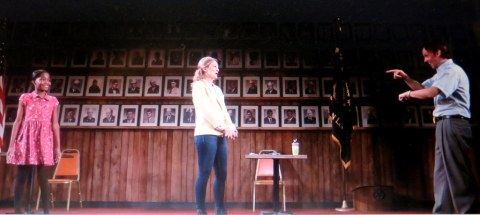
Rosdely Ciprain, Heidi Schreck, Mike Iveson, Clubbed Thumb in partnership with True Love Productions, ‘What The Constitution Means to Me,’ (Joan Marcus)
This alone remains worth the price of the ticket. In fact her production should be opened to area schools. Sitting just 10 minutes into the first half of the performance solidifies why. With a facile, funny, and vitally spontaneously delivery, Schreck becomes our vibrant teacher and historian. Notably, she proves the past abides in the present through her debates about the amendments. These concern those (9th, 4th), not typically familiar. Nevertheless, she proves why we should know them as crucial to our rights and well being.
During the production, Schreck reveals her personal veneration of our country’s democratic principles particularly outlined in the laws written after the Civil War. The quotes from distinguished justices and presidents alike illuminate. Assuredly, most amendments guarantee equity for every citizen and the rights of due process for all. And she notes the pitfalls where such principles and laws wobbled and continue to shake. Subtly, she infers that we must continually apprise ourselves of our constitution’s ever flexible nature.
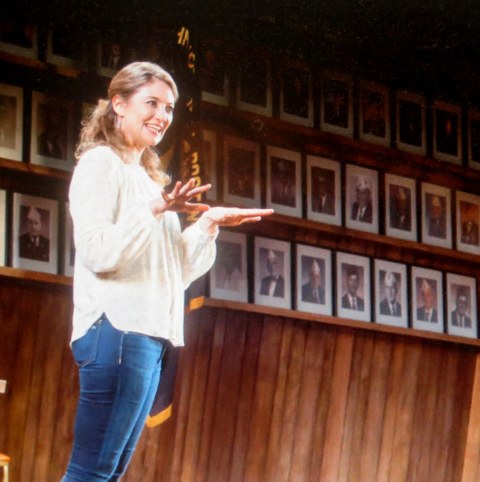
Heidi Schreck, actress, playwright, ‘What The Constitution Means to Me,’ directed by Oliver Butler, NYTW (Joan Marcus)
Evolution and devolution include the same letters save one. In other words we are a letter away from the collapse of the bedrock laws of equity. If pernicious, power-usurping partisans undo just applications for the great majority to benefit the proportionately few wealthy, contentment, and prosperity wanes for most citizens. Exemplified, though not mentioned in Schreck’s work would be Citizens United which favors corporate donors giving multi-millions to politicians’ PACS thereby owning them.
Additionally, her discussion relating the constitution’s impact on women in her own family acknowledges strides. But it also portends fissures and potential earthquakes setting “women’s rights” back decades. This discussion Schreck attends to in the second segment of her production
Winningly, in the first half Schreck recalls her teenage years and how she employed her reading, writing and research skills to earn needed college scholarship money. As a teenager she competed in debates for various prizes from the American Legion. Indeed, these competitions challenged her thinking and debate skills. Of course her presentation centered around “what the constitution meant to her” at that age. Thus, she uses this presentation format which she delivers to white military legionnaires (we, her audience, become them), at the American Legion Hall in the state of Washington. And returning to her teenage self, she argues the constitution’s relevance to her, evoking these debates. In the fast forward to now, we compare notes and assess our progress in the current times.
This clever vehicle allows Schreck and Mike Iveson (as a Legionnaire and himself), to set up her detailed and fascinating account of women in her family and how the constitution might have and then did impact them. As she discusses the lies promulgated to bring women to settle Washington state (one woman for every nine men), she enumerates the suicides and death rates of wives at the hands of their husbands. For example, her great, great-grandmother, a mail-order bride, ended up in an asylum and died of melancholia in her thirties. Schreck ruminates about the possible back story of what happened to her. Dismissively, we may think, “times have changed.”
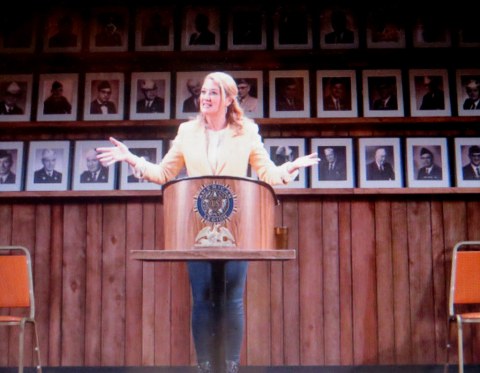
Heidi Schreck, actress, playwright, ‘What The Constitution Means to Me,’ directed by Oliver Butler, NYTW (Joan Marcus)
Then, she reveals today’s statistics. One in three women will be abused by male partners. One in four women are raped by men. And half of women killed die at the hands of their partners. However, women, no longer chattel (property), may seek justice. At one point in our history husbands could kill their wives with impunity. Yet, with lawsuits against Roger Ailes, Bill O’Reilly, Harvey Weinstein, and others, the #MeToo movement is a vital necessity. But will it negatively impact the constitution with the recent justice appointment?
In the third segment Schreck goes head-to-head with a student debater about whether we should keep or abolish the current constitution and create a new one. The evening I saw the production, Rosdely Ciprain revealed her feisty, funny debating chops and bested Schreck. However, Schreck’s spot-on argument about creating a positive rights constitution like those found in many European countries rang with sound truth.
What are negative vs. positive rights? Our negative rights constitution insures what the government cannot do to its citizens. On the other hand a positive rights constitution indicates what the government must provide: safety, security, healthcare, a living wage. After WWII FDR intended to institute a Second Bill of Rights which would have shifted the direction of our rights to positive ones. Of course, this became anathema to conservative corporates. And they held sway over our government and still do today.
Ours is a negative rights constitution. Hence, the government does not guarantee affordable healthcare, a decent living wage, human rights over corporate rights, mandates limiting excessive CEO pay, a proportionate equitable tax structure, etc. And it may rescind a “woman’s right to choose” what she might do with her own body.” Certainly, our congress has yet to pass an Equal Rights Amendment.

Preamble to the Constitution, Heidi Schreck, ‘What The Constitution Means to Me,’ NYTW, directed by Oliver Butler, (photo courtesy of the site)
Throughout, this superb production keeps one enthralled and laughing. But Schreck’s points run far and wide as she encourages our active participation in civics to understand our current historical reckoning. Thematically, she infers much. I divine from her work that like watchful sentinels, we must support the ACLU and other advocacy groups. And with them we must hold accountable our politicians to prevent thinning the constitutional threads so that they never break. Indeed, we must prevent the political think tanks and lobbyists who control our legislators from overriding through the courts the will of the majority of U.S. taxpayers/citizens. In the current tide of the Supreme Court Justice Kavanaugh times, this “must” appears more problematic than ever.
However, Schreck evokes a hopeful image her mother, a feminist, suggested to uplift her. First, picture a woman walking along a beach with a dog which darts back and forth, in the tide and waves. The dog races forward then races behind her and backtracks from whence it came. Then it moves forward, then backward. However, the woman walks forward, forward, steadily, slowly, undeterred, forward. This metaphor encourages us to hope. Not only to hope for women, but to hope for men, and LBGT communities who support equitable, positive rights for all born in this nation. And along with hope must come the energy to debate and persuade with reason and logic how undergirding the vulnerable and weak strengthens the strong.
The production currently at New York Theatre Workshop (83 E 4th Street) until 28 October, runs with no intermission. With scenic design by Rachel Hauck, costume design by Michael Krass, lighting design by Jen Schriever, and sound design by Sinan Zafar, this humorous masterwork should be extended. Hopefully, it will attend at another venue at some point in the near future. For tickets and times go to nytw.org.
Theater Review (NYC Broadway): ‘The Nap’ by Richard Bean, Directed by Daniel Sullivan
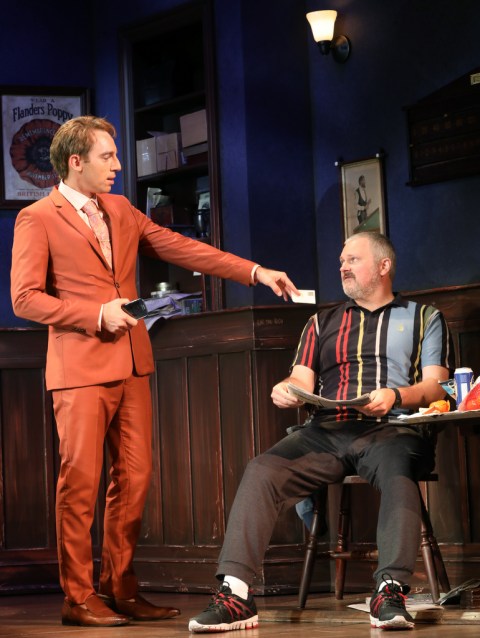
(L to R): Max Gordon Moore, John Ellison Conlee in the American premiere of ‘The Nap’ by Richard Bean, directed by Daniel Sullivan (Joan Marcus)
Playwright Richard Bean stormed Broadway with One Man, Two Guvnors, which familiarized American audiences with James Corden. Writing again for Broadway with The Nap, directed by Daniel Sullivan in its American premiere, Bean chooses a more sportsmanlike subject (snooker). A derivative of pyramid pool and life pool, with different rules, table, and balls, snooker classifies as a cue sport. It originated among British Army officers stationed in India in the latter half of the 19th century.
Bean’s incredible wit populates this play, with an ironic double entendre related to the game name thrown in for good measure. And his symbolism, related to what “the nap” suggests, cleverly stresses the theme of going with the flow of fateful events. The playwright also configures the plot twists with facile, wild characterizations. Daniel Sullivan keeps the action vibrant. As he shepherds his cast, the mix solidifies with humor. Together the ensemble presents an altogether enjoyable evening.
The play references the culture of those who enjoy snooker as aficionados and professionals. Dylan Spokes (Ben Schnetzer) hails from a lower-class background but uses his champion-level snooker skills to better himself and rise up the class ladder. This is no small feat considering his parentage: a former felonious, drug-dealing, alcoholic father and a gambling-addicted live-wire mother. Dylan’s ambitions lead him to become a ranked professional snooker player. And he intends to be number one in the world. With Dad, Bobby Spokes (the humorous John Ellison Conlee), who “coaches” him and mom, Stella Stokes (Johanna Day’s portrayal is too brief), who quietly “nurtures” him, how can he fail to be great? This introduces the primary conflict, as he competes in a major championship match.

‘The Nap’ American Premiere by Richard Bean, directed by Daniel Sullivan. With Alexandra Billings, John Ellison Conlee, Johanna Day, Ahmed Aly Elsayed, Ethan Hova, Heather Lind, Max Gordon Moore, Bhavesh Patel, Thomas Jay Ryan, Ben Schnetzer (Joan Marcus)
We learn about the game and protagonists Dylan and Bobby during their humorous by-play at their hometown Sheffield club. As Dylan readies the club’s snooker table with near-obsessive attention to detail, we witness his integrity regarding the game. Considering his background and the opportunities snooker provides for gambling, this irony falls heavily. Bobby even references his son’s morality countering his own history of waywardness. But snooker assures that Dylan will never return him to the grime and squalor of street crime. Consequently, he reveres the game like a religion.
That’s a key problem! But it makes for wonderful comedy. For this character trait becomes the linchpin of the action. All who know Dylan – the highbrows and criminals from his parents’ circle – can count on his assiduous, martinet-like behavior, as he never ever “violates the rules.” Indeed, his moral compass makes everyone blush – everyone except the amoralists, who exploit this sanctity.
Complications arise with Dylan’s upcoming tournament against Abdul Fattah during this snooker practice session. Bean sets the characters against each other. First, coppers Mohammad Butt (Bhavesh Patel) and Eleanor Lavery (Heather Lind) drop by to take Dylan’s urine sample, revealing that they serve the WPBSA (World Snooker Association).
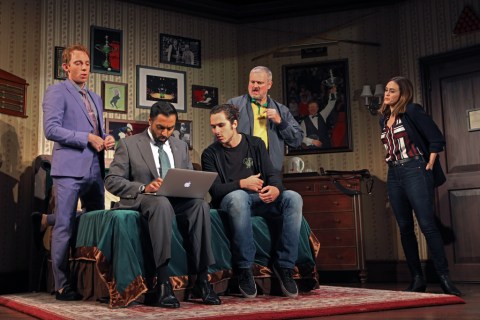
(L to R): Max Gordon Moore, Bhavesh Patel, Ben Schnetzer, John Ellison Conlee, Heather Lind in the American premiere of ‘The Nap’ by Richard Bean, directed by Daniel Sullivan (Joan Marcus)
Next, they warn Dylan that mischief comes in the form of match fixing and his flamboyant sponsor Waxy Bush, a confederate of his mom’s, who gambles odds against ranked players. The coppers suggest Dylan go undercover for them to set a trap. Along the way Dylan’s manager Tony (the humorous Max Gordon Moore), appears and schmoozes his way around the room, handing out his business cards like candy. As with all his characterizations Bean has given Tony delicious lines, which Gordon Moore takes full and clever advantage of to the audience’s delight.
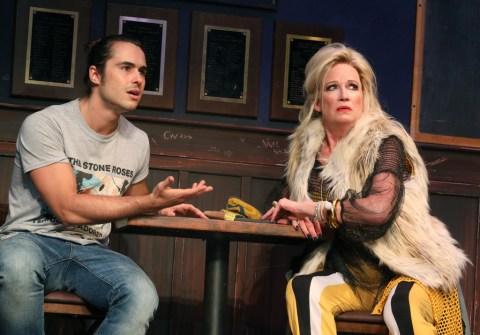
Ben Schnetzer, Johanna Day in the American premiere of ‘The Nap’ directed by Daniel Sullivan, written by Richard Bean (Joan Marcus)
A love interest develops between Eleanor and Dylan. Not only has snooker paved the way for Dylan’s exciting adventure in assisting the police and World Snooker, his love life blossoms. Can anything be better?
Subsequently, we meet the criminal-turned-innocent, Ms. Waxy Bush herself (the wonderfully spot-on and hysterical Alexandra Billings) and her accomplices (Stella and boyfriend). The plot thickens and confusion reigns. We think we follow the action. But the snookers are being “snookered.” During the chaos, divorced Bobby and Stella exploit Dylan for different reasons, badgering each other in the process. Humorously, Bobby warns Dylan not to give his mother any money. Stella identifies her former husband as a drunk to uplift her current “boyfriend” Danny (the versatile Thomas Jay Ryan), whose stinky smell puts others off. And Eleanor and Dylan continue their affair as he plays his match against the formidable Fattah (bona fide snooker play Ahmed Aly Elsayed). Thrillingly, the match is played live; the screen above the players shows all. Bean wrote in an interactive ending that changes unpredictably.

(L to R): Ahmed Aly Elsayed, Ethan Hova, Ben Schnetzer in the American Premiere of ‘The Nap’ by Richard Bean, directed by Daniel Sullivan (Joan Marcus)
No spoiler follows. Seeing this hysterical production you will find a rainbow of amazement and an intriguing conclusion. Most probably, you will learn the difference between pool and snooker. And your laughter will ring out uproariously as mine did at Waxy Bush and at Bean’s turns of phrase and clever wit characterizing Bobby, Waxy and Tony. You probably will be shocked and startled. You will appreciate the crooked film references and how apt they are to the circumstances. More than that I dare not reveal, for it would spoil the fun.
When I saw the production, a startling technical difficulty delayed the action toward the end of
Act I. Ironically, this mishap right out of The Play Gone Wrong provided me with unending chortles the next day when I learned that the misbehaving large prop hadn’t injured anyone.
On the other hand, that evening, some of the cast’s accents rankled. Actors who took their time to project clearly got the laughs. But some hysterical lines became swallowed up or dropped in the mangling of accents. I wondered, in the mouths of a different cast might things have been different?
For example, in the film Snatch, with Brad Pitt’s back-country UK caravan accent, as rapidly as Pitt’s character spoke his convolutions, I got it. Sadly, this did not hold true with some of the actors in The Nap. My frustration with this is that to lose any of Bean’s humor, and the audience surely did, seems a shame. The humor begins at the top and continues throughout. Indeed, Bean’s writing seeks a glorious level and his characterizations and the ironies that abound with them should strike continual heat-filled laughter from the outset. This play is every bit as LOL-excellent as One Man Two Guvnors. And yet.
Kudos go to the design team of Kaye Voyce (costumes), Justin Townsend (lighting), and David Rockwell (scenic design).
The Manhattan Theatre Club’s The Nap is at the Samuel J. Friedman Theatre (261 West 47th). The Nap closes on 11 November.
Broadway Theater Review (NYC): ‘Bernhardt/Hamlet’ Starring Janet McTeer, a Stunning Portrayal

(L to R): Dylan Baker, Jason Butler Harner, Janet McTeer, Matthew Saldivar in ‘Bernhardt/Hamlet’ by Theresa Rebeck, directed by Moritz von Stuelpnagel (Joan Marcus)
Theater scholars, dramatists, and actors are familiar with the legend of French actress Sarah Bernhardt (1844-1923), referred to as “The Divine Sarah.” Renowned for her indomitable theatrical greatness, she lived and breathed drama, melding her life and her art so that each informed the other. Alluding to this synergy of living artistry, Theresa Rebeck’s play Bernhardt/Hamlet explores the French actress’s acclaimed reinterpretation of the role of Shakespeare’s Hamlet, which she imbued with her own maverick genius and courage. Examining the actress’s work, the play, thrillingly directed by Moritz von Stuelpnagel, shows us thematic parallels to our times.
As Sarah Bernhardt circa 1897, confronting Shakespeare’s best-known character, Janet McTeer’s dynamism astounds. Her Bernhardt is a whirlwind of delight and shimmering brilliance. She propels the light and dark of human ethos with a range that bounds and swirls and captivates. In short, McTeer infuses her Bernhardt with an infinite variety of emotional hues so that we believe how and why Oscar Wilde referred to her as “the Incomparable One.” Additionally, we appreciate that Bernhardt was not only a visionary in enforcing her will to create opportunities for herself. For women who witnessed her heroism, she drove the platform of freedom, despite and because of a culture and society expressly controlled by men.

Dylan Baker, Janet McTeer in ‘Bernhardt/Hamlet,’ Roundabout Theatre Company (Joan Marcus)
Rebeck intimates that Bernhardt accomplished what every female actress covets. The actress intrepidly portrayed the complexity and angst of Hamlet’s human spirit with the realism of the mysterious feminine gone rogue, as only an exotic like Bernhardt could do. From her affairs with some of the crowned heads of Europe, to her re-imagining herself through her relationships with authors and playwrights, Bernhardt proved her exceptionalism. Continually, as she gained power and fame, she pushed the envelope of female propriety. And amazingly, the public adored her for it.
However, when she takes on the role of Hamlet to bring it to a larger, more profitable theater, her closest allies sound warnings. Edmond Rostand is one such ally. Jason Butler Harner skillfully portrays the poetic, conflicted author of Cyrano de Bergerac, who worked with and wrote for Bernhardt. Her lover in the play (a relationship that was rumor in real life), he must choose between his career and hers. Of course this is an irony. Rarely did women have the opportunity to have choices as Bernhardt did. In this instance, the hard choice becomes Rostand’s with regard to their work on Hamlet.
We see that the two consume each other in their relationship, which is a blessing and a curse. Harner’s potent by-play with McTeer when he challenges her “demented idea” of rewriting the iambic poetry in Hamlet’s speeches is particularly striking. His forcefulness stands against McTeer’s indomitable will in Rebeck’s exceptional characterizations. Their equivalent passion reveals the high stakes for each. Thus we appreciate the inevitability of their partnership taking a turn after he becomes famous with Cyrano and she moves on with an interpretation of Hamlet sans poetic rhythm and written by others.

Jason Butler Harner, Janet McTeer in ‘Bernhardt/Hamlet’ directed by Moritz von Stuelpnagel, written by Theresa Rebeck (Joan Marcus)
The other ally who opposes Bernhardt’s endeavor is critic Louis, played by the stalwart and stentorian Tony Carlin. He argues with and attempts to influence Rostand in an important scene. Here we see the dangerous, shifting ground Bernhardt must negotiate as Louis questions her Hamlet choice. Perhaps the scene could be less expositional, but it is a necessary one for advancing the stakes and presenting the seeds of themes.
For example, women’s stage roles traditionally remained weak asides to fascinating, dominant male protagonists. Male roles, complex and intelligent, provided the driving dynamic that women’s roles did not. To take on a man’s role, a woman must have the power and even greater acumen and ambition to accomplish it well. Unsurprisingly, both men question whether Bernhardt has the chops to meet the Hamlet challenge.
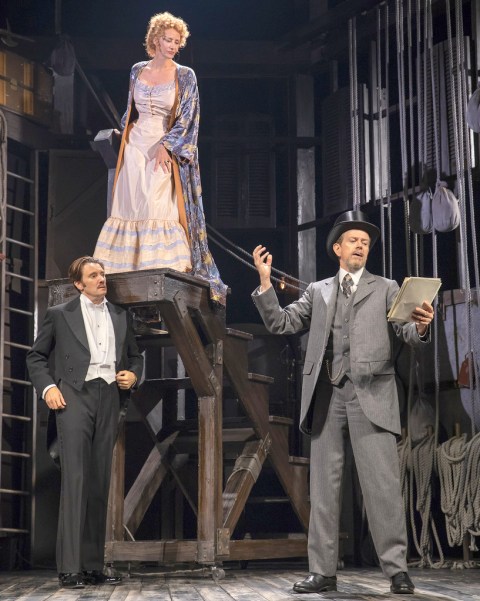
(L to R): Jason Butler Harner, Janet McTeer, Dylan Baker in ‘Bernhardt/Hamlet’ (Joan Marcus)
Through the real-life characters of Rostand and Louis, the playwright highlights the conflicts and problems McTeer’s Bernhardt faces. Additionally, Rebeck shows us how the staging, costuming, and promotion of this new, interpretative Hamlet must be conquered.
Wonderful in supporting roles are Dylan Baker, Matthew Saldivar, and the fine Brittany Bradford as actress Lysette. Baker portrays Constant Coquelin, Bernhardt’s acting contemporary and friend. Notably, Baker gets to have fun playing Hamlet’s father in a hysterical rehearsal scene. Experienced in the role himself, Coquelin guides Bernhardt as a quasi acting coach. Coquelin’s wisdom and sound judgment reflect his greatness as an actor. Eventually, Coquelin took on the role of Cyrano with great success. Baker’s versatility shines in his speeches as Cyrano, Hamlet’s father, and various roles including the great Coquelin himself.
Saldivar portrays Alphonse Mucha, whose artistic skills must beautify Bernhardt’s poster productions. Humorously, he expresses his upset with the task at hand. Indeed, Bernhardt’s hair, her clothing, her stature as Hamlet must enthrall and entice paying customers, a novel feat even for one of his skill. He cannot easily produce advertising artwork that will please Bernhardt, himself, and his public. Thus, as Bernhardt navigates new ground with her incredible decision to play Hamlet, so must Mucha and the others in her circle deal with the “dire” consequences. What a delicious conundrum her “simple” need to play Hamlet creates for these men whom she frustrates yet enthralls!

(L to R): Janet McTeer, Brittany Bradford in ‘Bernhardt/Hamlet’ (Joan Marcus)
The symbolism presented by Bernhardt’s desire to enforce her will upon the culture electrifies. Subtly, when she donned the pants in Hamlet, Bernhardt symbolically freed all women from fashion folkways. Her pants-wearing signals a needed change. Women’s mores were held fast by paternalism and manifested subtly in binding corsets, bustles, and long sleeved-high collared blouses. Worn even in heat waves, these sometimes smothered the wearers, who died of heat prostration. Fashion trends, as painful as they were, laid subservient female stereotypes at women’s feet. And they dared not transgress them. Do such trends abide even today? Sometimes.
In Rebeck’s characterization of Bernhardt, the more restrictive the “thou shalt not,” the more the actress embraced it, conquering fear. In her revolutionary behavior she dismantled the “double standard.” And because she did this with aplomb, sophistication, joie de vivre, and the audacity of wit and whimsy, who could censure her? As she developed her dramatic art, she empowered herself. Memorably, McTeer takes this characterization and with precision lives it in two acts. She evokes the marvelous “Divine Sarah” and makes her a heroine because she can. How McTeer creates her Bernhardt with adroit skill, subtle intelligence and determination is a Bernhardt-like feat.
What a breathtaking reminder of magnificent women in this twisted, political tide of times. Assuredly, Rebeck’s work (McTeer’s speech to this effect rings out beautifully) remains vital and insistent. With commanding power, McTeer’s Bernhardt corrects the historical record, striking forever at the literary and dramatic canon with a tight phrase. She proclaims to Rostand that she will not play the “flower.” The night I saw the production, the women in the audience applauded these words. “I was never a flower, and no matter how much you loved how beautifully I played the ingenue, it was always beneath me. It is beneath all women.”
This moment electrifies. For though women may be compared to flowers, they are not flowers. And Bernhardt, like all women, understands. For women are power brokers, however hidden, however “passive.” Regardless of how much men nullify this truth, “woke” women grew and grow to learn and champion it. And many achieved and achieve momentous feats even from the position of “second.”
Bernhardt captured opportunity and molded destiny so it served her, not the other way around. Strengthening and illuminating her own identity, she wrote her own history, not the one the culture intended to write for her and but couldn’t. McTeer’s inspiring depiction proclaims this with every card in the deck. Indeed, when Bernhardt says about Hamlet, “I do not play him as a woman! I play him as MYSELF,” we glean the full truth of her meaning.
Rebeck wisely selects the most vital of Hamlet’s speeches. Their themes meld aptly with Bernhardt’s conundrums. Indeed, Bernhardt is “a rogue and peasant slave.” At the time she rehearses that speech, she, like Hamlet, divines how an actor uses his skills to portray a character. The double meanings are ironic. But unlike Hamlet, Bernhardt is active, assertive. As Hamlet struggles with acting crazy to hide the knowledge of the truth of his father’s murder, she struggles with a Hamlet too passive to kill. Indeed, the humor comes in watching Bernhardt’s frustration at portraying an “inactive” Hamlet who comes up with philosophical obstacles to delay killing Claudius.

Janet McTeer in ‘Bernhardt/Hamlet’ by Theresa Rebeck, directed by Moritz von Stuelpnagel (Joan Marcus)
Rebeck interweaves in a complex way Hamlet’s speeches to emphasize Bernhardt’s conflict in deciding how to approach and interpret the role. One must work to catch all the ironies. So revisiting the play to enjoy this profound rendering is worthwhile.
Through active dialogue, we learn of Bernhardt’s promotional savvy and ability to reinvent herself for every decade. Naturally, this excites comparisons to today’s long-lasting actresses and others who could learn a thing or two from Bernhardt. Without fear, she capitalizes on rumor, innuendo, and extraordinary behavior that’s verboten for women. Cleverly, she makes critics her friends and generously remembers those who might have turned enemies.
Never an invisible woman, she will play men’s roles. In an affirmation about playing Hamlet and being a woman, she states to Rostand: “Where is his greatness? Where? Is it not in his mind, his soul, his essence? Where is mine? What is it about me you love? Because if in our essence we are the same, why am I otherwise less?”
Thus, Rebeck’s choice of this pivotal, “make or break” moment in Bernhardt’s career is an inspired, complicated one. The turning point reveals the grist, bravery, and revolutionary fervor Bernhardt required of herself to overturn centuries of dramatic tradition. Bernardt’s choice to conquer the greatest role written for men propels her to theatrical heaven. It is sheer artistic genius in a time when women were the “incapable,” “inferior” ones mastered by man’s sham invincibility. Bernardt/Hamlet through the seminal performances of McTeer and the ensemble informs and encourages us to realize that Shakespeare also speaks of women when Hamlet says, “What a piece of work is man. How noble in reason…”
Assuredly, kudos go to the spectacular artistic team. I particularly loved the sets (Beowulf Boritt), costumes (Toni-Leslie James), and hair (wig design by Matthew B. Armentrout). Lighting is by Bradley King and original music and sound design by Fitz Patton.
Bernhardt/Hamlet will be a multiple award winner. It is a must-see TWICE! This Roundabout Theatre Company production runs at the American Airlines Theatre on 42nd Street. The show until 11 November. Visit the Roundabout website for schedule and tickets.
Theater Review (NYC): ‘A Lovely Sunday For Creve Coeur,’ by Tennessee Williams, Starring Kristine Nielsen, Annette O’Toole, Jean Lichty

(L to R): Jean Lichty, Annette O’Toole, Kristine Nielsen, Polly McKie in ‘A Lovely Sunday For Creve Coeur,’ directed by Austin Pendleton (Joan Marcus)
Tennessee Williams dramatized women’s quiet lives of desperation. Indeed, his characterizations ping from the haunting, tragic-comedic melodies of emotion he experienced with his family growing up in St. Louis, Missouri. In A Lovely Sunday For Creve Coeur, directed with measured grace by Austin Pendleton, one of Williams’ last plays receives a sterling, masterful presentation. Assuredly, the excellent ensemble of actors provides the poignant atmospheric intensity.
Currently running at Theatre at St. Clement’s, the production deserves a visit for its adroit performances and direction. Pendleton’s nuanced and gradual unfolding of Williams’ dramatic climax at once captivates with its beauty, delicacy, and plaintiveness. Delivered with a less astute balance in shepherding the actors’ portrayals than Pendleton’s, Williams’ complicated play would not deliver the power and heart-break that this production evokes at the conclusion.
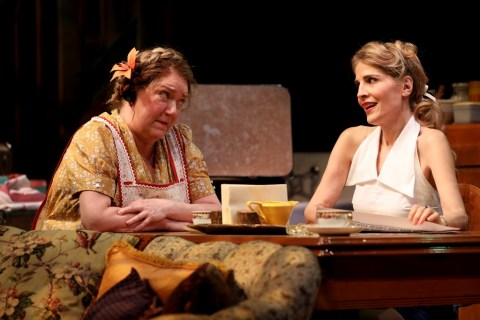
(L to R): Kristine Nielsen, Jean Lichty, ‘A Lovely Sunday For Creve Couer,’ Tennessee Williams, directed by Austin Pendleton (Joan Marcus)
Throughout the play we witness three single women’s wants and desires. A fourth, who becomes a foil for the other three, provides the background theme which motivates them to desperation. Each longs for happiness away from her current day to day lower class existence in depression era St. Louis, Missouri. In order to achieve this happiness, they place their hopes in others to deliver it. Ultimately, the women deceive themselves. Clearly, they set themselves up for disappointment after disappointment.
At the opening we note that maternal, nurturing Bodey (Kristine Nielsen in a superb, layered, and profound rendering), chides Dorothea. With precision Jean Lichty portrays the teacher, a fading Southern belle from Tennessee. Lichty’s somewhat frivolous Dorothea spends her entire morning waiting upon Mr. Ralph Ellis’s phone call. Because Bodey is “deaf” and didn’t hear the phone ring when it did, we become persuaded by Dorothea’s view. Initially we believe her relationship with Ralph remains solidly founded. Meanwhile, Bodey prepares food for a lovely outing at Creve Coeur with her twin brother Buddy, anticipating that Dorothea will join them. She insists she will not, for Ralph Ellis has important information to tell her about their lives together.
Strikingly, we see that neither women really listens to the other as each drives forward to achieve their own goals. Dorothea yearns for Ralph, a principal who associates with the country club set. Because of her recent tryst with him, she anticipates that her charms have overwhelmed him romantically as she has been overwhelmed. The inevitability remains clear for her, though Bodey warns her against these notions.
Bodey’s reaction to Dotty’s relationship with Ellis appears questionable. We wonder at Bodey’s potential jealousy of “their love.” The feminine, sweet, pretty Dorothea surely will leave her and get married, a frightening prospect for Bodey. Indeed, Dotty believes that eventually, Ralph will spirit her into a well positioned marriage away from the squalid, spare lifestyle she leads teaching, and renting from Bodey. For her part Bodey, a spinster devoted to caring for others, least of all herself, has given up on her own prospects of marriage. Instead, she believes that her overweight, reliable, unromantic, hearty twin Buddy would be perfect for Dorothea. And if they married, she would be the dependable aunt who would raise their brood and have a vital purpose in their family life.
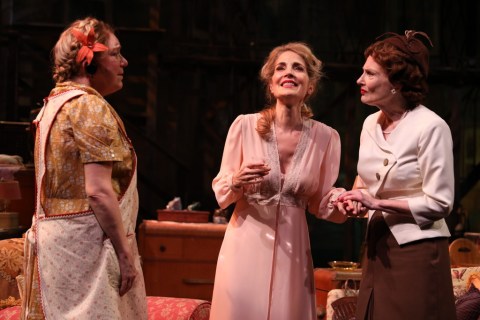
(L to R): Jean Lichty, Annette O’Toole, Kristine Nielsen in ‘A Lovely Sunday For Creve Coeur,’ directed by Austin Pendleton (Joan Marcus)
During the course of the play, two other spinsters join into this group of women who appear unloved and unwanted. Miss Gluck, a German neighbor who has lost her mother and who grieves incessantly. Most probably not only does she grieve the close relationship loss. But she probably grieves that she will be alone. Thus, she must give herself her own solace daily. Indeed, how much can Miss Gluck rely on the friendship of her neighbor Bodey with whom she communicates only in German? Polly McKie as the mournful Miss Gluck is humorous and believable. Thematically, the character portends what happens to women who do not marry well economically or congenially, or whose husbands abandon them to loneliness and despair.

Annette O’Toole and Polly McKie in ‘A Lovely Sunday For Creve Coeur,’ directed by Austin Pendleton, written by Tennessee Williams, La Femme Theatre Productions (Joan Marcus)
Helena is the fourth spinster who intrudes into the lives of Bodey and Dotty. During the course of her visit, she suggests the monstrous end which awaits the unfortunate Miss Gluck. Incisively portrayed by Annette O’Toole, Helena represents the cruel and bitter archetype of the most miserable of the spinsters. These yearn to escape themselves and falling short, grow venomous and predatory toward other women. Arrogant, acerbic, biting she manipulates with sarcasm. And she bullies and demeans Bodey and Dotty with female cultural mores and the pretense of good breeding. In irony she implies that unless Dotty takes actions to lift herself into an upscale arrangement with her, she will fall into the same despair as Bodey. And with finality, poor Dotty will eventually become a social anathema, the greying, unwanted, depressive Miss Gluck.
As the day unfolds, we learn Helena, too, has wants. A fellow teacher in the same school, she intends for Dotty to be her roommate and share the expensive rent and utilities. Her concern for Dotty’s life path concludes with self-dealing. Her own. She covets the monthly expenses Dotty will hand to her. And she intends Dotty to partner up at their bridge games twice a week for companionship. When Dotty inquires whether the bridge will be mixed, we see the fullness of Dotty’s fear anguish of discouragement.
For Dotty, there is no hope without a man. She cannot define herself in any other terms. Nor can she settle for a kind of contentment or resignation as Bodey, Helena and even Miss Gluck have. For her it’s a man, or it’s the abyss. That her designs fall upon Ralph Ellis and certainly not the overweight, unappealing Buddy, who accompanies his sister to Creve Coeur, is her tragic misfortune.
Tennessee Williams’ ironies and humor seek a fine level in this satisfying and heartfelt production. Notably, the Rolling Stones anthem to humanity rings out loudly in this play’s themes of disappointment and finding one’s courage to move past despair. No, “You Can’t Always Get What You Want!” However, for some of the characters, especially the ones who nurture and look out for each other, they do “get what they need.” Perhaps. Indeed, they may even enjoy a lovely Sunday at Creve Coeur.
Kudos to the artistic team Harry Feiner (Scenic & Lighting Design), Beth Goldenberg (Costumes), Ryan Rumery (Sound Design & Original Music), and the other artists.
A Lovely Sunday For Creve Coeur presented by La Femme Theatre Productions runs without an intermission at Theatre at St. Clement’s (423 West 46th St) until 21 October. Interestingly, the theater was founded by Tennessee William’s cousin Reverend Sidney Lanier. You may purchase tickets at LaFemmeTheatreProductions.org.
Edie Falco and Michael McKean as Rumored Lovers in ‘The True’ by Sharr White, Directed by Scott Elliott

(L to R): Michael McKean, Edie Falco, Peter Scolari in ‘The True’ by Sharr White, directed by Scott Elliott for The New Group, Pershing Square Signature Center (Michelle Carboni)
During my undergraduate and graduate college days and afterward (1970s), I lived in Albany, New York, the setting of The True. Familiarizing myself with the city during those years, I learned about Albany’s political and social structure. Friends who were aides to state congressmen used to discuss the corruption problems in Albany’s Democratic machine. Other friends, some of them Black Panthers, discussed the white communities’ racial discrimination and local government injustices. In those years, the Irish controlled Albany city and county. And Dan O’Connell as Party Chairman helped Mayor Erastus Corning II govern the city for decades.
On one level I knew about the background of Sharr White’s subject matter and characters in The True. There were no surprises. He based the characters on research about real personalities. On the other hand, the playwright’s perspective on the characters held many surprises. Indeed, his exploration of how power and the ties that solidify power bathe in loyalty appear fascinating in the backdrop of today’s leaking political climate. As a result, The True, ably directed by Scott Elliott and impeccably acted by Edie Falco, Michael McKean, and the ensemble, ignites with humor and intrigue.
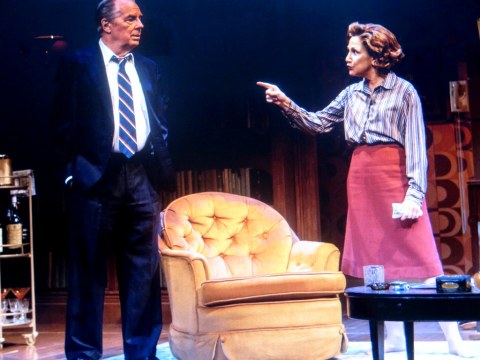
Michael McKean, Edie Falco, ‘The True,’ by Sharr White, directed by Scott Elliott for The New Group, Pershing Square Signature Center (Monique Carboni)
White mostly depicts Albany’s machine politics with a positive twist. Ostensibly, hooked-in communities backed the Democrats for good old-fashioned patronage. Their loyalty was rewarded with various types of assistance and employment. The Democratic Party took care of widows and orphans. They got jobs for those who needed help. In exchange the voters listened to their committeemen. And they formed a solid community. Furthermore, they remained loyal to the party until death. As for those who wanted a political career, they worked their way up the ladder, moved from position to position until they achieved glory. Of course they had to live in Albany for all of their lives. Erastus Corning II was such an individual.
But Republicans struggled. They received higher tax bills and other infelicities. Meanwhile, the outsider black community feared Corning’s police. Though injustices raged, they kept their heads down except for a few attempts at protest (by The Brothers). From my outsiders’ perspective a negative mythology about O’Connell’s machine and Mayor Corning II swirled around the capital of New York State. White’s The True rounded out my perspective and brought additional considerations into view.
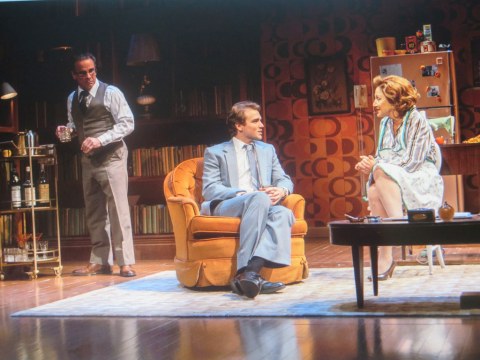
(L to R): Peter Scolari, Austin Cauldwell, Edie Falco in ‘The True,’ written by Sharr White, directed by Scott Elliott for The New Group, Pershing Square Signature Center (Monique Carboni)
Interestingly, no clouds of malfeasance penetrate Sharr White’s world of Albany politics, though characters discuss or deny rumors. Instead, White provides a human portrait of individuals. He particularly focuses on the relationship between Corning II (Michael McKean) and secretary and close friend Peggy Noonan (Edie Falco). Though Albany social circles intimated they had a love relationship, White’s play concentrates on their bonds surrounding politics. The ferocious loyalty Noonan has to Corning II as the do-gooding Mayor of Albany is the centerpiece of the play. Yet, questions about their relationship serve as the conflict. When a wedge develops between Corning II and Noonan, their reactions drive the action and stir the characterizations.
Ingeniously, White gives us the insider’s perspective “in the rooms where loyalties happened.” The play opens after Dan O’Connell’s funeral (1977), at friends Peter and Peggy Noonan’s home where Erastus Corning II frequently hangs for comfort and advice. With humorous interplay, Edie Falco portrays Peggy Noonan’s vibrance, determination, and foul-mouthed, steely brilliance. Her political acumen appears greater than that of her male counterparts. Supported by her affable, agreeable, clever, non-political husband Peter (Peter Scolari), they discuss Corning II’s options.
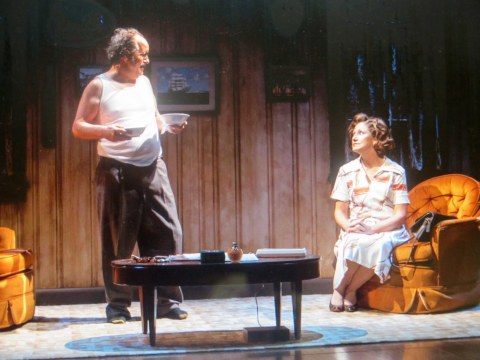
John Pankow, Edie Falco, ‘The True,’ by Sharr White, directed by Scott Elliott, The New Group, Pershing Square Signature Center (Monique Carboni)
Because Corning II is not O’Connell’s pronounced heir apparent, he is swimming in dark waters after the party boss’s death. We divine that the entire organization (machine) and reins of power are up for grabs. Indeed, Peggy stirs the pot by reminding “Rasty” that the tough O’Connell operative Charlie Ryan (John Pankow) will kick Corning II, whom he dislikes, to the curb. When McKean’s Corning II appears to wobble, Falco clobbers him with the truth of the loss of power that will occur and why and how it will occur. The changing of the guard (few politicians will care about their constituents) will sink Corning II. The lack of loyalty will give others a wedge to undermine the Democratic party’s strength at nurturing its communities.
Falco’s Noonan cajoles with logic, wit, and sarcasm. She delivers quips with sass and spunk and verve. As we note her determination in stirring McKean’s “Rasty” we note their closeness. For his part McKean’s portrait of Corning II remains measured, thoughtful, avuncular. No stench of corruption, rapacious ambition, or ruthlessness follows this likable mayor. Indeed, the portrayal reveals an emotional, deep individual. We note he stays because he yearns for the companionship of his trusted friends. Rather than go home to his wife Betty as Polly suggests, he receives sustenance from them, especially Polly. For his part, Peter listens and participates, generously pouring drinks and good will.

Edie Falco, MIchael McKean in ‘The True,’ The New Group, Pershing Square Signature Center until 28 October (Monique Carboni)
Yet, we question. Why would another man’s wife curate so vehemently the political career of a friend? Why not his own wife? Noonan as Corning’s former secretary means so much more to him than his wife Betty does. Indeed, she appears to be the finest political advisor a politician could have. On closer inspection we understand that this politician is married to his party and career. By design, Polly comes with the package. Thoughtfully, White lightly suggests that their bond did or may sneak beyond the elusive depths of his political career toward intimacy.
Sharr White develops this intriguing notion throughout. Notably, he presents a complex answer by degrees underneath various personality layers and sharp Noonan retorts to Rasty’s rivals. One obvious theme concerns Noonan’s gender. Undoubtedly, at a different time and place, Peggy Noonan would have stepped from behind the scenes to make a grand committeewoman or state congresswoman herself. However, because of gender limitations, she must settle for being Rasty’s brilliant adviser, counselor, and cattle prod, which she adores being. Also, she must wear the filthy smear of the “other woman,” in infamy. For decades it remains a slander from which she receives no benefit.
White shows us the turning point when McKean’s Corning II must give up his association with Peggy “to stop people from talking.” However, that does not stop Noonan’s persistence. She remains “the true.” Loyal to Corning II, she fights for him against his adversaries. And she properly divines the polls where others fail, even Rasty. Finally with only days to spare, we follow her intrigues as she puts together a deal which saves Rasty’s career and convinces a remorseful McKean’s Rasty he should never have left her association.
What a woman! A political wheeler-dealer bar none! In fact White reveals that Erastus Corning II might have languished in the graveyard of failed politicians without her help and Peter’s friendship. By comparison, Corning II’s own family situation appears worse than bleak, isolated and friendless. No forthcoming career help there.

L to R): Edie Falco, Michael McKean, Peter Scolari in ‘The True,’ by Sharr White, directed by Scott Elliott for The New Group, Pershing Square Signature Center (Monique Carboni)
The True succeeds on many levels: the fascinating characters, the acting, the directing. Though the individuals are factual, White teases out the emotional tenor between and among the Noonans and Corning II. Importantly, the playwright depicts an incredible force in Noonan. And Falco portrays her with that particularity inherent in one who is wise, ferocious, logical, politically savvy, and street smart. Also, she happens to be a woman who cares about people, as she suggests that O’Connell and Corning II and the Democratic Party cared about the “have nots.” For me this refreshing inside revelation about a vital and unlikely conductor politically leading a symphony of men strikes with authenticity.
The production is a must-see for Falco’s dogged portrayal, with adroit assists by McKean, Scolari and the rest of the cast. Austin Caldwell portrays Bill McCormick, Glenn Fitzgerald depicts Howard C. Nolan, and John Pankow portrays Charlie Ryan. Kudos go to the creative team: Derek McLane (scenic design), Clint Ramos (costume design), Jeff Croiter (lighting design), Rob Milburn & Michael Bodeen (sound design & music composition). The True runs at The Pershing Square Signature Center until 28 October. If you don’t purchase tickets soon, it will be sold out. For tickets Click HERE.

