Category Archives: NYC Theater Reviews

Broadway,

‘My Life on a Diet’ Starring Renée Taylor, a Laugh Fest You Don’t Want to Miss

Renée Taylor, My Life on a Diet, Joe Bologna, Theatre at St. Clement's

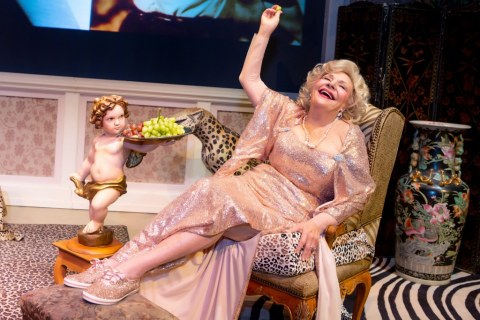
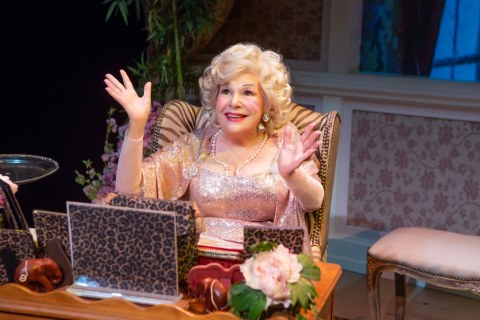
Renée Taylor in ‘My Life on a Diet.’ directed by Joe Bologna, Theatre at St. Clement’s, (Jeremy Daniel)

Every woman who has ever gone on a diet should either run to the Theatre at St. Clement’s to see My Life on a Diet or read Renée Taylor’s titular memoir. Taylor and Joseph Bologna, her husband of 52 years (now deceased), wrote her one-woman show, and as live performances go Taylor’s is just sumptuous.

Bologna, who directed the show, and Taylor have been a brilliant comedy writing and acting duo for decades, garnering Emmy Awards, a Writer’s Guild Award and nominations, and Academy Award nominations. Both have prodigious credits spanning TV, film, and Broadway. Together they collaborated on 22 plays, four films, and nine TV movies and series. Taylor acted with Bologna in plays they wrote for Broadway and Off Broadway, some later adapted for film, such as Lovers and Other Strangers, which they also starred in.

Taylor’s most recent exploits have been in recurring TV roles in How I met Your Mother, Bob’s Burgers, and Happily Divorced. Renowned for her portrayal of Sylvia Fine in The Nanny with Fran Drescher, Taylor developed comedic bits throughout based on her own eating binges. Overeating and dieting have been a Renée Taylor obsession her entire life. Thankfully, her story of dieting woe and skinny happiness has blossomed into this uplifting and marvelous show at St. Clement’s.

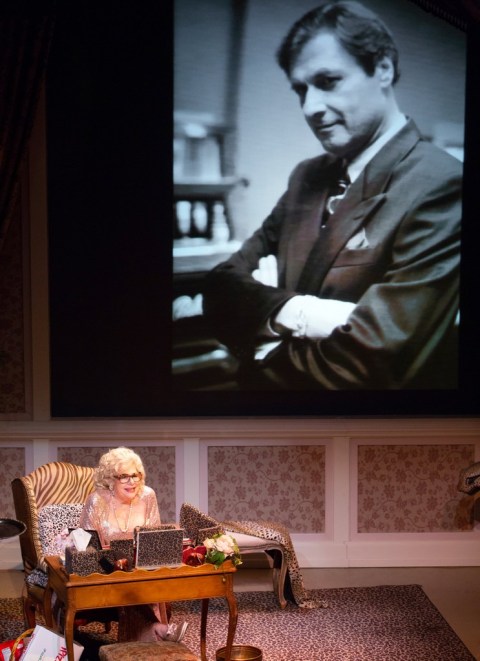
Indeed, with every well-timed joke, the production shimmers with riotous, rollicking fun. From beginning to end, the story scintillates with irony. From this historical reminiscence of Taylor’s childhood and adult years in New York City, Miami, and Hollywood, we glean an indelible portrait of the celebrity frenzy of dieting and weight loss. Enhanced and elucidated with personal archival black-and-white photos, film clips, diets, anecdotes, and fabulous humor, the story of her life through the decades makes us empathize as we laugh at her deadpan delivery. With every line and precept of weight loss, Bologna and Taylor authenticate Taylor’s show-business life as she struggles and fails to maintain “weight” even to this day.

Renée Taylor, My Life on a Diet, Joe Bologna, Theatre at St. Clement's

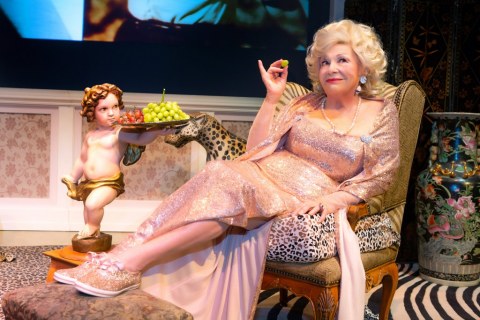
Renée Taylor in ‘My Life on a Diet,’ directed by Joe Bologna, Theatre at St. Clement’s (Jeremy Daniel)

Not only does the writing sparkle and effervesce, Taylor’s impeccable delivery and beautifully paced riffs leave no time for you to breathe. Your sides will be splitting and you’ll double over with joyful hysteria. For Taylor absolutely crushes it as she obsesses about appearance and historical trending diets (more than 25 including the Master Cleanse), with zaniness and LMAO humor.

The first examples she lists include individuals who died while on their own self-created and -touted diets. One even committed suicide. You may recognize the names. However, messages and themes eventually sneak through the crashing laughter. The fascism of slimness and appearance which Hollywood once embraced with fury can be wild, if not fatal.

Renée Taylor, My Life on a Diet, Joe Bologna, Theatre at St. Clement's

Renée Taylor in ‘My Life on a Diet,’ directed by Joe Bologna, Theatre at St. Clement’s ( Jeremy Daniel)

Though Taylor doesn’t reference Judy Garland, one may recall Garland’s drug addictions that began with diet doctors’ heavy prescriptions. Thus, when Taylor discusses weight loss via a diet of expensive Cristal champagne, and her addiction to amphetamines, we realize her journey was heading toward a dangerous cliff. Thanks to an intriguing, no-nonsense female doctor, and to meeting Bologna, Taylor’s life took an upswing into love and away from the dieting morass. One may arrive at emotional health and happiness with generous dollops of love, humility and humor. And so what if there are always a few pounds to shed? Wellbeing becomes paramount; that, and the ability not to take one’s obsessions too seriously.

One does not have to be overweight or diet-challenged to appreciate Taylor’s history of Hollywood stars and their diet manias. Even anorexics will enjoy her beautifully delivered jokes. For they highlight Taylor’s other obsessions: becoming and being “star-bright famous,” and meeting “star icons.” Notably, Taylor formed relationships with Orson Welles and Lenny Bruce. She became friends with Grace Kelly and Barbra Streisand on their way to stardom. When she discusses her poignant and close relationship with Marilyn Monroe, whom she met at the Actor’s Studio where both studied with Lee Strasberg, she breaks your heart.

In each instance Taylor lists food habits amidst delicious tidbits of humor. For example, Joan Crawford neglected to eat the bread part of raisin bread, eating only the raisins. Marilyn Monroe’s grape diet didn’t work for Taylor. On Lou Costello’s diet, the first diet Taylor went on (at age 11), she began to look like Costello.

Renée Taylor, Joe Bologna, Theatre at St. Clement's, My Life on a Diet

Renée Taylor in ‘My Life on a Diet,’ directed by Joe Bologna, Theatre at St. Clement’s (Jeremy Daniel)

As she attempted to combat the eternal problem of all dieters, “cheating,” she found that no diet worked, not even the diet plans given her by doctors her mom took her to. Then came a turning point in her “dieting life.” No one forced her to go on a diet; she had made that decision herself prompted by a first love. “Applause.” And her yo-yo dieting journey began. Priceless! I identify completely.

Regardless of whether one is young or old, male or female, overweight, buff, sylph-like, or curvy, Taylor’s war on fat rings true for us today. Indeed, for young folks in elementary school through high school and beyond, weight and identity is a critical issue, even for males. Fat shaming can be a social media bullying problem. Taylor reveals that humor, wit and irony can slay bullying insults at their roots.

Finally, kudos go to Harry Feiner (Scenic Design), Pol Atteu (Costume Design), Stefanie Risk (Lighting Director), Jay Risk (Sound Engineer), and Michael Redman (Projections Designer) for their efforts in making this a completely entertaining and gobsmacking must-see show.

My Life on a Diet is at Theatre at St. Clement’s (423 West 46th St. between 9th and 10th). Visit the website for tickets or call Telecharge, 212-239-6200. But hurry! The show runs until 19 August. Update: the show was extended a number of times. It should tour or come back. So many women struggle with losing even one pound, they will love Renée Taylor’s hysterical perspective.

NYC Theater: ‘On a Clear Day You Can See Forever’ Starring Melissa Errico at The Irish Rep

Charlotte Moore, On a Clear Day You Can See Forever, John Cudia, Melissa Errico, Irish Repertory Theatre

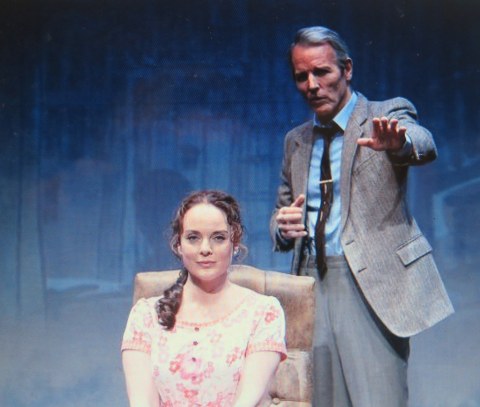
John Cudia, Melissa Errico in the Irish Repertory Theatre’s ‘On a Clear Day You Can See Forever,’ directed by Charlotte Moore (Carol Rosegg)

I did not see the Broadway versions (1965, 2011) of the musical On a Clear Day You Can See Forever by Burton Lane (music) and Alan Jay Lerner (book and lyrics). Paramount Studio made a film of the musical starring Barbra Streisand and Yves Montand, which has been listed by the American Film Institute as one of the 100 greatest musical films ever. Unfamiliar with the theater versions and the film, I did have a passing recognition of the more tuneful, memorable songs.

Thus, I came to Charlotte Moore’s adaptation of the show, currently running at the Irish Repertory Theatre, with a fresh perspective. The musical for years has been incorrectly (to my mind) characterized as “odd,” but I could not disagree more. I appreciated the Irish Rep’s revival and the lyrical, lovely music conducted by Gary Adler, engendered by music director John Bell and orchestrated by Josh Clayton. And I loved Moore’s canny direction and the accomplished, thrilling lead performances of Melissa Errico and Stephen Bogardus. Furthermore, the fine ensemble, also headed up by John Cudia as Edward Moncrief, strongly undergirded the dynamism of the revival/adaptation. Indeed, this production soars as a delightful theatrical experience full of whimsy, joy, and charm.

Melissa Errico, Stephen Bogardus, Irish Repertory Theatre, On a Clear Day You Can See Forever, Charlotte Moore

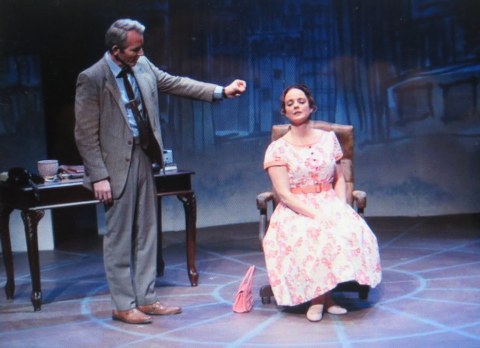
Melissa Errico, Stephen Bogardus in the Irish Repertory Theatre’s ‘On a Clear Day You Can See Forever’ (Carol Rosegg)

If one finds it difficult to accept the possibility of other realms of consciousness and making contact with past lives, the plot may appear inconsistently fantastic. Might we recall past identities, floating in our conscious or unconscious minds and impacting us in the present? Dr. Mark Bruckner (the gorgeously resonant-voiced Bogardus) through hypnosis regresses Daisy Gamble (played with energetic grace and verve by Errico). This premise, that we can recall past lives through hypnosis – an idea especially popular in the 1960s – grounds the play’s structure.

The regression occurs with Daisy’s permission after Dr. Bruckner discovers her amazing psychic gifts of precognition and telepathy. Threaded into her personality is a healthy dose of prescience. She predicts when the phone will ring. She communicates psychically and receives others’ thoughts. Of course, who communicates with her telepathically makes a difference, and why she receives their thoughts and not those of others conveys one of the play’s themes.

To say Daisy manifests the flexibility to suspend the culture’s rational materialism remains an understatement. And Errico handles Daisy’s gifts with authenticity and humor. For example, when she sings “Hurry It’s Lovely Up Here” to illustrate to Dr. Bruckner that her plants blossom speedily with her love talk, her luscious singing provokes our belief in Daisy’s extrasensory powers. With Errico’s magical, musical show-woman-ship, such feats of telepathy, etc., become humorous and matter-of-fact realistic.

Melissa Errico, Stephen Bogardus, On a Clear Day You Can See Forever, Charlotte Moore, Irish Repertory Theatre

Stephen Bogardus, Melissa Errico, the Irish Repertory Theatre’s ‘On a Clear Day You Can See Forever’ (Carol Rosegg)

It’s when Daisy and friends attend a group hypnosis session to stop smoking that the doctor notes her unusual susceptibility to hypnosis. Intrigued, he regresses her. With few props, clever costumes, and elusive painted projections, Moore and her artistic team stage 1960s New York City and 18th-century England adroitly. Somehow, the team’s artistry effects Daisy’s/Melinda’s environments and consciousness with appropriate, minimalistic fanfare. After all, this is a play about the mind, the intellect, and one’s ability to receive glimpses of the forever in the here and now. The small stage and pared-down sets and casting at The Irish Rep seem appropriately intimate for the overarching themes about the mysteries of life’s incorporeal beauty and spiritual grace in all living creation.

John Cudia, Melissa Errico, Irish Repertory Theatre, On a Clear Day You Can See Forever, Charlotte Moore

John Cudia, Melissa Errico in the Irish Repertory Theatre’s ‘On a Clear Day You Can See Forever’ (Carol Rosegg)

Under regression, Daisy transforms into elegant, well-healed Melinda Welles, replete with British accent and cool impassioned femininity. When her lover becomes her philandering husband Edward Moncrief (Cudia’s rich operatic voice melds beautifully with Errico’s in “She Wasn’t You”), and pursues many dalliances, unlike women of her time she revolts. To escape her misery and begin a new life, she books a passage to America. But her physical body never makes it. Perhaps her spiritual desire manifests through someone else? Regardless, Melinda, in Daisy’s unconscious, has arrived in Brooklyn and shows up when the time to manifest becomes appropriate. This notion teases with ironic humor.

Dr. Bruckner falls for the exotic, elusive Melinda (Bogardus impeccably renders the lovely song “Melinda”).  We understand his amazement at this other woman who appears when Daisy falls into unconsciousness under hypnosis. Melinda represents Daisy in a mysterious connection to the present which has yet to be revealed at this point.

Stephen Bogardus, Irish Repertory Theatre, On a Clear Day You Can See Forever, Charlotte Moore

Stephen Bogardus in Irish Repertory Theatre’s ‘On a Clear Day You Can See Forever’ (Carol Rosegg)

Errico exquisitely portrays the dual opposites, Daisy and Melinda, as head and tail of the same coin. She slips from cool Brit to zany New Yorker smoothly, but the transformation remains a cipher. Daisy’s bubbly exuberance, Brooklyn-accented loquaciousness, and peculiar comfort with her psychic gifts belies insecurity and self-debasement. And Errico’s poised, mannered, suppressed Melinda belies the broiling, impolitic, rash female maverick. For she erupts, revolts against the cultural limitations of her sex, and sets out on a fateful voyage of doom.

But when Daisy discovers the tape of her regression sessions and realizes she loves Bruckner, she becomes jealous of the aspect of herself beloved by the doctor – Melinda. The amazing “What Did I Have That I Don’t Have?” that Daisy sings in anger and hurt is ultimately ironic, because she doesn’t realize that her past consciousness of Melinda is an element of her own character and ethos. Yet the song through Errico’s instrument becomes transcendent, a universal song of lost love after initial passion has faded. That both Daisy and Melinda are ultimately one she cannot realize until Bruckner evolves to understand his love for all of her.

On a Clear Day You Can See Forever, Charlotte Moore, Melissa Errico, Irish Repertory Theatre

Melissa Errico and ensemble in Irish Repertory Theatre’s ‘On a Clear Day You Can See Forever,’ directed by Charlotte Moore (Carol Rosegg)

That one character (Daisy) encompasses and feeds into the other (Melinda) reveals Alan Lerner’s depth in flirting with the complexity and intricacy of consciousness. And the depth with which the writer characterizes the evolution of Dr. Bruckner’s self-transformations also reveals his flirtation with novel, profound ideas.

The love Dr. Bruckner feels – first for Melinda – evolves into the knowledge that Daisy and Melinda inhabit the being of the same woman. Thus, at a crucial moment he saves her and assists in her own evolution as a modern woman who loves a worthier man than the one left behind in another time and place. Bogardus renders the gradual evolution of Bruckner’s love beautifully in his ironic comments to Melinda when she and Moncrief show affection to one another. Then it gloriously bursts out in his incredible, full-throttle rendition of “Come Back to Me” after his revelation that he has grown to love Daisy/Melinda as one.

Melissa Errio, Irish Repertory Theatre, On a Clear Day You Can See Forever, Charlotte Moore

Melissa Errico and the cast of the Irish Repertory Theatre’s revival, ‘On a Clear Day You Can See Forever’ (Carol Rosegg)

Clearly, in helping her connect the present with the past in her own consciousness, Bruckner frees himself to love. And he helps free Daisy to return his love without jeopardizing her own psychic integrity. Finally, they solve how the mystery of Melinda’s death links to the present in a vital, uncanny way. The union of Daisy’s and Melinda’s consciousnesses binds Bruckner and Daisy in an incomparable clarity of vision, a way of seeing that gives them and their friends a glimpse into their interconnectedness with forever, the spirit, the eternal.

At the crux of Lerner’s and Lane’s work remains the theme that life encompasses more than materialism and empiricism. And in everpresent time, the past, present, and future may conjoin in the spiritual plane. We may be too distracted with the corporeal realm to understand how. Yet perhaps there are indeed realms of forever to which all of us are attached, whether we realize it or not. Finally, as Daisy Gamble learns, for those who have a gift of “second sight,” life is expansive. Used beneficially, such gifts may allow one to enjoy life’s beauties more fully and help others do the same. And in that expansiveness, one will probably discover the true meaning of love. The title song, “On a Clear Day You Can See Forever,” best represents this theme.

In her adaptation of this musical Moore reconfigures the action and characters concisely and adriotly. With the help of music director John Bell, choreographer Barry McNabb, scenic designer/projection artist James Morgan, costume designer Whitney Locher, lighting designer Mary Jo Dondlinger, sound designer M. Florian Staab, projection designer Ryan Belock, the musicians, the ensemble, and the leads, this version of On a Clear Day You Can See Forever shines like a beacon of truth.

Do you yearn to  get away from the current news cycles and our country’s present turmoils? If so this is a must-see. For you will have an extraordinary and uplifting time watching the team beautifully, seamlessly render the illusive with authenticity. The cast’s ebullience and the show’s ironic twists of humor will remind you of goodness. And you will feel embraced by the airiness of light. It would be a pity to miss the fun and romance, layered with an ethereal message we need to be reminded of.

The Irish Repertory Theatre’s On a Clear Day You Can See Forever runs until 12 August. Tickets are available online.

Save

Save

Off Broadway Theater Review: ‘Wood Calls Out to Wood’ at The Tank

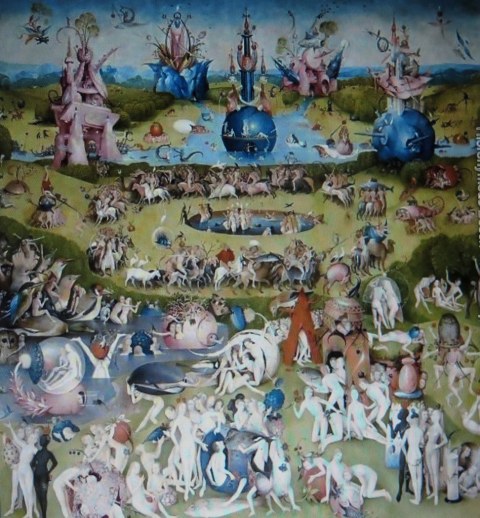
Hieronymous Bosch, Garden of Earthly Delights, panel# 1, Wood Calls Out to Wood

Hieronymous Bosch’s ‘Garden of Earthly Delights,’ panel #1, courtesy of this site.

Hieronymus Bosch’s 15th century triptych “The Garden of Earthly Delights,” never fails to amaze and intrigue. In Fisher Stevens’ exceptional Before The Flood which examines global warming/climate change and shadows Leonardo DiCaprio’s quest as United Nations Messenger of Peace on climate change, Stevens references Bosch’s work.

Hieronymous Bosch, Garden of Earthly Delight, panel #2

Hieronymous Bosch’s ‘Garden of Earthly Delights,’ panel #2, courtesy of the site.

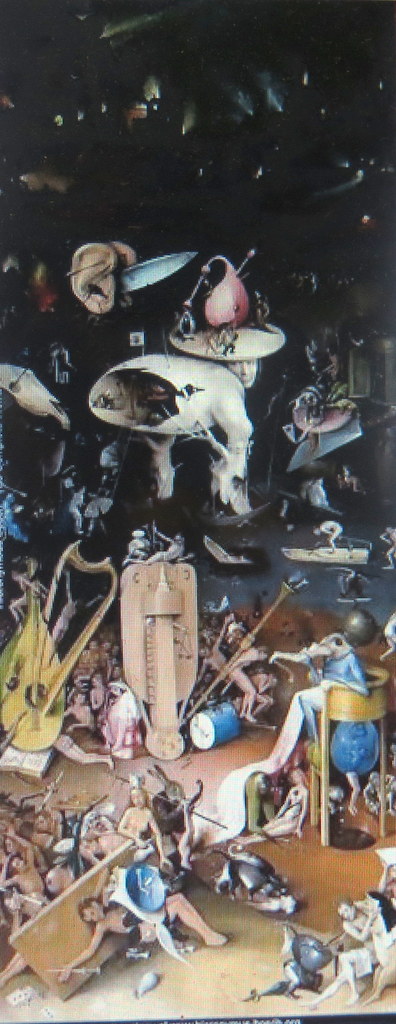
The Garden of Earthly Delights which hung over DiCaprio’s bed when he was a kid becomes a the monumentally symbolic metaphor at the central point of Before the Flood.. The director elucidates the triptych and reveals Bosch’s progression from panel to panel. Mankind was given the power of the beautiful Garden (our planet Earth) and in seeking forbidden knowledge of good and evil, created a nightmare world that his very nihilism and self-hate (sin) currently is effecting the destruction of his own species, every other species and the eco-systems of the planet, which results in a hellish state (panel three).

Hieronymous Bosch, Garden of Earthly Delights, panel # 3

Hieronymous Bosch’s ‘Garden of Earthly Delights,’ panel #3, courtesy of the site.

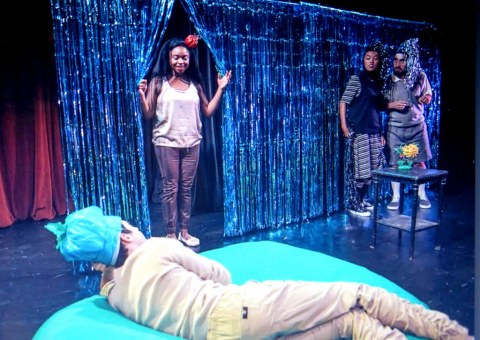
Corinne Donly’s Wood Calls Out to Wood, directed by Sarah Hughes currently at The Tank until 12 November presents a different interpretation of Bosch’s work. However, before one travels to The Tank to see the production which translates Bosch’s work from wood and paint into a live play creation, shimmering, colorful, fanciful and more, acutely review the Bosch triptych.

The assumption the playwright makes is that the audience carries around the detailed visual memory of the three panels and with that prodigious knowledge can correlate the dialogue, actors, sets, costumes and objects used with the various panels. I admit my own failing. Without nary a projection of Bosch’s triptych, I became hard pressed to recognize various associations. However, I gather, that was one theme of this work, as abstruse, opaque and self-possessed as it was.

Connor James Sheridan, Tanyamaria, Lanxing Fu, Will Dagger, Sarah Hughes, Corinne Donly

Foreground: Connor James Sheridan, L to R background: Tanyamaria, Lanxing Fu, Will Dagger in ‘Wood Calls Out to Wood,’ by Corinne Donly, directed by Sarah Hughes (Sasha Arulyunova)

The often poetic dialogue and nonsensical ramblings of the characters inspired by a few figures in Bosch’s work kept one interested by its sheer dense ridiculousness. Experimental theater reaching out for someone to make sense of it, to hang a truth on? OK. I can move with surrealism and absurdism. But even surreal, “out-there” work hangs on a point of revelation throughout and most importantly at its conclusion. Indeed, if the production was meant to end in a whimper, or a fabulous new insight, I confess, I missed it.

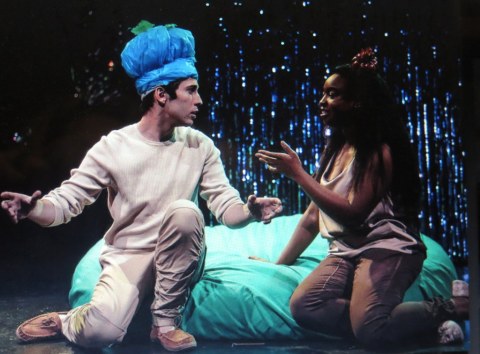
I do appreciate the exertions of the actors who seemed to have their sense memories and in-the-moment behaviors lined up appropriately. And the couple who love and comfort one another were adorable.

Connor James Sheridan, Tanyamaria, Wood Calls Out to Wood, Corinne Donly, Sarah Hughes

Connor James Sheridan, Tanyamaria in ‘Wood Calls Out to Wood,’ by Corinne Donly, directed by Sarah Hughes (Sasha Arulyunova)

Of course the irony in all of this remains that Bosch’s triptych replete with spiritual symbolic significance of man’s own inhumanity to himself was no where to be viscerally found. Wood Calling Out to Wood exists as an exercise. It is an exercise in the fun, lively, innovative, experimental, weird, often incompletely executed extrapolation of the three panels because that is what it is attempting. In the attempt it becomes the esoteric for esoteric’s sake. A Foucault for those who would attempt to make meaning of it and get tripped up on their own inadequate philosophies. It perches on the edge of Fuzzy Thinking as a mind blowout for those who will go there. If one will, make sure to have enough rest. It may be a flip to follow along. But you may also flip into the unconscious and post haste, fall asleep. Have coffee beforehand, and preferably not decaf.

My reading of the script helped me to understand what the playwright had intended. If the production could be given a proper mounting, with visual projections of Bosch’s work for those like this obtuse writer, I do think that Corinne Donly’s Wood Calls Out to Wood might find itself marvelous.

As it is, if you enjoy supporting The Tank (312 West 36th St), and favor the sheer nonsensical fun of attempting to make heavy-duty meaning out of the curious, you will enjoy the silly, frenetic quality of Wood Calls Out to Wood which runs for 50 minutes without an intermission. As for Bosch? Well, don’t expect any of his magnificent visuals, so review his works, exercise your memory and go prepared.

‘A Wall Apart,’ A New York Musical Festival Theater Review

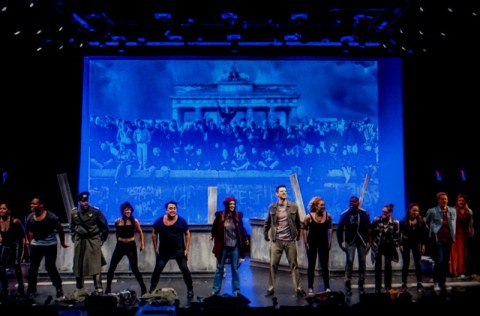
A Wall Apart, nYMF, Lord Graham Russell, Sam Goldstein, Craig Clyde, Keith Andrews

‘A Wall Apart’ at the NYMF, Music & Lyrics by Lord Graham Russell, Book by Sam Goldstein & Craig Clyde, directed/choreographed by Keith Andrews (Michael Schoenfeld)

It was a frightening time, the height of the Cold War! It was the division of Berlin into two sectors divided by a mammoth wall of concrete and barbed wire. West Berlin embraced everything economically viable through a market economy representative of Western culture.  East Berlin was controlled by the East German police (the hated Stasi) who were the engines of the government of the German Democratic Republic, a repressive communist country beholden to U.S.S.R. ideologies. How does one resist oppression and the repression of personal freedoms? How does one deny adherence t and subservience to the state? A Wall Apart reveals that the resistance was established prominently in two ways: rock music and love.

In A Wall Apart, a thrilling production which premiered at the New York Musical Festival (Music and Lyrics by Lord Graham Russell of Air Supply; Book by Sam Goldstein and Craig Clyde), we recognize that in the twenty-eight years which spanned the time of the Berlin Wall and the oppression it represented, that  rock music promoted the resistance against Communist tyranny. It did this subtly through its brash sounds and clashing, free-wheeling lyrics. Rock music expressed the yearned for liberty already inherent in the minds and souls of the younger generation. Its expression was life itself and in its clanging, smashing vibrations there could be heard the clarion call to revolt.

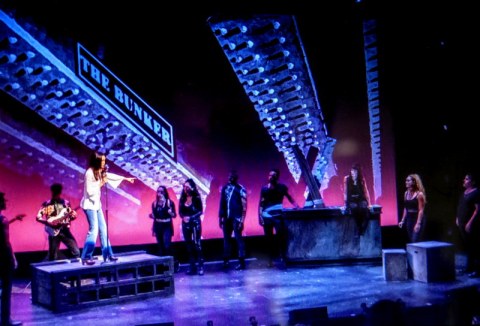
Maddie Shea Baldwin, A Wall Apart, NYMF

Maddie Shea Baldwin and the company of ‘A Wall Apart,’ NYMF (Michael Schoenfeld)

Perhaps more importantly, this production also reveals the power in resisting with love. In A Wall Apart we see that love and family unity ultimately triumph over allegiance to an oppressive government and the acceptance of its lies that subvert one’s humanity. From the opening song “Our City” we are reminded of the dreams of liberty that are inherent in every soul and which are the driving force that cannot be overthrown ,despite the attempt of governments to control that force through external structures and the threat of destruction.

Emily Behny, Josh Telle, Jordan Bondurant, Maddie Shea Baldwin, A Wall Apart, NYMF

(L to R): Emily Behny, Josh Tolle, Jordan Bondurant, Maddie Shea Baldwin in ‘A Wall Apart,’ NYMF (Michael Schoenfeld)

This force is manifested in each of the characters, perhaps most symbolically through Mickey (Josh Tolle gives a powerful sustained performance throughout) whose rock band plays at The Bunker in West Berlin. The Bunker is the place of symbolic birth, life and hope in the liberty of the rock music of the West. Mickey’s band, The Angels, represents all the goodness of Mickey’s own character. It has led him to a loving relationship with Suzanne (Emily Behny’s portrayal is soulfully rendered) and collaboration with his brother Kurt (the excellent Jordan Bondurant). It is at The Bunker where the bond between Kurt and Esther (the superb Maddie Shea Baldwin) is initiated, and all seems to be going swimmingly except for the rumors that Berlin is being divided, revealed to Kurt by their brother Hans (Darren Ritchie gives a bravura performance as the Stasi who must negotiate the conflict between love and obligation to the state in his own heart).

Jordan Bondurant, A Wall Apart, NYMF

Jordan Bondurant and company in ‘A Wall Apart,’ NYMF (Michael Schoenfeld)

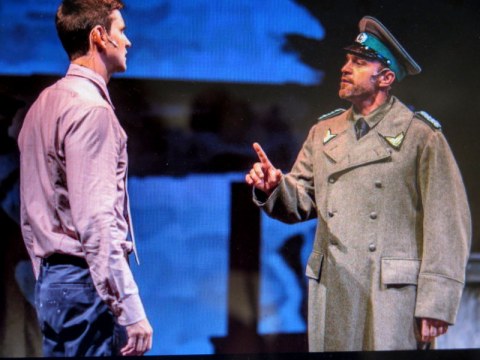
The most stalwart and loving of the characters is Tante (Leslie Backer is nothing short of astonishing). She is the glue that holds the family together; she mediates the troubles among the brothers and provides wisdom when Kurt and Mickey are caught in the East after the Berlin Wall is built and there is no getting out. Kurt and Mickey cannot abandon Tante who raised them when their parents were killed. Kurt especially is pressured by circumstances for he has left Esther in the West and will not join her but instead, joins the Stasi with Hans so that together they can put food on the table and obtain greater stockpiles of coal for heating. It is a devil’s bargain.

Jordan Bondurant, Darren Ritchie, A Wall Apart, NYMF

(L to R): Jordan Bondurant, Darren Ritchie in ‘A Wall Apart,’ NYMF (Michael Schoenfeld)

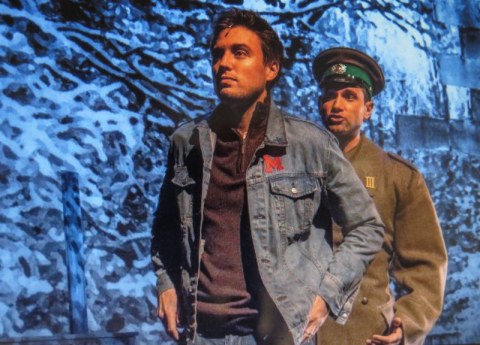
Material safety and support are not enough for Mickey who has to be free to express his being though his artistry and music. With Kurt’s information about which routes to take to get over the Wall, Mickey and a pregnant Suzanne make an escape attempt. What happens is irrevocable. And once again, we are reminded that individuals are willing to take grave risks when freedoms and personal identity are at stake. Ultimately, the risk is worth it for a difference is made in the lives touched by sacrifice.

Josh Tolle Jordan Bondurant, A Wall Apart, NYMF

(L to R) Josh Tolle, Jordan Bondurant in ‘A Wall Apart,’ NYMF (Michael Schoenfeld)

A Wall Apart follows the resistance of the family and Hans’ conflict at having to perform the obligations of being a Stasi when his heart is elsewhere. It journeys with Kurt’s resignation from the Stasi and his affirmation to join the revolt from within East Germany to bring down the totalitarian structures external and internal which would oppress individuals’ rights to follow their own path. And somehow, the love between Kurt and Esther finds a way to grow though the wall divides them physically. It is intriguing how this occurs and as there is no spoiler alert here, you will just have to see the production when it moves to another venue (which it should) at some point in the future.

Maddie Shea Baldwin, Leslie Becker, A Wall Apart, NYMF

(L to R) Maddie Shea Baldwin, Leslie Becker in ‘A Wall Apart,’ NYMF (Michael Schoenfeld)

This is a finely wrought production whose music (Lord Graham Russell of Air Supply created the music and lyrics) is gobsmackingly good in its variety, its power and its touching poignancy.  The book by Sam Goldstein and Craig Clyde highlights the period. It is aptly enhanced through the staging, sets, props and visual projections of archived black and white photographs, and video newsreel clips of the time. The fictionalized chronicle of one family’s struggles through tremendous economic and social upheaval is not only a vital remembrance of the past, it is a reminder of the tyranny of walls and what might happen in the future if fascism (in the guise of communism or any ism) is allowed to rear its ugly head.

A Wall Apart, NYMF

The company of ‘A Wall Apart,’ NYMF (Michael Schoenfeld)

The production is incredibly current. As we understand the uselessness of the Berlin Wall to serve its mission, we acknowledge that the inhuman, fascist separation of humanity is fear for fear’s sake. Fear is counterproductive, restriction retards innovation and stops the move toward progress. Regardless, freedom will triumph, love will triumph whether the resistance be through music or any means possible. Walls are symbolic of powerlessness in the face of humankind’s indelible desire for freedom and betterment. Barricades don’t work. Indeed, they inspire others to seek freedom despite the risk to themselves.

Jordan Bondurant, Maddie Shea Baldwin, A Wall Apart, NYMF

Jordan Bondurant, Maddie Shea Baldwin in ‘A Wall Apart,’ NYMF (Michael Schoenfeld)

I would hope that this production sees a continuation elsewhere. It is that good especially in that its themes presented through the music and book are profoundly transcendent. Kudos to the skillful, adroit and versatile musicians (Jonathan Ivie, Matt Brown, Lavondo Thomas, Daniel Ryan, T-Bone Motta), exceptional ensemble and the uber talented Keith Andrews, whose direction and choreography was insightful and spot-on great. I loved this production, for what it says and how the design team, ensemble, musicians all shepherded by the director collaborated to say it! A resounding yes, you get my vote!  A must-see which I am counting on seeing again.


‘Temple of The Souls’ a New York Musical Festival Review

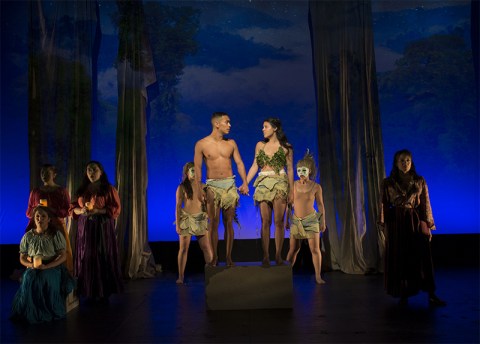
Temple of The Souls, NYMF, Multistages, Dr. Judy Kuriansky, Lorca Peress

‘Temple of the Souls’ at NYMF a Multistages and Dr. Judy Kuriansky production (John Quilty)

The New York Musical Festival is one of the most anticipated theater festivals in the city for good reason. The musical productions are top drawer, professional from start to finish. People enjoy seeing which shows are shepherded along to eventually make it to Off Broadway, Los Angeles, and Regional Theater. And sometimes Broadway producers are interested, though considering what it takes to mount a Broadway production these days, it would seem to be an incredible dream. But dreams do come true.

One offering that I do hope will be shepherded in this fashion is the profoundly moving musical Temple of The Souls which ran from July 17-  23rd at the Acorn Theater, one of the venues where the New York Musical Festival is taking place until 6 August. The multiple award winning Temple of The Souls is absolutely smashing. I don’t want to even consider that this production may not not continue to garner a wide audience.  It is superb.

The Temple of The Souls, Multistages, Dr. Judy Kuriansky, NYMF, Lorca Peress, Anita Velez-Mitchell, Anika Paris, Dean Landon

‘The Temple of The Souls’ presented by Multistages and Dr. Judy Kuriansky at the NYMF, directed by Lorca Peress (John Quilty)

The stirring, enlightened book by Anita Velez-Mitchell, Lorca Peress and Anika Paris and entrancing, vibrant and hypnotic score (music by Dean Landon & Anika Paris, lyrics by Anita Velez-Mitchell & Anika Paris) warrants support beyond its New York City run at the NYMF. The time for such a production to gain a larger audience is fast upon us because of  interest in the historical record of North America’s beginnings and the influences that have helped to shape our nation’s  and its territories’  greatness.

Temple of The Souls is not only grounded in historical fact, the iconic, forbidden love story between a man and a woman of two disparate cultures, is reminiscent of love stories through the ages. Indeed from Scotland to Rome, the people of various tribes and societies have been joined together with offspring from forbidden love arrangements. Such stories resonate for us today because of their inherent truths. Love does not see with the materialistic eye, it sees with the heart. Unbounded, love seeks an exalted level away from embedded social folkways that encourage hatred and violence. The triumph of love to unify nations and dispel racism, discrimination and hatred is the key theme of this incredible musical. How worthy, how wise, how current for our times.

Danny Bolero, Lorraine Velez, Jacob Gutierrez, Temple of The Souls, NYMF, Lorca Peress

‘The Temple of The Souls’ company with Danny Bolero, Lorraine Velez, Jacob Gutierrez at NYMF, directed by Lorca Peress (John Quilty)

Temple of The Souls begins in the present on a tour of the mysterious El Yunque, the magical and gorgeous rain forest in Puerto Rico at whose top on an outcropping of rock and a high cliff, there exists a cave and area known as the Temple of The Souls. The tour guide (Lorraine Velez), explains the significance of the area. Lorraine Velez also portrays Nana and as the symbolic earth mother encapsulates beautifully the movement of this production in her presence from its beginning to its conclusion. She is breathtaking, exquisite, poignant, brilliant.

As the guide, Velez tells of the legend of love between Guario, a Taino (an indigenous native of the island) and Amada, a nubile sixteen-year-old, whose Spanish father represents all the abuses of Colonial Spain and its goodness as well. When Guario and Amada fall in love, taboos are broken, folkways are destroyed, and the spirits of the island who oversee the history of Spain’s horrific murders, rapes and enslavements, encourage the melding between old and new: the culture of violent bondage and the culture of pacific freedom, the paternalistic society and the gender friendly Taino society of men and women as partners.

Lorraine Velez, Temple of The Souls, NYMF, Lorca Peress

Lorraine Velez and the company of ‘Temple of The Souls,’ NYMF, directed by Lorca Peress (John Quilty)

The guide shares the history which underscores that many Tainos refused to bow to the oppression of the Spanish and instead committed suicide by jumping from the cliffs to their deaths in the sea. Suddenly, the scene is transformed. We no longer hear the echoes of the Tainos’ music and drums or see the spirits of the Tainos watching the guide and tourists. We are flashed back to the historic time of  the 15th century in a Spanish colonial settlement on the verge of El Yunque.

It is a colorful, joyful day, the first day of celebration of La Fiesta de San Juan Bautista (St. John the Baptist announced and Baptized Christ as the embodiment of love). The celebration is ironic for the oppressive culture and religion do not represent the alleged Christian values in their discrimination, abuse and violence toward the Tainos. However, the production reveals the turning point when things begin to change and hope arrives in the union of love between Guario (Andres Quintero’s singing and acting talent establish him as a rising star; he’s just great)  and Amada (Noellia Hernandez’s superb performance, sustained with power and lyricism throughout, is his equal).

Andres Quintero, Temple of The Souls, NYMF, Lorca Peress

Andres Quintero in ‘Temple of The Souls,’ at NYMF, directed by Lorca Peress (John Quilty)

Quintero’s Guario is part of the oppressed class who rejects his servitude and goes to El Yunque and the Temple of the Souls to discover who he is. During his travels through the town to eventually get to his destination, he runs into Nemesio (the excellent Jacob Gutierrez), and his cabal of repressive, abusive and discriminatory Spanish overlords. They threaten Guario and warn him not to return, a command reaffirmed by Amada’s father, Don Severo (the amazing Danny Bolero), the conquistador who governs the town. However, as Guario leaves, he and Amada see one another; it is “love at first sight,” or at the least curiosity at first sight. Nevertheless, the spark is ignited and the burning passion which grows between them creates a cataclysm that engulfs Guario’s, Nemesio’s, Amada’s, Don Severo’s and Nana’s lives and brings about the recompense of innocent bloodshed, the blood which cries out for a cessation which can only be delivered by love.

Noellia Hernandez, Temple of The Souls, NYMF, Lorca Peress

Noellia Hernandez in ‘Temple of The Souls,’ at NYMF, directed by Lorca Peress (John Quilty)

The next hour and one-half flies as we watch the characters struggle with themselves and against each other in conflicts still being experienced today between indigenous populations and “the colonials”-us! From moment to moment we are enthralled with the acting and voices of the fine ensemble, the gorgeous music, the theatrical spectacle and the intensity of the story’s dynamic between love and hate, lies and truth, oppression and freedom, lasciviousness and genuine, sincere love.

Temple of The Souls, NYMF, Lorca Peress

The company of ‘Temple of The Souls,’ at the NYMF, directed by Lorca Peress (John Quilty)

The director and artistic team have filled our senses and one cannot help but be moved to empathy, even to feel for Don Severo (Danny Bolero is commanding, vibrant, appropriately wicked, yet loving in his redemption) and Nemesio (Jacob Guitierrez’s “Nobody Makes a Fool of Me” is superb) who are the chief architects of evil, yet who reveal that they too, have compassion and are human.

Andres Quintero, Noellia Hernandez, Temple of The Souls, Lorca Peress, NYMF

Andres Quintero and Noellia Hernandez and the company of ‘Temple of The Souls,’ directed by Lorca Peress at the NYMF (John Quilty)

The sterling balance of humanity which the writers crafted for these characters so that the actors might more easily breathe life into them captures us. We readily identify with them as people we know and take to heart.  Each character is rich, each manifests complex shadows of multifaceted good and evil.

A fallout of this great writing of the book and lyrics and attendant music scoring is that the multiple themes are clearly, simply revealed. One theme is that oppressors ultimately destroy themselves with their own oppression. An additional theme is that there is no lie that should be allowed to separate familial relationships, because of the sickness and wickedness of the external culture. A third is that there should be no room for divisiveness which embitters and destroys everyone it touches.

These are indelible themes the audience recognizes. Thus, they are able to walk away inspired but chastened, moved but counseled to reaffirm the love within their own lives.  The production above all reminds us of our ancestry and whether it is colonial or indigenous native, all of us are related if not by blood, by empathy as human beings.

I can only capstone this review by suggesting that the production is in hiatus until the next time. Look for it and if it is produced in another venue which is anywhere near you, see it. You will be uplifted and enlightened and reminded of all that is a blessing in your own life. The Temple of The Souls is wonderful entertainment with a vital message that all of us need to hear and see again and again.


‘The Government Inspector,’ starring Michael Urie at New World Stages

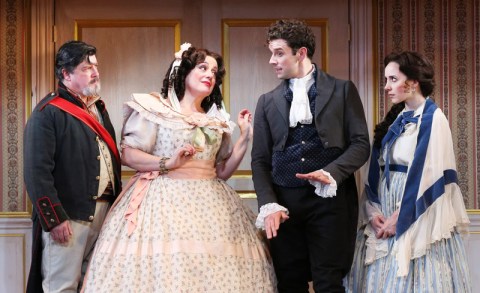
Michael McGrath, Luis Moreno, Mary Lou Rosato, The Government Inspector

Michael McGrath (forefront) Luis Moreno (L) Mary Lou Rosato (R) in ‘The Government Inspector (Carol Rosegg)

Corruption, bribery, pay offs siphoning off citizens’ taxes and lifeblood in a small town? What could be more symbolically representative of politics, whether such machinations take place in Russia or the United States today?  In good times, officials steal roundly and with less accountability because citizens are economically well placed to go about their lives.  In harsh economic times the sub rosa avarice of bureaucrats who serve themselves first and serve the public never, always raises a hue and cry.  When the little people are squeezed, they pressure their overlords to uphold the “sanctity of their positions.” Usually, the miscreants don’t and must be brought to heel. And sometimes there is even justice.

For playwright Nikolai Gogol, such a scenario, laden with hypocrisy and condemnation was a golden treasure trove of comedy. He has proven this with Revizor adapted by Jeffrey Hatcher into The Government Inspector, currently enjoying an extended run at New World Stages.

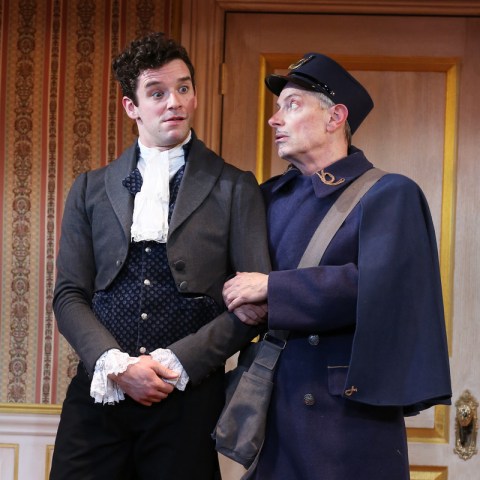
Michael Urie Arnie Burton, The Government Inspector, Nikolai Gogol, Revizor, Jeffrey Hatcher, Jesse Berger, Red Bull Theater

(L to R): Michael Urie, Arnie Burton in ‘The Government Inspector’ (Carol Rosegg)

What a marvelous production this is. It is relevant to our political times which encapsulate the play’s themes. This satire of small town government officials and their general incompetence and corrupt misapplication of their mission and public service is a relief and respite from disheartening nightly news. For that alone, it is a must-see. Apart from that, this production is a must-see because it is just terrific.

For Jeffrey Hatcher who was commissioned to adapt Gogol’s Revizor into a version which would be performed for the 2008 Guthrie season, it was a “kick.” He clarifies that it was an election year. The barnyard of democrats and republicans was in full cacophonic frenzy. Hatcher’s enjoyment is evident in this adroit adaptation. Indeed, he steps up Gogol’s humorous scenario of malevolent politicians who have the tables turned on them, as they conspire to cover-up their cronyism, graft and malfeasance.

Hatcher delivers the best of Gogol and allows the Russian playwright’s genius to shine. With finely tuned direction (Jesse Berger) and exceptional ensemble work, The Government Inspector is madcap, zany and high comedic exhilaration.. Hatcher nimbly tweaks the playwright’s work just enough to enhance the hysteria in the comedy, acute jokes and incredible witticisms. His writing makes this production so completely sumptuous, you will want to feed on it again and catch a second time the artful ironies and slick phrases that ring with truth and reality at every laugh riot of a turn.

Revizor, The Government Inspector, Jeffrey Hatcher, Arnie Burton, Mary Lou Rosato, Mary Testa, The Government Inspector, New World Stages

(L to R) Arnie Burton, Mary Lou Rosato, Mary Testa in ‘The Government Inspector’ (Carole Rosegg)

How satisfying it is to see the petty, self-dealing bureaucrats hoisted on their own greedy petard when they are duped by one of their own, who is even more mercenary than they. This is a normally improbable justice that we are privy to see, as it is unwittingly launched by error.  When the government officials receive their own comeuppance, we are assured that the lofty are most greatly impugned and punished by their own shame, humiliation and self-deception.  At this time in our social and political history, we are thrilled to laugh riotously at the characters’ machinations and their unhappy conclusions which remind us that “what goes around comes around.” What a pleasure!

The performances are the jewels that provide the glitter and the piquant vibrancy of the production. Without this ensemble, the jokes would scintillate but not with the power to strike as hard and send us as furiously as they do into the comic heavenlies.

The Government Inspector, New World Stages, Talene Monahon, Mary Testa, Michael McGrath

(L to R) Michael McGrath, Mary Testa, Talene Monahon in ‘The Government Inspector’ at New World Stages (Carol Rosegg)

In the first scene, we are introduced to the conflict and meet the dastardly mayor (Michael McGrath is wonderfully on point with every hysterical line, every turn of phrase) and his legion of nefarious officials, the illuminating and funny Tom Alan Robbins, William Youmans, Stephen Derosa, James Rana, Luis Moreno. Hatcher/Gogol pull back the veil as the politicians chatter and conspire and we are allowed to see where they have buried all the financial duplicities and discover who is taking what and how the mandate and mission of the judge, the principal, the hospital and law enforcement have been mismanaged to a preposterous degree. (It’s kind of like appointing an EPA director who will dismantle all of the environmental regulations to fund anti-green corporations.)

As for privacy concerns? All the town gossip, all of the secrecies and personal intimacies and weaknesses are explored and savored for broadcast by The Postmaster (the unforgettable Arnie Burton) who enthusiastically reads every line in each letter, sharing the juiciest and most damning information with his cronies for entertainment.  Burton’s portrayal of the Postmaster is moment to moment LMAO; the comedy comes out of the personality of the character which makes his performance absolutely sublime. In this town there is no detail which is not known or kept quiet that Arnie’s Postmaster doesn’t blabber with gusto. He certainly is a tool of the corrupt political machine; he helps it keep abreast of its enemies to forestall any dangers to its power structure.

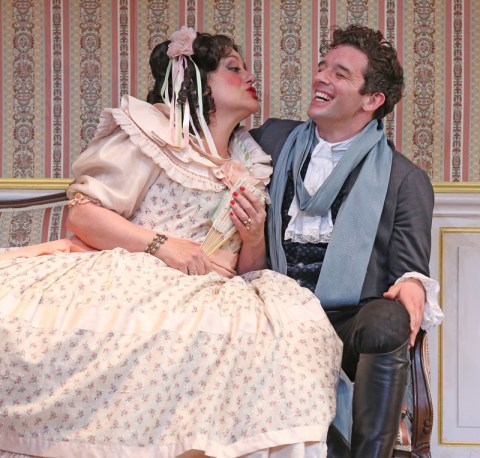
Mary Testa, Michael Urie, The Government Inspector, New World Stages

Mary Testa, Michael Urie in ‘The Government Inspector’ at New World Stages (Carol Rosegg)

At the meeting of these wicked corrupt, they discuss their grave problem which is a threat to their livelihood and career positions. An investigator has come to the town in disguise to explore the level of malfeasance. They fear that he will hold them to account. All the officials and even two local landowners (the funny Ben Mehl and Ryan Garbayo) must work together, discover the hidden identity of this “spy” and turn him over to their side with bribes and payoffs. It is an intrigue that holds danger for the officials and promise for the little people who we don’t really see as we are in thick with the conspirators, a completely enjoyable and refreshing sardonic view.

What has been a boisterous and satiric introduction is jettisoned into a hyperbole of hilarity in the next scene where we meet a lowly civil servant, the ineffectual would-be suicide Hlestakov (the unforgettable and prodigiously talented Michael Urie)  and his clever servant Osip (the versatile Arnie Burton). Hlestakov can’t quite “do the job” with a pistol to free himself of this unrequitable earthly plane, his gambling debts and the ignominy of a meager, zero-of-a-life, which he has badly used.

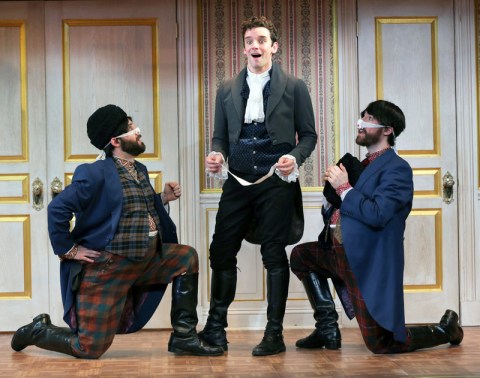
Ryan Garbayo, Michael Urie, Ben Mehl, The Government Inspector, New World Stages

(L to R) Ryan Garbayo, Michael Urie, Ben Mehl in ‘The Government Inspector’ at New World Stages (Carol Rosegg)

Because Hlestakov is incompetent at suicide, we have an hour and one-half of side-splitting laughter. Urie fashions comical uproariousness by using all the acting tools of his instrument.  He flawlessly surfs the cresting waves of  farcical action which he has helped to inflate. He is rather like a fine composer assisted by the incredible accompaniment of the ensemble, who spin their superbly tuned acting instruments into a wild symphony of raucous delight.

In this production Urie has stretched his talents to new heights. He is reminiscent of some of the comic greats; select any one of them in film, television or theater. He distills the substance of his lines then infuses them with the character of Hlestakov filtered through and around himself so that the civil servant who dupes the corrupted officials, and he, Michael Urie, are indivisible. Not only does Urie have seamless timing, he anticipates the power of  pauses which he capitalizes on with grace, fluidity and an uncanny communication with the watchful, listening audience. Very simply, he captures Hlestakov’s being and rounds it out with Chaplinesque force and will.

Talene Monahon, Michael Urie, The Government Inspector, New World Stages

Talene Monahon, Michael Urie in ‘The Government Inspector’ at New World Stages (Carol Rosegg)

As grand accompaniments, Mary Lou Rosato (various roles), Kelly Hutchinson (various roles), Mary Testa (the mayor’s wife) and Talene Monahon (the mayor’s daughter) are divine comedians. Without them the production would fly at a lower pitch. They are integral to the revelation of pretense behind the mayor, who is a wanna-be aspiring to nobility but must wallow in the mud of his position as a small-town functionary. And they (Testa, Monahon) provide the grist upon which Urie’s Hlestakov bakes the fabulous bread we devour to nurture our souls with exuberance and glee.

Michael McGrath, Mary Testa, Michael Urie, Talene Monahon, New World Stages, The Government Inspector

(L to R): Michael McGrath, Mary Testa, Michael Urie, Talene Monahon in ‘The Government Inspector’ at New World Stages (Carol Rosegg)

Indeed, all of the servant portrayals, each one more clever and shrewd than their masters/mistresses, are exceptionally delineated as characters and specifically portrayed by the actors. If  one considers that in less than one hundred years what they are to “inherit” after the Revolution, there are no insignificant characters here, but they are the most prescient in biding their time waiting, in due season to dispatch here and there the fools they serve.

The dynamic arc of the play’s development is expertly unfolded so that by the conclusion, we have feasted and are sated. We recognize how thrilling it is to take our part in this rollicking spectacle which is perfectly congenial in its staging,  set design,  lighting, costuming and the thematic symbolism of its physical, emotional and intellectual levels. This seemingly effortless and easy production took loving care, sagacity and genius to effect the terror of its satire, the bounty of its humor, the innovation of its celebrated cast. Kudos to Jesse Berger who magnificently brought this together and who had the quick-witted spirit and grace to understand how to let it “all hang out,” using the structure of these artists’ inner freedom to live within the boundaries of Gogol’s classic.

If you don’t see this production you will have missed something truly wonderful and riotous. If you do see it, expect the audience to break into laughter and applause frequently because the infection of joy is abundant and bounces liberally between audience and cast. The two hours with one intermission race by.

The Government Inspector is in its extended run at New World Stages until 20 August. You may purchase tickets on their website (CLICK HERE). Or you may phone 212-239-6200.


‘Julius Caesar’ Shakespeare in the Park’s Brilliant Controversy

The Daily News, Shakespeare in the Park, Julius Caesar

Cover of ‘The Daily News’ article discussing the controversy of The Public Theatre’s Shakespeare in the Park, production of ‘Julius Caesar’ (photo of the cover)

When Donald Trump won the 2016 election, Oskar Eustis decided that he would present the opening of the summer season of The Public Theatre’s Shakespeare in the Park with the timeless production where Shakespeare asks through conspirators who just assassinated Julius Caesar, “How many ages hence shall this our lofty scene be acted over in states unborn and accents yet unknown!” If Shakespeare could have conceived of his work being done to reflect the current social and political times of one of the foremost nation’s on the planet, a state not born in Shakespeare’s time, he would have appreciated how the director and cast presented his immutable themes about power, violence, greed, political dynamics with a current spin to make the audience think. To an admirable extent, Eustis’ direction “got it right!”

The assassination of a political figure, especially one as accomplished, militarily gifted and innately brilliant as the real Julius Caesar contains lessons for every era and generation of humanity.  Considering Shakespeare’s concentration on the very human issues of envy, injustice, pride and ease with which the witless masses are manipulated by politicians, all of which his work emphasizes, the US version of Julius Caesar presented by the Public Theatre’s Shakespeare in the Park in its modern day interpretation sits as a clarion call. It is a harbinger not of things to come, but is an echo of what has been and what will always be.

Shakespeare in the Park, Oscar Eustis, Julius Caesar, Greg Henry, Elisabeth Marvel

Shakespeare in the Park, ‘Julius Caesar with Gregg Henry as Caesar and Elizabeth Marvel as Marc Antony (photo courtesy of Greg Richter and the website)

For as long as there are governments, political factions, power players and the will to  murder and commit genocide to secure riches and power, Julius Caesar will be an iconic play. If  human nature could only embrace the man who came after Julius Caesar born in Judea in the time of  Augustus. Would that humanity could embody His spirit and virtues to change the very core of its flawed essence. Then Shakespeare’s Julius Caesar would be a quaint history play, an almost irrelevance. But such as humanity is, the play will always resound in studied human hearts and Caesar will bleed in sport on global stages for centuries to come..

Whether you dress Caesar up in a suit and long, red tie to mimicry and satirize the current fake and pompous American “man who would be king” or you costume Caesar in a toga replicating the times of Rome, there is much to understand about human beings and politics in this play, if one has the eyes to see, the ears to hear. If you  managed to  score a ticket to watch this very fine production which amassed responses of praise, excoriation and lukewarm dismissal during its controversial run, you would have been treated to a rousing occasion and would have judged for yourself whether it was offensive, too over the top or innovatively enlightened.

Shakespeare in the Park, The Public Theate, Julius Caesar, Oskar Eustis,

Shakespeare in the Park’s ‘Julius Caesar’ directed by Oskar Eustis (photo courtesy of the production)

Indeed, the furor of misinterpretation by those who never saw it and complained in error about what they thought the production advocated prompted a few sponsors to pull their support from a play which normally draws yawns and zzzzs after the climax in Act III. That Eustis could raise controversy because of his directorial choices is to his credit and speaks to his courage, ingeniousness and focus on the purpose of great drama: to raise awareness, to show us ourselves and to encourage us toward amendment.

The  outcry by those who most likely would not have appreciated the production’s cleverness, are probably not at the head of the class in understanding Shakespeare, his language, the subject, the poetic cadences, the metaphors, symbolism, themes, ironies and more. That is the real tragedy. For the commoners in Shakespeare’s time did recognize the poetic language, rhythms, the themes and even the psychological guilt in Brutus’ soul when Caesar’s ghost shows up to predict his death. Shakespeare’s work, unlike our atomized entertainment, was aimed at the working class and royalty alike; he wrote for everyone and his audience of Queen Elizabeth I and the groundlings appreciated and understood his plays.

Corey Stoll, John Douglas Thompson, Shakespeare in the Park, Julius Caesar, Oskar Eustis, The Public Theater

(L to R) Corey Stoll, John Douglas Thompson in Shakespeare in the Park’s ‘Julius Caesar’ (Joan Marcus)

Today, the intellect of commoners in the US who can or cannot appreciate Shakespeare knows no economic latitude and longitude. One may be a wealthy or poor Philistine: the  vilifiers of Eustis’ production did not suppress their ire. They misunderstood his work with abandon, thinking it rightly due that they could uplift uninformed opinions though they didn’t see the performances. Right behind them the Russian trolls and bots stirred up cauldrons of boiling virtual mud online via fake social media accounts.  So be it. They too, like Marc Antony will stumble over their own carcasses en route to an unhappy grave (the bots and trolls). Despite the hoopla, this presentation was a roaring fire and our nation and culture are better for it.

Eustis chose to accoutre his production with elements from our culture. He included these to poke fun at the chaos and clownish behaviors emanating from the United States’ once venerable seat of power, the White House, whose nobility has been sucked dry by the head canker worm with the red tie, and the other parasites that occupy the halls of power. Thus, from cell phones and twitter feeds to graffiti walls on subway stations where dissidents (ordinary citizens, protestors, Occupy Wall Street et. al.) wrote encouraging messages to counteract the disgust they felt after the 2016 election, the play manifests the struggle of American citizens on both the left and the right to solidify their agendas and make their voices known. The production emphasizes the horrific violence on both sides of the Roman coin which leads to the demise of the Roman republic and the rise of autocratic rule. That is the key warning for our age.

Some parallels between Julius Caesar’s Rome and U.S. politics are fascinating, but by no means does Eustis suggest the undercurrents of the tide and times are the same. Though he does make  foreboding suggestions for our democracy, the US does not hang in the balance, certainly, not like Rome did. However, if there is a foreign power influencing our elections (this is not in Julius Caesar) to promote the demise of our  two party system and push it against the principles of the constitution, then this must be looked into as a new type of warfare. We need to follow the example of our European allies who are currently working against Russia on many fronts including teaching children how to recognize fake sources of online news and the hallmark signs of propaganda. Ukraine and all of the EU nations are farther ahead of us who have not even recognized there is a devil in our virtual house, let alone protected against it.

Though there are hints at a comparison between Rome and the current US political situation, they are more for sardonic, dramatic and tonal purposes. Sadly, there is little to compare if one seriously considers the political players.  Would that our current president and the politicians in our Senate and House be worthy of the exceptionalism, military soldiering, courage, erudition and genius of Julius Caesar and the senators of that day. Indeed, over the past devolution of decades, the current lot of politicians are more akin to the rabble of citizens (illiterate lower classes) who are easily swayed by the last speaker and motivated by gifts (Antony offers the citizens gold from Caesar’s treasuries to sway them to violence, and later reneges on his promise). Our current political “heroes” lack the honor, the soul power, the majesty, the courage, the talents, the skills and solidity of character that their equivalents in the play demonstrate.

Nikki M. James, Corey Stoll, Shakespeare in the Park, Julius Caesar, Oskar Eustis, The Public Theater

Nikki M. James, Corey Stoll in Shakespeare in the Park’s ‘Julius Caesar’ (Joan Marcus)

By no means is the greatness of Caesar who led his legions, fought in battles next to his men and distinguished himself as an extraordinary individual who enriched the Roman empire to be lessened by a suggested reflection in the current president. If critics who so excoriated this production knew a bit about ancient history, Julius Caesar, the Roman senators, etc., they would have understood that the contrast between Donald Trump and Julius Caesar is indeed laughable to the extreme of hyperbole.

To think that Eustis is fomenting violence against the current president is even more laughable. And that is the point. This is one at whom one laughs, ridicules and mocks, for his actions are worthy of little more. Cutouts do not stand. They fall brought down by themselves. Julius Caesar the real man was very, very different. He was someone worthy, someone dangerous. His track record verifying this was miles long. The only wit who laughs about Caesar is Casca, no one else does in the play. The president’s behavior is imminently laughable and even more so that he does it to gain publicity which has been based on infamous shameless and untoward behavior unfit for the venerable office he holds and continually demeans.

There is no comparison between the two men. The fact that Eustis costumes the Caesar character  in  the tell-tale suit and red tie drives at the very cardboard cutout the president is proud to be:  all show, all outer appearance, all image, no inner substance, no character, no strength, no courage, no bravery, not one wit of who Julius Caesar was, except perhaps in Shakespeare’s delineating his pride in not wanting to appear weak which is the fatal flaw that leads to Caesar’s death.

Tina Benko, Gregg Henry, Eisa James, Shakespeare in the Park, Julius Caesar, Oskar Eustis, The Public Theater

(L to R) Tina Benko, Gregg Henry, Eisa James in Shakespeare in the Park’s ‘Julius Caesar’ (Joan Marcus)

But even then Caesar had to be cleverly manipulated by a “close confidante” to turn against his own better judgment and go to the senate where death awaited him. Indeed, he goes because he is fatalistic. He has braved death many times in battle. He does not fear death, as he says, “The valiant fears death only once,” so let it be with Caesar. This man Julius tailors himself to fit the fullness of the role of Caesar which he respects and attempts to live up to, but cannot because he is mortal. The current president cannot fit the role of president, is unfit for that role and would shape it to fit the role of the leadership of another country whose oligarchy, fascism and tyranny is well documented.

Unlike the White House knave, Caesar was deserving of his honors. He earned them and was indeed a self-made man, a courageous leader, exceptional diplomat and lover of the reputed to be most beautiful woman in the world, Cleopatra. How he rose to power was daunting. And even if you consider that the Roman legions didn’t take BS from anyone, if he had proven himself less worthy, they would have just as soon slit his throat than suffer any clownish foolishness he might lay on them which in his nobility and stature he would never entertain. Again the contrast with the current president is wider than the ocean and Eustas’ production proves their difference in character and spirit to be galactic. And that key theme is screamed out with irony and sardonic humor.

By the time Shakespeare introduces Caesar in the production, the very Roman republic is thought by some to be at stake (an argument Cassius uses to convince Brutus to join the conspirators, which is hypothetical) because a majority of the Roman senators intend to proclaim Caesar emperor. Caesar, wisely, will not wear his crown in Rome, maintaining an apparent  equality with the other rulers of Rome which he astutely understands want to keep Rome a republic. Nevertheless, it is because some senators supported Pompeii, the previous Roman ruler who Caesar fought during a civil war and killed in Gaul, that he has enemies. Rather than to kill many of Pompeii’s supporters (Cassius and the other conspirators) he pardons them. It is a fatal mistake because it is his enemies led by the noble, idealistic, impractical Brutus who kill him; only Brutus does so to preserve the republic. Brutus’ fatal error in fact destroys the Roman Republic forever.

Elizabeth Marvel, Shakespeare in the Park, Julius Caesar, The Public Theater, Oskar Eustis

Elizabeth Marvel as Marc Antony in Shakespeare in the Park’s ‘Julius Caesar’ (Joan Marcus)


As a result of the assassination, massive rioting takes over Rome, stirred up by Marc Antony who with Octavian and Lepidus foment another civil war  between the old Pompeii supporters led by Brutus’ and Cassius’ legions versus Marc Antony’s, Lepidus’ and Octavian’s armies which eventually win against the conspirators. However, the cost in bloodshed is incalculable and Octavian/Augustus proves to be the very thing that Brutus and Cassius intended to prevent with Caesar’s assassination. In fact Octavian as a tyrannical autocrat is worse than Caesar would have been. Caesar’s grandnephew, Octavian, later Augustus, learned from his granduncle’s mistake of granting pardons. When he attains the leadership of Rome, after getting Antony to commit suicide and wiping out his “enemies” in battle, at home he rounds up anyone who would even whisper against him, not even allowing them a trial. The genocidal purge wipes out the best of Rome and leads to his Pax Romana (an irony as peace was purchased by bloodshed and kept by fear) and autocratic rule.

The  Roman republic is destroyed. The catalyst is the assassination. If the conspiratorial senators had not taken matters into their own hands through violence, but trusted the very powerful democratic tools they had to strengthen their republic, thousands of lives would have been saved, and the intelligentsia would not have been wiped out as a potential threat to Augustus Caesar’s power base. Shakespeare’s principle theme that violence begets violence and a republic cannot be safeguarded by civil war is a powerful lesson he puts forth for future global generations.

Eustis’  production is assisted by fine performances by the ensemble and especially the standouts: the insidious, hypocritical Elizabeth Marvel as Marc Antony (with a southern voice, kind of like Jeff Sessions/Mitch McConnell and Strom Thurmond) Corey Stoll as Brutus, and John Douglas Thompson as Cassius. The latter two both portray a humanity and intelligence in their characters that is moving and real. In its entirety, Eustis’ Julius Caesar gives us a powerful reminder of the beauty of our democracy and constitution and the great tragedy if we lose it through violent means. ( or the new violence, cyber warfare).

Also, throughout this seminal, witty and sardonic presentation, there is an underlying, subtle exhortation to those who would govern us today, here and now: adhere to the constitution, respect the voices of the people, promote equity and justice through a free and accurate press, and insure solid educational opportunity which promotes a greater drive toward economic equity for all. To not do so encourages the hopelessness that begets violence and conspiracy such as made evident in Julius Caesar.  Indeed, as this production and Shakespeare so tellingly relate, a country’s leadership is directly responsible for the evolution or devolution of its nation, because the leaders manipulate the people who are invariably less educated and have less power than they.
Elizabeth Marvel, Shakespeare in the Park, Julius Caesar, The Public Theater, Oskar Eustis

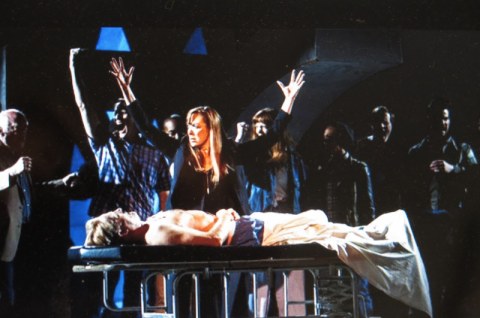
Elizabeth Marvel and company in Shakespeare in the Park’s ‘Julius Caesar’ (Joan Marcus)

Shakespeare/Eustis also reinforces that those in power who would manipulate and use the commons to kill for them in the hope of securing power through violent civil strife and assassination, only sow their own demise and the demise of the republic.. With each act of bloodshed, with each body slain, with each bellicose threat of citizen against citizen, a republic and/or a democracy is weakened, as this production reveals. To interpret this work as anything but belies a senselessness and negligent/willful misinterpretation of Shakespeare’s great play and Eustis’ production which interprets Shakespeare’s immutable themes with a currency that encourages us to think, to meditate and delve beyond brainwashing pap uplifted in some media outlets.

The Public Theater is to be credited for its steadfastness to withstand the intense pressure to remove funding because of a production predominately miscued by those who didn’t see it. The controversy, used to generate publicity about an individual whose shamelessness and lack of respect for himself and the office he holds actually validated Eustis’ sardonic interpretation, is a further irony. I, for one, appreciate The Public’s undaunted courage to persist with their vision and mission to  stand up for freedom of the press and the sanctity of artistic endeavor to bring a unique, fresh and ironic spin to a play that is often cast as a droll, frozen, rendering of antiquity, easily dismissed because it happened over 2000 years ago.

Eustis encouraged a new veneration for Shakespeare’s timeless work. And he unlike the head corporate philistine of Broadway who holds The Great White Way for ransom, follows in the venerated footsteps of its founder Joseph Papp. They offer sterling artistic works at a lower price and Shakespeare for FREE each year, if you cue up for it democratically. Bravo!


,

Soulpepper Theatre Company’s ‘Spoon River’ by Edgar Lee Masters

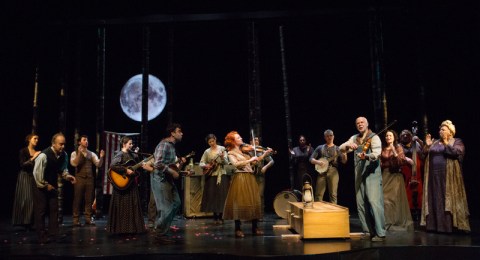
Spoon River Ensemble, Spoon River, Soulpepper Theatre Company, Albert Schwartz, Pershing Square Signature Center, Edgar Lee Masters
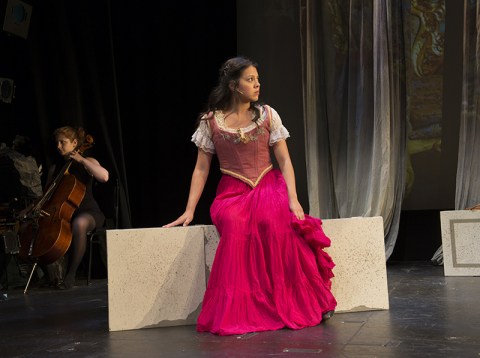
‘Spoon River,’ Spoon River Ensemble, Soulpepper Theatre Company, Albert Schultz (Artistic Director, Director) Cylla Von Tiedemann

Whatever Soulpepper Theatre Company seems to adapt by way of masterpieces, their productions are like spun gold. They lift the soul with transcendent performances and remind us of what is beyond the material world, sounding the clarion call that there is “more in heaven and earth than is dreamt of” in any philosophy. Such is true of their shimmering production Of Human Bondage (see my review on this site and on Blogcritics) as it is true of Artistic Director Albert Schultz’s adaptation of Edgar Lee Masters’ Spoon River Anthology, with Mike Ross as adaptor, composer, arranger and music director. Soulpepper’s award-winning Spoon River is currently running at Pershing Square Signature Center until 29 of July.

Spoon River begins with the remembrance of Bertie Hume who has recently died. Before the audience is seated, they are taken on a journey back in historic time to the town of Spoon River. The audience moves, from the light of the hallway of the Signature Center into a growing darkness where they are invited into the place where Bertie lies waked. Unbeknownst to the audience they are beginning their symbolic transformation from mere audience members to mourners. In a corner of the parlor where Bertie is laid out in an open casket with flowers, a shadowy family member welcomes them and thanks them for attending. This is immersive theater and we are in a state of wonder and anticipation knowing that what comes next will be surreal and illuminating.

Proceeding down the hallway filled with sepia-toned pictures of members of the Spoon River community who have passed and whom we will meet later in the production, the audience gradually takes on the role of “living” passersby who come to pay their respects to the dead and learn a lesson or two about life in death and death in life. They are led through the graveyard on the hill where Bertie Hume is to be laid to rest joining those from Spoon River who have gone before her. The tombstones’ lettering, brightly luminescent from the full moon, is carved with the names of those who will later “have their say” about their narrow identities in the material plane, from the perspective of  their expansive existence beyond the grave.

This is a momentous night; the harvest moon shines brightly; something unique will happen that audience members will partake of. The veil (represented by a thin grey-black scrim behind which the Soulpepper cast stands until their cue to step out) that separates the quick from the dead, the realms of spirit from the material world,  rises. The spirits materialize. Those who have gone on (the Soulpepper cast portraying the Spoon River deceased) watch with interest the audience, the pall bearers who bring out Bertie’s casket and place it on the ground, and Mr. Pollard who briefly speaks his piece about sweet Bertie being taken by death in the bloom of her life. Bertie,  like his Edmund, also deceased, “fed on life.”

Soulpepper Theatre Company, Spoon River, Edgar Lee Masters, Albert Schwartz, Alana Bridgewater, Brendan Wall, Richard Lam, Mike Ross

(L to R) Brendan Wall, Alana Bridgewater, Richard Lam, Mike Ross in Soulpepper Theatre Company’s Spoon River, Edgar Lee Masters, adapted by Albert Schultz, Mike Ross (music, arrangements, compositions) (Cylla von Tiedemann)

Mr. Pollard is unaware of the spiritual plane filled with once living Spoon River citizens who, behind him, stare out at us in silent wakefulness.  As we gaze in wonder, we realize that we are privileged to see into the things beyond the apprehension of our five senses on this special night. As happens to most individuals who live as material beings, we receive momentary glimpses into transcendent realms  (a theme of this production) in the hope of learning and evolving.  The audience and Mr. Pollard are given a glimpse. For the audience/passersby, this fabulous revelation lasts for 90 minutes with no intermission.

Mr. Pollard mentions that, if it is true and sometimes one can hear beyond the veil a choir singing and carrying on, Bertie will be joining them, for her voice was so lovely, the “angels were jealous.” For now she is on the hill “sleepin.”  From beyond the veil the Spoon River spiritual choir  loudly whisper “sleepin” which stops Pollard “dead” in his tracks at the vibration from the other world. What was that he heard? Was that a momentary aural flicker from the other side, an utterance from those in another plane of consciousness that he cannot see? It is then we begin to consider the theme of sleeping and wakefulness and their interchangeability as metaphors of life and death, and as it turns out much more as the play progresses.

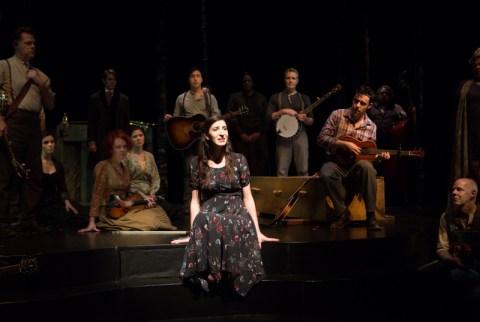
Jackie Richardson, Spoon River, Soulpepper Theatre Company, Spoon River, Edgar Lee Masters Spoon River Ensemble

Jackie Richardson and Soulpepper Theatre Company’s ‘Spoon River,’ Spoon River Ensemble (Cylla von Tiedemann)

Like Pollard, the audience (after the ninety minutes that we are transported by the Soulpepper company spirits), must contend with the material plane which distracts us by its toil, strife, physical pain and emotional heartache, all of which bring us “down to earth,” (another vital theme). Such earthiness is revealed by the Spoon River deceased as they refer to their secret lives and passions they experienced in Spoon River, and they tell us their personal stories that are heart-breaking, abrupt, shocking, funny, thrilling and mesmerizing. They relate their stories and lives as a clarion call and encouragement for us to feed on life while we can.

It is in that extraordinary moment when the Soulpepper cast whispers “sleepin” that the themes of awareness/unawareness, life in death in life processes, sleep referring to soul oblivion, wakefulness referring to soul awareness/life soar.  It is then our eyes are opened to what this play will be about. To the cast, “sleepin” is a description of the consciousness of those who are “living” on the material plane because they are blind to the furor of life’s beauty and opportunities. It is also an unction for us to question our own sleeping consciousness. Edgar Lee Masters and this adaptation by director Albert Schultz enlighten us to the concept that we must awaken our soul/consciousness to a greater appreciation of who we are and who others are in this “thing” we call life but only see “through a glass darkly.”

Kudos to Albert Schultz the director and adaptor, Mike Ross and the phenomenal cast, all of whom make this beginning of Spoon River one of the most memorable and transformative theatrical moments I have experienced in live theater.  Indeed, from start to glorious finish, this production is truly what the best of live theater is about.

Albert Schwartz, Mike Ross, Soulpepper Theatre Company, Miranda Mulholland, Spoon River, Pershing Square Signature Center, Edgar Lee Masters

Miranda Mulholland in Soulpepper Theatre Company’s ‘Spoon River’ by Edgar Lee Masters, adapted by Albert Schultz, music composed, arranged, adapted by Mike Ross (Cylla von Tiedemann)

As we settle in with the spirit-community of Spoon River’s deceased citizens, we recognize that they are mentoring us through important themes of life, death, human existence and other worldliness by relating their personal stories which are Edgar Lee Masters’ poems about the people who lived in the small Illinois community.  What were these individuals really like? Does anyone know anyone else on the material plane of existence which sometimes can blind us into a sham of duplicity and false fronting? Does anyone know others’ true happinesses,  torments, secrets, regrets, lies, crimes? Do people know themselves? The lawyer, the mayor, the housewives, the farmers, the rich, the destitute, the teenagers, the lovers, the lost, each of Master’s townspeople tell us and in each tale there is a lesson for us to learn.

Indeed, to be self-blind is perhaps the worst form of blindness and we are made to understand that even in death when various folks in the Spoon River community step forward and share who they were, they are not necessarily forthcoming and it must be their deceased friends and neighbors and spouses who let us in on their multiple realities. We are privy to the fulcrum of secrets that composed the core of many of these individuals’ lives; many of the silent mysteries they kept in life are filled with irony, pathos and humor.

The Spoon River souls (each Soulpepper cast member is prodigiously, musically multi-talented) relate stories in a celebration of music (gospel, blues, country, pop and more) songs  and accompaniment (banjos, ukeleles, piano, mandolin, cello, violins, guitars, brass, casket drumming, harmonica, and more). The songs are in various measures soulful, vibrant, achingly beautiful, frightening, uplifting and stirring; the dances are variously joyful, foot stomping and rousing. The lighting, staging, costuming and props which backdrop each of the songs/stories are economic, beautiful, appropriate, innovative and inspirational; they enhance the overall atmospheric effect to create riveting and dramatic storytelling.

Spoon River, Edgar Lee Masters, Soulpepper Theatre Company, Spoon River Ensemble, Albert Schwartz, Mike Ross

Spoon River Ensemble, Soulpepper Theatre Company, “Spoon River’ by Edgar Lee Masters, (Cylla von Tiedemann)

We watch and participate in the soul enlivening commemoration as the departed tell us about themselves in all their glorious, glowing and dastardly humanity. By the end of the production we understand why they are partying in the other realm. They have been whiling away the time, as they wait for the new member of their otherworldly community to awaken from her sleep of life’s oblivion to a new consciousness in “death.” When Bertie Hume finally arises from her “sleep state” and is renewed, the song she sings is a breathtaking and heart-rending appreciation of the beauty of her life that is now gone. She, too, didn’t love her life to the fullest. She too, was “sleepin” when she should have been soul-awake and “livin.”

If Bertie Hume realizes she didn’t love life as she could have, and she was one to feed on life, then what chance have we to live life to the fullest? What chance may we have to overturn the corporeal for incorporeal values, to fill our lives and awaken our souls with joy, peace and the fruitfulness of having a life well lived with no regrets?

This question is answered by Edgar Lee Masters’ injunction “It takes life to love life,” spoken by the exuberant Fiddler Jones who has joined his fellow spirits with little in the way of material objects, but is happy with 1000 memories and no regrets. And it is answered by the audience members at the joyous, life-affirming conclusion of Spoon River as the Soulpepper company with vibrant song, dance and accompaniment sing out “Is your soul alive? Then let it feed.”

This incredible production holds many beautiful truths. They begin and end in artistic  genius; with the unified elements of brilliant music composition and arrangements by Ross, the sterling voices of the talented, superb Soulpepper actors, the musicianship of cast members, the enlightened adaptation by Schultz of Edgar Lee Masters’ concepts and work. The genius flows over, in, around and through Ken MacKenzie (Set & Lighting Designer), Erika Connor (Costume Designer), Andrea Castillo-Smith (Sound Coordinator), and all who worked on Spoon River. In this illuminating and uplifting production that all of us can relate to, Schultz, Ross and the Soulpepper company present a banquet. We feed heartily  on their enthusiasm and loving generosity. We may even enjoy in our memories and consciousness, a raft of leftovers for future banquets upon which our alive souls may feed.

If your soul is alive and especially if you need renewal and want to feed off the sheer joy of Spoon River, run to see this production before it closes on 29 July. You will be glad you did. Tickets may be purchased at the Box Office at the Pershing Square Signature Center (42nd Street). To purchase from their website, CLICK HERE.


‘The Aran Islands’ by J.M. Synge at The Irish Repertory Theatre

Brendan Conroy, J.M. Synge, The Aran Islands, Joe O'Byrne, Irish Repertory Theatre

Brendan Conroy in J.M. Synge’s ‘The Aran Islands’ adapted by Joe O’Byrne at Irish Repertory Theatre (Carol Rosegg)

The Aran Islands J.M. Synge’s work adapted and directed by Joe O’Byrne in an extended run at the Irish Repertory Theatre through 6 August, first and foremost is a tome to the three, stark, wind-swept, rocky islands that are the sentinels of Galway Bay on the picturesque and green-lovely West Coast of Ireland. For millennia the Aran Islands have had as their mission to mitigate the ferocious and fickle storms, oppressive fogs and shattering clashes between air, land and sea. They provide a powerful breakfront for Galway City, so that it might prosper unhinged by the natural elements. Without the stolid, natural wall of Inishmaan, Inishmore and Inisheer, all the harshness of the weather and roaring sea would continually have battered Galway and perhaps lessened Irish interest to build an incredible, romantic, tourist friendly city that is currently flourishing and is a favored recommended spot of Irish citizens who suggest to visitors, “You must visit the west country.”

W.B. Yeats said the same to J. M. Synge when they met at the Sorbonne, Paris in 1896. Only with Yeats being Yeats and Synge being Synge, Yeats encouraged the younger writer to visit and spend time on the Aran Islands to get to know the people and their primitive culture and rural, seaward  lifestyle. Yeats’ hope was that Synge’s visit would be the catalyst to spur the young man’s imagination and experience the profound themes of birth, life and death. How these central dynamisms of life teased and blasted the inhabitants directly, the fascinated Synge captured in his work. The islanders, who lived without the distractions and stimulations of city life, like the Aran Islands themselves, had to confront and withstand, as it were, the batterings of the elements with only the bulwark of their isolated community network and companionship of their fellow resisters.

Brendan Conroy, J.M. Synge, The Aran Islands, Joe O'Byrne, Irish Repertory Theatre

Brendan Conroy in J.M. Synge’s ‘The Aran Islands,’ adapted by Joe O’Byrne, Irish Repertory Theatre (Carol Rosegg)

Yeats most probably wanted Synge to also experience the symbolism of raging nature  in confrontation with the stalwart, intrepid character of the lonely inhabitants who managed a meager daily subsistence in an unwelcoming land. There, they had to front the torments of sickness, ill health and old age at the edge of the world, which appeared to be going backward in man’s history when cities were beginning to experience electricity and modernism.

The fact that they were able to carve out a hard scrabble life was a luxury. Indeed, everywhere they went life and death were married in tortuous embrace and the residents, like a tribal people, used their myths and storytelling to fill the dreary nights and chronicle their relationships to each other and the land as life’s and death’s immutability clamped down upon all that they endeavored.

Brendan Conroy, The Aran Islands, J.M. Synge, Joe O'Byrne, Irish Repertory Theatre

Brendan Conroy in J.M. Synge’s ‘The Aran Islands,’ adapted by Joe’OByrne, Irish Repertory Theatre (Carol Rosegg)

A visceral and memorable portrait of the natural elements, the people’ struggle and the barren, bleak, rock-hard lifestyle and landscape are indelibly portrayed in the cadences and rhythms of Synge’s description of the Aran Islands in O’Byrne’s incisive adaptation of Synge’s work, The Aran Islands, formerly a book length journal.  The sheer poetic call of the undulations of the sea in its ferocity and tameness, the delicious descriptions and sound effects of language which are indelibly linked to Synge’s later work, have found a marvelous home in this travelog/adaptation. O’Byrne has reshaped it into a solo performance of an individual, the reaffirmation of Synge himself, who is a neophyte of all things “Aran.” As the production develops, this comes to mean all realms that flow easily among the levels of consciousness in stories told about the past in historical time and place, and which do represent the present, and are harbingers of the future.

I can imagine no one but Brendan Conroy to be the sojourner to the Aran Islands, an older Synge, whose face brightens as we might imagine Synge’s did when he saw the lands in the distance and eventually stepped off on to the pier and then on hardened, rocky ground. Conroy’s mastery of Synge’s poetic cadences and luscious images and his manipulation of pauses, digressions and silences transform him into the islands’ storytellers and ancient, wizened,  rural magi (wise ones), who stories convey  ever-present themes. Conroy beautifully renders the particularity of each with effortless realism.

Brendan Conroy, The Aran Islands, Joe O'Byrne, J.M. Synge, Irish Repertory Theatre

Brendan Conroy in ‘The Aran Islands’ at Irish Repertory Theatre (Carol Rosegg)

I could understand and visualize every beat, every declension, every word spoken and inferred in the descriptions and characterizations of the islanders who shared eerie  stories around the central core of every family, the hearth. Conroy’s insight and understanding of how aural power may transform the listener into his or her own visualist  and imagist is greatly appreciated in a time when we may too often rely on visual effects selected by others to relate stories which we then can easily dismiss because we have not used our own imagination to power up the visuals.

On another level this is a production about visualizing with the eye of consciousness, of employing one’s imagination to be transported through the rich medium of Synge’s figurative, elegant, word crafting. If one listens, then one cannot help but focus on Conroy’s dark, full-bodied,  resonant, somber and sometimes higher pitched musical instrument of a voice which he modulates with just enough breath and lung power to reverberate and touch the hearts of the audience.

Brendan Conroy, J.M. Synge, The Aran Islands, Joe O'Byrne, Irish Repertory Theatre

Brendan Conroy in J.M. Synge’s ‘The Aran Islands,’ adapted by Joe O’Byrne, Irish Repertory Theatre (Carol Rosegg)

Conroy entices all to see encapsulated in the words, the airy visions which are transformed through the medium of sound. With focused attention and appreciation, Conroy provides us with a heightened awareness of Synge’s rich language, the sound effects (i.e. alliteration, onomotopoeia), and imagery. Conroy’s gestures and changes in posture convey the various island characters; he effects these characterizations with a minimalism that does not detract from the beauty of Synge’s words. We are rapt and caught up in the consciousness of Synge’s personal observations made real to us. It is of a time and place which is now gone but will be ever-present in the writer’s journal and O’Byrne’s adaptation.

If you enjoy Synge and love traveling to Ireland, even if, at this point, you have no intention of going, allow the Irish Repertory Theatre’s production of the Aran Islands to take you there. This adaption ably directed by O’Byrne, with the assistance of artistic team Margaret Nolan (set designer) Marie Tierney (costume design) Joe O’Byrne (lighting design) Kieran Duddy (original music) is incisively brought to life. Special kudos goes to Conroy’s performance effected by his prodigious talent and artistry. This presentation will bring the sentinels of Galway Bay to your imagination and deliver you to a time and place more viscerally felt than looking at historic sepia photographs.

The Aran Islands is currently at the Irish Repertory Theatre (132 West 22nd Street) until 6 August. It is around 100 minutes with one intermission. For tickets visit the Box Office in person or go to their website: CLICK HERE.   You can order by phone at 212-727-2737

Soulpepper’s Adaptation, ‘Of Human Bondage’ by William Somerset Maugham at the Signature Theater, a Review

Gregory Prest, Michelle Monteith, Soulpepper Theatre Company, William Somerset Maugham, Of Human Bondage

Gregory Prest, Michelle Monteith in a Soulpepper Theatre Company adaptation of William Somerset Maugham’s ‘Of Human Bondage’ (Cylla Von Tiedemann)

Love is a scourge if it becomes an obsession that devours one’s soul and fouls one’s career, friendships and very life. And what if the pursuit of the love object is never requited in sincerity and kindness? William Somerset Maugham’s masterpiece Of Human Bondage reveals the withering devastation wreaked by obsessive, twisted love’s sadism and masochism.

Though the work has been transferred to the medium of film three times, it has never made it to the stage. It took a renowned playwright from Canada, Vern Thiessen, and a visionary Artistic Director Albert Schultz (director) to meld hearts, minds and artistic genius during a lively discussion to create the work. And it took Canadian Soulpepper Theatre Company to have the will to commission Thiessen to write Of Human Bondage the play, so that the adaptation of this immemorial story of human desire and repudiation would be able to soar on stage.

Theirs is a remarkable effort. The production from beginning to end is breathtaking. How the playwright and director unfold Philip Carey’s (Gregory Prest is just stunning), journey of infatuation for Mildred Rogers (Michelle Monteith’s wickedness is infuriating) through emotional enslavement and out, is mesmerizing, voyeuristic, horrific. The characters’ devolution into the abyss which touches upon class strife, gender exploitation, the crippling derangement of inferiority, self-deception, soul entrapment, sadism and masochism is a tour de force that encapsulates the seminal themes of the novel. That Soulpepper Theatre Company has so vitally put such a production before its audiences to magnify the best and worst of human nature and human relationships in all of their exceptionalism, and to refract it through a visceral lens by the brilliant Maugham in what is an exaltation of his work, will remain unparalleled for a long while.

William Somerset Maugham, Soulpepper Theatre Company, Of Human Bondage, Oliver Dennis, Gregory Prest, Vern Thiessen

(L to R) Oliver Dennis, Gregory Prest in Soulpepper Theatre Company’s adaptation of William Somerset Maugham’s ‘Of Human Bondage’ written by Vern Thiessen (Cylla Von Tiedemann)

The play presented by this acclaimed civic theater company has won numerous Dora awards (equivalent to our Tonys) deservedly so. How Thiessen, Schultz, the transcendent cast, Lorenzo Savoini (Set and Lighting Designer), Erika Connor (Costume Designer), Mike Ross (Composer and Sound Designer) and others crystallized the novel’s essence and distilled its characters and story into the magnificence that is currently playing at The Pershing Square Signature Center, is most probably a fascinating story in itself.

How did all unite to shape this epic production which is akin to Greek Drama? For each there must have been their own singular talent, passion, focus and the understanding that they were/are still contributing to something of great moment. With the expertly conceived of and executed unity, harmony and coherence in the acting and the theatrical spectacle, from the sound effects, music, lighting, seamless staging, props and costuming, not only are we transported back into the historic period of Victorian England, we are elevated into the consciousness and realms of feeling and emotion of the characters, especially that of Carey and the pitiably proud Mildred Rogers.

William Somerset Maugham, Of Human Bondage, Sarah Wilson, Gregory Prest, Soulpepper Theatre Company, Vern Thiessen

Sarah Wilson, Gregory Prest in Soulpepper’s adaptation of William Somerset Maugham’s ‘Of Human Bondage’ written by Vern Thiessen (Cylla Von Tiedemann)

Shame, embarrassment and self-consciousness about his club food have deformed Philip Carey’s personality and emotional nature, though he is a promising medical student who is wise and humane and has artistic talent which he has thrown over for medicine. Thiessen cleverly reveals the underbelly of Carey’s weaknesses that nearly destroy him: competitiveness, envy, slavishness, self-blindness to his own need to control others with manipulative acts. Thiessen also reveals his strengths: his artistic, soulful impulses, his life-long ties to artistic friends, his kindness, his perception, his insight.

Carey becomes entranced with his colleague’s object of infatuation, Monteith’s lower class, uneducated and exploitive gold digger waitress Mildred, who has no intentions of making a career plan or refining her inner emotional traits to encourage a more genteel way of living. We watch fascinated at how her sharpened claws prod and dig into Carey’s flesh; she entangles him and torments his soul. Their fates are sealed, regardless of the variety of sub-scenes which layer upon layer reveal Carey’s strengthened self-awareness which he gains with the help of his artistic friends as they show him the evolving corruption of Mildred’s soul and attitude. She presumptuously assumes she has the greater power over him because of his weak desires. This is a bitter mistake which destroys her.

Though it appears to be the reverse, for a good part of the play, like Mildred, we are duped to believe that she controls and drains the lifeblood from Carey while he becomes more destitute and obsessed with her. He follows her whims which she blows up into storms or breezes and he is blown about by her, as her kite to drop when another more “princely” man comes near, even his own colleague.  Though he meets other learned, more attractive women through his friends, who are interested in him, Carey goes back to Mildred when she is rejected by other suitors who dupe and dump her. Like an addict, he must get his Mildred fix, while she enjoys tormenting and acting superior to Carey’s club foot Quasimodo (his inferior perception of himself).

As each scene and interaction seamlessly slips into the next one, we are driven by the emotions of the characters whose fuses fire-up then blow out based upon their relationships with the protagonist Carey and the antagonist Mildred. Carey’s once pompous colleagues fall prey to their own addictions and failures, and Carey, is thrown out of his rooms and his medical school because he wastes his money on Mildred each time she returns to him. However, his artistic genius is still alive; can his corrupted soul be redeemed by a finer love?

Ironically,  it is Carey who actually is the subtle master of the two characters. His passive, puppy dog, slavishness is the iron chain that binds Mildred into the sadistic domination to which he submits, a domination which self-destructively, she cannot do without. He is and always was the “better” person. Regardless of how much he allows her to feel her mastery over him, he controls that dominance and has her on a long lead. It is why she resents him, though she never has the self-awareness to realize why she hates him (she indeed hates her own weakness to oppress as the culture oppresses her). If she had gained self-awareness, she would have picked herself up from the gutter and attempted to change her life and annihilating ways.

William Somerset Maugham, Of Human Bondage, Soulpepper Theatre Company, Jeff Lillico, Gregory Prest, Vern Thiessen, Soulpepper Theatre Company

(L to R): Jeff Lillico, Gregory Prest in Soulpepper’s adaptation of William Somerset Maugham’s ‘Of Human Bondage’ by Vern Thiessen (Cylla Von Tiedemann)

As the play’s ending lifts us toward the light, the playwright reinforces the theme manifest through a symbolic object, a gift, Carey receives from his friend. He lost this possession when he was destitute, but it is restored to him. Thiessen has poignantly woven this symbol/object/theme throughout the play. It is whimsical and profound, beautiful and sad, it represents a conjunction of Carey’s life and it wraps around Carey’s new circumstances as it once wrapped around the skeleton Carey used for studying the human anatomy (another profound theme). This is Thiessen’s meta theme and it is heartbreaking and simply gorgeous.

The actors, especially Prest, Rogers, Oliver Dennis, Stuart Hughes, John Jarvis, Racquel Duffy, Sarah Wilson are smashing, but the ensemble who also play instruments, sing, perform sound effects (i.e. doves, horses sauntering, street noises) and generally tell the story and give it shape are all exquisite and fit together like the threads of a priceless tapestry. What hath the director Albert Schultz wrought? In a word? Majesty.

I can’t sing this production’s praises enough except to say see it, see it, see it while it is in town if you are in New York City. If you are not, look for their work in Toronto. They are a marvelous company. This production is gobsmackingly singular.

Of Human Bondage runs until 26 July at the Pershing Square Signature Center. It has one intermission. Tickets may be purchased at the Box Office on 42nd Street, by calling 888-898-1188 or online by clicking HERE.