‘Lynn Nottage in Conversation With Elisabeth Vincentelli,’ a NYPL and LPTW Event: Part I
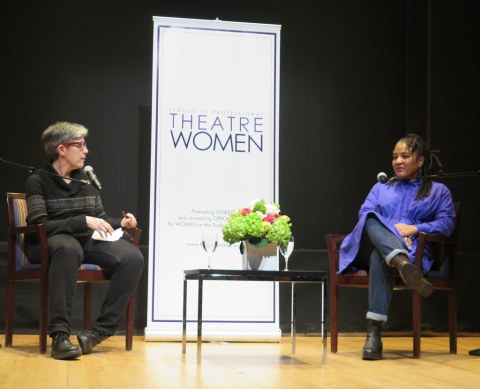
(L to R): Elisabeth Vincentelli, Lynn Nottage, NYPL for the Performing Arts and LPTW present in collaboration ‘Lynn Nottage in conversation with Elisabeth Vincentelli,’ Bruno Walter Auditorium (Carole Di Tosti)
Monday evening at the Bruno Walter Auditorium at Lincoln Center, the New York Library for the Performing Arts and The League of Professional Theatre Women presented another Oral History event celebrating renowned women in theater. Produced by Ludovia Villar-Hauser with Sophia Romma, those in attendance enjoyed Elisabeth Vincentelli’s interview of award-winning, globally renowned playwright and screenwriter Lynn Nottage. Elisabeth Vincentelli writes about the arts and theater for various publications including The New York Times, The New Yorker, The Wall Street Journal to name a few of her many writing accomplishments. She also co-hosts the “Three on the Aisle” podcast with Peter Marks (Washington Post) and Terry Teachout (Wall Street Journal) The following interview has been lightly edited. Look for Part II next week.

Ludovica Villar-Hauser, producer with Sophia Romma of ‘Lynn Nottage in conversation with Elisabeth Vincentelli,’ NYPL for the Performing Arts in collaboration with the League of Professional Theatre Women at the Bruno Walter Auditorium, Lincoln Center (Carole Di Tosti)
Elisabeth: You are the first woman to win the Pulitzer Prize twice (applause) You have such a rich career. I wanted to anchor it by having you talk about where you grew up. It was right here in New York.
Lynn: I was very fortunate to grow up in Boerum Hill, Brooklyn in the 1960s, 70s and 80s. It was a community defined by people moving through it to get to other communities. It was a very marginal neighborhood at the time. My block was dominated by boarding houses. It was very multicultural. It was a neighborhood where people who were pushed out of other neighborhoods found refuge. And as an aspiring writer, I feel like it was the best place to grow up because it was so diverse and accepting and nurturing. It was a true community. Next door to me, for example, in one of the boarding houses, there was a woman who by day wore a full Burqa, a Hijab. She was completely covered up. Her husband was a taxi driver. At night when he would leave, she would actually take it off and put on a Kaftan. That was the type of community it was.
So I think it was inevitable that I would end up as a writer having lived there. As a matter of fact on the same block, if anyone knows the novelist Jonathan Lethem, he memorialized the block in the Fortress of Solitude. And the yard in back where everyone played was the yard where I grew up. Our house was the nexus point for the block. I started my first stories when I was five-years-old. I wanted to capture things that I heard. And the aspect of the place was very rich in texture. I knew there was something very special about that moment in time and about the people who congregated in that neighborhood.

Lynn Nottage, NYPL for the Performing Arts and LPTW in collaboration present ‘Lynn Nottage in conversation with Elisabeth Vincentelli’ at Bruno Walter Auditorium, Lincoln Center (Carole Di Tosti)
Where did you go to college?
Before college, I went to the High School of Music and Art in Harlem. I was an aspiring musician. And when I got there, I discovered that I was not as good as the other aspiring musicians. (laughter) I decided to do something else. I went to Brown University as a Pre-med student with the assumption that I was going to be a doctor, not that I ever wanted to be a doctor. However, because I was very good in math and science, they decided to give me a scholarship and I got into Brown.
Even before I went to Brown I was writing plays and when I went to Brown I continued to write these little dramas that I managed to produce myself. When I was there I met two professors who were quite influential. One of them was Paula Vogel the first female playwright I had ever met. Up to then, there were only two other female playwrights that I had read. One of them was Lorraine Hansberry, the other was Ntozake Shange. At the time Lorraine Hanesberry had passed away and Ntozake Shange was not very prolific. I was under the assumption that playwriting was really a hobby for women and that it was something that I was never going to be able to make a living doing. Then I met Paula Vogel. She was the first woman who said, “You know, you can do this. And there’s strength in numbers.” There was another professor whose name was George Bass who was the executor of the Langston Hughes estate. He really taught me about the joys and the ritual of creating theater. Theater was not just about putting people on stage. But it was a place where healing could occur and where one could deal with community.
So at that point you’re still grappling with what you wanted to do.
I thought I was going to be a journalist. That summer I was working for a newspaper called The Villager. There were only four of us and we wrote the entire newspaper. For a very brief period of time I was the Arts Editor. And the only reason why I did it was because I could go to the Openings and drink wine. The Villager was located on East Fourth Street.
Did it compete with The Village Voice?
At some point it did. When I was there it did not. (audience laughter)
When did you decide to focus on writing?
I think my decision to focus on writing came when I was deciding what to do after college. I applied to Columbia Journalism School to be a journalist. And on a whim I applied to Yale School of Drama assuming I would never get in. I did. And I spent four very difficult, fraught years in Yale School of Drama where I learned how to be a playwright and then how not to be a playwright at the same time.

Lynn Nottage, NYPL for the Performing Arts and LPTW in collaboration present ‘Lynn Nottage in conversation with Elisabeth Vincentelli’ at Bruno Walter Auditorium, Lincoln Center (Carole Di Tosti)
Did you go to the theater?
Not so much, then. I went to the theater a lot when I was young. I was fortunate to grow up in New York City. At the time there were a lot of rising African American Theater Companies. There was the New Federal Theater. There was The Negro Ensemble. There was the Billie Holiday Theatre. My parents, who were great lovers of art, made sure that not every weekend, but certainly a few times a year we saw plays. So I encountered the work of Charles Fuller. I remember when I was in High School going to see Giancarlo Esposito. I was with my girlfriends and we were so excited. The performance was electric. At that time theater was affordable. We could go as teenagers.
What about the Billie Holiday Theatre?
They did a renovation and it is thriving. There are wonderful artists that are working there and they are doing representative work emphasizing being inclusive.
You mentioned that you dropped out of playwriting?
The time I was in graduate school coincided with the time that was a crucial moment in American Social History. It was the AIDS Crisis and the Crack Epidemic. So in school we were losing students, we were losing professors. It was really hard to make art in that environment. It felt like there were many more urgent things that needed to be attended to. After I graduated from Yale School of Drama, I felt that I wanted to do something with impact. I sold my computer, if you could call it that. It was sort of like a word processor, and I went to work for Amnesty International, which at the time was the largest human rights organization in the world. I was a press officer and I spent four, intense really concentrated years doing human rights work. In many ways the time I spent with Amnesty International became my second graduate school. It really shaped me not only as an artist but as a person. By the time I left, I knew exactly what I wanted to do as an artist which I didn’t know prior to that time.
Did you feel that playwriting could convey what you wanted to say?
I did. I will tell you a story. It was the moment that I decided to go back to playwriting. A woman named Donna Ferrato, who is a quite famous photographer came to our office. She’d taken these beautiful and disturbing photographs of women arriving at a battered women’s shelter. I saw these images of women who were in a moment of absolute crisis, but there was a look of relief on their faces as well. I was incredibly moved by the photographs.
During that time at Amnesty International, we were struggling with the notion that women’s rights should be separated out from human rights. The organization wasn’t doing enough to address specific human rights abuses. I saw these photographs and I knew that there was nothing that we as an organization could do. But as a human being I felt that I needed to respond to those images. So I closed my office door and I wrote a play. It was the first time I had done that in four years. The play was Poof. Poof is a short play about a woman who’s abused. She tells her husband to go to hell. He spontaneously combusts and turns into a pile of ash. (laughter) She calls her best friend on the phone and she comes down and they have a discussion about what to do with this pile of ash. Finally, they decide to sweep it under the rug. (laughter)
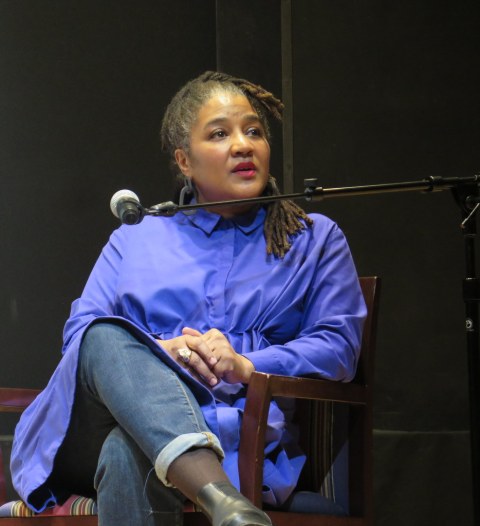
Lynn Nottage, NYPL for the Performing Arts and LPTW in collaboration present ‘Lynn Nottage in conversation with Elisabeth Vincentelli at Bruno Walter Auditorium, Lincoln Center (Carole Di Tosti)
I had returned to playwriting and it felt really good. I arrived at a total synthesis of the “human rights” brain and the “writing” brain. I thought, I can do both things. I don’t know why I have to compartmentalize. For me that was incredibly liberating.
Was Poof your first professional production?
Yes. It was my first professional production. I submitted it to it the Humana Festival. It won the Heideman Award. And Seret Scott who was a fantastic director became my first professional director and my first professional mentor who guided me through the process.
You had three plays in quick succession in the 1990s being produced around the country: Crumbs From the Table of Joy; Mud, River, Stone; and Por’Knockers. Could you speak about each?
Crumbs from the Table of Joy was my very first professional commission. It was commissioned by Second Stage which was still uptown in a 97-seat theater. The play was specifically commissioned for young audiences. I wrote this play assuming it would never get produced. They decided to do it.
It’s really interesting because it was directed by Joe Morton. People know him as “Papa Pope.” At the time he had a very robust acting career and in the middle of directing it he got a job and he was drawn away. So the previews went on for a really long time. As a result the play began to build an audience. By the time he came back, it actually was a success even before it opened. Word of mouth sold it. It starred Ella Joyce and she had just come off of a very popular series. And she used to go to the Beacon Theater which, at the time, was a venue for The Chitlin Circuit. And she would hand out flyers. She would say, “You think this is good, just walk down a few blocks.” People recognized her because she was on the series (Roc) and they followed her advice. She was really responsible for this robust audience that we had.
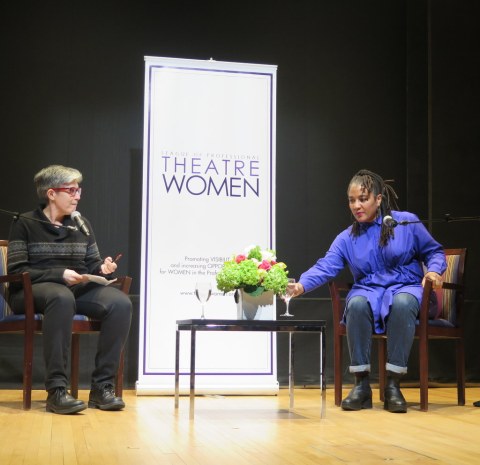
(L to R): Elisabeth Vincentelli, Lynn Nottage, NYPL for the Performing Arts and LPTW present in collaboration ‘Lynn Nottage in conversation with Elisabeth Vincentelli,’ Bruno Walter Auditorium (Carole Di Tosti)
Mud, River, Stone was commissioned by The Acting Company. We actually developed it on the road before we brought it into New York. When it came to New York, we did a short performance at Playwrights Horizons and then were invited back to do a larger production. I never felt that I finished that play. Before we went into rehearsal at Playwrights Horizons, I had my first child. I was nursing and at rehearsal. Every time she cried, I’d sneak out. The day of the first preview, my mother died. So I had all of these major life events occur during that play. As a result, I felt that I never really had the opportunity to properly tend to that play. That was my great frustration with it.
My other play which was Por’Knockers began at New York Theater Workshop. It came out of this multicultural group that I was in. We presented a short evening of plays. The Vineyard Theater came to see the play which is about a group of terrorists who blow up an FBI building and inadvertently kill some children. They have to decide over the course of the evening whether to take responsibility for their actions or not. They each get their turn to go to the phone to inform others about the explosion. Each one has to figure out what is the price they are willing to pay for their beliefs. At the end, none of them are able to make the phone call. The play was enormously successful at NY Theater Workshop. Then we did it at the Vineyard Theater. But the world had changed. Six months before we did it at the Vineyard, Oklahoma City Bombing happened. The FBI building was blown up. And the day we opened at the Vineyard Theater was the Million Man March. So the play that was a social satire suddenly became very different and much more intense. As a result people just didn’t respond to it.
Now, we’ll move on to Las Meninas which is an outlier, but every one of your plays is an outlier. That’s beautiful. I love that. Could you speak about Las Meninas
Sure. Las Meninas was actually a play that I wrote in graduate school. The play is based on a tiny slip of history that I read about. It was the relationship between Queen Maria Theresa of Spain, the wife of Louis XIV, the Sun King, and her African servant, Nabo who was a dwarf. When I read about this, I thought this is fascinating. Why don’t we know more? I ended up doing years and years of research. True story. I found a book in the New York Public Library, the main branch. I think I was the first person to ever read this book. It was written in 1710 and it was a translation of one of the memoirs written by a mistress. In this memoir the mistress detailed this relationship. I wrote a little bit about this and became an almost expert. I was getting calls from historians asking “How did you find this?” I said, “I don’t know. I’m a playwright.” Because the play is so whimsical and is a costume drama, it doesn’t get done that often. But it is one of my favorite plays because it is so delightful and it’s a true story told from the point of view of their daughter.
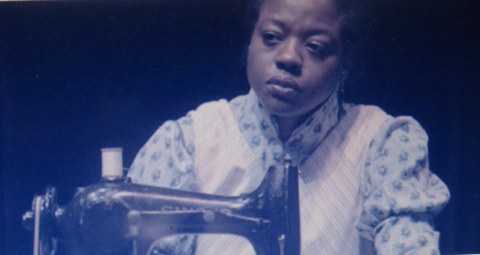
Viola Davis in ‘Intimate Apparel,’ by Lynn Nottage (courtesy of Lynn Nottage’s website)
Now we move on to a key play in your career, Intimate Apparel directed by Kate Whoriskey. Was that your first collaboration?
Yes. I describe our meeting as a theater blind date. Someone said ‘Oh you and Kate should meet.’ I remember that we met at New Dramatist, in their library which was very cold. We both talked to each other shivering. We decided to work together. I was excited to work with her. Intimate Apparel was a commission by Center Stage. And it was the first play that I had written after my mother died. My mother died of Lou Gehrig’s disease and I spent a lot of time caring for her. During that period, I didn’t have time to write. Also, I had a child. I was having to figure out, how do I make all of these pieces work. When my mother died, suddenly I became the main caregiver of my grandmother. My mother was just an only child. It was just my mother and my grandmother. My grandfather was there, but that’s a different story.
I was going through my grandmother’s things and literally, she would put photographs in the middle of magazines for some unknown reason. I found a photograph and it was the first time I had seen a photo of my great grandmother, my grandmother and her sister. And I was struck by the fact that my grandmother who had dementia, couldn’t answer questions about this woman in the photograph. I couldn’t ask my mother who was dead. And it really broke my heart. So I wanted to reconstruct her life. I went to the New York Public Library. I wanted to figure out who was this African American woman who came to New York at the turn of the century, by herself. Who was this seamstress? How did she survive? How did she make a living that enabled her to build a family and that led to me being on this stage today? So Intimate Apparel became an examination into my own ancestry.
You wrote this at the same time…you say that you work on a number of plays at the same time. While you were working on Intimate Apparel, you were working on Fabulation?
Yes, Fabulation is a social satire. I was imagining Esther who is the central character in Intimate Apparel. Esther is an African American seamstress who falls in love with a Romanian Jewish man and she’s corresponding with a Caribbean man. It’s this little love triangle. I was imagining who might Esther be one hundred years later, if she had gone through the Civil Rights Movement and the Women’s Rights Movement and felt fully empowered. So Undine of Fabulation is Esther 100-years later. Also, I wanted an outlet. Intimate Apparel was a play I wrote for my mother. I imagined what play might my mother want to see? Fabulation became my escape…the place that I went, when I didn’t want to cry.
You were working on poems at the same time, also. But how do you handle the juggling act of writing two plays at the same time?
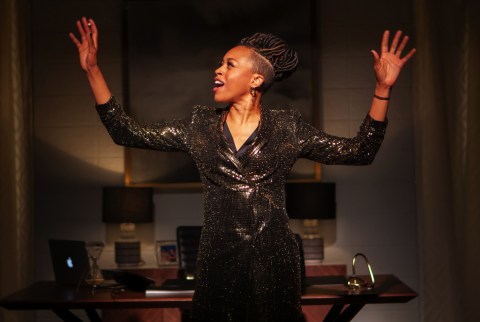
Cherise Boothe in ‘Fabulation, Or the Re-education of Undine’ by Lynn Nottage,directed by Lileana Blain-Cruz (Monique Carboni)
I have two screens. (laughter) Literally, when I would get stuck on one play, rather than step away from my computer and do something else, I can literally switch the screen and write something else. The plays are so different and use completely different muscles, I can enter in both worlds without feeling burdened by the other.
You have discussed that your plays are thoroughly researched. Then you transmogrify the information into drama.
I found in my writing process, that procrastination is a form of creative exploration. (laughter) When I’m not writing and beating up on myself, I just continue to investigate. When I was working on Sweat, for instance, I spent two-and-one-half years exploring. But I felt that I needed that time to explore. I needed that time to know my characters. Rather than to rush into writing, I felt I needed that time to know a completely different world and immerse myself. I did the same thing for Ruined. I spent three years of immersion with Ruined, going to and from East Africa trying to find a story that I wanted to tell. And I thought it was a very productive way to spend my time.
Ruined was a run-away success. It was extended numerous times. I remember one time I was seeing it with a school group in the audience, and I thought, “Oh, my God.” But they completely adored the story.
When you wrote Sweat, it was a fascinating project that you spent time researching, but you had a companion project with it.

Martha Plimpton in ‘Sweat,’ by Lynn Nottage, the Donmar Warehouse production in the UK. (courtesy of Lynn Nottage’s website)
It was a commission from the Oregon Shakespeare Festival that specifically invited playwrights to write plays about an “American Revolution.” The revolution that I wanted to write about was the Industrial Revolution in America. By the time I finished, I thought it would be history and it would be living history.
I went to Reading, PA, and spent a lot of time. I began forging these very deep, complicated relationships with people in the community. But I didn’t want to be a carpetbagger. I didn’t want to write this play that goes to Oregon, and travels to various theaters then comes to New York. I didn’t want to forget the play’s origins. I wanted to create something, a play that was still very connected to the people who were in Reading, PA and make use of these hundreds of hours of interviews that I didn’t use and didn’t filter into the play.
So after I did Sweat, the following year, I decided to build this massive performance installation that would be set in Reading, PA. We decided we wanted to re-animate the Reading Railroad that everyone knows from Monopoly. It had been abandoned since 1981. When it was closed down, it effectively shut Reading off from the rest of the country. Suddenly, people who used to get to Philadelphia in 55 minutes could no longer get there easily. They had to take a bus to Allentown and then go to Reading.
When I got to Reading, PA it was the poorest city of that size in America. When you walked around, you felt the sadness and the frustration and you felt all the things you experienced in a place that once had been an industrial powerhouse. It was literally withering on the vine. We thought, how do we revitalize this downtown area? The railroad station became symbolic. It was one of the few places that everyone had a connection to. At some point in time, everyone had passed through it.
We thought it was going to be difficult to get keys to the station. But the guy who had the keys said, ‘Yeah.” He tossed us the keys, and said “Here, just leave it in the same condition you found it.’ And we then went about building this installation that charted Reading from the moment the station closed down to the present. We wanted to create a space, like we said in our mission statement: “To create a space where a homeless person and the mayor could sit down together and recognize that they shared the same narrative,” and that they could sit side by side together. It’s not hyperbole to say that we achieved that. We didn’t get the present Mayor of Reading, PA. For various complicated reasons he was our antagonist. However, we did get two former Mayors who came and sat there and wept along with a lot of homeless folks. So it was successful and really gratifying to know that you could make theater outside of the proscenium that had resonance.
In 2017 Sweat was on Broadway. Then there was another stage in the Sweat saga with the Public Theater. (See This is Reading on Lynn Nottage’s website)
When we first produced Sweat at the Oregon Shakespeare Festival, we raised a grand to bring Sweat back to Reading, PA with the same cast. So the day we closed Sweat at the Public Theater, the next day we got up at 7:30 am and drove down to Reading and performed Sweat for 250 people in the Reading community. When we drove down there we were terrified about how the community would react to the production. However, we were overwhelmed by the response. We had a Q and A and people testified and told their stories and didn’t want to leave. We recognized that there was a real necessity for people who were going through the same predicaments as the characters in the play…for them to have an outlet for them to talk about their own struggles.
Oskar Eustis, Artistic Director of the Public Theater, was overwhelmed by the response. He said, “I’d like to do this on a larger scale.” The Public Theater has their Mobile Unit which moves around New York City, but never does that nationally. We spent a year to try and identify places to go. We decided to do a mobile tour of the Rust Belt. We selected five swing cities that first voted for Obama and then voted for Trump. We didn’t want to go to just places that were Red or Blue. We wanted to go to places where you would have a real dialogue and where you could bring people into a space where people would listen to each other. We did that in the fall of 2018. It was not just spaces, it was union halls, small colleges, we went to churches, we went to school gymnasiums. These were stripped down, bare bones productions. It was quite powerful. End of Part I
‘The Dance of Death,’ Conor McPherson’s New Version of August Strindberg’s Take on Marriage at CSC
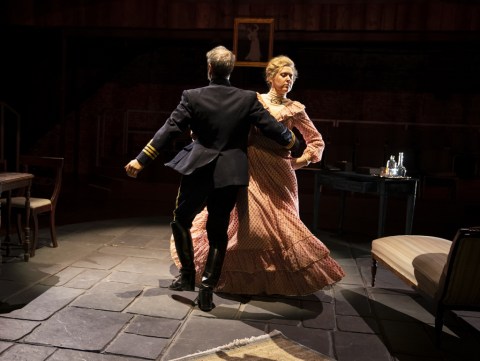
Rich Topol, Cassie Beck in ‘Dance of Death.’ by August Strindberg, Classic Stage Company, in a new version by Conor McPherson, directed by Victoria Clark (Joan Marcus)
Historically, marriage has been an economic arrangement. It will continue to be so for the upper classes who understand the necessity of securing their financial legacy for posterity. Emotions of love and caring might be a by-product, but they have been secondary considerations for the wealthy who remain keen-eyed and empirical when it comes to their fortunes. However, the middle class prompted by myth and fairy tale, believed and still believes in love and marriage, stoked by romantic films, songs and lucrative cultural artifices that reinforce the notion that marriage is an imperative for the straight as well as the LGBTQ set. Cultural consumerism pivots on romance and everything in between to culminate in the big white event. When government involvement and the legal system enforced marriage as an entrenched cultural institution with privileges and prohibitions, for good or ill, everyone was impacted and still are.
Marriage folkways and the idea that the ubiquitous institution brings comfort and joy to the bonded couple is turned humorously on its head by August Strindberg (1849-1912) in The Dance of Death. Strindberg’s play at times may be difficult to balance in its tenors between tragedy and comedy. Conor McPherson has transformed it into the most hysterical of blackest comedies about what may be for some, the bleakest of social arrangements in his new version which currently runs at CSC in an August Strindberg repertory (Mies Julie, The Dance of Death). McPherson, an award winning playwright is noted for such superb works as Shining City, The Seafarer, and most recently, Girl From the North Country.
McPherson easily leaps into and out of the precipices and crevices of irony, sarcasm and sardonic interplay in this new version. Many of McPherson’s works produce uncanny grotesques that meld fear, surprise and humor and always engage, startle and most assuredly enthrall. What he has accomplished with Strindberg’s The Dance of Death is the best of McPherson.

Rich Topol, Cassie Beck in ‘Dance of Death.’ by August Strindberg, Classic Stage Company, in a new version by Conor McPherson, directed by Victoria Clark (Joan Marcus)
In this new version the extraordinary relationship of bondage, fear, familiarity, loathing, quasi affection and sometime tolerance between Edgar (a Captain in the military) and Alice (a former stage actress) plays off Strindberg’s characterizations of the married couple. However, in McPherson’s iteration, the dialogue skips along in a rendering that is crisp and bold. The pace and clarity of the character and situation creates a dynamic that facilitates the humor and flat out comical brutality of husband Edgar (Rich Topol) as he jousts, using sword wit and hyperbole, with wife Alice (Cassie Beck) who as a formidable opponent dodges and wounds him with his every thrust.
The play takes place on an isolated island in a converted fortress that once housed condemned prisoners. The island surrounded by little other than the military regiment housing and social life related to a few high-placed neighbors. During the course of a few evenings, we discover the boundaries of this couple and what they fancy. Edgar is an unsuccessful skinflint who is barely able to perform his military duties as an older man in his 60s. As Edgar Topol reveals his incredible versatility, flexibility and vitality as he negotiates Edgar’s infirmities and attempts to dance, defying the illness that would swamp Edgar and remove all the luxuries and pleasantries of life, for example alcohol, a cigar, women. Topol’s ironic delivery is pitched for humor directed to deride and deliver underhanded insults at Alice. His performance is masterful.
Cassie Beck as Alice stomps down Edgar’s attempts with well-paced, clear, clipped delivery that is modulated for its utmost sardonic injury to Edgar’s ego. She transfers moods and graces with immediacy and vitality most producing audience laughter. Topol’s Edgar and Beck’s Alice are each other’s match and as the play progresses we note that their seething hate graduates to finer and fiercer levels as they insult, then bait and switch to more excoriating repartee. They are in earnest and desperate which makes the situation even more comical, for they are not playing for humor, they are clawing to get out of prison and wounding their jailer at every turn.
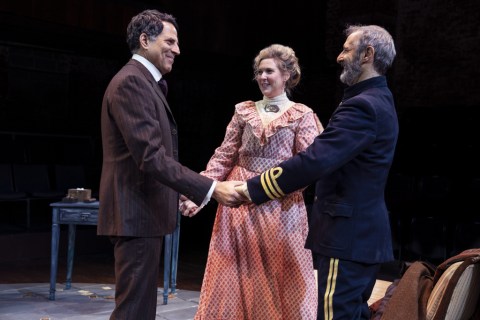
(L to R): Christopher Innvar, Cassie Beck, Rich Topol in ‘Dance of Death.’ by August Strindberg, Classic Stage Company, in a new version by Conor McPherson, directed by Victoria Clark (Joan Marcus)
With the shepherding of the incisive and able director Victoria Clark, the actors reveal their characters and display them in full. We completely understand by the end of the play that Edgar’s and Alice’s seriously humorous, witty invective has been fined-tuned over their twenty-five years of marriage into an incredible waltz that appears more like a Fandago, a courtship dance that is anything but. The irony is that we realize these two devils have somehow worked out and in a perverse and sadistic/masochistic way configured the dance steps which no one watching except for themselves revel in and enjoy.
Ah! Edgar and Alice embody the pleasures/ horrors of being married to someone they despise, yet are too embroiled in knowing familiarity to consider either killing or leaving. This indeed, as McPherson/Strindberg shoves into our laughing faces suits the marriage vows,” ’til death do them part.” The problem is that though Edgar is old, and Alice is 15 years his junior, Edgar totters between mini seizures, black-outs, obstreperous dying-ins, visions of an old woman who may or may not symbolize death that no one sees but him, and energetic dancing which he vigorously enjoys, then collapses to, yet, Edgar doesn’t die. For her part, Alice repeatedly announces in bell-like tones her wish for him to die, her relish in having him die. And that she will be thrilled if he hurries up and does it. How monstrous! How funny! How can we laugh? Well, indeed, how can we? These two maul each other with finesse which because of McPherson’s ear for language manages to be damn hysterical.

Christopher Innvar, Cassie Beck in ‘Dance of Death.’ by August Strindberg, Classic Stage Company, in a new version by Conor McPherson, directed by Victoria Clark (Joan Marcus)
When Edgar’s “friend”/Alice’s cousin Kurt (the most excellent, equally riveting Christopher Innvar) enters into the fray, he too becomes bloodied. It has been a hiatus of 15 years since he’s seen the devilish couple,. During that estrangement he obtained money but went through incredible personal trials which he weathered, the circumstance of which we learn as he is brought into their “fold.” The mysteries of affairs (Kurt’s wife was intimate with Edgar and Alice was intimate with Kurt) are not clearly drawn but they are delicious to consider as we note that the age of Edgar’s and Alice’s daughter coincides with the last time Alice saw Kurt.
The beauty of dynamically throwing Kurt into the mix is that his character remains fluid. On the one hand he must see his cousin Alice and Edgar since he will be working with him to set up a Quarantine station on the island. On the other hand, Alice paints him into the corner of rescuing her from her dire marriage. Yet, Kurt is friends with Edgar, though he has had an affair with Alice. The complications and contradictions abound with glorious humor as the characters trip over their own logic and irrationality, confound themselves and each other.
The situation is exacerbated when Alice tells Kurt that Edgar will be locked up for embezzlement as she has blown the whistle on him so that she will finally be able to free herself, divorce Edgar and be with Kurt. This is no spoiler alert. Importantly, the philosophical wisdom and underpinnings of Alice’s relationship with Edgar are revealed by the end. And we understand that perhaps even in the afterlife, these two will be scratching, slicing and impaling each other on their latest witty barbs for the love of the process and the fact that each has bestowed the good will on the other to dance in this way.
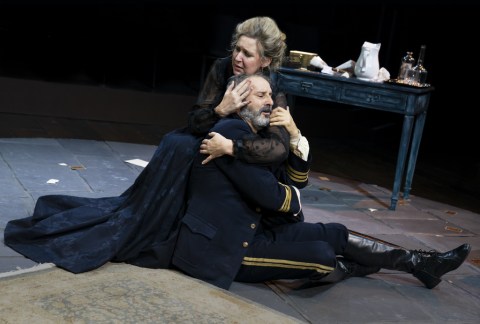
Rich Topol, Cassie Beck in ‘Dance of Death.’ by August Strindberg, Classic Stage Company, in a new version by Conor McPherson, directed by Victoria Clark (Joan Marcus)
Strindberg/McPherson’s themes are playful, trenchant, profound, socially satiric. Of course the target both playwrights hit is loveless marriage, loving marriage. Couples tend to stay in long-lived marriages for they have found the “way” to be together. Everyone’s “way” is different. If there is no “way,” there is divorce or immediate death. The notions of death in life and the chain of death being wrapped around couples that can only be severed when one or the other dies may be a dangerous one. In how many marriages over the centuries has the one spouse dispatched the other becoming the inheritor of wealth, or lands or freedom unjustly, malevolently?
Perhaps Edgar and Alice are more comforting in their outrageous, authentic and honest antics. Nothing surreptitious there. With Edgar and Alice, after each “dance of death” where they have at each other in their death matches of soul and ego wounding, there is no victor standing. The resurrection comes when they live to the next day to experience some peace and reconciliation until the next bout of rancor and explosive verbal violence. In between they can laugh and that we can laugh at them is the recognition that the human condition is so strange and tragic as to be a cosmic joke. And if at the end of the play, the end of this truly marvelous production, we can laugh and have joy, that is miraculous.
This version by McPherson incredibly directed by Clark with the measured and brilliant performances by Topol, Beck and Innvar is a complete treasure that you must see. The Dance of Death currently runs with no intermission at CSC (136 East 13th Street) until 10th March. It should be extended for its actors’ clearly expressed intentions out of which the hysterical comedy arises, for McPherson’s crackling, gobsmacking version and appreciation of the genius of Strindberg’s work, for Clark’s concise staging and direction. You can purchase tickets at the CSC website.
The Mindblasting Ethan Hawke and Paul Dano Cave to Primal Hatreds and Private Desolations in Sam Shepard’s ‘True West’

(L to R): Ethan Hawke, Paul Dano in Roundabout Theatre Company’s ‘True West,’ by Sam Shepard, directed by James Macdonald (Joan Marcus)
True West by Sam Shepard is a tour de force which easily reveals actors’ talents or their infelicities. Indeed, it may be a devastating on-stage nightmare if the actors’ skills do not resonate with a fluid “moment-to-moment” dynamic that sits precariously on the knife-edge of emotional chaos and crisis. This is especially so in Act II of Shepard’s True West which is currently in revival at the American Airlines Theatre on 42nd Street, starring the consummate Ethan Hawke and Paul Dano. Both actors rise to the pinnacle of their skills surfing their own moment-to-moment impulses in this sense-memory tearing, emotional slug-fest of a play about siblings. This is a glorious, shattering production thanks to Hawke and Dano who once more prove to be among the great actors of their generation. If Shepard is apprised of this production in another realm of consciousness, surely he is thrilled.
The arc of True West‘s development reveals Shepard’s acute examination of brothers Lee and Austin who wrangle and rage against each other to finally emerge from the emotional and familial folkways they’ve spun into their own self-fabricated prisons. The second act especially (the first act is more expositional and slower paced) screams with the taut, granular impact of subtly shifting, increasingly augmenting collisions of the mind, will and emotions of the older, social outcast and thief Lee (portrayed with dark tension, authenticity, humanity by Ethan Hawke) and the younger, ambitious, middle class Austin (the “mild-mannered” Dano seethes with fury and sub rosa angst that simmers to a boil). As these two attempt to reconnect after an estrangement, they thinly reconcile, negotiating confrontation and abrasion, while they attempt to deal with personal dissatisfaction. During their reunion, they discover that too far is never far enough to unleash the emotional convolutions, chaos and conundrums of their relationship.

(L to R): Ethan Hawke, Paul Dano in Roundabout Theatre Company’s ‘True West,’ by Sam Shepard, directed by James Macdonald (Joan Marcus)
Of course, Shepard’s searing, dark humor and sardonic irony resides in Lee’s and Austin’s attempt to achieve an inner and outer expurgation. Interestingly, they use each other’s “being” as a battering ram against themselves and their complex, twisted “brotherhood.” And as they pummel and propel themselves “forward” through the charged, electrified atmosphere between them, they disintegrate their inner soul rot and misery. By the conclusion of the play, they have reached their own TRUE WEST. This is brilliantly symbolized and effected by Jane Cox’s Lighting Design, Mimi Lien’s Set Design and Bray Poor’s Original Music and Sound Design.
In the last moments between life, death and resurrection, Lee and Austin stand on the edge of a precipice eyeballing each other with uncertain respect and caution as they assess who they are and what they have wrought together. We realize that they have sought this desert of their creation. That they, by primal impulses, destroyed and trashed everything around them including some of their mother’s prized possessions to get there, is unfathomable to us. It is incomprehensible unless we examine our own self-destructive behaviors. However, their behavior is an achievement necessary to get to who they are. At the least they’ve shed pretense. They are raw creature/creations like the the yapping coyotes that lure pets, grab them and chow down for supper. However, where these characters go from this still point remains uncertain. But the hope is that it will result in a new identity for each, away from the annihilation and alienation of the parents who raised them.
Though Shepard’s play is set in the distant past, the themes and relationship that Hawke and Dano establish is vital, energetic, heart-breaking, mind-blowing, current. Each actor has brought so much of his own grist to Lee and Austin and responds with such familiarity and raw honesty to the other, it is absolutely breathtaking. It remains impossible not to watch both and be in awe of their craft. One is utterly engaged in the suspense of where the brothers’ impulses will take them as they scrape and claw at each other’s nerve endings to create bleeding wounds.

Ethan Hawke (standing) Paul Dano in Roundabout Theatre Company’s ‘True West,’ by Sam Shepard, directed by James Macdonald (Joan Marcus)
Thanks go to James Macdonald’s direction and staging to facilitate Dano’s and Hawke’s memorable portrayals. With extraordinary performances like theirs, we are compelled to consider the characters, and determine how and why they are smashing each other’s personal boundaries to reveal inner resentments, hurts, and the chaotic forces that have swamped each of them in the most particular ways. The ties that bind them run so deep these two are oxymorons. They have identical twin souls, though they are externally antithetical. Why they clash is because they are like minded: raging, though controlled. Their emotions, like subterranean lava flows wait for the precise moment to explode and change the landscape around them. Lee is the more mature volcano; but his earthquakes create the chain reaction that stirs Austin’s. No smoke and mirrors here; just raw power.
As a perfect foil to spur the play’s development Gary Wilmes portrays Saul Kimmer, the producer hack who smarmes his way into Austin’s heart, then dumps him because he will not exact a devil’s bargain which Austin refuses to accept. Austin’s rejection of the “bargain,” enragese Lee. Wilmes is appropriately diffuse and opaque. Where does he really stand? What happened to make him turn on a dime regarding hiring Austin who has invested sweat equity and emotional integrity in a project Kimmer professed interest in? Wilmes is both authentic and the Hollywood “type,” to drive Lee and Austin against each other.
Likewise, as a foil, Marylouise Burke is LOL hysterical but frightening as their quirky mother. Her responses to their behavior are hyperbolic in the reverse and they speak volumes about how this family “functioned” in the past. She, too, helps to engine the suspense as Austin takes his power over Lee and she remains sanguine. All of the audience who are parents and especially those who have avoided the role are screaming silently in horror as the two “have at one another.” The situation and their confrontation is insane and humorous. Burke is perfect in the role as non-mediator. And Macdonald has done a magnificent job of balancing the tone and tenor of the last scene. As a result, Burke, Hawke, Dano deliver the lightening blow that helps us to realize the brothers’ intentions and the result of where they find themselves at the finale.

Ethan Hawke (standing) Paul Dano in Roundabout Theatre Company’s ‘True West,’ by Sam Shepard, directed by James Macdonald (Joan Marcus)
So much of the production resides in these incredible portrayals, of Lee and Austin’s devolution into the abyss to come to an epiphany. Caught up with that, one may overlook the artistic design. But it is so integral for it reveals the family and reflects the dynamic interactions. Superb, for example are the sound effects which augment in intensity, the frame of lights contrasting the stage into darkness for set changes, the homely, well-ordered kitchen and alcove writing area, the lovely plants and their “growth” (a field-day for symbolists), and the props. The toasting scene is just fabulous. Kudos go to Mimi Lien (Set Design) Kaye Voyce (Costume Design) Jane Cox (Lighting Design) Bray Poor (Original Music & Sound Design) Tom Watson (Hair & Wig Design) Thomas Shall (Fight Choreographer).
Sam Shepard’s play is a powerful revelation of brotherly love and hate, its design and usefulness. At the heart of our global issues resides familial relationships. To what impact on the whole is the sum of its parts? To what extent do families foment their own hatred upon themselves and the culture to exacerbate the issues? Likewise, what of families who love each other? The interplay between families and society is present but understanding it remains elusive and opaque. Shepard attempts clarity. Certainly, Lee points out that family relationships are high stakes and sometimes the warring relatives kill each other. Certainly, Austin points out that he and Lee will not kill each other over a film script. But he underestimates how far he or Lee are willing to go. How far are any of us willing to go if pushed by a relative?
Life’s uncertainty, as in the best of plays is all about surprise and not knowing what will happen in the next moments. This production of True West lives onstage because the actors are immersed in the genius of acting uncertainty that is always present. Most probably, their performance is different daily because the actors have dared to breathe out the characters whose souls they have elicited. Just W.O.W! (wild, obstreperous, wonderful)
See True West before it closes on 17 March. It runs with one intermission at the American Airlines Theatre on 42nd Street between 7th and 8th. You can get tickets at their website HERE.
‘Brunello di Montalcino 2014 Vintage is ‘Grace Under Pressure,’ Benvenuto Brunello Tasting at Tribeca 360

Brunello di Montalcino DOCG 2014, 2013, Brunello di Montalcino Tasting NYC, Tribeca 360 (Carole Di Tosti)
There are a number of lovely Tuscan wines. One of the finest I have been introduced to is the Brunello di Montalcino.

Montalcino, Tuscany, Italy, wine country. Benvenuto Brunello Wine Tasting NYC, Tribeca 360 (courtesy of the Consorzio del Vino Brunello di Montalcino)
The DOCG is produced in the area around Montalcino central Italy around 40 kilometers South of the city of Siena. The vineyards and the historic, pristine lands were declared a UNESCO World Heritage site in 2004. Montalcino is mostly one weathered mountain, really al hill, covered by oak forests from which the name Montalcino is thought to have derived.

View of the hill town Montalcino, Tuscany, Italy, wine country, Benvenuto Montalcino Wine Tasting NYC, Tribeca 360 (courtesy of Consorzio del Vino Brunello di Montalcino)
The small historic hill town is surrounded by vineyards, olive groves and seeded crops dotted with renovated stone buildings evidence of ancient cultivation. Montalicino and surrounding hamlets, Castelnuovo dell-Abate, Sant’Angelo and Torrenieri represent a quaint and glorious celebration of the past. The population totals a little over five thousand inhabitants and during the peak tourist season, the population swells. Naturally, it is a gorgeous tourist attraction year-round, but it is best in the spring, summer and fall with its typical Mediterranean climate and elevation of up to 500 metres.

Map of Central Italy, Tuscany, Montalcino (courtesy of Consorzio del Vino Brunello di Montalcino)
If you are traveling to Tuscany and specifically going to Siena, stop by Montalcino cantinas to sample the wines at the producers I mention here. If you are not traveling there, I list some of the wonderful Brunellos di Montalcinos that you may purchase online or ask your local wine store to order for you. Some information to note about Brunello di Montalcino. To achieve a DOCG the wine must be composed of 100% Sangiovese grapes. It must be aged for at least 30 months in oak barrels. However, some producers age their Brunellos longer. After the oak aging, then the wine is aged in bottles. Again, this may range with some producers between 6 months to a year. The wines age very well, and go fabulously with wild board found in the hills of Montalcino, roasts, sharp cheeses, meaty stews and rustic cooking. But if you are into making wonderful hamburgers with Japanese beef or other excellent, organic beef, then this wine would be smashing with that meat as well.

Montalcino is a UNESCO World Heritage site (courtesy del Vino Brunello di Montalcino) Benvenuto Brunello Tasting NYC
The 2014 vintage of Brunello di Montalcino was a diversion from previous years. The season was wetter than usual. The producers had to constantly monitor the harvest to prevent fungus. Some producers went to their vineyards four or five times to select the grapes that they determined had finally ripened. Copper was sprayed on the leaves repeatedly because the wetness could have spoiled the entire crop. As it was the yield was much smaller, but the elegance of the wine produced with the attention the vintners gave the harvest was particular to this year. The result is quite amazing, and the wines are ready to drink now.

View from Tribeca 360 in NYC, venue for Benvenuto Brunello Tasting (Carole Di Tosti)
From the 2014 vintage, I tasted wines in the seminar “Grace Under Pressure: the 2014 vintage of Brunello di Montalcino led by Nick Jackson and Giacomo Pondini, the new Director of the Consorzio del Vino Brunello di Montalcino. The 2014 vintage wines were from the following producers: Ridolfi, Capanna, Beatesca, La Togata and La Magia

Ridolfi Winery Brunello di Montalcino DOCG 2014 Donna Rebecca, Brunello di Montalcino Tasting NYC (Carole Di Tosti)
The Brunello di Montalcino DOCG 2014 Donna Rebecca from Ridolfi Winery was savory on the nose with soft, authentic and welcome tannins to promote a lasting finish.This powerful, earthy Brunello is drinkable with hardy breads and cheeses and meats. If has been aging for four to six years and is ready now. The Ridolfi family has been producing for many years and their lineage harkens back to Florence in 1290.

Capanna Winery Brunello di Montalcino DOCG 2014, Brunello di Montalcino Tasting NYC (Carole Di Tosti)
Their neighbor producer Capanna is in a different section of the territory, but not very far situated in the North of Montalcino. The 2014 Brunello was fruity on the nose and less earthy than the Donna Rebecca. There were elegant herbal notes and those of licorice and spice. The rounded rich fruit was sweeter on the palate with a less savory finish than the Donna Rebecca, but long structured aftertaste nevertheless. I would drink it with less sharp cheeses and with different accoutrements like nuts. And of course as with all the Brunellos, rare steak and pasta dishes with meat sauce, for example a Bolognese or wild boar sauce would be sumptuous.

Beatesca Winery (Toscana-Italia), brunello di Montalcino DOCG 2014, Brunello di Montalcino Tasting NYC (Carole Di Tosti)
The Beatesca Winery and vineyards are located in a higher elevation and nearer to Montalcino. On the nose this 2014 DOCG Brunello has sour cherry notes and florality. It is a beautifully elegant wine with plenty of structure and with detail on the palate. The wine differing from the Donna Rebecca is more about finesse than about power because of its fresh, pure taste of jam and melodic tannins. The wine has a 14.5 alcohol content by volume. Total aging as with the other Brunellos is 2 years in oak and 2 years in the bottle.

La Togata Winery, Brunello di Montalcino DOCG “La Togata” 2014, Brunello di Montalcino Tasting NYC (Carole Di Tosti)
La Togata Winery produces it 2014 Vintage DOCG Brunello by ageing it 36 months in Slavonian oak barrels and then refines the wine a minimum of 12 months in bottles. The color is a lovely intense ruby red with hints of garnet. The nose is complex and the perfumed aroma speaks of spices and fruit. This is a distinct Brunello that is detailed and has structure and power. The finish is a lasting one.

La Magia Winery, Brunello di Montalcino DOCG 2014, Brunello di Montalcino Tasting NYC (Carole Di Tosti)
Finally La Magia Winery is in the central part of Montalcino, in the highest areas in front of the Abby about 400-500 metres high. This wine is an organic vintage with no chemical products. It is very drinkable with minimum tannins. The 2014 vintage produced only 8,000 bottles out of the normal 30,000. And this was accomplished with careful selection of grapes as the vintners went into the vineyards again and again looking for the best and ripest Sangiovese. Copper had to repeatedly be sprayed on the vines to insure a coherent harvest. The power and structure of the wine are balanced and not overpowering. It is elegant, a remarkable wine that is aged for 3 years mainly in French oak barrels. Like the other Brunellos it is ruby red with garnet flourishes. On the nose there are notes of sour cherry, with spices and freshness. The finish is long lasting and pleasurable.
There were two 2013 Brunello di Montalcino vintages that we tasted which were absolutely lovely and different. The vintage was a much easier one as the weather did not feature the extreme rain of the 2014 year.

Loaker Corte Pavone Winery, Brunello di Montalcino 2013 Fiore Del Vento, Brunello Montalcino Tasting in NYC (Carole Di Tosti)
The Loacker Wine Estates have three wineries. Tenuta Corte Pavone Brunello di Montalcino DOCG 2013 Fiore Del Vento was the wine I tried from the Tenuta Corte Pavone Winnery. The ageing during the first two years follows the Brunello style in smaller then larger oak. It ages in its entirety for three years in oak. It is in the higher area of Montalcino, 450-500 metres. It is currently drinkable and will age nicely for a few decades. It is aromatic on the nose with lovely perfumed finesse. Its expression is authentic with purity and is harmonious and well balanced with no overpowering tannins at the finish.
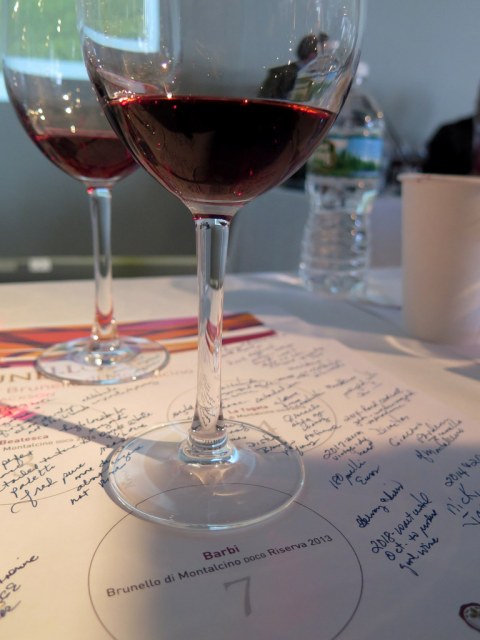
Fattoria dei Barbi Brunello di Montalcino Riserva DOCG 2013
The Barbi Winery boasts vineyards and a Taverna/Restaurant with lovely food. I tasted the Brunello di Montalcino DOCG Riserva 2013 which was wonderful. This is a modern expression of an ancient wine whose family has had a vineyard and wine estate for centuries. In the South East part of the Montalcino area, the soil is sandy and the area with remnants of fossils was under the sea eons ago. But the soil yields a lovely, classic wine that is contemporary. The nose is aromatic and pleasant. It is elegant and vibrant with a depth and structure that goes well with sharp cheeses, pastas and meats. If you check the pictures of the Taverna, you will see what goes best with the Brunellos offered. It is a deep ruby red with garnet tones, a lovely, drinkable wine.

The wines of Montalcino, Tuscany, Italy (Carole Di Tosti)
Tuscany, Italy was written about extensively by Frances Mayes who turned her Tuscan memoir and house renovation to a small business empire where she sells oil made from her trees, as an example. Another view of Tuscany is in the Brunello di Montalcinos. This wine is elegant, yet a throwback to the past. It is contemporary, yet has finesse. It is a competitor to the Vino Nobile di Montepulciano in the hill town of Montepulciano on the other side of Montalcino. Regardless, both are my favorites because of the Sangiovese grape which my father always talked about when he tried to make wine, but had to send to California for grapes, and truly, they weren’t very good then (1950s). Things have changed, of course. But now since it is easy to go online and have the wines shipped to your door, why make inferior wine? Don’t forget to order the Brunello or ask for it in your local wine store. Chin chin, happy drinking!
‘A Man For All Seasons’ by Robert Bolt, A Sterling Production at The Acorn Theatre, NYC

(L to R): Carolyn McCormick, Michael Countryman, Kim Wong, Fellowship for Performing Arts Production of ‘A Man for All Seasons’ (Jeremy Daniel)
A Man for All Seasons by Robert Bolt currently at The Acorn Theatre until 3 March is an exceptional play about the value of one’s life and the hope of death when that value is removed. In the final decision to live a life of worth or die if one cannot, lies the honor of realizing one’s life has true purpose. The production by the Fellowship for Performing Arts promotes a superb iteration of Bolt’s work which posits interesting themes about self-worth, the rule of law, political cravenness and acts of conscience.
These heady themes are uplifted in this revival of Bolt’s work which examines Sir Thomas More’s conflict with King Henry VIII over the King’s divorce of Catherine of Aragon and marriage to Anne Boleyn. More chose to follow his conscience and not the King’s feverish obsession to gain a male heir by putting away the barren Queen Catherine. When he took a stand that King Henry VIII interpreted as being against him, More knew the grave risks. Yet he held firm in his beliefs, maintaining his purpose and meaning for himself, an action which was used against him to advantage his enemies. Rather than to change his stance and support all the other powerful men who sided with the King, More followed his own conscience, martyring himself. He preferred to be in the afterlife with God, than in a physical existence among men abiding in lies and treason to his soul, a death far greater than any delivered by the executioner’s blow to his neck.
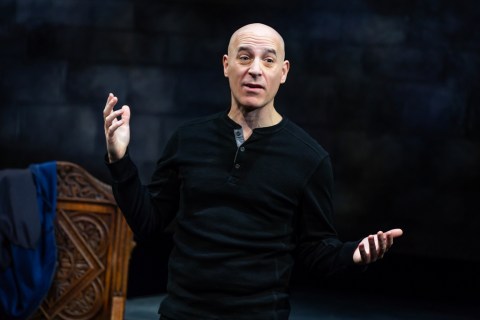
Harry Bouvy, Fellowship for Performing Arts Production of ‘A Man for All Seasons,’ Acorn Theatre (Jeremy Daniel)
Bolt examines the strength required to abide in the grace of righteous beliefs even if it means dying for it, rather than follow the crowd to stay alive. The playwrite’s brilliant work written in the sixties seems especially trenchant in our times when lying to protect one’s physical life is no longer an art, but a gross and craven reality show in politics. This fine production of A Man for All Seasons seems more resonant than ever.
Bolt most probably took title which originated from an Oxford scholar Robert Whittington who in 1520 wrote, “More is a man of an angel’s wit and singular learning. I know not his fellow. For where is the man of that gentleness, lowliness and affability? And, as time requireth, a man of marvelous mirth and pastimes, and sometime of as sad gravity. A man for all seasons.” Perhaps Whittington may have been inspired by the Biblical scripture, 2 Timothy 4:2 (NKJV) “Preach the word! Be ready in season and out of season. Convince, rebuke, exhort, with all longsuffering and teaching.”

Photograph of the playbill, of Fellowship for Performing Arts, ‘A Man for All Seasons’, directed by Christa Scott-Reed, starring Michael Countryman, David McElwee, John Ahlin, Todd Cerveris, Harry Bouvy, Carolyn McCormick, Kim Wong, Kevyn Morrow, Trent Dawson, Sean Dugan.
Bolt’s characterization of Sir Thomas More (Michael Countryman maintains a sensitive and thoughtful portrayal throughout) reflects the scripture and Whittington’s commentary. In Countryman’s rendering of More’s traits and interactions with his family, the King and Richard Rich, his foil and enemy, we understand the greatness of More’s mind and character.
Countryman also relays a profound appreciation of More’s humor and social affability. As Countryman presents More’s humility with the King (the effervescent and proud Trent Dawson), even though he disagrees with him we understand More’s sorrow at displeasing a man he loves. We also see the King’s sorrow that More is on a collusion course with the King’s soul. One of them will lose, the other will gain, and at that momentous juncture when the King visits More’s household, the actors and able direction reveal that there is no turning back for either man. It is an excellently rendered moment in the production, one of many that Director Christa Scott-Reed interprets and guides the actors to elicit.
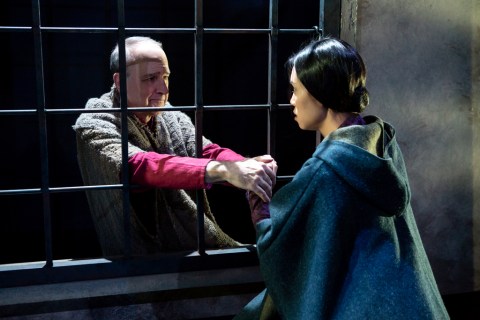
Mihael Countryman, Kim Wong, ‘A Man for All Seasons,’ Acorn Theatre (Jeremy Daniel)
Countryman, David McElswee as Richard Rich, Carolyn McCormick as Lady Alice More, Todd Cerveris as Thomas Cromwell Kim Wong as Meg are the principals who help establish the solid foundation upon which Bolt’s More rests. In various crucial scenes, the actors’ interplay heightens the stakes and pronounces the conundrum that More faces if he chooses conscience over king and loses everything he holds dear in the earthly realm to achieve a finer estate in the heavenly one.
In one particular example, the tension the cast creates when Meg, Lady Alice and Roper (Sean Dugan) tell More to have the pernicious Richard Rich arrested for being evil, we watch amazed as Countryman’s More defends McElwee’s Rich and upholds the law as paramount. Because of their acute sensitivity and the apt direction we understand how More is refining his position on the law to protect his own soul and, as Bolt perhaps wishes, we empathize and put ourselves in More’s shoes. Would we have the strength of character to follow the right and true dictates of our souls? Or would we as his family suggests he do use the law against others injudiciously and damn ourselves? Is such an action to uphold what is most precious important to us? Should it be? Bolt asks these intriguing questions and answers them by highlighting More’s difficult choices.
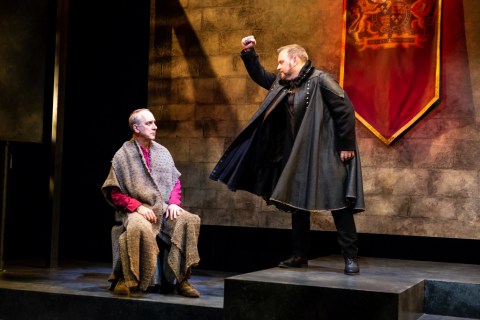
(L to R): Michael Countryman, Todd Cerveris, Fellowship for Performing Arts Production, ‘A Man for All Seasons,’ (Jeremy Daniel)
By the end of the play, McElwee’s Rich has become totally corrupted, rewarded for his betrayal of More by selling his soul for Wales. McElwee’s development from young man teetering on the brink of wickedness to world-hardened, wicked maturity having easily sold out a man he once greatly admired is well delivered. Both actors elicit the contrast between More and Rich beautifully. Rich achieves worldly power climbing from a lowly state upward and More moves in the opposite direction. But only More makes it to glory. Though Richard Rich dies peacefully in his bed unperturbed, unmolested by sending More to his beheading, More down through the centuries is venerated for his courage. He was canonized by the Church in 1935 and in 2000 Pope John Paul II named him “heavenly patron of statesmen and politicians.”
Countryman’s steadfast More, assisted by the ensemble’s excellence becomes especially powerful in the trial scene when More confronts his accusers, McElwee’s Rich, Cerveris’ Cromwell, Archbishop Cranmer (Sean Dugan), his former dear friend The Duke of Norfolk (Kevyn Morrow) and the executioner who also plays The Common Man (Harry Bouvy). Presented with the lies that Rich has told about him, More answers vehemently for his innocence and affirms that his silence about the oath taking is acquiescence under the law which they have misinterpreted because they do not know the law. The scene especially enthralls for we know that as More counters Rich’ lies, the blade will fall. He is as he says, “a dead man.”

(L to R): Todd Cerveris, David McElwee, Fellowship for Performing Arts Production of ‘A Man fro All Seasons,’ Acorn Theatre (Jeremy Daniel)
Countryman’s More is poignant as he maintains his domination and will when someone questions his surety that he will go to heaven. More’s reply is without fear or doubt, “God will not reject one so cheerful to go to Him.” We believe then that what More has suffered has a higher purpose. Indeed, Countryman’s portrayal of More uplifts with hope and inspires as Bolt most probably intended.
Bolt’s play is given a very fine rendering by The Fellowship for Performing Arts. The ensemble, shepherded by director Christa Scott-Reed depict Bolt’s characters with authenticity and engage us throughout. Countryman’s More comes off as a human saint. How Bolt shapes More’s development rising to glory as the king’s Lord High Chancellor and devolving to infamy as a traitor to kingdom and crown is the genius of the drama. The characterizations of More, his long suffering wife Lady Alice (Carolyn McCormick) and daughter Meg (Kim Wong) are superb and perhaps strongest in the prison scene when they see each other for the last time. As contrasts to the enlightened and saintly More, Richard Rich (McElwee) The Duke of Norfolk (Kevyn Morrow) and Thomas Cromwell (Todd Cerveris) reveal an edgy hardness as the play reaches its conclusion and More is condemned for treason. John Ahlin is exceptional as Cardinal Wolsey and Signor Chapuys. The latter attempts to wrangle with More about supporting Catherine of Aragon’s Queenly fate in Henry’s Kindgom.
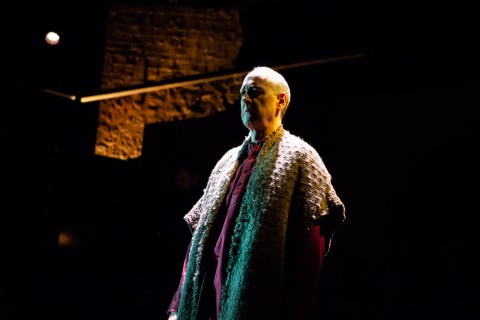
Michael Countryman, Fellowship for Performing Arts Production, ‘A Man for All Seasons,’ Acorn Theatre (Jeremy Daniel)
The character of The Common Man (excellently played by Harry Bouvy) is absent in some productions of A Man for All Seasons. Bouvy’s portrayal of the lowly roles (Matthew-More’s servant, the executioner, etc.) is one we identify with readily. His pronouncement of the earthly ends of More’s enemies Cranmer, Cromwell, The Duke of Norfolk is ironic. His sardonic humor at relating where Richard Rich ends up for sending a good man to his death is the exclamation point of Bolt’s work. But upon further research (More’s standing in the UK and with the Church as a saint), we note that Sir Thomas More comes off as a hero. On the other hand Richard Rich (hyperbolic name, indeed) comes off as the craven, mendacious coward. One of the strengths of the play and of this production is in the comparison between Rich and Moore. Indeed, Bolt uses Rich as a foil to burnish More’s greatness.
In this social climate of up is down black is white, there are many in power who behave as Richard Rich using clever manipulation, lying and amorality to achieve their desires. Bolt, a professed agnostic, leaves the final judgment about such individuals up to God. In the last analysis without a Richard Rich, would More have been so glorified?
Of late Hillary Mantel’s Wolf Hall downplays Bolt’s perspectives about More. She establishes the more vilifying and intriguing points about his religious beliefs. In uplifting Catholicism against Lutheran Protestantism which was spreading at the time of the play set in England between 1526-1535, Mantel emphasizes that More employed torture. Additionally, to force heretics to recant their beliefs in Protestantism, he believed in burning heretics who refused to recant. Others have been critical of More. For example, James Wood in his book The Broken Estate, refers to him as “cruel in punishment, evasive in argument, lusty for power, and repressive in politics.”
With controversial individuals like More, the jury is still out. However, with this production, the verdict is a resounding bravo. I especially enjoyed the John Gromada’s selection of music as Composer/Sound Design, and the staging and artistic of the production in its integration of the Scenic Design (Steven C. Kemp), Costume Design (Theresa Squire) and Lighting Design (Aaron Porter).
Man for All Seasons runs with one intermission at the Acorn Theatre (42nd Street between 8th and 9th) and is extended until 3 March. You can purchase tickets to see this fine production of Bolt’s great play at their website by CLICKING HERE.
‘The Cher Show’, a Joyous Celebration of The Power of Hope and Persistence

Stephanie J. Block as Star and the cast of ‘The Cher Show,’ (Joan Marcus)
Did you ever think you “knew” all you wanted to know about someone only to find out wonderous inspirations about them? No, I am not referring to our current president in the White House. I am referring to a feminine icon who has established herself as a tour de force for women through six decades, blowing past generational limitations and showing the way to “become” before Becoming (Michelle Obama’s glorious best-seller) was fashionable. Well, Cher, the Pop Goddess Warrior I never quite “got” is a superlative example of how no woman should allow anyone to tell her “it can’t be done!” It can be done! Regardless of how much the words are repeated, it is felt experience which sparks these words to life.. And it is the essence of this felt experience of overcoming that makes The Cher Show a celebration of women’s ability to thrive despite men telling them they cannot!

Stephanie J. Block as Star in ‘The Cher Show,’ Book by Rick Elice, Music Supervision by Daryl Waters, Directed by Jason Moore (Joan Marcus)
The musical hybrid (partial rock/pop concert, theatrical bio, cultural chronicle) sports a comprehensive book by Rick Elice and superb Music Supervision, Orchestrations and Arrangements by Daryl Waters. The must-see production is a mind blowing, entertainment ride down memory lane for the older crowd, and an earth shattering, eye-popping celebration of feminism (3rd and fourth wave) for the younger crowd.
Predominately, the production evidences how women (yes, there is only one Cher, but jump on the inspiration train, “bitches”) can rock it, take their power and express it with individuality, beauty and sometimes “foul-mouthed” grace. Especially now with the government shutdown standoff, the production is what we need to strengthen our comprehension of how women climb mountains though others attempt to pull them away from the top echelons of power (go Nancy Pelosi, Democratic Speaker of the House in 2019).

Jarrod Spector as Sonny Bono, Teal Wicks as Lady in ‘The Cher Show,’ directed by Jason Moore, Book by Rick Elie, Music Supervision, Orchestrations & Arrangements by Daryl Waters (Joan Marcus)
The Cher Show slam-bangs cultural fashions through the decades with spectacular Costume Design by Bob Mackie (portrayed by Michael Berresse). And it also pings the most meaningful signature songs of Cher’s life starting relevantly with “If I Could Turn Back Time” with the mature Cher (Stephanie J. Block) singing us back into the past to reveal her story through song.
Some songs are effected with striking dance numbers (“Dark Lady” is exceptional with Choreography by Christopher Gattelli) and staging. Actually, all of the songs really pop thanks to Daryl Waters, Jason Moore and the ensemble. There is the thrum and whirl of shimmering beauty as Bob Mackie’s gorgeous costumes, Lighting Design (Kevin Adams), Set Design (Christine Jones and Brett J. Banakis) and the song and dance numbers uplift and rouse. Guaranteed, the staging, light show, musical arrangements, legendary Cher characterizations will rock you to the point that you will be keeping the beat with your feet, though your body’s in your seat, just barely! By the end you will be standing.
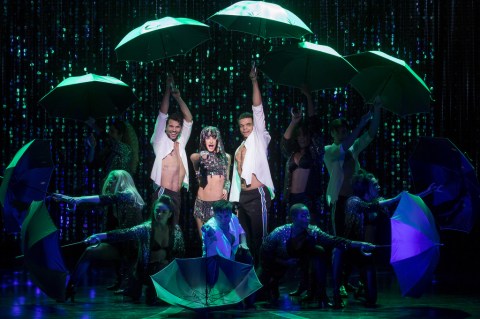
Micaela Diamond and cast in ‘The Cher Show,’ book by Rick Elie, Music Supervision Daryl Waters, directed by Jason Moore (Joan Marcus)
The show re-imagines the essence of Cher’s career highlighting critical moments in her life. The approach to understanding Cher’s development arc, is well fashioned by Rick Elice’s book. And it is reinforced by Billboard scoring the songs Cher hit recorded through six decades of Billboard charts. Aptly shepherded by director Jason Moore, The Cher Show relates Cher’s story in Cher’s grand, elliptical style through flashback and emotional flash-forward. The action is fast paced, not only covering an equivalent of three lifetimes but probing richly into what makes Cher “Cher,” if one is prepared to see it. Women will most probably note the emotional resonances more strongly than men.
Through brief, coherent snippets, Star unifies the show and directs the action. The excellent Stephanie J. Block portrays the mature Cher who speaks from a perspective of wisdom as she gives sage advice. Block whose voice is perhaps most like Cher’s, sings many of the sensitive, powerful songs in the Cher repertoire (i.e. “Believe”). Star introduces her younger selves Lady (the wise-cracking divorcee) and Babe (the sweet child and teenage songstress who meets Sonny) portrayed by Teal Wicks and Micaela Diamond. Each derivative of Cher is one element of a dynamic triumvirate that ushers in the whole portrait we need to understand the musical life and background of the legendary Diva. Together they establish the ethos of the performer as person and vice-versa. All three are vocal powerhouses. They reflect mannerisms, voice timber, comedic delivery, singing expressions and more as an echo of Cher, and not an impersonation.
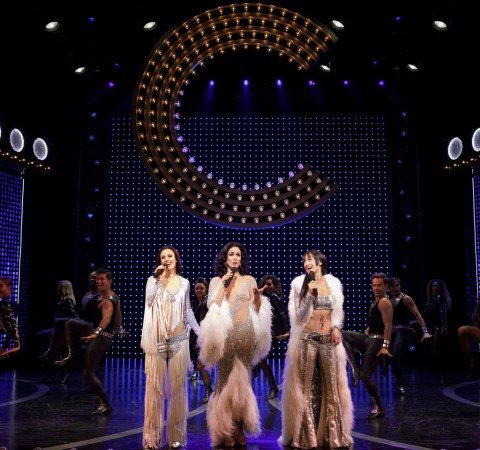
(L to R): Teal Wicks, Stephanie J. Block, Micaela Diamond, ‘The Cher Show,’ Book by Rick Elice, directed by Jason Moore, Music Supervision, Daryl Waters (Joan Marcus)
In her discussions with her mom Georgia Holt (a beautiful job by Emily Skinner) we learn of her early suffering and how music helped her overcome. By degrees, we discover she had dyslexia which made her shy and isolated her at school as bullies teased her about her being stupid and her “weirdness” being an Armenian. Interchanges which occur throughout various turning points in each decade reveal how her mother was her pillar of strength to guide her until Cher stood on her own in her career. Skinner’s mom poignantly and humorously encourages her daughter to overcome through her singing. Cher affirms her mother’s importance in her life especially after her step-father leaves. Apparently, she never knew her father.
Interestingly, Sonny Bono is perhaps a father figure, at first, who helps her grow up until she realizes her complete dependence on him must change. Thus, the production moves to the when and where of the duo who became Sonny and Cher and the evolution of some of Sonny and Cher’s greatest hits (for example “Baby Don’t Go,” “I Got You Babe,”). Sonny’s friendly, vibrant personality (gorgeously voiced Jarrod Spector gives a nuanced, charismatic portrayal) devolves under the pressure of ambition and fear. When Sonny caves to greed and Napoleonic impulses which hamper their relationship, Cher discovers Sonny completely controls their financial arrangements. A victim of the male chauvinism of the time, Cher conquers her fears of being on her own and goes solo, a first step in her confrontation with the male dominated recording industry and glass ceiling barring her own vision of herself as an entrepreneur.
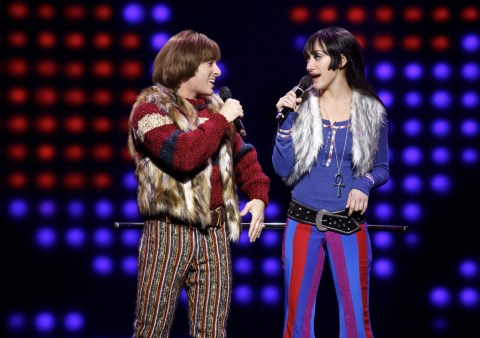
Jarrod Spector, Micaela Diamond, ‘The Cher Show,’ Book by Rick Elice, Music Supervision Daryl Waters, directed by Jason Moore (Joan Marcus)
As a central point of Cher’s “becoming,” this segment of the production delves into the honesty and authenticity of the peaks and valleys of her relationship with Sonny, their money woes and excesses, and their emotional, psychological and personality differences that manifested during the making of The Sonny and Cher Comedy Hour and after their divorce when they got back together, with the Sonny and Cher Show. The latter featured Cher’s new lover and eventual husband for a time, Greg Allman (Matthew Hydzik). Cher always remained friendly with Sonny because of their daughter Chastity. And indeed, though the reference is humorous, the production covers Sonny’s passing. Stephanie Block’s Cher intimates her love for him has a measure of forever in it, as she delivers her memorial speech at his funneral which is poignant.
After Cher determines to continue her solo career, she in effect jettisons relationships with famous singers and focuses on herself (“men are a luxury, like dessert.”) However, as this musical highlights the turning points in her life, we note her new iterations of her image and show business persona. She moves upward expanding her levels of success. Some of these activities include her accomplishments on Broadway, in film and on concert tours. Throughout, we understand how her love relationships fueled her artistic and creative powers. And this is so even after the love appears to be gone. For life goes on.

‘The Cher Show,’ the cast, Book by Rick Elice, directed by Jason Moore, Music Supervision by Daryl Waters (Joan Marcus)
The musical works on a number of levels. One can merely sit back and enjoy the dazzling spectacle and resplendent sensory stimulation. One can also appreciate the more profound and clarifying moments which reveal how this woman dealt with problems, love, sadness, heart-break, financial valleys (Cher sold hair products on TV at one point) show business/celebrity horrors and her sickness (her Adrenal Glands weren’t working). In short the emotionalism of life’s torques and jarring shatterings that we all must confront, work through, learn from to enrich our souls, Cher experiences and uses for her evolving artistry. The musical numbers especially, reflect the highs and the lows, the career successes and comebacks. And floating off in the narrative slips Star, Lady and Babe. Together they reveal the loneliness, fear and upsets, they must confront with each other as pals. It works for me. How can an autonomous woman not give good counsel to herself after a few marriages, divorces, children, career upsets, etc.?
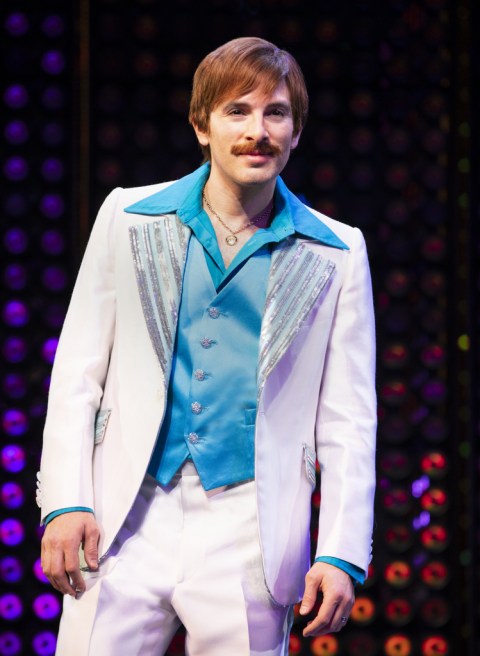
Jarrod Spector in ‘The Cher Show,’ directed by Jason Moore, Music by Daryl Waters, Book by Rick Elice ((Joan Marcus)
The songs represent Cher’s inner and outer life. Indeed, The Cher Show reflects that her singing helped to sustain her and take her to the next level in her career. And it is that which has made her legendary. She has topped Billboard Charts for six decades and garnered over 200 awards. The only one that has escaped her thus far is the Tony which she may win as one of the producers of The Cher Show. That would mean she has won an Emmy, a Grammy a Tony and an Oscar (EGOT), the grand slam of show business awards.
The irony is that as she evolves, as the production intimates, she must confront herself as a fantastical maverick icon of celebrity, who enforces her own kind of elusive magical realism. This makes for great copy, but it also moderates the chance for love and relationships. Block’s Star best establishes the emotionalism of this realization as she thrillingly sings “Believe.”

(L to R):Matthew Hydzik, Emily Skinner, Jarrod Spector, Micaela Diamond, Stephanie J. Block, Teal Wicks, Michael Berresse, Michael Campayno in ‘The Cher Show’ (Joan Marcus)
To its credit the production uncovers what lies underneath the fun, glamor, fashionable trend-setting songstress who became an actress, producer, author and philanthropist. Thus, in its strongest moments we see the peeling back of the layers to the raw core of Cher’s angst, depression and fear that happens whenever she comes to a crossroads. In the musical are the seeds of why Cher is alone but not lonely. She has discovered that she must be her own person away from Sonny and Greg Allman and Rob Camilletti (Michael Campayno). It is in the moments of misery, financial distress, heart break that we most empathize with Cher. And it is after these moments that she lifts herself up from the abyss and soars to inspire us once more and take us with her to another level.
The mythic humanity and pathos reflected in the music especially is what makes this a rich, nuanced show. But be careful. You may be caught up experiencing all the glittering excess, that you will miss the layers. How is it possible that we are seeing an older woman defy Hollywood age barriers, gender strictures and male domination issues? This show stomps down these overarching mores. It reveals Cher’s “belief,” and sheer force of will that she demonstrates in spades. This is especially so in the number “The Beat Goes On” which Micaela Diamond sings. The song symbolizes the beats of will, synchronized to destiny that brought Cher to accomplish the unthinkable in film. As as an “older” woman she won an Oscar and Golden Globes variously for Moonstruck, Mask and Silkwood. Ultimately, Cher learns autonomy is best and moves to her own beat which she drums out for herself again, and again, despite whichever love relationship she is in.
The Cher Show is breaking records of human happiness for both men and women at the Neil Simon Theatre on 52nd Street. It captures the essence of who Cher is, and who she always was and will be, a magical, one-of-a kind, self-defining woman.
Kudos (I loved the Hair & Wig Design by Charles G. LaPointe) to all who have made this a must-see production which runs with one intermission. For tickets you can go to the website, CLICK HERE.
Manhattan Theatre Club’s ‘Choir Boy’ by Tarell Alvin McCraney, Directed by Trip Cullman

(L to R): Niholas L. Ashe, J. Quinton Johnson, Jeremy Pope, Caleb Eberhardt, John lay III in ‘Choir Boy,’ by Tarell Alvin McCraney, directed by Trip Cullman (Michael Murphy)
Choir Boy written by Tarell Alvin McCraney, superbly directed by Trip Cullman is a tour de force that thrills with its beauty and grace and grieves with its recognition that a fine education may advance one in the world, but it doesn’t answer the longing in one’s heart for individual love and acceptance. And so it goes for Pharus Jonathan Young a super achiever who places all his investment in his golden voice and ambitious pride to excel and be someone despite the abuse he receives at the hands of the adult male black community in his hometown and the teenage black students at The Charles R. Drew Preparatory School for Boys. Drew, as it’s affectionately known, is an elite, religious, black, male prep school which shapes black men to be accepted into Ivy League Schools and shepherds them toward sterling behavior to succeed in their careers and in life. The question is, as always in Prep Schools. Are the sub rosa mores being transmitted a benefit or a nullification?
Choir Boy opens with the 49th Commencement for Charles R. Drew Prep’s graduating seniors. The gorgeous voice of Pharus Jonathan Young (Jeremy Pope in a vibrant, nuanced and fierce portrayal) rings out into the auditorium as he leads the choir in a song about “Trusting and Obeying Jesus” as the only way to happiness. The irony of the song and what occurs during the singing is reflective of the play’s underlying themes. It also is the linchpin upon which rests much of the action to follow.
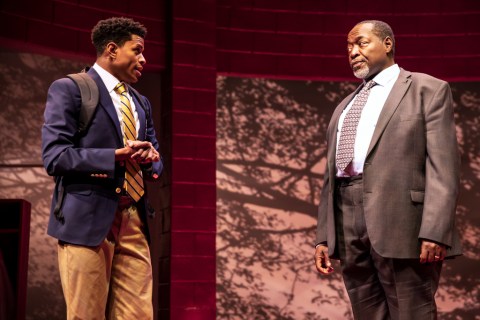
(L to R): Jeremy Pope, Chuck Cooper in ‘Choir Boy,’ directed by Trip Cullman, Manhattan Theatre Club (Michael Murphy)
What the staff, family and friends of the graduating seniors do not hear are the whispered insults and defamations by Bobby Marrow one of the choir members who clearly disdains and despises Pharus. Upset, distracted, Pharus stops singing and turns around to confront Bobby in a stare down. Bobby who achieves what he wants, to upset and deflect Pharus from his concentration, silences his whisperings. These opening salvos of raw animosity and tension between Bobby (J Quinton Johnson’s aggressions and rage are sustained throughout) and Pharus reveal the conflict which McCraney intensifies and escalates in this thrilling production that is currently at the Manhattan Theatre Club’s Samuel J. Friedman Theatre.
After the ceremony, Headmaster Marrow (Chuck Cooper employs his adroit acting skills with moment-to-moment precision) reprimands Pharus for stopping in mid-song, however, Pharus cleverly responds and we understand that he will not be cowed and will maintain his dignity and honor. Though Marrow presses him to explain, Pharus who has been voted as Choir Lead because of his hard work and golden voice evokes the “behavior of a “Drew man.” He tells Headmaster Marrow (the name is more than ironic), “A Drew man doesn’t tell on his brother. He allows him the honor of confessing himself.” The conflict is clearly expressed, and we understand Pharus is proud of being elected to head the choir which school-wide is considered an honor. However, we wonder why Bobby has chosen to slur Pharus’ sexuality and use the “N” word to demean him. Is this mere jealousy? Or has Pharus provoked him?
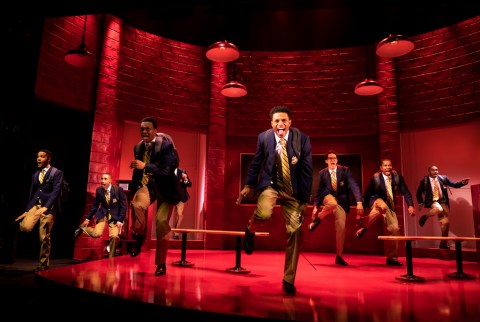
(L to ): Nicholas L. Ashe, Jonathan Burke, J. Quinton Johnson, Jeremy Pope, Caleb Eberhardt, John Clay III, Gerald Caesar in ‘Choir Boy,’ Manhattan Theatre Club (Michael Murphy)
Thus, from the outset, McCraney and the fine direction and staging of the opening scenes by Trip Cullman have engaged us. From this point on we are intrigued to learn about these two individuals and discover whether they will resolve their differences by themselves or with the help of the Headmaster and their friends in the choir.
McCraney’s play is a hybrid (musical, comedy, drama). It is not easily defined or pigeonholed and this is just one of its astounding brilliances. For at crucial junctures in the arc of the plot development, the boys’ chorus breaks into shimmering songs during various practice sessions. And there are dance and rhythmic numbers that relate to the themes. Additionally, humor abides throughout. Yet, there is pathos. In short all the emotional peaks and valleys in life are pinged and resonate with truthfulness.
McCraney’s characterizations are right-on. The leads are distinct individuals; they are finely drawn and by the conclusion of the play we note their development. In an irony reminiscent of our current divisive culture, the young men align either with Pharus or Bobby and the behind-the-scenes dynamic of support and friendship escalates the conflict between the two adversaries throughout. the action.

The cast of ‘Choir Boy’ on Broadway (Michael Murphy)
Additionally, McCraney reveals how the characters negotiate the mores of Drew with lip service and sometime sincerity. Intrigue and surreptitiousness are necessary to get along. And it is the intrigue that crashes into the barricade of Drew “do’s and don’ts” that the characters cannot help but contravene. Thus, they bloody themselves. As a result the explosive scenes bring this incredible social and cultural expose of a black young men’s prep school into the same territory as any white male prep school. Though Drew has a religious fundamental base, the rages, the conflicts, the loves defy class, color, economics. The human heart and human nature unfortunately run true to form. Overcoming evil intent is hard won everywhere. How the protagonist Pharus manages to triumph despite his own self-destructive impulses and need to “be Pharus” is the crux of the play.
The themes relating to division, separation, isolation and, remaining proud and courageous when others attempt to destroy you, McCraney explores with these individuals using humor, song, dance. The plot twists startle. The play’s dynamic is well constructed. From the initial conflict, Bobby, Pharus and their friends and foes are sent spinning until they reach their destinations.
Importantly, from the outset, we understand that the stakes for Pharus and a few other non-legacy young men are very high. Non-legacy men have advanced to Drew by merit based upon their efforts and skills. Pharus has worked very hard to receive a scholarship which he must maintain to take the shot he’s been given or fall by the wayside like other young black men. Thus, in his discussion with Headmaster Marrow, we learn that for Pharus, his newly appointed position as Choir Lead means everything to him. But would he risk that for something even more important?

(L to R): Jeremy Pope,Caleb Eberhardt, ‘Choir Boy,’ Manhattan Theatre Club, Broadway (Michael Murphy)
On the other hand, legacy men like Bobby don’t have Pharus’ worries. Additionally, Bobby enjoys the favor of his uncle’s being the Headmaster. As the arc of development moves toward its climax, we note that Bobby is hell-bent on unseating Pharus and taking the honor for himself. Who will win, who will lose? Clarity of conflict and the high stakes are the genius of this production along with the sensational choral work, the dancing, sensitive acting and the extraordinary meld of the ensemble, all of which makes Choir Boy a uniquely enthralling work..
During the course of the production, we discover the dynamic interplay of the young men who are part of the chorus that Pharus has been chosen to lead because of his academic excellence and golden voice. All who have lead roles are just terrific. Junior Davis, foil of Johnson’s Bobby, nearly stops the show with his hysterical dancing to impress Mr. Pendleton (Austin Pendleton, is humorously grand. Yet he’s expressively and authentically emotional when he reacts to Bobby’s use of the “N” word. It’s a hallowed, stirring moment.) Caleb Eberhardt’s David Heard is sensitive and solid in his portrayal. The sadness he evokes as he walks away from the school is an injustice we take to heart. As Pharus’ roommate and friend Anthony Justin ‘AJ’ James, John Clay III is superb. His comedic timing is spot on and his poignance and humanity is what is needed to help Pharus deal with the acute pain of life-long devastation he is trying to work through.
The production would not be as superb as it is without the following creative artists’ efforts. Special and heartfelt kudos to Jason Michael Webb (Music Direction, Arrangements & Original Music) David Zinn (Scenic & Costume Design), Peter Kaczorowski (Lighting Design) Fitz Patton (Original Music & Sound Design) Cookie Jordan (Hair & Makeup Design) Thomas Schall (Fight Direction) Camille A. Brown (Choreography).
Don’t walk, run to see Choir Boy at The Samuel Friedman Theatre, 261 W. 47th Street between Broadway and 8th Avenue. The production has no intermission and runs one hour forty-five minutes until 24 February. You can call for tickets at 212-239-6200, go in person to the Friedman or get tickets online at their website.
‘Blue Ridge,’ An Examination of Soul Rehabilitation in North Carolina, Starring Marin Ireland
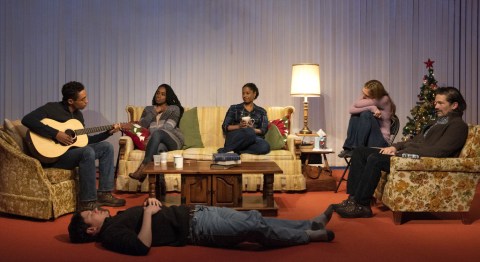
(L to R): Kyle Beltran, Kristolyn Lloyd, Nicole Lewis, Marin Ireland, Chris Stack, Peter Mark Kendall (foreground), in Atlantic Theater Company’s World Premiere of Abby Rosebrock’s ‘Blue Ridge,’ Linda Gross Theater (Ahron R. Foster)
How do we tell if our indignation for another’s plight isn’t our own misdirected rage that we ignore at our own peril? How is the healing process from childhood traumas that manifests through addiction to alcohol, drugs, sex and “acting out” initiated? Do those rehabilitating themselves recognize when the process evolves into wellness? How do such individuals recognize the journey to healing? Do they understand all that the arduous process entails before they attempt it? Or do they just move head on and try to change before they are ready because the culture and their anti-social behaviors demand it?
Atlantic Theater Company’s Blue Ridge written by Abby Rosebrock and directed by Taibi Magar raises these questions and many more. The play is superb, but does fall a bit short on one element, despite the fine performances by the ensemble and the excellent production values. The weakness evidences in Rosebrock’s sometimes confounding redirection of focus in examining the protagonist Alison (a nuanced, and layered performance by Marin Ireland whose accent is, at times, ill-executed because she quickly glosses over important, profound lines). Nevertheless, Rosebrock’s work is exceptional in the service of revealing themes which initiate organically from her characters and their interactions with each other, as they rehab in a group home setting.
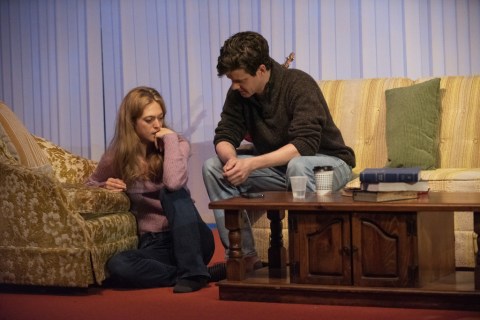
Marin Ireland, Peter Mark Kendall in Abby Rosebrock’s ‘Blue Ridge,’ Atlantic Theater Company World Premiere, Linda Gross Theater (Ahron R. Foster)
Currently at the Linda Gross Theater, Blue Ridge takes place at a religious rehabilitation retreat in the gorgeous mountains of western North Carolina (Appalachia). Everpresent are the fundamentalist tenets of Christianity which the characters attempt to espouse and practice. There, at St. John’s Service House, the individuals who have been interviewed and accepted for placement, seek God’s love, forgiveness, joy and peace, reinforced by Sunday church, Wednesday Bible Study, meditation, outside jobs at a pool store and therapeutic group conversation.
However, the process of moving toward wellness is not as easy as it may appear with prayers and Bible work. There must be a complete revolution of one’s soul, a very tricky circumstance indeed; for what is the soul? What is sin? What is the devil? And how do Christian teachings answer psychological traumas? As a key theme which Rosebrock brilliantly reveals, dealing with trauma involves more intricate and complex understanding on a personal level for those who experienced trauma. This involves a life-long process and everyone who undergoes it won’t find any marked yellow brick road at the end of the rainbow. But a good first step is remembering and confronting the trauma alone and/or with expert guidance and love.

Nicole Lewis in the Atlantic Theater Company’s World Premiere of Abby Rosebrock’s ‘Blue Ridge’ Linda Gross Theater (Ahron R. Foster)
The characters, some with overseeing functions like Hern (the pastor played by Chris Stack) and Grace (social worker portrayed by Nicole Lewis) help others, and with empathy and service, seek to rehabilitate themselves. Those, like Alison (Marin Ireland) Wade (Kyle Beltran) and Cole (Peter Mark Kendall), who have been accepted into the program, hope to correct problems which have manifested in self-destructive behaviors. If such behaviors continue, the individuals will be sent to restrictive settings (jail or psychiatric lock up), if they do not improve and heal. Other characters like Cherie (Kristolyn Lloyd), voluntarily enroll in the program. Cherie knows her own soul’s weaknesses related to her family’s and her own alcoholism. Though she is self-aware, she is blind to her other weaknesses and these set her on a course which may lead to relapse if not confronted.
Rosebrock introduces us to the principals in the first act which largely is humorous exposition to set up the dramatic developments and the climax of the second act. The characters are representational, some with individual problems that run deep but whose cause remains unknown. Their outward issues range from alcohol and drug addictions to anger management issues identified euphemistically as “intermittent explosive disorder.”
Central to the characters’ improvement and social reconstitution is the Wednesday Bible Study where we first meet the others and Alison, a teacher who lost her way and her job because of anger management issues. Alison chose to go to rehab rather than jail for destroying her principal’s car; ironically, he also was the man she “loved.” Marin Ireland’s portrayal reveals Alison’s fierce, hyperbolic and frenetic personality which masks the underlying wounds which Rosebrock intimates but doesn’t clarify by the conclusion of the play.
Marin Ireland in Atlantic Theater Company’s World Premiere of Abby Rosebrock’s ‘Blue Ridge,’ Linda Gross Theater (Ahron R. Foster)
A word about the character of Alison, who is the linchpin of Rosebrock’s work. One wonders if the play’s dynamism might have been strengthened if Rosebrock had more clearly and with dramatic and active plot points heightened the true issues that fomented Alison’s life-long devastation. At the beginning of Act One, to introduce herself, Alison glibly races through the lines of a song “Before He Cheats” by Carrie Underwood which parallels her behavior that landed her in rehab. We understand that she refers to herself when she quotes: “by this point all the accumulated pain an’ hopelessness, an’ annihilatin degradation, uh’bein a woman in this sexual economy’ve juss… racked the speaker’s brain and body, like a cancer.”
However, we remain unenlightened about the how and the what, even until the end of the play when Wade (Kyle Beltran) confronts her with these lines. Rosebrock never delineates the specifics of Alison’s annihilation and this is key to feeling empathy for her. Though Ireland does a yeowoman’s job in getting us to Alison’s heightened emotional state, our identification with her is muted and unsatisfactory. Perhaps, this is because we do not understand why she hurts so on an individual level. It is not enough to call in the cultural memes as her revelation. The facts and specifics matter; they resonate. But what are they? Thus the fullness and the power of Alison’s emotional state and whether or not she has achieved self-realization to move on to the healing process is opaque. We are not even “seeing through a glass darkly” where she is concerned.

Kyle Beltran in Atlantic Theater Company’s World Premiere of Abby Rosebrock’s ‘Blue Ridge,’ Linda Gross Theater (Ahron R. Foster)
The play turns on Alison’s integration into the program and her recovery. The irony is that she does the work in achieving her external goals and is reinstated as a teacher. However, she doesn’t begin to expurgate the underlying morass of pain in her soul while she is immersed in her sessions and interactions with Wade, Cherie, Hern, Cole, Grace. Indeed, because her self-realizations remain superficial, she becomes the catalyst that exacerbates conflicts and escalates issues for Cherie, Hern, Cole and Grace. As Cherie suggests, Alison blows up a set of circumstances via her own projections. As a result, everything changes for the characters.
Furthermore, Alison doesn’t understand how to get around the humiliation of the negative impact she has afterward. Ironically, though “all have sinned and come short of the glory of God,” by the end of the play, we see though there are apologies, there is no closure, no forgiveness, no resolution. Each of the individuals is forced to work by himself/herself as the “family” goes its own way in separate directions.
The only one who attempts to deal with himself in an authentic way is Wade. He tries to “make amends” for his not dealing with Alison on a deeper level than he he should have. At the conclusion Wade’s conversation with her is a trigger. However, we do not understand the specifics of the how or why. The rationale appears that she went through something in childhood. So did we all. We are ready to empathize, but are never quite given the chance, a fissure in the play’s development and characterization of Alison.
Rosebrock chooses to develop the play so that the conclusion becomes Alison’s flashpoint of experiencing the pain of her buried, bleeding wounds. The play ends with her emotional breakdown as she appears to allow herself to feel on a deeper level.
This is a risky choice in developing the play.The outcome remains unsatisfying and uncertain. The character Alison, whom we’ve come to accept and appreciate, is a cipher and a conundrum to herself and us. Though Alison has achieved the beginnings of a deep emotional release, Rosebrock sets her spinning in limbo. Any epiphany she might experience is mitigated by questions and doubt. We do not know where her emotional release will take her, nor what specifically it is connected to.

(L to R): Chris Stack, Kristolyn Lloyd in Atlantic Theater Company’s World Premiere of ‘Blue Ridge,’ written by Abby Rosebrock, directed by Taibi Magar, Linda Gross Theater (Ahron R. Foster)
If we did know more about what is “driving her to hydroplane” (a wonderful symbol of her dangerous emotional state), we might have greater empathy. And indeed, if she achieved the makings of an epiphany, we would understand her. The irony is that her emotions belie victimization but we do not understand. Might that have been dramatically revealed to deepen her characterization?
Magar’s direction aptly shepherds the cast as they portray how each of the characters attempts to make their way through their own personal trials that emerge after Alison blows apart the peaceful interactions of the “family” in the second act. These conflict scenes engage us. In the confrontation scene between Alison and Cherie toward the end of the second act, both Lloyd and Ireland hit their target. Their authenticity reveals the extent of Alison’s self-absorption and her misery which spills out onto everyone in the group, especially harming Cherie. This scene is one of the strongest in the play. There are others that work equally well because of fine ensemble work, direction and staging.
Kudos to Adam Rigg (Scenic Designer), Sarah Laux (Costume Designer) Amith Chandrashaker (Lighting Designer) and Mikaal Sulaiman (Sound Designer & Additional Composition) for adhering to themes and establishing the tenor and atmosphere of the play. (The final projection is revelatory and symbolic.)
A word of caution. For some actors, the North Carolinian accents were a distraction that occluded rather than clarified. Whether this was because of character portrayal or under-projection is moot. However, because Kyle Beltran, Kristolyn Lloyd, Peter Mark Kendall (to a lesser extent Chris Stack) didn’t overrun their lines and their projection was a sounding bell, their accents sounded unforced.
The play is a worthy must-see for the performances (despite a few rough patches with accents) and for Rosebrock’s metaphoric writing, humor and intriguing thematic questions. Blue Ridge runs with one intermission at the Linda Gross Theater on 336 20th Street between 7th and 8th until 26 January. For tickets go to the website.
Under The Radar Festival Review: ‘Minor Character,’ a Brilliant Twist on Chekhov’s ‘Uncle Vanya’

Under The Radar Festival, New Saloon’s ‘Minor Character’ (New Saloon)
Uncle Vanya is Chekhov’s masterwork that is Four Acts, hours long and requires tremendous acting and interesting staging, as the play is interior and the character development intricately opaque. In New Saloon’s humorous iteration of the classic play in a varied English language translation that “becomes” Minor Character defies the stodgy, fusty tradition of the Chekhov century-old drama. It turns gender on its head with great humor. And it elicits the characters and the plot purely for the genius of being lightening-like electric. As an added benefit, Chekhov’s profound insights are clarified. Noting the foolishness of our human selves is sheer delight.
If you know and have seen a good version of Uncle Vanya or two or three, you will enjoy New Saloon’s helter-skelter, explosion of humor and dolor in random order. Are you familiar with Chekhov’s hypersonic, beating breast misery and his characters’ static flatline of life ending before its begun? If so, you will enjoy the outrageous spin on Chekhov’s characters and the whip-saw dialogue which borders on Theatre of the Absurd. If you are a “current” modernist, you will love it as I did. I recommend you get a ticket immediately, because it will be there at The Public Theater and gone before you can recite the alphabet backward.
Why is Minor Character a must-see? For one, it’s the way the ensemble (Mile Cramer, Ron Domingo, Rona Figueroa, Fernando Gonzalet, David Greenspan, LaToya Lewis, Caitlin Morris, Madeline Wise) seamlessly negotiates the extreme variations of pacing, dialogue twists and turns and fluid staging. Not only does the wild production reveal an acutely clever director in Morgan Green, but the performers demonstrate solid acting chops and musicality.
To segue a bit, their vocal skills are notable. The music and songs appear pointedly and effectively. They reflect the haunting evocation of Chekhov’s themes and relate the music of the soul and heart of the characters. The music composed by Deepali Gupta with Music Direction by Robert Frost is in fine contrast to the dialogue and one of the highpoints of Minor Character. Of course the mundane dialogue is one of the key points of the human condition that Chekhov extends in Uncle Vanya. So much of what the characters say, as so much of what we say is inconsequential, repetitive, without emotion and unworthy of listening to. And ironically, this is why people are not particularly good listeners. There is nothing much of value that anyone says. Minor Character reveals this in spades, in 85 minutes. Bravo!
Notably, when the ensemble sings, we listen, we record, we empathize, we know. The tonal harmonies in the minor keys of some songs resonate with our nerve fibers and quell the jarring character clashes of language because the actors live in the music. The melodies are gorgeous. And we feel that like the whirlwind emotions of Sonya, Yelena, the Doctor, Uncle Vanya, Professor Alexander and the others, we are the “minor characters” whose lives come and go without our making one wave of excitation in the movement of the stars. Nevertheless, the music of our hearts is universal and aligns with the spheres as Johannes Kepler intimated.
The actors are superb. Their timing, quirkiness bar none. How they and don and take off their character mantles and costumes is richly varied. Their zaniness elucidates the characters of Uncle Vanya in their weird reminiscence of the bleeps and burps of language on Social Media. Additionally the sameness of the characters’ love dance, the miseries and depressions of the human condition are emphasized and experienced carefully by the actors in a chaos like musical chairs as they embrace a multiplicity of roles.
Sonya’s revelation of her love for the Doctor is echoed by three inverted gender couples concurrently. The theme of recognition that the central characters like the narrator of T. S. Eliot’s “Love Song of J. Alfred Prufrock,” will never be Hamlet-like protagonists, but will only “swell a scene of two,” is also echoed in threes by three sets of actors. However, Yelena’s and the Doctor’s intimation of a meet up which most probably will never occur, at the conclusion of the production is singular. Indeed, a couple’s love begins in particularity. It is only after the relationship achieves its peak, then like a canker worm, the sameness and repetitiveness of misery takes over with the acute result that “the bloom is off the rose.” In a banal finality the once “love-struck” couple manifests the most ridiculous foolishness and boredom after all is said and done.

Under The Radar Festival, New Saloon’s ‘Minor Character, the ensemble, The Public Theater (New Saloon)
As in Chekhov given an uplift by New Saloon’s actors and director, romantic hope dances on the wind. It is pregnant with expectation, as all romances begin filled with excitement, longing and anticipation. The most wonderful of relationships as Minor Character and Uncle Vanya suggest happen in the imagination; thus Sonya doesn’t want to know if the Doctor cares for her or not, at one point. She is thrilled to live in hope. Until…
What I particularly enjoyed about Minor Character is how Morgan Green and the actors risk landing on their heads in an epic fail and of course, land on their feet accumulating an excess of success. The seemingly clever abandon and aplomb that each of them embraces reveal precision, exceptional skill, and prodigious talent. In their downright foolish costumes (the mock fur capes worn by female characters despite the actor’s gender), and robes which clue us in to Chekhov’s characterization of Vanya, etc., the portraits of their motley humanity gradually manifest. Indeed, sometimes to realize the greatness of a classic, one must extrapolate to the end of the continuum of absurdity as New Saloon has done with this production. When one can go no further, there is a crystallization of understanding and epiphany. Whether 100+ years ago or today, human beings are the most stupidly adorable of all creatures.
Kudos to the following creatives: Deepali Gupta (Composer) Robert Frost (Music Director), Kristen Robinson (Scenic Designer) Alice Tavener (Costume Designer) Masha Tsimring (Lighting Designer) M. Florian Staab (Sound Designer) and all the translators.
Minor Character at the Public Theater celebrates Chekhov’s wit and humor taking it to an extraordinary level as profound themes glide under the surface of our laughter. You can ride the waves of fun including the variant English translations of character dialogue with the marvelous cast on the following dates and times.
5 January (Saturday) at 10 PM, 6 January (Sunday) at 9 PM, 9 January (Wednesday) 5:30, 8:30 PM, 11 January (Friday) 10 PM, 12 January (Saturday) 1:30 PM, 13 January (Sunday) 6:00 PM, 9:30 PM.
For tickets go to their website at The Public Theater.
Bar Car Nights at The New York Botanical Garden, a Fun Event

Bar Car Night, NYBG Holiday Train Show 2018, Applied Imagination (Carole Di Tosti)
The Garden in the evenings is like a magical mystery tour. Whether you go into the Enid A. Haupt Conservatory or travel the lit paths through the Garden or sample the delights at food trucks, the Bronx Night Market or food booths, there is always something to see and do during every season. Specifically the evening displays during which you may buy alcoholic drinks and must have proof of ID, for the 21 and older crowds are incredible fun with friends.

Bar Car Nights, packed crowd before entering 27th The Holiday Train Show, NYBG (Carole Di Tosti)
During the Holiday Train Show and Winter Season, there are The Bar Car Nights. This year they take place from 7-10:30 p.m. In the month of December the dates are 22, 28, 29. And in January, the Bar Car Nights are on the 5th and 12th.

Folks chowed down at the food booths from tacos to vegan offerings. Bar Car Nights, 27th NYBG Holiday Train Show (Carole Di Tosti)

Food booths and fire pit, Bar Car Nights, NYBG 27th Holiday Train Show (Carole Di Tosti)
The Bar Car Nights events which are a feature of the Winter Season have expanded to include more activities. I went last night which was perfect. The rain stopped and it was actually warm, a blip in the weather. The individual doing the ice sculptures commented that the ice was melting more quickly. Last year when I went with friends it was below freezing, 10 degrees in the New York City area which was experiencing a very cold December. Yesterday, it was in the 50s.Weather weirding and Climate Change. Oh, I forgot…that doesn’t exist “nationally.”. But in New York, the entire state governance is consonant with the California, whose leadership has come out in support for the Paris Climate Accord.

Holiday Train Show 2018, NYBG, Bar Car Nights (Carole Di Tosti)
Regardless of the weather, the show goes on. Last night, there was a large turn out and the crowds were thrilled with the offerings of the Holiday Train Show, the the musical activities in the Pine Tree Cafe and more. The food booths gave up heavenly aromas of fried chicken, barbecue, tacos and Vegan dishes. The booths were packed when I left around 9:00 pm, though the party was just getting started. And the bar section and fire pit was enjoyable, even though folks didn’t necessarily need to warm their hands in the freezing cold.

27th Holiday Train Show, Bar Car Nights, Applied Imagination (Carole Di Tosti)
The evenings in the Enid A. Haupt Conservatory are mystical realism. I love the sounds of the trains, the shimmering lights, the jazz and pop music in the background and especially the lights coming from the interiors of the New York botanical replicas. All of seems mysterious and the whispering of the foliage in the evening and its aroma and aura is special for a plant enthusiast like me.

One World Trade Center and Lower Manhattan Exhibit, Palms of the World Gallery and Reflecting Pool, Bar Car Nights, 27 NYBG Holiday Train Show (Carole Di Tosti)

Detail, One World Trade Center display and Oculus, Bar Car Nights, 27th NYBG Holiday Train Show, Palms of the World Gallery and Reflecting Pool (Carole Di Tosti)

Lighting the way for friends a dancer with hoops, 27th Holiday Train Show, NYBG Bar Car Nights (Carole Di Tosti)
Whether you enjoy chatting with friends sauntering through landscape with a wine or other beverage in your hand, or really dig the intricacies of the replicas, it’s a fun time. Last night there was a mixture of couples and friends groups. It seemed that the entire Bronx community was out and about. The Garden is a huge focal point of the Bronx and indeed, parents, children, educators, all community groups in the area make use of the Garden’s programs. Some of the couples last night were young and they came with oodles of friends. Older couples I’ve seen mostly on Member Day. However, last night, the age range was considerable. The draw is a night to get away from kids and hang with friends, be entertained with some cool music with a few drinks in hand and seeing the beauties of the season.

Hell’s Gate, GW Bridge, Bar Car Nights, 27th NYBG Holiday Train Show (Carole Di Tosti)
What’s not to love? Some of the pictures of the splendid Holiday Train Show are above, and the activities are below. Others I’ve posted elsewhere on my Social Media pages. Enjoy.

At the food booths there were crowds. Bar Car Nights, 27th NYBG Holiday Train Show (Carole Di Tosti)

Bar Car Nights ballerina, 2018 Holiday Train Show, NYBG (Carole Di Tosti)

Bar Car Nights, NYBG 27th Holiday Train Show, Applied Imagination, Ice Sculptor (Carole Di Tosti)

Dueling Pianos at the Pine Tree Cafe, Bar Car Nights, 27th NYBG Holiday Train Show (Carole Di Tosti)

On Saturdays, there is the Bronx Night Market, Bar Car Nights, 27th Holiday Train Show (Carole Di Tosti)
The 27th Holiday Train Show will be at the NYBG until January 21st. It is open Tuesday – Sunday and Monday, December 24 (3 p.m.) and January 21, 10 a.m. -6 p.m. The Garden will be closed on December 25 (Christmas). Extended hours, 10 a.m.-7 p.m. Saturdays until January 19, Friday Decmber 26-January 1. For all programming go to the website. And above all become a member to enjoy the NYBG year round. For tickets to The Holiday Train Show and BAR CAR NIGHTS, this evening, go to their website.
 CAROLE DI TOSTI