‘Banksy Most Wanted’ Directors E-Chat During the Pandemic, Tribeca Film Festival

Banksy’s mural ‘Girl With the Pierced Eardrum,’ featured on city graffiti tours in Bristol, UK in a 2019 photo. From ‘Banksy Most Wanted,’ directed by Aurélia Rouvier and Seamus Haley (courtesy of Cross Borders Films and Scarlett Production
I screened and reviewed Banksy Most Wanted as a Tribeca Film Festival offering, which appears on https://blogcritics.org/ and in a longer review: https://caroleditosti.com/2020/04/29/banksy-most-wanted-a-tribeca-film-festival-review/
I enjoyed the film which raised questions about the confluence of Banky’s art and Banksy’ anonymity. Would his art have the power it does if his identity is disclosed? The film, directed by Aurélia Rouvier and Seamus Haley delves into the Banksy myth and reality with a profound and in-depth portrait of a man who performs a great service to humanity which happens to be illegal. I had the opportunity after screening and writing the review to chat with directors via email about the film and how they arrived at their subject.

‘Banksy Most Wanted,’ “Girl With Balloon,” Banksy, ‘Girl With Balloon’ Shredded at Sotheby’s auction (https://www.engadget.com/2018-10-18-banksy-girl-with-balloon-meant-to-be-shredded-completely.html)
What inspired you to do a film about Banksy?

Aurélia Rouvier, Interview of directors Aurélia Rouvier and Seamus Haley Interview, ‘Banksy Most Wanted,’ (courtesy Cross Border Films and Scarlett Production)
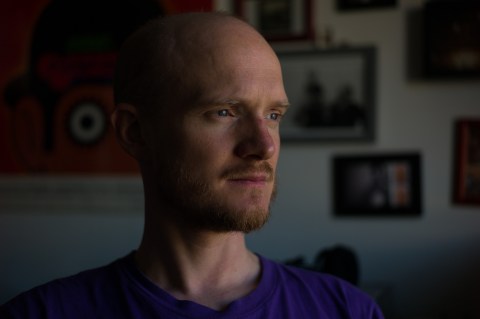
Seamus Haley, Interview of directors Aurélia Rouvier and Seamus Haley Interview, ‘Banksy Most Wanted,’ (courtesy Cross Border Films and Scarlett Production)
If you think of a Banksy piece, like the one he did in a bathroom during the lockdown for example. If the minute after you have seen it, you can imagine the man doing the stencil, because you know his face, his name, you know in which town the house is, you know that his wife and his 13-year-old son or daughter is probably behind the door.. it is immediately less fun.

Banksy’s mural “Season’s Greetings” in Port Talbot, UK with its buyer John Brandler, who bought the piece for more than 100,000 Euros, in a 2019 photo. ‘Banksy Most Wanted,’directed by Aurélia Rouvier and Seamus Haley (Cross Borders Films and Scarlett Production)
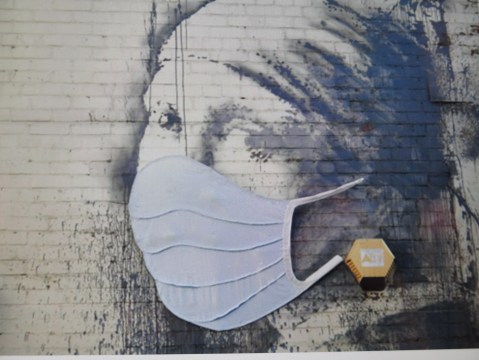
Banksy, “Girl With A Pierced Eardrum ,” COVID-19 update (courtesy of the site)

Banksy in lockdown (courtesy of Banksy on Instagram, courtesy of the site)
When did both of you first learn about Banksy?
Seamus Scanlon Interview: Chatting With the Playwright of ‘The McGowan Trilogy’

‘The McGowan Trilogy,’ written by Seamus Scanlon, directed by Kira Simring, part of 1st Origin Irish Theater Festival, Seamus Scanlon Interview (courtesy of Seamus Scanlon)
I had the opportunity to see Th McGowan Trilogy and review it on Blogcritics as an offering of The Origin Company’s 1st Irish Theater Festival 2014. Since then I have been in touch with Seamus Scanlon on social media and have kept up with his activities from time to time during posts. Finally, I caught up with him during the COVID-19 pandemic when we both had the time for me to interview him online via email.
Seamus, give the readers a bit of backstory about yourself.
My background is in science so I am a late convert to the arts. I am a first generation college goer in my family so gainful employment was the priority not frivolity (i.e. the creative arts). Science did appeal to me because it was definitive; equations and formulae were a great attraction for me. Also, my hand writing is appalling. I can’t even read it myself. I knew I would never be able to write papers or complete an analysis in college that a teacher could decipher.
Despite this, I recall playing a recording of Dylan Thomas reading Do Not Go Gentle Into That Night and I was immediately affected by it although I did not let on because our school was an artistic black hole. (In 2018, the Japanese production of The McGowan Trilogy played this recording during the performance which was an amazing surprise for me. I felt I had come full circle!) In English class we also read the poetry of Patrick Kavanagh – a self taught genius raised in poverty in rural County Monaghan. This poetry stirred me and remained with me despite my selection of science to pursue for a career
My hometown of Galway is an artistic epicenter with the Tony Award winning Druid Theater Company; the Galway International Arts Festival and The Cúirt International Festival of Literature. Nora Barnacle (James Joyce’s wife) was born there and Lady Gregory (Yeats’ mentor and co-founder of the Abbey Theater in Dublin) lived about 15 miles from Galway, Ireland. Galway county was the backdrop for Synge and Martin McDonagh. So there was no excuse for me not to be enamored of literature, but I just ignored it all. I was too timid to explore it.
How long did you work on the McGowan Trilogy?
Not very long. It was kick started by Nancy Manocherian’s Cell Theater Company Ltd (artistic director Kira Simring) who read a short play of mine Dancing at Lunacy and then staged it as part of the The Irish Cell event in March 2012. They then asked for a full play so I developed two other inter related one acts – The Long Wet Grass and Boys Swam Before Me. They were great to work with – two Jewish women interested in all things Irish. This was staged in Oct 2014 as part of the 1st Irish Theater Festival and was well received. The play was also published by Arlen House. Get a free digital copy here.

‘The McGowan Trilogy,’ written by Seamus Scanlon, directed by Kira Simmring, Seamus Scanlon Interview (courtesy of Seamus Scanlon)
What experiences helped you frame the story?
I lived in Belfast for five years so I was exposed to the daily life of Army patrols, constantly hovering Army helicopters, riots, shootings, July 12th marches where the deep seated tribal differences are in full flow. Before living in Belfast I had been affected greatly by the Hunger Strike in Belfast where 7 IRA and 3 INLA political prisoners died. Hunger strikes in Ireland have a long tradition. They are doubly significant and symbolic in Ireland because of the Great Famine (1847) which killed 1.5 million and caused forced emigration of 1.5 million to the US. A therapist in Belfast treating ex gunmen (late teens and early twenties) who had killed for the ‘cause’ and were suffering major trauma after killing someone.
Where has it been produced since it premiered in the US?
After The Cell production in 2014, they brought it to Hastings (UK) to the Kino-Teatr owned by a devoted Russian Hibernophile, Olga Manonova. The same Summer it was staged in two venues in Galway, and in Westport’s Townhall.
The major surprise for me came in 2018. The McGowan Trilogy (in Japanese) play was staged in Japan (in Japanese) to full houses (the lead was a rising movie star so that helped!). I traveled to Tokyo to see it and it was an amazing experience. They were selling merchandise in the foyer so I felt like a rock star! Japan has an amazing richness of theater and other art forms.
In Ireland three amateur drama groups have staged parts of the Trilogy and the feed back is usually positive. Amateur drama in Ireland is a long standing cultural phenomenon.
In April 2020 a theater student, Molly Flanagan at Southern Connecticut State University (SCSU) was to direct The Long Wet Grass. I was very excited to see this but it had to be cancelled because of the COVID-19 situation. Our mixed genre presentation Galway: The Good, the Bad, The Ugly at the New York Irish Center for April 23 had to be cancelled as well as an April performance at Lehman College.
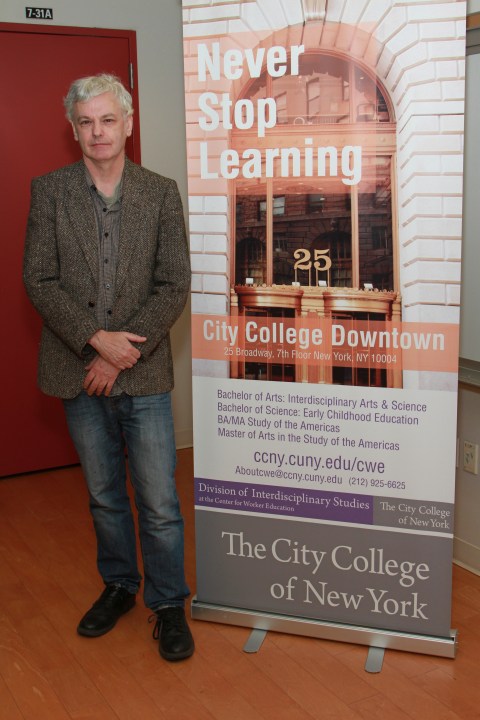
Seamus Scanlon, ‘The McGowan Trilogy,’ Seamus Scanlon Interview (courtesy of Seamus Scanlon)
In addition to The McGowan Trilogy, what are some of your successes over the years of which you are most proud?
Since 2016 I have self produced The Long Wet Grass at a number of locations such as Lehman College, City College Downtown, Art House, An Beal Bocht, Hudson Valley Writers’ Center and The New York Irish Center.
In February 2020 I collaborated on the immersive theater event Echoes of Calling with the Japanese dancer and choreographer Akiko Kitamura. If the COVID-19 restrictions lift in time this may be staged again in the Fall.
I worked on two film projects The Long Wet Grass (Ireland/USA, 2017) and The Butterfly Love Song (Ireland/USA, 2019) which was a new medium for me and challenging. I learned a lot – mainly that I should stick to play writing!
My first art form was fiction so I managed to have seven pieces published in Akashic Books’ Mondays Are Murder slot.
In 2019 I was awarded a special achievement award by the United Federation of Teachers for my work as a librarian at City College Downtown and the international success of The McGowan Trilogy.
What projects do you have in the works?
My next full length play The Blood Flow Game is a sequel to The McGowan Trilogy and is due for publication shortly. The end game for all plays is to have them produced so that is my goal. I have had four table readings of it as part of that process. I thought after The McGowan Trilogy success in Japan I would be a hot prospect but that is not the case!!
The radio play script of The Butterfly Love Song was short listed in Ireland in 2020 and that was a great thrill for me. It was the first radio play I had written. The Cell Theater, where I started off with Dancing at Lunacy, is going to develop it in Fall 2020 as a radio play/podcast.
I have few short films in the works including Three-Nil, Move Baby, Recycle This and The Resurrection Love Song.
Have you been able to get around Covid 19 virtually as other playwrights and artists have done?
The Butterfly Love Song which premiered in NYC in October 2019 and was screened in Dublin in early March 2020 is now being screened offline by various film festivals so that is encouraging. Film lends itself to this more than any other artistic format. Watch the trailer and the full film free at Irish Film London.
What is the first thing you will do, once the medical profession and the government has a handle on Covid 19 and has decided that businesses can reopen along with bars and restaurants?
I am looking forward to getting back to job as a librarian at City College Downtown. It was set up by the Labor Unions in 1981. Many students are first time college goers (like myself), many are from blue collar backgrounds (like myself) so I have a natural affinity with these students. We offer BA, BS and MA programs. Classes run weekday evenings and Saturdays. We specialize in one-on-one advising from day one. Email aboutcwe@ccny.cuny.edu for more info.
I am pretty deaf so I can’t really hear anyone in a noisy café or bar. I write in cafés. My office in Galway – when I am home – is The Secret Garden where I accomplish a lot. I hope it is open by July or I will be in trouble.
I have no writing schedule or format or craft advice or a writing desk or writing techniques. I am probably the worst person to look at for guidance since I do not really know how I write etc. I did an MFA in City College in New York and that was very useful because I had writing deadlines so I had to produce.
You can update Seamus’ activities on his website at www.seamusscanlon.com
‘Banksy Most Wanted,’ a Tribeca Film Festival Review
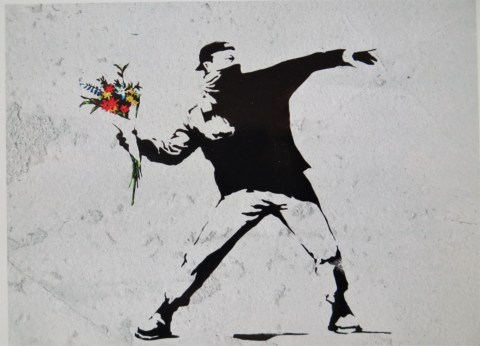
“Love is in the Air,” or “The Flower Thrower,” originally in 2005, Ash Salon Street, Bethlehem, West Bank, (courtesy of the site) ‘Banksy Most Wanted,’ directed by Aurélia Rouvier and Seamus Haley.
The “romantic” reality of the starving artist exploited by predatory promoters has been turned on its head by the graffiti artist, political activist and filmmaker Banksy. Over the past two decades Banksy has bested art dealers and beat them at their own game. In the process he has hyped up his own notoriety and sweetened his Robin-hood-like credibility by remaining anonymous to all. That is, all except the few sworn to secrecy who are privileged to be his inner circle.
Banksy’s mural ‘Girl With the Pierced Eardrum,’ featured on city graffiti tours in Bristol, UK in a 2019 photo. From ‘Banksy Most Wanted directed by Aurélia Rouvier and Seamus Haley (photo from the film)
Banksy Most Wanted, directed by Aurélia Rouvier and Seamus Haley, is a Tribeca Film Festival offering that I screened recently. I enjoy that Banksy thrives on anonymity, travels the world and uses buildings as his canvases. He paints and stencils ironic hieroglyphs, insuring they are accessible to the multitudes who appreciate his stark images and socially important messages. Cleverly, rakishly he tantalizes and exploits art dealers who would traffic his work like vultures.

“Show Me Monet,” ‘Banksy Most Wanted,’ directed by Aurélia Rouvier and Seamus Haley (courtesy of the site)
In their straight-shooting documentary Rouvier and Healey visit a multitude of locations. Using a mixture of video news clips and their own cinematography, they investigate the Banksy ethos with depth and humor. First, they chronicle his origins in Bristol, UK. Next, they trace his evolution from the 1990s. For then he painted by hand. Subsequently, he decided upon spray painting. With it he could cover more mileage. Therefore, upping the ante by preparing stencils in his studio beforehand, he left off labor intensity. Most probably, stenciling offered the ease and speed to get in and out of locations without detection.

Brexit mural in Dover by Banksy, ‘Banksy Most Wanted’ directed by Aurélia Rouvier and Seamus Haley (courtesy of the film)
More recently, Banksy’s evolution extends to outrageous, live installations. Irreverently, he painted a live elephant in Los Angeles riling animal rights activits. For the sheer cheek of it, he unleashed 200 rats in a London gallery. And with a nod to her sainthood, he embellished a portrait of Mother Teresa with the words “moisturize everyday.”
Identifying his most famous works in Bristol, London, Paris and New York, Rouvier and Healey relate the impact of these Banksys on the surrounding community. In one instance a town litigated a dealer who took “their Banksy” which had great significance to them. They refused to allow him to steal the honor of Banksy selecting Port Talbot, Wales as a site for his art.
Banksy’s mural “Season’s Greetings” in Port Talbot, UK. John Brandler, who bought the piece for more than 100,000 Euros. ‘Banksy Most Wanted,’directed by Aurélia Rouvier and Seamus Haley (courtesy of the site)
To establish ownership the dealer purchased a garage wall with the Banksy located in Port Talbot, Wales. Subsequently, he removed it with cranes to carve the images from the concrete to auction them off. As a result, the town sued him. During the litigation he discovered the art’s value to the community. Indeed, they believed Banksy had chosen their town to bless with his work.
Interestingly, the court found that the town’s freeholder rights as a community superseded the dealer’s free-holder rights. This was a Banksy triumph for the little people and a gut-wrenching blow to the stomachs and wallets of art dealers everywhere.

Banksy’s mural “Season’s Greetings” in Port Talbot, UK with its buyer John Brandler, who bought the piece for more than 100,000 Euros, in a 2019 photo. ‘Banksy Most Wanted,’directed by Aurélia Rouvier and Seamus Haley (courtesy of the film)
The filmmakers explore a few of Banksy’s satiric, temporary art installations. For example, they revisit the 2008 Porta-Potty Stonehenge. With self-demeaning brio, Banksy dubbed it “A Pile Of Crap.” Likewise, the 2015 Dismaland Bemusement Park offered a tortured happy rides with macabre convolution. Dismaland was a “sinister twist” on Disneylands everywhere. Banksy described it as “a family theme park unsuitable for children.”

Dismaland Bemusement Park, ‘Banksy Most Wanted,’ directed by Aurélia Rouvier and Seamus Haley (courtesy of the site)

“Dismaland Bemusement Park,” ‘Banksy Most Wanted,’ directed by Aurélia Rouvier and Seamus Haley (courtesy of the site)
Additionally, the directors highlight his adventurous pranks. One of these incurred self-shredding the print “Girl With Balloon” at a Sotheby auction right after the banging gavel closed the purchase.
‘Banksy Most Wanted’, Girl With Balloon, Banksy, Girl With Balloon Shredded directed by Aurélia Rouvier and Seamus Haley (courtesy of the site)
Throughout, the filmmakers question the Banksy ethos. His stenciled works increasingly find their way into areas of economic repression and cultural upheaval. Some appear in the West Bank. These, include the restored Walled Off Hotel positioned across the street from the Israeli-Palestinian West Bank barrier. All of them raise questions. Indeed, Banksy fans and critics alike interpret them as an addendum to his political activism. And they label him a postulate critic of the dominant powers who would prevent others from securing a viable place at the table of life.

“The Walled Off Hotel,” ‘Banksy Most Wanted,’ directed by Aurélia Rouvier and Seamus Haley (courtesy of the site)

‘Banksy Most Wanted,’ Banksy Kitten in Gaza (courtesy of the site)
With his works having become ubiquitous, Banksy globally imprints his perspective to sound the underlying truths of our reality. And his searing and irreverent statements against imperialism, capitalism, earth destruction, climate change, consumerism, poverty, corporate fascism, racism empower the viewer.
However, all is not anti-establishment. Occasionally, he counterbalances these themes and subjects with images of love, innocence and endurance. For the documentarians focus on how he makes his guerilla art a velvet weapon to war against killing and uplift peace. Furthermore, they reveal how his dichotomous images heighten the culture’s oblivion to their being accessories to enslaving and harming Third World Countries. With singularity and precision the directors emphasize how he employs juxtaposition in his creations. And they do justice to Banksy’s indictment of the West’s contributions to crimes against humanity in its greedy value of money over people.

Banksy’s Take-off on Rodin in Gaza West Bank (courtesy of the site)
Throughout the visual explication of Banksy’s subject matter and themes, the filmmakers delve into his message to the art world. Another lucid indictment emerges. For Banksy, great artistry moves beyond boundaries and walls of brick and mortar. It remains exclusive of hyped-up, artificiality and “Tulip mania” trends.
For this reason he has left the art world spinning in circles. As they chop up walls to obtain his works in the hope of making a bundle, he intentionally dislocates their obsession. Most recently, to thwart the rapacity of dealers, owners of buildings have become Banksy fans. They refuse to sell. Instead, they plexiglass their Banksys to protect them. With an irony of their own, they reinforce Banksy’s overarching instruction to street people. Art exists everywhere

Banksy’s Phone Lovers, Bristol, UK (courtesy of the site)
Over the years Banksy has garnered himself and a beleaguered art world a delicious, capitalistic profit. Reputedly his worth totals up to a rumored $50 million. So, for those who admire his anti-capitalistic, anti-consumer spirit, think again. Perhaps, this anonymous rogue doth protest too much. However, the vital question remains.
Who is Banksy? For me peaking behind the anonymity becomes a crucial high point of the film. With incisive interviews, the directors weave in and out to explore three possible identities. And these they unravel, playing with the uncertainty of facts and details of “reliable” narrators. Afterward, they suggest a fourth possible Banksy.

Banksy in the West Bank Barrier Wall, a guard tower converted to an amusement ride (courtesy of the site)
Clearly, the directors love their subject. And they have done their homework. They’ve presented the diorama that his anonymity has served a charitable purpose . Yet, they’ve proven Banksy also serves his own interests.
Thanks to his anonymity, others have been able to claim his work, either legally or emotionally. And his fans love adding to his aura by fantasizing about who is hiding behind the name. These investigations reveal a novel perspective of the artist, his salient/sardonic world view, his links with the music scene and his entrepreneurial acumen. They also expose the importance of identity to art and society and our need to triumph over invisibility.
Through the testimonies of those who know him and have worked with him, but also of those who exploit him, hunt him down and claim him, Banksy Most Wanted paints a profound portrait of “one” of the foremost artists of our time. It concludes with the vitality of the spirit that channels through the group of artists that effect Banksys. And that makes all the difference in the world.
Banksy during the pandemic.
Apparently, Banksy is staying indoors following the UKs sheltering in place lockdown orders. However his famed mural “The Girl With A Pierced Eardrum” has received a COVID-19 update which includes a blue surgical mask.
Banksy, “Girl With A Pierced Earring,” COVID-19 update (courtesy of the site)
First appearing on the side of a building in Bristol’s Harbourside in 2014, this Banksy spoofs Vermeer’s “Girl With A Pearl Earring.” But the earring incorporates Banksy’s thoughtful wall selection, an outdoor security alarm. Banky’s “girl” sports not a “pearl,” but a ‘stretcher’ supplied by the security alarm.
Wild speculation deems Banksy broke the lockdown and sneaked out to spray paint his work to give a kick in the pants to those who will tour his graffiti most probably with masks and appropriate social distancing when Bristol “opens.” However, fans argue the COVID-19 mural can’t be by Banksy who usually reveals his works on his Instagram account.
Banksy in lockdown (courtesy of the site)
For official COVID-19 works Banksy, on his account you will find rats running amuck and making themselves at home in his bathroom. It’s captioned: “My wife hates it when I work from home.” Banksy’s irreverence during this pandemic makes this Plague go down a bit easier. #Banksy
NYBG Celebrates Earth Day 50 Online

New York Botanical Garden, magnolias (courtesy of NYBG)
New York Botanical Garden is helping New Yorkers and global fans enjoy Spring in New York by maintaining social distancing during New York “Pause.” They have been holding online watch parties and have kept their virtual programming alive to involve those sheltering at home with interactive events and online classes that stream via YouTube.

‘The Orchid Show: Jeff Leatham’s Kaleidoscope,’ NYBG 18th Orchid Show, (Carole Di Tosti)

‘The Orchid Show: Jeff Leatham’s Kaleidoscope, NYBG 18th Orchid Show, (Carole Di Tosti)

‘The Orchid Show: Jeff Leatham’s Kaleidoscope,’ NYBG 18th Annual Orchid Show (Carole Di Tosti)


The Orchid Show: Jeff Leatham’s Kaleidoscope, NYBG 18th Orchid Show (Carole Di Tosti)
While the Garden’s gates may be closed temporarily, their virtual gates are wide open. The Garden invites its community near and and far to stay connected during this challenging time. Earth Day 50 with NYBG at Home is one way to do that.
‘Support for Artists: The Bret Adams and Paul Reisch Foundation Grants’

Bret Adams and Paul Reisch Foundation (courtesy of their website)
Each day the COVID 19 pandemic takes another swipe at the New York theater community as notifications of deaths (playwright Terrance McNally, actor Mark Blum, former Drama Desk President William Wolf) darkly bloom. Theaters will remain closed for the end of the month and most probably into the summer, if state and federal projections are to be believed. Thus, we wait and create and pray supporting each other with phone calls, emails, social media posts virtual presentations, meetings and parties on Zoom.
Show business folks have always helped one another. Currently, Brad Paisley, John Bon Jovi, Dolly Parton and other celebrities have stepped up donations. And beautiful financial flowers are burgeoning from GoFundMe campaigns springing up to support artists. Along with smaller operations, tried and true foundations like the Actor’s Fund and Broadway Cares/ Equity Fights AIDS, Dramatists Guild, League of Professional Theatre Women and New York Women in Film and Television to name a few are available with support for their members and freelance artists.
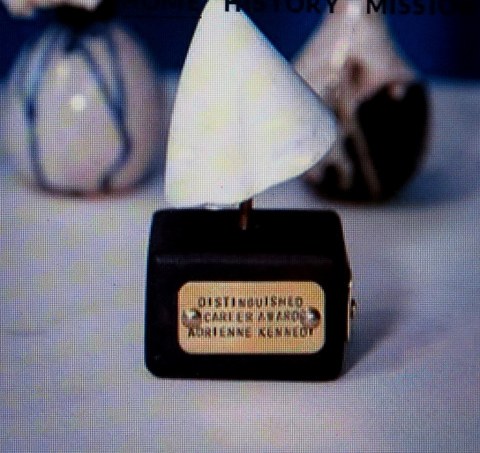
Tooth of Time Award: Honoring accomplished playwrights who have created significant, idea-driven works throughout their career, Bret Adams and Paul Reisch Foundation (courtesy of their website)
Freelancers are especially hard hit. They do not number amongst the 6.5 million who have filed for unemployment insurance (the number was posted on the news this morning). Not having a regular paycheck but living gig to gig, they are the invisible casualties of this war against a deadly molecule that strikes through those who are asymptomatic and “healthy,” but who are carriers of the spread. Clearly, more needs to be done by those of means who love theater and are devastated that COVID 19 has slammed into New York.
On that note The Bret Adams and Paul Reisch Foundation has decided to create an uplifting way to distribute the funds for their 2020 Idea Award for Theatre. This spring, the foundation will offer up to 40 emergency grants of $2,500 each to playwrights, composers, lyricists and librettists who have had a full professional production cancelled, closed, or indefinitely postponed due to the COVID-19 closures. A total of $100,000 will be distributed to theater writers.

Bret Adams and Paul Reisch Foundation, The Vivace Award: Recognizing musical theatre artists with emerging talent and original work with ambitious ideas (courtesy of the Bret Adams and Paul Reisch Foundation)
Eligible playwrights, composers, lyricists, or librettists should apply at this link. Writers who have had a professional production canceled may submit their name and proof of a professional show’s closure. (“Professional,” in this case, is defined as LORT, Off Broadway, or Broadway). Each artist can submit only once. If there are more than 40 applicants, the Foundation will award grants by lottery, allowing them to give out the greatest amount of money directly into the pockets of the artists who have been most affected.
The submission deadline is April 14. The Foundation hopes to make funds available to artists as quickly as possible to forge a path to provide a bit of hope and relief and especially to guide others to do the same for artists in this unprecedented time.
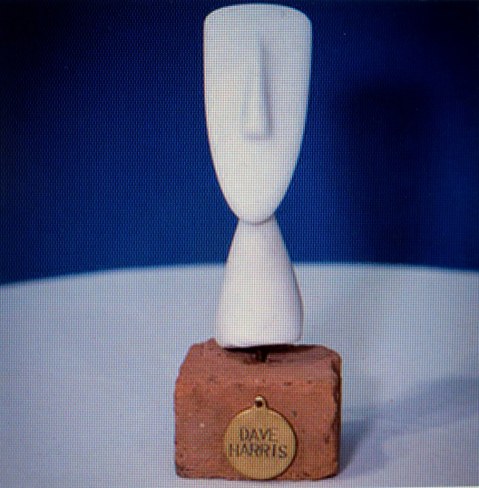
The Ollie Award: Recognizing playwrights with emerging talent and original work with ambitious theatrical ideas, The Bret Adams and Paul Reish Foundation (courtesy of the website)
The Bret Adams & Paul Reisch Foundation is a charitable foundation. Its mission is to give money to writers to write plays with ‘big ideas.’ This year, their ‘big idea’ is to help those “who have had productions cancelled,” said Bruce Ostler, V.P. and Board Member of The Bret Adams and Paul Reisch Foundation.
Ostler’s point is well taken and unfortunately, true when he affirms, “The economic model of theatre in the 21st century works much like it did in the 16th century, in that a playwright receives a percentage of the box office sales; without an audience, the box office receipts and royalty to playwrights dry up. In no uncertain terms, the business of theatre today has ground to a shocking halt due to the pandemic. Playwrights are not salaried workers and therefore are NOT eligible for unemployment for a cancelled production. That is the harsh reality of theatre today.”
Theatrical Agent Bret Adams and his partner Dr. Paul Reisch loved the theatre with great passion. As an agent, Bret shepherded the careers of many actors, writers and directors and designers, including Phylicia Rashad, Judy Kaye, Ruby Dee, Ossie Davis, Sherman Helmsley, Anna Maria Alberghetti, Eve Arden, Christine Ebersole, Kathleen Marshall, Jayne Wyman, Andre DeShields, Kathy Bates, and more.
After Bret and Paul’s passing, in 2006 and 2015, their foundation was created at their bequest. The Bret Adams and Paul Reisch Foundation champions visionary playwrights and embraces diversity in all its forms. It especially encourages fresh perspectives – particularly those from underrepresented backgrounds – to create idea-driven new plays and musicals. These may include a variety of themes, i.e. science, history, politics and sexual orientation. For more information, visit www.BretnPaulFoundation.org.
New York Botanical Garden: ‘Chorus of the Forest’

‘The Orchid Show: Jeff Leatham’s Kaleidoscope,’ NYBG 18th Orchid Show (Carole Di Tosti)
New York Botanical Garden is growing bountifully with springtime beauty. We are not able to appreciate it live and in our mortal flesh at this time because of the ferocious virulence and communicability of Covid 19. The Garden is temporarily closed as all non essential services in New York City are doing to practice social responsibility and save lives.
New York Botanical Garden, magnolias (courtesy of NYBG)
However, the Garden is online and broadcasting via virtual platforms. For the springtime beauty of the magnolias, CLICK HERE.

New York Botanical Garden, magnolias (courtesy of NYBG)
Jeff Leatham’s Kaleidoscope, The 18th Annual Orchid Show at the NYBG is also presenting a pre-recorded tour given by Marc Hachadourian, head orchid curator and orchid expert at the Garden. The tour features each of the galleries and Jeff Leatham’s vision of the wild colors manifest in a kaleidoscope employing his superb horticultural artistry and brilliant design. For Marc’s virtual tour, CLICK HERE. And for my review of the show with photographs taken in February, CLICK HERE.

‘The Orchid Show: Jeff Leatham’s Kaleidosope,’ NYBG 18th Orchid Show (Carole Di Tosti)
Whenever I become nervous or stressed at night, contemplating the news of what is happening in New York City and globally, I do one of two things to calm down since jokes are not seeming to help at this time. I go to Youtube and watch Governor Andrew Cuomo with his brother Chris (pray for Chris, he tested positive for Covid 19) as they kid around and take loving jabs at each other with rapier wit and gentle insults.

Governor Andrew Cuomo, daily briefings on Covid 19 (courtesy of Governor Cuomo’s Youtube channel)
Playing back Governor Cuomo’s daily record of the state’s progress to save lives as together we take on the responsibility to extirpate this plague from the planet, I feel emotionally calmer. I swear his father’s spiritual presence is there strengthening him for this incredible challenge to lead the nation as THE go-to governor in the forefront as New York is in the forefront of this virus with the most cases to date. It is Cuomo’s calm, commanding truthfulness as he uplifts the values of love and the sanctity of life that makes a tremendous difference to me as I shelter in place. During this historic time his stolid example and his stories of his family and the interplay with his brother have helped me reaffirm, even relearn the treasure of my own life and the preciousness of friends and family.
Secondly, I take Marc’s tour to witness the beauty of the Garden and orchids which I adore. I reviewed Jeff Leatham’s work on this blog when it opened in February. Then, the orchid placement was different in some of the galleries. In the Desert gallery I am happy to see that the poppies are blooming which they were not earlier in the year. After I watch Marc’s tour I have decompressed. I am ready to fall asleep as the beauty of the orchids, Jeff’s horticultural artistry and Marc’s soothing voice restore me to an inner state of peace.

Marc Hachadourian, Senior Orchid Curator pictured at ‘The Orchid Show: Jeff Leatham’s Kaleidosope,’ NYBG 18th Orchid Show (Carole Di Tosti)
Also, the Garden is sharing one of its most memorable live performances in a Facebook Watch Party on Wednesday, April 1, beginning at 1 p.m. EDT. Chorus of the Forest, a site-specific work by composer Angélica Negrón, premiered last November in NYBG’s 50-acre Thain Family Forest, the largest remaining tract of old-growth forest in New York City.

‘The Orchid Show: Jeff Leatham’s Kaleidosope,’ NYBG 18th Orchid Show (Carole Di Tosti)
Weaving together choral performances, robotic and percussive electronic instruments, and live and recorded forest sounds, this immersive, specially commissioned work was performed along a half-mile of trails. This choral and instrumental experience was created to explore humanity’s relationship with the forest and our connections–and disconnections–with nature.
Negrón, a Puerto Rican-born multi-instrumentalist who was NYBG’s 2019 Composer-in-Residence, will join the Facebook Watch Party for a live chat during the screening to discuss this ambitious project and answer viewers’ questions.
Take a break from the news when you can and enjoy the Watchbook Party by CLICKING ON THE LINK BELOW.
New York Botanical Garden, A Virtual, Online Haven During This Global Pandemic

‘The Orchid Show: Jeff Leatham’s Kaleidoscope,’ NYBG 18th Annual Orchid Show (Carole Di Tosti)
The Medieval 21st century plague of Covid 19 has swept into the United States with insidious tyranny. Sadly, with insufficient testing, the nation doesn’t realize the extent of its invisible spread, just yet.

‘The Orchid Show: Jeff Leatham’s Kaleidoscope,’ NYBG 18th Annual Orchid Show (Carole Di Tosti)
However, New York State Governor Andrew Cuomo and New York City Mayor Bill Di Blasio are aware of the implications of the tragic events in Italy as that country goes into more weeks of quarantine. Thus, these prescient and dynamic New York leaders with the efforts of our heroes in the medical professions and essential services, are making the invisible visible with massive testing.

‘The Orchid Show: Jeff Leatham’s Kaleidoscope,’ NYBG 18th Annual Orchid Show (Carole Di Tosti)
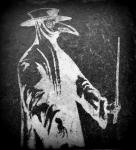
The Plague Doctor (Carole Di Tosti)
New York is to be commended for being in the forefront to scale up the protocols, supplies, research and data to nail down this nefarious, highly communicable virus and siphon off its power so that its replication in New Yorkers is incapacitated, and its ability to kill even the most vulnerable is obviated.
To the left is a photo of The Plague Doctor’s outfit circa 1650 in Edinburgh, UK which I took from a tile I purchased after a tour underneath the streets of Edinburgh, in the Old Town. The tour was amazing. It featured how the denizens of the city lived during the 1700s and revealed how they confronted the terrible plague which wiped out a goodly number of city dwellers. The uncertainty about what was causing the disease (the flea on the rats who lived in close proximity with citizens) led many to escape to safety in the country for fear of contagion. Those who had the means to leave, left. The remaining citizens suffered and died or caught it and recovered, or never caught it at all because they practiced quarantines or had the antibodies to keep the disease at bay.

Edinburgh, UK, photo of The Plague Doctor 1650 (Carole Di Tosti)
The Plague Doctor’s outfit was the hazmat suit of the time that protected the wearer. The bird like beak held curative herbs (rosemary, lavender, hyssop, marjoram etc.) that the doctor breathed in, an unwitting prevention which stopped their inhalation of droplets of contagion which would move into their respiratory system and infect them.

New York Botanical Garden, early December 2019, looking toward the herb garden, when Covid 2019 was spreading in Wuhan, mainland China and maybe globally which we may never know. (Carole Di Tosti)
Of course, curative plants, herbs like those found in the NYBG Nancy Bryan Luce Herb Garden. were used extensively in teas, tinctures, etc., and in the toolkit of the practitioner of the healing arts. The herbs listed on the page of the Nancy Bryan Luce Herb Garden are examples of prodigiously used herbs which were thought to be helpful in staving off contamination.

‘The Orchid Show: Jeff Leatham’s Kaleidosope,’ NYBG 18th Orchid Show (Carole Di Tosti)
In the 21st century we are light years away from such a crisis, and yet our Covid 19 plague has strange reflections of that time in the “sheltering in place,” “hunkering down” and “pausing” that the proactive states in the nation have enacted so that all but essential services and workers must stay inside. In California, New York, Ohio, Illinois and Louisiana, this pertains if individuals are in an age range of 65 and older while all others practice social distancing, social responsibility and self-discipline to self-monitor and not congregate anywhere whether on street corners or in parks. Surely, if other states follow, effectively managing this highly communicable pestilence Covid 19 will happen sooner than later.

‘The Orchid Show: Jeff Leatham’s Kaleidoscope, NYBG 18th Orchid Show, (Carole Di Tosti)
During this time until it opens its gates once more, New York Botanical Garden offers hope, beauty, resilience and peace, the immutable themes it displays year-round. In these extraordinary times, these spiritual powers resonate more than ever. The Garden as a place of emotional healing continues to stand as a hallmark that we who live in New York City and New York State and those who visit from around the world, can be nourished soulfully during this gravest of pandemics. Currently, the Garden provides an online beacon of light as it flourishes during glorious spring. The Garden’s virtual offerings are an antidote to calm troubled souls and stressed spirits.

‘The Orchid Show: Jeff Leatham’s Kaleidoscope, NYBG 18th Orchid Show, (Carole Di Tosti)
First, their new content page is on NYBG.ORG CLICK HERE. This page provides a way to stay connected to the Botanical Garden through our collections’ digital resources, creative educational programs, and other online offerings. For the home site NYBG At Home CLICK HERE.

‘The Orchid Show: Jeff Leatham’s Kaleidoscope, NYBG 18th Orchid Show, (Carole Di Tosti)
As spring unfolds, NYBG at Home will showcase the brightness and color seasonal spectacle. On March 20, the first day of spring, they presented a brief “first day of spring video walk” around NYBG’s grounds. The video can be viewed: CLICK HERE.

‘The Orchid Show: Jeff Leatham’s Kaleidoscope,’ NYBG 18th Orchid Show, Jeff Leatham, NYBG (Carole Di Tosti)
Through NYBG at Home, plant lovers can find out about upcoming virtual events such as a Facebook Watch Party video tour of The Orchid Show: Jeff Leatham’s Kaleidoscope on Wednesday, March 25, at 12 p.m. EDT. The site also provides convenient, one-click links to NYBG’s blogs; the digital collection of NYBG’s LuEsther T. Mertz Library; teacher resources; plant-based, kid-friendly recipes; ways to get involved in virtual research projects; and much more. The Garden hopes it will be a reminder of how the natural world brings joy and a respite from troubles.

‘The Orchid Show: Jeff Leatham’s Kaleidoscope,’ NYBG 18th Annual Orchid Show (Carole Di Tosti)
We do not know how long we will be monitoring each other, collaborating to keep everyone across the global as safe as possible and as healthy as possible through our social responsibility. It is a domino, butterfly effect. What we do here will impact our neighbors across the Pond, in Europe, in Oceania, in Asia and other places around the world. If we keep ourselves healthy with social distancing, we reveal our care and concern for our brothers and sisters in our human family. One way to keep our souls enriched is through visual online viewing of beauty and peace. Plants are our key. They can be silent representatives of love if you open your souls to them. Keep yourselves safe=healthy and enjoy the Garden. Together, we can get through this as we watch each other’s backs and remain uplifted. #plantlove
‘Girl From The North Country’ by Conor McPherson, With Music and Lyrics by Bob Dylan
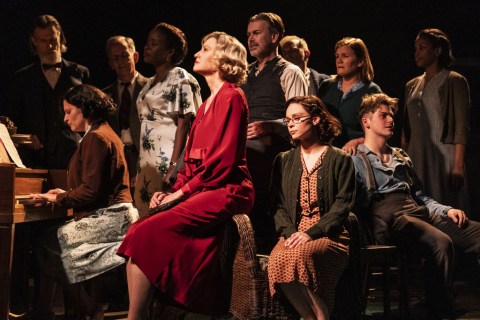
The cast of ‘Girl From The North Country,’ written and directed by Conor McPherson, music & lyrics by Bob Dylan (Matt Murphy)
Life is a whistle stop away from dissolution and death in the soulful, atmospheric, other-worldly Girl From The North Country by Conor McPherson (Shining City, The Seafarer) with music and lyrics by Bob Dylan. The production had an extended run off Broadway at The Public Theatre. With a few cast changes and a bit of slimming down, the McPherson/Dylan collaboration is an enlightened one as Dylan’s songs have found an amazing home threaded from decade to decade with McPherson’s canny naturalistic and spiritual characterizations

Robert Joy in ‘Girl From The North Country,’ written and directed by Conor McPherson, music & lyrics by Bob Dylan (Matt Murphy)
Dr. Walker (the fine Robert Joy) provides the frame of reference (like the narrator in Thorton Wilder’s Our Town) revealing the depression-era setting and introducing the lead characters. Interestingly, all of the characters by the end of the production must confront the state of their lives during the dire times during 1934 in Duluth, Minnesota. McPherson’s expert sense of story-telling and familiarity with the Depression-era literature of the time has enabled him to cobble together the John Steinbeck-like (Of Mice and Men, Grapes of Wrath) characters and storylines. These have been reinforced and inspired by Bob Dylan’s music from various decades. Together, theirs is a marvelous depiction of unity in desperation, longing in torment and hope in uncertainty. Finally, the musical’s theme of timelessness wafts like a beaming streak of gold throughout this must-see production.

Luba Mason in ‘Girl From The North Country,’ written and directed by Conor McPherson, music & lyrics by Bob Dylan (Matt Murphy)
A number of the actors double as musicians and Dylan’s song selection ranges in a combination of pop, country, folk and blues. All the songs are recognizable and illustrative of the mood and tone of this stirring piece about characters who yearn for a brighter tomorrow but know that the result will be a more challenging ever-presence of sorrows. Nevertheless, the characters snatch from the mouth of woe bits of humor, song and dance which create shining moments that move them to give solace to one another to help get them to the next day.
Chief among these every-day-heroes is boarding house owner, the stalwart, self-immolating Nick Laine (the fine Jay O. Sanders) who keeps a brood of homeless, down-and-outers together for a time, until they must all move on because Nick is broke and losing his home to the banks. The reference to Steinbeck’s Joad family in The Grapes of Wrath after they lose their house and prepare to leave for the “promised-land” of California is unmistakable.
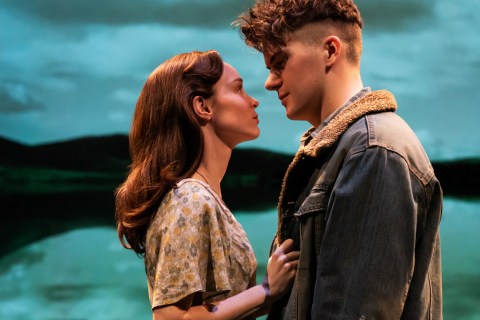
(L to R): Caitlin Houlahan, Colton Ryan, ‘Girl From The North Country,’ written/directed by Conor McPherson, music & lyrics by Bob Dylan (Matt Murphy)
Nick must negotiate his wife Elizabeth (the incredible Mare Winningham in a sterling performance). Elizabeth has dementia and ironically serves as Nick’s conscience, seamlessly moving in and out of sentience selecting a time when she can most effectively jab at Nick’s soul about his sister whose death he negligently caused and his mistress Mrs. Neilsen (the excellent Jeannette Bay Ardelle).
Mrs. Neilsen and Nick receive a respite from misery in each other’s arms as she rents a room and helps out with Elizabeth during the time she stays in Nick’s boarding house. Mrs. Neilsen lures Nick with her deceased husband’s scheduled inheritance which she dangles in front of him as bait to fulfill their dream of running away together. Ardelle easily slides into Dylan’s songs with full-throated abandon that is rich and lustrous.

Jeannette Bayardelle and The Cast of ‘Girl From The North Country,’ written/directed by Conor McPherson, music & lyrics by Bob Dylan (Matt Murphy)
Winningham’s Elizabeth is willful, prescient and edgily funny. She brings down the house with her rendition of “How Does It Feel,” as a foreboding reminder that fate comes for all of us and especially Nick and the various borders who are skulking away from life and the law in this temporary haven from both. She nails Mr. Perry for his sexually predatory abuse of her when she was a child. And she questions Nick why he would pimp off their adopted daughter Marianne Laine ( the wonderful Kimber Elayne Sprawl) to old Mr. Perry in a quid pro quo exchange of Marianne for the payments on their mortgage. Elizabeth to a large extent discourages the deal to Nick, Mr. Perry and her daughter, and though she will miss her, she doesn’t discourage Marianne from running off with boxer Joe Scott (Austin Scott) who blows in one desolate night looking for shelter at Nick’s place with his companion Reverend Marlowe (Matt McGrath).

Mare Winningham, Jay O. Sanders in ‘Girl From The North Country,’ written/directed by Conor McPherson, music & lyrics by Bob Dylan (Matt Murphy)
Thankfully, Nick’s boarding house provides “a welcome for lost souls.” There, Nick feeds them, they celebrate Thanksgiving, they dance. However, Mrs. Burke (the fine Luba Mason), Mr. Burke ( the superb Marc Kudisch), and Elias Burke (the wonderful Todd Almond) hide secrets. So do the slippery Reverend Marlowe and accomplished boxer Joe Scott. Each of the characters is “on the run!” They carry the baggage of their fears, failures and hidden torments to Nick’s guesthouse where eventually their inner hell is exposed to the light and we feel and understand their suffering with empathy in a kind of redemptive soul evolution and hope.
Perhaps the most poignant of fears concerns the Burkes, whose strong, powerfully built son Elias manifests the mind of a three-year-old. Like the character Lennie in Steinbeck’s Of Mice and Men, he understands little of his world around him and stumbles into heartbreaking trouble.

Todd Almond, the cast of ‘Girl From The North Country,’ written/directed by Conor McPherson, music & lyrics by Bob Dylan (Matt Murphy)
The poignance of his demise is uplifted when Todd Almond as Elias magnificently sings “Duquesne Whistle.” As a spirit he has gone to the afterlife. No more materialistic pain and suffering shackles his mind and heart in darkness. Dressed in a white suit, free of his mental challenges, he and the chorus celebrate that other dimension McPherson beautifully presents (a theme in many of his works). It is a full-on, gospel “coming home” ceremony. Elias (like his name-variant prophet Elijah), “makes it to the other side” of the Light in a wonderful capstone to Almond’s complex and nuanced portrayal.

(L to R): Mare Winningham, Kimber Elayne Sprawl in ‘Girl From The North Country,’ written/directed by Conor McPherson, music & lyrics by Bob Dylan (Matt Murphy)
Thanksgiving as an ironic celebration of a country that has not stood by any of them, initially is filled with song that follows fast with grim realities. At this juncture after the toasts come the tragic truths that explode all of their yearnings that are pipe dreams (in a reference to Eugene O’Neill’s The Iceman Cometh). Though Marianne escapes with Joe Scott who airily convinces her he will protect her and her child in Chicago, it is one more grabbing at a brass ring on the merry-go-round of life that has stopped spinning and has lost its glory in a break down that will never be repaired.

Austin Scott, Kimber Elaybe Sprawl, ‘Girl From The North Country,’ written/directed by Conor McPherson, music & lyrics by Bob Dylan (Matt Murphy)
Nick’s hopes shatter as his daughter Marianne runs off, leaving Mr. Perry without a wife and Nick without house payments. And the final blow is delivered by son Gene (Colton Ryan) whose alcoholism allows him to tell his father at the celebration that he lost the railroad job his father moved heaven and earth for him to get. Gene’s girlfriend Kate (Caitlin Houlahan) leaves him and he is left relying on his father when Nick has nothing more to give him and feels an abject failure at his inability to raise his children to help support the family which is now bereft. No wonder Nick considers suicide (Dr. Walker implies this) but is too dependent on Elizabeth needing him to take it beyond contemplation.

Jay O. Sanders in ‘Girl From The North Country, written/directed by Conor McPherson, music & lyrics by Bob Dylan (Matt Murphy)
Only Elizabeth, after her marvelous speech about love and her marriage to Nick, afterward singing “Forever Young,” remains serene in her sentience and canny distraction. Indeed, with Nick’s help she has mastered the art of balance even in her dementia.

Mare Winningham in ‘Girl From The North Country,’ written/directed by Conor McPherson, music & lyrics by Bob Dylan (Matt Murphy)
With finality, we look in the background at their last Thanksgiving together in tableau, as Dr. Walker narrates what he knows of the characters’ futures, again reminiscent of the narrator in Thornton Wilder’s Our Town. And as McPherson is wont to do and does believably, Dr. Walker (Robert Joy) shares his passing to “the other side” in Christmas of 1934. We realize then that he has been speaking to us as a spirit, sharing with us his fond memories of the Laines, the guests, and that time.
What more can be said about this marvelous must-see Broadway premiere that has been directed by Conor McPherson and shepherded with care and love from The Old Vic, to The Public Theater, to the Belasco Theatre? The chorus/ensemble (Matthew Frederick Harris, Jennifer Blood, LawTerrell Dunford, Ben Mayne, Tom Nelis, Chiara Trentalange, Bob Walton, John Schiappa, Rachel Stern, Chelsea Lee Williams), are exceptional in voice and movement. Kudos to Rae Smith (scenic & costume design), Mark Henderson (lighting design), and Simon Baker (sound design). Simon Hale’s orchestrations and arrangements of Dylan’s music are exceptional. Additionally, without Dean Sharenow (music coordinator) Marco Paguia (music director) Lucy Hind (movement director) the actors who played in the band (Todd Almond, Marc Kudisch, Luba Mason), and musicians Martha McDonnell, Mary Ann McSweeney, and others, the full impact of the production would be lessened.
This review was written in light of the suspension of Girl From The North Country until the 12th of April. For UPDATES ON THE SUSPENSION CLICK HERE.
‘Mirrors’ by Azure D. Osborne-Lee at NEXT DOOR @NYTW

(L to R): Joyia D. Bradley, Suzanne Darrell, Kayland Jordan, Anthony Goss, in ‘Mirrors,’ by Azure D. Osborne-Lee, directed by Ludovica Villar-Hauser (John Quilty)
Mirrors, the superb play by Azure D. Osborne-Lee, seminally directed by Ludovica Villar-Hauser is currently at NEXT DOOR @NYTW. In the production Osborne-Lee examines how painful reflections that mirror hidden events from our past often pour out from our souls to impact our current lives. Though the events may be buried deep in our unconscious, they are ever-present to haunt us. However, if fate and truth have their way and we are open and flexible, these reflections of past events force themselves into a resolution. The truth that we may have feared, when confronted unfolds like a flower to encourage us to redeem our dark guilt and work toward achieving peace and contentment.
Azure D. Osborne-Lee weaves a profound tale of sorrow, memory and haunting in which the protagonist Bird Wilson (Suzanne Darrell in a wonderful performance) confronts what she views as a tragedy of her identity that she never really accepts until she reveals the truth to another. When she does this, ultimately she is able to free herself.

(L to R): SuzanneDarrell, Ashley Noel Jones in ‘Mirrors,’ by Azure D. Osborne-Lee, directed by Ludovica Villar-Hauser (John Quilty)
The play moves seamlessly from the present where we discover there has been a death, to the past that unravels the story of Bird’s love relationship with Belle. Throughout the arc of development, the play fuses both the past and the present and moves between the two worlds through flashbacks and flashforwards. And there is also the “other world” where resides the ghost that haunts Bird and eventually influences her to face a truth she has been suppressing. Only when Bird confronts the truth is the ghost allowed to return to a place of peace which Bird, too, achieves.
Because the play takes place in the sleepy town of Etheridge, Mississippi, in the summer of 1960, we note that this is the racist, Jim Crow South, where voting rights had not been established for individuals like the three African-American women. There, they are “separate but equal” in an “equality that is not only discriminatory, but is outright abusive. Despite this, in their strength and wisdom, they end up understanding each other in a fullness never achieved before by the conclusion of the play.

(L to R): Joyia D. Bradley, Suzanne Darrell, Ashley Noel Jones, in Mirrors, by Azure D. Osborne-Lee, directed by Ludovica Villar-Hauser, Next Door @NYTW (John Quilty)
Not only were black women second-class citizens, at that time, they were expected to fit in to the rigid gender roles, and the mores of the African American culture. For the individual who does not fit in, they are discriminated against and treated as an outcast. This is particularly unjust for a woman of color to be rejected not only by the white race, but by African Americans as well.
For Bird Wilson, a gay woman who lives in her own house and works to support herself, to be like other black women is an impossibility. Rather than to attempt to slide into a world which is contrary to her choice of sexuality, she carves out a place for herself and adapts friendships and relationships to cohere to her life’s decisions. For example we discover that she enjoyed a deep, loving relationship with Belle. However, events happened that caused a separation. When Belle dies, Bird must take in Belle’s daughter and give her a home as well as attend to the funeral arrangements and wake which takes place in Bird’s home.

(L to R): Suzanne Darrell, Kayland Jordan, in ‘Mirrors,’ by Azure D. Osborne-Lee, directed by Ludovica Villar-Hauser, Next Door @NYTW (John Quilty)
Osborne-Lee delineates Bird as a strong, vital and energetic woman who is willing to take in Alma Jean, Belle’s daughter and give her a home through this difficult period of time that Alma Jean is mourning her mother. Initially, we surmise that though Bird and Belle had been estranged after Alma Jean was born, in the goodness of Bird’s heart, she buries the painful past so that she might give Alma Jean the security and comfort she needs to overcome this chaotic time without her mother. However, theirs is no easy relationship. And Bird is unsettled, uncomfortable and upset with Alma Jean’s presence in the house which also elicits the spirit of Belle, who haunts Bird and watches her daughter’s interactions with her.
Ashley Noel Jones and Suzanne Darrell create an appropriate tension and division between the two women. And gradually we understand that Bird sees Alma Jean as a mirrored reflection of her mother Belle in her wildness, wanting to be available to her boyfriend Ray (Anthony Goss).
The symbolism of the mirror has a number of interpretations. Bird tells Alma Jean that the large mirror in Bird’s living room is one that Belle loved to preen in front of. Bird has covered it up as a part of the folklore of death and burial to allow Belle to pass to the other world. Later, it is this same mirror that Alma Jean breaks which stresses out Bird because she fears that Belle will not be able to achieve peace in the afterlife and thus, neither will Bird. So the mirror represents the soul’s reflections of events on earth which must be covered over so the spirit can understand it must go to the afterlife.

(L to R): Joyia D. Bradley, Suzanne Darrell, in ‘Mirrors, by Azure D. Osborne-Lee, directed by Ludovica Villar-Hauser, Next Door @NYTW (John Quilty)
The mirror also represents that which reflects the truth and identity of the characters. Bird appears to believe that Alma Jean is a reflection of Belle with regard to men. Just as Belle solicited the attentions of men which upset Bird, so does Alma solicit the attention of the undeserving Ray. After meeting Ray, Bird is convinced that he is “playing” Alma Jean for a fool and she attempts to chide her into understanding Ray isn’t someone trustworthy to see Alma Jean as valuable. However, by the conclusion of the play, we understand that the reflection Bird sees in Alma Jean is something else entirely.
The mirror is only a reflection. It is not the substance of the truth. Cleverly, the symbol becomes a metaphor for something deeper. And only through Bird’s loving relationship with Louise (the marvelous Joyia D. Bradley) is Bird able to reconcile the substance of her life with Belle and the truth of her relationship with the resistant Alma Jean.
This is a dynamic and powerful production made all the more incredible and poignant by the performances of Suzanne Darrell and Joyia D. Bradley. Both actors wonderfully convey the love in Bird’s and Louise’s relationship. They infuse the caring closeness and unity between these two women who must walk the line of respectability carefully. Their expressions of love at the conclusion of the play are spot-on touching and authentic.
Ashley Noel Jones’ Alma Jean is troubled, annoyed and then accepting at the moment of Bird’s revelation. Her performance, well shepherded by Villar-Hauser is heightened by Osborne-Lee’s precise and detailed dialogue which Ashley Noel Jones infuses with emotional grist that parallels Belle’s. Thus, we see the connections between Belle and Alma Jean and how/why their behavior sets off Bird.

(L to R): Natalie Jacobs, AnJu Hyppolite, Joyia D. Bradley, Kayland Jordan, in ‘Mirrors,; by Azure D. Osborne-Lee, directed by Ludovica Villar-Hauser, Next Door@NYTW (John Quilty)
In spanning the worlds of memory, the spirit realm and reality in the flashbacks to Bird’s and Belle’s relationship in the past, Kayland Jordan as Belle manages to be serenely charismatic, lovely and stately. She is believable in her haunting presence, always watching and ” in the moment.” Her performance effects the mood of the play and conveys elements of magical realism with surreality. When Bird and Belle dance together, the moment is loving and we understand their closeness and why Belle responds to Bird in her extreme time of need.
Natalie Jacobs as Constance Jenkins and AnJu Hyppolite as Mabel round out the townsfolk as the town gossips and church busy-bodies. In such a community, they reinforce the strength and power of Bird’s character to live in her own identity in a town that is petty, judgmental and self-righteous.
Villar-Hauser’s vision of the Osborne-Lee’s play is one which is delivered with power and poignancy by her collaboration with the excellent actors and fine creative team. Kudos to Jamie Nicole Larson for her spot-on, specific and functional set design and Sabrina Bianca Guillaume for her wonderful, detailed costume design. Rounding out the team are Miriam Nilofa Crowe for lighting design and Twi McCallum for sound design. The latter designers really worked beautifully with the choral music in setting the somber tone. The selection of music and the singing was atmospheric and exceptional thanks to Ashley Noel Jones as music director.
This is one you should not miss. It runs with one intermission at New Door @NYTW on 83 East 4th Street until 22nd March. For tickets and times CLICK HERE.
‘West Side Story,’ The Brilliant Revival Stokes Profoundly Moving Revelations For Our Time

Dharon E. Jones Amar Ramasar in ‘West Side Story,’ based on a conception by Jerome Robbins, book by Arthur Laurents, music by Leonard Bernstein, lyrics by Stephen Sondheim, directed by Ivo Van Hove ( Jan Versweyveld)
West Side Story based on a conception by Jerome Robbins with book by Arthur Laurents, music by Leonard Bernstein (orchestrations by Sid Ramin, Irwin Kostal) and lyrics by Stephen Sondheim is a groundbreaking classic that garnered awards when it opened on Broadway in 1957 to a flurry of praise and glory. Its overwhelming success continued when it was made into the 1961 titular film winning 10 Academy Awards. Since then it has seen numerous global productions and has been revived on Broadway twice in 1980, and in 2009 with Spanish lyrics and dialogue weaved into the English Libretto.
Once again in revival directed by the maverick sensation Ivo Van Hove (Network, The Crucible) and choreographed by Anne Teresa De Keersmaeker, West Side Story has proven its timelessness with Van Hove highlighting its immutable themes. Van Hove’s direction sounds these thematic notes with his stylistic tuning fork to ping the deepest chords of human nature with which we must identify, as he explores the mortal boundaries of love, tribalism, power, bigotry, alienation, fear, self-loathing and hatred.
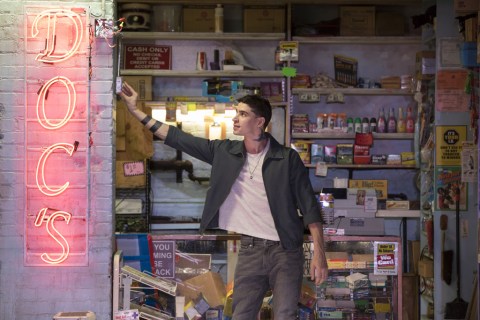
Isaac Powell in ‘West Side Story,’ based on a conception by Jerome Robbins, book by Arthur Laurents, music by Leonard Bernstein, lyrics by Stephen Sondheim, directed by Ivo Van Hove (Julieta Cervantes)
Van Hove’s modernization of West Side Story should not be underestimated. He unravels the underlying perils of “the outsider” theme that resonate with currency for us today. He gives this principal conceptualization a novel rendering by employing video projection (video design by Luke Halls) and the “close-up” to elicit an intimacy and connection with the characters not readily available before. The intimate portrayals of the Sharks and Jets (delivered by close-up) as well as their objectified view that encompasses their using the entire stage, reflects the insider and outsider viewpoint. In the intimate view these individuals are young men, hurting, afraid, alone. In the outsider view they are non-human, throw-away people who have embraced the world of criminality and violence because that gives them a rush of comfort in power and identity that the culture denies to them.
For example in the Prologue we meet in close-ups the key players: Riff (the fabulous Dharon E. Jones) of the Sharks, Bernardo (his marvelous equivalent Amar Ramasar) of the Jets, and their gang members. We note their proud and stalwart personas; they could be CEOs of a company in another time and place. We see their branding, the combat gear of their identities: their piercings, their haircuts, the intricacy of their tattoos. And beyond that as the camera pans the two tribes, we note their sneering bravado, their violence and something else behind their staring eyes-perhaps fear.
These Prologue close-ups in real time, before the tremendous opening number of the stylized, vigorous fight sequence in which a Jet is injured, humanize the erstwhile stereotyped ethnicity of the “Puerto Rican” Sharks and their urban, mixed race counterpart, the Jets. They appear interchangeable. Van Hove’s enlightened casting suggests they are not bonded by ethnicity since there are black, white, Latino members in both gangs, but by inner necessity. They cling to their tribe out of fear, isolation, alienation and the trauma of cultural self-loathing, of being outside, of being the “other.”

Dharon E. Jones and the cast of ‘West Side Story,’ based on a conception by Jerome Robbins, book by Arthur Laurents, music by Leonard Bernstein, lyrics by Stephen Sondheim, directed by Ivo Van Hove (Jan Versweyveld)
We especially note the need to belong in the “Jet Song” which answers the call to be a part of something “bigger” than oneself, even if it is bloodthirsty and destructive. By extension, the Sharks are mixed race and indistinguishable from the Jets except that they “came” from Puerto Rico.
With the exception of a few scenes and songs where the backdrop is black and a rainy mist falls down to perhaps symbolize the eternal/immutable/spiritual, the video design-both live and pre-recorded prevails throughout. The events are streamlined and strengthened. The arc of development moves over a two-day period and falls into the resolution we all know is coming, but still remains surprising and poignant. The song “I Feel Pretty” has been excised and the cut gives the musical an edgier, less digressive, less whimsical feel, which the song conveyed almost as an afterthought. That song in particular is off tenor with Van Hove’s dark vision of this lurid, scary world the gangs occupy, a vision which messages the nihilism of impoverished youth/citizens in this time of Trumpism, I.C.E., Black Lives Matter, The Wall, all of whose memes appear at various and pointed junctures in the production.
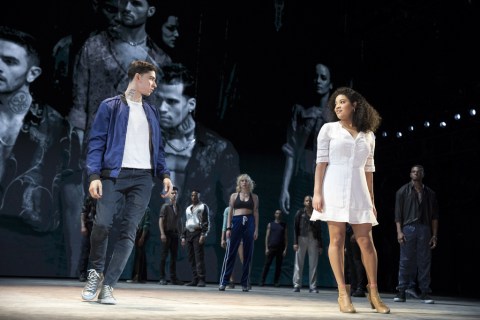
Isaac Powell and Shereen Pimentel in ‘West Side Story,’ based on a conception by Jerome Robbins, book by Arthur Laurents, music by Leonard Bernstein, lyrics by Stephen Sondheim, directed by Ivo Van Hove (Julieta Cervantes)
Thus, we note how the Sharks and Jets attempt to gain a position of power through violence to carve out a place where they can feel safe walking and being. Certainly, in the video projection of dark, lonely streets, a stylized version of the threatening landscape in each of the gang member’s minds, it is revealed that fear surrounds them and they must posture and swagger and image themselves into courage while inside they are cowering children.
For the Sharks, carving out a plot of land is acceptance in the country that views them as trash. As the cast sings “America” and the exceptional Yesenia Ayala as Anita and Amar Ramasar as Bernardo vocally duel out their positions for or against the US, Van Hove’s projections are pointed and riveting. These encompass haunting images of a damaged Puerto Rico left ripped and forgotten after the negligent response of the US to Hurricane Maria. The projections represent the truth; the dance number and song reveals the courage of Anita to hope and the realism of Bernardo to highlight the discrimination and bigotry of third and fourth generation citizens against them. Throughout, Van Hove uses the projections in juxtaposition with the staging to encourage a novel understanding of how the inner person and their outer image operates. We see the two perspectives- the truth and a presentation of the image that is hoped will help one survive in a forbidding city.
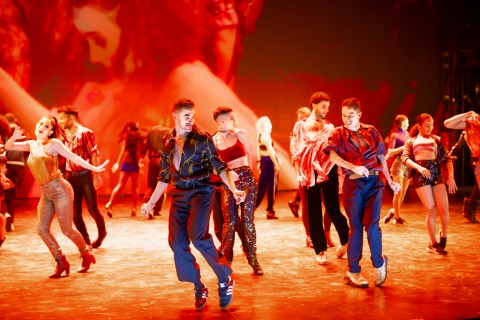
The Company, ‘West Side Story,’ based on a conception by Jerome Robbins, book by Arthur Laurents, music by Leonard Bernstein, lyrics by Stephen Sondheim, directed by Ivo Van Hove (Jan Versweyveld)
The clips of devastation of Puerto Rico are inter cut with various related video clips, one of the final ones referencing miles and miles of the wall at the southern border. The wall is the everpresent reminder that outsiders/illegals are potential thugs and criminals, regardless of their status as asylum seekers, regardless of their status as US citizens. Of course the irony, as Van Hove’s striking version indicates, through the attitudes of Lt. Shrank (Thomas Jay Ryan) and Officer Krupke (Danny Wolohan) that both Sharks and Jets are the unwanted trash, not just the Sharks. That is why they struggle against each other to maintain “face,” and identity in their gang until they are dead and the soil they have struggled over that has rejected them is forced to accept their corpses.
The one group that is missing from this production which I never realized before is missing for a great reason: the dominant social class of conservative “haves.” It is this notably absent elitist tribe that has made the country a pressure cooker of rejection, a blight and a hard climb to the top of the lower middle class for both wandering tribes. It is this group that indirectly encourages tribalism as an answer for those who have little hope for the future and are made to feel as outcasts and criminals who belong in jail (“Gee, Officer Krupke”-the projections during this number are just spot-on).

Isaac Powell and Shereen Pimentel in ‘West Side Story,’ based on a conception by Jerome Robbins, book by Arthur Laurents, music by Leonard Bernstein, lyrics by Stephen Sondheim, directed by Ivo Van Hove ( Jan Versweyveld)
The song sung terrifically by Action (Elijah A. Carter) and the Jets reveal they cannot escape from the dominant white culture’s prophecy about them as criminals. As they internalize the perspective of the dominant culture and law enforcement, their self-annihilation is a self-fulfilling prophecy. Though Action and the Jets tell the Officer to “Krup” himself, it isn’t enough. Their trajectory is fated and doomed, especially without mentors to guide them away from their self-loathing. That Tony and Maria become swept up in their misery unable to break completely free from their own posse and families is the tragedy we have come to hope against.
The director’s use of “larger-than-life” video shakes, stimulates, references and enhances the symbolism and profound human depth of the star-crossed lovers and their “posses.” The projections against the entire back wall of the stage sometimes in split screens of twenty portraits of gang members, sometimes in engaging medium shots of Doc’s drugstore (“Something’s Coming”) and the sweatshop (renamed from the bridal shop) where Maria and her friends work reveal the homely mores which Tony and Maria accept apart from the gang members’ identity and lifestyle.

Isaac Powell and Shereen Pimentel in ‘West Side Story,’ based on a conception by Jerome Robbins, book by Arthur Laurents, music by Leonard Bernstein, lyrics by Stephen Sondheim, directed by Ivo Van Hove ( Jan Versweyveld)
I particularly enjoyed how the close-ups of Maria and Tony in the intimacy of their alone time after he discovers her name worked. First, both Shereen Pimentel and Isaac Powell are vibrant, passionate and in-the-moment, practically every moment. Van Hove’s staging and Powell’s rendition of “Something’s Coming,” and “Maria” particularly shine. Powell’s voice, interpretation and movement are uplifting. In “Tonight” he appears as light as a feather; it is, a full expression of the exhilaration of his love for Maria. I have not seen anything like his performance; he is mesmerizing reaching the highs, lows and devastation of believing that Maria has been killed. He is so there, he brings us there with him. Superlative! Magnificent!
Maria is bubbling over warmth, passionate in her love scene with Powell which was a videoed close-up which made total sense and was an expression of their intimacy as they become “one” and exclude the world they were born into and have decided to leave. Pimentel’s fury after Tony is killed is so convincing, she makes you believe she will shoot all of the guilty, conferring upon herself the roles of judge, jury and executioner, thereby convicting them of his death.

Amar Ramasar, Yesenia Ayala, and the cast of ‘West Side Story,’ based on a conception by Jerome Robbins, book by Arthur Laurents, music by Leonard Bernstein, lyrics by Stephen Sondheim, directed by Ivo Van Hove ( Jan Versweyveld)
The projections carry the metaphoric journey of the outsider, the trash, the unwanted in a through-line of our time, of all time in the import of tribalism’s necessity in a culture that kicks these kids to the bottom and stands in the way of allowing others to find peace, love and happiness. This isn’t just about warring tribes; it’s about seeking power and domination, the easier, faster way out cultural hell than using intellect, logic and wisdom, the qualities amassed through experience, overcoming obstacles and time-worn trial and error.
The Sharks and the Jets, indistinguishable ethnically, are yet distinguishable through costume designer An D’Huys fine designs and color coordination. However, notable is that the Sharks and Jets are brothers of the same ethos who should be helping each other climb upward, instead of fulfilling the white culture’s perceptions of them as violent criminals. By the time we meet them in the video close-ups of the Prologue, we know it is too late. As young men and women, they have few tools at their disposal (wisdom-gained through experience) to thrive as they seek to establish who they are. After all, it is an alien society of adults who eschew them or culturally disavow what they are as tattooed, pierced, hoodlum criminals.
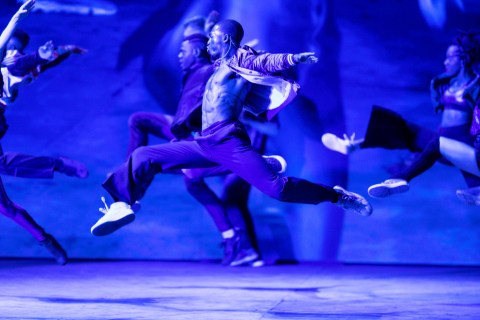
Dharon E. Jones and the cast of ‘West Side Story,’ (Jan Versweyveld)
Sadly, their choices to achieve are few. They can either “die young in a blaze of self-annihilating triumph and leave a good-looking corpse” or live the defeatist life of a self-quarantined, cowardly wussy to avoid the gangs. In Ivo Van Hove’s production, sociocultural economic inequality encourages these tribes toward the genocidal thing to do. That Tony and Maria find each other and love is miraculous. The scene where Van Hove and Anne Teresa De Keersmaeker stage the couples moving off together revealing love as an answer to the culturally encouraged nihilism and self-destruction is particularly touching and hopeful.
This version of West Side Story is a shining example of how structure, form, substance and profound understanding merges to make elevated art. Van Hove cleverly uses the projections and the live staging of the actors/characters in tandem; one informs the other, whether it is to enhance the symbols and themes, to emphasize the characterizations or to detail intimacy. What is communicated is remarkable and unforgettable. Coupled with the acting, singing, movement and the dance numbers by Anne Teresa De Keersmaeker are filled with athleticism that is so appropriate to the characters. All of this contributes to making the production indescribable- breathtaking, stunning, gobsmacking are an understatement. And the music is luscious, gorgeous, fabulous, thanks to Jonathan Tunick (orchestrations) and Alexander Gemignani (music supervisor & director).
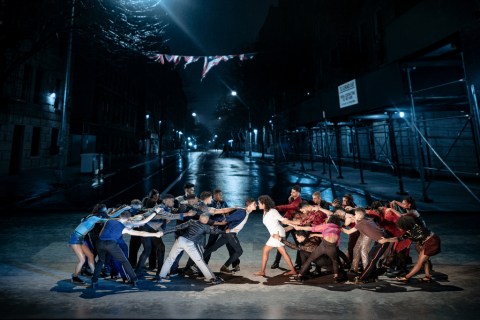
The company of ‘West Side Story,’ based on a conception by Jerome Robbins, book by Arthur Laurents, music by Leonard Bernstein, lyrics by Stephen Sondheim, directed by Ivo Van Hove (Jan Versweyveld)
There is so much more. I’ll just finish with… I also loved the staging/choreography where Maria and Tony are striving to move toward each other pulling against the need of their tribes. The piled-on movement is gripping, sinewy, a tug of war that they will defy for they love each other. Wonderful. And at the end they are pulled apart heaven and earth dividing them until…
The creative team are exceptional artists: Luke Halls (video design) Tom Gibbons (sound design) An D’Huys (costume design). Also superlative are Quinn Matthews as video director, Eric K. Yue as director of photography, Taylor Shung as video producer, Jan Versweyveld for his scenic design and lighting design.
There is nothing else to state except you must see this production. It is an event that does more than entertain. It grabs your heart and makes you understand your humanity and compassion. West Side Story is at the Broadway Theatre (1681 Broadway) running with no intermission until 6th September. For tickets and times CLICK HERE.
 CAROLE DI TOSTI