Category Archives: NYC Theater Reviews
Broadway,
‘Heroes of the Fourth Turning’ by Will Arbery at Playwrights Horizons

Jeb Kreager, Julia McDermott, Heroes of the Fourth Turning by Will Arbery (Joan Marcus)
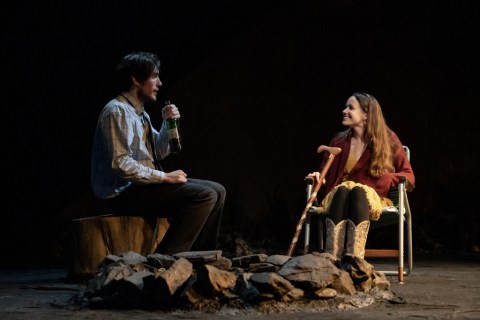
John Zdrojeski, Julia McDermott in Heroes of the Fourth Turning, by Will Arbery (Joan Marcus)
It’s seven years after you’ve graduated from college. What do you do if you are adrift, emotionally miserable and/or in physical pain? What if cocaine, alcohol, social media obsessions, abstinence from sex, indulgence in sex, and your Catholicism isn’t helping you find your way? Do you find something else to believe in to help you escape from the labyrinth of conundrums and foreboding demon thoughts plaguing your life?
Will Arbery’s Heroes of the Fourth Turning in a production at Playwrights Horizons ably directed by Danya Taymor discloses the inner world of the right wing religious. In his entertaining and profound examination of conservative-minded friends and alumni from a small, Catholic college who gather for a party, we get to see an interesting portrait of conservative “types,” who are akin to liberals in dishing the rhetoric. To his credit Arbery gives grist to the argument that beyond the cant are the issues that pertain to every American. Whether liberal or conservative, all have the need to belong, to care and love, and to make a way where there is no apparent way to traverse the noise and cacophony that creates the social, political divide currently in our nation.
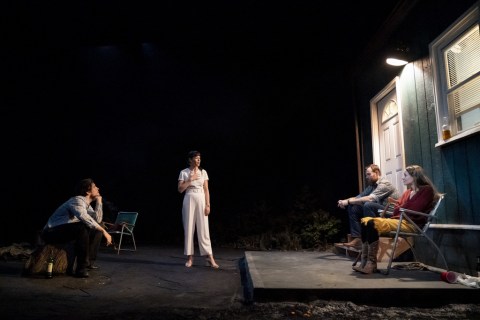
John Zdrojeski, Zoë Winters Heroes of the Fourth Turning, by Will Arbery (Joan Marcus)
How each of the friends attempts to survive “out there” in the cruel, “evil” world fascinates. During the evening mini reunion on the occasion of celebrating Emily’s mom’s accepting the presidency of their alma mater, Emily (Julia McDermott), Kevin (John Zdrojeski), Justin (Jeb Kreager), and Teresa (Zoë Winters), explain who they’ve become or not become in the seven years since they’ve graduated. Teresa, a rebel during her college years, has become more right-wing conservative than ever, embracing Steve Bannon, Breitbart and Trump with gusto. The others have “laid low” in retreat in Wyoming and Oklahoma, holding jobs they either despise or “put up with,” until they get something better.

Zoë Winters, Jeb Kreager, Julia McDermott, Heroes of the Fourth Turning, by Will Arbery (Joan Marcus)
Zoë Winters portrays Teresa, the feisty, determined, “assured,” conspiracy-theorist supporter with annoying certainty and hyper-vitality, as she explains the next phase of American history to the others. She does this by summarizing a book which posits the Strauss-Howe Generational Theory. Emily, Teresa and Kevin fit into the millennial segment which lends its title to the play: the fourth turning/hero cycle. As she insists that her friends are the hero archetypes laid out in Generations: The History of America’s Future: 1584-2069, she suggests they must embrace their inner/outer hero and get ready for the coming “civil war.”

John Zdrojeski, Julia McDermott in Heroes of the Fourth Turning by Will Arbery (Joan Marcus)
For different reasons Emily and Kevin find Teresa’s explanation of the “Fourth Turning” conceptualization doubtful for their lives. Kevin’s self-loathing and miserable weaknesses belie heroism. He is too full of self-torture and denigration to get out of himself to help another or take a stand for a conservative polemic to fight the liberal enemy in a civil war. Emily is crippled by the pain of her disease. We discover later in the play that she has questions about the conservatism she once embraced. The civil war polemic only seems possible for Justin (Jeb Kreager), who was in the military. Though Justin is not the “Hero” archetype, but is a “Nomad,” he later in the evening expresses that he thinks the conspiracy mantra “there will be a civil war,” proclaimed for decades by alternative right websites will happen.

John Zdrojeski, Zoë Winters, Jeb Kreager, Michele Pawk, Julia Mermott in Heroes of the Fourth Turning by Will Arbery (Joan Marcus)
Arbery has targeted their conversations with credibility and accuracy and the actors are authentic in their nuanced portrayals. As Kevin, John Zdrojeski becomes more drunk, humorous and emotionally outrageous as the night progresses. His behavior shocks for a supposed Catholic, until we understand Kevin doubts his religion’s tenets, especially abstinence before marriage. To a great extent he has been crippled emotionally by doubt, double-mindedness and the abject boredom he experiences with his job in Oklahoma. Also, he admits an addiction to Social Media. Zdrojeski projects Kevin’s confusion and self-loathing victimization with pathos and humor. But we can’t quite feel sorry for him because he is responsible for his morass and appears to enjoy reveling in with his friends. Teresa suggests this is his typical behavior.
The friends wait for the arrival of Gina (Michele Pawk), Emily’s mom’s, to congratulate her on becoming president of their old alma mater, Catholic Transfiguration College of Wyoming. As they wait, they drink, get drunk and catch up with each other, reaffirming their friendships from the past. They discuss and reflect upon the decisions that brought them to Catholic Transfiguration College. We note their conservative, religious views about life, family and politics. Their confusion, sense of impending doom and lack of hope for the future are obvious emotional states. This is an irony for Catholics, whose hope should reside with the birth of Christ and the resurrection. Clearly, they are not exercising the spiritual component of their faith, alluded to in Gina’s speech and in Kevin’s quoting of Wordsworth’s poem “The World is Too Much With Us.” They’ve allowed the material and carnal to overtake the spiritual dimension and thus are depressed and filled with doubt.
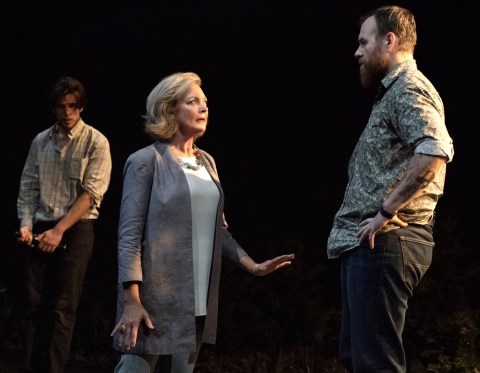
(L to R): John Zdrojeski, Michele Pawk, Jeb Kreager, in Heroes of the Fourth Turning by Will Arbery (Joan Marcus)
In representing the conservative views of these individuals, the playwright culls talking points from right-wing media and blogs which Teresa references to Gina when Gina finally arrives. The fact that right-wing conservatism construes violent fighters as heroes is a conflated, limited view. Indeed, to see oneself as a hero and embrace that role is not even an act which true heroes (i.e. firemen, doctors in war zones) saving lives perceive for themselves. It is rhetoric. And Teresa, to empower herself and impress her old friends, speaks it as polemic. Her discussion is not really appropriate to inspire comfortable light conversation at a party. Indeed, her talk is done to solidify herself in the firmament of fantastical belief and remove any oblivion of her own doubts about her life. She and Justin who was in the military particularly rail against liberals, the LGBTQ community, Black Lives Matter, etc.

(L to R): Michele Pawk, John Zdrojeski, Zoë Winters, Heroes of the Fourth Turning, by Will Arbery (Joan Marcus)
Interestingly, Gina blows up Teresa’s cant when she finally arrives to receive the friends’ congratulations. However, they are not quite ready for Gina’s rhetorical response which is a convolution of conservative and liberal ideas that loop in on themselves again and again and defy political labeling. But Gina separates out the illogic of each of their positions. She disavows Justin’s need for guns on campus and decries the conspiracy of the upcoming “civil war.” She implies that Bannon and his like-minded are hacks, and she disavows Trump to the shock of Teresa. At the end of the evening, she pronounces that she is disappointed in the education they have received at their school, believing the college has failed them.

Jeb Kreager, Julia McDermott, in Heroes of the Fourth Turning by Will Arbery (Joan Marcus)
The night of celebration becomes a night of upheaval for Emily, Justin, Kevin and even the staunchly “certain” Teresa who will in the next decade most probably change her views a number of times to suit her determination that she has a handle on the great narrative of “reality.” But in truth as we watch these friends founder through the labyrinth of sublimely complex political, social and cultural convergences they discuss and refer to, it becomes obvious that they have been dislocated from their comfortable conservatism that categorically defined the world for them when they began college.

(L to R): Zoë Winters. Michele Pawk in Heroes of the Fourth Turning by Will Arbery (Joan Marcus)
The irony is that when Gina comes and joins their conversation and smacks down each of their beliefs, especially Teresa’s, we settle back watching the imbroglio that Arbery has wrought. Indeed, we wonder at Gina’s convoluted logic and justifications. That she would give Kevin a job in admissions is a dark irony of misjudgment. He appears the least directed to help others in the admissions process. Though they say their goodbyes with love, Justin and Emily remain in darkness. There is no comfort to be found. There is only the continuation of a foreboding reckoning.
The strongest dynamic of the play resides in the conflicts when Arbery has the friends go at each other after their initial easy reaffirmation of friendships. Ironically, the community they attempt to create falls apart driven by what is devouring each of them inside. It is then that personal flaws they’ve discussed manifest and the hell they face within spills out. Justin’s is humorously eerie. Emily’s comes in the form of fury at whom she deals with in her job and the resident demon of pain in her body. Teresa fears she is making a mistake getting married, and Kevin can’t come to the end of himself.
The tempest between and among the individuals and their inner conflicts reflects a currency for our times and is welcome fodder for entertainment. Arbery with the subtle direction of Taymor has succeeded in extending a hand across the divide of national uproar between left and right with his human, flawed characters. The actors in this ensemble are superb and hit powerful emotional notes with spot-on nuances between humor and profound drama.
This is a play you must see for its shining performances, its topics, the rhetoric-exceptionally fashioned by the playwright and its surprises in characterization. The conclusion is chilling as it expands to the mythic. Noted are the design team: Sarafina Bush (costumes), Isabella Byrd (lighting), Justin Ellington (sound), J. David Brimmer (fight director).
Heroes of the Fourth Turning runs with no intermission at Playwrights Horizons (416 West 42nd Street between 8th and 9th). For tickets and times go to their website by CLICKING HERE.
t
‘Dublin Carol’ by Conor McPherson, Directed by Ciarán O’Reilly at Irish Repertory Theatre

(L to R): Cillian Hegarty, Jeffrey Bean, ‘Dublin Carol’ by Conor McPherson, directed by Ciarán O’Reilly, Irish Repertory Theatre (Carol Rosegg)
Dublin Carol by Conor McPherson directed with just the right tone and irony by Ciarán O’Reilly is a seminal play about the spirit of Christmas that is bestowed upon the principal character John, superbly portrayed by Jeffrey Bean. McPherson chooses this self-hating alcoholic protagonist to reflect humanity’s hope of redemption from broken promises, regrets and soul sins lathered with guilt and remorse.
McPherson’s John, like many, reveals an overarching longing for change from the boredom of self-loathing, loneliness and recriminations. During the course of the play we see how the playwright elucidates that such change never happens quickly, but does come with subtle, gradual almost unnoticeable shifts when least expected. In John’s instance it is the visit from his daughter Mary (Sarah Street) whom he hasn’t seen in ten years that fans the flames that have been ignited by his boss the mortician Noel who saved him from one stage of himself. When she comes to tell him about the condition of his wife, her mother whom he abandoned long ago, the conversation prompts his movement to admit his miserable state when he left the family. He was in hell.

Sarah Street in ‘Dublin Carol’ by Conor McPherson, directed by Ciarán O’Reilly, Irish Repertory Theatre (Carol Rosegg)
Above all McPherson’s work is about love and forgiveness. Such love is given by John’s daughter. And it is an irony that John is so over-bloated with guilt and remorse that he cannot forgive himself and thinks himself completely unworthy of it. But it is her expression of love and respect (she admits she also hates him) that helps him make a final determination. The decision moves him toward a kind and thoughtful resolution with his family which by the end of the play portends a new door will open in John’s life that may lift him up from his self-hatred into self-forgiveness.
Though the setting is Dublin Christmastime, in the office of a funeral parlor where life and death sit side by side, the title references a widow Carol who lived in Dublin that John mentions he had a long-time affair with. The title also alludes to a Carol as a song heralding the good news of the celebration of Christ’s birth. Of course, Christ’s birth symbolizes that redemption, reformation, forgiveness and love are possible for the great and small and even someone as “rotten” as John perceives himself to be.
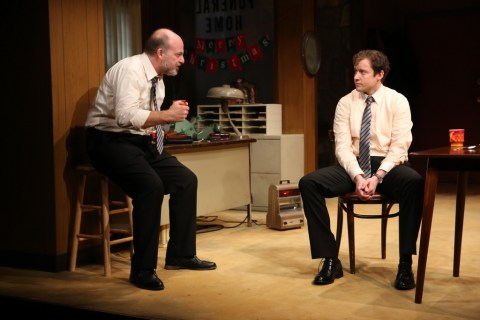
(L to R): Jeffrey Bean, Cillian Hegarty in ‘Dublin Carol’ by Conor McPherson, directed by Ciarán O’Reilly, Irish Repertory Theatre (Carol Rosegg)
The characterizations are drawn clearly and we become engaged in the simple interactions between Mark (Cillian Hegarty) and John in the first segment, John and his daughter Mary in the second and John and Mark in the third. The arc of development grows out of these interactions and the nature of the conversations which become more revelatory and intimate bring about a change in John’s character.
As Mark and John sit down for tea and a respite from their labors assisting Mark’s sick Uncle Noel (a mortician) with the external arrangements of a young person’s funeral while Noel is in the hospital, we first learn about John and a bit about the twenty-year-old Mark. John shares his self-perceptions and generally blames his lack of discipline and care for his family because of alcohol. He enjoys drinking. But when Mark’s Uncle Noel gave him a job to help in the office with the funerals, John’s life improved and he lifted himself up from the bad state he was in when Noel met him.
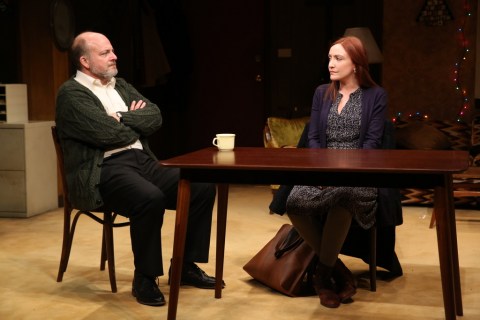
Jeffrey Bean, Sarah Street in ‘Dublin Carol’ by Conor McPherson, directed by Ciarán O’Reilly, Irish Repertory Theatre (Carol Rosegg)
John’s character grows on us because he holds little back and digs down into the depths of his self-loathing in each segment, taking off on a racetrack in his confession and heart-to-heart with daughter Mary to whom he apologizes for his miserable treatment and abandonment of the family. It is clear that there was no physical harm. Indeed, his own father beat his mother and John does not follow in his footsteps. Nevertheless, he lands on the fact that he didn’t stop his father and was a coward and felt self-hatred for selfishly, brutally not intervening because he feared getting beaten along with his mother.
However, even after John apologizes profusely for his behavior to Mary, he knows it isn’t enough. Clearly, he despises himself and wishes he could erase the memory of who he is along with his former identity and behaviors with his family. The self-disgust moves him to say he wishes he had never been born. Of course the more he admits fault, and makes such profound declarations, the more we identify with him and find his authenticity human, real and poignant. Jeffrey Bean is truly adroit in the role. He strikes all the notes clearly. He manifests John’s self-disgust with the nuance that John longs to be a different person, but is afraid he will let himself down by letting his family down once more.
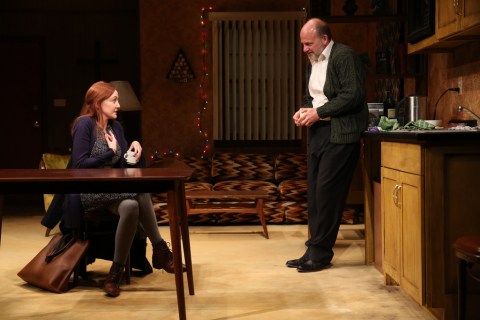
Sarah Street, Jeffrey Bean in ‘Dublin Carol’ by Conor McPherson, directed by Ciarán O’Reilly, Irish Repertory Theatre (Carol Rosegg
For their part Mary and Mark become John’s sounding boards, yet he clearly engages them and asks about their lives. When he discovers the news that Mary brings and the subsequent request that goes with it, the situation becomes a way that he can make up for his behavior in the past. He and Mary confess each other’s faults to one another, an important step toward forgiveness. But can John trust himself to do the right thing and stick to his decision? The irony is this: if he fulfills the request he will have to confront his past with the one he most abused and hurt, his wife from whom he never obtained a divorce. His guilt is overwhelming!
As his daughter leaves with the understanding that John will go with her to visit her mother who is dying, she importunes him not to drink any more and to be ready at a later time when she will drive him to the hospital. Of course, flashing lights go on. It is as if the request to not drink triggers John with perverse reverse psychology. The segment closes leaving John contemplating what to do. To drink? To make it up to his wife, daughter and son? Or just to escape somewhere out of their reach?
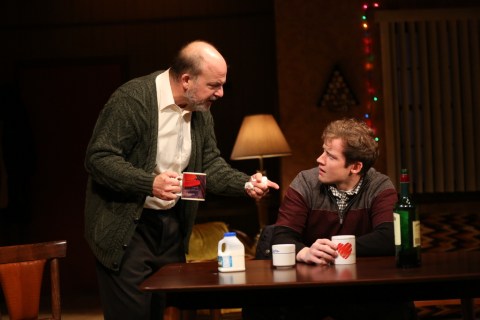
(L to R): Jeffrey Bean, Cillian Hegarty in ‘Dublin Carol’ by Conor McPherson, directed by Ciarán O’Reilly, Irish Repertory Theatre (Carol Rosegg)
At the top of the third segment we discover John caves to self-loathing and guilt. He has been celebrating “Christmas.” Mark interrupts him only to discover John was too overwhelmed with drink to pick up his money at the bank. During the course of their interchange, John lays down a rant which is pure McPherson replete with irony and sardonic humor as he relates how his affair with Carol and her unconditional love drove him to the end of himself and the dregs of barrels of alcohol. At this point it is apparent, especially when he begins to put away the Christmas decorations that he has no intention of making it up to his family or going with his daughter. He is back to square one and will be on another bender and into the abyss without Noel to save him a second time.
McPherson’s characterizations and themes are spot-on. Throughout, this work is filled with dark humor which resonates in truthfulness. And in the hands of Jeffrey Bean guided by O’Reilly, the ironies spill out with fervor, especially in the last section of the play when John attempts to counsel Mark not to feel guilty about ending it with his girlfriend. John’s groveling diatribe about the stages of his drunks is also humorous. But the confession and John’s setting a terrible example for Mark does both characters good. Hearing the pain and misery of the stages of drunkenness would give anyone pause about drinking to oblivion.
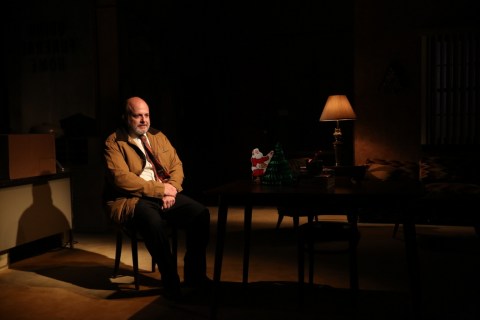
Jeffrey Bean in ‘Dublin Carol,’ by Conor McPherson, directed by Ciarán O’Reilly, Irish Repertory Theatre (Carol Rosegg)
The ensemble work is tight and O’Reilly keeps the production resonating with the wisdom and revelations that McPherson suggests in his themes. Kudos to the creative team who bring it all together: Charlie Corcoran (scenic design) Leon Dobkowski (costume design) Michael Gottlieb (lighting design) M. Florian Staab (sound design) Ryan Rumery (original music).
See Dublin Carol for the uplifting performances in this subtle and different McPherson work. It is running at Irish Repertory Theatre (22nd St between 6th and 7th) with no intermission. For tickets and times go to their website: CLICK HERE.
‘runboyrun’ and ‘In Old Age’ Two Magnificent Works by Mfoniso Udofia

Chiké Johnson, Patrice Johnson Chevannes in runboyrun and In Old Age, written by Mfoniso Udofia, directed by Loretta Greco, Awoye Timpo (Joan Marcus)
What is the impact of experiencing a genocidal civil war when one’s ancestry, bloodline and religion are used as targeted excuses for extermination? If one survives, is it possible to overcome the wartime horrors one experienced? Or is the sufferer doomed to circularly repeat the emotional ravages of past events that erupt from the unconscious and imprison the captive forever in misery? How is such a cycle broken to begin a process of healing?
In runboyrun, Mfoniso Udofia, first-generation Nigerian-Amerian playwright, through poetic flashback and mysterious revelation, with parallel action fusing the past with the present, explores these questions. Majestically, in her examination of principal characters Disciple Ufot (the superb Chiké Johnson), and his long-suffering wife Abasiama Ufot (the equally superb Patrice Johnson Chevannes), we witness how Disciple overcomes decades of suffering with the help of Abasiama during a night which is a turning point toward hope and redemption.

Chiké Johnson, Patrice Johnson Chevannes, Karl Green, Adrianna K. Mitchell in runboyrun and In Old Age, written by Mfoniso Udofia, directed by Loretta Greco, Awoye Timpo (Joan Marcus)
A bit of backstory is warranted. In 2017 New York Theatre Workshop presented two of Mfoniso Udofia’s plays in repertory (Sojourners, Her Portmanteau). runboyrun and In Old Age are two of Mfonsio Udofia’s offerings which are plays in The Ufot Cycle, a series of nine plays in total which chronicles four generations of a family of stalwart women and men of Nigerian descent. Though the plays currently presented at NYTW are conjoined to elucidate similar themes, they do not run in sequence. Nevertheless, both plays spotlight Mfonsio Udofia as a unique female voice of the African diaspora in the United States. Both represent the particularity of her exceptional work from a maverick’s perspective.
The first play directed by Loretta Greco begins with a flashback of a sister and brother. The setting is January, 1968 Biafra, the southern part of Nigeria that attempted to gain independence from Nigeria during the three year Biafran Civil War. During a lull in the shelling by the government in a hideout in the bush, the sister comforts her brother with a metaphorical story about the foundation of humanity and life. Then she encourages him to run as a game. However, it is the one activity that will save their lives as they escape the Nigerian soldiers at every turn, until they reach a safe place in a compound with their mother and brother.

Chiké Johnson, Patrice Johnson Chevannes, Karl Green, Adrianna K. Mitchell in runboyrun and In Old Age, written by Mfoniso Udofia, directed by Loretta Greco, Awoye Timpo (Joan Marcus)
This setting alternates to the present January, 2012, where we are introduced to the Ufots, transplanted Nigerians who immigrated to the United States, became citizens and eventually settled in the ramshackle interior of their colonial house in Massachusetts. However, from the moment Johnson’s Disciple enters their cold, dank home and with bellicosity relates to Chevannes’ Abasiama, we understand that their estrangement is acute. For her part Abasiama, who lies on the couch in the center of the living room wrapped up in layers of clothing with blankets and sheets thrown over her head, disengages from his behaviors, attempting to stay away from his weird, oppressive antics.
Disciple attempts to control her every move, berates and blames her for the bad spirits in the house. However, it becomes obvious that it is he who suffers derangement. He is fixated on the perception that everything outside him and especially his wife are the source of his bad luck and the wickedness that plagues him and threatens to upend his life and his writing. In what we learn has become a ritualistic practice, Disciple uses a thin stick to circumscribe areas as safe to prevent evil spirits from disarranging and unsettling his peace. Abasiama, used to this behavior, plays Christian music; Christianity was a part of their Igbo ancestry. However, after Disciple’s exorcism, when he attempts to begin work on a new book, the past erupts. Once more the playwright creates flashbacks which establish and explain Disciple’s instability and borderline insanity.

The full cast of runboyrun, written by Mfoniso Udofia, directed by Loretta Greco (Joan Marcus)
Udofia’s structure interlacing the past with the present is particularly strengthened by Andrew Boyce’s scenic design which threads the action, symbols and themes. The house is divided in a cross section symbolizing the division in Disciple’s and Abasiama’s relationship and marriage so we see how both conduct their lives in separate parts of the house: Abasiama upstairs, Disciple in the basement. They do not communicate, nor are they intimate with each other’s thoughts and feelings, sharing little if anything of their histories, a tragedy which has led to the disintegration of their marriage. Their lives are separately lived; they buy food separately, use different refrigerators. Disciple cooks for himself and they take their meals separately because he believes she may poison him.
The separation extends even to the different churches they attend and Disciple’s cruel treatment of Abasiama, which she sustains because to take a stand against it would rain down more abuse. Disciple begrudges Abasiama warmth for the upper floors which have insufficient heat to brace up against the cold Worcester, Massachusetts winter. This behavior of keeping the upper floors cold reflects Disciple’s abusiveness and penuriousness, not only with finances but with emotional intimacy and love.

Chiké Johnson, Patrice Johnson Chevannes in ‘runboyrun’ and ‘In Old Age,’ written by Mfoniso Udofia, directed by Loretta Greco, Awoye Timpo (Joan Marcus)
The division/cross section symbolizes a number of elements which define the characters so acutely portrayed by Johnson and Chevannes with maximum authenticity. It represents the compartmentalization of Abasiama’s and Disciple’s minds, especially Disciple’s as it relates to his unconscious memories which he’s suppressed, and on this night erupt with great ferocity. For Abasiama, she compartmentalizes her rage and anger against Disciple; to express the emotions will result in violence so she must be stoic. The events that play out from the past take place in the “basement” area. Events move upstairs when Abasiama extends grace to Disciple and he relives the flashback that has shaken his soul and increasingly knocked on his heart to be released as he has aged. If he does not, surely he will damage and destroy everything he has, most importantly his relationship with Abasiama.
It is in the “basement” of his being on this particular night that Disciple confronts the spirits that have haunted him for decades. By the play’s conclusion he revisits the blood soaked memories of his childhood during the horrors of the Biafran War. The spirits rise and their energy drives him to the brink of irrationality, which he takes out on Abasiama, who finally proclaims “enough,” and tells him she wants a divorce. In shock he returns downstairs and she hears him raving against the energies that roil him (his unconscious terror and guilt).

Adrianna Mitchell, Karl Green, ‘runboyrun,’ written by Mfoniso Udofia (Joan Marcus)
Mfoniso Udofia expertly weaves in concurrent flashbacks which reveal seminal events that shattered Disciple’s consciousness and emotionally freeze him in time. We learn why he is psychotic in recreated scenes of his family: sister (Adrianna Mitchell), mother (Zenzi Williams), Benjamin (Adesola Osakalumi). Karl Green portrays Disciple as a boy. And on Abasiama’s encouragement and love, he finally reaches the core event to expurgate it and grieve, thus beginning the healing process.
Chiké Johnson is acutely, sensitively invested in his portrayal of Disciple. Patrice Johnson Chevannes as Abasiama is expert and uplifting at the conclusion of runboyrun. And in the segue to the next play, we see her transformation into a withered, dried up old woman living with the rage and fury bestowed upon her by Disciple who has died by the opening of In Old Age.

Ron Canada, Patrice Johnson Chevannes in In Old Age, directed by Awoye Timpo, written by Mfoniso Udofia (Joan Marcus)
It is Abasiama’s fury that has carried over from her time with Disciple that Mfoniso Udofia examines in the play In Old Age. The stoicism we see in runboyrun blossoms into rage against herself for “putting up with” Disciple and not leaving him. Whether such anger manifests when we age, so that we have no tolerance for ourselves and are grumpy and angry with others is an interesting question that Mfoniso Udofia posits. Yet, it is in Abasiama’s interactions with Azell Abernathy the workman (Ron Canada), that the emotional abuse she never discussed or confronted Disciple about is now coming to call. And likewise, the tragic alcoholic-fueled abuse that centered around Abernathy’s marriage, that Abasiama intuits harmed his marriage, becomes a focal point of their interactions.
Abernathy and Abasiama clash and their expressed annoyances with each other are sometimes humorous. However, because they are both Christians, they attempt to bear up with one another. Indeed, Abernathy is much more determined to do so than initially Abasiama seems to want to. How Mfoniso Udofia brings these two together to establish the beginnings of a loving relationship is a lesson in grace and the spiritual need for forgiveness and emotional healing.
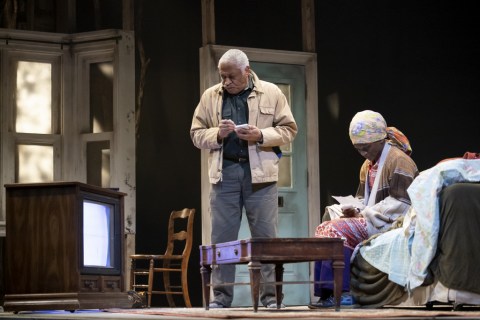
Ron Canada, Patrice Johnson Chevannes, ‘In Old Age,’ written by Mfoniso Udofia, directed by Awoye Timpo (Joan Marcus)
The plot development of In Old Age is simple. Azell Abernathy must persuade Abasiama to allow him to repair her house, the same house that she lived in with Disciple. However, the house is in more than need of repair. Abasiama hears what she believes is Disciple ranging and banging around in the basement. Just like in runboyrun when Disciple projected his terror and hurt onto Abasiama, now Abasiama projects her rage and anger onto the house and in magical realism fashion, it manifests in banging and noise.
One of the problems is that Abasiama subverted her own healing and empowerment to help Disciple redeem himself. Now she regrets her sacrifice and unselfishness. As a result, when Abasiama is forced to deal with Azell Abernathy (Ron Canada in a highly nuanced, sensitive, clarion performance), whom her daughters have paid to repair the house, the rage has so swelled inside of her she drips bile. Toward Abernathy, she is provocative and she riles him to the point where he nearly becomes abusive. However, he has learned. He leaves, goes outside and prays for her.
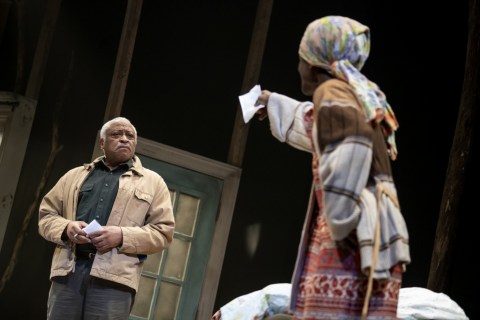
Ron Canada, Patrice Johnson Chevannes, In Old Age, written by Mfoniso Udofia, directed by Awoye Timpo (Joan Marcus)
His prayers work with power and change comes with revelation. Abasiama realizes she can no longer carry around past hurts and regrets. To expurgate them, she cleans out the “basement” (symbolic of her own soul and psyche), of all of the artifacts that Disciple kept there. As she throws them out, she frees herself realizing she is responsible for her own happiness and cannot blame her misery on Disciple. Cleansed from a night of dealing with her own regrets about her life, Abasiama is ready to face a new day. In a great, symbolic gesture, Abernathy washes her feet as Christ did with his disciples, showing he forgives her and forgives himself. It is an act of sublime strength. She receives his good will, Christian love and faith. She removes her shackles represented by her headdress and shows Abernathy her true self. She is beautiful. In their old age they have found love after confessing their faults to each other to be healed.
In Old Age is a hopeful, redemptive encomium to our ability to grow and regenerate our souls if we face ourselves. Directed by Awoye Timpo, In Old Age is just lovely and the complex performances by Canada and Chevannes are sterling, poignant and uplifting. Kudos to Andrew Boyce (scenic design), Karen Perry (costume design), Oona Curley (lighting design).
These are productions you do not want to miss for the profound beauty of Mfoniso Udofia’s work and the great ensemble acting. The tension in runboyrun is truly striking. runboyrun and In Old Age are at NYTW on 4th Street between 2nd and the Bowery. The production runs with one intermission. For tickets and times CLICK HERE.
‘The Height of the Storm,’ Starring Jonathan Pryce, Eileen Atkins in Bravura Performances
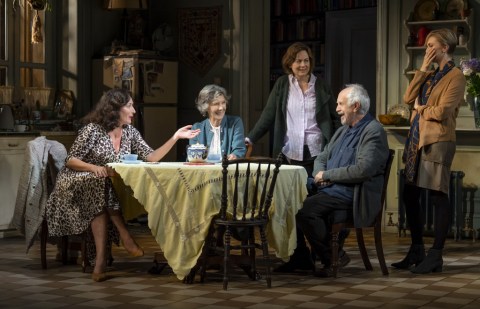
Lucy Cohu, Eileen Atkins, Amanda Drew, Jonathan Pryce, Lisa O’Hare in ‘In the Height of the Storm, by Florian Zeller, translated by Christopher Hampton, directed by Jonathan Kent (Joan Marcus)
The Height of the Storm written by Florian Zeller (The Father, The Mother, The Son trilogy) translated by Christopher Hampton and directed by Jonathan Kent will be poignant for those who have family with Alzheimer’s or parents with advanced dementia. After seeing the play, my experience having relatives with these devastating conditions darkly reminded me of the MO of how such folks live in existential time. The divide between past and present, fabrication and fact are filtered through unconscious impulses that make memories rise to the surface of consciousness like dead fish subject to random currents. In the tangled mind of those with dementia, hallucinations prevail. Memory co-exists with scenes in “present” time and all remains fluid, colored by the perceptions of the moment in whatever moment it is.
Living under such confusion remains frustrating for the sufferer and family who must bear up against the onslaught of alternating states of consciousness and melding realities. Family members sustain the disease. Forced to be complicit with the fantastical consciousness exhibited by their afflicted parent, they choose not to upset them with the facts of current time, place and circumstance which would be pointless. The afflicted wouldn’t accept what they say anyway, convinced of the truth of where they are, lost in their dreamscape of past perceptions. It is a cruel joke to try to make sense of the nonsensical.
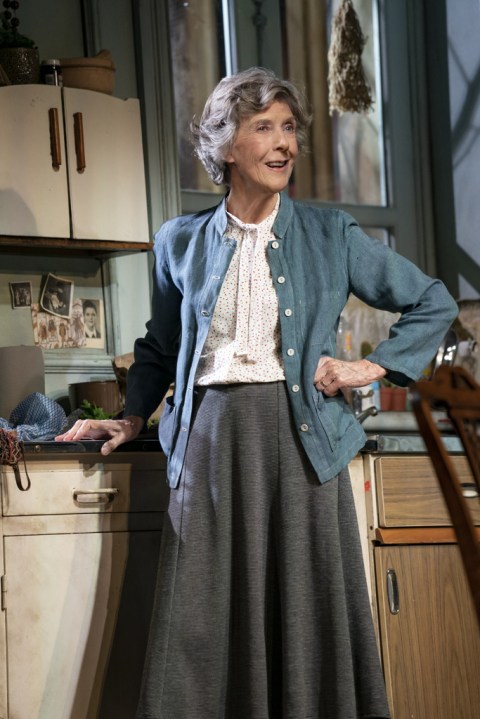
Eileen Atkins, ‘In the Height of the Storm,’ directed by Jonathan Kent, written by Florian Zeller, translated by by Christopher Hampton (Joan Marcus)
And so it goes for the characters in Zeller’s The Height of the Storm which elucidates a marriage between André and Madeleine that has lasted amidst triumphs and conflicts for fifty years. And so it goes for the audience who arbitrates the “reality” in present time of what it experiences during the interactions of family members (André, Madeleine, Anne, Élise) though clouds of glorious time past intervene. And sometimes the clouds work themselves into a storm, the memory of which repeats and repeats in their conversation.
In this play the fog, confusion, the displacement of time present with time past are acutely manifested by writer André (Jonathan Pryce in a portrayal that is a tour de force) though the entire family manifests elements of the same as they relate to him and each other. Madeleine played with astounding, measured brightness by Eileen Atkins is André’s stoic, vibrant, organized, take-charge wife who floats in and out of his stream-of-consciousness as he fades in and out of her conversations with her daughters.

Jonathan Pryce, ‘In the Height of the Storm,’ directed by Jonathan Kent, written by Florian Zeller, translated by by Christopher Hampton (Joan Marcus)
Zeller also focused on dementia in another of his plays, The Father (2016, The Samuel J. Friedman Theatre) starring Frank Langella who won a Tony Award for his performance. In The Father, another iteration of André must deal with the vicissitudes of memory loss, confusion, and his psychological responses of anger to that which is uncontrollable, his disease. Without the mitigating influence of his wife, André and his two daughters Élise and Anne must confront his worsening condition. The arc of development is explicit; we “get it.” We empathize and find catharsis in the tragedy of a family impacted by the mental disintegration of the patriarch. In The Father Zeller wraps up the characters, development and themes neatly; we are grateful, move on and generally forget what we’ve witnessed.
There is no such easiness in The Height of the Storm which is unforgettable because it is elliptical, abstruse and annoyingly so until we understand Zeller’s themes and the core of where he is driving this work. There is no clear arc of development in chronological story-telling. Time is defined by memory and that is the present consciousness. The amorphous, vague threads of conversation are filled with details chucked into the dialogue as we watch the daughters, Anne (Amanda Drew), Élise (Lisa O’Hare) father (André) and mother (Madeleine) interact, slip in and out of present and past moments, watch each other, are silent listeners. The moment we think we understand the concrete facts, for example that André won’t talk to Anne initially because he is caught up in a foggy Alzheimer’s reverie looking out the window, the axis of the scene shifts and he speaks to her and ends the interlude spouting, “Toll the bell, toll the bell. For all of you. Oblivion to the living!”

Jonathan Pryce, ‘In the Height of the Storm,’ directed by Jonathan Kent, written by Florian Zeller, translated by by Christopher Hampton (Joan Marcus)
This is a pronouncement that seems incredibly profound. And though we may admit it to ourselves or not, we face an oblivion of belief. We presume we understand what is happening around us in our lives, but it is our own perception, what we choose to believe about aspects of reality. We have no way of proving we are right or wrong. That is a form of oblivion whether we accept it or not. Similarly, as the characters in the play progress with each other, we watch/soldier on attempting to grab hold of and make sense of the interactions of the family. Moments of wisdom fade. And another curious scene of convolution ensues.
Zeller’s work is replete with axis shifts that create staggering imbalances so we are confounded about what is happening because we are not grounded in time. That it appears to be mid morning in a stately Victorian kitchen with a study nook, hallway lined with bookshelves, a kitchen window overlooking a garden doesn’t help. Precisely when the events occurred and in what sequence remains opaque. This is one morning of one or two mornings in the consciousness of André and Madeleine and their grown daughters who visit at vital times. Then it appears the mornings meld together without particularity except for tidbits of “apparent” distinguishing details in conversation.
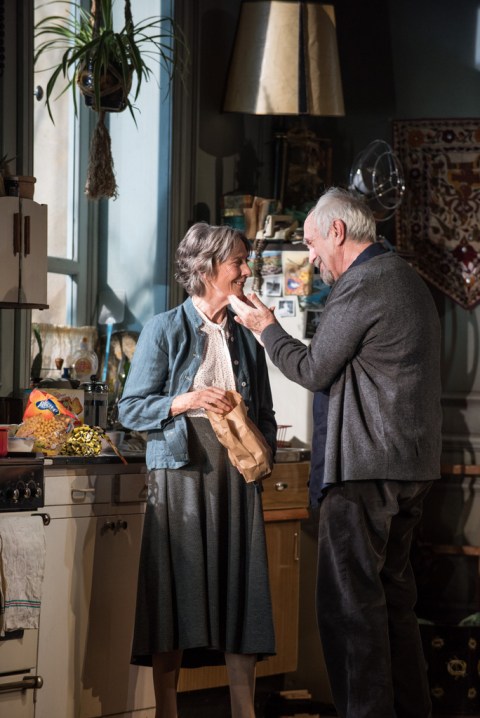
Eileen Atkins, Jonathan Pryce in ‘In the Height of the Storm,’ directed by Jonathan Kent, written by Florian Zeller, translated by by Christopher Hampton (Joan Marcus)
After Anne and André discuss the problem of his living alone in the house by himself, the scene subtly shifts and the atmosphere brightens with the truth or appearance of reality. The efficient, solid-state Madeleine comes in from shopping and lightly humors André. Is this present reality unfolding or someone’s memory from time past? Surely, this scene happened at some point in their lives. But when? We must sustain our confusion as uncomfortable as it is. But not for long because Zeller is constantly upending our former perceptions and muddling our attempt to make meaning. We experience André’s addled mind at work navigating the sea of confusion that is representative of those with dementia. And yet, we also experience Madeleine’s grounded, fact-based consciousness in alternate scenes after atmosphere shifts that randomly intrude, governed by a family member’s comment that joggles a memory and changes the mood once more from lightness to the austere and portentous.
Flowers arrive signifying someone has died. Who? It can’t be the characters present. As Madeleine and her daughters have a conversation about André in the past tense as he sits quietly in the chair, our certainty grows that he has died, physically, surely mentally. Then Zeller shifts the axis once more and in the next moments, André comes to life and he and Madeleine talk about what she is cooking (mushrooms). This subject brings up additional free associations from the past, i.e. André’s walks to look for mushrooms until he stopped when he heard another gentleman did the same and fell into the river and “died.” But we find out from André in another scene, that this man’s death was faked when André sees him years later with a woman. It is one more detail which we cannot deem with certainty is either credible or fictional or twisted threads of both.

Eileen Atkins, Jonathan Pryce in ‘In the Height of the Storm,’ directed by Jonathan Kent, written by Florian Zeller, translated by by Christopher Hampton (Joan Marcus)
With such convolutions in the characters’ conversations, Zeller demonstrates the randomness of consciousness, reality and memory. With each uncertainty prevails. In the scenes that follow, it appears that Madeleine has died as his daughters decide what to do with André, who for his part, is contented to stay in the gorgeous house and particularly the kitchen where he appears most comfortable remembering his lunches with Madeleine cooking mushrooms.
Zeller plays with our suppositions like a magician. He makes it untenable for us to choose what to assume is happening. In this we become like André and unlike Madeleine who remains assured, nonplussed and forward moving. An important theme Zeller emphasizes is that the nature of perception, choices, undercurrents that propel memories into the foreground may be wholly unreliable to begin with. If we are unlucky to have dementia, such expurgations from the unconscious force us to live in the memory we’ve edited as reality without the barriers of time. But that may not be so unlucky, after all. It is the epitome of existentialism, of living in the moment, whatever the moment is, whenever it comes, erupts, departs, until another “moment” arrives.
As a result themes of uncertainty of what consciousness is are reflected in each of the characterizations in the play. We cannot identity who has died, what the time line is, when the storm came and whether the scenes are the characters transformative memories or reflections of André‘s thoughts in his besieged mind which may not be as addled as we assume. An attempt to make sense of the “say what?” without outside evidence to understand whether André or Madeleine or both have died remains futile. Regardless, whichever parent has fled or will flee the planet first, the other is or will be left to deal with the memories, consequences and aftermath- for the daughters’ upset or consternation at the loss of a partner. Or something else. It appears that Madeleine is able to cope better than André whose lifeblood is Madeleine. However, that, too, is equivocal.
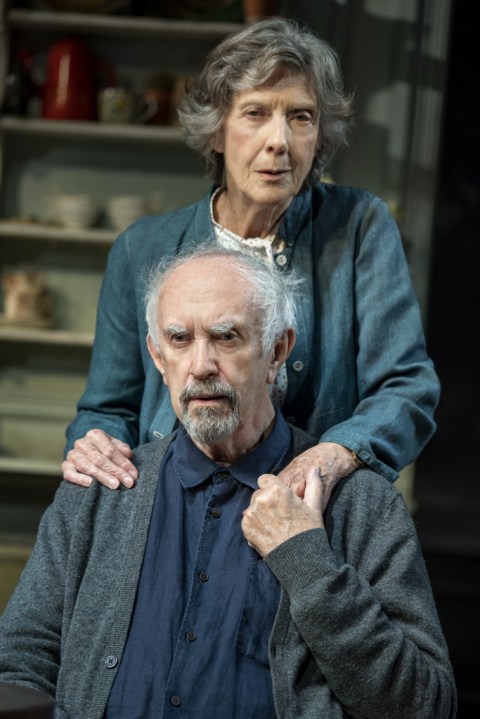
Eileen Atkins, Jonathan Pryce in ‘In the Height of the Storm,’ directed by Jonathan Kent, written by Florian Zeller, translated by by Christopher Hampton (Joan Marcus)
Finally, in the last scene, the daughters leave with all of their obstructions. The couple have the house and memories to themselves. It is a scene of pure consciousness with humor and heartbreak. Only then do we comfortably settle on the determination that when all was said and done, considering André‘s affairs, personality difficulties, and Madeleine’s wifely stoicism and love for her husband, their marriage was a fairly good one and they are together. Of course, Madeleine gets the credit for the unity of their marriage which André acknowledges. But for all our comfort, we may be witnessing the conversation of two ethereal beings in present consciousness, a sardonic irony that Zeller teases us with. Interestingly, with all of our assumptions about who dies first, after that storm, consciousness continues, a resurrection. And the unity the couple established and now share remains uplifted forever.
It seems that one of Zeller’s intents for the play as a series of reflections and vital vignettes that have little arc of development, is to place us in a consternation of misshapen realities that keep us off balance and frustrated until we relax. Such is the haphazard upside down world of those with dementia and those who must negotiate another’s dementia. But the theme also arises that those who live in their beliefs and certainties are not unlike the Alzheimer’s patient. They too may live in a fog of past memories, dreaming up what never happened, only they don’t know it. For both the ill and not so ill, Zeller affirms that glimpses of reality are fleeting; the past or future dominates. Living in the moment is a rarity. But if one is fortunate as both characters are at the play’s conclusion, one lives in a state of agreement and contentment “when the kids have gone.”
Jonathan Pryce and Eileen Atkins make this dense work sing and vibrate it into life, infusing their characters with truth and authenticity. Kudos to the creative team: Anthony Ward (scenic & costume design) Hugh Vanstone (lighting design) Paul Groothuis (sound design) Gary Yershon (original music).
The Height of the Storm runs with no intermission at Manhattan Theatre Club’s Samuel J. Friedman Theatre, 261 West 47th Street. For tickets and times CLICK HERE.
.
Bernard Shaw’s ‘Caesar & Cleopatra,’ Starring Robert Cuccioli and Teresa Avia Lim

Robert Cuccioli and Teresa Avia Lim in Bernard Shaw’s Caesar & Cleopatra, directed by David Staller at Theatre Row (Carol Rosegg)
The Gingold Theatrical Group noted for its Shaw productions is presenting Caesar & Cleopatra directed by David Staller at Theatre Row. The production is a tightly crafted, well-acted revelation of the historic and intriguing relationship as Shaw conceives may have unfolded between Cleopatra and Caesar. Having thoroughly researched their history to examine both their humanity and extraordinary genius, with economy, Shaw reveals individuals worthy of his depiction in interest, humor and vitality.
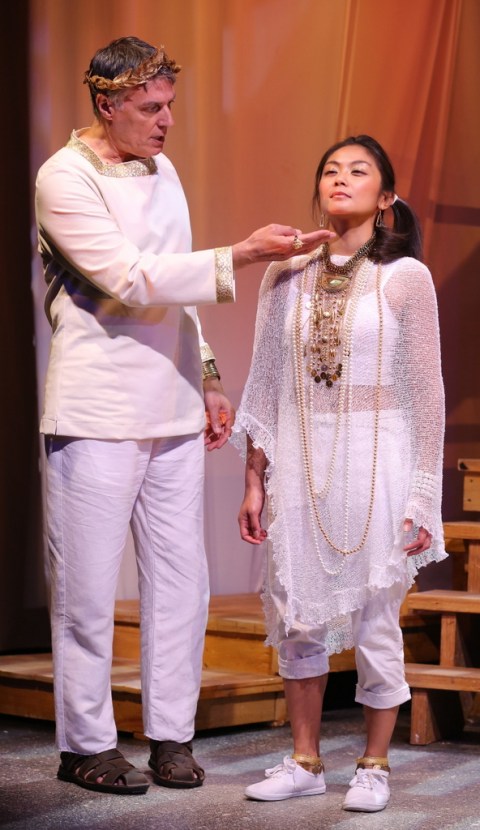
Robert Cuccioli and Teresa Avia Lim in Bernard Shaw’s Caesar & Cleopatra, directed by David Staller at Theatre Row (Carol Rosegg)
The production shepherded by Staller winningly presents the dynamic relationship between Caesar and Cleopatra which engages us with Shaw’s novel/fictional approach toward these icons as he generally follows historical events. The Gingold Theatrical Group has slimmed down Shaw’s version keeping the most salient scenes and consolidating characters providing narration by Ftatateeta (Brenda Braxton in a powerful performance) at the beginning of the production and throughout to fast-forward events and comment on their sequence with poetic persuasion.

Brenda Braxton, Teresa Avia Lim, Robert Cuccioli in Bernard Shaw’s Caesar & Cleopatra’ directed by David Staller (Carol Rosegg)
Caesar is portrayed by Robert Cuccioli whose presence and manner is believably confident, relaxed and princely even after the exhaustion of having just led his troops to conquer the Egyptians. However, knowing anything about Caesar before Shaw’s revelations at this point in the leader’s life, one realizes his personage that was incredible in stature and nobility was acquired over time. His popularity as a leader was grounded upon his military experience and wisdom bringing success to Rome in extending the Roman Empire. Cuccioli acutely engages as he renders this portrait of a man who doesn’t believe himself past his prime. As Shaw has drawn him and as Cuccioli so aptly portrays him, he sports humor, is playful yet has the perspicacity to note that the vivacious, lively teenage girl at the feet of the Sphinx must be Cleopatra, though he twits her about it after he realizes who she is.

(L to R) Teresa Avia Lim, Robert Cuccioli, Rajesh Bose in Bernard Shaw’s ‘Caesar & Cleopatra,’ directed by David Staller (Carol Rosegg)
Nevertheless, Caesar astutely withholds his identity, takes charge, and gains her confidence using her information to apprise himself of the situation. With his non-threatening, non-egotistical, down-to-earth demeanor, Cuccioli’s good-humored Caesar sets the very human rules of his budding relationship with Cleopatra which will serve him in stead as he fulfills his plans to set her on the throne of Egypt and further extend the acquisition of Egyptian lands under the control of Rome. Their’s is friendship, a mentorship, and an affectionate liaison which largely remains political in scope as the life and death stakes are high for both of them. It is a union which is beautifully drawn by Shaw and credibly acted by Lim and Cuccioli.

Brenda Braxton in Bernard Shaw’s ‘Caesar & Cleopatra,’ directed by David Staller (Carol Rosegg)
For her part, Teresa Avia Lim’s Cleopatra follows the arc of development that Shaw has delineated for her, revealing her growth from a child who is reckless and afraid, to a Queen tutored by Caesar in her bearing, wisdom and commanding presence. The scenes between Cleopatra and Caesar are the most fascinating, and Cuccioli and Lim authentically portray the concern, affection and nobility of both individuals as they tug at each other’s strengths and weaknesses. As Lim’s Cleopatra learns how to perceive herself a Queen and believe it fully, Caesar guides her to this end yet is warily empowered to overcome the dangers of the civil strife that threatens in Egypt in the rivalry between Ptolemy and Cleopatra for the throne and the betrayal of Romans who have been compromised by Egyptian leaders.

(L to R): Robert Cuccioli and Teresa Avia Lim, Dan Domingues in Bernard Shaw’s Caesar & Cleopatra, directed by David Staller at Theatre Row (Carol Rosegg)
Ptolemy (humorously effected as a puppet of Pothinus) and Pothinus are the villains in Shaw’s work. Perhaps, Rajesh Bose as Pothinus/Ptolemy is too unctuous and oily to empathize with. However, Cuccioli’s Caesar remains respectful and accommodating lifting Pothinus’ stature, however, annoyed, enraged and jealous Cleopatra is of him as her brother’s controller and representative.
As supporting players Rufio (Jeff Applegate) Britannus (Jonathan Hadley) and Apollodorus (Dan Domingues) provide action and sometimes comic relief in furthering the events when Caesar must grapple with the Egyptians, settle for a time at the lighthouse of Pharos, bring Cleopatra in a carpet to him and eventually swim away from the island to save themselves from the Egyptians who are in fast pursuit until a Roman boat rescues them. The adventures continue as they stand up to the Egyptians because of Cleopatra’s actions in killing a favorite and the annoyed Caesar must sustain the fallout as he and his men keep counsel and strategize after realizing the siblings hatred for each other in a dual rulership will never work.

(L to R): Robert Hadley, Robert Cuccioli, Teresa Avia Lim, Rajesh Bose, Jeff Applegate in Bernard Shaw’s ‘Caesar & Cleopatra,’ directed by David Staller (Carol Rosegg)
The scene when Caesar chides Cleopatra for her lack of clemency is thematically sound and a highpoint of the production along with the various scenes of action. We note Caesar’s wisdom and strength to pardon his enemies and convert them to friends, ignoring looking at incriminating letters Ptolemy has written. Caesar as a man of action with better things to do scorns wasting his time with prosecutions, preferring negotiation and the softer touch to co-opt those who can most do him harm. This is a strength which Cleopatra finds difficulty believing in or duplicating with her own brother and his followers.

Robert Cuccioli and Teresa Avia Lim in Bernard Shaw’s Caesar & Cleopatra, directed by David Staller at Theatre Row (Carol Rosegg)
When Roman reinforcements save the day and Caesar prepares to depart, he promises Cleopatra he will send Mark Antony to her and the rest is “history.” Caesar has proven to be an exceptional tutor in politics and power and Cleopatra has learned as much as her personality will allow. Interestingly, we see the seeds of destruction for both individuals in this play. That Caesar does not wipe out his enemies comes back to haunt him, for the conspirators he pardoned (Cassius, et. al) end up assassinating him.
Cleopatra’s yearning for Antony to be with her (a major flaw in her character is her loneliness) ends up destroying their love and bringing their downfall after Mark Antony does follow Caesar’s bidding to go to Egypt and check on the territory that is under Rome. Shaw plants the seeds of this weakness in Cleopatra at the outset of the play and reveals she never quite overcomes this need which is manifest in her searching for Caesar’s attentions which he can never fully give her because he is too involved in military actions and governing wisely or guiding others to govern wisely without malice and revenge.
This amazing relationship that Shaw has drawn concludes with the only kiss that we see. Caesar gently delivers it to Cleopatra’s forehead and claims he will never see her again. At that Ftatateeta sends the audience out into the night with a rejoinder of peace.
Kudos to the cast who is committed to fine ensemble work and the director who guided them to it. Kudos also goes to the creative team whose efforts assisted in elucidating Shaw’s themes and incredible characterizations. These include: Brian Prather (scenic design) Tracy Christensen (costume design) Jamie Roderick (lighting design) Frederick Kennedy (sound design).
Caesar & Cleopatra runs with one intermission at Theatre Row (410 West 42nd Street) until 12th October. For tickets and times CLICK HERE.
‘Wives’ by Jaclyn Backhaus, Spouses Emerging From the Male Institutions of Future Past

(L to R): Aadya Bedi,Sathya Sridharan,Purva Bedi ‘Wives’ by Jaclyn Backhaus,directed by Margot Bordelon (Joan Marcus)
Wives written by Jaclyn Backhaus directed by Margot Bordelon is a playful, farcical, quasi-philosophical comedy about women freeing themselves from the definitions and oppressions men have “gently” bestowed on them. Considering that most women outlive their spouses today, if women live long after their husbands have died, shouldn’t they be able to redefine their lives into a new evolution? Wives in attempting to grapple with this question features four segments with different settings to reveal how the women, some celebrated, some unknown, confronted their freedom after the dominant male in their lives lost power or expired.
Backhaus’ plays is a series of self-contained vignettes that require the audience to understand a bit about each setting as it twits the character wives and their husbands or in the case of India (third vignette) colonial institutions. The first wife is the amazing, vilified, powerful and ingenious Catherine de’ Medici (Purva Bedi portrays the wealthy Italian noblewoman) whom her relative Pope Clement VII, labeled her marriage to French Duke of Orléans as the “greatest match in the world,” taking credit for the arrangement. When her husband became King Henri (Sathya Sridharan) she was vaulted her into the position of Queen of France. But she rarely saw Henri who favored his mistress Diane de Poiters (Aadya Bedi). Only after ten years when her life as Queen depended on producing an heir, did Cathy begin to have sex with Henri to produce ten children, seven of whom lived to adulthood with her.

(L to R): Purva Bedi, Aadya Bedi ‘Wives’ by Jaclyn Backhaus,directed by Margot Bordelon (Joan Marcus)
Backhaus emphasizes Catherine’s spurning by Henri for Diane with hyperbolic humor. In real life, de Poiters had a lot of influence in the court, most probably because she was twenty years older and more experienced in court politics and intrigue than both Henry and Catherine who were the same age. In the farcical nature of this segment King Henri, Queen Cathy and Diane are hyper-modernized, two-dimensional caricatures to prove the point that women, subject to their husband’s whims, must swallow their subdued portion and be oppressed by them as Cathy was by Henri and Diane. The scene between Cathy and Diane where they scream ghetto-speak epithets to each other is funny and references pointed conflict that women will empathize with. Also, Adina Verson’s cooking lesson in a flippant direct address with a tray of chickens and squishy onion or two provides great humor at the outset of the scene.
Because Backhaus doesn’t indicate why, we are left with the impression that Diane de Poitiers (Aadya Bedi) is perceived to be superior to Catherine (Purva Bedi) for the reason that she is either younger or more flirtatious. The reason is more complicated. Nevertheless, as we note the death of Henri after a jousting match injury and Cathy’s rejection of Diane’s presence from court and removal from Henri’s will, we are heartened by a wonderful twist. The two women end up as friends. Cathy’s reasoning is sound; the court expects them to be enemies, however, as Cathy assumes the power that Henri excluded her from, Diane will become very useful as she was for Henri.
Thus, Backhaus emphasizes that only after the dismissive male husband dies are the women able to assist each other. The theme of how men pit women against each other to dominate and oppress is clear as is the women’s glorious freedom to shine after their oppressors leave the planet for what was a man’s world becomes a woman’s world open to redefinition.

(L to R): Adina Verson, Aadya Bedi, Purva Bedi ‘Wives’ by Jaclyn Backhaus,directed by Margot Bordelon (Joan Marcus)
Each of the vignettes carries this theme of wives being freed coming out from the shadows of their marriage partners. In the second segment another male death occurs: Hemingway’s. Backhaus places us at his funeral with his two former wives and current wife attending as Big Ern (Sathya Sridharan) gives his own eulogy which he wrote and ends with, “I have nothing to say to my wives: Mary Hemingway, Martha Gellhorn and Hadley Richardson. And Pauline.” However, with the exception of Pauline, the mistress who died, the three played by Purva Bedi, Adina Verson and Aadya Bedi have much to say about Hemingway. And what begins with a discussion of themselves after their divorces ends with a humorous “hate fest” about Hemingway as they drink toasts to his death and share the truth with each other about their relationships with him.
To one extent or another each admits that they allowed him to co-opt their lives as he knocked them out from under themselves in his writings, while they helped him with his manuscripts, served him and took a back seat to his glory. With the admission “we can never write ourselves because he wrote our history for us,” each proclaims what they think Hemingway’s legacy is for them, infusing a description of themselves in the terse Hemingway style.

(L to R): Sathya Sridharan, Purva Bedi, Aadya Bedi, ‘Wives’ by Jaclyn Backhaus,directed by Margot Bordelon (Joan Marcus)
Of course the irony is that they are still under his shadow not being able to write or live their own legacy apart from him and his “glory.” Coming late to this realization, but encouraged by the others into understanding, Mary (his last wife) joins in with Hadley and Martha into agreeing that his writing was “shitty.” And in the apex of the vignette, the three women like the witches out of Macbeth together ignite an act of symbolic freedom releasing themselves from their identity of “nothingness” to move themselves out from under Hemingway’s oppressive machismo.
The third vignette takes place in 1921 India and begins from the perspective of a colonial (Mr. Patterson) appointed to guarantee the relationship of England with the Maharaja Madho Singh II by halting the influence of the witch Roop Rai who gives healing sessions to the Maharaja. When Patterson threatens violence to stop the healing sessions which he thinks are dangerous to the Maharaja’s life, Roop Rai places him under a powerful spell that humiliates and vanishes him. In the process the Roop Rai, the Maharaja and the Maharini pledge their unity to each other in resisting colonialism and affirm the future freedom of India that will redefine itself out from under its oppressive marriage to England. But the majesty of the moment is forgotten with the names of the individuals, especially Roop Rai whose genius contributed toward the freedom gained.

(L to R): AdinaVerson, Aadya Bedi ‘Wives’ by Jaclyn Backhaus,directed by Margot Bordelon (Joan Marcus)
Backhaus continues the theme of women’s witchery and power and carries it into the present time in the last vignette under supervision of a picture of Virginia Woolf, the classic, misunderstood feminist of her time. In the basement of a fictional university a witch (a member of a commune of witches on campus who have found a safe space to practice their craft) creates a spell. During the spell an acolyte is encouraged to remove the shackles of her forebears whose mores kept women in demeaned servitude as she untethers herself from “the visions made by men.”
Beginning with an incantation that the acolyte repeats as the witch stirs up the ritual toward freedom, “Everything about you is right,” becomes the rallying cry that gives her confidence to examine her ancestry and claim an evolved identity where she can be anything and everything. In this final segment the acolyte, like the other burgeoning feminists we have seen before her (Catherine, Mary, Martha, Hadley, Roop Rai) finds herself, then defines her own being in a poetic direct address to the audience. Purva Bedi Adina Verson and Aadya Bedi and Sathya Sridharan play the various parts.

(L to R): Sathya Sridharan,Purva Bedi, Aadya Bedi, Adina, ‘Wives’ by Jaclyn Backhaus,directed by Margot Bordelon (Joan Marcus)
Wives is a heady production revealing how women in various times discovered their power after the male presence whether paternalistic, macho, colonial or socially institutional is disappeared. Backhaus’ ideas cohere in the script but at times become disjointed in the transference to live stage performance. Some of the problem is in the line delivery; sometimes accents get in the way of intelligibility so that meaning and connections are lost.
The conclusion was beautifully rendered, however, and I couldn’t help but consider in the hope expressed was the great tragedy of the women who had gone before whose genius was repressed by institutional power (paternalistic, colonial, chauvinistic) because of fear. It is as if women, not being allowed or not allowing themselves to realize the fullness of their completion was a wasteful sin of the ages. Backhaus’ work is a great encouragement to the present and future generations of women in the hope that the past will not raise its ugly, deformed head to devour the present strides in women’s enlightenment and contributions of their greatness.
Kudos to the creative team: Reid Thompson (scenic design) Valérie Thérèse Bart (costume design) Amith Chandrashaker (lighting design) Kate Marvin (sound design and original music) J. Jared Janas (hair and wig design).
Wives runs at Playwrights Horizons (West 42nd St. between 9th and 10th) with no intermission until 6th October. For tickets and times CLICK HERE.
‘Derren Brown Secret,’ is a Stunner, a “Mind” Field, Raising Illusions to Unforgettable Art!
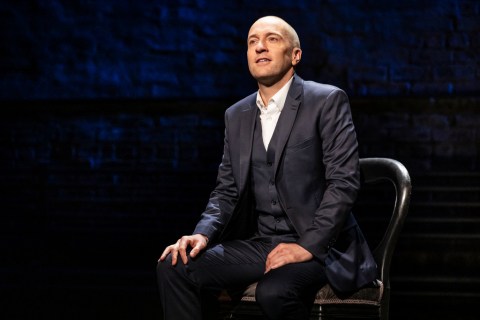
Derren Brown SECRET, written by Andy Nyman, Derren Brown & Andrew O’Connor, directed by Andrew O’Connor, Andy Nyman at the Cort Theatre (Matthew Murphy)
Derren Brown SECRET in its first time on Broadway at The Cort Theatre is nothing short of brilliant. Every illusion that Brown performs to perfection with scintillating charm and lightening smoothness, I have figured out! No! I haven’t. But I am still trying my damnedest two days after I saw Wednesday night’s show. And I am completely frustrated because the only way I will ever know is to ask Derren Brown or another magician to affirm whether my explanations might be correct. So, I’m at an impasse. However, I may know “the secrets” if I research/practice mesmerization, hypnosis and psychological manipulation or read about Brown’s iconic mind control exploits in the UK, which are each one of them harrowing “mind fucks” of entertainment that end up being great, harmless fun. Hmmm!
From convincing middle managers to commit armed robbery, to sticking viewers at home to their sofas, Brown may be one of the foremost masters of mind control in the world. Indeed, he makes President Donald Trump look like a crass sharpie. Thankfully, Brown is a mild-mannered English gentleman with a posh accent who paints and obviously enjoys what he does and will not run for the U.S. Presidency. If he ever does, the country would be in… Well, actually, perhaps he should run. Too bad there is a citizenship requirement. His honesty alone would be absolutely refreshing.

Derren Brown SECRET, written by Andy Nyman, Derren Brown & Andrew O’Connor, directed by Andrew O’Connor, Andy Nyman at the Cort Theatre (Matthew Murphy)
Seriously, Derren Brown is no joke. He is awe-inspiring. And this production will win awards because it is a lesson in human experience, crowd psychology, mind control, the power of suggestion and one’s inability to resist what is already in the unconscious, especially if one attempts to resist it. That is to say, the show is a lesson not only in illusion and mind manipulation and the mysterious, it is above all a lesson in audience participation and a revelation of you as an audience member in a dual role of watching yourself in all your unsubtle susceptibility and experiencing your psychological weaknesses.
It must also be a learning experience for Derren Brown. Indeed, he is always perfecting his artistry, honing his senses and his psychological talents. Whatever it takes to uplift his craft and ability to gauge the audience and manipulate them to a heightened interactive performance so that they stay in dynamic one accord, Brown appears to be pursuing this to the highest degree.
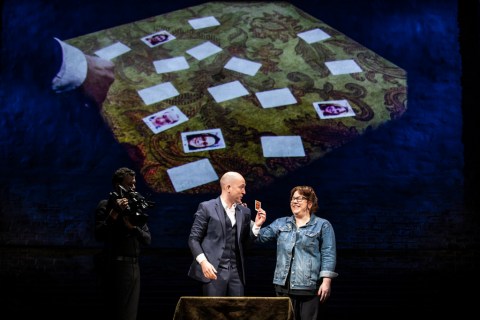
Derren Brown SECRET, written by Andy Nyman, Derren Brown & Andrew O’Connor, directed by Andrew O’Connor, Andy Nyman at the Cort Theatre (Matthew Murphy)
The audience’s “one accord” changes which makes each and every performance fabulous. Diverse audience members are a historical treasure of synchronicity and singularity. To bring audience members “there” who come with unusual lives and schedules and backstories is an impossibility made possible by their will and desire to be “there.” So to say that each night of Derren Brown SECRET is unique, is an understatement. An understatement of understatement. The audience’s and Brown’s particularity is what places this show at the pinnacle of live solo performance. Because of this exceptionalism Brown has deservedly won the Drama Desk in 2017 for his debut show, Secret. And he has won two Olivier Awards and five nominations. a record for one-person shows since the inception of the Olivier Awards.
Derren Brown SECRET showcases the illusory as high artistic execution. Brown begins the first act by reminding us that in our minds the world we live in is our own definition/explanation/fiction. Our perception is our choice, what suits us, probably learned or rejected or somewhat retained from our parents and/or the culture is ours and ours alone.

Derren Brown SECRET, written by Andy Nyman, Derren Brown & Andrew O’Connor, directed by Andrew O’Connor, Andy Nyman at the Cort Theatre (Matthew Murphy)
These moments of wisdom Brown employs throughout to gain our confidence and convince us that he is on our side. Of course his honesty and wisdom relaxes and blinds us to our own susceptibility to ourselves. It is a glorious misdirection, a mesmerization. Indeed, throughout the show, we will forget what we have just witnessed in plain sight and remember only unconsciously that which is inaccessible. The joke is on us and we laugh, yet are unsettled. Is this what is going on all day, every day, at work and at play? Oh, my God!
I watched carefully, so “out of the corner of my eye” in my peripheral vision I saw, what Brown told us would happen, then forgot I saw it. Yes, it did happen, but I missed it. Twice! Brown upends, distracts, and with verbal legerdemain disappears the visible, all the while warning us what to expect. His honesty is treacherous and exciting.
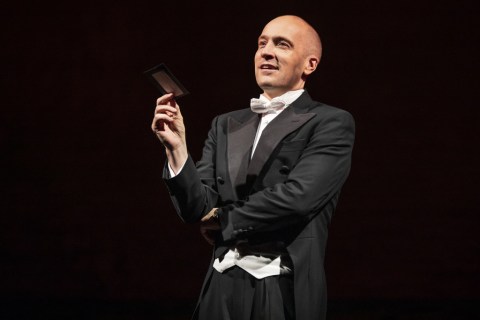
Derren Brown SECRET, written by Andy Nyman, Derren Brown & Andrew O’Connor, directed by Andrew O’Connor, Andy Nyman at the Cort Theatre (Matthew Murphy)
This is also a production in encouraging an audience member’s humility. Whenever I think that “I’ve arrived,” all I have to remember is a gorilla and a banana and Derren Brown to deflate my self-important arrogance. To understand what I mean, you must see the production. There is no spoiler alert.
Completely necessary for this show’s success is audience trust. Thus, to elicit audience participation to a maximum of effect, a good deal of this unparalleled production includes mentally massaging the audience which Brown does surreptitiously; he is a cypher with fragrant oils, gentle, quick hands. Meanwhile, this congeniality brings out audience interactions and responses which are authentic, humorous, genuine, unaffecting, human, all guided by Brown with adroit good will.
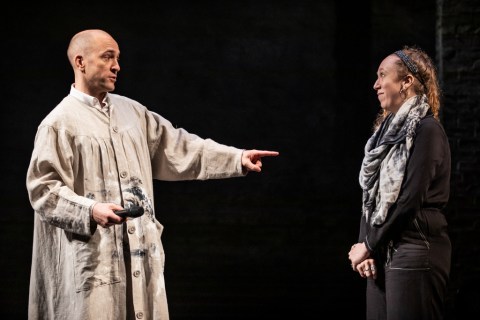
Derren Brown SECRET, written by Andy Nyman, Derren Brown & Andrew O’Connor, directed by Andrew O’Connor, Andy Nyman at the Cort Theatre (Matthew Murphy)
Audience interactivity and seeming spontaneity are rather “a character” along with Brown, whose persona is confident, wise, gently suggestive, witty, comfortable and youthfully avuncular. The audience responds by going onstage, as well as by thinking and sitting in their seats as they watch close-up projections of what is going on via the back wall. If you are in the audience, whether Brown chooses you to join a few others onstage for various illusions, or asks you to think of a celebrity, or asks you to think of a question for him, or write a question, or catch a “frisbee-thingy,” you are involved mentally, though you might passively think you are simply observing. And if you go unconscious and sleep? You are really interacting; you may stand up and walk down the aisle toward the stage!
I can only suggest the aftereffects of his mysterious illusory psychological craft and a bit of my amazement at the audience’s hushed, unified, “mind field” response in an example that is glorious and indescribable, though I will try. During the show Brown offers autobiographical information as patter to endear us to him. The story he shares about his deceased grandfather who enjoyed mysteries and magic is charming, humorous and a bit heartbreaking as Brown relates, it lovingly. Then Brown incorporates this story in an illusion. The night I was present, this involved bringing a woman participant on stage. Brown asked her a few questions about her relationship with a grandparent.
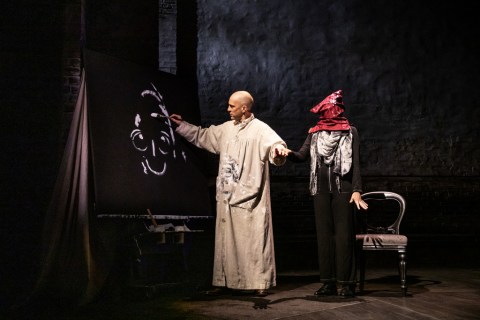
Derren Brown SECRET, written by Andy Nyman, Derren Brown & Andrew O’Connor, directed by Andrew O’Connor, Andy Nyman at the Cort Theatre (Matthew Murphy)
Brown crafted an extemporaneous event with the woman participant involving the audience in its creation. During these sterling moments the attentive audience, the woman participant and storyteller Brown become spectators in a joyous fabrication that was unimaginable beforehand and unfathomable after Brown concludes with a philosophical, metaphorical and mysterious flourish. From start to finish the entire audience was breathless, engaged, inspired and the woman participant was gobsmacked.
For those lovely moments, Brown returned us to the innocence of childhood in our first heartbeats of wonder. That is one of the beauties of this production, Brown’s continually igniting our imagination to fly to the realms of the supernal. But Brown does set us gently down into reality, afterward. We know we’ve been “had.” But it’s ok. Maybe we’ll become more learned about ourselves and more forgiving of our susceptibilities to return to a true place of wonderment after-all.
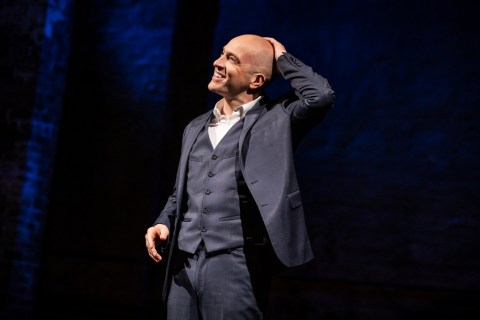
Derren Brown SECRET, written by Andy Nyman, Derren Brown & Andrew O’Connor, directed by Andrew O’Connor, Andy Nyman at the Cort Theatre (Matthew Murphy)
Explaining such illusions spoils the fun of the unknown. That’s why Derren Brown SECRET is celestial. The show is a mystery, wrapped in a box (like one of the illusions) of riddles filled with the fantastic and there are no explanations. Even the ushers are sworn to secrecy. I’m still trying to shake the thought that I’ve been screwed with mentally as I love to figure things out, and I’m annoyed that I’m not quite there yet. But that’s a part of what the power of suggestion does. Someone suggests. The more you fight it, the more you are hooked. Better to go with the flow and then the extraction from the spider’s web will come in due time.
Brown is an ADEPT. He mesmerizes in the direction you think you are going then find out that you are somewhere else completely. He is dastardly, wicked fun and the evening disappears like a shot. Maybe I need to return to “get” what I missed. But what if I miss it again? More frustration!
Of course that’s one of the many points that Derren Brown, performer and co-writer (with Andy Nyman and Andrew O’Connor who also directed) makes in this starry-minded, ephemeral, psychically untouchable production. Intriguingly, if you think that the audience has been planted with Brown’s co-conspirators to effect his “stupid pet tricks,” that is a simple yet profound error prompted by frustration. Unless you are an exceptional mesmerizer yourself and are a genius at misdirection and ledgerdemain like he is, you will not arrive at an explanation. But why even bother? It is a fabulous joy being returned to child-like innocence where all manner of spiritual mysteries are real, having been beaten out of us by ourselves after whatever ill wind blows.
Kudos to the creative team who enhance the enjoyment all the more: Takeshi Kata (scenic design) Ben Stanton (lighting design) Jill Bc Du Boff (sound design) Caite Hevner (projection design). Derren Brown SECRET runs with one intermission at the Cort Theatre (West 48th Street between 7th and 6th) until 4 January. I dare you to go!!! For tickets and times CLICK HERE.
‘Fern Hill’ Starring John Glover, Jill Eikenberry and Mark Linn-Baker at 59E59 Theaters, a Sharp, Non-formulaic Comedic Drama About Friendship

(L to R): Mark Linn-Baker, John Glover, Mark Blum, Jill Eikenberry, Jodi Long, Ellen Parker in Michael Tucker’s ‘Fern Hill’ directed by Nadia Tass at 59E59 Theaters (Carol Rosegg)
Fern Hill by Michael Tucker is about three couples in their golden years who hope to confront the next phase of their lives with joie de vivre and vibrance. The idea of spending one’s last years in the bucolic farmhouse haven, whose name is an allusion to the Dylan Thomas poem “Fern Hill,” where Thomas spent his childhood, is a pleasurable one for the characters. Directed by Nadia Tass, Tucker’s play offers the opportunity for superb actors to shine in a comedy-drama that is relentless, “in your face,” human and clever.

(L-R): Mark Blum, Mark Linn-Baker in Michael Tucker’s ‘Fern Hill’ directed by Nadia Tass 59E59 Theaters (Carol Rosegg)
The award-winning cast (Mark Blum, Jill Eikenberry, John Glover, Mark-Linn-Baker, Jodi Long, Ellen Parker) whose combined credits in theater, film and television number over one hundred are simply divine. Throughout, they remain inspired to hit the emotional notes and spark the humor with resonating heat at every turn. The plot twists gyrate the play into increasingly subtle directions until the inevitable result concludes with realism and poignance. Tucker’s thematic points about love, aging, sex, friendship, alienation in marriage, intimacy and more settle well because of fine ensemble work and authentic, moment-to-moment performances.
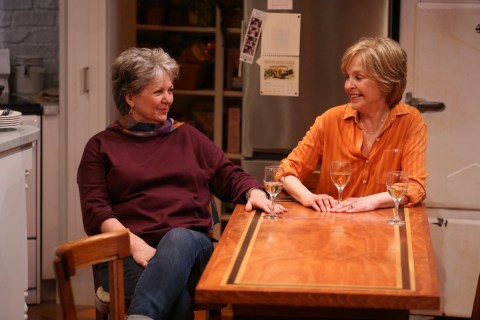
(L to R): Ellen Parker, Jill Eikenberry in Michael Tucker’s ‘Fern Hill directed by Nadia Tass at 59E59 Theaters (Carol Rosegg)
Initially, the gathering of couples feels like a hippie reunion from the early 1970s. But we discover these individuals have advanced together in friendship and collegiality teaching at a university. Additionally, they have launched themselves in careers as professional artists (painters, writers, photographers and even a musician rocker in a band) who attempt to make a difference as they offer their talents to the world and each other for stimulation, fun and growth. These are the perfect friends to have. They share the same values and intelligence with high social IQs. Indeed, their interactions at “Sunny and Jer’s” farmhouse located upstate in Fern Hill are similar to those represented in Lawrence Kasdan’s film The Big Chill (1983). However, unlike the companions in the film who have not seen each other in five years, these couples frequently meet up and have long-lived friendships that have weathered storms.

(L-R): Jodi Long, Mark Linn-Baker, Ellen Parker, John Glover in Michael Tucker’s ‘Fern Hill’ directed by Nadia Tass at 59E59 Theaters (Carol Rosegg)
Playwright Tucker through Tass’ amiable direction has weaved a happy tableau which we cannot conceive will ever end. And for precious moments the ensemble has made us feel so comfortable that we are happy to witness and be a part of their clan while they enjoy themselves riffing, joking, eating and drinking together. But as we are lulled into their “play,” reality hits with Vincent’s (John Glover) announcement about his hip-replacement. Though Vincent is older, the deterioration that comes with mortality has begun in earnest it seems.
And especially for the men, the creep of fear is plaguing each of them. In this pleasant farmhouse of joy, all does not really bode well. Despite the satisfaction of achieving successful careers, artistic purpose and comfortable lifestyles, the question looms: what remains next for Sunny (Jill Eikenberry) and Jer (Mark Blum), Billy (Mark Linn-Baker, who is a younger, lighter version of David Crosby of the band Crosby, Stills and Nash) and Michiko (Jodi Long), Darla (Ellen Parker) and Vincent (John Glover)? The answer is daunting. After all, “aging is not for sissies” (Bette Davis’ oft quoted comment).

Jill Eikenberry, Mark Blum in Michael Tucker’s ‘Fern Hill’ directed by Nadia Tass at 59E59 Theaters (Carol Rosegg)
Thinking outside the box during the last four months, these buddies have discussed the finest way to stave off the horror of aging, isolated, alone and desolate among strangers. Rather than be blind-sided by disease, loneliness and depression in the narrow construct of Assisted Living Centers and Nursing Homes, on this birthday celebration for Jer and Billy, they cement their agreement to live together as a commune at Fern Hill so that they can help each other as they transition into the next great adventure after retirement and moving toward their irrevocable sunset.
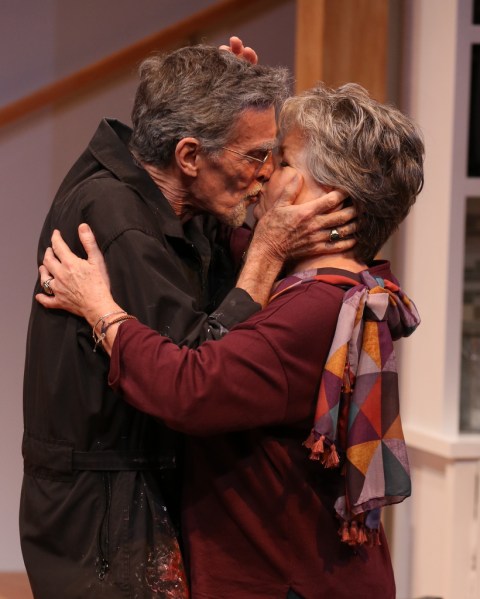
John Glover, Ellen Parker in Michael Tucker’s ‘Fern Hill’ directed by Nadia Tass at 59$59 Theaters (Carol Rosegg)
The playwright takes a while to set up this idyllic place with divine companions that we can visualize living together as an exceptional solution to the nation’s dire aging institutionalization foisted upon older citizens. So we don’t get why Jer attempts to end their discussion and close down a fabulous idea as a fantasy. Even his reasons appear lame: he doesn’t think they can live together; they will sabotage their closeness and loving relationships and end up without each other. When he becomes irate about it, we sense there are deeper reasons.

(L to R): Mark Linn-Baker, Mark Blum, Jill Eikenberry, Jodi Long, Ellen Parker, John Glover in Michael Tucker’s ‘Fern Hill,’ at 59E59 Theaters. (Carol Rosegg)
Tucker spins the plot twist abruptly in a few revelatory lines. Sunny shatters the peace, love and community of friends on this lovely evening with an explosion of truth. This truth threatens to nullify all their efforts at a togetherness that has encouraged power, integrity and strength. Deceitfulness like the worm of age leers at each of the characters so that they must check themselves and deal with this problem between Sunny and Jer which is also their problem.
It is fascinating to watch character responses. The wisdom and humor that emerges engages with honesty and love. And regardless of whether their camaraderie appears a bit fantastic or completely possible, Tucker has written a fine work that is grounded in logic and constructed brick by brick with solid characterizations. Finally, the actors’ portrayals are spot-on so that every segment of the journey that Sunny and Jer take to where they must go to resolve their relationship issues makes sense and seems right. Encouraged, we have followed them recognizing ourselves in their foibles and earthy humanity.
This is a terrific production made all the more exceptional by the performances and direction. Kudos to the creative team without which this ensemble piece would not have been neatly realized: Jessica Parks (scenic designer) Patricia E. Doherty (costume design) Kate MGee (lighting designer) Kenneth Goodwin (sound designer).
Fern Hill is currently running at 59E59 Theaters (59E59th Street between Madison and Lexington) with one intermission until 20 October. For tickets and times CLICK HERE.
‘Moulin Rouge! The Musical’ Celebrates the Seductive Delights of the Iconic Venue in a Sumptuous Feast for the Senses

(L-R): Jacqueline B. Arnold, Robyn Hurder, Holly James, Jeigh Madjus in Moulin Rouge! The Musical, book by John Logan, Music Supervision, Orchestrations, Arrangements & Additional Lyrics by Justin Levine directed by Alex Timbers (Matthew Murphy)
The moment you enter the Al Hirshfeld Theatre, a paradise of sensuality embraces your soul and immerses you in the suggestion of hedonistic pleasure. Immediately, you are “eyes wide open,” moving along a course where anything is possible, even an after hours engagement with one of the male, female or transgender perfections of beauty, scantily but tastefully adorned, who saunter on the catwalks and peer out at you from the stage. Undulating rhythms and sensual music in this Bohemian, Paris, Left Bank cabaret/theater/dance hall soothe and allure. The luxurious red and gold appointments, the deep cherry and red velvet variegated stage curtains, the banquets, chandeliers, gleaming brass, the golden cherubim all whisper romance, sex, excitement and a whirlwind of indulgence. Whoever you are, you will be encouraged to understand that you can achieve your vision of an exalted life, a life where freedom, truth, beauty and love raise you above a bruising and squalid reality out there on the dark streets.

Danny Burstein in Moulin Rouge! The Musical, directed by Alex Timbers (Matthew Murphy)
This is the Moulin Rouge Club at Moulin Rouge! The Musical. Expect the finest in fantasy and escapism. If your intellect and imagination are ripe to receive, you will never be the same again! As you sense this revelation La Chocolat (Jacqueline B. Arnold), Nini (Robyn Hurder), Arabia (Holly James), Baby Doll (Jeigh Madjus), parade their “stuff” and throatily grind to the beats as they torch out “Lady Marmalade,” in an unforgettable opening number joined by the ensemble. This full throttle ignition is brilliantly conceived with grand style and prodigious effort by the creative team. My God, what a triumph!

(L to R): Sahr Ngaujah, Aaron Tveit, Ricky Rojas in Moulin Rouge! The Musical, directed by Alex Timbers (Matthew Murphy)
The production directed by the illimitable Alex Timbers, with a clever book by John Logan (based on the 2001 Twentieth Century Fox Motion Picture written by Baz Luhrmann and Craig Pearce, directed by Baz Luhrmann), with “to-die-for” music supervision, orchestrations and arrangements by Justin Levine is a towering majestical remembrance of what never was but might have been during La Belle Époque in Paris and specifically at the fin de siè·cle. From the on-point luxurious, sexy, ravishing costumes by Catherine Zuber to the energetic, aggressive, dance numbers choreographed by Sonya Tayeh, this musical is a non stop festival. “Bad Romance” is especially gravitating as a thrilling, energetic, “lemme consume your lips,” head to head, face-off with couples gyrating to the hot Lady Gaga song which thematically epitomizes the romance among the principal couples: The Duke of Monroth (Tam Mutu), Satine (Karen Olivo), Christian (Aaron Tveit), and the lesser lights: Santiago (Ricky Rojas), and Nini (Robyn Hurder), all of whom are sensational in voice, and character portrayals.

Karen Olivo Aaron Tveit in Moulin Rouge! The Musical, directed by Alex Timbers (Matthew Murphy)
Baz Luhrmann and Catherine Martin provided their creative services to the production which is an update of their ground-breaking, award-winning film Moulin Rouge (2001). And indeed, the basic arc of development inspired by a meld of characters and plots from Giuseppe Verdi’s opera La Traviata and Giacomo Puccini’s La Boheme remains with added tweaks of humor, phantasm and fun, delivered by incredible performances, perhaps the most preeminent charismatic, chameleon of of them all being the gobsmacking Danny Burstein.

The Company, Moulin Rouge! The Musical, directed by Alex Timbers (Matthew Murphy)
Burstein is a mesmerizing scene stealer. Amidst the splendiferous sets (Derek McLane), and shimmering, vibrantly lit (Justin Townsend), festivities, Burstein, as the club’s artistic owner/showman Harold Zidler, is the “God-like” host of confabulation. And he is damn good at it, in fact so adorable that we understand how and why Harold has kept his “chickens” together through thick and the current financially thin stage of the Moulin Rouge Club’s history. As Burstein’s Harold winningly controls our imaginations and guides the glory and spectacle, we willingly follow him believing he has our best interests at heart because to him there is no sin, no judgment. Within this space and for this night, we are free to be our fantasies.

Tam Mutu in Moulin Rouge! The Musical, directed by Alex Timbers (Matthew Murphy)
What this production does exceedingly well is reveal that the Moulin Rouge Club into which Zidler has put his heart, soul and every red hot cent he owes is an artistic production down to the lavish sets and well-heeled orchestra. And he and the ensemble live for this art. Thus, Burstein’s performance is a revelatory genius of Zidler’s dedication and desperation. Motivated by his craft and concern for his artistic family, his character’s steely sweetness is genuine, his charm and love is pure without oily ingratitude or predatory insidiousness. Above all he makes clear in the behind the scenes discussions with Olivo’s Satine, that his desire is to supply his patrons’ complete enjoyment so his company will survive and remain off the streets and away from the impoverished hellishness they all came from.
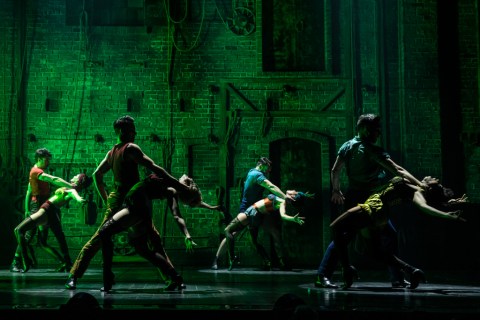
Moulin Rouge! The Musical, The Company, directed by Alex Timbers (Matthew Murphy)
Likewise, Satine’s love for Zidler and her company of friends and compatriots, one of whom is the great painter Toulouse-Lautrec (the very fine, grounded Sahr Ngaujah), reveals they understand the club’s liquidity is their life and happiness. Thus, Satine’s characterization is profound. She is the “read deal:” she is their salvation, their mother, their friend, their life-blood, their sacrifice. The sense of love and community among the ensemble is palpable so we believe Burstein’s Harold when he insists that Satine should “go to hospital,” as her friends insist as well. Without her, they are lost.
Karen Olivo’s Satine is a sensual, hot, earth-mother and high-class courtesan, experienced, wise, unmoved. She is not an ethereal beauty, but dominant, solid in will, though failing in flesh. She is a perfect symbol to represent what Harold’s artistic creation stands for, a lotus risen from the mud into full flower which will fade quickly. Olivo’s fullness of voice soars during her duets with Tveit’s Christian who is her equal in range, power and sensitivity. “The Elephant Medley” (the love song riff mash-up they sing in her boudoir as a “come-on” and “let-down”), that has been enhanced with additional numbers is just smashing.
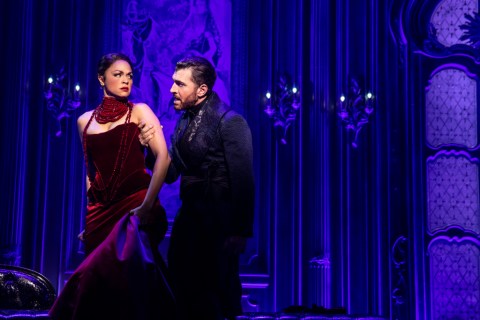
Karen Olivo, Tam Mutu, Moulin Rouge! The Musical, directed by Alex Timbers (Matthew Murphy)
Her introduction by Zidler as the “jewel” of the Moulin Rouge Club as she descends on a trapeze singing the “Diamond Medley” symbolizes her ethos and the club’s centrality as a necessity in the hearts of a society at that time and perhaps for all time. Escapism is in; it always was and always will be. The more authentic the fantasy, the better. And Satine, like Zidler, are exceptional conveyors. Their importance is an equivalent to their patrons’ happiness. Thus, she is fitting as a timeless symbol of the club; their interwoven stories will always resonate and instruct with wisdom, which like a diamond shines but cuts.
Obviously, Logan’s book adapted from Luhrmann’s and Craig Pearce’s film, reflects depth in its simple story of artists attempting to survive in a carnivorous world, as they use their charms and love inducements to glean wealthy backers. And all goes well, until the artists are hoisted on their own petard of humanity, and they fall fatally in love, and others fall fatally in lust with them. As cultural icons, artists cannot be owned or even possessed. (a not so subtle message to philistines everywhere). Satine and Zidler belong to their art, themselves and the world, as Ngaujah’s Toulouse-Lautrec affirms despite The Duke of Monroth’s insistence that Monroth owns the club and all its performers. This is another intriguing theme. When art is put in the hands of philistine owners, it crumbles for they lack the talent, will and spirit to create. Instead, they should uplift the brilliance of creators like Zidler. He knows how to draw the crowds but lacks the finances to sustain the Moulin Rouge Club.
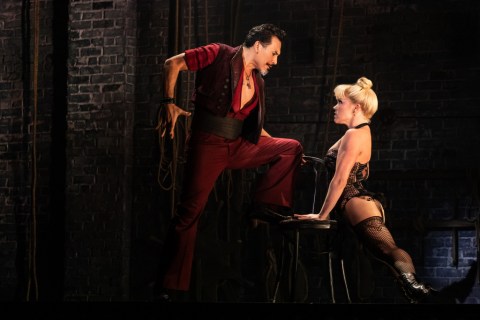
Ricky Rojas, Robyn Hurder, Moulin Rouge! The Musical, directed Alex Timbers (Matthew Murphy)
The scenes when Lautrec and the company rehearse and Mutu’s Duke attempts to assist are particularly to the point and humorous. Monroth’s ego gets in the way after he senses he has lost Satine to Christian. Yet, he is willing to keep her despite her lack of affection for him. And his jealousy rises to spoil the show, as Christian’s jealousy rises to provoke the Duke. Yet, the show must go on, but how? Satine, once more must “save the day,” but she is not immortal.

Aaron Tveit, Karen Olivo, Moulin Rouge! The Musical, directed by Alex Timbers (Matthew Murphy)
As rivals for her love and lust Tveit’s Christian and Mutu’s Duke are worthy. The intricacies of plot which involve Satine’s eventual love for the innocent and consumed Christian, and sexual enticement of the Duke are woven adroitly. Particularly delightful are Mutu’s mash-up of Mick Jagger’s songs (his “Sympathy for the Devil” could have gone on longer). And the conversion of lyrics to a male orientation for Rihanna’s “Only Girl” are hilarious. Mutu manages to be wicked but sexy and seductive. His intentions are insidious but he retains the exceptionalism of aristocracy that assumes privilege from generational wealth that goes back centuries. Importantly, it is the humor in Mutu’s depiction that keeps him interesting and edgy and not loathsome, which is in keeping with the comedic tone of the production.
As a keen and successful rival, Tveit expertly tweaks the humor related to Christian’s, creating his compositions in the funny scene when he first befriends Lautrec and Santiago. He does this with expert timing and together the three render their exchange into pure farce. His “Ohio” demeanor evolves by the conclusion from a “lad” to a man who “comes into his own.” He is every inch the authentic lover. His duets with Satine in which they both feed song refrains to each other are happily playful, suggestive and grounded. And in the delivery of his last songs, Tveit is amazing, heartfelt, sonorous. As a couple in a loving affair that grows into something more, Tveit and Olivo strike powerful resonances.
Nothing more can be lauded about Mouline Rouge! The Musical except that the sound design by Peter Hylenski was on point, balanced, targeted. I heard words from well known songs that I never “got” before, for example Katy Perry’s “Firework,” which Olivo sends into the heavens as a PURE WOW! Thus, I could greater appreciate the character development, the themes, symbols, the ironies, the true riches of this mythic production because the song mash-ups and medleys were crystal clear.
This is a Broadway show in the true spirit of New York City’s greatness. To see these performers, you should get tickets immediately and order another set to revisit a month or two out. I guarantee that seeing it again, you will note many other elements that you missed the first time around as you peel back layers. If you can’t see it again, some of the music is on YouTube. Check for updates.
The show runs with one intermission at the Al Hirschfeld Theatre on West 45th street. For tickets and times CLICK HERE.
The cast album is currently available for streaming at https://smarturl.it/MRtheMusical
‘L.O.V.E.R.’ a Personal Take on Sex and Love, Written and Performed by Lois Robbins

Lois Robbins in ‘L.O.V.E.R.’ written and performed by Lois Robbins, directed by Karen Carpenter (poster courtesy of the production)
So what’s life like for a lovely Jewish girl as she evolves into a lovely Jewish woman who marries a few times and has a fulfilling family life with husband and children after a long inquiring journey toward finding her voice? Lois Robbins (TV Land’s “Younger”; Cactus Flower) directed by Karen Carpenter (Love, Loss, and What I Wore) in her solo, one-woman show L.O.V.E.R. explains it all to you with tongue-in-cheek humor and great good will. As she entertainingly confesses her journey of many loves, she explains how she reconciles her loves and and losses to settle into her own measure of womanhood, confident and serene at the last.
With scenic design by Jo Winiarski, lighting design by Jeanette Oi-Suk Yew, sound design by Jane Shaw and styling by Fayola Ricotta, Lois Robbins’ woman shares her early stories of budding sexuality before she even realized what she was doing (masturbating) but it “really felt good.” There wasn’t an edge of a table or a vibrating washing machine she didn’t pass up. It was only much later in her burgeoning sexual love life did she realize what she had accomplished as a youngster.
The retelling of these events during her childhood are humorous and playful. Certainly, she had found a source of comfort and enjoyment without the stigma of “religious” guilt dumped on her. This is the first of Robbins’ bravo moments. Her happy-go-lucky attitude and finesse steer the show through many such fun, lively, authentic moments.
From this young age Robbins chronicles her youth and beyond. The stories she spins of boyfriends and relationships eventually bring her to the doors of marriage which she relates as a unique adventure with her first husband. Throughout, her quips and commentary resound with humanity and wit. She always seems to land on her feet as wisdom trails her journey into divorce and a second marriage which satisfies.
Both men and women will enjoy Robbins’ energy and vitality as she relates a variety of tales that are humorous, unusual and memorable. Throughout, we are reminded of ourselves in young love, impulsivity, marriage, relationship woes, mishaps and sheer zaniness. And then as Robbins so eloquently relates, she matures to understand the impact of her actions on herself and others. As this canny woman pulls herself together, she walks on the lighter side of life. By doing so she gains our empathy and we enjoy sitting back and listening to the final events in her evolution as a woman, who at the end, is able to define for herself what the letters L.O.V.E.R. mean for her.
This vibrant comedy is for you if you are looking for a break from darker aspects of love, life and relationships that end abruptly or sour into bitterness. There is little of the cryptic or cynical here. That is refreshing! Robbins’s gift is her ability to engage the audience as a confidante. Gradually, willingly the audience travels with her on her adventures as a listening friend. Robbins has mastered a relaxed delivery shepherded by the apt direction of Karen Carpenter. And with the use of the minimalistic set (stairs wrapped in a flowing sheet as an everpresent reminder where love often happens, between the sheets) the solo performance slips by with ease to achieve its satisfying conclusion.
L.O.V.E.R. is enjoying its Off Broadway premiere. It runs without an intermission at The Alice Griffin Jewel Box Theatre (480 West 42nd Street) at The Pershing square Signature Center. The last performance is Saturday, 2 November. For tickets and times CLICK HERE.

